
A English
The DNA Questions in English
Class 12 Biology · Molecular Basis of Inheritance · The DNA
632+
Questions
English
Language
100%
With Solutions
Showing 48 of 632 questions in English
301
MediumMCQ
One turn of the helix in a $B$-form $DNA$ is approximately (in $nm$)
A
$2$
B
$20$
C
$0.34$
D
$3.4$
Solution
(D) The correct answer is $D$.
In a $B$-form $DNA$ double helix,the structure consists of two antiparallel polynucleotide strands coiled around a common axis.
The distance between two adjacent base pairs is approximately $0.34 \ nm$ $(3.4 \ \mathring{A})$.
Since there are $10$ base pairs per turn of the helix,the length of one complete turn is $10 \times 0.34 \ nm = 3.4 \ nm$ $(34 \ \mathring{A})$.
In a $B$-form $DNA$ double helix,the structure consists of two antiparallel polynucleotide strands coiled around a common axis.
The distance between two adjacent base pairs is approximately $0.34 \ nm$ $(3.4 \ \mathring{A})$.
Since there are $10$ base pairs per turn of the helix,the length of one complete turn is $10 \times 0.34 \ nm = 3.4 \ nm$ $(34 \ \mathring{A})$.
0 likes
View Solution302
MediumMCQ
Antiparallel strands of a $DNA$ molecule means that
A
one strand turns clockwise
B
one strand turns anti-clockwise
C
the phosphate groups of two $DNA$ strands,at their ends,share the same position
D
the phosphate groups at the start of two $DNA$ strands are in opposite position (pole).
Solution
(D) $DNA$ is a type of nucleic acid that forms the genetic material in many organisms.
It consists of a long polymer of nucleotides.
It is a double helical molecule.
The two strands of $DNA$ run in opposite directions to one another,held together by hydrogen bonds.
One strand of $DNA$ has a $5' \rightarrow 3'$ direction,and the other strand has a $3' \rightarrow 5'$ direction.
This is why they are called antiparallel.
This orientation is determined by the presence of a free phosphate group at the $5'$ end and a free $OH$ group at the $3'$ end of the sugar-phosphate backbone.
It consists of a long polymer of nucleotides.
It is a double helical molecule.
The two strands of $DNA$ run in opposite directions to one another,held together by hydrogen bonds.
One strand of $DNA$ has a $5' \rightarrow 3'$ direction,and the other strand has a $3' \rightarrow 5'$ direction.
This is why they are called antiparallel.
This orientation is determined by the presence of a free phosphate group at the $5'$ end and a free $OH$ group at the $3'$ end of the sugar-phosphate backbone.
0 likes
View Solution303
MediumMCQ
$DNA$ sequences that code for proteins are known as:
A
Introns
B
Exons
C
Control regions
D
$A$ and $B$ both
Solution
(B) In eukaryotic genes,the coding sequences that are expressed in the final mature $mRNA$ are called $Exons$.
Introns are the intervening sequences that do not code for proteins and are removed during the process of $RNA$ splicing.
Therefore,only $Exons$ contain the information required to code for proteins.
Introns are the intervening sequences that do not code for proteins and are removed during the process of $RNA$ splicing.
Therefore,only $Exons$ contain the information required to code for proteins.
0 likes
View Solution304
MediumMCQ
If a length of $DNA$ has $45,000$ base pairs,how many complete turns will the $DNA$ molecule take?
A
$4,500$
B
$45,000$
C
$45$
D
$450$
Solution
(A) In a $B-DNA$ double helix,one complete turn consists of $10$ base pairs.
To find the total number of complete turns,we divide the total number of base pairs by the number of base pairs per turn.
Total base pairs = $45,000$.
Base pairs per turn = $10$.
Number of turns = $\frac{45,000}{10} = 4,500$.
Therefore,the $DNA$ molecule will take $4,500$ complete turns.
To find the total number of complete turns,we divide the total number of base pairs by the number of base pairs per turn.
Total base pairs = $45,000$.
Base pairs per turn = $10$.
Number of turns = $\frac{45,000}{10} = 4,500$.
Therefore,the $DNA$ molecule will take $4,500$ complete turns.
0 likes
View Solution305
MediumMCQ
What is the number of base pairs $(bp)$ in a nucleosome (in $,bp$)?
A
$200$
B
$300$
C
$400$
D
$500$
Solution
(A) nucleosome is the basic structural unit of $DNA$ packaging in eukaryotes.
It consists of a segment of $DNA$ wound around a core of eight histone proteins (histone octamer).
The $DNA$ segment that wraps around the histone octamer typically contains approximately $146$ base pairs.
However,when including the linker $DNA$ that connects adjacent nucleosomes,the total length associated with one nucleosome unit is commonly cited as $200\,bp$ in standard biological textbooks.
It consists of a segment of $DNA$ wound around a core of eight histone proteins (histone octamer).
The $DNA$ segment that wraps around the histone octamer typically contains approximately $146$ base pairs.
However,when including the linker $DNA$ that connects adjacent nucleosomes,the total length associated with one nucleosome unit is commonly cited as $200\,bp$ in standard biological textbooks.
0 likes
View Solution306
MediumMCQ
In a typical nucleosome,if the number of Adenine bases is $10$,then how many Guanine bases are present?
A
નક્કી કરી શકાતું નથી
B
$10$
C
$190$
D
$180$
Solution
(A) typical nucleosome contains approximately $146$ base pairs of $DNA$ wrapped around a histone octamer.
According to Chargaff's rule,the amount of Adenine $(A)$ equals Thymine $(T)$,and the amount of Guanine $(G)$ equals Cytosine $(C)$.
However,the ratio of $(A+T)$ to $(G+C)$ varies between different organisms and specific $DNA$ sequences.
Knowing the number of Adenine bases $(A=10)$ only allows us to determine the number of Thymine bases $(T=10)$.
It does not provide sufficient information to calculate the number of Guanine bases,as the $G+C$ content is independent of the $A+T$ content in a specific sequence.
Therefore,without additional data regarding the total length or the specific base composition of the $DNA$ segment,the number of Guanine bases cannot be determined.
According to Chargaff's rule,the amount of Adenine $(A)$ equals Thymine $(T)$,and the amount of Guanine $(G)$ equals Cytosine $(C)$.
However,the ratio of $(A+T)$ to $(G+C)$ varies between different organisms and specific $DNA$ sequences.
Knowing the number of Adenine bases $(A=10)$ only allows us to determine the number of Thymine bases $(T=10)$.
It does not provide sufficient information to calculate the number of Guanine bases,as the $G+C$ content is independent of the $A+T$ content in a specific sequence.
Therefore,without additional data regarding the total length or the specific base composition of the $DNA$ segment,the number of Guanine bases cannot be determined.
1 likes
View Solution307
EasyMCQ
$X$-ray diffraction data was produced by ........ and ........
A
James Watson and Francis Crick
B
Maurice Wilkins and Francis Crick
C
Erwin Chargaff and Rosalind Franklin
D
Maurice Wilkins and Rosalind Franklin
Solution
(D) The $X$-ray diffraction data that provided the basis for the double-helical model of $DNA$ was generated by $Maurice \ Wilkins$ and $Rosalind \ Franklin$. These data were crucial for $James \ Watson$ and $Francis \ Crick$ to propose the double-helical structure of $DNA$ in $1953$.
0 likes
View Solution308
MediumMCQ
Which of the following is incorrect for $DNA$ structure?
A
Backbone is constituted by sugar-phosphate.
B
Bases in two strands are paired through hydrogen bonds.
C
$11$ base pairs in each turn.
D
Both chains are coiled in a right-handed fashion.
Solution
(C) The structure of $DNA$ ($B$-$DNA$) is characterized by the following features:
$1$. The backbone is formed by the sugar-phosphate chain.
$2$. The two strands are held together by hydrogen bonds between nitrogenous bases.
$3$. The helix is right-handed.
$4$. Each full turn of the helix contains $10$ base pairs,not $11$. Therefore,the statement '$11$ base pairs in each turn' is incorrect.
$1$. The backbone is formed by the sugar-phosphate chain.
$2$. The two strands are held together by hydrogen bonds between nitrogenous bases.
$3$. The helix is right-handed.
$4$. Each full turn of the helix contains $10$ base pairs,not $11$. Therefore,the statement '$11$ base pairs in each turn' is incorrect.
0 likes
View Solution309
MediumMCQ
..............is common for both $DNA$ and $RNA$ but.............is present only in $DNA$.
A
Uracil,thymine
B
Thymine,Uracil
C
Guanine,thymine
D
Cytosine,uracil
Solution
(C) Both $DNA$ and $RNA$ contain the nitrogenous bases Adenine,Guanine,and Cytosine.
Therefore,Guanine is common to both.
$DNA$ contains Thymine,whereas $RNA$ contains Uracil in place of Thymine.
Thus,Thymine is present only in $DNA$.
Therefore,Guanine is common to both.
$DNA$ contains Thymine,whereas $RNA$ contains Uracil in place of Thymine.
Thus,Thymine is present only in $DNA$.
0 likes
View Solution310
MediumMCQ
Histones are rich in the basic amino acid ............... and ...............
A
Lysines,arginines
B
Lysines,glutamine
C
arginine,aspartic acid
D
aspartic acid,lysine
Solution
(A) Histones are a group of positively charged,basic proteins that are associated with $DNA$ in eukaryotic cells.
These proteins are rich in the basic amino acids $Lysine$ and $Arginine$.
Because these amino acids carry positive charges in their side chains,histones are positively charged,which allows them to bind tightly to the negatively charged phosphate backbone of $DNA$.
These proteins are rich in the basic amino acids $Lysine$ and $Arginine$.
Because these amino acids carry positive charges in their side chains,histones are positively charged,which allows them to bind tightly to the negatively charged phosphate backbone of $DNA$.
0 likes
View Solution311
MediumMCQ
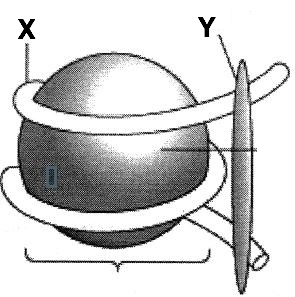
Identify $X$ and $Y$ in the given diagram of a nucleosome.
A
$X = \text{DNA}$, $Y = H_1$ histone
B
$X = \text{Histone octamer}$, $Y = \text{DNA}$
C
$X = \text{DNA}$, $Y = \text{Histone octamer}$
D
$X = H_1$ histone, $Y = \text{DNA}$
Solution
(A) The given diagram represents a nucleosome, which is the basic repeating structural unit of eukaryotic chromatin.
In this structure, the negatively charged $DNA$ (labeled as $X$) wraps around the positively charged histone octamer.
The $H_1$ histone (labeled as $Y$) binds to the $DNA$ where it enters and leaves the nucleosome, helping to stabilize the structure.
Therefore, $X$ represents $DNA$ and $Y$ represents the $H_1$ histone.
In this structure, the negatively charged $DNA$ (labeled as $X$) wraps around the positively charged histone octamer.
The $H_1$ histone (labeled as $Y$) binds to the $DNA$ where it enters and leaves the nucleosome, helping to stabilize the structure.
Therefore, $X$ represents $DNA$ and $Y$ represents the $H_1$ histone.
0 likes
View Solution312
MediumMCQ
$DNA$ contains
A
Sulfur
B
Phosphorus
C
Boron
D
Calcium
Solution
(B) $DNA$ (Deoxyribonucleic acid) is a polymer of nucleotides.
Each nucleotide consists of three components: a nitrogenous base,a pentose sugar (deoxyribose),and a phosphate group.
The phosphate group is derived from phosphoric acid $(H_3PO_4)$,which contains the element phosphorus.
Therefore,phosphorus is a fundamental component of the $DNA$ backbone.
Each nucleotide consists of three components: a nitrogenous base,a pentose sugar (deoxyribose),and a phosphate group.
The phosphate group is derived from phosphoric acid $(H_3PO_4)$,which contains the element phosphorus.
Therefore,phosphorus is a fundamental component of the $DNA$ backbone.
0 likes
View Solution313
MediumMCQ
In a $340 \text{ Å}$ long $DNA$ strand, how many nitrogen base pairs are present?
A
$100$ nucleotides
B
$100$ nitrogen base pairs
C
$100$ nitrogen bases
D
$100$ phosphate-sugar units
Solution
(B) The distance between two consecutive base pairs in a $DNA$ double helix is $3.4 \text{ Å}$ $(0.34 \text{ nm})$.
Given the total length of the $DNA$ strand is $340 \text{ Å}$.
The number of base pairs is calculated by dividing the total length by the distance between two consecutive base pairs.
Number of base pairs = $\frac{340 \text{ Å}}{3.4 \text{ Å/bp}} = 100 \text{ base pairs}$.
Therefore, there are $100$ nitrogen base pairs in the $DNA$ strand.
Given the total length of the $DNA$ strand is $340 \text{ Å}$.
The number of base pairs is calculated by dividing the total length by the distance between two consecutive base pairs.
Number of base pairs = $\frac{340 \text{ Å}}{3.4 \text{ Å/bp}} = 100 \text{ base pairs}$.
Therefore, there are $100$ nitrogen base pairs in the $DNA$ strand.
0 likes
View Solution314
MediumMCQ
It is absent in $RNA$.
A
Pentose sugar
B
Uracil
C
Guanine
D
Thymine
Solution
(D) $RNA$ (Ribonucleic acid) contains the pentose sugar ribose,and the nitrogenous bases Adenine,Guanine,Cytosine,and Uracil. $DNA$ (Deoxyribonucleic acid) contains the pentose sugar deoxyribose,and the nitrogenous bases Adenine,Guanine,Cytosine,and Thymine. Therefore,Thymine is absent in $RNA$ and is replaced by Uracil.
0 likes
View Solution315
MediumMCQ
Choose the incorrect sentence.
A
$A$ typical nucleosome contains $200$ bp of $DNA$ helix.
B
Nucleosomes constitute the repeating unit of a structure in the nucleus called chromatin,which are thread-like stained bodies seen in the nucleus.
C
In a typical nucleus,some regions of chromatin are loosely packed and are referred to as heterochromatin.
D
Euchromatin is said to be transcriptionally active chromatin,whereas heterochromatin is inactive.
Solution
(C) The correct answer is $C$.
$1$. $A$ typical nucleosome contains $200$ bp of $DNA$ helix,which is a correct statement.
$2$. Nucleosomes are the repeating units of chromatin,which appear as thread-like stained bodies in the nucleus; this is also correct.
$3$. In a typical nucleus,some regions of chromatin are loosely packed and stain light; these are called euchromatin. Regions that are densely packed and stain dark are called heterochromatin. Therefore,the statement that loosely packed regions are heterochromatin is incorrect.
$4$. Euchromatin is transcriptionally active,while heterochromatin is inactive; this is a correct statement.
$1$. $A$ typical nucleosome contains $200$ bp of $DNA$ helix,which is a correct statement.
$2$. Nucleosomes are the repeating units of chromatin,which appear as thread-like stained bodies in the nucleus; this is also correct.
$3$. In a typical nucleus,some regions of chromatin are loosely packed and stain light; these are called euchromatin. Regions that are densely packed and stain dark are called heterochromatin. Therefore,the statement that loosely packed regions are heterochromatin is incorrect.
$4$. Euchromatin is transcriptionally active,while heterochromatin is inactive; this is a correct statement.
0 likes
View Solution316
EasyMCQ
$A$ human diploid cell contains ............ bp.
A
$4.6 \times 10^6$ bp
B
$6.6 \times 10^6$ bp
C
$6.6 \times 10^9$ bp
D
$9.3 \times 10^9$ bp
Solution
(C) The human haploid genome content is approximately $3.3 \times 10^9$ bp.
Since a diploid cell contains two sets of chromosomes,the total number of base pairs (bp) in a human diploid cell is $2 \times (3.3 \times 10^9)$ bp = $6.6 \times 10^9$ bp.
Therefore,the correct option is $C$.
Since a diploid cell contains two sets of chromosomes,the total number of base pairs (bp) in a human diploid cell is $2 \times (3.3 \times 10^9)$ bp = $6.6 \times 10^9$ bp.
Therefore,the correct option is $C$.
0 likes
View Solution317
EasyMCQ
Nucleosome is made up of
A
$RNA + DNA$
B
Protein $+ RNA$
C
$DNA +$ Protein
D
Lipid $+$ Protein
Solution
(C) nucleosome is the basic structural unit of $DNA$ packaging in eukaryotes.
It consists of a segment of $DNA$ wrapped around a core of eight histone proteins.
This structure is often compared to thread wrapped around a spool.
Nucleosomes form the fundamental repeating units of chromatin,which helps in packing the large eukaryotic genome into the nucleus while maintaining accessibility for gene expression.
It consists of a segment of $DNA$ wrapped around a core of eight histone proteins.
This structure is often compared to thread wrapped around a spool.
Nucleosomes form the fundamental repeating units of chromatin,which helps in packing the large eukaryotic genome into the nucleus while maintaining accessibility for gene expression.
0 likes
View Solution318
MediumMCQ
$A$ single human cell has approximately ...... meter long thread of $DNA$ distributed among its ........ chromosomes.
A
$2, 23$
B
$2, 46$
C
$1, 46$
D
$1, 23$
Solution
(B) In a human cell,the total length of $DNA$ is calculated by multiplying the number of base pairs $(6.6 \times 10^9 \text{ bp})$ by the distance between two consecutive base pairs $(0.34 \times 10^{-9} \text{ m})$.
This results in approximately $2.2 \text{ meters}$ of $DNA$ length.
Human somatic cells contain $46$ chromosomes ($23$ pairs).
Therefore,the correct values are $2$ meters and $46$ chromosomes.
This results in approximately $2.2 \text{ meters}$ of $DNA$ length.
Human somatic cells contain $46$ chromosomes ($23$ pairs).
Therefore,the correct values are $2$ meters and $46$ chromosomes.
0 likes
View Solution319
MediumMCQ
The bond between the phosphate group and the hydroxyl group of sugar is........
A
Peptide bond
B
Hydrogen bond
C
Ester bond
D
Glycosidic bond
Solution
(C) In a nucleotide,the phosphate group is linked to the $5'-OH$ group of the sugar (nucleoside) through a phosphodiester linkage,which is chemically an ester bond.
Specifically,the reaction between the phosphoric acid and the hydroxyl group of the sugar forms a phosphate ester bond.
Specifically,the reaction between the phosphoric acid and the hydroxyl group of the sugar forms a phosphate ester bond.
0 likes
View Solution320
MediumMCQ
$A$ dinucleotide is obtained by joining two nucleotides together by a phosphodiester linkage. Between which carbons of the sugar of the nucleotides are these linkages present?
A
$5'$ and $3'$
B
$5'$ and $5'$
C
$3'$ and $3'$
D
$1'$ and $5'$
Solution
(A) phosphodiester linkage is a covalent bond that connects the $3'$ carbon atom of one sugar molecule to the $5'$ carbon atom of another sugar molecule in a nucleic acid chain.
This linkage involves a phosphate group that bridges the two sugars,forming the backbone of $DNA$ and $RNA$.
Therefore,the phosphodiester bond is formed between the $3'$ carbon of the first nucleotide and the $5'$ carbon of the second nucleotide.
This linkage involves a phosphate group that bridges the two sugars,forming the backbone of $DNA$ and $RNA$.
Therefore,the phosphodiester bond is formed between the $3'$ carbon of the first nucleotide and the $5'$ carbon of the second nucleotide.
0 likes
View Solution321
MediumMCQ
Choose the incorrect statement.
A
Apoenzyme is a proteinous part of an enzyme.
B
Two hydrogen bonds are present between $A$ and $T$ in $DNA$.
C
Four hydrogen bonds are present between $G$ and $C$ in $DNA$.
D
The polynucleotide chain is anti-parallel in $DNA$.
Solution
(C) In $DNA$ structure,$Adenine$ $(A)$ pairs with $Thymine$ $(T)$ via two hydrogen bonds.
$Guanine$ $(G)$ pairs with $Cytosine$ $(C)$ via three hydrogen bonds,not four.
Therefore,the statement claiming four hydrogen bonds between $G$ and $C$ is incorrect.
Apoenzyme is indeed the protein part of a holoenzyme,and $DNA$ strands are known to be anti-parallel.
$Guanine$ $(G)$ pairs with $Cytosine$ $(C)$ via three hydrogen bonds,not four.
Therefore,the statement claiming four hydrogen bonds between $G$ and $C$ is incorrect.
Apoenzyme is indeed the protein part of a holoenzyme,and $DNA$ strands are known to be anti-parallel.
0 likes
View Solution322
EasyMCQ
What is the distance between two successive nitrogen base pairs in a $DNA$ double helix?
A
$3.4\ m$
B
$34\ \mathring{A}$
C
$3.4\ \mathring{A}$
D
$20\ \mathring{A}$
Solution
(C) In a $DNA$ double helix structure,the two strands are coiled in a right-handed fashion.
The pitch of the helix is $34\ \mathring{A}$ $(3.4\ nm)$.
There are roughly $10$ base pairs in each turn of the helix.
Therefore,the distance between two successive base pairs is calculated as $34\ \mathring{A} / 10 = 3.4\ \mathring{A}$.
The pitch of the helix is $34\ \mathring{A}$ $(3.4\ nm)$.
There are roughly $10$ base pairs in each turn of the helix.
Therefore,the distance between two successive base pairs is calculated as $34\ \mathring{A} / 10 = 3.4\ \mathring{A}$.
0 likes
View Solution323
MediumMCQ
In a $DNA$ molecule,one chain contains $22$ thymine and its opposite chain contains $28$ guanine. What is the length of this $DNA$ in $\mathring{A}$?
A
$50\ \mathring{A}$
B
$170\ \mathring{A}$
C
$200\ \mathring{A}$
D
$85\ \mathring{A}$
Solution
(B) According to the base pairing rules of $DNA$ (Chargaff's rule),thymine $(T)$ pairs with adenine $(A)$ and guanine $(G)$ pairs with cytosine $(C)$.
In one strand,there are $22$ thymine bases. These will pair with $22$ adenine bases on the opposite strand.
In the opposite strand,there are $28$ guanine bases. These will pair with $28$ cytosine bases on the first strand.
Total number of base pairs = $22 + 28 = 50$ base pairs.
The distance between two consecutive base pairs in a $B-DNA$ helix is $3.4\ \mathring{A}$ $(0.34\ nm)$.
Total length of $DNA$ = (Total number of base pairs) $\times$ (Distance between two base pairs).
Total length = $50 \times 3.4\ \mathring{A} = 170\ \mathring{A}$.
In one strand,there are $22$ thymine bases. These will pair with $22$ adenine bases on the opposite strand.
In the opposite strand,there are $28$ guanine bases. These will pair with $28$ cytosine bases on the first strand.
Total number of base pairs = $22 + 28 = 50$ base pairs.
The distance between two consecutive base pairs in a $B-DNA$ helix is $3.4\ \mathring{A}$ $(0.34\ nm)$.
Total length of $DNA$ = (Total number of base pairs) $\times$ (Distance between two base pairs).
Total length = $50 \times 3.4\ \mathring{A} = 170\ \mathring{A}$.
0 likes
View Solution324
MediumMCQ
In a $DNA$ molecule,if cytosine is $18\%$,then the percentage of adenine would be: (in $\%$)
A
$18$
B
$32$
C
$36$
D
$64$
Solution
(B) According to Chargaff's rule,in a double-stranded $DNA$ molecule,the amount of adenine $(A)$ is equal to the amount of thymine $(T)$,and the amount of guanine $(G)$ is equal to the amount of cytosine $(C)$.
Given that cytosine $(C)$ = $18\%$,then guanine $(G)$ must also be $18\%$.
The total percentage of all four bases is $100\%$,so $A + T + G + C = 100\%$.
Since $A = T$ and $G = C$,we can write: $2A + 2C = 100\%$.
Substituting the value of $C$: $2A + 2(18\%) = 100\%$.
$2A + 36\% = 100\%$.
$2A = 100\% - 36\% = 64\%$.
$A = 64\% / 2 = 32\%$.
Therefore,the percentage of adenine is $32\%$.
Given that cytosine $(C)$ = $18\%$,then guanine $(G)$ must also be $18\%$.
The total percentage of all four bases is $100\%$,so $A + T + G + C = 100\%$.
Since $A = T$ and $G = C$,we can write: $2A + 2C = 100\%$.
Substituting the value of $C$: $2A + 2(18\%) = 100\%$.
$2A + 36\% = 100\%$.
$2A = 100\% - 36\% = 64\%$.
$A = 64\% / 2 = 32\%$.
Therefore,the percentage of adenine is $32\%$.
0 likes
View Solution325
MediumMCQ
What is absent in $DNA$?
A
$A$
B
$U$
C
$C$
D
$G$
Solution
(B) $DNA$ (Deoxyribonucleic acid) consists of four nitrogenous bases: Adenine $(A)$,Guanine $(G)$,Cytosine $(C)$,and Thymine $(T)$.
$RNA$ (Ribonucleic acid) consists of Adenine $(A)$,Guanine $(G)$,Cytosine $(C)$,and Uracil $(U)$.
Therefore,Uracil $(U)$ is present in $RNA$ but is absent in $DNA$.
$RNA$ (Ribonucleic acid) consists of Adenine $(A)$,Guanine $(G)$,Cytosine $(C)$,and Uracil $(U)$.
Therefore,Uracil $(U)$ is present in $RNA$ but is absent in $DNA$.
0 likes
View Solution326
MediumMCQ
The sugar found in polynucleotides is either $A$ or $B$. Choose the appropriate options to fill the blanks $A$ and $B$.
A
Ribose,sucrose
B
$2'$ deoxyribose,ribose
C
Ribose,dextrose
D
Deoxyribose,ribulose
Solution
(B) Polynucleotides are polymers of nucleotides, which are the building blocks of nucleic acids.
Nucleic acids are of two types: $DNA$ $(Deoxyribonucleic \text{ } Acid)$ and $RNA$ $(Ribonucleic \text{ } Acid)$.
In $DNA$, the sugar present is $2'$ deoxyribose.
In $RNA$, the sugar present is ribose.
Therefore, the sugars found in polynucleotides are either $2'$ deoxyribose or ribose.
Nucleic acids are of two types: $DNA$ $(Deoxyribonucleic \text{ } Acid)$ and $RNA$ $(Ribonucleic \text{ } Acid)$.
In $DNA$, the sugar present is $2'$ deoxyribose.
In $RNA$, the sugar present is ribose.
Therefore, the sugars found in polynucleotides are either $2'$ deoxyribose or ribose.
0 likes
View Solution327
EasyMCQ
Which two nitrogenous bases are of the purine type?
A
$C$ and $G$
B
$A$ and $T$
C
$U$ and $A$
D
$A$ and $G$
Solution
(D) Nitrogenous bases are classified into two types based on their chemical structure: purines and pyrimidines.
Purines are double-ringed structures,which include Adenine $(A)$ and Guanine $(G)$.
Pyrimidines are single-ringed structures,which include Cytosine $(C)$,Thymine $(T)$,and Uracil $(U)$.
Therefore,the two nitrogenous bases that are of the purine type are Adenine $(A)$ and Guanine $(G)$.
Purines are double-ringed structures,which include Adenine $(A)$ and Guanine $(G)$.
Pyrimidines are single-ringed structures,which include Cytosine $(C)$,Thymine $(T)$,and Uracil $(U)$.
Therefore,the two nitrogenous bases that are of the purine type are Adenine $(A)$ and Guanine $(G)$.
0 likes
View Solution328
MediumMCQ
The bond between the phosphate and hydroxyl group of sugar is ...........
A
Glycosidic bond
B
Ester bond
C
Peptide bond
D
Weak hydrogen bond
Solution
(B) In a nucleotide,the phosphate group is linked to the $5'-OH$ group of the sugar (pentose) through a phosphoester bond.
This bond is formed by the reaction between the phosphoric acid and the hydroxyl group of the sugar,resulting in an ester linkage.
Therefore,the bond between the phosphate and the hydroxyl group of the sugar is an ester bond.
This bond is formed by the reaction between the phosphoric acid and the hydroxyl group of the sugar,resulting in an ester linkage.
Therefore,the bond between the phosphate and the hydroxyl group of the sugar is an ester bond.
0 likes
View Solution329
EasyMCQ
$DNA$ is a
A
long polymer of deoxyribonucleotides
B
short polymer of deoxyribonucleotides
C
monomer of deoxyribonucleotides
D
long polymer of ribonucleotides
Solution
(A) $DNA$ (Deoxyribonucleic Acid) is a large macromolecule.
It is composed of a long chain of repeating units called deoxyribonucleotides.
Each deoxyribonucleotide consists of a deoxyribose sugar,a phosphate group,and a nitrogenous base.
Therefore,$DNA$ is defined as a long polymer of deoxyribonucleotides.
It is composed of a long chain of repeating units called deoxyribonucleotides.
Each deoxyribonucleotide consists of a deoxyribose sugar,a phosphate group,and a nitrogenous base.
Therefore,$DNA$ is defined as a long polymer of deoxyribonucleotides.
0 likes
View Solution330
EasyMCQ
The genetic material in the bacterium $Escherichia$ $coli$ $(E. coli)$ is:
A
Single-stranded $DNA$
B
Deoxyribose sugar
C
Double-stranded $DNA$
D
Single-stranded $RNA$
Solution
(C) $E. coli$ is a prokaryotic organism.
Prokaryotes possess a circular,double-stranded $DNA$ molecule as their primary genetic material,which is located in the nucleoid region.
Therefore,the genetic material in $E. coli$ is double-stranded $DNA$.
Prokaryotes possess a circular,double-stranded $DNA$ molecule as their primary genetic material,which is located in the nucleoid region.
Therefore,the genetic material in $E. coli$ is double-stranded $DNA$.
0 likes
View Solution331
MediumMCQ
What do the genes found on mitochondrial $DNA$ exhibit?
A
Generally maternal inheritance
B
They always exhibit paternal inheritance.
C
They exhibit inheritance from both parents like nuclear genes.
D
They are not inherited.
Solution
(A) Mitochondria are inherited through the cytoplasm of the egg cell during fertilization. Since the sperm contributes almost no cytoplasm to the zygote,the mitochondrial $DNA$ $(mtDNA)$ is passed down exclusively from the mother to the offspring. This phenomenon is known as maternal inheritance.
0 likes
View Solution332
MediumMCQ
What is present in $RNA$ instead of $Thymine$?
A
Adenine
B
Guanine
C
Cytosine
D
Uracil
Solution
(D) In $DNA$,the four nitrogenous bases are $Adenine$ $(A)$,$Guanine$ $(G)$,$Cytosine$ $(C)$,and $Thymine$ $(T)$.
In $RNA$,$Thymine$ is replaced by $Uracil$ $(U)$.
Therefore,$RNA$ contains $Adenine$,$Guanine$,$Cytosine$,and $Uracil$.
In $RNA$,$Thymine$ is replaced by $Uracil$ $(U)$.
Therefore,$RNA$ contains $Adenine$,$Guanine$,$Cytosine$,and $Uracil$.
0 likes
View Solution333
EasyMCQ
The arrangement of nucleotides in $DNA$ can be seen by which of the following techniques?
A
$X$-ray crystallography
B
Electron microscope
C
Ultracentrifuge
D
Light microscope
Solution
(A) The structure of $DNA$ and the arrangement of its nucleotides were famously determined by Rosalind Franklin and Maurice Wilkins using $X$-ray crystallography. This technique involves directing $X$-rays at a crystallized sample of $DNA$,which then diffracts the rays to create a pattern on a photographic plate. By analyzing this diffraction pattern,scientists were able to deduce the helical structure and the spacing of the nucleotides within the $DNA$ molecule.
0 likes
View Solution334
MediumMCQ
In $DNA$,the unequal nitrogenous bases will primarily be ...
A
Single-stranded
B
Double-stranded
C
Triple-stranded
D
Quadruple-stranded
Solution
(A) According to $Chargaff's$ rule,in a double-stranded $DNA$ molecule,the amount of adenine $(A)$ is equal to thymine $(T)$,and the amount of guanine $(G)$ is equal to cytosine $(C)$. Therefore,the ratio $(A+T)/(G+C)$ is constant for a species. If the nitrogenous bases are unequal (i.e.,$A+T \neq G+C$),it indicates that the $DNA$ molecule is single-stranded,as the base-pairing rules of $Watson$ and $Crick$ do not apply to single-stranded structures.
0 likes
View Solution335
EasyMCQ
The nucleosome core is made up of ............ .
A
$H_1, H_2A, H_2B$ and $H_3$
B
$H_1, H_2A, H_2B$ and $H_4$
C
$H_1, H_2A, H_2B, H_3$ and $H_4$
D
$H_2A, H_2B, H_3$ and $H_4$
Solution
(D) nucleosome is the basic structural unit of $DNA$ packaging in eukaryotes.
It consists of a segment of $DNA$ wound around a core of histone proteins.
This core particle is an octamer,which is composed of two molecules each of four types of histone proteins: $H_2A, H_2B, H_3$,and $H_4$.
The $H_1$ histone protein is not part of the core octamer; instead,it binds to the $DNA$ where it enters and leaves the nucleosome,helping to stabilize the structure.
Therefore,the nucleosome core is made up of $H_2A, H_2B, H_3$,and $H_4$.
It consists of a segment of $DNA$ wound around a core of histone proteins.
This core particle is an octamer,which is composed of two molecules each of four types of histone proteins: $H_2A, H_2B, H_3$,and $H_4$.
The $H_1$ histone protein is not part of the core octamer; instead,it binds to the $DNA$ where it enters and leaves the nucleosome,helping to stabilize the structure.
Therefore,the nucleosome core is made up of $H_2A, H_2B, H_3$,and $H_4$.
0 likes
View Solution336
MediumMCQ
In split genes,what are the coding sequences called?
A
Introns
B
Operons
C
Exons
D
Cistrons
Solution
(C) In eukaryotic organisms,genes are often 'split' or 'interrupted'.
These genes contain coding sequences known as $Exons$ and non-coding sequences known as $Introns$.
$Exons$ are the sequences that appear in mature or processed $RNA$ and code for proteins.
$Introns$ are intervening sequences that do not code for proteins and are removed during $RNA$ splicing.
Therefore,the coding sequences are called $Exons$.
These genes contain coding sequences known as $Exons$ and non-coding sequences known as $Introns$.
$Exons$ are the sequences that appear in mature or processed $RNA$ and code for proteins.
$Introns$ are intervening sequences that do not code for proteins and are removed during $RNA$ splicing.
Therefore,the coding sequences are called $Exons$.
0 likes
View Solution337
MediumMCQ
In a bacterial chromosome,the genes are held together by which of the following?
A
Histones
B
Basic proteins
C
Acidic proteins
D
Actin
Solution
(B) In prokaryotes like bacteria,the $DNA$ is not organized into complex chromatin structures with histones as seen in eukaryotes. Instead,the bacterial $DNA$ is organized in large loops held together by certain non-histone proteins,which are often basic in nature (such as polyamines). These proteins help in folding and compacting the circular $DNA$ into a structure known as the nucleoid.
0 likes
View Solution338
EasyMCQ
$DNA$ segments that can switch their position are called:
A
Exons
B
Introns
C
Cistrons
D
Transposons
Solution
(D) Transposons,also known as '$jumping$ $genes$',are specific $DNA$ sequences that have the ability to change their position within the genome.
They can move from one location to another on the same chromosome or to a different chromosome.
This process is known as transposition.
Exons are coding sequences,introns are non-coding sequences,and cistrons are functional units of $DNA$ encoding a polypeptide.
They can move from one location to another on the same chromosome or to a different chromosome.
This process is known as transposition.
Exons are coding sequences,introns are non-coding sequences,and cistrons are functional units of $DNA$ encoding a polypeptide.
0 likes
View Solution339
MediumMCQ
In $DNA$,when the sequence is $AGCT$,what is the corresponding complementary strand sequence?
A
$ACGT$
B
$AGCT$
C
$TCGA$
D
All of the above
Solution
(C) According to the base-pairing rules of $DNA$ (Chargaff's rules),Adenine $(A)$ always pairs with Thymine $(T)$ and Guanine $(G)$ always pairs with Cytosine $(C)$.
Given the sequence $AGCT$ on one strand:
- $A$ pairs with $T$
- $G$ pairs with $C$
- $C$ pairs with $G$
- $T$ pairs with $A$
Therefore,the complementary sequence is $TCGA$.
Given the sequence $AGCT$ on one strand:
- $A$ pairs with $T$
- $G$ pairs with $C$
- $C$ pairs with $G$
- $T$ pairs with $A$
Therefore,the complementary sequence is $TCGA$.
0 likes
View Solution340
MediumMCQ
If the percentage of thymine in $DNA$ is $20\%$,what will be the percentage of guanine (in $\%$)?
A
$20$
B
$40$
C
$30$
D
$60$
Solution
(C) According to Chargaff's rule,the amount of adenine $(A)$ is equal to the amount of thymine $(T)$,and the amount of guanine $(G)$ is equal to the amount of cytosine $(C)$.
Given that the percentage of thymine $(T)$ is $20\%$,then the percentage of adenine $(A)$ is also $20\%$.
The total percentage of $A + T$ is $20\% + 20\% = 40\%$.
Since the total percentage of all four bases $(A + T + G + C)$ is $100\%$,the sum of $G + C$ is $100\% - 40\% = 60\%$.
Since the amount of guanine $(G)$ is equal to the amount of cytosine $(C)$,the percentage of guanine is $60\% / 2 = 30\%$.
Given that the percentage of thymine $(T)$ is $20\%$,then the percentage of adenine $(A)$ is also $20\%$.
The total percentage of $A + T$ is $20\% + 20\% = 40\%$.
Since the total percentage of all four bases $(A + T + G + C)$ is $100\%$,the sum of $G + C$ is $100\% - 40\% = 60\%$.
Since the amount of guanine $(G)$ is equal to the amount of cytosine $(C)$,the percentage of guanine is $60\% / 2 = 30\%$.
0 likes
View Solution341
MediumMCQ
In a given species,which of the following ratios is constant?
A
$\frac{A+G}{C+T}$
B
$\frac{T+C}{G+A}$
C
$\frac{G+C}{A+T}$
D
$\frac{A+C}{T+G}$
Solution
(A) According to Chargaff's rules for double-stranded $DNA$,the amount of adenine $(A)$ is equal to the amount of thymine $(T)$,and the amount of guanine $(G)$ is equal to the amount of cytosine $(C)$.
Therefore,$A = T$ and $G = C$.
This implies that $A + G = T + C$.
When we take the ratio of purines $(A+G)$ to pyrimidines $(C+T)$,we get $\frac{A+G}{C+T} = 1$.
Since $A+G$ is always equal to $C+T$,this ratio remains constant for a given species.
Therefore,$A = T$ and $G = C$.
This implies that $A + G = T + C$.
When we take the ratio of purines $(A+G)$ to pyrimidines $(C+T)$,we get $\frac{A+G}{C+T} = 1$.
Since $A+G$ is always equal to $C+T$,this ratio remains constant for a given species.
0 likes
View Solution342
EasyMCQ
The telomeres of eukaryotic chromosomes consist of short sequences rich in:
A
Thymine-rich repeats
B
Cytosine-rich repeats
C
Adenine-rich repeats
D
Guanine-rich repeats
Solution
(D) The telomeres are the terminal regions of eukaryotic chromosomes that protect the ends from degradation and fusion.
These regions consist of highly conserved,repetitive $DNA$ sequences.
In most eukaryotes,including humans,these telomeric sequences are characterized by a high content of $G$ (Guanine) nucleotides.
For example,the human telomeric repeat sequence is $5'-TTAGGG-3'$,which is rich in Guanine.
Therefore,telomeres are Guanine-rich.
These regions consist of highly conserved,repetitive $DNA$ sequences.
In most eukaryotes,including humans,these telomeric sequences are characterized by a high content of $G$ (Guanine) nucleotides.
For example,the human telomeric repeat sequence is $5'-TTAGGG-3'$,which is rich in Guanine.
Therefore,telomeres are Guanine-rich.
0 likes
View Solution343
MediumMCQ
Telomerase is an enzyme that is a/an ....
A
Repetitive $DNA$
B
$RNA$
C
Simple protein
D
Ribonucleoprotein
Solution
(D) Telomerase is a ribonucleoprotein enzyme that adds $DNA$ sequence repeats to the $3'$ end of $DNA$ strands in the telomere regions. It consists of a protein component $(TERT)$ and an $RNA$ component $(TERC)$ that serves as a template for the synthesis of telomeric $DNA$. Therefore,it is classified as a ribonucleoprotein.
0 likes
View Solution344
MediumMCQ
Telomeric repetitive $DNA$ sequences control the function of eukaryotic chromosomes because they...
A
Act as replicons.
B
Are $RNA$ transcription initiators.
C
Help in chromosome pairing.
D
Prevent chromosome shortening.
Solution
(D) Telomeres are specialized structures at the ends of linear eukaryotic chromosomes consisting of repetitive $DNA$ sequences and associated proteins.
During $DNA$ replication,the enzyme $DNA$ polymerase cannot replicate the extreme ends of the lagging strand because it requires an $RNA$ primer to initiate synthesis.
If the ends of chromosomes consisted of essential genes,they would be lost during each round of cell division.
Telomeres act as protective caps that prevent the loss of vital genetic information by allowing the chromosome to shorten slightly without affecting coding regions,thus preventing chromosome shortening and degradation.
During $DNA$ replication,the enzyme $DNA$ polymerase cannot replicate the extreme ends of the lagging strand because it requires an $RNA$ primer to initiate synthesis.
If the ends of chromosomes consisted of essential genes,they would be lost during each round of cell division.
Telomeres act as protective caps that prevent the loss of vital genetic information by allowing the chromosome to shorten slightly without affecting coding regions,thus preventing chromosome shortening and degradation.
0 likes
View Solution345
MediumMCQ
The length of a $DNA$ molecule is much greater than the diameter of the nucleus in a eukaryotic cell. How is $DNA$ packaged?
A
By removing non-essential genes
B
By super-coiling into nucleosomes
C
By digesting $DNA$ with enzymes
D
By removing repetitive $DNA$
Solution
(B) In eukaryotic cells,the $DNA$ molecule is extremely long. For example,in humans,the total length of $DNA$ is approximately $2.2 \ m$,while the diameter of the nucleus is only about $10^{-6} \ m$. To fit this long $DNA$ into the small nucleus,it undergoes a complex packaging process. The $DNA$ is negatively charged and wraps around positively charged histone protein octamers to form structures called nucleosomes. These nucleosomes further coil and condense into chromatin fibers,a process known as super-coiling,which allows the $DNA$ to be compactly organized within the nucleus.
0 likes
View Solution346
EasyMCQ
When a chromosome,which appears like beads on a string,is observed under an electron microscope,what is this structure called?
A
Genes
B
Nucleotides
C
Nucleosomes
D
Base pairs
Solution
(C) The 'beads-on-a-string' structure of chromatin is observed under an electron microscope.
This structure is formed by the wrapping of $DNA$ around a core of histone proteins.
Each repeating unit of this structure is known as a $Nucleosome$.
Therefore,the correct answer is $C$.
This structure is formed by the wrapping of $DNA$ around a core of histone proteins.
Each repeating unit of this structure is known as a $Nucleosome$.
Therefore,the correct answer is $C$.
0 likes
View Solution347
MediumMCQ
Identify the correct sequence of genetic material in descending order of size (from largest to smallest).
A
Chromosome - Gene - Genome - Nucleotide
B
Genome - Chromosome - Nucleotide - Gene
C
Genome - Chromosome - Gene - Nucleotide
D
Chromosome - Genome - Nucleotide - Gene
Solution
(C) The hierarchy of genetic material organization is as follows:
$1$. $Genome$: The entire set of genetic material in an organism.
$2$. $Chromosome$: $A$ thread-like structure of nucleic acids and protein found in the nucleus,carrying genetic information in the form of genes.
$3$. $Gene$: $A$ specific segment of $DNA$ that codes for a functional product (protein or $RNA$).
$4$. $Nucleotide$: The basic structural unit of nucleic acids ($DNA$ or $RNA$),consisting of a sugar,a phosphate group,and a nitrogenous base.
Therefore,the correct descending order is $Genome > Chromosome > Gene > Nucleotide$.
$1$. $Genome$: The entire set of genetic material in an organism.
$2$. $Chromosome$: $A$ thread-like structure of nucleic acids and protein found in the nucleus,carrying genetic information in the form of genes.
$3$. $Gene$: $A$ specific segment of $DNA$ that codes for a functional product (protein or $RNA$).
$4$. $Nucleotide$: The basic structural unit of nucleic acids ($DNA$ or $RNA$),consisting of a sugar,a phosphate group,and a nitrogenous base.
Therefore,the correct descending order is $Genome > Chromosome > Gene > Nucleotide$.
0 likes
View Solution348
MediumMCQ
Which of the following is not applicable to $RNA$?
A
Complementary base pairing
B
$5'$ phosphoryl and $3'$ hydroxyl ends
C
Heterocyclic nitrogenous bases
D
Chargaff's rule
Solution
(D) Chargaff's rule states that in double-stranded $DNA$,the amount of adenine equals thymine $(A = T)$ and the amount of guanine equals cytosine $(G = C)$.
$RNA$ is typically single-stranded,and therefore,the base pairing ratios defined by Chargaff's rule do not apply to it.
Complementary base pairing can occur in $RNA$ (e.g.,during secondary structure formation),and $RNA$ molecules possess $5'$ phosphoryl and $3'$ hydroxyl ends,as well as heterocyclic nitrogenous bases (Adenine,Guanine,Cytosine,and Uracil).
$RNA$ is typically single-stranded,and therefore,the base pairing ratios defined by Chargaff's rule do not apply to it.
Complementary base pairing can occur in $RNA$ (e.g.,during secondary structure formation),and $RNA$ molecules possess $5'$ phosphoryl and $3'$ hydroxyl ends,as well as heterocyclic nitrogenous bases (Adenine,Guanine,Cytosine,and Uracil).
0 likes
View SolutionMolecular Basis of Inheritance — The DNA · Frequently Asked Questions
1Are these Molecular Basis of Inheritance questions useful for JEE and NEET?
Yes. All questions in this section are mapped to JEE Main and NEET exam patterns. Previous year questions from JEE Main, NEET, GUJCET and state-level exams are included with full solutions.
2Can I switch to Hindi or Gujarati for these questions?
Yes. Use the language tabs in the hero section or the sidebar to view the same questions and solutions in English, Hindi or Gujarati.
3How do I generate a question paper from this subtopic?
Use the Vedclass Exam Paper Generator — select the chapter and subtopic, set difficulty, and generate Sets A, B, C, D automatically. First 3 chapters of every subject are free.
Vedclass Products
For Students
Vedclass Test Series
Mock tests in real JEE/NEET style with performance analysis. 5-day free trial.
Start Free TrialFor Teachers
Exam Paper Generator
Generate Set A/B/C/D papers from this chapter in 2 minutes. 3 chapters free.
Try FreeFor Institutes
Online Exam Module
Live online exams with unlimited students, 360° analytics & white-label branding.
See DemoFor Teachers & Institutes
Generate a Molecular Basis of Inheritance Exam Paper in 2 Minutes
Select subtopic & difficulty — Sets A, B, C, D auto-generated with No Repeat logic.
First 3 chapters of every subject are free — no payment required.