
A English
The DNA Questions in English
Class 12 Biology · Molecular Basis of Inheritance · The DNA
632+
Questions
English
Language
100%
With Solutions
Showing 50 of 632 questions in English
501
EasyMCQ
$RNA$ is a polymer of
A
Ribonucleotides
B
Deoxyribonucleotides
C
Deoxyribonucleosides
D
Ribonucleosides
Solution
(A) $RNA$ (Ribonucleic acid) is a polynucleotide chain. Each nucleotide unit in $RNA$ consists of a ribose sugar,a phosphate group,and a nitrogenous base (Adenine,Uracil,Guanine,or Cytosine). Therefore,$RNA$ is a polymer of ribonucleotides.
0 likes
View Solution502
MediumMCQ
In $DNA$,cytosine pairs with
A
Guanine
B
Thymine
C
Adenine
D
Uracil
Solution
(A) According to Chargaff's rules of base pairing in $DNA$:
$A$ (Adenine) pairs with $T$ (Thymine) via $2$ hydrogen bonds.
$G$ (Guanine) pairs with $C$ (Cytosine) via $3$ hydrogen bonds.
Therefore,cytosine always pairs with guanine.
$A$ (Adenine) pairs with $T$ (Thymine) via $2$ hydrogen bonds.
$G$ (Guanine) pairs with $C$ (Cytosine) via $3$ hydrogen bonds.
Therefore,cytosine always pairs with guanine.
0 likes
View Solution503
EasyMCQ
$A$ distinct mechanism that usually involves a short segment of $DNA$ with remarkable capacity to move from one location in a chromosome to another is called
A
$DNA$ replication
B
$DNA$ hybridization
C
$DNA$ recombination
D
$DNA$ transposition
Solution
(D) $DNA$ transposition is the process which involves the movement of $DNA$ elements from one site in the genome to another.
It is mediated by transposase enzymes.
These short segments of $DNA$ with a remarkable capacity to move from one location in a chromosome to another are called transposons, jumping genes, transposable elements, or mobile genetic elements.
These were first discovered by Barbara McClintock in maize $(Zea \, mays)$, for which she was awarded the Nobel Prize in Physiology or Medicine.
It is mediated by transposase enzymes.
These short segments of $DNA$ with a remarkable capacity to move from one location in a chromosome to another are called transposons, jumping genes, transposable elements, or mobile genetic elements.
These were first discovered by Barbara McClintock in maize $(Zea \, mays)$, for which she was awarded the Nobel Prize in Physiology or Medicine.
0 likes
View Solution504
EasyMCQ
Which amino acids are present in histones?
A
Lysine and histidine
B
Valine and histidine
C
Arginine and lysine
D
Arginine and histidine
Solution
(C) Histones are basic proteins found in eukaryotic chromosomes.
These proteins are rich in the positively charged basic amino acids,specifically lysine and arginine.
There are five main types of histones,namely $H_{1}, H_{2}A, H_{2}B, H_{3},$ and $H_{4}$,which are found in almost all eukaryotic cells.
These proteins are rich in the positively charged basic amino acids,specifically lysine and arginine.
There are five main types of histones,namely $H_{1}, H_{2}A, H_{2}B, H_{3},$ and $H_{4}$,which are found in almost all eukaryotic cells.
0 likes
View Solution505
EasyMCQ
Jumping genes in maize were discovered by
A
Hugo de Vries
B
Barbara McClintock
C
$T. H. Morgan$
D
Mendel
Solution
(B) Jumping genes or movable genetic elements, also known as transposons, were discovered by Barbara McClintock $(1902-1992)$ in maize $(Zea \, mays)$.
These genetic elements are capable of moving from one location to another within the genome, which is why they are referred to as 'jumping genes'.
Barbara McClintock was awarded the Nobel Prize in Physiology or Medicine in $1983$ for this discovery.
These genetic elements are capable of moving from one location to another within the genome, which is why they are referred to as 'jumping genes'.
Barbara McClintock was awarded the Nobel Prize in Physiology or Medicine in $1983$ for this discovery.
0 likes
View Solution506
MediumMCQ
The two strands of $DNA$ are held together by
A
peptide bonds
B
phosphodiester bonds
C
hydrogen bonds
D
$S-S$ bonds
Solution
(C) In $DNA$,the two strands are held together by hydrogen bonds between the nitrogenous bases. Adenine $(A)$ pairs with Thymine $(T)$ via two hydrogen bonds,and Guanine $(G)$ pairs with Cytosine $(C)$ via three hydrogen bonds. These bonds provide stability to the double-helical structure of $DNA$.
0 likes
View Solution507
MediumMCQ
Nucleotide arrangement in $DNA$ can be seen by
A
$X$-ray crystallography
B
electron microscope
C
ultracentrifuge
D
light microscope
Solution
(A) $X$-ray crystallography is the study of molecular structure by examining diffraction patterns produced by $X$-rays beamed through a crystalline form of the molecules. It is widely used in biochemistry to determine the molecular structure of complex molecules such as proteins and $DNA$.
0 likes
View Solution508
MediumMCQ
Chargaff's rules are applicable to
A
single stranded $RNA.$
B
single stranded $DNA$ and $RNA.$
C
single stranded $DNA.$
D
double stranded $DNA.$
Solution
(D) Chargaff's rules are applicable to double stranded $DNA$ because,according to these rules,the amount of adenine is equal to the amount of thymine $(A = T)$ and the amount of guanine is equal to the amount of cytosine $(G = C)$.
This base pairing equality is a fundamental characteristic of the double-helical structure of $DNA$.
This base pairing equality is a fundamental characteristic of the double-helical structure of $DNA$.
0 likes
View Solution509
MediumMCQ
One turn of $DNA$ possesses
A
one base pair
B
two base pairs
C
five base pairs
D
ten base pairs
Solution
(D) The structure of $DNA$ is a double helix.
Each full turn of the $DNA$ helix measures approximately $3.4 \ nm$ in length.
There are $10$ base pairs present in each full turn of the $DNA$ double helix.
Each full turn of the $DNA$ helix measures approximately $3.4 \ nm$ in length.
There are $10$ base pairs present in each full turn of the $DNA$ double helix.
0 likes
View Solution510
MediumMCQ
Which of the following is correct for Watson and Crick's model of $DNA$? It is a duplex with
A
$10$ base pairs and $34 \; \mathring{A}$ distance for every turn.
B
$10$ base pairs and $3.4 \; \mathring{A}$ distance for each turn of spiral.
C
$20$ base pairs and $34 \; \mathring{A}$ for each turn.
D
None of the above
Solution
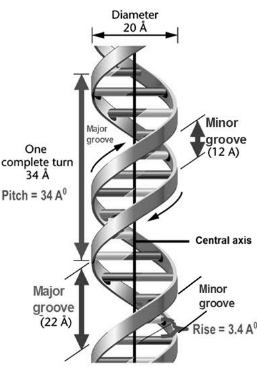
(A) According to the Watson and Crick model of $DNA$,it is a double helical molecule.
Each turn of the helix has a length of $34 \; \mathring{A}$ $(3.4 \; nm)$.
There are $10$ base pairs present in each full turn of the helix.
The distance between two adjacent base pairs is $3.4 \; \mathring{A}$ $(0.34 \; nm)$.
Therefore,the correct statement is that it has $10$ base pairs and $34 \; \mathring{A}$ distance for every turn.
Each turn of the helix has a length of $34 \; \mathring{A}$ $(3.4 \; nm)$.
There are $10$ base pairs present in each full turn of the helix.
The distance between two adjacent base pairs is $3.4 \; \mathring{A}$ $(0.34 \; nm)$.
Therefore,the correct statement is that it has $10$ base pairs and $34 \; \mathring{A}$ distance for every turn.
0 likes
View Solution511
EasyMCQ
What is a nucleosome?
A
Intron-interrupted $DNA$.
B
Double helix $DNA$.
C
Negatively charged $DNA$ wrapped around a positively charged histone octamer.
D
$A$ structure present only during the interphase of the cell cycle.
Solution
(C) nucleosome is the basic structural unit of eukaryotic chromatin.
It consists of a segment of negatively charged $DNA$ molecule wrapped around a positively charged histone protein core.
The histone core is an octamer,composed of two copies each of four histone proteins: $H2A, H2B, H3,$ and $H4$.
Therefore,option $C$ is the correct description.
It consists of a segment of negatively charged $DNA$ molecule wrapped around a positively charged histone protein core.
The histone core is an octamer,composed of two copies each of four histone proteins: $H2A, H2B, H3,$ and $H4$.
Therefore,option $C$ is the correct description.
0 likes
View Solution512
EasyMCQ
Genetic information is carried by long-chain molecules made up of
A
amino acids
B
enzymes
C
nucleotides
D
histone proteins
Solution
(C) nucleotide is an organic molecule consisting of a nucleoside (a nitrogenous base and a pentose sugar) connected to a phosphate group.
These nucleotides polymerize to form nucleic acids,such as $DNA$ or $RNA$.
Nucleic acids serve as the primary molecules that store and transmit genetic information in all living organisms.
These nucleotides polymerize to form nucleic acids,such as $DNA$ or $RNA$.
Nucleic acids serve as the primary molecules that store and transmit genetic information in all living organisms.
0 likes
View Solution513
EasyMCQ
Histones are rich in
A
alanine and glycine
B
lysine and arginine
C
histidine and serine
D
cysteine and tyrosine
Solution
(B) Histones are positively charged,basic proteins that are rich in the basic amino acids lysine and arginine.
Because they are positively charged,they bind tightly to the negatively charged phosphate backbone of $DNA$,which is acidic in nature.
Because they are positively charged,they bind tightly to the negatively charged phosphate backbone of $DNA$,which is acidic in nature.
0 likes
View Solution514
MediumMCQ
If a double stranded $DNA$ has $20\; \%$ of cytosine,what will be the percentage of adenine in it (in $; \%$)?
A
$20$
B
$40$
C
$30$
D
$60$
Solution
(C) According to $Chargaff's$ rule,in a double-stranded $DNA$,the amount of adenine $(A)$ is equal to thymine $(T)$,and the amount of cytosine $(C)$ is equal to guanine $(G)$.
Given that cytosine $(C)$ = $20\; \%$,then guanine $(G)$ must also be $20\; \%$.
The total percentage of $C + G = 20\; \% + 20\; \% = 40\; \%$.
Since the total percentage of all four bases is $100\; \%$,the remaining percentage for adenine and thymine is $100\; \% - 40\; \% = 60\; \%$.
Since $A = T$,the percentage of adenine is $60\; \% / 2 = 30\; \%$.
Given that cytosine $(C)$ = $20\; \%$,then guanine $(G)$ must also be $20\; \%$.
The total percentage of $C + G = 20\; \% + 20\; \% = 40\; \%$.
Since the total percentage of all four bases is $100\; \%$,the remaining percentage for adenine and thymine is $100\; \% - 40\; \% = 60\; \%$.
Since $A = T$,the percentage of adenine is $60\; \% / 2 = 30\; \%$.
0 likes
View Solution515
MediumMCQ
In the tertiary structure of $DNA$,what is a histone octamer?
A
$A$ complex consisting of eight negatively charged histone proteins (two of each $H2A, H2B, H3$ and $H4$) that aid in the packaging of $DNA$.
B
$A$ complex consisting of eight positively charged histone proteins (two of each $H2A, H2B, H3$ and $H4$) that aid in the packaging of $DNA$.
C
$A$ complex consisting of nine positively charged histone proteins ($H1$ and two of each $H2A, H2B, H3$ and $H4$) that aid in the packaging of $DNA$.
D
$A$ complex consisting of nine negatively charged histone proteins ($H1$ and two of each $H2A, H2B, H3$ and $H4$) that aid in the packaging of $DNA$.
Solution
(B) histone octamer is a complex of eight positively charged histone proteins (two of each $H2A, H2B, H3$ and $H4$) that aid in the packaging of $DNA$.
Negatively charged $DNA$ wraps around these histone octamers to form the nucleosome.
The $DNA$ is held there by ionic bonds.
Linker histone $H1$ binds to each nucleosome where the $DNA$ enters and exits,and this draws a string of nucleosomes closer together to form the $10 \ nm$ fibre.
The nucleosomes in chromatin are seen as a beads-on-string structure when viewed under an electron microscope.
Negatively charged $DNA$ wraps around these histone octamers to form the nucleosome.
The $DNA$ is held there by ionic bonds.
Linker histone $H1$ binds to each nucleosome where the $DNA$ enters and exits,and this draws a string of nucleosomes closer together to form the $10 \ nm$ fibre.
The nucleosomes in chromatin are seen as a beads-on-string structure when viewed under an electron microscope.
0 likes
View Solution516
MediumMCQ
$DNA$ exists in a double-stranded form whereas $RNA$ is mainly a single-stranded molecule. What is the likely reason for $DNA$ being double-stranded?
A
$RNA$ strands cannot form base pairs.
B
Double-stranded $DNA$ is a more stable structure.
C
$DNA$ cannot exist in the single-stranded form.
D
It is easier to replicate double-stranded $DNA$ than single-stranded $RNA$.
Solution
(B) Double-stranded $DNA$ is significantly more stable than single-stranded $RNA$,which helps protect the genetic code.
Having a second complementary strand provides a template for repair in the event of mutations or chemical damage,ensuring the integrity of the genetic information over long periods.
Having a second complementary strand provides a template for repair in the event of mutations or chemical damage,ensuring the integrity of the genetic information over long periods.
0 likes
View Solution517
MediumMCQ
Which one of the following pairs is a purine pair?
A
Uracil,Guanine
B
Cytosine,Thymine
C
Adenine,Guanine
D
Adenine,Thymine
Solution
(C) $DNA$ (deoxyribonucleic acid) consists of $3$ different components: a phosphate group,a $5$-carbon deoxyribose sugar,and a nitrogenous base.
Nitrogenous bases are classified into two types based on their structure:
$1$. Purines: These are $9$-membered,double-ringed structures. Adenine $(A)$ and Guanine $(G)$ are purines.
$2$. Pyrimidines: These are $6$-membered,single-ringed structures. Cytosine $(C)$,Thymine $(T)$,and Uracil $(U)$ are pyrimidines.
Therefore,the pair consisting of Adenine and Guanine is a purine pair.
Nitrogenous bases are classified into two types based on their structure:
$1$. Purines: These are $9$-membered,double-ringed structures. Adenine $(A)$ and Guanine $(G)$ are purines.
$2$. Pyrimidines: These are $6$-membered,single-ringed structures. Cytosine $(C)$,Thymine $(T)$,and Uracil $(U)$ are pyrimidines.
Therefore,the pair consisting of Adenine and Guanine is a purine pair.
0 likes
View Solution518
MediumMCQ
The two strands of a double helix model of $DNA$ are held together by hydrogen bonds between
A
sugar and phosphate groups.
B
sugar and nitrogenous bases.
C
phosphate groups and nitrogenous bases.
D
nitrogenous bases.
Solution
(D) The two strands of a double helix model of $DNA$ are held together by hydrogen bonds between nitrogenous bases,which help to stabilize the structure.
Specifically,$Adenine$ $(A)$ pairs with $Thymine$ $(T)$ via two hydrogen bonds,and $Guanine$ $(G)$ pairs with $Cytosine$ $(C)$ via three hydrogen bonds.
Specifically,$Adenine$ $(A)$ pairs with $Thymine$ $(T)$ via two hydrogen bonds,and $Guanine$ $(G)$ pairs with $Cytosine$ $(C)$ via three hydrogen bonds.
0 likes
View Solution519
MediumMCQ
Nucleotides are linked by
A
hydrogen bonds.
B
phosphodiester bonds.
C
peptide bonds.
D
ionic bonds.
Solution
(B) Nucleotides consist of three components: a nitrogenous base,a pentose sugar,and a phosphate group.
In a polynucleotide chain,the phosphate group of one nucleotide is linked to the $3'$-carbon of the pentose sugar of the adjacent nucleotide by a phosphodiester bond.
This bond formation involves the $5'$-phosphate group of one nucleotide and the $3'$-hydroxyl group of the next,creating the sugar-phosphate backbone of the $DNA$ or $RNA$ molecule.
In a polynucleotide chain,the phosphate group of one nucleotide is linked to the $3'$-carbon of the pentose sugar of the adjacent nucleotide by a phosphodiester bond.
This bond formation involves the $5'$-phosphate group of one nucleotide and the $3'$-hydroxyl group of the next,creating the sugar-phosphate backbone of the $DNA$ or $RNA$ molecule.
0 likes
View Solution520
MediumMCQ
Which of the following nitrogenous bases are common for both $RNA$ and $DNA$?
A
$C, G, A$
B
$G, A, U$
C
$T, A, C$
D
$U, A, C$
Solution
(A) Nitrogenous bases are classified into Purines and Pyrimidines.
Purines include Adenine $(A)$ and Guanine $(G)$,which are common to both $DNA$ and $RNA$.
Pyrimidines include Cytosine $(C)$,Thymine $(T)$,and Uracil $(U)$.
$DNA$ contains Cytosine $(C)$ and Thymine $(T)$.
$RNA$ contains Cytosine $(C)$ and Uracil $(U)$.
Therefore,the nitrogenous bases common to both $DNA$ and $RNA$ are Adenine $(A)$,Guanine $(G)$,and Cytosine $(C)$.
Purines include Adenine $(A)$ and Guanine $(G)$,which are common to both $DNA$ and $RNA$.
Pyrimidines include Cytosine $(C)$,Thymine $(T)$,and Uracil $(U)$.
$DNA$ contains Cytosine $(C)$ and Thymine $(T)$.
$RNA$ contains Cytosine $(C)$ and Uracil $(U)$.
Therefore,the nitrogenous bases common to both $DNA$ and $RNA$ are Adenine $(A)$,Guanine $(G)$,and Cytosine $(C)$.
0 likes
View Solution521
MediumMCQ
Adjacent nucleotides in a polynucleotide chain are joined by
A
$N-$glycosidic bond
B
Phosphodiester bond
C
$O-$glycosidic bond
D
Hydrogen bond
Solution
(B) In a polynucleotide chain,such as $DNA$ or $RNA$,the nucleotides are linked together to form a backbone.
This linkage occurs between the $3'-$carbon atom of the sugar molecule of one nucleotide and the $5'-$carbon atom of the sugar molecule of the adjacent nucleotide through a phosphate group.
This specific covalent linkage is known as a phosphodiester bond.
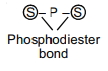
As shown in the diagram,the phosphate group $(P)$ connects two sugar molecules $(S)$,forming the phosphodiester bond.
This linkage occurs between the $3'-$carbon atom of the sugar molecule of one nucleotide and the $5'-$carbon atom of the sugar molecule of the adjacent nucleotide through a phosphate group.
This specific covalent linkage is known as a phosphodiester bond.
As shown in the diagram,the phosphate group $(P)$ connects two sugar molecules $(S)$,forming the phosphodiester bond.
0 likes
View Solution522
EasyMCQ
Sugars are attached to the pyrimidines by the formation of
A
Hydrogen bond
B
$N$-glycosidic bond
C
Phosphoester bond
D
$O$-glycosidic bond
Solution
(B) In a nucleoside,the nitrogenous base (purine or pyrimidine) is linked to the pentose sugar through an $N$-glycosidic bond.
Specifically,the $N-1$ nitrogen of the pyrimidine or the $N-9$ nitrogen of the purine forms a covalent bond with the $C-1'$ carbon of the sugar molecule.
Therefore,the correct bond formed is an $N$-glycosidic bond.
Specifically,the $N-1$ nitrogen of the pyrimidine or the $N-9$ nitrogen of the purine forms a covalent bond with the $C-1'$ carbon of the sugar molecule.
Therefore,the correct bond formed is an $N$-glycosidic bond.
0 likes
View Solution523
MediumMCQ
Which of the following structures are present in the core particle of a nucleosome?
A
Octamer of histone proteins
B
$200$ bp of $DNA$
C
Non-histone proteins
D
Linker $DNA$
Solution
(A) nucleosome consists of a core particle and linker $DNA$.
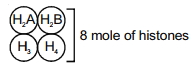
The core particle of a nucleosome is composed of an octamer of histone proteins ($H2A, H2B, H3, H4$ - two of each) around which approximately $146$ bp of $DNA$ is wrapped.
Option $A$ is correct because the histone octamer forms the central core of the nucleosome.
Option $B$ is incorrect because a complete nucleosome (including linker $DNA$) contains about $200$ bp of $DNA$,not just the core particle.
Option $C$ is incorrect as non-histone proteins are not part of the nucleosome core.
Option $D$ is incorrect because linker $DNA$ connects adjacent nucleosomes and is not part of the core particle itself.
The core particle of a nucleosome is composed of an octamer of histone proteins ($H2A, H2B, H3, H4$ - two of each) around which approximately $146$ bp of $DNA$ is wrapped.
Option $A$ is correct because the histone octamer forms the central core of the nucleosome.
Option $B$ is incorrect because a complete nucleosome (including linker $DNA$) contains about $200$ bp of $DNA$,not just the core particle.
Option $C$ is incorrect as non-histone proteins are not part of the nucleosome core.
Option $D$ is incorrect because linker $DNA$ connects adjacent nucleosomes and is not part of the core particle itself.
0 likes
View Solution524
MediumMCQ
Which of the following statements is correct regarding the packaging of the $DNA$ helix?
A
Involves polyamines in eukaryotes
B
Occurs with the help of $NHC$ proteins only
C
Requires acidic proteins that help in coiling of $DNA$ in prokaryotes
D
Is more complex in eukaryotes than prokaryotes
Solution
(D) The packaging of $DNA$ is significantly more complex in eukaryotes compared to prokaryotes. In prokaryotes,$DNA$ is organized in large loops held by proteins in a region called the nucleoid,involving positively charged proteins. In eukaryotes,the organization is much more elaborate,involving a set of positively charged basic proteins called histones. $DNA$ is wrapped around the histone octamer to form a structure called a nucleosome. Further packaging requires additional sets of proteins that are collectively referred to as Non-Histone Chromosomal $(NHC)$ proteins.
0 likes
View Solution525
MediumMCQ
The length of $DNA$ in $E. coli$ is:
A
$2.2\; m$
B
$1.36\; mm$
C
$1.36\; m$
D
$3.4\; m$
Solution
(B) The $E. coli$ genome consists of $4.6 \times 10^6$ base pairs.
The distance between two consecutive base pairs is $0.34 \times 10^{-9} \; m$ or $0.34 \times 10^{-6} \; mm$.
Therefore,the total length of $DNA$ is calculated as: $4.6 \times 10^6 \times 0.34 \times 10^{-6} \; mm = 1.36 \; mm$.
The distance between two consecutive base pairs is $0.34 \times 10^{-9} \; m$ or $0.34 \times 10^{-6} \; mm$.
Therefore,the total length of $DNA$ is calculated as: $4.6 \times 10^6 \times 0.34 \times 10^{-6} \; mm = 1.36 \; mm$.
0 likes
View Solution526
MediumMCQ
If the sequence of one strand of $DNA$ is $5^{\prime}-ATGCATCG-3^{\prime}$,find the sequence of the complementary strand in the $5^{\prime} \rightarrow 3^{\prime}$ direction.
A
$5^{\prime}-CGATGCAT-3^{\prime}$
B
$5^{\prime}-TACGTAGC-3^{\prime}$
C
$5^{\prime}-ATGCATCG-3^{\prime}$
D
$5^{\prime}-GCTACGTA-3^{\prime}$
Solution
(A) The two strands of $DNA$ are antiparallel and complementary to each other.
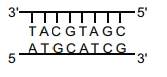
Given strand: $5^{\prime}-ATGCATCG-3^{\prime}$.
The complementary strand will run in the $3^{\prime} \rightarrow 5^{\prime}$ direction as $3^{\prime}-TACGTAGC-5^{\prime}$.
To write this in the $5^{\prime} \rightarrow 3^{\prime}$ direction,we reverse the sequence: $5^{\prime}-CGATGCAT-3^{\prime}$.
Therefore,the correct sequence is $5^{\prime}-CGATGCAT-3^{\prime}$.
Given strand: $5^{\prime}-ATGCATCG-3^{\prime}$.
The complementary strand will run in the $3^{\prime} \rightarrow 5^{\prime}$ direction as $3^{\prime}-TACGTAGC-5^{\prime}$.
To write this in the $5^{\prime} \rightarrow 3^{\prime}$ direction,we reverse the sequence: $5^{\prime}-CGATGCAT-3^{\prime}$.
Therefore,the correct sequence is $5^{\prime}-CGATGCAT-3^{\prime}$.
0 likes
View Solution527
MediumMCQ
$NHC$ (Non-Histone Chromosomal) structural proteins are:
A
Basic proteins rich in lysine and arginine
B
Regulatory proteins
C
Catalytic proteins rich in tryptophan and arginine
D
Required for packaging of chromatin at higher levels
Solution
(D) In the context of chromatin organization,proteins associated with $DNA$ are classified into two main types: Histones and Non-Histone Chromosomal $(NHC)$ proteins.
Histones are basic proteins rich in lysine and arginine,which are responsible for the basic packaging of $DNA$ into nucleosomes.
$NHC$ proteins are a diverse group of proteins that are required for the higher-level packaging of chromatin and also function in gene regulation and $DNA$ replication.
Therefore,the correct statement regarding $NHC$ proteins is that they are required for the packaging of chromatin at higher levels.
Histones are basic proteins rich in lysine and arginine,which are responsible for the basic packaging of $DNA$ into nucleosomes.
$NHC$ proteins are a diverse group of proteins that are required for the higher-level packaging of chromatin and also function in gene regulation and $DNA$ replication.
Therefore,the correct statement regarding $NHC$ proteins is that they are required for the packaging of chromatin at higher levels.
0 likes
View Solution528
MediumMCQ
Which of the following bonds is not present in $DNA$?
A
$\beta-1^{\prime}-9-N$-glycosidic bond
B
$3^{\prime}-5^{\prime}$ phosphodiester bond
C
$\beta-1^{\prime}-1-N$-glycosidic bond
D
$\beta-1^{\prime}-2-N$-glycosidic bond
Solution
(D) In $DNA$,the nitrogenous base is attached to the pentose sugar via an $N$-glycosidic linkage.
For purines (Adenine and Guanine),the linkage is between the $C-1^{\prime}$ of the sugar and the $N-9$ position of the base,known as a $\beta-1^{\prime}-9-N$-glycosidic bond.
For pyrimidines (Cytosine and Thymine),the linkage is between the $C-1^{\prime}$ of the sugar and the $N-1$ position of the base,known as a $\beta-1^{\prime}-1-N$-glycosidic bond.
The nucleotides are linked together by $3^{\prime}-5^{\prime}$ phosphodiester bonds.
Therefore,a $\beta-1^{\prime}-2-N$-glycosidic bond is not present in $DNA$.
For purines (Adenine and Guanine),the linkage is between the $C-1^{\prime}$ of the sugar and the $N-9$ position of the base,known as a $\beta-1^{\prime}-9-N$-glycosidic bond.
For pyrimidines (Cytosine and Thymine),the linkage is between the $C-1^{\prime}$ of the sugar and the $N-1$ position of the base,known as a $\beta-1^{\prime}-1-N$-glycosidic bond.
The nucleotides are linked together by $3^{\prime}-5^{\prime}$ phosphodiester bonds.
Therefore,a $\beta-1^{\prime}-2-N$-glycosidic bond is not present in $DNA$.
0 likes
View Solution529
MediumMCQ
Reverse transcriptase:
A
Disintegrates host $DNA$
B
Translates host $DNA$
C
Transcribes viral $RNA$ to $DNA$
D
Polymerises host $DNA$
Solution
(C) Reverse transcriptase is an enzyme found in retroviruses that catalyzes the synthesis of complementary $DNA$ $(cDNA)$ from an $RNA$ template. This process is known as reverse transcription. Unlike standard transcription,which goes from $DNA$ to $RNA$,this enzyme allows the viral $RNA$ genome to be converted into $DNA$,which can then be integrated into the host cell's genome.
0 likes
View Solution530
EasyMCQ
The mobile genetic element is
A
Transposon
B
Mutation
C
Endonuclease
D
Variation
Solution
(A) mobile genetic element is any genetic component capable of moving itself,with or without duplication,from one site in a genome to another.
Mobile genetic elements include plasmids,viruses,transposable genetic elements (transposons),short interspersed elements,and pathogenicity islands.
The term 'transposon' was introduced by $R. W. Hedges$ and $A. E. Jacob$ in $1974$ to describe 'controlling elements' or 'jumping genes',which were originally discovered by $Barbara$ $McClintock$ in $1950$ while studying maize.
Mobile genetic elements include plasmids,viruses,transposable genetic elements (transposons),short interspersed elements,and pathogenicity islands.
The term 'transposon' was introduced by $R. W. Hedges$ and $A. E. Jacob$ in $1974$ to describe 'controlling elements' or 'jumping genes',which were originally discovered by $Barbara$ $McClintock$ in $1950$ while studying maize.
0 likes
View Solution531
DifficultMCQ
If Adenine makes $30\%$ of the $DNA$ molecule,what will be the percentage of Thymine,Guanine,and Cytosine in it?
A
$T: 20\%, G: 30\%, C: 20\%$
B
$T: 20\%, G: 20\%, C: 30\%$
C
$T: 30\%, G: 20\%, C: 20\%$
D
$T: 20\%, G: 25\%, C: 25\%$
Solution
(C) According to Chargaff's rule,the amount of Adenine $(A)$ is equal to the amount of Thymine $(T)$,and the amount of Guanine $(G)$ is equal to the amount of Cytosine $(C)$.
Given that Adenine $(A)$ = $30\%$,then Thymine $(T)$ must also be $30\%$.
The total percentage of $A + T = 30\% + 30\% = 60\%$.
The remaining percentage for $G + C$ is $100\% - 60\% = 40\%$.
Since $G = C$,each must be $40\% / 2 = 20\%$.
Therefore,$T = 30\%, G = 20\%, C = 20\%$.
Given that Adenine $(A)$ = $30\%$,then Thymine $(T)$ must also be $30\%$.
The total percentage of $A + T = 30\% + 30\% = 60\%$.
The remaining percentage for $G + C$ is $100\% - 60\% = 40\%$.
Since $G = C$,each must be $40\% / 2 = 20\%$.
Therefore,$T = 30\%, G = 20\%, C = 20\%$.
0 likes
View Solution532
MediumMCQ
Which one of the following statements about Histones is wrong?
A
Histones are organized to form a unit of $8$ molecules.
B
The $pH$ of histones is slightly acidic.
C
Histones are rich in amino acids $-$ Lysine and Arginine.
D
Histones carry positive charge in the side chain.
Solution
(B) Histones are basic proteins that are positively charged.
They are rich in basic amino acids,specifically Lysine and Arginine.
These proteins are organized to form a unit of $8$ molecules known as a histone octamer.
Since they are basic proteins,their $pH$ is alkaline (basic),not acidic.
Therefore,the statement that the $pH$ of histones is slightly acidic is incorrect.
They are rich in basic amino acids,specifically Lysine and Arginine.
These proteins are organized to form a unit of $8$ molecules known as a histone octamer.
Since they are basic proteins,their $pH$ is alkaline (basic),not acidic.
Therefore,the statement that the $pH$ of histones is slightly acidic is incorrect.
0 likes
View Solution533
MediumMCQ
Read the following statements and choose the set of correct statements:
$(a)$ Euchromatin is loosely packed chromatin
$(b)$ Heterochromatin is transcriptionally active
$(c)$ Histone octamer is wrapped by negatively charged $DNA$ in nucleosome
$(d)$ Histones are rich in lysine and arginine
$(e)$ $A$ typical nucleosome contains $400 \ bp$ of $DNA$ helix
Choose the correct answer from the options given below:
$(a)$ Euchromatin is loosely packed chromatin
$(b)$ Heterochromatin is transcriptionally active
$(c)$ Histone octamer is wrapped by negatively charged $DNA$ in nucleosome
$(d)$ Histones are rich in lysine and arginine
$(e)$ $A$ typical nucleosome contains $400 \ bp$ of $DNA$ helix
Choose the correct answer from the options given below:
A
$(a), (c), (d)$ Only
B
$(b), (e)$ Only
C
$(a), (c), (e)$ Only
D
$(b), (d), (e)$ Only
Solution
(A) Statement $(a)$ is correct: Euchromatin is loosely packed and stains lightly.
Statement $(b)$ is incorrect: Heterochromatin is densely packed and transcriptionally inactive,whereas euchromatin is transcriptionally active.
Statement $(c)$ is correct: The negatively charged $DNA$ is wrapped around the positively charged histone octamer to form a nucleosome.
Statement $(d)$ is correct: Histone proteins are basic proteins rich in the basic amino acids lysine and arginine.
Statement $(e)$ is incorrect: $A$ typical nucleosome contains $200 \ bp$ of $DNA$ helix,not $400 \ bp$.
Therefore,the correct statements are $(a), (c),$ and $(d)$.
Statement $(b)$ is incorrect: Heterochromatin is densely packed and transcriptionally inactive,whereas euchromatin is transcriptionally active.
Statement $(c)$ is correct: The negatively charged $DNA$ is wrapped around the positively charged histone octamer to form a nucleosome.
Statement $(d)$ is correct: Histone proteins are basic proteins rich in the basic amino acids lysine and arginine.
Statement $(e)$ is incorrect: $A$ typical nucleosome contains $200 \ bp$ of $DNA$ helix,not $400 \ bp$.
Therefore,the correct statements are $(a), (c),$ and $(d)$.
0 likes
View Solution534
MediumMCQ
If the length of a $DNA$ molecule is $1.1$ metres,what will be the approximate number of base pairs?
A
$6.6 \times 10^{9} \text{ bp}$
B
$3.3 \times 10^{6} \text{ bp}$
C
$6.6 \times 10^{6} \text{ bp}$
D
$3.3 \times 10^{9} \text{ bp}$
Solution
(D) The distance between two consecutive base pairs in a $DNA$ molecule is $0.34 \text{ nm}$ or $0.34 \times 10^{-9} \text{ m}$.
Given the total length of the $DNA$ molecule is $1.1 \text{ m}$.
The number of base pairs is calculated by dividing the total length by the distance between two consecutive base pairs:
$\text{Number of base pairs} = \frac{\text{Total length}}{\text{Distance between two base pairs}}$
$\text{Number of base pairs} = \frac{1.1 \text{ m}}{0.34 \times 10^{-9} \text{ m}}$
$\text{Number of base pairs} \approx 3.235 \times 10^{9} \text{ bp}$.
Rounding this to the nearest option,we get $3.3 \times 10^{9} \text{ bp}$.
Given the total length of the $DNA$ molecule is $1.1 \text{ m}$.
The number of base pairs is calculated by dividing the total length by the distance between two consecutive base pairs:
$\text{Number of base pairs} = \frac{\text{Total length}}{\text{Distance between two base pairs}}$
$\text{Number of base pairs} = \frac{1.1 \text{ m}}{0.34 \times 10^{-9} \text{ m}}$
$\text{Number of base pairs} \approx 3.235 \times 10^{9} \text{ bp}$.
Rounding this to the nearest option,we get $3.3 \times 10^{9} \text{ bp}$.
0 likes
View Solution535
MediumMCQ
What types of nitrogenous bases are present in $DNA$ and $RNA$ respectively?
A
$A, G, C, T$ and $A, G, C, U$
B
$A, G, C, U$ and $A, G, C, T$
C
$A, G, T, U$ and $A, G, C, U$
D
$A, G, C, U$ and $A, G, T, U$
Solution
(A) $DNA$ (Deoxyribonucleic acid) contains the nitrogenous bases Adenine $(A)$,Guanine $(G)$,Cytosine $(C)$,and Thymine $(T)$.
$RNA$ (Ribonucleic acid) contains the nitrogenous bases Adenine $(A)$,Guanine $(G)$,Cytosine $(C)$,and Uracil $(U)$.
Therefore,the correct sequence for $DNA$ and $RNA$ is $A, G, C, T$ and $A, G, C, U$ respectively.
$RNA$ (Ribonucleic acid) contains the nitrogenous bases Adenine $(A)$,Guanine $(G)$,Cytosine $(C)$,and Uracil $(U)$.
Therefore,the correct sequence for $DNA$ and $RNA$ is $A, G, C, T$ and $A, G, C, U$ respectively.
0 likes
View Solution536
MediumMCQ
Deoxyadenosine,deoxyguanosine,deoxycytidine,and deoxythymidine are $....................$.
A
Nucleotides of $RNA$
B
Nucleosides of $RNA$
C
Nucleosides of $DNA$
D
Nucleotides of $DNA$
Solution
(C) nucleoside is formed by the combination of a nitrogenous base and a pentose sugar.
In $DNA$,the pentose sugar is deoxyribose.
When deoxyribose sugar combines with nitrogenous bases (Adenine,Guanine,Cytosine,and Thymine),they form deoxyadenosine,deoxyguanosine,deoxycytidine,and deoxythymidine,respectively.
These are collectively known as the nucleosides of $DNA$.
In $DNA$,the pentose sugar is deoxyribose.
When deoxyribose sugar combines with nitrogenous bases (Adenine,Guanine,Cytosine,and Thymine),they form deoxyadenosine,deoxyguanosine,deoxycytidine,and deoxythymidine,respectively.
These are collectively known as the nucleosides of $DNA$.
0 likes
View Solution537
MediumMCQ
Deoxyadenylic acid,deoxyguanylic acid,deoxycytidylic acid,and deoxythymidylic acid are $...............$.
A
Nucleotides for $RNA$
B
Nucleosides for $RNA$
C
Nucleosides for $DNA$
D
Nucleotides for $DNA$
Solution
(D) The compounds mentioned (deoxyadenylic acid,deoxyguanylic acid,deoxycytidylic acid,and deoxythymidylic acid) are the monomeric units of $DNA$.
These compounds are formed by the combination of a nitrogenous base,a deoxyribose sugar,and a phosphate group.
$A$ molecule consisting of a nitrogenous base,a sugar,and a phosphate group is called a nucleotide.
Since these specific molecules contain deoxyribose sugar,they are the nucleotides of $DNA$.
These compounds are formed by the combination of a nitrogenous base,a deoxyribose sugar,and a phosphate group.
$A$ molecule consisting of a nitrogenous base,a sugar,and a phosphate group is called a nucleotide.
Since these specific molecules contain deoxyribose sugar,they are the nucleotides of $DNA$.
0 likes
View Solution538
MediumMCQ
Identify the given nitrogenous bases $P$ and $Q$.
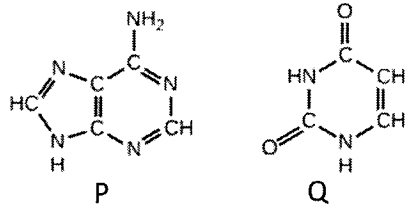
A
Adenine,Uracil
B
Uracil,Adenine
C
Guanine,Thymine
D
Thymine,Guanine
Solution
(A) The structure labeled $P$ is a double-ring structure,which is characteristic of a purine. Specifically,it is Adenine,which has an amino group $(-NH_2)$ attached to the purine ring.
The structure labeled $Q$ is a single-ring structure,which is characteristic of a pyrimidine. Specifically,it is Uracil,which contains two carbonyl groups $(C=O)$ and lacks the methyl group found in Thymine.
Therefore,$P$ is Adenine and $Q$ is Uracil.
The structure labeled $Q$ is a single-ring structure,which is characteristic of a pyrimidine. Specifically,it is Uracil,which contains two carbonyl groups $(C=O)$ and lacks the methyl group found in Thymine.
Therefore,$P$ is Adenine and $Q$ is Uracil.
0 likes
View Solution539
MediumMCQ
Identify the nitrogenous bases of the purine and pyrimidine types.
A
Purine $= C, T, U$; Pyrimidine $= A, G$
B
Purine $= G, C, U$; Pyrimidine $= A, T$
C
Purine $= A, T$; Pyrimidine $= G, C, U$
D
Purine $= A, G$; Pyrimidine $= C, T, U$
Solution
(D) Nitrogenous bases in nucleic acids are classified into two categories based on their chemical structure:
$1$. Purines: These are double-ring structures (bicyclic). Adenine $(A)$ and Guanine $(G)$ are purines.
$2$. Pyrimidines: These are single-ring structures (monocyclic). Cytosine $(C)$,Thymine $(T)$,and Uracil $(U)$ are pyrimidines.
Therefore,the correct classification is Purines $= A, G$ and Pyrimidines $= C, T, U$.
$1$. Purines: These are double-ring structures (bicyclic). Adenine $(A)$ and Guanine $(G)$ are purines.
$2$. Pyrimidines: These are single-ring structures (monocyclic). Cytosine $(C)$,Thymine $(T)$,and Uracil $(U)$ are pyrimidines.
Therefore,the correct classification is Purines $= A, G$ and Pyrimidines $= C, T, U$.
0 likes
View Solution540
MediumMCQ
If the amount of $Adenine$ in $DNA$ is $20 \%$,what is the amount of $Guanine$ (in $\%$)?
A
$20$
B
$30$
C
$80$
D
$40$
Solution
(B) According to $Chargaff's$ rule,the amount of $Adenine$ $(A)$ is equal to the amount of $Thymine$ $(T)$,and the amount of $Guanine$ $(G)$ is equal to the amount of $Cytosine$ $(C)$.
Given that $A = 20 \%$,then $T = 20 \%$.
The sum of all four bases is $A + T + G + C = 100 \%$.
Substituting the known values: $20 \% + 20 \% + G + C = 100 \%$.
$40 \% + G + C = 100 \%$.
$G + C = 60 \%$.
Since $G = C$,we have $2G = 60 \%$.
Therefore,$G = 30 \%$.
Given that $A = 20 \%$,then $T = 20 \%$.
The sum of all four bases is $A + T + G + C = 100 \%$.
Substituting the known values: $20 \% + 20 \% + G + C = 100 \%$.
$40 \% + G + C = 100 \%$.
$G + C = 60 \%$.
Since $G = C$,we have $2G = 60 \%$.
Therefore,$G = 30 \%$.
0 likes
View Solution541
EasyMCQ
The backbone of $DNA$ is made up of:
A
Sugar and phosphate
B
Sugar and nitrogenous bases
C
Phosphate and nitrogenous bases
D
Only sugar
Solution
(A) The $DNA$ molecule consists of two polynucleotide chains. Each nucleotide is composed of a deoxyribose sugar,a phosphate group,and a nitrogenous base. The backbone of the $DNA$ strand is formed by the alternating sequence of deoxyribose sugar and phosphate groups linked by phosphodiester bonds. The nitrogenous bases project inward from this backbone.
0 likes
View Solution542
MediumMCQ
In the structure of $DNA$,which component of the nucleotide is located towards the inside,perpendicular to the main axis?
A
Sugar
B
Glucose
C
Phosphate
D
Nitrogenous bases
Solution
(D) In the double-helical structure of $DNA$,the backbone is formed by the sugar-phosphate chain,which is located on the outside of the helix.
The nitrogenous bases (adenine,guanine,cytosine,and thymine) are attached to the sugar and are directed inwards towards the central axis.
These nitrogenous bases form hydrogen bonds with their complementary bases on the opposite strand,maintaining the stability of the $DNA$ structure.
The nitrogenous bases (adenine,guanine,cytosine,and thymine) are attached to the sugar and are directed inwards towards the central axis.
These nitrogenous bases form hydrogen bonds with their complementary bases on the opposite strand,maintaining the stability of the $DNA$ structure.
0 likes
View Solution543
MediumMCQ
How many hydrogen bonds are present between adenine and thymine?
A
$1$
B
$2$
C
$3$
D
$4$
Solution
(B) In the structure of $DNA$,nitrogenous bases pair with each other through hydrogen bonds.
According to Chargaff's rules and the Watson-Crick model of $DNA$,adenine $(A)$ always pairs with thymine $(T)$ via $2$ hydrogen bonds.
Conversely,guanine $(G)$ pairs with cytosine $(C)$ via $3$ hydrogen bonds.
Therefore,the correct number of hydrogen bonds between adenine and thymine is $2$.
According to Chargaff's rules and the Watson-Crick model of $DNA$,adenine $(A)$ always pairs with thymine $(T)$ via $2$ hydrogen bonds.
Conversely,guanine $(G)$ pairs with cytosine $(C)$ via $3$ hydrogen bonds.
Therefore,the correct number of hydrogen bonds between adenine and thymine is $2$.
0 likes
View Solution544
EasyMCQ
How many hydrogen bonds are present between guanine and cytosine?
A
$1$
B
$2$
C
$3$
D
$4$
Solution
(C) In the structure of $DNA$,nitrogenous bases pair specifically through hydrogen bonds.
According to Watson and Crick's base-pairing rules,guanine $(G)$ always pairs with cytosine $(C)$ via $3$ hydrogen bonds.
Conversely,adenine $(A)$ pairs with thymine $(T)$ via $2$ hydrogen bonds.
Therefore,the correct number of hydrogen bonds between guanine and cytosine is $3$.
According to Watson and Crick's base-pairing rules,guanine $(G)$ always pairs with cytosine $(C)$ via $3$ hydrogen bonds.
Conversely,adenine $(A)$ pairs with thymine $(T)$ via $2$ hydrogen bonds.
Therefore,the correct number of hydrogen bonds between guanine and cytosine is $3$.
0 likes
View Solution545
MediumMCQ
In the structure of $DNA$,the length of one full turn is $.........$ and the number of nitrogen base pairs is $...........$.
A
$34 \mathring A, 10$
B
$20 \mathring A, 10$
C
$3.4 \mathring A, 20$
D
$2.0 \mathring A, 20$
Solution
(A) According to the Watson-Crick model of $DNA$ structure:
$1$. The $DNA$ molecule forms a double helix.
$2$. One full turn of the helix (pitch) measures $34 \mathring A$ $(3.4 \ nm)$.
$3$. There are $10$ base pairs present in each full turn of the $DNA$ helix.
$4$. Therefore,the distance between two adjacent base pairs is $3.4 \mathring A$ $(0.34 \ nm)$.
$5$. Thus,the correct values are $34 \mathring A$ and $10$ base pairs.
$1$. The $DNA$ molecule forms a double helix.
$2$. One full turn of the helix (pitch) measures $34 \mathring A$ $(3.4 \ nm)$.
$3$. There are $10$ base pairs present in each full turn of the $DNA$ helix.
$4$. Therefore,the distance between two adjacent base pairs is $3.4 \mathring A$ $(0.34 \ nm)$.
$5$. Thus,the correct values are $34 \mathring A$ and $10$ base pairs.
0 likes
View Solution546
EasyMCQ
What is the distance between the two polynucleotide strands of $DNA$?
A
$34 \mathring A$
B
$20 \mathring A$
C
$36 \mathring A$
D
$10 \mathring A$
Solution
(B) According to the Watson-Crick model of $DNA$ structure,the $DNA$ molecule consists of two polynucleotide strands that form a double helix.
The diameter of this double helix is constant throughout its length.
The distance between the two polynucleotide strands (the diameter of the $DNA$ helix) is $20 \mathring A$ $(2 \text{ nm})$.
Therefore,the correct option is $B$.
The diameter of this double helix is constant throughout its length.
The distance between the two polynucleotide strands (the diameter of the $DNA$ helix) is $20 \mathring A$ $(2 \text{ nm})$.
Therefore,the correct option is $B$.
0 likes
View Solution547
MediumMCQ
How is the bond formed in the structure of a dinucleotide?
A
Between the $-NH_2$ group of one nucleotide and the $-COOH$ group of another nucleotide.
B
Between the $3'-OH$ group of one nucleotide and the $5'$-phosphate group of another nucleotide.
C
Between the $1'-OH$ group of one nucleotide and the $4'-OH$ group of another nucleotide.
D
Between the $-CONH_2$ group of one nucleotide and the $-OH$ group of another nucleotide.
Solution
(B) dinucleotide is formed when two nucleotides are linked together by a phosphodiester bond.
This bond is formed between the $3'-OH$ group of the sugar moiety of one nucleotide and the $5'$-phosphate group of the sugar moiety of the next nucleotide.
This linkage creates a sugar-phosphate backbone in the nucleic acid chain.
This bond is formed between the $3'-OH$ group of the sugar moiety of one nucleotide and the $5'$-phosphate group of the sugar moiety of the next nucleotide.
This linkage creates a sugar-phosphate backbone in the nucleic acid chain.
0 likes
View Solution548
MediumMCQ
$A$ gene is defined as ...........
A
$A$ unit of inheritance
B
$A$ factor that controls traits
C
$A$ segment of $DNA$
D
All of the above
Solution
(D) gene is the fundamental physical and functional unit of heredity.
It is a specific sequence of nucleotides in $DNA$ that encodes the synthesis of a gene product,either $RNA$ or protein.
In classical genetics,it is referred to as a 'factor' that controls the expression of specific traits in an organism.
Therefore,all the given statements correctly describe a gene.
It is a specific sequence of nucleotides in $DNA$ that encodes the synthesis of a gene product,either $RNA$ or protein.
In classical genetics,it is referred to as a 'factor' that controls the expression of specific traits in an organism.
Therefore,all the given statements correctly describe a gene.
0 likes
View Solution549
MediumMCQ
Genome $= ......$
A
The complete set of genetic information of an organism
B
Gene
C
Chromosome
D
All $RNA$ present in a cell
Solution
(A) The term $Genome$ refers to the complete set of genetic material $(DNA)$ present in an organism or cell. It includes all the genes as well as the non-coding sequences of the $DNA$. Therefore,it represents the entire genetic blueprint of an organism.
0 likes
View Solution550
MediumMCQ
Which of the following structures is correct for $DNA$?
A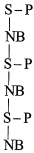
B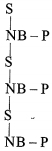
C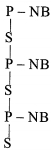
D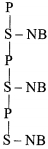
Solution
(D) $DNA$ molecule is a polymer of nucleotides. Each nucleotide consists of three components: a nitrogenous base $(NB)$,a pentose sugar $(S)$,and a phosphate group $(P)$.
In a nucleotide,the nitrogenous base is attached to the $1'$ carbon of the sugar,and the phosphate group is attached to the $5'$ carbon of the sugar.
These nucleotides are linked together by phosphodiester bonds to form a polynucleotide chain. The backbone of the $DNA$ strand is formed by the alternating sugar and phosphate groups $(S-P-S-P...)$,with the nitrogenous bases $(NB)$ attached to each sugar molecule.
Looking at the options,the structure where the phosphate group $(P)$ is attached to the sugar $(S)$,and the nitrogenous base $(NB)$ is also attached to the sugar $(S)$ in a repeating sequence represents the correct backbone structure of $DNA$.
In a nucleotide,the nitrogenous base is attached to the $1'$ carbon of the sugar,and the phosphate group is attached to the $5'$ carbon of the sugar.
These nucleotides are linked together by phosphodiester bonds to form a polynucleotide chain. The backbone of the $DNA$ strand is formed by the alternating sugar and phosphate groups $(S-P-S-P...)$,with the nitrogenous bases $(NB)$ attached to each sugar molecule.
Looking at the options,the structure where the phosphate group $(P)$ is attached to the sugar $(S)$,and the nitrogenous base $(NB)$ is also attached to the sugar $(S)$ in a repeating sequence represents the correct backbone structure of $DNA$.
0 likes
View SolutionMolecular Basis of Inheritance — The DNA · Frequently Asked Questions
1Are these Molecular Basis of Inheritance questions useful for JEE and NEET?
Yes. All questions in this section are mapped to JEE Main and NEET exam patterns. Previous year questions from JEE Main, NEET, GUJCET and state-level exams are included with full solutions.
2Can I switch to Hindi or Gujarati for these questions?
Yes. Use the language tabs in the hero section or the sidebar to view the same questions and solutions in English, Hindi or Gujarati.
3How do I generate a question paper from this subtopic?
Use the Vedclass Exam Paper Generator — select the chapter and subtopic, set difficulty, and generate Sets A, B, C, D automatically. First 3 chapters of every subject are free.
Vedclass Products
For Students
Vedclass Test Series
Mock tests in real JEE/NEET style with performance analysis. 5-day free trial.
Start Free TrialFor Teachers
Exam Paper Generator
Generate Set A/B/C/D papers from this chapter in 2 minutes. 3 chapters free.
Try FreeFor Institutes
Online Exam Module
Live online exams with unlimited students, 360° analytics & white-label branding.
See DemoFor Teachers & Institutes
Generate a Molecular Basis of Inheritance Exam Paper in 2 Minutes
Select subtopic & difficulty — Sets A, B, C, D auto-generated with No Repeat logic.
First 3 chapters of every subject are free — no payment required.