
A English
The DNA Questions in English
Class 12 Biology · Molecular Basis of Inheritance · The DNA
632+
Questions
English
Language
100%
With Solutions
Showing 32 of 632 questions in English
601
EasyMCQ
Nucleosomes are the repeating units of chromatin; the part between adjacent nucleosomes is called . . . . . . .
A
cDNA
B
tandem repeats
C
linker $DNA$
D
recombination nodules
Solution
(C) Nucleosomes are the fundamental repeating units of eukaryotic chromatin,consisting of a segment of $DNA$ wound around a histone protein core.
Each nucleosome core particle contains $146$ base pairs of $DNA$ wrapped around an octamer of histone proteins.
The $DNA$ segment that connects two adjacent nucleosomes is known as linker $DNA$.
This linker $DNA$ is associated with histone $H1$,which helps in the stabilization of the chromatin structure.
Each nucleosome core particle contains $146$ base pairs of $DNA$ wrapped around an octamer of histone proteins.
The $DNA$ segment that connects two adjacent nucleosomes is known as linker $DNA$.
This linker $DNA$ is associated with histone $H1$,which helps in the stabilization of the chromatin structure.
0 likes
View Solution602
EasyMCQ
$A$ nucleosome has a histone octamer made up of:
A
$1 H_1, 2 H_2, 3 H_3, 2 H_4$
B
$2 H_{2A}, 2 H_{2B}, 2 H_{3A}, 2 H_{3B}$
C
$2(H_{2A} + H_{2B} + H_3 + H_4)$
D
$2 H_2, 2 H_3, 2 H_4, 2 H_1$
Solution
(C) nucleosome is the basic structural unit of $DNA$ packaging in eukaryotes. It consists of a segment of $DNA$ wound around a core of histone proteins. The histone octamer core is composed of two copies each of four types of histone proteins: $H_{2A}$,$H_{2B}$,$H_3$,and $H_4$. Therefore,the octamer is represented as $2(H_{2A} + H_{2B} + H_3 + H_4)$. The $H_1$ histone protein is not part of the octamer core; instead,it binds to the $DNA$ where it enters and leaves the nucleosome,helping to stabilize the structure.
0 likes
View Solution603
EasyMCQ
Identify the $INCORRECT$ statement regarding packaging of $DNA$ in prokaryotes.
A
$1100 \ \mu m$ long nucleoid is packaged into a cell of $2-3 \ \mu m$ long.
B
Circular unfolded chromosome is $350 \ \mu m$ in diameter.
C
The $DNA$ gets packaged into $30 \ \mu m$ size due to coiling and supercoiling of each loop.
D
Supercoiling results in reducing the size of $DNA$ to $2 \ \mu m$ diameter.
Solution
(C) In prokaryotes,the $DNA$ is organized in large loops held by proteins.
The $DNA$ is reduced to $30 \ \mu m$ in diameter due to folding and looping of the $DNA$ strands.
The statement claiming this reduction is due to 'coiling and supercoiling' is incorrect,as coiling and supercoiling are responsible for further compaction to $2 \ \mu m$.
The $DNA$ is reduced to $30 \ \mu m$ in diameter due to folding and looping of the $DNA$ strands.
The statement claiming this reduction is due to 'coiling and supercoiling' is incorrect,as coiling and supercoiling are responsible for further compaction to $2 \ \mu m$.
0 likes
View Solution604
EasyMCQ
In eukaryotic chromosomes,the association of $DNA$ with histone and non-histone proteins was reported by . . . . . . in $1974$.
A
Kornberg
B
Crick
C
Heitz
D
Okazaki
Solution
(A) The structure of chromatin,where $DNA$ is wrapped around histone octamers to form nucleosomes,was proposed by Roger Kornberg in $1974$. This model explains how long $DNA$ molecules are packaged into the compact structure of eukaryotic chromosomes using histone and non-histone proteins.
0 likes
View Solution605
EasyMCQ
The successive histone octamers in a solenoid fibre are connected by . . . . . . .
A
chimeric $DNA$
B
recombinant $DNA$
C
linker $DNA$
D
complementary $DNA$
Solution
(C) One nucleosome approximately contains $200$ base pair long $DNA$ helix,of which about $146$ bp long segment is wound around each histone octamer,and the remaining base pairs contribute as linker $DNA$,which connects successive nucleosomes in a solenoid fibre.
0 likes
View Solution606
EasyMCQ
Which of the following statements are correct regarding $DNA$?
$(a)$ It is double stranded helically coiled.
$(b)$ The two strands are complementary and anti-parallel.
$(c)$ It has deoxyribose sugar and is acidic in nature.
$(d)$ It has only three nitrogen bases.
$(a)$ It is double stranded helically coiled.
$(b)$ The two strands are complementary and anti-parallel.
$(c)$ It has deoxyribose sugar and is acidic in nature.
$(d)$ It has only three nitrogen bases.
A
$(a)$,$(b)$,$(c)$ and $(d)$
B
$(a)$ and $(d)$ only
C
$(a)$ and $(c)$ only
D
$(a)$,$(b)$ and $(c)$
Solution
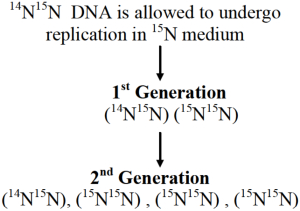
(C) Statement $(a)$ is correct: $DNA$ is a double-stranded,helically coiled molecule.
Statement $(b)$ is incorrect: The two strands of $DNA$ are complementary and anti-parallel,not parallel.
Statement $(c)$ is correct: $DNA$ contains deoxyribose sugar and is acidic due to the presence of phosphate groups.
Statement $(d)$ is incorrect: $DNA$ contains four nitrogenous bases (Adenine,Guanine,Cytosine,and Thymine),not three.
Therefore,statements $(a)$ and $(c)$ are correct.
Statement $(b)$ is incorrect: The two strands of $DNA$ are complementary and anti-parallel,not parallel.
Statement $(c)$ is correct: $DNA$ contains deoxyribose sugar and is acidic due to the presence of phosphate groups.
Statement $(d)$ is incorrect: $DNA$ contains four nitrogenous bases (Adenine,Guanine,Cytosine,and Thymine),not three.
Therefore,statements $(a)$ and $(c)$ are correct.
0 likes
View Solution607
EasyMCQ
The heterochromatin part of chromosome is . . . . . . times more rich in $DNA$ than euchromatin.
A
$2-3$
B
$9-12$
C
$5-8$
D
$4-6$
Solution
(B) Chromatin is classified into two types based on its staining properties and transcriptional activity: $Euchromatin$ and $Heterochromatin$.
$Euchromatin$ is loosely packed, transcriptionally active, and stains lightly.
$Heterochromatin$ is densely packed, transcriptionally inactive, and stains darkly.
Studies on the composition of these regions indicate that $Heterochromatin$ is significantly more condensed and contains a higher density of $DNA$ compared to $Euchromatin$.
Specifically, $Heterochromatin$ is approximately $9-12$ times more rich in $DNA$ content per unit volume compared to $Euchromatin$.
$Euchromatin$ is loosely packed, transcriptionally active, and stains lightly.
$Heterochromatin$ is densely packed, transcriptionally inactive, and stains darkly.
Studies on the composition of these regions indicate that $Heterochromatin$ is significantly more condensed and contains a higher density of $DNA$ compared to $Euchromatin$.
Specifically, $Heterochromatin$ is approximately $9-12$ times more rich in $DNA$ content per unit volume compared to $Euchromatin$.
0 likes
View Solution608
EasyMCQ
Which one of the following shows a clover leaf model?
A
$DNA$
B
$tRNA$
C
$mRNA$
D
$rRNA$
Solution
(B) The clover leaf model is the secondary structure of $tRNA$ (transfer $RNA$).
It consists of three loops: the $D-loop$, the $anticodon-loop$, and the $T\psi C-loop$.
This structure is essential for its function in protein synthesis, where it carries specific amino acids to the ribosome based on the codon sequence of $mRNA$.
It consists of three loops: the $D-loop$, the $anticodon-loop$, and the $T\psi C-loop$.
This structure is essential for its function in protein synthesis, where it carries specific amino acids to the ribosome based on the codon sequence of $mRNA$.
0 likes
View Solution609
EasyMCQ
The two strands of $DNA$ are
A
Similar and Parallel
B
Complementary and parallel
C
Complementary and antiparallel
D
Similar and discontinuous
Solution
(C) The structure of $DNA$ consists of two polynucleotide chains that form a double helix.
These two strands are complementary to each other,meaning the sequence of bases in one strand determines the sequence in the other due to specific base pairing rules ($A$ pairs with $T$,and $G$ pairs with $C$).
Furthermore,the two strands run in opposite directions,meaning one strand runs in the $5' \rightarrow 3'$ direction,while the other runs in the $3' \rightarrow 5'$ direction. This orientation is referred to as antiparallel.
These two strands are complementary to each other,meaning the sequence of bases in one strand determines the sequence in the other due to specific base pairing rules ($A$ pairs with $T$,and $G$ pairs with $C$).
Furthermore,the two strands run in opposite directions,meaning one strand runs in the $5' \rightarrow 3'$ direction,while the other runs in the $3' \rightarrow 5'$ direction. This orientation is referred to as antiparallel.
0 likes
View Solution610
EasyMCQ
In one nucleosome,which one of the following histone molecule is $NOT$ double?
A
H4
B
H3
C
H2
D
H1
Solution
(D) nucleosome consists of a core particle and a linker $DNA$. The core particle is an octamer of histone proteins,which contains two molecules each of $H2A$,$H2B$,$H3$,and $H4$.
These eight histone molecules form the core around which the $DNA$ is wrapped.
The $H1$ histone protein is known as the linker histone,which binds to the $DNA$ where it enters and leaves the nucleosome core particle.
Therefore,$H1$ is present as a single molecule per nucleosome,not as a double molecule.
These eight histone molecules form the core around which the $DNA$ is wrapped.
The $H1$ histone protein is known as the linker histone,which binds to the $DNA$ where it enters and leaves the nucleosome core particle.
Therefore,$H1$ is present as a single molecule per nucleosome,not as a double molecule.
0 likes
View Solution611
EasyMCQ
$A$ nucleosome along with linker $DNA$ consists of
A
eight molecules of histones and $146$ base pairs
B
eight molecules of histones and $200$ base pairs
C
nine molecules of histones and $146$ base pairs
D
nine molecules of histones and $200$ base pairs
Solution
(D) nucleosome core particle consists of an octamer of histone proteins ($H2A, H2B, H3, H4$ - two of each) around which $146$ base pairs of $DNA$ are wrapped.
When the linker $DNA$ (which connects adjacent nucleosomes) is included,the total length of $DNA$ associated with one nucleosome unit is approximately $200$ base pairs.
The $H1$ histone protein binds to the linker $DNA$,making the total number of histone molecules involved in the nucleosome complex equal to $9$ ($8$ in the core + $1$ linker histone).
When the linker $DNA$ (which connects adjacent nucleosomes) is included,the total length of $DNA$ associated with one nucleosome unit is approximately $200$ base pairs.
The $H1$ histone protein binds to the linker $DNA$,making the total number of histone molecules involved in the nucleosome complex equal to $9$ ($8$ in the core + $1$ linker histone).
0 likes
View Solution612
EasyMCQ
If a double-stranded $DNA$ has $30 \%$ adenine,what is the percentage of cytosine in the same $DNA$ (in $\%$)?
A
$30$
B
$20$
C
$40$
D
$70$
Solution
(B) According to Chargaff's rule for double-stranded $DNA$,the amount of adenine $(A)$ is equal to the amount of thymine $(T)$,and the amount of guanine $(G)$ is equal to the amount of cytosine $(C)$.
Given: $A = 30 \%$.
Since $A = T$,then $T = 30 \%$.
The sum of all bases is $A + T + G + C = 100 \%$.
Substituting the values: $30 \% + 30 \% + G + C = 100 \%$.
$60 \% + G + C = 100 \%$.
$G + C = 100 \% - 60 \% = 40 \%$.
Since $G = C$,we can write $2C = 40 \%$.
Therefore,$C = 20 \%$.
Thus,the percentage of cytosine is $20 \%$.
Given: $A = 30 \%$.
Since $A = T$,then $T = 30 \%$.
The sum of all bases is $A + T + G + C = 100 \%$.
Substituting the values: $30 \% + 30 \% + G + C = 100 \%$.
$60 \% + G + C = 100 \%$.
$G + C = 100 \% - 60 \% = 40 \%$.
Since $G = C$,we can write $2C = 40 \%$.
Therefore,$C = 20 \%$.
Thus,the percentage of cytosine is $20 \%$.
0 likes
View Solution613
EasyMCQ
Study the following statements:
$(I)$ Bacteriophage lambda has $48502$ base pairs $(bp)$
$(II)$ $E. \text{ coli}$ has $4.6 \times 10^6$ $bp$
$(III)$ Haploid content of human $DNA$ is $3.3 \times 10^9$ $bp$
Find the option for the incorrect statement.
$(I)$ Bacteriophage lambda has $48502$ base pairs $(bp)$
$(II)$ $E. \text{ coli}$ has $4.6 \times 10^6$ $bp$
$(III)$ Haploid content of human $DNA$ is $3.3 \times 10^9$ $bp$
Find the option for the incorrect statement.
A
Only statement $I$
B
Only statement $III$
C
Only statement $II$
D
Statements $I$ and $II$
Solution
(A) Statement $I$ is incorrect because Bacteriophage lambda has $48502$ base pairs $(bp)$.
Statement $\phi \times 174$ (phi $X$ $174$) bacteriophage has $5386$ nucleotides.
Statement $II$ is correct as $E. \text{ coli}$ contains $4.6 \times 10^6$ $bp$.
Statement $III$ is correct as the haploid content of human $DNA$ is $3.3 \times 10^9$ $bp$.
Therefore, only statement $I$ is incorrect.
Statement $\phi \times 174$ (phi $X$ $174$) bacteriophage has $5386$ nucleotides.
Statement $II$ is correct as $E. \text{ coli}$ contains $4.6 \times 10^6$ $bp$.
Statement $III$ is correct as the haploid content of human $DNA$ is $3.3 \times 10^9$ $bp$.
Therefore, only statement $I$ is incorrect.
0 likes
View Solution614
EasyMCQ
Histones are rich in which basic amino acids?
A
Valine and methionine
B
Phenylalanine and methionine
C
Valine and glutamine
D
Lysine and Arginine
Solution
(D) Histones are positively charged,basic proteins that are associated with $DNA$ in eukaryotic cells.
They are rich in the basic amino acids $Lysine$ and $Arginine$.
These amino acids carry positive charges in their side chains,which allow them to interact strongly with the negatively charged phosphate backbone of the $DNA$ molecule.
Therefore,the correct option is $D$.
They are rich in the basic amino acids $Lysine$ and $Arginine$.
These amino acids carry positive charges in their side chains,which allow them to interact strongly with the negatively charged phosphate backbone of the $DNA$ molecule.
Therefore,the correct option is $D$.
0 likes
View Solution615
EasyMCQ
Bacteriophage $\phi \times 174$ possesses . . . . . . nucleotides. (in $bp$)
A
$8653$
B
$8356$
C
$5386$
D
$6538$
Solution
(C) The bacteriophage $\phi \times 174$ is a well-known virus that contains a single-stranded $DNA$ genome.
According to the $NCERT$ textbook,the genome of bacteriophage $\phi \times 174$ consists of $5386$ nucleotides.
Therefore,the correct option is $C$.
According to the $NCERT$ textbook,the genome of bacteriophage $\phi \times 174$ consists of $5386$ nucleotides.
Therefore,the correct option is $C$.
0 likes
View Solution616
EasyMCQ
The length of $DNA$ double helix in human sperm is approximately . . . . . . .
A
$1.36$ mm
B
$2.2$ m
C
$1.1$ m
D
$2.2$ mm
Solution
(C) The total number of base pairs in a human diploid cell is $6.6 \times 10^9$ bp.
Since a sperm cell is haploid,it contains half the amount of $DNA$,which is $3.3 \times 10^9$ bp.
The distance between two consecutive base pairs is $0.34 \ \text{nm}$ or $0.34 \times 10^{-9} \ \text{m}$.
The total length of the $DNA$ double helix is calculated as: $\text{Length} = \text{Number of base pairs} \times \text{Distance between base pairs}$.
$\text{Length} = (3.3 \times 10^9) \times (0.34 \times 10^{-9} \ \text{m}) = 1.122 \ \text{m}$.
Therefore,the length is approximately $1.1 \ \text{m}$.
Since a sperm cell is haploid,it contains half the amount of $DNA$,which is $3.3 \times 10^9$ bp.
The distance between two consecutive base pairs is $0.34 \ \text{nm}$ or $0.34 \times 10^{-9} \ \text{m}$.
The total length of the $DNA$ double helix is calculated as: $\text{Length} = \text{Number of base pairs} \times \text{Distance between base pairs}$.
$\text{Length} = (3.3 \times 10^9) \times (0.34 \times 10^{-9} \ \text{m}) = 1.122 \ \text{m}$.
Therefore,the length is approximately $1.1 \ \text{m}$.
0 likes
View Solution617
EasyMCQ
If a double-stranded $DNA$ has $35 \%$ Guanine,calculate the percent of Thymine in the $DNA$. (in $\%$)
A
$35$
B
$70$
C
$15$
D
$30$
Solution
(C) According to Chargaff's rule,in double-stranded $DNA$,the amount of Adenine $(A)$ is equal to Thymine $(T)$,and the amount of Guanine $(G)$ is equal to Cytosine $(C)$.
Given: $G = 35 \%$.
Since $G = C$,therefore $C = 35 \%$.
The sum of all four bases is $100 \%$,so $A + T + G + C = 100 \%$.
Substituting the values: $A + T + 35 \% + 35 \% = 100 \%$.
$A + T + 70 \% = 100 \%$.
$A + T = 30 \%$.
Since $A = T$,we can write $2T = 30 \%$.
Therefore,$T = 15 \%$.
Given: $G = 35 \%$.
Since $G = C$,therefore $C = 35 \%$.
The sum of all four bases is $100 \%$,so $A + T + G + C = 100 \%$.
Substituting the values: $A + T + 35 \% + 35 \% = 100 \%$.
$A + T + 70 \% = 100 \%$.
$A + T = 30 \%$.
Since $A = T$,we can write $2T = 30 \%$.
Therefore,$T = 15 \%$.
0 likes
View Solution618
EasyMCQ
The length of $DNA$ in $E. coli$ is . . . . . . .
A
$1.36 \ mm$
B
$1.34 \ mm$
C
$1.8 \ m$
D
$2.2 \ m$
Solution
(A) The total length of $DNA$ in $E. coli$ is calculated by multiplying the total number of base pairs by the distance between two consecutive base pairs.
$E. coli$ has $4.6 \times 10^6$ base pairs.
The distance between two consecutive base pairs is $0.34 \times 10^{-9} \ m$.
Length = $(4.6 \times 10^6) \times (0.34 \times 10^{-9} \ m) \approx 1.36 \times 10^{-3} \ m = 1.36 \ mm$.
Therefore,the correct option is $A$.
$E. coli$ has $4.6 \times 10^6$ base pairs.
The distance between two consecutive base pairs is $0.34 \times 10^{-9} \ m$.
Length = $(4.6 \times 10^6) \times (0.34 \times 10^{-9} \ m) \approx 1.36 \times 10^{-3} \ m = 1.36 \ mm$.
Therefore,the correct option is $A$.
0 likes
View Solution619
EasyMCQ
The coding sequences of genes are known as . . . . . . .
A
Regulator
B
Introns
C
Promotor
D
Exons
Solution
(D) In eukaryotic genes,the coding sequences that appear in mature $mRNA$ are called $Exons$.
$Introns$ are the intervening,non-coding sequences that are removed during the process of $RNA$ splicing.
$Promoters$ and $Regulators$ are sequences involved in the control of gene expression,not the coding sequences themselves.
Therefore,the correct answer is $D$.
$Introns$ are the intervening,non-coding sequences that are removed during the process of $RNA$ splicing.
$Promoters$ and $Regulators$ are sequences involved in the control of gene expression,not the coding sequences themselves.
Therefore,the correct answer is $D$.
0 likes
View Solution620
EasyMCQ
$5$-Methyl uracil is . . . . . . .
A
Thymine
B
Cytosine
C
Adenine
D
Uracil
Solution
(A) The chemical name for $5$-Methyl uracil is Thymine.
Thymine is a pyrimidine nitrogenous base found in $DNA$.
It is structurally similar to Uracil,which is found in $RNA$,but with a methyl group $(-CH_3)$ attached at the $5^{th}$ position of the pyrimidine ring.
Therefore,the correct option is $A$.
Thymine is a pyrimidine nitrogenous base found in $DNA$.
It is structurally similar to Uracil,which is found in $RNA$,but with a methyl group $(-CH_3)$ attached at the $5^{th}$ position of the pyrimidine ring.
Therefore,the correct option is $A$.
0 likes
View Solution621
EasyMCQ
How many hydrogen bonds are found between nitrogen bases in $DNA$ having $50$ nitrogen base pairs with $20$ thymine?
A
$40$
B
$90$
C
$50$
D
$130$
Solution
(D) According to Chargaff's rule,in a double-stranded $DNA$ molecule,the amount of Adenine $(A)$ equals the amount of Thymine $(T)$,and the amount of Guanine $(G)$ equals the amount of Cytosine $(C)$.
Given: Total base pairs = $50$,so total nitrogen bases = $100$.
Number of Thymine $(T)$ = $20$.
Therefore,number of Adenine $(A)$ = $20$.
Number of $A-T$ pairs = $20$.
Number of $G-C$ pairs = Total base pairs - $A-T$ pairs = $50 - 20 = 30$.
Hydrogen bonds between $A$ and $T$ = $2 \times 20 = 40$.
Hydrogen bonds between $G$ and $C$ = $3 \times 30 = 90$.
Total hydrogen bonds = $40 + 90 = 130$.
Given: Total base pairs = $50$,so total nitrogen bases = $100$.
Number of Thymine $(T)$ = $20$.
Therefore,number of Adenine $(A)$ = $20$.
Number of $A-T$ pairs = $20$.
Number of $G-C$ pairs = Total base pairs - $A-T$ pairs = $50 - 20 = 30$.
Hydrogen bonds between $A$ and $T$ = $2 \times 20 = 40$.
Hydrogen bonds between $G$ and $C$ = $3 \times 30 = 90$.
Total hydrogen bonds = $40 + 90 = 130$.
0 likes
View Solution622
EasyMCQ
Histone proteins are positively charged because they are rich in basic amino acid residues:
A
Arginine and Proline
B
Arginine and Alanine
C
Arginine and Lysine
D
Arginine and Phenylalanine
Solution
(C) The correct answer is $C$.
Histones are positively charged proteins because they contain a very high proportion of basic amino acids,specifically $Lysine$ and $Arginine$.
These amino acids possess positively charged side chains at physiological $pH$.
Because of this positive charge,histones can effectively bind to the negatively charged phosphate backbone of $DNA$ to form nucleosomes.
Histones are positively charged proteins because they contain a very high proportion of basic amino acids,specifically $Lysine$ and $Arginine$.
These amino acids possess positively charged side chains at physiological $pH$.
Because of this positive charge,histones can effectively bind to the negatively charged phosphate backbone of $DNA$ to form nucleosomes.
0 likes
View Solution623
EasyMCQ
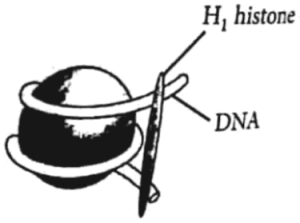
The given diagram represents:
A
nucleosome
B
chromosome
C
mesosome
D
ribosome
Solution
(A) The correct answer is $(A)$.
The diagram shows a nucleosome.
$A$ nucleosome is the basic structural unit of $DNA$ packaging in eukaryotes.
It consists of a segment of negatively charged $DNA$ wrapped around a positively charged histone octamer (a complex of eight histone proteins).
The $H_1$ histone protein helps in stabilizing the structure by binding to the $DNA$ where it enters and leaves the nucleosome.
The diagram shows a nucleosome.
$A$ nucleosome is the basic structural unit of $DNA$ packaging in eukaryotes.
It consists of a segment of negatively charged $DNA$ wrapped around a positively charged histone octamer (a complex of eight histone proteins).
The $H_1$ histone protein helps in stabilizing the structure by binding to the $DNA$ where it enters and leaves the nucleosome.
0 likes
View Solution624
EasyMCQ
The length of $DNA$ helix in a typical nucleosome is
A
$6.6 \times 10^9$ bp
B
$200$ bp
C
$1000$ bp
D
$3.2 \times 10^6$ bp
Solution
(B) The correct answer is $B$.
In a typical nucleosome,the $DNA$ helix is wrapped around a histone octamer.
This structure consists of approximately $200$ base pairs $(bp)$ of $DNA$.
In a typical nucleosome,the $DNA$ helix is wrapped around a histone octamer.
This structure consists of approximately $200$ base pairs $(bp)$ of $DNA$.
0 likes
View Solution625
EasyMCQ
Which of the following nitrogen bases is found only in $DNA$?
A
Cytosine
B
Adenine
C
Thymine
D
Guanine
Solution
(C) The correct answer is $C$.
Nitrogenous bases found in $DNA$ are Adenine $(A)$,Guanine $(G)$,Cytosine $(C)$,and Thymine $(T)$.
In $RNA$,Thymine is replaced by Uracil $(U)$.
Therefore,Thymine is the nitrogenous base found exclusively in $DNA$ and not in $RNA$.
Nitrogenous bases found in $DNA$ are Adenine $(A)$,Guanine $(G)$,Cytosine $(C)$,and Thymine $(T)$.
In $RNA$,Thymine is replaced by Uracil $(U)$.
Therefore,Thymine is the nitrogenous base found exclusively in $DNA$ and not in $RNA$.
0 likes
View Solution626
EasyMCQ
Match the number of nucleotides of the genome in Column $I$ with the organisms in Column $II$. Choose the correct option given below.
| Column $I$ | Column $II$ |
|---|---|
| $(A) 5386$ nucleotides | $(p) E. coli$ |
| $(B) 48502$ bp | $(q) \text{Man}$ |
| $(C) 4.6 \times 10^6$ bp | $(r) \text{Drosophila}$ |
| $(D) 3.3 \times 10^9$ bp | $(s) \phi \times 174 \text{ bacteriophage}$ |
| $(t) \text{Bacteriophage lambda}$ |
A
$A-s; B-q; C-p; D-t$
B
$A-s; B-p; C-q; D-r$
C
$A-s; B-t; C-p; D-q$
D
$A-r; B-t; C-s; D-p$
Solution
(C) The genome sizes of various organisms are as follows:
$1$. $\phi \times 174$ bacteriophage has $5386$ nucleotides.
$2$. Bacteriophage lambda has $48502$ base pairs (bp).
$3$. $E. coli$ has $4.6 \times 10^6$ base pairs (bp).
$4$. Human (haploid content) has $3.3 \times 10^9$ base pairs (bp).
Matching these with the given columns:
$(A) \rightarrow (s)$
$(B) \rightarrow (t)$
$(C) \rightarrow (p)$
$(D) \rightarrow (q)$
Therefore, the correct matching is $A-s, B-t, C-p, D-q$.
$1$. $\phi \times 174$ bacteriophage has $5386$ nucleotides.
$2$. Bacteriophage lambda has $48502$ base pairs (bp).
$3$. $E. coli$ has $4.6 \times 10^6$ base pairs (bp).
$4$. Human (haploid content) has $3.3 \times 10^9$ base pairs (bp).
Matching these with the given columns:
$(A) \rightarrow (s)$
$(B) \rightarrow (t)$
$(C) \rightarrow (p)$
$(D) \rightarrow (q)$
Therefore, the correct matching is $A-s, B-t, C-p, D-q$.
0 likes
View Solution627
EasyMCQ
The nitrogen base found only in $DNA$ is also called
A
uracil
B
$5-$methyl uracil
C
guanine
D
adenine
Solution
(B) The four nitrogenous bases present in $DNA$ are adenine,guanine,cytosine,and thymine.
Thymine is chemically known as $5$-methyl uracil.
Unlike $RNA$,which contains uracil,$DNA$ contains thymine as its specific nitrogenous base.
Thymine is chemically known as $5$-methyl uracil.
Unlike $RNA$,which contains uracil,$DNA$ contains thymine as its specific nitrogenous base.
0 likes
View Solution628
EasyMCQ
In a $3.2 \text{ Kbp}$ long piece of $DNA$,$820$ adenine bases were found. What would be the number of cytosine bases?
A
$780$
B
$1560$
C
$740$
D
$1480$
Solution
(A) Total length of $DNA$ = $3.2 \text{ Kbp} = 3200 \text{ bp}$.
According to Chargaff's rule,the amount of adenine $(A)$ is equal to thymine $(T)$,and the amount of guanine $(G)$ is equal to cytosine $(C)$.
Given,$A = 820$,therefore $T = 820$.
Total $A + T$ content = $820 + 820 = 1640$.
Total $G + C$ content = Total base pairs - Total $A + T$ content = $3200 - 1640 = 1560$.
Since $G = C$,the number of cytosine bases = $\frac{1560}{2} = 780$.
According to Chargaff's rule,the amount of adenine $(A)$ is equal to thymine $(T)$,and the amount of guanine $(G)$ is equal to cytosine $(C)$.
Given,$A = 820$,therefore $T = 820$.
Total $A + T$ content = $820 + 820 = 1640$.
Total $G + C$ content = Total base pairs - Total $A + T$ content = $3200 - 1640 = 1560$.
Since $G = C$,the number of cytosine bases = $\frac{1560}{2} = 780$.
0 likes
View Solution629
EasyMCQ
Molecular biology is concerned with the study of . . . . . .
A
all aspects of microorganisms
B
structure and functions of polymers of life
C
the chemistry of living organisms
D
the process by which molecules of chemical substances organized into primitive form of life
Solution
(B) Molecular biology is a branch of biology that deals with the molecular basis of biological activity in and between cells,including molecular synthesis,modification,mechanisms,and interactions. It primarily focuses on the structure and functions of the macromolecules (polymers of life) such as $DNA$,$RNA$,and proteins,which are essential for life processes.
0 likes
View Solution630
EasyMCQ
The average length of $hnRNA$ in humans is
A
$3000$ bases
B
$2.4$ million bases
C
$1500$ bases
D
$500$ bases
Solution
(A) The correct answer is $A$.
In humans,the primary transcript,known as $hnRNA$ (heterogeneous nuclear $RNA$),undergoes processing to form mature $mRNA$.
The average length of $hnRNA$ in humans is approximately $3000$ bases.
In humans,the primary transcript,known as $hnRNA$ (heterogeneous nuclear $RNA$),undergoes processing to form mature $mRNA$.
The average length of $hnRNA$ in humans is approximately $3000$ bases.
0 likes
View Solution631
EasyMCQ
In a structural gene,the template $DNA$ strand has the nucleotide sequence $3'-ATGCATGCATGCATGC-5'$. Find the correct and complementary nucleotide sequence on the coding strand.
A
$5'-ATGCATGCATGCATGC-3'$
B
$3'-GCATGCATGCATGCAT-5'$
C
$5'-TACGTACGTACGTACG-3'$
D
$3'-TACGTACGTACGTACG-5'$
Solution
(C) The correct option is $(C)$.
In a $DNA$ double helix,the two strands are antiparallel and complementary to each other.
The template strand runs in the $3' \rightarrow 5'$ direction,while the coding strand runs in the $5' \rightarrow 3'$ direction.
According to the base-pairing rules,$A$ pairs with $T$ and $G$ pairs with $C$.
Given template strand: $3'-ATGCATGCATGCATGC-5'$
Complementary coding strand: $5'-TACGTACGTACGTACG-3'$
In a $DNA$ double helix,the two strands are antiparallel and complementary to each other.
The template strand runs in the $3' \rightarrow 5'$ direction,while the coding strand runs in the $5' \rightarrow 3'$ direction.
According to the base-pairing rules,$A$ pairs with $T$ and $G$ pairs with $C$.
Given template strand: $3'-ATGCATGCATGCATGC-5'$
Complementary coding strand: $5'-TACGTACGTACGTACG-3'$
0 likes
View Solution632
MediumMCQ
Which of the following statements are correct with reference to the packaging of the $DNA$ helix?
A
$A$. Histones are organized to form a unit of eight molecules called a histone octamer.
B
$B$. Histones are negatively charged basic proteins.
C
$C$. Histones are rich in the basic amino acid residues - lysine and arginine.
D
$D$. The positively charged $DNA$ is wrapped around the histone octamer to form a nucleosome. $E$. The packaging of chromatin at higher levels requires an additional set of proteins called non-histone chromosomal proteins.
Solution
(A, C, D, E) In eukaryotic cells,$DNA$ is wrapped around a histone octamer (composed of two molecules each of $H2A$,$H2B$,$H3$,and $H4$) to form a nucleosome.
Histones are positively charged basic proteins,as they are rich in the basic amino acids lysine and arginine.
Therefore,statements $A$,$C$,$D$,and $E$ are correct.
Statement $B$ is incorrect because histones are positively charged,not negatively charged.
Histones are positively charged basic proteins,as they are rich in the basic amino acids lysine and arginine.
Therefore,statements $A$,$C$,$D$,and $E$ are correct.
Statement $B$ is incorrect because histones are positively charged,not negatively charged.
0 likes
View SolutionMolecular Basis of Inheritance — The DNA · Frequently Asked Questions
1Are these Molecular Basis of Inheritance questions useful for JEE and NEET?
Yes. All questions in this section are mapped to JEE Main and NEET exam patterns. Previous year questions from JEE Main, NEET, GUJCET and state-level exams are included with full solutions.
2Can I switch to Hindi or Gujarati for these questions?
Yes. Use the language tabs in the hero section or the sidebar to view the same questions and solutions in English, Hindi or Gujarati.
3How do I generate a question paper from this subtopic?
Use the Vedclass Exam Paper Generator — select the chapter and subtopic, set difficulty, and generate Sets A, B, C, D automatically. First 3 chapters of every subject are free.
Vedclass Products
For Students
Vedclass Test Series
Mock tests in real JEE/NEET style with performance analysis. 5-day free trial.
Start Free TrialFor Teachers
Exam Paper Generator
Generate Set A/B/C/D papers from this chapter in 2 minutes. 3 chapters free.
Try FreeFor Institutes
Online Exam Module
Live online exams with unlimited students, 360° analytics & white-label branding.
See DemoFor Teachers & Institutes
Generate a Molecular Basis of Inheritance Exam Paper in 2 Minutes
Select subtopic & difficulty — Sets A, B, C, D auto-generated with No Repeat logic.
First 3 chapters of every subject are free — no payment required.