
A English
The DNA Questions in English
Class 12 Biology · Molecular Basis of Inheritance · The DNA
632+
Questions
English
Language
100%
With Solutions
Showing 50 of 632 questions in English
551
MediumMCQ
$DNA$ is a ...
A
Long polymer of deoxyribonucleotides
B
Short polymer of deoxyribonucleotides
C
Short polymer of deoxyribonucleosides
D
Long polymer of deoxyribonucleosides
Solution
(A) $DNA$ stands for Deoxyribonucleic Acid. It is a long chain or polymer composed of repeating units called deoxyribonucleotides. Each deoxyribonucleotide consists of a deoxyribose sugar,a phosphate group,and a nitrogenous base. Therefore,$DNA$ is defined as a long polymer of deoxyribonucleotides.
0 likes
View Solution552
EasyMCQ
Match the following columns:
| Column-$I$ | Column-$II$ |
| $P$. Bacteriophage $\phi \times 174$ | $I$. $5386$ nucleotides |
| $Q$. Bacteriophage lambda | $II$. $48502 \, bp$ |
| $R$. Escherichia coli | $III$. $3.3 \times 10^9 \, bp$ |
| $S$. Human haploid $DNA$ | $IV$. $4.6 \times 10^6 \, bp$ |
A
$(P-II), (Q-I), (R-IV), (S-III)$
B
$(P-I), (Q-II), (R-IV), (S-III)$
C
$(P-II), (Q-I), (R-III), (S-IV)$
D
$(P-I), (Q-II), (R-III), (S-IV)$
Solution
(B) The correct matches based on the genetic material content are as follows:
$1$. Bacteriophage $\phi \times 174$ contains $5386$ nucleotides $(P-I)$.
$2$. Bacteriophage lambda contains $48502$ base pairs $(bp)$ $(Q-II)$.
$3$. Escherichia coli $(E. coli)$ contains $4.6 \times 10^6 \, bp$ $(R-IV)$.
$4$. Human haploid $DNA$ content is $3.3 \times 10^9 \, bp$ $(S-III)$.
Therefore,the correct matching sequence is $(P-I), (Q-II), (R-IV), (S-III)$.
$1$. Bacteriophage $\phi \times 174$ contains $5386$ nucleotides $(P-I)$.
$2$. Bacteriophage lambda contains $48502$ base pairs $(bp)$ $(Q-II)$.
$3$. Escherichia coli $(E. coli)$ contains $4.6 \times 10^6 \, bp$ $(R-IV)$.
$4$. Human haploid $DNA$ content is $3.3 \times 10^9 \, bp$ $(S-III)$.
Therefore,the correct matching sequence is $(P-I), (Q-II), (R-IV), (S-III)$.
0 likes
View Solution553
MediumMCQ
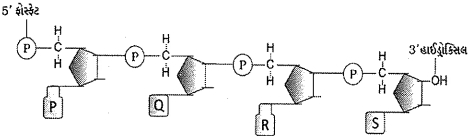
In the given polynucleotide chain,which of $P, Q, R,$ and $S$ are purine nitrogenous bases?
A
$P$ and $Q$
B
$P$ and $R$
C
$Q$ and $S$
D
$Q$ and $R$
Solution
(B) In a polynucleotide chain,nitrogenous bases are attached to the $1'$ carbon of the pentose sugar.
Purines are double-ring structures (Adenine and Guanine),while pyrimidines are single-ring structures (Cytosine,Thymine,and Uracil).
In the provided diagram,the shapes representing $P$ and $R$ are larger (double-ring structure),indicating they are purines.
The shapes representing $Q$ and $S$ are smaller (single-ring structure),indicating they are pyrimidines.
Therefore,$P$ and $R$ represent purine nitrogenous bases.
Purines are double-ring structures (Adenine and Guanine),while pyrimidines are single-ring structures (Cytosine,Thymine,and Uracil).
In the provided diagram,the shapes representing $P$ and $R$ are larger (double-ring structure),indicating they are purines.
The shapes representing $Q$ and $S$ are smaller (single-ring structure),indicating they are pyrimidines.
Therefore,$P$ and $R$ represent purine nitrogenous bases.
0 likes
View Solution554
EasyMCQ
The backbone of a polynucleotide chain is formed by which of the following?
A
Nitrogenous bases and pentose sugar
B
Phosphate group and pentose sugar
C
Nitrogenous bases and phosphate group
D
Nitrogenous bases,phosphate group,and pentose sugar
Solution
(B) polynucleotide chain consists of a sugar-phosphate backbone with nitrogenous bases attached to the sugar moiety.
Specifically,the backbone is formed by the alternating sequence of pentose sugar and phosphate groups linked by phosphodiester bonds.
The nitrogenous bases project inward from this backbone.
Specifically,the backbone is formed by the alternating sequence of pentose sugar and phosphate groups linked by phosphodiester bonds.
The nitrogenous bases project inward from this backbone.
0 likes
View Solution555
MediumMCQ
The acidity of the $DNA$ molecule is due to:
A
Nitrogenous bases
B
Sugar
C
Phosphate group
D
All of the above
Solution
(C) The $DNA$ molecule is a polymer of nucleotides. Each nucleotide consists of a nitrogenous base,a pentose sugar (deoxyribose),and a phosphate group.
The phosphate group $(PO_4^{3-})$ is derived from phosphoric acid $(H_3PO_4)$.
In the $DNA$ backbone,the phosphate groups link the sugar molecules via phosphodiester bonds.
Because these phosphate groups retain acidic properties (they release protons,$H^+$),they confer an overall negative charge and acidic nature to the $DNA$ molecule.
The phosphate group $(PO_4^{3-})$ is derived from phosphoric acid $(H_3PO_4)$.
In the $DNA$ backbone,the phosphate groups link the sugar molecules via phosphodiester bonds.
Because these phosphate groups retain acidic properties (they release protons,$H^+$),they confer an overall negative charge and acidic nature to the $DNA$ molecule.
0 likes
View Solution556
MediumMCQ
Which scientist's observations were the basis for the rule that the ratio between Adenine and Thymine,and Guanine and Cytosine in $DNA$ remains constant and equal to one another?
A
Friedrich Miescher
B
Erwin Chargaff
C
Rosalind Franklin
D
Maurice Wilkins
Solution
(B) Erwin Chargaff observed that in $DNA$,the amount of Adenine $(A)$ is always equal to the amount of Thymine $(T)$,and the amount of Guanine $(G)$ is always equal to the amount of Cytosine $(C)$.
This is known as Chargaff's rule,which states that the ratio of $A+G$ to $T+C$ is $1$,or more specifically,the base pairing rules are $A=T$ and $G=C$.
These observations were crucial for Watson and Crick to propose the double-helical structure of $DNA$.
This is known as Chargaff's rule,which states that the ratio of $A+G$ to $T+C$ is $1$,or more specifically,the base pairing rules are $A=T$ and $G=C$.
These observations were crucial for Watson and Crick to propose the double-helical structure of $DNA$.
0 likes
View Solution557
MediumMCQ
The variation in $DNA$ among different organisms is due to the sequence of:
A
Nitrogenous bases
B
Sugars
C
Phosphate groups
D
All of the above
Solution
(A) The $DNA$ molecule consists of a sugar-phosphate backbone and nitrogenous bases.
While the sugar (deoxyribose) and the phosphate group are identical in all $DNA$ molecules,the sequence of nitrogenous bases ($Adenine$,$Thymine$,$Guanine$,and $Cytosine$) varies significantly among different organisms.
This specific sequence of nitrogenous bases acts as the genetic code,which determines the biological characteristics of an organism.
Therefore,the variation in $DNA$ is primarily due to the sequence of nitrogenous bases.
While the sugar (deoxyribose) and the phosphate group are identical in all $DNA$ molecules,the sequence of nitrogenous bases ($Adenine$,$Thymine$,$Guanine$,and $Cytosine$) varies significantly among different organisms.
This specific sequence of nitrogenous bases acts as the genetic code,which determines the biological characteristics of an organism.
Therefore,the variation in $DNA$ is primarily due to the sequence of nitrogenous bases.
0 likes
View Solution558
MediumMCQ
$A$ $DNA$ polymer has a free phosphate group at one end of the sugar,which is called the $P$ end of the polynucleotide chain. Similarly,at the other end of the polymer,there is a free $OH$ group of the sugar,which is called the $Q$ end of the polynucleotide chain.
$\quad P \quad Q$
$\quad P \quad Q$
A
$3^{\prime} \quad 5^{\prime}$
B
$2^{\prime} \quad 5^{\prime}$
C
$5^{\prime} \quad 2^{\prime}$
D
$5^{\prime} \quad 3^{\prime}$
Solution
(D) In a $DNA$ polynucleotide chain,the sugar-phosphate backbone is formed by phosphodiester bonds.
At the $5^{\prime}$ end of the polynucleotide chain,the $5^{\prime}$ carbon of the deoxyribose sugar is attached to a free phosphate group.
At the $3^{\prime}$ end of the polynucleotide chain,the $3^{\prime}$ carbon of the deoxyribose sugar has a free hydroxyl $(-OH)$ group.
Therefore,the end with the free phosphate group is the $5^{\prime}$ end $(P = 5^{\prime})$ and the end with the free $-OH$ group is the $3^{\prime}$ end $(Q = 3^{\prime})$.
At the $5^{\prime}$ end of the polynucleotide chain,the $5^{\prime}$ carbon of the deoxyribose sugar is attached to a free phosphate group.
At the $3^{\prime}$ end of the polynucleotide chain,the $3^{\prime}$ carbon of the deoxyribose sugar has a free hydroxyl $(-OH)$ group.
Therefore,the end with the free phosphate group is the $5^{\prime}$ end $(P = 5^{\prime})$ and the end with the free $-OH$ group is the $3^{\prime}$ end $(Q = 3^{\prime})$.
0 likes
View Solution559
EasyMCQ
Thymine is $........$
A
$5-$methyl uracil
B
$5-$methyl guanine
C
$5-$methyl adenine
D
$5-$methyl cytosine
Solution
(A) Thymine is a pyrimidine base found in $DNA$.
Chemically,it is known as $5-$methyl uracil.
Uracil is found in $RNA$,while in $DNA$,the $5^{th}$ carbon of the uracil ring is methylated to form thymine.
Chemically,it is known as $5-$methyl uracil.
Uracil is found in $RNA$,while in $DNA$,the $5^{th}$ carbon of the uracil ring is methylated to form thymine.
0 likes
View Solution560
EasyMCQ
Who provided the data for $X$-ray diffraction of $DNA$?
A
Friedrich Miescher
B
James Watson and Francis Crick
C
Erwin Chargaff
D
Maurice Wilkins and Rosalind Franklin
Solution
(D) The $X$-ray diffraction data for $DNA$ was produced by Maurice Wilkins and Rosalind Franklin. This critical data provided the structural insights that allowed James Watson and Francis Crick to propose the double helix model of $DNA$ in $1953$.
0 likes
View Solution561
MediumMCQ
What is a template?
A
$A$ polymer that provides information for the synthesis of a new polymer
B
The newly synthesized polymer
C
$DNA$
D
$RNA$
Solution
(A) In molecular biology,a template is a strand of nucleic acid ($DNA$ or $RNA$) that serves as a pattern or guide for the synthesis of a complementary strand. During processes like replication or transcription,the sequence of nucleotides on the template strand determines the sequence of nucleotides in the newly synthesized polymer,ensuring genetic information is accurately copied.
0 likes
View Solution562
EasyMCQ
What is the distance between two consecutive base pairs in the structure of $DNA$ (in $nm$)?
A
$3.4$
B
$10$
C
$1$
D
$0.34$
Solution
(D) In the $B-DNA$ double helix model proposed by Watson and Crick, the distance between two consecutive base pairs is $0.34 \, nm$ (or $3.4 \, \mathring{A}$).
This distance is calculated by dividing the total pitch of one full turn of the helix $(3.4 \, nm)$ by the number of base pairs per turn $(10)$.
Therefore, the distance between two adjacent base pairs is $0.34 \, nm$.
This distance is calculated by dividing the total pitch of one full turn of the helix $(3.4 \, nm)$ by the number of base pairs per turn $(10)$.
Therefore, the distance between two adjacent base pairs is $0.34 \, nm$.
0 likes
View Solution563
MediumMCQ
In one turn of the $DNA$ helix,there are $.........\,bp$ and its length is $.........$.
A
$10, 0.34\,nm$
B
$20, 0.34\,nm$
C
$10, 3.4\,nm$
D
$20, 3.4\,nm$
Solution
(C) The structure of $DNA$ ($B$-$DNA$) consists of a double helix.
One full turn of the $DNA$ helix corresponds to a distance of $3.4\,nm$ (or $34\,\mathring{A}$).
Each turn contains $10$ base pairs $(bp)$.
Therefore,the distance between two consecutive base pairs is $0.34\,nm$ $(3.4\,nm / 10)$.
Thus,one turn has $10\,bp$ and a length of $3.4\,nm$.
One full turn of the $DNA$ helix corresponds to a distance of $3.4\,nm$ (or $34\,\mathring{A}$).
Each turn contains $10$ base pairs $(bp)$.
Therefore,the distance between two consecutive base pairs is $0.34\,nm$ $(3.4\,nm / 10)$.
Thus,one turn has $10\,bp$ and a length of $3.4\,nm$.
0 likes
View Solution564
MediumMCQ
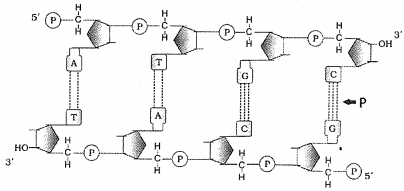
The given figure shows a double-stranded polynucleotide chain. Identify the bond labeled as $P$.
A
Disulfide bond
B
Phosphodiester bond
C
Hydrogen bond
D
Glycosidic bond
Solution
(C) In a $DNA$ molecule,the two polynucleotide strands are held together by hydrogen bonds between the nitrogenous bases.
Specifically,Adenine $(A)$ pairs with Thymine $(T)$ via two hydrogen bonds,and Guanine $(G)$ pairs with Cytosine $(C)$ via three hydrogen bonds.
The label $P$ in the figure points to the three dotted lines between Guanine $(G)$ and Cytosine $(C)$,which represent the three hydrogen bonds connecting these complementary bases.
Specifically,Adenine $(A)$ pairs with Thymine $(T)$ via two hydrogen bonds,and Guanine $(G)$ pairs with Cytosine $(C)$ via three hydrogen bonds.
The label $P$ in the figure points to the three dotted lines between Guanine $(G)$ and Cytosine $(C)$,which represent the three hydrogen bonds connecting these complementary bases.
0 likes
View Solution565
MediumMCQ
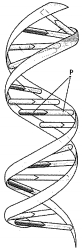
What does $P$ represent in the given figure?
A
Phosphate
B
Sugar
C
Phosphate-sugar backbone
D
Base pair
Solution
(D) The provided figure shows the double-helical structure of $DNA$. In this structure,the horizontal rungs connecting the two sugar-phosphate backbones represent the nitrogenous base pairs. The label $P$ points to these horizontal rungs,which are formed by hydrogen bonding between complementary nitrogenous bases (e.g.,Adenine with Thymine,Guanine with Cytosine). Therefore,$P$ represents a base pair.
0 likes
View Solution566
MediumMCQ
If the length of $DNA$ in an organism is $2.72 \,mm$,how many base pairs will be present in this organism?
A
$4 \times 10^6$
B
$8 \times 10^6$
C
$6 \times 10^6$
D
$2 \times 10^6$
Solution
(B) The distance between two consecutive base pairs in $DNA$ is $0.34 \,nm$ or $0.34 \times 10^{-6} \,mm$.
Total length of $DNA = 2.72 \,mm$.
Number of base pairs = $\frac{\text{Total length of DNA}}{\text{Distance between two consecutive base pairs}}$.
Number of base pairs = $\frac{2.72 \,mm}{0.34 \times 10^{-6} \,mm}$.
Number of base pairs = $\frac{2.72}{0.34} \times 10^6$.
Number of base pairs = $8 \times 10^6$ base pairs.
Total length of $DNA = 2.72 \,mm$.
Number of base pairs = $\frac{\text{Total length of DNA}}{\text{Distance between two consecutive base pairs}}$.
Number of base pairs = $\frac{2.72 \,mm}{0.34 \times 10^{-6} \,mm}$.
Number of base pairs = $\frac{2.72}{0.34} \times 10^6$.
Number of base pairs = $8 \times 10^6$ base pairs.
0 likes
View Solution567
MediumMCQ
Identify the correct sequence of packaging structures from $DNA$ to chromosome.
A
Nucleosome $\rightarrow$ $DNA$ $\rightarrow$ Chromatin $\rightarrow$ Chromatin fibers $\rightarrow$ Chromosome
B
$DNA$ $\rightarrow$ Nucleosome $\rightarrow$ Chromatin $\rightarrow$ Chromatin fibers $\rightarrow$ Chromosome
C
$DNA$ $\rightarrow$ Nucleosome $\rightarrow$ Chromatin fibers $\rightarrow$ Chromatin $\rightarrow$ Chromosome
D
$DNA$ $\rightarrow$ Nucleosome $\rightarrow$ Chromosome $\rightarrow$ Chromatin $\rightarrow$ Chromatin fibers
Solution
(B) The packaging of $DNA$ in eukaryotes involves several levels of organization:
$1$. $DNA$ helix wraps around histone octamers to form nucleosomes (beads-on-a-string structure).
$2$. These nucleosomes further coil and condense to form chromatin fibers.
$3$. These fibers are further organized into chromatin,which eventually condenses during cell division to form the highly compact structure known as the chromosome.
Therefore,the correct sequence is: $DNA$ $\rightarrow$ Nucleosome $\rightarrow$ Chromatin $\rightarrow$ Chromatin fibers $\rightarrow$ Chromosome.
$1$. $DNA$ helix wraps around histone octamers to form nucleosomes (beads-on-a-string structure).
$2$. These nucleosomes further coil and condense to form chromatin fibers.
$3$. These fibers are further organized into chromatin,which eventually condenses during cell division to form the highly compact structure known as the chromosome.
Therefore,the correct sequence is: $DNA$ $\rightarrow$ Nucleosome $\rightarrow$ Chromatin $\rightarrow$ Chromatin fibers $\rightarrow$ Chromosome.
0 likes
View Solution568
MediumMCQ
What is the length of $DNA$ present in a nucleosome (in $, nm$)?
A
$17$
B
$3.4$
C
$34$
D
$68$
Solution
(C) nucleosome consists of $DNA$ wrapped around a histone octamer.
In a typical nucleosome,the $DNA$ segment consists of approximately $146$ base pairs.
Since the distance between two adjacent base pairs in a $B-DNA$ helix is $0.34 \, nm$ $(3.4 \, \mathring{A})$,the total length of the $DNA$ can be calculated as:
Length $= 146 \times 0.34 \, nm \approx 49.64 \, nm$.
However,considering the linker $DNA$ and the complete structure,the standard value often cited in textbooks for the core $DNA$ length is approximately $146$ base pairs,which corresponds to roughly $50 \, nm$. Among the given options,$17 \, nm$ is incorrect,$3.4 \, nm$ is the length of one turn ($10$ base pairs),and $34 \, nm$ is a common approximation used in some contexts for the total length of the $DNA$ associated with the nucleosome core and linker. Given the standard curriculum,$34 \, nm$ is the most appropriate choice among the provided options.
In a typical nucleosome,the $DNA$ segment consists of approximately $146$ base pairs.
Since the distance between two adjacent base pairs in a $B-DNA$ helix is $0.34 \, nm$ $(3.4 \, \mathring{A})$,the total length of the $DNA$ can be calculated as:
Length $= 146 \times 0.34 \, nm \approx 49.64 \, nm$.
However,considering the linker $DNA$ and the complete structure,the standard value often cited in textbooks for the core $DNA$ length is approximately $146$ base pairs,which corresponds to roughly $50 \, nm$. Among the given options,$17 \, nm$ is incorrect,$3.4 \, nm$ is the length of one turn ($10$ base pairs),and $34 \, nm$ is a common approximation used in some contexts for the total length of the $DNA$ associated with the nucleosome core and linker. Given the standard curriculum,$34 \, nm$ is the most appropriate choice among the provided options.
0 likes
View Solution569
MediumMCQ
Identify the correct matching for Euchromatin and Heterochromatin from the given statements:
$I -$ Loosely packed
$II -$ Densely packed
$III -$ Darkly stained region
$IV -$ Lightly stained region
$V -$ Transcriptionally active chromatin
$VI -$ Transcriptionally inactive chromatin
Euchromatin $\quad\quad$ Heterochromatin
$I -$ Loosely packed
$II -$ Densely packed
$III -$ Darkly stained region
$IV -$ Lightly stained region
$V -$ Transcriptionally active chromatin
$VI -$ Transcriptionally inactive chromatin
Euchromatin $\quad\quad$ Heterochromatin
A
$II, III, VI \quad I, IV, V$
B
$I, IV, V \quad II, III, VI$
C
$II, III, V \quad I, IV, VI$
D
$I, IV, VI \quad II, III, V$
Solution
(B) Euchromatin is the loosely packed region of chromatin that stains lightly and is transcriptionally active. Thus,it corresponds to $I, IV, V$.
Heterochromatin is the densely packed region of chromatin that stains darkly and is transcriptionally inactive. Thus,it corresponds to $II, III, VI$.
Therefore,the correct matching is Euchromatin: $I, IV, V$ and Heterochromatin: $II, III, VI$.
Heterochromatin is the densely packed region of chromatin that stains darkly and is transcriptionally inactive. Thus,it corresponds to $II, III, VI$.
Therefore,the correct matching is Euchromatin: $I, IV, V$ and Heterochromatin: $II, III, VI$.
0 likes
View Solution570
MediumMCQ
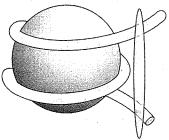
How many base pairs of $DNA$ are present in the structure shown below?
A
$100$
B
$150$
C
$200$
D
$300$
Solution
(B) The image shows a nucleosome,which is the basic unit of $DNA$ packaging in eukaryotes.
It consists of a segment of $DNA$ wrapped around a histone octamer.
The length of $DNA$ wrapped around the histone octamer is approximately $146$ base pairs,which is often rounded to $147$ or $150$ base pairs in many textbook contexts for simplicity.
Among the given options,$150$ base pairs is the standard accepted value for the $DNA$ wrapped around the histone core in a nucleosome.
It consists of a segment of $DNA$ wrapped around a histone octamer.
The length of $DNA$ wrapped around the histone octamer is approximately $146$ base pairs,which is often rounded to $147$ or $150$ base pairs in many textbook contexts for simplicity.
Among the given options,$150$ base pairs is the standard accepted value for the $DNA$ wrapped around the histone core in a nucleosome.
0 likes
View Solution571
EasyMCQ
$A$ histone octamer consists of:
A
$H_2A(2), H_2B(2), H_3(2), H_4(2)$
B
$H_1(2), H_2(2), H_3(2), H_4(2)$
C
$H_1A(2), H_1B(2), H_2(2), H_4(2)$
D
$H_1A(3), H_1B(1), H_2(1), H_4(3)$
Solution
(A) histone octamer is the fundamental unit of chromatin structure,known as a nucleosome.
It consists of a complex of $8$ histone proteins.
These proteins are $2$ molecules each of $H_2A, H_2B, H_3,$ and $H_4$.
$H_1$ histone is not part of the octamer core but binds to the $DNA$ where it enters and leaves the nucleosome.
It consists of a complex of $8$ histone proteins.
These proteins are $2$ molecules each of $H_2A, H_2B, H_3,$ and $H_4$.
$H_1$ histone is not part of the octamer core but binds to the $DNA$ where it enters and leaves the nucleosome.
0 likes
View Solution572
EasyMCQ
Which amino acids are present in high amounts in histone proteins?
A
Lysine and Arginine
B
Aspartic acid and Glutamic acid
C
Glycine and Alanine
D
Valine and Leucine
Solution
(A) Histones are basic proteins that are rich in the basic amino acids $Lysine$ and $Arginine$.
These amino acids carry positive charges in their side chains.
Because $DNA$ is negatively charged due to its phosphate backbone,these positively charged histone proteins help in the packaging of $DNA$ into structures called nucleosomes.
These amino acids carry positive charges in their side chains.
Because $DNA$ is negatively charged due to its phosphate backbone,these positively charged histone proteins help in the packaging of $DNA$ into structures called nucleosomes.
0 likes
View Solution573
MediumMCQ
What is the meaning of $DNAs$ and $DNAase$?
A
$DNAs$ - Plural of $DNA$ molecule
$DNAase$ - Enzyme that joins $DNA$
$DNAase$ - Enzyme that joins $DNA$
B
$DNAs$ - Enzyme that breaks $DNA$
$DNAase$ - Plural of $DNA$ molecule
$DNAase$ - Plural of $DNA$ molecule
C
$DNAs$ - Plural of $DNA$ molecule
$DNAase$ - Enzyme that breaks $DNA$
$DNAase$ - Enzyme that breaks $DNA$
D
$DNAs$ - $DNA$ replication
$DNAase$ - Enzyme that joins $DNA$
$DNAase$ - Enzyme that joins $DNA$
Solution
(C) $DNAs$ is simply the plural form of the $DNA$ molecule,referring to multiple strands or copies of Deoxyribonucleic Acid.
$DNAase$ (or $DNase$) is an enzyme that catalyzes the hydrolytic cleavage of phosphodiester linkages in the $DNA$ backbone,effectively breaking down or degrading $DNA$ molecules.
$DNAase$ (or $DNase$) is an enzyme that catalyzes the hydrolytic cleavage of phosphodiester linkages in the $DNA$ backbone,effectively breaking down or degrading $DNA$ molecules.
0 likes
View Solution574
EasyMCQ
Who proposed the following statement?
"It has not escaped our notice that the specific pairing we have postulated immediately suggests a possible copying mechanism for the genetic material."
"It has not escaped our notice that the specific pairing we have postulated immediately suggests a possible copying mechanism for the genetic material."
A
Matthew Meselson and Franklin Stahl
B
Maurice Wilkins and Rosalind Franklin
C
Friedrich Miescher
D
James Watson and Francis Crick
Solution
(D) The statement "It has not escaped our notice that the specific pairing we have postulated immediately suggests a possible copying mechanism for the genetic material" was made by $James \ Watson$ and $Francis \ Crick$ in their $1953$ paper published in the journal $Nature$. This famous sentence refers to the complementary base pairing ($A$ with $T$ and $G$ with $C$) in the $DNA$ double helix structure, which provides a logical basis for how genetic information is replicated during cell division.
0 likes
View Solution575
MediumMCQ
The clover-leaf model of $tRNA$ represents its ............ structure.
A
Primary
B
Secondary
C
Tertiary
D
Quaternary
Solution
(B) The $tRNA$ molecule exhibits a clover-leaf shape in its two-dimensional representation,which is known as its secondary structure. In its actual three-dimensional form,it appears as an inverted $L$-shaped molecule,which represents its tertiary structure. Therefore,the clover-leaf model specifically refers to the secondary structure of $tRNA$.
0 likes
View Solution576
EasyMCQ
$tRNA$ is also known as:
A
$rRNA$
B
$hnRNA$
C
$mRNA$
D
$sRNA$
Solution
(D) $tRNA$ (transfer $RNA$) is also known as $sRNA$ (soluble $RNA$) because it was historically isolated in the soluble fraction of the cell during centrifugation. It acts as an adapter molecule that carries specific amino acids to the ribosome during protein synthesis.
0 likes
View Solution577
MediumMCQ
Select the correct option for $DNA$.
A
$DNA$ is a hydrophilic molecule.
B
$DNA$ cannot pass through cell membranes.
C
$DNA$ is negatively charged.
D
All of the above.
Solution
(D) $DNA$ is a hydrophilic molecule because of the presence of the phosphate backbone,which makes it polar.
Due to its hydrophilic nature,$DNA$ cannot pass through cell membranes,which are composed of a hydrophobic lipid bilayer.
$DNA$ is negatively charged due to the phosphate groups $(PO_4^{3-})$ present in its backbone.
Therefore,all the given statements are correct.
Due to its hydrophilic nature,$DNA$ cannot pass through cell membranes,which are composed of a hydrophobic lipid bilayer.
$DNA$ is negatively charged due to the phosphate groups $(PO_4^{3-})$ present in its backbone.
Therefore,all the given statements are correct.
0 likes
View Solution578
MediumMCQ
If the nucleotide sequence of a probe is $3'-ATCAGC-5'$,which of the following strands will it hybridize with?
A
$5'-TAGTCG-3'$
B
$3'-ATCAGC-5'$
C
$3'-TAGTCG-5'$
D
$5'-ATCAGC-3'$
Solution
(A) probe is a single-stranded $DNA$ or $RNA$ molecule used to detect the presence of a complementary sequence in a sample.
Hybridization occurs through base pairing between complementary nucleotides,where $A$ pairs with $T$ (or $U$ in $RNA$) and $C$ pairs with $G$.
Crucially,$DNA$ strands are antiparallel,meaning the $3'-5'$ end of one strand aligns with the $5'-3'$ end of the complementary strand.
Given the probe sequence: $3'-A-T-C-A-G-C-5'$.
The complementary strand must be antiparallel $(5'-3')$ and follow base-pairing rules:
$3' \rightarrow 5'$ (Probe)
$5' \rightarrow 3'$ (Target)
$A$ pairs with $T$
$T$ pairs with $A$
$C$ pairs with $G$
$A$ pairs with $T$
$G$ pairs with $C$
$C$ pairs with $G$
Therefore,the complementary sequence is $5'-TAGTCG-3'$.
Thus,the correct option is $A$.
Hybridization occurs through base pairing between complementary nucleotides,where $A$ pairs with $T$ (or $U$ in $RNA$) and $C$ pairs with $G$.
Crucially,$DNA$ strands are antiparallel,meaning the $3'-5'$ end of one strand aligns with the $5'-3'$ end of the complementary strand.
Given the probe sequence: $3'-A-T-C-A-G-C-5'$.
The complementary strand must be antiparallel $(5'-3')$ and follow base-pairing rules:
$3' \rightarrow 5'$ (Probe)
$5' \rightarrow 3'$ (Target)
$A$ pairs with $T$
$T$ pairs with $A$
$C$ pairs with $G$
$A$ pairs with $T$
$G$ pairs with $C$
$C$ pairs with $G$
Therefore,the complementary sequence is $5'-TAGTCG-3'$.
Thus,the correct option is $A$.
0 likes
View Solution579
EasyMCQ
Match List-$I$ with List-$II$:
Choose the correct answer from the options given below:
| List-$I$ | List-$II$ |
|---|---|
| $a$. Bacteriophage $\phi \times 174$ | $i$. $48502$ base pairs |
| $b$. Bacteriophage lambda | $ii$. $5386$ nucleotides |
| $c$. Escherichia coli | $iii$. $3.3 \times 10^9$ base pairs |
| $d$. Haploid content of human $DNA$ | $iv$. $4.6 \times 10^6$ base pairs |
Choose the correct answer from the options given below:
A
$(a) - (i), (b) - (ii), (c) - (iii), (d) - (iv)$
B
$(a) - (ii), (b) - (iv), (c) - (i), (d) - (iii)$
C
$(a) - (ii), (b) - (i), (c) - (iv), (d) - (iii)$
D
$(a) - (i), (b) - (ii), (c) - (iv), (d) - (iii)$
Solution
(C) The correct matches are based on the standard values provided in the $NCERT$ textbook for the Molecular Basis of Inheritance:
$1$. Bacteriophage $\phi \times 174$ has $5386$ nucleotides $(a-ii)$.
$2$. Bacteriophage lambda has $48502$ base pairs $(b-i)$.
$3$. Escherichia coli $(E. coli)$ has $4.6 \times 10^6$ base pairs $(c-iv)$.
$4$. The haploid content of human $DNA$ is $3.3 \times 10^9$ base pairs $(d-iii)$.
Therefore,the correct matching is $(a) - (ii), (b) - (i), (c) - (iv), (d) - (iii)$.
$1$. Bacteriophage $\phi \times 174$ has $5386$ nucleotides $(a-ii)$.
$2$. Bacteriophage lambda has $48502$ base pairs $(b-i)$.
$3$. Escherichia coli $(E. coli)$ has $4.6 \times 10^6$ base pairs $(c-iv)$.
$4$. The haploid content of human $DNA$ is $3.3 \times 10^9$ base pairs $(d-iii)$.
Therefore,the correct matching is $(a) - (ii), (b) - (i), (c) - (iv), (d) - (iii)$.
0 likes
View Solution580
MediumMCQ
If $A$ and $C$ make $30\%$ and $20\%$ of $DNA$,respectively,what will be the percentage composition of $T$ and $G$?
A
$T : 20\%, G : 30\%$
B
$T : 30\%, G : 20\%$
C
$T : 30\%, G : 30\%$
D
$T : 20\%, G : 20\%$
Solution
(B) According to Chargaff's rule,the amount of adenine $(A)$ is equal to the amount of thymine $(T)$,and the amount of cytosine $(C)$ is equal to the amount of guanine $(G)$.
Given that $A = 30\%$,therefore $T$ must also be $30\%$.
Given that $C = 20\%$,therefore $G$ must also be $20\%$.
Thus,the percentage composition of $T$ is $30\%$ and $G$ is $20\%$.
Given that $A = 30\%$,therefore $T$ must also be $30\%$.
Given that $C = 20\%$,therefore $G$ must also be $20\%$.
Thus,the percentage composition of $T$ is $30\%$ and $G$ is $20\%$.
0 likes
View Solution581
MediumMCQ
Given below are two statements:
Statement $I$: In prokaryotes,the positively charged $DNA$ is held with some negatively charged proteins in a region called nucleoid.
Statement $II$: In eukaryotes,the negatively charged $DNA$ is wrapped around the positively charged histone octamer to form nucleosome.
In the light of the above statements,choose the correct answer from the options given below:
Statement $I$: In prokaryotes,the positively charged $DNA$ is held with some negatively charged proteins in a region called nucleoid.
Statement $II$: In eukaryotes,the negatively charged $DNA$ is wrapped around the positively charged histone octamer to form nucleosome.
In the light of the above statements,choose the correct answer from the options given below:
A
Statement $I$ is incorrect but Statement $II$ is true.
B
Both Statement $I$ and Statement $II$ are true.
C
Both Statement $I$ and Statement $II$ are false.
D
Statement $I$ is correct but Statement $II$ is false.
Solution
(A) Statement $I$ is incorrect because $DNA$ is negatively charged due to the presence of phosphate groups,and it is held by positively charged proteins in prokaryotes.
Statement $II$ is correct because in eukaryotes,the negatively charged $DNA$ wraps around the positively charged histone octamer to form a nucleosome.
Therefore,Statement $I$ is false and Statement $II$ is true.
Statement $II$ is correct because in eukaryotes,the negatively charged $DNA$ wraps around the positively charged histone octamer to form a nucleosome.
Therefore,Statement $I$ is false and Statement $II$ is true.
0 likes
View Solution582
EasyMCQ
Histones are enriched with $-$
A
Lysine $\&$ Arginine
B
Leucine $\&$ Lysine
C
Phenylalanine $\&$ Leucine
D
Phenylalanine $\&$ Arginine
Solution
(A) Histones are basic proteins that are associated with $DNA$ to form nucleosomes.
These proteins are rich in positively charged basic amino acids,specifically $Lysine$ and $Arginine$.
The positive charge of these amino acids allows histones to bind tightly to the negatively charged phosphate backbone of the $DNA$ molecule.
These proteins are rich in positively charged basic amino acids,specifically $Lysine$ and $Arginine$.
The positive charge of these amino acids allows histones to bind tightly to the negatively charged phosphate backbone of the $DNA$ molecule.
0 likes
View Solution583
EasyMCQ
In $DNA$,$20 \%$ of the bases are adenine. What percentage of bases are pyrimidines (in $\%$)?
A
$30$
B
$60$
C
$50$
D
$20$
Solution
(C) According to Chargaff's rule,the amount of adenine $(A)$ is equal to the amount of thymine $(T)$,and the amount of guanine $(G)$ is equal to the amount of cytosine $(C)$.
Given that adenine $(A)$ = $20 \%$,then thymine $(T)$ must also be $20 \%$.
The total percentage of purines $(A + G)$ or pyrimidines $(T + C)$ in a $DNA$ molecule is always $50 \%$.
Since $T + C = 50 \%$ and we know $T = 20 \%$,we can calculate $C = 50 \% - 20 \% = 30 \%$.
Therefore,the total percentage of pyrimidines $(T + C)$ is $20 \% + 30 \% = 50 \%$.
Given that adenine $(A)$ = $20 \%$,then thymine $(T)$ must also be $20 \%$.
The total percentage of purines $(A + G)$ or pyrimidines $(T + C)$ in a $DNA$ molecule is always $50 \%$.
Since $T + C = 50 \%$ and we know $T = 20 \%$,we can calculate $C = 50 \% - 20 \% = 30 \%$.
Therefore,the total percentage of pyrimidines $(T + C)$ is $20 \% + 30 \% = 50 \%$.
0 likes
View Solution584
MediumMCQ
Find the incorrect match.
A
Bacteriophage $(\phi \times 174) - 5386$ nucleotides
B
Bacteriophage lambda $- 48502$ base pairs
C
$\text{E. coli} - 4.6 \times 10^6 \ bp$
D
Haploid content of human $\text{DNA} - 3.3 \times 10^6 \ bp$
Solution
(D) The correct values for genetic material length as per $NCERT$ are:
$1$. Bacteriophage $\phi \times 174$ has $5386$ nucleotides.
$2$. Bacteriophage lambda has $48502$ base pairs $(bp)$.
$3$. $\text{E. coli}$ has $4.6 \times 10^6 \ bp$.
$4$. The haploid content of human $\text{DNA}$ is $3.3 \times 10^9 \ bp$.
Option $D$ states $3.3 \times 10^6 \ bp$,which is incorrect; the correct value is $3.3 \times 10^9 \ bp$.
$1$. Bacteriophage $\phi \times 174$ has $5386$ nucleotides.
$2$. Bacteriophage lambda has $48502$ base pairs $(bp)$.
$3$. $\text{E. coli}$ has $4.6 \times 10^6 \ bp$.
$4$. The haploid content of human $\text{DNA}$ is $3.3 \times 10^9 \ bp$.
Option $D$ states $3.3 \times 10^6 \ bp$,which is incorrect; the correct value is $3.3 \times 10^9 \ bp$.
0 likes
View Solution585
MediumMCQ
Mobile genetic elements $(transposons)$ replicate via an $.....$ intermediate.
A
$DNA$
B
Protein
C
$RNA$
D
Methyl
Solution
(C) Mobile genetic elements, also known as transposons, are $DNA$ sequences that can change their position within a genome. Retrotransposons, a specific class of these elements, replicate through an $RNA$ intermediate. They are first transcribed into $RNA$ and then reverse-transcribed back into $DNA$ to be inserted at a new genomic location.
0 likes
View Solution586
MediumMCQ
Who proposed that for a double-stranded $\text{DNA},$ the ratios between Adenine and Thymine and Guanine and Cytosine are constant and equal to one?
A
Erwin Chargaff
B
Wilkins
C
Franklin
D
Griffith
Solution
(A) Erwin Chargaff proposed the base-pairing rules for $\text{DNA}$ in $1950.$
He observed that in any double-stranded $\text{DNA}$ molecule,the amount of Adenine $(A)$ is equal to the amount of Thymine $(T)$,and the amount of Guanine $(G)$ is equal to the amount of Cytosine $(C)$.
This leads to the ratios $\frac{A}{T} = 1$ and $\frac{G}{C} = 1,$ or $\frac{A+G}{T+C} = 1.$
These observations are known as Chargaff's rules.
He observed that in any double-stranded $\text{DNA}$ molecule,the amount of Adenine $(A)$ is equal to the amount of Thymine $(T)$,and the amount of Guanine $(G)$ is equal to the amount of Cytosine $(C)$.
This leads to the ratios $\frac{A}{T} = 1$ and $\frac{G}{C} = 1,$ or $\frac{A+G}{T+C} = 1.$
These observations are known as Chargaff's rules.
0 likes
View Solution587
MediumMCQ
Assertion $(A) :$ The distance between two polynucleotide chains in $\text{dsDNA}$ remains constant.
Reason $(R) :$ Always a purine comes opposite to pyrimidine or vice versa.
Reason $(R) :$ Always a purine comes opposite to pyrimidine or vice versa.
A
Both $A$ and $R$ are true and $R$ is the correct explanation of $A$.
B
Both $A$ and $R$ are true but $R$ is $\text{NOT}$ the correct explanation of $A.$
C
$A$ is true but $R$ is false
D
$A$ is false but $R$ is true
Solution
(A) In the $\text{DNA}$ double helix model proposed by Watson and Crick,the two polynucleotide chains are held together by hydrogen bonds between nitrogenous bases.
According to Chargaff's rule and the structural constraints of the double helix,a purine (adenine or guanine) always pairs with a pyrimidine (thymine or cytosine).
$A$ purine is a double-ring structure,while a pyrimidine is a single-ring structure.
By pairing a purine with a pyrimidine,the total width of the base pair remains constant (approximately $20 \text{ Å}$),which maintains the uniform diameter of the $\text{dsDNA}$ molecule.
Therefore,the constant distance between the two chains is a direct consequence of the purine-pyrimidine pairing.
Thus,both $A$ and $R$ are true,and $R$ is the correct explanation of $A$.
According to Chargaff's rule and the structural constraints of the double helix,a purine (adenine or guanine) always pairs with a pyrimidine (thymine or cytosine).
$A$ purine is a double-ring structure,while a pyrimidine is a single-ring structure.
By pairing a purine with a pyrimidine,the total width of the base pair remains constant (approximately $20 \text{ Å}$),which maintains the uniform diameter of the $\text{dsDNA}$ molecule.
Therefore,the constant distance between the two chains is a direct consequence of the purine-pyrimidine pairing.
Thus,both $A$ and $R$ are true,and $R$ is the correct explanation of $A$.
0 likes
View Solution588
MediumMCQ
Which of the following features provide stability to the helical structure of $\text{DNA}$?
A
Presence of hydrogen bonds between two strands
B
The plane of one base pair stacks over the other in the double helix
C
Parallel polarity of two strands
D
Both $(A)$ and $(B)$
Solution
(D) The stability of the $\text{DNA}$ double helix is primarily maintained by two factors:
$1$. The hydrogen bonds between the nitrogenous bases of the two strands provide specific base pairing ($A=T$ and $G≡C$),which holds the strands together.
$2$. The base stacking interactions,where the planar surfaces of the base pairs stack over one another,contribute significantly to the thermodynamic stability of the helix.
Since both these features are correct,the correct option is $(D)$.
$1$. The hydrogen bonds between the nitrogenous bases of the two strands provide specific base pairing ($A=T$ and $G≡C$),which holds the strands together.
$2$. The base stacking interactions,where the planar surfaces of the base pairs stack over one another,contribute significantly to the thermodynamic stability of the helix.
Since both these features are correct,the correct option is $(D)$.
0 likes
View Solution589
MediumMCQ
One of the strands of double stranded $\text{DNA}$ has base composition as follows: $15 \% A, 15 \% T, 40 \% G$ and $30 \% C$. What will be the percentage of these bases in the complementary strand?
A
$15 \% A, 15 \% T, 30 \% G, 40 \% C$
B
$15 \% A, 15 \% T, 40 \% G, 30 \% C$
C
$15 \% A, 40 \% T, 15 \% G, 30 \% C$
D
$30 \% A, 40 \% T, 15 \% G, 15 \% C$
Solution
(A) In a double-stranded $\text{DNA}$ molecule,the two strands are complementary to each other.
According to base-pairing rules,Adenine $(A)$ pairs with Thymine $(T)$,and Guanine $(G)$ pairs with Cytosine $(C)$.
If the first strand has $15 \% A, 15 \% T, 40 \% G$,and $30 \% C$,the complementary strand must have bases that pair with these.
Specifically,$A$ on the first strand pairs with $T$ on the second,$T$ on the first pairs with $A$ on the second,$G$ on the first pairs with $C$ on the second,and $C$ on the first pairs with $G$ on the second.
Therefore,the complementary strand will have:
$15 \% T$ (pairing with $15 \% A$),
$15 \% A$ (pairing with $15 \% T$),
$40 \% C$ (pairing with $40 \% G$),
$30 \% G$ (pairing with $30 \% C$).
Rearranging these values,we get $15 \% A, 15 \% T, 30 \% G$,and $40 \% C$.
According to base-pairing rules,Adenine $(A)$ pairs with Thymine $(T)$,and Guanine $(G)$ pairs with Cytosine $(C)$.
If the first strand has $15 \% A, 15 \% T, 40 \% G$,and $30 \% C$,the complementary strand must have bases that pair with these.
Specifically,$A$ on the first strand pairs with $T$ on the second,$T$ on the first pairs with $A$ on the second,$G$ on the first pairs with $C$ on the second,and $C$ on the first pairs with $G$ on the second.
Therefore,the complementary strand will have:
$15 \% T$ (pairing with $15 \% A$),
$15 \% A$ (pairing with $15 \% T$),
$40 \% C$ (pairing with $40 \% G$),
$30 \% G$ (pairing with $30 \% C$).
Rearranging these values,we get $15 \% A, 15 \% T, 30 \% G$,and $40 \% C$.
0 likes
View Solution590
MediumMCQ
Read the following statements and choose the set of correct statements:
$(a)$ Euchromatin stains light.
$(b)$ Heterochromatin is transcriptionally inactive.
$(c)$ Histone octamer contains eight molecules of histone proteins.
$(d)$ Packaging of chromatin at higher level requires additional set of proteins that are referred to as non-histone chromosomal $(NHC)$ proteins.
$(e)$ In a human diploid cell,$6.6 \times 10^9$ base pairs are present,not $6.6 \times 10$ nucleosomes.
Choose the correct answer from the options given below:
$(a)$ Euchromatin stains light.
$(b)$ Heterochromatin is transcriptionally inactive.
$(c)$ Histone octamer contains eight molecules of histone proteins.
$(d)$ Packaging of chromatin at higher level requires additional set of proteins that are referred to as non-histone chromosomal $(NHC)$ proteins.
$(e)$ In a human diploid cell,$6.6 \times 10^9$ base pairs are present,not $6.6 \times 10$ nucleosomes.
Choose the correct answer from the options given below:
A
$(a), (c), (d)$ only
B
$(a), (b), (c)$ only
C
$(a), (c), (e)$ only
D
$(b), (e)$ only
Solution
(B) Statement $(a)$ is correct: Euchromatin is loosely packed and stains light.
Statement $(b)$ is correct: Heterochromatin is densely packed and is transcriptionally inactive.
Statement $(c)$ is correct: $A$ histone octamer consists of two molecules each of $H2A, H2B, H3,$ and $H4$.
Statement $(d)$ is incorrect: Packaging at higher levels requires non-histone chromosomal $(NHC)$ proteins,not additional histones.
Statement $(e)$ is incorrect: $A$ human diploid cell contains $6.6 \times 10^9$ base pairs,not $6.6 \times 10$ nucleosomes.
Therefore,the correct statements are $(a), (b),$ and $(c)$.
Statement $(b)$ is correct: Heterochromatin is densely packed and is transcriptionally inactive.
Statement $(c)$ is correct: $A$ histone octamer consists of two molecules each of $H2A, H2B, H3,$ and $H4$.
Statement $(d)$ is incorrect: Packaging at higher levels requires non-histone chromosomal $(NHC)$ proteins,not additional histones.
Statement $(e)$ is incorrect: $A$ human diploid cell contains $6.6 \times 10^9$ base pairs,not $6.6 \times 10$ nucleosomes.
Therefore,the correct statements are $(a), (b),$ and $(c)$.
0 likes
View Solution591
EasyMCQ
In one complete turn of $B-DNA,$ how many purine $N_2$-bases are present?
A
$10$
B
$20$
C
$30$
D
$5$
Solution
(A) In one complete turn of $B-DNA,$ there are $10$ base pairs.
Each base pair consists of one purine and one pyrimidine.
Therefore,there are $10$ purine bases and $10$ pyrimidine bases in one complete turn.
Since the question asks for the number of purine bases,the answer is $10$.
Each base pair consists of one purine and one pyrimidine.
Therefore,there are $10$ purine bases and $10$ pyrimidine bases in one complete turn.
Since the question asks for the number of purine bases,the answer is $10$.
0 likes
View Solution592
MediumMCQ
Identify $A, B$ and $C$ in the given diagram:
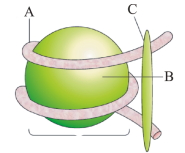
A
$A \rightarrow$ Histone-$H_1$,$B \rightarrow$ $DNA$,$C \rightarrow$ Histone octamer
B
$A \rightarrow$ $DNA$,$B \rightarrow$ Histone octamer,$C \rightarrow$ Histone-$H_1$
C
$A \rightarrow$ Histone octamer,$B \rightarrow$ Histone-$H_1$,$C \rightarrow$ $DNA$
D
$A \rightarrow$ Histone octamer,$B \rightarrow$ $DNA$,$C \rightarrow$ Histone-$H_1$
Solution
(B) The given diagram represents a nucleosome structure.
In this structure:
$A$ represents the $DNA$ molecule that wraps around the histone core.
$B$ represents the histone octamer,which is a complex of eight histone proteins ($H_2A, H_2B, H_3, H_4$ in pairs).
$C$ represents the linker histone,specifically Histone-$H_1$,which binds to the $DNA$ where it enters and leaves the nucleosome core particle.
Therefore,the correct identification is $A \rightarrow$ $DNA$,$B \rightarrow$ Histone octamer,$C \rightarrow$ Histone-$H_1$.
In this structure:
$A$ represents the $DNA$ molecule that wraps around the histone core.
$B$ represents the histone octamer,which is a complex of eight histone proteins ($H_2A, H_2B, H_3, H_4$ in pairs).
$C$ represents the linker histone,specifically Histone-$H_1$,which binds to the $DNA$ where it enters and leaves the nucleosome core particle.
Therefore,the correct identification is $A \rightarrow$ $DNA$,$B \rightarrow$ Histone octamer,$C \rightarrow$ Histone-$H_1$.
0 likes
View Solution593
MediumMCQ
Match the following columns $:-$
| Column-$I$ | Column-$II$ |
|---|---|
| $(a)$ $\phi \times 174$ bacteriophage | $(i)$ $48502 \ \text{b.p}$ |
| $(b)$ Human (diploid) | $(ii)$ $5386$ bases |
| $(c)$ $E. coli$ | $(iii)$ $6.6 \times 10^9 \ \text{b.p}$ |
| $(d)$ $\lambda$-phage | $(iv)$ $4.6 \times 10^6 \ \text{b.p}$ |
A
$a-iv, b-iii, c-ii, d-i$
B
$a-iii, b-iv, c-i, d-ii$
C
$a-ii, b-iii, c-iv, d-i$
D
$a-i, b-ii, c-iii, d-iv$
Solution
(C) The correct matches based on the genetic material content are as follows:
$1$. $\phi \times 174$ bacteriophage has $5386$ nucleotides (bases) - $(a-ii)$.
$2$. Human (diploid) $DNA$ content is $6.6 \times 10^9$ base pairs (b.p) - $(b-iii)$.
$3$. $E. coli$ has $4.6 \times 10^6$ base pairs (b.p) - $(c-iv)$.
$4$. $\lambda$-phage has $48502$ base pairs (b.p) - $(d-i)$.
Therefore,the correct sequence is $a-ii, b-iii, c-iv, d-i$.
$1$. $\phi \times 174$ bacteriophage has $5386$ nucleotides (bases) - $(a-ii)$.
$2$. Human (diploid) $DNA$ content is $6.6 \times 10^9$ base pairs (b.p) - $(b-iii)$.
$3$. $E. coli$ has $4.6 \times 10^6$ base pairs (b.p) - $(c-iv)$.
$4$. $\lambda$-phage has $48502$ base pairs (b.p) - $(d-i)$.
Therefore,the correct sequence is $a-ii, b-iii, c-iv, d-i$.
0 likes
View Solution594
EasyMCQ
In a segment of eukaryotic $DNA$,if the purine bases are $40$,then what will be the number of pyrimidine bases?
A
$20$
B
$40$
C
$60$
D
$80$
Solution
(B) According to Chargaff's rule,the amount of purines is always equal to the amount of pyrimidines in a double-stranded $DNA$ molecule.
This is expressed as the ratio of purines to pyrimidines being $1:1$.
Since the number of purine bases is given as $40$,the number of pyrimidine bases must also be $40$.
This is expressed as the ratio of purines to pyrimidines being $1:1$.
Since the number of purine bases is given as $40$,the number of pyrimidine bases must also be $40$.
0 likes
View Solution595
EasyMCQ
What will be the length of a $dsDNA$ strand,if it contains $100$ base pairs?
A
$340 \ \mathring{A}$
B
$170 \ \mathring{A}$
C
$100 \ \mathring{A}$
D
$200 \ \mathring{A}$
Solution
(A) In a $B-DNA$ double helix,the distance between two consecutive base pairs is approximately $3.4 \ \mathring{A}$ $(0.34 \ \text{nm})$.
Given that the $dsDNA$ strand contains $100$ base pairs.
The total length of the $DNA$ molecule is calculated by multiplying the number of base pairs by the distance between each pair.
Length $= 100 \times 3.4 \ \mathring{A} = 340 \ \mathring{A}$.
Given that the $dsDNA$ strand contains $100$ base pairs.
The total length of the $DNA$ molecule is calculated by multiplying the number of base pairs by the distance between each pair.
Length $= 100 \times 3.4 \ \mathring{A} = 340 \ \mathring{A}$.
0 likes
View Solution596
EasyMCQ
Erwin Chargaff $(1950)$ estimated that . . . . . . .
A
$\frac{A + T}{G + C}$ ratio in a $DNA$ molecule remains constant for a particular species.
B
pyrimidines and purines always occur in equal proportion.
C
nitrogen bases are placed regularly along the $DNA$ molecule at a distance of $3.4 \ \text{Å}$.
D
purine and pyrimidine bases are linked by glycosidic bond.
Solution
(B) Erwin Chargaff observed that the amount of purines $(A + G)$ is always equal to the amount of pyrimidines $(T + C)$ in a double-stranded $DNA$ molecule.
This is known as Chargaff's rule, which states that the ratio of adenine to thymine is $1:1$ and the ratio of guanine to cytosine is $1:1$.
This is known as Chargaff's rule, which states that the ratio of adenine to thymine is $1:1$ and the ratio of guanine to cytosine is $1:1$.
0 likes
View Solution597
EasyMCQ
Which one of the following nitrogenous bases is $NOT$ a component of $RNA$?
A
Guanine
B
Cytosine
C
Thymine
D
Adenine
Solution
(C) $RNA$ contains four nitrogenous bases: Adenine $(A)$,Guanine $(G)$,Cytosine $(C)$,and Uracil $(U)$. Thymine $(T)$ is found in $DNA$ but is replaced by Uracil $(U)$ in $RNA$. Therefore,Thymine is not a component of $RNA$.
0 likes
View Solution598
EasyMCQ
Which one of the following is the genetic material of bacteriophage $\phi X 174$?
A
ssRNA
B
ssDNA
C
dsRNA
D
dsDNA
Solution
(B) The bacteriophage $\phi X 174$ is a well-known virus that infects $E. coli$.
Its genetic material consists of a single-stranded $DNA$ molecule,commonly referred to as $ssDNA$.
Unlike most organisms that use double-stranded $DNA$ $(dsDNA)$ as their genetic material,$\phi X 174$ is a classic example of a virus with a single-stranded $DNA$ genome.
Its genetic material consists of a single-stranded $DNA$ molecule,commonly referred to as $ssDNA$.
Unlike most organisms that use double-stranded $DNA$ $(dsDNA)$ as their genetic material,$\phi X 174$ is a classic example of a virus with a single-stranded $DNA$ genome.
0 likes
View Solution599
EasyMCQ
Which one of the following can form a nucleotide of $DNA$?
A
Thymine + ribose + phosphate
B
Uracil + ribose + phosphate
C
Adenine + deoxyribose + phosphate
D
Uracil + deoxyribose + phosphate
Solution
(C) nucleotide of $DNA$ consists of three components: a nitrogenous base,a deoxyribose sugar,and a phosphate group.
$DNA$ contains the nitrogenous bases Adenine $(A)$,Guanine $(G)$,Cytosine $(C)$,and Thymine $(T)$.
$RNA$ contains the nitrogenous base Uracil $(U)$ instead of Thymine and uses ribose sugar instead of deoxyribose sugar.
Option $A$ is incorrect because it uses ribose sugar.
Option $B$ is incorrect because it uses Uracil and ribose sugar.
Option $C$ is correct because it contains Adenine (a $DNA$ base),deoxyribose sugar,and a phosphate group.
Option $D$ is incorrect because it uses Uracil.
$DNA$ contains the nitrogenous bases Adenine $(A)$,Guanine $(G)$,Cytosine $(C)$,and Thymine $(T)$.
$RNA$ contains the nitrogenous base Uracil $(U)$ instead of Thymine and uses ribose sugar instead of deoxyribose sugar.
Option $A$ is incorrect because it uses ribose sugar.
Option $B$ is incorrect because it uses Uracil and ribose sugar.
Option $C$ is correct because it contains Adenine (a $DNA$ base),deoxyribose sugar,and a phosphate group.
Option $D$ is incorrect because it uses Uracil.
0 likes
View Solution600
EasyMCQ
$A$ $340 \text{ Å}$ long segment of $DNA$ molecule has $20$ thymine nitrogenous bases. What will be the number of guanine nitrogen bases in the same segment?
A
$10$
B
$40$
C
$80$
D
$160$
Solution
(C) The total length of the $DNA$ segment is $340 \text{ Å}$.
Since the distance between two consecutive base pairs in a $DNA$ helix is $3.4 \text{ Å}$,the total number of base pairs is $340 \text{ Å} / 3.4 \text{ Å} = 100 \text{ base pairs}$.
This means there are $200$ total nitrogenous bases ($100$ on each strand).
According to Chargaff's rule,the number of adenine $(A)$ equals the number of thymine $(T)$,and the number of guanine $(G)$ equals the number of cytosine $(C)$.
Given that there are $20$ thymine bases,there must be $20$ adenine bases.
The total number of $A + T$ bases is $20 + 20 = 40$.
The remaining bases are $G + C = 200 - 40 = 160$.
Since $G = C$,the number of guanine bases is $160 / 2 = 80$.
Since the distance between two consecutive base pairs in a $DNA$ helix is $3.4 \text{ Å}$,the total number of base pairs is $340 \text{ Å} / 3.4 \text{ Å} = 100 \text{ base pairs}$.
This means there are $200$ total nitrogenous bases ($100$ on each strand).
According to Chargaff's rule,the number of adenine $(A)$ equals the number of thymine $(T)$,and the number of guanine $(G)$ equals the number of cytosine $(C)$.
Given that there are $20$ thymine bases,there must be $20$ adenine bases.
The total number of $A + T$ bases is $20 + 20 = 40$.
The remaining bases are $G + C = 200 - 40 = 160$.
Since $G = C$,the number of guanine bases is $160 / 2 = 80$.
0 likes
View SolutionMolecular Basis of Inheritance — The DNA · Frequently Asked Questions
1Are these Molecular Basis of Inheritance questions useful for JEE and NEET?
Yes. All questions in this section are mapped to JEE Main and NEET exam patterns. Previous year questions from JEE Main, NEET, GUJCET and state-level exams are included with full solutions.
2Can I switch to Hindi or Gujarati for these questions?
Yes. Use the language tabs in the hero section or the sidebar to view the same questions and solutions in English, Hindi or Gujarati.
3How do I generate a question paper from this subtopic?
Use the Vedclass Exam Paper Generator — select the chapter and subtopic, set difficulty, and generate Sets A, B, C, D automatically. First 3 chapters of every subject are free.
Vedclass Products
For Students
Vedclass Test Series
Mock tests in real JEE/NEET style with performance analysis. 5-day free trial.
Start Free TrialFor Teachers
Exam Paper Generator
Generate Set A/B/C/D papers from this chapter in 2 minutes. 3 chapters free.
Try FreeFor Institutes
Online Exam Module
Live online exams with unlimited students, 360° analytics & white-label branding.
See DemoFor Teachers & Institutes
Generate a Molecular Basis of Inheritance Exam Paper in 2 Minutes
Select subtopic & difficulty — Sets A, B, C, D auto-generated with No Repeat logic.
First 3 chapters of every subject are free — no payment required.