
A English
Potential Energy Questions in English
Class 11 Physics · Work, Energy, Power and Collision · Potential Energy
84+
Questions
English
Language
100%
With Solutions
Showing 34 of 84 questions in English
51
MediumMCQ
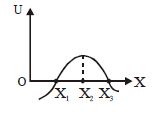
In the figure shown,the potential energy $(U)$ of a particle is plotted against its position $x$ from the origin. The particle at:
A
$x_1$ is in stable equilibrium
B
$x_2$ is in stable equilibrium
C
$x_3$ is in stable equilibrium
D
None of these
Solution
(D) For a particle to be in equilibrium,the net force must be zero,which implies $\frac{dU}{dx} = 0$. This corresponds to the points where the slope of the $U-x$ graph is zero.
At $x_2$,the potential energy $U$ is at a local maximum. For a potential energy maximum,the equilibrium is unstable because any small displacement results in a force that pushes the particle further away from the equilibrium position.
At $x_1$ and $x_3$,the slope is not zero,so the particle is not in equilibrium at these points.
Therefore,none of the given options correctly describe the state of the particle at the points shown.
At $x_2$,the potential energy $U$ is at a local maximum. For a potential energy maximum,the equilibrium is unstable because any small displacement results in a force that pushes the particle further away from the equilibrium position.
At $x_1$ and $x_3$,the slope is not zero,so the particle is not in equilibrium at these points.
Therefore,none of the given options correctly describe the state of the particle at the points shown.
0 likes
View Solution52
DifficultMCQ
The potential energy of a body of mass $m$ is given by $U = ax + by$,where $x$ and $y$ are the position coordinates of the particle. The acceleration of the particle is:
A
$\frac{(a^2 + b^2)^{1/2}}{m}$
B
$\frac{a^2 + b^2}{m}$
C
$\frac{(a + b)^{1/2}}{m}$
D
$\frac{a + b}{m}$
Solution
(A) The force components are derived from the negative gradient of the potential energy:
$F_x = -\frac{\partial U}{\partial x} = -a$
$F_y = -\frac{\partial U}{\partial y} = -b$
The magnitude of the net force $F$ is given by:
$F = \sqrt{F_x^2 + F_y^2} = \sqrt{(-a)^2 + (-b)^2} = \sqrt{a^2 + b^2}$
Using Newton's second law,the acceleration $a_{acc}$ is:
$a_{acc} = \frac{F}{m} = \frac{\sqrt{a^2 + b^2}}{m} = \frac{(a^2 + b^2)^{1/2}}{m}$
$F_x = -\frac{\partial U}{\partial x} = -a$
$F_y = -\frac{\partial U}{\partial y} = -b$
The magnitude of the net force $F$ is given by:
$F = \sqrt{F_x^2 + F_y^2} = \sqrt{(-a)^2 + (-b)^2} = \sqrt{a^2 + b^2}$
Using Newton's second law,the acceleration $a_{acc}$ is:
$a_{acc} = \frac{F}{m} = \frac{\sqrt{a^2 + b^2}}{m} = \frac{(a^2 + b^2)^{1/2}}{m}$
0 likes
View Solution53
DifficultMCQ
$A$ uniform chain of length $2\,m$ is kept on a table such that a length of $60\,cm$ hangs freely from the edge of the table. The total mass of the chain is $4\,kg$. What is the work done in pulling the entire chain on the table? (Take $g = 10\,m/s^2$)
A
$7.2$
B
$3.6$
C
$120$
D
$1200$
Solution
(B) Let the total length of the chain be $L = 2\,m$ and the total mass be $M = 4\,kg$.
The length of the hanging part is $l = 60\,cm = 0.6\,m$.
The mass per unit length of the chain is $\lambda = \frac{M}{L} = \frac{4}{2} = 2\,kg/m$.
The mass of the hanging part is $m = \lambda \times l = 2 \times 0.6 = 1.2\,kg$.
The center of mass of the hanging part is at a distance $h = \frac{l}{2} = \frac{0.6}{2} = 0.3\,m$ below the table edge.
The work done to pull the chain onto the table is equal to the change in potential energy of the hanging part,which is $W = mgh$.
Substituting the values: $W = 1.2 \times 10 \times 0.3 = 3.6\,J$.
The length of the hanging part is $l = 60\,cm = 0.6\,m$.
The mass per unit length of the chain is $\lambda = \frac{M}{L} = \frac{4}{2} = 2\,kg/m$.
The mass of the hanging part is $m = \lambda \times l = 2 \times 0.6 = 1.2\,kg$.
The center of mass of the hanging part is at a distance $h = \frac{l}{2} = \frac{0.6}{2} = 0.3\,m$ below the table edge.
The work done to pull the chain onto the table is equal to the change in potential energy of the hanging part,which is $W = mgh$.
Substituting the values: $W = 1.2 \times 10 \times 0.3 = 3.6\,J$.
0 likes
View Solution54
MediumMCQ
$A$ body of mass $2\, kg$ is situated at a height $5\, m$ above the ground. Its potential energy is reported as $70\, J$. The potential energy of a $3\, kg$ body situated at a height $1\, m$ above the ground will be reported as ................ $J$.
A
$30$
B
$21$
C
$-15$
D
$0$
Solution
(C) Let $x$ be the height of the reference point (where potential energy is zero) with respect to the ground.
The potential energy $U$ is given by $U = mgh'$,where $h'$ is the height relative to the reference point.
For the first body: $m_1 = 2\, kg$,$h_1 = 5\, m$,$U_1 = 70\, J$,and $g = 10\, m/s^2$.
$70 = 2 \times 10 \times (5 - x)$
$70 = 20(5 - x)$
$3.5 = 5 - x$
$x = 1.5\, m$.
For the second body: $m_2 = 3\, kg$,$h_2 = 1\, m$,and $g = 10\, m/s^2$.
$U_2 = m_2 \times g \times (h_2 - x)$
$U_2 = 3 \times 10 \times (1 - 1.5)$
$U_2 = 30 \times (-0.5)$
$U_2 = -15\, J$.
The potential energy $U$ is given by $U = mgh'$,where $h'$ is the height relative to the reference point.
For the first body: $m_1 = 2\, kg$,$h_1 = 5\, m$,$U_1 = 70\, J$,and $g = 10\, m/s^2$.
$70 = 2 \times 10 \times (5 - x)$
$70 = 20(5 - x)$
$3.5 = 5 - x$
$x = 1.5\, m$.
For the second body: $m_2 = 3\, kg$,$h_2 = 1\, m$,and $g = 10\, m/s^2$.
$U_2 = m_2 \times g \times (h_2 - x)$
$U_2 = 3 \times 10 \times (1 - 1.5)$
$U_2 = 30 \times (-0.5)$
$U_2 = -15\, J$.
0 likes
View Solution55
Medium
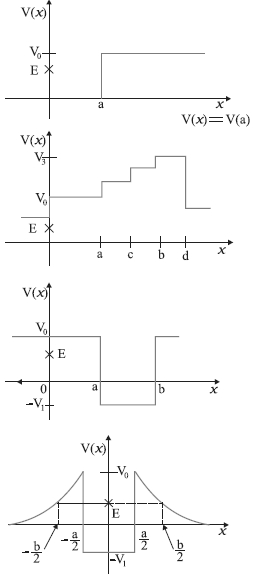
Given in the figures are examples of some potential energy functions in one dimension. The total energy of the particle is indicated by a cross on the ordinate axis. In each case,specify the regions,if any,in which the particle cannot be found for the given energy. Also,indicate the minimum total energy the particle must have in each case. Think of simple physical contexts for which these potential energy shapes are relevant.
Solution
(N/A) The total energy of a system is given by $E = P.E. + K.E.$,which implies $K.E. = E - P.E.$. Since kinetic energy $(K.E.)$ must be non-negative,the particle cannot exist in regions where $P.E. > E$.
$(i)$ For the first figure: The particle cannot exist in the region $x > a$ because $V(x) = V_0 > E$. The minimum total energy required is $0$.
(ii) For the second figure: The potential energy $V(x)$ is greater than $E$ in all regions shown. Thus,the particle cannot exist in any of these regions. The minimum total energy required is $V_0$.
(iii) For the third figure: The particle cannot exist in regions where $V(x) > E$. Here,$V(x) = V_0$ for $x < a$ and $x > b$. Thus,the particle is confined to $a < x < b$. The minimum total energy required is $-V_1$.
(iv) For the fourth figure: The particle cannot exist where $V(x) > E$. Based on the graph,this occurs for $x < -b/2$,$-a/2 < x < a/2$,and $x > b/2$. The particle can only exist in the regions $-b/2 < x < -a/2$ and $a/2 < x < b/2$. The minimum total energy required is $-V_1$.
$(i)$ For the first figure: The particle cannot exist in the region $x > a$ because $V(x) = V_0 > E$. The minimum total energy required is $0$.
(ii) For the second figure: The potential energy $V(x)$ is greater than $E$ in all regions shown. Thus,the particle cannot exist in any of these regions. The minimum total energy required is $V_0$.
(iii) For the third figure: The particle cannot exist in regions where $V(x) > E$. Here,$V(x) = V_0$ for $x < a$ and $x > b$. Thus,the particle is confined to $a < x < b$. The minimum total energy required is $-V_1$.
(iv) For the fourth figure: The particle cannot exist where $V(x) > E$. Based on the graph,this occurs for $x < -b/2$,$-a/2 < x < a/2$,and $x > b/2$. The particle can only exist in the regions $-b/2 < x < -a/2$ and $a/2 < x < b/2$. The minimum total energy required is $-V_1$.
0 likes
View Solution56
Easy
Write the equation of total mechanical energy of a body having mass $m$ and stationary at height $H$.
Solution
(N/A) The total mechanical energy $(E)$ of a body is the sum of its kinetic energy $(K)$ and potential energy $(U)$.
$E = K + U$
For a body of mass $m$ at height $H$ that is stationary,its velocity $(v)$ is $0$.
Therefore,the kinetic energy $K = \frac{1}{2}mv^2 = \frac{1}{2}m(0)^2 = 0$.
The gravitational potential energy $U$ at height $H$ relative to the ground is given by $U = mgH$.
Thus,the total mechanical energy is $E = 0 + mgH = mgH$.
$E = K + U$
For a body of mass $m$ at height $H$ that is stationary,its velocity $(v)$ is $0$.
Therefore,the kinetic energy $K = \frac{1}{2}mv^2 = \frac{1}{2}m(0)^2 = 0$.
The gravitational potential energy $U$ at height $H$ relative to the ground is given by $U = mgH$.
Thus,the total mechanical energy is $E = 0 + mgH = mgH$.
1 likes
View Solution57
MediumMCQ
In the equation $W = -mgh$,what does the negative sign indicate?
A
The work is done by the gravitational force.
B
The work is done against the gravitational force.
C
The kinetic energy is decreasing.
D
The potential energy is zero.
Solution
(B) The negative sign in the equation $W = -mgh$ indicates that the work is being done against the gravitational force. When an object is lifted vertically,the displacement is upward while the gravitational force acts downward. Since the force and displacement are in opposite directions,the work done by the external agent is positive,but the work done by the gravitational force is negative.
0 likes
View Solution58
MediumMCQ
When an arrow is released from a bow,from where does the arrow acquire its kinetic energy?
A
From the heat energy of the bow.
B
From the potential energy stored in the stretched bowstring.
C
From the chemical energy of the archer.
D
From the gravitational potential energy of the arrow.
Solution
(B) When the bowstring is stretched,work is done on the bow,which is stored as elastic potential energy in the bow and the string. When the arrow is released,this stored potential energy is converted into the kinetic energy of the arrow.
0 likes
View Solution59
Medium
Consider a one-dimensional motion of a particle with total energy $E$. There are four regions $A, B, C$ and $D$ in which the relation between potential energy $V$,kinetic energy $K$,and total energy $E$ is as given below:
Region $A: V > E$
Region $B: V < E$
Region $C: K < E$
Region $D: V > E$
State with reason in each case whether a particle can be found in the given region or not.
Region $A: V > E$
Region $B: V < E$
Region $C: K < E$
Region $D: V > E$
State with reason in each case whether a particle can be found in the given region or not.
Solution
(B) The total energy of a particle is given by $E = V + K$,where $V$ is the potential energy and $K$ is the kinetic energy. Since $K = E - V$ and kinetic energy $K$ must always be non-negative $(K \ge 0)$,a particle can exist in a region only if $E - V \ge 0$,which implies $V \le E$.
$1.$ Region $A$ $(V > E)$: Here,$K = E - V < 0$. Since kinetic energy cannot be negative,the particle cannot be found in this region.
$2.$ Region $B$ $(V < E)$: Here,$K = E - V > 0$. Since kinetic energy is positive,the particle can be found in this region.
$3.$ Region $C$ $(K < E)$: Since $K = E - V$,the condition $K < E$ implies $E - V < E$,which simplifies to $V > 0$. As long as the potential energy $V$ is positive,this condition is satisfied. Thus,the particle can be found in this region.
$4.$ Region $D$ $(V > E)$: Similar to region $A$,here $K = E - V < 0$. Since kinetic energy cannot be negative,the particle cannot be found in this region.
$1.$ Region $A$ $(V > E)$: Here,$K = E - V < 0$. Since kinetic energy cannot be negative,the particle cannot be found in this region.
$2.$ Region $B$ $(V < E)$: Here,$K = E - V > 0$. Since kinetic energy is positive,the particle can be found in this region.
$3.$ Region $C$ $(K < E)$: Since $K = E - V$,the condition $K < E$ implies $E - V < E$,which simplifies to $V > 0$. As long as the potential energy $V$ is positive,this condition is satisfied. Thus,the particle can be found in this region.
$4.$ Region $D$ $(V > E)$: Similar to region $A$,here $K = E - V < 0$. Since kinetic energy cannot be negative,the particle cannot be found in this region.
0 likes
View Solution60
EasyMCQ
For the stability of a physical system,what should be its potential energy? Should it be more or less?
A
More
B
Less
C
Zero
D
Infinite
Solution
(B) In physics,a system is considered to be in a state of stable equilibrium when its potential energy is at a minimum value.
According to the principle of minimum potential energy,systems naturally tend to move towards configurations that minimize their total potential energy to achieve maximum stability.
Therefore,for the stability of a system,its potential energy should be as low (less) as possible.
According to the principle of minimum potential energy,systems naturally tend to move towards configurations that minimize their total potential energy to achieve maximum stability.
Therefore,for the stability of a system,its potential energy should be as low (less) as possible.
0 likes
View Solution61
DifficultMCQ
If the potential energy between two molecules is given by $U = -\frac{A}{r^6} + \frac{B}{r^{12}}$,then at equilibrium,the separation between the molecules and the potential energy are:
A
$\left(\frac{B}{A}\right)^{1/6}, 0$
B
$\left(\frac{B}{2A}\right)^{1/6}, -\frac{A^2}{2B}$
C
$\left(\frac{2B}{A}\right)^{1/6}, -\frac{A^2}{4B}$
D
$\left(\frac{2B}{A}\right)^{1/6}, -\frac{A^2}{2B}$
Solution
(C) The potential energy is given by $U(r) = -\frac{A}{r^6} + \frac{B}{r^{12}}$.
At equilibrium,the force $F = -\frac{dU}{dr} = 0$.
Calculating the derivative: $\frac{dU}{dr} = -A(-6r^{-7}) + B(-12r^{-13}) = \frac{6A}{r^7} - \frac{12B}{r^{13}}$.
Setting $\frac{dU}{dr} = 0$: $\frac{6A}{r^7} = \frac{12B}{r^{13}} \Rightarrow r^6 = \frac{12B}{6A} = \frac{2B}{A}$.
Thus,the equilibrium separation is $r = \left(\frac{2B}{A}\right)^{1/6}$.
Substituting this value into the potential energy expression:
$U = -\frac{A}{(2B/A)} + \frac{B}{(2B/A)^2} = -\frac{A^2}{2B} + \frac{B \cdot A^2}{4B^2} = -\frac{A^2}{2B} + \frac{A^2}{4B} = -\frac{A^2}{4B}$.
At equilibrium,the force $F = -\frac{dU}{dr} = 0$.
Calculating the derivative: $\frac{dU}{dr} = -A(-6r^{-7}) + B(-12r^{-13}) = \frac{6A}{r^7} - \frac{12B}{r^{13}}$.
Setting $\frac{dU}{dr} = 0$: $\frac{6A}{r^7} = \frac{12B}{r^{13}} \Rightarrow r^6 = \frac{12B}{6A} = \frac{2B}{A}$.
Thus,the equilibrium separation is $r = \left(\frac{2B}{A}\right)^{1/6}$.
Substituting this value into the potential energy expression:
$U = -\frac{A}{(2B/A)} + \frac{B}{(2B/A)^2} = -\frac{A^2}{2B} + \frac{B \cdot A^2}{4B^2} = -\frac{A^2}{2B} + \frac{A^2}{4B} = -\frac{A^2}{4B}$.
0 likes
View Solution62
DifficultMCQ
The potential energy $(U)$ of a diatomic molecule is a function dependent on $r$ (interatomic distance) as $U = \frac{\alpha}{r^{10}} - \frac{\beta}{r^5} - 3$,where $\alpha$ and $\beta$ are positive constants. The equilibrium distance between two atoms will be $\left(\frac{2\alpha}{\beta}\right)^{\frac{a}{b}}$,where $a = \dots \dots \dots \dots$
A
$2$
B
$1$
C
$3$
D
$0$
Solution
(B) For a system to be in equilibrium,the net force must be zero,which implies that the derivative of potential energy with respect to distance must be zero: $\frac{dU}{dr} = 0$.
Given $U = \alpha r^{-10} - \beta r^{-5} - 3$.
Differentiating with respect to $r$:
$\frac{dU}{dr} = -10\alpha r^{-11} + 5\beta r^{-6} = 0$.
Rearranging the terms:
$5\beta r^{-6} = 10\alpha r^{-11}$.
Dividing both sides by $5\beta r^{-11}$:
$r^5 = \frac{10\alpha}{5\beta} = \frac{2\alpha}{\beta}$.
$r = \left(\frac{2\alpha}{\beta}\right)^{\frac{1}{5}}$.
Comparing this with the given form $\left(\frac{2\alpha}{\beta}\right)^{\frac{a}{b}}$,we find $\frac{a}{b} = \frac{1}{5}$.
Thus,$a = 1$.
Given $U = \alpha r^{-10} - \beta r^{-5} - 3$.
Differentiating with respect to $r$:
$\frac{dU}{dr} = -10\alpha r^{-11} + 5\beta r^{-6} = 0$.
Rearranging the terms:
$5\beta r^{-6} = 10\alpha r^{-11}$.
Dividing both sides by $5\beta r^{-11}$:
$r^5 = \frac{10\alpha}{5\beta} = \frac{2\alpha}{\beta}$.
$r = \left(\frac{2\alpha}{\beta}\right)^{\frac{1}{5}}$.
Comparing this with the given form $\left(\frac{2\alpha}{\beta}\right)^{\frac{a}{b}}$,we find $\frac{a}{b} = \frac{1}{5}$.
Thus,$a = 1$.
0 likes
View Solution63
MediumMCQ
Potential energy as a function of $r$ is given by $U = \frac{A}{r^{10}} - \frac{B}{r^{5}}$,where $r$ is the interatomic distance,and $A$ and $B$ are positive constants. The equilibrium distance between the two atoms will be
A
$\left(\frac{A}{B}\right)^{\frac{1}{5}}$
B
$\left(\frac{B}{A}\right)^{\frac{1}{5}}$
C
$\left(\frac{2A}{B}\right)^{\frac{1}{5}}$
D
$\left(\frac{B}{2A}\right)^{\frac{1}{5}}$
Solution
(C) The equilibrium position occurs where the force $F = -\frac{dU}{dr} = 0$.
Given $U = A r^{-10} - B r^{-5}$.
Differentiating with respect to $r$: $\frac{dU}{dr} = -10 A r^{-11} + 5 B r^{-6}$.
Setting $\frac{dU}{dr} = 0$ for equilibrium:
$-10 A r^{-11} + 5 B r^{-6} = 0$.
$5 B r^{-6} = 10 A r^{-11}$.
$r^5 = \frac{10A}{5B} = \frac{2A}{B}$.
Therefore,the equilibrium distance is $r = \left(\frac{2A}{B}\right)^{\frac{1}{5}}$.
Given $U = A r^{-10} - B r^{-5}$.
Differentiating with respect to $r$: $\frac{dU}{dr} = -10 A r^{-11} + 5 B r^{-6}$.
Setting $\frac{dU}{dr} = 0$ for equilibrium:
$-10 A r^{-11} + 5 B r^{-6} = 0$.
$5 B r^{-6} = 10 A r^{-11}$.
$r^5 = \frac{10A}{5B} = \frac{2A}{B}$.
Therefore,the equilibrium distance is $r = \left(\frac{2A}{B}\right)^{\frac{1}{5}}$.
0 likes
View Solution64
AdvancedMCQ
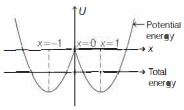
$A$ particle has a total mechanical energy that is small and negative. It is under the influence of a one-dimensional potential $U(x) = \frac{x^4}{4} - \frac{x^2}{2} \, J$,where $x$ is in meters. At time $t = 0 \, s$,it is at $x = -0.5 \, m$. Then,at a later time,it can be found:
A
anywhere on the $X$-axis
B
between $x = -1.0 \, m$ to $x = 1.0 \, m$
C
between $x = -1.0 \, m$ to $x = 0.0 \, m$
D
between $x = 0.0 \, m$ to $x = 1.0 \, m$
Solution
(C) The potential energy of the particle is given by $U(x) = \frac{x^4}{4} - \frac{x^2}{2}$.
To find the equilibrium points,we differentiate $U(x)$ with respect to $x$ and set it to zero:
$\frac{dU}{dx} = x^3 - x = x(x^2 - 1) = 0$.
This gives critical points at $x = 0$ and $x = \pm 1$.
Using the second derivative test: $\frac{d^2U}{dx^2} = 3x^2 - 1$.
At $x = 0$,$\frac{d^2U}{dx^2} = -1$ (local maximum).
At $x = \pm 1$,$\frac{d^2U}{dx^2} = 2$ (local minima).
The potential energy graph shows two wells separated by a barrier at $x = 0$. Since the total mechanical energy $E$ is small and negative (specifically,$E < U(0) = 0$),the particle is trapped in one of the potential wells.
Given that at $t = 0 \, s$,the particle is at $x = -0.5 \, m$,it is located in the left potential well. Because the total energy is less than the potential barrier at $x = 0$,the particle cannot cross the barrier and will remain confined between the turning points in the region $x = -1.0 \, m$ to $x = 0.0 \, m$.
To find the equilibrium points,we differentiate $U(x)$ with respect to $x$ and set it to zero:
$\frac{dU}{dx} = x^3 - x = x(x^2 - 1) = 0$.
This gives critical points at $x = 0$ and $x = \pm 1$.
Using the second derivative test: $\frac{d^2U}{dx^2} = 3x^2 - 1$.
At $x = 0$,$\frac{d^2U}{dx^2} = -1$ (local maximum).
At $x = \pm 1$,$\frac{d^2U}{dx^2} = 2$ (local minima).
The potential energy graph shows two wells separated by a barrier at $x = 0$. Since the total mechanical energy $E$ is small and negative (specifically,$E < U(0) = 0$),the particle is trapped in one of the potential wells.
Given that at $t = 0 \, s$,the particle is at $x = -0.5 \, m$,it is located in the left potential well. Because the total energy is less than the potential barrier at $x = 0$,the particle cannot cross the barrier and will remain confined between the turning points in the region $x = -1.0 \, m$ to $x = 0.0 \, m$.
0 likes
View Solution65
AdvancedMCQ
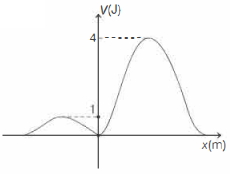
$A$ point particle of mass $0.5 \,kg$ is moving along the $X$-axis under a force described by the potential energy $V$ shown in the graph. It is projected towards the right from the origin with a speed $v$. What is the minimum value of $v$ for which the particle will escape infinitely far away from the origin?
A
$2 \sqrt{2} \,m/s$
B
$2 \,m/s$
C
$4 \,m/s$
D
The particle will never escape
Solution
(B) The particle is at the origin $(x=0)$ and is projected towards the right. To escape to infinity on the right side,it must overcome the potential barrier of $4 \,J$.
Using the law of conservation of energy: $K_i + V_i = K_f + V_f$.
At the origin,$V_i = 0$ and $K_i = \frac{1}{2}mv^2$.
To just cross the barrier,the final kinetic energy at the peak $(V_f = 4 \,J)$ must be at least $0$.
$\frac{1}{2} \times 0.5 \times v^2 = 4 \Rightarrow 0.25 \times v^2 = 4 \Rightarrow v^2 = 16 \Rightarrow v = 4 \,m/s$.
However,if the particle does not have enough energy to cross the right barrier,it will be reflected back towards the left. On the left side,there is a smaller potential barrier of $1 \,J$.
If the particle is reflected,it moves towards the left and must overcome the barrier of $1 \,J$ to escape to infinity on the left side.
For this,the initial kinetic energy must be at least $1 \,J$:
$\frac{1}{2} \times 0.5 \times v^2 = 1 \Rightarrow 0.25 \times v^2 = 1 \Rightarrow v^2 = 4 \Rightarrow v = 2 \,m/s$.
Since $2 \,m/s < 4 \,m/s$,the minimum speed required for the particle to escape to infinity (by going over the left barrier after reflection) is $2 \,m/s$.
Using the law of conservation of energy: $K_i + V_i = K_f + V_f$.
At the origin,$V_i = 0$ and $K_i = \frac{1}{2}mv^2$.
To just cross the barrier,the final kinetic energy at the peak $(V_f = 4 \,J)$ must be at least $0$.
$\frac{1}{2} \times 0.5 \times v^2 = 4 \Rightarrow 0.25 \times v^2 = 4 \Rightarrow v^2 = 16 \Rightarrow v = 4 \,m/s$.
However,if the particle does not have enough energy to cross the right barrier,it will be reflected back towards the left. On the left side,there is a smaller potential barrier of $1 \,J$.
If the particle is reflected,it moves towards the left and must overcome the barrier of $1 \,J$ to escape to infinity on the left side.
For this,the initial kinetic energy must be at least $1 \,J$:
$\frac{1}{2} \times 0.5 \times v^2 = 1 \Rightarrow 0.25 \times v^2 = 1 \Rightarrow v^2 = 4 \Rightarrow v = 2 \,m/s$.
Since $2 \,m/s < 4 \,m/s$,the minimum speed required for the particle to escape to infinity (by going over the left barrier after reflection) is $2 \,m/s$.
0 likes
View Solution66
MediumMCQ
$A$ chain of length $L$ and mass $M$ is placed on a frictionless table with one-fifth of its length hanging over the edge. What is the work required to pull the hanging part back onto the table?
A
$\frac{M g L}{5}$
B
$\frac{M g L}{18}$
C
$\frac{M g L}{10}$
D
$\frac{M g L}{50}$
Solution
(D) The length of the hanging part is $l = \frac{L}{5}$.
The mass of the hanging part is $m = \frac{M}{L} \times \frac{L}{5} = \frac{M}{5}$.
The center of mass of the hanging part is at a distance $h = \frac{l}{2} = \frac{L/5}{2} = \frac{L}{10}$ below the edge of the table.
The work done to pull the hanging part back onto the table is equal to the change in potential energy of the hanging part.
$W = mgh = \left( \frac{M}{5} \right) g \left( \frac{L}{10} \right) = \frac{M g L}{50}$.
The mass of the hanging part is $m = \frac{M}{L} \times \frac{L}{5} = \frac{M}{5}$.
The center of mass of the hanging part is at a distance $h = \frac{l}{2} = \frac{L/5}{2} = \frac{L}{10}$ below the edge of the table.
The work done to pull the hanging part back onto the table is equal to the change in potential energy of the hanging part.
$W = mgh = \left( \frac{M}{5} \right) g \left( \frac{L}{10} \right) = \frac{M g L}{50}$.
0 likes
View Solution67
MediumMCQ
$A$ stick of mass $m$ and length $l$ is pivoted at one end and is displaced through an angle $\theta$. The increase in potential energy is ............

A
$m g \frac{l}{2}(1-\cos \theta)$
B
$m g \frac{l}{2}(1+\cos \theta)$
C
$m g \frac{l}{2}(1-\sin \theta)$
D
$m g \frac{l}{2}(1+\sin \theta)$
Solution
(A) The potential energy of the stick is associated with its center of mass.
Initially,the center of mass of the stick is at a distance $h_1 = \frac{l}{2}$ from the pivot point.
When the stick is displaced by an angle $\theta$ from the vertical,the vertical distance of the center of mass from the pivot point becomes $h_2 = \frac{l}{2} \cos \theta$.
The change in the height of the center of mass is $\Delta h = h_1 - h_2 = \frac{l}{2} - \frac{l}{2} \cos \theta = \frac{l}{2}(1 - \cos \theta)$.
The increase in potential energy is given by $\Delta U = mg \Delta h = mg \frac{l}{2}(1 - \cos \theta)$.
Initially,the center of mass of the stick is at a distance $h_1 = \frac{l}{2}$ from the pivot point.
When the stick is displaced by an angle $\theta$ from the vertical,the vertical distance of the center of mass from the pivot point becomes $h_2 = \frac{l}{2} \cos \theta$.
The change in the height of the center of mass is $\Delta h = h_1 - h_2 = \frac{l}{2} - \frac{l}{2} \cos \theta = \frac{l}{2}(1 - \cos \theta)$.
The increase in potential energy is given by $\Delta U = mg \Delta h = mg \frac{l}{2}(1 - \cos \theta)$.
0 likes
View Solution68
MediumMCQ
The variation of potential energy $U$ of a body moving along the $x$-axis with its position $(x)$ is shown in the figure. The body is in an equilibrium state at:
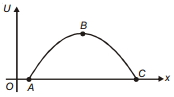
A
$A$
B
$B$
C
$C$
D
Both $A$ and $C$
Solution
(B) body is in equilibrium when the net force acting on it is zero.
For a conservative force field,the force $F$ is related to the potential energy $U$ by the relation $F = -\frac{dU}{dx}$.
Equilibrium occurs when $F = 0$,which implies $\frac{dU}{dx} = 0$.
Graphically,$\frac{dU}{dx}$ represents the slope of the $U-x$ curve.
At point $B$,the tangent to the curve is horizontal,meaning the slope $\frac{dU}{dx} = 0$.
Therefore,the body is in an equilibrium state at point $B$.
For a conservative force field,the force $F$ is related to the potential energy $U$ by the relation $F = -\frac{dU}{dx}$.
Equilibrium occurs when $F = 0$,which implies $\frac{dU}{dx} = 0$.
Graphically,$\frac{dU}{dx}$ represents the slope of the $U-x$ curve.
At point $B$,the tangent to the curve is horizontal,meaning the slope $\frac{dU}{dx} = 0$.
Therefore,the body is in an equilibrium state at point $B$.
0 likes
View Solution69
DifficultMCQ
The $PE$ of a $2 \, kg$ particle,free to move along the $x$-axis,is given by $V(x) = \left( \frac{x^3}{3} - \frac{x^2}{2} \right) \, J$. The total mechanical energy of the particle is $4 \, J$. The maximum speed (in $m \, s^{-1}$) is ...........
A
$\frac{1}{\sqrt{2}}$
B
$\sqrt{2}$
C
$\frac{3}{\sqrt{2}}$
D
$\frac{5}{\sqrt{6}}$
Solution
(D) The potential energy is given by $U(x) = \frac{x^3}{3} - \frac{x^2}{2}$.
To find the equilibrium points,we set the force $F = -\frac{dU}{dx} = 0$.
$\frac{dU}{dx} = x^2 - x = 0 \implies x(x - 1) = 0$,so $x = 0$ or $x = 1$.
We check the second derivative $\frac{d^2U}{dx^2} = 2x - 1$.
At $x = 0$,$\frac{d^2U}{dx^2} = -1 < 0$ (unstable equilibrium).
At $x = 1$,$\frac{d^2U}{dx^2} = 1 > 0$ (stable equilibrium,minimum potential energy).
The minimum potential energy is $U_{min} = \frac{1^3}{3} - \frac{1^2}{2} = \frac{1}{3} - \frac{1}{2} = -\frac{1}{6} \, J$.
The total mechanical energy $E = K + U = 4 \, J$.
Maximum kinetic energy $K_{max}$ occurs when $U$ is minimum: $K_{max} = E - U_{min} = 4 - (-\frac{1}{6}) = \frac{25}{6} \, J$.
Using $K_{max} = \frac{1}{2} m v_{max}^2$ with $m = 2 \, kg$:
$\frac{1}{2} (2) v_{max}^2 = \frac{25}{6} \implies v_{max}^2 = \frac{25}{6} \implies v_{max} = \frac{5}{\sqrt{6}} \, m \, s^{-1}$.
To find the equilibrium points,we set the force $F = -\frac{dU}{dx} = 0$.
$\frac{dU}{dx} = x^2 - x = 0 \implies x(x - 1) = 0$,so $x = 0$ or $x = 1$.
We check the second derivative $\frac{d^2U}{dx^2} = 2x - 1$.
At $x = 0$,$\frac{d^2U}{dx^2} = -1 < 0$ (unstable equilibrium).
At $x = 1$,$\frac{d^2U}{dx^2} = 1 > 0$ (stable equilibrium,minimum potential energy).
The minimum potential energy is $U_{min} = \frac{1^3}{3} - \frac{1^2}{2} = \frac{1}{3} - \frac{1}{2} = -\frac{1}{6} \, J$.
The total mechanical energy $E = K + U = 4 \, J$.
Maximum kinetic energy $K_{max}$ occurs when $U$ is minimum: $K_{max} = E - U_{min} = 4 - (-\frac{1}{6}) = \frac{25}{6} \, J$.
Using $K_{max} = \frac{1}{2} m v_{max}^2$ with $m = 2 \, kg$:
$\frac{1}{2} (2) v_{max}^2 = \frac{25}{6} \implies v_{max}^2 = \frac{25}{6} \implies v_{max} = \frac{5}{\sqrt{6}} \, m \, s^{-1}$.
0 likes
View Solution70
DifficultMCQ
The potential energy function (in $J$) of a particle in a region of space is given as $U = (2x^2 + 3y^3 + 2z)$. Here $x, y$ and $z$ are in meters. The magnitude of the $x$-component of the force (in $N$) acting on the particle at point $P(1, 2, 3) \ m$ is:
A
$2$
B
$6$
C
$4$
D
$8$
Solution
(C) The potential energy function is given by $U = 2x^2 + 3y^3 + 2z$.
The $x$-component of the force $F_x$ is related to the potential energy by the relation $F_x = -\frac{\partial U}{\partial x}$.
Differentiating $U$ with respect to $x$ while keeping $y$ and $z$ constant,we get $\frac{\partial U}{\partial x} = \frac{\partial}{\partial x}(2x^2 + 3y^3 + 2z) = 4x$.
Therefore,$F_x = -4x$.
At the point $P(1, 2, 3) \ m$,the value of $x$ is $1 \ m$.
Substituting $x = 1$ into the expression for $F_x$,we get $F_x = -4(1) = -4 \ N$.
The magnitude of the $x$-component of the force is $|F_x| = |-4| = 4 \ N$.
The $x$-component of the force $F_x$ is related to the potential energy by the relation $F_x = -\frac{\partial U}{\partial x}$.
Differentiating $U$ with respect to $x$ while keeping $y$ and $z$ constant,we get $\frac{\partial U}{\partial x} = \frac{\partial}{\partial x}(2x^2 + 3y^3 + 2z) = 4x$.
Therefore,$F_x = -4x$.
At the point $P(1, 2, 3) \ m$,the value of $x$ is $1 \ m$.
Substituting $x = 1$ into the expression for $F_x$,we get $F_x = -4(1) = -4 \ N$.
The magnitude of the $x$-component of the force is $|F_x| = |-4| = 4 \ N$.
0 likes
View Solution71
MediumMCQ
$A$ particle moves under the influence of a force $F = -2x$ in one dimension (where $x$ is the distance of the particle from the origin). Assume that the potential energy of the particle at the origin is zero. The schematic diagram of the potential energy $U$ as a function of $x$ is given by:
A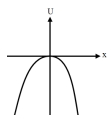
B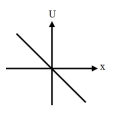
C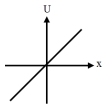
D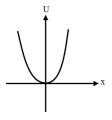
Solution
(D) The relationship between force $F$ and potential energy $U$ is given by $F = -\frac{dU}{dx}$.
Therefore,$dU = -F dx$.
Given $F = -2x$,we substitute this into the equation:
$dU = -(-2x) dx = 2x dx$.
Integrating both sides with the condition that $U = 0$ at $x = 0$:
$\int_0^U dU = \int_0^x 2x dx$.
$U = [x^2]_0^x = x^2$.
The potential energy function is $U = x^2$,which represents a parabola opening upwards with its vertex at the origin. This corresponds to the graph shown in option $D$.
Therefore,$dU = -F dx$.
Given $F = -2x$,we substitute this into the equation:
$dU = -(-2x) dx = 2x dx$.
Integrating both sides with the condition that $U = 0$ at $x = 0$:
$\int_0^U dU = \int_0^x 2x dx$.
$U = [x^2]_0^x = x^2$.
The potential energy function is $U = x^2$,which represents a parabola opening upwards with its vertex at the origin. This corresponds to the graph shown in option $D$.
0 likes
View Solution72
MediumMCQ
$A$ carpet of mass $M$ made of a material is rolled along its length in the form of a cylinder of radius $R$ and kept on a rough floor. If the carpet is unrolled without sliding to a radius $R/2$,the change in potential energy is ($g=$ acceleration due to gravity).
A
$MgR$
B
$\frac{7}{8} MgR$
C
$\frac{5}{7} MgR$
D
$\frac{3}{4} MgR$
Solution
(B) The density $\rho = M/V$ of the carpet remains constant.
Let $M_1 = M$ and $R_1 = R$. The volume $V = \pi R^2 l$,where $l$ is the length of the carpet.
When unrolled to radius $R_2 = R/2$,the mass $M_2$ of the carpet remaining in the rolled form is proportional to the volume of the cylinder.
$M_2 = \frac{M}{\pi R^2 l} \times \pi (R/2)^2 l = \frac{M}{4}$.
The potential energy of the initial rolled carpet (assuming center of mass at height $R$) is $U_1 = MgR$.
The potential energy of the final rolled carpet (with radius $R_2 = R/2$ and mass $M_2 = M/4$) is $U_2 = M_2 g R_2 = (M/4) g (R/2) = \frac{1}{8} MgR$.
The change in potential energy is $\Delta U = U_1 - U_2 = MgR - \frac{1}{8} MgR = \frac{7}{8} MgR$.
Let $M_1 = M$ and $R_1 = R$. The volume $V = \pi R^2 l$,where $l$ is the length of the carpet.
When unrolled to radius $R_2 = R/2$,the mass $M_2$ of the carpet remaining in the rolled form is proportional to the volume of the cylinder.
$M_2 = \frac{M}{\pi R^2 l} \times \pi (R/2)^2 l = \frac{M}{4}$.
The potential energy of the initial rolled carpet (assuming center of mass at height $R$) is $U_1 = MgR$.
The potential energy of the final rolled carpet (with radius $R_2 = R/2$ and mass $M_2 = M/4$) is $U_2 = M_2 g R_2 = (M/4) g (R/2) = \frac{1}{8} MgR$.
The change in potential energy is $\Delta U = U_1 - U_2 = MgR - \frac{1}{8} MgR = \frac{7}{8} MgR$.
0 likes
View Solution73
DifficultMCQ
$A$ smooth chain of length $2 \,m$ is kept on a table such that its length of $60 \,cm$ hangs freely from the edge of the table. The total mass of the chain is $4 \,kg$. The work done in pulling the entire chain on the table is (Take, $g=10 \,m/s^2$) (in $\,J$)
A
$6.3$
B
$3.6$
C
$2.0$
D
$12.9$
Solution
(B) Mass per unit length of the chain, $\lambda = \frac{M}{L} = \frac{4 \,kg}{2 \,m} = 2 \,kg/m$.
Let the length of the chain hanging from the table be $l = 0.6 \,m$.
The mass of the hanging part is $m = \lambda \times l = 2 \times 0.6 = 1.2 \,kg$.
The center of mass of the hanging part is at a distance $x = \frac{l}{2} = \frac{0.6}{2} = 0.3 \,m$ below the edge of the table.
The work done to pull the chain onto the table is equal to the change in potential energy of the hanging part, which is equivalent to lifting its center of mass to the level of the table.
$W = m \times g \times x = 1.2 \,kg \times 10 \,m/s^2 \times 0.3 \,m = 3.6 \,J$.
Let the length of the chain hanging from the table be $l = 0.6 \,m$.
The mass of the hanging part is $m = \lambda \times l = 2 \times 0.6 = 1.2 \,kg$.
The center of mass of the hanging part is at a distance $x = \frac{l}{2} = \frac{0.6}{2} = 0.3 \,m$ below the edge of the table.
The work done to pull the chain onto the table is equal to the change in potential energy of the hanging part, which is equivalent to lifting its center of mass to the level of the table.
$W = m \times g \times x = 1.2 \,kg \times 10 \,m/s^2 \times 0.3 \,m = 3.6 \,J$.
0 likes
View Solution74
MediumMCQ
If the potential energy of a particle of mass $0.1 \ kg$ moving along $x$-axis is $U(x) = 5x(x-4) \ J$,then the speed of the particle is maximum at a position of
A
$x=2 \ m$
B
$x=3 \ m$
C
$x=0.5 \ m$
D
$x=5 \ m$
Solution
(A) The potential energy of the particle is given by $U(x) = 5x(x-4) = 5x^2 - 20x \ J$.
For a particle moving in a conservative field,the force acting on it is given by $F = -\frac{dU}{dx}$.
$F = -\frac{d}{dx}(5x^2 - 20x) = -(10x - 20) = 20 - 10x$.
The speed of the particle is maximum when the net force acting on it is zero (equilibrium position).
Setting $F = 0$,we get $20 - 10x = 0$.
$10x = 20$,which implies $x = 2 \ m$.
At this position,the potential energy is minimum,and by the law of conservation of energy,the kinetic energy is maximum,meaning the speed is maximum.
For a particle moving in a conservative field,the force acting on it is given by $F = -\frac{dU}{dx}$.
$F = -\frac{d}{dx}(5x^2 - 20x) = -(10x - 20) = 20 - 10x$.
The speed of the particle is maximum when the net force acting on it is zero (equilibrium position).
Setting $F = 0$,we get $20 - 10x = 0$.
$10x = 20$,which implies $x = 2 \ m$.
At this position,the potential energy is minimum,and by the law of conservation of energy,the kinetic energy is maximum,meaning the speed is maximum.
0 likes
View Solution75
EasyMCQ
If a body has a potential energy of $(4x^2 + 2x) \,J$ at a position $x = 2 \,m$, then the force acting on the body is: (in $\,N$)
A
$9$
B
$27$
C
$18$
D
$0$
Solution
(C) The potential energy of the body is given by $U = (4x^2 + 2x) \,J$.
We know that the force $F$ acting on a body is related to the potential energy $U$ by the relation $F = -\frac{dU}{dx}$.
Calculating the derivative of $U$ with respect to $x$:
$F = -\frac{d}{dx}(4x^2 + 2x) = -(8x + 2) \,N$.
At the position $x = 2 \,m$, the magnitude of the force is:
$|F| = |-(8(2) + 2)| = |-(16 + 2)| = |-18| = 18 \,N$.
Therefore, the force acting on the body is $18 \,N$.
We know that the force $F$ acting on a body is related to the potential energy $U$ by the relation $F = -\frac{dU}{dx}$.
Calculating the derivative of $U$ with respect to $x$:
$F = -\frac{d}{dx}(4x^2 + 2x) = -(8x + 2) \,N$.
At the position $x = 2 \,m$, the magnitude of the force is:
$|F| = |-(8(2) + 2)| = |-(16 + 2)| = |-18| = 18 \,N$.
Therefore, the force acting on the body is $18 \,N$.
0 likes
View Solution76
EasyMCQ
The work done in moving a body of mass $2 \,kg$ to a height of $4 \,m$ from the surface of the earth is (Acceleration due to gravity $= 10 \,ms^{-2}$) (in $\,J$)
A
$10$
B
$20$
C
$40$
D
$80$
Solution
(D) The work done in lifting a body against gravity is stored as its gravitational potential energy.
Given:
Mass of the body, $m = 2 \,kg$
Height, $h = 4 \,m$
Acceleration due to gravity, $g = 10 \,ms^{-2}$
Formula for work done, $W = mgh$
Substituting the values:
$W = 2 \,kg \times 10 \,ms^{-2} \times 4 \,m$
$W = 80 \,J$
Therefore, the work done is $80 \,J$.
Given:
Mass of the body, $m = 2 \,kg$
Height, $h = 4 \,m$
Acceleration due to gravity, $g = 10 \,ms^{-2}$
Formula for work done, $W = mgh$
Substituting the values:
$W = 2 \,kg \times 10 \,ms^{-2} \times 4 \,m$
$W = 80 \,J$
Therefore, the work done is $80 \,J$.
0 likes
View Solution77
MediumMCQ
$A$ uniform chain has a mass $m$ and length $l$. It is held on a frictionless table with one-sixth of its length hanging over the edge. The work done in just pulling the hanging part back on the table is:
A
$\frac{m g l}{72}$
B
$\frac{m g l}{36}$
C
$\frac{m g l}{12}$
D
$\frac{m g l}{6}$
Solution
(A) The work done in pulling the hanging part of the chain onto the table is equal to the increase in the gravitational potential energy of that part.
Let the mass of the hanging part be $m' = \frac{m}{6}$ and its length be $l' = \frac{l}{6}$.
The center of mass of the hanging part is at a distance $h = \frac{l'}{2} = \frac{l/6}{2} = \frac{l}{12}$ below the edge of the table.
The work done $W$ is equal to the potential energy required to raise this center of mass to the level of the table:
$W = m' g h$
$W = \left(\frac{m}{6}\right) g \left(\frac{l}{12}\right)$
$W = \frac{m g l}{72}$
Let the mass of the hanging part be $m' = \frac{m}{6}$ and its length be $l' = \frac{l}{6}$.
The center of mass of the hanging part is at a distance $h = \frac{l'}{2} = \frac{l/6}{2} = \frac{l}{12}$ below the edge of the table.
The work done $W$ is equal to the potential energy required to raise this center of mass to the level of the table:
$W = m' g h$
$W = \left(\frac{m}{6}\right) g \left(\frac{l}{12}\right)$
$W = \frac{m g l}{72}$
0 likes
View Solution78
MediumMCQ
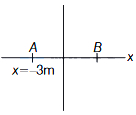
$A$ particle moving along the $X$-axis has potential energy $U = 2 - 20x + 5x^2 \text{ J}$. The particle is released at $x = -3 \text{ m}$. What is the maximum value of $x$ reached by the particle (in $\text{ m}$)? ($x$ is in meters and $U$ is in joules)
A
$5$
B
$3$
C
$7$
D
$8$
Solution
(C) The potential energy of the particle is given by $U(x) = 2 - 20x + 5x^2 \text{ J}$.
At the starting position $x_i = -3 \text{ m}$,the initial potential energy is:
$U_i = 2 - 20(-3) + 5(-3)^2 = 2 + 60 + 45 = 107 \text{ J}$.
Since the particle is released from rest,its total mechanical energy $E$ is equal to its initial potential energy:
$E = U_i = 107 \text{ J}$.
The particle will reach its maximum $x$ position when its kinetic energy becomes zero,meaning its potential energy at that point $x_f$ must equal the total mechanical energy $E$:
$U(x_f) = E$
$2 - 20x_f + 5x_f^2 = 107$
$5x_f^2 - 20x_f - 105 = 0$
Dividing by $5$:
$x_f^2 - 4x_f - 21 = 0$
Factoring the quadratic equation:
$(x_f - 7)(x_f + 3) = 0$
This gives two solutions: $x_f = 7 \text{ m}$ or $x_f = -3 \text{ m}$.
Since the particle starts at $x = -3 \text{ m}$ and moves to reach a maximum $x$,the maximum value is $x = 7 \text{ m}$.
At the starting position $x_i = -3 \text{ m}$,the initial potential energy is:
$U_i = 2 - 20(-3) + 5(-3)^2 = 2 + 60 + 45 = 107 \text{ J}$.
Since the particle is released from rest,its total mechanical energy $E$ is equal to its initial potential energy:
$E = U_i = 107 \text{ J}$.
The particle will reach its maximum $x$ position when its kinetic energy becomes zero,meaning its potential energy at that point $x_f$ must equal the total mechanical energy $E$:
$U(x_f) = E$
$2 - 20x_f + 5x_f^2 = 107$
$5x_f^2 - 20x_f - 105 = 0$
Dividing by $5$:
$x_f^2 - 4x_f - 21 = 0$
Factoring the quadratic equation:
$(x_f - 7)(x_f + 3) = 0$
This gives two solutions: $x_f = 7 \text{ m}$ or $x_f = -3 \text{ m}$.
Since the particle starts at $x = -3 \text{ m}$ and moves to reach a maximum $x$,the maximum value is $x = 7 \text{ m}$.
0 likes
View Solution79
DifficultMCQ
$A$ uniform chain of mass $M$ and length $L$ is lying on a smooth horizontal table,with half of its length hanging down. The work done in pulling the entire chain up onto the table is
A
$\frac{M g L}{2}$
B
$\frac{M g L}{4}$
C
$\frac{M g L}{8}$
D
$\frac{M g L}{16}$
Solution
(C) The work done in pulling the chain onto the table is equal to the change in the gravitational potential energy of the chain.
Let the table surface be the reference level $(U = 0)$.
The initial potential energy $(U_i)$ is due to the hanging part of the chain,which has mass $M/2$ and its center of mass is at a distance $L/4$ below the table.
$U_i = -(\frac{M}{2}) g (\frac{L}{4}) = -\frac{M g L}{8}$.
After pulling the entire chain onto the table,the final potential energy $(U_f)$ is $0$ because the entire chain is on the table surface.
Work done $W = U_f - U_i = 0 - (-\frac{M g L}{8}) = \frac{M g L}{8}$.
Let the table surface be the reference level $(U = 0)$.
The initial potential energy $(U_i)$ is due to the hanging part of the chain,which has mass $M/2$ and its center of mass is at a distance $L/4$ below the table.
$U_i = -(\frac{M}{2}) g (\frac{L}{4}) = -\frac{M g L}{8}$.
After pulling the entire chain onto the table,the final potential energy $(U_f)$ is $0$ because the entire chain is on the table surface.
Work done $W = U_f - U_i = 0 - (-\frac{M g L}{8}) = \frac{M g L}{8}$.
0 likes
View Solution80
DifficultMCQ
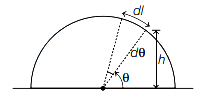
$A$ uniform chain of length $l$ and mass $m$ lies on the surface of a smooth hemisphere of radius $R$ $(R > l)$ with one end tied to the top of the hemisphere as shown in the figure. Gravitational potential energy of the chain with respect to the base of the hemisphere is
A
$\frac{m g l}{2}$
B
$\frac{m g R^2}{l} \sin \left(\frac{l}{R}\right)$
C
$\frac{m g R^2}{l} \sin \left(\frac{R}{l}\right)$
D
$\frac{m g l^2}{R} \sin \left(\frac{l}{R}\right)$
Solution
(B) Let the angle subtended by the chain at the center of the hemisphere be $\alpha = l/R$.
Consider an element of the chain of length $dl$ at an angle $\theta$ from the base.
The height of this element from the base is $h = R \sin \theta$.
The length of the element is $dl = R d\theta$.
The mass of this element is $dm = \frac{m}{l} dl = \frac{m}{l} R d\theta$.
The gravitational potential energy of this element is $dU = (dm)gh = \left(\frac{m}{l} R d\theta\right) g (R \sin \theta) = \frac{mgR^2}{l} \sin \theta d\theta$.
The chain extends from the top $(\theta = \pi/2)$ to an angle $\theta = \pi/2 - \alpha = \pi/2 - l/R$.
Integrating $dU$ from $\pi/2 - l/R$ to $\pi/2$:
$U = \int_{\pi/2 - l/R}^{\pi/2} \frac{mgR^2}{l} \sin \theta d\theta = \frac{mgR^2}{l} [-\cos \theta]_{\pi/2 - l/R}^{\pi/2}$
$U = \frac{mgR^2}{l} [-\cos(\pi/2) - (-\cos(\pi/2 - l/R))]$
$U = \frac{mgR^2}{l} [0 + \sin(l/R)] = \frac{mgR^2}{l} \sin \left(\frac{l}{R}\right)$.
Consider an element of the chain of length $dl$ at an angle $\theta$ from the base.
The height of this element from the base is $h = R \sin \theta$.
The length of the element is $dl = R d\theta$.
The mass of this element is $dm = \frac{m}{l} dl = \frac{m}{l} R d\theta$.
The gravitational potential energy of this element is $dU = (dm)gh = \left(\frac{m}{l} R d\theta\right) g (R \sin \theta) = \frac{mgR^2}{l} \sin \theta d\theta$.
The chain extends from the top $(\theta = \pi/2)$ to an angle $\theta = \pi/2 - \alpha = \pi/2 - l/R$.
Integrating $dU$ from $\pi/2 - l/R$ to $\pi/2$:
$U = \int_{\pi/2 - l/R}^{\pi/2} \frac{mgR^2}{l} \sin \theta d\theta = \frac{mgR^2}{l} [-\cos \theta]_{\pi/2 - l/R}^{\pi/2}$
$U = \frac{mgR^2}{l} [-\cos(\pi/2) - (-\cos(\pi/2 - l/R))]$
$U = \frac{mgR^2}{l} [0 + \sin(l/R)] = \frac{mgR^2}{l} \sin \left(\frac{l}{R}\right)$.
0 likes
View Solution81
EasyMCQ
While a person climbs stairs,the gravitational potential energy of the person increases. The source of this energy is
A
Work done by normal force from the steps
B
Work done by frictional force from the steps
C
Work done by air resistance
D
Work done by internal forces within the person's body
Solution
(D) When a person climbs stairs,work is done against the gravitational force which acts in the downward direction.
This work against gravity is performed by the chemical energy converted into mechanical work by the internal forces within the person's body (muscular contraction).
Therefore,the source of the increase in gravitational potential energy is the work done by internal forces within the person's body.
Hence,option $D$ is the correct answer.
This work against gravity is performed by the chemical energy converted into mechanical work by the internal forces within the person's body (muscular contraction).
Therefore,the source of the increase in gravitational potential energy is the work done by internal forces within the person's body.
Hence,option $D$ is the correct answer.
0 likes
View Solution82
DifficultMCQ
The potential energy of a particle in a central field has the form $U(r) = \frac{1}{r^2} - \frac{1}{r}$,where '$r$' is the distance from the centre of the field. The magnitude of the maximum attractive force in Newton is
A
$\frac{1}{27}$
B
$\frac{1}{9}$
C
$\frac{1}{3}$
D
$1$
Solution
(A) The relation between central force $F$ and potential energy $U(r)$ is given by $F = -\frac{dU}{dr}$.
Given $U(r) = r^{-2} - r^{-1}$.
Calculating the force: $F = -\frac{d}{dr}(r^{-2} - r^{-1}) = -(-2r^{-3} + r^{-2}) = \frac{2}{r^3} - \frac{1}{r^2}$.
For the maximum attractive force,we find the extremum of $F$ by setting $\frac{dF}{dr} = 0$.
$\frac{dF}{dr} = \frac{d}{dr}(2r^{-3} - r^{-2}) = -6r^{-4} + 2r^{-3} = 0$.
$2r^{-3} = 6r^{-4} \Rightarrow \frac{2}{r^3} = \frac{6}{r^4} \Rightarrow r = 3$.
Substituting $r = 3$ into the force equation:
$F = \frac{2}{(3)^3} - \frac{1}{(3)^2} = \frac{2}{27} - \frac{1}{9} = \frac{2-3}{27} = -\frac{1}{27}$.
The magnitude of the force is $|F| = \frac{1}{27}$.
Given $U(r) = r^{-2} - r^{-1}$.
Calculating the force: $F = -\frac{d}{dr}(r^{-2} - r^{-1}) = -(-2r^{-3} + r^{-2}) = \frac{2}{r^3} - \frac{1}{r^2}$.
For the maximum attractive force,we find the extremum of $F$ by setting $\frac{dF}{dr} = 0$.
$\frac{dF}{dr} = \frac{d}{dr}(2r^{-3} - r^{-2}) = -6r^{-4} + 2r^{-3} = 0$.
$2r^{-3} = 6r^{-4} \Rightarrow \frac{2}{r^3} = \frac{6}{r^4} \Rightarrow r = 3$.
Substituting $r = 3$ into the force equation:
$F = \frac{2}{(3)^3} - \frac{1}{(3)^2} = \frac{2}{27} - \frac{1}{9} = \frac{2-3}{27} = -\frac{1}{27}$.
The magnitude of the force is $|F| = \frac{1}{27}$.
0 likes
View Solution83
EasyMCQ
$A$ metal chain of mass $2 \,kg$ and length $90 \,cm$ hangs over a table with $60 \,cm$ on the table. How much work needs to be done to pull the hanging part of the chain back onto the table (in $\,J$)? (Let $g=10 \,m/s^2$)
A
$2$
B
$10$
C
$1$
D
$3$
Solution
(C) Given: Mass of the metal chain $m = 2 \,kg$, total length $l = 90 \,cm = 0.9 \,m$.
Length of the hanging part $l' = (90 - 60) \,cm = 30 \,cm = 0.3 \,m$.
The mass of the hanging part $m'$ is proportional to its length: $m' = (l'/l) \times m = (0.3 / 0.9) \times 2 = 2/3 \,kg$.
The center of gravity of the hanging part is at a distance $l_c = l'/2 = 0.3 / 2 = 0.15 \,m$ below the table surface.
The work done to pull the hanging part onto the table is equal to the change in potential energy: $W = m' g l_c$.
Substituting the values: $W = (2/3) \times 10 \times 0.15 = 1 \,J$.
Length of the hanging part $l' = (90 - 60) \,cm = 30 \,cm = 0.3 \,m$.
The mass of the hanging part $m'$ is proportional to its length: $m' = (l'/l) \times m = (0.3 / 0.9) \times 2 = 2/3 \,kg$.
The center of gravity of the hanging part is at a distance $l_c = l'/2 = 0.3 / 2 = 0.15 \,m$ below the table surface.
The work done to pull the hanging part onto the table is equal to the change in potential energy: $W = m' g l_c$.
Substituting the values: $W = (2/3) \times 10 \times 0.15 = 1 \,J$.
0 likes
View Solution84
EasyMCQ
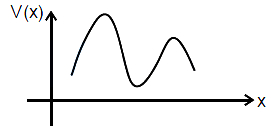
The following figure shows the variation of potential energy $V(x)$ of a particle with distance $x$. The particle has
A
Two equilibrium points,one stable another unstable
B
Two equilibrium points,both stable
C
Three equilibrium points,one stable two unstable
D
Three equilibrium points,two stable one unstable
Solution
(C) Equilibrium points occur where the force $F = -\frac{dV}{dx} = 0$,which corresponds to the points where the slope of the $V(x)$ versus $x$ graph is zero (i.e.,the peaks and valleys of the curve).
Looking at the graph,there are three such points: two local maxima (peaks) and one local minimum (valley).
$1$. At a local minimum,the potential energy is at a minimum,so $\frac{d^2V}{dx^2} > 0$. This represents a stable equilibrium point.
$2$. At a local maximum,the potential energy is at a maximum,so $\frac{d^2V}{dx^2} < 0$. This represents an unstable equilibrium point.
Since there are two peaks (unstable) and one valley (stable),there are three equilibrium points in total: one stable and two unstable.
Looking at the graph,there are three such points: two local maxima (peaks) and one local minimum (valley).
$1$. At a local minimum,the potential energy is at a minimum,so $\frac{d^2V}{dx^2} > 0$. This represents a stable equilibrium point.
$2$. At a local maximum,the potential energy is at a maximum,so $\frac{d^2V}{dx^2} < 0$. This represents an unstable equilibrium point.
Since there are two peaks (unstable) and one valley (stable),there are three equilibrium points in total: one stable and two unstable.
0 likes
View SolutionWork, Energy, Power and Collision — Potential Energy · Frequently Asked Questions
1Are these Work, Energy, Power and Collision questions useful for JEE and NEET?
Yes. All questions in this section are mapped to JEE Main and NEET exam patterns. Previous year questions from JEE Main, NEET, GUJCET and state-level exams are included with full solutions.
2Can I switch to Hindi or Gujarati for these questions?
Yes. Use the language tabs in the hero section or the sidebar to view the same questions and solutions in English, Hindi or Gujarati.
3How do I generate a question paper from this subtopic?
Use the Vedclass Exam Paper Generator — select the chapter and subtopic, set difficulty, and generate Sets A, B, C, D automatically. First 3 chapters of every subject are free.
Vedclass Products
For Students
Vedclass Test Series
Mock tests in real JEE/NEET style with performance analysis. 5-day free trial.
Start Free TrialFor Teachers
Exam Paper Generator
Generate Set A/B/C/D papers from this chapter in 2 minutes. 3 chapters free.
Try FreeFor Institutes
Online Exam Module
Live online exams with unlimited students, 360° analytics & white-label branding.
See DemoFor Teachers & Institutes
Generate a Work, Energy, Power and Collision Exam Paper in 2 Minutes
Select subtopic & difficulty — Sets A, B, C, D auto-generated with No Repeat logic.
First 3 chapters of every subject are free — no payment required.