
A English
Potential Energy Questions in English
Class 11 Physics · Work, Energy, Power and Collision · Potential Energy
84+
Questions
English
Language
100%
With Solutions
Showing 50 of 84 questions in English
1
DifficultMCQ
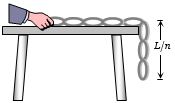
$A$ uniform chain of length $2\,m$ is kept on a table such that a length of $60\,cm$ hangs freely from the edge of the table. The total mass of the chain is $4\,kg$. What is the work done in pulling the entire chain onto the table? (Take $g = 10\,m/s^2$) ................ $J$
A
$7.2$
B
$3.6$
C
$120$
D
$1200$
Solution
(B) Let the total length of the chain be $L = 2\,m$ and total mass be $M = 4\,kg$.
The length of the hanging part is $l = 60\,cm = 0.6\,m$.
The mass per unit length of the chain is $\lambda = \frac{M}{L} = \frac{4}{2} = 2\,kg/m$.
The mass of the hanging part is $m = \lambda \times l = 2 \times 0.6 = 1.2\,kg$.
The center of mass of the hanging part is at a distance $h = \frac{l}{2} = \frac{0.6}{2} = 0.3\,m$ below the edge of the table.
The work done in pulling the chain onto the table is equal to the increase in the potential energy of the hanging part,which is $W = mgh$.
Substituting the values: $W = 1.2 \times 10 \times 0.3 = 3.6\,J$.
The length of the hanging part is $l = 60\,cm = 0.6\,m$.
The mass per unit length of the chain is $\lambda = \frac{M}{L} = \frac{4}{2} = 2\,kg/m$.
The mass of the hanging part is $m = \lambda \times l = 2 \times 0.6 = 1.2\,kg$.
The center of mass of the hanging part is at a distance $h = \frac{l}{2} = \frac{0.6}{2} = 0.3\,m$ below the edge of the table.
The work done in pulling the chain onto the table is equal to the increase in the potential energy of the hanging part,which is $W = mgh$.
Substituting the values: $W = 1.2 \times 10 \times 0.3 = 3.6\,J$.
0 likes
View Solution2
EasyMCQ
The potential energy of a body is given by $U = A - Bx^2$ (where $x$ is the displacement). The magnitude of the force acting on the particle is:
A
Constant
B
Proportional to $x$
C
Proportional to $x^2$
D
Inversely proportional to $x$
Solution
(B) The relationship between force $F$ and potential energy $U$ is given by $F = -\frac{dU}{dx}$.
Given the potential energy function $U = A - Bx^2$.
Differentiating $U$ with respect to $x$:
$\frac{dU}{dx} = \frac{d}{dx}(A - Bx^2) = 0 - 2Bx = -2Bx$.
Substituting this into the force equation:
$F = -(-2Bx) = 2Bx$.
The magnitude of the force is $|F| = 2Bx$.
Since $2B$ is a constant,the magnitude of the force is directly proportional to the displacement $x$ $(F \propto x)$.
Given the potential energy function $U = A - Bx^2$.
Differentiating $U$ with respect to $x$:
$\frac{dU}{dx} = \frac{d}{dx}(A - Bx^2) = 0 - 2Bx = -2Bx$.
Substituting this into the force equation:
$F = -(-2Bx) = 2Bx$.
The magnitude of the force is $|F| = 2Bx$.
Since $2B$ is a constant,the magnitude of the force is directly proportional to the displacement $x$ $(F \propto x)$.
0 likes
View Solution3
DifficultMCQ
The potential energy between two atoms in a molecule is given by $U(x) = \frac{a}{x^{12}} - \frac{b}{x^6}$,where $a$ and $b$ are positive constants and $x$ is the distance between the atoms. The atom is in stable equilibrium when:
A
$x = \sqrt[6]{\frac{11a}{5b}}$
B
$x = \sqrt[6]{\frac{a}{2b}}$
C
$x = 0$
D
$x = \sqrt[6]{\frac{2a}{b}}$
Solution
(D) The condition for stable equilibrium is that the net force $F$ acting on the system must be zero,where $F = -\frac{dU}{dx} = 0$.
Given $U(x) = ax^{-12} - bx^{-6}$.
Differentiating with respect to $x$:
$\frac{dU}{dx} = -12ax^{-13} - (-6bx^{-7}) = -12ax^{-13} + 6bx^{-7}$.
Setting the force to zero:
$F = -(-12ax^{-13} + 6bx^{-7}) = 0$
$12ax^{-13} - 6bx^{-7} = 0$
$\frac{12a}{x^{13}} = \frac{6b}{x^7}$
$\frac{12a}{6b} = \frac{x^{13}}{x^7}$
$\frac{2a}{b} = x^6$
$x = \sqrt[6]{\frac{2a}{b}}$.
Given $U(x) = ax^{-12} - bx^{-6}$.
Differentiating with respect to $x$:
$\frac{dU}{dx} = -12ax^{-13} - (-6bx^{-7}) = -12ax^{-13} + 6bx^{-7}$.
Setting the force to zero:
$F = -(-12ax^{-13} + 6bx^{-7}) = 0$
$12ax^{-13} - 6bx^{-7} = 0$
$\frac{12a}{x^{13}} = \frac{6b}{x^7}$
$\frac{12a}{6b} = \frac{x^{13}}{x^7}$
$\frac{2a}{b} = x^6$
$x = \sqrt[6]{\frac{2a}{b}}$.
1 likes
View Solution4
EasyMCQ
$A$ body at rest may have
A
Energy
B
Momentum
C
Speed
D
Velocity
Solution
(A) body at rest has a velocity of $0 \ m/s$,which implies its speed is also $0 \ m/s$.
Since momentum $p = mv$,if $v = 0$,then momentum $p = 0$.
However,a body at rest can possess potential energy due to its position or configuration in a field (e.g.,gravitational potential energy $U = mgh$).
Therefore,a body at rest may have energy.
Since momentum $p = mv$,if $v = 0$,then momentum $p = 0$.
However,a body at rest can possess potential energy due to its position or configuration in a field (e.g.,gravitational potential energy $U = mgh$).
Therefore,a body at rest may have energy.
0 likes
View Solution5
EasyMCQ
If a stone is thrown vertically upward and returns to the ground,its potential energy is maximum:
A
During the upward journey
B
At the maximum height
C
During the return journey
D
At the bottom
Solution
(B) The potential energy $(PE)$ of an object is given by the formula $PE = mgh$,where $m$ is the mass of the object,$g$ is the acceleration due to gravity,and $h$ is the height above the reference level (ground).
Since $m$ and $g$ are constants,the potential energy is directly proportional to the height $h$.
Therefore,the potential energy is maximum when the height $h$ is at its maximum value.
This occurs at the maximum height reached by the stone during its flight.
Since $m$ and $g$ are constants,the potential energy is directly proportional to the height $h$.
Therefore,the potential energy is maximum when the height $h$ is at its maximum value.
This occurs at the maximum height reached by the stone during its flight.
0 likes
View Solution6
EasyMCQ
The energy stored in a wound watch spring is:
A
Kinetic Energy $(K.E.)$
B
Potential Energy $(P.E.)$
C
Heat energy
D
Chemical energy
Solution
(B) When a watch spring is wound,work is done against the elastic restoring force of the spring. This work is stored in the spring in the form of elastic potential energy. Therefore,the energy stored in a wound watch spring is potential energy $(P.E.)$. The correct option is $(B)$.
0 likes
View Solution7
EasyMCQ
If a body of mass $200\, g$ falls from a height $200\, m$ and its total $P.E.$ is converted into $K.E.$ at the point of contact of the body with the earth's surface,then what is the decrease in $P.E.$ of the body at the contact? $(g = 10\, m/s^2)$ ............ $J$
A
$200$
B
$400$
C
$600$
D
$900$
Solution
(B) The mass of the body is $m = 200\, g = 0.2\, kg$.
The height from which the body falls is $h = 200\, m$.
The acceleration due to gravity is $g = 10\, m/s^2$.
The potential energy $(P.E.)$ at the initial height is given by $U = mgh$.
At the point of contact with the earth's surface,the final height is $0$,so the final potential energy is $0$.
The decrease in $P.E.$ is $\Delta U = U_{initial} - U_{final} = mgh - 0 = mgh$.
Substituting the values: $\Delta U = 0.2\, kg \times 10\, m/s^2 \times 200\, m = 400\, J$.
Therefore,the decrease in $P.E.$ is $400\, J$.
The height from which the body falls is $h = 200\, m$.
The acceleration due to gravity is $g = 10\, m/s^2$.
The potential energy $(P.E.)$ at the initial height is given by $U = mgh$.
At the point of contact with the earth's surface,the final height is $0$,so the final potential energy is $0$.
The decrease in $P.E.$ is $\Delta U = U_{initial} - U_{final} = mgh - 0 = mgh$.
Substituting the values: $\Delta U = 0.2\, kg \times 10\, m/s^2 \times 200\, m = 400\, J$.
Therefore,the decrease in $P.E.$ is $400\, J$.
0 likes
View Solution8
EasyMCQ
The decrease in the potential energy of a ball of mass $20 \,kg$ which falls from a height of $50 \,cm$ is ............ $J$.
A
$968$
B
$98$
C
$1980$
D
None of these
Solution
(B) The potential energy $(U)$ of an object is given by the formula $U = mgh$,where $m$ is the mass,$g$ is the acceleration due to gravity,and $h$ is the height.
Given:
Mass $(m)$ = $20 \,kg$
Height $(h)$ = $50 \,cm = 0.5 \,m$
Acceleration due to gravity $(g)$ = $9.8 \,m/s^2$
Decrease in potential energy $(\Delta U)$ = $mgh$
$\Delta U = 20 \times 9.8 \times 0.5$
$\Delta U = 10 \times 9.8 = 98 \,J$.
Therefore,the correct option is $B$.
Given:
Mass $(m)$ = $20 \,kg$
Height $(h)$ = $50 \,cm = 0.5 \,m$
Acceleration due to gravity $(g)$ = $9.8 \,m/s^2$
Decrease in potential energy $(\Delta U)$ = $mgh$
$\Delta U = 20 \times 9.8 \times 0.5$
$\Delta U = 10 \times 9.8 = 98 \,J$.
Therefore,the correct option is $B$.
0 likes
View Solution9
DifficultMCQ
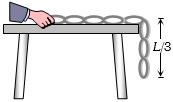
$A$ uniform chain of length $L$ and mass $M$ is lying on a smooth table and one-third of its length is hanging vertically down over the edge of the table. If $g$ is the acceleration due to gravity, the work required to pull the hanging part onto the table is
A
$MgL$
B
$MgL/3$
C
$MgL/9$
D
$MgL/18$
Solution
(D) The mass of the hanging part of the chain is $m = M/3$.
The length of the hanging part is $l = L/3$.
The center of mass of the hanging part is at a distance $h = l/2 = L/6$ below the edge of the table.
The potential energy of the hanging part relative to the table surface is $U = -mgh = -(M/3)g(L/6) = -MgL/18$.
To pull the hanging part onto the table, the work done by an external force must be equal to the change in potential energy, which is $W = \Delta U = U_{final} - U_{initial} = 0 - (-MgL/18) = MgL/18$.
The length of the hanging part is $l = L/3$.
The center of mass of the hanging part is at a distance $h = l/2 = L/6$ below the edge of the table.
The potential energy of the hanging part relative to the table surface is $U = -mgh = -(M/3)g(L/6) = -MgL/18$.
To pull the hanging part onto the table, the work done by an external force must be equal to the change in potential energy, which is $W = \Delta U = U_{final} - U_{initial} = 0 - (-MgL/18) = MgL/18$.
0 likes
View Solution10
DifficultMCQ
$A$ particle which is constrained to move along the $x-$axis is subjected to a force in the same direction which varies with the distance $x$ of the particle from the origin as $F(x) = -kx + ax^3$. Here $k$ and $a$ are positive constants. For $x \ge 0$,the functional form of the potential energy $U(x)$ of the particle is
A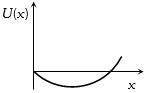
B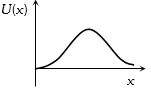
C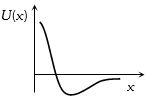
D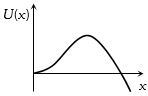
Solution
(D) The relationship between force $F(x)$ and potential energy $U(x)$ is given by $F(x) = -\frac{dU}{dx}$.
Integrating this,we get $U(x) = -\int F(x) dx$.
Substituting $F(x) = -kx + ax^3$,we have $U(x) = -\int (-kx + ax^3) dx = \frac{kx^2}{2} - \frac{ax^4}{4} + C$.
Assuming $U(0) = 0$,we get $C = 0$,so $U(x) = \frac{kx^2}{2} - \frac{ax^4}{4} = \frac{x^2}{4}(2k - ax^2)$.
For $x \ge 0$,$U(x) = 0$ at $x = 0$ and $x = \sqrt{\frac{2k}{a}}$.
Between $x = 0$ and $x = \sqrt{\frac{2k}{a}}$,$U(x)$ is positive. For $x > \sqrt{\frac{2k}{a}}$,$U(x)$ becomes negative.
The graph starts at the origin,rises to a maximum,and then decreases,crossing the $x-$axis at $x = \sqrt{\frac{2k}{a}}$. This matches Graph $D$.
Integrating this,we get $U(x) = -\int F(x) dx$.
Substituting $F(x) = -kx + ax^3$,we have $U(x) = -\int (-kx + ax^3) dx = \frac{kx^2}{2} - \frac{ax^4}{4} + C$.
Assuming $U(0) = 0$,we get $C = 0$,so $U(x) = \frac{kx^2}{2} - \frac{ax^4}{4} = \frac{x^2}{4}(2k - ax^2)$.
For $x \ge 0$,$U(x) = 0$ at $x = 0$ and $x = \sqrt{\frac{2k}{a}}$.
Between $x = 0$ and $x = \sqrt{\frac{2k}{a}}$,$U(x)$ is positive. For $x > \sqrt{\frac{2k}{a}}$,$U(x)$ becomes negative.
The graph starts at the origin,rises to a maximum,and then decreases,crossing the $x-$axis at $x = \sqrt{\frac{2k}{a}}$. This matches Graph $D$.
0 likes
View Solution11
DifficultMCQ
The diagrams represent the potential energy $U$ as a function of the inter-atomic distance $r$. Which diagram corresponds to stable molecules found in nature?
A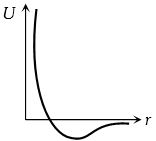
B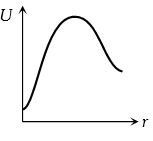
C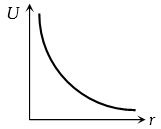
D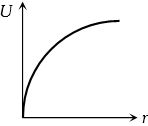
Solution
(A) For a stable molecule,the system must exist in a state of minimum potential energy at an equilibrium distance $r_0$.
When the distance between atoms is large,the interatomic force is very weak (attractive).
As they come closer,the force of attraction increases until it reaches a point where the potential energy is minimum.
At this equilibrium distance $r_0$,the net force is zero $(F = -dU/dr = 0)$.
If they are brought even closer,the force becomes strongly repulsive due to the overlapping of electron clouds.
This behavior is characteristic of the potential energy curve shown in graph $A$,which exhibits a clear potential well.
When the distance between atoms is large,the interatomic force is very weak (attractive).
As they come closer,the force of attraction increases until it reaches a point where the potential energy is minimum.
At this equilibrium distance $r_0$,the net force is zero $(F = -dU/dr = 0)$.
If they are brought even closer,the force becomes strongly repulsive due to the overlapping of electron clouds.
This behavior is characteristic of the potential energy curve shown in graph $A$,which exhibits a clear potential well.
0 likes
View Solution12
EasyMCQ
$A$ particle is placed at the origin and a force $F = kx$ is acting on it (where $k$ is a positive constant). If $U(0) = 0$,the graph of $U(x)$ versus $x$ will be (where $U$ is the potential energy function):
A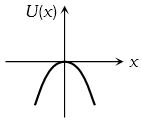
B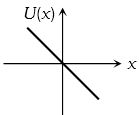
C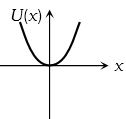
D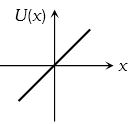
Solution
(A) The relationship between force $F$ and potential energy $U$ is given by $F = -\frac{dU}{dx}$.
Given $F = kx$,we have $-\frac{dU}{dx} = kx$.
Integrating both sides with respect to $x$:
$\int dU = -\int kx \, dx$
$U(x) = -\frac{1}{2}kx^2 + C$
Given $U(0) = 0$,we find $C = 0$.
Thus,$U(x) = -\frac{1}{2}kx^2$.
This is the equation of a downward-opening parabola symmetric about the $U$-axis,as shown in option $A$.
Given $F = kx$,we have $-\frac{dU}{dx} = kx$.
Integrating both sides with respect to $x$:
$\int dU = -\int kx \, dx$
$U(x) = -\frac{1}{2}kx^2 + C$
Given $U(0) = 0$,we find $C = 0$.
Thus,$U(x) = -\frac{1}{2}kx^2$.
This is the equation of a downward-opening parabola symmetric about the $U$-axis,as shown in option $A$.
0 likes
View Solution13
EasyMCQ
$A$ stretched rubber band has:
A
Increased kinetic energy
B
Increased potential energy
C
Decreased kinetic energy
D
Decreased potential energy
Solution
(B) When a rubber band is stretched,work is done against the internal elastic forces of the material.
This work done is stored within the rubber band in the form of elastic potential energy.
Therefore,a stretched rubber band possesses increased potential energy compared to its unstretched state.
This work done is stored within the rubber band in the form of elastic potential energy.
Therefore,a stretched rubber band possesses increased potential energy compared to its unstretched state.
0 likes
View Solution14
EasyMCQ
$A$ body of weight $1 \, N$ has a potential energy of $1 \, J$ relative to the ground. At what height (in $m$) is it located?
A
$1 \, m$
B
$9.8 \, m$
C
$1/9.8 \, m$
D
$0 \, m$
Solution
(A) The potential energy $(PE)$ of an object at a height $h$ is given by the formula: $PE = mgh$.
Here,the weight of the body is $W = mg = 1 \, N$.
The potential energy is given as $PE = 1 \, J$.
Substituting these values into the formula:
$1 \, J = (1 \, N) \times h$.
Therefore,$h = 1 \, m$.
Thus,the body is at a height of $1 \, m$.
Here,the weight of the body is $W = mg = 1 \, N$.
The potential energy is given as $PE = 1 \, J$.
Substituting these values into the formula:
$1 \, J = (1 \, N) \times h$.
Therefore,$h = 1 \, m$.
Thus,the body is at a height of $1 \, m$.
0 likes
View Solution15
DifficultMCQ
$A$ particle is constrained to move along the $x$-axis. $A$ force is applied to it in the same direction,which varies with the distance $x$ from the origin as $F(x) = -kx + ax^3$,where $k$ and $a$ are positive constants. What will be the graph of the potential energy $U(x)$ of the particle for $x \ge 0$?
A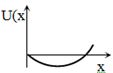
B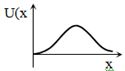
C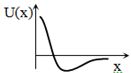
D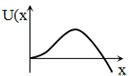
Solution
(D) The relationship between force $F$ and potential energy $U$ is given by $F = -\frac{dU}{dx}$.
Integrating this,we get $dU = -F dx$.
$U(x) = -\int_0^x (-kx + ax^3) dx = \int_0^x (kx - ax^3) dx$.
$U(x) = \left[ \frac{kx^2}{2} - \frac{ax^4}{4} \right]_0^x = \frac{kx^2}{2} - \frac{ax^4}{4}$.
At $x = 0$,$U(0) = 0$.
The slope of the $U-x$ graph is $\frac{dU}{dx} = -F = kx - ax^3$. At $x = 0$,the slope is $0$.
For small $x$,$U(x) \approx \frac{kx^2}{2}$,which is a parabola opening upwards.
Setting $U(x) = 0$,we get $\frac{kx^2}{2} = \frac{ax^4}{4} \Rightarrow x^2 = \frac{2k}{a} \Rightarrow x = \sqrt{\frac{2k}{a}}$.
Beyond this point,$U(x)$ becomes negative. Thus,the graph starts at the origin,increases to a maximum,and then decreases,crossing the $x$-axis at $x = \sqrt{\frac{2k}{a}}$. This matches the shape shown in Graph $D$.
Integrating this,we get $dU = -F dx$.
$U(x) = -\int_0^x (-kx + ax^3) dx = \int_0^x (kx - ax^3) dx$.
$U(x) = \left[ \frac{kx^2}{2} - \frac{ax^4}{4} \right]_0^x = \frac{kx^2}{2} - \frac{ax^4}{4}$.
At $x = 0$,$U(0) = 0$.
The slope of the $U-x$ graph is $\frac{dU}{dx} = -F = kx - ax^3$. At $x = 0$,the slope is $0$.
For small $x$,$U(x) \approx \frac{kx^2}{2}$,which is a parabola opening upwards.
Setting $U(x) = 0$,we get $\frac{kx^2}{2} = \frac{ax^4}{4} \Rightarrow x^2 = \frac{2k}{a} \Rightarrow x = \sqrt{\frac{2k}{a}}$.
Beyond this point,$U(x)$ becomes negative. Thus,the graph starts at the origin,increases to a maximum,and then decreases,crossing the $x$-axis at $x = \sqrt{\frac{2k}{a}}$. This matches the shape shown in Graph $D$.
0 likes
View Solution16
DifficultMCQ
The potential energy between two atoms is given by the function $U(r) = a/r^{12} - b/r^{6}$. Find the equilibrium distance between them.
A
$(2a/b)^{1/6}$
B
$(a/b)^{1/6}$
C
$(2b/a)^{1/6}$
D
$(b/2a)^{1/6}$
Solution
(A) The equilibrium distance $r_0$ occurs when the potential energy $U(r)$ is at a minimum,which implies that the force $F(r) = -dU/dr = 0$.
Given $U(r) = ar^{-12} - br^{-6}$.
Differentiating with respect to $r$:
$dU/dr = a(-12)r^{-13} - b(-6)r^{-7} = -12ar^{-13} + 6br^{-7}$.
Setting $dU/dr = 0$ for equilibrium:
$-12ar_0^{-13} + 6br_0^{-7} = 0$.
$6br_0^{-7} = 12ar_0^{-13}$.
$b/2a = r_0^{-13} / r_0^{-7} = r_0^{-6}$.
$r_0^6 = 2a/b$.
Therefore,$r_0 = (2a/b)^{1/6}$.
Given $U(r) = ar^{-12} - br^{-6}$.
Differentiating with respect to $r$:
$dU/dr = a(-12)r^{-13} - b(-6)r^{-7} = -12ar^{-13} + 6br^{-7}$.
Setting $dU/dr = 0$ for equilibrium:
$-12ar_0^{-13} + 6br_0^{-7} = 0$.
$6br_0^{-7} = 12ar_0^{-13}$.
$b/2a = r_0^{-13} / r_0^{-7} = r_0^{-6}$.
$r_0^6 = 2a/b$.
Therefore,$r_0 = (2a/b)^{1/6}$.
0 likes
View Solution17
DifficultMCQ
$A$ chain of mass $M$ and length $L$ is placed on a table such that $L/4$ of its length hangs over the edge. What is the work done by an external force to pull the hanging part back onto the table?
A
$\frac{MgL}{16}$
B
$\frac{MgL}{32}$
C
$\frac{MgL}{8}$
D
$\frac{MgL}{12}$
Solution
(B) The total mass of the chain is $M$ and the total length is $L$. The mass per unit length is $\lambda = M/L$.
The length of the hanging part is $l = L/4$.
The mass of the hanging part is $m = \lambda \times l = (M/L) \times (L/4) = M/4$.
The center of mass of the hanging part is located at a distance $h = l/2 = (L/4)/2 = L/8$ below the edge of the table.
To pull the hanging part back onto the table,the external force must overcome the gravitational potential energy of the hanging part.
The work done $W$ is equal to the change in potential energy of the hanging part,which is $W = mgh$.
Substituting the values: $W = (M/4) \times g \times (L/8) = \frac{MgL}{32}$.
Therefore,the work done by the external force is $\frac{MgL}{32}$.
The length of the hanging part is $l = L/4$.
The mass of the hanging part is $m = \lambda \times l = (M/L) \times (L/4) = M/4$.
The center of mass of the hanging part is located at a distance $h = l/2 = (L/4)/2 = L/8$ below the edge of the table.
To pull the hanging part back onto the table,the external force must overcome the gravitational potential energy of the hanging part.
The work done $W$ is equal to the change in potential energy of the hanging part,which is $W = mgh$.
Substituting the values: $W = (M/4) \times g \times (L/8) = \frac{MgL}{32}$.
Therefore,the work done by the external force is $\frac{MgL}{32}$.
0 likes
View Solution18
EasyMCQ
What does a body at rest possess?
A
Energy
B
Momentum
C
Speed
D
Velocity
Solution
(A) body at rest has a velocity $v = 0$ and speed $v = 0$.
Since momentum $p = mv$,if $v = 0$,then $p = 0$.
However,a body at rest can possess potential energy due to its position or configuration in a field (e.g.,gravitational potential energy $U = mgh$).
Therefore,a body at rest possesses energy.
Since momentum $p = mv$,if $v = 0$,then $p = 0$.
However,a body at rest can possess potential energy due to its position or configuration in a field (e.g.,gravitational potential energy $U = mgh$).
Therefore,a body at rest possesses energy.
0 likes
View Solution19
MediumMCQ
The potential energy of a particle is given by $U = A - Bx^2$,where $x$ is the displacement. What is the magnitude of the force acting on the particle?
A
Constant
B
Proportional to $x$
C
Proportional to $x^2$
D
Inversely proportional to $x$
Solution
(B) The force $F$ acting on a particle is related to the potential energy $U$ by the relation $F = -\frac{dU}{dx}$.
Given $U = A - Bx^2$.
Differentiating $U$ with respect to $x$:
$\frac{dU}{dx} = \frac{d}{dx}(A - Bx^2) = 0 - 2Bx = -2Bx$.
Substituting this into the force equation:
$F = -(-2Bx) = 2Bx$.
Since $A$ and $B$ are constants,$F = 2Bx$ implies that $F \propto x$.
Therefore,the force is proportional to the displacement $x$.
Given $U = A - Bx^2$.
Differentiating $U$ with respect to $x$:
$\frac{dU}{dx} = \frac{d}{dx}(A - Bx^2) = 0 - 2Bx = -2Bx$.
Substituting this into the force equation:
$F = -(-2Bx) = 2Bx$.
Since $A$ and $B$ are constants,$F = 2Bx$ implies that $F \propto x$.
Therefore,the force is proportional to the displacement $x$.
0 likes
View Solution20
EasyMCQ
When a stone is thrown vertically upwards and returns to the ground,at what point will its potential energy be maximum?
A
While moving upwards
B
At the maximum height
C
While moving downwards
D
On the ground
Solution
(B) The potential energy $(PE)$ of an object is given by the formula $PE = mgh$,where $m$ is the mass,$g$ is the acceleration due to gravity,and $h$ is the height above the reference level (ground).
Since $m$ and $g$ are constants,the potential energy is directly proportional to the height $h$.
Therefore,the potential energy is maximum when the height $h$ is at its maximum value.
This occurs at the highest point of the stone's trajectory.
Since $m$ and $g$ are constants,the potential energy is directly proportional to the height $h$.
Therefore,the potential energy is maximum when the height $h$ is at its maximum value.
This occurs at the highest point of the stone's trajectory.
0 likes
View Solution21
EasyMCQ
Potential energy is a......
A
Relative quantity
B
Absolute quantity
C
Constant quantity
D
Always a positive quantity
Solution
(A) Potential energy is defined as the energy possessed by an object due to its position or configuration in a field.
It is always defined relative to a reference point (where potential energy is taken as zero).
Since the choice of the reference point is arbitrary,the value of potential energy depends on the chosen reference frame.
Therefore,potential energy is a relative quantity.
It is always defined relative to a reference point (where potential energy is taken as zero).
Since the choice of the reference point is arbitrary,the value of potential energy depends on the chosen reference frame.
Therefore,potential energy is a relative quantity.
0 likes
View Solution22
DifficultMCQ
$A$ chain of mass $M$ and length $L$ is placed on a smooth table such that $1/n$ of its length is hanging over the edge of the table. The hanging part of the chain is pulled back onto the surface of the table. Find the work done to pull it up.
A
$MgL/n$
B
$MgL/2n$
C
$MgL/n^2$
D
$MgL/2n^2$
Solution
(D) Let the mass per unit length of the chain be $\lambda = M/L$.
The length of the hanging part is $l = L/n$.
The mass of the hanging part is $m = \lambda l = (M/L) \times (L/n) = M/n$.
The center of mass of the hanging part is at a distance $y = l/2 = L/(2n)$ below the edge of the table.
To pull the chain back onto the table,we must lift the center of mass of the hanging part to the level of the table.
The work done $W$ is equal to the change in potential energy of the hanging part:
$W = mgh = (M/n) \times g \times (L/2n) = MgL/(2n^2)$.
The length of the hanging part is $l = L/n$.
The mass of the hanging part is $m = \lambda l = (M/L) \times (L/n) = M/n$.
The center of mass of the hanging part is at a distance $y = l/2 = L/(2n)$ below the edge of the table.
To pull the chain back onto the table,we must lift the center of mass of the hanging part to the level of the table.
The work done $W$ is equal to the change in potential energy of the hanging part:
$W = mgh = (M/n) \times g \times (L/2n) = MgL/(2n^2)$.
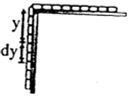
0 likes
View Solution23
DifficultMCQ
The work done in pumping out water from a cubical vessel of height $1 \ m$ is approximately ........ $J$ (Take $g = 10 \ m/s^2$ and density of water $\rho = 1000 \ kg/m^3$).
A
$5,000$
B
$10,000$
C
$5$
D
$10$
Solution
(A) The work done to pump out water from a vessel is equal to the change in potential energy of the water.
For a cubical vessel of height $h$ filled with water,the center of mass of the water is at a height $h/2$ from the bottom.
When the water is pumped out to the top level,the effective height through which the mass is lifted is $h/2$.
The mass of water $m = \text{density} \times \text{volume} = \rho \times (L^2 \times h)$. Since it is a cube,$L=h=1 \ m$,so $m = 1000 \ kg/m^3 \times 1 \ m^3 = 1000 \ kg$.
The work done $W = m \times g \times (h/2)$.
$W = 1000 \times 10 \times (1/2) = 5000 \ J$.
For a cubical vessel of height $h$ filled with water,the center of mass of the water is at a height $h/2$ from the bottom.
When the water is pumped out to the top level,the effective height through which the mass is lifted is $h/2$.
The mass of water $m = \text{density} \times \text{volume} = \rho \times (L^2 \times h)$. Since it is a cube,$L=h=1 \ m$,so $m = 1000 \ kg/m^3 \times 1 \ m^3 = 1000 \ kg$.
The work done $W = m \times g \times (h/2)$.
$W = 1000 \times 10 \times (1/2) = 5000 \ J$.
0 likes
View Solution24
MediumMCQ
$A$ rod of length $4 \ m$ and mass $20 \ kg$ is lying horizontally on the ground. Calculate the work done in $J$ to keep it in a vertical position such that one end remains in contact with the ground.
A
$109$
B
$392$
C
$350$
D
$280$
Solution
(B) The work done in raising the rod to a vertical position is equal to the change in its gravitational potential energy.
When the rod is lying horizontally,its center of mass is at height $h_1 = 0$.
When the rod is in a vertical position,its center of mass is at height $h_2 = \frac{L}{2}$,where $L = 4 \ m$.
So,$h_2 = \frac{4}{2} = 2 \ m$.
The work done $W = \Delta U = mg(h_2 - h_1)$.
Substituting the values: $W = 20 \times 9.8 \times (2 - 0)$.
$W = 20 \times 9.8 \times 2 = 392 \ J$.
When the rod is lying horizontally,its center of mass is at height $h_1 = 0$.
When the rod is in a vertical position,its center of mass is at height $h_2 = \frac{L}{2}$,where $L = 4 \ m$.
So,$h_2 = \frac{4}{2} = 2 \ m$.
The work done $W = \Delta U = mg(h_2 - h_1)$.
Substituting the values: $W = 20 \times 9.8 \times (2 - 0)$.
$W = 20 \times 9.8 \times 2 = 392 \ J$.
0 likes
View Solution25
MediumMCQ
For a system of conservative forces,the potential energy is given by the formula $U = ax^2 - bx$,where $a$ and $b$ are constants. The equilibrium position and the equilibrium potential energy will be,respectively:
A
$\frac{b}{2a}, -\frac{b}{2a}$
B
$\frac{b}{2a}, -\frac{b^2}{4a}$
C
$\frac{b^2}{2a}, -\frac{b^2}{2a}$
D
$-\frac{b}{4a}, -\frac{b}{4a}$
Solution
(B) For a conservative force,$F = -\frac{dU}{dx} = -(2ax - b) = -2ax + b$.
At the equilibrium position,$F = 0$,so $-2ax + b = 0$,which gives $x = \frac{b}{2a}$.
The equilibrium potential energy is $U = a(\frac{b}{2a})^2 - b(\frac{b}{2a}) = \frac{b^2}{4a} - \frac{b^2}{2a} = -\frac{b^2}{4a}$.
At the equilibrium position,$F = 0$,so $-2ax + b = 0$,which gives $x = \frac{b}{2a}$.
The equilibrium potential energy is $U = a(\frac{b}{2a})^2 - b(\frac{b}{2a}) = \frac{b^2}{4a} - \frac{b^2}{2a} = -\frac{b^2}{4a}$.
0 likes
View Solution26
MediumMCQ
$A$ uniform chain of length $L$ and mass $M$ is placed on a smooth table such that one-fourth of its length hangs over the edge. Find the work done to pull the hanging part of the chain onto the table.
A
$\frac{MgL}{12}$
B
$\frac{MgL}{8}$
C
$\frac{MgL}{32}$
D
$MgL$
Solution
(C) The length of the hanging part is $l = L/4$.
The mass of the hanging part is $m = (M/L) \times (L/4) = M/4$.
The center of mass of the hanging part is at a distance $h = l/2 = L/8$ below the edge of the table.
The work done to pull the hanging part onto the table is equal to the change in potential energy of the hanging part,which is $W = mgh$.
Substituting the values: $W = (M/4) \times g \times (L/8) = \frac{MgL}{32}$.
The mass of the hanging part is $m = (M/L) \times (L/4) = M/4$.
The center of mass of the hanging part is at a distance $h = l/2 = L/8$ below the edge of the table.
The work done to pull the hanging part onto the table is equal to the change in potential energy of the hanging part,which is $W = mgh$.
Substituting the values: $W = (M/4) \times g \times (L/8) = \frac{MgL}{32}$.
0 likes
View Solution27
EasyMCQ
If an object of mass $20 \ g$ falls from a height of $200 \ m$,and at the point where the object touches the Earth's surface,its total potential energy is converted into kinetic energy,then what is the decrease in the potential energy of the object in $J$?
A
$20$
B
$40$
C
$60$
D
$90$
Solution
(B) The decrease in potential energy is given by the formula $\Delta U = mgh$.
Given:
Mass $m = 20 \ g = 20 \times 10^{-3} \ kg = 0.02 \ kg$.
Height $h = 200 \ m$.
Acceleration due to gravity $g = 10 \ m/s^2$.
Substituting the values:
$\Delta U = 0.02 \ kg \times 10 \ m/s^2 \times 200 \ m$.
$\Delta U = 0.2 \times 200 = 40 \ J$.
Therefore,the decrease in potential energy is $40 \ J$.
Given:
Mass $m = 20 \ g = 20 \times 10^{-3} \ kg = 0.02 \ kg$.
Height $h = 200 \ m$.
Acceleration due to gravity $g = 10 \ m/s^2$.
Substituting the values:
$\Delta U = 0.02 \ kg \times 10 \ m/s^2 \times 200 \ m$.
$\Delta U = 0.2 \times 200 = 40 \ J$.
Therefore,the decrease in potential energy is $40 \ J$.
0 likes
View Solution28
MediumMCQ
$A$ uniform chain of length $2 \ m$ is placed on a table such that $60 \ cm$ of it hangs freely from the edge of the table. The total mass of the chain is $4 \ kg$. What is the work done in pulling the chain completely onto the table (in $J$)? (Take $g = 10 \ m/s^2$)
A
$7.2$
B
$3.6$
C
$120$
D
$1200$
Solution
(B) The length of the chain is $L = 2 \ m$ and the total mass is $M = 4 \ kg$. The mass per unit length is $\lambda = M/L = 4/2 = 2 \ kg/m$.
The length of the hanging part is $l = 60 \ cm = 0.6 \ m$.
The mass of the hanging part is $m = \lambda \times l = 2 \times 0.6 = 1.2 \ kg$.
The center of mass of the hanging part is at a distance $h = l/2 = 0.6/2 = 0.3 \ m$ below the edge of the table.
To pull the chain onto the table,we must lift the center of mass of the hanging part to the level of the table.
The work done $W$ is equal to the change in potential energy of the hanging part: $W = mgh$.
$W = 1.2 \ kg \times 10 \ m/s^2 \times 0.3 \ m = 3.6 \ J$.
The length of the hanging part is $l = 60 \ cm = 0.6 \ m$.
The mass of the hanging part is $m = \lambda \times l = 2 \times 0.6 = 1.2 \ kg$.
The center of mass of the hanging part is at a distance $h = l/2 = 0.6/2 = 0.3 \ m$ below the edge of the table.
To pull the chain onto the table,we must lift the center of mass of the hanging part to the level of the table.
The work done $W$ is equal to the change in potential energy of the hanging part: $W = mgh$.
$W = 1.2 \ kg \times 10 \ m/s^2 \times 0.3 \ m = 3.6 \ J$.
0 likes
View Solution29
DifficultMCQ
The potential energy of a particle of mass $1 \ kg$ moving freely along the $x$-axis is given by $V(x) = (\frac{x^4}{4} - \frac{x^2}{2}) \ J$. If the total mechanical energy of the particle is $2 \ J$,what is its maximum speed in $m/s$?
A
$3/\sqrt{2}$
B
$\sqrt{2}$
C
$1/\sqrt{2}$
D
$2$
Solution
(A) The potential energy is given by $V(x) = \frac{x^4}{4} - \frac{x^2}{2}$.
To find the equilibrium points,we set the derivative to zero: $\frac{dV}{dx} = x^3 - x = 0$.
This gives $x(x^2 - 1) = 0$,so $x = 0, 1, -1$.
The potential energy is minimum at $x = \pm 1$.
$V_{\min} = V(\pm 1) = \frac{(\pm 1)^4}{4} - \frac{(\pm 1)^2}{2} = \frac{1}{4} - \frac{1}{2} = -\frac{1}{4} \ J$.
Since the total mechanical energy $E = K.E. + V$ is constant at $2 \ J$,the kinetic energy is maximum when potential energy is minimum.
$K.E._{\max} = E - V_{\min} = 2 - (-1/4) = 2 + 0.25 = 2.25 \ J$.
Using $K.E._{\max} = \frac{1}{2} m v_{\max}^2$ with $m = 1 \ kg$:
$\frac{1}{2} \times 1 \times v_{\max}^2 = \frac{9}{4}$.
$v_{\max}^2 = \frac{9}{2}$.
$v_{\max} = \frac{3}{\sqrt{2}} \ m/s$.
To find the equilibrium points,we set the derivative to zero: $\frac{dV}{dx} = x^3 - x = 0$.
This gives $x(x^2 - 1) = 0$,so $x = 0, 1, -1$.
The potential energy is minimum at $x = \pm 1$.
$V_{\min} = V(\pm 1) = \frac{(\pm 1)^4}{4} - \frac{(\pm 1)^2}{2} = \frac{1}{4} - \frac{1}{2} = -\frac{1}{4} \ J$.
Since the total mechanical energy $E = K.E. + V$ is constant at $2 \ J$,the kinetic energy is maximum when potential energy is minimum.
$K.E._{\max} = E - V_{\min} = 2 - (-1/4) = 2 + 0.25 = 2.25 \ J$.
Using $K.E._{\max} = \frac{1}{2} m v_{\max}^2$ with $m = 1 \ kg$:
$\frac{1}{2} \times 1 \times v_{\max}^2 = \frac{9}{4}$.
$v_{\max}^2 = \frac{9}{2}$.
$v_{\max} = \frac{3}{\sqrt{2}} \ m/s$.
0 likes
View Solution30
DifficultMCQ
$A$ particle of mass $1 \ kg$ is free to move along the $x$-axis. Its potential energy is given by $U(x) = (\frac{x^2}{2} - x) \ J$. If the total mechanical energy of the particle is $2 \ J$,find the maximum speed of the particle.
A
$5 \ ms^{-1}$
B
$\sqrt{5} \ ms^{-1}$
C
$2\sqrt{3} \ ms^{-1}$
D
$3 \ ms^{-1}$
Solution
(B) The potential energy is given by $U(x) = \frac{x^2}{2} - x$.
To find the minimum potential energy,we set the derivative to zero: $\frac{dU}{dx} = x - 1 = 0$,which gives $x = 1 \ m$.
The second derivative $\frac{d^2U}{dx^2} = 1 > 0$,confirming a minimum at $x = 1 \ m$.
The minimum potential energy is $U_{min} = \frac{(1)^2}{2} - 1 = -0.5 \ J$.
The total mechanical energy $E$ is the sum of kinetic energy $K$ and potential energy $U$: $E = K + U$.
Since $E = 2 \ J$,the maximum kinetic energy $K_{max}$ occurs when $U$ is at its minimum: $K_{max} = E - U_{min} = 2 - (-0.5) = 2.5 \ J$.
Using $K_{max} = \frac{1}{2}mv_{max}^2$,we have $2.5 = \frac{1}{2}(1)v_{max}^2$.
$v_{max}^2 = 5$,so $v_{max} = \sqrt{5} \ ms^{-1}$.
To find the minimum potential energy,we set the derivative to zero: $\frac{dU}{dx} = x - 1 = 0$,which gives $x = 1 \ m$.
The second derivative $\frac{d^2U}{dx^2} = 1 > 0$,confirming a minimum at $x = 1 \ m$.
The minimum potential energy is $U_{min} = \frac{(1)^2}{2} - 1 = -0.5 \ J$.
The total mechanical energy $E$ is the sum of kinetic energy $K$ and potential energy $U$: $E = K + U$.
Since $E = 2 \ J$,the maximum kinetic energy $K_{max}$ occurs when $U$ is at its minimum: $K_{max} = E - U_{min} = 2 - (-0.5) = 2.5 \ J$.
Using $K_{max} = \frac{1}{2}mv_{max}^2$,we have $2.5 = \frac{1}{2}(1)v_{max}^2$.
$v_{max}^2 = 5$,so $v_{max} = \sqrt{5} \ ms^{-1}$.
0 likes
View Solution31
DifficultMCQ
The force acting on a particle is given by the formula $F(x) = -kx + ax^3$. Find the graph of its potential energy $U(x)$ for $x \ge 0$.
A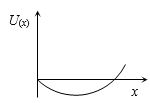
B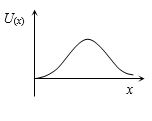
C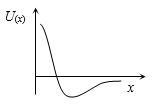
D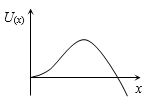
Solution
(D) The relationship between force $F$ and potential energy $U$ is given by $F = -\frac{dU}{dx}$.
Integrating this,we get $dU = -F \, dx$,so $U(x) = -\int F \, dx$.
Substituting $F(x) = -kx + ax^3$,we have $U(x) = -\int (-kx + ax^3) \, dx = \int (kx - ax^3) \, dx$.
Performing the integration,we get $U(x) = \frac{1}{2}kx^2 - \frac{1}{4}ax^4 + C$.
Assuming $U(0) = 0$,we find $C = 0$,so $U(x) = \frac{1}{2}kx^2 - \frac{1}{4}ax^4 = \frac{1}{4}x^2(2k - ax^2)$.
For $x \ge 0$,$U(x) = 0$ at $x = 0$ and $x = \sqrt{\frac{2k}{a}}$.
For $0 < x < \sqrt{\frac{2k}{a}}$,$U(x)$ is positive.
For $x > \sqrt{\frac{2k}{a}}$,$U(x)$ becomes negative and decreases as $x^4$ dominates.
This corresponds to a curve that starts at the origin,rises to a maximum,and then crosses the $x$-axis to become negative,which matches the graph in option $D$.
Integrating this,we get $dU = -F \, dx$,so $U(x) = -\int F \, dx$.
Substituting $F(x) = -kx + ax^3$,we have $U(x) = -\int (-kx + ax^3) \, dx = \int (kx - ax^3) \, dx$.
Performing the integration,we get $U(x) = \frac{1}{2}kx^2 - \frac{1}{4}ax^4 + C$.
Assuming $U(0) = 0$,we find $C = 0$,so $U(x) = \frac{1}{2}kx^2 - \frac{1}{4}ax^4 = \frac{1}{4}x^2(2k - ax^2)$.
For $x \ge 0$,$U(x) = 0$ at $x = 0$ and $x = \sqrt{\frac{2k}{a}}$.
For $0 < x < \sqrt{\frac{2k}{a}}$,$U(x)$ is positive.
For $x > \sqrt{\frac{2k}{a}}$,$U(x)$ becomes negative and decreases as $x^4$ dominates.
This corresponds to a curve that starts at the origin,rises to a maximum,and then crosses the $x$-axis to become negative,which matches the graph in option $D$.
0 likes
View Solution32
MediumMCQ
If the potential energy of a particle is given by $U = A - Bx^2$,then the force is proportional to which of the following?
A
Constant
B
$x$
C
$x^2$
D
$x^3$
Solution
(B) The relationship between force $F$ and potential energy $U$ is given by $F = -\frac{dU}{dx}$.
Given $U = A - Bx^2$.
Differentiating with respect to $x$:
$F = -\frac{d}{dx}(A - Bx^2)$
$F = -(0 - 2Bx)$
$F = 2Bx$.
Since $A$ and $B$ are constants,$F \propto x$.
Given $U = A - Bx^2$.
Differentiating with respect to $x$:
$F = -\frac{d}{dx}(A - Bx^2)$
$F = -(0 - 2Bx)$
$F = 2Bx$.
Since $A$ and $B$ are constants,$F \propto x$.
0 likes
View Solution33
MediumMCQ
The potential energy of a particle is given by $U = 8x^2 - 4x + 400 \, J$. Find the position $x$ where the force acting on the particle is zero.
A
$x = 25 \, m$
B
$x = 0.25 \, m$
C
$x = 0.025 \, m$
D
$x = 2.5 \, m$
Solution
(B) The force $F$ acting on a particle is related to its potential energy $U$ by the relation $F = -\frac{dU}{dx}$.
Given $U = 8x^2 - 4x + 400$.
To find the position where the force is zero,we set $F = 0$,which implies $\frac{dU}{dx} = 0$.
Calculating the derivative: $\frac{dU}{dx} = \frac{d}{dx}(8x^2 - 4x + 400) = 16x - 4$.
Setting the derivative to zero: $16x - 4 = 0$.
Solving for $x$: $16x = 4$,which gives $x = \frac{4}{16} = 0.25 \, m$.
Given $U = 8x^2 - 4x + 400$.
To find the position where the force is zero,we set $F = 0$,which implies $\frac{dU}{dx} = 0$.
Calculating the derivative: $\frac{dU}{dx} = \frac{d}{dx}(8x^2 - 4x + 400) = 16x - 4$.
Setting the derivative to zero: $16x - 4 = 0$.
Solving for $x$: $16x = 4$,which gives $x = \frac{4}{16} = 0.25 \, m$.
0 likes
View Solution34
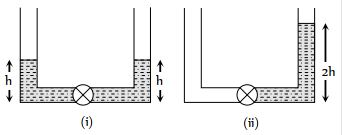
DifficultMCQ
Calculate the work done by pump $P$ to transfer water of density $d$ from one container to another as shown in the figure.
A
$2dgh^2a$
B
$dgha$
C
$2dgh^2a^2$
D
$dgh^2a$
Solution
(D) The work done by the pump is equal to the change in the potential energy of the water.
Initial potential energy $(U_i)$: The water is in two columns of height $h$ and cross-sectional area $a$. The center of mass of each column is at $h/2$.
$U_i = (a \cdot h \cdot d \cdot g) \cdot (h/2) + (a \cdot h \cdot d \cdot g) \cdot (h/2) = a \cdot h \cdot d \cdot g \cdot h = dgh^2a$.
Final potential energy $(U_f)$: All water is in one column of height $2h$ and cross-sectional area $a$. The center of mass is at $2h/2 = h$.
$U_f = (a \cdot 2h \cdot d \cdot g) \cdot h = 2dgh^2a$.
Work done $(W)$ = $U_f - U_i = 2dgh^2a - dgh^2a = dgh^2a$.
Initial potential energy $(U_i)$: The water is in two columns of height $h$ and cross-sectional area $a$. The center of mass of each column is at $h/2$.
$U_i = (a \cdot h \cdot d \cdot g) \cdot (h/2) + (a \cdot h \cdot d \cdot g) \cdot (h/2) = a \cdot h \cdot d \cdot g \cdot h = dgh^2a$.
Final potential energy $(U_f)$: All water is in one column of height $2h$ and cross-sectional area $a$. The center of mass is at $2h/2 = h$.
$U_f = (a \cdot 2h \cdot d \cdot g) \cdot h = 2dgh^2a$.
Work done $(W)$ = $U_f - U_i = 2dgh^2a - dgh^2a = dgh^2a$.
0 likes
View Solution35
EasyMCQ
$A$ rod of mass $m$ and length $l$ is lying on a table. What is the work done to make it stand vertically?
A
$mgl$
B
$\frac{mgl}{2}$
C
$\frac{mgl}{4}$
D
$2mgl$
Solution
(B) The work done to lift the rod is equal to the change in its gravitational potential energy.
Initially,the center of mass of the rod is on the table,so the initial potential energy $U_i = 0$.
When the rod is placed vertically,its center of mass is at a height $h = \frac{l}{2}$ from the table.
The final potential energy $U_f = mgh = mg(\frac{l}{2}) = \frac{mgl}{2}$.
Therefore,the work done $W = U_f - U_i = \frac{mgl}{2} - 0 = \frac{mgl}{2}$.
Initially,the center of mass of the rod is on the table,so the initial potential energy $U_i = 0$.
When the rod is placed vertically,its center of mass is at a height $h = \frac{l}{2}$ from the table.
The final potential energy $U_f = mgh = mg(\frac{l}{2}) = \frac{mgl}{2}$.
Therefore,the work done $W = U_f - U_i = \frac{mgl}{2} - 0 = \frac{mgl}{2}$.
0 likes
View Solution36
DifficultMCQ
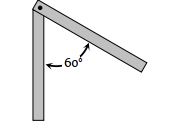
Calculate the work done in rotating a vertical meter scale of mass $400 \, g$ by an angle of ${60^o}$. (in $, J$)
A
$1$
B
$10$
C
$100$
D
$1000$
Solution
(A) The mass of the meter scale is $m = 400 \, g = 0.4 \, kg$. The length of the meter scale is $l = 1 \, m$.
The center of mass of the scale is at its midpoint,$l/2 = 0.5 \, m$.
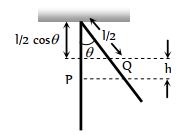
When the scale is rotated by an angle $\theta = {60^o}$,the vertical displacement $h$ of the center of mass is given by:
$h = \frac{l}{2} - \frac{l}{2} \cos \theta = \frac{l}{2}(1 - \cos \theta)$.
The work done $W$ against gravity is equal to the change in potential energy:
$W = mgh = mg \times \frac{l}{2}(1 - \cos {60^o})$.
Substituting the values:
$W = 0.4 \times 10 \times \frac{1}{2} \times (1 - 0.5) = 0.4 \times 10 \times 0.5 \times 0.5 = 1 \, J$.
The center of mass of the scale is at its midpoint,$l/2 = 0.5 \, m$.
When the scale is rotated by an angle $\theta = {60^o}$,the vertical displacement $h$ of the center of mass is given by:
$h = \frac{l}{2} - \frac{l}{2} \cos \theta = \frac{l}{2}(1 - \cos \theta)$.
The work done $W$ against gravity is equal to the change in potential energy:
$W = mgh = mg \times \frac{l}{2}(1 - \cos {60^o})$.
Substituting the values:
$W = 0.4 \times 10 \times \frac{1}{2} \times (1 - 0.5) = 0.4 \times 10 \times 0.5 \times 0.5 = 1 \, J$.
0 likes
View Solution37
MediumMCQ
The potential energy of a particle in a force field is $U(r) = \frac{A}{r^2} - \frac{B}{r}$,where $A$ and $B$ are positive constants and $r$ is the distance of the particle from the centre of the field. For stable equilibrium,the distance of the particle is:
A
$\frac{B}{2A}$
B
$\frac{2A}{B}$
C
$\frac{A}{B}$
D
$\frac{B}{A}$
Solution
(B) Given potential energy: $U(r) = \frac{A}{r^2} - \frac{B}{r}$.
For equilibrium,the force $F = -\frac{dU}{dr} = 0$,which implies $\frac{dU}{dr} = 0$.
$\frac{dU}{dr} = \frac{d}{dr}(Ar^{-2} - Br^{-1}) = -2Ar^{-3} + Br^{-2} = 0$.
$\frac{B}{r^2} = \frac{2A}{r^3} \implies r = \frac{2A}{B}$.
For stable equilibrium,the second derivative must be positive: $\frac{d^2U}{dr^2} > 0$.
$\frac{d^2U}{dr^2} = \frac{d}{dr}(-2Ar^{-3} + Br^{-2}) = 6Ar^{-4} - 2Br^{-3}$.
Substituting $r = \frac{2A}{B}$:
$\frac{d^2U}{dr^2} = 6A(\frac{B}{2A})^4 - 2B(\frac{B}{2A})^3 = 6A(\frac{B^4}{16A^4}) - 2B(\frac{B^3}{8A^3}) = \frac{3B^4}{8A^3} - \frac{B^4}{4A^3} = \frac{3B^4 - 2B^4}{8A^3} = \frac{B^4}{8A^3}$.
Since $A, B > 0$,$\frac{B^4}{8A^3} > 0$. Thus,the condition for stable equilibrium is satisfied at $r = \frac{2A}{B}$.
For equilibrium,the force $F = -\frac{dU}{dr} = 0$,which implies $\frac{dU}{dr} = 0$.
$\frac{dU}{dr} = \frac{d}{dr}(Ar^{-2} - Br^{-1}) = -2Ar^{-3} + Br^{-2} = 0$.
$\frac{B}{r^2} = \frac{2A}{r^3} \implies r = \frac{2A}{B}$.
For stable equilibrium,the second derivative must be positive: $\frac{d^2U}{dr^2} > 0$.
$\frac{d^2U}{dr^2} = \frac{d}{dr}(-2Ar^{-3} + Br^{-2}) = 6Ar^{-4} - 2Br^{-3}$.
Substituting $r = \frac{2A}{B}$:
$\frac{d^2U}{dr^2} = 6A(\frac{B}{2A})^4 - 2B(\frac{B}{2A})^3 = 6A(\frac{B^4}{16A^4}) - 2B(\frac{B^3}{8A^3}) = \frac{3B^4}{8A^3} - \frac{B^4}{4A^3} = \frac{3B^4 - 2B^4}{8A^3} = \frac{B^4}{8A^3}$.
Since $A, B > 0$,$\frac{B^4}{8A^3} > 0$. Thus,the condition for stable equilibrium is satisfied at $r = \frac{2A}{B}$.
0 likes
View Solution38
MediumMCQ
The potential energy of a particle is related to the $x$ coordinate by the equation $U = x^2 - 2x$. The particle will be in stable equilibrium at:
A
$x = 0.5$
B
$x = 1$
C
$x = 2$
D
$x = 4$
Solution
(B) The force $F$ acting on the particle is given by the negative gradient of potential energy: $F = -\frac{dU}{dx}$.
Given $U = x^2 - 2x$,we find the derivative: $\frac{dU}{dx} = 2x - 2$.
For equilibrium,the net force must be zero: $F = -(2x - 2) = 0$,which gives $x = 1$.
To check for stability,we examine the second derivative: $\frac{d^2U}{dx^2} = \frac{d}{dx}(2x - 2) = 2$.
Since $\frac{d^2U}{dx^2} > 0$ at $x = 1$,the potential energy is at a minimum,which corresponds to a state of stable equilibrium.
Given $U = x^2 - 2x$,we find the derivative: $\frac{dU}{dx} = 2x - 2$.
For equilibrium,the net force must be zero: $F = -(2x - 2) = 0$,which gives $x = 1$.
To check for stability,we examine the second derivative: $\frac{d^2U}{dx^2} = \frac{d}{dx}(2x - 2) = 2$.
Since $\frac{d^2U}{dx^2} > 0$ at $x = 1$,the potential energy is at a minimum,which corresponds to a state of stable equilibrium.
0 likes
View Solution39
MediumMCQ
$A$ particle with constant total energy $E$ moves in one dimension in a region where the potential energy is $U(x)$. The speed of the particle is zero where
A
$U(x) = E$
B
$U(x) = 0$
C
$\frac{dU(x)}{dx} = 0$
D
$\frac{d^2U(x)}{dx^2} = 0$
Solution
(A) The total mechanical energy $E$ of a particle is the sum of its kinetic energy $K$ and potential energy $U(x)$,given by $E = K + U(x)$.
Since kinetic energy $K = \frac{1}{2}mv^2$,where $m$ is the mass and $v$ is the speed of the particle.
If the speed of the particle is zero $(v = 0)$,then the kinetic energy $K$ must be zero $(K = 0)$.
Substituting $K = 0$ into the total energy equation,we get $E = 0 + U(x)$,which simplifies to $U(x) = E$.
Therefore,the speed of the particle is zero at the points where the potential energy equals the total energy.
Since kinetic energy $K = \frac{1}{2}mv^2$,where $m$ is the mass and $v$ is the speed of the particle.
If the speed of the particle is zero $(v = 0)$,then the kinetic energy $K$ must be zero $(K = 0)$.
Substituting $K = 0$ into the total energy equation,we get $E = 0 + U(x)$,which simplifies to $U(x) = E$.
Therefore,the speed of the particle is zero at the points where the potential energy equals the total energy.
0 likes
View Solution40
AdvancedMCQ
The potential energy of a particle of mass $5 \ kg$ moving in the $XY$ plane is given by $V = -7x + 24y$ joules,where $x$ and $y$ are in metres. Initially at $t = 0$,the particle is at the origin $(0, 0)$ moving with a velocity of $\vec{v}_0 = 6[0.24 \hat{i} + 0.7 \hat{j}] \ m/s = [1.44 \hat{i} + 4.2 \hat{j}] \ m/s$. Then:
A
the magnitude of velocity of the particle at $t = 4 \ s$ is $25 \ m/s$
B
the magnitude of acceleration of the particle is $5 \ m/s^2$
C
the direction of motion of the particle initially at $t = 0$ is at right angles to the direction of acceleration
D
All of the above
Solution
(B) The force acting on the particle is $\vec{F} = -\nabla V = -(\frac{\partial V}{\partial x} \hat{i} + \frac{\partial V}{\partial y} \hat{j}) = -(-7 \hat{i} + 24 \hat{j}) = 7 \hat{i} - 24 \hat{j} \ N$.
The acceleration is $\vec{a} = \frac{\vec{F}}{m} = \frac{7 \hat{i} - 24 \hat{j}}{5} = 1.4 \hat{i} - 4.8 \hat{j} \ m/s^2$.
The magnitude of acceleration is $|\vec{a}| = \sqrt{1.4^2 + (-4.8)^2} = \sqrt{1.96 + 23.04} = \sqrt{25} = 5 \ m/s^2$. (Option $B$ is correct).
At $t = 4 \ s$,the velocity is $\vec{v} = \vec{v}_0 + \vec{a}t = (1.44 \hat{i} + 4.2 \hat{j}) + (1.4 \hat{i} - 4.8 \hat{j}) \times 4 = (1.44 + 5.6) \hat{i} + (4.2 - 19.2) \hat{j} = 7.04 \hat{i} - 15 \hat{j} \ m/s$.
The magnitude is $|\vec{v}| = \sqrt{7.04^2 + (-15)^2} \approx \sqrt{49.56 + 225} \approx 16.57 \ m/s$. (Option $A$ is incorrect).
For option $C$,check the dot product $\vec{v}_0 \cdot \vec{a} = (1.44)(1.4) + (4.2)(-4.8) = 2.016 - 20.16 \neq 0$. (Option $C$ is incorrect).
Since only $B$ is correct,the answer is $B$.
The acceleration is $\vec{a} = \frac{\vec{F}}{m} = \frac{7 \hat{i} - 24 \hat{j}}{5} = 1.4 \hat{i} - 4.8 \hat{j} \ m/s^2$.
The magnitude of acceleration is $|\vec{a}| = \sqrt{1.4^2 + (-4.8)^2} = \sqrt{1.96 + 23.04} = \sqrt{25} = 5 \ m/s^2$. (Option $B$ is correct).
At $t = 4 \ s$,the velocity is $\vec{v} = \vec{v}_0 + \vec{a}t = (1.44 \hat{i} + 4.2 \hat{j}) + (1.4 \hat{i} - 4.8 \hat{j}) \times 4 = (1.44 + 5.6) \hat{i} + (4.2 - 19.2) \hat{j} = 7.04 \hat{i} - 15 \hat{j} \ m/s$.
The magnitude is $|\vec{v}| = \sqrt{7.04^2 + (-15)^2} \approx \sqrt{49.56 + 225} \approx 16.57 \ m/s$. (Option $A$ is incorrect).
For option $C$,check the dot product $\vec{v}_0 \cdot \vec{a} = (1.44)(1.4) + (4.2)(-4.8) = 2.016 - 20.16 \neq 0$. (Option $C$ is incorrect).
Since only $B$ is correct,the answer is $B$.
0 likes
View Solution41
DifficultMCQ
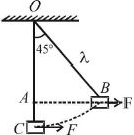
$A$ mass of $M \ kg$ is suspended by a weightless string of length $\ell$. The horizontal force required to displace it until the string makes an angle of $45^\circ$ with the initial vertical direction is:
A
$Mg(\sqrt{2} + 1)$
B
$Mg\sqrt{2}$
C
$\frac{Mg}{\sqrt{2}}$
D
$Mg(\sqrt{2} - 1)$
Solution
(D) Let the length of the string be $\ell$. When the mass is displaced by an angle $\theta = 45^\circ$,the vertical height gained by the mass is $h = \ell - \ell \cos 45^\circ = \ell(1 - \frac{1}{\sqrt{2}})$.
The horizontal displacement of the mass is $x = \ell \sin 45^\circ = \frac{\ell}{\sqrt{2}}$.
Using the work-energy theorem,the work done by the external horizontal force $F$ must equal the change in potential energy of the mass (assuming it starts and ends at rest,so $\Delta K = 0$):
$W_F + W_g = 0$
$F \cdot x - Mg \cdot h = 0$
$F \cdot (\frac{\ell}{\sqrt{2}}) = Mg \cdot \ell(1 - \frac{1}{\sqrt{2}})$
$F = Mg \cdot \sqrt{2}(1 - \frac{1}{\sqrt{2}})$
$F = Mg(\sqrt{2} - 1)$
The horizontal displacement of the mass is $x = \ell \sin 45^\circ = \frac{\ell}{\sqrt{2}}$.
Using the work-energy theorem,the work done by the external horizontal force $F$ must equal the change in potential energy of the mass (assuming it starts and ends at rest,so $\Delta K = 0$):
$W_F + W_g = 0$
$F \cdot x - Mg \cdot h = 0$
$F \cdot (\frac{\ell}{\sqrt{2}}) = Mg \cdot \ell(1 - \frac{1}{\sqrt{2}})$
$F = Mg \cdot \sqrt{2}(1 - \frac{1}{\sqrt{2}})$
$F = Mg(\sqrt{2} - 1)$
0 likes
View Solution42
MediumMCQ
The potential energy function for the force between two atoms in a diatomic molecule is approximately given by $U(x) = \frac{a}{x^{12}} - \frac{b}{x^6}$,where $a$ and $b$ are constants and $x$ is the distance between the atoms. If the dissociation energy of the molecule is $D = [U(x = \infty) - U_{\text{at equilibrium}}]$,then $D$ is:
A
$\frac{b^2}{2a}$
B
$\frac{b^2}{6a}$
C
$\frac{b^2}{4a}$
D
$\frac{b^2}{12a}$
Solution
(C) At equilibrium,the force is zero,which means the derivative of the potential energy with respect to distance is zero: $\frac{dU(x)}{dx} = 0$.
Given $U(x) = ax^{-12} - bx^{-6}$,we differentiate:
$\frac{dU}{dx} = -12ax^{-13} + 6bx^{-7} = 0$.
$12ax^{-13} = 6bx^{-7} \Rightarrow \frac{2a}{x^6} = b \Rightarrow x^6 = \frac{2a}{b}$.
Now,substitute $x^6 = \frac{2a}{b}$ into the potential energy function to find $U_{\text{at equilibrium}}$:
$U_{\text{at equilibrium}} = \frac{a}{(x^6)^2} - \frac{b}{x^6} = \frac{a}{(2a/b)^2} - \frac{b}{(2a/b)} = \frac{a}{4a^2/b^2} - \frac{b^2}{2a} = \frac{b^2}{4a} - \frac{2b^2}{4a} = -\frac{b^2}{4a}$.
Since $U(x = \infty) = 0$,the dissociation energy $D$ is:
$D = U(\infty) - U_{\text{at equilibrium}} = 0 - (-\frac{b^2}{4a}) = \frac{b^2}{4a}$.
Given $U(x) = ax^{-12} - bx^{-6}$,we differentiate:
$\frac{dU}{dx} = -12ax^{-13} + 6bx^{-7} = 0$.
$12ax^{-13} = 6bx^{-7} \Rightarrow \frac{2a}{x^6} = b \Rightarrow x^6 = \frac{2a}{b}$.
Now,substitute $x^6 = \frac{2a}{b}$ into the potential energy function to find $U_{\text{at equilibrium}}$:
$U_{\text{at equilibrium}} = \frac{a}{(x^6)^2} - \frac{b}{x^6} = \frac{a}{(2a/b)^2} - \frac{b}{(2a/b)} = \frac{a}{4a^2/b^2} - \frac{b^2}{2a} = \frac{b^2}{4a} - \frac{2b^2}{4a} = -\frac{b^2}{4a}$.
Since $U(x = \infty) = 0$,the dissociation energy $D$ is:
$D = U(\infty) - U_{\text{at equilibrium}} = 0 - (-\frac{b^2}{4a}) = \frac{b^2}{4a}$.
0 likes
View Solution43
DifficultMCQ
The potential energy of a diatomic molecule is given by $U = \frac{A}{r^{12}} - \frac{B}{r^6}$,where $A$ and $B$ are positive constants. The distance $r$ between them at equilibrium is:
A
$(\frac{A}{B})^{1/6}$
B
$(\frac{2A}{B})^{1/6}$
C
$(\frac{A}{2B})^{1/6}$
D
None of these
Solution
(B) At equilibrium,the potential energy is at a minimum,so the derivative of potential energy with respect to distance $r$ must be zero: $\frac{dU}{dr} = 0$.
Given $U = Ar^{-12} - Br^{-6}$.
Differentiating with respect to $r$: $\frac{dU}{dr} = -12Ar^{-13} + 6Br^{-7} = 0$.
Rearranging the equation: $\frac{6B}{r^7} = \frac{12A}{r^{13}}$.
Multiplying both sides by $r^{13}$: $6B r^6 = 12A$.
Solving for $r^6$: $r^6 = \frac{12A}{6B} = \frac{2A}{B}$.
Therefore,the equilibrium distance is $r = (\frac{2A}{B})^{1/6}$.
Given $U = Ar^{-12} - Br^{-6}$.
Differentiating with respect to $r$: $\frac{dU}{dr} = -12Ar^{-13} + 6Br^{-7} = 0$.
Rearranging the equation: $\frac{6B}{r^7} = \frac{12A}{r^{13}}$.
Multiplying both sides by $r^{13}$: $6B r^6 = 12A$.
Solving for $r^6$: $r^6 = \frac{12A}{6B} = \frac{2A}{B}$.
Therefore,the equilibrium distance is $r = (\frac{2A}{B})^{1/6}$.
0 likes
View Solution44
DifficultMCQ
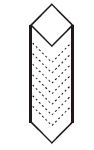
$A$ number of identical cubical blocks of edge $a$ and mass $m$ are lying on a horizontal table. The work done on the blocks in arranging them in a column of height $(n + 1)a$ on the table is
A
$\frac{1}{2}ma\,g{n^2}$
B
$\frac{1}{2}ma\,g\left( {{n^2} + n} \right)$
C
$\frac{1}{2}\left( {{n^2} - 2} \right)mag$
D
$\frac{1}{2}{\left( {n + 1} \right)^2}mag$
Solution
(B) The total number of blocks is $N = n + 1$. Initially, all blocks are on the table, so their center of mass is at height $h_i = a/2$.
After stacking them into a column of height $H = (n + 1)a$, the center of mass of the column is at $h_f = H/2 = (n + 1)a/2$.
The total mass of the system is $M = (n + 1)m$.
The work done is equal to the change in gravitational potential energy: $W = \Delta U = M g (h_f - h_i)$.
$W = (n + 1)m g \left[ \frac{(n + 1)a}{2} - \frac{a}{2} \right]$.
$W = (n + 1)m g \left[ \frac{na + a - a}{2} \right] = (n + 1)m g \left( \frac{na}{2} \right)$.
$W = \frac{1}{2} m a g (n^2 + n)$.
After stacking them into a column of height $H = (n + 1)a$, the center of mass of the column is at $h_f = H/2 = (n + 1)a/2$.
The total mass of the system is $M = (n + 1)m$.
The work done is equal to the change in gravitational potential energy: $W = \Delta U = M g (h_f - h_i)$.
$W = (n + 1)m g \left[ \frac{(n + 1)a}{2} - \frac{a}{2} \right]$.
$W = (n + 1)m g \left[ \frac{na + a - a}{2} \right] = (n + 1)m g \left( \frac{na}{2} \right)$.
$W = \frac{1}{2} m a g (n^2 + n)$.
0 likes
View Solution45
MediumMCQ
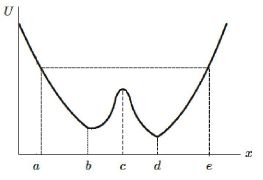
$A$ particle is released from rest at the point $x = a$ and moves along the $x$ axis subject to the potential energy function $U(x)$ shown. The particle:
A
moves to a point to the left of $x = e$,stops,and remains at rest
B
moves to a point $x = e$,and then moves to the left
C
moves to infinity at varying speed
D
moves to $x = b$,where it remains at rest
Solution
(B) The total mechanical energy $E$ of the particle is conserved. Since the particle is released from rest at $x = a$,its kinetic energy $K = 0$ at $x = a$,so its total energy is $E = U(a)$.
As the particle moves,$E = K + U(x) = U(a)$. Since $K \ge 0$,the particle can only move in regions where $U(x) \le U(a)$.
Looking at the graph,$U(x) = U(a)$ at $x = a$ and $x = e$. Between $x = a$ and $x = e$,$U(x) \le U(a)$.
Therefore,the particle will move from $x = a$ towards the right,pass through $x = b$,$x = c$,and $x = d$,and reach $x = e$. At $x = e$,its kinetic energy becomes zero $(K = E - U(e) = 0)$,so it stops and then reverses its direction to move back to the left.
As the particle moves,$E = K + U(x) = U(a)$. Since $K \ge 0$,the particle can only move in regions where $U(x) \le U(a)$.
Looking at the graph,$U(x) = U(a)$ at $x = a$ and $x = e$. Between $x = a$ and $x = e$,$U(x) \le U(a)$.
Therefore,the particle will move from $x = a$ towards the right,pass through $x = b$,$x = c$,and $x = d$,and reach $x = e$. At $x = e$,its kinetic energy becomes zero $(K = E - U(e) = 0)$,so it stops and then reverses its direction to move back to the left.
0 likes
View Solution46
MediumMCQ
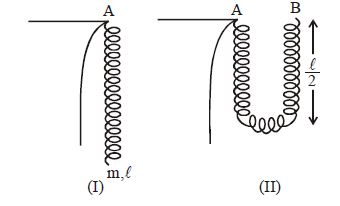
$A$ chain of mass $m$ and length $l$ is hanging freely from edge $A$ (as shown in diagram $I$). Calculate the work done to fold it as shown in diagram $(II)$.
A
$mg\frac{l}{2}$
B
$-mg\frac{l}{2}$
C
$mg\frac{l}{4}$
D
$-mg\frac{l}{4}$
Solution
(C) In diagram $(I)$,the center of mass of the chain is at a distance of $\frac{l}{2}$ below the edge $A$. The potential energy is $U_I = -mg(\frac{l}{2})$.
In diagram $(II)$,the chain is folded such that it hangs to a depth of $\frac{l}{2}$. The center of mass of this folded chain is at a distance of $\frac{l}{4}$ below the edge $A$. The potential energy is $U_{II} = -mg(\frac{l}{4})$.
The work done $W$ is equal to the change in potential energy: $W = \Delta U = U_{II} - U_I$.
$W = -mg(\frac{l}{4}) - (-mg(\frac{l}{2})) = -mg\frac{l}{4} + mg\frac{l}{2} = mg\frac{l}{4}$.
In diagram $(II)$,the chain is folded such that it hangs to a depth of $\frac{l}{2}$. The center of mass of this folded chain is at a distance of $\frac{l}{4}$ below the edge $A$. The potential energy is $U_{II} = -mg(\frac{l}{4})$.
The work done $W$ is equal to the change in potential energy: $W = \Delta U = U_{II} - U_I$.
$W = -mg(\frac{l}{4}) - (-mg(\frac{l}{2})) = -mg\frac{l}{4} + mg\frac{l}{2} = mg\frac{l}{4}$.
0 likes
View Solution47
MediumMCQ
Potential energy of a particle varies with position $r$ as,$U = \left( \frac{\alpha}{r^4} - \frac{\beta}{r^5} \right) \text{ J}$,where $\alpha$ and $\beta$ are positive constants. The particle will be in equilibrium at $r = \dots$
A
$\frac{4\alpha}{5\beta}$
B
$\frac{5\beta}{4\alpha}$
C
$-\frac{4\alpha}{5\beta}$
D
$-\frac{5\beta}{4\alpha}$
Solution
(B) The force $F$ acting on the particle is given by the negative gradient of the potential energy: $F = -\frac{dU}{dr}$.
Given $U = \alpha r^{-4} - \beta r^{-5}$.
Differentiating with respect to $r$:
$F = -\frac{d}{dr}(\alpha r^{-4} - \beta r^{-5}) = -[\alpha(-4r^{-5}) - \beta(-5r^{-6})] = 4\alpha r^{-5} - 5\beta r^{-6}$.
For the particle to be in equilibrium,the net force must be zero: $F = 0$.
$4\alpha r^{-5} - 5\beta r^{-6} = 0$.
$4\alpha r^{-5} = 5\beta r^{-6}$.
Multiplying both sides by $r^6$:
$4\alpha r = 5\beta$.
Therefore,$r = \frac{5\beta}{4\alpha}$.
Given $U = \alpha r^{-4} - \beta r^{-5}$.
Differentiating with respect to $r$:
$F = -\frac{d}{dr}(\alpha r^{-4} - \beta r^{-5}) = -[\alpha(-4r^{-5}) - \beta(-5r^{-6})] = 4\alpha r^{-5} - 5\beta r^{-6}$.
For the particle to be in equilibrium,the net force must be zero: $F = 0$.
$4\alpha r^{-5} - 5\beta r^{-6} = 0$.
$4\alpha r^{-5} = 5\beta r^{-6}$.
Multiplying both sides by $r^6$:
$4\alpha r = 5\beta$.
Therefore,$r = \frac{5\beta}{4\alpha}$.
0 likes
View Solution48
MediumMCQ
The potential energy of a particle oscillating along the $x-$axis is given by $U = 20 + (x - 2)^2$,where $U$ is in joules and $x$ is in meters. The total mechanical energy of the particle is $36\,J$. The maximum kinetic energy of the particle is ................ $J$.
A
$24$
B
$36$
C
$16$
D
$20$
Solution
(C) The potential energy function is $U(x) = 20 + (x - 2)^2$.
The minimum potential energy $(U_{min})$ occurs when $(x - 2)^2 = 0$,which is at $x = 2\,m$.
Thus,$U_{min} = 20 + 0 = 20\,J$.
The total mechanical energy $(TE)$ of the particle is given as $36\,J$.
According to the law of conservation of mechanical energy,$TE = U + KE$.
To find the maximum kinetic energy $(KE_{max})$,we use the relation $KE_{max} = TE - U_{min}$.
Substituting the values,$KE_{max} = 36\,J - 20\,J = 16\,J$.
The minimum potential energy $(U_{min})$ occurs when $(x - 2)^2 = 0$,which is at $x = 2\,m$.
Thus,$U_{min} = 20 + 0 = 20\,J$.
The total mechanical energy $(TE)$ of the particle is given as $36\,J$.
According to the law of conservation of mechanical energy,$TE = U + KE$.
To find the maximum kinetic energy $(KE_{max})$,we use the relation $KE_{max} = TE - U_{min}$.
Substituting the values,$KE_{max} = 36\,J - 20\,J = 16\,J$.
0 likes
View Solution49
DifficultMCQ
$A$ uniform chain of length $L$ and mass $M$ is lying on a smooth table and one-third of its length is hanging vertically down over the edge of the table. If $g$ is the acceleration due to gravity,the work required to pull the hanging part onto the table is:
A
$MgL$
B
$\frac{MgL}{3}$
C
$\frac{MgL}{9}$
D
$\frac{MgL}{18}$
Solution
(D) The length of the hanging part is $l = \frac{L}{3}$.
The mass of the hanging part is $m = \frac{M}{L} \times \frac{L}{3} = \frac{M}{3}$.
The center of mass of the hanging part is at a distance $h = \frac{l}{2} = \frac{L/3}{2} = \frac{L}{6}$ below the edge of the table.
The work done to pull the hanging part onto the table is equal to the change in potential energy of the hanging part.
$W = mgh = \left(\frac{M}{3}\right) g \left(\frac{L}{6}\right) = \frac{MgL}{18}$.
The mass of the hanging part is $m = \frac{M}{L} \times \frac{L}{3} = \frac{M}{3}$.
The center of mass of the hanging part is at a distance $h = \frac{l}{2} = \frac{L/3}{2} = \frac{L}{6}$ below the edge of the table.
The work done to pull the hanging part onto the table is equal to the change in potential energy of the hanging part.
$W = mgh = \left(\frac{M}{3}\right) g \left(\frac{L}{6}\right) = \frac{MgL}{18}$.
0 likes
View Solution50
DifficultMCQ
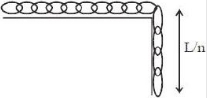
$A$ uniform cable of mass $M$ and length $L$ is placed on a horizontal surface such that its $(1/n)^{th}$ part is hanging below the edge of the surface. To lift the hanging part of the cable up to the surface,the work done should be
A
$nMgL$
B
$\frac{MgL}{2n^2}$
C
$\frac{2MgL}{n^2}$
D
$\frac{MgL}{n^2}$
Solution
(B) The length of the hanging part is $l = L/n$.
Since the cable is uniform,the mass of the hanging part is $m = (M/L) \times l = M/n$.
The center of mass of the hanging part is at a distance $h_{COM} = l/2 = L/(2n)$ below the edge of the surface.
To lift the hanging part onto the surface,we must raise its center of mass to the level of the surface.
The work done $W$ is equal to the change in potential energy of the hanging part:
$W = m \times g \times h_{COM}$
$W = (M/n) \times g \times (L/(2n))$
$W = \frac{MgL}{2n^2}$
Since the cable is uniform,the mass of the hanging part is $m = (M/L) \times l = M/n$.
The center of mass of the hanging part is at a distance $h_{COM} = l/2 = L/(2n)$ below the edge of the surface.
To lift the hanging part onto the surface,we must raise its center of mass to the level of the surface.
The work done $W$ is equal to the change in potential energy of the hanging part:
$W = m \times g \times h_{COM}$
$W = (M/n) \times g \times (L/(2n))$
$W = \frac{MgL}{2n^2}$
0 likes
View SolutionWork, Energy, Power and Collision — Potential Energy · Frequently Asked Questions
1Are these Work, Energy, Power and Collision questions useful for JEE and NEET?
Yes. All questions in this section are mapped to JEE Main and NEET exam patterns. Previous year questions from JEE Main, NEET, GUJCET and state-level exams are included with full solutions.
2Can I switch to Hindi or Gujarati for these questions?
Yes. Use the language tabs in the hero section or the sidebar to view the same questions and solutions in English, Hindi or Gujarati.
3How do I generate a question paper from this subtopic?
Use the Vedclass Exam Paper Generator — select the chapter and subtopic, set difficulty, and generate Sets A, B, C, D automatically. First 3 chapters of every subject are free.
Vedclass Products
For Students
Vedclass Test Series
Mock tests in real JEE/NEET style with performance analysis. 5-day free trial.
Start Free TrialFor Teachers
Exam Paper Generator
Generate Set A/B/C/D papers from this chapter in 2 minutes. 3 chapters free.
Try FreeFor Institutes
Online Exam Module
Live online exams with unlimited students, 360° analytics & white-label branding.
See DemoFor Teachers & Institutes
Generate a Work, Energy, Power and Collision Exam Paper in 2 Minutes
Select subtopic & difficulty — Sets A, B, C, D auto-generated with No Repeat logic.
First 3 chapters of every subject are free — no payment required.