
$A$ particle moves under the influence of a force $F = -2x$ in one dimension (where $x$ is the distance of the particle from the origin). Assume that the potential energy of the particle at the origin is zero. The schematic diagram of the potential energy $U$ as a function of $x$ is given by:
- A
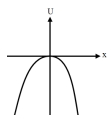
- B
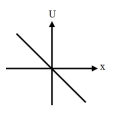
- C
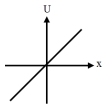
- D
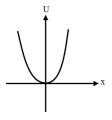
Explore More
Similar Questions
For a system of conservative forces,the potential energy is given by the formula $U = ax^2 - bx$,where $a$ and $b$ are constants. The equilibrium position and the equilibrium potential energy will be,respectively:
Medium
View SolutionThe potential energy of a body is given by $U = A - Bx^2$ (where $x$ is the displacement). The magnitude of the force acting on the particle is:
Easy
View Solution$A$ particle is released from rest at the point $x = a$ and moves along the $x$ axis subject to the potential energy function $U(x)$ shown. The particle:
Medium
View SolutionThe potential energy of a particle of mass $5 \ kg$ moving in the $XY$ plane is given by $V = -7x + 24y$ joules,where $x$ and $y$ are in metres. Initially at $t = 0$,the particle is at the origin $(0, 0)$ moving with a velocity of $\vec{v}_0 = 6[0.24 \hat{i} + 0.7 \hat{j}] \ m/s = [1.44 \hat{i} + 4.2 \hat{j}] \ m/s$. Then:
If the potential energy of a particle of mass $0.1 \ kg$ moving along $x$-axis is $U(x) = 5x(x-4) \ J$,then the speed of the particle is maximum at a position of
Vedclass Products
For Students
Vedclass Test Series
Mock tests in real JEE/NEET style with performance analysis. 5-day free trial.
Start Free TrialFor Teachers
Exam Paper Generator
Generate Set A/B/C/D exam papers from 7.5L+ questions in 2 minutes. 3 chapters free.
Try FreeFor Institutes
Online Exam Module
Live online exams with unlimited students, 360° analytics & white-label branding.
See Demo