
A English
Perfectly Inelastic Collision Questions in English
Class 11 Physics · Work, Energy, Power and Collision · Perfectly Inelastic Collision
110+
Questions
English
Language
100%
With Solutions
Showing 49 of 110 questions in English
51
DifficultMCQ
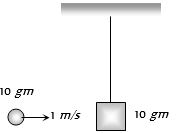
$A$ block of mass $10 \text{ g}$ is suspended from the ceiling by a string. $A$ bullet of mass $10 \text{ g}$ moving with a velocity of $1 \text{ m/s}$ strikes the block and gets embedded in it. To what height will the block rise (in $\text{ cm}$)? (Take $g = 10 \text{ m/s}^2$)
A
$0$
B
$5$
C
$2.5$
D
$1.25$
Solution
(D) Step $1$: Apply the law of conservation of linear momentum during the collision.
Let $m_1 = 10 \text{ g} = 0.01 \text{ kg}$ be the mass of the bullet and $m_2 = 10 \text{ g} = 0.01 \text{ kg}$ be the mass of the block.
Initial velocity of the bullet $u_1 = 1 \text{ m/s}$ and initial velocity of the block $u_2 = 0 \text{ m/s}$.
Let $v$ be the common velocity of the system (bullet + block) immediately after the collision.
$m_1 u_1 + m_2 u_2 = (m_1 + m_2) v$
$0.01 \times 1 + 0.01 \times 0 = (0.01 + 0.01) v$
$0.01 = 0.02 v$
$v = 0.5 \text{ m/s}$.
Step $2$: Apply the law of conservation of mechanical energy to find the height $h$.
The kinetic energy of the combined system is converted into potential energy at the maximum height $h$.
$\frac{1}{2} (m_1 + m_2) v^2 = (m_1 + m_2) g h$
$h = \frac{v^2}{2g}$
$h = \frac{(0.5)^2}{2 \times 10} = \frac{0.25}{20} = 0.0125 \text{ m}$.
Step $3$: Convert the height into centimeters.
$h = 0.0125 \text{ m} = 0.0125 \times 100 \text{ cm} = 1.25 \text{ cm}$.
Let $m_1 = 10 \text{ g} = 0.01 \text{ kg}$ be the mass of the bullet and $m_2 = 10 \text{ g} = 0.01 \text{ kg}$ be the mass of the block.
Initial velocity of the bullet $u_1 = 1 \text{ m/s}$ and initial velocity of the block $u_2 = 0 \text{ m/s}$.
Let $v$ be the common velocity of the system (bullet + block) immediately after the collision.
$m_1 u_1 + m_2 u_2 = (m_1 + m_2) v$
$0.01 \times 1 + 0.01 \times 0 = (0.01 + 0.01) v$
$0.01 = 0.02 v$
$v = 0.5 \text{ m/s}$.
Step $2$: Apply the law of conservation of mechanical energy to find the height $h$.
The kinetic energy of the combined system is converted into potential energy at the maximum height $h$.
$\frac{1}{2} (m_1 + m_2) v^2 = (m_1 + m_2) g h$
$h = \frac{v^2}{2g}$
$h = \frac{(0.5)^2}{2 \times 10} = \frac{0.25}{20} = 0.0125 \text{ m}$.
Step $3$: Convert the height into centimeters.
$h = 0.0125 \text{ m} = 0.0125 \times 100 \text{ cm} = 1.25 \text{ cm}$.
0 likes
View Solution52
DifficultMCQ
$A$ bag of mass $M$ is suspended by a string. $A$ bullet of mass $m$ moving with velocity $v$ enters the bag and gets embedded in it. Then,for the system:
A
Momentum is $\frac{mvM}{M + m}$
B
Kinetic energy is $\frac{mv^2}{2}$
C
Momentum is $\frac{mv(M + m)}{M}$
D
Kinetic energy is $\frac{m^2v^2}{2(M + m)}$
Solution
(D) According to the law of conservation of linear momentum,the initial momentum of the bullet equals the final momentum of the system (bag + bullet).
Initial momentum $P_i = mv$.
Final momentum $P_f = (M + m)V$,where $V$ is the common velocity.
$mv = (M + m)V \implies V = \frac{mv}{M + m}$.
The kinetic energy $K$ of the system after the collision is given by $K = \frac{1}{2}(M + m)V^2$.
Substituting the value of $V$:
$K = \frac{1}{2}(M + m) \left( \frac{mv}{M + m} \right)^2$.
$K = \frac{1}{2}(M + m) \frac{m^2v^2}{(M + m)^2}$.
$K = \frac{m^2v^2}{2(M + m)}$.
Initial momentum $P_i = mv$.
Final momentum $P_f = (M + m)V$,where $V$ is the common velocity.
$mv = (M + m)V \implies V = \frac{mv}{M + m}$.
The kinetic energy $K$ of the system after the collision is given by $K = \frac{1}{2}(M + m)V^2$.
Substituting the value of $V$:
$K = \frac{1}{2}(M + m) \left( \frac{mv}{M + m} \right)^2$.
$K = \frac{1}{2}(M + m) \frac{m^2v^2}{(M + m)^2}$.
$K = \frac{m^2v^2}{2(M + m)}$.
0 likes
View Solution53
MediumMCQ
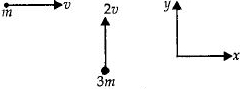
$A$ mass $m$ moving horizontally (along the $x-$axis) with velocity $v$ collides and sticks to a mass of $3m$ moving vertically upward (along the $y-$axis) with velocity $2v$. The final velocity of the combination is
A
$\frac{3}{2}v\hat i + \frac{1}{4}v\hat j$
B
$\frac{1}{4}v\hat i + \frac{3}{2}v\hat j$
C
$\frac{1}{3}v\hat i + \frac{2}{3}v\hat j$
D
$\frac{2}{3}v\hat i + \frac{1}{3}v\hat j$
Solution
(B) According to the law of conservation of linear momentum,the total momentum before the collision must equal the total momentum after the collision.
Let $\vec{v}'$ be the final velocity of the combined mass.
The initial momentum of mass $m$ is $\vec{p}_1 = m v \hat{i}$.
The initial momentum of mass $3m$ is $\vec{p}_2 = (3m)(2v) \hat{j} = 6mv \hat{j}$.
The total initial momentum is $\vec{p}_{initial} = m v \hat{i} + 6mv \hat{j}$.
The total mass after the collision is $M = m + 3m = 4m$.
The final momentum is $\vec{p}_{final} = (4m) \vec{v}'$.
Equating the two,we get:
$4m \vec{v}' = m v \hat{i} + 6mv \hat{j}$
$\vec{v}' = \frac{mv \hat{i} + 6mv \hat{j}}{4m}$
$\vec{v}' = \frac{1}{4}v \hat{i} + \frac{6}{4}v \hat{j} = \frac{1}{4}v \hat{i} + \frac{3}{2}v \hat{j}$.
Let $\vec{v}'$ be the final velocity of the combined mass.
The initial momentum of mass $m$ is $\vec{p}_1 = m v \hat{i}$.
The initial momentum of mass $3m$ is $\vec{p}_2 = (3m)(2v) \hat{j} = 6mv \hat{j}$.
The total initial momentum is $\vec{p}_{initial} = m v \hat{i} + 6mv \hat{j}$.
The total mass after the collision is $M = m + 3m = 4m$.
The final momentum is $\vec{p}_{final} = (4m) \vec{v}'$.
Equating the two,we get:
$4m \vec{v}' = m v \hat{i} + 6mv \hat{j}$
$\vec{v}' = \frac{mv \hat{i} + 6mv \hat{j}}{4m}$
$\vec{v}' = \frac{1}{4}v \hat{i} + \frac{6}{4}v \hat{j} = \frac{1}{4}v \hat{i} + \frac{3}{2}v \hat{j}$.
0 likes
View Solution54
DifficultMCQ
$A$ body of mass $m_1$ moving with a uniform velocity of $40 \, m/s$ collides with another mass $m_2$ at rest,and then the two together begin to move with a uniform velocity of $30 \, m/s$. The ratio of their masses $\frac{m_1}{m_2}$ is:
A
$0.75$
B
$1.33$
C
$3$
D
$4$
Solution
(C) According to the law of conservation of linear momentum,the total momentum before the collision is equal to the total momentum after the collision.
Initial momentum of the system = $m_1 \times 40 + m_2 \times 0 = 40m_1$.
Final momentum of the system = $(m_1 + m_2) \times 30 = 30m_1 + 30m_2$.
Equating the initial and final momentum:
$40m_1 = 30m_1 + 30m_2$
$40m_1 - 30m_1 = 30m_2$
$10m_1 = 30m_2$
$\frac{m_1}{m_2} = \frac{30}{10} = 3$.
Therefore,the ratio of their masses is $3$.
Initial momentum of the system = $m_1 \times 40 + m_2 \times 0 = 40m_1$.
Final momentum of the system = $(m_1 + m_2) \times 30 = 30m_1 + 30m_2$.
Equating the initial and final momentum:
$40m_1 = 30m_1 + 30m_2$
$40m_1 - 30m_1 = 30m_2$
$10m_1 = 30m_2$
$\frac{m_1}{m_2} = \frac{30}{10} = 3$.
Therefore,the ratio of their masses is $3$.

0 likes
View Solution55
DifficultMCQ
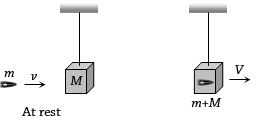
$A$ bag of sand of mass $M$ is suspended by a string. $A$ bullet of mass $m$ is fired at it with velocity $v$ and gets embedded into it. The loss of kinetic energy in this process is
A
$\frac{1}{2}m{v^2}$
B
$\frac{1}{2}m{v^2} \times \frac{1}{{M + m}}$
C
$\frac{1}{2}m{v^2} \times \frac{M}{m}$
D
$\frac{1}{2}m{v^2}\left( {\frac{M}{{M + m}}} \right)$
Solution
(D) Initial kinetic energy of the bullet is $K_i = \frac{1}{2}mv^2$.
After the perfectly inelastic collision,the bullet gets embedded in the sandbag,and the system moves with a common velocity $V$.
By the principle of conservation of linear momentum:
$mv + M(0) = (m + M)V$
$V = \frac{mv}{m + M}$
The final kinetic energy of the system is $K_f = \frac{1}{2}(m + M)V^2$.
Substituting the value of $V$:
$K_f = \frac{1}{2}(m + M) \left( \frac{mv}{m + M} \right)^2 = \frac{1}{2} \frac{m^2v^2}{m + M}$.
The loss in kinetic energy is $\Delta K = K_i - K_f$.
$\Delta K = \frac{1}{2}mv^2 - \frac{1}{2} \frac{m^2v^2}{m + M}$
$\Delta K = \frac{1}{2}mv^2 \left( 1 - \frac{m}{m + M} \right)$
$\Delta K = \frac{1}{2}mv^2 \left( \frac{m + M - m}{m + M} \right)$
$\Delta K = \frac{1}{2}mv^2 \left( \frac{M}{m + M} \right)$.
After the perfectly inelastic collision,the bullet gets embedded in the sandbag,and the system moves with a common velocity $V$.
By the principle of conservation of linear momentum:
$mv + M(0) = (m + M)V$
$V = \frac{mv}{m + M}$
The final kinetic energy of the system is $K_f = \frac{1}{2}(m + M)V^2$.
Substituting the value of $V$:
$K_f = \frac{1}{2}(m + M) \left( \frac{mv}{m + M} \right)^2 = \frac{1}{2} \frac{m^2v^2}{m + M}$.
The loss in kinetic energy is $\Delta K = K_i - K_f$.
$\Delta K = \frac{1}{2}mv^2 - \frac{1}{2} \frac{m^2v^2}{m + M}$
$\Delta K = \frac{1}{2}mv^2 \left( 1 - \frac{m}{m + M} \right)$
$\Delta K = \frac{1}{2}mv^2 \left( \frac{m + M - m}{m + M} \right)$
$\Delta K = \frac{1}{2}mv^2 \left( \frac{M}{m + M} \right)$.
0 likes
View Solution56
MediumMCQ
In a one-dimensional collision, a particle of mass $2m$ collides with a particle of mass $m$ at rest. If the particles stick together after the collision, what fraction of the initial kinetic energy is lost in the collision?
A
$1/4$
B
$1/3$
C
$1/2$
D
none
Solution
(B) Let the initial velocity of the particle with mass $2m$ be $u$. The particle with mass $m$ is at rest.
By the law of conservation of linear momentum, the final velocity $v$ of the combined mass $(2m + m = 3m)$ is:
$(2m)u + (m)(0) = (3m)v$
$v = \frac{2mu}{3m} = \frac{2u}{3}$
Initial kinetic energy $K_i = \frac{1}{2}(2m)u^2 = mu^2$.
Final kinetic energy $K_f = \frac{1}{2}(3m)v^2 = \frac{1}{2}(3m)\left(\frac{2u}{3}\right)^2 = \frac{3m}{2} \cdot \frac{4u^2}{9} = \frac{2}{3}mu^2$.
The loss in kinetic energy is $\Delta K = K_i - K_f = mu^2 - \frac{2}{3}mu^2 = \frac{1}{3}mu^2$.
The fraction of initial kinetic energy lost is $\frac{\Delta K}{K_i} = \frac{\frac{1}{3}mu^2}{mu^2} = \frac{1}{3}$.
By the law of conservation of linear momentum, the final velocity $v$ of the combined mass $(2m + m = 3m)$ is:
$(2m)u + (m)(0) = (3m)v$
$v = \frac{2mu}{3m} = \frac{2u}{3}$
Initial kinetic energy $K_i = \frac{1}{2}(2m)u^2 = mu^2$.
Final kinetic energy $K_f = \frac{1}{2}(3m)v^2 = \frac{1}{2}(3m)\left(\frac{2u}{3}\right)^2 = \frac{3m}{2} \cdot \frac{4u^2}{9} = \frac{2}{3}mu^2$.
The loss in kinetic energy is $\Delta K = K_i - K_f = mu^2 - \frac{2}{3}mu^2 = \frac{1}{3}mu^2$.
The fraction of initial kinetic energy lost is $\frac{\Delta K}{K_i} = \frac{\frac{1}{3}mu^2}{mu^2} = \frac{1}{3}$.
0 likes
View Solution57
MediumMCQ
$A$ block of mass $0.50 \ kg$ is moving with a speed of $2.00 \ m/s$ on a smooth surface. It strikes another mass of $1.00 \ kg$ at rest and then they move together as a single body. The energy loss during the collision is ............. $J$.
A
$0.34$
B
$0.16$
C
$1.00$
D
$0.67$
Solution
(D) Given: $m_1 = 0.50 \ kg$,$u_1 = 2.00 \ m/s$,$m_2 = 1.00 \ kg$,$u_2 = 0 \ m/s$.
Since the bodies move together after the collision,it is a perfectly inelastic collision.
The formula for energy loss in a perfectly inelastic collision is given by:
$\Delta K = \frac{m_1 m_2}{2(m_1 + m_2)} (u_1 - u_2)^2$
Substituting the values:
$\Delta K = \frac{0.50 \times 1.00}{2(0.50 + 1.00)} (2.00 - 0)^2$
$\Delta K = \frac{0.50}{2(1.50)} (4)$
$\Delta K = \frac{0.50}{3.00} \times 4 = \frac{2}{3} \approx 0.67 \ J$.
Since the bodies move together after the collision,it is a perfectly inelastic collision.
The formula for energy loss in a perfectly inelastic collision is given by:
$\Delta K = \frac{m_1 m_2}{2(m_1 + m_2)} (u_1 - u_2)^2$
Substituting the values:
$\Delta K = \frac{0.50 \times 1.00}{2(0.50 + 1.00)} (2.00 - 0)^2$
$\Delta K = \frac{0.50}{2(1.50)} (4)$
$\Delta K = \frac{0.50}{3.00} \times 4 = \frac{2}{3} \approx 0.67 \ J$.
0 likes
View Solution58
DifficultMCQ
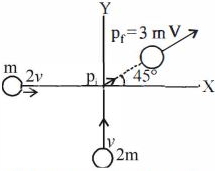
$A$ particle of mass $m$ moving in the $x$-direction with speed $2v$ is hit by another particle of mass $2m$ moving in the $y$-direction with speed $v$. If the collision is perfectly inelastic,the percentage loss in the energy during the collision is close to .............. $\%$
A
$50$
B
$56$
C
$62$
D
$44$
Solution
(B) Initial momentum of the system in $x$-direction: $p_x = m(2v) = 2mv$.
Initial momentum of the system in $y$-direction: $p_y = (2m)v = 2mv$.
Total initial kinetic energy: $K_i = \frac{1}{2}m(2v)^2 + \frac{1}{2}(2m)v^2 = 2mv^2 + mv^2 = 3mv^2$.
Since the collision is perfectly inelastic,the particles stick together. Let the final velocity be $V_f$ at an angle $\theta$.
By conservation of linear momentum: $p_f = \sqrt{p_x^2 + p_y^2} = \sqrt{(2mv)^2 + (2mv)^2} = 2\sqrt{2}mv$.
Also,$p_f = (m + 2m)V_f = 3mV_f$.
Equating the two: $3mV_f = 2\sqrt{2}mv \Rightarrow V_f = \frac{2\sqrt{2}}{3}v$.
Final kinetic energy: $K_f = \frac{1}{2}(3m)V_f^2 = \frac{3m}{2} \left( \frac{8v^2}{9} \right) = \frac{4}{3}mv^2$.
Loss in energy: $\Delta K = K_i - K_f = 3mv^2 - \frac{4}{3}mv^2 = \frac{5}{3}mv^2$.
Percentage loss: $\frac{\Delta K}{K_i} \times 100 = \frac{(5/3)mv^2}{3mv^2} \times 100 = \frac{5}{9} \times 100 \approx 55.55\% \approx 56\%$.
Initial momentum of the system in $y$-direction: $p_y = (2m)v = 2mv$.
Total initial kinetic energy: $K_i = \frac{1}{2}m(2v)^2 + \frac{1}{2}(2m)v^2 = 2mv^2 + mv^2 = 3mv^2$.
Since the collision is perfectly inelastic,the particles stick together. Let the final velocity be $V_f$ at an angle $\theta$.
By conservation of linear momentum: $p_f = \sqrt{p_x^2 + p_y^2} = \sqrt{(2mv)^2 + (2mv)^2} = 2\sqrt{2}mv$.
Also,$p_f = (m + 2m)V_f = 3mV_f$.
Equating the two: $3mV_f = 2\sqrt{2}mv \Rightarrow V_f = \frac{2\sqrt{2}}{3}v$.
Final kinetic energy: $K_f = \frac{1}{2}(3m)V_f^2 = \frac{3m}{2} \left( \frac{8v^2}{9} \right) = \frac{4}{3}mv^2$.
Loss in energy: $\Delta K = K_i - K_f = 3mv^2 - \frac{4}{3}mv^2 = \frac{5}{3}mv^2$.
Percentage loss: $\frac{\Delta K}{K_i} \times 100 = \frac{(5/3)mv^2}{3mv^2} \times 100 = \frac{5}{9} \times 100 \approx 55.55\% \approx 56\%$.
0 likes
View Solution59
DifficultMCQ
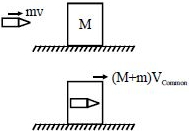
$A$ bullet of mass $m$ travelling at speed $v$ strikes a block of mass $M$ at rest and gets embedded in it. Finally,both will have a combined kinetic energy of:
A
$\frac{1}{2}mv^2 \times \left( \frac{m}{m + M} \right)$
B
$\frac{1}{2}mv^2 \times \left( \frac{M}{m + M} \right)$
C
$\frac{1}{2}mv^2 \times \left( \frac{M + m}{M} \right)$
D
$\frac{1}{2}mv^2 \times \left( \frac{M + m}{m} \right)$
Solution
(A) According to the law of conservation of linear momentum,the initial momentum of the system is equal to the final momentum.
$mv + M(0) = (M + m)V_{\text{common}}$
$\therefore V_{\text{common}} = \frac{mv}{M + m}$
Now,the final kinetic energy $(KE_{\text{final}})$ of the combined system is given by:
$KE_{\text{final}} = \frac{1}{2}(M + m)V_{\text{common}}^2$
Substituting the value of $V_{\text{common}}$:
$KE_{\text{final}} = \frac{1}{2}(M + m) \left( \frac{mv}{M + m} \right)^2$
$KE_{\text{final}} = \frac{1}{2}(M + m) \frac{m^2v^2}{(M + m)^2}$
$KE_{\text{final}} = \frac{1}{2}mv^2 \times \left( \frac{m}{M + m} \right)$
$mv + M(0) = (M + m)V_{\text{common}}$
$\therefore V_{\text{common}} = \frac{mv}{M + m}$
Now,the final kinetic energy $(KE_{\text{final}})$ of the combined system is given by:
$KE_{\text{final}} = \frac{1}{2}(M + m)V_{\text{common}}^2$
Substituting the value of $V_{\text{common}}$:
$KE_{\text{final}} = \frac{1}{2}(M + m) \left( \frac{mv}{M + m} \right)^2$
$KE_{\text{final}} = \frac{1}{2}(M + m) \frac{m^2v^2}{(M + m)^2}$
$KE_{\text{final}} = \frac{1}{2}mv^2 \times \left( \frac{m}{M + m} \right)$
0 likes
View Solution60
AdvancedMCQ
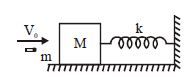
$A$ bullet of mass $m$ strikes a block of mass $M$ connected to a light spring of stiffness $k$,with a speed $V_0$. If the bullet gets embedded in the block,then the maximum compression in the spring is
A
${\left( {\frac{{{m^2}V_0^2}}{{(M + m)k}}} \right)^{1/2}}$
B
${\left( {\frac{{Mmv_0^2}}{{2(M + m)k}}} \right)^{1/2}}$
C
${\left( {\frac{{Mv_0^2}}{{2(M + m)k}}} \right)^{1/2}}$
D
${\left( {\frac{{m{V_0^2}}}{{(M + m)k}}} \right)^{1/2}}$
Solution
(A) Step $1$: Apply the principle of conservation of linear momentum during the collision.
Since the bullet gets embedded in the block,the collision is perfectly inelastic.
Let $V'$ be the velocity of the combined system $(M+m)$ immediately after the collision.
$m V_0 = (M + m) V'$
$V' = \frac{m V_0}{M + m}$
Step $2$: Apply the law of conservation of energy for the system after the collision.
The kinetic energy of the system is converted into the potential energy of the spring at maximum compression $X_{\max}$.
$\frac{1}{2} (M + m) (V')^2 = \frac{1}{2} k X_{\max}^2$
$(M + m) \left( \frac{m V_0}{M + m} \right)^2 = k X_{\max}^2$
$\frac{m^2 V_0^2}{M + m} = k X_{\max}^2$
$X_{\max}^2 = \frac{m^2 V_0^2}{(M + m)k}$
$X_{\max} = \sqrt{\frac{m^2 V_0^2}{(M + m)k}} = \left( \frac{m^2 V_0^2}{(M + m)k} \right)^{1/2}$
Since the bullet gets embedded in the block,the collision is perfectly inelastic.
Let $V'$ be the velocity of the combined system $(M+m)$ immediately after the collision.
$m V_0 = (M + m) V'$
$V' = \frac{m V_0}{M + m}$
Step $2$: Apply the law of conservation of energy for the system after the collision.
The kinetic energy of the system is converted into the potential energy of the spring at maximum compression $X_{\max}$.
$\frac{1}{2} (M + m) (V')^2 = \frac{1}{2} k X_{\max}^2$
$(M + m) \left( \frac{m V_0}{M + m} \right)^2 = k X_{\max}^2$
$\frac{m^2 V_0^2}{M + m} = k X_{\max}^2$
$X_{\max}^2 = \frac{m^2 V_0^2}{(M + m)k}$
$X_{\max} = \sqrt{\frac{m^2 V_0^2}{(M + m)k}} = \left( \frac{m^2 V_0^2}{(M + m)k} \right)^{1/2}$
0 likes
View Solution61
DifficultMCQ
Two identical masses $M$ moving with velocities $\mu_1$ and $\mu_2$ collide perfectly inelastically. The loss in energy is
A
$\frac{M}{2}(\mu_2 - \mu_1)^2$
B
$\frac{M}{2}(\mu_1 - \mu_2)^2$
C
$\frac{M}{4}(\mu_1 - \mu_2)^2$
D
$\frac{M}{4}(\mu_2 - \mu_1)^2$
Solution
(C) For a perfectly inelastic collision,the coefficient of restitution $e = 0$.
Using the law of conservation of linear momentum:
$M\mu_1 + M\mu_2 = (M + M)V$
$M(\mu_1 + \mu_2) = 2MV$
$V = \frac{\mu_1 + \mu_2}{2}$
Initial kinetic energy $(K_i)$:
$K_i = \frac{1}{2}M\mu_1^2 + \frac{1}{2}M\mu_2^2 = \frac{M}{2}(\mu_1^2 + \mu_2^2)$
Final kinetic energy $(K_f)$:
$K_f = \frac{1}{2}(2M)V^2 = M \left( \frac{\mu_1 + \mu_2}{2} \right)^2 = \frac{M}{4}(\mu_1^2 + \mu_2^2 + 2\mu_1\mu_2)$
Loss in energy $(\Delta K = K_i - K_f)$:
$\Delta K = \frac{M}{2}(\mu_1^2 + \mu_2^2) - \frac{M}{4}(\mu_1^2 + \mu_2^2 + 2\mu_1\mu_2)$
$\Delta K = \frac{M}{4} [2\mu_1^2 + 2\mu_2^2 - \mu_1^2 - \mu_2^2 - 2\mu_1\mu_2]$
$\Delta K = \frac{M}{4}(\mu_1^2 + \mu_2^2 - 2\mu_1\mu_2)$
$\Delta K = \frac{M}{4}(\mu_1 - \mu_2)^2$
Using the law of conservation of linear momentum:
$M\mu_1 + M\mu_2 = (M + M)V$
$M(\mu_1 + \mu_2) = 2MV$
$V = \frac{\mu_1 + \mu_2}{2}$
Initial kinetic energy $(K_i)$:
$K_i = \frac{1}{2}M\mu_1^2 + \frac{1}{2}M\mu_2^2 = \frac{M}{2}(\mu_1^2 + \mu_2^2)$
Final kinetic energy $(K_f)$:
$K_f = \frac{1}{2}(2M)V^2 = M \left( \frac{\mu_1 + \mu_2}{2} \right)^2 = \frac{M}{4}(\mu_1^2 + \mu_2^2 + 2\mu_1\mu_2)$
Loss in energy $(\Delta K = K_i - K_f)$:
$\Delta K = \frac{M}{2}(\mu_1^2 + \mu_2^2) - \frac{M}{4}(\mu_1^2 + \mu_2^2 + 2\mu_1\mu_2)$
$\Delta K = \frac{M}{4} [2\mu_1^2 + 2\mu_2^2 - \mu_1^2 - \mu_2^2 - 2\mu_1\mu_2]$
$\Delta K = \frac{M}{4}(\mu_1^2 + \mu_2^2 - 2\mu_1\mu_2)$
$\Delta K = \frac{M}{4}(\mu_1 - \mu_2)^2$
0 likes
View Solution62
DifficultMCQ
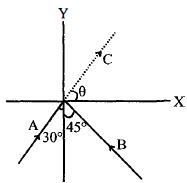
Two particles $A$ and $B$ of equal mass $M$ are moving with the same speed $v$ as shown in the figure. They collide completely inelastically and move as a single particle $C$. The angle $\theta$ that the path of $C$ makes with the $X$-axis is given by
A
$\tan \theta = \frac{\sqrt{3} + \sqrt{2}}{1 - \sqrt{2}}$
B
$\tan \theta = \frac{\sqrt{3} - \sqrt{2}}{1 - \sqrt{2}}$
C
$\tan \theta = \frac{1 - \sqrt{2}}{\sqrt{2}(1 + \sqrt{3})}$
D
$\tan \theta = \frac{1 - \sqrt{3}}{1 + \sqrt{2}}$
Solution
(A) Let the mass of each particle be $M$ and their speed be $v$. After the collision,they form a single particle $C$ of mass $2M$ moving with velocity $v'$ at an angle $\theta$ with the $X$-axis.
Applying the law of conservation of linear momentum along the $X$ and $Y$ axes:
Along the $X$-axis:
$P_{ix} = P_{fx}$
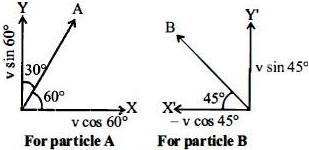
$Mv \cos(60^{\circ}) - Mv \cos(45^{\circ}) = (2M)v' \cos \theta$
$v(\frac{1}{2} - \frac{1}{\sqrt{2}}) = 2v' \cos \theta \quad ... (i)$
Along the $Y$-axis:
$P_{iy} = P_{fy}$
$Mv \sin(60^{\circ}) + Mv \sin(45^{\circ}) = (2M)v' \sin \theta$
$v(\frac{\sqrt{3}}{2} + \frac{1}{\sqrt{2}}) = 2v' \sin \theta \quad ... (ii)$
Dividing equation $(ii)$ by equation $(i)$:
$\tan \theta = \frac{v(\frac{\sqrt{3}}{2} + \frac{1}{\sqrt{2}})}{v(\frac{1}{2} - \frac{1}{\sqrt{2}})} = \frac{\sqrt{3} + \sqrt{2}}{1 - \sqrt{2}}$
Applying the law of conservation of linear momentum along the $X$ and $Y$ axes:
Along the $X$-axis:
$P_{ix} = P_{fx}$
$Mv \cos(60^{\circ}) - Mv \cos(45^{\circ}) = (2M)v' \cos \theta$
$v(\frac{1}{2} - \frac{1}{\sqrt{2}}) = 2v' \cos \theta \quad ... (i)$
Along the $Y$-axis:
$P_{iy} = P_{fy}$
$Mv \sin(60^{\circ}) + Mv \sin(45^{\circ}) = (2M)v' \sin \theta$
$v(\frac{\sqrt{3}}{2} + \frac{1}{\sqrt{2}}) = 2v' \sin \theta \quad ... (ii)$
Dividing equation $(ii)$ by equation $(i)$:
$\tan \theta = \frac{v(\frac{\sqrt{3}}{2} + \frac{1}{\sqrt{2}})}{v(\frac{1}{2} - \frac{1}{\sqrt{2}})} = \frac{\sqrt{3} + \sqrt{2}}{1 - \sqrt{2}}$
0 likes
View Solution63
DifficultMCQ
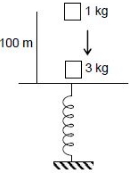
$A$ body of mass $1\,kg$ falls freely from a height of $100\,m$ onto a platform of mass $3\,kg$ which is mounted on a spring having spring constant $k = 1.25 \times 10^6\,N/m.$ The body sticks to the platform and the spring's maximum compression is found to be $x.$ Given that $g = 10\,m/s^2,$ the value of $x$ will be close to ................ $cm$.
A
$40$
B
$4$
C
$80$
D
$2$
Solution
(D) $1$. Velocity of the $1\,kg$ body just before hitting the platform: $v = \sqrt{2gh} = \sqrt{2 \times 10 \times 100} = \sqrt{2000} = 20\sqrt{5}\,m/s.$
$2$. Using the Conservation of Linear Momentum $(COLM)$ during the perfectly inelastic collision: $m_1 v = (m_1 + m_2) v',$
where $v'$ is the velocity of the combined mass $(1+3 = 4\,kg)$ immediately after the collision.
$1 \times 20\sqrt{5} = 4 \times v' \implies v' = 5\sqrt{5}\,m/s.$
$3$. Using the Conservation of Mechanical Energy for the system from the point of collision to the point of maximum compression $x$:
The initial kinetic energy of the combined mass is converted into the potential energy of the spring and the gravitational potential energy change.
Let the equilibrium position of the spring be the reference level. The platform is already compressed by $x_0 = \frac{m_2 g}{k} = \frac{3 \times 10}{1.25 \times 10^6} = 2.4 \times 10^{-5}\,m,$ which is negligible.
Applying energy conservation: $\frac{1}{2} M (v')^2 + M g x = \frac{1}{2} k x^2,$
where $M = 4\,kg.$
$\frac{1}{2} \times 4 \times (5\sqrt{5})^2 + 4 \times 10 \times x = \frac{1}{2} \times 1.25 \times 10^6 \times x^2.$
$2 \times 125 + 40x = 6.25 \times 10^5 x^2.$
$6.25 \times 10^5 x^2 - 40x - 250 = 0.$
Since $x$ is very small,$40x$ is negligible compared to $250$ and $6.25 \times 10^5 x^2.$
$6.25 \times 10^5 x^2 \approx 250 \implies x^2 \approx \frac{250}{6.25 \times 10^5} = 40 \times 10^{-5} = 4 \times 10^{-4}.$
$x = 0.02\,m = 2\,cm.$
$2$. Using the Conservation of Linear Momentum $(COLM)$ during the perfectly inelastic collision: $m_1 v = (m_1 + m_2) v',$
where $v'$ is the velocity of the combined mass $(1+3 = 4\,kg)$ immediately after the collision.
$1 \times 20\sqrt{5} = 4 \times v' \implies v' = 5\sqrt{5}\,m/s.$
$3$. Using the Conservation of Mechanical Energy for the system from the point of collision to the point of maximum compression $x$:
The initial kinetic energy of the combined mass is converted into the potential energy of the spring and the gravitational potential energy change.
Let the equilibrium position of the spring be the reference level. The platform is already compressed by $x_0 = \frac{m_2 g}{k} = \frac{3 \times 10}{1.25 \times 10^6} = 2.4 \times 10^{-5}\,m,$ which is negligible.
Applying energy conservation: $\frac{1}{2} M (v')^2 + M g x = \frac{1}{2} k x^2,$
where $M = 4\,kg.$
$\frac{1}{2} \times 4 \times (5\sqrt{5})^2 + 4 \times 10 \times x = \frac{1}{2} \times 1.25 \times 10^6 \times x^2.$
$2 \times 125 + 40x = 6.25 \times 10^5 x^2.$
$6.25 \times 10^5 x^2 - 40x - 250 = 0.$
Since $x$ is very small,$40x$ is negligible compared to $250$ and $6.25 \times 10^5 x^2.$
$6.25 \times 10^5 x^2 \approx 250 \implies x^2 \approx \frac{250}{6.25 \times 10^5} = 40 \times 10^{-5} = 4 \times 10^{-4}.$
$x = 0.02\,m = 2\,cm.$
0 likes
View Solution64
MediumMCQ
$A$ scooter of $40\,kg$ mass moving with velocity $4\,m/s$ collides with another scooter of $60\,kg$ mass moving with velocity $2\,m/s$ in the same direction. After the collision,the two scooters stick to each other. The loss in kinetic energy is .............. $J$.
A
$392$
B
$440$
C
$48$
D
$110$
Solution
(C) Initial kinetic energy $K_i = \frac{1}{2} m_1 v_1^2 + \frac{1}{2} m_2 v_2^2 = \frac{1}{2} (40)(4)^2 + \frac{1}{2} (60)(2)^2 = 320 + 120 = 440\,J$.
By the Law of Conservation of Linear Momentum,$m_1 v_1 + m_2 v_2 = (m_1 + m_2) V_c$.
$40(4) + 60(2) = (40 + 60) V_c \implies 160 + 120 = 100 V_c \implies 280 = 100 V_c \implies V_c = 2.8\,m/s$.
Final kinetic energy $K_f = \frac{1}{2} (m_1 + m_2) V_c^2 = \frac{1}{2} (100) (2.8)^2 = 50 \times 7.84 = 392\,J$.
Loss in kinetic energy $\Delta K = K_i - K_f = 440 - 392 = 48\,J$.
Alternatively,for a perfectly inelastic collision: $(\Delta K)_{\text{loss}} = \frac{1}{2} \frac{m_1 m_2}{m_1 + m_2} (v_1 - v_2)^2 = \frac{1}{2} \times \frac{40 \times 60}{100} \times (4 - 2)^2 = \frac{1}{2} \times 24 \times 4 = 48\,J$.
By the Law of Conservation of Linear Momentum,$m_1 v_1 + m_2 v_2 = (m_1 + m_2) V_c$.
$40(4) + 60(2) = (40 + 60) V_c \implies 160 + 120 = 100 V_c \implies 280 = 100 V_c \implies V_c = 2.8\,m/s$.
Final kinetic energy $K_f = \frac{1}{2} (m_1 + m_2) V_c^2 = \frac{1}{2} (100) (2.8)^2 = 50 \times 7.84 = 392\,J$.
Loss in kinetic energy $\Delta K = K_i - K_f = 440 - 392 = 48\,J$.
Alternatively,for a perfectly inelastic collision: $(\Delta K)_{\text{loss}} = \frac{1}{2} \frac{m_1 m_2}{m_1 + m_2} (v_1 - v_2)^2 = \frac{1}{2} \times \frac{40 \times 60}{100} \times (4 - 2)^2 = \frac{1}{2} \times 24 \times 4 = 48\,J$.
0 likes
View Solution65
MediumMCQ
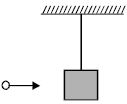
$A$ bullet of mass $m$ moving with a speed $v$ strikes a wooden block of mass $M$ and gets embedded into the block. The final speed is
A
$\sqrt {\frac{M}{{M + m}}} v$
B
$\sqrt {\frac{m}{{M + m}}} v$
C
$\frac{m}{{M + m}}v$
D
$\frac {v}{2}$
Solution
(C) According to the law of conservation of linear momentum,the total momentum before the collision is equal to the total momentum after the collision.
Let the final speed of the combined system be $v_f$.
The initial momentum of the system is $p_i = mv + M(0) = mv$.
The final momentum of the system is $p_f = (M + m)v_f$.
Since $p_i = p_f$,we have:
$mv = (M + m)v_f$
Solving for $v_f$,we get:
$v_f = \frac{m}{M + m}v$
Let the final speed of the combined system be $v_f$.
The initial momentum of the system is $p_i = mv + M(0) = mv$.
The final momentum of the system is $p_f = (M + m)v_f$.
Since $p_i = p_f$,we have:
$mv = (M + m)v_f$
Solving for $v_f$,we get:
$v_f = \frac{m}{M + m}v$
0 likes
View Solution66
MediumMCQ
$A$ body of mass $2 \ kg$ moving with a velocity of $6 \ m/s$ strikes inelastically another body of same mass at rest. The amount of heat evolved during collision is ............... $J$.
A
$36$
B
$18$
C
$9$
D
$3$
Solution
(B) Initial kinetic energy of the system: $K_i = \frac{1}{2} m u_1^2 + \frac{1}{2} m u_2^2 = \frac{1}{2} \times 2 \times (6)^2 + 0 = 36 \ J$.
By the law of conservation of linear momentum: $m u_1 + m u_2 = (m + m) v$.
$2 \times 6 + 2 \times 0 = (2 + 2) v \implies 12 = 4v \implies v = 3 \ m/s$.
Final kinetic energy of the system: $K_f = \frac{1}{2} (m + m) v^2 = \frac{1}{2} \times 4 \times (3)^2 = 2 \times 9 = 18 \ J$.
The heat evolved is equal to the loss in kinetic energy: $\Delta K = K_i - K_f = 36 \ J - 18 \ J = 18 \ J$.
By the law of conservation of linear momentum: $m u_1 + m u_2 = (m + m) v$.
$2 \times 6 + 2 \times 0 = (2 + 2) v \implies 12 = 4v \implies v = 3 \ m/s$.
Final kinetic energy of the system: $K_f = \frac{1}{2} (m + m) v^2 = \frac{1}{2} \times 4 \times (3)^2 = 2 \times 9 = 18 \ J$.
The heat evolved is equal to the loss in kinetic energy: $\Delta K = K_i - K_f = 36 \ J - 18 \ J = 18 \ J$.
0 likes
View Solution67
MediumMCQ
$A$ body of mass $5\,kg$ strikes another body of mass $2.5\,kg$ initially at rest. The bodies after collision coalesce and begin to move as a whole with a kinetic energy of $5\,J$. The kinetic energy of the first body before collision is ............... $J$.
A
$7.5$
B
$5$
C
$2.5$
D
$10$
Solution
(A) Let the mass of the first body be $m_1 = 5\,kg$ and its initial velocity be $u$. Let the mass of the second body be $m_2 = 2.5\,kg$ with initial velocity $u_2 = 0$.
By the law of conservation of linear momentum: $m_1 u + m_2 u_2 = (m_1 + m_2) v$,where $v$ is the final common velocity.
$5u + 0 = (5 + 2.5)v \Rightarrow 5u = 7.5v \Rightarrow v = \frac{5}{7.5}u = \frac{2}{3}u$.
The final kinetic energy of the combined mass is $K_f = \frac{1}{2}(m_1 + m_2)v^2 = 5\,J$.
Substituting the values: $\frac{1}{2} \times 7.5 \times (\frac{2}{3}u)^2 = 5$.
$3.75 \times \frac{4}{9}u^2 = 5 \Rightarrow \frac{15}{9}u^2 = 5 \Rightarrow \frac{5}{3}u^2 = 5 \Rightarrow u^2 = 3$.
The initial kinetic energy of the first body is $K_i = \frac{1}{2}m_1 u^2 = \frac{1}{2} \times 5 \times 3 = 7.5\,J$.
By the law of conservation of linear momentum: $m_1 u + m_2 u_2 = (m_1 + m_2) v$,where $v$ is the final common velocity.
$5u + 0 = (5 + 2.5)v \Rightarrow 5u = 7.5v \Rightarrow v = \frac{5}{7.5}u = \frac{2}{3}u$.
The final kinetic energy of the combined mass is $K_f = \frac{1}{2}(m_1 + m_2)v^2 = 5\,J$.
Substituting the values: $\frac{1}{2} \times 7.5 \times (\frac{2}{3}u)^2 = 5$.
$3.75 \times \frac{4}{9}u^2 = 5 \Rightarrow \frac{15}{9}u^2 = 5 \Rightarrow \frac{5}{3}u^2 = 5 \Rightarrow u^2 = 3$.
The initial kinetic energy of the first body is $K_i = \frac{1}{2}m_1 u^2 = \frac{1}{2} \times 5 \times 3 = 7.5\,J$.
0 likes
View Solution68
DifficultMCQ
$A$ bullet of mass $m$ moving with velocity $v$ strikes a block of mass $M$ at rest and gets embedded into it. The kinetic energy of the composite block will be
A
$\frac{1}{2}mv^2 \times \frac{m}{m+M}$
B
$\frac{1}{2}mv^2 \times \frac{M}{m+M}$
C
$\frac{1}{2}mv^2 \times \frac{M+m}{M}$
D
$\frac{1}{2}mv^2 \times \frac{2m}{M+m}$
Solution
(A) Initial momentum of the system,$p_i = mv$.
Let $V$ be the velocity of the composite system after the collision.
Final momentum of the system,$p_f = (m+M)V$.
By the law of conservation of linear momentum,$p_i = p_f$,so $mv = (m+M)V$.
Therefore,the velocity of the composite block is $V = \frac{mv}{m+M}$.
The kinetic energy of the composite block is $K = \frac{1}{2}(m+M)V^2$.
Substituting the value of $V$,we get $K = \frac{1}{2}(m+M) \left( \frac{mv}{m+M} \right)^2$.
Simplifying this expression,$K = \frac{1}{2}(m+M) \frac{m^2v^2}{(m+M)^2} = \frac{1}{2}mv^2 \times \frac{m}{m+M}$.
Let $V$ be the velocity of the composite system after the collision.
Final momentum of the system,$p_f = (m+M)V$.
By the law of conservation of linear momentum,$p_i = p_f$,so $mv = (m+M)V$.
Therefore,the velocity of the composite block is $V = \frac{mv}{m+M}$.
The kinetic energy of the composite block is $K = \frac{1}{2}(m+M)V^2$.
Substituting the value of $V$,we get $K = \frac{1}{2}(m+M) \left( \frac{mv}{m+M} \right)^2$.
Simplifying this expression,$K = \frac{1}{2}(m+M) \frac{m^2v^2}{(m+M)^2} = \frac{1}{2}mv^2 \times \frac{m}{m+M}$.
0 likes
View Solution69
MediumMCQ
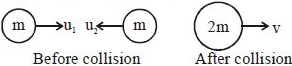
Two masses of $0.25\, kg$ each move towards each other with speeds of $3\, ms^{-1}$ and $1\, ms^{-1}$. They collide and stick together. Find the final velocity in $ms^{-1}$.
A
$0.5$
B
$2$
C
$1$
D
$0.25$
Solution
(C) Given: $m_1 = m_2 = 0.25\, kg$,$u_1 = 3\, ms^{-1}$,$u_2 = -1\, ms^{-1}$.
Since the masses move towards each other,we take one velocity as positive and the other as negative.
This is a perfectly inelastic collision where the bodies stick together after the collision.
According to the law of conservation of linear momentum:
$m_1 u_1 + m_2 u_2 = (m_1 + m_2) v$
Substituting the values:
$(0.25)(3) + (0.25)(-1) = (0.25 + 0.25) v$
$0.75 - 0.25 = 0.5 v$
$0.5 = 0.5 v$
$v = 1\, ms^{-1}$.
Since the masses move towards each other,we take one velocity as positive and the other as negative.
This is a perfectly inelastic collision where the bodies stick together after the collision.
According to the law of conservation of linear momentum:
$m_1 u_1 + m_2 u_2 = (m_1 + m_2) v$
Substituting the values:
$(0.25)(3) + (0.25)(-1) = (0.25 + 0.25) v$
$0.75 - 0.25 = 0.5 v$
$0.5 = 0.5 v$
$v = 1\, ms^{-1}$.
0 likes
View Solution70
MediumMCQ
$A$ body of mass $2 \, kg$ moving with a velocity $(\hat{i} + \hat{j} + \hat{k}) \, m/s$ collides with another body of mass $5 \, kg$ moving with velocity $(\hat{i} - 2\hat{j} + 3\hat{k}) \, m/s$. If they stick together,the velocity (in $m/s$) of the composite body is:
A
$(\hat{i} - \frac{8}{7}\hat{j} + \frac{17}{7}\hat{k})$
B
$(\hat{i} - \frac{8}{7}\hat{j} + \frac{17}{7}\hat{k})$
C
$(-\hat{i} - \frac{8}{7}\hat{j} - \frac{17}{7}\hat{k})$
D
$(\hat{i} + \frac{8}{7}\hat{j} + \frac{17}{7}\hat{k})$
Solution
(B) According to the law of conservation of linear momentum,the total momentum before collision equals the total momentum after collision.
$m_1\vec{v}_1 + m_2\vec{v}_2 = (m_1 + m_2)\vec{v}_{final}$
Given $m_1 = 2 \, kg$,$\vec{v}_1 = (\hat{i} + \hat{j} + \hat{k}) \, m/s$ and $m_2 = 5 \, kg$,$\vec{v}_2 = (\hat{i} - 2\hat{j} + 3\hat{k}) \, m/s$.
Substituting the values:
$2(\hat{i} + \hat{j} + \hat{k}) + 5(\hat{i} - 2\hat{j} + 3\hat{k}) = (2 + 5)\vec{v}_{final}$
$(2\hat{i} + 2\hat{j} + 2\hat{k}) + (5\hat{i} - 10\hat{j} + 15\hat{k}) = 7\vec{v}_{final}$
$(7\hat{i} - 8\hat{j} + 17\hat{k}) = 7\vec{v}_{final}$
$\vec{v}_{final} = \frac{7}{7}\hat{i} - \frac{8}{7}\hat{j} + \frac{17}{7}\hat{k} = (\hat{i} - \frac{8}{7}\hat{j} + \frac{17}{7}\hat{k}) \, m/s$.
$m_1\vec{v}_1 + m_2\vec{v}_2 = (m_1 + m_2)\vec{v}_{final}$
Given $m_1 = 2 \, kg$,$\vec{v}_1 = (\hat{i} + \hat{j} + \hat{k}) \, m/s$ and $m_2 = 5 \, kg$,$\vec{v}_2 = (\hat{i} - 2\hat{j} + 3\hat{k}) \, m/s$.
Substituting the values:
$2(\hat{i} + \hat{j} + \hat{k}) + 5(\hat{i} - 2\hat{j} + 3\hat{k}) = (2 + 5)\vec{v}_{final}$
$(2\hat{i} + 2\hat{j} + 2\hat{k}) + (5\hat{i} - 10\hat{j} + 15\hat{k}) = 7\vec{v}_{final}$
$(7\hat{i} - 8\hat{j} + 17\hat{k}) = 7\vec{v}_{final}$
$\vec{v}_{final} = \frac{7}{7}\hat{i} - \frac{8}{7}\hat{j} + \frac{17}{7}\hat{k} = (\hat{i} - \frac{8}{7}\hat{j} + \frac{17}{7}\hat{k}) \, m/s$.
0 likes
View Solution71
DifficultMCQ
$A$ body of mass $m$ moving with velocity $v$ makes a head-on perfectly inelastic collision with another body of mass $2m$ which is initially at rest. What is the percentage loss in the kinetic energy?
A
$50\,\%$
B
$\frac{200}{3}\,\%$
C
$\frac{800}{3}\,\%$
D
$25\,\%$
Solution
(B) According to the law of conservation of linear momentum,the total momentum before collision equals the total momentum after collision.
$mv + (2m)(0) = (m + 2m)v'$
$mv = 3mv'$
$v' = \frac{v}{3}$
The initial kinetic energy is $KE_i = \frac{1}{2}mv^2$.
The final kinetic energy is $KE_f = \frac{1}{2}(m + 2m)(v')^2 = \frac{1}{2}(3m)(\frac{v}{3})^2 = \frac{1}{2}(3m)(\frac{v^2}{9}) = \frac{1}{6}mv^2$.
The loss in kinetic energy is $\Delta KE = KE_i - KE_f = \frac{1}{2}mv^2 - \frac{1}{6}mv^2 = \frac{3-1}{6}mv^2 = \frac{2}{6}mv^2 = \frac{1}{3}mv^2$.
The percentage loss in kinetic energy is $\frac{\Delta KE}{KE_i} \times 100 = \frac{\frac{1}{3}mv^2}{\frac{1}{2}mv^2} \times 100 = \frac{2}{3} \times 100 = \frac{200}{3}\,\%$.
$mv + (2m)(0) = (m + 2m)v'$
$mv = 3mv'$
$v' = \frac{v}{3}$
The initial kinetic energy is $KE_i = \frac{1}{2}mv^2$.
The final kinetic energy is $KE_f = \frac{1}{2}(m + 2m)(v')^2 = \frac{1}{2}(3m)(\frac{v}{3})^2 = \frac{1}{2}(3m)(\frac{v^2}{9}) = \frac{1}{6}mv^2$.
The loss in kinetic energy is $\Delta KE = KE_i - KE_f = \frac{1}{2}mv^2 - \frac{1}{6}mv^2 = \frac{3-1}{6}mv^2 = \frac{2}{6}mv^2 = \frac{1}{3}mv^2$.
The percentage loss in kinetic energy is $\frac{\Delta KE}{KE_i} \times 100 = \frac{\frac{1}{3}mv^2}{\frac{1}{2}mv^2} \times 100 = \frac{2}{3} \times 100 = \frac{200}{3}\,\%$.
0 likes
View Solution72
DifficultMCQ
$A$ body of mass $2\, kg$ moving with a velocity of $3\, m/s$ collides head-on with a body of mass $1\, kg$ moving in the opposite direction with a velocity of $4\, m/s$. After the collision,the two bodies stick together and move with a common velocity. The common velocity in $m/s$ is equal to:
A
$1/4$
B
$1/3$
C
$2/3$
D
$3/4$
Solution
(C) According to the law of conservation of linear momentum,the total momentum before the collision is equal to the total momentum after the collision.
Let the mass of the first body be $m_1 = 2\, kg$ and its velocity be $u_1 = 3\, m/s$.
Let the mass of the second body be $m_2 = 1\, kg$ and its velocity be $u_2 = -4\, m/s$ (since it is moving in the opposite direction).
Let the common velocity after the collision be $v$.
Using the conservation of momentum: $m_1 u_1 + m_2 u_2 = (m_1 + m_2) v$.
Substituting the values: $(2 \times 3) + (1 \times -4) = (2 + 1) v$.
$6 - 4 = 3v$.
$2 = 3v$.
$v = 2/3\, m/s$.
Let the mass of the first body be $m_1 = 2\, kg$ and its velocity be $u_1 = 3\, m/s$.
Let the mass of the second body be $m_2 = 1\, kg$ and its velocity be $u_2 = -4\, m/s$ (since it is moving in the opposite direction).
Let the common velocity after the collision be $v$.
Using the conservation of momentum: $m_1 u_1 + m_2 u_2 = (m_1 + m_2) v$.
Substituting the values: $(2 \times 3) + (1 \times -4) = (2 + 1) v$.
$6 - 4 = 3v$.
$2 = 3v$.
$v = 2/3\, m/s$.
0 likes
View Solution73
DifficultMCQ
Two particles of equal mass $m$ have respective initial velocities $u\hat{i}$ and $u\left(\frac{\hat{i}+ \hat{j}}{2}\right)$. They collide completely inelastically. The energy lost in the process is
A
$\frac{3}{4} mu^{2}$
B
$\frac{1}{8} mu^{2}$
C
$\sqrt{\frac{2}{3}} mu^{2}$
D
$\frac{1}{3} mu^{2}$
Solution
(B) Initial momentum of the system: $\vec{P}_i = m(u\hat{i}) + m\left(\frac{u}{2}\hat{i} + \frac{u}{2}\hat{j}\right) = \frac{3}{2}mu\hat{i} + \frac{1}{2}mu\hat{j}$.
Since the collision is completely inelastic,the particles stick together and move with a common velocity $\vec{v}_f$. By conservation of linear momentum: $\vec{P}_i = (m+m)\vec{v}_f = 2m\vec{v}_f$.
$\vec{v}_f = \frac{1}{2m} \left(\frac{3}{2}mu\hat{i} + \frac{1}{2}mu\hat{j}\right) = \frac{3}{4}u\hat{i} + \frac{1}{4}u\hat{j}$.
Initial kinetic energy: $K_i = \frac{1}{2}mu^2 + \frac{1}{2}m\left|\frac{u}{2}\hat{i} + \frac{u}{2}\hat{j}\right|^2 = \frac{1}{2}mu^2 + \frac{1}{2}m\left(\frac{u^2}{4} + \frac{u^2}{4}\right) = \frac{1}{2}mu^2 + \frac{1}{4}mu^2 = \frac{3}{4}mu^2$.
Final kinetic energy: $K_f = \frac{1}{2}(2m)|\vec{v}_f|^2 = m\left(\left(\frac{3}{4}u\right)^2 + \left(\frac{1}{4}u\right)^2\right) = m\left(\frac{9}{16}u^2 + \frac{1}{16}u^2\right) = \frac{10}{16}mu^2 = \frac{5}{8}mu^2$.
Energy lost: $\Delta K = K_i - K_f = \frac{3}{4}mu^2 - \frac{5}{8}mu^2 = \frac{6-5}{8}mu^2 = \frac{1}{8}mu^2$.
Since the collision is completely inelastic,the particles stick together and move with a common velocity $\vec{v}_f$. By conservation of linear momentum: $\vec{P}_i = (m+m)\vec{v}_f = 2m\vec{v}_f$.
$\vec{v}_f = \frac{1}{2m} \left(\frac{3}{2}mu\hat{i} + \frac{1}{2}mu\hat{j}\right) = \frac{3}{4}u\hat{i} + \frac{1}{4}u\hat{j}$.
Initial kinetic energy: $K_i = \frac{1}{2}mu^2 + \frac{1}{2}m\left|\frac{u}{2}\hat{i} + \frac{u}{2}\hat{j}\right|^2 = \frac{1}{2}mu^2 + \frac{1}{2}m\left(\frac{u^2}{4} + \frac{u^2}{4}\right) = \frac{1}{2}mu^2 + \frac{1}{4}mu^2 = \frac{3}{4}mu^2$.
Final kinetic energy: $K_f = \frac{1}{2}(2m)|\vec{v}_f|^2 = m\left(\left(\frac{3}{4}u\right)^2 + \left(\frac{1}{4}u\right)^2\right) = m\left(\frac{9}{16}u^2 + \frac{1}{16}u^2\right) = \frac{10}{16}mu^2 = \frac{5}{8}mu^2$.
Energy lost: $\Delta K = K_i - K_f = \frac{3}{4}mu^2 - \frac{5}{8}mu^2 = \frac{6-5}{8}mu^2 = \frac{1}{8}mu^2$.
0 likes
View Solution74
Medium
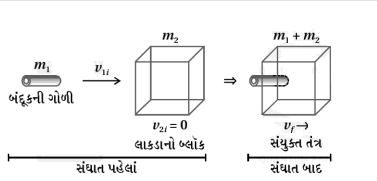
Discuss the completely inelastic collision in one dimension.
Solution
(N/A) Consider a particle of mass $m_{1}$ moving with velocity $v_{1i}$ colliding with a stationary particle of mass $m_{2}$. After the collision,both particles move together in the direction of $v_{1i}$ with a common final velocity $v_{f}$.
From the law of conservation of linear momentum,the total momentum before the collision equals the total momentum after the collision:
$m_{1} v_{1i} + m_{2} v_{2i} = (m_{1} + m_{2}) v_{f}$
Since the second particle is initially at rest,$v_{2i} = 0$:
$m_{1} v_{1i} = (m_{1} + m_{2}) v_{f}$
$v_{f} = \frac{m_{1}}{m_{1} + m_{2}} v_{1i}$
Kinetic energy is not conserved in an inelastic collision. The loss in kinetic energy $\Delta K$ is given by:
$\Delta K = K_{i} - K_{f}$
$\Delta K = \frac{1}{2} m_{1} v_{1i}^{2} - \frac{1}{2} (m_{1} + m_{2}) v_{f}^{2}$
Substituting $v_{f}$:
$\Delta K = \frac{1}{2} m_{1} v_{1i}^{2} - \frac{1}{2} (m_{1} + m_{2}) \left( \frac{m_{1}}{m_{1} + m_{2}} \right)^{2} v_{1i}^{2}$
$\Delta K = \frac{1}{2} m_{1} v_{1i}^{2} \left( 1 - \frac{m_{1}}{m_{1} + m_{2}} \right)$
$\Delta K = \frac{1}{2} \frac{m_{1} m_{2}}{m_{1} + m_{2}} v_{1i}^{2}$
Since $\Delta K > 0$,kinetic energy is dissipated during the collision.
From the law of conservation of linear momentum,the total momentum before the collision equals the total momentum after the collision:
$m_{1} v_{1i} + m_{2} v_{2i} = (m_{1} + m_{2}) v_{f}$
Since the second particle is initially at rest,$v_{2i} = 0$:
$m_{1} v_{1i} = (m_{1} + m_{2}) v_{f}$
$v_{f} = \frac{m_{1}}{m_{1} + m_{2}} v_{1i}$
Kinetic energy is not conserved in an inelastic collision. The loss in kinetic energy $\Delta K$ is given by:
$\Delta K = K_{i} - K_{f}$
$\Delta K = \frac{1}{2} m_{1} v_{1i}^{2} - \frac{1}{2} (m_{1} + m_{2}) v_{f}^{2}$
Substituting $v_{f}$:
$\Delta K = \frac{1}{2} m_{1} v_{1i}^{2} - \frac{1}{2} (m_{1} + m_{2}) \left( \frac{m_{1}}{m_{1} + m_{2}} \right)^{2} v_{1i}^{2}$
$\Delta K = \frac{1}{2} m_{1} v_{1i}^{2} \left( 1 - \frac{m_{1}}{m_{1} + m_{2}} \right)$
$\Delta K = \frac{1}{2} \frac{m_{1} m_{2}}{m_{1} + m_{2}} v_{1i}^{2}$
Since $\Delta K > 0$,kinetic energy is dissipated during the collision.
0 likes
View Solution75
MediumMCQ
When does the total kinetic energy of two bodies moving in opposite directions become zero after a collision?
A
When the collision is perfectly elastic.
B
When the bodies stick together after the collision and their initial momenta are equal and opposite.
C
When the collision is oblique.
D
When the bodies move in the same direction after the collision.
Solution
(B) The total kinetic energy of a system of two bodies becomes zero after a collision if and only if the collision is perfectly inelastic and the total linear momentum of the system is zero.
If two bodies of masses $m_1$ and $m_2$ move with velocities $v_1$ and $v_2$ in opposite directions such that their total momentum $p = m_1v_1 + m_2v_2 = 0$,and they stick together after the collision,the final velocity $V$ of the combined mass will be $V = \frac{m_1v_1 + m_2v_2}{m_1 + m_2} = 0$.
Since the final velocity is zero,the final kinetic energy $K_f = \frac{1}{2}(m_1 + m_2)V^2 = 0$.
If two bodies of masses $m_1$ and $m_2$ move with velocities $v_1$ and $v_2$ in opposite directions such that their total momentum $p = m_1v_1 + m_2v_2 = 0$,and they stick together after the collision,the final velocity $V$ of the combined mass will be $V = \frac{m_1v_1 + m_2v_2}{m_1 + m_2} = 0$.
Since the final velocity is zero,the final kinetic energy $K_f = \frac{1}{2}(m_1 + m_2)V^2 = 0$.
0 likes
View Solution76
DifficultMCQ
$A$ body of mass $m$ moving with velocity $v$ collides head-on with another body of mass $2m$ which is initially at rest. If the collision is perfectly inelastic,what is the loss in kinetic energy of the system?
A
$1/2 mv^2$
B
$1/3 mv^2$
C
$2/3 mv^2$
D
$1/6 mv^2$
Solution
(B) Initial kinetic energy of the system is $K_i = 1/2 mv^2 + 1/2 (2m)(0)^2 = 1/2 mv^2$.
Since the collision is perfectly inelastic,the two bodies stick together after the collision and move with a common velocity $V$.
By the law of conservation of linear momentum: $mv + (2m)(0) = (m + 2m)V$.
$mv = 3mV$,which gives $V = v/3$.
The final kinetic energy of the system is $K_f = 1/2 (m + 2m)V^2 = 1/2 (3m)(v/3)^2 = 1/2 (3m)(v^2/9) = 1/6 mv^2$.
The loss in kinetic energy is $\Delta K = K_i - K_f = 1/2 mv^2 - 1/6 mv^2 = (3/6 - 1/6) mv^2 = 2/6 mv^2 = 1/3 mv^2$.
Since the collision is perfectly inelastic,the two bodies stick together after the collision and move with a common velocity $V$.
By the law of conservation of linear momentum: $mv + (2m)(0) = (m + 2m)V$.
$mv = 3mV$,which gives $V = v/3$.
The final kinetic energy of the system is $K_f = 1/2 (m + 2m)V^2 = 1/2 (3m)(v/3)^2 = 1/2 (3m)(v^2/9) = 1/6 mv^2$.
The loss in kinetic energy is $\Delta K = K_i - K_f = 1/2 mv^2 - 1/6 mv^2 = (3/6 - 1/6) mv^2 = 2/6 mv^2 = 1/3 mv^2$.
0 likes
View Solution77
MediumMCQ
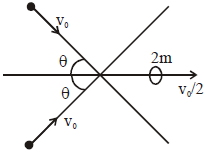
Two bodies of the same mass $m$ are moving with the same speed $v_0$,but in different directions in a plane. They undergo a completely inelastic collision and move together thereafter with a final speed which is half of their initial speed. The angle between the initial velocities of the two bodies (in degrees) is:
A
$100$
B
$120$
C
$125$
D
$130$
Solution
(B) Let the two bodies have mass $m$ and initial speed $v_0$. Let the angle between their initial velocity vectors be $2\theta$.
By symmetry,the combined mass $2m$ will move along the angle bisector of the initial velocity vectors with a final speed $v_f = v_0/2$.
Applying the law of conservation of linear momentum along the direction of the final velocity:
$m v_0 \cos \theta + m v_0 \cos \theta = (2m) v_f$
$2 m v_0 \cos \theta = 2 m (v_0/2)$
$2 m v_0 \cos \theta = m v_0$
$\cos \theta = 1/2$
$\theta = 60^\circ$
The angle between the initial velocities is $2\theta = 2 \times 60^\circ = 120^\circ$.
By symmetry,the combined mass $2m$ will move along the angle bisector of the initial velocity vectors with a final speed $v_f = v_0/2$.
Applying the law of conservation of linear momentum along the direction of the final velocity:
$m v_0 \cos \theta + m v_0 \cos \theta = (2m) v_f$
$2 m v_0 \cos \theta = 2 m (v_0/2)$
$2 m v_0 \cos \theta = m v_0$
$\cos \theta = 1/2$
$\theta = 60^\circ$
The angle between the initial velocities is $2\theta = 2 \times 60^\circ = 120^\circ$.
0 likes
View Solution78
DifficultMCQ
$A$ body of mass $5 \times 10^{3} \, kg$ moving with speed $2 \, m/s$ collides with a body of mass $15 \times 10^{3} \, kg$ inelastically and sticks to it. The loss in $K.E.$ of the system will be (in $kJ$):
A
$7.5$
B
$15$
C
$10$
D
$5$
Solution
(A) Given: $m_1 = 5 \times 10^{3} \, kg$,$u_1 = 2 \, m/s$,$m_2 = 15 \times 10^{3} \, kg$,$u_2 = 0 \, m/s$.
Since the collision is perfectly inelastic $(e = 0)$,the bodies stick together.
The loss in kinetic energy $(\Delta K.E.)$ for a perfectly inelastic collision is given by:
$\Delta K.E. = \frac{1}{2} \frac{m_1 m_2}{m_1 + m_2} (u_1 - u_2)^2$
Substituting the values:
$\Delta K.E. = \frac{1}{2} \times \frac{(5 \times 10^{3}) \times (15 \times 10^{3})}{5 \times 10^{3} + 15 \times 10^{3}} \times (2 - 0)^2$
$\Delta K.E. = \frac{1}{2} \times \frac{75 \times 10^{6}}{20 \times 10^{3}} \times 4$
$\Delta K.E. = \frac{1}{2} \times 3.75 \times 10^{3} \times 4$
$\Delta K.E. = 7.5 \times 10^{3} \, J = 7.5 \, kJ$.
Since the collision is perfectly inelastic $(e = 0)$,the bodies stick together.
The loss in kinetic energy $(\Delta K.E.)$ for a perfectly inelastic collision is given by:
$\Delta K.E. = \frac{1}{2} \frac{m_1 m_2}{m_1 + m_2} (u_1 - u_2)^2$
Substituting the values:
$\Delta K.E. = \frac{1}{2} \times \frac{(5 \times 10^{3}) \times (15 \times 10^{3})}{5 \times 10^{3} + 15 \times 10^{3}} \times (2 - 0)^2$
$\Delta K.E. = \frac{1}{2} \times \frac{75 \times 10^{6}}{20 \times 10^{3}} \times 4$
$\Delta K.E. = \frac{1}{2} \times 3.75 \times 10^{3} \times 4$
$\Delta K.E. = 7.5 \times 10^{3} \, J = 7.5 \, kJ$.
0 likes
View Solution79
MediumMCQ
$A$ bag of sand of mass $9.8 \, kg$ is suspended by a rope. $A$ bullet of mass $200 \, g$ travelling with a speed of $10 \, ms^{-1}$ gets embedded in it. The loss of kinetic energy will be $... J$.
A
$4.9$
B
$9.8$
C
$14.7$
D
$19.6$
Solution
(B) Initial momentum of the system: $P_i = m_b v_b + m_s v_s = 0.2 \, kg \times 10 \, ms^{-1} + 9.8 \, kg \times 0 = 2 \, kg \cdot ms^{-1}$.
Final momentum of the system: $P_f = (m_b + m_s) v = (0.2 + 9.8) \, kg \times v = 10 \, kg \times v$.
By the law of conservation of linear momentum: $P_i = P_f \implies 2 = 10v \implies v = 0.2 \, ms^{-1}$.
Initial kinetic energy: $K_i = \frac{1}{2} m_b v_b^2 = \frac{1}{2} \times 0.2 \times (10)^2 = 0.1 \times 100 = 10 \, J$.
Final kinetic energy: $K_f = \frac{1}{2} (m_b + m_s) v^2 = \frac{1}{2} \times 10 \times (0.2)^2 = 5 \times 0.04 = 0.2 \, J$.
Loss in kinetic energy: $\Delta K = K_i - K_f = 10 - 0.2 = 9.8 \, J$.
Final momentum of the system: $P_f = (m_b + m_s) v = (0.2 + 9.8) \, kg \times v = 10 \, kg \times v$.
By the law of conservation of linear momentum: $P_i = P_f \implies 2 = 10v \implies v = 0.2 \, ms^{-1}$.
Initial kinetic energy: $K_i = \frac{1}{2} m_b v_b^2 = \frac{1}{2} \times 0.2 \times (10)^2 = 0.1 \times 100 = 10 \, J$.
Final kinetic energy: $K_f = \frac{1}{2} (m_b + m_s) v^2 = \frac{1}{2} \times 10 \times (0.2)^2 = 5 \times 0.04 = 0.2 \, J$.
Loss in kinetic energy: $\Delta K = K_i - K_f = 10 - 0.2 = 9.8 \, J$.
1 likes
View Solution80
MediumMCQ
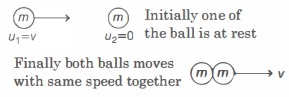
$A$ clay ball of mass $m$ and speed $v$ strikes another metal ball of the same mass $m$,which is at rest. They stick together after the collision. The kinetic energy of the system after the collision is
A
$m v^2 / 2$
B
$m v^2 / 4$
C
$2 m v^2$
D
$m v^2$
Solution
(B) According to the law of conservation of linear momentum,the total momentum before the collision is equal to the total momentum after the collision.
Let $V$ be the final velocity of the combined system of mass $(m + m) = 2m$.
$m v + m(0) = (2m)V$
$m v = 2m V$
$V = v / 2$
Now,the kinetic energy of the system after the collision is given by:
$K_f = \frac{1}{2} (2m) V^2$
Substituting the value of $V$:
$K_f = \frac{1}{2} (2m) \left(\frac{v}{2}\right)^2$
$K_f = m \times \frac{v^2}{4} = \frac{m v^2}{4}$
Let $V$ be the final velocity of the combined system of mass $(m + m) = 2m$.
$m v + m(0) = (2m)V$
$m v = 2m V$
$V = v / 2$
Now,the kinetic energy of the system after the collision is given by:
$K_f = \frac{1}{2} (2m) V^2$
Substituting the value of $V$:
$K_f = \frac{1}{2} (2m) \left(\frac{v}{2}\right)^2$
$K_f = m \times \frac{v^2}{4} = \frac{m v^2}{4}$
0 likes
View Solution81
MediumMCQ
An object of mass $80 \,kg$ moving with velocity $2 \,ms^{-1}$ collides with another object of mass $20 \,kg$ moving with velocity $4 \,ms^{-1}$. Find the loss of energy assuming a perfectly inelastic collision. ........... $J$
A
$12$
B
$24$
C
$32$
D
$30$
Solution
(C) For a perfectly inelastic collision,the loss in kinetic energy $\Delta K$ is given by the formula:
$\Delta K = \frac{m_1 m_2}{2(m_1 + m_2)} (u_1 - u_2)^2$
Given:
$m_1 = 80 \,kg$,$u_1 = 2 \,ms^{-1}$
$m_2 = 20 \,kg$,$u_2 = 4 \,ms^{-1}$
Substituting the values:
$\Delta K = \frac{80 \times 20}{2(80 + 20)} (2 - 4)^2$
$\Delta K = \frac{1600}{2(100)} (-2)^2$
$\Delta K = \frac{1600}{200} \times 4$
$\Delta K = 8 \times 4 = 32 \,J$
Therefore,the loss of energy is $32 \,J$.
$\Delta K = \frac{m_1 m_2}{2(m_1 + m_2)} (u_1 - u_2)^2$
Given:
$m_1 = 80 \,kg$,$u_1 = 2 \,ms^{-1}$
$m_2 = 20 \,kg$,$u_2 = 4 \,ms^{-1}$
Substituting the values:
$\Delta K = \frac{80 \times 20}{2(80 + 20)} (2 - 4)^2$
$\Delta K = \frac{1600}{2(100)} (-2)^2$
$\Delta K = \frac{1600}{200} \times 4$
$\Delta K = 8 \times 4 = 32 \,J$
Therefore,the loss of energy is $32 \,J$.
0 likes
View Solution82
MediumMCQ
$A$ particle of mass $m$ moving towards west with speed $v$ collides with another particle of mass $m$ moving towards south. If the two particles stick to each other,the speed of the new particle of mass $2m$ will be ..........
A
$v \sqrt{2}$
B
$\frac{v}{\sqrt{2}}$
C
$\frac{v}{2}$
D
$v$
Solution
(B) According to the law of conservation of linear momentum,the total momentum before collision is equal to the total momentum after collision.
Let the direction towards the west be along the negative $x$-axis $(-\hat{i})$ and the direction towards the south be along the negative $y$-axis $(-\hat{j})$.
The initial momentum of the first particle is $\vec{p}_1 = m v(-\hat{i}) = -m v \hat{i}$.
The initial momentum of the second particle is $\vec{p}_2 = m v(-\hat{j}) = -m v \hat{j}$.
The total initial momentum is $\vec{P}_i = \vec{p}_1 + \vec{p}_2 = -m v \hat{i} - m v \hat{j}$.
After the collision,the particles stick together to form a single particle of mass $2m$ moving with velocity $\vec{V}$.
The final momentum is $\vec{P}_f = (2m) \vec{V}$.
By conservation of momentum,$\vec{P}_i = \vec{P}_f$,so $(2m) \vec{V} = -m v \hat{i} - m v \hat{j}$.
Dividing by $2m$,we get $\vec{V} = -\frac{v}{2} \hat{i} - \frac{v}{2} \hat{j}$.
The speed is the magnitude of the velocity vector: $|\vec{V}| = \sqrt{(-\frac{v}{2})^2 + (-\frac{v}{2})^2} = \sqrt{\frac{v^2}{4} + \frac{v^2}{4}} = \sqrt{\frac{v^2}{2}} = \frac{v}{\sqrt{2}}$.
Let the direction towards the west be along the negative $x$-axis $(-\hat{i})$ and the direction towards the south be along the negative $y$-axis $(-\hat{j})$.
The initial momentum of the first particle is $\vec{p}_1 = m v(-\hat{i}) = -m v \hat{i}$.
The initial momentum of the second particle is $\vec{p}_2 = m v(-\hat{j}) = -m v \hat{j}$.
The total initial momentum is $\vec{P}_i = \vec{p}_1 + \vec{p}_2 = -m v \hat{i} - m v \hat{j}$.
After the collision,the particles stick together to form a single particle of mass $2m$ moving with velocity $\vec{V}$.
The final momentum is $\vec{P}_f = (2m) \vec{V}$.
By conservation of momentum,$\vec{P}_i = \vec{P}_f$,so $(2m) \vec{V} = -m v \hat{i} - m v \hat{j}$.
Dividing by $2m$,we get $\vec{V} = -\frac{v}{2} \hat{i} - \frac{v}{2} \hat{j}$.
The speed is the magnitude of the velocity vector: $|\vec{V}| = \sqrt{(-\frac{v}{2})^2 + (-\frac{v}{2})^2} = \sqrt{\frac{v^2}{4} + \frac{v^2}{4}} = \sqrt{\frac{v^2}{2}} = \frac{v}{\sqrt{2}}$.
0 likes
View Solution83
MediumMCQ
$A$ body of mass $10 \, kg$ moving with a speed of $3 \, m/s$ collides with another stationary body of mass $5 \, kg$. As a result,the two bodies stick together. The $KE$ of the composite mass will be .......... $J$.
A
$60$
B
$30$
C
$90$
D
$120$
Solution
(B) According to the law of conservation of linear momentum,the total momentum before the collision is equal to the total momentum after the collision.
Let $m_1 = 10 \, kg$,$u_1 = 3 \, m/s$,$m_2 = 5 \, kg$,and $u_2 = 0 \, m/s$.
Let $V$ be the final velocity of the combined mass $(m_1 + m_2) = 15 \, kg$.
$m_1 u_1 + m_2 u_2 = (m_1 + m_2) V$
$10 \times 3 + 5 \times 0 = (10 + 5) V$
$30 = 15 V$
$V = 2 \, m/s$
Now,the kinetic energy $(KE)$ of the composite mass is given by:
$KE = \frac{1}{2} (m_1 + m_2) V^2$
$KE = \frac{1}{2} \times 15 \times (2)^2$
$KE = \frac{1}{2} \times 15 \times 4$
$KE = 30 \, J$.
Let $m_1 = 10 \, kg$,$u_1 = 3 \, m/s$,$m_2 = 5 \, kg$,and $u_2 = 0 \, m/s$.
Let $V$ be the final velocity of the combined mass $(m_1 + m_2) = 15 \, kg$.
$m_1 u_1 + m_2 u_2 = (m_1 + m_2) V$
$10 \times 3 + 5 \times 0 = (10 + 5) V$
$30 = 15 V$
$V = 2 \, m/s$
Now,the kinetic energy $(KE)$ of the composite mass is given by:
$KE = \frac{1}{2} (m_1 + m_2) V^2$
$KE = \frac{1}{2} \times 15 \times (2)^2$
$KE = \frac{1}{2} \times 15 \times 4$
$KE = 30 \, J$.
0 likes
View Solution84
MediumMCQ
$A$ bullet weighing $10 \,g$ and moving with a velocity $300 \,m/s$ strikes a $5 \,kg$ block of ice and gets embedded in it. The ice block is kept on a smooth surface. The speed of the block after the collision is ........ $cm/s$.
A
$60$
B
$6$
C
$0.06$
D
$0.6$
Solution
(A) According to the law of conservation of linear momentum,the total momentum before the collision is equal to the total momentum after the collision.
Let $m_1 = 10 \,g = 0.01 \,kg$ be the mass of the bullet and $v_1 = 300 \,m/s$ be its initial velocity.
Let $m_2 = 5 \,kg$ be the mass of the ice block and $v_2 = 0 \,m/s$ be its initial velocity.
After the collision,the bullet gets embedded in the block,so the total mass is $M = m_1 + m_2 = 0.01 \,kg + 5 \,kg = 5.01 \,kg$.
Let $V$ be the final velocity of the system.
$m_1 v_1 + m_2 v_2 = (m_1 + m_2) V$
$(0.01 \,kg)(300 \,m/s) + (5 \,kg)(0 \,m/s) = (5.01 \,kg) V$
$3 = 5.01 V$
$V = \frac{3}{5.01} \approx 0.5988 \,m/s \approx 0.6 \,m/s$.
To convert this into $cm/s$,we multiply by $100$:
$V = 0.6 \times 100 = 60 \,cm/s$.
Let $m_1 = 10 \,g = 0.01 \,kg$ be the mass of the bullet and $v_1 = 300 \,m/s$ be its initial velocity.
Let $m_2 = 5 \,kg$ be the mass of the ice block and $v_2 = 0 \,m/s$ be its initial velocity.
After the collision,the bullet gets embedded in the block,so the total mass is $M = m_1 + m_2 = 0.01 \,kg + 5 \,kg = 5.01 \,kg$.
Let $V$ be the final velocity of the system.
$m_1 v_1 + m_2 v_2 = (m_1 + m_2) V$
$(0.01 \,kg)(300 \,m/s) + (5 \,kg)(0 \,m/s) = (5.01 \,kg) V$
$3 = 5.01 V$
$V = \frac{3}{5.01} \approx 0.5988 \,m/s \approx 0.6 \,m/s$.
To convert this into $cm/s$,we multiply by $100$:
$V = 0.6 \times 100 = 60 \,cm/s$.
0 likes
View Solution85
MediumMCQ
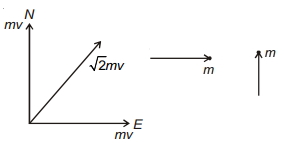
$A$ particle of mass $m$ moving eastward with a speed $v$ collides with another particle of the same mass moving northwards with the same speed $v$. The two particles coalesce on collision. The new particle of mass $2m$ will move with velocity:
A
$\frac{v}{2}$ North-East
B
$\frac{v}{\sqrt{2}}$ South-West
C
$\frac{v}{\sqrt{2}}$ North-East
D
$\frac{v}{2}$ North-West
Solution
(C) Let the velocity of the first particle be $\vec{v}_1 = v \hat{i}$ and the velocity of the second particle be $\vec{v}_2 = v \hat{j}$.
According to the law of conservation of linear momentum,the total initial momentum must equal the total final momentum:
$\vec{P}_i = \vec{P}_f$
$m \vec{v}_1 + m \vec{v}_2 = (2m) \vec{V}$
$m(v \hat{i}) + m(v \hat{j}) = 2m \vec{V}$
$m v (\hat{i} + \hat{j}) = 2m \vec{V}$
$\vec{V} = \frac{v}{2} (\hat{i} + \hat{j})$
The magnitude of the final velocity is $V = \sqrt{(\frac{v}{2})^2 + (\frac{v}{2})^2} = \sqrt{\frac{v^2}{4} + \frac{v^2}{4}} = \sqrt{\frac{v^2}{2}} = \frac{v}{\sqrt{2}}$.
The direction is along the vector $(\hat{i} + \hat{j})$,which is North-East.
Thus,the new particle moves with a velocity of $\frac{v}{\sqrt{2}}$ in the North-East direction.
According to the law of conservation of linear momentum,the total initial momentum must equal the total final momentum:
$\vec{P}_i = \vec{P}_f$
$m \vec{v}_1 + m \vec{v}_2 = (2m) \vec{V}$
$m(v \hat{i}) + m(v \hat{j}) = 2m \vec{V}$
$m v (\hat{i} + \hat{j}) = 2m \vec{V}$
$\vec{V} = \frac{v}{2} (\hat{i} + \hat{j})$
The magnitude of the final velocity is $V = \sqrt{(\frac{v}{2})^2 + (\frac{v}{2})^2} = \sqrt{\frac{v^2}{4} + \frac{v^2}{4}} = \sqrt{\frac{v^2}{2}} = \frac{v}{\sqrt{2}}$.
The direction is along the vector $(\hat{i} + \hat{j})$,which is North-East.
Thus,the new particle moves with a velocity of $\frac{v}{\sqrt{2}}$ in the North-East direction.
1 likes
View Solution86
EasyMCQ
Two balls of masses $m$ each are moving at right angles to each other with velocities $6 \, m/s$ and $8 \, m/s$ respectively. If the collision between them is perfectly inelastic,the velocity of the combined mass is ......... $m/s$.
A
$15$
B
$10$
C
$5$
D
$2.5$
Solution
(C) Let the two balls have mass $m$ and velocities $\vec{v}_1 = 6 \hat{i} \, m/s$ and $\vec{v}_2 = 8 \hat{j} \, m/s$.
Since the collision is perfectly inelastic,the two balls stick together and move with a common velocity $\vec{V}$.
According to the law of conservation of linear momentum:
$\vec{P}_{initial} = \vec{P}_{final}$
$m \vec{v}_1 + m \vec{v}_2 = (m + m) \vec{V}$
$m(6 \hat{i} + 8 \hat{j}) = 2m \vec{V}$
$\vec{V} = \frac{6 \hat{i} + 8 \hat{j}}{2} = 3 \hat{i} + 4 \hat{j} \, m/s$
The magnitude of the combined velocity is:
$V = |\vec{V}| = \sqrt{3^2 + 4^2} = \sqrt{9 + 16} = \sqrt{25} = 5 \, m/s$.
Since the collision is perfectly inelastic,the two balls stick together and move with a common velocity $\vec{V}$.
According to the law of conservation of linear momentum:
$\vec{P}_{initial} = \vec{P}_{final}$
$m \vec{v}_1 + m \vec{v}_2 = (m + m) \vec{V}$
$m(6 \hat{i} + 8 \hat{j}) = 2m \vec{V}$
$\vec{V} = \frac{6 \hat{i} + 8 \hat{j}}{2} = 3 \hat{i} + 4 \hat{j} \, m/s$
The magnitude of the combined velocity is:
$V = |\vec{V}| = \sqrt{3^2 + 4^2} = \sqrt{9 + 16} = \sqrt{25} = 5 \, m/s$.

0 likes
View Solution87
EasyMCQ
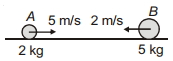
Velocity of the ball $A$ after collision with the ball $B$ as shown in the figure is ............. $m/s$. (Assume perfectly inelastic and head-on collision)
A
$\frac{3}{7}$
B
$\frac{5}{7}$
C
$\frac{1}{7}$
D
$0$
Solution
(D) Given:
Mass of ball $A$,$m_A = 2 \, kg$
Velocity of ball $A$,$u_A = 5 \, m/s$
Mass of ball $B$,$m_B = 5 \, kg$
Velocity of ball $B$,$u_B = -2 \, m/s$ (since it is moving in the opposite direction)
In a perfectly inelastic collision,the two bodies stick together after the collision and move with a common velocity $v$.
According to the law of conservation of linear momentum:
$m_A u_A + m_B u_B = (m_A + m_B) v$
Substituting the values:
$(2 \, kg)(5 \, m/s) + (5 \, kg)(-2 \, m/s) = (2 \, kg + 5 \, kg) v$
$10 - 10 = 7v$
$0 = 7v$
$v = 0 \, m/s$
Thus,the velocity of the balls after the collision is $0 \, m/s$.
Mass of ball $A$,$m_A = 2 \, kg$
Velocity of ball $A$,$u_A = 5 \, m/s$
Mass of ball $B$,$m_B = 5 \, kg$
Velocity of ball $B$,$u_B = -2 \, m/s$ (since it is moving in the opposite direction)
In a perfectly inelastic collision,the two bodies stick together after the collision and move with a common velocity $v$.
According to the law of conservation of linear momentum:
$m_A u_A + m_B u_B = (m_A + m_B) v$
Substituting the values:
$(2 \, kg)(5 \, m/s) + (5 \, kg)(-2 \, m/s) = (2 \, kg + 5 \, kg) v$
$10 - 10 = 7v$
$0 = 7v$
$v = 0 \, m/s$
Thus,the velocity of the balls after the collision is $0 \, m/s$.
0 likes
View Solution88
MediumMCQ
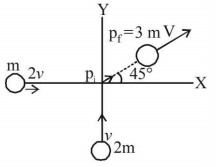
$A$ particle of mass $m$ moving in the $x$ direction with speed $2v$ is hit by another particle of mass $2m$ moving in the $y$ direction with speed $v$. If the collision is perfectly inelastic,the percentage loss in the energy during the collision is close to $..........\%$
A
$56$
B
$62$
C
$44$
D
$50$
Solution
(A) Initial kinetic energy of the system:
$K_i = \frac{1}{2} m (2v)^2 + \frac{1}{2} (2m) v^2 = 2mv^2 + mv^2 = 3mv^2$
Initial momentum of the system:
$\vec{p}_i = m(2v)\hat{i} + (2m)v\hat{j} = 2mv\hat{i} + 2mv\hat{j}$
Since the collision is perfectly inelastic,the particles stick together and move with a common velocity $\vec{V}$.
By the law of conservation of linear momentum:
$\vec{p}_f = \vec{p}_i$
$(m + 2m)\vec{V} = 2mv\hat{i} + 2mv\hat{j}$
$3m\vec{V} = 2mv(\hat{i} + \hat{j})$
$\vec{V} = \frac{2v}{3}(\hat{i} + \hat{j})$
Final kinetic energy of the system:
$K_f = \frac{1}{2} (m + 2m) |\vec{V}|^2 = \frac{1}{2} (3m) \left( \sqrt{(\frac{2v}{3})^2 + (\frac{2v}{3})^2} \right)^2$
$K_f = \frac{3m}{2} \left( \frac{4v^2}{9} + \frac{4v^2}{9} \right) = \frac{3m}{2} \left( \frac{8v^2}{9} \right) = \frac{4}{3} mv^2$
Loss in energy:
$\Delta K = K_i - K_f = 3mv^2 - \frac{4}{3} mv^2 = \frac{5}{3} mv^2$
Percentage loss in energy:
$\text{Percentage Loss} = \frac{\Delta K}{K_i} \times 100 = \frac{\frac{5}{3} mv^2}{3mv^2} \times 100 = \frac{5}{9} \times 100 \approx 55.55\% \approx 56\%$
$K_i = \frac{1}{2} m (2v)^2 + \frac{1}{2} (2m) v^2 = 2mv^2 + mv^2 = 3mv^2$
Initial momentum of the system:
$\vec{p}_i = m(2v)\hat{i} + (2m)v\hat{j} = 2mv\hat{i} + 2mv\hat{j}$
Since the collision is perfectly inelastic,the particles stick together and move with a common velocity $\vec{V}$.
By the law of conservation of linear momentum:
$\vec{p}_f = \vec{p}_i$
$(m + 2m)\vec{V} = 2mv\hat{i} + 2mv\hat{j}$
$3m\vec{V} = 2mv(\hat{i} + \hat{j})$
$\vec{V} = \frac{2v}{3}(\hat{i} + \hat{j})$
Final kinetic energy of the system:
$K_f = \frac{1}{2} (m + 2m) |\vec{V}|^2 = \frac{1}{2} (3m) \left( \sqrt{(\frac{2v}{3})^2 + (\frac{2v}{3})^2} \right)^2$
$K_f = \frac{3m}{2} \left( \frac{4v^2}{9} + \frac{4v^2}{9} \right) = \frac{3m}{2} \left( \frac{8v^2}{9} \right) = \frac{4}{3} mv^2$
Loss in energy:
$\Delta K = K_i - K_f = 3mv^2 - \frac{4}{3} mv^2 = \frac{5}{3} mv^2$
Percentage loss in energy:
$\text{Percentage Loss} = \frac{\Delta K}{K_i} \times 100 = \frac{\frac{5}{3} mv^2}{3mv^2} \times 100 = \frac{5}{9} \times 100 \approx 55.55\% \approx 56\%$
0 likes
View Solution89
MediumMCQ
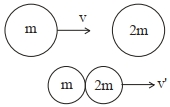
$A$ particle of mass $m$ moving with velocity $v$ collides with a stationary particle of mass $2m$. After collision,they stick together and continue to move together with velocity ........
A
$v$
B
$\frac{v}{2}$
C
$\frac{v}{3}$
D
$\frac{v}{4}$
Solution
(C) According to the law of conservation of linear momentum,the total initial momentum of the system must be equal to the total final momentum.
Initial momentum of the system: $P_i = m \cdot v + 2m \cdot 0 = mv$
After the collision,the two particles stick together,forming a combined mass of $(m + 2m) = 3m$.
Let the final velocity of the combined mass be $v'$.
Final momentum of the system: $P_f = (3m) \cdot v'$
Equating initial and final momentum: $mv = 3m \cdot v'$
Solving for $v'$: $v' = \frac{mv}{3m} = \frac{v}{3}$
Initial momentum of the system: $P_i = m \cdot v + 2m \cdot 0 = mv$
After the collision,the two particles stick together,forming a combined mass of $(m + 2m) = 3m$.
Let the final velocity of the combined mass be $v'$.
Final momentum of the system: $P_f = (3m) \cdot v'$
Equating initial and final momentum: $mv = 3m \cdot v'$
Solving for $v'$: $v' = \frac{mv}{3m} = \frac{v}{3}$
0 likes
View Solution90
MediumMCQ
Two bodies $A$ and $B$ of same mass undergo a completely inelastic one-dimensional collision. The body $A$ moves with velocity $v_1$ while body $B$ is at rest before the collision. The velocity of the system after the collision is $v_2$. The ratio $v_1: v_2$ is
A
$2: 1$
B
$4: 1$
C
$1: 4$
D
$1: 2$
Solution
(A) Let the mass of both bodies $A$ and $B$ be $m$.
Before the collision,body $A$ has velocity $v_1$ and body $B$ is at rest $(v_B = 0)$.
After the collision,since it is a completely inelastic collision,both bodies stick together and move with a common velocity $v_2$.
According to the law of conservation of linear momentum:
Initial momentum = Final momentum
$m v_1 + m(0) = (m + m) v_2$
$m v_1 = 2m v_2$
Dividing both sides by $m v_2$,we get:
$\frac{v_1}{v_2} = \frac{2}{1}$
Therefore,the ratio $v_1: v_2$ is $2: 1$.
Before the collision,body $A$ has velocity $v_1$ and body $B$ is at rest $(v_B = 0)$.
After the collision,since it is a completely inelastic collision,both bodies stick together and move with a common velocity $v_2$.
According to the law of conservation of linear momentum:
Initial momentum = Final momentum
$m v_1 + m(0) = (m + m) v_2$
$m v_1 = 2m v_2$
Dividing both sides by $m v_2$,we get:
$\frac{v_1}{v_2} = \frac{2}{1}$
Therefore,the ratio $v_1: v_2$ is $2: 1$.
0 likes
View Solution91
MediumMCQ
$A$ body of mass $2 \ kg$ moving with a velocity of $3 \ m/s$ collides head-on with a body of mass $1 \ kg$ moving with a velocity of $4 \ m/s$ in the opposite direction. After the collision,the two bodies stick together and move with a common velocity:
A
$\frac{1}{4} \ m/s$
B
$\frac{1}{3} \ m/s$
C
$\frac{2}{3} \ m/s$
D
$\frac{3}{4} \ m/s$
Solution
(C) According to the law of conservation of linear momentum,the total momentum before the collision is equal to the total momentum after the collision.
Let $m_1 = 2 \ kg$,$v_1 = 3 \ m/s$,$m_2 = 1 \ kg$,and $v_2 = -4 \ m/s$ (since it is moving in the opposite direction).
$m_1 v_1 + m_2 v_2 = (m_1 + m_2) v$
Substituting the values:
$2(3) + 1(-4) = (2 + 1) v$
$6 - 4 = 3v$
$2 = 3v$
$v = \frac{2}{3} \ m/s$
Thus,the common velocity is $\frac{2}{3} \ m/s$.
Let $m_1 = 2 \ kg$,$v_1 = 3 \ m/s$,$m_2 = 1 \ kg$,and $v_2 = -4 \ m/s$ (since it is moving in the opposite direction).
$m_1 v_1 + m_2 v_2 = (m_1 + m_2) v$
Substituting the values:
$2(3) + 1(-4) = (2 + 1) v$
$6 - 4 = 3v$
$2 = 3v$
$v = \frac{2}{3} \ m/s$
Thus,the common velocity is $\frac{2}{3} \ m/s$.
0 likes
View Solution92
MediumMCQ
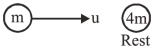
$A$ body of mass $m$ is moving with velocity $u$ as shown in the figure and it collides with a body of mass $4m$ at rest. If the collision is perfectly inelastic,then the percentage loss in kinetic energy is:
A
$64$
B
$40$
C
$50$
D
$80$
Solution
(D) Initial kinetic energy of the system is $K_i = \frac{1}{2} m u^2$.
By the law of conservation of linear momentum,the final velocity $v$ of the combined mass $(m + 4m = 5m)$ is given by:
$m u + (4m)(0) = (5m) v$
$m u = 5m v$
$v = \frac{u}{5}$
Final kinetic energy of the system is $K_f = \frac{1}{2} (5m) v^2 = \frac{1}{2} (5m) \left(\frac{u}{5}\right)^2 = \frac{1}{2} (5m) \frac{u^2}{25} = \frac{1}{10} m u^2$.
The loss in kinetic energy is $\Delta K = K_i - K_f = \frac{1}{2} m u^2 - \frac{1}{10} m u^2 = \frac{5-1}{10} m u^2 = \frac{4}{10} m u^2 = \frac{2}{5} m u^2$.
The percentage loss in kinetic energy is $\frac{\Delta K}{K_i} \times 100 = \frac{\frac{2}{5} m u^2}{\frac{1}{2} m u^2} \times 100 = \frac{4}{5} \times 100 = 80 \%$.
By the law of conservation of linear momentum,the final velocity $v$ of the combined mass $(m + 4m = 5m)$ is given by:
$m u + (4m)(0) = (5m) v$
$m u = 5m v$
$v = \frac{u}{5}$
Final kinetic energy of the system is $K_f = \frac{1}{2} (5m) v^2 = \frac{1}{2} (5m) \left(\frac{u}{5}\right)^2 = \frac{1}{2} (5m) \frac{u^2}{25} = \frac{1}{10} m u^2$.
The loss in kinetic energy is $\Delta K = K_i - K_f = \frac{1}{2} m u^2 - \frac{1}{10} m u^2 = \frac{5-1}{10} m u^2 = \frac{4}{10} m u^2 = \frac{2}{5} m u^2$.
The percentage loss in kinetic energy is $\frac{\Delta K}{K_i} \times 100 = \frac{\frac{2}{5} m u^2}{\frac{1}{2} m u^2} \times 100 = \frac{4}{5} \times 100 = 80 \%$.
0 likes
View Solution93
EasyMCQ
$A$ bullet is fired from a gun. It hits a solid block resting on a frictionless surface,gets embedded into it,and both move jointly. In this process,
A
Both momentum and kinetic energy are not conserved.
B
Only kinetic energy is conserved.
C
Both momentum and kinetic energy are conserved.
D
Only momentum is conserved.
Solution
(D) This is a case of a perfectly inelastic collision.
In any collision where external forces are absent,the total linear momentum of the system is conserved.
However,in an inelastic collision,some kinetic energy is converted into other forms of energy (such as heat or deformation energy) due to the internal forces acting during the impact.
Therefore,only the linear momentum is conserved,while the kinetic energy is not.
In any collision where external forces are absent,the total linear momentum of the system is conserved.
However,in an inelastic collision,some kinetic energy is converted into other forms of energy (such as heat or deformation energy) due to the internal forces acting during the impact.
Therefore,only the linear momentum is conserved,while the kinetic energy is not.
0 likes
View Solution94
MediumMCQ
$A$ metal ball of mass $2 \,kg$ moving with a speed of $10 \,ms^{-1}$ has a head-on collision with a stationary ball of mass $3 \,kg$. If after the collision, both the balls move together, then the loss in kinetic energy due to the collision is: (in $\,J.$)
A
$60$
B
$100$
C
$140$
D
$40$
Solution
$(A)$ According to the law of conservation of momentum, the total momentum before the collision equals the total momentum after the collision.
$m_1 u_1 + m_2 u_2 = (m_1 + m_2)v$
Given $m_1 = 2 \,kg$, $u_1 = 10 \,ms^{-1}$, $m_2 = 3 \,kg$, and $u_2 = 0 \,ms^{-1}$.
$2 \times 10 + 3 \times 0 = (2 + 3)v$
$20 = 5v \implies v = 4 \,ms^{-1}$.
Initial kinetic energy $(K_i)$ = $\frac{1}{2} m_1 u_1^2 = \frac{1}{2} \times 2 \times (10)^2 = 100 \,J$.
Final kinetic energy $(K_f)$ = $\frac{1}{2} (m_1 + m_2) v^2 = \frac{1}{2} \times (2 + 3) \times (4)^2 = \frac{1}{2} \times 5 \times 16 = 40 \,J$.
Loss in kinetic energy = $K_i - K_f = 100 \,J - 40 \,J = 60 \,J$.
$m_1 u_1 + m_2 u_2 = (m_1 + m_2)v$
Given $m_1 = 2 \,kg$, $u_1 = 10 \,ms^{-1}$, $m_2 = 3 \,kg$, and $u_2 = 0 \,ms^{-1}$.
$2 \times 10 + 3 \times 0 = (2 + 3)v$
$20 = 5v \implies v = 4 \,ms^{-1}$.
Initial kinetic energy $(K_i)$ = $\frac{1}{2} m_1 u_1^2 = \frac{1}{2} \times 2 \times (10)^2 = 100 \,J$.
Final kinetic energy $(K_f)$ = $\frac{1}{2} (m_1 + m_2) v^2 = \frac{1}{2} \times (2 + 3) \times (4)^2 = \frac{1}{2} \times 5 \times 16 = 40 \,J$.
Loss in kinetic energy = $K_i - K_f = 100 \,J - 40 \,J = 60 \,J$.
0 likes
View Solution95
EasyMCQ
$A$ block of mass $m$ moving along a straight line with constant velocity $3 \vec{V}$ collides with another block of the same mass at rest. They stick together and move with a common velocity. The common velocity is:
A
$\frac{3 \vec{V}}{2}$
B
$2 \vec{V}$
C
$3 \vec{V}$
D
$\vec{V}$
Solution
(A) According to the principle of conservation of linear momentum,the total momentum before the collision is equal to the total momentum after the collision.
Let the mass of each block be $m$.
The initial velocity of the first block is $3 \vec{V}$ and the second block is $0$.
After the collision,the two blocks stick together and move with a common velocity $V_{c}$.
Applying the conservation of momentum:
$m(3 \vec{V}) + m(0) = (m + m) V_{c}$
$3 m \vec{V} = 2 m V_{c}$
$V_{c} = \frac{3 m \vec{V}}{2 m} = \frac{3}{2} \vec{V}$
Let the mass of each block be $m$.
The initial velocity of the first block is $3 \vec{V}$ and the second block is $0$.
After the collision,the two blocks stick together and move with a common velocity $V_{c}$.
Applying the conservation of momentum:
$m(3 \vec{V}) + m(0) = (m + m) V_{c}$
$3 m \vec{V} = 2 m V_{c}$
$V_{c} = \frac{3 m \vec{V}}{2 m} = \frac{3}{2} \vec{V}$
0 likes
View Solution96
EasyMCQ
$A$ body of mass $m$ moving with speed $3 \ m/s$ collides with a body of mass $2m$ at rest. The coalesced mass will start to move with a speed of (in $m/s$)
A
$3$
B
$6$
C
$9$
D
$1$
Solution
(D) Initial mass $m_1 = m$,initial velocity $u_1 = 3 \ m/s$.
Initial mass $m_2 = 2m$,initial velocity $u_2 = 0 \ m/s$.
According to the law of conservation of linear momentum,the total initial momentum equals the total final momentum.
$P_i = m_1 u_1 + m_2 u_2 = m(3) + 2m(0) = 3m$.
After collision,the bodies coalesce,so the final mass is $M = m_1 + m_2 = m + 2m = 3m$.
Let the final velocity be $V$.
$P_f = (m_1 + m_2)V = 3mV$.
Equating $P_i = P_f$:
$3m = 3mV$.
$V = 1 \ m/s$.
Initial mass $m_2 = 2m$,initial velocity $u_2 = 0 \ m/s$.
According to the law of conservation of linear momentum,the total initial momentum equals the total final momentum.
$P_i = m_1 u_1 + m_2 u_2 = m(3) + 2m(0) = 3m$.
After collision,the bodies coalesce,so the final mass is $M = m_1 + m_2 = m + 2m = 3m$.
Let the final velocity be $V$.
$P_f = (m_1 + m_2)V = 3mV$.
Equating $P_i = P_f$:
$3m = 3mV$.
$V = 1 \ m/s$.
0 likes
View Solution97
MediumMCQ
$A$ mass $M$ moving with velocity $V$ along the $x$-axis collides and sticks to another mass $2M$ which is moving along the $y$-axis with velocity $3V$. The velocity of the combination after the collision is:
A
$\frac{V}{3} \hat{i} + 2V \hat{j}$
B
$\frac{V}{2} \hat{i} + V \hat{j}$
C
$\frac{V}{3} \hat{i} - 2V \hat{j}$
D
$\frac{V}{2} \hat{i} - V \hat{j}$
Solution
(A) According to the law of conservation of linear momentum,the total momentum before the collision equals the total momentum after the collision.
Initial momentum of mass $M$: $\vec{p}_1 = M V \hat{i}$.
Initial momentum of mass $2M$: $\vec{p}_2 = 2M (3V \hat{j}) = 6MV \hat{j}$.
Total initial momentum: $\vec{p}_{initial} = M V \hat{i} + 6MV \hat{j}$.
After the collision,the masses stick together to form a single body of mass $3M$ moving with velocity $\vec{v}_{final}$.
Total final momentum: $\vec{p}_{final} = (M + 2M) \vec{v}_{final} = 3M \vec{v}_{final}$.
Equating the two: $3M \vec{v}_{final} = M V \hat{i} + 6MV \hat{j}$.
Dividing by $3M$: $\vec{v}_{final} = \frac{V}{3} \hat{i} + 2V \hat{j}$.
Initial momentum of mass $M$: $\vec{p}_1 = M V \hat{i}$.
Initial momentum of mass $2M$: $\vec{p}_2 = 2M (3V \hat{j}) = 6MV \hat{j}$.
Total initial momentum: $\vec{p}_{initial} = M V \hat{i} + 6MV \hat{j}$.
After the collision,the masses stick together to form a single body of mass $3M$ moving with velocity $\vec{v}_{final}$.
Total final momentum: $\vec{p}_{final} = (M + 2M) \vec{v}_{final} = 3M \vec{v}_{final}$.
Equating the two: $3M \vec{v}_{final} = M V \hat{i} + 6MV \hat{j}$.
Dividing by $3M$: $\vec{v}_{final} = \frac{V}{3} \hat{i} + 2V \hat{j}$.
0 likes
View Solution98
MediumMCQ
$A$ body of mass $m$ moving along a straight line collides with a stationary body of mass $2m$. After collision,if the two bodies move together with the same velocity,then the fraction of kinetic energy lost in the process is
A
$1/2$
B
$2/3$
C
$3/4$
D
$1/3$
Solution
(B) Let the initial velocity of the body of mass $m$ be $v$. The initial kinetic energy is $K_i = \frac{1}{2}mv^2$.
By the law of conservation of linear momentum: $mv + (2m)(0) = (m + 2m)v'$,where $v'$ is the final common velocity.
$mv = 3mv' \implies v' = v/3$.
The final kinetic energy is $K_f = \frac{1}{2}(m + 2m)(v')^2 = \frac{1}{2}(3m)(v/3)^2 = \frac{1}{2}(3m)(v^2/9) = \frac{1}{6}mv^2$.
The loss in kinetic energy is $\Delta K = K_i - K_f = \frac{1}{2}mv^2 - \frac{1}{6}mv^2 = \frac{3-1}{6}mv^2 = \frac{2}{6}mv^2 = \frac{1}{3}mv^2$.
The fraction of kinetic energy lost is $\frac{\Delta K}{K_i} = \frac{\frac{1}{3}mv^2}{\frac{1}{2}mv^2} = \frac{1}{3} \times 2 = 2/3$.
By the law of conservation of linear momentum: $mv + (2m)(0) = (m + 2m)v'$,where $v'$ is the final common velocity.
$mv = 3mv' \implies v' = v/3$.
The final kinetic energy is $K_f = \frac{1}{2}(m + 2m)(v')^2 = \frac{1}{2}(3m)(v/3)^2 = \frac{1}{2}(3m)(v^2/9) = \frac{1}{6}mv^2$.
The loss in kinetic energy is $\Delta K = K_i - K_f = \frac{1}{2}mv^2 - \frac{1}{6}mv^2 = \frac{3-1}{6}mv^2 = \frac{2}{6}mv^2 = \frac{1}{3}mv^2$.
The fraction of kinetic energy lost is $\frac{\Delta K}{K_i} = \frac{\frac{1}{3}mv^2}{\frac{1}{2}mv^2} = \frac{1}{3} \times 2 = 2/3$.
0 likes
View Solution99
DifficultMCQ
Ball $A$ of mass $1 \,kg$ moving along a straight line with a velocity of $4 \,ms^{-1}$ hits another ball $B$ of mass $3 \,kg$ which is at rest. After collision, they stick together and move with the same velocity along the same straight line. If the time of impact of the collision is $0.1 \,s$, then the force exerted on $B$ is (in $\,N$)
A
$30$
B
$24$
C
$36$
D
$27$
Solution
(A) For ball $A$: $m_A = 1 \,kg$, $u_A = 4 \,ms^{-1}$. For ball $B$: $m_B = 3 \,kg$, $u_B = 0 \,ms^{-1}$.
Total initial momentum $p_i = m_A u_A + m_B u_B = (1 \times 4) + (3 \times 0) = 4 \,kg \cdot ms^{-1}$.
After collision, both bodies stick together and move with a common velocity $v$.
Total final momentum $p_f = (m_A + m_B)v = (1 + 3)v = 4v$.
By the law of conservation of linear momentum, $p_i = p_f$, so $4 = 4v$, which gives $v = 1 \,ms^{-1}$.
The force exerted on ball $B$ is the rate of change of momentum of ball $B$:
$F_B = \frac{\Delta p_B}{\Delta t} = \frac{m_B(v - u_B)}{\Delta t} = \frac{3(1 - 0)}{0.1} = \frac{3}{0.1} = 30 \,N$.
Total initial momentum $p_i = m_A u_A + m_B u_B = (1 \times 4) + (3 \times 0) = 4 \,kg \cdot ms^{-1}$.
After collision, both bodies stick together and move with a common velocity $v$.
Total final momentum $p_f = (m_A + m_B)v = (1 + 3)v = 4v$.
By the law of conservation of linear momentum, $p_i = p_f$, so $4 = 4v$, which gives $v = 1 \,ms^{-1}$.
The force exerted on ball $B$ is the rate of change of momentum of ball $B$:
$F_B = \frac{\Delta p_B}{\Delta t} = \frac{m_B(v - u_B)}{\Delta t} = \frac{3(1 - 0)}{0.1} = \frac{3}{0.1} = 30 \,N$.
0 likes
View SolutionWork, Energy, Power and Collision — Perfectly Inelastic Collision · Frequently Asked Questions
1Are these Work, Energy, Power and Collision questions useful for JEE and NEET?
Yes. All questions in this section are mapped to JEE Main and NEET exam patterns. Previous year questions from JEE Main, NEET, GUJCET and state-level exams are included with full solutions.
2Can I switch to Hindi or Gujarati for these questions?
Yes. Use the language tabs in the hero section or the sidebar to view the same questions and solutions in English, Hindi or Gujarati.
3How do I generate a question paper from this subtopic?
Use the Vedclass Exam Paper Generator — select the chapter and subtopic, set difficulty, and generate Sets A, B, C, D automatically. First 3 chapters of every subject are free.
Vedclass Products
For Students
Vedclass Test Series
Mock tests in real JEE/NEET style with performance analysis. 5-day free trial.
Start Free TrialFor Teachers
Exam Paper Generator
Generate Set A/B/C/D papers from this chapter in 2 minutes. 3 chapters free.
Try FreeFor Institutes
Online Exam Module
Live online exams with unlimited students, 360° analytics & white-label branding.
See DemoFor Teachers & Institutes
Generate a Work, Energy, Power and Collision Exam Paper in 2 Minutes
Select subtopic & difficulty — Sets A, B, C, D auto-generated with No Repeat logic.
First 3 chapters of every subject are free — no payment required.