
A English
Perfectly Inelastic Collision Questions in English
Class 11 Physics · Work, Energy, Power and Collision · Perfectly Inelastic Collision
110+
Questions
English
Language
100%
With Solutions
Showing 48 of 110 questions in English
1
DifficultMCQ
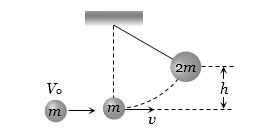
$A$ particle of mass $m$ moving with velocity $V_0$ strikes a simple pendulum of mass $m$ and sticks to it. The maximum height attained by the pendulum will be
A
$\frac{V_0^2}{8g}$
B
$\sqrt{V_0g}$
C
$2\sqrt{\frac{V_0}{g}}$
D
$\frac{V_0^2}{4g}$
Solution
(A) Initial momentum of the particle = $m V_0$.
Final momentum of the system (particle + pendulum) = $(m + m)v = 2mv$.
By the law of conservation of momentum:
$m V_0 = 2mv$
$v = \frac{V_0}{2}$
Initial kinetic energy of the system = $\frac{1}{2}(2m)v^2 = \frac{1}{2}(2m)\left(\frac{V_0}{2}\right)^2 = \frac{1}{2}(2m)\frac{V_0^2}{4} = \frac{m V_0^2}{4}$.
If the system rises to a maximum height $h$,the potential energy gained is $P.E. = (2m)gh$.
By the law of conservation of energy,the initial kinetic energy is converted into potential energy at the maximum height:
$\frac{m V_0^2}{4} = 2mgh$
$h = \frac{m V_0^2}{4 \cdot 2mg} = \frac{V_0^2}{8g}$.
Final momentum of the system (particle + pendulum) = $(m + m)v = 2mv$.
By the law of conservation of momentum:
$m V_0 = 2mv$
$v = \frac{V_0}{2}$
Initial kinetic energy of the system = $\frac{1}{2}(2m)v^2 = \frac{1}{2}(2m)\left(\frac{V_0}{2}\right)^2 = \frac{1}{2}(2m)\frac{V_0^2}{4} = \frac{m V_0^2}{4}$.
If the system rises to a maximum height $h$,the potential energy gained is $P.E. = (2m)gh$.
By the law of conservation of energy,the initial kinetic energy is converted into potential energy at the maximum height:
$\frac{m V_0^2}{4} = 2mgh$
$h = \frac{m V_0^2}{4 \cdot 2mg} = \frac{V_0^2}{8g}$.
0 likes
View Solution2
MediumMCQ
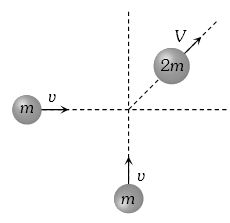
$A$ particle of mass $m$ moving eastward with a speed $v$ collides with another particle of the same mass moving northward with the same speed $v$. The two particles coalesce on collision. The new particle of mass $2m$ will move in the north-easterly direction with a velocity
A
$v/2$
B
$2v$
C
$v/\sqrt{2}$
D
$v$
Solution
(C) Initial momentum of the system is given by:
$\vec{P}_i = mv\hat{i} + mv\hat{j}$
Magnitude of initial momentum:
$|\vec{P}_i| = \sqrt{(mv)^2 + (mv)^2} = \sqrt{2}mv$
Final momentum of the system after coalescence is:
$\vec{P}_f = (2m)\vec{V}$
By the law of conservation of linear momentum,$\vec{P}_i = \vec{P}_f$:
$\sqrt{2}mv = 2mV$
Solving for $V$:
$V = \frac{\sqrt{2}mv}{2m} = \frac{v}{\sqrt{2}}$
$\vec{P}_i = mv\hat{i} + mv\hat{j}$
Magnitude of initial momentum:
$|\vec{P}_i| = \sqrt{(mv)^2 + (mv)^2} = \sqrt{2}mv$
Final momentum of the system after coalescence is:
$\vec{P}_f = (2m)\vec{V}$
By the law of conservation of linear momentum,$\vec{P}_i = \vec{P}_f$:
$\sqrt{2}mv = 2mV$
Solving for $V$:
$V = \frac{\sqrt{2}mv}{2m} = \frac{v}{\sqrt{2}}$
0 likes
View Solution3
EasyMCQ
The coefficient of restitution $e$ for a perfectly inelastic collision is
A
$1$
B
$0$
C
$\infty$
D
$-1$
Solution
(B) The coefficient of restitution $e$ is defined as the ratio of the relative velocity of separation to the relative velocity of approach of the colliding bodies.
In a perfectly inelastic collision,the two bodies stick together after the collision and move with a common velocity.
Since the bodies move together,the relative velocity of separation is $0$.
Therefore,the coefficient of restitution $e = \frac{\text{Relative velocity of separation}}{\text{Relative velocity of approach}} = \frac{0}{v_{approach}} = 0$.
In a perfectly inelastic collision,the two bodies stick together after the collision and move with a common velocity.
Since the bodies move together,the relative velocity of separation is $0$.
Therefore,the coefficient of restitution $e = \frac{\text{Relative velocity of separation}}{\text{Relative velocity of approach}} = \frac{0}{v_{approach}} = 0$.
0 likes
View Solution4
EasyMCQ
When two bodies stick together after collision,the collision is said to be
A
Partially elastic
B
Total elastic
C
Total inelastic
D
None of the above
Solution
(C) In a perfectly inelastic collision,the two colliding bodies stick together and move with a common velocity after the impact.
For a perfectly inelastic collision,the coefficient of restitution $e = 0$.
In such a collision,the total linear momentum of the system remains conserved just before and just after the collision,but there is a maximum loss of kinetic energy during the process.
For a perfectly inelastic collision,the coefficient of restitution $e = 0$.
In such a collision,the total linear momentum of the system remains conserved just before and just after the collision,but there is a maximum loss of kinetic energy during the process.
0 likes
View Solution5
EasyMCQ
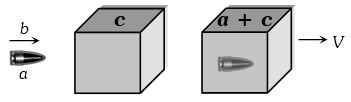
$A$ bullet of mass $a$ and velocity $b$ is fired into a large block of mass $c$. The final velocity of the system is
A
$\frac{c}{a + b} \cdot b$
B
$\frac{a}{a + c} \cdot b$
C
$\frac{a + b}{c} \cdot a$
D
$\frac{a + c}{a} \cdot b$
Solution
(B) Initially,the bullet moves with velocity $b$ and the block is at rest. After the collision,the bullet gets embedded in the block,and both move together with a common velocity $V$.
By the principle of conservation of linear momentum:
Initial momentum = Final momentum
$a \cdot b + c \cdot 0 = (a + c) \cdot V$
$a \cdot b = (a + c) \cdot V$
$V = \frac{a \cdot b}{a + c}$
By the principle of conservation of linear momentum:
Initial momentum = Final momentum
$a \cdot b + c \cdot 0 = (a + c) \cdot V$
$a \cdot b = (a + c) \cdot V$
$V = \frac{a \cdot b}{a + c}$
0 likes
View Solution6
EasyMCQ
$A$ completely inelastic collision is one in which the two colliding particles
A
Are separated after collision
B
Remain together after collision
C
Split into small fragments flying in all directions
D
None of the above
Solution
(B) completely inelastic collision is defined as a collision in which the coefficient of restitution $(e)$ is equal to $0$.
The coefficient of restitution is defined as the ratio of the relative velocity of separation to the relative velocity of approach.
Since $e = 0$,the relative velocity of separation must be $0$.
This implies that the two particles move with the same velocity after the collision,meaning they remain together after the collision.
The coefficient of restitution is defined as the ratio of the relative velocity of separation to the relative velocity of approach.
Since $e = 0$,the relative velocity of separation must be $0$.
This implies that the two particles move with the same velocity after the collision,meaning they remain together after the collision.
0 likes
View Solution7
EasyMCQ
$A$ bullet hits and gets embedded in a solid block resting on a horizontal frictionless table. What is conserved?
A
Momentum and kinetic energy
B
Kinetic energy alone
C
Momentum alone
D
Neither momentum nor kinetic energy
Solution
(C) When a bullet hits and gets embedded in a block,the collision is perfectly inelastic.
In any collision where no external horizontal force acts on the system,the total linear momentum of the system is conserved.
However,in a perfectly inelastic collision,kinetic energy is not conserved because some of the energy is dissipated as heat,sound,and deformation energy during the collision process.
Therefore,only momentum is conserved.
In any collision where no external horizontal force acts on the system,the total linear momentum of the system is conserved.
However,in a perfectly inelastic collision,kinetic energy is not conserved because some of the energy is dissipated as heat,sound,and deformation energy during the collision process.
Therefore,only momentum is conserved.
0 likes
View Solution8
EasyMCQ
$A$ body of mass $m$ moving with a constant velocity $v$ hits another body of the same mass moving with the same velocity $v$ but in the opposite direction and sticks to it. The velocity of the compound body after collision is
A
$v$
B
$2v$
C
$0$
D
$v/2$
Solution
(C) According to the law of conservation of linear momentum,the total momentum of the system remains constant if no external force acts on it.
Initial momentum of the system = $m(v) + m(-v) = mv - mv = 0$.
Let the final velocity of the combined mass be $V$.
Since the bodies stick together,the final mass of the system is $m + m = 2m$.
Final momentum of the system = $(2m)V$.
By the law of conservation of momentum: Initial momentum = Final momentum.
$0 = 2mV$.
Therefore,$V = 0$.
Initial momentum of the system = $m(v) + m(-v) = mv - mv = 0$.
Let the final velocity of the combined mass be $V$.
Since the bodies stick together,the final mass of the system is $m + m = 2m$.
Final momentum of the system = $(2m)V$.
By the law of conservation of momentum: Initial momentum = Final momentum.
$0 = 2mV$.
Therefore,$V = 0$.
0 likes
View Solution9
EasyMCQ
$A$ body of mass $m$ moving with a constant velocity $v$ hits another body of the same mass that is at rest. If the two bodies stick together after the collision,the velocity of the compound body is:
A
$v/2$
B
$2v$
C
$v$
D
$0$
Solution
(A) According to the law of conservation of linear momentum,the total momentum before the collision must equal the total momentum after the collision.
Let $m$ be the mass of each body.
Initial momentum of the first body = $mv$.
Initial momentum of the second body = $m \times 0 = 0$.
Total initial momentum = $mv + 0 = mv$.
After the collision,the two bodies stick together to form a compound body of mass $M = m + m = 2m$.
Let $V$ be the velocity of the compound body after the collision.
Total final momentum = $(2m)V$.
By the law of conservation of momentum: $mv = 2mV$.
Solving for $V$,we get $V = \frac{mv}{2m} = \frac{v}{2}$.
Let $m$ be the mass of each body.
Initial momentum of the first body = $mv$.
Initial momentum of the second body = $m \times 0 = 0$.
Total initial momentum = $mv + 0 = mv$.
After the collision,the two bodies stick together to form a compound body of mass $M = m + m = 2m$.
Let $V$ be the velocity of the compound body after the collision.
Total final momentum = $(2m)V$.
By the law of conservation of momentum: $mv = 2mV$.
Solving for $V$,we get $V = \frac{mv}{2m} = \frac{v}{2}$.
0 likes
View Solution10
DifficultMCQ
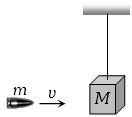
$A$ bag (mass $M$) hangs by a long thread and a bullet (mass $m$) comes horizontally with velocity $v$ and gets caught in the bag. Then for the combined (bag $+$ bullet) system
A
Momentum is $\frac{mvM}{M + m}$
B
Kinetic energy is $\frac{mv^2}{2}$
C
Momentum is $\frac{mv(M + m)}{M}$
D
Kinetic energy is $\frac{m^2v^2}{2(M + m)}$
Solution
(D) Initial momentum of the system = $mv$.
Final momentum of the system = $(m + M)V$,where $V$ is the common velocity of the system after collision.
By the law of conservation of linear momentum,$mv = (m + M)V$.
Therefore,the common velocity $V = \frac{mv}{M + m}$.
The kinetic energy of the combined system is $K = \frac{1}{2}(m + M)V^2$.
Substituting the value of $V$,we get $K = \frac{1}{2}(m + M) \left( \frac{mv}{M + m} \right)^2$.
$K = \frac{1}{2}(m + M) \frac{m^2v^2}{(M + m)^2} = \frac{m^2v^2}{2(M + m)}$.
Thus,option $D$ is correct.
Final momentum of the system = $(m + M)V$,where $V$ is the common velocity of the system after collision.
By the law of conservation of linear momentum,$mv = (m + M)V$.
Therefore,the common velocity $V = \frac{mv}{M + m}$.
The kinetic energy of the combined system is $K = \frac{1}{2}(m + M)V^2$.
Substituting the value of $V$,we get $K = \frac{1}{2}(m + M) \left( \frac{mv}{M + m} \right)^2$.
$K = \frac{1}{2}(m + M) \frac{m^2v^2}{(M + m)^2} = \frac{m^2v^2}{2(M + m)}$.
Thus,option $D$ is correct.
0 likes
View Solution11
DifficultMCQ
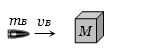
$A$ $50\, g$ bullet moving with velocity $10\, m/s$ strikes a block of mass $950 \,g$ at rest and gets embedded in it. The loss in kinetic energy will be ............... $\%$
A
$100$
B
$95$
C
$5$
D
$50$
Solution
(B) Initial kinetic energy of the system $(K_i)$ = Kinetic energy of the bullet = $\frac{1}{2} m_B v_B^2 = \frac{1}{2} \times 0.05 \, kg \times (10 \, m/s)^2 = 2.5 \, J$.
By the law of conservation of linear momentum,$m_B v_B = (m_B + M) v_{sys}$.
$0.05 \times 10 = (0.05 + 0.95) \times v_{sys} \implies 0.5 = 1 \times v_{sys} \implies v_{sys} = 0.5 \, m/s$.
Final kinetic energy of the system $(K_f)$ = $\frac{1}{2} (m_B + M) v_{sys}^2 = \frac{1}{2} \times 1 \, kg \times (0.5 \, m/s)^2 = 0.125 \, J$.
Loss in kinetic energy = $K_i - K_f = 2.5 - 0.125 = 2.375 \, J$.
Percentage loss = $\frac{K_i - K_f}{K_i} \times 100 = \frac{2.375}{2.5} \times 100 = 95\%$.
By the law of conservation of linear momentum,$m_B v_B = (m_B + M) v_{sys}$.
$0.05 \times 10 = (0.05 + 0.95) \times v_{sys} \implies 0.5 = 1 \times v_{sys} \implies v_{sys} = 0.5 \, m/s$.
Final kinetic energy of the system $(K_f)$ = $\frac{1}{2} (m_B + M) v_{sys}^2 = \frac{1}{2} \times 1 \, kg \times (0.5 \, m/s)^2 = 0.125 \, J$.
Loss in kinetic energy = $K_i - K_f = 2.5 - 0.125 = 2.375 \, J$.
Percentage loss = $\frac{K_i - K_f}{K_i} \times 100 = \frac{2.375}{2.5} \times 100 = 95\%$.
1 likes
View Solution12
MediumMCQ
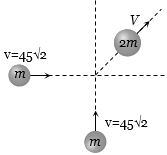
Two putty balls of equal mass $m$ moving with equal velocity $v = 45\sqrt{2} \, m/s$ in mutually perpendicular directions,stick together after collision. The velocity of their combined mass after collision is .................. $m/s$.
A
$45\sqrt{2}$
B
$45$
C
$90$
D
$22.5\sqrt{2}$
Solution
(B) Let the two balls have mass $m$ and move along the $x$ and $y$ axes respectively.
Initial velocity of ball $1$: $\vec{v}_1 = 45\sqrt{2} \hat{i} \, m/s$.
Initial velocity of ball $2$: $\vec{v}_2 = 45\sqrt{2} \hat{j} \, m/s$.
Initial total momentum: $\vec{P}_i = m\vec{v}_1 + m\vec{v}_2 = m(45\sqrt{2} \hat{i} + 45\sqrt{2} \hat{j})$.
The magnitude of initial momentum is: $|\vec{P}_i| = m \sqrt{(45\sqrt{2})^2 + (45\sqrt{2})^2} = m \sqrt{4050 + 4050} = m \sqrt{8100} = 90m \, kg \cdot m/s$.
After collision,the balls stick together to form a mass $2m$ moving with velocity $\vec{V}$.
By the law of conservation of linear momentum: $\vec{P}_i = \vec{P}_f$.
$90m = (2m)V$.
$V = \frac{90m}{2m} = 45 \, m/s$.
Initial velocity of ball $1$: $\vec{v}_1 = 45\sqrt{2} \hat{i} \, m/s$.
Initial velocity of ball $2$: $\vec{v}_2 = 45\sqrt{2} \hat{j} \, m/s$.
Initial total momentum: $\vec{P}_i = m\vec{v}_1 + m\vec{v}_2 = m(45\sqrt{2} \hat{i} + 45\sqrt{2} \hat{j})$.
The magnitude of initial momentum is: $|\vec{P}_i| = m \sqrt{(45\sqrt{2})^2 + (45\sqrt{2})^2} = m \sqrt{4050 + 4050} = m \sqrt{8100} = 90m \, kg \cdot m/s$.
After collision,the balls stick together to form a mass $2m$ moving with velocity $\vec{V}$.
By the law of conservation of linear momentum: $\vec{P}_i = \vec{P}_f$.
$90m = (2m)V$.
$V = \frac{90m}{2m} = 45 \, m/s$.
0 likes
View Solution13
DifficultMCQ
$A$ particle of mass $m$ moving with velocity $v$ collides with a stationary particle of mass $2m$ and sticks to it. What will be the speed of the system?
A
$v/2$
B
$2v$
C
$v/3$
D
$3v$
Solution
(C) According to the law of conservation of linear momentum,the total momentum before the collision is equal to the total momentum after the collision.
Initial momentum = $m \times v + 2m \times 0 = mv$.
Final momentum = $(m + 2m) \times V = 3mV$,where $V$ is the final velocity of the combined system.
Equating initial and final momentum: $mv = 3mV$.
Therefore,the speed of the system is $V = v/3$.
Initial momentum = $m \times v + 2m \times 0 = mv$.
Final momentum = $(m + 2m) \times V = 3mV$,where $V$ is the final velocity of the combined system.
Equating initial and final momentum: $mv = 3mV$.
Therefore,the speed of the system is $V = v/3$.
0 likes
View Solution14
MediumMCQ
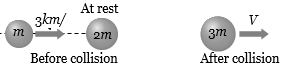
$A$ moving body of mass $m$ and velocity $3 \, km/h$ collides with a body of mass $2m$ at rest and sticks to it. Now the combined mass starts to move. What will be the combined velocity in $km/h$?
A
$3$
B
$2$
C
$1$
D
$4$
Solution
(C) According to the law of conservation of linear momentum,the total momentum before the collision is equal to the total momentum after the collision.
Initial momentum = $(m \times 3) + (2m \times 0) = 3m \, kg \cdot km/h$.
Final mass of the combined body = $m + 2m = 3m$.
Let the final velocity of the combined mass be $V$.
Final momentum = $(3m) \times V$.
Equating initial and final momentum:
$3m = 3m \times V$
$V = \frac{3m}{3m} = 1 \, km/h$.
Therefore,the combined velocity is $1 \, km/h$.
Initial momentum = $(m \times 3) + (2m \times 0) = 3m \, kg \cdot km/h$.
Final mass of the combined body = $m + 2m = 3m$.
Let the final velocity of the combined mass be $V$.
Final momentum = $(3m) \times V$.
Equating initial and final momentum:
$3m = 3m \times V$
$V = \frac{3m}{3m} = 1 \, km/h$.
Therefore,the combined velocity is $1 \, km/h$.
0 likes
View Solution15
EasyMCQ
$A$ ball is dropped from a height of $10 \,m$. The ball embeds itself $1 \,m$ into the sand and stops. Which of the following statements is correct regarding this process?
A
Only momentum remains conserved
B
Only kinetic energy remains conserved
C
Both momentum and kinetic energy are conserved
D
Neither kinetic energy nor momentum is conserved
Solution
(A) When the ball hits the sand and embeds itself,it undergoes a perfectly inelastic collision with the sand-earth system.
In any collision,the total linear momentum of the system (ball + earth) remains conserved,provided no external impulsive force acts on the system.
However,kinetic energy is not conserved in an inelastic collision because a significant portion of the energy is dissipated as heat,sound,and work done against the resistive force of the sand.
Therefore,only momentum remains conserved.
In any collision,the total linear momentum of the system (ball + earth) remains conserved,provided no external impulsive force acts on the system.
However,kinetic energy is not conserved in an inelastic collision because a significant portion of the energy is dissipated as heat,sound,and work done against the resistive force of the sand.
Therefore,only momentum remains conserved.
0 likes
View Solution16
MediumMCQ
$A$ metal ball of mass $2 \,kg$ moving with a velocity of $36 \,km/h$ has a head-on collision with a stationary ball of mass $3 \,kg$. If after the collision,the two balls move together,the loss in kinetic energy due to the collision is ........ $J$.
A
$40$
B
$60$
C
$100$
D
$140$
Solution
(B) Initial velocity of the first ball,$u_1 = 36 \,km/h = 36 \times \frac{5}{18} = 10 \,m/s$.
Initial velocity of the second ball,$u_2 = 0 \,m/s$.
Masses are $m_1 = 2 \,kg$ and $m_2 = 3 \,kg$.
By the law of conservation of linear momentum,$m_1 u_1 + m_2 u_2 = (m_1 + m_2)V$,where $V$ is the common velocity after the collision.
$2 \times 10 + 3 \times 0 = (2 + 3)V \implies 20 = 5V \implies V = 4 \,m/s$.
Initial kinetic energy,$K_i = \frac{1}{2} m_1 u_1^2 + \frac{1}{2} m_2 u_2^2 = \frac{1}{2} \times 2 \times (10)^2 + 0 = 100 \,J$.
Final kinetic energy,$K_f = \frac{1}{2} (m_1 + m_2) V^2 = \frac{1}{2} \times 5 \times (4)^2 = \frac{1}{2} \times 5 \times 16 = 40 \,J$.
Loss in kinetic energy,$\Delta K = K_i - K_f = 100 - 40 = 60 \,J$.
Initial velocity of the second ball,$u_2 = 0 \,m/s$.
Masses are $m_1 = 2 \,kg$ and $m_2 = 3 \,kg$.
By the law of conservation of linear momentum,$m_1 u_1 + m_2 u_2 = (m_1 + m_2)V$,where $V$ is the common velocity after the collision.
$2 \times 10 + 3 \times 0 = (2 + 3)V \implies 20 = 5V \implies V = 4 \,m/s$.
Initial kinetic energy,$K_i = \frac{1}{2} m_1 u_1^2 + \frac{1}{2} m_2 u_2^2 = \frac{1}{2} \times 2 \times (10)^2 + 0 = 100 \,J$.
Final kinetic energy,$K_f = \frac{1}{2} (m_1 + m_2) V^2 = \frac{1}{2} \times 5 \times (4)^2 = \frac{1}{2} \times 5 \times 16 = 40 \,J$.
Loss in kinetic energy,$\Delta K = K_i - K_f = 100 - 40 = 60 \,J$.
0 likes
View Solution17
MediumMCQ
$A$ body of mass $2 \, kg$ is moving with velocity $10 \, m/s$ towards the east. Another body of the same mass and same velocity moving towards the north collides with the former,coalesces,and moves towards the north-east. What is its final velocity?
A
$10 \, m/s$
B
$5 \, m/s$
C
$2.5 \, m/s$
D
$5\sqrt{2} \, m/s$
Solution
(D) Let the mass of each body be $m = 2 \, kg$ and the velocity be $v = 10 \, m/s$.
Initial momentum of the first body: $\vec{P}_1 = mv \hat{i} = 2 \times 10 \hat{i} = 20 \hat{i} \, kg \cdot m/s$.
Initial momentum of the second body: $\vec{P}_2 = mv \hat{j} = 2 \times 10 \hat{j} = 20 \hat{j} \, kg \cdot m/s$.
Total initial momentum: $\vec{P}_{total} = \vec{P}_1 + \vec{P}_2 = 20 \hat{i} + 20 \hat{j}$.
Magnitude of total initial momentum: $|\vec{P}_{total}| = \sqrt{20^2 + 20^2} = 20\sqrt{2} \, kg \cdot m/s$.
After collision,the bodies coalesce into a single mass $M = m + m = 4 \, kg$.
Let the final velocity be $V$. By the law of conservation of momentum: $\vec{P}_{final} = \vec{P}_{total}$.
$MV = |\vec{P}_{total}| \implies 4V = 20\sqrt{2}$.
$V = \frac{20\sqrt{2}}{4} = 5\sqrt{2} \, m/s$.
Initial momentum of the first body: $\vec{P}_1 = mv \hat{i} = 2 \times 10 \hat{i} = 20 \hat{i} \, kg \cdot m/s$.
Initial momentum of the second body: $\vec{P}_2 = mv \hat{j} = 2 \times 10 \hat{j} = 20 \hat{j} \, kg \cdot m/s$.
Total initial momentum: $\vec{P}_{total} = \vec{P}_1 + \vec{P}_2 = 20 \hat{i} + 20 \hat{j}$.
Magnitude of total initial momentum: $|\vec{P}_{total}| = \sqrt{20^2 + 20^2} = 20\sqrt{2} \, kg \cdot m/s$.
After collision,the bodies coalesce into a single mass $M = m + m = 4 \, kg$.
Let the final velocity be $V$. By the law of conservation of momentum: $\vec{P}_{final} = \vec{P}_{total}$.
$MV = |\vec{P}_{total}| \implies 4V = 20\sqrt{2}$.
$V = \frac{20\sqrt{2}}{4} = 5\sqrt{2} \, m/s$.
0 likes
View Solution18
MediumMCQ
$A$ mass of $20\, kg$ moving with a speed of $10\, m/s$ collides with another stationary mass of $5\, kg$. As a result of the collision,the two masses stick together. The kinetic energy of the composite mass will be ............. $J$.
A
$600$
B
$800$
C
$1000$
D
$1200$
Solution
(B) According to the law of conservation of linear momentum,the total momentum before the collision is equal to the total momentum after the collision.
Let $m_1 = 20\, kg$,$v_1 = 10\, m/s$,$m_2 = 5\, kg$,and $v_2 = 0\, m/s$.
$m_1 v_1 + m_2 v_2 = (m_1 + m_2) v_{sys}$
$20 \times 10 + 5 \times 0 = (20 + 5) v_{sys}$
$200 = 25 v_{sys}$
$v_{sys} = \frac{200}{25} = 8\, m/s$
The kinetic energy of the composite mass is given by $K.E. = \frac{1}{2} (m_1 + m_2) v_{sys}^2$.
$K.E. = \frac{1}{2} \times (20 + 5) \times (8)^2$
$K.E. = \frac{1}{2} \times 25 \times 64$
$K.E. = 25 \times 32 = 800\, J$.
Let $m_1 = 20\, kg$,$v_1 = 10\, m/s$,$m_2 = 5\, kg$,and $v_2 = 0\, m/s$.
$m_1 v_1 + m_2 v_2 = (m_1 + m_2) v_{sys}$
$20 \times 10 + 5 \times 0 = (20 + 5) v_{sys}$
$200 = 25 v_{sys}$
$v_{sys} = \frac{200}{25} = 8\, m/s$
The kinetic energy of the composite mass is given by $K.E. = \frac{1}{2} (m_1 + m_2) v_{sys}^2$.
$K.E. = \frac{1}{2} \times (20 + 5) \times (8)^2$
$K.E. = \frac{1}{2} \times 25 \times 64$
$K.E. = 25 \times 32 = 800\, J$.
0 likes
View Solution19
MediumMCQ
$A$ neutron having a mass of $1.67 \times 10^{-27} \ kg$ and moving at $10^8 \ m/s$ collides with a deuteron at rest and sticks to it. If the mass of the deuteron is $3.34 \times 10^{-27} \ kg$,then the speed of the combination is:
A
$2.56 \times 10^3 \ m/s$
B
$2.98 \times 10^5 \ m/s$
C
$3.33 \times 10^7 \ m/s$
D
$5.01 \times 10^9 \ m/s$
Solution
(C) According to the law of conservation of linear momentum,the total momentum before the collision equals the total momentum after the collision.
Let $m_1 = 1.67 \times 10^{-27} \ kg$ be the mass of the neutron and $v_1 = 10^8 \ m/s$ be its velocity.
Let $m_2 = 3.34 \times 10^{-27} \ kg$ be the mass of the deuteron,which is initially at rest $(v_2 = 0)$.
Since the particles stick together,they move with a common velocity $v$.
$m_1 v_1 + m_2 v_2 = (m_1 + m_2)v$
$(1.67 \times 10^{-27}) \times 10^8 + 0 = (1.67 \times 10^{-27} + 3.34 \times 10^{-27}) \times v$
$1.67 \times 10^{-19} = (5.01 \times 10^{-27}) \times v$
$v = \frac{1.67 \times 10^{-19}}{5.01 \times 10^{-27}}$
$v = \frac{1}{3} \times 10^8 \ m/s = 3.33 \times 10^7 \ m/s$.
Let $m_1 = 1.67 \times 10^{-27} \ kg$ be the mass of the neutron and $v_1 = 10^8 \ m/s$ be its velocity.
Let $m_2 = 3.34 \times 10^{-27} \ kg$ be the mass of the deuteron,which is initially at rest $(v_2 = 0)$.
Since the particles stick together,they move with a common velocity $v$.
$m_1 v_1 + m_2 v_2 = (m_1 + m_2)v$
$(1.67 \times 10^{-27}) \times 10^8 + 0 = (1.67 \times 10^{-27} + 3.34 \times 10^{-27}) \times v$
$1.67 \times 10^{-19} = (5.01 \times 10^{-27}) \times v$
$v = \frac{1.67 \times 10^{-19}}{5.01 \times 10^{-27}}$
$v = \frac{1}{3} \times 10^8 \ m/s = 3.33 \times 10^7 \ m/s$.
0 likes
View Solution20
MediumMCQ
$A$ body of mass $40\,kg$ having velocity $4\,m/s$ collides with another body of mass $60\,kg$ having velocity $2\,m/s$. If the collision is perfectly inelastic, then the loss in kinetic energy will be .............. $J$.
A
$440$
B
$392$
C
$48$
D
$144$
Solution
(C) For a perfectly inelastic collision, the loss in kinetic energy $(\Delta K)$ is given by the formula:
$\Delta K = \frac{1}{2} \left( \frac{m_1 m_2}{m_1 + m_2} \right) (u_1 - u_2)^2$
Given:
$m_1 = 40\,kg$, $u_1 = 4\,m/s$
$m_2 = 60\,kg$, $u_2 = 2\,m/s$
Substituting the values into the formula:
$\Delta K = \frac{1}{2} \left( \frac{40 \times 60}{40 + 60} \right) (4 - 2)^2$
$\Delta K = \frac{1}{2} \left( \frac{2400}{100} \right) (2)^2$
$\Delta K = \frac{1}{2} \times 24 \times 4$
$\Delta K = 12 \times 4 = 48\,J$
Therefore, the loss in kinetic energy is $48\,J$.
$\Delta K = \frac{1}{2} \left( \frac{m_1 m_2}{m_1 + m_2} \right) (u_1 - u_2)^2$
Given:
$m_1 = 40\,kg$, $u_1 = 4\,m/s$
$m_2 = 60\,kg$, $u_2 = 2\,m/s$
Substituting the values into the formula:
$\Delta K = \frac{1}{2} \left( \frac{40 \times 60}{40 + 60} \right) (4 - 2)^2$
$\Delta K = \frac{1}{2} \left( \frac{2400}{100} \right) (2)^2$
$\Delta K = \frac{1}{2} \times 24 \times 4$
$\Delta K = 12 \times 4 = 48\,J$
Therefore, the loss in kinetic energy is $48\,J$.
0 likes
View Solution21
EasyMCQ
$A$ body of mass $m_1$ is moving with a velocity $V$. It collides with another stationary body of mass $m_2$. They get embedded. At the point of collision,the velocity of the system
A
Increases
B
Decreases but does not become zero
C
Remains same
D
Become zero
Solution
(B) According to the law of conservation of linear momentum,the total momentum before the collision must equal the total momentum after the collision.
Let $v$ be the final velocity of the combined system.
Initial momentum = $m_1 V + m_2 \times 0 = m_1 V$.
Final momentum = $(m_1 + m_2)v$.
Equating the two: $m_1 V = (m_1 + m_2)v$.
Therefore,$v = \frac{m_1}{m_1 + m_2} V$.
Since $\frac{m_1}{m_1 + m_2} < 1$,the final velocity $v$ is less than the initial velocity $V$ but greater than zero (assuming $m_1, m_2 > 0$ and $V > 0$).
Let $v$ be the final velocity of the combined system.
Initial momentum = $m_1 V + m_2 \times 0 = m_1 V$.
Final momentum = $(m_1 + m_2)v$.
Equating the two: $m_1 V = (m_1 + m_2)v$.
Therefore,$v = \frac{m_1}{m_1 + m_2} V$.
Since $\frac{m_1}{m_1 + m_2} < 1$,the final velocity $v$ is less than the initial velocity $V$ but greater than zero (assuming $m_1, m_2 > 0$ and $V > 0$).
0 likes
View Solution22
MediumMCQ
$A$ bullet of mass $m$ moving with velocity $v$ strikes a block of mass $M$ at rest and gets embedded into it. The kinetic energy of the composite block will be
A
$\frac{1}{2}mv^2 \times \frac{m}{m+M}$
B
$\frac{1}{2}mv^2 \times \frac{M}{m+M}$
C
$\frac{1}{2}mv^2 \times \frac{M+m}{M}$
D
$\frac{1}{2}Mv^2 \times \frac{m}{m+M}$
Solution
(A) By the law of conservation of linear momentum,the initial momentum of the system equals the final momentum of the system.
$mv + M(0) = (m + M)V$
Where $V$ is the velocity of the composite block after the collision.
$V = \frac{mv}{m + M}$
The kinetic energy $(KE)$ of the composite block is given by $KE = \frac{1}{2}(m + M)V^2$.
Substituting the value of $V$:
$KE = \frac{1}{2}(m + M) \left( \frac{mv}{m + M} \right)^2$
$KE = \frac{1}{2}(m + M) \frac{m^2 v^2}{(m + M)^2}$
$KE = \frac{1}{2} m v^2 \left( \frac{m}{m + M} \right)$
$mv + M(0) = (m + M)V$
Where $V$ is the velocity of the composite block after the collision.
$V = \frac{mv}{m + M}$
The kinetic energy $(KE)$ of the composite block is given by $KE = \frac{1}{2}(m + M)V^2$.
Substituting the value of $V$:
$KE = \frac{1}{2}(m + M) \left( \frac{mv}{m + M} \right)^2$
$KE = \frac{1}{2}(m + M) \frac{m^2 v^2}{(m + M)^2}$
$KE = \frac{1}{2} m v^2 \left( \frac{m}{m + M} \right)$
0 likes
View Solution23
MediumMCQ
$A$ body of mass $4\, kg$ moving with velocity $12\, m/s$ collides with another body of mass $6\, kg$ at rest. If two bodies stick together after collision,then the loss of kinetic energy of the system is .............. $J$.
A
$0$
B
$288$
C
$172.8$
D
$144$
Solution
(C) Initial kinetic energy of the system $(K_i)$ = $\frac{1}{2} m_1 u_1^2 + \frac{1}{2} m_2 u_2^2 = \frac{1}{2} \times 4 \times (12)^2 + 0 = 288\, J$.
Since the bodies stick together,it is a perfectly inelastic collision.
By the law of conservation of linear momentum,$m_1 u_1 + m_2 u_2 = (m_1 + m_2) v$.
$4 \times 12 + 6 \times 0 = (4 + 6) v \implies 48 = 10v \implies v = 4.8\, m/s$.
Final kinetic energy of the system $(K_f)$ = $\frac{1}{2} (m_1 + m_2) v^2 = \frac{1}{2} \times 10 \times (4.8)^2 = 5 \times 23.04 = 115.2\, J$.
Loss in kinetic energy = $K_i - K_f = 288 - 115.2 = 172.8\, J$.
Since the bodies stick together,it is a perfectly inelastic collision.
By the law of conservation of linear momentum,$m_1 u_1 + m_2 u_2 = (m_1 + m_2) v$.
$4 \times 12 + 6 \times 0 = (4 + 6) v \implies 48 = 10v \implies v = 4.8\, m/s$.
Final kinetic energy of the system $(K_f)$ = $\frac{1}{2} (m_1 + m_2) v^2 = \frac{1}{2} \times 10 \times (4.8)^2 = 5 \times 23.04 = 115.2\, J$.
Loss in kinetic energy = $K_i - K_f = 288 - 115.2 = 172.8\, J$.
0 likes
View Solution24
EasyMCQ
Which of the following is not an example of a perfectly inelastic collision?
A
$A$ bullet fired into a block if the bullet gets embedded into the block
B
Capture of electrons by an atom
C
$A$ man jumping onto a moving boat
D
$A$ ball bearing striking another ball bearing
Solution
(D) In a perfectly inelastic collision,the colliding bodies stick together and move with a common velocity after the impact.
$A$. $A$ bullet embedded in a block means they move together. This is a perfectly inelastic collision.
$B$. The capture of an electron by an atom results in the electron becoming part of the atomic system. This is a perfectly inelastic collision.
$C$. $A$ man jumping onto a moving boat results in the man moving with the boat. This is a perfectly inelastic collision.
$D$. $A$ ball bearing striking another ball bearing usually results in them bouncing off each other,which is an elastic or partially inelastic collision,not a perfectly inelastic one.
Therefore,the correct option is $D$.
$A$. $A$ bullet embedded in a block means they move together. This is a perfectly inelastic collision.
$B$. The capture of an electron by an atom results in the electron becoming part of the atomic system. This is a perfectly inelastic collision.
$C$. $A$ man jumping onto a moving boat results in the man moving with the boat. This is a perfectly inelastic collision.
$D$. $A$ ball bearing striking another ball bearing usually results in them bouncing off each other,which is an elastic or partially inelastic collision,not a perfectly inelastic one.
Therefore,the correct option is $D$.
0 likes
View Solution25
EasyMCQ
$A$ bullet strikes a solid block resting on a frictionless horizontal table and gets embedded in it. Which of the following is conserved?
A
Momentum and kinetic energy
B
Kinetic energy
C
Momentum
D
Neither momentum nor kinetic energy
Solution
(C) $1$. In this scenario,the bullet and the block form an isolated system because there are no external horizontal forces acting on them (the table is frictionless).
$2$. According to the law of conservation of linear momentum,the total momentum of an isolated system remains constant.
$3$. Since the bullet gets embedded in the block,this is a perfectly inelastic collision.
$4$. In a perfectly inelastic collision,kinetic energy is not conserved; it is partially converted into heat,sound,and deformation energy.
$5$. Therefore,only the linear momentum is conserved.
$2$. According to the law of conservation of linear momentum,the total momentum of an isolated system remains constant.
$3$. Since the bullet gets embedded in the block,this is a perfectly inelastic collision.
$4$. In a perfectly inelastic collision,kinetic energy is not conserved; it is partially converted into heat,sound,and deformation energy.
$5$. Therefore,only the linear momentum is conserved.
0 likes
View Solution26
MediumMCQ
$A$ particle of mass $m_1$ moving with a velocity of $5 \ m/s$ undergoes a head-on collision with a stationary particle of mass $m_2$. After the collision,both particles move with a common velocity of $4 \ m/s$. Find the ratio $m_1/m_2$.
A
$4 : 1$
B
$2 : 1$
C
$1 : 8$
D
$1 : 1$
Solution
(A) According to the law of conservation of linear momentum,the total momentum before the collision is equal to the total momentum after the collision.
Initial momentum $P_i = m_1 \times 5 + m_2 \times 0 = 5m_1$.
Final momentum $P_f = (m_1 + m_2) \times 4 = 4m_1 + 4m_2$.
Equating $P_i$ and $P_f$:
$5m_1 = 4m_1 + 4m_2$.
$5m_1 - 4m_1 = 4m_2$.
$m_1 = 4m_2$.
Therefore,the ratio $\frac{m_1}{m_2} = \frac{4}{1}$.
Initial momentum $P_i = m_1 \times 5 + m_2 \times 0 = 5m_1$.
Final momentum $P_f = (m_1 + m_2) \times 4 = 4m_1 + 4m_2$.
Equating $P_i$ and $P_f$:
$5m_1 = 4m_1 + 4m_2$.
$5m_1 - 4m_1 = 4m_2$.
$m_1 = 4m_2$.
Therefore,the ratio $\frac{m_1}{m_2} = \frac{4}{1}$.
0 likes
View Solution27
EasyMCQ
In a perfectly inelastic collision,what happens to the two colliding particles after the collision?
A
They separate after the collision.
B
They stick together and move as a single unit after the collision.
C
They break into smaller particles and fly in different directions.
D
None of the above.
Solution
(B) perfectly inelastic collision is defined as a collision in which the two colliding bodies stick together after the impact.
In such a collision,the kinetic energy is not conserved,but the total linear momentum of the system remains conserved.
Since the bodies move with a common velocity after the collision,the final kinetic energy is less than the initial kinetic energy.
Therefore,the correct description is that the particles stick together and move as a single unit.
In such a collision,the kinetic energy is not conserved,but the total linear momentum of the system remains conserved.
Since the bodies move with a common velocity after the collision,the final kinetic energy is less than the initial kinetic energy.
Therefore,the correct description is that the particles stick together and move as a single unit.
0 likes
View Solution28
MediumMCQ
$A$ particle of mass $m_1$ undergoes a perfectly inelastic head-on collision with another particle of mass $m_2$ at rest $(m_2 > m_1)$. What fraction of the initial kinetic energy is converted into heat energy during this collision?
A
$\frac{m_2}{m_1 + m_2}$
B
$\frac{m_1}{m_1 + m_2}$
C
$\frac{m_1}{m_1 - m_2}$
D
$\frac{m_2}{m_1 - m_2}$
Solution
(A) In a perfectly inelastic collision,the two particles stick together after the collision and move with a common velocity $v_f$.
By the law of conservation of linear momentum: $m_1 u_1 + m_2(0) = (m_1 + m_2)v_f$.
Thus,$v_f = \frac{m_1 u_1}{m_1 + m_2}$.
The initial kinetic energy is $K_i = \frac{1}{2} m_1 u_1^2$.
The final kinetic energy is $K_f = \frac{1}{2} (m_1 + m_2) v_f^2 = \frac{1}{2} (m_1 + m_2) \left( \frac{m_1 u_1}{m_1 + m_2} \right)^2 = \frac{1}{2} \frac{m_1^2 u_1^2}{m_1 + m_2}$.
The loss in kinetic energy (which is converted to heat) is $\Delta K = K_i - K_f = \frac{1}{2} m_1 u_1^2 - \frac{1}{2} \frac{m_1^2 u_1^2}{m_1 + m_2}$.
$\Delta K = \frac{1}{2} m_1 u_1^2 \left( 1 - \frac{m_1}{m_1 + m_2} \right) = \frac{1}{2} m_1 u_1^2 \left( \frac{m_2}{m_1 + m_2} \right)$.
The fraction of initial kinetic energy converted to heat is $\frac{\Delta K}{K_i} = \frac{m_2}{m_1 + m_2}$.
By the law of conservation of linear momentum: $m_1 u_1 + m_2(0) = (m_1 + m_2)v_f$.
Thus,$v_f = \frac{m_1 u_1}{m_1 + m_2}$.
The initial kinetic energy is $K_i = \frac{1}{2} m_1 u_1^2$.
The final kinetic energy is $K_f = \frac{1}{2} (m_1 + m_2) v_f^2 = \frac{1}{2} (m_1 + m_2) \left( \frac{m_1 u_1}{m_1 + m_2} \right)^2 = \frac{1}{2} \frac{m_1^2 u_1^2}{m_1 + m_2}$.
The loss in kinetic energy (which is converted to heat) is $\Delta K = K_i - K_f = \frac{1}{2} m_1 u_1^2 - \frac{1}{2} \frac{m_1^2 u_1^2}{m_1 + m_2}$.
$\Delta K = \frac{1}{2} m_1 u_1^2 \left( 1 - \frac{m_1}{m_1 + m_2} \right) = \frac{1}{2} m_1 u_1^2 \left( \frac{m_2}{m_1 + m_2} \right)$.
The fraction of initial kinetic energy converted to heat is $\frac{\Delta K}{K_i} = \frac{m_2}{m_1 + m_2}$.
0 likes
View Solution29
EasyMCQ
$A$ bullet of mass $m$ is fired horizontally with a velocity $u$ into a sandbag placed on a truck. If the mass of the truck is $M$, what will be the velocity of the truck after the collision?
A
$\frac{\mu}{M + m}$
B
$\frac{m}{(M + m)u}$
C
$\frac{mM}{(M + m)u}$
D
$0$
Solution
(A) This is a case of a perfectly inelastic collision where the bullet gets embedded in the sandbag on the truck.
According to the law of conservation of linear momentum, the total momentum before the collision must equal the total momentum after the collision.
Let $V$ be the final velocity of the truck (with the bullet and sandbag) after the collision.
Initial momentum of the system = $m \cdot u + M \cdot 0 = \mu$.
Final momentum of the system = $(M + m) \cdot V$.
Equating the two: $\mu = (M + m)V$.
Solving for $V$: $V = \frac{\mu}{M + m}$.
According to the law of conservation of linear momentum, the total momentum before the collision must equal the total momentum after the collision.
Let $V$ be the final velocity of the truck (with the bullet and sandbag) after the collision.
Initial momentum of the system = $m \cdot u + M \cdot 0 = \mu$.
Final momentum of the system = $(M + m) \cdot V$.
Equating the two: $\mu = (M + m)V$.
Solving for $V$: $V = \frac{\mu}{M + m}$.
0 likes
View Solution30
MediumMCQ
Statement $1$: In a perfectly inelastic collision,the total energy of two particles moving in the same direction is not completely lost.
Statement $2$: The principle of conservation of momentum is valid for all types of collisions.
Statement $2$: The principle of conservation of momentum is valid for all types of collisions.
A
Statement $-1$ is true,Statement $-2$ is false.
B
Statement $-1$ is true,Statement $-2$ is true.
C
Statement $-1$ is true,Statement $-2$ is true,but Statement $-2$ is not the correct explanation of Statement $-1$.
D
Statement $-1$ is false,Statement $-2$ is true.
Solution
(B) Statement $1$ is true: In a perfectly inelastic collision,the particles stick together after the collision. While kinetic energy is lost (converted into heat,sound,or deformation energy),the total energy of the system remains conserved. Since the particles continue to move with a common velocity,the system retains some kinetic energy,so the total energy is not completely lost.
Statement $2$ is true: The law of conservation of linear momentum is a fundamental principle derived from Newton's laws and is applicable to all types of collisions (elastic,inelastic,or perfectly inelastic) provided no external force acts on the system.
Conclusion: Both statements are true,but Statement $2$ does not explain why the energy is not completely lost in Statement $1$.
Statement $2$ is true: The law of conservation of linear momentum is a fundamental principle derived from Newton's laws and is applicable to all types of collisions (elastic,inelastic,or perfectly inelastic) provided no external force acts on the system.
Conclusion: Both statements are true,but Statement $2$ does not explain why the energy is not completely lost in Statement $1$.
0 likes
View Solution31
EasyMCQ
Find the correct option based on the two statements given below.
Statement-$1$ : Two particles moving in the same direction do not lose all their energy in a perfectly inelastic collision.
Statement-$2$ : The law of conservation of linear momentum is obeyed for all types of collisions.
Statement-$1$ : Two particles moving in the same direction do not lose all their energy in a perfectly inelastic collision.
Statement-$2$ : The law of conservation of linear momentum is obeyed for all types of collisions.
A
Statement-$1$ is false,Statement-$2$ is true.
B
Statement-$1$ is true,Statement-$2$ is false.
C
Statement-$1$ is true,Statement-$2$ is true. Statement-$2$ is the correct explanation of Statement-$1$.
D
Statement-$1$ is true,Statement-$2$ is true. Statement-$2$ is not the correct explanation of Statement-$1$.
Solution
(D) In a perfectly inelastic collision,the particles stick together and move with a common velocity $V_f = \frac{m_1v_1 + m_2v_2}{m_1 + m_2}$.
Since the system retains a common velocity after the collision,the final kinetic energy $K_f = \frac{1}{2}(m_1 + m_2)V_f^2$ is not zero.
Thus,Statement-$1$ is true because the system does not lose all its energy.
Statement-$2$ is also true because the law of conservation of linear momentum is a fundamental principle that applies to all collisions in the absence of external forces.
However,the conservation of momentum (Statement-$2$) is not the reason why some kinetic energy is retained (Statement-$1$); the retention of energy is due to the requirement of momentum conservation in a system that must move together.
Therefore,Statement-$1$ and Statement-$2$ are both true,but Statement-$2$ is not the correct explanation of Statement-$1$.
Since the system retains a common velocity after the collision,the final kinetic energy $K_f = \frac{1}{2}(m_1 + m_2)V_f^2$ is not zero.
Thus,Statement-$1$ is true because the system does not lose all its energy.
Statement-$2$ is also true because the law of conservation of linear momentum is a fundamental principle that applies to all collisions in the absence of external forces.
However,the conservation of momentum (Statement-$2$) is not the reason why some kinetic energy is retained (Statement-$1$); the retention of energy is due to the requirement of momentum conservation in a system that must move together.
Therefore,Statement-$1$ and Statement-$2$ are both true,but Statement-$2$ is not the correct explanation of Statement-$1$.
0 likes
View Solution32
DifficultMCQ
$A$ bag of mass $M$ is suspended by a long string. $A$ bullet of mass $m$ moving with velocity $v$ hits the bag and gets embedded in it. For the (bag + bullet) system:
A
The momentum is $\frac{mvM}{M + m}$.
B
The kinetic energy is $\frac{mv^2}{2}$.
C
The momentum is $\frac{mv(M + m)}{M}$.
D
The kinetic energy is $\frac{m^2v^2}{2(M + m)}$.
Solution
(D) According to the law of conservation of linear momentum,the initial momentum of the system equals the final momentum.
$mv + M(0) = (m + M)v'$
$v' = \frac{mv}{m + M}$
where $v'$ is the common velocity of the system after the collision.
The kinetic energy of the (bag + bullet) system after the collision is given by:
$K = \frac{1}{2}(m + M)(v')^2$
$K = \frac{1}{2}(m + M) \left( \frac{mv}{m + M} \right)^2$
$K = \frac{1}{2}(m + M) \frac{m^2v^2}{(m + M)^2}$
$K = \frac{m^2v^2}{2(m + M)}$
$mv + M(0) = (m + M)v'$
$v' = \frac{mv}{m + M}$
where $v'$ is the common velocity of the system after the collision.
The kinetic energy of the (bag + bullet) system after the collision is given by:
$K = \frac{1}{2}(m + M)(v')^2$
$K = \frac{1}{2}(m + M) \left( \frac{mv}{m + M} \right)^2$
$K = \frac{1}{2}(m + M) \frac{m^2v^2}{(m + M)^2}$
$K = \frac{m^2v^2}{2(m + M)}$
0 likes
View Solution33
DifficultMCQ
$A$ body of mass $0.50 \ kg$ is moving on a smooth surface with a speed of $2.00 \ m/s$. It collides with another body of mass $1.00 \ kg$ at rest,and they move together as a single body. The energy loss during the collision is ....... $J$.
A
$0.16$
B
$1.00$
C
$0.67$
D
$0.34$
Solution
(C) Given: $m_1 = 0.50 \ kg$,$u_1 = 2.00 \ m/s$,$m_2 = 1.00 \ kg$,$u_2 = 0 \ m/s$.
By the law of conservation of linear momentum: $m_1 u_1 + m_2 u_2 = (m_1 + m_2)v$.
$(0.50)(2.00) + (1.00)(0) = (0.50 + 1.00)v$.
$1.00 = 1.50v \implies v = \frac{1.00}{1.50} = \frac{2}{3} \ m/s$.
Initial kinetic energy $K_i = \frac{1}{2} m_1 u_1^2 = \frac{1}{2} (0.50) (2.00)^2 = 1.00 \ J$.
Final kinetic energy $K_f = \frac{1}{2} (m_1 + m_2) v^2 = \frac{1}{2} (1.50) (\frac{2}{3})^2 = 0.75 \times \frac{4}{9} = 0.333... \ J$.
Energy loss $\Delta K = K_i - K_f = 1.00 - 0.333 = 0.667 \ J \approx 0.67 \ J$.
By the law of conservation of linear momentum: $m_1 u_1 + m_2 u_2 = (m_1 + m_2)v$.
$(0.50)(2.00) + (1.00)(0) = (0.50 + 1.00)v$.
$1.00 = 1.50v \implies v = \frac{1.00}{1.50} = \frac{2}{3} \ m/s$.
Initial kinetic energy $K_i = \frac{1}{2} m_1 u_1^2 = \frac{1}{2} (0.50) (2.00)^2 = 1.00 \ J$.
Final kinetic energy $K_f = \frac{1}{2} (m_1 + m_2) v^2 = \frac{1}{2} (1.50) (\frac{2}{3})^2 = 0.75 \times \frac{4}{9} = 0.333... \ J$.
Energy loss $\Delta K = K_i - K_f = 1.00 - 0.333 = 0.667 \ J \approx 0.67 \ J$.
0 likes
View Solution34
DifficultMCQ
$A$ scooter of mass $40 \ kg$ moving with a velocity of $4 \ m/s$ collides with another scooter of mass $60 \ kg$ moving with a velocity of $2 \ m/s$. After the collision,both scooters stick together. Find the loss in kinetic energy in $J$.
A
$392$
B
$440$
C
$48$
D
$110$
Solution
(C) The loss in kinetic energy during a perfectly inelastic collision is given by the formula: $\Delta K = \frac{1}{2} \left( \frac{m_1 m_2}{m_1 + m_2} \right) (u_1 - u_2)^2$.
Given: $m_1 = 40 \ kg$,$u_1 = 4 \ m/s$,$m_2 = 60 \ kg$,$u_2 = 2 \ m/s$.
Substituting the values: $\Delta K = \frac{1}{2} \left( \frac{40 \times 60}{40 + 60} \right) (4 - 2)^2$.
$\Delta K = \frac{1}{2} \left( \frac{2400}{100} \right) (2)^2$.
$\Delta K = \frac{1}{2} \times 24 \times 4$.
$\Delta K = 12 \times 4 = 48 \ J$.
Given: $m_1 = 40 \ kg$,$u_1 = 4 \ m/s$,$m_2 = 60 \ kg$,$u_2 = 2 \ m/s$.
Substituting the values: $\Delta K = \frac{1}{2} \left( \frac{40 \times 60}{40 + 60} \right) (4 - 2)^2$.
$\Delta K = \frac{1}{2} \left( \frac{2400}{100} \right) (2)^2$.
$\Delta K = \frac{1}{2} \times 24 \times 4$.
$\Delta K = 12 \times 4 = 48 \ J$.
0 likes
View Solution35
DifficultMCQ
$A$ body of mass $20 \ kg$ moving with a speed of $10 \ m/s$ collides with a stationary body of mass $5 \ kg$. After the collision,both bodies stick together. The combined kinetic energy of the system will be $...... \ J$.
A
$600$
B
$800$
C
$1000$
D
$1200$
Solution
(B) According to the law of conservation of linear momentum,$m_1v_1 + m_2v_2 = (m_1 + m_2)v$.
Given $m_1 = 20 \ kg$,$v_1 = 10 \ m/s$,$m_2 = 5 \ kg$,$v_2 = 0 \ m/s$.
Substituting the values: $20 \times 10 + 5 \times 0 = (20 + 5)v$.
$200 = 25v$,which gives $v = 8 \ m/s$.
The combined kinetic energy $K = \frac{1}{2}(m_1 + m_2)v^2$.
$K = \frac{1}{2}(20 + 5) \times (8)^2 = \frac{1}{2} \times 25 \times 64 = 25 \times 32 = 800 \ J$.
Given $m_1 = 20 \ kg$,$v_1 = 10 \ m/s$,$m_2 = 5 \ kg$,$v_2 = 0 \ m/s$.
Substituting the values: $20 \times 10 + 5 \times 0 = (20 + 5)v$.
$200 = 25v$,which gives $v = 8 \ m/s$.
The combined kinetic energy $K = \frac{1}{2}(m_1 + m_2)v^2$.
$K = \frac{1}{2}(20 + 5) \times (8)^2 = \frac{1}{2} \times 25 \times 64 = 25 \times 32 = 800 \ J$.
0 likes
View Solution36
MediumMCQ
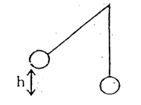
Two identical balls are suspended side by side by two long strings. One ball is pulled aside so that its center of gravity rises by a vertical distance $h$. It is then released and undergoes a perfectly inelastic collision with the other ball. What is the vertical distance to which the center of gravity of the combined system rises?
A
$h$
B
$3h/4$
C
$h/2$
D
$h/4$
Solution
(D) Let the mass of each ball be $m$. When the first ball is released from a vertical height $h$,its velocity $v$ just before the collision is given by the conservation of energy: $v = \sqrt{2gh}$.
Since the collision is perfectly inelastic,the two balls stick together and move with a common velocity $V$ after the collision. Applying the law of conservation of linear momentum:
$m \cdot v + m \cdot 0 = (m + m) \cdot V$
$m \sqrt{2gh} = 2m \cdot V$
$V = \frac{\sqrt{2gh}}{2} = \sqrt{\frac{2gh}{4}}$
Let the combined system rise to a new vertical height $h'$. Using the conservation of energy for the combined system:
$\frac{1}{2} (2m) V^2 = (2m) g h'$
$V^2 = 2g h'$
Substituting $V^2 = \frac{2gh}{4}$:
$\frac{2gh}{4} = 2g h'$
$h' = \frac{h}{4}$
Since the collision is perfectly inelastic,the two balls stick together and move with a common velocity $V$ after the collision. Applying the law of conservation of linear momentum:
$m \cdot v + m \cdot 0 = (m + m) \cdot V$
$m \sqrt{2gh} = 2m \cdot V$
$V = \frac{\sqrt{2gh}}{2} = \sqrt{\frac{2gh}{4}}$
Let the combined system rise to a new vertical height $h'$. Using the conservation of energy for the combined system:
$\frac{1}{2} (2m) V^2 = (2m) g h'$
$V^2 = 2g h'$
Substituting $V^2 = \frac{2gh}{4}$:
$\frac{2gh}{4} = 2g h'$
$h' = \frac{h}{4}$
0 likes
View Solution37
EasyMCQ
$A$ particle of mass $m$ moves with velocity $v$ towards the East. It collides with another particle of the same mass and same speed moving towards the North and sticks to it. What will be the velocity of the combined particles?
A
$v/\sqrt{2}$ in North-East direction
B
$v/\sqrt{2}$ in North-West direction
C
$\sqrt{2}v$ in North-East direction
D
$\sqrt{2}v$ in North-West direction
Solution
(A) Using the law of conservation of linear momentum,the initial momentum is $\vec{p}_i = m v \hat{i} + m v \hat{j}$.
After the collision,the particles stick together to form a mass of $2m$ moving with velocity $\vec{v}'$.
By conservation of momentum: $m v \hat{i} + m v \hat{j} = (2m) \vec{v}'$.
Dividing by $2m$,we get $\vec{v}' = \frac{v}{2} \hat{i} + \frac{v}{2} \hat{j}$.
The magnitude of the velocity is $v' = \sqrt{(\frac{v}{2})^2 + (\frac{v}{2})^2} = \sqrt{\frac{v^2}{4} + \frac{v^2}{4}} = \sqrt{\frac{v^2}{2}} = \frac{v}{\sqrt{2}}$.
The direction is along the resultant of $\hat{i}$ and $\hat{j}$,which is the North-East direction.
After the collision,the particles stick together to form a mass of $2m$ moving with velocity $\vec{v}'$.
By conservation of momentum: $m v \hat{i} + m v \hat{j} = (2m) \vec{v}'$.
Dividing by $2m$,we get $\vec{v}' = \frac{v}{2} \hat{i} + \frac{v}{2} \hat{j}$.
The magnitude of the velocity is $v' = \sqrt{(\frac{v}{2})^2 + (\frac{v}{2})^2} = \sqrt{\frac{v^2}{4} + \frac{v^2}{4}} = \sqrt{\frac{v^2}{2}} = \frac{v}{\sqrt{2}}$.
The direction is along the resultant of $\hat{i}$ and $\hat{j}$,which is the North-East direction.
0 likes
View Solution38
DifficultMCQ
$A$ neutron of mass $1.67 \times 10^{-27} \ kg$ moving with a velocity of $10^8 \ m/s$ collides with a deuteron at rest and sticks to it. If the mass of the deuteron is $3.34 \times 10^{-27} \ kg$,what will be the velocity of the combined system?
A
$2.56 \times 10^3 \ m/s$
B
$2.98 \times 10^5 \ m/s$
C
$3.33 \times 10^7 \ m/s$
D
$55.01 \times 10^9 \ m/s$
Solution
(C) According to the law of conservation of linear momentum,the total momentum before collision equals the total momentum after collision.
Let $m_1 = 1.67 \times 10^{-27} \ kg$ be the mass of the neutron and $v_1 = 10^8 \ m/s$ be its velocity.
Let $m_2 = 3.34 \times 10^{-27} \ kg$ be the mass of the deuteron,which is initially at rest $(v_2 = 0)$.
Let $v$ be the final velocity of the combined system of mass $(m_1 + m_2)$.
Applying the conservation of momentum:
$m_1 v_1 + m_2 v_2 = (m_1 + m_2)v$
$(1.67 \times 10^{-27}) \times 10^8 + (3.34 \times 10^{-27}) \times 0 = (1.67 \times 10^{-27} + 3.34 \times 10^{-27})v$
$1.67 \times 10^{-19} = (5.01 \times 10^{-27})v$
$v = \frac{1.67 \times 10^{-19}}{5.01 \times 10^{-27}}$
$v = 0.333 \times 10^8 \ m/s = 3.33 \times 10^7 \ m/s$.
Let $m_1 = 1.67 \times 10^{-27} \ kg$ be the mass of the neutron and $v_1 = 10^8 \ m/s$ be its velocity.
Let $m_2 = 3.34 \times 10^{-27} \ kg$ be the mass of the deuteron,which is initially at rest $(v_2 = 0)$.
Let $v$ be the final velocity of the combined system of mass $(m_1 + m_2)$.
Applying the conservation of momentum:
$m_1 v_1 + m_2 v_2 = (m_1 + m_2)v$
$(1.67 \times 10^{-27}) \times 10^8 + (3.34 \times 10^{-27}) \times 0 = (1.67 \times 10^{-27} + 3.34 \times 10^{-27})v$
$1.67 \times 10^{-19} = (5.01 \times 10^{-27})v$
$v = \frac{1.67 \times 10^{-19}}{5.01 \times 10^{-27}}$
$v = 0.333 \times 10^8 \ m/s = 3.33 \times 10^7 \ m/s$.
0 likes
View Solution39
DifficultMCQ
$A$ metal ball of mass $2 \ kg$ moves with a speed of $36 \ km/hr$. It collides with a stationary ball of mass $3 \ kg$. If both balls move together after the collision,the loss in kinetic energy due to the collision is ........... $J$.
A
$40$
B
$60$
C
$100$
D
$140$
Solution
(B) Given: $m_1 = 2 \ kg$,$u_1 = 36 \ km/hr = 36 \times \frac{5}{18} = 10 \ m/s$,$m_2 = 3 \ kg$,$u_2 = 0 \ m/s$.
According to the law of conservation of linear momentum: $m_1 u_1 + m_2 u_2 = (m_1 + m_2)v$.
$(2)(10) + (3)(0) = (2 + 3)v \implies 20 = 5v \implies v = 4 \ m/s$.
Initial kinetic energy $K_i = \frac{1}{2} m_1 u_1^2 = \frac{1}{2} \times 2 \times (10)^2 = 100 \ J$.
Final kinetic energy $K_f = \frac{1}{2} (m_1 + m_2) v^2 = \frac{1}{2} \times (2 + 3) \times (4)^2 = \frac{1}{2} \times 5 \times 16 = 40 \ J$.
Loss in kinetic energy $\Delta K = K_i - K_f = 100 \ J - 40 \ J = 60 \ J$.
According to the law of conservation of linear momentum: $m_1 u_1 + m_2 u_2 = (m_1 + m_2)v$.
$(2)(10) + (3)(0) = (2 + 3)v \implies 20 = 5v \implies v = 4 \ m/s$.
Initial kinetic energy $K_i = \frac{1}{2} m_1 u_1^2 = \frac{1}{2} \times 2 \times (10)^2 = 100 \ J$.
Final kinetic energy $K_f = \frac{1}{2} (m_1 + m_2) v^2 = \frac{1}{2} \times (2 + 3) \times (4)^2 = \frac{1}{2} \times 5 \times 16 = 40 \ J$.
Loss in kinetic energy $\Delta K = K_i - K_f = 100 \ J - 40 \ J = 60 \ J$.
0 likes
View Solution40
DifficultMCQ
$A$ body of mass $40 \ kg$ moves with a velocity of $4 \ m/s$,and another body of mass $60 \ kg$ moves with a velocity of $2 \ m/s$. If they undergo a perfectly inelastic collision,the loss in kinetic energy is $... \ J$.
A
$440$
B
$392$
C
$48$
D
$144$
Solution
(C) For a perfectly inelastic collision,the loss in kinetic energy $\Delta K$ is given by the formula: $\Delta K = \frac{1}{2} \frac{m_1 m_2}{m_1 + m_2} (u_1 - u_2)^2$.
Given: $m_1 = 40 \ kg$,$u_1 = 4 \ m/s$,$m_2 = 60 \ kg$,$u_2 = 2 \ m/s$.
Substituting the values: $\Delta K = \frac{1}{2} \times \frac{40 \times 60}{40 + 60} \times (4 - 2)^2$.
$\Delta K = \frac{1}{2} \times \frac{2400}{100} \times (2)^2$.
$\Delta K = \frac{1}{2} \times 24 \times 4$.
$\Delta K = 12 \times 4 = 48 \ J$.
Given: $m_1 = 40 \ kg$,$u_1 = 4 \ m/s$,$m_2 = 60 \ kg$,$u_2 = 2 \ m/s$.
Substituting the values: $\Delta K = \frac{1}{2} \times \frac{40 \times 60}{40 + 60} \times (4 - 2)^2$.
$\Delta K = \frac{1}{2} \times \frac{2400}{100} \times (2)^2$.
$\Delta K = \frac{1}{2} \times 24 \times 4$.
$\Delta K = 12 \times 4 = 48 \ J$.
0 likes
View Solution41
MediumMCQ
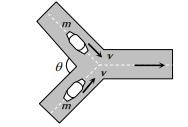
Two cars of equal mass $m$ moving with the same speed $v$ undergo a perfectly inelastic collision. What is the velocity of the combined mass after the collision?
A
$v \cos \frac{\theta}{2}$
B
$\frac{v}{2} \cos \theta$
C
$\frac{v}{2} \cos \frac{\theta}{2}$
D
$2v \cos \theta$
Solution
(A) Let the two cars have mass $m$ and velocity $v$. They collide at an angle $\theta$ between their paths.
By the principle of conservation of linear momentum,the component of momentum along the direction of the combined motion must be conserved.
The initial momentum of each car along the direction of the resultant motion is $mv \cos(\theta/2)$.
Since there are two cars,the total initial momentum is $P_i = mv \cos(\theta/2) + mv \cos(\theta/2) = 2mv \cos(\theta/2)$.
After the collision,the two cars stick together and move with a common velocity $V$. The total mass is $2m$.
The final momentum is $P_f = (2m)V$.
Equating initial and final momentum: $2mV = 2mv \cos(\theta/2)$.
Therefore,the final velocity is $V = v \cos(\theta/2)$.
By the principle of conservation of linear momentum,the component of momentum along the direction of the combined motion must be conserved.
The initial momentum of each car along the direction of the resultant motion is $mv \cos(\theta/2)$.
Since there are two cars,the total initial momentum is $P_i = mv \cos(\theta/2) + mv \cos(\theta/2) = 2mv \cos(\theta/2)$.
After the collision,the two cars stick together and move with a common velocity $V$. The total mass is $2m$.
The final momentum is $P_f = (2m)V$.
Equating initial and final momentum: $2mV = 2mv \cos(\theta/2)$.
Therefore,the final velocity is $V = v \cos(\theta/2)$.
0 likes
View Solution42
DifficultMCQ
$A$ body of mass $2 \ kg$ is moving with a velocity of $36 \ km/h$. It collides inelastically with a stationary body of mass $3 \ kg$. The loss in kinetic energy is ..... $J$.
A
$40$
B
$60$
C
$100$
D
$140$
Solution
(B) Given: $m_1 = 2 \ kg$,$u_1 = 36 \ km/h = 36 \times \frac{5}{18} = 10 \ m/s$,$m_2 = 3 \ kg$,$u_2 = 0 \ m/s$.
For a perfectly inelastic collision,the loss in kinetic energy is given by the formula:
$\Delta K = \frac{1}{2} \left( \frac{m_1 m_2}{m_1 + m_2} \right) (u_1 - u_2)^2$
Substituting the values:
$\Delta K = \frac{1}{2} \left( \frac{2 \times 3}{2 + 3} \right) (10 - 0)^2$
$\Delta K = \frac{1}{2} \times \frac{6}{5} \times 100$
$\Delta K = 0.6 \times 100 = 60 \ J$.
For a perfectly inelastic collision,the loss in kinetic energy is given by the formula:
$\Delta K = \frac{1}{2} \left( \frac{m_1 m_2}{m_1 + m_2} \right) (u_1 - u_2)^2$
Substituting the values:
$\Delta K = \frac{1}{2} \left( \frac{2 \times 3}{2 + 3} \right) (10 - 0)^2$
$\Delta K = \frac{1}{2} \times \frac{6}{5} \times 100$
$\Delta K = 0.6 \times 100 = 60 \ J$.
0 likes
View Solution43
DifficultMCQ
$A$ body of mass $20 \ kg$ moving with a velocity of $10 \ m/s$ collides with a stationary body of mass $5 \ kg$ and sticks to it. The combined kinetic energy of the system after the collision is . . . . . . $J$.
A
$600$
B
$800$
C
$1000$
D
$1200$
Solution
(B) According to the law of conservation of linear momentum:
$m_1 u_1 + m_2 u_2 = (m_1 + m_2)V$
Given: $m_1 = 20 \ kg$,$u_1 = 10 \ m/s$,$m_2 = 5 \ kg$,$u_2 = 0 \ m/s$.
Substituting the values:
$20 \times 10 + 5 \times 0 = (20 + 5)V$
$200 = 25V$
$V = \frac{200}{25} = 8 \ m/s$
The combined kinetic energy $K$ is given by:
$K = \frac{1}{2}(m_1 + m_2)V^2$
$K = \frac{1}{2}(20 + 5) \times (8)^2$
$K = \frac{1}{2} \times 25 \times 64$
$K = 25 \times 32 = 800 \ J$.
$m_1 u_1 + m_2 u_2 = (m_1 + m_2)V$
Given: $m_1 = 20 \ kg$,$u_1 = 10 \ m/s$,$m_2 = 5 \ kg$,$u_2 = 0 \ m/s$.
Substituting the values:
$20 \times 10 + 5 \times 0 = (20 + 5)V$
$200 = 25V$
$V = \frac{200}{25} = 8 \ m/s$
The combined kinetic energy $K$ is given by:
$K = \frac{1}{2}(m_1 + m_2)V^2$
$K = \frac{1}{2}(20 + 5) \times (8)^2$
$K = \frac{1}{2} \times 25 \times 64$
$K = 25 \times 32 = 800 \ J$.
0 likes
View Solution44
DifficultMCQ
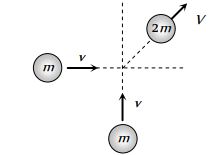
$A$ body of mass $m$ moves with velocity $v$ in the East direction,and another body of the same mass moves with velocity $v$ in the North direction. After they collide and stick together,what is the combined velocity of the resulting body of mass $2m$?
A
$v/2$
B
$2v$
C
$v/\sqrt{2}$
D
$v$
Solution
(C) According to the law of conservation of linear momentum,the initial momentum of the system must equal the final momentum.
Initial momentum in the East direction: $P_x = mv$.
Initial momentum in the North direction: $P_y = mv$.
The magnitude of the total initial momentum is $P_i = \sqrt{P_x^2 + P_y^2} = \sqrt{(mv)^2 + (mv)^2} = \sqrt{2}mv$.
The final momentum of the combined body of mass $2m$ moving with velocity $V$ is $P_f = 2mV$.
Equating initial and final momentum: $\sqrt{2}mv = 2mV$.
Solving for $V$: $V = \frac{\sqrt{2}mv}{2m} = \frac{v}{\sqrt{2}}$.
Initial momentum in the East direction: $P_x = mv$.
Initial momentum in the North direction: $P_y = mv$.
The magnitude of the total initial momentum is $P_i = \sqrt{P_x^2 + P_y^2} = \sqrt{(mv)^2 + (mv)^2} = \sqrt{2}mv$.
The final momentum of the combined body of mass $2m$ moving with velocity $V$ is $P_f = 2mV$.
Equating initial and final momentum: $\sqrt{2}mv = 2mV$.
Solving for $V$: $V = \frac{\sqrt{2}mv}{2m} = \frac{v}{\sqrt{2}}$.
0 likes
View Solution45
MediumMCQ
$A$ particle of mass $m$ moving with velocity $v$ collides with a stationary particle of mass $2m$ and sticks to it. What is the combined velocity of the system?
A
$\frac{v}{2}$
B
$2v$
C
$\frac{v}{3}$
D
$3v$
Solution
(C) According to the law of conservation of linear momentum,the total momentum before the collision is equal to the total momentum after the collision.
Let $V$ be the combined velocity of the system after the collision.
Initial momentum = $m \times v + 2m \times 0 = mv$.
Final momentum = $(m + 2m) \times V = 3mV$.
Equating the two: $mv = 3mV$.
Therefore,$V = \frac{v}{3}$.
Let $V$ be the combined velocity of the system after the collision.
Initial momentum = $m \times v + 2m \times 0 = mv$.
Final momentum = $(m + 2m) \times V = 3mV$.
Equating the two: $mv = 3mV$.
Therefore,$V = \frac{v}{3}$.
0 likes
View Solution46
DifficultMCQ
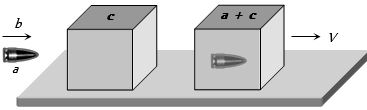
$A$ bullet of mass $a$ moving with velocity $b$ strikes a block of mass $c$ and gets embedded in it. Find the velocity of the block.
A
$\frac{c}{a + c}$
B
$\frac{ab}{a + c}$
C
$\frac{a + b}{c}$
D
$\frac{a + c}{a}b$
Solution
(B) According to the principle of conservation of linear momentum,the total momentum before the collision is equal to the total momentum after the collision.
Let $V$ be the final velocity of the block-bullet system.
Initial momentum of the system = (mass of bullet $\times$ velocity of bullet) + (mass of block $\times$ velocity of block) = $a \times b + c \times 0 = ab$.
Final momentum of the system = (mass of bullet + mass of block) $\times$ final velocity = $(a + c)V$.
Equating the initial and final momentum: $ab = (a + c)V$.
Therefore,the velocity of the block is $V = \frac{ab}{a + c}$.
Let $V$ be the final velocity of the block-bullet system.
Initial momentum of the system = (mass of bullet $\times$ velocity of bullet) + (mass of block $\times$ velocity of block) = $a \times b + c \times 0 = ab$.
Final momentum of the system = (mass of bullet + mass of block) $\times$ final velocity = $(a + c)V$.
Equating the initial and final momentum: $ab = (a + c)V$.
Therefore,the velocity of the block is $V = \frac{ab}{a + c}$.
0 likes
View Solution47
MediumMCQ
$A$ body of mass $1 \ g$ moving with a velocity of $3\hat{i} - 2\hat{j} \ m/s$ collides with a body of mass $2 \ g$ moving with a velocity of $4\hat{j} - 6\hat{k} \ m/s$. If the two bodies stick together after the collision,what is the magnitude of their combined velocity in $m/s$?
A
$5.6$
B
$0$
C
$6.4$
D
$4.6$
Solution
(D) According to the law of conservation of linear momentum for a perfectly inelastic collision:
$m_1\vec{u}_1 + m_2\vec{u}_2 = (m_1 + m_2)\vec{V}$
Given:
$m_1 = 1 \ g, \vec{u}_1 = 3\hat{i} - 2\hat{j} \ m/s$
$m_2 = 2 \ g, \vec{u}_2 = 4\hat{j} - 6\hat{k} \ m/s$
Substituting the values:
$\vec{V} = \frac{m_1\vec{u}_1 + m_2\vec{u}_2}{m_1 + m_2} = \frac{1(3\hat{i} - 2\hat{j}) + 2(4\hat{j} - 6\hat{k})}{1 + 2}$
$\vec{V} = \frac{3\hat{i} - 2\hat{j} + 8\hat{j} - 12\hat{k}}{3} = \frac{3\hat{i} + 6\hat{j} - 12\hat{k}}{3}$
$\vec{V} = 1\hat{i} + 2\hat{j} - 4\hat{k} \ m/s$
The magnitude of the combined velocity is:
$|\vec{V}| = \sqrt{(1)^2 + (2)^2 + (-4)^2} = \sqrt{1 + 4 + 16} = \sqrt{21} \approx 4.58 \ m/s \approx 4.6 \ m/s$.
$m_1\vec{u}_1 + m_2\vec{u}_2 = (m_1 + m_2)\vec{V}$
Given:
$m_1 = 1 \ g, \vec{u}_1 = 3\hat{i} - 2\hat{j} \ m/s$
$m_2 = 2 \ g, \vec{u}_2 = 4\hat{j} - 6\hat{k} \ m/s$
Substituting the values:
$\vec{V} = \frac{m_1\vec{u}_1 + m_2\vec{u}_2}{m_1 + m_2} = \frac{1(3\hat{i} - 2\hat{j}) + 2(4\hat{j} - 6\hat{k})}{1 + 2}$
$\vec{V} = \frac{3\hat{i} - 2\hat{j} + 8\hat{j} - 12\hat{k}}{3} = \frac{3\hat{i} + 6\hat{j} - 12\hat{k}}{3}$
$\vec{V} = 1\hat{i} + 2\hat{j} - 4\hat{k} \ m/s$
The magnitude of the combined velocity is:
$|\vec{V}| = \sqrt{(1)^2 + (2)^2 + (-4)^2} = \sqrt{1 + 4 + 16} = \sqrt{21} \approx 4.58 \ m/s \approx 4.6 \ m/s$.
0 likes
View Solution48
DifficultMCQ
$A$ bullet of mass $m$ moving with velocity $v$ strikes a block of mass $M$ and gets embedded in it. The kinetic energy of the system is:
A
$\frac{1}{2}mv^2 \times \frac{m}{(m + M)}$
B
$\frac{1}{2}mv^2 \times \frac{M}{(m + M)}$
C
$\frac{1}{2}mv^2 \times \frac{(M + m)}{M}$
D
$\frac{1}{2}Mv^2 \times \frac{m}{(m + M)}$
Solution
(A) According to the law of conservation of linear momentum,the initial momentum of the bullet equals the final momentum of the combined system:
$mv = (m + M)V$
where $V$ is the final velocity of the combined system.
$V = \frac{mv}{m + M}$
The kinetic energy $K$ of the combined system is given by:
$K = \frac{1}{2}(m + M)V^2$
Substituting the value of $V$:
$K = \frac{1}{2}(m + M) \left( \frac{mv}{m + M} \right)^2$
$K = \frac{1}{2}(m + M) \frac{m^2v^2}{(m + M)^2}$
$K = \frac{1}{2} \frac{m^2v^2}{m + M}$
$K = \left( \frac{1}{2}mv^2 \right) \left( \frac{m}{m + M} \right)$
$mv = (m + M)V$
where $V$ is the final velocity of the combined system.
$V = \frac{mv}{m + M}$
The kinetic energy $K$ of the combined system is given by:
$K = \frac{1}{2}(m + M)V^2$
Substituting the value of $V$:
$K = \frac{1}{2}(m + M) \left( \frac{mv}{m + M} \right)^2$
$K = \frac{1}{2}(m + M) \frac{m^2v^2}{(m + M)^2}$
$K = \frac{1}{2} \frac{m^2v^2}{m + M}$
$K = \left( \frac{1}{2}mv^2 \right) \left( \frac{m}{m + M} \right)$
0 likes
View SolutionWork, Energy, Power and Collision — Perfectly Inelastic Collision · Frequently Asked Questions
1Are these Work, Energy, Power and Collision questions useful for JEE and NEET?
Yes. All questions in this section are mapped to JEE Main and NEET exam patterns. Previous year questions from JEE Main, NEET, GUJCET and state-level exams are included with full solutions.
2Can I switch to Hindi or Gujarati for these questions?
Yes. Use the language tabs in the hero section or the sidebar to view the same questions and solutions in English, Hindi or Gujarati.
3How do I generate a question paper from this subtopic?
Use the Vedclass Exam Paper Generator — select the chapter and subtopic, set difficulty, and generate Sets A, B, C, D automatically. First 3 chapters of every subject are free.
Vedclass Products
For Students
Vedclass Test Series
Mock tests in real JEE/NEET style with performance analysis. 5-day free trial.
Start Free TrialFor Teachers
Exam Paper Generator
Generate Set A/B/C/D papers from this chapter in 2 minutes. 3 chapters free.
Try FreeFor Institutes
Online Exam Module
Live online exams with unlimited students, 360° analytics & white-label branding.
See DemoFor Teachers & Institutes
Generate a Work, Energy, Power and Collision Exam Paper in 2 Minutes
Select subtopic & difficulty — Sets A, B, C, D auto-generated with No Repeat logic.
First 3 chapters of every subject are free — no payment required.