
A English
Perfectly Inelastic Collision Questions in English
Class 11 Physics · Work, Energy, Power and Collision · Perfectly Inelastic Collision
110+
Questions
English
Language
100%
With Solutions
Showing 10 of 110 questions in English
101
EasyMCQ
In perfectly inelastic collisions,the relative velocity of the bodies
A
before impact is zero
B
before impact is equal to that after impact
C
after impact is zero
D
is characterised by none of the above
Solution
(C) In a perfectly inelastic collision,the two bodies stick together after the impact and move with a common final velocity.
Let the velocities of the two bodies after the collision be $v_1$ and $v_2$. Since they move together,$v_1 = v_2 = v$.
The relative velocity of the bodies after the impact is defined as the difference between their velocities:
$v_{\text{rel}} = v_1 - v_2$
Substituting $v_1 = v_2 = v$ into the equation:
$v_{\text{rel}} = v - v = 0$
Therefore,the relative velocity of the bodies after the impact is zero.
Let the velocities of the two bodies after the collision be $v_1$ and $v_2$. Since they move together,$v_1 = v_2 = v$.
The relative velocity of the bodies after the impact is defined as the difference between their velocities:
$v_{\text{rel}} = v_1 - v_2$
Substituting $v_1 = v_2 = v$ into the equation:
$v_{\text{rel}} = v - v = 0$
Therefore,the relative velocity of the bodies after the impact is zero.
0 likes
View Solution102
MediumMCQ
$A$ body of mass $3 \,kg$ is moving with a velocity of $8 \,ms^{-1}$ collides head-on with another body of mass $1 \,kg$, moving in the opposite direction with a velocity of $4 \,ms^{-1}$. After the collision, if the two bodies stick together and move, they move with a common velocity: (in $\,ms^{-1}$)
A
$5$
B
$7$
C
$10$
D
$14$
Solution
(A) Given: Mass $m_1 = 3 \,kg$, Velocity $v_1 = 8 \,ms^{-1}$.
Mass $m_2 = 1 \,kg$, Velocity $v_2 = -4 \,ms^{-1}$ (since it is moving in the opposite direction).
According to the law of conservation of linear momentum, the total momentum before collision equals the total momentum after collision.
$m_1 v_1 + m_2 v_2 = (m_1 + m_2) v$
Substituting the values:
$(3 \times 8) + (1 \times -4) = (3 + 1) \times v$
$24 - 4 = 4v$
$20 = 4v$
$v = 5 \,ms^{-1}$
Thus, the common velocity is $5 \,ms^{-1}$.
Mass $m_2 = 1 \,kg$, Velocity $v_2 = -4 \,ms^{-1}$ (since it is moving in the opposite direction).
According to the law of conservation of linear momentum, the total momentum before collision equals the total momentum after collision.
$m_1 v_1 + m_2 v_2 = (m_1 + m_2) v$
Substituting the values:
$(3 \times 8) + (1 \times -4) = (3 + 1) \times v$
$24 - 4 = 4v$
$20 = 4v$
$v = 5 \,ms^{-1}$
Thus, the common velocity is $5 \,ms^{-1}$.
0 likes
View Solution103
EasyMCQ
$A$ bullet strikes against a wooden block and is embedded in it,the nature of collision is
A
elastic
B
perfectly inelastic
C
inelastic
D
perfectly elastic
Solution
(B) When a bullet strikes a wooden block and gets embedded in it,the two bodies move together with a common velocity after the collision.
This type of collision,where the bodies stick together after impact,is defined as a perfectly inelastic collision.
In this process,the loss of kinetic energy is maximum.
This type of collision,where the bodies stick together after impact,is defined as a perfectly inelastic collision.
In this process,the loss of kinetic energy is maximum.
0 likes
View Solution104
MediumMCQ
$A$ bullet of mass $m$ and velocity $v$ when fired at a sand bag of mass $M$,suspended by a string,gets embedded into the bag. The loss of kinetic energy in this process is
A
$\frac{m v^2}{2}$
B
$\frac{m v^2}{2(M+m)}$
C
$\frac{M v^2}{2}$
D
$\frac{m M v^2}{2(M+m)}$
Solution
(D) Mass of the bullet $= m$. Speed of the bullet $= v$.
According to the problem,the bullet gets embedded into the bag,so they move together with a common velocity $v_1$.
This is a case of a perfectly inelastic collision.
Initial kinetic energy of the bullet,$K_i = \frac{1}{2} m v^2$.
By the law of conservation of linear momentum: $m v = (M + m) v_1 \Rightarrow v_1 = \frac{m v}{M + m}$.
Final kinetic energy of the system,$K_f = \frac{1}{2} (M + m) v_1^2 = \frac{1}{2} (M + m) \left( \frac{m v}{M + m} \right)^2 = \frac{m^2 v^2}{2(M + m)}$.
Loss in kinetic energy $= K_i - K_f = \frac{1}{2} m v^2 - \frac{m^2 v^2}{2(M + m)}$.
$= \frac{1}{2} m v^2 \left( 1 - \frac{m}{M + m} \right) = \frac{1}{2} m v^2 \left( \frac{M + m - m}{M + m} \right) = \frac{m M v^2}{2(M + m)}$.
According to the problem,the bullet gets embedded into the bag,so they move together with a common velocity $v_1$.
This is a case of a perfectly inelastic collision.
Initial kinetic energy of the bullet,$K_i = \frac{1}{2} m v^2$.
By the law of conservation of linear momentum: $m v = (M + m) v_1 \Rightarrow v_1 = \frac{m v}{M + m}$.
Final kinetic energy of the system,$K_f = \frac{1}{2} (M + m) v_1^2 = \frac{1}{2} (M + m) \left( \frac{m v}{M + m} \right)^2 = \frac{m^2 v^2}{2(M + m)}$.
Loss in kinetic energy $= K_i - K_f = \frac{1}{2} m v^2 - \frac{m^2 v^2}{2(M + m)}$.
$= \frac{1}{2} m v^2 \left( 1 - \frac{m}{M + m} \right) = \frac{1}{2} m v^2 \left( \frac{M + m - m}{M + m} \right) = \frac{m M v^2}{2(M + m)}$.
0 likes
View Solution105
DifficultMCQ
$A$ ball moving horizontally with a velocity $2 \,ms^{-1}$ strikes the bob of a seconds pendulum at rest. If the mass of the bob is equal to the mass of the ball and the collision is perfectly elastic, after collision the bob of the pendulum will raise to a height of $(g=10 \,ms^{-2})$ (in $\,cm$)
A
$80$
B
$60$
C
$40$
D
$20$
Solution
(D) In a perfectly elastic collision between two bodies of equal mass where one body is initially at rest, the bodies exchange their velocities.
Let the mass of the ball be $m$ and the mass of the bob be $m$.
Initial velocity of the ball $u_1 = 2 \,ms^{-1}$ and initial velocity of the bob $u_2 = 0 \,ms^{-1}$.
After the elastic collision, the ball comes to rest $(v_1 = 0)$ and the bob acquires the velocity of the ball $(v_2 = u_1 = 2 \,ms^{-1})$.
The kinetic energy of the bob immediately after the collision is converted into potential energy as it rises to a height $h$.
Using the conservation of energy: $\frac{1}{2}mv_2^2 = mgh$.
Substituting the values: $\frac{1}{2} \times (2)^2 = 10 \times h$.
$2 = 10h$.
$h = 0.2 \,m = 20 \,cm$.
Let the mass of the ball be $m$ and the mass of the bob be $m$.
Initial velocity of the ball $u_1 = 2 \,ms^{-1}$ and initial velocity of the bob $u_2 = 0 \,ms^{-1}$.
After the elastic collision, the ball comes to rest $(v_1 = 0)$ and the bob acquires the velocity of the ball $(v_2 = u_1 = 2 \,ms^{-1})$.
The kinetic energy of the bob immediately after the collision is converted into potential energy as it rises to a height $h$.
Using the conservation of energy: $\frac{1}{2}mv_2^2 = mgh$.
Substituting the values: $\frac{1}{2} \times (2)^2 = 10 \times h$.
$2 = 10h$.
$h = 0.2 \,m = 20 \,cm$.
0 likes
View Solution106
EasyMCQ
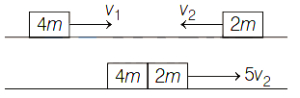
$A$ block of mass $4 m$ travelling at a velocity $v_1$ in the $x$-direction on a frictionless horizontal plane makes a head-on collision with another block of mass $2 m$ travelling in the opposite direction with a velocity $v_2$. After the collision,both blocks travel as a single block along the $x$-direction with a final velocity $5 v_2$. The ratio of velocities $\frac{v_1}{v_2}$ is
A
$2$
B
$3$
C
$5$
D
$8$
Solution
(D) According to the law of conservation of linear momentum,the total momentum before the collision is equal to the total momentum after the collision.
Let the $x$-direction be positive. The initial momentum of the system is:
$p_i = (4m)(v_1) + (2m)(-v_2) = 4mv_1 - 2mv_2$
After the collision,the two blocks move together as a single mass $(4m + 2m = 6m)$ with a final velocity $5v_2$ in the $x$-direction:
$p_f = (6m)(5v_2) = 30mv_2$
Equating the initial and final momentum:
$4mv_1 - 2mv_2 = 30mv_2$
$4mv_1 = 32mv_2$
$\frac{v_1}{v_2} = \frac{32}{4} = 8$
Let the $x$-direction be positive. The initial momentum of the system is:
$p_i = (4m)(v_1) + (2m)(-v_2) = 4mv_1 - 2mv_2$
After the collision,the two blocks move together as a single mass $(4m + 2m = 6m)$ with a final velocity $5v_2$ in the $x$-direction:
$p_f = (6m)(5v_2) = 30mv_2$
Equating the initial and final momentum:
$4mv_1 - 2mv_2 = 30mv_2$
$4mv_1 = 32mv_2$
$\frac{v_1}{v_2} = \frac{32}{4} = 8$
0 likes
View Solution107
MediumMCQ
$A$ body of mass $3 \ kg$ moving with a velocity $(2 \hat{i}+3 \hat{j}+3 \hat{k}) \ m/s$ collides with another body of mass $4 \ kg$ moving with a velocity $(3 \hat{i}+2 \hat{j}-3 \hat{k}) \ m/s$. The two bodies stick together after collision. The velocity of the composite body is
A
$\frac{1}{7}(4 \hat{i}+6 \hat{j}-3 \hat{k}) \ m/s$
B
$\frac{1}{7}(18 \hat{i}+17 \hat{j}-3 \hat{k}) \ m/s$
C
$\frac{1}{7}(6 \hat{i}+4 \hat{j}-6 \hat{k}) \ m/s$
D
$\frac{1}{7}(9 \hat{i}+8 \hat{j}-6 \hat{k}) \ m/s$
Solution
(B) Given,mass of the first body $m_1 = 3 \ kg$ and its velocity $v_1 = (2 \hat{i}+3 \hat{j}+3 \hat{k}) \ m/s$.
Mass of the second body $m_2 = 4 \ kg$ and its velocity $v_2 = (3 \hat{i}+2 \hat{j}-3 \hat{k}) \ m/s$.
According to the law of conservation of linear momentum,the total momentum before collision is equal to the total momentum after collision.
$m_1 v_1 + m_2 v_2 = (m_1 + m_2) v$
Substituting the values:
$3(2 \hat{i}+3 \hat{j}+3 \hat{k}) + 4(3 \hat{i}+2 \hat{j}-3 \hat{k}) = (3 + 4) v$
$(6 \hat{i}+9 \hat{j}+9 \hat{k}) + (12 \hat{i}+8 \hat{j}-12 \hat{k}) = 7 v$
$(6+12) \hat{i} + (9+8) \hat{j} + (9-12) \hat{k} = 7 v$
$18 \hat{i} + 17 \hat{j} - 3 \hat{k} = 7 v$
$v = \frac{1}{7}(18 \hat{i}+17 \hat{j}-3 \hat{k}) \ m/s$.
Mass of the second body $m_2 = 4 \ kg$ and its velocity $v_2 = (3 \hat{i}+2 \hat{j}-3 \hat{k}) \ m/s$.
According to the law of conservation of linear momentum,the total momentum before collision is equal to the total momentum after collision.
$m_1 v_1 + m_2 v_2 = (m_1 + m_2) v$
Substituting the values:
$3(2 \hat{i}+3 \hat{j}+3 \hat{k}) + 4(3 \hat{i}+2 \hat{j}-3 \hat{k}) = (3 + 4) v$
$(6 \hat{i}+9 \hat{j}+9 \hat{k}) + (12 \hat{i}+8 \hat{j}-12 \hat{k}) = 7 v$
$(6+12) \hat{i} + (9+8) \hat{j} + (9-12) \hat{k} = 7 v$
$18 \hat{i} + 17 \hat{j} - 3 \hat{k} = 7 v$
$v = \frac{1}{7}(18 \hat{i}+17 \hat{j}-3 \hat{k}) \ m/s$.
0 likes
View Solution108
MediumMCQ
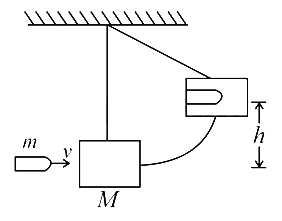
$A$ bullet of mass $m$ moving horizontally with speed $v_0$ hits a wooden block of mass $M$ that is suspended from a massless string. The bullet gets lodged into the block. If the block-bullet system swings to a maximum height $h$,how much of the initial kinetic energy of the bullet is lost in the collision?
A
$\frac{1}{2} m v_0^2 \left( \frac{M}{m+M} \right)$
B
$\frac{1}{2} m v_0^2 \left( \frac{M+m}{M} \right)$
C
$\frac{1}{2} m v_0^2 \left( \frac{M^2}{(m+M)^2} \right)$
D
$\frac{1}{2} m v_0^2 \left( \frac{(M+m)^2}{M^2} \right)$
Solution
(A) Initial kinetic energy of the bullet is $K_i = \frac{1}{2} m v_0^2$.
After the collision,the bullet gets lodged in the block,and they move together with a common velocity $v$. By the law of conservation of linear momentum:
$m v_0 = (m + M) v \implies v = \frac{m v_0}{m + M}$.
The kinetic energy of the combined system immediately after the collision is $K_f = \frac{1}{2} (m + M) v^2$.
Substituting the value of $v$:
$K_f = \frac{1}{2} (m + M) \left( \frac{m v_0}{m + M} \right)^2 = \frac{1}{2} (m + M) \frac{m^2 v_0^2}{(m + M)^2} = \frac{1}{2} \frac{m^2 v_0^2}{m + M}$.
The energy lost in the collision is $\Delta K = K_i - K_f$:
$\Delta K = \frac{1}{2} m v_0^2 - \frac{1}{2} \frac{m^2 v_0^2}{m + M} = \frac{1}{2} m v_0^2 \left( 1 - \frac{m}{m + M} \right) = \frac{1}{2} m v_0^2 \left( \frac{m + M - m}{m + M} \right) = \frac{1}{2} m v_0^2 \left( \frac{M}{m + M} \right)$.
After the collision,the bullet gets lodged in the block,and they move together with a common velocity $v$. By the law of conservation of linear momentum:
$m v_0 = (m + M) v \implies v = \frac{m v_0}{m + M}$.
The kinetic energy of the combined system immediately after the collision is $K_f = \frac{1}{2} (m + M) v^2$.
Substituting the value of $v$:
$K_f = \frac{1}{2} (m + M) \left( \frac{m v_0}{m + M} \right)^2 = \frac{1}{2} (m + M) \frac{m^2 v_0^2}{(m + M)^2} = \frac{1}{2} \frac{m^2 v_0^2}{m + M}$.
The energy lost in the collision is $\Delta K = K_i - K_f$:
$\Delta K = \frac{1}{2} m v_0^2 - \frac{1}{2} \frac{m^2 v_0^2}{m + M} = \frac{1}{2} m v_0^2 \left( 1 - \frac{m}{m + M} \right) = \frac{1}{2} m v_0^2 \left( \frac{m + M - m}{m + M} \right) = \frac{1}{2} m v_0^2 \left( \frac{M}{m + M} \right)$.
0 likes
View Solution109
MediumMCQ
Two identical blocks of ice move in opposite directions with equal speed and collide with each other. What will be the minimum speed required to make both the blocks melt completely,if the initial temperatures of the blocks were $-8^{\circ} C$ each (in $ms^{-1}$)? (Specific heat of ice is $2100 \ Jkg^{-1} K^{-1}$ and latent heat of fusion of ice is $3.36 \times 10^{5} \ Jkg^{-1}$)
A
$840$
B
$420$
C
$84$
D
$42$
Solution
(A) The total kinetic energy of the two blocks before the collision is $K.E. = \frac{1}{2}mv^2 + \frac{1}{2}mv^2 = mv^2$.
Since the collision is perfectly inelastic (the blocks melt),the maximum loss in kinetic energy is equal to the total initial kinetic energy,which is $mv^2$.
This energy is used to raise the temperature of the ice from $-8^{\circ}C$ to $0^{\circ}C$ and then to melt it.
The energy required for one block is $Q = ms\Delta\theta + mL$.
For two blocks,the total energy required is $2(ms\Delta\theta + mL)$.
Equating the energy loss to the heat required: $mv^2 = 2m(s\Delta\theta + L)$.
Canceling $m$ from both sides: $v^2 = 2(s\Delta\theta + L)$.
Given: $s = 2100 \ Jkg^{-1}K^{-1}$,$\Delta\theta = 8^{\circ}C$,$L = 3.36 \times 10^5 \ Jkg^{-1}$.
$v^2 = 2(2100 \times 8 + 3.36 \times 10^5) = 2(16800 + 336000) = 2(352800) = 705600$.
$v = \sqrt{705600} = 840 \ ms^{-1}$.
Since the collision is perfectly inelastic (the blocks melt),the maximum loss in kinetic energy is equal to the total initial kinetic energy,which is $mv^2$.
This energy is used to raise the temperature of the ice from $-8^{\circ}C$ to $0^{\circ}C$ and then to melt it.
The energy required for one block is $Q = ms\Delta\theta + mL$.
For two blocks,the total energy required is $2(ms\Delta\theta + mL)$.
Equating the energy loss to the heat required: $mv^2 = 2m(s\Delta\theta + L)$.
Canceling $m$ from both sides: $v^2 = 2(s\Delta\theta + L)$.
Given: $s = 2100 \ Jkg^{-1}K^{-1}$,$\Delta\theta = 8^{\circ}C$,$L = 3.36 \times 10^5 \ Jkg^{-1}$.
$v^2 = 2(2100 \times 8 + 3.36 \times 10^5) = 2(16800 + 336000) = 2(352800) = 705600$.
$v = \sqrt{705600} = 840 \ ms^{-1}$.
0 likes
View Solution110
EasyMCQ
$A$ bullet of mass $m$ travelling with a speed $v$ hits a block of mass $M$ initially at rest and gets embedded in it. The combined system is free to move and there is no other force acting on the system. The heat generated in the process will be
A
Zero
B
$\frac{m v^{2}}{2}$
C
$\frac{M m v^{2}}{2(M-m)}$
D
$\frac{m M v^{2}}{2(M+m)}$
Solution
(D) Mass of bullet $= m$,Initial speed of bullet $= v$.
Mass of block $= M$,Initial speed of block $= 0$.
Let the common velocity of the system after collision be $V$.
According to the law of conservation of linear momentum:
$m v + M(0) = (m + M)V$
$V = \frac{m v}{m + M}$
Heat generated is equal to the loss in kinetic energy $(KE)$.
$\Delta KE = KE_{initial} - KE_{final}$
$\Delta KE = \frac{1}{2} m v^{2} - \frac{1}{2} (m + M) V^{2}$
Substituting the value of $V$:
$\Delta KE = \frac{1}{2} m v^{2} - \frac{1}{2} (m + M) \left( \frac{m v}{m + M} \right)^{2}$
$\Delta KE = \frac{1}{2} m v^{2} - \frac{1}{2} (m + M) \frac{m^{2} v^{2}}{(m + M)^{2}}$
$\Delta KE = \frac{1}{2} m v^{2} \left( 1 - \frac{m}{m + M} \right)$
$\Delta KE = \frac{1}{2} m v^{2} \left( \frac{m + M - m}{m + M} \right)$
$\Delta KE = \frac{1}{2} \frac{m M v^{2}}{m + M}$
Mass of block $= M$,Initial speed of block $= 0$.
Let the common velocity of the system after collision be $V$.
According to the law of conservation of linear momentum:
$m v + M(0) = (m + M)V$
$V = \frac{m v}{m + M}$
Heat generated is equal to the loss in kinetic energy $(KE)$.
$\Delta KE = KE_{initial} - KE_{final}$
$\Delta KE = \frac{1}{2} m v^{2} - \frac{1}{2} (m + M) V^{2}$
Substituting the value of $V$:
$\Delta KE = \frac{1}{2} m v^{2} - \frac{1}{2} (m + M) \left( \frac{m v}{m + M} \right)^{2}$
$\Delta KE = \frac{1}{2} m v^{2} - \frac{1}{2} (m + M) \frac{m^{2} v^{2}}{(m + M)^{2}}$
$\Delta KE = \frac{1}{2} m v^{2} \left( 1 - \frac{m}{m + M} \right)$
$\Delta KE = \frac{1}{2} m v^{2} \left( \frac{m + M - m}{m + M} \right)$
$\Delta KE = \frac{1}{2} \frac{m M v^{2}}{m + M}$
0 likes
View SolutionWork, Energy, Power and Collision — Perfectly Inelastic Collision · Frequently Asked Questions
1Are these Work, Energy, Power and Collision questions useful for JEE and NEET?
Yes. All questions in this section are mapped to JEE Main and NEET exam patterns. Previous year questions from JEE Main, NEET, GUJCET and state-level exams are included with full solutions.
2Can I switch to Hindi or Gujarati for these questions?
Yes. Use the language tabs in the hero section or the sidebar to view the same questions and solutions in English, Hindi or Gujarati.
3How do I generate a question paper from this subtopic?
Use the Vedclass Exam Paper Generator — select the chapter and subtopic, set difficulty, and generate Sets A, B, C, D automatically. First 3 chapters of every subject are free.
Vedclass Products
For Students
Vedclass Test Series
Mock tests in real JEE/NEET style with performance analysis. 5-day free trial.
Start Free TrialFor Teachers
Exam Paper Generator
Generate Set A/B/C/D papers from this chapter in 2 minutes. 3 chapters free.
Try FreeFor Institutes
Online Exam Module
Live online exams with unlimited students, 360° analytics & white-label branding.
See DemoFor Teachers & Institutes
Generate a Work, Energy, Power and Collision Exam Paper in 2 Minutes
Select subtopic & difficulty — Sets A, B, C, D auto-generated with No Repeat logic.
First 3 chapters of every subject are free — no payment required.