
A English
Inelastic Collision Questions in English
Class 11 Physics · Work, Energy, Power and Collision · Inelastic Collision
141+
Questions
English
Language
100%
With Solutions
Showing 49 of 141 questions in English
51
MediumMCQ
$A$ smooth sphere is moving on a horizontal surface with velocity vector $3 \hat{i} + \hat{j}$ immediately before it hits a vertical wall. The wall is parallel to the $\hat{j}$ vector,and the coefficient of restitution between the wall and the sphere is $\frac{1}{3}$. What is the velocity vector of the sphere after it hits the wall?
A
$\hat{i} + \hat{j}$
B
$3 \hat{i} - \frac{1}{3} \hat{j}$
C
$-\hat{i} + \hat{j}$
D
$\hat{i} - \hat{j}$
Solution
(C) The velocity of the sphere before impact is $\vec{v}_1 = 3 \hat{i} + \hat{j}$.
The wall is parallel to the $\hat{j}$ axis,meaning the wall lies in the $yz$-plane (normal to the $x$-axis).
The component of velocity parallel to the wall ($\hat{j}$ component) remains unchanged during the collision because the impulse acts only along the normal to the wall.
Thus,$v_{y, \text{after}} = v_{y, \text{before}} = 1 \hat{j}$.
The component of velocity perpendicular to the wall ($\hat{i}$ component) changes according to the coefficient of restitution $e$.
The velocity of approach along the normal is $u_x = 3$.
The velocity of separation along the normal is $v_x = -e \cdot u_x = -\frac{1}{3} \cdot 3 = -1$.
Therefore,the velocity vector after the collision is $\vec{v}_2 = -1 \hat{i} + 1 \hat{j} = -\hat{i} + \hat{j}$.
The wall is parallel to the $\hat{j}$ axis,meaning the wall lies in the $yz$-plane (normal to the $x$-axis).
The component of velocity parallel to the wall ($\hat{j}$ component) remains unchanged during the collision because the impulse acts only along the normal to the wall.
Thus,$v_{y, \text{after}} = v_{y, \text{before}} = 1 \hat{j}$.
The component of velocity perpendicular to the wall ($\hat{i}$ component) changes according to the coefficient of restitution $e$.
The velocity of approach along the normal is $u_x = 3$.
The velocity of separation along the normal is $v_x = -e \cdot u_x = -\frac{1}{3} \cdot 3 = -1$.
Therefore,the velocity vector after the collision is $\vec{v}_2 = -1 \hat{i} + 1 \hat{j} = -\hat{i} + \hat{j}$.
0 likes
View Solution52
AdvancedMCQ
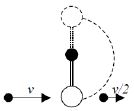
$A$ bullet of mass $m$ and speed $v$ hits a pendulum bob of mass $M$ at time $t_1$,and passes completely through the bob. The bullet emerges at time $t_2$ with a speed of $v/2$. The pendulum bob is suspended by a stiff rod of length $l$ and negligible mass. After the collision,the bob can barely swing through a complete vertical circle. At time $t_3$,the bob reaches the highest position. What quantities are conserved in this process?
A
Total kinetic energy of the bob and the bullet during the time interval $\Delta t = t_2 - t_1$.
B
Total momentum of the bob and the bullet during the time interval $\Delta t = t_2 - t_1$.
C
Total mechanical energy of the bob and the bullet during the time interval $t_3 - t_1$.
D
Momentum of the bob after $t_2$.
Solution
(B) $1$. During the collision interval $\Delta t = t_2 - t_1$,the impulsive force exerted by the bullet on the bob and vice-versa is internal to the system (bullet + bob). The external forces (gravity and tension) are non-impulsive. Therefore,the total linear momentum of the system is conserved during the interval $\Delta t$.
$2$. Kinetic energy is not conserved because the collision is inelastic (the bullet passes through the bob,causing deformation and heat).
$3$. Mechanical energy is not conserved during the collision due to energy loss. After the collision (from $t_2$ to $t_3$),mechanical energy is conserved for the bob as it swings up,but not for the whole system including the bullet.
$4$. Momentum of the bob alone is not conserved after $t_2$ because gravity and tension act on it.
$5$. Thus,the correct statement is that the total momentum of the bob and the bullet is conserved during the interval $\Delta t = t_2 - t_1$.
$2$. Kinetic energy is not conserved because the collision is inelastic (the bullet passes through the bob,causing deformation and heat).
$3$. Mechanical energy is not conserved during the collision due to energy loss. After the collision (from $t_2$ to $t_3$),mechanical energy is conserved for the bob as it swings up,but not for the whole system including the bullet.
$4$. Momentum of the bob alone is not conserved after $t_2$ because gravity and tension act on it.
$5$. Thus,the correct statement is that the total momentum of the bob and the bullet is conserved during the interval $\Delta t = t_2 - t_1$.
0 likes
View Solution53
MediumMCQ
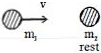
An unknown nucleus of mass $m_1$ collides with a stationary ${}^4He$ nucleus of mass $m_2$. After the collision,the two nuclei travel in perpendicular directions relative to each other. If kinetic energy is lost in the collision,the unknown nucleus must be:
A
${}^{28}N$
B
${}^4He$
C
${}^{12}C$
D
$A$ nucleus with mass lighter than ${}^4He$
Solution
(C) In a collision where a projectile of mass $m_1$ strikes a stationary target of mass $m_2$,and the two particles move at an angle of $90^{\circ}$ to each other,the condition is given by $m_2 = m_1 \cdot e$,where $e$ is the coefficient of restitution.
For an inelastic collision,kinetic energy is lost,which implies $e < 1$.
Substituting $e < 1$ into the condition $m_2 = m_1 \cdot e$,we get $m_2 < m_1$,which means $m_1 > m_2$.
Since the target nucleus is ${}^4He$ $(m_2 = 4 \text{ amu})$,the projectile nucleus must have a mass $m_1 > 4 \text{ amu}$.
Among the given options,${}^{28}N$ and ${}^{12}C$ are heavier than ${}^4He$. However,in standard physics problems of this type,the projectile is typically heavier than the target to satisfy the scattering geometry. ${}^{12}C$ is a valid candidate.
For an inelastic collision,kinetic energy is lost,which implies $e < 1$.
Substituting $e < 1$ into the condition $m_2 = m_1 \cdot e$,we get $m_2 < m_1$,which means $m_1 > m_2$.
Since the target nucleus is ${}^4He$ $(m_2 = 4 \text{ amu})$,the projectile nucleus must have a mass $m_1 > 4 \text{ amu}$.
Among the given options,${}^{28}N$ and ${}^{12}C$ are heavier than ${}^4He$. However,in standard physics problems of this type,the projectile is typically heavier than the target to satisfy the scattering geometry. ${}^{12}C$ is a valid candidate.
0 likes
View Solution54
MediumMCQ
Two identical balls $P$ and $Q$ moving in the $x-y$ plane collide at the origin $(x=0, y=0)$ of the coordinate system. Their velocity components just before the moment of impact were,for ball $P$,$v_x = 6 \ m/s, v_y = 0$; for ball $Q$,$v_x = -5 \ m/s, v_y = 2 \ m/s$. As a result of the collision,ball $P$ comes to rest. The velocity components of ball $Q$ just after the collision will be:
A
$v_x = 0, v_y = 2 \ m/s$
B
$v_x = 1 \ m/s, v_y = 0$
C
$v_x = 1 \ m/s, v_y = 2 \ m/s$
D
$v_x = -11 \ m/s, v_y = 2 \ m/s$
Solution
(C) Since the balls are identical,let their mass be $m$.
According to the law of conservation of linear momentum,the total momentum before the collision must equal the total momentum after the collision.
Initial momentum in $x$-direction: $P_{ix} = m(v_{Px}) + m(v_{Qx}) = m(6) + m(-5) = m \ kg \ m/s$.
Initial momentum in $y$-direction: $P_{iy} = m(v_{Py}) + m(v_{Qy}) = m(0) + m(2) = 2m \ kg \ m/s$.
After the collision,ball $P$ comes to rest,so $v'_{Px} = 0$ and $v'_{Py} = 0$.
Let the velocity components of ball $Q$ after the collision be $v'_{Qx}$ and $v'_{Qy}$.
Final momentum in $x$-direction: $P_{fx} = m(0) + m(v'_{Qx}) = m(v'_{Qx})$.
Final momentum in $y$-direction: $P_{fy} = m(0) + m(v'_{Qy}) = m(v'_{Qy})$.
Equating initial and final momenta:
$m(v'_{Qx}) = m \implies v'_{Qx} = 1 \ m/s$.
$m(v'_{Qy}) = 2m \implies v'_{Qy} = 2 \ m/s$.
Therefore,the velocity components of ball $Q$ after the collision are $v_x = 1 \ m/s$ and $v_y = 2 \ m/s$.
According to the law of conservation of linear momentum,the total momentum before the collision must equal the total momentum after the collision.
Initial momentum in $x$-direction: $P_{ix} = m(v_{Px}) + m(v_{Qx}) = m(6) + m(-5) = m \ kg \ m/s$.
Initial momentum in $y$-direction: $P_{iy} = m(v_{Py}) + m(v_{Qy}) = m(0) + m(2) = 2m \ kg \ m/s$.
After the collision,ball $P$ comes to rest,so $v'_{Px} = 0$ and $v'_{Py} = 0$.
Let the velocity components of ball $Q$ after the collision be $v'_{Qx}$ and $v'_{Qy}$.
Final momentum in $x$-direction: $P_{fx} = m(0) + m(v'_{Qx}) = m(v'_{Qx})$.
Final momentum in $y$-direction: $P_{fy} = m(0) + m(v'_{Qy}) = m(v'_{Qy})$.
Equating initial and final momenta:
$m(v'_{Qx}) = m \implies v'_{Qx} = 1 \ m/s$.
$m(v'_{Qy}) = 2m \implies v'_{Qy} = 2 \ m/s$.
Therefore,the velocity components of ball $Q$ after the collision are $v_x = 1 \ m/s$ and $v_y = 2 \ m/s$.
0 likes
View Solution55
DifficultMCQ
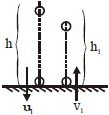
$A$ body dropped from a height $1\,m$ on a floor rises to a height $25\,cm$ after the first rebound. The coefficient of restitution is
A
$\frac{3}{4}$
B
$\frac{1}{4}$
C
$\frac{1}{2}$
D
$\frac{2}{3}$
Solution
(C) Let $h = 1\,m = 100\,cm$ be the initial height and $h_1 = 25\,cm$ be the height after the first rebound.
When a body is dropped from a height $h$,its velocity just before hitting the floor is $u = \sqrt{2gh}$.
After the rebound,if the body rises to a height $h_1$,its velocity just after the collision is $v = \sqrt{2gh_1}$.
The coefficient of restitution $e$ is defined as the ratio of the velocity of separation to the velocity of approach.
$e = \frac{v}{u} = \frac{\sqrt{2gh_1}}{\sqrt{2gh}} = \sqrt{\frac{h_1}{h}}$.
Substituting the given values:
$e = \sqrt{\frac{25\,cm}{100\,cm}} = \sqrt{\frac{1}{4}} = \frac{1}{2}$.
When a body is dropped from a height $h$,its velocity just before hitting the floor is $u = \sqrt{2gh}$.
After the rebound,if the body rises to a height $h_1$,its velocity just after the collision is $v = \sqrt{2gh_1}$.
The coefficient of restitution $e$ is defined as the ratio of the velocity of separation to the velocity of approach.
$e = \frac{v}{u} = \frac{\sqrt{2gh_1}}{\sqrt{2gh}} = \sqrt{\frac{h_1}{h}}$.
Substituting the given values:
$e = \sqrt{\frac{25\,cm}{100\,cm}} = \sqrt{\frac{1}{4}} = \frac{1}{2}$.
0 likes
View Solution56
DifficultMCQ
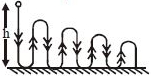
$A$ particle falls from a height $h$ on a static horizontal plane and rebounds. If $e$ is the coefficient of restitution,then the total distance traveled by the particle before coming to rest will be:
A
$h\left( \frac{1 + e^2}{1 - e^2} \right)$
B
$h\left( \frac{1 - e^2}{1 + e^2} \right)$
C
$\frac{h}{2}\left( \frac{1 - e^2}{1 + e^2} \right)$
D
$\frac{h}{2}\left( \frac{1 + e^2}{1 - e^2} \right)$
Solution
(A) The particle falls from height $h$. After the first collision,it rebounds to height $h_1 = e^2 h$.
After the second collision,it rebounds to height $h_2 = e^2 h_1 = e^4 h$,and so on.
The total distance $S$ traveled is the sum of the initial fall and all subsequent upward and downward paths:
$S = h + 2h_1 + 2h_2 + 2h_3 + \dots$
$S = h + 2(e^2 h) + 2(e^4 h) + 2(e^6 h) + \dots$
$S = h + 2e^2 h (1 + e^2 + e^4 + \dots)$
This is a geometric series with first term $a = 1$ and common ratio $r = e^2$. The sum is $\frac{1}{1 - e^2}$.
$S = h + 2e^2 h \left( \frac{1}{1 - e^2} \right)$
$S = h \left( 1 + \frac{2e^2}{1 - e^2} \right) = h \left( \frac{1 - e^2 + 2e^2}{1 - e^2} \right)$
$S = h \left( \frac{1 + e^2}{1 - e^2} \right)$
After the second collision,it rebounds to height $h_2 = e^2 h_1 = e^4 h$,and so on.
The total distance $S$ traveled is the sum of the initial fall and all subsequent upward and downward paths:
$S = h + 2h_1 + 2h_2 + 2h_3 + \dots$
$S = h + 2(e^2 h) + 2(e^4 h) + 2(e^6 h) + \dots$
$S = h + 2e^2 h (1 + e^2 + e^4 + \dots)$
This is a geometric series with first term $a = 1$ and common ratio $r = e^2$. The sum is $\frac{1}{1 - e^2}$.
$S = h + 2e^2 h \left( \frac{1}{1 - e^2} \right)$
$S = h \left( 1 + \frac{2e^2}{1 - e^2} \right) = h \left( \frac{1 - e^2 + 2e^2}{1 - e^2} \right)$
$S = h \left( \frac{1 + e^2}{1 - e^2} \right)$
0 likes
View Solution57
DifficultMCQ
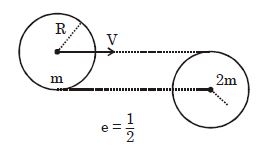
$A$ ball of mass $m$ is moving with a speed $V$ as shown in the figure. It undergoes an inelastic collision with a ball of mass $2m$ which was initially at rest. The velocity of the ball of mass $2m$ after the collision is given by
A
$\frac{3V}{8}$
B
$\frac{3V}{4}$
C
$\frac{3\sqrt{3}V}{4}$
D
$\frac{\sqrt{3}V}{4}$
Solution
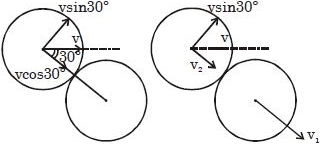
(D) The collision occurs along the line joining the centers of the two balls. The angle between the velocity vector $V$ and the line of impact is $30^{\circ}$.
The component of velocity along the line of impact is $u = V \cos 30^{\circ} = \frac{\sqrt{3}V}{2}$.
Let $v_1$ be the velocity of the ball of mass $2m$ and $v_2$ be the velocity of the ball of mass $m$ along the line of impact after the collision.
Applying the law of conservation of linear momentum along the line of impact:
$m u = m v_2 + (2m) v_1$
$u = v_2 + 2v_1$ --- $(1)$
Applying the coefficient of restitution formula $(e = 1/2)$:
$e = \frac{v_1 - v_2}{u}$
$\frac{1}{2} = \frac{v_1 - v_2}{u}$
$u = 2v_1 - 2v_2$ --- $(2)$
Adding equations $(1)$ and $(2)$:
$2u = 4v_1 - v_2 + v_2 = 4v_1$
$v_1 = \frac{u}{2} = \frac{\sqrt{3}V}{2 \times 2} = \frac{\sqrt{3}V}{4}$.
The component of velocity along the line of impact is $u = V \cos 30^{\circ} = \frac{\sqrt{3}V}{2}$.
Let $v_1$ be the velocity of the ball of mass $2m$ and $v_2$ be the velocity of the ball of mass $m$ along the line of impact after the collision.
Applying the law of conservation of linear momentum along the line of impact:
$m u = m v_2 + (2m) v_1$
$u = v_2 + 2v_1$ --- $(1)$
Applying the coefficient of restitution formula $(e = 1/2)$:
$e = \frac{v_1 - v_2}{u}$
$\frac{1}{2} = \frac{v_1 - v_2}{u}$
$u = 2v_1 - 2v_2$ --- $(2)$
Adding equations $(1)$ and $(2)$:
$2u = 4v_1 - v_2 + v_2 = 4v_1$
$v_1 = \frac{u}{2} = \frac{\sqrt{3}V}{2 \times 2} = \frac{\sqrt{3}V}{4}$.
0 likes
View Solution58
MediumMCQ
$A$ $1.0 \ kg$ ball drops vertically onto a floor from a height of $25 \ cm$. It rebounds to a height of $4 \ cm$. The coefficient of restitution for the collision is
A
$0.16$
B
$0.32$
C
$0.40$
D
$0.56$
Solution
(C) The velocity of the ball just before the collision is given by $u = \sqrt{2gh}$,where $h = 25 \ cm = 0.25 \ m$.
$u = \sqrt{2 \times 9.8 \times 0.25} = \sqrt{4.9} \ m/s$.
The velocity of the ball just after the collision is given by $v = \sqrt{2gh'}$,where $h' = 4 \ cm = 0.04 \ m$.
$v = \sqrt{2 \times 9.8 \times 0.04} = \sqrt{0.784} \ m/s$.
The coefficient of restitution $e$ is defined as the ratio of the velocity of separation to the velocity of approach: $e = \frac{v}{u}$.
$e = \sqrt{\frac{2gh'}{2gh}} = \sqrt{\frac{h'}{h}}$.
Substituting the values: $e = \sqrt{\frac{4 \ cm}{25 \ cm}} = \sqrt{\frac{4}{25}} = \frac{2}{5} = 0.4$.
$u = \sqrt{2 \times 9.8 \times 0.25} = \sqrt{4.9} \ m/s$.
The velocity of the ball just after the collision is given by $v = \sqrt{2gh'}$,where $h' = 4 \ cm = 0.04 \ m$.
$v = \sqrt{2 \times 9.8 \times 0.04} = \sqrt{0.784} \ m/s$.
The coefficient of restitution $e$ is defined as the ratio of the velocity of separation to the velocity of approach: $e = \frac{v}{u}$.
$e = \sqrt{\frac{2gh'}{2gh}} = \sqrt{\frac{h'}{h}}$.
Substituting the values: $e = \sqrt{\frac{4 \ cm}{25 \ cm}} = \sqrt{\frac{4}{25}} = \frac{2}{5} = 0.4$.
0 likes
View Solution59
MediumMCQ
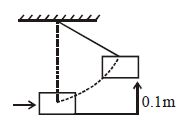
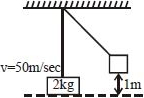
$A$ bullet of mass $0.01\, kg$ travelling at a speed of $500\, m/s$ strikes and passes horizontally through a block of mass $2\, kg$ which is suspended by a string of length $5\, m$. The centre of gravity of the block is found to rise a vertical distance of $0.1\, m$. What is the speed of the bullet after it emerges from the block? (The time of passing of the bullet is negligible,$g = 9.8\, m/s^2$)
A
$110$
B
$120$
C
$220$
D
$280$
Solution
(C) Let $m_b = 0.01\, kg$ be the mass of the bullet,$v_i = 500\, m/s$ be its initial velocity,and $v_f$ be its final velocity.
Let $M = 2\, kg$ be the mass of the block and $V$ be the velocity of the block immediately after the bullet emerges.
Using the principle of conservation of mechanical energy for the block,the kinetic energy gained by the block is equal to the potential energy gained: $\frac{1}{2} M V^2 = Mgh$.
$V = \sqrt{2gh} = \sqrt{2 \times 9.8 \times 0.1} = \sqrt{1.96} = 1.4\, m/s$.
Now,applying the principle of conservation of linear momentum in the horizontal direction:
$m_b v_i = m_b v_f + M V$.
$0.01 \times 500 = 0.01 \times v_f + 2 \times 1.4$.
$5 = 0.01 v_f + 2.8$.
$0.01 v_f = 5 - 2.8 = 2.2$.
$v_f = \frac{2.2}{0.01} = 220\, m/s$.
Let $M = 2\, kg$ be the mass of the block and $V$ be the velocity of the block immediately after the bullet emerges.
Using the principle of conservation of mechanical energy for the block,the kinetic energy gained by the block is equal to the potential energy gained: $\frac{1}{2} M V^2 = Mgh$.
$V = \sqrt{2gh} = \sqrt{2 \times 9.8 \times 0.1} = \sqrt{1.96} = 1.4\, m/s$.
Now,applying the principle of conservation of linear momentum in the horizontal direction:
$m_b v_i = m_b v_f + M V$.
$0.01 \times 500 = 0.01 \times v_f + 2 \times 1.4$.
$5 = 0.01 v_f + 2.8$.
$0.01 v_f = 5 - 2.8 = 2.2$.
$v_f = \frac{2.2}{0.01} = 220\, m/s$.
0 likes
View Solution60
DifficultMCQ
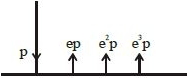
$A$ ball falls vertically onto a floor with momentum $p$ and then bounces repeatedly. If the coefficient of restitution is $e$, then the total momentum imparted by the ball on the floor is:
A
$p(1+e)$
B
$\frac{p}{1-e}$
C
$p(1+\frac{1}{e})$
D
$p(\frac{1+e}{1-e})$
Solution
(D) The change in momentum during each collision is the impulse imparted to the floor.
For the first impact, the ball arrives with momentum $p$ (downward) and rebounds with $ep$ (upward). The change in momentum is $\Delta p_1 = p - (-ep) = p(1+e)$.
For the second impact, the ball arrives with momentum $ep$ (downward) and rebounds with $e^2p$ (upward). The change in momentum is $\Delta p_2 = ep - (-e^2p) = ep(1+e)$.
For the third impact, the change is $\Delta p_3 = e^2p(1+e)$, and so on.
The total momentum imparted is the sum of all these impulses:
$\Delta p_{total} = p(1+e) + ep(1+e) + e^2p(1+e) + \dots$
$\Delta p_{total} = p(1+e) [1 + e + e^2 + \dots]$
Using the sum of an infinite geometric series $S = \frac{1}{1-e}$ for $|e| < 1$:
$\Delta p_{total} = p(1+e) \cdot \frac{1}{1-e} = p(\frac{1+e}{1-e})$.
For the first impact, the ball arrives with momentum $p$ (downward) and rebounds with $ep$ (upward). The change in momentum is $\Delta p_1 = p - (-ep) = p(1+e)$.
For the second impact, the ball arrives with momentum $ep$ (downward) and rebounds with $e^2p$ (upward). The change in momentum is $\Delta p_2 = ep - (-e^2p) = ep(1+e)$.
For the third impact, the change is $\Delta p_3 = e^2p(1+e)$, and so on.
The total momentum imparted is the sum of all these impulses:
$\Delta p_{total} = p(1+e) + ep(1+e) + e^2p(1+e) + \dots$
$\Delta p_{total} = p(1+e) [1 + e + e^2 + \dots]$
Using the sum of an infinite geometric series $S = \frac{1}{1-e}$ for $|e| < 1$:
$\Delta p_{total} = p(1+e) \cdot \frac{1}{1-e} = p(\frac{1+e}{1-e})$.
0 likes
View Solution61
MediumMCQ
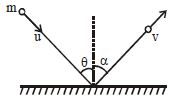
$A$ particle of mass $m$ strikes the ground inelastically with a coefficient of restitution $e$. Find the relation between the angles $\theta$ and $\alpha$ as shown in the figure.
A
$\frac{\tan \alpha}{\tan \theta} = e$
B
$\frac{\tan \theta}{\tan \alpha} = e$
C
$\tan^2 \theta + \tan^2 \alpha = 1$
D
$\tan^2 \theta + \tan^2 \alpha = e^2$
Solution
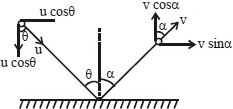
(B) Let the velocity of the particle before impact be $u$ and after impact be $v$.
The component of velocity parallel to the ground remains unchanged because there is no impulsive force acting parallel to the surface:
$v \sin \alpha = u \sin \theta$ --- $(1)$
The component of velocity perpendicular to the ground changes according to the coefficient of restitution $e$:
$v \cos \alpha = e u \cos \theta$ --- $(2)$
Dividing equation $(1)$ by equation $(2)$:
$\frac{v \sin \alpha}{v \cos \alpha} = \frac{u \sin \theta}{e u \cos \theta}$
$\tan \alpha = \frac{\tan \theta}{e}$
Rearranging the terms,we get:
$\frac{\tan \theta}{\tan \alpha} = e$
The component of velocity parallel to the ground remains unchanged because there is no impulsive force acting parallel to the surface:
$v \sin \alpha = u \sin \theta$ --- $(1)$
The component of velocity perpendicular to the ground changes according to the coefficient of restitution $e$:
$v \cos \alpha = e u \cos \theta$ --- $(2)$
Dividing equation $(1)$ by equation $(2)$:
$\frac{v \sin \alpha}{v \cos \alpha} = \frac{u \sin \theta}{e u \cos \theta}$
$\tan \alpha = \frac{\tan \theta}{e}$
Rearranging the terms,we get:
$\frac{\tan \theta}{\tan \alpha} = e$
0 likes
View Solution62
DifficultMCQ
$A$ ball $P$ collides with another identical ball $Q$ at rest. For what value of the coefficient of restitution $e$ will the velocity of ball $Q$ become two times that of ball $P$ after the collision?
A
$1/3$
B
$1/2$
C
$1/4$
D
$1/6$
Solution
(A) Let the mass of both balls be $m$. Let the initial velocity of ball $P$ be $u_1$ and ball $Q$ be $u_2 = 0$. After the collision,let their velocities be $v_1$ and $v_2$ respectively.
From the conservation of linear momentum: $m u_1 + 0 = m v_1 + m v_2 \implies u_1 = v_1 + v_2$.
From the definition of the coefficient of restitution $e$: $e = \frac{v_2 - v_1}{u_1 - u_2} \implies e u_1 = v_2 - v_1$.
Adding the two equations: $(1+e) u_1 = 2 v_2 \implies v_2 = \frac{1+e}{2} u_1$.
Subtracting the equations: $(1-e) u_1 = 2 v_1 \implies v_1 = \frac{1-e}{2} u_1$.
Given that $v_2 = 2 v_1$,we substitute the expressions:
$\frac{1+e}{2} u_1 = 2 \left( \frac{1-e}{2} \right) u_1$.
$1 + e = 2(1 - e) \implies 1 + e = 2 - 2e$.
$3e = 1 \implies e = 1/3$.
From the conservation of linear momentum: $m u_1 + 0 = m v_1 + m v_2 \implies u_1 = v_1 + v_2$.
From the definition of the coefficient of restitution $e$: $e = \frac{v_2 - v_1}{u_1 - u_2} \implies e u_1 = v_2 - v_1$.
Adding the two equations: $(1+e) u_1 = 2 v_2 \implies v_2 = \frac{1+e}{2} u_1$.
Subtracting the equations: $(1-e) u_1 = 2 v_1 \implies v_1 = \frac{1-e}{2} u_1$.
Given that $v_2 = 2 v_1$,we substitute the expressions:
$\frac{1+e}{2} u_1 = 2 \left( \frac{1-e}{2} \right) u_1$.
$1 + e = 2(1 - e) \implies 1 + e = 2 - 2e$.
$3e = 1 \implies e = 1/3$.
0 likes
View Solution63
MediumMCQ
$A$ ball is thrown with a velocity of $6\, m/s$ vertically downwards from a height $H = 3.2\, m$ above a horizontal floor. If it rebounds back to the same height,then the coefficient of restitution $e$ is $[g = 10\, m/s^2]$.
A
$0.5$
B
$0.6$
C
$0.7$
D
$0.8$
Solution
(D) Let $u = 6\, m/s$ be the initial downward velocity and $H = 3.2\, m$ be the height.
First,calculate the velocity $v$ of the ball just before hitting the floor using the equation $v^2 = u^2 + 2gH$:
$v^2 = 6^2 + 2 \times 10 \times 3.2 = 36 + 64 = 100$
$v = 10\, m/s$.
Let $v'$ be the velocity of the ball just after the rebound. Since the ball rebounds to the same height $H$,the velocity required to reach height $H$ is $v' = \sqrt{2gH} = \sqrt{2 \times 10 \times 3.2} = \sqrt{64} = 8\, m/s$.
The coefficient of restitution $e$ is defined as the ratio of the velocity of separation to the velocity of approach:
$e = \frac{v'}{v} = \frac{8}{10} = 0.8$.
First,calculate the velocity $v$ of the ball just before hitting the floor using the equation $v^2 = u^2 + 2gH$:
$v^2 = 6^2 + 2 \times 10 \times 3.2 = 36 + 64 = 100$
$v = 10\, m/s$.
Let $v'$ be the velocity of the ball just after the rebound. Since the ball rebounds to the same height $H$,the velocity required to reach height $H$ is $v' = \sqrt{2gH} = \sqrt{2 \times 10 \times 3.2} = \sqrt{64} = 8\, m/s$.
The coefficient of restitution $e$ is defined as the ratio of the velocity of separation to the velocity of approach:
$e = \frac{v'}{v} = \frac{8}{10} = 0.8$.
0 likes
View Solution64
DifficultMCQ
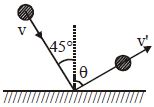
$A$ ball strikes a horizontal surface as shown in the figure. If the coefficient of restitution is $e = 1/\sqrt{3}$,then the angle $\theta$ is ............... $^o$.
A
$45$
B
$60$
C
$30$
D
$0$
Solution
(B) When a ball strikes a surface,the component of velocity parallel to the surface remains unchanged (assuming no friction),while the component perpendicular to the surface changes according to the coefficient of restitution $e$.
$1$. The horizontal component of velocity remains constant:
$v' \sin \theta = v \sin 45^{\circ}$ --- $(1)$
$2$. The vertical component of velocity after impact is given by $v'_{y} = e v_{y}$:
$v' \cos \theta = e (v \cos 45^{\circ})$ --- $(2)$
$3$. Dividing equation $(1)$ by equation $(2)$:
$\frac{v' \sin \theta}{v' \cos \theta} = \frac{v \sin 45^{\circ}}{e v \cos 45^{\circ}}$
$\tan \theta = \frac{\tan 45^{\circ}}{e}$
$4$. Given $e = 1/\sqrt{3}$ and $\tan 45^{\circ} = 1$:
$\tan \theta = \frac{1}{1/\sqrt{3}} = \sqrt{3}$
$5$. Therefore,$\theta = \tan^{-1}(\sqrt{3}) = 60^{\circ}$.
$1$. The horizontal component of velocity remains constant:
$v' \sin \theta = v \sin 45^{\circ}$ --- $(1)$
$2$. The vertical component of velocity after impact is given by $v'_{y} = e v_{y}$:
$v' \cos \theta = e (v \cos 45^{\circ})$ --- $(2)$
$3$. Dividing equation $(1)$ by equation $(2)$:
$\frac{v' \sin \theta}{v' \cos \theta} = \frac{v \sin 45^{\circ}}{e v \cos 45^{\circ}}$
$\tan \theta = \frac{\tan 45^{\circ}}{e}$
$4$. Given $e = 1/\sqrt{3}$ and $\tan 45^{\circ} = 1$:
$\tan \theta = \frac{1}{1/\sqrt{3}} = \sqrt{3}$
$5$. Therefore,$\theta = \tan^{-1}(\sqrt{3}) = 60^{\circ}$.
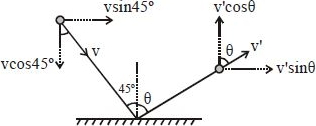
0 likes
View Solution65
DifficultMCQ
An object is dropped from a height $h$ from the ground. Every time it hits the ground,it loses $50\%$ of its kinetic energy. The total distance covered as $t \to \infty$ is
A
$3\,h$
B
$\infty$
C
$\frac{5}{3}\,h$
D
$\frac{8}{3}\,h$
Solution
(A) When the object hits the ground,its kinetic energy becomes $50\%$ of its initial value. Let $v$ be the velocity just before impact and $v'$ be the velocity just after impact.
$\frac{1}{2}m(v')^2 = \frac{50}{100} \times \frac{1}{2}mv^2 \Rightarrow v' = \frac{v}{\sqrt{2}}$.
The coefficient of restitution $e$ is defined as $e = \frac{v'}{v} = \frac{1}{\sqrt{2}}$.
The total distance $H$ covered by an object dropped from height $h$ undergoing multiple bounces is given by the formula:
$H = h + 2h(e^2) + 2h(e^4) + 2h(e^6) + \dots$
This is a geometric series: $H = h + 2h \left( \frac{e^2}{1 - e^2} \right) = h \left( \frac{1 - e^2 + 2e^2}{1 - e^2} \right) = h \left( \frac{1 + e^2}{1 - e^2} \right)$.
Substituting $e^2 = \frac{1}{2}$:
$H = h \left( \frac{1 + 1/2}{1 - 1/2} \right) = h \left( \frac{3/2}{1/2} \right) = 3h$.
$\frac{1}{2}m(v')^2 = \frac{50}{100} \times \frac{1}{2}mv^2 \Rightarrow v' = \frac{v}{\sqrt{2}}$.
The coefficient of restitution $e$ is defined as $e = \frac{v'}{v} = \frac{1}{\sqrt{2}}$.
The total distance $H$ covered by an object dropped from height $h$ undergoing multiple bounces is given by the formula:
$H = h + 2h(e^2) + 2h(e^4) + 2h(e^6) + \dots$
This is a geometric series: $H = h + 2h \left( \frac{e^2}{1 - e^2} \right) = h \left( \frac{1 - e^2 + 2e^2}{1 - e^2} \right) = h \left( \frac{1 + e^2}{1 - e^2} \right)$.
Substituting $e^2 = \frac{1}{2}$:
$H = h \left( \frac{1 + 1/2}{1 - 1/2} \right) = h \left( \frac{3/2}{1/2} \right) = 3h$.
0 likes
View Solution66
MediumMCQ
$A$ particle of mass $m$ moving with speed $2v$ collides with a mass $2m$ moving with speed $v$ in the same direction. After the collision,the first mass is stopped completely,while the second one splits into two particles each of mass $m$,which move at an angle of $45^o$ with respect to the original direction. The speed of each of the moving particles will be:
A
$v / (2\sqrt{2})$
B
$2\sqrt{2}v$
C
$\sqrt{2}v$
D
$v / \sqrt{2}$
Solution
(B) According to the law of conservation of linear momentum in the original direction of motion:
Initial momentum = Final momentum
$m(2v) + (2m)(v) = m(0) + m(v') \cos(45^o) + m(v') \cos(45^o)$
$2mv + 2mv = 0 + 2mv' \cos(45^o)$
$4mv = 2mv' (1 / \sqrt{2})$
$4v = v' \sqrt{2}$
$v' = 4v / \sqrt{2} = 2\sqrt{2}v$
Therefore,the speed of each of the moving particles is $2\sqrt{2}v$.
Initial momentum = Final momentum
$m(2v) + (2m)(v) = m(0) + m(v') \cos(45^o) + m(v') \cos(45^o)$
$2mv + 2mv = 0 + 2mv' \cos(45^o)$
$4mv = 2mv' (1 / \sqrt{2})$
$4v = v' \sqrt{2}$
$v' = 4v / \sqrt{2} = 2\sqrt{2}v$
Therefore,the speed of each of the moving particles is $2\sqrt{2}v$.
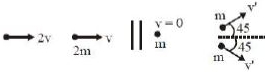
0 likes
View Solution67
DifficultMCQ
If the coefficient of restitution is $0.5$,what is the percentage loss of energy on each rebounding of a ball dropped from a height?
A
$12.5$
B
$25$
C
$50$
D
$75$
Solution
(D) The initial kinetic energy of the ball just before impact is $K_i = \frac{1}{2} m v_i^2$.
After the collision,the velocity of the ball is $v_f = e v_i$,where $e$ is the coefficient of restitution.
The final kinetic energy is $K_f = \frac{1}{2} m v_f^2 = \frac{1}{2} m (e v_i)^2 = e^2 K_i$.
The loss in kinetic energy is $\Delta K = K_i - K_f = K_i - e^2 K_i = K_i(1 - e^2)$.
The percentage loss in energy is $\frac{\Delta K}{K_i} \times 100\% = (1 - e^2) \times 100\%$.
Given $e = 0.5$,the percentage loss is $(1 - (0.5)^2) \times 100\% = (1 - 0.25) \times 100\% = 0.75 \times 100\% = 75\%$.
After the collision,the velocity of the ball is $v_f = e v_i$,where $e$ is the coefficient of restitution.
The final kinetic energy is $K_f = \frac{1}{2} m v_f^2 = \frac{1}{2} m (e v_i)^2 = e^2 K_i$.
The loss in kinetic energy is $\Delta K = K_i - K_f = K_i - e^2 K_i = K_i(1 - e^2)$.
The percentage loss in energy is $\frac{\Delta K}{K_i} \times 100\% = (1 - e^2) \times 100\%$.
Given $e = 0.5$,the percentage loss is $(1 - (0.5)^2) \times 100\% = (1 - 0.25) \times 100\% = 0.75 \times 100\% = 75\%$.
0 likes
View Solution68
DifficultMCQ
$A$ ball of mass $M$ falls from a height $h$ on a floor. If the coefficient of restitution is $e$,the height attained by the ball after two rebounds is
A
$e^2h$
B
$eh^2$
C
$e^4h$
D
$h/e^4$
Solution
(C) Let the initial velocity of the ball just before the first impact be $u = \sqrt{2gh}$.
After the first rebound,the velocity of the ball is $v_1 = eu = e\sqrt{2gh}$.
The height attained after the first rebound is $h_1 = \frac{v_1^2}{2g} = \frac{e^2(2gh)}{2g} = e^2h$.
After the second rebound,the velocity of the ball is $v_2 = ev_1 = e(e\sqrt{2gh}) = e^2\sqrt{2gh}$.
The height attained after the second rebound is $h_2 = \frac{v_2^2}{2g} = \frac{(e^2\sqrt{2gh})^2}{2g} = \frac{e^4(2gh)}{2g} = e^4h$.
After the first rebound,the velocity of the ball is $v_1 = eu = e\sqrt{2gh}$.
The height attained after the first rebound is $h_1 = \frac{v_1^2}{2g} = \frac{e^2(2gh)}{2g} = e^2h$.
After the second rebound,the velocity of the ball is $v_2 = ev_1 = e(e\sqrt{2gh}) = e^2\sqrt{2gh}$.
The height attained after the second rebound is $h_2 = \frac{v_2^2}{2g} = \frac{(e^2\sqrt{2gh})^2}{2g} = \frac{e^4(2gh)}{2g} = e^4h$.
0 likes
View Solution69
MediumMCQ
$A$ ball falling freely from a height of $4.9 \, m$ hits a horizontal surface. If the coefficient of restitution is $e = \frac{3}{4}$,then the ball will hit the surface for the second time after .............. $s$.
A
$1$
B
$1.5$
C
$2$
D
$3$
Solution
(B) The time taken for the ball to reach the surface for the first time is given by $t_1 = \sqrt{\frac{2h}{g}} = \sqrt{\frac{2 \times 4.9}{9.8}} = \sqrt{1} = 1 \, s$.
After the first impact,the velocity of the ball just before hitting the surface is $v = \sqrt{2gh} = \sqrt{2 \times 9.8 \times 4.9} = 9.8 \, m/s$.
The velocity of the ball just after the first bounce is $v' = e \times v = \frac{3}{4} \times 9.8 = 7.35 \, m/s$.
The time taken to reach the maximum height and return to the surface (time of flight for the second bounce) is $t_2 = \frac{2v'}{g} = \frac{2 \times 7.35}{9.8} = 1.5 \, s$.
Thus,the ball hits the surface for the second time $1.5 \, s$ after the first impact.
After the first impact,the velocity of the ball just before hitting the surface is $v = \sqrt{2gh} = \sqrt{2 \times 9.8 \times 4.9} = 9.8 \, m/s$.
The velocity of the ball just after the first bounce is $v' = e \times v = \frac{3}{4} \times 9.8 = 7.35 \, m/s$.
The time taken to reach the maximum height and return to the surface (time of flight for the second bounce) is $t_2 = \frac{2v'}{g} = \frac{2 \times 7.35}{9.8} = 1.5 \, s$.
Thus,the ball hits the surface for the second time $1.5 \, s$ after the first impact.
0 likes
View Solution70
MediumMCQ
$A$ ball moving with a velocity of $6\, m/s$ strikes an identical stationary ball. After collision,each ball moves at an angle of $30^{\circ}$ with the original line of motion. What are the speeds of the balls after the collision?
A
$\frac{\sqrt{3}}{2}\, m/s$
B
$3\, m/s$
C
$2\sqrt{3}\, m/s$
D
$\sqrt{3}\, m/s$
Solution
(C) Let the mass of each ball be $m$. The initial velocity of the first ball is $u_1 = 6\, m/s$ and the second ball is $u_2 = 0$.
Let the final speed of each ball after the collision be $v$.
According to the law of conservation of linear momentum along the original direction of motion ($X$-axis):
$m u_1 + m u_2 = m v \cos 30^{\circ} + m v \cos 30^{\circ}$
$m(6) + m(0) = 2 m v \cos 30^{\circ}$
$6 = 2 v \left( \frac{\sqrt{3}}{2} \right)$
$6 = v \sqrt{3}$
$v = \frac{6}{\sqrt{3}} = 2\sqrt{3}\, m/s$.
Let the final speed of each ball after the collision be $v$.
According to the law of conservation of linear momentum along the original direction of motion ($X$-axis):
$m u_1 + m u_2 = m v \cos 30^{\circ} + m v \cos 30^{\circ}$
$m(6) + m(0) = 2 m v \cos 30^{\circ}$
$6 = 2 v \left( \frac{\sqrt{3}}{2} \right)$
$6 = v \sqrt{3}$
$v = \frac{6}{\sqrt{3}} = 2\sqrt{3}\, m/s$.
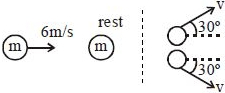
0 likes
View Solution71
EasyMCQ
For an inelastic collision between two spherical rigid bodies:
A
the total kinetic energy is conserved
B
the total potential energy is conserved
C
the linear momentum is not conserved
D
the linear momentum is conserved
Solution
(D) In any collision (elastic or inelastic),the total linear momentum of the system remains conserved,provided no external force acts on the system.
In an inelastic collision,the kinetic energy is not conserved,but the linear momentum is always conserved.
In an inelastic collision,the kinetic energy is not conserved,but the linear momentum is always conserved.
0 likes
View Solution72
Difficult
$A$ ball of mass $m$,moving with a speed $2v_0$,collides inelastically $(e > 0)$ with an identical ball at rest. Show that
$(a)$ For head-on collision,both the balls move forward.
$(b)$ For a general collision,the angle between the two velocities of scattered balls is less than $90^o$.
$(a)$ For head-on collision,both the balls move forward.
$(b)$ For a general collision,the angle between the two velocities of scattered balls is less than $90^o$.
Solution
(A-D) Let $v_{1}$ and $v_{2}$ be the velocities of the two balls after the collision.
From the law of conservation of linear momentum:
$2mv_0 = mv_1 + mv_2$
$\therefore 2v_0 = v_1 + v_2$
From the definition of the coefficient of restitution $e$:
$e = \frac{v_2 - v_1}{2v_0 - 0} \Rightarrow v_2 - v_1 = 2v_0e$
Adding the two equations:
$(v_1 + v_2) + (v_2 - v_1) = 2v_0 + 2v_0e$
$2v_2 = 2v_0(1 + e) \Rightarrow v_2 = v_0(1 + e)$
Subtracting the equations:
$(v_1 + v_2) - (v_2 - v_1) = 2v_0 - 2v_0e$
$2v_1 = 2v_0(1 - e) \Rightarrow v_1 = v_0(1 - e)$
Since $0 < e < 1$,both $v_1$ and $v_2$ are positive,meaning both balls move forward.
$(b)$ For a general collision,by the law of conservation of linear momentum:
$\vec{p} = \vec{p_1} + \vec{p_2}$
For an inelastic collision,kinetic energy is lost,so:
$\frac{p^2}{2m} > \frac{p_1^2}{2m} + \frac{p_2^2}{2m} \Rightarrow p^2 > p_1^2 + p_2^2$
Using the law of cosines for the vector triangle formed by $\vec{p}, \vec{p_1},$ and $\vec{p_2}$:
$p^2 = p_1^2 + p_2^2 - 2p_1p_2 \cos(180^o - \theta) = p_1^2 + p_2^2 + 2p_1p_2 \cos \theta$
Since $p^2 > p_1^2 + p_2^2$,it follows that $2p_1p_2 \cos \theta > 0$,which implies $\cos \theta > 0$.
Therefore,$\theta < 90^o$.
From the law of conservation of linear momentum:
$2mv_0 = mv_1 + mv_2$
$\therefore 2v_0 = v_1 + v_2$
From the definition of the coefficient of restitution $e$:
$e = \frac{v_2 - v_1}{2v_0 - 0} \Rightarrow v_2 - v_1 = 2v_0e$
Adding the two equations:
$(v_1 + v_2) + (v_2 - v_1) = 2v_0 + 2v_0e$
$2v_2 = 2v_0(1 + e) \Rightarrow v_2 = v_0(1 + e)$
Subtracting the equations:
$(v_1 + v_2) - (v_2 - v_1) = 2v_0 - 2v_0e$
$2v_1 = 2v_0(1 - e) \Rightarrow v_1 = v_0(1 - e)$
Since $0 < e < 1$,both $v_1$ and $v_2$ are positive,meaning both balls move forward.
$(b)$ For a general collision,by the law of conservation of linear momentum:
$\vec{p} = \vec{p_1} + \vec{p_2}$
For an inelastic collision,kinetic energy is lost,so:
$\frac{p^2}{2m} > \frac{p_1^2}{2m} + \frac{p_2^2}{2m} \Rightarrow p^2 > p_1^2 + p_2^2$
Using the law of cosines for the vector triangle formed by $\vec{p}, \vec{p_1},$ and $\vec{p_2}$:
$p^2 = p_1^2 + p_2^2 - 2p_1p_2 \cos(180^o - \theta) = p_1^2 + p_2^2 + 2p_1p_2 \cos \theta$
Since $p^2 > p_1^2 + p_2^2$,it follows that $2p_1p_2 \cos \theta > 0$,which implies $\cos \theta > 0$.
Therefore,$\theta < 90^o$.
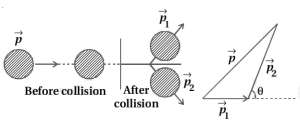
0 likes
View Solution73
Medium
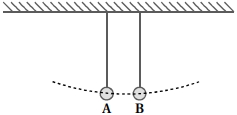
Two pendulums with identical bobs and lengths are suspended from a common support such that in rest position the two bobs are in contact (figure). One of the bobs is released after being displaced by $10^{\circ}$ so that it collides elastically head-on with the other bob.
$(a)$ Describe the motion of two bobs.
$(b)$ Draw a graph showing variation in energy of either pendulum with time,for $0 \leqslant t \leqslant 2T$,where $T$ is the period of each pendulum.
$(a)$ Describe the motion of two bobs.
$(b)$ Draw a graph showing variation in energy of either pendulum with time,for $0 \leqslant t \leqslant 2T$,where $T$ is the period of each pendulum.
Solution
(N/A) Consider the diagram where bob $B$ is displaced through an angle $\theta$ and released.
At $t=0$,suppose bob $B$ is displaced by $\theta=10^{\circ}$ to the right. It is given potential energy $E_{1}=E$. Energy of $A$,$E_{2}=0$.
When $B$ is released,it strikes $A$ at $t=T/4$. In the head-on elastic collision between identical masses,they exchange velocities. Thus,$B$ comes to rest and $A$ gets the velocity of $B$. Therefore,$E_{1}=0$ and $E_{2}=E$.
At $t=2T/4$,$B$ reaches its extreme right position when $KE$ of $A$ is converted into $PE=E_{2}=E$. Energy of $B$,$E_{1}=0$.
At $t=3T/4$,$A$ reaches its mean position,when its $PE$ is converted into $KE=E_{2}=E$. It collides elastically with $B$ and transfers its entire energy to $B$. Thus,$E_{2}=0$ and $E_{1}=E$. The entire process is repeated.
$(b)$ The values of energies of $B$ and $A$ at different time intervals are tabulated below:
At $t=0$,suppose bob $B$ is displaced by $\theta=10^{\circ}$ to the right. It is given potential energy $E_{1}=E$. Energy of $A$,$E_{2}=0$.
When $B$ is released,it strikes $A$ at $t=T/4$. In the head-on elastic collision between identical masses,they exchange velocities. Thus,$B$ comes to rest and $A$ gets the velocity of $B$. Therefore,$E_{1}=0$ and $E_{2}=E$.
At $t=2T/4$,$B$ reaches its extreme right position when $KE$ of $A$ is converted into $PE=E_{2}=E$. Energy of $B$,$E_{1}=0$.
At $t=3T/4$,$A$ reaches its mean position,when its $PE$ is converted into $KE=E_{2}=E$. It collides elastically with $B$ and transfers its entire energy to $B$. Thus,$E_{2}=0$ and $E_{1}=E$. The entire process is repeated.
$(b)$ The values of energies of $B$ and $A$ at different time intervals are tabulated below:
| Time $(t)$ | Energy of $B$ $(E_{1})$ | Energy of $A$ $(E_{2})$ |
| $0$ | $E$ | $0$ |
| $T/4$ | $0$ | $E$ |
| $2T/4$ | $0$ | $E$ |
| $3T/4$ | $E$ | $0$ |
| $4T/4$ | $E$ | $0$ |
| $5T/4$ | $0$ | $E$ |
| $6T/4$ | $0$ | $E$ |
| $7T/4$ | $E$ | $0$ |
| $8T/4$ | $E$ | $0$ |
0 likes
View Solution74
DifficultMCQ
$A$ uniform rod of mass $M$ and length $L$ is placed on a smooth horizontal surface. $A$ particle of mass $m$ strikes the rod at one end with a velocity $v$ perpendicular to the rod. If the particle comes to rest after the collision,the velocity of the center of mass of the rod after the collision is:
A
$v/2$
B
$mv/M$
C
$mv/(M+m)$
D
$v$
Solution
(B) According to the principle of conservation of linear momentum,the total momentum before the collision must equal the total momentum after the collision.
Before the collision,the momentum of the system is $p_i = mv$.
After the collision,the particle comes to rest,so its momentum is $0$. Let the velocity of the center of mass of the rod be $V_{cm}$. The momentum of the rod is $MV_{cm}$.
By conservation of linear momentum: $mv = 0 + MV_{cm}$.
Therefore,the velocity of the center of mass of the rod is $V_{cm} = mv/M$.
Before the collision,the momentum of the system is $p_i = mv$.
After the collision,the particle comes to rest,so its momentum is $0$. Let the velocity of the center of mass of the rod be $V_{cm}$. The momentum of the rod is $MV_{cm}$.
By conservation of linear momentum: $mv = 0 + MV_{cm}$.
Therefore,the velocity of the center of mass of the rod is $V_{cm} = mv/M$.
0 likes
View Solution75
DifficultMCQ
$A$ rubber ball is released from a height of $5\, m$ above the floor. It bounces back repeatedly,always rising to $\frac{81}{100}$ of the height through which it falls. Find the average speed of the ball. (Take $g = 10\, m/s^2$)
A
$3.0$
B
$3.50$
C
$2.0$
D
$2.50$
Solution
(D) The initial height is $h = 5\, m$. The ball rises to a fraction $f = \frac{81}{100}$ of its previous height after each bounce. Thus,$e^2 = \frac{81}{100}$,which means the coefficient of restitution $e = 0.9$.
Total distance $S = h + 2(fh) + 2(f^2h) + \dots = h + 2h(f + f^2 + \dots) = h + 2h \left( \frac{f}{1-f} \right) = h \left( 1 + \frac{2f}{1-f} \right) = h \left( \frac{1+f}{1-f} \right)$.
Substituting $h = 5$ and $f = 0.81$: $S = 5 \left( \frac{1.81}{0.19} \right) = 5 \times \frac{181}{19} \approx 47.63\, m$.
Total time $t = \sqrt{\frac{2h}{g}} + 2e\sqrt{\frac{2h}{g}} + 2e^2\sqrt{\frac{2h}{g}} + \dots = \sqrt{\frac{2h}{g}} \left( 1 + 2e + 2e^2 + \dots \right) = \sqrt{\frac{2h}{g}} \left( 1 + \frac{2e}{1-e} \right) = \sqrt{\frac{2h}{g}} \left( \frac{1+e}{1-e} \right)$.
Substituting $h = 5, g = 10, e = 0.9$: $t = \sqrt{\frac{2 \times 5}{10}} \left( \frac{1+0.9}{1-0.9} \right) = 1 \times \frac{1.9}{0.1} = 19\, s$.
Average speed $v_{av} = \frac{S}{t} = \frac{5 \times 1.81 / 0.19}{19} = \frac{5 \times 181 / 19}{19} = \frac{905}{361} \approx 2.5\, m/s$.
Total distance $S = h + 2(fh) + 2(f^2h) + \dots = h + 2h(f + f^2 + \dots) = h + 2h \left( \frac{f}{1-f} \right) = h \left( 1 + \frac{2f}{1-f} \right) = h \left( \frac{1+f}{1-f} \right)$.
Substituting $h = 5$ and $f = 0.81$: $S = 5 \left( \frac{1.81}{0.19} \right) = 5 \times \frac{181}{19} \approx 47.63\, m$.
Total time $t = \sqrt{\frac{2h}{g}} + 2e\sqrt{\frac{2h}{g}} + 2e^2\sqrt{\frac{2h}{g}} + \dots = \sqrt{\frac{2h}{g}} \left( 1 + 2e + 2e^2 + \dots \right) = \sqrt{\frac{2h}{g}} \left( 1 + \frac{2e}{1-e} \right) = \sqrt{\frac{2h}{g}} \left( \frac{1+e}{1-e} \right)$.
Substituting $h = 5, g = 10, e = 0.9$: $t = \sqrt{\frac{2 \times 5}{10}} \left( \frac{1+0.9}{1-0.9} \right) = 1 \times \frac{1.9}{0.1} = 19\, s$.
Average speed $v_{av} = \frac{S}{t} = \frac{5 \times 1.81 / 0.19}{19} = \frac{5 \times 181 / 19}{19} = \frac{905}{361} \approx 2.5\, m/s$.
0 likes
View Solution76
DifficultMCQ
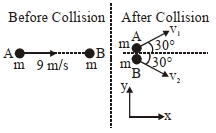
$A$ ball with a speed of $9\, m/s$ collides with another identical ball at rest. After the collision,the direction of each ball makes an angle of $30^{\circ}$ with the original direction. The ratio of velocities of the balls after collision is $x : y$ where $x$ is........
A
$3$
B
$2$
C
$0$
D
$1$
Solution
(D) Let the mass of each ball be $m$. The initial velocity of ball $A$ is $u_1 = 9\, m/s$ and ball $B$ is $u_2 = 0$.
After the collision,let the velocities of balls $A$ and $B$ be $v_1$ and $v_2$ respectively,both at an angle of $30^{\circ}$ with the original direction.
According to the law of conservation of linear momentum along the $y$-axis (perpendicular to the initial direction of motion):
$\sum P_{iy} = \sum P_{fy}$
$0 = m v_1 \sin 30^{\circ} - m v_2 \sin 30^{\circ}$
Since the masses are identical and $\sin 30^{\circ} \neq 0$,we get:
$v_1 \sin 30^{\circ} = v_2 \sin 30^{\circ}$
$v_1 = v_2$
Therefore,the ratio of the velocities $v_1 : v_2$ is $1 : 1$.
Thus,$x = 1$.
After the collision,let the velocities of balls $A$ and $B$ be $v_1$ and $v_2$ respectively,both at an angle of $30^{\circ}$ with the original direction.
According to the law of conservation of linear momentum along the $y$-axis (perpendicular to the initial direction of motion):
$\sum P_{iy} = \sum P_{fy}$
$0 = m v_1 \sin 30^{\circ} - m v_2 \sin 30^{\circ}$
Since the masses are identical and $\sin 30^{\circ} \neq 0$,we get:
$v_1 \sin 30^{\circ} = v_2 \sin 30^{\circ}$
$v_1 = v_2$
Therefore,the ratio of the velocities $v_1 : v_2$ is $1 : 1$.
Thus,$x = 1$.
0 likes
View Solution77
AdvancedMCQ
An electron collides with a free molecule initially in its ground state. The collision leaves the molecule in an excited state that is metastable and does not decay to the ground state by radiation. Let $K$ be the sum of the initial kinetic energies of the electron and the molecule,and $p$ be the sum of their initial momenta. Let $K^{\prime}$ and $p^{\prime}$ represent the same physical quantities after the collision. Then,
A
$K = K^{\prime}, p = p^{\prime}$
B
$K^{\prime} < K, p = p^{\prime}$
C
$K = K^{\prime}, p \neq p^{\prime}$
D
$K^{\prime} < K, p \neq p^{\prime}$
Solution
(B) In this collision,the electron transfers a portion of its kinetic energy to the molecule to excite it from the ground state to a metastable excited state.
Since some kinetic energy is converted into the internal potential energy of the molecule,the total kinetic energy of the system decreases. Therefore,the collision is inelastic,and $K^{\prime} < K$.
According to the law of conservation of linear momentum,the total momentum of an isolated system remains constant regardless of whether the collision is elastic or inelastic.
Thus,the total initial momentum $p$ must be equal to the total final momentum $p^{\prime}$,so $p = p^{\prime}$.
Combining these,we get $K^{\prime} < K$ and $p = p^{\prime}$.
Since some kinetic energy is converted into the internal potential energy of the molecule,the total kinetic energy of the system decreases. Therefore,the collision is inelastic,and $K^{\prime} < K$.
According to the law of conservation of linear momentum,the total momentum of an isolated system remains constant regardless of whether the collision is elastic or inelastic.
Thus,the total initial momentum $p$ must be equal to the total final momentum $p^{\prime}$,so $p = p^{\prime}$.
Combining these,we get $K^{\prime} < K$ and $p = p^{\prime}$.
0 likes
View Solution78
MediumMCQ
$A$ ball of mass $m$ moving with velocity $v$ collides head-on with a second ball of mass $m$ at rest. If the coefficient of restitution is $e$,the velocity of the first ball after collision is $v_1$,and the velocity of the second ball after collision is $v_2$,then:
A
$v_1 = \frac{(1+e)v}{2}, v_2 = \frac{(1-e)v}{2}$
B
$v_1 = \frac{(1-e)v}{2}, v_2 = \frac{(1+e)v}{2}$
C
$v_1 = \frac{v}{2}, v_2 = -\frac{v}{2}$
D
$v_1 = (1+e)v, v_2 = (1-e)v$
Solution
(B) For a head-on collision between two bodies of equal mass $m$,where the second body is initially at rest $(u_2 = 0)$ and the first body has initial velocity $u_1 = v$:
$1$. Conservation of linear momentum: $mv + 0 = mv_1 + mv_2 \implies v = v_1 + v_2$.
$2$. Coefficient of restitution definition: $e = \frac{v_2 - v_1}{u_1 - u_2} = \frac{v_2 - v_1}{v - 0} \implies ev = v_2 - v_1$.
$3$. Adding the two equations: $v + ev = (v_1 + v_2) + (v_2 - v_1) = 2v_2 \implies v_2 = \frac{(1+e)v}{2}$.
$4$. Subtracting the equations: $v - ev = (v_1 + v_2) - (v_2 - v_1) = 2v_1 \implies v_1 = \frac{(1-e)v}{2}$.
Thus,the correct option is $B$.
$1$. Conservation of linear momentum: $mv + 0 = mv_1 + mv_2 \implies v = v_1 + v_2$.
$2$. Coefficient of restitution definition: $e = \frac{v_2 - v_1}{u_1 - u_2} = \frac{v_2 - v_1}{v - 0} \implies ev = v_2 - v_1$.
$3$. Adding the two equations: $v + ev = (v_1 + v_2) + (v_2 - v_1) = 2v_2 \implies v_2 = \frac{(1+e)v}{2}$.
$4$. Subtracting the equations: $v - ev = (v_1 + v_2) - (v_2 - v_1) = 2v_1 \implies v_1 = \frac{(1-e)v}{2}$.
Thus,the correct option is $B$.
0 likes
View Solution79
MediumMCQ
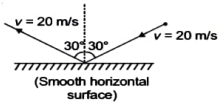
$A$ ball is moving with speed $20 \, m/s$ collides with a smooth surface as shown in the figure. The magnitude of the change in velocity of the ball will be ........... $m/s$.
A
$10 \sqrt{3}$
B
$20 \sqrt{3}$
C
$\frac{40}{\sqrt{3}}$
D
$40$
Solution
(B) From the figure,the ball approaches the surface at an angle of $30^{\circ}$ with the normal and rebounds at the same angle.
Initial velocity vector: $\vec{v}_i = (20 \sin 30^{\circ} \hat{i} - 20 \cos 30^{\circ} \hat{j}) \, m/s$
Final velocity vector: $\vec{v}_f = (-20 \sin 30^{\circ} \hat{i} - 20 \cos 30^{\circ} \hat{j}) \, m/s$
Change in velocity: $\Delta \vec{v} = \vec{v}_f - \vec{v}_i$
$\Delta \vec{v} = (-20 \sin 30^{\circ} \hat{i} - 20 \cos 30^{\circ} \hat{j}) - (20 \sin 30^{\circ} \hat{i} - 20 \cos 30^{\circ} \hat{j})$
$\Delta \vec{v} = -40 \sin 30^{\circ} \hat{i}$
Magnitude of change in velocity: $|\Delta \vec{v}| = 40 \times \sin 30^{\circ} = 40 \times 0.5 = 20 \, m/s$.
Wait,re-evaluating based on the standard reflection geometry: The component parallel to the surface remains unchanged,while the component perpendicular to the surface reverses.
Let the normal be along the $y$-axis.
$\vec{v}_i = v \sin 30^{\circ} \hat{i} - v \cos 30^{\circ} \hat{j}$
$\vec{v}_f = -v \sin 30^{\circ} \hat{i} - v \cos 30^{\circ} \hat{j}$
$\Delta \vec{v} = \vec{v}_f - \vec{v}_i = -2v \sin 30^{\circ} \hat{i} = -2(20)(0.5) \hat{i} = -20 \hat{i}$.
If the normal is along the $x$-axis:
$\vec{v}_i = -v \cos 30^{\circ} \hat{i} - v \sin 30^{\circ} \hat{j}$
$\vec{v}_f = v \cos 30^{\circ} \hat{i} - v \sin 30^{\circ} \hat{j}$
$\Delta \vec{v} = \vec{v}_f - \vec{v}_i = 2v \cos 30^{\circ} \hat{i} = 2(20)(\frac{\sqrt{3}}{2}) \hat{i} = 20\sqrt{3} \hat{i}$.
Given the options,the magnitude is $20\sqrt{3}$.
Initial velocity vector: $\vec{v}_i = (20 \sin 30^{\circ} \hat{i} - 20 \cos 30^{\circ} \hat{j}) \, m/s$
Final velocity vector: $\vec{v}_f = (-20 \sin 30^{\circ} \hat{i} - 20 \cos 30^{\circ} \hat{j}) \, m/s$
Change in velocity: $\Delta \vec{v} = \vec{v}_f - \vec{v}_i$
$\Delta \vec{v} = (-20 \sin 30^{\circ} \hat{i} - 20 \cos 30^{\circ} \hat{j}) - (20 \sin 30^{\circ} \hat{i} - 20 \cos 30^{\circ} \hat{j})$
$\Delta \vec{v} = -40 \sin 30^{\circ} \hat{i}$
Magnitude of change in velocity: $|\Delta \vec{v}| = 40 \times \sin 30^{\circ} = 40 \times 0.5 = 20 \, m/s$.
Wait,re-evaluating based on the standard reflection geometry: The component parallel to the surface remains unchanged,while the component perpendicular to the surface reverses.
Let the normal be along the $y$-axis.
$\vec{v}_i = v \sin 30^{\circ} \hat{i} - v \cos 30^{\circ} \hat{j}$
$\vec{v}_f = -v \sin 30^{\circ} \hat{i} - v \cos 30^{\circ} \hat{j}$
$\Delta \vec{v} = \vec{v}_f - \vec{v}_i = -2v \sin 30^{\circ} \hat{i} = -2(20)(0.5) \hat{i} = -20 \hat{i}$.
If the normal is along the $x$-axis:
$\vec{v}_i = -v \cos 30^{\circ} \hat{i} - v \sin 30^{\circ} \hat{j}$
$\vec{v}_f = v \cos 30^{\circ} \hat{i} - v \sin 30^{\circ} \hat{j}$
$\Delta \vec{v} = \vec{v}_f - \vec{v}_i = 2v \cos 30^{\circ} \hat{i} = 2(20)(\frac{\sqrt{3}}{2}) \hat{i} = 20\sqrt{3} \hat{i}$.
Given the options,the magnitude is $20\sqrt{3}$.
2 likes
View Solution80
MediumMCQ
Two balls of equal mass undergo head-on collision while each was moving with speed $6 \, m/s$ in opposite directions. If the coefficient of restitution is $e = 1/3$,the speed of each ball after impact will be ............ $m/s$.
A
$18$
B
$4$
C
$6$
D
$2$
Solution
(D) Let the masses of the two balls be $m_1 = m_2 = m$.
Let the initial velocities be $u_1 = 6 \, m/s$ and $u_2 = -6 \, m/s$.
The coefficient of restitution is $e = \frac{v_2 - v_1}{u_1 - u_2}$,where $v_1$ and $v_2$ are the final velocities.
Since the masses are equal and the collision is head-on,the balls will exchange velocities if $e=1$. For a general $e$,the final velocities are given by $v_1 = \frac{(m_1 - em_2)u_1 + m_2(1+e)u_2}{m_1 + m_2}$ and $v_2 = \frac{(m_2 - em_1)u_2 + m_1(1+e)u_1}{m_1 + m_2}$.
Substituting $m_1 = m_2 = m$,$u_1 = 6$,and $u_2 = -6$:
$v_1 = \frac{(m - em)(6) + m(1+e)(-6)}{2m} = \frac{6 - 6e - 6 - 6e}{2} = -6e$.
$v_2 = \frac{(m - em)(-6) + m(1+e)(6)}{2m} = \frac{-6 + 6e + 6 + 6e}{2} = 6e$.
Given $e = 1/3$,the speed of each ball is $|v| = 6 \times (1/3) = 2 \, m/s$.
Let the initial velocities be $u_1 = 6 \, m/s$ and $u_2 = -6 \, m/s$.
The coefficient of restitution is $e = \frac{v_2 - v_1}{u_1 - u_2}$,where $v_1$ and $v_2$ are the final velocities.
Since the masses are equal and the collision is head-on,the balls will exchange velocities if $e=1$. For a general $e$,the final velocities are given by $v_1 = \frac{(m_1 - em_2)u_1 + m_2(1+e)u_2}{m_1 + m_2}$ and $v_2 = \frac{(m_2 - em_1)u_2 + m_1(1+e)u_1}{m_1 + m_2}$.
Substituting $m_1 = m_2 = m$,$u_1 = 6$,and $u_2 = -6$:
$v_1 = \frac{(m - em)(6) + m(1+e)(-6)}{2m} = \frac{6 - 6e - 6 - 6e}{2} = -6e$.
$v_2 = \frac{(m - em)(-6) + m(1+e)(6)}{2m} = \frac{-6 + 6e + 6 + 6e}{2} = 6e$.
Given $e = 1/3$,the speed of each ball is $|v| = 6 \times (1/3) = 2 \, m/s$.
0 likes
View Solution81
MediumMCQ
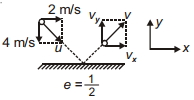
In the figure shown,a small ball hits obliquely a smooth and horizontal surface with speed $u$ whose $x$ and $y$ components are indicated. If the coefficient of restitution is $\frac{1}{2}$,then its $x$ and $y$ components $v_x$ and $v_y$ just after collision are respectively
A
$2 \, m/s, 2 \, m/s$
B
$2 \, m/s, 1 \, m/s$
C
$4 \, m/s, 1 \, m/s$
D
$4 \, m/s, 2 \, m/s$
Solution
(A) The surface is smooth and horizontal,so there is no impulsive force acting in the $x$-direction during the collision. Therefore,the velocity component in the $x$-direction remains unchanged.
$v_x = u_x = 2 \, m/s$
In the $y$-direction (normal to the surface),the coefficient of restitution $e$ is defined as the ratio of the velocity of separation to the velocity of approach.
$e = \frac{v_y}{u_y}$
Given $e = \frac{1}{2}$ and $u_y = 4 \, m/s$,we have:
$v_y = e \times u_y = \frac{1}{2} \times 4 = 2 \, m/s$
Thus,the components just after the collision are $v_x = 2 \, m/s$ and $v_y = 2 \, m/s$.
$v_x = u_x = 2 \, m/s$
In the $y$-direction (normal to the surface),the coefficient of restitution $e$ is defined as the ratio of the velocity of separation to the velocity of approach.
$e = \frac{v_y}{u_y}$
Given $e = \frac{1}{2}$ and $u_y = 4 \, m/s$,we have:
$v_y = e \times u_y = \frac{1}{2} \times 4 = 2 \, m/s$
Thus,the components just after the collision are $v_x = 2 \, m/s$ and $v_y = 2 \, m/s$.
0 likes
View Solution82
MediumMCQ
$A$ bullet of mass $10 \,g$ moving with a speed of $20 \,m/s$ hits an ice block of mass $990 \,g$ kept on a frictionless floor and gets stuck in it. How much ice will melt if $50 \%$ of the lost kinetic energy $(KE)$ goes to the ice? (Initial temperature of the ice block and bullet $= 0^{\circ}C$,Latent heat of fusion of ice $L = 80 \,cal/g = 336 \,J/g$)
A
$0.001$
B
$0.002$
C
$0.003$
D
$0.004$
Solution
(C) $1$. Calculate the initial kinetic energy of the bullet: $KE_i = \frac{1}{2} m v^2 = \frac{1}{2} \times 0.01 \,kg \times (20 \,m/s)^2 = 2 \,J$.
$2$. Calculate the final velocity of the system (bullet + ice) using conservation of momentum: $m_b v_b = (m_b + m_i) v_f \Rightarrow 0.01 \times 20 = (0.01 + 0.99) v_f \Rightarrow v_f = 0.2 \,m/s$.
$3$. Calculate the final kinetic energy of the system: $KE_f = \frac{1}{2} (m_b + m_i) v_f^2 = \frac{1}{2} \times 1 \,kg \times (0.2 \,m/s)^2 = 0.02 \,J$.
$4$. Calculate the lost kinetic energy: $\Delta KE = KE_i - KE_f = 2 - 0.02 = 1.98 \,J$.
$5$. Energy available for melting ice: $Q = 50\% \text{ of } \Delta KE = 0.5 \times 1.98 = 0.99 \,J \approx 1 \,J$.
$6$. Amount of ice melted: $m_{melt} = \frac{Q}{L} = \frac{1 \,J}{336 \,J/g} \approx 0.00297 \,g \approx 0.003 \,g$.
$2$. Calculate the final velocity of the system (bullet + ice) using conservation of momentum: $m_b v_b = (m_b + m_i) v_f \Rightarrow 0.01 \times 20 = (0.01 + 0.99) v_f \Rightarrow v_f = 0.2 \,m/s$.
$3$. Calculate the final kinetic energy of the system: $KE_f = \frac{1}{2} (m_b + m_i) v_f^2 = \frac{1}{2} \times 1 \,kg \times (0.2 \,m/s)^2 = 0.02 \,J$.
$4$. Calculate the lost kinetic energy: $\Delta KE = KE_i - KE_f = 2 - 0.02 = 1.98 \,J$.
$5$. Energy available for melting ice: $Q = 50\% \text{ of } \Delta KE = 0.5 \times 1.98 = 0.99 \,J \approx 1 \,J$.
$6$. Amount of ice melted: $m_{melt} = \frac{Q}{L} = \frac{1 \,J}{336 \,J/g} \approx 0.00297 \,g \approx 0.003 \,g$.
0 likes
View Solution83
MediumMCQ
$A$ ball is dropped from a height of $20\,m$. If the coefficient of restitution for the collision between ball and floor is $0.5$,after hitting the floor,the ball rebounds to a height of $.............m$.
A
$4$
B
$3$
C
$5$
D
$2$
Solution
(C) When a ball is dropped from a height $h$ and hits a floor with a coefficient of restitution $e$,the height $h^{\prime}$ to which it rebounds is given by the formula: $h^{\prime} = e^2 h$.
Given:
Initial height $h = 20\,m$.
Coefficient of restitution $e = 0.5$.
Substituting the values into the formula:
$h^{\prime} = (0.5)^2 \times 20\,m$.
$h^{\prime} = 0.25 \times 20\,m$.
$h^{\prime} = 5\,m$.
Therefore,the ball rebounds to a height of $5\,m$.
Given:
Initial height $h = 20\,m$.
Coefficient of restitution $e = 0.5$.
Substituting the values into the formula:
$h^{\prime} = (0.5)^2 \times 20\,m$.
$h^{\prime} = 0.25 \times 20\,m$.
$h^{\prime} = 5\,m$.
Therefore,the ball rebounds to a height of $5\,m$.
0 likes
View Solution84
DifficultMCQ
$A$ body is dropped on the ground from a height $h_1$ and after hitting the ground,it rebounds to a height $h_2$. If the ratio of velocities of the body just before and after hitting the ground is $4$,then the percentage loss in kinetic energy of the body is $\frac{x}{4}$. The value of $x$ is $.......$
A
$374$
B
$373$
C
$375$
D
$365$
Solution
(C) Let $V_1$ be the velocity just before hitting the ground and $V_2$ be the velocity just after hitting the ground.
Given the ratio of velocities is $\frac{V_1}{V_2} = 4$,which implies $V_1 = 4V_2$.
The kinetic energy just before hitting the ground is $KE_{before} = \frac{1}{2}mV_1^2$.
The kinetic energy just after hitting the ground is $KE_{after} = \frac{1}{2}mV_2^2 = \frac{1}{2}m\left(\frac{V_1}{4}\right)^2 = \frac{1}{2}mV_1^2 \times \frac{1}{16}$.
The loss in kinetic energy is $\Delta KE = KE_{before} - KE_{after} = \frac{1}{2}mV_1^2 \left(1 - \frac{1}{16}\right) = \frac{15}{32}mV_1^2$.
The percentage loss in kinetic energy is $\frac{\Delta KE}{KE_{before}} \times 100 = \left(1 - \frac{1}{16}\right) \times 100 = \frac{15}{16} \times 100 = \frac{1500}{16} = \frac{375}{4} \%$.
Comparing this with $\frac{x}{4} \%$,we get $x = 375$.
Given the ratio of velocities is $\frac{V_1}{V_2} = 4$,which implies $V_1 = 4V_2$.
The kinetic energy just before hitting the ground is $KE_{before} = \frac{1}{2}mV_1^2$.
The kinetic energy just after hitting the ground is $KE_{after} = \frac{1}{2}mV_2^2 = \frac{1}{2}m\left(\frac{V_1}{4}\right)^2 = \frac{1}{2}mV_1^2 \times \frac{1}{16}$.
The loss in kinetic energy is $\Delta KE = KE_{before} - KE_{after} = \frac{1}{2}mV_1^2 \left(1 - \frac{1}{16}\right) = \frac{15}{32}mV_1^2$.
The percentage loss in kinetic energy is $\frac{\Delta KE}{KE_{before}} \times 100 = \left(1 - \frac{1}{16}\right) \times 100 = \frac{15}{16} \times 100 = \frac{1500}{16} = \frac{375}{4} \%$.
Comparing this with $\frac{x}{4} \%$,we get $x = 375$.
0 likes
View Solution85
MediumMCQ
$A$ moving ball collides head-on with a similar ball at rest. If $\frac{1}{4}$ of the kinetic energy is lost during the impact,the value of the coefficient of restitution is:
A
$\frac{1}{2 \sqrt{2}}$
B
$\frac{1}{\sqrt{3}}$
C
$\frac{1}{\sqrt{2}}$
D
$\frac{\sqrt{3}}{2}$
Solution
(C) For a head-on collision between two identical masses $m$ where one is at rest,the loss in kinetic energy $\Delta KE$ is given by:
$\Delta KE = \frac{1}{2} \frac{m_1 m_2}{m_1 + m_2} (1 - e^2) (u_1 - u_2)^2$
Since $m_1 = m_2 = m$,$u_1 = u$,and $u_2 = 0$:
$\Delta KE = \frac{1}{2} \frac{m^2}{2m} (1 - e^2) u^2 = \frac{1}{4} m u^2 (1 - e^2)$
Given that $\Delta KE = \frac{1}{4} KE_{initial} = \frac{1}{4} (\frac{1}{2} m u^2)$:
$\frac{1}{4} m u^2 (1 - e^2) = \frac{1}{4} (\frac{1}{2} m u^2)$
$(1 - e^2) = \frac{1}{2}$
$e^2 = 1 - \frac{1}{2} = \frac{1}{2}$
$e = \frac{1}{\sqrt{2}}$
$\Delta KE = \frac{1}{2} \frac{m_1 m_2}{m_1 + m_2} (1 - e^2) (u_1 - u_2)^2$
Since $m_1 = m_2 = m$,$u_1 = u$,and $u_2 = 0$:
$\Delta KE = \frac{1}{2} \frac{m^2}{2m} (1 - e^2) u^2 = \frac{1}{4} m u^2 (1 - e^2)$
Given that $\Delta KE = \frac{1}{4} KE_{initial} = \frac{1}{4} (\frac{1}{2} m u^2)$:
$\frac{1}{4} m u^2 (1 - e^2) = \frac{1}{4} (\frac{1}{2} m u^2)$
$(1 - e^2) = \frac{1}{2}$
$e^2 = 1 - \frac{1}{2} = \frac{1}{2}$
$e = \frac{1}{\sqrt{2}}$
0 likes
View Solution86
MediumMCQ
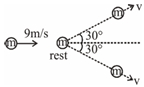
$A$ ball moving with a velocity of $9 \ m/s$ collides with another similar stationary ball. After the collision,both balls move in directions making an angle of $30^{\circ}$ with the initial direction. After the collision,their speed will be $-$
A
$\frac{5}{\sqrt{3}} \ m/s$
B
$3 \sqrt{3} \ m/s$
C
$\frac{10}{\sqrt{3}} \ m/s$
D
$52 \ m/s$
Solution
(B) Let the mass of each ball be $m$. The initial velocity of the first ball is $u = 9 \ m/s$ and the second ball is at rest $(u_2 = 0)$.
According to the Law of Conservation of Linear Momentum $(COLM)$ along the initial direction of motion:
$m \times u = m \times v \cos 30^{\circ} + m \times v \cos 30^{\circ}$
$m \times 9 = 2 \times m \times v \times \cos 30^{\circ}$
$9 = 2 \times v \times \frac{\sqrt{3}}{2}$
$9 = v \sqrt{3}$
$v = \frac{9}{\sqrt{3}} = 3 \sqrt{3} \ m/s$
Thus,the speed of both balls after the collision is $3 \sqrt{3} \ m/s$.
According to the Law of Conservation of Linear Momentum $(COLM)$ along the initial direction of motion:
$m \times u = m \times v \cos 30^{\circ} + m \times v \cos 30^{\circ}$
$m \times 9 = 2 \times m \times v \times \cos 30^{\circ}$
$9 = 2 \times v \times \frac{\sqrt{3}}{2}$
$9 = v \sqrt{3}$
$v = \frac{9}{\sqrt{3}} = 3 \sqrt{3} \ m/s$
Thus,the speed of both balls after the collision is $3 \sqrt{3} \ m/s$.
0 likes
View Solution87
DifficultMCQ
$A$ ball impinges directly on a similar ball of same mass at rest. If $1/4$ of the kinetic energy is lost by the impact,the value of the coefficient of restitution is
A
$1 / (2 \sqrt{2})$
B
$1 / \sqrt{3}$
C
$1 / \sqrt{2}$
D
$\sqrt{3} / 2$
Solution
(C) The loss in kinetic energy during a perfectly inelastic collision between two bodies of equal mass $m$,where one is at rest,is given by the formula: $\Delta KE = \frac{1}{2} \frac{m_1 m_2}{m_1 + m_2} (1 - e^2) (u_1 - u_2)^2$.
Given $m_1 = m_2 = m$,$u_1 = u$,and $u_2 = 0$,the formula becomes: $\Delta KE = \frac{1}{2} \frac{m^2}{2m} (1 - e^2) u^2 = \frac{1}{4} m (1 - e^2) u^2$.
We are given that the loss in kinetic energy is $1/4$ of the initial kinetic energy $(KE_i = \frac{1}{2} m u^2)$.
So,$\frac{1}{4} m (1 - e^2) u^2 = \frac{1}{4} (\frac{1}{2} m u^2)$.
Dividing both sides by $\frac{1}{4} m u^2$,we get: $1 - e^2 = \frac{1}{2}$.
Therefore,$e^2 = 1 - 1/2 = 1/2$.
Taking the square root,we get: $e = 1 / \sqrt{2}$.
Given $m_1 = m_2 = m$,$u_1 = u$,and $u_2 = 0$,the formula becomes: $\Delta KE = \frac{1}{2} \frac{m^2}{2m} (1 - e^2) u^2 = \frac{1}{4} m (1 - e^2) u^2$.
We are given that the loss in kinetic energy is $1/4$ of the initial kinetic energy $(KE_i = \frac{1}{2} m u^2)$.
So,$\frac{1}{4} m (1 - e^2) u^2 = \frac{1}{4} (\frac{1}{2} m u^2)$.
Dividing both sides by $\frac{1}{4} m u^2$,we get: $1 - e^2 = \frac{1}{2}$.
Therefore,$e^2 = 1 - 1/2 = 1/2$.
Taking the square root,we get: $e = 1 / \sqrt{2}$.
0 likes
View Solution88
MediumMCQ
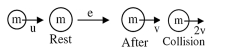
Ball $1$ collides with another identical ball at rest. For what value of coefficient of restitution $e,$ the velocity of the second ball becomes two times that of the first ball after the collision?
A
$\frac{1}{3}$
B
$\frac{1}{2}$
C
$\frac{1}{4}$
D
$\frac{1}{6}$
Solution
(A) Let the mass of each ball be $m$. Let the initial velocity of the first ball be $u$ and the second ball be $0$. Let the velocities after the collision be $v_1$ and $v_2$ respectively. According to the problem,$v_2 = 2v_1$.
By the Conservation of Linear Momentum $(COLM)$:
$m(u) + m(0) = m(v_1) + m(v_2)$
$u = v_1 + v_2$
Since $v_2 = 2v_1$,we have $u = v_1 + 2v_1 = 3v_1$,which implies $v_1 = \frac{u}{3}$ and $v_2 = \frac{2u}{3}$.
The coefficient of restitution $e$ is defined as:
$e = \frac{v_2 - v_1}{u_1 - u_2}$
Substituting the values:
$e = \frac{2v_1 - v_1}{u - 0} = \frac{v_1}{u}$
Since $v_1 = \frac{u}{3}$,we get:
$e = \frac{u/3}{u} = \frac{1}{3}$
By the Conservation of Linear Momentum $(COLM)$:
$m(u) + m(0) = m(v_1) + m(v_2)$
$u = v_1 + v_2$
Since $v_2 = 2v_1$,we have $u = v_1 + 2v_1 = 3v_1$,which implies $v_1 = \frac{u}{3}$ and $v_2 = \frac{2u}{3}$.
The coefficient of restitution $e$ is defined as:
$e = \frac{v_2 - v_1}{u_1 - u_2}$
Substituting the values:
$e = \frac{2v_1 - v_1}{u - 0} = \frac{v_1}{u}$
Since $v_1 = \frac{u}{3}$,we get:
$e = \frac{u/3}{u} = \frac{1}{3}$
0 likes
View Solution89
EasyMCQ
$A$ glass ball collides with a smooth horizontal surface with a velocity $\vec{v} = a \hat{i} - b \hat{j}$. If the coefficient of restitution of the collision is $e$,find the velocity of the ball just after the collision. ($x$-axis is along the ground and $y$-axis is along the vertical).
A
$e a \hat{i} + b \hat{j}$
B
$a \hat{i} - e b \hat{j}$
C
$e a \hat{i} - b \hat{j}$
D
$a \hat{i} + e b \hat{j}$
Solution
(D) The velocity of the ball before collision is $\vec{v}_{initial} = a \hat{i} - b \hat{j}$.
Since the surface is smooth,there is no friction,so the horizontal component of velocity remains unchanged: $v_{x, final} = v_{x, initial} = a \hat{i}$.
The vertical component of velocity changes due to the collision. According to the definition of the coefficient of restitution $e$,the velocity of separation along the normal is $e$ times the velocity of approach along the normal.
$v_{y, final} = e \times |v_{y, initial}| = e b$.
Since the ball bounces upward,the final vertical velocity is in the positive $y$-direction: $\vec{v}_{y, final} = e b \hat{j}$.
Therefore,the velocity of the ball just after the collision is $\vec{v}_{final} = a \hat{i} + e b \hat{j}$.
Since the surface is smooth,there is no friction,so the horizontal component of velocity remains unchanged: $v_{x, final} = v_{x, initial} = a \hat{i}$.
The vertical component of velocity changes due to the collision. According to the definition of the coefficient of restitution $e$,the velocity of separation along the normal is $e$ times the velocity of approach along the normal.
$v_{y, final} = e \times |v_{y, initial}| = e b$.
Since the ball bounces upward,the final vertical velocity is in the positive $y$-direction: $\vec{v}_{y, final} = e b \hat{j}$.
Therefore,the velocity of the ball just after the collision is $\vec{v}_{final} = a \hat{i} + e b \hat{j}$.
0 likes
View Solution90
MediumMCQ
$A$ ball is moving with velocity $4 \ m/s$ and collides head-on with another stationary ball of double the mass. If the coefficient of restitution is $0.2$,then their velocities (in $m/s$) after the collision will be:
A
$0.8, 1.6$
B
$0.8, 0.4$
C
$0.2, 0.4$
D
$0.6, 1.2$
Solution
(A) Let the mass of the first ball be $m$ and its initial velocity be $u_1 = 4 \ m/s$. The mass of the second ball is $2m$ and its initial velocity is $u_2 = 0 \ m/s$.
According to the law of conservation of linear momentum:
$m_1 u_1 + m_2 u_2 = m_1 v_1 + m_2 v_2$
$m(4) + 2m(0) = m v_1 + 2m v_2$
$4 = v_1 + 2v_2$ --- (Equation $1$)
Using the coefficient of restitution $e = 0.2$:
$e = \frac{v_2 - v_1}{u_1 - u_2}$
$0.2 = \frac{v_2 - v_1}{4 - 0}$
$v_2 - v_1 = 0.8$ --- (Equation $2$)
Adding Equation $1$ and Equation $2$:
$(v_1 + 2v_2) + (v_2 - v_1) = 4 + 0.8$
$3v_2 = 4.8 \Rightarrow v_2 = 1.6 \ m/s$
Substituting $v_2$ into Equation $2$:
$1.6 - v_1 = 0.8 \Rightarrow v_1 = 0.8 \ m/s$
Thus,the velocities after collision are $0.8 \ m/s$ and $1.6 \ m/s$.
According to the law of conservation of linear momentum:
$m_1 u_1 + m_2 u_2 = m_1 v_1 + m_2 v_2$
$m(4) + 2m(0) = m v_1 + 2m v_2$
$4 = v_1 + 2v_2$ --- (Equation $1$)
Using the coefficient of restitution $e = 0.2$:
$e = \frac{v_2 - v_1}{u_1 - u_2}$
$0.2 = \frac{v_2 - v_1}{4 - 0}$
$v_2 - v_1 = 0.8$ --- (Equation $2$)
Adding Equation $1$ and Equation $2$:
$(v_1 + 2v_2) + (v_2 - v_1) = 4 + 0.8$
$3v_2 = 4.8 \Rightarrow v_2 = 1.6 \ m/s$
Substituting $v_2$ into Equation $2$:
$1.6 - v_1 = 0.8 \Rightarrow v_1 = 0.8 \ m/s$
Thus,the velocities after collision are $0.8 \ m/s$ and $1.6 \ m/s$.
0 likes
View Solution91
MediumMCQ
An object of mass $m$ moving with velocity $u$ collides with another stationary object of mass $M$ and stops just after the collision. The coefficient of restitution is
A
$\frac{m}{M+m}$
B
$\frac{M-m}{M+m}$
C
$\frac{m}{M}$
D
$1$
Solution
(C) Let the mass of the first object be $m$ and its initial velocity be $u$. Let the mass of the second object be $M$ and its initial velocity be $0$. After the collision,the first object stops $(v_1 = 0)$.
By the law of conservation of linear momentum:
$m u + M(0) = m(0) + M v_2$
$m u = M v_2$
$v_2 = \frac{m u}{M}$
The coefficient of restitution $e$ is defined as the ratio of the relative velocity of separation to the relative velocity of approach:
$e = \frac{v_2 - v_1}{u_1 - u_2}$
Substituting the values:
$e = \frac{\frac{m u}{M} - 0}{u - 0} = \frac{m u / M}{u} = \frac{m}{M}$
By the law of conservation of linear momentum:
$m u + M(0) = m(0) + M v_2$
$m u = M v_2$
$v_2 = \frac{m u}{M}$
The coefficient of restitution $e$ is defined as the ratio of the relative velocity of separation to the relative velocity of approach:
$e = \frac{v_2 - v_1}{u_1 - u_2}$
Substituting the values:
$e = \frac{\frac{m u}{M} - 0}{u - 0} = \frac{m u / M}{u} = \frac{m}{M}$
0 likes
View Solution92
MediumMCQ
$A$ body falls on a surface of coefficient of restitution $0.6$ from a height of $1 \ m$. Then the body rebounds to a height of (in $m$)
A
$1$
B
$0.36$
C
$0.4$
D
$0.6$
Solution
(B) When a body falls from a height $h_1$,its velocity just before impact is $v_b = \sqrt{2gh_1}$.
After the collision,the velocity of the body becomes $v_f = e \cdot v_b$,where $e$ is the coefficient of restitution.
The body then rises to a height $h_2$,where $v_f = \sqrt{2gh_2}$.
Substituting $v_f$ into the equation,we get $\sqrt{2gh_2} = e \sqrt{2gh_1}$.
Squaring both sides,we get $2gh_2 = e^2 (2gh_1)$,which simplifies to $h_2 = e^2 h_1$.
Given $e = 0.6$ and $h_1 = 1 \ m$:
$h_2 = (0.6)^2 \times 1 \ m = 0.36 \ m$.
After the collision,the velocity of the body becomes $v_f = e \cdot v_b$,where $e$ is the coefficient of restitution.
The body then rises to a height $h_2$,where $v_f = \sqrt{2gh_2}$.
Substituting $v_f$ into the equation,we get $\sqrt{2gh_2} = e \sqrt{2gh_1}$.
Squaring both sides,we get $2gh_2 = e^2 (2gh_1)$,which simplifies to $h_2 = e^2 h_1$.
Given $e = 0.6$ and $h_1 = 1 \ m$:
$h_2 = (0.6)^2 \times 1 \ m = 0.36 \ m$.
0 likes
View Solution93
MediumMCQ
$A$ sphere of mass $m$ moving with velocity $v$ collides head-on with another sphere of the same mass which is at rest. The ratio of the final velocity of the second sphere to the initial velocity of the first sphere is (where $e$ is the coefficient of restitution and the collision is inelastic).
A
$\frac{e-1}{2}$
B
$\frac{e}{2}$
C
$\frac{e+1}{2}$
D
$e$
Solution
(C) Let the mass of both spheres be $m$. The initial velocity of the first sphere is $v$ and the second sphere is $0$. Let their final velocities be $V_1$ and $V_2$ respectively.
By the law of conservation of linear momentum:
$m v + m(0) = m V_1 + m V_2$
$v = V_1 + V_2$ --- $(1)$
By the definition of the coefficient of restitution $e$:
$e = \frac{V_2 - V_1}{u_1 - u_2}$
$e = \frac{V_2 - V_1}{v - 0}$
$e v = V_2 - V_1$ --- $(2)$
Adding equations $(1)$ and $(2)$:
$v + e v = (V_1 + V_2) + (V_2 - V_1)$
$v(1 + e) = 2 V_2$
$V_2 = \frac{v(e + 1)}{2}$
The ratio of the final velocity of the second sphere $(V_2)$ to the initial velocity of the first sphere $(v)$ is:
$\frac{V_2}{v} = \frac{e + 1}{2}$
By the law of conservation of linear momentum:
$m v + m(0) = m V_1 + m V_2$
$v = V_1 + V_2$ --- $(1)$
By the definition of the coefficient of restitution $e$:
$e = \frac{V_2 - V_1}{u_1 - u_2}$
$e = \frac{V_2 - V_1}{v - 0}$
$e v = V_2 - V_1$ --- $(2)$
Adding equations $(1)$ and $(2)$:
$v + e v = (V_1 + V_2) + (V_2 - V_1)$
$v(1 + e) = 2 V_2$
$V_2 = \frac{v(e + 1)}{2}$
The ratio of the final velocity of the second sphere $(V_2)$ to the initial velocity of the first sphere $(v)$ is:
$\frac{V_2}{v} = \frac{e + 1}{2}$

0 likes
View Solution94
EasyMCQ
$A$ particle of mass $m$ collides with another stationary particle of mass $M$. The particle of mass $m$ stops just after the collision. The coefficient of restitution is
A
$\frac{M}{m}$
B
$\frac{m+M}{M}$
C
$\frac{M-m}{M+m}$
D
$\frac{m}{M}$
Solution
(D) Let $u$ be the initial velocity of mass $m$ and $v_M$ be the velocity of mass $M$ after the collision. The mass $m$ comes to rest,so its final velocity is $0$.
By the law of conservation of linear momentum:
$mu + M(0) = m(0) + Mv_M$
$mu = Mv_M$
$v_M = \frac{m}{M}u$
The coefficient of restitution $e$ is defined as the ratio of the relative velocity of separation to the relative velocity of approach:
$e = \frac{v_M - 0}{u - 0} = \frac{v_M}{u}$
Substituting the value of $v_M$:
$e = \frac{(m/M)u}{u} = \frac{m}{M}$
By the law of conservation of linear momentum:
$mu + M(0) = m(0) + Mv_M$
$mu = Mv_M$
$v_M = \frac{m}{M}u$
The coefficient of restitution $e$ is defined as the ratio of the relative velocity of separation to the relative velocity of approach:
$e = \frac{v_M - 0}{u - 0} = \frac{v_M}{u}$
Substituting the value of $v_M$:
$e = \frac{(m/M)u}{u} = \frac{m}{M}$
0 likes
View Solution95
DifficultMCQ
$A$ wooden block of mass $m$ moves with velocity $v$ and collides with another block of mass $4m$,which is at rest. After the collision,the block of mass $m$ comes to rest. The coefficient of restitution will be:
A
$0.70$
B
$0.25$
C
$0.40$
D
$0.50$
Solution
(B) Given: Mass of first block $M_1 = m$,initial velocity $u_1 = v$,final velocity $v_1 = 0$.
Mass of second block $M_2 = 4m$,initial velocity $u_2 = 0$,final velocity $v_2 = ?$.
According to the law of conservation of linear momentum:
$M_1 u_1 + M_2 u_2 = M_1 v_1 + M_2 v_2$
$m(v) + 4m(0) = m(0) + 4m(v_2)$
$mv = 4mv_2$
$v_2 = \frac{v}{4}$
The coefficient of restitution $e$ is defined as:
$e = \frac{v_2 - v_1}{u_1 - u_2}$
Substituting the values:
$e = \frac{\frac{v}{4} - 0}{v - 0} = \frac{v/4}{v} = \frac{1}{4} = 0.25$.
Mass of second block $M_2 = 4m$,initial velocity $u_2 = 0$,final velocity $v_2 = ?$.
According to the law of conservation of linear momentum:
$M_1 u_1 + M_2 u_2 = M_1 v_1 + M_2 v_2$
$m(v) + 4m(0) = m(0) + 4m(v_2)$
$mv = 4mv_2$
$v_2 = \frac{v}{4}$
The coefficient of restitution $e$ is defined as:
$e = \frac{v_2 - v_1}{u_1 - u_2}$
Substituting the values:
$e = \frac{\frac{v}{4} - 0}{v - 0} = \frac{v/4}{v} = \frac{1}{4} = 0.25$.
0 likes
View Solution96
EasyMCQ
$A$ ball kept at $20 \,m$ height falls freely in a downward direction vertically and hits the ground. The coefficient of restitution is $0.4$. After the first rebound, the upward velocity is $[g = 10 \,m/s^2]$. (in $\,m/s$)
A
$8$
B
$12$
C
$4$
D
$16$
Solution
(A) Given: Height $h = 20 \,m$, acceleration due to gravity $g = 10 \,m/s^2$, and coefficient of restitution $e = 0.4$.
First, calculate the velocity $v$ of the ball just before it hits the ground using the equation of motion $v^2 = u^2 + 2gh$ (where initial velocity $u = 0$):
$v = \sqrt{2gh} = \sqrt{2 \times 10 \times 20} = \sqrt{400} = 20 \,m/s$.
The coefficient of restitution $e$ is defined as the ratio of the velocity of separation (rebound velocity $v'$) to the velocity of approach (impact velocity $v$):
$e = \frac{v'}{v}$.
Therefore, the upward rebound velocity $v'$ is:
$v' = e \times v = 0.4 \times 20 = 8 \,m/s$.
First, calculate the velocity $v$ of the ball just before it hits the ground using the equation of motion $v^2 = u^2 + 2gh$ (where initial velocity $u = 0$):
$v = \sqrt{2gh} = \sqrt{2 \times 10 \times 20} = \sqrt{400} = 20 \,m/s$.
The coefficient of restitution $e$ is defined as the ratio of the velocity of separation (rebound velocity $v'$) to the velocity of approach (impact velocity $v$):
$e = \frac{v'}{v}$.
Therefore, the upward rebound velocity $v'$ is:
$v' = e \times v = 0.4 \times 20 = 8 \,m/s$.
0 likes
View Solution97
MediumMCQ
$A$ ball kept at $20 \,m$ height falls freely in a vertically downward direction and hits the ground. The coefficient of restitution is $0.4$. What is the velocity of the ball after the first rebound (in $\,ms^{-1}$)? $\left[g=10 \,ms^{-2}\right]$
A
$4$
B
$8$
C
$12$
D
$16$
Solution
(B) First, calculate the velocity of the ball just before it hits the ground using the equation of motion $v^2 = u^2 + 2gh$. Since the ball falls freely, initial velocity $u = 0$.
$v^2 = 0 + 2 \times 10 \times 20 = 400$
$v = \sqrt{400} = 20 \,ms^{-1}$.
The coefficient of restitution $e$ is defined as the ratio of the velocity of rebound $(v')$ to the velocity of impact $(v)$: $e = \frac{v'}{v}$.
Given $e = 0.4$, the velocity after the first rebound is $v' = e \times v$.
$v' = 0.4 \times 20 = 8 \,ms^{-1}$.
$v^2 = 0 + 2 \times 10 \times 20 = 400$
$v = \sqrt{400} = 20 \,ms^{-1}$.
The coefficient of restitution $e$ is defined as the ratio of the velocity of rebound $(v')$ to the velocity of impact $(v)$: $e = \frac{v'}{v}$.
Given $e = 0.4$, the velocity after the first rebound is $v' = e \times v$.
$v' = 0.4 \times 20 = 8 \,ms^{-1}$.
0 likes
View Solution98
DifficultMCQ
$A$ $1 \,kg$ ball moving at $12 \,ms^{-1}$ collides with a $2 \,kg$ ball moving in the opposite direction at $24 \,ms^{-1}$. If the coefficient of restitution is $2/3$, then their velocities after the collision are
A
$-4 \,ms^{-1}, -28 \,ms^{-1}$
B
$-28 \,ms^{-1}, -4 \,ms^{-1}$
C
$4 \,ms^{-1}, 28 \,ms^{-1}$
D
$28 \,ms^{-1}, 4 \,ms^{-1}$
Solution
(B) Given: $m_1 = 1 \,kg$, $u_1 = 12 \,ms^{-1}$, $m_2 = 2 \,kg$, $u_2 = -24 \,ms^{-1}$ (negative sign indicates opposite direction).
Coefficient of restitution $e = 2/3$.
The formula for the coefficient of restitution is $e = \frac{v_2 - v_1}{u_1 - u_2}$.
Substituting the values: $\frac{2}{3} = \frac{v_2 - v_1}{12 - (-24)} = \frac{v_2 - v_1}{36}$.
Thus, $v_2 - v_1 = 24$ ... $(i)$.
By the law of conservation of linear momentum: $m_1 u_1 + m_2 u_2 = m_1 v_1 + m_2 v_2$.
$(1)(12) + (2)(-24) = (1)v_1 + (2)v_2$.
$12 - 48 = v_1 + 2v_2 \Rightarrow v_1 + 2v_2 = -36$ ... (ii).
From $(i)$, $v_2 = v_1 + 24$. Substituting into (ii):
$v_1 + 2(v_1 + 24) = -36$.
$v_1 + 2v_1 + 48 = -36 \Rightarrow 3v_1 = -84 \Rightarrow v_1 = -28 \,ms^{-1}$.
Then $v_2 = -28 + 24 = -4 \,ms^{-1}$.
The velocities are $-28 \,ms^{-1}$ and $-4 \,ms^{-1}$.
Coefficient of restitution $e = 2/3$.
The formula for the coefficient of restitution is $e = \frac{v_2 - v_1}{u_1 - u_2}$.
Substituting the values: $\frac{2}{3} = \frac{v_2 - v_1}{12 - (-24)} = \frac{v_2 - v_1}{36}$.
Thus, $v_2 - v_1 = 24$ ... $(i)$.
By the law of conservation of linear momentum: $m_1 u_1 + m_2 u_2 = m_1 v_1 + m_2 v_2$.
$(1)(12) + (2)(-24) = (1)v_1 + (2)v_2$.
$12 - 48 = v_1 + 2v_2 \Rightarrow v_1 + 2v_2 = -36$ ... (ii).
From $(i)$, $v_2 = v_1 + 24$. Substituting into (ii):
$v_1 + 2(v_1 + 24) = -36$.
$v_1 + 2v_1 + 48 = -36 \Rightarrow 3v_1 = -84 \Rightarrow v_1 = -28 \,ms^{-1}$.
Then $v_2 = -28 + 24 = -4 \,ms^{-1}$.
The velocities are $-28 \,ms^{-1}$ and $-4 \,ms^{-1}$.
0 likes
View Solution99
EasyMCQ
$A$ ball hits the floor and rebounds after an inelastic collision. In this case:
A
the momentum of the ball is conserved
B
the mechanical energy of the ball is conserved
C
the total momentum of the ball and the earth is conserved
D
the total mechanical energy of the ball and the earth is conserved
Solution
(C) According to the law of conservation of linear momentum,if the net external force on a system is zero,the total momentum of the system remains conserved.
When a ball hits the floor,the interaction between the ball and the Earth (floor) involves internal forces. Since there is no external force acting on the system of the ball and the Earth,the total momentum of the system is conserved.
In an inelastic collision,kinetic energy is not conserved as some energy is dissipated as heat,sound,or deformation energy.
Therefore,the mechanical energy of the ball is not conserved,and the total mechanical energy of the ball and the Earth is also not conserved due to the energy loss during the inelastic collision.
When a ball hits the floor,the interaction between the ball and the Earth (floor) involves internal forces. Since there is no external force acting on the system of the ball and the Earth,the total momentum of the system is conserved.
In an inelastic collision,kinetic energy is not conserved as some energy is dissipated as heat,sound,or deformation energy.
Therefore,the mechanical energy of the ball is not conserved,and the total mechanical energy of the ball and the Earth is also not conserved due to the energy loss during the inelastic collision.
0 likes
View SolutionWork, Energy, Power and Collision — Inelastic Collision · Frequently Asked Questions
1Are these Work, Energy, Power and Collision questions useful for JEE and NEET?
Yes. All questions in this section are mapped to JEE Main and NEET exam patterns. Previous year questions from JEE Main, NEET, GUJCET and state-level exams are included with full solutions.
2Can I switch to Hindi or Gujarati for these questions?
Yes. Use the language tabs in the hero section or the sidebar to view the same questions and solutions in English, Hindi or Gujarati.
3How do I generate a question paper from this subtopic?
Use the Vedclass Exam Paper Generator — select the chapter and subtopic, set difficulty, and generate Sets A, B, C, D automatically. First 3 chapters of every subject are free.
Vedclass Products
For Students
Vedclass Test Series
Mock tests in real JEE/NEET style with performance analysis. 5-day free trial.
Start Free TrialFor Teachers
Exam Paper Generator
Generate Set A/B/C/D papers from this chapter in 2 minutes. 3 chapters free.
Try FreeFor Institutes
Online Exam Module
Live online exams with unlimited students, 360° analytics & white-label branding.
See DemoFor Teachers & Institutes
Generate a Work, Energy, Power and Collision Exam Paper in 2 Minutes
Select subtopic & difficulty — Sets A, B, C, D auto-generated with No Repeat logic.
First 3 chapters of every subject are free — no payment required.