
A English
Inelastic Collision Questions in English
Class 11 Physics · Work, Energy, Power and Collision · Inelastic Collision
141+
Questions
English
Language
100%
With Solutions
Showing 36 of 141 questions in English
101
EasyMCQ
During an inelastic collision between two objects,which of the following quantities always remains conserved?
A
Total linear momentum
B
Total kinetic energy
C
Speed of each body
D
Total mechanical energy
Solution
(A) In any collision,if there are no external forces acting on the system,the total linear momentum of the system remains conserved according to the law of conservation of linear momentum.
This principle applies to both elastic and inelastic collisions.
However,total kinetic energy is only conserved in perfectly elastic collisions.
In inelastic collisions,some kinetic energy is transformed into other forms of energy (such as heat,sound,or deformation energy),so it is not conserved.
Therefore,total linear momentum is the quantity that always remains conserved.
This principle applies to both elastic and inelastic collisions.
However,total kinetic energy is only conserved in perfectly elastic collisions.
In inelastic collisions,some kinetic energy is transformed into other forms of energy (such as heat,sound,or deformation energy),so it is not conserved.
Therefore,total linear momentum is the quantity that always remains conserved.
0 likes
View Solution102
MediumMCQ
$A$ body moving along a straight line collides with another body of the same mass moving in the same direction with half of the velocity of the first body. If the coefficient of restitution between the two bodies is $0.5$,then the ratio of the velocities of the two bodies after collision is (treat the collision as one dimensional).
A
$2: 5$
B
$2: 3$
C
$5: 7$
D
$3: 7$
Solution
(C) Let the mass of both bodies be $m$. Let the initial velocity of the first body be $u_1 = v$ and the initial velocity of the second body be $u_2 = v/2$.
By the law of conservation of linear momentum: $m u_1 + m u_2 = m v_1 + m v_2$,where $v_1$ and $v_2$ are the final velocities.
$v + v/2 = v_1 + v_2 \implies v_1 + v_2 = 1.5v$ --- $(1)$
The coefficient of restitution $e$ is defined as $e = (v_2 - v_1) / (u_1 - u_2)$.
Given $e = 0.5$,$u_1 = v$,and $u_2 = v/2$,we have $0.5 = (v_2 - v_1) / (v - v/2)$.
$0.5 = (v_2 - v_1) / (0.5v) \implies v_2 - v_1 = 0.25v$ --- $(2)$
Adding equations $(1)$ and $(2)$: $2v_2 = 1.75v \implies v_2 = 0.875v = (7/8)v$.
Subtracting equation $(2)$ from $(1)$: $2v_1 = 1.25v \implies v_1 = 0.625v = (5/8)v$.
The ratio of the velocities $v_1 : v_2 = (5/8)v : (7/8)v = 5:7$.
By the law of conservation of linear momentum: $m u_1 + m u_2 = m v_1 + m v_2$,where $v_1$ and $v_2$ are the final velocities.
$v + v/2 = v_1 + v_2 \implies v_1 + v_2 = 1.5v$ --- $(1)$
The coefficient of restitution $e$ is defined as $e = (v_2 - v_1) / (u_1 - u_2)$.
Given $e = 0.5$,$u_1 = v$,and $u_2 = v/2$,we have $0.5 = (v_2 - v_1) / (v - v/2)$.
$0.5 = (v_2 - v_1) / (0.5v) \implies v_2 - v_1 = 0.25v$ --- $(2)$
Adding equations $(1)$ and $(2)$: $2v_2 = 1.75v \implies v_2 = 0.875v = (7/8)v$.
Subtracting equation $(2)$ from $(1)$: $2v_1 = 1.25v \implies v_1 = 0.625v = (5/8)v$.
The ratio of the velocities $v_1 : v_2 = (5/8)v : (7/8)v = 5:7$.
0 likes
View Solution103
MediumMCQ
$A$ body falls freely onto a hard horizontal surface. If the coefficient of restitution between the surface and the body is $e = 0.8$,then the ratio of the maximum height to which the body rises after the second impact to the initial height of the body is:
A
$256: 625$
B
$64: 125$
C
$16: 25$
D
$4: 5$
Solution
(A) Let the initial height from which the body falls be $H_0$.
When a body falls from height $H_0$,its velocity just before the first impact is $v_0 = \sqrt{2gH_0}$.
After the first impact,the velocity becomes $v_1 = e v_0$,and the height reached is $H_1 = e^2 H_0$.
After the second impact,the velocity becomes $v_2 = e v_1 = e^2 v_0$,and the height reached is $H_2 = e^4 H_0$.
Given $e = 0.8 = 4/5$.
The ratio of the height after the second impact to the initial height is $H_2 / H_0 = e^4$.
Calculating $e^4 = (0.8)^4 = (4/5)^4 = 256 / 625$.
Thus,the ratio is $256: 625$.
When a body falls from height $H_0$,its velocity just before the first impact is $v_0 = \sqrt{2gH_0}$.
After the first impact,the velocity becomes $v_1 = e v_0$,and the height reached is $H_1 = e^2 H_0$.
After the second impact,the velocity becomes $v_2 = e v_1 = e^2 v_0$,and the height reached is $H_2 = e^4 H_0$.
Given $e = 0.8 = 4/5$.
The ratio of the height after the second impact to the initial height is $H_2 / H_0 = e^4$.
Calculating $e^4 = (0.8)^4 = (4/5)^4 = 256 / 625$.
Thus,the ratio is $256: 625$.
0 likes
View Solution104
EasyMCQ
In an inelastic collision,after collision the kinetic energy
A
increases by $2$ times
B
is less than before collision
C
is more than before collision
D
remains same
Solution
(B) In an inelastic collision,the total kinetic energy of the system is not conserved.
Some part of the kinetic energy is converted into other forms of energy,such as heat,sound,or deformation energy.
Therefore,the final kinetic energy $(K_f)$ is always less than the initial kinetic energy $(K_i)$.
$K_f < K_i$ or $K_i > K_f$.
Some part of the kinetic energy is converted into other forms of energy,such as heat,sound,or deformation energy.
Therefore,the final kinetic energy $(K_f)$ is always less than the initial kinetic energy $(K_i)$.
$K_f < K_i$ or $K_i > K_f$.
0 likes
View Solution105
MediumMCQ
$A$ body of mass $2 \,kg$ collides head-on with another body of mass $4 \,kg$. If the relative velocities of the bodies before and after collision are $10 \,ms^{-1}$ and $4 \,ms^{-1}$ respectively, the loss of kinetic energy of the system due to the collision is (in $\,J$)
A
$28$
B
$56$
C
$84$
D
$42$
Solution
(B) Given: $m_1 = 2 \,kg$, $m_2 = 4 \,kg$, relative velocity before collision $u_{rel} = u_1 - u_2 = 10 \,ms^{-1}$, relative velocity after collision $v_{rel} = v_2 - v_1 = 4 \,ms^{-1}$.
Coefficient of restitution $e = \frac{v_{rel}}{u_{rel}} = \frac{4}{10} = 0.4$.
The loss in kinetic energy during a collision is given by $\Delta K = \frac{1}{2} \left( \frac{m_1 m_2}{m_1 + m_2} \right) (u_{rel})^2 (1 - e^2)$.
Substituting the values: $\Delta K = \frac{1}{2} \left( \frac{2 \times 4}{2 + 4} \right) (10)^2 (1 - (0.4)^2)$.
$\Delta K = \frac{1}{2} \left( \frac{8}{6} \right) (100) (1 - 0.16)$.
$\Delta K = \frac{1}{2} \times \frac{4}{3} \times 100 \times 0.84$.
$\Delta K = \frac{2}{3} \times 84 = 56 \,J$.
Coefficient of restitution $e = \frac{v_{rel}}{u_{rel}} = \frac{4}{10} = 0.4$.
The loss in kinetic energy during a collision is given by $\Delta K = \frac{1}{2} \left( \frac{m_1 m_2}{m_1 + m_2} \right) (u_{rel})^2 (1 - e^2)$.
Substituting the values: $\Delta K = \frac{1}{2} \left( \frac{2 \times 4}{2 + 4} \right) (10)^2 (1 - (0.4)^2)$.
$\Delta K = \frac{1}{2} \left( \frac{8}{6} \right) (100) (1 - 0.16)$.
$\Delta K = \frac{1}{2} \times \frac{4}{3} \times 100 \times 0.84$.
$\Delta K = \frac{2}{3} \times 84 = 56 \,J$.
0 likes
View Solution106
MediumMCQ
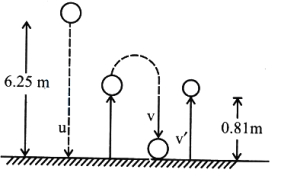
$A$ ball falls freely from rest from a height of $6.25 \ m$ onto a hard horizontal surface. If the ball reaches a height of $81 \ cm$ after the second bounce from the surface,the coefficient of restitution is
A
$0.3$
B
$0.45$
C
$0.75$
D
$0.6$
Solution
(D) Let $H_0 = 6.25 \ m$ be the initial height and $H_2 = 81 \ cm = 0.81 \ m$ be the height reached after the second bounce.
For a ball bouncing on a hard surface,the height reached after $n$ bounces is given by $H_n = H_0 \cdot e^{2n}$,where $e$ is the coefficient of restitution.
Given $n = 2$,$H_0 = 6.25 \ m$,and $H_2 = 0.81 \ m$.
Substituting the values:
$0.81 = 6.25 \cdot e^{2 \times 2}$
$0.81 = 6.25 \cdot e^4$
$e^4 = \frac{0.81}{6.25} = \frac{81}{625}$
Taking the square root on both sides:
$e^2 = \sqrt{\frac{81}{625}} = \frac{9}{25} = 0.36$
Taking the square root again:
$e = \sqrt{0.36} = 0.6$
Thus,the coefficient of restitution is $0.6$.
For a ball bouncing on a hard surface,the height reached after $n$ bounces is given by $H_n = H_0 \cdot e^{2n}$,where $e$ is the coefficient of restitution.
Given $n = 2$,$H_0 = 6.25 \ m$,and $H_2 = 0.81 \ m$.
Substituting the values:
$0.81 = 6.25 \cdot e^{2 \times 2}$
$0.81 = 6.25 \cdot e^4$
$e^4 = \frac{0.81}{6.25} = \frac{81}{625}$
Taking the square root on both sides:
$e^2 = \sqrt{\frac{81}{625}} = \frac{9}{25} = 0.36$
Taking the square root again:
$e = \sqrt{0.36} = 0.6$
Thus,the coefficient of restitution is $0.6$.
0 likes
View Solution107
EasyMCQ
$A$ body falls freely from a height of $100 \ m$ onto the ground and rebounds to a maximum height of $36 \ m$ after collision. The coefficient of restitution between the ground and the body is
A
$0.4$
B
$0.36$
C
$0.6$
D
$0.5$
Solution
(C) The velocity of the body just before hitting the ground is $v_0 = \sqrt{2gh_0}$,where $h_0 = 100 \ m$.
After the collision,the velocity of rebound is $v_1 = e v_0 = e \sqrt{2gh_0}$.
The maximum height reached after the rebound is $h_1 = \frac{v_1^2}{2g} = \frac{(e \sqrt{2gh_0})^2}{2g} = e^2 h_0$.
Given $h_1 = 36 \ m$ and $h_0 = 100 \ m$,we have $36 = e^2(100)$.
$e^2 = \frac{36}{100} = 0.36$.
$e = \sqrt{0.36} = 0.6$.
After the collision,the velocity of rebound is $v_1 = e v_0 = e \sqrt{2gh_0}$.
The maximum height reached after the rebound is $h_1 = \frac{v_1^2}{2g} = \frac{(e \sqrt{2gh_0})^2}{2g} = e^2 h_0$.
Given $h_1 = 36 \ m$ and $h_0 = 100 \ m$,we have $36 = e^2(100)$.
$e^2 = \frac{36}{100} = 0.36$.
$e = \sqrt{0.36} = 0.6$.
0 likes
View Solution108
MediumMCQ
$A$ ball moving with velocity $2 \,m/s$ collides head-on with another stationary ball of double the mass. If the coefficient of restitution is $0.5$, then their velocities (in $m/s$) after collision will be:
A
$0, 1$
B
$1, 1$
C
$1, 0.5$
D
$0, 2$
Solution
(A) Let the mass of the first ball be $m_1 = m$ and the mass of the second ball be $m_2 = 2m$.
Initial velocities are $u_1 = 2 \,m/s$ and $u_2 = 0 \,m/s$.
The coefficient of restitution is $e = 0.5$.
The velocity of the first ball after collision is given by $v_1 = \frac{(m_1 - em_2)u_1 + (1 + e)m_2u_2}{m_1 + m_2}$.
Substituting the values: $v_1 = \frac{(m - 0.5 \times 2m)(2) + (1 + 0.5)(2m)(0)}{m + 2m} = \frac{(m - m)(2) + 0}{3m} = 0 \,m/s$.
The velocity of the second ball after collision is given by $v_2 = \frac{(m_2 - em_1)u_2 + (1 + e)m_1u_1}{m_1 + m_2}$.
Substituting the values: $v_2 = \frac{(2m - 0.5 \times m)(0) + (1 + 0.5)(m)(2)}{m + 2m} = \frac{0 + (1.5)(2m)}{3m} = \frac{3m}{3m} = 1 \,m/s$.
Thus, their velocities after collision are $0 \,m/s$ and $1 \,m/s$.
Initial velocities are $u_1 = 2 \,m/s$ and $u_2 = 0 \,m/s$.
The coefficient of restitution is $e = 0.5$.
The velocity of the first ball after collision is given by $v_1 = \frac{(m_1 - em_2)u_1 + (1 + e)m_2u_2}{m_1 + m_2}$.
Substituting the values: $v_1 = \frac{(m - 0.5 \times 2m)(2) + (1 + 0.5)(2m)(0)}{m + 2m} = \frac{(m - m)(2) + 0}{3m} = 0 \,m/s$.
The velocity of the second ball after collision is given by $v_2 = \frac{(m_2 - em_1)u_2 + (1 + e)m_1u_1}{m_1 + m_2}$.
Substituting the values: $v_2 = \frac{(2m - 0.5 \times m)(0) + (1 + 0.5)(m)(2)}{m + 2m} = \frac{0 + (1.5)(2m)}{3m} = \frac{3m}{3m} = 1 \,m/s$.
Thus, their velocities after collision are $0 \,m/s$ and $1 \,m/s$.
0 likes
View Solution109
MediumMCQ
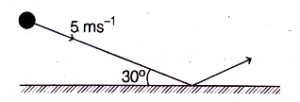
$A$ cricket ball hits the ground with a speed of $5 \,m \,s^{-1}$ making an angle of $30^{\circ}$ with the horizontal. If the coefficient of restitution is $0.2$, the speed of the reflected ball in $m \,s^{-1}$ is
A
$\sqrt{22}$
B
$\sqrt{15}$
C
$\sqrt{19}$
D
$\sqrt{11}$
Solution
(C) The initial velocity of the ball is $u = 5 \,m \,s^{-1}$ at an angle of $30^{\circ}$ with the horizontal.
We resolve this velocity into horizontal and vertical components:
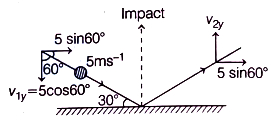
Horizontal component, $v_{1x} = u \cos 30^{\circ} = 5 \times \frac{\sqrt{3}}{2} = \frac{5\sqrt{3}}{2} \,m \,s^{-1}$.
Vertical component, $v_{1y} = u \sin 30^{\circ} = 5 \times \frac{1}{2} = 2.5 \,m \,s^{-1}$.
During the collision with the ground, the horizontal component of velocity remains unchanged because there is no impulse along the horizontal direction.
$v_{2x} = v_{1x} = \frac{5\sqrt{3}}{2} \,m \,s^{-1}$.
The vertical component changes according to the coefficient of restitution $e = 0.2$:
$v_{2y} = e \times v_{1y} = 0.2 \times 2.5 = 0.5 \,m \,s^{-1}$.
The final speed of the ball $v_f$ is the magnitude of the resultant velocity vector:
$v_f = \sqrt{v_{2x}^2 + v_{2y}^2} = \sqrt{\left(\frac{5\sqrt{3}}{2}\right)^2 + (0.5)^2}$
$v_f = \sqrt{\frac{25 \times 3}{4} + 0.25} = \sqrt{\frac{75}{4} + \frac{1}{4}} = \sqrt{\frac{76}{4}} = \sqrt{19} \,m \,s^{-1}$.
We resolve this velocity into horizontal and vertical components:
Horizontal component, $v_{1x} = u \cos 30^{\circ} = 5 \times \frac{\sqrt{3}}{2} = \frac{5\sqrt{3}}{2} \,m \,s^{-1}$.
Vertical component, $v_{1y} = u \sin 30^{\circ} = 5 \times \frac{1}{2} = 2.5 \,m \,s^{-1}$.
During the collision with the ground, the horizontal component of velocity remains unchanged because there is no impulse along the horizontal direction.
$v_{2x} = v_{1x} = \frac{5\sqrt{3}}{2} \,m \,s^{-1}$.
The vertical component changes according to the coefficient of restitution $e = 0.2$:
$v_{2y} = e \times v_{1y} = 0.2 \times 2.5 = 0.5 \,m \,s^{-1}$.
The final speed of the ball $v_f$ is the magnitude of the resultant velocity vector:
$v_f = \sqrt{v_{2x}^2 + v_{2y}^2} = \sqrt{\left(\frac{5\sqrt{3}}{2}\right)^2 + (0.5)^2}$
$v_f = \sqrt{\frac{25 \times 3}{4} + 0.25} = \sqrt{\frac{75}{4} + \frac{1}{4}} = \sqrt{\frac{76}{4}} = \sqrt{19} \,m \,s^{-1}$.
0 likes
View Solution110
EasyMCQ
$A$ ball of mass $2 \ g$ moving with a velocity of $2 \ ms^{-1}$ collides with another ball of mass $8 \ g$ which is at rest and comes to rest after collision. Then the coefficient of restitution is
A
$1$
B
$0.75$
C
$0.5$
D
$0.25$
Solution
(D) Let $m_1 = 2 \ g$ and $u_1 = 2 \ ms^{-1}$ be the mass and initial velocity of the first ball.
Let $m_2 = 8 \ g$ and $u_2 = 0 \ ms^{-1}$ be the mass and initial velocity of the second ball.
After collision,the first ball comes to rest,so $v_1 = 0 \ ms^{-1}$.
Using the law of conservation of linear momentum: $m_1 u_1 + m_2 u_2 = m_1 v_1 + m_2 v_2$.
Substituting the values: $(2 \ g)(2 \ ms^{-1}) + (8 \ g)(0) = (2 \ g)(0) + (8 \ g)(v_2)$.
$4 = 8 v_2 \implies v_2 = 0.5 \ ms^{-1}$.
The coefficient of restitution $e$ is defined as $e = \frac{v_2 - v_1}{u_1 - u_2}$.
Substituting the values: $e = \frac{0.5 - 0}{2 - 0} = \frac{0.5}{2} = 0.25$.
Let $m_2 = 8 \ g$ and $u_2 = 0 \ ms^{-1}$ be the mass and initial velocity of the second ball.
After collision,the first ball comes to rest,so $v_1 = 0 \ ms^{-1}$.
Using the law of conservation of linear momentum: $m_1 u_1 + m_2 u_2 = m_1 v_1 + m_2 v_2$.
Substituting the values: $(2 \ g)(2 \ ms^{-1}) + (8 \ g)(0) = (2 \ g)(0) + (8 \ g)(v_2)$.
$4 = 8 v_2 \implies v_2 = 0.5 \ ms^{-1}$.
The coefficient of restitution $e$ is defined as $e = \frac{v_2 - v_1}{u_1 - u_2}$.
Substituting the values: $e = \frac{0.5 - 0}{2 - 0} = \frac{0.5}{2} = 0.25$.
0 likes
View Solution111
MediumMCQ
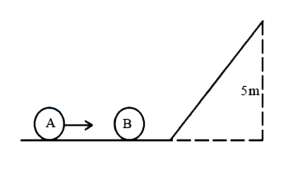
Two identical balls $A$ and $B$ of equal mass $m$ are lying on a smooth surface as shown in the figure. If ball $A$ hits ball $B$ at rest with a velocity $16 \,ms^{-1}$,then the coefficient of restitution $e$ between $A$ and $B$ so that $B$ just reaches the highest point of the smooth inclined plane of height $5 \,m$ is $\left(g=10 \,ms^{-2}\right)$
A
$\frac{2}{3}$
B
$\frac{1}{2}$
C
$\frac{1}{3}$
D
$\frac{1}{4}$
Solution
(D) Let the mass of each ball be $m$. Let $v_A = 16 \,ms^{-1}$ be the initial velocity of ball $A$ and $v_B = 0$ be the initial velocity of ball $B$.
After collision,let the velocities of $A$ and $B$ be $v_1$ and $v_2$ respectively.
By conservation of linear momentum: $m v_A + 0 = m v_1 + m v_2 \implies v_1 + v_2 = 16$.
By the definition of coefficient of restitution $e$: $e = \frac{v_2 - v_1}{v_A - 0} \implies v_2 - v_1 = 16e$.
Adding the two equations: $2v_2 = 16(1+e) \implies v_2 = 8(1+e)$.
For ball $B$ to just reach the top of the inclined plane of height $h = 5 \,m$,its kinetic energy at the bottom must equal its potential energy at the top: $\frac{1}{2} m v_2^2 = mgh$.
$v_2^2 = 2gh = 2 \times 10 \times 5 = 100 \implies v_2 = 10 \,ms^{-1}$.
Substituting $v_2$ in the expression: $8(1+e) = 10 \implies 1+e = \frac{10}{8} = 1.25 \implies e = 0.25 = \frac{1}{4}$.
After collision,let the velocities of $A$ and $B$ be $v_1$ and $v_2$ respectively.
By conservation of linear momentum: $m v_A + 0 = m v_1 + m v_2 \implies v_1 + v_2 = 16$.
By the definition of coefficient of restitution $e$: $e = \frac{v_2 - v_1}{v_A - 0} \implies v_2 - v_1 = 16e$.
Adding the two equations: $2v_2 = 16(1+e) \implies v_2 = 8(1+e)$.
For ball $B$ to just reach the top of the inclined plane of height $h = 5 \,m$,its kinetic energy at the bottom must equal its potential energy at the top: $\frac{1}{2} m v_2^2 = mgh$.
$v_2^2 = 2gh = 2 \times 10 \times 5 = 100 \implies v_2 = 10 \,ms^{-1}$.
Substituting $v_2$ in the expression: $8(1+e) = 10 \implies 1+e = \frac{10}{8} = 1.25 \implies e = 0.25 = \frac{1}{4}$.
0 likes
View Solution112
DifficultMCQ
$A$ $1 \ kg$ ball moving with a speed of $6 \ ms^{-1}$ collides head-on with a $0.5 \ kg$ ball moving in the opposite direction with a speed of $9 \ ms^{-1}$. If the coefficient of restitution is $\frac{1}{3}$,then the energy lost in the collision is (in $J$)
A
$303.4$
B
$66.7$
C
$33.3$
D
$67.8$
Solution
(C) The energy lost in an inelastic collision is given by the formula: $\Delta KE = \frac{m_1 m_2}{2(m_1 + m_2)} (1 - e^2) (u_1 + u_2)^2$.
Given: $m_1 = 1 \ kg$,$m_2 = 0.5 \ kg$,$u_1 = 6 \ ms^{-1}$,$u_2 = 9 \ ms^{-1}$ (since they move in opposite directions,the relative velocity is $u_1 + u_2$),and $e = \frac{1}{3}$.
Substituting the values:
$\Delta KE = \frac{1 \times 0.5}{2(1 + 0.5)} \left(1 - (\frac{1}{3})^2\right) (6 + 9)^2$
$\Delta KE = \frac{0.5}{3} \times (1 - \frac{1}{9}) \times (15)^2$
$\Delta KE = \frac{1}{6} \times \frac{8}{9} \times 225$
$\Delta KE = \frac{8}{54} \times 225 = \frac{4}{27} \times 225 = 33.33 \ J$.
Given: $m_1 = 1 \ kg$,$m_2 = 0.5 \ kg$,$u_1 = 6 \ ms^{-1}$,$u_2 = 9 \ ms^{-1}$ (since they move in opposite directions,the relative velocity is $u_1 + u_2$),and $e = \frac{1}{3}$.
Substituting the values:
$\Delta KE = \frac{1 \times 0.5}{2(1 + 0.5)} \left(1 - (\frac{1}{3})^2\right) (6 + 9)^2$
$\Delta KE = \frac{0.5}{3} \times (1 - \frac{1}{9}) \times (15)^2$
$\Delta KE = \frac{1}{6} \times \frac{8}{9} \times 225$
$\Delta KE = \frac{8}{54} \times 225 = \frac{4}{27} \times 225 = 33.33 \ J$.
0 likes
View Solution113
DifficultMCQ
$A$ ball $P$ moving with a speed of $v \ ms^{-1}$ collides directly with another identical ball $Q$ moving with a speed $10 \ ms^{-1}$ in the opposite direction. $P$ comes to rest after the collision. If the coefficient of restitution is $0.6$,the value of $v$ is (in $ms^{-1}$)
A
$30$
B
$40$
C
$50$
D
$60$
Solution
(B) Let the mass of both balls be $m$. Let the initial velocities be $u_P = v$ and $u_Q = -10 \ ms^{-1}$.
After the collision,the final velocity of ball $P$ is $v_P = 0$ and let the final velocity of ball $Q$ be $v_Q$.
By the law of conservation of linear momentum:
$m(v) + m(-10) = m(0) + m(v_Q)$
$v - 10 = v_Q$
Now,using the coefficient of restitution formula $e = \frac{\text{velocity of separation}}{\text{velocity of approach}}$:
$e = \frac{v_Q - v_P}{u_P - u_Q}$
Given $e = 0.6$,$v_P = 0$,$u_P = v$,and $u_Q = -10$:
$0.6 = \frac{v_Q - 0}{v - (-10)}$
$0.6 = \frac{v_Q}{v + 10}$
Substitute $v_Q = v - 10$ into the equation:
$0.6 = \frac{v - 10}{v + 10}$
$0.6(v + 10) = v - 10$
$0.6v + 6 = v - 10$
$16 = 0.4v$
$v = \frac{16}{0.4} = 40 \ ms^{-1}$
After the collision,the final velocity of ball $P$ is $v_P = 0$ and let the final velocity of ball $Q$ be $v_Q$.
By the law of conservation of linear momentum:
$m(v) + m(-10) = m(0) + m(v_Q)$
$v - 10 = v_Q$
Now,using the coefficient of restitution formula $e = \frac{\text{velocity of separation}}{\text{velocity of approach}}$:
$e = \frac{v_Q - v_P}{u_P - u_Q}$
Given $e = 0.6$,$v_P = 0$,$u_P = v$,and $u_Q = -10$:
$0.6 = \frac{v_Q - 0}{v - (-10)}$
$0.6 = \frac{v_Q}{v + 10}$
Substitute $v_Q = v - 10$ into the equation:
$0.6 = \frac{v - 10}{v + 10}$
$0.6(v + 10) = v - 10$
$0.6v + 6 = v - 10$
$16 = 0.4v$
$v = \frac{16}{0.4} = 40 \ ms^{-1}$
0 likes
View Solution114
DifficultMCQ
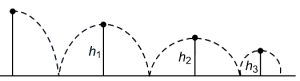
$A$ ball falls from a height $h$ and rebounds after striking the floor. The coefficient of restitution is $e$. The total distance covered by the ball before it comes to rest is
A
$\frac{\left(1-e^2\right) h}{e^2}$
B
$\frac{\left(1+e^2\right) h}{e^2}$
C
$\left(\frac{1+e^2}{1-e^2}\right) h$
D
$\frac{e^2 h}{1-e^2}$
Solution
(C) When a ball falls from a height $h$,it strikes the floor and rebounds to a height $h_1 = h e^2$.
After the second impact,it rebounds to a height $h_2 = h_1 e^2 = h e^4$.
In general,the height reached after the $n$-th rebound is $h_n = h e^{2n}$.
The total distance $H$ covered by the ball is the sum of the initial fall and the subsequent upward and downward paths for each rebound:
$H = h + 2h_1 + 2h_2 + 2h_3 + \dots$
$H = h + 2(h e^2 + h e^4 + h e^6 + \dots)$
$H = h + 2h(e^2 + e^4 + e^6 + \dots)$
The term in the bracket is an infinite geometric progression with first term $a = e^2$ and common ratio $r = e^2$. The sum is $S = \frac{a}{1-r} = \frac{e^2}{1-e^2}$.
$H = h + 2h \left( \frac{e^2}{1-e^2} \right)$
$H = h \left( 1 + \frac{2e^2}{1-e^2} \right)$
$H = h \left( \frac{1 - e^2 + 2e^2}{1 - e^2} \right)$
$H = h \left( \frac{1 + e^2}{1 - e^2} \right)$
After the second impact,it rebounds to a height $h_2 = h_1 e^2 = h e^4$.
In general,the height reached after the $n$-th rebound is $h_n = h e^{2n}$.
The total distance $H$ covered by the ball is the sum of the initial fall and the subsequent upward and downward paths for each rebound:
$H = h + 2h_1 + 2h_2 + 2h_3 + \dots$
$H = h + 2(h e^2 + h e^4 + h e^6 + \dots)$
$H = h + 2h(e^2 + e^4 + e^6 + \dots)$
The term in the bracket is an infinite geometric progression with first term $a = e^2$ and common ratio $r = e^2$. The sum is $S = \frac{a}{1-r} = \frac{e^2}{1-e^2}$.
$H = h + 2h \left( \frac{e^2}{1-e^2} \right)$
$H = h \left( 1 + \frac{2e^2}{1-e^2} \right)$
$H = h \left( \frac{1 - e^2 + 2e^2}{1 - e^2} \right)$
$H = h \left( \frac{1 + e^2}{1 - e^2} \right)$
0 likes
View Solution115
MediumMCQ
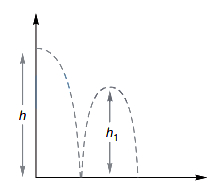
$A$ ball is dropped from a height $h$ on a floor of coefficient of restitution $e$. The total distance covered by the ball just before the second hit is
A
$h(1-2e^2)$
B
$h(1+2e^2)$
C
$h(1+e^2)$
D
$he^2$
Solution
(B) $1$. The ball is dropped from height $h$. The distance covered during the first fall is $h$.
$2$. After the first collision with the floor,the ball rebounds to a height $h_1 = e^2h$.
$3$. The ball then travels upward to height $h_1$ and then falls back down to the floor to make the second hit.
$4$. The distance covered during the rebound is $h_1$ (upward) + $h_1$ (downward) = $2h_1 = 2e^2h$.
$5$. The total distance covered by the ball just before the second hit is the sum of the initial fall and the rebound distance: $D = h + 2e^2h = h(1 + 2e^2)$.
$2$. After the first collision with the floor,the ball rebounds to a height $h_1 = e^2h$.
$3$. The ball then travels upward to height $h_1$ and then falls back down to the floor to make the second hit.
$4$. The distance covered during the rebound is $h_1$ (upward) + $h_1$ (downward) = $2h_1 = 2e^2h$.
$5$. The total distance covered by the ball just before the second hit is the sum of the initial fall and the rebound distance: $D = h + 2e^2h = h(1 + 2e^2)$.
0 likes
View Solution116
MediumMCQ
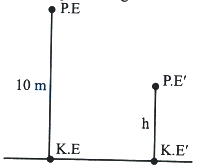
$A$ ball of mass $10 \text{ g}$ is allowed to fall from a height of $10 \text{ m}$. After the collision with the ground, if $50\%$ of its energy is lost, then the height reached by the ball is: (in $\text{ m}$)
A
$4$
B
$6$
C
$5$
D
$7$
Solution
(C) Initial potential energy of the ball at height $H = 10 \text{ m}$ is $E_i = mgH$.
When the ball hits the ground, this energy is converted into kinetic energy.
After the collision, $50\%$ of the energy is lost, so the remaining energy is $E_f = 0.5 \times E_i = 0.5 \times mgH$.
The ball will rise to a new height $h$ such that its potential energy at that height equals the remaining energy:
$mgh = 0.5 \times mgH$
$h = 0.5 \times H$
Given $H = 10 \text{ m}$, we have:
$h = 0.5 \times 10 \text{ m} = 5 \text{ m}$.
Therefore, the height reached by the ball is $5 \text{ m}$.
When the ball hits the ground, this energy is converted into kinetic energy.
After the collision, $50\%$ of the energy is lost, so the remaining energy is $E_f = 0.5 \times E_i = 0.5 \times mgH$.
The ball will rise to a new height $h$ such that its potential energy at that height equals the remaining energy:
$mgh = 0.5 \times mgH$
$h = 0.5 \times H$
Given $H = 10 \text{ m}$, we have:
$h = 0.5 \times 10 \text{ m} = 5 \text{ m}$.
Therefore, the height reached by the ball is $5 \text{ m}$.
0 likes
View Solution117
EasyMCQ
$A$ ball is dropped from some height and after the first collision with the ground,if it reaches $\frac{3}{4}$ of its original height,then the percentage loss of its energy is:
A
$25$
B
$75$
C
$50$
D
$55$
Solution
(A) Let the ball be dropped from an initial height $h$. The initial potential energy is $U_i = mgh$.
After the collision,the ball reaches a final height of $h_f = \frac{3}{4}h$.
The final potential energy is $U_f = mgh_f = mgh(\frac{3}{4}) = \frac{3}{4}mgh$.
The energy loss is $\Delta U = U_i - U_f = mgh - \frac{3}{4}mgh = \frac{1}{4}mgh$.
The percentage loss of energy is given by $\frac{\Delta U}{U_i} \times 100\%$.
Percentage loss $= \frac{\frac{1}{4}mgh}{mgh} \times 100\% = \frac{1}{4} \times 100\% = 25\%$.
After the collision,the ball reaches a final height of $h_f = \frac{3}{4}h$.
The final potential energy is $U_f = mgh_f = mgh(\frac{3}{4}) = \frac{3}{4}mgh$.
The energy loss is $\Delta U = U_i - U_f = mgh - \frac{3}{4}mgh = \frac{1}{4}mgh$.
The percentage loss of energy is given by $\frac{\Delta U}{U_i} \times 100\%$.
Percentage loss $= \frac{\frac{1}{4}mgh}{mgh} \times 100\% = \frac{1}{4} \times 100\% = 25\%$.
0 likes
View Solution118
MediumMCQ
$A$ ball is allowed to fall freely from a height of $42 \ m$ from the ground. If the coefficient of restitution between the ball and the ground is $0.4$,then the total distance travelled by the ball before it comes to rest is (in $m$)
A
$84$
B
$87$
C
$72$
D
$58$
Solution
(D) When a ball is dropped from a height $H$ and the coefficient of restitution is $e$,the height reached after the first bounce is $h_1 = e^2 H$,after the second bounce is $h_2 = e^4 H$,and so on.
The total distance $D$ travelled by the ball is given by the sum of the initial fall and the infinite series of bounces (up and down):
$D = H + 2h_1 + 2h_2 + 2h_3 + ...$
$D = H + 2(e^2 H + e^4 H + e^6 H + ...)$
$D = H + 2e^2 H (1 + e^2 + e^4 + ...)$
Using the sum of an infinite geometric progression $S = \frac{a}{1-r}$,where $a = 1$ and $r = e^2$:
$D = H + 2e^2 H \left( \frac{1}{1 - e^2} \right)$
$D = H \left( 1 + \frac{2e^2}{1 - e^2} \right) = H \left( \frac{1 - e^2 + 2e^2}{1 - e^2} \right) = H \left( \frac{1 + e^2}{1 - e^2} \right)$
Given $H = 42 \ m$ and $e = 0.4$:
$e^2 = (0.4)^2 = 0.16$
$D = 42 \times \left( \frac{1 + 0.16}{1 - 0.16} \right) = 42 \times \left( \frac{1.16}{0.84} \right)$
$D = 42 \times \frac{116}{84} = 42 \times \frac{116}{2 \times 42} = \frac{116}{2} = 58 \ m$.
The total distance $D$ travelled by the ball is given by the sum of the initial fall and the infinite series of bounces (up and down):
$D = H + 2h_1 + 2h_2 + 2h_3 + ...$
$D = H + 2(e^2 H + e^4 H + e^6 H + ...)$
$D = H + 2e^2 H (1 + e^2 + e^4 + ...)$
Using the sum of an infinite geometric progression $S = \frac{a}{1-r}$,where $a = 1$ and $r = e^2$:
$D = H + 2e^2 H \left( \frac{1}{1 - e^2} \right)$
$D = H \left( 1 + \frac{2e^2}{1 - e^2} \right) = H \left( \frac{1 - e^2 + 2e^2}{1 - e^2} \right) = H \left( \frac{1 + e^2}{1 - e^2} \right)$
Given $H = 42 \ m$ and $e = 0.4$:
$e^2 = (0.4)^2 = 0.16$
$D = 42 \times \left( \frac{1 + 0.16}{1 - 0.16} \right) = 42 \times \left( \frac{1.16}{0.84} \right)$
$D = 42 \times \frac{116}{84} = 42 \times \frac{116}{2 \times 42} = \frac{116}{2} = 58 \ m$.
0 likes
View Solution119
EasyMCQ
$A$ ball $P$ of mass $0.5 \ kg$ moving with a velocity of $10 \ ms^{-1}$ collides with another ball $Q$ of mass $1 \ kg$ at rest. If the coefficient of restitution is $0.4$,the ratio of the velocities of the balls $P$ and $Q$ after the collision is
A
$1: 7$
B
$2: 7$
C
$2: 5$
D
$5: 6$
Solution
(A) Given: $m_1 = 0.5 \ kg$,$u_1 = 10 \ ms^{-1}$,$m_2 = 1 \ kg$,$u_2 = 0$,$e = 0.4$.
The final velocities $v_1$ and $v_2$ after a one-dimensional collision are given by:
$v_1 = \left( \frac{m_1 - e m_2}{m_1 + m_2} \right) u_1 = \left( \frac{0.5 - 0.4 \times 1}{0.5 + 1} \right) \times 10 = \left( \frac{0.1}{1.5} \right) \times 10 = \frac{1}{15} \times 10 = \frac{2}{3} \ ms^{-1}$.
$v_2 = \frac{(1 + e) m_1 u_1}{m_1 + m_2} = \frac{(1 + 0.4) \times 0.5 \times 10}{0.5 + 1} = \frac{1.4 \times 5}{1.5} = \frac{7}{1.5} = \frac{14}{3} \ ms^{-1}$.
The ratio of the velocities is $\frac{v_1}{v_2} = \frac{2/3}{14/3} = \frac{2}{14} = 1:7$.
The final velocities $v_1$ and $v_2$ after a one-dimensional collision are given by:
$v_1 = \left( \frac{m_1 - e m_2}{m_1 + m_2} \right) u_1 = \left( \frac{0.5 - 0.4 \times 1}{0.5 + 1} \right) \times 10 = \left( \frac{0.1}{1.5} \right) \times 10 = \frac{1}{15} \times 10 = \frac{2}{3} \ ms^{-1}$.
$v_2 = \frac{(1 + e) m_1 u_1}{m_1 + m_2} = \frac{(1 + 0.4) \times 0.5 \times 10}{0.5 + 1} = \frac{1.4 \times 5}{1.5} = \frac{7}{1.5} = \frac{14}{3} \ ms^{-1}$.
The ratio of the velocities is $\frac{v_1}{v_2} = \frac{2/3}{14/3} = \frac{2}{14} = 1:7$.
0 likes
View Solution120
MediumMCQ
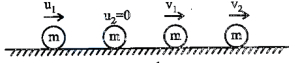
$A$ ball of mass $1.2 \ kg$ moving with a velocity of $12 \ ms^{-1}$ makes a one-dimensional collision with another stationary ball of mass $1.2 \ kg$. If the coefficient of restitution is $\frac{1}{\sqrt{2}}$,then the ratio of the total kinetic energy of the balls after the collision to the initial kinetic energy is:
A
$3: 4$
B
$1: 1$
C
$2: 3$
D
$3: \sqrt{2}$
Solution
(A) Given: $m_1 = m_2 = m = 1.2 \ kg$,$u_1 = 12 \ ms^{-1}$,$u_2 = 0$,$e = \frac{1}{\sqrt{2}}$.
By the law of conservation of linear momentum:
$m u_1 + m u_2 = m v_1 + m v_2$
$12 + 0 = v_1 + v_2 \Rightarrow v_1 + v_2 = 12$ ...$(i)$
By the definition of the coefficient of restitution $(e)$:
$e = \frac{v_2 - v_1}{u_1 - u_2} \Rightarrow \frac{1}{\sqrt{2}} = \frac{v_2 - v_1}{12}$
$v_2 - v_1 = \frac{12}{\sqrt{2}} = 6\sqrt{2}$ ...(ii)
Adding equations $(i)$ and (ii):
$2v_2 = 12 + 6\sqrt{2} \Rightarrow v_2 = 6 + 3\sqrt{2} \ ms^{-1}$
Subtracting equation (ii) from $(i)$:
$2v_1 = 12 - 6\sqrt{2} \Rightarrow v_1 = 6 - 3\sqrt{2} \ ms^{-1}$
Initial kinetic energy $(KE)_i = \frac{1}{2} m u_1^2 = \frac{1}{2} \times 1.2 \times (12)^2 = 0.6 \times 144 = 86.4 \ J$.
Final kinetic energy $(KE)_f = \frac{1}{2} m v_1^2 + \frac{1}{2} m v_2^2 = \frac{1}{2} m (v_1^2 + v_2^2)$.
$v_1^2 + v_2^2 = (6 - 3\sqrt{2})^2 + (6 + 3\sqrt{2})^2 = (36 + 18 - 36\sqrt{2}) + (36 + 18 + 36\sqrt{2}) = 54 + 54 = 108$.
$(KE)_f = \frac{1}{2} \times 1.2 \times 108 = 0.6 \times 108 = 64.8 \ J$.
Ratio $\frac{(KE)_f}{(KE)_i} = \frac{64.8}{86.4} = \frac{648}{864} = \frac{3}{4} = 3:4$.
By the law of conservation of linear momentum:
$m u_1 + m u_2 = m v_1 + m v_2$
$12 + 0 = v_1 + v_2 \Rightarrow v_1 + v_2 = 12$ ...$(i)$
By the definition of the coefficient of restitution $(e)$:
$e = \frac{v_2 - v_1}{u_1 - u_2} \Rightarrow \frac{1}{\sqrt{2}} = \frac{v_2 - v_1}{12}$
$v_2 - v_1 = \frac{12}{\sqrt{2}} = 6\sqrt{2}$ ...(ii)
Adding equations $(i)$ and (ii):
$2v_2 = 12 + 6\sqrt{2} \Rightarrow v_2 = 6 + 3\sqrt{2} \ ms^{-1}$
Subtracting equation (ii) from $(i)$:
$2v_1 = 12 - 6\sqrt{2} \Rightarrow v_1 = 6 - 3\sqrt{2} \ ms^{-1}$
Initial kinetic energy $(KE)_i = \frac{1}{2} m u_1^2 = \frac{1}{2} \times 1.2 \times (12)^2 = 0.6 \times 144 = 86.4 \ J$.
Final kinetic energy $(KE)_f = \frac{1}{2} m v_1^2 + \frac{1}{2} m v_2^2 = \frac{1}{2} m (v_1^2 + v_2^2)$.
$v_1^2 + v_2^2 = (6 - 3\sqrt{2})^2 + (6 + 3\sqrt{2})^2 = (36 + 18 - 36\sqrt{2}) + (36 + 18 + 36\sqrt{2}) = 54 + 54 = 108$.
$(KE)_f = \frac{1}{2} \times 1.2 \times 108 = 0.6 \times 108 = 64.8 \ J$.
Ratio $\frac{(KE)_f}{(KE)_i} = \frac{64.8}{86.4} = \frac{648}{864} = \frac{3}{4} = 3:4$.
0 likes
View Solution121
MediumMCQ
$A$ body falls freely from a height $h$ on a fixed horizontal plane and rebounds. If $e$ is the coefficient of restitution,the total distance travelled before it comes to rest is
A
$h\left[\frac{1+e^2}{1-e^2}\right]$
B
$h\left[\frac{1-e^2}{1+e^2}\right]$
C
$\frac{h}{2}\left[\frac{1-e^2}{1+e^2}\right]$
D
$\frac{h}{2}\left[\frac{1+e^2}{1-e^2}\right]$
Solution
(A) When a body is dropped from a height $h$,it strikes the floor with velocity $v = \sqrt{2gh}$.
After the first impact,it rebounds with velocity $v_1 = ev = e\sqrt{2gh}$.
The height reached after the first rebound is $h_1 = \frac{v_1^2}{2g} = e^2h$.
After the second impact,it rebounds with velocity $v_2 = ev_1 = e^2v$,reaching a height $h_2 = \frac{v_2^2}{2g} = e^4h$.
The total distance $D$ travelled is the initial fall plus twice the sum of all subsequent rebound heights:
$D = h + 2h_1 + 2h_2 + 2h_3 + \dots$
$D = h + 2(e^2h + e^4h + e^6h + \dots)$
$D = h + 2e^2h(1 + e^2 + e^4 + \dots)$
Using the sum of an infinite geometric series $S = \frac{a}{1-r}$ where $a=1$ and $r=e^2$:
$D = h + 2e^2h \left( \frac{1}{1-e^2} \right)$
$D = h \left[ 1 + \frac{2e^2}{1-e^2} \right] = h \left[ \frac{1-e^2+2e^2}{1-e^2} \right] = h \left[ \frac{1+e^2}{1-e^2} \right]$.
After the first impact,it rebounds with velocity $v_1 = ev = e\sqrt{2gh}$.
The height reached after the first rebound is $h_1 = \frac{v_1^2}{2g} = e^2h$.
After the second impact,it rebounds with velocity $v_2 = ev_1 = e^2v$,reaching a height $h_2 = \frac{v_2^2}{2g} = e^4h$.
The total distance $D$ travelled is the initial fall plus twice the sum of all subsequent rebound heights:
$D = h + 2h_1 + 2h_2 + 2h_3 + \dots$
$D = h + 2(e^2h + e^4h + e^6h + \dots)$
$D = h + 2e^2h(1 + e^2 + e^4 + \dots)$
Using the sum of an infinite geometric series $S = \frac{a}{1-r}$ where $a=1$ and $r=e^2$:
$D = h + 2e^2h \left( \frac{1}{1-e^2} \right)$
$D = h \left[ 1 + \frac{2e^2}{1-e^2} \right] = h \left[ \frac{1-e^2+2e^2}{1-e^2} \right] = h \left[ \frac{1+e^2}{1-e^2} \right]$.
0 likes
View Solution122
MediumMCQ
$A$ ball falls freely from a height $h$ on a rigid horizontal plane. If the coefficient of restitution is $e$,then the total distance travelled by the ball before hitting the plane the second time is
A
$h^2$
B
$h(1+2e^2)$
C
$h(1-2e^2)$
D
$h(1+e^2)$
Solution
(B) When the ball is dropped from height $h$,it strikes the plane with velocity $v = \sqrt{2gh}$.
After the collision,the ball rebounds with a velocity $u = ev = e\sqrt{2gh}$.
The height reached by the ball after the first collision is $h_1 = \frac{u^2}{2g} = \frac{e^2(2gh)}{2g} = e^2h$.
The total distance travelled by the ball before hitting the plane for the second time is the sum of the initial downward distance and the distance covered during the first rebound (up and down).
Total distance $= h + 2h_1 = h + 2(e^2h) = h(1 + 2e^2)$.
After the collision,the ball rebounds with a velocity $u = ev = e\sqrt{2gh}$.
The height reached by the ball after the first collision is $h_1 = \frac{u^2}{2g} = \frac{e^2(2gh)}{2g} = e^2h$.
The total distance travelled by the ball before hitting the plane for the second time is the sum of the initial downward distance and the distance covered during the first rebound (up and down).
Total distance $= h + 2h_1 = h + 2(e^2h) = h(1 + 2e^2)$.
0 likes
View Solution123
MediumMCQ
Particle $A$ moving with a velocity $v = 10 \ m/s$ experiences a head-on collision with a stationary particle $B$ of the same mass. As a result of the collision,the kinetic energy of the system decreases by $1 \%$. The speed of particle $A$ after the collision is: (in $m/s$)
A
$9.95$
B
$7.07$
C
$5$
D
$0.707$
Solution
(A) Let the mass of both particles be $m$. Let $V_1$ and $V_2$ be the velocities of particles $A$ and $B$ after the collision,respectively.
By the law of conservation of momentum:
$m \times 10 + 0 = m V_1 + m V_2 \Rightarrow V_1 + V_2 = 10$ ... $(i)$
Given that the kinetic energy of the system decreases by $1 \%$,the final kinetic energy $K_f = 0.99 K_i$.
$\frac{1}{2} m V_1^2 + \frac{1}{2} m V_2^2 = 0.99 \times (\frac{1}{2} m \times 10^2)$
$V_1^2 + V_2^2 = 0.99 \times 100 = 99$ ... (ii)
We know that $(V_1 + V_2)^2 = V_1^2 + V_2^2 + 2 V_1 V_2$.
Substituting the values: $10^2 = 99 + 2 V_1 V_2 \Rightarrow 100 = 99 + 2 V_1 V_2 \Rightarrow 2 V_1 V_2 = 1 \Rightarrow V_1 V_2 = 0.5$.
Now,$(V_1 - V_2)^2 = (V_1 + V_2)^2 - 4 V_1 V_2 = 100 - 4(0.5) = 100 - 2 = 98$.
$V_1 - V_2 = \sqrt{98} = 7\sqrt{2} \approx 9.899 \ m/s$.
Adding $(i)$ and (ii): $2 V_1 = 10 + 9.899 = 19.899 \Rightarrow V_1 \approx 9.95 \ m/s$.
By the law of conservation of momentum:
$m \times 10 + 0 = m V_1 + m V_2 \Rightarrow V_1 + V_2 = 10$ ... $(i)$
Given that the kinetic energy of the system decreases by $1 \%$,the final kinetic energy $K_f = 0.99 K_i$.
$\frac{1}{2} m V_1^2 + \frac{1}{2} m V_2^2 = 0.99 \times (\frac{1}{2} m \times 10^2)$
$V_1^2 + V_2^2 = 0.99 \times 100 = 99$ ... (ii)
We know that $(V_1 + V_2)^2 = V_1^2 + V_2^2 + 2 V_1 V_2$.
Substituting the values: $10^2 = 99 + 2 V_1 V_2 \Rightarrow 100 = 99 + 2 V_1 V_2 \Rightarrow 2 V_1 V_2 = 1 \Rightarrow V_1 V_2 = 0.5$.
Now,$(V_1 - V_2)^2 = (V_1 + V_2)^2 - 4 V_1 V_2 = 100 - 4(0.5) = 100 - 2 = 98$.
$V_1 - V_2 = \sqrt{98} = 7\sqrt{2} \approx 9.899 \ m/s$.
Adding $(i)$ and (ii): $2 V_1 = 10 + 9.899 = 19.899 \Rightarrow V_1 \approx 9.95 \ m/s$.

0 likes
View Solution124
MediumMCQ
Ball $A$ of mass $50 \ gm$ and speed $10 \ m/s$ collides with another ball $B$ of mass $10 \ gm$ and speed $15 \ m/s$ travelling in opposite directions. Determine the final speed of ball $B$,if the coefficient of restitution is $\frac{2}{5}$.
A
$\frac{40}{3} \ m/s$
B
$\frac{75}{3} \ m/s$
C
$\frac{91}{8} \ m/s$
D
$\frac{85}{6} \ m/s$
Solution
(D) Given: Mass of ball $A$,$m_A = 50 \ gm$; initial velocity of ball $A$,$u_A = 10 \ m/s$. Mass of ball $B$,$m_B = 10 \ gm$; initial velocity of ball $B$,$u_B = -15 \ m/s$ (since it is moving in the opposite direction). Coefficient of restitution,$e = \frac{2}{5}$.
The final velocity $v_B$ of the second ball $B$ after a one-dimensional collision is given by the formula:
$v_B = \frac{m_A(1+e)}{m_A+m_B} u_A + \frac{m_B - e m_A}{m_A+m_B} u_B$
Substituting the given values into the formula:
$v_B = \frac{50(1 + \frac{2}{5})}{50 + 10} \times 10 + \frac{10 - (\frac{2}{5} \times 50)}{50 + 10} \times (-15)$
$v_B = \frac{50 \times \frac{7}{5}}{60} \times 10 + \frac{10 - 20}{60} \times (-15)$
$v_B = \frac{70}{60} \times 10 + \frac{-10}{60} \times (-15)$
$v_B = \frac{70}{6} + \frac{150}{60} = \frac{70}{6} + \frac{15}{6} = \frac{85}{6} \ m/s$
Thus,the final speed of ball $B$ is $\frac{85}{6} \ m/s$.
The final velocity $v_B$ of the second ball $B$ after a one-dimensional collision is given by the formula:
$v_B = \frac{m_A(1+e)}{m_A+m_B} u_A + \frac{m_B - e m_A}{m_A+m_B} u_B$
Substituting the given values into the formula:
$v_B = \frac{50(1 + \frac{2}{5})}{50 + 10} \times 10 + \frac{10 - (\frac{2}{5} \times 50)}{50 + 10} \times (-15)$
$v_B = \frac{50 \times \frac{7}{5}}{60} \times 10 + \frac{10 - 20}{60} \times (-15)$
$v_B = \frac{70}{60} \times 10 + \frac{-10}{60} \times (-15)$
$v_B = \frac{70}{6} + \frac{150}{60} = \frac{70}{6} + \frac{15}{6} = \frac{85}{6} \ m/s$
Thus,the final speed of ball $B$ is $\frac{85}{6} \ m/s$.

0 likes
View Solution125
MediumMCQ
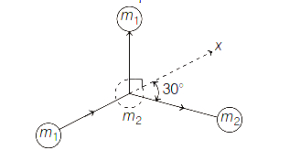
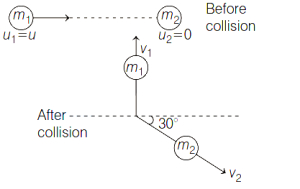
$A$ particle of mass $m_1$ moving along the $X$-axis collides with a stationary particle of mass $m_2$ and deviates by an angle $30^{\circ}$ to the $X$-axis as shown in the figure. If the percentage change in kinetic energy of the combined system of these two particles reduces by $50 \%$,then the ratio of the masses $\frac{m_2}{m_1}$ is
A
$8$
B
$6$
C
$\frac{8}{7}$
D
$\frac{1}{6}$
Solution
(A) Let the initial velocity of $m_1$ be $u$ and the final velocities of $m_1$ and $m_2$ be $v_1$ and $v_2$ respectively. The particle $m_1$ moves at $90^{\circ}$ to the $X$-axis and $m_2$ moves at $30^{\circ}$ to the $X$-axis.
Applying conservation of linear momentum along the $X$-axis:
$m_1 u = m_2 v_2 \cos 30^{\circ} \quad \dots (i)$
Applying conservation of linear momentum along the $Y$-axis:
$0 = m_2 v_2 \sin 30^{\circ} - m_1 v_1 \quad \Rightarrow \quad m_1 v_1 = m_2 v_2 \sin 30^{\circ} \quad \dots (ii)$
Given that the kinetic energy reduces by $50 \%$,the final kinetic energy is half of the initial kinetic energy:
$\frac{1}{2} (\frac{1}{2} m_1 v_1^2 + \frac{1}{2} m_2 v_2^2) = \frac{1}{2} (\frac{1}{2} m_1 u^2) \quad \Rightarrow \quad m_1 v_1^2 + m_2 v_2^2 = \frac{1}{2} m_1 u^2 \quad \dots (iii)$
From $(i)$,$v_2 \cos 30^{\circ} = \frac{m_1 u}{m_2} \Rightarrow v_2 = \frac{2 m_1 u}{\sqrt{3} m_2}$.
From $(ii)$,$v_1 = \frac{m_2 v_2 \sin 30^{\circ}}{m_1} = \frac{m_2}{m_1} \cdot \frac{2 m_1 u}{\sqrt{3} m_2} \cdot \frac{1}{2} = \frac{u}{\sqrt{3}}$.
Substituting $v_1$ and $v_2$ into $(iii)$:
$m_1 (\frac{u^2}{3}) + m_2 (\frac{4 m_1^2 u^2}{3 m_2^2}) = \frac{1}{2} m_1 u^2$
Dividing by $m_1 u^2$:
$\frac{1}{3} + \frac{4 m_1}{3 m_2} = \frac{1}{2} \quad \Rightarrow \quad \frac{4 m_1}{3 m_2} = \frac{1}{2} - \frac{1}{3} = \frac{1}{6}$
$\frac{m_1}{m_2} = \frac{3}{24} = \frac{1}{8} \quad \Rightarrow \quad \frac{m_2}{m_1} = 8$.
Applying conservation of linear momentum along the $X$-axis:
$m_1 u = m_2 v_2 \cos 30^{\circ} \quad \dots (i)$
Applying conservation of linear momentum along the $Y$-axis:
$0 = m_2 v_2 \sin 30^{\circ} - m_1 v_1 \quad \Rightarrow \quad m_1 v_1 = m_2 v_2 \sin 30^{\circ} \quad \dots (ii)$
Given that the kinetic energy reduces by $50 \%$,the final kinetic energy is half of the initial kinetic energy:
$\frac{1}{2} (\frac{1}{2} m_1 v_1^2 + \frac{1}{2} m_2 v_2^2) = \frac{1}{2} (\frac{1}{2} m_1 u^2) \quad \Rightarrow \quad m_1 v_1^2 + m_2 v_2^2 = \frac{1}{2} m_1 u^2 \quad \dots (iii)$
From $(i)$,$v_2 \cos 30^{\circ} = \frac{m_1 u}{m_2} \Rightarrow v_2 = \frac{2 m_1 u}{\sqrt{3} m_2}$.
From $(ii)$,$v_1 = \frac{m_2 v_2 \sin 30^{\circ}}{m_1} = \frac{m_2}{m_1} \cdot \frac{2 m_1 u}{\sqrt{3} m_2} \cdot \frac{1}{2} = \frac{u}{\sqrt{3}}$.
Substituting $v_1$ and $v_2$ into $(iii)$:
$m_1 (\frac{u^2}{3}) + m_2 (\frac{4 m_1^2 u^2}{3 m_2^2}) = \frac{1}{2} m_1 u^2$
Dividing by $m_1 u^2$:
$\frac{1}{3} + \frac{4 m_1}{3 m_2} = \frac{1}{2} \quad \Rightarrow \quad \frac{4 m_1}{3 m_2} = \frac{1}{2} - \frac{1}{3} = \frac{1}{6}$
$\frac{m_1}{m_2} = \frac{3}{24} = \frac{1}{8} \quad \Rightarrow \quad \frac{m_2}{m_1} = 8$.
0 likes
View Solution126
DifficultMCQ
$A$ ball is let fall from a height $h_0$. It makes $n$ collisions with the earth. After $n$ collisions it rebounds with a velocity $v_n$ and the ball rises to a height $h_n$,then the coefficient of restitution is given by
A
$e=\left[\frac{h_n}{h_0}\right]^{1 / 2 n}$
B
$e=\left[\frac{h_0}{h_n}\right]^{1 / 2 n}$
C
$e=\frac{1}{n} \sqrt{\frac{h_n}{h_0}}$
D
$e=\frac{1}{n} \sqrt{\frac{h_0}{h_n}}$
Solution
(A) The velocity of the ball just before the first impact is $v_0 = \sqrt{2gh_0}$.
After the first collision,the velocity is $v_1 = e v_0$.
After the second collision,the velocity is $v_2 = e v_1 = e^2 v_0$.
Following this pattern,after $n$ collisions,the velocity of the ball is $v_n = e^n v_0$.
The height $h_n$ reached after the $n$th rebound is given by $h_n = \frac{v_n^2}{2g}$.
Substituting $v_n = e^n v_0$,we get $h_n = \frac{(e^n v_0)^2}{2g} = e^{2n} \frac{v_0^2}{2g}$.
Since $h_0 = \frac{v_0^2}{2g}$,we have $h_n = e^{2n} h_0$.
Rearranging for $e$,we get $e^{2n} = \frac{h_n}{h_0}$,which implies $e = \left[\frac{h_n}{h_0}\right]^{1/2n}$.
After the first collision,the velocity is $v_1 = e v_0$.
After the second collision,the velocity is $v_2 = e v_1 = e^2 v_0$.
Following this pattern,after $n$ collisions,the velocity of the ball is $v_n = e^n v_0$.
The height $h_n$ reached after the $n$th rebound is given by $h_n = \frac{v_n^2}{2g}$.
Substituting $v_n = e^n v_0$,we get $h_n = \frac{(e^n v_0)^2}{2g} = e^{2n} \frac{v_0^2}{2g}$.
Since $h_0 = \frac{v_0^2}{2g}$,we have $h_n = e^{2n} h_0$.
Rearranging for $e$,we get $e^{2n} = \frac{h_n}{h_0}$,which implies $e = \left[\frac{h_n}{h_0}\right]^{1/2n}$.
0 likes
View Solution127
EasyMCQ
$A$ $2 \,kg$ ball moving at $24 \,ms^{-1}$ undergoes inelastic head-on collision with a $4 \,kg$ ball moving in the opposite direction at $48 \,ms^{-1}$. If the coefficient of restitution is $2/3$, their velocities in $ms^{-1}$ after impact are
A
$-56, -8$
B
$-28, -4$
C
$-14, -2$
D
$-7, -1$
Solution
(A) Given: $m_1 = 2 \,kg$, $v_1 = 24 \,ms^{-1}$, $m_2 = 4 \,kg$, $v_2 = -48 \,ms^{-1}$ (opposite direction), $e = 2/3$.
Using the formula for final velocities after collision:
$v_1' = \frac{m_1 v_1 + m_2 v_2 + e m_2 (v_2 - v_1)}{m_1 + m_2}$
$v_1' = \frac{(2)(24) + (4)(-48) + (2/3)(4)(-48 - 24)}{2 + 4}$
$v_1' = \frac{48 - 192 + (8/3)(-72)}{6} = \frac{-144 - 192}{6} = \frac{-336}{6} = -56 \,ms^{-1}$.
Using the conservation of momentum or the restitution equation $v_2' - v_1' = e(v_1 - v_2)$:
$v_2' - (-56) = (2/3)(24 - (-48))$
$v_2' + 56 = (2/3)(72) = 48$
$v_2' = 48 - 56 = -8 \,ms^{-1}$.
Using the formula for final velocities after collision:
$v_1' = \frac{m_1 v_1 + m_2 v_2 + e m_2 (v_2 - v_1)}{m_1 + m_2}$
$v_1' = \frac{(2)(24) + (4)(-48) + (2/3)(4)(-48 - 24)}{2 + 4}$
$v_1' = \frac{48 - 192 + (8/3)(-72)}{6} = \frac{-144 - 192}{6} = \frac{-336}{6} = -56 \,ms^{-1}$.
Using the conservation of momentum or the restitution equation $v_2' - v_1' = e(v_1 - v_2)$:
$v_2' - (-56) = (2/3)(24 - (-48))$
$v_2' + 56 = (2/3)(72) = 48$
$v_2' = 48 - 56 = -8 \,ms^{-1}$.
0 likes
View Solution128
DifficultMCQ
$A$ particle falls from a height $h$ upon a fixed horizontal plane and rebounds. If $e$ is the coefficient of restitution,the total distance travelled before rebounding has stopped is
A
$h\left(\frac{1+e^2}{1-e^2}\right)$
B
$h\left(\frac{1-e^2}{1+e^2}\right)$
C
$\frac{h}{2}\left(\frac{1-e^2}{1+e^2}\right)$
D
$\frac{h}{2}\left(\frac{1+e^2}{1-e^2}\right)$
Solution
(A) The particle falls from height $h$. The first impact velocity is $v_0 = \sqrt{2gh}$.
After the first collision,the rebound velocity is $v_1 = ev_0$. The height reached is $h_1 = \frac{v_1^2}{2g} = e^2h$.
The particle travels $h$ downwards,then $h_1$ upwards and $h_1$ downwards.
After the second collision,it reaches $h_2 = e^2h_1 = e^4h$,traveling $h_2$ up and $h_2$ down.
The total distance $D$ is given by:
$D = h + 2h_1 + 2h_2 + 2h_3 + ...$
$D = h + 2(e^2h + e^4h + e^6h + ...)$
$D = h + 2h(e^2 + e^4 + e^6 + ...)$
Using the sum of an infinite geometric series $S = \frac{a}{1-r}$ where $a = e^2$ and $r = e^2$:
$D = h + 2h \left( \frac{e^2}{1-e^2} \right)$
$D = h \left( 1 + \frac{2e^2}{1-e^2} \right) = h \left( \frac{1-e^2+2e^2}{1-e^2} \right) = h \left( \frac{1+e^2}{1-e^2} \right)$.
After the first collision,the rebound velocity is $v_1 = ev_0$. The height reached is $h_1 = \frac{v_1^2}{2g} = e^2h$.
The particle travels $h$ downwards,then $h_1$ upwards and $h_1$ downwards.
After the second collision,it reaches $h_2 = e^2h_1 = e^4h$,traveling $h_2$ up and $h_2$ down.
The total distance $D$ is given by:
$D = h + 2h_1 + 2h_2 + 2h_3 + ...$
$D = h + 2(e^2h + e^4h + e^6h + ...)$
$D = h + 2h(e^2 + e^4 + e^6 + ...)$
Using the sum of an infinite geometric series $S = \frac{a}{1-r}$ where $a = e^2$ and $r = e^2$:
$D = h + 2h \left( \frac{e^2}{1-e^2} \right)$
$D = h \left( 1 + \frac{2e^2}{1-e^2} \right) = h \left( \frac{1-e^2+2e^2}{1-e^2} \right) = h \left( \frac{1+e^2}{1-e^2} \right)$.
0 likes
View Solution129
EasyMCQ
The sphere $A$ of mass $m$ moving with a constant velocity hits another sphere $B$ of mass $2m$ at rest. If the coefficient of restitution is $0.4$,the ratio of the velocities of the spheres $A$ and $B$ after collision is
A
$3:1$
B
$1:5$
C
$1:7$
D
$4:1$
Solution
(C) Let the initial velocity of sphere $A$ be $u$ and the final velocities of spheres $A$ and $B$ be $v_1$ and $v_2$ respectively.
By the law of conservation of linear momentum:
$m u + (2m)(0) = m v_1 + 2m v_2$
$u = v_1 + 2v_2$ ....$(i)$
Given the coefficient of restitution $e = 0.4 = \frac{2}{5}$.
Using the definition of the coefficient of restitution:
$e = \frac{v_2 - v_1}{u_1 - u_2} = \frac{v_2 - v_1}{u - 0} = 0.4$
$v_2 - v_1 = 0.4u$ ....$(ii)$
From equation $(i)$,$u = v_1 + 2v_2$. Substitute this into equation $(ii)$:
$v_2 - v_1 = 0.4(v_1 + 2v_2)$
$v_2 - v_1 = 0.4v_1 + 0.8v_2$
$0.2v_2 = 1.4v_1$
$\frac{v_1}{v_2} = \frac{0.2}{1.4} = \frac{1}{7}$
By the law of conservation of linear momentum:
$m u + (2m)(0) = m v_1 + 2m v_2$
$u = v_1 + 2v_2$ ....$(i)$
Given the coefficient of restitution $e = 0.4 = \frac{2}{5}$.
Using the definition of the coefficient of restitution:
$e = \frac{v_2 - v_1}{u_1 - u_2} = \frac{v_2 - v_1}{u - 0} = 0.4$
$v_2 - v_1 = 0.4u$ ....$(ii)$
From equation $(i)$,$u = v_1 + 2v_2$. Substitute this into equation $(ii)$:
$v_2 - v_1 = 0.4(v_1 + 2v_2)$
$v_2 - v_1 = 0.4v_1 + 0.8v_2$
$0.2v_2 = 1.4v_1$
$\frac{v_1}{v_2} = \frac{0.2}{1.4} = \frac{1}{7}$
0 likes
View Solution130
MediumMCQ
Ball $P$ of mass $m$ moving with velocity $v$ collides with another ball $Q$ of mass $2m$,which is at rest. If $v_P$ and $v_Q$ are the final velocities of $P$ and $Q$ respectively after the collision,then (Assume the coefficient of restitution is $e = 1/3$):
A
$\frac{v_Q}{v_P} = 4$
B
$\frac{v_P}{v_Q} = 4$
C
$\frac{v_Q}{v_P} = 2$
D
$\frac{v_P}{v_Q} = 2$
Solution
(A) According to the law of conservation of linear momentum:
$m v + 2m(0) = m v_P + 2m v_Q$
$v = v_P + 2v_Q \quad \dots(1)$
Using the coefficient of restitution formula $e = \frac{v_2 - v_1}{u_1 - u_2}$:
$e = \frac{1}{3} = \frac{v_Q - v_P}{v - 0}$
$v_Q - v_P = \frac{v}{3} \quad \dots(2)$
From equation $(1)$,$v = v_P + 2v_Q$. Substituting this into equation $(2)$:
$v_Q - v_P = \frac{v_P + 2v_Q}{3}$
$3v_Q - 3v_P = v_P + 2v_Q$
$v_Q = 4v_P$
$\frac{v_Q}{v_P} = 4$
$m v + 2m(0) = m v_P + 2m v_Q$
$v = v_P + 2v_Q \quad \dots(1)$
Using the coefficient of restitution formula $e = \frac{v_2 - v_1}{u_1 - u_2}$:
$e = \frac{1}{3} = \frac{v_Q - v_P}{v - 0}$
$v_Q - v_P = \frac{v}{3} \quad \dots(2)$
From equation $(1)$,$v = v_P + 2v_Q$. Substituting this into equation $(2)$:
$v_Q - v_P = \frac{v_P + 2v_Q}{3}$
$3v_Q - 3v_P = v_P + 2v_Q$
$v_Q = 4v_P$
$\frac{v_Q}{v_P} = 4$
0 likes
View Solution131
EasyMCQ
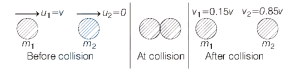
$A$ ball moving with a velocity $v$ collides head-on with a stationary second ball of the same mass. After the collision,the velocity of the first ball is reduced to $0.15 v$. The kinetic energy of the system is decreased nearly by (in $\%$)
A
$20$
B
$25$
C
$30$
D
$40$
Solution
(B) Given: Mass of both balls is $m$. Initial velocities are $u_1 = v$ and $u_2 = 0$. After collision,$v_1 = 0.15 v$.
Using the law of conservation of linear momentum:
$m u_1 + m u_2 = m v_1 + m v_2$
$m v + 0 = m(0.15 v) + m v_2$
$v = 0.15 v + v_2 \implies v_2 = 0.85 v$
Initial kinetic energy $(KE)_i = \frac{1}{2} m v^2$.
Final kinetic energy $(KE)_f = \frac{1}{2} m v_1^2 + \frac{1}{2} m v_2^2 = \frac{1}{2} m (0.15 v)^2 + \frac{1}{2} m (0.85 v)^2$
$(KE)_f = \frac{1}{2} m v^2 [0.15^2 + 0.85^2] = \frac{1}{2} m v^2 [0.0225 + 0.7225] = \frac{1}{2} m v^2 [0.745]$
Decrease in kinetic energy $\Delta KE = (KE)_i - (KE)_f = \frac{1}{2} m v^2 [1 - 0.745] = 0.255 \times (KE)_i$
Percentage decrease $= \frac{\Delta KE}{(KE)_i} \times 100 = 0.255 \times 100 = 25.5 \% \approx 25 \%$.
Using the law of conservation of linear momentum:
$m u_1 + m u_2 = m v_1 + m v_2$
$m v + 0 = m(0.15 v) + m v_2$
$v = 0.15 v + v_2 \implies v_2 = 0.85 v$
Initial kinetic energy $(KE)_i = \frac{1}{2} m v^2$.
Final kinetic energy $(KE)_f = \frac{1}{2} m v_1^2 + \frac{1}{2} m v_2^2 = \frac{1}{2} m (0.15 v)^2 + \frac{1}{2} m (0.85 v)^2$
$(KE)_f = \frac{1}{2} m v^2 [0.15^2 + 0.85^2] = \frac{1}{2} m v^2 [0.0225 + 0.7225] = \frac{1}{2} m v^2 [0.745]$
Decrease in kinetic energy $\Delta KE = (KE)_i - (KE)_f = \frac{1}{2} m v^2 [1 - 0.745] = 0.255 \times (KE)_i$
Percentage decrease $= \frac{\Delta KE}{(KE)_i} \times 100 = 0.255 \times 100 = 25.5 \% \approx 25 \%$.
0 likes
View Solution132
MediumMCQ
$A$ ball falls from a height $h$ upon a fixed horizontal floor. The coefficient of restitution for the collision between the ball and the floor is $e$. The total distance covered by the ball before coming to rest is [neglect the air resistance].
A
$h \frac{1+e^2}{1-e^2}$
B
$h \frac{1-e^2}{1+e^2}$
C
$h \frac{1+e^2}{1-e^2}$
D
$h \frac{1-e^2}{1+e^2}$
Solution
(A) The ball falls from height $h$ and hits the floor. The velocity just before the first impact is $v_0 = \sqrt{2gh}$.
After the first impact,the velocity becomes $v_1 = e v_0$. The ball rises to a height $h_1 = \frac{v_1^2}{2g} = e^2 h$.
It then falls from $h_1$ and hits the floor again. The distance covered in the first bounce (up and down) is $2h_1 = 2e^2 h$.
After the second impact,it rises to $h_2 = e^2 h_1 = e^4 h$. The distance covered in the second bounce is $2h_2 = 2e^4 h$.
The total distance $D$ is the sum of the initial fall and all subsequent bounces:
$D = h + 2h_1 + 2h_2 + 2h_3 + ...$
$D = h + 2e^2 h + 2e^4 h + 2e^6 h + ...$
$D = h + 2e^2 h (1 + e^2 + e^4 + ...)$
Using the sum of an infinite geometric series $S = \frac{a}{1-r}$ where $a=1$ and $r=e^2$:
$D = h + 2e^2 h \left( \frac{1}{1-e^2} \right)$
$D = h \left( 1 + \frac{2e^2}{1-e^2} \right) = h \left( \frac{1-e^2+2e^2}{1-e^2} \right) = h \left( \frac{1+e^2}{1-e^2} \right)$.
After the first impact,the velocity becomes $v_1 = e v_0$. The ball rises to a height $h_1 = \frac{v_1^2}{2g} = e^2 h$.
It then falls from $h_1$ and hits the floor again. The distance covered in the first bounce (up and down) is $2h_1 = 2e^2 h$.
After the second impact,it rises to $h_2 = e^2 h_1 = e^4 h$. The distance covered in the second bounce is $2h_2 = 2e^4 h$.
The total distance $D$ is the sum of the initial fall and all subsequent bounces:
$D = h + 2h_1 + 2h_2 + 2h_3 + ...$
$D = h + 2e^2 h + 2e^4 h + 2e^6 h + ...$
$D = h + 2e^2 h (1 + e^2 + e^4 + ...)$
Using the sum of an infinite geometric series $S = \frac{a}{1-r}$ where $a=1$ and $r=e^2$:
$D = h + 2e^2 h \left( \frac{1}{1-e^2} \right)$
$D = h \left( 1 + \frac{2e^2}{1-e^2} \right) = h \left( \frac{1-e^2+2e^2}{1-e^2} \right) = h \left( \frac{1+e^2}{1-e^2} \right)$.
0 likes
View Solution133
EasyMCQ
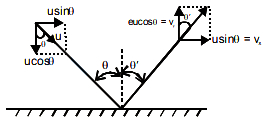
$A$ tennis ball hits the floor with a speed $v$ at an angle $\theta$ with the normal to the floor. If the collision is inelastic and the coefficient of restitution is $\varepsilon$,what will be the angle of reflection?
A
$\tan ^{-1}\left(\frac{\tan \theta}{\varepsilon}\right)$
B
$\sin ^{-1}\left(\frac{\sin \theta}{\varepsilon}\right)$
C
$\theta \varepsilon$
D
$\theta \frac{2 \varepsilon}{\varepsilon+1}$
Solution
(A) Let the velocity of the ball before collision be $v$. The velocity components are $v_x = v \sin \theta$ (parallel to the floor) and $v_y = v \cos \theta$ (perpendicular to the floor).
Since the floor is smooth,there is no impulsive force parallel to the floor,so the tangential component of velocity remains unchanged: $v'_x = v \sin \theta$.
For the normal component,the coefficient of restitution $\varepsilon$ is defined as the ratio of the velocity of separation to the velocity of approach along the normal: $\varepsilon = \frac{v'_y}{v_y}$.
Thus,$v'_y = \varepsilon v_y = \varepsilon v \cos \theta$.
Let $\theta'$ be the angle of reflection with the normal. Then,$\tan \theta' = \frac{v'_x}{v'_y} = \frac{v \sin \theta}{\varepsilon v \cos \theta} = \frac{\tan \theta}{\varepsilon}$.
Therefore,$\theta' = \tan ^{-1}\left(\frac{\tan \theta}{\varepsilon}\right)$.
Since the floor is smooth,there is no impulsive force parallel to the floor,so the tangential component of velocity remains unchanged: $v'_x = v \sin \theta$.
For the normal component,the coefficient of restitution $\varepsilon$ is defined as the ratio of the velocity of separation to the velocity of approach along the normal: $\varepsilon = \frac{v'_y}{v_y}$.
Thus,$v'_y = \varepsilon v_y = \varepsilon v \cos \theta$.
Let $\theta'$ be the angle of reflection with the normal. Then,$\tan \theta' = \frac{v'_x}{v'_y} = \frac{v \sin \theta}{\varepsilon v \cos \theta} = \frac{\tan \theta}{\varepsilon}$.
Therefore,$\theta' = \tan ^{-1}\left(\frac{\tan \theta}{\varepsilon}\right)$.
0 likes
View Solution134
MediumMCQ
$A$ small steel ball bounces on a steel plate held horizontally. On each bounce,the speed of the ball arriving at the plate is reduced by a factor $e$ (coefficient of restitution) in the rebound,so that $V_{\text{upward}} = e V_{\text{downward}}$. If the ball is initially dropped from a height of $0.4 \text{ m}$ above the plate and if $10 \text{ s}$ later the bouncing ceases,the value of $e$ is:
A
$\sqrt{\frac{2}{7}}$
B
$\frac{3}{4}$
C
$\frac{13}{18}$
D
$\frac{17}{18}$
Solution
(D) The time taken for the first fall is $t_0 = \sqrt{\frac{2h}{g}}$.
After the first impact,the ball rises to height $h_1 = e^2 h$ and falls back,taking time $t_1 = 2 \sqrt{\frac{2h_1}{g}} = 2e \sqrt{\frac{2h}{g}}$.
Similarly,for subsequent bounces,the time taken is $t_n = 2e^n \sqrt{\frac{2h}{g}}$.
The total time $T$ is the sum of the initial fall and all subsequent bounces:
$T = \sqrt{\frac{2h}{g}} + 2e \sqrt{\frac{2h}{g}} + 2e^2 \sqrt{\frac{2h}{g}} + \dots = \sqrt{\frac{2h}{g}} \left( 1 + 2e + 2e^2 + \dots \right)$.
Using the sum of a geometric series for $e < 1$,$T = \sqrt{\frac{2h}{g}} \left( 1 + 2e \frac{1}{1-e} \right) = \sqrt{\frac{2h}{g}} \left( \frac{1+e}{1-e} \right)$.
Given $h = 0.4 \text{ m}$,$g = 10 \text{ m/s}^2$,and $T = 10 \text{ s}$:
$10 = \sqrt{\frac{2 \times 0.4}{10}} \left( \frac{1+e}{1-e} \right) = \sqrt{0.08} \left( \frac{1+e}{1-e} \right) = 0.2828 \left( \frac{1+e}{1-e} \right)$.
Actually,using $g = 9.8 \text{ m/s}^2$ or simplifying the expression: $10 = \sqrt{0.08} \frac{1+e}{1-e} \implies \frac{10}{0.2828} = \frac{1+e}{1-e} \approx 35.35$.
Solving for $e$ yields $e \approx 0.944$,which corresponds to $\frac{17}{18} \approx 0.944$.
After the first impact,the ball rises to height $h_1 = e^2 h$ and falls back,taking time $t_1 = 2 \sqrt{\frac{2h_1}{g}} = 2e \sqrt{\frac{2h}{g}}$.
Similarly,for subsequent bounces,the time taken is $t_n = 2e^n \sqrt{\frac{2h}{g}}$.
The total time $T$ is the sum of the initial fall and all subsequent bounces:
$T = \sqrt{\frac{2h}{g}} + 2e \sqrt{\frac{2h}{g}} + 2e^2 \sqrt{\frac{2h}{g}} + \dots = \sqrt{\frac{2h}{g}} \left( 1 + 2e + 2e^2 + \dots \right)$.
Using the sum of a geometric series for $e < 1$,$T = \sqrt{\frac{2h}{g}} \left( 1 + 2e \frac{1}{1-e} \right) = \sqrt{\frac{2h}{g}} \left( \frac{1+e}{1-e} \right)$.
Given $h = 0.4 \text{ m}$,$g = 10 \text{ m/s}^2$,and $T = 10 \text{ s}$:
$10 = \sqrt{\frac{2 \times 0.4}{10}} \left( \frac{1+e}{1-e} \right) = \sqrt{0.08} \left( \frac{1+e}{1-e} \right) = 0.2828 \left( \frac{1+e}{1-e} \right)$.
Actually,using $g = 9.8 \text{ m/s}^2$ or simplifying the expression: $10 = \sqrt{0.08} \frac{1+e}{1-e} \implies \frac{10}{0.2828} = \frac{1+e}{1-e} \approx 35.35$.
Solving for $e$ yields $e \approx 0.944$,which corresponds to $\frac{17}{18} \approx 0.944$.
0 likes
View Solution135
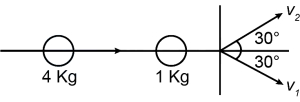
MediumMCQ
$A$ spherical ball $A$ of mass $4 \ kg$,moving along a straight line,strikes another spherical ball $B$ of mass $1 \ kg$ at rest. After the collision,$A$ and $B$ move with velocities $v_1 \ ms^{-1}$ and $v_2 \ ms^{-1}$ respectively,making angles of $30^{\circ}$ and $60^{\circ}$ with respect to the original direction of motion of $A$. The ratio $\frac{v_1}{v_2}$ will be
A
$\frac{\sqrt{3}}{4}$
B
$\frac{4}{\sqrt{3}}$
C
$\frac{1}{\sqrt{3}}$
D
$\sqrt{3}$
Solution
(A) According to the law of conservation of linear momentum,the net external force on the system is zero,so the momentum along the $y$-axis (perpendicular to the initial direction of motion) must be conserved.
Initially,the system has no momentum along the $y$-axis.
After the collision,the components of momentum along the $y$-axis for balls $A$ and $B$ must be equal and opposite.
Let $m_1 = 4 \ kg$ and $m_2 = 1 \ kg$.
$m_1 v_1 \sin(30^{\circ}) = m_2 v_2 \sin(60^{\circ})$
$4 \cdot v_1 \cdot \frac{1}{2} = 1 \cdot v_2 \cdot \frac{\sqrt{3}}{2}$
$2 v_1 = \frac{\sqrt{3}}{2} v_2$
$\frac{v_1}{v_2} = \frac{\sqrt{3}}{4}$
Initially,the system has no momentum along the $y$-axis.
After the collision,the components of momentum along the $y$-axis for balls $A$ and $B$ must be equal and opposite.
Let $m_1 = 4 \ kg$ and $m_2 = 1 \ kg$.
$m_1 v_1 \sin(30^{\circ}) = m_2 v_2 \sin(60^{\circ})$
$4 \cdot v_1 \cdot \frac{1}{2} = 1 \cdot v_2 \cdot \frac{\sqrt{3}}{2}$
$2 v_1 = \frac{\sqrt{3}}{2} v_2$
$\frac{v_1}{v_2} = \frac{\sqrt{3}}{4}$
0 likes
View Solution136
MediumMCQ
$A$ bullet of mass $4.2 \times 10^{-2} \text{ kg}$, moving at a speed of $300 \text{ m/s}$, gets stuck into a block with a mass $9$ times that of the bullet. If the block is free to move without any kind of friction, the heat generated in the process will be (in $\text{ cal}$)
A
$45$
B
$405$
C
$450$
D
$1701$
Solution
(B) Let the mass of the bullet be $m = 4.2 \times 10^{-2} \text{ kg}$.
Mass of the block $M = 9m = 9 \times 4.2 \times 10^{-2} \text{ kg}$.
Initial velocity of the bullet $v = 300 \text{ m/s}$.
By the law of conservation of linear momentum, the momentum before collision equals the momentum after collision:
$mv = (m + M)V$
$m(300) = (m + 9m)V$
$300m = 10mV$
$V = 30 \text{ m/s}$.
Heat generated is equal to the loss in kinetic energy:
$\Delta K = K_i - K_f = \frac{1}{2}mv^2 - \frac{1}{2}(m + M)V^2$
$\Delta K = \frac{1}{2} \times (4.2 \times 10^{-2}) \times (300)^2 - \frac{1}{2} \times (10 \times 4.2 \times 10^{-2}) \times (30)^2$
$\Delta K = \frac{1}{2} \times 4.2 \times 10^{-2} \times (90000 - 10 \times 900)$
$\Delta K = 2.1 \times 10^{-2} \times (90000 - 9000) = 2.1 \times 10^{-2} \times 81000 = 1701 \text{ J}$.
Since $1 \text{ cal} = 4.2 \text{ J}$, the heat in calories is:
$\text{Heat} = \frac{1701}{4.2} = 405 \text{ cal}$.
Mass of the block $M = 9m = 9 \times 4.2 \times 10^{-2} \text{ kg}$.
Initial velocity of the bullet $v = 300 \text{ m/s}$.
By the law of conservation of linear momentum, the momentum before collision equals the momentum after collision:
$mv = (m + M)V$
$m(300) = (m + 9m)V$
$300m = 10mV$
$V = 30 \text{ m/s}$.
Heat generated is equal to the loss in kinetic energy:
$\Delta K = K_i - K_f = \frac{1}{2}mv^2 - \frac{1}{2}(m + M)V^2$
$\Delta K = \frac{1}{2} \times (4.2 \times 10^{-2}) \times (300)^2 - \frac{1}{2} \times (10 \times 4.2 \times 10^{-2}) \times (30)^2$
$\Delta K = \frac{1}{2} \times 4.2 \times 10^{-2} \times (90000 - 10 \times 900)$
$\Delta K = 2.1 \times 10^{-2} \times (90000 - 9000) = 2.1 \times 10^{-2} \times 81000 = 1701 \text{ J}$.
Since $1 \text{ cal} = 4.2 \text{ J}$, the heat in calories is:
$\text{Heat} = \frac{1701}{4.2} = 405 \text{ cal}$.
0 likes
View SolutionWork, Energy, Power and Collision — Inelastic Collision · Frequently Asked Questions
1Are these Work, Energy, Power and Collision questions useful for JEE and NEET?
Yes. All questions in this section are mapped to JEE Main and NEET exam patterns. Previous year questions from JEE Main, NEET, GUJCET and state-level exams are included with full solutions.
2Can I switch to Hindi or Gujarati for these questions?
Yes. Use the language tabs in the hero section or the sidebar to view the same questions and solutions in English, Hindi or Gujarati.
3How do I generate a question paper from this subtopic?
Use the Vedclass Exam Paper Generator — select the chapter and subtopic, set difficulty, and generate Sets A, B, C, D automatically. First 3 chapters of every subject are free.
Vedclass Products
For Students
Vedclass Test Series
Mock tests in real JEE/NEET style with performance analysis. 5-day free trial.
Start Free TrialFor Teachers
Exam Paper Generator
Generate Set A/B/C/D papers from this chapter in 2 minutes. 3 chapters free.
Try FreeFor Institutes
Online Exam Module
Live online exams with unlimited students, 360° analytics & white-label branding.
See DemoFor Teachers & Institutes
Generate a Work, Energy, Power and Collision Exam Paper in 2 Minutes
Select subtopic & difficulty — Sets A, B, C, D auto-generated with No Repeat logic.
First 3 chapters of every subject are free — no payment required.