
A English
Elastic Collision Questions in English
Class 11 Physics · Work, Energy, Power and Collision · Elastic Collision
221+
Questions
English
Language
100%
With Solutions
Showing 48 of 221 questions in English
101
DifficultMCQ
$A$ body of mass $m$ moving with velocity $v$ undergoes a head-on elastic collision with another body of mass $2m$ which is initially at rest. The ratio of the kinetic energy $(K.E.)$ of the colliding body before and after the collision is: (in $: 1$)
A
$1$
B
$2$
C
$4$
D
$9$
Solution
(D) For a one-dimensional elastic collision,the velocity of the first body $(m_1 = m)$ after the collision $(v_1)$ is given by the formula:
$v_1 = \left( \frac{m_1 - m_2}{m_1 + m_2} \right) u_1 + \left( \frac{2m_2}{m_1 + m_2} \right) u_2$
Given $m_1 = m$,$m_2 = 2m$,$u_1 = v$,and $u_2 = 0$:
$v_1 = \left( \frac{m - 2m}{m + 2m} \right) v + 0 = \left( \frac{-m}{3m} \right) v = -\frac{v}{3}$
Initial kinetic energy $(KE_i)$ = $\frac{1}{2} mv^2$
Final kinetic energy $(KE_f)$ = $\frac{1}{2} m v_1^2 = \frac{1}{2} m \left( -\frac{v}{3} \right)^2 = \frac{1}{2} m \left( \frac{v^2}{9} \right) = \frac{1}{18} mv^2$
The ratio of $KE_i$ to $KE_f$ is:
$\frac{KE_i}{KE_f} = \frac{\frac{1}{2} mv^2}{\frac{1}{18} mv^2} = \frac{1/2}{1/18} = \frac{18}{2} = 9$
Thus,the ratio is $9 : 1$.
$v_1 = \left( \frac{m_1 - m_2}{m_1 + m_2} \right) u_1 + \left( \frac{2m_2}{m_1 + m_2} \right) u_2$
Given $m_1 = m$,$m_2 = 2m$,$u_1 = v$,and $u_2 = 0$:
$v_1 = \left( \frac{m - 2m}{m + 2m} \right) v + 0 = \left( \frac{-m}{3m} \right) v = -\frac{v}{3}$
Initial kinetic energy $(KE_i)$ = $\frac{1}{2} mv^2$
Final kinetic energy $(KE_f)$ = $\frac{1}{2} m v_1^2 = \frac{1}{2} m \left( -\frac{v}{3} \right)^2 = \frac{1}{2} m \left( \frac{v^2}{9} \right) = \frac{1}{18} mv^2$
The ratio of $KE_i$ to $KE_f$ is:
$\frac{KE_i}{KE_f} = \frac{\frac{1}{2} mv^2}{\frac{1}{18} mv^2} = \frac{1/2}{1/18} = \frac{18}{2} = 9$
Thus,the ratio is $9 : 1$.
0 likes
View Solution102
MediumMCQ
After a head-on elastic collision between two balls of equal masses,one is observed to have a speed of $3\,m/s$ along the positive $x$-axis and the other has a speed of $2\,m/s$ along the negative $x$-axis. What were the original velocities of the balls?
A
$-2\,m/s$ and $+3\,m/s$
B
$+2\,m/s$ and $+3\,m/s$
C
$-3\,m/s$ and $+2\,m/s$
D
$+3\,m/s$ and $-2\,m/s$
Solution
(A) For a head-on elastic collision between two bodies of equal masses $(m_1 = m_2 = m)$,the bodies simply exchange their velocities.
Let the initial velocities be $u_1$ and $u_2$,and the final velocities be $v_1$ and $v_2$.
According to the conservation of momentum: $m u_1 + m u_2 = m v_1 + m v_2$,which simplifies to $u_1 + u_2 = v_1 + v_2$.
According to the property of elastic collision for equal masses: $v_1 = u_2$ and $v_2 = u_1$.
Given the final velocities are $v_1 = +3\,m/s$ and $v_2 = -2\,m/s$.
Therefore,the initial velocities must be $u_1 = v_2 = -2\,m/s$ and $u_2 = v_1 = +3\,m/s$.
Let the initial velocities be $u_1$ and $u_2$,and the final velocities be $v_1$ and $v_2$.
According to the conservation of momentum: $m u_1 + m u_2 = m v_1 + m v_2$,which simplifies to $u_1 + u_2 = v_1 + v_2$.
According to the property of elastic collision for equal masses: $v_1 = u_2$ and $v_2 = u_1$.
Given the final velocities are $v_1 = +3\,m/s$ and $v_2 = -2\,m/s$.
Therefore,the initial velocities must be $u_1 = v_2 = -2\,m/s$ and $u_2 = v_1 = +3\,m/s$.
0 likes
View Solution103
AdvancedMCQ
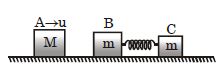
$A$ block $A$ of mass $M$ moving with speed $u$ collides elastically with block $B$ of mass $m$ which is connected to block $C$ of mass $m$ with a spring. When the compression in the spring is maximum,the velocity of block $C$ with respect to block $A$ is (neglect friction):
A
Zero
B
$\frac{M}{M+m}u$
C
$\left(\frac{m}{M+m}\right)u$
D
$\frac{m}{M}u$
Solution
(C) $1$. In the first elastic collision between block $A$ and block $B$:
$V_A = \left(\frac{M-m}{M+m}\right)u$
$V_B = \left(\frac{2M}{M+m}\right)u$
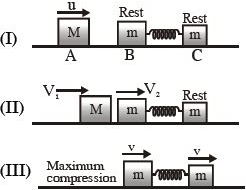
$2$. After the collision,block $B$ moves towards block $C$ and compresses the spring. At the time of maximum compression,the velocities of blocks $B$ and $C$ become equal (let this velocity be $v$).
$3$. By the law of conservation of linear momentum for the system of blocks $B$ and $C$:
$m V_B = (m + m)v$
$m \left(\frac{2M}{M+m}\right)u = 2mv$
$v = \left(\frac{M}{M+m}\right)u$
$4$. The velocity of block $C$ with respect to block $A$ is:
$V_{CA} = V_C - V_A = v - V_A$
$V_{CA} = \left(\frac{M}{M+m}\right)u - \left(\frac{M-m}{M+m}\right)u$
$V_{CA} = \left(\frac{M - M + m}{M+m}\right)u = \left(\frac{m}{M+m}\right)u$
$V_A = \left(\frac{M-m}{M+m}\right)u$
$V_B = \left(\frac{2M}{M+m}\right)u$
$2$. After the collision,block $B$ moves towards block $C$ and compresses the spring. At the time of maximum compression,the velocities of blocks $B$ and $C$ become equal (let this velocity be $v$).
$3$. By the law of conservation of linear momentum for the system of blocks $B$ and $C$:
$m V_B = (m + m)v$
$m \left(\frac{2M}{M+m}\right)u = 2mv$
$v = \left(\frac{M}{M+m}\right)u$
$4$. The velocity of block $C$ with respect to block $A$ is:
$V_{CA} = V_C - V_A = v - V_A$
$V_{CA} = \left(\frac{M}{M+m}\right)u - \left(\frac{M-m}{M+m}\right)u$
$V_{CA} = \left(\frac{M - M + m}{M+m}\right)u = \left(\frac{m}{M+m}\right)u$
0 likes
View Solution104
MediumMCQ
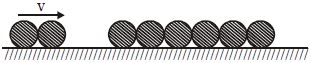
Six identical balls are lined up in a straight groove on a horizontal frictionless surface. Two similar balls,each moving with a velocity $v$,collide elastically with the row of $6$ balls from the left. What will happen?
A
One ball from the right rolls out with a speed $2v$ and the remaining balls will remain at rest.
B
Two balls from the right roll out with speed $v$ each and the remaining balls will remain stationary.
C
All the six balls in the row will roll out with speed $v/6$ each and the two colliding balls will come to rest.
D
The colliding balls will come to rest and no ball rolls out from the right.
Solution
(B) In a one-dimensional elastic collision between identical masses,the colliding body comes to rest and transfers its velocity to the stationary body if the number of incoming bodies equals the number of outgoing bodies.
Here,$2$ balls are moving with velocity $v$ and collide with a row of $6$ identical stationary balls.
By the principle of conservation of linear momentum and kinetic energy for elastic collisions of identical masses,the $2$ incoming balls will come to rest,and $2$ balls from the right end of the row will move out with the same velocity $v$.
Therefore,the correct option is $B$.
Here,$2$ balls are moving with velocity $v$ and collide with a row of $6$ identical stationary balls.
By the principle of conservation of linear momentum and kinetic energy for elastic collisions of identical masses,the $2$ incoming balls will come to rest,and $2$ balls from the right end of the row will move out with the same velocity $v$.
Therefore,the correct option is $B$.
0 likes
View Solution105
MediumMCQ
In an elastic collision of two particles,which of the following quantities is conserved?
A
Momentum of each particle
B
Speed of each particle
C
Kinetic energy of each particle
D
Total kinetic energy of both the particles
Solution
(D) In an elastic collision,both the total linear momentum and the total kinetic energy of the system are conserved.
While the total kinetic energy of the system remains constant,the kinetic energy of individual particles may change due to the exchange of energy during the collision.
Therefore,the total kinetic energy of both particles is the conserved quantity.
While the total kinetic energy of the system remains constant,the kinetic energy of individual particles may change due to the exchange of energy during the collision.
Therefore,the total kinetic energy of both particles is the conserved quantity.
0 likes
View Solution106
MediumMCQ
After a head-on elastic collision between two balls of equal masses,one is observed to have a speed of $3 \, m/s$ along the positive $x$-axis and the other has a speed of $2 \, m/s$ along the negative $x$-axis. The original velocities of the balls are:
A
$-2 \, m/s$ and $+3 \, m/s$
B
$+2 \, m/s$ and $+3 \, m/s$
C
$-3 \, m/s$ and $+2 \, m/s$
D
$+3 \, m/s$ and $-2 \, m/s$
Solution
(A) For a head-on elastic collision between two bodies of equal masses $(m_1 = m_2 = m)$,the velocities are exchanged.
Let the initial velocities be $u_1$ and $u_2$,and the final velocities be $v_1$ and $v_2$.
According to the properties of a one-dimensional elastic collision with equal masses,$v_1 = u_2$ and $v_2 = u_1$.
Given the final velocities are $v_1 = +3 \, m/s$ and $v_2 = -2 \, m/s$.
Therefore,the initial velocities must be $u_1 = v_2 = -2 \, m/s$ and $u_2 = v_1 = +3 \, m/s$.
Thus,the original velocities are $-2 \, m/s$ and $+3 \, m/s$.
Let the initial velocities be $u_1$ and $u_2$,and the final velocities be $v_1$ and $v_2$.
According to the properties of a one-dimensional elastic collision with equal masses,$v_1 = u_2$ and $v_2 = u_1$.
Given the final velocities are $v_1 = +3 \, m/s$ and $v_2 = -2 \, m/s$.
Therefore,the initial velocities must be $u_1 = v_2 = -2 \, m/s$ and $u_2 = v_1 = +3 \, m/s$.
Thus,the original velocities are $-2 \, m/s$ and $+3 \, m/s$.
0 likes
View Solution107
DifficultMCQ
$A$ ball after falling from a height of $10\, m$ strikes the roof of a lift which is descending down with a velocity of $1\, m/s$. The recoil velocity of the ball will be .............. $m/s$.
A
$8$
B
$11$
C
$12$
D
$15$
Solution
(C) The speed of the ball just before striking the lift is given by $v = \sqrt{2gh}$.
Taking $g = 9.8\, m/s^2$ and $h = 10\, m$,we get $v = \sqrt{2 \times 9.8 \times 10} = \sqrt{196} = 14\, m/s$.
Let the downward direction be positive. The velocity of the ball before collision is $u_1 = 14\, m/s$ and the velocity of the lift is $u_2 = 1\, m/s$.
Since the mass of the lift is much greater than the mass of the ball $(M_{lift} \gg M_{ball})$,the collision is effectively an elastic collision with a stationary wall moving at velocity $u_2$.
The velocity of the ball after collision $v_1$ is given by the formula $v_1 = 2u_2 - u_1$ (relative to the ground).
Substituting the values: $v_1 = 2(1) - 14 = 2 - 14 = -12\, m/s$.
The negative sign indicates that the ball is moving upwards with a speed of $12\, m/s$.
Taking $g = 9.8\, m/s^2$ and $h = 10\, m$,we get $v = \sqrt{2 \times 9.8 \times 10} = \sqrt{196} = 14\, m/s$.
Let the downward direction be positive. The velocity of the ball before collision is $u_1 = 14\, m/s$ and the velocity of the lift is $u_2 = 1\, m/s$.
Since the mass of the lift is much greater than the mass of the ball $(M_{lift} \gg M_{ball})$,the collision is effectively an elastic collision with a stationary wall moving at velocity $u_2$.
The velocity of the ball after collision $v_1$ is given by the formula $v_1 = 2u_2 - u_1$ (relative to the ground).
Substituting the values: $v_1 = 2(1) - 14 = 2 - 14 = -12\, m/s$.
The negative sign indicates that the ball is moving upwards with a speed of $12\, m/s$.
0 likes
View Solution108
DifficultMCQ
$A$ body of mass $m$ moving with velocity $v$ collides head-on with another body of mass $2m$ which is initially at rest. The ratio of the $K.E.$ of the colliding body before and after the collision will be: (in $: 1$)
A
$1$
B
$2$
C
$4$
D
$9$
Solution
(D) The velocity of the first body after a one-dimensional elastic collision is given by the formula:
$v_{1} = \left(\frac{m_{1}-m_{2}}{m_{1}+m_{2}}\right) u_{1} + \frac{2 m_{2} u_{2}}{m_{1}+m_{2}}$
Given $m_{1} = m$,$m_{2} = 2m$,$u_{1} = v$,and $u_{2} = 0$:
$v_{1} = \left(\frac{m - 2m}{m + 2m}\right) v + \frac{2(2m)(0)}{3m} = \left(\frac{-m}{3m}\right) v = -\frac{v}{3}$
Initial kinetic energy of the first body: $KE_{i} = \frac{1}{2} mv^{2}$
Final kinetic energy of the first body: $KE_{f} = \frac{1}{2} m\left(-\frac{v}{3}\right)^{2} = \frac{1}{2} m \left(\frac{v^{2}}{9}\right) = \frac{KE_{i}}{9}$
The ratio of $KE_{i}$ to $KE_{f}$ is:
$\frac{KE_{i}}{KE_{f}} = \frac{KE_{i}}{KE_{i}/9} = 9$
Thus,the ratio is $9 : 1$.
$v_{1} = \left(\frac{m_{1}-m_{2}}{m_{1}+m_{2}}\right) u_{1} + \frac{2 m_{2} u_{2}}{m_{1}+m_{2}}$
Given $m_{1} = m$,$m_{2} = 2m$,$u_{1} = v$,and $u_{2} = 0$:
$v_{1} = \left(\frac{m - 2m}{m + 2m}\right) v + \frac{2(2m)(0)}{3m} = \left(\frac{-m}{3m}\right) v = -\frac{v}{3}$
Initial kinetic energy of the first body: $KE_{i} = \frac{1}{2} mv^{2}$
Final kinetic energy of the first body: $KE_{f} = \frac{1}{2} m\left(-\frac{v}{3}\right)^{2} = \frac{1}{2} m \left(\frac{v^{2}}{9}\right) = \frac{KE_{i}}{9}$
The ratio of $KE_{i}$ to $KE_{f}$ is:
$\frac{KE_{i}}{KE_{f}} = \frac{KE_{i}}{KE_{i}/9} = 9$
Thus,the ratio is $9 : 1$.
0 likes
View Solution109
MediumMCQ
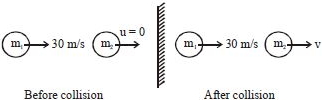
$A$ heavy body moving with a velocity $30\, m/s$ and another small object at rest undergo an elastic collision. The latter will move with a velocity of .............. $m/s$.
A
$30$
B
$60$
C
$80$
D
$0$
Solution
(B) Let $m_1$ be the mass of the heavy body and $m_2$ be the mass of the small object. Given $m_1 \gg m_2$.
Since the collision is elastic and the body $m_1$ is very heavy,it continues to move with its initial velocity $u_1 = 30\, m/s$ after the collision.
For an elastic collision,the coefficient of restitution $e = 1$.
The formula for the coefficient of restitution is $e = \frac{v_2 - v_1}{u_1 - u_2}$,where $u_1 = 30\, m/s$,$u_2 = 0$,$v_1 = 30\, m/s$,and $v_2 = v$.
Substituting the values: $1 = \frac{v - 30}{30 - 0}$.
$1 = \frac{v - 30}{30} \Rightarrow v - 30 = 30 \Rightarrow v = 60\, m/s$.
Since the collision is elastic and the body $m_1$ is very heavy,it continues to move with its initial velocity $u_1 = 30\, m/s$ after the collision.
For an elastic collision,the coefficient of restitution $e = 1$.
The formula for the coefficient of restitution is $e = \frac{v_2 - v_1}{u_1 - u_2}$,where $u_1 = 30\, m/s$,$u_2 = 0$,$v_1 = 30\, m/s$,and $v_2 = v$.
Substituting the values: $1 = \frac{v - 30}{30 - 0}$.
$1 = \frac{v - 30}{30} \Rightarrow v - 30 = 30 \Rightarrow v = 60\, m/s$.
0 likes
View Solution110
DifficultMCQ
$A$ body falling on the ground from a height of $10 \, m$,rebounds to a height of $2.5 \, m$. The ratio of the velocities of the body just before and after the collision will be:
A
$2$
B
$4$
C
$0.5$
D
$0.25$
Solution
(A) Let $v_{1}$ be the velocity just before the collision and $v_{2}$ be the velocity just after the collision.
Using the principle of conservation of energy,the velocity of a body falling from height $h$ is given by $v = \sqrt{2gh}$.
Velocity just before collision: $v_{1} = \sqrt{2gh_{1}} = \sqrt{2 \times g \times 10}$.
Velocity just after collision: $v_{2} = \sqrt{2gh_{2}} = \sqrt{2 \times g \times 2.5}$.
The ratio of velocities is $\frac{v_{1}}{v_{2}} = \frac{\sqrt{2gh_{1}}}{\sqrt{2gh_{2}}} = \sqrt{\frac{h_{1}}{h_{2}}}$.
Substituting the values: $\frac{v_{1}}{v_{2}} = \sqrt{\frac{10}{2.5}} = \sqrt{4} = 2$.
Thus,the ratio of the velocities is $2$.
Using the principle of conservation of energy,the velocity of a body falling from height $h$ is given by $v = \sqrt{2gh}$.
Velocity just before collision: $v_{1} = \sqrt{2gh_{1}} = \sqrt{2 \times g \times 10}$.
Velocity just after collision: $v_{2} = \sqrt{2gh_{2}} = \sqrt{2 \times g \times 2.5}$.
The ratio of velocities is $\frac{v_{1}}{v_{2}} = \frac{\sqrt{2gh_{1}}}{\sqrt{2gh_{2}}} = \sqrt{\frac{h_{1}}{h_{2}}}$.
Substituting the values: $\frac{v_{1}}{v_{2}} = \sqrt{\frac{10}{2.5}} = \sqrt{4} = 2$.
Thus,the ratio of the velocities is $2$.
0 likes
View Solution111
DifficultMCQ
$A$ ball falls from a height of $5\,m$ and strikes the roof of a lift. If at the time of collision,the lift is moving in the upward direction with a velocity of $1\,m/s$,then the velocity with which the ball rebounds after collision will be (assume $e = 1$):
A
$11\,m/s$ downwards
B
$12\,m/s$ upwards
C
$13\,m/s$ upwards
D
$12\,m/s$ downwards
Solution
(B) Let the velocity of the ball just before collision be $u_1$ and the velocity of the lift be $u_2$.
$1$. Calculate the velocity of the ball before collision:
Using $v^2 - u^2 = 2gh$,where $u=0$,$g=10\,m/s^2$,and $h=5\,m$:
$u_1 = \sqrt{2gh} = \sqrt{2 \times 10 \times 5} = 10\,m/s$ (downwards).
$2$. Define the coordinate system:
Let upwards be positive $(+)$ and downwards be negative $(-)$.
So,$u_1 = -10\,m/s$ and $u_2 = +1\,m/s$.
$3$. Collision analysis:
Since the lift is much heavier than the ball $(m_{lift} \gg m_{ball})$,the lift's velocity remains unchanged after the elastic collision $(e=1)$.
Using the relative velocity formula for elastic collision: $v_1 - v_2 = -e(u_1 - u_2)$.
Since $v_2 = u_2 = 1\,m/s$:
$v_1 - 1 = -1(-10 - 1)$
$v_1 - 1 = -1(-11)$
$v_1 - 1 = 11$
$v_1 = 12\,m/s$.
Since the result is positive,the ball rebounds upwards with a velocity of $12\,m/s$.
$1$. Calculate the velocity of the ball before collision:
Using $v^2 - u^2 = 2gh$,where $u=0$,$g=10\,m/s^2$,and $h=5\,m$:
$u_1 = \sqrt{2gh} = \sqrt{2 \times 10 \times 5} = 10\,m/s$ (downwards).
$2$. Define the coordinate system:
Let upwards be positive $(+)$ and downwards be negative $(-)$.
So,$u_1 = -10\,m/s$ and $u_2 = +1\,m/s$.
$3$. Collision analysis:
Since the lift is much heavier than the ball $(m_{lift} \gg m_{ball})$,the lift's velocity remains unchanged after the elastic collision $(e=1)$.
Using the relative velocity formula for elastic collision: $v_1 - v_2 = -e(u_1 - u_2)$.
Since $v_2 = u_2 = 1\,m/s$:
$v_1 - 1 = -1(-10 - 1)$
$v_1 - 1 = -1(-11)$
$v_1 - 1 = 11$
$v_1 = 12\,m/s$.
Since the result is positive,the ball rebounds upwards with a velocity of $12\,m/s$.
0 likes
View Solution112
DifficultMCQ
$A$ sphere of mass $0.1\,kg$ is attached to a cord of $1\,m$ length. Starting from the height of its point of suspension,this sphere hits a block of the same mass at rest on a frictionless table. If the impact is elastic,then the kinetic energy of the block after the collision is ............. $J$.
A
$1$
B
$10$
C
$0.1$
D
$0.5$
Solution
(A) $1$. First,calculate the velocity of the sphere just before the collision using the principle of conservation of energy. The potential energy at the suspension height is converted into kinetic energy at the bottom: $mgh = \frac{1}{2}mv^2$.
$2$. Given $h = 1\,m$ and $g = 10\,m/s^2$,the velocity $v$ is $\sqrt{2gh} = \sqrt{2 \times 10 \times 1} = \sqrt{20}\,m/s$.
$3$. The collision is perfectly elastic between two bodies of equal mass $(m_1 = m_2 = 0.1\,kg)$. In a one-dimensional elastic collision between two equal masses,the bodies exchange their velocities.
$4$. Since the sphere had velocity $v$ and the block was at rest,after the collision,the sphere comes to rest and the block moves with velocity $v$.
$5$. The kinetic energy of the block after the collision is $K.E. = \frac{1}{2}mv^2 = \frac{1}{2} \times 0.1 \times (\sqrt{20})^2 = 0.05 \times 20 = 1\,J$.
$2$. Given $h = 1\,m$ and $g = 10\,m/s^2$,the velocity $v$ is $\sqrt{2gh} = \sqrt{2 \times 10 \times 1} = \sqrt{20}\,m/s$.
$3$. The collision is perfectly elastic between two bodies of equal mass $(m_1 = m_2 = 0.1\,kg)$. In a one-dimensional elastic collision between two equal masses,the bodies exchange their velocities.
$4$. Since the sphere had velocity $v$ and the block was at rest,after the collision,the sphere comes to rest and the block moves with velocity $v$.
$5$. The kinetic energy of the block after the collision is $K.E. = \frac{1}{2}mv^2 = \frac{1}{2} \times 0.1 \times (\sqrt{20})^2 = 0.05 \times 20 = 1\,J$.
0 likes
View Solution113
DifficultMCQ
$A$ ball of mass $m$ moving with a speed $u$ undergoes a head-on elastic collision with a ball of mass $nm$ initially at rest. The fraction of the incident energy transferred to the heavier ball is
A
$\frac{n}{(1+n)^2}$
B
$\frac{2n}{(1+n)^2}$
C
$\frac{4n}{(1+n)^2}$
D
$\frac{n}{1+n}$
Solution
(C) In a head-on elastic collision,the fraction of kinetic energy transferred from a body of mass $m_1$ to a body of mass $m_2$ (initially at rest) is given by the formula:
$f = \frac{4m_1m_2}{(m_1 + m_2)^2}$
Here,$m_1 = m$ and $m_2 = nm$.
Substituting these values into the formula:
$f = \frac{4(m)(nm)}{(m + nm)^2}$
$f = \frac{4nm^2}{m^2(1 + n)^2}$
$f = \frac{4n}{(1 + n)^2}$
$f = \frac{4m_1m_2}{(m_1 + m_2)^2}$
Here,$m_1 = m$ and $m_2 = nm$.
Substituting these values into the formula:
$f = \frac{4(m)(nm)}{(m + nm)^2}$
$f = \frac{4nm^2}{m^2(1 + n)^2}$
$f = \frac{4n}{(1 + n)^2}$
0 likes
View Solution114
DifficultMCQ
$A$ proton of mass $m$ collides elastically with a particle of unknown mass $M$ at rest. After the collision, the proton and the unknown particle are seen moving at an angle of $90^\circ$ with respect to each other. The mass of the unknown particle is:
A
$\frac{m}{\sqrt{3}}$
B
$\frac{m}{2}$
C
$2m$
D
$m$
Solution
(D) Let the initial velocity of the proton be $u$ and the final velocities of the proton and the particle be $v_1$ and $v_2$ respectively. Let the proton move at an angle $\theta$ with the initial direction, then the particle moves at an angle $(90^\circ - \theta)$.
By conservation of linear momentum:
Along the initial direction ($x$-axis): $mu = mv_1 \cos \theta + Mv_2 \cos(90^\circ - \theta) = mv_1 \cos \theta + Mv_2 \sin \theta$ ...$(i)$
Along the perpendicular direction ($y$-axis): $0 = mv_1 \sin \theta - Mv_2 \sin(90^\circ - \theta) = mv_1 \sin \theta - Mv_2 \cos \theta$ ...$(ii)$
From $(ii)$, $Mv_2 \cos \theta = mv_1 \sin \theta$, so $Mv_2 = mv_1 \tan \theta$.
Since the collision is elastic, kinetic energy is conserved:
$\frac{1}{2}mu^2 = \frac{1}{2}mv_1^2 + \frac{1}{2}Mv_2^2$
$mu^2 = mv_1^2 + Mv_2^2$ ...$(iii)$
Squaring and adding equations $(i)$ and $(ii)$:
$(mu)^2 = (mv_1 \cos \theta + Mv_2 \sin \theta)^2 + (mv_1 \sin \theta - Mv_2 \cos \theta)^2$
$m^2u^2 = m^2v_1^2 + M^2v_2^2$ ...$(iv)$
Comparing $(iii)$ and $(iv)$:
$m(mv_1^2 + Mv_2^2) = m^2v_1^2 + M^2v_2^2$
$m^2v_1^2 + m M v_2^2 = m^2v_1^2 + M^2v_2^2$
$m M v_2^2 = M^2v_2^2$
$m = M$
Thus, the mass of the unknown particle is $m$.
By conservation of linear momentum:
Along the initial direction ($x$-axis): $mu = mv_1 \cos \theta + Mv_2 \cos(90^\circ - \theta) = mv_1 \cos \theta + Mv_2 \sin \theta$ ...$(i)$
Along the perpendicular direction ($y$-axis): $0 = mv_1 \sin \theta - Mv_2 \sin(90^\circ - \theta) = mv_1 \sin \theta - Mv_2 \cos \theta$ ...$(ii)$
From $(ii)$, $Mv_2 \cos \theta = mv_1 \sin \theta$, so $Mv_2 = mv_1 \tan \theta$.
Since the collision is elastic, kinetic energy is conserved:
$\frac{1}{2}mu^2 = \frac{1}{2}mv_1^2 + \frac{1}{2}Mv_2^2$
$mu^2 = mv_1^2 + Mv_2^2$ ...$(iii)$
Squaring and adding equations $(i)$ and $(ii)$:
$(mu)^2 = (mv_1 \cos \theta + Mv_2 \sin \theta)^2 + (mv_1 \sin \theta - Mv_2 \cos \theta)^2$
$m^2u^2 = m^2v_1^2 + M^2v_2^2$ ...$(iv)$
Comparing $(iii)$ and $(iv)$:
$m(mv_1^2 + Mv_2^2) = m^2v_1^2 + M^2v_2^2$
$m^2v_1^2 + m M v_2^2 = m^2v_1^2 + M^2v_2^2$
$m M v_2^2 = M^2v_2^2$
$m = M$
Thus, the mass of the unknown particle is $m$.
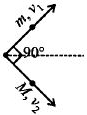
0 likes
View Solution115
DifficultMCQ
$A$ moving particle of mass $m$ makes a head-on elastic collision with another particle of mass $2m$ which is initially at rest. The percentage loss in energy of the colliding particle on collision is close to .................. $\%$
A
$33$
B
$67$
C
$90$
D
$10$
Solution
(C) For a head-on elastic collision between a particle of mass $m_1$ moving with velocity $u_1$ and a particle of mass $m_2$ at rest $(u_2 = 0)$,the final velocity $v_1$ of the first particle is given by:
$v_1 = \left( \frac{m_1 - m_2}{m_1 + m_2} \right) u_1$
The fraction of kinetic energy retained by the first particle is:
$\frac{K_f}{K_i} = \frac{\frac{1}{2} m_1 v_1^2}{\frac{1}{2} m_1 u_1^2} = \left( \frac{v_1}{u_1} \right)^2 = \left( \frac{m_1 - m_2}{m_1 + m_2} \right)^2$
Given $m_1 = m$ and $m_2 = 2m$:
$\frac{K_f}{K_i} = \left( \frac{m - 2m}{m + 2m} \right)^2 = \left( \frac{-m}{3m} \right)^2 = \left( -\frac{1}{3} \right)^2 = \frac{1}{9}$
The fraction of kinetic energy lost is:
$\frac{\Delta K}{K_i} = 1 - \frac{K_f}{K_i} = 1 - \frac{1}{9} = \frac{8}{9}$
Percentage loss in energy:
$\text{Percentage loss} = \frac{8}{9} \times 100 \approx 88.89\% \approx 90\%$
$v_1 = \left( \frac{m_1 - m_2}{m_1 + m_2} \right) u_1$
The fraction of kinetic energy retained by the first particle is:
$\frac{K_f}{K_i} = \frac{\frac{1}{2} m_1 v_1^2}{\frac{1}{2} m_1 u_1^2} = \left( \frac{v_1}{u_1} \right)^2 = \left( \frac{m_1 - m_2}{m_1 + m_2} \right)^2$
Given $m_1 = m$ and $m_2 = 2m$:
$\frac{K_f}{K_i} = \left( \frac{m - 2m}{m + 2m} \right)^2 = \left( \frac{-m}{3m} \right)^2 = \left( -\frac{1}{3} \right)^2 = \frac{1}{9}$
The fraction of kinetic energy lost is:
$\frac{\Delta K}{K_i} = 1 - \frac{K_f}{K_i} = 1 - \frac{1}{9} = \frac{8}{9}$
Percentage loss in energy:
$\text{Percentage loss} = \frac{8}{9} \times 100 \approx 88.89\% \approx 90\%$
0 likes
View Solution116
DifficultMCQ
$A$ simple pendulum,made of a string of length $l$ and a bob of mass $m$,is released from a small angle $\theta_0$. It strikes a block of mass $M$,kept on a horizontal surface at its lowest point of oscillations,elastically. It bounces back and goes up to an angle $\theta_1$. Then $M$ is given by
A
$\frac{m}{2}\left( \frac{\theta_0 + \theta_1}{\theta_0 - \theta_1} \right)$
B
$m\left( \frac{\theta_0 - \theta_1}{\theta_0 + \theta_1} \right)$
C
$m\left( \frac{\theta_0 + \theta_1}{\theta_0 - \theta_1} \right)$
D
$\frac{m}{2}\left( \frac{\theta_0 - \theta_1}{\theta_0 + \theta_1} \right)$
Solution
(C) For small angles,$\cos \theta \approx 1 - \frac{\theta^2}{2}$. The velocity of the bob of mass $m$ at the lowest point is $v = \sqrt{2gl(1 - \cos \theta_0)} \approx \sqrt{2gl(\frac{\theta_0^2}{2})} = \theta_0 \sqrt{gl}$.
After the elastic collision,the bob bounces back with velocity $v'$ and reaches angle $\theta_1$,so $v' = \theta_1 \sqrt{gl}$.
In an elastic collision with a stationary block of mass $M$,the velocity of the bob $m$ after collision is $v' = \left( \frac{m - M}{m + M} \right)v$.
Since the bob bounces back,its velocity is negative relative to the initial direction,so $v' = -\theta_1 \sqrt{gl}$.
Thus,$-\theta_1 \sqrt{gl} = \left( \frac{m - M}{m + M} \right) \theta_0 \sqrt{gl}$.
$-\theta_1 = \frac{m - M}{m + M} \theta_0 \implies -\theta_1(m + M) = \theta_0(m - M)$.
$-m\theta_1 - M\theta_1 = m\theta_0 - M\theta_0$.
$M(\theta_0 - \theta_1) = m(\theta_0 + \theta_1)$.
$M = m\left( \frac{\theta_0 + \theta_1}{\theta_0 - \theta_1} \right)$.
After the elastic collision,the bob bounces back with velocity $v'$ and reaches angle $\theta_1$,so $v' = \theta_1 \sqrt{gl}$.
In an elastic collision with a stationary block of mass $M$,the velocity of the bob $m$ after collision is $v' = \left( \frac{m - M}{m + M} \right)v$.
Since the bob bounces back,its velocity is negative relative to the initial direction,so $v' = -\theta_1 \sqrt{gl}$.
Thus,$-\theta_1 \sqrt{gl} = \left( \frac{m - M}{m + M} \right) \theta_0 \sqrt{gl}$.
$-\theta_1 = \frac{m - M}{m + M} \theta_0 \implies -\theta_1(m + M) = \theta_0(m - M)$.
$-m\theta_1 - M\theta_1 = m\theta_0 - M\theta_0$.
$M(\theta_0 - \theta_1) = m(\theta_0 + \theta_1)$.
$M = m\left( \frac{\theta_0 + \theta_1}{\theta_0 - \theta_1} \right)$.
0 likes
View Solution117
DifficultMCQ
An alpha-particle of mass $m$ undergoes a $1$-dimensional elastic collision with a nucleus of unknown mass $M$ at rest. It is scattered directly backwards,losing $64\%$ of its initial kinetic energy. The mass of the nucleus is .......... $m$.
A
$2$
B
$3.5$
C
$1.5$
D
$4$
Solution
(D) Let the initial velocity of the alpha-particle be $v_0$ and its final velocity be $-v_1$ (since it is scattered backwards).
Let the mass of the nucleus be $M$ and its final velocity be $v_2$.
According to the conservation of linear momentum:
$mv_0 = -mv_1 + Mv_2$ --- $(1)$
According to the property of $1$-dimensional elastic collision:
$v_0 = v_1 + v_2$ --- $(2)$
From $(2)$,$v_1 = v_0 - v_2$. Substituting this into $(1)$:
$mv_0 = -m(v_0 - v_2) + Mv_2$
$mv_0 = -mv_0 + mv_2 + Mv_2$
$2mv_0 = (m + M)v_2 \Rightarrow v_2 = \frac{2mv_0}{m + M}$
The final kinetic energy of the alpha-particle is $K_f = \frac{1}{2}mv_1^2$.
Given that it loses $64\%$ of its initial kinetic energy $(K_i = \frac{1}{2}mv_0^2)$,the remaining kinetic energy is $36\%$ of $K_i$:
$K_f = 0.36 K_i \Rightarrow \frac{1}{2}mv_1^2 = 0.36 \times \frac{1}{2}mv_0^2$
$v_1^2 = 0.36 v_0^2 \Rightarrow v_1 = 0.6 v_0$
Using the formula for final velocity in elastic collision: $v_1 = \left( \frac{m - M}{m + M} \right) v_0$ (where $v_1$ is in the direction of $v_0$).
Since it is scattered backwards,$v_1 = -0.6 v_0$,so $\frac{m - M}{m + M} = -0.6$.
$m - M = -0.6m - 0.6M$
$1.6m = 0.4M \Rightarrow M = 4m$.
Let the mass of the nucleus be $M$ and its final velocity be $v_2$.
According to the conservation of linear momentum:
$mv_0 = -mv_1 + Mv_2$ --- $(1)$
According to the property of $1$-dimensional elastic collision:
$v_0 = v_1 + v_2$ --- $(2)$
From $(2)$,$v_1 = v_0 - v_2$. Substituting this into $(1)$:
$mv_0 = -m(v_0 - v_2) + Mv_2$
$mv_0 = -mv_0 + mv_2 + Mv_2$
$2mv_0 = (m + M)v_2 \Rightarrow v_2 = \frac{2mv_0}{m + M}$
The final kinetic energy of the alpha-particle is $K_f = \frac{1}{2}mv_1^2$.
Given that it loses $64\%$ of its initial kinetic energy $(K_i = \frac{1}{2}mv_0^2)$,the remaining kinetic energy is $36\%$ of $K_i$:
$K_f = 0.36 K_i \Rightarrow \frac{1}{2}mv_1^2 = 0.36 \times \frac{1}{2}mv_0^2$
$v_1^2 = 0.36 v_0^2 \Rightarrow v_1 = 0.6 v_0$
Using the formula for final velocity in elastic collision: $v_1 = \left( \frac{m - M}{m + M} \right) v_0$ (where $v_1$ is in the direction of $v_0$).
Since it is scattered backwards,$v_1 = -0.6 v_0$,so $\frac{m - M}{m + M} = -0.6$.
$m - M = -0.6m - 0.6M$
$1.6m = 0.4M \Rightarrow M = 4m$.
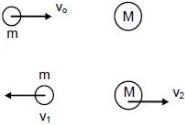
0 likes
View Solution118
MediumMCQ
$A$ body of mass $2\,kg$ makes an elastic collision with a second body of mass $m$ at rest and continues to move in the original direction but with one-fourth of its original speed. What is the mass of the second body? ................ $kg$
A
$1.5$
B
$1.2$
C
$1.8$
D
$1$
Solution
(B) Let the initial velocity of the $2\,kg$ body be $v_0$ and the final velocity be $v_0/4$. Let the mass of the second body be $m$ and its final velocity be $v$.
By the law of conservation of linear momentum:
$2v_0 = 2(v_0/4) + mv$
$2v_0 = v_0/2 + mv$
$mv = 3v_0/2$ --- $(1)$
Since the collision is perfectly elastic,the coefficient of restitution $e = 1$:
$e = (v_{2} - v_{1}) / (u_{1} - u_{2}) = 1$
$v - v_0/4 = v_0 - 0$
$v = v_0 + v_0/4 = 5v_0/4$
Substitute $v$ into equation $(1)$:
$m(5v_0/4) = 3v_0/2$
$m = (3/2) * (4/5) = 12/10 = 1.2\,kg$.
By the law of conservation of linear momentum:
$2v_0 = 2(v_0/4) + mv$
$2v_0 = v_0/2 + mv$
$mv = 3v_0/2$ --- $(1)$
Since the collision is perfectly elastic,the coefficient of restitution $e = 1$:
$e = (v_{2} - v_{1}) / (u_{1} - u_{2}) = 1$
$v - v_0/4 = v_0 - 0$
$v = v_0 + v_0/4 = 5v_0/4$
Substitute $v$ into equation $(1)$:
$m(5v_0/4) = 3v_0/2$
$m = (3/2) * (4/5) = 12/10 = 1.2\,kg$.
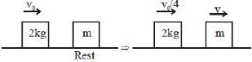
0 likes
View Solution119
DifficultMCQ
$A$ particle of mass $m$ moving with kinetic energy $E$ collides head-on elastically with another particle of mass $2m$ at rest. After the collision,the kinetic energy of the first particle is:
A
$\frac{E}{9}$
B
$\frac{2E}{9}$
C
$\frac{8E}{9}$
D
$E$
Solution
(A) For a one-dimensional elastic collision,the final velocity $v_1$ of the first particle (mass $m_1$) colliding with a stationary particle (mass $m_2$) is given by:
$v_1 = \left( \frac{m_1 - m_2}{m_1 + m_2} \right) u_1$
Given $m_1 = m$,$m_2 = 2m$,and initial kinetic energy $E = \frac{1}{2} m u_1^2$.
The final kinetic energy $E'$ of the first particle is:
$E' = \frac{1}{2} m_1 v_1^2 = \frac{1}{2} m \left( \frac{m - 2m}{m + 2m} \right)^2 u_1^2$
$E' = \left( \frac{-m}{3m} \right)^2 \left( \frac{1}{2} m u_1^2 \right)$
$E' = \left( -\frac{1}{3} \right)^2 E = \frac{1}{9} E$
Thus,the kinetic energy of the first particle after the collision is $\frac{E}{9}$.
$v_1 = \left( \frac{m_1 - m_2}{m_1 + m_2} \right) u_1$
Given $m_1 = m$,$m_2 = 2m$,and initial kinetic energy $E = \frac{1}{2} m u_1^2$.
The final kinetic energy $E'$ of the first particle is:
$E' = \frac{1}{2} m_1 v_1^2 = \frac{1}{2} m \left( \frac{m - 2m}{m + 2m} \right)^2 u_1^2$
$E' = \left( \frac{-m}{3m} \right)^2 \left( \frac{1}{2} m u_1^2 \right)$
$E' = \left( -\frac{1}{3} \right)^2 E = \frac{1}{9} E$
Thus,the kinetic energy of the first particle after the collision is $\frac{E}{9}$.
0 likes
View Solution120
MediumMCQ
The bob $A$ of a simple pendulum is released when the string makes an angle of $45^o$ with the vertical. It hits another bob $B$ of the same material and same mass kept at rest on the table. If the collision is elastic,then
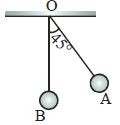
A
Both $A$ and $B$ rise to the same height
B
Both $A$ and $B$ come to rest at $B$
C
Both $A$ and $B$ move with the same velocity of $A$
D
$A$ comes to rest and $B$ moves with the velocity of $A$
Solution
(D) In a one-dimensional elastic collision between two bodies of equal mass,where one body is initially at rest,the bodies exchange their velocities after the collision.
Since bob $A$ and bob $B$ have the same mass and the collision is elastic,bob $A$ transfers its entire velocity to bob $B$.
Consequently,bob $A$ comes to rest immediately after the collision,and bob $B$ starts moving with the velocity that bob $A$ had just before the collision.
Since bob $A$ and bob $B$ have the same mass and the collision is elastic,bob $A$ transfers its entire velocity to bob $B$.
Consequently,bob $A$ comes to rest immediately after the collision,and bob $B$ starts moving with the velocity that bob $A$ had just before the collision.
0 likes
View Solution121
MediumMCQ
Two smooth objects with a coefficient of restitution $e$ collide directly and bounce as shown. Newton's law of restitution gives:
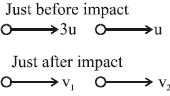
A
$e \times 4u = v_2 + v_1$
B
$e \times 2u = v_1 + v_2$
C
$e \times 2u = v_2 - v_1$
D
It cannot be applied as the masses are not known.
Solution
(C) Newton's law of restitution states that the coefficient of restitution $e$ is the ratio of the relative velocity of separation to the relative velocity of approach.
$e = \frac{\text{Relative velocity of separation}}{\text{Relative velocity of approach}}$
From the given diagram,the velocities just before impact are $u_1 = 3u$ and $u_2 = u$.
Therefore,the relative velocity of approach is $u_1 - u_2 = 3u - u = 2u$.
The velocities just after impact are $v_1$ and $v_2$.
Therefore,the relative velocity of separation is $v_2 - v_1$.
Substituting these into the formula:
$e = \frac{v_2 - v_1}{2u}$
$e \times 2u = v_2 - v_1$
$e = \frac{\text{Relative velocity of separation}}{\text{Relative velocity of approach}}$
From the given diagram,the velocities just before impact are $u_1 = 3u$ and $u_2 = u$.
Therefore,the relative velocity of approach is $u_1 - u_2 = 3u - u = 2u$.
The velocities just after impact are $v_1$ and $v_2$.
Therefore,the relative velocity of separation is $v_2 - v_1$.
Substituting these into the formula:
$e = \frac{v_2 - v_1}{2u}$
$e \times 2u = v_2 - v_1$
0 likes
View Solution122
MediumMCQ
Which of the following statements is true?
A
Kinetic energy is conserved in all types of collisions.
B
By definition,there is no difference between elastic and perfectly elastic collisions.
C
By definition,there is no difference between inelastic and perfectly inelastic collisions.
D
After the collision,the relative displacement of the particles decreases with time.
Solution
(B) For an elastic collision between two bodies of masses $m_{1}$ and $m_{2}$,the law of conservation of momentum states:
$m_{1} u_{1} + m_{2} u_{2} = m_{1} v_{1} + m_{2} v_{2}$
$m_{1}(u_{1} - v_{1}) = m_{2}(v_{2} - u_{2})$ $...(i)$
The law of conservation of kinetic energy $(KE)$ states:
$\frac{1}{2} m_{1} u_{1}^{2} + \frac{1}{2} m_{2} u_{2}^{2} = \frac{1}{2} m_{1} v_{1}^{2} + \frac{1}{2} m_{2} v_{2}^{2}$
$m_{1}(u_{1}^{2} - v_{1}^{2}) = m_{2}(v_{2}^{2} - u_{2}^{2})$ $...(ii)$
Dividing equation $(ii)$ by equation $(i)$:
$u_{1} + v_{1} = v_{2} + u_{2}$
$(u_{1} - u_{2}) = (v_{2} - v_{1})$
$\frac{v_{2} - v_{1}}{u_{1} - u_{2}} = 1$
This ratio is the coefficient of restitution $e$. For a perfectly elastic collision,$e = 1$. By definition,the terms 'elastic' and 'perfectly elastic' refer to the same physical process where both momentum and kinetic energy are conserved.
$m_{1} u_{1} + m_{2} u_{2} = m_{1} v_{1} + m_{2} v_{2}$
$m_{1}(u_{1} - v_{1}) = m_{2}(v_{2} - u_{2})$ $...(i)$
The law of conservation of kinetic energy $(KE)$ states:
$\frac{1}{2} m_{1} u_{1}^{2} + \frac{1}{2} m_{2} u_{2}^{2} = \frac{1}{2} m_{1} v_{1}^{2} + \frac{1}{2} m_{2} v_{2}^{2}$
$m_{1}(u_{1}^{2} - v_{1}^{2}) = m_{2}(v_{2}^{2} - u_{2}^{2})$ $...(ii)$
Dividing equation $(ii)$ by equation $(i)$:
$u_{1} + v_{1} = v_{2} + u_{2}$
$(u_{1} - u_{2}) = (v_{2} - v_{1})$
$\frac{v_{2} - v_{1}}{u_{1} - u_{2}} = 1$
This ratio is the coefficient of restitution $e$. For a perfectly elastic collision,$e = 1$. By definition,the terms 'elastic' and 'perfectly elastic' refer to the same physical process where both momentum and kinetic energy are conserved.
0 likes
View Solution123
DifficultMCQ
$A$ ball is dropped from height $h$ on a plane. If the coefficient of restitution of the plane is $e$ and the ball hits the ground two times,the height up to which it reaches after two jumps will be:
A
$e^4h$
B
$eh$
C
$2eh$
D
$eh/2$
Solution
(A) When a ball is dropped from a height $h$,its velocity just before the first impact is $v_0 = \sqrt{2gh}$.
After the first impact with a coefficient of restitution $e$,the velocity becomes $v_1 = ev_0 = e\sqrt{2gh}$.
The height reached after the first jump is $h_1 = \frac{v_1^2}{2g} = e^2h$.
After the second impact,the velocity becomes $v_2 = ev_1 = e^2\sqrt{2gh}$.
The height reached after the second jump is $h_2 = \frac{v_2^2}{2g} = e^4h$.
In general,the height attained after $n$ jumps is given by $h_n = e^{2n}h$.
For $n = 2$,the height is $h_2 = e^{2(2)}h = e^4h$.
After the first impact with a coefficient of restitution $e$,the velocity becomes $v_1 = ev_0 = e\sqrt{2gh}$.
The height reached after the first jump is $h_1 = \frac{v_1^2}{2g} = e^2h$.
After the second impact,the velocity becomes $v_2 = ev_1 = e^2\sqrt{2gh}$.
The height reached after the second jump is $h_2 = \frac{v_2^2}{2g} = e^4h$.
In general,the height attained after $n$ jumps is given by $h_n = e^{2n}h$.
For $n = 2$,the height is $h_2 = e^{2(2)}h = e^4h$.
0 likes
View Solution124
DifficultMCQ
$A$ body of mass $5\, kg$ moving with a velocity $10\, m/s$ collides with another body of mass $20\, kg$ at rest and comes to rest. The velocity of the second body due to the collision is ............ $m/s$.
A
$2.5$
B
$5$
C
$7.5$
D
$10$
Solution
(A) According to the law of conservation of linear momentum,the total momentum before the collision is equal to the total momentum after the collision.
Let $m_1 = 5\, kg$ be the mass of the first body and $u_1 = 10\, m/s$ be its initial velocity.
Let $m_2 = 20\, kg$ be the mass of the second body and $u_2 = 0\, m/s$ be its initial velocity.
After the collision,the first body comes to rest,so $v_1 = 0\, m/s$.
Let $v_2$ be the final velocity of the second body.
The conservation equation is: $m_1 u_1 + m_2 u_2 = m_1 v_1 + m_2 v_2$.
Substituting the values: $(5 \times 10) + (20 \times 0) = (5 \times 0) + (20 \times v_2)$.
$50 + 0 = 0 + 20 v_2$.
$50 = 20 v_2$.
$v_2 = \frac{50}{20} = 2.5\, m/s$.
Let $m_1 = 5\, kg$ be the mass of the first body and $u_1 = 10\, m/s$ be its initial velocity.
Let $m_2 = 20\, kg$ be the mass of the second body and $u_2 = 0\, m/s$ be its initial velocity.
After the collision,the first body comes to rest,so $v_1 = 0\, m/s$.
Let $v_2$ be the final velocity of the second body.
The conservation equation is: $m_1 u_1 + m_2 u_2 = m_1 v_1 + m_2 v_2$.
Substituting the values: $(5 \times 10) + (20 \times 0) = (5 \times 0) + (20 \times v_2)$.
$50 + 0 = 0 + 20 v_2$.
$50 = 20 v_2$.
$v_2 = \frac{50}{20} = 2.5\, m/s$.
0 likes
View Solution125
MediumMCQ
Four smooth steel balls of equal mass at rest are free to move along a straight line without friction. The first ball is given a velocity of $0.4\, m/s$. It collides head-on with the second elastically,the second one similarly with the third and so on. The velocity of the last ball is .............. $m/s$.
A
$0.4$
B
$0.2$
C
$0.1$
D
$0.05$
Solution
(A) When two objects of equal mass undergo a perfectly elastic head-on collision,they exchange their velocities.
Let the masses of the four balls be $m_1 = m_2 = m_3 = m_4 = m$.
The initial velocity of the first ball is $v_1 = 0.4\, m/s$,and the others are at rest $(v_2 = v_3 = v_4 = 0)$.
$1$. Collision between ball $1$ and ball $2$: Ball $1$ comes to rest,and ball $2$ acquires velocity $0.4\, m/s$.
$2$. Collision between ball $2$ and ball $3$: Ball $2$ comes to rest,and ball $3$ acquires velocity $0.4\, m/s$.
$3$. Collision between ball $3$ and ball $4$: Ball $3$ comes to rest,and ball $4$ acquires velocity $0.4\, m/s$.
Thus,the velocity of the last ball is $0.4\, m/s$.
Let the masses of the four balls be $m_1 = m_2 = m_3 = m_4 = m$.
The initial velocity of the first ball is $v_1 = 0.4\, m/s$,and the others are at rest $(v_2 = v_3 = v_4 = 0)$.
$1$. Collision between ball $1$ and ball $2$: Ball $1$ comes to rest,and ball $2$ acquires velocity $0.4\, m/s$.
$2$. Collision between ball $2$ and ball $3$: Ball $2$ comes to rest,and ball $3$ acquires velocity $0.4\, m/s$.
$3$. Collision between ball $3$ and ball $4$: Ball $3$ comes to rest,and ball $4$ acquires velocity $0.4\, m/s$.
Thus,the velocity of the last ball is $0.4\, m/s$.
0 likes
View Solution126
DifficultMCQ
$A$ body of mass $2 \ kg$ makes an elastic collision with another body at rest and continues to move in the original direction with one-fourth of its original speed. The mass of the second body which collides with the first body is ............... $kg$.
A
$2$
B
$1.2$
C
$3$
D
$1.5$
Solution
(B) Let the mass of the first body be $m_1 = 2 \ kg$ and its initial velocity be $u_1$. Let the mass of the second body be $m_2$,which is initially at rest $(u_2 = 0)$.
After an elastic collision,the final velocity $v_1$ of the first body is given by the formula:
$v_1 = \left( \frac{m_1 - m_2}{m_1 + m_2} \right) u_1$
According to the problem,the first body continues to move in the original direction with one-fourth of its original speed,so $v_1 = \frac{u_1}{4}$.
Equating the two expressions for $v_1$:
$\frac{u_1}{4} = \left( \frac{2 - m_2}{2 + m_2} \right) u_1$
$\frac{1}{4} = \frac{2 - m_2}{2 + m_2}$
$2 + m_2 = 4(2 - m_2)$
$2 + m_2 = 8 - 4m_2$
$5m_2 = 6$
$m_2 = \frac{6}{5} = 1.2 \ kg$.
After an elastic collision,the final velocity $v_1$ of the first body is given by the formula:
$v_1 = \left( \frac{m_1 - m_2}{m_1 + m_2} \right) u_1$
According to the problem,the first body continues to move in the original direction with one-fourth of its original speed,so $v_1 = \frac{u_1}{4}$.
Equating the two expressions for $v_1$:
$\frac{u_1}{4} = \left( \frac{2 - m_2}{2 + m_2} \right) u_1$
$\frac{1}{4} = \frac{2 - m_2}{2 + m_2}$
$2 + m_2 = 4(2 - m_2)$
$2 + m_2 = 8 - 4m_2$
$5m_2 = 6$
$m_2 = \frac{6}{5} = 1.2 \ kg$.
0 likes
View Solution127
EasyMCQ
When two particles collide elastically,then impulsive force can't change
A
Momentum of each particle
B
Momentum of system
C
Kinetic energy of each particle
D
Kinetic energy of system
Solution
(B) In an elastic collision between two particles,the impulsive force acts between the particles during the short duration of the collision.
According to Newton's second law,the impulsive force changes the momentum of each individual particle.
However,for the system as a whole,the impulsive forces are internal forces.
According to the law of conservation of linear momentum,the total momentum of the system remains constant in the absence of any external force.
Therefore,the impulsive force cannot change the total momentum of the system.
According to Newton's second law,the impulsive force changes the momentum of each individual particle.
However,for the system as a whole,the impulsive forces are internal forces.
According to the law of conservation of linear momentum,the total momentum of the system remains constant in the absence of any external force.
Therefore,the impulsive force cannot change the total momentum of the system.
0 likes
View Solution128
MediumMCQ
$A$ heavy body moving with a velocity of $6\,ms^{-1}$ collides elastically with a light body (whose mass is half of the mass of the heavy body) at rest. The velocity of the light body will be (in $ms^{-1}$):
A
$12$
B
$8$
C
$6$
D
Very large
Solution
(B) Let the mass of the heavy body be $M$ and the mass of the light body be $m = M/2$. Let the initial velocity of the heavy body be $u_1 = 6\,ms^{-1}$ and the light body be $u_2 = 0$.
For a one-dimensional elastic collision,the final velocity $v_2$ of the second body (light body) is given by the formula:
$v_2 = \frac{2M_1 u_1}{M_1 + M_2} + \frac{(M_2 - M_1) u_2}{M_1 + M_2}$
Substituting $M_1 = M$,$M_2 = M/2$,$u_1 = 6$,and $u_2 = 0$:
$v_2 = \frac{2M(6)}{M + M/2} + 0$
$v_2 = \frac{12M}{1.5M} = \frac{12}{1.5} = 8\,ms^{-1}$.
For a one-dimensional elastic collision,the final velocity $v_2$ of the second body (light body) is given by the formula:
$v_2 = \frac{2M_1 u_1}{M_1 + M_2} + \frac{(M_2 - M_1) u_2}{M_1 + M_2}$
Substituting $M_1 = M$,$M_2 = M/2$,$u_1 = 6$,and $u_2 = 0$:
$v_2 = \frac{2M(6)}{M + M/2} + 0$
$v_2 = \frac{12M}{1.5M} = \frac{12}{1.5} = 8\,ms^{-1}$.
0 likes
View Solution129
DifficultMCQ
$A$ ball impinges directly on a similar ball at rest. If $1/4^{th}$ of the kinetic energy is lost by the impact, the value of the coefficient of restitution is:
A
$\frac{1}{2\sqrt{2}}$
B
$\frac{1}{\sqrt{3}}$
C
$\frac{1}{\sqrt{2}}$
D
$\frac{\sqrt{3}}{2}$
Solution
(C) Let the mass of each ball be $m$. The initial velocity of the first ball is $u$ and the second ball is at rest $(0)$.
The initial kinetic energy of the system is $KE_i = \frac{1}{2}mu^2$.
The loss in kinetic energy during a perfectly inelastic collision between two equal masses is given by $\Delta KE = \frac{1}{4}m(1-e^2)u^2$.
Given that the loss in kinetic energy is $\frac{1}{4}$ of the initial kinetic energy:
$\Delta KE = \frac{1}{4} KE_i = \frac{1}{4} (\frac{1}{2}mu^2) = \frac{1}{8}mu^2$.
Equating the two expressions for $\Delta KE$:
$\frac{1}{4}m(1-e^2)u^2 = \frac{1}{8}mu^2$.
Dividing both sides by $\frac{1}{4}mu^2$:
$1-e^2 = \frac{1}{2}$.
$e^2 = 1 - \frac{1}{2} = \frac{1}{2}$.
$e = \frac{1}{\sqrt{2}}$.
The initial kinetic energy of the system is $KE_i = \frac{1}{2}mu^2$.
The loss in kinetic energy during a perfectly inelastic collision between two equal masses is given by $\Delta KE = \frac{1}{4}m(1-e^2)u^2$.
Given that the loss in kinetic energy is $\frac{1}{4}$ of the initial kinetic energy:
$\Delta KE = \frac{1}{4} KE_i = \frac{1}{4} (\frac{1}{2}mu^2) = \frac{1}{8}mu^2$.
Equating the two expressions for $\Delta KE$:
$\frac{1}{4}m(1-e^2)u^2 = \frac{1}{8}mu^2$.
Dividing both sides by $\frac{1}{4}mu^2$:
$1-e^2 = \frac{1}{2}$.
$e^2 = 1 - \frac{1}{2} = \frac{1}{2}$.
$e = \frac{1}{\sqrt{2}}$.
0 likes
View Solution130
DifficultMCQ
Six steel balls of identical size are lined up along a straight frictionless groove. Two similar balls moving with a speed $V$ along the groove collide with this row on the extreme left end. Then:
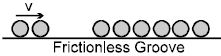
A
all the balls will start moving to the right with speed $V/8$ each
B
all the six balls initially at rest will move on with speed $V/6$ each and two identical balls will come to rest
C
two balls from the extreme right end will move on with speed $V$ each and the remaining balls will remain at rest
D
one ball from the right end will move on with speed $2V$,the remaining balls will be at rest
Solution
(C) When two particles of equal mass undergo a head-on perfectly elastic collision,they exchange their velocities.
In this scenario,the two moving balls collide with the first ball of the stationary row. Because the masses are identical and the collision is perfectly elastic,the momentum and kinetic energy are transferred through the chain.
The first moving ball transfers its velocity $V$ to the first stationary ball,which then transfers it to the next,and so on,until the velocity reaches the end of the row.
Since there are two incoming balls,this process happens for both. Consequently,the two balls at the extreme right end of the row will move off with speed $V$ each,while the remaining balls (the original six plus the two incoming ones) will come to rest.
In this scenario,the two moving balls collide with the first ball of the stationary row. Because the masses are identical and the collision is perfectly elastic,the momentum and kinetic energy are transferred through the chain.
The first moving ball transfers its velocity $V$ to the first stationary ball,which then transfers it to the next,and so on,until the velocity reaches the end of the row.
Since there are two incoming balls,this process happens for both. Consequently,the two balls at the extreme right end of the row will move off with speed $V$ each,while the remaining balls (the original six plus the two incoming ones) will come to rest.
0 likes
View Solution131
DifficultMCQ
$A$ neutron moving with velocity $u$ collides elastically with an atom of mass number $A$. If the collision is head-on and the initial kinetic energy of the neutron is $E$, then the final kinetic energy of the neutron after the collision is:
A
${\left( {\frac{{A + 1}}{{A - 1}}} \right)^2}E$
B
${\left( {\frac{{A - 1}}{{A + 1}}} \right)^2}E$
C
${\left( {\frac{{A - 1}}{{A + 1}}} \right)}E$
D
${\left( {\frac{{A + 1}}{{A - 1}}} \right)}E$
Solution
(B) Let the mass of the neutron be $m$. The mass of the atom is $Am$.
Using the conservation of linear momentum: $mu + Am(0) = mv_1 + Amv_2$, which simplifies to $u = v_1 + Av_2$ (Equation $1$).
For an elastic head-on collision, the coefficient of restitution $e = 1$, so $v_2 - v_1 = u$ (Equation $2$).
From Equation $2$, $v_2 = u + v_1$. Substituting this into Equation $1$:
$u = v_1 + A(u + v_1) = v_1 + Au + Av_1 = v_1(1 + A) + Au$.
$v_1(1 + A) = u - Au = u(1 - A)$.
$v_1 = u \frac{1 - A}{1 + A}$.
The initial kinetic energy is $E = \frac{1}{2}mu^2$.
The final kinetic energy of the neutron is $E' = \frac{1}{2}mv_1^2 = \frac{1}{2}m \left( u \frac{1 - A}{1 + A} \right)^2$.
$E' = \left( \frac{1}{2}mu^2 \right) \left( \frac{1 - A}{1 + A} \right)^2 = E \left( \frac{A - 1}{A + 1} \right)^2$.
Using the conservation of linear momentum: $mu + Am(0) = mv_1 + Amv_2$, which simplifies to $u = v_1 + Av_2$ (Equation $1$).
For an elastic head-on collision, the coefficient of restitution $e = 1$, so $v_2 - v_1 = u$ (Equation $2$).
From Equation $2$, $v_2 = u + v_1$. Substituting this into Equation $1$:
$u = v_1 + A(u + v_1) = v_1 + Au + Av_1 = v_1(1 + A) + Au$.
$v_1(1 + A) = u - Au = u(1 - A)$.
$v_1 = u \frac{1 - A}{1 + A}$.
The initial kinetic energy is $E = \frac{1}{2}mu^2$.
The final kinetic energy of the neutron is $E' = \frac{1}{2}mv_1^2 = \frac{1}{2}m \left( u \frac{1 - A}{1 + A} \right)^2$.
$E' = \left( \frac{1}{2}mu^2 \right) \left( \frac{1 - A}{1 + A} \right)^2 = E \left( \frac{A - 1}{A + 1} \right)^2$.
0 likes
View Solution132
EasyMCQ
$Assertion$ : In an elastic collision of two billiard balls,the total kinetic energy is conserved during the short time of oscillation of the balls (i.e.,when they are in contact).
$Reason$ : Energy spent against friction does not follow the law of conservation of energy.
$Reason$ : Energy spent against friction does not follow the law of conservation of energy.
A
If both $Assertion$ and $Reason$ are correct and the $Reason$ is a correct explanation of the $Assertion$.
B
If both $Assertion$ and $Reason$ are correct but $Reason$ is not a correct explanation of the $Assertion$.
C
If the $Assertion$ is correct but $Reason$ is incorrect.
D
If both the $Assertion$ and $Reason$ are incorrect.
Solution
(D) In an elastic collision,the total kinetic energy is conserved throughout the process,including the time of contact. During the collision,kinetic energy is temporarily converted into elastic potential energy and then back into kinetic energy,so the total mechanical energy remains constant. Thus,the $Assertion$ is incorrect because kinetic energy is not conserved *during* the contact time (it is converted to potential energy).
The $Reason$ is also incorrect because the law of conservation of energy is a universal law; energy spent against friction is converted into heat or sound,and the total energy of the system (including heat/sound) remains conserved.
The $Reason$ is also incorrect because the law of conservation of energy is a universal law; energy spent against friction is converted into heat or sound,and the total energy of the system (including heat/sound) remains conserved.
1 likes
View Solution133
MediumMCQ
$Assertion$: $n$ small balls each of mass $m$ collide elastically each second on a surface with velocity $u$. The force experienced by the surface is $2mnu$.
$Reason$: On elastic collision,the ball rebounds with the same velocity.
$Reason$: On elastic collision,the ball rebounds with the same velocity.
A
If both $Assertion$ and $Reason$ are correct and the $Reason$ is a correct explanation of the $Assertion$.
B
If both $Assertion$ and $Reason$ are correct but $Reason$ is not a correct explanation of the $Assertion$.
C
If the $Assertion$ is correct but $Reason$ is incorrect.
D
If both the $Assertion$ and $Reason$ are incorrect.
Solution
(A) In an elastic collision,kinetic energy is conserved,therefore the ball rebounds with the same velocity $u$ in the opposite direction.
According to Newton's second law,the force $F$ exerted by the surface is equal to the rate of change of momentum.
The change in momentum for one ball is $\Delta p = m(u - (-u)) = 2mu$.
Since $n$ balls collide per second,the total change in momentum per second is $n \times 2mu = 2mnu$.
Therefore,the force experienced by the surface is $F = 2mnu$.
Both the $Assertion$ and $Reason$ are correct,and the $Reason$ explains why the change in momentum is $2mu$ per ball.
According to Newton's second law,the force $F$ exerted by the surface is equal to the rate of change of momentum.
The change in momentum for one ball is $\Delta p = m(u - (-u)) = 2mu$.
Since $n$ balls collide per second,the total change in momentum per second is $n \times 2mu = 2mnu$.
Therefore,the force experienced by the surface is $F = 2mnu$.
Both the $Assertion$ and $Reason$ are correct,and the $Reason$ explains why the change in momentum is $2mu$ per ball.
0 likes
View Solution134
EasyMCQ
$Assertion$ : If collision occurs between two elastic bodies,their kinetic energy decreases during the time of collision.
$Reason$ : During collision,intermolecular space decreases and hence elastic potential energy increases.
$Reason$ : During collision,intermolecular space decreases and hence elastic potential energy increases.
A
If both $Assertion$ and $Reason$ are correct and the $Reason$ is a correct explanation of the $Assertion$.
B
If both $Assertion$ and $Reason$ are correct but $Reason$ is not a correct explanation of the $Assertion$.
C
If the $Assertion$ is correct but $Reason$ is incorrect.
D
If both the $Assertion$ and $Reason$ are incorrect.
Solution
(A) During the collision of two elastic bodies,the bodies undergo deformation.
As the bodies deform,the intermolecular distance between the particles decreases,leading to an increase in the elastic potential energy of the system.
According to the law of conservation of energy,the total energy of the system remains constant.
Since the elastic potential energy increases during the deformation phase of the collision,the kinetic energy $(K.E.)$ of the system must decrease to compensate for this change.
Therefore,both the $Assertion$ and the $Reason$ are correct,and the $Reason$ provides the correct explanation for the $Assertion$.
As the bodies deform,the intermolecular distance between the particles decreases,leading to an increase in the elastic potential energy of the system.
According to the law of conservation of energy,the total energy of the system remains constant.
Since the elastic potential energy increases during the deformation phase of the collision,the kinetic energy $(K.E.)$ of the system must decrease to compensate for this change.
Therefore,both the $Assertion$ and the $Reason$ are correct,and the $Reason$ provides the correct explanation for the $Assertion$.
0 likes
View Solution135
DifficultMCQ
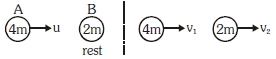
$A$ body $A$ of mass $4m$ moving with speed $u$ collides with another body $B$ of mass $2m$,which is at rest. The collision is head-on and elastic in nature. After the collision,the fraction of energy lost by the colliding body $A$ is
A
$\frac{1}{9}$
B
$\frac{8}{9}$
C
$\frac{4}{9}$
D
$\frac{5}{9}$
Solution
(B) For a one-dimensional elastic collision where body $B$ is initially at rest,the final velocity $v_1$ of body $A$ is given by:
$v_1 = \left( \frac{m_1 - m_2}{m_1 + m_2} \right) u$
Substituting $m_1 = 4m$ and $m_2 = 2m$:
$v_1 = \left( \frac{4m - 2m}{4m + 2m} \right) u = \left( \frac{2m}{6m} \right) u = \frac{u}{3}$
Initial kinetic energy of body $A$ is $K_i = \frac{1}{2}(4m)u^2 = 2mu^2$.
Final kinetic energy of body $A$ is $K_f = \frac{1}{2}(4m)v_1^2 = \frac{1}{2}(4m)\left(\frac{u}{3}\right)^2 = \frac{2mu^2}{9}$.
The energy lost by body $A$ is $\Delta K = K_i - K_f = 2mu^2 - \frac{2mu^2}{9} = \frac{16mu^2}{9}$.
The fraction of energy lost is $\frac{\Delta K}{K_i} = \frac{16mu^2 / 9}{2mu^2} = \frac{16}{18} = \frac{8}{9}$.
$v_1 = \left( \frac{m_1 - m_2}{m_1 + m_2} \right) u$
Substituting $m_1 = 4m$ and $m_2 = 2m$:
$v_1 = \left( \frac{4m - 2m}{4m + 2m} \right) u = \left( \frac{2m}{6m} \right) u = \frac{u}{3}$
Initial kinetic energy of body $A$ is $K_i = \frac{1}{2}(4m)u^2 = 2mu^2$.
Final kinetic energy of body $A$ is $K_f = \frac{1}{2}(4m)v_1^2 = \frac{1}{2}(4m)\left(\frac{u}{3}\right)^2 = \frac{2mu^2}{9}$.
The energy lost by body $A$ is $\Delta K = K_i - K_f = 2mu^2 - \frac{2mu^2}{9} = \frac{16mu^2}{9}$.
The fraction of energy lost is $\frac{\Delta K}{K_i} = \frac{16mu^2 / 9}{2mu^2} = \frac{16}{18} = \frac{8}{9}$.
0 likes
View Solution136
MediumMCQ
$A$ body $A$ of mass $m=0.1 \; kg$ has an initial velocity of $3 \hat{i} \; ms^{-1}$. It collides elastically with another body $B$ of the same mass which has an initial velocity of $5 \hat{j} \; ms^{-1}$. After the collision,$A$ moves with a velocity $\vec{v}_A = 4(\hat{i} + \hat{j}) \; ms^{-1}$. The energy of $B$ after the collision is written as $\frac{x}{10} \; J$. The value of $x$ is:
A
$4$
B
$2$
C
$3$
D
$1$
Solution
(D) By the law of conservation of linear momentum:
$m \vec{u}_A + m \vec{u}_B = m \vec{v}_A + m \vec{v}_B$
Given $m = 0.1 \; kg$,$\vec{u}_A = 3 \hat{i} \; ms^{-1}$,$\vec{u}_B = 5 \hat{j} \; ms^{-1}$,and $\vec{v}_A = 4(\hat{i} + \hat{j}) \; ms^{-1}$.
Substituting the values:
$0.1(3 \hat{i}) + 0.1(5 \hat{j}) = 0.1(4 \hat{i} + 4 \hat{j}) + 0.1 \vec{v}_B$
Dividing by $0.1$:
$3 \hat{i} + 5 \hat{j} = 4 \hat{i} + 4 \hat{j} + \vec{v}_B$
$\vec{v}_B = (3-4) \hat{i} + (5-4) \hat{j} = -\hat{i} + \hat{j} \; ms^{-1}$.
The speed of $B$ after the collision is $|\vec{v}_B| = \sqrt{(-1)^2 + (1)^2} = \sqrt{2} \; ms^{-1}$.
The kinetic energy of $B$ after the collision is $K_B = \frac{1}{2} m |\vec{v}_B|^2$.
$K_B = \frac{1}{2} (0.1) (\sqrt{2})^2 = \frac{1}{2} (0.1) (2) = 0.1 \; J$.
Since $K_B = \frac{x}{10} \; J$,we have $0.1 = \frac{x}{10}$,which implies $x = 1$.
$m \vec{u}_A + m \vec{u}_B = m \vec{v}_A + m \vec{v}_B$
Given $m = 0.1 \; kg$,$\vec{u}_A = 3 \hat{i} \; ms^{-1}$,$\vec{u}_B = 5 \hat{j} \; ms^{-1}$,and $\vec{v}_A = 4(\hat{i} + \hat{j}) \; ms^{-1}$.
Substituting the values:
$0.1(3 \hat{i}) + 0.1(5 \hat{j}) = 0.1(4 \hat{i} + 4 \hat{j}) + 0.1 \vec{v}_B$
Dividing by $0.1$:
$3 \hat{i} + 5 \hat{j} = 4 \hat{i} + 4 \hat{j} + \vec{v}_B$
$\vec{v}_B = (3-4) \hat{i} + (5-4) \hat{j} = -\hat{i} + \hat{j} \; ms^{-1}$.
The speed of $B$ after the collision is $|\vec{v}_B| = \sqrt{(-1)^2 + (1)^2} = \sqrt{2} \; ms^{-1}$.
The kinetic energy of $B$ after the collision is $K_B = \frac{1}{2} m |\vec{v}_B|^2$.
$K_B = \frac{1}{2} (0.1) (\sqrt{2})^2 = \frac{1}{2} (0.1) (2) = 0.1 \; J$.
Since $K_B = \frac{x}{10} \; J$,we have $0.1 = \frac{x}{10}$,which implies $x = 1$.
0 likes
View Solution137
Medium
Consider the collision depicted in the figure to be between two billiard balls with equal masses $m_{1} = m_{2}$. The first ball is called the cue, while the second ball is called the target. The billiard player wants to 'sink' the target ball in a corner pocket, which is at an angle $\theta_{2} = 37^{\circ}$. Assume that the collision is elastic and that friction and rotational motion are not important. Obtain $\theta_{1}$.
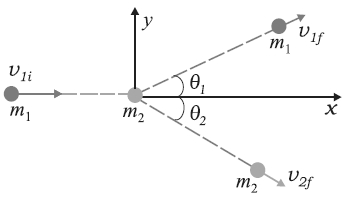
Solution
$(53^{\circ})$ From the law of conservation of linear momentum, since the masses are equal $(m_{1} = m_{2})$, we have:
$\vec{v}_{1i} = \vec{v}_{1f} + \vec{v}_{2f}$
Taking the dot product of the velocity vector with itself:
$v_{1i}^{2} = (\vec{v}_{1f} + \vec{v}_{2f}) \cdot (\vec{v}_{1f} + \vec{v}_{2f})$
$v_{1i}^{2} = v_{1f}^{2} + v_{2f}^{2} + 2\vec{v}_{1f} \cdot \vec{v}_{2f}$
$v_{1i}^{2} = v_{1f}^{2} + v_{2f}^{2} + 2v_{1f}v_{2f} \cos(\theta_{1} + \theta_{2})$
Since the collision is elastic and the masses are equal, the conservation of kinetic energy implies:
$\frac{1}{2}m v_{1i}^{2} = \frac{1}{2}m v_{1f}^{2} + \frac{1}{2}m v_{2f}^{2}$
$v_{1i}^{2} = v_{1f}^{2} + v_{2f}^{2}$
Comparing the two expressions for $v_{1i}^{2}$, we get:
$2v_{1f}v_{2f} \cos(\theta_{1} + \theta_{2}) = 0$
Since $v_{1f} \neq 0$ and $v_{2f} \neq 0$, we must have $\cos(\theta_{1} + \theta_{2}) = 0$, which implies $\theta_{1} + \theta_{2} = 90^{\circ}$.
Given $\theta_{2} = 37^{\circ}$, we find:
$\theta_{1} = 90^{\circ} - 37^{\circ} = 53^{\circ}$.
Thus, the balls move at right angles to each other after the collision.
$\vec{v}_{1i} = \vec{v}_{1f} + \vec{v}_{2f}$
Taking the dot product of the velocity vector with itself:
$v_{1i}^{2} = (\vec{v}_{1f} + \vec{v}_{2f}) \cdot (\vec{v}_{1f} + \vec{v}_{2f})$
$v_{1i}^{2} = v_{1f}^{2} + v_{2f}^{2} + 2\vec{v}_{1f} \cdot \vec{v}_{2f}$
$v_{1i}^{2} = v_{1f}^{2} + v_{2f}^{2} + 2v_{1f}v_{2f} \cos(\theta_{1} + \theta_{2})$
Since the collision is elastic and the masses are equal, the conservation of kinetic energy implies:
$\frac{1}{2}m v_{1i}^{2} = \frac{1}{2}m v_{1f}^{2} + \frac{1}{2}m v_{2f}^{2}$
$v_{1i}^{2} = v_{1f}^{2} + v_{2f}^{2}$
Comparing the two expressions for $v_{1i}^{2}$, we get:
$2v_{1f}v_{2f} \cos(\theta_{1} + \theta_{2}) = 0$
Since $v_{1f} \neq 0$ and $v_{2f} \neq 0$, we must have $\cos(\theta_{1} + \theta_{2}) = 0$, which implies $\theta_{1} + \theta_{2} = 90^{\circ}$.
Given $\theta_{2} = 37^{\circ}$, we find:
$\theta_{1} = 90^{\circ} - 37^{\circ} = 53^{\circ}$.
Thus, the balls move at right angles to each other after the collision.
0 likes
View Solution138
MediumMCQ
Two identical ball bearings in contact with each other and resting on a frictionless table are hit head-on by another ball bearing of the same mass moving initially with a speed $V$. If the collision is elastic,which of the following figure is a possible result after collision?
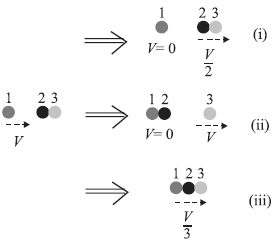
A
Only $(i)$
B
Only $(ii)$
C
Only $(iii)$
D
$(i)$ and $(iii)$
Solution
(B) It can be observed that the total momentum before and after the collision in each case is constant.
For an elastic collision,the total kinetic energy of a system remains conserved before and after the collision.
For mass of each ball bearing $m,$ we can write:
Total kinetic energy of the system before collision:
$= \frac{1}{2} m V^{2} + \frac{1}{2}(2m)(0)^{2} = \frac{1}{2} m V^{2}$
Case $(i)$:
Total kinetic energy of the system after collision
$= \frac{1}{2} m (0)^{2} + \frac{1}{2}(2m) \left( \frac{V}{2} \right)^{2} = \frac{1}{4} m V^{2}$
Since $\frac{1}{4} m V^{2} \neq \frac{1}{2} m V^{2}$,the kinetic energy is not conserved.
Case $(ii)$:
Total kinetic energy of the system after collision
$= \frac{1}{2}(2m)(0)^{2} + \frac{1}{2} m V^{2} = \frac{1}{2} m V^{2}$
Since $\frac{1}{2} m V^{2} = \frac{1}{2} m V^{2}$,the kinetic energy is conserved.
Case $(iii)$:
Total kinetic energy of the system after collision
$= \frac{1}{2}(3m) \left( \frac{V}{3} \right)^{2} = \frac{1}{6} m V^{2}$
Since $\frac{1}{6} m V^{2} \neq \frac{1}{2} m V^{2}$,the kinetic energy is not conserved.
Thus,only case $(ii)$ represents a possible result for an elastic collision.
For an elastic collision,the total kinetic energy of a system remains conserved before and after the collision.
For mass of each ball bearing $m,$ we can write:
Total kinetic energy of the system before collision:
$= \frac{1}{2} m V^{2} + \frac{1}{2}(2m)(0)^{2} = \frac{1}{2} m V^{2}$
Case $(i)$:
Total kinetic energy of the system after collision
$= \frac{1}{2} m (0)^{2} + \frac{1}{2}(2m) \left( \frac{V}{2} \right)^{2} = \frac{1}{4} m V^{2}$
Since $\frac{1}{4} m V^{2} \neq \frac{1}{2} m V^{2}$,the kinetic energy is not conserved.
Case $(ii)$:
Total kinetic energy of the system after collision
$= \frac{1}{2}(2m)(0)^{2} + \frac{1}{2} m V^{2} = \frac{1}{2} m V^{2}$
Since $\frac{1}{2} m V^{2} = \frac{1}{2} m V^{2}$,the kinetic energy is conserved.
Case $(iii)$:
Total kinetic energy of the system after collision
$= \frac{1}{2}(3m) \left( \frac{V}{3} \right)^{2} = \frac{1}{6} m V^{2}$
Since $\frac{1}{6} m V^{2} \neq \frac{1}{2} m V^{2}$,the kinetic energy is not conserved.
Thus,only case $(ii)$ represents a possible result for an elastic collision.
0 likes
View Solution139
Medium
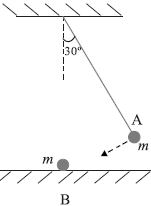
The bob $A$ of a pendulum released from $30^o$ to the vertical hits another bob $B$ of the same mass at rest on a table as shown in Figure. How high does the bob $A$ rise after the collision? Neglect the size of the bobs and assume the collision to be elastic.
Solution
(A) Bob $A$ will not rise at all.
In an elastic collision between two equal masses in which one is stationary,while the other is moving with some velocity,the stationary mass acquires the same velocity,while the moving mass immediately comes to rest after the collision. In this case,a complete transfer of momentum and kinetic energy takes place from the moving mass to the stationary mass.
Hence,bob $A$ of mass $m$,after colliding with bob $B$ of equal mass,will come to rest,while bob $B$ will move with the velocity of bob $A$ at the instant of collision. Since bob $A$ comes to rest at the lowest point,it will not rise at all.
In an elastic collision between two equal masses in which one is stationary,while the other is moving with some velocity,the stationary mass acquires the same velocity,while the moving mass immediately comes to rest after the collision. In this case,a complete transfer of momentum and kinetic energy takes place from the moving mass to the stationary mass.
Hence,bob $A$ of mass $m$,after colliding with bob $B$ of equal mass,will come to rest,while bob $B$ will move with the velocity of bob $A$ at the instant of collision. Since bob $A$ comes to rest at the lowest point,it will not rise at all.
0 likes
View Solution140
Medium
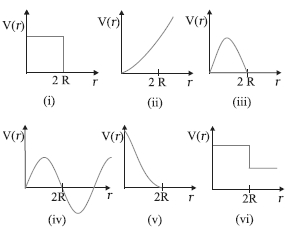
Which of the following potential energy curves in the figure cannot possibly describe the elastic collision of two billiard balls? Here $r$ is the distance between the centres of the balls.
Solution
(A) For an elastic collision between two hard billiard balls,the potential energy $V(r)$ must satisfy two conditions:
$1$. When the distance $r$ between the centers is greater than $2R$ (where $R$ is the radius of each ball),the balls do not interact,so the potential energy $V(r) = 0$.
$2$. When the distance $r$ is less than $2R$,the balls are in contact and undergo deformation,leading to a rapid increase in potential energy. At the point of contact $r = 2R$,the potential energy should be zero,and for $r < 2R$,it should be positive and increasing.
Looking at the given curves:
- Curve $(v)$ shows $V(r) = 0$ for $r \ge 2R$ and $V(r) > 0$ for $r < 2R$,which correctly describes the interaction.
- Curves $(i), (ii), (iii), (iv),$ and $(vi)$ do not satisfy these physical requirements. For example,$(ii)$ shows potential energy increasing with distance,which is incorrect,and $(i)$ and $(vi)$ show non-zero potential energy for $r > 2R$.
Therefore,the curves that cannot describe the elastic collision are $(i), (ii), (iii), (iv),$ and $(vi)$.
$1$. When the distance $r$ between the centers is greater than $2R$ (where $R$ is the radius of each ball),the balls do not interact,so the potential energy $V(r) = 0$.
$2$. When the distance $r$ is less than $2R$,the balls are in contact and undergo deformation,leading to a rapid increase in potential energy. At the point of contact $r = 2R$,the potential energy should be zero,and for $r < 2R$,it should be positive and increasing.
Looking at the given curves:
- Curve $(v)$ shows $V(r) = 0$ for $r \ge 2R$ and $V(r) > 0$ for $r < 2R$,which correctly describes the interaction.
- Curves $(i), (ii), (iii), (iv),$ and $(vi)$ do not satisfy these physical requirements. For example,$(ii)$ shows potential energy increasing with distance,which is incorrect,and $(i)$ and $(vi)$ show non-zero potential energy for $r > 2R$.
Therefore,the curves that cannot describe the elastic collision are $(i), (ii), (iii), (iv),$ and $(vi)$.
0 likes
View Solution141
Easy
Derive the expressions for the velocities of two bodies after a one-dimensional elastic collision.
Solution
(N/A) Consider two bodies of masses $m_1$ and $m_2$ moving in a straight line along the $X$-direction. Let their initial velocities be $v_{1i}$ and $v_{2i}$ respectively,with $v_{1i} > v_{2i}$.
After the collision,let their final velocities be $v_{1f}$ and $v_{2f}$. In an elastic collision,both linear momentum and kinetic energy are conserved.
Conservation of linear momentum:
$m_1 v_{1i} + m_2 v_{2i} = m_1 v_{1f} + m_2 v_{2f}$
$m_1(v_{1i} - v_{1f}) = m_2(v_{2f} - v_{2i})$ ---$(1)$
Conservation of kinetic energy:
$\frac{1}{2} m_1 v_{1i}^2 + \frac{1}{2} m_2 v_{2i}^2 = \frac{1}{2} m_1 v_{1f}^2 + \frac{1}{2} m_2 v_{2f}^2$
$m_1(v_{1i}^2 - v_{1f}^2) = m_2(v_{2f}^2 - v_{2i}^2)$
$m_1(v_{1i} - v_{1f})(v_{1i} + v_{1f}) = m_2(v_{2f} - v_{2i})(v_{2f} + v_{2i})$ ---$(2)$
Dividing equation $(2)$ by equation $(1)$:
$v_{1i} + v_{1f} = v_{2f} + v_{2i}$
$v_{1f} = v_{2f} + v_{2i} - v_{1i}$ ---$(3)$
Substituting $(3)$ into $(1)$:
$m_1(v_{1i} - (v_{2f} + v_{2i} - v_{1i})) = m_2(v_{2f} - v_{2i})$
$m_1(2v_{1i} - v_{2i} - v_{2f}) = m_2(v_{2f} - v_{2i})$
$2m_1 v_{1i} - m_1 v_{2i} - m_1 v_{2f} = m_2 v_{2f} - m_2 v_{2i}$
$2m_1 v_{1i} + (m_2 - m_1)v_{2i} = (m_1 + m_2)v_{2f}$
$v_{2f} = \frac{2m_1}{m_1 + m_2}v_{1i} + \frac{m_2 - m_1}{m_1 + m_2}v_{2i}$
Similarly,for $v_{1f}$:
$v_{1f} = \frac{m_1 - m_2}{m_1 + m_2}v_{1i} + \frac{2m_2}{m_1 + m_2}v_{2i}$
After the collision,let their final velocities be $v_{1f}$ and $v_{2f}$. In an elastic collision,both linear momentum and kinetic energy are conserved.
Conservation of linear momentum:
$m_1 v_{1i} + m_2 v_{2i} = m_1 v_{1f} + m_2 v_{2f}$
$m_1(v_{1i} - v_{1f}) = m_2(v_{2f} - v_{2i})$ ---$(1)$
Conservation of kinetic energy:
$\frac{1}{2} m_1 v_{1i}^2 + \frac{1}{2} m_2 v_{2i}^2 = \frac{1}{2} m_1 v_{1f}^2 + \frac{1}{2} m_2 v_{2f}^2$
$m_1(v_{1i}^2 - v_{1f}^2) = m_2(v_{2f}^2 - v_{2i}^2)$
$m_1(v_{1i} - v_{1f})(v_{1i} + v_{1f}) = m_2(v_{2f} - v_{2i})(v_{2f} + v_{2i})$ ---$(2)$
Dividing equation $(2)$ by equation $(1)$:
$v_{1i} + v_{1f} = v_{2f} + v_{2i}$
$v_{1f} = v_{2f} + v_{2i} - v_{1i}$ ---$(3)$
Substituting $(3)$ into $(1)$:
$m_1(v_{1i} - (v_{2f} + v_{2i} - v_{1i})) = m_2(v_{2f} - v_{2i})$
$m_1(2v_{1i} - v_{2i} - v_{2f}) = m_2(v_{2f} - v_{2i})$
$2m_1 v_{1i} - m_1 v_{2i} - m_1 v_{2f} = m_2 v_{2f} - m_2 v_{2i}$
$2m_1 v_{1i} + (m_2 - m_1)v_{2i} = (m_1 + m_2)v_{2f}$
$v_{2f} = \frac{2m_1}{m_1 + m_2}v_{1i} + \frac{m_2 - m_1}{m_1 + m_2}v_{2i}$
Similarly,for $v_{1f}$:
$v_{1f} = \frac{m_1 - m_2}{m_1 + m_2}v_{1i} + \frac{2m_2}{m_1 + m_2}v_{2i}$

0 likes
View Solution142
Medium
Explain the special cases of elastic collision in one dimension.
Solution
(A) Case $1$: If the two masses are equal $(m_{1} = m_{2} = m)$:
$v_{1f} = \left(\frac{m_{1}-m_{2}}{m_{1}+m_{2}}\right) v_{1i} + \left(\frac{2m_{2}}{m_{1}+m_{2}}\right) v_{2i}$. Assuming $v_{2i} = 0$,we get $v_{1f} = 0$ and $v_{2f} = v_{1i}$. The masses exchange their velocities.
Case $2$: If $m_{2} \gg m_{1}$ (a light body strikes a very heavy stationary body):
$v_{1f} = \left(\frac{m_{1}-m_{2}}{m_{1}+m_{2}}\right) v_{1i} \approx \left(\frac{-m_{2}}{m_{2}}\right) v_{1i} = -v_{1i}$. The light body rebounds with the same speed.
$v_{2f} = \left(\frac{2m_{1}}{m_{1}+m_{2}}\right) v_{1i} \approx 0$. The heavy body remains practically at rest.
Case $3$: If $m_{1} \gg m_{2}$ (a heavy body strikes a light stationary body):
$v_{1f} = \left(\frac{m_{1}-m_{2}}{m_{1}+m_{2}}\right) v_{1i} \approx \left(\frac{m_{1}}{m_{1}}\right) v_{1i} = v_{1i}$. The heavy body continues to move with almost the same velocity.
$v_{2f} = \left(\frac{2m_{1}}{m_{1}+m_{2}}\right) v_{1i} \approx \left(\frac{2m_{1}}{m_{1}}\right) v_{1i} = 2v_{1i}$. The light body moves with twice the velocity of the heavy body.
$v_{1f} = \left(\frac{m_{1}-m_{2}}{m_{1}+m_{2}}\right) v_{1i} + \left(\frac{2m_{2}}{m_{1}+m_{2}}\right) v_{2i}$. Assuming $v_{2i} = 0$,we get $v_{1f} = 0$ and $v_{2f} = v_{1i}$. The masses exchange their velocities.
Case $2$: If $m_{2} \gg m_{1}$ (a light body strikes a very heavy stationary body):
$v_{1f} = \left(\frac{m_{1}-m_{2}}{m_{1}+m_{2}}\right) v_{1i} \approx \left(\frac{-m_{2}}{m_{2}}\right) v_{1i} = -v_{1i}$. The light body rebounds with the same speed.
$v_{2f} = \left(\frac{2m_{1}}{m_{1}+m_{2}}\right) v_{1i} \approx 0$. The heavy body remains practically at rest.
Case $3$: If $m_{1} \gg m_{2}$ (a heavy body strikes a light stationary body):
$v_{1f} = \left(\frac{m_{1}-m_{2}}{m_{1}+m_{2}}\right) v_{1i} \approx \left(\frac{m_{1}}{m_{1}}\right) v_{1i} = v_{1i}$. The heavy body continues to move with almost the same velocity.
$v_{2f} = \left(\frac{2m_{1}}{m_{1}+m_{2}}\right) v_{1i} \approx \left(\frac{2m_{1}}{m_{1}}\right) v_{1i} = 2v_{1i}$. The light body moves with twice the velocity of the heavy body.
0 likes
View Solution143
Medium
Discuss elastic collision in two dimensions.
Solution
(N/A) As shown in the figure,suppose a ball of mass $m_{1}$ moving in the $X$-direction with speed $v_{1i}$ collides elastically with a stationary ball of mass $m_{2}$.
After the collision,these balls move in directions making angles $\theta_{1}$ and $\theta_{2}$ with the $X$-axis with velocities $v_{1f}$ and $v_{2f}$ respectively.
Momentum is conserved in the collision,so the total momentum before collision equals the total momentum after collision.
Taking $X$-components of momentum:
$m_{1} v_{1i} = m_{1} v_{1f} \cos \theta_{1} + m_{2} v_{2f} \cos \theta_{2} \quad \dots (1)$
Taking $Y$-components of momentum:
$0 = m_{1} v_{1f} \sin \theta_{1} - m_{2} v_{2f} \sin \theta_{2} \quad \dots (2)$
Since the collision is elastic,kinetic energy is conserved:
$\frac{1}{2} m_{1} v_{1i}^{2} = \frac{1}{2} m_{1} v_{1f}^{2} + \frac{1}{2} m_{2} v_{2f}^{2} \quad \dots (3)$
Here,we have three independent equations $(1)$,$(2)$,and $(3)$. Typically,$m_{1}, m_{2},$ and $v_{1i}$ are known,while the four variables $v_{1f}, v_{2f}, \theta_{1},$ and $\theta_{2}$ are unknown. To solve for all unknowns,at least one of these four quantities must be known,as three equations can only determine three unknown quantities.
After the collision,these balls move in directions making angles $\theta_{1}$ and $\theta_{2}$ with the $X$-axis with velocities $v_{1f}$ and $v_{2f}$ respectively.
Momentum is conserved in the collision,so the total momentum before collision equals the total momentum after collision.
Taking $X$-components of momentum:
$m_{1} v_{1i} = m_{1} v_{1f} \cos \theta_{1} + m_{2} v_{2f} \cos \theta_{2} \quad \dots (1)$
Taking $Y$-components of momentum:
$0 = m_{1} v_{1f} \sin \theta_{1} - m_{2} v_{2f} \sin \theta_{2} \quad \dots (2)$
Since the collision is elastic,kinetic energy is conserved:
$\frac{1}{2} m_{1} v_{1i}^{2} = \frac{1}{2} m_{1} v_{1f}^{2} + \frac{1}{2} m_{2} v_{2f}^{2} \quad \dots (3)$
Here,we have three independent equations $(1)$,$(2)$,and $(3)$. Typically,$m_{1}, m_{2},$ and $v_{1i}$ are known,while the four variables $v_{1f}, v_{2f}, \theta_{1},$ and $\theta_{2}$ are unknown. To solve for all unknowns,at least one of these four quantities must be known,as three equations can only determine three unknown quantities.
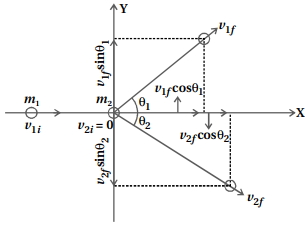
0 likes
View Solution144
Medium
What is a head-on collision?
Solution
(N/A) head-on collision is a type of collision where the velocities of the colliding bodies are directed along the line joining their centers of mass. In such a collision,the bodies move along the same straight line before and after the impact.
0 likes
View Solution145
DifficultMCQ
What happens when two identical bodies moving in opposite directions undergo a perfectly elastic collision?
A
They come to rest.
B
They exchange their velocities.
C
They move in the same direction.
D
They stick together.
Solution
(B) In a perfectly elastic collision between two identical bodies (masses $m_1 = m_2 = m$),the conservation of momentum and kinetic energy leads to the result that the bodies exchange their velocities after the collision.
If body $1$ has velocity $v_1$ and body $2$ has velocity $v_2$,after the collision,body $1$ will have velocity $v_2$ and body $2$ will have velocity $v_1$.
If body $1$ has velocity $v_1$ and body $2$ has velocity $v_2$,after the collision,body $1$ will have velocity $v_2$ and body $2$ will have velocity $v_1$.
0 likes
View Solution146
Easy
What is a head-on collision?
Solution
(N/A) collision is said to be a head-on collision (or one-dimensional collision) if the colliding bodies move along the same straight line before and after the collision.
0 likes
View Solution147
MediumMCQ
When does the maximum energy transfer occur during an elastic collision?
A
When the masses are equal.
B
When the masses are very different.
C
When the collision is head-on.
D
When the velocity of one object is zero.
Solution
(A) In a one-dimensional elastic collision between two bodies of masses $m_1$ and $m_2$,the kinetic energy transferred from the first body to the second is given by $\Delta K = \frac{4m_1 m_2}{(m_1 + m_2)^2} K_i$,where $K_i$ is the initial kinetic energy of the first body.
This transfer is maximum when the denominator $(m_1 + m_2)^2$ is minimized relative to the numerator,which occurs when $m_1 = m_2$.
Therefore,when two objects of equal mass undergo a head-on elastic collision,they exchange their velocities completely,resulting in the maximum possible energy transfer.
This transfer is maximum when the denominator $(m_1 + m_2)^2$ is minimized relative to the numerator,which occurs when $m_1 = m_2$.
Therefore,when two objects of equal mass undergo a head-on elastic collision,they exchange their velocities completely,resulting in the maximum possible energy transfer.
0 likes
View Solution148
MediumMCQ
When two identical masses,one of which is at rest,undergo an oblique elastic collision,what is the angle between the two bodies after the collision (in $^{\circ}$)?
A
$0$
B
$45$
C
$90$
D
$180$
Solution
(C) In an elastic collision between two bodies of equal mass where one body is initially at rest,the conservation of linear momentum and kinetic energy leads to the condition:
$\vec{p}_1 = \vec{p}_1' + \vec{p}_2'$
Since the collision is elastic,$K_1 = K_1' + K_2'$,which implies $\frac{p_1^2}{2m} = \frac{p_1'^2}{2m} + \frac{p_2'^2}{2m}$.
This simplifies to $p_1^2 = p_1'^2 + p_2'^2$.
Comparing this with the vector equation $\vec{p}_1 = \vec{p}_1' + \vec{p}_2'$,we can see that this follows the Pythagorean theorem $(a^2 + b^2 = c^2)$.
Therefore,the vectors $\vec{p}_1'$ and $\vec{p}_2'$ must be perpendicular to each other.
Thus,the angle between the two bodies after the collision is $90^{\circ}$.
$\vec{p}_1 = \vec{p}_1' + \vec{p}_2'$
Since the collision is elastic,$K_1 = K_1' + K_2'$,which implies $\frac{p_1^2}{2m} = \frac{p_1'^2}{2m} + \frac{p_2'^2}{2m}$.
This simplifies to $p_1^2 = p_1'^2 + p_2'^2$.
Comparing this with the vector equation $\vec{p}_1 = \vec{p}_1' + \vec{p}_2'$,we can see that this follows the Pythagorean theorem $(a^2 + b^2 = c^2)$.
Therefore,the vectors $\vec{p}_1'$ and $\vec{p}_2'$ must be perpendicular to each other.
Thus,the angle between the two bodies after the collision is $90^{\circ}$.
0 likes
View SolutionWork, Energy, Power and Collision — Elastic Collision · Frequently Asked Questions
1Are these Work, Energy, Power and Collision questions useful for JEE and NEET?
Yes. All questions in this section are mapped to JEE Main and NEET exam patterns. Previous year questions from JEE Main, NEET, GUJCET and state-level exams are included with full solutions.
2Can I switch to Hindi or Gujarati for these questions?
Yes. Use the language tabs in the hero section or the sidebar to view the same questions and solutions in English, Hindi or Gujarati.
3How do I generate a question paper from this subtopic?
Use the Vedclass Exam Paper Generator — select the chapter and subtopic, set difficulty, and generate Sets A, B, C, D automatically. First 3 chapters of every subject are free.
Vedclass Products
For Students
Vedclass Test Series
Mock tests in real JEE/NEET style with performance analysis. 5-day free trial.
Start Free TrialFor Teachers
Exam Paper Generator
Generate Set A/B/C/D papers from this chapter in 2 minutes. 3 chapters free.
Try FreeFor Institutes
Online Exam Module
Live online exams with unlimited students, 360° analytics & white-label branding.
See DemoFor Teachers & Institutes
Generate a Work, Energy, Power and Collision Exam Paper in 2 Minutes
Select subtopic & difficulty — Sets A, B, C, D auto-generated with No Repeat logic.
First 3 chapters of every subject are free — no payment required.