
A English
Elastic Collision Questions in English
Class 11 Physics · Work, Energy, Power and Collision · Elastic Collision
221+
Questions
English
Language
100%
With Solutions
Showing 18 of 221 questions in English
201
MediumMCQ
When a moving body collides with a stationary body of $n$ times its mass,then the amount of kinetic energy transferred to the stationary body is
A
$\frac{4 n}{(1+n)^2}$
B
$\frac{n}{(1+n)^2}$
C
$\frac{n^2}{(1+n)^2}$
D
$\frac{4 n^2}{(1+n)^2}$
Solution
(A) Let the mass of the moving body be $m_1$ and its initial velocity be $u$. The mass of the stationary body is $M_2 = n m_1$ and its initial velocity is $0$.
For a perfectly elastic collision,the law of conservation of momentum gives:
$m_1 u = m_1 v_1 + M_2 v_2$
$m_1 u = m_1 v_1 + n m_1 v_2$
$u = v_1 + n v_2$ ... $(i)$
The coefficient of restitution $e = 1$ for an elastic collision,so:
$v_2 - v_1 = u - 0$
$v_1 = v_2 - u$ ... (ii)
Substituting (ii) into $(i)$:
$u = (v_2 - u) + n v_2$
$2u = (n + 1) v_2$
$v_2 = \frac{2u}{n + 1}$
The initial kinetic energy of the moving body is $K_1 = \frac{1}{2} m_1 u^2$.
The kinetic energy transferred to the stationary body is $K_2 = \frac{1}{2} M_2 v_2^2$.
$K_2 = \frac{1}{2} (n m_1) \left( \frac{2u}{n + 1} \right)^2 = \frac{1}{2} n m_1 \frac{4 u^2}{(n + 1)^2} = \left( \frac{1}{2} m_1 u^2 \right) \frac{4n}{(n + 1)^2}$.
The fraction of kinetic energy transferred is $\frac{K_2}{K_1} = \frac{4n}{(n + 1)^2}$.
For a perfectly elastic collision,the law of conservation of momentum gives:
$m_1 u = m_1 v_1 + M_2 v_2$
$m_1 u = m_1 v_1 + n m_1 v_2$
$u = v_1 + n v_2$ ... $(i)$
The coefficient of restitution $e = 1$ for an elastic collision,so:
$v_2 - v_1 = u - 0$
$v_1 = v_2 - u$ ... (ii)
Substituting (ii) into $(i)$:
$u = (v_2 - u) + n v_2$
$2u = (n + 1) v_2$
$v_2 = \frac{2u}{n + 1}$
The initial kinetic energy of the moving body is $K_1 = \frac{1}{2} m_1 u^2$.
The kinetic energy transferred to the stationary body is $K_2 = \frac{1}{2} M_2 v_2^2$.
$K_2 = \frac{1}{2} (n m_1) \left( \frac{2u}{n + 1} \right)^2 = \frac{1}{2} n m_1 \frac{4 u^2}{(n + 1)^2} = \left( \frac{1}{2} m_1 u^2 \right) \frac{4n}{(n + 1)^2}$.
The fraction of kinetic energy transferred is $\frac{K_2}{K_1} = \frac{4n}{(n + 1)^2}$.
0 likes
View Solution202
DifficultMCQ
$A$ steel ball of radius $2 \,cm$ is at rest on a frictionless surface. Another steel ball of radius $4 \,cm$ moving with velocity of $81 \,cm \,s^{-1}$ collides elastically with the ball which is at rest. After collision, the ball with radius of $2 \,cm$ moves with a speed of:
A
$144 \,cm \,s^{-1}$
B
$72 \,cm \,s^{-1}$
C
$216 \,cm \,s^{-1}$
D
$36 \,cm \,s^{-1}$
Solution
(A) Let the radius of the first ball be $r_1 = 2 \,cm$ and the second ball be $r_2 = 4 \,cm$.
Assuming both balls are made of the same material with density $\rho$, the mass $m$ is given by $m = \frac{4}{3} \pi r^3 \rho$.
Thus, the ratio of masses is $\frac{m_1}{m_2} = \frac{r_1^3}{r_2^3} = \left(\frac{2}{4}\right)^3 = \frac{1}{8}$, which implies $m_2 = 8m_1$.
For a one-dimensional elastic collision, the final velocity $v_1$ of the first ball (initially at rest) is given by the formula:
$v_1 = \left(\frac{2m_2}{m_1 + m_2}\right) u_2$, where $u_2 = 81 \,cm \,s^{-1}$ is the initial velocity of the second ball.
Substituting the values:
$v_1 = \left(\frac{2(8m_1)}{m_1 + 8m_1}\right) \times 81$
$v_1 = \left(\frac{16m_1}{9m_1}\right) \times 81$
$v_1 = \frac{16}{9} \times 81 = 16 \times 9 = 144 \,cm \,s^{-1}$.
Assuming both balls are made of the same material with density $\rho$, the mass $m$ is given by $m = \frac{4}{3} \pi r^3 \rho$.
Thus, the ratio of masses is $\frac{m_1}{m_2} = \frac{r_1^3}{r_2^3} = \left(\frac{2}{4}\right)^3 = \frac{1}{8}$, which implies $m_2 = 8m_1$.
For a one-dimensional elastic collision, the final velocity $v_1$ of the first ball (initially at rest) is given by the formula:
$v_1 = \left(\frac{2m_2}{m_1 + m_2}\right) u_2$, where $u_2 = 81 \,cm \,s^{-1}$ is the initial velocity of the second ball.
Substituting the values:
$v_1 = \left(\frac{2(8m_1)}{m_1 + 8m_1}\right) \times 81$
$v_1 = \left(\frac{16m_1}{9m_1}\right) \times 81$
$v_1 = \frac{16}{9} \times 81 = 16 \times 9 = 144 \,cm \,s^{-1}$.
0 likes
View Solution203
EasyMCQ
$A$ ball of mass $2 \,kg$ collides with another ball of mass $M$ at rest. If the collision is elastic and after the collision, the first ball moves with $\frac{1}{3}$ of its initial velocity in the same direction, then the mass of the second ball is: (in $\,kg$)
A
$2.5$
B
$3.5$
C
$3.0$
D
$1.0$
Solution
(D) Let the initial velocity of the first ball be $u_1 = u$ and the second ball be $u_2 = 0$. After the collision, the velocity of the first ball is $v_1 = \frac{u}{3}$.
Since the collision is elastic, the coefficient of restitution $e = 1$.
The formula for the velocity of the first ball after an elastic collision is $v_1 = \frac{m_1 - m_2}{m_1 + m_2} u_1 + \frac{2m_2}{m_1 + m_2} u_2$.
Substituting the known values: $\frac{u}{3} = \frac{2 - M}{2 + M} u + 0$.
Dividing by $u$: $\frac{1}{3} = \frac{2 - M}{2 + M}$.
Cross-multiplying: $2 + M = 3(2 - M) = 6 - 3M$.
Rearranging terms: $M + 3M = 6 - 2$, which gives $4M = 4$.
Therefore, $M = 1 \,kg$.
Since the collision is elastic, the coefficient of restitution $e = 1$.
The formula for the velocity of the first ball after an elastic collision is $v_1 = \frac{m_1 - m_2}{m_1 + m_2} u_1 + \frac{2m_2}{m_1 + m_2} u_2$.
Substituting the known values: $\frac{u}{3} = \frac{2 - M}{2 + M} u + 0$.
Dividing by $u$: $\frac{1}{3} = \frac{2 - M}{2 + M}$.
Cross-multiplying: $2 + M = 3(2 - M) = 6 - 3M$.
Rearranging terms: $M + 3M = 6 - 2$, which gives $4M = 4$.
Therefore, $M = 1 \,kg$.
0 likes
View Solution204
MediumMCQ
Two spheres '$A$' and '$B$' of equal mass lie at rest at the opposite ends of a diameter of a smooth horizontal circular groove of radius '$r$'. '$A$' moves and collides with '$B$' after a time '$t$'. If '$e$' is the coefficient of restitution,the next collision between the spheres takes place after a time of . . . . . .
A
$\frac{2 t}{e}$
B
$\frac{t}{e}$
C
$\frac{\pi t}{e}$
D
$\frac{2 \pi t}{e}$
Solution
(A) Let the mass of each sphere be $m$. The distance between $A$ and $B$ along the semi-circular path is $\pi r$. Let the initial velocity of $A$ be $v_0$. Since $A$ covers the distance $\pi r$ in time $t$,we have $v_0 = \frac{\pi r}{t}$.
After the first collision,by the law of conservation of momentum and the definition of the coefficient of restitution $e$,the velocities of $A$ and $B$ become $v_A = \frac{v_0(1-e)}{2}$ and $v_B = \frac{v_0(1+e)}{2}$.
The spheres are now moving in the same direction along the circular groove. The relative velocity between them is $v_{rel} = v_B - v_A = v_0 e$.
The distance they must cover to collide again is the full circumference of the groove,which is $2\pi r$.
The time taken for the next collision is $t' = \frac{2\pi r}{v_{rel}} = \frac{2\pi r}{v_0 e}$.
Substituting $v_0 = \frac{\pi r}{t}$,we get $t' = \frac{2\pi r}{(\pi r / t) e} = \frac{2t}{e}$.
After the first collision,by the law of conservation of momentum and the definition of the coefficient of restitution $e$,the velocities of $A$ and $B$ become $v_A = \frac{v_0(1-e)}{2}$ and $v_B = \frac{v_0(1+e)}{2}$.
The spheres are now moving in the same direction along the circular groove. The relative velocity between them is $v_{rel} = v_B - v_A = v_0 e$.
The distance they must cover to collide again is the full circumference of the groove,which is $2\pi r$.
The time taken for the next collision is $t' = \frac{2\pi r}{v_{rel}} = \frac{2\pi r}{v_0 e}$.
Substituting $v_0 = \frac{\pi r}{t}$,we get $t' = \frac{2\pi r}{(\pi r / t) e} = \frac{2t}{e}$.
0 likes
View Solution205
DifficultMCQ
$A$ ball $A$ of mass $m$ moving along the positive $x$-direction with kinetic energy $K$ and momentum $p$ undergoes an elastic head-on collision with a stationary ball $B$ of mass $M$. After the collision,the ball $A$ moves along the negative $x$-direction with kinetic energy $K/9$. The final momentum of $B$ is:
A
$p$
B
$p/3$
C
$4p/3$
D
$4p$
Solution
(C) Initial kinetic energy of ball $A$ is $K = p^2 / (2m)$,so $p = \sqrt{2mK}$.
Initial velocity of ball $A$ is $u_1 = p/m = \sqrt{2K/m}$.
After collision,ball $A$ moves in the negative $x$-direction with kinetic energy $K' = K/9$.
Let $v_1$ be the final velocity of ball $A$. Then $\frac{1}{2}mv_1^2 = K/9$,which gives $v_1 = \sqrt{2K/(9m)} = \frac{1}{3}\sqrt{2K/m} = u_1/3 = p/(3m)$.
Since the collision is one-dimensional,we apply the law of conservation of linear momentum:
$p_{initial} = p_{final}$
$p = -mv_1 + p_B$
$p_B = p + mv_1$
Substituting $v_1 = p/(3m)$:
$p_B = p + m(p/(3m)) = p + p/3 = 4p/3$.
Initial velocity of ball $A$ is $u_1 = p/m = \sqrt{2K/m}$.
After collision,ball $A$ moves in the negative $x$-direction with kinetic energy $K' = K/9$.
Let $v_1$ be the final velocity of ball $A$. Then $\frac{1}{2}mv_1^2 = K/9$,which gives $v_1 = \sqrt{2K/(9m)} = \frac{1}{3}\sqrt{2K/m} = u_1/3 = p/(3m)$.
Since the collision is one-dimensional,we apply the law of conservation of linear momentum:
$p_{initial} = p_{final}$
$p = -mv_1 + p_B$
$p_B = p + mv_1$
Substituting $v_1 = p/(3m)$:
$p_B = p + m(p/(3m)) = p + p/3 = 4p/3$.
0 likes
View Solution206
EasyMCQ
Consider the following statements $A$ and $B$ and identify the correct answer:
$A$. In an elastic collision,if a body suffers a head-on collision with another of the same mass at rest,then the first body comes to rest while the other starts moving with the velocity of the first one.
$B$. Two bodies of equal mass suffering a head-on elastic collision merely exchange their velocities.
$A$. In an elastic collision,if a body suffers a head-on collision with another of the same mass at rest,then the first body comes to rest while the other starts moving with the velocity of the first one.
$B$. Two bodies of equal mass suffering a head-on elastic collision merely exchange their velocities.
A
Both $A$ and $B$ are true
B
Both $A$ and $B$ are false
C
$A$ is true but $B$ is false
D
$A$ is false but $B$ is true
Solution
(A) In an elastic collision between two bodies of equal mass $(m_1 = m_2 = m)$,the final velocities $v_1$ and $v_2$ are given by the conservation of momentum and kinetic energy as:
$v_1 = \frac{m_1 - m_2}{m_1 + m_2}u_1 + \frac{2m_2}{m_1 + m_2}u_2$
$v_2 = \frac{2m_1}{m_1 + m_2}u_1 + \frac{m_2 - m_1}{m_1 + m_2}u_2$
Since $m_1 = m_2$,these equations simplify to $v_1 = u_2$ and $v_2 = u_1$.
Statement $A$ describes the specific case where $u_2 = 0$,resulting in $v_1 = 0$ and $v_2 = u_1$,which is true.
Statement $B$ is the general case of the same principle,which is also true. Thus,both statements are correct.
$v_1 = \frac{m_1 - m_2}{m_1 + m_2}u_1 + \frac{2m_2}{m_1 + m_2}u_2$
$v_2 = \frac{2m_1}{m_1 + m_2}u_1 + \frac{m_2 - m_1}{m_1 + m_2}u_2$
Since $m_1 = m_2$,these equations simplify to $v_1 = u_2$ and $v_2 = u_1$.
Statement $A$ describes the specific case where $u_2 = 0$,resulting in $v_1 = 0$ and $v_2 = u_1$,which is true.
Statement $B$ is the general case of the same principle,which is also true. Thus,both statements are correct.
0 likes
View Solution207
MediumMCQ
$A$ body of mass $m$ moving with a velocity $v$ collides head-on with another body of mass $2m$ at rest. If the coefficient of restitution between the two bodies is $e$,then the ratio of the velocities of the two bodies after collision is:
A
$\frac{1+e}{1-2e}$
B
$\frac{1+2e}{1-e}$
C
$\frac{1-e}{1+2e}$
D
$\frac{1-2e}{1+e}$
Solution
(D) Let $v_1$ and $v_2$ be the velocities of the bodies of mass $m$ and $2m$ respectively after the collision.
By the law of conservation of linear momentum: $mv + (2m)(0) = mv_1 + 2mv_2$,which simplifies to $v = v_1 + 2v_2$ (Equation $1$).
The coefficient of restitution $e$ is defined as $e = \frac{v_2 - v_1}{u_1 - u_2}$.
Given $u_1 = v$ and $u_2 = 0$,we have $e = \frac{v_2 - v_1}{v}$,which implies $v_1 = v_2 - ev$ (Equation $2$).
Substitute Equation $2$ into Equation $1$: $v = (v_2 - ev) + 2v_2$.
$v(1+e) = 3v_2$,so $v_2 = \frac{v(1+e)}{3}$.
Now,substitute $v_2$ back into Equation $2$: $v_1 = \frac{v(1+e)}{3} - ev = \frac{v + ev - 3ev}{3} = \frac{v(1-2e)}{3}$.
The ratio of the velocities $v_1/v_2$ is $\frac{v(1-2e)/3}{v(1+e)/3} = \frac{1-2e}{1+e}$.
By the law of conservation of linear momentum: $mv + (2m)(0) = mv_1 + 2mv_2$,which simplifies to $v = v_1 + 2v_2$ (Equation $1$).
The coefficient of restitution $e$ is defined as $e = \frac{v_2 - v_1}{u_1 - u_2}$.
Given $u_1 = v$ and $u_2 = 0$,we have $e = \frac{v_2 - v_1}{v}$,which implies $v_1 = v_2 - ev$ (Equation $2$).
Substitute Equation $2$ into Equation $1$: $v = (v_2 - ev) + 2v_2$.
$v(1+e) = 3v_2$,so $v_2 = \frac{v(1+e)}{3}$.
Now,substitute $v_2$ back into Equation $2$: $v_1 = \frac{v(1+e)}{3} - ev = \frac{v + ev - 3ev}{3} = \frac{v(1-2e)}{3}$.
The ratio of the velocities $v_1/v_2$ is $\frac{v(1-2e)/3}{v(1+e)/3} = \frac{1-2e}{1+e}$.
0 likes
View Solution208
MediumMCQ
$A$ moving particle collides with a stationary particle of mass $\frac{1}{n}$ times the mass of the moving particle. The fraction of its kinetic energy transferred to the stationary particle is:
A
$\frac{4 n^2}{(1+n)^2}$
B
$\frac{4 n}{(1+n)^2}$
C
$\frac{4 n}{1+n^2}$
D
$4 n^2$
Solution
(B) Let the mass of the moving particle be $m$ and its initial velocity be $u$. The mass of the stationary particle is $m' = \frac{m}{n}$.
Assuming a perfectly elastic head-on collision,we apply the conservation of linear momentum:
$mu = mv_1 + \frac{m}{n}v_2 \Rightarrow u = v_1 + \frac{v_2}{n}$ (Equation $1$)
Using the coefficient of restitution $e=1$ for an elastic collision:
$v_2 - v_1 = u \Rightarrow v_1 = v_2 - u$ (Equation $2$)
Substituting Equation $2$ into Equation $1$:
$u = (v_2 - u) + \frac{v_2}{n} \Rightarrow 2u = v_2(1 + \frac{1}{n}) = v_2(\frac{n+1}{n})$
$v_2 = \frac{2nu}{n+1}$
The kinetic energy transferred to the stationary particle is $K' = \frac{1}{2} m' v_2^2 = \frac{1}{2} (\frac{m}{n}) (\frac{2nu}{n+1})^2 = \frac{1}{2} \frac{m}{n} \frac{4n^2 u^2}{(n+1)^2} = \frac{2mnu^2}{(n+1)^2}$.
The initial kinetic energy is $K = \frac{1}{2} mu^2$.
The fraction of kinetic energy transferred is $\frac{K'}{K} = \frac{\frac{2mnu^2}{(n+1)^2}}{\frac{1}{2} mu^2} = \frac{4n}{(n+1)^2}$.
Assuming a perfectly elastic head-on collision,we apply the conservation of linear momentum:
$mu = mv_1 + \frac{m}{n}v_2 \Rightarrow u = v_1 + \frac{v_2}{n}$ (Equation $1$)
Using the coefficient of restitution $e=1$ for an elastic collision:
$v_2 - v_1 = u \Rightarrow v_1 = v_2 - u$ (Equation $2$)
Substituting Equation $2$ into Equation $1$:
$u = (v_2 - u) + \frac{v_2}{n} \Rightarrow 2u = v_2(1 + \frac{1}{n}) = v_2(\frac{n+1}{n})$
$v_2 = \frac{2nu}{n+1}$
The kinetic energy transferred to the stationary particle is $K' = \frac{1}{2} m' v_2^2 = \frac{1}{2} (\frac{m}{n}) (\frac{2nu}{n+1})^2 = \frac{1}{2} \frac{m}{n} \frac{4n^2 u^2}{(n+1)^2} = \frac{2mnu^2}{(n+1)^2}$.
The initial kinetic energy is $K = \frac{1}{2} mu^2$.
The fraction of kinetic energy transferred is $\frac{K'}{K} = \frac{\frac{2mnu^2}{(n+1)^2}}{\frac{1}{2} mu^2} = \frac{4n}{(n+1)^2}$.
0 likes
View Solution209
DifficultMCQ
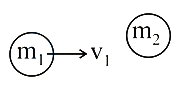
$A$ particle of mass $m_1$ collides with a particle of mass $m_2$ at rest. After the elastic collision,the two particles move at an angle of $90^{\circ}$ with respect to each other. The ratio $\frac{m_2}{m_1}$ is
A
$1$
B
$1.5$
C
$2$
D
$2.5$
Solution
(A) Let the initial velocity of $m_1$ be $\vec{u}_1$ and final velocities be $\vec{v}_1$ and $\vec{v}_2$. Since the collision is elastic,kinetic energy and momentum are conserved.
Conservation of momentum: $m_1 \vec{u}_1 = m_1 \vec{v}_1 + m_2 \vec{v}_2$.
Squaring both sides: $m_1^2 u_1^2 = m_1^2 v_1^2 + m_2^2 v_2^2 + 2 m_1 m_2 \vec{v}_1 \cdot \vec{v}_2$.
Since the particles move at $90^{\circ}$ to each other,$\vec{v}_1 \cdot \vec{v}_2 = 0$,so $m_1^2 u_1^2 = m_1^2 v_1^2 + m_2^2 v_2^2$.
Conservation of kinetic energy: $\frac{1}{2} m_1 u_1^2 = \frac{1}{2} m_1 v_1^2 + \frac{1}{2} m_2 v_2^2$,which implies $m_1 u_1^2 = m_1 v_1^2 + m_2 v_2^2$.
From energy conservation,$m_1(u_1^2 - v_1^2) = m_2 v_2^2$.
From momentum conservation,$m_1^2(u_1^2 - v_1^2) = m_2^2 v_2^2$.
Dividing the two equations: $m_1 = m_2$. Thus,the ratio $\frac{m_2}{m_1} = 1$.
Conservation of momentum: $m_1 \vec{u}_1 = m_1 \vec{v}_1 + m_2 \vec{v}_2$.
Squaring both sides: $m_1^2 u_1^2 = m_1^2 v_1^2 + m_2^2 v_2^2 + 2 m_1 m_2 \vec{v}_1 \cdot \vec{v}_2$.
Since the particles move at $90^{\circ}$ to each other,$\vec{v}_1 \cdot \vec{v}_2 = 0$,so $m_1^2 u_1^2 = m_1^2 v_1^2 + m_2^2 v_2^2$.
Conservation of kinetic energy: $\frac{1}{2} m_1 u_1^2 = \frac{1}{2} m_1 v_1^2 + \frac{1}{2} m_2 v_2^2$,which implies $m_1 u_1^2 = m_1 v_1^2 + m_2 v_2^2$.
From energy conservation,$m_1(u_1^2 - v_1^2) = m_2 v_2^2$.
From momentum conservation,$m_1^2(u_1^2 - v_1^2) = m_2^2 v_2^2$.
Dividing the two equations: $m_1 = m_2$. Thus,the ratio $\frac{m_2}{m_1} = 1$.
0 likes
View Solution210
EasyMCQ
$A$ moving body with a mass $m_1$ and velocity $u$ strikes a stationary body of mass $m_2$. The masses $m_1$ and $m_2$ should be in the ratio $\frac{m_1}{m_2}$,so as to decrease the velocity of the first body to $\frac{2u}{3}$ and give a velocity of $v$ to $m_2$,assuming a perfectly elastic impact. Then,the ratio $\frac{m_1}{m_2}$ is
A
$5$
B
$1$/$5$
C
$1$/$25$
D
$25$
Solution
(A) By the law of conservation of linear momentum:
Total momentum before collision $=$ Total momentum after collision
$m_1 u + m_2(0) = m_1 \left(\frac{2u}{3}\right) + m_2 v$
$m_1 u - \frac{2}{3} m_1 u = m_2 v$
$\frac{1}{3} m_1 u = m_2 v$ --- $(i)$
Since the collision is perfectly elastic,the coefficient of restitution $e = 1$:
$e = \frac{v_2 - v_1}{u_1 - u_2} = 1$
$\frac{v - 2u/3}{u - 0} = 1$
$v - \frac{2u}{3} = u$
$v = u + \frac{2u}{3} = \frac{5u}{3}$
Substituting $v$ into Eq. $(i)$:
$\frac{1}{3} m_1 u = m_2 \left(\frac{5u}{3}\right)$
$\frac{m_1}{m_2} = \frac{5u/3}{u/3} = 5$
Total momentum before collision $=$ Total momentum after collision
$m_1 u + m_2(0) = m_1 \left(\frac{2u}{3}\right) + m_2 v$
$m_1 u - \frac{2}{3} m_1 u = m_2 v$
$\frac{1}{3} m_1 u = m_2 v$ --- $(i)$
Since the collision is perfectly elastic,the coefficient of restitution $e = 1$:
$e = \frac{v_2 - v_1}{u_1 - u_2} = 1$
$\frac{v - 2u/3}{u - 0} = 1$
$v - \frac{2u}{3} = u$
$v = u + \frac{2u}{3} = \frac{5u}{3}$
Substituting $v$ into Eq. $(i)$:
$\frac{1}{3} m_1 u = m_2 \left(\frac{5u}{3}\right)$
$\frac{m_1}{m_2} = \frac{5u/3}{u/3} = 5$
0 likes
View Solution211
MediumMCQ
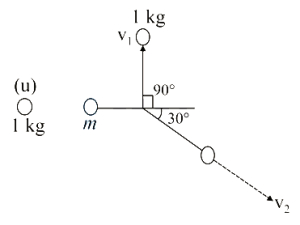
$A$ ball of mass $1 \ kg$ moving along the $X$-direction collides elastically with a stationary ball of mass $m$. The first ball (mass $= 1 \ kg$) recoils at a right angle to its original direction of motion. If the second ball starts moving at an angle $30^{\circ}$ with the $X$-axis,the value of $m$ must be (in $kg$)
A
$0.5$
B
$1.5$
C
$2.5$
D
$2$
Solution
(D) Let the initial velocity of the $1 \ kg$ ball be $u$. After the collision,the first ball moves with velocity $v_1$ along the $Y$-axis,and the second ball of mass $m$ moves with velocity $v_2$ at an angle $30^{\circ}$ below the $X$-axis.
Applying the law of conservation of linear momentum along the $X$-axis:
$1 \cdot u = m v_2 \cos(30^{\circ}) \implies u = m v_2 \frac{\sqrt{3}}{2} \implies v_2 = \frac{2u}{m\sqrt{3}} \quad ... (1)$
Applying the law of conservation of linear momentum along the $Y$-axis:
$0 = 1 \cdot v_1 - m v_2 \sin(30^{\circ}) \implies v_1 = m v_2 \sin(30^{\circ}) = m v_2 \cdot \frac{1}{2} \implies v_2 = \frac{2v_1}{m} \quad ... (2)$
From $(1)$ and $(2)$,$\frac{2u}{m\sqrt{3}} = \frac{2v_1}{m} \implies v_1 = \frac{u}{\sqrt{3}}$.
Since the collision is elastic,kinetic energy is conserved:
$\frac{1}{2} (1) u^2 = \frac{1}{2} (1) v_1^2 + \frac{1}{2} m v_2^2$
$u^2 = v_1^2 + m v_2^2$
Substitute $v_1 = \frac{u}{\sqrt{3}}$ and $v_2 = \frac{2v_1}{m} = \frac{2u}{m\sqrt{3}}$:
$u^2 = \left(\frac{u}{\sqrt{3}}\right)^2 + m \left(\frac{2u}{m\sqrt{3}}\right)^2$
$u^2 = \frac{u^2}{3} + m \cdot \frac{4u^2}{3m^2} = \frac{u^2}{3} + \frac{4u^2}{3m}$
$1 = \frac{1}{3} + \frac{4}{3m} \implies \frac{2}{3} = \frac{4}{3m} \implies m = 2 \ kg$.
Applying the law of conservation of linear momentum along the $X$-axis:
$1 \cdot u = m v_2 \cos(30^{\circ}) \implies u = m v_2 \frac{\sqrt{3}}{2} \implies v_2 = \frac{2u}{m\sqrt{3}} \quad ... (1)$
Applying the law of conservation of linear momentum along the $Y$-axis:
$0 = 1 \cdot v_1 - m v_2 \sin(30^{\circ}) \implies v_1 = m v_2 \sin(30^{\circ}) = m v_2 \cdot \frac{1}{2} \implies v_2 = \frac{2v_1}{m} \quad ... (2)$
From $(1)$ and $(2)$,$\frac{2u}{m\sqrt{3}} = \frac{2v_1}{m} \implies v_1 = \frac{u}{\sqrt{3}}$.
Since the collision is elastic,kinetic energy is conserved:
$\frac{1}{2} (1) u^2 = \frac{1}{2} (1) v_1^2 + \frac{1}{2} m v_2^2$
$u^2 = v_1^2 + m v_2^2$
Substitute $v_1 = \frac{u}{\sqrt{3}}$ and $v_2 = \frac{2v_1}{m} = \frac{2u}{m\sqrt{3}}$:
$u^2 = \left(\frac{u}{\sqrt{3}}\right)^2 + m \left(\frac{2u}{m\sqrt{3}}\right)^2$
$u^2 = \frac{u^2}{3} + m \cdot \frac{4u^2}{3m^2} = \frac{u^2}{3} + \frac{4u^2}{3m}$
$1 = \frac{1}{3} + \frac{4}{3m} \implies \frac{2}{3} = \frac{4}{3m} \implies m = 2 \ kg$.
0 likes
View Solution212
EasyMCQ
Collision takes place between two solid spheres denoted as $1$ and $2$. The initial velocities of the spheres are $u_1 = 3 \ m/s$ and $u_2 = 1.5 \ m/s$,and the final velocities are $v_1 = 2.5 \ m/s$ and $v_2 = 3.5 \ m/s$. The coefficient of restitution between the materials of the spheres is nearly:
A
$0.67$
B
$0.78$
C
$0.83$
D
$0.96$
Solution
(A) The coefficient of restitution $e$ is defined as the ratio of the relative velocity of separation to the relative velocity of approach.
$e = \frac{v_2 - v_1}{u_1 - u_2}$
Given:
$u_1 = 3 \ m/s$,$u_2 = 1.5 \ m/s$
$v_1 = 2.5 \ m/s$,$v_2 = 3.5 \ m/s$
Substituting the values:
$e = \frac{3.5 - 2.5}{3 - 1.5} = \frac{1}{1.5} = \frac{10}{15} = \frac{2}{3} \approx 0.67$
Thus,the coefficient of restitution is approximately $0.67$.
$e = \frac{v_2 - v_1}{u_1 - u_2}$
Given:
$u_1 = 3 \ m/s$,$u_2 = 1.5 \ m/s$
$v_1 = 2.5 \ m/s$,$v_2 = 3.5 \ m/s$
Substituting the values:
$e = \frac{3.5 - 2.5}{3 - 1.5} = \frac{1}{1.5} = \frac{10}{15} = \frac{2}{3} \approx 0.67$
Thus,the coefficient of restitution is approximately $0.67$.
0 likes
View Solution213
EasyMCQ
$A$ billiard ball of mass $M$,moving with velocity $v_1$ collides with another ball of the same mass but at rest. If the collision is elastic,the angle of divergence after the collision is (in $^{\circ}$)
A
$0$
B
$30$
C
$90$
D
$45$
Solution
(C) In an elastic collision between two bodies of equal mass where one is initially at rest,the conservation of linear momentum and kinetic energy leads to the equation: $\vec{v}_1 = \vec{v}_1' + \vec{v}_2'$.
Since the collision is elastic and masses are equal,the conservation of kinetic energy gives: $v_1^2 = (v_1')^2 + (v_2')^2$.
Comparing these two equations with the vector relation $\vec{v}_1^2 = (\vec{v}_1' + \vec{v}_2')^2 = (v_1')^2 + (v_2')^2 + 2\vec{v}_1' \cdot \vec{v}_2'$,we find that $2\vec{v}_1' \cdot \vec{v}_2' = 0$.
This implies that the dot product of the final velocity vectors is zero,meaning the angle between the two balls after the collision is $90^{\circ}$ (provided the collision is not head-on).
Since the collision is elastic and masses are equal,the conservation of kinetic energy gives: $v_1^2 = (v_1')^2 + (v_2')^2$.
Comparing these two equations with the vector relation $\vec{v}_1^2 = (\vec{v}_1' + \vec{v}_2')^2 = (v_1')^2 + (v_2')^2 + 2\vec{v}_1' \cdot \vec{v}_2'$,we find that $2\vec{v}_1' \cdot \vec{v}_2' = 0$.
This implies that the dot product of the final velocity vectors is zero,meaning the angle between the two balls after the collision is $90^{\circ}$ (provided the collision is not head-on).
0 likes
View Solution214
DifficultMCQ
$A$ body of mass $5 \ kg$ makes an elastic collision with another body at rest and continues to move in the original direction after collision with a velocity equal to $\frac{1}{10}$ th of its original velocity. Then the mass of the second body is (in $kg$)
A
$4.09$
B
$0.5$
C
$5$
D
$5.09$
Solution
(A) Let the mass of the first body be $m_1 = 5 \ kg$ and its initial velocity be $u$. Let the mass of the second body be $M$,which is initially at rest $(u_2 = 0)$.
For an elastic collision,the coefficient of restitution $e = 1$.
After the collision,the velocity of the first body becomes $v_1 = \frac{u}{10}$. Let the velocity of the second body be $v_2$.
By the law of conservation of linear momentum:
$m_1 u_1 + m_2 u_2 = m_1 v_1 + m_2 v_2$
$5u + M(0) = 5 \left(\frac{u}{10}\right) + M v_2$
$5u = \frac{u}{2} + M v_2 \quad \dots (i)$
Using the property of elastic collision $(v_1 - v_2 = -e(u_1 - u_2))$:
$\frac{u}{10} - v_2 = -1(u - 0)$
$v_2 = \frac{u}{10} + u = \frac{11u}{10} \quad \dots (ii)$
Substituting $v_2$ from Eq. $(ii)$ into Eq. $(i)$:
$5u = \frac{u}{2} + M \left(\frac{11u}{10}\right)$
$5 - 0.5 = M \left(\frac{11}{10}\right)$
$4.5 = M \left(\frac{11}{10}\right)$
$M = \frac{4.5 \times 10}{11} = \frac{45}{11} \approx 4.09 \ kg$.
For an elastic collision,the coefficient of restitution $e = 1$.
After the collision,the velocity of the first body becomes $v_1 = \frac{u}{10}$. Let the velocity of the second body be $v_2$.
By the law of conservation of linear momentum:
$m_1 u_1 + m_2 u_2 = m_1 v_1 + m_2 v_2$
$5u + M(0) = 5 \left(\frac{u}{10}\right) + M v_2$
$5u = \frac{u}{2} + M v_2 \quad \dots (i)$
Using the property of elastic collision $(v_1 - v_2 = -e(u_1 - u_2))$:
$\frac{u}{10} - v_2 = -1(u - 0)$
$v_2 = \frac{u}{10} + u = \frac{11u}{10} \quad \dots (ii)$
Substituting $v_2$ from Eq. $(ii)$ into Eq. $(i)$:
$5u = \frac{u}{2} + M \left(\frac{11u}{10}\right)$
$5 - 0.5 = M \left(\frac{11}{10}\right)$
$4.5 = M \left(\frac{11}{10}\right)$
$M = \frac{4.5 \times 10}{11} = \frac{45}{11} \approx 4.09 \ kg$.
0 likes
View Solution215
EasyMCQ
Assertion $(A)$: In an elastic collision of two billiard balls,both kinetic energy and linear momentum remain conserved.
Reason $(R)$: During the collision of the balls,as the collision is elastic,there is no exchange of energy. Therefore,both energy and momentum are conserved.
Reason $(R)$: During the collision of the balls,as the collision is elastic,there is no exchange of energy. Therefore,both energy and momentum are conserved.
A
$(A)$ is true,$(R)$ is true and $(R)$ is the correct explanation for $(A)$
B
$(A)$ is true,$(R)$ is true but $(R)$ is not the correct explanation for $(A)$
C
$(A)$ is true but $(R)$ is false
D
$(A)$ is false but $(R)$ is true
Solution
(C) In an elastic collision,both the total linear momentum and the total kinetic energy of the system are conserved.
Assertion $(A)$ is true because by definition,an elastic collision is one in which there is no loss of kinetic energy.
Reason $(R)$ is false because,during an elastic collision,there is indeed an exchange of energy between the colliding bodies (momentum and kinetic energy are transferred between them),even though the total kinetic energy of the system remains constant.
Therefore,$(A)$ is true but $(R)$ is false.
Assertion $(A)$ is true because by definition,an elastic collision is one in which there is no loss of kinetic energy.
Reason $(R)$ is false because,during an elastic collision,there is indeed an exchange of energy between the colliding bodies (momentum and kinetic energy are transferred between them),even though the total kinetic energy of the system remains constant.
Therefore,$(A)$ is true but $(R)$ is false.
0 likes
View Solution216
MediumMCQ
An object $A$ of mass $20 \ kg$ and travelling at $20 \ m \ s^{-1}$ crashes into another object $B$ of mass $200 \ kg$ and travelling at $10 \ m \ s^{-1}$,in the same direction. After the collision,object $A$ bounces back in the opposite direction at a speed of $10 \ m \ s^{-1}$. The speed of the object $B$ after the collision is: (in $m \ s^{-1}$)
A
$13$
B
$12$
C
$14$
D
$20$
Solution
(A) According to the law of conservation of linear momentum,the total momentum before the collision is equal to the total momentum after the collision,as no external force acts on the system.
$m_A u_A + m_B u_B = m_A v_A + m_B v_B$
Given: $m_A = 20 \ kg$,$u_A = 20 \ m \ s^{-1}$,$m_B = 200 \ kg$,$u_B = 10 \ m \ s^{-1}$.
After collision,$v_A = -10 \ m \ s^{-1}$ (since it bounces back in the opposite direction).
Substituting the values:
$(20 \times 20) + (200 \times 10) = (20 \times -10) + (200 \times v_B)$
$400 + 2000 = -200 + 200 v_B$
$2400 = -200 + 200 v_B$
$2600 = 200 v_B$
$v_B = 13 \ m \ s^{-1}$
$m_A u_A + m_B u_B = m_A v_A + m_B v_B$
Given: $m_A = 20 \ kg$,$u_A = 20 \ m \ s^{-1}$,$m_B = 200 \ kg$,$u_B = 10 \ m \ s^{-1}$.
After collision,$v_A = -10 \ m \ s^{-1}$ (since it bounces back in the opposite direction).
Substituting the values:
$(20 \times 20) + (200 \times 10) = (20 \times -10) + (200 \times v_B)$
$400 + 2000 = -200 + 200 v_B$
$2400 = -200 + 200 v_B$
$2600 = 200 v_B$
$v_B = 13 \ m \ s^{-1}$
0 likes
View Solution217
MediumMCQ
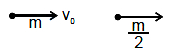
There are $n$ elastic balls placed on a smooth horizontal plane. The masses of the balls are $m, \frac{m}{2}, \frac{m}{2^2}, \ldots, \frac{m}{2^{n-1}}$ respectively. If the first ball hits the second ball with velocity $v_0$,then the velocity of the $n^{\text{th}}$ ball will be,
A
$\frac{4}{3} v_0$
B
$\left(\frac{4}{3}\right)^n v_0$
C
$\left(\frac{4}{3}\right)^{n-1} v_0$
D
$v_0$
Solution
(C) For a one-dimensional elastic collision between two masses $m_1$ and $m_2$,where $m_2$ is initially at rest,the velocity $v_2$ of the second mass after the collision is given by $v_2 = \frac{2m_1}{m_1 + m_2} v_1$.
1st collision: Mass $m_1 = m$ hits $m_2 = \frac{m}{2}$ with velocity $v_0$. The velocity of the second ball $v_1$ is:
$v_1 = \frac{2m}{m + \frac{m}{2}} v_0 = \frac{2m}{\frac{3m}{2}} v_0 = \frac{4}{3} v_0$.
2nd collision: Mass $m_2 = \frac{m}{2}$ hits $m_3 = \frac{m}{4}$ with velocity $v_1 = \frac{4}{3} v_0$. The velocity of the third ball $v_2$ is:
$v_2 = \frac{2(\frac{m}{2})}{\frac{m}{2} + \frac{m}{4}} v_1 = \frac{m}{\frac{3m}{4}} v_1 = \frac{4}{3} v_1 = \left(\frac{4}{3}\right)^2 v_0$.
Following this pattern,for the $n^{\text{th}}$ ball,the velocity $v_{n-1}$ after $(n-1)$ collisions will be:
$v_{n-1} = \left(\frac{4}{3}\right)^{n-1} v_0$.
1st collision: Mass $m_1 = m$ hits $m_2 = \frac{m}{2}$ with velocity $v_0$. The velocity of the second ball $v_1$ is:
$v_1 = \frac{2m}{m + \frac{m}{2}} v_0 = \frac{2m}{\frac{3m}{2}} v_0 = \frac{4}{3} v_0$.
2nd collision: Mass $m_2 = \frac{m}{2}$ hits $m_3 = \frac{m}{4}$ with velocity $v_1 = \frac{4}{3} v_0$. The velocity of the third ball $v_2$ is:
$v_2 = \frac{2(\frac{m}{2})}{\frac{m}{2} + \frac{m}{4}} v_1 = \frac{m}{\frac{3m}{4}} v_1 = \frac{4}{3} v_1 = \left(\frac{4}{3}\right)^2 v_0$.
Following this pattern,for the $n^{\text{th}}$ ball,the velocity $v_{n-1}$ after $(n-1)$ collisions will be:
$v_{n-1} = \left(\frac{4}{3}\right)^{n-1} v_0$.
0 likes
View Solution218
MediumMCQ
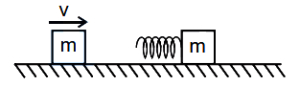
$A$ block of mass $m$ slides with speed $v$ on a frictionless table towards another stationary block of mass $m$. $A$ massless spring with spring constant $k$ is attached to the second block as shown in the figure. The maximum distance the spring gets compressed is
A
$\sqrt{\frac{m}{k}} v$
B
$\sqrt{\frac{m}{2 k}} v$
C
$\sqrt{\frac{k}{m}} v$
D
$\sqrt{\frac{k}{2 m}} v$
Solution
(B) When the spring is at maximum compression,both blocks move with the same velocity $v_{cm}$.
By the law of conservation of linear momentum: $mv + m(0) = (m + m)v_{cm} \Rightarrow v_{cm} = \frac{v}{2}$.
By the law of conservation of energy,the initial kinetic energy of the system equals the sum of the final kinetic energy and the potential energy stored in the spring at maximum compression $x$:
$\frac{1}{2}mv^2 = \frac{1}{2}(2m)v_{cm}^2 + \frac{1}{2}kx^2$
$\frac{1}{2}mv^2 = m(\frac{v}{2})^2 + \frac{1}{2}kx^2$
$\frac{1}{2}mv^2 = \frac{1}{4}mv^2 + \frac{1}{2}kx^2$
$\frac{1}{4}mv^2 = \frac{1}{2}kx^2$
$x^2 = \frac{mv^2}{2k} \Rightarrow x = v\sqrt{\frac{m}{2k}}$.
By the law of conservation of linear momentum: $mv + m(0) = (m + m)v_{cm} \Rightarrow v_{cm} = \frac{v}{2}$.
By the law of conservation of energy,the initial kinetic energy of the system equals the sum of the final kinetic energy and the potential energy stored in the spring at maximum compression $x$:
$\frac{1}{2}mv^2 = \frac{1}{2}(2m)v_{cm}^2 + \frac{1}{2}kx^2$
$\frac{1}{2}mv^2 = m(\frac{v}{2})^2 + \frac{1}{2}kx^2$
$\frac{1}{2}mv^2 = \frac{1}{4}mv^2 + \frac{1}{2}kx^2$
$\frac{1}{4}mv^2 = \frac{1}{2}kx^2$
$x^2 = \frac{mv^2}{2k} \Rightarrow x = v\sqrt{\frac{m}{2k}}$.
0 likes
View SolutionWork, Energy, Power and Collision — Elastic Collision · Frequently Asked Questions
1Are these Work, Energy, Power and Collision questions useful for JEE and NEET?
Yes. All questions in this section are mapped to JEE Main and NEET exam patterns. Previous year questions from JEE Main, NEET, GUJCET and state-level exams are included with full solutions.
2Can I switch to Hindi or Gujarati for these questions?
Yes. Use the language tabs in the hero section or the sidebar to view the same questions and solutions in English, Hindi or Gujarati.
3How do I generate a question paper from this subtopic?
Use the Vedclass Exam Paper Generator — select the chapter and subtopic, set difficulty, and generate Sets A, B, C, D automatically. First 3 chapters of every subject are free.
Vedclass Products
For Students
Vedclass Test Series
Mock tests in real JEE/NEET style with performance analysis. 5-day free trial.
Start Free TrialFor Teachers
Exam Paper Generator
Generate Set A/B/C/D papers from this chapter in 2 minutes. 3 chapters free.
Try FreeFor Institutes
Online Exam Module
Live online exams with unlimited students, 360° analytics & white-label branding.
See DemoFor Teachers & Institutes
Generate a Work, Energy, Power and Collision Exam Paper in 2 Minutes
Select subtopic & difficulty — Sets A, B, C, D auto-generated with No Repeat logic.
First 3 chapters of every subject are free — no payment required.