
A English
Elastic Collision Questions in English
Class 11 Physics · Work, Energy, Power and Collision · Elastic Collision
221+
Questions
English
Language
100%
With Solutions
Showing 50 of 221 questions in English
151
Medium
In an elastic collision of two billiard balls,which of the following quantities remain conserved during the short time of collision of the balls? (i.e.,when they are in contact)
$(a)$ Kinetic energy.
$(b)$ Total linear momentum.
Give reason for your answer in each case.
$(a)$ Kinetic energy.
$(b)$ Total linear momentum.
Give reason for your answer in each case.
Solution
(B) During the short time of collision,the billiard balls undergo deformation,which leads to the storage of potential energy $(PE)$.
Since some kinetic energy $(KE)$ is converted into potential energy during the deformation phase,the total kinetic energy is not conserved during the contact time.
However,for the system of two balls,the resultant external force acting on the system is zero.
According to the law of conservation of linear momentum,if the net external force is zero,the total linear momentum of the system remains conserved throughout the collision process,including the time of contact.
Since some kinetic energy $(KE)$ is converted into potential energy during the deformation phase,the total kinetic energy is not conserved during the contact time.
However,for the system of two balls,the resultant external force acting on the system is zero.
According to the law of conservation of linear momentum,if the net external force is zero,the total linear momentum of the system remains conserved throughout the collision process,including the time of contact.
0 likes
View Solution152
Medium
The bob $A$ of a pendulum,released from a horizontal position to the vertical,hits another bob $B$ of the same mass at rest on a table as shown in the figure. If the length of the pendulum is $1\,m$,calculate:
$(a)$ The height to which bob $A$ will rise after the collision.
$(b)$ The speed with which bob $B$ starts moving.
Neglect the size of the bobs and assume the collision to be elastic.
$(a)$ The height to which bob $A$ will rise after the collision.
$(b)$ The speed with which bob $B$ starts moving.
Neglect the size of the bobs and assume the collision to be elastic.
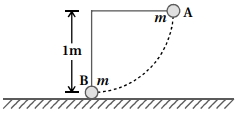
Solution
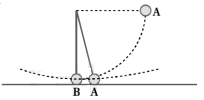
(N/A) When ball $A$ reaches the bottom point,its velocity is horizontal. Since the collision is elastic and the masses are equal,the velocities are exchanged.
$(a)$ In an elastic collision between two bodies of equal mass where one is at rest,the moving body comes to rest and the stationary body acquires the velocity of the moving body. Therefore,bob $A$ comes to rest at the bottom point after the collision. The height to which it will rise is $0\,m$.
$(b)$ The speed with which bob $B$ starts moving is equal to the speed with which bob $A$ hits bob $B$. Using the law of conservation of energy for bob $A$ as it falls from height $h = 1\,m$:
$v = \sqrt{2gh}$
$v = \sqrt{2 \times 9.8 \times 1}$
$v = \sqrt{19.6} \approx 4.43\,m/s$.
$(a)$ In an elastic collision between two bodies of equal mass where one is at rest,the moving body comes to rest and the stationary body acquires the velocity of the moving body. Therefore,bob $A$ comes to rest at the bottom point after the collision. The height to which it will rise is $0\,m$.
$(b)$ The speed with which bob $B$ starts moving is equal to the speed with which bob $A$ hits bob $B$. Using the law of conservation of energy for bob $A$ as it falls from height $h = 1\,m$:
$v = \sqrt{2gh}$
$v = \sqrt{2 \times 9.8 \times 1}$
$v = \sqrt{19.6} \approx 4.43\,m/s$.
0 likes
View Solution153
DifficultMCQ
$A$ body of mass $m$ moving with velocity $v$ makes a head-on elastic collision with another body of mass $2m$ which is initially at rest. What is the loss in kinetic energy of the colliding body?
A
$1/2 \ mv^2$
B
$8/9 \ mv^2$
C
$4/9 \ mv^2$
D
$2/9 \ mv^2$
Solution
(C) In an elastic collision,the total kinetic energy is conserved. However,the question asks for the loss in kinetic energy of the colliding body. Let the mass of the first body be $m_1 = m$ and its initial velocity be $u_1 = v$. Let the mass of the second body be $m_2 = 2m$ and its initial velocity be $u_2 = 0$.
After the collision,the final velocity $v_1$ of the first body is given by the formula: $v_1 = \frac{m_1 - m_2}{m_1 + m_2} u_1 + \frac{2m_2}{m_1 + m_2} u_2$.
Substituting the values: $v_1 = \frac{m - 2m}{m + 2m} v + 0 = \frac{-m}{3m} v = -v/3$.
The initial kinetic energy of the first body is $K_i = 1/2 \ mv^2$.
The final kinetic energy of the first body is $K_f = 1/2 \ m(v_1)^2 = 1/2 \ m(-v/3)^2 = 1/2 \ m(v^2/9) = 1/18 \ mv^2$.
The loss in kinetic energy of the colliding body is $\Delta K = K_i - K_f = 1/2 \ mv^2 - 1/18 \ mv^2$.
$\Delta K = (9/18 - 1/18) \ mv^2 = 8/18 \ mv^2 = 4/9 \ mv^2$.
After the collision,the final velocity $v_1$ of the first body is given by the formula: $v_1 = \frac{m_1 - m_2}{m_1 + m_2} u_1 + \frac{2m_2}{m_1 + m_2} u_2$.
Substituting the values: $v_1 = \frac{m - 2m}{m + 2m} v + 0 = \frac{-m}{3m} v = -v/3$.
The initial kinetic energy of the first body is $K_i = 1/2 \ mv^2$.
The final kinetic energy of the first body is $K_f = 1/2 \ m(v_1)^2 = 1/2 \ m(-v/3)^2 = 1/2 \ m(v^2/9) = 1/18 \ mv^2$.
The loss in kinetic energy of the colliding body is $\Delta K = K_i - K_f = 1/2 \ mv^2 - 1/18 \ mv^2$.
$\Delta K = (9/18 - 1/18) \ mv^2 = 8/18 \ mv^2 = 4/9 \ mv^2$.
0 likes
View Solution154
DifficultMCQ
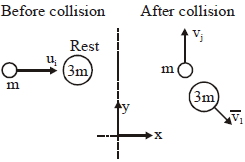
$A$ particle of mass $m$ with an initial velocity $u\hat{i}$ collides perfectly elastically with a mass $3m$ at rest. It moves with a velocity $v\hat{j}$ after collision. Then, $v$ is given by:
A
$v=\sqrt{\frac{2}{3}} u$
B
$v =\frac{1}{\sqrt{6}} u$
C
$v=\frac{u}{\sqrt{3}}$
D
$v=\frac{u}{\sqrt{2}}$
Solution
(D) From the law of conservation of linear momentum:
$\vec{P}_i = \vec{P}_f$
$m(u\hat{i}) + 3m(0) = m(v\hat{j}) + 3m\vec{v}_1$
$m(u\hat{i} - v\hat{j}) = 3m\vec{v}_1$
$\vec{v}_1 = \frac{u\hat{i} - v\hat{j}}{3}$
Taking the magnitude squared:
$v_1^2 = \frac{u^2 + v^2}{9} \quad \dots(1)$
Since the collision is perfectly elastic, kinetic energy is conserved:
$K_i = K_f$
$\frac{1}{2}mu^2 + 0 = \frac{1}{2}mv^2 + \frac{1}{2}(3m)v_1^2$
$u^2 = v^2 + 3v_1^2$
Substituting equation $(1)$ into the energy equation:
$u^2 = v^2 + 3\left(\frac{u^2 + v^2}{9}\right)$
$u^2 = v^2 + \frac{u^2 + v^2}{3}$
$3u^2 = 3v^2 + u^2 + v^2$
$2u^2 = 4v^2$
$v^2 = \frac{u^2}{2}$
$v = \frac{u}{\sqrt{2}}$
$\vec{P}_i = \vec{P}_f$
$m(u\hat{i}) + 3m(0) = m(v\hat{j}) + 3m\vec{v}_1$
$m(u\hat{i} - v\hat{j}) = 3m\vec{v}_1$
$\vec{v}_1 = \frac{u\hat{i} - v\hat{j}}{3}$
Taking the magnitude squared:
$v_1^2 = \frac{u^2 + v^2}{9} \quad \dots(1)$
Since the collision is perfectly elastic, kinetic energy is conserved:
$K_i = K_f$
$\frac{1}{2}mu^2 + 0 = \frac{1}{2}mv^2 + \frac{1}{2}(3m)v_1^2$
$u^2 = v^2 + 3v_1^2$
Substituting equation $(1)$ into the energy equation:
$u^2 = v^2 + 3\left(\frac{u^2 + v^2}{9}\right)$
$u^2 = v^2 + \frac{u^2 + v^2}{3}$
$3u^2 = 3v^2 + u^2 + v^2$
$2u^2 = 4v^2$
$v^2 = \frac{u^2}{2}$
$v = \frac{u}{\sqrt{2}}$
0 likes
View Solution155
DifficultMCQ
An object of mass $M$ is much heavier than another object of mass $m$. The heavy object moving with speed $v$ undergoes an elastic collision with the light object at rest. What will be the speed of the light object after the collision?
A
$2v$
B
$3v$
C
$v$
D
$\frac{v}{7}$
Solution
(A) From the law of conservation of momentum:
$Mv + m \times 0 = Mv_1 + mv_2$
$\Rightarrow M(v - v_1) = mv_2 \dots (i)$
From the law of conservation of kinetic energy (since the collision is elastic):
$\frac{1}{2}Mv^2 + 0 = \frac{1}{2}Mv_1^2 + \frac{1}{2}mv_2^2$
$\Rightarrow M(v^2 - v_1^2) = mv_2^2 \dots (ii)$
Dividing equation $(ii)$ by $(i)$:
$\frac{M(v - v_1)(v + v_1)}{M(v - v_1)} = \frac{mv_2^2}{mv_2}$
$v + v_1 = v_2 \dots (iii)$
Solving equations $(i)$ and $(iii)$ for the final velocity of the light object $(v_2)$:
$v_2 = \frac{2Mv}{M + m}$
Since $M \gg m$,we can approximate $M + m \approx M$:
$v_2 = \frac{2Mv}{M} = 2v$.
$Mv + m \times 0 = Mv_1 + mv_2$
$\Rightarrow M(v - v_1) = mv_2 \dots (i)$
From the law of conservation of kinetic energy (since the collision is elastic):
$\frac{1}{2}Mv^2 + 0 = \frac{1}{2}Mv_1^2 + \frac{1}{2}mv_2^2$
$\Rightarrow M(v^2 - v_1^2) = mv_2^2 \dots (ii)$
Dividing equation $(ii)$ by $(i)$:
$\frac{M(v - v_1)(v + v_1)}{M(v - v_1)} = \frac{mv_2^2}{mv_2}$
$v + v_1 = v_2 \dots (iii)$
Solving equations $(i)$ and $(iii)$ for the final velocity of the light object $(v_2)$:
$v_2 = \frac{2Mv}{M + m}$
Since $M \gg m$,we can approximate $M + m \approx M$:
$v_2 = \frac{2Mv}{M} = 2v$.
0 likes
View Solution156
DifficultMCQ
Body $A$ of mass $4m$ moving with speed $u$ collides with another body $B$ of mass $2m$ at rest. The collision is head-on and elastic in nature. After the collision, the fraction of energy lost by the colliding body $A$ is:
A
$\frac{5}{9}$
B
$\frac{1}{9}$
C
$\frac{8}{9}$
D
$\frac{4}{9}$
Solution
(C) For a one-dimensional elastic collision, the final velocity of body $A$ $(v_1)$ is given by:
$v_1 = \left( \frac{m_1 - m_2}{m_1 + m_2} \right) u_1 + \left( \frac{2m_2}{m_1 + m_2} \right) u_2$
Given $m_1 = 4m$, $u_1 = u$, $m_2 = 2m$, and $u_2 = 0$:
$v_1 = \left( \frac{4m - 2m}{4m + 2m} \right) u + 0 = \left( \frac{2m}{6m} \right) u = \frac{1}{3} u$
Initial kinetic energy of body $A$ is $K_i = \frac{1}{2} (4m) u^2 = 2mu^2$.
Final kinetic energy of body $A$ is $K_f = \frac{1}{2} (4m) (\frac{1}{3} u)^2 = 2m (\frac{1}{9} u^2) = \frac{2}{9} mu^2$.
Energy lost by body $A$ is $\Delta K = K_i - K_f = 2mu^2 - \frac{2}{9} mu^2 = \frac{16}{9} mu^2$.
The fraction of energy lost is $\frac{\Delta K}{K_i} = \frac{\frac{16}{9} mu^2}{2mu^2} = \frac{8}{9}$.
$v_1 = \left( \frac{m_1 - m_2}{m_1 + m_2} \right) u_1 + \left( \frac{2m_2}{m_1 + m_2} \right) u_2$
Given $m_1 = 4m$, $u_1 = u$, $m_2 = 2m$, and $u_2 = 0$:
$v_1 = \left( \frac{4m - 2m}{4m + 2m} \right) u + 0 = \left( \frac{2m}{6m} \right) u = \frac{1}{3} u$
Initial kinetic energy of body $A$ is $K_i = \frac{1}{2} (4m) u^2 = 2mu^2$.
Final kinetic energy of body $A$ is $K_f = \frac{1}{2} (4m) (\frac{1}{3} u)^2 = 2m (\frac{1}{9} u^2) = \frac{2}{9} mu^2$.
Energy lost by body $A$ is $\Delta K = K_i - K_f = 2mu^2 - \frac{2}{9} mu^2 = \frac{16}{9} mu^2$.
The fraction of energy lost is $\frac{\Delta K}{K_i} = \frac{\frac{16}{9} mu^2}{2mu^2} = \frac{8}{9}$.
0 likes
View Solution157
DifficultMCQ
$A$ uniform rod of mass $M$ and length $L$ is placed on a smooth horizontal surface. $A$ particle of mass $m$ moving with velocity $v$ strikes the rod at one end perpendicularly and comes to rest. The velocity of the centre of mass of the rod after the collision is:
A
$v$
B
$\frac{mv}{M}$
C
$\frac{mv}{M+m}$
D
$\frac{Mv}{m}$
Solution
(B) According to the law of conservation of linear momentum,the total momentum of the system before the collision is equal to the total momentum of the system after the collision.
Let $v_{cm}$ be the velocity of the centre of mass of the rod after the collision.
Before the collision,the momentum of the particle is $p_i = mv$ and the rod is at rest $(p_{rod} = 0)$.
After the collision,the particle comes to rest,so its momentum is $0$. The rod moves with velocity $v_{cm}$.
Applying conservation of linear momentum:
$mv + 0 = 0 + Mv_{cm}$
Solving for $v_{cm}$:
$v_{cm} = \frac{mv}{M}$
Let $v_{cm}$ be the velocity of the centre of mass of the rod after the collision.
Before the collision,the momentum of the particle is $p_i = mv$ and the rod is at rest $(p_{rod} = 0)$.
After the collision,the particle comes to rest,so its momentum is $0$. The rod moves with velocity $v_{cm}$.
Applying conservation of linear momentum:
$mv + 0 = 0 + Mv_{cm}$
Solving for $v_{cm}$:
$v_{cm} = \frac{mv}{M}$
0 likes
View Solution158
MediumMCQ
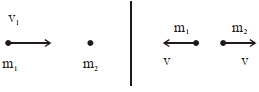
An object of mass $m_{1}$ collides with another object of mass $m_{2}$,which is at rest. After the collision,the objects move with equal speeds in opposite directions. The ratio of the masses $m_{2} : m_{1}$ is
A
$3:1$
B
$2:1$
C
$1:2$
D
$1:3$
Solution
(A) Let the initial velocity of mass $m_{1}$ be $u$ and the final velocities of $m_{1}$ and $m_{2}$ be $v$ in opposite directions. Since the collision is elastic (implied by the context of such problems),we use the conservation of linear momentum and the coefficient of restitution.
Conservation of linear momentum:
$m_{1}u = m_{2}v - m_{1}v$
$m_{1}u = v(m_{2} - m_{1})$ --- $(1)$
Coefficient of restitution $e = 1$ for elastic collision:
$e = \frac{v_{sep}}{v_{app}} = \frac{v - (-v)}{u - 0} = 1$
$2v = u$ --- $(2)$
Substitute $u = 2v$ into equation $(1)$:
$m_{1}(2v) = v(m_{2} - m_{1})$
$2m_{1} = m_{2} - m_{1}$
$m_{2} = 3m_{1}$
$\frac{m_{2}}{m_{1}} = 3$
Thus,the ratio $m_{2} : m_{1}$ is $3:1$.
Conservation of linear momentum:
$m_{1}u = m_{2}v - m_{1}v$
$m_{1}u = v(m_{2} - m_{1})$ --- $(1)$
Coefficient of restitution $e = 1$ for elastic collision:
$e = \frac{v_{sep}}{v_{app}} = \frac{v - (-v)}{u - 0} = 1$
$2v = u$ --- $(2)$
Substitute $u = 2v$ into equation $(1)$:
$m_{1}(2v) = v(m_{2} - m_{1})$
$2m_{1} = m_{2} - m_{1}$
$m_{2} = 3m_{1}$
$\frac{m_{2}}{m_{1}} = 3$
Thus,the ratio $m_{2} : m_{1}$ is $3:1$.
0 likes
View Solution159
DifficultMCQ
Given below are two statements: one is labelled as Assertion $A$ and the other is labelled as Reason $R$.
Assertion $A$: Body $P$ having mass $M$ moving with speed $u$ has a head-on elastic collision with another body $Q$ having mass $m$ initially at rest. If $m << M$,body $Q$ will have a maximum speed equal to $2u$ after the collision.
Reason $R$: During an elastic collision,the momentum and kinetic energy are both conserved.
In the light of the above statements,choose the most appropriate answer from the options given below:
Assertion $A$: Body $P$ having mass $M$ moving with speed $u$ has a head-on elastic collision with another body $Q$ having mass $m$ initially at rest. If $m << M$,body $Q$ will have a maximum speed equal to $2u$ after the collision.
Reason $R$: During an elastic collision,the momentum and kinetic energy are both conserved.
In the light of the above statements,choose the most appropriate answer from the options given below:
A
$A$ is not correct but $R$ is correct.
B
Both $A$ and $R$ are correct but $R$ is $NOT$ the correct explanation of $A$.
C
Both $A$ and $R$ are correct and $R$ is the correct explanation of $A$.
D
$A$ is correct but $R$ is not correct.
Solution
(C) For a one-dimensional elastic collision where the second body is initially at rest,the final velocity $V_2$ of the second body is given by the formula:
$V_2 = \frac{2m_1 u_1}{m_1 + m_2}$
Here,$m_1 = M$,$m_2 = m$,and $u_1 = u$. Substituting these values:
$V_2 = \frac{2Mu}{M + m}$
Given the condition $m << M$,we can approximate $M + m \approx M$.
Therefore,$V_2 \approx \frac{2Mu}{M} = 2u$.
Thus,Assertion $A$ is correct.
Reason $R$ states that momentum and kinetic energy are conserved in an elastic collision,which is the fundamental definition and physical principle used to derive the velocity equations. Therefore,$R$ is the correct explanation for $A$.
$V_2 = \frac{2m_1 u_1}{m_1 + m_2}$
Here,$m_1 = M$,$m_2 = m$,and $u_1 = u$. Substituting these values:
$V_2 = \frac{2Mu}{M + m}$
Given the condition $m << M$,we can approximate $M + m \approx M$.
Therefore,$V_2 \approx \frac{2Mu}{M} = 2u$.
Thus,Assertion $A$ is correct.
Reason $R$ states that momentum and kinetic energy are conserved in an elastic collision,which is the fundamental definition and physical principle used to derive the velocity equations. Therefore,$R$ is the correct explanation for $A$.
0 likes
View Solution160
DifficultMCQ
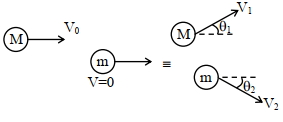
$A$ body of mass $M$ moving at speed $V_{0}$ collides elastically with a mass $m$ at rest. After the collision,the two masses move at angles $\theta_{1}$ and $\theta_{2}$ with respect to the initial direction of motion of the body of mass $M$. The largest possible value of the ratio $M/m$,for which the angles $\theta_{1}$ and $\theta_{2}$ will be equal,is:
A
$4$
B
$1$
C
$3$
D
$2$
Solution
(C) Given $\theta_{1} = \theta_{2} = \theta$.
From the conservation of linear momentum:
In the $x$-direction: $M V_{0} = M V_{1} \cos \theta + m V_{2} \cos \theta$
In the $y$-direction: $0 = M V_{1} \sin \theta - m V_{2} \sin \theta$
From the $y$-direction equation,we get $M V_{1} = m V_{2}$,so $V_{2} = \frac{M V_{1}}{m}$.
Substituting this into the $x$-direction equation: $M V_{0} = (M V_{1} + m \cdot \frac{M V_{1}}{m}) \cos \theta = 2 M V_{1} \cos \theta$,which gives $V_{0} = 2 V_{1} \cos \theta$.
From the conservation of kinetic energy in an elastic collision:
$\frac{1}{2} M V_{0}^{2} = \frac{1}{2} M V_{1}^{2} + \frac{1}{2} m V_{2}^{2}$
Substituting $V_{0} = 2 V_{1} \cos \theta$ and $V_{2} = \frac{M V_{1}}{m}$:
$M (4 V_{1}^{2} \cos^{2} \theta) = M V_{1}^{2} + m (\frac{M V_{1}}{m})^{2}$
$4 M \cos^{2} \theta = M + \frac{M^{2}}{m}$
Dividing by $M$: $4 \cos^{2} \theta = 1 + \frac{M}{m}$
Since $\cos^{2} \theta \leq 1$,we have $1 + \frac{M}{m} \leq 4$,which implies $\frac{M}{m} \leq 3$.
Thus,the largest possible value of the ratio $M/m$ is $3$.
From the conservation of linear momentum:
In the $x$-direction: $M V_{0} = M V_{1} \cos \theta + m V_{2} \cos \theta$
In the $y$-direction: $0 = M V_{1} \sin \theta - m V_{2} \sin \theta$
From the $y$-direction equation,we get $M V_{1} = m V_{2}$,so $V_{2} = \frac{M V_{1}}{m}$.
Substituting this into the $x$-direction equation: $M V_{0} = (M V_{1} + m \cdot \frac{M V_{1}}{m}) \cos \theta = 2 M V_{1} \cos \theta$,which gives $V_{0} = 2 V_{1} \cos \theta$.
From the conservation of kinetic energy in an elastic collision:
$\frac{1}{2} M V_{0}^{2} = \frac{1}{2} M V_{1}^{2} + \frac{1}{2} m V_{2}^{2}$
Substituting $V_{0} = 2 V_{1} \cos \theta$ and $V_{2} = \frac{M V_{1}}{m}$:
$M (4 V_{1}^{2} \cos^{2} \theta) = M V_{1}^{2} + m (\frac{M V_{1}}{m})^{2}$
$4 M \cos^{2} \theta = M + \frac{M^{2}}{m}$
Dividing by $M$: $4 \cos^{2} \theta = 1 + \frac{M}{m}$
Since $\cos^{2} \theta \leq 1$,we have $1 + \frac{M}{m} \leq 4$,which implies $\frac{M}{m} \leq 3$.
Thus,the largest possible value of the ratio $M/m$ is $3$.
0 likes
View Solution161
DifficultMCQ
What percentage of kinetic energy of a moving particle is transferred to a stationary particle when it strikes the stationary particle of $5$ times its mass (in $\%$)? (Assume the collision to be head-on elastic collision)
A
$50$
B
$66.6$
C
$55.5$
D
$33.3$
Solution
(C) Let the mass of the moving particle be $m_1 = m$ and its initial velocity be $u_1 = u_0$.
Let the mass of the stationary particle be $m_2 = 5m$ and its initial velocity be $u_2 = 0$.
For a head-on elastic collision,the final velocity $V_2$ of the second particle is given by:
$V_2 = \frac{2m_1 u_1}{m_1 + m_2} = \frac{2m u_0}{m + 5m} = \frac{2m u_0}{6m} = \frac{u_0}{3}$.
The kinetic energy transferred to the stationary particle is its final kinetic energy $K_2 = \frac{1}{2} m_2 V_2^2$.
$K_2 = \frac{1}{2} (5m) \left(\frac{u_0}{3}\right)^2 = \frac{5}{2} m \frac{u_0^2}{9} = \frac{5}{18} m u_0^2$.
The initial kinetic energy of the moving particle is $K_1 = \frac{1}{2} m u_0^2$.
The percentage of kinetic energy transferred is $\frac{K_2}{K_1} \times 100$.
$\frac{\frac{5}{18} m u_0^2}{\frac{1}{2} m u_0^2} \times 100 = \frac{5}{18} \times 2 \times 100 = \frac{5}{9} \times 100 = 55.55\% \approx 55.5\%$.
Let the mass of the stationary particle be $m_2 = 5m$ and its initial velocity be $u_2 = 0$.
For a head-on elastic collision,the final velocity $V_2$ of the second particle is given by:
$V_2 = \frac{2m_1 u_1}{m_1 + m_2} = \frac{2m u_0}{m + 5m} = \frac{2m u_0}{6m} = \frac{u_0}{3}$.
The kinetic energy transferred to the stationary particle is its final kinetic energy $K_2 = \frac{1}{2} m_2 V_2^2$.
$K_2 = \frac{1}{2} (5m) \left(\frac{u_0}{3}\right)^2 = \frac{5}{2} m \frac{u_0^2}{9} = \frac{5}{18} m u_0^2$.
The initial kinetic energy of the moving particle is $K_1 = \frac{1}{2} m u_0^2$.
The percentage of kinetic energy transferred is $\frac{K_2}{K_1} \times 100$.
$\frac{\frac{5}{18} m u_0^2}{\frac{1}{2} m u_0^2} \times 100 = \frac{5}{18} \times 2 \times 100 = \frac{5}{9} \times 100 = 55.55\% \approx 55.5\%$.
0 likes
View Solution162
MediumMCQ
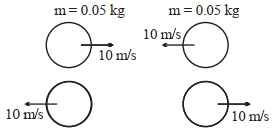
Two billiard balls of mass $0.05\,kg$ each,moving in opposite directions with $10\,m/s$,collide and rebound with the same speed. If the time duration of contact is $t = 0.005\,s$,then the force exerted on the balls due to each other is $\dots N$.
A
$100$
B
$200$
C
$300$
D
$400$
Solution
(B) Mass of each ball,$m = 0.05\,kg$.
Initial velocity of one ball,$u = 10\,m/s$.
Final velocity of the same ball after collision,$v = -10\,m/s$ (since it rebounds in the opposite direction).
Change in momentum of one ball,$\Delta P = m(v - u) = 0.05 \times (-10 - 10) = 0.05 \times (-20) = -1\,kg\cdot m/s$.
The magnitude of change in momentum is $|\Delta P| = 1\,kg\cdot m/s$.
The average force exerted is given by $F = \frac{|\Delta P|}{\Delta t}$.
Given $\Delta t = 0.005\,s$,we have $F = \frac{1}{0.005} = \frac{1000}{5} = 200\,N$.
Initial velocity of one ball,$u = 10\,m/s$.
Final velocity of the same ball after collision,$v = -10\,m/s$ (since it rebounds in the opposite direction).
Change in momentum of one ball,$\Delta P = m(v - u) = 0.05 \times (-10 - 10) = 0.05 \times (-20) = -1\,kg\cdot m/s$.
The magnitude of change in momentum is $|\Delta P| = 1\,kg\cdot m/s$.
The average force exerted is given by $F = \frac{|\Delta P|}{\Delta t}$.
Given $\Delta t = 0.005\,s$,we have $F = \frac{1}{0.005} = \frac{1000}{5} = 200\,N$.
0 likes
View Solution163
DifficultMCQ
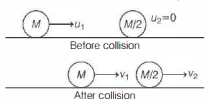
$A$ point mass $M$ moving with a certain velocity collides with a stationary point mass $M / 2$. The collision is elastic and in one-dimension. Let the ratio of the final velocities of $M$ and $M / 2$ be $x$. The value of $x$ is
A
$2$
B
$3$
C
$1/2$
D
$1/4$
Solution
(D) Since the collision is elastic,both linear momentum and kinetic energy are conserved.
Let $u_1$ be the initial velocity of mass $M$,and $v_1, v_2$ be the final velocities of masses $M$ and $M/2$ respectively.
Conservation of linear momentum:
$M u_1 = M v_1 + (M/2) v_2$
$u_1 = v_1 + v_2/2$
$2 u_1 = 2 v_1 + v_2$ ... $(i)$
Conservation of kinetic energy:
$(1/2) M u_1^2 = (1/2) M v_1^2 + (1/2) (M/2) v_2^2$
$u_1^2 = v_1^2 + v_2^2/2$
$2 u_1^2 = 2 v_1^2 + v_2^2$ ... (ii)
From $(i)$,$u_1 = (2 v_1 + v_2) / 2$. Substituting this into (ii):
$2 ((2 v_1 + v_2) / 2)^2 = 2 v_1^2 + v_2^2$
$2 (4 v_1^2 + v_2^2 + 4 v_1 v_2) / 4 = 2 v_1^2 + v_2^2$
$(4 v_1^2 + v_2^2 + 4 v_1 v_2) / 2 = 2 v_1^2 + v_2^2$
$4 v_1^2 + v_2^2 + 4 v_1 v_2 = 4 v_1^2 + 2 v_2^2$
$4 v_1 v_2 = v_2^2$
Since $v_2 \neq 0$,we have $v_2 = 4 v_1$.
The ratio of final velocities of $M$ and $M/2$ is $x = v_1 / v_2 = 1 / 4$.
Let $u_1$ be the initial velocity of mass $M$,and $v_1, v_2$ be the final velocities of masses $M$ and $M/2$ respectively.
Conservation of linear momentum:
$M u_1 = M v_1 + (M/2) v_2$
$u_1 = v_1 + v_2/2$
$2 u_1 = 2 v_1 + v_2$ ... $(i)$
Conservation of kinetic energy:
$(1/2) M u_1^2 = (1/2) M v_1^2 + (1/2) (M/2) v_2^2$
$u_1^2 = v_1^2 + v_2^2/2$
$2 u_1^2 = 2 v_1^2 + v_2^2$ ... (ii)
From $(i)$,$u_1 = (2 v_1 + v_2) / 2$. Substituting this into (ii):
$2 ((2 v_1 + v_2) / 2)^2 = 2 v_1^2 + v_2^2$
$2 (4 v_1^2 + v_2^2 + 4 v_1 v_2) / 4 = 2 v_1^2 + v_2^2$
$(4 v_1^2 + v_2^2 + 4 v_1 v_2) / 2 = 2 v_1^2 + v_2^2$
$4 v_1^2 + v_2^2 + 4 v_1 v_2 = 4 v_1^2 + 2 v_2^2$
$4 v_1 v_2 = v_2^2$
Since $v_2 \neq 0$,we have $v_2 = 4 v_1$.
The ratio of final velocities of $M$ and $M/2$ is $x = v_1 / v_2 = 1 / 4$.
0 likes
View Solution164
DifficultMCQ
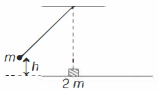
$A$ ball of mass $m$ suspended from a rigid support by an inextensible massless string is released from a height $h$ above its lowest point. At its lowest point, it collides elastically with a block of mass $2m$ at rest on a frictionless surface. Neglect the dimensions of the ball and the block. After the collision, the ball rises to a maximum height of
A
$\frac{h}{3}$
B
$\frac{h}{2}$
C
$\frac{h}{8}$
D
$\frac{h}{9}$
Solution
(D) Let the velocity of the ball of mass $m$ just before the collision be $u$. By conservation of energy, $\frac{1}{2}mu^2 = mgh$, so $u = \sqrt{2gh}$.
In an elastic collision, both kinetic energy and linear momentum are conserved.
Let $v_1$ be the velocity of the ball (in the opposite direction) and $v_2$ be the velocity of the block after the collision.
Conservation of momentum: $mu = 2mv_2 - mv_1 \Rightarrow u = 2v_2 - v_1 \quad \dots (i)$
Conservation of kinetic energy: $\frac{1}{2}mu^2 = \frac{1}{2}mv_1^2 + \frac{1}{2}(2m)v_2^2 \Rightarrow u^2 = v_1^2 + 2v_2^2 \quad \dots (ii)$
From $(i)$, $2v_2 = u + v_1$. Substituting this into $(ii)$:
$u^2 = v_1^2 + 2\left(\frac{u+v_1}{2}\right)^2 = v_1^2 + \frac{(u+v_1)^2}{2}$
$2u^2 = 2v_1^2 + u^2 + v_1^2 + 2uv_1$
$u^2 - 2uv_1 - 3v_1^2 = 0$
$(u - 3v_1)(u + v_1) = 0$
Since $v_1$ is the speed in the opposite direction, $v_1 = \frac{u}{3}$.
The new height $h'$ reached by the ball is given by $mgh' = \frac{1}{2}mv_1^2$.
$h' = \frac{v_1^2}{2g} = \frac{(u/3)^2}{2g} = \frac{u^2}{18g} = \frac{2gh}{18g} = \frac{h}{9}$.
In an elastic collision, both kinetic energy and linear momentum are conserved.
Let $v_1$ be the velocity of the ball (in the opposite direction) and $v_2$ be the velocity of the block after the collision.
Conservation of momentum: $mu = 2mv_2 - mv_1 \Rightarrow u = 2v_2 - v_1 \quad \dots (i)$
Conservation of kinetic energy: $\frac{1}{2}mu^2 = \frac{1}{2}mv_1^2 + \frac{1}{2}(2m)v_2^2 \Rightarrow u^2 = v_1^2 + 2v_2^2 \quad \dots (ii)$
From $(i)$, $2v_2 = u + v_1$. Substituting this into $(ii)$:
$u^2 = v_1^2 + 2\left(\frac{u+v_1}{2}\right)^2 = v_1^2 + \frac{(u+v_1)^2}{2}$
$2u^2 = 2v_1^2 + u^2 + v_1^2 + 2uv_1$
$u^2 - 2uv_1 - 3v_1^2 = 0$
$(u - 3v_1)(u + v_1) = 0$
Since $v_1$ is the speed in the opposite direction, $v_1 = \frac{u}{3}$.
The new height $h'$ reached by the ball is given by $mgh' = \frac{1}{2}mv_1^2$.
$h' = \frac{v_1^2}{2g} = \frac{(u/3)^2}{2g} = \frac{u^2}{18g} = \frac{2gh}{18g} = \frac{h}{9}$.
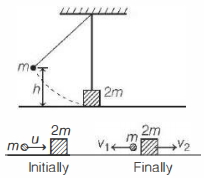
0 likes
View Solution165
DifficultMCQ
$A$ mass $M$ moving with a certain speed $V$ collides elastically with another stationary mass $m$. After the collision,the masses $M$ and $m$ move with speeds $V^{\prime}$ and $v$,respectively. All motion is in one dimension. Then,
A
$V=V^{\prime}+v$
B
$V^{\prime}=V+v$
C
$V^{\prime}=\frac{(V+v)}{2}$
D
$v=V+V^{\prime}$
Solution
(D) The collision is elastic,so both linear momentum and kinetic energy are conserved.
According to the conservation of linear momentum:
$M V = M V^{\prime} + m v \implies M(V - V^{\prime}) = m v \dots (i)$
According to the conservation of kinetic energy:
$\frac{1}{2} M V^2 = \frac{1}{2} M V^{\prime 2} + \frac{1}{2} m v^2 \implies M(V^2 - V^{\prime 2}) = m v^2 \dots (ii)$
Dividing equation $(ii)$ by equation $(i)$:
$\frac{M(V^2 - V^{\prime 2})}{M(V - V^{\prime})} = \frac{m v^2}{m v}$
$\frac{(V - V^{\prime})(V + V^{\prime})}{(V - V^{\prime})} = v$
$V + V^{\prime} = v$
Thus,option $(d)$ is correct.
According to the conservation of linear momentum:
$M V = M V^{\prime} + m v \implies M(V - V^{\prime}) = m v \dots (i)$
According to the conservation of kinetic energy:
$\frac{1}{2} M V^2 = \frac{1}{2} M V^{\prime 2} + \frac{1}{2} m v^2 \implies M(V^2 - V^{\prime 2}) = m v^2 \dots (ii)$
Dividing equation $(ii)$ by equation $(i)$:
$\frac{M(V^2 - V^{\prime 2})}{M(V - V^{\prime})} = \frac{m v^2}{m v}$
$\frac{(V - V^{\prime})(V + V^{\prime})}{(V - V^{\prime})} = v$
$V + V^{\prime} = v$
Thus,option $(d)$ is correct.
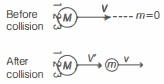
0 likes
View Solution166
AdvancedMCQ
$A$ ball of mass $2m$ and a system of two balls with equal masses $m$ connected by a massless spring are placed on a smooth horizontal surface (see figure). Initially, the ball of mass $2m$ moves with velocity $u_0$ along the line passing through the centres of all the balls and the spring, whereas the system of two balls is at rest. Assuming that the collision between the individual balls is perfectly elastic, the ratio of vibrational energy stored in the system of two connected balls to the initial kinetic energy of the ball of mass $2m$ is

A
$1$
B
$\frac{4}{9}$
C
$\frac{1}{2}$
D
$\frac{2}{3}$
Solution
(B) Let the velocity of the ball of mass $2m$ be $u_0$ and the system of two balls be at rest. After the elastic collision, let the velocity of the ball of mass $2m$ be $v_1$ and the velocity of the first ball of mass $m$ be $v_2$.
By conservation of linear momentum: $2m u_0 = 2m v_1 + m v_2 \implies 2u_0 = 2v_1 + v_2$.
Since the collision is perfectly elastic, the coefficient of restitution $e = 1 = \frac{v_2 - v_1}{u_0} \implies v_2 - v_1 = u_0$.
Solving these two equations: $v_2 = u_0 + v_1$. Substituting this into the momentum equation: $2u_0 = 2v_1 + (u_0 + v_1) = 3v_1 + u_0 \implies 3v_1 = u_0 \implies v_1 = \frac{u_0}{3}$.
Then $v_2 = u_0 + \frac{u_0}{3} = \frac{4u_0}{3}$.
The vibrational energy is the kinetic energy of the two-ball system in the center-of-mass frame. The velocity of the center of mass of the two-ball system is $v_{cm} = \frac{m(v_2) + m(0)}{2m} = \frac{v_2}{2} = \frac{2u_0}{3}$.
The vibrational energy $E_v = \frac{1}{2} \mu v_{rel}^2$, where $\mu = \frac{m \cdot m}{m+m} = \frac{m}{2}$ and $v_{rel} = v_2 - 0 = \frac{4u_0}{3}$.
$E_v = \frac{1}{2} \left( \frac{m}{2} \right) \left( \frac{4u_0}{3} \right)^2 = \frac{m}{4} \cdot \frac{16u_0^2}{9} = \frac{4mu_0^2}{9}$.
The initial kinetic energy of the ball of mass $2m$ is $K_i = \frac{1}{2} (2m) u_0^2 = mu_0^2$.
The ratio is $\frac{E_v}{K_i} = \frac{4mu_0^2 / 9}{mu_0^2} = \frac{4}{9}$.
By conservation of linear momentum: $2m u_0 = 2m v_1 + m v_2 \implies 2u_0 = 2v_1 + v_2$.
Since the collision is perfectly elastic, the coefficient of restitution $e = 1 = \frac{v_2 - v_1}{u_0} \implies v_2 - v_1 = u_0$.
Solving these two equations: $v_2 = u_0 + v_1$. Substituting this into the momentum equation: $2u_0 = 2v_1 + (u_0 + v_1) = 3v_1 + u_0 \implies 3v_1 = u_0 \implies v_1 = \frac{u_0}{3}$.
Then $v_2 = u_0 + \frac{u_0}{3} = \frac{4u_0}{3}$.
The vibrational energy is the kinetic energy of the two-ball system in the center-of-mass frame. The velocity of the center of mass of the two-ball system is $v_{cm} = \frac{m(v_2) + m(0)}{2m} = \frac{v_2}{2} = \frac{2u_0}{3}$.
The vibrational energy $E_v = \frac{1}{2} \mu v_{rel}^2$, where $\mu = \frac{m \cdot m}{m+m} = \frac{m}{2}$ and $v_{rel} = v_2 - 0 = \frac{4u_0}{3}$.
$E_v = \frac{1}{2} \left( \frac{m}{2} \right) \left( \frac{4u_0}{3} \right)^2 = \frac{m}{4} \cdot \frac{16u_0^2}{9} = \frac{4mu_0^2}{9}$.
The initial kinetic energy of the ball of mass $2m$ is $K_i = \frac{1}{2} (2m) u_0^2 = mu_0^2$.
The ratio is $\frac{E_v}{K_i} = \frac{4mu_0^2 / 9}{mu_0^2} = \frac{4}{9}$.
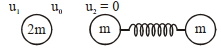
0 likes
View Solution167
MediumMCQ
Particle $A$ makes a perfectly elastic collision with another particle $B$ at rest. They fly apart in opposite directions with equal speeds. If their masses are $m_A$ and $m_B$ respectively,then:
A
$2 m_A = m_B$
B
$\sqrt{3} m_A = m_B$
C
$4 m_A = m_B$
D
$3 m_A = m_B$
Solution
(D) Let the initial velocity of particle $A$ be $u_A$ and particle $B$ be $0$. Let the final velocities be $v_A$ and $v_B$. Given that they move in opposite directions with equal speeds,let $v_A = -v$ and $v_B = v$.
From the conservation of linear momentum:
$m_A u_A = m_A (-v) + m_B v$
$m_A u_A = (m_B - m_A) v$ --- $(1)$
From the conservation of kinetic energy (perfectly elastic collision):
$\frac{1}{2} m_A u_A^2 = \frac{1}{2} m_A (-v)^2 + \frac{1}{2} m_B v^2$
$m_A u_A^2 = (m_A + m_B) v^2$ --- $(2)$
Dividing equation $(2)$ by equation $(1)$:
$\frac{m_A u_A^2}{m_A u_A} = \frac{(m_A + m_B) v^2}{(m_B - m_A) v}$
$u_A = \frac{(m_A + m_B) v}{(m_B - m_A)}$
Substitute $u_A$ back into equation $(1)$:
$m_A \left[ \frac{(m_A + m_B) v}{(m_B - m_A)} \right] = (m_B - m_A) v$
$m_A (m_A + m_B) = (m_B - m_A)^2$
$m_A^2 + m_A m_B = m_B^2 - 2 m_A m_B + m_A^2$
$3 m_A m_B = m_B^2$
$3 m_A = m_B$
From the conservation of linear momentum:
$m_A u_A = m_A (-v) + m_B v$
$m_A u_A = (m_B - m_A) v$ --- $(1)$
From the conservation of kinetic energy (perfectly elastic collision):
$\frac{1}{2} m_A u_A^2 = \frac{1}{2} m_A (-v)^2 + \frac{1}{2} m_B v^2$
$m_A u_A^2 = (m_A + m_B) v^2$ --- $(2)$
Dividing equation $(2)$ by equation $(1)$:
$\frac{m_A u_A^2}{m_A u_A} = \frac{(m_A + m_B) v^2}{(m_B - m_A) v}$
$u_A = \frac{(m_A + m_B) v}{(m_B - m_A)}$
Substitute $u_A$ back into equation $(1)$:
$m_A \left[ \frac{(m_A + m_B) v}{(m_B - m_A)} \right] = (m_B - m_A) v$
$m_A (m_A + m_B) = (m_B - m_A)^2$
$m_A^2 + m_A m_B = m_B^2 - 2 m_A m_B + m_A^2$
$3 m_A m_B = m_B^2$
$3 m_A = m_B$
0 likes
View Solution168
MediumMCQ
If $n$ balls hit elastically and normally on a surface per unit time and all balls of mass $m$ are moving with the same velocity $u$, then the force on the surface is ..........
A
$mun$
B
$2mun$
C
$\frac{1}{2}mu^2n$
D
$mu^2n$
Solution
(B) The force exerted on the surface is equal to the rate of change of momentum of the balls.
Since the collision is elastic and normal, the velocity of each ball changes from $u$ to $-u$.
The change in momentum for a single ball is $\Delta p = m(-u) - mu = -2mu$.
The magnitude of the change in momentum for one ball is $|\Delta p| = 2mu$.
Since $n$ balls strike the surface per unit time, the total rate of change of momentum is $F = n \times |\Delta p|$.
Therefore, the force on the surface is $F = 2mun$.
Since the collision is elastic and normal, the velocity of each ball changes from $u$ to $-u$.
The change in momentum for a single ball is $\Delta p = m(-u) - mu = -2mu$.
The magnitude of the change in momentum for one ball is $|\Delta p| = 2mu$.
Since $n$ balls strike the surface per unit time, the total rate of change of momentum is $F = n \times |\Delta p|$.
Therefore, the force on the surface is $F = 2mun$.

0 likes
View Solution169
MediumMCQ
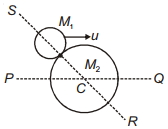
An object of mass $M_1$ moving horizontally with speed $u$ collides elastically with another object of mass $M_2$ at rest. Select the correct statement.
A
The momentum of the system is conserved only in the direction $PQ$.
B
The momentum of $M_1$ is conserved in the direction perpendicular to $SR$.
C
The momentum of $M_2$ will change in the direction normal to $CR$.
D
All of these.
Solution
(B) During an elastic collision between two spheres,the impulsive force acts along the line joining their centers (the line $SR$).
This force causes a change in the momentum of both objects along the line $SR$.
However,there is no impulsive force acting perpendicular to the line $SR$.
Therefore,the component of momentum of each object perpendicular to the line $SR$ remains unchanged (conserved).
Thus,the momentum of $M_1$ is conserved in the direction perpendicular to $SR$.
This force causes a change in the momentum of both objects along the line $SR$.
However,there is no impulsive force acting perpendicular to the line $SR$.
Therefore,the component of momentum of each object perpendicular to the line $SR$ remains unchanged (conserved).
Thus,the momentum of $M_1$ is conserved in the direction perpendicular to $SR$.
0 likes
View Solution170
MediumMCQ
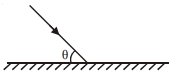
$A$ ball of mass $m$ moving with speed $u$ collides with a smooth horizontal surface at an angle $\theta$ with it as shown in the figure. The magnitude of the impulse imparted to the surface by the ball is [Coefficient of restitution of collision is $e$].
A
$m u(1+e) \cos \theta$
B
$m u(1-e) \sin \theta$
C
$m u(1-e) \cos \theta$
D
$m u(1+e) \sin \theta$
Solution
(D) The velocity of the ball before collision can be resolved into two components: horizontal component $u_x = u \cos \theta$ and vertical component $u_y = -u \sin \theta$ (taking downward as negative).
Since the surface is smooth,there is no impulse in the horizontal direction,so the horizontal velocity remains unchanged: $v_x = u \cos \theta$.
In the vertical direction,the coefficient of restitution $e$ is defined as the ratio of the velocity of separation to the velocity of approach along the normal: $e = \frac{v_y}{u_y}$.
Thus,the vertical velocity after collision is $v_y = e u \sin \theta$ (upward).
The impulse $I$ imparted to the ball by the surface is equal to the change in momentum of the ball: $\vec{I} = m(\vec{v} - \vec{u})$.
Since there is no change in horizontal momentum,the impulse is only in the vertical direction: $I = m(v_y - u_y) = m(e u \sin \theta - (-u \sin \theta)) = m u(1+e) \sin \theta$.
The magnitude of the impulse imparted to the surface by the ball is equal to the magnitude of the impulse imparted to the ball by the surface,which is $m u(1+e) \sin \theta$.
Since the surface is smooth,there is no impulse in the horizontal direction,so the horizontal velocity remains unchanged: $v_x = u \cos \theta$.
In the vertical direction,the coefficient of restitution $e$ is defined as the ratio of the velocity of separation to the velocity of approach along the normal: $e = \frac{v_y}{u_y}$.
Thus,the vertical velocity after collision is $v_y = e u \sin \theta$ (upward).
The impulse $I$ imparted to the ball by the surface is equal to the change in momentum of the ball: $\vec{I} = m(\vec{v} - \vec{u})$.
Since there is no change in horizontal momentum,the impulse is only in the vertical direction: $I = m(v_y - u_y) = m(e u \sin \theta - (-u \sin \theta)) = m u(1+e) \sin \theta$.
The magnitude of the impulse imparted to the surface by the ball is equal to the magnitude of the impulse imparted to the ball by the surface,which is $m u(1+e) \sin \theta$.
0 likes
View Solution171
MediumMCQ
Which one of the following statements does not hold good when two balls of masses $m_1$ and $m_2$ undergo elastic collision?
A
When $m_1 < m_2$ and $m_2$ is at rest,there will be maximum transfer of momentum.
B
When $m_1 > m_2$ and $m_2$ is at rest,after collision the ball of mass $m_2$ moves with four times the velocity of $m_1$.
C
When $m_1 = m_2$ and $m_2$ is at rest,there will be maximum transfer of $K.E$.
D
When the collision is oblique and $m_2$ is at rest with $m_1 = m_2$,after collision the balls move in opposite directions.
Solution
(D) In an elastic collision between two bodies of equal mass $(m_1 = m_2)$ where one is initially at rest,if the collision is oblique,the two bodies move at an angle of $90^{\circ}$ to each other,not in opposite directions. Thus,statement $(d)$ is incorrect.
For $(a)$: When $m_1 \ll m_2$,the momentum transfer is indeed maximum.
For $(b)$: If $m_1 \gg m_2$,the velocity of the second ball becomes $v_2 \approx 2u_1$,which is a standard result,but the specific claim in $(b)$ is generally considered a distractor or incorrect depending on the mass ratio context,however,$(d)$ is physically impossible for oblique collisions.
For $(c)$: When $m_1 = m_2$ and $m_2$ is at rest,the first ball comes to rest and the second moves with the initial velocity of the first,resulting in $100\%$ transfer of $K.E$.
For $(a)$: When $m_1 \ll m_2$,the momentum transfer is indeed maximum.
For $(b)$: If $m_1 \gg m_2$,the velocity of the second ball becomes $v_2 \approx 2u_1$,which is a standard result,but the specific claim in $(b)$ is generally considered a distractor or incorrect depending on the mass ratio context,however,$(d)$ is physically impossible for oblique collisions.
For $(c)$: When $m_1 = m_2$ and $m_2$ is at rest,the first ball comes to rest and the second moves with the initial velocity of the first,resulting in $100\%$ transfer of $K.E$.
0 likes
View Solution172
MediumMCQ
$A$ mass $m_1$ moves with a great velocity. It strikes another mass $m_2$ at rest in a head-on collision. It comes back along its path with low speed after the collision. Then:
A
$m_1 > m_2$
B
$m_1 < m_2$
C
$m_1 = m_2$
D
$m_1 \geq m_2$
Solution
(B) In a one-dimensional elastic head-on collision,the final velocity $v_1$ of the first mass $m_1$ is given by the formula:
$v_1 = \frac{(m_1 - m_2)u_1}{m_1 + m_2}$
where $u_1$ is the initial velocity of $m_1$ and $m_2$ is initially at rest $(u_2 = 0)$.
According to the problem,the mass $m_1$ rebounds,meaning its final velocity $v_1$ is in the opposite direction to its initial velocity $u_1$. Thus,$v_1$ must be negative.
For $v_1$ to be negative,the numerator $(m_1 - m_2)$ must be negative,which implies $m_1 - m_2 < 0$ or $m_1 < m_2$.
Therefore,the correct option is $B$.
$v_1 = \frac{(m_1 - m_2)u_1}{m_1 + m_2}$
where $u_1$ is the initial velocity of $m_1$ and $m_2$ is initially at rest $(u_2 = 0)$.
According to the problem,the mass $m_1$ rebounds,meaning its final velocity $v_1$ is in the opposite direction to its initial velocity $u_1$. Thus,$v_1$ must be negative.
For $v_1$ to be negative,the numerator $(m_1 - m_2)$ must be negative,which implies $m_1 - m_2 < 0$ or $m_1 < m_2$.
Therefore,the correct option is $B$.
0 likes
View Solution173
MediumMCQ
$A$ block having mass $m$ collides with another stationary block having mass $2m$. The lighter block comes to rest after the collision. If the initial velocity of the first block is $v$,then the value of the coefficient of restitution must be:
A
$0.5$
B
$0.4$
C
$0.6$
D
$0.8$
Solution
(A) Since there is no external force acting on the system,the linear momentum of the system is conserved.
Let $v_1$ and $v_2$ be the velocities of the blocks after the collision.
Initial momentum = $mv + (2m)(0) = mv$.
Final momentum = $m(0) + (2m)v_2 = 2mv_2$.
By conservation of linear momentum: $mv = 2mv_2$,which gives $v_2 = v/2$.
The coefficient of restitution $e$ is defined as the ratio of the velocity of separation to the velocity of approach.
Velocity of approach = $v - 0 = v$.
Velocity of separation = $v_2 - 0 = v_2 = v/2$.
Therefore,$e = \frac{v/2}{v} = 0.5$.
Let $v_1$ and $v_2$ be the velocities of the blocks after the collision.
Initial momentum = $mv + (2m)(0) = mv$.
Final momentum = $m(0) + (2m)v_2 = 2mv_2$.
By conservation of linear momentum: $mv = 2mv_2$,which gives $v_2 = v/2$.
The coefficient of restitution $e$ is defined as the ratio of the velocity of separation to the velocity of approach.
Velocity of approach = $v - 0 = v$.
Velocity of separation = $v_2 - 0 = v_2 = v/2$.
Therefore,$e = \frac{v/2}{v} = 0.5$.
0 likes
View Solution174
MediumMCQ
Assertion $(A)$: In an elastic collision between two bodies,the relative speed of the bodies after collision is equal to the relative speed before the collision.
Reason $(R)$: In an elastic collision,the linear momentum of the system is conserved.
Reason $(R)$: In an elastic collision,the linear momentum of the system is conserved.
A
If both Assertion and Reason are true and Reason is the correct explanation of Assertion.
B
If both Assertion and Reason are true but Reason is not the correct explanation of Assertion.
C
If Assertion is true but Reason is false.
D
If both Assertion and Reason are false.
Solution
(B) The Assertion $(A)$ is true. By the definition of an elastic collision,both kinetic energy and linear momentum are conserved. For a one-dimensional elastic collision between two bodies of masses $m_1$ and $m_2$ with initial velocities $u_1$ and $u_2$ and final velocities $v_1$ and $v_2$,the coefficient of restitution $e$ is defined as $e = \frac{v_2 - v_1}{u_1 - u_2}$. For an elastic collision,$e = 1$,which implies $v_2 - v_1 = u_1 - u_2$. This confirms that the relative speed of separation after collision is equal to the relative speed of approach before collision.
The Reason $(R)$ is also true. In any collision (elastic or inelastic),the total linear momentum of the system is conserved provided no external force acts on the system.
However,the conservation of linear momentum alone does not explain why the relative speed remains constant; that property is a consequence of the conservation of kinetic energy in an elastic collision. Therefore,the Reason is not the correct explanation of the Assertion.
The Reason $(R)$ is also true. In any collision (elastic or inelastic),the total linear momentum of the system is conserved provided no external force acts on the system.
However,the conservation of linear momentum alone does not explain why the relative speed remains constant; that property is a consequence of the conservation of kinetic energy in an elastic collision. Therefore,the Reason is not the correct explanation of the Assertion.
0 likes
View Solution175
MediumMCQ
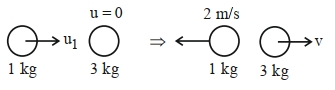
$A$ body of mass $1\,kg$ collides head-on elastically with a stationary body of mass $3\,kg$. After the collision,the smaller body reverses its direction of motion and moves with a speed of $2\,m/s$. The initial speed of the smaller body before the collision is $..........\,m/s$.
A
$3$
B
$4$
C
$2$
D
$1$
Solution
(B) Let $m_1 = 1\,kg$,$m_2 = 3\,kg$,$u_1$ be the initial velocity of the $1\,kg$ mass,and $u_2 = 0$ be the initial velocity of the $3\,kg$ mass.
After the collision,the velocity of the $1\,kg$ mass is $v_1 = -2\,m/s$ (as it reverses direction).
By the law of conservation of linear momentum:
$m_1 u_1 + m_2 u_2 = m_1 v_1 + m_2 v_2$
$1(u_1) + 3(0) = 1(-2) + 3(v_2)$
$u_1 = -2 + 3v_2 \quad \dots(1)$
For an elastic collision,the coefficient of restitution $e = 1$:
$e = \frac{v_2 - v_1}{u_1 - u_2} = 1$
$1 = \frac{v_2 - (-2)}{u_1 - 0} \Rightarrow u_1 = v_2 + 2 \quad \dots(2)$
Substituting $v_2 = u_1 - 2$ into equation $(1)$:
$u_1 = -2 + 3(u_1 - 2)$
$u_1 = -2 + 3u_1 - 6$
$2u_1 = 8$
$u_1 = 4\,m/s$.
After the collision,the velocity of the $1\,kg$ mass is $v_1 = -2\,m/s$ (as it reverses direction).
By the law of conservation of linear momentum:
$m_1 u_1 + m_2 u_2 = m_1 v_1 + m_2 v_2$
$1(u_1) + 3(0) = 1(-2) + 3(v_2)$
$u_1 = -2 + 3v_2 \quad \dots(1)$
For an elastic collision,the coefficient of restitution $e = 1$:
$e = \frac{v_2 - v_1}{u_1 - u_2} = 1$
$1 = \frac{v_2 - (-2)}{u_1 - 0} \Rightarrow u_1 = v_2 + 2 \quad \dots(2)$
Substituting $v_2 = u_1 - 2$ into equation $(1)$:
$u_1 = -2 + 3(u_1 - 2)$
$u_1 = -2 + 3u_1 - 6$
$2u_1 = 8$
$u_1 = 4\,m/s$.
0 likes
View Solution176
MediumMCQ
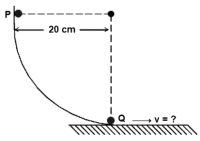
As per the given figure,a small ball $P$ slides down the quadrant of a circle and hits another ball $Q$ of equal mass which is initially at rest. Neglecting the effect of friction and assuming the collision to be elastic,the velocity of ball $Q$ after the collision will be $............\,m/s$ $(g = 10\,m/s^2)$.
A
$0$
B
$0.25$
C
$2$
D
$4$
Solution
(C) $1$. The ball $P$ slides down a height $h = 20\,cm = 0.2\,m$.
$2$. By the law of conservation of energy,the velocity $v_P$ of ball $P$ just before the collision is given by $v_P = \sqrt{2gh}$.
$3$. Substituting the values: $v_P = \sqrt{2 \times 10 \times 0.2} = \sqrt{4} = 2\,m/s$.
$4$. Since the collision is elastic and the masses of the two balls are equal,the velocities are interchanged after the collision.
$5$. Before the collision,ball $P$ has velocity $v_P = 2\,m/s$ and ball $Q$ is at rest $(v_Q = 0)$.
$6$. After the collision,ball $P$ comes to rest $(v_P' = 0)$ and ball $Q$ moves with the velocity that ball $P$ had before the collision $(v_Q' = v_P = 2\,m/s)$.
$2$. By the law of conservation of energy,the velocity $v_P$ of ball $P$ just before the collision is given by $v_P = \sqrt{2gh}$.
$3$. Substituting the values: $v_P = \sqrt{2 \times 10 \times 0.2} = \sqrt{4} = 2\,m/s$.
$4$. Since the collision is elastic and the masses of the two balls are equal,the velocities are interchanged after the collision.
$5$. Before the collision,ball $P$ has velocity $v_P = 2\,m/s$ and ball $Q$ is at rest $(v_Q = 0)$.
$6$. After the collision,ball $P$ comes to rest $(v_P' = 0)$ and ball $Q$ moves with the velocity that ball $P$ had before the collision $(v_Q' = v_P = 2\,m/s)$.
0 likes
View Solution177
DifficultMCQ
$STATEMENT-1$: In an elastic collision between two bodies, the relative speed of the bodies after collision is equal to the relative speed before the collision. Because
$STATEMENT-2$: In an elastic collision, the linear momentum of the system is conserved.
$STATEMENT-2$: In an elastic collision, the linear momentum of the system is conserved.
A
$Statement-1$ is True, $Statement-2$ is True; $Statement-2$ is a correct explanation for $Statement-1$.
B
$Statement-1$ is True, $Statement-2$ is True; $Statement-2$ is $NOT$ a correct explanation for $Statement-1$.
C
$Statement-1$ is True, $Statement-2$ is False.
D
$Statement-1$ is False, $Statement-2$ is True.
Solution
(B) In an elastic collision, both linear momentum and kinetic energy are conserved.
Let two bodies of masses $m_1$ and $m_2$ have initial velocities $u_1$ and $u_2$, and final velocities $v_1$ and $v_2$.
Conservation of linear momentum: $m_1 u_1 + m_2 u_2 = m_1 v_1 + m_2 v_2$ => $m_1(u_1 - v_1) = m_2(v_2 - u_2)$ (Equation $1$).
Conservation of kinetic energy: $\frac{1}{2} m_1 u_1^2 + \frac{1}{2} m_2 u_2^2 = \frac{1}{2} m_1 v_1^2 + \frac{1}{2} m_2 v_2^2$ => $m_1(u_1^2 - v_1^2) = m_2(v_2^2 - u_2^2)$ (Equation $2$).
Dividing Equation $2$ by Equation $1$: $u_1 + v_1 = v_2 + u_2$ => $u_1 - u_2 = v_2 - v_1$.
This shows that the relative velocity of approach $(u_1 - u_2)$ equals the relative velocity of separation $(v_2 - v_1)$. Thus, $Statement-1$ is true.
$Statement-2$ is also true because linear momentum is always conserved in any collision (elastic or inelastic) in the absence of external forces. However, the conservation of momentum alone is not sufficient to derive the relative speed property; the conservation of kinetic energy is required. Therefore, $Statement-2$ is not the correct explanation for $Statement-1$.
Let two bodies of masses $m_1$ and $m_2$ have initial velocities $u_1$ and $u_2$, and final velocities $v_1$ and $v_2$.
Conservation of linear momentum: $m_1 u_1 + m_2 u_2 = m_1 v_1 + m_2 v_2$ => $m_1(u_1 - v_1) = m_2(v_2 - u_2)$ (Equation $1$).
Conservation of kinetic energy: $\frac{1}{2} m_1 u_1^2 + \frac{1}{2} m_2 u_2^2 = \frac{1}{2} m_1 v_1^2 + \frac{1}{2} m_2 v_2^2$ => $m_1(u_1^2 - v_1^2) = m_2(v_2^2 - u_2^2)$ (Equation $2$).
Dividing Equation $2$ by Equation $1$: $u_1 + v_1 = v_2 + u_2$ => $u_1 - u_2 = v_2 - v_1$.
This shows that the relative velocity of approach $(u_1 - u_2)$ equals the relative velocity of separation $(v_2 - v_1)$. Thus, $Statement-1$ is true.
$Statement-2$ is also true because linear momentum is always conserved in any collision (elastic or inelastic) in the absence of external forces. However, the conservation of momentum alone is not sufficient to derive the relative speed property; the conservation of kinetic energy is required. Therefore, $Statement-2$ is not the correct explanation for $Statement-1$.
0 likes
View Solution178
AdvancedMCQ
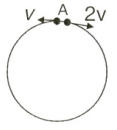
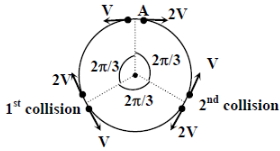
Two small particles of equal masses start moving in opposite directions from a point $A$ in a horizontal circular orbit. Their tangential velocities are $v$ and $2v$,respectively,as shown in the figure. Between collisions,the particles move with constant speeds. After making how many elastic collisions,other than that at $A$,will these two particles again reach the point $A$?
A
$4$
B
$3$
C
$2$
D
$1$
Solution
(C) Since the collision is elastic and the masses are equal,the velocities of the particles will be interchanged after each collision.
Let the particles collide at time $t$ at an angle $\theta$ from point $A$.
The distance traveled by the first particle is $R\theta = vt$.
The distance traveled by the second particle is $R(2\pi - \theta) = 2vt$.
Dividing the two equations: $\frac{\theta}{2\pi - \theta} = \frac{vt}{2vt} = \frac{1}{2}$.
This gives $2\theta = 2\pi - \theta$,so $3\theta = 2\pi$,which means $\theta = \frac{2\pi}{3} = 120^{\circ}$.
After the first collision at $120^{\circ}$,the velocities are interchanged. The particle that had speed $v$ now has speed $2v$,and the particle that had speed $2v$ now has speed $v$.
They will collide again after traveling another $120^{\circ}$ relative to each other,which occurs at an angle of $240^{\circ}$ from point $A$.
After this second collision,the velocities are interchanged again. The particles will then travel the remaining $120^{\circ}$ to reach point $A$ simultaneously.
Thus,they reach point $A$ after $2$ collisions.
Let the particles collide at time $t$ at an angle $\theta$ from point $A$.
The distance traveled by the first particle is $R\theta = vt$.
The distance traveled by the second particle is $R(2\pi - \theta) = 2vt$.
Dividing the two equations: $\frac{\theta}{2\pi - \theta} = \frac{vt}{2vt} = \frac{1}{2}$.
This gives $2\theta = 2\pi - \theta$,so $3\theta = 2\pi$,which means $\theta = \frac{2\pi}{3} = 120^{\circ}$.
After the first collision at $120^{\circ}$,the velocities are interchanged. The particle that had speed $v$ now has speed $2v$,and the particle that had speed $2v$ now has speed $v$.
They will collide again after traveling another $120^{\circ}$ relative to each other,which occurs at an angle of $240^{\circ}$ from point $A$.
After this second collision,the velocities are interchanged again. The particles will then travel the remaining $120^{\circ}$ to reach point $A$ simultaneously.
Thus,they reach point $A$ after $2$ collisions.
0 likes
View Solution179
DifficultMCQ
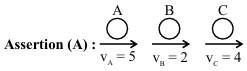
Given below are two statements. One is labelled as Assertion $(A)$ and the other is labelled as Reason $(R)$. Three identical spheres of same mass undergo one-dimensional motion as shown in the figure with initial velocities $v_{A} = 5 \ m/s$,$v_{B} = 2 \ m/s$,$v_{C} = 4 \ m/s$. If we wait sufficiently long for elastic collisions to happen,then $v_{A} = 4 \ m/s$,$v_{B} = 2 \ m/s$,$v_{C} = 5 \ m/s$ will be the final velocities.
Reason $(R)$: In an elastic collision between identical masses,two objects exchange their velocities. In the light of the above statements,choose the correct answer from the options given below:
Reason $(R)$: In an elastic collision between identical masses,two objects exchange their velocities. In the light of the above statements,choose the correct answer from the options given below:
A
$(A)$ is false but $(R)$ is true
B
$(A)$ is true but $(R)$ is false
C
Both $(A)$ and $(R)$ are true and $(R)$ is the correct explanation of $(A)$.
D
Both $(A)$ and $(R)$ are true but $(R)$ is $\text{NOT}$ the correct explanation of $(A)$
Solution
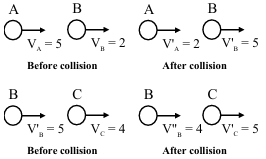
(A) When two objects of identical mass undergo a perfectly elastic one-dimensional collision,they exchange their velocities.
Initially,we have $v_{A} = 5 \ m/s$,$v_{B} = 2 \ m/s$,and $v_{C} = 4 \ m/s$.
First,sphere $A$ collides with sphere $B$. Since they have identical masses,they exchange velocities: $v_{A}' = 2 \ m/s$ and $v_{B}' = 5 \ m/s$.
Now,sphere $B$ (moving with $5 \ m/s$) collides with sphere $C$ (moving with $4 \ m/s$). They exchange velocities: $v_{B}'' = 4 \ m/s$ and $v_{C}' = 5 \ m/s$.
Thus,the final velocities are $v_{A} = 2 \ m/s$,$v_{B} = 4 \ m/s$,and $v_{C} = 5 \ m/s$.
The Assertion $(A)$ states the final velocities are $4 \ m/s, 2 \ m/s, 5 \ m/s$,which is incorrect.
The Reason $(R)$ is a correct physical principle.
Therefore,$(A)$ is false but $(R)$ is true.
Initially,we have $v_{A} = 5 \ m/s$,$v_{B} = 2 \ m/s$,and $v_{C} = 4 \ m/s$.
First,sphere $A$ collides with sphere $B$. Since they have identical masses,they exchange velocities: $v_{A}' = 2 \ m/s$ and $v_{B}' = 5 \ m/s$.
Now,sphere $B$ (moving with $5 \ m/s$) collides with sphere $C$ (moving with $4 \ m/s$). They exchange velocities: $v_{B}'' = 4 \ m/s$ and $v_{C}' = 5 \ m/s$.
Thus,the final velocities are $v_{A} = 2 \ m/s$,$v_{B} = 4 \ m/s$,and $v_{C} = 5 \ m/s$.
The Assertion $(A)$ states the final velocities are $4 \ m/s, 2 \ m/s, 5 \ m/s$,which is incorrect.
The Reason $(R)$ is a correct physical principle.
Therefore,$(A)$ is false but $(R)$ is true.
0 likes
View Solution180
DifficultMCQ
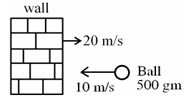
Consider the situation as shown in the figure. The ball strikes the wall normally and the collision is elastic. The wall is moving with a velocity of $20 \ m/s$ to the right,and the ball is moving with a velocity of $10 \ m/s$ to the left. The mass of the ball is $500 \ g$. The change in the kinetic energy of the ball is $....J$.
A
$300$
B
$600$
C
$900$
D
$1200$
Solution
(B) Let the velocity of the wall be $v_w = 20 \ m/s$ (to the right,positive direction).
The velocity of the ball before collision is $u = -10 \ m/s$ (to the left,negative direction).
The mass of the ball is $m = 500 \ g = 0.5 \ kg$.
In an elastic collision with a massive wall moving with velocity $v_w$,the velocity of the ball after collision $v$ is given by the formula $v = 2v_w - u$.
Substituting the values: $v = 2(20) - (-10) = 40 + 10 = 50 \ m/s$.
The change in kinetic energy of the ball is $\Delta KE = KE_f - KE_i = \frac{1}{2} m v^2 - \frac{1}{2} m u^2$.
$\Delta KE = \frac{1}{2} \times 0.5 \times (50^2 - (-10)^2) = 0.25 \times (2500 - 100) = 0.25 \times 2400 = 600 \ J$.
The velocity of the ball before collision is $u = -10 \ m/s$ (to the left,negative direction).
The mass of the ball is $m = 500 \ g = 0.5 \ kg$.
In an elastic collision with a massive wall moving with velocity $v_w$,the velocity of the ball after collision $v$ is given by the formula $v = 2v_w - u$.
Substituting the values: $v = 2(20) - (-10) = 40 + 10 = 50 \ m/s$.
The change in kinetic energy of the ball is $\Delta KE = KE_f - KE_i = \frac{1}{2} m v^2 - \frac{1}{2} m u^2$.
$\Delta KE = \frac{1}{2} \times 0.5 \times (50^2 - (-10)^2) = 0.25 \times (2500 - 100) = 0.25 \times 2400 = 600 \ J$.
0 likes
View Solution181
MediumMCQ
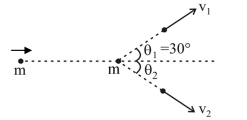
$A$ ball initially at rest is hit by another identical ball moving with some velocity as shown. Find the angle $\theta_2$ if the surface is without friction and the collision is perfectly elastic. $......^{\circ}$
A
$30$
B
$45$
C
$60$
D
$90$
Solution
(C) In a two-dimensional perfectly elastic collision between two identical masses $(m_1 = m_2 = m)$,where one mass is initially at rest,the conservation of linear momentum and kinetic energy leads to the condition that the angle between the final velocities of the two particles is $90^{\circ}$.
Given that $\theta_1 = 30^{\circ}$,we have the relation $\theta_1 + \theta_2 = 90^{\circ}$.
Therefore,$\theta_2 = 90^{\circ} - 30^{\circ} = 60^{\circ}$.
Given that $\theta_1 = 30^{\circ}$,we have the relation $\theta_1 + \theta_2 = 90^{\circ}$.
Therefore,$\theta_2 = 90^{\circ} - 30^{\circ} = 60^{\circ}$.
0 likes
View Solution182
AdvancedMCQ
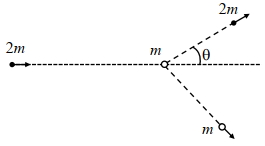
In a scattering experiment,a particle of mass $2m$ collides with another particle of mass $m$,which is initially at rest. Assuming the collision to be perfectly elastic,the maximum angular deviation $\theta$ of the heavier particle,as shown in the figure,in radians is:
A
$\pi$
B
$\frac{\pi}{6}$
C
$\frac{\pi}{3}$
D
$\tan^{-1}\left(\frac{1}{2}\right)$
Solution
(B) Let the initial velocity of the particle of mass $2m$ be $v_1$ and the final velocities of particles $2m$ and $m$ be $v_{1f}$ and $v_{2f}$ at angles $\theta$ and $\phi$ respectively.
Conservation of linear momentum along the $x$-axis:
$2mv_1 = 2mv_{1f} \cos \theta + mv_{2f} \cos \phi$ ---$(i)$
Conservation of linear momentum along the $y$-axis:
$0 = 2mv_{1f} \sin \theta - mv_{2f} \sin \phi \implies 2mv_{1f} \sin \theta = mv_{2f} \sin \phi$ ---(ii)
Conservation of kinetic energy:
$\frac{1}{2}(2m)v_1^2 = \frac{1}{2}(2m)v_{1f}^2 + \frac{1}{2}mv_{2f}^2 \implies 2v_1^2 = 2v_{1f}^2 + v_{2f}^2$ ---(iii)
From $(i)$ and (ii),$mv_{2f} \cos \phi = 2m(v_1 - v_{1f} \cos \theta)$ and $mv_{2f} \sin \phi = 2mv_{1f} \sin \theta$.
Squaring and adding these:
$(mv_{2f})^2 = 4m^2(v_1^2 + v_{1f}^2 - 2v_1v_{1f} \cos \theta)$.
Substitute $v_{2f}^2 = 2v_1^2 - 2v_{1f}^2$ from (iii):
$m^2(2v_1^2 - 2v_{1f}^2) = 4m^2(v_1^2 + v_{1f}^2 - 2v_1v_{1f} \cos \theta)$.
$v_1^2 - v_{1f}^2 = 2v_1^2 + 2v_{1f}^2 - 4v_1v_{1f} \cos \theta$.
$3v_{1f}^2 - (4v_1 \cos \theta)v_{1f} + v_1^2 = 0$.
For $v_{1f}$ to be real,the discriminant $D \geq 0$:
$(4v_1 \cos \theta)^2 - 4(3)(v_1^2) \geq 0 \implies 16v_1^2 \cos^2 \theta - 12v_1^2 \geq 0$.
$\cos^2 \theta \geq \frac{12}{16} = \frac{3}{4} \implies \cos \theta \geq \frac{\sqrt{3}}{2}$.
Thus,the maximum value of $\theta$ is $\cos^{-1}\left(\frac{\sqrt{3}}{2}\right) = \frac{\pi}{6}$.
Conservation of linear momentum along the $x$-axis:
$2mv_1 = 2mv_{1f} \cos \theta + mv_{2f} \cos \phi$ ---$(i)$
Conservation of linear momentum along the $y$-axis:
$0 = 2mv_{1f} \sin \theta - mv_{2f} \sin \phi \implies 2mv_{1f} \sin \theta = mv_{2f} \sin \phi$ ---(ii)
Conservation of kinetic energy:
$\frac{1}{2}(2m)v_1^2 = \frac{1}{2}(2m)v_{1f}^2 + \frac{1}{2}mv_{2f}^2 \implies 2v_1^2 = 2v_{1f}^2 + v_{2f}^2$ ---(iii)
From $(i)$ and (ii),$mv_{2f} \cos \phi = 2m(v_1 - v_{1f} \cos \theta)$ and $mv_{2f} \sin \phi = 2mv_{1f} \sin \theta$.
Squaring and adding these:
$(mv_{2f})^2 = 4m^2(v_1^2 + v_{1f}^2 - 2v_1v_{1f} \cos \theta)$.
Substitute $v_{2f}^2 = 2v_1^2 - 2v_{1f}^2$ from (iii):
$m^2(2v_1^2 - 2v_{1f}^2) = 4m^2(v_1^2 + v_{1f}^2 - 2v_1v_{1f} \cos \theta)$.
$v_1^2 - v_{1f}^2 = 2v_1^2 + 2v_{1f}^2 - 4v_1v_{1f} \cos \theta$.
$3v_{1f}^2 - (4v_1 \cos \theta)v_{1f} + v_1^2 = 0$.
For $v_{1f}$ to be real,the discriminant $D \geq 0$:
$(4v_1 \cos \theta)^2 - 4(3)(v_1^2) \geq 0 \implies 16v_1^2 \cos^2 \theta - 12v_1^2 \geq 0$.
$\cos^2 \theta \geq \frac{12}{16} = \frac{3}{4} \implies \cos \theta \geq \frac{\sqrt{3}}{2}$.
Thus,the maximum value of $\theta$ is $\cos^{-1}\left(\frac{\sqrt{3}}{2}\right) = \frac{\pi}{6}$.
0 likes
View Solution183
MediumMCQ
There is a head-on elastic collision between two particles moving in the same direction with speeds $5 \,m/s$ and $3 \,m/s$ respectively. After the collision,the velocity of the first particle becomes $4 \,m/s$ in the same direction. What is the velocity of the second particle?
A
$6 \,m/s$ in the same direction.
B
$4 \,m/s$ in the same direction.
C
$2 \,m/s$ in the opposite direction.
D
$3 \,m/s$ in the same direction.
Solution
$(A)$ In a head-on elastic collision,the relative velocity of approach is equal to the relative velocity of separation.
Let the masses of the two particles be $m_1$ and $m_2$.
Initial velocities are $u_1 = 5 \,m/s$ and $u_2 = 3 \,m/s$.
Final velocities are $v_1 = 4 \,m/s$ and $v_2 = ?$.
The relative velocity of approach is $u_1 - u_2 = 5 - 3 = 2 \,m/s$.
The relative velocity of separation is $v_2 - v_1 = v_2 - 4$.
Since the collision is elastic,$u_1 - u_2 = v_2 - v_1$.
Substituting the values: $2 = v_2 - 4$.
Therefore,$v_2 = 2 + 4 = 6 \,m/s$.
Since the result is positive,the second particle moves in the same direction.
Let the masses of the two particles be $m_1$ and $m_2$.
Initial velocities are $u_1 = 5 \,m/s$ and $u_2 = 3 \,m/s$.
Final velocities are $v_1 = 4 \,m/s$ and $v_2 = ?$.
The relative velocity of approach is $u_1 - u_2 = 5 - 3 = 2 \,m/s$.
The relative velocity of separation is $v_2 - v_1 = v_2 - 4$.
Since the collision is elastic,$u_1 - u_2 = v_2 - v_1$.
Substituting the values: $2 = v_2 - 4$.
Therefore,$v_2 = 2 + 4 = 6 \,m/s$.
Since the result is positive,the second particle moves in the same direction.
0 likes
View Solution184
MediumMCQ
$A$ sphere of mass $m$,moving with velocity $3u$,collides head-on with another identical sphere at rest. If $e$ is the coefficient of restitution,what will be the ratio of the velocity of the second sphere to that of the first sphere after the collision?
A
$\frac{1-e}{1+e}$
B
$\frac{1+e}{1-e}$
C
$\frac{e+1}{e-1}$
D
$\frac{e-1}{e+1}$
Solution
(B) Let the mass of both spheres be $m$. The initial velocity of the first sphere is $u_1 = 3u$ and the second sphere is $u_2 = 0$.
Let $v_1$ and $v_2$ be the velocities of the first and second spheres after the collision,respectively.
By the law of conservation of linear momentum: $m(3u) + m(0) = mv_1 + mv_2$,which simplifies to $v_1 + v_2 = 3u$ (Equation $1$).
By the definition of the coefficient of restitution $e$: $e = \frac{v_2 - v_1}{u_1 - u_2} = \frac{v_2 - v_1}{3u - 0}$,which gives $v_2 - v_1 = 3ue$ (Equation $2$).
Adding Equation $1$ and Equation $2$: $2v_2 = 3u(1 + e) \implies v_2 = \frac{3u(1 + e)}{2}$.
Subtracting Equation $2$ from Equation $1$: $2v_1 = 3u(1 - e) \implies v_1 = \frac{3u(1 - e)}{2}$.
The ratio of the velocity of the second sphere to the first sphere is $\frac{v_2}{v_1} = \frac{3u(1 + e) / 2}{3u(1 - e) / 2} = \frac{1 + e}{1 - e}$.
Let $v_1$ and $v_2$ be the velocities of the first and second spheres after the collision,respectively.
By the law of conservation of linear momentum: $m(3u) + m(0) = mv_1 + mv_2$,which simplifies to $v_1 + v_2 = 3u$ (Equation $1$).
By the definition of the coefficient of restitution $e$: $e = \frac{v_2 - v_1}{u_1 - u_2} = \frac{v_2 - v_1}{3u - 0}$,which gives $v_2 - v_1 = 3ue$ (Equation $2$).
Adding Equation $1$ and Equation $2$: $2v_2 = 3u(1 + e) \implies v_2 = \frac{3u(1 + e)}{2}$.
Subtracting Equation $2$ from Equation $1$: $2v_1 = 3u(1 - e) \implies v_1 = \frac{3u(1 - e)}{2}$.
The ratio of the velocity of the second sphere to the first sphere is $\frac{v_2}{v_1} = \frac{3u(1 + e) / 2}{3u(1 - e) / 2} = \frac{1 + e}{1 - e}$.
0 likes
View Solution185
MediumMCQ
$A$ particle of mass $m$ collides with another stationary particle of mass $M$. The particle $m$ stops just after the collision. The coefficient of restitution is:
A
$\frac{m}{M}$
B
$\frac{M-m}{M+m}$
C
$1$
D
$\frac{m}{M+m}$
Solution
(A) Let $u$ be the initial velocity of mass $m$ and $0$ be the initial velocity of mass $M$.
Let $v_1$ be the final velocity of mass $m$ and $v_2$ be the final velocity of mass $M$.
Given that the particle $m$ stops after the collision,$v_1 = 0$.
By the law of conservation of linear momentum: $mu + M(0) = m(0) + Mv_2$.
This simplifies to $mu = Mv_2$,so $v_2 = \frac{mu}{M}$.
The coefficient of restitution $e$ is defined as $e = \frac{v_2 - v_1}{u_1 - u_2}$.
Substituting the known values: $e = \frac{\frac{mu}{M} - 0}{u - 0} = \frac{mu/M}{u} = \frac{m}{M}$.
Let $v_1$ be the final velocity of mass $m$ and $v_2$ be the final velocity of mass $M$.
Given that the particle $m$ stops after the collision,$v_1 = 0$.
By the law of conservation of linear momentum: $mu + M(0) = m(0) + Mv_2$.
This simplifies to $mu = Mv_2$,so $v_2 = \frac{mu}{M}$.
The coefficient of restitution $e$ is defined as $e = \frac{v_2 - v_1}{u_1 - u_2}$.
Substituting the known values: $e = \frac{\frac{mu}{M} - 0}{u - 0} = \frac{mu/M}{u} = \frac{m}{M}$.
0 likes
View Solution186
MediumMCQ
$A$ ball of mass $m$ moving with speed $v$ collides elastically with an identical stationary ball which is initially at rest. After collision,the first ball moves at an angle $\theta$ to its initial direction and has speed $(v/3)$. The second ball moves in a straight line after the collision. Then,the speed of the second ball after the collision is:
A
$\frac{2}{\sqrt{3}} v$
B
$\frac{2 \sqrt{2}}{3} v$
C
$\frac{4}{3} v$
D
$\frac{3}{\sqrt{2}} v$
Solution
(B) In an elastic collision,both linear momentum and kinetic energy are conserved.
Let the mass of both balls be $m$.
Initial kinetic energy $K_i = \frac{1}{2} m v^2 + 0 = \frac{1}{2} m v^2$.
Final kinetic energy $K_f = \frac{1}{2} m (v/3)^2 + \frac{1}{2} m v_2'^2$,where $v_2'$ is the speed of the second ball.
Since the collision is elastic,$K_i = K_f$.
$\frac{1}{2} m v^2 = \frac{1}{2} m (v^2/9) + \frac{1}{2} m v_2'^2$.
Dividing by $\frac{1}{2} m$,we get $v^2 = \frac{v^2}{9} + v_2'^2$.
$v_2'^2 = v^2 - \frac{v^2}{9} = \frac{8v^2}{9}$.
Therefore,$v_2' = \sqrt{\frac{8}{9}} v = \frac{2\sqrt{2}}{3} v$.
Let the mass of both balls be $m$.
Initial kinetic energy $K_i = \frac{1}{2} m v^2 + 0 = \frac{1}{2} m v^2$.
Final kinetic energy $K_f = \frac{1}{2} m (v/3)^2 + \frac{1}{2} m v_2'^2$,where $v_2'$ is the speed of the second ball.
Since the collision is elastic,$K_i = K_f$.
$\frac{1}{2} m v^2 = \frac{1}{2} m (v^2/9) + \frac{1}{2} m v_2'^2$.
Dividing by $\frac{1}{2} m$,we get $v^2 = \frac{v^2}{9} + v_2'^2$.
$v_2'^2 = v^2 - \frac{v^2}{9} = \frac{8v^2}{9}$.
Therefore,$v_2' = \sqrt{\frac{8}{9}} v = \frac{2\sqrt{2}}{3} v$.
0 likes
View Solution187
EasyMCQ
Two masses $m_1$ and $m_2$ moving with velocities $v_1$ and $v_2$ in opposite directions collide elastically and after collision masses $m_1$ and $m_2$ move with velocity $v_2$ and $v_1$ respectively. The ratio $\left(\frac{m_2}{m_1}\right)$ is
A
$0.75$
B
$1$
C
$1.5$
D
$1.25$
Solution
(B) In an elastic collision between two bodies of masses $m_1$ and $m_2$ moving with velocities $u_1$ and $u_2$,the final velocities $v_1$ and $v_2$ are given by the conservation of momentum and kinetic energy.
Given that after the collision,the masses exchange their velocities such that $m_1$ moves with $v_2$ and $m_2$ moves with $v_1$,this is a characteristic property of an elastic collision between two bodies of equal mass.
If $m_1 = m_2$,then the bodies exchange their velocities after an elastic collision.
Therefore,the ratio $\frac{m_2}{m_1} = 1$.
Given that after the collision,the masses exchange their velocities such that $m_1$ moves with $v_2$ and $m_2$ moves with $v_1$,this is a characteristic property of an elastic collision between two bodies of equal mass.
If $m_1 = m_2$,then the bodies exchange their velocities after an elastic collision.
Therefore,the ratio $\frac{m_2}{m_1} = 1$.
0 likes
View Solution188
EasyMCQ
Two masses $m_{a}$ and $m_{b}$ moving with velocities $v_{a}$ and $v_{b}$ in opposite directions collide elastically. After the collision,$m_{a}$ and $m_{b}$ move with velocities $v_{b}$ and $v_{a}$ respectively. The ratio $m_{a} : m_{b}$ is:
A
$\frac{v_{a}+v_{b}}{v_{a}-v_{b}}$
B
$\frac{1}{2}$
C
$1$
D
$\frac{v_{a}-v_{b}}{v_{a}+v_{b}}$
Solution
(C) In an elastic collision,both linear momentum and kinetic energy are conserved.
Let the initial velocities be $v_{a}$ and $-v_{b}$ (since they move in opposite directions).
After the collision,the velocities are $-v_{b}$ and $v_{a}$ respectively.
According to the law of conservation of linear momentum:
$m_{a}v_{a} - m_{b}v_{b} = m_{a}(-v_{b}) + m_{b}v_{a}$
Rearranging the terms:
$m_{a}v_{a} + m_{a}v_{b} = m_{b}v_{a} + m_{b}v_{b}$
$m_{a}(v_{a} + v_{b}) = m_{b}(v_{a} + v_{b})$
Since $(v_{a} + v_{b}) \neq 0$,we can divide both sides by $(v_{a} + v_{b})$:
$m_{a} = m_{b}$
Therefore,the ratio $\frac{m_{a}}{m_{b}} = 1$.
Let the initial velocities be $v_{a}$ and $-v_{b}$ (since they move in opposite directions).
After the collision,the velocities are $-v_{b}$ and $v_{a}$ respectively.
According to the law of conservation of linear momentum:
$m_{a}v_{a} - m_{b}v_{b} = m_{a}(-v_{b}) + m_{b}v_{a}$
Rearranging the terms:
$m_{a}v_{a} + m_{a}v_{b} = m_{b}v_{a} + m_{b}v_{b}$
$m_{a}(v_{a} + v_{b}) = m_{b}(v_{a} + v_{b})$
Since $(v_{a} + v_{b}) \neq 0$,we can divide both sides by $(v_{a} + v_{b})$:
$m_{a} = m_{b}$
Therefore,the ratio $\frac{m_{a}}{m_{b}} = 1$.
0 likes
View Solution189
EasyMCQ
$A$ molecule of mass $m$ moving with velocity $v$ makes $5$ elastic collisions with a wall of a container per second. The change in momentum of the wall per second in $5$ collisions will be:
A
$10 mv$
B
$5 mv$
C
$\frac{1}{5} mv$
D
$\frac{1}{10} mv$
Solution
(A) In an elastic collision with a stationary wall,the molecule rebounds with the same speed $v$ in the opposite direction.
Change in momentum of the molecule in one collision = $mv - (-mv) = 2mv$.
By the law of conservation of momentum,the change in momentum of the wall in one collision is equal and opposite to the change in momentum of the molecule,which is $2mv$.
Since there are $5$ collisions per second,the total change in momentum of the wall per second is $5 \times 2mv = 10mv$.
Change in momentum of the molecule in one collision = $mv - (-mv) = 2mv$.
By the law of conservation of momentum,the change in momentum of the wall in one collision is equal and opposite to the change in momentum of the molecule,which is $2mv$.
Since there are $5$ collisions per second,the total change in momentum of the wall per second is $5 \times 2mv = 10mv$.
0 likes
View Solution190
EasyMCQ
For a perfectly elastic collision,the coefficient of restitution $e$ is
A
zero
B
$1$
C
$0.75$
D
$0.5$
Solution
(B) The coefficient of restitution $e$ is defined as the ratio of the relative velocity of separation to the relative velocity of approach.
For a perfectly elastic collision,the kinetic energy and momentum are conserved.
In such a collision,the relative velocity of separation is equal to the relative velocity of approach.
Therefore,$e = \frac{v_2 - v_1}{u_1 - u_2} = 1$.
For a perfectly elastic collision,the kinetic energy and momentum are conserved.
In such a collision,the relative velocity of separation is equal to the relative velocity of approach.
Therefore,$e = \frac{v_2 - v_1}{u_1 - u_2} = 1$.
0 likes
View Solution191
DifficultMCQ
$A$ block of mass $m$ moving on a frictionless surface at speed $v$ collides elastically with a block of the same mass,initially at rest. Now,the first block moves at an angle $\theta$ with its initial direction and has speed $v_1$. The speed of the second block after the collision is
A
$\sqrt{v_1^2-v^2}$
B
$\sqrt{v^2-v_1^2}$
C
$\sqrt{v^2+v_1^2}$
D
$\sqrt{v-v_1}$
Solution
(B) In an elastic collision,both linear momentum and kinetic energy are conserved.
Since the collision is elastic,the total kinetic energy before the collision is equal to the total kinetic energy after the collision.
Let $v_2$ be the speed of the second block after the collision.
Initial kinetic energy $KE_i = \frac{1}{2}mv^2 + \frac{1}{2}m(0)^2 = \frac{1}{2}mv^2$.
Final kinetic energy $KE_f = \frac{1}{2}mv_1^2 + \frac{1}{2}mv_2^2$.
Equating $KE_i = KE_f$:
$\frac{1}{2}mv^2 = \frac{1}{2}mv_1^2 + \frac{1}{2}mv_2^2$
Dividing by $\frac{1}{2}m$:
$v^2 = v_1^2 + v_2^2$
$v_2^2 = v^2 - v_1^2$
$v_2 = \sqrt{v^2 - v_1^2}$.
Since the collision is elastic,the total kinetic energy before the collision is equal to the total kinetic energy after the collision.
Let $v_2$ be the speed of the second block after the collision.
Initial kinetic energy $KE_i = \frac{1}{2}mv^2 + \frac{1}{2}m(0)^2 = \frac{1}{2}mv^2$.
Final kinetic energy $KE_f = \frac{1}{2}mv_1^2 + \frac{1}{2}mv_2^2$.
Equating $KE_i = KE_f$:
$\frac{1}{2}mv^2 = \frac{1}{2}mv_1^2 + \frac{1}{2}mv_2^2$
Dividing by $\frac{1}{2}m$:
$v^2 = v_1^2 + v_2^2$
$v_2^2 = v^2 - v_1^2$
$v_2 = \sqrt{v^2 - v_1^2}$.
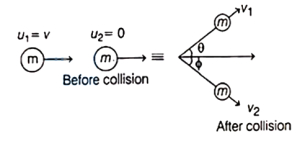
0 likes
View Solution192
DifficultMCQ
$A$ moving body with mass $m_1$ strikes a stationary mass $m_2$. What should be the ratio $\frac{m_1}{m_2}$ so as to decrease the velocity of the first body by $1.5$ times after the collision?
A
$1: 25$
B
$1: 5$
C
$5: 1$
D
$25: 1$
Solution
(C) Let the initial velocity of mass $m_1$ be $v_1$ and the final velocity of mass $m_2$ be $v_2$.
According to the given condition,the final velocity of mass $m_1$ is $v_1' = \frac{v_1}{1.5} = \frac{2}{3} v_1$.
Assuming an elastic collision,the coefficient of restitution $e = 1$.
The formula for the coefficient of restitution is $e = \frac{v_2 - v_1'}{v_1 - 0}$.
Substituting the values: $1 = \frac{v_2 - \frac{2}{3}v_1}{v_1} \implies v_2 = v_1 + \frac{2}{3}v_1 = \frac{5}{3}v_1$.
By the law of conservation of linear momentum: $m_1 v_1 = m_1 v_1' + m_2 v_2$.
Substituting the velocities: $m_1 v_1 = m_1 (\frac{2}{3} v_1) + m_2 (\frac{5}{3} v_1)$.
Rearranging the terms: $m_1 v_1 - \frac{2}{3} m_1 v_1 = m_2 \frac{5}{3} v_1$.
$\frac{1}{3} m_1 v_1 = \frac{5}{3} m_2 v_1$.
Therefore,$\frac{m_1}{m_2} = \frac{5}{1}$.
According to the given condition,the final velocity of mass $m_1$ is $v_1' = \frac{v_1}{1.5} = \frac{2}{3} v_1$.
Assuming an elastic collision,the coefficient of restitution $e = 1$.
The formula for the coefficient of restitution is $e = \frac{v_2 - v_1'}{v_1 - 0}$.
Substituting the values: $1 = \frac{v_2 - \frac{2}{3}v_1}{v_1} \implies v_2 = v_1 + \frac{2}{3}v_1 = \frac{5}{3}v_1$.
By the law of conservation of linear momentum: $m_1 v_1 = m_1 v_1' + m_2 v_2$.
Substituting the velocities: $m_1 v_1 = m_1 (\frac{2}{3} v_1) + m_2 (\frac{5}{3} v_1)$.
Rearranging the terms: $m_1 v_1 - \frac{2}{3} m_1 v_1 = m_2 \frac{5}{3} v_1$.
$\frac{1}{3} m_1 v_1 = \frac{5}{3} m_2 v_1$.
Therefore,$\frac{m_1}{m_2} = \frac{5}{1}$.
0 likes
View Solution193
EasyMCQ
During an elastic collision between two bodies,which of the following statements are correct?
$I$. The initial kinetic energy is equal to the final kinetic energy of the system.
$II$. The linear momentum is conserved.
$III$. The kinetic energy during $\Delta t$ (the collision time) is not conserved.
$I$. The initial kinetic energy is equal to the final kinetic energy of the system.
$II$. The linear momentum is conserved.
$III$. The kinetic energy during $\Delta t$ (the collision time) is not conserved.
A
$II$ and $III$ only
B
$I$ and $III$ only
C
$I, II$ and $III$
D
$I$ and $II$ only
Solution
(C) $I$. In an elastic collision,the total kinetic energy of the system is conserved,meaning the initial kinetic energy equals the final kinetic energy.
$II$. Linear momentum is conserved in all types of collisions (elastic or inelastic) provided no external force acts on the system.
$III$. During the collision interval $\Delta t$,the bodies deform,and part of the kinetic energy is temporarily converted into elastic potential energy. Therefore,the kinetic energy is not conserved during the collision process itself.
$\therefore$ All three statements are correct.
$II$. Linear momentum is conserved in all types of collisions (elastic or inelastic) provided no external force acts on the system.
$III$. During the collision interval $\Delta t$,the bodies deform,and part of the kinetic energy is temporarily converted into elastic potential energy. Therefore,the kinetic energy is not conserved during the collision process itself.
$\therefore$ All three statements are correct.
0 likes
View Solution194
MediumMCQ
$A$ steel sphere of radius $1.2 \ cm$ collides with a second steel sphere at rest. If the collision is elastic and after the collision the first sphere continues to move in its initial direction with a velocity of $\frac{7}{9}$ times its initial velocity,then the radius of the second sphere is (in $cm$)
A
$1.8$
B
$2.4$
C
$1.2$
D
$0.6$
Solution
(D) Let the mass of the first sphere be $m_1$ and the second be $m_2$. Since both are steel spheres,their density $\rho$ is the same. Thus,$m = \rho V = \rho (\frac{4}{3} \pi r^3)$.
So,$m_1 \propto r_1^3$ and $m_2 \propto r_2^3$.
For an elastic collision in one dimension where the second body is at rest,the final velocity of the first body $v_1'$ is given by $v_1' = \frac{m_1 - m_2}{m_1 + m_2} v_1$.
Given $v_1' = \frac{7}{9} v_1$,we have $\frac{m_1 - m_2}{m_1 + m_2} = \frac{7}{9}$.
Cross-multiplying: $9m_1 - 9m_2 = 7m_1 + 7m_2$.
$2m_1 = 16m_2 \implies m_1 = 8m_2$.
Since $m \propto r^3$,we have $r_1^3 = 8r_2^3$.
Taking the cube root: $r_1 = 2r_2$.
Given $r_1 = 1.2 \ cm$,we get $1.2 = 2r_2 \implies r_2 = 0.6 \ cm$.
So,$m_1 \propto r_1^3$ and $m_2 \propto r_2^3$.
For an elastic collision in one dimension where the second body is at rest,the final velocity of the first body $v_1'$ is given by $v_1' = \frac{m_1 - m_2}{m_1 + m_2} v_1$.
Given $v_1' = \frac{7}{9} v_1$,we have $\frac{m_1 - m_2}{m_1 + m_2} = \frac{7}{9}$.
Cross-multiplying: $9m_1 - 9m_2 = 7m_1 + 7m_2$.
$2m_1 = 16m_2 \implies m_1 = 8m_2$.
Since $m \propto r^3$,we have $r_1^3 = 8r_2^3$.
Taking the cube root: $r_1 = 2r_2$.
Given $r_1 = 1.2 \ cm$,we get $1.2 = 2r_2 \implies r_2 = 0.6 \ cm$.
0 likes
View Solution195
MediumMCQ
$A$ body of mass $30 \ kg$ moving with a velocity $20 \ ms^{-1}$ undergoes a one-dimensional elastic collision with another ball of the same mass moving in the opposite direction with a velocity of $30 \ ms^{-1}$. After the collision,the velocities of the first and second bodies respectively are:
A
$-30 \ ms^{-1}, 20 \ ms^{-1}$
B
$30 \ ms^{-1}, 30 \ ms^{-1}$
C
$30 \ ms^{-1}, 20 \ ms^{-1}$
D
$40 \ ms^{-1}, 15 \ ms^{-1}$
Solution
(A) For a one-dimensional elastic collision between two bodies of equal mass $(m_1 = m_2 = m)$,the bodies simply exchange their velocities.
Given:
$u_1 = 20 \ ms^{-1}$
$u_2 = -30 \ ms^{-1}$ (moving in the opposite direction)
According to the property of elastic collision of equal masses:
$v_1 = u_2 = -30 \ ms^{-1}$
$v_2 = u_1 = 20 \ ms^{-1}$
Thus,the velocity of the first body after the collision is $-30 \ ms^{-1}$ and the velocity of the second body is $20 \ ms^{-1}$.
Given:
$u_1 = 20 \ ms^{-1}$
$u_2 = -30 \ ms^{-1}$ (moving in the opposite direction)
According to the property of elastic collision of equal masses:
$v_1 = u_2 = -30 \ ms^{-1}$
$v_2 = u_1 = 20 \ ms^{-1}$
Thus,the velocity of the first body after the collision is $-30 \ ms^{-1}$ and the velocity of the second body is $20 \ ms^{-1}$.
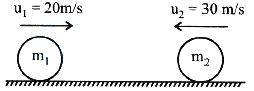
0 likes
View Solution196
EasyMCQ
Two balls $A$ and $B$,of masses $M$ and $2M$ respectively,collide with each other. If ball $A$ moves with a speed of $150 \ m \ s^{-1}$ and collides with ball $B$ moving with speed $v$ in the opposite direction,and after the collision ball $A$ comes to rest with the coefficient of restitution being $1$,then the speed of ball $B$ before it collides with ball $A$ is: (in $m \ s^{-1}$)
A
$37.5$
B
$12.5$
C
$75$
D
$25$
Solution
(A) Applying the law of conservation of linear momentum before and after the collision:
$M(150) + 2M(-v) = M(0) + 2M(v')$ (Taking the direction of ball $A$ as positive)
$150 - 2v = 2v'$
$v' = 75 - v \dots (1)$
Now,the coefficient of restitution $e$ is given by:
$e = \frac{v_2 - v_1}{u_1 - u_2} = 1$
$1 = \frac{v' - 0}{150 - (-v)}$
$150 + v = v' \dots (2)$
Equating $(1)$ and $(2)$:
$75 - v = 150 + v$
$2v = -75$
Since we are looking for the speed (magnitude),we consider the relative velocities. Re-evaluating with standard convention: Let $A$ move at $+150$ and $B$ move at $-v$. After collision,$A$ is at $0$ and $B$ moves at $+v'$.
$150M - 2Mv = 2Mv' \Rightarrow 75 - v = v'$
$e = \frac{v' - 0}{150 - (-v)} = 1 \Rightarrow v' = 150 + v$
Solving $75 - v = 150 + v$ gives $v = -37.5$. The magnitude of speed is $37.5 \ m \ s^{-1}$.
$M(150) + 2M(-v) = M(0) + 2M(v')$ (Taking the direction of ball $A$ as positive)
$150 - 2v = 2v'$
$v' = 75 - v \dots (1)$
Now,the coefficient of restitution $e$ is given by:
$e = \frac{v_2 - v_1}{u_1 - u_2} = 1$
$1 = \frac{v' - 0}{150 - (-v)}$
$150 + v = v' \dots (2)$
Equating $(1)$ and $(2)$:
$75 - v = 150 + v$
$2v = -75$
Since we are looking for the speed (magnitude),we consider the relative velocities. Re-evaluating with standard convention: Let $A$ move at $+150$ and $B$ move at $-v$. After collision,$A$ is at $0$ and $B$ moves at $+v'$.
$150M - 2Mv = 2Mv' \Rightarrow 75 - v = v'$
$e = \frac{v' - 0}{150 - (-v)} = 1 \Rightarrow v' = 150 + v$
Solving $75 - v = 150 + v$ gives $v = -37.5$. The magnitude of speed is $37.5 \ m \ s^{-1}$.
0 likes
View Solution197
DifficultMCQ
$A$ particle of mass $m$,moving with a velocity $v$,makes an elastic collision in one dimension with a stationary particle of mass $m$. During the collision,they remain in contact with each other for an extremely small time $T$. Their force of contact with time is shown in the figure. Then $F_0 =$
A
$\frac{2 m v}{T}$
B
$\frac{4 m v}{3 T}$
C
$\frac{m v}{T}$
D
$\frac{3 m v}{4 T}$
Solution
(B) In an elastic head-on collision between two particles of equal mass,the particles exchange their velocities. Therefore,the velocity of the incident particle becomes $0$ and the stationary particle moves with velocity $v$.
The change in momentum of the incident particle is $\Delta p = m(v - 0) = mv$.
According to the impulse-momentum theorem,the impulse (area under the $F-t$ graph) is equal to the change in momentum.
$\text{Area} = \Delta p = mv$.
The area under the given trapezoidal $F-t$ graph is:
$\text{Area} = \frac{1}{2} \times (\text{sum of parallel sides}) \times \text{height}$
$\text{Area} = \frac{1}{2} \times \left( T + \left( \frac{3T}{4} - \frac{T}{4} \right) \right) \times F_0$
$\text{Area} = \frac{1}{2} \times \left( T + \frac{2T}{4} \right) \times F_0 = \frac{1}{2} \times \left( T + \frac{T}{2} \right) \times F_0 = \frac{1}{2} \times \left( \frac{3T}{2} \right) \times F_0 = \frac{3T F_0}{4}$.
Equating the area to the change in momentum:
$\frac{3T F_0}{4} = mv$
$F_0 = \frac{4mv}{3T}$.
The change in momentum of the incident particle is $\Delta p = m(v - 0) = mv$.
According to the impulse-momentum theorem,the impulse (area under the $F-t$ graph) is equal to the change in momentum.
$\text{Area} = \Delta p = mv$.
The area under the given trapezoidal $F-t$ graph is:
$\text{Area} = \frac{1}{2} \times (\text{sum of parallel sides}) \times \text{height}$
$\text{Area} = \frac{1}{2} \times \left( T + \left( \frac{3T}{4} - \frac{T}{4} \right) \right) \times F_0$
$\text{Area} = \frac{1}{2} \times \left( T + \frac{2T}{4} \right) \times F_0 = \frac{1}{2} \times \left( T + \frac{T}{2} \right) \times F_0 = \frac{1}{2} \times \left( \frac{3T}{2} \right) \times F_0 = \frac{3T F_0}{4}$.
Equating the area to the change in momentum:
$\frac{3T F_0}{4} = mv$
$F_0 = \frac{4mv}{3T}$.
0 likes
View Solution198
EasyMCQ
The coefficient of restitution for a perfectly elastic collision is
A
$1$
B
$0$
C
$\infty$
D
$-1$
Solution
(A) The coefficient of restitution $(e)$ is defined as the ratio of the relative velocity of separation to the relative velocity of approach between two colliding bodies.
Mathematically,$e = \frac{v_2 - v_1}{u_1 - u_2} = \frac{\text{Relative velocity of separation}}{\text{Relative velocity of approach}}$.
For a perfectly elastic collision,the kinetic energy and momentum are conserved,which implies that the relative velocity of separation is equal to the relative velocity of approach.
Therefore,$e = 1$ for a perfectly elastic collision.
For a perfectly inelastic collision,$e = 0$,and for an inelastic collision,$0 < e < 1$.
Mathematically,$e = \frac{v_2 - v_1}{u_1 - u_2} = \frac{\text{Relative velocity of separation}}{\text{Relative velocity of approach}}$.
For a perfectly elastic collision,the kinetic energy and momentum are conserved,which implies that the relative velocity of separation is equal to the relative velocity of approach.
Therefore,$e = 1$ for a perfectly elastic collision.
For a perfectly inelastic collision,$e = 0$,and for an inelastic collision,$0 < e < 1$.
0 likes
View Solution199
EasyMCQ
When two bodies collide elastically,then
A
kinetic energy of the system alone is conserved
B
only momentum is conserved
C
both kinetic energy and momentum are conserved
D
neither kinetic energy nor momentum is conserved
Solution
(C) In an elastic collision,both the total kinetic energy and the total linear momentum of the system are conserved.
Additionally,the total energy of the system remains conserved in all types of collisions.
Additionally,the total energy of the system remains conserved in all types of collisions.
0 likes
View Solution200
MediumMCQ
Two balls $X(2 \ kg)$ and $Y(4 \ kg)$ approach each other with equal speeds of $10 \ ms^{-1}$. If the collision is perfectly elastic,then the new velocities of balls $X$ and $Y$ are respectively
A
$\frac{50}{3} \ ms^{-1}, -\frac{10}{3} \ ms^{-1}$
B
$-\frac{50}{3} \ ms^{-1}, -\frac{10}{3} \ ms^{-1}$
C
$-\frac{50}{3} \ ms^{-1}, \frac{10}{3} \ ms^{-1}$
D
$\frac{50}{3} \ ms^{-1}, \frac{10}{3} \ ms^{-1}$
Solution
(C) Given: $m_1 = 2 \ kg$,$m_2 = 4 \ kg$,$u_1 = 10 \ ms^{-1}$,$u_2 = -10 \ ms^{-1}$.
In a perfectly elastic collision,both linear momentum and kinetic energy are conserved.
By conservation of linear momentum:
$m_1 u_1 + m_2 u_2 = m_1 v_1 + m_2 v_2$
$2(10) + 4(-10) = 2v_1 + 4v_2$
$20 - 40 = 2v_1 + 4v_2$
$-20 = 2v_1 + 4v_2 \Rightarrow v_1 + 2v_2 = -10 \quad \dots (i)$
For a perfectly elastic collision,the coefficient of restitution $e = 1$,so the velocity of separation equals the velocity of approach:
$v_2 - v_1 = u_1 - u_2$
$v_2 - v_1 = 10 - (-10) = 20 \quad \dots (ii)$
Adding equations $(i)$ and $(ii)$:
$(v_1 + 2v_2) + (v_2 - v_1) = -10 + 20$
$3v_2 = 10 \Rightarrow v_2 = \frac{10}{3} \ ms^{-1}$
Substituting $v_2$ into equation $(ii)$:
$\frac{10}{3} - v_1 = 20$
$v_1 = \frac{10}{3} - 20 = \frac{10 - 60}{3} = -\frac{50}{3} \ ms^{-1}$
Thus,the final velocities are $v_1 = -\frac{50}{3} \ ms^{-1}$ and $v_2 = \frac{10}{3} \ ms^{-1}$.
In a perfectly elastic collision,both linear momentum and kinetic energy are conserved.
By conservation of linear momentum:
$m_1 u_1 + m_2 u_2 = m_1 v_1 + m_2 v_2$
$2(10) + 4(-10) = 2v_1 + 4v_2$
$20 - 40 = 2v_1 + 4v_2$
$-20 = 2v_1 + 4v_2 \Rightarrow v_1 + 2v_2 = -10 \quad \dots (i)$
For a perfectly elastic collision,the coefficient of restitution $e = 1$,so the velocity of separation equals the velocity of approach:
$v_2 - v_1 = u_1 - u_2$
$v_2 - v_1 = 10 - (-10) = 20 \quad \dots (ii)$
Adding equations $(i)$ and $(ii)$:
$(v_1 + 2v_2) + (v_2 - v_1) = -10 + 20$
$3v_2 = 10 \Rightarrow v_2 = \frac{10}{3} \ ms^{-1}$
Substituting $v_2$ into equation $(ii)$:
$\frac{10}{3} - v_1 = 20$
$v_1 = \frac{10}{3} - 20 = \frac{10 - 60}{3} = -\frac{50}{3} \ ms^{-1}$
Thus,the final velocities are $v_1 = -\frac{50}{3} \ ms^{-1}$ and $v_2 = \frac{10}{3} \ ms^{-1}$.
0 likes
View SolutionWork, Energy, Power and Collision — Elastic Collision · Frequently Asked Questions
1Are these Work, Energy, Power and Collision questions useful for JEE and NEET?
Yes. All questions in this section are mapped to JEE Main and NEET exam patterns. Previous year questions from JEE Main, NEET, GUJCET and state-level exams are included with full solutions.
2Can I switch to Hindi or Gujarati for these questions?
Yes. Use the language tabs in the hero section or the sidebar to view the same questions and solutions in English, Hindi or Gujarati.
3How do I generate a question paper from this subtopic?
Use the Vedclass Exam Paper Generator — select the chapter and subtopic, set difficulty, and generate Sets A, B, C, D automatically. First 3 chapters of every subject are free.
Vedclass Products
For Students
Vedclass Test Series
Mock tests in real JEE/NEET style with performance analysis. 5-day free trial.
Start Free TrialFor Teachers
Exam Paper Generator
Generate Set A/B/C/D papers from this chapter in 2 minutes. 3 chapters free.
Try FreeFor Institutes
Online Exam Module
Live online exams with unlimited students, 360° analytics & white-label branding.
See DemoFor Teachers & Institutes
Generate a Work, Energy, Power and Collision Exam Paper in 2 Minutes
Select subtopic & difficulty — Sets A, B, C, D auto-generated with No Repeat logic.
First 3 chapters of every subject are free — no payment required.