
A English
Isobaric and Isochoric Processes Questions in English
Class 11 Physics · Thermodynamics · Isobaric and Isochoric Processes
125+
Questions
English
Language
100%
With Solutions
Showing 24 of 125 questions in English
101
EasyMCQ
Which one of the following equations specifies an isobaric process?
$[Q=$ heat supplied; $\Delta P, \Delta V$ and $\Delta T$ are change in pressure,volume,and temperature respectively.]
$[Q=$ heat supplied; $\Delta P, \Delta V$ and $\Delta T$ are change in pressure,volume,and temperature respectively.]
A
$Q=0$
B
$\Delta T=0$
C
$\Delta V=0$
D
$\Delta P=0$
Solution
(D) An isobaric process is a thermodynamic process in which the pressure of the system remains constant throughout the process.
By definition,if the pressure $P$ is constant,then the change in pressure $\Delta P$ must be equal to zero.
Therefore,the equation that specifies an isobaric process is $\Delta P=0$.
By definition,if the pressure $P$ is constant,then the change in pressure $\Delta P$ must be equal to zero.
Therefore,the equation that specifies an isobaric process is $\Delta P=0$.
0 likes
View Solution102
EasyMCQ
In thermodynamics,for an isochoric process,which one of the following statements is $INCORRECT$?
A
Energy exchanged is used to do work and also to change internal energy
B
No work is done in the process
C
It is a constant volume process
D
Temperature of the system changes during the process
Solution
(A) An isochoric process is defined as a process where the volume of the system remains constant $(dV = 0)$.
Since work done $dW = P dV$,if $dV = 0$,then $dW = 0$. Thus,no work is done in the process.
According to the first law of thermodynamics,$dQ = dU + dW$. Since $dW = 0$,the heat exchanged $(dQ)$ is entirely used to change the internal energy $(dU)$ of the system.
Therefore,statement $(A)$ is incorrect because energy exchanged is not used to do work.
Since work done $dW = P dV$,if $dV = 0$,then $dW = 0$. Thus,no work is done in the process.
According to the first law of thermodynamics,$dQ = dU + dW$. Since $dW = 0$,the heat exchanged $(dQ)$ is entirely used to change the internal energy $(dU)$ of the system.
Therefore,statement $(A)$ is incorrect because energy exchanged is not used to do work.
0 likes
View Solution103
EasyMCQ
Which one of the following statements is wrong for an isobaric process?
A
The pressure of the system remains constant.
B
There is a change in volume when work is done.
C
Temperature of the system remains constant.
D
Energy exchanged is used to do work and to change internal energy.
Solution
(C) An isobaric process is defined as a thermodynamic process in which the pressure of the system remains constant $(P = \text{constant})$.
According to the ideal gas law, $PV = nRT$. Since $P$ is constant, $V \propto T$.
Therefore, if the volume changes during the process, the temperature of the system must also change.
Statement $(C)$ claims that the temperature remains constant, which is incorrect for an isobaric process; it is a characteristic of an isothermal process.
According to the ideal gas law, $PV = nRT$. Since $P$ is constant, $V \propto T$.
Therefore, if the volume changes during the process, the temperature of the system must also change.
Statement $(C)$ claims that the temperature remains constant, which is incorrect for an isobaric process; it is a characteristic of an isothermal process.
0 likes
View Solution104
EasyMCQ
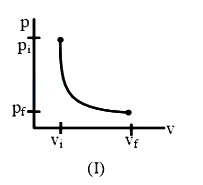
Which one of the following $p-V$ diagrams is correct for an isochoric process?
A
$IV$
B
$II$
C
$III$
D
$I$
Solution
(B) In an isochoric process,the volume of the system remains constant throughout the process.
On a $p-V$ diagram,where pressure $p$ is plotted on the $y$-axis and volume $V$ is plotted on the $x$-axis,a constant volume process is represented by a vertical line.
This vertical line indicates that for any change in pressure,the value of $V$ remains the same.
Looking at the provided diagrams (not fully shown but implied by standard physics problems of this type),the diagram representing a vertical line corresponds to the isochoric process.
Assuming the standard set of diagrams where $II$ represents the vertical line,the correct option is $II$.
On a $p-V$ diagram,where pressure $p$ is plotted on the $y$-axis and volume $V$ is plotted on the $x$-axis,a constant volume process is represented by a vertical line.
This vertical line indicates that for any change in pressure,the value of $V$ remains the same.
Looking at the provided diagrams (not fully shown but implied by standard physics problems of this type),the diagram representing a vertical line corresponds to the isochoric process.
Assuming the standard set of diagrams where $II$ represents the vertical line,the correct option is $II$.
0 likes
View Solution105
MediumMCQ
One mole of a diatomic gas is heated at constant pressure starting at $ 27^{\circ}C $. How much energy must be added to the gas as heat to double its volume?
A
$ 750 R $
B
Zero
C
$ 1050 R $
D
$ 450 R $
Solution
(C) For an ideal gas at constant pressure,Charles's Law states that $ V \propto T $.
Since the volume is doubled $( V_2 = 2V_1 )$,the temperature must also double.
The initial temperature is $ T_1 = 27^{\circ}C = 27 + 273 = 300 \text{ K} $.
The final temperature is $ T_2 = 2 \times 300 \text{ K} = 600 \text{ K} $.
The change in temperature is $ \Delta T = 600 \text{ K} - 300 \text{ K} = 300 \text{ K} $.
For a diatomic gas,the molar heat capacity at constant pressure is $ C_p = \frac{7}{2}R $.
The heat added is given by $ Q = n C_p \Delta T $.
Substituting the values: $ Q = 1 \times \frac{7}{2} R \times 300 = 1050 R $.
Since the volume is doubled $( V_2 = 2V_1 )$,the temperature must also double.
The initial temperature is $ T_1 = 27^{\circ}C = 27 + 273 = 300 \text{ K} $.
The final temperature is $ T_2 = 2 \times 300 \text{ K} = 600 \text{ K} $.
The change in temperature is $ \Delta T = 600 \text{ K} - 300 \text{ K} = 300 \text{ K} $.
For a diatomic gas,the molar heat capacity at constant pressure is $ C_p = \frac{7}{2}R $.
The heat added is given by $ Q = n C_p \Delta T $.
Substituting the values: $ Q = 1 \times \frac{7}{2} R \times 300 = 1050 R $.
0 likes
View Solution106
EasyMCQ
$A$ certain amount of heat energy is supplied to a monoatomic ideal gas which expands at constant pressure. What fraction of the heat energy is converted into work?
A
$1$
B
$\frac{2}{3}$
C
$\frac{2}{5}$
D
$\frac{5}{7}$
Solution
(C) According to the first law of thermodynamics,the heat supplied $Q$ is equal to the change in internal energy $\Delta U$ plus the work done $W$: $Q = \Delta U + W$.
For a process at constant pressure,the heat supplied is $Q = n C_p \Delta T$.
The change in internal energy is $\Delta U = n C_V \Delta T$.
The work done is $W = Q - \Delta U = n C_p \Delta T - n C_V \Delta T = n R \Delta T$.
The fraction of heat energy converted into work is $\frac{W}{Q} = \frac{n R \Delta T}{n C_p \Delta T} = \frac{R}{C_p}$.
For a monoatomic ideal gas,$C_p = \frac{5}{2} R$.
Therefore,the fraction is $\frac{W}{Q} = \frac{R}{\frac{5}{2} R} = \frac{2}{5}$.
For a process at constant pressure,the heat supplied is $Q = n C_p \Delta T$.
The change in internal energy is $\Delta U = n C_V \Delta T$.
The work done is $W = Q - \Delta U = n C_p \Delta T - n C_V \Delta T = n R \Delta T$.
The fraction of heat energy converted into work is $\frac{W}{Q} = \frac{n R \Delta T}{n C_p \Delta T} = \frac{R}{C_p}$.
For a monoatomic ideal gas,$C_p = \frac{5}{2} R$.
Therefore,the fraction is $\frac{W}{Q} = \frac{R}{\frac{5}{2} R} = \frac{2}{5}$.
0 likes
View Solution107
EasyMCQ
When $80 \ J$ of heat is absorbed by a monoatomic gas,its volume increases by $16 \times 10^{-5} \ m^3$ at constant pressure. The pressure of the gas is
A
$2 \times 10^5 \ Nm^{-2}$
B
$4 \times 10^5 \ Nm^{-2}$
C
$6 \times 10^5 \ Nm^{-2}$
D
$5 \times 10^5 \ Nm^{-2}$
Solution
(A) For a monoatomic gas,the degrees of freedom $f = 3$.
At constant pressure,the heat absorbed is given by $Q = n C_p \Delta T$.
Since $C_p = \frac{f+2}{2} R = \frac{5}{2} R$,we have $Q = \frac{5}{2} n R \Delta T$.
From the ideal gas equation,$p \Delta V = n R \Delta T$.
Substituting this into the heat equation: $Q = \frac{5}{2} p \Delta V$.
Given $Q = 80 \ J$ and $\Delta V = 16 \times 10^{-5} \ m^3$,we have:
$80 = \frac{5}{2} \times p \times 16 \times 10^{-5}$.
$80 = 40 \times 10^{-5} \times p$.
$p = \frac{80}{40 \times 10^{-5}} = 2 \times 10^5 \ Nm^{-2}$.
At constant pressure,the heat absorbed is given by $Q = n C_p \Delta T$.
Since $C_p = \frac{f+2}{2} R = \frac{5}{2} R$,we have $Q = \frac{5}{2} n R \Delta T$.
From the ideal gas equation,$p \Delta V = n R \Delta T$.
Substituting this into the heat equation: $Q = \frac{5}{2} p \Delta V$.
Given $Q = 80 \ J$ and $\Delta V = 16 \times 10^{-5} \ m^3$,we have:
$80 = \frac{5}{2} \times p \times 16 \times 10^{-5}$.
$80 = 40 \times 10^{-5} \times p$.
$p = \frac{80}{40 \times 10^{-5}} = 2 \times 10^5 \ Nm^{-2}$.
0 likes
View Solution108
EasyMCQ
The heat energy supplied to a diatomic gas at constant pressure is $210 \,J$. Then, the work done by the gas is: (in $\,J$)
A
$60$
B
$150$
C
$90$
D
$210$
Solution
(A) Given: Heat supplied at constant pressure, $Q_P = 210 \,J$.
For a diatomic gas, the molar heat capacity at constant volume is $C_V = \frac{5}{2}R$.
The molar heat capacity at constant pressure is $C_P = C_V + R = \frac{5}{2}R + R = \frac{7}{2}R$.
We know that $Q_P = n C_P \Delta T = 210 \,J$.
Substituting $C_P$, we get $n (\frac{7}{2}R) \Delta T = 210$.
Thus, $n R \Delta T = 210 \times \frac{2}{7} = 60 \,J$.
The work done by the gas at constant pressure is given by $W = P \Delta V = n R \Delta T$.
Therefore, $W = 60 \,J$.
For a diatomic gas, the molar heat capacity at constant volume is $C_V = \frac{5}{2}R$.
The molar heat capacity at constant pressure is $C_P = C_V + R = \frac{5}{2}R + R = \frac{7}{2}R$.
We know that $Q_P = n C_P \Delta T = 210 \,J$.
Substituting $C_P$, we get $n (\frac{7}{2}R) \Delta T = 210$.
Thus, $n R \Delta T = 210 \times \frac{2}{7} = 60 \,J$.
The work done by the gas at constant pressure is given by $W = P \Delta V = n R \Delta T$.
Therefore, $W = 60 \,J$.
0 likes
View Solution109
EasyMCQ
An ideal monoatomic gas expands at constant pressure. The work done by the gas on its environment is $200 \,J$, then the heat absorbed by the gas during the process is (in $\,J$)
A
$500$
B
$300$
C
$200$
D
$600$
Solution
(A) Given: Work done by the gas, $W = 200 \,J$.
For an ideal monoatomic gas expanding at constant pressure, the heat absorbed is given by $Q = n C_p \Delta T$.
The work done is given by $W = n R \Delta T$.
Taking the ratio of $Q$ to $W$:
$\frac{Q}{W} = \frac{n C_p \Delta T}{n R \Delta T} = \frac{C_p}{R}$.
For a monoatomic gas, the molar heat capacity at constant volume is $C_v = \frac{3}{2} R = 1.5 R$.
Using the relation $C_p = C_v + R$, we get $C_p = 1.5 R + R = 2.5 R$.
Substituting this into the ratio:
$\frac{Q}{W} = \frac{2.5 R}{R} = 2.5$.
Therefore, $Q = 2.5 \times W = 2.5 \times 200 \,J = 500 \,J$.
For an ideal monoatomic gas expanding at constant pressure, the heat absorbed is given by $Q = n C_p \Delta T$.
The work done is given by $W = n R \Delta T$.
Taking the ratio of $Q$ to $W$:
$\frac{Q}{W} = \frac{n C_p \Delta T}{n R \Delta T} = \frac{C_p}{R}$.
For a monoatomic gas, the molar heat capacity at constant volume is $C_v = \frac{3}{2} R = 1.5 R$.
Using the relation $C_p = C_v + R$, we get $C_p = 1.5 R + R = 2.5 R$.
Substituting this into the ratio:
$\frac{Q}{W} = \frac{2.5 R}{R} = 2.5$.
Therefore, $Q = 2.5 \times W = 2.5 \times 200 \,J = 500 \,J$.
0 likes
View Solution110
EasyMCQ
The change in the internal energy of $3$ moles of a gas heated at constant volume from $20^{\circ}C$ to $40^{\circ}C$ is $1080 \ J$. The molar specific heat of the gas at constant volume in $J \ mol^{-1} \ K^{-1}$ is:
A
$21$
B
$18$
C
$24$
D
$12$
Solution
(B) The change in internal energy $(\Delta U)$ for a gas at constant volume is given by the formula:
$\Delta U = n C_V \Delta T$
Where:
$n = 3 \text{ moles}$
$\Delta U = 1080 \ J$
$\Delta T = 40^{\circ}C - 20^{\circ}C = 20 \ K$
Rearranging the formula to solve for $C_V$:
$C_V = \frac{\Delta U}{n \Delta T}$
Substituting the given values:
$C_V = \frac{1080}{3 \times 20}$
$C_V = \frac{1080}{60}$
$C_V = 18 \ J \ mol^{-1} \ K^{-1}$
Thus, the molar specific heat at constant volume is $18 \ J \ mol^{-1} \ K^{-1}$.
$\Delta U = n C_V \Delta T$
Where:
$n = 3 \text{ moles}$
$\Delta U = 1080 \ J$
$\Delta T = 40^{\circ}C - 20^{\circ}C = 20 \ K$
Rearranging the formula to solve for $C_V$:
$C_V = \frac{\Delta U}{n \Delta T}$
Substituting the given values:
$C_V = \frac{1080}{3 \times 20}$
$C_V = \frac{1080}{60}$
$C_V = 18 \ J \ mol^{-1} \ K^{-1}$
Thus, the molar specific heat at constant volume is $18 \ J \ mol^{-1} \ K^{-1}$.
0 likes
View Solution111
EasyMCQ
An ideal monoatomic gas of $1.5$ moles is heated at a constant pressure of $2 \,atm$ so that its temperature increases from $30^{\circ} C$ to $130^{\circ} C$. The work done by the gas is (Universal gas constant $R = 8.3 \,J \,mol^{-1} \,K^{-1}$). (in $\,J$)
A
$2500$
B
$1450$
C
$1245$
D
$555$
Solution
(C) Work done by a gas in a constant pressure process is given by the formula:
$W = P \Delta V$
Since the gas is ideal, we use the ideal gas equation $PV = nRT$. At constant pressure, $P \Delta V = nR \Delta T$.
Therefore, $W = nR \Delta T$ ... $(i)$
Given:
$n = 1.5 \,mol$
$R = 8.3 \,J \,mol^{-1} \,K^{-1}$
$\Delta T = (130 + 273) - (30 + 273) = 100 \,K$
Substituting these values into equation $(i)$:
$W = 1.5 \times 8.3 \times 100$
$W = 1245 \,J$
$W = P \Delta V$
Since the gas is ideal, we use the ideal gas equation $PV = nRT$. At constant pressure, $P \Delta V = nR \Delta T$.
Therefore, $W = nR \Delta T$ ... $(i)$
Given:
$n = 1.5 \,mol$
$R = 8.3 \,J \,mol^{-1} \,K^{-1}$
$\Delta T = (130 + 273) - (30 + 273) = 100 \,K$
Substituting these values into equation $(i)$:
$W = 1.5 \times 8.3 \times 100$
$W = 1245 \,J$
0 likes
View Solution112
MediumMCQ
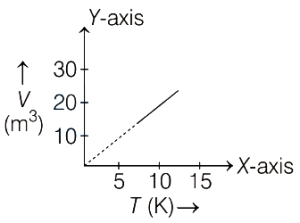
$A$ graph is drawn between absolute temperature and volume of $3$ moles of helium gas as shown in the figure. If $5 \text{ cal}$ of heat is used in the process, then the work done is (in $\text{ J}$)
A
$21.0$
B
$8.4$
C
$12.6$
D
$6.2$
Solution
(B) In the given graph, $V \propto T$, which implies $\frac{V}{T} = \text{constant}$.
This indicates that the process is an isobaric process (constant pressure process).
For an isobaric process, the heat supplied is given by $\Delta Q = n C_p \Delta T$.
The work done is given by $\Delta W = p \Delta V = n R \Delta T$.
Since $C_p = \frac{5}{2} R$ for a monoatomic gas like helium, we have:
$\Delta W = n R \Delta T = n R \left( \frac{\Delta Q}{n C_p} \right) = \frac{\Delta Q R}{C_p} = \frac{\Delta Q R}{\frac{5}{2} R} = \frac{2}{5} \Delta Q$.
Given $\Delta Q = 5 \text{ cal}$, we get:
$\Delta W = \frac{2}{5} \times 5 \text{ cal} = 2 \text{ cal}$.
Converting to Joules, $\Delta W = 2 \times 4.2 \text{ J} = 8.4 \text{ J}$.
This indicates that the process is an isobaric process (constant pressure process).
For an isobaric process, the heat supplied is given by $\Delta Q = n C_p \Delta T$.
The work done is given by $\Delta W = p \Delta V = n R \Delta T$.
Since $C_p = \frac{5}{2} R$ for a monoatomic gas like helium, we have:
$\Delta W = n R \Delta T = n R \left( \frac{\Delta Q}{n C_p} \right) = \frac{\Delta Q R}{C_p} = \frac{\Delta Q R}{\frac{5}{2} R} = \frac{2}{5} \Delta Q$.
Given $\Delta Q = 5 \text{ cal}$, we get:
$\Delta W = \frac{2}{5} \times 5 \text{ cal} = 2 \text{ cal}$.
Converting to Joules, $\Delta W = 2 \times 4.2 \text{ J} = 8.4 \text{ J}$.
0 likes
View Solution113
MediumMCQ
The work done by $6$ moles of helium gas when its temperature increases by $20^{\circ} C$ at constant pressure is (Universal gas constant $R = 8.31 \ J \ mol^{-1} \ K^{-1}$) (in $J$)
A
$807.2$
B
$887.2$
C
$997.2$
D
$1007.2$
Solution
(C) For an ideal gas undergoing a process at constant pressure,the work done $W$ is given by the formula $W = nR\Delta T$.
Here,the number of moles $n = 6$.
The universal gas constant $R = 8.31 \ J \ mol^{-1} \ K^{-1}$.
The change in temperature $\Delta T = 20^{\circ} C = 20 \ K$ (since the change in temperature is the same in Celsius and Kelvin scales).
Substituting these values into the formula:
$W = 6 \times 8.31 \times 20$
$W = 120 \times 8.31$
$W = 997.2 \ J$.
Therefore,the correct option is $C$.
Here,the number of moles $n = 6$.
The universal gas constant $R = 8.31 \ J \ mol^{-1} \ K^{-1}$.
The change in temperature $\Delta T = 20^{\circ} C = 20 \ K$ (since the change in temperature is the same in Celsius and Kelvin scales).
Substituting these values into the formula:
$W = 6 \times 8.31 \times 20$
$W = 120 \times 8.31$
$W = 997.2 \ J$.
Therefore,the correct option is $C$.
0 likes
View Solution114
EasyMCQ
The work done by a gas is maximum when it expands from a volume $V_1$ to $V_2$. This expansion is:
A
Isothermal expansion
B
Adiabatic expansion
C
Isobaric expansion
D
Free expansion
Solution
(C) The work done by a gas during expansion is given by the area under the $P-V$ curve,$W = \int_{V_1}^{V_2} P \, dV$.
For a given change in volume from $V_1$ to $V_2$,the pressure $P$ must be as high as possible throughout the process to maximize the integral.
In an isobaric process,the pressure remains constant at its initial maximum value.
In other processes like isothermal or adiabatic,the pressure decreases as the volume increases.
Therefore,the area under the $P-V$ curve is largest for an isobaric expansion,making the work done maximum.
For a given change in volume from $V_1$ to $V_2$,the pressure $P$ must be as high as possible throughout the process to maximize the integral.
In an isobaric process,the pressure remains constant at its initial maximum value.
In other processes like isothermal or adiabatic,the pressure decreases as the volume increases.
Therefore,the area under the $P-V$ curve is largest for an isobaric expansion,making the work done maximum.
0 likes
View Solution115
EasyMCQ
$\Delta W = 0$,for the process
A
isobaric
B
isochoric
C
isothermal
D
adiabatic
Solution
(B) For an isochoric process,the volume remains constant,so $\Delta V = 0$.
Since the work done in a thermodynamic process is given by $W = p \cdot \Delta V$,substituting $\Delta V = 0$ gives $W = 0$.
Since the work done in a thermodynamic process is given by $W = p \cdot \Delta V$,substituting $\Delta V = 0$ gives $W = 0$.
0 likes
View Solution116
EasyMCQ
$A$ diatomic gas $(\gamma = 1.4)$ does $300 \ J$ of work when expanded isobarically. The heat given to the gas in this process is: (in $J$)
A
$1050$
B
$950$
C
$600$
D
$550$
Solution
(A) For an isobaric process,the work done is $dW = P dV$ and the heat supplied is $dQ = n C_p dT$.
Using the relation $C_p = \frac{\gamma R}{\gamma - 1}$ and $dW = n R dT$,we have:
$\frac{dW}{dQ} = \frac{nR dT}{n C_p dT} = \frac{R}{C_p} = \frac{R}{\frac{\gamma R}{\gamma - 1}} = \frac{\gamma - 1}{\gamma}$.
Given $\gamma = 1.4$ and $dW = 300 \ J$,we substitute these values:
$\frac{300}{dQ} = \frac{1.4 - 1}{1.4} = \frac{0.4}{1.4} = \frac{4}{14} = \frac{2}{7}$.
Therefore,$dQ = 300 \times \frac{7}{2} = 150 \times 7 = 1050 \ J$.
Using the relation $C_p = \frac{\gamma R}{\gamma - 1}$ and $dW = n R dT$,we have:
$\frac{dW}{dQ} = \frac{nR dT}{n C_p dT} = \frac{R}{C_p} = \frac{R}{\frac{\gamma R}{\gamma - 1}} = \frac{\gamma - 1}{\gamma}$.
Given $\gamma = 1.4$ and $dW = 300 \ J$,we substitute these values:
$\frac{300}{dQ} = \frac{1.4 - 1}{1.4} = \frac{0.4}{1.4} = \frac{4}{14} = \frac{2}{7}$.
Therefore,$dQ = 300 \times \frac{7}{2} = 150 \times 7 = 1050 \ J$.
0 likes
View Solution117
MediumMCQ
$A$ diatomic gas $\left(C_P = \frac{7}{2} R\right)$ does $200 \ J$ of work when it is expanded isobarically. The heat given to the gas in the process is (in $J$)
A
$600$
B
$800$
C
$900$
D
$700$
Solution
(D) For an isobaric process,the work done is given by $W = P \Delta V = nR \Delta T = 200 \ J$.
The heat supplied to the gas is given by $\Delta Q = n C_P \Delta T$.
Given that $C_P = \frac{7}{2} R$,we substitute this into the equation:
$\Delta Q = n \left( \frac{7}{2} R \right) \Delta T = \frac{7}{2} (nR \Delta T)$.
Substituting the value of $nR \Delta T = 200 \ J$:
$\Delta Q = \frac{7}{2} \times 200 \ J = 7 \times 100 \ J = 700 \ J$.
The heat supplied to the gas is given by $\Delta Q = n C_P \Delta T$.
Given that $C_P = \frac{7}{2} R$,we substitute this into the equation:
$\Delta Q = n \left( \frac{7}{2} R \right) \Delta T = \frac{7}{2} (nR \Delta T)$.
Substituting the value of $nR \Delta T = 200 \ J$:
$\Delta Q = \frac{7}{2} \times 200 \ J = 7 \times 100 \ J = 700 \ J$.
0 likes
View Solution118
EasyMCQ
An amount of $700 \,J$ of heat is transferred to a diatomic gas, allowing it to expand with the pressure held constant. The work done by the gas is (in $\,J$)
A
$200$
B
$100$
C
$300$
D
$500$
Solution
(A) For an isobaric process, the heat supplied is given by $\Delta Q = n C_P \Delta T = 700 \,J$.
The change in internal energy is $\Delta U = n C_V \Delta T$.
For a diatomic gas, the adiabatic index is $\gamma = \frac{C_P}{C_V} = 1.4 = \frac{7}{5}$.
From the first law of thermodynamics, $\Delta Q = \Delta U + W$, so the work done by the gas is $W = \Delta Q - \Delta U$.
Since $\Delta U = n C_V \Delta T = n \left(\frac{C_P}{\gamma}\right) \Delta T = \frac{\Delta Q}{\gamma}$, we have:
$W = \Delta Q - \frac{\Delta Q}{\gamma} = \Delta Q \left(1 - \frac{1}{\gamma}\right)$.
Substituting the values:
$W = 700 \left(1 - \frac{5}{7}\right) = 700 \left(\frac{2}{7}\right) = 200 \,J$.
The change in internal energy is $\Delta U = n C_V \Delta T$.
For a diatomic gas, the adiabatic index is $\gamma = \frac{C_P}{C_V} = 1.4 = \frac{7}{5}$.
From the first law of thermodynamics, $\Delta Q = \Delta U + W$, so the work done by the gas is $W = \Delta Q - \Delta U$.
Since $\Delta U = n C_V \Delta T = n \left(\frac{C_P}{\gamma}\right) \Delta T = \frac{\Delta Q}{\gamma}$, we have:
$W = \Delta Q - \frac{\Delta Q}{\gamma} = \Delta Q \left(1 - \frac{1}{\gamma}\right)$.
Substituting the values:
$W = 700 \left(1 - \frac{5}{7}\right) = 700 \left(\frac{2}{7}\right) = 200 \,J$.
0 likes
View Solution119
MediumMCQ
The percentage of heat supplied to a diatomic ideal gas that is converted into work in an isobaric process is
A
$62.7$
B
$71.4$
C
$28.6$
D
$34.6$
Solution
(C) For an isobaric process, the pressure remains constant $(P = \text{constant})$.
From the first law of thermodynamics, $\Delta Q = \Delta U + \Delta W$.
For a diatomic gas, the molar heat capacities are $C_p = \frac{7}{2}R$ and $C_v = \frac{5}{2}R$.
The heat supplied is $\Delta Q = n C_p \Delta T$.
The work done is $\Delta W = n R \Delta T$.
The fraction of heat converted into work is $\frac{\Delta W}{\Delta Q} = \frac{n R \Delta T}{n C_p \Delta T} = \frac{R}{C_p} = \frac{R}{\frac{7}{2}R} = \frac{2}{7}$.
Converting this to a percentage: $\frac{2}{7} \times 100 \approx 28.6 \%$.
Therefore, the percentage of heat converted into work is $28.6 \%$.
From the first law of thermodynamics, $\Delta Q = \Delta U + \Delta W$.
For a diatomic gas, the molar heat capacities are $C_p = \frac{7}{2}R$ and $C_v = \frac{5}{2}R$.
The heat supplied is $\Delta Q = n C_p \Delta T$.
The work done is $\Delta W = n R \Delta T$.
The fraction of heat converted into work is $\frac{\Delta W}{\Delta Q} = \frac{n R \Delta T}{n C_p \Delta T} = \frac{R}{C_p} = \frac{R}{\frac{7}{2}R} = \frac{2}{7}$.
Converting this to a percentage: $\frac{2}{7} \times 100 \approx 28.6 \%$.
Therefore, the percentage of heat converted into work is $28.6 \%$.
0 likes
View Solution120
EasyMCQ
$A$ monoatomic gas does $100 J$ of work when it is expanded isobarically. How much heat is given to the gas in the process (in $J$)?
A
$150$
B
$200$
C
$250$
D
$300$
Solution
(C) For an isobaric process,the work done is given by $W = P \Delta V = n R \Delta T = 100 J$.
For a monoatomic gas,the molar heat capacity at constant pressure is $C_P = \frac{5}{2} R$.
The heat supplied to the gas is given by $Q = n C_P \Delta T$.
Substituting the value of $C_P$,we get $Q = n (\frac{5}{2} R) \Delta T = \frac{5}{2} (n R \Delta T)$.
Since $n R \Delta T = 100 J$,we have $Q = \frac{5}{2} \times 100 J = 250 J$.
For a monoatomic gas,the molar heat capacity at constant pressure is $C_P = \frac{5}{2} R$.
The heat supplied to the gas is given by $Q = n C_P \Delta T$.
Substituting the value of $C_P$,we get $Q = n (\frac{5}{2} R) \Delta T = \frac{5}{2} (n R \Delta T)$.
Since $n R \Delta T = 100 J$,we have $Q = \frac{5}{2} \times 100 J = 250 J$.
0 likes
View Solution121
DifficultMCQ
The ratio of specific heats of a gas is $\gamma$. The change in internal energy of one mole of the gas,when the volume changes from $V$ to $2V$ at constant pressure $p$,is:
A
$\frac{\gamma-1}{p V}$
B
$p V$
C
$\frac{p V}{\gamma-1}$
D
$\frac{p V}{\gamma}$
Solution
(C) For an ideal gas,the change in internal energy $\Delta U$ is given by $\Delta U = n C_V \Delta T$.
Given $n = 1$ mole,so $\Delta U = C_V \Delta T$.
We know that $C_V = \frac{R}{\gamma-1}$.
Thus,$\Delta U = \frac{R \Delta T}{\gamma-1}$.
From the ideal gas equation at constant pressure $p$,$p V = R T$,so $p \Delta V = R \Delta T$.
Here,the volume changes from $V$ to $2V$,so $\Delta V = 2V - V = V$.
Therefore,$R \Delta T = p V$.
Substituting this into the expression for $\Delta U$:
$\Delta U = \frac{p V}{\gamma-1}$.
Given $n = 1$ mole,so $\Delta U = C_V \Delta T$.
We know that $C_V = \frac{R}{\gamma-1}$.
Thus,$\Delta U = \frac{R \Delta T}{\gamma-1}$.
From the ideal gas equation at constant pressure $p$,$p V = R T$,so $p \Delta V = R \Delta T$.
Here,the volume changes from $V$ to $2V$,so $\Delta V = 2V - V = V$.
Therefore,$R \Delta T = p V$.
Substituting this into the expression for $\Delta U$:
$\Delta U = \frac{p V}{\gamma-1}$.
0 likes
View Solution122
MediumMCQ
$A$ frictionless piston-cylinder based enclosure contains some amount of gas at a pressure of $400 \text{ kPa}$. Heat is transferred to the gas at constant pressure in a quasi-static process. The piston moves up slowly through a height of $10 \text{ cm}$. If the piston has a cross-sectional area of $0.3 \text{ m}^2$, the work done by the gas in this process is: (in $\text{ kJ}$)
A
$6$
B
$12$
C
$7.5$
D
$24$
Solution
(B) The work done by a gas during a constant pressure (isobaric) process is given by the formula: $W = P \Delta V$.
Here, $P = 400 \text{ kPa} = 400 \times 10^3 \text{ Pa}$.
The change in volume $\Delta V$ is equal to the cross-sectional area $A$ multiplied by the displacement $h$.
Given $A = 0.3 \text{ m}^2$ and $h = 10 \text{ cm} = 0.1 \text{ m}$.
Therefore, $\Delta V = A \times h = 0.3 \text{ m}^2 \times 0.1 \text{ m} = 0.03 \text{ m}^3$.
Now, substitute the values into the work formula:
$W = (400 \times 10^3 \text{ Pa}) \times (0.03 \text{ m}^3)$
$W = 400,000 \times 0.03 = 12,000 \text{ J}$.
Converting to kilojoules: $W = 12 \text{ kJ}$.
Here, $P = 400 \text{ kPa} = 400 \times 10^3 \text{ Pa}$.
The change in volume $\Delta V$ is equal to the cross-sectional area $A$ multiplied by the displacement $h$.
Given $A = 0.3 \text{ m}^2$ and $h = 10 \text{ cm} = 0.1 \text{ m}$.
Therefore, $\Delta V = A \times h = 0.3 \text{ m}^2 \times 0.1 \text{ m} = 0.03 \text{ m}^3$.
Now, substitute the values into the work formula:
$W = (400 \times 10^3 \text{ Pa}) \times (0.03 \text{ m}^3)$
$W = 400,000 \times 0.03 = 12,000 \text{ J}$.
Converting to kilojoules: $W = 12 \text{ kJ}$.
0 likes
View Solution123
MediumMCQ
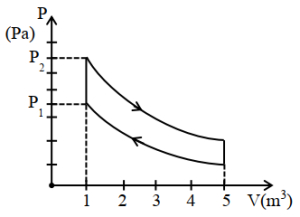
$10 \text{ mole}$ of an ideal gas is undergoing the process shown in the figure. The heat involved in the process from $P_1$ to $P_2$ at constant volume $V = 1 \text{ m}^3$ is $\alpha \text{ Joule}$ ($P_1 = 21.7 \text{ Pa}$,$P_2 = 30 \text{ Pa}$,$C_v = 21 \text{ J/K} \cdot \text{mol}$,$R = 8.3 \text{ J/mol} \cdot \text{K}$). The value of $\alpha$ is . . . . . . .
A
$24$
B
$15$
C
$21$
D
$28$
Solution
(C) The process from $P_1$ to $P_2$ occurs at a constant volume $V = 1 \text{ m}^3$.
For an isochoric process,the heat exchanged is given by $\Delta Q = n C_v \Delta T$.
Using the ideal gas law $PV = nRT$,we have $nR \Delta T = V \Delta P$.
Substituting this into the heat equation: $\Delta Q = \frac{C_v}{R} (nR \Delta T) = \frac{C_v}{R} V (P_2 - P_1)$.
Given $n = 10 \text{ mol}$,$C_v = 21 \text{ J/K} \cdot \text{mol}$,$R = 8.3 \text{ J/mol} \cdot \text{K}$,$V = 1 \text{ m}^3$,$P_1 = 21.7 \text{ Pa}$,and $P_2 = 30 \text{ Pa}$.
$\Delta Q = \frac{21}{8.3} \times 1 \times (30 - 21.7) = \frac{21}{8.3} \times 8.3 = 21 \text{ J}$.
Thus,$\alpha = 21$.
For an isochoric process,the heat exchanged is given by $\Delta Q = n C_v \Delta T$.
Using the ideal gas law $PV = nRT$,we have $nR \Delta T = V \Delta P$.
Substituting this into the heat equation: $\Delta Q = \frac{C_v}{R} (nR \Delta T) = \frac{C_v}{R} V (P_2 - P_1)$.
Given $n = 10 \text{ mol}$,$C_v = 21 \text{ J/K} \cdot \text{mol}$,$R = 8.3 \text{ J/mol} \cdot \text{K}$,$V = 1 \text{ m}^3$,$P_1 = 21.7 \text{ Pa}$,and $P_2 = 30 \text{ Pa}$.
$\Delta Q = \frac{21}{8.3} \times 1 \times (30 - 21.7) = \frac{21}{8.3} \times 8.3 = 21 \text{ J}$.
Thus,$\alpha = 21$.
0 likes
View Solution124
MediumMCQ
$A$ diatomic gas $(\gamma = 1.4)$ does $100 \ J$ of work when it is expanded isobarically. Then the heat given to the gas is . . . . . . $J$.
A
$250$
B
$350$
C
$450$
D
$100$
Solution
(B) For an isobaric process,the work done is given by $W = P \Delta V = nR \Delta T = 100 \ J$.
For a diatomic gas,the degree of freedom $f = 5$.
The molar heat capacity at constant pressure is $C_p = (\frac{f}{2} + 1)R = (\frac{5}{2} + 1)R = \frac{7}{2}R$.
The heat supplied to the gas is $Q = nC_p \Delta T = n(\frac{7}{2}R) \Delta T$.
Substituting $nR \Delta T = 100 \ J$,we get $Q = \frac{7}{2} \times 100 = 350 \ J$.
For a diatomic gas,the degree of freedom $f = 5$.
The molar heat capacity at constant pressure is $C_p = (\frac{f}{2} + 1)R = (\frac{5}{2} + 1)R = \frac{7}{2}R$.
The heat supplied to the gas is $Q = nC_p \Delta T = n(\frac{7}{2}R) \Delta T$.
Substituting $nR \Delta T = 100 \ J$,we get $Q = \frac{7}{2} \times 100 = 350 \ J$.
0 likes
View SolutionThermodynamics — Isobaric and Isochoric Processes · Frequently Asked Questions
1Are these Thermodynamics questions useful for JEE and NEET?
Yes. All questions in this section are mapped to JEE Main and NEET exam patterns. Previous year questions from JEE Main, NEET, GUJCET and state-level exams are included with full solutions.
2Can I switch to Hindi or Gujarati for these questions?
Yes. Use the language tabs in the hero section or the sidebar to view the same questions and solutions in English, Hindi or Gujarati.
3How do I generate a question paper from this subtopic?
Use the Vedclass Exam Paper Generator — select the chapter and subtopic, set difficulty, and generate Sets A, B, C, D automatically. First 3 chapters of every subject are free.
Vedclass Products
For Students
Vedclass Test Series
Mock tests in real JEE/NEET style with performance analysis. 5-day free trial.
Start Free TrialFor Teachers
Exam Paper Generator
Generate Set A/B/C/D papers from this chapter in 2 minutes. 3 chapters free.
Try FreeFor Institutes
Online Exam Module
Live online exams with unlimited students, 360° analytics & white-label branding.
See DemoFor Teachers & Institutes
Generate a Thermodynamics Exam Paper in 2 Minutes
Select subtopic & difficulty — Sets A, B, C, D auto-generated with No Repeat logic.
First 3 chapters of every subject are free — no payment required.