
A English
Isobaric and Isochoric Processes Questions in English
Class 11 Physics · Thermodynamics · Isobaric and Isochoric Processes
125+
Questions
English
Language
100%
With Solutions
Showing 50 of 125 questions in English
51
MediumMCQ
$n$ moles of an ideal gas with constant volume heat capacity $C_v$ undergo an isobaric expansion by a certain volume. The ratio of the work done in the process to the heat supplied is
A
$\frac{nR}{C_v + nR}$
B
$\frac{nR}{C_v - nR}$
C
$\frac{nR}{C_p}$
D
$\frac{nR}{C_v}$
Solution
(A) For an isobaric process,the work done $W$ is given by $W = P \Delta V = nR \Delta T$.
The heat supplied $Q$ at constant pressure is given by $Q = n C_p \Delta T$.
Using Mayer's relation,$C_p = C_v + R$ (where $C_v$ and $C_p$ are molar heat capacities).
Therefore,the heat supplied is $Q = n(C_v + R) \Delta T = (n C_v + nR) \Delta T$.
The ratio of work done to heat supplied is $\frac{W}{Q} = \frac{nR \Delta T}{(n C_v + nR) \Delta T} = \frac{nR}{n C_v + nR}$.
If $C_v$ is the total heat capacity of $n$ moles,then $C_v(\text{total}) = n C_v(\text{molar})$. Thus,the ratio is $\frac{nR}{C_v + nR}$.
The heat supplied $Q$ at constant pressure is given by $Q = n C_p \Delta T$.
Using Mayer's relation,$C_p = C_v + R$ (where $C_v$ and $C_p$ are molar heat capacities).
Therefore,the heat supplied is $Q = n(C_v + R) \Delta T = (n C_v + nR) \Delta T$.
The ratio of work done to heat supplied is $\frac{W}{Q} = \frac{nR \Delta T}{(n C_v + nR) \Delta T} = \frac{nR}{n C_v + nR}$.
If $C_v$ is the total heat capacity of $n$ moles,then $C_v(\text{total}) = n C_v(\text{molar})$. Thus,the ratio is $\frac{nR}{C_v + nR}$.
0 likes
View Solution52
MediumMCQ
$A$ diatomic gas with rigid molecules does $10 \ J$ of work when expanded at constant pressure. What would be the heat energy absorbed by the gas,in this process ..... $J$.
A
$40$
B
$30$
C
$35$
D
$25$
Solution
(C) For a diatomic gas with rigid molecules,the molar heat capacity at constant pressure is given by $C_{p} = \frac{7}{2} R$.
The work done in an isobaric process is given by $W = P \Delta V = nR \Delta T = 10 \ J$.
The heat energy absorbed by the gas is given by $\Delta Q = n C_{p} \Delta T$.
Substituting $C_{p} = \frac{7}{2} R$,we get $\Delta Q = n \left( \frac{7}{2} R \right) \Delta T = \frac{7}{2} (nR \Delta T)$.
Since $nR \Delta T = W = 10 \ J$,we have $\Delta Q = \frac{7}{2} \times 10 \ J = 35 \ J$.
The work done in an isobaric process is given by $W = P \Delta V = nR \Delta T = 10 \ J$.
The heat energy absorbed by the gas is given by $\Delta Q = n C_{p} \Delta T$.
Substituting $C_{p} = \frac{7}{2} R$,we get $\Delta Q = n \left( \frac{7}{2} R \right) \Delta T = \frac{7}{2} (nR \Delta T)$.
Since $nR \Delta T = W = 10 \ J$,we have $\Delta Q = \frac{7}{2} \times 10 \ J = 35 \ J$.
0 likes
View Solution53
MediumMCQ
$A$ sample of ideal gas $(\gamma = 1.4)$ is heated at constant pressure. If $100 \ J$ of heat is supplied to the gas,the work done by the gas is ...... $J$.
A
$42.12$
B
$56.28$
C
$28.57$
D
$36.23$
Solution
(C) For an ideal gas at constant pressure,the heat supplied $Q$ is given by $Q = n C_p \Delta T$.
The work done by the gas is $W = P \Delta V = n R \Delta T$.
We know that the molar heat capacity at constant pressure is $C_p = \frac{\gamma R}{\gamma - 1}$.
Substituting this into the heat equation: $Q = n \left( \frac{\gamma R}{\gamma - 1} \right) \Delta T$.
From the work equation,we have $n R \Delta T = W$. Substituting this into the heat equation:
$Q = W \left( \frac{\gamma}{\gamma - 1} \right)$.
Rearranging to solve for $W$:
$W = Q \left( \frac{\gamma - 1}{\gamma} \right)$.
Given $Q = 100 \ J$ and $\gamma = 1.4$:
$W = 100 \left( \frac{1.4 - 1}{1.4} \right) = 100 \left( \frac{0.4}{1.4} \right) = 100 \left( \frac{4}{14} \right) = 100 \left( \frac{2}{7} \right) \approx 28.57 \ J$.
The work done by the gas is $W = P \Delta V = n R \Delta T$.
We know that the molar heat capacity at constant pressure is $C_p = \frac{\gamma R}{\gamma - 1}$.
Substituting this into the heat equation: $Q = n \left( \frac{\gamma R}{\gamma - 1} \right) \Delta T$.
From the work equation,we have $n R \Delta T = W$. Substituting this into the heat equation:
$Q = W \left( \frac{\gamma}{\gamma - 1} \right)$.
Rearranging to solve for $W$:
$W = Q \left( \frac{\gamma - 1}{\gamma} \right)$.
Given $Q = 100 \ J$ and $\gamma = 1.4$:
$W = 100 \left( \frac{1.4 - 1}{1.4} \right) = 100 \left( \frac{0.4}{1.4} \right) = 100 \left( \frac{4}{14} \right) = 100 \left( \frac{2}{7} \right) \approx 28.57 \ J$.
0 likes
View Solution54
DifficultMCQ
$A$ monoatomic gas is supplied heat $Q$ very slowly keeping the pressure constant. The work done by the gas will be
A
$\frac{2}{3} Q$
B
$\frac{3}{4} Q$
C
$\frac{2}{5} Q$
D
$\frac{3}{5} Q$
Solution
(C) For a monoatomic gas,the molar heat capacity at constant pressure is $C_p = \frac{5}{2} R$ and at constant volume is $C_v = \frac{3}{2} R$.
The heat supplied at constant pressure is given by $dQ = n C_p dT = n \left( \frac{5}{2} R \right) dT$.
The work done by the gas at constant pressure is $dW = P dV = n R dT$.
Dividing the work done by the heat supplied,we get:
$\frac{dW}{dQ} = \frac{n R dT}{n (\frac{5}{2} R) dT} = \frac{1}{5/2} = \frac{2}{5}$.
Therefore,the work done by the gas is $dW = \frac{2}{5} Q$.
The heat supplied at constant pressure is given by $dQ = n C_p dT = n \left( \frac{5}{2} R \right) dT$.
The work done by the gas at constant pressure is $dW = P dV = n R dT$.
Dividing the work done by the heat supplied,we get:
$\frac{dW}{dQ} = \frac{n R dT}{n (\frac{5}{2} R) dT} = \frac{1}{5/2} = \frac{2}{5}$.
Therefore,the work done by the gas is $dW = \frac{2}{5} Q$.
0 likes
View Solution55
Medium
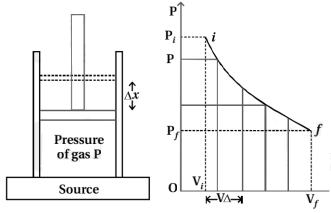
Derive the expression for work done by a gas during an isobaric process (constant pressure).
Solution
(N/A) Consider a gas enclosed in a cylinder fitted with a frictionless,movable piston of cross-sectional area $A$. When the gas expands at constant pressure $P$,the piston moves outward by a small distance $\Delta x$.
The force exerted by the gas on the piston is $F = P \times A$.
The work done by the gas during this small displacement $\Delta x$ is:
$\Delta W = F \times \Delta x = (P \times A) \times \Delta x$
Since the change in volume is $\Delta V = A \times \Delta x$,we can write:
$\Delta W = P \Delta V$
For a finite change in volume from $V_i$ to $V_f$ at constant pressure $P$,the total work done is:
$W = \int_{V_i}^{V_f} P \, dV = P(V_f - V_i) = P \Delta V$
According to the first law of thermodynamics,$\Delta Q = \Delta U + W$. Substituting the expression for work,we get:
$\Delta Q = \Delta U + P \Delta V$
The force exerted by the gas on the piston is $F = P \times A$.
The work done by the gas during this small displacement $\Delta x$ is:
$\Delta W = F \times \Delta x = (P \times A) \times \Delta x$
Since the change in volume is $\Delta V = A \times \Delta x$,we can write:
$\Delta W = P \Delta V$
For a finite change in volume from $V_i$ to $V_f$ at constant pressure $P$,the total work done is:
$W = \int_{V_i}^{V_f} P \, dV = P(V_f - V_i) = P \Delta V$
According to the first law of thermodynamics,$\Delta Q = \Delta U + W$. Substituting the expression for work,we get:
$\Delta Q = \Delta U + P \Delta V$
0 likes
View Solution56
MediumMCQ
Obtain the expression for work done by a gas during an isobaric process (constant pressure).
A
$W$ = $P$(V_f - V_i)
B
$W$ = $P$(V_i - V_f)
C
$W$ = nRT ln(V_f/V_i)
D
$W$ = $0$
Solution
(A) In an isobaric process,the pressure $P$ of the system remains constant throughout the process.
Work done $W$ by a gas is defined by the integral $W = \int_{V_i}^{V_f} P \, dV$.
Since $P$ is constant,it can be taken out of the integral: $W = P \int_{V_i}^{V_f} dV$.
Evaluating the integral,we get $W = P [V]_{V_i}^{V_f}$.
Thus,the work done is $W = P(V_f - V_i)$,where $V_f$ is the final volume and $V_i$ is the initial volume.
Work done $W$ by a gas is defined by the integral $W = \int_{V_i}^{V_f} P \, dV$.
Since $P$ is constant,it can be taken out of the integral: $W = P \int_{V_i}^{V_f} dV$.
Evaluating the integral,we get $W = P [V]_{V_i}^{V_f}$.
Thus,the work done is $W = P(V_f - V_i)$,where $V_f$ is the final volume and $V_i$ is the initial volume.
0 likes
View Solution57
Medium
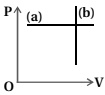
Match the graphs in Column-$I$ with the processes in Column-$II$:
| Column-$I$ | Column-$II$ |
| $(a)$ Horizontal line parallel to $V$-axis | $(i)$ Adiabatic process |
| $(b)$ Vertical line parallel to $P$-axis | $(ii)$ Isobaric process |
| $(iii)$ Isochoric process |
Solution
(A) In a $P-V$ diagram:
$1$. $A$ horizontal line parallel to the $V$-axis indicates that the pressure $P$ remains constant as the volume $V$ changes. This represents an isobaric process. Thus,$(a)$ corresponds to $(ii)$.
$2$. $A$ vertical line parallel to the $P$-axis indicates that the volume $V$ remains constant as the pressure $P$ changes. This represents an isochoric process. Thus,$(b)$ corresponds to $(iii)$.
$1$. $A$ horizontal line parallel to the $V$-axis indicates that the pressure $P$ remains constant as the volume $V$ changes. This represents an isobaric process. Thus,$(a)$ corresponds to $(ii)$.
$2$. $A$ vertical line parallel to the $P$-axis indicates that the volume $V$ remains constant as the pressure $P$ changes. This represents an isochoric process. Thus,$(b)$ corresponds to $(iii)$.
0 likes
View Solution58
Easy
Write a note on the isochoric process.
Solution
(N/A) The process during which the volume of a system remains constant is known as an isochoric process. In an isochoric process,the volume $V$ is constant.
Since work $W = P \Delta V$ and $\Delta V = 0$,the work done $W = 0$.
According to the first law of thermodynamics,$\Delta Q = \Delta U + \Delta W$. Since $\Delta W = 0$,we have $\Delta Q = \Delta U$.
This implies that if heat is absorbed,the internal energy increases,leading to an increase in temperature. Conversely,if the gas rejects heat,the internal energy decreases,leading to a decrease in temperature.
The change in temperature for a given amount of heat can be determined by the specific heat capacity of the gas at constant volume using the formula:
$C_v = \frac{\Delta Q}{\mu \Delta T} \implies \Delta T = \frac{\Delta Q}{\mu C_v}$,where $\mu$ is the number of moles.
Since work $W = P \Delta V$ and $\Delta V = 0$,the work done $W = 0$.
According to the first law of thermodynamics,$\Delta Q = \Delta U + \Delta W$. Since $\Delta W = 0$,we have $\Delta Q = \Delta U$.
This implies that if heat is absorbed,the internal energy increases,leading to an increase in temperature. Conversely,if the gas rejects heat,the internal energy decreases,leading to a decrease in temperature.
The change in temperature for a given amount of heat can be determined by the specific heat capacity of the gas at constant volume using the formula:
$C_v = \frac{\Delta Q}{\mu \Delta T} \implies \Delta T = \frac{\Delta Q}{\mu C_v}$,where $\mu$ is the number of moles.
0 likes
View Solution59
Easy
Define an isobaric process. Derive an expression for the work done in such a process.
Solution
(N/A) An isobaric process is a thermodynamic process in which the pressure of the system remains constant.
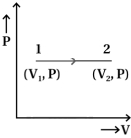
Consider a gas undergoing an expansion from an initial state $(V_1, P)$ to a final state $(V_2, P)$ at a constant pressure $P$,as shown in the $P-V$ diagram.
The work done $W$ by the gas is given by the integral of pressure with respect to volume:
$W = \int_{V_1}^{V_2} P \, dV$
Since the pressure $P$ is constant,it can be taken out of the integral:
$W = P \int_{V_1}^{V_2} dV$
$W = P [V_2 - V_1]$
$W = P \Delta V$
Using the ideal gas equation $PV = \mu RT$,we can express the work done in terms of temperature change:
$PV_1 = \mu RT_1$
$PV_2 = \mu RT_2$
Substituting these into the work equation:
$W = \mu RT_2 - \mu RT_1$
$W = \mu R(T_2 - T_1)$
$W = \mu R \Delta T$
Consider a gas undergoing an expansion from an initial state $(V_1, P)$ to a final state $(V_2, P)$ at a constant pressure $P$,as shown in the $P-V$ diagram.
The work done $W$ by the gas is given by the integral of pressure with respect to volume:
$W = \int_{V_1}^{V_2} P \, dV$
Since the pressure $P$ is constant,it can be taken out of the integral:
$W = P \int_{V_1}^{V_2} dV$
$W = P [V_2 - V_1]$
$W = P \Delta V$
Using the ideal gas equation $PV = \mu RT$,we can express the work done in terms of temperature change:
$PV_1 = \mu RT_1$
$PV_2 = \mu RT_2$
Substituting these into the work equation:
$W = \mu RT_2 - \mu RT_1$
$W = \mu R(T_2 - T_1)$
$W = \mu R \Delta T$
0 likes
View Solution60
Easy
Write the expression for the work done by an ideal gas in an isobaric process.
Solution
(N/A) An isobaric process is a thermodynamic process in which the pressure $P$ of the system remains constant.
For an ideal gas,the work done $W$ during a process is given by the integral $W = \int_{V_i}^{V_f} P \, dV$.
Since the pressure $P$ is constant in an isobaric process,it can be taken out of the integral:
$W = P \int_{V_i}^{V_f} dV$
$W = P(V_f - V_i)$
Using the ideal gas equation $PV = nRT$,we can also express this as:
$W = nR(T_f - T_i)$
where $n$ is the number of moles,$R$ is the universal gas constant,$V_i$ and $V_f$ are the initial and final volumes,and $T_i$ and $T_f$ are the initial and final temperatures.
For an ideal gas,the work done $W$ during a process is given by the integral $W = \int_{V_i}^{V_f} P \, dV$.
Since the pressure $P$ is constant in an isobaric process,it can be taken out of the integral:
$W = P \int_{V_i}^{V_f} dV$
$W = P(V_f - V_i)$
Using the ideal gas equation $PV = nRT$,we can also express this as:
$W = nR(T_f - T_i)$
where $n$ is the number of moles,$R$ is the universal gas constant,$V_i$ and $V_f$ are the initial and final volumes,and $T_i$ and $T_f$ are the initial and final temperatures.
0 likes
View Solution61
Easy
Describe the nature of $P-V$ diagrams for isobaric and isochoric processes.
Solution
(N/A) In an isobaric process,the pressure $P$ remains constant. Therefore,the $P-V$ diagram is a straight line parallel to the volume axis ($V$-axis).
In an isochoric process,the volume $V$ remains constant. Therefore,the $P-V$ diagram is a straight line parallel to the pressure axis ($P$-axis).
In an isochoric process,the volume $V$ remains constant. Therefore,the $P-V$ diagram is a straight line parallel to the pressure axis ($P$-axis).
0 likes
View Solution62
Easy
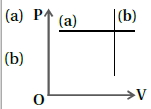
In Column-$I$ a graph and in Column-$II$ processes are given. Match them appropriately:
| Column-$I$ | Column-$II$ |
| $(a)$ Graph $(a)$ | $(i)$ Adiabatic process |
| $(b)$ Graph $(b)$ | $(ii)$ Isobaric process |
| $(iii)$ Isochoric process |
Solution
(A) In a $P-V$ diagram:
$1$. Graph $(a)$ is a horizontal line,which means pressure $P$ remains constant as volume $V$ changes. This represents an Isobaric process.
$2$. Graph $(b)$ is a vertical line,which means volume $V$ remains constant as pressure $P$ changes. This represents an Isochoric process.
Therefore,the correct matching is: $(a-ii), (b-iii)$.
$1$. Graph $(a)$ is a horizontal line,which means pressure $P$ remains constant as volume $V$ changes. This represents an Isobaric process.
$2$. Graph $(b)$ is a vertical line,which means volume $V$ remains constant as pressure $P$ changes. This represents an Isochoric process.
Therefore,the correct matching is: $(a-ii), (b-iii)$.
0 likes
View Solution63
EasyMCQ
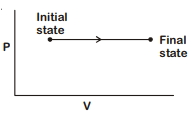
The $P-V$ diagram for an ideal gas in a piston-cylinder assembly undergoing a thermodynamic process is shown in the figure. The process is
A
isothermal
B
adiabatic
C
isochoric
D
isobaric
Solution
(D) In a $P-V$ diagram,the $y$-axis represents pressure $(P)$ and the $x$-axis represents volume $(V)$.
From the given figure,the line representing the process is horizontal,which means the pressure $(P)$ remains constant as the volume $(V)$ changes from the initial state to the final state.
$A$ thermodynamic process in which the pressure of the system remains constant is known as an isobaric process.
Therefore,the correct option is $D$.
From the given figure,the line representing the process is horizontal,which means the pressure $(P)$ remains constant as the volume $(V)$ changes from the initial state to the final state.
$A$ thermodynamic process in which the pressure of the system remains constant is known as an isobaric process.
Therefore,the correct option is $D$.
0 likes
View Solution64
DifficultMCQ
In an isobaric process,the work done by a diatomic gas is $10 \ J$. The heat given to the gas will be (in $J$):
A
$35$
B
$30$
C
$45$
D
$60$
Solution
(A) For an isobaric process,the work done $W$ and heat supplied $Q$ are given by:
$W = n R \Delta T$
$Q = n C_p \Delta T$
Since $C_p = \frac{f}{2} R + R = (\frac{f}{2} + 1) R$,we have:
$\frac{W}{Q} = \frac{n R \Delta T}{n (\frac{f}{2} + 1) R \Delta T} = \frac{1}{\frac{f}{2} + 1}$
For a diatomic gas,the degrees of freedom $f = 5$.
Substituting $f = 5$:
$\frac{W}{Q} = \frac{1}{\frac{5}{2} + 1} = \frac{1}{\frac{7}{2}} = \frac{2}{7}$
Therefore,$Q = \frac{7}{2} W$.
Given $W = 10 \ J$,we get:
$Q = \frac{7}{2} \times 10 = 35 \ J$.
$W = n R \Delta T$
$Q = n C_p \Delta T$
Since $C_p = \frac{f}{2} R + R = (\frac{f}{2} + 1) R$,we have:
$\frac{W}{Q} = \frac{n R \Delta T}{n (\frac{f}{2} + 1) R \Delta T} = \frac{1}{\frac{f}{2} + 1}$
For a diatomic gas,the degrees of freedom $f = 5$.
Substituting $f = 5$:
$\frac{W}{Q} = \frac{1}{\frac{5}{2} + 1} = \frac{1}{\frac{7}{2}} = \frac{2}{7}$
Therefore,$Q = \frac{7}{2} W$.
Given $W = 10 \ J$,we get:
$Q = \frac{7}{2} \times 10 = 35 \ J$.
0 likes
View Solution65
DifficultMCQ
$A$ diatomic gas,having $C_{p} = \frac{7}{2} R$ and $C_{v} = \frac{5}{2} R$,is heated at constant pressure. The ratio $dU : dQ : dW$ is:
A
$5: 7: 3$
B
$5: 7: 2$
C
$3: 7: 2$
D
$3: 5: 2$
Solution
(B) For an ideal gas,the change in internal energy is given by $dU = n C_{v} dT$.
The heat supplied at constant pressure is given by $dQ = n C_{p} dT$.
The work done in an isobaric process is given by $dW = P dV = n R dT$.
Therefore,the ratio $dU : dQ : dW$ is $n C_{v} dT : n C_{p} dT : n R dT$,which simplifies to $C_{v} : C_{p} : R$.
Substituting the given values,we get $\frac{5}{2} R : \frac{7}{2} R : R$.
Multiplying by $\frac{2}{R}$,we obtain the ratio $5 : 7 : 2$.
The heat supplied at constant pressure is given by $dQ = n C_{p} dT$.
The work done in an isobaric process is given by $dW = P dV = n R dT$.
Therefore,the ratio $dU : dQ : dW$ is $n C_{v} dT : n C_{p} dT : n R dT$,which simplifies to $C_{v} : C_{p} : R$.
Substituting the given values,we get $\frac{5}{2} R : \frac{7}{2} R : R$.
Multiplying by $\frac{2}{R}$,we obtain the ratio $5 : 7 : 2$.
0 likes
View Solution66
MediumMCQ
The temperature of $3.00 \, mol$ of an ideal diatomic gas is increased by $40.0^{\circ} C$ without changing the pressure of the gas. The molecules in the gas rotate but do not oscillate. If the ratio of change in internal energy of the gas to the amount of work done by the gas is $\frac{x}{10}$,then the value of $x$ (round off to the nearest integer) is ..... . (Given $R = 8.31 \, J \, mol^{-1} K^{-1}$)
A
$25$
B
$2.5$
C
$125$
D
$250$
Solution
(A) Since the pressure of the gas remains constant,the process is isobaric.
For a diatomic gas where molecules rotate but do not oscillate,the degrees of freedom $f = 5$.
The change in internal energy is given by $\Delta U = n C_v \Delta T = n \left( \frac{f}{2} R \right) \Delta T = \frac{5}{2} n R \Delta T$.
The work done by the gas in an isobaric process is $W = P \Delta V = n R \Delta T$.
The ratio of the change in internal energy to the work done is $\frac{\Delta U}{W} = \frac{\frac{5}{2} n R \Delta T}{n R \Delta T} = \frac{5}{2} = 2.5$.
Given that this ratio is equal to $\frac{x}{10}$,we have $\frac{x}{10} = 2.5$.
Therefore,$x = 2.5 \times 10 = 25$.
For a diatomic gas where molecules rotate but do not oscillate,the degrees of freedom $f = 5$.
The change in internal energy is given by $\Delta U = n C_v \Delta T = n \left( \frac{f}{2} R \right) \Delta T = \frac{5}{2} n R \Delta T$.
The work done by the gas in an isobaric process is $W = P \Delta V = n R \Delta T$.
The ratio of the change in internal energy to the work done is $\frac{\Delta U}{W} = \frac{\frac{5}{2} n R \Delta T}{n R \Delta T} = \frac{5}{2} = 2.5$.
Given that this ratio is equal to $\frac{x}{10}$,we have $\frac{x}{10} = 2.5$.
Therefore,$x = 2.5 \times 10 = 25$.
0 likes
View Solution67
MediumMCQ
$A$ diatomic gas $(\gamma = 1.4)$ does $400 \ J$ of work when it is expanded isobarically. The heat given to the gas in the process is ............ $J$.
A
$1100$
B
$1200$
C
$1300$
D
$1400$
Solution
(D) For an isobaric process,the work done is given by $W = P \Delta V = nR \Delta T = 400 \ J$.
The heat supplied to the gas is given by $Q = nC_p \Delta T$.
Since $C_p = \frac{\gamma R}{\gamma - 1}$,we have $Q = n \left( \frac{\gamma R}{\gamma - 1} \right) \Delta T$.
Substituting $nR \Delta T = W = 400 \ J$ and $\gamma = 1.4$:
$Q = \frac{\gamma}{\gamma - 1} \times W = \frac{1.4}{1.4 - 1} \times 400$.
$Q = \frac{1.4}{0.4} \times 400 = 3.5 \times 400 = 1400 \ J$.
The heat supplied to the gas is given by $Q = nC_p \Delta T$.
Since $C_p = \frac{\gamma R}{\gamma - 1}$,we have $Q = n \left( \frac{\gamma R}{\gamma - 1} \right) \Delta T$.
Substituting $nR \Delta T = W = 400 \ J$ and $\gamma = 1.4$:
$Q = \frac{\gamma}{\gamma - 1} \times W = \frac{1.4}{1.4 - 1} \times 400$.
$Q = \frac{1.4}{0.4} \times 400 = 3.5 \times 400 = 1400 \ J$.
0 likes
View Solution68
MediumMCQ
An ideal diatomic gas is heated at constant pressure. The ratio of the work done to the heat supplied is
A
$3/5$
B
$2/5$
C
$2/7$
D
$4/7$
Solution
(C) The heat supplied at constant pressure is given by $\Delta Q = n C_p \Delta T$.
The work done by the gas at constant pressure is $\Delta W = p \Delta V = n R \Delta T$.
The ratio of the work done to the heat supplied is $\frac{\Delta W}{\Delta Q} = \frac{n R \Delta T}{n C_p \Delta T} = \frac{R}{C_p}$.
Using the relation $R = C_p - C_V$,we get $\frac{\Delta W}{\Delta Q} = \frac{C_p - C_V}{C_p} = 1 - \frac{C_V}{C_p} = 1 - \frac{1}{\gamma}$.
For a diatomic gas,the adiabatic index $\gamma = 7/5$.
Therefore,the ratio is $1 - \frac{1}{7/5} = 1 - \frac{5}{7} = \frac{2}{7}$.
The work done by the gas at constant pressure is $\Delta W = p \Delta V = n R \Delta T$.
The ratio of the work done to the heat supplied is $\frac{\Delta W}{\Delta Q} = \frac{n R \Delta T}{n C_p \Delta T} = \frac{R}{C_p}$.
Using the relation $R = C_p - C_V$,we get $\frac{\Delta W}{\Delta Q} = \frac{C_p - C_V}{C_p} = 1 - \frac{C_V}{C_p} = 1 - \frac{1}{\gamma}$.
For a diatomic gas,the adiabatic index $\gamma = 7/5$.
Therefore,the ratio is $1 - \frac{1}{7/5} = 1 - \frac{5}{7} = \frac{2}{7}$.
0 likes
View Solution69
MediumMCQ
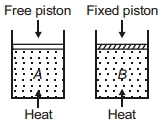
Two cylinders contain the same amount of an ideal monatomic gas. The same amount of heat is given to both cylinders. If the temperature rise in cylinder $A$ is $T_0$,then the temperature rise in cylinder $B$ will be:
A
$\frac{4}{3} T_0$
B
$2 T_0$
C
$\frac{T_0}{2}$
D
$\frac{5}{3} T_0$
Solution
(D) Cylinder $A$ has a free piston,which means the process occurs at constant pressure. The heat supplied is given by $\Delta Q = n C_P \Delta T_A = n C_P T_0$.
Cylinder $B$ has a fixed piston,which means the process occurs at constant volume. The heat supplied is given by $\Delta Q = n C_V \Delta T_B$.
Since the same amount of heat is supplied to both cylinders,we have:
$n C_P T_0 = n C_V \Delta T_B$
$\Delta T_B = \frac{C_P}{C_V} T_0$
For an ideal monatomic gas,the ratio of specific heats is $\gamma = \frac{C_P}{C_V} = \frac{5}{3}$.
Therefore,$\Delta T_B = \frac{5}{3} T_0$.
Cylinder $B$ has a fixed piston,which means the process occurs at constant volume. The heat supplied is given by $\Delta Q = n C_V \Delta T_B$.
Since the same amount of heat is supplied to both cylinders,we have:
$n C_P T_0 = n C_V \Delta T_B$
$\Delta T_B = \frac{C_P}{C_V} T_0$
For an ideal monatomic gas,the ratio of specific heats is $\gamma = \frac{C_P}{C_V} = \frac{5}{3}$.
Therefore,$\Delta T_B = \frac{5}{3} T_0$.
0 likes
View Solution70
EasyMCQ
For an isochoric process,which of the following relations is correct?
A
$\Delta W = -\Delta U$
B
$\Delta Q = \Delta U$
C
$\Delta Q = \Delta W$
D
$\Delta Q = -\Delta U$
Solution
(B) In an isochoric process,the volume of the system remains constant,so the change in volume $\Delta V = 0$.
Since the work done by the system is given by $\Delta W = P \Delta V$,it follows that $\Delta W = 0$.
According to the first law of thermodynamics,$\Delta Q = \Delta U + \Delta W$.
Substituting $\Delta W = 0$ into the equation,we get $\Delta Q = \Delta U$.
Since the work done by the system is given by $\Delta W = P \Delta V$,it follows that $\Delta W = 0$.
According to the first law of thermodynamics,$\Delta Q = \Delta U + \Delta W$.
Substituting $\Delta W = 0$ into the equation,we get $\Delta Q = \Delta U$.
0 likes
View Solution71
MediumMCQ
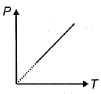
The pressure $P$ of an ideal diatomic gas varies with its absolute temperature $T$ as shown in the figure. The molar heat capacity of the gas during this process is ........... $R$ [$R$ is the gas constant].
A
$1.7$
B
$3.25$
C
$2.5$
D
$4.2$
Solution
(C) From the given graph, the pressure $P$ is directly proportional to the absolute temperature $T$, i.e., $P \propto T$ or $P = kT$ (where $k$ is a constant).
Using the ideal gas equation $PV = nRT$, we can substitute $P = kT$ to get $(kT)V = nRT$, which simplifies to $V = nR/k = \text{constant}$.
Since the volume $V$ remains constant throughout the process, this is an isochoric process.
The molar heat capacity of an ideal gas for an isochoric process is given by $C_V$.
For a diatomic gas, the degrees of freedom $f = 5$.
Therefore, the molar heat capacity $C_V = \frac{f}{2}R = \frac{5}{2}R = 2.5R$.
Thus, the molar heat capacity is $2.5R$.
Using the ideal gas equation $PV = nRT$, we can substitute $P = kT$ to get $(kT)V = nRT$, which simplifies to $V = nR/k = \text{constant}$.
Since the volume $V$ remains constant throughout the process, this is an isochoric process.
The molar heat capacity of an ideal gas for an isochoric process is given by $C_V$.
For a diatomic gas, the degrees of freedom $f = 5$.
Therefore, the molar heat capacity $C_V = \frac{f}{2}R = \frac{5}{2}R = 2.5R$.
Thus, the molar heat capacity is $2.5R$.
0 likes
View Solution72
DifficultMCQ
$0.08 \text{ kg}$ of air is heated at constant volume through $5^{\circ} \text{C}$. The specific heat of air at constant volume is $0.17 \text{ kcal/kg}^{\circ} \text{C}$ and $J = 4.18 \text{ J/cal}$. The change in its internal energy is approximately: (in $\text{ J}$)
A
$318$
B
$298$
C
$284$
D
$142$
Solution
(C) For a process at constant volume,the work done $W = 0$. According to the first law of thermodynamics,$\Delta Q = \Delta U + W$,so $\Delta Q = \Delta U$.
The change in internal energy is given by $\Delta U = m \cdot c_v \cdot \Delta T$.
Given:
$m = 0.08 \text{ kg}$
$c_v = 0.17 \text{ kcal/kg}^{\circ} \text{C} = 0.17 \times 1000 \text{ cal/kg}^{\circ} \text{C} = 170 \text{ cal/kg}^{\circ} \text{C}$
$\Delta T = 5^{\circ} \text{C}$
$J = 4.18 \text{ J/cal}$
Substituting the values:
$\Delta U = 0.08 \text{ kg} \times 170 \text{ cal/kg}^{\circ} \text{C} \times 5^{\circ} \text{C} \times 4.18 \text{ J/cal}$
$\Delta U = 0.08 \times 170 \times 5 \times 4.18 \text{ J}$
$\Delta U = 68 \times 4.18 \text{ J}$
$\Delta U = 284.24 \text{ J}$
Thus,the change in internal energy is approximately $284 \text{ J}$.
The change in internal energy is given by $\Delta U = m \cdot c_v \cdot \Delta T$.
Given:
$m = 0.08 \text{ kg}$
$c_v = 0.17 \text{ kcal/kg}^{\circ} \text{C} = 0.17 \times 1000 \text{ cal/kg}^{\circ} \text{C} = 170 \text{ cal/kg}^{\circ} \text{C}$
$\Delta T = 5^{\circ} \text{C}$
$J = 4.18 \text{ J/cal}$
Substituting the values:
$\Delta U = 0.08 \text{ kg} \times 170 \text{ cal/kg}^{\circ} \text{C} \times 5^{\circ} \text{C} \times 4.18 \text{ J/cal}$
$\Delta U = 0.08 \times 170 \times 5 \times 4.18 \text{ J}$
$\Delta U = 68 \times 4.18 \text{ J}$
$\Delta U = 284.24 \text{ J}$
Thus,the change in internal energy is approximately $284 \text{ J}$.
0 likes
View Solution73
DifficultMCQ
$A$ diatomic gas $(\gamma = 1.4)$ does $200 \,J$ of work when it is expanded isobarically. The heat given to the gas in the process is: (in $\,J$)
A
$850$
B
$800$
C
$600$
D
$700$
Solution
(D) For a diatomic gas, the degrees of freedom $f = 5$.
In an isobaric process, the work done is given by $W = nR\Delta T = 200 \,J$.
The heat supplied to the gas is given by $Q = nC_p\Delta T$.
Since $C_p = \frac{f+2}{2}R$, we have $Q = \left(\frac{f+2}{2}\right) nR\Delta T$.
Substituting the values $f = 5$ and $nR\Delta T = 200 \,J$:
$Q = \left(\frac{5+2}{2}\right) \times 200 = \frac{7}{2} \times 200 = 700 \,J$.
In an isobaric process, the work done is given by $W = nR\Delta T = 200 \,J$.
The heat supplied to the gas is given by $Q = nC_p\Delta T$.
Since $C_p = \frac{f+2}{2}R$, we have $Q = \left(\frac{f+2}{2}\right) nR\Delta T$.
Substituting the values $f = 5$ and $nR\Delta T = 200 \,J$:
$Q = \left(\frac{5+2}{2}\right) \times 200 = \frac{7}{2} \times 200 = 700 \,J$.
0 likes
View Solution74
DifficultMCQ
$A$ diatomic gas $(\gamma=1.4)$ does $100 \,J$ of work in an isobaric expansion. The heat given to the gas is: (in $\,J$)
A
$350$
B
$490$
C
$150$
D
$250$
Solution
(A) For an isobaric process, the work done is given by $W = P \Delta V = nR \Delta T = 100 \,J$.
The heat supplied to the gas is given by the first law of thermodynamics: $Q = \Delta U + W$.
For a diatomic gas, the degrees of freedom $f = 5$. The change in internal energy is $\Delta U = \frac{f}{2} nR \Delta T = \frac{5}{2} nR \Delta T$.
Substituting $\Delta U$ and $W$ into the heat equation: $Q = \frac{5}{2} nR \Delta T + nR \Delta T = \left(\frac{5}{2} + 1\right) nR \Delta T = \frac{7}{2} nR \Delta T$.
Since $nR \Delta T = 100 \,J$, we have $Q = \frac{7}{2} \times 100 = 350 \,J$.
The heat supplied to the gas is given by the first law of thermodynamics: $Q = \Delta U + W$.
For a diatomic gas, the degrees of freedom $f = 5$. The change in internal energy is $\Delta U = \frac{f}{2} nR \Delta T = \frac{5}{2} nR \Delta T$.
Substituting $\Delta U$ and $W$ into the heat equation: $Q = \frac{5}{2} nR \Delta T + nR \Delta T = \left(\frac{5}{2} + 1\right) nR \Delta T = \frac{7}{2} nR \Delta T$.
Since $nR \Delta T = 100 \,J$, we have $Q = \frac{7}{2} \times 100 = 350 \,J$.
0 likes
View Solution75
MediumMCQ
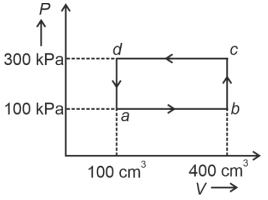
$A$ cyclic process of a thermodynamic system is taken through $a \to b \to c \to d \to a$ as shown in the $P-V$ diagram. The work done by the gas along the path $b \to c$ is
A
$30 \ J$
B
$-90 \ J$
C
$-60 \ J$
D
Zero
Solution
(D) In a $P-V$ diagram,the work done by a gas is given by the area under the curve,which is $\int P \ dV$.
Along the path $b \to c$,the volume $V$ remains constant at $400 \ cm^3$.
Since there is no change in volume $(dV = 0)$,the process is an isochoric process.
Therefore,the work done by the gas along the path $b \to c$ is $W = P \Delta V = P \times 0 = 0 \ J$.
Along the path $b \to c$,the volume $V$ remains constant at $400 \ cm^3$.
Since there is no change in volume $(dV = 0)$,the process is an isochoric process.
Therefore,the work done by the gas along the path $b \to c$ is $W = P \Delta V = P \times 0 = 0 \ J$.
0 likes
View Solution76
MediumMCQ
Two moles of ideal helium gas are in a rubber balloon at $30^{\circ} C$. The balloon is fully expandable and can be assumed to require no energy in its expansion. The temperature of the gas in the balloon is slowly changed to $35^{\circ} C$. The amount of heat required in raising the temperature is nearly (take $R = 8.31 \ J / mol \cdot K$) (in $J$)
A
$62$
B
$104$
C
$124$
D
$208$
Solution
(D) Since the balloon is fully expandable and requires no energy for expansion,the pressure inside the balloon remains constant (equal to atmospheric pressure). Thus,the process is isobaric.
For an isobaric process,the heat required is given by $\Delta Q = n C_p \Delta T$.
For a monoatomic gas like helium,the degrees of freedom $f = 3$.
The molar heat capacity at constant pressure is $C_p = \frac{f}{2} R + R = \frac{3}{2} R + R = \frac{5}{2} R$.
Given: $n = 2 \ mol$,$\Delta T = 35^{\circ} C - 30^{\circ} C = 5 \ K$,and $R = 8.31 \ J / mol \cdot K$.
Substituting the values:
$\Delta Q = 2 \times \left( \frac{5}{2} \times 8.31 \right) \times 5$
$\Delta Q = 5 \times 8.31 \times 5 = 25 \times 8.31 = 207.75 \ J$.
Rounding to the nearest integer,we get $\Delta Q \approx 208 \ J$.
For an isobaric process,the heat required is given by $\Delta Q = n C_p \Delta T$.
For a monoatomic gas like helium,the degrees of freedom $f = 3$.
The molar heat capacity at constant pressure is $C_p = \frac{f}{2} R + R = \frac{3}{2} R + R = \frac{5}{2} R$.
Given: $n = 2 \ mol$,$\Delta T = 35^{\circ} C - 30^{\circ} C = 5 \ K$,and $R = 8.31 \ J / mol \cdot K$.
Substituting the values:
$\Delta Q = 2 \times \left( \frac{5}{2} \times 8.31 \right) \times 5$
$\Delta Q = 5 \times 8.31 \times 5 = 25 \times 8.31 = 207.75 \ J$.
Rounding to the nearest integer,we get $\Delta Q \approx 208 \ J$.
0 likes
View Solution77
MediumMCQ
An ideal gas goes from an initial state to a final state. During the process,the pressure of the gas increases linearly with temperature. Which of the following statements are correct?
$A.$ The work done by the gas during the process is zero.
$B.$ The heat added to the gas is different from the change in its internal energy.
$C.$ The volume of the gas is increased.
$D.$ The internal energy of the gas is increased.
$E.$ The process is isochoric (constant volume process).
Choose the correct answer from the options given below $:-$
$A.$ The work done by the gas during the process is zero.
$B.$ The heat added to the gas is different from the change in its internal energy.
$C.$ The volume of the gas is increased.
$D.$ The internal energy of the gas is increased.
$E.$ The process is isochoric (constant volume process).
Choose the correct answer from the options given below $:-$
A
$A, B, C, D$ Only
B
$A, D, E$ Only
C
$E$ Only
D
$A, C$ Only
Solution
(B) For an ideal gas,the equation of state is $PV = nRT$.
Given that the pressure $P$ increases linearly with temperature $T$,we have $P = kT$,where $k$ is a constant.
Substituting this into the ideal gas equation: $(kT)V = nRT$.
This simplifies to $V = \frac{nR}{k} = \text{constant}$.
Since the volume $V$ is constant,the process is isochoric.
$1$. Work done $W = \int P dV = 0$ because $dV = 0$. Thus,statement $A$ is correct.
$2$. According to the first law of thermodynamics,$Q = \Delta U + W$. Since $W = 0$,$Q = \Delta U$. Thus,statement $B$ is incorrect.
$3$. Since the volume is constant,statement $C$ is incorrect.
$4$. As the temperature increases,the internal energy $\Delta U = nC_v \Delta T$ increases. Thus,statement $D$ is correct.
$5$. Since the volume is constant,the process is isochoric. Thus,statement $E$ is correct.
Therefore,statements $A, D,$ and $E$ are correct.
Given that the pressure $P$ increases linearly with temperature $T$,we have $P = kT$,where $k$ is a constant.
Substituting this into the ideal gas equation: $(kT)V = nRT$.
This simplifies to $V = \frac{nR}{k} = \text{constant}$.
Since the volume $V$ is constant,the process is isochoric.
$1$. Work done $W = \int P dV = 0$ because $dV = 0$. Thus,statement $A$ is correct.
$2$. According to the first law of thermodynamics,$Q = \Delta U + W$. Since $W = 0$,$Q = \Delta U$. Thus,statement $B$ is incorrect.
$3$. Since the volume is constant,statement $C$ is incorrect.
$4$. As the temperature increases,the internal energy $\Delta U = nC_v \Delta T$ increases. Thus,statement $D$ is correct.
$5$. Since the volume is constant,the process is isochoric. Thus,statement $E$ is correct.
Therefore,statements $A, D,$ and $E$ are correct.
0 likes
View Solution78
MediumMCQ
The temperature of $1$ mole of an ideal monoatomic gas is increased by $50^{\circ} C$ at constant pressure. The total heat added and change in internal energy are $E_1$ and $E_2$,respectively. If $\frac{E_1}{E_2}=\frac{x}{9}$,then the value of $x$ is . . . . . . .
A
$15$
B
$25$
C
$35$
D
$45$
Solution
(A) For an isobaric process,the heat added is given by $E_1 = n C_p \Delta T$.
The change in internal energy is given by $E_2 = n C_v \Delta T$.
Therefore,the ratio is $\frac{E_1}{E_2} = \frac{n C_p \Delta T}{n C_v \Delta T} = \frac{C_p}{C_v} = \gamma$.
For a monoatomic gas,the degrees of freedom $f = 3$.
The adiabatic index is $\gamma = 1 + \frac{2}{f} = 1 + \frac{2}{3} = \frac{5}{3}$.
Given $\frac{E_1}{E_2} = \frac{x}{9}$,we have $\frac{5}{3} = \frac{x}{9}$.
Solving for $x$,we get $x = \frac{5 \times 9}{3} = 15$.
The change in internal energy is given by $E_2 = n C_v \Delta T$.
Therefore,the ratio is $\frac{E_1}{E_2} = \frac{n C_p \Delta T}{n C_v \Delta T} = \frac{C_p}{C_v} = \gamma$.
For a monoatomic gas,the degrees of freedom $f = 3$.
The adiabatic index is $\gamma = 1 + \frac{2}{f} = 1 + \frac{2}{3} = \frac{5}{3}$.
Given $\frac{E_1}{E_2} = \frac{x}{9}$,we have $\frac{5}{3} = \frac{x}{9}$.
Solving for $x$,we get $x = \frac{5 \times 9}{3} = 15$.
0 likes
View Solution79
MediumMCQ
$A$ quantity of heat $Q$ is supplied to a monoatomic ideal gas which expands at constant pressure. The fraction of heat that goes into work done by the gas is
A
$2/5$
B
$3/5$
C
$2/3$
D
$1$
Solution
(A) For an isobaric process,the heat supplied is given by $\Delta Q = \mu C_p \Delta T$.
According to the first law of thermodynamics,$\Delta Q = \Delta U + \Delta W$,where $\Delta U = \mu C_v \Delta T$ is the change in internal energy and $\Delta W$ is the work done.
Thus,$\Delta W = \Delta Q - \Delta U = \mu C_p \Delta T - \mu C_v \Delta T = \mu (C_p - C_v) \Delta T$.
The fraction of heat converted into work is $f = \frac{\Delta W}{\Delta Q} = \frac{\mu (C_p - C_v) \Delta T}{\mu C_p \Delta T} = 1 - \frac{C_v}{C_p} = 1 - \frac{1}{\gamma}$.
For a monoatomic gas,the adiabatic index $\gamma = 5/3$.
Therefore,$f = 1 - \frac{1}{5/3} = 1 - \frac{3}{5} = \frac{2}{5}$.
According to the first law of thermodynamics,$\Delta Q = \Delta U + \Delta W$,where $\Delta U = \mu C_v \Delta T$ is the change in internal energy and $\Delta W$ is the work done.
Thus,$\Delta W = \Delta Q - \Delta U = \mu C_p \Delta T - \mu C_v \Delta T = \mu (C_p - C_v) \Delta T$.
The fraction of heat converted into work is $f = \frac{\Delta W}{\Delta Q} = \frac{\mu (C_p - C_v) \Delta T}{\mu C_p \Delta T} = 1 - \frac{C_v}{C_p} = 1 - \frac{1}{\gamma}$.
For a monoatomic gas,the adiabatic index $\gamma = 5/3$.
Therefore,$f = 1 - \frac{1}{5/3} = 1 - \frac{3}{5} = \frac{2}{5}$.
0 likes
View Solution80
EasyMCQ
$A$ monoatomic ideal gas is heated at constant pressure. The percentage of total heat used in changing the internal energy is (in $\%$)
A
$30$
B
$40$
C
$50$
D
$60$
Solution
(D) For a monoatomic gas,the degrees of freedom $f = 3$.
At constant pressure,the molar heat capacity is $C_P = \frac{5}{2}R$ and the molar heat capacity at constant volume is $C_V = \frac{3}{2}R$.
The total heat supplied is $\Delta Q = n C_P \Delta T$.
The change in internal energy is $\Delta U = n C_V \Delta T$.
The fraction of heat used to change internal energy is $\frac{\Delta U}{\Delta Q} = \frac{n C_V \Delta T}{n C_P \Delta T} = \frac{C_V}{C_P}$.
Substituting the values,$\frac{\Delta U}{\Delta Q} = \frac{\frac{3}{2}R}{\frac{5}{2}R} = \frac{3}{5} = 0.6$.
Therefore,the percentage of total heat used is $0.6 \times 100 = 60 \%$.
At constant pressure,the molar heat capacity is $C_P = \frac{5}{2}R$ and the molar heat capacity at constant volume is $C_V = \frac{3}{2}R$.
The total heat supplied is $\Delta Q = n C_P \Delta T$.
The change in internal energy is $\Delta U = n C_V \Delta T$.
The fraction of heat used to change internal energy is $\frac{\Delta U}{\Delta Q} = \frac{n C_V \Delta T}{n C_P \Delta T} = \frac{C_V}{C_P}$.
Substituting the values,$\frac{\Delta U}{\Delta Q} = \frac{\frac{3}{2}R}{\frac{5}{2}R} = \frac{3}{5} = 0.6$.
Therefore,the percentage of total heat used is $0.6 \times 100 = 60 \%$.
0 likes
View Solution81
MediumMCQ
$A$ monoatomic gas is heated at constant pressure. The percentage of total heat used for doing external work is (in $\%$)
A
$30$
B
$40$
C
$50$
D
$60$
Solution
(B) For a process at constant pressure,the first law of thermodynamics is given by $Q = \Delta U + W$.
The heat supplied is $Q = n C_p \Delta T$.
The change in internal energy is $\Delta U = n C_v \Delta T$.
The external work done is $W = Q - \Delta U = n C_p \Delta T - n C_v \Delta T = n (C_p - C_v) \Delta T = n R \Delta T$.
For a monoatomic gas,$C_v = \frac{3}{2} R$ and $C_p = \frac{5}{2} R$.
The fraction of heat used for work is $\frac{W}{Q} = \frac{n R \Delta T}{n C_p \Delta T} = \frac{R}{C_p} = \frac{R}{\frac{5}{2} R} = \frac{2}{5}$.
Converting to percentage: $\frac{2}{5} \times 100 \% = 40 \%$.
The heat supplied is $Q = n C_p \Delta T$.
The change in internal energy is $\Delta U = n C_v \Delta T$.
The external work done is $W = Q - \Delta U = n C_p \Delta T - n C_v \Delta T = n (C_p - C_v) \Delta T = n R \Delta T$.
For a monoatomic gas,$C_v = \frac{3}{2} R$ and $C_p = \frac{5}{2} R$.
The fraction of heat used for work is $\frac{W}{Q} = \frac{n R \Delta T}{n C_p \Delta T} = \frac{R}{C_p} = \frac{R}{\frac{5}{2} R} = \frac{2}{5}$.
Converting to percentage: $\frac{2}{5} \times 100 \% = 40 \%$.
0 likes
View Solution82
MediumMCQ
When an ideal gas $\left(\gamma = \frac{5}{3}\right)$ is heated under constant pressure,then what percentage of given heat energy will be utilised in doing external work (in $\%$)?
A
$60$
B
$20$
C
$30$
D
$40$
Solution
(D) For an ideal gas undergoing a process at constant pressure,the heat supplied $dQ$ is given by $dQ = n C_p dT$.
The work done by the gas is $dW = P dV = n R dT$.
The fraction of heat energy utilized in doing external work is $\frac{dW}{dQ} = \frac{n R dT}{n C_p dT} = \frac{R}{C_p}$.
We know that $C_p = \frac{\gamma R}{\gamma - 1}$.
Substituting this,we get $\frac{dW}{dQ} = \frac{R}{\frac{\gamma R}{\gamma - 1}} = \frac{\gamma - 1}{\gamma} = 1 - \frac{1}{\gamma}$.
Given $\gamma = \frac{5}{3}$,we have $\frac{dW}{dQ} = 1 - \frac{1}{5/3} = 1 - \frac{3}{5} = \frac{2}{5}$.
Converting to percentage: $\frac{2}{5} \times 100 \% = 40 \%$.
The work done by the gas is $dW = P dV = n R dT$.
The fraction of heat energy utilized in doing external work is $\frac{dW}{dQ} = \frac{n R dT}{n C_p dT} = \frac{R}{C_p}$.
We know that $C_p = \frac{\gamma R}{\gamma - 1}$.
Substituting this,we get $\frac{dW}{dQ} = \frac{R}{\frac{\gamma R}{\gamma - 1}} = \frac{\gamma - 1}{\gamma} = 1 - \frac{1}{\gamma}$.
Given $\gamma = \frac{5}{3}$,we have $\frac{dW}{dQ} = 1 - \frac{1}{5/3} = 1 - \frac{3}{5} = \frac{2}{5}$.
Converting to percentage: $\frac{2}{5} \times 100 \% = 40 \%$.
0 likes
View Solution83
MediumMCQ
In an isobaric process of an ideal gas,the ratio of heat supplied and work done by the system $\left(\frac{Q}{W}\right)$ is given by $\left[\frac{C_{P}}{C_{V}}=\gamma\right]$.
A
$1$
B
$\gamma$
C
$\frac{\gamma}{\gamma-1}$
D
$\frac{\gamma-1}{\gamma}$
Solution
(C) For an isobaric process,the pressure $P$ remains constant.
Heat supplied to the system is given by $Q = n C_{P} \Delta T$.
Work done by the system is given by $W = P \Delta V$.
Using the ideal gas equation $PV = nRT$,for a constant pressure process,$P \Delta V = nR \Delta T$.
Therefore,$W = nR \Delta T$.
The ratio of heat supplied to work done is $\frac{Q}{W} = \frac{n C_{P} \Delta T}{n R \Delta T} = \frac{C_{P}}{R}$.
We know that $C_{P} - C_{V} = R$,so $R = C_{P} - C_{V}$.
Substituting $R$ in the ratio: $\frac{Q}{W} = \frac{C_{P}}{C_{P} - C_{V}}$.
Dividing the numerator and denominator by $C_{V}$: $\frac{Q}{W} = \frac{C_{P}/C_{V}}{(C_{P}/C_{V}) - 1}$.
Since $\frac{C_{P}}{C_{V}} = \gamma$,we get $\frac{Q}{W} = \frac{\gamma}{\gamma - 1}$.
Heat supplied to the system is given by $Q = n C_{P} \Delta T$.
Work done by the system is given by $W = P \Delta V$.
Using the ideal gas equation $PV = nRT$,for a constant pressure process,$P \Delta V = nR \Delta T$.
Therefore,$W = nR \Delta T$.
The ratio of heat supplied to work done is $\frac{Q}{W} = \frac{n C_{P} \Delta T}{n R \Delta T} = \frac{C_{P}}{R}$.
We know that $C_{P} - C_{V} = R$,so $R = C_{P} - C_{V}$.
Substituting $R$ in the ratio: $\frac{Q}{W} = \frac{C_{P}}{C_{P} - C_{V}}$.
Dividing the numerator and denominator by $C_{V}$: $\frac{Q}{W} = \frac{C_{P}/C_{V}}{(C_{P}/C_{V}) - 1}$.
Since $\frac{C_{P}}{C_{V}} = \gamma$,we get $\frac{Q}{W} = \frac{\gamma}{\gamma - 1}$.
0 likes
View Solution84
EasyMCQ
The condition $dQ = dU$ (heat supplied equals the increase in internal energy) is true for which of the following processes?
A
Isothermal process.
B
Adiabatic process.
C
Isobaric process.
D
Isochoric process.
Solution
(D) According to the First Law of Thermodynamics,$dQ = dU + dW$,where $dW = P dV$.
For an isochoric process,the volume remains constant,meaning $dV = 0$.
Consequently,the work done $dW = P dV = 0$.
Substituting this into the First Law equation,we get $dQ = dU + 0$,which simplifies to $dQ = dU$.
Therefore,the condition $dQ = dU$ holds true for an isochoric process.
For an isochoric process,the volume remains constant,meaning $dV = 0$.
Consequently,the work done $dW = P dV = 0$.
Substituting this into the First Law equation,we get $dQ = dU + 0$,which simplifies to $dQ = dU$.
Therefore,the condition $dQ = dU$ holds true for an isochoric process.
0 likes
View Solution85
MediumMCQ
$A$ sample of an ideal gas $(\gamma = 5/3)$ is heated at constant pressure. If $100 \ J$ of heat is supplied to the gas,the work done by the gas is: (in $J$)
A
$150$
B
$60$
C
$40$
D
$250$
Solution
(C) For an ideal gas heated at constant pressure,the heat supplied $(Q_p)$ is given by $Q_p = n C_p \Delta T = 100 \ J$.
The work done by the gas is $W = n R \Delta T$.
We know that $C_p = \frac{\gamma R}{\gamma - 1}$.
Substituting this into the heat equation: $Q_p = n \left( \frac{\gamma R}{\gamma - 1} \right) \Delta T = 100 \ J$.
Therefore,$n R \Delta T = Q_p \left( \frac{\gamma - 1}{\gamma} \right)$.
Given $\gamma = 5/3$,we have $\frac{\gamma - 1}{\gamma} = \frac{5/3 - 1}{5/3} = \frac{2/3}{5/3} = 2/5$.
Thus,$W = 100 \ J \times (2/5) = 40 \ J$.
The work done by the gas is $W = n R \Delta T$.
We know that $C_p = \frac{\gamma R}{\gamma - 1}$.
Substituting this into the heat equation: $Q_p = n \left( \frac{\gamma R}{\gamma - 1} \right) \Delta T = 100 \ J$.
Therefore,$n R \Delta T = Q_p \left( \frac{\gamma - 1}{\gamma} \right)$.
Given $\gamma = 5/3$,we have $\frac{\gamma - 1}{\gamma} = \frac{5/3 - 1}{5/3} = \frac{2/3}{5/3} = 2/5$.
Thus,$W = 100 \ J \times (2/5) = 40 \ J$.
0 likes
View Solution86
EasyMCQ
$dQ$ is the heat energy supplied to an ideal gas under isochoric conditions. If $dU$ and $dW$ denote the change in internal energy and the work done respectively,then:
A
$dQ = dW$
B
$dQ > dU$
C
$dQ < dU$
D
$dQ = dU$
Solution
(D) Under isochoric (constant volume) conditions,the volume change $dV = 0$.
Since work done $dW = P \cdot dV$,it follows that $dW = 0$.
According to the First Law of Thermodynamics,$dQ = dU + dW$.
Substituting $dW = 0$,we get $dQ = dU$.
Since work done $dW = P \cdot dV$,it follows that $dW = 0$.
According to the First Law of Thermodynamics,$dQ = dU + dW$.
Substituting $dW = 0$,we get $dQ = dU$.
0 likes
View Solution87
EasyMCQ
If $R$ is the universal gas constant,the amount of heat needed to raise the temperature of $2$ moles of an ideal monoatomic gas from $273 \ K$ to $373 \ K$ when no work is done is: (in $R$)
A
$150$
B
$100$
C
$500$
D
$300$
Solution
(D) For an ideal gas,the internal energy is a function of temperature only. When no work is done,the process is isochoric (constant volume),so $\Delta W = 0$.
According to the first law of thermodynamics,$\Delta Q = \Delta U + \Delta W$.
Since $\Delta W = 0$,the heat supplied is equal to the change in internal energy: $\Delta Q = \Delta U = n C_V \Delta T$.
For a monoatomic gas,the molar heat capacity at constant volume is $C_V = \frac{3}{2} R$.
Given $n = 2$ moles,$\Delta T = 373 \ K - 273 \ K = 100 \ K$.
Substituting the values: $\Delta Q = 2 \times \frac{3}{2} R \times 100 = 300 R$.
According to the first law of thermodynamics,$\Delta Q = \Delta U + \Delta W$.
Since $\Delta W = 0$,the heat supplied is equal to the change in internal energy: $\Delta Q = \Delta U = n C_V \Delta T$.
For a monoatomic gas,the molar heat capacity at constant volume is $C_V = \frac{3}{2} R$.
Given $n = 2$ moles,$\Delta T = 373 \ K - 273 \ K = 100 \ K$.
Substituting the values: $\Delta Q = 2 \times \frac{3}{2} R \times 100 = 300 R$.
0 likes
View Solution88
EasyMCQ
$A$ sample of a gas expands from volume $V_1$ to $V_2$. The amount of work done by the gas is maximum when the expansion is:
A
Adiabatic
B
Equal in isothermal and isobaric
C
Isothermal
D
Isobaric
Solution
(D) The work done by a gas during expansion is given by the area under the $P-V$ curve.
For a given change in volume from $V_1$ to $V_2$,the pressure $P$ remains higher in an isobaric process compared to an isothermal or adiabatic process.
Since $W = \int_{V_1}^{V_2} P \, dV$,the area under the curve is largest for the isobaric process.
Therefore,the work done by the gas is maximum when the expansion is isobaric.
For a given change in volume from $V_1$ to $V_2$,the pressure $P$ remains higher in an isobaric process compared to an isothermal or adiabatic process.
Since $W = \int_{V_1}^{V_2} P \, dV$,the area under the curve is largest for the isobaric process.
Therefore,the work done by the gas is maximum when the expansion is isobaric.
0 likes
View Solution89
EasyMCQ
The change in internal energy of a mass of gas,when the volume changes from $V$ to $2V$ at constant pressure $P$,is (where $\gamma$ is the ratio of $C_p$ to $C_v$):
A
$\frac{PV}{\gamma-1}$
B
$\frac{P}{\gamma-1}$
C
$PV$
D
$\frac{\gamma PV}{\gamma-1}$
Solution
(A) The change in internal energy $\Delta U$ for an ideal gas is given by $\Delta U = n C_v \Delta T$.
Using the relation $C_v = \frac{R}{\gamma-1}$,we get $\Delta U = n \left( \frac{R}{\gamma-1} \right) \Delta T$.
From the ideal gas law $PV = nRT$,at constant pressure $P$,we have $P \Delta V = nR \Delta T$.
Substituting this into the internal energy equation: $\Delta U = \frac{P \Delta V}{\gamma-1}$.
Given that the volume changes from $V$ to $2V$,the change in volume is $\Delta V = 2V - V = V$.
Therefore,$\Delta U = \frac{P(V)}{\gamma-1} = \frac{PV}{\gamma-1}$.
Using the relation $C_v = \frac{R}{\gamma-1}$,we get $\Delta U = n \left( \frac{R}{\gamma-1} \right) \Delta T$.
From the ideal gas law $PV = nRT$,at constant pressure $P$,we have $P \Delta V = nR \Delta T$.
Substituting this into the internal energy equation: $\Delta U = \frac{P \Delta V}{\gamma-1}$.
Given that the volume changes from $V$ to $2V$,the change in volume is $\Delta V = 2V - V = V$.
Therefore,$\Delta U = \frac{P(V)}{\gamma-1} = \frac{PV}{\gamma-1}$.
0 likes
View Solution90
EasyMCQ
In an isobaric process,
A
pressure is constant.
B
volume is constant.
C
temperature is constant.
D
internal energy is constant.
Solution
(A) In an isobaric process,the pressure of the system remains constant throughout the thermodynamic process. By definition,'iso' means same and 'baric' refers to pressure.
0 likes
View Solution91
EasyMCQ
In an isobaric process of an ideal gas,the ratio of work done by the system to the heat supplied $\left(\frac{W}{Q}\right)$ is
A
$\frac{1}{\gamma-1}$
B
$\gamma$
C
$\frac{\gamma}{\gamma-1}$
D
$\frac{\gamma-1}{\gamma}$
Solution
(D) For an isobaric process,the heat supplied is given by $\Delta Q = nC_p \Delta T$.
According to the first law of thermodynamics,$\Delta Q = \Delta U + W$,where $\Delta U = nC_v \Delta T$ is the change in internal energy and $W$ is the work done.
Thus,$W = \Delta Q - \Delta U = nC_p \Delta T - nC_v \Delta T = n(C_p - C_v) \Delta T$.
Taking the ratio $\frac{W}{\Delta Q}$,we get:
$\frac{W}{\Delta Q} = \frac{n(C_p - C_v) \Delta T}{nC_p \Delta T} = \frac{C_p - C_v}{C_p} = 1 - \frac{C_v}{C_p}$.
Since $\gamma = \frac{C_p}{C_v}$,we have $\frac{C_v}{C_p} = \frac{1}{\gamma}$.
Therefore,$\frac{W}{\Delta Q} = 1 - \frac{1}{\gamma} = \frac{\gamma - 1}{\gamma}$.
According to the first law of thermodynamics,$\Delta Q = \Delta U + W$,where $\Delta U = nC_v \Delta T$ is the change in internal energy and $W$ is the work done.
Thus,$W = \Delta Q - \Delta U = nC_p \Delta T - nC_v \Delta T = n(C_p - C_v) \Delta T$.
Taking the ratio $\frac{W}{\Delta Q}$,we get:
$\frac{W}{\Delta Q} = \frac{n(C_p - C_v) \Delta T}{nC_p \Delta T} = \frac{C_p - C_v}{C_p} = 1 - \frac{C_v}{C_p}$.
Since $\gamma = \frac{C_p}{C_v}$,we have $\frac{C_v}{C_p} = \frac{1}{\gamma}$.
Therefore,$\frac{W}{\Delta Q} = 1 - \frac{1}{\gamma} = \frac{\gamma - 1}{\gamma}$.
0 likes
View Solution92
MediumMCQ
For an ideal gas,in an isobaric process,the ratio of heat supplied '$Q$' to the work done '$W$' by the system is ($\gamma = $ ratio of specific heat at constant pressure to that at constant volume).
A
$\frac{1}{\gamma}$
B
$\frac{1}{\gamma-1}$
C
$\frac{\gamma}{\gamma-1}$
D
$\frac{\gamma-1}{\gamma}$
Solution
(C) For an isobaric process,the heat supplied is given by $Q = n C_p \Delta T$.
The work done by the system is given by $W = P \Delta V = n R \Delta T$.
The ratio of heat supplied to work done is $\frac{Q}{W} = \frac{n C_p \Delta T}{n R \Delta T} = \frac{C_p}{R}$.
We know that for an ideal gas,the molar specific heat at constant pressure is $C_p = \frac{R \gamma}{\gamma - 1}$.
Substituting this into the ratio,we get $\frac{Q}{W} = \frac{R \gamma / (\gamma - 1)}{R} = \frac{\gamma}{\gamma - 1}$.
The work done by the system is given by $W = P \Delta V = n R \Delta T$.
The ratio of heat supplied to work done is $\frac{Q}{W} = \frac{n C_p \Delta T}{n R \Delta T} = \frac{C_p}{R}$.
We know that for an ideal gas,the molar specific heat at constant pressure is $C_p = \frac{R \gamma}{\gamma - 1}$.
Substituting this into the ratio,we get $\frac{Q}{W} = \frac{R \gamma / (\gamma - 1)}{R} = \frac{\gamma}{\gamma - 1}$.
0 likes
View Solution93
MediumMCQ
In an isobaric process of an ideal gas, the ratio of work done by the system $(W)$ during the expansion and the heat exchanged $(Q)$ is $(\gamma = \frac{C_p}{C_v})$
A
$\gamma$
B
$\gamma-1$
C
$\frac{\gamma}{\gamma-1}$
D
$\frac{\gamma-1}{\gamma}$
Solution
(D) In an isobaric process, the pressure remains constant.
Heat exchanged is given by $Q = n C_p \Delta T$.
Work done by the system is given by $W = P \Delta V = n R \Delta T$.
Using Mayer's relation, $R = C_p - C_v$.
Therefore, $W = n(C_p - C_v) \Delta T$.
The ratio of work done to heat exchanged is $\frac{W}{Q} = \frac{n(C_p - C_v) \Delta T}{n C_p \Delta T} = \frac{C_p - C_v}{C_p} = 1 - \frac{C_v}{C_p}$.
Since $\gamma = \frac{C_p}{C_v}$, we have $\frac{C_v}{C_p} = \frac{1}{\gamma}$.
Thus, $\frac{W}{Q} = 1 - \frac{1}{\gamma} = \frac{\gamma - 1}{\gamma}$.
Heat exchanged is given by $Q = n C_p \Delta T$.
Work done by the system is given by $W = P \Delta V = n R \Delta T$.
Using Mayer's relation, $R = C_p - C_v$.
Therefore, $W = n(C_p - C_v) \Delta T$.
The ratio of work done to heat exchanged is $\frac{W}{Q} = \frac{n(C_p - C_v) \Delta T}{n C_p \Delta T} = \frac{C_p - C_v}{C_p} = 1 - \frac{C_v}{C_p}$.
Since $\gamma = \frac{C_p}{C_v}$, we have $\frac{C_v}{C_p} = \frac{1}{\gamma}$.
Thus, $\frac{W}{Q} = 1 - \frac{1}{\gamma} = \frac{\gamma - 1}{\gamma}$.
0 likes
View Solution94
EasyMCQ
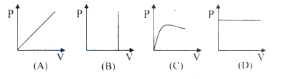
Which of the following graphs between pressure $(P)$ and volume $(V)$ correctly shows an isochoric process?
A
Graph $(A)$
B
Graph $(B)$
C
Graph $(C)$
D
Graph $(D)$
Solution
$(B)$ An isochoric process is a thermodynamic process in which the volume of the system remains constant $(V = \text{constant})$.
In a pressure-volume $(P-V)$ diagram, a constant volume process is represented by a vertical line, as the volume does not change while the pressure varies.
Looking at the given options, Graph $(B)$ shows a vertical line parallel to the pressure axis, indicating that the volume $V$ is constant for all values of pressure $P$.
Therefore, Graph $(B)$ correctly represents an isochoric process.
In a pressure-volume $(P-V)$ diagram, a constant volume process is represented by a vertical line, as the volume does not change while the pressure varies.
Looking at the given options, Graph $(B)$ shows a vertical line parallel to the pressure axis, indicating that the volume $V$ is constant for all values of pressure $P$.
Therefore, Graph $(B)$ correctly represents an isochoric process.
0 likes
View Solution95
EasyMCQ
The ratio of work done by an ideal rigid diatomic gas to the heat supplied to the gas in an isobaric process is (in $/7$)
A
$3$
B
$2$
C
$4$
D
$5$
Solution
(B) For an ideal rigid diatomic gas,the molar heat capacity at constant pressure is $C_p = \frac{7}{2}R$ and at constant volume is $C_v = \frac{5}{2}R$.
In an isobaric process,the heat supplied is $\Delta Q = n C_p \Delta T$ and the work done is $W = P \Delta V = n R \Delta T$.
The ratio of work done to the heat supplied is given by:
$\frac{W}{\Delta Q} = \frac{n R \Delta T}{n C_p \Delta T} = \frac{R}{C_p}$
Substituting the value of $C_p$:
$\frac{W}{\Delta Q} = \frac{R}{\frac{7}{2}R} = \frac{2}{7}$
In an isobaric process,the heat supplied is $\Delta Q = n C_p \Delta T$ and the work done is $W = P \Delta V = n R \Delta T$.
The ratio of work done to the heat supplied is given by:
$\frac{W}{\Delta Q} = \frac{n R \Delta T}{n C_p \Delta T} = \frac{R}{C_p}$
Substituting the value of $C_p$:
$\frac{W}{\Delta Q} = \frac{R}{\frac{7}{2}R} = \frac{2}{7}$
0 likes
View Solution96
EasyMCQ
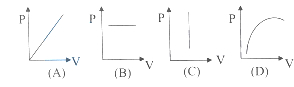
Which of the following graphs between pressure $(P)$ and volume $(V)$ correctly shows isochoric changes?
A
$A$
B
$B$
C
$C$
D
$D$
Solution
(C) An isochoric process is a thermodynamic process in which the volume $(V)$ of the system remains constant.
In a $P-V$ diagram,a constant volume process is represented by a vertical line,because for a single value of $V$,the pressure $(P)$ can vary.
Looking at the given options:
Graph $(A)$ shows $P$ proportional to $V$.
Graph $(B)$ shows constant pressure (isobaric).
Graph $(C)$ shows a vertical line,which indicates that $V$ is constant while $P$ changes.
Graph $(D)$ shows a curve.
Therefore,graph $(C)$ represents an isochoric process.
In a $P-V$ diagram,a constant volume process is represented by a vertical line,because for a single value of $V$,the pressure $(P)$ can vary.
Looking at the given options:
Graph $(A)$ shows $P$ proportional to $V$.
Graph $(B)$ shows constant pressure (isobaric).
Graph $(C)$ shows a vertical line,which indicates that $V$ is constant while $P$ changes.
Graph $(D)$ shows a curve.
Therefore,graph $(C)$ represents an isochoric process.
0 likes
View Solution97
EasyMCQ
In an isochoric process,if $t_1 = 27^{\circ}C$ and $t_2 = 127^{\circ}C$,then $\frac{P_1}{P_2}$ will be equal to [$P_1$ and $P_2$ are the pressures at $t_1^{\circ}C$ and $t_2^{\circ}C$ respectively].
A
$\frac{9}{59}$
B
$\frac{4}{3}$
C
$\frac{3}{4}$
D
$\frac{2}{3}$
Solution
(C) In an isochoric process,the volume of the gas remains constant.
According to Gay-Lussac's law,for a fixed mass of gas at constant volume,the pressure is directly proportional to its absolute temperature $(P \propto T)$.
Therefore,$\frac{P_1}{P_2} = \frac{T_1}{T_2}$.
First,convert the temperatures from Celsius to Kelvin:
$T_1 = 27 + 273 = 300 \ K$
$T_2 = 127 + 273 = 400 \ K$
Substituting these values into the ratio:
$\frac{P_1}{P_2} = \frac{300}{400} = \frac{3}{4}$.
According to Gay-Lussac's law,for a fixed mass of gas at constant volume,the pressure is directly proportional to its absolute temperature $(P \propto T)$.
Therefore,$\frac{P_1}{P_2} = \frac{T_1}{T_2}$.
First,convert the temperatures from Celsius to Kelvin:
$T_1 = 27 + 273 = 300 \ K$
$T_2 = 127 + 273 = 400 \ K$
Substituting these values into the ratio:
$\frac{P_1}{P_2} = \frac{300}{400} = \frac{3}{4}$.
0 likes
View Solution98
EasyMCQ
Which one of the following equations specifies an isochoric process?
$[Q = \text{heat supplied, } \Delta p = \text{change in pressure, } \Delta V = \text{change in volume, } \Delta T = \text{change in temperature}]$
$[Q = \text{heat supplied, } \Delta p = \text{change in pressure, } \Delta V = \text{change in volume, } \Delta T = \text{change in temperature}]$
A
$\Delta V = 0$
B
$Q = 0$
C
$\Delta P = 0$
D
$\Delta T = 0$
Solution
(A) An isochoric process is a thermodynamic process that occurs at a constant volume.
Since the volume remains constant throughout the process,the change in volume is zero.
Therefore,the equation for an isochoric process is $\Delta V = 0$.
Since the volume remains constant throughout the process,the change in volume is zero.
Therefore,the equation for an isochoric process is $\Delta V = 0$.
0 likes
View Solution99
EasyMCQ
In which thermodynamic process are the change in internal energy ' $\Delta U$ ',heat supplied ' $Q$ ',and the work done in expansion ' $W$ ' all non-zero?
A
Adiabatic
B
Isobaric
C
Isothermal
D
Isochoric
Solution
(B) According to the first law of thermodynamics,$\Delta U = Q - W$.
$1$. In an adiabatic process,$Q = 0$ by definition,so it does not satisfy the condition.
$2$. In an isothermal process,the temperature remains constant,which implies $\Delta U = 0$ for an ideal gas,so it does not satisfy the condition.
$3$. In an isochoric process,the volume remains constant,which implies $W = P \Delta V = 0$,so it does not satisfy the condition.
$4$. In an isobaric process,the pressure remains constant. During expansion,the volume changes $(W \neq 0)$,the temperature changes $(\Delta U \neq 0)$,and heat is exchanged with the surroundings $(Q \neq 0)$. Therefore,all three quantities are non-zero.
$1$. In an adiabatic process,$Q = 0$ by definition,so it does not satisfy the condition.
$2$. In an isothermal process,the temperature remains constant,which implies $\Delta U = 0$ for an ideal gas,so it does not satisfy the condition.
$3$. In an isochoric process,the volume remains constant,which implies $W = P \Delta V = 0$,so it does not satisfy the condition.
$4$. In an isobaric process,the pressure remains constant. During expansion,the volume changes $(W \neq 0)$,the temperature changes $(\Delta U \neq 0)$,and heat is exchanged with the surroundings $(Q \neq 0)$. Therefore,all three quantities are non-zero.
0 likes
View Solution100
EasyMCQ
The thermodynamic process in which the work done on or by the gas is zero is:
A
adiabatic process
B
isochoric process
C
isothermal process
D
isobaric process
Solution
(B) The work done by or on a gas is given by the formula $\Delta W = P \Delta V$,where $P$ is the pressure and $\Delta V$ is the change in volume.
For the work done to be zero,the change in volume $\Delta V$ must be zero.
This implies that the volume $V$ remains constant throughout the process.
$A$ thermodynamic process in which the volume remains constant is known as an isochoric process.
Therefore,in an isochoric process,the work done is zero.
For the work done to be zero,the change in volume $\Delta V$ must be zero.
This implies that the volume $V$ remains constant throughout the process.
$A$ thermodynamic process in which the volume remains constant is known as an isochoric process.
Therefore,in an isochoric process,the work done is zero.
0 likes
View SolutionThermodynamics — Isobaric and Isochoric Processes · Frequently Asked Questions
1Are these Thermodynamics questions useful for JEE and NEET?
Yes. All questions in this section are mapped to JEE Main and NEET exam patterns. Previous year questions from JEE Main, NEET, GUJCET and state-level exams are included with full solutions.
2Can I switch to Hindi or Gujarati for these questions?
Yes. Use the language tabs in the hero section or the sidebar to view the same questions and solutions in English, Hindi or Gujarati.
3How do I generate a question paper from this subtopic?
Use the Vedclass Exam Paper Generator — select the chapter and subtopic, set difficulty, and generate Sets A, B, C, D automatically. First 3 chapters of every subject are free.
Vedclass Products
For Students
Vedclass Test Series
Mock tests in real JEE/NEET style with performance analysis. 5-day free trial.
Start Free TrialFor Teachers
Exam Paper Generator
Generate Set A/B/C/D papers from this chapter in 2 minutes. 3 chapters free.
Try FreeFor Institutes
Online Exam Module
Live online exams with unlimited students, 360° analytics & white-label branding.
See DemoFor Teachers & Institutes
Generate a Thermodynamics Exam Paper in 2 Minutes
Select subtopic & difficulty — Sets A, B, C, D auto-generated with No Repeat logic.
First 3 chapters of every subject are free — no payment required.