
A English
Rotational Equilibrium Questions in English
Class 11 Physics · System of Particles and Rotational Motion · Rotational Equilibrium
59+
Questions
English
Language
100%
With Solutions
Showing 9 of 59 questions in English
51
DifficultMCQ
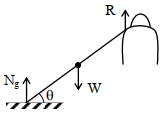
$A$ heavy iron bar of weight $W$ has one end on the ground and the other on the shoulder of a person. The bar makes an angle $\theta$ with the horizontal. The weight experienced by the person is:
A
$\frac{W}{2}$
B
$W$
C
$W \cos \theta$
D
$W \sin \theta$
Solution
(A) Let $L$ be the length of the iron bar. The weight $W$ of the bar acts at its center of mass,which is at a distance of $L/2$ from the end on the ground.
Let $R$ be the reaction force exerted by the person's shoulder on the bar. The bar is in rotational equilibrium.
Taking the torque about the point of contact on the ground:
The torque due to the weight $W$ is $\tau_W = W \cdot (L/2) \cos \theta$ (acting in a clockwise direction).
The torque due to the reaction force $R$ is $\tau_R = R \cdot L \cos \theta$ (acting in a counter-clockwise direction).
For rotational equilibrium,the net torque about the point of contact on the ground must be zero:
$\sum \tau = 0$
$R \cdot L \cos \theta = W \cdot (L/2) \cos \theta$
Dividing both sides by $L \cos \theta$ (assuming $\cos \theta \neq 0$):
$R = \frac{W}{2}$
Thus,the weight experienced by the person is $\frac{W}{2}$.
Let $R$ be the reaction force exerted by the person's shoulder on the bar. The bar is in rotational equilibrium.
Taking the torque about the point of contact on the ground:
The torque due to the weight $W$ is $\tau_W = W \cdot (L/2) \cos \theta$ (acting in a clockwise direction).
The torque due to the reaction force $R$ is $\tau_R = R \cdot L \cos \theta$ (acting in a counter-clockwise direction).
For rotational equilibrium,the net torque about the point of contact on the ground must be zero:
$\sum \tau = 0$
$R \cdot L \cos \theta = W \cdot (L/2) \cos \theta$
Dividing both sides by $L \cos \theta$ (assuming $\cos \theta \neq 0$):
$R = \frac{W}{2}$
Thus,the weight experienced by the person is $\frac{W}{2}$.
0 likes
View Solution52
MediumMCQ
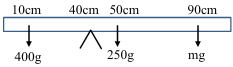
$A$ uniform rod of mass $250 \ g$ having length $100 \ cm$ is balanced on a sharp edge at $40 \ cm$ mark. $A$ mass of $400 \ g$ is suspended at $10 \ cm$ mark. To maintain the balance of the rod,the mass to be suspended at $90 \ cm$ mark is: (in $g$)
A
$300$
B
$190$
C
$200$
D
$290$
Solution
(B) For the rod to be in rotational equilibrium,the net torque about the pivot point (at $40 \ cm$ mark) must be zero.
Let $m$ be the mass to be suspended at the $90 \ cm$ mark.
The weight of the rod acts at its center of mass,which is at the $50 \ cm$ mark.
The distance of the $400 \ g$ mass from the pivot is $40 \ cm - 10 \ cm = 30 \ cm$.
The distance of the rod's center of mass from the pivot is $50 \ cm - 40 \ cm = 10 \ cm$.
The distance of the unknown mass $m$ from the pivot is $90 \ cm - 40 \ cm = 50 \ cm$.
Taking the pivot as the reference point,the torque balance equation is:
$(400 \ g \times 30 \ cm) = (250 \ g \times 10 \ cm) + (m \times 50 \ cm)$
$12000 = 2500 + 50m$
$50m = 12000 - 2500$
$50m = 9500$
$m = \frac{9500}{50} = 190 \ g$
Let $m$ be the mass to be suspended at the $90 \ cm$ mark.
The weight of the rod acts at its center of mass,which is at the $50 \ cm$ mark.
The distance of the $400 \ g$ mass from the pivot is $40 \ cm - 10 \ cm = 30 \ cm$.
The distance of the rod's center of mass from the pivot is $50 \ cm - 40 \ cm = 10 \ cm$.
The distance of the unknown mass $m$ from the pivot is $90 \ cm - 40 \ cm = 50 \ cm$.
Taking the pivot as the reference point,the torque balance equation is:
$(400 \ g \times 30 \ cm) = (250 \ g \times 10 \ cm) + (m \times 50 \ cm)$
$12000 = 2500 + 50m$
$50m = 12000 - 2500$
$50m = 9500$
$m = \frac{9500}{50} = 190 \ g$
0 likes
View Solution53
EasyMCQ
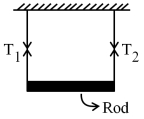
Find the value of $T_1$ (in $N$),if the system is in equilibrium and the mass of the rod is $10 \ kg$ and its length is $10 \ m$. $[g = 10 \ m/s^2]$ (in $N$)
A
$100$
B
$50$
C
$25$
D
$12.5$
Solution
(B) The system is in translational and rotational equilibrium.
For translational equilibrium,the sum of upward forces equals the downward force (weight of the rod):
$T_1 + T_2 = mg = 10 \ kg \times 10 \ m/s^2 = 100 \ N$ (Equation $1$)
For rotational equilibrium,the net torque about any point must be zero. Let us take the torque about the point where $T_2$ is applied:
$\tau_{\text{net}} = 0$
$T_1 \times \ell - mg \times \frac{\ell}{2} = 0$
$T_1 \times \ell = 100 \times \frac{\ell}{2}$
$T_1 = 50 \ N$
For translational equilibrium,the sum of upward forces equals the downward force (weight of the rod):
$T_1 + T_2 = mg = 10 \ kg \times 10 \ m/s^2 = 100 \ N$ (Equation $1$)
For rotational equilibrium,the net torque about any point must be zero. Let us take the torque about the point where $T_2$ is applied:
$\tau_{\text{net}} = 0$
$T_1 \times \ell - mg \times \frac{\ell}{2} = 0$
$T_1 \times \ell = 100 \times \frac{\ell}{2}$
$T_1 = 50 \ N$
0 likes
View Solution54
MediumMCQ
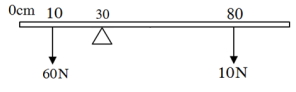
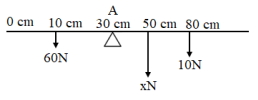
$A$ uniform meter scale is balanced at the $30 \ cm$ mark on a knife edge,when weights of $60 \ N$ and $10 \ N$ are suspended at the $10 \ cm$ and $80 \ cm$ marks,respectively. The mass of the meter scale is: $(g = 10 \ m/s^2)$ (in $kg$)
A
$4$
B
$6$
C
$3.5$
D
$9.5$
Solution
(C) For a uniform meter scale,the weight of the scale acts at its center of gravity,which is at the $50 \ cm$ mark.
Let the weight of the scale be $W = mg$.
The pivot point is at the $30 \ cm$ mark.
According to the principle of moments,the sum of clockwise moments about the pivot must equal the sum of counter-clockwise moments about the pivot.
Counter-clockwise moment: $60 \ N \times (30 \ cm - 10 \ cm) = 60 \times 20 = 1200 \ N \cdot cm$.
Clockwise moments: $W \times (50 \ cm - 30 \ cm) + 10 \ N \times (80 \ cm - 30 \ cm) = W \times 20 + 10 \times 50 = 20W + 500$.
Equating the moments: $1200 = 20W + 500$.
$20W = 1200 - 500 = 700$.
$W = 35 \ N$.
Since $W = mg$ and $g = 10 \ m/s^2$,we have $m \times 10 = 35$.
$m = 3.5 \ kg$.
Let the weight of the scale be $W = mg$.
The pivot point is at the $30 \ cm$ mark.
According to the principle of moments,the sum of clockwise moments about the pivot must equal the sum of counter-clockwise moments about the pivot.
Counter-clockwise moment: $60 \ N \times (30 \ cm - 10 \ cm) = 60 \times 20 = 1200 \ N \cdot cm$.
Clockwise moments: $W \times (50 \ cm - 30 \ cm) + 10 \ N \times (80 \ cm - 30 \ cm) = W \times 20 + 10 \times 50 = 20W + 500$.
Equating the moments: $1200 = 20W + 500$.
$20W = 1200 - 500 = 700$.
$W = 35 \ N$.
Since $W = mg$ and $g = 10 \ m/s^2$,we have $m \times 10 = 35$.
$m = 3.5 \ kg$.
0 likes
View Solution55
MediumMCQ
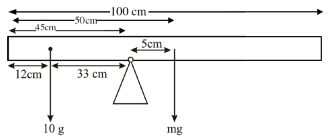
$A$ meter stick is balanced on a knife edge at its centre. When a $10 \ g$ coin is placed on top of the stick at the $12 \ cm$ mark,the stick is found to be balanced at the $45 \ cm$ mark. Then the mass of the meter stick is $.... \ g$.
A
$24$
B
$66$
C
$90$
D
$100$
Solution
(B) Let the mass of the meter stick be $m$. The center of mass of the uniform meter stick is at the $50 \ cm$ mark.
When the stick is balanced at the $45 \ cm$ mark,the pivot is at $45 \ cm$.
The distance of the coin from the pivot is $|45 \ cm - 12 \ cm| = 33 \ cm$.
The distance of the center of mass of the stick from the pivot is $|50 \ cm - 45 \ cm| = 5 \ cm$.
For rotational equilibrium,the net torque about the pivot must be zero:
$\tau_{\text{net}} = 0$
$(10 \ g) \times (33 \ cm) = (m \ g) \times (5 \ cm)$
$330 = 5m$
$m = \frac{330}{5} = 66 \ g$
Therefore,the mass of the meter stick is $66 \ g$.
When the stick is balanced at the $45 \ cm$ mark,the pivot is at $45 \ cm$.
The distance of the coin from the pivot is $|45 \ cm - 12 \ cm| = 33 \ cm$.
The distance of the center of mass of the stick from the pivot is $|50 \ cm - 45 \ cm| = 5 \ cm$.
For rotational equilibrium,the net torque about the pivot must be zero:
$\tau_{\text{net}} = 0$
$(10 \ g) \times (33 \ cm) = (m \ g) \times (5 \ cm)$
$330 = 5m$
$m = \frac{330}{5} = 66 \ g$
Therefore,the mass of the meter stick is $66 \ g$.
0 likes
View Solution56
EasyMCQ
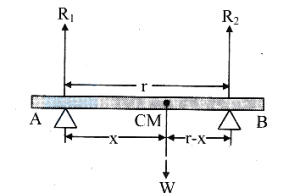
$A$ metal rod of weight $W$ is supported by two parallel knife-edges $A$ and $B$. The rod is in equilibrium in a horizontal position. The distance between the two knife-edges is $r$. The centre of mass of the rod is at a distance $x$ from $A$. The normal reaction on $A$ is
A
$\frac{W \cdot r}{x}$
B
$\frac{W \cdot x}{r}$
C
$\frac{W \cdot(r-x)}{x}$
D
$\frac{W \cdot(r-x)}{r}$
Solution
(D) For the rod to be in rotational equilibrium,the sum of torques about any point must be zero.
Taking the torque about the knife-edge $B$:
$\sum \tau_B = 0$
$N_A \cdot r - W \cdot (r - x) = 0$
Where $N_A$ is the normal reaction at $A$.
$N_A \cdot r = W(r - x)$
$N_A = \frac{W(r - x)}{r}$
Taking the torque about the knife-edge $B$:
$\sum \tau_B = 0$
$N_A \cdot r - W \cdot (r - x) = 0$
Where $N_A$ is the normal reaction at $A$.
$N_A \cdot r = W(r - x)$
$N_A = \frac{W(r - x)}{r}$
0 likes
View Solution57
DifficultMCQ
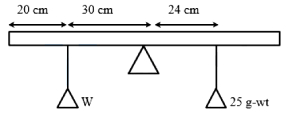
$A$ metre scale is supported on a wedge at its centre of gravity. $A$ body of weight '$W$' is suspended from the $20 \text{ cm}$ mark and another weight of $25 \text{ g-wt}$ is suspended from the $74 \text{ cm}$ mark to balance it, and the metre scale remains perfectly horizontal. Neglecting the weight of the metre scale, the weight of the body is: (in $\text{ g-wt}$)
A
$20$
B
$15$
C
$33$
D
$30$
Solution
(A) The centre of gravity of a metre scale is at the $50 \text{ cm}$ mark. The wedge is placed at this point.
The distance of the weight '$W$' from the wedge is $50 \text{ cm} - 20 \text{ cm} = 30 \text{ cm}$.
The distance of the $25 \text{ g-wt}$ weight from the wedge is $74 \text{ cm} - 50 \text{ cm} = 24 \text{ cm}$.
For the scale to remain horizontal, the clockwise moment must equal the anticlockwise moment about the pivot (wedge):
$W \times 30 \text{ cm} = 25 \text{ g-wt} \times 24 \text{ cm}$
$W = \frac{25 \times 24}{30} \text{ g-wt}$
$W = \frac{600}{30} \text{ g-wt} = 20 \text{ g-wt}$
The distance of the weight '$W$' from the wedge is $50 \text{ cm} - 20 \text{ cm} = 30 \text{ cm}$.
The distance of the $25 \text{ g-wt}$ weight from the wedge is $74 \text{ cm} - 50 \text{ cm} = 24 \text{ cm}$.
For the scale to remain horizontal, the clockwise moment must equal the anticlockwise moment about the pivot (wedge):
$W \times 30 \text{ cm} = 25 \text{ g-wt} \times 24 \text{ cm}$
$W = \frac{25 \times 24}{30} \text{ g-wt}$
$W = \frac{600}{30} \text{ g-wt} = 20 \text{ g-wt}$
0 likes
View Solution58
EasyMCQ
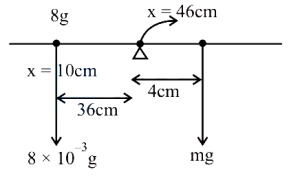
$A$ metre stick is balanced on a knife edge at its centre. When four coins, each of mass $2 \,g$, are placed one on top of the other at the $10.0 \,cm$ mark, the stick is found to be balanced at the $46.0 \,cm$ mark. The mass of the metre stick is: (in $\,g$)
A
$66$
B
$60$
C
$72$
D
$18$
Solution
(C) Let $M$ be the mass of the metre stick. The centre of mass of the metre stick is at the $50.0 \,cm$ mark.
When the stick is balanced at the $46.0 \,cm$ mark, the torque due to the weight of the stick must be balanced by the torque due to the coins.
The weight of the four coins is $W_c = 4 \times 2 \,g = 8 \,g$. This acts at the $10.0 \,cm$ mark.
The distance of the coins from the pivot $(46.0 \,cm)$ is $d_1 = 46.0 \,cm - 10.0 \,cm = 36.0 \,cm$.
The weight of the metre stick $W_s = M \,g$ acts at its centre of mass, which is at the $50.0 \,cm$ mark.
The distance of the centre of mass from the pivot is $d_2 = 50.0 \,cm - 46.0 \,cm = 4.0 \,cm$.
For rotational equilibrium, the clockwise torque must equal the counter-clockwise torque:
$M \,g \times d_2 = W_c \times d_1$
$M \,g \times 4.0 \,cm = 8 \,g \times 36.0 \,cm$
$4 \,M = 8 \times 36$
$M = 2 \times 36 = 72 \,g$.
When the stick is balanced at the $46.0 \,cm$ mark, the torque due to the weight of the stick must be balanced by the torque due to the coins.
The weight of the four coins is $W_c = 4 \times 2 \,g = 8 \,g$. This acts at the $10.0 \,cm$ mark.
The distance of the coins from the pivot $(46.0 \,cm)$ is $d_1 = 46.0 \,cm - 10.0 \,cm = 36.0 \,cm$.
The weight of the metre stick $W_s = M \,g$ acts at its centre of mass, which is at the $50.0 \,cm$ mark.
The distance of the centre of mass from the pivot is $d_2 = 50.0 \,cm - 46.0 \,cm = 4.0 \,cm$.
For rotational equilibrium, the clockwise torque must equal the counter-clockwise torque:
$M \,g \times d_2 = W_c \times d_1$
$M \,g \times 4.0 \,cm = 8 \,g \times 36.0 \,cm$
$4 \,M = 8 \times 36$
$M = 2 \times 36 = 72 \,g$.
0 likes
View Solution59
MediumMCQ
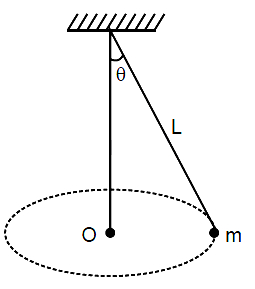
$A$ small ball of mass $m$ is suspended from the ceiling by a string of length $L$. The ball moves along a horizontal circle with constant angular velocity $\omega$,as shown in the figure. The torque about the centre $(O)$ of the horizontal circle is
A
$m g L \sin \theta$
B
$m g L$
C
$0$
D
$m g L \cos \theta$
Solution
(C) The forces acting on the ball are the tension $T$ in the string and the gravitational force $mg$ acting downwards.
Let the centre of the horizontal circle be $O$. The position vector $\vec{r}$ of the ball relative to $O$ lies in the horizontal plane.
The gravitational force $\vec{F}_g = m\vec{g}$ acts vertically downwards through the ball.
The torque $\vec{\tau}$ about point $O$ is given by $\vec{\tau} = \vec{r} \times \vec{F}$.
Since the force of gravity $\vec{F}_g$ is parallel to the vertical axis passing through $O$,and the position vector $\vec{r}$ is horizontal,the torque due to gravity is $\vec{\tau}_g = \vec{r} \times (m\vec{g})$. The magnitude is $mgr \sin(90^\circ) = mgr$,but the direction is tangential to the circle.
However,the tension force $\vec{T}$ acts along the string towards the point of suspension. The line of action of the tension force passes through the point of suspension,but not through $O$.
Crucially,for a particle moving in a horizontal circle with constant angular velocity,the net torque about the centre $O$ must be zero because the angular momentum $\vec{L} = \vec{r} \times \vec{p}$ is constant in magnitude and direction (the vector $\vec{L}$ points along the vertical axis). Since $\frac{d\vec{L}}{dt} = \vec{\tau}_{net} = 0$,the net torque about $O$ is zero.
Let the centre of the horizontal circle be $O$. The position vector $\vec{r}$ of the ball relative to $O$ lies in the horizontal plane.
The gravitational force $\vec{F}_g = m\vec{g}$ acts vertically downwards through the ball.
The torque $\vec{\tau}$ about point $O$ is given by $\vec{\tau} = \vec{r} \times \vec{F}$.
Since the force of gravity $\vec{F}_g$ is parallel to the vertical axis passing through $O$,and the position vector $\vec{r}$ is horizontal,the torque due to gravity is $\vec{\tau}_g = \vec{r} \times (m\vec{g})$. The magnitude is $mgr \sin(90^\circ) = mgr$,but the direction is tangential to the circle.
However,the tension force $\vec{T}$ acts along the string towards the point of suspension. The line of action of the tension force passes through the point of suspension,but not through $O$.
Crucially,for a particle moving in a horizontal circle with constant angular velocity,the net torque about the centre $O$ must be zero because the angular momentum $\vec{L} = \vec{r} \times \vec{p}$ is constant in magnitude and direction (the vector $\vec{L}$ points along the vertical axis). Since $\frac{d\vec{L}}{dt} = \vec{\tau}_{net} = 0$,the net torque about $O$ is zero.
0 likes
View SolutionSystem of Particles and Rotational Motion — Rotational Equilibrium · Frequently Asked Questions
1Are these System of Particles and Rotational Motion questions useful for JEE and NEET?
Yes. All questions in this section are mapped to JEE Main and NEET exam patterns. Previous year questions from JEE Main, NEET, GUJCET and state-level exams are included with full solutions.
2Can I switch to Hindi or Gujarati for these questions?
Yes. Use the language tabs in the hero section or the sidebar to view the same questions and solutions in English, Hindi or Gujarati.
3How do I generate a question paper from this subtopic?
Use the Vedclass Exam Paper Generator — select the chapter and subtopic, set difficulty, and generate Sets A, B, C, D automatically. First 3 chapters of every subject are free.
Vedclass Products
For Students
Vedclass Test Series
Mock tests in real JEE/NEET style with performance analysis. 5-day free trial.
Start Free TrialFor Teachers
Exam Paper Generator
Generate Set A/B/C/D papers from this chapter in 2 minutes. 3 chapters free.
Try FreeFor Institutes
Online Exam Module
Live online exams with unlimited students, 360° analytics & white-label branding.
See DemoFor Teachers & Institutes
Generate a System of Particles and Rotational Motion Exam Paper in 2 Minutes
Select subtopic & difficulty — Sets A, B, C, D auto-generated with No Repeat logic.
First 3 chapters of every subject are free — no payment required.