
A English
Moment of Inertia and Radius of gyration Questions in English
Class 11 Physics · System of Particles and Rotational Motion · Moment of Inertia and Radius of gyration
371+
Questions
English
Language
100%
With Solutions
Showing 21 of 371 questions in English
351
MediumMCQ
$A$ thin uniform wire of mass $m$ and linear density $\rho$ is bent in the form of a circular ring. The moment of inertia of the ring about a tangent parallel to its diameter is
A
$\frac{3 m^3}{8 \pi^2 \rho^2}$
B
$\frac{8 m^3}{3 \pi^2 \rho^2}$
C
$\frac{8 \pi^2 m^3}{3 \rho^2}$
D
$\frac{3 \pi^2 m^3}{8 \rho^2}$
Solution
(A) $1$. The mass of the ring is $m$ and its linear density is $\rho$. The circumference of the ring is $L = \frac{m}{\rho}$.
$2$. Since $L = 2 \pi R$,the radius of the ring is $R = \frac{m}{2 \pi \rho}$.
$3$. The moment of inertia of a ring about its diameter is $I_{diam} = \frac{1}{2} m R^2$.
$4$. According to the parallel axis theorem,the moment of inertia about a tangent parallel to the diameter is $I = I_{diam} + m R^2 = \frac{1}{2} m R^2 + m R^2 = \frac{3}{2} m R^2$.
$5$. Substituting $R = \frac{m}{2 \pi \rho}$ into the expression: $I = \frac{3}{2} m \left( \frac{m}{2 \pi \rho} \right)^2 = \frac{3}{2} m \left( \frac{m^2}{4 \pi^2 \rho^2} \right) = \frac{3 m^3}{8 \pi^2 \rho^2}$.
$2$. Since $L = 2 \pi R$,the radius of the ring is $R = \frac{m}{2 \pi \rho}$.
$3$. The moment of inertia of a ring about its diameter is $I_{diam} = \frac{1}{2} m R^2$.
$4$. According to the parallel axis theorem,the moment of inertia about a tangent parallel to the diameter is $I = I_{diam} + m R^2 = \frac{1}{2} m R^2 + m R^2 = \frac{3}{2} m R^2$.
$5$. Substituting $R = \frac{m}{2 \pi \rho}$ into the expression: $I = \frac{3}{2} m \left( \frac{m}{2 \pi \rho} \right)^2 = \frac{3}{2} m \left( \frac{m^2}{4 \pi^2 \rho^2} \right) = \frac{3 m^3}{8 \pi^2 \rho^2}$.
0 likes
View Solution352
MediumMCQ
If the length of a thin uniform rod is $L$ and the radius of gyration of the rod about an axis perpendicular to its length and passing through one end is $K$,then $K: L=$
A
$1: \sqrt{3}$
B
$1: \sqrt{2}$
C
$1: 3$
D
$1: 2$
Solution
(A) The moment of inertia $I$ of a thin uniform rod of mass $M$ and length $L$ about an axis perpendicular to its length and passing through one end is given by $I = \frac{1}{3}ML^2$.
By definition,the radius of gyration $K$ is related to the moment of inertia by $I = MK^2$.
Equating the two expressions for $I$,we get $MK^2 = \frac{1}{3}ML^2$.
Canceling $M$ from both sides,we have $K^2 = \frac{L^2}{3}$.
Taking the square root of both sides,we get $K = \frac{L}{\sqrt{3}}$.
Therefore,the ratio $K: L = \frac{1}{\sqrt{3}}$ or $1: \sqrt{3}$.
By definition,the radius of gyration $K$ is related to the moment of inertia by $I = MK^2$.
Equating the two expressions for $I$,we get $MK^2 = \frac{1}{3}ML^2$.
Canceling $M$ from both sides,we have $K^2 = \frac{L^2}{3}$.
Taking the square root of both sides,we get $K = \frac{L}{\sqrt{3}}$.
Therefore,the ratio $K: L = \frac{1}{\sqrt{3}}$ or $1: \sqrt{3}$.
0 likes
View Solution353
EasyMCQ
$A$ thin uniform wire of mass $m$ and linear mass density $\rho$ is bent in the form of a circular loop. The moment of inertia of the loop about its diameter is
A
$\frac{m^2}{4 \pi^2 \rho^2}$
B
$\frac{m^3}{4 \rho^2}$
C
$\frac{m^3}{8 \pi^2 \rho^2}$
D
$\frac{m^3}{8 \rho^2}$
Solution
(C) The moment of inertia of a circular ring of mass $m$ and radius $R$ about its diameter is given by $I = \frac{1}{2} mR^2$.
Given that the linear mass density is $\rho = \frac{m}{L}$,where $L$ is the circumference of the loop $(L = 2 \pi R)$.
Therefore,$\rho = \frac{m}{2 \pi R}$,which implies $R = \frac{m}{2 \pi \rho}$.
Substituting the value of $R$ into the formula for the moment of inertia:
$I = \frac{1}{2} m \left( \frac{m}{2 \pi \rho} \right)^2$
$I = \frac{1}{2} m \left( \frac{m^2}{4 \pi^2 \rho^2} \right)$
$I = \frac{m^3}{8 \pi^2 \rho^2}$.
Given that the linear mass density is $\rho = \frac{m}{L}$,where $L$ is the circumference of the loop $(L = 2 \pi R)$.
Therefore,$\rho = \frac{m}{2 \pi R}$,which implies $R = \frac{m}{2 \pi \rho}$.
Substituting the value of $R$ into the formula for the moment of inertia:
$I = \frac{1}{2} m \left( \frac{m}{2 \pi \rho} \right)^2$
$I = \frac{1}{2} m \left( \frac{m^2}{4 \pi^2 \rho^2} \right)$
$I = \frac{m^3}{8 \pi^2 \rho^2}$.
0 likes
View Solution354
EasyMCQ
The ratio of the radii of two solid spheres of same mass is $2:3$. The ratio of the moments of inertia of the spheres about their diameters is
A
$4$:$9$
B
$2$:$3$
C
$8$:$27$
D
$16$:$81$
Solution
(A) The moment of inertia $I$ of a solid sphere of mass $M$ and radius $R$ about its diameter is given by the formula $I = \frac{2}{5} MR^2$.
Since the mass $M$ is the same for both spheres,the moment of inertia is directly proportional to the square of the radius,i.e.,$I \propto R^2$.
Given the ratio of the radii is $\frac{R_1}{R_2} = \frac{2}{3}$.
Therefore,the ratio of the moments of inertia is $\frac{I_1}{I_2} = \left(\frac{R_1}{R_2}\right)^2 = \left(\frac{2}{3}\right)^2 = \frac{4}{9}$.
Thus,the ratio is $4:9$.
Since the mass $M$ is the same for both spheres,the moment of inertia is directly proportional to the square of the radius,i.e.,$I \propto R^2$.
Given the ratio of the radii is $\frac{R_1}{R_2} = \frac{2}{3}$.
Therefore,the ratio of the moments of inertia is $\frac{I_1}{I_2} = \left(\frac{R_1}{R_2}\right)^2 = \left(\frac{2}{3}\right)^2 = \frac{4}{9}$.
Thus,the ratio is $4:9$.
0 likes
View Solution355
DifficultMCQ
$A$ straight rod of length $L$ is made of a material having mass per unit length $m(x) = \lambda|x|$,where $x$ is measured from the center of the rod. The moment of inertia about an axis perpendicular to the rod and passing through one end of the rod is to be calculated. Given $L = 1 \ m$ and $\lambda = 16 \ kg/m^2$.
A
$1.5 \ kg \cdot m^2$
B
$40 \ kg \cdot m^2$
C
$\frac{36}{5} \ kg \cdot m^2$
D
$246 \ kg \cdot m^2$
Solution
(A) The mass per unit length is given by $dm = \lambda|x|dx$.
First,calculate the moment of inertia about the axis $AA$ passing through the center of the rod:
$I_{AA} = \int x^2 dm = \int_{-L/2}^{L/2} x^2 (\lambda|x|) dx = 2\lambda \int_{0}^{L/2} x^3 dx = 2\lambda \left[ \frac{x^4}{4} \right]_0^{L/2} = \frac{\lambda}{2} \left( \frac{L}{2} \right)^4 = \frac{\lambda L^4}{32}$.
Given $\lambda = 16 \ kg/m^2$ and $L = 1 \ m$,$I_{AA} = \frac{16 \times 1^4}{32} = 0.5 \ kg \cdot m^2$.
Now,calculate the total mass $M$ of the rod:
$M = \int_{-L/2}^{L/2} \lambda|x| dx = 2\lambda \int_0^{L/2} x dx = 2\lambda \left[ \frac{x^2}{2} \right]_0^{L/2} = \lambda \left( \frac{L}{2} \right)^2 = \frac{\lambda L^2}{4}$.
With $\lambda = 16$ and $L = 1$,$M = \frac{16 \times 1^2}{4} = 4 \ kg$.
Using the parallel axis theorem to find the moment of inertia about axis $BB$ passing through one end:
$I_{BB} = I_{CM} + M h^2$,where $h = L/2 = 0.5 \ m$.
$I_{BB} = 0.5 + 4 \times (0.5)^2 = 0.5 + 4 \times 0.25 = 0.5 + 1 = 1.5 \ kg \cdot m^2$.
First,calculate the moment of inertia about the axis $AA$ passing through the center of the rod:
$I_{AA} = \int x^2 dm = \int_{-L/2}^{L/2} x^2 (\lambda|x|) dx = 2\lambda \int_{0}^{L/2} x^3 dx = 2\lambda \left[ \frac{x^4}{4} \right]_0^{L/2} = \frac{\lambda}{2} \left( \frac{L}{2} \right)^4 = \frac{\lambda L^4}{32}$.
Given $\lambda = 16 \ kg/m^2$ and $L = 1 \ m$,$I_{AA} = \frac{16 \times 1^4}{32} = 0.5 \ kg \cdot m^2$.
Now,calculate the total mass $M$ of the rod:
$M = \int_{-L/2}^{L/2} \lambda|x| dx = 2\lambda \int_0^{L/2} x dx = 2\lambda \left[ \frac{x^2}{2} \right]_0^{L/2} = \lambda \left( \frac{L}{2} \right)^2 = \frac{\lambda L^2}{4}$.
With $\lambda = 16$ and $L = 1$,$M = \frac{16 \times 1^2}{4} = 4 \ kg$.
Using the parallel axis theorem to find the moment of inertia about axis $BB$ passing through one end:
$I_{BB} = I_{CM} + M h^2$,where $h = L/2 = 0.5 \ m$.
$I_{BB} = 0.5 + 4 \times (0.5)^2 = 0.5 + 4 \times 0.25 = 0.5 + 1 = 1.5 \ kg \cdot m^2$.
0 likes
View Solution356
DifficultMCQ
Consider a sphere of mass $M$ and radius $R$ centered at the origin. The density of the material of the sphere is $\rho = A r^\alpha$,where $r$ is the radial distance,and $\alpha$ and $A$ are constants. If the moment of inertia of the sphere about the axis passing through the centre is $\frac{6}{7} M R^2$,then the value of $\alpha$ is
A
-$3$
B
-$6$
C
-$9$
D
-$12$
Solution
(D) Given,density of sphere,$\rho = A r^\alpha$ (where $r$ is the radial distance and $A$ and $\alpha$ are constants).
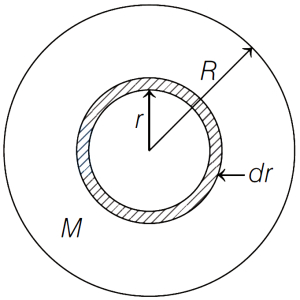
Consider an elemental spherical shell of radius $r$ and thickness $dr$.
Mass of elemental spherical shell,$dm = \text{Volume} \times \text{Density} = (4 \pi r^2) dr \cdot A r^\alpha = 4 \pi A r^{2+\alpha} dr$.
Mass of entire solid sphere,$M = 4 \pi A \int_0^R r^{2+\alpha} dr = 4 \pi A \left[ \frac{r^{3+\alpha}}{3+\alpha} \right]_0^R = \frac{4 \pi A}{3+\alpha} R^{3+\alpha}$.
Moment of inertia of the elemental spherical shell is $dI = \frac{2}{3} (dm) r^2 = \frac{2}{3} (4 \pi A r^{2+\alpha} dr) r^2 = \frac{8}{3} \pi A r^{4+\alpha} dr$.
Moment of inertia of the entire solid sphere,$I = \int_0^R dI = \frac{8}{3} \pi A \int_0^R r^{4+\alpha} dr = \frac{8}{3} \pi A \left[ \frac{r^{5+\alpha}}{5+\alpha} \right]_0^R = \frac{8 \pi A}{3(5+\alpha)} R^{5+\alpha}$.
Substituting $M$ into the expression for $I$,we get $I = \left( \frac{4 \pi A R^{3+\alpha}}{3+\alpha} \right) \cdot \frac{2}{3} \cdot \frac{3+\alpha}{5+\alpha} R^2 = M R^2 \left( \frac{2(3+\alpha)}{3(5+\alpha)} \right)$.
Given $I = \frac{6}{7} M R^2$,we equate: $\frac{2(3+\alpha)}{3(5+\alpha)} = \frac{6}{7}$.
$14(3+\alpha) = 18(5+\alpha) \Rightarrow 42 + 14\alpha = 90 + 18\alpha \Rightarrow -4\alpha = 48 \Rightarrow \alpha = -12$.
Consider an elemental spherical shell of radius $r$ and thickness $dr$.
Mass of elemental spherical shell,$dm = \text{Volume} \times \text{Density} = (4 \pi r^2) dr \cdot A r^\alpha = 4 \pi A r^{2+\alpha} dr$.
Mass of entire solid sphere,$M = 4 \pi A \int_0^R r^{2+\alpha} dr = 4 \pi A \left[ \frac{r^{3+\alpha}}{3+\alpha} \right]_0^R = \frac{4 \pi A}{3+\alpha} R^{3+\alpha}$.
Moment of inertia of the elemental spherical shell is $dI = \frac{2}{3} (dm) r^2 = \frac{2}{3} (4 \pi A r^{2+\alpha} dr) r^2 = \frac{8}{3} \pi A r^{4+\alpha} dr$.
Moment of inertia of the entire solid sphere,$I = \int_0^R dI = \frac{8}{3} \pi A \int_0^R r^{4+\alpha} dr = \frac{8}{3} \pi A \left[ \frac{r^{5+\alpha}}{5+\alpha} \right]_0^R = \frac{8 \pi A}{3(5+\alpha)} R^{5+\alpha}$.
Substituting $M$ into the expression for $I$,we get $I = \left( \frac{4 \pi A R^{3+\alpha}}{3+\alpha} \right) \cdot \frac{2}{3} \cdot \frac{3+\alpha}{5+\alpha} R^2 = M R^2 \left( \frac{2(3+\alpha)}{3(5+\alpha)} \right)$.
Given $I = \frac{6}{7} M R^2$,we equate: $\frac{2(3+\alpha)}{3(5+\alpha)} = \frac{6}{7}$.
$14(3+\alpha) = 18(5+\alpha) \Rightarrow 42 + 14\alpha = 90 + 18\alpha \Rightarrow -4\alpha = 48 \Rightarrow \alpha = -12$.
0 likes
View Solution357
EasyMCQ
Assertion $(A)$: The moment of inertia of a steel sphere is larger than the moment of inertia of a wooden sphere of the same radius.
Reason $(R)$: Moment of inertia is independent of the mass of the body.
The correct one is:
Reason $(R)$: Moment of inertia is independent of the mass of the body.
The correct one is:
A
Both $(A)$ and $(R)$ are true,and $(R)$ is the correct explanation of $(A)$
B
Both $(A)$ and $(R)$ are true,and $(R)$ is not the correct explanation of $(A)$
C
$(A)$ is true but $(R)$ is wrong
D
$(A)$ is wrong but $(R)$ is true
Solution
(C) The moment of inertia $(I)$ of a solid sphere about its diameter is given by the formula $I = \frac{2}{5}MR^2$,where $M$ is the mass and $R$ is the radius of the sphere.
Since the steel sphere has a higher density than the wooden sphere,for the same radius,the mass of the steel sphere is greater than that of the wooden sphere.
Therefore,the moment of inertia of the steel sphere is larger than that of the wooden sphere. Thus,Assertion $(A)$ is true.
However,the formula $I = \frac{2}{5}MR^2$ clearly shows that the moment of inertia depends on the mass $(M)$ of the body.
Therefore,Reason $(R)$ is false.
Hence,the correct option is $(C)$.
Since the steel sphere has a higher density than the wooden sphere,for the same radius,the mass of the steel sphere is greater than that of the wooden sphere.
Therefore,the moment of inertia of the steel sphere is larger than that of the wooden sphere. Thus,Assertion $(A)$ is true.
However,the formula $I = \frac{2}{5}MR^2$ clearly shows that the moment of inertia depends on the mass $(M)$ of the body.
Therefore,Reason $(R)$ is false.
Hence,the correct option is $(C)$.
0 likes
View Solution358
EasyMCQ
Two solid spheres $A$ and $B$ each of radius $R$ are made of materials of densities $\rho_A$ and $\rho_B$ respectively. Their moments of inertia about a diameter are $I_A$ and $I_B$ respectively. The value of $\frac{I_A}{I_B}$ is
A
$\sqrt{\frac{\rho_A}{\rho_B}}$
B
$\sqrt{\frac{\rho_B}{\rho_A}}$
C
$\frac{\rho_A}{\rho_B}$
D
$\frac{\rho_B}{\rho_A}$
Solution
(C) The moment of inertia $I$ of a solid sphere of mass $M$ and radius $R$ about its diameter is given by $I = \frac{2}{5} M R^2$.
Since the mass $M$ is the product of volume $V$ and density $\rho$,we have $M = V \rho = \frac{4}{3} \pi R^3 \rho$.
Substituting this into the formula for $I$,we get $I = \frac{2}{5} (\frac{4}{3} \pi R^3 \rho) R^2 = \frac{8}{15} \pi R^5 \rho$.
Therefore,the ratio of the moments of inertia is $\frac{I_A}{I_B} = \frac{\frac{8}{15} \pi R^5 \rho_A}{\frac{8}{15} \pi R^5 \rho_B} = \frac{\rho_A}{\rho_B}$.
Since the mass $M$ is the product of volume $V$ and density $\rho$,we have $M = V \rho = \frac{4}{3} \pi R^3 \rho$.
Substituting this into the formula for $I$,we get $I = \frac{2}{5} (\frac{4}{3} \pi R^3 \rho) R^2 = \frac{8}{15} \pi R^5 \rho$.
Therefore,the ratio of the moments of inertia is $\frac{I_A}{I_B} = \frac{\frac{8}{15} \pi R^5 \rho_A}{\frac{8}{15} \pi R^5 \rho_B} = \frac{\rho_A}{\rho_B}$.
0 likes
View Solution359
MediumMCQ
Two uniform circular discs having the same mass and the same thickness but different radii are made from different materials. The disc with the smaller rotational inertia is
A
the one made from the more dense material
B
the one made from the less dense material
C
the disc with the larger angular velocity
D
the disc with the larger torque
Solution
(A) The moment of inertia $(I)$ of a uniform circular disc is given by $I = \frac{1}{2} M R^2$.
Since the mass $(M)$ and thickness $(t)$ are constant,we express the radius $(R)$ in terms of density $(\rho)$:
$M = \pi R^2 t \rho \Rightarrow R^2 = \frac{M}{\pi t \rho}$.
Substituting this into the formula for $I$:
$I = \frac{1}{2} M \left( \frac{M}{\pi t \rho} \right) = \frac{M^2}{2 \pi t \rho}$.
Since $M$,$t$,and $\pi$ are constants,we have $I \propto \frac{1}{\rho}$.
Therefore,the disc made from the more dense material (higher $\rho$) will have a smaller rotational inertia.
Since the mass $(M)$ and thickness $(t)$ are constant,we express the radius $(R)$ in terms of density $(\rho)$:
$M = \pi R^2 t \rho \Rightarrow R^2 = \frac{M}{\pi t \rho}$.
Substituting this into the formula for $I$:
$I = \frac{1}{2} M \left( \frac{M}{\pi t \rho} \right) = \frac{M^2}{2 \pi t \rho}$.
Since $M$,$t$,and $\pi$ are constants,we have $I \propto \frac{1}{\rho}$.
Therefore,the disc made from the more dense material (higher $\rho$) will have a smaller rotational inertia.
0 likes
View Solution360
MediumMCQ
Two solid spheres ($A$ and $B$) are made of metals of different densities $\rho_A$ and $\rho_B$ respectively. If their masses are equal,the ratio of their moments of inertia $(I_B / I_A)$ about their respective diameter is
A
$(\rho_B / \rho_A)^{2/3}$
B
$(\rho_A / \rho_B)^{2/3}$
C
$\rho_A / \rho_B$
D
$\rho_B / \rho_A$
Solution
(B) Given that the masses of the two solid spheres are equal,$m_A = m_B$.
Since mass $m = \text{Volume} \times \text{Density} = \frac{4}{3} \pi R^3 \rho$,we have:
$\frac{4}{3} \pi R_A^3 \rho_A = \frac{4}{3} \pi R_B^3 \rho_B$
$\Rightarrow \frac{R_A^3}{R_B^3} = \frac{\rho_B}{\rho_A} \Rightarrow \frac{R_A}{R_B} = \left(\frac{\rho_B}{\rho_A}\right)^{1/3}$.
The moment of inertia of a solid sphere about its diameter is $I = \frac{2}{5} m R^2$.
Since $m_A = m_B$,the ratio of moments of inertia is:
$\frac{I_B}{I_A} = \frac{\frac{2}{5} m_B R_B^2}{\frac{2}{5} m_A R_A^2} = \left(\frac{R_B}{R_A}\right)^2$.
Substituting the ratio of radii:
$\frac{I_B}{I_A} = \left[ \left( \frac{\rho_A}{\rho_B} \right)^{1/3} \right]^2 = \left( \frac{\rho_A}{\rho_B} \right)^{2/3}$.
Since mass $m = \text{Volume} \times \text{Density} = \frac{4}{3} \pi R^3 \rho$,we have:
$\frac{4}{3} \pi R_A^3 \rho_A = \frac{4}{3} \pi R_B^3 \rho_B$
$\Rightarrow \frac{R_A^3}{R_B^3} = \frac{\rho_B}{\rho_A} \Rightarrow \frac{R_A}{R_B} = \left(\frac{\rho_B}{\rho_A}\right)^{1/3}$.
The moment of inertia of a solid sphere about its diameter is $I = \frac{2}{5} m R^2$.
Since $m_A = m_B$,the ratio of moments of inertia is:
$\frac{I_B}{I_A} = \frac{\frac{2}{5} m_B R_B^2}{\frac{2}{5} m_A R_A^2} = \left(\frac{R_B}{R_A}\right)^2$.
Substituting the ratio of radii:
$\frac{I_B}{I_A} = \left[ \left( \frac{\rho_A}{\rho_B} \right)^{1/3} \right]^2 = \left( \frac{\rho_A}{\rho_B} \right)^{2/3}$.
0 likes
View Solution361
EasyMCQ
$A$ metallic solid sphere is rotating about its diameter as an axis of rotation. If the temperature is increased by $200^{\circ} C$,the percentage increase in its moment of inertia is (Coefficient of linear expansion of the metal $= 10^{-5} /^{\circ} C$) (in $\%$)
A
$0.1$
B
$0.2$
C
$0.3$
D
$0.4$
Solution
(D) The moment of inertia of a solid sphere about its diameter is given by $I = \frac{2}{5} m R^2$.
Since mass $m$ remains constant,$I \propto R^2$.
The fractional change in moment of inertia is given by $\frac{\Delta I}{I} = 2 \frac{\Delta R}{R}$.
We know that the linear expansion is given by $\frac{\Delta R}{R} = \alpha \Delta t$,where $\alpha = 10^{-5} /^{\circ} C$ and $\Delta t = 200^{\circ} C$.
Substituting these values,we get $\frac{\Delta I}{I} = 2 \alpha \Delta t$.
To find the percentage increase,we multiply by $100$:
$\text{Percentage increase} = 2 \times 10^{-5} \times 200 \times 100 = 0.4 \%$.
Since mass $m$ remains constant,$I \propto R^2$.
The fractional change in moment of inertia is given by $\frac{\Delta I}{I} = 2 \frac{\Delta R}{R}$.
We know that the linear expansion is given by $\frac{\Delta R}{R} = \alpha \Delta t$,where $\alpha = 10^{-5} /^{\circ} C$ and $\Delta t = 200^{\circ} C$.
Substituting these values,we get $\frac{\Delta I}{I} = 2 \alpha \Delta t$.
To find the percentage increase,we multiply by $100$:
$\text{Percentage increase} = 2 \times 10^{-5} \times 200 \times 100 = 0.4 \%$.
0 likes
View Solution362
MediumMCQ
$A$ circular disc of radius $R$ and thickness $\frac{R}{6}$ has moment of inertia $I$ about an axis passing through its centre and perpendicular to its plane. It is melted and recasted into a solid sphere. The moment of inertia of the sphere about its diameter as axis of rotation is :
A
$I$
B
$\frac{2 I}{3}$
C
$\frac{I}{5}$
D
$\frac{I}{10}$
Solution
(C) The moment of inertia of a disc about an axis passing through its centre and perpendicular to its plane is given by $I = \frac{1}{2} M R^2$.
Since the disc is melted and recasted into a solid sphere,the volume remains constant.
Volume of disc = Volume of sphere
$\pi R^2 \times \frac{R}{6} = \frac{4}{3} \pi R_1^3$
$\frac{R^3}{6} = \frac{4}{3} R_1^3$
$R_1^3 = \frac{R^3}{8} \implies R_1 = \frac{R}{2}$,where $R_1$ is the radius of the sphere.
The moment of inertia of a solid sphere about its diameter is $I' = \frac{2}{5} M R_1^2$.
Substituting $R_1 = \frac{R}{2}$ into the formula:
$I' = \frac{2}{5} M \left(\frac{R}{2}\right)^2 = \frac{2}{5} M \left(\frac{R^2}{4}\right) = \frac{1}{5} \left(\frac{1}{2} M R^2\right)$.
Since $I = \frac{1}{2} M R^2$,we get $I' = \frac{I}{5}$.
Since the disc is melted and recasted into a solid sphere,the volume remains constant.
Volume of disc = Volume of sphere
$\pi R^2 \times \frac{R}{6} = \frac{4}{3} \pi R_1^3$
$\frac{R^3}{6} = \frac{4}{3} R_1^3$
$R_1^3 = \frac{R^3}{8} \implies R_1 = \frac{R}{2}$,where $R_1$ is the radius of the sphere.
The moment of inertia of a solid sphere about its diameter is $I' = \frac{2}{5} M R_1^2$.
Substituting $R_1 = \frac{R}{2}$ into the formula:
$I' = \frac{2}{5} M \left(\frac{R}{2}\right)^2 = \frac{2}{5} M \left(\frac{R^2}{4}\right) = \frac{1}{5} \left(\frac{1}{2} M R^2\right)$.
Since $I = \frac{1}{2} M R^2$,we get $I' = \frac{I}{5}$.
0 likes
View Solution363
MediumMCQ
The moment of inertia of a meter scale of mass $0.6 \ kg$ about an axis perpendicular to the scale and located at the $20 \ cm$ position on the scale in $kg-m^2$ is: (Breadth of the scale is negligible)
A
$0.078$
B
$0.104$
C
$0.148$
D
$0.208$
Solution
(B) Given: Total mass $M = 0.6 \ kg$,Length $L = 1 \ m = 100 \ cm$.
Mass per unit length $\lambda = \frac{0.6 \ kg}{100 \ cm} = 0.006 \ kg/cm$.
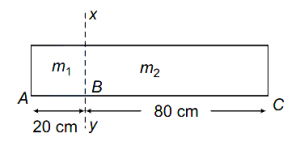
The axis is at $20 \ cm$. This divides the scale into two parts: $AB$ $(20 \ cm)$ and $BC$ $(80 \ cm)$.
Mass of part $AB$,$m_1 = \lambda \times 20 = 0.006 \times 20 = 0.12 \ kg$.
Mass of part $BC$,$m_2 = \lambda \times 80 = 0.006 \times 80 = 0.48 \ kg$.
The moment of inertia of a rod about an axis passing through one end is $I = \frac{1}{3} m l^2$.
For part $AB$ (axis at end $B$): $I_1 = \frac{1}{3} m_1 (l_1)^2 = \frac{1}{3} \times 0.12 \times (0.2)^2 = 0.04 \times 0.04 = 0.0016 \ kg-m^2$.
For part $BC$ (axis at end $B$): $I_2 = \frac{1}{3} m_2 (l_2)^2 = \frac{1}{3} \times 0.48 \times (0.8)^2 = 0.16 \times 0.64 = 0.1024 \ kg-m^2$.
Total moment of inertia $I = I_1 + I_2 = 0.0016 + 0.1024 = 0.104 \ kg-m^2$.
Mass per unit length $\lambda = \frac{0.6 \ kg}{100 \ cm} = 0.006 \ kg/cm$.
The axis is at $20 \ cm$. This divides the scale into two parts: $AB$ $(20 \ cm)$ and $BC$ $(80 \ cm)$.
Mass of part $AB$,$m_1 = \lambda \times 20 = 0.006 \times 20 = 0.12 \ kg$.
Mass of part $BC$,$m_2 = \lambda \times 80 = 0.006 \times 80 = 0.48 \ kg$.
The moment of inertia of a rod about an axis passing through one end is $I = \frac{1}{3} m l^2$.
For part $AB$ (axis at end $B$): $I_1 = \frac{1}{3} m_1 (l_1)^2 = \frac{1}{3} \times 0.12 \times (0.2)^2 = 0.04 \times 0.04 = 0.0016 \ kg-m^2$.
For part $BC$ (axis at end $B$): $I_2 = \frac{1}{3} m_2 (l_2)^2 = \frac{1}{3} \times 0.48 \times (0.8)^2 = 0.16 \times 0.64 = 0.1024 \ kg-m^2$.
Total moment of inertia $I = I_1 + I_2 = 0.0016 + 0.1024 = 0.104 \ kg-m^2$.
0 likes
View Solution364
DifficultMCQ
From a uniform wire,two circular loops are made: $(i)$ $P$ of radius $r$ and (ii) $Q$ of radius $nr$. If the moment of inertia of $Q$ about an axis passing through its centre and perpendicular to its plane is $8$ times that of $P$ about a similar axis,the value of $n$ is (diameter of the wire is very much smaller than $r$ or $nr$). (in $\sqrt{2}$)
A
$8$
B
$6$
C
$4$
D
$2$
Solution
(D) The moment of inertia of a circular loop of mass $m$ and radius $R$ about an axis passing through its centre and perpendicular to its plane is $I = mR^2$.
Let the mass of loop $P$ be $m_P$ and its radius be $r_P = r$. The mass of loop $Q$ is $m_Q$ and its radius is $r_Q = nr$.
Since the wire is uniform,the mass is proportional to the circumference $(m \propto 2\pi R)$. Thus,$m_Q = n m_P$.
The moment of inertia of $P$ is $I_P = m_P r^2$.
The moment of inertia of $Q$ is $I_Q = m_Q (nr)^2 = (n m_P) (n^2 r^2) = n^3 m_P r^2$.
Given that $I_Q = 8 I_P$,we have $n^3 m_P r^2 = 8 m_P r^2$.
Therefore,$n^3 = 8$,which gives $n = 2$.
Let the mass of loop $P$ be $m_P$ and its radius be $r_P = r$. The mass of loop $Q$ is $m_Q$ and its radius is $r_Q = nr$.
Since the wire is uniform,the mass is proportional to the circumference $(m \propto 2\pi R)$. Thus,$m_Q = n m_P$.
The moment of inertia of $P$ is $I_P = m_P r^2$.
The moment of inertia of $Q$ is $I_Q = m_Q (nr)^2 = (n m_P) (n^2 r^2) = n^3 m_P r^2$.
Given that $I_Q = 8 I_P$,we have $n^3 m_P r^2 = 8 m_P r^2$.
Therefore,$n^3 = 8$,which gives $n = 2$.
0 likes
View Solution365
DifficultMCQ
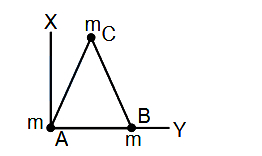
Three particles,each of mass '$m$' grams,are situated at the vertices of an equilateral $\triangle ABC$ of side '$a$' $cm$ (as shown in the figure). The moment of inertia of the system about a line $AX$ perpendicular to $AB$ and in the plane of $ABC$ in $g-cm^2$ units will be:
A
$2 ma^2$
B
$\frac{3}{2} ma^2$
C
$\frac{3}{4} ma^2$
D
$\frac{5}{4} ma^2$
Solution
(D) Let the axis of rotation be the $AX$ line,which passes through vertex $A$ and is perpendicular to $AB$.
The moment of inertia $I$ of the system is the sum of the moments of inertia of individual particles about the axis $AX$.
$I = \sum m_i r_i^2$,where $r_i$ is the perpendicular distance of the $i$-th particle from the axis $AX$.
$1$. For the particle at vertex $A$: The distance $r_A = 0$,so $I_A = m(0)^2 = 0$.
$2$. For the particle at vertex $B$: The distance $r_B = a$,so $I_B = m(a)^2 = ma^2$.
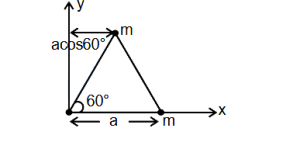
$3$. For the particle at vertex $C$: The perpendicular distance from $AX$ is $r_C = a \cos 60^{\circ} = a \times \frac{1}{2} = \frac{a}{2}$.
So,$I_C = m(\frac{a}{2})^2 = \frac{ma^2}{4}$.
The total moment of inertia $I = I_A + I_B + I_C = 0 + ma^2 + \frac{ma^2}{4} = \frac{5ma^2}{4} \text{ } g-cm^2$.
The moment of inertia $I$ of the system is the sum of the moments of inertia of individual particles about the axis $AX$.
$I = \sum m_i r_i^2$,where $r_i$ is the perpendicular distance of the $i$-th particle from the axis $AX$.
$1$. For the particle at vertex $A$: The distance $r_A = 0$,so $I_A = m(0)^2 = 0$.
$2$. For the particle at vertex $B$: The distance $r_B = a$,so $I_B = m(a)^2 = ma^2$.
$3$. For the particle at vertex $C$: The perpendicular distance from $AX$ is $r_C = a \cos 60^{\circ} = a \times \frac{1}{2} = \frac{a}{2}$.
So,$I_C = m(\frac{a}{2})^2 = \frac{ma^2}{4}$.
The total moment of inertia $I = I_A + I_B + I_C = 0 + ma^2 + \frac{ma^2}{4} = \frac{5ma^2}{4} \text{ } g-cm^2$.
0 likes
View Solution366
DifficultMCQ
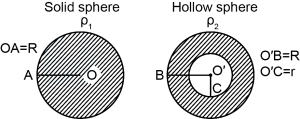
$A$ solid spherical ball of density $\rho_{1}$ and a hollow spherical ball of density $\rho_{2}$ have the same outer radius $R$ and the same mass $M$. What is the ratio of the moment of inertia of the hollow sphere to that of the solid sphere about an axis passing through their centers?
A
$\frac{\rho_{2}}{\rho_{1}}\left(1-\frac{\rho_{2}}{\rho_{1}}\right)^{\frac{5}{3}}$
B
$\frac{\rho_{2}}{\rho_{1}}\left[1-\left(1-\frac{\rho_{2}}{\rho_{1}}\right)^{\frac{5}{3}}\right]$
C
$\frac{\rho_{2}}{\rho_{1}}\left(1-\frac{\rho_{1}}{\rho_{2}}\right)^{\frac{5}{3}}$
D
$\frac{\rho_{2}}{\rho_{1}}\left[1-\left(1-\frac{\rho_{1}}{\rho_{2}}\right)^{\frac{5}{3}}\right]$
Solution
(D) Let $M$ be the mass of both spheres. For the solid sphere: $M = \rho_{1} \frac{4}{3} \pi R^{3}$.
For the hollow sphere with inner radius $r$: $M = \rho_{2} \frac{4}{3} \pi (R^{3} - r^{3})$.
Equating the masses: $\rho_{1} R^{3} = \rho_{2} (R^{3} - r^{3})$.
This gives $\frac{\rho_{1}}{\rho_{2}} = 1 - \frac{r^{3}}{R^{3}}$,so $\frac{r^{3}}{R^{3}} = 1 - \frac{\rho_{1}}{\rho_{2}}$,which implies $\frac{r}{R} = (1 - \frac{\rho_{1}}{\rho_{2}})^{1/3}$.
The moment of inertia of the solid sphere is $I_{S} = \frac{2}{5} M R^{2}$.
The moment of inertia of the hollow sphere is $I_{H} = \frac{2}{5} M \frac{R^{5} - r^{5}}{R^{3} - r^{3}}$.
Using $M = \rho_{2} \frac{4}{3} \pi (R^{3} - r^{3})$,we get $I_{H} = \frac{2}{5} (\rho_{2} \frac{4}{3} \pi (R^{3} - r^{3})) \frac{R^{5} - r^{5}}{R^{3} - r^{3}} = \frac{2}{5} \rho_{2} \frac{4}{3} \pi (R^{5} - r^{5})$.
Since $M = \rho_{1} \frac{4}{3} \pi R^{3}$,we have $I_{S} = \frac{2}{5} (\rho_{1} \frac{4}{3} \pi R^{3}) R^{2} = \frac{2}{5} \rho_{1} \frac{4}{3} \pi R^{5}$.
Therefore,$\frac{I_{H}}{I_{S}} = \frac{\rho_{2} (R^{5} - r^{5})}{\rho_{1} R^{5}} = \frac{\rho_{2}}{\rho_{1}} [1 - (\frac{r}{R})^{5}]$.
Substituting $\frac{r}{R} = (1 - \frac{\rho_{1}}{\rho_{2}})^{1/3}$,we get $\frac{I_{H}}{I_{S}} = \frac{\rho_{2}}{\rho_{1}} [1 - (1 - \frac{\rho_{1}}{\rho_{2}})^{5/3}]$.
For the hollow sphere with inner radius $r$: $M = \rho_{2} \frac{4}{3} \pi (R^{3} - r^{3})$.
Equating the masses: $\rho_{1} R^{3} = \rho_{2} (R^{3} - r^{3})$.
This gives $\frac{\rho_{1}}{\rho_{2}} = 1 - \frac{r^{3}}{R^{3}}$,so $\frac{r^{3}}{R^{3}} = 1 - \frac{\rho_{1}}{\rho_{2}}$,which implies $\frac{r}{R} = (1 - \frac{\rho_{1}}{\rho_{2}})^{1/3}$.
The moment of inertia of the solid sphere is $I_{S} = \frac{2}{5} M R^{2}$.
The moment of inertia of the hollow sphere is $I_{H} = \frac{2}{5} M \frac{R^{5} - r^{5}}{R^{3} - r^{3}}$.
Using $M = \rho_{2} \frac{4}{3} \pi (R^{3} - r^{3})$,we get $I_{H} = \frac{2}{5} (\rho_{2} \frac{4}{3} \pi (R^{3} - r^{3})) \frac{R^{5} - r^{5}}{R^{3} - r^{3}} = \frac{2}{5} \rho_{2} \frac{4}{3} \pi (R^{5} - r^{5})$.
Since $M = \rho_{1} \frac{4}{3} \pi R^{3}$,we have $I_{S} = \frac{2}{5} (\rho_{1} \frac{4}{3} \pi R^{3}) R^{2} = \frac{2}{5} \rho_{1} \frac{4}{3} \pi R^{5}$.
Therefore,$\frac{I_{H}}{I_{S}} = \frac{\rho_{2} (R^{5} - r^{5})}{\rho_{1} R^{5}} = \frac{\rho_{2}}{\rho_{1}} [1 - (\frac{r}{R})^{5}]$.
Substituting $\frac{r}{R} = (1 - \frac{\rho_{1}}{\rho_{2}})^{1/3}$,we get $\frac{I_{H}}{I_{S}} = \frac{\rho_{2}}{\rho_{1}} [1 - (1 - \frac{\rho_{1}}{\rho_{2}})^{5/3}]$.
0 likes
View Solution367
MediumMCQ
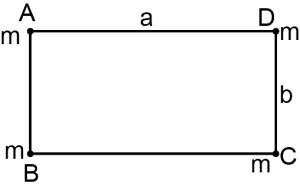
Four small objects,each of mass $m$,are fixed at the corners of a rectangular wire-frame of negligible mass with sides $a$ and $b$ $(a > b)$. If the wire frame is now rotated about an axis passing along the side of length $b$,then the moment of inertia of the system for this axis of rotation is:
A
$2 ma^{2}$
B
$4 ma^{2}$
C
$2 m(a^{2} + b^{2})$
D
$2 m(a^{2} - b^{2})$
Solution
(A) Let the rectangular frame have corners $A, B, C,$ and $D$ such that side $AD = BC = a$ and side $AB = CD = b$. The masses $m$ are placed at each corner.
The axis of rotation passes along the side of length $b$ (let this be side $CD$).
The moment of inertia $I$ of a system of particles is given by $I = \sum m_i r_i^2$,where $r_i$ is the perpendicular distance of the $i$-th mass from the axis of rotation.
$1$. The masses at $C$ and $D$ lie on the axis of rotation,so their perpendicular distances are $r_C = 0$ and $r_D = 0$. Thus,their contribution to the moment of inertia is $m(0)^2 + m(0)^2 = 0$.
$2$. The masses at $A$ and $B$ are at a perpendicular distance $a$ from the axis $CD$. Thus,their contribution is $m(a)^2 + m(a)^2 = 2ma^2$.
Therefore,the total moment of inertia of the system about the axis $CD$ is $I = 0 + 2ma^2 = 2ma^2$.
The axis of rotation passes along the side of length $b$ (let this be side $CD$).
The moment of inertia $I$ of a system of particles is given by $I = \sum m_i r_i^2$,where $r_i$ is the perpendicular distance of the $i$-th mass from the axis of rotation.
$1$. The masses at $C$ and $D$ lie on the axis of rotation,so their perpendicular distances are $r_C = 0$ and $r_D = 0$. Thus,their contribution to the moment of inertia is $m(0)^2 + m(0)^2 = 0$.
$2$. The masses at $A$ and $B$ are at a perpendicular distance $a$ from the axis $CD$. Thus,their contribution is $m(a)^2 + m(a)^2 = 2ma^2$.
Therefore,the total moment of inertia of the system about the axis $CD$ is $I = 0 + 2ma^2 = 2ma^2$.
0 likes
View Solution368
MediumMCQ
$A$ solid sphere of radius $10 \ cm$ is rotating about an axis which is at a distance $15 \ cm$ from its centre. The radius of gyration about this axis is $\sqrt{n} \ cm$. The value of $n$ is
A
$265$
B
$100$
C
$325$
D
$125$
Solution
(A) The moment of inertia of a solid sphere about an axis passing through its centre is $I_{cm} = \frac{2}{5} mR^2$.
Using the parallel axis theorem,the moment of inertia about an axis at a distance $d$ from the centre is $I = I_{cm} + md^2$.
$I = \frac{2}{5} mR^2 + md^2$.
By definition,the radius of gyration $k$ is given by $I = mk^2$.
Therefore,$mk^2 = \frac{2}{5} mR^2 + md^2$.
$k^2 = \frac{2}{5} R^2 + d^2$.
Given $R = 10 \ cm$ and $d = 15 \ cm$:
$k^2 = \frac{2}{5} (10)^2 + (15)^2$.
$k^2 = \frac{2}{5} (100) + 225 = 40 + 225 = 265$.
Since $k = \sqrt{n}$,we have $k^2 = n$.
Thus,$n = 265$.
Using the parallel axis theorem,the moment of inertia about an axis at a distance $d$ from the centre is $I = I_{cm} + md^2$.
$I = \frac{2}{5} mR^2 + md^2$.
By definition,the radius of gyration $k$ is given by $I = mk^2$.
Therefore,$mk^2 = \frac{2}{5} mR^2 + md^2$.
$k^2 = \frac{2}{5} R^2 + d^2$.
Given $R = 10 \ cm$ and $d = 15 \ cm$:
$k^2 = \frac{2}{5} (10)^2 + (15)^2$.
$k^2 = \frac{2}{5} (100) + 225 = 40 + 225 = 265$.
Since $k = \sqrt{n}$,we have $k^2 = n$.
Thus,$n = 265$.
0 likes
View Solution369
DifficultMCQ
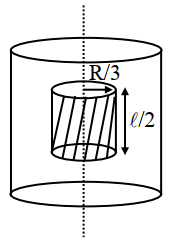
$A$ uniform solid cylinder of length $L$ and radius $R$ has a moment of inertia about its axis equal to $I_1$. $A$ small co-centric cylinder of length $L/2$ and radius $R/3$ is carved from this cylinder. The moment of inertia of this small carved cylinder about the same axis is $I_2$. The ratio $I_1/I_2$ is . . . . . . .
A
$162$
B
$81$
C
$54$
D
$27$
Solution
(A) Let $\rho$ be the density of the material of the cylinder.
The mass of the original cylinder is $M = \rho \cdot \pi R^2 L$.
The moment of inertia of the original cylinder about its axis is $I_1 = \frac{1}{2} M R^2 = \frac{1}{2} (\rho \pi R^2 L) R^2 = \frac{1}{2} \rho \pi R^4 L$.
The mass of the carved cylinder is $m = \rho \cdot \pi (R/3)^2 \cdot (L/2) = \rho \cdot \pi (R^2/9) \cdot (L/2) = \frac{\rho \pi R^2 L}{18} = \frac{M}{18}$.
The moment of inertia of the carved cylinder about its axis is $I_2 = \frac{1}{2} m (R/3)^2 = \frac{1}{2} (\frac{M}{18}) (\frac{R^2}{9}) = \frac{1}{324} M R^2$.
Now,the ratio $I_1/I_2$ is:
$\frac{I_1}{I_2} = \frac{\frac{1}{2} M R^2}{\frac{1}{324} M R^2} = \frac{1}{2} \times 324 = 162$.
The mass of the original cylinder is $M = \rho \cdot \pi R^2 L$.
The moment of inertia of the original cylinder about its axis is $I_1 = \frac{1}{2} M R^2 = \frac{1}{2} (\rho \pi R^2 L) R^2 = \frac{1}{2} \rho \pi R^4 L$.
The mass of the carved cylinder is $m = \rho \cdot \pi (R/3)^2 \cdot (L/2) = \rho \cdot \pi (R^2/9) \cdot (L/2) = \frac{\rho \pi R^2 L}{18} = \frac{M}{18}$.
The moment of inertia of the carved cylinder about its axis is $I_2 = \frac{1}{2} m (R/3)^2 = \frac{1}{2} (\frac{M}{18}) (\frac{R^2}{9}) = \frac{1}{324} M R^2$.
Now,the ratio $I_1/I_2$ is:
$\frac{I_1}{I_2} = \frac{\frac{1}{2} M R^2}{\frac{1}{324} M R^2} = \frac{1}{2} \times 324 = 162$.
0 likes
View Solution370
MediumMCQ
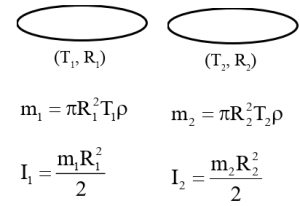
$A$ circular disc has radius $R_1$ and thickness $T_1$. Another circular disc made of the same material has radius $R_2$ and thickness $T_2$. If the moment of inertia of both discs are same and $\frac{R_1}{R_2}=2$,then $\frac{T_1}{T_2}=\frac{1}{\alpha}$. The value of $\alpha$ is . . . . . . .
A
$4$
B
$8$
C
$16$
D
$32$
Solution
(C) The moment of inertia of a circular disc about its central axis is given by $I = \frac{1}{2} M R^2$.
Since the discs are made of the same material,their density $\rho$ is the same.
The mass of a disc is $M = \text{Volume} \times \text{density} = (\pi R^2 T) \rho$.
Therefore,the moment of inertia is $I = \frac{1}{2} (\pi R^2 T \rho) R^2 = \frac{1}{2} \pi \rho R^4 T$.
Given that $I_1 = I_2$,we have:
$\frac{1}{2} \pi \rho R_1^4 T_1 = \frac{1}{2} \pi \rho R_2^4 T_2$
$R_1^4 T_1 = R_2^4 T_2$
$\frac{T_1}{T_2} = \frac{R_2^4}{R_1^4} = \left( \frac{R_2}{R_1} \right)^4$.
Given $\frac{R_1}{R_2} = 2$,so $\frac{R_2}{R_1} = \frac{1}{2}$.
$\frac{T_1}{T_2} = \left( \frac{1}{2} \right)^4 = \frac{1}{16}$.
Comparing this with $\frac{T_1}{T_2} = \frac{1}{\alpha}$,we get $\alpha = 16$.
Since the discs are made of the same material,their density $\rho$ is the same.
The mass of a disc is $M = \text{Volume} \times \text{density} = (\pi R^2 T) \rho$.
Therefore,the moment of inertia is $I = \frac{1}{2} (\pi R^2 T \rho) R^2 = \frac{1}{2} \pi \rho R^4 T$.
Given that $I_1 = I_2$,we have:
$\frac{1}{2} \pi \rho R_1^4 T_1 = \frac{1}{2} \pi \rho R_2^4 T_2$
$R_1^4 T_1 = R_2^4 T_2$
$\frac{T_1}{T_2} = \frac{R_2^4}{R_1^4} = \left( \frac{R_2}{R_1} \right)^4$.
Given $\frac{R_1}{R_2} = 2$,so $\frac{R_2}{R_1} = \frac{1}{2}$.
$\frac{T_1}{T_2} = \left( \frac{1}{2} \right)^4 = \frac{1}{16}$.
Comparing this with $\frac{T_1}{T_2} = \frac{1}{\alpha}$,we get $\alpha = 16$.
0 likes
View Solution371
MediumMCQ
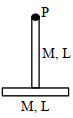
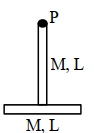
Two identical thin rods of mass $M \ kg$ and length $L \ m$ are connected as shown in the figure. The moment of inertia of the combined rod system about an axis passing through point $P$ and perpendicular to the plane of the rods is $\frac{x}{12} M L^2 \ kg \ m^2$. The value of $x$ is . . . . . . .
A
$12$
B
$17$
C
$13$
D
$15$
Solution
(B) Let the vertical rod be $1$ and the horizontal rod be $2$.
For rod $1$,the moment of inertia about an axis passing through $P$ (its end) and perpendicular to its length is $I_1 = \frac{ML^2}{3}$.
For rod $2$,the moment of inertia about its center of mass is $I_{cm} = \frac{ML^2}{12}$. Using the parallel axis theorem,the moment of inertia about an axis passing through $P$ and perpendicular to the plane is $I_2 = I_{cm} + Md^2$,where $d = L$ is the distance from $P$ to the center of rod $2$.
$I_2 = \frac{ML^2}{12} + M(L)^2 = \frac{13ML^2}{12}$.
The total moment of inertia is $I = I_1 + I_2 = \frac{ML^2}{3} + \frac{13ML^2}{12} = \frac{4ML^2 + 13ML^2}{12} = \frac{17ML^2}{12}$.
Comparing this with $\frac{x}{12} ML^2$,we get $x = 17$.
For rod $1$,the moment of inertia about an axis passing through $P$ (its end) and perpendicular to its length is $I_1 = \frac{ML^2}{3}$.
For rod $2$,the moment of inertia about its center of mass is $I_{cm} = \frac{ML^2}{12}$. Using the parallel axis theorem,the moment of inertia about an axis passing through $P$ and perpendicular to the plane is $I_2 = I_{cm} + Md^2$,where $d = L$ is the distance from $P$ to the center of rod $2$.
$I_2 = \frac{ML^2}{12} + M(L)^2 = \frac{13ML^2}{12}$.
The total moment of inertia is $I = I_1 + I_2 = \frac{ML^2}{3} + \frac{13ML^2}{12} = \frac{4ML^2 + 13ML^2}{12} = \frac{17ML^2}{12}$.
Comparing this with $\frac{x}{12} ML^2$,we get $x = 17$.
0 likes
View SolutionSystem of Particles and Rotational Motion — Moment of Inertia and Radius of gyration · Frequently Asked Questions
1Are these System of Particles and Rotational Motion questions useful for JEE and NEET?
Yes. All questions in this section are mapped to JEE Main and NEET exam patterns. Previous year questions from JEE Main, NEET, GUJCET and state-level exams are included with full solutions.
2Can I switch to Hindi or Gujarati for these questions?
Yes. Use the language tabs in the hero section or the sidebar to view the same questions and solutions in English, Hindi or Gujarati.
3How do I generate a question paper from this subtopic?
Use the Vedclass Exam Paper Generator — select the chapter and subtopic, set difficulty, and generate Sets A, B, C, D automatically. First 3 chapters of every subject are free.
Vedclass Products
For Students
Vedclass Test Series
Mock tests in real JEE/NEET style with performance analysis. 5-day free trial.
Start Free TrialFor Teachers
Exam Paper Generator
Generate Set A/B/C/D papers from this chapter in 2 minutes. 3 chapters free.
Try FreeFor Institutes
Online Exam Module
Live online exams with unlimited students, 360° analytics & white-label branding.
See DemoFor Teachers & Institutes
Generate a System of Particles and Rotational Motion Exam Paper in 2 Minutes
Select subtopic & difficulty — Sets A, B, C, D auto-generated with No Repeat logic.
First 3 chapters of every subject are free — no payment required.