
A English
Mix Example - System of Particles and Rotational Motion Questions in English
Class 11 Physics · System of Particles and Rotational Motion · Mix Example - System of Particles and Rotational Motion
262+
Questions
English
Language
100%
With Solutions
Showing 11 of 262 questions in English
251
EasyMCQ
$A$ uniform circular disc of radius $R$,lying on a frictionless horizontal plane,is rotating with an angular velocity $\omega$ about its own axis. Another identical circular disc is gently placed on top of the first disc coaxially. The loss in rotational kinetic energy due to friction between the two discs,as they acquire a common angular velocity,is ($I$ is the moment of inertia of the disc).
A
$\frac{1}{8} I \omega^2$
B
$\frac{1}{4} I \omega^2$
C
$\frac{1}{2} I \omega^2$
D
$I \omega^2$
Solution
(B) Initial state: The first disc has moment of inertia $I$ and angular velocity $\omega$. The second disc is at rest $(I_2 = I, \omega_2 = 0)$.
By the principle of conservation of angular momentum: $L_i = L_f$.
$I \omega + I(0) = (I + I) \omega'$,where $\omega'$ is the common angular velocity.
$I \omega = 2I \omega' \implies \omega' = \frac{\omega}{2}$.
Initial rotational kinetic energy: $K_i = \frac{1}{2} I \omega^2$.
Final rotational kinetic energy: $K_f = \frac{1}{2} (2I) (\omega')^2 = I (\frac{\omega}{2})^2 = \frac{I \omega^2}{4}$.
Loss in rotational kinetic energy: $\Delta K = K_i - K_f = \frac{1}{2} I \omega^2 - \frac{1}{4} I \omega^2 = \frac{1}{4} I \omega^2$.
By the principle of conservation of angular momentum: $L_i = L_f$.
$I \omega + I(0) = (I + I) \omega'$,where $\omega'$ is the common angular velocity.
$I \omega = 2I \omega' \implies \omega' = \frac{\omega}{2}$.
Initial rotational kinetic energy: $K_i = \frac{1}{2} I \omega^2$.
Final rotational kinetic energy: $K_f = \frac{1}{2} (2I) (\omega')^2 = I (\frac{\omega}{2})^2 = \frac{I \omega^2}{4}$.
Loss in rotational kinetic energy: $\Delta K = K_i - K_f = \frac{1}{2} I \omega^2 - \frac{1}{4} I \omega^2 = \frac{1}{4} I \omega^2$.
0 likes
View Solution252
DifficultMCQ
$A$ wheel of radius $0.5 \ m$ and a moment of inertia of $10 \ kg \cdot m^2$ is rotating freely at an angular speed of $70 \ rev/min$. The wheel can be stopped in $5.0 \ s$ by pressing a wet cloth against the rim and exerting a radially inward force of $88 \ N$. The coefficient of kinetic friction between the wheel and wet cloth is:
A
$0.17$
B
$0.33$
C
$0.4$
D
$0.6$
Solution
(B) Given: Radius $r = 0.5 \ m$,Moment of inertia $I = 10 \ kg \cdot m^2$,Initial angular speed $\omega_0 = 70 \ rev/min = 70 \times \frac{2\pi}{60} \ rad/s = \frac{7\pi}{3} \ rad/s$,Time $t = 5.0 \ s$,Normal force $N = 88 \ N$.
Final angular speed $\omega = 0 \ rad/s$.
Angular acceleration $\alpha = \frac{\omega - \omega_0}{t} = \frac{0 - 7\pi/3}{5} = -\frac{7\pi}{15} \ rad/s^2$.
Magnitude of torque $\tau = I|\alpha| = 10 \times \frac{7\pi}{15} = \frac{14\pi}{3} \ N \cdot m$.
Also,torque $\tau = f_k \cdot r = \mu_k N \cdot r$.
Equating the two: $\mu_k N r = \frac{14\pi}{3} \implies \mu_k (88)(0.5) = \frac{14\pi}{3}$.
$\mu_k (44) = \frac{14 \times 3.14159}{3} \approx 14.66$.
$\mu_k = \frac{14.66}{44} \approx 0.333$.
Thus,the coefficient of kinetic friction is approximately $0.33$.
Final angular speed $\omega = 0 \ rad/s$.
Angular acceleration $\alpha = \frac{\omega - \omega_0}{t} = \frac{0 - 7\pi/3}{5} = -\frac{7\pi}{15} \ rad/s^2$.
Magnitude of torque $\tau = I|\alpha| = 10 \times \frac{7\pi}{15} = \frac{14\pi}{3} \ N \cdot m$.
Also,torque $\tau = f_k \cdot r = \mu_k N \cdot r$.
Equating the two: $\mu_k N r = \frac{14\pi}{3} \implies \mu_k (88)(0.5) = \frac{14\pi}{3}$.
$\mu_k (44) = \frac{14 \times 3.14159}{3} \approx 14.66$.
$\mu_k = \frac{14.66}{44} \approx 0.333$.
Thus,the coefficient of kinetic friction is approximately $0.33$.
0 likes
View Solution253
DifficultMCQ
$A$ metal sphere of radius $r$ and specific heat $S$ is rotated about an axis passing through its centre at a speed of $n$ rotations per second. It is suddenly stopped and $50 \%$ of its energy is used in increasing its temperature. Then,the rise in temperature of the sphere is
A
$\frac{2 \pi^2 n^2 r^2}{5 S}$
B
$\frac{1 \pi^2 n^2}{10 r^2 S}$
C
$\frac{7}{8} \pi r^2 n^2 S$
D
$\frac{5(\pi r n)^2}{14 S}$
Solution
(A) The rotational kinetic energy $(KE)$ of a solid sphere is given by $KE = \frac{1}{2} I \omega^2$.
For a solid sphere,the moment of inertia $I = \frac{2}{5} m r^2$ and angular velocity $\omega = 2 \pi n$.
Substituting these values,$KE = \frac{1}{2} \times (\frac{2}{5} m r^2) \times (2 \pi n)^2 = \frac{1}{5} m r^2 \times 4 \pi^2 n^2 = \frac{4}{5} m r^2 \pi^2 n^2$.
Given that $50 \%$ of this energy is converted into heat,the heat produced $\Delta Q = \frac{1}{2} KE = \frac{1}{2} \times (\frac{4}{5} m r^2 \pi^2 n^2) = \frac{2}{5} m r^2 \pi^2 n^2$.
Using the relation $\Delta Q = m S \Delta t$,where $\Delta t$ is the rise in temperature,we get $\Delta t = \frac{\Delta Q}{m S}$.
Substituting $\Delta Q$,$\Delta t = \frac{2/5 m r^2 \pi^2 n^2}{m S} = \frac{2 \pi^2 n^2 r^2}{5 S}$.
For a solid sphere,the moment of inertia $I = \frac{2}{5} m r^2$ and angular velocity $\omega = 2 \pi n$.
Substituting these values,$KE = \frac{1}{2} \times (\frac{2}{5} m r^2) \times (2 \pi n)^2 = \frac{1}{5} m r^2 \times 4 \pi^2 n^2 = \frac{4}{5} m r^2 \pi^2 n^2$.
Given that $50 \%$ of this energy is converted into heat,the heat produced $\Delta Q = \frac{1}{2} KE = \frac{1}{2} \times (\frac{4}{5} m r^2 \pi^2 n^2) = \frac{2}{5} m r^2 \pi^2 n^2$.
Using the relation $\Delta Q = m S \Delta t$,where $\Delta t$ is the rise in temperature,we get $\Delta t = \frac{\Delta Q}{m S}$.
Substituting $\Delta Q$,$\Delta t = \frac{2/5 m r^2 \pi^2 n^2}{m S} = \frac{2 \pi^2 n^2 r^2}{5 S}$.
0 likes
View Solution254
MediumMCQ
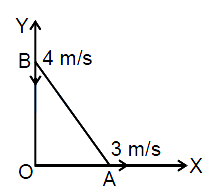
$A$ uniform rod $AB$ of length $1 \ m$ and mass $4 \ kg$ is sliding along two mutually perpendicular frictionless walls $OX$ and $OY$. The velocity of the two ends of the rod $A$ and $B$ are $3 \ m/s$ and $4 \ m/s$ respectively,as shown in the figure. Which of the following statement$(s)$ is/are correct?
A
The velocity of the centre of mass of the rod is $2.5 \ m/s$.
B
Rotational kinetic energy of the rod is $\frac{25}{6} \ J$.
C
The angular velocity of the rod is $5 \ rad/s$ clockwise.
D
The angular velocity of the rod is $5 \ rad/s$ anticlockwise.
Solution
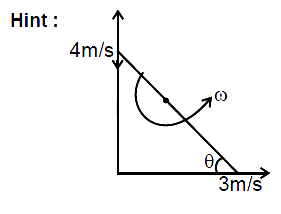
(B, C) Let the rod make an angle $\theta$ with the $OX$ axis. The velocity of end $A$ is $v_A = 3 \ m/s$ along $OX$ and the velocity of end $B$ is $v_B = 4 \ m/s$ along $OY$ (downwards).
Using the condition that the length of the rod is constant,the component of velocity along the rod must be the same for both ends:
$v_A \cos \theta = v_B \sin \theta \implies 3 \cos \theta = 4 \sin \theta \implies \tan \theta = \frac{3}{4}$.
Thus,$\sin \theta = \frac{3}{5}$ and $\cos \theta = \frac{4}{5}$.
The angular velocity $\omega$ is given by $\omega = \frac{v_A \sin \theta + v_B \cos \theta}{\ell} = \frac{3(3/5) + 4(4/5)}{1} = \frac{9/5 + 16/5}{1} = \frac{25}{5} = 5 \ rad/s$.
Since the rod is rotating such that $A$ moves right and $B$ moves down,the rotation is clockwise.
The rotational kinetic energy is $(KE)_{rot} = \frac{1}{2} I \omega^2 = \frac{1}{2} (\frac{1}{12} m \ell^2) \omega^2 = \frac{1}{2} \times \frac{1}{12} \times 4 \times (1)^2 \times (5)^2 = \frac{1}{24} \times 4 \times 25 = \frac{25}{6} \ J$.
Both statements $B$ and $C$ are correct.
Using the condition that the length of the rod is constant,the component of velocity along the rod must be the same for both ends:
$v_A \cos \theta = v_B \sin \theta \implies 3 \cos \theta = 4 \sin \theta \implies \tan \theta = \frac{3}{4}$.
Thus,$\sin \theta = \frac{3}{5}$ and $\cos \theta = \frac{4}{5}$.
The angular velocity $\omega$ is given by $\omega = \frac{v_A \sin \theta + v_B \cos \theta}{\ell} = \frac{3(3/5) + 4(4/5)}{1} = \frac{9/5 + 16/5}{1} = \frac{25}{5} = 5 \ rad/s$.
Since the rod is rotating such that $A$ moves right and $B$ moves down,the rotation is clockwise.
The rotational kinetic energy is $(KE)_{rot} = \frac{1}{2} I \omega^2 = \frac{1}{2} (\frac{1}{12} m \ell^2) \omega^2 = \frac{1}{2} \times \frac{1}{12} \times 4 \times (1)^2 \times (5)^2 = \frac{1}{24} \times 4 \times 25 = \frac{25}{6} \ J$.
Both statements $B$ and $C$ are correct.
0 likes
View Solution255
MediumMCQ
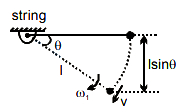
$A$ simple pendulum of length $\ell$ is displaced so that its taut string is horizontal and then released. $A$ uniform bar of length $L$ pivoted at one end is simultaneously released from its horizontal position. If their motions are synchronous (i.e.,they have the same angular velocity at any angle $\theta$ below the horizontal),what is the length $L$ of the bar?
A
$\frac{3 \ell}{2}$
B
$\ell$
C
$2 \ell$
D
$\frac{2 \ell}{3}$
Solution
(A) For a simple pendulum of length $\ell$,the angular velocity $\omega_1$ at an angle $\theta$ below the horizontal is derived from energy conservation: $mg(\ell \sin \theta) = \frac{1}{2} m v^2 = \frac{1}{2} m (\omega_1 \ell)^2$. Thus,$\omega_1 = \sqrt{\frac{2g \sin \theta}{\ell}}$.
For a uniform bar of length $L$ pivoted at one end,the moment of inertia is $I = \frac{1}{3} m L^2$. The potential energy lost when it rotates by angle $\theta$ is $mg(\frac{L}{2} \sin \theta)$. By energy conservation: $mg(\frac{L}{2} \sin \theta) = \frac{1}{2} I \omega_2^2 = \frac{1}{2} (\frac{1}{3} m L^2) \omega_2^2$. Simplifying gives $\omega_2 = \sqrt{\frac{3g \sin \theta}{L}}$.
Since the motions are synchronous,$\omega_1 = \omega_2$,so $\frac{2}{\ell} = \frac{3}{L}$.
Therefore,$L = \frac{3}{2} \ell$.
For a uniform bar of length $L$ pivoted at one end,the moment of inertia is $I = \frac{1}{3} m L^2$. The potential energy lost when it rotates by angle $\theta$ is $mg(\frac{L}{2} \sin \theta)$. By energy conservation: $mg(\frac{L}{2} \sin \theta) = \frac{1}{2} I \omega_2^2 = \frac{1}{2} (\frac{1}{3} m L^2) \omega_2^2$. Simplifying gives $\omega_2 = \sqrt{\frac{3g \sin \theta}{L}}$.
Since the motions are synchronous,$\omega_1 = \omega_2$,so $\frac{2}{\ell} = \frac{3}{L}$.
Therefore,$L = \frac{3}{2} \ell$.
0 likes
View Solution256
MediumMCQ
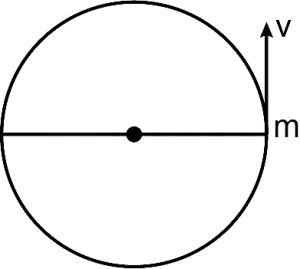
$A$ bar of length $L$ carrying a small mass $m$ at one of its ends rotates with a uniform angular speed $\omega$ in a vertical plane about the midpoint of the bar. During the rotation,at some instant of time when the bar is horizontal,the mass is detached from the bar but the bar continues to rotate with the same $\omega$. The mass moves vertically up,comes back,and reaches the bar at the same point. At that place,the acceleration due to gravity is $g$.
A
This is possible if the quantity $\frac{\omega^{2} L}{2 \pi g}$ is an integer.
B
The total time of flight of the mass is proportional to $\omega^{2}$.
C
The total distance travelled by the mass in air is proportional to $\omega^{2}$.
D
The total distance travelled by the mass in air and its total time of flight are both independent of its mass.
Solution
(A) The radius of the circular path of the mass is $R = L/2$. The linear velocity of the mass at the moment of detachment is $v = \omega R = \frac{\omega L}{2}$.
Since the mass is moving vertically upwards,the time of flight $T$ is given by $T = \frac{2v}{g} = \frac{\omega L}{g}$.
For the mass to reach the bar at the same point,the bar must complete an integer number of rotations $n$ in time $T$. The time for $n$ rotations is $T = n \cdot \frac{2\pi}{\omega}$.
Equating the two expressions for $T$: $\frac{\omega L}{g} = n \frac{2\pi}{\omega} \implies n = \frac{\omega^{2} L}{2\pi g}$. Thus,$n$ must be an integer.
For option $C$,the distance travelled by the mass in air is $2h = 2 \cdot \frac{v^2}{2g} = \frac{v^2}{g} = \frac{(\omega L/2)^2}{g} = \frac{\omega^2 L^2}{4g}$,which is proportional to $\omega^2$.
Since the mass is moving vertically upwards,the time of flight $T$ is given by $T = \frac{2v}{g} = \frac{\omega L}{g}$.
For the mass to reach the bar at the same point,the bar must complete an integer number of rotations $n$ in time $T$. The time for $n$ rotations is $T = n \cdot \frac{2\pi}{\omega}$.
Equating the two expressions for $T$: $\frac{\omega L}{g} = n \frac{2\pi}{\omega} \implies n = \frac{\omega^{2} L}{2\pi g}$. Thus,$n$ must be an integer.
For option $C$,the distance travelled by the mass in air is $2h = 2 \cdot \frac{v^2}{2g} = \frac{v^2}{g} = \frac{(\omega L/2)^2}{g} = \frac{\omega^2 L^2}{4g}$,which is proportional to $\omega^2$.
0 likes
View Solution257
DifficultMCQ
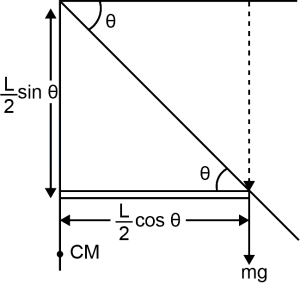
$A$ thin rod $AB$ of length $L$ and mass $m$ is held horizontally so that it can freely rotate in a vertical plane about the end $A$ as shown in the figure. The potential energy of the rod when it hangs vertically is taken to be zero. The end $B$ of the rod is released from rest from a horizontal position. At the instant the rod makes an angle $\theta$ with the horizontal:
A
the speed of end $B$ is proportional to $\sqrt{\sin \theta}$
B
the potential energy is proportional to $(1-\cos \theta)$
C
the angular acceleration is proportional to $\cos \theta$
D
the torque about $A$ remains the same as its initial value
Solution
(A, C) Let the rod have length $L$ and mass $m$. The center of mass is at $L/2$ from $A$.
When the rod makes an angle $\theta$ with the horizontal,the center of mass has descended by $h = (L/2) \sin \theta$.
By conservation of energy,the loss in potential energy equals the gain in rotational kinetic energy:
$mg(L/2) \sin \theta = \frac{1}{2} I \omega^2$,where $I = mL^2/3$.
$mg(L/2) \sin \theta = \frac{1}{2} (mL^2/3) \omega^2 \Rightarrow \omega^2 \propto \sin \theta \Rightarrow \omega \propto \sqrt{\sin \theta}$.
Since the speed of end $B$ is $v = \omega L$,we have $v \propto \sqrt{\sin \theta}$. Thus,option $A$ is correct.
For angular acceleration $\alpha$,the torque about $A$ is $\tau = mg(L/2) \cos \theta$.
Using $\tau = I \alpha$,we get $mg(L/2) \cos \theta = (mL^2/3) \alpha$.
This implies $\alpha \propto \cos \theta$. Thus,option $C$ is correct.
Note: Both $A$ and $C$ are correct statements.
When the rod makes an angle $\theta$ with the horizontal,the center of mass has descended by $h = (L/2) \sin \theta$.
By conservation of energy,the loss in potential energy equals the gain in rotational kinetic energy:
$mg(L/2) \sin \theta = \frac{1}{2} I \omega^2$,where $I = mL^2/3$.
$mg(L/2) \sin \theta = \frac{1}{2} (mL^2/3) \omega^2 \Rightarrow \omega^2 \propto \sin \theta \Rightarrow \omega \propto \sqrt{\sin \theta}$.
Since the speed of end $B$ is $v = \omega L$,we have $v \propto \sqrt{\sin \theta}$. Thus,option $A$ is correct.
For angular acceleration $\alpha$,the torque about $A$ is $\tau = mg(L/2) \cos \theta$.
Using $\tau = I \alpha$,we get $mg(L/2) \cos \theta = (mL^2/3) \alpha$.
This implies $\alpha \propto \cos \theta$. Thus,option $C$ is correct.
Note: Both $A$ and $C$ are correct statements.
0 likes
View Solution258
DifficultMCQ
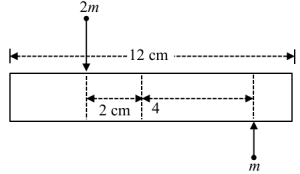
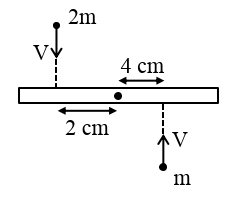
$A$ uniform bar of length $12 \text{ cm}$ and mass $20m$ lies on a smooth horizontal table. Two point masses $m$ and $2m$ are moving in opposite directions with the same speed $v$ and in the same plane as the bar. These masses strike the bar simultaneously and get stuck to it. After the collision,the entire system is rotating with an angular frequency $\omega$. The ratio of $v$ and $\omega$ is:
A
$33$
B
$2\sqrt{88}$
C
$66$
D
$32$
Solution
(A) Let the center of mass of the rod be the origin. The moment of inertia of the rod about its center is $I_{rod} = \frac{(20m)(12)^2}{12} = 240m \text{ cm}^2$.
Using the conservation of angular momentum about the center of mass of the rod:
$L_i = L_f$
Initial angular momentum $L_i = (2m)(v)(2) + (m)(v)(4) = 4mv + 4mv = 8mv$.
The final moment of inertia of the system is $I_f = I_{rod} + I_{mass1} + I_{mass2} = 240m + (2m)(2)^2 + (m)(4)^2 = 240m + 8m + 16m = 264m \text{ cm}^2$.
Since $L_f = I_f \omega$,we have $8mv = 264m \omega$.
Therefore,$\frac{v}{\omega} = \frac{264}{8} = 33$.
Using the conservation of angular momentum about the center of mass of the rod:
$L_i = L_f$
Initial angular momentum $L_i = (2m)(v)(2) + (m)(v)(4) = 4mv + 4mv = 8mv$.
The final moment of inertia of the system is $I_f = I_{rod} + I_{mass1} + I_{mass2} = 240m + (2m)(2)^2 + (m)(4)^2 = 240m + 8m + 16m = 264m \text{ cm}^2$.
Since $L_f = I_f \omega$,we have $8mv = 264m \omega$.
Therefore,$\frac{v}{\omega} = \frac{264}{8} = 33$.
0 likes
View Solution259
DifficultMCQ
$A$ solid sphere of mass $M$ and radius $R$ is divided into two unequal parts. The smaller part having mass $M/8$ is converted into a sphere of radius $r$ and the larger part is converted into a circular disc of thickness $t$ and radius $2R$. If $I_1$ is the moment of inertia of a sphere having radius $r$ about an axis through its centre and $I_2$ is the moment of inertia of a disc about its diameter,the ratio of their moment of inertia $I_2/I_1 = . . . . . . $.
A
$35$
B
$70$
C
$140$
D
$210$
Solution
(B) Density $\rho = \frac{M}{\frac{4}{3}\pi R^3}$.
Mass of smaller part $m_1 = \frac{M}{8}$. Since $\rho = \frac{m_1}{V_1} = \frac{m_1}{\frac{4}{3}\pi r^3}$,we have $\frac{M}{\frac{4}{3}\pi R^3} = \frac{M/8}{\frac{4}{3}\pi r^3} \Rightarrow r^3 = \frac{R^3}{8} \Rightarrow r = \frac{R}{2}$.
$I_1$ (moment of inertia of sphere about its centre) $= \frac{2}{5}m_1r^2 = \frac{2}{5}(\frac{M}{8})(\frac{R}{2})^2 = \frac{2}{5} \times \frac{M}{8} \times \frac{R^2}{4} = \frac{M R^2}{80}$.
Mass of larger part $m_2 = M - \frac{M}{8} = \frac{7M}{8}$.
$I_2$ (moment of inertia of disc about its diameter) $= \frac{m_2 R_D^2}{4}$,where $R_D = 2R$.
$I_2 = \frac{(\frac{7M}{8})(2R)^2}{4} = \frac{(\frac{7M}{8})(4R^2)}{4} = \frac{7M R^2}{8}$.
Ratio $\frac{I_2}{I_1} = \frac{7M R^2 / 8}{M R^2 / 80} = \frac{7}{8} \times 80 = 70$.
Mass of smaller part $m_1 = \frac{M}{8}$. Since $\rho = \frac{m_1}{V_1} = \frac{m_1}{\frac{4}{3}\pi r^3}$,we have $\frac{M}{\frac{4}{3}\pi R^3} = \frac{M/8}{\frac{4}{3}\pi r^3} \Rightarrow r^3 = \frac{R^3}{8} \Rightarrow r = \frac{R}{2}$.
$I_1$ (moment of inertia of sphere about its centre) $= \frac{2}{5}m_1r^2 = \frac{2}{5}(\frac{M}{8})(\frac{R}{2})^2 = \frac{2}{5} \times \frac{M}{8} \times \frac{R^2}{4} = \frac{M R^2}{80}$.
Mass of larger part $m_2 = M - \frac{M}{8} = \frac{7M}{8}$.
$I_2$ (moment of inertia of disc about its diameter) $= \frac{m_2 R_D^2}{4}$,where $R_D = 2R$.
$I_2 = \frac{(\frac{7M}{8})(2R)^2}{4} = \frac{(\frac{7M}{8})(4R^2)}{4} = \frac{7M R^2}{8}$.
Ratio $\frac{I_2}{I_1} = \frac{7M R^2 / 8}{M R^2 / 80} = \frac{7}{8} \times 80 = 70$.
0 likes
View Solution260
DifficultMCQ
$A$ solid sphere $(A)$ of mass $5m$ and a spherical shell $(B)$ of mass $m$,both having the same radius $R$,are placed on a rough surface. When a force $F$ of the same magnitude is applied tangentially at the highest points of $A$ and $B$,they start rolling without slipping with accelerations $a_A$ and $a_B$,respectively. The ratio of $a_A$ to $a_B$ is . . . . . . .
A
$5$:$21$
B
$6$:$10$
C
$21$:$25$
D
$1$:$5$
Solution
(A) For a body of mass $M$ and radius $R$ with moment of inertia $I = kMR^2$,a tangential force $F$ applied at the highest point (at distance $2R$ from the contact point) creates a torque $\tau = F(2R) - f(R) = I\alpha$,where $f$ is the friction force and $\alpha = a/R$ is the angular acceleration.
Thus,$2FR - fR = (kMR^2)(a/R) \Rightarrow 2F - f = kMa$.
The linear force equation is $F + f = Ma$.
Adding these two equations: $(2F - f) + (F + f) = kMa + Ma \Rightarrow 3F = (k+1)Ma \Rightarrow a = \frac{3F}{(k+1)M}$.
For a solid sphere $(A)$,$k = 2/5$ and $M = 5m$: $a_A = \frac{3F}{(2/5 + 1)5m} = \frac{3F}{(7/5)5m} = \frac{3F}{7m}$.
For a spherical shell $(B)$,$k = 2/3$ and $M = m$: $a_B = \frac{3F}{(2/3 + 1)m} = \frac{3F}{(5/3)m} = \frac{9F}{5m}$.
The ratio $a_A/a_B = (3F/7m) / (9F/5m) = (3/7) \times (5/9) = 15/63 = 5/21$.
Thus,$2FR - fR = (kMR^2)(a/R) \Rightarrow 2F - f = kMa$.
The linear force equation is $F + f = Ma$.
Adding these two equations: $(2F - f) + (F + f) = kMa + Ma \Rightarrow 3F = (k+1)Ma \Rightarrow a = \frac{3F}{(k+1)M}$.
For a solid sphere $(A)$,$k = 2/5$ and $M = 5m$: $a_A = \frac{3F}{(2/5 + 1)5m} = \frac{3F}{(7/5)5m} = \frac{3F}{7m}$.
For a spherical shell $(B)$,$k = 2/3$ and $M = m$: $a_B = \frac{3F}{(2/3 + 1)m} = \frac{3F}{(5/3)m} = \frac{9F}{5m}$.
The ratio $a_A/a_B = (3F/7m) / (9F/5m) = (3/7) \times (5/9) = 15/63 = 5/21$.
0 likes
View Solution261
DifficultMCQ
The position of an object having mass $0.1 \text{ kg}$ as a function of time $t$ is given as $\vec{r} = (10t^2\hat{i} + 5t^3\hat{j}) \text{ m}$. At $t = 1 \text{ s}$,which of the following statements are correct?
$A$. The linear momentum $\vec{p} = (2\hat{i} + 1.5\hat{j}) \text{ kg} \cdot \text{m/s}$.
$B$. The force acting on the object $\vec{F} = (2\hat{i} + 3\hat{j}) \text{ N}$.
$C$. The angular momentum of the object about its origin $\vec{L} = 15\hat{k} \text{ J} \cdot \text{s}$.
$D$. The torque acting on the object about its origin $\vec{\tau} = 20\hat{k} \text{ N} \cdot \text{m}$.
Choose the correct answer from the options given below:
$A$. The linear momentum $\vec{p} = (2\hat{i} + 1.5\hat{j}) \text{ kg} \cdot \text{m/s}$.
$B$. The force acting on the object $\vec{F} = (2\hat{i} + 3\hat{j}) \text{ N}$.
$C$. The angular momentum of the object about its origin $\vec{L} = 15\hat{k} \text{ J} \cdot \text{s}$.
$D$. The torque acting on the object about its origin $\vec{\tau} = 20\hat{k} \text{ N} \cdot \text{m}$.
Choose the correct answer from the options given below:
A
$A, B$ and $C$ only
B
$B, C$ and $D$ only
C
$A, C$ and $D$ only
D
$A, B$ and $D$ only
Solution
(D) Given position vector $\vec{r} = 10t^2\hat{i} + 5t^3\hat{j}$.
Velocity $\vec{v} = \frac{d\vec{r}}{dt} = 20t\hat{i} + 15t^2\hat{j}$.
At $t = 1 \text{ s}$,$\vec{v} = 20\hat{i} + 15\hat{j} \text{ m/s}$.
Linear momentum $\vec{p} = m\vec{v} = 0.1(20\hat{i} + 15\hat{j}) = (2\hat{i} + 1.5\hat{j}) \text{ kg} \cdot \text{m/s}$. Thus,statement $A$ is correct.
Acceleration $\vec{a} = \frac{d\vec{v}}{dt} = 20\hat{i} + 30t\hat{j}$.
At $t = 1 \text{ s}$,$\vec{a} = 20\hat{i} + 30\hat{j} \text{ m/s}^2$.
Force $\vec{F} = m\vec{a} = 0.1(20\hat{i} + 30\hat{j}) = (2\hat{i} + 3\hat{j}) \text{ N}$. Thus,statement $B$ is correct.
At $t = 1 \text{ s}$,$\vec{r} = 10(1)^2\hat{i} + 5(1)^3\hat{j} = 10\hat{i} + 5\hat{j}$.
Angular momentum $\vec{L} = \vec{r} \times \vec{p} = (10\hat{i} + 5\hat{j}) \times (2\hat{i} + 1.5\hat{j}) = (15\hat{k} - 10\hat{k}) = 5\hat{k} \text{ J} \cdot \text{s}$. Thus,statement $C$ is incorrect.
Torque $\vec{\tau} = \vec{r} \times \vec{F} = (10\hat{i} + 5\hat{j}) \times (2\hat{i} + 3\hat{j}) = (30\hat{k} - 10\hat{k}) = 20\hat{k} \text{ N} \cdot \text{m}$. Thus,statement $D$ is correct.
Therefore,statements $A, B$ and $D$ are correct.
Velocity $\vec{v} = \frac{d\vec{r}}{dt} = 20t\hat{i} + 15t^2\hat{j}$.
At $t = 1 \text{ s}$,$\vec{v} = 20\hat{i} + 15\hat{j} \text{ m/s}$.
Linear momentum $\vec{p} = m\vec{v} = 0.1(20\hat{i} + 15\hat{j}) = (2\hat{i} + 1.5\hat{j}) \text{ kg} \cdot \text{m/s}$. Thus,statement $A$ is correct.
Acceleration $\vec{a} = \frac{d\vec{v}}{dt} = 20\hat{i} + 30t\hat{j}$.
At $t = 1 \text{ s}$,$\vec{a} = 20\hat{i} + 30\hat{j} \text{ m/s}^2$.
Force $\vec{F} = m\vec{a} = 0.1(20\hat{i} + 30\hat{j}) = (2\hat{i} + 3\hat{j}) \text{ N}$. Thus,statement $B$ is correct.
At $t = 1 \text{ s}$,$\vec{r} = 10(1)^2\hat{i} + 5(1)^3\hat{j} = 10\hat{i} + 5\hat{j}$.
Angular momentum $\vec{L} = \vec{r} \times \vec{p} = (10\hat{i} + 5\hat{j}) \times (2\hat{i} + 1.5\hat{j}) = (15\hat{k} - 10\hat{k}) = 5\hat{k} \text{ J} \cdot \text{s}$. Thus,statement $C$ is incorrect.
Torque $\vec{\tau} = \vec{r} \times \vec{F} = (10\hat{i} + 5\hat{j}) \times (2\hat{i} + 3\hat{j}) = (30\hat{k} - 10\hat{k}) = 20\hat{k} \text{ N} \cdot \text{m}$. Thus,statement $D$ is correct.
Therefore,statements $A, B$ and $D$ are correct.
0 likes
View SolutionSystem of Particles and Rotational Motion — Mix Example - System of Particles and Rotational Motion · Frequently Asked Questions
1Are these System of Particles and Rotational Motion questions useful for JEE and NEET?
Yes. All questions in this section are mapped to JEE Main and NEET exam patterns. Previous year questions from JEE Main, NEET, GUJCET and state-level exams are included with full solutions.
2Can I switch to Hindi or Gujarati for these questions?
Yes. Use the language tabs in the hero section or the sidebar to view the same questions and solutions in English, Hindi or Gujarati.
3How do I generate a question paper from this subtopic?
Use the Vedclass Exam Paper Generator — select the chapter and subtopic, set difficulty, and generate Sets A, B, C, D automatically. First 3 chapters of every subject are free.
Vedclass Products
For Students
Vedclass Test Series
Mock tests in real JEE/NEET style with performance analysis. 5-day free trial.
Start Free TrialFor Teachers
Exam Paper Generator
Generate Set A/B/C/D papers from this chapter in 2 minutes. 3 chapters free.
Try FreeFor Institutes
Online Exam Module
Live online exams with unlimited students, 360° analytics & white-label branding.
See DemoFor Teachers & Institutes
Generate a System of Particles and Rotational Motion Exam Paper in 2 Minutes
Select subtopic & difficulty — Sets A, B, C, D auto-generated with No Repeat logic.
First 3 chapters of every subject are free — no payment required.