
A English
Centre of Mass of Composite Bodies and Cavity Problen of Centre of mass Questions in English
Class 11 Physics · System of Particles and Rotational Motion · Centre of Mass of Composite Bodies and Cavity Problen of Centre of mass
72+
Questions
English
Language
100%
With Solutions
Showing 19 of 72 questions in English
51
DifficultMCQ
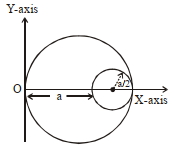
$A$ circular hole of radius $\left(\frac{a}{2}\right)$ is cut out of a circular disc of radius $'a'$ as shown in the figure. The centroid of the remaining circular portion with respect to point $'O'$ will be:
A
$\frac{1}{6} a$
B
$\frac{10}{11} a$
C
$\frac{5}{6} a$
D
$\frac{2}{3} a$
Solution
(C) Let $\sigma$ be the uniform surface mass density of the disc.
Let $M_1$ be the mass of the full disc of radius $a$ and $M_2$ be the mass of the removed circular hole of radius $\frac{a}{2}$.
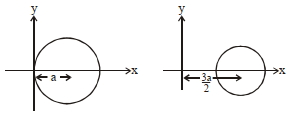
$M_1 = \sigma \pi a^2$,with its center of mass at $x_1 = a$.
$M_2 = \sigma \pi \left(\frac{a}{2}\right)^2 = \frac{\sigma \pi a^2}{4}$,with its center of mass at $x_2 = \frac{3a}{2}$.
The center of mass of the remaining portion is given by:
$x_{COM} = \frac{M_1 x_1 - M_2 x_2}{M_1 - M_2}$
$x_{COM} = \frac{(\sigma \pi a^2)(a) - (\frac{\sigma \pi a^2}{4})(\frac{3a}{2})}{\sigma \pi a^2 - \frac{\sigma \pi a^2}{4}}$
$x_{COM} = \frac{a - \frac{3a}{8}}{1 - \frac{1}{4}} = \frac{\frac{5a}{8}}{\frac{3}{4}} = \frac{5a}{8} \times \frac{4}{3} = \frac{5a}{6}$
Let $M_1$ be the mass of the full disc of radius $a$ and $M_2$ be the mass of the removed circular hole of radius $\frac{a}{2}$.
$M_1 = \sigma \pi a^2$,with its center of mass at $x_1 = a$.
$M_2 = \sigma \pi \left(\frac{a}{2}\right)^2 = \frac{\sigma \pi a^2}{4}$,with its center of mass at $x_2 = \frac{3a}{2}$.
The center of mass of the remaining portion is given by:
$x_{COM} = \frac{M_1 x_1 - M_2 x_2}{M_1 - M_2}$
$x_{COM} = \frac{(\sigma \pi a^2)(a) - (\frac{\sigma \pi a^2}{4})(\frac{3a}{2})}{\sigma \pi a^2 - \frac{\sigma \pi a^2}{4}}$
$x_{COM} = \frac{a - \frac{3a}{8}}{1 - \frac{1}{4}} = \frac{\frac{5a}{8}}{\frac{3}{4}} = \frac{5a}{8} \times \frac{4}{3} = \frac{5a}{6}$
0 likes
View Solution52
AdvancedMCQ
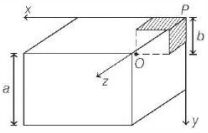
$A$ smaller cube with side $b$ (depicted by dashed lines) is excised from a bigger uniform cube with side $a$ as shown below,such that both cubes have a common vertex $P$. Let $X = a/b$. If the centre of mass of the remaining solid is at the vertex $O$ of the smaller cube,then $X$ satisfies:
A
$X^3-X^2-X-1=0$
B
$X^2-X-1=0$
C
$X^3+X^2-X-1=0$
D
$X^3-X^2-X+1=0$
Solution
(A) We choose the origin at point $P$. The coordinates of the vertex $O$ of the smaller cube are $(b, b, b)$.
Let $\rho$ be the mass density of the cube.
The mass of the large cube is $M_1 = \rho a^3$ and its centre of mass is at $(\frac{a}{2}, \frac{a}{2}, \frac{a}{2})$.
The mass of the removed smaller cube is $M_2 = \rho b^3$ and its centre of mass is at $(\frac{b}{2}, \frac{b}{2}, \frac{b}{2})$.
Using the principle of negative mass for the centre of mass of the remaining solid:
$x_{CM} = \frac{M_1 x_1 - M_2 x_2}{M_1 - M_2} = b$
$\Rightarrow \frac{\rho a^3 (a/2) - \rho b^3 (b/2)}{\rho a^3 - \rho b^3} = b$
$\Rightarrow \frac{a^4 - b^4}{2(a^3 - b^3)} = b$
$\Rightarrow a^4 - b^4 = 2b(a^3 - b^3)$
Dividing by $b^4$ and substituting $X = a/b$:
$X^4 - 1 = 2(X^3 - 1)$
$X^4 - 2X^3 + 1 = 0$
Since $X \neq 1$,we divide by $(X-1)$:
$(X-1)(X^3 - X^2 - X - 1) = 0$
Thus,$X^3 - X^2 - X - 1 = 0$.
Let $\rho$ be the mass density of the cube.
The mass of the large cube is $M_1 = \rho a^3$ and its centre of mass is at $(\frac{a}{2}, \frac{a}{2}, \frac{a}{2})$.
The mass of the removed smaller cube is $M_2 = \rho b^3$ and its centre of mass is at $(\frac{b}{2}, \frac{b}{2}, \frac{b}{2})$.
Using the principle of negative mass for the centre of mass of the remaining solid:
$x_{CM} = \frac{M_1 x_1 - M_2 x_2}{M_1 - M_2} = b$
$\Rightarrow \frac{\rho a^3 (a/2) - \rho b^3 (b/2)}{\rho a^3 - \rho b^3} = b$
$\Rightarrow \frac{a^4 - b^4}{2(a^3 - b^3)} = b$
$\Rightarrow a^4 - b^4 = 2b(a^3 - b^3)$
Dividing by $b^4$ and substituting $X = a/b$:
$X^4 - 1 = 2(X^3 - 1)$
$X^4 - 2X^3 + 1 = 0$
Since $X \neq 1$,we divide by $(X-1)$:
$(X-1)(X^3 - X^2 - X - 1) = 0$
Thus,$X^3 - X^2 - X - 1 = 0$.
0 likes
View Solution53
DifficultMCQ
The distance between the vertex and the centre of mass of a uniform solid planar circular segment of angular size $\theta$ and radius $R$ is given by
A
$\frac{4}{3} R \frac{\sin (\theta / 2)}{\theta}$
B
$R \frac{\sin (\theta / 2)}{\theta}$
C
$\frac{4}{3} R \cos \left(\frac{\theta}{2}\right)$
D
$\frac{2}{3} R \cos \theta$
Solution
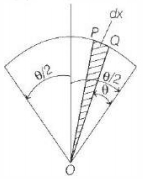
(A) Consider a uniform solid circular sector of radius $R$ and total angular size $\theta$. Let the sector be symmetric about the $y$-axis.
Consider an infinitesimal triangular element of the sector with an angular width $d\alpha$ at an angle $\alpha$ from the $y$-axis.
The area of this infinitesimal triangle is $dA = \frac{1}{2} R^2 d\alpha$.
The centre of mass of a triangle is at a distance of $\frac{2}{3} R$ from the vertex $O$. For this element,the distance of its centre of mass from the $x$-axis is $y = \frac{2}{3} R \cos \alpha$.
The $y$-coordinate of the centre of mass of the entire sector is given by:
$\bar{y} = \frac{\int y dA}{\int dA} = \frac{\int_{-\theta/2}^{\theta/2} (\frac{2}{3} R \cos \alpha) (\frac{1}{2} R^2 d\alpha)}{\int_{-\theta/2}^{\theta/2} \frac{1}{2} R^2 d\alpha}$
Simplifying the expression:
$\bar{y} = \frac{\frac{1}{3} R^3 \int_{-\theta/2}^{\theta/2} \cos \alpha d\alpha}{\frac{1}{2} R^2 [\alpha]_{-\theta/2}^{\theta/2}} = \frac{\frac{1}{3} R^3 [\sin \alpha]_{-\theta/2}^{\theta/2}}{\frac{1}{2} R^2 \theta} = \frac{\frac{1}{3} R^3 (2 \sin(\theta/2))}{\frac{1}{2} R^2 \theta}$
$\bar{y} = \frac{2}{3} R \frac{2 \sin(\theta/2)}{\theta} = \frac{4}{3} R \frac{\sin(\theta/2)}{\theta}$
Consider an infinitesimal triangular element of the sector with an angular width $d\alpha$ at an angle $\alpha$ from the $y$-axis.
The area of this infinitesimal triangle is $dA = \frac{1}{2} R^2 d\alpha$.
The centre of mass of a triangle is at a distance of $\frac{2}{3} R$ from the vertex $O$. For this element,the distance of its centre of mass from the $x$-axis is $y = \frac{2}{3} R \cos \alpha$.
The $y$-coordinate of the centre of mass of the entire sector is given by:
$\bar{y} = \frac{\int y dA}{\int dA} = \frac{\int_{-\theta/2}^{\theta/2} (\frac{2}{3} R \cos \alpha) (\frac{1}{2} R^2 d\alpha)}{\int_{-\theta/2}^{\theta/2} \frac{1}{2} R^2 d\alpha}$
Simplifying the expression:
$\bar{y} = \frac{\frac{1}{3} R^3 \int_{-\theta/2}^{\theta/2} \cos \alpha d\alpha}{\frac{1}{2} R^2 [\alpha]_{-\theta/2}^{\theta/2}} = \frac{\frac{1}{3} R^3 [\sin \alpha]_{-\theta/2}^{\theta/2}}{\frac{1}{2} R^2 \theta} = \frac{\frac{1}{3} R^3 (2 \sin(\theta/2))}{\frac{1}{2} R^2 \theta}$
$\bar{y} = \frac{2}{3} R \frac{2 \sin(\theta/2)}{\theta} = \frac{4}{3} R \frac{\sin(\theta/2)}{\theta}$
0 likes
View Solution54
DifficultMCQ
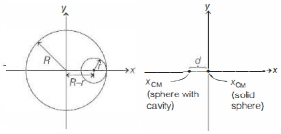
$A$ spherical cavity of radius $r$ is carved out of a uniform solid sphere of radius $R$ as shown in the figure below. The distance of the centre of mass of the resulting body from that of the solid sphere is given by

A
$\frac{R-r}{2}$
B
$\frac{R+r}{2}$
C
$0$
D
$\frac{r^3}{R^2+R r+r^2}$
Solution
(D) Let the centre of the solid sphere of radius $R$ be at the origin $(0,0,0)$.
Let $\rho$ be the uniform density of the sphere.
The mass of the solid sphere is $M = \frac{4}{3} \pi R^3 \rho$.
The mass of the removed spherical cavity of radius $r$ is $m = \frac{4}{3} \pi r^3 \rho$.
The centre of mass of the cavity is at a distance $x = R-r$ from the origin along the $x$-axis.
The centre of mass of the remaining body is given by the formula:
$x_{CM} = \frac{M(0) - m(R-r)}{M - m}$
Substituting the values:
$x_{CM} = \frac{0 - (\frac{4}{3} \pi r^3 \rho)(R-r)}{\frac{4}{3} \pi R^3 \rho - \frac{4}{3} \pi r^3 \rho}$
$x_{CM} = -\frac{r^3(R-r)}{R^3 - r^3}$
Using the algebraic identity $R^3 - r^3 = (R-r)(R^2 + Rr + r^2)$:
$x_{CM} = -\frac{r^3(R-r)}{(R-r)(R^2 + Rr + r^2)} = -\frac{r^3}{R^2 + Rr + r^2}$
The negative sign indicates that the centre of mass shifts in the direction opposite to the cavity.
The distance $d$ of the centre of mass from the centre of the original solid sphere is the magnitude of $x_{CM}$:
$d = \frac{r^3}{R^2 + Rr + r^2}$
Let $\rho$ be the uniform density of the sphere.
The mass of the solid sphere is $M = \frac{4}{3} \pi R^3 \rho$.
The mass of the removed spherical cavity of radius $r$ is $m = \frac{4}{3} \pi r^3 \rho$.
The centre of mass of the cavity is at a distance $x = R-r$ from the origin along the $x$-axis.
The centre of mass of the remaining body is given by the formula:
$x_{CM} = \frac{M(0) - m(R-r)}{M - m}$
Substituting the values:
$x_{CM} = \frac{0 - (\frac{4}{3} \pi r^3 \rho)(R-r)}{\frac{4}{3} \pi R^3 \rho - \frac{4}{3} \pi r^3 \rho}$
$x_{CM} = -\frac{r^3(R-r)}{R^3 - r^3}$
Using the algebraic identity $R^3 - r^3 = (R-r)(R^2 + Rr + r^2)$:
$x_{CM} = -\frac{r^3(R-r)}{(R-r)(R^2 + Rr + r^2)} = -\frac{r^3}{R^2 + Rr + r^2}$
The negative sign indicates that the centre of mass shifts in the direction opposite to the cavity.
The distance $d$ of the centre of mass from the centre of the original solid sphere is the magnitude of $x_{CM}$:
$d = \frac{r^3}{R^2 + Rr + r^2}$
0 likes
View Solution55
MediumMCQ
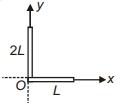
The figure shows a composite system of two uniform rods of lengths as indicated. The coordinates of the centre of mass of the system of rods are ...........
A
$\left(\frac{L}{2}, \frac{2 L}{3}\right)$
B
$\left(\frac{L}{4}, \frac{2 L}{3}\right)$
C
$\left(\frac{L}{6}, \frac{2 L}{3}\right)$
D
$\left(\frac{L}{6}, \frac{L}{3}\right)$
Solution
(C) Let the linear mass density of the rods be $\lambda$.
The mass of the horizontal rod (length $L$) is $m_1 = \lambda L$ and its centre of mass is at $(x_1, y_1) = (L/2, 0)$.
The mass of the vertical rod (length $2L$) is $m_2 = \lambda(2L) = 2m$ (where $m = \lambda L$) and its centre of mass is at $(x_2, y_2) = (0, L)$.
The $x$-coordinate of the centre of mass is $x_{cm} = \frac{m_1 x_1 + m_2 x_2}{m_1 + m_2} = \frac{m(L/2) + 2m(0)}{m + 2m} = \frac{mL/2}{3m} = \frac{L}{6}$.
The $y$-coordinate of the centre of mass is $y_{cm} = \frac{m_1 y_1 + m_2 y_2}{m_1 + m_2} = \frac{m(0) + 2m(L)}{m + 2m} = \frac{2mL}{3m} = \frac{2L}{3}$.
Thus,the coordinates of the centre of mass are $\left(\frac{L}{6}, \frac{2L}{3}\right)$.
The mass of the horizontal rod (length $L$) is $m_1 = \lambda L$ and its centre of mass is at $(x_1, y_1) = (L/2, 0)$.
The mass of the vertical rod (length $2L$) is $m_2 = \lambda(2L) = 2m$ (where $m = \lambda L$) and its centre of mass is at $(x_2, y_2) = (0, L)$.
The $x$-coordinate of the centre of mass is $x_{cm} = \frac{m_1 x_1 + m_2 x_2}{m_1 + m_2} = \frac{m(L/2) + 2m(0)}{m + 2m} = \frac{mL/2}{3m} = \frac{L}{6}$.
The $y$-coordinate of the centre of mass is $y_{cm} = \frac{m_1 y_1 + m_2 y_2}{m_1 + m_2} = \frac{m(0) + 2m(L)}{m + 2m} = \frac{2mL}{3m} = \frac{2L}{3}$.
Thus,the coordinates of the centre of mass are $\left(\frac{L}{6}, \frac{2L}{3}\right)$.
0 likes
View Solution56
EasyMCQ
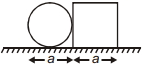
$A$ circular plate of diameter '$a$' is kept in contact with a square plate of side '$a$' as shown. The density of the material and the thickness are same everywhere. The centre of mass of the composite system will be ...........
A
Inside the circular plate
B
Inside the square plate
C
At the point of contact
D
Outside the system
Solution
(B) Let the point of contact be the origin $(0,0)$.
The area of the circular plate is $A_1 = \pi (a/2)^2 = \frac{\pi a^2}{4}$. Its centre of mass is at $x_1 = -a/2$.
The area of the square plate is $A_2 = a^2$. Its centre of mass is at $x_2 = a/2$.
The centre of mass of the composite system along the x-axis is given by:
$x_{cm} = \frac{A_1 x_1 + A_2 x_2}{A_1 + A_2}$
$x_{cm} = \frac{(\frac{\pi a^2}{4})(-a/2) + (a^2)(a/2)}{\frac{\pi a^2}{4} + a^2}$
$x_{cm} = \frac{-\frac{\pi a^3}{8} + \frac{a^3}{2}}{\frac{\pi a^2}{4} + a^2} = \frac{a^3(\frac{1}{2} - \frac{\pi}{8})}{a^2(1 + \frac{\pi}{4})} = \frac{a(4 - \pi)}{8} \cdot \frac{4}{4 + \pi} = \frac{a(4 - \pi)}{2(4 + \pi)}$
Since $\pi \approx 3.14$,$4 - \pi > 0$,therefore $x_{cm} > 0$.
Since the positive x-axis lies within the square plate,the centre of mass lies inside the square plate.
The area of the circular plate is $A_1 = \pi (a/2)^2 = \frac{\pi a^2}{4}$. Its centre of mass is at $x_1 = -a/2$.
The area of the square plate is $A_2 = a^2$. Its centre of mass is at $x_2 = a/2$.
The centre of mass of the composite system along the x-axis is given by:
$x_{cm} = \frac{A_1 x_1 + A_2 x_2}{A_1 + A_2}$
$x_{cm} = \frac{(\frac{\pi a^2}{4})(-a/2) + (a^2)(a/2)}{\frac{\pi a^2}{4} + a^2}$
$x_{cm} = \frac{-\frac{\pi a^3}{8} + \frac{a^3}{2}}{\frac{\pi a^2}{4} + a^2} = \frac{a^3(\frac{1}{2} - \frac{\pi}{8})}{a^2(1 + \frac{\pi}{4})} = \frac{a(4 - \pi)}{8} \cdot \frac{4}{4 + \pi} = \frac{a(4 - \pi)}{2(4 + \pi)}$
Since $\pi \approx 3.14$,$4 - \pi > 0$,therefore $x_{cm} > 0$.
Since the positive x-axis lies within the square plate,the centre of mass lies inside the square plate.
0 likes
View Solution57
EasyMCQ
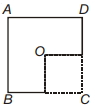
From a uniform square plate,one-fourth part is removed as shown. The centre of mass of the remaining part will lie on:
A
$OC$
B
$OA$
C
$OB$
D
$OD$
Solution
(B) The centre of mass of a body always lies on its axis of symmetry.
In the given figure,the square plate has a portion removed such that the remaining $L$-shaped body is symmetric about the diagonal $OA$.
Therefore,the centre of mass of the remaining part must lie on the line $OA$.
In the given figure,the square plate has a portion removed such that the remaining $L$-shaped body is symmetric about the diagonal $OA$.
Therefore,the centre of mass of the remaining part must lie on the line $OA$.
0 likes
View Solution58
DifficultMCQ
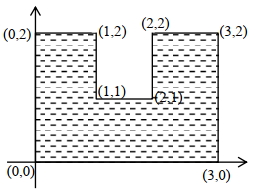
$A$ uniform thin metal plate of mass $10 \ kg$ with the dimensions shown in the figure is given. The ratio of the $x$ and $y$ coordinates of the center of mass of the plate is $\frac{n}{9}$. The value of $n$ is:
A
$15$
B
$17$
C
$18$
D
$20$
Solution
(A) Let the surface mass density be $\sigma$. The total area of the plate is $A = (3 \times 2) - (1 \times 1) = 5 \text{ units}^2$. Given mass $M = 10 \ kg$,so $\sigma = \frac{10}{5} = 2 \ kg/\text{unit}^2$.
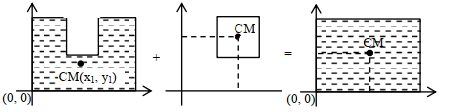
We can consider the plate as a large rectangle of $3 \times 2$ (mass $M_{total} = 3 \times 2 \times 2 = 12 \ kg$) minus a small square of $1 \times 1$ (mass $m_{cut} = 1 \times 1 \times 2 = 2 \ kg$).
The center of mass of the large rectangle is at $(1.5, 1.0)$.
The center of mass of the cut-out square is at $(1.5, 1.5)$.
Let the center of mass of the remaining plate be $(x, y)$. Using the principle of moments:
$M_{total} X_{CM} = M_{plate} x + m_{cut} x_{cut} \Rightarrow 12(1.5) = 10(x) + 2(1.5)$
$18 = 10x + 3 \Rightarrow 10x = 15 \Rightarrow x = 1.5$.
$M_{total} Y_{CM} = M_{plate} y + m_{cut} y_{cut} \Rightarrow 12(1.0) = 10(y) + 2(1.5)$
$12 = 10y + 3 \Rightarrow 10y = 9 \Rightarrow y = 0.9$.
The ratio $\frac{x}{y} = \frac{1.5}{0.9} = \frac{15}{9}$.
Comparing with $\frac{n}{9}$,we get $n = 15$.
We can consider the plate as a large rectangle of $3 \times 2$ (mass $M_{total} = 3 \times 2 \times 2 = 12 \ kg$) minus a small square of $1 \times 1$ (mass $m_{cut} = 1 \times 1 \times 2 = 2 \ kg$).
The center of mass of the large rectangle is at $(1.5, 1.0)$.
The center of mass of the cut-out square is at $(1.5, 1.5)$.
Let the center of mass of the remaining plate be $(x, y)$. Using the principle of moments:
$M_{total} X_{CM} = M_{plate} x + m_{cut} x_{cut} \Rightarrow 12(1.5) = 10(x) + 2(1.5)$
$18 = 10x + 3 \Rightarrow 10x = 15 \Rightarrow x = 1.5$.
$M_{total} Y_{CM} = M_{plate} y + m_{cut} y_{cut} \Rightarrow 12(1.0) = 10(y) + 2(1.5)$
$12 = 10y + 3 \Rightarrow 10y = 9 \Rightarrow y = 0.9$.
The ratio $\frac{x}{y} = \frac{1.5}{0.9} = \frac{15}{9}$.
Comparing with $\frac{n}{9}$,we get $n = 15$.
0 likes
View Solution59
MediumMCQ
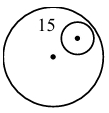
Consider a circular disc of radius $20 \ cm$ with centre located at the origin. $A$ circular hole of radius $5 \ cm$ is cut from this disc in such a way that the edge of the hole touches the edge of the disc. The distance of the centre of mass of the residual or remaining disc from the origin will be (in $cm$)
A
$2.0$
B
$0.5$
C
$1.5$
D
$1.0$
Solution
(D) Let the radius of the original disc be $R = 20 \ cm$ and the radius of the hole be $r = 5 \ cm$.
The mass of the original disc is $M = \sigma \pi R^2$,where $\sigma$ is the surface mass density.
The mass of the cut-out part is $m = \sigma \pi r^2$.
Since $r = R/4$,the mass $m = \sigma \pi (R/4)^2 = M/16$.
The centre of mass of the original disc is at the origin $(0, 0)$.
The centre of the hole is at a distance $d = R - r = 20 - 5 = 15 \ cm$ from the origin.
Let the centre of mass of the remaining part be $X_{\text{com}}$. Using the formula for the centre of mass of a system with a cavity:
$X_{\text{com}} = \frac{M(0) - m(d)}{M - m}$
$X_{\text{com}} = \frac{0 - (M/16)(15)}{M - M/16} = \frac{-(15/16)M}{(15/16)M} = -1 \ cm$.
The magnitude of the distance is $|X_{\text{com}}| = 1 \ cm$.
The mass of the original disc is $M = \sigma \pi R^2$,where $\sigma$ is the surface mass density.
The mass of the cut-out part is $m = \sigma \pi r^2$.
Since $r = R/4$,the mass $m = \sigma \pi (R/4)^2 = M/16$.
The centre of mass of the original disc is at the origin $(0, 0)$.
The centre of the hole is at a distance $d = R - r = 20 - 5 = 15 \ cm$ from the origin.
Let the centre of mass of the remaining part be $X_{\text{com}}$. Using the formula for the centre of mass of a system with a cavity:
$X_{\text{com}} = \frac{M(0) - m(d)}{M - m}$
$X_{\text{com}} = \frac{0 - (M/16)(15)}{M - M/16} = \frac{-(15/16)M}{(15/16)M} = -1 \ cm$.
The magnitude of the distance is $|X_{\text{com}}| = 1 \ cm$.
0 likes
View Solution60
MediumMCQ
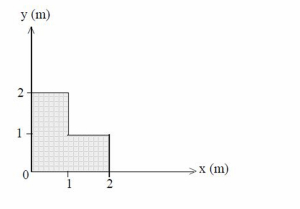
The coordinates of the centre of mass of a uniform $L$-shaped plate of mass $3 \ kg$ shown in the figure is:
A
$\left(\frac{5}{6} \ m, \frac{5}{6} \ m\right)$
B
$\left(\frac{3}{2} \ m, \frac{3}{2} \ m\right)$
C
$\left(\frac{1}{2} \ m, \frac{1}{2} \ m\right)$
D
$\left(\frac{6}{5} \ m, \frac{6}{5} \ m\right)$
Solution
(A) We can divide the $L$-shaped plate into two rectangular parts:
Part $1$: $A$ rectangle from $x=0$ to $x=1$ and $y=0$ to $y=2$. Its area is $A_1 = 1 \times 2 = 2 \ m^2$. Its centre of mass is at $(x_1, y_1) = (0.5, 1)$.
Part $2$: $A$ rectangle from $x=1$ to $x=2$ and $y=0$ to $y=1$. Its area is $A_2 = 1 \times 1 = 1 \ m^2$. Its centre of mass is at $(x_2, y_2) = (1.5, 0.5)$.
Since the plate is uniform,the mass is proportional to the area. Total area $A = A_1 + A_2 = 3 \ m^2$.
The $x$-coordinate of the centre of mass is $X_{cm} = \frac{A_1 x_1 + A_2 x_2}{A_1 + A_2} = \frac{2(0.5) + 1(1.5)}{3} = \frac{1 + 1.5}{3} = \frac{2.5}{3} = \frac{5}{6} \ m$.
The $y$-coordinate of the centre of mass is $Y_{cm} = \frac{A_1 y_1 + A_2 y_2}{A_1 + A_2} = \frac{2(1) + 1(0.5)}{3} = \frac{2 + 0.5}{3} = \frac{2.5}{3} = \frac{5}{6} \ m$.
Thus,the coordinates of the centre of mass are $\left(\frac{5}{6} \ m, \frac{5}{6} \ m\right)$.
Part $1$: $A$ rectangle from $x=0$ to $x=1$ and $y=0$ to $y=2$. Its area is $A_1 = 1 \times 2 = 2 \ m^2$. Its centre of mass is at $(x_1, y_1) = (0.5, 1)$.
Part $2$: $A$ rectangle from $x=1$ to $x=2$ and $y=0$ to $y=1$. Its area is $A_2 = 1 \times 1 = 1 \ m^2$. Its centre of mass is at $(x_2, y_2) = (1.5, 0.5)$.
Since the plate is uniform,the mass is proportional to the area. Total area $A = A_1 + A_2 = 3 \ m^2$.
The $x$-coordinate of the centre of mass is $X_{cm} = \frac{A_1 x_1 + A_2 x_2}{A_1 + A_2} = \frac{2(0.5) + 1(1.5)}{3} = \frac{1 + 1.5}{3} = \frac{2.5}{3} = \frac{5}{6} \ m$.
The $y$-coordinate of the centre of mass is $Y_{cm} = \frac{A_1 y_1 + A_2 y_2}{A_1 + A_2} = \frac{2(1) + 1(0.5)}{3} = \frac{2 + 0.5}{3} = \frac{2.5}{3} = \frac{5}{6} \ m$.
Thus,the coordinates of the centre of mass are $\left(\frac{5}{6} \ m, \frac{5}{6} \ m\right)$.
0 likes
View Solution61
DifficultMCQ
$A$ circular plate $A$ of radius $1.5 r$ is removed from one edge of a uniform circular plate $B$ of radius $2 r$. The distance of the centre of mass of the remaining portion from the centre of the plate $B$ is
A
$\frac{5 r}{12}$
B
$\frac{9 r}{14}$
C
$\frac{3 r}{4}$
D
$\frac{7 r}{8}$
Solution
(B) Let the surface mass density of the plate be $\sigma$. The mass of the original plate $B$ of radius $R = 2r$ is $M_B = \sigma \pi (2r)^2 = 4 \sigma \pi r^2$.
Let the mass of the removed plate $A$ of radius $r_A = 1.5r$ be $M_A = \sigma \pi (1.5r)^2 = 2.25 \sigma \pi r^2$.
The centre of mass of the original plate $B$ is at its centre (origin,$x_B = 0$).
The centre of the removed plate $A$ is at a distance $d = R - r_A = 2r - 1.5r = 0.5r$ from the centre of plate $B$.
The centre of mass of the remaining portion $X_{cm}$ is given by:
$X_{cm} = \frac{M_B x_B - M_A x_A}{M_B - M_A}$
$X_{cm} = \frac{(4 \sigma \pi r^2)(0) - (2.25 \sigma \pi r^2)(0.5r)}{4 \sigma \pi r^2 - 2.25 \sigma \pi r^2}$
$X_{cm} = \frac{-1.125 \sigma \pi r^3}{1.75 \sigma \pi r^2} = -\frac{1.125}{1.75} r = -\frac{1125}{1750} r = -\frac{9}{14} r$.
The magnitude of the distance is $\frac{9r}{14}$.
Let the mass of the removed plate $A$ of radius $r_A = 1.5r$ be $M_A = \sigma \pi (1.5r)^2 = 2.25 \sigma \pi r^2$.
The centre of mass of the original plate $B$ is at its centre (origin,$x_B = 0$).
The centre of the removed plate $A$ is at a distance $d = R - r_A = 2r - 1.5r = 0.5r$ from the centre of plate $B$.
The centre of mass of the remaining portion $X_{cm}$ is given by:
$X_{cm} = \frac{M_B x_B - M_A x_A}{M_B - M_A}$
$X_{cm} = \frac{(4 \sigma \pi r^2)(0) - (2.25 \sigma \pi r^2)(0.5r)}{4 \sigma \pi r^2 - 2.25 \sigma \pi r^2}$
$X_{cm} = \frac{-1.125 \sigma \pi r^3}{1.75 \sigma \pi r^2} = -\frac{1.125}{1.75} r = -\frac{1125}{1750} r = -\frac{9}{14} r$.
The magnitude of the distance is $\frac{9r}{14}$.
0 likes
View Solution62
EasyMCQ
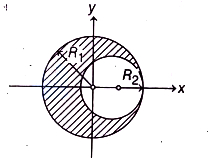
$A$ circular portion of radius $R_2$ has been removed from one edge of a circular disc of radius $R_1$. The correct expression for the centre of mass for the remaining portion of the disc is
A
$-\frac{R_2^2}{R_1+R_2}$
B
$-\frac{R_2^2}{R_1-R_2}$
C
$\frac{R_2^2}{R_1+R_2}$
D
$-\frac{R_1^2}{R_1+R_2}$
Solution
(A) Let the original disc have radius $R_1$ and mass $M_1 = \sigma \pi R_1^2$,where $\sigma$ is the surface mass density. Its center of mass is at the origin $(0,0)$.
Let the removed circular portion have radius $R_2$ and mass $M_2 = \sigma \pi R_2^2$. Its center is at $(R_1 - R_2, 0)$ as shown in the figure.
The center of mass of the remaining portion is given by:
$x_{CM} = \frac{M_1 x_1 - M_2 x_2}{M_1 - M_2}$
Substituting the values:
$x_{CM} = \frac{(\sigma \pi R_1^2)(0) - (\sigma \pi R_2^2)(R_1 - R_2)}{\sigma \pi R_1^2 - \sigma \pi R_2^2}$
$x_{CM} = \frac{-R_2^2(R_1 - R_2)}{R_1^2 - R_2^2}$
$x_{CM} = \frac{-R_2^2(R_1 - R_2)}{(R_1 - R_2)(R_1 + R_2)}$
$x_{CM} = -\frac{R_2^2}{R_1 + R_2}$
Let the removed circular portion have radius $R_2$ and mass $M_2 = \sigma \pi R_2^2$. Its center is at $(R_1 - R_2, 0)$ as shown in the figure.
The center of mass of the remaining portion is given by:
$x_{CM} = \frac{M_1 x_1 - M_2 x_2}{M_1 - M_2}$
Substituting the values:
$x_{CM} = \frac{(\sigma \pi R_1^2)(0) - (\sigma \pi R_2^2)(R_1 - R_2)}{\sigma \pi R_1^2 - \sigma \pi R_2^2}$
$x_{CM} = \frac{-R_2^2(R_1 - R_2)}{R_1^2 - R_2^2}$
$x_{CM} = \frac{-R_2^2(R_1 - R_2)}{(R_1 - R_2)(R_1 + R_2)}$
$x_{CM} = -\frac{R_2^2}{R_1 + R_2}$
0 likes
View Solution63
EasyMCQ
$A$ uniform circular disc has radius $r$. $A$ square portion of diagonal $r$ is cut from it. The centre of mass of the remaining disc from the centre of the disc is
A
$\frac{r}{2-4 \pi}$
B
$\frac{r}{3-3 \pi}$
C
$\frac{r}{2-5 \pi}$
D
$\frac{2 r}{1-2 \pi}$
Solution
(A) Let the mass of the circular disc be $M$ and its radius be $r$. The area of the disc is $A = \pi r^2$.
Let the origin $(0,0)$ be the centre of the disc.
$A$ square with diagonal $d = r$ is cut from it. The side of the square $a$ is given by $a = d / \sqrt{2} = r / \sqrt{2}$.
The area of the square is $A_s = a^2 = r^2 / 2$.
The mass of the square portion is $m = M \times (A_s / A) = M \times (r^2 / 2) / (\pi r^2) = M / (2 \pi)$.
The centre of mass of the square is at a distance $d_s = r/2$ from the centre of the disc.
Using the formula for the centre of mass of the remaining part: $X_{cm} = (M_1 X_1 - M_2 X_2) / (M_1 - M_2)$.
Here,$M_1 = M$,$X_1 = 0$,$M_2 = m = M / (2 \pi)$,and $X_2 = r/2$.
$X_{cm} = (M \times 0 - (M / 2 \pi) \times (r / 2)) / (M - M / 2 \pi)$.
$X_{cm} = (-Mr / 4 \pi) / (M(1 - 1 / 2 \pi)) = (-r / 4 \pi) / ((2 \pi - 1) / 2 \pi) = -r / (2(2 \pi - 1)) = r / (2 - 4 \pi)$.
Let the origin $(0,0)$ be the centre of the disc.
$A$ square with diagonal $d = r$ is cut from it. The side of the square $a$ is given by $a = d / \sqrt{2} = r / \sqrt{2}$.
The area of the square is $A_s = a^2 = r^2 / 2$.
The mass of the square portion is $m = M \times (A_s / A) = M \times (r^2 / 2) / (\pi r^2) = M / (2 \pi)$.
The centre of mass of the square is at a distance $d_s = r/2$ from the centre of the disc.
Using the formula for the centre of mass of the remaining part: $X_{cm} = (M_1 X_1 - M_2 X_2) / (M_1 - M_2)$.
Here,$M_1 = M$,$X_1 = 0$,$M_2 = m = M / (2 \pi)$,and $X_2 = r/2$.
$X_{cm} = (M \times 0 - (M / 2 \pi) \times (r / 2)) / (M - M / 2 \pi)$.
$X_{cm} = (-Mr / 4 \pi) / (M(1 - 1 / 2 \pi)) = (-r / 4 \pi) / ((2 \pi - 1) / 2 \pi) = -r / (2(2 \pi - 1)) = r / (2 - 4 \pi)$.
0 likes
View Solution64
MediumMCQ
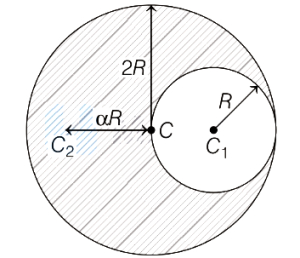
$A$ circular disc of radius $R$ is removed from one end of a bigger circular disc of radius $2R$. The centre of mass of the new disc is at a distance $\alpha R$ from the centre of the bigger disc. The value of $\alpha$ is
A
$\frac{1}{2}$
B
$\frac{1}{3}$
C
$\frac{1}{4}$
D
$\frac{1}{6}$
Solution
(B) Let the mass of the entire disc be $M$.
The mass per unit area is $\sigma = \frac{M}{\pi(2R)^2} = \frac{M}{4\pi R^2}$.
The mass of the removed circular disc of radius $R$ is $M_1 = \sigma \cdot \pi R^2 = \frac{M}{4\pi R^2} \cdot \pi R^2 = \frac{M}{4}$.
The mass of the remaining disc is $M_2 = M - M_1 = M - \frac{M}{4} = \frac{3M}{4}$.
Let the centre of the bigger disc be the origin $(0,0)$. The centre of mass of the removed disc is at $x_1 = R$ and the centre of mass of the remaining disc is at $x_2 = -\alpha R$.
Since the centre of mass of the original disc was at the origin,we have:
$M_1 x_1 + M_2 x_2 = 0$
$\frac{M}{4} \cdot R + \frac{3M}{4} \cdot (-\alpha R) = 0$
$\frac{M}{4} \cdot R = \frac{3M}{4} \cdot \alpha R$
$\alpha = \frac{1}{3}$.
The mass per unit area is $\sigma = \frac{M}{\pi(2R)^2} = \frac{M}{4\pi R^2}$.
The mass of the removed circular disc of radius $R$ is $M_1 = \sigma \cdot \pi R^2 = \frac{M}{4\pi R^2} \cdot \pi R^2 = \frac{M}{4}$.
The mass of the remaining disc is $M_2 = M - M_1 = M - \frac{M}{4} = \frac{3M}{4}$.
Let the centre of the bigger disc be the origin $(0,0)$. The centre of mass of the removed disc is at $x_1 = R$ and the centre of mass of the remaining disc is at $x_2 = -\alpha R$.
Since the centre of mass of the original disc was at the origin,we have:
$M_1 x_1 + M_2 x_2 = 0$
$\frac{M}{4} \cdot R + \frac{3M}{4} \cdot (-\alpha R) = 0$
$\frac{M}{4} \cdot R = \frac{3M}{4} \cdot \alpha R$
$\alpha = \frac{1}{3}$.
0 likes
View Solution65
DifficultMCQ
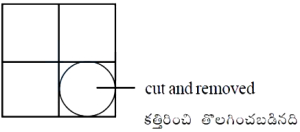
$A$ uniform square plate has a side of length $2R$. $A$ circular piece of maximum possible area is cut and removed from one of the quadrants of the plate as shown in the figure. Calculate the shift in the centre of mass of the plate.
A
$\frac{\pi R}{\sqrt{2}(16-\pi)}$
B
$\frac{R}{(16-\pi)}$
C
$\frac{R}{\pi(16-\pi)}$
D
$\frac{R \pi}{(16-\pi)}$
Solution
(A) Let the mass of the original square plate be $M$ and its side length be $2R$. The area is $A = (2R)^2 = 4R^2$. The centre of mass is at the origin $(0,0)$.
When a circular piece of radius $r = R/2$ is removed from a quadrant,its area is $A' = \pi r^2 = \pi (R/2)^2 = \pi R^2 / 4$.
The mass of the removed circular piece is $m = M \times (A'/A) = M \times (\pi R^2 / 4) / (4R^2) = M \pi / 16$.
The centre of mass of the removed circular piece is at $(R/2, R/2)$ relative to the centre of the square.
The shift in the centre of mass $\Delta x$ is given by $\Delta x = \frac{m \cdot d}{M - m}$,where $d$ is the distance of the centre of the circle from the centre of the square. The distance $d = \sqrt{(R/2)^2 + (R/2)^2} = \frac{R}{\sqrt{2}}$.
Substituting the values: $\Delta x = \frac{(M \pi / 16) \cdot (R / \sqrt{2})}{M - M \pi / 16} = \frac{M \pi R / (16 \sqrt{2})}{M(16 - \pi) / 16} = \frac{\pi R}{\sqrt{2}(16 - \pi)}$.
Thus,the correct option is $A$.
When a circular piece of radius $r = R/2$ is removed from a quadrant,its area is $A' = \pi r^2 = \pi (R/2)^2 = \pi R^2 / 4$.
The mass of the removed circular piece is $m = M \times (A'/A) = M \times (\pi R^2 / 4) / (4R^2) = M \pi / 16$.
The centre of mass of the removed circular piece is at $(R/2, R/2)$ relative to the centre of the square.
The shift in the centre of mass $\Delta x$ is given by $\Delta x = \frac{m \cdot d}{M - m}$,where $d$ is the distance of the centre of the circle from the centre of the square. The distance $d = \sqrt{(R/2)^2 + (R/2)^2} = \frac{R}{\sqrt{2}}$.
Substituting the values: $\Delta x = \frac{(M \pi / 16) \cdot (R / \sqrt{2})}{M - M \pi / 16} = \frac{M \pi R / (16 \sqrt{2})}{M(16 - \pi) / 16} = \frac{\pi R}{\sqrt{2}(16 - \pi)}$.
Thus,the correct option is $A$.
0 likes
View Solution66
MediumMCQ
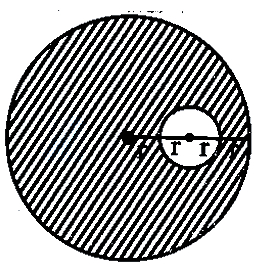
$A$ circular plate of radius $r$ is removed from a uniform circular plate $P$ of radius $4 r$ to form a hole. If the distance between the centre of the hole formed and the centre of the plate $P$ is $2 r$,then the distance of the centre of mass of the remaining portion from the centre of the plate $P$ is
A
$\frac{r}{3}$
B
$\frac{r}{15}$
C
$\frac{2 r}{15}$
D
$2 r$
Solution
(C) Let the mass per unit area of the plate be $\sigma$.
Mass of the original plate $M = \sigma \pi (4r)^2 = 16 \sigma \pi r^2$.
Mass of the removed circular part $m = \sigma \pi r^2$.
The mass of the remaining portion is $M' = M - m = 16 \sigma \pi r^2 - \sigma \pi r^2 = 15 \sigma \pi r^2$.
Let the centre of the original plate be at the origin $(0, 0)$.
The centre of the removed part is at $(2r, 0)$.
Using the principle of centre of mass for a cavity: $M X_{CM} = M' X_{R} + m X_{C}$,where $X_{CM}$ is the centre of mass of the original plate (which is $0$),$X_{R}$ is the centre of mass of the remaining portion,and $X_{C}$ is the centre of mass of the removed part.
$0 = (15 \sigma \pi r^2) X_{R} + (\sigma \pi r^2)(2r)$.
$15 X_{R} = -2r$.
The magnitude of the distance is $|X_{R}| = \frac{2r}{15}$.
Mass of the original plate $M = \sigma \pi (4r)^2 = 16 \sigma \pi r^2$.
Mass of the removed circular part $m = \sigma \pi r^2$.
The mass of the remaining portion is $M' = M - m = 16 \sigma \pi r^2 - \sigma \pi r^2 = 15 \sigma \pi r^2$.
Let the centre of the original plate be at the origin $(0, 0)$.
The centre of the removed part is at $(2r, 0)$.
Using the principle of centre of mass for a cavity: $M X_{CM} = M' X_{R} + m X_{C}$,where $X_{CM}$ is the centre of mass of the original plate (which is $0$),$X_{R}$ is the centre of mass of the remaining portion,and $X_{C}$ is the centre of mass of the removed part.
$0 = (15 \sigma \pi r^2) X_{R} + (\sigma \pi r^2)(2r)$.
$15 X_{R} = -2r$.
The magnitude of the distance is $|X_{R}| = \frac{2r}{15}$.
0 likes
View Solution67
DifficultMCQ
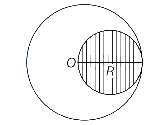
From a uniform circular disc of radius $2 \,cm$ (its centre of mass is at $O$), a circular portion of radius $1 \,cm$ is removed such that the shift in centre of mass is maximum. The disc is now rotated by an angle $\theta$ about an axis perpendicular to its plane and passing through $O$. If the magnitude of displacement of the new centre of mass is $\frac{1}{\sqrt{3}} \,cm$, then the $\theta$ is (in $^{\circ}$)
A
$30$
B
$45$
C
$60$
D
$120$
Solution
(D) Let $R = 2 \,cm$ be the radius of the original disc and $r = 1 \,cm$ be the radius of the removed portion.
The area of the original disc is $A_1 = \pi R^2 = 4\pi \,cm^2$ and the area of the removed portion is $A_2 = \pi r^2 = \pi \,cm^2$.
Let $\sigma$ be the surface mass density. The mass of the original disc is $M = \sigma A_1 = 4\sigma\pi$ and the mass of the removed portion is $m = \sigma A_2 = \sigma\pi$.
The remaining mass is $M' = M - m = 3\sigma\pi = \frac{3}{4}M$.
To maximize the shift in the centre of mass, the removed portion must be tangent to the original disc at the edge. The distance of the centre of the removed portion from $O$ is $d = R - r = 2 - 1 = 1 \,cm$.
The shift in the centre of mass $x$ is given by $x = \frac{m d}{M'} = \frac{(\sigma\pi)(1)}{3\sigma\pi} = \frac{1}{3} \,cm$.
When the disc is rotated by an angle $\theta$, the new centre of mass moves along a circular arc of radius $x = \frac{1}{3} \,cm$. The displacement $PQ$ between the initial and final positions of the centre of mass is given as $\frac{1}{\sqrt{3}} \,cm$.
In the isosceles triangle formed by the centre $O$ and the two positions of the centre of mass, the angle at $O$ is $\theta$. Using the chord length formula $PQ = 2x \sin(\frac{\theta}{2})$:
$\frac{1}{\sqrt{3}} = 2(\frac{1}{3}) \sin(\frac{\theta}{2})$
$\sin(\frac{\theta}{2}) = \frac{3}{2\sqrt{3}} = \frac{\sqrt{3}}{2}$
$\frac{\theta}{2} = 60^{\circ} \Rightarrow \theta = 120^{\circ}$.
The area of the original disc is $A_1 = \pi R^2 = 4\pi \,cm^2$ and the area of the removed portion is $A_2 = \pi r^2 = \pi \,cm^2$.
Let $\sigma$ be the surface mass density. The mass of the original disc is $M = \sigma A_1 = 4\sigma\pi$ and the mass of the removed portion is $m = \sigma A_2 = \sigma\pi$.
The remaining mass is $M' = M - m = 3\sigma\pi = \frac{3}{4}M$.
To maximize the shift in the centre of mass, the removed portion must be tangent to the original disc at the edge. The distance of the centre of the removed portion from $O$ is $d = R - r = 2 - 1 = 1 \,cm$.
The shift in the centre of mass $x$ is given by $x = \frac{m d}{M'} = \frac{(\sigma\pi)(1)}{3\sigma\pi} = \frac{1}{3} \,cm$.
When the disc is rotated by an angle $\theta$, the new centre of mass moves along a circular arc of radius $x = \frac{1}{3} \,cm$. The displacement $PQ$ between the initial and final positions of the centre of mass is given as $\frac{1}{\sqrt{3}} \,cm$.
In the isosceles triangle formed by the centre $O$ and the two positions of the centre of mass, the angle at $O$ is $\theta$. Using the chord length formula $PQ = 2x \sin(\frac{\theta}{2})$:
$\frac{1}{\sqrt{3}} = 2(\frac{1}{3}) \sin(\frac{\theta}{2})$
$\sin(\frac{\theta}{2}) = \frac{3}{2\sqrt{3}} = \frac{\sqrt{3}}{2}$
$\frac{\theta}{2} = 60^{\circ} \Rightarrow \theta = 120^{\circ}$.
0 likes
View Solution68
DifficultMCQ
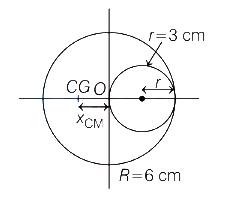
$A$ circular hole of radius $3 \text{ cm}$ is cut out from a uniform circular disc of radius $6 \text{ cm}$. The centre of the hole is at $3 \text{ cm}$ from the centre of the original disc. The distance of the centre of gravity of the resulting flat body from the centre of the original disc is: (in $\text{ cm}$)
A
$0.5$
B
$1$
C
$1.5$
D
$0.75$
Solution
(B) Let the mass per unit area of the disc be $\sigma$.
Total mass of the original disc,$M = \pi R^2 \sigma$,where $R = 6 \text{ cm}$.
Mass of the scooped-out portion,$M' = \pi r^2 \sigma$,where $r = 3 \text{ cm}$.
We take the centre $O$ of the original disc as the origin $(0,0)$.
The centre of mass of the original disc is at $(0,0)$.
The centre of the hole is at $(3,0)$.
The centre of mass of the remaining portion is given by:
$x_{CM} = \frac{M x_1 - M' x_2}{M - M'}$
Substituting the values:
$x_{CM} = \frac{(\pi R^2 \sigma)(0) - (\pi r^2 \sigma)(3)}{\pi R^2 \sigma - \pi r^2 \sigma}$
$x_{CM} = \frac{-3 \pi r^2 \sigma}{\pi \sigma (R^2 - r^2)} = \frac{-3 r^2}{R^2 - r^2}$
$x_{CM} = \frac{-3 \times 3^2}{6^2 - 3^2} = \frac{-3 \times 9}{36 - 9} = \frac{-27}{27} = -1 \text{ cm}$.
The negative sign indicates that the centre of mass shifts $1 \text{ cm}$ to the left of the original centre. The distance is $1 \text{ cm}$.
Total mass of the original disc,$M = \pi R^2 \sigma$,where $R = 6 \text{ cm}$.
Mass of the scooped-out portion,$M' = \pi r^2 \sigma$,where $r = 3 \text{ cm}$.
We take the centre $O$ of the original disc as the origin $(0,0)$.
The centre of mass of the original disc is at $(0,0)$.
The centre of the hole is at $(3,0)$.
The centre of mass of the remaining portion is given by:
$x_{CM} = \frac{M x_1 - M' x_2}{M - M'}$
Substituting the values:
$x_{CM} = \frac{(\pi R^2 \sigma)(0) - (\pi r^2 \sigma)(3)}{\pi R^2 \sigma - \pi r^2 \sigma}$
$x_{CM} = \frac{-3 \pi r^2 \sigma}{\pi \sigma (R^2 - r^2)} = \frac{-3 r^2}{R^2 - r^2}$
$x_{CM} = \frac{-3 \times 3^2}{6^2 - 3^2} = \frac{-3 \times 9}{36 - 9} = \frac{-27}{27} = -1 \text{ cm}$.
The negative sign indicates that the centre of mass shifts $1 \text{ cm}$ to the left of the original centre. The distance is $1 \text{ cm}$.
0 likes
View Solution69
MediumMCQ
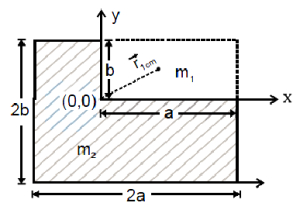
The position of the centre of mass of the uniform plate as shown in the figure is
A
$\left(-\frac{a}{2},-\frac{b}{2}\right)$
B
$\left(\frac{a}{8}, \frac{b}{8}\right)$
C
$\left(-\frac{b}{6},-\frac{a}{6}\right)$
D
$\left(-\frac{a}{6},-\frac{b}{6}\right)$
Solution
(D) Let the uniform plate be considered as a large rectangle of sides $2a$ and $2b$ with a smaller rectangle of sides $a$ and $b$ removed from it.
Let the mass of the removed rectangle be $m_1$ and the mass of the remaining shaded plate be $m_2$.
The area of the removed rectangle is $A_1 = a \times b$. Thus,$m_1 = \sigma ab$.
The area of the full rectangle is $A = 2a \times 2b = 4ab$. The area of the remaining plate is $A_2 = 4ab - ab = 3ab$. Thus,$m_2 = 3\sigma ab = 3m_1$.
The centre of mass of the full rectangle is at $(-a/2, -b/2)$ relative to the origin $(0,0)$.
The centre of mass of the removed rectangle is at $(a/2, b/2)$.
Using the principle of superposition for the centre of mass: $X_{cm} = \frac{m_2 x_2 + m_1 x_1}{m_2 + m_1} = 0$ (since the full rectangle's $CM$ is at the origin if we shift coordinates,but here we use the formula for a cavity).
For a cavity,the position of the centre of mass of the remaining part is given by $\vec{R} = \frac{M\vec{R}_{full} - m_1\vec{r}_1}{M - m_1}$.
Here,the full rectangle has its centre at $(-a/2, -b/2)$. Its mass is $M = 4m_1$.
The removed part has its centre at $(a/2, b/2)$.
$X_{cm} = \frac{4m_1(-a/2) - m_1(a/2)}{3m_1} = \frac{-2m_1a - 0.5m_1a}{3m_1} = \frac{-2.5a}{3} = -\frac{5a}{6}$.
Wait,re-evaluating based on the coordinate system provided: The origin $(0,0)$ is at the corner of the cavity.
The full rectangle (if it were complete) would span from $x = -a$ to $x = a$ and $y = -b$ to $y = b$. Its $CM$ is at $(0,0)$.
The removed rectangle spans $x = 0$ to $a$ and $y = 0$ to $b$. Its $CM$ is at $(a/2, b/2)$.
$X_{cm} = \frac{M(0) - m_1(a/2)}{3m_1} = -a/6$.
$Y_{cm} = \frac{M(0) - m_1(b/2)}{3m_1} = -b/6$.
Thus,the position is $(-\frac{a}{6}, -\frac{b}{6})$.
Let the mass of the removed rectangle be $m_1$ and the mass of the remaining shaded plate be $m_2$.
The area of the removed rectangle is $A_1 = a \times b$. Thus,$m_1 = \sigma ab$.
The area of the full rectangle is $A = 2a \times 2b = 4ab$. The area of the remaining plate is $A_2 = 4ab - ab = 3ab$. Thus,$m_2 = 3\sigma ab = 3m_1$.
The centre of mass of the full rectangle is at $(-a/2, -b/2)$ relative to the origin $(0,0)$.
The centre of mass of the removed rectangle is at $(a/2, b/2)$.
Using the principle of superposition for the centre of mass: $X_{cm} = \frac{m_2 x_2 + m_1 x_1}{m_2 + m_1} = 0$ (since the full rectangle's $CM$ is at the origin if we shift coordinates,but here we use the formula for a cavity).
For a cavity,the position of the centre of mass of the remaining part is given by $\vec{R} = \frac{M\vec{R}_{full} - m_1\vec{r}_1}{M - m_1}$.
Here,the full rectangle has its centre at $(-a/2, -b/2)$. Its mass is $M = 4m_1$.
The removed part has its centre at $(a/2, b/2)$.
$X_{cm} = \frac{4m_1(-a/2) - m_1(a/2)}{3m_1} = \frac{-2m_1a - 0.5m_1a}{3m_1} = \frac{-2.5a}{3} = -\frac{5a}{6}$.
Wait,re-evaluating based on the coordinate system provided: The origin $(0,0)$ is at the corner of the cavity.
The full rectangle (if it were complete) would span from $x = -a$ to $x = a$ and $y = -b$ to $y = b$. Its $CM$ is at $(0,0)$.
The removed rectangle spans $x = 0$ to $a$ and $y = 0$ to $b$. Its $CM$ is at $(a/2, b/2)$.
$X_{cm} = \frac{M(0) - m_1(a/2)}{3m_1} = -a/6$.
$Y_{cm} = \frac{M(0) - m_1(b/2)}{3m_1} = -b/6$.
Thus,the position is $(-\frac{a}{6}, -\frac{b}{6})$.
0 likes
View SolutionSystem of Particles and Rotational Motion — Centre of Mass of Composite Bodies and Cavity Problen of Centre of mass · Frequently Asked Questions
1Are these System of Particles and Rotational Motion questions useful for JEE and NEET?
Yes. All questions in this section are mapped to JEE Main and NEET exam patterns. Previous year questions from JEE Main, NEET, GUJCET and state-level exams are included with full solutions.
2Can I switch to Hindi or Gujarati for these questions?
Yes. Use the language tabs in the hero section or the sidebar to view the same questions and solutions in English, Hindi or Gujarati.
3How do I generate a question paper from this subtopic?
Use the Vedclass Exam Paper Generator — select the chapter and subtopic, set difficulty, and generate Sets A, B, C, D automatically. First 3 chapters of every subject are free.
Vedclass Products
For Students
Vedclass Test Series
Mock tests in real JEE/NEET style with performance analysis. 5-day free trial.
Start Free TrialFor Teachers
Exam Paper Generator
Generate Set A/B/C/D papers from this chapter in 2 minutes. 3 chapters free.
Try FreeFor Institutes
Online Exam Module
Live online exams with unlimited students, 360° analytics & white-label branding.
See DemoFor Teachers & Institutes
Generate a System of Particles and Rotational Motion Exam Paper in 2 Minutes
Select subtopic & difficulty — Sets A, B, C, D auto-generated with No Repeat logic.
First 3 chapters of every subject are free — no payment required.