
A English
Average Velocity and Average Speed Questions in English
Class 11 Physics · Motion in Straight Line · Average Velocity and Average Speed
81+
Questions
English
Language
100%
With Solutions
Showing 49 of 81 questions in English
1
MediumMCQ
$A$ person travels along a straight road for half the distance with velocity $v_1$ and the remaining half distance with velocity $v_2$. The average velocity is given by:
A
$v_1 v_2$
B
$\frac{v_2^2}{v_1^2}$
C
$\frac{v_1 + v_2}{2}$
D
$\frac{2v_1 v_2}{v_1 + v_2}$
Solution
(D) Let the total distance be $2d$.
The person travels distance $d$ with velocity $v_1$ and the remaining distance $d$ with velocity $v_2$.
Time taken for the first half is $t_1 = \frac{d}{v_1}$.
Time taken for the second half is $t_2 = \frac{d}{v_2}$.
Average velocity $v_{avg} = \frac{\text{Total distance}}{\text{Total time}} = \frac{2d}{t_1 + t_2}$.
Substituting the values: $v_{avg} = \frac{2d}{\frac{d}{v_1} + \frac{d}{v_2}} = \frac{2d}{d(\frac{v_1 + v_2}{v_1 v_2})} = \frac{2v_1 v_2}{v_1 + v_2}$.
Thus,the correct option is $D$.
The person travels distance $d$ with velocity $v_1$ and the remaining distance $d$ with velocity $v_2$.
Time taken for the first half is $t_1 = \frac{d}{v_1}$.
Time taken for the second half is $t_2 = \frac{d}{v_2}$.
Average velocity $v_{avg} = \frac{\text{Total distance}}{\text{Total time}} = \frac{2d}{t_1 + t_2}$.
Substituting the values: $v_{avg} = \frac{2d}{\frac{d}{v_1} + \frac{d}{v_2}} = \frac{2d}{d(\frac{v_1 + v_2}{v_1 v_2})} = \frac{2v_1 v_2}{v_1 + v_2}$.
Thus,the correct option is $D$.
0 likes
View Solution2
MediumMCQ
$A$ car travels from $A$ to $B$ at a speed of $20\,km/hr$ and returns at a speed of $30\,km/hr$. The average speed of the car for the whole journey is............$km/hr$
A
$25$
B
$24$
C
$50$
D
$5$
Solution
(B) The formula for the average speed when a body travels a distance $d$ at speed $v_1$ and returns the same distance $d$ at speed $v_2$ is given by:
$\text{Average speed} = \frac{2v_1v_2}{v_1 + v_2}$
Given $v_1 = 20\,km/hr$ and $v_2 = 30\,km/hr$.
Substituting the values:
$\text{Average speed} = \frac{2 \times 20 \times 30}{20 + 30}$
$\text{Average speed} = \frac{1200}{50}$
$\text{Average speed} = 24\,km/hr$
Therefore,the correct option is $(b)$.
$\text{Average speed} = \frac{2v_1v_2}{v_1 + v_2}$
Given $v_1 = 20\,km/hr$ and $v_2 = 30\,km/hr$.
Substituting the values:
$\text{Average speed} = \frac{2 \times 20 \times 30}{20 + 30}$
$\text{Average speed} = \frac{1200}{50}$
$\text{Average speed} = 24\,km/hr$
Therefore,the correct option is $(b)$.
0 likes
View Solution3
MediumMCQ
$A$ boy walks to his school at a distance of $6\, km$ with a constant speed of $2.5\, km/h$ and walks back with a constant speed of $4\, km/h$. His average speed for the round trip,expressed in $km/h$,is:
A
$24/13$
B
$40/13$
C
$3$
D
$1/2$
Solution
(B) The average speed for a round trip where the distance for both legs is the same is given by the formula: $v_{avg} = \frac{2v_1v_2}{v_1 + v_2}$.
Here,$v_1 = 2.5\, km/h$ and $v_2 = 4\, km/h$.
Substituting the values into the formula:
$v_{avg} = \frac{2 \times 2.5 \times 4}{2.5 + 4}$
$v_{avg} = \frac{20}{6.5}$
$v_{avg} = \frac{200}{65} = \frac{40}{13}\, km/h$.
Thus,the correct option is $B$.
Here,$v_1 = 2.5\, km/h$ and $v_2 = 4\, km/h$.
Substituting the values into the formula:
$v_{avg} = \frac{2 \times 2.5 \times 4}{2.5 + 4}$
$v_{avg} = \frac{20}{6.5}$
$v_{avg} = \frac{200}{65} = \frac{40}{13}\, km/h$.
Thus,the correct option is $B$.
0 likes
View Solution4
MediumMCQ
$A$ car travels the first half of a distance between two places at a speed of $30 \, km/hr$ and the second half of the distance at $50 \, km/hr$. The average speed of the car for the whole journey is .......... $km/hr$.
A
$42.5$
B
$40.0$
C
$37.5$
D
$35.0$
Solution
(C) When a body covers two equal distances with different speeds $v_1$ and $v_2$,the average speed is given by the harmonic mean formula: $\text{Average Speed} = \frac{2v_1v_2}{v_1 + v_2}$.
Given $v_1 = 30 \, km/hr$ and $v_2 = 50 \, km/hr$.
Substituting the values: $\text{Average Speed} = \frac{2 \times 30 \times 50}{30 + 50}$.
$\text{Average Speed} = \frac{3000}{80}$.
$\text{Average Speed} = \frac{300}{8} = 37.5 \, km/hr$.
Given $v_1 = 30 \, km/hr$ and $v_2 = 50 \, km/hr$.
Substituting the values: $\text{Average Speed} = \frac{2 \times 30 \times 50}{30 + 50}$.
$\text{Average Speed} = \frac{3000}{80}$.
$\text{Average Speed} = \frac{300}{8} = 37.5 \, km/hr$.
1 likes
View Solution5
MediumMCQ
$A$ car moving on a straight road covers one-third of the distance with $20 \, km/hr$ and the rest with $60 \, km/hr$. The average speed is .......... $km/hr$.
A
$40$
B
$80$
C
$46\frac{2}{3}$
D
$36$
Solution
(D) Let the total distance be $x$.
Time taken to cover the first one-third distance $(x/3)$ at $v_1 = 20 \, km/hr$ is $t_1 = \frac{x/3}{20} = \frac{x}{60} \, hr$.
Time taken to cover the remaining two-thirds distance $(2x/3)$ at $v_2 = 60 \, km/hr$ is $t_2 = \frac{2x/3}{60} = \frac{2x}{180} = \frac{x}{90} \, hr$.
Average speed is defined as the total distance divided by the total time: $v_{avg} = \frac{x}{t_1 + t_2}$.
$v_{avg} = \frac{x}{\frac{x}{60} + \frac{x}{90}} = \frac{1}{\frac{1}{60} + \frac{1}{90}}$.
Finding a common denominator: $\frac{1}{60} + \frac{1}{90} = \frac{3+2}{180} = \frac{5}{180} = \frac{1}{36}$.
Therefore,$v_{avg} = \frac{1}{1/36} = 36 \, km/hr$.
Time taken to cover the first one-third distance $(x/3)$ at $v_1 = 20 \, km/hr$ is $t_1 = \frac{x/3}{20} = \frac{x}{60} \, hr$.
Time taken to cover the remaining two-thirds distance $(2x/3)$ at $v_2 = 60 \, km/hr$ is $t_2 = \frac{2x/3}{60} = \frac{2x}{180} = \frac{x}{90} \, hr$.
Average speed is defined as the total distance divided by the total time: $v_{avg} = \frac{x}{t_1 + t_2}$.
$v_{avg} = \frac{x}{\frac{x}{60} + \frac{x}{90}} = \frac{1}{\frac{1}{60} + \frac{1}{90}}$.
Finding a common denominator: $\frac{1}{60} + \frac{1}{90} = \frac{3+2}{180} = \frac{5}{180} = \frac{1}{36}$.
Therefore,$v_{avg} = \frac{1}{1/36} = 36 \, km/hr$.
0 likes
View Solution6
EasyMCQ
$A$ car moves for half of its time at $80 \, km/h$ and for the rest half of the time at $40 \, km/h$. The total distance covered is $60 \, km$. What is the average speed of the car in $km/h$?
A
$60$
B
$80$
C
$120$
D
$180$
Solution
(A) When a body travels for equal intervals of time with different speeds $v_1$ and $v_2$,the average speed is given by the arithmetic mean of the speeds.
Average speed $v_{avg} = \frac{v_1 + v_2}{2}$.
Given $v_1 = 80 \, km/h$ and $v_2 = 40 \, km/h$.
$v_{avg} = \frac{80 + 40}{2} = \frac{120}{2} = 60 \, km/h$.
Thus,the average speed of the car is $60 \, km/h$.
Average speed $v_{avg} = \frac{v_1 + v_2}{2}$.
Given $v_1 = 80 \, km/h$ and $v_2 = 40 \, km/h$.
$v_{avg} = \frac{80 + 40}{2} = \frac{120}{2} = 60 \, km/h$.
Thus,the average speed of the car is $60 \, km/h$.
1 likes
View Solution7
MediumMCQ
$A$ train has a speed of $60\, km/h$ for the first one hour and $40\, km/h$ for the next half hour. Its average speed in $km/h$ is
A
$50$
B
$53.33$
C
$48$
D
$70$
Solution
(B) The distance travelled by the train in the first $1\, h$ is $d_1 = 60\, km/h \times 1\, h = 60\, km$.
The distance travelled by the train in the next $0.5\, h$ is $d_2 = 40\, km/h \times 0.5\, h = 20\, km$.
The total distance travelled is $D = d_1 + d_2 = 60\, km + 20\, km = 80\, km$.
The total time taken is $T = 1\, h + 0.5\, h = 1.5\, h = 3/2\, h$.
The average speed is given by $\text{Average Speed} = \frac{\text{Total Distance}}{\text{Total Time}} = \frac{80}{1.5} = \frac{80}{3/2} = \frac{160}{3} \approx 53.33\, km/h$.
The distance travelled by the train in the next $0.5\, h$ is $d_2 = 40\, km/h \times 0.5\, h = 20\, km$.
The total distance travelled is $D = d_1 + d_2 = 60\, km + 20\, km = 80\, km$.
The total time taken is $T = 1\, h + 0.5\, h = 1.5\, h = 3/2\, h$.
The average speed is given by $\text{Average Speed} = \frac{\text{Total Distance}}{\text{Total Time}} = \frac{80}{1.5} = \frac{80}{3/2} = \frac{160}{3} \approx 53.33\, km/h$.
0 likes
View Solution8
EasyMCQ
$A$ particle moves along a semicircle of radius $10\,m$ in $5$ seconds. The average velocity of the particle is...........$m/s$.
A
$2\pi$
B
$4\pi$
C
$2$
D
$4$
Solution
(D) Average velocity is defined as the ratio of total displacement to total time taken.
Displacement is the shortest distance between the initial and final positions.
For a particle moving along a semicircle of radius $r = 10\,m$,the displacement is equal to the diameter of the circle.
Displacement $= 2r = 2 \times 10\,m = 20\,m$.
Total time taken $= 5\,s$.
Average velocity $= \frac{\text{Total displacement}}{\text{Total time}} = \frac{20\,m}{5\,s} = 4\,m/s$.
Therefore,the correct option is $D$.
Displacement is the shortest distance between the initial and final positions.
For a particle moving along a semicircle of radius $r = 10\,m$,the displacement is equal to the diameter of the circle.
Displacement $= 2r = 2 \times 10\,m = 20\,m$.
Total time taken $= 5\,s$.
Average velocity $= \frac{\text{Total displacement}}{\text{Total time}} = \frac{20\,m}{5\,s} = 4\,m/s$.
Therefore,the correct option is $D$.
0 likes
View Solution9
DifficultMCQ
$A$ man walks on a straight road from his home to a market $2.5 \,km$ away with a speed of $5 \,km/h$. Finding the market closed,he instantly turns and walks back home with a speed of $7.5 \,km/h$. The average speed of the man over the interval of time $0$ to $40 \,min$ is equal to
A
$5 \,km/h$
B
$\frac{25}{4} \,km/h$
C
$\frac{30}{4} \,km/h$
D
$\frac{45}{8} \,km/h$
Solution
(D) Time taken to reach the market: $t_1 = \frac{d}{v_1} = \frac{2.5 \,km}{5 \,km/h} = 0.5 \,h = 30 \,min$.
Since the total time interval is $40 \,min$,the time spent walking back is $t_2 = 40 \,min - 30 \,min = 10 \,min = \frac{10}{60} \,h = \frac{1}{6} \,h$.
Distance covered while returning: $d_2 = v_2 \times t_2 = 7.5 \,km/h \times \frac{1}{6} \,h = 1.25 \,km$.
Total distance covered: $D = 2.5 \,km + 1.25 \,km = 3.75 \,km$.
Total time taken: $T = 40 \,min = \frac{40}{60} \,h = \frac{2}{3} \,h$.
Average speed = $\frac{\text{Total distance}}{\text{Total time}} = \frac{3.75 \,km}{(2/3) \,h} = 3.75 \times 1.5 = 5.625 \,km/h = \frac{45}{8} \,km/h$.
Since the total time interval is $40 \,min$,the time spent walking back is $t_2 = 40 \,min - 30 \,min = 10 \,min = \frac{10}{60} \,h = \frac{1}{6} \,h$.
Distance covered while returning: $d_2 = v_2 \times t_2 = 7.5 \,km/h \times \frac{1}{6} \,h = 1.25 \,km$.
Total distance covered: $D = 2.5 \,km + 1.25 \,km = 3.75 \,km$.
Total time taken: $T = 40 \,min = \frac{40}{60} \,h = \frac{2}{3} \,h$.
Average speed = $\frac{\text{Total distance}}{\text{Total time}} = \frac{3.75 \,km}{(2/3) \,h} = 3.75 \times 1.5 = 5.625 \,km/h = \frac{45}{8} \,km/h$.
0 likes
View Solution10
EasyMCQ
The ratio of the numerical values of the average velocity and average speed of a body is always
A
Unity
B
Unity or less
C
Unity or more
D
Less than unity
Solution
(B) The average velocity is defined as the ratio of total displacement to total time,while average speed is the ratio of total distance to total time.
Mathematically,$\text{Average velocity} = \frac{\text{Displacement}}{\text{Time}}$ and $\text{Average speed} = \frac{\text{Distance}}{\text{Time}}$.
Therefore,the ratio is $\frac{|\text{Average velocity}|}{|\text{Average speed}|} = \frac{|\text{Displacement}|}{\text{Distance}}$.
Since the magnitude of displacement is always less than or equal to the distance traveled $(|\text{Displacement}| \le \text{Distance})$,the ratio must be $\le 1$.
Thus,the ratio is unity or less.
Mathematically,$\text{Average velocity} = \frac{\text{Displacement}}{\text{Time}}$ and $\text{Average speed} = \frac{\text{Distance}}{\text{Time}}$.
Therefore,the ratio is $\frac{|\text{Average velocity}|}{|\text{Average speed}|} = \frac{|\text{Displacement}|}{\text{Distance}}$.
Since the magnitude of displacement is always less than or equal to the distance traveled $(|\text{Displacement}| \le \text{Distance})$,the ratio must be $\le 1$.
Thus,the ratio is unity or less.
0 likes
View Solution11
EasyMCQ
$A$ person travels along a straight road for the first half time with a velocity $v_1$ and the next half time with a velocity $v_2$. The mean velocity $V$ of the man is
A
$\frac{2}{V} = \frac{1}{v_1} + \frac{1}{v_2}$
B
$V = \frac{v_1 + v_2}{2}$
C
$V = \sqrt{v_1 v_2}$
D
$V = \sqrt{\frac{v_1}{v_2}}$
Solution
(B) Let the total time taken be $T$. The person travels for the first half time $t = \frac{T}{2}$ with velocity $v_1$,so the distance covered is $s_1 = v_1 \times \frac{T}{2}$.
The person travels for the next half time $t = \frac{T}{2}$ with velocity $v_2$,so the distance covered is $s_2 = v_2 \times \frac{T}{2}$.
The mean velocity $V$ is defined as the total displacement divided by the total time.
$V = \frac{s_1 + s_2}{T} = \frac{v_1(T/2) + v_2(T/2)}{T} = \frac{(v_1 + v_2)(T/2)}{T} = \frac{v_1 + v_2}{2}$.
The person travels for the next half time $t = \frac{T}{2}$ with velocity $v_2$,so the distance covered is $s_2 = v_2 \times \frac{T}{2}$.
The mean velocity $V$ is defined as the total displacement divided by the total time.
$V = \frac{s_1 + s_2}{T} = \frac{v_1(T/2) + v_2(T/2)}{T} = \frac{(v_1 + v_2)(T/2)}{T} = \frac{v_1 + v_2}{2}$.
0 likes
View Solution12
EasyMCQ
$A$ particle moves for $20 \,s$ with velocity $3 \,m/s$,then with velocity $4 \,m/s$ for another $20 \,s$,and finally with velocity $5 \,m/s$ for the next $20 \,s$. What is the average velocity of the particle in $m/s$?
A
$3$
B
$4$
C
$5$
D
$0$
Solution
(B) The average velocity is defined as the total displacement divided by the total time taken.
Total displacement $S = S_1 + S_2 + S_3 = (v_1 \times t_1) + (v_2 \times t_2) + (v_3 \times t_3)$.
Given $v_1 = 3 \,m/s$,$v_2 = 4 \,m/s$,$v_3 = 5 \,m/s$ and $t_1 = t_2 = t_3 = 20 \,s$.
$S = (3 \times 20) + (4 \times 20) + (5 \times 20) = 60 + 80 + 100 = 240 \,m$.
Total time $T = 20 + 20 + 20 = 60 \,s$.
Average velocity $v_{avg} = \frac{S}{T} = \frac{240}{60} = 4 \,m/s$.
Since the time intervals are equal,the average velocity is simply the arithmetic mean of the velocities: $v_{avg} = \frac{v_1 + v_2 + v_3}{3} = \frac{3 + 4 + 5}{3} = 4 \,m/s$.
Total displacement $S = S_1 + S_2 + S_3 = (v_1 \times t_1) + (v_2 \times t_2) + (v_3 \times t_3)$.
Given $v_1 = 3 \,m/s$,$v_2 = 4 \,m/s$,$v_3 = 5 \,m/s$ and $t_1 = t_2 = t_3 = 20 \,s$.
$S = (3 \times 20) + (4 \times 20) + (5 \times 20) = 60 + 80 + 100 = 240 \,m$.
Total time $T = 20 + 20 + 20 = 60 \,s$.
Average velocity $v_{avg} = \frac{S}{T} = \frac{240}{60} = 4 \,m/s$.
Since the time intervals are equal,the average velocity is simply the arithmetic mean of the velocities: $v_{avg} = \frac{v_1 + v_2 + v_3}{3} = \frac{3 + 4 + 5}{3} = 4 \,m/s$.
0 likes
View Solution13
MediumMCQ
$A$ car travels half the distance with a constant velocity of $40 \, km/h$ and the remaining half with a constant velocity of $60 \, km/h$. The average velocity of the car in $km/h$ is
A
$40$
B
$60$
C
$48$
D
$50$
Solution
(C) Let the total distance be $2d$. The car travels the first half distance $d$ with velocity $v_1 = 40 \, km/h$ and the second half distance $d$ with velocity $v_2 = 60 \, km/h$.
Time taken for the first half is $t_1 = \frac{d}{v_1} = \frac{d}{40}$.
Time taken for the second half is $t_2 = \frac{d}{v_2} = \frac{d}{60}$.
Average velocity $v_{av} = \frac{\text{Total distance}}{\text{Total time}} = \frac{2d}{t_1 + t_2} = \frac{2d}{\frac{d}{40} + \frac{d}{60}}$.
$v_{av} = \frac{2}{\frac{1}{40} + \frac{1}{60}} = \frac{2}{\frac{3+2}{120}} = \frac{2 \times 120}{5} = \frac{240}{5} = 48 \, km/h$.
Time taken for the first half is $t_1 = \frac{d}{v_1} = \frac{d}{40}$.
Time taken for the second half is $t_2 = \frac{d}{v_2} = \frac{d}{60}$.
Average velocity $v_{av} = \frac{\text{Total distance}}{\text{Total time}} = \frac{2d}{t_1 + t_2} = \frac{2d}{\frac{d}{40} + \frac{d}{60}}$.
$v_{av} = \frac{2}{\frac{1}{40} + \frac{1}{60}} = \frac{2}{\frac{3+2}{120}} = \frac{2 \times 120}{5} = \frac{240}{5} = 48 \, km/h$.
0 likes
View Solution14
DifficultMCQ
$A$ particle moving in a straight line covers half the distance with a speed of $3 \, m/s$. The other half of the distance is covered in two equal time intervals with speeds of $4.5 \, m/s$ and $7.5 \, m/s$ respectively. The average speed of the particle during this motion is...... $\, m/s$
A
$4$
B
$5$
C
$5.5$
D
$4.8$
Solution
(A) Let the total distance be $x$. The first half distance is $x/2$ covered with speed $v_1 = 3 \, m/s$. The time taken is $t_1 = \frac{x/2}{3} = \frac{x}{6}$.
The second half distance $x/2$ is covered in two equal time intervals,say $t_2$ each. Let the speeds be $v_2 = 4.5 \, m/s$ and $v_3 = 7.5 \, m/s$.
Distance covered in the second half is $(v_2 \cdot t_2) + (v_3 \cdot t_2) = x/2$.
$(4.5 + 7.5) t_2 = x/2 \Rightarrow 12 t_2 = x/2 \Rightarrow t_2 = x/24$.
The total time taken for the second half is $2 t_2 = 2(x/24) = x/12$.
Total time $T = t_1 + 2 t_2 = \frac{x}{6} + \frac{x}{12} = \frac{2x + x}{12} = \frac{3x}{12} = \frac{x}{4}$.
Average speed $v_{avg} = \frac{\text{Total distance}}{\text{Total time}} = \frac{x}{x/4} = 4 \, m/s$.
The second half distance $x/2$ is covered in two equal time intervals,say $t_2$ each. Let the speeds be $v_2 = 4.5 \, m/s$ and $v_3 = 7.5 \, m/s$.
Distance covered in the second half is $(v_2 \cdot t_2) + (v_3 \cdot t_2) = x/2$.
$(4.5 + 7.5) t_2 = x/2 \Rightarrow 12 t_2 = x/2 \Rightarrow t_2 = x/24$.
The total time taken for the second half is $2 t_2 = 2(x/24) = x/12$.
Total time $T = t_1 + 2 t_2 = \frac{x}{6} + \frac{x}{12} = \frac{2x + x}{12} = \frac{3x}{12} = \frac{x}{4}$.
Average speed $v_{avg} = \frac{\text{Total distance}}{\text{Total time}} = \frac{x}{x/4} = 4 \, m/s$.
0 likes
View Solution15
EasyMCQ
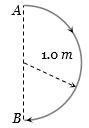
In $1.0 \, s$,a particle moves from point $A$ to point $B$ along a semicircle of radius $1.0 \, m$ (see figure). The magnitude of the average velocity is ......... $m/s$.
A
$3.14$
B
$2.0$
C
$1.0$
D
$0$
Solution
(B) The average velocity is defined as the total displacement divided by the total time taken.
Displacement is the shortest distance between the initial point $A$ and the final point $B$.
Since the particle moves along a semicircle of radius $r = 1.0 \, m$,the displacement is equal to the diameter of the semicircle.
Displacement $= 2 \times r = 2 \times 1.0 \, m = 2.0 \, m$.
The time taken is $1.0 \, s$.
Therefore,the magnitude of the average velocity $= \frac{\text{Total displacement}}{\text{Total time}} = \frac{2.0 \, m}{1.0 \, s} = 2.0 \, m/s$.
Displacement is the shortest distance between the initial point $A$ and the final point $B$.
Since the particle moves along a semicircle of radius $r = 1.0 \, m$,the displacement is equal to the diameter of the semicircle.
Displacement $= 2 \times r = 2 \times 1.0 \, m = 2.0 \, m$.
The time taken is $1.0 \, s$.
Therefore,the magnitude of the average velocity $= \frac{\text{Total displacement}}{\text{Total time}} = \frac{2.0 \, m}{1.0 \, s} = 2.0 \, m/s$.
0 likes
View Solution16
DifficultMCQ
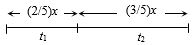
$A$ car covers $2/5^{th}$ of the total distance with speed $v_1$ and $3/5^{th}$ of the total distance with speed $v_2$. What is its average speed?
A
$\frac{1}{2}\sqrt{v_1 v_2}$
B
$\frac{v_1 + v_2}{2}$
C
$\frac{2v_1 v_2}{v_1 + v_2}$
D
$\frac{5v_1 v_2}{3v_1 + 2v_2}$
Solution
(D) Let the total distance be $x$.
Time taken to cover the first part of the distance $(d_1 = \frac{2}{5}x)$ with speed $v_1$ is $t_1 = \frac{d_1}{v_1} = \frac{2x}{5v_1}$.
Time taken to cover the second part of the distance $(d_2 = \frac{3}{5}x)$ with speed $v_2$ is $t_2 = \frac{d_2}{v_2} = \frac{3x}{5v_2}$.
Average speed is defined as the total distance divided by the total time taken:
$\text{Average speed} = \frac{\text{Total distance}}{\text{Total time}} = \frac{x}{t_1 + t_2}$
Substituting the values of $t_1$ and $t_2$:
$\text{Average speed} = \frac{x}{\frac{2x}{5v_1} + \frac{3x}{5v_2}}$
$\text{Average speed} = \frac{x}{\frac{2xv_2 + 3xv_1}{5v_1 v_2}}$
$\text{Average speed} = \frac{5v_1 v_2}{3v_1 + 2v_2}$
Time taken to cover the first part of the distance $(d_1 = \frac{2}{5}x)$ with speed $v_1$ is $t_1 = \frac{d_1}{v_1} = \frac{2x}{5v_1}$.
Time taken to cover the second part of the distance $(d_2 = \frac{3}{5}x)$ with speed $v_2$ is $t_2 = \frac{d_2}{v_2} = \frac{3x}{5v_2}$.
Average speed is defined as the total distance divided by the total time taken:
$\text{Average speed} = \frac{\text{Total distance}}{\text{Total time}} = \frac{x}{t_1 + t_2}$
Substituting the values of $t_1$ and $t_2$:
$\text{Average speed} = \frac{x}{\frac{2x}{5v_1} + \frac{3x}{5v_2}}$
$\text{Average speed} = \frac{x}{\frac{2xv_2 + 3xv_1}{5v_1 v_2}}$
$\text{Average speed} = \frac{5v_1 v_2}{3v_1 + 2v_2}$
0 likes
View Solution17
MediumMCQ
$A$ car moves a distance of $200 \; m$. It covers the first half of the distance at a speed of $40 \; km/h$ and the second half of the distance at a speed of $v$. If the average speed is $48 \; km/h$,the value of $v$ is: (in $; km/h$)
A
$56$
B
$60$
C
$50$
D
$48$
Solution
(B) Let the total distance be $d = 200 \; m$. The first half distance is $d_1 = 100 \; m$ and the second half distance is $d_2 = 100 \; m$.
The time taken for the first half is $t_1 = \frac{d_1}{v_1} = \frac{100}{40} \; h$.
The time taken for the second half is $t_2 = \frac{d_2}{v} = \frac{100}{v} \; h$.
The average speed $v_{avg}$ is given by the formula: $v_{avg} = \frac{\text{Total Distance}}{\text{Total Time}} = \frac{d}{t_1 + t_2}$.
Substituting the given values: $48 = \frac{200}{\frac{100}{40} + \frac{100}{v}}$.
Dividing the numerator and denominator by $100$: $48 = \frac{2}{\frac{1}{40} + \frac{1}{v}}$.
Rearranging the terms: $\frac{1}{40} + \frac{1}{v} = \frac{2}{48} = \frac{1}{24}$.
Solving for $v$: $\frac{1}{v} = \frac{1}{24} - \frac{1}{40} = \frac{5 - 3}{120} = \frac{2}{120} = \frac{1}{60}$.
Therefore,$v = 60 \; km/h$.
The time taken for the first half is $t_1 = \frac{d_1}{v_1} = \frac{100}{40} \; h$.
The time taken for the second half is $t_2 = \frac{d_2}{v} = \frac{100}{v} \; h$.
The average speed $v_{avg}$ is given by the formula: $v_{avg} = \frac{\text{Total Distance}}{\text{Total Time}} = \frac{d}{t_1 + t_2}$.
Substituting the given values: $48 = \frac{200}{\frac{100}{40} + \frac{100}{v}}$.
Dividing the numerator and denominator by $100$: $48 = \frac{2}{\frac{1}{40} + \frac{1}{v}}$.
Rearranging the terms: $\frac{1}{40} + \frac{1}{v} = \frac{2}{48} = \frac{1}{24}$.
Solving for $v$: $\frac{1}{v} = \frac{1}{24} - \frac{1}{40} = \frac{5 - 3}{120} = \frac{2}{120} = \frac{1}{60}$.
Therefore,$v = 60 \; km/h$.
0 likes
View Solution18
DifficultMCQ
$A$ car travels $\frac{1}{3}$ of the total distance on a straight road at a speed of $20 \, km/hr$ and the remaining distance at a speed of $60 \, km/hr$. What is the average speed of the car in $km/hr$?
A
$40$
B
$80$
C
$36$
D
$46\frac{2}{3}$
Solution
(C) Let the total distance be $x$.
Time taken for the first part of the journey $(d_1 = x/3)$ at speed $v_1 = 20 \, km/hr$ is $t_1 = \frac{x/3}{20} = \frac{x}{60} \, hr$.
Time taken for the remaining part of the journey $(d_2 = 2x/3)$ at speed $v_2 = 60 \, km/hr$ is $t_2 = \frac{2x/3}{60} = \frac{2x}{180} = \frac{x}{90} \, hr$.
Total time $T = t_1 + t_2 = \frac{x}{60} + \frac{x}{90} = \frac{3x + 2x}{180} = \frac{5x}{180} = \frac{x}{36} \, hr$.
Average speed $v_{avg} = \frac{\text{Total distance}}{\text{Total time}} = \frac{x}{x/36} = 36 \, km/hr$.
Time taken for the first part of the journey $(d_1 = x/3)$ at speed $v_1 = 20 \, km/hr$ is $t_1 = \frac{x/3}{20} = \frac{x}{60} \, hr$.
Time taken for the remaining part of the journey $(d_2 = 2x/3)$ at speed $v_2 = 60 \, km/hr$ is $t_2 = \frac{2x/3}{60} = \frac{2x}{180} = \frac{x}{90} \, hr$.
Total time $T = t_1 + t_2 = \frac{x}{60} + \frac{x}{90} = \frac{3x + 2x}{180} = \frac{5x}{180} = \frac{x}{36} \, hr$.
Average speed $v_{avg} = \frac{\text{Total distance}}{\text{Total time}} = \frac{x}{x/36} = 36 \, km/hr$.
0 likes
View Solution19
MediumMCQ
$A$ car moves from $X$ to $Y$ with a uniform speed $v_1$ and returns from $Y$ to $X$ with a uniform speed $v_2$. The average speed for this round trip is
A
$\bar v = \frac{v_1 + v_2}{2}$
B
$\bar v = \sqrt{v_1 v_2}$
C
$\frac{2}{\bar v} = \frac{1}{v_1} + \frac{1}{v_2}$
D
$\frac{1}{\bar v} = \frac{1}{v_1} + \frac{1}{v_2}$
Solution
(C) Average speed is defined as the ratio of total distance traveled to the total time taken.
Let the distance between $X$ and $Y$ be $d$.
Time taken to travel from $X$ to $Y$ is $t_1 = \frac{d}{v_1}$.
Time taken to travel from $Y$ to $X$ is $t_2 = \frac{d}{v_2}$.
Total distance $= d + d = 2d$.
Total time $= t_1 + t_2 = \frac{d}{v_1} + \frac{d}{v_2}$.
Average speed $\bar v = \frac{\text{Total distance}}{\text{Total time}} = \frac{2d}{\frac{d}{v_1} + \frac{d}{v_2}}$.
Canceling $d$ from the numerator and denominator,we get $\bar v = \frac{2}{\frac{1}{v_1} + \frac{1}{v_2}}$.
Rearranging this gives $\frac{2}{\bar v} = \frac{1}{v_1} + \frac{1}{v_2}$.
Let the distance between $X$ and $Y$ be $d$.
Time taken to travel from $X$ to $Y$ is $t_1 = \frac{d}{v_1}$.
Time taken to travel from $Y$ to $X$ is $t_2 = \frac{d}{v_2}$.
Total distance $= d + d = 2d$.
Total time $= t_1 + t_2 = \frac{d}{v_1} + \frac{d}{v_2}$.
Average speed $\bar v = \frac{\text{Total distance}}{\text{Total time}} = \frac{2d}{\frac{d}{v_1} + \frac{d}{v_2}}$.
Canceling $d$ from the numerator and denominator,we get $\bar v = \frac{2}{\frac{1}{v_1} + \frac{1}{v_2}}$.
Rearranging this gives $\frac{2}{\bar v} = \frac{1}{v_1} + \frac{1}{v_2}$.
1 likes
View Solution20
EasyMCQ
$A$ particle covers half of its total distance with speed $v_1$ and the rest half distance with speed $v_2$. Its average speed during the complete journey is
A
$\frac{v_1 + v_2}{2}$
B
$\frac{v_1 v_2}{v_1 + v_2}$
C
$\frac{2 v_1 v_2}{v_1 + v_2}$
D
$\frac{v_1 + v_2}{3}$
Solution
(C) Let the total distance be $d$. The particle covers the first half distance $(d/2)$ with speed $v_1$ and the second half distance $(d/2)$ with speed $v_2$.
Time taken for the first half,$t_1 = \frac{d/2}{v_1} = \frac{d}{2v_1}$.
Time taken for the second half,$t_2 = \frac{d/2}{v_2} = \frac{d}{2v_2}$.
Average speed is defined as the total distance divided by the total time taken:
$v_{av} = \frac{\text{Total Distance}}{\text{Total Time}} = \frac{d}{t_1 + t_2}$.
Substituting the values of $t_1$ and $t_2$:
$v_{av} = \frac{d}{\frac{d}{2v_1} + \frac{d}{2v_2}} = \frac{d}{\frac{d}{2} (\frac{1}{v_1} + \frac{1}{v_2})} = \frac{1}{\frac{1}{2} (\frac{v_1 + v_2}{v_1 v_2})}$.
$v_{av} = \frac{2 v_1 v_2}{v_1 + v_2}$.
Time taken for the first half,$t_1 = \frac{d/2}{v_1} = \frac{d}{2v_1}$.
Time taken for the second half,$t_2 = \frac{d/2}{v_2} = \frac{d}{2v_2}$.
Average speed is defined as the total distance divided by the total time taken:
$v_{av} = \frac{\text{Total Distance}}{\text{Total Time}} = \frac{d}{t_1 + t_2}$.
Substituting the values of $t_1$ and $t_2$:
$v_{av} = \frac{d}{\frac{d}{2v_1} + \frac{d}{2v_2}} = \frac{d}{\frac{d}{2} (\frac{1}{v_1} + \frac{1}{v_2})} = \frac{1}{\frac{1}{2} (\frac{v_1 + v_2}{v_1 v_2})}$.
$v_{av} = \frac{2 v_1 v_2}{v_1 + v_2}$.
0 likes
View Solution21
EasyMCQ
$A$ car travels a distance $S$ on a straight road in two hours and then returns to the starting point in the next three hours. Its average velocity is
A
$S/5$
B
$2S/5$
C
$S/2 + S/3$
D
None of the above
Solution
(D) Average velocity is defined as the total displacement divided by the total time taken.
Since the car returns to its starting point,the final position is the same as the initial position.
Therefore,the total displacement is $0$.
Average velocity $= \frac{\text{Total displacement}}{\text{Total time}} = \frac{0}{2 + 3} = 0 \text{ km/h}$.
Thus,the correct option is $D$.
Since the car returns to its starting point,the final position is the same as the initial position.
Therefore,the total displacement is $0$.
Average velocity $= \frac{\text{Total displacement}}{\text{Total time}} = \frac{0}{2 + 3} = 0 \text{ km/h}$.
Thus,the correct option is $D$.
0 likes
View Solution22
MediumMCQ
$A$ body has speeds $V$,$2V$,and $3V$ in the first $1/3$ of distance $S$,the second $1/3$ of distance $S$,and the third $1/3$ of distance $S$ respectively. Its average speed will be:
A
$V$
B
$2V$
C
$\frac{18}{11}V$
D
$\frac{11}{18}V$
Solution
(C) The average speed is defined as the total distance divided by the total time taken.
Let the total distance be $S$.
The distance for each segment is $S/3$.
The time taken for the first segment is $t_1 = \frac{S/3}{V} = \frac{S}{3V}$.
The time taken for the second segment is $t_2 = \frac{S/3}{2V} = \frac{S}{6V}$.
The time taken for the third segment is $t_3 = \frac{S/3}{3V} = \frac{S}{9V}$.
Total time $T = t_1 + t_2 + t_3 = \frac{S}{3V} + \frac{S}{6V} + \frac{S}{9V}$.
Taking the common denominator as $18V$,we get $T = \frac{6S + 3S + 2S}{18V} = \frac{11S}{18V}$.
Average speed $V_{av} = \frac{S}{T} = \frac{S}{11S / 18V} = \frac{18V}{11}$.
Let the total distance be $S$.
The distance for each segment is $S/3$.
The time taken for the first segment is $t_1 = \frac{S/3}{V} = \frac{S}{3V}$.
The time taken for the second segment is $t_2 = \frac{S/3}{2V} = \frac{S}{6V}$.
The time taken for the third segment is $t_3 = \frac{S/3}{3V} = \frac{S}{9V}$.
Total time $T = t_1 + t_2 + t_3 = \frac{S}{3V} + \frac{S}{6V} + \frac{S}{9V}$.
Taking the common denominator as $18V$,we get $T = \frac{6S + 3S + 2S}{18V} = \frac{11S}{18V}$.
Average speed $V_{av} = \frac{S}{T} = \frac{S}{11S / 18V} = \frac{18V}{11}$.
0 likes
View Solution23
MediumMCQ
If a body covers one-third of its total distance at speed $v_1$,the next one-third at speed $v_2$,and the last one-third at speed $v_3$,then the average speed will be:
A
$\frac{v_1 v_2 + v_2 v_3 + v_3 v_1}{v_1 + v_2 + v_3}$
B
$\frac{v_1 + v_2 + v_3}{3}$
C
$\frac{v_1 v_2 v_3}{v_1 v_2 + v_2 v_3 + v_3 v_1}$
D
$\frac{3 v_1 v_2 v_3}{v_1 v_2 + v_2 v_3 + v_3 v_1}$
Solution
(D) Let the total distance be $x$.
The distance covered in each part is $x/3$.
The time taken for the first part is $t_1 = \frac{x/3}{v_1} = \frac{x}{3v_1}$.
The time taken for the second part is $t_2 = \frac{x/3}{v_2} = \frac{x}{3v_2}$.
The time taken for the third part is $t_3 = \frac{x/3}{v_3} = \frac{x}{3v_3}$.
Average speed $v_{av} = \frac{\text{Total distance}}{\text{Total time}} = \frac{x}{t_1 + t_2 + t_3}$.
$v_{av} = \frac{x}{\frac{x}{3v_1} + \frac{x}{3v_2} + \frac{x}{3v_3}} = \frac{1}{\frac{1}{3v_1} + \frac{1}{3v_2} + \frac{1}{3v_3}}$.
$v_{av} = \frac{3}{\frac{1}{v_1} + \frac{1}{v_2} + \frac{1}{v_3}} = \frac{3}{\frac{v_2 v_3 + v_1 v_3 + v_1 v_2}{v_1 v_2 v_3}}$.
$v_{av} = \frac{3 v_1 v_2 v_3}{v_1 v_2 + v_2 v_3 + v_3 v_1}$.
The distance covered in each part is $x/3$.
The time taken for the first part is $t_1 = \frac{x/3}{v_1} = \frac{x}{3v_1}$.
The time taken for the second part is $t_2 = \frac{x/3}{v_2} = \frac{x}{3v_2}$.
The time taken for the third part is $t_3 = \frac{x/3}{v_3} = \frac{x}{3v_3}$.
Average speed $v_{av} = \frac{\text{Total distance}}{\text{Total time}} = \frac{x}{t_1 + t_2 + t_3}$.
$v_{av} = \frac{x}{\frac{x}{3v_1} + \frac{x}{3v_2} + \frac{x}{3v_3}} = \frac{1}{\frac{1}{3v_1} + \frac{1}{3v_2} + \frac{1}{3v_3}}$.
$v_{av} = \frac{3}{\frac{1}{v_1} + \frac{1}{v_2} + \frac{1}{v_3}} = \frac{3}{\frac{v_2 v_3 + v_1 v_3 + v_1 v_2}{v_1 v_2 v_3}}$.
$v_{av} = \frac{3 v_1 v_2 v_3}{v_1 v_2 + v_2 v_3 + v_3 v_1}$.
0 likes
View Solution24
DifficultMCQ
$A$ particle moves with constant speed $v$ along a regular hexagon $ABCDEF$ in the same order. What is the magnitude of the average velocity for its motion from $A$ to $F$?
A
$v/5$
B
$v$
C
$\frac{\sqrt{3}v}{2}$
D
$\frac{2v}{3}$
Solution
(A) Let the side length of the regular hexagon be $a$. The particle moves with constant speed $v$.
For motion from $A$ to $F$,the displacement is the vector $\vec{AF}$. Since $ABCDEF$ is a regular hexagon,the distance $AF$ is equal to the side length $a$.
The time taken to travel from $A$ to $F$ along the path $A \to B \to C \to D \to E \to F$ is $t = \frac{5a}{v}$.
The magnitude of average velocity is given by $|\vec{v}_{av}| = \frac{|\text{displacement}|}{\text{time taken}}$.
$|\vec{v}_{av}| = \frac{a}{5a/v} = \frac{v}{5}$.
For motion from $A$ to $F$,the displacement is the vector $\vec{AF}$. Since $ABCDEF$ is a regular hexagon,the distance $AF$ is equal to the side length $a$.
The time taken to travel from $A$ to $F$ along the path $A \to B \to C \to D \to E \to F$ is $t = \frac{5a}{v}$.
The magnitude of average velocity is given by $|\vec{v}_{av}| = \frac{|\text{displacement}|}{\text{time taken}}$.
$|\vec{v}_{av}| = \frac{a}{5a/v} = \frac{v}{5}$.
0 likes
View Solution25
MediumMCQ
Five particles have speeds $1, 2, 3, 4, 5 \, m/s$. The average velocity of the particles is (in $m/s$):
A
$3$
B
$0$
C
$2.5$
D
Cannot be calculated.
Solution
(D) Average velocity is defined as the total displacement divided by the total time,or the vector sum of individual velocities divided by the number of particles.
Speed is a scalar quantity representing the magnitude of velocity,while velocity is a vector quantity having both magnitude and direction.
The question provides only the speeds (magnitudes) of the five particles but does not provide any information regarding the directions of their motion.
Since the direction of each particle is unknown,the vector sum of the velocities cannot be determined.
Therefore,the average velocity cannot be calculated with the given information.
Speed is a scalar quantity representing the magnitude of velocity,while velocity is a vector quantity having both magnitude and direction.
The question provides only the speeds (magnitudes) of the five particles but does not provide any information regarding the directions of their motion.
Since the direction of each particle is unknown,the vector sum of the velocities cannot be determined.
Therefore,the average velocity cannot be calculated with the given information.
0 likes
View Solution26
MediumMCQ
$A$ bus travels the first one-third distance at a speed of $10\; km/h$,the next one-third at $20\; km/h$,and the last one-third at $60\; km/h$. The average speed of the bus is ........ $km/h$.
A
$18$
B
$9$
C
$16$
D
$48$
Solution
(A) Let the total distance be $3x$. The distance for each segment is $x$.
The time taken for the first segment is $t_1 = \frac{x}{10}$.
The time taken for the second segment is $t_2 = \frac{x}{20}$.
The time taken for the third segment is $t_3 = \frac{x}{60}$.
The average speed $v_{avg}$ is given by the total distance divided by the total time:
$v_{avg} = \frac{3x}{t_1 + t_2 + t_3} = \frac{3x}{\frac{x}{10} + \frac{x}{20} + \frac{x}{60}}$.
Factoring out $x$:
$v_{avg} = \frac{3}{\frac{1}{10} + \frac{1}{20} + \frac{1}{60}} = \frac{3}{\frac{6+3+1}{60}} = \frac{3}{\frac{10}{60}} = \frac{3 \times 60}{10} = 18\; km/h$.
The time taken for the first segment is $t_1 = \frac{x}{10}$.
The time taken for the second segment is $t_2 = \frac{x}{20}$.
The time taken for the third segment is $t_3 = \frac{x}{60}$.
The average speed $v_{avg}$ is given by the total distance divided by the total time:
$v_{avg} = \frac{3x}{t_1 + t_2 + t_3} = \frac{3x}{\frac{x}{10} + \frac{x}{20} + \frac{x}{60}}$.
Factoring out $x$:
$v_{avg} = \frac{3}{\frac{1}{10} + \frac{1}{20} + \frac{1}{60}} = \frac{3}{\frac{6+3+1}{60}} = \frac{3}{\frac{10}{60}} = \frac{3 \times 60}{10} = 18\; km/h$.
0 likes
View Solution27
MediumMCQ
$A$ particle moves in the east direction with $15 \, m/s$ for $2 \, s$,then moves northward with $5 \, m/s$ for $8 \, s$. The average velocity of the particle is:
A
$5 \, m/s$ due $E-37^\circ-N$
B
$5 \, m/s$ due $N-37^\circ-E$
C
$7 \, m/s$ due $S-37^\circ-W$
D
$10 \, m/s$ due $N-37^\circ-E$
Solution
(B) The average velocity is defined as the total displacement divided by the total time taken.
First,calculate the displacement in the east direction:
$\vec{d}_1 = 15 \, m/s \times 2 \, s \times \hat{i} = 30 \hat{i} \, m$
Next,calculate the displacement in the north direction:
$\vec{d}_2 = 5 \, m/s \times 8 \, s \times \hat{j} = 40 \hat{j} \, m$
Total displacement $\vec{d} = \vec{d}_1 + \vec{d}_2 = 30 \hat{i} + 40 \hat{j} \, m$
Total time $t = 2 \, s + 8 \, s = 10 \, s$
Average velocity $\vec{v}_{av} = \frac{\vec{d}}{t} = \frac{30 \hat{i} + 40 \hat{j}}{10} = 3 \hat{i} + 4 \hat{j} \, m/s$
The magnitude of the average velocity is $|\vec{v}_{av}| = \sqrt{3^2 + 4^2} = \sqrt{9 + 16} = 5 \, m/s$.
The direction is given by $\tan \theta = \frac{v_y}{v_x} = \frac{4}{3}$,which implies $\theta = 53^\circ$ north of east,or $37^\circ$ east of north.
Thus,the average velocity is $5 \, m/s$ due $N-37^\circ-E$.
First,calculate the displacement in the east direction:
$\vec{d}_1 = 15 \, m/s \times 2 \, s \times \hat{i} = 30 \hat{i} \, m$
Next,calculate the displacement in the north direction:
$\vec{d}_2 = 5 \, m/s \times 8 \, s \times \hat{j} = 40 \hat{j} \, m$
Total displacement $\vec{d} = \vec{d}_1 + \vec{d}_2 = 30 \hat{i} + 40 \hat{j} \, m$
Total time $t = 2 \, s + 8 \, s = 10 \, s$
Average velocity $\vec{v}_{av} = \frac{\vec{d}}{t} = \frac{30 \hat{i} + 40 \hat{j}}{10} = 3 \hat{i} + 4 \hat{j} \, m/s$
The magnitude of the average velocity is $|\vec{v}_{av}| = \sqrt{3^2 + 4^2} = \sqrt{9 + 16} = 5 \, m/s$.
The direction is given by $\tan \theta = \frac{v_y}{v_x} = \frac{4}{3}$,which implies $\theta = 53^\circ$ north of east,or $37^\circ$ east of north.
Thus,the average velocity is $5 \, m/s$ due $N-37^\circ-E$.

0 likes
View Solution28
DifficultMCQ
$A$ body has speed $V, 2V$ and $3V$ in the first $1/3$ of distance $S$,second $1/3$ of $S$,and third $1/3$ of $S$ respectively. Its average speed will be:
A
$V$
B
$2V$
C
$\frac{18}{11}V$
D
$\frac{11}{18}V$
Solution
(C) The total distance is $S$. The distance is divided into three equal parts,each of length $S/3$.
Let the speeds in these parts be $v_1 = V$,$v_2 = 2V$,and $v_3 = 3V$.
The time taken for each part is $t_1 = \frac{S/3}{V}$,$t_2 = \frac{S/3}{2V}$,and $t_3 = \frac{S/3}{3V}$.
Average speed $V_{av} = \frac{\text{Total Distance}}{\text{Total Time}} = \frac{S}{t_1 + t_2 + t_3}$.
$V_{av} = \frac{S}{\frac{S}{3V} + \frac{S}{6V} + \frac{S}{9V}} = \frac{1}{\frac{1}{3V} + \frac{1}{6V} + \frac{1}{9V}}$.
Taking the common denominator $18V$: $V_{av} = \frac{1}{\frac{6+3+2}{18V}} = \frac{18V}{11}$.
Let the speeds in these parts be $v_1 = V$,$v_2 = 2V$,and $v_3 = 3V$.
The time taken for each part is $t_1 = \frac{S/3}{V}$,$t_2 = \frac{S/3}{2V}$,and $t_3 = \frac{S/3}{3V}$.
Average speed $V_{av} = \frac{\text{Total Distance}}{\text{Total Time}} = \frac{S}{t_1 + t_2 + t_3}$.
$V_{av} = \frac{S}{\frac{S}{3V} + \frac{S}{6V} + \frac{S}{9V}} = \frac{1}{\frac{1}{3V} + \frac{1}{6V} + \frac{1}{9V}}$.
Taking the common denominator $18V$: $V_{av} = \frac{1}{\frac{6+3+2}{18V}} = \frac{18V}{11}$.
0 likes
View Solution29
MediumMCQ
$A$ motorcyclist travels a certain distance with a uniform speed of $30\, m/s$ and immediately turns back and returns to the starting point with a uniform speed of $20\, m/s$. Then the average speed of the motorcycle is ..........$m/s$ :-
A
$12$
B
$50$
C
$24$
D
$25$
Solution
(C) Let the distance between the starting point and the turning point be $D$.
Time taken to travel the distance $D$ with speed $v_1 = 30\, m/s$ is $T_1 = D / 30$.
Time taken to return the same distance $D$ with speed $v_2 = 20\, m/s$ is $T_2 = D / 20$.
The total distance traveled is $D + D = 2D$.
The total time taken is $T_1 + T_2 = D/30 + D/20 = (2D + 3D) / 60 = 5D / 60 = D / 12$.
The average speed is defined as the total distance divided by the total time:
Average Speed $= (2D) / (D / 12) = 2 \times 12 = 24\, m/s$.
Time taken to travel the distance $D$ with speed $v_1 = 30\, m/s$ is $T_1 = D / 30$.
Time taken to return the same distance $D$ with speed $v_2 = 20\, m/s$ is $T_2 = D / 20$.
The total distance traveled is $D + D = 2D$.
The total time taken is $T_1 + T_2 = D/30 + D/20 = (2D + 3D) / 60 = 5D / 60 = D / 12$.
The average speed is defined as the total distance divided by the total time:
Average Speed $= (2D) / (D / 12) = 2 \times 12 = 24\, m/s$.
0 likes
View Solution30
DifficultMCQ
Velocity of an object in rectilinear motion is given as a function of time by $v = t - t^3$,where $v$ is in $m/s$ and $t$ is in seconds. Its average velocity over the time interval from $t = 0 \ s$ to $t = 2 \ s$ is ........ $m/s$.
A
$-1$
B
$1$
C
$2$
D
determinable,if initial position is known
Solution
(A) The average velocity $v_{avg}$ is defined as the total displacement divided by the total time interval.
$v_{avg} = \frac{\Delta x}{\Delta t} = \frac{1}{t_2 - t_1} \int_{t_1}^{t_2} v(t) \, dt$
Given $v(t) = t - t^3$,$t_1 = 0 \ s$,and $t_2 = 2 \ s$.
$v_{avg} = \frac{1}{2 - 0} \int_{0}^{2} (t - t^3) \, dt$
$v_{avg} = \frac{1}{2} \left[ \frac{t^2}{2} - \frac{t^4}{4} \right]_{0}^{2}$
$v_{avg} = \frac{1}{2} \left[ (\frac{2^2}{2} - \frac{2^4}{4}) - (0 - 0) \right]$
$v_{avg} = \frac{1}{2} \left[ (\frac{4}{2} - \frac{16}{4}) \right]$
$v_{avg} = \frac{1}{2} [2 - 4] = \frac{1}{2} [-2] = -1 \ m/s$.
Note: Since the result is $-1 \ m/s$ and it is not among the options,the question or options may be flawed. However,based on the calculation,the value is $-1$.
$v_{avg} = \frac{\Delta x}{\Delta t} = \frac{1}{t_2 - t_1} \int_{t_1}^{t_2} v(t) \, dt$
Given $v(t) = t - t^3$,$t_1 = 0 \ s$,and $t_2 = 2 \ s$.
$v_{avg} = \frac{1}{2 - 0} \int_{0}^{2} (t - t^3) \, dt$
$v_{avg} = \frac{1}{2} \left[ \frac{t^2}{2} - \frac{t^4}{4} \right]_{0}^{2}$
$v_{avg} = \frac{1}{2} \left[ (\frac{2^2}{2} - \frac{2^4}{4}) - (0 - 0) \right]$
$v_{avg} = \frac{1}{2} \left[ (\frac{4}{2} - \frac{16}{4}) \right]$
$v_{avg} = \frac{1}{2} [2 - 4] = \frac{1}{2} [-2] = -1 \ m/s$.
Note: Since the result is $-1 \ m/s$ and it is not among the options,the question or options may be flawed. However,based on the calculation,the value is $-1$.
0 likes
View Solution31
MediumMCQ
$A$ car starts from rest and moves such that it possesses average speeds of $5 \, ms^{-1}$,$10 \, ms^{-1}$,and $15 \, ms^{-1}$ in the first,second,and third seconds,respectively. What is the total distance covered by the car in these three seconds? ......... $m$
A
$15$
B
$30$
C
$55$
D
None of these
Solution
(B) The distance covered in a specific time interval is given by the product of the average speed during that interval and the duration of the interval.
Distance in the first second $(S_{1})$:
$S_{1} = v_{av1} \times t_{1} = 5 \, ms^{-1} \times 1 \, s = 5 \, m$
Distance in the second second $(S_{2})$:
$S_{2} = v_{av2} \times t_{2} = 10 \, ms^{-1} \times 1 \, s = 10 \, m$
Distance in the third second $(S_{3})$:
$S_{3} = v_{av3} \times t_{3} = 15 \, ms^{-1} \times 1 \, s = 15 \, m$
Total distance covered $(S_{T})$:
$S_{T} = S_{1} + S_{2} + S_{3} = 5 + 10 + 15 = 30 \, m$
Distance in the first second $(S_{1})$:
$S_{1} = v_{av1} \times t_{1} = 5 \, ms^{-1} \times 1 \, s = 5 \, m$
Distance in the second second $(S_{2})$:
$S_{2} = v_{av2} \times t_{2} = 10 \, ms^{-1} \times 1 \, s = 10 \, m$
Distance in the third second $(S_{3})$:
$S_{3} = v_{av3} \times t_{3} = 15 \, ms^{-1} \times 1 \, s = 15 \, m$
Total distance covered $(S_{T})$:
$S_{T} = S_{1} + S_{2} + S_{3} = 5 + 10 + 15 = 30 \, m$
0 likes
View Solution32
DifficultMCQ
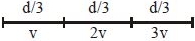
$A$ body moves with velocities $v$,$2v$,and $3v$ in the first,second,and third one-third distances of the path traveled,respectively. Its average speed is:
A
$\left( \frac{6}{11} \right) v$
B
$\left( \frac{12}{11} \right) v$
C
$\left( \frac{18}{11} \right) v$
D
$\left( \frac{36}{11} \right) v$
Solution
(C) Let the total distance be $d$. The path is divided into three equal parts,each of distance $d/3$.
Time taken for the first part: $t_1 = \frac{d/3}{v} = \frac{d}{3v}$.
Time taken for the second part: $t_2 = \frac{d/3}{2v} = \frac{d}{6v}$.
Time taken for the third part: $t_3 = \frac{d/3}{3v} = \frac{d}{9v}$.
Total time $T = t_1 + t_2 + t_3 = \frac{d}{3v} + \frac{d}{6v} + \frac{d}{9v}$.
Taking the common denominator as $18v$: $T = \frac{6d + 3d + 2d}{18v} = \frac{11d}{18v}$.
Average speed = $\frac{\text{Total distance}}{\text{Total time}} = \frac{d}{11d / 18v} = \frac{18v}{11}$.
Time taken for the first part: $t_1 = \frac{d/3}{v} = \frac{d}{3v}$.
Time taken for the second part: $t_2 = \frac{d/3}{2v} = \frac{d}{6v}$.
Time taken for the third part: $t_3 = \frac{d/3}{3v} = \frac{d}{9v}$.
Total time $T = t_1 + t_2 + t_3 = \frac{d}{3v} + \frac{d}{6v} + \frac{d}{9v}$.
Taking the common denominator as $18v$: $T = \frac{6d + 3d + 2d}{18v} = \frac{11d}{18v}$.
Average speed = $\frac{\text{Total distance}}{\text{Total time}} = \frac{d}{11d / 18v} = \frac{18v}{11}$.
0 likes
View Solution33
MediumMCQ
$A$ body covers the first one-third of the distance with a velocity of $20 \, m/s$,the second one-third with a velocity of $30 \, m/s$,and the last one-third with a velocity of $40 \, m/s$. The average velocity is nearly........$m/s$.
A
$28$
B
$38$
C
$18$
D
$8$
Solution
(A) Let the total distance be $3d$. The distance for each part is $d$.
The time taken for the first part is $t_1 = \frac{d}{20}$.
The time taken for the second part is $t_2 = \frac{d}{30}$.
The time taken for the third part is $t_3 = \frac{d}{40}$.
The average velocity $v_{avg}$ is given by the total distance divided by the total time:
$v_{avg} = \frac{3d}{t_1 + t_2 + t_3} = \frac{3d}{\frac{d}{20} + \frac{d}{30} + \frac{d}{40}}$
$v_{avg} = \frac{3}{\frac{1}{20} + \frac{1}{30} + \frac{1}{40}}$
Taking the least common multiple of $20, 30, 40$,which is $120$:
$v_{avg} = \frac{3}{\frac{6 + 4 + 3}{120}} = \frac{3 \times 120}{13} = \frac{360}{13}$
$v_{avg} \approx 27.69 \, m/s \approx 28 \, m/s$.
The time taken for the first part is $t_1 = \frac{d}{20}$.
The time taken for the second part is $t_2 = \frac{d}{30}$.
The time taken for the third part is $t_3 = \frac{d}{40}$.
The average velocity $v_{avg}$ is given by the total distance divided by the total time:
$v_{avg} = \frac{3d}{t_1 + t_2 + t_3} = \frac{3d}{\frac{d}{20} + \frac{d}{30} + \frac{d}{40}}$
$v_{avg} = \frac{3}{\frac{1}{20} + \frac{1}{30} + \frac{1}{40}}$
Taking the least common multiple of $20, 30, 40$,which is $120$:
$v_{avg} = \frac{3}{\frac{6 + 4 + 3}{120}} = \frac{3 \times 120}{13} = \frac{360}{13}$
$v_{avg} \approx 27.69 \, m/s \approx 28 \, m/s$.
0 likes
View Solution34
MediumMCQ
The position of an object moving along the $x$-axis is given by $x = a + b t^2$,where $a = 8.5 \; m$,$b = 2.5 \; m s^{-2}$,and $t$ is measured in seconds. What is the average velocity between $t = 2.0 \; s$ and $t = 4.0 \; s$ (in $; m s^{-1}$)?
A
$20$
B
$10$
C
$25$
D
$15$
Solution
(D) The average velocity is defined as the change in position divided by the change in time: $v_{avg} = \frac{x(t_2) - x(t_1)}{t_2 - t_1}$.
Given $x(t) = a + b t^2$,we calculate the positions at $t_1 = 2.0 \; s$ and $t_2 = 4.0 \; s$.
$x(2.0) = a + b(2.0)^2 = a + 4b$.
$x(4.0) = a + b(4.0)^2 = a + 16b$.
Now,substitute these into the average velocity formula:
$v_{avg} = \frac{(a + 16b) - (a + 4b)}{4.0 - 2.0} = \frac{12b}{2.0} = 6b$.
Given $b = 2.5 \; m s^{-2}$,we have:
$v_{avg} = 6 \times 2.5 = 15 \; m s^{-1}$.
Given $x(t) = a + b t^2$,we calculate the positions at $t_1 = 2.0 \; s$ and $t_2 = 4.0 \; s$.
$x(2.0) = a + b(2.0)^2 = a + 4b$.
$x(4.0) = a + b(4.0)^2 = a + 16b$.
Now,substitute these into the average velocity formula:
$v_{avg} = \frac{(a + 16b) - (a + 4b)}{4.0 - 2.0} = \frac{12b}{2.0} = 6b$.
Given $b = 2.5 \; m s^{-2}$,we have:
$v_{avg} = 6 \times 2.5 = 15 \; m s^{-1}$.
0 likes
View Solution35
Medium
Explain clearly, with examples, the distinction between
$(a)$ magnitude of displacement over an interval of time, and the total length of path covered by a particle over the same interval.
$(b)$ magnitude of average velocity over an interval of time, and the average speed over the same interval. [Average speed of a particle over an interval of time is defined as the total path length divided by the time interval].
Show in both $(a)$ and $(b)$ that the second quantity is either greater than or equal to the first. When is the equality sign true? [For simplicity, consider one-dimensional motion only].
$(a)$ magnitude of displacement over an interval of time, and the total length of path covered by a particle over the same interval.
$(b)$ magnitude of average velocity over an interval of time, and the average speed over the same interval. [Average speed of a particle over an interval of time is defined as the total path length divided by the time interval].
Show in both $(a)$ and $(b)$ that the second quantity is either greater than or equal to the first. When is the equality sign true? [For simplicity, consider one-dimensional motion only].
Solution
(N/A) The magnitude of displacement over an interval of time is the shortest distance (a straight line) between the initial and final positions of the particle.
The total path length of a particle is the actual distance covered by the particle in a given interval of time.
For example, consider a particle moving from point $A$ to point $B$ and then returning to point $C$, taking a total time $t$. As shown in the figure, the magnitude of displacement is $AC$, whereas the total path length is $AB + BC$.
Note that the magnitude of displacement can never be greater than the total path length. However, in cases where the particle moves in a single direction without turning back, both quantities are equal.
$(b)$ Magnitude of average velocity = $\frac{\text{Magnitude of displacement}}{\text{Time interval}}$
For the given particle, Average velocity = $\frac{AC}{t}$.
Average speed = $\frac{\text{Total path length}}{\text{Time interval}} = \frac{AB + BC}{t}$.
Since $(AB + BC) > AC$, the average speed is greater than the magnitude of average velocity. The two quantities are equal if the particle continues to move along a straight line in the same direction.
The total path length of a particle is the actual distance covered by the particle in a given interval of time.
For example, consider a particle moving from point $A$ to point $B$ and then returning to point $C$, taking a total time $t$. As shown in the figure, the magnitude of displacement is $AC$, whereas the total path length is $AB + BC$.
Note that the magnitude of displacement can never be greater than the total path length. However, in cases where the particle moves in a single direction without turning back, both quantities are equal.
$(b)$ Magnitude of average velocity = $\frac{\text{Magnitude of displacement}}{\text{Time interval}}$
For the given particle, Average velocity = $\frac{AC}{t}$.
Average speed = $\frac{\text{Total path length}}{\text{Time interval}} = \frac{AB + BC}{t}$.
Since $(AB + BC) > AC$, the average speed is greater than the magnitude of average velocity. The two quantities are equal if the particle continues to move along a straight line in the same direction.

0 likes
View Solution36
EasyMCQ
$A$ man walks on a straight road from his home to a market $2.5 \; km$ away with a speed of $5 \; km \; h^{-1}$. Finding the market closed,he instantly turns and walks back home with a speed of $7.5 \; km \; h^{-1}$. What is the magnitude of average velocity in $m/s$?
A
$10$
B
$20$
C
$35$
D
$0$
Solution
(D) Average velocity is defined as the total displacement divided by the total time taken.
Displacement is the shortest distance between the initial and final positions.
In this case,the man starts from his home and returns to his home after visiting the market.
Since the initial position (home) and the final position (home) are the same,the total displacement is $0 \; km$.
Therefore,Average velocity $= \frac{\text{Total Displacement}}{\text{Total Time}} = \frac{0 \; km}{\text{Total Time}} = 0 \; m/s$.
Displacement is the shortest distance between the initial and final positions.
In this case,the man starts from his home and returns to his home after visiting the market.
Since the initial position (home) and the final position (home) are the same,the total displacement is $0 \; km$.
Therefore,Average velocity $= \frac{\text{Total Displacement}}{\text{Total Time}} = \frac{0 \; km}{\text{Total Time}} = 0 \; m/s$.
0 likes
View Solution37
EasyMCQ
$A$ man walks on a straight road from his home to a market $2.5 \; km$ away with a speed of $5 \; km \; h^{-1}$. Finding the market closed,he instantly turns and walks back home with a speed of $7.5 \; km \; h^{-1}$. What is the average speed of the man over the interval of time $0$ to $30 \; min$?
A
$5 \; km \; h^{-1}$
B
$7.5 \; km \; h^{-1}$
C
$2.5 \; km \; h^{-1}$
D
$10 \; km \; h^{-1}$
Solution
(A) The time taken to reach the market is $t_1 = \frac{\text{distance}}{\text{speed}} = \frac{2.5 \; km}{5 \; km \; h^{-1}} = 0.5 \; h = 30 \; min$.
Since the time interval requested is $0$ to $30 \; min$,we only consider the motion from home to the market.
During this interval,the total distance covered is $2.5 \; km$.
The total time taken is $30 \; min = 0.5 \; h$.
Average speed is defined as $\frac{\text{Total distance}}{\text{Total time}}$.
Average speed $= \frac{2.5 \; km}{0.5 \; h} = 5 \; km \; h^{-1}$.
Since the time interval requested is $0$ to $30 \; min$,we only consider the motion from home to the market.
During this interval,the total distance covered is $2.5 \; km$.
The total time taken is $30 \; min = 0.5 \; h$.
Average speed is defined as $\frac{\text{Total distance}}{\text{Total time}}$.
Average speed $= \frac{2.5 \; km}{0.5 \; h} = 5 \; km \; h^{-1}$.
0 likes
View Solution38
MediumMCQ
$A$ man walks on a straight road from his home to a market $2.5 \; km$ away with a speed of $5 \; km \; h^{-1}$. Finding the market closed,he instantly turns and walks back home with a speed of $7.5 \; km \; h^{-1}$. What is the average speed (in $km/h$) of the man over the interval of time $0$ to $50 \; min$?
A
$4$
B
$6$
C
$0$
D
$10$
Solution
(B) Time taken to reach the market: $t_{1} = \frac{2.5 \; km}{5 \; km/h} = 0.5 \; h = 30 \; min$.
Time taken to return home: $t_{2} = \frac{2.5 \; km}{7.5 \; km/h} = \frac{1}{3} \; h \approx 20 \; min$.
Total time taken for the round trip: $t_{total} = 30 \; min + 20 \; min = 50 \; min = \frac{50}{60} \; h = \frac{5}{6} \; h$.
Total distance traveled: $d_{total} = 2.5 \; km + 2.5 \; km = 5 \; km$.
Average speed is defined as the total distance traveled divided by the total time taken.
Average speed $= \frac{\text{Total distance}}{\text{Total time}} = \frac{5 \; km}{5/6 \; h} = 5 \times \frac{6}{5} \; km/h = 6 \; km/h$.
Time taken to return home: $t_{2} = \frac{2.5 \; km}{7.5 \; km/h} = \frac{1}{3} \; h \approx 20 \; min$.
Total time taken for the round trip: $t_{total} = 30 \; min + 20 \; min = 50 \; min = \frac{50}{60} \; h = \frac{5}{6} \; h$.
Total distance traveled: $d_{total} = 2.5 \; km + 2.5 \; km = 5 \; km$.
Average speed is defined as the total distance traveled divided by the total time taken.
Average speed $= \frac{\text{Total distance}}{\text{Total time}} = \frac{5 \; km}{5/6 \; h} = 5 \times \frac{6}{5} \; km/h = 6 \; km/h$.
0 likes
View Solution39
Medium
Explain average velocity and average speed.
Solution
(N/A) When an object is in motion,its position changes with time. The rate at which it changes its position can be found in two ways.
If we only consider the time rate of change of distance,it is speed. If we consider the time rate of change of position with direction,it is velocity.
Speed: The distance covered by an object in unit time is called speed.
Average speed: The ratio of the total distance covered during a journey to the total time taken is called average speed.
Its $SI$ unit is $m s^{-1}$ and it is a scalar quantity. Hence,its value is always positive.
Velocity: The displacement covered in unit time is called velocity. It is a vector quantity.
Average velocity is defined as the change in position or displacement $(\Delta x)$ divided by the time interval $(\Delta t)$ in which the displacement occurs:
$\bar{v} = \frac{x_{2} - x_{1}}{t_{2} - t_{1}} = \frac{\Delta x}{\Delta t}$
where $x_{2}$ and $x_{1}$ are the positions of the object at times $t_{2}$ and $t_{1}$ respectively. The $SI$ unit for velocity is $m s^{-1}$,although $km h^{-1}$ is used in many everyday applications.
For motion in a straight line,the directional aspect of the vector can be represented by '$+$' and '$-$' signs,and we do not have to use vector notation for velocity.
The magnitude of average velocity can be positive,negative,or zero.
Average speed is always greater than or equal to the magnitude of average velocity. For uniform motion,velocity is equal to average velocity at every moment.
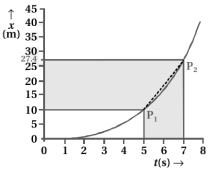
The figure shows the $x-t$ graph for the motion of a car,where the portion between $t = 5 \ s$ and $t = 7 \ s$ is highlighted to calculate average velocity.
If we only consider the time rate of change of distance,it is speed. If we consider the time rate of change of position with direction,it is velocity.
Speed: The distance covered by an object in unit time is called speed.
Average speed: The ratio of the total distance covered during a journey to the total time taken is called average speed.
Its $SI$ unit is $m s^{-1}$ and it is a scalar quantity. Hence,its value is always positive.
Velocity: The displacement covered in unit time is called velocity. It is a vector quantity.
Average velocity is defined as the change in position or displacement $(\Delta x)$ divided by the time interval $(\Delta t)$ in which the displacement occurs:
$\bar{v} = \frac{x_{2} - x_{1}}{t_{2} - t_{1}} = \frac{\Delta x}{\Delta t}$
where $x_{2}$ and $x_{1}$ are the positions of the object at times $t_{2}$ and $t_{1}$ respectively. The $SI$ unit for velocity is $m s^{-1}$,although $km h^{-1}$ is used in many everyday applications.
For motion in a straight line,the directional aspect of the vector can be represented by '$+$' and '$-$' signs,and we do not have to use vector notation for velocity.
The magnitude of average velocity can be positive,negative,or zero.
Average speed is always greater than or equal to the magnitude of average velocity. For uniform motion,velocity is equal to average velocity at every moment.
The figure shows the $x-t$ graph for the motion of a car,where the portion between $t = 5 \ s$ and $t = 7 \ s$ is highlighted to calculate average velocity.
0 likes
View Solution40
MediumMCQ
Which information cannot be drawn from average velocity?
A
The total displacement of the object.
B
The total time taken for the motion.
C
The actual path or distance covered by the object.
D
The average rate of change of position.
Solution
(C) Average velocity is defined as the ratio of total displacement to total time taken $(v_{avg} = \frac{\Delta x}{\Delta t})$.
$1$. It does not provide information about the actual distance covered by the object,as distance depends on the path taken,whereas displacement only depends on the initial and final positions.
$2$. It does not describe the specific path of motion taken by the object between the initial and final points.
$3$. It does not provide information about the instantaneous velocities of the object at different positions along the path.
$1$. It does not provide information about the actual distance covered by the object,as distance depends on the path taken,whereas displacement only depends on the initial and final positions.
$2$. It does not describe the specific path of motion taken by the object between the initial and final points.
$3$. It does not provide information about the instantaneous velocities of the object at different positions along the path.
0 likes
View Solution41
Medium
"The magnitude of average velocity is equal to average speed". This statement is not always correct and not always incorrect. Explain with an example.
Solution
(N/A) Consider a car moving along a straight line as shown in the figure. Let the car move from $O$ to $P$ in $18 \, s$ and then return from $P$ to $Q$ in $6 \, s$.
Case $1$: Motion from $O$ to $P$
Total distance = $OP = 360 \, m$
Total displacement = $360 \, m - 0 \, m = 360 \, m$
Time taken = $18 \, s$
Average speed = $\frac{\text{Total distance}}{\text{Total time}} = \frac{360}{18} = 20 \, ms^{-1}$
Average velocity = $\frac{\text{Total displacement}}{\text{Total time}} = \frac{360}{18} = 20 \, ms^{-1}$
Here, the magnitude of average velocity is equal to the average speed.
Case $2$: Motion from $O$ to $P$ and then to $Q$
Total distance = $OP + PQ = 360 + (360 - 240) = 360 + 120 = 480 \, m$
Total displacement = $OQ = 240 \, m - 0 \, m = 240 \, m$
Total time = $18 \, s + 6 \, s = 24 \, s$
Average speed = $\frac{480}{24} = 20 \, ms^{-1}$
Average velocity = $\frac{240}{24} = 10 \, ms^{-1}$
Here, the magnitude of average velocity $(10 \, ms^{-1})$ is not equal to the average speed $(20 \, ms^{-1})$.
Thus, the statement is not always correct and not always incorrect.
Case $1$: Motion from $O$ to $P$
Total distance = $OP = 360 \, m$
Total displacement = $360 \, m - 0 \, m = 360 \, m$
Time taken = $18 \, s$
Average speed = $\frac{\text{Total distance}}{\text{Total time}} = \frac{360}{18} = 20 \, ms^{-1}$
Average velocity = $\frac{\text{Total displacement}}{\text{Total time}} = \frac{360}{18} = 20 \, ms^{-1}$
Here, the magnitude of average velocity is equal to the average speed.
Case $2$: Motion from $O$ to $P$ and then to $Q$
Total distance = $OP + PQ = 360 + (360 - 240) = 360 + 120 = 480 \, m$
Total displacement = $OQ = 240 \, m - 0 \, m = 240 \, m$
Total time = $18 \, s + 6 \, s = 24 \, s$
Average speed = $\frac{480}{24} = 20 \, ms^{-1}$
Average velocity = $\frac{240}{24} = 10 \, ms^{-1}$
Here, the magnitude of average velocity $(10 \, ms^{-1})$ is not equal to the average speed $(20 \, ms^{-1})$.
Thus, the statement is not always correct and not always incorrect.

0 likes
View Solution42
Difficult
Give the difference between average speed and average velocity.
Solution
(N/A)
| Average Speed | Average Velocity |
|---|---|
| $(1)$ The ratio of total path length covered to the total time taken is called average speed. | $(1)$ The ratio of total displacement to the total time taken is called average velocity. |
| $(2)$ It is a scalar quantity. | $(2)$ It is a vector quantity. |
| $(3)$ It is always positive for a moving object. | $(3)$ It may be positive,negative,or zero depending on the direction of displacement. |
| $(4)$ Average speed $\geq$ Magnitude of average velocity. | $(4)$ Average velocity $\leq$ Average speed. |
0 likes
View Solution43
Medium
Define speed. Define average speed.
Solution
(N/A) Speed: The distance covered by an object in unit time is called speed. It is defined as the rate of change of distance.
Average speed: The ratio of the total distance covered during a journey to the total time taken is called average speed.
Mathematically,$\text{Average Speed} = \frac{\text{Total Distance}}{\text{Total Time}}$.
The $SI$ unit of speed is $m/s$ $(ms^{-1})$,and it is a scalar quantity. Therefore,its value is always positive.
Average speed: The ratio of the total distance covered during a journey to the total time taken is called average speed.
Mathematically,$\text{Average Speed} = \frac{\text{Total Distance}}{\text{Total Time}}$.
The $SI$ unit of speed is $m/s$ $(ms^{-1})$,and it is a scalar quantity. Therefore,its value is always positive.
1 likes
View Solution44
Medium
Define velocity. Define average velocity.
Solution
(N/A) Velocity: The rate of change of displacement of an object with respect to time is called velocity. It is a vector quantity,meaning it has both magnitude and direction. The $SI$ unit of velocity is $m/s$.
Average velocity: The average velocity of an object is defined as the total displacement divided by the total time interval taken to cover that displacement. Mathematically,$v_{avg} = \frac{\Delta x}{\Delta t}$,where $\Delta x$ is the total displacement and $\Delta t$ is the total time interval.
Average velocity: The average velocity of an object is defined as the total displacement divided by the total time interval taken to cover that displacement. Mathematically,$v_{avg} = \frac{\Delta x}{\Delta t}$,where $\Delta x$ is the total displacement and $\Delta t$ is the total time interval.
0 likes
View Solution45
Medium
Write the relation between speed and the magnitude of velocity.
Solution
(N/A) The speed of an object is defined as the total distance traveled divided by the total time taken,while the magnitude of velocity is defined as the magnitude of the displacement divided by the total time taken.
Since the distance traveled is always greater than or equal to the magnitude of the displacement $(Distance \ge |Displacement|)$,it follows that the speed is always greater than or equal to the magnitude of the velocity.
Mathematically,this is expressed as: $\text{Speed} \ge |\text{Velocity}|$.
Equality holds true only when the object moves in a straight line without changing its direction.
Since the distance traveled is always greater than or equal to the magnitude of the displacement $(Distance \ge |Displacement|)$,it follows that the speed is always greater than or equal to the magnitude of the velocity.
Mathematically,this is expressed as: $\text{Speed} \ge |\text{Velocity}|$.
Equality holds true only when the object moves in a straight line without changing its direction.
0 likes
View Solution46
MediumMCQ
Which among average speed and average velocity can be positive,negative or zero?
A
Average speed
B
Average velocity
C
Both
D
None
Solution
(B) Average speed is defined as the total distance traveled divided by the total time taken. Since distance is a scalar quantity and is always non-negative,average speed is always non-negative.
Average velocity is defined as the total displacement divided by the total time taken. Displacement is a vector quantity and can be positive,negative,or zero depending on the direction of motion and the final position relative to the initial position.
Therefore,average velocity can be positive,negative,or zero.
Average velocity is defined as the total displacement divided by the total time taken. Displacement is a vector quantity and can be positive,negative,or zero depending on the direction of motion and the final position relative to the initial position.
Therefore,average velocity can be positive,negative,or zero.
0 likes
View Solution47
EasyMCQ
Is the average of different speeds called average speed? Do you agree?
A
Yes
B
No
C
Sometimes
D
Depends on the motion
Solution
(B) No,we do not agree.
Average speed is defined as the total distance traveled divided by the total time taken.
It is not simply the arithmetic mean of different speeds.
For example,if an object travels a distance $d_1$ with speed $v_1$ and distance $d_2$ with speed $v_2$,the average speed is $\frac{d_1 + d_2}{t_1 + t_2} = \frac{d_1 + d_2}{\frac{d_1}{v_1} + \frac{d_2}{v_2}}$,which is the harmonic mean of speeds if distances are equal,not the arithmetic mean.
Average speed is defined as the total distance traveled divided by the total time taken.
It is not simply the arithmetic mean of different speeds.
For example,if an object travels a distance $d_1$ with speed $v_1$ and distance $d_2$ with speed $v_2$,the average speed is $\frac{d_1 + d_2}{t_1 + t_2} = \frac{d_1 + d_2}{\frac{d_1}{v_1} + \frac{d_2}{v_2}}$,which is the harmonic mean of speeds if distances are equal,not the arithmetic mean.
0 likes
View Solution48
EasyMCQ
Is it possible for a moving object to have a constant velocity and a changing speed?
A
Yes
B
No
C
Only in circular motion
D
Only in linear motion
Solution
(B) No,it is not possible.
Velocity is defined as a vector quantity that includes both speed and direction.
If the velocity of an object is constant,both its magnitude (speed) and its direction must remain unchanged.
Therefore,if the velocity is constant,the speed cannot change.
Velocity is defined as a vector quantity that includes both speed and direction.
If the velocity of an object is constant,both its magnitude (speed) and its direction must remain unchanged.
Therefore,if the velocity is constant,the speed cannot change.
0 likes
View Solution49
EasyMCQ
Is the statement "$A$ particle can have zero speed but non-zero velocity" true or false? Explain.
A
True
B
False
C
Depends on the frame of reference
D
None of the above
Solution
(B) The statement is $False$.
Speed is defined as the magnitude of velocity $(v = |\vec{v}|)$.
If the speed is zero, it implies that the magnitude of the velocity vector is zero, which means the velocity must be zero $(\vec{v} = 0)$.
Therefore, it is impossible for a particle to have zero speed and non-zero velocity simultaneously.
Speed is defined as the magnitude of velocity $(v = |\vec{v}|)$.
If the speed is zero, it implies that the magnitude of the velocity vector is zero, which means the velocity must be zero $(\vec{v} = 0)$.
Therefore, it is impossible for a particle to have zero speed and non-zero velocity simultaneously.
0 likes
View SolutionMotion in Straight Line — Average Velocity and Average Speed · Frequently Asked Questions
1Are these Motion in Straight Line questions useful for JEE and NEET?
Yes. All questions in this section are mapped to JEE Main and NEET exam patterns. Previous year questions from JEE Main, NEET, GUJCET and state-level exams are included with full solutions.
2Can I switch to Hindi or Gujarati for these questions?
Yes. Use the language tabs in the hero section or the sidebar to view the same questions and solutions in English, Hindi or Gujarati.
3How do I generate a question paper from this subtopic?
Use the Vedclass Exam Paper Generator — select the chapter and subtopic, set difficulty, and generate Sets A, B, C, D automatically. First 3 chapters of every subject are free.
Vedclass Products
For Students
Vedclass Test Series
Mock tests in real JEE/NEET style with performance analysis. 5-day free trial.
Start Free TrialFor Teachers
Exam Paper Generator
Generate Set A/B/C/D papers from this chapter in 2 minutes. 3 chapters free.
Try FreeFor Institutes
Online Exam Module
Live online exams with unlimited students, 360° analytics & white-label branding.
See DemoFor Teachers & Institutes
Generate a Motion in Straight Line Exam Paper in 2 Minutes
Select subtopic & difficulty — Sets A, B, C, D auto-generated with No Repeat logic.
First 3 chapters of every subject are free — no payment required.