
A English
Average Velocity and Average Speed Questions in English
Class 11 Physics · Motion in Straight Line · Average Velocity and Average Speed
81+
Questions
English
Language
100%
With Solutions
Showing 30 of 81 questions in English
51
EasyMCQ
Why can the speed of a moving object never be negative?
A
Speed is a vector quantity.
B
Speed is defined as the total distance traveled divided by time,and distance is always positive.
C
Speed depends on displacement,which can be negative.
D
Speed is always equal to velocity.
Solution
(B) Speed is defined as the total distance traveled by an object per unit time interval.
Distance is a scalar quantity that represents the total path length covered by an object,and it is always non-negative (i.e.,distance $\ge 0$).
Since time is also a positive scalar quantity,the ratio of distance to time (speed) must always be non-negative.
Therefore,the speed of a moving object can never be negative.
Distance is a scalar quantity that represents the total path length covered by an object,and it is always non-negative (i.e.,distance $\ge 0$).
Since time is also a positive scalar quantity,the ratio of distance to time (speed) must always be non-negative.
Therefore,the speed of a moving object can never be negative.
0 likes
View Solution52
Medium
Distinguish between uniform velocity and non-uniform (variable) velocity.
Solution
(N/A) Uniform velocity: $A$ body is said to have uniform velocity if it covers equal displacements in equal intervals of time,regardless of how small these time intervals may be.
Non-uniform (variable) velocity: $A$ body is said to have non-uniform velocity if it covers unequal displacements in equal intervals of time,or if its direction of motion changes.
Non-uniform (variable) velocity: $A$ body is said to have non-uniform velocity if it covers unequal displacements in equal intervals of time,or if its direction of motion changes.
0 likes
View Solution53
MediumMCQ
$A$ car travels from point $A$ to point $B$ with a speed of $40 \ km/h$ and returns from $B$ to $A$ with a speed of $60 \ km/h$. What is the average speed of the car for the entire journey (in $km/h$)?
A
$48$
B
$50$
C
$52$
D
$55$
Solution
(A) Let the distance between point $A$ and point $B$ be $d$.
Time taken to travel from $A$ to $B$ is $t_1 = \frac{d}{v_1} = \frac{d}{40}$.
Time taken to travel from $B$ to $A$ is $t_2 = \frac{d}{v_2} = \frac{d}{60}$.
Total distance covered = $d + d = 2d$.
Total time taken = $t_1 + t_2 = \frac{d}{40} + \frac{d}{60} = \frac{3d + 2d}{120} = \frac{5d}{120} = \frac{d}{24}$.
Average speed = $\frac{\text{Total distance}}{\text{Total time}} = \frac{2d}{d/24} = 2 \times 24 = 48 \ km/h$.
Time taken to travel from $A$ to $B$ is $t_1 = \frac{d}{v_1} = \frac{d}{40}$.
Time taken to travel from $B$ to $A$ is $t_2 = \frac{d}{v_2} = \frac{d}{60}$.
Total distance covered = $d + d = 2d$.
Total time taken = $t_1 + t_2 = \frac{d}{40} + \frac{d}{60} = \frac{3d + 2d}{120} = \frac{5d}{120} = \frac{d}{24}$.
Average speed = $\frac{\text{Total distance}}{\text{Total time}} = \frac{2d}{d/24} = 2 \times 24 = 48 \ km/h$.
0 likes
View Solution54
MediumMCQ
$A$ car covers distance $AB$ with the first one-third at velocity $v_{1} \, ms^{-1}$,the second one-third at $v_{2} \, ms^{-1}$,and the last one-third at $v_{3} \, ms^{-1}$. If $v_{3}=3v_{1}$,$v_{2}=2v_{1}$,and $v_{1}=11 \, ms^{-1}$,then the average velocity of the car is . . . . . . $ms^{-1}$.
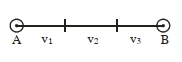
A
$17$
B
$16$
C
$20$
D
$18$
Solution
(D) Let the total distance $AB$ be $d$.
Each segment covers a distance of $\frac{d}{3}$.
The time taken for each segment is $t_{1} = \frac{d/3}{v_{1}}$,$t_{2} = \frac{d/3}{v_{2}}$,and $t_{3} = \frac{d/3}{v_{3}}$.
The average velocity $v_{avg}$ is given by:
$v_{avg} = \frac{\text{Total Distance}}{\text{Total Time}} = \frac{d}{t_{1} + t_{2} + t_{3}} = \frac{d}{\frac{d}{3v_{1}} + \frac{d}{3v_{2}} + \frac{d}{3v_{3}}}$
$v_{avg} = \frac{3}{\frac{1}{v_{1}} + \frac{1}{v_{2}} + \frac{1}{v_{3}}}$
Given $v_{1} = 11 \, ms^{-1}$,$v_{2} = 2v_{1} = 22 \, ms^{-1}$,and $v_{3} = 3v_{1} = 33 \, ms^{-1}$.
Substituting these values:
$v_{avg} = \frac{3}{\frac{1}{11} + \frac{1}{22} + \frac{1}{33}} = \frac{3}{\frac{6+3+2}{66}} = \frac{3 \times 66}{11} = 3 \times 6 = 18 \, ms^{-1}$.
Each segment covers a distance of $\frac{d}{3}$.
The time taken for each segment is $t_{1} = \frac{d/3}{v_{1}}$,$t_{2} = \frac{d/3}{v_{2}}$,and $t_{3} = \frac{d/3}{v_{3}}$.
The average velocity $v_{avg}$ is given by:
$v_{avg} = \frac{\text{Total Distance}}{\text{Total Time}} = \frac{d}{t_{1} + t_{2} + t_{3}} = \frac{d}{\frac{d}{3v_{1}} + \frac{d}{3v_{2}} + \frac{d}{3v_{3}}}$
$v_{avg} = \frac{3}{\frac{1}{v_{1}} + \frac{1}{v_{2}} + \frac{1}{v_{3}}}$
Given $v_{1} = 11 \, ms^{-1}$,$v_{2} = 2v_{1} = 22 \, ms^{-1}$,and $v_{3} = 3v_{1} = 33 \, ms^{-1}$.
Substituting these values:
$v_{avg} = \frac{3}{\frac{1}{11} + \frac{1}{22} + \frac{1}{33}} = \frac{3}{\frac{6+3+2}{66}} = \frac{3 \times 66}{11} = 3 \times 6 = 18 \, ms^{-1}$.
0 likes
View Solution55
MediumMCQ
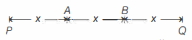
$A$ person goes from point $P$ to point $Q$ covering $1/3$ of the distance with speed $10 \, km/h$,the next $1/3$ of the distance at $20 \, km/h$,and the last $1/3$ of the distance at $60 \, km/h$. The average speed of the person is ............ $km/h$.
A
$30$
B
$24$
C
$18$
D
$12$
Solution
(C) Let the total distance between $P$ and $Q$ be $3x \, km$.
The distance is divided into three equal parts,each of length $x \, km$.
For the first part,the speed is $v_1 = 10 \, km/h$. The time taken is $t_1 = \frac{x}{10} \, h$.
For the second part,the speed is $v_2 = 20 \, km/h$. The time taken is $t_2 = \frac{x}{20} \, h$.
For the third part,the speed is $v_3 = 60 \, km/h$. The time taken is $t_3 = \frac{x}{60} \, h$.
The average speed is defined as the total distance divided by the total time taken:
$\text{Average Speed} = \frac{\text{Total Distance}}{\text{Total Time}} = \frac{3x}{t_1 + t_2 + t_3}$
Substituting the values:
$\text{Average Speed} = \frac{3x}{\frac{x}{10} + \frac{x}{20} + \frac{x}{60}}$
Taking the common denominator $(60)$:
$\text{Average Speed} = \frac{3x}{\frac{6x + 3x + x}{60}} = \frac{3x}{\frac{10x}{60}} = \frac{3x \times 60}{10x} = 18 \, km/h$.
The distance is divided into three equal parts,each of length $x \, km$.
For the first part,the speed is $v_1 = 10 \, km/h$. The time taken is $t_1 = \frac{x}{10} \, h$.
For the second part,the speed is $v_2 = 20 \, km/h$. The time taken is $t_2 = \frac{x}{20} \, h$.
For the third part,the speed is $v_3 = 60 \, km/h$. The time taken is $t_3 = \frac{x}{60} \, h$.
The average speed is defined as the total distance divided by the total time taken:
$\text{Average Speed} = \frac{\text{Total Distance}}{\text{Total Time}} = \frac{3x}{t_1 + t_2 + t_3}$
Substituting the values:
$\text{Average Speed} = \frac{3x}{\frac{x}{10} + \frac{x}{20} + \frac{x}{60}}$
Taking the common denominator $(60)$:
$\text{Average Speed} = \frac{3x}{\frac{6x + 3x + x}{60}} = \frac{3x}{\frac{10x}{60}} = \frac{3x \times 60}{10x} = 18 \, km/h$.
0 likes
View Solution56
EasyMCQ
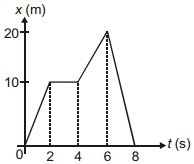
The position $(x)$-time $(t)$ graph for a particle moving along a straight line is shown in the figure. The average speed of the particle in the time interval $t=0$ to $t=8 \, s$ is .......... $m/s$.
A
$0$
B
$5$
C
$7.5$
D
$9.7$
Solution
(B) Average speed is defined as the total distance traveled divided by the total time taken.
From the graph,the particle moves from $x=0$ to $x=10$ in the interval $t=0$ to $t=2 \, s$ (distance = $10 \, m$).
From $t=2 \, s$ to $t=4 \, s$,the particle is at rest (distance = $0 \, m$).
From $t=4 \, s$ to $t=6 \, s$,the particle moves from $x=10$ to $x=20$ (distance = $10 \, m$).
From $t=6 \, s$ to $t=8 \, s$,the particle moves from $x=20$ to $x=0$ (distance = $20 \, m$).
Total distance = $10 + 0 + 10 + 20 = 40 \, m$.
Total time = $8 \, s$.
Average speed = $\frac{\text{Total distance}}{\text{Total time}} = \frac{40}{8} = 5 \, m/s$.
From the graph,the particle moves from $x=0$ to $x=10$ in the interval $t=0$ to $t=2 \, s$ (distance = $10 \, m$).
From $t=2 \, s$ to $t=4 \, s$,the particle is at rest (distance = $0 \, m$).
From $t=4 \, s$ to $t=6 \, s$,the particle moves from $x=10$ to $x=20$ (distance = $10 \, m$).
From $t=6 \, s$ to $t=8 \, s$,the particle moves from $x=20$ to $x=0$ (distance = $20 \, m$).
Total distance = $10 + 0 + 10 + 20 = 40 \, m$.
Total time = $8 \, s$.
Average speed = $\frac{\text{Total distance}}{\text{Total time}} = \frac{40}{8} = 5 \, m/s$.
0 likes
View Solution57
MediumMCQ
If the average velocity of a particle moving on a straight line is zero in a time interval,then:
A
Acceleration of the particle may be zero.
B
Velocity of the particle must be zero at an instant.
C
Velocity of the particle may be never zero in the interval.
D
Average speed of the particle may be zero in the interval.
Solution
(B) The average velocity is defined as $\text{Average Velocity} = \frac{\text{Total Displacement}}{\text{Total Time}}$.
If the average velocity is $0$,then the total displacement must be $0$.
For a particle moving in a straight line to have a displacement of $0$,it must return to its starting position.
To return to the starting position,the particle must change its direction of motion at some point.
At the instant the particle changes its direction,its velocity must be $0$ (assuming continuous motion).
Therefore,the velocity of the particle must be zero at at least one instant in the interval.
If the average velocity is $0$,then the total displacement must be $0$.
For a particle moving in a straight line to have a displacement of $0$,it must return to its starting position.
To return to the starting position,the particle must change its direction of motion at some point.
At the instant the particle changes its direction,its velocity must be $0$ (assuming continuous motion).
Therefore,the velocity of the particle must be zero at at least one instant in the interval.
0 likes
View Solution58
MediumMCQ
$A$ particle travels half of the distance of a straight journey with a speed $6 \,m/s$. The remaining part of the distance is covered with speed $2 \,m/s$ for half of the time of the remaining journey and with speed $4 \,m/s$ for the other half of the time. The average speed of the particle is ....... $m/s$.
A
$3$
B
$4$
C
$3/4$
D
$5$
Solution
(B) Let the total distance be $2d$. The first half distance $d$ is covered with speed $v_1 = 6 \,m/s$.
The remaining distance $d$ is covered in two parts,each for time $t$. Let the speeds be $v_2 = 2 \,m/s$ and $v_3 = 4 \,m/s$.
For the second half of the journey,the average speed $v'$ is the arithmetic mean of the speeds because the time intervals are equal:
$v' = \frac{v_2 + v_3}{2} = \frac{2 + 4}{2} = 3 \,m/s$.
Now,the total journey consists of two equal distances $d$ covered with speeds $v_1 = 6 \,m/s$ and $v' = 3 \,m/s$. The average speed for equal distances is given by the harmonic mean:
$v_{av} = \frac{2 v_1 v'}{v_1 + v'} = \frac{2 \times 6 \times 3}{6 + 3} = \frac{36}{9} = 4 \,m/s$.
The remaining distance $d$ is covered in two parts,each for time $t$. Let the speeds be $v_2 = 2 \,m/s$ and $v_3 = 4 \,m/s$.
For the second half of the journey,the average speed $v'$ is the arithmetic mean of the speeds because the time intervals are equal:
$v' = \frac{v_2 + v_3}{2} = \frac{2 + 4}{2} = 3 \,m/s$.
Now,the total journey consists of two equal distances $d$ covered with speeds $v_1 = 6 \,m/s$ and $v' = 3 \,m/s$. The average speed for equal distances is given by the harmonic mean:
$v_{av} = \frac{2 v_1 v'}{v_1 + v'} = \frac{2 \times 6 \times 3}{6 + 3} = \frac{36}{9} = 4 \,m/s$.

0 likes
View Solution59
MediumMCQ
$A$ car travels a distance of $x$ with speed $v_1$ and then the same distance $x$ with speed $v_2$ in the same direction. The average speed of the car is
A
$\frac{v_1 v_2}{2(v_1+v_2)}$
B
$\frac{v_1+v_2}{2}$
C
$\frac{2x}{v_1+v_2}$
D
$\frac{2v_1 v_2}{v_1+v_2}$
Solution
(D) The average speed is defined as the ratio of the total distance traveled to the total time taken.
Total distance = $x + x = 2x$.
Time taken for the first half,$t_1 = \frac{x}{v_1}$.
Time taken for the second half,$t_2 = \frac{x}{v_2}$.
Total time = $t_1 + t_2 = \frac{x}{v_1} + \frac{x}{v_2} = x \left( \frac{v_1 + v_2}{v_1 v_2} \right)$.
Average speed = $\frac{\text{Total distance}}{\text{Total time}} = \frac{2x}{x \left( \frac{v_1 + v_2}{v_1 v_2} \right)} = \frac{2v_1 v_2}{v_1 + v_2}$.
Total distance = $x + x = 2x$.
Time taken for the first half,$t_1 = \frac{x}{v_1}$.
Time taken for the second half,$t_2 = \frac{x}{v_2}$.
Total time = $t_1 + t_2 = \frac{x}{v_1} + \frac{x}{v_2} = x \left( \frac{v_1 + v_2}{v_1 v_2} \right)$.
Average speed = $\frac{\text{Total distance}}{\text{Total time}} = \frac{2x}{x \left( \frac{v_1 + v_2}{v_1 v_2} \right)} = \frac{2v_1 v_2}{v_1 + v_2}$.

0 likes
View Solution60
MediumMCQ
$A$ vehicle travels $4\,km$ with a speed of $3\,km/h$ and another $4\,km$ with a speed of $5\,km/h$. What is its average speed in $km/h$?
A
$4.25$
B
$3.50$
C
$4.00$
D
$3.75$
Solution
(D) The average speed is defined as the total distance traveled divided by the total time taken.
Total distance $d_{total} = 4\,km + 4\,km = 8\,km$.
Time taken for the first part $t_1 = \frac{d_1}{v_1} = \frac{4}{3}\,h$.
Time taken for the second part $t_2 = \frac{d_2}{v_2} = \frac{4}{5}\,h$.
Total time $t_{total} = t_1 + t_2 = \frac{4}{3} + \frac{4}{5} = \frac{20 + 12}{15} = \frac{32}{15}\,h$.
Average speed $V_{av} = \frac{d_{total}}{t_{total}} = \frac{8}{32/15} = \frac{8 \times 15}{32} = \frac{15}{4} = 3.75\,km/h$.
Total distance $d_{total} = 4\,km + 4\,km = 8\,km$.
Time taken for the first part $t_1 = \frac{d_1}{v_1} = \frac{4}{3}\,h$.
Time taken for the second part $t_2 = \frac{d_2}{v_2} = \frac{4}{5}\,h$.
Total time $t_{total} = t_1 + t_2 = \frac{4}{3} + \frac{4}{5} = \frac{20 + 12}{15} = \frac{32}{15}\,h$.
Average speed $V_{av} = \frac{d_{total}}{t_{total}} = \frac{8}{32/15} = \frac{8 \times 15}{32} = \frac{15}{4} = 3.75\,km/h$.
0 likes
View Solution61
MediumMCQ
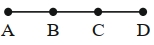
An object moves with speeds $v_1, v_2$,and $v_3$ along line segments $AB, BC$,and $CD$ respectively,as shown in the figure. If $AB = BC$ and $AD = 3 AB$,then the average speed of the object will be:
A
$\frac{(v_1+v_2+v_3)}{3}$
B
$\frac{v_1 v_2 v_3}{3(v_1 v_2+v_2 v_3+v_3 v_1)}$
C
$\frac{3 v_1 v_2 v_3}{v_1 v_2+v_2 v_3+v_3 v_1}$
D
$\frac{(v_1+v_2+v_3)}{3 v_1 v_2 v_3}$
Solution
(C) Let $AB = x$.
Given $AB = BC$,so $BC = x$.
Given $AD = 3 AB$,so $AD = 3x$.
Since $AD = AB + BC + CD$,we have $3x = x + x + CD$,which implies $CD = x$.
The total distance covered is $D_{total} = AB + BC + CD = x + x + x = 3x$.
The total time taken is $T_{total} = t_1 + t_2 + t_3 = \frac{AB}{v_1} + \frac{BC}{v_2} + \frac{CD}{v_3} = \frac{x}{v_1} + \frac{x}{v_2} + \frac{x}{v_3}$.
The average speed is defined as $v_{avg} = \frac{D_{total}}{T_{total}} = \frac{3x}{\frac{x}{v_1} + \frac{x}{v_2} + \frac{x}{v_3}}$.
Simplifying the expression,we get $v_{avg} = \frac{3x}{x(\frac{1}{v_1} + \frac{1}{v_2} + \frac{1}{v_3})} = \frac{3}{\frac{v_2 v_3 + v_1 v_3 + v_1 v_2}{v_1 v_2 v_3}} = \frac{3 v_1 v_2 v_3}{v_1 v_2 + v_2 v_3 + v_3 v_1}$.
Given $AB = BC$,so $BC = x$.
Given $AD = 3 AB$,so $AD = 3x$.
Since $AD = AB + BC + CD$,we have $3x = x + x + CD$,which implies $CD = x$.
The total distance covered is $D_{total} = AB + BC + CD = x + x + x = 3x$.
The total time taken is $T_{total} = t_1 + t_2 + t_3 = \frac{AB}{v_1} + \frac{BC}{v_2} + \frac{CD}{v_3} = \frac{x}{v_1} + \frac{x}{v_2} + \frac{x}{v_3}$.
The average speed is defined as $v_{avg} = \frac{D_{total}}{T_{total}} = \frac{3x}{\frac{x}{v_1} + \frac{x}{v_2} + \frac{x}{v_3}}$.
Simplifying the expression,we get $v_{avg} = \frac{3x}{x(\frac{1}{v_1} + \frac{1}{v_2} + \frac{1}{v_3})} = \frac{3}{\frac{v_2 v_3 + v_1 v_3 + v_1 v_2}{v_1 v_2 v_3}} = \frac{3 v_1 v_2 v_3}{v_1 v_2 + v_2 v_3 + v_3 v_1}$.
0 likes
View Solution62
MediumMCQ
$A$ person travels $x$ distance with velocity $v_1$ and then $x$ distance with velocity $v_2$ in the same direction. The average velocity of the person is $v$. Then the relation between $v, v_1$ and $v_2$ will be:
A
$v = v_1 + v_2$
B
$v = \frac{v_1 + v_2}{2}$
C
$\frac{2}{v} = \frac{1}{v_1} + \frac{1}{v_2}$
D
$\frac{1}{v} = \frac{1}{v_1} + \frac{1}{v_2}$
Solution
(C) The average velocity is defined as the total displacement divided by the total time taken.
Total distance $= x + x = 2x$.
Time taken for the first part of the journey $t_1 = \frac{x}{v_1}$.
Time taken for the second part of the journey $t_2 = \frac{x}{v_2}$.
Total time taken $T = t_1 + t_2 = \frac{x}{v_1} + \frac{x}{v_2} = x \left( \frac{1}{v_1} + \frac{1}{v_2} \right)$.
Average velocity $v = \frac{\text{Total distance}}{\text{Total time}} = \frac{2x}{x \left( \frac{1}{v_1} + \frac{1}{v_2} \right)}$.
Canceling $x$ from the numerator and denominator,we get $v = \frac{2}{\frac{1}{v_1} + \frac{1}{v_2}}$.
Rearranging this gives $\frac{2}{v} = \frac{1}{v_1} + \frac{1}{v_2}$.
Total distance $= x + x = 2x$.
Time taken for the first part of the journey $t_1 = \frac{x}{v_1}$.
Time taken for the second part of the journey $t_2 = \frac{x}{v_2}$.
Total time taken $T = t_1 + t_2 = \frac{x}{v_1} + \frac{x}{v_2} = x \left( \frac{1}{v_1} + \frac{1}{v_2} \right)$.
Average velocity $v = \frac{\text{Total distance}}{\text{Total time}} = \frac{2x}{x \left( \frac{1}{v_1} + \frac{1}{v_2} \right)}$.
Canceling $x$ from the numerator and denominator,we get $v = \frac{2}{\frac{1}{v_1} + \frac{1}{v_2}}$.
Rearranging this gives $\frac{2}{v} = \frac{1}{v_1} + \frac{1}{v_2}$.
0 likes
View Solution63
MediumMCQ
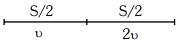
$A$ vehicle travels half the distance with speed $v$ and the remaining distance with speed $2v$. Its average speed is:
A
$\frac{3v}{4}$
B
$\frac{v}{3}$
C
$\frac{2v}{3}$
D
$\frac{4v}{3}$
Solution
(D) Let the total distance be $S$.
The vehicle travels the first half distance $(S/2)$ with speed $v_1 = v$.
The time taken for the first half is $t_1 = \frac{S/2}{v} = \frac{S}{2v}$.
The vehicle travels the remaining half distance $(S/2)$ with speed $v_2 = 2v$.
The time taken for the second half is $t_2 = \frac{S/2}{2v} = \frac{S}{4v}$.
The average speed is defined as the total distance divided by the total time:
$V_{avg} = \frac{\text{Total Distance}}{\text{Total Time}} = \frac{S}{t_1 + t_2}$
$V_{avg} = \frac{S}{\frac{S}{2v} + \frac{S}{4v}} = \frac{S}{\frac{2S + S}{4v}} = \frac{S}{\frac{3S}{4v}}$
$V_{avg} = \frac{4v}{3}$
The vehicle travels the first half distance $(S/2)$ with speed $v_1 = v$.
The time taken for the first half is $t_1 = \frac{S/2}{v} = \frac{S}{2v}$.
The vehicle travels the remaining half distance $(S/2)$ with speed $v_2 = 2v$.
The time taken for the second half is $t_2 = \frac{S/2}{2v} = \frac{S}{4v}$.
The average speed is defined as the total distance divided by the total time:
$V_{avg} = \frac{\text{Total Distance}}{\text{Total Time}} = \frac{S}{t_1 + t_2}$
$V_{avg} = \frac{S}{\frac{S}{2v} + \frac{S}{4v}} = \frac{S}{\frac{2S + S}{4v}} = \frac{S}{\frac{3S}{4v}}$
$V_{avg} = \frac{4v}{3}$
1 likes
View Solution64
MediumMCQ
$A$ person travelling on a straight line moves with a uniform velocity $v_1$ for a distance $x$ and with a uniform velocity $v_2$ for the next $\frac{3}{2} x$ distance. The average velocity in this motion is $\frac{50}{7} \ m/s$. If $v_1$ is $5 \ m/s$,then $v_2 = $ . . . . . . $m/s$.
A
$10$
B
$20$
C
$30$
D
$40$
Solution
(A) The average velocity is defined as the total displacement divided by the total time taken.
$v_{\text{avg}} = \frac{x_1 + x_2}{t_1 + t_2}$
Given $x_1 = x$,$x_2 = \frac{3}{2}x$,$v_1 = 5 \ m/s$,and $v_{\text{avg}} = \frac{50}{7} \ m/s$.
The time taken for the first part is $t_1 = \frac{x}{v_1} = \frac{x}{5}$.
The time taken for the second part is $t_2 = \frac{x_2}{v_2} = \frac{3x}{2v_2}$.
Substituting these into the average velocity formula:
$\frac{50}{7} = \frac{x + \frac{3}{2}x}{\frac{x}{5} + \frac{3x}{2v_2}}$
$\frac{50}{7} = \frac{\frac{5}{2}x}{x(\frac{1}{5} + \frac{3}{2v_2})}$
$\frac{50}{7} = \frac{2.5}{\frac{1}{5} + \frac{3}{2v_2}}$
$\frac{1}{5} + \frac{3}{2v_2} = \frac{2.5 \times 7}{50} = \frac{17.5}{50} = \frac{7}{20}$
$\frac{3}{2v_2} = \frac{7}{20} - \frac{1}{5} = \frac{7-4}{20} = \frac{3}{20}$
$\frac{3}{2v_2} = \frac{3}{20} \Rightarrow 2v_2 = 20 \Rightarrow v_2 = 10 \ m/s$.
$v_{\text{avg}} = \frac{x_1 + x_2}{t_1 + t_2}$
Given $x_1 = x$,$x_2 = \frac{3}{2}x$,$v_1 = 5 \ m/s$,and $v_{\text{avg}} = \frac{50}{7} \ m/s$.
The time taken for the first part is $t_1 = \frac{x}{v_1} = \frac{x}{5}$.
The time taken for the second part is $t_2 = \frac{x_2}{v_2} = \frac{3x}{2v_2}$.
Substituting these into the average velocity formula:
$\frac{50}{7} = \frac{x + \frac{3}{2}x}{\frac{x}{5} + \frac{3x}{2v_2}}$
$\frac{50}{7} = \frac{\frac{5}{2}x}{x(\frac{1}{5} + \frac{3}{2v_2})}$
$\frac{50}{7} = \frac{2.5}{\frac{1}{5} + \frac{3}{2v_2}}$
$\frac{1}{5} + \frac{3}{2v_2} = \frac{2.5 \times 7}{50} = \frac{17.5}{50} = \frac{7}{20}$
$\frac{3}{2v_2} = \frac{7}{20} - \frac{1}{5} = \frac{7-4}{20} = \frac{3}{20}$
$\frac{3}{2v_2} = \frac{3}{20} \Rightarrow 2v_2 = 20 \Rightarrow v_2 = 10 \ m/s$.
0 likes
View Solution65
MediumMCQ
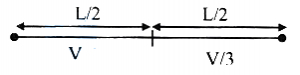
$A$ vehicle runs on a straight road of length $L$. It travels half the distance with speed $V$ and the remaining distance with speed $\frac{V}{3}$. Its average speed is
A
$\frac{3V}{2}$
B
$V$
C
$\frac{V}{2}$
D
$\frac{2V}{3}$
Solution
(C) The total distance is $L$. The vehicle travels the first half distance $(L/2)$ with speed $V_1 = V$ and the second half distance $(L/2)$ with speed $V_2 = \frac{V}{3}$.
Time taken for the first half,$t_1 = \frac{L/2}{V} = \frac{L}{2V}$.
Time taken for the second half,$t_2 = \frac{L/2}{V/3} = \frac{3L}{2V}$.
Total time taken,$T = t_1 + t_2 = \frac{L}{2V} + \frac{3L}{2V} = \frac{4L}{2V} = \frac{2L}{V}$.
Average speed,$V_{\text{avg}} = \frac{\text{Total distance}}{\text{Total time}} = \frac{L}{2L/V} = \frac{V}{2}$.
Time taken for the first half,$t_1 = \frac{L/2}{V} = \frac{L}{2V}$.
Time taken for the second half,$t_2 = \frac{L/2}{V/3} = \frac{3L}{2V}$.
Total time taken,$T = t_1 + t_2 = \frac{L}{2V} + \frac{3L}{2V} = \frac{4L}{2V} = \frac{2L}{V}$.
Average speed,$V_{\text{avg}} = \frac{\text{Total distance}}{\text{Total time}} = \frac{L}{2L/V} = \frac{V}{2}$.
0 likes
View Solution66
EasyMCQ
$A$ body covers half of its distance with speed $u$ and the other half with a speed $v$,the average speed of the body is
A
$\frac{2uv}{u+v}$
B
$\frac{u-v}{2}$
C
$\frac{u+v}{2uv}$
D
$\frac{u+v}{2}$
Solution
(A) Let the total distance covered by the body be $2d$.
Then,the first half distance is $d$ and the second half distance is $d$.
Time taken to cover the first half distance at speed $u$ is $t_1 = \frac{d}{u}$.
Time taken to cover the second half distance at speed $v$ is $t_2 = \frac{d}{v}$.
Average speed is defined as the total distance divided by the total time taken.
Average speed $= \frac{\text{Total Distance}}{\text{Total Time}} = \frac{2d}{t_1 + t_2} = \frac{2d}{\frac{d}{u} + \frac{d}{v}}$.
Simplifying the expression: $\frac{2d}{d(\frac{1}{u} + \frac{1}{v})} = \frac{2}{\frac{u+v}{uv}} = \frac{2uv}{u+v}$.
Then,the first half distance is $d$ and the second half distance is $d$.
Time taken to cover the first half distance at speed $u$ is $t_1 = \frac{d}{u}$.
Time taken to cover the second half distance at speed $v$ is $t_2 = \frac{d}{v}$.
Average speed is defined as the total distance divided by the total time taken.
Average speed $= \frac{\text{Total Distance}}{\text{Total Time}} = \frac{2d}{t_1 + t_2} = \frac{2d}{\frac{d}{u} + \frac{d}{v}}$.
Simplifying the expression: $\frac{2d}{d(\frac{1}{u} + \frac{1}{v})} = \frac{2}{\frac{u+v}{uv}} = \frac{2uv}{u+v}$.
0 likes
View Solution67
EasyMCQ
$A$ car moves from $A$ to $B$ with a speed of $30 \ km/h$ and from $B$ to $A$ with a speed of $20 \ km/h$. What is the average speed of the car (in $km/h$)?
A
$25$
B
$24$
C
$50$
D
$10$
Solution
(B) Let the distance between $A$ and $B$ be $d$.
Time taken to travel from $A$ to $B$ is $t_{1} = \frac{d}{v_{1}} = \frac{d}{30}$.
Time taken to travel from $B$ to $A$ is $t_{2} = \frac{d}{v_{2}} = \frac{d}{20}$.
Average speed is defined as the total distance divided by the total time.
Average speed $= \frac{\text{Total distance}}{\text{Total time}} = \frac{d + d}{t_{1} + t_{2}} = \frac{2d}{\frac{d}{30} + \frac{d}{20}}$.
Average speed $= \frac{2d}{d(\frac{20 + 30}{600})} = \frac{2 \times 600}{50} = \frac{1200}{50} = 24 \ km/h$.
Time taken to travel from $A$ to $B$ is $t_{1} = \frac{d}{v_{1}} = \frac{d}{30}$.
Time taken to travel from $B$ to $A$ is $t_{2} = \frac{d}{v_{2}} = \frac{d}{20}$.
Average speed is defined as the total distance divided by the total time.
Average speed $= \frac{\text{Total distance}}{\text{Total time}} = \frac{d + d}{t_{1} + t_{2}} = \frac{2d}{\frac{d}{30} + \frac{d}{20}}$.
Average speed $= \frac{2d}{d(\frac{20 + 30}{600})} = \frac{2 \times 600}{50} = \frac{1200}{50} = 24 \ km/h$.
0 likes
View Solution68
MediumMCQ
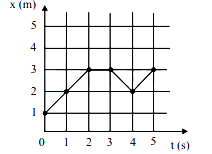
$A$ particle moves along a straight line along the $x$-axis. Its position $(x)$ versus time $(t)$ graph is shown in the figure [$x$ in meters and $t$ in seconds]. Its average speed during this motion is (in $\text{ m/s}$)
A
$0.4$
B
$1.0$
C
$0.8$
D
$0.6$
Solution
(C) Average speed is defined as the total distance traveled divided by the total time taken.
From the graph,we can calculate the distance traveled in each interval:
$1$. From $t = 0 \text{ s}$ to $t = 1 \text{ s}$,distance = $|2 - 1| = 1 \text{ m}$.
$2$. From $t = 1 \text{ s}$ to $t = 2 \text{ s}$,distance = $|3 - 2| = 1 \text{ m}$.
$3$. From $t = 2 \text{ s}$ to $t = 3 \text{ s}$,distance = $|3 - 3| = 0 \text{ m}$.
$4$. From $t = 3 \text{ s}$ to $t = 4 \text{ s}$,distance = $|2 - 3| = 1 \text{ m}$.
$5$. From $t = 4 \text{ s}$ to $t = 5 \text{ s}$,distance = $|3 - 2| = 1 \text{ m}$.
Total distance = $1 + 1 + 0 + 1 + 1 = 4 \text{ m}$.
Total time = $5 \text{ s}$.
Average speed = $\frac{\text{Total distance}}{\text{Total time}} = \frac{4 \text{ m}}{5 \text{ s}} = 0.8 \text{ m/s}$.
From the graph,we can calculate the distance traveled in each interval:
$1$. From $t = 0 \text{ s}$ to $t = 1 \text{ s}$,distance = $|2 - 1| = 1 \text{ m}$.
$2$. From $t = 1 \text{ s}$ to $t = 2 \text{ s}$,distance = $|3 - 2| = 1 \text{ m}$.
$3$. From $t = 2 \text{ s}$ to $t = 3 \text{ s}$,distance = $|3 - 3| = 0 \text{ m}$.
$4$. From $t = 3 \text{ s}$ to $t = 4 \text{ s}$,distance = $|2 - 3| = 1 \text{ m}$.
$5$. From $t = 4 \text{ s}$ to $t = 5 \text{ s}$,distance = $|3 - 2| = 1 \text{ m}$.
Total distance = $1 + 1 + 0 + 1 + 1 = 4 \text{ m}$.
Total time = $5 \text{ s}$.
Average speed = $\frac{\text{Total distance}}{\text{Total time}} = \frac{4 \text{ m}}{5 \text{ s}} = 0.8 \text{ m/s}$.
0 likes
View Solution69
MediumMCQ
The velocity of an object moving in a straight line path is given as a function of time by $v = 6t - 3t^2$,where $v$ is in $m/s$ and $t$ is in $s$. The average velocity of the object between $t = 0$ and $t = 2 \ s$ is
A
$0$
B
$3 \ m/s$
C
$2 \ m/s$
D
$4 \ m/s$
Solution
(C) Given,velocity $v = 6t - 3t^2$.
We know that velocity $v = \frac{dx}{dt}$,where $x$ is the displacement.
Therefore,the displacement $x$ is given by the integral of velocity with respect to time:
$x = \int_{0}^{2} v \ dt = \int_{0}^{2} (6t - 3t^2) \ dt$
$x = \left[ \frac{6t^2}{2} - \frac{3t^3}{3} \right]_{0}^{2} = \left[ 3t^2 - t^3 \right]_{0}^{2}$
$x = (3(2)^2 - (2)^3) - (3(0)^2 - (0)^3)$
$x = (12 - 8) - 0 = 4 \ m$.
The average velocity $v_{avg}$ is defined as the total displacement divided by the total time taken:
$v_{avg} = \frac{\text{Total displacement}}{\text{Total time}} = \frac{4 \ m}{2 \ s} = 2 \ m/s$.
Thus,the average velocity is $2 \ m/s$.
We know that velocity $v = \frac{dx}{dt}$,where $x$ is the displacement.
Therefore,the displacement $x$ is given by the integral of velocity with respect to time:
$x = \int_{0}^{2} v \ dt = \int_{0}^{2} (6t - 3t^2) \ dt$
$x = \left[ \frac{6t^2}{2} - \frac{3t^3}{3} \right]_{0}^{2} = \left[ 3t^2 - t^3 \right]_{0}^{2}$
$x = (3(2)^2 - (2)^3) - (3(0)^2 - (0)^3)$
$x = (12 - 8) - 0 = 4 \ m$.
The average velocity $v_{avg}$ is defined as the total displacement divided by the total time taken:
$v_{avg} = \frac{\text{Total displacement}}{\text{Total time}} = \frac{4 \ m}{2 \ s} = 2 \ m/s$.
Thus,the average velocity is $2 \ m/s$.
0 likes
View Solution70
MediumMCQ
If a car travels $40 \%$ of the total distance with a speed $v_1$ and the remaining distance with a speed $v_2$,then the average speed of the car is:
A
$\frac{1}{2} \sqrt{v_1 v_2}$
B
$\frac{v_1+v_2}{2}$
C
$\frac{2 v_1 v_2}{v_1+v_2}$
D
$\frac{5 v_1 v_2}{3 v_1+2 v_2}$
Solution
(D) Let the total distance be $D$.
Distance covered with speed $v_1$ is $d_1 = 0.4D$.
Distance covered with speed $v_2$ is $d_2 = 0.6D$.
Time taken for the first part is $t_1 = \frac{d_1}{v_1} = \frac{0.4D}{v_1}$.
Time taken for the second part is $t_2 = \frac{d_2}{v_2} = \frac{0.6D}{v_2}$.
Average speed $v_{avg} = \frac{\text{Total Distance}}{\text{Total Time}} = \frac{D}{t_1 + t_2}$.
$v_{avg} = \frac{D}{\frac{0.4D}{v_1} + \frac{0.6D}{v_2}} = \frac{1}{\frac{0.4}{v_1} + \frac{0.6}{v_2}}$.
$v_{avg} = \frac{1}{\frac{0.4v_2 + 0.6v_1}{v_1 v_2}} = \frac{v_1 v_2}{0.4v_2 + 0.6v_1}$.
Multiply numerator and denominator by $5$ to simplify: $v_{avg} = \frac{5 v_1 v_2}{2v_2 + 3v_1} = \frac{5 v_1 v_2}{3v_1 + 2v_2}$.
Distance covered with speed $v_1$ is $d_1 = 0.4D$.
Distance covered with speed $v_2$ is $d_2 = 0.6D$.
Time taken for the first part is $t_1 = \frac{d_1}{v_1} = \frac{0.4D}{v_1}$.
Time taken for the second part is $t_2 = \frac{d_2}{v_2} = \frac{0.6D}{v_2}$.
Average speed $v_{avg} = \frac{\text{Total Distance}}{\text{Total Time}} = \frac{D}{t_1 + t_2}$.
$v_{avg} = \frac{D}{\frac{0.4D}{v_1} + \frac{0.6D}{v_2}} = \frac{1}{\frac{0.4}{v_1} + \frac{0.6}{v_2}}$.
$v_{avg} = \frac{1}{\frac{0.4v_2 + 0.6v_1}{v_1 v_2}} = \frac{v_1 v_2}{0.4v_2 + 0.6v_1}$.
Multiply numerator and denominator by $5$ to simplify: $v_{avg} = \frac{5 v_1 v_2}{2v_2 + 3v_1} = \frac{5 v_1 v_2}{3v_1 + 2v_2}$.
0 likes
View Solution71
MediumMCQ
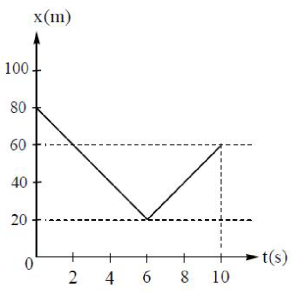
The displacement $(x)$ and time $(t)$ graph of a particle moving along a straight line is shown in the figure. The average velocity of the particle in the time of $10 \ s$ is (in $m \ s^{-1}$)
A
$2$
B
$4$
C
$6$
D
$8$
Solution
(A) Average velocity is defined as the total displacement divided by the total time interval.
From the graph,at $t = 0 \ s$,the initial position $x_i = 80 \ m$.
At $t = 10 \ s$,the final position $x_f = 60 \ m$.
The total displacement $\Delta x = x_f - x_i = 60 \ m - 80 \ m = -20 \ m$.
The total time interval $\Delta t = 10 \ s - 0 \ s = 10 \ s$.
Average velocity $v_{avg} = \frac{\Delta x}{\Delta t} = \frac{-20 \ m}{10 \ s} = -2 \ m \ s^{-1}$.
The magnitude of the average velocity is $2 \ m \ s^{-1}$.
From the graph,at $t = 0 \ s$,the initial position $x_i = 80 \ m$.
At $t = 10 \ s$,the final position $x_f = 60 \ m$.
The total displacement $\Delta x = x_f - x_i = 60 \ m - 80 \ m = -20 \ m$.
The total time interval $\Delta t = 10 \ s - 0 \ s = 10 \ s$.
Average velocity $v_{avg} = \frac{\Delta x}{\Delta t} = \frac{-20 \ m}{10 \ s} = -2 \ m \ s^{-1}$.
The magnitude of the average velocity is $2 \ m \ s^{-1}$.
0 likes
View Solution72
EasyMCQ
If a person moving along a straight line path covers the first half distance with velocity $V_1$ and the next half distance with velocity $V_2$,then the average velocity of the person is
A
$\frac{V_1+V_2}{2}$
B
$\frac{(V_1+V_2)}{2 \sqrt{V_1 V_2}}$
C
$\frac{2}{\frac{1}{V_1}+\frac{1}{V_2}}$
D
$\frac{V_1 V_2}{V_1+V_2}$
Solution
(C) Let the total distance be $d$.
Time taken for the first half distance $(d/2)$ is $t_1 = \frac{d/2}{V_1} = \frac{d}{2V_1}$.
Time taken for the second half distance $(d/2)$ is $t_2 = \frac{d/2}{V_2} = \frac{d}{2V_2}$.
Average velocity is defined as the total distance divided by the total time taken.
Average velocity $= \frac{\text{Total distance}}{\text{Total time}} = \frac{d}{t_1 + t_2}$.
Substituting the values of $t_1$ and $t_2$:
Average velocity $= \frac{d}{\frac{d}{2V_1} + \frac{d}{2V_2}} = \frac{d}{\frac{d}{2} \left( \frac{1}{V_1} + \frac{1}{V_2} \right)} = \frac{1}{\frac{1}{2} \left( \frac{V_1 + V_2}{V_1 V_2} \right)} = \frac{2V_1 V_2}{V_1 + V_2}$.
Note that $\frac{2V_1 V_2}{V_1 + V_2}$ is equivalent to $\frac{2}{\frac{1}{V_1} + \frac{1}{V_2}}$,which matches option $C$.
Time taken for the first half distance $(d/2)$ is $t_1 = \frac{d/2}{V_1} = \frac{d}{2V_1}$.
Time taken for the second half distance $(d/2)$ is $t_2 = \frac{d/2}{V_2} = \frac{d}{2V_2}$.
Average velocity is defined as the total distance divided by the total time taken.
Average velocity $= \frac{\text{Total distance}}{\text{Total time}} = \frac{d}{t_1 + t_2}$.
Substituting the values of $t_1$ and $t_2$:
Average velocity $= \frac{d}{\frac{d}{2V_1} + \frac{d}{2V_2}} = \frac{d}{\frac{d}{2} \left( \frac{1}{V_1} + \frac{1}{V_2} \right)} = \frac{1}{\frac{1}{2} \left( \frac{V_1 + V_2}{V_1 V_2} \right)} = \frac{2V_1 V_2}{V_1 + V_2}$.
Note that $\frac{2V_1 V_2}{V_1 + V_2}$ is equivalent to $\frac{2}{\frac{1}{V_1} + \frac{1}{V_2}}$,which matches option $C$.
0 likes
View Solution73
EasyMCQ
$A$ train travels from city-$A$ to city-$B$ with a constant speed of $18 \,ms^{-1}$ and returns back to city-$A$ with a constant speed of $36 \,ms^{-1}$. Find its average speed during the journey. (in $\,ms^{-1}$)
A
$24$
B
$12$
C
$27$
D
$24$
Solution
(A) Given that, speed of train from city-$A$ to city-$B$ is $v_1 = 18 \,ms^{-1}$.
Speed of train from city-$B$ to city-$A$ is $v_2 = 36 \,ms^{-1}$.
Since the distance travelled from $A$ to $B$ and $B$ to $A$ is the same, we use the formula for average speed over equal distances:
$v_{av} = \frac{2 v_1 v_2}{v_1 + v_2}$
Substituting the values:
$v_{av} = \frac{2 \times 18 \times 36}{18 + 36}$
$v_{av} = \frac{2 \times 18 \times 36}{54}$
$v_{av} = \frac{1296}{54} = 24 \,ms^{-1}$.
Speed of train from city-$B$ to city-$A$ is $v_2 = 36 \,ms^{-1}$.
Since the distance travelled from $A$ to $B$ and $B$ to $A$ is the same, we use the formula for average speed over equal distances:
$v_{av} = \frac{2 v_1 v_2}{v_1 + v_2}$
Substituting the values:
$v_{av} = \frac{2 \times 18 \times 36}{18 + 36}$
$v_{av} = \frac{2 \times 18 \times 36}{54}$
$v_{av} = \frac{1296}{54} = 24 \,ms^{-1}$.
0 likes
View Solution74
MediumMCQ
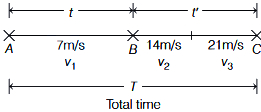
$A$ body travelling along a straight line path travels the first half of the distance with a velocity of $7 \,m/s$. During the travel time of the second half of the distance, the first half of the time is travelled with a velocity of $14 \,m/s$ and the second half of the time is travelled with a velocity of $21 \,m/s$. Then the average velocity of the body during the entire journey is: (in $\,m/s$)
A
$14$
B
$10$
C
$9$
D
$12$
Solution
(B) Let the total distance be $2d$. The first half distance is $d$ and the second half distance is $d$.
For the first half distance $(d)$: Velocity $v_1 = 7 \,m/s$. Time taken $t_1 = \frac{d}{v_1} = \frac{d}{7}$.
For the second half distance $(d)$: Let the total time taken be $t_2$. The first half of this time $(t_2/2)$ is travelled with $v_2 = 14 \,m/s$ and the second half $(t_2/2)$ with $v_3 = 21 \,m/s$.
Distance $d = (v_2 \times \frac{t_2}{2}) + (v_3 \times \frac{t_2}{2}) = (14 \times \frac{t_2}{2}) + (21 \times \frac{t_2}{2}) = 7t_2 + 10.5t_2 = 17.5t_2$.
So, $t_2 = \frac{d}{17.5} = \frac{d}{35/2} = \frac{2d}{35}$.
Total distance = $2d$.
Total time $T = t_1 + t_2 = \frac{d}{7} + \frac{2d}{35} = \frac{5d + 2d}{35} = \frac{7d}{35} = \frac{d}{5}$.
Average velocity $v_{avg} = \frac{\text{Total distance}}{\text{Total time}} = \frac{2d}{d/5} = 10 \,m/s$.
For the first half distance $(d)$: Velocity $v_1 = 7 \,m/s$. Time taken $t_1 = \frac{d}{v_1} = \frac{d}{7}$.
For the second half distance $(d)$: Let the total time taken be $t_2$. The first half of this time $(t_2/2)$ is travelled with $v_2 = 14 \,m/s$ and the second half $(t_2/2)$ with $v_3 = 21 \,m/s$.
Distance $d = (v_2 \times \frac{t_2}{2}) + (v_3 \times \frac{t_2}{2}) = (14 \times \frac{t_2}{2}) + (21 \times \frac{t_2}{2}) = 7t_2 + 10.5t_2 = 17.5t_2$.
So, $t_2 = \frac{d}{17.5} = \frac{d}{35/2} = \frac{2d}{35}$.
Total distance = $2d$.
Total time $T = t_1 + t_2 = \frac{d}{7} + \frac{2d}{35} = \frac{5d + 2d}{35} = \frac{7d}{35} = \frac{d}{5}$.
Average velocity $v_{avg} = \frac{\text{Total distance}}{\text{Total time}} = \frac{2d}{d/5} = 10 \,m/s$.
0 likes
View Solution75
EasyMCQ
$A$ car covers a distance at a speed of $60 \ km \ h^{-1}$. It returns and comes back to the original point moving at a speed of $V$. If the average speed for the round trip is $48 \ km \ h^{-1}$,then the magnitude of $V$ is (in $km \ h^{-1}$)
A
$40$
B
$36$
C
$44$
D
$32$
Solution
(A) Let the car cover a distance $s$ from point $A$ to $B$ and then return to point $A$.
The average speed is defined as the total distance covered divided by the total time taken.
Time taken from $A$ to $B$ is $t_1 = \frac{s}{60}$.
Time taken from $B$ to $A$ is $t_2 = \frac{s}{V}$.
The total distance is $s + s = 2s$.
The total time is $t_1 + t_2 = \frac{s}{60} + \frac{s}{V}$.
Given the average speed is $48 \ km \ h^{-1}$,we have:
$48 = \frac{2s}{\frac{s}{60} + \frac{s}{V}}$
Dividing both sides by $s$ (assuming $s \neq 0$):
$48 = \frac{2}{\frac{1}{60} + \frac{1}{V}}$
$\frac{1}{60} + \frac{1}{V} = \frac{2}{48} = \frac{1}{24}$
$\frac{1}{V} = \frac{1}{24} - \frac{1}{60}$
$\frac{1}{V} = \frac{5 - 2}{120} = \frac{3}{120} = \frac{1}{40}$
Therefore,$V = 40 \ km \ h^{-1}$.
The average speed is defined as the total distance covered divided by the total time taken.
Time taken from $A$ to $B$ is $t_1 = \frac{s}{60}$.
Time taken from $B$ to $A$ is $t_2 = \frac{s}{V}$.
The total distance is $s + s = 2s$.
The total time is $t_1 + t_2 = \frac{s}{60} + \frac{s}{V}$.
Given the average speed is $48 \ km \ h^{-1}$,we have:
$48 = \frac{2s}{\frac{s}{60} + \frac{s}{V}}$
Dividing both sides by $s$ (assuming $s \neq 0$):
$48 = \frac{2}{\frac{1}{60} + \frac{1}{V}}$
$\frac{1}{60} + \frac{1}{V} = \frac{2}{48} = \frac{1}{24}$
$\frac{1}{V} = \frac{1}{24} - \frac{1}{60}$
$\frac{1}{V} = \frac{5 - 2}{120} = \frac{3}{120} = \frac{1}{40}$
Therefore,$V = 40 \ km \ h^{-1}$.
0 likes
View Solution76
MediumMCQ
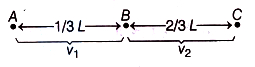
$A$ biker travels $\frac{1}{3}$ of the distance $L$ with speed $v_1$ and $\frac{2}{3}$ of the distance with speed $v_2$. Then the average speed is
A
$\frac{v_1 v_2}{v_1+v_2}$
B
$\frac{3 v_1 v_2}{2 v_1+v_2}$
C
$\frac{3 v_1 v_2}{v_1+2 v_2}$
D
$\frac{v_1+v_2}{v_1 v_2}$
Solution
(B) The average speed is defined as the total distance divided by the total time taken.
Let the total distance be $L$.
The distance for the first part is $d_1 = \frac{L}{3}$ and the speed is $v_1$.
The time taken for the first part is $t_1 = \frac{d_1}{v_1} = \frac{L/3}{v_1} = \frac{L}{3 v_1}$.
The distance for the second part is $d_2 = \frac{2L}{3}$ and the speed is $v_2$.
The time taken for the second part is $t_2 = \frac{d_2}{v_2} = \frac{2L/3}{v_2} = \frac{2L}{3 v_2}$.
The total time taken is $T = t_1 + t_2 = \frac{L}{3 v_1} + \frac{2L}{3 v_2} = \frac{L}{3} \left( \frac{1}{v_1} + \frac{2}{v_2} \right) = \frac{L}{3} \left( \frac{v_2 + 2 v_1}{v_1 v_2} \right)$.
The average speed $v_{avg} = \frac{\text{Total distance}}{\text{Total time}} = \frac{L}{\frac{L}{3} \left( \frac{2 v_1 + v_2}{v_1 v_2} \right)} = \frac{3 v_1 v_2}{2 v_1 + v_2}$.
Let the total distance be $L$.
The distance for the first part is $d_1 = \frac{L}{3}$ and the speed is $v_1$.
The time taken for the first part is $t_1 = \frac{d_1}{v_1} = \frac{L/3}{v_1} = \frac{L}{3 v_1}$.
The distance for the second part is $d_2 = \frac{2L}{3}$ and the speed is $v_2$.
The time taken for the second part is $t_2 = \frac{d_2}{v_2} = \frac{2L/3}{v_2} = \frac{2L}{3 v_2}$.
The total time taken is $T = t_1 + t_2 = \frac{L}{3 v_1} + \frac{2L}{3 v_2} = \frac{L}{3} \left( \frac{1}{v_1} + \frac{2}{v_2} \right) = \frac{L}{3} \left( \frac{v_2 + 2 v_1}{v_1 v_2} \right)$.
The average speed $v_{avg} = \frac{\text{Total distance}}{\text{Total time}} = \frac{L}{\frac{L}{3} \left( \frac{2 v_1 + v_2}{v_1 v_2} \right)} = \frac{3 v_1 v_2}{2 v_1 + v_2}$.
0 likes
View Solution77
EasyMCQ
$A$ car travels in a straight line along a road. Its distance $x$ from a stop sign is given as a function of $t$ by the equation $x(t) = \alpha t + \beta t^3$,where $\alpha = 2.0 \ m \ s^{-1}$ and $\beta = 0.01 \ m \ s^{-3}$. Calculate the average velocity of the car in the time interval $t = 2.00 \ s$ to $t = 4.00 \ s$. (in $m \ s^{-1}$)
A
$2.28$
B
$4.94$
C
$3.34$
D
$4.12$
Solution
(A) The average velocity $v_{avg}$ is defined as the total change in displacement divided by the total time interval: $v_{avg} = \frac{\Delta x}{\Delta t} = \frac{x(t_2) - x(t_1)}{t_2 - t_1}$.
Given $x(t) = \alpha t + \beta t^3$ with $\alpha = 2.0 \ m \ s^{-1}$ and $\beta = 0.01 \ m \ s^{-3}$.
At $t_1 = 2.00 \ s$: $x(2) = 2.0(2) + 0.01(2)^3 = 4.0 + 0.01(8) = 4.08 \ m$.
At $t_2 = 4.00 \ s$: $x(4) = 2.0(4) + 0.01(4)^3 = 8.0 + 0.01(64) = 8.64 \ m$.
Now,calculate the average velocity: $v_{avg} = \frac{8.64 - 4.08}{4.00 - 2.00} = \frac{4.56}{2} = 2.28 \ m \ s^{-1}$.
Given $x(t) = \alpha t + \beta t^3$ with $\alpha = 2.0 \ m \ s^{-1}$ and $\beta = 0.01 \ m \ s^{-3}$.
At $t_1 = 2.00 \ s$: $x(2) = 2.0(2) + 0.01(2)^3 = 4.0 + 0.01(8) = 4.08 \ m$.
At $t_2 = 4.00 \ s$: $x(4) = 2.0(4) + 0.01(4)^3 = 8.0 + 0.01(64) = 8.64 \ m$.
Now,calculate the average velocity: $v_{avg} = \frac{8.64 - 4.08}{4.00 - 2.00} = \frac{4.56}{2} = 2.28 \ m \ s^{-1}$.
0 likes
View Solution78
EasyMCQ
The position of an object moving along the $X$-axis is given by $x = \alpha + \beta t^2$,where $\alpha$ and $\beta$ are constants with appropriate dimensions and $t$ is time in seconds. The average velocity between $t = 2 \ s$ and $t = 4 \ s$ is $12 \ m/s$. If $\alpha = 8 \ m$,then the value of $\beta$ is: (in $m/s^2$)
A
$0.5$
B
$2$
C
$4$
D
$5$
Solution
(B) The position is given by $x(t) = \alpha + \beta t^2$.
Given $\alpha = 8 \ m$,the equation becomes $x(t) = 8 + \beta t^2$.
The average velocity $v_{avg}$ between $t_1 = 2 \ s$ and $t_2 = 4 \ s$ is defined as $v_{avg} = \frac{x(t_2) - x(t_1)}{t_2 - t_1}$.
Calculate the position at $t_1 = 2 \ s$: $x(2) = 8 + \beta(2)^2 = 8 + 4\beta$.
Calculate the position at $t_2 = 4 \ s$: $x(4) = 8 + \beta(4)^2 = 8 + 16\beta$.
The change in position is $\Delta x = x(4) - x(2) = (8 + 16\beta) - (8 + 4\beta) = 12\beta$.
The time interval is $\Delta t = 4 - 2 = 2 \ s$.
Given $v_{avg} = 12 \ m/s$,we have $12 = \frac{12\beta}{2}$.
$12 = 6\beta$,which implies $\beta = 2 \ m/s^2$.
Given $\alpha = 8 \ m$,the equation becomes $x(t) = 8 + \beta t^2$.
The average velocity $v_{avg}$ between $t_1 = 2 \ s$ and $t_2 = 4 \ s$ is defined as $v_{avg} = \frac{x(t_2) - x(t_1)}{t_2 - t_1}$.
Calculate the position at $t_1 = 2 \ s$: $x(2) = 8 + \beta(2)^2 = 8 + 4\beta$.
Calculate the position at $t_2 = 4 \ s$: $x(4) = 8 + \beta(4)^2 = 8 + 16\beta$.
The change in position is $\Delta x = x(4) - x(2) = (8 + 16\beta) - (8 + 4\beta) = 12\beta$.
The time interval is $\Delta t = 4 - 2 = 2 \ s$.
Given $v_{avg} = 12 \ m/s$,we have $12 = \frac{12\beta}{2}$.
$12 = 6\beta$,which implies $\beta = 2 \ m/s^2$.
0 likes
View Solution79
MediumMCQ
$A$ body moves in a straight line with speeds $v_1$ and $v_2$ for distances which are in the ratio $1: 2$. Find the average speed.
A
$3 v_1+v_2$
B
$v_2+2 v_1$
C
$\frac{3 v_1 v_2}{v_2+2 v_1}$
D
$\frac{3 v_1 v_2}{v_2-2 v_1}$
Solution
(C) Given that the distances travelled by the body are in the ratio $1: 2$.
Let the distance travelled with speed $v_1$ be $s$. Then,the distance travelled with speed $v_2$ will be $2s$.
Average speed is defined as the total distance travelled divided by the total time taken.
Total distance = $s + 2s = 3s$.
Time taken for the first part,$t_1 = \frac{s}{v_1}$.
Time taken for the second part,$t_2 = \frac{2s}{v_2}$.
Total time taken,$T = t_1 + t_2 = \frac{s}{v_1} + \frac{2s}{v_2} = s \left( \frac{1}{v_1} + \frac{2}{v_2} \right) = s \left( \frac{v_2 + 2v_1}{v_1 v_2} \right)$.
Average speed,$v_{\text{avg}} = \frac{\text{Total distance}}{\text{Total time}} = \frac{3s}{s \left( \frac{v_2 + 2v_1}{v_1 v_2} \right)} = \frac{3 v_1 v_2}{v_2 + 2v_1}$.
Let the distance travelled with speed $v_1$ be $s$. Then,the distance travelled with speed $v_2$ will be $2s$.
Average speed is defined as the total distance travelled divided by the total time taken.
Total distance = $s + 2s = 3s$.
Time taken for the first part,$t_1 = \frac{s}{v_1}$.
Time taken for the second part,$t_2 = \frac{2s}{v_2}$.
Total time taken,$T = t_1 + t_2 = \frac{s}{v_1} + \frac{2s}{v_2} = s \left( \frac{1}{v_1} + \frac{2}{v_2} \right) = s \left( \frac{v_2 + 2v_1}{v_1 v_2} \right)$.
Average speed,$v_{\text{avg}} = \frac{\text{Total distance}}{\text{Total time}} = \frac{3s}{s \left( \frac{v_2 + 2v_1}{v_1 v_2} \right)} = \frac{3 v_1 v_2}{v_2 + 2v_1}$.

0 likes
View Solution80
DifficultMCQ
$A$ person walks along a straight road from his house to a market $2.5 \,km$ away with a speed of $5 \,km/h$ and instantly turns back and reaches his house with a speed of $7.5 \,km/h$. The average speed of the person during the time interval $0$ to $50 \,min$ is (in $m/s$)
A
$4 \frac{2}{3}$
B
$\frac{5}{3}$
C
$\frac{5}{6}$
D
$\frac{1}{3}$
Solution
(B) Time taken to reach the market: $t_1 = \frac{\text{distance}}{\text{speed}} = \frac{2.5 \,km}{5 \,km/h} = 0.5 \,h = 30 \,min$.
Time taken to return to the house: $t_2 = \frac{\text{distance}}{\text{speed}} = \frac{2.5 \,km}{7.5 \,km/h} = \frac{1}{3} \,h = 20 \,min$.
Total time taken for the round trip is $30 \,min + 20 \,min = 50 \,min$.
Total distance covered = $2.5 \,km + 2.5 \,km = 5 \,km = 5000 \,m$.
Total time in seconds = $50 \,min \times 60 \,s/min = 3000 \,s$.
Average speed = $\frac{\text{Total distance}}{\text{Total time}} = \frac{5000 \,m}{3000 \,s} = \frac{5}{3} \,m/s$.
Time taken to return to the house: $t_2 = \frac{\text{distance}}{\text{speed}} = \frac{2.5 \,km}{7.5 \,km/h} = \frac{1}{3} \,h = 20 \,min$.
Total time taken for the round trip is $30 \,min + 20 \,min = 50 \,min$.
Total distance covered = $2.5 \,km + 2.5 \,km = 5 \,km = 5000 \,m$.
Total time in seconds = $50 \,min \times 60 \,s/min = 3000 \,s$.
Average speed = $\frac{\text{Total distance}}{\text{Total time}} = \frac{5000 \,m}{3000 \,s} = \frac{5}{3} \,m/s$.
0 likes
View SolutionMotion in Straight Line — Average Velocity and Average Speed · Frequently Asked Questions
1Are these Motion in Straight Line questions useful for JEE and NEET?
Yes. All questions in this section are mapped to JEE Main and NEET exam patterns. Previous year questions from JEE Main, NEET, GUJCET and state-level exams are included with full solutions.
2Can I switch to Hindi or Gujarati for these questions?
Yes. Use the language tabs in the hero section or the sidebar to view the same questions and solutions in English, Hindi or Gujarati.
3How do I generate a question paper from this subtopic?
Use the Vedclass Exam Paper Generator — select the chapter and subtopic, set difficulty, and generate Sets A, B, C, D automatically. First 3 chapters of every subject are free.
Vedclass Products
For Students
Vedclass Test Series
Mock tests in real JEE/NEET style with performance analysis. 5-day free trial.
Start Free TrialFor Teachers
Exam Paper Generator
Generate Set A/B/C/D papers from this chapter in 2 minutes. 3 chapters free.
Try FreeFor Institutes
Online Exam Module
Live online exams with unlimited students, 360° analytics & white-label branding.
See DemoFor Teachers & Institutes
Generate a Motion in Straight Line Exam Paper in 2 Minutes
Select subtopic & difficulty — Sets A, B, C, D auto-generated with No Repeat logic.
First 3 chapters of every subject are free — no payment required.