
A English
Gas Laws (Charles, Boyle's, Avagadro's, Gay Lussacs and Dalton's law) and Ideal gas Equation Questions in English
Class 11 Physics · Kinetic Theory of Gases · Gas Laws (Charles, Boyle's, Avagadro's, Gay Lussacs and Dalton's law) and Ideal gas Equation
391+
Questions
English
Language
100%
With Solutions
Showing 49 of 391 questions in English
51
MediumMCQ
The equation of state for $5 \, g$ of oxygen at a pressure $P$ and temperature $T$,when occupying a volume $V$,will be (where $R$ is the gas constant).
A
$PV = \frac{5}{32}RT$
B
$PV = 5RT$
C
$PV = \frac{5}{2}RT$
D
$PV = \frac{5}{16}RT$
Solution
(A) The ideal gas equation is given by $PV = \mu RT$,where $\mu$ is the number of moles.
Number of moles $\mu = \frac{\text{mass } (m)}{\text{molar mass } (M)}$.
For oxygen gas $(O_2)$,the molar mass $M = 32 \, g/mol$.
Given mass $m = 5 \, g$.
Therefore,$\mu = \frac{5}{32} \, mol$.
Substituting this into the ideal gas equation,we get $PV = \frac{5}{32}RT$.
Number of moles $\mu = \frac{\text{mass } (m)}{\text{molar mass } (M)}$.
For oxygen gas $(O_2)$,the molar mass $M = 32 \, g/mol$.
Given mass $m = 5 \, g$.
Therefore,$\mu = \frac{5}{32} \, mol$.
Substituting this into the ideal gas equation,we get $PV = \frac{5}{32}RT$.
0 likes
View Solution52
MediumMCQ
$O_2$ gas is filled in a vessel. If the pressure is doubled and the temperature becomes four times,how many times will its density become?
A
$2$
B
$4$
C
$0.25$
D
$0.5$
Solution
(D) From the ideal gas equation,$PV = nRT$.
Since $n = \frac{m}{M}$,where $m$ is the mass and $M$ is the molar mass,we have $PV = \frac{m}{M}RT$.
Rearranging for density $\rho = \frac{m}{V}$,we get $P = \frac{\rho RT}{M}$.
This implies that $\frac{P}{\rho T} = \frac{R}{M} = \text{constant}$.
Therefore,$\frac{P_1}{\rho_1 T_1} = \frac{P_2}{\rho_2 T_2}$.
Given: $P_2 = 2P_1$ and $T_2 = 4T_1$.
Substituting these values: $\frac{P_1}{\rho_1 T_1} = \frac{2P_1}{\rho_2 (4T_1)}$.
Simplifying,$1 = \frac{2}{4} \cdot \frac{\rho_1}{\rho_2}$,which gives $1 = \frac{1}{2} \cdot \frac{\rho_1}{\rho_2}$.
Thus,$\rho_2 = 0.5 \rho_1$.
The density becomes $0.5$ times the original density.
Since $n = \frac{m}{M}$,where $m$ is the mass and $M$ is the molar mass,we have $PV = \frac{m}{M}RT$.
Rearranging for density $\rho = \frac{m}{V}$,we get $P = \frac{\rho RT}{M}$.
This implies that $\frac{P}{\rho T} = \frac{R}{M} = \text{constant}$.
Therefore,$\frac{P_1}{\rho_1 T_1} = \frac{P_2}{\rho_2 T_2}$.
Given: $P_2 = 2P_1$ and $T_2 = 4T_1$.
Substituting these values: $\frac{P_1}{\rho_1 T_1} = \frac{2P_1}{\rho_2 (4T_1)}$.
Simplifying,$1 = \frac{2}{4} \cdot \frac{\rho_1}{\rho_2}$,which gives $1 = \frac{1}{2} \cdot \frac{\rho_1}{\rho_2}$.
Thus,$\rho_2 = 0.5 \rho_1$.
The density becomes $0.5$ times the original density.
0 likes
View Solution53
MediumMCQ
The volume of a gas will be double of what it is at $0^{\circ}C$ (pressure remaining constant) at:
A
$1092 \, K$
B
$273 \, K$
C
$546^{\circ}C$
D
$273^{\circ}C$
Solution
(D) According to Charles's Law,for a fixed mass of gas at constant pressure,the volume $V$ is directly proportional to the absolute temperature $T$ $(V \propto T)$.
Let the initial volume at $T_1 = 0^{\circ}C = 273 \, K$ be $V_1 = V$.
We want the final volume to be $V_2 = 2V$.
Using the relation $\frac{V_1}{T_1} = \frac{V_2}{T_2}$:
$\frac{V}{273} = \frac{2V}{T_2}$
$T_2 = 2 \times 273 = 546 \, K$.
To convert this to Celsius: $T_2(^{\circ}C) = 546 - 273 = 273^{\circ}C$.
Let the initial volume at $T_1 = 0^{\circ}C = 273 \, K$ be $V_1 = V$.
We want the final volume to be $V_2 = 2V$.
Using the relation $\frac{V_1}{T_1} = \frac{V_2}{T_2}$:
$\frac{V}{273} = \frac{2V}{T_2}$
$T_2 = 2 \times 273 = 546 \, K$.
To convert this to Celsius: $T_2(^{\circ}C) = 546 - 273 = 273^{\circ}C$.
0 likes
View Solution54
MediumMCQ
Three containers of the same volume contain three different gases. The masses of the molecules are $m_1, m_2$ and $m_3$ and the number of molecules in their respective containers are $N_1, N_2$ and $N_3$. The gas pressures in the containers are $P_1, P_2$ and $P_3$ respectively. All the gases are now mixed and put in one of the containers. The pressure $P$ of the mixture will be
A
$P < (P_1 + P_2 + P_3)$
B
$P = \frac{P_1 + P_2 + P_3}{3}$
C
$P = P_1 + P_2 + P_3$
D
$P > (P_1 + P_2 + P_3)$
Solution
(C) According to Dalton's Law of Partial Pressures,the total pressure exerted by a mixture of non-reacting gases in a fixed volume is equal to the sum of the partial pressures of the individual gases.
Since all three gases are mixed and placed into a single container of the same volume $V$,the total pressure $P$ is the sum of the individual pressures.
Therefore,$P = P_1 + P_2 + P_3$.
Since all three gases are mixed and placed into a single container of the same volume $V$,the total pressure $P$ is the sum of the individual pressures.
Therefore,$P = P_1 + P_2 + P_3$.
0 likes
View Solution55
EasyMCQ
At a given volume and temperature,the pressure of a gas
A
Varies inversely as its mass
B
Varies inversely as the square of its mass
C
Varies linearly as its mass
D
Is independent of its mass
Solution
(C) We know the ideal gas equation is given by $PV = nRT$,where $n$ is the number of moles.
Since $n = \frac{m}{M}$,where $m$ is the mass of the gas and $M$ is the molar mass,the equation becomes $PV = \frac{m}{M} RT$.
Rearranging for pressure $P$,we get $P = \left( \frac{RT}{MV} \right) m$.
Given that the volume $V$ and temperature $T$ are constant,and the molar mass $M$ and gas constant $R$ are also constants,the term $\left( \frac{RT}{MV} \right)$ is a constant.
Therefore,$P \propto m$.
This shows that the pressure of the gas varies linearly with its mass.
Thus,the correct choice is option $C$.
Since $n = \frac{m}{M}$,where $m$ is the mass of the gas and $M$ is the molar mass,the equation becomes $PV = \frac{m}{M} RT$.
Rearranging for pressure $P$,we get $P = \left( \frac{RT}{MV} \right) m$.
Given that the volume $V$ and temperature $T$ are constant,and the molar mass $M$ and gas constant $R$ are also constants,the term $\left( \frac{RT}{MV} \right)$ is a constant.
Therefore,$P \propto m$.
This shows that the pressure of the gas varies linearly with its mass.
Thus,the correct choice is option $C$.
0 likes
View Solution56
MediumMCQ
When a gas in a closed vessel was heated so as to increase its temperature by $5^{\circ}C$,there occurred an increase of $1\%$ in its pressure. The original temperature of the gas was ...... $^{\circ}C$
A
$500$
B
$273$
C
$227$
D
$50$
Solution
(C) For a gas in a closed vessel,volume $V$ is constant. According to Gay-Lussac's Law,$P \propto T$ (where $T$ is in Kelvin).
Let the initial pressure be $P_1$ and initial temperature be $T_1$ (in Kelvin).
When the temperature increases by $5^{\circ}C$,the new temperature $T_2 = T_1 + 5$.
The pressure increases by $1\%$,so the new pressure $P_2 = P_1 + 0.01 P_1 = 1.01 P_1$.
Using the relation $\frac{P_1}{P_2} = \frac{T_1}{T_2}$,we get:
$\frac{P_1}{1.01 P_1} = \frac{T_1}{T_1 + 5}$
$T_1 + 5 = 1.01 T_1$
$0.01 T_1 = 5$
$T_1 = \frac{5}{0.01} = 500 \ K$.
To convert Kelvin to Celsius: $t(^{\circ}C) = T(K) - 273$.
$t = 500 - 273 = 227^{\circ}C$.
Let the initial pressure be $P_1$ and initial temperature be $T_1$ (in Kelvin).
When the temperature increases by $5^{\circ}C$,the new temperature $T_2 = T_1 + 5$.
The pressure increases by $1\%$,so the new pressure $P_2 = P_1 + 0.01 P_1 = 1.01 P_1$.
Using the relation $\frac{P_1}{P_2} = \frac{T_1}{T_2}$,we get:
$\frac{P_1}{1.01 P_1} = \frac{T_1}{T_1 + 5}$
$T_1 + 5 = 1.01 T_1$
$0.01 T_1 = 5$
$T_1 = \frac{5}{0.01} = 500 \ K$.
To convert Kelvin to Celsius: $t(^{\circ}C) = T(K) - 273$.
$t = 500 - 273 = 227^{\circ}C$.
0 likes
View Solution57
MediumMCQ
The gas in a vessel is subjected to a pressure of $20 \ atm$ at a temperature of $27^{\circ}C$. If one-half of the gas is released from the vessel and the temperature of the remaining gas is raised by $50^{\circ}C$,the final pressure of the gas in the vessel is ....... $atm$.
A
$8.5$
B
$10.8$
C
$11.7$
D
$17$
Solution
(C) Using the ideal gas equation,$PV = \mu RT = \frac{m}{M}RT$,where $m$ is the mass of the gas.
Since $V$ and $M$ are constant,we have $P \propto mT$.
Let the initial state be $(P_1, m_1, T_1)$ and the final state be $(P_2, m_2, T_2)$.
Given: $P_1 = 20 \ atm$,$T_1 = 27^{\circ}C = 300 \ K$.
After releasing half the gas,$m_2 = \frac{1}{2}m_1$.
The temperature is raised by $50^{\circ}C$,so $T_2 = (27 + 50)^{\circ}C = 77^{\circ}C = 350 \ K$.
Using the ratio: $\frac{P_2}{P_1} = \frac{m_2}{m_1} \times \frac{T_2}{T_1}$.
$\frac{P_2}{20} = \frac{1}{2} \times \frac{350}{300} = \frac{1}{2} \times \frac{7}{6} = \frac{7}{12}$.
$P_2 = 20 \times \frac{7}{12} = \frac{140}{12} \approx 11.67 \ atm$.
Thus,the final pressure is approximately $11.7 \ atm$.
Since $V$ and $M$ are constant,we have $P \propto mT$.
Let the initial state be $(P_1, m_1, T_1)$ and the final state be $(P_2, m_2, T_2)$.
Given: $P_1 = 20 \ atm$,$T_1 = 27^{\circ}C = 300 \ K$.
After releasing half the gas,$m_2 = \frac{1}{2}m_1$.
The temperature is raised by $50^{\circ}C$,so $T_2 = (27 + 50)^{\circ}C = 77^{\circ}C = 350 \ K$.
Using the ratio: $\frac{P_2}{P_1} = \frac{m_2}{m_1} \times \frac{T_2}{T_1}$.
$\frac{P_2}{20} = \frac{1}{2} \times \frac{350}{300} = \frac{1}{2} \times \frac{7}{6} = \frac{7}{12}$.
$P_2 = 20 \times \frac{7}{12} = \frac{140}{12} \approx 11.67 \ atm$.
Thus,the final pressure is approximately $11.7 \ atm$.
0 likes
View Solution58
MediumMCQ
At $0^{\circ}C$,the density of a fixed mass of a gas divided by pressure is $x$. At $100^{\circ}C$,the ratio will be
A
$x$
B
$\frac{273}{373}x$
C
$\frac{373}{273}x$
D
$\frac{100}{273}x$
Solution
(B) From the ideal gas equation,$PV = \mu RT = \frac{m}{M}RT$,where $m$ is the mass,$M$ is the molar mass,and $V$ is the volume.
Since density $\rho = \frac{m}{V}$,we can write $P = \frac{\rho RT}{M}$.
Therefore,the ratio of density to pressure is $\frac{\rho}{P} = \frac{M}{RT}$.
At $0^{\circ}C$ $(T_1 = 273 \ K)$,the ratio is $\left( \frac{\rho}{P} \right)_1 = \frac{M}{R(273)} = x$ --- $(i)$.
At $100^{\circ}C$ $(T_2 = 373 \ K)$,the ratio is $\left( \frac{\rho}{P} \right)_2 = \frac{M}{R(373)}$ --- $(ii)$.
Dividing equation $(ii)$ by equation $(i)$,we get $\frac{(\rho/P)_2}{x} = \frac{M/R(373)}{M/R(273)} = \frac{273}{373}$.
Thus,the ratio at $100^{\circ}C$ is $\frac{273}{373}x$.
Since density $\rho = \frac{m}{V}$,we can write $P = \frac{\rho RT}{M}$.
Therefore,the ratio of density to pressure is $\frac{\rho}{P} = \frac{M}{RT}$.
At $0^{\circ}C$ $(T_1 = 273 \ K)$,the ratio is $\left( \frac{\rho}{P} \right)_1 = \frac{M}{R(273)} = x$ --- $(i)$.
At $100^{\circ}C$ $(T_2 = 373 \ K)$,the ratio is $\left( \frac{\rho}{P} \right)_2 = \frac{M}{R(373)}$ --- $(ii)$.
Dividing equation $(ii)$ by equation $(i)$,we get $\frac{(\rho/P)_2}{x} = \frac{M/R(373)}{M/R(273)} = \frac{273}{373}$.
Thus,the ratio at $100^{\circ}C$ is $\frac{273}{373}x$.
0 likes
View Solution59
MediumMCQ
$2 \, g$ of ${O_2}$ gas is taken at $27^{\circ}C$ and a pressure of $76 \, cm$ of $Hg$. Find the volume of the gas (in liters).
A
$1.53$
B
$2.44$
C
$3.08$
D
$44.2$
Solution
(A) Given: Mass of ${O_2}$ $(m)$ = $2 \, g$,Temperature $(T)$ = $27^{\circ}C = 300 \, K$,Pressure $(P)$ = $76 \, cm$ of $Hg = 1 \, atm = 1.013 \times 10^5 \, Pa$.
Using the Ideal Gas Equation: $PV = nRT = \frac{m}{M}RT$.
Here,$M$ (molar mass of ${O_2}$) = $32 \, g/mol$ and $R = 0.0821 \, L \cdot atm \cdot K^{-1} \cdot mol^{-1}$.
$V = \frac{mRT}{MP} = \frac{2 \times 0.0821 \times 300}{32 \times 1} = \frac{49.26}{32} \approx 1.54 \, L$.
Using $R = 8.314 \, J \cdot K^{-1} \cdot mol^{-1}$ and $P = 1.013 \times 10^5 \, Pa$:
$V = \frac{(2/32) \times 8.314 \times 300}{1.013 \times 10^5} = 0.001539 \, m^3 = 1.539 \, L$.
Rounding to the nearest option,the correct answer is $1.53 \, L$.
Using the Ideal Gas Equation: $PV = nRT = \frac{m}{M}RT$.
Here,$M$ (molar mass of ${O_2}$) = $32 \, g/mol$ and $R = 0.0821 \, L \cdot atm \cdot K^{-1} \cdot mol^{-1}$.
$V = \frac{mRT}{MP} = \frac{2 \times 0.0821 \times 300}{32 \times 1} = \frac{49.26}{32} \approx 1.54 \, L$.
Using $R = 8.314 \, J \cdot K^{-1} \cdot mol^{-1}$ and $P = 1.013 \times 10^5 \, Pa$:
$V = \frac{(2/32) \times 8.314 \times 300}{1.013 \times 10^5} = 0.001539 \, m^3 = 1.539 \, L$.
Rounding to the nearest option,the correct answer is $1.53 \, L$.
0 likes
View Solution60
MediumMCQ
An electron tube was sealed off during manufacture at a pressure of $1.2 \times 10^{-7} \text{ mm}$ of mercury at $27^{\circ}C$. Its volume is $100 \text{ cm}^3$. The number of molecules that remain in the tube is
A
$2 \times 10^{16}$
B
$3 \times 10^{15}$
C
$3.86 \times 10^{11}$
D
$5 \times 10^{11}$
Solution
(C) The pressure $P$ is given by $P = h \rho g$,where $h = 1.2 \times 10^{-7} \text{ mm} = 1.2 \times 10^{-10} \text{ m}$,$\rho = 13600 \text{ kg/m}^3$,and $g = 9.8 \text{ m/s}^2$.
Using the ideal gas law $PV = NkT$,the number of molecules $N$ is given by $N = \frac{PV}{kT}$.
Here,$V = 100 \text{ cm}^3 = 100 \times 10^{-6} \text{ m}^3 = 10^{-4} \text{ m}^3$,$k = 1.38 \times 10^{-23} \text{ J/K}$,and $T = 27 + 273 = 300 \text{ K}$.
Substituting the values:
$N = \frac{(1.2 \times 10^{-10} \times 13600 \times 9.8) \times 10^{-4}}{1.38 \times 10^{-23} \times 300}$
$N = \frac{1.59936 \times 10^{-8} \times 10^{-4}}{4.14 \times 10^{-21}}$
$N = \frac{1.59936 \times 10^{-12}}{4.14 \times 10^{-21}} \approx 0.386 \times 10^9 \times 10^3 = 3.86 \times 10^{11}$ molecules.
Using the ideal gas law $PV = NkT$,the number of molecules $N$ is given by $N = \frac{PV}{kT}$.
Here,$V = 100 \text{ cm}^3 = 100 \times 10^{-6} \text{ m}^3 = 10^{-4} \text{ m}^3$,$k = 1.38 \times 10^{-23} \text{ J/K}$,and $T = 27 + 273 = 300 \text{ K}$.
Substituting the values:
$N = \frac{(1.2 \times 10^{-10} \times 13600 \times 9.8) \times 10^{-4}}{1.38 \times 10^{-23} \times 300}$
$N = \frac{1.59936 \times 10^{-8} \times 10^{-4}}{4.14 \times 10^{-21}}$
$N = \frac{1.59936 \times 10^{-12}}{4.14 \times 10^{-21}} \approx 0.386 \times 10^9 \times 10^3 = 3.86 \times 10^{11}$ molecules.
0 likes
View Solution61
MediumMCQ
If the pressure of an ideal gas contained in a closed vessel is increased by $0.5\%,$ the increase in temperature is $2 \, K.$ The initial temperature of the gas is ...... $^\circ C$
A
$27$
B
$127$
C
$300$
D
$400$
Solution
(B) For an ideal gas in a closed vessel, the volume $V$ is constant. According to Gay-Lussac's Law, $P \propto T$ or $\frac{P_1}{P_2} = \frac{T_1}{T_2}$.
Let the initial pressure be $P$ and initial temperature be $T$ (in Kelvin).
Given that the pressure increases by $0.5\%$, the new pressure $P_2 = P + 0.005P = 1.005P$.
The new temperature $T_2 = T + 2$.
Substituting these values into the gas law equation:
$\frac{P}{1.005P} = \frac{T}{T + 2}$
$\frac{1}{1.005} = \frac{T}{T + 2}$
$T + 2 = 1.005T$
$0.005T = 2$
$T = \frac{2}{0.005} = 400 \, K$.
To convert Kelvin to Celsius: $T(^\circ C) = T(K) - 273 = 400 - 273 = 127^\circ C$.
Let the initial pressure be $P$ and initial temperature be $T$ (in Kelvin).
Given that the pressure increases by $0.5\%$, the new pressure $P_2 = P + 0.005P = 1.005P$.
The new temperature $T_2 = T + 2$.
Substituting these values into the gas law equation:
$\frac{P}{1.005P} = \frac{T}{T + 2}$
$\frac{1}{1.005} = \frac{T}{T + 2}$
$T + 2 = 1.005T$
$0.005T = 2$
$T = \frac{2}{0.005} = 400 \, K$.
To convert Kelvin to Celsius: $T(^\circ C) = T(K) - 273 = 400 - 273 = 127^\circ C$.
0 likes
View Solution62
MediumMCQ
Air is filled in a bottle at atmospheric pressure and it is corked at $35^{\circ}C$. If the cork can come out at $3$ atmospheric pressure,then up to what temperature should the bottle be heated in order to remove the cork? (in $^{\circ}C$)
A
$325.5$
B
$851$
C
$651$
D
None of these
Solution
(C) According to the ideal gas law,$PV = nRT$. Since the volume $V$ and the amount of gas $n$ remain constant,we have $P \propto T$,which implies $\frac{P_1}{T_1} = \frac{P_2}{T_2}$.
Given:
Initial pressure $P_1 = 1 \text{ atm}$
Initial temperature $T_1 = 35 + 273 = 308 \text{ K}$
Final pressure $P_2 = 3 \text{ atm}$
Final temperature $T_2 = ?$
Substituting the values into the relation:
$\frac{1}{308} = \frac{3}{T_2}$
Solving for $T_2$:
$T_2 = 3 \times 308 = 924 \text{ K}$
Converting the temperature back to Celsius:
$T_2(^{\circ}C) = 924 - 273 = 651^{\circ}C$.
Given:
Initial pressure $P_1 = 1 \text{ atm}$
Initial temperature $T_1 = 35 + 273 = 308 \text{ K}$
Final pressure $P_2 = 3 \text{ atm}$
Final temperature $T_2 = ?$
Substituting the values into the relation:
$\frac{1}{308} = \frac{3}{T_2}$
Solving for $T_2$:
$T_2 = 3 \times 308 = 924 \text{ K}$
Converting the temperature back to Celsius:
$T_2(^{\circ}C) = 924 - 273 = 651^{\circ}C$.
0 likes
View Solution63
MediumMCQ
$A$ gas is collected over water at $25^{\circ}C$. The total pressure of the moist gas was $735 \, mm$ of mercury. If the aqueous vapour pressure at $25^{\circ}C$ is $23.8 \, mm$,then the pressure of the dry gas is..... $mm$.
A
$760$
B
$758.8$
C
$710.8$
D
$711.2$
Solution
(D) Given:
Total pressure of moist gas $= 735 \, mm$ of mercury.
Aqueous vapour pressure $= 23.8 \, mm$.
According to Dalton's law of partial pressures,the total pressure of a moist gas is the sum of the pressure of the dry gas and the aqueous vapour pressure.
$P_{\text{total}} = P_{\text{dry gas}} + P_{\text{aqueous vapour}}$
$735 \, mm = P_{\text{dry gas}} + 23.8 \, mm$
$P_{\text{dry gas}} = 735 \, mm - 23.8 \, mm$
$P_{\text{dry gas}} = 711.2 \, mm$.
Therefore,the correct choice is option $D$.
Total pressure of moist gas $= 735 \, mm$ of mercury.
Aqueous vapour pressure $= 23.8 \, mm$.
According to Dalton's law of partial pressures,the total pressure of a moist gas is the sum of the pressure of the dry gas and the aqueous vapour pressure.
$P_{\text{total}} = P_{\text{dry gas}} + P_{\text{aqueous vapour}}$
$735 \, mm = P_{\text{dry gas}} + 23.8 \, mm$
$P_{\text{dry gas}} = 735 \, mm - 23.8 \, mm$
$P_{\text{dry gas}} = 711.2 \, mm$.
Therefore,the correct choice is option $D$.
0 likes
View Solution64
MediumMCQ
Air is pumped into an automobile tube up to a pressure of $200\, kPa$ in the morning when the air temperature is $22^{\circ}C$. During the day,the temperature rises to $42^{\circ}C$ and the tube expands by $2\%$. The pressure of the air in the tube at this temperature will be approximately ...... $kPa$.
A
$212$
B
$209$
C
$206$
D
$200$
Solution
(B) Using the ideal gas law,$\frac{PV}{T} = \text{constant}$,we have:
$\frac{P_1 V_1}{T_1} = \frac{P_2 V_2}{T_2}$
Given:
$P_1 = 200\, kPa$
$T_1 = 22 + 273 = 295\, K$
$T_2 = 42 + 273 = 315\, K$
$V_1 = V$
$V_2 = V + 0.02V = 1.02V$
Substituting the values:
$\frac{200 \times V}{295} = \frac{P_2 \times 1.02V}{315}$
$P_2 = \frac{200 \times 315}{295 \times 1.02}$
$P_2 = \frac{63000}{300.9} \approx 209.37\, kPa$
Thus,the pressure is approximately $209\, kPa$.
$\frac{P_1 V_1}{T_1} = \frac{P_2 V_2}{T_2}$
Given:
$P_1 = 200\, kPa$
$T_1 = 22 + 273 = 295\, K$
$T_2 = 42 + 273 = 315\, K$
$V_1 = V$
$V_2 = V + 0.02V = 1.02V$
Substituting the values:
$\frac{200 \times V}{295} = \frac{P_2 \times 1.02V}{315}$
$P_2 = \frac{200 \times 315}{295 \times 1.02}$
$P_2 = \frac{63000}{300.9} \approx 209.37\, kPa$
Thus,the pressure is approximately $209\, kPa$.
0 likes
View Solution65
MediumMCQ
At what temperature does the volume of an ideal gas at $0^{\circ}C$ become triple? (in $^{\circ}C$)
A
$546$
B
$182$
C
$819$
D
$646$
Solution
(A) According to Charles's Law,at constant pressure,the volume of a gas is directly proportional to its absolute temperature $(V \propto T)$.
Given:
Initial volume $V_{1} = V$
Initial temperature $T_{1} = 0^{\circ}C = 273 \; K$
Final volume $V_{2} = 3V$
Using the relation $\frac{V_{1}}{T_{1}} = \frac{V_{2}}{T_{2}}$:
$T_{2} = \frac{V_{2} \times T_{1}}{V_{1}}$
$T_{2} = \frac{3V \times 273}{V} = 819 \; K$
To convert the temperature to Celsius $(^{\circ}C)$:
$T(^{\circ}C) = T(K) - 273$
$T(^{\circ}C) = 819 - 273 = 546^{\circ}C$.
Given:
Initial volume $V_{1} = V$
Initial temperature $T_{1} = 0^{\circ}C = 273 \; K$
Final volume $V_{2} = 3V$
Using the relation $\frac{V_{1}}{T_{1}} = \frac{V_{2}}{T_{2}}$:
$T_{2} = \frac{V_{2} \times T_{1}}{V_{1}}$
$T_{2} = \frac{3V \times 273}{V} = 819 \; K$
To convert the temperature to Celsius $(^{\circ}C)$:
$T(^{\circ}C) = T(K) - 273$
$T(^{\circ}C) = 819 - 273 = 546^{\circ}C$.
0 likes
View Solution66
MediumMCQ
If an ideal gas has volume $V$ at $27^{\circ}C$ and it is heated at a constant pressure so that its volume becomes $1.5V$,then the value of the final temperature will be ....... $^{\circ}C$.
A
$600$
B
$177$
C
$817$
D
None of these
Solution
(B) According to Charles's Law,for a fixed mass of gas at constant pressure,the volume is directly proportional to the absolute temperature: $V \propto T$ or $\frac{V_1}{T_1} = \frac{V_2}{T_2}$.
Given: Initial volume $V_1 = V$,Initial temperature $T_1 = 27^{\circ}C = 27 + 273 = 300 \ K$,Final volume $V_2 = 1.5V$.
Using the formula $T_2 = \left( \frac{V_2}{V_1} \right) T_1$,we get $T_2 = \left( \frac{1.5V}{V} \right) \times 300 \ K = 1.5 \times 300 \ K = 450 \ K$.
To convert the final temperature back to Celsius: $T(^{\circ}C) = T(K) - 273 = 450 - 273 = 177^{\circ}C$.
Given: Initial volume $V_1 = V$,Initial temperature $T_1 = 27^{\circ}C = 27 + 273 = 300 \ K$,Final volume $V_2 = 1.5V$.
Using the formula $T_2 = \left( \frac{V_2}{V_1} \right) T_1$,we get $T_2 = \left( \frac{1.5V}{V} \right) \times 300 \ K = 1.5 \times 300 \ K = 450 \ K$.
To convert the final temperature back to Celsius: $T(^{\circ}C) = T(K) - 273 = 450 - 273 = 177^{\circ}C$.
0 likes
View Solution67
MediumMCQ
The temperature of an ideal gas at atmospheric pressure is $300\,K$ and volume is $1\,m^3$. If the temperature and volume both become double,then the pressure will be:
A
$10^5\,N/m^2$
B
$2 \times 10^5\,N/m^2$
C
$0.5 \times 10^5\,N/m^2$
D
$4 \times 10^5\,N/m^2$
Solution
(A) According to the ideal gas law,$\frac{P_1 V_1}{T_1} = \frac{P_2 V_2}{T_2}$.
Given:
$P_1 = 10^5\,N/m^2$ (atmospheric pressure),
$V_1 = 1\,m^3$,
$T_1 = 300\,K$.
New conditions:
$V_2 = 2V_1 = 2\,m^3$,
$T_2 = 2T_1 = 600\,K$.
Substituting these values into the equation:
$\frac{10^5 \times 1}{300} = \frac{P_2 \times 2}{600}$.
$\frac{10^5}{300} = \frac{P_2}{300}$.
$P_2 = 10^5\,N/m^2$.
Therefore,the pressure remains the same.
Given:
$P_1 = 10^5\,N/m^2$ (atmospheric pressure),
$V_1 = 1\,m^3$,
$T_1 = 300\,K$.
New conditions:
$V_2 = 2V_1 = 2\,m^3$,
$T_2 = 2T_1 = 600\,K$.
Substituting these values into the equation:
$\frac{10^5 \times 1}{300} = \frac{P_2 \times 2}{600}$.
$\frac{10^5}{300} = \frac{P_2}{300}$.
$P_2 = 10^5\,N/m^2$.
Therefore,the pressure remains the same.
0 likes
View Solution68
MediumMCQ
What is the mass of $2$ litres of nitrogen gas $(N_2)$ at $22.4$ atmospheric pressure and $273\,K$?
A
$28\,g$
B
$14 \times 22.4\,g$
C
$56\,g$
D
None of these
Solution
(C) Using the Ideal Gas Law: $PV = nRT$,where $n = \frac{m}{M}$.
Here,$P = 22.4\,atm$,$V = 2\,L$,$T = 273\,K$,and the molar mass of $N_2$ is $M = 28\,g/mol$.
The gas constant $R = 0.0821\,L \cdot atm \cdot K^{-1} \cdot mol^{-1}$.
Substituting the values: $22.4 \times 2 = n \times 0.0821 \times 273$.
Since $0.0821 \times 273 \approx 22.4$,we get $22.4 \times 2 = n \times 22.4$,which implies $n = 2\,mol$.
The mass $m = n \times M = 2\,mol \times 28\,g/mol = 56\,g$.
Here,$P = 22.4\,atm$,$V = 2\,L$,$T = 273\,K$,and the molar mass of $N_2$ is $M = 28\,g/mol$.
The gas constant $R = 0.0821\,L \cdot atm \cdot K^{-1} \cdot mol^{-1}$.
Substituting the values: $22.4 \times 2 = n \times 0.0821 \times 273$.
Since $0.0821 \times 273 \approx 22.4$,we get $22.4 \times 2 = n \times 22.4$,which implies $n = 2\,mol$.
The mass $m = n \times M = 2\,mol \times 28\,g/mol = 56\,g$.
0 likes
View Solution69
MediumMCQ
The value of $PV/T$ for one mole of an ideal gas is nearly equal to . . . . . . $J$ $mol^{-1}K^{-1}$.
A
$1.5$
B
$8.3$
C
$4.2$
D
$2$
Solution
(B) For $1$ mole of an ideal gas,the ideal gas equation is given by $PV = nRT$.
Since $n = 1$ mole,the equation simplifies to $PV = RT$.
Rearranging this,we get $PV/T = R$.
The universal gas constant $R$ is a fundamental physical constant.
In $SI$ units,the value of $R$ is approximately $8.314$ $J$ $mol^{-1}K^{-1}$.
Therefore,the value of $PV/T$ is nearly $8.3$ $J$ $mol^{-1}K^{-1}$.
Since $n = 1$ mole,the equation simplifies to $PV = RT$.
Rearranging this,we get $PV/T = R$.
The universal gas constant $R$ is a fundamental physical constant.
In $SI$ units,the value of $R$ is approximately $8.314$ $J$ $mol^{-1}K^{-1}$.
Therefore,the value of $PV/T$ is nearly $8.3$ $J$ $mol^{-1}K^{-1}$.
0 likes
View Solution70
EasyMCQ
$A$ tyre kept outside in sunlight bursts after some time because of:
A
Increase in pressure
B
Increase in volume
C
Both $(a)$ and $(b)$
D
None of these
Solution
(A) The volume of the gas inside the tyre is essentially constant. According to Gay-Lussac's law,for a given mass of gas at a constant volume,the pressure is directly proportional to its absolute temperature $(P \propto T)$.
When the tyre is kept in sunlight,the temperature of the trapped air increases. Consequently,the pressure of the gas inside the tyre also increases.
This increased pressure exerts a greater force on the inner walls of the tyre,eventually exceeding the structural limit of the material,causing the tyre to burst.
Therefore,the correct choice is option $A$.
When the tyre is kept in sunlight,the temperature of the trapped air increases. Consequently,the pressure of the gas inside the tyre also increases.
This increased pressure exerts a greater force on the inner walls of the tyre,eventually exceeding the structural limit of the material,causing the tyre to burst.
Therefore,the correct choice is option $A$.
0 likes
View Solution71
EasyMCQ
In Boyle's law, what remains constant?
A
$PV = \text{constant}$
B
$T = \text{constant}$
C
$V/T = \text{constant}$
D
$P/T = \text{constant}$
Solution
(A) Boyle's law states that for a given mass of an ideal gas at a constant temperature, the volume of the gas is inversely proportional to its pressure.
i.e., $V \propto 1/P$ or $PV = k$ (where $k$ is a constant).
Therefore, in Boyle's law, the temperature $(T)$ and the mass of the gas remain constant.
Looking at the options provided, option $A$ represents the mathematical expression of Boyle's law $(PV = \text{constant})$, which is the result of the law. However, the question asks what remains constant in the law's definition. Since temperature is the primary physical quantity held constant, and $PV$ is the product that remains constant, option $A$ is the standard representation.
Correct choice: $A$
i.e., $V \propto 1/P$ or $PV = k$ (where $k$ is a constant).
Therefore, in Boyle's law, the temperature $(T)$ and the mass of the gas remain constant.
Looking at the options provided, option $A$ represents the mathematical expression of Boyle's law $(PV = \text{constant})$, which is the result of the law. However, the question asks what remains constant in the law's definition. Since temperature is the primary physical quantity held constant, and $PV$ is the product that remains constant, option $A$ is the standard representation.
Correct choice: $A$
0 likes
View Solution72
MediumMCQ
The equation of an ideal gas in terms of pressure $(P)$,absolute temperature $(T)$,and density $(d)$ is:
A
$\frac{P_1}{T_1 d_1} = \frac{P_2}{T_2 d_2}$
B
$\frac{P_1 T_1}{d_1} = \frac{P_2 T_2}{d_2}$
C
$\frac{P_1 d_2}{T_1} = \frac{P_2 d_1}{T_2}$
D
$\frac{P_1}{d_1 T_1} = \frac{P_2}{d_2 T_2}$
Solution
(A) The ideal gas equation is given by $PV = \mu RT$,where $\mu = \frac{m}{M}$ is the number of moles.
Substituting $\mu$,we get $PV = \frac{m}{M}RT$.
Since density $d = \frac{m}{V}$,we can write $V = \frac{m}{d}$.
Substituting $V$ in the equation: $P(\frac{m}{d}) = \frac{m}{M}RT$.
Simplifying,we get $P = \frac{d}{M}RT$,which implies $\frac{P}{dT} = \frac{R}{M} = \text{constant}$.
Therefore,for two different states,we have $\frac{P_1}{d_1 T_1} = \frac{P_2}{d_2 T_2}$.
Substituting $\mu$,we get $PV = \frac{m}{M}RT$.
Since density $d = \frac{m}{V}$,we can write $V = \frac{m}{d}$.
Substituting $V$ in the equation: $P(\frac{m}{d}) = \frac{m}{M}RT$.
Simplifying,we get $P = \frac{d}{M}RT$,which implies $\frac{P}{dT} = \frac{R}{M} = \text{constant}$.
Therefore,for two different states,we have $\frac{P_1}{d_1 T_1} = \frac{P_2}{d_2 T_2}$.
0 likes
View Solution73
MediumMCQ
At constant pressure,the ratio of the increase in volume of an ideal gas per degree rise in Kelvin temperature to its original volume is $(T =$ absolute temperature of the gas$)$
A
$T^2$
B
$T$
C
$\frac{1}{T}$
D
$\frac{1}{T^2}$
Solution
(C) According to the ideal gas law for one mole of gas,$PV = RT$.
Since pressure $P$ is constant,$V = (R/P)T$,which implies $V \propto T$.
Let the initial volume be $V_1$ at temperature $T_1 = T$.
If the temperature increases by $1 \ K$,the new temperature is $T_2 = T + 1$.
The new volume $V_2$ is given by $V_2 = (R/P)(T + 1)$.
The increase in volume is $\Delta V = V_2 - V_1 = (R/P)(T + 1) - (R/P)T = R/P$.
The ratio of the increase in volume to the original volume is $\frac{\Delta V}{V_1} = \frac{R/P}{(R/P)T} = \frac{1}{T}$.
Since pressure $P$ is constant,$V = (R/P)T$,which implies $V \propto T$.
Let the initial volume be $V_1$ at temperature $T_1 = T$.
If the temperature increases by $1 \ K$,the new temperature is $T_2 = T + 1$.
The new volume $V_2$ is given by $V_2 = (R/P)(T + 1)$.
The increase in volume is $\Delta V = V_2 - V_1 = (R/P)(T + 1) - (R/P)T = R/P$.
The ratio of the increase in volume to the original volume is $\frac{\Delta V}{V_1} = \frac{R/P}{(R/P)T} = \frac{1}{T}$.
0 likes
View Solution74
MediumMCQ
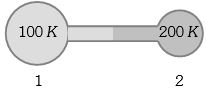
The figure shows two flasks connected to each other. The volume of flask $1$ is twice that of flask $2$. The system is filled with an ideal gas at temperatures $100\, K$ and $200\, K$ respectively. If the mass of the gas in flask $1$ is $m$,what is the mass of the gas in flask $2$?
A
$m$
B
$\frac{m}{2}$
C
$\frac{m}{4}$
D
$\frac{m}{8}$
Solution
(C) For an ideal gas,the ideal gas equation is given by $PV = \frac{m}{M}RT$,where $P$ is pressure,$V$ is volume,$m$ is mass,$M$ is molar mass,$R$ is the universal gas constant,and $T$ is temperature.
Since the flasks are connected,the pressure $P$ is the same in both flasks. Also,the gas is the same,so $M$ is constant.
Thus,$V \propto \frac{mT}{P} \Rightarrow V \propto mT$.
We can write the ratio as: $\frac{V_1}{V_2} = \frac{m_1 T_1}{m_2 T_2}$.
Given $V_1 = 2V_2$,$T_1 = 100\, K$,$T_2 = 200\, K$,and $m_1 = m$.
Substituting these values: $\frac{2V_2}{V_2} = \frac{m \times 100}{m_2 \times 200}$.
$2 = \frac{m}{2m_2}$.
$4m_2 = m \Rightarrow m_2 = \frac{m}{4}$.
Since the flasks are connected,the pressure $P$ is the same in both flasks. Also,the gas is the same,so $M$ is constant.
Thus,$V \propto \frac{mT}{P} \Rightarrow V \propto mT$.
We can write the ratio as: $\frac{V_1}{V_2} = \frac{m_1 T_1}{m_2 T_2}$.
Given $V_1 = 2V_2$,$T_1 = 100\, K$,$T_2 = 200\, K$,and $m_1 = m$.
Substituting these values: $\frac{2V_2}{V_2} = \frac{m \times 100}{m_2 \times 200}$.
$2 = \frac{m}{2m_2}$.
$4m_2 = m \Rightarrow m_2 = \frac{m}{4}$.
0 likes
View Solution75
EasyMCQ
$A$ box contains $n$ molecules of a gas. How will the pressure of the gas be affected if the number of molecules is made $2n$?
A
Pressure will decrease
B
Pressure will remain unchanged
C
Pressure will be doubled
D
Pressure will become three times
Solution
(C) We know that from the ideal gas equation,$PV = n_{moles}RT$.
Here,$n_{moles} = \frac{N}{N_{A}}$,where $N$ is the number of molecules of the gas and $N_{A}$ is the Avogadro's number.
Substituting the value of $n_{moles}$ into the ideal gas equation,we get $PV = \frac{N}{N_{A}}RT$.
This implies that the pressure $P$ of the gas is directly proportional to the number of molecules $N$ of the gas,provided the temperature $T$ and volume $V$ remain constant $(P \propto N)$.
Therefore,if the number of molecules is doubled $(N' = 2N)$,the pressure will also be doubled $(P' = 2P)$.
Here,$n_{moles} = \frac{N}{N_{A}}$,where $N$ is the number of molecules of the gas and $N_{A}$ is the Avogadro's number.
Substituting the value of $n_{moles}$ into the ideal gas equation,we get $PV = \frac{N}{N_{A}}RT$.
This implies that the pressure $P$ of the gas is directly proportional to the number of molecules $N$ of the gas,provided the temperature $T$ and volume $V$ remain constant $(P \propto N)$.
Therefore,if the number of molecules is doubled $(N' = 2N)$,the pressure will also be doubled $(P' = 2P)$.
0 likes
View Solution76
EasyMCQ
At the same temperature,pressure,and volume of two gases,which of the following quantities is constant?
A
Total number of molecules
B
Average kinetic energy
C
Root mean square velocity
D
Mean free path
Solution
(A) According to the ideal gas law,$PV = nRT$,where $n = N/N_A$. Since $P$,$V$,and $T$ are the same for both gases,the number of moles $n$ must be the same,which implies the total number of molecules $N$ is constant.
Average kinetic energy is given by $K_{avg} = (3/2)k_BT$,which depends only on temperature $T$. Since $T$ is constant,the average kinetic energy is also constant.
However,in the context of comparing two different gases,the total number of molecules is a fundamental consequence of Avogadro's Law under these conditions. Both $A$ and $B$ are constant,but the total number of molecules is the primary result of the given conditions.
Average kinetic energy is given by $K_{avg} = (3/2)k_BT$,which depends only on temperature $T$. Since $T$ is constant,the average kinetic energy is also constant.
However,in the context of comparing two different gases,the total number of molecules is a fundamental consequence of Avogadro's Law under these conditions. Both $A$ and $B$ are constant,but the total number of molecules is the primary result of the given conditions.
0 likes
View Solution77
MediumMCQ
The air density at Mount Everest is less than that at the sea level. It is found by mountaineers that for one trip lasting a few hours,the extra oxygen needed by them corresponds to $30,000 \, cc$ at sea level (pressure $1 \, atm$,temperature $27^{\circ}C$). Assuming that the temperature around Mount Everest is $-73^{\circ}C$ and that the oxygen cylinder has a capacity of $5.2 \, L$,the pressure at which $O_2$ must be filled (at site) in the cylinder is .... $atm$.
A
$3.86$
B
$5.00$
C
$5.77$
D
$1$
Solution
(A) The number of moles of gas remains constant in both states. According to the ideal gas law,$\frac{P_1 V_1}{T_1} = \frac{P_2 V_2}{T_2}$.
Given at sea level:
$P_1 = 1 \, atm$
$V_1 = 30,000 \, cc = 30 \, L$
$T_1 = 27^{\circ}C = 27 + 273 = 300 \, K$
Given at Mount Everest site:
$V_2 = 5.2 \, L$
$T_2 = -73^{\circ}C = -73 + 273 = 200 \, K$
$P_2 = ?$
Substituting the values into the equation:
$\frac{1 \times 30}{300} = \frac{P_2 \times 5.2}{200}$
$0.1 = \frac{P_2 \times 5.2}{200}$
$P_2 = \frac{0.1 \times 200}{5.2} = \frac{20}{5.2} \approx 3.846 \, atm \approx 3.86 \, atm$.
Given at sea level:
$P_1 = 1 \, atm$
$V_1 = 30,000 \, cc = 30 \, L$
$T_1 = 27^{\circ}C = 27 + 273 = 300 \, K$
Given at Mount Everest site:
$V_2 = 5.2 \, L$
$T_2 = -73^{\circ}C = -73 + 273 = 200 \, K$
$P_2 = ?$
Substituting the values into the equation:
$\frac{1 \times 30}{300} = \frac{P_2 \times 5.2}{200}$
$0.1 = \frac{P_2 \times 5.2}{200}$
$P_2 = \frac{0.1 \times 200}{5.2} = \frac{20}{5.2} \approx 3.846 \, atm \approx 3.86 \, atm$.
0 likes
View Solution78
MediumMCQ
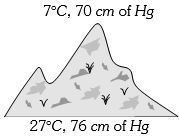
At the top of a mountain,a thermometer reads $7^{\circ}C$ and a barometer reads $70 \, cm$ of $Hg$. At the bottom of the mountain,these read $27^{\circ}C$ and $76 \, cm$ of $Hg$ respectively. The ratio of the density of air at the top to that at the bottom is
A
$75/76$
B
$70/76$
C
$76/75$
D
$76/70$
Solution
(A) The ideal gas equation in terms of density is given by $PV = nRT = \frac{m}{M}RT$,which implies $P = \frac{\rho RT}{M}$,where $\rho$ is the density.
Thus,$\frac{P}{\rho T} = \frac{R}{M} = \text{constant}$.
Therefore,$\frac{P_1}{\rho_1 T_1} = \frac{P_2}{\rho_2 T_2}$,which gives $\frac{\rho_1}{\rho_2} = \frac{P_1}{P_2} \times \frac{T_2}{T_1}$.
Given:
At the top: $P_{top} = 70 \, cm$ of $Hg$,$T_{top} = 7 + 273 = 280 \, K$.
At the bottom: $P_{bottom} = 76 \, cm$ of $Hg$,$T_{bottom} = 27 + 273 = 300 \, K$.
Substituting these values:
$\frac{\rho_{top}}{\rho_{bottom}} = \frac{70}{76} \times \frac{300}{280} = \frac{70}{76} \times \frac{30}{28} = \frac{70}{76} \times \frac{15}{14} = \frac{5 \times 15}{76} = \frac{75}{76}$.
Thus,$\frac{P}{\rho T} = \frac{R}{M} = \text{constant}$.
Therefore,$\frac{P_1}{\rho_1 T_1} = \frac{P_2}{\rho_2 T_2}$,which gives $\frac{\rho_1}{\rho_2} = \frac{P_1}{P_2} \times \frac{T_2}{T_1}$.
Given:
At the top: $P_{top} = 70 \, cm$ of $Hg$,$T_{top} = 7 + 273 = 280 \, K$.
At the bottom: $P_{bottom} = 76 \, cm$ of $Hg$,$T_{bottom} = 27 + 273 = 300 \, K$.
Substituting these values:
$\frac{\rho_{top}}{\rho_{bottom}} = \frac{70}{76} \times \frac{300}{280} = \frac{70}{76} \times \frac{30}{28} = \frac{70}{76} \times \frac{15}{14} = \frac{5 \times 15}{76} = \frac{75}{76}$.
0 likes
View Solution79
MediumMCQ
$A$ closed vessel contains $8\,g$ of oxygen and $7\,g$ of nitrogen. The total pressure is $10\,atm$ at a given temperature. If oxygen is now absorbed by introducing a suitable absorbent,the pressure of the remaining gas in $atm$ will be:
A
$2$
B
$10$
C
$4$
D
$5$
Solution
(D) The number of moles of oxygen $(n_{O_2})$ is $n_{O_2} = \frac{8\,g}{32\,g/mol} = 0.25\,mol$.
The number of moles of nitrogen $(n_{N_2})$ is $n_{N_2} = \frac{7\,g}{28\,g/mol} = 0.25\,mol$.
According to Dalton's law of partial pressures,the total pressure $P_{total}$ is proportional to the total number of moles $n_{total} = n_{O_2} + n_{N_2} = 0.25 + 0.25 = 0.50\,mol$.
Given $P_{total} = 10\,atm$,the partial pressure of each gas is proportional to its mole fraction.
Since $n_{O_2} = n_{N_2}$,the partial pressure of nitrogen is $P_{N_2} = \frac{n_{N_2}}{n_{O_2} + n_{N_2}} \times P_{total} = \frac{0.25}{0.50} \times 10\,atm = 5\,atm$.
When oxygen is removed,only nitrogen remains in the vessel. Therefore,the pressure of the remaining gas is $5\,atm$.
The number of moles of nitrogen $(n_{N_2})$ is $n_{N_2} = \frac{7\,g}{28\,g/mol} = 0.25\,mol$.
According to Dalton's law of partial pressures,the total pressure $P_{total}$ is proportional to the total number of moles $n_{total} = n_{O_2} + n_{N_2} = 0.25 + 0.25 = 0.50\,mol$.
Given $P_{total} = 10\,atm$,the partial pressure of each gas is proportional to its mole fraction.
Since $n_{O_2} = n_{N_2}$,the partial pressure of nitrogen is $P_{N_2} = \frac{n_{N_2}}{n_{O_2} + n_{N_2}} \times P_{total} = \frac{0.25}{0.50} \times 10\,atm = 5\,atm$.
When oxygen is removed,only nitrogen remains in the vessel. Therefore,the pressure of the remaining gas is $5\,atm$.
0 likes
View Solution80
MediumMCQ
If the intermolecular forces vanish away,the volume occupied by the molecules contained in $4.5 \,kg$ of water at standard temperature and pressure will be
A
$5.6 \,m^3$
B
$4.5 \,m^3$
C
$11.2 \,litre$
D
$11.2 \,m^3$
Solution
(A) The number of moles $\mu$ is given by the mass of water divided by its molar mass.
$\mu = \frac{4.5 \,kg}{18 \times 10^{-3} \,kg/mol} = 250 \,mol$.
At standard temperature and pressure $(STP)$,$T = 273 \,K$ and $P = 10^5 \,Pa$.
Using the ideal gas equation $PV = \mu RT$:
$V = \frac{\mu RT}{P} = \frac{250 \times 8.314 \times 273}{10^5} \approx 5.67 \,m^3$.
Rounding to the nearest provided option,the correct value is $5.6 \,m^3$.
$\mu = \frac{4.5 \,kg}{18 \times 10^{-3} \,kg/mol} = 250 \,mol$.
At standard temperature and pressure $(STP)$,$T = 273 \,K$ and $P = 10^5 \,Pa$.
Using the ideal gas equation $PV = \mu RT$:
$V = \frac{\mu RT}{P} = \frac{250 \times 8.314 \times 273}{10^5} \approx 5.67 \,m^3$.
Rounding to the nearest provided option,the correct value is $5.6 \,m^3$.
0 likes
View Solution81
MediumMCQ
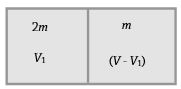
Inside a cylinder having insulating walls and closed at ends is a movable piston,which divides the cylinder into two compartments. On one side of the piston is a mass $m$ of a gas and on the other side a mass $2m$ of the same gas. What fraction of the total volume of the cylinder will be occupied by the larger mass of the gas when the piston is in equilibrium? Consider that the movable piston is conducting so that the temperature is the same throughout.
A
$0.25$
B
$0.33$
C
$0.5$
D
$0.67$
Solution
(D) Let the total volume of the cylinder be $V$. Let the volume occupied by the gas of mass $2m$ be $V_1$ and the volume occupied by the gas of mass $m$ be $V_2 = V - V_1$.
Since the piston is in equilibrium,the pressure $P$ on both sides is the same.
Since the piston is conducting,the temperature $T$ is the same for both gases.
Using the ideal gas equation $PV = nRT = \frac{m_{gas}}{M}RT$,where $M$ is the molar mass of the gas:
For the gas with mass $m$: $P(V - V_1) = \frac{m}{M}RT$ $(i)$
For the gas with mass $2m$: $P V_1 = \frac{2m}{M}RT$ $(ii)$
Dividing equation $(ii)$ by equation $(i)$:
$\frac{P V_1}{P(V - V_1)} = \frac{\frac{2m}{M}RT}{\frac{m}{M}RT}$
$\frac{V_1}{V - V_1} = 2$
$V_1 = 2V - 2V_1$
$3V_1 = 2V$
$\frac{V_1}{V} = \frac{2}{3} \approx 0.67$
Thus,the larger mass occupies $0.67$ of the total volume.
Since the piston is in equilibrium,the pressure $P$ on both sides is the same.
Since the piston is conducting,the temperature $T$ is the same for both gases.
Using the ideal gas equation $PV = nRT = \frac{m_{gas}}{M}RT$,where $M$ is the molar mass of the gas:
For the gas with mass $m$: $P(V - V_1) = \frac{m}{M}RT$ $(i)$
For the gas with mass $2m$: $P V_1 = \frac{2m}{M}RT$ $(ii)$
Dividing equation $(ii)$ by equation $(i)$:
$\frac{P V_1}{P(V - V_1)} = \frac{\frac{2m}{M}RT}{\frac{m}{M}RT}$
$\frac{V_1}{V - V_1} = 2$
$V_1 = 2V - 2V_1$
$3V_1 = 2V$
$\frac{V_1}{V} = \frac{2}{3} \approx 0.67$
Thus,the larger mass occupies $0.67$ of the total volume.
0 likes
View Solution82
MediumMCQ
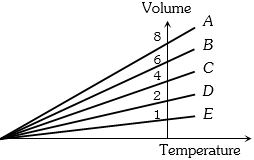
The expansion of an ideal gas of mass $m$ at a constant pressure $P$ is given by the straight line $D$. Then the expansion of the same ideal gas of mass $2m$ at a pressure $P/2$ is given by the straight line
A
$E$
B
$C$
C
$B$
D
$A$
Solution
(D) The ideal gas equation is given by $PV = nRT$,where $n = \frac{m}{M}$ ($m$ is the mass,$M$ is the molar mass).
Thus,$V = \left(\frac{m}{PM}\right) RT$.
The slope of the $V-T$ graph is $S = \frac{mR}{PM}$.
For the first case (line $D$): $S_1 = \frac{mR}{PM}$. From the graph,the slope of line $D$ is $2$.
For the second case (mass $2m$,pressure $P/2$): $S_2 = \frac{(2m)R}{(P/2)M} = 4 \left(\frac{mR}{PM}\right) = 4S_1$.
Since $S_1 = 2$,we have $S_2 = 4 \times 2 = 8$.
Looking at the graph,the line with a slope of $8$ is $A$.
Thus,$V = \left(\frac{m}{PM}\right) RT$.
The slope of the $V-T$ graph is $S = \frac{mR}{PM}$.
For the first case (line $D$): $S_1 = \frac{mR}{PM}$. From the graph,the slope of line $D$ is $2$.
For the second case (mass $2m$,pressure $P/2$): $S_2 = \frac{(2m)R}{(P/2)M} = 4 \left(\frac{mR}{PM}\right) = 4S_1$.
Since $S_1 = 2$,we have $S_2 = 4 \times 2 = 8$.
Looking at the graph,the line with a slope of $8$ is $A$.
0 likes
View Solution83
MediumMCQ
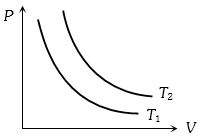
The adjoining figure shows the graph of pressure $(P)$ and volume $(V)$ of a gas at two temperatures $T_1$ and $T_2$. Which of the following inferences is correct?
A
$T_1 > T_2$
B
$T_1 = T_2$
C
$T_1 < T_2$
D
No inference can be drawn
Solution
(C) For an ideal gas,the equation of state is $PV = nRT$.
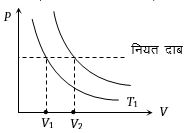
To compare the temperatures $T_1$ and $T_2$,we can draw a line of constant pressure $(P = \text{constant})$ on the $P-V$ graph.
At a constant pressure,the ideal gas equation gives $V \propto T$.
From the graph,for a fixed pressure,the volume corresponding to the curve $T_2$ (let it be $V_2$) is greater than the volume corresponding to the curve $T_1$ (let it be $V_1$),i.e.,$V_2 > V_1$.
Since $V \propto T$ at constant pressure,$V_2 > V_1$ implies $T_2 > T_1$ or $T_1 < T_2$.
To compare the temperatures $T_1$ and $T_2$,we can draw a line of constant pressure $(P = \text{constant})$ on the $P-V$ graph.
At a constant pressure,the ideal gas equation gives $V \propto T$.
From the graph,for a fixed pressure,the volume corresponding to the curve $T_2$ (let it be $V_2$) is greater than the volume corresponding to the curve $T_1$ (let it be $V_1$),i.e.,$V_2 > V_1$.
Since $V \propto T$ at constant pressure,$V_2 > V_1$ implies $T_2 > T_1$ or $T_1 < T_2$.
0 likes
View Solution84
MediumMCQ
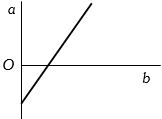
The expansion of unit mass of a perfect gas at constant pressure is shown in the diagram. Here
A
$a =$ volume,$b = ^{\circ}C$ temperature
B
$a =$ volume,$b = K$ temperature
C
$a = ^{\circ}C$ temperature,$b =$ volume
D
$a = K$ temperature,$b =$ volume
Solution
(A) According to Charles's Law,for a fixed mass of a gas at constant pressure,the volume $V$ is directly proportional to the absolute temperature $T$ (in Kelvin),i.e.,$V = kT$.
However,when expressed in Celsius scale,$V = V_0(1 + \alpha t)$,where $t$ is the temperature in $^{\circ}C$.
This equation represents a straight line $y = mx + c$,where $y$ is volume $(V)$ and $x$ is temperature ($t$ in $^{\circ}C$).
In the given graph,the line intersects the horizontal axis at a negative value,which corresponds to $-273.15^{\circ}C$ (absolute zero).
Since volume cannot be negative,the vertical axis $(a)$ must represent Volume $(V)$ and the horizontal axis $(b)$ must represent temperature in $^{\circ}C$ because the temperature scale in $^{\circ}C$ can have negative values.
Therefore,$a =$ volume and $b = ^{\circ}C$ temperature.
However,when expressed in Celsius scale,$V = V_0(1 + \alpha t)$,where $t$ is the temperature in $^{\circ}C$.
This equation represents a straight line $y = mx + c$,where $y$ is volume $(V)$ and $x$ is temperature ($t$ in $^{\circ}C$).
In the given graph,the line intersects the horizontal axis at a negative value,which corresponds to $-273.15^{\circ}C$ (absolute zero).
Since volume cannot be negative,the vertical axis $(a)$ must represent Volume $(V)$ and the horizontal axis $(b)$ must represent temperature in $^{\circ}C$ because the temperature scale in $^{\circ}C$ can have negative values.
Therefore,$a =$ volume and $b = ^{\circ}C$ temperature.
0 likes
View Solution85
DifficultMCQ
An ideal gas is initially at temperature $T$ and volume $V.$ Its volume is increased by $\Delta V$ due to an increase in temperature $\Delta T,$ pressure remaining constant. The quantity $\delta = \Delta V / (V \Delta T)$ varies with temperature as
A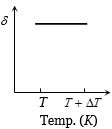
B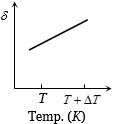
C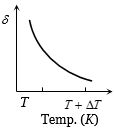
D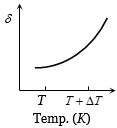
Solution
(C) For an ideal gas at constant pressure,Charles's Law states that $V / T = \text{constant}.$
When the temperature changes from $T$ to $T + \Delta T,$ the volume changes from $V$ to $V + \Delta V.$
Thus,we have:
$\frac{V + \Delta V}{T + \Delta T} = \frac{V}{T}$
Cross-multiplying gives:
$T(V + \Delta V) = V(T + \Delta T)$
$VT + T \Delta V = VT + V \Delta T$
Subtracting $VT$ from both sides:
$T \Delta V = V \Delta T$
Rearranging to find the expression for $\delta$:
$\delta = \frac{\Delta V}{V \Delta T} = \frac{1}{T}$
Since $\delta = 1/T,$ the quantity $\delta$ is inversely proportional to the temperature $T.$ This relationship is represented by a rectangular hyperbola,which corresponds to the graph shown in option $C.$
When the temperature changes from $T$ to $T + \Delta T,$ the volume changes from $V$ to $V + \Delta V.$
Thus,we have:
$\frac{V + \Delta V}{T + \Delta T} = \frac{V}{T}$
Cross-multiplying gives:
$T(V + \Delta V) = V(T + \Delta T)$
$VT + T \Delta V = VT + V \Delta T$
Subtracting $VT$ from both sides:
$T \Delta V = V \Delta T$
Rearranging to find the expression for $\delta$:
$\delta = \frac{\Delta V}{V \Delta T} = \frac{1}{T}$
Since $\delta = 1/T,$ the quantity $\delta$ is inversely proportional to the temperature $T.$ This relationship is represented by a rectangular hyperbola,which corresponds to the graph shown in option $C.$
0 likes
View Solution86
DifficultMCQ
The pressure versus temperature graph of an ideal gas with an equal number of moles at different volumes is plotted as shown in the figure. Choose the correct alternative.
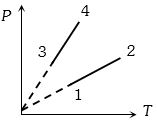
A
$V_1 = V_2, V_3 = V_4$ and $V_2 > V_3$
B
$V_1 = V_2, V_3 = V_4$ and $V_2 < V_3$
C
$V_1 = V_2 = V_3 = V_4$
D
$V_4 > V_3 > V_2 > V_1$
Solution
(A) According to the ideal gas law,$PV = nRT$,which can be rearranged as $P = (nR/V)T$.
For a constant volume process,the pressure-temperature graph is a straight line passing through the origin with a slope equal to $nR/V$.
In the given graph,lines $1-2$ and $3-4$ represent processes at constant volumes. Since lines $1-2$ and $3-4$ are segments of lines passing through the origin,we have $V_1 = V_2$ and $V_3 = V_4$.
The slope of the line is $m = nR/V$. Since the slope is inversely proportional to volume $(m \propto 1/V)$,a smaller slope corresponds to a larger volume.
The slope of line $1-2$ is less than the slope of line $3-4$. Therefore,the volume $V_2$ must be greater than the volume $V_3$ $(V_2 > V_3)$.
Thus,the correct relation is $V_1 = V_2, V_3 = V_4$ and $V_2 > V_3$.
For a constant volume process,the pressure-temperature graph is a straight line passing through the origin with a slope equal to $nR/V$.
In the given graph,lines $1-2$ and $3-4$ represent processes at constant volumes. Since lines $1-2$ and $3-4$ are segments of lines passing through the origin,we have $V_1 = V_2$ and $V_3 = V_4$.
The slope of the line is $m = nR/V$. Since the slope is inversely proportional to volume $(m \propto 1/V)$,a smaller slope corresponds to a larger volume.
The slope of line $1-2$ is less than the slope of line $3-4$. Therefore,the volume $V_2$ must be greater than the volume $V_3$ $(V_2 > V_3)$.
Thus,the correct relation is $V_1 = V_2, V_3 = V_4$ and $V_2 > V_3$.
0 likes
View Solution87
MediumMCQ
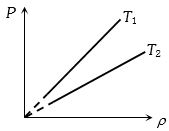
The figure shows graphs of pressure $(P)$ versus density $(
ho)$ for an ideal gas at two temperatures $T_1$ and $T_2$.
A
$T_1 > T_2$
B
$T_1 = T_2$
C
$T_1 < T_2$
D
Nothing can be predicted
Solution
(A) The ideal gas equation is given by $PV = nRT$.
Since $n = \frac{m}{M}$ and density $\rho = \frac{m}{V}$,we can write $V = \frac{m}{\rho}$.
Substituting this into the ideal gas equation: $P \left( \frac{m}{\rho} \right) = \left( \frac{m}{M} \right) RT$.
Simplifying,we get $P = \left( \frac{RT}{M} \right) \rho$.
This equation represents a straight line passing through the origin,$P = m' \rho$,where the slope $m' = \frac{RT}{M}$.
Since the slope is directly proportional to temperature $T$ (for a given gas,$R$ and $M$ are constant),the line with the greater slope corresponds to the higher temperature.
In the given graph,the slope of the line for $T_1$ is greater than the slope of the line for $T_2$.
Therefore,$T_1 > T_2$.
Since $n = \frac{m}{M}$ and density $\rho = \frac{m}{V}$,we can write $V = \frac{m}{\rho}$.
Substituting this into the ideal gas equation: $P \left( \frac{m}{\rho} \right) = \left( \frac{m}{M} \right) RT$.
Simplifying,we get $P = \left( \frac{RT}{M} \right) \rho$.
This equation represents a straight line passing through the origin,$P = m' \rho$,where the slope $m' = \frac{RT}{M}$.
Since the slope is directly proportional to temperature $T$ (for a given gas,$R$ and $M$ are constant),the line with the greater slope corresponds to the higher temperature.
In the given graph,the slope of the line for $T_1$ is greater than the slope of the line for $T_2$.
Therefore,$T_1 > T_2$.
0 likes
View Solution88
DifficultMCQ
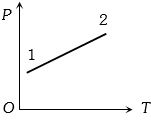
$A$ pressure $P-$absolute temperature $T$ diagram was obtained when a given mass of gas was heated. During the heating process from state $1$ to state $2$,the volume:
A
Increased
B
Decreased
C
Remained constant
D
Changed erratically
Solution
(A) From the ideal gas equation,we have $PV = nRT$,which can be rewritten as $P = (nR/V)T$.
Comparing this with the equation of a straight line passing through the origin,$y = mx$,where $y = P$ and $x = T$,the slope $m = nR/V$.
In the given $P-T$ diagram,the line representing the process from state $1$ to state $2$ is a straight line that does not pass through the origin $(0,0)$.
Let the equation of the line be $P = mT + c$,where $c > 0$ (since the intercept on the $P$-axis is positive).
Substituting $P = nRT/V$,we get $nRT/V = mT + c$,or $V = nR / (m + c/T)$.
As the temperature $T$ increases from state $1$ to state $2$,the term $c/T$ decreases.
Consequently,the denominator $(m + c/T)$ decreases,which means the volume $V$ must increase.
Comparing this with the equation of a straight line passing through the origin,$y = mx$,where $y = P$ and $x = T$,the slope $m = nR/V$.
In the given $P-T$ diagram,the line representing the process from state $1$ to state $2$ is a straight line that does not pass through the origin $(0,0)$.
Let the equation of the line be $P = mT + c$,where $c > 0$ (since the intercept on the $P$-axis is positive).
Substituting $P = nRT/V$,we get $nRT/V = mT + c$,or $V = nR / (m + c/T)$.
As the temperature $T$ increases from state $1$ to state $2$,the term $c/T$ decreases.
Consequently,the denominator $(m + c/T)$ decreases,which means the volume $V$ must increase.
0 likes
View Solution89
MediumMCQ
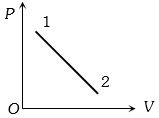
$A$ volume $V$ and pressure $P$ diagram was obtained from state $1$ to state $2$ when a given mass of a gas is subjected to temperature changes. During this process the gas is
A
Heated continuously
B
Cooled continuously
C
Heated in the beginning and cooled towards the end
D
Cooled in the beginning and heated towards the end
Solution
(C) For an ideal gas,the equation of state is $PV = nRT$. Thus,the temperature $T$ is proportional to the product $PV$.
In the given $P-V$ diagram,the process is a straight line from state $1$ to state $2$.
Let the equation of the line be $P = -mV + c$,where $m$ is the slope and $c$ is the intercept.
The product $PV = (-mV + c)V = -mV^2 + cV$.
To find the variation of $T$ with $V$,we look at the function $f(V) = -mV^2 + cV$.
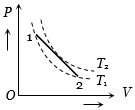
This is a downward-opening parabola. The value of $PV$ (and thus $T$) increases initially as $V$ increases,reaches a maximum at $V = c/(2m)$,and then decreases as $V$ increases further.
Therefore,the gas is heated in the beginning and cooled towards the end.
In the given $P-V$ diagram,the process is a straight line from state $1$ to state $2$.
Let the equation of the line be $P = -mV + c$,where $m$ is the slope and $c$ is the intercept.
The product $PV = (-mV + c)V = -mV^2 + cV$.
To find the variation of $T$ with $V$,we look at the function $f(V) = -mV^2 + cV$.
This is a downward-opening parabola. The value of $PV$ (and thus $T$) increases initially as $V$ increases,reaches a maximum at $V = c/(2m)$,and then decreases as $V$ increases further.
Therefore,the gas is heated in the beginning and cooled towards the end.
0 likes
View Solution90
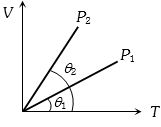
MediumMCQ
The figure shows the volume $V$ versus temperature $T$ graphs for a certain mass of a perfect gas at two constant pressures of $P_1$ and $P_2$. What inference can you draw from the graphs?
A
$P_1 > P_2$
B
$P_1 < P_2$
C
$P_1 = P_2$
D
No inference can be drawn due to insufficient information
Solution
(A) From the ideal gas equation,$PV = \mu RT$,we have $V = (\frac{\mu R}{P})T$.
The slope of the $V-T$ graph is given by $m = \tan \theta = \frac{V}{T} = \frac{\mu R}{P}$.
Since the slope is inversely proportional to pressure $(m \propto \frac{1}{P})$,a smaller slope corresponds to a higher pressure.
From the graph,it is clear that $\theta_1 < \theta_2$,which implies $\tan \theta_1 < \tan \theta_2$.
Therefore,$(\frac{V}{T})_1 < (\frac{V}{T})_2$.
Since $(\frac{V}{T}) \propto \frac{1}{P}$,we have $(\frac{1}{P})_1 < (\frac{1}{P})_2$,which leads to $P_1 > P_2$.
The slope of the $V-T$ graph is given by $m = \tan \theta = \frac{V}{T} = \frac{\mu R}{P}$.
Since the slope is inversely proportional to pressure $(m \propto \frac{1}{P})$,a smaller slope corresponds to a higher pressure.
From the graph,it is clear that $\theta_1 < \theta_2$,which implies $\tan \theta_1 < \tan \theta_2$.
Therefore,$(\frac{V}{T})_1 < (\frac{V}{T})_2$.
Since $(\frac{V}{T}) \propto \frac{1}{P}$,we have $(\frac{1}{P})_1 < (\frac{1}{P})_2$,which leads to $P_1 > P_2$.
0 likes
View Solution91
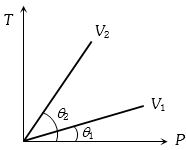
MediumMCQ
From the following $P-T$ graph,what inference can be drawn?
A
$V_2 > V_1$
B
$V_2 < V_1$
C
$V_2 = V_1$
D
None of the above
Solution
(A) From the given $P-T$ graph,the slope of the line represents $\frac{T}{P}$.
Since the angle $\theta_2 > \theta_1$,we have $\tan \theta_2 > \tan \theta_1$.
This implies $\left( \frac{T}{P} \right)_2 > \left( \frac{T}{P} \right)_1$.
From the ideal gas equation $PV = \mu RT$,we can write $\frac{T}{P} = \frac{V}{\mu R}$.
Since $\mu$ and $R$ are constants,$\frac{T}{P} \propto V$.
Therefore,$\left( \frac{T}{P} \right)_2 > \left( \frac{T}{P} \right)_1$ implies $V_2 > V_1$.
Since the angle $\theta_2 > \theta_1$,we have $\tan \theta_2 > \tan \theta_1$.
This implies $\left( \frac{T}{P} \right)_2 > \left( \frac{T}{P} \right)_1$.
From the ideal gas equation $PV = \mu RT$,we can write $\frac{T}{P} = \frac{V}{\mu R}$.
Since $\mu$ and $R$ are constants,$\frac{T}{P} \propto V$.
Therefore,$\left( \frac{T}{P} \right)_2 > \left( \frac{T}{P} \right)_1$ implies $V_2 > V_1$.
0 likes
View Solution92
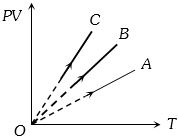
MediumMCQ
The $PV$ versus $T$ graph for equal masses of $H_2$,$He$,and $O_2$ is shown in the figure. Choose the correct alternative.
A
$C$ corresponds to $H_2$,$B$ to $He$,and $A$ to $O_2$.
B
$B$ corresponds to $He$,$A$ to $H_2$,and $C$ to $O_2$.
C
$A$ corresponds to $He$,$B$ to $H_2$,and $C$ to $O_2$.
D
$A$ corresponds to $O_2$,$B$ to $He$,and $C$ to $H_2$.
Solution
(A) From the ideal gas equation,$PV = \mu RT = \frac{m}{M}RT$,where $m$ is the mass and $M$ is the molar mass.
Rearranging the equation,we get $\frac{PV}{T} = \frac{mR}{M}$.
Since the masses $m$ are equal and $R$ is a constant,we have $\frac{PV}{T} \propto \frac{1}{M}$.
From the graph,the slope of the lines is $\frac{PV}{T}$. The slope is greatest for line $C$ and smallest for line $A$,so $(\frac{PV}{T})_C > (\frac{PV}{T})_B > (\frac{PV}{T})_A$.
This implies $M_C < M_B < M_A$.
The molar masses are $M_{H_2} = 2 \text{ g/mol}$,$M_{He} = 4 \text{ g/mol}$,and $M_{O_2} = 32 \text{ g/mol}$.
Therefore,$M_{H_2} < M_{He} < M_{O_2}$.
Comparing the two relations,we get $C$ corresponds to $H_2$,$B$ to $He$,and $A$ to $O_2$.
Rearranging the equation,we get $\frac{PV}{T} = \frac{mR}{M}$.
Since the masses $m$ are equal and $R$ is a constant,we have $\frac{PV}{T} \propto \frac{1}{M}$.
From the graph,the slope of the lines is $\frac{PV}{T}$. The slope is greatest for line $C$ and smallest for line $A$,so $(\frac{PV}{T})_C > (\frac{PV}{T})_B > (\frac{PV}{T})_A$.
This implies $M_C < M_B < M_A$.
The molar masses are $M_{H_2} = 2 \text{ g/mol}$,$M_{He} = 4 \text{ g/mol}$,and $M_{O_2} = 32 \text{ g/mol}$.
Therefore,$M_{H_2} < M_{He} < M_{O_2}$.
Comparing the two relations,we get $C$ corresponds to $H_2$,$B$ to $He$,and $A$ to $O_2$.
0 likes
View Solution93
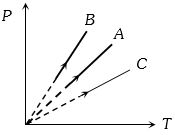
MediumMCQ
The pressure versus temperature graph of an ideal gas at constant volume $V$ and mass $m$ is shown by the straight line $A$. If the mass of the gas is doubled and the volume is halved,then the corresponding pressure versus temperature graph will be shown by the line:
A
$A$
B
$B$
C
$C$
D
None of these
Solution
(B) For an ideal gas,the equation of state is $PV = nRT$,where $n = \frac{m}{M}$ ($m$ is mass,$M$ is molar mass).
Thus,$PV = \frac{m}{M} RT$,which implies $P = \left( \frac{mR}{MV} \right) T$.
For the initial state,the slope of the line $A$ is $S_1 = \frac{mR}{MV}$.
In the new state,the mass $m' = 2m$ and the volume $V' = \frac{V}{2}$.
The new slope $S_2$ is given by $S_2 = \frac{m'R}{MV'} = \frac{(2m)R}{M(V/2)} = 4 \left( \frac{mR}{MV} \right) = 4S_1$.
Since the slope $S_2$ is greater than $S_1$,the new line must be steeper than line $A$. Looking at the graph,line $B$ has a greater slope than line $A$. Therefore,the correct line is $B$.
Thus,$PV = \frac{m}{M} RT$,which implies $P = \left( \frac{mR}{MV} \right) T$.
For the initial state,the slope of the line $A$ is $S_1 = \frac{mR}{MV}$.
In the new state,the mass $m' = 2m$ and the volume $V' = \frac{V}{2}$.
The new slope $S_2$ is given by $S_2 = \frac{m'R}{MV'} = \frac{(2m)R}{M(V/2)} = 4 \left( \frac{mR}{MV} \right) = 4S_1$.
Since the slope $S_2$ is greater than $S_1$,the new line must be steeper than line $A$. Looking at the graph,line $B$ has a greater slope than line $A$. Therefore,the correct line is $B$.
0 likes
View Solution94
MediumMCQ
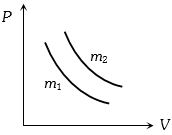
Two different isotherms representing the relationship between pressure $p$ and volume $V$ at a given temperature for the same ideal gas are shown for masses $m_1$ and $m_2$ of the gas respectively in the figure given. Then:
A
$m_1 > m_2$
B
$m_1 = m_2$
C
$m_1 < m_2$
D
$m_1 \ge m_2$
Solution
(C) The ideal gas equation is given by $pV = nRT = \frac{m}{M}RT$,where $m$ is the mass of the gas and $M$ is the molar mass.
For a fixed temperature $T$,we have $pV = \text{constant} \times m$,which implies $m = \frac{pVM}{RT}$.
For a constant pressure $p$,we can see from the graph that for the same pressure,the volume $V_2$ corresponding to mass $m_2$ is greater than the volume $V_1$ corresponding to mass $m_1$ (i.e.,$V_2 > V_1$).
Since $m = \frac{pVM}{RT}$,for a constant $p, T,$ and $M$,we have $m \propto V$.
Since $V_2 > V_1$,it follows that $m_2 > m_1$ or $m_1 < m_2$.
For a fixed temperature $T$,we have $pV = \text{constant} \times m$,which implies $m = \frac{pVM}{RT}$.
For a constant pressure $p$,we can see from the graph that for the same pressure,the volume $V_2$ corresponding to mass $m_2$ is greater than the volume $V_1$ corresponding to mass $m_1$ (i.e.,$V_2 > V_1$).
Since $m = \frac{pVM}{RT}$,for a constant $p, T,$ and $M$,we have $m \propto V$.
Since $V_2 > V_1$,it follows that $m_2 > m_1$ or $m_1 < m_2$.
0 likes
View Solution95
MediumMCQ
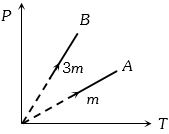
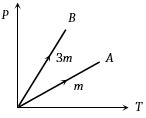
Two different masses $m$ and $3m$ of an ideal gas are heated separately in a vessel of constant volume. The pressure $P$ versus absolute temperature $T$ graphs for these two cases are shown in the figure. The ratio of the slopes of curves $B$ to $A$ is
A
$3:1$
B
$1:3$
C
$9:1$
D
$1:9$
Solution
(A) From the ideal gas equation, $PV = nRT$, where $n = \frac{m}{M}$ ($M$ is the molar mass).
So, $PV = \frac{m}{M} RT$.
Rearranging for pressure $P$, we get $P = \left( \frac{mR}{MV} \right) T$.
Comparing this with the equation of a straight line $P = (\text{slope}) \cdot T$, the slope is given by $S = \frac{mR}{MV}$.
Since $R$, $M$, and $V$ are constants for both cases, the slope $S$ is directly proportional to the mass $m$ $(S \propto m)$.
For curve $A$, the mass is $m$, so $S_A \propto m$.
For curve $B$, the mass is $3m$, so $S_B \propto 3m$.
The ratio of the slopes of curves $B$ to $A$ is $\frac{S_B}{S_A} = \frac{3m}{m} = \frac{3}{1}$.
Thus, the ratio is $3:1$.
So, $PV = \frac{m}{M} RT$.
Rearranging for pressure $P$, we get $P = \left( \frac{mR}{MV} \right) T$.
Comparing this with the equation of a straight line $P = (\text{slope}) \cdot T$, the slope is given by $S = \frac{mR}{MV}$.
Since $R$, $M$, and $V$ are constants for both cases, the slope $S$ is directly proportional to the mass $m$ $(S \propto m)$.
For curve $A$, the mass is $m$, so $S_A \propto m$.
For curve $B$, the mass is $3m$, so $S_B \propto 3m$.
The ratio of the slopes of curves $B$ to $A$ is $\frac{S_B}{S_A} = \frac{3m}{m} = \frac{3}{1}$.
Thus, the ratio is $3:1$.
0 likes
View Solution96
EasyMCQ
Under constant temperature,the graph between $P$ and $1/V$ is:
A
Parabola
B
Hyperbola
C
Straight line
D
Circle
Solution
(C) According to Boyle's Law,at a constant temperature,the pressure $P$ of a given mass of gas is inversely proportional to its volume $V$.
Mathematically,$PV = k$ (where $k$ is a constant).
This can be rewritten as $P = k \cdot (1/V)$.
Comparing this to the equation of a straight line $y = mx + c$,where $y = P$,$x = 1/V$,$m = k$,and $c = 0$,we see that the graph of $P$ versus $1/V$ is a straight line passing through the origin.
Mathematically,$PV = k$ (where $k$ is a constant).
This can be rewritten as $P = k \cdot (1/V)$.
Comparing this to the equation of a straight line $y = mx + c$,where $y = P$,$x = 1/V$,$m = k$,and $c = 0$,we see that the graph of $P$ versus $1/V$ is a straight line passing through the origin.
0 likes
View Solution97
MediumMCQ
Which one of the following graphs represents the behavior of an ideal gas at a constant temperature?
A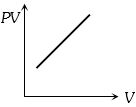
B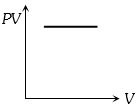
C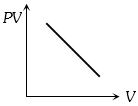
D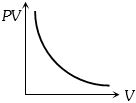
Solution
(B) For an ideal gas, the equation of state is given by $PV = nRT$.
If the temperature $T$ is kept constant, then for a fixed amount of gas (fixed $n$), the product $nRT$ is a constant.
Therefore, $PV = \text{constant}$.
This implies that the value of $PV$ does not change with a change in volume $V$. The graph of $PV$ versus $V$ will be a horizontal straight line parallel to the $V$-axis. Thus, the correct graph is represented by option $B$.
If the temperature $T$ is kept constant, then for a fixed amount of gas (fixed $n$), the product $nRT$ is a constant.
Therefore, $PV = \text{constant}$.
This implies that the value of $PV$ does not change with a change in volume $V$. The graph of $PV$ versus $V$ will be a horizontal straight line parallel to the $V$-axis. Thus, the correct graph is represented by option $B$.
0 likes
View Solution98
EasyMCQ
The volume-temperature graph at atmospheric pressure for a monoatomic gas ($V$ in $m^3$,$T$ in $^{\circ}C$) is:
A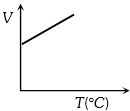
B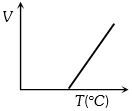
C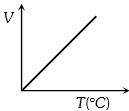
D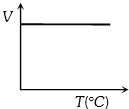
Solution
(A) According to Charles's Law,for a gas at constant pressure,the volume $V_T$ at temperature $T$ $(^{\circ}C)$ is given by the relation:
$V_T = V_0 \left( 1 + \frac{T}{273} \right)$
$V_T = V_0 + \left( \frac{V_0}{273} \right) T$
Comparing this with the equation of a straight line $y = mx + c$,where $y = V_T$,$x = T$,$m = \frac{V_0}{273}$ (slope),and $c = V_0$ (y-intercept).
Since $V_0 > 0$,the graph is a straight line with a positive y-intercept and a positive slope. This corresponds to the graph shown in option $A$.
$V_T = V_0 \left( 1 + \frac{T}{273} \right)$
$V_T = V_0 + \left( \frac{V_0}{273} \right) T$
Comparing this with the equation of a straight line $y = mx + c$,where $y = V_T$,$x = T$,$m = \frac{V_0}{273}$ (slope),and $c = V_0$ (y-intercept).
Since $V_0 > 0$,the graph is a straight line with a positive y-intercept and a positive slope. This corresponds to the graph shown in option $A$.
0 likes
View Solution99
MediumMCQ
$A$ vessel containing $5 \, L$ of a gas at $0.8 \, Pa$ pressure is connected to an evacuated vessel of volume $3 \, L$. The resultant pressure inside will be ...... $Pa$ (assuming the whole system to be isolated).
A
$4/3$
B
$0.5$
C
$2.0$
D
$3/4$
Solution
(B) According to Boyle's Law,for a gas at constant temperature,$P_1 V_1 = P_2 V_2$.
Here,the initial pressure $P_1 = 0.8 \, Pa$ and initial volume $V_1 = 5 \, L$.
The gas expands into an additional evacuated vessel of volume $3 \, L$,so the final volume $V_2 = V_1 + V_{evacuated} = 5 \, L + 3 \, L = 8 \, L$.
Substituting the values into the equation: $0.8 \times 5 = P_2 \times 8$.
$4 = P_2 \times 8$.
$P_2 = 4 / 8 = 0.5 \, Pa$.
Here,the initial pressure $P_1 = 0.8 \, Pa$ and initial volume $V_1 = 5 \, L$.
The gas expands into an additional evacuated vessel of volume $3 \, L$,so the final volume $V_2 = V_1 + V_{evacuated} = 5 \, L + 3 \, L = 8 \, L$.
Substituting the values into the equation: $0.8 \times 5 = P_2 \times 8$.
$4 = P_2 \times 8$.
$P_2 = 4 / 8 = 0.5 \, Pa$.
0 likes
View SolutionKinetic Theory of Gases — Gas Laws (Charles, Boyle's, Avagadro's, Gay Lussacs and Dalton's law) and Ideal gas Equation · Frequently Asked Questions
1Are these Kinetic Theory of Gases questions useful for JEE and NEET?
Yes. All questions in this section are mapped to JEE Main and NEET exam patterns. Previous year questions from JEE Main, NEET, GUJCET and state-level exams are included with full solutions.
2Can I switch to Hindi or Gujarati for these questions?
Yes. Use the language tabs in the hero section or the sidebar to view the same questions and solutions in English, Hindi or Gujarati.
3How do I generate a question paper from this subtopic?
Use the Vedclass Exam Paper Generator — select the chapter and subtopic, set difficulty, and generate Sets A, B, C, D automatically. First 3 chapters of every subject are free.
Vedclass Products
For Students
Vedclass Test Series
Mock tests in real JEE/NEET style with performance analysis. 5-day free trial.
Start Free TrialFor Teachers
Exam Paper Generator
Generate Set A/B/C/D papers from this chapter in 2 minutes. 3 chapters free.
Try FreeFor Institutes
Online Exam Module
Live online exams with unlimited students, 360° analytics & white-label branding.
See DemoFor Teachers & Institutes
Generate a Kinetic Theory of Gases Exam Paper in 2 Minutes
Select subtopic & difficulty — Sets A, B, C, D auto-generated with No Repeat logic.
First 3 chapters of every subject are free — no payment required.