
A English
Gas Laws (Charles, Boyle's, Avagadro's, Gay Lussacs and Dalton's law) and Ideal gas Equation Questions in English
Class 11 Physics · Kinetic Theory of Gases · Gas Laws (Charles, Boyle's, Avagadro's, Gay Lussacs and Dalton's law) and Ideal gas Equation
391+
Questions
English
Language
100%
With Solutions
Showing 49 of 391 questions in English
151
MediumMCQ
In a process,the pressure of an ideal gas varies with volume as $P = \frac{a}{1 + (V/b)^2}$,where $a$ and $b$ are constants. What is the temperature of the gas when the volume of $1$ mole of the gas is $V = b$?
A
$\frac{ab}{2R}$
B
$\frac{ab}{R}$
C
$ab$
D
Zero
Solution
(A) Given the pressure-volume relation: $P = \frac{a}{1 + (V/b)^2}$.
At $V = b$,the pressure $P$ becomes: $P = \frac{a}{1 + (b/b)^2} = \frac{a}{1 + 1} = \frac{a}{2}$.
Using the ideal gas equation for $n = 1$ mole: $PV = nRT$.
Substituting $P = \frac{a}{2}$,$V = b$,and $n = 1$:
$(\frac{a}{2}) \times b = 1 \times R \times T$.
Solving for $T$: $T = \frac{ab}{2R}$.
At $V = b$,the pressure $P$ becomes: $P = \frac{a}{1 + (b/b)^2} = \frac{a}{1 + 1} = \frac{a}{2}$.
Using the ideal gas equation for $n = 1$ mole: $PV = nRT$.
Substituting $P = \frac{a}{2}$,$V = b$,and $n = 1$:
$(\frac{a}{2}) \times b = 1 \times R \times T$.
Solving for $T$: $T = \frac{ab}{2R}$.
0 likes
View Solution152
MediumMCQ
$A$ vessel of volume $8\, L$ contains an ideal gas at $300\, K$ and $2\, atm$ pressure. The gas is allowed to leak until the pressure becomes $125\, kPa$. Calculate the number of moles that leaked out if the temperature remains constant.
A
$0.24$
B
$1.54$
C
$0.87$
D
$1.21$
Solution
(A) Initial state: $PV = n_1RT$. Given $P_1 = 2\, atm = 2.026 \times 10^5\, Pa$,$V = 8 \times 10^{-3}\, m^3$,$T = 300\, K$,$R = 8.314\, J/(mol\cdot K)$.
$n_1 = \frac{P_1V}{RT} = \frac{2.026 \times 10^5 \times 8 \times 10^{-3}}{8.314 \times 300} \approx 0.65\, mol$.
Using the provided approximation $1\, atm = 10^5\, Pa$ as per the solution logic: $n_1 = \frac{2 \times 10^5 \times 8 \times 10^{-3}}{8.31 \times 300} = 0.64\, mol$.
Since temperature $T$ and volume $V$ are constant,$P \propto n$,so $\frac{P_2}{P_1} = \frac{n_2}{n_1}$.
$P_2 = 125\, kPa = 1.25 \times 10^5\, Pa$.
$n_2 = n_1 \times \frac{P_2}{P_1} = 0.64 \times \frac{1.25 \times 10^5}{2 \times 10^5} = 0.64 \times 0.625 = 0.40\, mol$.
Leaked moles $= n_1 - n_2 = 0.64 - 0.40 = 0.24\, mol$.
$n_1 = \frac{P_1V}{RT} = \frac{2.026 \times 10^5 \times 8 \times 10^{-3}}{8.314 \times 300} \approx 0.65\, mol$.
Using the provided approximation $1\, atm = 10^5\, Pa$ as per the solution logic: $n_1 = \frac{2 \times 10^5 \times 8 \times 10^{-3}}{8.31 \times 300} = 0.64\, mol$.
Since temperature $T$ and volume $V$ are constant,$P \propto n$,so $\frac{P_2}{P_1} = \frac{n_2}{n_1}$.
$P_2 = 125\, kPa = 1.25 \times 10^5\, Pa$.
$n_2 = n_1 \times \frac{P_2}{P_1} = 0.64 \times \frac{1.25 \times 10^5}{2 \times 10^5} = 0.64 \times 0.625 = 0.40\, mol$.
Leaked moles $= n_1 - n_2 = 0.64 - 0.40 = 0.24\, mol$.
0 likes
View Solution153
DifficultMCQ
An insulated container is divided into two parts by a partition. The same gas is filled in both parts. In the right part,the volume,temperature,and pressure are $2V$,$T$,and $2P$ respectively. In the left part,the same parameters are $V$,$T$,and $P$. What is the ratio of the number of molecules in the right part to the left part?
A
$1:1$
B
$2:1$
C
$4:1$
D
$1:4$
Solution
(C) The ideal gas equation is given by $PV = nRT$,where $n = \frac{N}{N_A}$. Thus,$PV = \frac{N}{N_A}RT$,which implies $N = \frac{PVN_A}{RT}$.
For the right part $(N_R)$: $P_R = 2P$,$V_R = 2V$,$T_R = T$.
$N_R = \frac{(2P)(2V)N_A}{RT} = \frac{4PVN_A}{RT}$.
For the left part $(N_L)$: $P_L = P$,$V_L = V$,$T_L = T$.
$N_L = \frac{(P)(V)N_A}{RT} = \frac{PVN_A}{RT}$.
The ratio of the number of molecules in the right part to the left part is:
$\frac{N_R}{N_L} = \frac{4PVN_A / RT}{PVN_A / RT} = \frac{4}{1}$.
Therefore,the ratio is $4:1$.
For the right part $(N_R)$: $P_R = 2P$,$V_R = 2V$,$T_R = T$.
$N_R = \frac{(2P)(2V)N_A}{RT} = \frac{4PVN_A}{RT}$.
For the left part $(N_L)$: $P_L = P$,$V_L = V$,$T_L = T$.
$N_L = \frac{(P)(V)N_A}{RT} = \frac{PVN_A}{RT}$.
The ratio of the number of molecules in the right part to the left part is:
$\frac{N_R}{N_L} = \frac{4PVN_A / RT}{PVN_A / RT} = \frac{4}{1}$.
Therefore,the ratio is $4:1$.
0 likes
View Solution154
DifficultMCQ
If the density of the Sun is $1.4 \, g \, cm^{-3}$, the pressure is $1.4 \times 10^9 \, \text{atm}$, and the molar mass of the gas in the Sun is $2 \, g \, mol^{-1}$, then the temperature of the Sun will be: [Take $R = 8.4 \, J \, mol^{-1} \, K^{-1}$]
A
$3.0 \times 10^9 \, K$
B
$1.3 \times 10^8 \, K$
C
$0.7 \times 10^6 \, K$
D
$2.4 \times 10^7 \, K$
Solution
(D) Using the ideal gas equation $PV = \mu RT$, where $\mu = \frac{m}{M_w}$ and $\rho = \frac{m}{V}$, we have $m = \rho V$. Substituting $\mu = \frac{\rho V}{M_w}$ into the ideal gas equation:
$PV = \left( \frac{\rho V}{M_w} \right) RT \Rightarrow T = \frac{P M_w}{\rho R}$
Given:
$P = 1.4 \times 10^9 \, \text{atm} = 1.4 \times 10^9 \times 1.013 \times 10^5 \, N \, m^{-2} \approx 1.418 \times 10^{14} \, Pa$
$\rho = 1.4 \, g \, cm^{-3} = 1400 \, kg \, m^{-3}$
$M_w = 2 \, g \, mol^{-1} = 2 \times 10^{-3} \, kg \, mol^{-1}$
$R = 8.4 \, J \, mol^{-1} \, K^{-1}$
Substituting the values:
$T = \frac{(1.4 \times 10^9 \times 1.013 \times 10^5) \times (2 \times 10^{-3})}{1400 \times 8.4}$
$T = \frac{1.418 \times 10^{14} \times 2 \times 10^{-3}}{11760} = \frac{2.836 \times 10^{11}}{11760} \approx 2.41 \times 10^7 \, K$
Thus, the temperature is approximately $2.4 \times 10^7 \, K$.
$PV = \left( \frac{\rho V}{M_w} \right) RT \Rightarrow T = \frac{P M_w}{\rho R}$
Given:
$P = 1.4 \times 10^9 \, \text{atm} = 1.4 \times 10^9 \times 1.013 \times 10^5 \, N \, m^{-2} \approx 1.418 \times 10^{14} \, Pa$
$\rho = 1.4 \, g \, cm^{-3} = 1400 \, kg \, m^{-3}$
$M_w = 2 \, g \, mol^{-1} = 2 \times 10^{-3} \, kg \, mol^{-1}$
$R = 8.4 \, J \, mol^{-1} \, K^{-1}$
Substituting the values:
$T = \frac{(1.4 \times 10^9 \times 1.013 \times 10^5) \times (2 \times 10^{-3})}{1400 \times 8.4}$
$T = \frac{1.418 \times 10^{14} \times 2 \times 10^{-3}}{11760} = \frac{2.836 \times 10^{11}}{11760} \approx 2.41 \times 10^7 \, K$
Thus, the temperature is approximately $2.4 \times 10^7 \, K$.
0 likes
View Solution155
DifficultMCQ
In the figure,the volume of container $X$ is twice the volume of container $Y$. Both contain an ideal gas. The temperature of $X$ is $200 \, K$ and the temperature of $Y$ is $400 \, K$. If the mass of the gas in $X$ is $m$,what will be the mass of the gas in $Y$?
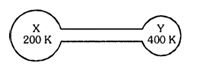
A
$\frac{m}{8}$
B
$\frac{m}{6}$
C
$\frac{m}{4}$
D
$\frac{m}{2}$
Solution
(C) Since the containers are connected,the pressure $P$ in both containers must be equal,i.e.,$P_X = P_Y$.
Using the ideal gas equation $PV = nRT = \frac{m}{M}RT$,we get $P = \frac{mRT}{MV}$.
For both containers,$P = \frac{mRT}{MV}$ is constant,so $\frac{m_X T_X}{V_X} = \frac{m_Y T_Y}{V_Y}$.
Given $V_X = 2V_Y$,$T_X = 200 \, K$,$T_Y = 400 \, K$,and $m_X = m$.
Substituting these values: $\frac{m \times 200}{2V_Y} = \frac{m_Y \times 400}{V_Y}$.
Simplifying: $\frac{100m}{V_Y} = \frac{400m_Y}{V_Y}$.
$100m = 400m_Y \Rightarrow m_Y = \frac{100m}{400} = \frac{m}{4}$.
Using the ideal gas equation $PV = nRT = \frac{m}{M}RT$,we get $P = \frac{mRT}{MV}$.
For both containers,$P = \frac{mRT}{MV}$ is constant,so $\frac{m_X T_X}{V_X} = \frac{m_Y T_Y}{V_Y}$.
Given $V_X = 2V_Y$,$T_X = 200 \, K$,$T_Y = 400 \, K$,and $m_X = m$.
Substituting these values: $\frac{m \times 200}{2V_Y} = \frac{m_Y \times 400}{V_Y}$.
Simplifying: $\frac{100m}{V_Y} = \frac{400m_Y}{V_Y}$.
$100m = 400m_Y \Rightarrow m_Y = \frac{100m}{400} = \frac{m}{4}$.
0 likes
View Solution156
MediumMCQ
Equal masses of $N_2$ and $O_2$ gases are filled in containers $A$ and $B$ respectively. The volume of container $B$ is twice the volume of container $A$. What is the ratio of the pressure in container $A$ to that in container $B$?
A
$16 : 14$
B
$32 : 7$
C
$16 : 7$
D
None of these
Solution
(C) From the ideal gas equation $PV = \frac{m}{M_0}RT$,where $m$ is mass,$M_0$ is molar mass,$R$ is the gas constant,and $T$ is temperature.
Since $m$ and $T$ are constant,$P \propto \frac{1}{M_0 V}$.
Therefore,the ratio of pressures is $\frac{P_A}{P_B} = \frac{M_{0,B}}{M_{0,A}} \times \frac{V_B}{V_A}$.
Given: $M_{0,A} (N_2) = 28 \, g/mol$,$M_{0,B} (O_2) = 32 \, g/mol$,and $V_B = 2V_A$.
Substituting these values: $\frac{P_A}{P_B} = \frac{32}{28} \times \frac{2V_A}{V_A} = \frac{32}{28} \times 2 = \frac{64}{28} = \frac{16}{7}$.
Since $m$ and $T$ are constant,$P \propto \frac{1}{M_0 V}$.
Therefore,the ratio of pressures is $\frac{P_A}{P_B} = \frac{M_{0,B}}{M_{0,A}} \times \frac{V_B}{V_A}$.
Given: $M_{0,A} (N_2) = 28 \, g/mol$,$M_{0,B} (O_2) = 32 \, g/mol$,and $V_B = 2V_A$.
Substituting these values: $\frac{P_A}{P_B} = \frac{32}{28} \times \frac{2V_A}{V_A} = \frac{32}{28} \times 2 = \frac{64}{28} = \frac{16}{7}$.
0 likes
View Solution157
DifficultMCQ
$A$ container $A$ contains a gas at thermodynamic coordinates $P, V,$ and $T$. Another container $B$ contains a different gas at $2P, V/4,$ and $2T$. The ratio of the number of molecules in container $A$ to the number of molecules in container $B$ is:
A
$4:1$
B
$2:1$
C
$1:2$
D
$1:1$
Solution
(A) The ideal gas equation is given by $PV = nRT$,where $n$ is the number of moles.
Since $n = N/N_A$ (where $N$ is the number of molecules and $N_A$ is Avogadro's number),the equation becomes $PV = (N/N_A)RT$.
For container $A$: $P_A V_A = (N_A / N_{Avogadro}) R T_A \Rightarrow PV = (N_A / N_{Avogadro}) R T$.
For container $B$: $P_B V_B = (N_B / N_{Avogadro}) R T_B \Rightarrow (2P)(V/4) = (N_B / N_{Avogadro}) R (2T) \Rightarrow PV/2 = (N_B / N_{Avogadro}) R (2T)$.
Dividing the two equations:
$\frac{PV}{PV/2} = \frac{N_A}{N_B} \times \frac{T}{2T} \Rightarrow 2 = \frac{N_A}{N_B} \times \frac{1}{2}$.
Therefore,$\frac{N_A}{N_B} = 4$,which is $4:1$.
Since $n = N/N_A$ (where $N$ is the number of molecules and $N_A$ is Avogadro's number),the equation becomes $PV = (N/N_A)RT$.
For container $A$: $P_A V_A = (N_A / N_{Avogadro}) R T_A \Rightarrow PV = (N_A / N_{Avogadro}) R T$.
For container $B$: $P_B V_B = (N_B / N_{Avogadro}) R T_B \Rightarrow (2P)(V/4) = (N_B / N_{Avogadro}) R (2T) \Rightarrow PV/2 = (N_B / N_{Avogadro}) R (2T)$.
Dividing the two equations:
$\frac{PV}{PV/2} = \frac{N_A}{N_B} \times \frac{T}{2T} \Rightarrow 2 = \frac{N_A}{N_B} \times \frac{1}{2}$.
Therefore,$\frac{N_A}{N_B} = 4$,which is $4:1$.
0 likes
View Solution158
EasyMCQ
Find the value of the universal gas constant $R$ in $J \ mol^{-1} K^{-1}$.
A
$5.65$
B
$8.31$
C
$9.75$
D
$7.54$
Solution
(B) The universal gas constant $R$ is given by the formula $R = \frac{PV}{nT}$.
At $STP$ (Standard Temperature and Pressure),for $n = 1 \ mol$ of an ideal gas:
$P = 1.013 \times 10^5 \ Pa$ (or $1 \ atm$),
$V = 22.4 \times 10^{-3} \ m^3$,
$T = 273.15 \ K$.
Substituting these values:
$R = \frac{(1.013 \times 10^5 \ Pa) \times (22.4 \times 10^{-3} \ m^3)}{1 \ mol \times 273.15 \ K} \approx 8.314 \ J \ mol^{-1} K^{-1}$.
Thus,the value is approximately $8.31 \ J \ mol^{-1} K^{-1}$.
At $STP$ (Standard Temperature and Pressure),for $n = 1 \ mol$ of an ideal gas:
$P = 1.013 \times 10^5 \ Pa$ (or $1 \ atm$),
$V = 22.4 \times 10^{-3} \ m^3$,
$T = 273.15 \ K$.
Substituting these values:
$R = \frac{(1.013 \times 10^5 \ Pa) \times (22.4 \times 10^{-3} \ m^3)}{1 \ mol \times 273.15 \ K} \approx 8.314 \ J \ mol^{-1} K^{-1}$.
Thus,the value is approximately $8.31 \ J \ mol^{-1} K^{-1}$.
0 likes
View Solution159
MediumMCQ
$A$ gas at a temperature of $27^{\circ}C$ has a volume $V$ and pressure $P$. If the pressure is doubled and the volume is tripled,what will be the new temperature in $^{\circ}C$?
A
$1800$
B
$162$
C
$1527$
D
$600$
Solution
(C) Using the ideal gas law,$PV = \mu RT$,we have the relation $\frac{P_1 V_1}{T_1} = \frac{P_2 V_2}{T_2}$.
Given: $T_1 = 27^{\circ}C = 27 + 273 = 300 \ K$,$P_2 = 2P_1$,and $V_2 = 3V_1$.
Substituting these values into the equation:
$\frac{P_1 V_1}{T_1} = \frac{(2P_1)(3V_1)}{T_2}$
$\frac{1}{T_1} = \frac{6}{T_2}$
$T_2 = 6T_1 = 6 \times 300 = 1800 \ K$.
To convert the temperature to Celsius: $T(^{\circ}C) = 1800 - 273 = 1527^{\circ}C$.
Given: $T_1 = 27^{\circ}C = 27 + 273 = 300 \ K$,$P_2 = 2P_1$,and $V_2 = 3V_1$.
Substituting these values into the equation:
$\frac{P_1 V_1}{T_1} = \frac{(2P_1)(3V_1)}{T_2}$
$\frac{1}{T_1} = \frac{6}{T_2}$
$T_2 = 6T_1 = 6 \times 300 = 1800 \ K$.
To convert the temperature to Celsius: $T(^{\circ}C) = 1800 - 273 = 1527^{\circ}C$.
0 likes
View Solution160
DifficultMCQ
$A$ container holds $13 \, g$ of gas at a temperature of $27^{\circ}C$. If the temperature of the container is raised to $52^{\circ}C$ while keeping the pressure constant,the amount of gas that must be released is ..... $g$.
A
$2.5$
B
$20$
C
$1.5$
D
$1.0$
Solution
(D) From the ideal gas equation,$PV = nRT = \frac{m}{M}RT$.
Since pressure $P$,volume $V$,and molar mass $M$ are constant,we have $m_1 T_1 = m_2 T_2$.
Given: $m_1 = 13 \, g$,$T_1 = 27 + 273 = 300 \, K$,$T_2 = 52 + 273 = 325 \, K$.
Substituting the values: $13 \times 300 = m_2 \times 325$.
$m_2 = \frac{13 \times 300}{325} = \frac{3900}{325} = 12 \, g$.
The amount of gas released is $\Delta m = m_1 - m_2 = 13 \, g - 12 \, g = 1 \, g$.
Since pressure $P$,volume $V$,and molar mass $M$ are constant,we have $m_1 T_1 = m_2 T_2$.
Given: $m_1 = 13 \, g$,$T_1 = 27 + 273 = 300 \, K$,$T_2 = 52 + 273 = 325 \, K$.
Substituting the values: $13 \times 300 = m_2 \times 325$.
$m_2 = \frac{13 \times 300}{325} = \frac{3900}{325} = 12 \, g$.
The amount of gas released is $\Delta m = m_1 - m_2 = 13 \, g - 12 \, g = 1 \, g$.
0 likes
View Solution161
DifficultMCQ
$A$ gas of mass $m$ undergoes expansion at a constant pressure $P$,resulting in graph $D$. Which graph will be obtained if the same gas of mass $2m$ undergoes expansion at a pressure of $P/2$?
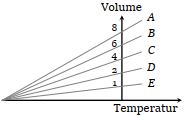
A
$E$
B
$C$
C
$B$
D
$A$
Solution
(D) From the ideal gas equation,$PV = \frac{m}{M}RT$,where $M$ is the molar mass.
For a constant pressure $P$,the volume $V$ is given by $V = (\frac{mR}{MP})T$.
The slope of the $V-T$ graph is $S = \frac{mR}{MP}$.
For the initial case,the slope is $S_1 = \frac{mR}{MP}$,which corresponds to graph $D$.
For the second case,the mass is $2m$ and the pressure is $P/2$.
The new slope is $S_2 = \frac{(2m)R}{M(P/2)} = 4 \times \frac{mR}{MP} = 4S_1$.
Since the slope of graph $D$ is proportional to $1$,the slope of the new graph will be proportional to $4$.
Looking at the provided graph,the slopes increase from $E$ to $A$. Graph $D$ has a slope proportional to $1$,and graph $A$ has a slope proportional to $4$ (as $4 \times 1 = 4$).
Therefore,the correct graph is $A$.
For a constant pressure $P$,the volume $V$ is given by $V = (\frac{mR}{MP})T$.
The slope of the $V-T$ graph is $S = \frac{mR}{MP}$.
For the initial case,the slope is $S_1 = \frac{mR}{MP}$,which corresponds to graph $D$.
For the second case,the mass is $2m$ and the pressure is $P/2$.
The new slope is $S_2 = \frac{(2m)R}{M(P/2)} = 4 \times \frac{mR}{MP} = 4S_1$.
Since the slope of graph $D$ is proportional to $1$,the slope of the new graph will be proportional to $4$.
Looking at the provided graph,the slopes increase from $E$ to $A$. Graph $D$ has a slope proportional to $1$,and graph $A$ has a slope proportional to $4$ (as $4 \times 1 = 4$).
Therefore,the correct graph is $A$.
0 likes
View Solution162
DifficultMCQ
Find the ratio of the density of air at the top of a mountain to the density of air at the bottom of the mountain,given the conditions shown in the image.
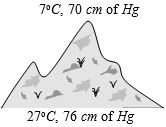
A
$75/76$
B
$70/76$
C
$76/75$
D
$76/70$
Solution
(A) From the ideal gas equation,$PV = nRT = \frac{m}{M}RT$,we have $P = \frac{\rho RT}{M}$,where $\rho$ is the density of the gas.
Thus,$\frac{P}{\rho T} = \frac{R}{M} = \text{constant}$.
This implies $\frac{\rho_1}{\rho_2} = \frac{P_1}{P_2} \times \frac{T_2}{T_1}$.
Given at the top: $P_{\text{top}} = 70 \text{ cm of Hg}$,$T_{\text{top}} = 7^{\circ}\text{C} = 280 \text{ K}$.
Given at the bottom: $P_{\text{bottom}} = 76 \text{ cm of Hg}$,$T_{\text{bottom}} = 27^{\circ}\text{C} = 300 \text{ K}$.
Therefore,the ratio of density at the top to the density at the bottom is:
$\frac{\rho_{\text{top}}}{\rho_{\text{bottom}}} = \frac{P_{\text{top}}}{P_{\text{bottom}}} \times \frac{T_{\text{bottom}}}{T_{\text{top}}} = \frac{70}{76} \times \frac{300}{280} = \frac{70}{76} \times \frac{30}{28} = \frac{70}{76} \times \frac{15}{14} = \frac{5 \times 15}{76} = \frac{75}{76}$.
Thus,$\frac{P}{\rho T} = \frac{R}{M} = \text{constant}$.
This implies $\frac{\rho_1}{\rho_2} = \frac{P_1}{P_2} \times \frac{T_2}{T_1}$.
Given at the top: $P_{\text{top}} = 70 \text{ cm of Hg}$,$T_{\text{top}} = 7^{\circ}\text{C} = 280 \text{ K}$.
Given at the bottom: $P_{\text{bottom}} = 76 \text{ cm of Hg}$,$T_{\text{bottom}} = 27^{\circ}\text{C} = 300 \text{ K}$.
Therefore,the ratio of density at the top to the density at the bottom is:
$\frac{\rho_{\text{top}}}{\rho_{\text{bottom}}} = \frac{P_{\text{top}}}{P_{\text{bottom}}} \times \frac{T_{\text{bottom}}}{T_{\text{top}}} = \frac{70}{76} \times \frac{300}{280} = \frac{70}{76} \times \frac{30}{28} = \frac{70}{76} \times \frac{15}{14} = \frac{5 \times 15}{76} = \frac{75}{76}$.
0 likes
View Solution163
MediumMCQ
$A$ container holds $10 \ kg$ of gas at a pressure of $10^7 \ N/m^2$. How much gas in $kg$ must be removed so that the final pressure becomes $2.5 \times 10^6 \ N/m^2$? (Assume temperature remains constant.)
A
$0$
B
$7.5$
C
$2.5$
D
$5$
Solution
(B) For an ideal gas at constant temperature,the pressure $P$ is directly proportional to the mass $m$ of the gas in the container $(P \propto m)$.
Given:
Initial pressure $P_1 = 10^7 \ N/m^2$
Initial mass $m_1 = 10 \ kg$
Final pressure $P_2 = 2.5 \times 10^6 \ N/m^2$
Using the relation $\frac{P_1}{P_2} = \frac{m_1}{m_2}$:
$\frac{10^7}{2.5 \times 10^6} = \frac{10}{m_2}$
Solving for $m_2$:
$m_2 = \frac{2.5 \times 10^6 \times 10}{10^7} = 2.5 \ kg$
The mass of gas removed is $\Delta m = m_1 - m_2 = 10 \ kg - 2.5 \ kg = 7.5 \ kg$.
Given:
Initial pressure $P_1 = 10^7 \ N/m^2$
Initial mass $m_1 = 10 \ kg$
Final pressure $P_2 = 2.5 \times 10^6 \ N/m^2$
Using the relation $\frac{P_1}{P_2} = \frac{m_1}{m_2}$:
$\frac{10^7}{2.5 \times 10^6} = \frac{10}{m_2}$
Solving for $m_2$:
$m_2 = \frac{2.5 \times 10^6 \times 10}{10^7} = 2.5 \ kg$
The mass of gas removed is $\Delta m = m_1 - m_2 = 10 \ kg - 2.5 \ kg = 7.5 \ kg$.
0 likes
View Solution164
MediumMCQ
$A$ gas has a volume $V$ at a temperature of $27^{\circ}C$. If the temperature is increased to $327^{\circ}C$ while keeping the pressure constant,what will be the new volume of the gas?
A
$V$
B
$3V$
C
$2V$
D
$V/2$
Solution
(C) According to Charles's Law,for a fixed mass of gas at constant pressure,the volume is directly proportional to its absolute temperature: $V \propto T$.
This can be written as $\frac{V_1}{T_1} = \frac{V_2}{T_2}$.
Given: $T_1 = 27^{\circ}C = 27 + 273 = 300 \ K$ and $T_2 = 327^{\circ}C = 327 + 273 = 600 \ K$.
Substituting the values: $\frac{V}{300} = \frac{V_2}{600}$.
Solving for $V_2$: $V_2 = V \times \frac{600}{300} = 2V$.
Therefore,the new volume of the gas is $2V$.
This can be written as $\frac{V_1}{T_1} = \frac{V_2}{T_2}$.
Given: $T_1 = 27^{\circ}C = 27 + 273 = 300 \ K$ and $T_2 = 327^{\circ}C = 327 + 273 = 600 \ K$.
Substituting the values: $\frac{V}{300} = \frac{V_2}{600}$.
Solving for $V_2$: $V_2 = V \times \frac{600}{300} = 2V$.
Therefore,the new volume of the gas is $2V$.
0 likes
View Solution165
DifficultMCQ
When the pressure of a gas is increased by $0.4\%$,its temperature increases by $1\,^{\circ}\text{C}$. What is the initial temperature of the gas?
A
$250\, \text{K}$
B
$250\, ^{\circ}\text{C}$
C
$2500\, \text{K}$
D
$25\, ^{\circ}\text{C}$
Solution
(A) Let the initial pressure be $P_1 = P$ and the initial temperature be $T_1 = T$ (in Kelvin).
Given that the pressure increases by $0.4\%$,the new pressure is $P_2 = P + 0.004P = 1.004P$.
Given that the temperature increases by $1\,^{\circ}\text{C}$,the new temperature is $T_2 = T + 1$.
Assuming the volume remains constant,according to Gay-Lussac's Law,$\frac{P_1}{T_1} = \frac{P_2}{T_2}$.
Substituting the values: $\frac{P}{T} = \frac{1.004P}{T + 1}$.
$T + 1 = 1.004T$.
$1 = 0.004T$.
$T = \frac{1}{0.004} = \frac{1000}{4} = 250\, \text{K}$.
Given that the pressure increases by $0.4\%$,the new pressure is $P_2 = P + 0.004P = 1.004P$.
Given that the temperature increases by $1\,^{\circ}\text{C}$,the new temperature is $T_2 = T + 1$.
Assuming the volume remains constant,according to Gay-Lussac's Law,$\frac{P_1}{T_1} = \frac{P_2}{T_2}$.
Substituting the values: $\frac{P}{T} = \frac{1.004P}{T + 1}$.
$T + 1 = 1.004T$.
$1 = 0.004T$.
$T = \frac{1}{0.004} = \frac{1000}{4} = 250\, \text{K}$.
0 likes
View Solution166
DifficultMCQ
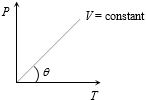
The graph of four gases with the same number of moles is given. Then:
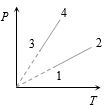
A
$V_1 = V_2, V_3 = V_4$ and $V_2 > V_3$
B
$V_1 = V_2, V_3 = V_4$ and $V_2 < V_3$
C
$V_1 = V_2 = V_3 = V_4$
D
$V_4 > V_3 > V_2 > V_1$
Solution
(A) From the ideal gas equation,$PV = \mu RT$,we can write:
$P = \left( \frac{\mu R}{V} \right) T$
Comparing this with the equation of a straight line $y = mx$,where $y = P$ and $x = T$,the slope $m$ is given by:
$m = \tan \theta = \frac{\mu R}{V}$
Since the number of moles $\mu$ and the gas constant $R$ are constant,we have:
$V \propto \frac{1}{\tan \theta}$
As the angle $\theta$ increases,$\tan \theta$ increases,and therefore the volume $V$ decreases.
From the graph,the slope of line $1$ is equal to the slope of line $2$ (as they are parallel),so $V_1 = V_2$.
Similarly,the slope of line $3$ is equal to the slope of line $4$,so $V_3 = V_4$.
Since the slope of line $3$ (and $4$) is greater than the slope of line $1$ (and $2$),we have $\tan \theta_3 > \tan \theta_1$.
Therefore,$V_3 < V_1$ or $V_2 > V_3$.
Thus,the correct relation is $V_1 = V_2, V_3 = V_4$ and $V_2 > V_3$.
$P = \left( \frac{\mu R}{V} \right) T$
Comparing this with the equation of a straight line $y = mx$,where $y = P$ and $x = T$,the slope $m$ is given by:
$m = \tan \theta = \frac{\mu R}{V}$
Since the number of moles $\mu$ and the gas constant $R$ are constant,we have:
$V \propto \frac{1}{\tan \theta}$
As the angle $\theta$ increases,$\tan \theta$ increases,and therefore the volume $V$ decreases.
From the graph,the slope of line $1$ is equal to the slope of line $2$ (as they are parallel),so $V_1 = V_2$.
Similarly,the slope of line $3$ is equal to the slope of line $4$,so $V_3 = V_4$.
Since the slope of line $3$ (and $4$) is greater than the slope of line $1$ (and $2$),we have $\tan \theta_3 > \tan \theta_1$.
Therefore,$V_3 < V_1$ or $V_2 > V_3$.
Thus,the correct relation is $V_1 = V_2, V_3 = V_4$ and $V_2 > V_3$.
0 likes
View Solution167
EasyMCQ
What is the number of molecules in $1 \, litre$ of an ideal gas at $S.T.P.$?
A
$2.68 \times 10^{22}$
B
$2.68 \times 10^{25}$
C
$2.68 \times 10^{28}$
D
$1.68 \times 10^{22}$
Solution
(A) At $S.T.P.$ (Standard Temperature and Pressure),the molar volume of an ideal gas is $22.4 \, litres$.
According to Avogadro's hypothesis,$1 \, mole$ of any gas contains $6.023 \times 10^{23}$ molecules.
Therefore,$22.4 \, litres$ of gas contains $6.023 \times 10^{23}$ molecules.
To find the number of molecules in $1 \, litre$,we divide the total number of molecules by the molar volume:
Number of molecules $= \frac{6.023 \times 10^{23}}{22.4} \approx 2.68 \times 10^{22}$ molecules.
According to Avogadro's hypothesis,$1 \, mole$ of any gas contains $6.023 \times 10^{23}$ molecules.
Therefore,$22.4 \, litres$ of gas contains $6.023 \times 10^{23}$ molecules.
To find the number of molecules in $1 \, litre$,we divide the total number of molecules by the molar volume:
Number of molecules $= \frac{6.023 \times 10^{23}}{22.4} \approx 2.68 \times 10^{22}$ molecules.
0 likes
View Solution168
EasyMCQ
The number of molecules in $1 \, cm^{3}$ of an ideal gas at $N.T.P.$ is:
A
$6.02 \times 10^{23} / 22400$
B
$6.02 \times 10^{23}$
C
$1 / 22400$
D
$6.02 \times 10^{23} / 76$
Solution
(A) At $N.T.P.$,the molar volume of an ideal gas is $22.4 \, L$.
Since $1 \, L = 1000 \, cm^{3}$,the volume of $1 \, mole$ of gas is $22.4 \times 10^{3} \, cm^{3} = 22400 \, cm^{3}$.
According to Avogadro's hypothesis,$1 \, mole$ of any gas contains $6.023 \times 10^{23}$ molecules.
Therefore,the number of molecules in $22400 \, cm^{3}$ is $6.023 \times 10^{23}$.
Thus,the number of molecules in $1 \, cm^{3}$ is $\frac{6.023 \times 10^{23}}{22400}$.
Since $1 \, L = 1000 \, cm^{3}$,the volume of $1 \, mole$ of gas is $22.4 \times 10^{3} \, cm^{3} = 22400 \, cm^{3}$.
According to Avogadro's hypothesis,$1 \, mole$ of any gas contains $6.023 \times 10^{23}$ molecules.
Therefore,the number of molecules in $22400 \, cm^{3}$ is $6.023 \times 10^{23}$.
Thus,the number of molecules in $1 \, cm^{3}$ is $\frac{6.023 \times 10^{23}}{22400}$.
0 likes
View Solution169
MediumMCQ
At $10^{\circ} C$,the value of the density of a fixed mass of an ideal gas divided by its pressure is $x$. At $110^{\circ} C$,this ratio is:
A
$\left( \frac{10}{110} \right)x$
B
$\left( \frac{283}{383} \right)x$
C
$x$
D
$\left( \frac{383}{283} \right)x$
Solution
(B) From the ideal gas equation,$PV = nRT = \frac{m}{M}RT$,where $m$ is the mass and $M$ is the molar mass.
Density $\rho = \frac{m}{V} = \frac{PM}{RT}$.
The ratio of density to pressure is $\frac{\rho}{P} = \frac{M}{RT}$.
Since $M$ and $R$ are constants,$\frac{\rho}{P} \propto \frac{1}{T}$.
Let the ratio at $T_1 = 10^{\circ} C = 283 \ K$ be $x_1 = x$.
Let the ratio at $T_2 = 110^{\circ} C = 383 \ K$ be $x_2$.
Since $x \cdot T = \text{constant}$,we have $x_1 T_1 = x_2 T_2$.
$x \cdot 283 = x_2 \cdot 383$.
Therefore,$x_2 = \left( \frac{283}{383} \right)x$.
Density $\rho = \frac{m}{V} = \frac{PM}{RT}$.
The ratio of density to pressure is $\frac{\rho}{P} = \frac{M}{RT}$.
Since $M$ and $R$ are constants,$\frac{\rho}{P} \propto \frac{1}{T}$.
Let the ratio at $T_1 = 10^{\circ} C = 283 \ K$ be $x_1 = x$.
Let the ratio at $T_2 = 110^{\circ} C = 383 \ K$ be $x_2$.
Since $x \cdot T = \text{constant}$,we have $x_1 T_1 = x_2 T_2$.
$x \cdot 283 = x_2 \cdot 383$.
Therefore,$x_2 = \left( \frac{283}{383} \right)x$.
0 likes
View Solution170
MediumMCQ
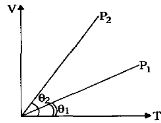
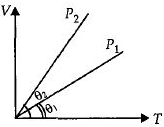
In the given $(V - T)$ diagram,what is the relation between pressures $P_1$ and $P_2 \,?$
A
$P_2 = P_1$
B
$P_2 > P_1$
C
$P_2 < P_1$
D
Cannot be predicted
Solution
(C) According to the ideal gas equation,
$PV = nRT$
Rearranging for $V$ in terms of $T$:
$V = \left( \frac{nR}{P} \right) T$
This represents a straight line passing through the origin,where the slope $m$ is given by:
$m = \frac{V}{T} = \frac{nR}{P}$
Since $n$ and $R$ are constants,the slope is inversely proportional to the pressure $P$ $(m \propto \frac{1}{P})$.
From the given figure,the angle $\theta_2 > \theta_1$,which implies that the slope of the line for $P_2$ is greater than the slope of the line for $P_1$:
$(\text{Slope})_2 > (\text{Slope})_1$
Since slope is inversely proportional to pressure,a higher slope corresponds to a lower pressure:
$P_2 < P_1$
$PV = nRT$
Rearranging for $V$ in terms of $T$:
$V = \left( \frac{nR}{P} \right) T$
This represents a straight line passing through the origin,where the slope $m$ is given by:
$m = \frac{V}{T} = \frac{nR}{P}$
Since $n$ and $R$ are constants,the slope is inversely proportional to the pressure $P$ $(m \propto \frac{1}{P})$.
From the given figure,the angle $\theta_2 > \theta_1$,which implies that the slope of the line for $P_2$ is greater than the slope of the line for $P_1$:
$(\text{Slope})_2 > (\text{Slope})_1$
Since slope is inversely proportional to pressure,a higher slope corresponds to a lower pressure:
$P_2 < P_1$
0 likes
View Solution171
MediumMCQ
Two vessels separately contain two ideal gases $A$ and $B$ at the same temperature. The pressure of $A$ is twice that of $B.$ Under such conditions,the density of $A$ is found to be $1.5$ times the density of $B.$ The ratio of the molecular weight of $A$ to that of $B$ is
A
$0.5$
B
$0.67$
C
$0.75$
D
$2$
Solution
(C) According to the ideal gas equation,the molecular weight $M$ of an ideal gas is given by:
$M = \frac{\rho R T}{P}$
where $P$ is the pressure,$T$ is the temperature,$\rho$ is the density,and $R$ is the universal gas constant.
For gases $A$ and $B$:
$M_A = \frac{\rho_A R T_A}{P_A}$ and $M_B = \frac{\rho_B R T_B}{P_B}$
The ratio of their molecular weights is:
$\frac{M_A}{M_B} = \left( \frac{\rho_A}{\rho_B} \right) \left( \frac{T_A}{T_B} \right) \left( \frac{P_B}{P_A} \right)$
Given:
$\frac{\rho_A}{\rho_B} = 1.5 = \frac{3}{2}$
$T_A = T_B \implies \frac{T_A}{T_B} = 1$
$P_A = 2 P_B \implies \frac{P_B}{P_A} = \frac{1}{2}$
Substituting these values:
$\frac{M_A}{M_B} = \left( \frac{3}{2} \right) \times (1) \times \left( \frac{1}{2} \right) = \frac{3}{4} = 0.75$
$M = \frac{\rho R T}{P}$
where $P$ is the pressure,$T$ is the temperature,$\rho$ is the density,and $R$ is the universal gas constant.
For gases $A$ and $B$:
$M_A = \frac{\rho_A R T_A}{P_A}$ and $M_B = \frac{\rho_B R T_B}{P_B}$
The ratio of their molecular weights is:
$\frac{M_A}{M_B} = \left( \frac{\rho_A}{\rho_B} \right) \left( \frac{T_A}{T_B} \right) \left( \frac{P_B}{P_A} \right)$
Given:
$\frac{\rho_A}{\rho_B} = 1.5 = \frac{3}{2}$
$T_A = T_B \implies \frac{T_A}{T_B} = 1$
$P_A = 2 P_B \implies \frac{P_B}{P_A} = \frac{1}{2}$
Substituting these values:
$\frac{M_A}{M_B} = \left( \frac{3}{2} \right) \times (1) \times \left( \frac{1}{2} \right) = \frac{3}{4} = 0.75$
0 likes
View Solution172
MediumMCQ
$A$ given sample of an ideal gas occupies a volume $V$ at a pressure $P$ and absolute temperature $T.$ The mass of each molecule of the gas is $m.$ Which of the following gives the density of the gas $?$
A
$\frac{P}{kTV}$
B
$mKT$
C
$\frac{P}{kT}$
D
$\frac{Pm}{kT}$
Solution
(D) The ideal gas equation is given by $PV = nRT$,where $n$ is the number of moles.
We know that $n = \frac{\text{mass of gas}}{M}$,where $M$ is the molar mass.
Also,the molar mass $M = m N_A$,where $m$ is the mass of one molecule and $N_A$ is Avogadro's number.
Substituting these into the ideal gas equation: $PV = \left(\frac{\text{mass}}{m N_A}\right) RT$.
Rearranging for density $\rho = \frac{\text{mass}}{V}$,we get $\rho = \frac{P m N_A}{RT}$.
Since the Boltzmann constant $k = \frac{R}{N_A}$,we have $R = N_A k$.
Substituting $R$ in the density equation: $\rho = \frac{P m N_A}{(N_A k) T} = \frac{Pm}{kT}$.
We know that $n = \frac{\text{mass of gas}}{M}$,where $M$ is the molar mass.
Also,the molar mass $M = m N_A$,where $m$ is the mass of one molecule and $N_A$ is Avogadro's number.
Substituting these into the ideal gas equation: $PV = \left(\frac{\text{mass}}{m N_A}\right) RT$.
Rearranging for density $\rho = \frac{\text{mass}}{V}$,we get $\rho = \frac{P m N_A}{RT}$.
Since the Boltzmann constant $k = \frac{R}{N_A}$,we have $R = N_A k$.
Substituting $R$ in the density equation: $\rho = \frac{P m N_A}{(N_A k) T} = \frac{Pm}{kT}$.
0 likes
View Solution173
EasyMCQ
The $SI$ unit of universal gas constant is
A
$Watt\,K^{-1}mol^{-1}$
B
$Newton\,K^{-1}mol^{-1}$
C
$Joule\,K^{-1}mol^{-1}$
D
$Erg\,K^{-1}mol^{-1}$
Solution
(C) From the ideal gas equation,$PV = nRT$.
Rearranging for the universal gas constant,we get $R = \frac{PV}{nT}$.
The unit of pressure $P$ is $Pascal$ $(Pa)$ or $Joule/m^3$,and volume $V$ is $m^3$. Thus,the product $PV$ has the unit of energy,which is $Joule$ $(J)$.
The unit of amount of substance $n$ is $mole$ $(mol)$ and temperature $T$ is $Kelvin$ $(K)$.
Substituting these units,we get the unit of $R = \frac{J}{mol \cdot K} = J\,K^{-1}mol^{-1}$.
Rearranging for the universal gas constant,we get $R = \frac{PV}{nT}$.
The unit of pressure $P$ is $Pascal$ $(Pa)$ or $Joule/m^3$,and volume $V$ is $m^3$. Thus,the product $PV$ has the unit of energy,which is $Joule$ $(J)$.
The unit of amount of substance $n$ is $mole$ $(mol)$ and temperature $T$ is $Kelvin$ $(K)$.
Substituting these units,we get the unit of $R = \frac{J}{mol \cdot K} = J\,K^{-1}mol^{-1}$.
0 likes
View Solution174
EasyMCQ
An ideal gas has an initial pressure of $3$ pressure units and an initial volume of $4$ volume units. The table gives the final pressure and volume of the gas (in those same units) in four processes. Which processes start and end on the same isotherm?
| $A$. Process $A$ | $P=5, V=7$ |
| $B$. Process $B$ | $P=4, V=6$ |
| $C$. Process $C$ | $P=12, V=1$ |
| $D$. Process $D$ | $P=6, V=3$ |
A
$A$
B
$B$
C
$C$
D
$D$
Solution
(C) For an ideal gas, the equation of state is $PV = nRT$.
An isotherm is a process where the temperature $T$ remains constant.
Since $n$ and $R$ are constants, for an isotherm, $PV = \text{constant}$.
Given initial conditions: $P_i = 3$ and $V_i = 4$.
Therefore, the product $P_i V_i = 3 \times 4 = 12$.
We check the product $PV$ for each process:
Process $A$: $P \times V = 5 \times 7 = 35 \neq 12$.
Process $B$: $P \times V = 4 \times 6 = 24 \neq 12$.
Process $C$: $P \times V = 12 \times 1 = 12$.
Process $D$: $P \times V = 6 \times 3 = 18 \neq 12$.
Thus, only process $C$ satisfies the condition $P_f V_f = P_i V_i$.
An isotherm is a process where the temperature $T$ remains constant.
Since $n$ and $R$ are constants, for an isotherm, $PV = \text{constant}$.
Given initial conditions: $P_i = 3$ and $V_i = 4$.
Therefore, the product $P_i V_i = 3 \times 4 = 12$.
We check the product $PV$ for each process:
Process $A$: $P \times V = 5 \times 7 = 35 \neq 12$.
Process $B$: $P \times V = 4 \times 6 = 24 \neq 12$.
Process $C$: $P \times V = 12 \times 1 = 12$.
Process $D$: $P \times V = 6 \times 3 = 18 \neq 12$.
Thus, only process $C$ satisfies the condition $P_f V_f = P_i V_i$.
0 likes
View Solution175
MediumMCQ
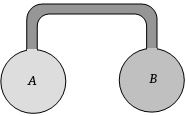
Two spherical vessels of equal volume $V$ are connected by a narrow tube. The apparatus contains an ideal gas at $1 \text{ atm}$ and $300 \text{ K}$. Now,if one vessel is immersed in a bath of constant temperature $600 \text{ K}$ and the other in a bath of constant temperature $300 \text{ K}$,then the common pressure will be ...... $\text{atm}$.
A
$1$
B
$0.8$
C
$1.33$
D
$0.75$
Solution
(C) Let the initial pressure be $P = 1 \text{ atm}$ and initial temperature be $T = 300 \text{ K}$.
The total number of moles of gas in the system is constant.
Initial moles: $\mu = \frac{PV}{RT} + \frac{PV}{RT} = \frac{2PV}{RT}$.
Let the final common pressure be $P'$.
Final moles: $\mu' = \frac{P'V}{RT_1} + \frac{P'V}{RT_2}$,where $T_1 = 600 \text{ K}$ and $T_2 = 300 \text{ K}$.
Since $\mu = \mu'$,we have: $\frac{2PV}{RT} = \frac{P'V}{RT_1} + \frac{P'V}{RT_2}$.
Canceling $V/R$ from both sides: $\frac{2P}{T} = P' \left( \frac{1}{T_1} + \frac{1}{T_2} \right) = P' \left( \frac{T_1 + T_2}{T_1 T_2} \right)$.
Solving for $P'$: $P' = \frac{2P T_1 T_2}{T(T_1 + T_2)}$.
Substituting the values: $P' = \frac{2 \times 1 \times 600 \times 300}{300 \times (600 + 300)} = \frac{2 \times 600}{900} = \frac{1200}{900} = \frac{4}{3} \approx 1.33 \text{ atm}$.
The total number of moles of gas in the system is constant.
Initial moles: $\mu = \frac{PV}{RT} + \frac{PV}{RT} = \frac{2PV}{RT}$.
Let the final common pressure be $P'$.
Final moles: $\mu' = \frac{P'V}{RT_1} + \frac{P'V}{RT_2}$,where $T_1 = 600 \text{ K}$ and $T_2 = 300 \text{ K}$.
Since $\mu = \mu'$,we have: $\frac{2PV}{RT} = \frac{P'V}{RT_1} + \frac{P'V}{RT_2}$.
Canceling $V/R$ from both sides: $\frac{2P}{T} = P' \left( \frac{1}{T_1} + \frac{1}{T_2} \right) = P' \left( \frac{T_1 + T_2}{T_1 T_2} \right)$.
Solving for $P'$: $P' = \frac{2P T_1 T_2}{T(T_1 + T_2)}$.
Substituting the values: $P' = \frac{2 \times 1 \times 600 \times 300}{300 \times (600 + 300)} = \frac{2 \times 600}{900} = \frac{1200}{900} = \frac{4}{3} \approx 1.33 \text{ atm}$.
0 likes
View Solution176
EasyMCQ
The volume of a gas at pressure $21 \times 10^4 \ N/m^2$ and temperature $27^\circ C$ is $83 \ L$. If $R = 8.3 \ J/mol/K$,then the quantity of gas in $gm-mole$ will be:
A
$15$
B
$42$
C
$7$
D
$14$
Solution
(C) The ideal gas equation is given by $PV = \mu RT$,where $\mu$ is the number of moles.
Given:
Pressure $P = 21 \times 10^4 \ N/m^2$
Volume $V = 83 \ L = 83 \times 10^{-3} \ m^3$
Temperature $T = 27^\circ C = 27 + 273 = 300 \ K$
Gas constant $R = 8.3 \ J/mol/K$
Substituting the values into the equation:
$\mu = \frac{PV}{RT} = \frac{21 \times 10^4 \times 83 \times 10^{-3}}{8.3 \times 300}$
$\mu = \frac{21 \times 10^4 \times 83 \times 10^{-3}}{8.3 \times 300} = \frac{21 \times 830}{2490} = \frac{17430}{2490} = 7 \ gm-mole$.
Given:
Pressure $P = 21 \times 10^4 \ N/m^2$
Volume $V = 83 \ L = 83 \times 10^{-3} \ m^3$
Temperature $T = 27^\circ C = 27 + 273 = 300 \ K$
Gas constant $R = 8.3 \ J/mol/K$
Substituting the values into the equation:
$\mu = \frac{PV}{RT} = \frac{21 \times 10^4 \times 83 \times 10^{-3}}{8.3 \times 300}$
$\mu = \frac{21 \times 10^4 \times 83 \times 10^{-3}}{8.3 \times 300} = \frac{21 \times 830}{2490} = \frac{17430}{2490} = 7 \ gm-mole$.
0 likes
View Solution177
MediumMCQ
The pressure and temperature of an ideal gas in a closed vessel are $720 \, kPa$ and $40^\circ C$ respectively. If $\frac{1}{4}^{th}$ of the gas is released from the vessel and the temperature of the remaining gas is raised to $353^\circ C$,the final pressure of the gas is ....... $kPa$.
A
$1440$
B
$1080$
C
$720$
D
$540$
Solution
(B) Given: Initial pressure $P_1 = 720 \, kPa$,Initial temperature $T_1 = 40^\circ C = 273 + 40 = 313 \, K$.
Final temperature $T_2 = 353^\circ C = 273 + 353 = 626 \, K$.
Since $\frac{1}{4}^{th}$ of the gas is released,the remaining mass $m_2 = \frac{3}{4} m_1$.
Using the ideal gas law $PV = nRT = \frac{m}{M} RT$,we have $P \propto mT$ (since $V$ and $M$ are constant).
Therefore,$\frac{P_2}{P_1} = \frac{m_2}{m_1} \times \frac{T_2}{T_1}$.
Substituting the values: $\frac{P_2}{720} = \frac{3}{4} \times \frac{626}{313} = \frac{3}{4} \times 2 = 1.5$.
$P_2 = 1.5 \times 720 = 1080 \, kPa$.
Final temperature $T_2 = 353^\circ C = 273 + 353 = 626 \, K$.
Since $\frac{1}{4}^{th}$ of the gas is released,the remaining mass $m_2 = \frac{3}{4} m_1$.
Using the ideal gas law $PV = nRT = \frac{m}{M} RT$,we have $P \propto mT$ (since $V$ and $M$ are constant).
Therefore,$\frac{P_2}{P_1} = \frac{m_2}{m_1} \times \frac{T_2}{T_1}$.
Substituting the values: $\frac{P_2}{720} = \frac{3}{4} \times \frac{626}{313} = \frac{3}{4} \times 2 = 1.5$.
$P_2 = 1.5 \times 720 = 1080 \, kPa$.
0 likes
View Solution178
MediumMCQ
$A$ pressure cooker contains air at $1$ atm and $30^\circ C$. If the safety valve of the cooker blows when the inside pressure $\ge 3$ atm,then the maximum temperature of the air inside the cooker can be .... $^\circ C$.
A
$90$
B
$636$
C
$909$
D
$363$
Solution
(B) Since the volume of the pressure cooker remains constant,we use Gay-Lussac's Law: $\frac{P_1}{T_1} = \frac{P_2}{T_2}$.
Given: $P_1 = 1$ atm,$T_1 = 30^\circ C = 30 + 273 = 303$ $K$,and $P_2 = 3$ atm.
Substituting the values: $\frac{1}{303} = \frac{3}{T_2}$.
Solving for $T_2$: $T_2 = 3 \times 303 = 909$ $K$.
To convert the temperature to Celsius: $T_2(^\circ C) = 909 - 273 = 636^\circ C$.
Given: $P_1 = 1$ atm,$T_1 = 30^\circ C = 30 + 273 = 303$ $K$,and $P_2 = 3$ atm.
Substituting the values: $\frac{1}{303} = \frac{3}{T_2}$.
Solving for $T_2$: $T_2 = 3 \times 303 = 909$ $K$.
To convert the temperature to Celsius: $T_2(^\circ C) = 909 - 273 = 636^\circ C$.
0 likes
View Solution179
MediumMCQ
$A$ cylinder contains $10\, kg$ of gas at a pressure of $10^7\, N/m^2$. The quantity of gas taken out of the cylinder,if the final pressure is $2.5 \times 10^6\, N/m^2$,will be ..... $kg$ (Temperature of the gas is constant).
A
$15.2$
B
$3.7$
C
$0$
D
$7.5$
Solution
(D) From the ideal gas equation,$PV = nRT = (m/M)RT$.
Since the temperature $T$,volume $V$,and molar mass $M$ are constant,we have $P \propto m$.
Therefore,$\frac{P_1}{P_2} = \frac{m_1}{m_2}$.
Given $P_1 = 10^7\, N/m^2$,$m_1 = 10\, kg$,and $P_2 = 2.5 \times 10^6\, N/m^2$.
Substituting the values: $\frac{10^7}{2.5 \times 10^6} = \frac{10}{m_2}$.
$4 = \frac{10}{m_2} \implies m_2 = \frac{10}{4} = 2.5\, kg$.
The mass of the gas taken out is $\Delta m = m_1 - m_2 = 10 - 2.5 = 7.5\, kg$.
Since the temperature $T$,volume $V$,and molar mass $M$ are constant,we have $P \propto m$.
Therefore,$\frac{P_1}{P_2} = \frac{m_1}{m_2}$.
Given $P_1 = 10^7\, N/m^2$,$m_1 = 10\, kg$,and $P_2 = 2.5 \times 10^6\, N/m^2$.
Substituting the values: $\frac{10^7}{2.5 \times 10^6} = \frac{10}{m_2}$.
$4 = \frac{10}{m_2} \implies m_2 = \frac{10}{4} = 2.5\, kg$.
The mass of the gas taken out is $\Delta m = m_1 - m_2 = 10 - 2.5 = 7.5\, kg$.
0 likes
View Solution180
MediumMCQ
Air is filled at $60^oC$ in a vessel with an open mouth. The vessel is heated to a temperature $T$ so that $1/4^{th}$ of the air escapes. Assuming the volume of the vessel remains constant,the value of $T$ is ....... $^oC$.
A
$80$
B
$444$
C
$333$
D
$171$
Solution
(D) For an open-mouthed vessel,the pressure $P$ remains constant as it is equal to the atmospheric pressure.
The volume $V$ of the vessel is also constant.
From the ideal gas equation $PV = \mu RT = \left( \frac{m}{M} \right) RT$,where $m$ is the mass of the gas and $M$ is the molar mass,we have $m \propto \frac{1}{T}$ at constant $P$ and $V$.
Therefore,$m_1 T_1 = m_2 T_2$,which implies $\frac{T_2}{T_1} = \frac{m_1}{m_2}$.
Initial temperature $T_1 = 60 + 273 = 333 \ K$.
Since $1/4^{th}$ of the air escapes,the remaining mass $m_2 = m_1 - \frac{1}{4}m_1 = \frac{3}{4}m_1$.
Substituting the values: $\frac{T_2}{333} = \frac{m_1}{(3/4)m_1} = \frac{4}{3}$.
$T_2 = 333 \times \frac{4}{3} = 444 \ K$.
Converting to Celsius: $T = 444 - 273 = 171^oC$.
The volume $V$ of the vessel is also constant.
From the ideal gas equation $PV = \mu RT = \left( \frac{m}{M} \right) RT$,where $m$ is the mass of the gas and $M$ is the molar mass,we have $m \propto \frac{1}{T}$ at constant $P$ and $V$.
Therefore,$m_1 T_1 = m_2 T_2$,which implies $\frac{T_2}{T_1} = \frac{m_1}{m_2}$.
Initial temperature $T_1 = 60 + 273 = 333 \ K$.
Since $1/4^{th}$ of the air escapes,the remaining mass $m_2 = m_1 - \frac{1}{4}m_1 = \frac{3}{4}m_1$.
Substituting the values: $\frac{T_2}{333} = \frac{m_1}{(3/4)m_1} = \frac{4}{3}$.
$T_2 = 333 \times \frac{4}{3} = 444 \ K$.
Converting to Celsius: $T = 444 - 273 = 171^oC$.
0 likes
View Solution181
MediumMCQ
$A$ partition divides a container having insulated walls into two compartments $I$ and $II$. The same gas fills the two compartments. Based on the values given in the figure,the ratio of the number of molecules in compartments $I$ and $II$ is
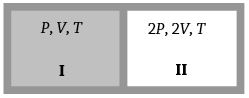
A
$1:6$
B
$6:1$
C
$4:1$
D
$1:4$
Solution
(D) From the ideal gas equation,the number of molecules $N$ is given by $N = \frac{PV}{kT}$.
For compartment $I$,the parameters are $P, V, T$. Thus,the number of molecules $N_I = \frac{PV}{kT}$.
For compartment $II$,the parameters are $2P, 2V, T$. Thus,the number of molecules $N_{II} = \frac{(2P)(2V)}{kT} = 4 \frac{PV}{kT} = 4N_I$.
The ratio of the number of molecules in compartments $I$ and $II$ is $\frac{N_I}{N_{II}} = \frac{N_I}{4N_I} = \frac{1}{4}$.
For compartment $I$,the parameters are $P, V, T$. Thus,the number of molecules $N_I = \frac{PV}{kT}$.
For compartment $II$,the parameters are $2P, 2V, T$. Thus,the number of molecules $N_{II} = \frac{(2P)(2V)}{kT} = 4 \frac{PV}{kT} = 4N_I$.
The ratio of the number of molecules in compartments $I$ and $II$ is $\frac{N_I}{N_{II}} = \frac{N_I}{4N_I} = \frac{1}{4}$.
0 likes
View Solution182
MediumMCQ
Find the approximate number of molecules contained in a vessel of volume $7 \text{ litres}$ at $0^{\circ}C$ and a pressure of $1.3 \times 10^{5} \text{ Pa}$.
A
$2.4 \times 10^{23}$
B
$3 \times 10^{23}$
C
$6 \times 10^{23}$
D
$4.8 \times 10^{23}$
Solution
(A) Given:
Volume $V = 7 \text{ L} = 7 \times 10^{-3} \text{ m}^{3}$
Temperature $T = 0^{\circ}C = 273 \text{ K}$
Pressure $P = 1.3 \times 10^{5} \text{ Pa}$
Universal gas constant $R = 8.314 \text{ J/(mol K)}$
Using the ideal gas equation $PV = nRT$,we find the number of moles $n$:
$n = \frac{PV}{RT} = \frac{1.3 \times 10^{5} \times 7 \times 10^{-3}}{8.314 \times 273} \approx 0.4 \text{ moles}$
The number of molecules $N$ is given by $N = n \times N_{A}$,where $N_{A} = 6.022 \times 10^{23} \text{ molecules/mol}$.
$N = 0.4 \times 6.022 \times 10^{23} \approx 2.4 \times 10^{23} \text{ molecules}$.
Volume $V = 7 \text{ L} = 7 \times 10^{-3} \text{ m}^{3}$
Temperature $T = 0^{\circ}C = 273 \text{ K}$
Pressure $P = 1.3 \times 10^{5} \text{ Pa}$
Universal gas constant $R = 8.314 \text{ J/(mol K)}$
Using the ideal gas equation $PV = nRT$,we find the number of moles $n$:
$n = \frac{PV}{RT} = \frac{1.3 \times 10^{5} \times 7 \times 10^{-3}}{8.314 \times 273} \approx 0.4 \text{ moles}$
The number of molecules $N$ is given by $N = n \times N_{A}$,where $N_{A} = 6.022 \times 10^{23} \text{ molecules/mol}$.
$N = 0.4 \times 6.022 \times 10^{23} \approx 2.4 \times 10^{23} \text{ molecules}$.
0 likes
View Solution183
AdvancedMCQ
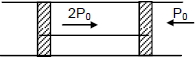
$A$ cylindrical tube of cross-sectional area $A$ has two airtight,frictionless pistons at its two ends. The pistons are tied with a straight piece of metallic wire. The tube contains a gas at atmospheric pressure $P_0$ and temperature $T_0$. If the temperature of the gas is doubled,then the tension in the wire is:
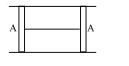
A
$4 P_0 A$
B
$P_0 A / 2$
C
$P_0 A$
D
$2 P_0 A$
Solution
(C) Since the pistons are connected by a wire,the volume $V$ of the gas remains constant.
Using the ideal gas law for a constant volume process: $\frac{P_1}{T_1} = \frac{P_2}{T_2}$.
Given $P_1 = P_0$,$T_1 = T_0$,and $T_2 = 2T_0$,we have:
$\frac{P_0}{T_0} = \frac{P'}{2T_0} \Rightarrow P' = 2P_0$.
The pressure inside the tube is now $2P_0$,while the external atmospheric pressure is $P_0$.
The net force acting outwards on each piston is $F_{net} = (P' - P_0)A = (2P_0 - P_0)A = P_0 A$.
Since the wire connects the two pistons,the tension $T$ in the wire must balance this net outward force.
Therefore,the tension in the wire is $T = P_0 A$.
Using the ideal gas law for a constant volume process: $\frac{P_1}{T_1} = \frac{P_2}{T_2}$.
Given $P_1 = P_0$,$T_1 = T_0$,and $T_2 = 2T_0$,we have:
$\frac{P_0}{T_0} = \frac{P'}{2T_0} \Rightarrow P' = 2P_0$.
The pressure inside the tube is now $2P_0$,while the external atmospheric pressure is $P_0$.
The net force acting outwards on each piston is $F_{net} = (P' - P_0)A = (2P_0 - P_0)A = P_0 A$.
Since the wire connects the two pistons,the tension $T$ in the wire must balance this net outward force.
Therefore,the tension in the wire is $T = P_0 A$.
0 likes
View Solution184
MediumMCQ
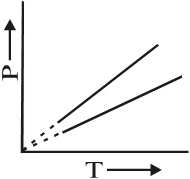
$A$ perfect gas of a given mass is heated first in a small vessel and then in a large vessel,such that their volumes remain unchanged. The $P-T$ curves are
A
parabolic with same curvature
B
parabolic with different curvature
C
linear with same slopes
D
linear with different slopes
Solution
(D) According to the ideal gas equation:
$P V = n R T$
Since the volume $V$ is constant for each vessel,we can write:
$P = \left( \frac{n R}{V} \right) T$
This equation is of the form $y = m x$,where $y = P$,$x = T$,and the slope $m = \frac{n R}{V}$.
Since the mass is given,$n$ is constant. However,the volumes $V$ of the small and large vessels are different.
Therefore,the slope $m = \frac{n R}{V}$ will be different for the two vessels.
Thus,the $P-T$ curves are linear,passing through the origin,but with different slopes.
$P V = n R T$
Since the volume $V$ is constant for each vessel,we can write:
$P = \left( \frac{n R}{V} \right) T$
This equation is of the form $y = m x$,where $y = P$,$x = T$,and the slope $m = \frac{n R}{V}$.
Since the mass is given,$n$ is constant. However,the volumes $V$ of the small and large vessels are different.
Therefore,the slope $m = \frac{n R}{V}$ will be different for the two vessels.
Thus,the $P-T$ curves are linear,passing through the origin,but with different slopes.
0 likes
View Solution185
DifficultMCQ
At a temperature $T \ K$,the pressure of $4.0 \ g$ argon in a bulb is $p$. The bulb is put in a bath having a temperature higher by $50 \ K$ than the first one. $0.8 \ g$ of argon gas had to be removed to maintain the original pressure. The temperature $T$ is equal to ..... $K$.
A
$510$
B
$200$
C
$100$
D
$73$
Solution
(B) Using the ideal gas equation $PV = nRT = \frac{m}{M}RT$,where $m$ is the mass and $M$ is the molar mass of argon.
For the first state: $PV = \frac{4}{M}RT$ ... $(i)$
For the second state,the temperature is $(T + 50) \ K$,the mass is $(4.0 - 0.8) = 3.2 \ g$,and the pressure $p$ remains constant: $PV = \frac{3.2}{M}R(T + 50)$ ... (ii)
Equating $(i)$ and (ii) since $PV$ is constant:
$\frac{4}{M}RT = \frac{3.2}{M}R(T + 50)$
$4T = 3.2(T + 50)$
$4T = 3.2T + 160$
$0.8T = 160$
$T = \frac{160}{0.8} = 200 \ K$.
For the first state: $PV = \frac{4}{M}RT$ ... $(i)$
For the second state,the temperature is $(T + 50) \ K$,the mass is $(4.0 - 0.8) = 3.2 \ g$,and the pressure $p$ remains constant: $PV = \frac{3.2}{M}R(T + 50)$ ... (ii)
Equating $(i)$ and (ii) since $PV$ is constant:
$\frac{4}{M}RT = \frac{3.2}{M}R(T + 50)$
$4T = 3.2(T + 50)$
$4T = 3.2T + 160$
$0.8T = 160$
$T = \frac{160}{0.8} = 200 \ K$.
0 likes
View Solution186
DifficultMCQ
When $2 \, g$ of a gas are introduced into an evacuated flask kept at $25 \, ^\circ C$,the pressure is found to be $1 \, atm$. If $3 \, g$ of another gas is added to the same flask,the pressure becomes $1.5 \, atm$. The ratio of the molecular weights of these gases will be:
A
$1 : 3$
B
$3 : 1$
C
$2 : 3$
D
$3 : 2$
Solution
(A) According to the Ideal Gas Law,$PV = nRT$. Since the volume $V$ and temperature $T$ are constant,the pressure $P$ is directly proportional to the number of moles $n$ $(P \propto n)$.
Let the molecular weights of the two gases be $M_A$ and $M_B$.
For the first gas $A$,the number of moles is $n_A = \frac{2}{M_A}$. Given $P_A = 1 \, atm$,we have $\frac{2}{M_A} \propto 1 \dots (i)$.
When the second gas $B$ is added,the total pressure becomes $1.5 \, atm$. The partial pressure of gas $B$ is $P_B = P_{total} - P_A = 1.5 - 1 = 0.5 \, atm$.
For the second gas $B$,the number of moles is $n_B = \frac{3}{M_B}$. Thus,$\frac{3}{M_B} \propto 0.5 \dots (ii)$.
Dividing equation $(ii)$ by equation $(i)$:
$\frac{3/M_B}{2/M_A} = \frac{0.5}{1}$
$\frac{3}{M_B} \times \frac{M_A}{2} = 0.5$
$\frac{M_A}{M_B} = 0.5 \times \frac{2}{3} = \frac{1}{3}$
Therefore,the ratio of the molecular weights $M_A : M_B$ is $1 : 3$.
Let the molecular weights of the two gases be $M_A$ and $M_B$.
For the first gas $A$,the number of moles is $n_A = \frac{2}{M_A}$. Given $P_A = 1 \, atm$,we have $\frac{2}{M_A} \propto 1 \dots (i)$.
When the second gas $B$ is added,the total pressure becomes $1.5 \, atm$. The partial pressure of gas $B$ is $P_B = P_{total} - P_A = 1.5 - 1 = 0.5 \, atm$.
For the second gas $B$,the number of moles is $n_B = \frac{3}{M_B}$. Thus,$\frac{3}{M_B} \propto 0.5 \dots (ii)$.
Dividing equation $(ii)$ by equation $(i)$:
$\frac{3/M_B}{2/M_A} = \frac{0.5}{1}$
$\frac{3}{M_B} \times \frac{M_A}{2} = 0.5$
$\frac{M_A}{M_B} = 0.5 \times \frac{2}{3} = \frac{1}{3}$
Therefore,the ratio of the molecular weights $M_A : M_B$ is $1 : 3$.
0 likes
View Solution187
AdvancedMCQ
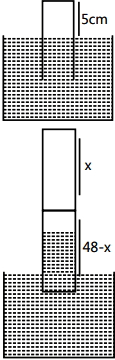
An open and wide glass tube is immersed vertically in mercury in such a way that a length of $0.05 \, m$ extends above the mercury level. The open end of the tube is closed and the tube is raised further by $0.43 \, m$. The length of the air column above the mercury level in the tube will be ...... $m$. Take $P_{atm} = 76 \, cm$ of mercury.
A
$0.215$
B
$0.2$
C
$0.1$
D
$0.4$
Solution
(C) Initially,the air column length $L_i = 0.05 \, m = 5 \, cm$. The pressure of the air $P_i = P_{atm} = 76 \, cm$ of $Hg$.
When the tube is raised by $0.43 \, m = 43 \, cm$,let the new length of the air column be $x \, cm$. The mercury level inside the tube rises by $(48 - x) \, cm$ relative to the initial position,where $48 \, cm$ is the total displacement of the tube relative to the mercury surface.
The final pressure of the air inside the tube is $P_f = P_{atm} - (48 - x) = 76 - 48 + x = (28 + x) \, cm$ of $Hg$.
Since the temperature remains constant,we apply Boyle's Law: $P_i V_i = P_f V_f$.
Assuming the cross-sectional area $A$ is constant:
$76 \times 5 \times A = (28 + x) \times x \times A$
$380 = 28x + x^2$
$x^2 + 28x - 380 = 0$
Solving the quadratic equation:
$x = \frac{-28 \pm \sqrt{28^2 - 4(1)(-380)}}{2} = \frac{-28 \pm \sqrt{784 + 1520}}{2} = \frac{-28 \pm \sqrt{2304}}{2} = \frac{-28 \pm 48}{2}$
Taking the positive root: $x = \frac{20}{2} = 10 \, cm = 0.1 \, m$.
When the tube is raised by $0.43 \, m = 43 \, cm$,let the new length of the air column be $x \, cm$. The mercury level inside the tube rises by $(48 - x) \, cm$ relative to the initial position,where $48 \, cm$ is the total displacement of the tube relative to the mercury surface.
The final pressure of the air inside the tube is $P_f = P_{atm} - (48 - x) = 76 - 48 + x = (28 + x) \, cm$ of $Hg$.
Since the temperature remains constant,we apply Boyle's Law: $P_i V_i = P_f V_f$.
Assuming the cross-sectional area $A$ is constant:
$76 \times 5 \times A = (28 + x) \times x \times A$
$380 = 28x + x^2$
$x^2 + 28x - 380 = 0$
Solving the quadratic equation:
$x = \frac{-28 \pm \sqrt{28^2 - 4(1)(-380)}}{2} = \frac{-28 \pm \sqrt{784 + 1520}}{2} = \frac{-28 \pm \sqrt{2304}}{2} = \frac{-28 \pm 48}{2}$
Taking the positive root: $x = \frac{20}{2} = 10 \, cm = 0.1 \, m$.
0 likes
View Solution188
DifficultMCQ
$A$ vessel with an open mouth contains air at $60^{\circ}C$. When the vessel is heated up to temperature $T$,one-fourth of the air goes out. The value of $T$ is ..... $^{\circ}C$
A
$80$
B
$171$
C
$333$
D
$444$
Solution
(B) Initial mass of air is $M_1 = M$ at temperature $T_1 = 60 + 273 = 333 \ K$.
Since the vessel is open,the pressure remains constant (atmospheric pressure).
According to the ideal gas law,$PV = nRT = \frac{M}{m}RT$,where $m$ is the molar mass of air.
Since $P$,$V$,and $m$ are constant,we have $M_1 T_1 = M_2 T_2$.
After heating,one-fourth of the air escapes,so the remaining mass is $M_2 = M - \frac{M}{4} = \frac{3M}{4}$.
Substituting the values: $M \times 333 = \frac{3M}{4} \times T_2$.
$T_2 = 333 \times \frac{4}{3} = 444 \ K$.
Converting back to Celsius: $T = 444 - 273 = 171^{\circ}C$.
Since the vessel is open,the pressure remains constant (atmospheric pressure).
According to the ideal gas law,$PV = nRT = \frac{M}{m}RT$,where $m$ is the molar mass of air.
Since $P$,$V$,and $m$ are constant,we have $M_1 T_1 = M_2 T_2$.
After heating,one-fourth of the air escapes,so the remaining mass is $M_2 = M - \frac{M}{4} = \frac{3M}{4}$.
Substituting the values: $M \times 333 = \frac{3M}{4} \times T_2$.
$T_2 = 333 \times \frac{4}{3} = 444 \ K$.
Converting back to Celsius: $T = 444 - 273 = 171^{\circ}C$.
0 likes
View Solution189
DifficultMCQ
$28\, g$ of $N_2$ gas is contained in a flask at a pressure of $10\, atm$ and at a temperature of $57^\circ C$. It is found that due to leakage in the flask,the pressure is reduced to half and the temperature is reduced to $27^\circ C$. The quantity of $N_2$ gas that leaked out is
A
$11/20\, g$
B
$20/11\, g$
C
$5/63\, g$
D
$63/5\, g$
Solution
(D) The ideal gas law $PV = nRT$ must hold both before and after the leakage of the gas.
Since the volume $V$ of the flask remains constant,we have $\frac{P_i}{n_i T_i} = \frac{P_f}{n_f T_f}$.
Given initial conditions: $P_i = 10\, atm$,$T_i = 57 + 273 = 330\, K$,$m_i = 28\, g$,$n_i = \frac{28}{28} = 1\, mol$.
Given final conditions: $P_f = \frac{10}{2} = 5\, atm$,$T_f = 27 + 273 = 300\, K$.
Using the relation $n_f = \frac{P_f}{P_i} \cdot \frac{T_i}{T_f} \cdot n_i$,we get:
$n_f = \frac{5}{10} \cdot \frac{330}{300} \cdot 1 = \frac{1}{2} \cdot \frac{11}{10} = \frac{11}{20}\, mol$.
The final mass $m_f = n_f \times M = \frac{11}{20} \times 28 = 15.4\, g$.
The mass of $N_2$ gas that leaked out is $\Delta m = m_i - m_f = 28 - 15.4 = 12.6\, g$.
Converting $12.6\, g$ to fraction: $12.6 = \frac{126}{10} = \frac{63}{5}\, g$.
Since the volume $V$ of the flask remains constant,we have $\frac{P_i}{n_i T_i} = \frac{P_f}{n_f T_f}$.
Given initial conditions: $P_i = 10\, atm$,$T_i = 57 + 273 = 330\, K$,$m_i = 28\, g$,$n_i = \frac{28}{28} = 1\, mol$.
Given final conditions: $P_f = \frac{10}{2} = 5\, atm$,$T_f = 27 + 273 = 300\, K$.
Using the relation $n_f = \frac{P_f}{P_i} \cdot \frac{T_i}{T_f} \cdot n_i$,we get:
$n_f = \frac{5}{10} \cdot \frac{330}{300} \cdot 1 = \frac{1}{2} \cdot \frac{11}{10} = \frac{11}{20}\, mol$.
The final mass $m_f = n_f \times M = \frac{11}{20} \times 28 = 15.4\, g$.
The mass of $N_2$ gas that leaked out is $\Delta m = m_i - m_f = 28 - 15.4 = 12.6\, g$.
Converting $12.6\, g$ to fraction: $12.6 = \frac{126}{10} = \frac{63}{5}\, g$.
0 likes
View Solution190
AdvancedMCQ
$A$ cylinder containing gas at $27\,^{\circ}C$ is divided into two parts of equal volume,each $100\,cm^3$,and at equal pressure by a piston of cross-sectional area $10.85\,cm^2$. The gas in one part is raised in temperature to $100\,^{\circ}C$ while the other is maintained at the original temperature. The piston and walls are perfect insulators. How far will the piston move during the change in temperature? (in $cm$)
A
$1$
B
$2$
C
$0.5$
D
$1.5$
Solution
(A) Initial state: $T_1 = 27 + 273 = 300\,K$,$V_1 = V_2 = 100\,cm^3$,$P_1 = P_2 = P$.
Final state: One part is at $T_1' = 300\,K$,other at $T_2' = 100 + 273 = 373\,K$.
Let the piston move by distance $x$. The new volumes are $V_1' = 100 - 10.85x$ and $V_2' = 100 + 10.85x$.
Since the piston is in equilibrium,the final pressures are equal: $P_1' = P_2' = P'$.
Using the ideal gas law $PV = nRT$,and noting that the number of moles $n$ remains constant:
$P_1 V_1 / T_1 = P_1' V_1' / T_1' \implies P(100) / 300 = P'(100 - 10.85x) / 300 \implies P' = P \cdot 100 / (100 - 10.85x)$.
$P_2 V_2 / T_2 = P_2' V_2' / T_2' \implies P(100) / 300 = P'(100 + 10.85x) / 373$.
Equating $P'$ from both: $P \cdot 100 / (100 - 10.85x) = P \cdot 100 \cdot 373 / (300(100 + 10.85x))$.
$300(100 + 10.85x) = 373(100 - 10.85x)$.
$30000 + 3255x = 37300 - 4047.05x$.
$7302.05x = 7300 \implies x \approx 1\,cm$.
Final state: One part is at $T_1' = 300\,K$,other at $T_2' = 100 + 273 = 373\,K$.
Let the piston move by distance $x$. The new volumes are $V_1' = 100 - 10.85x$ and $V_2' = 100 + 10.85x$.
Since the piston is in equilibrium,the final pressures are equal: $P_1' = P_2' = P'$.
Using the ideal gas law $PV = nRT$,and noting that the number of moles $n$ remains constant:
$P_1 V_1 / T_1 = P_1' V_1' / T_1' \implies P(100) / 300 = P'(100 - 10.85x) / 300 \implies P' = P \cdot 100 / (100 - 10.85x)$.
$P_2 V_2 / T_2 = P_2' V_2' / T_2' \implies P(100) / 300 = P'(100 + 10.85x) / 373$.
Equating $P'$ from both: $P \cdot 100 / (100 - 10.85x) = P \cdot 100 \cdot 373 / (300(100 + 10.85x))$.
$300(100 + 10.85x) = 373(100 - 10.85x)$.
$30000 + 3255x = 37300 - 4047.05x$.
$7302.05x = 7300 \implies x \approx 1\,cm$.
0 likes
View Solution191
DifficultMCQ
$12\,g$ of gas occupies a volume of $4\times 10^{-3}\,m^3$ at a temperature of $7\,^oC$. After the gas is heated at constant pressure,its density becomes $6\times 10^{-4}\,g/cc$. Find the temperature $T$ (in $K$) to which the gas was heated.
A
$1000$
B
$1400$
C
$1200$
D
$800$
Solution
(B) Given: Mass $w = 12\,g$,Initial Volume $V_1 = 4\times 10^{-3}\,m^3$,Initial Temperature $T_1 = 7 + 273 = 280\,K$.
Density $\rho = \frac{w}{V}$. Since pressure $P$ is constant,from the ideal gas law $PV = nRT = \frac{w}{M}RT$,we have $P = \frac{\rho RT}{M}$.
Since $P$ and $M$ are constant,$\rho_1 T_1 = \rho_2 T_2$.
Initial density $\rho_1 = \frac{w}{V_1} = \frac{12}{4 \times 10^{-3}} = 3000\,g/m^3 = 3 \times 10^{-3}\,g/cc$.
Final density $\rho_2 = 6 \times 10^{-4}\,g/cc = 0.6 \times 10^{-3}\,g/cc$.
Using $\rho_1 T_1 = \rho_2 T_2$:
$T_2 = \frac{\rho_1 T_1}{\rho_2} = \frac{3 \times 10^{-3} \times 280}{0.6 \times 10^{-3}} = \frac{3 \times 280}{0.6} = 5 \times 280 = 1400\,K$.
Density $\rho = \frac{w}{V}$. Since pressure $P$ is constant,from the ideal gas law $PV = nRT = \frac{w}{M}RT$,we have $P = \frac{\rho RT}{M}$.
Since $P$ and $M$ are constant,$\rho_1 T_1 = \rho_2 T_2$.
Initial density $\rho_1 = \frac{w}{V_1} = \frac{12}{4 \times 10^{-3}} = 3000\,g/m^3 = 3 \times 10^{-3}\,g/cc$.
Final density $\rho_2 = 6 \times 10^{-4}\,g/cc = 0.6 \times 10^{-3}\,g/cc$.
Using $\rho_1 T_1 = \rho_2 T_2$:
$T_2 = \frac{\rho_1 T_1}{\rho_2} = \frac{3 \times 10^{-3} \times 280}{0.6 \times 10^{-3}} = \frac{3 \times 280}{0.6} = 5 \times 280 = 1400\,K$.
0 likes
View Solution192
MediumMCQ
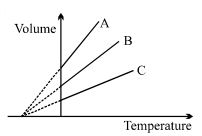
The expansion of an ideal gas of mass $m$ at a constant pressure $P$ is given by the straight line $B$ in the $V-T$ graph. Then the expansion of the same ideal gas of mass $2m$ at a pressure $2P$ is given by the straight line:
A
$C$
B
$A$
C
$B$
D
none
Solution
(C) From the ideal gas equation,$PV = nRT$,where $n = \frac{m}{M}$ ($M$ is the molar mass).
At constant pressure $P$,the equation becomes $V = \left(\frac{mR}{MP}\right)T$.
The slope of the $V-T$ graph is given by $S = \frac{mR}{MP}$.
In the first case,the slope is $S_1 = \frac{mR}{MP}$.
In the second case,the mass is $2m$ and the pressure is $2P$. The new slope $S_2$ is:
$S_2 = \frac{(2m)R}{M(2P)} = \frac{mR}{MP} = S_1$.
Since the slope remains the same,the expansion of the gas will be represented by the same straight line $B$.
Therefore,the correct option is $C$.
At constant pressure $P$,the equation becomes $V = \left(\frac{mR}{MP}\right)T$.
The slope of the $V-T$ graph is given by $S = \frac{mR}{MP}$.
In the first case,the slope is $S_1 = \frac{mR}{MP}$.
In the second case,the mass is $2m$ and the pressure is $2P$. The new slope $S_2$ is:
$S_2 = \frac{(2m)R}{M(2P)} = \frac{mR}{MP} = S_1$.
Since the slope remains the same,the expansion of the gas will be represented by the same straight line $B$.
Therefore,the correct option is $C$.
0 likes
View Solution193
MediumMCQ
$A$ container $X$ has a volume double that of container $Y$,and both are connected by a thin tube. Both contain the same ideal gas. The temperature of $X$ is $200\,K$ and that of $Y$ is $400\,K$. If the mass of the gas in $X$ is $m$,then the mass of the gas in $Y$ will be:
A
$m/8$
B
$m/6$
C
$m/4$
D
$m/2$
Solution
(C) The ideal gas equation is given by $PV = nRT$,where $n = \frac{m}{M}$ ($M$ is the molar mass of the gas).
Since the containers are connected by a thin tube,the pressure $P$ in both containers must be the same at equilibrium.
For container $X$: $V_X = 2V$,$T_X = 200\,K$,and mass $m_X = m$.
Thus,$P(2V) = \left(\frac{m}{M}\right) R(200) \implies P = \frac{mR(200)}{2VM} = \frac{100mR}{VM}$.
For container $Y$: $V_Y = V$,$T_Y = 400\,K$,and mass $m_Y = m_Y$.
Thus,$P(V) = \left(\frac{m_Y}{M}\right) R(400) \implies P = \frac{400m_Y R}{VM}$.
Equating the expressions for $P$: $\frac{100mR}{VM} = \frac{400m_Y R}{VM}$.
Solving for $m_Y$: $100m = 400m_Y \implies m_Y = \frac{100m}{400} = \frac{m}{4}$.
Since the containers are connected by a thin tube,the pressure $P$ in both containers must be the same at equilibrium.
For container $X$: $V_X = 2V$,$T_X = 200\,K$,and mass $m_X = m$.
Thus,$P(2V) = \left(\frac{m}{M}\right) R(200) \implies P = \frac{mR(200)}{2VM} = \frac{100mR}{VM}$.
For container $Y$: $V_Y = V$,$T_Y = 400\,K$,and mass $m_Y = m_Y$.
Thus,$P(V) = \left(\frac{m_Y}{M}\right) R(400) \implies P = \frac{400m_Y R}{VM}$.
Equating the expressions for $P$: $\frac{100mR}{VM} = \frac{400m_Y R}{VM}$.
Solving for $m_Y$: $100m = 400m_Y \implies m_Y = \frac{100m}{400} = \frac{m}{4}$.
0 likes
View Solution194
DifficultMCQ
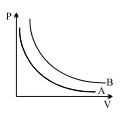
The figure shows the pressure $P$ versus volume $V$ graphs for two different gas samples at a given temperature. $M_A$ and $M_B$ are the masses of the two samples,and $n_A$ and $n_B$ are the numbers of moles. Which of the following must be incorrect?
A
$M_A > M_B$
B
$M_A < M_B$
C
$n_A > n_B$
D
$n_A < n_B$
Solution
(C) For an ideal gas,the equation of state is $PV = nRT$.
At a constant temperature $T$,the product $PV = nRT$ is constant for a given number of moles $n$.
From the graph,for a fixed volume $V$,the pressure $P_B > P_A$.
Since $P_B V = n_B RT$ and $P_A V = n_A RT$,we have $P_B V > P_A V$,which implies $n_B RT > n_A RT$.
Therefore,$n_B > n_A$.
Since $n_B > n_A$,the statement $n_A > n_B$ (option $C$) is incorrect.
Regarding the masses $M_A$ and $M_B$,the relationship depends on the molar masses of the gases,which are not specified. Thus,$M_A > M_B$ or $M_A < M_B$ could both be true depending on the gas type. However,$n_A > n_B$ is definitely incorrect based on the graph.
At a constant temperature $T$,the product $PV = nRT$ is constant for a given number of moles $n$.
From the graph,for a fixed volume $V$,the pressure $P_B > P_A$.
Since $P_B V = n_B RT$ and $P_A V = n_A RT$,we have $P_B V > P_A V$,which implies $n_B RT > n_A RT$.
Therefore,$n_B > n_A$.
Since $n_B > n_A$,the statement $n_A > n_B$ (option $C$) is incorrect.
Regarding the masses $M_A$ and $M_B$,the relationship depends on the molar masses of the gases,which are not specified. Thus,$M_A > M_B$ or $M_A < M_B$ could both be true depending on the gas type. However,$n_A > n_B$ is definitely incorrect based on the graph.
0 likes
View Solution195
MediumMCQ
Hydrogen gas and oxygen gas have a volume of $1 \, cm^3$ each at $N.T.P$. Which of the following statements is correct?
A
The number of molecules is the same in both gases.
B
The average velocity of molecules of each gas is the same.
C
The internal energy of each gas is the same.
D
All of the above.
Solution
(A) According to Avogadro's Law,equal volumes of all gases at the same temperature and pressure contain an equal number of molecules. Since both gases have the same volume $(1 \, cm^3)$ at $N.T.P$,the number of molecules is the same in both.
The internal energy of an ideal gas depends only on its temperature $(U = \frac{f}{2} nRT)$. Since both gases are at the same temperature and have the same number of moles (due to equal volume at $N.T.P$),their internal energies are the same.
The average velocity (root mean square velocity) of gas molecules is given by $v_{rms} = \sqrt{\frac{3RT}{M}}$. Since the molar mass $(M)$ of hydrogen $(H_2)$ and oxygen $(O_2)$ are different,their average velocities will be different. Therefore,statement $B$ is incorrect.
Since statement $B$ is incorrect,statement $D$ is also incorrect. Thus,both $A$ and $C$ are technically correct,but in the context of standard multiple-choice questions,the most fundamental property derived from $N.T.P$ conditions is the number of molecules.
The internal energy of an ideal gas depends only on its temperature $(U = \frac{f}{2} nRT)$. Since both gases are at the same temperature and have the same number of moles (due to equal volume at $N.T.P$),their internal energies are the same.
The average velocity (root mean square velocity) of gas molecules is given by $v_{rms} = \sqrt{\frac{3RT}{M}}$. Since the molar mass $(M)$ of hydrogen $(H_2)$ and oxygen $(O_2)$ are different,their average velocities will be different. Therefore,statement $B$ is incorrect.
Since statement $B$ is incorrect,statement $D$ is also incorrect. Thus,both $A$ and $C$ are technically correct,but in the context of standard multiple-choice questions,the most fundamental property derived from $N.T.P$ conditions is the number of molecules.
0 likes
View Solution196
MediumMCQ
$A$ gas is enclosed in a vessel at a constant temperature at a pressure of $5 \text{ atm}$ and volume $4 \text{ L}$. Due to a leakage in the vessel,after some time,the pressure is reduced to $4 \text{ atm}$. As a result,the:
A
volume of the gas decreased by $20\%$
B
average $K.E.$ of gas molecule decreases by $20\%$
C
$20\%$ of the gas escaped due to the leakage
D
$25\%$ of the gas escaped due to the leakage
Solution
(C) Since the temperature $T$ and volume $V$ of the vessel remain constant,we use the ideal gas law $PV = nRT$.
From this,$n = \frac{PV}{RT}$. Since $V, R,$ and $T$ are constant,$n \propto P$.
Initial state: $P_1 = 5 \text{ atm}$,$n_1 = n$.
Final state: $P_2 = 4 \text{ atm}$,$n_2 = n'$.
Therefore,$\frac{n'}{n} = \frac{P_2}{P_1} = \frac{4}{5} = 0.8$.
This means $n' = 0.8n$.
The amount of gas that escaped is $\Delta n = n - n' = n - 0.8n = 0.2n$.
Percentage of gas escaped = $\frac{0.2n}{n} \times 100\% = 20\%$.
From this,$n = \frac{PV}{RT}$. Since $V, R,$ and $T$ are constant,$n \propto P$.
Initial state: $P_1 = 5 \text{ atm}$,$n_1 = n$.
Final state: $P_2 = 4 \text{ atm}$,$n_2 = n'$.
Therefore,$\frac{n'}{n} = \frac{P_2}{P_1} = \frac{4}{5} = 0.8$.
This means $n' = 0.8n$.
The amount of gas that escaped is $\Delta n = n - n' = n - 0.8n = 0.2n$.
Percentage of gas escaped = $\frac{0.2n}{n} \times 100\% = 20\%$.
0 likes
View Solution197
MediumMCQ
The temperature of an open room of volume $30\ m^3$ increases from $17^\circ C$ to $27^\circ C$ due to sunshine. The atmospheric pressure in the room remains $1 \times 10^5\ Pa$. If $n_i$ and $n_f$ are the number of molecules in the room before and after heating,then $n_f - n_i$ will be:
A
$-1.61 \times 10^{23}$
B
$1.38 \times 10^{23}$
C
$2.5 \times 10^{23}$
D
$-2.5 \times 10^{25}$
Solution
(D) Given: Initial temperature $T_i = 17 + 273 = 290 \ K$.
Final temperature $T_f = 27 + 273 = 300 \ K$.
Atmospheric pressure $P = 1 \times 10^5 \ Pa$.
Volume of the room $V = 30 \ m^3$.
The number of molecules $N$ is given by the ideal gas law $PV = N k_B T$,where $k_B$ is the Boltzmann constant $(k_B = 1.38 \times 10^{-23} \ J/K)$.
Thus,$N = \frac{PV}{k_B T}$.
Initial number of molecules $N_i = \frac{PV}{k_B T_i}$.
Final number of molecules $N_f = \frac{PV}{k_B T_f}$.
The change in the number of molecules is $N_f - N_i = \frac{PV}{k_B} \left( \frac{1}{T_f} - \frac{1}{T_i} \right)$.
Substituting the values: $N_f - N_i = \frac{1 \times 10^5 \times 30}{1.38 \times 10^{-23}} \left( \frac{1}{300} - \frac{1}{290} \right)$.
$N_f - N_i = \frac{30 \times 10^5}{1.38 \times 10^{-23}} \left( \frac{290 - 300}{300 \times 290} \right)$.
$N_f - N_i = \frac{30 \times 10^5}{1.38 \times 10^{-23}} \left( \frac{-10}{87000} \right) \approx -2.5 \times 10^{25}$.
Final temperature $T_f = 27 + 273 = 300 \ K$.
Atmospheric pressure $P = 1 \times 10^5 \ Pa$.
Volume of the room $V = 30 \ m^3$.
The number of molecules $N$ is given by the ideal gas law $PV = N k_B T$,where $k_B$ is the Boltzmann constant $(k_B = 1.38 \times 10^{-23} \ J/K)$.
Thus,$N = \frac{PV}{k_B T}$.
Initial number of molecules $N_i = \frac{PV}{k_B T_i}$.
Final number of molecules $N_f = \frac{PV}{k_B T_f}$.
The change in the number of molecules is $N_f - N_i = \frac{PV}{k_B} \left( \frac{1}{T_f} - \frac{1}{T_i} \right)$.
Substituting the values: $N_f - N_i = \frac{1 \times 10^5 \times 30}{1.38 \times 10^{-23}} \left( \frac{1}{300} - \frac{1}{290} \right)$.
$N_f - N_i = \frac{30 \times 10^5}{1.38 \times 10^{-23}} \left( \frac{290 - 300}{300 \times 290} \right)$.
$N_f - N_i = \frac{30 \times 10^5}{1.38 \times 10^{-23}} \left( \frac{-10}{87000} \right) \approx -2.5 \times 10^{25}$.
0 likes
View Solution198
MediumMCQ
An open glass tube is immersed in mercury such that a length of $8 \ cm$ extends above the mercury level. The open end of the tube is then closed and sealed,and the tube is raised vertically by an additional $46 \ cm$. What will be the length of the air column above the mercury in the tube now? (Atmospheric pressure = $76 \ cm$ of $Hg$)
A
$22$
B
$38$
C
$6$
D
$16$
Solution
(D) Initial state: The air column length is $L_1 = 8 \ cm$ and the pressure is atmospheric,$P_1 = 76 \ cm$ of $Hg$.
Final state: The tube is raised by $46 \ cm$. Let the new length of the air column be $L_2$. Let the height of the mercury column inside the tube above the external mercury level be $x$. The total length of the tube above the external mercury level is $8 + 46 = 54 \ cm$. Thus,$L_2 = 54 - x$.
The pressure of the trapped air in the final state is $P_2 = P_0 - x = 76 - x$.
Using Boyle's Law $(P_1 V_1 = P_2 V_2)$ and assuming constant cross-sectional area $A$:
$76 \times A \times 8 = (76 - x) \times A \times (54 - x)$
$608 = 4104 - 76x - 54x + x^2$
$x^2 - 130x + 3496 = 0$
Solving the quadratic equation using the formula $x = \frac{-b \pm \sqrt{b^2 - 4ac}}{2a}$:
$x = \frac{130 \pm \sqrt{16900 - 13984}}{2} = \frac{130 \pm \sqrt{2916}}{2} = \frac{130 \pm 54}{2}$
$x_1 = 92$ (impossible as $x < 54$) or $x_2 = 38 \ cm$.
Therefore,the length of the air column is $L_2 = 54 - 38 = 16 \ cm$.
Final state: The tube is raised by $46 \ cm$. Let the new length of the air column be $L_2$. Let the height of the mercury column inside the tube above the external mercury level be $x$. The total length of the tube above the external mercury level is $8 + 46 = 54 \ cm$. Thus,$L_2 = 54 - x$.
The pressure of the trapped air in the final state is $P_2 = P_0 - x = 76 - x$.
Using Boyle's Law $(P_1 V_1 = P_2 V_2)$ and assuming constant cross-sectional area $A$:
$76 \times A \times 8 = (76 - x) \times A \times (54 - x)$
$608 = 4104 - 76x - 54x + x^2$
$x^2 - 130x + 3496 = 0$
Solving the quadratic equation using the formula $x = \frac{-b \pm \sqrt{b^2 - 4ac}}{2a}$:
$x = \frac{130 \pm \sqrt{16900 - 13984}}{2} = \frac{130 \pm \sqrt{2916}}{2} = \frac{130 \pm 54}{2}$
$x_1 = 92$ (impossible as $x < 54$) or $x_2 = 38 \ cm$.
Therefore,the length of the air column is $L_2 = 54 - 38 = 16 \ cm$.
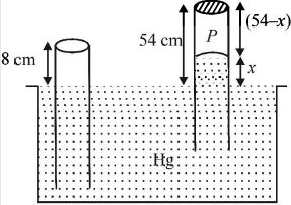
1 likes
View Solution199
DifficultMCQ
Two identical glass bulbs are interconnected by a thin glass tube. Initially,both bulbs are at $0^{\circ}C$. $A$ gas is filled in these bulbs. When one bulb is placed in ice $(0^{\circ}C)$ and the other bulb is placed in a hot bath,the pressure of the gas becomes $1.5$ times the initial pressure. The temperature of the hot bath will be ...... $^{\circ}C$.
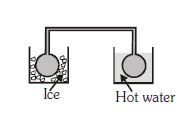
A
$100$
B
$182$
C
$256$
D
$546$
Solution
(D) Let the initial pressure be $P_0$ and the volume of each bulb be $V$. The initial temperature of both bulbs is $T_0 = 273 \ K$.
The total number of moles of gas is constant:
$n_{total} = n_1 + n_2 = \frac{P_0 V}{R T_0} + \frac{P_0 V}{R T_0} = \frac{2 P_0 V}{R T_0}$
When one bulb is in ice $(T_1 = 273 \ K)$ and the other is in a hot bath $(T_2 = T)$,the new pressure is $P = 1.5 P_0$.
The new number of moles is:
$n'_{total} = \frac{P V}{R T_1} + \frac{P V}{R T_2} = \frac{1.5 P_0 V}{R (273)} + \frac{1.5 P_0 V}{R T}$
Since $n_{total} = n'_{total}$:
$\frac{2 P_0 V}{R (273)} = \frac{1.5 P_0 V}{R (273)} + \frac{1.5 P_0 V}{R T}$
Dividing both sides by $\frac{P_0 V}{R}$:
$\frac{2}{273} = \frac{1.5}{273} + \frac{1.5}{T}$
$\frac{0.5}{273} = \frac{1.5}{T}$
$T = \frac{1.5 \times 273}{0.5} = 3 \times 273 = 819 \ K$
Converting to Celsius:
$T(^{\circ}C) = 819 - 273 = 546^{\circ}C$.
The total number of moles of gas is constant:
$n_{total} = n_1 + n_2 = \frac{P_0 V}{R T_0} + \frac{P_0 V}{R T_0} = \frac{2 P_0 V}{R T_0}$
When one bulb is in ice $(T_1 = 273 \ K)$ and the other is in a hot bath $(T_2 = T)$,the new pressure is $P = 1.5 P_0$.
The new number of moles is:
$n'_{total} = \frac{P V}{R T_1} + \frac{P V}{R T_2} = \frac{1.5 P_0 V}{R (273)} + \frac{1.5 P_0 V}{R T}$
Since $n_{total} = n'_{total}$:
$\frac{2 P_0 V}{R (273)} = \frac{1.5 P_0 V}{R (273)} + \frac{1.5 P_0 V}{R T}$
Dividing both sides by $\frac{P_0 V}{R}$:
$\frac{2}{273} = \frac{1.5}{273} + \frac{1.5}{T}$
$\frac{0.5}{273} = \frac{1.5}{T}$
$T = \frac{1.5 \times 273}{0.5} = 3 \times 273 = 819 \ K$
Converting to Celsius:
$T(^{\circ}C) = 819 - 273 = 546^{\circ}C$.
0 likes
View SolutionKinetic Theory of Gases — Gas Laws (Charles, Boyle's, Avagadro's, Gay Lussacs and Dalton's law) and Ideal gas Equation · Frequently Asked Questions
1Are these Kinetic Theory of Gases questions useful for JEE and NEET?
Yes. All questions in this section are mapped to JEE Main and NEET exam patterns. Previous year questions from JEE Main, NEET, GUJCET and state-level exams are included with full solutions.
2Can I switch to Hindi or Gujarati for these questions?
Yes. Use the language tabs in the hero section or the sidebar to view the same questions and solutions in English, Hindi or Gujarati.
3How do I generate a question paper from this subtopic?
Use the Vedclass Exam Paper Generator — select the chapter and subtopic, set difficulty, and generate Sets A, B, C, D automatically. First 3 chapters of every subject are free.
Vedclass Products
For Students
Vedclass Test Series
Mock tests in real JEE/NEET style with performance analysis. 5-day free trial.
Start Free TrialFor Teachers
Exam Paper Generator
Generate Set A/B/C/D papers from this chapter in 2 minutes. 3 chapters free.
Try FreeFor Institutes
Online Exam Module
Live online exams with unlimited students, 360° analytics & white-label branding.
See DemoFor Teachers & Institutes
Generate a Kinetic Theory of Gases Exam Paper in 2 Minutes
Select subtopic & difficulty — Sets A, B, C, D auto-generated with No Repeat logic.
First 3 chapters of every subject are free — no payment required.