
A English
Gas Laws (Charles, Boyle's, Avagadro's, Gay Lussacs and Dalton's law) and Ideal gas Equation Questions in English
Class 11 Physics · Kinetic Theory of Gases · Gas Laws (Charles, Boyle's, Avagadro's, Gay Lussacs and Dalton's law) and Ideal gas Equation
391+
Questions
English
Language
100%
With Solutions
Showing 50 of 391 questions in English
101
EasyMCQ
The gas law $\frac{PV}{T} = \text{constant}$ is true for
A
Isothermal changes only
B
Adiabatic changes only
C
Both isothermal and adiabatic changes
D
Neither isothermal nor adiabatic changes
Solution
(C) For an ideal gas,the equation of state is given by $PV = nRT$.
Rearranging this equation,we get $\frac{PV}{T} = nR$.
Since $n$ (number of moles) and $R$ (universal gas constant) are constants for a given amount of gas,the ratio $\frac{PV}{T}$ remains constant.
This relationship is derived from the ideal gas law and is valid for any process involving an ideal gas,including isothermal and adiabatic processes.
Therefore,option $C$ is correct.
Rearranging this equation,we get $\frac{PV}{T} = nR$.
Since $n$ (number of moles) and $R$ (universal gas constant) are constants for a given amount of gas,the ratio $\frac{PV}{T}$ remains constant.
This relationship is derived from the ideal gas law and is valid for any process involving an ideal gas,including isothermal and adiabatic processes.
Therefore,option $C$ is correct.
0 likes
View Solution102
MediumMCQ
One mole of a perfect gas in a cylinder fitted with a piston has a pressure $P,$ volume $V,$ and temperature $T.$ If the temperature is increased by $1 \, K$ keeping pressure constant,the increase in volume is
A
$\frac{2V}{273}$
B
$\frac{V}{91}$
C
$\frac{V}{273}$
D
$V$
Solution
(C) For an isobaric process (constant pressure),the ideal gas law $PV = nRT$ implies that $V \propto T$ (Charles's Law).
Given $n = 1$ mole,initial volume is $V$ at temperature $T$.
When temperature increases by $1 \, K$,the new temperature is $T' = T + 1$.
The new volume $V'$ is given by $\frac{V'}{T+1} = \frac{V}{T}$.
$V' = V \left(1 + \frac{1}{T}\right) = V + \frac{V}{T}$.
For a gas at standard conditions or generally,the coefficient of volume expansion $\gamma = \frac{1}{T}$. For an ideal gas,$\gamma = \frac{1}{273} \, K^{-1}$ at $0 \, ^\circ C$ $(273 \, K)$.
Thus,the increase in volume $\Delta V = V' - V = \frac{V}{T}$.
Assuming $T = 273 \, K$,the increase in volume is $\frac{V}{273}$.
Given $n = 1$ mole,initial volume is $V$ at temperature $T$.
When temperature increases by $1 \, K$,the new temperature is $T' = T + 1$.
The new volume $V'$ is given by $\frac{V'}{T+1} = \frac{V}{T}$.
$V' = V \left(1 + \frac{1}{T}\right) = V + \frac{V}{T}$.
For a gas at standard conditions or generally,the coefficient of volume expansion $\gamma = \frac{1}{T}$. For an ideal gas,$\gamma = \frac{1}{273} \, K^{-1}$ at $0 \, ^\circ C$ $(273 \, K)$.
Thus,the increase in volume $\Delta V = V' - V = \frac{V}{T}$.
Assuming $T = 273 \, K$,the increase in volume is $\frac{V}{273}$.
0 likes
View Solution103
EasyMCQ
An ideal gas has volume ${V_0}$ at ${27^{\circ}C}$. It is heated at constant pressure so that its volume becomes $2{V_0}$. The final temperature is
A
${54^{\circ}C}$
B
${32.6^{\circ}C}$
C
${327^{\circ}C}$
D
${150 K}$
Solution
(C) According to Charles's Law,for a fixed mass of gas at constant pressure,the volume is directly proportional to the absolute temperature: ${V \propto T}$ or $\frac{V_1}{T_1} = \frac{V_2}{T_2}$.
Given: Initial volume ${V_1 = V_0}$,Initial temperature ${T_1 = 27^{\circ}C = 27 + 273 = 300 K}$.
Final volume ${V_2 = 2V_0}$.
Substituting the values: $\frac{V_0}{300} = \frac{2V_0}{T_2}$.
Solving for ${T_2}$: ${T_2 = 2 \times 300 = 600 K}$.
Converting back to Celsius: ${T_2 = 600 - 273 = 327^{\circ}C}$.
Given: Initial volume ${V_1 = V_0}$,Initial temperature ${T_1 = 27^{\circ}C = 27 + 273 = 300 K}$.
Final volume ${V_2 = 2V_0}$.
Substituting the values: $\frac{V_0}{300} = \frac{2V_0}{T_2}$.
Solving for ${T_2}$: ${T_2 = 2 \times 300 = 600 K}$.
Converting back to Celsius: ${T_2 = 600 - 273 = 327^{\circ}C}$.
0 likes
View Solution104
EasyMCQ
If $300 \ ml$ of a gas at $27^{\circ}C$ is cooled to $7^{\circ}C$ at constant pressure,then its final volume will be ...... $ml$.
A
$540$
B
$350$
C
$280$
D
$135$
Solution
(C) According to Charles's Law,at constant pressure,the volume of a given mass of gas is directly proportional to its absolute temperature: $V \propto T$.
This implies $\frac{V_1}{T_1} = \frac{V_2}{T_2}$.
Given:
$V_1 = 300 \ ml$
$T_1 = 27^{\circ}C = 27 + 273 = 300 \ K$
$T_2 = 7^{\circ}C = 7 + 273 = 280 \ K$
Substituting the values into the formula:
$V_2 = \frac{V_1 \times T_2}{T_1} = \frac{300 \times 280}{300} = 280 \ ml$.
This implies $\frac{V_1}{T_1} = \frac{V_2}{T_2}$.
Given:
$V_1 = 300 \ ml$
$T_1 = 27^{\circ}C = 27 + 273 = 300 \ K$
$T_2 = 7^{\circ}C = 7 + 273 = 280 \ K$
Substituting the values into the formula:
$V_2 = \frac{V_1 \times T_2}{T_1} = \frac{300 \times 280}{300} = 280 \ ml$.
0 likes
View Solution105
MediumMCQ
Which of the following graphs correctly represents the variation of $\beta = - (dV/dP)/V$ with $P$ for an ideal gas at constant temperature?
A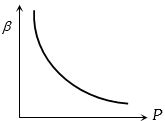
B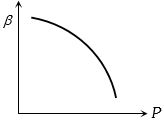
C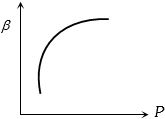
D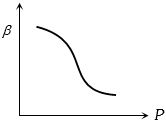
Solution
(A) For an isothermal process, $PV = \text{constant}$.
Differentiating both sides with respect to $P$, we get:
$P(dV/dP) + V = 0$
$P(dV/dP) = -V$
$-(dV/dP)/V = 1/P$
Given $\beta = -(dV/dP)/V$, we have $\beta = 1/P$.
This equation represents a rectangular hyperbola, where $\beta$ decreases as $P$ increases. This relationship is correctly shown in graph $A$.
Differentiating both sides with respect to $P$, we get:
$P(dV/dP) + V = 0$
$P(dV/dP) = -V$
$-(dV/dP)/V = 1/P$
Given $\beta = -(dV/dP)/V$, we have $\beta = 1/P$.
This equation represents a rectangular hyperbola, where $\beta$ decreases as $P$ increases. This relationship is correctly shown in graph $A$.
0 likes
View Solution106
MediumMCQ
The volume of an ideal gas is $1 \, L$ and its pressure is equal to $72 \, cm$ of mercury. It is compressed isothermally until its volume becomes $900 \, cm^3$. What is the change in pressure (stress) of the gas in $cm$ of mercury?
A
$8$
B
$7$
C
$6$
D
$4$
Solution
(A) For an isothermal process,Boyle's Law states that $P_1 V_1 = P_2 V_2$.
Given: $V_1 = 1 \, L = 1000 \, cm^3$,$P_1 = 72 \, cm$ of $Hg$,$V_2 = 900 \, cm^3$.
Using the formula: $P_2 = \frac{P_1 V_1}{V_2} = \frac{72 \times 1000}{900} = 80 \, cm$ of $Hg$.
The change in pressure (stress) is $\Delta P = P_2 - P_1$.
$\Delta P = 80 \, cm - 72 \, cm = 8 \, cm$ of $Hg$.
Given: $V_1 = 1 \, L = 1000 \, cm^3$,$P_1 = 72 \, cm$ of $Hg$,$V_2 = 900 \, cm^3$.
Using the formula: $P_2 = \frac{P_1 V_1}{V_2} = \frac{72 \times 1000}{900} = 80 \, cm$ of $Hg$.
The change in pressure (stress) is $\Delta P = P_2 - P_1$.
$\Delta P = 80 \, cm - 72 \, cm = 8 \, cm$ of $Hg$.
0 likes
View Solution107
EasyMCQ
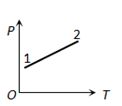
The $P-T$ graph shows a gas being heated. During this process from point $1$ to $2$,the volume of the gas:
A
remains constant.
B
decreases.
C
increases.
D
changes unpredictably.
Solution
(C) From the ideal gas equation,$PV = \mu RT$,we can write $V = \frac{\mu RT}{P}$,which implies $V \propto \frac{T}{P}$.
In the given $P-T$ graph,the line representing the process from $1$ to $2$ passes through the $T$-axis at a positive value (if extended). This means the slope $\frac{P}{T}$ is decreasing as $T$ increases.
Since $V \propto \frac{T}{P}$,if the ratio $\frac{P}{T}$ decreases,the ratio $\frac{T}{P}$ must increase.
Therefore,the volume $V$ of the gas increases during the process from $1$ to $2$.
In the given $P-T$ graph,the line representing the process from $1$ to $2$ passes through the $T$-axis at a positive value (if extended). This means the slope $\frac{P}{T}$ is decreasing as $T$ increases.
Since $V \propto \frac{T}{P}$,if the ratio $\frac{P}{T}$ decreases,the ratio $\frac{T}{P}$ must increase.
Therefore,the volume $V$ of the gas increases during the process from $1$ to $2$.
0 likes
View Solution108
EasyMCQ
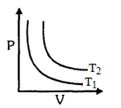
Which relation is correct for the given $P-V$ diagram?
A
$T_1 = T_2$
B
$T_1 > T_2$
C
$T_1 < T_2$
D
$T_1 \ge T_2$
Solution
(C) For an ideal gas,the equation of state is $PV = nRT$.
This implies $P = \frac{nRT}{V}$.
For a constant volume $V$,the pressure $P$ is directly proportional to the temperature $T$ $(P \propto T)$.
In the given $P-V$ diagram,if we draw a vertical line at a constant volume $V$,the pressure corresponding to the curve $T_2$ is higher than the pressure corresponding to the curve $T_1$.
Since $P_2 > P_1$ at the same volume,it follows that $T_2 > T_1$,or $T_1 < T_2$.
This implies $P = \frac{nRT}{V}$.
For a constant volume $V$,the pressure $P$ is directly proportional to the temperature $T$ $(P \propto T)$.
In the given $P-V$ diagram,if we draw a vertical line at a constant volume $V$,the pressure corresponding to the curve $T_2$ is higher than the pressure corresponding to the curve $T_1$.
Since $P_2 > P_1$ at the same volume,it follows that $T_2 > T_1$,or $T_1 < T_2$.
0 likes
View Solution109
MediumMCQ
For a monoatomic gas at constant pressure,the $V \rightarrow T$ graph is . . . . . .
A
B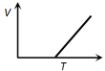
C
D
Solution
(C) According to the ideal gas equation,$PV = nRT$.
For a constant pressure $P$ and a fixed amount of gas $n$,the equation becomes $V = (\frac{nR}{P})T$.
This is of the form $V = kT$,where $k = \frac{nR}{P}$ is a constant.
This represents a straight line passing through the origin $(0, 0)$ in the $V-T$ plane.
Therefore,the correct graph is a straight line passing through the origin.
For a constant pressure $P$ and a fixed amount of gas $n$,the equation becomes $V = (\frac{nR}{P})T$.
This is of the form $V = kT$,where $k = \frac{nR}{P}$ is a constant.
This represents a straight line passing through the origin $(0, 0)$ in the $V-T$ plane.
Therefore,the correct graph is a straight line passing through the origin.
0 likes
View Solution110
MediumMCQ
For an ideal gas with pressure $P$,temperature $T$,and volume $V$,where the mass of each molecule is $m$,what is the density of the gas? ($k$ is the Boltzmann constant)
A
$mkT$
B
$\frac{Pm}{kT}$
C
$\frac{P}{kTV}$
D
$\frac{P}{kT}$
Solution
(B) The ideal gas equation is given by $PV = nRT$,where $n$ is the number of moles.
$n = \frac{N}{N_A}$,where $N$ is the total number of molecules and $N_A$ is Avogadro's number.
Also,the total mass of the gas is $M_{total} = N \times m$,where $m$ is the mass of one molecule.
Density $\rho = \frac{M_{total}}{V} = \frac{Nm}{V}$.
From the ideal gas law: $PV = \frac{N}{N_A} RT$.
Since $R = k N_A$,we have $PV = \frac{N}{N_A} (k N_A) T = NkT$.
Rearranging for $N/V$: $\frac{N}{V} = \frac{P}{kT}$.
Substituting this into the density formula: $\rho = \left(\frac{N}{V}\right) m = \left(\frac{P}{kT}\right) m = \frac{Pm}{kT}$.
$n = \frac{N}{N_A}$,where $N$ is the total number of molecules and $N_A$ is Avogadro's number.
Also,the total mass of the gas is $M_{total} = N \times m$,where $m$ is the mass of one molecule.
Density $\rho = \frac{M_{total}}{V} = \frac{Nm}{V}$.
From the ideal gas law: $PV = \frac{N}{N_A} RT$.
Since $R = k N_A$,we have $PV = \frac{N}{N_A} (k N_A) T = NkT$.
Rearranging for $N/V$: $\frac{N}{V} = \frac{P}{kT}$.
Substituting this into the density formula: $\rho = \left(\frac{N}{V}\right) m = \left(\frac{P}{kT}\right) m = \frac{Pm}{kT}$.
0 likes
View Solution111
MediumMCQ
Which quantity is constant for two gases of equal volume at the same pressure and temperature?
A
Number of molecules
B
Average kinetic energy
C
$rms$ velocity
D
Mean free path
Solution
(A) According to the Ideal Gas Law,$PV = NkT$,where $P$ is pressure,$V$ is volume,$N$ is the number of molecules,$k$ is the Boltzmann constant,and $T$ is temperature.
Rearranging for the number of molecules,we get $N = \frac{PV}{kT}$.
Since $P$,$V$,$k$,and $T$ are identical for both gases,the number of molecules $N$ must be the same for both gases.
Rearranging for the number of molecules,we get $N = \frac{PV}{kT}$.
Since $P$,$V$,$k$,and $T$ are identical for both gases,the number of molecules $N$ must be the same for both gases.
0 likes
View Solution112
EasyMCQ
For $H_2, O_2$,and $He$ gases at the same temperature and pressure,the volumes are equal. Which of the following has the highest number of atoms?
A
$H_2$
B
$O_2$
C
$He$
D
All gases have the same number of atoms.
Solution
(A) According to the ideal gas equation,$PV = nRT$,where $n$ is the number of moles.
Given that $P, V, R$,and $T$ are the same for all three gases,the number of moles $n = \frac{PV}{RT}$ is the same for all.
Number of molecules $N = n \times N_A$,where $N_A$ is Avogadro's number. Thus,the number of molecules is the same for all.
Now,we calculate the number of atoms:
For $H_2$ (diatomic): Number of atoms $= 2 \times n \times N_A = 2nN_A$.
For $O_2$ (diatomic): Number of atoms $= 2 \times n \times N_A = 2nN_A$.
For $He$ (monoatomic): Number of atoms $= 1 \times n \times N_A = nN_A$.
Comparing these,$H_2$ and $O_2$ have the same number of atoms,which is higher than that of $He$.
Given that $P, V, R$,and $T$ are the same for all three gases,the number of moles $n = \frac{PV}{RT}$ is the same for all.
Number of molecules $N = n \times N_A$,where $N_A$ is Avogadro's number. Thus,the number of molecules is the same for all.
Now,we calculate the number of atoms:
For $H_2$ (diatomic): Number of atoms $= 2 \times n \times N_A = 2nN_A$.
For $O_2$ (diatomic): Number of atoms $= 2 \times n \times N_A = 2nN_A$.
For $He$ (monoatomic): Number of atoms $= 1 \times n \times N_A = nN_A$.
Comparing these,$H_2$ and $O_2$ have the same number of atoms,which is higher than that of $He$.
0 likes
View Solution113
MediumMCQ
$A$ gas at $27^{\circ}C$ has a volume $V$ and pressure $P$. If it is heated such that the pressure becomes double and the volume becomes triple,what is the final temperature in $^{\circ}C$?
A
$1800$
B
$162$
C
$1527$
D
$600$
Solution
(C) Using the ideal gas law equation: $\frac{P_1 V_1}{T_1} = \frac{P_2 V_2}{T_2}$.
Given: $T_1 = 27^{\circ}C = 27 + 273 = 300 \ K$,$P_1 = P$,$V_1 = V$.
Final conditions: $P_2 = 2P$,$V_2 = 3V$.
Substituting these values into the equation:
$\frac{P \times V}{300} = \frac{(2P) \times (3V)}{T_2}$.
$T_2 = \frac{6PV}{PV} \times 300 = 6 \times 300 = 1800 \ K$.
To convert to Celsius: $T(^{\circ}C) = 1800 - 273 = 1527^{\circ}C$.
Given: $T_1 = 27^{\circ}C = 27 + 273 = 300 \ K$,$P_1 = P$,$V_1 = V$.
Final conditions: $P_2 = 2P$,$V_2 = 3V$.
Substituting these values into the equation:
$\frac{P \times V}{300} = \frac{(2P) \times (3V)}{T_2}$.
$T_2 = \frac{6PV}{PV} \times 300 = 6 \times 300 = 1800 \ K$.
To convert to Celsius: $T(^{\circ}C) = 1800 - 273 = 1527^{\circ}C$.
0 likes
View Solution114
EasyMCQ
$A$ certain amount of gas has a volume of $12 \, L$ at a pressure of $3 \, atm$. If the temperature remains constant,what pressure in $atm$ must be applied to reduce its volume to $9 \, L$?
A
$2$
B
$5$
C
$3$
D
$4$
Solution
(D) According to Boyle's Law for a fixed amount of gas at constant temperature,the product of pressure and volume remains constant: $P_1V_1 = P_2V_2$.
Given values are $P_1 = 3 \, atm$,$V_1 = 12 \, L$,and $V_2 = 9 \, L$.
Substituting these values into the equation: $3 \times 12 = P_2 \times 9$.
Solving for $P_2$: $P_2 = \frac{3 \times 12}{9} = \frac{36}{9} = 4 \, atm$.
Therefore,the required pressure is $4 \, atm$.
Given values are $P_1 = 3 \, atm$,$V_1 = 12 \, L$,and $V_2 = 9 \, L$.
Substituting these values into the equation: $3 \times 12 = P_2 \times 9$.
Solving for $P_2$: $P_2 = \frac{3 \times 12}{9} = \frac{36}{9} = 4 \, atm$.
Therefore,the required pressure is $4 \, atm$.
0 likes
View Solution115
MediumMCQ
$A$ container $A$ contains a gas at pressure $P$,volume $V$,and temperature $T$. Another container $B$ contains a gas at pressure $2P$,volume $V/4$,and temperature $2T$. The ratio of the number of molecules in container $A$ to that in container $B$ is:
A
$1 : 1$
B
$1 : 2$
C
$2 : 1$
D
$4 : 1$
Solution
(D) Using the ideal gas equation $PV = Nk_BT$,where $N$ is the number of molecules and $k_B$ is the Boltzmann constant.
For container $A$: $N_A = \frac{PV}{k_BT}$.
For container $B$: $N_B = \frac{(2P)(V/4)}{k_B(2T)} = \frac{PV/2}{2k_BT} = \frac{PV}{4k_BT}$.
The ratio of the number of molecules is $\frac{N_A}{N_B} = \frac{PV/k_BT}{PV/4k_BT} = \frac{1}{1/4} = \frac{4}{1}$.
For container $A$: $N_A = \frac{PV}{k_BT}$.
For container $B$: $N_B = \frac{(2P)(V/4)}{k_B(2T)} = \frac{PV/2}{2k_BT} = \frac{PV}{4k_BT}$.
The ratio of the number of molecules is $\frac{N_A}{N_B} = \frac{PV/k_BT}{PV/4k_BT} = \frac{1}{1/4} = \frac{4}{1}$.
0 likes
View Solution116
EasyMCQ
$O_2$ gas is filled in a cylinder. If the pressure is doubled and the temperature is quadrupled,what will be the factor by which the density changes?
A
$2$
B
$4$
C
$0.25$
D
$0.5$
Solution
(D) The density $\rho$ of an ideal gas is given by the formula $\rho = \frac{M_w P}{RT}$,where $M_w$ is the molar mass,$P$ is the pressure,$R$ is the gas constant,and $T$ is the absolute temperature.
Given that the pressure $P' = 2P$ and the temperature $T' = 4T$.
The new density $\rho'$ is given by $\rho' = \frac{M_w P'}{R T'}$.
Substituting the values,we get $\rho' = \frac{M_w (2P)}{R (4T)} = \frac{1}{2} \left( \frac{M_w P}{RT} \right)$.
Therefore,$\rho' = 0.5 \rho$.
The density becomes $0.5$ times the original density.
Given that the pressure $P' = 2P$ and the temperature $T' = 4T$.
The new density $\rho'$ is given by $\rho' = \frac{M_w P'}{R T'}$.
Substituting the values,we get $\rho' = \frac{M_w (2P)}{R (4T)} = \frac{1}{2} \left( \frac{M_w P}{RT} \right)$.
Therefore,$\rho' = 0.5 \rho$.
The density becomes $0.5$ times the original density.
0 likes
View Solution117
DifficultMCQ
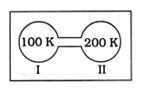
Two spheres are connected to each other as shown in the figure. The volume of sphere $I$ is twice the volume of sphere $II$. They contain an ideal gas at temperatures $100 K$ and $200 K$,respectively. If the mass of the gas in sphere $I$ is $m$,what is the mass of the gas in sphere $II$?
A
$m$
B
$m/2$
C
$m/4$
D
$m/8$
Solution
(C) Since the two spheres are connected,the pressure $P$ in both spheres is the same.
Given: Volume $V_1 = 2V_2$,Temperature $T_1 = 100 K$,$T_2 = 200 K$.
Using the ideal gas equation $PV = nRT = (m/M)RT$,where $M$ is the molar mass of the gas.
For sphere $I$: $PV_1 = (m/M)RT_1$ --- $(1)$
For sphere $II$: $PV_2 = (m'/M)RT_2$ --- $(2)$
Dividing equation $(2)$ by equation $(1)$:
$\frac{PV_2}{PV_1} = \frac{(m'/M)RT_2}{(m/M)RT_1}$
$\frac{V_2}{2V_2} = \frac{m'}{m} \times \frac{200}{100}$
$\frac{1}{2} = \frac{m'}{m} \times 2$
$\frac{m'}{m} = \frac{1}{4}$
$m' = m/4$
Given: Volume $V_1 = 2V_2$,Temperature $T_1 = 100 K$,$T_2 = 200 K$.
Using the ideal gas equation $PV = nRT = (m/M)RT$,where $M$ is the molar mass of the gas.
For sphere $I$: $PV_1 = (m/M)RT_1$ --- $(1)$
For sphere $II$: $PV_2 = (m'/M)RT_2$ --- $(2)$
Dividing equation $(2)$ by equation $(1)$:
$\frac{PV_2}{PV_1} = \frac{(m'/M)RT_2}{(m/M)RT_1}$
$\frac{V_2}{2V_2} = \frac{m'}{m} \times \frac{200}{100}$
$\frac{1}{2} = \frac{m'}{m} \times 2$
$\frac{m'}{m} = \frac{1}{4}$
$m' = m/4$
0 likes
View Solution118
EasyMCQ
$A$ sample of oxygen gas is compressed from a volume of $500 \, cc$ to $400 \, cc$ at a pressure of $2 \, atm$. If the temperature is kept constant,what pressure in $atm$ is required?
A
$1.2$
B
$2.5$
C
$4.7$
D
$5.0$
Solution
(B) Since the temperature is constant,we use Boyle's Law: $P_1 V_1 = P_2 V_2$.
Given: $P_1 = 2 \, atm$,$V_1 = 500 \, cc$,$V_2 = 400 \, cc$.
Substituting the values into the equation:
$P_2 = P_1 \times \frac{V_1}{V_2}$
$P_2 = 2 \times \frac{500}{400}$
$P_2 = 2 \times 1.25 = 2.5 \, atm$.
Given: $P_1 = 2 \, atm$,$V_1 = 500 \, cc$,$V_2 = 400 \, cc$.
Substituting the values into the equation:
$P_2 = P_1 \times \frac{V_1}{V_2}$
$P_2 = 2 \times \frac{500}{400}$
$P_2 = 2 \times 1.25 = 2.5 \, atm$.
0 likes
View Solution119
MediumMCQ
$A$ gas is contained in a $5 \, L$ vessel at a pressure of $0.8 \, m$. It is connected to another evacuated vessel of $3 \, L$ capacity. What will be the resultant pressure in $m$ (at constant temperature)?
A
$4/3$
B
$0.5$
C
$2.0$
D
$3/4$
Solution
(B) According to Boyle's Law,at constant temperature,$P_1V_1 = P_2V_2$.
Here,the initial pressure $P_1 = 0.8 \, m$ and initial volume $V_1 = 5 \, L$.
The final volume $V_2$ is the sum of the two vessels because the gas expands to fill both: $V_2 = 5 \, L + 3 \, L = 8 \, L$.
Substituting the values into the equation:
$0.8 \times 5 = P_2 \times 8$
$4.0 = P_2 \times 8$
$P_2 = 4.0 / 8 = 0.5 \, m$.
Thus,the resultant pressure is $0.5 \, m$.
Here,the initial pressure $P_1 = 0.8 \, m$ and initial volume $V_1 = 5 \, L$.
The final volume $V_2$ is the sum of the two vessels because the gas expands to fill both: $V_2 = 5 \, L + 3 \, L = 8 \, L$.
Substituting the values into the equation:
$0.8 \times 5 = P_2 \times 8$
$4.0 = P_2 \times 8$
$P_2 = 4.0 / 8 = 0.5 \, m$.
Thus,the resultant pressure is $0.5 \, m$.
0 likes
View Solution120
EasyMCQ
The pressure of a given mass of gas at $20^{\circ}C$ is $P$. At constant volume,at what temperature in $^{\circ}C$ will the pressure of the gas become $2P$?
A
$40$
B
$113$
C
$213$
D
$313$
Solution
(D) According to Gay-Lussac's Law,for a given mass of gas at constant volume,the pressure is directly proportional to its absolute temperature: $P \propto T$.
Therefore,$\frac{P_2}{P_1} = \frac{T_2}{T_1}$.
Given: $P_1 = P$,$P_2 = 2P$,and $T_1 = 20^{\circ}C = 20 + 273 = 293 \ K$.
Substituting the values: $\frac{2P}{P} = \frac{T_2}{293}$.
$T_2 = 2 \times 293 = 586 \ K$.
To convert the temperature back to Celsius: $T(^{\circ}C) = 586 - 273 = 313^{\circ}C$.
Therefore,$\frac{P_2}{P_1} = \frac{T_2}{T_1}$.
Given: $P_1 = P$,$P_2 = 2P$,and $T_1 = 20^{\circ}C = 20 + 273 = 293 \ K$.
Substituting the values: $\frac{2P}{P} = \frac{T_2}{293}$.
$T_2 = 2 \times 293 = 586 \ K$.
To convert the temperature back to Celsius: $T(^{\circ}C) = 586 - 273 = 313^{\circ}C$.
0 likes
View Solution121
DifficultMCQ
For container $A$,the pressure is $P$,volume is $V$,and temperature is $T$. For container $B$,the pressure is $2P$,volume is $V/4$,and temperature is $2T$. Find the ratio of the number of molecules in container $A$ to that in container $B$.
A
$1 : 1$
B
$1 : 2$
C
$2 : 1$
D
$4 : 1$
Solution
(D) The ideal gas equation is given by $PV = NkT$,where $N$ is the number of molecules and $k$ is the Boltzmann constant.
For container $A$: $P_A = P$,$V_A = V$,$T_A = T$. So,$N_A = \frac{PV}{kT}$.
For container $B$: $P_B = 2P$,$V_B = V/4$,$T_B = 2T$. So,$N_B = \frac{(2P)(V/4)}{k(2T)} = \frac{PV/2}{2kT} = \frac{PV}{4kT}$.
The ratio of the number of molecules is $\frac{N_A}{N_B} = \frac{PV/kT}{PV/4kT} = \frac{4}{1}$.
Therefore,the ratio is $4 : 1$.
For container $A$: $P_A = P$,$V_A = V$,$T_A = T$. So,$N_A = \frac{PV}{kT}$.
For container $B$: $P_B = 2P$,$V_B = V/4$,$T_B = 2T$. So,$N_B = \frac{(2P)(V/4)}{k(2T)} = \frac{PV/2}{2kT} = \frac{PV}{4kT}$.
The ratio of the number of molecules is $\frac{N_A}{N_B} = \frac{PV/kT}{PV/4kT} = \frac{4}{1}$.
Therefore,the ratio is $4 : 1$.
0 likes
View Solution122
EasyMCQ
$A$ container holds $6 \ g$ of oxygen at a pressure $P$ and temperature $400 \ K$. $A$ small hole is made in the container so that oxygen can leak out. How much oxygen (in $g$) will leak out by the time the pressure becomes $P/2$ and the temperature becomes $300 \ K$?
A
$3$
B
$2$
C
$4$
D
$5$
Solution
(B) Using the ideal gas equation,$PV = \frac{m}{M}RT$,where $m$ is the mass of the gas,$M$ is the molar mass,$R$ is the gas constant,and $T$ is the temperature.
Since the volume $V$ and molar mass $M$ are constant,we have $P \propto \frac{mT}{V} \implies P \propto mT$.
Let $m_1 = 6 \ g$,$P_1 = P$,$T_1 = 400 \ K$ and $m_2$ be the final mass,$P_2 = P/2$,$T_2 = 300 \ K$.
Using the ratio $\frac{P_1}{P_2} = \frac{m_1 T_1}{m_2 T_2}$,we get $\frac{P}{P/2} = \frac{6 \times 400}{m_2 \times 300}$.
$2 = \frac{2400}{300 m_2} \implies 2 = \frac{8}{m_2}$.
$m_2 = 4 \ g$.
The amount of oxygen leaked is $\Delta m = m_1 - m_2 = 6 \ g - 4 \ g = 2 \ g$.
Since the volume $V$ and molar mass $M$ are constant,we have $P \propto \frac{mT}{V} \implies P \propto mT$.
Let $m_1 = 6 \ g$,$P_1 = P$,$T_1 = 400 \ K$ and $m_2$ be the final mass,$P_2 = P/2$,$T_2 = 300 \ K$.
Using the ratio $\frac{P_1}{P_2} = \frac{m_1 T_1}{m_2 T_2}$,we get $\frac{P}{P/2} = \frac{6 \times 400}{m_2 \times 300}$.
$2 = \frac{2400}{300 m_2} \implies 2 = \frac{8}{m_2}$.
$m_2 = 4 \ g$.
The amount of oxygen leaked is $\Delta m = m_1 - m_2 = 6 \ g - 4 \ g = 2 \ g$.
0 likes
View Solution123
MediumMCQ
At a constant temperature,by what percentage $(\%)$ must the pressure of a given mass of gas be increased so that its volume decreases by $10\%$ (in $.1$)?
A
$8$
B
$9$
C
$10$
D
$11$
Solution
(D) According to Boyle's Law,for a given mass of gas at constant temperature,$P_1V_1 = P_2V_2$.
Let the initial pressure be $P_1 = P$ and initial volume be $V_1 = V$.
The final volume is $V_2 = V - 0.1V = 0.9V$.
Using $P_1V_1 = P_2V_2$,we get $P \times V = P_2 \times 0.9V$.
Therefore,$P_2 = \frac{P}{0.9} = \frac{10}{9}P$.
The change in pressure is $\Delta P = P_2 - P = \frac{10}{9}P - P = \frac{1}{9}P$.
The percentage increase in pressure is $\frac{\Delta P}{P} \times 100 = \frac{1/9P}{P} \times 100 = \frac{100}{9} \approx 11.11\%$.
Let the initial pressure be $P_1 = P$ and initial volume be $V_1 = V$.
The final volume is $V_2 = V - 0.1V = 0.9V$.
Using $P_1V_1 = P_2V_2$,we get $P \times V = P_2 \times 0.9V$.
Therefore,$P_2 = \frac{P}{0.9} = \frac{10}{9}P$.
The change in pressure is $\Delta P = P_2 - P = \frac{10}{9}P - P = \frac{1}{9}P$.
The percentage increase in pressure is $\frac{\Delta P}{P} \times 100 = \frac{1/9P}{P} \times 100 = \frac{100}{9} \approx 11.11\%$.
0 likes
View Solution124
MediumMCQ
The lowest pressure (the best vacuum) that can be created in the laboratory at $27^{\circ}C$ is $10^{-11} \; mm$ of $Hg$. At this pressure,the number of ideal gas molecules per $cm^{3}$ will be:
A
$3.22 \times 10^{12}$
B
$1.61 \times 10^{12}$
C
$3.21 \times 10^{6}$
D
$3.22 \times 10^{5}$
Solution
(D) Using the ideal gas equation $PV = nRT$,we can write $P = (n/V)RT$,where $n/V$ is the number density of molecules.
Given $P = nkT$,where $n$ is the number density and $k$ is the Boltzmann constant $(k = 1.38 \times 10^{-23} \; J/K)$.
First,convert pressure to $SI$ units $(Pa)$:
$1 \; atm = 760 \; mm \; Hg = 1.013 \times 10^{5} \; Pa$.
$P = 10^{-11} \; mm \; Hg = (10^{-11} / 760) \times 1.013 \times 10^{5} \; Pa \approx 1.33 \times 10^{-9} \; Pa$.
Temperature $T = 27 + 273 = 300 \; K$.
Using $n = P / (kT)$:
$n = (1.33 \times 10^{-9}) / (1.38 \times 10^{-23} \times 300) \approx 3.21 \times 10^{11} \; molecules/m^{3}$.
Since $1 \; m^{3} = 10^{6} \; cm^{3}$,the number density per $cm^{3}$ is $3.21 \times 10^{11} / 10^{6} = 3.21 \times 10^{5} \; molecules/cm^{3}$.
Rounding to the nearest option,the answer is $3.22 \times 10^{5} \; molecules/cm^{3}$.
Given $P = nkT$,where $n$ is the number density and $k$ is the Boltzmann constant $(k = 1.38 \times 10^{-23} \; J/K)$.
First,convert pressure to $SI$ units $(Pa)$:
$1 \; atm = 760 \; mm \; Hg = 1.013 \times 10^{5} \; Pa$.
$P = 10^{-11} \; mm \; Hg = (10^{-11} / 760) \times 1.013 \times 10^{5} \; Pa \approx 1.33 \times 10^{-9} \; Pa$.
Temperature $T = 27 + 273 = 300 \; K$.
Using $n = P / (kT)$:
$n = (1.33 \times 10^{-9}) / (1.38 \times 10^{-23} \times 300) \approx 3.21 \times 10^{11} \; molecules/m^{3}$.
Since $1 \; m^{3} = 10^{6} \; cm^{3}$,the number density per $cm^{3}$ is $3.21 \times 10^{11} / 10^{6} = 3.21 \times 10^{5} \; molecules/cm^{3}$.
Rounding to the nearest option,the answer is $3.22 \times 10^{5} \; molecules/cm^{3}$.
0 likes
View Solution125
DifficultMCQ
When the temperature of a gas in a closed vessel is increased by $1^{\circ}C$,its pressure increases by $0.4\%$. The initial temperature of the gas is ...
A
$25^{\circ}C$
B
$250^{\circ}C$
C
$250 \ K$
D
$2500 \ K$
Solution
(C) For a gas in a closed vessel,the volume $V$ is constant. According to Gay-Lussac's Law,$\frac{P}{T} = \text{constant}$,which means $\frac{P_1}{T_1} = \frac{P_2}{T_2}$.
Let the initial pressure be $P_1 = P$ and the initial temperature be $T_1 = T$ (in Kelvin).
The final pressure is $P_2 = P + 0.4\% \text{ of } P = P + 0.004P = 1.004P$.
The final temperature is $T_2 = T + 1$.
Substituting these values into the equation: $\frac{P}{T} = \frac{1.004P}{T+1}$.
Dividing both sides by $P$: $\frac{1}{T} = \frac{1.004}{T+1}$.
Cross-multiplying: $T + 1 = 1.004T$.
$1 = 0.004T$.
$T = \frac{1}{0.004} = 250 \ K$.
Let the initial pressure be $P_1 = P$ and the initial temperature be $T_1 = T$ (in Kelvin).
The final pressure is $P_2 = P + 0.4\% \text{ of } P = P + 0.004P = 1.004P$.
The final temperature is $T_2 = T + 1$.
Substituting these values into the equation: $\frac{P}{T} = \frac{1.004P}{T+1}$.
Dividing both sides by $P$: $\frac{1}{T} = \frac{1.004}{T+1}$.
Cross-multiplying: $T + 1 = 1.004T$.
$1 = 0.004T$.
$T = \frac{1}{0.004} = 250 \ K$.
0 likes
View Solution126
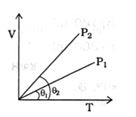
MediumMCQ
The volume versus temperature graph for a fixed amount of gas at constant pressures $P_1$ and $P_2$ is shown in the figure. From this,it can be concluded that...........
A
$P_1 > P_2$
B
$P_1 < P_2$
C
$P_1 = P_2$
D
Cannot be determined.
Solution
(A) From the graph,we observe that the angle $\theta_1 < \theta_2$.
Since the slope of the $V-T$ graph is $\tan \theta = \frac{V}{T}$,it follows that $\tan \theta_1 < \tan \theta_2$.
Therefore,$\left( \frac{V}{T} \right)_1 < \left( \frac{V}{T} \right)_2$.
From the ideal gas equation $PV = \mu RT$,we have $\frac{V}{T} = \frac{\mu R}{P}$.
This implies that $\frac{V}{T} \propto \frac{1}{P}$.
Thus,$\frac{1}{P_1} < \frac{1}{P_2}$,which leads to $P_1 > P_2$.
Since the slope of the $V-T$ graph is $\tan \theta = \frac{V}{T}$,it follows that $\tan \theta_1 < \tan \theta_2$.
Therefore,$\left( \frac{V}{T} \right)_1 < \left( \frac{V}{T} \right)_2$.
From the ideal gas equation $PV = \mu RT$,we have $\frac{V}{T} = \frac{\mu R}{P}$.
This implies that $\frac{V}{T} \propto \frac{1}{P}$.
Thus,$\frac{1}{P_1} < \frac{1}{P_2}$,which leads to $P_1 > P_2$.
0 likes
View Solution127
MediumMCQ
$A$ gas is filled in a cylinder. If its temperature is increased by $20\%$ and its volume decreases by $10\%$, what percentage of the gas will have leaked out?
A
$30$
B
$40$
C
$15$
D
$25$
Solution
(D) Let the initial state be $(P, V, T)$ and the final state be $(P, V', T')$.
Assuming the pressure remains constant (as it is a cylinder with a movable piston or open to atmosphere), we use the Ideal Gas Law: $PV = nRT$.
Initial state: $PV = n_1 RT$.
Final state: $PV' = n_2 R T'$.
Given: $T' = T + 0.20T = 1.2T$ and $V' = V - 0.10V = 0.9V$.
Substituting these into the final state equation: $P(0.9V) = n_2 R (1.2T)$.
$0.9 PV = n_2 R (1.2T) \Rightarrow n_2 = \frac{0.9}{1.2} n_1 = 0.75 n_1$.
The amount of gas leaked is $\Delta n = n_1 - n_2 = n_1 - 0.75 n_1 = 0.25 n_1$.
Percentage of gas leaked = $\frac{\Delta n}{n_1} \times 100 = 0.25 \times 100 = 25\%$.
Assuming the pressure remains constant (as it is a cylinder with a movable piston or open to atmosphere), we use the Ideal Gas Law: $PV = nRT$.
Initial state: $PV = n_1 RT$.
Final state: $PV' = n_2 R T'$.
Given: $T' = T + 0.20T = 1.2T$ and $V' = V - 0.10V = 0.9V$.
Substituting these into the final state equation: $P(0.9V) = n_2 R (1.2T)$.
$0.9 PV = n_2 R (1.2T) \Rightarrow n_2 = \frac{0.9}{1.2} n_1 = 0.75 n_1$.
The amount of gas leaked is $\Delta n = n_1 - n_2 = n_1 - 0.75 n_1 = 0.25 n_1$.
Percentage of gas leaked = $\frac{\Delta n}{n_1} \times 100 = 0.25 \times 100 = 25\%$.
0 likes
View Solution128
MediumMCQ
At a room temperature of $23^{\circ}C$,a person inhales $1500 \, ml$ of air at a body temperature of $37^{\circ}C$. If the pressure and mass remain constant,what will be the volume of the air in the person's lungs in $ml$?
A
$1650$
B
$1570.9$
C
$1450.2$
D
$1740$
Solution
(B) Given: Initial temperature $T_1 = 23^{\circ}C = 23 + 273 = 296 \, K$.
Initial volume $V_1 = 1500 \, ml$.
Final temperature $T_2 = 37^{\circ}C = 37 + 273 = 310 \, K$.
Since pressure and mass (amount of gas) are constant,we use Charles's Law: $\frac{V_1}{T_1} = \frac{V_2}{T_2}$.
Rearranging for $V_2$: $V_2 = V_1 \times \frac{T_2}{T_1}$.
Substituting the values: $V_2 = 1500 \times \frac{310}{296}$.
Calculating the result: $V_2 \approx 1570.9 \, ml$.
Initial volume $V_1 = 1500 \, ml$.
Final temperature $T_2 = 37^{\circ}C = 37 + 273 = 310 \, K$.
Since pressure and mass (amount of gas) are constant,we use Charles's Law: $\frac{V_1}{T_1} = \frac{V_2}{T_2}$.
Rearranging for $V_2$: $V_2 = V_1 \times \frac{T_2}{T_1}$.
Substituting the values: $V_2 = 1500 \times \frac{310}{296}$.
Calculating the result: $V_2 \approx 1570.9 \, ml$.
0 likes
View Solution129
EasyMCQ
What is the equation of state for $8 \, g$ of $O_2$?
A
$PV = 8RT$
B
$PV = \frac{RT}{4}$
C
$PV = RT$
D
$PV = \frac{RT}{2}$
Solution
(B) The ideal gas equation is given by $PV = \mu RT$,where $\mu$ is the number of moles.
For $O_2$,the molar mass $M = 32 \, g/mol$.
The number of moles $\mu = \frac{\text{mass}}{\text{molar mass}} = \frac{8 \, g}{32 \, g/mol} = \frac{1}{4} \, mol$.
Substituting this into the ideal gas equation:
$PV = \left( \frac{1}{4} \right) RT = \frac{RT}{4}$.
For $O_2$,the molar mass $M = 32 \, g/mol$.
The number of moles $\mu = \frac{\text{mass}}{\text{molar mass}} = \frac{8 \, g}{32 \, g/mol} = \frac{1}{4} \, mol$.
Substituting this into the ideal gas equation:
$PV = \left( \frac{1}{4} \right) RT = \frac{RT}{4}$.
0 likes
View Solution130
MediumMCQ
When the temperature of a gas at constant volume is increased by $5^{\circ}C$,its pressure increases by $0.5\%$ of its initial value. The initial temperature of the gas is..... $K$.
A
$1100$
B
$850$
C
$1000$
D
$940$
Solution
(C) For a gas at constant volume,according to Gay-Lussac's Law,$P \propto T$.
This implies $\frac{\Delta P}{P} = \frac{\Delta T}{T}$.
Given that the percentage increase in pressure is $\frac{\Delta P}{P} \times 100 = 0.5\%$ and the change in temperature is $\Delta T = 5 \ K$.
Substituting these values into the equation:
$\frac{0.5}{100} = \frac{5}{T}$
$T = \frac{5 \times 100}{0.5}$
$T = 1000 \ K$.
Therefore,the initial temperature of the gas is $1000 \ K$.
This implies $\frac{\Delta P}{P} = \frac{\Delta T}{T}$.
Given that the percentage increase in pressure is $\frac{\Delta P}{P} \times 100 = 0.5\%$ and the change in temperature is $\Delta T = 5 \ K$.
Substituting these values into the equation:
$\frac{0.5}{100} = \frac{5}{T}$
$T = \frac{5 \times 100}{0.5}$
$T = 1000 \ K$.
Therefore,the initial temperature of the gas is $1000 \ K$.
0 likes
View Solution131
EasyMCQ
Equal molar amounts of $H_2$ and $He$ are placed in two separate containers of equal volume at the same temperature. Their molar masses are $2$ and $4$ respectively. If the pressure of $H_2$ gas is $4 \ atm$,what will be the pressure of $He$ gas in atmospheres?
A
$1$
B
$4$
C
$2$
D
$8$
Solution
(B) According to the ideal gas equation,$PV = \mu RT$,where $P$ is pressure,$V$ is volume,$\mu$ is the number of moles,$R$ is the universal gas constant,and $T$ is temperature.
Since the number of moles $\mu$,volume $V$,and temperature $T$ are the same for both gases,the pressure $P$ must also be the same.
Given that the pressure of $H_2$ is $4 \ atm$,the pressure of $He$ will also be $4 \ atm$.
Since the number of moles $\mu$,volume $V$,and temperature $T$ are the same for both gases,the pressure $P$ must also be the same.
Given that the pressure of $H_2$ is $4 \ atm$,the pressure of $He$ will also be $4 \ atm$.
0 likes
View Solution132
EasyMCQ
What is the number of oxygen molecules in a cylinder of volume $1 \ m^3$ at $27^{\circ}C$ and $13.8 \ Pa$? (Boltzmann constant $k = 1.38 \times 10^{-23} \ JK^{-1}$)
A
$6.23 \times 10^{26}$
B
$0.33 \times 10^{28}$
C
$3.3 \times 10^{21}$
D
None of these
Solution
(C) The ideal gas equation is given by $PV = NkT$,where $P$ is pressure,$V$ is volume,$N$ is the number of molecules,$k$ is the Boltzmann constant,and $T$ is the temperature in Kelvin.
Given: $P = 13.8 \ Pa$,$V = 1 \ m^3$,$k = 1.38 \times 10^{-23} \ JK^{-1}$,and $T = 27^{\circ}C = 27 + 273 = 300 \ K$.
Rearranging the formula for $N$: $N = \frac{PV}{kT}$.
Substituting the values: $N = \frac{13.8 \times 1}{1.38 \times 10^{-23} \times 300}$.
$N = \frac{13.8}{414 \times 10^{-23}} = \frac{13.8}{4.14 \times 10^{-21}} = \frac{13.8}{414} \times 10^{23} = 0.0333 \times 10^{23} = 3.33 \times 10^{21}$.
Thus,the number of molecules is approximately $3.3 \times 10^{21}$.
Given: $P = 13.8 \ Pa$,$V = 1 \ m^3$,$k = 1.38 \times 10^{-23} \ JK^{-1}$,and $T = 27^{\circ}C = 27 + 273 = 300 \ K$.
Rearranging the formula for $N$: $N = \frac{PV}{kT}$.
Substituting the values: $N = \frac{13.8 \times 1}{1.38 \times 10^{-23} \times 300}$.
$N = \frac{13.8}{414 \times 10^{-23}} = \frac{13.8}{4.14 \times 10^{-21}} = \frac{13.8}{414} \times 10^{23} = 0.0333 \times 10^{23} = 3.33 \times 10^{21}$.
Thus,the number of molecules is approximately $3.3 \times 10^{21}$.
0 likes
View Solution133
DifficultMCQ
What will be the volume occupied by $4.5 \, kg$ of water at $STP$ if the intermolecular forces are neglected?
A
$5.6 \, m^3$
B
$4.5 \, m^3$
C
$11.2 \, L$
D
$11.2 \, m^3$
Solution
(A) Given mass of water $m = 4.5 \, kg = 4500 \, g$.
The molar mass of water $(H_2O)$ is $M = 18 \, g/mol$.
The number of moles $n = \frac{m}{M} = \frac{4500}{18} = 250 \, mol$.
At $STP$,the volume occupied by $1 \, mole$ of an ideal gas is $22.4 \, L$.
Therefore,the volume occupied by $250 \, moles$ is $V = n \times 22.4 \, L = 250 \times 22.4 = 5600 \, L$.
Since $1000 \, L = 1 \, m^3$,the volume is $V = 5.6 \, m^3$.
The molar mass of water $(H_2O)$ is $M = 18 \, g/mol$.
The number of moles $n = \frac{m}{M} = \frac{4500}{18} = 250 \, mol$.
At $STP$,the volume occupied by $1 \, mole$ of an ideal gas is $22.4 \, L$.
Therefore,the volume occupied by $250 \, moles$ is $V = n \times 22.4 \, L = 250 \times 22.4 = 5600 \, L$.
Since $1000 \, L = 1 \, m^3$,the volume is $V = 5.6 \, m^3$.
0 likes
View Solution134
MediumMCQ
$A$ sample of $O_2$ gas has a volume of $100 \ ml$ at a pressure of $1 \ atm$ and a temperature of $27^{\circ}C$. If the pressure is increased to $2 \ atm$ while the volume remains $100 \ ml$,the new temperature will be .... $^{\circ}C$.
A
$250$
B
$380$
C
$410$
D
$327$
Solution
(D) Given: Initial pressure $P_1 = 1 \ atm$,Initial volume $V_1 = 100 \ ml$,Initial temperature $T_1 = 27 + 273 = 300 \ K$.
Final pressure $P_2 = 2 \ atm$,Final volume $V_2 = 100 \ ml$.
Since the volume remains constant $(V_1 = V_2)$,we use Gay-Lussac's Law: $\frac{P_1}{T_1} = \frac{P_2}{T_2}$.
Substituting the values: $\frac{1}{300} = \frac{2}{T_2}$.
Solving for $T_2$: $T_2 = 300 \times 2 = 600 \ K$.
Converting to Celsius: $T_2(^{\circ}C) = 600 - 273 = 327^{\circ}C$.
Final pressure $P_2 = 2 \ atm$,Final volume $V_2 = 100 \ ml$.
Since the volume remains constant $(V_1 = V_2)$,we use Gay-Lussac's Law: $\frac{P_1}{T_1} = \frac{P_2}{T_2}$.
Substituting the values: $\frac{1}{300} = \frac{2}{T_2}$.
Solving for $T_2$: $T_2 = 300 \times 2 = 600 \ K$.
Converting to Celsius: $T_2(^{\circ}C) = 600 - 273 = 327^{\circ}C$.
0 likes
View Solution135
EasyMCQ
At constant pressure,the ratio of the increase in volume of an ideal gas per degree rise in temperature to its original volume is ... (where $T$ is the absolute temperature of the gas).
A
$T^2$
B
$1/T^2$
C
$T$
D
$1/T$
Solution
(D) According to Charles's Law,at constant pressure,the volume $V$ of an ideal gas is directly proportional to its absolute temperature $T$,i.e.,$V = kT$,where $k$ is a constant.
Taking the derivative with respect to $T$,we get $\frac{dV}{dT} = k$.
The ratio of the increase in volume per unit rise in temperature to the original volume is given by $\frac{\frac{dV}{dT}}{V}$.
Substituting the values,we get $\frac{k}{kT} = \frac{1}{T}$.
Taking the derivative with respect to $T$,we get $\frac{dV}{dT} = k$.
The ratio of the increase in volume per unit rise in temperature to the original volume is given by $\frac{\frac{dV}{dT}}{V}$.
Substituting the values,we get $\frac{k}{kT} = \frac{1}{T}$.
0 likes
View Solution136
DifficultMCQ
When the temperature of a gas in a closed container is increased by $1 ^\circ C$,its pressure increases by $0.4 \%$. What is the initial temperature of the gas?
A
$25 ^\circ C$
B
$250 ^\circ C$
C
$250 \ K$
D
$2500 ^\circ C$
Solution
(C) For a gas in a closed container,the volume $V$ is constant. According to Gay-Lussac's Law,$P \propto T$,where $P$ is pressure and $T$ is absolute temperature in Kelvin.
Taking the differential form,we have $\frac{\Delta P}{P} = \frac{\Delta T}{T}$.
Given,$\frac{\Delta P}{P} = 0.4 \% = \frac{0.4}{100}$ and $\Delta T = 1 \ K$ (since a change of $1 ^\circ C$ is equivalent to a change of $1 \ K$).
Substituting these values into the equation: $\frac{0.4}{100} = \frac{1}{T}$.
Solving for $T$: $T = \frac{100}{0.4} = 250 \ K$.
Taking the differential form,we have $\frac{\Delta P}{P} = \frac{\Delta T}{T}$.
Given,$\frac{\Delta P}{P} = 0.4 \% = \frac{0.4}{100}$ and $\Delta T = 1 \ K$ (since a change of $1 ^\circ C$ is equivalent to a change of $1 \ K$).
Substituting these values into the equation: $\frac{0.4}{100} = \frac{1}{T}$.
Solving for $T$: $T = \frac{100}{0.4} = 250 \ K$.
0 likes
View Solution137
MediumMCQ
$A$ container holds $1$ mole of $O_2$ (molar mass $32$) at temperature $T$. The pressure is $P$. Another identical container holds $1$ mole of $He$ (molar mass $4$) at temperature $2T$. Find the pressure in the second container.
A
$P/8$
B
$P$
C
$2P$
D
$8P$
Solution
(C) The ideal gas equation is given by $PV = nRT$,where $P$ is pressure,$V$ is volume,$n$ is the number of moles,$R$ is the universal gas constant,and $T$ is the absolute temperature.
For the first container: $P_1 V_1 = n_1 R T_1$. Given $n_1 = 1$,$T_1 = T$,and $P_1 = P$,we have $PV = RT$ (Equation $1$).
For the second container: $P_2 V_2 = n_2 R T_2$. Given $n_2 = 1$,$T_2 = 2T$,and the containers are identical,so $V_2 = V_1 = V$.
Substituting these values: $P_2 V = (1) R (2T) = 2RT$ (Equation $2$).
Dividing Equation $2$ by Equation $1$: $\frac{P_2 V}{PV} = \frac{2RT}{RT}$.
This simplifies to $\frac{P_2}{P} = 2$,which gives $P_2 = 2P$.
For the first container: $P_1 V_1 = n_1 R T_1$. Given $n_1 = 1$,$T_1 = T$,and $P_1 = P$,we have $PV = RT$ (Equation $1$).
For the second container: $P_2 V_2 = n_2 R T_2$. Given $n_2 = 1$,$T_2 = 2T$,and the containers are identical,so $V_2 = V_1 = V$.
Substituting these values: $P_2 V = (1) R (2T) = 2RT$ (Equation $2$).
Dividing Equation $2$ by Equation $1$: $\frac{P_2 V}{PV} = \frac{2RT}{RT}$.
This simplifies to $\frac{P_2}{P} = 2$,which gives $P_2 = 2P$.
0 likes
View Solution138
DifficultMCQ
When the temperature of a gas in a closed vessel is increased by $1 \ ^\circ C$,its pressure increases by $0.4 \ \%$. The initial temperature of the gas is:
A
$2500 \ K$
B
$250 \ K$
C
$250 \ ^\circ C$
D
$25 \ ^\circ C$
Solution
(B) According to Gay-Lussac's Law for a gas in a closed vessel (constant volume),$P \propto T$,which implies $\frac{\Delta P}{P} = \frac{\Delta T}{T}$.
Given: $\frac{\Delta P}{P} = 0.4 \ \% = 0.004$ and $\Delta T = 1 \ K$ (a change of $1 \ ^\circ C$ is equivalent to a change of $1 \ K$ in absolute temperature).
Substituting the values: $0.004 = \frac{1}{T}$.
Therefore,$T = \frac{1}{0.004} = 250 \ K$.
Converting to Celsius: $T( ^\circ C) = 250 - 273 = -23 \ ^\circ C$.
However,based on the standard interpretation of such problems where the result is expected in Kelvin or the temperature difference is treated as absolute,the initial temperature is $250 \ K$.
Given: $\frac{\Delta P}{P} = 0.4 \ \% = 0.004$ and $\Delta T = 1 \ K$ (a change of $1 \ ^\circ C$ is equivalent to a change of $1 \ K$ in absolute temperature).
Substituting the values: $0.004 = \frac{1}{T}$.
Therefore,$T = \frac{1}{0.004} = 250 \ K$.
Converting to Celsius: $T( ^\circ C) = 250 - 273 = -23 \ ^\circ C$.
However,based on the standard interpretation of such problems where the result is expected in Kelvin or the temperature difference is treated as absolute,the initial temperature is $250 \ K$.
0 likes
View Solution139
EasyMCQ
For an ideal gas at constant pressure,if the volume is $V$ at a temperature of $27^{\circ}C$,what will be its final volume when the temperature is increased to $327^{\circ}C$?
A
$V$
B
$3V$
C
$2V$
D
$V/2$
Solution
(C) According to Charles's Law,for an ideal gas at constant pressure,the volume $V$ is directly proportional to the absolute temperature $T$ $(V \propto T)$.
Given:
Initial temperature $T_1 = 27^{\circ}C = 27 + 273 = 300 \ K$.
Final temperature $T_2 = 327^{\circ}C = 327 + 273 = 600 \ K$.
Initial volume $V_1 = V$.
Using the relation $\frac{V_1}{T_1} = \frac{V_2}{T_2}$:
$\frac{V}{300} = \frac{V_2}{600}$.
$V_2 = V \times \frac{600}{300} = 2V$.
Therefore,the final volume is $2V$.
Given:
Initial temperature $T_1 = 27^{\circ}C = 27 + 273 = 300 \ K$.
Final temperature $T_2 = 327^{\circ}C = 327 + 273 = 600 \ K$.
Initial volume $V_1 = V$.
Using the relation $\frac{V_1}{T_1} = \frac{V_2}{T_2}$:
$\frac{V}{300} = \frac{V_2}{600}$.
$V_2 = V \times \frac{600}{300} = 2V$.
Therefore,the final volume is $2V$.
0 likes
View Solution140
MediumMCQ
The equation of state for $5 \ g$ of oxygen gas at pressure $P$,volume $V$,and temperature $T$ is given by:
A
$PV = 5/2 RT$
B
$PV = 5/16 RT$
C
$PV = 5/32 RT$
D
$PV = 5 RT$
Solution
(C) The ideal gas equation is given by $PV = \mu RT$,where $\mu$ is the number of moles.
Number of moles $\mu = \frac{\text{mass}}{\text{molar mass}} = \frac{m}{M_0}$.
For oxygen gas $(O_2)$,the molar mass $M_0 = 32 \ g/mol$.
Given mass $m = 5 \ g$.
Substituting these values into the equation: $\mu = \frac{5}{32}$.
Therefore,the equation of state is $PV = \frac{5}{32} RT$.
Number of moles $\mu = \frac{\text{mass}}{\text{molar mass}} = \frac{m}{M_0}$.
For oxygen gas $(O_2)$,the molar mass $M_0 = 32 \ g/mol$.
Given mass $m = 5 \ g$.
Substituting these values into the equation: $\mu = \frac{5}{32}$.
Therefore,the equation of state is $PV = \frac{5}{32} RT$.
0 likes
View Solution141
MediumMCQ
The floor area of a room is $20 \, m^2$ and its walls are $3 \, m$ high. If the pressure of air in the room is $1 \, atm$ and the temperature is $27 \, ^\circ C$,find the mass of the air in the room. (Take the molar mass of air as $29 \, g/mol$). Given: $1 \, atm = 1.01 \times 10^5 \, N \, m^{-2}$,$R = 8.31 \, J \, mol^{-1} K^{-1}$.
A
$70.5 \, kg$
B
$7.05 \, kg$
C
$70.5 \, g$
D
$7.05 \, g$
Solution
(A) Given: Pressure $P = 1 \, atm = 1.01 \times 10^5 \, N \, m^{-2}$.
Volume $V = \text{Area} \times \text{Height} = 20 \, m^2 \times 3 \, m = 60 \, m^3$.
Temperature $T = 27 \, ^\circ C = 27 + 273 = 300 \, K$.
Universal gas constant $R = 8.31 \, J \, mol^{-1} K^{-1}$.
Molar mass of air $M = 29 \, g/mol = 0.029 \, kg/mol$.
Using the ideal gas equation $PV = nRT$,where $n$ is the number of moles:
$n = \frac{PV}{RT} = \frac{1.01 \times 10^5 \times 60}{8.31 \times 300} \approx 2430.8 \, mol$.
The mass of the air $m = n \times M = 2430.8 \times 0.029 \approx 70.49 \, kg \approx 70.5 \, kg$.
Volume $V = \text{Area} \times \text{Height} = 20 \, m^2 \times 3 \, m = 60 \, m^3$.
Temperature $T = 27 \, ^\circ C = 27 + 273 = 300 \, K$.
Universal gas constant $R = 8.31 \, J \, mol^{-1} K^{-1}$.
Molar mass of air $M = 29 \, g/mol = 0.029 \, kg/mol$.
Using the ideal gas equation $PV = nRT$,where $n$ is the number of moles:
$n = \frac{PV}{RT} = \frac{1.01 \times 10^5 \times 60}{8.31 \times 300} \approx 2430.8 \, mol$.
The mass of the air $m = n \times M = 2430.8 \times 0.029 \approx 70.49 \, kg \approx 70.5 \, kg$.
0 likes
View Solution142
MediumMCQ
Dry air at sea level contains $75.5\%\, N_2$ by mass. If the total atmospheric pressure is $1 \,atm$,the partial pressure of nitrogen is approximately $... \,atm$.
A
$0.50$
B
$1.0$
C
$0.78$
D
$1.75$
Solution
(C) The partial pressure of a gas in a mixture is given by $P_i = x_i P_{total}$,where $x_i$ is the mole fraction of the gas.
First,we calculate the mole fraction of $N_2$ from its mass percentage.
Let the total mass of air be $100 \,g$. The mass of $N_2$ is $75.5 \,g$ and the mass of the remaining air is $24.5 \,g$.
The average molar mass of air is approximately $29 \,g/mol$.
The number of moles of $N_2$ is $n_{N_2} = \frac{75.5}{28} \approx 2.696 \,mol$.
The total number of moles in $100 \,g$ of air is $n_{total} = \frac{100}{29} \approx 3.448 \,mol$.
The mole fraction of $N_2$ is $x_{N_2} = \frac{n_{N_2}}{n_{total}} = \frac{2.696}{3.448} \approx 0.782$.
Thus,the partial pressure of $N_2$ is $P_{N_2} = x_{N_2} \times P_{total} = 0.782 \times 1 \,atm \approx 0.78 \,atm$.
First,we calculate the mole fraction of $N_2$ from its mass percentage.
Let the total mass of air be $100 \,g$. The mass of $N_2$ is $75.5 \,g$ and the mass of the remaining air is $24.5 \,g$.
The average molar mass of air is approximately $29 \,g/mol$.
The number of moles of $N_2$ is $n_{N_2} = \frac{75.5}{28} \approx 2.696 \,mol$.
The total number of moles in $100 \,g$ of air is $n_{total} = \frac{100}{29} \approx 3.448 \,mol$.
The mole fraction of $N_2$ is $x_{N_2} = \frac{n_{N_2}}{n_{total}} = \frac{2.696}{3.448} \approx 0.782$.
Thus,the partial pressure of $N_2$ is $P_{N_2} = x_{N_2} \times P_{total} = 0.782 \times 1 \,atm \approx 0.78 \,atm$.
0 likes
View Solution143
DifficultMCQ
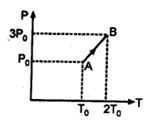
The pressure-temperature graph for an ideal gas is shown in the figure. At point $A$,the density of the gas is $\rho_0$. What will be the density at point $B$?
A
$\frac{3}{4} \rho_0$
B
$\frac{3}{2} \rho_0$
C
$\frac{4}{3} \rho_0$
D
$2 \rho_0$
Solution
(B) From the ideal gas equation,$PV = nRT$,where $n = \frac{m}{M}$.
So,$PV = \frac{m}{M} RT$,which gives $P = \frac{m}{V} \frac{RT}{M} = \rho \frac{RT}{M}$.
This implies $P \propto \rho T$,or $\frac{P_1}{P_2} = \frac{\rho_1 T_1}{\rho_2 T_2}$.
Given at point $A$: $P_A = P_0$,$T_A = T_0$,$\rho_A = \rho_0$.
Given at point $B$: $P_B = 3P_0$,$T_B = 2T_0$,$\rho_B = ?$.
Substituting the values: $\frac{P_0}{3P_0} = \frac{\rho_0 T_0}{\rho_B (2T_0)}$.
$\frac{1}{3} = \frac{\rho_0}{2 \rho_B} \Rightarrow \rho_B = \frac{3}{2} \rho_0$.
So,$PV = \frac{m}{M} RT$,which gives $P = \frac{m}{V} \frac{RT}{M} = \rho \frac{RT}{M}$.
This implies $P \propto \rho T$,or $\frac{P_1}{P_2} = \frac{\rho_1 T_1}{\rho_2 T_2}$.
Given at point $A$: $P_A = P_0$,$T_A = T_0$,$\rho_A = \rho_0$.
Given at point $B$: $P_B = 3P_0$,$T_B = 2T_0$,$\rho_B = ?$.
Substituting the values: $\frac{P_0}{3P_0} = \frac{\rho_0 T_0}{\rho_B (2T_0)}$.
$\frac{1}{3} = \frac{\rho_0}{2 \rho_B} \Rightarrow \rho_B = \frac{3}{2} \rho_0$.
0 likes
View Solution144
DifficultMCQ
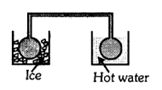
Two identical glass bulbs are connected by a thin glass tube. The system is filled with gas at $0^{\circ}C$. If one bulb is placed in ice and the other in hot water,the pressure of the gas becomes $1.5$ times the initial pressure. What is the temperature of the hot water in $^{\circ}C$?
A
$100$
B
$182$
C
$256$
D
$546$
Solution
(D) Let the volume of each bulb be $V$. Initially,both bulbs are at $T_1 = 273 \ K$ and pressure $P$. The total number of moles $n$ is given by:
$n = \frac{PV}{RT_1} + \frac{PV}{RT_1} = \frac{2PV}{RT_1}$
When one bulb is at $T_1 = 273 \ K$ and the other is at $T_2$,the new pressure is $P' = 1.5P$. The total number of moles remains constant:
$n = \frac{P'V}{RT_1} + \frac{P'V}{RT_2} = \frac{1.5PV}{RT_1} + \frac{1.5PV}{RT_2}$
Equating the two expressions for $n$:
$\frac{2PV}{RT_1} = \frac{1.5PV}{RT_1} + \frac{1.5PV}{RT_2}$
$\frac{2}{273} = \frac{1.5}{273} + \frac{1.5}{T_2}$
$\frac{0.5}{273} = \frac{1.5}{T_2}$
$T_2 = 273 \times \frac{1.5}{0.5} = 273 \times 3 = 819 \ K$
Converting to Celsius: $T_2(^{\circ}C) = 819 - 273 = 546^{\circ}C$.
$n = \frac{PV}{RT_1} + \frac{PV}{RT_1} = \frac{2PV}{RT_1}$
When one bulb is at $T_1 = 273 \ K$ and the other is at $T_2$,the new pressure is $P' = 1.5P$. The total number of moles remains constant:
$n = \frac{P'V}{RT_1} + \frac{P'V}{RT_2} = \frac{1.5PV}{RT_1} + \frac{1.5PV}{RT_2}$
Equating the two expressions for $n$:
$\frac{2PV}{RT_1} = \frac{1.5PV}{RT_1} + \frac{1.5PV}{RT_2}$
$\frac{2}{273} = \frac{1.5}{273} + \frac{1.5}{T_2}$
$\frac{0.5}{273} = \frac{1.5}{T_2}$
$T_2 = 273 \times \frac{1.5}{0.5} = 273 \times 3 = 819 \ K$
Converting to Celsius: $T_2(^{\circ}C) = 819 - 273 = 546^{\circ}C$.
0 likes
View Solution145
MediumMCQ
$A$ fixed amount of gas has a volume $V$ at constant pressure. If the temperature of the gas is increased such that the $v_{rms}$ of the molecules doubles,then its new volume will be .......
A
$V/2$
B
$V/\sqrt{2}$
C
$2V$
D
$4V$
Solution
(D) The root mean square speed is given by $v_{rms} = \sqrt{\frac{3RT}{M}}$.
Since $M$ and $R$ are constant,$v_{rms} \propto \sqrt{T}$.
Given that the new root mean square speed $v'_{rms} = 2v_{rms}$,we have:
$\frac{v'_{rms}}{v_{rms}} = \sqrt{\frac{T'}{T}} \implies 2 = \sqrt{\frac{T'}{T}} \implies \frac{T'}{T} = 4 \implies T' = 4T$.
According to Charles's Law,for a fixed amount of gas at constant pressure,$V \propto T$.
Therefore,$\frac{V'}{V} = \frac{T'}{T} = 4$.
Thus,the new volume $V' = 4V$.
Since $M$ and $R$ are constant,$v_{rms} \propto \sqrt{T}$.
Given that the new root mean square speed $v'_{rms} = 2v_{rms}$,we have:
$\frac{v'_{rms}}{v_{rms}} = \sqrt{\frac{T'}{T}} \implies 2 = \sqrt{\frac{T'}{T}} \implies \frac{T'}{T} = 4 \implies T' = 4T$.
According to Charles's Law,for a fixed amount of gas at constant pressure,$V \propto T$.
Therefore,$\frac{V'}{V} = \frac{T'}{T} = 4$.
Thus,the new volume $V' = 4V$.
0 likes
View Solution146
DifficultMCQ
Oxygen gas is filled in a container of volume $20 \, L$ at a pressure of $2.5 \times 10^5 \, N \, m^{-2}$. Find the mass of the oxygen gas in the container. The temperature of the oxygen in the container is $27 \, ^\circ C$,the molar mass of oxygen is $32 \, g \, mol^{-1}$,and $R = 8.31 \, J \, mol^{-1} K^{-1}$.
A
$64 \, kg$
B
$64 \, g$
C
$6.4 \, kg$
D
$6.4 \, g$
Solution
(B) Given:
Pressure $P = 2.5 \times 10^5 \, N \, m^{-2}$
Volume $V = 20 \, L = 20 \times 10^{-3} \, m^3$
Temperature $T = 27 \, ^\circ C = 27 + 273 = 300 \, K$
Molar mass $M = 32 \, g \, mol^{-1} = 32 \times 10^{-3} \, kg \, mol^{-1}$
Gas constant $R = 8.31 \, J \, mol^{-1} K^{-1}$
Using the ideal gas equation $PV = \mu RT$,where $\mu = \frac{m}{M}$:
$PV = \frac{m}{M} RT$
$m = \frac{PVM}{RT}$
Substituting the values:
$m = \frac{(2.5 \times 10^5) \times (20 \times 10^{-3}) \times (32 \times 10^{-3})}{8.31 \times 300}$
$m = \frac{2.5 \times 20 \times 32 \times 10^{-1}}{2493}$
$m = \frac{1600 \times 10^{-1}}{2493} \approx 0.06418 \, kg$
Rounding to the nearest significant value provided in the options,$m = 0.064 \, kg = 64 \, g$.
Pressure $P = 2.5 \times 10^5 \, N \, m^{-2}$
Volume $V = 20 \, L = 20 \times 10^{-3} \, m^3$
Temperature $T = 27 \, ^\circ C = 27 + 273 = 300 \, K$
Molar mass $M = 32 \, g \, mol^{-1} = 32 \times 10^{-3} \, kg \, mol^{-1}$
Gas constant $R = 8.31 \, J \, mol^{-1} K^{-1}$
Using the ideal gas equation $PV = \mu RT$,where $\mu = \frac{m}{M}$:
$PV = \frac{m}{M} RT$
$m = \frac{PVM}{RT}$
Substituting the values:
$m = \frac{(2.5 \times 10^5) \times (20 \times 10^{-3}) \times (32 \times 10^{-3})}{8.31 \times 300}$
$m = \frac{2.5 \times 20 \times 32 \times 10^{-1}}{2493}$
$m = \frac{1600 \times 10^{-1}}{2493} \approx 0.06418 \, kg$
Rounding to the nearest significant value provided in the options,$m = 0.064 \, kg = 64 \, g$.
0 likes
View Solution147
MediumMCQ
An ideal gas at atmospheric pressure has a temperature of $300 \,K$ and a volume of $1 \,m^3$. If its temperature and volume are both doubled,its pressure will be ...........
A
$10^5 \,N/m^2$
B
$2 \times 10^5 \,N/m^2$
C
$0.5 \times 10^5 \,N/m^2$
D
$4 \times 10^5 \,N/m^2$
Solution
(A) Given:
Initial pressure $P_1 = 1 \,atm = 1.01 \times 10^5 \,N/m^2$.
Initial volume $V_1 = 1 \,m^3$.
Initial temperature $T_1 = 300 \,K$.
Final volume $V_2 = 2V_1 = 2 \,m^3$.
Final temperature $T_2 = 2T_1 = 600 \,K$.
Using the ideal gas law equation $\frac{P_1 V_1}{T_1} = \frac{P_2 V_2}{T_2}$:
$P_2 = P_1 \times \frac{V_1}{V_2} \times \frac{T_2}{T_1}$
$P_2 = (1.01 \times 10^5) \times \frac{1}{2} \times \frac{600}{300}$
$P_2 = (1.01 \times 10^5) \times \frac{1}{2} \times 2$
$P_2 = 1.01 \times 10^5 \,N/m^2 \approx 10^5 \,N/m^2$.
Initial pressure $P_1 = 1 \,atm = 1.01 \times 10^5 \,N/m^2$.
Initial volume $V_1 = 1 \,m^3$.
Initial temperature $T_1 = 300 \,K$.
Final volume $V_2 = 2V_1 = 2 \,m^3$.
Final temperature $T_2 = 2T_1 = 600 \,K$.
Using the ideal gas law equation $\frac{P_1 V_1}{T_1} = \frac{P_2 V_2}{T_2}$:
$P_2 = P_1 \times \frac{V_1}{V_2} \times \frac{T_2}{T_1}$
$P_2 = (1.01 \times 10^5) \times \frac{1}{2} \times \frac{600}{300}$
$P_2 = (1.01 \times 10^5) \times \frac{1}{2} \times 2$
$P_2 = 1.01 \times 10^5 \,N/m^2 \approx 10^5 \,N/m^2$.
0 likes
View Solution148
MediumMCQ
$A$ cylinder of volume $30 \, L$ contains oxygen at an initial gauge pressure of $15 \, atm$ and a temperature of $27^{\circ}C$. After some oxygen is withdrawn from the cylinder,the gauge pressure drops to $11 \, atm$ and its temperature drops to $17^{\circ}C$. The mass of oxygen taken out of the cylinder is approximately ........ $kg$. (Given: $R = 8.31 \, J \, mol^{-1} K^{-1}$,molar mass of $O_2 = 32 \, g/mol$ or $32 \times 10^{-3} \, kg/mol$)
A
$0.14$
B
$1.02$
C
$0.547$
D
$1.457$
Solution
(A) The initial pressure $P_1 = 15 \, atm = 15 \times 1.013 \times 10^5 \, Pa \approx 15.2 \times 10^5 \, Pa$. The initial temperature $T_1 = 27 + 273 = 300 \, K$. The volume $V = 30 \, L = 30 \times 10^{-3} \, m^3$.
Using the ideal gas law $PV = nRT = \frac{m}{M_w} RT$,the initial mass $m_1 = \frac{P_1 V M_w}{R T_1}$.
$m_1 = \frac{(15.2 \times 10^5) \times (30 \times 10^{-3}) \times (32 \times 10^{-3})}{8.31 \times 300} \approx 0.586 \, kg$.
After withdrawal,$P_2 = 11 \, atm = 11.14 \times 10^5 \, Pa$,$T_2 = 17 + 273 = 290 \, K$.
The final mass $m_2 = \frac{P_2 V M_w}{R T_2} = \frac{(11.14 \times 10^5) \times (30 \times 10^{-3}) \times (32 \times 10^{-3})}{8.31 \times 290} \approx 0.447 \, kg$.
The mass of oxygen taken out is $\Delta m = m_1 - m_2 = 0.586 - 0.447 = 0.139 \, kg \approx 0.14 \, kg$.
Using the ideal gas law $PV = nRT = \frac{m}{M_w} RT$,the initial mass $m_1 = \frac{P_1 V M_w}{R T_1}$.
$m_1 = \frac{(15.2 \times 10^5) \times (30 \times 10^{-3}) \times (32 \times 10^{-3})}{8.31 \times 300} \approx 0.586 \, kg$.
After withdrawal,$P_2 = 11 \, atm = 11.14 \times 10^5 \, Pa$,$T_2 = 17 + 273 = 290 \, K$.
The final mass $m_2 = \frac{P_2 V M_w}{R T_2} = \frac{(11.14 \times 10^5) \times (30 \times 10^{-3}) \times (32 \times 10^{-3})}{8.31 \times 290} \approx 0.447 \, kg$.
The mass of oxygen taken out is $\Delta m = m_1 - m_2 = 0.586 - 0.447 = 0.139 \, kg \approx 0.14 \, kg$.
0 likes
View Solution149
MediumMCQ
$A$ cylinder contains $10 \, kg$ of gas at a pressure of $10^7 \, N/m^2$. What amount of gas in $kg$ must be removed so that the final pressure becomes $2.5 \times 10^6 \, N/m^2$?
A
$15.2$
B
$3.7$
C
$0$
D
$7.5$
Solution
(D) Given: Initial mass $M_1 = 10 \, kg$,Initial pressure $P_1 = 10^7 \, N/m^2$,Final pressure $P_2 = 2.5 \times 10^6 \, N/m^2$.
Using the ideal gas equation $PV = nRT = \frac{M}{M_w} RT$,where $M$ is the mass of the gas.
Since $V$,$R$,$T$,and $M_w$ are constant,we have $P \propto M$.
Therefore,$\frac{P_2}{P_1} = \frac{M_2}{M_1}$.
Substituting the values: $\frac{2.5 \times 10^6}{10^7} = \frac{M_2}{10}$.
$0.25 = \frac{M_2}{10} \Rightarrow M_2 = 2.5 \, kg$.
The mass of gas removed is $\Delta M = M_1 - M_2 = 10 - 2.5 = 7.5 \, kg$.
Using the ideal gas equation $PV = nRT = \frac{M}{M_w} RT$,where $M$ is the mass of the gas.
Since $V$,$R$,$T$,and $M_w$ are constant,we have $P \propto M$.
Therefore,$\frac{P_2}{P_1} = \frac{M_2}{M_1}$.
Substituting the values: $\frac{2.5 \times 10^6}{10^7} = \frac{M_2}{10}$.
$0.25 = \frac{M_2}{10} \Rightarrow M_2 = 2.5 \, kg$.
The mass of gas removed is $\Delta M = M_1 - M_2 = 10 - 2.5 = 7.5 \, kg$.
0 likes
View Solution150
MediumMCQ
An open-mouthed container is filled with air at $60^{\circ}C$. The container is heated to a temperature $T$ such that $1/4$ of the air escapes. The value of $T$ is ........ $^{\circ}C$.
A
$80$
B
$444$
C
$333$
D
$171$
Solution
(D) For an open container,the pressure $P$ and volume $V$ remain constant.
Using the ideal gas law $PV = nRT$,where $n$ is the number of moles,we have $n \propto 1/T$.
Therefore,$n_1 T_1 = n_2 T_2$.
Initial temperature $T_1 = 60 + 273 = 333 \ K$.
Let the initial number of moles be $n_1 = n$.
Since $1/4$ of the air escapes,the remaining moles $n_2 = n - (1/4)n = (3/4)n$.
Substituting the values: $n \times 333 = (3/4)n \times T_2$.
$T_2 = 333 \times (4/3) = 444 \ K$.
Converting back to Celsius: $T = 444 - 273 = 171^{\circ}C$.
Using the ideal gas law $PV = nRT$,where $n$ is the number of moles,we have $n \propto 1/T$.
Therefore,$n_1 T_1 = n_2 T_2$.
Initial temperature $T_1 = 60 + 273 = 333 \ K$.
Let the initial number of moles be $n_1 = n$.
Since $1/4$ of the air escapes,the remaining moles $n_2 = n - (1/4)n = (3/4)n$.
Substituting the values: $n \times 333 = (3/4)n \times T_2$.
$T_2 = 333 \times (4/3) = 444 \ K$.
Converting back to Celsius: $T = 444 - 273 = 171^{\circ}C$.
0 likes
View SolutionKinetic Theory of Gases — Gas Laws (Charles, Boyle's, Avagadro's, Gay Lussacs and Dalton's law) and Ideal gas Equation · Frequently Asked Questions
1Are these Kinetic Theory of Gases questions useful for JEE and NEET?
Yes. All questions in this section are mapped to JEE Main and NEET exam patterns. Previous year questions from JEE Main, NEET, GUJCET and state-level exams are included with full solutions.
2Can I switch to Hindi or Gujarati for these questions?
Yes. Use the language tabs in the hero section or the sidebar to view the same questions and solutions in English, Hindi or Gujarati.
3How do I generate a question paper from this subtopic?
Use the Vedclass Exam Paper Generator — select the chapter and subtopic, set difficulty, and generate Sets A, B, C, D automatically. First 3 chapters of every subject are free.
Vedclass Products
For Students
Vedclass Test Series
Mock tests in real JEE/NEET style with performance analysis. 5-day free trial.
Start Free TrialFor Teachers
Exam Paper Generator
Generate Set A/B/C/D papers from this chapter in 2 minutes. 3 chapters free.
Try FreeFor Institutes
Online Exam Module
Live online exams with unlimited students, 360° analytics & white-label branding.
See DemoFor Teachers & Institutes
Generate a Kinetic Theory of Gases Exam Paper in 2 Minutes
Select subtopic & difficulty — Sets A, B, C, D auto-generated with No Repeat logic.
First 3 chapters of every subject are free — no payment required.