
A English
Mean Free Path and Real Gases Questions in English
Class 11 Physics · Kinetic Theory of Gases · Mean Free Path and Real Gases
89+
Questions
English
Language
100%
With Solutions
Showing 50 of 89 questions in English
1
EasyMCQ
Every real gas behaves as an ideal gas:
A
At high temperature and low pressure
B
At low temperature and high pressure
C
At normal temperature and pressure
D
None of the above
Solution
(A) Real gases obey the van der Waals equation:
$(P + \frac{n^2 a}{V^2})(V - nb) = nRT$
At high temperature $(T)$ and low pressure $(P)$,the volume $V$ becomes very large. Consequently,the correction terms $\frac{n^2 a}{V^2}$ and $nb$ become negligible compared to $P$ and $V$ respectively.
Thus,the equation simplifies to $PV = nRT$.
Therefore,real gases behave as ideal gases at high temperature and low pressure.
$(P + \frac{n^2 a}{V^2})(V - nb) = nRT$
At high temperature $(T)$ and low pressure $(P)$,the volume $V$ becomes very large. Consequently,the correction terms $\frac{n^2 a}{V^2}$ and $nb$ become negligible compared to $P$ and $V$ respectively.
Thus,the equation simplifies to $PV = nRT$.
Therefore,real gases behave as ideal gases at high temperature and low pressure.
0 likes
View Solution2
EasyMCQ
The vapour of a substance behaves as a gas:
A
Below critical temperature
B
Above critical temperature
C
At $100^{\circ}C$
D
At $1000^{\circ}C$
Solution
(B) The critical temperature is defined as the temperature above which a gas cannot be liquefied by pressure alone.
Below the critical temperature,a substance in the gaseous state is called a vapour,as it can be liquefied by increasing the pressure.
Above the critical temperature,the substance exists in a state where it cannot be liquefied regardless of the pressure applied,and it behaves as a gas.
Therefore,option $(B)$ is correct.
Below the critical temperature,a substance in the gaseous state is called a vapour,as it can be liquefied by increasing the pressure.
Above the critical temperature,the substance exists in a state where it cannot be liquefied regardless of the pressure applied,and it behaves as a gas.
Therefore,option $(B)$ is correct.
0 likes
View Solution3
EasyMCQ
The temperature below which a gas should be cooled,before it can be liquefied by pressure only,is termed as:
A
The dew point
B
The freezing point
C
The saturation point
D
The critical temperature
Solution
(D) The critical temperature of a gas is defined as the temperature above which a gas cannot be liquefied by the application of pressure alone,regardless of how much pressure is applied.
Therefore,a gas must be cooled to a temperature at or below its critical temperature before it can be liquefied by pressure.
Thus,option $(D)$ is correct.
Therefore,a gas must be cooled to a temperature at or below its critical temperature before it can be liquefied by pressure.
Thus,option $(D)$ is correct.
0 likes
View Solution4
EasyMCQ
The mean free path of gas molecules depends on $(d =$ molecular diameter$)$
A
$d$
B
$d^2$
C
$d^{-2}$
D
$d^{-1}$
Solution
(C) The mean free path $(\lambda)$ is the average distance traveled by a gas molecule between successive collisions.
The formula for the mean free path is given by:
$\lambda = \frac{k_B T}{\sqrt{2} \pi d^2 P}$
where $k_B$ is the Boltzmann constant, $T$ is the temperature, $d$ is the molecular diameter, and $P$ is the pressure.
From the formula, it is evident that the mean free path is inversely proportional to the square of the molecular diameter:
$\lambda \propto \frac{1}{d^2}$
Therefore, $\lambda \propto d^{-2}$.
Thus, option $(C)$ is correct.
The formula for the mean free path is given by:
$\lambda = \frac{k_B T}{\sqrt{2} \pi d^2 P}$
where $k_B$ is the Boltzmann constant, $T$ is the temperature, $d$ is the molecular diameter, and $P$ is the pressure.
From the formula, it is evident that the mean free path is inversely proportional to the square of the molecular diameter:
$\lambda \propto \frac{1}{d^2}$
Therefore, $\lambda \propto d^{-2}$.
Thus, option $(C)$ is correct.
0 likes
View Solution5
EasyMCQ
Under which of the following conditions is the law $PV = RT$ obeyed most closely by a real gas?
A
High pressure and high temperature
B
Low pressure and low temperature
C
Low pressure and high temperature
D
High pressure and low temperature
Solution
(C) real gas behaves as an ideal gas and obeys the equation $PV = RT$ under conditions of low pressure and high temperature.
At high temperatures,the kinetic energy of the molecules is very high,making the intermolecular forces of attraction or repulsion negligible.
At low pressures,the volume occupied by the gas molecules is negligible compared to the total volume of the container.
Therefore,under these conditions,the assumptions of the kinetic theory of gases hold true,and the real gas follows the ideal gas law.
At high temperatures,the kinetic energy of the molecules is very high,making the intermolecular forces of attraction or repulsion negligible.
At low pressures,the volume occupied by the gas molecules is negligible compared to the total volume of the container.
Therefore,under these conditions,the assumptions of the kinetic theory of gases hold true,and the real gas follows the ideal gas law.
0 likes
View Solution6
MediumMCQ
For matter to exist simultaneously in gas and liquid phases:
A
The temperature must be $0 \, K$
B
The temperature must be less than $0^{\circ}C$
C
The temperature must be less than the critical temperature
D
The temperature must be less than the reduced temperature
Solution
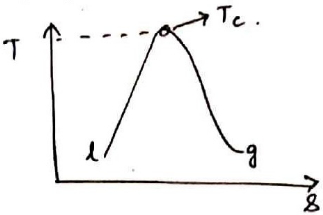
(C) The provided graph illustrates a $T-s$ (temperature-entropy) diagram of a substance.
The line $l$ represents the saturated liquid line,and the line $g$ represents the saturated gas line.
The region between these two lines is the wet region,where both liquid and gas phases coexist in equilibrium.
$T_c$ represents the critical temperature,which is the maximum temperature at which a substance can exist in both liquid and gas phases simultaneously.
Therefore,for a substance to exist in both gas and liquid phases,the temperature must be below the critical temperature $(T < T_c)$.
Correct choice - option-$C$
The line $l$ represents the saturated liquid line,and the line $g$ represents the saturated gas line.
The region between these two lines is the wet region,where both liquid and gas phases coexist in equilibrium.
$T_c$ represents the critical temperature,which is the maximum temperature at which a substance can exist in both liquid and gas phases simultaneously.
Therefore,for a substance to exist in both gas and liquid phases,the temperature must be below the critical temperature $(T < T_c)$.
Correct choice - option-$C$
0 likes
View Solution7
MediumMCQ
The value of critical temperature in terms of Vander Waals constants $a$ and $b$ is
A
$T_c = \frac{8a}{27Rb}$
B
$T_c = \frac{a}{2Rb}$
C
$T_c = \frac{8}{27Rb}$
D
$T_c = \frac{27a}{8Rb}$
Solution
(A) The Vander Waals equation for one mole of gas is given by:
$(P + \frac{a}{V^2})(V - b) = RT$
At the critical point,the pressure $P$ as a function of volume $V$ satisfies the conditions:
$\frac{\partial P}{\partial V} = 0$ and $\frac{\partial^2 P}{\partial V^2} = 0$
From the equation of state,$P = \frac{RT}{V-b} - \frac{a}{V^2}$.
Taking the first derivative with respect to $V$:
$\frac{\partial P}{\partial V} = -\frac{RT}{(V-b)^2} + \frac{2a}{V^3} = 0 \implies \frac{RT}{(V-b)^2} = \frac{2a}{V^3}$ ... $(1)$
Taking the second derivative with respect to $V$:
$\frac{\partial^2 P}{\partial V^2} = \frac{2RT}{(V-b)^3} - \frac{6a}{V^4} = 0 \implies \frac{RT}{(V-b)^3} = \frac{3a}{V^4}$ ... $(2)$
Dividing equation $(1)$ by equation $(2)$:
$\frac{V-b}{1} = \frac{2a/V^3}{3a/V^4} = \frac{2V}{3}$
$3V - 3b = 2V \implies V_c = 3b$
Substituting $V_c = 3b$ into equation $(1)$:
$\frac{RT_c}{(3b-b)^2} = \frac{2a}{(3b)^3}$
$\frac{RT_c}{4b^2} = \frac{2a}{27b^3}$
$T_c = \frac{8a}{27Rb}$
$(P + \frac{a}{V^2})(V - b) = RT$
At the critical point,the pressure $P$ as a function of volume $V$ satisfies the conditions:
$\frac{\partial P}{\partial V} = 0$ and $\frac{\partial^2 P}{\partial V^2} = 0$
From the equation of state,$P = \frac{RT}{V-b} - \frac{a}{V^2}$.
Taking the first derivative with respect to $V$:
$\frac{\partial P}{\partial V} = -\frac{RT}{(V-b)^2} + \frac{2a}{V^3} = 0 \implies \frac{RT}{(V-b)^2} = \frac{2a}{V^3}$ ... $(1)$
Taking the second derivative with respect to $V$:
$\frac{\partial^2 P}{\partial V^2} = \frac{2RT}{(V-b)^3} - \frac{6a}{V^4} = 0 \implies \frac{RT}{(V-b)^3} = \frac{3a}{V^4}$ ... $(2)$
Dividing equation $(1)$ by equation $(2)$:
$\frac{V-b}{1} = \frac{2a/V^3}{3a/V^4} = \frac{2V}{3}$
$3V - 3b = 2V \implies V_c = 3b$
Substituting $V_c = 3b$ into equation $(1)$:
$\frac{RT_c}{(3b-b)^2} = \frac{2a}{(3b)^3}$
$\frac{RT_c}{4b^2} = \frac{2a}{27b^3}$
$T_c = \frac{8a}{27Rb}$
0 likes
View Solution8
EasyMCQ
In Van der Waals equation $\left( P + \frac{a}{V^2} \right)(V - b) = RT$,what do $a$ and $b$ represent?
A
Both $a$ and $b$ represent correction in volume.
B
Both $a$ and $b$ represent adhesive force between molecules.
C
$a$ represents adhesive force between molecules and $b$ represents correction in volume.
D
$a$ represents correction in volume and $b$ represents adhesive force between molecules.
Solution
(C) The Van der Waals equation for one mole of a real gas is given by $\left( P + \frac{a}{V^2} \right)(V - b) = RT$.
In this equation,the term $\frac{a}{V^2}$ is the pressure correction term,which accounts for the intermolecular attractive forces (adhesive forces) between gas molecules.
The term $b$ is the volume correction term,which accounts for the excluded volume due to the finite size of the gas molecules.
Therefore,$a$ represents the intermolecular attractive force,and $b$ represents the correction in volume.
Correct choice - $C$.
In this equation,the term $\frac{a}{V^2}$ is the pressure correction term,which accounts for the intermolecular attractive forces (adhesive forces) between gas molecules.
The term $b$ is the volume correction term,which accounts for the excluded volume due to the finite size of the gas molecules.
Therefore,$a$ represents the intermolecular attractive force,and $b$ represents the correction in volume.
Correct choice - $C$.
0 likes
View Solution9
MediumMCQ
If the volume of the gas containing $n$ number of molecules is $V,$ then the pressure will decrease due to the force of intermolecular attraction in the proportion:
A
$n/V$
B
$n/V^2$
C
$(n/V)^2$
D
$1/V^2$
Solution
(C) The Van der Waals equation for real gases is given by $(P + a(n/V)^2)(V - nb) = nRT$.
In this equation,the term $a(n/V)^2$ represents the correction factor for the pressure due to intermolecular attractive forces.
Here,$n$ is the number of molecules and $V$ is the volume of the gas.
The force of attraction experienced by a molecule at the surface of the gas is proportional to the density of the molecules,which is $(n/V)$.
Since the pressure reduction is proportional to the product of the density of molecules hitting the wall and the density of molecules pulling them back,the pressure decrease is proportional to $(n/V) \times (n/V) = (n/V)^2$.
Therefore,the pressure decreases in the proportion $(n/V)^2$.
Thus,option $(C)$ is the correct answer.
In this equation,the term $a(n/V)^2$ represents the correction factor for the pressure due to intermolecular attractive forces.
Here,$n$ is the number of molecules and $V$ is the volume of the gas.
The force of attraction experienced by a molecule at the surface of the gas is proportional to the density of the molecules,which is $(n/V)$.
Since the pressure reduction is proportional to the product of the density of molecules hitting the wall and the density of molecules pulling them back,the pressure decrease is proportional to $(n/V) \times (n/V) = (n/V)^2$.
Therefore,the pressure decreases in the proportion $(n/V)^2$.
Thus,option $(C)$ is the correct answer.
0 likes
View Solution10
EasyMCQ
If the pressure in a closed vessel is reduced by drawing out some gas,the mean free path of the molecules
A
Is decreased
B
Is increased
C
Remains unchanged
D
Increases or decreases according to the nature of the gas
Solution
(B) The mean free path $\lambda$ of a gas molecule is given by the formula $\lambda = \frac{1}{\sqrt{2} \pi d^2 n}$,where $d$ is the diameter of the molecule and $n$ is the number density (number of molecules per unit volume).
Since the pressure $P$ of an ideal gas is related to the number density by $P = nkT$,reducing the pressure at a constant temperature implies that the number density $n$ decreases.
As $n$ is in the denominator of the expression for $\lambda$,a decrease in $n$ leads to an increase in the mean free path $\lambda$.
Therefore,when gas is drawn out of a closed vessel,the mean free path of the molecules increases.
Since the pressure $P$ of an ideal gas is related to the number density by $P = nkT$,reducing the pressure at a constant temperature implies that the number density $n$ decreases.
As $n$ is in the denominator of the expression for $\lambda$,a decrease in $n$ leads to an increase in the mean free path $\lambda$.
Therefore,when gas is drawn out of a closed vessel,the mean free path of the molecules increases.
0 likes
View Solution11
MediumMCQ
If the mean free path of atoms is doubled,then the pressure of the gas will become:
A
$P/4$
B
$P/2$
C
$P/8$
D
$P$
Solution
(B) The mean free path $\lambda$ of gas molecules is given by the formula: $\lambda = \frac{k_B T}{\sqrt{2} \pi d^2 P}$,where $k_B$ is the Boltzmann constant,$T$ is the temperature,$d$ is the molecular diameter,and $P$ is the pressure.
From this relation,it is clear that the mean free path is inversely proportional to the pressure: $\lambda \propto \frac{1}{P}$.
If the mean free path $\lambda$ is doubled (i.e.,$\lambda' = 2\lambda$),then the new pressure $P'$ must satisfy:
$P' = \frac{P}{2}$.
Therefore,if the mean free path is doubled,the pressure of the gas becomes half of its initial value.
From this relation,it is clear that the mean free path is inversely proportional to the pressure: $\lambda \propto \frac{1}{P}$.
If the mean free path $\lambda$ is doubled (i.e.,$\lambda' = 2\lambda$),then the new pressure $P'$ must satisfy:
$P' = \frac{P}{2}$.
Therefore,if the mean free path is doubled,the pressure of the gas becomes half of its initial value.
0 likes
View Solution12
EasyMCQ
In the absence of intermolecular forces of attraction,the observed pressure $P$ will be
A
$P$
B
$< P$
C
$> P$
D
Zero
Solution
(C) According to the van der Waals equation for real gases,the pressure is given by $P_{real} = P_{ideal} - a(n/V)^2$.
Here,the term $a(n/V)^2$ represents the reduction in pressure due to intermolecular forces of attraction.
If these intermolecular forces are absent (i.e.,$a = 0$),the observed pressure $P$ would be equal to the ideal pressure,which is higher than the pressure observed when forces are present.
Therefore,the observed pressure in the absence of such forces will be greater than the pressure $P$ observed with them.
Here,the term $a(n/V)^2$ represents the reduction in pressure due to intermolecular forces of attraction.
If these intermolecular forces are absent (i.e.,$a = 0$),the observed pressure $P$ would be equal to the ideal pressure,which is higher than the pressure observed when forces are present.
Therefore,the observed pressure in the absence of such forces will be greater than the pressure $P$ observed with them.
0 likes
View Solution13
MediumMCQ
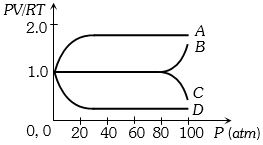
An experiment is carried out on a fixed amount of gas at different temperatures and at high pressure such that it deviates from ideal gas behavior. The variation of $\frac{PV}{RT}$ with $P$ is shown in the diagram. The correct variation will correspond to
A
Curve $A$
B
Curve $B$
C
Curve $C$
D
Curve $D$
Solution
(B) For an ideal gas,the compressibility factor $Z = \frac{PV}{nRT} = 1$. For $n = 1$ mole,$Z = \frac{PV}{RT} = 1$.
At low pressure,all real gases behave like an ideal gas,so $\frac{PV}{RT}$ approaches $1$ as $P$ approaches $0$.
As pressure increases,the finite size of molecules and intermolecular forces cause deviations.
For most real gases at high pressure,the volume of molecules becomes significant,making the gas less compressible than an ideal gas,which leads to $Z > 1$. This corresponds to an upward trend in the graph.
Curve $B$ shows this characteristic behavior where the value of $\frac{PV}{RT}$ increases above $1$ as pressure increases.
At low pressure,all real gases behave like an ideal gas,so $\frac{PV}{RT}$ approaches $1$ as $P$ approaches $0$.
As pressure increases,the finite size of molecules and intermolecular forces cause deviations.
For most real gases at high pressure,the volume of molecules becomes significant,making the gas less compressible than an ideal gas,which leads to $Z > 1$. This corresponds to an upward trend in the graph.
Curve $B$ shows this characteristic behavior where the value of $\frac{PV}{RT}$ increases above $1$ as pressure increases.
0 likes
View Solution14
MediumMCQ
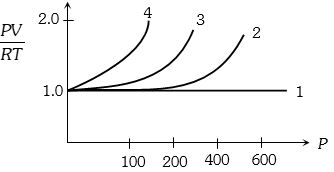
$A$ fixed amount of nitrogen gas ($1$ mole) is taken and subjected to pressure and temperature variations. The experiment is performed at high pressures and various temperatures. The results obtained are shown in the figure. The correct variation of $PV/RT$ with $P$ for nitrogen gas at high temperatures will be exhibited by:
A
$4$
B
$3$
C
$2$
D
$1$
Solution
(C) The compressibility factor $Z$ is defined as $Z = PV/RT$. For an ideal gas,$Z = 1$ at all pressures and temperatures.
Real gases deviate from ideal behavior at high pressures.
For nitrogen gas,as the temperature increases,the gas behaves more like an ideal gas.
At a given high pressure,the deviation from $Z = 1$ decreases as the temperature increases.
Looking at the graph,curve $1$ represents the ideal gas behavior $(Z = 1)$.
Curves $2, 3,$ and $4$ represent real gas behavior at different temperatures.
Since higher temperatures lead to behavior closer to ideal,the curve that stays closest to the ideal line $(Z = 1)$ represents the highest temperature.
Therefore,curve $2$ represents the highest temperature among the real gas curves shown,as it shows the least deviation from the ideal behavior.
Real gases deviate from ideal behavior at high pressures.
For nitrogen gas,as the temperature increases,the gas behaves more like an ideal gas.
At a given high pressure,the deviation from $Z = 1$ decreases as the temperature increases.
Looking at the graph,curve $1$ represents the ideal gas behavior $(Z = 1)$.
Curves $2, 3,$ and $4$ represent real gas behavior at different temperatures.
Since higher temperatures lead to behavior closer to ideal,the curve that stays closest to the ideal line $(Z = 1)$ represents the highest temperature.
Therefore,curve $2$ represents the highest temperature among the real gas curves shown,as it shows the least deviation from the ideal behavior.
0 likes
View Solution15
MediumMCQ
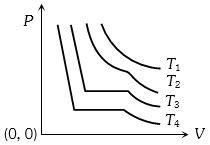
The change in volume $V$ with respect to an increase in pressure $P$ has been shown in the figure for a non-ideal gas at four different temperatures ${T_1}, {T_2}, {T_3}$ and ${T_4}$. The critical temperature of the gas is
A
${T_1}$
B
${T_2}$
C
${T_3}$
D
${T_4}$
Solution
(B) In an Andrews isotherm diagram for a real gas,the critical temperature is defined as the temperature at which the horizontal portion of the isotherm (representing the phase transition from gas to liquid) reduces to a single point of inflection.
Looking at the provided $P-V$ curves:
- At temperatures ${T_4}$ and ${T_3}$,there is a distinct horizontal region indicating the coexistence of liquid and gas phases.
- At temperature ${T_2}$,the horizontal region has shrunk to a point of inflection,which is the characteristic feature of the critical isotherm.
- At temperature ${T_1}$,the curve is smooth and does not show any phase transition,indicating it is above the critical temperature.
Therefore,the critical temperature of the gas is ${T_2}$.
Looking at the provided $P-V$ curves:
- At temperatures ${T_4}$ and ${T_3}$,there is a distinct horizontal region indicating the coexistence of liquid and gas phases.
- At temperature ${T_2}$,the horizontal region has shrunk to a point of inflection,which is the characteristic feature of the critical isotherm.
- At temperature ${T_1}$,the curve is smooth and does not show any phase transition,indicating it is above the critical temperature.
Therefore,the critical temperature of the gas is ${T_2}$.
0 likes
View Solution16
MediumMCQ
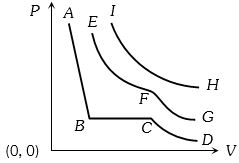
In the adjoining figure,various isothermals are shown for a real gas. Then
A
$EF$ represents liquification
B
$CB$ represents liquification
C
$HI$ represents the critical temperature
D
$AB$ represents gas at a high temperature
Solution
(B) In the $P-V$ diagram for a real gas,the horizontal portion of the isothermal curve represents the phase transition from gas to liquid,which is known as liquification.
In the given figure,the segment $BC$ represents the constant pressure region where both liquid and gas phases coexist at a constant temperature.
Therefore,$CB$ (or $BC$) represents the process of liquification.
Option $B$ is the correct answer.
In the given figure,the segment $BC$ represents the constant pressure region where both liquid and gas phases coexist at a constant temperature.
Therefore,$CB$ (or $BC$) represents the process of liquification.
Option $B$ is the correct answer.
0 likes
View Solution17
MediumMCQ
An ideal gas $A$ and a real gas $B$ have their volumes increased from $V$ to $2V$ under isothermal conditions. The increase in internal energy
[$AIPMT$ $1993$]
[$AIPMT$ $1993$]
A
Will be same in both $A$ and $B$
B
Will be zero in both the gases
C
Of $B$ will be more than that of $A$
D
Of $A$ will be more than that of $B$
Solution
(C) For an ideal gas,the internal energy depends only on temperature. Since the process is isothermal (temperature remains constant),the change in internal energy for the ideal gas $A$ is zero.
For a real gas $B$,the internal energy depends on both temperature and volume because of the presence of intermolecular forces. When the volume of a real gas increases,work must be done against these attractive intermolecular forces,which leads to an increase in the internal energy of the system.
Therefore,the increase in internal energy of the real gas $B$ is greater than that of the ideal gas $A$.
For a real gas $B$,the internal energy depends on both temperature and volume because of the presence of intermolecular forces. When the volume of a real gas increases,work must be done against these attractive intermolecular forces,which leads to an increase in the internal energy of the system.
Therefore,the increase in internal energy of the real gas $B$ is greater than that of the ideal gas $A$.
0 likes
View Solution18
EasyMCQ
Gases begin to conduct electricity at low pressure because
A
At low pressure,gases turn to plasma
B
Colliding electrons can acquire higher kinetic energy due to increased mean free path leading to ionisation of atoms
C
Atoms break up into electrons and protons
D
The electrons in atoms can move freely at low pressure
Solution
(B) At low pressure,the mean free path of electrons increases significantly.
Due to this,electrons can travel a longer distance between successive collisions without losing energy.
As a result,they acquire sufficient kinetic energy from the applied electric field to ionize the gas atoms upon collision.
This process of ionization creates more charge carriers (ions and electrons),which allows the gas to conduct electricity.
Due to this,electrons can travel a longer distance between successive collisions without losing energy.
As a result,they acquire sufficient kinetic energy from the applied electric field to ionize the gas atoms upon collision.
This process of ionization creates more charge carriers (ions and electrons),which allows the gas to conduct electricity.
0 likes
View Solution19
EasyMCQ
In the van der Waals equation $\left( P + \frac{a}{V^2} \right)(V - b) = RT$,what do $a$ and $b$ represent?
A
$a$ and $b$ both represent volume correction.
B
$a$ and $b$ both represent the force of attraction between molecules.
C
$a$ represents the force of attraction between molecules and $b$ represents volume correction.
D
$a$ represents volume correction and $b$ represents the intermolecular force of attraction.
Solution
(C) The van der Waals equation is given by $\left( P + \frac{a}{V^2} \right)(V - b) = RT$.
In this equation,the term $\frac{a}{V^2}$ is added to the pressure $P$ to account for the intermolecular forces of attraction between gas molecules. Thus,$a$ is a constant related to the intermolecular force of attraction.
The term $b$ is subtracted from the molar volume $V$ to account for the finite volume occupied by the gas molecules themselves. Thus,$b$ is a constant related to the volume correction (excluded volume).
Therefore,$a$ represents the intermolecular force of attraction and $b$ represents the volume correction.
In this equation,the term $\frac{a}{V^2}$ is added to the pressure $P$ to account for the intermolecular forces of attraction between gas molecules. Thus,$a$ is a constant related to the intermolecular force of attraction.
The term $b$ is subtracted from the molar volume $V$ to account for the finite volume occupied by the gas molecules themselves. Thus,$b$ is a constant related to the volume correction (excluded volume).
Therefore,$a$ represents the intermolecular force of attraction and $b$ represents the volume correction.
0 likes
View Solution20
EasyMCQ
According to the Kinetic Theory of Gases,which of the following statements is correct?
A
Collisions between molecules are inelastic,and the time between two collisions is less than the time taken for the collision.
B
There are attractive forces between the molecules.
C
All molecules of a gas move with the same velocity.
D
The distance traveled between two successive collisions is called the mean free path.
Solution
(D) According to the Kinetic Theory of Gases,the assumptions are as follows:
$1$. Molecules are point masses and move randomly in all directions.
$2$. Collisions between molecules and with the walls of the container are perfectly elastic.
$3$. There are no intermolecular forces of attraction or repulsion between the molecules.
$4$. The molecules move with different velocities,following a Maxwell-Boltzmann distribution.
$5$. The average distance traveled by a molecule between two successive collisions is defined as the mean free path.
Therefore,option $D$ is the correct statement.
$1$. Molecules are point masses and move randomly in all directions.
$2$. Collisions between molecules and with the walls of the container are perfectly elastic.
$3$. There are no intermolecular forces of attraction or repulsion between the molecules.
$4$. The molecules move with different velocities,following a Maxwell-Boltzmann distribution.
$5$. The average distance traveled by a molecule between two successive collisions is defined as the mean free path.
Therefore,option $D$ is the correct statement.
0 likes
View Solution21
EasyMCQ
Under what conditions does a real gas obey the relation $PV = RT$?
A
High temperature and high density
B
Low temperature and low density
C
High temperature and low density
D
Low temperature and high density
Solution
(C) real gas behaves like an ideal gas when the intermolecular forces are negligible and the volume occupied by the gas molecules is negligible compared to the total volume of the container.
These conditions are satisfied at high temperatures (where kinetic energy dominates over intermolecular forces) and low densities (where the average distance between molecules is large,making the volume of molecules negligible).
Therefore,a real gas obeys the ideal gas equation $PV = RT$ at high temperature and low density.
These conditions are satisfied at high temperatures (where kinetic energy dominates over intermolecular forces) and low densities (where the average distance between molecules is large,making the volume of molecules negligible).
Therefore,a real gas obeys the ideal gas equation $PV = RT$ at high temperature and low density.
0 likes
View Solution22
MediumMCQ
For a van der Waals gas,if $P_c, V_c$,and $T_c$ are the critical pressure,volume,and temperature respectively,then the value of $P_cV_c/T_c$ is:
A
$3/8 R$
B
$2/3 R$
C
$3/5 R$
D
$1/8 R$
Solution
(A) For a van der Waals gas,the critical constants are given by:
$P_c = \frac{a}{27b^2}$
$V_c = 3b$
$T_c = \frac{8a}{27Rb}$
Now,calculate the ratio $P_cV_c/T_c$:
$\frac{P_cV_c}{T_c} = \frac{(\frac{a}{27b^2}) \times (3b)}{\frac{8a}{27Rb}}$
$= \frac{\frac{3a}{27b}}{\frac{8a}{27Rb}}$
$= \frac{3a}{27b} \times \frac{27Rb}{8a}$
$= \frac{3}{8} R$
Thus,the correct option is $A$.
$P_c = \frac{a}{27b^2}$
$V_c = 3b$
$T_c = \frac{8a}{27Rb}$
Now,calculate the ratio $P_cV_c/T_c$:
$\frac{P_cV_c}{T_c} = \frac{(\frac{a}{27b^2}) \times (3b)}{\frac{8a}{27Rb}}$
$= \frac{\frac{3a}{27b}}{\frac{8a}{27Rb}}$
$= \frac{3a}{27b} \times \frac{27Rb}{8a}$
$= \frac{3}{8} R$
Thus,the correct option is $A$.
0 likes
View Solution23
EasyMCQ
If the pressure of a gas in a closed container is reduced,the mean free path of the molecules will ......
A
decrease
B
increase
C
remain constant
D
increase or decrease depending on the nature of the gas
Solution
(B) The mean free path $(\lambda)$ of a gas molecule is given by the formula $\lambda = \frac{k_B T}{\sqrt{2} \pi d^2 P}$,where $k_B$ is the Boltzmann constant,$T$ is the absolute temperature,$d$ is the diameter of the molecule,and $P$ is the pressure of the gas.
From the formula,it is clear that the mean free path $\lambda$ is inversely proportional to the pressure $P$ (i.e.,$\lambda \propto \frac{1}{P}$).
Therefore,if the pressure $P$ is reduced,the mean free path $\lambda$ will increase because the molecules will travel a longer distance on average before colliding with another molecule.
From the formula,it is clear that the mean free path $\lambda$ is inversely proportional to the pressure $P$ (i.e.,$\lambda \propto \frac{1}{P}$).
Therefore,if the pressure $P$ is reduced,the mean free path $\lambda$ will increase because the molecules will travel a longer distance on average before colliding with another molecule.
0 likes
View Solution24
MediumMCQ
The diameter of an oxygen molecule is $2.94 \times 10^{-10} \ m$. The van der Waals gas constant '$b$' in $m^3/mol$ is:
A
$3.2$
B
$16$
C
$32 \times 10^{-4}$
D
$32 \times 10^{-6}$
Solution
(D) The van der Waals constant '$b$' represents the excluded volume per mole of gas.
It is given by the formula: $b = 4 \times N_A \times V_{molecule}$,where $N_A$ is Avogadro's number and $V_{molecule} = \frac{4}{3} \pi r^3$.
Given diameter $d = 2.94 \times 10^{-10} \ m$,so radius $r = \frac{d}{2} = 1.47 \times 10^{-10} \ m$.
$b = 4 \times (6.022 \times 10^{23}) \times \frac{4}{3} \times 3.14 \times (1.47 \times 10^{-10})^3$.
$b = 4 \times (6.022 \times 10^{23}) \times \frac{4}{3} \times 3.14 \times (3.1765 \times 10^{-30})$.
$b \approx 32 \times 10^{-6} \ m^3/mol$.
It is given by the formula: $b = 4 \times N_A \times V_{molecule}$,where $N_A$ is Avogadro's number and $V_{molecule} = \frac{4}{3} \pi r^3$.
Given diameter $d = 2.94 \times 10^{-10} \ m$,so radius $r = \frac{d}{2} = 1.47 \times 10^{-10} \ m$.
$b = 4 \times (6.022 \times 10^{23}) \times \frac{4}{3} \times 3.14 \times (1.47 \times 10^{-10})^3$.
$b = 4 \times (6.022 \times 10^{23}) \times \frac{4}{3} \times 3.14 \times (3.1765 \times 10^{-30})$.
$b \approx 32 \times 10^{-6} \ m^3/mol$.
0 likes
View Solution25
MediumMCQ
If the molecular radius of hydrogen gas is $0.5 \ \mathring A$,then the mean free path of hydrogen gas molecules at $0 \ ^\circ C$ temperature and $1 \ atm$ pressure is ........ $\mathring A$. (Given $k_B = 1.38 \times 10^{-23} \ J \ K^{-1}$)
A
$842.5$
B
$84.25$
C
$8425$
D
$8.425$
Solution
(C) Given: Molecular radius $r = 0.5 \ \mathring A$,so the collision diameter $d = 2r = 1 \ \mathring A = 10^{-10} \ m$.
Temperature $T = 0 \ ^\circ C = 273 \ K$.
Pressure $P = 1 \ atm = 1.01 \times 10^5 \ N \ m^{-2}$.
The formula for mean free path is $\bar{l} = \frac{1}{\sqrt{2} \pi n d^2}$.
Using the ideal gas law $P = n k_B T$,the number density is $n = \frac{P}{k_B T}$.
Substituting $n$ into the formula: $\bar{l} = \frac{k_B T}{\sqrt{2} \pi P d^2}$.
$\bar{l} = \frac{1.38 \times 10^{-23} \times 273}{\sqrt{2} \times 3.14159 \times 1.01 \times 10^5 \times (10^{-10})^2}$.
$\bar{l} = \frac{3.7674 \times 10^{-21}}{4.495 \times 10^{-15}} \approx 8.38 \times 10^{-7} \ m$.
Rounding to the provided options: $\bar{l} \approx 8.425 \times 10^{-7} \ m = 8425 \times 10^{-10} \ m = 8425 \ \mathring A$.
Temperature $T = 0 \ ^\circ C = 273 \ K$.
Pressure $P = 1 \ atm = 1.01 \times 10^5 \ N \ m^{-2}$.
The formula for mean free path is $\bar{l} = \frac{1}{\sqrt{2} \pi n d^2}$.
Using the ideal gas law $P = n k_B T$,the number density is $n = \frac{P}{k_B T}$.
Substituting $n$ into the formula: $\bar{l} = \frac{k_B T}{\sqrt{2} \pi P d^2}$.
$\bar{l} = \frac{1.38 \times 10^{-23} \times 273}{\sqrt{2} \times 3.14159 \times 1.01 \times 10^5 \times (10^{-10})^2}$.
$\bar{l} = \frac{3.7674 \times 10^{-21}}{4.495 \times 10^{-15}} \approx 8.38 \times 10^{-7} \ m$.
Rounding to the provided options: $\bar{l} \approx 8.425 \times 10^{-7} \ m = 8425 \times 10^{-10} \ m = 8425 \ \mathring A$.
0 likes
View Solution26
MediumMCQ
The mean free path of electrons in a metal is $4 \times 10^{-8} \;m$. The electric field which can give on an average $2 \;eV$ energy to an electron in the metal will be in units of $V/m$.
A
$8 \times 10^7$
B
$5 \times 10^7$
C
$5 \times 10^{-11}$
D
$8 \times 10^{-11}$
Solution
(B) The energy gained by an electron in an electric field $E$ over a mean free path $\lambda$ is given by the work done: $W = qE\lambda$.
Given the energy $W = 2 \;eV$,the charge $q = e$,and the mean free path $\lambda = 4 \times 10^{-8} \;m$.
Substituting these values into the equation: $2 \;eV = e \times E \times (4 \times 10^{-8} \;m)$.
Since $1 \;eV$ is the energy gained by an electron moving through a potential difference of $1 \;V$,we have $2 \;e \;V = e \times E \times 4 \times 10^{-8} \;m$.
Dividing both sides by $e$ and $4 \times 10^{-8} \;m$,we get: $E = \frac{2}{4 \times 10^{-8}} \;V/m$.
$E = 0.5 \times 10^8 \;V/m = 5 \times 10^7 \;V/m$.
Given the energy $W = 2 \;eV$,the charge $q = e$,and the mean free path $\lambda = 4 \times 10^{-8} \;m$.
Substituting these values into the equation: $2 \;eV = e \times E \times (4 \times 10^{-8} \;m)$.
Since $1 \;eV$ is the energy gained by an electron moving through a potential difference of $1 \;V$,we have $2 \;e \;V = e \times E \times 4 \times 10^{-8} \;m$.
Dividing both sides by $e$ and $4 \times 10^{-8} \;m$,we get: $E = \frac{2}{4 \times 10^{-8}} \;V/m$.
$E = 0.5 \times 10^8 \;V/m = 5 \times 10^7 \;V/m$.
0 likes
View Solution27
EasyMCQ
If the mean free path is doubled,the pressure becomes:
A
$P/4$
B
$P/2$
C
$P/8$
D
$P$
Solution
(B) The formula for the mean free path $\lambda$ of gas molecules is given by $\lambda = \frac{1}{\sqrt{2}} \frac{kT}{\pi d^2 P}$.
From this expression,it is clear that the mean free path $\lambda$ is inversely proportional to the pressure $P$,i.e.,$\lambda \propto \frac{1}{P}$.
If the mean free path is doubled $(\lambda' = 2\lambda)$,then the new pressure $P'$ must satisfy $\lambda' \propto \frac{1}{P'}$.
Since $2\lambda \propto \frac{1}{P'}$,we have $P' = \frac{P}{2}$.
Therefore,the pressure becomes $P/2$.
From this expression,it is clear that the mean free path $\lambda$ is inversely proportional to the pressure $P$,i.e.,$\lambda \propto \frac{1}{P}$.
If the mean free path is doubled $(\lambda' = 2\lambda)$,then the new pressure $P'$ must satisfy $\lambda' \propto \frac{1}{P'}$.
Since $2\lambda \propto \frac{1}{P'}$,we have $P' = \frac{P}{2}$.
Therefore,the pressure becomes $P/2$.
0 likes
View Solution28
EasyMCQ
The mean free path of molecules of a gas (radius $r$) is inversely proportional to
A
$r^3$
B
$r^2$
C
$r$
D
$\sqrt{r}$
Solution
(B) The mean free path $\lambda$ of a gas molecule is given by the formula:
$\lambda = \frac{1}{\sqrt{2} n \pi d^2}$
where $n$ is the number density of molecules and $d$ is the diameter of the molecule.
Since the radius of the molecule is $r$,the diameter is $d = 2r$.
Substituting this into the formula:
$\lambda = \frac{1}{\sqrt{2} n \pi (2r)^2} = \frac{1}{4\sqrt{2} n \pi r^2}$
From this expression,it is clear that $\lambda \propto \frac{1}{r^2}$.
Therefore,the mean free path is inversely proportional to $r^2$.
$\lambda = \frac{1}{\sqrt{2} n \pi d^2}$
where $n$ is the number density of molecules and $d$ is the diameter of the molecule.
Since the radius of the molecule is $r$,the diameter is $d = 2r$.
Substituting this into the formula:
$\lambda = \frac{1}{\sqrt{2} n \pi (2r)^2} = \frac{1}{4\sqrt{2} n \pi r^2}$
From this expression,it is clear that $\lambda \propto \frac{1}{r^2}$.
Therefore,the mean free path is inversely proportional to $r^2$.
0 likes
View Solution29
DifficultMCQ
Consider an ideal gas confined in an isolated closed chamber. As the gas undergoes an adiabatic expansion,the average time of collision between molecules increases as $V^q$,where $V$ is the volume of the gas. The value of $q$ is $\left( \gamma = \frac{C_P}{C_V} \right)$.
A
$\frac{3\gamma - 5}{6}$
B
$\frac{\gamma + 1}{2}$
C
$\frac{\gamma - 1}{2}$
D
$\frac{3\gamma + 5}{6}$
Solution
(B) The average time between collisions $\tau$ is given by $\tau = \frac{\lambda}{v_{rms}}$,where $\lambda$ is the mean free path and $v_{rms}$ is the root mean square speed.
$\lambda = \frac{1}{\sqrt{2} \pi d^2 (N/V)} \propto V$.
$v_{rms} = \sqrt{\frac{3RT}{M}} \propto \sqrt{T}$.
Thus,$\tau \propto \frac{V}{\sqrt{T}}$.
For an adiabatic process,$TV^{\gamma-1} = \text{constant}$,which implies $T \propto V^{1-\gamma}$.
Substituting this into the expression for $\tau$:
$\tau \propto \frac{V}{(V^{1-\gamma})^{1/2}} = \frac{V}{V^{(1-\gamma)/2}} = V^{1 - \frac{1-\gamma}{2}} = V^{\frac{2-1+\gamma}{2}} = V^{\frac{\gamma+1}{2}}$.
Comparing this with $V^q$,we get $q = \frac{\gamma+1}{2}$.
$\lambda = \frac{1}{\sqrt{2} \pi d^2 (N/V)} \propto V$.
$v_{rms} = \sqrt{\frac{3RT}{M}} \propto \sqrt{T}$.
Thus,$\tau \propto \frac{V}{\sqrt{T}}$.
For an adiabatic process,$TV^{\gamma-1} = \text{constant}$,which implies $T \propto V^{1-\gamma}$.
Substituting this into the expression for $\tau$:
$\tau \propto \frac{V}{(V^{1-\gamma})^{1/2}} = \frac{V}{V^{(1-\gamma)/2}} = V^{1 - \frac{1-\gamma}{2}} = V^{\frac{2-1+\gamma}{2}} = V^{\frac{\gamma+1}{2}}$.
Comparing this with $V^q$,we get $q = \frac{\gamma+1}{2}$.
0 likes
View Solution30
MediumMCQ
Consider a gas for which the diameter of molecules is $\sigma$. The gas is at a pressure $P$ and temperature $T$,and $N_a$ is Avogadro's number. What is the mean free path along the $x$-axis?
A
$\frac{RT}{\sqrt{2} P N_a \pi \sigma^2}$
B
$\frac{RT}{\sqrt{3} P N_a \pi \sigma^2}$
C
$\frac{RT}{\sqrt{6} P N_a \pi \sigma^2}$
D
$\frac{RT}{P N_a \pi \sigma^2}$
Solution
(C) The mean free path $\lambda$ for a gas is given by the formula $\lambda = \frac{1}{\sqrt{2} \pi \sigma^2 n}$,where $n$ is the number density of molecules.
Using the ideal gas equation $PV = n_{mol} RT$,where $n_{mol} = \frac{N}{N_a}$,we have $P = \frac{N}{V} \frac{RT}{N_a} = n \frac{RT}{N_a}$.
Thus,$n = \frac{P N_a}{RT}$.
Substituting $n$ into the expression for $\lambda$,we get $\lambda = \frac{RT}{\sqrt{2} \pi \sigma^2 P N_a}$.
Since the motion of molecules is isotropic,the mean square free path is related to its components by $\lambda^2 = \lambda_x^2 + \lambda_y^2 + \lambda_z^2$. Due to symmetry,$\lambda_x = \lambda_y = \lambda_z$,so $\lambda^2 = 3 \lambda_x^2$,which implies $\lambda_x = \frac{\lambda}{\sqrt{3}}$.
Substituting the value of $\lambda$,we get $\lambda_x = \frac{RT}{\sqrt{3} \sqrt{2} P N_a \pi \sigma^2} = \frac{RT}{\sqrt{6} P N_a \pi \sigma^2}$.
Using the ideal gas equation $PV = n_{mol} RT$,where $n_{mol} = \frac{N}{N_a}$,we have $P = \frac{N}{V} \frac{RT}{N_a} = n \frac{RT}{N_a}$.
Thus,$n = \frac{P N_a}{RT}$.
Substituting $n$ into the expression for $\lambda$,we get $\lambda = \frac{RT}{\sqrt{2} \pi \sigma^2 P N_a}$.
Since the motion of molecules is isotropic,the mean square free path is related to its components by $\lambda^2 = \lambda_x^2 + \lambda_y^2 + \lambda_z^2$. Due to symmetry,$\lambda_x = \lambda_y = \lambda_z$,so $\lambda^2 = 3 \lambda_x^2$,which implies $\lambda_x = \frac{\lambda}{\sqrt{3}}$.
Substituting the value of $\lambda$,we get $\lambda_x = \frac{RT}{\sqrt{3} \sqrt{2} P N_a \pi \sigma^2} = \frac{RT}{\sqrt{6} P N_a \pi \sigma^2}$.
0 likes
View Solution31
EasyMCQ
Statement-$1$: Real gas approaches ideal gas behaviour for low pressures and high temperatures.
Statement-$2$: At low pressure,the density of a gas is very low.
Statement-$2$: At low pressure,the density of a gas is very low.
A
Statement-$1$ is True,Statement-$2$ is True; Statement-$2$ is a correct explanation for Statement-$1$.
B
Statement-$1$ is True,Statement-$2$ is True; Statement-$2$ is not a correct explanation for Statement-$1$.
C
Statement-$1$ is True,Statement-$2$ is False.
D
Statement-$1$ is False,Statement-$2$ is True.
Solution
(A) real gas behaves like an ideal gas when the intermolecular forces are negligible and the volume occupied by the gas molecules is negligible compared to the total volume of the container.
At low pressure,the molecules are far apart,making the intermolecular forces negligible.
At high temperature,the kinetic energy of the molecules is high,which also makes the effect of intermolecular forces negligible.
Thus,Statement-$1$ is True.
At low pressure,the volume of the gas increases significantly for a given mass,which means the density $(\rho = m/V)$ becomes very low.
This low density implies that the average distance between molecules is large,which justifies why the gas behaves ideally.
Therefore,Statement-$2$ is True and is the correct explanation for Statement-$1$.
At low pressure,the molecules are far apart,making the intermolecular forces negligible.
At high temperature,the kinetic energy of the molecules is high,which also makes the effect of intermolecular forces negligible.
Thus,Statement-$1$ is True.
At low pressure,the volume of the gas increases significantly for a given mass,which means the density $(\rho = m/V)$ becomes very low.
This low density implies that the average distance between molecules is large,which justifies why the gas behaves ideally.
Therefore,Statement-$2$ is True and is the correct explanation for Statement-$1$.
0 likes
View Solution32
DifficultMCQ
The value of $C_p - C_v = 1.00 R$ for a gas in state $A$ and $C_p - C_v = 1.06 R$ in another state $B$. If $P_A$ and $P_B$ denote the pressure and $T_A$ and $T_B$ denote the temperature in the two states,then:
A
$P_A = P_B; T_A > T_B$
B
$P_A > P_B; T_A = T_B$
C
$P_A < P_B; T_A > T_B$
D
$P_A = P_B; T_A < T_B$
Solution
(C) For an ideal gas,the Mayer's relation is given by $C_p - C_v = R$.
In state $A$,$C_p - C_v = 1.00 R$,which implies the gas behaves as an ideal gas in this state.
In state $B$,$C_p - C_v = 1.06 R$,which is not equal to $R$,implying the gas deviates from ideal behavior in this state.
Real gases approach ideal behavior at high temperatures and low pressures.
Since state $A$ is closer to ideal behavior than state $B$,it must be at a higher temperature and lower pressure compared to state $B$.
Therefore,$P_A < P_B$ and $T_A > T_B$.
In state $A$,$C_p - C_v = 1.00 R$,which implies the gas behaves as an ideal gas in this state.
In state $B$,$C_p - C_v = 1.06 R$,which is not equal to $R$,implying the gas deviates from ideal behavior in this state.
Real gases approach ideal behavior at high temperatures and low pressures.
Since state $A$ is closer to ideal behavior than state $B$,it must be at a higher temperature and lower pressure compared to state $B$.
Therefore,$P_A < P_B$ and $T_A > T_B$.
0 likes
View Solution33
MediumMCQ
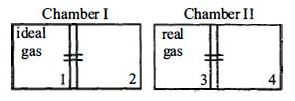
There are two identical chambers,completely thermally insulated from surroundings. Both chambers have a partition wall dividing the chambers into two compartments. Compartment $1$ is filled with an ideal gas and Compartment $3$ is filled with a real gas. Compartments $2$ and $4$ are vacuum. $A$ small hole (orifice) is made in the partition walls and the gases are allowed to expand into the vacuum.
Statement $-1$: No change in the temperature of the gas takes place when an ideal gas expands in a vacuum. However,the temperature of a real gas goes down (cooling) when it expands in a vacuum.
Statement $-2$: The internal energy of an ideal gas is only kinetic. The internal energy of a real gas is kinetic as well as potential.
Statement $-1$: No change in the temperature of the gas takes place when an ideal gas expands in a vacuum. However,the temperature of a real gas goes down (cooling) when it expands in a vacuum.
Statement $-2$: The internal energy of an ideal gas is only kinetic. The internal energy of a real gas is kinetic as well as potential.
A
Statement $-1$ is false and Statement $-2$ is true.
B
Statement $-1$ and Statement $-2$ both are true. Statement $-2$ is the correct explanation of Statement $-1$.
C
Statement $-1$ is true and Statement $-2$ is false.
D
Statement $-1$ and Statement $-2$ both are true. Statement $-2$ is not the correct explanation of Statement $-1$.
Solution
(B) In an ideal gas,there are no intermolecular forces of attraction. When it expands into a vacuum (Joule expansion),no work is done $(W = 0)$ and since the system is thermally insulated,no heat is exchanged $(Q = 0)$. According to the first law of thermodynamics,$\Delta U = Q - W = 0$. Since the internal energy of an ideal gas depends only on temperature $(U = f(T))$,$\Delta U = 0$ implies $\Delta T = 0$. Thus,the temperature remains constant.
In a real gas,there are intermolecular forces of attraction. When a real gas expands into a vacuum,the molecules must do work against these attractive forces to increase their separation. Since the expansion is adiabatic $(Q = 0)$ and no external work is done $(W = 0)$,this internal work is done at the expense of the kinetic energy of the molecules. Consequently,the temperature of the real gas decreases.
Statement $-2$ is true because the internal energy of an ideal gas is purely kinetic (translational),whereas for a real gas,it includes both kinetic energy and potential energy due to intermolecular interactions. Since Statement $-2$ explains why the internal energy changes for a real gas (leading to cooling) but not for an ideal gas,it is the correct explanation for Statement $-1$.
In a real gas,there are intermolecular forces of attraction. When a real gas expands into a vacuum,the molecules must do work against these attractive forces to increase their separation. Since the expansion is adiabatic $(Q = 0)$ and no external work is done $(W = 0)$,this internal work is done at the expense of the kinetic energy of the molecules. Consequently,the temperature of the real gas decreases.
Statement $-2$ is true because the internal energy of an ideal gas is purely kinetic (translational),whereas for a real gas,it includes both kinetic energy and potential energy due to intermolecular interactions. Since Statement $-2$ explains why the internal energy changes for a real gas (leading to cooling) but not for an ideal gas,it is the correct explanation for Statement $-1$.
0 likes
View Solution34
DifficultMCQ
An ideal gas is enclosed in a cylinder at a pressure of $2 \, atm$ and a temperature of $300 \, K$. The mean time between two successive collisions is $6 \times 10^{-8} \, s$. If the pressure is doubled and the temperature is increased to $500 \, K$,the mean time between two successive collisions will be close to:
A
$2 \times 10^{-7} \, s$
B
$4 \times 10^{-8} \, s$
C
$0.5 \times 10^{-8} \, s$
D
$3 \times 10^{-6} \, s$
Solution
(B) The mean time between two successive collisions is given by $\tau = \frac{\lambda}{v_{avg}}$,where $\lambda$ is the mean free path and $v_{avg}$ is the average speed.
Since $\lambda \propto \frac{T}{P}$ and $v_{avg} \propto \sqrt{T}$,we have $\tau \propto \frac{T/P}{\sqrt{T}} \propto \frac{\sqrt{T}}{P}$.
Given $P_1 = 2 \, atm$,$T_1 = 300 \, K$,and $\tau_1 = 6 \times 10^{-8} \, s$.
For the new state,$P_2 = 2 P_1 = 4 \, atm$ and $T_2 = 500 \, K$.
Using the ratio $\frac{\tau_2}{\tau_1} = \frac{P_1}{P_2} \sqrt{\frac{T_2}{T_1}}$:
$\frac{\tau_2}{6 \times 10^{-8}} = \frac{2}{4} \sqrt{\frac{500}{300}} = \frac{1}{2} \sqrt{\frac{5}{3}}$.
$\tau_2 = 6 \times 10^{-8} \times 0.5 \times 1.29 \approx 3.87 \times 10^{-8} \, s$.
This is closest to $4 \times 10^{-8} \, s$.
Since $\lambda \propto \frac{T}{P}$ and $v_{avg} \propto \sqrt{T}$,we have $\tau \propto \frac{T/P}{\sqrt{T}} \propto \frac{\sqrt{T}}{P}$.
Given $P_1 = 2 \, atm$,$T_1 = 300 \, K$,and $\tau_1 = 6 \times 10^{-8} \, s$.
For the new state,$P_2 = 2 P_1 = 4 \, atm$ and $T_2 = 500 \, K$.
Using the ratio $\frac{\tau_2}{\tau_1} = \frac{P_1}{P_2} \sqrt{\frac{T_2}{T_1}}$:
$\frac{\tau_2}{6 \times 10^{-8}} = \frac{2}{4} \sqrt{\frac{500}{300}} = \frac{1}{2} \sqrt{\frac{5}{3}}$.
$\tau_2 = 6 \times 10^{-8} \times 0.5 \times 1.29 \approx 3.87 \times 10^{-8} \, s$.
This is closest to $4 \times 10^{-8} \, s$.
0 likes
View Solution35
DifficultMCQ
$A$ $25 \times 10^{-3} \, m^3$ volume cylinder is filled with $1 \, mol$ of $O_2$ gas at room temperature $(300 \, K)$. The molecular diameter of $O_2$ is $0.3 \, nm$ and its root mean square speed is $200 \, m/s$. What is the average collision rate (per second) for an $O_2$ molecule?
A
$\sim 10^{10}$
B
$\sim 10^{11}$
C
$\sim 10^{12}$
D
$\sim 10^{13}$
Solution
(A) The collision frequency $Z$ is given by $Z = \frac{v_{avg}}{\lambda}$,where $\lambda$ is the mean free path.
The mean free path is $\lambda = \frac{1}{\sqrt{2} \pi \sigma^2 n}$,where $n = \frac{N}{V} = \frac{N_A}{V}$ is the number density.
Substituting $n$,we get $\lambda = \frac{V}{\sqrt{2} \pi \sigma^2 N_A}$.
Thus,$Z = \frac{v_{avg} \sqrt{2} \pi \sigma^2 N_A}{V}$.
Given: $V = 25 \times 10^{-3} \, m^3$,$\sigma = 0.3 \times 10^{-9} \, m$,$v_{rms} = 200 \, m/s$,$N_A = 6.022 \times 10^{23} \, mol^{-1}$.
Using $v_{avg} = \sqrt{\frac{8}{3\pi}} v_{rms} \approx 0.921 \times 200 \approx 184.2 \, m/s$.
$Z = \frac{184.2 \times \sqrt{2} \times 3.14 \times (0.3 \times 10^{-9})^2 \times 6.022 \times 10^{23}}{25 \times 10^{-3}}$.
$Z \approx \frac{184.2 \times 1.414 \times 3.14 \times 0.09 \times 10^{-18} \times 6.022 \times 10^{23}}{0.025} \approx \frac{439.5}{0.025} \times 10^5 \approx 1.75 \times 10^{10} \, s^{-1}$.
Therefore,the collision rate is $\sim 10^{10} \, s^{-1}$.
The mean free path is $\lambda = \frac{1}{\sqrt{2} \pi \sigma^2 n}$,where $n = \frac{N}{V} = \frac{N_A}{V}$ is the number density.
Substituting $n$,we get $\lambda = \frac{V}{\sqrt{2} \pi \sigma^2 N_A}$.
Thus,$Z = \frac{v_{avg} \sqrt{2} \pi \sigma^2 N_A}{V}$.
Given: $V = 25 \times 10^{-3} \, m^3$,$\sigma = 0.3 \times 10^{-9} \, m$,$v_{rms} = 200 \, m/s$,$N_A = 6.022 \times 10^{23} \, mol^{-1}$.
Using $v_{avg} = \sqrt{\frac{8}{3\pi}} v_{rms} \approx 0.921 \times 200 \approx 184.2 \, m/s$.
$Z = \frac{184.2 \times \sqrt{2} \times 3.14 \times (0.3 \times 10^{-9})^2 \times 6.022 \times 10^{23}}{25 \times 10^{-3}}$.
$Z \approx \frac{184.2 \times 1.414 \times 3.14 \times 0.09 \times 10^{-18} \times 6.022 \times 10^{23}}{0.025} \approx \frac{439.5}{0.025} \times 10^5 \approx 1.75 \times 10^{10} \, s^{-1}$.
Therefore,the collision rate is $\sim 10^{10} \, s^{-1}$.
0 likes
View Solution36
MediumMCQ
$A$ gas deviates maximum from the ideal gas law at
A
high temperature and high pressure
B
low temperature and low pressure
C
high temperature and low pressure
D
low temperature and high pressure
Solution
(D) The ideal gas law assumes that gas particles have negligible volume and no intermolecular forces.
Real gases behave most like ideal gases at high temperature and low pressure,where the kinetic energy of the particles is high and the average distance between them is large.
Conversely,at low temperature and high pressure,the intermolecular forces become significant and the volume of the gas particles cannot be ignored.
Therefore,a gas deviates maximum from the ideal gas law at low temperature and high pressure.
Real gases behave most like ideal gases at high temperature and low pressure,where the kinetic energy of the particles is high and the average distance between them is large.
Conversely,at low temperature and high pressure,the intermolecular forces become significant and the volume of the gas particles cannot be ignored.
Therefore,a gas deviates maximum from the ideal gas law at low temperature and high pressure.
0 likes
View Solution37
MediumMCQ
$Assertion:$ Mean free path of a gas molecule varies inversely as the density of the gas.
$Reason:$ Mean free path varies inversely as the pressure of the gas.
$Reason:$ Mean free path varies inversely as the pressure of the gas.
A
If both Assertion and Reason are correct and the Reason is a correct explanation of the Assertion.
B
If both Assertion and Reason are correct but Reason is not a correct explanation of the Assertion.
C
If the Assertion is correct but Reason is incorrect.
D
If both the Assertion and Reason are incorrect.
Solution
(A) The mean free path $\lambda$ of a gas molecule is the average distance between two successive collisions.
It is given by the formula $\lambda = \frac{k T}{\sqrt{2} \pi \sigma^2 P}$,where $k$ is the Boltzmann constant,$T$ is the temperature,$\sigma$ is the molecular diameter,and $P$ is the pressure.
Since density $\rho = \frac{m}{V} = \frac{M P}{R T}$,we can express the mean free path in terms of density as $\lambda = \frac{m}{\sqrt{2} \pi \sigma^2 \rho}$,where $\rho$ is the density of the gas.
From these relations,it is clear that $\lambda \propto \frac{1}{P}$ and $\lambda \propto \frac{1}{\rho}$.
Therefore,the mean free path is inversely proportional to both the pressure and the density of the gas.
Since the Assertion states that it varies inversely with density and the Reason states it varies inversely with pressure,both are correct.
Furthermore,the relationship between pressure and density (at constant temperature) explains why the mean free path depends on both in an inverse manner,making the Reason a correct explanation for the Assertion.
It is given by the formula $\lambda = \frac{k T}{\sqrt{2} \pi \sigma^2 P}$,where $k$ is the Boltzmann constant,$T$ is the temperature,$\sigma$ is the molecular diameter,and $P$ is the pressure.
Since density $\rho = \frac{m}{V} = \frac{M P}{R T}$,we can express the mean free path in terms of density as $\lambda = \frac{m}{\sqrt{2} \pi \sigma^2 \rho}$,where $\rho$ is the density of the gas.
From these relations,it is clear that $\lambda \propto \frac{1}{P}$ and $\lambda \propto \frac{1}{\rho}$.
Therefore,the mean free path is inversely proportional to both the pressure and the density of the gas.
Since the Assertion states that it varies inversely with density and the Reason states it varies inversely with pressure,both are correct.
Furthermore,the relationship between pressure and density (at constant temperature) explains why the mean free path depends on both in an inverse manner,making the Reason a correct explanation for the Assertion.
0 likes
View Solution38
MediumMCQ
Two gases-argon (atomic radius $0.07 \; nm$,atomic weight $40$) and xenon (atomic radius $0.1 \; nm$,atomic weight $140$) have the same number density and are at the same temperature. The ratio of their respective mean free times is closest to:
A
$1.09$
B
$4.67$
C
$1.83$
D
$2.3$
Solution
(A) The mean free path $\lambda$ is given by $\lambda = \frac{1}{\sqrt{2} \pi n_{v} d^{2}}$,where $n_{v}$ is the number density and $d$ is the diameter of the atom.
The mean free time $\tau$ is defined as $\tau = \frac{\lambda}{v_{rms}}$,where $v_{rms} = \sqrt{\frac{3RT}{M}}$.
Substituting $\lambda$ and $v_{rms}$ into the expression for $\tau$:
$\tau = \frac{1}{\sqrt{2} \pi n_{v} d^{2}} \sqrt{\frac{M}{3RT}}$.
Since $n_{v}$,$R$,and $T$ are the same for both gases,the ratio of the mean free times $\tau_{Ar} / \tau_{Xe}$ is:
$\frac{\tau_{Ar}}{\tau_{Xe}} = \sqrt{\frac{M_{Ar}}{M_{Xe}}} \times \left( \frac{d_{Xe}}{d_{Ar}} \right)^{2}$.
Given $M_{Ar} = 40$,$M_{Xe} = 140$,$d_{Ar} = 2 \times 0.07 \; nm$,and $d_{Xe} = 2 \times 0.1 \; nm$:
$\frac{\tau_{Ar}}{\tau_{Xe}} = \sqrt{\frac{40}{140}} \times \left( \frac{0.1}{0.07} \right)^{2} = \sqrt{\frac{2}{7}} \times \left( \frac{10}{7} \right)^{2} \approx 0.5345 \times 2.0408 \approx 1.09$.
The mean free time $\tau$ is defined as $\tau = \frac{\lambda}{v_{rms}}$,where $v_{rms} = \sqrt{\frac{3RT}{M}}$.
Substituting $\lambda$ and $v_{rms}$ into the expression for $\tau$:
$\tau = \frac{1}{\sqrt{2} \pi n_{v} d^{2}} \sqrt{\frac{M}{3RT}}$.
Since $n_{v}$,$R$,and $T$ are the same for both gases,the ratio of the mean free times $\tau_{Ar} / \tau_{Xe}$ is:
$\frac{\tau_{Ar}}{\tau_{Xe}} = \sqrt{\frac{M_{Ar}}{M_{Xe}}} \times \left( \frac{d_{Xe}}{d_{Ar}} \right)^{2}$.
Given $M_{Ar} = 40$,$M_{Xe} = 140$,$d_{Ar} = 2 \times 0.07 \; nm$,and $d_{Xe} = 2 \times 0.1 \; nm$:
$\frac{\tau_{Ar}}{\tau_{Xe}} = \sqrt{\frac{40}{140}} \times \left( \frac{0.1}{0.07} \right)^{2} = \sqrt{\frac{2}{7}} \times \left( \frac{10}{7} \right)^{2} \approx 0.5345 \times 2.0408 \approx 1.09$.
0 likes
View Solution39
Medium
Two ideal gas thermometers $A$ and $B$ use oxygen and hydrogen respectively. The following observations are made:
$(a)$ What is the absolute temperature of the normal melting point of sulphur as read by thermometers $A$ and $B$?
$(b)$ What do you think is the reason behind the slight difference in answers of thermometers $A$ and $B$? (The thermometers are not faulty). What further procedure is needed in the experiment to reduce the discrepancy between the two readings?
| Temperature | Pressure thermometer $A$ | Pressure thermometer $B$ |
|---|---|---|
| Triple-point of water | $1.250 \times 10^{5} \; Pa$ | $0.200 \times 10^{5} \; Pa$ |
| Normal melting point of sulphur | $1.797 \times 10^{5} \; Pa$ | $0.287 \times 10^{5} \; Pa$ |
$(a)$ What is the absolute temperature of the normal melting point of sulphur as read by thermometers $A$ and $B$?
$(b)$ What do you think is the reason behind the slight difference in answers of thermometers $A$ and $B$? (The thermometers are not faulty). What further procedure is needed in the experiment to reduce the discrepancy between the two readings?
Solution
(N/A) For thermometer $A$:
At triple point of water,$T = 273.16 \; K$,$P_A = 1.250 \times 10^{5} \; Pa$.
At melting point of sulphur,$P_1 = 1.797 \times 10^{5} \; Pa$.
Using Charles' Law,$T_1 = (P_1 / P_A) \times 273.16 = (1.797 / 1.250) \times 273.16 = 392.69 \; K$.
For thermometer $B$:
At triple point of water,$T = 273.16 \; K$,$P_B = 0.200 \times 10^{5} \; Pa$.
At melting point of sulphur,$P_2 = 0.287 \times 10^{5} \; Pa$.
Using Charles' Law,$T_1 = (P_2 / P_B) \times 273.16 = (0.287 / 0.200) \times 273.16 = 391.98 \; K$.
$(b)$ The gases oxygen and hydrogen are not perfectly ideal. The discrepancy arises because real gases deviate from ideal gas behavior. To reduce the discrepancy,the experiment should be performed at lower pressures,where gases behave more like ideal gases.
At triple point of water,$T = 273.16 \; K$,$P_A = 1.250 \times 10^{5} \; Pa$.
At melting point of sulphur,$P_1 = 1.797 \times 10^{5} \; Pa$.
Using Charles' Law,$T_1 = (P_1 / P_A) \times 273.16 = (1.797 / 1.250) \times 273.16 = 392.69 \; K$.
For thermometer $B$:
At triple point of water,$T = 273.16 \; K$,$P_B = 0.200 \times 10^{5} \; Pa$.
At melting point of sulphur,$P_2 = 0.287 \times 10^{5} \; Pa$.
Using Charles' Law,$T_1 = (P_2 / P_B) \times 273.16 = (0.287 / 0.200) \times 273.16 = 391.98 \; K$.
$(b)$ The gases oxygen and hydrogen are not perfectly ideal. The discrepancy arises because real gases deviate from ideal gas behavior. To reduce the discrepancy,the experiment should be performed at lower pressures,where gases behave more like ideal gases.
0 likes
View Solution40
Easy
Estimate the mean free path for a water molecule in water vapour at $373 \; K$. The density of water is $1000 \; kg \; m^{-3}$. The density of water vapour at $100 \; ^{\circ}C$ and $1 \; atm$ pressure is $0.6 \; kg \; m^{-3}$. The volume of a molecule multiplied by the total number gives,what is called,molecular volume.
Solution
The mean free path $l$ is given by the formula $l = \frac{1}{\sqrt{2} \pi d^2 n}$,where $d$ is the molecular diameter and $n$ is the number density.
For a water molecule,the diameter $d \approx 2 \times 10^{-10} \; m$.
The number density $n$ is given by $n = \frac{\rho}{m}$,where $\rho = 0.6 \; kg \; m^{-3}$ and $m$ is the mass of one water molecule $(H_2O)$.
The mass of one water molecule $m = \frac{18 \times 10^{-3} \; kg}{6.022 \times 10^{23}} \approx 3 \times 10^{-26} \; kg$.
Thus,$n = \frac{0.6}{3 \times 10^{-26}} = 2 \times 10^{25} \; m^{-3}$.
Substituting these values into the formula:
$l = \frac{1}{\sqrt{2} \times 3.14 \times (2 \times 10^{-10})^2 \times 2 \times 10^{25}}$
$l = \frac{1}{1.414 \times 3.14 \times 4 \times 10^{-20} \times 2 \times 10^{25}}$
$l = \frac{1}{35.47 \times 10^5} \approx 2.8 \times 10^{-7} \; m$.
For a water molecule,the diameter $d \approx 2 \times 10^{-10} \; m$.
The number density $n$ is given by $n = \frac{\rho}{m}$,where $\rho = 0.6 \; kg \; m^{-3}$ and $m$ is the mass of one water molecule $(H_2O)$.
The mass of one water molecule $m = \frac{18 \times 10^{-3} \; kg}{6.022 \times 10^{23}} \approx 3 \times 10^{-26} \; kg$.
Thus,$n = \frac{0.6}{3 \times 10^{-26}} = 2 \times 10^{25} \; m^{-3}$.
Substituting these values into the formula:
$l = \frac{1}{\sqrt{2} \times 3.14 \times (2 \times 10^{-10})^2 \times 2 \times 10^{25}}$
$l = \frac{1}{1.414 \times 3.14 \times 4 \times 10^{-20} \times 2 \times 10^{25}}$
$l = \frac{1}{35.47 \times 10^5} \approx 2.8 \times 10^{-7} \; m$.
0 likes
View Solution41
MediumMCQ
Estimate the fraction of molecular volume to the actual volume occupied by oxygen gas at $STP$. Take the diameter of an oxygen molecule to be $3 \mathring A$.
A
$5.4 \times 10^{-2}$
B
$3.8 \times 10^{-4}$
C
$4.5 \times 10^{-3}$
D
$3.68 \times 10^{-5}$
Solution
(B) Diameter of an oxygen molecule,$d = 3 \mathring A = 3 \times 10^{-8} \text{ cm}$.
Radius,$r = \frac{d}{2} = 1.5 \times 10^{-8} \text{ cm}$.
Actual volume occupied by $1 \text{ mole}$ of oxygen gas at $STP = 22400 \text{ cm}^3$.
Molecular volume of $1 \text{ mole}$ of oxygen gas,$V_m = N_A \times \frac{4}{3} \pi r^3$,where $N_A = 6.023 \times 10^{23} \text{ molecules/mole}$.
$V_m = 6.023 \times 10^{23} \times \frac{4}{3} \times 3.14 \times (1.5 \times 10^{-8})^3$.
$V_m \approx 8.51 \text{ cm}^3$.
The fraction of molecular volume to the actual volume is $\frac{V_m}{V_{STP}} = \frac{8.51}{22400} \approx 3.8 \times 10^{-4}$.
Radius,$r = \frac{d}{2} = 1.5 \times 10^{-8} \text{ cm}$.
Actual volume occupied by $1 \text{ mole}$ of oxygen gas at $STP = 22400 \text{ cm}^3$.
Molecular volume of $1 \text{ mole}$ of oxygen gas,$V_m = N_A \times \frac{4}{3} \pi r^3$,where $N_A = 6.023 \times 10^{23} \text{ molecules/mole}$.
$V_m = 6.023 \times 10^{23} \times \frac{4}{3} \times 3.14 \times (1.5 \times 10^{-8})^3$.
$V_m \approx 8.51 \text{ cm}^3$.
The fraction of molecular volume to the actual volume is $\frac{V_m}{V_{STP}} = \frac{8.51}{22400} \approx 3.8 \times 10^{-4}$.
0 likes
View Solution42
Medium
Estimate the mean free path and collision frequency of a nitrogen molecule in a cylinder containing nitrogen at $2.0 \; atm$ and temperature $17\,^{\circ} C$. Take the radius of a nitrogen molecule to be roughly $1.0 \; \mathring{A}$. Compare the collision time with the time the molecule moves freely between two successive collisions (Molecular mass of $N_{2} = 28.0 \; u$).
Solution
(A) Given: Pressure $P = 2.0 \; atm = 2.026 \times 10^{5} \; Pa$,Temperature $T = 17^{\circ} C = 290 \; K$,Radius $r = 1.0 \; \mathring{A} = 1.0 \times 10^{-10} \; m$,Diameter $d = 2r = 2.0 \times 10^{-10} \; m$,Molecular mass $M = 28.0 \times 10^{-3} \; kg/mol$.
$1$. Root mean square speed $v_{rms} = \sqrt{\frac{3RT}{M}} = \sqrt{\frac{3 \times 8.314 \times 290}{28 \times 10^{-3}}} \approx 508.26 \; m/s$.
$2$. Mean free path $l = \frac{kT}{\sqrt{2} \pi d^{2} P}$. Using Boltzmann constant $k = 1.38 \times 10^{-23} \; J/K$,$l = \frac{1.38 \times 10^{-23} \times 290}{\sqrt{2} \times 3.1416 \times (2.0 \times 10^{-10})^{2} \times 2.026 \times 10^{5}} \approx 1.11 \times 10^{-7} \; m$.
$3$. Collision frequency $f = \frac{v_{rms}}{l} = \frac{508.26}{1.11 \times 10^{-7}} \approx 4.58 \times 10^{9} \; s^{-1}$.
$4$. Collision time $t_{c} = \frac{d}{v_{rms}} = \frac{2.0 \times 10^{-10}}{508.26} \approx 3.93 \times 10^{-13} \; s$.
$5$. Time between collisions $t_{f} = \frac{l}{v_{rms}} = \frac{1.11 \times 10^{-7}}{508.26} \approx 2.18 \times 10^{-10} \; s$.
Ratio $\frac{t_{f}}{t_{c}} = \frac{2.18 \times 10^{-10}}{3.93 \times 10^{-13}} \approx 555 \approx 500$.
$1$. Root mean square speed $v_{rms} = \sqrt{\frac{3RT}{M}} = \sqrt{\frac{3 \times 8.314 \times 290}{28 \times 10^{-3}}} \approx 508.26 \; m/s$.
$2$. Mean free path $l = \frac{kT}{\sqrt{2} \pi d^{2} P}$. Using Boltzmann constant $k = 1.38 \times 10^{-23} \; J/K$,$l = \frac{1.38 \times 10^{-23} \times 290}{\sqrt{2} \times 3.1416 \times (2.0 \times 10^{-10})^{2} \times 2.026 \times 10^{5}} \approx 1.11 \times 10^{-7} \; m$.
$3$. Collision frequency $f = \frac{v_{rms}}{l} = \frac{508.26}{1.11 \times 10^{-7}} \approx 4.58 \times 10^{9} \; s^{-1}$.
$4$. Collision time $t_{c} = \frac{d}{v_{rms}} = \frac{2.0 \times 10^{-10}}{508.26} \approx 3.93 \times 10^{-13} \; s$.
$5$. Time between collisions $t_{f} = \frac{l}{v_{rms}} = \frac{1.11 \times 10^{-7}}{508.26} \approx 2.18 \times 10^{-10} \; s$.
Ratio $\frac{t_{f}}{t_{c}} = \frac{2.18 \times 10^{-10}}{3.93 \times 10^{-13}} \approx 555 \approx 500$.
0 likes
View Solution43
EasyMCQ
The internal energy of real gases is determined by which of the following?
A
Pressure and volume
B
Volume and temperature
C
Pressure and temperature
D
Only temperature
Solution
(B) For an ideal gas,the internal energy depends only on temperature. However,for a real gas,the internal energy depends on both the temperature and the volume of the gas. This is because real gases have intermolecular forces,and the potential energy associated with these forces changes as the distance between molecules (which is related to volume) changes.
0 likes
View Solution44
Difficult
Write and explain three states of matter.
Solution
(N/A) Matter is composed of atoms or molecules. Atoms can be observed using an electron microscope or a scanning tunneling microscope. The dimension of an atom is of the order of $10^{-10} \; m$.
The three states of matter are solid,liquid,and gas.
$1$. Solids: In solids,atoms are closely packed,and the distance between two atoms is of the order of $2 \; \mathring{A}$. Due to the proximity of atoms,interatomic forces are strong,preventing free movement.
$2$. Liquids: In liquids,atoms are not as rigidly fixed as in solids. Atoms can move around,which allows liquids to flow. Like solids,atoms in liquids are very close to each other,resulting in significant interatomic forces.
$3$. Gases: In gases,the interatomic distance is large,typically of the order of $10 \; \mathring{A}$. Consequently,interatomic forces are very weak,and atoms are free to move independently in any direction. Gases do not remain in an open container and will disperse. Gas behavior is characterized by dynamic equilibrium,where molecules collide and change speeds,while their average properties remain constant. The average distance a molecule travels without colliding is called the mean free path,which is of the order of $10^{3} \; \mathring{A}$.
The three states of matter are solid,liquid,and gas.
$1$. Solids: In solids,atoms are closely packed,and the distance between two atoms is of the order of $2 \; \mathring{A}$. Due to the proximity of atoms,interatomic forces are strong,preventing free movement.
$2$. Liquids: In liquids,atoms are not as rigidly fixed as in solids. Atoms can move around,which allows liquids to flow. Like solids,atoms in liquids are very close to each other,resulting in significant interatomic forces.
$3$. Gases: In gases,the interatomic distance is large,typically of the order of $10 \; \mathring{A}$. Consequently,interatomic forces are very weak,and atoms are free to move independently in any direction. Gases do not remain in an open container and will disperse. Gas behavior is characterized by dynamic equilibrium,where molecules collide and change speeds,while their average properties remain constant. The average distance a molecule travels without colliding is called the mean free path,which is of the order of $10^{3} \; \mathring{A}$.
0 likes
View Solution45
Medium
What is mean free path?
Solution
(N/A) The mean free path is defined as the average distance traveled by a gas molecule between two successive collisions.
If a molecule travels distances $\lambda_1, \lambda_2, \lambda_3, ..., \lambda_n$ between $n$ successive collisions,the mean free path $\lambda$ is given by:
$\lambda = \frac{\lambda_1 + \lambda_2 + ... + \lambda_n}{n}$.
According to the kinetic theory of gases,it is expressed as $\lambda = \frac{1}{\sqrt{2} \pi d^2 n}$,where $d$ is the diameter of the molecule and $n$ is the number density of the molecules.
If a molecule travels distances $\lambda_1, \lambda_2, \lambda_3, ..., \lambda_n$ between $n$ successive collisions,the mean free path $\lambda$ is given by:
$\lambda = \frac{\lambda_1 + \lambda_2 + ... + \lambda_n}{n}$.
According to the kinetic theory of gases,it is expressed as $\lambda = \frac{1}{\sqrt{2} \pi d^2 n}$,where $d$ is the diameter of the molecule and $n$ is the number density of the molecules.
0 likes
View Solution46
Easy
State the differences between an ideal gas and a real gas.
Solution
(N/A)
| Ideal gas | Real gas |
| $(1)$ It satisfies $PV = \mu RT$ for all temperatures and pressures. | $(1)$ It does not satisfy $PV = \mu RT$ for all temperatures and pressures. |
| $(2)$ The volume of molecules of an ideal gas is considered zero. | $(2)$ The volume of molecules of real gases is not zero. |
| $(3)$ In an ideal gas, no intermolecular forces act between molecules. | $(3)$ Depending on the distance between molecules, attractive or repulsive forces act between them. |
| $(4)$ Interatomic force is zero, hence potential energy is zero. | $(4)$ Interatomic force is not zero, hence potential energy is not zero. |
| $(5)$ Possesses only kinetic energy. | $(5)$ Possesses both kinetic energy and potential energy. |
| $(6)$ At absolute zero, the volume, pressure, and internal energy of an ideal gas become zero. | $(6)$ All real gases liquefy before reaching absolute zero, and the internal energy in the liquid state is not zero. |
0 likes
View Solution47
Difficult
What is free path and mean free path?
Solution
(N/A) Example: Gas leaking from a cylinder in a kitchen takes considerable time to diffuse to the other corners of the room.
This is due to the fact that gas molecules act like rigid spheres with small volume; hence,they collide with one another during random motion,causing their speed and direction to change.
Between two successive collisions,molecules travel in a straight line with constant speed.
Free Path: The linear distance travelled by a molecule of gas with constant speed between two successive collisions is called the free path.
Mean Free Path: The average of such free paths travelled by a molecule is called the mean free path.
Let the free paths of a molecule in successive collisions $1, 2, 3, \ldots$ be $l_{1}, l_{2}, l_{3}, \ldots$
$\therefore \text{Mean free path } \bar{l} = \frac{\text{sum of free paths}}{\text{number of collisions}} = \frac{l_{1} + l_{2} + l_{3} + \ldots}{n}$
This is due to the fact that gas molecules act like rigid spheres with small volume; hence,they collide with one another during random motion,causing their speed and direction to change.
Between two successive collisions,molecules travel in a straight line with constant speed.
Free Path: The linear distance travelled by a molecule of gas with constant speed between two successive collisions is called the free path.
Mean Free Path: The average of such free paths travelled by a molecule is called the mean free path.
Let the free paths of a molecule in successive collisions $1, 2, 3, \ldots$ be $l_{1}, l_{2}, l_{3}, \ldots$
$\therefore \text{Mean free path } \bar{l} = \frac{\text{sum of free paths}}{\text{number of collisions}} = \frac{l_{1} + l_{2} + l_{3} + \ldots}{n}$
0 likes
View Solution48
Medium
What is mean free path? Derive the equation for the mean free path.
Solution
(N/A) The average distance traveled by gas molecules between two successive collisions is called the mean free path.
The calculation of the mean free path is based on two hypotheses:
$(1)$ Gas molecules are rigid spheres of diameter '$d$'.
$(2)$ Molecules other than the one in motion are considered stationary.
Let the diameter of a gas molecule be $d$ and the average speed of one molecule be $\langle v \rangle$.
Let this molecule collide with any other molecule that comes within a distance $d$ between their centers.
It sweeps a volume $\pi d^{2} \langle v \rangle \Delta t$ in a time interval $\Delta t$.
If $n$ is the number of molecules per unit volume,the molecule undergoes $n \pi d^{2} \langle v \rangle \Delta t$ collisions in the time interval $\Delta t$.
Thus,the rate of collision is $n \pi d^{2} \langle v \rangle$.
The time interval between two successive collisions is:
$\tau = \frac{1}{n \pi \langle v \rangle d^{2}}$
The average distance between two successive collisions is called the mean free path,denoted by $\bar{l}$.
$\therefore \bar{l} = \langle v \rangle \tau$
$\therefore \bar{l} = \frac{1}{n \pi d^{2}}$
The calculation of the mean free path is based on two hypotheses:
$(1)$ Gas molecules are rigid spheres of diameter '$d$'.
$(2)$ Molecules other than the one in motion are considered stationary.
Let the diameter of a gas molecule be $d$ and the average speed of one molecule be $\langle v \rangle$.
Let this molecule collide with any other molecule that comes within a distance $d$ between their centers.
It sweeps a volume $\pi d^{2} \langle v \rangle \Delta t$ in a time interval $\Delta t$.
If $n$ is the number of molecules per unit volume,the molecule undergoes $n \pi d^{2} \langle v \rangle \Delta t$ collisions in the time interval $\Delta t$.
Thus,the rate of collision is $n \pi d^{2} \langle v \rangle$.
The time interval between two successive collisions is:
$\tau = \frac{1}{n \pi \langle v \rangle d^{2}}$
The average distance between two successive collisions is called the mean free path,denoted by $\bar{l}$.
$\therefore \bar{l} = \langle v \rangle \tau$
$\therefore \bar{l} = \frac{1}{n \pi d^{2}}$
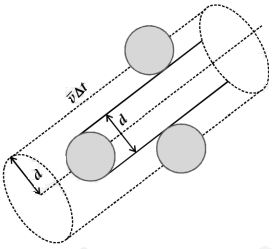
0 likes
View Solution49
Difficult
Calculate the mean free path and relaxation time for a gas with a mean speed $\langle v \rangle = 485 \ m/s$. Assume standard conditions $(STP)$ where the number density $n \approx 2.7 \times 10^{25} \ m^{-3}$ and molecular diameter $d = 2 \ \mathring{A}$.
Solution
(N/A) Given:
Mean speed $\langle v \rangle = 485 \ m/s$
Number density $n = 2.7 \times 10^{25} \ m^{-3}$
Diameter $d = 2 \ \mathring{A} = 2 \times 10^{-10} \ m$
$1$. Mean free path $(\bar{l})$:
The formula for mean free path is $\bar{l} = \frac{1}{\sqrt{2} n \pi d^2}$.
$\bar{l} = \frac{1}{\sqrt{2} \times (2.7 \times 10^{25}) \times 3.14 \times (2 \times 10^{-10})^2}$
$\bar{l} = \frac{1}{1.414 \times 2.7 \times 10^{25} \times 3.14 \times 4 \times 10^{-20}}$
$\bar{l} \approx 2.08 \times 10^{-7} \ m$.
$2$. Relaxation time $(\tau)$:
The formula for relaxation time is $\tau = \frac{\bar{l}}{\langle v \rangle}$.
$\tau = \frac{2.08 \times 10^{-7}}{485}$
$\tau \approx 4.29 \times 10^{-10} \ s$.
Mean speed $\langle v \rangle = 485 \ m/s$
Number density $n = 2.7 \times 10^{25} \ m^{-3}$
Diameter $d = 2 \ \mathring{A} = 2 \times 10^{-10} \ m$
$1$. Mean free path $(\bar{l})$:
The formula for mean free path is $\bar{l} = \frac{1}{\sqrt{2} n \pi d^2}$.
$\bar{l} = \frac{1}{\sqrt{2} \times (2.7 \times 10^{25}) \times 3.14 \times (2 \times 10^{-10})^2}$
$\bar{l} = \frac{1}{1.414 \times 2.7 \times 10^{25} \times 3.14 \times 4 \times 10^{-20}}$
$\bar{l} \approx 2.08 \times 10^{-7} \ m$.
$2$. Relaxation time $(\tau)$:
The formula for relaxation time is $\tau = \frac{\bar{l}}{\langle v \rangle}$.
$\tau = \frac{2.08 \times 10^{-7}}{485}$
$\tau \approx 4.29 \times 10^{-10} \ s$.
0 likes
View Solution50
Medium
What is free path? And what is mean free path?
Solution
(N/A) $1$. Free Path: The distance traveled by a gas molecule between two successive collisions is called the free path. During this interval,the molecule moves in a straight line with constant velocity.
$2$. Mean Free Path: The average distance traveled by a gas molecule between successive collisions is known as the mean free path. It is denoted by $\lambda$. If a molecule travels distances $\lambda_1, \lambda_2, \dots, \lambda_n$ between $n$ collisions,the mean free path is given by $\lambda = \frac{\lambda_1 + \lambda_2 + \dots + \lambda_n}{n}$.
Mathematically,it is expressed as $\lambda = \frac{1}{\sqrt{2} n \pi d^2}$,where $n$ is the number density of molecules and $d$ is the diameter of the molecule.
$2$. Mean Free Path: The average distance traveled by a gas molecule between successive collisions is known as the mean free path. It is denoted by $\lambda$. If a molecule travels distances $\lambda_1, \lambda_2, \dots, \lambda_n$ between $n$ collisions,the mean free path is given by $\lambda = \frac{\lambda_1 + \lambda_2 + \dots + \lambda_n}{n}$.
Mathematically,it is expressed as $\lambda = \frac{1}{\sqrt{2} n \pi d^2}$,where $n$ is the number density of molecules and $d$ is the diameter of the molecule.
0 likes
View SolutionKinetic Theory of Gases — Mean Free Path and Real Gases · Frequently Asked Questions
1Are these Kinetic Theory of Gases questions useful for JEE and NEET?
Yes. All questions in this section are mapped to JEE Main and NEET exam patterns. Previous year questions from JEE Main, NEET, GUJCET and state-level exams are included with full solutions.
2Can I switch to Hindi or Gujarati for these questions?
Yes. Use the language tabs in the hero section or the sidebar to view the same questions and solutions in English, Hindi or Gujarati.
3How do I generate a question paper from this subtopic?
Use the Vedclass Exam Paper Generator — select the chapter and subtopic, set difficulty, and generate Sets A, B, C, D automatically. First 3 chapters of every subject are free.
Vedclass Products
For Students
Vedclass Test Series
Mock tests in real JEE/NEET style with performance analysis. 5-day free trial.
Start Free TrialFor Teachers
Exam Paper Generator
Generate Set A/B/C/D papers from this chapter in 2 minutes. 3 chapters free.
Try FreeFor Institutes
Online Exam Module
Live online exams with unlimited students, 360° analytics & white-label branding.
See DemoFor Teachers & Institutes
Generate a Kinetic Theory of Gases Exam Paper in 2 Minutes
Select subtopic & difficulty — Sets A, B, C, D auto-generated with No Repeat logic.
First 3 chapters of every subject are free — no payment required.