
A English
Degree of Freedom Questions in English
Class 11 Physics · Kinetic Theory of Gases · Degree of Freedom
89+
Questions
English
Language
100%
With Solutions
Showing 50 of 89 questions in English
1
EasyMCQ
$A$ monoatomic gas molecule has
A
Three degrees of freedom
B
Four degrees of freedom
C
Five degrees of freedom
D
Six degrees of freedom
Solution
(A) monoatomic gas molecule consists of a single atom.
Since it can only move in three-dimensional space ($x, y, z$ axes),it possesses only translational degrees of freedom.
It does not have rotational degrees of freedom because the moment of inertia about its center of mass is negligible.
Therefore,a monoatomic gas molecule has $3$ degrees of freedom.
Since it can only move in three-dimensional space ($x, y, z$ axes),it possesses only translational degrees of freedom.
It does not have rotational degrees of freedom because the moment of inertia about its center of mass is negligible.
Therefore,a monoatomic gas molecule has $3$ degrees of freedom.
0 likes
View Solution2
EasyMCQ
$A$ diatomic molecule has how many degrees of freedom?
A
$3$
B
$4$
C
$5$
D
$6$
Solution
(C) The number of degrees of freedom $f$ for a molecule is given by the formula $f = 3N - k$,where $N$ is the number of atoms and $k$ is the number of constraints.
For a rigid diatomic molecule,there are $N = 2$ atoms and $k = 1$ constraint (the fixed distance between the atoms).
Substituting these values,we get $f = 3(2) - 1 = 5$.
Thus,a diatomic molecule has $5$ degrees of freedom ($3$ translational and $2$ rotational).
For a rigid diatomic molecule,there are $N = 2$ atoms and $k = 1$ constraint (the fixed distance between the atoms).
Substituting these values,we get $f = 3(2) - 1 = 5$.
Thus,a diatomic molecule has $5$ degrees of freedom ($3$ translational and $2$ rotational).
0 likes
View Solution3
EasyMCQ
The degrees of freedom of a triatomic gas is
A
$2$
B
$4$
C
$6$
D
$8$
Solution
(C) For a non-linear triatomic gas molecule,the degrees of freedom $(f)$ is calculated as follows:
$1$. Translational degrees of freedom: $3$ (along $x, y, z$ axes).
$2$. Rotational degrees of freedom: $3$ (about $x, y, z$ axes).
Therefore,the total degrees of freedom $f = 3 + 3 = 6$.
$1$. Translational degrees of freedom: $3$ (along $x, y, z$ axes).
$2$. Rotational degrees of freedom: $3$ (about $x, y, z$ axes).
Therefore,the total degrees of freedom $f = 3 + 3 = 6$.
0 likes
View Solution4
MediumMCQ
Supposing the distance between the atoms of a diatomic gas to be constant,its specific heat at constant volume per mole (gram mole) is
A
$\frac{5}{2}R$
B
$\frac{3}{2}R$
C
$R$
D
$\frac{1}{2}R$
Solution
(A) The molar specific heat at constant volume is given by the formula $C_V = \frac{f}{2}R$,where $f$ is the number of degrees of freedom.
For a diatomic gas,the atoms are assumed to be at a constant distance (rigid rotator model),which means the molecule has $3$ translational degrees of freedom and $2$ rotational degrees of freedom.
Thus,the total degrees of freedom $f = 3 + 2 = 5$.
Substituting this value into the formula,we get $C_V = \frac{5}{2}R$.
For a diatomic gas,the atoms are assumed to be at a constant distance (rigid rotator model),which means the molecule has $3$ translational degrees of freedom and $2$ rotational degrees of freedom.
Thus,the total degrees of freedom $f = 3 + 2 = 5$.
Substituting this value into the formula,we get $C_V = \frac{5}{2}R$.
0 likes
View Solution5
MediumMCQ
The temperature of argon,kept in a vessel,is raised by $1^\circ C$ at a constant volume. The total heat supplied to the gas is a combination of translational and rotational energies. Their respective shares are
A
$60\%$ and $40\%$
B
$40\%$ and $60\%$
C
$50\%$ and $50\%$
D
$100\%$ and $0\%$
Solution
(D) Argon $(Ar)$ is a monoatomic gas.
For a monoatomic gas,the degrees of freedom $(f)$ is $3$,which corresponds entirely to translational motion.
Monoatomic gases do not possess rotational degrees of freedom because they are point-like particles.
Therefore,the total heat supplied to the gas at constant volume is used entirely for increasing the translational kinetic energy.
The share of translational energy is $100\%$ and the share of rotational energy is $0\%$.
For a monoatomic gas,the degrees of freedom $(f)$ is $3$,which corresponds entirely to translational motion.
Monoatomic gases do not possess rotational degrees of freedom because they are point-like particles.
Therefore,the total heat supplied to the gas at constant volume is used entirely for increasing the translational kinetic energy.
The share of translational energy is $100\%$ and the share of rotational energy is $0\%$.
0 likes
View Solution6
EasyMCQ
The number of translational degrees of freedom for a diatomic gas is
A
$2$
B
$3$
C
$5$
D
$6$
Solution
(B) For a diatomic gas molecule,the motion can be described in three-dimensional space.
The number of translational degrees of freedom is always $3$ for any gas molecule,corresponding to motion along the $x, y,$ and $z$ axes.
The number of rotational degrees of freedom for a rigid diatomic molecule is $2$.
Therefore,the number of translational degrees of freedom is $3$.
The number of translational degrees of freedom is always $3$ for any gas molecule,corresponding to motion along the $x, y,$ and $z$ axes.
The number of rotational degrees of freedom for a rigid diatomic molecule is $2$.
Therefore,the number of translational degrees of freedom is $3$.
0 likes
View Solution7
EasyMCQ
For a gas,$\gamma = 7/5$. The gas may probably be
A
Helium
B
Hydrogen
C
Argon
D
Neon
Solution
(B) The adiabatic index $\gamma$ is defined as the ratio of the molar heat capacity at constant pressure $(C_p)$ to the molar heat capacity at constant volume $(C_v)$,given by $\gamma = C_p/C_v = 1 + 2/f$,where $f$ is the degrees of freedom.
For a monatomic gas,$f = 3$,so $\gamma = 1 + 2/3 = 5/3 \approx 1.67$.
For a diatomic gas,$f = 5$ (at room temperature),so $\gamma = 1 + 2/5 = 7/5 = 1.4$.
Since the given value is $\gamma = 7/5$,the gas must be diatomic.
Among the given options,Helium $(He)$,Argon $(Ar)$,and Neon $(Ne)$ are monatomic noble gases,while Hydrogen $(H_2)$ is a diatomic gas.
Therefore,the gas is Hydrogen.
For a monatomic gas,$f = 3$,so $\gamma = 1 + 2/3 = 5/3 \approx 1.67$.
For a diatomic gas,$f = 5$ (at room temperature),so $\gamma = 1 + 2/5 = 7/5 = 1.4$.
Since the given value is $\gamma = 7/5$,the gas must be diatomic.
Among the given options,Helium $(He)$,Argon $(Ar)$,and Neon $(Ne)$ are monatomic noble gases,while Hydrogen $(H_2)$ is a diatomic gas.
Therefore,the gas is Hydrogen.
0 likes
View Solution8
EasyMCQ
The degrees of freedom of a stationary rigid body rotating about its axis will be
A
$1$
B
$2$
C
$3$
D
$6$
Solution
(A) rigid body in space has $6$ degrees of freedom ($3$ translational and $3$ rotational).
When a rigid body is constrained to rotate about a fixed axis,its translational motion is restricted,and its rotational motion is restricted to only one axis.
However,in the context of statistical mechanics and kinetic theory,a rigid body rotating about a fixed axis is often considered to have $1$ degree of freedom associated with its rotational kinetic energy $(K = \frac{1}{2} I \omega^2)$.
Given the standard options provided for this specific physics problem,the intended answer is $1$.
When a rigid body is constrained to rotate about a fixed axis,its translational motion is restricted,and its rotational motion is restricted to only one axis.
However,in the context of statistical mechanics and kinetic theory,a rigid body rotating about a fixed axis is often considered to have $1$ degree of freedom associated with its rotational kinetic energy $(K = \frac{1}{2} I \omega^2)$.
Given the standard options provided for this specific physics problem,the intended answer is $1$.
0 likes
View Solution9
EasyMCQ
The kinetic energy per gram mole for a diatomic gas at room temperature is:
A
$3 RT$
B
$\frac{5}{2} RT$
C
$\frac{3}{2} RT$
D
$\frac{1}{2} RT$
Solution
(B) The kinetic energy $E$ per gram mole of an ideal gas is given by the formula $E = \frac{f}{2} RT$,where $f$ is the number of degrees of freedom.
For a diatomic gas at room temperature,the molecule has $3$ translational and $2$ rotational degrees of freedom,so $f = 3 + 2 = 5$.
Substituting $f = 5$ into the formula,we get $E = \frac{5}{2} RT$.
For a diatomic gas at room temperature,the molecule has $3$ translational and $2$ rotational degrees of freedom,so $f = 3 + 2 = 5$.
Substituting $f = 5$ into the formula,we get $E = \frac{5}{2} RT$.
0 likes
View Solution10
EasyMCQ
$A$ polyatomic gas with $n$ degrees of freedom has a mean energy per molecule given by (where $k$ is Boltzmann's constant and $T$ is temperature).
A
$\frac{nkT}{N}$
B
$\frac{nkT}{2N}$
C
$\frac{nkT}{2}$
D
$\frac{3kT}{2}$
Solution
(C) According to the law of equipartition of energy,each degree of freedom contributes $\frac{1}{2}kT$ to the average kinetic energy of a molecule.
For a gas molecule with $n$ degrees of freedom,the total mean energy per molecule is the sum of the energies associated with each degree of freedom.
Therefore,the mean energy per molecule $E = n \times (\frac{1}{2}kT) = \frac{nkT}{2}$.
Thus,the correct option is $C$.
For a gas molecule with $n$ degrees of freedom,the total mean energy per molecule is the sum of the energies associated with each degree of freedom.
Therefore,the mean energy per molecule $E = n \times (\frac{1}{2}kT) = \frac{nkT}{2}$.
Thus,the correct option is $C$.
0 likes
View Solution11
MediumMCQ
The mean kinetic energy per degree of freedom of gas molecules is:
A
$\frac{3}{2}k_BT$
B
$k_BT$
C
$\frac{1}{2}k_BT$
D
$\frac{3}{2}RT$
Solution
(C) According to the law of equipartition of energy,the total average kinetic energy of a gas molecule is given by $KE = \frac{f}{2} k_B T$,where $f$ is the number of degrees of freedom and $k_B$ is the Boltzmann constant.
The mean kinetic energy per degree of freedom is obtained by dividing the total kinetic energy by the number of degrees of freedom $f$.
Therefore,$\text{Mean kinetic energy per degree of freedom} = \frac{KE}{f} = \frac{\frac{f}{2} k_B T}{f} = \frac{1}{2} k_B T$.
The mean kinetic energy per degree of freedom is obtained by dividing the total kinetic energy by the number of degrees of freedom $f$.
Therefore,$\text{Mean kinetic energy per degree of freedom} = \frac{KE}{f} = \frac{\frac{f}{2} k_B T}{f} = \frac{1}{2} k_B T$.
0 likes
View Solution12
MediumMCQ
At standard temperature and pressure $(STP)$,the density of a gas is $1.3 \ kg/m^3$ and the speed of sound in the gas is $330 \ m/s$. The degree of freedom of the gas is:
A
$3$
B
$4$
C
$5$
D
$6$
Solution
(C) The speed of sound in a gas is given by the formula $v = \sqrt{\frac{\gamma P}{\rho}}$,where $\gamma$ is the adiabatic index,$P$ is the pressure,and $\rho$ is the density.
Rearranging for $\gamma$,we get $\gamma = \frac{v^2 \rho}{P}$.
At $STP$,$P = 1.013 \times 10^5 \ Pa$.
Substituting the given values: $\gamma = \frac{(330)^2 \times 1.3}{1.013 \times 10^5} = \frac{108900 \times 1.3}{101300} \approx 1.4$.
For an ideal gas,$\gamma = 1 + \frac{2}{f}$,where $f$ is the degree of freedom.
Thus,$1.4 = 1 + \frac{2}{f} \Rightarrow 0.4 = \frac{2}{f} \Rightarrow f = \frac{2}{0.4} = 5$.
Rearranging for $\gamma$,we get $\gamma = \frac{v^2 \rho}{P}$.
At $STP$,$P = 1.013 \times 10^5 \ Pa$.
Substituting the given values: $\gamma = \frac{(330)^2 \times 1.3}{1.013 \times 10^5} = \frac{108900 \times 1.3}{101300} \approx 1.4$.
For an ideal gas,$\gamma = 1 + \frac{2}{f}$,where $f$ is the degree of freedom.
Thus,$1.4 = 1 + \frac{2}{f} \Rightarrow 0.4 = \frac{2}{f} \Rightarrow f = \frac{2}{0.4} = 5$.
0 likes
View Solution13
MediumMCQ
How many degrees of freedom does a diatomic gas have due to its translational motion?
A
$2$
B
$3$
C
$5$
D
$6$
Solution
(B) The degrees of freedom $(f)$ of a gas molecule are defined as the number of independent ways in which a molecule can possess energy.
For any gas molecule,the translational degrees of freedom are always $3$,corresponding to motion along the $x$,$y$,and $z$ axes.
Since a diatomic gas molecule can move in three-dimensional space,it possesses $3$ translational degrees of freedom.
Therefore,the correct option is $B$.
For any gas molecule,the translational degrees of freedom are always $3$,corresponding to motion along the $x$,$y$,and $z$ axes.
Since a diatomic gas molecule can move in three-dimensional space,it possesses $3$ translational degrees of freedom.
Therefore,the correct option is $B$.
0 likes
View Solution14
MediumMCQ
$A$ container holds $1 \, \text{mole}$ of oxygen and $2 \, \text{moles}$ of nitrogen at a temperature of $300 \, K$. What is the ratio of the average rotational kinetic energy of $O_2$ to that of $N_2$?
A
$1 : 1$
B
$2 : 1$
C
$1 : 2$
D
Depends on the moment of inertia
Solution
$(A)$ According to the equipartition theorem, the average kinetic energy associated with each degree of freedom per molecule is $\frac{1}{2} kT$.
Both oxygen $(O_2)$ and nitrogen $(N_2)$ are diatomic molecules.
For a diatomic molecule, there are $2$ rotational degrees of freedom.
Therefore, the average rotational kinetic energy per molecule for both gases is $2 \times \frac{1}{2} kT = kT$.
Since the temperature $T$ is the same for both gases, the average rotational kinetic energy per molecule is identical for both $O_2$ and $N_2$.
The ratio of the average rotational kinetic energy of $O_2$ to $N_2$ is $1 : 1$.
Both oxygen $(O_2)$ and nitrogen $(N_2)$ are diatomic molecules.
For a diatomic molecule, there are $2$ rotational degrees of freedom.
Therefore, the average rotational kinetic energy per molecule for both gases is $2 \times \frac{1}{2} kT = kT$.
Since the temperature $T$ is the same for both gases, the average rotational kinetic energy per molecule is identical for both $O_2$ and $N_2$.
The ratio of the average rotational kinetic energy of $O_2$ to $N_2$ is $1 : 1$.
0 likes
View Solution15
MediumMCQ
$A$ gas at temperature $T$ consists of only rigid diatomic molecules. If the moment of inertia of a molecule is $I$,what is the root mean square angular velocity of the rotating molecule? ($k$ = Boltzmann constant)
A
$\sqrt{\frac{2kT}{I}}$
B
$\sqrt{\frac{kT}{I}}$
C
$\sqrt{\frac{3kT}{I}}$
D
$\sqrt{\frac{5kT}{I}}$
Solution
(A) According to the equipartition theorem,each rotational degree of freedom contributes $\frac{1}{2}kT$ to the average energy of a molecule.
For a rigid diatomic molecule,there are $2$ rotational degrees of freedom.
Therefore,the average rotational kinetic energy is given by: $K.E._{rot} = 2 \times (\frac{1}{2}kT) = kT$.
The rotational kinetic energy is also expressed as: $K.E._{rot} = \frac{1}{2}I\omega_{rms}^2$.
Equating the two expressions: $\frac{1}{2}I\omega_{rms}^2 = kT$.
Solving for $\omega_{rms}$: $\omega_{rms}^2 = \frac{2kT}{I}$.
Thus,$\omega_{rms} = \sqrt{\frac{2kT}{I}}$.
For a rigid diatomic molecule,there are $2$ rotational degrees of freedom.
Therefore,the average rotational kinetic energy is given by: $K.E._{rot} = 2 \times (\frac{1}{2}kT) = kT$.
The rotational kinetic energy is also expressed as: $K.E._{rot} = \frac{1}{2}I\omega_{rms}^2$.
Equating the two expressions: $\frac{1}{2}I\omega_{rms}^2 = kT$.
Solving for $\omega_{rms}$: $\omega_{rms}^2 = \frac{2kT}{I}$.
Thus,$\omega_{rms} = \sqrt{\frac{2kT}{I}}$.
0 likes
View Solution16
MediumMCQ
For a triatomic gas molecule,if the degrees of freedom for translation,rotation,and vibration are considered,then $C_P/C_V = ?$
A
$1.28$
B
$1.33$
C
$1.4$
D
$1.6$
Solution
(A) For a non-linear triatomic gas molecule,the degrees of freedom are as follows:
Translation degrees of freedom $(f_t)$ = $3$.
Rotation degrees of freedom $(f_r)$ = $3$.
Vibration degrees of freedom $(f_v)$ = $2$ (since each vibrational mode contributes $2$ degrees of freedom).
Total degrees of freedom $(f)$ = $f_t + f_r + f_v = 3 + 3 + 2 = 8$.
However,in standard physics problems where the total degrees of freedom is given as $7$ (implying $f_t=3, f_r=2, f_v=2$ for a linear molecule or specific conditions),we use the formula $\gamma = 1 + \frac{2}{f}$.
Given $f = 7$,$\gamma = 1 + \frac{2}{7} = \frac{9}{7} \approx 1.28$.
Thus,$C_P/C_V = 1.28$.
Translation degrees of freedom $(f_t)$ = $3$.
Rotation degrees of freedom $(f_r)$ = $3$.
Vibration degrees of freedom $(f_v)$ = $2$ (since each vibrational mode contributes $2$ degrees of freedom).
Total degrees of freedom $(f)$ = $f_t + f_r + f_v = 3 + 3 + 2 = 8$.
However,in standard physics problems where the total degrees of freedom is given as $7$ (implying $f_t=3, f_r=2, f_v=2$ for a linear molecule or specific conditions),we use the formula $\gamma = 1 + \frac{2}{f}$.
Given $f = 7$,$\gamma = 1 + \frac{2}{7} = \frac{9}{7} \approx 1.28$.
Thus,$C_P/C_V = 1.28$.
0 likes
View Solution17
EasyMCQ
If $\gamma$ is the ratio of specific heats of an ideal gas,the number of degrees of freedom of the gas molecules is .......
A
$\frac{2}{\gamma - 1}$
B
$\frac{3\gamma - 1}{2\gamma - 1}$
C
$\frac{25}{2}(\gamma - 1)$
D
$\frac{9}{2}(\gamma - 1)$
Solution
(A) The ratio of specific heats $\gamma$ is defined as the ratio of the molar specific heat at constant pressure $(C_p)$ to the molar specific heat at constant volume $(C_v)$.
For an ideal gas,$C_v = \frac{f}{2}R$ and $C_p = (\frac{f}{2} + 1)R$,where $f$ is the number of degrees of freedom.
Thus,$\gamma = \frac{C_p}{C_v} = \frac{(\frac{f}{2} + 1)R}{(\frac{f}{2})R} = \frac{f + 2}{f}$.
Rearranging the equation to solve for $f$:
$\gamma f = f + 2$
$\gamma f - f = 2$
$f(\gamma - 1) = 2$
$f = \frac{2}{\gamma - 1}$.
For an ideal gas,$C_v = \frac{f}{2}R$ and $C_p = (\frac{f}{2} + 1)R$,where $f$ is the number of degrees of freedom.
Thus,$\gamma = \frac{C_p}{C_v} = \frac{(\frac{f}{2} + 1)R}{(\frac{f}{2})R} = \frac{f + 2}{f}$.
Rearranging the equation to solve for $f$:
$\gamma f = f + 2$
$\gamma f - f = 2$
$f(\gamma - 1) = 2$
$f = \frac{2}{\gamma - 1}$.
0 likes
View Solution18
DifficultMCQ
The total thermal energy associated with $200 \, g$ of oxygen at $27 \, ^\circ C$ is ......... $J$. (Assume oxygen molecules as rigid rotators.)
A
$1.86 \times 10^4 \, J$
B
$1.86 \times 10^{-4} \, J$
C
$3.8 \times 10^4 \, J$
D
$3.8 \times 10^{-4} \, J$
Solution
(C) Oxygen $(O_2)$ is a diatomic molecule. As a rigid rotator,it has $5$ degrees of freedom ($3$ translational and $2$ rotational).
The number of moles $n$ in $200 \, g$ of $O_2$ is given by $n = \frac{\text{mass}}{\text{molar mass}} = \frac{200}{32} = 6.25 \, \text{mol}$.
The total thermal energy $U$ is given by $U = n \cdot \frac{f}{2} \cdot R \cdot T$,where $f = 5$,$R = 8.314 \, J \cdot mol^{-1} \cdot K^{-1}$,and $T = 27 + 273 = 300 \, K$.
$U = 6.25 \times \frac{5}{2} \times 8.314 \times 300$
$U = 6.25 \times 2.5 \times 8.314 \times 300 = 38953.125 \, J \approx 3.9 \times 10^4 \, J$.
Given the options provided,the closest value is $3.8 \times 10^4 \, J$.
The number of moles $n$ in $200 \, g$ of $O_2$ is given by $n = \frac{\text{mass}}{\text{molar mass}} = \frac{200}{32} = 6.25 \, \text{mol}$.
The total thermal energy $U$ is given by $U = n \cdot \frac{f}{2} \cdot R \cdot T$,where $f = 5$,$R = 8.314 \, J \cdot mol^{-1} \cdot K^{-1}$,and $T = 27 + 273 = 300 \, K$.
$U = 6.25 \times \frac{5}{2} \times 8.314 \times 300$
$U = 6.25 \times 2.5 \times 8.314 \times 300 = 38953.125 \, J \approx 3.9 \times 10^4 \, J$.
Given the options provided,the closest value is $3.8 \times 10^4 \, J$.
0 likes
View Solution19
MediumMCQ
The total number of degrees of freedom in $1 \ cm^3$ of $H_2$ gas at $NTP$ is ....
A
$2.54342 \times 10^{20}$
B
$1.13475 \times 10^{40}$
C
$0.24575 \times 10^{30}$
D
$1.34375 \times 10^{20}$
Solution
(D) At $NTP$,$22400 \ cm^3$ of any ideal gas contains $6.02 \times 10^{23}$ molecules.
Since $H_2$ is a diatomic molecule,the number of atoms per molecule is $2$. However,the question asks for the degrees of freedom of the molecules in $1 \ cm^3$.
The number of molecules in $1 \ cm^3$ is $n = \frac{6.02 \times 10^{23}}{22400} \approx 0.26875 \times 10^{20}$ molecules.
$A$ diatomic molecule $(H_2)$ has $5$ degrees of freedom ($3$ translational + $2$ rotational).
Total degrees of freedom = (Number of molecules) $\times$ (Degrees of freedom per molecule)
Total degrees of freedom = $0.26875 \times 10^{20} \times 5 = 1.34375 \times 10^{20}$.
Since $H_2$ is a diatomic molecule,the number of atoms per molecule is $2$. However,the question asks for the degrees of freedom of the molecules in $1 \ cm^3$.
The number of molecules in $1 \ cm^3$ is $n = \frac{6.02 \times 10^{23}}{22400} \approx 0.26875 \times 10^{20}$ molecules.
$A$ diatomic molecule $(H_2)$ has $5$ degrees of freedom ($3$ translational + $2$ rotational).
Total degrees of freedom = (Number of molecules) $\times$ (Degrees of freedom per molecule)
Total degrees of freedom = $0.26875 \times 10^{20} \times 5 = 1.34375 \times 10^{20}$.
0 likes
View Solution20
MediumMCQ
If the kinetic energy of a monoatomic gas molecule is $\frac{3}{2}PV$,then the kinetic energy of a diatomic gas molecule is:
A
$\frac{1}{2}PV$
B
$\frac{3}{2}PV$
C
$\frac{5}{2}PV$
D
$3 \,PV$
Solution
(C) The total internal energy $E$ of an ideal gas is given by $E = \frac{f}{2}RT = \frac{f}{2}PV$,where $f$ is the degrees of freedom.
For a monoatomic gas,the degrees of freedom $f = 3$. Therefore,$E = \frac{3}{2}PV$.
For a diatomic gas at moderate temperatures,the degrees of freedom $f = 5$ ($3$ translational + $2$ rotational).
Therefore,the kinetic energy of a diatomic gas molecule is $E = \frac{5}{2}PV$.
For a monoatomic gas,the degrees of freedom $f = 3$. Therefore,$E = \frac{3}{2}PV$.
For a diatomic gas at moderate temperatures,the degrees of freedom $f = 5$ ($3$ translational + $2$ rotational).
Therefore,the kinetic energy of a diatomic gas molecule is $E = \frac{5}{2}PV$.
0 likes
View Solution21
EasyMCQ
When heat is supplied to an Argon gas,what is the percentage distribution of the energy into translational and rotational kinetic energy?
A
$60\%$ and $40\%$
B
$40\%$ and $60\%$
C
$50\%$ and $50\%$
D
$100\%$ and $0\%$
Solution
(D) Argon $(Ar)$ is a monoatomic gas.
For a monoatomic gas,the degrees of freedom $(f)$ is $3$,which corresponds entirely to translational motion.
Monoatomic gases do not possess rotational degrees of freedom because they are point-like particles.
Therefore,the total internal energy of a monoatomic gas is purely translational kinetic energy.
Translational kinetic energy = $100\%$ of the total energy.
Rotational kinetic energy = $0\%$ of the total energy.
Thus,the correct option is $D$.
For a monoatomic gas,the degrees of freedom $(f)$ is $3$,which corresponds entirely to translational motion.
Monoatomic gases do not possess rotational degrees of freedom because they are point-like particles.
Therefore,the total internal energy of a monoatomic gas is purely translational kinetic energy.
Translational kinetic energy = $100\%$ of the total energy.
Rotational kinetic energy = $0\%$ of the total energy.
Thus,the correct option is $D$.
0 likes
View Solution22
DifficultMCQ
What is the kinetic energy of $1 \, g$ of $CO_2$ $(O-C-O)$?
A
$3/88 NkT$
B
$5/88 NkT$
C
$6/88 NkT$
D
$7/88 NkT$
Solution
(D) The total kinetic energy $E$ of a gas is given by $E = \mu \frac{f}{2} RT$,where $\mu$ is the number of moles,$f$ is the degrees of freedom,$R$ is the universal gas constant,and $T$ is the absolute temperature.
Since $R = N_A k$,we can write $E = \mu \frac{f}{2} N_A k T = n \frac{f}{2} kT$,where $n$ is the total number of molecules.
For $CO_2$,which is a linear triatomic molecule,the degrees of freedom $f = 7$ ($3$ translational + $2$ rotational + $2$ vibrational).
The molar mass $M$ of $CO_2$ is $12 + 2(16) = 44 \, g/mol$.
The number of moles $\mu = \frac{m}{M} = \frac{1}{44} \, mol$.
Substituting these values: $E = \frac{1}{44} \times \frac{7}{2} NkT = \frac{7}{88} NkT$.
Since $R = N_A k$,we can write $E = \mu \frac{f}{2} N_A k T = n \frac{f}{2} kT$,where $n$ is the total number of molecules.
For $CO_2$,which is a linear triatomic molecule,the degrees of freedom $f = 7$ ($3$ translational + $2$ rotational + $2$ vibrational).
The molar mass $M$ of $CO_2$ is $12 + 2(16) = 44 \, g/mol$.
The number of moles $\mu = \frac{m}{M} = \frac{1}{44} \, mol$.
Substituting these values: $E = \frac{1}{44} \times \frac{7}{2} NkT = \frac{7}{88} NkT$.
0 likes
View Solution23
MediumMCQ
At $STP$,the speed of a sound wave in a gas is $330 \ m/s$ and the density of the gas is $1.3 \ kg/m^3$. Calculate the degrees of freedom $(f)$ of the gas.
A
$3$
B
$4$
C
$5$
D
$6$
Solution
(C) Given: Speed of sound $v_s = 330 \ m/s$,density $\rho = 1.3 \ kg/m^3$,and pressure at $STP$ $P = 1.01 \times 10^5 \ N/m^2$.
The formula for the speed of sound in a gas is $v_s = \sqrt{\frac{\gamma P}{\rho}}$.
Rearranging for $\gamma$: $\gamma = \frac{v_s^2 \rho}{P}$.
Substituting the values: $\gamma = \frac{(330)^2 \times 1.3}{1.01 \times 10^5} = \frac{108900 \times 1.3}{101000} \approx \frac{141570}{101000} \approx 1.4$.
The relation between the adiabatic index $\gamma$ and degrees of freedom $f$ is $\gamma = 1 + \frac{2}{f}$.
Solving for $f$: $f = \frac{2}{\gamma - 1} = \frac{2}{1.4 - 1} = \frac{2}{0.4} = 5$.
The formula for the speed of sound in a gas is $v_s = \sqrt{\frac{\gamma P}{\rho}}$.
Rearranging for $\gamma$: $\gamma = \frac{v_s^2 \rho}{P}$.
Substituting the values: $\gamma = \frac{(330)^2 \times 1.3}{1.01 \times 10^5} = \frac{108900 \times 1.3}{101000} \approx \frac{141570}{101000} \approx 1.4$.
The relation between the adiabatic index $\gamma$ and degrees of freedom $f$ is $\gamma = 1 + \frac{2}{f}$.
Solving for $f$: $f = \frac{2}{\gamma - 1} = \frac{2}{1.4 - 1} = \frac{2}{0.4} = 5$.
0 likes
View Solution24
MediumMCQ
The ratio of average translational kinetic energy to rotational kinetic energy of a diatomic molecule at temperature $T$ is
A
$3$
B
$7/5$
C
$5/3$
D
$3/2$
Solution
(D) For a diatomic molecule,the translational degrees of freedom are $f_t = 3$ and the rotational degrees of freedom are $f_r = 2$.
According to the equipartition theorem,the average energy associated with each degree of freedom is $\frac{1}{2} k_B T$.
Average translational kinetic energy $E_t = f_t \times \frac{1}{2} k_B T = 3 \times \frac{1}{2} k_B T = \frac{3}{2} k_B T$.
Average rotational kinetic energy $E_r = f_r \times \frac{1}{2} k_B T = 2 \times \frac{1}{2} k_B T = 1 k_B T$.
The ratio of average translational kinetic energy to rotational kinetic energy is $\frac{E_t}{E_r} = \frac{\frac{3}{2} k_B T}{k_B T} = \frac{3}{2}$.
According to the equipartition theorem,the average energy associated with each degree of freedom is $\frac{1}{2} k_B T$.
Average translational kinetic energy $E_t = f_t \times \frac{1}{2} k_B T = 3 \times \frac{1}{2} k_B T = \frac{3}{2} k_B T$.
Average rotational kinetic energy $E_r = f_r \times \frac{1}{2} k_B T = 2 \times \frac{1}{2} k_B T = 1 k_B T$.
The ratio of average translational kinetic energy to rotational kinetic energy is $\frac{E_t}{E_r} = \frac{\frac{3}{2} k_B T}{k_B T} = \frac{3}{2}$.
0 likes
View Solution25
MediumMCQ
The ratio of specific heats of a gas is $\frac{9}{7}$. The number of degrees of freedom of the gas molecules for translational motion is:
A
$7$
B
$3$
C
$6$
D
None of these
Solution
(B) The ratio of specific heats is given by $\gamma = \frac{C_p}{C_v} = 1 + \frac{2}{f}$,where $f$ is the total number of degrees of freedom.
Given $\gamma = \frac{9}{7}$,we have $\frac{9}{7} = 1 + \frac{2}{f}$.
Subtracting $1$ from both sides,we get $\frac{2}{7} = \frac{2}{f}$,which implies $f = 7$.
However,the question specifically asks for the degrees of freedom for translational motion.
For any gas molecule,the number of degrees of freedom for translational motion is always $3$ (along the $x, y,$ and $z$ axes),regardless of the total degrees of freedom.
Given $\gamma = \frac{9}{7}$,we have $\frac{9}{7} = 1 + \frac{2}{f}$.
Subtracting $1$ from both sides,we get $\frac{2}{7} = \frac{2}{f}$,which implies $f = 7$.
However,the question specifically asks for the degrees of freedom for translational motion.
For any gas molecule,the number of degrees of freedom for translational motion is always $3$ (along the $x, y,$ and $z$ axes),regardless of the total degrees of freedom.
0 likes
View Solution26
MediumMCQ
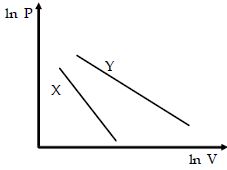
For two different gases $X$ and $Y,$ having degrees of freedom $f_1$ and $f_2$ and molar heat capacities at constant volume $C_{v_1}$ and $C_{v_2}$ respectively, for an adiabatic process, the $\ln P$ versus $\ln V$ graph is plotted as shown:
A
$f_1 > f_2$
B
$f_2 > f_1$
C
$C_{v_2} = C_{v_1}$
D
$C_{v_1} > C_{v_2}$
Solution
(B) For an adiabatic process, the relation between pressure $P$ and volume $V$ is given by $PV^{\gamma} = \text{constant}.$
Taking the natural logarithm on both sides, we get $\ln P + \gamma \ln V = \ln(\text{constant}).$
Rearranging this, we get $\ln P = -\gamma \ln V + \ln(\text{constant}).$
This is the equation of a straight line $y = mx + c,$ where the slope $m = -\gamma.$
The magnitude of the slope is equal to the adiabatic index $\gamma.$
From the given graph, the slope of line $X$ is greater than the slope of line $Y,$ so $\gamma_x > \gamma_y.$
Since $\gamma = 1 + \frac{2}{f},$ a larger $\gamma$ corresponds to a smaller degree of freedom $f.$
Therefore, $\gamma_x > \gamma_y \implies f_1 < f_2,$ which means $f_2 > f_1.$
Taking the natural logarithm on both sides, we get $\ln P + \gamma \ln V = \ln(\text{constant}).$
Rearranging this, we get $\ln P = -\gamma \ln V + \ln(\text{constant}).$
This is the equation of a straight line $y = mx + c,$ where the slope $m = -\gamma.$
The magnitude of the slope is equal to the adiabatic index $\gamma.$
From the given graph, the slope of line $X$ is greater than the slope of line $Y,$ so $\gamma_x > \gamma_y.$
Since $\gamma = 1 + \frac{2}{f},$ a larger $\gamma$ corresponds to a smaller degree of freedom $f.$
Therefore, $\gamma_x > \gamma_y \implies f_1 < f_2,$ which means $f_2 > f_1.$
0 likes
View Solution27
MediumMCQ
The mean rotational kinetic energy of a diatomic molecule at temperature $T$ is
A
$1/2 kT$
B
$kT$
C
$2kT$
D
$5/2 kT$
Solution
(B) diatomic molecule is treated as a rigid rotator with $2$ degrees of rotational freedom. According to the law of equipartition of energy,each degree of freedom contributes $1/2 kT$ to the average kinetic energy. Therefore,the mean rotational kinetic energy is $2 \times (1/2 kT) = kT$.
0 likes
View Solution28
MediumMCQ
When $x$ amount of heat is given to a gas at constant pressure,it performs $x/3$ amount of work. The average number of degrees of freedom per molecule is
A
$3$
B
$4$
C
$5$
D
$6$
Solution
(B) For an ideal gas at constant pressure,the heat supplied is $Q = n C_P \Delta T$ and the work done is $W = n R \Delta T$.
Given $Q = x$ and $W = x/3$,we have the ratio $\frac{W}{Q} = \frac{n R \Delta T}{n C_P \Delta T} = \frac{R}{C_P} = \frac{x/3}{x} = \frac{1}{3}$.
We know that $C_P = C_V + R = \frac{f}{2}R + R = R(\frac{f}{2} + 1) = R(\frac{f+2}{2})$.
Substituting this into the ratio: $\frac{R}{R(\frac{f+2}{2})} = \frac{2}{f+2} = \frac{1}{3}$.
Solving for $f$: $f+2 = 6$,which gives $f = 4$.
Given $Q = x$ and $W = x/3$,we have the ratio $\frac{W}{Q} = \frac{n R \Delta T}{n C_P \Delta T} = \frac{R}{C_P} = \frac{x/3}{x} = \frac{1}{3}$.
We know that $C_P = C_V + R = \frac{f}{2}R + R = R(\frac{f}{2} + 1) = R(\frac{f+2}{2})$.
Substituting this into the ratio: $\frac{R}{R(\frac{f+2}{2})} = \frac{2}{f+2} = \frac{1}{3}$.
Solving for $f$: $f+2 = 6$,which gives $f = 4$.
0 likes
View Solution29
EasyMCQ
An ideal gas has molecules with $5$ degrees of freedom. The ratio of specific heats at constant pressure $(C_p)$ and at constant volume $(C_v)$ is
A
$1.4$
B
$1.67$
C
$1.33$
D
$1.2$
Solution
(A) The ratio of specific heats at constant pressure $(C_p)$ and constant volume $(C_v)$ is given by the adiabatic index $\gamma$.
The formula for the ratio is $\gamma = \frac{C_p}{C_v} = 1 + \frac{2}{f}$,where $f$ is the number of degrees of freedom.
Given that the gas has $f = 5$ degrees of freedom:
$\gamma = 1 + \frac{2}{5} = 1 + 0.4 = 1.4$.
Therefore,the ratio of specific heats is $1.4$.
The formula for the ratio is $\gamma = \frac{C_p}{C_v} = 1 + \frac{2}{f}$,where $f$ is the number of degrees of freedom.
Given that the gas has $f = 5$ degrees of freedom:
$\gamma = 1 + \frac{2}{5} = 1 + 0.4 = 1.4$.
Therefore,the ratio of specific heats is $1.4$.
0 likes
View Solution30
DifficultMCQ
The specific heats,$C_P$ and $C_V$ of a gas of diatomic molecules,$A$,are given (in units of $J\, mol^{-1}\, K^{-1}$) by $29$ and $22$,respectively. Another gas of diatomic molecules,$B$,has the corresponding values $30$ and $21$. If they are treated as ideal gases,then:
A
$A$ has one vibrational mode and $B$ has two
B
Both $A$ and $B$ have a vibrational mode each
C
$A$ is rigid but $B$ has a vibrational mode
D
$A$ has a vibrational mode but $B$ has none
Solution
(D) For gas $A$: The molar heat capacity at constant volume is $C_V = 22 \, J\, mol^{-1}\, K^{-1}$.
Using the relation $C_V = \frac{f}{2}R$,where $R \approx 8.314 \, J\, mol^{-1}\, K^{-1}$,we get $f = \frac{2 C_V}{R} = \frac{2 \times 22}{8.314} \approx 5.29$.
Since $f$ is slightly greater than $5$ (the degrees of freedom for a rigid diatomic molecule),it indicates the presence of $1$ vibrational mode.
For gas $B$: The molar heat capacity at constant volume is $C_V = 21 \, J\, mol^{-1}\, K^{-1}$.
Using $f = \frac{2 C_V}{R} = \frac{2 \times 21}{8.314} \approx 5.05$.
This value is approximately $5$,which corresponds to a rigid diatomic molecule with no vibrational modes.
Thus,$A$ has a vibrational mode but $B$ has none.
Using the relation $C_V = \frac{f}{2}R$,where $R \approx 8.314 \, J\, mol^{-1}\, K^{-1}$,we get $f = \frac{2 C_V}{R} = \frac{2 \times 22}{8.314} \approx 5.29$.
Since $f$ is slightly greater than $5$ (the degrees of freedom for a rigid diatomic molecule),it indicates the presence of $1$ vibrational mode.
For gas $B$: The molar heat capacity at constant volume is $C_V = 21 \, J\, mol^{-1}\, K^{-1}$.
Using $f = \frac{2 C_V}{R} = \frac{2 \times 21}{8.314} \approx 5.05$.
This value is approximately $5$,which corresponds to a rigid diatomic molecule with no vibrational modes.
Thus,$A$ has a vibrational mode but $B$ has none.
0 likes
View Solution31
MediumMCQ
If the internal energy of $n_1$ moles of $He$ at temperature $10T$ is equal to the internal energy of $n_2$ moles of hydrogen $(H_2)$ at temperature $6T$,find the ratio $\frac{n_1}{n_2}$.
A
$3/5$
B
$2$
C
$1$
D
$5/3$
Solution
(C) The internal energy $U$ of an ideal gas is given by $U = \frac{f}{2} nRT$,where $f$ is the degrees of freedom,$n$ is the number of moles,$R$ is the universal gas constant,and $T$ is the absolute temperature.
For $He$ (a monoatomic gas),the degrees of freedom $f_1 = 3$. Given $n_1$ moles at $10T$,the internal energy is $U_1 = \frac{3}{2} n_1 R (10T) = 15 n_1 RT$.
For $H_2$ (a diatomic gas),the degrees of freedom $f_2 = 5$. Given $n_2$ moles at $6T$,the internal energy is $U_2 = \frac{5}{2} n_2 R (6T) = 15 n_2 RT$.
Equating the internal energies,$U_1 = U_2$,we get $15 n_1 RT = 15 n_2 RT$.
Therefore,$n_1 = n_2$,which implies $\frac{n_1}{n_2} = 1$.
For $He$ (a monoatomic gas),the degrees of freedom $f_1 = 3$. Given $n_1$ moles at $10T$,the internal energy is $U_1 = \frac{3}{2} n_1 R (10T) = 15 n_1 RT$.
For $H_2$ (a diatomic gas),the degrees of freedom $f_2 = 5$. Given $n_2$ moles at $6T$,the internal energy is $U_2 = \frac{5}{2} n_2 R (6T) = 15 n_2 RT$.
Equating the internal energies,$U_1 = U_2$,we get $15 n_1 RT = 15 n_2 RT$.
Therefore,$n_1 = n_2$,which implies $\frac{n_1}{n_2} = 1$.
0 likes
View Solution32
MediumMCQ
The ratio of total energy of all molecules of one mole of $O_2$ to the total energy of all molecules of two moles of $He$ at the same temperature is
A
$2 : 1$
B
$1 : 2$
C
$5 : 4$
D
$5 : 6$
Solution
(D) The total internal energy $U$ of $\mu$ moles of an ideal gas is given by $U = \frac{f}{2} \mu RT$,where $f$ is the degree of freedom,$\mu$ is the number of moles,$R$ is the universal gas constant,and $T$ is the absolute temperature.
For $O_2$ (a diatomic gas),the degree of freedom $f_1 = 5$ and $\mu_1 = 1$.
So,$U_{O_2} = \frac{5}{2} (1) RT = 2.5 RT$.
For $He$ (a monoatomic gas),the degree of freedom $f_2 = 3$ and $\mu_2 = 2$.
So,$U_{He} = \frac{3}{2} (2) RT = 3 RT$.
The ratio is $\frac{U_{O_2}}{U_{He}} = \frac{2.5 RT}{3 RT} = \frac{2.5}{3} = \frac{5}{6}$.
For $O_2$ (a diatomic gas),the degree of freedom $f_1 = 5$ and $\mu_1 = 1$.
So,$U_{O_2} = \frac{5}{2} (1) RT = 2.5 RT$.
For $He$ (a monoatomic gas),the degree of freedom $f_2 = 3$ and $\mu_2 = 2$.
So,$U_{He} = \frac{3}{2} (2) RT = 3 RT$.
The ratio is $\frac{U_{O_2}}{U_{He}} = \frac{2.5 RT}{3 RT} = \frac{2.5}{3} = \frac{5}{6}$.
0 likes
View Solution33
MediumMCQ
The mean kinetic energy of $1 \, mole$ of gas per degree of freedom (on the basis of kinetic theory of gases) is
A
$\frac{1}{2} kT$
B
$\frac{3}{2} kT$
C
$\frac{3}{2} RT$
D
$\frac{1}{2} RT$
Solution
(D) According to the equipartition theorem,the average kinetic energy associated with each degree of freedom for a single molecule is $\frac{1}{2} kT$,where $k$ is the Boltzmann constant and $T$ is the absolute temperature.
For $1 \, mole$ of gas,the number of molecules is equal to the Avogadro number,$N_A$.
Therefore,the mean kinetic energy for $1 \, mole$ per degree of freedom is $\frac{1}{2} kT \times N_A$.
Since $R = k \times N_A$ (where $R$ is the universal gas constant),the expression becomes $\frac{1}{2} RT$.
For $1 \, mole$ of gas,the number of molecules is equal to the Avogadro number,$N_A$.
Therefore,the mean kinetic energy for $1 \, mole$ per degree of freedom is $\frac{1}{2} kT \times N_A$.
Since $R = k \times N_A$ (where $R$ is the universal gas constant),the expression becomes $\frac{1}{2} RT$.
0 likes
View Solution34
EasyMCQ
$Assertion :$ For a gas atom,the number of degrees of freedom is $3$.
$Reason :$ $\frac{C_P}{C_V} = \gamma $
$Reason :$ $\frac{C_P}{C_V} = \gamma $
A
If both Assertion and Reason are correct and the Reason is a correct explanation of the Assertion.
B
If both Assertion and Reason are correct but Reason is not a correct explanation of the Assertion.
C
If the Assertion is correct but Reason is incorrect.
D
If both the Assertion and Reason are incorrect.
Solution
(B) monoatomic gas atom has $3$ degrees of freedom because it can only undergo translational motion along the $X-$,$Y-$,and $Z-$ axes. Rotational and vibrational degrees of freedom are not present for a single point-like atom.
Therefore,the Assertion is correct.
The expression $\frac{C_P}{C_V} = \gamma$ is a standard thermodynamic relation for the ratio of molar specific heats,which is also correct.
However,the value of the degrees of freedom is determined by the structure of the molecule (monoatomic,diatomic,etc.),not by the ratio of specific heats $\gamma$. Thus,the Reason is not the correct explanation of the Assertion.
Therefore,the Assertion is correct.
The expression $\frac{C_P}{C_V} = \gamma$ is a standard thermodynamic relation for the ratio of molar specific heats,which is also correct.
However,the value of the degrees of freedom is determined by the structure of the molecule (monoatomic,diatomic,etc.),not by the ratio of specific heats $\gamma$. Thus,the Reason is not the correct explanation of the Assertion.
0 likes
View Solution35
MediumMCQ
The value of $\gamma \left( = \frac{C_{p}}{C_{v}} \right)$ for hydrogen,helium,and another ideal diatomic gas $X$ (whose molecules are not rigid but have an additional vibrational mode) are respectively equal to:
A
$\frac{7}{5}, \frac{5}{3}, \frac{9}{7}$
B
$\frac{5}{3}, \frac{7}{5}, \frac{9}{7}$
C
$\frac{5}{3}, \frac{7}{5}, \frac{7}{5}$
D
$\frac{7}{5}, \frac{5}{3}, \frac{7}{5}$
Solution
(A) The adiabatic index is given by $\gamma = 1 + \frac{2}{f}$,where $f$ is the number of degrees of freedom.
$1$. Hydrogen $(H_2)$ is a diatomic gas at room temperature. Its degrees of freedom $f = 5$ ($3$ translational + $2$ rotational). Thus,$\gamma = 1 + \frac{2}{5} = \frac{7}{5}$.
$2$. Helium $(He)$ is a monoatomic gas. Its degrees of freedom $f = 3$ ($3$ translational). Thus,$\gamma = 1 + \frac{2}{3} = \frac{5}{3}$.
$3$. Gas $X$ is a diatomic gas with an additional vibrational mode. $A$ vibrational mode contributes $2$ degrees of freedom ($1$ kinetic + $1$ potential). So,$f = 5 + 2 = 7$. Thus,$\gamma = 1 + \frac{2}{7} = \frac{9}{7}$.
Therefore,the values are $\frac{7}{5}, \frac{5}{3}, \text{and } \frac{9}{7}$.
$1$. Hydrogen $(H_2)$ is a diatomic gas at room temperature. Its degrees of freedom $f = 5$ ($3$ translational + $2$ rotational). Thus,$\gamma = 1 + \frac{2}{5} = \frac{7}{5}$.
$2$. Helium $(He)$ is a monoatomic gas. Its degrees of freedom $f = 3$ ($3$ translational). Thus,$\gamma = 1 + \frac{2}{3} = \frac{5}{3}$.
$3$. Gas $X$ is a diatomic gas with an additional vibrational mode. $A$ vibrational mode contributes $2$ degrees of freedom ($1$ kinetic + $1$ potential). So,$f = 5 + 2 = 7$. Thus,$\gamma = 1 + \frac{2}{7} = \frac{9}{7}$.
Therefore,the values are $\frac{7}{5}, \frac{5}{3}, \text{and } \frac{9}{7}$.
0 likes
View Solution36
MediumMCQ
Consider two ideal diatomic gases $A$ and $B$ at some temperature $T$. Molecules of the gas $A$ are rigid,and have a mass $m$. Molecules of the gas $B$ have an additional vibrational mode,and have a mass $\frac{m}{4}$. The ratio of the specific heats $(C_{v}^{A}$ and $C_{v}^{B})$ of gas $A$ and $B$,respectively,is
A
$7:9$
B
$5:7$
C
$3:5$
D
$5:9$
Solution
(B) For a rigid diatomic molecule,the degrees of freedom $(f_A)$ are $5$ ($3$ translational + $2$ rotational).
For a diatomic molecule with an additional vibrational mode,the degrees of freedom $(f_B)$ are $7$ ($3$ translational + $2$ rotational + $2$ vibrational).
The molar specific heat at constant volume is given by $C_v = \frac{f}{2}R$.
Therefore,$C_v^A = \frac{5}{2}R$ and $C_v^B = \frac{7}{2}R$.
The ratio $\frac{C_v^A}{C_v^B} = \frac{\frac{5}{2}R}{\frac{7}{2}R} = \frac{5}{7}$.
For a diatomic molecule with an additional vibrational mode,the degrees of freedom $(f_B)$ are $7$ ($3$ translational + $2$ rotational + $2$ vibrational).
The molar specific heat at constant volume is given by $C_v = \frac{f}{2}R$.
Therefore,$C_v^A = \frac{5}{2}R$ and $C_v^B = \frac{7}{2}R$.
The ratio $\frac{C_v^A}{C_v^B} = \frac{\frac{5}{2}R}{\frac{7}{2}R} = \frac{5}{7}$.
0 likes
View Solution37
Difficult
Define degree of freedom.
Solution
(N/A) The degree of freedom is defined as the number of independent ways in which a molecule of a gas can possess energy or undergo motion.
The degree of freedom depends on the following factors:
$(1)$ The number of atoms in the molecule (atomicity).
$(2)$ The temperature of the gas (which determines the activation of vibrational modes).
Mathematically,the total number of independent quadratic terms in the expression for the total energy of a molecule is called its degree of freedom $(f)$.
The degree of freedom depends on the following factors:
$(1)$ The number of atoms in the molecule (atomicity).
$(2)$ The temperature of the gas (which determines the activation of vibrational modes).
Mathematically,the total number of independent quadratic terms in the expression for the total energy of a molecule is called its degree of freedom $(f)$.
0 likes
View Solution38
Medium
State and explain the law of equipartition of energy.
Solution
(N/A) Law of Equipartition of Energy: In thermal equilibrium,the total energy of a system is equally distributed among all its active degrees of freedom,and each degree of freedom is associated with an average energy equal to $\frac{1}{2} k_{B} T$,where $k_{B}$ is the Boltzmann constant and $T$ is the absolute temperature.
Consider a monoatomic gas molecule in thermal equilibrium at temperature $T$. The average kinetic energy of the molecule is given by:
$\langle E_{t} \rangle = \langle \frac{1}{2} m v_{x}^{2} \rangle + \langle \frac{1}{2} m v_{y}^{2} \rangle + \langle \frac{1}{2} m v_{z}^{2} \rangle$
From the kinetic theory of gases,we know that the average kinetic energy of a molecule is $\frac{3}{2} k_{B} T$:
$\langle E_{t} \rangle = \frac{3}{2} k_{B} T$
Since the gas is isotropic,the average kinetic energy along each axis is equal:
$\langle \frac{1}{2} m v_{x}^{2} \rangle = \langle \frac{1}{2} m v_{y}^{2} \rangle = \langle \frac{1}{2} m v_{z}^{2} \rangle$
Substituting this into the total energy equation:
$\frac{3}{2} k_{B} T = 3 \langle \frac{1}{2} m v_{x}^{2} \rangle$
Therefore,the energy associated with each degree of freedom is:
$\langle \frac{1}{2} m v_{x}^{2} \rangle = \frac{1}{2} k_{B} T$
This confirms that for every degree of freedom,the associated average energy is $\frac{1}{2} k_{B} T$. This is known as the Law of Equipartition of Energy.
Consider a monoatomic gas molecule in thermal equilibrium at temperature $T$. The average kinetic energy of the molecule is given by:
$\langle E_{t} \rangle = \langle \frac{1}{2} m v_{x}^{2} \rangle + \langle \frac{1}{2} m v_{y}^{2} \rangle + \langle \frac{1}{2} m v_{z}^{2} \rangle$
From the kinetic theory of gases,we know that the average kinetic energy of a molecule is $\frac{3}{2} k_{B} T$:
$\langle E_{t} \rangle = \frac{3}{2} k_{B} T$
Since the gas is isotropic,the average kinetic energy along each axis is equal:
$\langle \frac{1}{2} m v_{x}^{2} \rangle = \langle \frac{1}{2} m v_{y}^{2} \rangle = \langle \frac{1}{2} m v_{z}^{2} \rangle$
Substituting this into the total energy equation:
$\frac{3}{2} k_{B} T = 3 \langle \frac{1}{2} m v_{x}^{2} \rangle$
Therefore,the energy associated with each degree of freedom is:
$\langle \frac{1}{2} m v_{x}^{2} \rangle = \frac{1}{2} k_{B} T$
This confirms that for every degree of freedom,the associated average energy is $\frac{1}{2} k_{B} T$. This is known as the Law of Equipartition of Energy.
0 likes
View Solution39
Medium
Calculate the degree of freedom of a diatomic gas.
Solution
(N/A) diatomic gas molecule like $O_{2}$,$N_{2}$,$H_{2}$,or $CO$ has three translational degrees of freedom corresponding to motion along the $x$,$y$,and $z$ axes.
$E_{t} = \langle \frac{1}{2} m v_{x}^{2} \rangle + \langle \frac{1}{2} m v_{y}^{2} \rangle + \langle \frac{1}{2} m v_{z}^{2} \rangle$
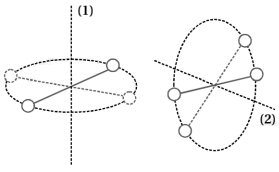
Additionally,it possesses two $(2)$ rotational degrees of freedom,as shown in the diagram. For a diatomic molecule,there are two independent rotational motions about axes perpendicular to the interatomic axis.
Let $\omega_{1}$ and $\omega_{2}$ be the angular speeds about axes $1$ and $2$,and $I_{1}$ and $I_{2}$ be the moments of inertia about these axes.
The total energy of the molecule is the sum of translational and rotational kinetic energy $(KE)$:
$E = E_{t} + E_{r}$
$E = \langle \frac{1}{2} m v_{x}^{2} \rangle + \langle \frac{1}{2} m v_{y}^{2} \rangle + \langle \frac{1}{2} m v_{z}^{2} \rangle + \langle \frac{1}{2} I_{1} \omega_{1}^{2} \rangle + \langle \frac{1}{2} I_{2} \omega_{2}^{2} \rangle$
Here,there are $3$ terms for translational $KE$ and $2$ terms for rotational $KE$,resulting in a total of $5$ degrees of freedom at room temperature.
At high temperatures,these molecules also exhibit a vibrational mode. The atoms oscillate along the interatomic axis like a one-dimensional harmonic oscillator,contributing two additional degrees of freedom (one for kinetic energy and one for potential energy),making the total $7$ degrees of freedom.
$E_{t} = \langle \frac{1}{2} m v_{x}^{2} \rangle + \langle \frac{1}{2} m v_{y}^{2} \rangle + \langle \frac{1}{2} m v_{z}^{2} \rangle$
Additionally,it possesses two $(2)$ rotational degrees of freedom,as shown in the diagram. For a diatomic molecule,there are two independent rotational motions about axes perpendicular to the interatomic axis.
Let $\omega_{1}$ and $\omega_{2}$ be the angular speeds about axes $1$ and $2$,and $I_{1}$ and $I_{2}$ be the moments of inertia about these axes.
The total energy of the molecule is the sum of translational and rotational kinetic energy $(KE)$:
$E = E_{t} + E_{r}$
$E = \langle \frac{1}{2} m v_{x}^{2} \rangle + \langle \frac{1}{2} m v_{y}^{2} \rangle + \langle \frac{1}{2} m v_{z}^{2} \rangle + \langle \frac{1}{2} I_{1} \omega_{1}^{2} \rangle + \langle \frac{1}{2} I_{2} \omega_{2}^{2} \rangle$
Here,there are $3$ terms for translational $KE$ and $2$ terms for rotational $KE$,resulting in a total of $5$ degrees of freedom at room temperature.
At high temperatures,these molecules also exhibit a vibrational mode. The atoms oscillate along the interatomic axis like a one-dimensional harmonic oscillator,contributing two additional degrees of freedom (one for kinetic energy and one for potential energy),making the total $7$ degrees of freedom.
0 likes
View Solution40
Medium
Derive the equation for the internal energy of a gas in terms of its degrees of freedom.
Solution
Let $N$ be the number of molecules of a given gas. If each molecule has $f$ degrees of freedom,then according to the law of equipartition of energy,the internal energy associated with each degree of freedom is $\frac{1}{2} k_{B} T$.
The total internal energy $U$ of the gas is given by:
$U = [\text{Total number of molecules}] \times [\text{Degrees of freedom per molecule}] \times [\text{Internal energy per degree of freedom}]$
$\therefore U = N \times f \times \frac{1}{2} k_{B} T$
Since $N = \mu N_{A}$,where $\mu$ is the number of moles and $N_{A}$ is Avogadro's number:
$U = \mu N_{A} \times f \times \frac{1}{2} k_{B} T$
Using the relation $R = N_{A} k_{B}$:
$U = \mu f \left( N_{A} k_{B} \right) \frac{1}{2} T$
$\therefore U = \frac{1}{2} \mu f RT$
The total internal energy $U$ of the gas is given by:
$U = [\text{Total number of molecules}] \times [\text{Degrees of freedom per molecule}] \times [\text{Internal energy per degree of freedom}]$
$\therefore U = N \times f \times \frac{1}{2} k_{B} T$
Since $N = \mu N_{A}$,where $\mu$ is the number of moles and $N_{A}$ is Avogadro's number:
$U = \mu N_{A} \times f \times \frac{1}{2} k_{B} T$
Using the relation $R = N_{A} k_{B}$:
$U = \mu f \left( N_{A} k_{B} \right) \frac{1}{2} T$
$\therefore U = \frac{1}{2} \mu f RT$
0 likes
View Solution41
Difficult
What is the degree of freedom?
Solution
(N/A) The degree of freedom $(f)$ of a dynamical system is defined as the total number of independent coordinates or ways in which a system can possess energy or move without violating any constraints imposed on it.
Mathematically,for a system of $N$ particles with $k$ constraints,the degree of freedom is given by $f = 3N - k$.
Mathematically,for a system of $N$ particles with $k$ constraints,the degree of freedom is given by $f = 3N - k$.
0 likes
View Solution42
Medium
Write the degrees of freedom for:
$(i)$ Monoatomic gas
$(ii)$ Diatomic gas
$(i)$ Monoatomic gas
$(ii)$ Diatomic gas
Solution
(N/A) The degree of freedom $(f)$ is defined as the number of independent ways in which a molecule can possess energy.
$(i)$ For a monoatomic gas (e.g.,$He, Ne, Ar$),the molecule can only have translational motion along the $x, y,$ and $z$ axes. Thus,it has $3$ translational degrees of freedom and $0$ rotational degrees of freedom. Total degrees of freedom $f = 3$.
$(ii)$ For a diatomic gas (e.g.,$H_2, O_2, N_2$) at room temperature,the molecule has $3$ translational degrees of freedom and $2$ rotational degrees of freedom (about the axes perpendicular to the bond axis). Total degrees of freedom $f = 3 + 2 = 5$.
$(i)$ For a monoatomic gas (e.g.,$He, Ne, Ar$),the molecule can only have translational motion along the $x, y,$ and $z$ axes. Thus,it has $3$ translational degrees of freedom and $0$ rotational degrees of freedom. Total degrees of freedom $f = 3$.
$(ii)$ For a diatomic gas (e.g.,$H_2, O_2, N_2$) at room temperature,the molecule has $3$ translational degrees of freedom and $2$ rotational degrees of freedom (about the axes perpendicular to the bond axis). Total degrees of freedom $f = 3 + 2 = 5$.
0 likes
View Solution43
MediumMCQ
Write the degree of freedom for a diatomic rigid rotator.
A
$3$
B
$5$
C
$6$
D
$7$
Solution
(B) diatomic molecule,modeled as a rigid rotator,consists of two atoms separated by a fixed distance.
It has $3$ translational degrees of freedom corresponding to motion along the $x, y,$ and $z$ axes.
Additionally,it has $2$ rotational degrees of freedom because it can rotate about the two axes perpendicular to the line connecting the atoms.
Therefore,the total degree of freedom $f$ is the sum of translational and rotational degrees of freedom: $f = 3 + 2 = 5$.
It has $3$ translational degrees of freedom corresponding to motion along the $x, y,$ and $z$ axes.
Additionally,it has $2$ rotational degrees of freedom because it can rotate about the two axes perpendicular to the line connecting the atoms.
Therefore,the total degree of freedom $f$ is the sum of translational and rotational degrees of freedom: $f = 3 + 2 = 5$.
0 likes
View Solution44
Easy
State the law of equipartition of energy.
Solution
(N/A) The law of equipartition of energy states that for a dynamic system in thermal equilibrium,the total energy of the system is distributed equally amongst all the degrees of freedom. The energy associated with each degree of freedom per molecule is $\frac{1}{2} k_B T$,where $k_B$ is the Boltzmann constant and $T$ is the absolute temperature of the system.
0 likes
View Solution45
MediumMCQ
Write the degree of freedom for a polyatomic gas.
A
$3$
B
$5$
C
$6$
D
$8$
Solution
(C) The degree of freedom $(f)$ of a gas molecule is defined as the number of independent ways in which a molecule can possess energy.
For a non-linear polyatomic gas molecule,there are $3$ translational degrees of freedom and $3$ rotational degrees of freedom.
Therefore,the total degree of freedom for a non-linear polyatomic gas is $f = 3 + 3 = 6$.
If the polyatomic gas is linear,it has $3$ translational and $2$ rotational degrees of freedom,resulting in $f = 5$ (at room temperature).
In general,for a non-linear polyatomic molecule,the degree of freedom is $6$.
For a non-linear polyatomic gas molecule,there are $3$ translational degrees of freedom and $3$ rotational degrees of freedom.
Therefore,the total degree of freedom for a non-linear polyatomic gas is $f = 3 + 3 = 6$.
If the polyatomic gas is linear,it has $3$ translational and $2$ rotational degrees of freedom,resulting in $f = 5$ (at room temperature).
In general,for a non-linear polyatomic molecule,the degree of freedom is $6$.
0 likes
View Solution46
MediumMCQ
What is the degree of freedom of a honey bee flying in a room?
A
$1$
B
$2$
C
$3$
D
$6$
Solution
(C) The degree of freedom of a particle or an object is defined as the number of independent coordinates required to specify its position in space.
Since a room is a three-dimensional space,a honey bee flying within it can move independently along the $x$,$y$,and $z$ axes.
Therefore,the number of degrees of freedom for the honey bee is $3$.
Since a room is a three-dimensional space,a honey bee flying within it can move independently along the $x$,$y$,and $z$ axes.
Therefore,the number of degrees of freedom for the honey bee is $3$.
0 likes
View Solution47
MediumMCQ
When the temperature of a gas is increased,does the degree of freedom change?
A
Yes
B
No
C
Depends on the gas
D
None of the above
Solution
(A) Yes,the degree of freedom changes with an increase in temperature. At low temperatures,only translational and rotational degrees of freedom are active. As the temperature increases,the vibrational mode of motion becomes active,which adds to the total degrees of freedom of the gas molecules.
0 likes
View Solution48
EasyMCQ
Degree of freedom of a gas depends on which factors?
A
Only temperature
B
Only atomicity
C
Atomicity and temperature
D
Pressure and volume
Solution
(C) The degree of freedom $(f)$ of a gas molecule is determined by its atomicity (monatomic,diatomic,or polyatomic),which defines the number of independent ways a molecule can store energy (translational,rotational,and vibrational).
At low temperatures,only translational and rotational degrees of freedom are active.
As the temperature increases,vibrational degrees of freedom may also become active,thus making the degree of freedom dependent on both atomicity and temperature.
At low temperatures,only translational and rotational degrees of freedom are active.
As the temperature increases,vibrational degrees of freedom may also become active,thus making the degree of freedom dependent on both atomicity and temperature.
0 likes
View Solution49
Difficult
Calculate the total number of degrees of freedom of molecules of hydrogen in $1$ $cc$ of hydrogen gas at $NTP$.
Solution
(N/A) The total number of degrees of freedom in a thermodynamic system is given by the product of the degrees of freedom per molecule and the total number of molecules.
At $NTP$,the volume occupied by $1$ mole of an ideal gas is $22400$ $cc$.
Using Avogadro's number $(N_A = 6.023 \times 10^{23})$,the number of molecules $(n)$ in $1$ $cc$ is:
$n = \frac{6.023 \times 10^{23}}{22400} \approx 2.688 \times 10^{19}$ molecules.
Hydrogen $(H_2)$ is a diatomic molecule. At room temperature,its degrees of freedom $(f)$ is $5$ ($3$ translational + $2$ rotational).
Total degrees of freedom $= f \times n = 5 \times 2.688 \times 10^{19} = 1.344 \times 10^{20}$.
At $NTP$,the volume occupied by $1$ mole of an ideal gas is $22400$ $cc$.
Using Avogadro's number $(N_A = 6.023 \times 10^{23})$,the number of molecules $(n)$ in $1$ $cc$ is:
$n = \frac{6.023 \times 10^{23}}{22400} \approx 2.688 \times 10^{19}$ molecules.
Hydrogen $(H_2)$ is a diatomic molecule. At room temperature,its degrees of freedom $(f)$ is $5$ ($3$ translational + $2$ rotational).
Total degrees of freedom $= f \times n = 5 \times 2.688 \times 10^{19} = 1.344 \times 10^{20}$.
0 likes
View Solution50
MediumMCQ
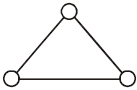
Consider a gas of triatomic molecules. The molecules are assumed to be triangular and made of massless rigid rods whose vertices are occupied by atoms. The internal energy of a mole of the gas at temperature $T$ is $......RT$.
A
$4.5$
B
$1.5$
C
$2.5$
D
$3$
Solution
(D) For a non-linear (triangular) rigid molecule,the degrees of freedom $(f)$ are calculated as follows:
$1$. Translational degrees of freedom: $3$ (along $x, y, z$ axes).
$2$. Rotational degrees of freedom: $3$ (about the three principal axes of rotation for a non-linear molecule).
Total degrees of freedom $(f)$ = $3 + 3 = 6$.
The internal energy $(U)$ of $n$ moles of an ideal gas is given by $U = \frac{f}{2} nRT$.
For $n = 1$ mole and $f = 6$:
$U = \frac{6}{2} \times 1 \times RT = 3RT$.
Thus,the internal energy is $3RT$.
$1$. Translational degrees of freedom: $3$ (along $x, y, z$ axes).
$2$. Rotational degrees of freedom: $3$ (about the three principal axes of rotation for a non-linear molecule).
Total degrees of freedom $(f)$ = $3 + 3 = 6$.
The internal energy $(U)$ of $n$ moles of an ideal gas is given by $U = \frac{f}{2} nRT$.
For $n = 1$ mole and $f = 6$:
$U = \frac{6}{2} \times 1 \times RT = 3RT$.
Thus,the internal energy is $3RT$.
0 likes
View SolutionKinetic Theory of Gases — Degree of Freedom · Frequently Asked Questions
1Are these Kinetic Theory of Gases questions useful for JEE and NEET?
Yes. All questions in this section are mapped to JEE Main and NEET exam patterns. Previous year questions from JEE Main, NEET, GUJCET and state-level exams are included with full solutions.
2Can I switch to Hindi or Gujarati for these questions?
Yes. Use the language tabs in the hero section or the sidebar to view the same questions and solutions in English, Hindi or Gujarati.
3How do I generate a question paper from this subtopic?
Use the Vedclass Exam Paper Generator — select the chapter and subtopic, set difficulty, and generate Sets A, B, C, D automatically. First 3 chapters of every subject are free.
Vedclass Products
For Students
Vedclass Test Series
Mock tests in real JEE/NEET style with performance analysis. 5-day free trial.
Start Free TrialFor Teachers
Exam Paper Generator
Generate Set A/B/C/D papers from this chapter in 2 minutes. 3 chapters free.
Try FreeFor Institutes
Online Exam Module
Live online exams with unlimited students, 360° analytics & white-label branding.
See DemoFor Teachers & Institutes
Generate a Kinetic Theory of Gases Exam Paper in 2 Minutes
Select subtopic & difficulty — Sets A, B, C, D auto-generated with No Repeat logic.
First 3 chapters of every subject are free — no payment required.