
A English
Motion of Satellites in Circular Orbits and Planets in Elliptical Orbits Questions in English
Class 11 Physics · Gravitation · Motion of Satellites in Circular Orbits and Planets in Elliptical Orbits
326+
Questions
English
Language
100%
With Solutions
Showing 23 of 326 questions in English
301
MediumMCQ
$A$ satellite is placed in a circular orbit around the Earth at an altitude of $1000 \,km$. The time period of the satellite in minutes is approximately (mass of the Earth $= 6 \times 10^{24} \,kg$, radius of the Earth $= 6.4 \times 10^6 \,m$, $G = 6.67 \times 10^{-11} \,Nm^2 \,kg^{-2}$).
A
$105$
B
$200$
C
$120$
D
$62$
Solution
$(A)$ Given: Altitude $h = 1000 \,km = 10^6 \,m$, Radius of Earth $R = 6.4 \times 10^6 \,m$, Mass of Earth $M = 6 \times 10^{24} \,kg$, Gravitational constant $G = 6.67 \times 10^{-11} \,Nm^2 \,kg^{-2}$.
The orbital radius is $r = R + h = 6.4 \times 10^6 + 1.0 \times 10^6 = 7.4 \times 10^6 \,m$.
The time period $T$ of a satellite is given by $T = 2 \pi \sqrt{\frac{r^3}{GM}}$.
Substituting the values:
$T = 2 \times 3.14 \times \sqrt{\frac{(7.4 \times 10^6)^3}{6.67 \times 10^{-11} \times 6 \times 10^{24}}}$
$T = 6.28 \times \sqrt{\frac{405.224 \times 10^{18}}{40.02 \times 10^{13}}}$
$T = 6.28 \times \sqrt{10.125 \times 10^5} = 6.28 \times \sqrt{1012500} \approx 6.28 \times 1006.23 \approx 6319 \,s$.
Converting to minutes: $T = \frac{6319}{60} \approx 105.3 \,min$.
Thus, the time period is approximately $105 \,min$.
The orbital radius is $r = R + h = 6.4 \times 10^6 + 1.0 \times 10^6 = 7.4 \times 10^6 \,m$.
The time period $T$ of a satellite is given by $T = 2 \pi \sqrt{\frac{r^3}{GM}}$.
Substituting the values:
$T = 2 \times 3.14 \times \sqrt{\frac{(7.4 \times 10^6)^3}{6.67 \times 10^{-11} \times 6 \times 10^{24}}}$
$T = 6.28 \times \sqrt{\frac{405.224 \times 10^{18}}{40.02 \times 10^{13}}}$
$T = 6.28 \times \sqrt{10.125 \times 10^5} = 6.28 \times \sqrt{1012500} \approx 6.28 \times 1006.23 \approx 6319 \,s$.
Converting to minutes: $T = \frac{6319}{60} \approx 105.3 \,min$.
Thus, the time period is approximately $105 \,min$.
0 likes
View Solution302
EasyMCQ
Two planets,$A$ and $B$,orbit around a star such that the time period of $A$ is $8$ times the time period of $B$. The ratio of the orbital velocities of planets $A$ and $B$ is:
A
$4: 1$
B
$1: 4$
C
$2: 1$
D
$1: 2$
Solution
(D) Given: $T_A = 8 T_B$.
According to Kepler's third law,$T^2 \propto R^3$,where $T$ is the time period and $R$ is the orbital radius.
Thus,$\frac{T_A^2}{T_B^2} = \frac{R_A^3}{R_B^3} \Rightarrow (8)^2 = \left(\frac{R_A}{R_B}\right)^3 \Rightarrow 64 = \left(\frac{R_A}{R_B}\right)^3$.
Taking the cube root,$\frac{R_A}{R_B} = (64)^{1/3} = 4$.
Orbital velocity $V$ is given by $V = \frac{2 \pi R}{T}$.
Therefore,the ratio of orbital velocities is $\frac{V_A}{V_B} = \frac{R_A}{R_B} \times \frac{T_B}{T_A} = 4 \times \frac{1}{8} = \frac{1}{2}$.
Hence,the ratio is $1: 2$.
According to Kepler's third law,$T^2 \propto R^3$,where $T$ is the time period and $R$ is the orbital radius.
Thus,$\frac{T_A^2}{T_B^2} = \frac{R_A^3}{R_B^3} \Rightarrow (8)^2 = \left(\frac{R_A}{R_B}\right)^3 \Rightarrow 64 = \left(\frac{R_A}{R_B}\right)^3$.
Taking the cube root,$\frac{R_A}{R_B} = (64)^{1/3} = 4$.
Orbital velocity $V$ is given by $V = \frac{2 \pi R}{T}$.
Therefore,the ratio of orbital velocities is $\frac{V_A}{V_B} = \frac{R_A}{R_B} \times \frac{T_B}{T_A} = 4 \times \frac{1}{8} = \frac{1}{2}$.
Hence,the ratio is $1: 2$.
0 likes
View Solution303
EasyMCQ
The orbital period of a geostationary satellite is (in $\,h$)
A
$2$
B
$5$
C
$24$
D
$12$
Solution
(C) geostationary satellite is a satellite that orbits the Earth in the same direction as the Earth's rotation (from west to east).
Its orbital period is exactly equal to the Earth's rotational period, which is $24 \,h$ (or $1 \,day$).
Its orbital period is exactly equal to the Earth's rotational period, which is $24 \,h$ (or $1 \,day$).
0 likes
View Solution304
MediumMCQ
$A$ geostationary satellite is taken to a new orbit such that its distance from the centre of the earth is doubled. Find the time period of this satellite in the new orbit.
A
$24 \text{ hrs}$
B
$4.8 \text{ hrs}$
C
$48 \sqrt{2} \text{ hrs}$
D
$24 \sqrt{2} \text{ hrs}$
Solution
(C) The orbital time period for a satellite is given by $T = 2 \pi \sqrt{\frac{r^3}{GM_E}}$.
From this relation,we can see that $T \propto r^{3/2}$.
For a geostationary satellite,the initial time period is $T_1 = 24 \text{ hrs}$.
Let the initial radius be $r_1$ and the new radius be $r_2 = 2r_1$.
Using the proportionality $T \propto r^{3/2}$,we have the ratio:
$\frac{T_2}{T_1} = \left( \frac{r_2}{r_1} \right)^{3/2}$.
Substituting the given values:
$\frac{T_2}{24} = \left( \frac{2r_1}{r_1} \right)^{3/2} = (2)^{3/2} = 2\sqrt{2}$.
Therefore,$T_2 = 24 \times 2\sqrt{2} = 48\sqrt{2} \text{ hrs}$.
From this relation,we can see that $T \propto r^{3/2}$.
For a geostationary satellite,the initial time period is $T_1 = 24 \text{ hrs}$.
Let the initial radius be $r_1$ and the new radius be $r_2 = 2r_1$.
Using the proportionality $T \propto r^{3/2}$,we have the ratio:
$\frac{T_2}{T_1} = \left( \frac{r_2}{r_1} \right)^{3/2}$.
Substituting the given values:
$\frac{T_2}{24} = \left( \frac{2r_1}{r_1} \right)^{3/2} = (2)^{3/2} = 2\sqrt{2}$.
Therefore,$T_2 = 24 \times 2\sqrt{2} = 48\sqrt{2} \text{ hrs}$.
0 likes
View Solution305
EasyMCQ
Using the data given below,find the height at which a communication satellite can reside. $(G=6.67 \times 10^{-11} \text{ N-m}^2 \text{ kg}^{-2}, M=5.98 \times 10^{24} \text{ kg}, R=6.4 \times 10^6 \text{ m})$ (in $\text{ km}$)
A
$35850$
B
$3585$
C
$358.5$
D
$35.85$
Solution
(A) Given: $G=6.67 \times 10^{-11} \text{ N-m}^2 \text{ kg}^{-2}$,$M=5.98 \times 10^{24} \text{ kg}$,$R=6.4 \times 10^6 \text{ m}$.
For a communication satellite,the time period $T = 24 \text{ h} = 24 \times 3600 \text{ s} = 8.64 \times 10^4 \text{ s}$.
The orbital radius $r = R+h$ is related to the time period by Kepler's Third Law: $T^2 = \frac{4 \pi^2 r^3}{GM}$.
Rearranging for $r$: $r = \left( \frac{T^2 GM}{4 \pi^2} \right)^{1/3}$.
Substituting the values:
$r = \left( \frac{(8.64 \times 10^4)^2 \times 6.67 \times 10^{-11} \times 5.98 \times 10^{24}}{4 \times (3.14)^2} \right)^{1/3}$.
$r \approx 42.25 \times 10^6 \text{ m}$.
Since $h = r - R$,we have $h = 42.25 \times 10^6 \text{ m} - 6.4 \times 10^6 \text{ m} = 35.85 \times 10^6 \text{ m}$.
Converting to kilometers: $h = 35850 \text{ km}$.
For a communication satellite,the time period $T = 24 \text{ h} = 24 \times 3600 \text{ s} = 8.64 \times 10^4 \text{ s}$.
The orbital radius $r = R+h$ is related to the time period by Kepler's Third Law: $T^2 = \frac{4 \pi^2 r^3}{GM}$.
Rearranging for $r$: $r = \left( \frac{T^2 GM}{4 \pi^2} \right)^{1/3}$.
Substituting the values:
$r = \left( \frac{(8.64 \times 10^4)^2 \times 6.67 \times 10^{-11} \times 5.98 \times 10^{24}}{4 \times (3.14)^2} \right)^{1/3}$.
$r \approx 42.25 \times 10^6 \text{ m}$.
Since $h = r - R$,we have $h = 42.25 \times 10^6 \text{ m} - 6.4 \times 10^6 \text{ m} = 35.85 \times 10^6 \text{ m}$.
Converting to kilometers: $h = 35850 \text{ km}$.
0 likes
View Solution306
EasyMCQ
$A$ ball is dropped from a spacecraft revolving around the earth at a height of $120 \ km$. What will happen to the ball?
A
It will continue to move with the same speed along the original orbit of the spacecraft.
B
It will move with the same speed tangentially to the original orbit.
C
It will fall down to the earth gradually.
D
It will go very far in space.
Solution
(A) When a ball is dropped from a spacecraft revolving around the earth at a height of $120 \ km$,the ball possesses the same orbital velocity as the spacecraft at the moment of release.
Since there is no external force (like air resistance) to change its state of motion in the vacuum of space,the ball will continue to move with the same speed and in the same direction as the spacecraft.
Therefore,it will continue to move along the original orbit of the spacecraft.
Since there is no external force (like air resistance) to change its state of motion in the vacuum of space,the ball will continue to move with the same speed and in the same direction as the spacecraft.
Therefore,it will continue to move along the original orbit of the spacecraft.
0 likes
View Solution307
EasyMCQ
$A$ satellite is to be placed in an equatorial geostationary orbit around the Earth for communication purposes. The height of such a satellite is $(M_{E} = 6 \times 10^{24} \,kg, R_{E} = 6400 \,km)$.
A
$3.57 \times 10^8 \,m$
B
$3.57 \times 10^7 \,m$
C
$3.57 \times 10^5 \,m$
D
$3.57 \times 10^6 \,m$
Solution
(B) For a geostationary satellite, the orbital period $T$ is $24$ hours, which is $24 \times 3600 = 86400 \,s$.
The formula for the orbital radius $r$ is given by Kepler's Third Law: $T^2 = \frac{4\pi^2 r^3}{GM_{E}}$.
Rearranging for $r$: $r = \left( \frac{GMT^2}{4\pi^2} \right)^{1/3}$.
Substituting the values: $G = 6.67 \times 10^{-11} \,Nm^2/kg^2$, $M_{E} = 6 \times 10^{24} \,kg$, $T = 86400 \,s$.
$r = \left( \frac{6.67 \times 10^{-11} \times 6 \times 10^{24} \times (86400)^2}{4 \times (3.14)^2} \right)^{1/3} \approx 4.22 \times 10^7 \,m$.
The height $h$ of the satellite above the Earth's surface is $h = r - R_{E}$.
$h = 4.22 \times 10^7 \,m - 0.64 \times 10^7 \,m = 3.58 \times 10^7 \,m$.
Rounding to the nearest given option, the height is approximately $3.57 \times 10^7 \,m$.
The formula for the orbital radius $r$ is given by Kepler's Third Law: $T^2 = \frac{4\pi^2 r^3}{GM_{E}}$.
Rearranging for $r$: $r = \left( \frac{GMT^2}{4\pi^2} \right)^{1/3}$.
Substituting the values: $G = 6.67 \times 10^{-11} \,Nm^2/kg^2$, $M_{E} = 6 \times 10^{24} \,kg$, $T = 86400 \,s$.
$r = \left( \frac{6.67 \times 10^{-11} \times 6 \times 10^{24} \times (86400)^2}{4 \times (3.14)^2} \right)^{1/3} \approx 4.22 \times 10^7 \,m$.
The height $h$ of the satellite above the Earth's surface is $h = r - R_{E}$.
$h = 4.22 \times 10^7 \,m - 0.64 \times 10^7 \,m = 3.58 \times 10^7 \,m$.
Rounding to the nearest given option, the height is approximately $3.57 \times 10^7 \,m$.
0 likes
View Solution308
MediumMCQ
The orbit of a geo-stationary satellite is circular. The time period of the satellite depends on:
$(i)$ mass of the satellite
(ii) mass of the earth
(iii) radius of the orbit
(iv) height of the satellite from the surface of the earth
Which of the following is correct?
$(i)$ mass of the satellite
(ii) mass of the earth
(iii) radius of the orbit
(iv) height of the satellite from the surface of the earth
Which of the following is correct?
A
$(i)$ only
B
$(i)$ and (ii)
C
$(i)$,(ii) and (iii)
D
(ii),(iii) and (iv)
Solution
(D) The time period $T$ of a satellite in a circular orbit is given by the formula $T = 2\pi \sqrt{\frac{r^3}{GM}}$,where $r$ is the orbital radius,$G$ is the gravitational constant,and $M$ is the mass of the earth.
$1$. The orbital radius $r$ is equal to $R + h$,where $R$ is the radius of the earth and $h$ is the height of the satellite from the earth's surface.
$2$. From the formula,it is clear that $T$ depends on the mass of the earth $(M)$,the radius of the orbit $(r)$,and the height $(h)$ because $r = R + h$.
$3$. The time period $T$ is independent of the mass of the satellite $(m)$.
Therefore,the time period depends on (ii),(iii),and (iv).
$1$. The orbital radius $r$ is equal to $R + h$,where $R$ is the radius of the earth and $h$ is the height of the satellite from the earth's surface.
$2$. From the formula,it is clear that $T$ depends on the mass of the earth $(M)$,the radius of the orbit $(r)$,and the height $(h)$ because $r = R + h$.
$3$. The time period $T$ is independent of the mass of the satellite $(m)$.
Therefore,the time period depends on (ii),(iii),and (iv).
0 likes
View Solution309
MediumMCQ
If the orbital speed of a body revolving in a circular path near the surface of the earth is $8 \ km s^{-1}$,then the orbital speed of a body revolving around the earth in a circular orbit at a height of $19,200 \ km$ from the surface of the earth is (Radius of the earth $R = 6400 \ km$). (in $km s^{-1}$)
A
$4$
B
$6$
C
$7.5$
D
$9$
Solution
(A) The orbital speed $v_0$ of a satellite at a distance $r$ from the center of the earth is given by $v_0 = \sqrt{\frac{GM}{r}}$.
For a body near the earth's surface,$r_1 = R = 6400 \ km$,so $v_1 = \sqrt{\frac{GM}{R}} = 8 \ km s^{-1}$.
For a body at a height $h = 19,200 \ km$,the distance from the center is $r_2 = R + h = 6400 + 19,200 = 25,600 \ km$.
The orbital speed at this height is $v_2 = \sqrt{\frac{GM}{r_2}}$.
Taking the ratio: $\frac{v_2}{v_1} = \sqrt{\frac{R}{r_2}} = \sqrt{\frac{6400}{25600}} = \sqrt{\frac{1}{4}} = \frac{1}{2}$.
Therefore,$v_2 = \frac{v_1}{2} = \frac{8 \ km s^{-1}}{2} = 4 \ km s^{-1}$.
For a body near the earth's surface,$r_1 = R = 6400 \ km$,so $v_1 = \sqrt{\frac{GM}{R}} = 8 \ km s^{-1}$.
For a body at a height $h = 19,200 \ km$,the distance from the center is $r_2 = R + h = 6400 + 19,200 = 25,600 \ km$.
The orbital speed at this height is $v_2 = \sqrt{\frac{GM}{r_2}}$.
Taking the ratio: $\frac{v_2}{v_1} = \sqrt{\frac{R}{r_2}} = \sqrt{\frac{6400}{25600}} = \sqrt{\frac{1}{4}} = \frac{1}{2}$.
Therefore,$v_2 = \frac{v_1}{2} = \frac{8 \ km s^{-1}}{2} = 4 \ km s^{-1}$.
0 likes
View Solution310
DifficultMCQ
The percentage increase in the energy for an artificial satellite to shift it from an orbit of radius $r$ to an orbit of radius $\frac{3r}{2}$ is
A
$66.7$
B
$50$
C
$33.33$
D
$25$
Solution
(C) The total energy of an artificial satellite in an orbit of radius $r$ is given by $E = -\frac{GMm}{2r}$.
Initial energy at radius $r$ is $E_1 = -\frac{GMm}{2r}$.
Final energy at radius $\frac{3r}{2}$ is $E_2 = -\frac{GMm}{2(\frac{3r}{2})} = -\frac{GMm}{3r}$.
The energy increases as the satellite moves to a higher orbit. The change in energy is $\Delta E = E_2 - E_1 = -\frac{GMm}{3r} - (-\frac{GMm}{2r}) = \frac{GMm}{2r} - \frac{GMm}{3r} = \frac{GMm}{6r}$.
The percentage increase is given by $\frac{\Delta E}{|E_1|} \times 100\%$.
Percentage increase $= \frac{\frac{GMm}{6r}}{\frac{GMm}{2r}} \times 100\% = \frac{2}{6} \times 100\% = \frac{1}{3} \times 100\% = 33.33\%$.
Initial energy at radius $r$ is $E_1 = -\frac{GMm}{2r}$.
Final energy at radius $\frac{3r}{2}$ is $E_2 = -\frac{GMm}{2(\frac{3r}{2})} = -\frac{GMm}{3r}$.
The energy increases as the satellite moves to a higher orbit. The change in energy is $\Delta E = E_2 - E_1 = -\frac{GMm}{3r} - (-\frac{GMm}{2r}) = \frac{GMm}{2r} - \frac{GMm}{3r} = \frac{GMm}{6r}$.
The percentage increase is given by $\frac{\Delta E}{|E_1|} \times 100\%$.
Percentage increase $= \frac{\frac{GMm}{6r}}{\frac{GMm}{2r}} \times 100\% = \frac{2}{6} \times 100\% = \frac{1}{3} \times 100\% = 33.33\%$.
0 likes
View Solution311
DifficultMCQ
$A$ satellite revolving around the earth at a certain height experiences acceleration due to gravity equal to $\frac{16}{49} g_0$,where $g_0$ is the acceleration due to gravity on the earth's surface. If $R$ is the radius of earth,then the square of time period of the satellite's revolution is equal to $K\left[\frac{\pi^2 R^3}{G M}\right]$. The value of $K$ is
A
$\frac{27}{36}$
B
$\frac{343}{16}$
C
$\frac{125}{64}$
D
$\frac{675}{81}$
Solution
(B) The acceleration due to gravity $g$ at a height $h$ from the surface of the earth is given by:
$g = g_0 \left( \frac{R}{R+h} \right)^2 = \frac{16}{49} g_0$
Taking the square root on both sides:
$\frac{R}{R+h} = \frac{4}{7}$
$7R = 4R + 4h \implies 4h = 3R \implies h = \frac{3R}{4}$
The orbital radius $r$ is:
$r = R + h = R + \frac{3R}{4} = \frac{7R}{4}$
The time period $T$ of a satellite is given by:
$T = 2\pi \sqrt{\frac{r^3}{GM}}$
Squaring both sides:
$T^2 = \frac{4\pi^2 r^3}{GM} = \frac{4\pi^2}{GM} \left( \frac{7R}{4} \right)^3 = \frac{4\pi^2}{GM} \left( \frac{343 R^3}{64} \right) = \frac{343}{16} \left[ \frac{\pi^2 R^3}{GM} \right]$
Comparing this with $K \left[ \frac{\pi^2 R^3}{GM} \right]$,we get $K = \frac{343}{16}$.
$g = g_0 \left( \frac{R}{R+h} \right)^2 = \frac{16}{49} g_0$
Taking the square root on both sides:
$\frac{R}{R+h} = \frac{4}{7}$
$7R = 4R + 4h \implies 4h = 3R \implies h = \frac{3R}{4}$
The orbital radius $r$ is:
$r = R + h = R + \frac{3R}{4} = \frac{7R}{4}$
The time period $T$ of a satellite is given by:
$T = 2\pi \sqrt{\frac{r^3}{GM}}$
Squaring both sides:
$T^2 = \frac{4\pi^2 r^3}{GM} = \frac{4\pi^2}{GM} \left( \frac{7R}{4} \right)^3 = \frac{4\pi^2}{GM} \left( \frac{343 R^3}{64} \right) = \frac{343}{16} \left[ \frac{\pi^2 R^3}{GM} \right]$
Comparing this with $K \left[ \frac{\pi^2 R^3}{GM} \right]$,we get $K = \frac{343}{16}$.

0 likes
View Solution312
EasyMCQ
An artificial satellite of mass $m$ revolves around the earth at a height $h$ with a speed $v$. How much power (energy per second) will it require to keep itself moving with constant speed in the orbit of radius $r$?
A
$\frac{m v^3}{r}$
B
$\frac{1}{2} m v^2$
C
$\frac{6 m M_e}{\left(R_e+h\right)}$
D
$0$
Solution
(D) The speed of the satellite is constant in a circular orbit.
According to the work-energy theorem,the net work done on the satellite is equal to the change in its kinetic energy.
Since the speed $v$ is constant,the kinetic energy $K = \frac{1}{2} m v^2$ remains constant.
Therefore,the change in kinetic energy $\Delta K = K_f - K_i = 0$.
Since the work done $W = \Delta K = 0$,the power required,which is defined as $P = \frac{W}{t}$,is also zero.
Thus,no external power is required to maintain the constant speed of the satellite in its orbit.
According to the work-energy theorem,the net work done on the satellite is equal to the change in its kinetic energy.
Since the speed $v$ is constant,the kinetic energy $K = \frac{1}{2} m v^2$ remains constant.
Therefore,the change in kinetic energy $\Delta K = K_f - K_i = 0$.
Since the work done $W = \Delta K = 0$,the power required,which is defined as $P = \frac{W}{t}$,is also zero.
Thus,no external power is required to maintain the constant speed of the satellite in its orbit.
0 likes
View Solution313
DifficultMCQ
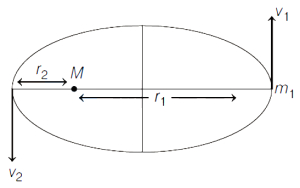
$A$ planet of mass $m$ moves in an elliptical orbit around an unknown star of mass $M$ such that its maximum and minimum distances from the star are equal to $r_1$ and $r_2$ respectively. The angular momentum of the planet relative to the centre of the star is
A
$m \sqrt{\frac{2 G M r_1 r_2}{r_1+r_2}}$
B
$0$
C
$m \sqrt{\frac{2 G M(r_1+r_2)}{r_1 r_2}}$
D
$\sqrt{\frac{2 G M m r_1}{(r_1+r_2) r_2}}$
Solution
(A) According to the law of conservation of angular momentum at the perihelion and aphelion points:
$m v_1 r_1 = m v_2 r_2$
$\Rightarrow v_2 = \frac{v_1 r_1}{r_2}$ $(i)$
From the law of conservation of total mechanical energy:
$-\frac{G M m}{r_1} + \frac{1}{2} m v_1^2 = -\frac{G M m}{r_2} + \frac{1}{2} m v_2^2$
Substituting $v_2$ from $(i)$:
$-\frac{G M}{r_1} + \frac{1}{2} v_1^2 = -\frac{G M}{r_2} + \frac{1}{2} \left(\frac{v_1 r_1}{r_2}\right)^2$
$\frac{1}{2} v_1^2 \left(1 - \frac{r_1^2}{r_2^2}\right) = G M \left(\frac{1}{r_1} - \frac{1}{r_2}\right)$
$\frac{1}{2} v_1^2 \left(\frac{r_2^2 - r_1^2}{r_2^2}\right) = G M \left(\frac{r_2 - r_1}{r_1 r_2}\right)$
$\frac{1}{2} v_1^2 \frac{(r_2 - r_1)(r_2 + r_1)}{r_2^2} = G M \frac{(r_2 - r_1)}{r_1 r_2}$
$v_1^2 = \frac{2 G M r_2}{r_1(r_1 + r_2)}$
$v_1 = \sqrt{\frac{2 G M r_2}{r_1(r_1 + r_2)}}$
Angular momentum $L = m v_1 r_1 = m \sqrt{\frac{2 G M r_2}{r_1(r_1 + r_2)}} \cdot r_1 = m \sqrt{\frac{2 G M r_1 r_2}{r_1 + r_2}}$
$m v_1 r_1 = m v_2 r_2$
$\Rightarrow v_2 = \frac{v_1 r_1}{r_2}$ $(i)$
From the law of conservation of total mechanical energy:
$-\frac{G M m}{r_1} + \frac{1}{2} m v_1^2 = -\frac{G M m}{r_2} + \frac{1}{2} m v_2^2$
Substituting $v_2$ from $(i)$:
$-\frac{G M}{r_1} + \frac{1}{2} v_1^2 = -\frac{G M}{r_2} + \frac{1}{2} \left(\frac{v_1 r_1}{r_2}\right)^2$
$\frac{1}{2} v_1^2 \left(1 - \frac{r_1^2}{r_2^2}\right) = G M \left(\frac{1}{r_1} - \frac{1}{r_2}\right)$
$\frac{1}{2} v_1^2 \left(\frac{r_2^2 - r_1^2}{r_2^2}\right) = G M \left(\frac{r_2 - r_1}{r_1 r_2}\right)$
$\frac{1}{2} v_1^2 \frac{(r_2 - r_1)(r_2 + r_1)}{r_2^2} = G M \frac{(r_2 - r_1)}{r_1 r_2}$
$v_1^2 = \frac{2 G M r_2}{r_1(r_1 + r_2)}$
$v_1 = \sqrt{\frac{2 G M r_2}{r_1(r_1 + r_2)}}$
Angular momentum $L = m v_1 r_1 = m \sqrt{\frac{2 G M r_2}{r_1(r_1 + r_2)}} \cdot r_1 = m \sqrt{\frac{2 G M r_1 r_2}{r_1 + r_2}}$
0 likes
View Solution314
DifficultMCQ
$A$ satellite is revolving very close to a planet of density $\rho$. The period of revolution of the satellite is
A
$\sqrt{\frac{3 \pi \rho}{G}}$
B
$\sqrt{\frac{3 \pi}{2 \rho G}}$
C
$\sqrt{\frac{3 \pi}{\rho G}}$
D
$\sqrt{\frac{3 \pi G}{\rho}}$
Solution
(C) The period of revolution $T$ of a satellite at a distance $r = R_p + h$ from the center of a planet of mass $M_p$ is given by $T = 2 \pi \sqrt{\frac{r^3}{G M_p}}$.
Since the satellite is revolving very close to the planet,$h \approx 0$,so $r \approx R_p$.
The mass of the planet in terms of its density $\rho$ and radius $R_p$ is $M_p = \frac{4}{3} \pi R_p^3 \rho$.
Substituting $M_p$ into the period formula:
$T = 2 \pi \sqrt{\frac{R_p^3}{G (\frac{4}{3} \pi R_p^3 \rho)}}$.
Simplifying the expression:
$T = 2 \pi \sqrt{\frac{3}{4 \pi G \rho}} = \sqrt{\frac{4 \pi^2 \cdot 3}{4 \pi G \rho}} = \sqrt{\frac{3 \pi}{G \rho}}$.
Since the satellite is revolving very close to the planet,$h \approx 0$,so $r \approx R_p$.
The mass of the planet in terms of its density $\rho$ and radius $R_p$ is $M_p = \frac{4}{3} \pi R_p^3 \rho$.
Substituting $M_p$ into the period formula:
$T = 2 \pi \sqrt{\frac{R_p^3}{G (\frac{4}{3} \pi R_p^3 \rho)}}$.
Simplifying the expression:
$T = 2 \pi \sqrt{\frac{3}{4 \pi G \rho}} = \sqrt{\frac{4 \pi^2 \cdot 3}{4 \pi G \rho}} = \sqrt{\frac{3 \pi}{G \rho}}$.
0 likes
View Solution315
EasyMCQ
Assertion $A$: An astronaut inside a massive spaceship orbiting around the Earth will experience a finite but small gravitational force.
Reason $R$: The centripetal force necessary to keep the spaceship in orbit around the Earth is provided by the gravitational force between the Earth and the spaceship.
Reason $R$: The centripetal force necessary to keep the spaceship in orbit around the Earth is provided by the gravitational force between the Earth and the spaceship.
A
Both $(A)$ and $(R)$ are true and $(R)$ is the correct explanation of $(A)$
B
Both $(A)$ and $(R)$ are true and $(R)$ is not the correct explanation of $(A)$
C
$(A)$ is true but $(R)$ is not true
D
$(A)$ is not true but $(R)$ is true
Solution
(D) The gravitational force acting on the astronaut is $F = G \frac{Mm}{r^2}$,which is finite and non-zero. However,the astronaut is in a state of free fall along with the spaceship. In the frame of reference of the spaceship,the gravitational force is balanced by the pseudo-force (centrifugal force),leading to a state of weightlessness. Therefore,the astronaut does not 'experience' any gravitational force (the effective weight is zero). Thus,Assertion $(A)$ is false.
Reason $(R)$ is a standard physical fact describing the orbital motion of satellites,which is true.
Reason $(R)$ is a standard physical fact describing the orbital motion of satellites,which is true.
0 likes
View Solution316
EasyMCQ
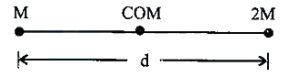
Two stars of masses $M$ and $2M$ are at a distance $d$ apart and are revolving around their common center of mass. The angular velocity of the system of the two stars is ($G$ is the universal gravitational constant).
A
$\sqrt{\frac{4 G M}{d^3}}$
B
$\sqrt{\frac{2 G M}{d^3}}$
C
$\sqrt{\frac{9 G M}{d^3}}$
D
$\sqrt{\frac{3 G M}{d^3}}$
Solution
(D) The two stars revolve around their common center of mass $(COM)$ with the same angular velocity $\omega$.
Let $r_1$ and $r_2$ be the distances of masses $M$ and $2M$ from the $COM$,respectively.
We know that $r_1 + r_2 = d$ and $M r_1 = (2M) r_2$.
From these,$r_1 = \frac{2M}{3M} d = \frac{2}{3} d$.
The gravitational force between the stars provides the necessary centripetal force for the star of mass $M$:
$F_g = F_c$
$\frac{G(M)(2M)}{d^2} = M \omega^2 r_1$
Substituting $r_1 = \frac{2}{3} d$:
$\frac{2 G M^2}{d^2} = M \omega^2 \left(\frac{2}{3} d\right)$
$\frac{2 G M}{d^2} = \omega^2 \left(\frac{2}{3} d\right)$
$\omega^2 = \frac{2 G M}{d^2} \cdot \frac{3}{2 d} = \frac{3 G M}{d^3}$
$\omega = \sqrt{\frac{3 G M}{d^3}}$
Let $r_1$ and $r_2$ be the distances of masses $M$ and $2M$ from the $COM$,respectively.
We know that $r_1 + r_2 = d$ and $M r_1 = (2M) r_2$.
From these,$r_1 = \frac{2M}{3M} d = \frac{2}{3} d$.
The gravitational force between the stars provides the necessary centripetal force for the star of mass $M$:
$F_g = F_c$
$\frac{G(M)(2M)}{d^2} = M \omega^2 r_1$
Substituting $r_1 = \frac{2}{3} d$:
$\frac{2 G M^2}{d^2} = M \omega^2 \left(\frac{2}{3} d\right)$
$\frac{2 G M}{d^2} = \omega^2 \left(\frac{2}{3} d\right)$
$\omega^2 = \frac{2 G M}{d^2} \cdot \frac{3}{2 d} = \frac{3 G M}{d^3}$
$\omega = \sqrt{\frac{3 G M}{d^3}}$
0 likes
View Solution317
MediumMCQ
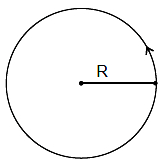
Two stars of equal masses $M$ are orbiting in a circle of radius $R$. Their orbital time period is proportional to
A
$R^{\frac{3}{2}}$
B
$R$
C
$R^2$
D
$R^{\frac{1}{2}}$
Solution
(A) For two stars of equal mass $M$ orbiting each other in a circular path of radius $R$,the distance between them is $d = 2R$.
The gravitational force between them provides the necessary centripetal force for circular motion.
The gravitational force is $F_g = \frac{G M^2}{(2R)^2} = \frac{G M^2}{4R^2}$.
The centripetal force required for a star of mass $M$ to move in a circle of radius $R$ with angular velocity $\omega$ is $F_c = M \omega^2 R$.
Equating the forces: $M \omega^2 R = \frac{G M^2}{4R^2}$.
Simplifying,$\omega^2 = \frac{G M}{4R^3}$.
Since the time period $T = \frac{2\pi}{\omega}$,we have $T^2 = \frac{4\pi^2}{\omega^2} = \frac{4\pi^2 (4R^3)}{GM} = \frac{16\pi^2 R^3}{GM}$.
Thus,$T^2 \propto R^3$,which implies $T \propto R^{\frac{3}{2}}$.
The gravitational force between them provides the necessary centripetal force for circular motion.
The gravitational force is $F_g = \frac{G M^2}{(2R)^2} = \frac{G M^2}{4R^2}$.
The centripetal force required for a star of mass $M$ to move in a circle of radius $R$ with angular velocity $\omega$ is $F_c = M \omega^2 R$.
Equating the forces: $M \omega^2 R = \frac{G M^2}{4R^2}$.
Simplifying,$\omega^2 = \frac{G M}{4R^3}$.
Since the time period $T = \frac{2\pi}{\omega}$,we have $T^2 = \frac{4\pi^2}{\omega^2} = \frac{4\pi^2 (4R^3)}{GM} = \frac{16\pi^2 R^3}{GM}$.
Thus,$T^2 \propto R^3$,which implies $T \propto R^{\frac{3}{2}}$.
0 likes
View Solution318
EasyMCQ
If a satellite has to orbit the earth in a circular path every $6 \text{ hrs}$, at what distance from the surface of the earth should the satellite be placed (in $\text{ km}$)? (Radius of earth $R_e = 6400 \text{ km}$)
(Assume $\frac{GM}{4\pi^2} = 8 \times 10^{12} \text{ m}^3\text{s}^{-2}$, where $G$ and $M$ are the gravitational constant and mass of earth, and $10^{1/3} = 2.1$)
(Assume $\frac{GM}{4\pi^2} = 8 \times 10^{12} \text{ m}^3\text{s}^{-2}$, where $G$ and $M$ are the gravitational constant and mass of earth, and $10^{1/3} = 2.1$)
A
$15100$
B
$8720$
C
$20600$
D
$5560$
Solution
(B) Given: Time period $T = 6 \text{ hrs} = 6 \times 3600 \text{ s} = 21600 \text{ s}$.
Radius of earth $R_e = 6400 \text{ km} = 6.4 \times 10^6 \text{ m}$.
Using Kepler's third law: $T^2 = \frac{4\pi^2 R^3}{GM}$, where $R$ is the orbital radius.
$R^3 = T^2 \times \frac{GM}{4\pi^2} = (21600)^2 \times 8 \times 10^{12}$.
$R^3 = (2.16 \times 10^4)^2 \times 8 \times 10^{12} = 4.6656 \times 10^8 \times 8 \times 10^{12} = 37.3248 \times 10^{20} \approx 3.732 \times 10^{21} \text{ m}^3$.
$R = (3732 \times 10^{18})^{1/3} = (3732)^{1/3} \times 10^6$.
Given $10^{1/3} = 2.1$, then $(3732)^{1/3} \approx 15.51$.
$R \approx 15.51 \times 10^6 \text{ m} = 15510 \text{ km}$.
Distance from surface $h = R - R_e = 15510 \text{ km} - 6400 \text{ km} = 9110 \text{ km}$.
Re-evaluating with provided constants: $R^3 = (21600)^2 \times 8 \times 10^{12} = 466560000 \times 8 \times 10^{12} = 3.73248 \times 10^{21}$.
$R = (3.73248 \times 10^{21})^{1/3} = (3732.48)^{1/3} \times 10^6 \approx 15.51 \times 10^6 \text{ m} = 15510 \text{ km}$.
$h = 15510 - 6400 = 9110 \text{ km}$. Note: Based on standard calculation, the closest option is $8720 \text{ km}$.
Radius of earth $R_e = 6400 \text{ km} = 6.4 \times 10^6 \text{ m}$.
Using Kepler's third law: $T^2 = \frac{4\pi^2 R^3}{GM}$, where $R$ is the orbital radius.
$R^3 = T^2 \times \frac{GM}{4\pi^2} = (21600)^2 \times 8 \times 10^{12}$.
$R^3 = (2.16 \times 10^4)^2 \times 8 \times 10^{12} = 4.6656 \times 10^8 \times 8 \times 10^{12} = 37.3248 \times 10^{20} \approx 3.732 \times 10^{21} \text{ m}^3$.
$R = (3732 \times 10^{18})^{1/3} = (3732)^{1/3} \times 10^6$.
Given $10^{1/3} = 2.1$, then $(3732)^{1/3} \approx 15.51$.
$R \approx 15.51 \times 10^6 \text{ m} = 15510 \text{ km}$.
Distance from surface $h = R - R_e = 15510 \text{ km} - 6400 \text{ km} = 9110 \text{ km}$.
Re-evaluating with provided constants: $R^3 = (21600)^2 \times 8 \times 10^{12} = 466560000 \times 8 \times 10^{12} = 3.73248 \times 10^{21}$.
$R = (3.73248 \times 10^{21})^{1/3} = (3732.48)^{1/3} \times 10^6 \approx 15.51 \times 10^6 \text{ m} = 15510 \text{ km}$.
$h = 15510 - 6400 = 9110 \text{ km}$. Note: Based on standard calculation, the closest option is $8720 \text{ km}$.
0 likes
View Solution319
DifficultMCQ
$A$ planet is moving in a circular orbit. It completes $2$ revolutions in $360$ days. What is its angular frequency?
A
$1.5 \times 10^{-2} \text{ rad day}^{-1}$
B
$2.5 \times 10^{-2} \text{ rad day}^{-1}$
C
$3.5 \times 10^{-2} \text{ rad day}^{-1}$
D
$4.5 \times 10^{-2} \text{ rad day}^{-1}$
Solution
(C) Given: The planet completes $2$ revolutions in $360$ days.
One complete revolution corresponds to an angle of $2\pi$ radians.
Therefore,the total angle $\theta$ covered in $2$ revolutions is $\theta = 2 \times 2\pi = 4\pi$ radians.
The time taken $t$ is $360$ days.
The angular frequency $\omega$ is defined as $\omega = \frac{\theta}{t}$.
Substituting the values: $\omega = \frac{4\pi}{360} = \frac{\pi}{90} \text{ rad day}^{-1}$.
Using $\pi \approx 3.14159$,we get $\omega \approx \frac{3.14159}{90} \approx 0.0349 \text{ rad day}^{-1}$.
This can be written in scientific notation as $3.49 \times 10^{-2} \text{ rad day}^{-1}$,which is approximately $3.5 \times 10^{-2} \text{ rad day}^{-1}$.
One complete revolution corresponds to an angle of $2\pi$ radians.
Therefore,the total angle $\theta$ covered in $2$ revolutions is $\theta = 2 \times 2\pi = 4\pi$ radians.
The time taken $t$ is $360$ days.
The angular frequency $\omega$ is defined as $\omega = \frac{\theta}{t}$.
Substituting the values: $\omega = \frac{4\pi}{360} = \frac{\pi}{90} \text{ rad day}^{-1}$.
Using $\pi \approx 3.14159$,we get $\omega \approx \frac{3.14159}{90} \approx 0.0349 \text{ rad day}^{-1}$.
This can be written in scientific notation as $3.49 \times 10^{-2} \text{ rad day}^{-1}$,which is approximately $3.5 \times 10^{-2} \text{ rad day}^{-1}$.
0 likes
View Solution320
DifficultMCQ
An earth's satellite near the surface of the earth takes about $90$ min per revolution. $A$ satellite orbiting the moon also takes about $90$ min per revolution. Then which of the following is true?
A
$\rho_m < \rho_e$
B
$\rho_m > \rho_e$
C
$\rho_m = \rho_e$
D
No conclusion can be made about the densities
Solution
(C) For a satellite orbiting near the surface of a planet of radius $R$ and density $\rho$,the gravitational force provides the necessary centripetal force.
$m g = m \omega^2 R$
Since $g = \frac{G M}{R^2}$ and $M = \rho \cdot \frac{4}{3} \pi R^3$,we have $g = \frac{G \rho \frac{4}{3} \pi R^3}{R^2} = \frac{4}{3} \pi G \rho R$.
Substituting this into the force equation:
$m (\frac{4}{3} \pi G \rho R) = m \omega^2 R$
$\omega^2 = \frac{4}{3} \pi G \rho$
Since $\omega = \frac{2 \pi}{T}$,we get $(\frac{2 \pi}{T})^2 = \frac{4}{3} \pi G \rho$,which simplifies to $T^2 = \frac{3 \pi}{G \rho}$.
Thus,$T \propto \frac{1}{\sqrt{\rho}}$.
Since both satellites have the same time period $T$,their densities must be equal,i.e.,$\rho_m = \rho_e$.
$m g = m \omega^2 R$
Since $g = \frac{G M}{R^2}$ and $M = \rho \cdot \frac{4}{3} \pi R^3$,we have $g = \frac{G \rho \frac{4}{3} \pi R^3}{R^2} = \frac{4}{3} \pi G \rho R$.
Substituting this into the force equation:
$m (\frac{4}{3} \pi G \rho R) = m \omega^2 R$
$\omega^2 = \frac{4}{3} \pi G \rho$
Since $\omega = \frac{2 \pi}{T}$,we get $(\frac{2 \pi}{T})^2 = \frac{4}{3} \pi G \rho$,which simplifies to $T^2 = \frac{3 \pi}{G \rho}$.
Thus,$T \propto \frac{1}{\sqrt{\rho}}$.
Since both satellites have the same time period $T$,their densities must be equal,i.e.,$\rho_m = \rho_e$.
0 likes
View Solution321
DifficultMCQ
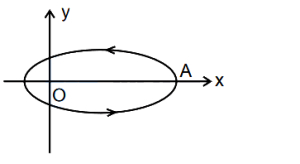
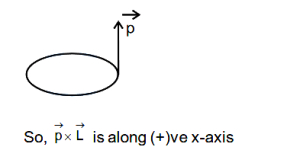
$A$ particle is moving in an elliptical orbit as shown in the figure. If $\vec{p}$,$\vec{L}$,and $\vec{r}$ denote the linear momentum,angular momentum,and position vector of the particle (from focus $O$) respectively at point $A$,then the direction of $\vec{\alpha} = \vec{p} \times \vec{L}$ is along
A
+ ve $x$ axis
B
- ve $x$ axis
C
+ ve $y$ axis
D
- ve $y$ axis
Solution
(A) The angular momentum $\vec{L}$ is defined as $\vec{L} = \vec{r} \times \vec{p}$. Since the particle moves in the $xy$-plane,$\vec{L}$ is directed along the $z$-axis (perpendicular to the plane of motion).
At point $A$,the particle is moving along the $y$-direction (tangent to the ellipse at the extreme right point),so the linear momentum $\vec{p}$ is along the $+y$ direction.
We need to find the direction of $\vec{\alpha} = \vec{p} \times \vec{L}$.
Using the right-hand rule for the cross product:
$\vec{p}$ is in the $+y$ direction $(\hat{j})$.
$\vec{L}$ is in the $+z$ direction $(\hat{k})$.
Therefore,$\vec{\alpha} = \vec{p} \times \vec{L} = (p\hat{j}) \times (L\hat{k}) = pL(\hat{j} \times \hat{k}) = pL\hat{i}$.
This corresponds to the $+x$ axis.
At point $A$,the particle is moving along the $y$-direction (tangent to the ellipse at the extreme right point),so the linear momentum $\vec{p}$ is along the $+y$ direction.
We need to find the direction of $\vec{\alpha} = \vec{p} \times \vec{L}$.
Using the right-hand rule for the cross product:
$\vec{p}$ is in the $+y$ direction $(\hat{j})$.
$\vec{L}$ is in the $+z$ direction $(\hat{k})$.
Therefore,$\vec{\alpha} = \vec{p} \times \vec{L} = (p\hat{j}) \times (L\hat{k}) = pL(\hat{j} \times \hat{k}) = pL\hat{i}$.
This corresponds to the $+x$ axis.
0 likes
View Solution322
MediumMCQ
$A$ planet moves around the sun in an elliptical orbit with the sun at one of its foci. The physical quantity associated with the motion of the planet that remains constant with time is
A
velocity
B
centripetal force
C
linear momentum
D
angular momentum
Solution
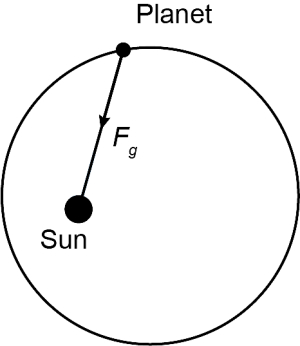
(D) planet revolves around the sun in an elliptical orbit under the influence of the gravitational force exerted by the sun.
Since the gravitational force $F$ always acts along the line joining the planet and the sun (the position vector $r$),the torque $\tau$ acting on the planet about the sun is given by $\tau = r \times F = rF \sin(180^{\circ}) = 0$.
According to the relation between torque and angular momentum,$\tau = \frac{dL}{dt}$.
Since $\tau = 0$,it follows that $\frac{dL}{dt} = 0$,which implies that the angular momentum $L$ is a constant with respect to time.
Therefore,the angular momentum of the planet remains constant.
Since the gravitational force $F$ always acts along the line joining the planet and the sun (the position vector $r$),the torque $\tau$ acting on the planet about the sun is given by $\tau = r \times F = rF \sin(180^{\circ}) = 0$.
According to the relation between torque and angular momentum,$\tau = \frac{dL}{dt}$.
Since $\tau = 0$,it follows that $\frac{dL}{dt} = 0$,which implies that the angular momentum $L$ is a constant with respect to time.
Therefore,the angular momentum of the planet remains constant.
0 likes
View Solution323
DifficultMCQ
Given below are two statements:
Statement $I$: $A$ satellite is moving around the Earth in an orbit very close to the Earth's surface. The time period of revolution of the satellite depends upon the density of the Earth.
Statement $II$: The time period of revolution of the satellite is $T = 2\pi\sqrt{\frac{R_e}{g}}$ (for a satellite very close to the Earth's surface),where $R_e$ is the radius of the Earth and $g$ is the acceleration due to gravity.
In the light of the above statements,choose the correct answer from the options given below:
Statement $I$: $A$ satellite is moving around the Earth in an orbit very close to the Earth's surface. The time period of revolution of the satellite depends upon the density of the Earth.
Statement $II$: The time period of revolution of the satellite is $T = 2\pi\sqrt{\frac{R_e}{g}}$ (for a satellite very close to the Earth's surface),where $R_e$ is the radius of the Earth and $g$ is the acceleration due to gravity.
In the light of the above statements,choose the correct answer from the options given below:
A
Both Statement $I$ and Statement $II$ are false
B
Both Statement $I$ and Statement $II$ are true
C
Statement $I$ is true but Statement $II$ is false
D
Statement $I$ is false but Statement $II$ is true
Solution
(B) The time period of a satellite orbiting close to the Earth's surface is given by $T = 2\pi\sqrt{\frac{R_e^3}{GM}}$.
Since the mass of the Earth $M = \rho \cdot \frac{4}{3}\pi R_e^3$,where $\rho$ is the density of the Earth,we can substitute $M$ into the formula:
$T = 2\pi\sqrt{\frac{R_e^3}{G(\rho \cdot \frac{4}{3}\pi R_e^3)}} = 2\pi\sqrt{\frac{3}{4\pi G\rho}}$.
This shows that $T$ depends on the density $\rho$ of the Earth. Thus,Statement $I$ is true.
For a satellite very close to the surface,the gravitational force provides the centripetal force,leading to $g = \frac{GM}{R_e^2}$.
Substituting $GM = gR_e^2$ into the general time period formula $T = 2\pi\sqrt{\frac{R_e^3}{GM}}$,we get $T = 2\pi\sqrt{\frac{R_e^3}{gR_e^2}} = 2\pi\sqrt{\frac{R_e}{g}}$.
Thus,Statement $II$ is true.
Since the mass of the Earth $M = \rho \cdot \frac{4}{3}\pi R_e^3$,where $\rho$ is the density of the Earth,we can substitute $M$ into the formula:
$T = 2\pi\sqrt{\frac{R_e^3}{G(\rho \cdot \frac{4}{3}\pi R_e^3)}} = 2\pi\sqrt{\frac{3}{4\pi G\rho}}$.
This shows that $T$ depends on the density $\rho$ of the Earth. Thus,Statement $I$ is true.
For a satellite very close to the surface,the gravitational force provides the centripetal force,leading to $g = \frac{GM}{R_e^2}$.
Substituting $GM = gR_e^2$ into the general time period formula $T = 2\pi\sqrt{\frac{R_e^3}{GM}}$,we get $T = 2\pi\sqrt{\frac{R_e^3}{gR_e^2}} = 2\pi\sqrt{\frac{R_e}{g}}$.
Thus,Statement $II$ is true.
0 likes
View SolutionGravitation — Motion of Satellites in Circular Orbits and Planets in Elliptical Orbits · Frequently Asked Questions
1Are these Gravitation questions useful for JEE and NEET?
Yes. All questions in this section are mapped to JEE Main and NEET exam patterns. Previous year questions from JEE Main, NEET, GUJCET and state-level exams are included with full solutions.
2Can I switch to Hindi or Gujarati for these questions?
Yes. Use the language tabs in the hero section or the sidebar to view the same questions and solutions in English, Hindi or Gujarati.
3How do I generate a question paper from this subtopic?
Use the Vedclass Exam Paper Generator — select the chapter and subtopic, set difficulty, and generate Sets A, B, C, D automatically. First 3 chapters of every subject are free.
Vedclass Products
For Students
Vedclass Test Series
Mock tests in real JEE/NEET style with performance analysis. 5-day free trial.
Start Free TrialFor Teachers
Exam Paper Generator
Generate Set A/B/C/D papers from this chapter in 2 minutes. 3 chapters free.
Try FreeFor Institutes
Online Exam Module
Live online exams with unlimited students, 360° analytics & white-label branding.
See DemoFor Teachers & Institutes
Generate a Gravitation Exam Paper in 2 Minutes
Select subtopic & difficulty — Sets A, B, C, D auto-generated with No Repeat logic.
First 3 chapters of every subject are free — no payment required.