
A English
Motion of Satellites in Circular Orbits and Planets in Elliptical Orbits Questions in English
Class 11 Physics · Gravitation · Motion of Satellites in Circular Orbits and Planets in Elliptical Orbits
326+
Questions
English
Language
100%
With Solutions
Showing 49 of 326 questions in English
251
EasyMCQ
The distances of two planets $A$ and $B$ from the sun are $r_A$ and $r_B$ respectively. Given that $r_B = 100 r_A$. If the orbital speed of planet $A$ is $v$,then the orbital speed of planet $B$ is:
A
$\frac{v}{10}$
B
$\frac{v}{2}$
C
$\sqrt{2} v$
D
$10 v$
Solution
(A) The orbital speed of a planet at a distance $r$ from the sun is given by the formula: $v_{\text{orb}} = \sqrt{\frac{GM}{r}}$.
For planet $A$,the orbital speed is $v_A = v = \sqrt{\frac{GM}{r_A}}$.
For planet $B$,the orbital speed is $v_B = \sqrt{\frac{GM}{r_B}}$.
Substituting $r_B = 100 r_A$ into the expression for $v_B$:
$v_B = \sqrt{\frac{GM}{100 r_A}} = \frac{1}{\sqrt{100}} \sqrt{\frac{GM}{r_A}} = \frac{1}{10} \sqrt{\frac{GM}{r_A}}$.
Since $v = \sqrt{\frac{GM}{r_A}}$,we have $v_B = \frac{v}{10}$.
For planet $A$,the orbital speed is $v_A = v = \sqrt{\frac{GM}{r_A}}$.
For planet $B$,the orbital speed is $v_B = \sqrt{\frac{GM}{r_B}}$.
Substituting $r_B = 100 r_A$ into the expression for $v_B$:
$v_B = \sqrt{\frac{GM}{100 r_A}} = \frac{1}{\sqrt{100}} \sqrt{\frac{GM}{r_A}} = \frac{1}{10} \sqrt{\frac{GM}{r_A}}$.
Since $v = \sqrt{\frac{GM}{r_A}}$,we have $v_B = \frac{v}{10}$.
0 likes
View Solution252
MediumMCQ
$A$ satellite is revolving around a planet in a circular orbit close to its surface. Let $\rho$ be the mean density and $R$ be the radius of the planet. Then the period of the satellite is ($G=$ universal constant of gravitation).
A
$\sqrt{\frac{4 \pi}{\rho G}}$
B
$\sqrt{\frac{\pi}{\rho G}}$
C
$\sqrt{\frac{3 \pi}{\rho G}}$
D
$\sqrt{\frac{2 \pi}{\rho G}}$
Solution
(C) From Kepler's third law,the time period $T$ is given by $T = 2 \pi \sqrt{\frac{r^3}{GM}}$.
Since the satellite is revolving close to the surface of the planet,we take the orbital radius $r = R$.
Thus,$T = 2 \pi \sqrt{\frac{R^3}{GM}} \dots (i)$.
The mass $M$ of the planet can be expressed in terms of its density $\rho$ and radius $R$ as $M = \text{Volume} \times \text{Density} = \frac{4}{3} \pi R^3 \rho \dots (ii)$.
Substituting the value of $M$ from equation $(ii)$ into equation $(i)$:
$T = 2 \pi \sqrt{\frac{R^3}{G \times \frac{4}{3} \pi R^3 \rho}}$
$T = 2 \pi \sqrt{\frac{3}{4 \pi G \rho}}$
$T = 2 \pi \times \frac{1}{2} \sqrt{\frac{3}{\pi G \rho}}$
$T = \sqrt{\frac{4 \pi^2 \times 3}{4 \pi G \rho}} = \sqrt{\frac{3 \pi}{\rho G}}$.
Since the satellite is revolving close to the surface of the planet,we take the orbital radius $r = R$.
Thus,$T = 2 \pi \sqrt{\frac{R^3}{GM}} \dots (i)$.
The mass $M$ of the planet can be expressed in terms of its density $\rho$ and radius $R$ as $M = \text{Volume} \times \text{Density} = \frac{4}{3} \pi R^3 \rho \dots (ii)$.
Substituting the value of $M$ from equation $(ii)$ into equation $(i)$:
$T = 2 \pi \sqrt{\frac{R^3}{G \times \frac{4}{3} \pi R^3 \rho}}$
$T = 2 \pi \sqrt{\frac{3}{4 \pi G \rho}}$
$T = 2 \pi \times \frac{1}{2} \sqrt{\frac{3}{\pi G \rho}}$
$T = \sqrt{\frac{4 \pi^2 \times 3}{4 \pi G \rho}} = \sqrt{\frac{3 \pi}{\rho G}}$.
0 likes
View Solution253
MediumMCQ
$A$ small planet is revolving around a very massive star in a circular orbit of radius $R$ with a period of revolution $T$. If the gravitational force between the planet and the star were proportional to $R^{-5/2}$,then $T$ would be proportional to:
A
$R^{3/2}$
B
$R^{3/5}$
C
$R^{7/2}$
D
$R^{7/4}$
Solution
(D) For a planet to orbit a star in a circular path,the gravitational force provides the necessary centripetal force.
Given that the gravitational force $F_G \propto R^{-5/2}$.
The centripetal force is given by $F_c = m \omega^2 R$,where $\omega = \frac{2\pi}{T}$.
Thus,$F_c = m \left(\frac{4\pi^2}{T^2}\right) R$.
Equating the forces: $m \left(\frac{4\pi^2}{T^2}\right) R \propto R^{-5/2}$.
Since $m$ and $4\pi^2$ are constants,we have $\frac{R}{T^2} \propto R^{-5/2}$.
Rearranging for $T^2$: $T^2 \propto R \cdot R^{5/2} = R^{7/2}$.
Taking the square root on both sides: $T \propto R^{7/4}$.
Given that the gravitational force $F_G \propto R^{-5/2}$.
The centripetal force is given by $F_c = m \omega^2 R$,where $\omega = \frac{2\pi}{T}$.
Thus,$F_c = m \left(\frac{4\pi^2}{T^2}\right) R$.
Equating the forces: $m \left(\frac{4\pi^2}{T^2}\right) R \propto R^{-5/2}$.
Since $m$ and $4\pi^2$ are constants,we have $\frac{R}{T^2} \propto R^{-5/2}$.
Rearranging for $T^2$: $T^2 \propto R \cdot R^{5/2} = R^{7/2}$.
Taking the square root on both sides: $T \propto R^{7/4}$.
0 likes
View Solution254
MediumMCQ
$A$ satellite of mass $m$ is revolving around the Earth of mass $M$ in an orbit of radius $r$ with constant angular velocity $\omega$. The angular momentum of the satellite is ($G=$ Universal constant of gravitation).
A
$m(GMr)^{3/2}$
B
$m(GMr)$
C
$m(GMr)^{1/2}$
D
$m(GMr)^{-1/2}$
Solution
(C) The gravitational force provides the necessary centripetal force for the satellite to revolve in a circular orbit:
$\frac{mv^2}{r} = \frac{GMm}{r^2}$
Solving for the orbital velocity $v$:
$v^2 = \frac{GM}{r} \implies v = \sqrt{\frac{GM}{r}}$
The angular momentum $L$ of the satellite is defined as $L = mvr$.
Substituting the expression for $v$:
$L = m \left( \sqrt{\frac{GM}{r}} \right) r$
$L = m \sqrt{GM} \cdot \sqrt{r} = m(GMr)^{1/2}$
$\frac{mv^2}{r} = \frac{GMm}{r^2}$
Solving for the orbital velocity $v$:
$v^2 = \frac{GM}{r} \implies v = \sqrt{\frac{GM}{r}}$
The angular momentum $L$ of the satellite is defined as $L = mvr$.
Substituting the expression for $v$:
$L = m \left( \sqrt{\frac{GM}{r}} \right) r$
$L = m \sqrt{GM} \cdot \sqrt{r} = m(GMr)^{1/2}$
0 likes
View Solution255
MediumMCQ
The time period $T$ of a satellite is related to the density $(\rho)$ of the planet around which it is orbiting close to the surface as:
A
$T \propto \rho^{1/2}$
B
$T \propto \rho$
C
$T \propto \rho^{-3/2}$
D
$T \propto \rho^{-1/2}$
Solution
(D) For a satellite orbiting close to the surface of a planet of radius $R$ and density $\rho$,the time period $T$ is given by $T = 2\pi \sqrt{\frac{R}{g}}$.
Since $g = \frac{GM}{R^2}$ and $M = \rho \cdot \frac{4}{3} \pi R^3$,we have $g = \frac{G \cdot \rho \cdot \frac{4}{3} \pi R^3}{R^2} = \frac{4}{3} G \pi \rho R$.
Substituting $g$ into the time period formula: $T = 2\pi \sqrt{\frac{R}{\frac{4}{3} G \pi \rho R}} = 2\pi \sqrt{\frac{3}{4 G \pi \rho}}$.
Thus,$T \propto \rho^{-1/2}$.
Since $g = \frac{GM}{R^2}$ and $M = \rho \cdot \frac{4}{3} \pi R^3$,we have $g = \frac{G \cdot \rho \cdot \frac{4}{3} \pi R^3}{R^2} = \frac{4}{3} G \pi \rho R$.
Substituting $g$ into the time period formula: $T = 2\pi \sqrt{\frac{R}{\frac{4}{3} G \pi \rho R}} = 2\pi \sqrt{\frac{3}{4 G \pi \rho}}$.
Thus,$T \propto \rho^{-1/2}$.
0 likes
View Solution256
MediumMCQ
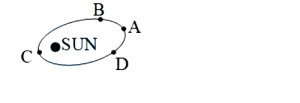
$A$ planet is moving around the sun in an elliptical orbit at different positions $A, B, C, D$. The maximum kinetic energy of the planet is at position:
A
$D$
B
$B$
C
$A$
D
$C$
Solution
(D) Concept: Angular momentum $(L)$ is conserved because the gravitational force exerted by the sun on the planet is a central force, resulting in zero torque about the sun.
$L = mvr \sin(\theta) = \text{constant}$.
At the perihelion (the point closest to the sun), the distance $r$ is minimum.
Since $L = mvr$ (where $v$ is the orbital velocity perpendicular to the radius vector at perihelion), for a constant $L$, the velocity $v$ must be maximum when $r$ is minimum.
Kinetic energy $(K.E.)$ is given by $K.E. = \frac{1}{2}mv^2$.
Therefore, when the velocity $v$ is maximum, the kinetic energy is also maximum.
Looking at the diagram, point $C$ is the closest to the sun (perihelion).
Thus, the planet has the maximum kinetic energy at position $C$.
$L = mvr \sin(\theta) = \text{constant}$.
At the perihelion (the point closest to the sun), the distance $r$ is minimum.
Since $L = mvr$ (where $v$ is the orbital velocity perpendicular to the radius vector at perihelion), for a constant $L$, the velocity $v$ must be maximum when $r$ is minimum.
Kinetic energy $(K.E.)$ is given by $K.E. = \frac{1}{2}mv^2$.
Therefore, when the velocity $v$ is maximum, the kinetic energy is also maximum.
Looking at the diagram, point $C$ is the closest to the sun (perihelion).
Thus, the planet has the maximum kinetic energy at position $C$.
0 likes
View Solution257
MediumMCQ
The radius of the orbit of a geostationary satellite is (mean radius of the earth is $R$,angular velocity about its axis is $\omega$,and acceleration due to gravity on the earth's surface is $g$).
A
$\left(\frac{g R^{2}}{\omega^{2}}\right)^{1 / 3}$
B
$\frac{g R^{2}}{\omega^{2}}$
C
$\left(\frac{g R^{2}}{\omega^{2}}\right)^{2 / 3}$
D
$\left(\frac{g R^{2}}{\omega^{2}}\right)^{1 / 2}$
Solution
(A) For a satellite to orbit the Earth,the gravitational force provides the necessary centripetal force.
$m r \omega^{2} = \frac{G M m}{r^{2}}$
Here,$r$ is the orbital radius,$M$ is the mass of the Earth,and $\omega$ is the angular velocity.
Simplifying the equation,we get $r^{3} = \frac{G M}{\omega^{2}}$.
We know that the acceleration due to gravity on the Earth's surface is $g = \frac{G M}{R^{2}}$,which implies $G M = g R^{2}$.
Substituting $G M$ in the expression for $r^{3}$,we get $r^{3} = \frac{g R^{2}}{\omega^{2}}$.
Therefore,the radius of the orbit is $r = \left(\frac{g R^{2}}{\omega^{2}}\right)^{1 / 3}$.
$m r \omega^{2} = \frac{G M m}{r^{2}}$
Here,$r$ is the orbital radius,$M$ is the mass of the Earth,and $\omega$ is the angular velocity.
Simplifying the equation,we get $r^{3} = \frac{G M}{\omega^{2}}$.
We know that the acceleration due to gravity on the Earth's surface is $g = \frac{G M}{R^{2}}$,which implies $G M = g R^{2}$.
Substituting $G M$ in the expression for $r^{3}$,we get $r^{3} = \frac{g R^{2}}{\omega^{2}}$.
Therefore,the radius of the orbit is $r = \left(\frac{g R^{2}}{\omega^{2}}\right)^{1 / 3}$.
0 likes
View Solution258
EasyMCQ
Two satellites of earth,$S_{1}$ and $S_{2}$,are moving in the same orbit. The mass of $S_{1}$ is four times the mass of $S_{2}$. Which one of the following statements is true?
A
The time period of $S_{1}$ is four times that of $S_{2}$
B
The potential energies of earth and satellite in the two cases are equal
C
$S_{1}$ and $S_{2}$ are moving with the same speed
D
The kinetic energies of the two satellites are equal
Solution
(C) The orbital speed of a satellite is given by $v = \sqrt{\frac{GM}{r}}$,where $G$ is the gravitational constant,$M$ is the mass of the earth,and $r$ is the radius of the orbit.
Since both satellites are in the same orbit,$r$ is the same for both.
Therefore,the orbital speed $v$ is independent of the mass of the satellite.
Thus,$S_{1}$ and $S_{2}$ move with the same speed.
The time period is given by $T = \frac{2\pi r}{v}$,which is also independent of the mass of the satellite.
Potential energy $U = -\frac{GMm}{r}$ and kinetic energy $K = \frac{GMm}{2r}$ both depend on the mass $m$ of the satellite,so they are not equal for $S_{1}$ and $S_{2}$.
Since both satellites are in the same orbit,$r$ is the same for both.
Therefore,the orbital speed $v$ is independent of the mass of the satellite.
Thus,$S_{1}$ and $S_{2}$ move with the same speed.
The time period is given by $T = \frac{2\pi r}{v}$,which is also independent of the mass of the satellite.
Potential energy $U = -\frac{GMm}{r}$ and kinetic energy $K = \frac{GMm}{2r}$ both depend on the mass $m$ of the satellite,so they are not equal for $S_{1}$ and $S_{2}$.
0 likes
View Solution259
MediumMCQ
Two particles of equal mass $m$ move in a circle of radius $r$ under the action of their mutual gravitational attraction. The speed of each particle will be ($G=$ Universal gravitational constant).
A
$\sqrt{\frac{G m}{4 r}}$
B
$\sqrt{\frac{G m}{r}}$
C
$\sqrt{\frac{G m}{2 r}}$
D
$\sqrt{\frac{4 Gm}{r}}$
Solution
(A) The two particles of mass $m$ are moving in a circle of radius $r$. The distance between them is the diameter of the circle,which is $2r$.
The gravitational force between the two particles acts as the centripetal force required for circular motion.
The gravitational force is given by $F_g = \frac{G m m}{(2r)^2} = \frac{G m^2}{4r^2}$.
The centripetal force required for a particle of mass $m$ moving with speed $v$ in a circle of radius $r$ is $F_c = \frac{m v^2}{r}$.
Equating the two forces: $\frac{m v^2}{r} = \frac{G m^2}{4r^2}$.
Solving for $v^2$: $v^2 = \frac{G m}{4r}$.
Taking the square root,we get $v = \sqrt{\frac{G m}{4r}}$.
The gravitational force between the two particles acts as the centripetal force required for circular motion.
The gravitational force is given by $F_g = \frac{G m m}{(2r)^2} = \frac{G m^2}{4r^2}$.
The centripetal force required for a particle of mass $m$ moving with speed $v$ in a circle of radius $r$ is $F_c = \frac{m v^2}{r}$.
Equating the two forces: $\frac{m v^2}{r} = \frac{G m^2}{4r^2}$.
Solving for $v^2$: $v^2 = \frac{G m}{4r}$.
Taking the square root,we get $v = \sqrt{\frac{G m}{4r}}$.
0 likes
View Solution260
MediumMCQ
The radii of circular orbits of two satellites $A$ and $B$ of the earth are $4R$ and $R$ respectively,where $R$ is the radius of the earth. If the speed of satellite $B$ is $6V$,then the speed of satellite $A$ will be:
A
$3V$
B
$4V$
C
$12V$
D
$3V/4$
Solution
(A) The orbital speed $v$ of a satellite at a distance $r$ from the center of the earth is given by the formula $v = \sqrt{\frac{GM}{r}}$.
From this relation,we can see that $v \propto \frac{1}{\sqrt{r}}$.
Let $v_A$ and $v_B$ be the speeds of satellites $A$ and $B$ with orbital radii $r_A = 4R$ and $r_B = R$ respectively.
Taking the ratio,we get $\frac{v_A}{v_B} = \sqrt{\frac{r_B}{r_A}}$.
Substituting the given values,$\frac{v_A}{6V} = \sqrt{\frac{R}{4R}} = \sqrt{\frac{1}{4}} = \frac{1}{2}$.
Therefore,$v_A = 6V \times \frac{1}{2} = 3V$.
From this relation,we can see that $v \propto \frac{1}{\sqrt{r}}$.
Let $v_A$ and $v_B$ be the speeds of satellites $A$ and $B$ with orbital radii $r_A = 4R$ and $r_B = R$ respectively.
Taking the ratio,we get $\frac{v_A}{v_B} = \sqrt{\frac{r_B}{r_A}}$.
Substituting the given values,$\frac{v_A}{6V} = \sqrt{\frac{R}{4R}} = \sqrt{\frac{1}{4}} = \frac{1}{2}$.
Therefore,$v_A = 6V \times \frac{1}{2} = 3V$.
0 likes
View Solution261
MediumMCQ
Two satellites $P$ and $Q$ go round a planet in circular orbits having radii $3R$ and $R$ respectively. If the speed of satellite $P$ is $2V$,what will be the speed of satellite $Q$?
A
$2 \sqrt{3} V$
B
$\frac{2V}{\sqrt{3}}$
C
$\frac{V}{2}$
D
$\frac{V}{\sqrt{3}}$
Solution
(A) The orbital speed $v$ of a satellite revolving around a planet of mass $M$ at a distance $r$ is given by the formula $v = \sqrt{\frac{GM}{r}}$.
This implies that $v \propto \frac{1}{\sqrt{r}}$.
Given the radii of the orbits are $r_P = 3R$ and $r_Q = R$.
Let $v_P$ and $v_Q$ be the orbital speeds of satellites $P$ and $Q$ respectively.
Then,$\frac{v_Q}{v_P} = \sqrt{\frac{r_P}{r_Q}}$.
Substituting the given values: $\frac{v_Q}{2V} = \sqrt{\frac{3R}{R}} = \sqrt{3}$.
Therefore,$v_Q = 2V \times \sqrt{3} = 2\sqrt{3}V$.
This implies that $v \propto \frac{1}{\sqrt{r}}$.
Given the radii of the orbits are $r_P = 3R$ and $r_Q = R$.
Let $v_P$ and $v_Q$ be the orbital speeds of satellites $P$ and $Q$ respectively.
Then,$\frac{v_Q}{v_P} = \sqrt{\frac{r_P}{r_Q}}$.
Substituting the given values: $\frac{v_Q}{2V} = \sqrt{\frac{3R}{R}} = \sqrt{3}$.
Therefore,$v_Q = 2V \times \sqrt{3} = 2\sqrt{3}V$.
0 likes
View Solution262
MediumMCQ
The gravitational potential energy required to raise a satellite of mass $m$ to a height $h$ above the Earth's surface is $E_1$. Let the energy required to put this satellite into orbit at the same height be $E_2$. If $M$ and $R$ are the mass and radius of the Earth respectively,then the ratio $E_1: E_2$ is:
A
$h: R$
B
$h: 2R$
C
$R: h$
D
$2h: R$
Solution
(D) The energy required to raise a satellite to a height $h$ is the change in potential energy: $E_1 = U_f - U_i = -\frac{GMm}{R+h} - (-\frac{GMm}{R}) = GMm \left( \frac{1}{R} - \frac{1}{R+h} \right) = \frac{GMmh}{R(R+h)}$.
Using $g = \frac{GM}{R^2}$,we get $GM = gR^2$. Substituting this,$E_1 = \frac{gR^2mh}{R(R+h)} = \frac{mgh}{1 + h/R}$.
The energy required to put the satellite into orbit at height $h$ is the kinetic energy $E_2 = \frac{1}{2}mv_0^2$. Since $v_0 = \sqrt{\frac{GM}{R+h}}$,$E_2 = \frac{1}{2}m \left( \frac{GM}{R+h} \right) = \frac{GMm}{2(R+h)}$.
Substituting $GM = gR^2$,$E_2 = \frac{gR^2m}{2(R+h)} = \frac{mgR}{2(1 + h/R)}$.
Taking the ratio: $\frac{E_1}{E_2} = \frac{mgh / (1 + h/R)}{mgR / (2(1 + h/R))} = \frac{h}{R/2} = \frac{2h}{R}$.
Using $g = \frac{GM}{R^2}$,we get $GM = gR^2$. Substituting this,$E_1 = \frac{gR^2mh}{R(R+h)} = \frac{mgh}{1 + h/R}$.
The energy required to put the satellite into orbit at height $h$ is the kinetic energy $E_2 = \frac{1}{2}mv_0^2$. Since $v_0 = \sqrt{\frac{GM}{R+h}}$,$E_2 = \frac{1}{2}m \left( \frac{GM}{R+h} \right) = \frac{GMm}{2(R+h)}$.
Substituting $GM = gR^2$,$E_2 = \frac{gR^2m}{2(R+h)} = \frac{mgR}{2(1 + h/R)}$.
Taking the ratio: $\frac{E_1}{E_2} = \frac{mgh / (1 + h/R)}{mgR / (2(1 + h/R))} = \frac{h}{R/2} = \frac{2h}{R}$.
0 likes
View Solution263
EasyMCQ
Two satellites $A$ and $B$ having ratio of masses $3: 1$ are revolving in circular orbits of radii $r$ and $4r$. The ratio of total energy of satellites $A$ to that of $B$ is
A
$1: 3$
B
$3: 1$
C
$3: 4$
D
$12: 1$
Solution
(D) The total energy $E$ of a satellite of mass $m$ revolving in an orbit of radius $r$ around a planet of mass $M$ is given by $E = -\frac{GMm}{2r}$.
From this expression,we can see that $E \propto \frac{m}{r}$.
Given the mass ratio $\frac{m_A}{m_B} = \frac{3}{1}$ and the radius ratio $\frac{r_A}{r_B} = \frac{r}{4r} = \frac{1}{4}$.
Therefore,the ratio of the total energies is $\frac{E_A}{E_B} = \frac{m_A}{m_B} \times \frac{r_B}{r_A}$.
Substituting the given values: $\frac{E_A}{E_B} = \frac{3}{1} \times \frac{4r}{r} = \frac{12}{1}$.
Thus,the ratio is $12: 1$.
From this expression,we can see that $E \propto \frac{m}{r}$.
Given the mass ratio $\frac{m_A}{m_B} = \frac{3}{1}$ and the radius ratio $\frac{r_A}{r_B} = \frac{r}{4r} = \frac{1}{4}$.
Therefore,the ratio of the total energies is $\frac{E_A}{E_B} = \frac{m_A}{m_B} \times \frac{r_B}{r_A}$.
Substituting the given values: $\frac{E_A}{E_B} = \frac{3}{1} \times \frac{4r}{r} = \frac{12}{1}$.
Thus,the ratio is $12: 1$.
0 likes
View Solution264
MediumMCQ
For a satellite moving in an orbit around the earth at height '$h$',the ratio of kinetic energy to potential energy is
A
$2: 1$
B
$1: 2$
C
$1: \sqrt{2}$
D
$\sqrt{2}: 1$
Solution
(B) Let $M_e$ be the mass of the earth,$m$ be the mass of the satellite,and $r = R_e + h$ be the orbital radius.
The potential energy $U$ of the satellite is given by $U = -\frac{GM_e m}{r}$.
The orbital velocity $v$ of the satellite is given by $v = \sqrt{\frac{GM_e}{r}}$.
The kinetic energy $K$ is given by $K = \frac{1}{2}mv^2 = \frac{1}{2}m \left(\frac{GM_e}{r}\right) = \frac{GM_e m}{2r}$.
Comparing the magnitudes,we have $K = \frac{1}{2} |U|$.
Therefore,the ratio of kinetic energy to the magnitude of potential energy is $K : |U| = 1 : 2$.
The potential energy $U$ of the satellite is given by $U = -\frac{GM_e m}{r}$.
The orbital velocity $v$ of the satellite is given by $v = \sqrt{\frac{GM_e}{r}}$.
The kinetic energy $K$ is given by $K = \frac{1}{2}mv^2 = \frac{1}{2}m \left(\frac{GM_e}{r}\right) = \frac{GM_e m}{2r}$.
Comparing the magnitudes,we have $K = \frac{1}{2} |U|$.
Therefore,the ratio of kinetic energy to the magnitude of potential energy is $K : |U| = 1 : 2$.
0 likes
View Solution265
MediumMCQ
$A$ satellite is orbiting just above the surface of a planet of density $\rho$ with a periodic time $T$. The quantity $T^2 \rho$ is equal to ($G=$ universal gravitational constant).
A
$\frac{4 \pi^2}{G}$
B
$\frac{3 \pi^2}{G}$
C
$\frac{3 \pi}{G}$
D
$\frac{\pi}{G}$
Solution
(C) The time period $T$ of a satellite orbiting just above the surface of a planet of radius $R$ is given by $T = 2 \pi \sqrt{\frac{R}{g}}$.
Squaring both sides,we get $T^2 = 4 \pi^2 \frac{R}{g}$.
We know that the acceleration due to gravity $g$ at the surface of a planet is given by $g = \frac{GM}{R^2}$.
Since the mass $M$ of the planet is $M = \text{Volume} \times \text{Density} = \frac{4}{3} \pi R^3 \rho$,we substitute $M$ into the expression for $g$:
$g = \frac{G}{R^2} \left( \frac{4}{3} \pi R^3 \rho \right) = \frac{4}{3} \pi \rho G R$.
Now,substitute this expression for $g$ into the equation for $T^2$:
$T^2 = 4 \pi^2 \frac{R}{\frac{4}{3} \pi \rho G R} = 4 \pi^2 \times \frac{3}{4 \pi \rho G} = \frac{3 \pi}{\rho G}$.
Rearranging the terms,we get $T^2 \rho = \frac{3 \pi}{G}$.
Squaring both sides,we get $T^2 = 4 \pi^2 \frac{R}{g}$.
We know that the acceleration due to gravity $g$ at the surface of a planet is given by $g = \frac{GM}{R^2}$.
Since the mass $M$ of the planet is $M = \text{Volume} \times \text{Density} = \frac{4}{3} \pi R^3 \rho$,we substitute $M$ into the expression for $g$:
$g = \frac{G}{R^2} \left( \frac{4}{3} \pi R^3 \rho \right) = \frac{4}{3} \pi \rho G R$.
Now,substitute this expression for $g$ into the equation for $T^2$:
$T^2 = 4 \pi^2 \frac{R}{\frac{4}{3} \pi \rho G R} = 4 \pi^2 \times \frac{3}{4 \pi \rho G} = \frac{3 \pi}{\rho G}$.
Rearranging the terms,we get $T^2 \rho = \frac{3 \pi}{G}$.
0 likes
View Solution266
MediumMCQ
Periodic time of a satellite revolving above the earth's surface at a height equal to radius of the earth '$R$' is [$g=$ acceleration due to gravity].
A
$2 \pi \sqrt{\frac{2 R}{g}}$
B
$4 \pi \sqrt{\frac{2 R}{g}}$
C
$2 \pi \sqrt{\frac{R}{g}}$
D
$8 \pi \sqrt{\frac{R}{g}}$
Solution
(B) The formula for the time period of a satellite at height $h$ above the Earth's surface is given by $T = 2 \pi \sqrt{\frac{(R+h)^3}{GM}}$.
Since $g = \frac{GM}{R^2}$,we have $GM = gR^2$.
Substituting this into the formula,we get $T = 2 \pi \sqrt{\frac{(R+h)^3}{gR^2}}$.
Given that the height $h = R$,we substitute $h$ with $R$:
$T = 2 \pi \sqrt{\frac{(R+R)^3}{gR^2}} = 2 \pi \sqrt{\frac{(2R)^3}{gR^2}}$.
$T = 2 \pi \sqrt{\frac{8R^3}{gR^2}} = 2 \pi \sqrt{\frac{8R}{g}}$.
Simplifying the expression,we get $T = 2 \pi \cdot 2 \sqrt{\frac{2R}{g}} = 4 \pi \sqrt{\frac{2R}{g}}$.
Since $g = \frac{GM}{R^2}$,we have $GM = gR^2$.
Substituting this into the formula,we get $T = 2 \pi \sqrt{\frac{(R+h)^3}{gR^2}}$.
Given that the height $h = R$,we substitute $h$ with $R$:
$T = 2 \pi \sqrt{\frac{(R+R)^3}{gR^2}} = 2 \pi \sqrt{\frac{(2R)^3}{gR^2}}$.
$T = 2 \pi \sqrt{\frac{8R^3}{gR^2}} = 2 \pi \sqrt{\frac{8R}{g}}$.
Simplifying the expression,we get $T = 2 \pi \cdot 2 \sqrt{\frac{2R}{g}} = 4 \pi \sqrt{\frac{2R}{g}}$.
0 likes
View Solution267
MediumMCQ
The radius of the orbit of a geostationary satellite is (mean radius of earth is $R$,angular velocity about own axis is $\omega$,and acceleration due to gravity on earth's surface is $g$).
A
$\left(\frac{gR^2}{\omega^2}\right)^{\frac{1}{3}}$
B
$\left(\frac{gR^2}{\omega^2}\right)^{\frac{2}{3}}$
C
$\left(\frac{gR^2}{\omega^2}\right)^{\frac{1}{2}}$
D
$\frac{gR^2}{\omega^2}$
Solution
(A) For a geostationary satellite,the gravitational force provides the necessary centripetal force for circular motion.
$m r \omega^2 = \frac{G M m}{r^2}$
Where $m$ is the mass of the satellite,$r$ is the orbital radius,$M$ is the mass of the Earth,and $\omega$ is the angular velocity.
Simplifying the equation: $\omega^2 = \frac{G M}{r^3}$.
We know that the acceleration due to gravity on the Earth's surface is $g = \frac{G M}{R^2}$,which implies $G M = g R^2$.
Substituting $G M$ in the expression for $\omega^2$:
$\omega^2 = \frac{g R^2}{r^3}$
Rearranging to solve for $r$:
$r^3 = \frac{g R^2}{\omega^2}$
$r = \left(\frac{g R^2}{\omega^2}\right)^{\frac{1}{3}}$
$m r \omega^2 = \frac{G M m}{r^2}$
Where $m$ is the mass of the satellite,$r$ is the orbital radius,$M$ is the mass of the Earth,and $\omega$ is the angular velocity.
Simplifying the equation: $\omega^2 = \frac{G M}{r^3}$.
We know that the acceleration due to gravity on the Earth's surface is $g = \frac{G M}{R^2}$,which implies $G M = g R^2$.
Substituting $G M$ in the expression for $\omega^2$:
$\omega^2 = \frac{g R^2}{r^3}$
Rearranging to solve for $r$:
$r^3 = \frac{g R^2}{\omega^2}$
$r = \left(\frac{g R^2}{\omega^2}\right)^{\frac{1}{3}}$
0 likes
View Solution268
EasyMCQ
$A$ satellite of mass $m$ is revolving around the Earth of mass $M$ in an orbit of radius $r$. The angular momentum of the satellite about the centre of the orbit will be:
A
$\sqrt{GMmr}$
B
$\sqrt{Mvr}$
C
$\sqrt{GMm}$
D
$\sqrt{GMm^2 r}$
Solution
(D) The correct option is $D$.
Considering the force balance in the orbit:
$\frac{GMm}{r^2} = \frac{mv^2}{r}$
Here,the gravitational force provides the necessary centripetal force for circular motion.
Solving for the orbital velocity $v$:
$v^2 = \frac{GM}{r} \implies v = \sqrt{\frac{GM}{r}}$
The angular momentum $L$ of the satellite is given by the formula $L = mvr$.
Substituting the value of $v$:
$L = m \times \sqrt{\frac{GM}{r}} \times r$
$L = \sqrt{m^2 \times \frac{GM}{r} \times r^2}$
$L = \sqrt{GMm^2 r}$
Considering the force balance in the orbit:
$\frac{GMm}{r^2} = \frac{mv^2}{r}$
Here,the gravitational force provides the necessary centripetal force for circular motion.
Solving for the orbital velocity $v$:
$v^2 = \frac{GM}{r} \implies v = \sqrt{\frac{GM}{r}}$
The angular momentum $L$ of the satellite is given by the formula $L = mvr$.
Substituting the value of $v$:
$L = m \times \sqrt{\frac{GM}{r}} \times r$
$L = \sqrt{m^2 \times \frac{GM}{r} \times r^2}$
$L = \sqrt{GMm^2 r}$
0 likes
View Solution269
EasyMCQ
Two satellites $A$ and $B$ rotate around a planet in orbits having radii $4R$ and $R$ respectively. If the speed of satellite $A$ is $3V$,then the speed of satellite $B$ is: (in $V$)
A
$12$
B
$1.5$
C
$2$
D
$6$
Solution
(D) The orbital speed $v$ of a satellite at a distance $r$ from the center of a planet is given by the formula $v = \sqrt{\frac{GM}{r}}$.
From this relation,we can see that $v \propto \frac{1}{\sqrt{r}}$.
Given for satellite $A$: $r_A = 4R$ and $v_A = 3V$.
Given for satellite $B$: $r_B = R$.
Using the ratio: $\frac{v_B}{v_A} = \sqrt{\frac{r_A}{r_B}}$.
Substituting the values: $\frac{v_B}{3V} = \sqrt{\frac{4R}{R}} = \sqrt{4} = 2$.
Therefore,$v_B = 2 \times 3V = 6V$.
The correct option is $D$.
From this relation,we can see that $v \propto \frac{1}{\sqrt{r}}$.
Given for satellite $A$: $r_A = 4R$ and $v_A = 3V$.
Given for satellite $B$: $r_B = R$.
Using the ratio: $\frac{v_B}{v_A} = \sqrt{\frac{r_A}{r_B}}$.
Substituting the values: $\frac{v_B}{3V} = \sqrt{\frac{4R}{R}} = \sqrt{4} = 2$.
Therefore,$v_B = 2 \times 3V = 6V$.
The correct option is $D$.
0 likes
View Solution270
DifficultMCQ
$A$ satellite of mass $m$ is moving in a circular orbit of radius $r$ around the earth. The angular momentum of the satellite about the center of orbit is ($M=$ mass of earth,$G=$ gravitational constant).
A
$(G M m^2 r^2)^{1/2}$
B
$(G M m r)$
C
$(G M m^2 r)^{1/2}$
D
$(G M^2 m r)^{1/2}$
Solution
(C) Let the satellite revolve in a circular orbit of radius $r$ with a linear velocity $v$.
The centripetal force acting on the satellite is provided by the gravitational force due to the earth.
$\therefore F_{\text{centripetal}} = F_{\text{gravitational}}$
$\Rightarrow \frac{mv^2}{r} = \frac{GMm}{r^2}$
$\Rightarrow v = \sqrt{\frac{GM}{r}}$
The angular momentum $L$ of the satellite about the center of the orbit is given by $L = mvr$.
Substituting the value of $v$:
$L = m \left(\sqrt{\frac{GM}{r}}\right) r$
$L = m \sqrt{GM} \cdot \sqrt{r} = \sqrt{GMm^2r}$
$L = (GMm^2r)^{1/2}$
The centripetal force acting on the satellite is provided by the gravitational force due to the earth.
$\therefore F_{\text{centripetal}} = F_{\text{gravitational}}$
$\Rightarrow \frac{mv^2}{r} = \frac{GMm}{r^2}$
$\Rightarrow v = \sqrt{\frac{GM}{r}}$
The angular momentum $L$ of the satellite about the center of the orbit is given by $L = mvr$.
Substituting the value of $v$:
$L = m \left(\sqrt{\frac{GM}{r}}\right) r$
$L = m \sqrt{GM} \cdot \sqrt{r} = \sqrt{GMm^2r}$
$L = (GMm^2r)^{1/2}$
0 likes
View Solution271
MediumMCQ
$A$ geostationary satellite is revolving around the Earth. If the radius of the Earth is $R$ and the angular speed of the Earth about its own axis is $\omega$,then the radius of the orbit of the geostationary satellite is ($g =$ acceleration due to gravity).
A
$\left[\frac{R^2 \omega^2}{g}\right]^{1/3}$
B
$\left[\frac{Rg}{\omega^2}\right]^{1/3}$
C
$\left[\frac{R^2 g}{\omega}\right]^{1/3}$
D
$\left[\frac{R^2 g}{\omega^2}\right]^{1/3}$
Solution
(D) For a geostationary satellite,the gravitational force provides the necessary centripetal force for its circular orbit.
Let $r$ be the radius of the orbit of the satellite and $M$ be the mass of the Earth.
The condition for circular motion is: $m \omega^2 r = \frac{GMm}{r^2}$.
Simplifying this,we get: $r^3 = \frac{GM}{\omega^2}$.
We know that the acceleration due to gravity at the Earth's surface is given by $g = \frac{GM}{R^2}$,which implies $GM = gR^2$.
Substituting $GM = gR^2$ into the expression for $r^3$,we get: $r^3 = \frac{gR^2}{\omega^2}$.
Therefore,the radius of the orbit is $r = \left[\frac{R^2 g}{\omega^2}\right]^{1/3}$.
Let $r$ be the radius of the orbit of the satellite and $M$ be the mass of the Earth.
The condition for circular motion is: $m \omega^2 r = \frac{GMm}{r^2}$.
Simplifying this,we get: $r^3 = \frac{GM}{\omega^2}$.
We know that the acceleration due to gravity at the Earth's surface is given by $g = \frac{GM}{R^2}$,which implies $GM = gR^2$.
Substituting $GM = gR^2$ into the expression for $r^3$,we get: $r^3 = \frac{gR^2}{\omega^2}$.
Therefore,the radius of the orbit is $r = \left[\frac{R^2 g}{\omega^2}\right]^{1/3}$.
0 likes
View Solution272
EasyMCQ
The orbital velocity of an artificial satellite in a circular orbit just above the earth's surface is $V$. For the satellite orbiting at an altitude of half the earth's radius,the orbital velocity is:
A
$\frac{3}{2} V$
B
$\sqrt{\frac{3}{2}} V$
C
$\sqrt{\frac{2}{3}} V$
D
$\frac{2}{3} V$
Solution
(C) The orbital velocity of a satellite at a distance $r$ from the center of the earth is given by $v = \sqrt{\frac{GM}{r}}$.
For a satellite just above the earth's surface,the orbital radius is $r = R$,so the velocity is $V = \sqrt{\frac{GM}{R}}$.
For a satellite at an altitude $h = \frac{R}{2}$,the orbital radius is $r' = R + h = R + \frac{R}{2} = \frac{3R}{2}$.
The new orbital velocity $V'$ is given by $V' = \sqrt{\frac{GM}{r'}} = \sqrt{\frac{GM}{3R/2}} = \sqrt{\frac{2GM}{3R}}$.
Substituting $V = \sqrt{\frac{GM}{R}}$ into the expression,we get $V' = \sqrt{\frac{2}{3}} V$.
For a satellite just above the earth's surface,the orbital radius is $r = R$,so the velocity is $V = \sqrt{\frac{GM}{R}}$.
For a satellite at an altitude $h = \frac{R}{2}$,the orbital radius is $r' = R + h = R + \frac{R}{2} = \frac{3R}{2}$.
The new orbital velocity $V'$ is given by $V' = \sqrt{\frac{GM}{r'}} = \sqrt{\frac{GM}{3R/2}} = \sqrt{\frac{2GM}{3R}}$.
Substituting $V = \sqrt{\frac{GM}{R}}$ into the expression,we get $V' = \sqrt{\frac{2}{3}} V$.
0 likes
View Solution273
MediumMCQ
Two satellites of equal mass are launched in circular orbits at heights $R$ and $2R$ above the surface of the Earth. The ratio of their kinetic energies is ($R =$ radius of the Earth).
A
$1$:$3$
B
$3$:$2$
C
$4$:$9$
D
$9$:$4$
Solution
(B) The kinetic energy $(K.E.)$ of a satellite of mass $m$ orbiting a planet of mass $M$ at a distance $r$ from the center is given by $K.E. = \frac{GMm}{2r}$.
Here,$r$ is the distance from the center of the Earth,so $r = R_{earth} + h$.
For the first satellite at height $h_1 = R$,the orbital radius is $r_1 = R + R = 2R$.
For the second satellite at height $h_2 = 2R$,the orbital radius is $r_2 = R + 2R = 3R$.
Since both satellites have equal mass $m$,the kinetic energy is inversely proportional to the orbital radius: $K.E. \propto \frac{1}{r}$.
Therefore,the ratio of their kinetic energies is $\frac{(K.E.)_1}{(K.E.)_2} = \frac{r_2}{r_1} = \frac{3R}{2R} = \frac{3}{2}$.
Here,$r$ is the distance from the center of the Earth,so $r = R_{earth} + h$.
For the first satellite at height $h_1 = R$,the orbital radius is $r_1 = R + R = 2R$.
For the second satellite at height $h_2 = 2R$,the orbital radius is $r_2 = R + 2R = 3R$.
Since both satellites have equal mass $m$,the kinetic energy is inversely proportional to the orbital radius: $K.E. \propto \frac{1}{r}$.
Therefore,the ratio of their kinetic energies is $\frac{(K.E.)_1}{(K.E.)_2} = \frac{r_2}{r_1} = \frac{3R}{2R} = \frac{3}{2}$.
0 likes
View Solution274
EasyMCQ
If the horizontal velocity given to a satellite is greater than critical velocity but less than the escape velocity at the height,then the satellite will
A
be lost in space
B
falls on the earth along parabolic path
C
revolve in circular orbit
D
revolve in elliptical orbit
Solution
(D) The motion of a satellite depends on its horizontal velocity $(v)$ relative to the critical velocity $(v_c)$ and escape velocity $(v_e)$.
If $v < v_c$,the satellite will fall back to Earth.
If $v = v_c$,the satellite will revolve in a circular orbit.
If $v_c < v < v_e$,the satellite will revolve in an elliptical orbit with the Earth at one of the foci.
If $v = v_e$,the satellite will escape the gravitational field of the Earth.
Therefore,if the horizontal velocity is greater than the critical velocity but less than the escape velocity,the satellite will revolve in an elliptical orbit.
If $v < v_c$,the satellite will fall back to Earth.
If $v = v_c$,the satellite will revolve in a circular orbit.
If $v_c < v < v_e$,the satellite will revolve in an elliptical orbit with the Earth at one of the foci.
If $v = v_e$,the satellite will escape the gravitational field of the Earth.
Therefore,if the horizontal velocity is greater than the critical velocity but less than the escape velocity,the satellite will revolve in an elliptical orbit.
0 likes
View Solution275
EasyMCQ
Two satellites '$A$' and '$B$' are revolving with critical velocities '$v_{A}$' and '$v_{B}$' around the Earth in circular orbits of radii '$R$' and '$2R$',respectively. The ratio $\frac{v_{A}}{v_{B}}$ is
A
$2: 1$
B
$\sqrt{2}: 1$
C
$1: 2$
D
$1: \sqrt{2}$
Solution
(B) The critical velocity (orbital velocity) of a satellite revolving around the Earth at a distance '$r$' from the center is given by the formula:
$v = \sqrt{\frac{GM}{r}}$
where '$G$' is the gravitational constant and '$M$' is the mass of the Earth.
For satellite '$A$' with radius '$R$':
$v_{A} = \sqrt{\frac{GM}{R}}$
For satellite '$B$' with radius '$2R$':
$v_{B} = \sqrt{\frac{GM}{2R}}$
Taking the ratio of the two velocities:
$\frac{v_{A}}{v_{B}} = \frac{\sqrt{\frac{GM}{R}}}{\sqrt{\frac{GM}{2R}}} = \sqrt{\frac{GM}{R} \times \frac{2R}{GM}} = \sqrt{2}$
Therefore,the ratio $\frac{v_{A}}{v_{B}}$ is $\sqrt{2}: 1$.
$v = \sqrt{\frac{GM}{r}}$
where '$G$' is the gravitational constant and '$M$' is the mass of the Earth.
For satellite '$A$' with radius '$R$':
$v_{A} = \sqrt{\frac{GM}{R}}$
For satellite '$B$' with radius '$2R$':
$v_{B} = \sqrt{\frac{GM}{2R}}$
Taking the ratio of the two velocities:
$\frac{v_{A}}{v_{B}} = \frac{\sqrt{\frac{GM}{R}}}{\sqrt{\frac{GM}{2R}}} = \sqrt{\frac{GM}{R} \times \frac{2R}{GM}} = \sqrt{2}$
Therefore,the ratio $\frac{v_{A}}{v_{B}}$ is $\sqrt{2}: 1$.
0 likes
View Solution276
MediumMCQ
Two satellites of masses '$m$' and '$2m$' are revolving in a circular orbit of radius '$r$' around the Earth. The ratio of their frequencies of revolution will be:
A
$1: 3$
B
$1: 2$
C
$1: 1$
D
$2: 1$
Solution
(C) The orbital velocity of a satellite is given by $v = \sqrt{\frac{GM}{r}}$.
The time period of revolution is $T = \frac{2\pi r}{v} = 2\pi \sqrt{\frac{r^3}{GM}}$.
The frequency of revolution is $f = \frac{1}{T} = \frac{1}{2\pi} \sqrt{\frac{GM}{r^3}}$.
As observed,the frequency '$f$' depends only on the mass of the Earth '$M$' and the radius of the orbit '$r$'.
It is independent of the mass of the satellite '$m$'.
Therefore,the ratio of their frequencies is $1:1$.
The time period of revolution is $T = \frac{2\pi r}{v} = 2\pi \sqrt{\frac{r^3}{GM}}$.
The frequency of revolution is $f = \frac{1}{T} = \frac{1}{2\pi} \sqrt{\frac{GM}{r^3}}$.
As observed,the frequency '$f$' depends only on the mass of the Earth '$M$' and the radius of the orbit '$r$'.
It is independent of the mass of the satellite '$m$'.
Therefore,the ratio of their frequencies is $1:1$.
0 likes
View Solution277
EasyMCQ
The period of revolution of a satellite is
A
independent of mass of a satellite.
B
independent of radius of planet.
C
dependent on the mass of a satellite.
D
independent of height of the satellite from the planet.
Solution
(A) The time period $T$ of a satellite revolving around a planet is given by the formula $T = 2 \pi \sqrt{\frac{r^3}{GM}}$,where $r$ is the orbital radius,$G$ is the gravitational constant,and $M$ is the mass of the planet.
From this expression,it is clear that the time period $T$ depends only on the mass of the planet $M$ and the orbital radius $r$.
It does not depend on the mass of the satellite $m$.
Therefore,the period of revolution is independent of the mass of the satellite.
From this expression,it is clear that the time period $T$ depends only on the mass of the planet $M$ and the orbital radius $r$.
It does not depend on the mass of the satellite $m$.
Therefore,the period of revolution is independent of the mass of the satellite.
0 likes
View Solution278
MediumMCQ
Two satellites '$A$' and '$B$' of the same mass are revolving around the Earth at heights '$2R$' and '$3R$' respectively above the surface of the Earth. The ratio of their kinetic energies $(K_A : K_B)$ will be:
A
$3: 2$
B
$3: 4$
C
$2: 3$
D
$4: 3$
Solution
(D) The kinetic energy $(K)$ of a satellite of mass $m$ revolving at a distance $r$ from the center of the Earth is given by $K = \frac{GMm}{2r}$.
Here,$r = R + h$,where $R$ is the radius of the Earth and $h$ is the height above the surface.
For satellite '$A$',$h_A = 2R$,so $r_A = R + 2R = 3R$.
For satellite '$B$',$h_B = 3R$,so $r_B = R + 3R = 4R$.
The ratio of kinetic energies is $\frac{K_A}{K_B} = \frac{r_B}{r_A} = \frac{4R}{3R} = \frac{4}{3}$.
Here,$r = R + h$,where $R$ is the radius of the Earth and $h$ is the height above the surface.
For satellite '$A$',$h_A = 2R$,so $r_A = R + 2R = 3R$.
For satellite '$B$',$h_B = 3R$,so $r_B = R + 3R = 4R$.
The ratio of kinetic energies is $\frac{K_A}{K_B} = \frac{r_B}{r_A} = \frac{4R}{3R} = \frac{4}{3}$.
0 likes
View Solution279
EasyMCQ
Two satellites of masses $m$ and $4m$ are revolving in the same orbit around the Earth. Which one of the following statements is correct?
A
They have periods in the ratio $1:4$.
B
They have the same kinetic energy.
C
They have the same potential energy.
D
They have the same period.
Solution
(D) The orbital period $T$ of a satellite revolving around the Earth is given by the formula $T = 2 \pi \sqrt{\frac{r^3}{GM}}$,where $r$ is the orbital radius,$G$ is the gravitational constant,and $M$ is the mass of the Earth.
Since both satellites are revolving in the same orbit,their orbital radius $r$ is the same.
Because $T$ depends only on the orbital radius $r$ and the mass of the Earth $M$,and not on the mass of the satellite $m$,both satellites will have the same orbital period.
Therefore,the correct statement is that they have the same period.
Since both satellites are revolving in the same orbit,their orbital radius $r$ is the same.
Because $T$ depends only on the orbital radius $r$ and the mass of the Earth $M$,and not on the mass of the satellite $m$,both satellites will have the same orbital period.
Therefore,the correct statement is that they have the same period.
0 likes
View Solution280
MediumMCQ
If $\rho$ is the density of the planet,the time period of a nearby satellite is given by
A
$\sqrt{\frac{4 \pi}{3 G \rho}}$
B
$\sqrt{\frac{4 \pi}{G \rho}}$
C
$\sqrt{\frac{3 \pi}{G \rho}}$
D
$\sqrt{\frac{\pi}{G \rho}}$
Solution
(C) The time period $T$ of a satellite orbiting near the surface of a planet is given by $T = 2 \pi \sqrt{\frac{R^3}{GM}}$.
Here,$R$ is the radius of the planet and $M$ is its mass.
The mass $M$ of the planet can be expressed in terms of its density $\rho$ as $M = \rho \cdot V = \rho \cdot \frac{4}{3} \pi R^3$.
Substituting this value of $M$ into the time period formula:
$T = 2 \pi \sqrt{\frac{R^3}{G \cdot (\frac{4}{3} \pi R^3 \rho)}}$
$T = 2 \pi \sqrt{\frac{R^3 \cdot 3}{4 \pi G R^3 \rho}}$
$T = 2 \pi \sqrt{\frac{3}{4 \pi G \rho}}$
$T = \sqrt{\frac{4 \pi^2 \cdot 3}{4 \pi G \rho}}$
$T = \sqrt{\frac{3 \pi}{G \rho}}$
Here,$R$ is the radius of the planet and $M$ is its mass.
The mass $M$ of the planet can be expressed in terms of its density $\rho$ as $M = \rho \cdot V = \rho \cdot \frac{4}{3} \pi R^3$.
Substituting this value of $M$ into the time period formula:
$T = 2 \pi \sqrt{\frac{R^3}{G \cdot (\frac{4}{3} \pi R^3 \rho)}}$
$T = 2 \pi \sqrt{\frac{R^3 \cdot 3}{4 \pi G R^3 \rho}}$
$T = 2 \pi \sqrt{\frac{3}{4 \pi G \rho}}$
$T = \sqrt{\frac{4 \pi^2 \cdot 3}{4 \pi G \rho}}$
$T = \sqrt{\frac{3 \pi}{G \rho}}$
0 likes
View Solution281
MediumMCQ
Assuming that the earth is revolving around the sun in a circular orbit of radius $R$,the angular momentum is directly proportional to $R^{n}$. The value of $n$ is
A
$2$
B
$1.5$
C
$1$
D
$0.5$
Solution
(D) We know that angular momentum $L = m v R$ ... $(i)$
For a planet revolving around the sun,the gravitational force provides the necessary centripetal force:
$\frac{m v^2}{R} = \frac{G M m}{R^2}$
$v^2 = \frac{G M}{R}$
$v = \sqrt{\frac{G M}{R}}$ ... (ii)
Substituting equation (ii) into $(i)$:
$L = m \times \sqrt{\frac{G M}{R}} \times R$
$L = m \sqrt{G M R}$
Since $m$,$G$,and $M$ are constants,we have:
$L \propto \sqrt{R}$
$L \propto R^{1/2}$
Comparing this with $L \propto R^n$,we get $n = 0.5$.
For a planet revolving around the sun,the gravitational force provides the necessary centripetal force:
$\frac{m v^2}{R} = \frac{G M m}{R^2}$
$v^2 = \frac{G M}{R}$
$v = \sqrt{\frac{G M}{R}}$ ... (ii)
Substituting equation (ii) into $(i)$:
$L = m \times \sqrt{\frac{G M}{R}} \times R$
$L = m \sqrt{G M R}$
Since $m$,$G$,and $M$ are constants,we have:
$L \propto \sqrt{R}$
$L \propto R^{1/2}$
Comparing this with $L \propto R^n$,we get $n = 0.5$.
0 likes
View Solution282
EasyMCQ
Which of the following is the evidence to show that there must be a force acting on the earth and directed towards the sun?
A
Deviation of the falling bodies towards east
B
Revolution of the earth round the sun
C
Phenomenon of day and night
D
Apparent motion of sun round the earth
Solution
(B) According to Newton's laws of motion,an object moving in a circular path requires a centripetal force directed towards the center of the circle to maintain its motion.
Since the earth revolves around the sun in a nearly circular orbit,there must be a centripetal force acting on the earth directed towards the sun.
This force is provided by the gravitational attraction between the sun and the earth.
Therefore,the revolution of the earth around the sun is the evidence that such a force exists.
Since the earth revolves around the sun in a nearly circular orbit,there must be a centripetal force acting on the earth directed towards the sun.
This force is provided by the gravitational attraction between the sun and the earth.
Therefore,the revolution of the earth around the sun is the evidence that such a force exists.
0 likes
View Solution283
EasyMCQ
$A$ particle moves in a circular orbit of radius $r$ under a central attractive force $F = -\frac{k}{r}$,where $k$ is a constant. The periodic time of this motion is proportional to:
A
$r^{1/2}$
B
$r^{2/3}$
C
$r$
D
$r^{3/2}$
Solution
(C) For a particle moving in a circular orbit,the centripetal force is provided by the central attractive force.
Given $F = \frac{k}{r}$,the magnitude of the centripetal force is $F_c = m r \omega^2$.
Equating the two: $m r \omega^2 = \frac{k}{r}$.
Rearranging for angular velocity $\omega$: $\omega^2 = \frac{k}{m r^2}$.
Taking the square root: $\omega = \sqrt{\frac{k}{m}} \cdot \frac{1}{r}$.
Since the periodic time $T = \frac{2\pi}{\omega}$,we have $T = 2\pi \sqrt{\frac{m}{k}} \cdot r$.
Therefore,$T \propto r$.
Given $F = \frac{k}{r}$,the magnitude of the centripetal force is $F_c = m r \omega^2$.
Equating the two: $m r \omega^2 = \frac{k}{r}$.
Rearranging for angular velocity $\omega$: $\omega^2 = \frac{k}{m r^2}$.
Taking the square root: $\omega = \sqrt{\frac{k}{m}} \cdot \frac{1}{r}$.
Since the periodic time $T = \frac{2\pi}{\omega}$,we have $T = 2\pi \sqrt{\frac{m}{k}} \cdot r$.
Therefore,$T \propto r$.
0 likes
View Solution284
EasyMCQ
Earth revolves around the sun in a circular orbit of radius $R$. The angular momentum of the revolving Earth is directly proportional to:
A
$R^{2}$
B
$R^{3}$
C
$R$
D
$\sqrt{R}$
Solution
(D) The angular momentum $L$ of a particle moving in a circular orbit is given by $L = mvr$,where $m$ is the mass,$v$ is the orbital velocity,and $r$ is the radius.
For a planet revolving around the sun,the gravitational force provides the necessary centripetal force:
$\frac{GMm}{R^2} = \frac{mv^2}{R}$
Solving for $v$,we get $v = \sqrt{\frac{GM}{R}}$.
Substituting this into the angular momentum formula:
$L = m \times \sqrt{\frac{GM}{R}} \times R$
$L = m \sqrt{GM} \times \sqrt{R}$
Since $m$,$G$,and $M$ are constants,we find that $L \propto \sqrt{R}$.
Therefore,the correct option is $D$.
For a planet revolving around the sun,the gravitational force provides the necessary centripetal force:
$\frac{GMm}{R^2} = \frac{mv^2}{R}$
Solving for $v$,we get $v = \sqrt{\frac{GM}{R}}$.
Substituting this into the angular momentum formula:
$L = m \times \sqrt{\frac{GM}{R}} \times R$
$L = m \sqrt{GM} \times \sqrt{R}$
Since $m$,$G$,and $M$ are constants,we find that $L \propto \sqrt{R}$.
Therefore,the correct option is $D$.
0 likes
View Solution285
EasyMCQ
Earth revolves around the sun in a circular orbit of radius $R$. The angular momentum of the revolving earth is directly proportional to
A
$R^{2}$
B
$R^{3}$
C
$\sqrt{R}$
D
$R$
Solution
(C) The angular momentum $L$ of a particle in circular motion is given by $L = mvr$,where $m$ is the mass of the earth,$v$ is its orbital velocity,and $r$ is the radius of the orbit $R$.
For a planet revolving around the sun,the centripetal force is provided by the gravitational force:
$\frac{mv^2}{R} = \frac{GMm}{R^2}$
Solving for $v$,we get $v = \sqrt{\frac{GM}{R}}$.
Substituting this into the expression for angular momentum:
$L = m \times \sqrt{\frac{GM}{R}} \times R$
$L = m \sqrt{GM} \times \frac{R}{\sqrt{R}}$
$L = m \sqrt{GM} \times \sqrt{R}$
Since $m$,$G$,and $M$ are constants,we find that $L \propto \sqrt{R}$.
For a planet revolving around the sun,the centripetal force is provided by the gravitational force:
$\frac{mv^2}{R} = \frac{GMm}{R^2}$
Solving for $v$,we get $v = \sqrt{\frac{GM}{R}}$.
Substituting this into the expression for angular momentum:
$L = m \times \sqrt{\frac{GM}{R}} \times R$
$L = m \sqrt{GM} \times \frac{R}{\sqrt{R}}$
$L = m \sqrt{GM} \times \sqrt{R}$
Since $m$,$G$,and $M$ are constants,we find that $L \propto \sqrt{R}$.
0 likes
View Solution286
MediumMCQ
$A$ satellite of mass $m$ is revolving around the Earth of mass $M$ in an orbit of radius $r$ with constant angular velocity $\omega$. The angular momentum of the satellite is ($G$ = gravitational constant).
A
$m(GMr)$
B
$m(GMr)^{1/2}$
C
$(GMmr)^{1/2}$
D
$\left(\frac{GMr}{m}\right)^{2}$
Solution
(B) The orbital velocity $v$ of a satellite revolving around the Earth at a distance $r$ is given by $v = \sqrt{\frac{GM}{r}}$.
Angular momentum $L$ is defined as $L = mvr$.
Substituting the value of $v$ into the equation for $L$:
$L = m \left(\sqrt{\frac{GM}{r}}\right) r$
$L = m \sqrt{GM} \cdot \sqrt{r}$
$L = m \sqrt{GMr}$
$L = m(GMr)^{1/2}$.
Angular momentum $L$ is defined as $L = mvr$.
Substituting the value of $v$ into the equation for $L$:
$L = m \left(\sqrt{\frac{GM}{r}}\right) r$
$L = m \sqrt{GM} \cdot \sqrt{r}$
$L = m \sqrt{GMr}$
$L = m(GMr)^{1/2}$.
0 likes
View Solution287
EasyMCQ
Two satellites of mass $m$ and $9m$ are orbiting a planet in orbits of radius $R$. Their periods of revolution will be in the ratio of
A
$9: 1$
B
$3: 1$
C
$1: 1$
D
$1: 3$
Solution
(C) According to Kepler's third law of planetary motion,the square of the time period $T$ of a satellite is proportional to the cube of the orbital radius $R$,given by $T^2 \propto R^3$.
This implies $T = 2\pi \sqrt{\frac{R^3}{GM}}$,where $G$ is the gravitational constant and $M$ is the mass of the planet.
Note that the time period $T$ depends only on the radius of the orbit $R$ and the mass of the central planet $M$.
It is independent of the mass of the satellite $m$.
Since both satellites orbit the same planet at the same radius $R$,their time periods will be equal.
Therefore,the ratio of their periods of revolution is $1: 1$.
This implies $T = 2\pi \sqrt{\frac{R^3}{GM}}$,where $G$ is the gravitational constant and $M$ is the mass of the planet.
Note that the time period $T$ depends only on the radius of the orbit $R$ and the mass of the central planet $M$.
It is independent of the mass of the satellite $m$.
Since both satellites orbit the same planet at the same radius $R$,their time periods will be equal.
Therefore,the ratio of their periods of revolution is $1: 1$.
0 likes
View Solution288
EasyMCQ
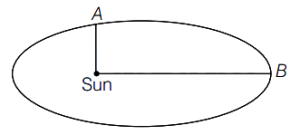
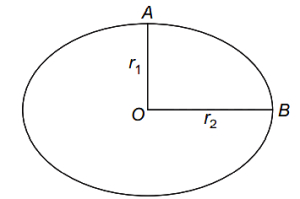
Earth is moving around the sun in an elliptical orbit as shown. The ratio of $OB$ and $OA$ is $R$. Then the ratio of Earth's velocities at $A$ and $B$ is
A
$R^{-1}$
B
$\sqrt{R}$
C
$R$
D
$R^{2/3}$
Solution
(C) In central force motion,the angular momentum of the body remains conserved.
Angular momentum is given by $L = \vec{r} \times \vec{p} = mvr \sin \theta$.
At points $A$ and $B$,the velocity vector is perpendicular to the position vector,so $\theta = 90^\circ$ and $\sin 90^\circ = 1$.
Thus,$L = mvr$.
Let $v_A$ and $v_B$ be the speeds of the Earth at $A$ and $B$,respectively,and $r_A = OA$ and $r_B = OB$ be the distances from the Sun.
By conservation of angular momentum:
$m v_A r_A = m v_B r_B$
$\Rightarrow \frac{v_A}{v_B} = \frac{r_B}{r_A} = \frac{OB}{OA}$
Given that $\frac{OB}{OA} = R$,we have $\frac{v_A}{v_B} = R$.
Therefore,the ratio of Earth's velocities at $A$ and $B$ is $R$.
Angular momentum is given by $L = \vec{r} \times \vec{p} = mvr \sin \theta$.
At points $A$ and $B$,the velocity vector is perpendicular to the position vector,so $\theta = 90^\circ$ and $\sin 90^\circ = 1$.
Thus,$L = mvr$.
Let $v_A$ and $v_B$ be the speeds of the Earth at $A$ and $B$,respectively,and $r_A = OA$ and $r_B = OB$ be the distances from the Sun.
By conservation of angular momentum:
$m v_A r_A = m v_B r_B$
$\Rightarrow \frac{v_A}{v_B} = \frac{r_B}{r_A} = \frac{OB}{OA}$
Given that $\frac{OB}{OA} = R$,we have $\frac{v_A}{v_B} = R$.
Therefore,the ratio of Earth's velocities at $A$ and $B$ is $R$.
0 likes
View Solution289
MediumMCQ
What is the period of revolution of an Earth satellite? Ignore the height of the satellite above the surface of the Earth.
Given:
$(1)$ The value of gravitational acceleration $g = 10 \ ms^{-2}$.
$(2)$ Radius of Earth $R_E = 6400 \ km$. Take $\pi = 3.14$.
Given:
$(1)$ The value of gravitational acceleration $g = 10 \ ms^{-2}$.
$(2)$ Radius of Earth $R_E = 6400 \ km$. Take $\pi = 3.14$.
A
$85$ minutes
B
$156$ minutes
C
$83.73$ minutes
D
$90$ minutes
Solution
(C) The period of revolution $T$ of a satellite orbiting very close to the Earth's surface is given by the formula:
$T = 2 \pi \sqrt{\frac{R_E}{g}}$
Given values:
$R_E = 6400 \ km = 6.4 \times 10^6 \ m$
$g = 10 \ ms^{-2}$
$\pi = 3.14$
Substituting these values into the formula:
$T = 2 \times 3.14 \times \sqrt{\frac{6.4 \times 10^6}{10}}$
$T = 6.28 \times \sqrt{6.4 \times 10^5} = 6.28 \times \sqrt{64 \times 10^4}$
$T = 6.28 \times 800 = 5024 \ s$
To convert the time into minutes:
$T = \frac{5024}{60} \ min \approx 83.73 \ min$
Therefore, the period of revolution is $83.73$ minutes.
$T = 2 \pi \sqrt{\frac{R_E}{g}}$
Given values:
$R_E = 6400 \ km = 6.4 \times 10^6 \ m$
$g = 10 \ ms^{-2}$
$\pi = 3.14$
Substituting these values into the formula:
$T = 2 \times 3.14 \times \sqrt{\frac{6.4 \times 10^6}{10}}$
$T = 6.28 \times \sqrt{6.4 \times 10^5} = 6.28 \times \sqrt{64 \times 10^4}$
$T = 6.28 \times 800 = 5024 \ s$
To convert the time into minutes:
$T = \frac{5024}{60} \ min \approx 83.73 \ min$
Therefore, the period of revolution is $83.73$ minutes.
0 likes
View Solution290
MediumMCQ
The time period of a geostationary satellite is (in $\text{ h}$)
A
$24$
B
$12$
C
$30$
D
$48$
Solution
(A) geostationary satellite orbits around the Earth above the equator such that it remains stationary as seen from the Earth.
This means the satellite completes one revolution around the Earth in the same time it takes for the Earth to complete one rotation about its axis.
The rotational period of the Earth is $24 \text{ h}$.
Therefore,the time period of a geostationary satellite is $24 \text{ h}$.
This means the satellite completes one revolution around the Earth in the same time it takes for the Earth to complete one rotation about its axis.
The rotational period of the Earth is $24 \text{ h}$.
Therefore,the time period of a geostationary satellite is $24 \text{ h}$.
0 likes
View Solution291
MediumMCQ
If the escape velocity of a body from the surface of the earth is $11.2 \,km \,s^{-1}$, then the orbital velocity of a satellite in an orbit which is at a height equal to the radius of the earth is
A
$11.2 \,km \,s^{-1}$
B
$2.8 \,km \,s^{-1}$
C
$22.4 \,km \,s^{-1}$
D
$5.6 \,km \,s^{-1}$
Solution
(D) The escape velocity from the surface of the earth is given by $v_e = \sqrt{\frac{2GM}{R}} = 11.2 \,km \,s^{-1}$.
The orbital velocity of a satellite at a height $h$ from the surface is given by $v_o = \sqrt{\frac{GM}{R+h}}$.
Given that the height $h = R$, the orbital velocity becomes $v_o = \sqrt{\frac{GM}{R+R}} = \sqrt{\frac{GM}{2R}}$.
We can express $v_o$ in terms of $v_e$ as follows:
$v_o = \sqrt{\frac{1}{4} \cdot \frac{2GM}{R}} = \frac{v_e}{2}$.
Substituting the value of $v_e = 11.2 \,km \,s^{-1}$:
$v_o = \frac{11.2}{2} = 5.6 \,km \,s^{-1}$.
The orbital velocity of a satellite at a height $h$ from the surface is given by $v_o = \sqrt{\frac{GM}{R+h}}$.
Given that the height $h = R$, the orbital velocity becomes $v_o = \sqrt{\frac{GM}{R+R}} = \sqrt{\frac{GM}{2R}}$.
We can express $v_o$ in terms of $v_e$ as follows:
$v_o = \sqrt{\frac{1}{4} \cdot \frac{2GM}{R}} = \frac{v_e}{2}$.
Substituting the value of $v_e = 11.2 \,km \,s^{-1}$:
$v_o = \frac{11.2}{2} = 5.6 \,km \,s^{-1}$.
0 likes
View Solution292
EasyMCQ
$A$ body is projected with a velocity greater than orbital velocity but less than escape velocity. Its path is
A
circular
B
elliptical
C
parabolic
D
hyperbolic
Solution
(B) When the velocity of a body $(v)$ is greater than the orbital velocity $(v_o)$ but less than the escape velocity $(v_e)$,i.e.,$v_o < v < v_e$,the total energy of the body is negative.
For a negative total energy in a central gravitational field,the trajectory of the body is an ellipse with the center of the Earth at one of the foci.
If $v = v_e$,the total energy is zero,and the path becomes parabolic.
If $v > v_e$,the total energy is positive,and the path becomes hyperbolic.
For a negative total energy in a central gravitational field,the trajectory of the body is an ellipse with the center of the Earth at one of the foci.
If $v = v_e$,the total energy is zero,and the path becomes parabolic.
If $v > v_e$,the total energy is positive,and the path becomes hyperbolic.
0 likes
View Solution293
MediumMCQ
An artificial satellite is revolving around a planet of radius $R$ in a circular orbit of radius $a$. If the time period of revolution of the satellite $T \propto a^{3/2} g^x R^y$,then the values of $x$ and $y$ are respectively. [Note: $g$ is the acceleration due to gravity at the surface of the planet.]
A
$1, 1/2$
B
$1/2, 1$
C
$-1/2, 1/2$
D
$-1/2, -1$
Solution
(D) According to Kepler's Third Law,the time period $T$ of a satellite in a circular orbit of radius $a$ is given by $T = 2\pi \sqrt{\frac{a^3}{GM}}$,where $M$ is the mass of the planet.
We know that the acceleration due to gravity at the surface of the planet is $g = \frac{GM}{R^2}$,which implies $GM = gR^2$.
Substituting $GM$ into the time period formula: $T = 2\pi \sqrt{\frac{a^3}{gR^2}} = 2\pi a^{3/2} g^{-1/2} R^{-1}$.
Comparing this with the given expression $T \propto a^{3/2} g^x R^y$,we get $x = -1/2$ and $y = -1$.
We know that the acceleration due to gravity at the surface of the planet is $g = \frac{GM}{R^2}$,which implies $GM = gR^2$.
Substituting $GM$ into the time period formula: $T = 2\pi \sqrt{\frac{a^3}{gR^2}} = 2\pi a^{3/2} g^{-1/2} R^{-1}$.
Comparing this with the given expression $T \propto a^{3/2} g^x R^y$,we get $x = -1/2$ and $y = -1$.
0 likes
View Solution294
EasyMCQ
The time period of revolution of a satellite close to the planet's surface is $80 \text{ minutes}$. The time period of another satellite which is at a height of $3$ times the radius of the planet from the surface is:
A
$64 \text{ minutes}$
B
$640 \text{ minutes}$
C
$320 \text{ minutes}$
D
$240 \text{ minutes}$
Solution
(B) According to Kepler's third law of planetary motion, the square of the time period $(T)$ is proportional to the cube of the orbital radius $(r)$:
$T^2 \propto r^3$
For the first satellite, the orbital radius is $r_1 = R$ (where $R$ is the radius of the planet).
For the second satellite, the height is $h = 3R$, so the orbital radius is $r_2 = R + 3R = 4R$.
Using the ratio:
$\left(\frac{T_2}{T_1}\right)^2 = \left(\frac{r_2}{r_1}\right)^3$
$\left(\frac{T_2}{T_1}\right)^2 = \left(\frac{4R}{R}\right)^3 = 4^3 = 64$
Taking the square root on both sides:
$\frac{T_2}{T_1} = \sqrt{64} = 8$
Given $T_1 = 80 \text{ minutes}$, we find:
$T_2 = 8 \times 80 \text{ minutes} = 640 \text{ minutes}$.
$T^2 \propto r^3$
For the first satellite, the orbital radius is $r_1 = R$ (where $R$ is the radius of the planet).
For the second satellite, the height is $h = 3R$, so the orbital radius is $r_2 = R + 3R = 4R$.
Using the ratio:
$\left(\frac{T_2}{T_1}\right)^2 = \left(\frac{r_2}{r_1}\right)^3$
$\left(\frac{T_2}{T_1}\right)^2 = \left(\frac{4R}{R}\right)^3 = 4^3 = 64$
Taking the square root on both sides:
$\frac{T_2}{T_1} = \sqrt{64} = 8$
Given $T_1 = 80 \text{ minutes}$, we find:
$T_2 = 8 \times 80 \text{ minutes} = 640 \text{ minutes}$.
0 likes
View Solution295
MediumMCQ
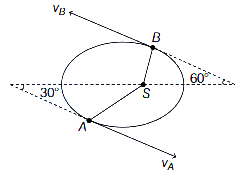
$A$ planet is revolving around the Sun as shown in the figure. The radius vectors joining the Sun and the planet at points $A$ and $B$ are $90 \times 10^6 \text{ km}$ and $60 \times 10^6 \text{ km}$,respectively. The ratio of velocities of the planet at the points $A$ and $B$ when its velocities make angles $30^{\circ}$ and $60^{\circ}$ with the major axis of the orbit is:
A
$\frac{3}{2 \sqrt{3}}$
B
$\frac{2}{\sqrt{3}}$
C
$\frac{1}{\sqrt{3}}$
D
$\frac{\sqrt{3}}{2}$
Solution
(B) According to the law of conservation of angular momentum,the angular momentum $(L)$ of a planet is constant.
$L = mvr \sin \theta$,where $\theta$ is the angle between the velocity vector and the radius vector.
However,the problem specifies the angle between the velocity vector and the major axis. Let $\phi$ be the angle between the velocity vector and the radius vector. The angular momentum is $L = mvr \sin \phi$.
From the geometry of an ellipse,the angle between the radius vector and the tangent (velocity vector) is related to the angle with the major axis. Given the standard approach for such problems where the angular momentum component perpendicular to the radius vector is $v \sin \phi$,the conservation law is $m v_A r_A \sin \phi_A = m v_B r_B \sin \phi_B$.
Given $r_A = 90 \times 10^6 \text{ km}$,$r_B = 60 \times 10^6 \text{ km}$,$\phi_A = 30^{\circ}$,and $\phi_B = 60^{\circ}$:
$\frac{v_A}{v_B} = \frac{r_B}{r_A} \times \frac{\sin \phi_B}{\sin \phi_A}$
$\frac{v_A}{v_B} = \frac{60 \times 10^6}{90 \times 10^6} \times \frac{\sin 60^{\circ}}{\sin 30^{\circ}}$
$\frac{v_A}{v_B} = \frac{2}{3} \times \frac{\sqrt{3}/2}{1/2} = \frac{2}{3} \times \sqrt{3} = \frac{2}{\sqrt{3}}$.
$L = mvr \sin \theta$,where $\theta$ is the angle between the velocity vector and the radius vector.
However,the problem specifies the angle between the velocity vector and the major axis. Let $\phi$ be the angle between the velocity vector and the radius vector. The angular momentum is $L = mvr \sin \phi$.
From the geometry of an ellipse,the angle between the radius vector and the tangent (velocity vector) is related to the angle with the major axis. Given the standard approach for such problems where the angular momentum component perpendicular to the radius vector is $v \sin \phi$,the conservation law is $m v_A r_A \sin \phi_A = m v_B r_B \sin \phi_B$.
Given $r_A = 90 \times 10^6 \text{ km}$,$r_B = 60 \times 10^6 \text{ km}$,$\phi_A = 30^{\circ}$,and $\phi_B = 60^{\circ}$:
$\frac{v_A}{v_B} = \frac{r_B}{r_A} \times \frac{\sin \phi_B}{\sin \phi_A}$
$\frac{v_A}{v_B} = \frac{60 \times 10^6}{90 \times 10^6} \times \frac{\sin 60^{\circ}}{\sin 30^{\circ}}$
$\frac{v_A}{v_B} = \frac{2}{3} \times \frac{\sqrt{3}/2}{1/2} = \frac{2}{3} \times \sqrt{3} = \frac{2}{\sqrt{3}}$.
0 likes
View Solution296
MediumMCQ
If the angular velocity of a planet about its axis is halved,the distance of the stationary satellite of this planet from the centre of the planet becomes $2^{n}$ times the initial distance. Then the value of '$n$' is
A
$2/3$
B
$3/2$
C
$1/3$
D
$4/3$
Solution
(A) For a stationary satellite,its orbital period $T$ must be equal to the rotational period of the planet about its axis. The angular velocity of the planet is $\omega = 2\pi / T$.
Since the angular velocity is halved $(\omega' = \omega / 2)$,the new period $T'$ becomes $2T$ because $T = 2\pi / \omega$.
According to Kepler's Third Law,the square of the orbital period is proportional to the cube of the orbital radius: $T^2 \propto r^3$.
Therefore,$(T'/T)^2 = (r'/r)^3$.
Substituting $T' = 2T$,we get $(2)^2 = (r'/r)^3$,which implies $4 = (r'/r)^3$.
Taking the cube root on both sides,$r'/r = 4^{1/3} = (2^2)^{1/3} = 2^{2/3}$.
Comparing this with $r'/r = 2^n$,we find $n = 2/3$.
Since the angular velocity is halved $(\omega' = \omega / 2)$,the new period $T'$ becomes $2T$ because $T = 2\pi / \omega$.
According to Kepler's Third Law,the square of the orbital period is proportional to the cube of the orbital radius: $T^2 \propto r^3$.
Therefore,$(T'/T)^2 = (r'/r)^3$.
Substituting $T' = 2T$,we get $(2)^2 = (r'/r)^3$,which implies $4 = (r'/r)^3$.
Taking the cube root on both sides,$r'/r = 4^{1/3} = (2^2)^{1/3} = 2^{2/3}$.
Comparing this with $r'/r = 2^n$,we find $n = 2/3$.
0 likes
View Solution297
MediumMCQ
Two satellites $A$ and $B$ are revolving around the earth in orbits of heights $1.25 R_E$ and $19.25 R_E$ from the surface of the earth respectively,where $R_E$ is the radius of the earth. The ratio of the orbital speeds of the satellites $A$ and $B$ is (in $: 1$)
A
$5$
B
$4$
C
$9$
D
$3$
Solution
(D) The orbital speed of a satellite at a distance $r$ from the center of the earth is given by $v = \sqrt{\frac{GM_E}{r}}$,where $r = R_E + h$.
For satellite $A$,the height is $h_A = 1.25 R_E$,so the distance from the center is $r_A = R_E + 1.25 R_E = 2.25 R_E$.
For satellite $B$,the height is $h_B = 19.25 R_E$,so the distance from the center is $r_B = R_E + 19.25 R_E = 20.25 R_E$.
The ratio of the orbital speeds is $\frac{v_A}{v_B} = \sqrt{\frac{r_B}{r_A}} = \sqrt{\frac{20.25 R_E}{2.25 R_E}} = \sqrt{\frac{2025}{225}} = \sqrt{9} = 3$.
Thus,the ratio is $3: 1$.
For satellite $A$,the height is $h_A = 1.25 R_E$,so the distance from the center is $r_A = R_E + 1.25 R_E = 2.25 R_E$.
For satellite $B$,the height is $h_B = 19.25 R_E$,so the distance from the center is $r_B = R_E + 19.25 R_E = 20.25 R_E$.
The ratio of the orbital speeds is $\frac{v_A}{v_B} = \sqrt{\frac{r_B}{r_A}} = \sqrt{\frac{20.25 R_E}{2.25 R_E}} = \sqrt{\frac{2025}{225}} = \sqrt{9} = 3$.
Thus,the ratio is $3: 1$.
0 likes
View Solution298
DifficultMCQ
The time period of a $1500 \,kg$ satellite is equal to the time period of rotation of the earth. The altitude of the satellite is nearly
A
$42,211 \,km$
B
$35,840 \,km$
C
$6,400 \,km$
D
$13,800 \,km$
Solution
(B) satellite with a time period equal to the rotation of the Earth $(T = 24 \,h)$ is a geostationary satellite.
For a geostationary satellite,the orbital radius $r$ is given by $r = \left( \frac{T^2 GM_e}{4 \pi^2} \right)^{1/3}$.
Substituting the values $T = 86,400 \,s$,$G = 6.67 \times 10^{-11} \,Nm^2/kg^2$,and $M_e = 5.97 \times 10^{24} \,kg$,we get $r \approx 42,200 \,km$.
The altitude $h$ is given by $h = r - R_e$,where $R_e \approx 6,400 \,km$.
Thus,$h = 42,200 \,km - 6,400 \,km = 35,800 \,km$.
Therefore,the altitude is nearly $35,840 \,km$.
For a geostationary satellite,the orbital radius $r$ is given by $r = \left( \frac{T^2 GM_e}{4 \pi^2} \right)^{1/3}$.
Substituting the values $T = 86,400 \,s$,$G = 6.67 \times 10^{-11} \,Nm^2/kg^2$,and $M_e = 5.97 \times 10^{24} \,kg$,we get $r \approx 42,200 \,km$.
The altitude $h$ is given by $h = r - R_e$,where $R_e \approx 6,400 \,km$.
Thus,$h = 42,200 \,km - 6,400 \,km = 35,800 \,km$.
Therefore,the altitude is nearly $35,840 \,km$.
0 likes
View Solution299
EasyMCQ
Satellites which give high value data for remote sensing,meteorology and environmental studies are
A
Geostationary satellites
B
Polar satellites
C
Communication satellites
D
Radio satellites
Solution
(B) Polar satellites orbit the Earth in a north-south direction as the Earth rotates beneath them. This allows them to scan the entire globe,making them ideal for remote sensing,meteorology,and environmental monitoring.
0 likes
View SolutionGravitation — Motion of Satellites in Circular Orbits and Planets in Elliptical Orbits · Frequently Asked Questions
1Are these Gravitation questions useful for JEE and NEET?
Yes. All questions in this section are mapped to JEE Main and NEET exam patterns. Previous year questions from JEE Main, NEET, GUJCET and state-level exams are included with full solutions.
2Can I switch to Hindi or Gujarati for these questions?
Yes. Use the language tabs in the hero section or the sidebar to view the same questions and solutions in English, Hindi or Gujarati.
3How do I generate a question paper from this subtopic?
Use the Vedclass Exam Paper Generator — select the chapter and subtopic, set difficulty, and generate Sets A, B, C, D automatically. First 3 chapters of every subject are free.
Vedclass Products
For Students
Vedclass Test Series
Mock tests in real JEE/NEET style with performance analysis. 5-day free trial.
Start Free TrialFor Teachers
Exam Paper Generator
Generate Set A/B/C/D papers from this chapter in 2 minutes. 3 chapters free.
Try FreeFor Institutes
Online Exam Module
Live online exams with unlimited students, 360° analytics & white-label branding.
See DemoFor Teachers & Institutes
Generate a Gravitation Exam Paper in 2 Minutes
Select subtopic & difficulty — Sets A, B, C, D auto-generated with No Repeat logic.
First 3 chapters of every subject are free — no payment required.