
A English
Radiation by Stefan's Boltzmann Law Questions in English
Class 11 Physics · 10-2.Heat Transfer · Radiation by Stefan's Boltzmann Law
258+
Questions
English
Language
100%
With Solutions
Showing 47 of 258 questions in English
101
EasyMCQ
$A$ black body is at a temperature of $500 \; K$. It emits energy at a rate which is proportional to:
A
$(500)^{4}$
B
$(500)^{3}$
C
$(500)^{2}$
D
$(500)$
Solution
(A) According to Stefan-Boltzmann Law,the rate of energy emission (power) $P$ from a black body is directly proportional to the fourth power of its absolute temperature $T$.
Mathematically,$P \propto T^{4}$.
Given the temperature $T = 500 \; K$,the rate of energy emission is proportional to $(500)^{4}$.
Mathematically,$P \propto T^{4}$.
Given the temperature $T = 500 \; K$,the rate of energy emission is proportional to $(500)^{4}$.
0 likes
View Solution102
DifficultMCQ
Two spheres of radii $4 \, m$ and $1 \, m$ have temperatures $2000 \, K$ and $4000 \, K$ respectively. Find the ratio of their emitted energy.
A
$1:1$
B
$4:1$
C
$1:4$
D
$2:1$
Solution
(A) According to the Stefan-Boltzmann law,the power radiated by a black body is given by $P = \sigma A T^4$.
Since the energy emitted $Q$ in time $t$ is $Q = P \cdot t = \sigma A t T^4$,the ratio of energy emitted by two spheres is:
$\frac{Q_1}{Q_2} = \frac{A_1}{A_2} \left( \frac{T_1}{T_2} \right)^4$.
Given $r_1 = 4 \, m$,$r_2 = 1 \, m$,$T_1 = 2000 \, K$,and $T_2 = 4000 \, K$.
Since $A = 4 \pi r^2$,the ratio of areas is $\frac{A_1}{A_2} = \left( \frac{r_1}{r_2} \right)^2 = \left( \frac{4}{1} \right)^2 = 16$.
The ratio of temperatures is $\frac{T_1}{T_2} = \frac{2000}{4000} = \frac{1}{2}$.
Substituting these values:
$\frac{Q_1}{Q_2} = 16 \times \left( \frac{1}{2} \right)^4 = 16 \times \frac{1}{16} = 1$.
Thus,the ratio is $1:1$.
Since the energy emitted $Q$ in time $t$ is $Q = P \cdot t = \sigma A t T^4$,the ratio of energy emitted by two spheres is:
$\frac{Q_1}{Q_2} = \frac{A_1}{A_2} \left( \frac{T_1}{T_2} \right)^4$.
Given $r_1 = 4 \, m$,$r_2 = 1 \, m$,$T_1 = 2000 \, K$,and $T_2 = 4000 \, K$.
Since $A = 4 \pi r^2$,the ratio of areas is $\frac{A_1}{A_2} = \left( \frac{r_1}{r_2} \right)^2 = \left( \frac{4}{1} \right)^2 = 16$.
The ratio of temperatures is $\frac{T_1}{T_2} = \frac{2000}{4000} = \frac{1}{2}$.
Substituting these values:
$\frac{Q_1}{Q_2} = 16 \times \left( \frac{1}{2} \right)^4 = 16 \times \frac{1}{16} = 1$.
Thus,the ratio is $1:1$.
0 likes
View Solution103
MediumMCQ
If the ratio of the radii of two spheres of the same material and at the same temperature is $1:2$,find the ratio of their emissive power.
A
$1:2$
B
$1:8$
C
$1:4$
D
$1:16$
Solution
(C) According to the Stefan-Boltzmann law,the power radiated by a black body is given by $P = A \sigma T^4$,where $A$ is the surface area,$\sigma$ is the Stefan-Boltzmann constant,and $T$ is the absolute temperature.
Since the spheres are of the same material and at the same temperature,$\sigma$ and $T$ are constant.
The surface area of a sphere is $A = 4 \pi r^2$,so $P \propto r^2$.
Therefore,the ratio of the emissive power is $\frac{P_1}{P_2} = \frac{r_1^2}{r_2^2}$.
Given $\frac{r_1}{r_2} = \frac{1}{2}$,we have $\frac{P_1}{P_2} = (\frac{1}{2})^2 = \frac{1}{4}$.
Since the spheres are of the same material and at the same temperature,$\sigma$ and $T$ are constant.
The surface area of a sphere is $A = 4 \pi r^2$,so $P \propto r^2$.
Therefore,the ratio of the emissive power is $\frac{P_1}{P_2} = \frac{r_1^2}{r_2^2}$.
Given $\frac{r_1}{r_2} = \frac{1}{2}$,we have $\frac{P_1}{P_2} = (\frac{1}{2})^2 = \frac{1}{4}$.
0 likes
View Solution104
DifficultMCQ
Two spheres of the same material have radii $r_1$ and $r_2$ and surface temperatures $T_1$ and $T_2$ respectively. If their emissive power (total power radiated) is the same,find the ratio of their radii $r_1/r_2$.
A
$(\frac{T_2}{T_1})^2$
B
$(\frac{T_2}{T_1})^4$
C
$(\frac{T_1}{T_2})^2$
D
$(\frac{T_1}{T_2})^4$
Solution
(A) According to the Stefan-Boltzmann law,the total power $P$ radiated by a sphere of radius $r$ and temperature $T$ is given by $P = A \sigma T^4$,where $A = 4 \pi r^2$ is the surface area and $\sigma$ is the Stefan-Boltzmann constant.
Since the material is the same,the emissivity is the same. Given that the total power radiated $P$ is the same for both spheres,we have $P_1 = P_2$.
Substituting the formula: $4 \pi r_1^2 \sigma T_1^4 = 4 \pi r_2^2 \sigma T_2^4$.
Simplifying the equation: $r_1^2 T_1^4 = r_2^2 T_2^4$.
Rearranging to find the ratio of radii: $(\frac{r_1}{r_2})^2 = (\frac{T_2}{T_1})^4$.
Taking the square root on both sides: $\frac{r_1}{r_2} = (\frac{T_2}{T_1})^2$.
Since the material is the same,the emissivity is the same. Given that the total power radiated $P$ is the same for both spheres,we have $P_1 = P_2$.
Substituting the formula: $4 \pi r_1^2 \sigma T_1^4 = 4 \pi r_2^2 \sigma T_2^4$.
Simplifying the equation: $r_1^2 T_1^4 = r_2^2 T_2^4$.
Rearranging to find the ratio of radii: $(\frac{r_1}{r_2})^2 = (\frac{T_2}{T_1})^4$.
Taking the square root on both sides: $\frac{r_1}{r_2} = (\frac{T_2}{T_1})^2$.
0 likes
View Solution105
EasyMCQ
$A$ black body is at $727^\circ C$. It emits energy at a rate which is proportional to
A
$(1000)^4$
B
$(1000)^2$
C
$(727)^4$
D
$(727)^2$
Solution
(A) According to Stefan-Boltzmann law,the rate of energy radiated $(E)$ by a black body is directly proportional to the fourth power of its absolute temperature ($T$ in Kelvin).
The formula is given by $E \propto T^4$.
Given the temperature in Celsius is $727^\circ C$,we must convert it to Kelvin:
$T = 727 + 273 = 1000 \ K$.
Substituting this value into the proportionality relation:
$E \propto (1000)^4$.
Therefore,the rate of energy emission is proportional to $(1000)^4$.
The formula is given by $E \propto T^4$.
Given the temperature in Celsius is $727^\circ C$,we must convert it to Kelvin:
$T = 727 + 273 = 1000 \ K$.
Substituting this value into the proportionality relation:
$E \propto (1000)^4$.
Therefore,the rate of energy emission is proportional to $(1000)^4$.
0 likes
View Solution106
MediumMCQ
Assuming the sun to have a spherical outer surface of radius $r$,radiating like a black body at temperature $t^{\circ} C$,the power received by a unit surface (normal to the incident rays) at a distance $R$ from the centre of the sun is,where $\sigma$ is the Stefan's constant.
A
$\frac{r^2 \sigma (t + 273)^4}{4\pi R^2}$
B
$\frac{16\pi^2 r^2 \sigma t^4}{R^2}$
C
$\frac{r^2 \sigma (t + 273)^4}{R^2}$
D
$\frac{4\pi r^2 \sigma t^4}{R^2}$
Solution
(C) The total power $P$ radiated by the sun,acting as a black body with radius $r$ and absolute temperature $T = (t + 273) \ K$,is given by the Stefan-Boltzmann law: $P = \sigma A T^4 = \sigma (4\pi r^2) (t + 273)^4$.
At a distance $R$ from the center of the sun,this power is distributed over a spherical surface area of $4\pi R^2$.
The power received per unit area (intensity $S$) by a surface normal to the incident rays is given by: $S = \frac{P}{4\pi R^2}$.
Substituting the value of $P$: $S = \frac{\sigma (4\pi r^2) (t + 273)^4}{4\pi R^2} = \frac{r^2 \sigma (t + 273)^4}{R^2}$.
At a distance $R$ from the center of the sun,this power is distributed over a spherical surface area of $4\pi R^2$.
The power received per unit area (intensity $S$) by a surface normal to the incident rays is given by: $S = \frac{P}{4\pi R^2}$.
Substituting the value of $P$: $S = \frac{\sigma (4\pi r^2) (t + 273)^4}{4\pi R^2} = \frac{r^2 \sigma (t + 273)^4}{R^2}$.
0 likes
View Solution107
MediumMCQ
$A$ black body at $227^o C$ radiates heat at the rate of $7 \; cal/cm^2 s$. At a temperature of $727^o C$,the rate of heat radiated in the same units will be:
A
$50$
B
$112$
C
$80$
D
$60$
Solution
(B) According to Stefan-Boltzmann law,the rate of heat radiation $E$ is proportional to the fourth power of the absolute temperature $T$,i.e.,$E \propto T^4$.
Given:
Initial temperature $T_1 = 227^o C = (227 + 273) K = 500 K$.
Initial rate of radiation $E_1 = 7 \; cal/cm^2 s$.
Final temperature $T_2 = 727^o C = (727 + 273) K = 1000 K$.
Using the ratio formula:
$\frac{E_2}{E_1} = \left( \frac{T_2}{T_1} \right)^4$
Substituting the values:
$\frac{E_2}{7} = \left( \frac{1000}{500} \right)^4$
$\frac{E_2}{7} = (2)^4$
$\frac{E_2}{7} = 16$
$E_2 = 7 \times 16 = 112 \; cal/cm^2 s$.
Therefore,the rate of heat radiated at $727^o C$ is $112 \; cal/cm^2 s$.
Given:
Initial temperature $T_1 = 227^o C = (227 + 273) K = 500 K$.
Initial rate of radiation $E_1 = 7 \; cal/cm^2 s$.
Final temperature $T_2 = 727^o C = (727 + 273) K = 1000 K$.
Using the ratio formula:
$\frac{E_2}{E_1} = \left( \frac{T_2}{T_1} \right)^4$
Substituting the values:
$\frac{E_2}{7} = \left( \frac{1000}{500} \right)^4$
$\frac{E_2}{7} = (2)^4$
$\frac{E_2}{7} = 16$
$E_2 = 7 \times 16 = 112 \; cal/cm^2 s$.
Therefore,the rate of heat radiated at $727^o C$ is $112 \; cal/cm^2 s$.
0 likes
View Solution108
MediumMCQ
The total radiant energy per unit area,normal to the direction of incidence,received at a distance $R$ from the centre of a star of radius $r$,whose outer surface radiates as a black body at a temperature $T \ K$ is given by
A
$\sigma \frac{r^2}{R^2} T^4$
B
$\frac{\sigma r^2}{4\pi R^2} T^4$
C
$\sigma \frac{r^4}{R^4} T^4$
D
$\sigma \frac{4\pi r^2}{R^2} T^4$
Solution
(A) According to the Stefan-Boltzmann law,the total power $P$ radiated by a star of radius $r$ acting as a black body at temperature $T$ is given by:
$P = \sigma A T^4 = \sigma (4\pi r^2) T^4$
At a distance $R$ from the center of the star,this energy is spread over a spherical surface area of $4\pi R^2$.
The radiant energy per unit area (intensity $S$) received at distance $R$ is:
$S = \frac{P}{4\pi R^2}$
Substituting the value of $P$:
$S = \frac{\sigma (4\pi r^2) T^4}{4\pi R^2} = \sigma \frac{r^2}{R^2} T^4$
$P = \sigma A T^4 = \sigma (4\pi r^2) T^4$
At a distance $R$ from the center of the star,this energy is spread over a spherical surface area of $4\pi R^2$.
The radiant energy per unit area (intensity $S$) received at distance $R$ is:
$S = \frac{P}{4\pi R^2}$
Substituting the value of $P$:
$S = \frac{\sigma (4\pi r^2) T^4}{4\pi R^2} = \sigma \frac{r^2}{R^2} T^4$
0 likes
View Solution109
MediumMCQ
If the radius of a star is $R$ and it acts as a black body,what would be the temperature of the star,in which the rate of energy production is $Q$? ($\sigma$ stands for Stefan's constant)
A
$\frac{Q}{4\pi \sigma R^2}$
B
$\left( \frac{Q}{4\pi \sigma R^2} \right)^{1/2}$
C
$\left( \frac{Q}{4\pi \sigma R^2} \right)^{1/4}$
D
$\left( \frac{4\pi \sigma R^2}{Q} \right)^{1/4}$
Solution
(C) According to Stefan's law,the rate of energy emission (power) $Q$ from a black body is given by $Q = \sigma A T^4$.
Here,$A$ is the surface area of the star,which is $4\pi R^2$.
Substituting the value of $A$ into the equation,we get $Q = \sigma (4\pi R^2) T^4$.
Rearranging the formula to solve for temperature $T$,we have $T^4 = \frac{Q}{4\pi \sigma R^2}$.
Taking the fourth root on both sides,we get $T = \left( \frac{Q}{4\pi \sigma R^2} \right)^{1/4}$.
Here,$A$ is the surface area of the star,which is $4\pi R^2$.
Substituting the value of $A$ into the equation,we get $Q = \sigma (4\pi R^2) T^4$.
Rearranging the formula to solve for temperature $T$,we have $T^4 = \frac{Q}{4\pi \sigma R^2}$.
Taking the fourth root on both sides,we get $T = \left( \frac{Q}{4\pi \sigma R^2} \right)^{1/4}$.
0 likes
View Solution110
MediumMCQ
$A$ spherical black body with a radius of $12 \ cm$ radiates $450 \ W$ power at $500 \ K$. If the radius were halved and the temperature doubled,the power radiated in watt would be
A
$450$
B
$1000$
C
$1800$
D
$225$
Solution
(C) According to the $Stefan-Boltzmann$ law,the rate of energy radiated by a black body is given by:
$E = \sigma A T^4 = \sigma (4 \pi R^2) T^4$
Given:
$E_1 = 450 \ W$,$T_1 = 500 \ K$,$R_1 = 12 \ cm$
$R_2 = \frac{R_1}{2}$,$T_2 = 2T_1$
Since $E \propto R^2 T^4$,we have:
$\frac{E_2}{E_1} = \left( \frac{R_2}{R_1} \right)^2 \left( \frac{T_2}{T_1} \right)^4$
$\frac{E_2}{E_1} = \left( \frac{1}{2} \right)^2 \times (2)^4$
$\frac{E_2}{E_1} = \frac{1}{4} \times 16 = 4$
$E_2 = 4 \times E_1 = 4 \times 450 \ W = 1800 \ W$
$E = \sigma A T^4 = \sigma (4 \pi R^2) T^4$
Given:
$E_1 = 450 \ W$,$T_1 = 500 \ K$,$R_1 = 12 \ cm$
$R_2 = \frac{R_1}{2}$,$T_2 = 2T_1$
Since $E \propto R^2 T^4$,we have:
$\frac{E_2}{E_1} = \left( \frac{R_2}{R_1} \right)^2 \left( \frac{T_2}{T_1} \right)^4$
$\frac{E_2}{E_1} = \left( \frac{1}{2} \right)^2 \times (2)^4$
$\frac{E_2}{E_1} = \frac{1}{4} \times 16 = 4$
$E_2 = 4 \times E_1 = 4 \times 450 \ W = 1800 \ W$
0 likes
View Solution111
MediumMCQ
The power radiated by a black body is $P$ and it radiates maximum energy at wavelength $\lambda_0$. If the temperature of the black body is now changed so that it radiates maximum energy at wavelength $\frac{3}{4}\lambda_0$,the power radiated by it becomes $nP$. The value of $n$ is
A
$\frac{3}{4}$
B
$\frac{4}{3}$
C
$\frac{81}{256}$
D
$\frac{256}{81}$
Solution
(D) According to $Wien's$ displacement law,$\lambda_{\max} T = \text{constant}$.
Let the initial temperature be $T$ and the final temperature be $T'$.
Given $\lambda_{\max, 1} = \lambda_0$ and $\lambda_{\max, 2} = \frac{3}{4}\lambda_0$.
Using the law: $\lambda_0 T = \left(\frac{3}{4}\lambda_0\right) T' \Rightarrow T' = \frac{4}{3}T$.
According to the $Stefan-Boltzmann$ law,the power radiated by a black body is $P = A \sigma T^4$,which implies $P \propto T^4$.
Therefore,$\frac{P_2}{P_1} = \left(\frac{T'}{T}\right)^4$.
Substituting the values: $n = \left(\frac{4/3 T}{T}\right)^4 = \left(\frac{4}{3}\right)^4 = \frac{256}{81}$.
Let the initial temperature be $T$ and the final temperature be $T'$.
Given $\lambda_{\max, 1} = \lambda_0$ and $\lambda_{\max, 2} = \frac{3}{4}\lambda_0$.
Using the law: $\lambda_0 T = \left(\frac{3}{4}\lambda_0\right) T' \Rightarrow T' = \frac{4}{3}T$.
According to the $Stefan-Boltzmann$ law,the power radiated by a black body is $P = A \sigma T^4$,which implies $P \propto T^4$.
Therefore,$\frac{P_2}{P_1} = \left(\frac{T'}{T}\right)^4$.
Substituting the values: $n = \left(\frac{4/3 T}{T}\right)^4 = \left(\frac{4}{3}\right)^4 = \frac{256}{81}$.
0 likes
View Solution112
MediumMCQ
The top of an insulated cylindrical container is covered by a disc having emissivity $0.6$ and thickness $1\, cm$. The temperature is maintained by circulating oil as shown in the figure. If the temperature of the upper surface of the disc is $127^\circ C$ and the temperature of the surroundings is $27^\circ C$,then the radiation loss to the surroundings will be (Take $\sigma = \frac{17}{3} \times 10^{-8} \, W/m^2 K^4$)
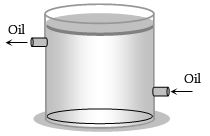
A
$595 \, J/m^2 \cdot s$
B
$595 \, cal/m^2 \cdot s$
C
$991.0 \, J/m^2 \cdot s$
D
$440 \, J/m^2 \cdot s$
Solution
(A) The rate of heat loss per unit area due to radiation,also known as the emissive power $e$,is given by the Stefan-Boltzmann law:
$e = \varepsilon \sigma (T^4 - T_0^4)$
Given:
Emissivity $\varepsilon = 0.6$
Stefan-Boltzmann constant $\sigma = \frac{17}{3} \times 10^{-8} \, W/m^2 K^4$
Surface temperature $T = 127^\circ C = 127 + 273 = 400 \, K$
Surrounding temperature $T_0 = 27^\circ C = 27 + 273 = 300 \, K$
Substituting the values:
$e = 0.6 \times \left( \frac{17}{3} \times 10^{-8} \right) \times [ (400)^4 - (300)^4 ]$
$e = 0.2 \times 17 \times 10^{-8} \times [ 256 \times 10^8 - 81 \times 10^8 ]$
$e = 3.4 \times 10^{-8} \times (175 \times 10^8)$
$e = 3.4 \times 175 = 595 \, J/m^2 \cdot s$
$e = \varepsilon \sigma (T^4 - T_0^4)$
Given:
Emissivity $\varepsilon = 0.6$
Stefan-Boltzmann constant $\sigma = \frac{17}{3} \times 10^{-8} \, W/m^2 K^4$
Surface temperature $T = 127^\circ C = 127 + 273 = 400 \, K$
Surrounding temperature $T_0 = 27^\circ C = 27 + 273 = 300 \, K$
Substituting the values:
$e = 0.6 \times \left( \frac{17}{3} \times 10^{-8} \right) \times [ (400)^4 - (300)^4 ]$
$e = 0.2 \times 17 \times 10^{-8} \times [ 256 \times 10^8 - 81 \times 10^8 ]$
$e = 3.4 \times 10^{-8} \times (175 \times 10^8)$
$e = 3.4 \times 175 = 595 \, J/m^2 \cdot s$
0 likes
View Solution113
MediumMCQ
$A$ black body is heated from $27^oC$ to $127^oC$. The ratio of their energies of radiations emitted will be
A
$3:4$
B
$9:16$
C
$27:64$
D
$81:256$
Solution
(D) According to Stefan-Boltzmann Law,the energy radiated per unit time by a black body is proportional to the fourth power of its absolute temperature: $E \propto T^4$.
Given temperatures in Celsius: $T_1 = 27^oC$ and $T_2 = 127^oC$.
Convert these to Kelvin: $T_1 = 27 + 273 = 300 \ K$ and $T_2 = 127 + 273 = 400 \ K$.
The ratio of the energies emitted is given by: $\frac{E_1}{E_2} = \left( \frac{T_1}{T_2} \right)^4$.
Substituting the values: $\frac{E_1}{E_2} = \left( \frac{300}{400} \right)^4 = \left( \frac{3}{4} \right)^4 = \frac{81}{256}$.
Thus,the ratio is $81:256$.
Given temperatures in Celsius: $T_1 = 27^oC$ and $T_2 = 127^oC$.
Convert these to Kelvin: $T_1 = 27 + 273 = 300 \ K$ and $T_2 = 127 + 273 = 400 \ K$.
The ratio of the energies emitted is given by: $\frac{E_1}{E_2} = \left( \frac{T_1}{T_2} \right)^4$.
Substituting the values: $\frac{E_1}{E_2} = \left( \frac{300}{400} \right)^4 = \left( \frac{3}{4} \right)^4 = \frac{81}{256}$.
Thus,the ratio is $81:256$.
0 likes
View Solution114
DifficultMCQ
$A$ black metal foil is warmed by radiation from a small sphere at temperature $T$ and at a distance $d$. It is found that the power received by the foil is $P$. If both the temperature and distance are doubled,the power received by the foil will be:
A
$16 P$
B
$4 P$
C
$2 P$
D
$P$
Solution
(B) The power $P$ received by a small area at a distance $d$ from a spherical source at temperature $T$ is proportional to the Stefan-Boltzmann law and the inverse square law of radiation.
According to the Stefan-Boltzmann law,the total power radiated by the sphere is $P_{source} \propto T^4$.
The intensity of radiation at a distance $d$ follows the inverse square law,$I \propto \frac{1}{d^2}$.
Thus,the power received by the foil is $P \propto \frac{T^4}{d^2}$.
Let the initial state be $P_1 = k \frac{T^4}{d^2} = P$.
In the final state,the temperature becomes $T' = 2T$ and the distance becomes $d' = 2d$.
The new power $P'$ is given by:
$P' = k \frac{(2T)^4}{(2d)^2} = k \frac{16 T^4}{4 d^2} = 4 \left( k \frac{T^4}{d^2} \right) = 4P$.
According to the Stefan-Boltzmann law,the total power radiated by the sphere is $P_{source} \propto T^4$.
The intensity of radiation at a distance $d$ follows the inverse square law,$I \propto \frac{1}{d^2}$.
Thus,the power received by the foil is $P \propto \frac{T^4}{d^2}$.
Let the initial state be $P_1 = k \frac{T^4}{d^2} = P$.
In the final state,the temperature becomes $T' = 2T$ and the distance becomes $d' = 2d$.
The new power $P'$ is given by:
$P' = k \frac{(2T)^4}{(2d)^2} = k \frac{16 T^4}{4 d^2} = 4 \left( k \frac{T^4}{d^2} \right) = 4P$.
0 likes
View Solution115
AdvancedMCQ
Spheres $P$ and $Q$ are uniformly constructed from the same material,which is a good conductor of heat,and the radius of $Q$ is thrice the radius of $P$. The rate of fall of temperature of $P$ is $x$ times that of $Q$ when both are at the same surface temperature. The value of $x$ is:
A
$0.25$
B
$0.33$
C
$3$
D
$4$
Solution
(C) Let the radius of sphere $P$ be $r$ and the radius of sphere $Q$ be $3r$.
The rate of heat loss by radiation is given by Stefan-Boltzmann Law: $\frac{dQ}{dt} = \sigma e A T^4$.
Also,the rate of heat loss is related to the rate of fall of temperature by the equation: $\frac{dQ}{dt} = -ms \frac{dT}{dt}$,where $m$ is mass,$s$ is specific heat capacity,and $\frac{dT}{dt}$ is the rate of fall of temperature.
Equating the two: $ms \frac{dT}{dt} = \sigma e A T^4$.
Since $m = \rho V = \rho (\frac{4}{3} \pi r^3)$,we have $\rho (\frac{4}{3} \pi r^3) s \frac{dT}{dt} = \sigma e (4 \pi r^2) T^4$.
Thus,the rate of fall of temperature is $\frac{dT}{dt} = \frac{\sigma e (4 \pi r^2) T^4}{\rho (\frac{4}{3} \pi r^3) s} = \frac{3 \sigma e T^4}{\rho r s}$.
This shows that $\frac{dT}{dt} \propto \frac{1}{r}$.
Therefore,$\frac{(\frac{dT}{dt})_P}{(\frac{dT}{dt})_Q} = \frac{r_Q}{r_P} = \frac{3r}{r} = 3$.
Given $(\frac{dT}{dt})_P = x (\frac{dT}{dt})_Q$,we find $x = 3$.
The rate of heat loss by radiation is given by Stefan-Boltzmann Law: $\frac{dQ}{dt} = \sigma e A T^4$.
Also,the rate of heat loss is related to the rate of fall of temperature by the equation: $\frac{dQ}{dt} = -ms \frac{dT}{dt}$,where $m$ is mass,$s$ is specific heat capacity,and $\frac{dT}{dt}$ is the rate of fall of temperature.
Equating the two: $ms \frac{dT}{dt} = \sigma e A T^4$.
Since $m = \rho V = \rho (\frac{4}{3} \pi r^3)$,we have $\rho (\frac{4}{3} \pi r^3) s \frac{dT}{dt} = \sigma e (4 \pi r^2) T^4$.
Thus,the rate of fall of temperature is $\frac{dT}{dt} = \frac{\sigma e (4 \pi r^2) T^4}{\rho (\frac{4}{3} \pi r^3) s} = \frac{3 \sigma e T^4}{\rho r s}$.
This shows that $\frac{dT}{dt} \propto \frac{1}{r}$.
Therefore,$\frac{(\frac{dT}{dt})_P}{(\frac{dT}{dt})_Q} = \frac{r_Q}{r_P} = \frac{3r}{r} = 3$.
Given $(\frac{dT}{dt})_P = x (\frac{dT}{dt})_Q$,we find $x = 3$.
0 likes
View Solution116
MediumMCQ
Two bodies $P$ and $Q$ have thermal emissivities of $\varepsilon_P$ and $\varepsilon_Q$ respectively. Surface areas of these bodies are same and the total radiant power emitted is also at the same rate. If the temperature of $P$ is $\theta_P$ Kelvin,then the temperature of $Q$ i.e.,$\theta_Q$ is:
A
${\left( {\frac{{{\varepsilon _Q}}}{{{\varepsilon _P}}}} \right)^{1/4}}\,{\theta _P}$
B
${\left( {\frac{{{\varepsilon _P}}}{{{\varepsilon _Q}}}} \right)^{1/4}}\,{\theta _P}$
C
${\left( {\frac{{{\varepsilon _Q}}}{{{\varepsilon _P}}}} \right)^{1/4}}\,\, \times \,\frac{1}{{{\theta _P}}}$
D
${\left( {\frac{{{\varepsilon _Q}}}{{{\varepsilon _P}}}} \right)^4}\,\,{\theta _P}$
Solution
(B) According to the Stefan-Boltzmann law,the radiant power $E$ emitted by a body is given by $E = \varepsilon \sigma A T^4$,where $\varepsilon$ is emissivity,$\sigma$ is the Stefan-Boltzmann constant,$A$ is the surface area,and $T$ is the absolute temperature.
Given that the radiant power $E$ and surface area $A$ are the same for both bodies $P$ and $Q$,we have:
$E_P = E_Q$
$\varepsilon_P \sigma A_P \theta_P^4 = \varepsilon_Q \sigma A_Q \theta_Q^4$
Since $A_P = A_Q$ and $\sigma$ is constant,the equation simplifies to:
$\varepsilon_P \theta_P^4 = \varepsilon_Q \theta_Q^4$
Rearranging for $\theta_Q$:
$\theta_Q^4 = \frac{\varepsilon_P}{\varepsilon_Q} \theta_P^4$
$\theta_Q = \left( \frac{\varepsilon_P}{\varepsilon_Q} \right)^{1/4} \theta_P$
Thus,the correct option is $B$.
Given that the radiant power $E$ and surface area $A$ are the same for both bodies $P$ and $Q$,we have:
$E_P = E_Q$
$\varepsilon_P \sigma A_P \theta_P^4 = \varepsilon_Q \sigma A_Q \theta_Q^4$
Since $A_P = A_Q$ and $\sigma$ is constant,the equation simplifies to:
$\varepsilon_P \theta_P^4 = \varepsilon_Q \theta_Q^4$
Rearranging for $\theta_Q$:
$\theta_Q^4 = \frac{\varepsilon_P}{\varepsilon_Q} \theta_P^4$
$\theta_Q = \left( \frac{\varepsilon_P}{\varepsilon_Q} \right)^{1/4} \theta_P$
Thus,the correct option is $B$.
0 likes
View Solution117
DifficultMCQ
The rate of emission of radiation of a black body at $273^{\circ} C$ is $E$. What will be the rate of emission of radiation of this body at $0^{\circ} C$?
A
$\frac{E}{16}$
B
$\frac{E}{4}$
C
$\frac{E}{8}$
D
$0$
Solution
(A) According to the Stefan-Boltzmann law,the rate of emission of radiation $E$ from a black body is proportional to the fourth power of its absolute temperature $T$,given by $E = \sigma A T^4$.
Step $1$: Convert temperatures from Celsius to Kelvin.
$T_1 = 273^{\circ} C = (273 + 273) K = 546 K$.
$T_2 = 0^{\circ} C = (0 + 273) K = 273 K$.
Step $2$: Set up the ratio of emission rates.
$\frac{E_2}{E_1} = \left( \frac{T_2}{T_1} \right)^4$.
Step $3$: Substitute the values.
$\frac{E_2}{E} = \left( \frac{273}{546} \right)^4 = \left( \frac{1}{2} \right)^4 = \frac{1}{16}$.
Therefore,$E_2 = \frac{E}{16}$.
Step $1$: Convert temperatures from Celsius to Kelvin.
$T_1 = 273^{\circ} C = (273 + 273) K = 546 K$.
$T_2 = 0^{\circ} C = (0 + 273) K = 273 K$.
Step $2$: Set up the ratio of emission rates.
$\frac{E_2}{E_1} = \left( \frac{T_2}{T_1} \right)^4$.
Step $3$: Substitute the values.
$\frac{E_2}{E} = \left( \frac{273}{546} \right)^4 = \left( \frac{1}{2} \right)^4 = \frac{1}{16}$.
Therefore,$E_2 = \frac{E}{16}$.
0 likes
View Solution118
MediumMCQ
Assuming the Sun to be a spherical body of radius $R$ at a temperature of $T \ K$,evaluate the total radiant power incident on Earth at a distance $r$ from the Sun. Where $r_0$ is the radius of the Earth and $\sigma$ is Stefan's constant.
A
$\frac{R^2 \sigma T^4}{r^2}$
B
$\frac{4\pi r_0^2 R^2 \sigma T^4}{r^2}$
C
$\frac{\pi r_0^2 R^2 \sigma T^4}{r^2}$
D
$\frac{r_0^2 R^2 \sigma T^4}{4\pi r^2}$
Solution
(C) The total power radiated by the Sun is given by the Stefan-Boltzmann law: $P_{sun} = \sigma T^4 \times (4\pi R^2)$.
The intensity $I$ of the radiation at a distance $r$ from the Sun is the power per unit area: $I = \frac{P_{sun}}{4\pi r^2} = \frac{\sigma T^4 \times 4\pi R^2}{4\pi r^2} = \frac{\sigma T^4 R^2}{r^2}$.
The Earth intercepts this radiation over its cross-sectional area,which is $\pi r_0^2$.
Therefore,the total radiant power incident on Earth is $P_{earth} = I \times \pi r_0^2 = \frac{\sigma T^4 R^2}{r^2} \times \pi r_0^2 = \frac{\pi r_0^2 R^2 \sigma T^4}{r^2}$.
The intensity $I$ of the radiation at a distance $r$ from the Sun is the power per unit area: $I = \frac{P_{sun}}{4\pi r^2} = \frac{\sigma T^4 \times 4\pi R^2}{4\pi r^2} = \frac{\sigma T^4 R^2}{r^2}$.
The Earth intercepts this radiation over its cross-sectional area,which is $\pi r_0^2$.
Therefore,the total radiant power incident on Earth is $P_{earth} = I \times \pi r_0^2 = \frac{\sigma T^4 R^2}{r^2} \times \pi r_0^2 = \frac{\pi r_0^2 R^2 \sigma T^4}{r^2}$.
0 likes
View Solution119
MediumMCQ
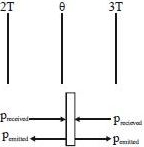
Three very large plates of the same area are kept parallel and close to each other. They are considered as ideal black surfaces and have very high thermal conductivity. The first and third plates are maintained at temperatures $2T$ and $3T$ respectively. The temperature of the middle (i.e.,second) plate under steady-state condition is
A
$\left (\frac{65}{2} \right )^{1/4} T$
B
$\left (\frac{97}{4} \right )^{1/4} T$
C
$\left (\frac{97}{2} \right )^{1/4} T$
D
$(97)^{1/4}T$
Solution
(C) For the middle plate to be in a steady state,the net power received by the plate must equal the net power emitted by the plate.
Let the temperature of the middle plate be $\theta$.
The power received by the middle plate from the first plate (at $2T$) and the third plate (at $3T$) is given by the Stefan-Boltzmann law for black bodies: $P_{\text{received}} = \sigma A (2T)^4 + \sigma A (3T)^4$.
The middle plate emits radiation from both its sides,so the total power emitted is: $P_{\text{emitted}} = 2 \times \sigma A \theta^4$.
Equating the power received and emitted:
$\sigma A (2T)^4 + \sigma A (3T)^4 = 2 \sigma A \theta^4$
$16 T^4 + 81 T^4 = 2 \theta^4$
$97 T^4 = 2 \theta^4$
$\theta^4 = \frac{97}{2} T^4$
$\theta = \left( \frac{97}{2} \right)^{1/4} T$
Let the temperature of the middle plate be $\theta$.
The power received by the middle plate from the first plate (at $2T$) and the third plate (at $3T$) is given by the Stefan-Boltzmann law for black bodies: $P_{\text{received}} = \sigma A (2T)^4 + \sigma A (3T)^4$.
The middle plate emits radiation from both its sides,so the total power emitted is: $P_{\text{emitted}} = 2 \times \sigma A \theta^4$.
Equating the power received and emitted:
$\sigma A (2T)^4 + \sigma A (3T)^4 = 2 \sigma A \theta^4$
$16 T^4 + 81 T^4 = 2 \theta^4$
$97 T^4 = 2 \theta^4$
$\theta^4 = \frac{97}{2} T^4$
$\theta = \left( \frac{97}{2} \right)^{1/4} T$
0 likes
View Solution120
DifficultMCQ
Assuming the sun to be a spherical body of radius $R$ at a temperature of $T \ K$,evaluate the total radiant power incident on Earth at a distance $r$ from the sun (where the radius of the Earth is $r_0$).
A
$4\pi r_0^2 R^2 \sigma T^4 / r^2$
B
$\pi r_0^2 R^2 \sigma T^4 / r^2$
C
$r_0^2 R^2 \sigma T^4 / 4\pi R^2$
D
$R^2 \sigma T^4 / r^2$
Solution
(B) The total power radiated by the sun is given by the Stefan-Boltzmann law: $P = \sigma A_{sun} T^4 = \sigma (4\pi R^2) T^4$.
At a distance $r$ from the sun,this power is spread over a spherical surface area of $4\pi r^2$.
The intensity $I$ of radiation at distance $r$ is $I = P / (4\pi r^2) = (\sigma 4\pi R^2 T^4) / (4\pi r^2) = \sigma R^2 T^4 / r^2$.
The Earth intercepts this radiation with its cross-sectional area,which is $\pi r_0^2$.
Therefore,the total radiant power incident on Earth is $P_{Earth} = I \times \pi r_0^2 = (\sigma R^2 T^4 / r^2) \times \pi r_0^2 = \pi r_0^2 R^2 \sigma T^4 / r^2$.
At a distance $r$ from the sun,this power is spread over a spherical surface area of $4\pi r^2$.
The intensity $I$ of radiation at distance $r$ is $I = P / (4\pi r^2) = (\sigma 4\pi R^2 T^4) / (4\pi r^2) = \sigma R^2 T^4 / r^2$.
The Earth intercepts this radiation with its cross-sectional area,which is $\pi r_0^2$.
Therefore,the total radiant power incident on Earth is $P_{Earth} = I \times \pi r_0^2 = (\sigma R^2 T^4 / r^2) \times \pi r_0^2 = \pi r_0^2 R^2 \sigma T^4 / r^2$.
0 likes
View Solution121
MediumMCQ
Two electric lamps $A$ and $B$ radiate the same power. Their filaments have the same dimensions and have emissivities $e_A$ and $e_B$. Their surface temperatures are $T_A$ and $T_B$. The ratio $\frac{T_A}{T_B}$ will be equal to :-
A
$(\frac{e_B}{e_A})^{1/4}$
B
$(\frac{e_B}{e_A})^{1/2}$
C
$(\frac{e_A}{e_B})^{1/2}$
D
$(\frac{e_A}{e_B})^{1/4}$
Solution
(A) According to the Stefan-Boltzmann law,the power radiated by a body is given by $P = e A \sigma T^4$,where $e$ is the emissivity,$A$ is the surface area,$\sigma$ is the Stefan-Boltzmann constant,and $T$ is the absolute temperature.
Since both lamps radiate the same power $(P_A = P_B)$ and have the same dimensions (same surface area $A$),we have:
$e_A A \sigma T_A^4 = e_B A \sigma T_B^4$
Canceling the common terms $A$ and $\sigma$,we get:
$e_A T_A^4 = e_B T_B^4$
Rearranging the terms to find the ratio $\frac{T_A}{T_B}$:
$\frac{T_A^4}{T_B^4} = \frac{e_B}{e_A}$
Taking the fourth root on both sides:
$\frac{T_A}{T_B} = (\frac{e_B}{e_A})^{1/4}$
Since both lamps radiate the same power $(P_A = P_B)$ and have the same dimensions (same surface area $A$),we have:
$e_A A \sigma T_A^4 = e_B A \sigma T_B^4$
Canceling the common terms $A$ and $\sigma$,we get:
$e_A T_A^4 = e_B T_B^4$
Rearranging the terms to find the ratio $\frac{T_A}{T_B}$:
$\frac{T_A^4}{T_B^4} = \frac{e_B}{e_A}$
Taking the fourth root on both sides:
$\frac{T_A}{T_B} = (\frac{e_B}{e_A})^{1/4}$
0 likes
View Solution122
DifficultMCQ
Two spheres of the same material have radii $1\ m$ and $4\ m$ and temperatures $4000\ K$ and $2000\ K$ respectively. The ratio of the energy radiated per second by the first sphere to that by the second is
A
$1 : 1$
B
$16 : 1$
C
$4 : 1$
D
$1 : 9$
Solution
(A) The energy radiated per second by a sphere is given by the Stefan-Boltzmann law: $P = \sigma A T^4$,where $A = 4\pi r^2$ is the surface area of the sphere.
Given radii $r_1 = 1\ m$,$r_2 = 4\ m$ and temperatures $T_1 = 4000\ K$,$T_2 = 2000\ K$.
The ratio of energy radiated is $\frac{P_1}{P_2} = \frac{\sigma (4\pi r_1^2) T_1^4}{\sigma (4\pi r_2^2) T_2^4} = \left(\frac{r_1}{r_2}\right)^2 \left(\frac{T_1}{T_2}\right)^4$.
Substituting the values: $\frac{P_1}{P_2} = \left(\frac{1}{4}\right)^2 \left(\frac{4000}{2000}\right)^4 = \left(\frac{1}{16}\right) \times (2)^4 = \frac{1}{16} \times 16 = 1$.
Thus,the ratio is $1 : 1$.
Given radii $r_1 = 1\ m$,$r_2 = 4\ m$ and temperatures $T_1 = 4000\ K$,$T_2 = 2000\ K$.
The ratio of energy radiated is $\frac{P_1}{P_2} = \frac{\sigma (4\pi r_1^2) T_1^4}{\sigma (4\pi r_2^2) T_2^4} = \left(\frac{r_1}{r_2}\right)^2 \left(\frac{T_1}{T_2}\right)^4$.
Substituting the values: $\frac{P_1}{P_2} = \left(\frac{1}{4}\right)^2 \left(\frac{4000}{2000}\right)^4 = \left(\frac{1}{16}\right) \times (2)^4 = \frac{1}{16} \times 16 = 1$.
Thus,the ratio is $1 : 1$.
0 likes
View Solution123
MediumMCQ
Radiation from a black body at the thermodynamic temperature $T_1$ is measured by a small detector at distance $d_1$ from it. When the temperature is increased to $T_2$ and the distance to $d_2$,the power received by the detector is unchanged. What is the ratio $d_2/d_1$?
A
$\frac{T_2}{T_1}$
B
$(\frac{T_2}{T_1})^2$
C
$(\frac{T_1}{T_2})^2$
D
$(\frac{T_2}{T_1})^4$
Solution
(B) According to the Stefan-Boltzmann law,the total power $P$ radiated by a black body of surface area $A$ at temperature $T$ is given by $P = A \sigma T^4$.
The power received by a small detector at distance $d$ is proportional to the intensity $I$,which follows the inverse square law: $I = \frac{P}{4 \pi d^2} = \frac{A \sigma T^4}{4 \pi d^2}$.
Given that the power received by the detector remains unchanged when the temperature changes from $T_1$ to $T_2$ and the distance changes from $d_1$ to $d_2$,we have:
$\frac{A \sigma T_1^4}{4 \pi d_1^2} = \frac{A \sigma T_2^4}{4 \pi d_2^2}$
Canceling the common constants $A, \sigma,$ and $4 \pi$,we get:
$\frac{T_1^4}{d_1^2} = \frac{T_2^4}{d_2^2}$
Rearranging the terms to find the ratio $d_2/d_1$:
$(\frac{d_2}{d_1})^2 = (\frac{T_2}{T_1})^4$
Taking the square root of both sides:
$\frac{d_2}{d_1} = (\frac{T_2}{T_1})^2$
The power received by a small detector at distance $d$ is proportional to the intensity $I$,which follows the inverse square law: $I = \frac{P}{4 \pi d^2} = \frac{A \sigma T^4}{4 \pi d^2}$.
Given that the power received by the detector remains unchanged when the temperature changes from $T_1$ to $T_2$ and the distance changes from $d_1$ to $d_2$,we have:
$\frac{A \sigma T_1^4}{4 \pi d_1^2} = \frac{A \sigma T_2^4}{4 \pi d_2^2}$
Canceling the common constants $A, \sigma,$ and $4 \pi$,we get:
$\frac{T_1^4}{d_1^2} = \frac{T_2^4}{d_2^2}$
Rearranging the terms to find the ratio $d_2/d_1$:
$(\frac{d_2}{d_1})^2 = (\frac{T_2}{T_1})^4$
Taking the square root of both sides:
$\frac{d_2}{d_1} = (\frac{T_2}{T_1})^2$
0 likes
View Solution124
EasyMCQ
The unit of Stefan-Boltzmann's constant $(\sigma)$ is:
A
$\frac{watt^4}{m \times K^4}$
B
$\frac{calorie}{m^2 \times K^4}$
C
$\frac{watt}{m^2 \times K^4}$
D
$\frac{joule}{m^2 \times K^4}$
Solution
(C) According to Stefan-Boltzmann's Law,the power radiated per unit area $(E)$ is given by:
$E = \sigma T^4$
Where $E$ is in $watt/m^2$ and $T$ is in $Kelvin$ $(K)$.
Rearranging for $\sigma$:
$\sigma = \frac{E}{T^4}$
Substituting the units:
Unit of $\sigma = \frac{watt/m^2}{K^4} = \frac{watt}{m^2 \times K^4}$.
$E = \sigma T^4$
Where $E$ is in $watt/m^2$ and $T$ is in $Kelvin$ $(K)$.
Rearranging for $\sigma$:
$\sigma = \frac{E}{T^4}$
Substituting the units:
Unit of $\sigma = \frac{watt/m^2}{K^4} = \frac{watt}{m^2 \times K^4}$.
0 likes
View Solution125
DifficultMCQ
$A$ sphere and a cube of the same material and same volume are heated up to the same temperature and allowed to cool in the same surroundings. The ratio of the amounts of radiation emitted will be
A
$1 : 1$
B
$\frac{4\pi}{3} : 1$
C
$\left( \frac{\pi}{6} \right)^{1/3} : 1$
D
$\frac{1}{2} \left( \frac{4\pi}{3} \right)^{2/3} : 1$
Solution
(C) The rate of heat emission by radiation is given by the Stefan-Boltzmann law: $\Delta E = e A \sigma (T^4 - T_0^4)$.
Since the material,temperature,and surroundings are the same,the ratio of radiation emitted depends only on the surface area $A$: $\frac{(\Delta E)_{\text{sphere}}}{(\Delta E)_{\text{cube}}} = \frac{A_{\text{sphere}}}{A_{\text{cube}}} = \frac{4 \pi R^2}{6 a^2}$.
Given that the volumes are equal: $\frac{4}{3} \pi R^3 = a^3$,which implies $a = R \left( \frac{4\pi}{3} \right)^{1/3}$.
Substituting $a$ into the area ratio: $\frac{4 \pi R^2}{6 [R (4\pi/3)^{1/3}]^2} = \frac{4 \pi}{6 (4\pi/3)^{2/3}} = \frac{4 \pi}{6} \cdot \frac{3^{2/3}}{(4\pi)^{2/3}} = \frac{(4\pi)^{1/3}}{6 \cdot 3^{-2/3}} = \frac{(4\pi)^{1/3}}{6^{1/3} \cdot 6^{2/3} \cdot 3^{-2/3}} = \left( \frac{4\pi}{6 \cdot (4/3)^{2/3}} \right) = \left( \frac{\pi}{6} \right)^{1/3}$.
Thus,the ratio is $\left( \frac{\pi}{6} \right)^{1/3} : 1$.
Since the material,temperature,and surroundings are the same,the ratio of radiation emitted depends only on the surface area $A$: $\frac{(\Delta E)_{\text{sphere}}}{(\Delta E)_{\text{cube}}} = \frac{A_{\text{sphere}}}{A_{\text{cube}}} = \frac{4 \pi R^2}{6 a^2}$.
Given that the volumes are equal: $\frac{4}{3} \pi R^3 = a^3$,which implies $a = R \left( \frac{4\pi}{3} \right)^{1/3}$.
Substituting $a$ into the area ratio: $\frac{4 \pi R^2}{6 [R (4\pi/3)^{1/3}]^2} = \frac{4 \pi}{6 (4\pi/3)^{2/3}} = \frac{4 \pi}{6} \cdot \frac{3^{2/3}}{(4\pi)^{2/3}} = \frac{(4\pi)^{1/3}}{6 \cdot 3^{-2/3}} = \frac{(4\pi)^{1/3}}{6^{1/3} \cdot 6^{2/3} \cdot 3^{-2/3}} = \left( \frac{4\pi}{6 \cdot (4/3)^{2/3}} \right) = \left( \frac{\pi}{6} \right)^{1/3}$.
Thus,the ratio is $\left( \frac{\pi}{6} \right)^{1/3} : 1$.
0 likes
View Solution126
DifficultMCQ
Radiated energy at $T$ temperature is $E$ for a body of diameter $d$. If the temperature becomes $2T$ and the diameter becomes $d/4$,then the radiated energy will be:
A
$4E$
B
$16E$
C
$E$
D
$E/16$
Solution
(C) According to the Stefan-Boltzmann law,the radiated energy $E$ is given by $E = \sigma A T^4$,where $A$ is the surface area and $T$ is the absolute temperature.
For a spherical body of diameter $d$,the surface area $A = 4\pi r^2 = 4\pi (d/2)^2 = \pi d^2$.
Initial energy $E_1 = \sigma (\pi d^2) T^4 = E$.
New temperature $T_2 = 2T$ and new diameter $d_2 = d/4$.
New surface area $A_2 = \pi (d_2)^2 = \pi (d/4)^2 = \pi d^2 / 16 = A_1 / 16$.
New radiated energy $E_2 = \sigma A_2 T_2^4 = \sigma (A_1 / 16) (2T)^4$.
$E_2 = \sigma (A_1 / 16) (16 T^4) = \sigma A_1 T^4 = E$.
For a spherical body of diameter $d$,the surface area $A = 4\pi r^2 = 4\pi (d/2)^2 = \pi d^2$.
Initial energy $E_1 = \sigma (\pi d^2) T^4 = E$.
New temperature $T_2 = 2T$ and new diameter $d_2 = d/4$.
New surface area $A_2 = \pi (d_2)^2 = \pi (d/4)^2 = \pi d^2 / 16 = A_1 / 16$.
New radiated energy $E_2 = \sigma A_2 T_2^4 = \sigma (A_1 / 16) (2T)^4$.
$E_2 = \sigma (A_1 / 16) (16 T^4) = \sigma A_1 T^4 = E$.
0 likes
View Solution127
MediumMCQ
$A$ black body,at a temperature of $227\,^{\circ}C$,radiates heat at a rate of $7\,cal\,cm^{-2}\,s^{-1}$. At a temperature of $727\,^{\circ}C$,the rate of heat radiated in the same units will be:
A
$80$
B
$60$
C
$50$
D
$112$
Solution
(D) According to Stefan-Boltzmann Law,the rate of heat radiation $E$ is proportional to the fourth power of the absolute temperature $T$,i.e.,$E \propto T^{4}$.
Given:
Initial temperature $T_{1} = 227 + 273 = 500\,K$.
Final temperature $T_{2} = 727 + 273 = 1000\,K$.
Initial rate of radiation $E_{1} = 7\,cal\,cm^{-2}\,s^{-1}$.
Using the ratio formula:
$E_{2} = E_{1} \left(\frac{T_{2}}{T_{1}}\right)^{4}$
$E_{2} = 7 \times \left(\frac{1000}{500}\right)^{4}$
$E_{2} = 7 \times (2)^{4}$
$E_{2} = 7 \times 16 = 112\,cal\,cm^{-2}\,s^{-1}$.
Therefore,the rate of heat radiated at $727\,^{\circ}C$ is $112\,cal\,cm^{-2}\,s^{-1}$.
Given:
Initial temperature $T_{1} = 227 + 273 = 500\,K$.
Final temperature $T_{2} = 727 + 273 = 1000\,K$.
Initial rate of radiation $E_{1} = 7\,cal\,cm^{-2}\,s^{-1}$.
Using the ratio formula:
$E_{2} = E_{1} \left(\frac{T_{2}}{T_{1}}\right)^{4}$
$E_{2} = 7 \times \left(\frac{1000}{500}\right)^{4}$
$E_{2} = 7 \times (2)^{4}$
$E_{2} = 7 \times 16 = 112\,cal\,cm^{-2}\,s^{-1}$.
Therefore,the rate of heat radiated at $727\,^{\circ}C$ is $112\,cal\,cm^{-2}\,s^{-1}$.
0 likes
View Solution128
MediumMCQ
The cooling rate of a sphere at $600\,K$ in an external environment of $200\,K$ is $R$. When the temperature of the sphere is reduced to $400\,K$,the cooling rate of the sphere becomes:
A
$\frac{3}{16} R$
B
$\frac{16}{3} R$
C
$\frac{9}{27} R$
D
None
Solution
(A) According to the Stefan-Boltzmann law,the rate of cooling $R$ is proportional to $(T^4 - T_0^4)$,where $T$ is the temperature of the body and $T_0$ is the temperature of the surroundings.
For the first case: $R_1 = R \propto (600^4 - 200^4) = (6^4 - 2^4) \times 10^8 = (1296 - 16) \times 10^8 = 1280 \times 10^8$.
For the second case: $R_2 \propto (400^4 - 200^4) = (4^4 - 2^4) \times 10^8 = (256 - 16) \times 10^8 = 240 \times 10^8$.
Taking the ratio: $\frac{R_2}{R_1} = \frac{240 \times 10^8}{1280 \times 10^8} = \frac{24}{128} = \frac{3}{16}$.
Therefore,$R_2 = \frac{3}{16} R$.
For the first case: $R_1 = R \propto (600^4 - 200^4) = (6^4 - 2^4) \times 10^8 = (1296 - 16) \times 10^8 = 1280 \times 10^8$.
For the second case: $R_2 \propto (400^4 - 200^4) = (4^4 - 2^4) \times 10^8 = (256 - 16) \times 10^8 = 240 \times 10^8$.
Taking the ratio: $\frac{R_2}{R_1} = \frac{240 \times 10^8}{1280 \times 10^8} = \frac{24}{128} = \frac{3}{16}$.
Therefore,$R_2 = \frac{3}{16} R$.
0 likes
View Solution129
MediumMCQ
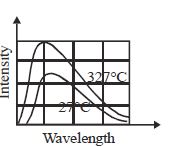
The spectrum of a black body at two temperatures $27\,^oC$ and $327\,^oC$ is shown in the figure. Let $A_1$ and $A_2$ be the areas under the two curves respectively. Find the value of $\frac {A_2}{A_1}$.
A
$16 : 1$
B
$8 : 1$
C
$9 : 4$
D
$16 : 9$
Solution
(A) According to the Stefan-Boltzmann law,the total energy radiated per unit area per unit time by a black body is proportional to the fourth power of its absolute temperature $(E \propto T^4)$.
The area under the intensity-wavelength curve represents the total emissive power of the black body at that temperature.
Therefore,the ratio of the areas $A_1$ and $A_2$ corresponding to temperatures $T_1$ and $T_2$ is given by $\frac{A_2}{A_1} = \frac{T_2^4}{T_1^4}$.
Given temperatures are $T_1 = 27\,^oC = (27 + 273)\,K = 300\,K$ and $T_2 = 327\,^oC = (327 + 273)\,K = 600\,K$.
Substituting these values into the ratio:
$\frac{A_2}{A_1} = \left( \frac{600}{300} \right)^4 = (2)^4 = 16$.
Thus,the ratio $\frac{A_2}{A_1}$ is $16 : 1$.
The area under the intensity-wavelength curve represents the total emissive power of the black body at that temperature.
Therefore,the ratio of the areas $A_1$ and $A_2$ corresponding to temperatures $T_1$ and $T_2$ is given by $\frac{A_2}{A_1} = \frac{T_2^4}{T_1^4}$.
Given temperatures are $T_1 = 27\,^oC = (27 + 273)\,K = 300\,K$ and $T_2 = 327\,^oC = (327 + 273)\,K = 600\,K$.
Substituting these values into the ratio:
$\frac{A_2}{A_1} = \left( \frac{600}{300} \right)^4 = (2)^4 = 16$.
Thus,the ratio $\frac{A_2}{A_1}$ is $16 : 1$.
0 likes
View Solution130
MediumMCQ
$A$ tungsten body of diameter $2.3 \ cm$ is at $2000 \ ^oC$. It radiates $30 \%$ of the energy radiated by a black body of the same radius and temperature. Find the radius of a black body which will radiate energy at the same rate at the same temperature (in $cm$).
A
$2.32$
B
$1.49$
C
$0.63$
D
$0.12$
Solution
(C) The rate of energy radiation is given by the Stefan-Boltzmann law: $P = e \sigma A T^4$.
For a black body,emissivity $e = 1$.
Let $R_1$ be the radius of the tungsten body and $R$ be the radius of the black body.
The power radiated by the tungsten body is $P_T = e_T \sigma (4 \pi R_1^2) T^4$,where $e_T = 0.3$.
The power radiated by a black body of the same radius $R_1$ is $P_B = 1 \cdot \sigma (4 \pi R_1^2) T^4$.
Given that the tungsten body radiates $30 \%$ of the energy of a black body of the same radius,we have $P_T = 0.3 P_B$.
We want to find the radius $R_{new}$ of a black body that radiates at the same rate as the tungsten body at the same temperature: $P_{new} = 1 \cdot \sigma (4 \pi R_{new}^2) T^4 = P_T$.
Since $P_T = 0.3 \cdot \sigma (4 \pi R_1^2) T^4$,we equate the two:
$\sigma (4 \pi R_{new}^2) T^4 = 0.3 \sigma (4 \pi R_1^2) T^4$.
$R_{new}^2 = 0.3 R_1^2$.
$R_{new} = \sqrt{0.3} \cdot R_1$.
Given diameter $d = 2.3 \ cm$,so $R_1 = 1.15 \ cm$.
$R_{new} = \sqrt{0.3} \cdot 1.15 \approx 0.5477 \cdot 1.15 \approx 0.6299 \ cm \approx 0.63 \ cm$.
For a black body,emissivity $e = 1$.
Let $R_1$ be the radius of the tungsten body and $R$ be the radius of the black body.
The power radiated by the tungsten body is $P_T = e_T \sigma (4 \pi R_1^2) T^4$,where $e_T = 0.3$.
The power radiated by a black body of the same radius $R_1$ is $P_B = 1 \cdot \sigma (4 \pi R_1^2) T^4$.
Given that the tungsten body radiates $30 \%$ of the energy of a black body of the same radius,we have $P_T = 0.3 P_B$.
We want to find the radius $R_{new}$ of a black body that radiates at the same rate as the tungsten body at the same temperature: $P_{new} = 1 \cdot \sigma (4 \pi R_{new}^2) T^4 = P_T$.
Since $P_T = 0.3 \cdot \sigma (4 \pi R_1^2) T^4$,we equate the two:
$\sigma (4 \pi R_{new}^2) T^4 = 0.3 \sigma (4 \pi R_1^2) T^4$.
$R_{new}^2 = 0.3 R_1^2$.
$R_{new} = \sqrt{0.3} \cdot R_1$.
Given diameter $d = 2.3 \ cm$,so $R_1 = 1.15 \ cm$.
$R_{new} = \sqrt{0.3} \cdot 1.15 \approx 0.5477 \cdot 1.15 \approx 0.6299 \ cm \approx 0.63 \ cm$.
0 likes
View Solution131
MediumMCQ
The temperature of a black body reduces to half of its initial value. By what fraction will the amount of radiation emitted reduce?
A
$1/2$
B
$1/4$
C
$1/8$
D
$1/16$
Solution
(D) According to the Stefan-Boltzmann law,the power radiated by a black body is given by $E = \sigma A T^4$.
Since the surface area $A$ and the Stefan-Boltzmann constant $\sigma$ are constant,the power radiated is directly proportional to the fourth power of the absolute temperature: $E \propto T^4$.
Let the initial temperature be $T_1 = T$ and the final temperature be $T_2 = T/2$.
The ratio of the final power $E_2$ to the initial power $E_1$ is given by:
$E_2 / E_1 = (T_2 / T_1)^4 = ( (T/2) / T )^4 = (1/2)^4 = 1/16$.
Therefore,the amount of radiation emitted reduces to $1/16$ of its initial value.
Since the surface area $A$ and the Stefan-Boltzmann constant $\sigma$ are constant,the power radiated is directly proportional to the fourth power of the absolute temperature: $E \propto T^4$.
Let the initial temperature be $T_1 = T$ and the final temperature be $T_2 = T/2$.
The ratio of the final power $E_2$ to the initial power $E_1$ is given by:
$E_2 / E_1 = (T_2 / T_1)^4 = ( (T/2) / T )^4 = (1/2)^4 = 1/16$.
Therefore,the amount of radiation emitted reduces to $1/16$ of its initial value.
0 likes
View Solution132
DifficultMCQ
$A$ black body,at a temperature of $227\,^{\circ}C$,radiates heat at a rate of $7\, cal\, cm^{-2} \,s^{-1}$. At a temperature of $727\,^{\circ}C$,the rate of heat radiated in the same units will be ..... units.
A
$80$
B
$60$
C
$50$
D
$112$
Solution
(D) According to the Stefan-Boltzmann Law,the rate of heat radiation $E$ from a black body is directly proportional to the fourth power of its absolute temperature $T$,i.e.,$E \propto T^{4}$.
Given:
Initial temperature $T_{1} = 227 + 273 = 500\, K$.
Initial rate of radiation $E_{1} = 7\, cal\, cm^{-2} \,s^{-1}$.
Final temperature $T_{2} = 727 + 273 = 1000\, K$.
Using the ratio formula:
$E_{2} = E_{1} \left(\frac{T_{2}}{T_{1}}\right)^{4}$
Substituting the values:
$E_{2} = 7 \times \left(\frac{1000}{500}\right)^{4}$
$E_{2} = 7 \times (2)^{4}$
$E_{2} = 7 \times 16 = 112\, cal\, cm^{-2} \,s^{-1}$.
Thus,the rate of heat radiated is $112$ units.
Given:
Initial temperature $T_{1} = 227 + 273 = 500\, K$.
Initial rate of radiation $E_{1} = 7\, cal\, cm^{-2} \,s^{-1}$.
Final temperature $T_{2} = 727 + 273 = 1000\, K$.
Using the ratio formula:
$E_{2} = E_{1} \left(\frac{T_{2}}{T_{1}}\right)^{4}$
Substituting the values:
$E_{2} = 7 \times \left(\frac{1000}{500}\right)^{4}$
$E_{2} = 7 \times (2)^{4}$
$E_{2} = 7 \times 16 = 112\, cal\, cm^{-2} \,s^{-1}$.
Thus,the rate of heat radiated is $112$ units.
0 likes
View Solution133
DifficultMCQ
The rate of dissipation of heat by a black body at temperature $T$ is $Q$. What will be the rate of dissipation of heat by another body at temperature $2T$ and emissivity $0.25$ (in $Q$)?
A
$16$
B
$4$
C
$8$
D
$4.5$
Solution
(B) The rate of heat dissipation for a black body is given by the Stefan-Boltzmann law: $Q = \sigma A T^4$.
For another body with emissivity $e = 0.25$ and temperature $T' = 2T$,the rate of heat dissipation $Q'$ is given by: $Q' = e \sigma A (T')^4$.
Substituting the given values: $Q' = 0.25 \times \sigma A (2T)^4$.
$Q' = 0.25 \times \sigma A \times 16 T^4$.
$Q' = 0.25 \times 16 \times (\sigma A T^4)$.
Since $Q = \sigma A T^4$,we have $Q' = 4 \times Q = 4Q$.
For another body with emissivity $e = 0.25$ and temperature $T' = 2T$,the rate of heat dissipation $Q'$ is given by: $Q' = e \sigma A (T')^4$.
Substituting the given values: $Q' = 0.25 \times \sigma A (2T)^4$.
$Q' = 0.25 \times \sigma A \times 16 T^4$.
$Q' = 0.25 \times 16 \times (\sigma A T^4)$.
Since $Q = \sigma A T^4$,we have $Q' = 4 \times Q = 4Q$.
0 likes
View Solution134
MediumMCQ
$A$ black body is heated from $7\,^oC$ to $287\,^oC$. The ratio of radiation emitted is
A
$1:16$
B
$1:64$
C
$1:256$
D
$1:8$
Solution
(A) According to the Stefan-Boltzmann law,the power radiated by a black body is proportional to the fourth power of its absolute temperature: $E \propto T^4$.
Given temperatures in Celsius: $T_1 = 7\,^oC$ and $T_2 = 287\,^oC$.
Convert these to Kelvin: $T_1 = 7 + 273 = 280\,K$ and $T_2 = 287 + 273 = 560\,K$.
The ratio of radiation emitted is $\frac{E_1}{E_2} = \left(\frac{T_1}{T_2}\right)^4$.
Substituting the values: $\frac{E_1}{E_2} = \left(\frac{280}{560}\right)^4 = \left(\frac{1}{2}\right)^4 = \frac{1}{16}$.
Thus,the ratio is $1:16$.
Given temperatures in Celsius: $T_1 = 7\,^oC$ and $T_2 = 287\,^oC$.
Convert these to Kelvin: $T_1 = 7 + 273 = 280\,K$ and $T_2 = 287 + 273 = 560\,K$.
The ratio of radiation emitted is $\frac{E_1}{E_2} = \left(\frac{T_1}{T_2}\right)^4$.
Substituting the values: $\frac{E_1}{E_2} = \left(\frac{280}{560}\right)^4 = \left(\frac{1}{2}\right)^4 = \frac{1}{16}$.
Thus,the ratio is $1:16$.
0 likes
View Solution135
DifficultMCQ
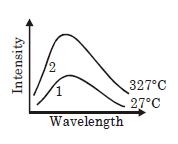
The spectrum of a black body at two temperatures $27\,^oC$ and $327\,^oC$ is shown in the figure. Let $A_1$ and $A_2$ be the areas under the two curves respectively. The value of $\frac{A_2}{A_1}$ is
A
$1 : 16$
B
$4 : 1$
C
$2 : 1$
D
$16 : 1$
Solution
(D) According to Stefan-Boltzmann law,the total energy radiated per unit area per unit time (emissive power $E$) by a black body is directly proportional to the fourth power of its absolute temperature $(T)$.
$E \propto T^4$
Since the area under the intensity-wavelength curve represents the total emissive power,we have $A \propto T^4$.
Given temperatures are $T_1 = 27\,^oC = (27 + 273)\,K = 300\,K$ and $T_2 = 327\,^oC = (327 + 273)\,K = 600\,K$.
Therefore,the ratio of the areas is:
$\frac{A_2}{A_1} = \frac{T_2^4}{T_1^4} = \left(\frac{600}{300}\right)^4 = (2)^4 = 16$.
Thus,the value of $\frac{A_2}{A_1}$ is $16 : 1$.
$E \propto T^4$
Since the area under the intensity-wavelength curve represents the total emissive power,we have $A \propto T^4$.
Given temperatures are $T_1 = 27\,^oC = (27 + 273)\,K = 300\,K$ and $T_2 = 327\,^oC = (327 + 273)\,K = 600\,K$.
Therefore,the ratio of the areas is:
$\frac{A_2}{A_1} = \frac{T_2^4}{T_1^4} = \left(\frac{600}{300}\right)^4 = (2)^4 = 16$.
Thus,the value of $\frac{A_2}{A_1}$ is $16 : 1$.
0 likes
View Solution136
DifficultMCQ
Calculate the surface temperature of the planet,if the energy radiated by unit area in unit time is $5.67 \times 10^4 \, W$. (Assume the planet to be a black body).
A
$1273 \, ^\circ C$
B
$1000 \, ^\circ C$
C
$727 \, ^\circ C$
D
$727 \, K$
Solution
(C) The energy radiated per unit area per unit time is given by the Stefan-Boltzmann law: $I = \frac{P}{A} = \sigma T^4$.
Given,$I = 5.67 \times 10^4 \, W/m^2$ and Stefan-Boltzmann constant $\sigma = 5.67 \times 10^{-8} \, W/m^2 \cdot K^4$.
Substituting the values: $5.67 \times 10^4 = 5.67 \times 10^{-8} \times T^4$.
$T^4 = \frac{5.67 \times 10^4}{5.67 \times 10^{-8}} = 10^{12}$.
Taking the fourth root: $T = (10^{12})^{1/4} = 10^3 \, K = 1000 \, K$.
To convert to Celsius: $T(^{\circ}C) = T(K) - 273 = 1000 - 273 = 727 \, ^{\circ}C$.
Given,$I = 5.67 \times 10^4 \, W/m^2$ and Stefan-Boltzmann constant $\sigma = 5.67 \times 10^{-8} \, W/m^2 \cdot K^4$.
Substituting the values: $5.67 \times 10^4 = 5.67 \times 10^{-8} \times T^4$.
$T^4 = \frac{5.67 \times 10^4}{5.67 \times 10^{-8}} = 10^{12}$.
Taking the fourth root: $T = (10^{12})^{1/4} = 10^3 \, K = 1000 \, K$.
To convert to Celsius: $T(^{\circ}C) = T(K) - 273 = 1000 - 273 = 727 \, ^{\circ}C$.
0 likes
View Solution137
DifficultMCQ
$A$ black coloured solid sphere of radius $R$ and mass $M$ is inside a cavity with vacuum inside. The walls of the cavity are maintained at temperature $T_0$. The initial temperature of the sphere is $3T_0$. If the specific heat of the material of the sphere varies as $\alpha T^3$ per unit mass with the temperature $T$ of the sphere,where $\alpha$ is a constant,then the time taken for the sphere to cool down to temperature $2T_0$ will be ($\sigma$ is Stefan-Boltzmann constant).
A
$\frac{M\alpha}{4\pi R^2\sigma} \ln \left( \frac{3}{2} \right)$
B
$\frac{M\alpha}{4\pi R^2\sigma} \ln \left( \frac{16}{3} \right)$
C
$\frac{M\alpha}{16\pi R^2\sigma} \ln \left( \frac{16}{3} \right)$
D
$\frac{M\alpha}{16\pi R^2\sigma} \ln \left( \frac{3}{2} \right)$
Solution
(C) The rate of heat loss by the sphere is given by the Stefan-Boltzmann law: $dQ/dt = \sigma A (T^4 - T_0^4)$,where $A = 4\pi R^2$.
Also,the heat lost by the sphere is $dQ = -Mc dT$,where $c = \alpha T^3$.
Equating the two expressions: $-M(\alpha T^3) dT = \sigma (4\pi R^2) (T^4 - T_0^4) dt$.
Rearranging to solve for $dt$: $dt = -\frac{M\alpha T^3 dT}{\sigma (4\pi R^2) (T^4 - T_0^4)}$.
Integrating from $T = 3T_0$ to $T = 2T_0$: $t = \int_{2T_0}^{3T_0} \frac{M\alpha T^3}{4\pi R^2 \sigma (T^4 - T_0^4)} dT$.
Let $u = T^4 - T_0^4$,then $du = 4T^3 dT$,so $T^3 dT = du/4$.
$t = \frac{M\alpha}{4\pi R^2 \sigma} \int_{T=2T_0}^{T=3T_0} \frac{du/4}{u} = \frac{M\alpha}{16\pi R^2 \sigma} [\ln(u)]_{T=2T_0}^{T=3T_0}$.
$t = \frac{M\alpha}{16\pi R^2 \sigma} [\ln(T^4 - T_0^4)]_{2T_0}^{3T_0} = \frac{M\alpha}{16\pi R^2 \sigma} \ln \left( \frac{(3T_0)^4 - T_0^4}{(2T_0)^4 - T_0^4} \right)$.
$t = \frac{M\alpha}{16\pi R^2 \sigma} \ln \left( \frac{81T_0^4 - T_0^4}{16T_0^4 - T_0^4} \right) = \frac{M\alpha}{16\pi R^2 \sigma} \ln \left( \frac{80}{15} \right) = \frac{M\alpha}{16\pi R^2 \sigma} \ln \left( \frac{16}{3} \right)$.
Also,the heat lost by the sphere is $dQ = -Mc dT$,where $c = \alpha T^3$.
Equating the two expressions: $-M(\alpha T^3) dT = \sigma (4\pi R^2) (T^4 - T_0^4) dt$.
Rearranging to solve for $dt$: $dt = -\frac{M\alpha T^3 dT}{\sigma (4\pi R^2) (T^4 - T_0^4)}$.
Integrating from $T = 3T_0$ to $T = 2T_0$: $t = \int_{2T_0}^{3T_0} \frac{M\alpha T^3}{4\pi R^2 \sigma (T^4 - T_0^4)} dT$.
Let $u = T^4 - T_0^4$,then $du = 4T^3 dT$,so $T^3 dT = du/4$.
$t = \frac{M\alpha}{4\pi R^2 \sigma} \int_{T=2T_0}^{T=3T_0} \frac{du/4}{u} = \frac{M\alpha}{16\pi R^2 \sigma} [\ln(u)]_{T=2T_0}^{T=3T_0}$.
$t = \frac{M\alpha}{16\pi R^2 \sigma} [\ln(T^4 - T_0^4)]_{2T_0}^{3T_0} = \frac{M\alpha}{16\pi R^2 \sigma} \ln \left( \frac{(3T_0)^4 - T_0^4}{(2T_0)^4 - T_0^4} \right)$.
$t = \frac{M\alpha}{16\pi R^2 \sigma} \ln \left( \frac{81T_0^4 - T_0^4}{16T_0^4 - T_0^4} \right) = \frac{M\alpha}{16\pi R^2 \sigma} \ln \left( \frac{80}{15} \right) = \frac{M\alpha}{16\pi R^2 \sigma} \ln \left( \frac{16}{3} \right)$.
0 likes
View Solution138
MediumMCQ
The heat radiated per unit area in $1\,hour$ by a furnace whose temperature is $3000\,K$ is $(\sigma = 5.7 \times 10^{-8}\,W\,m^{-2}\,K^{-4})$.
A
$1.7 \times 10^{10}\,J$
B
$1.1 \times 10^{12}\,J$
C
$2.8 \times 10^{8}\,J$
D
$4.6 \times 10^{6}\,J$
Solution
(A) According to $Stefan's\,law$, the power radiated per unit area is given by $E = \sigma T^4$.
Given:
Temperature $T = 3000\,K$
Stefan's constant $\sigma = 5.7 \times 10^{-8}\,W\,m^{-2}\,K^{-4}$
Time $t = 1\,hour = 3600\,s$
The heat radiated per unit area $(Q/A)$ in time $t$ is:
$Q/A = E \times t = \sigma T^4 \times t$
Substituting the values:
$Q/A = (5.7 \times 10^{-8}) \times (3000)^4 \times 3600$
$Q/A = 5.7 \times 10^{-8} \times 81 \times 10^{12} \times 3600$
$Q/A = 5.7 \times 81 \times 3600 \times 10^4$
$Q/A = 1662120 \times 10^4 = 1.66212 \times 10^{10}\,J \approx 1.7 \times 10^{10}\,J$.
Given:
Temperature $T = 3000\,K$
Stefan's constant $\sigma = 5.7 \times 10^{-8}\,W\,m^{-2}\,K^{-4}$
Time $t = 1\,hour = 3600\,s$
The heat radiated per unit area $(Q/A)$ in time $t$ is:
$Q/A = E \times t = \sigma T^4 \times t$
Substituting the values:
$Q/A = (5.7 \times 10^{-8}) \times (3000)^4 \times 3600$
$Q/A = 5.7 \times 10^{-8} \times 81 \times 10^{12} \times 3600$
$Q/A = 5.7 \times 81 \times 3600 \times 10^4$
$Q/A = 1662120 \times 10^4 = 1.66212 \times 10^{10}\,J \approx 1.7 \times 10^{10}\,J$.
0 likes
View Solution139
MediumMCQ
$A$ black body radiates heat energy at the rate of $2 \times 10^5 \, J/s \cdot m^2$ at a temperature of $127 \, ^\circ C$. The temperature of the black body at which the rate becomes $32 \times 10^5 \, J/s \cdot m^2$ is ....... $^\circ C$.
A
$273$
B
$527$
C
$873$
D
$927$
Solution
(B) According to Stefan-Boltzmann Law,the rate of heat radiation $E$ is proportional to the fourth power of absolute temperature $T$,i.e.,$E = \sigma T^4$.
Given:
$E_1 = 2 \times 10^5 \, J/s \cdot m^2$
$T_1 = 127 + 273 = 400 \, K$
$E_2 = 32 \times 10^5 \, J/s \cdot m^2$
Using the ratio formula:
$\frac{E_2}{E_1} = \left(\frac{T_2}{T_1}\right)^4$
$\frac{32 \times 10^5}{2 \times 10^5} = \left(\frac{T_2}{400}\right)^4$
$16 = \left(\frac{T_2}{400}\right)^4$
Taking the fourth root on both sides:
$2 = \frac{T_2}{400}$
$T_2 = 800 \, K$
Converting back to Celsius:
$T_2 = 800 - 273 = 527 \, ^\circ C$.
Given:
$E_1 = 2 \times 10^5 \, J/s \cdot m^2$
$T_1 = 127 + 273 = 400 \, K$
$E_2 = 32 \times 10^5 \, J/s \cdot m^2$
Using the ratio formula:
$\frac{E_2}{E_1} = \left(\frac{T_2}{T_1}\right)^4$
$\frac{32 \times 10^5}{2 \times 10^5} = \left(\frac{T_2}{400}\right)^4$
$16 = \left(\frac{T_2}{400}\right)^4$
Taking the fourth root on both sides:
$2 = \frac{T_2}{400}$
$T_2 = 800 \, K$
Converting back to Celsius:
$T_2 = 800 - 273 = 527 \, ^\circ C$.
0 likes
View Solution140
MediumMCQ
The area of the hole of a heat furnace is $10^{-4} \ m^2$. It radiates $1.58 \times 10^5 \ cal$ of heat per hour. If the emissivity of the furnace is $0.80$,then its temperature is .......... $K$.
A
$1500$
B
$2000$
C
$2500$
D
$3000$
Solution
(C) According to Stefan-Boltzmann law,the power radiated is given by $P = \sigma \varepsilon A T^4$.
Here,$P = \frac{1.58 \times 10^5 \ cal}{1 \ hour} = \frac{1.58 \times 10^5 \times 4.2 \ J}{3600 \ s} \approx 184.33 \ W$.
Given: $A = 10^{-4} \ m^2$,$\varepsilon = 0.80$,$\sigma = 5.67 \times 10^{-8} \ W/m^2K^4$.
Substituting the values: $184.33 = 5.67 \times 10^{-8} \times 0.80 \times 10^{-4} \times T^4$.
$T^4 = \frac{184.33}{5.67 \times 0.80 \times 10^{-12}} \approx 4.06 \times 10^{13} \approx 3906250000000$.
Taking the fourth root,$T \approx 2500 \ K$.
Here,$P = \frac{1.58 \times 10^5 \ cal}{1 \ hour} = \frac{1.58 \times 10^5 \times 4.2 \ J}{3600 \ s} \approx 184.33 \ W$.
Given: $A = 10^{-4} \ m^2$,$\varepsilon = 0.80$,$\sigma = 5.67 \times 10^{-8} \ W/m^2K^4$.
Substituting the values: $184.33 = 5.67 \times 10^{-8} \times 0.80 \times 10^{-4} \times T^4$.
$T^4 = \frac{184.33}{5.67 \times 0.80 \times 10^{-12}} \approx 4.06 \times 10^{13} \approx 3906250000000$.
Taking the fourth root,$T \approx 2500 \ K$.
0 likes
View Solution141
MediumMCQ
Energy is being emitted from the surface of a black body at $127\,^{\circ}C$ temperature at the rate of $1.0 \times 10^6\,J/s\cdot m^2$. The temperature of the black body at which the rate of energy emission is $16.0 \times 10^6\,J/s\cdot m^2$ will be ......... $^{\circ}C$.
A
$254$
B
$508$
C
$527$
D
$727$
Solution
(C) According to Stefan-Boltzmann Law,the rate of energy emission per unit area $E$ is proportional to the fourth power of the absolute temperature $T$,i.e.,$E \propto T^4$.
Given:
$T_1 = 127^{\circ}C = 127 + 273 = 400\,K$
$E_1 = 1.0 \times 10^6\,J/s\cdot m^2$
$E_2 = 16.0 \times 10^6\,J/s\cdot m^2$
Using the ratio formula:
$\frac{E_2}{E_1} = \left(\frac{T_2}{T_1}\right)^4$
Substituting the values:
$\frac{16.0 \times 10^6}{1.0 \times 10^6} = \left(\frac{T_2}{400}\right)^4$
$16 = \left(\frac{T_2}{400}\right)^4$
$2^4 = \left(\frac{T_2}{400}\right)^4$
Taking the fourth root on both sides:
$2 = \frac{T_2}{400}$
$T_2 = 800\,K$
Converting back to Celsius:
$T_2 = 800 - 273 = 527^{\circ}C$.
Given:
$T_1 = 127^{\circ}C = 127 + 273 = 400\,K$
$E_1 = 1.0 \times 10^6\,J/s\cdot m^2$
$E_2 = 16.0 \times 10^6\,J/s\cdot m^2$
Using the ratio formula:
$\frac{E_2}{E_1} = \left(\frac{T_2}{T_1}\right)^4$
Substituting the values:
$\frac{16.0 \times 10^6}{1.0 \times 10^6} = \left(\frac{T_2}{400}\right)^4$
$16 = \left(\frac{T_2}{400}\right)^4$
$2^4 = \left(\frac{T_2}{400}\right)^4$
Taking the fourth root on both sides:
$2 = \frac{T_2}{400}$
$T_2 = 800\,K$
Converting back to Celsius:
$T_2 = 800 - 273 = 527^{\circ}C$.
0 likes
View Solution142
DifficultMCQ
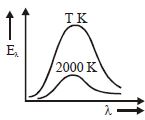
The adjoining diagram shows the spectral energy density distribution $E_\lambda$ of a black body at two different temperatures. If the areas under the curves are in the ratio $16 : 1$,the value of temperature $T$ is ......... $K$. (in $,000$)
A
$32$
B
$16$
C
$8$
D
$4$
Solution
(D) According to the Stefan-Boltzmann law,the total energy radiated per unit area per unit time by a black body is proportional to the fourth power of its absolute temperature $(E \propto T^4)$.
The area under the spectral energy density curve $E_\lambda$ versus $\lambda$ represents the total emissive power of the black body.
Given the ratio of the areas under the curves is $\frac{A_1}{A_2} = 16 : 1$,where $A_1$ corresponds to temperature $T$ and $A_2$ corresponds to $2000 \ K$.
Using the relation $\frac{A_1}{A_2} = \left(\frac{T}{2000}\right)^4$,we have:
$16 = \left(\frac{T}{2000}\right)^4$
Taking the fourth root on both sides:
$2 = \frac{T}{2000}$
$T = 2 \times 2000 = 4000 \ K$.
The area under the spectral energy density curve $E_\lambda$ versus $\lambda$ represents the total emissive power of the black body.
Given the ratio of the areas under the curves is $\frac{A_1}{A_2} = 16 : 1$,where $A_1$ corresponds to temperature $T$ and $A_2$ corresponds to $2000 \ K$.
Using the relation $\frac{A_1}{A_2} = \left(\frac{T}{2000}\right)^4$,we have:
$16 = \left(\frac{T}{2000}\right)^4$
Taking the fourth root on both sides:
$2 = \frac{T}{2000}$
$T = 2 \times 2000 = 4000 \ K$.
0 likes
View Solution143
DifficultMCQ
The temperature of a body is increased from $27\,^{\circ}C$ to $127\,^{\circ}C$. The radiation emitted by it increases by a factor of:
A
$\frac{256}{81}$
B
$\frac{15}{9}$
C
$\frac{4}{5}$
D
$\frac{12}{27}$
Solution
(A) According to the Stefan-Boltzmann law,the power radiated by a black body is proportional to the fourth power of its absolute temperature: $E \propto T^4$.
Initial temperature $T_1 = 27 + 273 = 300\,K$.
Final temperature $T_2 = 127 + 273 = 400\,K$.
The ratio of radiation emitted is given by $\frac{E_2}{E_1} = \left( \frac{T_2}{T_1} \right)^4$.
Substituting the values: $\frac{E_2}{E_1} = \left( \frac{400}{300} \right)^4 = \left( \frac{4}{3} \right)^4$.
Calculating the value: $\frac{4^4}{3^4} = \frac{256}{81}$.
Therefore,the radiation increases by a factor of $\frac{256}{81}$.
Initial temperature $T_1 = 27 + 273 = 300\,K$.
Final temperature $T_2 = 127 + 273 = 400\,K$.
The ratio of radiation emitted is given by $\frac{E_2}{E_1} = \left( \frac{T_2}{T_1} \right)^4$.
Substituting the values: $\frac{E_2}{E_1} = \left( \frac{400}{300} \right)^4 = \left( \frac{4}{3} \right)^4$.
Calculating the value: $\frac{4^4}{3^4} = \frac{256}{81}$.
Therefore,the radiation increases by a factor of $\frac{256}{81}$.
0 likes
View Solution144
MediumMCQ
$A$ body of area $1\, cm^2$ is heated to a temperature $1000\, K$. The amount of energy radiated by the body in $1\, second$ is .......... $Joule$ (Stefan's constant $\sigma = 5.67 \times 10^{-8}\, W\, m^{-2}K^{-4}$)
A
$5.67$
B
$0.56$
C
$56.7$
D
$567$
Solution
(A) Given:
Area $A = 1\, cm^2 = 10^{-4}\, m^2$
Temperature $T = 1000\, K = 10^3\, K$
Time $t = 1\, s$
Stefan's constant $\sigma = 5.67 \times 10^{-8}\, W\, m^{-2}K^{-4}$
According to the Stefan-Boltzmann law,the energy $E$ radiated by a body is given by:
$E = \sigma A T^4 t$
Substituting the values:
$E = (5.67 \times 10^{-8}) \times (10^{-4}) \times (10^3)^4 \times 1$
$E = 5.67 \times 10^{-12} \times 10^{12} \times 1$
$E = 5.67\, J$
Thus,the amount of energy radiated is $5.67\, J$.
Area $A = 1\, cm^2 = 10^{-4}\, m^2$
Temperature $T = 1000\, K = 10^3\, K$
Time $t = 1\, s$
Stefan's constant $\sigma = 5.67 \times 10^{-8}\, W\, m^{-2}K^{-4}$
According to the Stefan-Boltzmann law,the energy $E$ radiated by a body is given by:
$E = \sigma A T^4 t$
Substituting the values:
$E = (5.67 \times 10^{-8}) \times (10^{-4}) \times (10^3)^4 \times 1$
$E = 5.67 \times 10^{-12} \times 10^{12} \times 1$
$E = 5.67\, J$
Thus,the amount of energy radiated is $5.67\, J$.
0 likes
View Solution145
MediumMCQ
$A$ black body at a high temperature $T \ K$ radiates energy at the rate $E \ W/m^2$. When the temperature falls to $(T/2) \ K$,the radiated energy will be:
A
$E/4$
B
$E/2$
C
$2E$
D
$E/16$
Solution
(D) According to the Stefan-Boltzmann law,the energy radiated per unit area per unit time by a black body is proportional to the fourth power of its absolute temperature: $E \propto T^4$.
Let $E_1 = E$ at temperature $T_1 = T$.
Let $E_2$ be the energy radiated at temperature $T_2 = T/2$.
Using the ratio: $\frac{E_2}{E_1} = \left( \frac{T_2}{T_1} \right)^4$.
Substituting the values: $\frac{E_2}{E} = \left( \frac{T/2}{T} \right)^4 = \left( \frac{1}{2} \right)^4 = \frac{1}{16}$.
Therefore,$E_2 = E/16$.
Let $E_1 = E$ at temperature $T_1 = T$.
Let $E_2$ be the energy radiated at temperature $T_2 = T/2$.
Using the ratio: $\frac{E_2}{E_1} = \left( \frac{T_2}{T_1} \right)^4$.
Substituting the values: $\frac{E_2}{E} = \left( \frac{T/2}{T} \right)^4 = \left( \frac{1}{2} \right)^4 = \frac{1}{16}$.
Therefore,$E_2 = E/16$.
0 likes
View Solution146
DifficultMCQ
If the temperature of a black body increases from $7\,^{\circ}C$ to $287\,^{\circ}C$,then the rate of energy radiation increases by
A
$(\frac{287}{7})^4$
B
$16$
C
$4$
D
$2$
Solution
(B) According to Stefan-Boltzmann law,the rate of energy radiation $E$ from a black body is proportional to the fourth power of its absolute temperature $T$,given by $E = A\sigma T^4$,where $A$ is the surface area and $\sigma$ is the Stefan-Boltzmann constant.
Given initial temperature $T_1 = 7^{\circ}C = 7 + 273 = 280\,K$.
Given final temperature $T_2 = 287^{\circ}C = 287 + 273 = 560\,K$.
The ratio of the rate of energy radiation is given by $\frac{E_2}{E_1} = (\frac{T_2}{T_1})^4$.
Substituting the values: $\frac{E_2}{E_1} = (\frac{560}{280})^4 = (2)^4 = 16$.
Therefore,the rate of energy radiation increases by $16$ times.
Given initial temperature $T_1 = 7^{\circ}C = 7 + 273 = 280\,K$.
Given final temperature $T_2 = 287^{\circ}C = 287 + 273 = 560\,K$.
The ratio of the rate of energy radiation is given by $\frac{E_2}{E_1} = (\frac{T_2}{T_1})^4$.
Substituting the values: $\frac{E_2}{E_1} = (\frac{560}{280})^4 = (2)^4 = 16$.
Therefore,the rate of energy radiation increases by $16$ times.
0 likes
View Solution147
EasyMCQ
$Assertion :$ Bodies radiate heat at all temperatures.
$Reason :$ Rate of radiation of heat is proportional to the fourth power of absolute temperature.
$Reason :$ Rate of radiation of heat is proportional to the fourth power of absolute temperature.
A
If both Assertion and Reason are correct and the Reason is a correct explanation of the Assertion.
B
If both Assertion and Reason are correct but Reason is not a correct explanation of the Assertion.
C
If the Assertion is correct but Reason is incorrect.
D
If both the Assertion and Reason are incorrect.
Solution
(A) According to the kinetic theory of matter,all bodies at temperatures above absolute zero $(0 \ K)$ possess thermal energy and emit electromagnetic radiation. Thus,the assertion is correct.
According to the Stefan-Boltzmann law,the total energy radiated per unit surface area of a black body per unit time is directly proportional to the fourth power of its absolute temperature,given by $E = \sigma T^4$. This law explains why the rate of radiation depends on the temperature of the body. Therefore,the reason is correct and provides a valid explanation for the assertion.
According to the Stefan-Boltzmann law,the total energy radiated per unit surface area of a black body per unit time is directly proportional to the fourth power of its absolute temperature,given by $E = \sigma T^4$. This law explains why the rate of radiation depends on the temperature of the body. Therefore,the reason is correct and provides a valid explanation for the assertion.
0 likes
View Solution10-2.Heat Transfer — Radiation by Stefan's Boltzmann Law · Frequently Asked Questions
1Are these 10-2.Heat Transfer questions useful for JEE and NEET?
Yes. All questions in this section are mapped to JEE Main and NEET exam patterns. Previous year questions from JEE Main, NEET, GUJCET and state-level exams are included with full solutions.
2Can I switch to Hindi or Gujarati for these questions?
Yes. Use the language tabs in the hero section or the sidebar to view the same questions and solutions in English, Hindi or Gujarati.
3How do I generate a question paper from this subtopic?
Use the Vedclass Exam Paper Generator — select the chapter and subtopic, set difficulty, and generate Sets A, B, C, D automatically. First 3 chapters of every subject are free.
Vedclass Products
For Students
Vedclass Test Series
Mock tests in real JEE/NEET style with performance analysis. 5-day free trial.
Start Free TrialFor Teachers
Exam Paper Generator
Generate Set A/B/C/D papers from this chapter in 2 minutes. 3 chapters free.
Try FreeFor Institutes
Online Exam Module
Live online exams with unlimited students, 360° analytics & white-label branding.
See DemoFor Teachers & Institutes
Generate a 10-2.Heat Transfer Exam Paper in 2 Minutes
Select subtopic & difficulty — Sets A, B, C, D auto-generated with No Repeat logic.
First 3 chapters of every subject are free — no payment required.