
A English
Temperature and Temperature scales Questions in English
Class 11 Physics · 10-1.Thermometry, Thermal Expansion and Calorimetry · Temperature and Temperature scales
142+
Questions
English
Language
100%
With Solutions
Showing 40 of 142 questions in English
101
Medium
Calculate the temperature which has the same numerical value on the Celsius and Fahrenheit scales.
Solution
(D) The relationship between Celsius $(^{\circ}C)$ and Fahrenheit $(^{\circ}F)$ scales is given by:
$\frac{F-32}{180} = \frac{C}{100}$
Let the temperature be $Q$ such that $F = C = Q$.
Substituting $Q$ into the equation:
$\frac{Q-32}{180} = \frac{Q}{100}$
Simplify the fraction $\frac{180}{100}$ to $\frac{9}{5}$:
$Q - 32 = \frac{9}{5}Q$
Rearrange the terms to solve for $Q$:
$Q - \frac{9}{5}Q = 32$
$-\frac{4}{5}Q = 32$
Multiply both sides by $-\frac{5}{4}$:
$Q = 32 \times (-\frac{5}{4})$
$Q = -40$
Thus,the temperature is $-40^{\circ}C$ or $-40^{\circ}F$.
$\frac{F-32}{180} = \frac{C}{100}$
Let the temperature be $Q$ such that $F = C = Q$.
Substituting $Q$ into the equation:
$\frac{Q-32}{180} = \frac{Q}{100}$
Simplify the fraction $\frac{180}{100}$ to $\frac{9}{5}$:
$Q - 32 = \frac{9}{5}Q$
Rearrange the terms to solve for $Q$:
$Q - \frac{9}{5}Q = 32$
$-\frac{4}{5}Q = 32$
Multiply both sides by $-\frac{5}{4}$:
$Q = 32 \times (-\frac{5}{4})$
$Q = -40$
Thus,the temperature is $-40^{\circ}C$ or $-40^{\circ}F$.
0 likes
View Solution102
MediumMCQ
$A$ certain liquid has a melting point of $-50^{\circ} C$ and a boiling point of $150^{\circ} C$. $A$ thermometer is designed with this liquid and its melting and boiling points are designated at $0^{\circ} L$ and $100^{\circ} L$. The melting and boiling points of water on this scale are
A
$25^{\circ} L$ and $75^{\circ} L$,respectively
B
$0^{\circ} L$ and $100^{\circ} L$,respectively
C
$20^{\circ} L$ and $70^{\circ} L$,respectively
D
$30^{\circ} L$ and $80^{\circ} L$,respectively
Solution
(A) The principle of thermometry states that the ratio of the difference between a temperature and the Lower Fixed Point $(LFP)$ to the difference between the Upper Fixed Point $(UFP)$ and the $LFP$ is constant for all scales.
Let $C$ be the temperature on the Celsius scale and $L$ be the temperature on the new scale.
For the Celsius scale: $LFP = 0^{\circ} C$,$UFP = 100^{\circ} C$.
For the new liquid scale: $LFP = -50^{\circ} C$ (which corresponds to $0^{\circ} L$),$UFP = 150^{\circ} C$ (which corresponds to $100^{\circ} L$).
The conversion formula is: $\frac{L - 0}{100 - 0} = \frac{C - (-50)}{150 - (-50)}$.
$\frac{L}{100} = \frac{C + 50}{200}$.
$L = \frac{C + 50}{2} \Rightarrow 2L = C + 50 \Rightarrow C = 2L - 50$.
For the melting point of water $(C = 0^{\circ} C)$:
$0 = 2L - 50 \Rightarrow 2L = 50 \Rightarrow L = 25^{\circ} L$.
For the boiling point of water $(C = 100^{\circ} C)$:
$100 = 2L - 50 \Rightarrow 2L = 150 \Rightarrow L = 75^{\circ} L$.
Thus,the melting and boiling points of water on this scale are $25^{\circ} L$ and $75^{\circ} L$.
Let $C$ be the temperature on the Celsius scale and $L$ be the temperature on the new scale.
For the Celsius scale: $LFP = 0^{\circ} C$,$UFP = 100^{\circ} C$.
For the new liquid scale: $LFP = -50^{\circ} C$ (which corresponds to $0^{\circ} L$),$UFP = 150^{\circ} C$ (which corresponds to $100^{\circ} L$).
The conversion formula is: $\frac{L - 0}{100 - 0} = \frac{C - (-50)}{150 - (-50)}$.
$\frac{L}{100} = \frac{C + 50}{200}$.
$L = \frac{C + 50}{2} \Rightarrow 2L = C + 50 \Rightarrow C = 2L - 50$.
For the melting point of water $(C = 0^{\circ} C)$:
$0 = 2L - 50 \Rightarrow 2L = 50 \Rightarrow L = 25^{\circ} L$.
For the boiling point of water $(C = 100^{\circ} C)$:
$100 = 2L - 50 \Rightarrow 2L = 150 \Rightarrow L = 75^{\circ} L$.
Thus,the melting and boiling points of water on this scale are $25^{\circ} L$ and $75^{\circ} L$.
0 likes
View Solution103
MediumMCQ
Mercury is often used in clinical thermometers. Which one of the following properties of mercury is not a reason for this?
A
The coefficient of thermal expansion is large
B
It is shiny
C
It is a liquid at room temperature
D
It has high density
Solution
(D) The correct answer is $D$.
$A$ liquid used in a thermometer must be easily visible,expand uniformly and significantly,and remain in the liquid state at room temperature.
Mercury is used because it has a high coefficient of thermal expansion,it is shiny (making it easy to read),and it is a liquid at room temperature.
High density is a physical property of mercury,but it is not a requirement or a reason for its use in clinical thermometers.
$A$ liquid used in a thermometer must be easily visible,expand uniformly and significantly,and remain in the liquid state at room temperature.
Mercury is used because it has a high coefficient of thermal expansion,it is shiny (making it easy to read),and it is a liquid at room temperature.
High density is a physical property of mercury,but it is not a requirement or a reason for its use in clinical thermometers.
0 likes
View Solution104
AdvancedMCQ
$A$ new temperature scale uses $X$ as a unit of temperature,where the numerical value of the temperature $t_x$ in this scale is related to the absolute temperature $T$ by $t_x = 3T + 100$. If the specific heat of a material using this unit is $1400 \, J \, kg^{-1} X^{-1}$,its specific heat in the $SI$ system of units is:
A
$4200 \, J \, kg^{-1} K^{-1}$
B
$1400 \, J \, kg^{-1} K^{-1}$
C
$466.7 \, J \, kg^{-1} K^{-1}$
D
Impossible to determine from the information provided
Solution
(A) Given the relation between the new scale $t_x$ and absolute temperature $T$ is $t_x = 3T + 100$.
The change in temperature $\Delta t_x$ is related to the change in absolute temperature $\Delta T$ by:
$\Delta t_x = t_{x2} - t_{x1} = (3T_2 + 100) - (3T_1 + 100) = 3(T_2 - T_1) = 3 \Delta T$.
Specific heat $c$ is defined as the amount of heat $Q$ required to raise the temperature of unit mass $m$ by unit temperature change $\Delta \theta$:
$c = \frac{Q}{m \Delta \theta}$.
Given $c_x = 1400 \, J \, kg^{-1} X^{-1}$,we have $c_x = \frac{Q}{m \Delta t_x} = 1400$.
We want to find $c_{SI} = \frac{Q}{m \Delta T}$.
Substituting $\Delta t_x = 3 \Delta T$ into the expression for $c_x$:
$1400 = \frac{Q}{m (3 \Delta T)} = \frac{1}{3} \left( \frac{Q}{m \Delta T} \right) = \frac{1}{3} c_{SI}$.
Therefore,$c_{SI} = 3 \times 1400 = 4200 \, J \, kg^{-1} K^{-1}$.
The change in temperature $\Delta t_x$ is related to the change in absolute temperature $\Delta T$ by:
$\Delta t_x = t_{x2} - t_{x1} = (3T_2 + 100) - (3T_1 + 100) = 3(T_2 - T_1) = 3 \Delta T$.
Specific heat $c$ is defined as the amount of heat $Q$ required to raise the temperature of unit mass $m$ by unit temperature change $\Delta \theta$:
$c = \frac{Q}{m \Delta \theta}$.
Given $c_x = 1400 \, J \, kg^{-1} X^{-1}$,we have $c_x = \frac{Q}{m \Delta t_x} = 1400$.
We want to find $c_{SI} = \frac{Q}{m \Delta T}$.
Substituting $\Delta t_x = 3 \Delta T$ into the expression for $c_x$:
$1400 = \frac{Q}{m (3 \Delta T)} = \frac{1}{3} \left( \frac{Q}{m \Delta T} \right) = \frac{1}{3} c_{SI}$.
Therefore,$c_{SI} = 3 \times 1400 = 4200 \, J \, kg^{-1} K^{-1}$.
0 likes
View Solution105
DifficultMCQ
$A$ constant volume gas thermometer shows pressure readings of $50 \, cm$ and $90 \, cm$ of mercury at $0^{\circ} C$ and $100^{\circ} C$ respectively. When the pressure reading is $60 \, cm$ of mercury,the temperature is ......... $^{\circ} C$.
A
$25$
B
$40$
C
$15$
D
$12.5$
Solution
(A) For a constant volume gas thermometer,the temperature $T$ is related to the pressure $P$ by the linear equation: $T = aP + b$.
Given:
At $T_0 = 0^{\circ} C$,$P_0 = 50 \, cm$ of Hg.
At $T_1 = 100^{\circ} C$,$P_1 = 90 \, cm$ of Hg.
The slope of the temperature-pressure graph is $m = \frac{T_1 - T_0}{P_1 - P_0} = \frac{100 - 0}{90 - 50} = \frac{100}{40} = 2.5 \, ^{\circ} C/cm$.
The equation for temperature is $T - T_0 = m(P - P_0)$.
Substituting the values for $P = 60 \, cm$:
$T - 0 = 2.5 \times (60 - 50)$
$T = 2.5 \times 10$
$T = 25^{\circ} C$.
Given:
At $T_0 = 0^{\circ} C$,$P_0 = 50 \, cm$ of Hg.
At $T_1 = 100^{\circ} C$,$P_1 = 90 \, cm$ of Hg.
The slope of the temperature-pressure graph is $m = \frac{T_1 - T_0}{P_1 - P_0} = \frac{100 - 0}{90 - 50} = \frac{100}{40} = 2.5 \, ^{\circ} C/cm$.
The equation for temperature is $T - T_0 = m(P - P_0)$.
Substituting the values for $P = 60 \, cm$:
$T - 0 = 2.5 \times (60 - 50)$
$T = 2.5 \times 10$
$T = 25^{\circ} C$.
0 likes
View Solution106
MediumMCQ
On the centigrade scale,the temperature of a body increases by $30$ degrees. The increase in temperature on the Fahrenheit scale is ..............
A
$50$
B
$40$
C
$30$
D
$54$
Solution
(D) The relationship between the temperature on the centigrade scale $(C)$ and the Fahrenheit scale $(F)$ is given by the formula: $F = \frac{9}{5}C + 32$.
Let the initial temperature be $C_1$ and the final temperature be $C_2$. The increase in temperature on the centigrade scale is $\Delta C = C_2 - C_1 = 30^{\circ}C$.
The corresponding temperatures on the Fahrenheit scale are $F_1 = \frac{9}{5}C_1 + 32$ and $F_2 = \frac{9}{5}C_2 + 32$.
The increase in temperature on the Fahrenheit scale is $\Delta F = F_2 - F_1$.
Substituting the expressions for $F_1$ and $F_2$:
$\Delta F = (\frac{9}{5}C_2 + 32) - (\frac{9}{5}C_1 + 32) = \frac{9}{5}(C_2 - C_1) = \frac{9}{5}(\Delta C)$.
Given $\Delta C = 30$,we have:
$\Delta F = \frac{9}{5} \times 30 = 9 \times 6 = 54^{\circ}F$.
Therefore,the increase in temperature on the Fahrenheit scale is $54^{\circ}F$.
Let the initial temperature be $C_1$ and the final temperature be $C_2$. The increase in temperature on the centigrade scale is $\Delta C = C_2 - C_1 = 30^{\circ}C$.
The corresponding temperatures on the Fahrenheit scale are $F_1 = \frac{9}{5}C_1 + 32$ and $F_2 = \frac{9}{5}C_2 + 32$.
The increase in temperature on the Fahrenheit scale is $\Delta F = F_2 - F_1$.
Substituting the expressions for $F_1$ and $F_2$:
$\Delta F = (\frac{9}{5}C_2 + 32) - (\frac{9}{5}C_1 + 32) = \frac{9}{5}(C_2 - C_1) = \frac{9}{5}(\Delta C)$.
Given $\Delta C = 30$,we have:
$\Delta F = \frac{9}{5} \times 30 = 9 \times 6 = 54^{\circ}F$.
Therefore,the increase in temperature on the Fahrenheit scale is $54^{\circ}F$.
0 likes
View Solution107
EasyMCQ
Temperature is a measure of ...........
A
Hotness or coldness
B
Heat possessed by a body
C
Potential energy
D
Thermal energy
Solution
(A) The correct answer is $A$.
Temperature is defined as the physical quantity that measures the degree of hotness or coldness of a body. It determines the direction of heat flow when two bodies are in thermal contact.
Temperature is defined as the physical quantity that measures the degree of hotness or coldness of a body. It determines the direction of heat flow when two bodies are in thermal contact.
0 likes
View Solution108
MediumMCQ
The pressure of a gas filled in the bulb of a constant volume gas thermometer at temperatures $0^{\circ} C$ and $100^{\circ} C$ are $27.50 \, cm$ and $37.50 \, cm$ of $Hg$ respectively. At an unknown temperature,the pressure is $32.45 \, cm$ of $Hg$. The unknown temperature is ........ $^{\circ} C$.
A
$30$
B
$39$
C
$49.5$
D
$29.6$
Solution
(C) For a constant volume gas thermometer,the temperature $T$ is related to the pressure $P$ by the linear relation:
$T = \frac{P - P_0}{P_{100} - P_0} \times 100^{\circ} C$
Given:
$P_0 = 27.50 \, cm$ of $Hg$ at $0^{\circ} C$
$P_{100} = 37.50 \, cm$ of $Hg$ at $100^{\circ} C$
$P = 32.45 \, cm$ of $Hg$ at unknown temperature $T$
Substituting the values:
$T = \frac{32.45 - 27.50}{37.50 - 27.50} \times 100$
$T = \frac{4.95}{10.00} \times 100$
$T = 0.495 \times 100 = 49.5^{\circ} C$
Thus,the unknown temperature is $49.5^{\circ} C$.
$T = \frac{P - P_0}{P_{100} - P_0} \times 100^{\circ} C$
Given:
$P_0 = 27.50 \, cm$ of $Hg$ at $0^{\circ} C$
$P_{100} = 37.50 \, cm$ of $Hg$ at $100^{\circ} C$
$P = 32.45 \, cm$ of $Hg$ at unknown temperature $T$
Substituting the values:
$T = \frac{32.45 - 27.50}{37.50 - 27.50} \times 100$
$T = \frac{4.95}{10.00} \times 100$
$T = 0.495 \times 100 = 49.5^{\circ} C$
Thus,the unknown temperature is $49.5^{\circ} C$.
0 likes
View Solution109
EasyMCQ
$A$ uniform thermometer scale is at steady state with its $0 \, cm$ mark at $20^{\circ} C$ and $100 \, cm$ mark at $100^{\circ} C$. The temperature of the $60 \, cm$ mark is ............. $^{\circ} C$.
A
$48$
B
$68$
C
$52$
D
$58$
Solution
(B) Let the temperature at the $60 \, cm$ mark be $T$.
Since the scale is uniform,the temperature varies linearly with the length.
The relationship between temperature $T$ and length $L$ is given by the linear interpolation formula:
$\frac{T - T_0}{T_{100} - T_0} = \frac{L - L_0}{L_{100} - L_0}$
Here,$T_0 = 20^{\circ} C$ at $L_0 = 0 \, cm$ and $T_{100} = 100^{\circ} C$ at $L_{100} = 100 \, cm$.
Substituting the values for $L = 60 \, cm$:
$\frac{T - 20}{100 - 20} = \frac{60 - 0}{100 - 0}$
$\frac{T - 20}{80} = \frac{60}{100}$
$\frac{T - 20}{80} = 0.6$
$T - 20 = 0.6 \times 80$
$T - 20 = 48$
$T = 48 + 20 = 68^{\circ} C$
Thus,the temperature at the $60 \, cm$ mark is $68^{\circ} C$.
Since the scale is uniform,the temperature varies linearly with the length.
The relationship between temperature $T$ and length $L$ is given by the linear interpolation formula:
$\frac{T - T_0}{T_{100} - T_0} = \frac{L - L_0}{L_{100} - L_0}$
Here,$T_0 = 20^{\circ} C$ at $L_0 = 0 \, cm$ and $T_{100} = 100^{\circ} C$ at $L_{100} = 100 \, cm$.
Substituting the values for $L = 60 \, cm$:
$\frac{T - 20}{100 - 20} = \frac{60 - 0}{100 - 0}$
$\frac{T - 20}{80} = \frac{60}{100}$
$\frac{T - 20}{80} = 0.6$
$T - 20 = 0.6 \times 80$
$T - 20 = 48$
$T = 48 + 20 = 68^{\circ} C$
Thus,the temperature at the $60 \, cm$ mark is $68^{\circ} C$.
0 likes
View Solution110
MediumMCQ
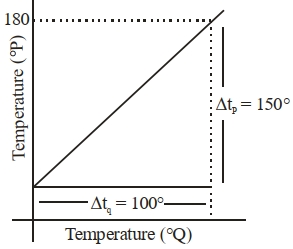
The graph between two temperature scales $P$ and $Q$ is shown in the figure. Between the upper fixed point and the lower fixed point,there are $150$ equal divisions on scale $P$ and $100$ divisions on scale $Q$. The relationship for conversion between the two scales is given by:
A
$\frac{t_Q}{150}=\frac{t_P-180}{100}$
B
$\frac{t_Q}{100}=\frac{t_P-30}{150}$
C
$\frac{t_P}{180}=\frac{t_Q-40}{100}$
D
$\frac{t_P}{100}=\frac{t_Q-180}{150}$
Solution
(B) The general formula for converting between two temperature scales is given by:
$\frac{\text{Reading on scale} - \text{Lower fixed point}}{\text{Upper fixed point} - \text{Lower fixed point}} = \text{Constant}$
From the graph,for scale $P$,the lower fixed point is $30$ and the upper fixed point is $180$ (since $180 - 30 = 150$ divisions).
For scale $Q$,the lower fixed point is $0$ and the upper fixed point is $100$ (since $100 - 0 = 100$ divisions).
Applying the formula:
$\frac{t_P - 30}{180 - 30} = \frac{t_Q - 0}{100 - 0}$
Simplifying the expression:
$\frac{t_P - 30}{150} = \frac{t_Q}{100}$
$\frac{\text{Reading on scale} - \text{Lower fixed point}}{\text{Upper fixed point} - \text{Lower fixed point}} = \text{Constant}$
From the graph,for scale $P$,the lower fixed point is $30$ and the upper fixed point is $180$ (since $180 - 30 = 150$ divisions).
For scale $Q$,the lower fixed point is $0$ and the upper fixed point is $100$ (since $100 - 0 = 100$ divisions).
Applying the formula:
$\frac{t_P - 30}{180 - 30} = \frac{t_Q - 0}{100 - 0}$
Simplifying the expression:
$\frac{t_P - 30}{150} = \frac{t_Q}{100}$
0 likes
View Solution111
MediumMCQ
$A$ faulty thermometer reads $5^{\circ}C$ in melting ice and $95^{\circ}C$ in steam. The correct temperature on the absolute scale will be $.........K$ when the faulty thermometer reads $41^{\circ}C$.
A
$312$
B
$311$
C
$313$
D
$310$
Solution
(C) Let $T_f$ be the reading on the faulty thermometer and $T_c$ be the reading on the Celsius scale.
The formula for conversion is $\frac{T_f - LFP}{UFP - LFP} = \frac{T_c - 0}{100 - 0}$,where $LFP$ is the Lower Fixed Point and $UFP$ is the Upper Fixed Point.
Given $LFP = 5^{\circ}C$ and $UFP = 95^{\circ}C$,we have $\frac{41 - 5}{95 - 5} = \frac{T_c}{100}$.
$\frac{36}{90} = \frac{T_c}{100}$.
$T_c = \frac{36}{90} \times 100 = 40^{\circ}C$.
To convert to the absolute scale (Kelvin),$T_K = T_c + 273.15 \approx 40 + 273 = 313 \, K$.
The formula for conversion is $\frac{T_f - LFP}{UFP - LFP} = \frac{T_c - 0}{100 - 0}$,where $LFP$ is the Lower Fixed Point and $UFP$ is the Upper Fixed Point.
Given $LFP = 5^{\circ}C$ and $UFP = 95^{\circ}C$,we have $\frac{41 - 5}{95 - 5} = \frac{T_c}{100}$.
$\frac{36}{90} = \frac{T_c}{100}$.
$T_c = \frac{36}{90} \times 100 = 40^{\circ}C$.
To convert to the absolute scale (Kelvin),$T_K = T_c + 273.15 \approx 40 + 273 = 313 \, K$.
0 likes
View Solution112
MediumMCQ
On a temperature scale $X$,the boiling point of water is $65^{\circ} X$ and the freezing point is $-15^{\circ} X$. Assume that the $X$ scale is linear. The equivalent temperature corresponding to $-95^{\circ} X$ on the Fahrenheit scale would be $..........^{\circ} F$.
A
$-63$
B
$-112$
C
$-48$
D
$-148$
Solution
(D) The relationship between any linear temperature scale and the Fahrenheit scale is given by the formula:
$\frac{X - X_{\text{freezing}}}{X_{\text{boiling}} - X_{\text{freezing}}} = \frac{F - 32}{212 - 32}$
Given:
$X_{\text{boiling}} = 65^{\circ} X$
$X_{\text{freezing}} = -15^{\circ} X$
$X = -95^{\circ} X$
Substituting the values into the formula:
$\frac{-95 - (-15)}{65 - (-15)} = \frac{F - 32}{180}$
$\frac{-95 + 15}{65 + 15} = \frac{F - 32}{180}$
$\frac{-80}{80} = \frac{F - 32}{180}$
$-1 = \frac{F - 32}{180}$
$-180 = F - 32$
$F = -180 + 32 = -148^{\circ} F$
$\frac{X - X_{\text{freezing}}}{X_{\text{boiling}} - X_{\text{freezing}}} = \frac{F - 32}{212 - 32}$
Given:
$X_{\text{boiling}} = 65^{\circ} X$
$X_{\text{freezing}} = -15^{\circ} X$
$X = -95^{\circ} X$
Substituting the values into the formula:
$\frac{-95 - (-15)}{65 - (-15)} = \frac{F - 32}{180}$
$\frac{-95 + 15}{65 + 15} = \frac{F - 32}{180}$
$\frac{-80}{80} = \frac{F - 32}{180}$
$-1 = \frac{F - 32}{180}$
$-180 = F - 32$
$F = -180 + 32 = -148^{\circ} F$
0 likes
View Solution113
DifficultMCQ
On the Celsius scale,the temperature of a body increases by $40^{\circ} C$. The increase in temperature on the Fahrenheit scale is: (in $^{\circ} F$)
A
$70$
B
$68$
C
$72$
D
$75$
Solution
(C) The relationship between a change in temperature on the Celsius scale $(\Delta T_C)$ and the Fahrenheit scale $(\Delta T_F)$ is given by the formula: $\Delta T_F = \frac{9}{5} \Delta T_C$.
Given that the increase in temperature on the Celsius scale is $\Delta T_C = 40^{\circ} C$.
Substituting this value into the formula:
$\Delta T_F = \frac{9}{5} \times 40^{\circ} F$
$\Delta T_F = 9 \times 8^{\circ} F$
$\Delta T_F = 72^{\circ} F$.
Therefore,the increase in temperature on the Fahrenheit scale is $72^{\circ} F$.
Hence,the correct option is $C$.
Given that the increase in temperature on the Celsius scale is $\Delta T_C = 40^{\circ} C$.
Substituting this value into the formula:
$\Delta T_F = \frac{9}{5} \times 40^{\circ} F$
$\Delta T_F = 9 \times 8^{\circ} F$
$\Delta T_F = 72^{\circ} F$.
Therefore,the increase in temperature on the Fahrenheit scale is $72^{\circ} F$.
Hence,the correct option is $C$.
0 likes
View Solution114
MediumMCQ
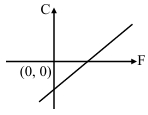
Which of the following figures represents the relation between Celsius $(C)$ and Fahrenheit $(F)$ temperatures?
A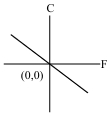
B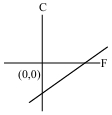
C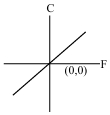
D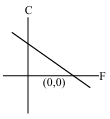
Solution
(B) The relationship between Celsius $(C)$ and Fahrenheit $(F)$ scales is given by the formula:
$\frac{C}{5} = \frac{F - 32}{9}$
Rearranging this equation to the form $y = mx + c$ (where $y = C$ and $x = F$):
$C = \frac{5}{9}F - \frac{160}{9}$
This is a linear equation of the form $y = mx + c$,where the slope $m = \frac{5}{9}$ is positive and the $y$-intercept $c = -\frac{160}{9}$ is negative.
$A$ graph with a positive slope and a negative $y$-intercept corresponds to a line that passes through the fourth quadrant and has a positive inclination.
Comparing this with the given options,Figure $B$ represents a line with a positive slope and a negative $y$-intercept.
$\frac{C}{5} = \frac{F - 32}{9}$
Rearranging this equation to the form $y = mx + c$ (where $y = C$ and $x = F$):
$C = \frac{5}{9}F - \frac{160}{9}$
This is a linear equation of the form $y = mx + c$,where the slope $m = \frac{5}{9}$ is positive and the $y$-intercept $c = -\frac{160}{9}$ is negative.
$A$ graph with a positive slope and a negative $y$-intercept corresponds to a line that passes through the fourth quadrant and has a positive inclination.
Comparing this with the given options,Figure $B$ represents a line with a positive slope and a negative $y$-intercept.
0 likes
View Solution115
MediumMCQ
$A$ hypothetical thermometer reads $5^{\circ} C$ in melting ice and $99^{\circ} C$ at the steam point. What is the correct temperature in $^{\circ} F$ when this faulty thermometer reads $52^{\circ} C$?
A
$90$
B
$50$
C
$122$
D
$130$
Solution
(C) The general formula for temperature conversion between any two scales is: $\frac{X - \text{LFP}_X}{\text{UFP}_X - \text{LFP}_X} = \frac{Y - \text{LFP}_Y}{\text{UFP}_Y - \text{LFP}_Y}$.
For the faulty thermometer $(X)$: $\text{LFP}_X = 5^{\circ} C$,$\text{UFP}_X = 99^{\circ} C$,and reading $X = 52^{\circ} C$.
For the Fahrenheit scale $(Y)$: $\text{LFP}_Y = 32^{\circ} F$,$\text{UFP}_Y = 212^{\circ} F$.
Substituting the values: $\frac{52 - 5}{99 - 5} = \frac{T_F - 32}{212 - 32}$.
$\frac{47}{94} = \frac{T_F - 32}{180}$.
$0.5 = \frac{T_F - 32}{180}$.
$T_F - 32 = 90$.
$T_F = 122^{\circ} F$.
For the faulty thermometer $(X)$: $\text{LFP}_X = 5^{\circ} C$,$\text{UFP}_X = 99^{\circ} C$,and reading $X = 52^{\circ} C$.
For the Fahrenheit scale $(Y)$: $\text{LFP}_Y = 32^{\circ} F$,$\text{UFP}_Y = 212^{\circ} F$.
Substituting the values: $\frac{52 - 5}{99 - 5} = \frac{T_F - 32}{212 - 32}$.
$\frac{47}{94} = \frac{T_F - 32}{180}$.
$0.5 = \frac{T_F - 32}{180}$.
$T_F - 32 = 90$.
$T_F = 122^{\circ} F$.
0 likes
View Solution116
EasyMCQ
The temperature of a body on the Kelvin scale is $x \ K$. When it is measured by a Fahrenheit thermometer,it is found to be $x \ ^{\circ}F$. The value of $x$ is (nearly):
A
$40$
B
$313$
C
$574$
D
$301$
Solution
(C) The relationship between the Kelvin scale $(K)$ and the Fahrenheit scale $(F)$ is given by the formula: $\frac{K - 273.15}{5} = \frac{F - 32}{9}$.
Given that the temperature is $x$ on both scales,we substitute $K = x$ and $F = x$ into the equation:
$\frac{x - 273.15}{5} = \frac{x - 32}{9}$.
Cross-multiplying gives: $9(x - 273.15) = 5(x - 32)$.
$9x - 2458.35 = 5x - 160$.
$4x = 2458.35 - 160$.
$4x = 2298.35$.
$x = \frac{2298.35}{4} \approx 574.58$.
Rounding to the nearest whole number,we get $x \approx 574$.
Given that the temperature is $x$ on both scales,we substitute $K = x$ and $F = x$ into the equation:
$\frac{x - 273.15}{5} = \frac{x - 32}{9}$.
Cross-multiplying gives: $9(x - 273.15) = 5(x - 32)$.
$9x - 2458.35 = 5x - 160$.
$4x = 2458.35 - 160$.
$4x = 2298.35$.
$x = \frac{2298.35}{4} \approx 574.58$.
Rounding to the nearest whole number,we get $x \approx 574$.
0 likes
View Solution117
MediumMCQ
$A$ thermometer bulb has a volume of $10^{-6} \,m^3$ and the cross-section of the stem is $0.002 \,cm^2$. The bulb is filled with mercury at $0^{\circ} C$. If the thermometer reads a temperature of $100^{\circ} C$, what is the length of the mercury column? (Coefficient of cubical expansion of mercury $\gamma = 18 \times 10^{-5} /{ }^{\circ} C$)
A
$90$ cm
B
$9$ cm
C
$9$ mm
D
$0.9$ mm
Solution
(B) The change in volume of the mercury is given by $\Delta V = V_0 \gamma \Delta T$.
Given: $V_0 = 10^{-6} \,m^3$, $\gamma = 18 \times 10^{-5} /{ }^{\circ} C$, and $\Delta T = 100^{\circ} C - 0^{\circ} C = 100^{\circ} C$.
Substituting the values: $\Delta V = (10^{-6} \,m^3) \times (18 \times 10^{-5} /{ }^{\circ} C) \times (100^{\circ} C) = 18 \times 10^{-9} \,m^3$.
The cross-sectional area of the stem $A = 0.002 \,cm^2 = 0.002 \times 10^{-4} \,m^2 = 2 \times 10^{-7} \,m^2$.
The change in volume is also equal to the area times the length of the mercury column: $\Delta V = A \times L$.
Therefore, $L = \frac{\Delta V}{A} = \frac{18 \times 10^{-9} \,m^3}{2 \times 10^{-7} \,m^2} = 9 \times 10^{-2} \,m = 9 \,cm$.
Given: $V_0 = 10^{-6} \,m^3$, $\gamma = 18 \times 10^{-5} /{ }^{\circ} C$, and $\Delta T = 100^{\circ} C - 0^{\circ} C = 100^{\circ} C$.
Substituting the values: $\Delta V = (10^{-6} \,m^3) \times (18 \times 10^{-5} /{ }^{\circ} C) \times (100^{\circ} C) = 18 \times 10^{-9} \,m^3$.
The cross-sectional area of the stem $A = 0.002 \,cm^2 = 0.002 \times 10^{-4} \,m^2 = 2 \times 10^{-7} \,m^2$.
The change in volume is also equal to the area times the length of the mercury column: $\Delta V = A \times L$.
Therefore, $L = \frac{\Delta V}{A} = \frac{18 \times 10^{-9} \,m^3}{2 \times 10^{-7} \,m^2} = 9 \times 10^{-2} \,m = 9 \,cm$.
0 likes
View Solution118
EasyMCQ
$A$ centigrade and Fahrenheit thermometer are dipped in boiling water. The water temperature is lowered until the Fahrenheit temperature observed is $140^{\circ} F$. At that time the temperature registered by the centigrade thermometer is (in $^{\circ} C$)
A
$80$
B
$60$
C
$40$
D
$20$
Solution
(B) The relationship between the temperature in Celsius $(C)$ and Fahrenheit $(F)$ scales is given by the formula: $\frac{C}{5} = \frac{F - 32}{9}$.
Given the Fahrenheit temperature $F = 140^{\circ} F$.
Substituting the value of $F$ into the formula:
$\frac{C}{5} = \frac{140 - 32}{9}$
$\frac{C}{5} = \frac{108}{9}$
$\frac{C}{5} = 12$
$C = 12 \times 5 = 60^{\circ} C$.
Therefore,the temperature registered by the centigrade thermometer is $60^{\circ} C$.
Given the Fahrenheit temperature $F = 140^{\circ} F$.
Substituting the value of $F$ into the formula:
$\frac{C}{5} = \frac{140 - 32}{9}$
$\frac{C}{5} = \frac{108}{9}$
$\frac{C}{5} = 12$
$C = 12 \times 5 = 60^{\circ} C$.
Therefore,the temperature registered by the centigrade thermometer is $60^{\circ} C$.
0 likes
View Solution119
DifficultMCQ
On an imaginary linear scale of temperature (called '$W$' scale) the freezing and boiling points of water are $39^{\circ} W$ and $239^{\circ} W$ respectively. The temperature on the new scale corresponding to $39^{\circ} C$ temperature on the Celsius scale will be (in $^{\circ} W$)
A
$139$
B
$78$
C
$117$
D
$200$
Solution
(C) In the Celsius scale,the freezing point of water is $0^{\circ} C$ and the boiling point is $100^{\circ} C$. The range is $100 - 0 = 100$.
In the given imaginary '$W$' scale,the freezing point is $39^{\circ} W$ and the boiling point is $239^{\circ} W$. The range is $239 - 39 = 200$.
Using the linear conversion formula between two temperature scales:
$\frac{C - C_{freezing}}{C_{boiling} - C_{freezing}} = \frac{W - W_{freezing}}{W_{boiling} - W_{freezing}}$
Substituting the values:
$\frac{C - 0}{100 - 0} = \frac{W - 39}{239 - 39}$
$\frac{C}{100} = \frac{W - 39}{200}$
For $C = 39^{\circ} C$:
$\frac{39}{100} = \frac{W - 39}{200}$
$39 \times 2 = W - 39$
$78 = W - 39$
$W = 78 + 39 = 117^{\circ} W$.
In the given imaginary '$W$' scale,the freezing point is $39^{\circ} W$ and the boiling point is $239^{\circ} W$. The range is $239 - 39 = 200$.
Using the linear conversion formula between two temperature scales:
$\frac{C - C_{freezing}}{C_{boiling} - C_{freezing}} = \frac{W - W_{freezing}}{W_{boiling} - W_{freezing}}$
Substituting the values:
$\frac{C - 0}{100 - 0} = \frac{W - 39}{239 - 39}$
$\frac{C}{100} = \frac{W - 39}{200}$
For $C = 39^{\circ} C$:
$\frac{39}{100} = \frac{W - 39}{200}$
$39 \times 2 = W - 39$
$78 = W - 39$
$W = 78 + 39 = 117^{\circ} W$.
0 likes
View Solution120
EasyMCQ
Find the value of $-197^{\circ} C$ temperature in Kelvin. (in $ K$)
A
$47$
B
$76$
C
$470$
D
$760$
Solution
(B) The relation between temperature in Celsius $(C)$ and Kelvin $(K)$ is given by:
$T(K) = T(^{\circ}C) + 273.15$
Given $T(^{\circ}C) = -197^{\circ}C$.
Substituting the value:
$T(K) = -197 + 273 = 76 K$
Therefore,the temperature is $76 K$.
$T(K) = T(^{\circ}C) + 273.15$
Given $T(^{\circ}C) = -197^{\circ}C$.
Substituting the value:
$T(K) = -197 + 273 = 76 K$
Therefore,the temperature is $76 K$.
0 likes
View Solution121
EasyMCQ
The resistance of the platinum wire of a platinum resistance thermometer at an ice point is $5 \Omega$ and at steam point is $5.23 \Omega$. When the thermometer is inserted in a hot bath,the resistance of a platinum wire is $5.795 \Omega$. Calculate the temperature of the bath. (in $^{\circ} C$)
A
$245.65$
B
$365.65$
C
$345.65$
D
$354.56$
Solution
(C) Given:
Resistance at ice point $(R_0)$ = $5 \Omega$ at $\theta_0 = 0^{\circ} C$
Resistance at steam point $(R_{100})$ = $5.23 \Omega$ at $\theta_{100} = 100^{\circ} C$
Resistance in hot bath $(R_{\theta})$ = $5.795 \Omega$
The formula for temperature in a platinum resistance thermometer is:
$\theta = \frac{R_{\theta} - R_0}{R_{100} - R_0} \times 100^{\circ} C$
Substituting the values:
$\theta = \frac{5.795 - 5}{5.23 - 5} \times 100^{\circ} C$
$\theta = \frac{0.795}{0.23} \times 100^{\circ} C$
$\theta = 3.4565 \times 100^{\circ} C$
$\theta = 345.65^{\circ} C$
Therefore,the temperature of the bath is $345.65^{\circ} C$.
Resistance at ice point $(R_0)$ = $5 \Omega$ at $\theta_0 = 0^{\circ} C$
Resistance at steam point $(R_{100})$ = $5.23 \Omega$ at $\theta_{100} = 100^{\circ} C$
Resistance in hot bath $(R_{\theta})$ = $5.795 \Omega$
The formula for temperature in a platinum resistance thermometer is:
$\theta = \frac{R_{\theta} - R_0}{R_{100} - R_0} \times 100^{\circ} C$
Substituting the values:
$\theta = \frac{5.795 - 5}{5.23 - 5} \times 100^{\circ} C$
$\theta = \frac{0.795}{0.23} \times 100^{\circ} C$
$\theta = 3.4565 \times 100^{\circ} C$
$\theta = 345.65^{\circ} C$
Therefore,the temperature of the bath is $345.65^{\circ} C$.
0 likes
View Solution122
MediumMCQ
In anomalous expansion of water, at what temperature is the density of water maximum?
A
$ 4^{\circ} C $
B
< $ 4^{\circ} C $
C
> $ 4^{\circ} C $
D
$ 10^{\circ} C $
Solution
(A) Anomalous expansion of water is a unique property where water contracts instead of expanding when heated between $ 0^{\circ} C $ and $ 4^{\circ} C $.
Since density is defined as mass per unit volume $( \rho = m/V )$, as the volume decreases while the mass remains constant, the density increases.
At $ 4^{\circ} C $, the volume of a given mass of water is minimum.
Therefore, the density of water is maximum at $ 4^{\circ} C $.
Since density is defined as mass per unit volume $( \rho = m/V )$, as the volume decreases while the mass remains constant, the density increases.
At $ 4^{\circ} C $, the volume of a given mass of water is minimum.
Therefore, the density of water is maximum at $ 4^{\circ} C $.
0 likes
View Solution123
EasyMCQ
The triple point of water is
A
$273.16^{\circ} C$
B
$273.16 \,K$
C
$273.16^{\circ} F$
D
$0.15 \,K$
Solution
(B) In thermodynamics, the triple point of water is defined as the specific temperature and pressure at which the three phases of water (liquid, solid, and gaseous) coexist in thermodynamic equilibrium.
By international agreement, the triple point of pure water is exactly $273.16 \,K$ at a pressure of $611.2 \,Pa$.
By international agreement, the triple point of pure water is exactly $273.16 \,K$ at a pressure of $611.2 \,Pa$.
0 likes
View Solution124
EasyMCQ
If the values of the temperature of a body in Fahrenheit and Celsius scales are in the ratio of $13:5$,then the temperature of the body is
A
$80^{\circ} F$
B
$104^{\circ} C$
C
$40^{\circ} C$
D
$40^{\circ} F$
Solution
(C) The relationship between temperature in Fahrenheit $(F)$ and Celsius $(C)$ is given by the formula: $\frac{F - 32}{9} = \frac{C}{5}$.
Given that the ratio of the temperature values is $F:C = 13:5$,we can write $F = 13x$ and $C = 5x$ for some constant $x$.
Substituting these into the formula: $\frac{13x - 32}{9} = \frac{5x}{5}$.
This simplifies to: $\frac{13x - 32}{9} = x$.
Multiplying both sides by $9$: $13x - 32 = 9x$.
Rearranging the terms: $13x - 9x = 32$,which gives $4x = 32$,so $x = 8$.
Therefore,the temperature in Fahrenheit is $F = 13 \times 8 = 104^{\circ} F$ and the temperature in Celsius is $C = 5 \times 8 = 40^{\circ} C$.
Since $40^{\circ} C$ is one of the options,the correct answer is $C$.
Given that the ratio of the temperature values is $F:C = 13:5$,we can write $F = 13x$ and $C = 5x$ for some constant $x$.
Substituting these into the formula: $\frac{13x - 32}{9} = \frac{5x}{5}$.
This simplifies to: $\frac{13x - 32}{9} = x$.
Multiplying both sides by $9$: $13x - 32 = 9x$.
Rearranging the terms: $13x - 9x = 32$,which gives $4x = 32$,so $x = 8$.
Therefore,the temperature in Fahrenheit is $F = 13 \times 8 = 104^{\circ} F$ and the temperature in Celsius is $C = 5 \times 8 = 40^{\circ} C$.
Since $40^{\circ} C$ is one of the options,the correct answer is $C$.
0 likes
View Solution125
MediumMCQ
The water on the surface of a lake is just about to freeze. The most likely temperature at the bottom of the lake is (in $^{\circ} C$)
A
$4$
B
$0$
C
$-4$
D
$-273$
Solution
(A) Water exhibits anomalous expansion. Its density is maximum at $4^{\circ} C$.
When the surface water cools to $0^{\circ} C$ and begins to freeze,the denser water at $4^{\circ} C$ settles at the bottom of the lake.
Therefore,the temperature at the bottom of the lake remains $4^{\circ} C$.
When the surface water cools to $0^{\circ} C$ and begins to freeze,the denser water at $4^{\circ} C$ settles at the bottom of the lake.
Therefore,the temperature at the bottom of the lake remains $4^{\circ} C$.
0 likes
View Solution126
EasyMCQ
Oxygen boils at $-183^{\circ} C$. This temperature is approximately (in $^{\circ} F$)
A
$215$
B
$-297$
C
$329$
D
$361$
Solution
(B) The relationship between temperature in Celsius $(C)$ and Fahrenheit $(F)$ is given by the formula: $\frac{C}{5} = \frac{F - 32}{9}$.
Rearranging the formula to solve for $F$,we get: $F = C \times \frac{9}{5} + 32$.
Substituting the value $C = -183^{\circ} C$ into the equation:
$F = -183 \times \frac{9}{5} + 32$
$F = -36.6 \times 9 + 32$
$F = -329.4 + 32$
$F = -297.4^{\circ} F$.
Rounding to the nearest integer,we get $-297^{\circ} F$.
Rearranging the formula to solve for $F$,we get: $F = C \times \frac{9}{5} + 32$.
Substituting the value $C = -183^{\circ} C$ into the equation:
$F = -183 \times \frac{9}{5} + 32$
$F = -36.6 \times 9 + 32$
$F = -329.4 + 32$
$F = -297.4^{\circ} F$.
Rounding to the nearest integer,we get $-297^{\circ} F$.
0 likes
View Solution127
EasyMCQ
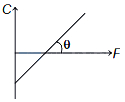
The temperature of a body is measured both in ${ }^{\circ} C$ and ${ }^{\circ} F$. $A$ graph is plotted with ${ }^{\circ} F$ on the $X$-axis and ${ }^{\circ} C$ on the $Y$-axis. Then,the cosine of the angle between the graph and the $X$-axis is
A
$0$
B
$\frac{9}{5}$
C
$\frac{5}{\sqrt{106}}$
D
$\frac{9}{\sqrt{106}}$
Solution
(D) The relation between the Celsius scale temperature $(C)$ and the Fahrenheit scale temperature $(F)$ is given by:
$\frac{C}{5} = \frac{F-32}{9}$
Rearranging this equation to the form $y = mx + c$ (where $y = C$ and $x = F$):
$C = \frac{5}{9}F - \frac{160}{9}$
Comparing this with the equation of a straight line $y = mx + c$,the slope of the graph is $m = \tan \theta = \frac{5}{9}$.
Since $\tan \theta = \frac{\text{opposite}}{\text{adjacent}} = \frac{5}{9}$,we can consider a right-angled triangle with opposite side $5$ and adjacent side $9$.
The hypotenuse is $\sqrt{5^2 + 9^2} = \sqrt{25 + 81} = \sqrt{106}$.
Therefore,the cosine of the angle $\theta$ is $\cos \theta = \frac{\text{adjacent}}{\text{hypotenuse}} = \frac{9}{\sqrt{106}}$.
$\frac{C}{5} = \frac{F-32}{9}$
Rearranging this equation to the form $y = mx + c$ (where $y = C$ and $x = F$):
$C = \frac{5}{9}F - \frac{160}{9}$
Comparing this with the equation of a straight line $y = mx + c$,the slope of the graph is $m = \tan \theta = \frac{5}{9}$.
Since $\tan \theta = \frac{\text{opposite}}{\text{adjacent}} = \frac{5}{9}$,we can consider a right-angled triangle with opposite side $5$ and adjacent side $9$.
The hypotenuse is $\sqrt{5^2 + 9^2} = \sqrt{25 + 81} = \sqrt{106}$.
Therefore,the cosine of the angle $\theta$ is $\cos \theta = \frac{\text{adjacent}}{\text{hypotenuse}} = \frac{9}{\sqrt{106}}$.
0 likes
View Solution128
EasyMCQ
The resistance of a thermometer is $100 \Omega$ at the triple point of water $(273 \ K)$ and is $300 \Omega$ at the melting point of gold $(873 \ K)$. The temperature at which the resistance of the thermometer is $200 \Omega$ is: (in $K$)
A
$273$
B
$373$
C
$473$
D
$573$
Solution
(D) Let the resistance be a linear function of temperature: $R_T = R_0 + \alpha T$.
Given: $R_1 = 100 \ \Omega$ at $T_1 = 273 \ K$ and $R_2 = 300 \ \Omega$ at $T_2 = 873 \ K$.
The slope of the resistance-temperature graph is $m = \frac{R_2 - R_1}{T_2 - T_1} = \frac{300 - 100}{873 - 273} = \frac{200}{600} = \frac{1}{3} \ \Omega/K$.
We want to find the temperature $T$ where $R = 200 \ \Omega$.
Using the equation of a line: $R - R_1 = m(T - T_1)$.
$200 - 100 = \frac{1}{3}(T - 273)$.
$100 = \frac{1}{3}(T - 273)$.
$300 = T - 273$.
$T = 300 + 273 = 573 \ K$.
Given: $R_1 = 100 \ \Omega$ at $T_1 = 273 \ K$ and $R_2 = 300 \ \Omega$ at $T_2 = 873 \ K$.
The slope of the resistance-temperature graph is $m = \frac{R_2 - R_1}{T_2 - T_1} = \frac{300 - 100}{873 - 273} = \frac{200}{600} = \frac{1}{3} \ \Omega/K$.
We want to find the temperature $T$ where $R = 200 \ \Omega$.
Using the equation of a line: $R - R_1 = m(T - T_1)$.
$200 - 100 = \frac{1}{3}(T - 273)$.
$100 = \frac{1}{3}(T - 273)$.
$300 = T - 273$.
$T = 300 + 273 = 573 \ K$.
0 likes
View Solution129
MediumMCQ
Assertion $(A)$: Rapidly changing temperatures can be measured by thermocouples.
Reason $(R)$: The thermal capacity of the junction of a thermocouple is very small.
Reason $(R)$: The thermal capacity of the junction of a thermocouple is very small.
A
Both $(A)$ and $(R)$ are true and $(R)$ is the correct explanation of $(A)$
B
Both $(A)$ and $(R)$ are true but $(R)$ is not the correct explanation of $(A)$
C
$(A)$ is true but $(R)$ is false
D
$(A)$ is false but $(R)$ is true
Solution
(A) thermocouple consists of two junctions of dissimilar metals.
Because the junctions are very small,their thermal capacity (mass $\times$ specific heat) is extremely low.
Thermal capacity determines how much heat is required to change the temperature of an object.
Since the thermal capacity is very small,the junction can quickly gain or lose heat to reach thermal equilibrium with the surrounding environment.
This allows the thermocouple to respond rapidly to changes in temperature.
Therefore,both $(A)$ and $(R)$ are true,and $(R)$ is the correct explanation of $(A)$.
Because the junctions are very small,their thermal capacity (mass $\times$ specific heat) is extremely low.
Thermal capacity determines how much heat is required to change the temperature of an object.
Since the thermal capacity is very small,the junction can quickly gain or lose heat to reach thermal equilibrium with the surrounding environment.
This allows the thermocouple to respond rapidly to changes in temperature.
Therefore,both $(A)$ and $(R)$ are true,and $(R)$ is the correct explanation of $(A)$.
0 likes
View Solution130
MediumMCQ
The temperature at which the reading on the Fahrenheit scale becomes $90 \%$ more than the reading on the Celsius scale is: (in $^{\circ} F$)
A
$280$
B
$580$
C
$608$
D
$320$
Solution
(C) Let the reading on the Celsius scale be $C$ and the reading on the Fahrenheit scale be $F$.
According to the problem,$F = C + 0.90C = 1.9C$.
The relationship between the Celsius and Fahrenheit scales is given by the formula: $F = \frac{9}{5}C + 32$.
Substituting $F = 1.9C$ into the formula,we get: $1.9C = 1.8C + 32$.
Subtracting $1.8C$ from both sides,we get: $0.1C = 32$.
Thus,$C = 320^{\circ} C$.
Now,find $F$ using $F = 1.9C$: $F = 1.9 \times 320 = 608^{\circ} F$.
Therefore,the temperature is $608^{\circ} F$.
According to the problem,$F = C + 0.90C = 1.9C$.
The relationship between the Celsius and Fahrenheit scales is given by the formula: $F = \frac{9}{5}C + 32$.
Substituting $F = 1.9C$ into the formula,we get: $1.9C = 1.8C + 32$.
Subtracting $1.8C$ from both sides,we get: $0.1C = 32$.
Thus,$C = 320^{\circ} C$.
Now,find $F$ using $F = 1.9C$: $F = 1.9 \times 320 = 608^{\circ} F$.
Therefore,the temperature is $608^{\circ} F$.
0 likes
View Solution131
MediumMCQ
The temperature of a body shown by a faulty Celsius thermometer is $49^{\circ} C$ and by a correct Fahrenheit thermometer is $122^{\circ} F$. The correction to be applied to the faulty thermometer is
A
$-12^{\circ} C$
B
$+1^{\circ} C$
C
$+12^{\circ} C$
D
$-1^{\circ} C$
Solution
(B) First,convert the temperature measured by the correct Fahrenheit thermometer into Celsius scale.
The relation between Celsius $(C)$ and Fahrenheit $(F)$ is given by: $C = \frac{5}{9}(F - 32)$.
Substituting $F = 122^{\circ} F$:
$C = \frac{5}{9}(122 - 32) = \frac{5}{9}(90) = 50^{\circ} C$.
This is the true temperature of the body.
The faulty thermometer reads $49^{\circ} C$.
The correction is defined as: $\text{True Value} - \text{Measured Value}$.
Correction $= 50^{\circ} C - 49^{\circ} C = +1^{\circ} C$.
Therefore,the correction to be applied is $+1^{\circ} C$.
The relation between Celsius $(C)$ and Fahrenheit $(F)$ is given by: $C = \frac{5}{9}(F - 32)$.
Substituting $F = 122^{\circ} F$:
$C = \frac{5}{9}(122 - 32) = \frac{5}{9}(90) = 50^{\circ} C$.
This is the true temperature of the body.
The faulty thermometer reads $49^{\circ} C$.
The correction is defined as: $\text{True Value} - \text{Measured Value}$.
Correction $= 50^{\circ} C - 49^{\circ} C = +1^{\circ} C$.
Therefore,the correction to be applied is $+1^{\circ} C$.
0 likes
View Solution132
EasyMCQ
If the reading in Fahrenheit scale is twice the reading in Celsius scale,then the reading in Fahrenheit scale is (in $^{\circ} F$)
A
$100$
B
$120$
C
$80$
D
$320$
Solution
(D) The relationship between the Fahrenheit scale $(F)$ and the Celsius scale $(C)$ is given by the formula: $\frac{F-32}{9} = \frac{C}{5}$.
Given that the reading in Fahrenheit is twice the reading in Celsius,we have $F = 2C$,which implies $C = \frac{F}{2}$.
Substituting $C = \frac{F}{2}$ into the temperature conversion formula:
$\frac{F-32}{9} = \frac{F/2}{5}$
$\frac{F-32}{9} = \frac{F}{10}$
Cross-multiplying gives: $10(F - 32) = 9F$.
$10F - 320 = 9F$.
$10F - 9F = 320$.
$F = 320^{\circ} F$.
Given that the reading in Fahrenheit is twice the reading in Celsius,we have $F = 2C$,which implies $C = \frac{F}{2}$.
Substituting $C = \frac{F}{2}$ into the temperature conversion formula:
$\frac{F-32}{9} = \frac{F/2}{5}$
$\frac{F-32}{9} = \frac{F}{10}$
Cross-multiplying gives: $10(F - 32) = 9F$.
$10F - 320 = 9F$.
$10F - 9F = 320$.
$F = 320^{\circ} F$.
0 likes
View Solution133
EasyMCQ
The Fahrenheit and Kelvin scales of temperature will have the same reading at a temperature of (in $^{\circ} F$)
A
$-40$
B
$313$
C
$574.6$
D
$732.7$
Solution
(C) The relationship between the Fahrenheit $(F)$ and Kelvin $(K)$ scales is given by the formula:
$\frac{F - 32}{9} = \frac{K - 273.15}{5}$
Let the temperature where both scales have the same numerical value be $X$.
Substituting $F = X$ and $K = X$ into the equation:
$\frac{X - 32}{9} = \frac{X - 273.15}{5}$
Cross-multiplying gives:
$5(X - 32) = 9(X - 273.15)$
$5X - 160 = 9X - 2458.35$
Rearranging the terms to solve for $X$:
$9X - 5X = 2458.35 - 160$
$4X = 2298.35$
$X = 574.5875 \approx 574.6$
Thus,the temperature is $574.6^{\circ} F$.
$\frac{F - 32}{9} = \frac{K - 273.15}{5}$
Let the temperature where both scales have the same numerical value be $X$.
Substituting $F = X$ and $K = X$ into the equation:
$\frac{X - 32}{9} = \frac{X - 273.15}{5}$
Cross-multiplying gives:
$5(X - 32) = 9(X - 273.15)$
$5X - 160 = 9X - 2458.35$
Rearranging the terms to solve for $X$:
$9X - 5X = 2458.35 - 160$
$4X = 2298.35$
$X = 574.5875 \approx 574.6$
Thus,the temperature is $574.6^{\circ} F$.
0 likes
View Solution134
EasyMCQ
The temperature on a Fahrenheit temperature scale that is twice the temperature on a Celsius temperature scale is: (in $^{\circ} F$)
A
$160$
B
$240$
C
$320$
D
$480$
Solution
(C) The relationship between Fahrenheit $(F)$ and Celsius $(C)$ temperature scales is given by the formula: $F = \frac{9}{5} C + 32$.
According to the problem,the temperature on the Fahrenheit scale is twice the temperature on the Celsius scale,so $F = 2C$,which implies $C = \frac{F}{2}$.
Substituting this into the formula: $F = \frac{9}{5} \left( \frac{F}{2} \right) + 32$.
$F = \frac{9F}{10} + 32$.
Multiplying the entire equation by $10$: $10F = 9F + 320$.
$10F - 9F = 320$.
Therefore,$F = 320^{\circ} F$.
According to the problem,the temperature on the Fahrenheit scale is twice the temperature on the Celsius scale,so $F = 2C$,which implies $C = \frac{F}{2}$.
Substituting this into the formula: $F = \frac{9}{5} \left( \frac{F}{2} \right) + 32$.
$F = \frac{9F}{10} + 32$.
Multiplying the entire equation by $10$: $10F = 9F + 320$.
$10F - 9F = 320$.
Therefore,$F = 320^{\circ} F$.
0 likes
View Solution135
EasyMCQ
On a new temperature scale,the melting point of ice is $20^{\circ} X$ and the boiling point of water is $110^{\circ} X$. $A$ temperature of $40^{\circ} C$ would be indicated on this new temperature scale as (in $^{\circ} X$)
A
$60$
B
$56$
C
$70$
D
$54$
Solution
(B) The relationship between two temperature scales is given by the formula:
$\frac{\text{Reading on scale} - \text{LFP}}{\text{UFP} - \text{LFP}} = \text{constant}$
For the Celsius scale,the Lower Fixed Point $(LFP)$ is $0^{\circ} C$ and the Upper Fixed Point $(UFP)$ is $100^{\circ} C$.
For the new scale $X$,the $LFP$ is $20^{\circ} X$ and the $UFP$ is $110^{\circ} X$.
Let the temperature on the new scale be $z^{\circ} X$ corresponding to $40^{\circ} C$.
$\frac{z - 20}{110 - 20} = \frac{40 - 0}{100 - 0}$
$\frac{z - 20}{90} = \frac{40}{100}$
$\frac{z - 20}{90} = 0.4$
$z - 20 = 0.4 \times 90$
$z - 20 = 36$
$z = 36 + 20 = 56^{\circ} X$
Therefore,$40^{\circ} C$ corresponds to $56^{\circ} X$.
$\frac{\text{Reading on scale} - \text{LFP}}{\text{UFP} - \text{LFP}} = \text{constant}$
For the Celsius scale,the Lower Fixed Point $(LFP)$ is $0^{\circ} C$ and the Upper Fixed Point $(UFP)$ is $100^{\circ} C$.
For the new scale $X$,the $LFP$ is $20^{\circ} X$ and the $UFP$ is $110^{\circ} X$.
Let the temperature on the new scale be $z^{\circ} X$ corresponding to $40^{\circ} C$.
$\frac{z - 20}{110 - 20} = \frac{40 - 0}{100 - 0}$
$\frac{z - 20}{90} = \frac{40}{100}$
$\frac{z - 20}{90} = 0.4$
$z - 20 = 0.4 \times 90$
$z - 20 = 36$
$z = 36 + 20 = 56^{\circ} X$
Therefore,$40^{\circ} C$ corresponds to $56^{\circ} X$.
0 likes
View Solution136
DifficultMCQ
On a temperature scale $Y$,water freezes at $-160^{\circ} Y$ and boils at $-50^{\circ} Y$. On this $Y$ scale,a temperature of $340 \ K$ is (in $^{\circ} Y$)
A
$-160.3$
B
$-96.3$
C
$-86.3$
D
$-76.3$
Solution
(C) The relationship between any temperature scale and the Kelvin scale is given by the formula: $\frac{Y - Y_{ice}}{Y_{steam} - Y_{ice}} = \frac{K - K_{ice}}{K_{steam} - K_{ice}}$.
Given for scale $Y$: $Y_{ice} = -160^{\circ} Y$ and $Y_{steam} = -50^{\circ} Y$.
For the Kelvin scale: $K_{ice} = 273 \ K$ and $K_{steam} = 373 \ K$.
Substituting the values for $K = 340 \ K$:
$\frac{Y - (-160)}{-50 - (-160)} = \frac{340 - 273}{373 - 273}$
$\frac{Y + 160}{110} = \frac{67}{100}$
$Y + 160 = 0.67 \times 110$
$Y + 160 = 73.7$
$Y = 73.7 - 160 = -86.3^{\circ} Y$.
Given for scale $Y$: $Y_{ice} = -160^{\circ} Y$ and $Y_{steam} = -50^{\circ} Y$.
For the Kelvin scale: $K_{ice} = 273 \ K$ and $K_{steam} = 373 \ K$.
Substituting the values for $K = 340 \ K$:
$\frac{Y - (-160)}{-50 - (-160)} = \frac{340 - 273}{373 - 273}$
$\frac{Y + 160}{110} = \frac{67}{100}$
$Y + 160 = 0.67 \times 110$
$Y + 160 = 73.7$
$Y = 73.7 - 160 = -86.3^{\circ} Y$.
0 likes
View Solution137
MediumMCQ
$A$ scientist proposes a new temperature scale in which the ice point is $25 X$ ($X$ is the new unit of temperature) and the steam point is $305 X$. The specific heat capacity of water in this new scale is (in $J kg^{-1} X^{-1}$):
A
$4.2 \times 10^{3}$
B
$3.0 \times 10^{3}$
C
$1.2 \times 10^{3}$
D
$1.5 \times 10^{3}$
Solution
(D) The ice point on the Celsius scale is $0^{\circ} C$ and the steam point is $100^{\circ} C$.
In the new scale,the ice point is $25 X$ and the steam point is $305 X$.
The temperature interval of $100^{\circ} C$ corresponds to $(305 - 25) X = 280 X$.
Therefore,a change of $1^{\circ} C$ is equivalent to a change of $\frac{280}{100} X = 2.8 X$.
This implies $1^{\circ} C = 2.8 X$,or $1 X = \frac{1}{2.8}^{\circ} C$.
The specific heat capacity of water is $c = 4200 \ J kg^{-1} (^{\circ} C)^{-1}$.
Substituting the relation $1^{\circ} C = 2.8 X$ into the unit:
$c = 4200 \ J kg^{-1} (2.8 X)^{-1} = \frac{4200}{2.8} J kg^{-1} X^{-1} = 1500 \ J kg^{-1} X^{-1}$.
Thus,$c = 1.5 \times 10^{3} J kg^{-1} X^{-1}$.
In the new scale,the ice point is $25 X$ and the steam point is $305 X$.
The temperature interval of $100^{\circ} C$ corresponds to $(305 - 25) X = 280 X$.
Therefore,a change of $1^{\circ} C$ is equivalent to a change of $\frac{280}{100} X = 2.8 X$.
This implies $1^{\circ} C = 2.8 X$,or $1 X = \frac{1}{2.8}^{\circ} C$.
The specific heat capacity of water is $c = 4200 \ J kg^{-1} (^{\circ} C)^{-1}$.
Substituting the relation $1^{\circ} C = 2.8 X$ into the unit:
$c = 4200 \ J kg^{-1} (2.8 X)^{-1} = \frac{4200}{2.8} J kg^{-1} X^{-1} = 1500 \ J kg^{-1} X^{-1}$.
Thus,$c = 1.5 \times 10^{3} J kg^{-1} X^{-1}$.
0 likes
View Solution138
EasyMCQ
In a mercury thermometer, the ice point (lower fixed point) is marked as $10^{\circ}$ and the steam point (upper fixed point) is marked as $130^{\circ}$. At $40^{\circ} C$ temperature, what will this thermometer read (in $^{\circ}$)?
A
$78$
B
$66$
C
$62$
D
$58$
Solution
(D) The relationship between any temperature scale and the Celsius scale is given by the formula: $\frac{X - \text{Lower Fixed Point}}{\text{Upper Fixed Point} - \text{Lower Fixed Point}} = \frac{C}{100}$.
Here, the lower fixed point is $10^{\circ}$ and the upper fixed point is $130^{\circ}$.
Substituting the given values: $\frac{X - 10}{130 - 10} = \frac{40}{100}$.
$\frac{X - 10}{120} = \frac{40}{100}$.
$X - 10 = \frac{40}{100} \times 120$.
$X - 10 = 0.4 \times 120 = 48$.
$X = 48 + 10 = 58^{\circ}$.
Here, the lower fixed point is $10^{\circ}$ and the upper fixed point is $130^{\circ}$.
Substituting the given values: $\frac{X - 10}{130 - 10} = \frac{40}{100}$.
$\frac{X - 10}{120} = \frac{40}{100}$.
$X - 10 = \frac{40}{100} \times 120$.
$X - 10 = 0.4 \times 120 = 48$.
$X = 48 + 10 = 58^{\circ}$.
0 likes
View Solution139
EasyMCQ
Two temperature scales $A$ and $B$ are related by $\frac{A-42}{110}=\frac{B-72}{220}$. At which temperature do the two scales have the same reading?
A
$-42^{\circ}$
B
$-72^{\circ}$
C
$+12^{\circ}$
D
$-40^{\circ}$
Solution
(C) Given the relationship between the two temperature scales is $\frac{A-42}{110} = \frac{B-72}{220}$.
To find the temperature where both scales have the same reading,we set $A = B = T$.
Substituting $T$ into the equation: $\frac{T-42}{110} = \frac{T-72}{220}$.
Simplifying the equation by dividing the denominators by $110$: $\frac{T-42}{1} = \frac{T-72}{2}$.
Cross-multiplying gives: $2(T-42) = T-72$.
Expanding the terms: $2T - 84 = T - 72$.
Rearranging to solve for $T$: $2T - T = 84 - 72$.
Thus,$T = 12$.
Therefore,the two scales have the same reading at $12^{\circ}$.
To find the temperature where both scales have the same reading,we set $A = B = T$.
Substituting $T$ into the equation: $\frac{T-42}{110} = \frac{T-72}{220}$.
Simplifying the equation by dividing the denominators by $110$: $\frac{T-42}{1} = \frac{T-72}{2}$.
Cross-multiplying gives: $2(T-42) = T-72$.
Expanding the terms: $2T - 84 = T - 72$.
Rearranging to solve for $T$: $2T - T = 84 - 72$.
Thus,$T = 12$.
Therefore,the two scales have the same reading at $12^{\circ}$.
0 likes
View Solution140
MediumMCQ
It is difficult to cook rice in an open vessel by boiling it at high altitudes because of
A
low boiling point and high pressure
B
high boiling point and low pressure
C
low boiling point and low pressure
D
high boiling point and high pressure
Solution
(C) At high altitudes,the atmospheric pressure is significantly lower than at sea level.
Since the boiling point of a liquid depends on the external pressure,a decrease in atmospheric pressure leads to a decrease in the boiling point of water.
Consequently,water boils at a temperature lower than $100 \, ^\circ\text{C}$ at high altitudes.
Because the water boils at a lower temperature,it does not provide enough heat to cook the rice properly,making the cooking process difficult.
Since the boiling point of a liquid depends on the external pressure,a decrease in atmospheric pressure leads to a decrease in the boiling point of water.
Consequently,water boils at a temperature lower than $100 \, ^\circ\text{C}$ at high altitudes.
Because the water boils at a lower temperature,it does not provide enough heat to cook the rice properly,making the cooking process difficult.
0 likes
View Solution10-1.Thermometry, Thermal Expansion and Calorimetry — Temperature and Temperature scales · Frequently Asked Questions
1Are these 10-1.Thermometry, Thermal Expansion and Calorimetry questions useful for JEE and NEET?
Yes. All questions in this section are mapped to JEE Main and NEET exam patterns. Previous year questions from JEE Main, NEET, GUJCET and state-level exams are included with full solutions.
2Can I switch to Hindi or Gujarati for these questions?
Yes. Use the language tabs in the hero section or the sidebar to view the same questions and solutions in English, Hindi or Gujarati.
3How do I generate a question paper from this subtopic?
Use the Vedclass Exam Paper Generator — select the chapter and subtopic, set difficulty, and generate Sets A, B, C, D automatically. First 3 chapters of every subject are free.
Vedclass Products
For Students
Vedclass Test Series
Mock tests in real JEE/NEET style with performance analysis. 5-day free trial.
Start Free TrialFor Teachers
Exam Paper Generator
Generate Set A/B/C/D papers from this chapter in 2 minutes. 3 chapters free.
Try FreeFor Institutes
Online Exam Module
Live online exams with unlimited students, 360° analytics & white-label branding.
See DemoFor Teachers & Institutes
Generate a 10-1.Thermometry, Thermal Expansion and Calorimetry Exam Paper in 2 Minutes
Select subtopic & difficulty — Sets A, B, C, D auto-generated with No Repeat logic.
First 3 chapters of every subject are free — no payment required.