
A English
Temperature and Temperature scales Questions in English
Class 11 Physics · 10-1.Thermometry, Thermal Expansion and Calorimetry · Temperature and Temperature scales
142+
Questions
English
Language
100%
With Solutions
Showing 50 of 142 questions in English
1
EasyMCQ
The correct value of $0^{\circ}C$ on the Kelvin scale is ........... $K$.
A
$273.15$
B
$272.85$
C
$273$
D
$273.2$
Solution
(A) The relationship between the Celsius scale and the Kelvin scale is given by the formula: $T(K) = T(^{\circ}C) + 273.15$.
Substituting $T(^{\circ}C) = 0^{\circ}C$ into the formula:
$T(K) = 0 + 273.15 = 273.15 \ K$.
Therefore,the correct value is $273.15 \ K$.
Substituting $T(^{\circ}C) = 0^{\circ}C$ into the formula:
$T(K) = 0 + 273.15 = 273.15 \ K$.
Therefore,the correct value is $273.15 \ K$.
0 likes
View Solution2
EasyMCQ
On the Celsius scale,the absolute zero of temperature is at .......... $^\circ C$.
A
$0$
B
$-32$
C
$100$
D
$-273.15$
Solution
(D) The relationship between the Kelvin scale $(T)$ and the Celsius scale $(t)$ is given by the formula: $T = t + 273.15$.
Absolute zero is defined as $0 \ K$ on the Kelvin scale.
Substituting $T = 0$ into the equation: $0 = t + 273.15$.
Solving for $t$,we get: $t = -273.15 \ ^\circ C$.
Therefore,the absolute zero of temperature on the Celsius scale is $-273.15 \ ^\circ C$.
Absolute zero is defined as $0 \ K$ on the Kelvin scale.
Substituting $T = 0$ into the equation: $0 = t + 273.15$.
Solving for $t$,we get: $t = -273.15 \ ^\circ C$.
Therefore,the absolute zero of temperature on the Celsius scale is $-273.15 \ ^\circ C$.
0 likes
View Solution3
EasyMCQ
Oxygen boils at $-183^{\circ}C$. This temperature is approximately ....... $^{\circ}F$.
A
$215$
B
$-297$
C
$329$
D
$361$
Solution
(B) The relationship between the Celsius scale $(C)$ and the Fahrenheit scale $(F)$ is given by the formula: $\frac{C}{5} = \frac{F - 32}{9}$.
Given $C = -183^{\circ}C$.
Substituting the value into the formula: $\frac{-183}{5} = \frac{F - 32}{9}$.
$-36.6 = \frac{F - 32}{9}$.
$-36.6 \times 9 = F - 32$.
$-329.4 = F - 32$.
$F = -329.4 + 32 = -297.4^{\circ}F$.
Rounding to the nearest integer,we get $F \approx -297^{\circ}F$.
Given $C = -183^{\circ}C$.
Substituting the value into the formula: $\frac{-183}{5} = \frac{F - 32}{9}$.
$-36.6 = \frac{F - 32}{9}$.
$-36.6 \times 9 = F - 32$.
$-329.4 = F - 32$.
$F = -329.4 + 32 = -297.4^{\circ}F$.
Rounding to the nearest integer,we get $F \approx -297^{\circ}F$.
0 likes
View Solution4
EasyMCQ
Recently,the phenomenon of superconductivity has been observed at $95\, K$. This temperature is nearly equal to ......... $^oF$.
A
$-288$
B
$-146$
C
$-368$
D
$+178$
Solution
(A) The relationship between the Kelvin scale $(K)$ and the Fahrenheit scale $(F)$ is given by the formula: $\frac{F - 32}{9} = \frac{K - 273}{5}$.
Substituting the given value $K = 95\, K$ into the equation:
$\frac{F - 32}{9} = \frac{95 - 273}{5}$
$\frac{F - 32}{9} = \frac{-178}{5}$
$\frac{F - 32}{9} = -35.6$
$F - 32 = -35.6 \times 9$
$F - 32 = -320.4$
$F = -320.4 + 32$
$F = -288.4^\circ F$.
Rounding to the nearest integer,we get $F \approx -288^\circ F$.
Substituting the given value $K = 95\, K$ into the equation:
$\frac{F - 32}{9} = \frac{95 - 273}{5}$
$\frac{F - 32}{9} = \frac{-178}{5}$
$\frac{F - 32}{9} = -35.6$
$F - 32 = -35.6 \times 9$
$F - 32 = -320.4$
$F = -320.4 + 32$
$F = -288.4^\circ F$.
Rounding to the nearest integer,we get $F \approx -288^\circ F$.
0 likes
View Solution5
EasyMCQ
The temperature of a substance increases by $27^{\circ}C$. On the Kelvin scale,this increase is equal to ........ $K$.
A
$300$
B
$2.46$
C
$27$
D
$7$
Solution
(C) The relationship between the Celsius scale and the Kelvin scale is given by $T(K) = T(^{\circ}C) + 273.15$.
For a change in temperature,$\Delta T(K) = \Delta T(^{\circ}C)$.
Since the increase in temperature is $27^{\circ}C$,the corresponding increase on the Kelvin scale is $27\, K$.
For a change in temperature,$\Delta T(K) = \Delta T(^{\circ}C)$.
Since the increase in temperature is $27^{\circ}C$,the corresponding increase on the Kelvin scale is $27\, K$.
0 likes
View Solution6
EasyMCQ
No other thermometer is as suitable as a platinum resistance thermometer to measure temperature in the entire range of
A
$0^{\circ}C$ to $100^{\circ}C$
B
$100^{\circ}C$ to $1500^{\circ}C$
C
$-50^{\circ}C$ to $+350^{\circ}C$
D
$-200^{\circ}C$ to $600^{\circ}C$
Solution
(D) platinum resistance thermometer is highly accurate and stable over a wide range of temperatures. It is specifically designed to measure temperatures ranging from $-200^{\circ}C$ to $600^{\circ}C$. Due to the linear relationship between the resistance of platinum and temperature,it is considered the most suitable instrument for this specific range.
0 likes
View Solution7
EasyMCQ
$A$ thermoelectric thermometer is based on:
A
Photoelectric effect
B
Seebeck effect
C
Compton effect
D
Joule effect
Solution
(B) thermoelectric thermometer operates on the principle of the Seebeck effect.
In the Seebeck effect,a temperature difference between two dissimilar electrical conductors or semiconductors produces a voltage difference between them.
This phenomenon is utilized in thermocouples to measure temperature by converting thermal energy directly into electrical energy.
In the Seebeck effect,a temperature difference between two dissimilar electrical conductors or semiconductors produces a voltage difference between them.
This phenomenon is utilized in thermocouples to measure temperature by converting thermal energy directly into electrical energy.
0 likes
View Solution8
MediumMCQ
Maximum density of $H_2O$ is at the temperature .......... $^\circ F$.
A
$32$
B
$39.2$
C
$42$
D
$4$
Solution
(B) The maximum density of water occurs at $4^\circ C$.
To convert this temperature to Fahrenheit, we use the formula:
$\frac{C}{5} = \frac{F - 32}{9}$
Substituting $C = 4$ into the equation:
$\frac{4}{5} = \frac{F - 32}{9}$
$0.8 = \frac{F - 32}{9}$
$7.2 = F - 32$
$F = 39.2^\circ F$
Therefore, the correct option is $B$.
To convert this temperature to Fahrenheit, we use the formula:
$\frac{C}{5} = \frac{F - 32}{9}$
Substituting $C = 4$ into the equation:
$\frac{4}{5} = \frac{F - 32}{9}$
$0.8 = \frac{F - 32}{9}$
$7.2 = F - 32$
$F = 39.2^\circ F$
Therefore, the correct option is $B$.
0 likes
View Solution9
EasyMCQ
The study of physical phenomena at low temperatures (below liquid nitrogen temperature) is called:
A
Refrigeration
B
Radiation
C
Cryogenics
D
Pyrometry
Solution
(C) The branch of physics that deals with the production and behavior of materials at very low temperatures,typically below $123\,K$ (the temperature of liquid nitrogen),is known as Cryogenics.
It involves the study of physical phenomena at temperatures close to $0\,K$ (absolute zero).
It involves the study of physical phenomena at temperatures close to $0\,K$ (absolute zero).
0 likes
View Solution10
EasyMCQ
The absolute scale of temperature is reproduced in the laboratory by making use of a
A
Radiation pyrometer
B
Platinum resistance thermometer
C
Constant volume helium gas thermometer
D
Constant pressure ideal gas thermometer
Solution
(C) The absolute scale of temperature (Kelvin scale) is defined based on the properties of an ideal gas.
In practical laboratory conditions,a constant volume helium gas thermometer is used to reproduce this scale because helium behaves very closely to an ideal gas over a wide range of temperatures.
Therefore,the correct option is $C$.
In practical laboratory conditions,a constant volume helium gas thermometer is used to reproduce this scale because helium behaves very closely to an ideal gas over a wide range of temperatures.
Therefore,the correct option is $C$.
0 likes
View Solution11
EasyMCQ
On which of the following temperature scales is the temperature never negative?
A
Celsius
B
Fahrenheit
C
Reaumur
D
Kelvin
Solution
(D) The correct option is $D$.
The absolute zero temperature is $0 \ K$,which corresponds to $-273.15^\circ C$.
Since the Kelvin scale starts from absolute zero $(0 \ K)$,which is the lowest possible theoretical temperature,the temperature on the Kelvin scale can never be negative.
The absolute zero temperature is $0 \ K$,which corresponds to $-273.15^\circ C$.
Since the Kelvin scale starts from absolute zero $(0 \ K)$,which is the lowest possible theoretical temperature,the temperature on the Kelvin scale can never be negative.
0 likes
View Solution12
EasyMCQ
The temperature on the Celsius scale is $25^{\circ}C$. What is the corresponding temperature on the Fahrenheit scale in $^{\circ}F$?
A
$40$
B
$77$
C
$50$
D
$45$
Solution
(B) The relationship between the Celsius scale $(C)$ and the Fahrenheit scale $(F)$ is given by the formula: $\frac{C}{5} = \frac{F - 32}{9}$.
Given $C = 25^{\circ}C$,substitute this value into the equation:
$\frac{25}{5} = \frac{F - 32}{9}$
$5 = \frac{F - 32}{9}$
$45 = F - 32$
$F = 45 + 32 = 77^{\circ}F$.
Therefore,the correct option is $B$.
Given $C = 25^{\circ}C$,substitute this value into the equation:
$\frac{25}{5} = \frac{F - 32}{9}$
$5 = \frac{F - 32}{9}$
$45 = F - 32$
$F = 45 + 32 = 77^{\circ}F$.
Therefore,the correct option is $B$.
0 likes
View Solution13
EasyMCQ
Two thermometers are used to record the temperature of a room. If the bulb of one is wrapped in a wet hanky,which of the following statements is correct?
A
The temperature recorded by both will be the same.
B
The temperature recorded by the wet-bulb thermometer will be greater than that recorded by the other.
C
The temperature recorded by the dry-bulb thermometer will be greater than that recorded by the other.
D
None of the above.
Solution
(C) When a thermometer bulb is wrapped in a wet hanky,the water evaporates from the surface of the hanky.
Evaporation is a cooling process that absorbs latent heat from the thermometer bulb.
As a result,the temperature of the wet-bulb thermometer decreases.
Therefore,the dry-bulb thermometer will record a higher temperature than the wet-bulb thermometer.
Evaporation is a cooling process that absorbs latent heat from the thermometer bulb.
As a result,the temperature of the wet-bulb thermometer decreases.
Therefore,the dry-bulb thermometer will record a higher temperature than the wet-bulb thermometer.
0 likes
View Solution14
EasyMCQ
At what temperature are the centigrade (Celsius) and Fahrenheit readings the same?
A
-$40$
B
+$40$
C
$36.6$
D
-$37$
Solution
(A) The relationship between the Celsius scale $(C)$ and the Fahrenheit scale $(F)$ is given by the formula: $\frac{C}{5} = \frac{F - 32}{9}$.
To find the temperature where both readings are the same,let $C = F = t$.
Substituting this into the formula,we get: $\frac{t}{5} = \frac{t - 32}{9}$.
Cross-multiplying gives: $9t = 5(t - 32)$.
$9t = 5t - 160$.
$9t - 5t = -160$.
$4t = -160$.
$t = -40$.
Therefore,at $-40^\circ$,the readings on both the Celsius and Fahrenheit scales are identical.
To find the temperature where both readings are the same,let $C = F = t$.
Substituting this into the formula,we get: $\frac{t}{5} = \frac{t - 32}{9}$.
Cross-multiplying gives: $9t = 5(t - 32)$.
$9t = 5t - 160$.
$9t - 5t = -160$.
$4t = -160$.
$t = -40$.
Therefore,at $-40^\circ$,the readings on both the Celsius and Fahrenheit scales are identical.
0 likes
View Solution15
EasyMCQ
Standardisation of thermometers is obtained with
A
Jolly's thermometer
B
Platinum resistance thermometer
C
Thermocouple thermometer
D
Gas thermometer
Solution
(D) The standardisation of thermometers is performed using a gas thermometer.
Gas thermometers,particularly constant-volume gas thermometers,are considered the primary standard for temperature measurement because the properties of gases (like pressure and volume) follow the ideal gas law $PV = nRT$ very closely,providing a highly accurate and reproducible scale across a wide range of temperatures.
Gas thermometers,particularly constant-volume gas thermometers,are considered the primary standard for temperature measurement because the properties of gases (like pressure and volume) follow the ideal gas law $PV = nRT$ very closely,providing a highly accurate and reproducible scale across a wide range of temperatures.
0 likes
View Solution16
EasyMCQ
The gas thermometers are more sensitive than liquid thermometers because
A
Gases expand more than liquids
B
Gases are easily obtained
C
Gases are much lighter
D
Gases do not easily change their states
Solution
(A) The sensitivity of a thermometer depends on the coefficient of volume expansion $(\gamma)$.
For gases,the coefficient of volume expansion is significantly higher than that of liquids.
Since $\Delta V = V_0 \gamma \Delta T$,a larger value of $\gamma$ results in a larger change in volume for a given change in temperature $(\Delta T)$.
Therefore,gas thermometers are more sensitive than liquid thermometers.
For gases,the coefficient of volume expansion is significantly higher than that of liquids.
Since $\Delta V = V_0 \gamma \Delta T$,a larger value of $\gamma$ results in a larger change in volume for a given change in temperature $(\Delta T)$.
Therefore,gas thermometers are more sensitive than liquid thermometers.
0 likes
View Solution17
EasyMCQ
Mercury thermometers can be used to measure temperatures up to ........ $^oC$. (in $^oC$)
A
$100$
B
$212$
C
$360$
D
$500$
Solution
(C) The boiling point of mercury is approximately $357^oC$.
$A$ mercury thermometer operates on the principle of thermal expansion of liquid mercury with a rise in temperature.
It is typically used to measure temperatures in the range of $-30^oC$ to $357^oC$.
Therefore,among the given options,the mercury thermometer can be used to measure temperatures up to $360^oC$ (as it is the closest practical upper limit provided).
$A$ mercury thermometer operates on the principle of thermal expansion of liquid mercury with a rise in temperature.
It is typically used to measure temperatures in the range of $-30^oC$ to $357^oC$.
Therefore,among the given options,the mercury thermometer can be used to measure temperatures up to $360^oC$ (as it is the closest practical upper limit provided).
0 likes
View Solution18
EasyMCQ
Mercury boils at $367^{\circ}C$. However,mercury thermometers are made such that they can measure temperatures up to $500^{\circ}C$. This is achieved by:
A
Maintaining a vacuum above the mercury column in the stem of the thermometer
B
Filling nitrogen gas at high pressure above the mercury column
C
Filling nitrogen gas at low pressure above the mercury level
D
Filling oxygen gas at high pressure above the mercury column
Solution
(B) The boiling point of a liquid increases with an increase in external pressure. By filling the space above the mercury column with an inert gas like nitrogen at high pressure,the boiling point of mercury is raised significantly above its normal boiling point of $367^{\circ}C$. This allows the thermometer to measure temperatures up to $500^{\circ}C$ without the mercury boiling.
0 likes
View Solution19
EasyMCQ
$A$ device used to measure very high temperature is
A
Pyrometer
B
Thermometer
C
Bolometer
D
Calorimeter
Solution
(A) $Pyrometer$ is a type of remote-sensing thermometer used to measure the temperature of a surface.
It is specifically designed to measure very high temperatures,such as those found in furnaces or industrial processes,by detecting the thermal radiation emitted by the object.
Therefore,the correct option is $A$.
It is specifically designed to measure very high temperatures,such as those found in furnaces or industrial processes,by detecting the thermal radiation emitted by the object.
Therefore,the correct option is $A$.
0 likes
View Solution20
EasyMCQ
The absolute zero temperature on the Fahrenheit scale is ........ $^\circ F$.
A
$-273$
B
$-32$
C
$-460$
D
$-132$
Solution
(C) The relationship between the Fahrenheit scale $(F)$ and the Kelvin scale $(K)$ is given by the formula: $\frac{F - 32}{9} = \frac{K - 273.15}{5}$.
Absolute zero is defined as $0 \ K$.
Substituting $K = 0$ into the equation:
$\frac{F - 32}{9} = \frac{0 - 273.15}{5}$
$\frac{F - 32}{9} = -54.63$
$F - 32 = -54.63 \times 9$
$F - 32 = -491.67$
$F = -491.67 + 32 = -459.67^\circ F$.
Rounding to the nearest whole number,we get $-460^\circ F$.
Absolute zero is defined as $0 \ K$.
Substituting $K = 0$ into the equation:
$\frac{F - 32}{9} = \frac{0 - 273.15}{5}$
$\frac{F - 32}{9} = -54.63$
$F - 32 = -54.63 \times 9$
$F - 32 = -491.67$
$F = -491.67 + 32 = -459.67^\circ F$.
Rounding to the nearest whole number,we get $-460^\circ F$.
0 likes
View Solution21
MediumMCQ
$A$ constant pressure air thermometer gave a reading of $47.5$ units of volume when immersed in ice cold water, and $67$ units in a boiling liquid. The boiling point of the liquid will be .......... $^\circ C$.
A
$135$
B
$125$
C
$112$
D
$100$
Solution
(C) According to Charles's law, for a gas at constant pressure, the volume $V$ is directly proportional to the absolute temperature $T$ ($V \propto T$ or $\frac{V}{T} = \text{constant}$).
Given:
Initial volume $V_1 = 47.5$ units at temperature $T_1 = 0^\circ C = 273 \, K$.
Final volume $V_2 = 67$ units at boiling point temperature $T_2$.
Using the relation $\frac{V_1}{T_1} = \frac{V_2}{T_2}$:
$T_2 = \frac{V_2 \times T_1}{V_1}$
$T_2 = \frac{67 \times 273}{47.5} \approx 385 \, K$.
To convert the temperature from Kelvin to Celsius:
$t(^\circ C) = T(K) - 273$
$t = 385 - 273 = 112^\circ C$.
Thus, the boiling point of the liquid is $112^\circ C$.
Given:
Initial volume $V_1 = 47.5$ units at temperature $T_1 = 0^\circ C = 273 \, K$.
Final volume $V_2 = 67$ units at boiling point temperature $T_2$.
Using the relation $\frac{V_1}{T_1} = \frac{V_2}{T_2}$:
$T_2 = \frac{V_2 \times T_1}{V_1}$
$T_2 = \frac{67 \times 273}{47.5} \approx 385 \, K$.
To convert the temperature from Kelvin to Celsius:
$t(^\circ C) = T(K) - 273$
$t = 385 - 273 = 112^\circ C$.
Thus, the boiling point of the liquid is $112^\circ C$.
3 likes
View Solution22
MediumMCQ
If a thermometer reads the freezing point of water as $20^{\circ}C$ and the boiling point as $150^{\circ}C$,what will the thermometer read when the actual temperature is $60^{\circ}C$?
A
$98$
B
$110$
C
$40$
D
$60$
Solution
(A) The temperature on any scale can be converted to another scale using the linear relationship:
$\frac{X - LFP}{UFP - LFP} = \text{constant}$
Where $X$ is the temperature reading,$LFP$ is the Lower Fixed Point (freezing point),and $UFP$ is the Upper Fixed Point (boiling point).
For the Celsius scale: $LFP = 0^{\circ}C$,$UFP = 100^{\circ}C$.
For the given thermometer: $LFP' = 20^{\circ}C$,$UFP' = 150^{\circ}C$.
Equating the two:
$\frac{X - 20}{150 - 20} = \frac{60 - 0}{100 - 0}$
$\frac{X - 20}{130} = \frac{60}{100}$
$\frac{X - 20}{130} = 0.6$
$X - 20 = 0.6 \times 130$
$X - 20 = 78$
$X = 98^{\circ}C$.
$\frac{X - LFP}{UFP - LFP} = \text{constant}$
Where $X$ is the temperature reading,$LFP$ is the Lower Fixed Point (freezing point),and $UFP$ is the Upper Fixed Point (boiling point).
For the Celsius scale: $LFP = 0^{\circ}C$,$UFP = 100^{\circ}C$.
For the given thermometer: $LFP' = 20^{\circ}C$,$UFP' = 150^{\circ}C$.
Equating the two:
$\frac{X - 20}{150 - 20} = \frac{60 - 0}{100 - 0}$
$\frac{X - 20}{130} = \frac{60}{100}$
$\frac{X - 20}{130} = 0.6$
$X - 20 = 0.6 \times 130$
$X - 20 = 78$
$X = 98^{\circ}C$.
0 likes
View Solution23
EasyMCQ
If the temperature of an object is $140^{\circ}F$,then its temperature in Celsius is ........ $^{\circ}C$.
A
$105$
B
$32$
C
$140$
D
$60$
Solution
(D) The relationship between Celsius $(C)$ and Fahrenheit $(F)$ scales is given by the formula: $\frac{C}{5} = \frac{F - 32}{9}$.
Given $F = 140^{\circ}F$.
Substituting the value of $F$ in the formula:
$\frac{C}{5} = \frac{140 - 32}{9}$
$\frac{C}{5} = \frac{108}{9}$
$\frac{C}{5} = 12$
$C = 12 \times 5 = 60^{\circ}C$.
Therefore,the correct option is $D$.
Given $F = 140^{\circ}F$.
Substituting the value of $F$ in the formula:
$\frac{C}{5} = \frac{140 - 32}{9}$
$\frac{C}{5} = \frac{108}{9}$
$\frac{C}{5} = 12$
$C = 12 \times 5 = 60^{\circ}C$.
Therefore,the correct option is $D$.
0 likes
View Solution24
EasyMCQ
Of the following thermometers, the one which can be used for measuring a rapidly changing temperature is a
A
Thermocouple thermometer
B
Gas thermometer
C
Maximum resistance thermometer
D
Vapour pressure thermometer
Solution
(A) thermocouple thermometer consists of two dissimilar metal wires joined at two junctions.
It works on the Seebeck effect, where a temperature difference between the junctions produces an electromotive force $(EMF)$.
Because thermocouples have a very low thermal mass and high thermal conductivity, they respond very quickly to changes in temperature.
Therefore, they are the ideal choice for measuring rapidly changing temperatures compared to gas, resistance, or vapour pressure thermometers, which have higher thermal inertia.
It works on the Seebeck effect, where a temperature difference between the junctions produces an electromotive force $(EMF)$.
Because thermocouples have a very low thermal mass and high thermal conductivity, they respond very quickly to changes in temperature.
Therefore, they are the ideal choice for measuring rapidly changing temperatures compared to gas, resistance, or vapour pressure thermometers, which have higher thermal inertia.
0 likes
View Solution25
EasyMCQ
The correct value of $0^{\circ}C$ on the Kelvin scale is ........ $K$.
A
$273.15$
B
$273.00$
C
$273.05$
D
$273.63$
Solution
(A) The relationship between the Celsius scale and the Kelvin scale is given by the formula: $T(K) = T(^{\circ}C) + 273.15$.
Substituting the value of $0^{\circ}C$ into the formula:
$T(K) = 0 + 273.15 = 273.15 \ K$.
Therefore,$0^{\circ}C$ is equivalent to $273.15 \ K$ on the Kelvin scale.
Substituting the value of $0^{\circ}C$ into the formula:
$T(K) = 0 + 273.15 = 273.15 \ K$.
Therefore,$0^{\circ}C$ is equivalent to $273.15 \ K$ on the Kelvin scale.
0 likes
View Solution26
EasyMCQ
Water has maximum density at
A
$0^{\circ}C$
B
$32^{\circ}F$
C
$-4^{\circ}C$
D
$4^{\circ}C$
Solution
(D) The density of water is anomalous. As water is cooled from room temperature,its density increases until it reaches $4^{\circ}C$. At $4^{\circ}C$,water molecules are packed most closely together,resulting in maximum density. Below $4^{\circ}C$,the hydrogen bonding structure causes the water to expand,leading to a decrease in density. Therefore,water has maximum density at $4^{\circ}C$.
0 likes
View Solution27
EasyMCQ
At $NTP$,water boils at $100^{\circ}C$. Deep down in a mine,water will boil at a temperature:
A
$100^{\circ}C$
B
$> 100^{\circ}C$
C
$< 100^{\circ}C$
D
Will not boil at all
Solution
(B) The boiling point of a liquid is the temperature at which its vapor pressure becomes equal to the external atmospheric pressure.
As we go deep down into a mine,the atmospheric pressure increases due to the weight of the air column above.
Since the boiling point of water increases with an increase in external pressure,the water inside the mine will boil at a temperature greater than $100^{\circ}C$.
Therefore,the correct option is $B$.
As we go deep down into a mine,the atmospheric pressure increases due to the weight of the air column above.
Since the boiling point of water increases with an increase in external pressure,the water inside the mine will boil at a temperature greater than $100^{\circ}C$.
Therefore,the correct option is $B$.
0 likes
View Solution28
EasyMCQ
The saturation vapour pressure of water at $100^{\circ}C$ is ........ $mm$ of mercury.
A
$739$
B
$750$
C
$760$
D
$712$
Solution
(C) At the boiling point,the saturation vapour pressure of a liquid becomes equal to the external atmospheric pressure.
For water,the boiling point at standard atmospheric pressure is $100^{\circ}C$.
Standard atmospheric pressure is defined as $760\, mm$ of $Hg$.
Therefore,the saturation vapour pressure of water at $100^{\circ}C$ is $760\, mm$ of $Hg$.
For water,the boiling point at standard atmospheric pressure is $100^{\circ}C$.
Standard atmospheric pressure is defined as $760\, mm$ of $Hg$.
Therefore,the saturation vapour pressure of water at $100^{\circ}C$ is $760\, mm$ of $Hg$.
0 likes
View Solution29
EasyMCQ
$A$ calorie is defined as the amount of heat required to raise the temperature of $1 \, g$ of water by $1^{\circ} C$. Under which of the following conditions is this defined?
A
From $14.5^{\circ} C$ to $15.5^{\circ} C$ at $760 \, mm$ of $Hg$
B
From $98.5^{\circ} C$ to $99.5^{\circ} C$ at $760 \, mm$ of $Hg$
C
From $13.5^{\circ} C$ to $14.5^{\circ} C$ at $76 \, mm$ of $Hg$
D
From $3.5^{\circ} C$ to $4.5^{\circ} C$ at $76 \, mm$ of $Hg$
Solution
(A) The calorie is a unit of energy defined as the amount of heat energy required to raise the temperature of $1 \, g$ of water by $1^{\circ} C$.
Specifically,the $15^{\circ} C$ calorie is defined as the heat required to raise the temperature of $1 \, g$ of water from $14.5^{\circ} C$ to $15.5^{\circ} C$ at a standard atmospheric pressure of $760 \, mm$ of $Hg$.
Specifically,the $15^{\circ} C$ calorie is defined as the heat required to raise the temperature of $1 \, g$ of water from $14.5^{\circ} C$ to $15.5^{\circ} C$ at a standard atmospheric pressure of $760 \, mm$ of $Hg$.
0 likes
View Solution30
EasyMCQ
At atmospheric pressure, water boils at $100^{\circ}C$. If the pressure is reduced, it will boil at:
A
Higher temperature
B
Lower temperature
C
The same temperature
D
Critical temperature
Solution
(B) The boiling point of a liquid is defined as the temperature at which its vapor pressure becomes equal to the external atmospheric pressure.
When the external pressure is reduced, the vapor pressure of the liquid reaches the external pressure at a lower temperature.
Therefore, the boiling point of water decreases as the pressure is reduced.
Thus, option $B$ is correct.
When the external pressure is reduced, the vapor pressure of the liquid reaches the external pressure at a lower temperature.
Therefore, the boiling point of water decreases as the pressure is reduced.
Thus, option $B$ is correct.
0 likes
View Solution31
EasyMCQ
The triple point of water is
A
$273.16^{\circ}F$
B
$273.16\, K$
C
$273.16^{\circ}C$
D
$273.16\, R$
Solution
(B) The triple point of water is the specific temperature and pressure at which the three phases of water (solid ice,liquid water,and water vapor) coexist in thermodynamic equilibrium.
By international agreement,the triple point of water is defined as $273.16\, K$ (which is equivalent to $0.01^{\circ}C$ or $32.018^{\circ}F$).
Therefore,the correct option is $B$.
By international agreement,the triple point of water is defined as $273.16\, K$ (which is equivalent to $0.01^{\circ}C$ or $32.018^{\circ}F$).
Therefore,the correct option is $B$.
0 likes
View Solution32
EasyMCQ
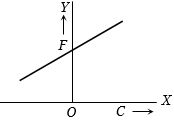
If a graph is plotted taking the temperature in Fahrenheit along the $Y-$axis and the corresponding temperature in Celsius along the $X-$axis,it will be a straight line:
A
Having a $+ve$ intercept on the $Y-$axis
B
Having a $+ve$ intercept on the $X-$axis
C
Passing through the origin
D
Having a $-ve$ intercept on both axes
Solution
(A) The relationship between temperature in Celsius $(C)$ and Fahrenheit $(F)$ is given by the formula: $\frac{C}{100} = \frac{F - 32}{180}$.
Rearranging this to express $F$ in terms of $C$,we get: $F = \frac{9}{5}C + 32$.
Comparing this with the equation of a straight line,$y = mx + c$,where $y = F$ and $x = C$:
Here,the slope $m = \frac{9}{5}$ (which is positive) and the $Y-$intercept $c = 32$ (which is positive).
Since the $Y-$intercept is positive,the line intersects the $Y-$axis at a point above the origin. Thus,the graph has a positive intercept on the $Y-$axis.
Rearranging this to express $F$ in terms of $C$,we get: $F = \frac{9}{5}C + 32$.
Comparing this with the equation of a straight line,$y = mx + c$,where $y = F$ and $x = C$:
Here,the slope $m = \frac{9}{5}$ (which is positive) and the $Y-$intercept $c = 32$ (which is positive).
Since the $Y-$intercept is positive,the line intersects the $Y-$axis at a point above the origin. Thus,the graph has a positive intercept on the $Y-$axis.
0 likes
View Solution33
EasyMCQ
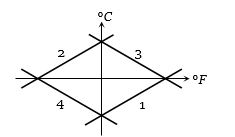
Which of the curves in the figure represents the relation between Celsius and Fahrenheit temperatures?
A
$1$
B
$2$
C
$3$
D
$4$
Solution
(A) The relationship between Celsius $(C)$ and Fahrenheit $(F)$ temperatures is given by the formula:
$\frac{C}{5} = \frac{F - 32}{9}$
Rearranging this equation to the form $y = mx + c$ (where $y = C$ and $x = F$):
$C = \frac{5}{9}F - \frac{32 \times 5}{9}$
$C = \frac{5}{9}F - \frac{160}{9}$
$C = \frac{5}{9}F - 17.78$
This equation represents a straight line with a positive slope $(m = \frac{5}{9})$ and a negative $y$-intercept $(c = -17.78)$.
Looking at the provided figure,curve $1$ is the only line that has a positive slope and passes through the negative $C$-axis (negative intercept).
Therefore,curve $1$ represents the correct relationship.
$\frac{C}{5} = \frac{F - 32}{9}$
Rearranging this equation to the form $y = mx + c$ (where $y = C$ and $x = F$):
$C = \frac{5}{9}F - \frac{32 \times 5}{9}$
$C = \frac{5}{9}F - \frac{160}{9}$
$C = \frac{5}{9}F - 17.78$
This equation represents a straight line with a positive slope $(m = \frac{5}{9})$ and a negative $y$-intercept $(c = -17.78)$.
Looking at the provided figure,curve $1$ is the only line that has a positive slope and passes through the negative $C$-axis (negative intercept).
Therefore,curve $1$ represents the correct relationship.
0 likes
View Solution34
EasyMCQ
At a common temperature,a block of wood and a block of metal feel equally cold or hot. The temperatures of the block of wood and the block of metal are:
A
Equal to the temperature of the body
B
Less than the temperature of the body
C
Greater than the temperature of the body
D
Either $(b)$ or $(c)$
Solution
(A) When the temperature of an object is equal to that of the human body,no heat is transferred between the object and the body.
Since the human body is at a constant temperature,if the objects are also at that same temperature,there is no net flow of heat.
Therefore,both the block of wood and the block of metal will feel neither cold nor hot,or they will feel equally neutral,which is the condition described as feeling 'equally cold or hot' (i.e.,no temperature difference is perceived).
Thus,the correct answer is that their temperatures are equal to the temperature of the human body.
Since the human body is at a constant temperature,if the objects are also at that same temperature,there is no net flow of heat.
Therefore,both the block of wood and the block of metal will feel neither cold nor hot,or they will feel equally neutral,which is the condition described as feeling 'equally cold or hot' (i.e.,no temperature difference is perceived).
Thus,the correct answer is that their temperatures are equal to the temperature of the human body.
0 likes
View Solution35
EasyMCQ
Temperature of water at the surface of a lake is $ -20^{\circ}C$. Then,the temperature of water just below the lower surface of the ice layer is ...... $^{\circ}C$.
A
$ -4 $
B
$ 0 $
C
$ 4 $
D
$ -20 $
Solution
(B) When the surface of a lake is exposed to a freezing environment,ice begins to form on the top layer.
Since ice is a poor conductor of heat,it acts as an insulator between the cold air and the liquid water beneath it.
The phase change of water to ice occurs at the freezing point of water.
Therefore,the temperature of the water immediately in contact with the lower surface of the ice layer is maintained at the freezing point of water,which is $0^{\circ}C$.
Since ice is a poor conductor of heat,it acts as an insulator between the cold air and the liquid water beneath it.
The phase change of water to ice occurs at the freezing point of water.
Therefore,the temperature of the water immediately in contact with the lower surface of the ice layer is maintained at the freezing point of water,which is $0^{\circ}C$.
0 likes
View Solution36
EasyMCQ
The surface of the lake is at $2^{\circ}C$. Find the temperature of the bottom of the lake in $^{\circ}C$.
A
$2$
B
$3$
C
$4$
D
$1$
Solution
(C) lake cools from the surface down. Above $4^{\circ}C$,the cooled water at the surface flows to the bottom because of its greater density.
However,when the surface temperature drops below $4^{\circ}C$ (in this case,$2^{\circ}C$),the water near the surface becomes less dense than the warmer water below.
Consequently,the downward flow ceases,and the water at the bottom remains at $4^{\circ}C$ until nearly the entire lake is frozen.
However,when the surface temperature drops below $4^{\circ}C$ (in this case,$2^{\circ}C$),the water near the surface becomes less dense than the warmer water below.
Consequently,the downward flow ceases,and the water at the bottom remains at $4^{\circ}C$ until nearly the entire lake is frozen.
0 likes
View Solution37
MediumMCQ
$A$ thermocouple is a device for the measurement of
A
Absolute temperature of a metal
B
The temperature difference between two substances
C
The couple acting on a wire
D
Thermal conductivity of a substance
Solution
(B) thermocouple is an electrical device consisting of two dissimilar electrical conductors forming an electrical junction.
It operates on the principle of the Seebeck effect,where a temperature-dependent voltage is produced due to the temperature difference between the two junctions of the dissimilar metals.
Therefore,a thermocouple is primarily used to measure the temperature difference between two points or substances.
It operates on the principle of the Seebeck effect,where a temperature-dependent voltage is produced due to the temperature difference between the two junctions of the dissimilar metals.
Therefore,a thermocouple is primarily used to measure the temperature difference between two points or substances.
0 likes
View Solution38
MediumMCQ
If a graph is plotted with Fahrenheit temperature on the $Y$-axis and Celsius temperature on the $X$-axis,the resulting straight line is one that .....
A
has a positive intercept on the $Y$-axis.
B
has a positive intercept on the $X$-axis.
C
passes through the origin.
D
has a negative intercept on both axes.
Solution
(A) The relationship between Fahrenheit temperature $(T_F)$ and Celsius temperature $(T_C)$ is given by the equation: $T_F = \frac{9}{5} T_C + 32$.
Comparing this with the equation of a straight line $Y = mX + C$,where $Y = T_F$,$X = T_C$,$m = 9/5$,and $C = 32$.
Since the intercept $C = 32$ is positive,the line has a positive intercept on the $Y$-axis.
Comparing this with the equation of a straight line $Y = mX + C$,where $Y = T_F$,$X = T_C$,$m = 9/5$,and $C = 32$.
Since the intercept $C = 32$ is positive,the line has a positive intercept on the $Y$-axis.
0 likes
View Solution39
MediumMCQ
$A$ Centigrade and a Fahrenheit thermometer are dipped in boiling water. The water is then cooled until the Fahrenheit thermometer reads $140 ^\circ F$. The corresponding drop in temperature as recorded by the Centigrade thermometer is ...... $^\circ C$.
A
$30$
B
$40$
C
$60$
D
$80$
Solution
(B) The boiling point of water is $100 ^\circ C$ or $212 ^\circ F$.
The initial temperature of the water is $212 ^\circ F$.
The final temperature of the water is $140 ^\circ F$.
The change in temperature on the Fahrenheit scale is $\Delta T_F = 212 ^\circ F - 140 ^\circ F = 72 ^\circ F$.
The relationship between a change in temperature on the Celsius scale $(\Delta T_C)$ and the Fahrenheit scale $(\Delta T_F)$ is given by $\Delta T_C = \frac{5}{9} \Delta T_F$.
Substituting the value of $\Delta T_F$:
$\Delta T_C = \frac{5}{9} \times 72 = 5 \times 8 = 40 ^\circ C$.
Thus,the Centigrade thermometer will show a drop of $40 ^\circ C$.
The initial temperature of the water is $212 ^\circ F$.
The final temperature of the water is $140 ^\circ F$.
The change in temperature on the Fahrenheit scale is $\Delta T_F = 212 ^\circ F - 140 ^\circ F = 72 ^\circ F$.
The relationship between a change in temperature on the Celsius scale $(\Delta T_C)$ and the Fahrenheit scale $(\Delta T_F)$ is given by $\Delta T_C = \frac{5}{9} \Delta T_F$.
Substituting the value of $\Delta T_F$:
$\Delta T_C = \frac{5}{9} \times 72 = 5 \times 8 = 40 ^\circ C$.
Thus,the Centigrade thermometer will show a drop of $40 ^\circ C$.
0 likes
View Solution40
DifficultMCQ
The temperature of a body on the Kelvin scale is $x \ K$. When the temperature of this body is measured with a Fahrenheit thermometer,it is found to be $x \ ^\circ F$. Then $x = $......
A
$40$
B
$313$
C
$574.25$
D
$301.25$
Solution
(C) The relationship between temperature in Celsius $(T_C)$ and Fahrenheit $(T_F)$ is given by $T_F = \frac{9}{5} T_C + 32$.
We know that $T_C = T_K - 273.15$,where $T_K$ is the temperature in Kelvin.
Substituting $T_K = x$ and $T_F = x$,we get:
$x = \frac{9}{5}(x - 273.15) + 32$
$x = 1.8(x - 273.15) + 32$
$x = 1.8x - 491.67 + 32$
$x = 1.8x - 459.67$
$0.8x = 459.67$
$x = \frac{459.67}{0.8} = 574.5875 \approx 574.25$ (using standard approximation $273$ instead of $273.15$ gives $x = 574.25$ exactly).
Thus,$x = 574.25$.
We know that $T_C = T_K - 273.15$,where $T_K$ is the temperature in Kelvin.
Substituting $T_K = x$ and $T_F = x$,we get:
$x = \frac{9}{5}(x - 273.15) + 32$
$x = 1.8(x - 273.15) + 32$
$x = 1.8x - 491.67 + 32$
$x = 1.8x - 459.67$
$0.8x = 459.67$
$x = \frac{459.67}{0.8} = 574.5875 \approx 574.25$ (using standard approximation $273$ instead of $273.15$ gives $x = 574.25$ exactly).
Thus,$x = 574.25$.
0 likes
View Solution41
MediumMCQ
If the temperature of a body increases by $30^{\circ}C$ on the Celsius scale,then the increase in temperature on the Fahrenheit scale is .... $^oF$.
A
$50$
B
$40$
C
$30$
D
$54$
Solution
(D) The relationship between a change in temperature on the Celsius scale $(\Delta T_C)$ and the Fahrenheit scale $(\Delta T_F)$ is given by the formula: $\Delta T_F = \frac{9}{5} \Delta T_C$.
Given that the increase in temperature on the Celsius scale is $\Delta T_C = 30^{\circ}C$.
Substituting this value into the formula:
$\Delta T_F = \frac{9}{5} \times 30^{\circ}F$
$\Delta T_F = 9 \times 6^{\circ}F$
$\Delta T_F = 54^{\circ}F$.
Therefore,the increase in temperature on the Fahrenheit scale is $54^{\circ}F$.
Given that the increase in temperature on the Celsius scale is $\Delta T_C = 30^{\circ}C$.
Substituting this value into the formula:
$\Delta T_F = \frac{9}{5} \times 30^{\circ}F$
$\Delta T_F = 9 \times 6^{\circ}F$
$\Delta T_F = 54^{\circ}F$.
Therefore,the increase in temperature on the Fahrenheit scale is $54^{\circ}F$.
0 likes
View Solution42
MediumMCQ
The phenomenon of superconductivity is observed at a temperature of $95 \ K$. The corresponding temperature on the Fahrenheit scale is ...... $^\circ F$.
A
$-288$
B
$-146$
C
$-368$
D
$+178$
Solution
(A) The relationship between the Kelvin scale $(T_K)$ and the Celsius scale $(T_C)$ is given by $T_C = T_K - 273.15$. Taking $T_K = 95 \ K$,we get $T_C = 95 - 273 = -178 \ ^\circ C$.
The relationship between the Fahrenheit scale $(T_F)$ and the Celsius scale $(T_C)$ is given by $T_F = \frac{9}{5} T_C + 32$.
Substituting the value of $T_C$:
$T_F = \frac{9}{5}(-178) + 32$
$T_F = -320.4 + 32$
$T_F = -288.4 \ ^\circ F$.
Rounding to the nearest integer,the value is $-288 \ ^\circ F$.
The relationship between the Fahrenheit scale $(T_F)$ and the Celsius scale $(T_C)$ is given by $T_F = \frac{9}{5} T_C + 32$.
Substituting the value of $T_C$:
$T_F = \frac{9}{5}(-178) + 32$
$T_F = -320.4 + 32$
$T_F = -288.4 \ ^\circ F$.
Rounding to the nearest integer,the value is $-288 \ ^\circ F$.
0 likes
View Solution43
EasyMCQ
At what temperature in $^\circ F$ is the density of water maximum?
A
$32$
B
$39.2$
C
$42$
D
$4$
Solution
(B) The density of water is maximum at $4 \, ^\circ C$.
To convert this temperature to Fahrenheit,we use the formula: $T_F = \frac{9}{5} T_C + 32$.
Substituting $T_C = 4 \, ^\circ C$ into the formula:
$T_F = \frac{9}{5}(4) + 32$
$T_F = 7.2 + 32$
$T_F = 39.2 \, ^\circ F$.
Thus,the density of water is maximum at $39.2 \, ^\circ F$.
To convert this temperature to Fahrenheit,we use the formula: $T_F = \frac{9}{5} T_C + 32$.
Substituting $T_C = 4 \, ^\circ C$ into the formula:
$T_F = \frac{9}{5}(4) + 32$
$T_F = 7.2 + 32$
$T_F = 39.2 \, ^\circ F$.
Thus,the density of water is maximum at $39.2 \, ^\circ F$.
0 likes
View Solution44
EasyMCQ
What is the value of absolute zero temperature on the Fahrenheit scale?
A
$-273$
B
$-32$
C
$-460$
D
$-132$
Solution
(C) The relationship between the Celsius scale $(T_C)$ and the Fahrenheit scale $(T_F)$ is given by the formula: $T_F = \frac{9}{5} T_C + 32$.
Absolute zero temperature in Celsius is $T_C = -273.15 \ ^\circ C$.
Substituting this value into the formula:
$T_F = \frac{9}{5} (-273.15) + 32$
$T_F = -491.67 + 32$
$T_F = -459.67 \ ^\circ F$.
Rounding to the nearest whole number,we get $T_F \approx -460 \ ^\circ F$.
Absolute zero temperature in Celsius is $T_C = -273.15 \ ^\circ C$.
Substituting this value into the formula:
$T_F = \frac{9}{5} (-273.15) + 32$
$T_F = -491.67 + 32$
$T_F = -459.67 \ ^\circ F$.
Rounding to the nearest whole number,we get $T_F \approx -460 \ ^\circ F$.
0 likes
View Solution45
EasyMCQ
In the absence of an atmosphere,the average temperature on the surface of the Earth would be . . . . . . .
A
lower.
B
higher.
C
the same as it is now.
D
$0^{\circ}C$.
Solution
(A) The Earth's atmosphere acts like a greenhouse,trapping heat through the greenhouse effect. Without the atmosphere,the heat radiated by the Earth would escape directly into space,leading to a significant decrease in the average surface temperature. Therefore,the temperature would be lower than it is currently.
0 likes
View Solution46
EasyMCQ
At what temperature in $^oC$ is the density of water maximum?
A
$0$
B
$32$
C
$-4$
D
$4$
Solution
(D) The density of water is anomalous. As water is cooled from room temperature,it contracts and its density increases until it reaches $4 ^oC$.
At $4 ^oC$,water molecules are most closely packed,resulting in maximum density.
Below $4 ^oC$,water begins to expand as it forms a crystalline structure,causing the density to decrease.
Therefore,the density of water is maximum at $4 ^oC$.
At $4 ^oC$,water molecules are most closely packed,resulting in maximum density.
Below $4 ^oC$,water begins to expand as it forms a crystalline structure,causing the density to decrease.
Therefore,the density of water is maximum at $4 ^oC$.
0 likes
View Solution47
DifficultMCQ
The temperature of the hot junction of a thermocouple is increased from $80\,\,^{\circ}\text{C}$ to $100\,\,^{\circ}\text{C}$. The percentage change in the thermoelectric power will be ............ $\%$.
A
$8$
B
$10$
C
$20$
D
$25$
Solution
(D) The thermoelectric power $P$ is directly proportional to the temperature difference $\theta$ between the junctions, i.e., $P \propto \theta$.
Given, initial temperature $\theta_1 = 80\,\,^{\circ}\text{C}$ and final temperature $\theta_2 = 100\,\,^{\circ}\text{C}$.
The percentage change in thermoelectric power is given by:
$\text{Percentage Change} = \frac{P_2 - P_1}{P_1} \times 100$
Since $P \propto \theta$, we can write:
$\text{Percentage Change} = \frac{\theta_2 - \theta_1}{\theta_1} \times 100$
Substituting the values:
$\text{Percentage Change} = \frac{100 - 80}{80} \times 100$
$\text{Percentage Change} = \frac{20}{80} \times 100$
$\text{Percentage Change} = \frac{1}{4} \times 100 = 25\,\%$.
Given, initial temperature $\theta_1 = 80\,\,^{\circ}\text{C}$ and final temperature $\theta_2 = 100\,\,^{\circ}\text{C}$.
The percentage change in thermoelectric power is given by:
$\text{Percentage Change} = \frac{P_2 - P_1}{P_1} \times 100$
Since $P \propto \theta$, we can write:
$\text{Percentage Change} = \frac{\theta_2 - \theta_1}{\theta_1} \times 100$
Substituting the values:
$\text{Percentage Change} = \frac{100 - 80}{80} \times 100$
$\text{Percentage Change} = \frac{20}{80} \times 100$
$\text{Percentage Change} = \frac{1}{4} \times 100 = 25\,\%$.
0 likes
View Solution48
EasyMCQ
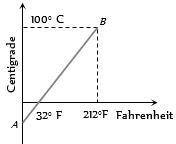
What is the slope of the line $AB$ in the given graph?
A
$9/5$
B
$5/9$
C
$1/9$
D
$3/9$
Solution
(B) The relationship between Celsius $(C)$ and Fahrenheit $(F)$ scales is given by the formula: $C = \frac{5}{9}(F - 32)$.
This can be rewritten as: $C = \frac{5}{9}F - \frac{160}{9}$.
Comparing this with the equation of a straight line $y = mx + c$,where $y$ is the temperature in Celsius and $x$ is the temperature in Fahrenheit,the slope $m$ is the coefficient of $F$.
Therefore,the slope $m = \frac{5}{9}$.
Alternatively,using the coordinates of points $A$ and $B$ from the graph:
Point $A$ is $(32, 0)$ and point $B$ is $(212, 100)$.
Slope $m = \frac{y_2 - y_1}{x_2 - x_1} = \frac{100 - 0}{212 - 32} = \frac{100}{180} = \frac{5}{9}$.
This can be rewritten as: $C = \frac{5}{9}F - \frac{160}{9}$.
Comparing this with the equation of a straight line $y = mx + c$,where $y$ is the temperature in Celsius and $x$ is the temperature in Fahrenheit,the slope $m$ is the coefficient of $F$.
Therefore,the slope $m = \frac{5}{9}$.
Alternatively,using the coordinates of points $A$ and $B$ from the graph:
Point $A$ is $(32, 0)$ and point $B$ is $(212, 100)$.
Slope $m = \frac{y_2 - y_1}{x_2 - x_1} = \frac{100 - 0}{212 - 32} = \frac{100}{180} = \frac{5}{9}$.
0 likes
View Solution49
MediumMCQ
The melting point of ice and the boiling point of water are marked as $20^o X$ and $150^o X$ respectively on a thermometer. What will be the temperature of $60^o C$ on this scale?
A
$40$
B
$65$
C
$98$
D
$110$
Solution
(C) The relationship between any temperature scale and the Celsius scale is given by the formula: $\frac{X - LFP}{UFP - LFP} = \frac{C - 0^o}{100^o - 0^o}$,where $LFP$ is the Lower Fixed Point and $UFP$ is the Upper Fixed Point.
Given: $LFP = 20^o X$,$UFP = 150^o X$,and $C = 60^o C$.
Substituting the values into the formula:
$\frac{X - 20}{150 - 20} = \frac{60 - 0}{100 - 0}$
$\frac{X - 20}{130} = \frac{60}{100}$
$\frac{X - 20}{130} = 0.6$
$X - 20 = 0.6 \times 130$
$X - 20 = 78$
$X = 78 + 20 = 98^o X$.
Given: $LFP = 20^o X$,$UFP = 150^o X$,and $C = 60^o C$.
Substituting the values into the formula:
$\frac{X - 20}{150 - 20} = \frac{60 - 0}{100 - 0}$
$\frac{X - 20}{130} = \frac{60}{100}$
$\frac{X - 20}{130} = 0.6$
$X - 20 = 0.6 \times 130$
$X - 20 = 78$
$X = 78 + 20 = 98^o X$.
0 likes
View Solution50
MediumMCQ
On a new scale of temperature (which is linear) called the $W$ scale,the freezing and boiling points of water are $39\,^{\circ}W$ and $239\,^{\circ}W$ respectively. What will be the temperature on the new scale,corresponding to a temperature of $39\,^{\circ}C$ on the Celsius scale?
A
$200$
B
$139$
C
$78$
D
$117$
Solution
(D) The relationship between two linear temperature scales is given by the formula: $\frac{T_W - \text{Freezing point}_W}{\text{Boiling point}_W - \text{Freezing point}_W} = \frac{T_C - \text{Freezing point}_C}{\text{Boiling point}_C - \text{Freezing point}_C}$.
Given for the $W$ scale: Freezing point = $39\,^{\circ}W$,Boiling point = $239\,^{\circ}W$.
Given for the Celsius scale: Freezing point = $0\,^{\circ}C$,Boiling point = $100\,^{\circ}C$.
Substituting the values:
$\frac{T_W - 39}{239 - 39} = \frac{39 - 0}{100 - 0}$
$\frac{T_W - 39}{200} = \frac{39}{100}$
$T_W - 39 = \frac{39}{100} \times 200$
$T_W - 39 = 39 \times 2 = 78$
$T_W = 78 + 39 = 117\,^{\circ}W$.
Given for the $W$ scale: Freezing point = $39\,^{\circ}W$,Boiling point = $239\,^{\circ}W$.
Given for the Celsius scale: Freezing point = $0\,^{\circ}C$,Boiling point = $100\,^{\circ}C$.
Substituting the values:
$\frac{T_W - 39}{239 - 39} = \frac{39 - 0}{100 - 0}$
$\frac{T_W - 39}{200} = \frac{39}{100}$
$T_W - 39 = \frac{39}{100} \times 200$
$T_W - 39 = 39 \times 2 = 78$
$T_W = 78 + 39 = 117\,^{\circ}W$.
0 likes
View Solution10-1.Thermometry, Thermal Expansion and Calorimetry — Temperature and Temperature scales · Frequently Asked Questions
1Are these 10-1.Thermometry, Thermal Expansion and Calorimetry questions useful for JEE and NEET?
Yes. All questions in this section are mapped to JEE Main and NEET exam patterns. Previous year questions from JEE Main, NEET, GUJCET and state-level exams are included with full solutions.
2Can I switch to Hindi or Gujarati for these questions?
Yes. Use the language tabs in the hero section or the sidebar to view the same questions and solutions in English, Hindi or Gujarati.
3How do I generate a question paper from this subtopic?
Use the Vedclass Exam Paper Generator — select the chapter and subtopic, set difficulty, and generate Sets A, B, C, D automatically. First 3 chapters of every subject are free.
Vedclass Products
For Students
Vedclass Test Series
Mock tests in real JEE/NEET style with performance analysis. 5-day free trial.
Start Free TrialFor Teachers
Exam Paper Generator
Generate Set A/B/C/D papers from this chapter in 2 minutes. 3 chapters free.
Try FreeFor Institutes
Online Exam Module
Live online exams with unlimited students, 360° analytics & white-label branding.
See DemoFor Teachers & Institutes
Generate a 10-1.Thermometry, Thermal Expansion and Calorimetry Exam Paper in 2 Minutes
Select subtopic & difficulty — Sets A, B, C, D auto-generated with No Repeat logic.
First 3 chapters of every subject are free — no payment required.