
A English
Temperature and Temperature scales Questions in English
Class 11 Physics · 10-1.Thermometry, Thermal Expansion and Calorimetry · Temperature and Temperature scales
142+
Questions
English
Language
100%
With Solutions
Showing 49 of 142 questions in English
51
DifficultMCQ
The temperature of a body on the Kelvin scale is found to be $X \; K$. When it is measured by a Fahrenheit thermometer,it is found to be $X \; ^\circ F$. Then $X$ is:
A
$301.25$
B
$574.25$
C
$313$
D
$40$
Solution
(B) The relationship between the Fahrenheit scale $(F)$ and the Kelvin scale $(K)$ is given by the formula: $\frac{F - 32}{9} = \frac{K - 273}{5}$.
Given that the temperature is $X$ on both scales,we substitute $F = X$ and $K = X$ into the equation:
$\frac{X - 32}{9} = \frac{X - 273}{5}$.
Cross-multiplying gives: $5(X - 32) = 9(X - 273)$.
Expanding the terms: $5X - 160 = 9X - 2457$.
Rearranging the terms to solve for $X$: $9X - 5X = 2457 - 160$.
$4X = 2297$.
$X = \frac{2297}{4} = 574.25$.
Therefore,the value of $X$ is $574.25$.
Given that the temperature is $X$ on both scales,we substitute $F = X$ and $K = X$ into the equation:
$\frac{X - 32}{9} = \frac{X - 273}{5}$.
Cross-multiplying gives: $5(X - 32) = 9(X - 273)$.
Expanding the terms: $5X - 160 = 9X - 2457$.
Rearranging the terms to solve for $X$: $9X - 5X = 2457 - 160$.
$4X = 2297$.
$X = \frac{2297}{4} = 574.25$.
Therefore,the value of $X$ is $574.25$.
0 likes
View Solution52
EasyMCQ
An ideal thermometer should have
A
Large heat capacity
B
Medium heat capacity
C
Small heat capacity
D
Variable heat capacity
Solution
(C) An ideal thermometer must reach thermal equilibrium with the body whose temperature is being measured.
To ensure the measurement is accurate,the thermometer should absorb or release as little heat as possible from the body.
If the thermometer has a large heat capacity,it will draw a significant amount of heat from the body,thereby changing the body's original temperature.
Therefore,to minimize the disturbance to the system,an ideal thermometer should have a small heat capacity.
To ensure the measurement is accurate,the thermometer should absorb or release as little heat as possible from the body.
If the thermometer has a large heat capacity,it will draw a significant amount of heat from the body,thereby changing the body's original temperature.
Therefore,to minimize the disturbance to the system,an ideal thermometer should have a small heat capacity.
0 likes
View Solution53
MediumMCQ
$A$ faulty thermometer has its lower fixed point marked as $-10^\circ C$ and upper fixed point marked as $110^\circ C$. If the temperature of a body shown on this scale is $62^\circ$,the temperature shown on the Celsius scale is ........ $^\circ C$.
A
$72$
B
$82$
C
$60$
D
$42$
Solution
(C) The relationship between a faulty scale $(X)$ and the Celsius scale $(C)$ is given by the formula: $\frac{X - L_X}{U_X - L_X} = \frac{C - L_C}{U_C - L_C}$.
Here,the lower fixed point of the faulty scale $L_X = -10^\circ$ and the upper fixed point $U_X = 110^\circ$.
For the Celsius scale,the lower fixed point $L_C = 0^\circ$ and the upper fixed point $U_C = 100^\circ$.
Given the temperature on the faulty scale $X = 62^\circ$,we substitute the values into the formula:
$\frac{62 - (-10)}{110 - (-10)} = \frac{C - 0}{100 - 0}$
$\frac{62 + 10}{110 + 10} = \frac{C}{100}$
$\frac{72}{120} = \frac{C}{100}$
$C = \frac{72}{120} \times 100 = 0.6 \times 100 = 60^\circ C$.
Here,the lower fixed point of the faulty scale $L_X = -10^\circ$ and the upper fixed point $U_X = 110^\circ$.
For the Celsius scale,the lower fixed point $L_C = 0^\circ$ and the upper fixed point $U_C = 100^\circ$.
Given the temperature on the faulty scale $X = 62^\circ$,we substitute the values into the formula:
$\frac{62 - (-10)}{110 - (-10)} = \frac{C - 0}{100 - 0}$
$\frac{62 + 10}{110 + 10} = \frac{C}{100}$
$\frac{72}{120} = \frac{C}{100}$
$C = \frac{72}{120} \times 100 = 0.6 \times 100 = 60^\circ C$.
0 likes
View Solution54
EasyMCQ
In the definition of 'calorie',one calorie is the heat required to raise the temperature of $1\ g$ of water through $1\ ^oC$ in a certain interval of temperature. The temperature interval is
A
$13.5\ ^oC$ to $14.5\ ^oC$
B
$6.5\ ^oC$ to $7.5\ ^oC$
C
$14.5\ ^oC$ to $15.5\ ^oC$
D
$98.5\ ^oC$ to $99.5\ ^oC$
Solution
(C) By definition,one calorie is the amount of heat energy required to raise the temperature of $1\ g$ of pure water from $14.5\ ^oC$ to $15.5\ ^oC$ at a standard atmospheric pressure of $760\ mm$ of $Hg$.
0 likes
View Solution55
MediumMCQ
What is the change in temperature on the Fahrenheit scale and Kelvin scale,if an iron piece is heated from $30\ ^oC$ to $90\ ^oC$?
A
$60\ ^oF, 108\ K$
B
$100\ ^oF, 65\ K$
C
$108\ ^oF, 60\ K$
D
$43\ ^oF, 100\ K$
Solution
(C) The change in temperature on the Celsius scale is given by $\Delta T_C = 90\ ^oC - 30\ ^oC = 60\ ^oC$.
For the Fahrenheit scale,the relation between the change in temperature is $\Delta T_F = \frac{9}{5} \Delta T_C$.
Substituting the value: $\Delta T_F = \frac{9}{5} \times 60\ ^oC = 108\ ^oF$.
For the Kelvin scale,the change in temperature is equal to the change in temperature on the Celsius scale,because the size of one degree Celsius is equal to the size of one Kelvin unit.
Therefore,$\Delta T_K = \Delta T_C = 60\ K$.
Thus,the change is $108\ ^oF$ and $60\ K$.
For the Fahrenheit scale,the relation between the change in temperature is $\Delta T_F = \frac{9}{5} \Delta T_C$.
Substituting the value: $\Delta T_F = \frac{9}{5} \times 60\ ^oC = 108\ ^oF$.
For the Kelvin scale,the change in temperature is equal to the change in temperature on the Celsius scale,because the size of one degree Celsius is equal to the size of one Kelvin unit.
Therefore,$\Delta T_K = \Delta T_C = 60\ K$.
Thus,the change is $108\ ^oF$ and $60\ K$.
0 likes
View Solution56
MediumMCQ
$A$ faulty thermometer has its fixed points marked $5^{\circ}$ and $95^{\circ}$. This thermometer reads the temperature of a body as $59^{\circ}$. Then the correct temperature of the body on the Celsius scale is ........ $^{\circ}$.
A
$59$
B
$58$
C
$60$
D
$61$
Solution
(C) Let $T_{C}$ be the correct temperature on the Celsius scale.
The formula relating a faulty scale to the Celsius scale is given by:
$\frac{T_{C} - 0}{100 - 0} = \frac{X - X_{L}}{X_{U} - X_{L}}$
Where:
$X = 59^{\circ}$ (reading on the faulty thermometer)
$X_{L} = 5^{\circ}$ (lower fixed point)
$X_{U} = 95^{\circ}$ (upper fixed point)
Substituting the values:
$\frac{T_{C}}{100} = \frac{59 - 5}{95 - 5}$
$\frac{T_{C}}{100} = \frac{54}{90}$
$\frac{T_{C}}{100} = \frac{6}{10} = 0.6$
$T_{C} = 0.6 \times 100 = 60^{\circ}$
The formula relating a faulty scale to the Celsius scale is given by:
$\frac{T_{C} - 0}{100 - 0} = \frac{X - X_{L}}{X_{U} - X_{L}}$
Where:
$X = 59^{\circ}$ (reading on the faulty thermometer)
$X_{L} = 5^{\circ}$ (lower fixed point)
$X_{U} = 95^{\circ}$ (upper fixed point)
Substituting the values:
$\frac{T_{C}}{100} = \frac{59 - 5}{95 - 5}$
$\frac{T_{C}}{100} = \frac{54}{90}$
$\frac{T_{C}}{100} = \frac{6}{10} = 0.6$
$T_{C} = 0.6 \times 100 = 60^{\circ}$
0 likes
View Solution57
DifficultMCQ
$A$ faulty thermometer has its fixed points marked $5^{\circ}$ and $95^{\circ}$. This thermometer reads the temperature of a body as $59^{\circ}$. Then,the correct temperature of the body on the Celsius scale is ...... $^{\circ}$
A
$59$
B
$60$
C
$48.6$
D
$58$
Solution
(B) The formula to convert temperature between two scales is given by: $\frac{X - X_{LFP}}{X_{UFP} - X_{LFP}} = \frac{C - C_{LFP}}{C_{UFP} - C_{LFP}}$.
Here,the faulty thermometer has a Lower Fixed Point $(X_{LFP})$ of $5^{\circ}$ and an Upper Fixed Point $(X_{UFP})$ of $95^{\circ}$.
The Celsius scale has a Lower Fixed Point $(C_{LFP})$ of $0^{\circ}$ and an Upper Fixed Point $(C_{UFP})$ of $100^{\circ}$.
Given the reading on the faulty thermometer $X = 59^{\circ}$.
Substituting the values: $\frac{59 - 5}{95 - 5} = \frac{C - 0}{100 - 0}$.
$\frac{54}{90} = \frac{C}{100}$.
$C = \frac{54}{90} \times 100 = 0.6 \times 100 = 60^{\circ}$.
Here,the faulty thermometer has a Lower Fixed Point $(X_{LFP})$ of $5^{\circ}$ and an Upper Fixed Point $(X_{UFP})$ of $95^{\circ}$.
The Celsius scale has a Lower Fixed Point $(C_{LFP})$ of $0^{\circ}$ and an Upper Fixed Point $(C_{UFP})$ of $100^{\circ}$.
Given the reading on the faulty thermometer $X = 59^{\circ}$.
Substituting the values: $\frac{59 - 5}{95 - 5} = \frac{C - 0}{100 - 0}$.
$\frac{54}{90} = \frac{C}{100}$.
$C = \frac{54}{90} \times 100 = 0.6 \times 100 = 60^{\circ}$.
0 likes
View Solution58
MediumMCQ
Two thermometers $X$ and $Y$ have ice points marked at $15^{\circ}$ and $25^{\circ}$ and steam points marked as $75^{\circ}$ and $125^{\circ}$ respectively. When thermometer $X$ measures the temperature of a bath as $60^{\circ}$ on it,what would thermometer $Y$ read when it is used to measure the temperature of the same bath? ...... $^{\circ}$
A
$60$
B
$75$
C
$100$
D
$90$
Solution
(C) For any temperature scale,the ratio of the difference between the reading and the melting point (ice point) to the difference between the boiling point (steam point) and the melting point is constant.
$\frac{\text{Reading}_X - MP_X}{BP_X - MP_X} = \frac{\text{Reading}_Y - MP_Y}{BP_Y - MP_Y}$
Given for thermometer $X$: $MP_X = 15^{\circ}$,$BP_X = 75^{\circ}$,Reading $= 60^{\circ}$.
Given for thermometer $Y$: $MP_Y = 25^{\circ}$,$BP_Y = 125^{\circ}$.
Substituting the values:
$\frac{60 - 15}{75 - 15} = \frac{y - 25}{125 - 25}$
$\frac{45}{60} = \frac{y - 25}{100}$
$\frac{3}{4} = \frac{y - 25}{100}$
$y - 25 = 75$
$y = 100^{\circ}$
$\frac{\text{Reading}_X - MP_X}{BP_X - MP_X} = \frac{\text{Reading}_Y - MP_Y}{BP_Y - MP_Y}$
Given for thermometer $X$: $MP_X = 15^{\circ}$,$BP_X = 75^{\circ}$,Reading $= 60^{\circ}$.
Given for thermometer $Y$: $MP_Y = 25^{\circ}$,$BP_Y = 125^{\circ}$.
Substituting the values:
$\frac{60 - 15}{75 - 15} = \frac{y - 25}{125 - 25}$
$\frac{45}{60} = \frac{y - 25}{100}$
$\frac{3}{4} = \frac{y - 25}{100}$
$y - 25 = 75$
$y = 100^{\circ}$
0 likes
View Solution59
MediumMCQ
$A$ Centigrade and a Fahrenheit thermometer are dipped in boiling water. The water temperature is lowered until the Fahrenheit thermometer registers $140\,^{\circ}F$. What is the fall in temperature as registered by the centigrade thermometer?
A
$30$
B
$40$
C
$60$
D
$80$
Solution
(B) The initial temperature of boiling water is $100\,^{\circ}C$ or $212\,^{\circ}F$.
The final temperature in Fahrenheit is $F = 140\,^{\circ}F$.
Using the conversion formula $\frac{C}{100} = \frac{F-32}{180}$,we find the final temperature in Celsius:
$\frac{C}{100} = \frac{140-32}{180} = \frac{108}{180} = 0.6$
$C = 60\,^{\circ}C$.
The fall in temperature on the Centigrade scale is $\Delta C = 100\,^{\circ}C - 60\,^{\circ}C = 40\,^{\circ}C$.
The final temperature in Fahrenheit is $F = 140\,^{\circ}F$.
Using the conversion formula $\frac{C}{100} = \frac{F-32}{180}$,we find the final temperature in Celsius:
$\frac{C}{100} = \frac{140-32}{180} = \frac{108}{180} = 0.6$
$C = 60\,^{\circ}C$.
The fall in temperature on the Centigrade scale is $\Delta C = 100\,^{\circ}C - 60\,^{\circ}C = 40\,^{\circ}C$.
0 likes
View Solution60
EasyMCQ
If $H_C, H_K$ and $H_F$ are the heat required to raise the temperature of one gram of water by one degree Celsius,Kelvin,and Fahrenheit temperature scales respectively,then:
A
$H_K > H_C > H_F$
B
$H_F > H_C > H_K$
C
$H_K = H_C > H_F$
D
$H_K = H_C = H_F$
Solution
(C) The heat required to raise the temperature of a substance is given by $H = ms\Delta\theta$.
For $1 \text{ g}$ of water,$m$ and $s$ are constant.
$H_C = ms(1^{\circ}C)$.
$H_K = ms(1 \text{ K})$. Since a change of $1 \text{ K}$ is equal to a change of $1^{\circ}C$,$H_K = ms(1^{\circ}C) = H_C$.
$H_F = ms(1^{\circ}F)$. Since a change of $1^{\circ}F$ is equal to $(5/9)^{\circ}C$,$H_F = ms(5/9)^{\circ}C$.
Comparing the values,$H_C = H_K$ and since $1 > 5/9$,$H_C > H_F$.
Therefore,$H_K = H_C > H_F$.
For $1 \text{ g}$ of water,$m$ and $s$ are constant.
$H_C = ms(1^{\circ}C)$.
$H_K = ms(1 \text{ K})$. Since a change of $1 \text{ K}$ is equal to a change of $1^{\circ}C$,$H_K = ms(1^{\circ}C) = H_C$.
$H_F = ms(1^{\circ}F)$. Since a change of $1^{\circ}F$ is equal to $(5/9)^{\circ}C$,$H_F = ms(5/9)^{\circ}C$.
Comparing the values,$H_C = H_K$ and since $1 > 5/9$,$H_C > H_F$.
Therefore,$H_K = H_C > H_F$.
0 likes
View Solution61
MediumMCQ
On a linear temperature scale $Y$,water freezes at $-160^{\circ}Y$ and boils at $-50^{\circ}Y$. On this $Y$ scale,a temperature of $340\,K$ would be read as........ $^{\circ}Y$ (water freezes at $273\,K$ and boils at $373\,K$).
A
$-73.7$
B
$-233.7$
C
$-86.3$
D
$-106.3$
Solution
(C) The relationship between any two temperature scales is given by the formula: $\frac{T - LFP}{UFP - LFP} = \text{constant}$.
For the Kelvin scale $(K)$: $LFP = 273\,K$,$UFP = 373\,K$.
For the $Y$ scale: $LFP = -160^{\circ}Y$,$UFP = -50^{\circ}Y$.
Setting the ratios equal:
$\frac{340 - 273}{373 - 273} = \frac{Y - (-160)}{-50 - (-160)}$
$\frac{67}{100} = \frac{Y + 160}{110}$
$Y + 160 = \frac{67 \times 110}{100}$
$Y + 160 = 73.7$
$Y = 73.7 - 160 = -86.3^{\circ}Y$.
For the Kelvin scale $(K)$: $LFP = 273\,K$,$UFP = 373\,K$.
For the $Y$ scale: $LFP = -160^{\circ}Y$,$UFP = -50^{\circ}Y$.
Setting the ratios equal:
$\frac{340 - 273}{373 - 273} = \frac{Y - (-160)}{-50 - (-160)}$
$\frac{67}{100} = \frac{Y + 160}{110}$
$Y + 160 = \frac{67 \times 110}{100}$
$Y + 160 = 73.7$
$Y = 73.7 - 160 = -86.3^{\circ}Y$.
1 likes
View Solution62
DifficultMCQ
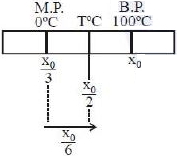
$A$ thermometer graduated according to a linear scale reads a value $x_0$ when in contact with boiling water,and $x_0/3$ when in contact with ice. What is the temperature of an object in ${}^oC$,if this thermometer in contact with the object reads $x_0/2$?
A
$25$
B
$60$
C
$40$
D
$35$
Solution
(A) For a linear scale,the temperature $T$ can be related to the reading $x$ by the formula:
$T = \frac{x - x_{ice}}{x_{steam} - x_{ice}} \times 100^\circ C$
Given:
$x_{steam} = x_0$
$x_{ice} = x_0/3$
$x = x_0/2$
Substituting these values into the formula:
$T = \frac{x_0/2 - x_0/3}{x_0 - x_0/3} \times 100^\circ C$
$T = \frac{(3x_0 - 2x_0)/6}{(3x_0 - x_0)/3} \times 100^\circ C$
$T = \frac{x_0/6}{2x_0/3} \times 100^\circ C$
$T = \frac{x_0}{6} \times \frac{3}{2x_0} \times 100^\circ C$
$T = \frac{1}{4} \times 100^\circ C = 25^\circ C$
$T = \frac{x - x_{ice}}{x_{steam} - x_{ice}} \times 100^\circ C$
Given:
$x_{steam} = x_0$
$x_{ice} = x_0/3$
$x = x_0/2$
Substituting these values into the formula:
$T = \frac{x_0/2 - x_0/3}{x_0 - x_0/3} \times 100^\circ C$
$T = \frac{(3x_0 - 2x_0)/6}{(3x_0 - x_0)/3} \times 100^\circ C$
$T = \frac{x_0/6}{2x_0/3} \times 100^\circ C$
$T = \frac{x_0}{6} \times \frac{3}{2x_0} \times 100^\circ C$
$T = \frac{1}{4} \times 100^\circ C = 25^\circ C$
0 likes
View Solution63
MediumMCQ
Maximum density of $H_2O$ is at temperature
A
$32\,^{\circ}F$
B
$4\,^{\circ}K$
C
$4\,^{\circ}F$
D
$39.2\,^{\circ}F$
Solution
(D) The density of water is maximum at $4^{\circ}C$.
To convert this temperature to Fahrenheit,we use the formula:
$\frac{T_{C}-0}{100-0} = \frac{T_{F}-32}{212-32}$
Substituting $T_{C} = 4^{\circ}C$:
$\frac{4}{100} = \frac{T_{F}-32}{180}$
$0.04 \times 180 = T_{F} - 32$
$7.2 = T_{F} - 32$
$T_{F} = 32 + 7.2 = 39.2^{\circ}F$
Thus,the maximum density of $H_2O$ occurs at $39.2^{\circ}F$.
To convert this temperature to Fahrenheit,we use the formula:
$\frac{T_{C}-0}{100-0} = \frac{T_{F}-32}{212-32}$
Substituting $T_{C} = 4^{\circ}C$:
$\frac{4}{100} = \frac{T_{F}-32}{180}$
$0.04 \times 180 = T_{F} - 32$
$7.2 = T_{F} - 32$
$T_{F} = 32 + 7.2 = 39.2^{\circ}F$
Thus,the maximum density of $H_2O$ occurs at $39.2^{\circ}F$.
0 likes
View Solution64
DifficultMCQ
The temperature of a body on the Kelvin scale is found to be $x \ K$. When it is measured by a Fahrenheit thermometer,it is found to be $x \ ^\circ F$. Then the value of $x$ is:
A
$40$
B
$313$
C
$574.25$
D
$301.25$
Solution
(C) The relationship between the Fahrenheit scale $(F)$ and the Kelvin scale $(K)$ is given by the formula: $\frac{F-32}{9} = \frac{K-273}{5}$.
Given that the temperature is $x$ on both scales,we substitute $F = x$ and $K = x$ into the equation:
$\frac{x-32}{9} = \frac{x-273}{5}$.
Cross-multiplying the terms,we get: $5(x-32) = 9(x-273)$.
Expanding the brackets: $5x - 160 = 9x - 2457$.
Rearranging the terms to solve for $x$: $2457 - 160 = 9x - 5x$.
$2297 = 4x$.
$x = \frac{2297}{4} = 574.25$.
Therefore,the value of $x$ is $574.25$.
Given that the temperature is $x$ on both scales,we substitute $F = x$ and $K = x$ into the equation:
$\frac{x-32}{9} = \frac{x-273}{5}$.
Cross-multiplying the terms,we get: $5(x-32) = 9(x-273)$.
Expanding the brackets: $5x - 160 = 9x - 2457$.
Rearranging the terms to solve for $x$: $2457 - 160 = 9x - 5x$.
$2297 = 4x$.
$x = \frac{2297}{4} = 574.25$.
Therefore,the value of $x$ is $574.25$.
0 likes
View Solution65
MediumMCQ
The temperature at which the reading of a Fahrenheit thermometer will be double that of a centigrade thermometer is ........ $^\circ$.
A
$160$
B
$180$
C
$32$
D
$100$
Solution
(A) The relationship between Fahrenheit $(T_F)$ and Celsius $(T_C)$ scales is given by the formula: $\frac{T_F - 32}{180} = \frac{T_C}{100}$.
Let the reading on the centigrade thermometer be $\theta$. According to the problem,the reading on the Fahrenheit thermometer is $2\theta$.
Substituting these values into the formula: $\frac{2\theta - 32}{180} = \frac{\theta}{100}$.
Simplifying the equation: $\frac{2\theta - 32}{18} = \frac{\theta}{10}$.
$10(2\theta - 32) = 18\theta$.
$20\theta - 320 = 18\theta$.
$2\theta = 320$.
$\theta = 160$.
Thus,the temperature is $160^{\circ}$.
Let the reading on the centigrade thermometer be $\theta$. According to the problem,the reading on the Fahrenheit thermometer is $2\theta$.
Substituting these values into the formula: $\frac{2\theta - 32}{180} = \frac{\theta}{100}$.
Simplifying the equation: $\frac{2\theta - 32}{18} = \frac{\theta}{10}$.
$10(2\theta - 32) = 18\theta$.
$20\theta - 320 = 18\theta$.
$2\theta = 320$.
$\theta = 160$.
Thus,the temperature is $160^{\circ}$.
0 likes
View Solution66
MediumMCQ
Maximum density of $H_2O$ is at the temperature
A
$32^{\circ}F$
B
$4^{\circ}K$
C
$4^{\circ}F$
D
$39.2^{\circ}F$
Solution
(D) The density of water is maximum at $4^{\circ}C$.
To convert this temperature to Fahrenheit,we use the formula:
$\frac{C}{5} = \frac{F - 32}{9}$
Substituting $C = 4$:
$\frac{4}{5} = \frac{F - 32}{9}$
$0.8 = \frac{F - 32}{9}$
$7.2 = F - 32$
$F = 39.2^{\circ}F$
Thus,the maximum density of $H_2O$ occurs at $39.2^{\circ}F$.
To convert this temperature to Fahrenheit,we use the formula:
$\frac{C}{5} = \frac{F - 32}{9}$
Substituting $C = 4$:
$\frac{4}{5} = \frac{F - 32}{9}$
$0.8 = \frac{F - 32}{9}$
$7.2 = F - 32$
$F = 39.2^{\circ}F$
Thus,the maximum density of $H_2O$ occurs at $39.2^{\circ}F$.
0 likes
View Solution67
MediumMCQ
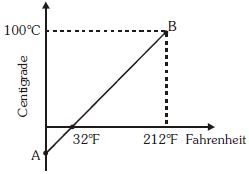
The graph $AB$ shown in the figure is a plot of the temperature of a body in degree Celsius $(C)$ versus degree Fahrenheit $(F)$. Then:
A
slope of line $AB$ is $9/5$
B
slope of line $AB$ is $5/9$
C
slope of line $AB$ is $1/9$
D
slope of line $AB$ is $3/9$
Solution
(B) The relation between the Celsius $(C)$ and Fahrenheit $(F)$ scales of temperature is given by the formula:
$\frac{C}{5} = \frac{F - 32}{9}$
Rearranging this equation to express $C$ in terms of $F$:
$C = \frac{5}{9}F - \frac{160}{9}$
Comparing this with the standard equation of a straight line,$y = mx + c$,where $y$ is the temperature in Celsius,$x$ is the temperature in Fahrenheit,and $m$ is the slope:
Here,$y = C$ and $x = F$.
Thus,the slope $m = 5/9$.
Therefore,the slope of the line $AB$ is $5/9$.
$\frac{C}{5} = \frac{F - 32}{9}$
Rearranging this equation to express $C$ in terms of $F$:
$C = \frac{5}{9}F - \frac{160}{9}$
Comparing this with the standard equation of a straight line,$y = mx + c$,where $y$ is the temperature in Celsius,$x$ is the temperature in Fahrenheit,and $m$ is the slope:
Here,$y = C$ and $x = F$.
Thus,the slope $m = 5/9$.
Therefore,the slope of the line $AB$ is $5/9$.
0 likes
View Solution68
DifficultMCQ
Two thermometers $X$ and $Y$ have ice points marked at $15^{\circ}$ and $25^{\circ}$ and steam points marked as $75^{\circ}$ and $125^{\circ}$ respectively. When thermometer $X$ measures the temperature of a bath as $60^{\circ}$ on it,what would thermometer $Y$ read (in $^{\circ}C$) when it is used to measure the temperature of the same bath?
A
$60$
B
$75$
C
$100$
D
$90$
Solution
(C) The relationship between two temperature scales is given by the formula: $\frac{X - X_{L}}{X_{U} - X_{L}} = \frac{Y - Y_{L}}{Y_{U} - Y_{L}}$
Here,$X_{L} = 15$,$X_{U} = 75$,$Y_{L} = 25$,and $Y_{U} = 125$.
Given that thermometer $X$ reads $60^{\circ}$,we substitute the values:
$\frac{60 - 15}{75 - 15} = \frac{Y - 25}{125 - 25}$
$\frac{45}{60} = \frac{Y - 25}{100}$
$\frac{3}{4} = \frac{Y - 25}{100}$
$Y - 25 = \frac{3}{4} \times 100 = 75$
$Y = 75 + 25 = 100^{\circ}$
Here,$X_{L} = 15$,$X_{U} = 75$,$Y_{L} = 25$,and $Y_{U} = 125$.
Given that thermometer $X$ reads $60^{\circ}$,we substitute the values:
$\frac{60 - 15}{75 - 15} = \frac{Y - 25}{125 - 25}$
$\frac{45}{60} = \frac{Y - 25}{100}$
$\frac{3}{4} = \frac{Y - 25}{100}$
$Y - 25 = \frac{3}{4} \times 100 = 75$
$Y = 75 + 25 = 100^{\circ}$
0 likes
View Solution69
MediumMCQ
$Assertion :$ In a pressure cooker,water is brought to a boil. The cooker is then removed from the stove. Now,upon removing the lid of the pressure cooker,the water starts boiling again.
$Reason :$ The impurities in water bring down its boiling point.
$Reason :$ The impurities in water bring down its boiling point.
A
If both Assertion and Reason are correct and the Reason is a correct explanation of the Assertion.
B
If both Assertion and Reason are correct but Reason is not a correct explanation of the Assertion.
C
If the Assertion is correct but Reason is incorrect.
D
If both the Assertion and Reason are incorrect.
Solution
(C) The water starts boiling a second time because when the pressure cooker cools down,the pressure inside decreases.
According to the relationship between pressure and boiling point,a decrease in pressure leads to a decrease in the boiling point $(B.P.)$ of water.
When the lid is removed,the pressure drops to atmospheric pressure,which is lower than the pressure inside the closed cooker.
Since the water is already at a high temperature,this reduction in pressure causes the water to boil again.
The Reason provided is incorrect because impurities generally increase the boiling point of water (elevation of boiling point),not decrease it.
According to the relationship between pressure and boiling point,a decrease in pressure leads to a decrease in the boiling point $(B.P.)$ of water.
When the lid is removed,the pressure drops to atmospheric pressure,which is lower than the pressure inside the closed cooker.
Since the water is already at a high temperature,this reduction in pressure causes the water to boil again.
The Reason provided is incorrect because impurities generally increase the boiling point of water (elevation of boiling point),not decrease it.
0 likes
View Solution70
EasyMCQ
$Assertion :$ Fahrenheit is the smallest unit measuring temperature.
$Reason :$ Fahrenheit was the first temperature scale used for measuring temperature.
$Reason :$ Fahrenheit was the first temperature scale used for measuring temperature.
A
If both Assertion and Reason are correct and the Reason is a correct explanation of the Assertion.
B
If both Assertion and Reason are correct but Reason is not a correct explanation of the Assertion.
C
If the Assertion is correct but Reason is incorrect.
D
If the Assertion is incorrect but the Reason is correct.
Solution
(D) The Assertion is incorrect because the size of a degree in a temperature scale is determined by the number of divisions between the freezing and boiling points of water.
In the Celsius scale $(^oC)$,there are $100$ divisions.
In the Fahrenheit scale $(^oF)$,there are $180$ divisions.
In the Reaumur scale $(^oR)$,there are $80$ divisions.
In the Rankine scale $(^oRa)$,there are $180$ divisions.
Since the Rankine scale has the largest number of divisions for the same temperature interval,its unit size is actually smaller than that of the Fahrenheit scale.
Therefore,the statement that Fahrenheit is the smallest unit is false.
The Reason is correct because Daniel Gabriel Fahrenheit developed the first standardized mercury-in-glass thermometer and the associated Fahrenheit scale in $1724$.
In the Celsius scale $(^oC)$,there are $100$ divisions.
In the Fahrenheit scale $(^oF)$,there are $180$ divisions.
In the Reaumur scale $(^oR)$,there are $80$ divisions.
In the Rankine scale $(^oRa)$,there are $180$ divisions.
Since the Rankine scale has the largest number of divisions for the same temperature interval,its unit size is actually smaller than that of the Fahrenheit scale.
Therefore,the statement that Fahrenheit is the smallest unit is false.
The Reason is correct because Daniel Gabriel Fahrenheit developed the first standardized mercury-in-glass thermometer and the associated Fahrenheit scale in $1724$.
0 likes
View Solution71
Medium
The triple points of neon and carbon dioxide are $24.57\; K$ and $216.55\; K$ respectively. Express these temperatures on the Celsius and Fahrenheit scales.
Solution
The relation between Kelvin and Celsius scales is given by:
$T_{C} = T_{K} - 273.15$
The relation between Celsius and Fahrenheit scales is given by:
$T_{F} = \frac{9}{5} T_{C} + 32$
For neon $(T_{K} = 24.57\; K)$:
$T_{C} = 24.57 - 273.15 = -248.58^{\circ}C$
$T_{F} = \frac{9}{5}(-248.58) + 32 = -447.44 + 32 = -415.44^{\circ}F$
For carbon dioxide $(T_{K} = 216.55\; K)$:
$T_{C} = 216.55 - 273.15 = -56.60^{\circ}C$
$T_{F} = \frac{9}{5}(-56.60) + 32 = -101.88 + 32 = -69.88^{\circ}F$
$T_{C} = T_{K} - 273.15$
The relation between Celsius and Fahrenheit scales is given by:
$T_{F} = \frac{9}{5} T_{C} + 32$
For neon $(T_{K} = 24.57\; K)$:
$T_{C} = 24.57 - 273.15 = -248.58^{\circ}C$
$T_{F} = \frac{9}{5}(-248.58) + 32 = -447.44 + 32 = -415.44^{\circ}F$
For carbon dioxide $(T_{K} = 216.55\; K)$:
$T_{C} = 216.55 - 273.15 = -56.60^{\circ}C$
$T_{F} = \frac{9}{5}(-56.60) + 32 = -101.88 + 32 = -69.88^{\circ}F$
0 likes
View Solution72
Medium
Two absolute scales $A$ and $B$ have triple points of water defined to be $200\; A$ and $350\; B$. What is the relation between $T_{A}$ and $T_{B}$?
Solution
(D) The triple point of water on the Kelvin scale is $T_{K} = 273.15\; K$.
Given that the triple point of water on scale $A$ is $200\; A$,we have $200\; A = 273.15\; K$. Thus,$1\; A = \frac{273.15}{200}\; K$.
Given that the triple point of water on scale $B$ is $350\; B$,we have $350\; B = 273.15\; K$. Thus,$1\; B = \frac{273.15}{350}\; K$.
To find the relation between any temperature $T_{A}$ and $T_{B}$ representing the same physical state,we equate them to the Kelvin scale:
$T_{A} \times \left( \frac{273.15}{200} \right) = T_{B} \times \left( \frac{273.15}{350} \right)$.
Dividing both sides by $273.15$,we get:
$\frac{T_{A}}{200} = \frac{T_{B}}{350}$.
Simplifying the ratio:
$T_{A} = \frac{200}{350} T_{B} = \frac{4}{7} T_{B}$.
Therefore,the relation is $T_{A} = \frac{4}{7} T_{B}$ or $T_{A} : T_{B} = 4 : 7$.
Given that the triple point of water on scale $A$ is $200\; A$,we have $200\; A = 273.15\; K$. Thus,$1\; A = \frac{273.15}{200}\; K$.
Given that the triple point of water on scale $B$ is $350\; B$,we have $350\; B = 273.15\; K$. Thus,$1\; B = \frac{273.15}{350}\; K$.
To find the relation between any temperature $T_{A}$ and $T_{B}$ representing the same physical state,we equate them to the Kelvin scale:
$T_{A} \times \left( \frac{273.15}{200} \right) = T_{B} \times \left( \frac{273.15}{350} \right)$.
Dividing both sides by $273.15$,we get:
$\frac{T_{A}}{200} = \frac{T_{B}}{350}$.
Simplifying the ratio:
$T_{A} = \frac{200}{350} T_{B} = \frac{4}{7} T_{B}$.
Therefore,the relation is $T_{A} = \frac{4}{7} T_{B}$ or $T_{A} : T_{B} = 4 : 7$.
0 likes
View Solution73
MediumMCQ
The electrical resistance in ohms of a certain thermometer varies with temperature according to the approximate law:
$R = R_{0} [1 + \alpha (T - T_{0})]$
The resistance is $101.6 \; \Omega$ at the triple-point of water $(273.16 \; K)$,and $165.5 \; \Omega$ at the normal melting point of lead $(600.5 \; K)$. What is the temperature (in $K$) when the resistance is $123.4 \; \Omega$?
$R = R_{0} [1 + \alpha (T - T_{0})]$
The resistance is $101.6 \; \Omega$ at the triple-point of water $(273.16 \; K)$,and $165.5 \; \Omega$ at the normal melting point of lead $(600.5 \; K)$. What is the temperature (in $K$) when the resistance is $123.4 \; \Omega$?
A
$126.54$
B
$423.17$
C
$384.61$
D
$273.15$
Solution
(C) The given relation is $R = R_{0} [1 + \alpha (T - T_{0})]$.
At the triple point of water,$T_{0} = 273.16 \; K$ and $R_{0} = 101.6 \; \Omega$.
At the melting point of lead,$T = 600.5 \; K$ and $R = 165.5 \; \Omega$.
Substituting these values into the equation:
$165.5 = 101.6 [1 + \alpha (600.5 - 273.16)]$
$1.629 = 1 + \alpha (327.34)$
$\alpha = \frac{0.629}{327.34} \approx 1.9215 \times 10^{-3} \; K^{-1}$.
Now,for $R = 123.4 \; \Omega$,we find $T$:
$123.4 = 101.6 [1 + 1.9215 \times 10^{-3} (T - 273.16)]$
$1.21457 = 1 + 1.9215 \times 10^{-3} (T - 273.16)$
$0.21457 = 1.9215 \times 10^{-3} (T - 273.16)$
$T - 273.16 = \frac{0.21457}{1.9215 \times 10^{-3}} \approx 111.67$
$T = 111.67 + 273.16 = 384.83 \; K$.
Rounding to the nearest provided option,$T \approx 384.61 \; K$.
At the triple point of water,$T_{0} = 273.16 \; K$ and $R_{0} = 101.6 \; \Omega$.
At the melting point of lead,$T = 600.5 \; K$ and $R = 165.5 \; \Omega$.
Substituting these values into the equation:
$165.5 = 101.6 [1 + \alpha (600.5 - 273.16)]$
$1.629 = 1 + \alpha (327.34)$
$\alpha = \frac{0.629}{327.34} \approx 1.9215 \times 10^{-3} \; K^{-1}$.
Now,for $R = 123.4 \; \Omega$,we find $T$:
$123.4 = 101.6 [1 + 1.9215 \times 10^{-3} (T - 273.16)]$
$1.21457 = 1 + 1.9215 \times 10^{-3} (T - 273.16)$
$0.21457 = 1.9215 \times 10^{-3} (T - 273.16)$
$T - 273.16 = \frac{0.21457}{1.9215 \times 10^{-3}} \approx 111.67$
$T = 111.67 + 273.16 = 384.83 \; K$.
Rounding to the nearest provided option,$T \approx 384.61 \; K$.
0 likes
View Solution74
Medium
Answer the following:
$(a)$ The triple-point of water is a standard fixed point in modern thermometry. Why? What is wrong with taking the melting point of ice and the boiling point of water as standard fixed points (as was originally done in the Celsius scale)?
$(b)$ There were two fixed points in the original Celsius scale as mentioned above,which were assigned the numbers $0^{\circ}C$ and $100^{\circ}C$ respectively. On the absolute scale,one of the fixed points is the triple-point of water,which on the Kelvin absolute scale is assigned the number $273.16\; K$. What is the other fixed point on this (Kelvin) scale?
$(c)$ The absolute temperature (Kelvin scale) $T$ is related to the temperature $t_c$ on the Celsius scale by $t_c = T - 273.15$. Why do we have $273.15$ in this relation,and not $273.16$?
$(d)$ What is the temperature of the triple-point of water on an absolute scale whose unit interval size is equal to that of the Fahrenheit scale?
$(a)$ The triple-point of water is a standard fixed point in modern thermometry. Why? What is wrong with taking the melting point of ice and the boiling point of water as standard fixed points (as was originally done in the Celsius scale)?
$(b)$ There were two fixed points in the original Celsius scale as mentioned above,which were assigned the numbers $0^{\circ}C$ and $100^{\circ}C$ respectively. On the absolute scale,one of the fixed points is the triple-point of water,which on the Kelvin absolute scale is assigned the number $273.16\; K$. What is the other fixed point on this (Kelvin) scale?
$(c)$ The absolute temperature (Kelvin scale) $T$ is related to the temperature $t_c$ on the Celsius scale by $t_c = T - 273.15$. Why do we have $273.15$ in this relation,and not $273.16$?
$(d)$ What is the temperature of the triple-point of water on an absolute scale whose unit interval size is equal to that of the Fahrenheit scale?
Solution
(N/A) The triple-point of water is a unique state that occurs at a specific temperature and pressure,making it a highly reproducible standard. The melting point of ice and the boiling point of water are dependent on pressure; therefore,they are not unique unless the pressure is strictly defined,making them less reliable as universal standards.
$(b)$ The other fixed point on the Kelvin absolute scale is absolute zero,which is $0\; K$.
$(c)$ The value $273.16\; K$ is the triple-point of water. The Celsius scale defines $0^{\circ}C$ as the melting point of ice at $1\; atm$ pressure. The difference between the triple-point of water and the melting point of ice is $0.01\; K$. Thus,$0^{\circ}C = 273.16\; K - 0.01\; K = 273.15\; K$. Hence,$t_c = T - 273.15$.
$(d)$ The size of $1\; K$ is equal to $1.8$ times the size of $1^{\circ}F$ (since $100\; K$ interval corresponds to $180^{\circ}F$ interval). The triple-point of water is $273.16\; K$. On a scale where the unit interval is equal to the Fahrenheit scale,the triple-point temperature is $273.16 \times 1.8 = 491.688\; R$ (Rankine scale).
$(b)$ The other fixed point on the Kelvin absolute scale is absolute zero,which is $0\; K$.
$(c)$ The value $273.16\; K$ is the triple-point of water. The Celsius scale defines $0^{\circ}C$ as the melting point of ice at $1\; atm$ pressure. The difference between the triple-point of water and the melting point of ice is $0.01\; K$. Thus,$0^{\circ}C = 273.16\; K - 0.01\; K = 273.15\; K$. Hence,$t_c = T - 273.15$.
$(d)$ The size of $1\; K$ is equal to $1.8$ times the size of $1^{\circ}F$ (since $100\; K$ interval corresponds to $180^{\circ}F$ interval). The triple-point of water is $273.16\; K$. On a scale where the unit interval is equal to the Fahrenheit scale,the triple-point temperature is $273.16 \times 1.8 = 491.688\; R$ (Rankine scale).
0 likes
View Solution75
Easy
Explain the concept of heat and temperature based on everyday experience.
Solution
(N/A) From everyday experience,we observe that a hot body has a higher temperature,while a cold body has a lower temperature. For instance,boiling water has a higher temperature than ice.
Temperature is a measure of the 'degree of hotness' or 'coldness' of a body. Heat,on the other hand,is a form of energy that depends on the mass and the nature of the substance. For example,the total heat energy contained in a bucket of water at room temperature is greater than the heat energy in a glass of boiling water,even though the boiling water has a higher temperature.
Temperature is a measure of the 'degree of hotness' or 'coldness' of a body. Heat,on the other hand,is a form of energy that depends on the mass and the nature of the substance. For example,the total heat energy contained in a bucket of water at room temperature is greater than the heat energy in a glass of boiling water,even though the boiling water has a higher temperature.
0 likes
View Solution76
Easy
''Amount of heat is greater in hot body than cold body.'' Check the correctness of this statement.
Solution
(N/A) The statement is incorrect.
Heat is a form of energy in transit due to a temperature difference between two bodies.
It is not a property of a body,meaning a body does not 'contain' heat.
Instead,a body contains 'internal energy'.
Temperature is a measure of the average kinetic energy of the molecules in a body.
Therefore,a hot body has a higher temperature than a cold body,but it does not possess a greater 'amount of heat'.
Heat is only defined when energy is transferred from a body at a higher temperature to a body at a lower temperature.
Heat is a form of energy in transit due to a temperature difference between two bodies.
It is not a property of a body,meaning a body does not 'contain' heat.
Instead,a body contains 'internal energy'.
Temperature is a measure of the average kinetic energy of the molecules in a body.
Therefore,a hot body has a higher temperature than a cold body,but it does not possess a greater 'amount of heat'.
Heat is only defined when energy is transferred from a body at a higher temperature to a body at a lower temperature.
0 likes
View Solution77
Medium
Explain the study of thermal properties of matter by giving definitions of temperature and heat.
Solution
(N/A) Temperature is a relative measure,or indication of hotness or coldness.
$A$ hot utensil is said to have a high temperature and an ice cube is said to have a low temperature.
An object that has a higher temperature than another object is said to be hotter. Hot and cold are relative terms,like tall and short.
We can perceive temperature by touch. However,this temperature sense is somewhat unreliable and its range is too limited to be useful for scientific purposes.
$A$ glass of ice-cold water left on a table on a hot summer day eventually warms up,whereas a cup of hot tea on the same table cools down.
This means that when the temperature of a body (ice-cold water or hot tea in this case) and its surrounding medium are different,heat transfer takes place between the system and the surrounding medium until the body and the surrounding medium are at the same temperature.
In the case of a glass tumbler of ice-cold water,heat flows from the environment to the glass tumbler,whereas in the case of hot tea,it flows from the cup of hot tea to the environment.
Therefore,heat is the form of energy transferred between two (or more) systems or a system and its surroundings by virtue of a temperature difference.
The $SI$ unit of heat energy transferred is expressed in joule $(J)$,while the $SI$ unit of temperature is kelvin $(K)$,and ${ }^{\circ}C$ is a commonly used unit of temperature.
$A$ hot utensil is said to have a high temperature and an ice cube is said to have a low temperature.
An object that has a higher temperature than another object is said to be hotter. Hot and cold are relative terms,like tall and short.
We can perceive temperature by touch. However,this temperature sense is somewhat unreliable and its range is too limited to be useful for scientific purposes.
$A$ glass of ice-cold water left on a table on a hot summer day eventually warms up,whereas a cup of hot tea on the same table cools down.
This means that when the temperature of a body (ice-cold water or hot tea in this case) and its surrounding medium are different,heat transfer takes place between the system and the surrounding medium until the body and the surrounding medium are at the same temperature.
In the case of a glass tumbler of ice-cold water,heat flows from the environment to the glass tumbler,whereas in the case of hot tea,it flows from the cup of hot tea to the environment.
Therefore,heat is the form of energy transferred between two (or more) systems or a system and its surroundings by virtue of a temperature difference.
The $SI$ unit of heat energy transferred is expressed in joule $(J)$,while the $SI$ unit of temperature is kelvin $(K)$,and ${ }^{\circ}C$ is a commonly used unit of temperature.
0 likes
View Solution78
Medium
What does temperature measure? Write the $SI$ unit of temperature.
Solution
(N/A) Temperature is a physical quantity that measures the degree of hotness or coldness of a body or an environment.
It represents the average kinetic energy of the particles in a substance.
The $SI$ unit of temperature is the Kelvin,denoted by the symbol $K$.
It represents the average kinetic energy of the particles in a substance.
The $SI$ unit of temperature is the Kelvin,denoted by the symbol $K$.
0 likes
View Solution79
Medium
Explain which property of liquid is used with temperature to measure it in a thermometer and how a thermometer represents it.
Solution
(N/A) measure of temperature is obtained using a thermometer.
Thermometers are calibrated so that a numerical value may be assigned to a given temperature. The commonly used property is the variation of the volume of a liquid with temperature (thermal expansion). Mercury and alcohol are the liquids used in most liquid-in-glass thermometers.
For the definition of any standard scale,two fixed reference points are needed.
The ice point and the steam point of water are two convenient fixed points and are known as the freezing and boiling points.
These two points are the temperatures at which pure water freezes and boils under standard pressure.
The two familiar temperature scales are the Fahrenheit temperature scale and the Celsius temperature scale.
The ice and steam point have values $32^{\circ}F$ and $212^{\circ}F$ respectively on the Fahrenheit scale,and $0^{\circ}C$ and $100^{\circ}C$ on the Celsius scale.
On the Fahrenheit scale,there are $180$ equal intervals between the two reference points,and on the Celsius scale,there are $100$ equal intervals.
Thermometers are calibrated so that a numerical value may be assigned to a given temperature. The commonly used property is the variation of the volume of a liquid with temperature (thermal expansion). Mercury and alcohol are the liquids used in most liquid-in-glass thermometers.
For the definition of any standard scale,two fixed reference points are needed.
The ice point and the steam point of water are two convenient fixed points and are known as the freezing and boiling points.
These two points are the temperatures at which pure water freezes and boils under standard pressure.
The two familiar temperature scales are the Fahrenheit temperature scale and the Celsius temperature scale.
The ice and steam point have values $32^{\circ}F$ and $212^{\circ}F$ respectively on the Fahrenheit scale,and $0^{\circ}C$ and $100^{\circ}C$ on the Celsius scale.
On the Fahrenheit scale,there are $180$ equal intervals between the two reference points,and on the Celsius scale,there are $100$ equal intervals.
0 likes
View Solution80
Easy
Write the relation between Celsius and Fahrenheit scales with a graph.
Solution
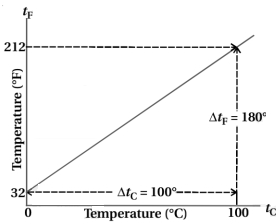
(N/A) The relationship between the Celsius and Fahrenheit temperature scales can be derived from a linear graph of Fahrenheit temperature $(t_{F})$ versus Celsius temperature $(t_{C})$.
As shown in the graph,the freezing point of water is $0^{\circ}C$ or $32^{\circ}F$,and the boiling point of water is $100^{\circ}C$ or $212^{\circ}F$.
The equation for this straight line is given by:
$\frac{t_{F} - 32}{212 - 32} = \frac{t_{C} - 0}{100 - 0}$
Simplifying the denominators:
$\frac{t_{F} - 32}{180} = \frac{t_{C}}{100}$
Further simplifying the equation:
$t_{F} - 32 = \frac{180}{100} t_{C}$
$t_{F} - 32 = \frac{9}{5} t_{C}$
$t_{F} = \frac{9}{5} t_{C} + 32$
As shown in the graph,the freezing point of water is $0^{\circ}C$ or $32^{\circ}F$,and the boiling point of water is $100^{\circ}C$ or $212^{\circ}F$.
The equation for this straight line is given by:
$\frac{t_{F} - 32}{212 - 32} = \frac{t_{C} - 0}{100 - 0}$
Simplifying the denominators:
$\frac{t_{F} - 32}{180} = \frac{t_{C}}{100}$
Further simplifying the equation:
$t_{F} - 32 = \frac{180}{100} t_{C}$
$t_{F} - 32 = \frac{9}{5} t_{C}$
$t_{F} = \frac{9}{5} t_{C} + 32$
0 likes
View Solution81
Medium
Give the name of the instrument that measures temperature. Write the freezing and boiling points of water in $^oC$,$^oF$,and $K$.
Solution
(N/A) The instrument used to measure temperature is called a $Thermometer$.
For water:
$1$. Freezing point:
- In $^oC$: $0 \ ^oC$
- In $^oF$: $32 \ ^oF$
- In $K$: $273.15 \ K$
$2$. Boiling point:
- In $^oC$: $100 \ ^oC$
- In $^oF$: $212 \ ^oF$
- In $K$: $373.15 \ K$
For water:
$1$. Freezing point:
- In $^oC$: $0 \ ^oC$
- In $^oF$: $32 \ ^oF$
- In $K$: $273.15 \ K$
$2$. Boiling point:
- In $^oC$: $100 \ ^oC$
- In $^oF$: $212 \ ^oF$
- In $K$: $373.15 \ K$
0 likes
View Solution82
Easy
Write the equation that gives the relation between $t_F$ and $t_C$.
Solution
(N/A) The relationship between the temperature in Fahrenheit $(t_F)$ and the temperature in Celsius $(t_C)$ is derived from the freezing and boiling points of water on both scales.
On the Celsius scale,the freezing point is $0^\circ C$ and the boiling point is $100^\circ C$.
On the Fahrenheit scale,the freezing point is $32^\circ F$ and the boiling point is $212^\circ F$.
The conversion formula is given by:
$t_F = \frac{9}{5} t_C + 32$.
On the Celsius scale,the freezing point is $0^\circ C$ and the boiling point is $100^\circ C$.
On the Fahrenheit scale,the freezing point is $32^\circ F$ and the boiling point is $212^\circ F$.
The conversion formula is given by:
$t_F = \frac{9}{5} t_C + 32$.
0 likes
View Solution83
MediumMCQ
What is the difference between $^oC$ and $^oF$ thermometer values for freezing and boiling points of water?
A
Freezing point: $100$,Boiling point: $180$
B
Freezing point: $32$,Boiling point: $180$
C
Freezing point: $32$,Boiling point: $100$
D
Freezing point: $0$,Boiling point: $32$
Solution
(B) The freezing point of water is $0 ^oC$ or $32 ^oF$. The difference is $32 - 0 = 32$.
The boiling point of water is $100 ^oC$ or $212 ^oF$. The difference is $212 - 100 = 112$.
However,the question asks for the difference between the values on the two scales for these points.
For freezing point: $32 ^oF - 0 ^oC = 32$.
For boiling point: $212 ^oF - 100 ^oC = 112$.
If the question implies the range (interval) difference: The range on the Celsius scale is $100 - 0 = 100$. The range on the Fahrenheit scale is $212 - 32 = 180$.
The boiling point of water is $100 ^oC$ or $212 ^oF$. The difference is $212 - 100 = 112$.
However,the question asks for the difference between the values on the two scales for these points.
For freezing point: $32 ^oF - 0 ^oC = 32$.
For boiling point: $212 ^oF - 100 ^oC = 112$.
If the question implies the range (interval) difference: The range on the Celsius scale is $100 - 0 = 100$. The range on the Fahrenheit scale is $212 - 32 = 180$.
0 likes
View Solution84
Medium
What is a thermometer? What is a gas thermometer? Write its characteristics.
Solution
(N/A) thermometer is a device used to measure the temperature of a system or a body. It works on the principle that certain physical properties of substances change with temperature.
$A$ gas thermometer is a type of thermometer that uses the change in pressure or volume of a gas at a constant volume or constant pressure,respectively,to measure temperature. It is based on the ideal gas law,$PV = nRT$.
Characteristics of a gas thermometer:
$1$. It is highly accurate and is often used as a standard for calibrating other thermometers.
$2$. It has a wide range of temperature measurement,typically from very low temperatures (near absolute zero) to very high temperatures.
$3$. It is based on the properties of an ideal gas,which makes it independent of the specific material properties of the container.
$4$. It is generally bulky and slow to respond to temperature changes compared to liquid-in-glass thermometers.
$A$ gas thermometer is a type of thermometer that uses the change in pressure or volume of a gas at a constant volume or constant pressure,respectively,to measure temperature. It is based on the ideal gas law,$PV = nRT$.
Characteristics of a gas thermometer:
$1$. It is highly accurate and is often used as a standard for calibrating other thermometers.
$2$. It has a wide range of temperature measurement,typically from very low temperatures (near absolute zero) to very high temperatures.
$3$. It is based on the properties of an ideal gas,which makes it independent of the specific material properties of the container.
$4$. It is generally bulky and slow to respond to temperature changes compared to liquid-in-glass thermometers.
0 likes
View Solution85
Medium
Explain different scales of temperature and write the equation for their relationship.
Solution
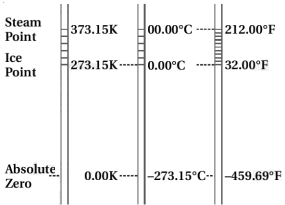
(N/A) There are three common temperature scales: Celsius $(^{\circ}C)$,Fahrenheit $(^{\circ}F)$,and Kelvin $(K)$.
$(1)$ Relation between Celsius and Kelvin scales:
If $T_{C}$ is the temperature in Celsius and $T$ is the temperature in Kelvin,the relationship is given by:
$T = T_{C} + 273.15$
$(2)$ Relation between Celsius and Fahrenheit scales:
If $T_{F}$ is the temperature in Fahrenheit and $T_{C}$ is the temperature in Celsius,the relationship is given by:
$T_{F} = \frac{9}{5} T_{C} + 32$
$(3)$ General relation:
The general relation between these scales is given by the formula:
$\frac{T_{C} - 0}{100} = \frac{T_{F} - 32}{180} = \frac{T - 273.15}{100}$
These scales are compared based on fixed points like the ice point (freezing point of water) and the steam point (boiling point of water) at atmospheric pressure. The Kelvin scale is an absolute scale where $0 \ K$ is the absolute zero temperature,which is the lowest possible temperature.
$(1)$ Relation between Celsius and Kelvin scales:
If $T_{C}$ is the temperature in Celsius and $T$ is the temperature in Kelvin,the relationship is given by:
$T = T_{C} + 273.15$
$(2)$ Relation between Celsius and Fahrenheit scales:
If $T_{F}$ is the temperature in Fahrenheit and $T_{C}$ is the temperature in Celsius,the relationship is given by:
$T_{F} = \frac{9}{5} T_{C} + 32$
$(3)$ General relation:
The general relation between these scales is given by the formula:
$\frac{T_{C} - 0}{100} = \frac{T_{F} - 32}{180} = \frac{T - 273.15}{100}$
These scales are compared based on fixed points like the ice point (freezing point of water) and the steam point (boiling point of water) at atmospheric pressure. The Kelvin scale is an absolute scale where $0 \ K$ is the absolute zero temperature,which is the lowest possible temperature.
0 likes
View Solution86
MediumMCQ
What is the base of the absolute temperature scale?
A
Celsius scale
B
Fahrenheit scale
C
Kelvin scale
D
Rankine scale
Solution
(C) The absolute temperature scale is defined by the $Kelvin$ scale.
In this scale,the base or the zero point is $0 \ K$,which corresponds to absolute zero,the theoretical temperature at which all molecular motion ceases.
Therefore,the base of the absolute temperature scale is the $Kelvin$ scale.
In this scale,the base or the zero point is $0 \ K$,which corresponds to absolute zero,the theoretical temperature at which all molecular motion ceases.
Therefore,the base of the absolute temperature scale is the $Kelvin$ scale.
0 likes
View Solution87
Easy
Is a negative value on the Kelvin scale possible? Why?
Solution
(NO) No,a negative value on the Kelvin scale is not possible.
According to the kinetic theory of gases,the temperature of a system is directly proportional to the average kinetic energy of its molecules.
The absolute zero temperature $(0 \ K)$ corresponds to the state where the kinetic energy of the molecules becomes zero,meaning all molecular motion ceases.
Since kinetic energy cannot be negative,the temperature on the Kelvin scale cannot be less than $0 \ K$.
According to the kinetic theory of gases,the temperature of a system is directly proportional to the average kinetic energy of its molecules.
The absolute zero temperature $(0 \ K)$ corresponds to the state where the kinetic energy of the molecules becomes zero,meaning all molecular motion ceases.
Since kinetic energy cannot be negative,the temperature on the Kelvin scale cannot be less than $0 \ K$.
0 likes
View Solution88
MediumMCQ
What is the value of absolute zero temperature on the Fahrenheit scale?
A
-$273.15$ °$F$
B
-$459.67$ °$F$
C
-$32$ °$F$
D
$0$ °$F$
Solution
(B) The relationship between the Celsius scale $(C)$ and the Fahrenheit scale $(F)$ is given by the formula: $F = \frac{9}{5}C + 32$.
Absolute zero is defined as $0 \ K$,which is equal to $-273.15 \ °C$.
Substituting $C = -273.15$ into the formula:
$F = \frac{9}{5}(-273.15) + 32$
$F = 1.8 \times (-273.15) + 32$
$F = -491.67 + 32$
$F = -459.67 \ °F$.
Therefore,the absolute zero temperature on the Fahrenheit scale is $-459.67 \ °F$.
Absolute zero is defined as $0 \ K$,which is equal to $-273.15 \ °C$.
Substituting $C = -273.15$ into the formula:
$F = \frac{9}{5}(-273.15) + 32$
$F = 1.8 \times (-273.15) + 32$
$F = -491.67 + 32$
$F = -459.67 \ °F$.
Therefore,the absolute zero temperature on the Fahrenheit scale is $-459.67 \ °F$.
0 likes
View Solution89
Easy
Write the meaning of temperature.
Solution
(N/A) Temperature is a physical quantity that expresses the degree of hotness or coldness of a body.
It is a measure of the average kinetic energy of the particles in a substance.
When two bodies are in thermal contact,heat flows from the body at a higher temperature to the body at a lower temperature until thermal equilibrium is reached.
The $SI$ unit of temperature is Kelvin $(K)$.
It is a measure of the average kinetic energy of the particles in a substance.
When two bodies are in thermal contact,heat flows from the body at a higher temperature to the body at a lower temperature until thermal equilibrium is reached.
The $SI$ unit of temperature is Kelvin $(K)$.
0 likes
View Solution90
DifficultMCQ
The resistance of the platinum wire of a platinum resistance thermometer at the ice point is $5\; \Omega$ and at steam point is $5.39\; \Omega$. When the thermometer is inserted in a hot bath,the resistance of the platinum wire is $5.795\; \Omega$. Calculate the temperature of the bath in $^oC$. (in $^{\circ}C$)
A
$279.64$
B
$462.95$
C
$593.24$
D
$203.85$
Solution
(D) Given:
Resistance at ice point $(R_0) = 5\; \Omega$
Resistance at steam point $(R_{100}) = 5.39\; \Omega$
Resistance in hot bath $(R_t) = 5.795\; \Omega$
The formula for temperature $(t)$ in a platinum resistance thermometer is given by:
$t = \frac{R_t - R_0}{R_{100} - R_0} \times 100$
Substituting the values:
$t = \frac{5.795 - 5}{5.39 - 5} \times 100$
$t = \frac{0.795}{0.39} \times 100$
$t = 2.03846 \times 100$
$t \approx 203.85^{\circ}C$
Resistance at ice point $(R_0) = 5\; \Omega$
Resistance at steam point $(R_{100}) = 5.39\; \Omega$
Resistance in hot bath $(R_t) = 5.795\; \Omega$
The formula for temperature $(t)$ in a platinum resistance thermometer is given by:
$t = \frac{R_t - R_0}{R_{100} - R_0} \times 100$
Substituting the values:
$t = \frac{5.795 - 5}{5.39 - 5} \times 100$
$t = \frac{0.795}{0.39} \times 100$
$t = 2.03846 \times 100$
$t \approx 203.85^{\circ}C$
0 likes
View Solution91
MediumMCQ
At what temperature is the density of water maximum? Provide the value in $^\circ C$, $^\circ F$, and $K$.
A
$4^\circ C, 39.2^\circ F, 277.15 K$
B
$0^\circ C, 32^\circ F, 273.15 K$
C
$10^\circ C, 50^\circ F, 283.15 K$
D
$4^\circ C, 37.2^\circ F, 277.15 K$
Solution
(A) The density of water is maximum at $4^\circ C$.
To convert Celsius to Fahrenheit, use the formula: $F = C \times (9/5) + 32$.
$F = 4 \times (1.8) + 32 = 7.2 + 32 = 39.2^\circ F$.
To convert Celsius to Kelvin, use the formula: $K = C + 273.15$.
$K = 4 + 273.15 = 277.15 K$.
Thus, the values are $4^\circ C$, $39.2^\circ F$, and $277.15 K$.
To convert Celsius to Fahrenheit, use the formula: $F = C \times (9/5) + 32$.
$F = 4 \times (1.8) + 32 = 7.2 + 32 = 39.2^\circ F$.
To convert Celsius to Kelvin, use the formula: $K = C + 273.15$.
$K = 4 + 273.15 = 277.15 K$.
Thus, the values are $4^\circ C$, $39.2^\circ F$, and $277.15 K$.
0 likes
View Solution92
Medium
Is negative temperature possible on the Kelvin scale? Why?
Solution
(N/A) No,negative temperature is not possible on the Kelvin scale. The Kelvin scale is an absolute temperature scale where the lowest possible temperature is absolute zero $(0 \ K)$. According to the third law of thermodynamics,it is impossible to reach absolute zero,and temperatures below this point cannot exist because the kinetic energy of particles cannot be less than zero.
0 likes
View Solution93
Medium
What is the value of the fixed point on the standard (Kelvin) scale?
Solution
(N/A) On the Kelvin scale,there is only one fixed point defined by international agreement,which is the triple point of water.
The value of the triple point of water on the Kelvin scale is $273.16 \ K$,which corresponds to $0.01^{\circ}C$ on the Celsius scale.
The value of the triple point of water on the Kelvin scale is $273.16 \ K$,which corresponds to $0.01^{\circ}C$ on the Celsius scale.
0 likes
View Solution94
EasyMCQ
What is absolute zero temperature?
A
$0$ $K$
B
$273$ $K$
C
-$273$ $K$
D
$0$ °$C$
Solution
(A) Absolute zero temperature is the theoretical temperature at which the entropy of a perfect crystal is zero and all molecular motion ceases. It is defined as $0 \ K$ on the Kelvin scale,which is equivalent to $-273.15 \ °C$.
0 likes
View Solution95
Medium
How many fixed points does an absolute Kelvin scale have? Write their values.
Solution
(N/A) The absolute Kelvin scale has only one fixed point,which is the triple point of water.
Its value is defined as $T_{tr} = 273.16 \ K$ or $0.01^{\circ}C$.
Its value is defined as $T_{tr} = 273.16 \ K$ or $0.01^{\circ}C$.
0 likes
View Solution96
Medium
What is the triple point?
Solution
(N/A) The triple point is defined as the specific temperature and pressure at which all three states of matter—solid,liquid,and gas—coexist in thermodynamic equilibrium.
0 likes
View Solution97
MediumMCQ
What is called absolute zero temperature?
A
$-273.15^{\circ} C$
B
$0^{\circ} C$
C
$100^{\circ} C$
D
$273.15^{\circ} C$
Solution
(A) For an ideal gas, the graph of pressure $P$ versus temperature $T$ is linear.
By extending this linear graph backwards, the point at which it intersects the temperature axis is called absolute zero temperature.
Its value is $-273.15^{\circ} C$.
By extending this linear graph backwards, the point at which it intersects the temperature axis is called absolute zero temperature.
Its value is $-273.15^{\circ} C$.
0 likes
View Solution98
Medium
Check whether the following statements are True or False:
$(a)$ The equation to convert Celsius temperature to Fahrenheit is $t^{\circ}F = \frac{5}{9}t^{\circ}C + 32$.
$(b)$ For an ideal gas,absolute zero temperature is $273.15^{\circ}C$.
$(c)$ The volume of water is maximum at $4^{\circ}C$.
$(d)$ The temperature gradient is negative if a cube block is heated at the cold end and heat transfers to the hot end.
$(a)$ The equation to convert Celsius temperature to Fahrenheit is $t^{\circ}F = \frac{5}{9}t^{\circ}C + 32$.
$(b)$ For an ideal gas,absolute zero temperature is $273.15^{\circ}C$.
$(c)$ The volume of water is maximum at $4^{\circ}C$.
$(d)$ The temperature gradient is negative if a cube block is heated at the cold end and heat transfers to the hot end.
Solution
(NONE) False. The correct conversion formula is $t^{\circ}F = \frac{9}{5}t^{\circ}C + 32$.
$(b)$ False. Absolute zero temperature is $-273.15^{\circ}C$.
$(c)$ False. The density of water is maximum at $4^{\circ}C$,which means its volume is minimum at this temperature.
$(d)$ False. Heat flows from a higher temperature to a lower temperature. If heat is transferred from the cold end to the hot end,the temperature gradient would be positive in the direction of heat flow.
$(b)$ False. Absolute zero temperature is $-273.15^{\circ}C$.
$(c)$ False. The density of water is maximum at $4^{\circ}C$,which means its volume is minimum at this temperature.
$(d)$ False. Heat flows from a higher temperature to a lower temperature. If heat is transferred from the cold end to the hot end,the temperature gradient would be positive in the direction of heat flow.
0 likes
View Solution99
Medium
Is the bulb of a thermometer made of a diathermic or adiabatic wall?
Solution
(A) diathermic wall allows the exchange of heat between systems,whereas an adiabatic wall prevents the exchange of heat. For a thermometer to measure the temperature of a system,it must be in thermal equilibrium with that system. Therefore,the bulb of a thermometer must be made of a diathermic wall to allow heat transfer.
0 likes
View Solution10-1.Thermometry, Thermal Expansion and Calorimetry — Temperature and Temperature scales · Frequently Asked Questions
1Are these 10-1.Thermometry, Thermal Expansion and Calorimetry questions useful for JEE and NEET?
Yes. All questions in this section are mapped to JEE Main and NEET exam patterns. Previous year questions from JEE Main, NEET, GUJCET and state-level exams are included with full solutions.
2Can I switch to Hindi or Gujarati for these questions?
Yes. Use the language tabs in the hero section or the sidebar to view the same questions and solutions in English, Hindi or Gujarati.
3How do I generate a question paper from this subtopic?
Use the Vedclass Exam Paper Generator — select the chapter and subtopic, set difficulty, and generate Sets A, B, C, D automatically. First 3 chapters of every subject are free.
Vedclass Products
For Students
Vedclass Test Series
Mock tests in real JEE/NEET style with performance analysis. 5-day free trial.
Start Free TrialFor Teachers
Exam Paper Generator
Generate Set A/B/C/D papers from this chapter in 2 minutes. 3 chapters free.
Try FreeFor Institutes
Online Exam Module
Live online exams with unlimited students, 360° analytics & white-label branding.
See DemoFor Teachers & Institutes
Generate a 10-1.Thermometry, Thermal Expansion and Calorimetry Exam Paper in 2 Minutes
Select subtopic & difficulty — Sets A, B, C, D auto-generated with No Repeat logic.
First 3 chapters of every subject are free — no payment required.