
A English
Heat Capacity, Specific Heat and Molar Specific Heat Questions in English
Class 11 Physics · 10-1.Thermometry, Thermal Expansion and Calorimetry · Heat Capacity, Specific Heat and Molar Specific Heat
107+
Questions
English
Language
100%
With Solutions
Showing 49 of 107 questions in English
51
Easy
What is the heat capacity of copper of $40 \, g$ and specific heat $0.3 \, erg \, g^{-1} (^{\circ} C)^{-1}$?
Solution
$(12 \, erg (^{\circ} C)^{-1})$ The heat capacity $C$ is defined as the product of the mass $m$ and the specific heat capacity $s$ of the substance.
Given:
Mass $m = 40 \, g$
Specific heat $s = 0.3 \, erg \, g^{-1} (^{\circ} C)^{-1}$
Calculation:
$C = m \times s$
$C = 40 \, g \times 0.3 \, erg \, g^{-1} (^{\circ} C)^{-1}$
$C = 12 \, erg (^{\circ} C)^{-1}$
Given:
Mass $m = 40 \, g$
Specific heat $s = 0.3 \, erg \, g^{-1} (^{\circ} C)^{-1}$
Calculation:
$C = m \times s$
$C = 40 \, g \times 0.3 \, erg \, g^{-1} (^{\circ} C)^{-1}$
$C = 12 \, erg (^{\circ} C)^{-1}$
0 likes
View Solution52
Easy
What is the heat capacity of a substance?
Solution
(N/A) The ratio of heat supplied $\Delta Q$ to a substance to the change in its temperature $\Delta T$ is called heat capacity.
$\therefore$ Heat capacity $= \frac{\text{Heat given}}{\text{Change in temperature}}$
$S = \frac{\Delta Q}{\Delta T}$
The $SI$ unit of heat capacity is $J K^{-1}$ or $cal K^{-1}$.
The heat capacity of a body depends on the material of the body as well as on its mass.
For different bodies,having different types of masses but of the same material,the value of heat capacity is different.
$\therefore$ Heat capacity $= \frac{\text{Heat given}}{\text{Change in temperature}}$
$S = \frac{\Delta Q}{\Delta T}$
The $SI$ unit of heat capacity is $J K^{-1}$ or $cal K^{-1}$.
The heat capacity of a body depends on the material of the body as well as on its mass.
For different bodies,having different types of masses but of the same material,the value of heat capacity is different.
0 likes
View Solution53
Difficult
What is specific heat? Give its unit and on which factors does specific heat depend?
Solution
(N/A) Specific heat is defined as the heat capacity per unit mass of a body.
$s = \frac{\text{Heat capacity}}{\text{Mass of body}}$
$s = \frac{\Delta Q}{m \Delta T}$
$\therefore \Delta Q = m s \Delta T$
The $SI$ unit of specific heat is $J \cdot kg^{-1} \cdot K^{-1}$.
The magnitude of specific heat depends on the nature of the material of the body,the temperature range,and the conditions under which heat is supplied (e.g.,constant pressure or constant volume).
Heat capacity per mole of a substance is known as molar specific heat capacity $(C)$:
$C = \frac{S}{\mu} = \frac{1}{\mu} \frac{\Delta Q}{\Delta T}$
Molar specific heat capacity is independent of the amount of substance. Its unit is $J \cdot mol^{-1} \cdot K^{-1}$.
Experimental values agree with the predicted value of $3R$ at ordinary temperatures (except for Carbon). This agreement breaks down at low temperatures.
$s = \frac{\text{Heat capacity}}{\text{Mass of body}}$
$s = \frac{\Delta Q}{m \Delta T}$
$\therefore \Delta Q = m s \Delta T$
The $SI$ unit of specific heat is $J \cdot kg^{-1} \cdot K^{-1}$.
The magnitude of specific heat depends on the nature of the material of the body,the temperature range,and the conditions under which heat is supplied (e.g.,constant pressure or constant volume).
Heat capacity per mole of a substance is known as molar specific heat capacity $(C)$:
$C = \frac{S}{\mu} = \frac{1}{\mu} \frac{\Delta Q}{\Delta T}$
Molar specific heat capacity is independent of the amount of substance. Its unit is $J \cdot mol^{-1} \cdot K^{-1}$.
| Substance | Specific Heat $(J \cdot kg^{-1} \cdot K^{-1})$ | Molar Specific Heat $(J \cdot mol^{-1} \cdot K^{-1})$ |
| Aluminium | $900.0$ | $24.4$ |
| Carbon | $506.5$ | $6.1$ |
| Copper | $386.4$ | $24.5$ |
| Lead | $127.7$ | $26.5$ |
| Silver | $236.1$ | $25.5$ |
| Tungsten | $134.4$ | $24.9$ |
Experimental values agree with the predicted value of $3R$ at ordinary temperatures (except for Carbon). This agreement breaks down at low temperatures.
0 likes
View Solution54
Difficult
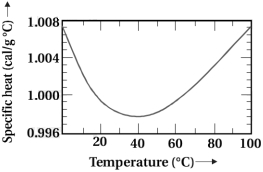
Draw a graph of the variation of specific heat capacity of water with temperature and define calorie.
Solution
(N/A) The old unit of heat was the calorie, and one calorie was earlier defined as the amount of heat required to raise the temperature of $1 \; g$ of water by $1^{\circ} C$.
Variation of specific heat capacity of water with temperature:
The specific heat of water varies slightly with temperature; hence, for a precise definition of a calorie, it was necessary to specify the unit temperature interval.
Precise definition of a Calorie: The amount of heat required to raise the temperature of $1 \; g$ of water from $14.5^{\circ} C$ to $15.5^{\circ} C$.
The specific heat capacity of water is approximately $4186 \; J \; kg^{-1} \; K^{-1}$, which means $4.186 \; J \; g^{-1} \; K^{-1}$.
From the relation $W = JH$, the amount of work needed to produce $1 \; \text{cal}$ of heat is called the mechanical equivalent of heat.
Therefore, $W = J$ (where $H = 1 \; \text{calorie}$).
Thus, there are two units of heat, Joule and Calorie, and for conversion, $1 \; \text{calorie} = 4.186 \; J$ of heat is needed.
Variation of specific heat capacity of water with temperature:
The specific heat of water varies slightly with temperature; hence, for a precise definition of a calorie, it was necessary to specify the unit temperature interval.
Precise definition of a Calorie: The amount of heat required to raise the temperature of $1 \; g$ of water from $14.5^{\circ} C$ to $15.5^{\circ} C$.
The specific heat capacity of water is approximately $4186 \; J \; kg^{-1} \; K^{-1}$, which means $4.186 \; J \; g^{-1} \; K^{-1}$.
From the relation $W = JH$, the amount of work needed to produce $1 \; \text{cal}$ of heat is called the mechanical equivalent of heat.
Therefore, $W = J$ (where $H = 1 \; \text{calorie}$).
Thus, there are two units of heat, Joule and Calorie, and for conversion, $1 \; \text{calorie} = 4.186 \; J$ of heat is needed.
0 likes
View Solution55
Easy
Define heat capacity and write its $SI$ unit.
Solution
(N/A) Heat capacity is defined as the amount of heat energy required to raise the temperature of a given substance by $1 \ K$ (or $1 \ ^\circ C$).
Mathematically,it is given by $C = \frac{dQ}{dT}$,where $dQ$ is the heat supplied and $dT$ is the change in temperature.
The $SI$ unit of heat capacity is $\text{joule per kelvin}$ ($J/K$ or $J \cdot K^{-1}$).
Mathematically,it is given by $C = \frac{dQ}{dT}$,where $dQ$ is the heat supplied and $dT$ is the change in temperature.
The $SI$ unit of heat capacity is $\text{joule per kelvin}$ ($J/K$ or $J \cdot K^{-1}$).
0 likes
View Solution56
MediumMCQ
On what does the value of heat capacity depend?
A
Nature of the substance
B
Temperature of the substance
C
State of the substance
D
All of the above
Solution
(D) The heat capacity $(C)$ of a substance is defined as the amount of heat required to raise the temperature of a given mass of the substance by $1 \ K$ or $1^{\circ}C$.
It depends on several factors:
$1$. Nature of the substance: Different materials have different atomic or molecular structures,leading to different heat capacities.
$2$. Temperature of the substance: For many substances,heat capacity varies with temperature,especially at very low temperatures.
$3$. State of the substance: The heat capacity of a substance in its solid,liquid,or gaseous state is different because the intermolecular forces and degrees of freedom change with the state.
Therefore,the value of heat capacity depends on all the mentioned factors.
It depends on several factors:
$1$. Nature of the substance: Different materials have different atomic or molecular structures,leading to different heat capacities.
$2$. Temperature of the substance: For many substances,heat capacity varies with temperature,especially at very low temperatures.
$3$. State of the substance: The heat capacity of a substance in its solid,liquid,or gaseous state is different because the intermolecular forces and degrees of freedom change with the state.
Therefore,the value of heat capacity depends on all the mentioned factors.
0 likes
View Solution57
Medium
Define specific heat capacity and write its $SI$ unit.
Solution
(N/A) Specific heat capacity of a substance is defined as the amount of heat energy required to raise the temperature of a unit mass of the substance by $1 \ K$ (or $1 \ ^\circ C$).
Mathematically,it is given by $s = \frac{Q}{m \Delta T}$,where $Q$ is the heat energy,$m$ is the mass,and $\Delta T$ is the change in temperature.
The $SI$ unit of specific heat capacity is $\text{Joule per kilogram per Kelvin}$ $(J \ kg^{-1} \ K^{-1})$.
Mathematically,it is given by $s = \frac{Q}{m \Delta T}$,where $Q$ is the heat energy,$m$ is the mass,and $\Delta T$ is the change in temperature.
The $SI$ unit of specific heat capacity is $\text{Joule per kilogram per Kelvin}$ $(J \ kg^{-1} \ K^{-1})$.
0 likes
View Solution58
MediumMCQ
On what does the value of specific heat capacity depend?
A
Nature of the substance
B
Temperature of the substance
C
State of the substance
D
All of the above
Solution
(D) The specific heat capacity of a substance is defined as the amount of heat required to raise the temperature of a unit mass of the substance by $1 \ K$ or $1 \ ^\circ C$.
It depends on the following factors:
$1$. Nature of the substance: Different materials have different atomic or molecular structures,which affect how they store thermal energy.
$2$. Temperature of the substance: For many materials,specific heat capacity varies with temperature,especially at very low or very high temperatures.
$3$. State of the substance: The specific heat capacity of a substance changes when it changes its state (e.g.,solid to liquid or liquid to gas) because the internal energy and molecular arrangements are different in each state.
Therefore,the correct option is $D$.
It depends on the following factors:
$1$. Nature of the substance: Different materials have different atomic or molecular structures,which affect how they store thermal energy.
$2$. Temperature of the substance: For many materials,specific heat capacity varies with temperature,especially at very low or very high temperatures.
$3$. State of the substance: The specific heat capacity of a substance changes when it changes its state (e.g.,solid to liquid or liquid to gas) because the internal energy and molecular arrangements are different in each state.
Therefore,the correct option is $D$.
0 likes
View Solution59
Easy
What is the molar specific heat capacity of a substance? Write its unit.
Solution
(N/A) The molar specific heat capacity of a substance is defined as the amount of heat energy required to raise the temperature of $1 \text{ mole}$ of the substance by $1 \text{ Kelvin}$ (or $1^{\circ}C$).
Mathematically,it is given by $C = \frac{Q}{n \Delta T}$,where $Q$ is the heat supplied,$n$ is the number of moles,and $\Delta T$ is the change in temperature.
The $SI$ unit of molar specific heat capacity is $\text{J mol}^{-1} \text{ K}^{-1}$.
Mathematically,it is given by $C = \frac{Q}{n \Delta T}$,where $Q$ is the heat supplied,$n$ is the number of moles,and $\Delta T$ is the change in temperature.
The $SI$ unit of molar specific heat capacity is $\text{J mol}^{-1} \text{ K}^{-1}$.
0 likes
View Solution60
MediumMCQ
What is the total energy for one mole of a solid substance?
A
$3RT$
B
$RT$
C
$2RT$
D
$1.5RT$
Solution
(A) According to the law of equipartition of energy,each degree of freedom contributes $\frac{1}{2}RT$ to the internal energy of one mole of a substance.
$A$ solid atom can be modeled as a three-dimensional harmonic oscillator.
For a three-dimensional harmonic oscillator,there are $3$ degrees of freedom for kinetic energy and $3$ degrees of freedom for potential energy,totaling $6$ degrees of freedom.
Therefore,the total internal energy $U$ for one mole of a solid is $U = 6 \times (\frac{1}{2}RT) = 3RT$.
$A$ solid atom can be modeled as a three-dimensional harmonic oscillator.
For a three-dimensional harmonic oscillator,there are $3$ degrees of freedom for kinetic energy and $3$ degrees of freedom for potential energy,totaling $6$ degrees of freedom.
Therefore,the total internal energy $U$ for one mole of a solid is $U = 6 \times (\frac{1}{2}RT) = 3RT$.
0 likes
View Solution61
Medium
Write the old and new definition of calorie.
Solution
(N/A) The old definition of a calorie is the amount of heat energy required to raise the temperature of $1 \ g$ of water from $14.5 \ ^\circ C$ to $15.5 \ ^\circ C$ at a pressure of $1 \ atm$.
The new definition of a calorie is defined in terms of the Joule,which is the $SI$ unit of energy. One calorie is exactly equal to $4.184 \ J$.
The new definition of a calorie is defined in terms of the Joule,which is the $SI$ unit of energy. One calorie is exactly equal to $4.184 \ J$.
0 likes
View Solution62
Medium
Draw a graph of the variation of the specific heat capacity of water with temperature.
Solution
(N/A) The specific heat capacity of water $(c)$ is not constant; it varies with temperature.
At $0 \ ^\circ C$,the specific heat capacity of water is approximately $4.217 \ J/g \cdot K$.
As the temperature increases,the specific heat capacity decreases,reaching a minimum value of approximately $4.178 \ J/g \cdot K$ at around $35 \ ^\circ C$.
Beyond $35 \ ^\circ C$,the specific heat capacity starts to increase again as the temperature rises toward $100 \ ^\circ C$.
The graph of specific heat capacity versus temperature is a $U$-shaped curve,showing a minimum at room temperature.
At $0 \ ^\circ C$,the specific heat capacity of water is approximately $4.217 \ J/g \cdot K$.
As the temperature increases,the specific heat capacity decreases,reaching a minimum value of approximately $4.178 \ J/g \cdot K$ at around $35 \ ^\circ C$.
Beyond $35 \ ^\circ C$,the specific heat capacity starts to increase again as the temperature rises toward $100 \ ^\circ C$.
The graph of specific heat capacity versus temperature is a $U$-shaped curve,showing a minimum at room temperature.
0 likes
View Solution63
Medium
Write the value of the specific heat capacity of water with its unit.
Solution
(N/A) The specific heat capacity of water is the amount of heat required to raise the temperature of $1 \ kg$ of water by $1 \ K$ (or $1 \ ^\circ C$).
The value of the specific heat capacity of water is approximately $4186 \ J \ kg^{-1} \ K^{-1}$ or $4.186 \ J \ g^{-1} \ ^\circ C^{-1}$.
In terms of calories,it is $1 \ cal \ g^{-1} \ ^\circ C^{-1}$.
The value of the specific heat capacity of water is approximately $4186 \ J \ kg^{-1} \ K^{-1}$ or $4.186 \ J \ g^{-1} \ ^\circ C^{-1}$.
In terms of calories,it is $1 \ cal \ g^{-1} \ ^\circ C^{-1}$.
0 likes
View Solution64
MediumMCQ
At which temperature is the specific heat of water minimum (in $^\circ C$)?
A
$30$
B
$35$
C
$40$
D
$45$
Solution
(B) The specific heat capacity of water is not constant and varies with temperature.
Experimental data shows that the specific heat capacity of water decreases as the temperature increases from $0 \ ^\circ C$ to approximately $35 \ ^\circ C - 40 \ ^\circ C$.
It reaches a minimum value at approximately $35 \ ^\circ C$ to $37 \ ^\circ C$.
Among the given options,$35 \ ^\circ C$ is the standard value often cited in physics textbooks as the temperature where the specific heat of water is at its minimum.
Experimental data shows that the specific heat capacity of water decreases as the temperature increases from $0 \ ^\circ C$ to approximately $35 \ ^\circ C - 40 \ ^\circ C$.
It reaches a minimum value at approximately $35 \ ^\circ C$ to $37 \ ^\circ C$.
Among the given options,$35 \ ^\circ C$ is the standard value often cited in physics textbooks as the temperature where the specific heat of water is at its minimum.
0 likes
View Solution65
Medium
Is the specific heat of water and ice the same? Give their values.
Solution
(N/A) No, the specific heat capacities of water and ice are not the same.
The specific heat capacity of water is approximately $4.18 \, J \, g^{-1} \, K^{-1}$ (or $1 \, cal \, g^{-1} \, ^\circ C^{-1}$).
The specific heat capacity of ice is approximately $2.09 \, J \, g^{-1} \, K^{-1}$ (or $0.5 \, cal \, g^{-1} \, ^\circ C^{-1}$).
The specific heat capacity of water is approximately $4.18 \, J \, g^{-1} \, K^{-1}$ (or $1 \, cal \, g^{-1} \, ^\circ C^{-1}$).
The specific heat capacity of ice is approximately $2.09 \, J \, g^{-1} \, K^{-1}$ (or $0.5 \, cal \, g^{-1} \, ^\circ C^{-1}$).
0 likes
View Solution66
Medium
Derive the equation for the molar specific heat capacity of solids.
Solution
(N/A) In solids, atoms oscillate about their mean position.
Let the number of atoms in $1$ mole of a solid be $N_{A}$.
According to the law of equipartition of energy, the energy associated with the oscillation of atoms in one dimension is $2 \times \frac{1}{2} k_{B} T = k_{B} T$.
Therefore, in three dimensions, the average energy of an atom is $3 k_{B} T$.
The total energy of $1$ mole of solid is $U = 3 k_{B} T \times N_{A} = 3 RT$ (since $k_{B} N_{A} = R$).
From the first law of thermodynamics, $\Delta Q = \Delta U + \Delta W$.
Since $\Delta W = P \Delta V$ and for solids $\Delta V \approx 0$, we have $\Delta Q = \Delta U$.
The molar specific heat of a solid is $C = \frac{\Delta Q}{\Delta T} = \frac{d(3 RT)}{dT} = 3R$.
Substituting $R = 8.31 \ J \ mol^{-1} \ K^{-1}$, we get $C = 3 \times 8.31 = 24.93 \ J \ mol^{-1} \ K^{-1}$.
Let the number of atoms in $1$ mole of a solid be $N_{A}$.
According to the law of equipartition of energy, the energy associated with the oscillation of atoms in one dimension is $2 \times \frac{1}{2} k_{B} T = k_{B} T$.
Therefore, in three dimensions, the average energy of an atom is $3 k_{B} T$.
The total energy of $1$ mole of solid is $U = 3 k_{B} T \times N_{A} = 3 RT$ (since $k_{B} N_{A} = R$).
From the first law of thermodynamics, $\Delta Q = \Delta U + \Delta W$.
Since $\Delta W = P \Delta V$ and for solids $\Delta V \approx 0$, we have $\Delta Q = \Delta U$.
The molar specific heat of a solid is $C = \frac{\Delta Q}{\Delta T} = \frac{d(3 RT)}{dT} = 3R$.
Substituting $R = 8.31 \ J \ mol^{-1} \ K^{-1}$, we get $C = 3 \times 8.31 = 24.93 \ J \ mol^{-1} \ K^{-1}$.
| Substance | Specific Heat $(J \ kg^{-1} \ K^{-1})$ | Molar Specific Heat $(J \ mol^{-1} \ K^{-1})$ |
| Aluminium | $900.0$ | $24.4$ |
| Carbon | $506.5$ | $6.1$ |
| Copper | $386.4$ | $24.5$ |
| Lead | $127.7$ | $26.5$ |
| Silver | $236.1$ | $25.5$ |
| Tungsten | $134.4$ | $24.9$ |
0 likes
View Solution67
MediumMCQ
What is the value of the specific heat of a solid by using the law of equipartition of energy?
A
3R
B
3R/$2$
C
$R$
D
$R$/$2$
Solution
(A) According to the law of equipartition of energy,each degree of freedom contributes $1/2 k_BT$ to the average energy of a particle.
In a solid,each atom acts as a 3D harmonic oscillator.
Each atom has $3$ degrees of freedom for kinetic energy and $3$ degrees of freedom for potential energy,totaling $6$ degrees of freedom.
The average energy per atom is $U = 6 \times (1/2 k_BT) = 3k_BT$.
For $1 \text{ mole}$ of a solid,the total internal energy is $U = 3RT$.
The molar specific heat at constant volume is $C_V = dU/dT = 3R$.
In a solid,each atom acts as a 3D harmonic oscillator.
Each atom has $3$ degrees of freedom for kinetic energy and $3$ degrees of freedom for potential energy,totaling $6$ degrees of freedom.
The average energy per atom is $U = 6 \times (1/2 k_BT) = 3k_BT$.
For $1 \text{ mole}$ of a solid,the total internal energy is $U = 3RT$.
The molar specific heat at constant volume is $C_V = dU/dT = 3R$.
0 likes
View Solution68
MediumMCQ
What is the value of the specific heat of water using the law of equipartition of energy?
A
$1$ cal/g°$C$
B
$0.5$ cal/g°$C$
C
$0.75$ cal/g°$C$
D
$2$ cal/g°$C$
Solution
(A) The law of equipartition of energy is applicable to ideal gases,where the internal energy is solely due to the kinetic energy of the molecules.
Water is a liquid,and its specific heat is determined by its complex intermolecular forces and hydrogen bonding,which cannot be derived using the law of equipartition of energy.
However,the standard experimental value for the specific heat capacity of water is $1 \text{ cal/g°C}$ or $4186 \text{ J/kg°K}$.
Since the question asks for the value of the specific heat of water,the correct standard value is $1 \text{ cal/g°C}$.
Water is a liquid,and its specific heat is determined by its complex intermolecular forces and hydrogen bonding,which cannot be derived using the law of equipartition of energy.
However,the standard experimental value for the specific heat capacity of water is $1 \text{ cal/g°C}$ or $4186 \text{ J/kg°K}$.
Since the question asks for the value of the specific heat of water,the correct standard value is $1 \text{ cal/g°C}$.
0 likes
View Solution69
MediumMCQ
What is the value of the specific heat of all substances at absolute zero temperature?
A
Zero
B
Infinity
C
One
D
Negative
Solution
(A) The specific heat capacity $C$ is defined as the amount of heat required to raise the temperature of a unit mass of a substance by $1 \ K$. Mathematically,$C = \frac{dQ}{m \ dT}$.
According to the Third Law of Thermodynamics,as the temperature $T$ approaches absolute zero $(0 \ K)$,the entropy of a perfect crystal approaches zero.
Furthermore,the heat capacity of all substances approaches zero as the temperature approaches absolute zero $(T \to 0 \ K)$.
Therefore,the specific heat of all substances at absolute zero temperature is $0$.
According to the Third Law of Thermodynamics,as the temperature $T$ approaches absolute zero $(0 \ K)$,the entropy of a perfect crystal approaches zero.
Furthermore,the heat capacity of all substances approaches zero as the temperature approaches absolute zero $(T \to 0 \ K)$.
Therefore,the specific heat of all substances at absolute zero temperature is $0$.
0 likes
View Solution70
Easy
Is the molar specific heat of a solid a constant value? Explain.
Solution
(A) According to the Dulong-Petit law,the molar specific heat capacity of a solid at room temperature is approximately constant and is given by $C_v = 3R$,where $R$ is the universal gas constant. Since $R \approx 2 \text{ cal/mol K}$,the value is approximately $3 \times 2 = 6 \text{ cal/mol K}$. However,the specific value $3 \text{ cal/mol K}$ mentioned in the prompt is incorrect; the correct classical value is $3R \approx 6 \text{ cal/mol K}$.
0 likes
View Solution71
DifficultMCQ
Why is water used as a coolant?
A
It has a low boiling point.
B
It has a very high specific heat capacity.
C
It is easily available.
D
It is a good conductor of electricity.
Solution
(B) The specific heat capacity of water is very high $(4186 \ J/kg \cdot K)$.
This means that water can absorb or release a large amount of heat energy with only a small change in its temperature.
Because of this property,it is highly effective at carrying heat away from engines or industrial machinery,making it an ideal coolant.
This means that water can absorb or release a large amount of heat energy with only a small change in its temperature.
Because of this property,it is highly effective at carrying heat away from engines or industrial machinery,making it an ideal coolant.
0 likes
View Solution72
MediumMCQ
Is the specific heat of water greater than that of sand?
A
Yes
B
No
C
Equal
D
Cannot be determined
Solution
(A) Yes,the specific heat capacity of water is significantly greater than that of sand.
Water has a specific heat capacity of approximately $4186 \ J/(kg \cdot K)$,whereas sand has a specific heat capacity of approximately $800 \ J/(kg \cdot K)$.
This high specific heat capacity of water allows it to absorb or release large amounts of heat with relatively small changes in temperature,which is why it is used as a coolant and plays a crucial role in regulating Earth's climate.
Water has a specific heat capacity of approximately $4186 \ J/(kg \cdot K)$,whereas sand has a specific heat capacity of approximately $800 \ J/(kg \cdot K)$.
This high specific heat capacity of water allows it to absorb or release large amounts of heat with relatively small changes in temperature,which is why it is used as a coolant and plays a crucial role in regulating Earth's climate.
0 likes
View Solution73
Medium
On which factors does the heat capacity depend?
Solution
(N/A) The heat capacity $(C)$ of a substance depends on two primary factors:
$1$. The nature of the substance (material properties).
$2$. The mass of the substance $(m)$.
It is defined by the relation $C = ms$,where $s$ is the specific heat capacity of the material.
$1$. The nature of the substance (material properties).
$2$. The mass of the substance $(m)$.
It is defined by the relation $C = ms$,where $s$ is the specific heat capacity of the material.
0 likes
View Solution74
Easy
On what factors does the required amount of heat depend to heat a given substance?
Solution
(N/A) The amount of heat $Q$ required to change the temperature of a substance is given by the formula $Q = mc\Delta T$,where:
$1$. $m$ is the mass of the substance.
$2$. $c$ is the specific heat capacity of the material,which depends on the type of substance.
$3$. $\Delta T$ is the change in temperature.
Therefore,the required heat depends on the mass of the substance,the specific heat capacity (nature of the material),and the change in temperature.
$1$. $m$ is the mass of the substance.
$2$. $c$ is the specific heat capacity of the material,which depends on the type of substance.
$3$. $\Delta T$ is the change in temperature.
Therefore,the required heat depends on the mass of the substance,the specific heat capacity (nature of the material),and the change in temperature.
0 likes
View Solution75
MediumMCQ
By what property can the temperature difference be determined if the state of a substance does not change during the absorption of a given amount of heat?
A
Specific heat capacity
B
Latent heat
C
Thermal conductivity
D
Thermal expansion
Solution
(A) When a substance absorbs heat without changing its state, the relationship between the heat absorbed $(Q)$, mass $(m)$, specific heat capacity $(c)$, and the change in temperature $(\Delta T)$ is given by the formula: $Q = mc\Delta T$.
From this equation, the temperature difference $(\Delta T)$ can be determined as: $\Delta T = \frac{Q}{mc}$.
Therefore, the specific heat capacity $(c)$ is the property that relates the heat absorbed to the change in temperature when no phase change occurs.
From this equation, the temperature difference $(\Delta T)$ can be determined as: $\Delta T = \frac{Q}{mc}$.
Therefore, the specific heat capacity $(c)$ is the property that relates the heat absorbed to the change in temperature when no phase change occurs.
0 likes
View Solution76
MediumMCQ
Why is water used in a rubber bag for fomentation on the body?
A
Water is cheap and easily available.
B
Water has a very high specific heat capacity.
C
Water is a good conductor of heat.
D
Water does not leak easily from rubber bags.
Solution
(B) The specific heat capacity of water is very high $(4186 \ J/kg \cdot K)$ compared to most other common substances.
This means that water can absorb or release a large amount of heat energy while undergoing only a small change in temperature.
Consequently,a hot water bag remains warm for a much longer duration,providing consistent heat for therapeutic fomentation.
This means that water can absorb or release a large amount of heat energy while undergoing only a small change in temperature.
Consequently,a hot water bag remains warm for a much longer duration,providing consistent heat for therapeutic fomentation.
0 likes
View Solution77
Easy
Why is water used as a coolant in automobile radiators?
Solution
(N/A) Water is used as a coolant in automobile radiators primarily due to its exceptionally high specific heat capacity $(c = 4186 \ J/kg \cdot K)$.
Because of this high value,water can absorb a large amount of heat energy with a relatively small rise in its temperature.
Additionally,water is easily available,inexpensive,and has a high thermal conductivity,which allows it to efficiently transfer heat away from the engine block to the radiator fins where it is dissipated into the atmosphere.
Because of this high value,water can absorb a large amount of heat energy with a relatively small rise in its temperature.
Additionally,water is easily available,inexpensive,and has a high thermal conductivity,which allows it to efficiently transfer heat away from the engine block to the radiator fins where it is dissipated into the atmosphere.
0 likes
View Solution78
DifficultMCQ
Why is the wind coming from the sea cool at the shores?
A
Water has a lower specific heat capacity than land.
B
Water has a higher specific heat capacity than land.
C
The sea is always at a lower temperature than the land.
D
The sea is always at a higher temperature than the land.
Solution
(B) The specific heat capacity of water is much higher than that of land (soil/sand).
Due to this,water takes a longer time to heat up and a longer time to cool down compared to land.
During the day,the land heats up faster than the sea.
As a result,the air above the land becomes hot and rises,creating a low-pressure region.
Cooler air from above the sea then moves towards the land to fill this low-pressure region,which is felt as a cool sea breeze at the shores.
Due to this,water takes a longer time to heat up and a longer time to cool down compared to land.
During the day,the land heats up faster than the sea.
As a result,the air above the land becomes hot and rises,creating a low-pressure region.
Cooler air from above the sea then moves towards the land to fill this low-pressure region,which is felt as a cool sea breeze at the shores.
0 likes
View Solution79
MediumMCQ
Why does the land in a desert get hotter during the day and colder at night quickly?
A
Due to high specific heat of sand.
B
Due to low specific heat of sand.
C
Due to high thermal conductivity of sand.
D
Due to the presence of water in the desert.
Solution
(B) The specific heat capacity of sand (which makes up the desert land) is very low.
Specific heat capacity is the amount of heat required to raise the temperature of a unit mass of a substance by $1 \ ^\circ C$.
Because the specific heat of sand is low,it absorbs heat quickly during the day,leading to a rapid rise in temperature.
Similarly,it loses heat quickly at night,leading to a rapid drop in temperature.
Specific heat capacity is the amount of heat required to raise the temperature of a unit mass of a substance by $1 \ ^\circ C$.
Because the specific heat of sand is low,it absorbs heat quickly during the day,leading to a rapid rise in temperature.
Similarly,it loses heat quickly at night,leading to a rapid drop in temperature.
0 likes
View Solution80
MediumMCQ
The quantities of heat required to raise the temperature of two solid copper spheres of radii $r_{1}$ and $r_{2}$ $(r_{1} = 1.5 r_{2})$ through $1 \ K$ are in the ratio:
A
$5/3$
B
$27/8$
C
$9/4$
D
$3/2$
Solution
(B) The heat required to change the temperature of a body is given by the formula $\Delta Q = M s \Delta T$,where $M$ is the mass,$s$ is the specific heat capacity,and $\Delta T$ is the change in temperature.
Since both spheres are made of copper,the specific heat capacity $s$ is the same for both.
Given that the temperature change $\Delta T = 1 \ K$ is the same for both,we have $\Delta Q \propto M$.
The mass $M$ of a sphere is given by $M = V \rho = \frac{4}{3} \pi r^3 \rho$,where $V$ is the volume,$r$ is the radius,and $\rho$ is the density.
Since $\rho$ is the same for both copper spheres,$M \propto r^3$.
Therefore,the ratio of heat required is $\frac{\Delta Q_1}{\Delta Q_2} = \frac{M_1}{M_2} = \left( \frac{r_1}{r_2} \right)^3$.
Given $r_1 = 1.5 r_2$,we have $\frac{r_1}{r_2} = 1.5 = \frac{3}{2}$.
Thus,$\frac{\Delta Q_1}{\Delta Q_2} = \left( \frac{3}{2} \right)^3 = \frac{27}{8}$.
Since both spheres are made of copper,the specific heat capacity $s$ is the same for both.
Given that the temperature change $\Delta T = 1 \ K$ is the same for both,we have $\Delta Q \propto M$.
The mass $M$ of a sphere is given by $M = V \rho = \frac{4}{3} \pi r^3 \rho$,where $V$ is the volume,$r$ is the radius,and $\rho$ is the density.
Since $\rho$ is the same for both copper spheres,$M \propto r^3$.
Therefore,the ratio of heat required is $\frac{\Delta Q_1}{\Delta Q_2} = \frac{M_1}{M_2} = \left( \frac{r_1}{r_2} \right)^3$.
Given $r_1 = 1.5 r_2$,we have $\frac{r_1}{r_2} = 1.5 = \frac{3}{2}$.
Thus,$\frac{\Delta Q_1}{\Delta Q_2} = \left( \frac{3}{2} \right)^3 = \frac{27}{8}$.
0 likes
View Solution81
MediumMCQ
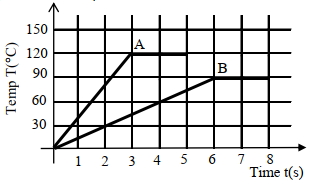
Two different metal bodies $A$ and $B$ of equal mass are heated at a uniform rate under similar conditions. The variation of temperature of the bodies is graphically represented as shown in the figure. The ratio of specific heat capacities is :
A
$\frac{8}{3}$
B
$\frac{3}{8}$
C
$\frac{3}{4}$
D
$\frac{4}{3}$
Solution
(B) Given that the bodies are heated at a uniform rate,the rate of heat supply is constant,i.e.,$\left(\frac{\Delta Q}{\Delta t}\right)_{A} = \left(\frac{\Delta Q}{\Delta t}\right)_{B}$.
We know that $\Delta Q = mc\Delta T$,so $\frac{\Delta Q}{\Delta t} = mc\left(\frac{\Delta T}{\Delta t}\right)$.
Since the masses $m$ are equal,we have $c_{A}\left(\frac{\Delta T}{\Delta t}\right)_{A} = c_{B}\left(\frac{\Delta T}{\Delta t}\right)_{B}$.
Therefore,the ratio of specific heat capacities is $\frac{c_{A}}{c_{B}} = \frac{(\Delta T / \Delta t)_{B}}{(\Delta T / \Delta t)_{A}}$.
From the graph,the slope $(\Delta T / \Delta t)$ for body $A$ is $\frac{120 - 0}{3 - 0} = 40 \ ^{\circ}\text{C/s}$.
The slope $(\Delta T / \Delta t)$ for body $B$ is $\frac{90 - 0}{6 - 0} = 15 \ ^{\circ}\text{C/s}$.
Thus,$\frac{c_{A}}{c_{B}} = \frac{15}{40} = \frac{3}{8}$.
We know that $\Delta Q = mc\Delta T$,so $\frac{\Delta Q}{\Delta t} = mc\left(\frac{\Delta T}{\Delta t}\right)$.
Since the masses $m$ are equal,we have $c_{A}\left(\frac{\Delta T}{\Delta t}\right)_{A} = c_{B}\left(\frac{\Delta T}{\Delta t}\right)_{B}$.
Therefore,the ratio of specific heat capacities is $\frac{c_{A}}{c_{B}} = \frac{(\Delta T / \Delta t)_{B}}{(\Delta T / \Delta t)_{A}}$.
From the graph,the slope $(\Delta T / \Delta t)$ for body $A$ is $\frac{120 - 0}{3 - 0} = 40 \ ^{\circ}\text{C/s}$.
The slope $(\Delta T / \Delta t)$ for body $B$ is $\frac{90 - 0}{6 - 0} = 15 \ ^{\circ}\text{C/s}$.
Thus,$\frac{c_{A}}{c_{B}} = \frac{15}{40} = \frac{3}{8}$.
0 likes
View Solution82
AdvancedMCQ
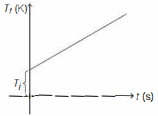
$A$ heater supplying constant power $P$ watts is switched $ON$ at time $t=0$ to raise the temperature of a liquid kept in a calorimeter of negligible heat capacity. $A$ student records the temperature of the liquid $T(t)$ at equal time intervals. $A$ graph is plotted with $T(t)$ on the $Y$-axis versus $t$ on the $X$-axis. Assume that there is no heat loss to the surroundings during heating. Then,
A
the graph is a straight line parallel to the time axis
B
the heat capacity of the liquid is inversely proportional to the slope of the graph
C
if some heat were lost at a constant rate to the surroundings during heating,the graph would be a straight line but with a larger slope
D
the internal energy of the liquid increases quadratically with time
Solution
(B) Assuming no heat loss,the heat gained by the liquid in the calorimeter is equal to the heat supplied by the heater.
$Q = m S \Delta T = P t$
Where $m$ is the mass of the liquid,$S$ is the specific heat capacity,and $T_f - T_i = \Delta T$.
$\Rightarrow m S (T_f - T_i) = P t$
$\Rightarrow T_f = \left( \frac{P}{m S} \right) t + T_i$
Comparing this with the equation of a straight line $y = mx + c$,we get:
Slope $= \frac{P}{m S} = \frac{P}{C}$,where $C = m S$ is the heat capacity of the liquid.
Since the slope is $\frac{P}{C}$,the heat capacity $C$ is inversely proportional to the slope of the graph $(C \propto \frac{1}{\text{slope}})$.
Therefore,option $(b)$ is correct.
$Q = m S \Delta T = P t$
Where $m$ is the mass of the liquid,$S$ is the specific heat capacity,and $T_f - T_i = \Delta T$.
$\Rightarrow m S (T_f - T_i) = P t$
$\Rightarrow T_f = \left( \frac{P}{m S} \right) t + T_i$
Comparing this with the equation of a straight line $y = mx + c$,we get:
Slope $= \frac{P}{m S} = \frac{P}{C}$,where $C = m S$ is the heat capacity of the liquid.
Since the slope is $\frac{P}{C}$,the heat capacity $C$ is inversely proportional to the slope of the graph $(C \propto \frac{1}{\text{slope}})$.
Therefore,option $(b)$ is correct.
0 likes
View Solution83
EasyMCQ
The thermal capacity of $100 \,g$ of aluminum (specific heat $= 0.2 \,cal / g ^{\circ} C$) is ............ $cal / ^{\circ} C$.
A
$0.002$
B
$20$
C
$200$
D
$100$
Solution
(B) The thermal capacity of a substance is defined as the product of its mass $(m)$ and its specific heat capacity $(c)$.
Formula: $\text{Thermal Capacity} = m \times c$
Given:
Mass $(m)$ = $100 \,g$
Specific heat $(c)$ = $0.2 \,cal / g ^{\circ} C$
Calculation:
$\text{Thermal Capacity} = 100 \,g \times 0.2 \,cal / g ^{\circ} C = 20 \,cal / ^{\circ} C$
Therefore,the correct option is $B$.
Formula: $\text{Thermal Capacity} = m \times c$
Given:
Mass $(m)$ = $100 \,g$
Specific heat $(c)$ = $0.2 \,cal / g ^{\circ} C$
Calculation:
$\text{Thermal Capacity} = 100 \,g \times 0.2 \,cal / g ^{\circ} C = 20 \,cal / ^{\circ} C$
Therefore,the correct option is $B$.
0 likes
View Solution84
EasyMCQ
In engines,water is used as a coolant because ......
A
It is a good conductor of heat energy
B
It has low density
C
It has high specific heat
D
It is a bad conductor of heat energy
Solution
(C) The correct option is $(C)$.
Water is used as a coolant in engines primarily because it has a very high specific heat capacity $(c \approx 4186 \ J/kg \cdot K)$.
Specific heat is the amount of heat required to raise the temperature of a unit mass of a substance by $1 \ ^\circ C$.
Due to its high specific heat,water can absorb a large amount of heat energy from the engine with only a relatively small increase in its own temperature.
This makes it an extremely efficient medium for transferring heat away from engine components,preventing them from overheating.
Water is used as a coolant in engines primarily because it has a very high specific heat capacity $(c \approx 4186 \ J/kg \cdot K)$.
Specific heat is the amount of heat required to raise the temperature of a unit mass of a substance by $1 \ ^\circ C$.
Due to its high specific heat,water can absorb a large amount of heat energy from the engine with only a relatively small increase in its own temperature.
This makes it an extremely efficient medium for transferring heat away from engine components,preventing them from overheating.
0 likes
View Solution85
EasyMCQ
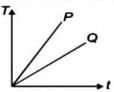
Heat energy at a constant rate is supplied to two substances $P$ and $Q$. If the variation of temperature $(T)$ of the substances with time $(t)$ is as shown in the figure,then select the correct statement.
A
Specific heat of $P$ is greater than $Q$
B
Specific heat of $Q$ is greater than $P$
C
Both have the same specific heat
D
Data is insufficient to predict it
Solution
(B) The heat energy supplied at a constant rate $H$ is given by $H = \frac{dQ}{dt} = mc \frac{dT}{dt}$,where $m$ is the mass and $c$ is the specific heat capacity.
Since $H$ is constant,we have $c = \frac{H}{m (dT/dt)}$.
This implies that the specific heat $c$ is inversely proportional to the slope of the $T-t$ graph,i.e.,$c \propto \frac{1}{\text{slope}}$.
From the figure,the slope of the graph for substance $P$ is greater than the slope of the graph for substance $Q$ (i.e.,$\text{slope}_P > \text{slope}_Q$).
Therefore,the specific heat of $Q$ must be greater than the specific heat of $P$ $(c_Q > c_P)$.
Thus,the correct statement is that the specific heat of $Q$ is greater than $P$.
Since $H$ is constant,we have $c = \frac{H}{m (dT/dt)}$.
This implies that the specific heat $c$ is inversely proportional to the slope of the $T-t$ graph,i.e.,$c \propto \frac{1}{\text{slope}}$.
From the figure,the slope of the graph for substance $P$ is greater than the slope of the graph for substance $Q$ (i.e.,$\text{slope}_P > \text{slope}_Q$).
Therefore,the specific heat of $Q$ must be greater than the specific heat of $P$ $(c_Q > c_P)$.
Thus,the correct statement is that the specific heat of $Q$ is greater than $P$.
0 likes
View Solution86
AdvancedMCQ
$A$ current-carrying wire heats a metal rod. The wire provides a constant power $(P)$ to the rod. The metal rod is enclosed in an insulated container. It is observed that the temperature $(T)$ in the metal rod changes with time $(t)$ as:
$T(t) = T_0(1 + \beta t^{1/4})$
where $\beta$ is a constant with appropriate dimensions,while $T_0$ is a constant with the dimension of temperature. The heat capacity of the metal is:
$T(t) = T_0(1 + \beta t^{1/4})$
where $\beta$ is a constant with appropriate dimensions,while $T_0$ is a constant with the dimension of temperature. The heat capacity of the metal is:
A
$\frac{4 P (T(t) - T_0)^3}{\beta^4 T_0^4}$
B
$\frac{4 P (T(t) - T_0)}{\beta^4 T_0^2}$
C
$\frac{4 P (T(t) - T_0)^4}{\beta^4 T_0^5}$
D
$\frac{4 P (T(t) - T_0)^2}{\beta^4 T_0^3}$
Solution
(A) Given power $P = \frac{dQ}{dt}$.
Heat capacity $S = \frac{dQ}{dT} = \frac{dQ/dt}{dT/dt} = \frac{P}{dT/dt}$.
Given $T(t) = T_0(1 + \beta t^{1/4})$.
Differentiating with respect to $t$:
$\frac{dT}{dt} = T_0 \cdot \beta \cdot \frac{1}{4} t^{-3/4} = \frac{\beta T_0}{4} t^{-3/4}$.
Substituting this into the expression for $S$:
$S = \frac{P}{(\beta T_0 / 4) t^{-3/4}} = \frac{4P}{\beta T_0} t^{3/4}$.
From the given equation,$\beta t^{1/4} = \frac{T(t) - T_0}{T_0}$.
Therefore,$t^{1/4} = \frac{T(t) - T_0}{\beta T_0}$.
Raising both sides to the power of $3$:
$t^{3/4} = \left( \frac{T(t) - T_0}{\beta T_0} \right)^3$.
Substituting $t^{3/4}$ back into the expression for $S$:
$S = \frac{4P}{\beta T_0} \cdot \frac{(T(t) - T_0)^3}{\beta^3 T_0^3} = \frac{4P(T(t) - T_0)^3}{\beta^4 T_0^4}$.
Heat capacity $S = \frac{dQ}{dT} = \frac{dQ/dt}{dT/dt} = \frac{P}{dT/dt}$.
Given $T(t) = T_0(1 + \beta t^{1/4})$.
Differentiating with respect to $t$:
$\frac{dT}{dt} = T_0 \cdot \beta \cdot \frac{1}{4} t^{-3/4} = \frac{\beta T_0}{4} t^{-3/4}$.
Substituting this into the expression for $S$:
$S = \frac{P}{(\beta T_0 / 4) t^{-3/4}} = \frac{4P}{\beta T_0} t^{3/4}$.
From the given equation,$\beta t^{1/4} = \frac{T(t) - T_0}{T_0}$.
Therefore,$t^{1/4} = \frac{T(t) - T_0}{\beta T_0}$.
Raising both sides to the power of $3$:
$t^{3/4} = \left( \frac{T(t) - T_0}{\beta T_0} \right)^3$.
Substituting $t^{3/4}$ back into the expression for $S$:
$S = \frac{4P}{\beta T_0} \cdot \frac{(T(t) - T_0)^3}{\beta^3 T_0^3} = \frac{4P(T(t) - T_0)^3}{\beta^4 T_0^4}$.
0 likes
View Solution87
DifficultMCQ
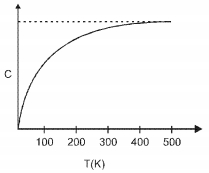
The figure below shows the variation of specific heat capacity $(C)$ of a solid as a function of temperature $(T)$. The temperature is increased continuously from $0$ to $500 \ K$ at a constant rate. Ignoring any volume change,which of the following statement$(s)$ is (are) correct to a reasonable approximation?
$(A)$ The rate at which heat is absorbed in the range $0-100 \ K$ varies linearly with temperature $T$.
$(B)$ Heat absorbed in increasing the temperature from $0-100 \ K$ is less than the heat required for increasing the temperature from $400-500 \ K$.
$(C)$ There is no change in the rate of heat absorption in the range $400-500 \ K$.
$(D)$ The rate of heat absorption increases in the range $200-300 \ K$.
$(A)$ The rate at which heat is absorbed in the range $0-100 \ K$ varies linearly with temperature $T$.
$(B)$ Heat absorbed in increasing the temperature from $0-100 \ K$ is less than the heat required for increasing the temperature from $400-500 \ K$.
$(C)$ There is no change in the rate of heat absorption in the range $400-500 \ K$.
$(D)$ The rate of heat absorption increases in the range $200-300 \ K$.
A
$(A, B, C, D)$
B
$(A, C)$
C
$(A, B, D)$
D
$(B, C, D)$
Solution
(D) The rate of heat absorption is given by $R = \frac{dq}{dt} = m C \frac{dT}{dt}$. Since the temperature is increased at a constant rate,$\frac{dT}{dt} = k$ (constant). Thus,$R \propto C$.
$(A)$ In the range $0-100 \ K$,the graph of $C$ vs $T$ is non-linear (curved),so the rate of heat absorption $R$ does not vary linearly with $T$. Statement $(A)$ is incorrect.
$(B)$ The heat absorbed is $\Delta Q = \int m C dT$,which is proportional to the area under the $C-T$ curve. The area under the curve from $0-100 \ K$ is clearly smaller than the area under the curve from $400-500 \ K$ (where $C$ is nearly constant at its maximum value). Statement $(B)$ is correct.
$(C)$ In the range $400-500 \ K$,the graph of $C$ vs $T$ is a horizontal line,meaning $C$ is constant. Since $R \propto C$,the rate of heat absorption remains constant. Statement $(C)$ is correct.
$(D)$ In the range $200-300 \ K$,the graph of $C$ vs $T$ has a positive slope,meaning $C$ is increasing. Since $R \propto C$,the rate of heat absorption increases. Statement $(D)$ is correct.
Therefore,statements $(B, C, D)$ are correct.
$(A)$ In the range $0-100 \ K$,the graph of $C$ vs $T$ is non-linear (curved),so the rate of heat absorption $R$ does not vary linearly with $T$. Statement $(A)$ is incorrect.
$(B)$ The heat absorbed is $\Delta Q = \int m C dT$,which is proportional to the area under the $C-T$ curve. The area under the curve from $0-100 \ K$ is clearly smaller than the area under the curve from $400-500 \ K$ (where $C$ is nearly constant at its maximum value). Statement $(B)$ is correct.
$(C)$ In the range $400-500 \ K$,the graph of $C$ vs $T$ is a horizontal line,meaning $C$ is constant. Since $R \propto C$,the rate of heat absorption remains constant. Statement $(C)$ is correct.
$(D)$ In the range $200-300 \ K$,the graph of $C$ vs $T$ has a positive slope,meaning $C$ is increasing. Since $R \propto C$,the rate of heat absorption increases. Statement $(D)$ is correct.
Therefore,statements $(B, C, D)$ are correct.
0 likes
View Solution88
MediumMCQ
The specific heat capacity of a substance is temperature dependent and is given by the formula $C = kT$,where $k$ is a constant of suitable dimensions in $SI$ units,and $T$ is the absolute temperature. If the heat required to raise the temperature of $1 \ kg$ of the substance from $-73^{\circ} C$ to $27^{\circ} C$ is $nk$,the value of $n$ is. . . . . . [Given: $0 \ K = -273^{\circ} C$.]
A
$20000$
B
$30000$
C
$40000$
D
$25000$
Solution
(D) The initial temperature is $T_i = -73^{\circ} C = (-73 + 273) \ K = 200 \ K$.
The final temperature is $T_f = 27^{\circ} C = (27 + 273) \ K = 300 \ K$.
The heat required $Q$ is given by the integral $Q = \int_{T_i}^{T_f} m C dT$.
Given $m = 1 \ kg$ and $C = kT$,we have $Q = \int_{200}^{300} (1) (kT) dT$.
$Q = k \int_{200}^{300} T dT = k \left[ \frac{T^2}{2} \right]_{200}^{300}$.
$Q = \frac{k}{2} [300^2 - 200^2] = \frac{k}{2} [90000 - 40000] = \frac{k}{2} [50000]$.
$Q = 25000 k$.
Comparing this with $nk$,we get $n = 25000$.
The final temperature is $T_f = 27^{\circ} C = (27 + 273) \ K = 300 \ K$.
The heat required $Q$ is given by the integral $Q = \int_{T_i}^{T_f} m C dT$.
Given $m = 1 \ kg$ and $C = kT$,we have $Q = \int_{200}^{300} (1) (kT) dT$.
$Q = k \int_{200}^{300} T dT = k \left[ \frac{T^2}{2} \right]_{200}^{300}$.
$Q = \frac{k}{2} [300^2 - 200^2] = \frac{k}{2} [90000 - 40000] = \frac{k}{2} [50000]$.
$Q = 25000 k$.
Comparing this with $nk$,we get $n = 25000$.
0 likes
View Solution89
MediumMCQ
The quantities of heat required to raise the temperatures of two copper spheres of radii $r_{1}$ and $r_{2}$ $(r_{1} = 1.5 r_{2})$ through $1 \ K$ are in the ratio of:
A
$27/8$
B
$9/4$
C
$3/2$
D
$1$
Solution
(A) The heat required to raise the temperature of a body is given by $Q = mc\Delta T$,where $m$ is the mass,$c$ is the specific heat capacity,and $\Delta T$ is the change in temperature.
Since the spheres are made of the same material (copper),$c$ is constant. For a given $\Delta T = 1 \ K$,$Q \propto m$.
The mass $m$ of a sphere is given by $m = \rho V$,where $\rho$ is the density and $V$ is the volume.
$V = \frac{4}{3}\pi r^3$,so $m \propto r^3$.
Therefore,$Q \propto r^3$.
The ratio of heat required is $\frac{Q_1}{Q_2} = \frac{r_1^3}{r_2^3} = \left(\frac{r_1}{r_2}\right)^3$.
Given $r_1 = 1.5 r_2$,we have $\frac{r_1}{r_2} = 1.5 = \frac{3}{2}$.
Thus,$\frac{Q_1}{Q_2} = \left(\frac{3}{2}\right)^3 = \frac{27}{8}$.
Since the spheres are made of the same material (copper),$c$ is constant. For a given $\Delta T = 1 \ K$,$Q \propto m$.
The mass $m$ of a sphere is given by $m = \rho V$,where $\rho$ is the density and $V$ is the volume.
$V = \frac{4}{3}\pi r^3$,so $m \propto r^3$.
Therefore,$Q \propto r^3$.
The ratio of heat required is $\frac{Q_1}{Q_2} = \frac{r_1^3}{r_2^3} = \left(\frac{r_1}{r_2}\right)^3$.
Given $r_1 = 1.5 r_2$,we have $\frac{r_1}{r_2} = 1.5 = \frac{3}{2}$.
Thus,$\frac{Q_1}{Q_2} = \left(\frac{3}{2}\right)^3 = \frac{27}{8}$.
0 likes
View Solution90
MediumMCQ
The $S.I.$ unit of specific heat capacity is
A
$J \ mol^{-1} \ K^{-1}$
B
$J \ kg^{-1} \ K^{-1}$
C
$J \ K^{-1}$
D
$J \ kg^{-1}$
Solution
(B) Specific heat capacity is defined as the amount of heat energy required to raise the temperature of $1 \ kg$ of a substance by $1 \ K$.
We use the formula $Q = m \cdot c \cdot \Delta T$,where $Q$ is the heat energy $(J)$,$m$ is the mass $(kg)$,$c$ is the specific heat capacity,and $\Delta T$ is the change in temperature $(K)$.
Rearranging for $c$,we get $c = \frac{Q}{m \cdot \Delta T}$.
Substituting the units,the $S.I.$ unit of specific heat capacity is $\frac{J}{kg \cdot K}$,which is written as $J \ kg^{-1} \ K^{-1}$.
We use the formula $Q = m \cdot c \cdot \Delta T$,where $Q$ is the heat energy $(J)$,$m$ is the mass $(kg)$,$c$ is the specific heat capacity,and $\Delta T$ is the change in temperature $(K)$.
Rearranging for $c$,we get $c = \frac{Q}{m \cdot \Delta T}$.
Substituting the units,the $S.I.$ unit of specific heat capacity is $\frac{J}{kg \cdot K}$,which is written as $J \ kg^{-1} \ K^{-1}$.
0 likes
View Solution91
MediumMCQ
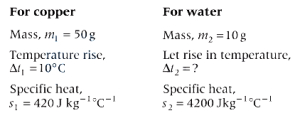
$50 \text{ g}$ of copper is heated to increase its temperature by $10^{\circ} \text{C}$. If the same quantity of heat is given to $10 \text{ g}$ of water,the rise in temperature is (specific heat of $\text{Cu} = 420 \text{ J kg}^{-1} {}^{\circ} \text{C}^{-1}$ and specific heat of water is $4200 \text{ J kg}^{-1} {}^{\circ} \text{C}^{-1}$) (in $^{\circ} \text{C}$)
A
$6$
B
$10$
C
$5$
D
$15$
Solution
(C) Given:
For copper: Mass $m_1 = 50 \text{ g} = 0.05 \text{ kg}$,Temperature rise $\Delta t_1 = 10^{\circ} \text{C}$,Specific heat $s_1 = 420 \text{ J kg}^{-1} {}^{\circ} \text{C}^{-1}$.
For water: Mass $m_2 = 10 \text{ g} = 0.01 \text{ kg}$,Specific heat $s_2 = 4200 \text{ J kg}^{-1} {}^{\circ} \text{C}^{-1}$,Let the rise in temperature be $\Delta t_2$.
Since the same amount of heat $Q$ is supplied to both,we have $Q_1 = Q_2$.
Using the formula $Q = m s \Delta t$,we get:
$m_1 s_1 \Delta t_1 = m_2 s_2 \Delta t_2$
Substituting the values:
$0.05 \times 420 \times 10 = 0.01 \times 4200 \times \Delta t_2$
$210 = 42 \times \Delta t_2$
$\Delta t_2 = \frac{210}{42} = 5^{\circ} \text{C}$.
Thus,the rise in temperature of water is $5^{\circ} \text{C}$.
For copper: Mass $m_1 = 50 \text{ g} = 0.05 \text{ kg}$,Temperature rise $\Delta t_1 = 10^{\circ} \text{C}$,Specific heat $s_1 = 420 \text{ J kg}^{-1} {}^{\circ} \text{C}^{-1}$.
For water: Mass $m_2 = 10 \text{ g} = 0.01 \text{ kg}$,Specific heat $s_2 = 4200 \text{ J kg}^{-1} {}^{\circ} \text{C}^{-1}$,Let the rise in temperature be $\Delta t_2$.
Since the same amount of heat $Q$ is supplied to both,we have $Q_1 = Q_2$.
Using the formula $Q = m s \Delta t$,we get:
$m_1 s_1 \Delta t_1 = m_2 s_2 \Delta t_2$
Substituting the values:
$0.05 \times 420 \times 10 = 0.01 \times 4200 \times \Delta t_2$
$210 = 42 \times \Delta t_2$
$\Delta t_2 = \frac{210}{42} = 5^{\circ} \text{C}$.
Thus,the rise in temperature of water is $5^{\circ} \text{C}$.
0 likes
View Solution92
EasyMCQ
The temperature of $5$ moles of a gas at constant volume is changed from $100^{\circ} C$ to $120^{\circ} C$. The change in internal energy is $80 \,J$. The total heat capacity of the gas at constant volume in $J/K$ is:
A
$8$
B
$4$
C
$0.8$
D
$0.4$
Solution
(B) Given: Number of moles $n = 5$, initial temperature $T_1 = 100^{\circ} C$, final temperature $T_2 = 120^{\circ} C$, change in internal energy $\Delta U = 80 \,J$.
The change in temperature is $\Delta T = T_2 - T_1 = 120^{\circ} C - 100^{\circ} C = 20 \,K$ (since the change in temperature is the same in Celsius and Kelvin).
The change in internal energy for a gas at constant volume is given by $\Delta U = C_V \Delta T$, where $C_V$ is the total heat capacity at constant volume.
Therefore, $C_V = \frac{\Delta U}{\Delta T} = \frac{80 \,J}{20 \,K} = 4 \,J/K$.
The change in temperature is $\Delta T = T_2 - T_1 = 120^{\circ} C - 100^{\circ} C = 20 \,K$ (since the change in temperature is the same in Celsius and Kelvin).
The change in internal energy for a gas at constant volume is given by $\Delta U = C_V \Delta T$, where $C_V$ is the total heat capacity at constant volume.
Therefore, $C_V = \frac{\Delta U}{\Delta T} = \frac{80 \,J}{20 \,K} = 4 \,J/K$.
0 likes
View Solution93
EasyMCQ
Water of mass $5 \ kg$ in a closed vessel is at a temperature of $20^{\circ} C$. If the temperature of the water when heated for a time of $10 \ minutes$ becomes $30^{\circ} C$, then the increase in the internal energy of the water is (Specific heat capacity of water $= 4200 \ J \ kg^{-1} \ K^{-1}$) (in $kJ$)
A
$100$
B
$420$
C
$510$
D
$210$
Solution
(D) The increase in internal energy $(\Delta U)$ of a substance when heated is equal to the heat energy $(Q)$ absorbed by it, provided there is no change in state or external work done.
Using the formula for heat absorbed: $Q = m \cdot c \cdot \Delta T$
Given:
Mass $(m)$ = $5 \ kg$
Specific heat capacity $(c)$ = $4200 \ J \ kg^{-1} \ K^{-1}$
Change in temperature $(\Delta T)$ = $30^{\circ} C - 20^{\circ} C = 10^{\circ} C = 10 \ K$
Substituting the values:
$Q = 5 \ kg \times 4200 \ J \ kg^{-1} \ K^{-1} \times 10 \ K$
$Q = 210000 \ J$
$Q = 210 \ kJ$
Therefore, the increase in internal energy is $210 \ kJ$.
Using the formula for heat absorbed: $Q = m \cdot c \cdot \Delta T$
Given:
Mass $(m)$ = $5 \ kg$
Specific heat capacity $(c)$ = $4200 \ J \ kg^{-1} \ K^{-1}$
Change in temperature $(\Delta T)$ = $30^{\circ} C - 20^{\circ} C = 10^{\circ} C = 10 \ K$
Substituting the values:
$Q = 5 \ kg \times 4200 \ J \ kg^{-1} \ K^{-1} \times 10 \ K$
$Q = 210000 \ J$
$Q = 210 \ kJ$
Therefore, the increase in internal energy is $210 \ kJ$.
0 likes
View Solution94
EasyMCQ
If some heat is given to a metal of mass $100 \ g$,its temperature rises by $20^{\circ} C$. If the same heat is given to $20 \ g$ of water,the change in its temperature (in $^{\circ} C$) is (The ratio of specific heat capacities of metal and water is $1: 10$).
A
$5$
B
$10$
C
$12$
D
$15$
Solution
(B) The heat given to a substance is given by the formula $Q = mc\Delta T$,where $m$ is the mass,$c$ is the specific heat capacity,and $\Delta T$ is the change in temperature.
For the metal: $Q = m_m c_m \Delta T_m = 100 \times c_m \times 20 = 2000 c_m$.
For the water: $Q = m_w c_w \Delta T_w = 20 \times c_w \times \Delta T_w$.
Since the heat given is the same,we equate the two expressions: $2000 c_m = 20 c_w \Delta T_w$.
Given the ratio of specific heat capacities $\frac{c_m}{c_w} = \frac{1}{10}$,we have $c_w = 10 c_m$.
Substituting this into the equation: $2000 c_m = 20 \times (10 c_m) \times \Delta T_w$.
$2000 c_m = 200 c_m \times \Delta T_w$.
Dividing both sides by $200 c_m$: $\Delta T_w = \frac{2000}{200} = 10^{\circ} C$.
For the metal: $Q = m_m c_m \Delta T_m = 100 \times c_m \times 20 = 2000 c_m$.
For the water: $Q = m_w c_w \Delta T_w = 20 \times c_w \times \Delta T_w$.
Since the heat given is the same,we equate the two expressions: $2000 c_m = 20 c_w \Delta T_w$.
Given the ratio of specific heat capacities $\frac{c_m}{c_w} = \frac{1}{10}$,we have $c_w = 10 c_m$.
Substituting this into the equation: $2000 c_m = 20 \times (10 c_m) \times \Delta T_w$.
$2000 c_m = 200 c_m \times \Delta T_w$.
Dividing both sides by $200 c_m$: $\Delta T_w = \frac{2000}{200} = 10^{\circ} C$.
0 likes
View Solution95
EasyMCQ
The specific heat capacity of a copper block of mass $M$ is $s$. If the mass of the copper block is doubled,the specific heat capacity will be
A
$2s$
B
$s/2$
C
$s$
D
$\sqrt{3/2}s$
Solution
(C) Specific heat capacity is an intrinsic property of a material,which means it depends only on the nature of the substance and not on the amount or mass of the substance.
Since the material remains copper,its specific heat capacity remains constant regardless of the change in mass.
Therefore,if the mass is doubled,the specific heat capacity will remain $s$.
Since the material remains copper,its specific heat capacity remains constant regardless of the change in mass.
Therefore,if the mass is doubled,the specific heat capacity will remain $s$.
0 likes
View Solution96
EasyMCQ
The heat energy released by water of mass $2 \,kg$ when it is cooled by $10^{\circ} C$ is (Specific heat capacity of water $= 4200 \,J \,kg^{-1} \,K^{-1}$) (in $\,J$)
A
$42000$
B
$21000$
C
$63000$
D
$84000$
Solution
(D) Given: Mass of water,$m = 2 \,kg$
Change in temperature,$\Delta T = 10^{\circ} C$
Specific heat capacity of water,$c = 4200 \,J \,kg^{-1} \,K^{-1}$
The heat energy $Q$ released is calculated using the formula:
$Q = m c \Delta T$
Substituting the values:
$Q = 2 \,kg \times 4200 \,J \,kg^{-1} \,K^{-1} \times 10 \,K$
$Q = 84000 \,J$
Change in temperature,$\Delta T = 10^{\circ} C$
Specific heat capacity of water,$c = 4200 \,J \,kg^{-1} \,K^{-1}$
The heat energy $Q$ released is calculated using the formula:
$Q = m c \Delta T$
Substituting the values:
$Q = 2 \,kg \times 4200 \,J \,kg^{-1} \,K^{-1} \times 10 \,K$
$Q = 84000 \,J$
0 likes
View Solution97
EasyMCQ
$A$ small electric heater is used to heat $200 \,g$ of water. The time required to bring all this water from $40^{\circ} C$ to $100^{\circ} C$ is $200 \,s$. If the specific heat of the water is $4200 \,J \,kg^{-1} \,K^{-1}$, then the power supplied by the heater is: (in $\,W$)
A
$155$
B
$310$
C
$88$
D
$252$
Solution
(D) Given: Mass of water $m = 200 \,g = 0.2 \,kg$, time $t = 200 \,s$, specific heat $s = 4200 \,J \,kg^{-1} \,K^{-1}$, and temperature change $\Delta T = 100^{\circ} C - 40^{\circ} C = 60 \,K$.
The heat energy $Q$ required to raise the temperature of the water is given by $Q = m \cdot s \cdot \Delta T$.
The power $P$ supplied by the heater is $P = \frac{Q}{t} = \frac{m \cdot s \cdot \Delta T}{t}$.
Substituting the values: $P = \frac{0.2 \,kg \times 4200 \,J \,kg^{-1} \,K^{-1} \times 60 \,K}{200 \,s}$.
$P = \frac{50400}{200} \,W = 252 \,W$.
The heat energy $Q$ required to raise the temperature of the water is given by $Q = m \cdot s \cdot \Delta T$.
The power $P$ supplied by the heater is $P = \frac{Q}{t} = \frac{m \cdot s \cdot \Delta T}{t}$.
Substituting the values: $P = \frac{0.2 \,kg \times 4200 \,J \,kg^{-1} \,K^{-1} \times 60 \,K}{200 \,s}$.
$P = \frac{50400}{200} \,W = 252 \,W$.
0 likes
View Solution98
EasyMCQ
$A$ metal cube absorbs $2100.0 \ J$ of heat when its temperature is raised by $2^{\circ} C$. If the specific heat of the metal is $900 \ J \ kg^{-1} K^{-1}$,then the mass of the cube is (in $kg$)
A
$1.16$
B
$2.33$
C
$1.66$
D
$1.33$
Solution
(A) The heat absorbed by a substance is given by the formula: $H = m s \Delta T$,where $H$ is the heat,$m$ is the mass,$s$ is the specific heat capacity,and $\Delta T$ is the change in temperature.
Given values are: $H = 2100.0 \ J$,$s = 900 \ J \ kg^{-1} K^{-1}$,and $\Delta T = 2^{\circ} C = 2 \ K$.
Rearranging the formula to solve for mass $m$: $m = \frac{H}{s \Delta T}$.
Substituting the values: $m = \frac{2100}{900 \times 2} = \frac{2100}{1800} = 1.166... \ kg$.
Rounding to two decimal places,we get $m \approx 1.16 \ kg$.
Given values are: $H = 2100.0 \ J$,$s = 900 \ J \ kg^{-1} K^{-1}$,and $\Delta T = 2^{\circ} C = 2 \ K$.
Rearranging the formula to solve for mass $m$: $m = \frac{H}{s \Delta T}$.
Substituting the values: $m = \frac{2100}{900 \times 2} = \frac{2100}{1800} = 1.166... \ kg$.
Rounding to two decimal places,we get $m \approx 1.16 \ kg$.
0 likes
View Solution99
MediumMCQ
How much heat energy is supplied when $5 \,kg$ of water at $20^{\circ} C$ is brought to its boiling point? (Assume,specific heat of water $=4.2 \,J / g^{\circ} C$ )
A
$1680$ kJ
B
$1740$ kJ
C
$1680$ $J$
D
$1740$ $J$
Solution
(A) Given that,mass $m = 5 \,kg = 5000 \,g$.
Specific heat capacity $c = 4.2 \,J / g^{\circ} C$.
Initial temperature $T_1 = 20^{\circ} C$.
Boiling point of water $T_2 = 100^{\circ} C$.
Change in temperature $\Delta T = T_2 - T_1 = 100^{\circ} C - 20^{\circ} C = 80^{\circ} C$.
The heat energy supplied is given by the formula $\Delta Q = m c \Delta T$.
Substituting the values: $\Delta Q = 5000 \,g \times 4.2 \,J / g^{\circ} C \times 80^{\circ} C$.
$\Delta Q = 5000 \times 4.2 \times 80 = 1680000 \,J$.
Converting to kilojoules: $\Delta Q = 1680 \,kJ$.
Specific heat capacity $c = 4.2 \,J / g^{\circ} C$.
Initial temperature $T_1 = 20^{\circ} C$.
Boiling point of water $T_2 = 100^{\circ} C$.
Change in temperature $\Delta T = T_2 - T_1 = 100^{\circ} C - 20^{\circ} C = 80^{\circ} C$.
The heat energy supplied is given by the formula $\Delta Q = m c \Delta T$.
Substituting the values: $\Delta Q = 5000 \,g \times 4.2 \,J / g^{\circ} C \times 80^{\circ} C$.
$\Delta Q = 5000 \times 4.2 \times 80 = 1680000 \,J$.
Converting to kilojoules: $\Delta Q = 1680 \,kJ$.
0 likes
View Solution10-1.Thermometry, Thermal Expansion and Calorimetry — Heat Capacity, Specific Heat and Molar Specific Heat · Frequently Asked Questions
1Are these 10-1.Thermometry, Thermal Expansion and Calorimetry questions useful for JEE and NEET?
Yes. All questions in this section are mapped to JEE Main and NEET exam patterns. Previous year questions from JEE Main, NEET, GUJCET and state-level exams are included with full solutions.
2Can I switch to Hindi or Gujarati for these questions?
Yes. Use the language tabs in the hero section or the sidebar to view the same questions and solutions in English, Hindi or Gujarati.
3How do I generate a question paper from this subtopic?
Use the Vedclass Exam Paper Generator — select the chapter and subtopic, set difficulty, and generate Sets A, B, C, D automatically. First 3 chapters of every subject are free.
Vedclass Products
For Students
Vedclass Test Series
Mock tests in real JEE/NEET style with performance analysis. 5-day free trial.
Start Free TrialFor Teachers
Exam Paper Generator
Generate Set A/B/C/D papers from this chapter in 2 minutes. 3 chapters free.
Try FreeFor Institutes
Online Exam Module
Live online exams with unlimited students, 360° analytics & white-label branding.
See DemoFor Teachers & Institutes
Generate a 10-1.Thermometry, Thermal Expansion and Calorimetry Exam Paper in 2 Minutes
Select subtopic & difficulty — Sets A, B, C, D auto-generated with No Repeat logic.
First 3 chapters of every subject are free — no payment required.