
A English
Heat Capacity, Specific Heat and Molar Specific Heat Questions in English
Class 11 Physics · 10-1.Thermometry, Thermal Expansion and Calorimetry · Heat Capacity, Specific Heat and Molar Specific Heat
107+
Questions
English
Language
100%
With Solutions
Showing 6 of 107 questions in English
101
EasyMCQ
Which of the following statements is $NOT$ true?
A
Specific heat capacity is dependent on the nature of the substance but independent of its quantity.
B
Specific heat capacity depends on temperature.
C
Specific heat capacity of water does not vary with temperature.
D
The $SI$ unit of specific heat capacity is $J \cdot K^{-1} \cdot kg^{-1}$.
Solution
(C) The specific heat capacity of a substance is defined as the amount of heat required to raise the temperature of a unit mass of the substance by $1 \text{ K}$.
It is an intrinsic property that depends on the nature of the substance and its phase.
Experimental observations show that the specific heat capacity of most substances, including water, varies with temperature.
Therefore, the statement that the specific heat capacity of water does not vary with temperature is false.
Thus, option $C$ is the correct answer.
It is an intrinsic property that depends on the nature of the substance and its phase.
Experimental observations show that the specific heat capacity of most substances, including water, varies with temperature.
Therefore, the statement that the specific heat capacity of water does not vary with temperature is false.
Thus, option $C$ is the correct answer.
0 likes
View Solution102
MediumMCQ
$500 \ g$ of water is heated from $30^{\circ}C$ to $90^{\circ}C$. What is the change in its internal energy? (Specific heat of water is $4184 \ J \ kg^{-1} \ K^{-1}$)
A
$1.25 \times 10^5 \ J$
B
$2.0 \times 10^5 \ J$
C
$1.3 \times 10^4 \ J$
D
$2.0 \times 10^4 \ J$
Solution
(A) The heat energy supplied to the water is given by the formula $Q = m c \Delta T$,where $m$ is the mass,$c$ is the specific heat capacity,and $\Delta T$ is the change in temperature.
Given: $m = 500 \ g = 0.5 \ kg$,$c = 4184 \ J \ kg^{-1} \ K^{-1}$,$\Delta T = 90^{\circ}C - 30^{\circ}C = 60 \ K$.
Substituting the values: $Q = 0.5 \times 4184 \times 60$.
$Q = 0.5 \times 251040 = 125520 \ J$.
Since the volume change for liquid water during heating is negligible,the work done is approximately zero,and the change in internal energy $\Delta U \approx Q$.
Therefore,$\Delta U = 1.2552 \times 10^5 \ J \approx 1.25 \times 10^5 \ J$.
Given: $m = 500 \ g = 0.5 \ kg$,$c = 4184 \ J \ kg^{-1} \ K^{-1}$,$\Delta T = 90^{\circ}C - 30^{\circ}C = 60 \ K$.
Substituting the values: $Q = 0.5 \times 4184 \times 60$.
$Q = 0.5 \times 251040 = 125520 \ J$.
Since the volume change for liquid water during heating is negligible,the work done is approximately zero,and the change in internal energy $\Delta U \approx Q$.
Therefore,$\Delta U = 1.2552 \times 10^5 \ J \approx 1.25 \times 10^5 \ J$.
0 likes
View Solution103
EasyMCQ
$A$ solid of $2 \,kg$ mass absorbs $50 \,kJ$ when its temperature is raised from $20^{\circ} C$ to $70^{\circ} C$. The specific heat capacity of this solid in units of $J / kg^{\circ} C$ is
A
$500$
B
$1000$
C
$1500$
D
$750$
Solution
(A) The heat absorbed by a solid is given by the formula: $\Delta Q = m s \Delta T$, where $s$ is the specific heat capacity of the solid.
Given values are: mass $m = 2 \,kg$, heat absorbed $\Delta Q = 50 \,kJ = 50,000 \,J$, and change in temperature $\Delta T = 70^{\circ} C - 20^{\circ} C = 50^{\circ} C$.
Rearranging the formula to solve for $s$: $s = \frac{\Delta Q}{m \cdot \Delta T}$.
Substituting the values: $s = \frac{50,000 \,J}{2 \,kg \times 50^{\circ} C} = \frac{50,000}{100} \,J / kg^{\circ} C = 500 \,J / kg^{\circ} C$.
Therefore, the specific heat capacity of the solid is $500 \,J / kg^{\circ} C$.
Given values are: mass $m = 2 \,kg$, heat absorbed $\Delta Q = 50 \,kJ = 50,000 \,J$, and change in temperature $\Delta T = 70^{\circ} C - 20^{\circ} C = 50^{\circ} C$.
Rearranging the formula to solve for $s$: $s = \frac{\Delta Q}{m \cdot \Delta T}$.
Substituting the values: $s = \frac{50,000 \,J}{2 \,kg \times 50^{\circ} C} = \frac{50,000}{100} \,J / kg^{\circ} C = 500 \,J / kg^{\circ} C$.
Therefore, the specific heat capacity of the solid is $500 \,J / kg^{\circ} C$.
0 likes
View Solution104
DifficultMCQ
$A$ lead bullet of mass $10 \ g$ travelling at $300 \ m/s$ strikes against a block of wood and comes to rest. Assuming $50\%$ of heat is absorbed by the bullet,the increase in its temperature is (Specific heat of lead $= 150 \ J/kg \cdot ^{\circ}C$) (in $^{\circ}C$)
A
$100$
B
$125$
C
$150$
D
$200$
Solution
(C) Given: Mass $m = 10 \ g = 0.01 \ kg$,velocity $v = 300 \ m/s$,specific heat $s = 150 \ J/kg \cdot ^{\circ}C$.
Kinetic energy of the bullet $KE = \frac{1}{2}mv^2 = \frac{1}{2} \times 0.01 \times (300)^2 = 0.005 \times 90000 = 450 \ J$.
Heat absorbed by the bullet $Q = 50\% \text{ of } KE = 0.5 \times 450 = 225 \ J$.
Using the formula $Q = ms\Delta T$,where $\Delta T$ is the change in temperature:
$225 = 0.01 \times 150 \times \Delta T$
$225 = 1.5 \times \Delta T$
$\Delta T = \frac{225}{1.5} = 150^{\circ}C$.
Thus,the increase in temperature is $150^{\circ}C$.
Kinetic energy of the bullet $KE = \frac{1}{2}mv^2 = \frac{1}{2} \times 0.01 \times (300)^2 = 0.005 \times 90000 = 450 \ J$.
Heat absorbed by the bullet $Q = 50\% \text{ of } KE = 0.5 \times 450 = 225 \ J$.
Using the formula $Q = ms\Delta T$,where $\Delta T$ is the change in temperature:
$225 = 0.01 \times 150 \times \Delta T$
$225 = 1.5 \times \Delta T$
$\Delta T = \frac{225}{1.5} = 150^{\circ}C$.
Thus,the increase in temperature is $150^{\circ}C$.
0 likes
View Solution105
MediumMCQ
The specific heat $C$ of a solid at low temperature shows temperature dependence according to the relation $C = D T^{3}$,where $D$ is a constant and $T$ is the temperature in Kelvin. $A$ piece of this solid of mass $m \ kg$ is taken and its temperature is raised from $20 \ K$ to $30 \ K$. The amount of heat required in the process in energy units is
A
$5 \times 10^{4} D m$
B
$(33 / 4) \times 10^{4} D m$
C
$(65 / 4) \times 10^{4} D m$
D
$(5 / 4) \times 10^{4} D m$
Solution
(C) The amount of heat $Q$ required to raise the temperature of a substance is given by $Q = \int m C \ dT$.
Given the specific heat $C = D T^{3}$.
Substituting this into the integral,we get $Q = \int_{20}^{30} m (D T^{3}) \ dT$.
Taking the constants $m$ and $D$ outside the integral: $Q = m D \int_{20}^{30} T^{3} \ dT$.
Evaluating the integral: $Q = m D \left[ \frac{T^{4}}{4} \right]_{20}^{30}$.
$Q = \frac{m D}{4} [ (30)^{4} - (20)^{4} ]$.
$Q = \frac{m D}{4} [ 810000 - 160000 ]$.
$Q = \frac{m D}{4} [ 650000 ]$.
$Q = \frac{650000}{4} m D = \frac{65}{4} \times 10^{4} m D$.
Given the specific heat $C = D T^{3}$.
Substituting this into the integral,we get $Q = \int_{20}^{30} m (D T^{3}) \ dT$.
Taking the constants $m$ and $D$ outside the integral: $Q = m D \int_{20}^{30} T^{3} \ dT$.
Evaluating the integral: $Q = m D \left[ \frac{T^{4}}{4} \right]_{20}^{30}$.
$Q = \frac{m D}{4} [ (30)^{4} - (20)^{4} ]$.
$Q = \frac{m D}{4} [ 810000 - 160000 ]$.
$Q = \frac{m D}{4} [ 650000 ]$.
$Q = \frac{650000}{4} m D = \frac{65}{4} \times 10^{4} m D$.
0 likes
View Solution106
MediumMCQ
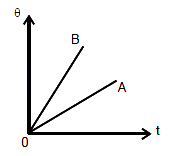
Two substances $A$ and $B$ of the same mass are heated at a constant rate. The variation of temperature $\theta$ of the substances with time $t$ is shown in the figure. Choose the correct statement.
A
Specific heat of $A$ is greater than that of $B$
B
Specific heat of $B$ is greater than that of $A$
C
Both have same specific heat
D
None of the above is true
Solution
(A) The heat supplied at a constant rate is given by $\Delta H = mC \Delta \theta$.
Since the rate of heat supply $\frac{dH}{dt}$ is constant,we can write:
$\frac{dH}{dt} = mC \frac{d\theta}{dt}$.
This implies $\frac{d\theta}{dt} = \frac{1}{mC} \left( \frac{dH}{dt} \right)$.
Since $m$ and $\frac{dH}{dt}$ are constant,the slope of the $\theta-t$ graph is inversely proportional to the specific heat $C$ (i.e.,$\text{slope} \propto \frac{1}{C}$).
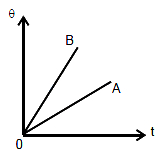
From the figure,the slope of line $B$ is greater than the slope of line $A$ (i.e.,$\text{slope}_B > \text{slope}_A$).
Therefore,$C_B < C_A$,which means the specific heat of $A$ is greater than that of $B$.
Since the rate of heat supply $\frac{dH}{dt}$ is constant,we can write:
$\frac{dH}{dt} = mC \frac{d\theta}{dt}$.
This implies $\frac{d\theta}{dt} = \frac{1}{mC} \left( \frac{dH}{dt} \right)$.
Since $m$ and $\frac{dH}{dt}$ are constant,the slope of the $\theta-t$ graph is inversely proportional to the specific heat $C$ (i.e.,$\text{slope} \propto \frac{1}{C}$).
From the figure,the slope of line $B$ is greater than the slope of line $A$ (i.e.,$\text{slope}_B > \text{slope}_A$).
Therefore,$C_B < C_A$,which means the specific heat of $A$ is greater than that of $B$.
0 likes
View Solution10-1.Thermometry, Thermal Expansion and Calorimetry — Heat Capacity, Specific Heat and Molar Specific Heat · Frequently Asked Questions
1Are these 10-1.Thermometry, Thermal Expansion and Calorimetry questions useful for JEE and NEET?
Yes. All questions in this section are mapped to JEE Main and NEET exam patterns. Previous year questions from JEE Main, NEET, GUJCET and state-level exams are included with full solutions.
2Can I switch to Hindi or Gujarati for these questions?
Yes. Use the language tabs in the hero section or the sidebar to view the same questions and solutions in English, Hindi or Gujarati.
3How do I generate a question paper from this subtopic?
Use the Vedclass Exam Paper Generator — select the chapter and subtopic, set difficulty, and generate Sets A, B, C, D automatically. First 3 chapters of every subject are free.
Vedclass Products
For Students
Vedclass Test Series
Mock tests in real JEE/NEET style with performance analysis. 5-day free trial.
Start Free TrialFor Teachers
Exam Paper Generator
Generate Set A/B/C/D papers from this chapter in 2 minutes. 3 chapters free.
Try FreeFor Institutes
Online Exam Module
Live online exams with unlimited students, 360° analytics & white-label branding.
See DemoFor Teachers & Institutes
Generate a 10-1.Thermometry, Thermal Expansion and Calorimetry Exam Paper in 2 Minutes
Select subtopic & difficulty — Sets A, B, C, D auto-generated with No Repeat logic.
First 3 chapters of every subject are free — no payment required.