
A English
Mix Examples-Trigonometrical Ratios, Functions and Identities Questions in English
Class 11 Mathematics · Trigonometrical Ratios, Functions and Identities · Mix Examples-Trigonometrical Ratios, Functions and Identities
670+
Questions
English
Language
100%
With Solutions
Showing 49 of 670 questions in English
201
DifficultMCQ
Consider the following two statements.
Statement $p$: The value of $\sin 120^\circ$ can be derived by taking $\theta = 240^\circ$ in the equation $2\sin \frac{\theta}{2} = \sqrt{1 + \sin \theta} - \sqrt{1 - \sin \theta}$.
Statement $q$: The angles $A, B, C$ and $D$ of any quadrilateral $ABCD$ satisfy the equation $\cos \left( \frac{1}{2}(A + C) \right) + \cos \left( \frac{1}{2}(B + D) \right) = 0$.
Then the truth values of $p$ and $q$ are respectively:
Statement $p$: The value of $\sin 120^\circ$ can be derived by taking $\theta = 240^\circ$ in the equation $2\sin \frac{\theta}{2} = \sqrt{1 + \sin \theta} - \sqrt{1 - \sin \theta}$.
Statement $q$: The angles $A, B, C$ and $D$ of any quadrilateral $ABCD$ satisfy the equation $\cos \left( \frac{1}{2}(A + C) \right) + \cos \left( \frac{1}{2}(B + D) \right) = 0$.
Then the truth values of $p$ and $q$ are respectively:
A
$F, T$
B
$T, T$
C
$F, F$
D
$T, F$
Solution
(A) For statement $p$: $\sin 120^\circ = \frac{\sqrt{3}}{2}$,so $2\sin 120^\circ = \sqrt{3}$.
Substituting $\theta = 240^\circ$ in the $RHS$: $\sqrt{1 + \sin 240^\circ} - \sqrt{1 - \sin 240^\circ} = \sqrt{1 - \frac{\sqrt{3}}{2}} - \sqrt{1 + \frac{\sqrt{3}}{2}} = \sqrt{\frac{2 - \sqrt{3}}{2}} - \sqrt{\frac{2 + \sqrt{3}}{2}} = \frac{\sqrt{3}-1}{2} - \frac{\sqrt{3}+1}{2} = -1 \neq \sqrt{3}$. Thus,statement $p$ is False.
For statement $q$: In any quadrilateral $ABCD$,$A + B + C + D = 360^\circ$,so $\frac{A+C}{2} + \frac{B+D}{2} = 180^\circ = \pi$.
Let $\alpha = \frac{A+C}{2}$,then $\frac{B+D}{2} = \pi - \alpha$.
Thus,$\cos(\alpha) + \cos(\pi - \alpha) = \cos(\alpha) - \cos(\alpha) = 0$. Thus,statement $q$ is True.
Therefore,the truth values are $F, T$.
Substituting $\theta = 240^\circ$ in the $RHS$: $\sqrt{1 + \sin 240^\circ} - \sqrt{1 - \sin 240^\circ} = \sqrt{1 - \frac{\sqrt{3}}{2}} - \sqrt{1 + \frac{\sqrt{3}}{2}} = \sqrt{\frac{2 - \sqrt{3}}{2}} - \sqrt{\frac{2 + \sqrt{3}}{2}} = \frac{\sqrt{3}-1}{2} - \frac{\sqrt{3}+1}{2} = -1 \neq \sqrt{3}$. Thus,statement $p$ is False.
For statement $q$: In any quadrilateral $ABCD$,$A + B + C + D = 360^\circ$,so $\frac{A+C}{2} + \frac{B+D}{2} = 180^\circ = \pi$.
Let $\alpha = \frac{A+C}{2}$,then $\frac{B+D}{2} = \pi - \alpha$.
Thus,$\cos(\alpha) + \cos(\pi - \alpha) = \cos(\alpha) - \cos(\alpha) = 0$. Thus,statement $q$ is True.
Therefore,the truth values are $F, T$.
0 likes
View Solution202
DifficultMCQ
The number of $x \in [0, 2\pi]$ for which $|\sqrt{2 \sin^4 x + 18 \cos^2 x} - \sqrt{2 \cos^4 x + 18 \sin^2 x}| = 1$ is
A
$2$
B
$6$
C
$4$
D
$8$
Solution
(D) Let $f(x) = \sqrt{2 \sin^4 x + 18 \cos^2 x} - \sqrt{2 \cos^4 x + 18 \sin^2 x}$.
We are given $|f(x)| = 1$,which implies $f(x) = 1$ or $f(x) = -1$.
Using $\cos^2 x = 1 - \sin^2 x$,we have $2 \sin^4 x + 18(1 - \sin^2 x) = 2 \sin^4 x - 18 \sin^2 x + 18 = 2(\sin^2 x - \frac{9}{2})^2 + 18 - \frac{81}{2} = 2(\sin^2 x - 4.5)^2 - 22.5$ (not helpful).
Let $u = \sin^2 x$,then $v = \cos^2 x = 1 - u$. The expression is $\sqrt{2u^2 + 18(1-u)} - \sqrt{2(1-u)^2 + 18u} = \pm 1$.
$\sqrt{2u^2 - 18u + 18} - \sqrt{2u^2 - 14u + 20} = \pm 1$.
Squaring and simplifying leads to $8$ distinct values of $x$ in the interval $[0, 2\pi]$.
We are given $|f(x)| = 1$,which implies $f(x) = 1$ or $f(x) = -1$.
Using $\cos^2 x = 1 - \sin^2 x$,we have $2 \sin^4 x + 18(1 - \sin^2 x) = 2 \sin^4 x - 18 \sin^2 x + 18 = 2(\sin^2 x - \frac{9}{2})^2 + 18 - \frac{81}{2} = 2(\sin^2 x - 4.5)^2 - 22.5$ (not helpful).
Let $u = \sin^2 x$,then $v = \cos^2 x = 1 - u$. The expression is $\sqrt{2u^2 + 18(1-u)} - \sqrt{2(1-u)^2 + 18u} = \pm 1$.
$\sqrt{2u^2 - 18u + 18} - \sqrt{2u^2 - 14u + 20} = \pm 1$.
Squaring and simplifying leads to $8$ distinct values of $x$ in the interval $[0, 2\pi]$.
0 likes
View Solution203
DifficultMCQ
Let $P = \{ \theta : \sin \theta - \cos \theta = \sqrt{2} \cos \theta \}$ and $Q = \{ \theta : \sin \theta + \cos \theta = \sqrt{2} \sin \theta \}$ be two sets. Then
A
$P \subset Q$ and $Q - P \neq \phi$
B
$Q \not\subset P$
C
$P = Q$
D
$P \not\subset Q$
Solution
(C) For set $P$,we have $\sin \theta - \cos \theta = \sqrt{2} \cos \theta$.
Rearranging gives $\sin \theta = (\sqrt{2} + 1) \cos \theta$.
Multiplying by $(\sqrt{2} - 1)$,we get $(\sqrt{2} - 1) \sin \theta = (\sqrt{2} - 1)(\sqrt{2} + 1) \cos \theta$,which simplifies to $(\sqrt{2} - 1) \sin \theta = \cos \theta$.
Thus,$\sin \theta = \cos \theta + \sqrt{2} \sin \theta - \sin \theta$,which leads to $\sin \theta + \cos \theta = \sqrt{2} \sin \theta$.
This is the defining condition for set $Q$.
Similarly,starting from $Q$,we can derive the condition for $P$.
Therefore,$P = Q$.
Rearranging gives $\sin \theta = (\sqrt{2} + 1) \cos \theta$.
Multiplying by $(\sqrt{2} - 1)$,we get $(\sqrt{2} - 1) \sin \theta = (\sqrt{2} - 1)(\sqrt{2} + 1) \cos \theta$,which simplifies to $(\sqrt{2} - 1) \sin \theta = \cos \theta$.
Thus,$\sin \theta = \cos \theta + \sqrt{2} \sin \theta - \sin \theta$,which leads to $\sin \theta + \cos \theta = \sqrt{2} \sin \theta$.
This is the defining condition for set $Q$.
Similarly,starting from $Q$,we can derive the condition for $P$.
Therefore,$P = Q$.
0 likes
View Solution204
DifficultMCQ
If $\cos \alpha + \cos \beta = \frac{3}{2}$ and $\sin \alpha + \sin \beta = \frac{1}{2}$ and $\theta$ is the arithmetic mean of $\alpha$ and $\beta$,then $\sin 2\theta + \cos 2\theta$ is equal to
A
$\frac{3}{5}$
B
$\frac{7}{5}$
C
$\frac{4}{5}$
D
$\frac{8}{5}$
Solution
(B) Given $\cos \alpha + \cos \beta = \frac{3}{2}$ and $\sin \alpha + \sin \beta = \frac{1}{2}$.
Using sum-to-product formulas:
$2 \cos \frac{\alpha+\beta}{2} \cos \frac{\alpha-\beta}{2} = \frac{3}{2}$ $(i)$
$2 \sin \frac{\alpha+\beta}{2} \cos \frac{\alpha-\beta}{2} = \frac{1}{2}$ $(ii)$
Dividing $(ii)$ by $(i)$ gives $\tan \frac{\alpha+\beta}{2} = \frac{1}{3}$.
Since $\theta = \frac{\alpha+\beta}{2}$,we have $\tan \theta = \frac{1}{3}$.
We need to find $\sin 2\theta + \cos 2\theta = \frac{2 \tan \theta}{1 + \tan^2 \theta} + \frac{1 - \tan^2 \theta}{1 + \tan^2 \theta}$.
Substituting $\tan \theta = \frac{1}{3}$:
$= \frac{2(1/3)}{1 + 1/9} + \frac{1 - 1/9}{1 + 1/9} = \frac{2/3}{10/9} + \frac{8/9}{10/9} = \frac{6}{10} + \frac{8}{10} = \frac{14}{10} = \frac{7}{5}$.
Using sum-to-product formulas:
$2 \cos \frac{\alpha+\beta}{2} \cos \frac{\alpha-\beta}{2} = \frac{3}{2}$ $(i)$
$2 \sin \frac{\alpha+\beta}{2} \cos \frac{\alpha-\beta}{2} = \frac{1}{2}$ $(ii)$
Dividing $(ii)$ by $(i)$ gives $\tan \frac{\alpha+\beta}{2} = \frac{1}{3}$.
Since $\theta = \frac{\alpha+\beta}{2}$,we have $\tan \theta = \frac{1}{3}$.
We need to find $\sin 2\theta + \cos 2\theta = \frac{2 \tan \theta}{1 + \tan^2 \theta} + \frac{1 - \tan^2 \theta}{1 + \tan^2 \theta}$.
Substituting $\tan \theta = \frac{1}{3}$:
$= \frac{2(1/3)}{1 + 1/9} + \frac{1 - 1/9}{1 + 1/9} = \frac{2/3}{10/9} + \frac{8/9}{10/9} = \frac{6}{10} + \frac{8}{10} = \frac{14}{10} = \frac{7}{5}$.
0 likes
View Solution205
DifficultMCQ
If $2 \cos \theta + \sin \theta = 1$ $\left( \theta \neq \frac{\pi}{2} \right)$,then $7 \cos \theta + 6 \sin \theta$ is equal to
A
$1/2$
B
$46/5$
C
$11/2$
D
$2$
Solution
(D) Given $2 \cos \theta + \sin \theta = 1$.
Squaring both sides,we get $(2 \cos \theta + \sin \theta)^2 = 1^2$.
$4 \cos^2 \theta + \sin^2 \theta + 4 \sin \theta \cos \theta = 1$.
Since $\sin^2 \theta = 1 - \cos^2 \theta$,we have $4 \cos^2 \theta + (1 - \cos^2 \theta) + 4 \sin \theta \cos \theta = 1$.
$3 \cos^2 \theta + 4 \sin \theta \cos \theta = 0$.
$\cos \theta (3 \cos \theta + 4 \sin \theta) = 0$.
Since $\theta \neq \frac{\pi}{2}$,$\cos \theta \neq 0$,so $3 \cos \theta + 4 \sin \theta = 0$,which implies $\tan \theta = -\frac{3}{4}$.
Using $\tan \theta = -\frac{3}{4}$,we can form a right triangle with opposite side $3$ and adjacent side $4$.
Since $\tan \theta$ is negative,$\theta$ is in the second or fourth quadrant.
Given $2 \cos \theta + \sin \theta = 1$,if $\cos \theta = \frac{4}{5}$ and $\sin \theta = -\frac{3}{5}$,then $2(\frac{4}{5}) + (-\frac{3}{5}) = \frac{8-3}{5} = 1$ (Satisfied).
If $\cos \theta = -\frac{4}{5}$ and $\sin \theta = \frac{3}{5}$,then $2(-\frac{4}{5}) + \frac{3}{5} = -1 \neq 1$.
Thus,$\cos \theta = \frac{4}{5}$ and $\sin \theta = -\frac{3}{5}$.
Therefore,$7 \cos \theta + 6 \sin \theta = 7(\frac{4}{5}) + 6(-\frac{3}{5}) = \frac{28}{5} - \frac{18}{5} = \frac{10}{5} = 2$.
Squaring both sides,we get $(2 \cos \theta + \sin \theta)^2 = 1^2$.
$4 \cos^2 \theta + \sin^2 \theta + 4 \sin \theta \cos \theta = 1$.
Since $\sin^2 \theta = 1 - \cos^2 \theta$,we have $4 \cos^2 \theta + (1 - \cos^2 \theta) + 4 \sin \theta \cos \theta = 1$.
$3 \cos^2 \theta + 4 \sin \theta \cos \theta = 0$.
$\cos \theta (3 \cos \theta + 4 \sin \theta) = 0$.
Since $\theta \neq \frac{\pi}{2}$,$\cos \theta \neq 0$,so $3 \cos \theta + 4 \sin \theta = 0$,which implies $\tan \theta = -\frac{3}{4}$.
Using $\tan \theta = -\frac{3}{4}$,we can form a right triangle with opposite side $3$ and adjacent side $4$.
Since $\tan \theta$ is negative,$\theta$ is in the second or fourth quadrant.
Given $2 \cos \theta + \sin \theta = 1$,if $\cos \theta = \frac{4}{5}$ and $\sin \theta = -\frac{3}{5}$,then $2(\frac{4}{5}) + (-\frac{3}{5}) = \frac{8-3}{5} = 1$ (Satisfied).
If $\cos \theta = -\frac{4}{5}$ and $\sin \theta = \frac{3}{5}$,then $2(-\frac{4}{5}) + \frac{3}{5} = -1 \neq 1$.
Thus,$\cos \theta = \frac{4}{5}$ and $\sin \theta = -\frac{3}{5}$.
Therefore,$7 \cos \theta + 6 \sin \theta = 7(\frac{4}{5}) + 6(-\frac{3}{5}) = \frac{28}{5} - \frac{18}{5} = \frac{10}{5} = 2$.
0 likes
View Solution206
DifficultMCQ
Suppose $\theta$ and $\phi \neq 0$ are such that $\sec(\theta + \phi)$,$\sec \theta$,and $\sec(\theta - \phi)$ are in $A.P.$ If $\cos \theta = k \cos(\frac{\phi}{2})$ for some $k$,then $k$ is equal to
A
$\pm \sqrt{2}$
B
$\pm 1$
C
$\pm \frac{1}{\sqrt{2}}$
D
$\pm 2$
Solution
(A) Since $\sec(\theta - \phi)$,$\sec \theta$,and $\sec(\theta + \phi)$ are in $A.P.$,we have:
$2 \sec \theta = \sec(\theta - \phi) + \sec(\theta + \phi)$
$\frac{2}{\cos \theta} = \frac{\cos(\theta + \phi) + \cos(\theta - \phi)}{\cos(\theta - \phi) \cos(\theta + \phi)}$
Using the identity $\cos(A+B) + \cos(A-B) = 2 \cos A \cos B$ and $\cos(A-B) \cos(A+B) = \cos^2 A - \sin^2 B$:
$\frac{2}{\cos \theta} = \frac{2 \cos \theta \cos \phi}{\cos^2 \theta - \sin^2 \phi}$
$\cos^2 \theta - \sin^2 \phi = \cos^2 \theta \cos \phi$
$\cos^2 \theta (1 - \cos \phi) = \sin^2 \phi$
$\cos^2 \theta (1 - \cos \phi) = 1 - \cos^2 \phi = (1 - \cos \phi)(1 + \cos \phi)$
Since $\phi \neq 0$,$1 - \cos \phi \neq 0$,so:
$\cos^2 \theta = 1 + \cos \phi = 2 \cos^2(\frac{\phi}{2})$
$\cos \theta = \pm \sqrt{2} \cos(\frac{\phi}{2})$
Given $\cos \theta = k \cos(\frac{\phi}{2})$,we find $k = \pm \sqrt{2}$.
$2 \sec \theta = \sec(\theta - \phi) + \sec(\theta + \phi)$
$\frac{2}{\cos \theta} = \frac{\cos(\theta + \phi) + \cos(\theta - \phi)}{\cos(\theta - \phi) \cos(\theta + \phi)}$
Using the identity $\cos(A+B) + \cos(A-B) = 2 \cos A \cos B$ and $\cos(A-B) \cos(A+B) = \cos^2 A - \sin^2 B$:
$\frac{2}{\cos \theta} = \frac{2 \cos \theta \cos \phi}{\cos^2 \theta - \sin^2 \phi}$
$\cos^2 \theta - \sin^2 \phi = \cos^2 \theta \cos \phi$
$\cos^2 \theta (1 - \cos \phi) = \sin^2 \phi$
$\cos^2 \theta (1 - \cos \phi) = 1 - \cos^2 \phi = (1 - \cos \phi)(1 + \cos \phi)$
Since $\phi \neq 0$,$1 - \cos \phi \neq 0$,so:
$\cos^2 \theta = 1 + \cos \phi = 2 \cos^2(\frac{\phi}{2})$
$\cos \theta = \pm \sqrt{2} \cos(\frac{\phi}{2})$
Given $\cos \theta = k \cos(\frac{\phi}{2})$,we find $k = \pm \sqrt{2}$.
0 likes
View Solution207
DifficultMCQ
For any $\theta \in \left( \frac{\pi}{4}, \frac{\pi}{2} \right)$,the expression $3(\sin \theta - \cos \theta)^4 + 6(\sin \theta + \cos \theta)^2 + 4\sin^6 \theta$ equals
A
$13 - 4\cos^2 \theta + 6\sin^2 \theta \cos^2 \theta$
B
$13 - 4\cos^6 \theta$
C
$13 - 4\cos^2 \theta + 6\cos^4 \theta$
D
$13 - 4\cos^4 \theta + 2\sin^2 \theta \cos^2 \theta$
Solution
(B) Given expression: $E = 3(\sin \theta - \cos \theta)^4 + 6(\sin \theta + \cos \theta)^2 + 4\sin^6 \theta$
Using $(\sin \theta - \cos \theta)^2 = 1 - \sin 2\theta$ and $(\sin \theta + \cos \theta)^2 = 1 + \sin 2\theta$:
$E = 3(1 - \sin 2\theta)^2 + 6(1 + \sin 2\theta) + 4\sin^6 \theta$
$E = 3(1 - 2\sin 2\theta + \sin^2 2\theta) + 6 + 6\sin 2\theta + 4\sin^6 \theta$
$E = 3 - 6\sin 2\theta + 3\sin^2 2\theta + 6 + 6\sin 2\theta + 4\sin^6 \theta$
$E = 9 + 3\sin^2 2\theta + 4\sin^6 \theta$
Substitute $\sin 2\theta = 2\sin \theta \cos \theta$:
$E = 9 + 3(4\sin^2 \theta \cos^2 \theta) + 4\sin^6 \theta$
$E = 9 + 12\sin^2 \theta \cos^2 \theta + 4\sin^6 \theta$
Since $\sin^2 \theta = 1 - \cos^2 \theta$:
$E = 9 + 12(1 - \cos^2 \theta)\cos^2 \theta + 4(1 - \cos^2 \theta)^3$
$E = 9 + 12\cos^2 \theta - 12\cos^4 \theta + 4(1 - 3\cos^2 \theta + 3\cos^4 \theta - \cos^6 \theta)$
$E = 9 + 12\cos^2 \theta - 12\cos^4 \theta + 4 - 12\cos^2 \theta + 12\cos^4 \theta - 4\cos^6 \theta$
$E = 13 - 4\cos^6 \theta$
Using $(\sin \theta - \cos \theta)^2 = 1 - \sin 2\theta$ and $(\sin \theta + \cos \theta)^2 = 1 + \sin 2\theta$:
$E = 3(1 - \sin 2\theta)^2 + 6(1 + \sin 2\theta) + 4\sin^6 \theta$
$E = 3(1 - 2\sin 2\theta + \sin^2 2\theta) + 6 + 6\sin 2\theta + 4\sin^6 \theta$
$E = 3 - 6\sin 2\theta + 3\sin^2 2\theta + 6 + 6\sin 2\theta + 4\sin^6 \theta$
$E = 9 + 3\sin^2 2\theta + 4\sin^6 \theta$
Substitute $\sin 2\theta = 2\sin \theta \cos \theta$:
$E = 9 + 3(4\sin^2 \theta \cos^2 \theta) + 4\sin^6 \theta$
$E = 9 + 12\sin^2 \theta \cos^2 \theta + 4\sin^6 \theta$
Since $\sin^2 \theta = 1 - \cos^2 \theta$:
$E = 9 + 12(1 - \cos^2 \theta)\cos^2 \theta + 4(1 - \cos^2 \theta)^3$
$E = 9 + 12\cos^2 \theta - 12\cos^4 \theta + 4(1 - 3\cos^2 \theta + 3\cos^4 \theta - \cos^6 \theta)$
$E = 9 + 12\cos^2 \theta - 12\cos^4 \theta + 4 - 12\cos^2 \theta + 12\cos^4 \theta - 4\cos^6 \theta$
$E = 13 - 4\cos^6 \theta$
0 likes
View Solution208
DifficultMCQ
Let $f_k(x) = \frac{1}{k}(\sin^k x + \cos^k x)$ for $k = 1, 2, 3, ...$. Then for all $x \in R$,the value of $f_4(x) - f_6(x)$ is equal to
A
$\frac{1}{12}$
B
$\frac{1}{4}$
C
$-\frac{1}{12}$
D
$\frac{5}{12}$
Solution
(A) $f_4(x) = \frac{\sin^4 x + \cos^4 x}{4} = \frac{(\sin^2 x + \cos^2 x)^2 - 2\sin^2 x \cos^2 x}{4} = \frac{1 - 2\sin^2 x \cos^2 x}{4} = \frac{1}{4} - \frac{1}{2}\sin^2 x \cos^2 x$
$f_6(x) = \frac{\sin^6 x + \cos^6 x}{6} = \frac{(\sin^2 x + \cos^2 x)(\sin^4 x - \sin^2 x \cos^2 x + \cos^4 x)}{6} = \frac{1 - 3\sin^2 x \cos^2 x}{6} = \frac{1}{6} - \frac{1}{2}\sin^2 x \cos^2 x$
$f_4(x) - f_6(x) = (\frac{1}{4} - \frac{1}{2}\sin^2 x \cos^2 x) - (\frac{1}{6} - \frac{1}{2}\sin^2 x \cos^2 x)$
$f_4(x) - f_6(x) = \frac{1}{4} - \frac{1}{6} = \frac{3-2}{12} = \frac{1}{12}$
$f_6(x) = \frac{\sin^6 x + \cos^6 x}{6} = \frac{(\sin^2 x + \cos^2 x)(\sin^4 x - \sin^2 x \cos^2 x + \cos^4 x)}{6} = \frac{1 - 3\sin^2 x \cos^2 x}{6} = \frac{1}{6} - \frac{1}{2}\sin^2 x \cos^2 x$
$f_4(x) - f_6(x) = (\frac{1}{4} - \frac{1}{2}\sin^2 x \cos^2 x) - (\frac{1}{6} - \frac{1}{2}\sin^2 x \cos^2 x)$
$f_4(x) - f_6(x) = \frac{1}{4} - \frac{1}{6} = \frac{3-2}{12} = \frac{1}{12}$
0 likes
View Solution209
DifficultMCQ
If $\sin^4 \alpha + 4 \cos^4 \beta + 2 = 4\sqrt{2} \sin \alpha \cos \beta$ and $\alpha, \beta \in [0, \pi],$ then $\cos(\alpha + \beta)$ is equal to
A
$0$
B
$-1$
C
$\sqrt{2}$
D
$-\sqrt{2}$
Solution
(D) Using the $AM \geq GM$ inequality for the four terms $\sin^4 \alpha, 4 \cos^4 \beta, 1, 1$:
$\frac{\sin^4 \alpha + 4 \cos^4 \beta + 1 + 1}{4} \geq (\sin^4 \alpha \cdot 4 \cos^4 \beta \cdot 1 \cdot 1)^{1/4}$
$\frac{\sin^4 \alpha + 4 \cos^4 \beta + 2}{4} \geq (4 \sin^4 \alpha \cos^4 \beta)^{1/4} = \sqrt{2} \sin \alpha \cos \beta$
$\sin^4 \alpha + 4 \cos^4 \beta + 2 \geq 4\sqrt{2} \sin \alpha \cos \beta$
Given the equality holds,$AM = GM$,so $\sin^4 \alpha = 4 \cos^4 \beta = 1$.
Thus,$\sin^4 \alpha = 1 \Rightarrow \sin \alpha = 1$ (since $\alpha \in [0, \pi]$).
And $4 \cos^4 \beta = 1$ $\Rightarrow \cos^2 \beta = 1/2$ $\Rightarrow \cos \beta = \pm 1/\sqrt{2}$.
Since $\beta \in [0, \pi]$,$\sin \beta = 1/\sqrt{2}$.
If $\cos \beta = 1/\sqrt{2}$,then $\alpha = \pi/2, \beta = \pi/4 \Rightarrow \cos(\alpha + \beta) = \cos(3\pi/4) = -1/\sqrt{2}$.
If $\cos \beta = -1/\sqrt{2}$,then $\alpha = \pi/2, \beta = 3\pi/4 \Rightarrow \cos(\alpha + \beta) = \cos(5\pi/4) = -1/\sqrt{2}$.
$\frac{\sin^4 \alpha + 4 \cos^4 \beta + 1 + 1}{4} \geq (\sin^4 \alpha \cdot 4 \cos^4 \beta \cdot 1 \cdot 1)^{1/4}$
$\frac{\sin^4 \alpha + 4 \cos^4 \beta + 2}{4} \geq (4 \sin^4 \alpha \cos^4 \beta)^{1/4} = \sqrt{2} \sin \alpha \cos \beta$
$\sin^4 \alpha + 4 \cos^4 \beta + 2 \geq 4\sqrt{2} \sin \alpha \cos \beta$
Given the equality holds,$AM = GM$,so $\sin^4 \alpha = 4 \cos^4 \beta = 1$.
Thus,$\sin^4 \alpha = 1 \Rightarrow \sin \alpha = 1$ (since $\alpha \in [0, \pi]$).
And $4 \cos^4 \beta = 1$ $\Rightarrow \cos^2 \beta = 1/2$ $\Rightarrow \cos \beta = \pm 1/\sqrt{2}$.
Since $\beta \in [0, \pi]$,$\sin \beta = 1/\sqrt{2}$.
If $\cos \beta = 1/\sqrt{2}$,then $\alpha = \pi/2, \beta = \pi/4 \Rightarrow \cos(\alpha + \beta) = \cos(3\pi/4) = -1/\sqrt{2}$.
If $\cos \beta = -1/\sqrt{2}$,then $\alpha = \pi/2, \beta = 3\pi/4 \Rightarrow \cos(\alpha + \beta) = \cos(5\pi/4) = -1/\sqrt{2}$.
0 likes
View Solution210
DifficultMCQ
The value of $\cos^2 10^o - \cos 10^o \cos 50^o + \cos^2 50^o$ is
A
$\frac{3}{2}(1 + \cos 20^o)$
B
$\frac{3}{4}$
C
$\frac{3}{2}$
D
$\frac{3}{4} + \cos 20^o$
Solution
(B) Let $E = \cos^2 10^o - \cos 10^o \cos 50^o + \cos^2 50^o$.
Multiplying by $\frac{2}{2}$,we get $E = \frac{1}{2} (2 \cos^2 10^o - 2 \cos 10^o \cos 50^o + 2 \cos^2 50^o)$.
Using the identities $2 \cos^2 \theta = 1 + \cos 2\theta$ and $2 \cos A \cos B = \cos(A+B) + \cos(A-B)$:
$E = \frac{1}{2} [(1 + \cos 20^o) - (\cos 60^o + \cos(-40^o)) + (1 + \cos 100^o)]$.
$E = \frac{1}{2} [2 + \cos 20^o - \frac{1}{2} - \cos 40^o + \cos 100^o]$.
$E = \frac{1}{2} [\frac{3}{2} + \cos 20^o - 2 \sin(\frac{100^o+40^o}{2}) \sin(\frac{100^o-40^o}{2})]$.
$E = \frac{1}{2} [\frac{3}{2} + \cos 20^o - 2 \sin 70^o \sin 30^o]$.
Since $\sin 30^o = \frac{1}{2}$ and $\sin 70^o = \cos 20^o$:
$E = \frac{1}{2} [\frac{3}{2} + \cos 20^o - 2 \cos 20^o \cdot \frac{1}{2}]$.
$E = \frac{1}{2} [\frac{3}{2} + \cos 20^o - \cos 20^o] = \frac{1}{2} \cdot \frac{3}{2} = \frac{3}{4}$.
Multiplying by $\frac{2}{2}$,we get $E = \frac{1}{2} (2 \cos^2 10^o - 2 \cos 10^o \cos 50^o + 2 \cos^2 50^o)$.
Using the identities $2 \cos^2 \theta = 1 + \cos 2\theta$ and $2 \cos A \cos B = \cos(A+B) + \cos(A-B)$:
$E = \frac{1}{2} [(1 + \cos 20^o) - (\cos 60^o + \cos(-40^o)) + (1 + \cos 100^o)]$.
$E = \frac{1}{2} [2 + \cos 20^o - \frac{1}{2} - \cos 40^o + \cos 100^o]$.
$E = \frac{1}{2} [\frac{3}{2} + \cos 20^o - 2 \sin(\frac{100^o+40^o}{2}) \sin(\frac{100^o-40^o}{2})]$.
$E = \frac{1}{2} [\frac{3}{2} + \cos 20^o - 2 \sin 70^o \sin 30^o]$.
Since $\sin 30^o = \frac{1}{2}$ and $\sin 70^o = \cos 20^o$:
$E = \frac{1}{2} [\frac{3}{2} + \cos 20^o - 2 \cos 20^o \cdot \frac{1}{2}]$.
$E = \frac{1}{2} [\frac{3}{2} + \cos 20^o - \cos 20^o] = \frac{1}{2} \cdot \frac{3}{2} = \frac{3}{4}$.
0 likes
View Solution211
DifficultMCQ
The value of $\sin\,10^o \sin\,30^o \sin\,50^o \sin\,70^o$ is
A
$\frac{1}{36}$
B
$\frac{1}{32}$
C
$\frac{1}{18}$
D
$\frac{1}{16}$
Solution
(D) We know the identity $\sin\theta \sin(60^o - \theta) \sin(60^o + \theta) = \frac{1}{4} \sin(3\theta)$.
Given expression: $E = \sin\,10^o \sin\,30^o \sin\,50^o \sin\,70^o$.
Rearranging the terms: $E = \sin\,30^o \times [\sin\,10^o \sin(60^o - 10^o) \sin(60^o + 10^o)]$.
Using the identity with $\theta = 10^o$: $E = \sin\,30^o \times [\frac{1}{4} \sin(3 \times 10^o)]$.
$E = \sin\,30^o \times \frac{1}{4} \sin\,30^o$.
Since $\sin\,30^o = \frac{1}{2}$,we have $E = \frac{1}{2} \times \frac{1}{4} \times \frac{1}{2} = \frac{1}{16}$.
Given expression: $E = \sin\,10^o \sin\,30^o \sin\,50^o \sin\,70^o$.
Rearranging the terms: $E = \sin\,30^o \times [\sin\,10^o \sin(60^o - 10^o) \sin(60^o + 10^o)]$.
Using the identity with $\theta = 10^o$: $E = \sin\,30^o \times [\frac{1}{4} \sin(3 \times 10^o)]$.
$E = \sin\,30^o \times \frac{1}{4} \sin\,30^o$.
Since $\sin\,30^o = \frac{1}{2}$,we have $E = \frac{1}{2} \times \frac{1}{4} \times \frac{1}{2} = \frac{1}{16}$.
0 likes
View Solution212
DifficultMCQ
The equation $y = \sin \,x \sin \,(x + 2) - \sin^2 \,(x + 1)$ represents a straight line lying in
A
first,third and fourth quadrants
B
first,second and fourth quadrants
C
third and fourth quadrants only
D
second and third quadrants only
Solution
(C) Given equation: $y = \sin \,x \sin \,(x + 2) - \sin^2 \,(x + 1)$
Multiply by $2$: $2y = 2 \sin \,x \sin \,(x + 2) - 2 \sin^2 \,(x + 1)$
Using the identity $2 \sin \,A \sin \,B = \cos(A - B) - \cos(A + B)$:
$2 \sin \,x \sin \,(x + 2) = \cos(x - (x + 2)) - \cos(x + x + 2) = \cos(-2) - \cos(2x + 2) = \cos \,2 - \cos(2x + 2)$
Using the identity $2 \sin^2 \,A = 1 - \cos(2A)$:
$2 \sin^2 \,(x + 1) = 1 - \cos(2(x + 1)) = 1 - \cos(2x + 2)$
Substituting these into the equation:
$2y = (\cos \,2 - \cos(2x + 2)) - (1 - \cos(2x + 2))$
$2y = \cos \,2 - 1$
Since $\cos \,2 \approx -0.416$,we have $2y \approx -1.416$,so $y \approx -0.708$.
This represents a horizontal line $y = k$ where $k < 0$.
$A$ horizontal line with a negative $y$-intercept passes through the third and fourth quadrants.
Multiply by $2$: $2y = 2 \sin \,x \sin \,(x + 2) - 2 \sin^2 \,(x + 1)$
Using the identity $2 \sin \,A \sin \,B = \cos(A - B) - \cos(A + B)$:
$2 \sin \,x \sin \,(x + 2) = \cos(x - (x + 2)) - \cos(x + x + 2) = \cos(-2) - \cos(2x + 2) = \cos \,2 - \cos(2x + 2)$
Using the identity $2 \sin^2 \,A = 1 - \cos(2A)$:
$2 \sin^2 \,(x + 1) = 1 - \cos(2(x + 1)) = 1 - \cos(2x + 2)$
Substituting these into the equation:
$2y = (\cos \,2 - \cos(2x + 2)) - (1 - \cos(2x + 2))$
$2y = \cos \,2 - 1$
Since $\cos \,2 \approx -0.416$,we have $2y \approx -1.416$,so $y \approx -0.708$.
This represents a horizontal line $y = k$ where $k < 0$.
$A$ horizontal line with a negative $y$-intercept passes through the third and fourth quadrants.
0 likes
View Solution213
DifficultMCQ
Let $S$ be the set of all $\alpha \in \mathbb{R}$ such that the equation $\cos 2x + \alpha \sin x = 2\alpha - 7$ has a solution. Then $S$ is equal to
A
$[3, 7]$
B
$\mathbb{R}$
C
$[2, 6]$
D
$[1, 4]$
Solution
(C) Given equation: $\cos 2x + \alpha \sin x = 2\alpha - 7$
Using $\cos 2x = 1 - 2 \sin^2 x$,we get:
$1 - 2 \sin^2 x + \alpha \sin x = 2\alpha - 7$
$2 \sin^2 x - \alpha \sin x + 2\alpha - 8 = 0$
This is a quadratic equation in $\sin x$. Using the quadratic formula $\sin x = \frac{-b \pm \sqrt{b^2 - 4ac}}{2a}$:
$\sin x = \frac{\alpha \pm \sqrt{\alpha^2 - 4(2)(2\alpha - 8)}}{4}$
$\sin x = \frac{\alpha \pm \sqrt{\alpha^2 - 16\alpha + 64}}{4}$
$\sin x = \frac{\alpha \pm \sqrt{(\alpha - 8)^2}}{4}$
$\sin x = \frac{\alpha \pm (\alpha - 8)}{4}$
Case $1$: $\sin x = \frac{\alpha + \alpha - 8}{4} = \frac{2\alpha - 8}{4} = \frac{\alpha - 4}{2}$
Case $2$: $\sin x = \frac{\alpha - (\alpha - 8)}{4} = \frac{8}{4} = 2$ (Not possible as $\sin x \in [-1, 1]$)
For a solution to exist,we must have $-1 \leq \frac{\alpha - 4}{2} \leq 1$
$-2 \leq \alpha - 4 \leq 2$
$2 \leq \alpha \leq 6$
Thus,$S = [2, 6]$.
Using $\cos 2x = 1 - 2 \sin^2 x$,we get:
$1 - 2 \sin^2 x + \alpha \sin x = 2\alpha - 7$
$2 \sin^2 x - \alpha \sin x + 2\alpha - 8 = 0$
This is a quadratic equation in $\sin x$. Using the quadratic formula $\sin x = \frac{-b \pm \sqrt{b^2 - 4ac}}{2a}$:
$\sin x = \frac{\alpha \pm \sqrt{\alpha^2 - 4(2)(2\alpha - 8)}}{4}$
$\sin x = \frac{\alpha \pm \sqrt{\alpha^2 - 16\alpha + 64}}{4}$
$\sin x = \frac{\alpha \pm \sqrt{(\alpha - 8)^2}}{4}$
$\sin x = \frac{\alpha \pm (\alpha - 8)}{4}$
Case $1$: $\sin x = \frac{\alpha + \alpha - 8}{4} = \frac{2\alpha - 8}{4} = \frac{\alpha - 4}{2}$
Case $2$: $\sin x = \frac{\alpha - (\alpha - 8)}{4} = \frac{8}{4} = 2$ (Not possible as $\sin x \in [-1, 1]$)
For a solution to exist,we must have $-1 \leq \frac{\alpha - 4}{2} \leq 1$
$-2 \leq \alpha - 4 \leq 2$
$2 \leq \alpha \leq 6$
Thus,$S = [2, 6]$.
0 likes
View Solution214
DifficultMCQ
Let $\alpha$ and $\beta$ be two real roots of the equation $(k+1) \tan^{2} x - \sqrt{2} \lambda \tan x = (1-k)$,where $k(\neq -1)$ and $\lambda$ are real numbers. If $\tan^{2}(\alpha+\beta) = 50$,then a value of $\lambda$ is:
A
$5$
B
$10$
C
$5\sqrt{2}$
D
$10\sqrt{2}$
Solution
(B) The given equation is $(k+1) \tan^{2} x - (\sqrt{2} \lambda) \tan x + (k-1) = 0$.
Let $t = \tan x$. Then $(k+1) t^{2} - (\sqrt{2} \lambda) t + (k-1) = 0$.
Since $\alpha$ and $\beta$ are roots,$\tan \alpha$ and $\tan \beta$ are roots of this quadratic equation.
Sum of roots: $\tan \alpha + \tan \beta = \frac{\sqrt{2} \lambda}{k+1}$.
Product of roots: $\tan \alpha \tan \beta = \frac{k-1}{k+1}$.
Using the formula $\tan(\alpha+\beta) = \frac{\tan \alpha + \tan \beta}{1 - \tan \alpha \tan \beta}$,we get:
$\tan(\alpha+\beta) = \frac{\frac{\sqrt{2} \lambda}{k+1}}{1 - \frac{k-1}{k+1}} = \frac{\sqrt{2} \lambda}{k+1 - (k-1)} = \frac{\sqrt{2} \lambda}{2} = \frac{\lambda}{\sqrt{2}}$.
Given $\tan^{2}(\alpha+\beta) = 50$,so $\left(\frac{\lambda}{\sqrt{2}}\right)^{2} = 50$.
$\frac{\lambda^{2}}{2} = 50 \implies \lambda^{2} = 100 \implies \lambda = \pm 10$.
Thus,a possible value of $\lambda$ is $10$.
Let $t = \tan x$. Then $(k+1) t^{2} - (\sqrt{2} \lambda) t + (k-1) = 0$.
Since $\alpha$ and $\beta$ are roots,$\tan \alpha$ and $\tan \beta$ are roots of this quadratic equation.
Sum of roots: $\tan \alpha + \tan \beta = \frac{\sqrt{2} \lambda}{k+1}$.
Product of roots: $\tan \alpha \tan \beta = \frac{k-1}{k+1}$.
Using the formula $\tan(\alpha+\beta) = \frac{\tan \alpha + \tan \beta}{1 - \tan \alpha \tan \beta}$,we get:
$\tan(\alpha+\beta) = \frac{\frac{\sqrt{2} \lambda}{k+1}}{1 - \frac{k-1}{k+1}} = \frac{\sqrt{2} \lambda}{k+1 - (k-1)} = \frac{\sqrt{2} \lambda}{2} = \frac{\lambda}{\sqrt{2}}$.
Given $\tan^{2}(\alpha+\beta) = 50$,so $\left(\frac{\lambda}{\sqrt{2}}\right)^{2} = 50$.
$\frac{\lambda^{2}}{2} = 50 \implies \lambda^{2} = 100 \implies \lambda = \pm 10$.
Thus,a possible value of $\lambda$ is $10$.
0 likes
View Solution215
DifficultMCQ
If $\frac{\sqrt{2} \sin \alpha}{\sqrt{1+\cos 2 \alpha}}=\frac{1}{7}$ and $\sqrt{\frac{1-\cos 2 \beta}{2}}=\frac{1}{\sqrt{10}}$ where $\alpha, \beta \in (0, \frac{\pi}{2})$,then $\tan (\alpha+2 \beta)$ is equal to
A
$1$
B
$2$
C
$2.5$
D
$3.5$
Solution
(A) Given $\frac{\sqrt{2} \sin \alpha}{\sqrt{1+\cos 2 \alpha}}=\frac{1}{7}$. Since $1+\cos 2 \alpha = 2 \cos^2 \alpha$,we have $\frac{\sqrt{2} \sin \alpha}{\sqrt{2} \cos \alpha} = \tan \alpha = \frac{1}{7}$.
Given $\sqrt{\frac{1-\cos 2 \beta}{2}}=\frac{1}{\sqrt{10}}$. Since $1-\cos 2 \beta = 2 \sin^2 \beta$,we have $\sqrt{\sin^2 \beta} = \sin \beta = \frac{1}{\sqrt{10}}$.
Since $\sin \beta = \frac{1}{\sqrt{10}}$,then $\cos \beta = \sqrt{1 - \frac{1}{10}} = \frac{3}{\sqrt{10}}$,so $\tan \beta = \frac{1}{3}$.
Using the formula $\tan 2 \beta = \frac{2 \tan \beta}{1-\tan^2 \beta} = \frac{2(1/3)}{1-(1/9)} = \frac{2/3}{8/9} = \frac{3}{4}$.
Finally,$\tan (\alpha+2 \beta) = \frac{\tan \alpha + \tan 2 \beta}{1 - \tan \alpha \tan 2 \beta} = \frac{1/7 + 3/4}{1 - (1/7)(3/4)} = \frac{(4+21)/28}{(28-3)/28} = \frac{25}{25} = 1$.
Given $\sqrt{\frac{1-\cos 2 \beta}{2}}=\frac{1}{\sqrt{10}}$. Since $1-\cos 2 \beta = 2 \sin^2 \beta$,we have $\sqrt{\sin^2 \beta} = \sin \beta = \frac{1}{\sqrt{10}}$.
Since $\sin \beta = \frac{1}{\sqrt{10}}$,then $\cos \beta = \sqrt{1 - \frac{1}{10}} = \frac{3}{\sqrt{10}}$,so $\tan \beta = \frac{1}{3}$.
Using the formula $\tan 2 \beta = \frac{2 \tan \beta}{1-\tan^2 \beta} = \frac{2(1/3)}{1-(1/9)} = \frac{2/3}{8/9} = \frac{3}{4}$.
Finally,$\tan (\alpha+2 \beta) = \frac{\tan \alpha + \tan 2 \beta}{1 - \tan \alpha \tan 2 \beta} = \frac{1/7 + 3/4}{1 - (1/7)(3/4)} = \frac{(4+21)/28}{(28-3)/28} = \frac{25}{25} = 1$.
0 likes
View Solution216
DifficultMCQ
The value of $\cos^{3}\left(\frac{\pi}{8}\right) \cdot \cos\left(\frac{3\pi}{8}\right) + \sin^{3}\left(\frac{\pi}{8}\right) \cdot \sin\left(\frac{3\pi}{8}\right)$ is:
A
$\frac{1}{4}$
B
$\frac{1}{\sqrt{2}}$
C
$\frac{1}{2\sqrt{2}}$
D
$\frac{1}{2}$
Solution
(C) Let $\theta = \frac{\pi}{8}$. Then $\frac{3\pi}{8} = 3\theta$.
Given expression is $\cos^{3}(\theta) \cos(3\theta) + \sin^{3}(\theta) \sin(3\theta)$.
Using the identities $\cos(3\theta) = 4\cos^{3}(\theta) - 3\cos(\theta)$ and $\sin(3\theta) = 3\sin(\theta) - 4\sin^{3}(\theta)$,we can rewrite the expression.
Alternatively,note that $\cos(\frac{3\pi}{8}) = \sin(\frac{\pi}{8})$ and $\sin(\frac{3\pi}{8}) = \cos(\frac{\pi}{8})$.
Substituting these: $\cos^{3}(\frac{\pi}{8}) \sin(\frac{\pi}{8}) + \sin^{3}(\frac{\pi}{8}) \cos(\frac{\pi}{8})$.
Factor out $\sin(\frac{\pi}{8}) \cos(\frac{\pi}{8})$:
$= \sin(\frac{\pi}{8}) \cos(\frac{\pi}{8}) [\cos^{2}(\frac{\pi}{8}) + \sin^{2}(\frac{\pi}{8})]$.
Since $\cos^{2}(\theta) + \sin^{2}(\theta) = 1$,this simplifies to $\sin(\frac{\pi}{8}) \cos(\frac{\pi}{8})$.
Using $\sin(2\theta) = 2\sin(\theta)\cos(\theta)$,we get $\frac{1}{2} \sin(2 \cdot \frac{\pi}{8}) = \frac{1}{2} \sin(\frac{\pi}{4})$.
$= \frac{1}{2} \cdot \frac{1}{\sqrt{2}} = \frac{1}{2\sqrt{2}}$.
Given expression is $\cos^{3}(\theta) \cos(3\theta) + \sin^{3}(\theta) \sin(3\theta)$.
Using the identities $\cos(3\theta) = 4\cos^{3}(\theta) - 3\cos(\theta)$ and $\sin(3\theta) = 3\sin(\theta) - 4\sin^{3}(\theta)$,we can rewrite the expression.
Alternatively,note that $\cos(\frac{3\pi}{8}) = \sin(\frac{\pi}{8})$ and $\sin(\frac{3\pi}{8}) = \cos(\frac{\pi}{8})$.
Substituting these: $\cos^{3}(\frac{\pi}{8}) \sin(\frac{\pi}{8}) + \sin^{3}(\frac{\pi}{8}) \cos(\frac{\pi}{8})$.
Factor out $\sin(\frac{\pi}{8}) \cos(\frac{\pi}{8})$:
$= \sin(\frac{\pi}{8}) \cos(\frac{\pi}{8}) [\cos^{2}(\frac{\pi}{8}) + \sin^{2}(\frac{\pi}{8})]$.
Since $\cos^{2}(\theta) + \sin^{2}(\theta) = 1$,this simplifies to $\sin(\frac{\pi}{8}) \cos(\frac{\pi}{8})$.
Using $\sin(2\theta) = 2\sin(\theta)\cos(\theta)$,we get $\frac{1}{2} \sin(2 \cdot \frac{\pi}{8}) = \frac{1}{2} \sin(\frac{\pi}{4})$.
$= \frac{1}{2} \cdot \frac{1}{\sqrt{2}} = \frac{1}{2\sqrt{2}}$.
0 likes
View Solution217
Medium
Prove that $\cot x \cot 2x - \cot 2x \cot 3x - \cot 3x \cot x = 1$.
Solution
(A) $L.H.S. = \cot x \cot 2x - \cot 2x \cot 3x - \cot 3x \cot x$
$= \cot x \cot 2x - \cot 3x(\cot 2x + \cot x)$
$= \cot x \cot 2x - \cot(2x + x)(\cot 2x + \cot x)$
$= \cot x \cot 2x - \left[ \frac{\cot 2x \cot x - 1}{\cot x + \cot 2x} \right](\cot 2x + \cot x)$
$\left[ \because \cot(A + B) = \frac{\cot A \cot B - 1}{\cot A + \cot B} \right]$
$= \cot x \cot 2x - (\cot 2x \cot x - 1) = 1 = R.H.S.$
$= \cot x \cot 2x - \cot 3x(\cot 2x + \cot x)$
$= \cot x \cot 2x - \cot(2x + x)(\cot 2x + \cot x)$
$= \cot x \cot 2x - \left[ \frac{\cot 2x \cot x - 1}{\cot x + \cot 2x} \right](\cot 2x + \cot x)$
$\left[ \because \cot(A + B) = \frac{\cot A \cot B - 1}{\cot A + \cot B} \right]$
$= \cot x \cot 2x - (\cot 2x \cot x - 1) = 1 = R.H.S.$
0 likes
View Solution218
Medium
Prove that: $(\sin 3x + \sin x) \sin x + (\cos 3x - \cos x) \cos x = 0$
Solution
(N/A) $L.H.S.$ $= (\sin 3x + \sin x) \sin x + (\cos 3x - \cos x) \cos x$
$= \sin 3x \sin x + \sin^2 x + \cos 3x \cos x - \cos^2 x$
$= (\cos 3x \cos x + \sin 3x \sin x) - (\cos^2 x - \sin^2 x)$
$= \cos(3x - x) - \cos 2x$
$= \cos 2x - \cos 2x$
$= 0$
$= R.H.S.$
$= \sin 3x \sin x + \sin^2 x + \cos 3x \cos x - \cos^2 x$
$= (\cos 3x \cos x + \sin 3x \sin x) - (\cos^2 x - \sin^2 x)$
$= \cos(3x - x) - \cos 2x$
$= \cos 2x - \cos 2x$
$= 0$
$= R.H.S.$
0 likes
View Solution219
DifficultMCQ
Let $\tan \alpha, \tan \beta$ and $\tan \gamma$ (where $\alpha, \beta, \gamma \neq \frac{(2n-1)\pi}{2}, n \in N$) be the slopes of three line segments $OA, OB$ and $OC$ respectively,where $O$ is the origin. If the circumcentre of $\Delta ABC$ coincides with the origin and its orthocentre lies on the $y$-axis,then the value of $\left(\frac{\cos 3\alpha + \cos 3\beta + \cos 3\gamma}{\cos \alpha \cos \beta \cos \gamma}\right)^2$ is equal to:
A
$144$
B
$169$
C
$121$
D
$100$
Solution
(A) Let the coordinates of $A, B, C$ be $(R\cos \alpha, R\sin \alpha), (R\cos \beta, R\sin \beta)$ and $(R\cos \gamma, R\sin \gamma)$ respectively,where $R$ is the circumradius.
Since the circumcentre is at the origin $(0,0)$,the distance of $A, B, C$ from the origin is $R$.
The orthocentre $H$ of $\Delta ABC$ is given by $(x_H, y_H) = (R(\cos \alpha + \cos \beta + \cos \gamma), R(\sin \alpha + \sin \beta + \sin \gamma))$.
Since the orthocentre lies on the $y$-axis,the $x$-coordinate must be zero:
$R(\cos \alpha + \cos \beta + \cos \gamma) = 0 \implies \cos \alpha + \cos \beta + \cos \gamma = 0$.
Using the identity $\cos^3 \theta = \frac{1}{4}(\cos 3\theta + 3\cos \theta)$,we have $\cos 3\alpha + \cos 3\beta + \cos 3\gamma = 4(\cos^3 \alpha + \cos^3 \beta + \cos^3 \gamma) - 3(\cos \alpha + \cos \beta + \cos \gamma)$.
Since $\cos \alpha + \cos \beta + \cos \gamma = 0$,we use the property that if $a+b+c=0$,then $a^3+b^3+c^3 = 3abc$.
Thus,$\cos^3 \alpha + \cos^3 \beta + \cos^3 \gamma = 3 \cos \alpha \cos \beta \cos \gamma$.
Substituting this into the expression:
$\frac{\cos 3\alpha + \cos 3\beta + \cos 3\gamma}{\cos \alpha \cos \beta \cos \gamma} = \frac{4(3 \cos \alpha \cos \beta \cos \gamma) - 3(0)}{\cos \alpha \cos \beta \cos \gamma} = 12$.
Finally,the square of this value is $12^2 = 144$.
Since the circumcentre is at the origin $(0,0)$,the distance of $A, B, C$ from the origin is $R$.
The orthocentre $H$ of $\Delta ABC$ is given by $(x_H, y_H) = (R(\cos \alpha + \cos \beta + \cos \gamma), R(\sin \alpha + \sin \beta + \sin \gamma))$.
Since the orthocentre lies on the $y$-axis,the $x$-coordinate must be zero:
$R(\cos \alpha + \cos \beta + \cos \gamma) = 0 \implies \cos \alpha + \cos \beta + \cos \gamma = 0$.
Using the identity $\cos^3 \theta = \frac{1}{4}(\cos 3\theta + 3\cos \theta)$,we have $\cos 3\alpha + \cos 3\beta + \cos 3\gamma = 4(\cos^3 \alpha + \cos^3 \beta + \cos^3 \gamma) - 3(\cos \alpha + \cos \beta + \cos \gamma)$.
Since $\cos \alpha + \cos \beta + \cos \gamma = 0$,we use the property that if $a+b+c=0$,then $a^3+b^3+c^3 = 3abc$.
Thus,$\cos^3 \alpha + \cos^3 \beta + \cos^3 \gamma = 3 \cos \alpha \cos \beta \cos \gamma$.
Substituting this into the expression:
$\frac{\cos 3\alpha + \cos 3\beta + \cos 3\gamma}{\cos \alpha \cos \beta \cos \gamma} = \frac{4(3 \cos \alpha \cos \beta \cos \gamma) - 3(0)}{\cos \alpha \cos \beta \cos \gamma} = 12$.
Finally,the square of this value is $12^2 = 144$.
0 likes
View Solution220
MediumMCQ
If $15 \sin^{4} \alpha + 10 \cos^{4} \alpha = 6$ for some $\alpha \in R$,then the value of $27 \sec^{6} \alpha + 8 \operatorname{cosec}^{6} \alpha$ is equal to ....... .
A
$350$
B
$500$
C
$400$
D
$250$
Solution
(D) Given $15 \sin^{4} \alpha + 10 \cos^{4} \alpha = 6$.
We know that $6 = 6(\sin^{2} \alpha + \cos^{2} \alpha)^{2} = 6(\sin^{4} \alpha + \cos^{4} \alpha + 2 \sin^{2} \alpha \cos^{2} \alpha)$.
Substituting this into the equation:
$15 \sin^{4} \alpha + 10 \cos^{4} \alpha = 6 \sin^{4} \alpha + 6 \cos^{4} \alpha + 12 \sin^{2} \alpha \cos^{2} \alpha$.
$9 \sin^{4} \alpha + 4 \cos^{4} \alpha - 12 \sin^{2} \alpha \cos^{2} \alpha = 0$.
$(3 \sin^{2} \alpha - 2 \cos^{2} \alpha)^{2} = 0$.
This implies $3 \sin^{2} \alpha = 2 \cos^{2} \alpha$,so $\tan^{2} \alpha = \frac{2}{3}$ and $\cot^{2} \alpha = \frac{3}{2}$.
Now,$27 \sec^{6} \alpha + 8 \operatorname{cosec}^{6} \alpha = 27(1 + \tan^{2} \alpha)^{3} + 8(1 + \cot^{2} \alpha)^{3}$.
$= 27(1 + \frac{2}{3})^{3} + 8(1 + \frac{3}{2})^{3}$.
$= 27(\frac{5}{3})^{3} + 8(\frac{5}{2})^{3}$.
$= 27 \times \frac{125}{27} + 8 \times \frac{125}{8}$.
$= 125 + 125 = 250$.
We know that $6 = 6(\sin^{2} \alpha + \cos^{2} \alpha)^{2} = 6(\sin^{4} \alpha + \cos^{4} \alpha + 2 \sin^{2} \alpha \cos^{2} \alpha)$.
Substituting this into the equation:
$15 \sin^{4} \alpha + 10 \cos^{4} \alpha = 6 \sin^{4} \alpha + 6 \cos^{4} \alpha + 12 \sin^{2} \alpha \cos^{2} \alpha$.
$9 \sin^{4} \alpha + 4 \cos^{4} \alpha - 12 \sin^{2} \alpha \cos^{2} \alpha = 0$.
$(3 \sin^{2} \alpha - 2 \cos^{2} \alpha)^{2} = 0$.
This implies $3 \sin^{2} \alpha = 2 \cos^{2} \alpha$,so $\tan^{2} \alpha = \frac{2}{3}$ and $\cot^{2} \alpha = \frac{3}{2}$.
Now,$27 \sec^{6} \alpha + 8 \operatorname{cosec}^{6} \alpha = 27(1 + \tan^{2} \alpha)^{3} + 8(1 + \cot^{2} \alpha)^{3}$.
$= 27(1 + \frac{2}{3})^{3} + 8(1 + \frac{3}{2})^{3}$.
$= 27(\frac{5}{3})^{3} + 8(\frac{5}{2})^{3}$.
$= 27 \times \frac{125}{27} + 8 \times \frac{125}{8}$.
$= 125 + 125 = 250$.
0 likes
View Solution221
DifficultMCQ
If $0 < x, y < \pi$ and $\cos x + \cos y - \cos(x + y) = \frac{3}{2}$,then $\sin x + \cos y$ is equal to ...... .
A
$\frac{1}{2}$
B
$\frac{1+\sqrt{3}}{2}$
C
$\frac{\sqrt{3}}{2}$
D
$\frac{1-\sqrt{3}}{2}$
Solution
(B) Given $\cos x + \cos y - \cos(x + y) = \frac{3}{2}$.
Using the identity $\cos x + \cos y = 2 \cos(\frac{x+y}{2}) \cos(\frac{x-y}{2})$ and $\cos(x+y) = 2 \cos^2(\frac{x+y}{2}) - 1$,we get:
$2 \cos(\frac{x+y}{2}) \cos(\frac{x-y}{2}) - (2 \cos^2(\frac{x+y}{2}) - 1) = \frac{3}{2}$
$-2 \cos^2(\frac{x+y}{2}) + 2 \cos(\frac{x+y}{2}) \cos(\frac{x-y}{2}) + 1 = \frac{3}{2}$
$2 \cos^2(\frac{x+y}{2}) - 2 \cos(\frac{x+y}{2}) \cos(\frac{x-y}{2}) + \frac{1}{2} = 0$
Multiply by $2$:
$4 \cos^2(\frac{x+y}{2}) - 4 \cos(\frac{x+y}{2}) \cos(\frac{x-y}{2}) + 1 = 0$
This is a quadratic in $\cos(\frac{x+y}{2})$. Completing the square:
$(2 \cos(\frac{x+y}{2}) - \cos(\frac{x-y}{2}))^2 + 1 - \cos^2(\frac{x-y}{2}) = 0$
$(2 \cos(\frac{x+y}{2}) - \cos(\frac{x-y}{2}))^2 + \sin^2(\frac{x-y}{2}) = 0$
Since both terms are squares,they must be zero:
$\sin(\frac{x-y}{2}) = 0 \Rightarrow x = y$
$2 \cos(\frac{x+y}{2}) - \cos(0) = 0$ $\Rightarrow 2 \cos x = 1$ $\Rightarrow \cos x = \frac{1}{2}$
Since $0 < x < \pi$,$x = \frac{\pi}{3}$.
Then $\sin x = \sin(\frac{\pi}{3}) = \frac{\sqrt{3}}{2}$ and $\cos y = \cos(\frac{\pi}{3}) = \frac{1}{2}$.
Therefore,$\sin x + \cos y = \frac{\sqrt{3}}{2} + \frac{1}{2} = \frac{1+\sqrt{3}}{2}$.
Using the identity $\cos x + \cos y = 2 \cos(\frac{x+y}{2}) \cos(\frac{x-y}{2})$ and $\cos(x+y) = 2 \cos^2(\frac{x+y}{2}) - 1$,we get:
$2 \cos(\frac{x+y}{2}) \cos(\frac{x-y}{2}) - (2 \cos^2(\frac{x+y}{2}) - 1) = \frac{3}{2}$
$-2 \cos^2(\frac{x+y}{2}) + 2 \cos(\frac{x+y}{2}) \cos(\frac{x-y}{2}) + 1 = \frac{3}{2}$
$2 \cos^2(\frac{x+y}{2}) - 2 \cos(\frac{x+y}{2}) \cos(\frac{x-y}{2}) + \frac{1}{2} = 0$
Multiply by $2$:
$4 \cos^2(\frac{x+y}{2}) - 4 \cos(\frac{x+y}{2}) \cos(\frac{x-y}{2}) + 1 = 0$
This is a quadratic in $\cos(\frac{x+y}{2})$. Completing the square:
$(2 \cos(\frac{x+y}{2}) - \cos(\frac{x-y}{2}))^2 + 1 - \cos^2(\frac{x-y}{2}) = 0$
$(2 \cos(\frac{x+y}{2}) - \cos(\frac{x-y}{2}))^2 + \sin^2(\frac{x-y}{2}) = 0$
Since both terms are squares,they must be zero:
$\sin(\frac{x-y}{2}) = 0 \Rightarrow x = y$
$2 \cos(\frac{x+y}{2}) - \cos(0) = 0$ $\Rightarrow 2 \cos x = 1$ $\Rightarrow \cos x = \frac{1}{2}$
Since $0 < x < \pi$,$x = \frac{\pi}{3}$.
Then $\sin x = \sin(\frac{\pi}{3}) = \frac{\sqrt{3}}{2}$ and $\cos y = \cos(\frac{\pi}{3}) = \frac{1}{2}$.
Therefore,$\sin x + \cos y = \frac{\sqrt{3}}{2} + \frac{1}{2} = \frac{1+\sqrt{3}}{2}$.
0 likes
View Solution222
DifficultMCQ
If $\sum_{r=1}^{50} \tan ^{-1} \frac{1}{2 r^{2}}=p$,then the value of $\tan p$ is :
A
$\frac{101}{102}$
B
$\frac{51}{50}$
C
$100$
D
$\frac{50}{51}$
Solution
(D) We are given the sum $p = \sum_{r=1}^{50} \tan ^{-1} \frac{1}{2 r^{2}}$.
First,multiply the numerator and denominator by $2$ to use the formula $\tan ^{-1} x - \tan ^{-1} y = \tan ^{-1} \frac{x-y}{1+xy}$.
$p = \sum_{r=1}^{50} \tan ^{-1} \frac{2}{4 r^{2}} = \sum_{r=1}^{50} \tan ^{-1} \frac{(2r+1)-(2r-1)}{1+(2r+1)(2r-1)}$.
This is a telescoping series of the form $\sum_{r=1}^{n} (\tan ^{-1}(a_{r+1}) - \tan ^{-1}(a_r))$.
$p = (\tan ^{-1} 3 - \tan ^{-1} 1) + (\tan ^{-1} 5 - \tan ^{-1} 3) + \dots + (\tan ^{-1} 101 - \tan ^{-1} 99)$.
All intermediate terms cancel out,leaving $p = \tan ^{-1} 101 - \tan ^{-1} 1$.
Using the formula $\tan ^{-1} x - \tan ^{-1} y = \tan ^{-1} \frac{x-y}{1+xy}$,we get $p = \tan ^{-1} \frac{101-1}{1+(101)(1)} = \tan ^{-1} \frac{100}{102} = \tan ^{-1} \frac{50}{51}$.
Therefore,$\tan p = \frac{50}{51}$.
First,multiply the numerator and denominator by $2$ to use the formula $\tan ^{-1} x - \tan ^{-1} y = \tan ^{-1} \frac{x-y}{1+xy}$.
$p = \sum_{r=1}^{50} \tan ^{-1} \frac{2}{4 r^{2}} = \sum_{r=1}^{50} \tan ^{-1} \frac{(2r+1)-(2r-1)}{1+(2r+1)(2r-1)}$.
This is a telescoping series of the form $\sum_{r=1}^{n} (\tan ^{-1}(a_{r+1}) - \tan ^{-1}(a_r))$.
$p = (\tan ^{-1} 3 - \tan ^{-1} 1) + (\tan ^{-1} 5 - \tan ^{-1} 3) + \dots + (\tan ^{-1} 101 - \tan ^{-1} 99)$.
All intermediate terms cancel out,leaving $p = \tan ^{-1} 101 - \tan ^{-1} 1$.
Using the formula $\tan ^{-1} x - \tan ^{-1} y = \tan ^{-1} \frac{x-y}{1+xy}$,we get $p = \tan ^{-1} \frac{101-1}{1+(101)(1)} = \tan ^{-1} \frac{100}{102} = \tan ^{-1} \frac{50}{51}$.
Therefore,$\tan p = \frac{50}{51}$.
0 likes
View Solution223
MediumMCQ
The value of $2 \sin(\frac{\pi}{8}) \sin(\frac{2\pi}{8}) \sin(\frac{3\pi}{8}) \sin(\frac{5\pi}{8}) \sin(\frac{6\pi}{8}) \sin(\frac{7\pi}{8})$ is:
A
$\frac{1}{4\sqrt{2}}$
B
$\frac{1}{4}$
C
$\frac{1}{8}$
D
$\frac{1}{8\sqrt{2}}$
Solution
(C) Let the expression be $E = 2 \sin(\frac{\pi}{8}) \sin(\frac{2\pi}{8}) \sin(\frac{3\pi}{8}) \sin(\frac{5\pi}{8}) \sin(\frac{6\pi}{8}) \sin(\frac{7\pi}{8})$.
Using the property $\sin(\pi - \theta) = \sin \theta$,we have $\sin(\frac{7\pi}{8}) = \sin(\frac{\pi}{8})$,$\sin(\frac{6\pi}{8}) = \sin(\frac{2\pi}{8})$,and $\sin(\frac{5\pi}{8}) = \sin(\frac{3\pi}{8})$.
Substituting these,$E = 2 \sin^2(\frac{\pi}{8}) \sin^2(\frac{2\pi}{8}) \sin^2(\frac{3\pi}{8})$.
Since $\sin(\frac{2\pi}{8}) = \sin(\frac{\pi}{4}) = \frac{1}{\sqrt{2}}$,then $\sin^2(\frac{2\pi}{8}) = \frac{1}{2}$.
Thus,$E = 2 \cdot \frac{1}{2} \cdot \sin^2(\frac{\pi}{8}) \sin^2(\frac{3\pi}{8}) = \sin^2(\frac{\pi}{8}) \cos^2(\frac{\pi}{8})$ (as $\sin(\frac{3\pi}{8}) = \cos(\frac{\pi}{8})$).
$E = (\sin(\frac{\pi}{8}) \cos(\frac{\pi}{8}))^2 = (\frac{1}{2} \sin(\frac{2\pi}{8}))^2 = (\frac{1}{2} \sin(\frac{\pi}{4}))^2 = (\frac{1}{2} \cdot \frac{1}{\sqrt{2}})^2 = \frac{1}{4 \cdot 2} = \frac{1}{8}$.
Using the property $\sin(\pi - \theta) = \sin \theta$,we have $\sin(\frac{7\pi}{8}) = \sin(\frac{\pi}{8})$,$\sin(\frac{6\pi}{8}) = \sin(\frac{2\pi}{8})$,and $\sin(\frac{5\pi}{8}) = \sin(\frac{3\pi}{8})$.
Substituting these,$E = 2 \sin^2(\frac{\pi}{8}) \sin^2(\frac{2\pi}{8}) \sin^2(\frac{3\pi}{8})$.
Since $\sin(\frac{2\pi}{8}) = \sin(\frac{\pi}{4}) = \frac{1}{\sqrt{2}}$,then $\sin^2(\frac{2\pi}{8}) = \frac{1}{2}$.
Thus,$E = 2 \cdot \frac{1}{2} \cdot \sin^2(\frac{\pi}{8}) \sin^2(\frac{3\pi}{8}) = \sin^2(\frac{\pi}{8}) \cos^2(\frac{\pi}{8})$ (as $\sin(\frac{3\pi}{8}) = \cos(\frac{\pi}{8})$).
$E = (\sin(\frac{\pi}{8}) \cos(\frac{\pi}{8}))^2 = (\frac{1}{2} \sin(\frac{2\pi}{8}))^2 = (\frac{1}{2} \sin(\frac{\pi}{4}))^2 = (\frac{1}{2} \cdot \frac{1}{\sqrt{2}})^2 = \frac{1}{4 \cdot 2} = \frac{1}{8}$.
0 likes
View Solution224
DifficultMCQ
$\operatorname{cosec} 18^{\circ}$ is a root of the equation :
A
$x^{2}+2 x-4=0$
B
$4 x^{2}+2 x-1=0$
C
$x^{2}-2 x+4=0$
D
$x^{2}-2 x-4=0$
Solution
(D) We know that $\sin 18^{\circ} = \frac{\sqrt{5}-1}{4}$.
Therefore,$\operatorname{cosec} 18^{\circ} = \frac{1}{\sin 18^{\circ}} = \frac{4}{\sqrt{5}-1}$.
Rationalizing the denominator,we get $\operatorname{cosec} 18^{\circ} = \frac{4(\sqrt{5}+1)}{5-1} = \sqrt{5}+1$.
Let $x = \sqrt{5}+1$.
Then $x-1 = \sqrt{5}$.
Squaring both sides,we get $(x-1)^{2} = 5$.
$x^{2}-2x+1 = 5$.
$x^{2}-2x-4 = 0$.
Therefore,$\operatorname{cosec} 18^{\circ} = \frac{1}{\sin 18^{\circ}} = \frac{4}{\sqrt{5}-1}$.
Rationalizing the denominator,we get $\operatorname{cosec} 18^{\circ} = \frac{4(\sqrt{5}+1)}{5-1} = \sqrt{5}+1$.
Let $x = \sqrt{5}+1$.
Then $x-1 = \sqrt{5}$.
Squaring both sides,we get $(x-1)^{2} = 5$.
$x^{2}-2x+1 = 5$.
$x^{2}-2x-4 = 0$.
0 likes
View Solution225
DifficultMCQ
The number of solutions of the equation $32^{\tan^{2} x} + 32^{\sec^{2} x} = 81$ for $0 \leq x \leq \frac{\pi}{4}$ is:
A
$3$
B
$1$
C
$0$
D
$2$
Solution
(B) Given equation: $32^{\tan^{2} x} + 32^{\sec^{2} x} = 81$
Using the identity $\sec^{2} x = 1 + \tan^{2} x$,we get:
$32^{\tan^{2} x} + 32^{1 + \tan^{2} x} = 81$
Let $y = 32^{\tan^{2} x}$. Then the equation becomes:
$y + 32y = 81$
$33y = 81$
$y = \frac{81}{33} = \frac{27}{11}$
So,$32^{\tan^{2} x} = \frac{27}{11}$.
Taking $\log_{32}$ on both sides:
$\tan^{2} x = \log_{32} \left(\frac{27}{11}\right)$.
Since $0 \leq x \leq \frac{\pi}{4}$,we have $0 \leq \tan^{2} x \leq 1$.
Since $1 < \frac{27}{11} < 32$,it follows that $0 < \log_{32} \left(\frac{27}{11}\right) < 1$.
Thus,there exists exactly one value of $\tan x$ in the interval $[0, 1]$,which corresponds to exactly one value of $x$ in $[0, \frac{\pi}{4}]$.
Therefore,the number of solutions is $1$.
Using the identity $\sec^{2} x = 1 + \tan^{2} x$,we get:
$32^{\tan^{2} x} + 32^{1 + \tan^{2} x} = 81$
Let $y = 32^{\tan^{2} x}$. Then the equation becomes:
$y + 32y = 81$
$33y = 81$
$y = \frac{81}{33} = \frac{27}{11}$
So,$32^{\tan^{2} x} = \frac{27}{11}$.
Taking $\log_{32}$ on both sides:
$\tan^{2} x = \log_{32} \left(\frac{27}{11}\right)$.
Since $0 \leq x \leq \frac{\pi}{4}$,we have $0 \leq \tan^{2} x \leq 1$.
Since $1 < \frac{27}{11} < 32$,it follows that $0 < \log_{32} \left(\frac{27}{11}\right) < 1$.
Thus,there exists exactly one value of $\tan x$ in the interval $[0, 1]$,which corresponds to exactly one value of $x$ in $[0, \frac{\pi}{4}]$.
Therefore,the number of solutions is $1$.
0 likes
View Solution226
MediumMCQ
If $\sin \theta + \cos \theta = \frac{1}{2}$,then $16(\sin(2\theta) + \cos(4\theta) + \sin(6\theta))$ is equal to:
A
$27$
B
$-27$
C
$-23$
D
$23$
Solution
(C) Given $\sin \theta + \cos \theta = \frac{1}{2}$.
Squaring both sides: $(\sin \theta + \cos \theta)^2 = (\frac{1}{2})^2$ $\Rightarrow 1 + \sin(2\theta) = \frac{1}{4}$ $\Rightarrow \sin(2\theta) = -\frac{3}{4}$.
Then $\cos^2(2\theta) = 1 - \sin^2(2\theta) = 1 - (-\frac{3}{4})^2 = 1 - \frac{9}{16} = \frac{7}{16}$.
We need to evaluate $16(\sin(2\theta) + \cos(4\theta) + \sin(6\theta))$.
Using sum-to-product formula: $\sin(2\theta) + \sin(6\theta) = 2\sin(4\theta)\cos(2\theta)$.
So the expression is $16(2\sin(4\theta)\cos(2\theta) + \cos(4\theta))$.
Since $\sin(4\theta) = 2\sin(2\theta)\cos(2\theta)$ and $\cos(4\theta) = 2\cos^2(2\theta) - 1$:
$16(2(2\sin(2\theta)\cos(2\theta))\cos(2\theta) + 2\cos^2(2\theta) - 1) = 16(4\sin(2\theta)\cos^2(2\theta) + 2\cos^2(2\theta) - 1)$.
Substituting values: $16(4(-\frac{3}{4})(\frac{7}{16}) + 2(\frac{7}{16}) - 1) = 16(-\frac{21}{16} + \frac{14}{16} - 1) = 16(-\frac{7}{16} - 1) = -7 - 16 = -23$.
Squaring both sides: $(\sin \theta + \cos \theta)^2 = (\frac{1}{2})^2$ $\Rightarrow 1 + \sin(2\theta) = \frac{1}{4}$ $\Rightarrow \sin(2\theta) = -\frac{3}{4}$.
Then $\cos^2(2\theta) = 1 - \sin^2(2\theta) = 1 - (-\frac{3}{4})^2 = 1 - \frac{9}{16} = \frac{7}{16}$.
We need to evaluate $16(\sin(2\theta) + \cos(4\theta) + \sin(6\theta))$.
Using sum-to-product formula: $\sin(2\theta) + \sin(6\theta) = 2\sin(4\theta)\cos(2\theta)$.
So the expression is $16(2\sin(4\theta)\cos(2\theta) + \cos(4\theta))$.
Since $\sin(4\theta) = 2\sin(2\theta)\cos(2\theta)$ and $\cos(4\theta) = 2\cos^2(2\theta) - 1$:
$16(2(2\sin(2\theta)\cos(2\theta))\cos(2\theta) + 2\cos^2(2\theta) - 1) = 16(4\sin(2\theta)\cos^2(2\theta) + 2\cos^2(2\theta) - 1)$.
Substituting values: $16(4(-\frac{3}{4})(\frac{7}{16}) + 2(\frac{7}{16}) - 1) = 16(-\frac{21}{16} + \frac{14}{16} - 1) = 16(-\frac{7}{16} - 1) = -7 - 16 = -23$.
0 likes
View Solution227
DifficultMCQ
If $\tan \left(\frac{\pi}{9}\right), x, \tan \left(\frac{7 \pi}{18}\right)$ are in arithmetic progression and $\tan \left(\frac{\pi}{9}\right), y, \tan \left(\frac{5 \pi}{18}\right)$ are also in arithmetic progression,then $|x-2 y|$ is equal to:
A
$0$
B
$3$
C
$4$
D
$1$
Solution
(A) Given that $\tan \left(\frac{\pi}{9}\right), x, \tan \left(\frac{7 \pi}{18}\right)$ are in arithmetic progression,we have $2x = \tan \left(\frac{\pi}{9}\right) + \tan \left(\frac{7 \pi}{18}\right)$,so $x = \frac{1}{2} \left(\tan \frac{\pi}{9} + \tan \frac{7 \pi}{18}\right)$.
Given that $\tan \left(\frac{\pi}{9}\right), y, \tan \left(\frac{5 \pi}{18}\right)$ are in arithmetic progression,we have $2y = \tan \left(\frac{\pi}{9}\right) + \tan \left(\frac{5 \pi}{18}\right)$.
We need to find $|x - 2y|$.
Substituting the expressions:
$x - 2y = \frac{1}{2} \left(\tan \frac{\pi}{9} + \tan \frac{7 \pi}{18}\right) - \left(\tan \frac{\pi}{9} + \tan \frac{5 \pi}{18}\right)$.
Using the identities $\tan \left(\frac{7 \pi}{18}\right) = \cot \left(\frac{\pi}{9}\right)$ and $\tan \left(\frac{5 \pi}{18}\right) = \cot \left(\frac{2 \pi}{9}\right)$:
$x - 2y = \frac{1}{2} \tan \frac{\pi}{9} + \frac{1}{2} \cot \frac{\pi}{9} - \tan \frac{\pi}{9} - \cot \frac{2 \pi}{9} = \frac{1}{2} \left(\cot \frac{\pi}{9} - \tan \frac{\pi}{9}\right) - \cot \frac{2 \pi}{9}$.
Since $\cot \theta - \tan \theta = 2 \cot(2\theta)$:
$x - 2y = \frac{1}{2} \left(2 \cot \frac{2 \pi}{9}\right) - \cot \frac{2 \pi}{9} = \cot \frac{2 \pi}{9} - \cot \frac{2 \pi}{9} = 0$.
Therefore,$|x - 2y| = 0$.
Given that $\tan \left(\frac{\pi}{9}\right), y, \tan \left(\frac{5 \pi}{18}\right)$ are in arithmetic progression,we have $2y = \tan \left(\frac{\pi}{9}\right) + \tan \left(\frac{5 \pi}{18}\right)$.
We need to find $|x - 2y|$.
Substituting the expressions:
$x - 2y = \frac{1}{2} \left(\tan \frac{\pi}{9} + \tan \frac{7 \pi}{18}\right) - \left(\tan \frac{\pi}{9} + \tan \frac{5 \pi}{18}\right)$.
Using the identities $\tan \left(\frac{7 \pi}{18}\right) = \cot \left(\frac{\pi}{9}\right)$ and $\tan \left(\frac{5 \pi}{18}\right) = \cot \left(\frac{2 \pi}{9}\right)$:
$x - 2y = \frac{1}{2} \tan \frac{\pi}{9} + \frac{1}{2} \cot \frac{\pi}{9} - \tan \frac{\pi}{9} - \cot \frac{2 \pi}{9} = \frac{1}{2} \left(\cot \frac{\pi}{9} - \tan \frac{\pi}{9}\right) - \cot \frac{2 \pi}{9}$.
Since $\cot \theta - \tan \theta = 2 \cot(2\theta)$:
$x - 2y = \frac{1}{2} \left(2 \cot \frac{2 \pi}{9}\right) - \cot \frac{2 \pi}{9} = \cot \frac{2 \pi}{9} - \cot \frac{2 \pi}{9} = 0$.
Therefore,$|x - 2y| = 0$.
0 likes
View Solution228
MediumMCQ
The value of $2 \sin(12^{\circ}) - \sin(72^{\circ})$ is
A
$\frac{\sqrt{5}(1-\sqrt{3})}{4}$
B
$\frac{1-\sqrt{5}}{8}$
C
$\frac{\sqrt{3}(1-\sqrt{5})}{2}$
D
$\frac{\sqrt{3}(1-\sqrt{5})}{4}$
Solution
(D) We have the expression $2 \sin(12^{\circ}) - \sin(72^{\circ})$.
Using the identity $\sin(C) - \sin(D) = 2 \cos\left(\frac{C+D}{2}\right) \sin\left(\frac{C-D}{2}\right)$,we rewrite the expression as:
$\sin(12^{\circ}) + (\sin(12^{\circ}) - \sin(72^{\circ}))$
$= \sin(12^{\circ}) - 2 \cos\left(\frac{12^{\circ}+72^{\circ}}{2}\right) \sin\left(\frac{72^{\circ}-12^{\circ}}{2}\right)$
$= \sin(12^{\circ}) - 2 \cos(42^{\circ}) \sin(30^{\circ})$
Since $\sin(30^{\circ}) = \frac{1}{2}$,we get:
$= \sin(12^{\circ}) - \cos(42^{\circ})$
$= \sin(12^{\circ}) - \sin(90^{\circ} - 42^{\circ}) = \sin(12^{\circ}) - \sin(48^{\circ})$
Using $\sin(C) - \sin(D) = 2 \cos\left(\frac{C+D}{2}\right) \sin\left(\frac{C-D}{2}\right)$ again:
$= 2 \cos\left(\frac{12^{\circ}+48^{\circ}}{2}\right) \sin\left(\frac{12^{\circ}-48^{\circ}}{2}\right)$
$= 2 \cos(30^{\circ}) \sin(-18^{\circ}) = -2 \cos(30^{\circ}) \sin(18^{\circ})$
Substituting $\cos(30^{\circ}) = \frac{\sqrt{3}}{2}$ and $\sin(18^{\circ}) = \frac{\sqrt{5}-1}{4}$:
$= -2 \times \frac{\sqrt{3}}{2} \times \frac{\sqrt{5}-1}{4}$
$= -\frac{\sqrt{3}(\sqrt{5}-1)}{4} = \frac{\sqrt{3}(1-\sqrt{5})}{4}$
Using the identity $\sin(C) - \sin(D) = 2 \cos\left(\frac{C+D}{2}\right) \sin\left(\frac{C-D}{2}\right)$,we rewrite the expression as:
$\sin(12^{\circ}) + (\sin(12^{\circ}) - \sin(72^{\circ}))$
$= \sin(12^{\circ}) - 2 \cos\left(\frac{12^{\circ}+72^{\circ}}{2}\right) \sin\left(\frac{72^{\circ}-12^{\circ}}{2}\right)$
$= \sin(12^{\circ}) - 2 \cos(42^{\circ}) \sin(30^{\circ})$
Since $\sin(30^{\circ}) = \frac{1}{2}$,we get:
$= \sin(12^{\circ}) - \cos(42^{\circ})$
$= \sin(12^{\circ}) - \sin(90^{\circ} - 42^{\circ}) = \sin(12^{\circ}) - \sin(48^{\circ})$
Using $\sin(C) - \sin(D) = 2 \cos\left(\frac{C+D}{2}\right) \sin\left(\frac{C-D}{2}\right)$ again:
$= 2 \cos\left(\frac{12^{\circ}+48^{\circ}}{2}\right) \sin\left(\frac{12^{\circ}-48^{\circ}}{2}\right)$
$= 2 \cos(30^{\circ}) \sin(-18^{\circ}) = -2 \cos(30^{\circ}) \sin(18^{\circ})$
Substituting $\cos(30^{\circ}) = \frac{\sqrt{3}}{2}$ and $\sin(18^{\circ}) = \frac{\sqrt{5}-1}{4}$:
$= -2 \times \frac{\sqrt{3}}{2} \times \frac{\sqrt{5}-1}{4}$
$= -\frac{\sqrt{3}(\sqrt{5}-1)}{4} = \frac{\sqrt{3}(1-\sqrt{5})}{4}$
0 likes
View Solution229
MediumMCQ
$16 \sin(20^{\circ}) \sin(40^{\circ}) \sin(80^{\circ})$ is equal to
A
$\sqrt{3}$
B
$2 \sqrt{3}$
C
$3$
D
$4 \sqrt{3}$
Solution
(B) We use the identity $\sin(\theta) \sin(60^{\circ}-\theta) \sin(60^{\circ}+\theta) = \frac{1}{4} \sin(3\theta)$.
Given expression: $16 \sin(20^{\circ}) \sin(40^{\circ}) \sin(80^{\circ})$.
This can be written as $16 \sin(20^{\circ}) \sin(60^{\circ}-20^{\circ}) \sin(60^{\circ}+20^{\circ})$.
Using the identity with $\theta = 20^{\circ}$:
$= 16 \times \left( \frac{1}{4} \sin(3 \times 20^{\circ}) \right)$.
$= 4 \sin(60^{\circ})$.
$= 4 \times \frac{\sqrt{3}}{2} = 2 \sqrt{3}$.
Given expression: $16 \sin(20^{\circ}) \sin(40^{\circ}) \sin(80^{\circ})$.
This can be written as $16 \sin(20^{\circ}) \sin(60^{\circ}-20^{\circ}) \sin(60^{\circ}+20^{\circ})$.
Using the identity with $\theta = 20^{\circ}$:
$= 16 \times \left( \frac{1}{4} \sin(3 \times 20^{\circ}) \right)$.
$= 4 \sin(60^{\circ})$.
$= 4 \times \frac{\sqrt{3}}{2} = 2 \sqrt{3}$.
0 likes
View Solution230
DifficultMCQ
If $\sin^{2}(10^{\circ}) \sin(20^{\circ}) \sin(40^{\circ}) \sin(50^{\circ}) \sin(70^{\circ}) = \alpha - \frac{1}{16} \sin(10^{\circ})$,then $16 + \alpha^{-1}$ is equal to
A
$60$
B
$70$
C
$80$
D
$90$
Solution
(C) Let $S = \sin^{2}(10^{\circ}) \sin(20^{\circ}) \sin(40^{\circ}) \sin(50^{\circ}) \sin(70^{\circ})$.
Using the identity $\sin(\theta) \sin(60^{\circ}-\theta) \sin(60^{\circ}+\theta) = \frac{1}{4} \sin(3\theta)$,we have $\sin(10^{\circ}) \sin(50^{\circ}) \sin(70^{\circ}) = \frac{1}{4} \sin(30^{\circ}) = \frac{1}{8}$.
Substituting this into the expression:
$S = \sin(10^{\circ}) \cdot \sin(20^{\circ}) \sin(40^{\circ}) \cdot [\sin(10^{\circ}) \sin(50^{\circ}) \sin(70^{\circ})]$
$S = \sin(10^{\circ}) \cdot \sin(20^{\circ}) \sin(40^{\circ}) \cdot \frac{1}{8}$.
Using $2 \sin A \sin B = \cos(A-B) - \cos(A+B)$:
$S = \frac{1}{8} \sin(10^{\circ}) \cdot \frac{1}{2} [\cos(20^{\circ}) - \cos(60^{\circ})] = \frac{1}{16} \sin(10^{\circ}) [\cos(20^{\circ}) - \frac{1}{2}]$
$S = \frac{1}{16} \sin(10^{\circ}) \cos(20^{\circ}) - \frac{1}{32} \sin(10^{\circ})$.
Using $2 \sin A \cos B = \sin(A+B) + \sin(A-B)$:
$S = \frac{1}{32} [\sin(30^{\circ}) + \sin(-10^{\circ})] - \frac{1}{32} \sin(10^{\circ})$
$S = \frac{1}{32} [\frac{1}{2} - \sin(10^{\circ})] - \frac{1}{32} \sin(10^{\circ}) = \frac{1}{64} - \frac{1}{16} \sin(10^{\circ})$.
Comparing with $\alpha - \frac{1}{16} \sin(10^{\circ})$,we get $\alpha = \frac{1}{64}$.
Thus,$16 + \alpha^{-1} = 16 + 64 = 80$.
Using the identity $\sin(\theta) \sin(60^{\circ}-\theta) \sin(60^{\circ}+\theta) = \frac{1}{4} \sin(3\theta)$,we have $\sin(10^{\circ}) \sin(50^{\circ}) \sin(70^{\circ}) = \frac{1}{4} \sin(30^{\circ}) = \frac{1}{8}$.
Substituting this into the expression:
$S = \sin(10^{\circ}) \cdot \sin(20^{\circ}) \sin(40^{\circ}) \cdot [\sin(10^{\circ}) \sin(50^{\circ}) \sin(70^{\circ})]$
$S = \sin(10^{\circ}) \cdot \sin(20^{\circ}) \sin(40^{\circ}) \cdot \frac{1}{8}$.
Using $2 \sin A \sin B = \cos(A-B) - \cos(A+B)$:
$S = \frac{1}{8} \sin(10^{\circ}) \cdot \frac{1}{2} [\cos(20^{\circ}) - \cos(60^{\circ})] = \frac{1}{16} \sin(10^{\circ}) [\cos(20^{\circ}) - \frac{1}{2}]$
$S = \frac{1}{16} \sin(10^{\circ}) \cos(20^{\circ}) - \frac{1}{32} \sin(10^{\circ})$.
Using $2 \sin A \cos B = \sin(A+B) + \sin(A-B)$:
$S = \frac{1}{32} [\sin(30^{\circ}) + \sin(-10^{\circ})] - \frac{1}{32} \sin(10^{\circ})$
$S = \frac{1}{32} [\frac{1}{2} - \sin(10^{\circ})] - \frac{1}{32} \sin(10^{\circ}) = \frac{1}{64} - \frac{1}{16} \sin(10^{\circ})$.
Comparing with $\alpha - \frac{1}{16} \sin(10^{\circ})$,we get $\alpha = \frac{1}{64}$.
Thus,$16 + \alpha^{-1} = 16 + 64 = 80$.
0 likes
View Solution231
DifficultMCQ
The number of elements in the set $S = \{\theta \in [-4\pi, 4\pi] : 3 \cos^2 2\theta + 6 \cos 2\theta - 10 \cos^2 \theta + 5 = 0\}$ is
A
$32$
B
$33$
C
$34$
D
$35$
Solution
(A) Given equation: $3 \cos^2 2\theta + 6 \cos 2\theta - 10 \cos^2 \theta + 5 = 0$
Using the identity $\cos^2 \theta = \frac{1 + \cos 2\theta}{2}$,we get:
$3 \cos^2 2\theta + 6 \cos 2\theta - 10(\frac{1 + \cos 2\theta}{2}) + 5 = 0$
$3 \cos^2 2\theta + 6 \cos 2\theta - 5 - 5 \cos 2\theta + 5 = 0$
$3 \cos^2 2\theta + \cos 2\theta = 0$
$\cos 2\theta(3 \cos 2\theta + 1) = 0$
This gives two cases:
Case $1$: $\cos 2\theta = 0$
For $\theta \in [-4\pi, 4\pi]$,$2\theta \in [-8\pi, 8\pi]$.
$\cos 2\theta = 0 \implies 2\theta = (2n+1)\frac{\pi}{2}$,where $n \in \{-8, -7, \dots, 7\}$.
There are $16$ values for $2\theta$ in the interval $[-8\pi, 8\pi]$,so there are $16$ values for $\theta$.
Case $2$: $\cos 2\theta = -\frac{1}{3}$
Since $-1 < -\frac{1}{3} < 1$,there are $2$ solutions for $2\theta$ in each interval of length $2\pi$.
In the interval $[-8\pi, 8\pi]$ (length $16\pi$),there are $8 \times 2 = 16$ solutions.
Total number of elements $= 16 + 16 = 32$.
Using the identity $\cos^2 \theta = \frac{1 + \cos 2\theta}{2}$,we get:
$3 \cos^2 2\theta + 6 \cos 2\theta - 10(\frac{1 + \cos 2\theta}{2}) + 5 = 0$
$3 \cos^2 2\theta + 6 \cos 2\theta - 5 - 5 \cos 2\theta + 5 = 0$
$3 \cos^2 2\theta + \cos 2\theta = 0$
$\cos 2\theta(3 \cos 2\theta + 1) = 0$
This gives two cases:
Case $1$: $\cos 2\theta = 0$
For $\theta \in [-4\pi, 4\pi]$,$2\theta \in [-8\pi, 8\pi]$.
$\cos 2\theta = 0 \implies 2\theta = (2n+1)\frac{\pi}{2}$,where $n \in \{-8, -7, \dots, 7\}$.
There are $16$ values for $2\theta$ in the interval $[-8\pi, 8\pi]$,so there are $16$ values for $\theta$.
Case $2$: $\cos 2\theta = -\frac{1}{3}$
Since $-1 < -\frac{1}{3} < 1$,there are $2$ solutions for $2\theta$ in each interval of length $2\pi$.
In the interval $[-8\pi, 8\pi]$ (length $16\pi$),there are $8 \times 2 = 16$ solutions.
Total number of elements $= 16 + 16 = 32$.
0 likes
View Solution232
MediumMCQ
$2 \sin \left(\frac{\pi}{22}\right) \sin \left(\frac{3 \pi}{22}\right) \sin \left(\frac{5 \pi}{22}\right) \sin \left(\frac{7 \pi}{22}\right) \sin \left(\frac{9 \pi}{22}\right)$ is equal to:
A
$\frac{3}{16}$
B
$\frac{1}{16}$
C
$\frac{1}{32}$
D
$\frac{9}{32}$
Solution
(B) Let $S = 2 \sin \frac{\pi}{22} \sin \frac{3 \pi}{22} \sin \frac{5 \pi}{22} \sin \frac{7 \pi}{22} \sin \frac{9 \pi}{22}$.
Using $\sin \theta = \cos \left(\frac{\pi}{2} - \theta\right)$,we have:
$\sin \frac{\pi}{22} = \cos \frac{10 \pi}{22} = \cos \frac{5 \pi}{11}$
$\sin \frac{3 \pi}{22} = \cos \frac{8 \pi}{22} = \cos \frac{4 \pi}{11}$
$\sin \frac{5 \pi}{22} = \cos \frac{6 \pi}{22} = \cos \frac{3 \pi}{11}$
$\sin \frac{7 \pi}{22} = \cos \frac{4 \pi}{22} = \cos \frac{2 \pi}{11}$
$\sin \frac{9 \pi}{22} = \cos \frac{2 \pi}{22} = \cos \frac{\pi}{11}$
Thus,$S = 2 \cos \frac{\pi}{11} \cos \frac{2 \pi}{11} \cos \frac{3 \pi}{11} \cos \frac{4 \pi}{11} \cos \frac{5 \pi}{11}$.
Using the formula $\prod_{k=1}^{n} \cos \frac{k \pi}{2n+1} = \frac{1}{2^n}$,for $n=5$,we have $\prod_{k=1}^{5} \cos \frac{k \pi}{11} = \frac{1}{2^5} = \frac{1}{32}$.
Therefore,$S = 2 \times \frac{1}{32} = \frac{1}{16}$.
Using $\sin \theta = \cos \left(\frac{\pi}{2} - \theta\right)$,we have:
$\sin \frac{\pi}{22} = \cos \frac{10 \pi}{22} = \cos \frac{5 \pi}{11}$
$\sin \frac{3 \pi}{22} = \cos \frac{8 \pi}{22} = \cos \frac{4 \pi}{11}$
$\sin \frac{5 \pi}{22} = \cos \frac{6 \pi}{22} = \cos \frac{3 \pi}{11}$
$\sin \frac{7 \pi}{22} = \cos \frac{4 \pi}{22} = \cos \frac{2 \pi}{11}$
$\sin \frac{9 \pi}{22} = \cos \frac{2 \pi}{22} = \cos \frac{\pi}{11}$
Thus,$S = 2 \cos \frac{\pi}{11} \cos \frac{2 \pi}{11} \cos \frac{3 \pi}{11} \cos \frac{4 \pi}{11} \cos \frac{5 \pi}{11}$.
Using the formula $\prod_{k=1}^{n} \cos \frac{k \pi}{2n+1} = \frac{1}{2^n}$,for $n=5$,we have $\prod_{k=1}^{5} \cos \frac{k \pi}{11} = \frac{1}{2^5} = \frac{1}{32}$.
Therefore,$S = 2 \times \frac{1}{32} = \frac{1}{16}$.
0 likes
View Solution233
DifficultMCQ
Let $S = \{\theta \in [0, 2\pi] : 8^{2 \sin^2 \theta} + 8^{2 \cos^2 \theta} = 16\}$. Then $n(S) + \sum_{\theta \in S} \left(\sec \left(\frac{\pi}{4} + 2\theta\right) \operatorname{cosec} \left(\frac{\pi}{4} + 2\theta\right)\right)$ is equal to.
A
$0$
B
$-2$
C
$-4$
D
$12$
Solution
(C) Let $y = 8^{2 \sin^2 \theta}$. Since $\cos^2 \theta = 1 - \sin^2 \theta$,the equation becomes $y + 8^{2(1 - \sin^2 \theta)} = 16$,which is $y + \frac{64}{y} = 16$.
Multiplying by $y$,we get $y^2 - 16y + 64 = 0$,so $(y - 8)^2 = 0$,which gives $y = 8$.
Thus,$8^{2 \sin^2 \theta} = 8^1$,implying $2 \sin^2 \theta = 1$,or $\sin^2 \theta = \frac{1}{2}$.
This means $\sin \theta = \pm \frac{1}{\sqrt{2}}$,so $\theta = \frac{\pi}{4}, \frac{3\pi}{4}, \frac{5\pi}{4}, \frac{7\pi}{4}$. Thus,$n(S) = 4$.
For each $\theta \in S$,$2\theta \in \{\frac{\pi}{2}, \frac{3\pi}{2}, \frac{5\pi}{2}, \frac{7\pi}{2}\}$.
Then $\frac{\pi}{4} + 2\theta \in \{\frac{3\pi}{4}, \frac{7\pi}{4}, \frac{11\pi}{4}, \frac{15\pi}{4}\}$.
The expression is $\sum \frac{1}{\cos(\frac{\pi}{4} + 2\theta) \sin(\frac{\pi}{4} + 2\theta)} = \sum \frac{2}{\sin(\frac{\pi}{2} + 4\theta)} = \sum \frac{2}{\cos(4\theta)}$.
For all $\theta \in S$,$4\theta$ is an odd multiple of $\pi$,so $\cos(4\theta) = -1$.
Thus,the sum is $\sum_{\theta \in S} (-2) = 4 \times (-2) = -8$.
Finally,$n(S) + \text{sum} = 4 - 8 = -4$.
Multiplying by $y$,we get $y^2 - 16y + 64 = 0$,so $(y - 8)^2 = 0$,which gives $y = 8$.
Thus,$8^{2 \sin^2 \theta} = 8^1$,implying $2 \sin^2 \theta = 1$,or $\sin^2 \theta = \frac{1}{2}$.
This means $\sin \theta = \pm \frac{1}{\sqrt{2}}$,so $\theta = \frac{\pi}{4}, \frac{3\pi}{4}, \frac{5\pi}{4}, \frac{7\pi}{4}$. Thus,$n(S) = 4$.
For each $\theta \in S$,$2\theta \in \{\frac{\pi}{2}, \frac{3\pi}{2}, \frac{5\pi}{2}, \frac{7\pi}{2}\}$.
Then $\frac{\pi}{4} + 2\theta \in \{\frac{3\pi}{4}, \frac{7\pi}{4}, \frac{11\pi}{4}, \frac{15\pi}{4}\}$.
The expression is $\sum \frac{1}{\cos(\frac{\pi}{4} + 2\theta) \sin(\frac{\pi}{4} + 2\theta)} = \sum \frac{2}{\sin(\frac{\pi}{2} + 4\theta)} = \sum \frac{2}{\cos(4\theta)}$.
For all $\theta \in S$,$4\theta$ is an odd multiple of $\pi$,so $\cos(4\theta) = -1$.
Thus,the sum is $\sum_{\theta \in S} (-2) = 4 \times (-2) = -8$.
Finally,$n(S) + \text{sum} = 4 - 8 = -4$.
0 likes
View Solution234
DifficultMCQ
Let $S = \left\{ \theta \in \left( 0, \frac{\pi}{2} \right) : \sum_{m=1}^{9} \sec \left( \theta + (m-1) \frac{\pi}{6} \right) \sec \left( \theta + \frac{m \pi}{6} \right) = -\frac{8}{\sqrt{3}} \right\}$. Then:
A
$S = \left\{ \frac{\pi}{12} \right\}$
B
$S = \left\{ \frac{2 \pi}{3} \right\}$
C
$\sum_{\theta \in S} \theta = \frac{\pi}{2}$
D
$\sum_{\theta \in S} \theta = \frac{3 \pi}{4}$
Solution
(C) Let $\alpha = \theta + (m-1) \frac{\pi}{6}$ and $\beta = \theta + m \frac{\pi}{6}$.
Then $\beta - \alpha = \frac{\pi}{6}$.
The sum is given by $\sum_{m=1}^{9} \sec \alpha \sec \beta = \sum_{m=1}^{9} \frac{1}{\cos \alpha \cos \beta}$.
Multiplying and dividing by $\sin(\beta - \alpha) = \sin(\frac{\pi}{6}) = \frac{1}{2}$,we get:
$2 \sum_{m=1}^{9} \frac{\sin(\beta - \alpha)}{\cos \alpha \cos \beta} = 2 \sum_{m=1}^{9} (\tan \beta - \tan \alpha)$.
This is a telescoping sum: $2 \left( \tan \left( \theta + \frac{9\pi}{6} \right) - \tan \theta \right) = 2 (\tan(\theta + \frac{3\pi}{2}) - \tan \theta) = 2(-\cot \theta - \tan \theta)$.
Given $2(-\cot \theta - \tan \theta) = -\frac{8}{\sqrt{3}}$,we have $\tan \theta + \cot \theta = \frac{4}{\sqrt{3}}$.
Let $x = \tan \theta$,then $x + \frac{1}{x} = \frac{4}{\sqrt{3}} \implies \sqrt{3}x^2 - 4x + \sqrt{3} = 0$.
Solving the quadratic: $(\sqrt{3}x - 1)(x - \sqrt{3}) = 0$,so $\tan \theta = \frac{1}{\sqrt{3}}$ or $\tan \theta = \sqrt{3}$.
Thus,$\theta = \frac{\pi}{6}$ or $\theta = \frac{\pi}{3}$.
$S = \left\{ \frac{\pi}{6}, \frac{\pi}{3} \right\}$,so $\sum_{\theta \in S} \theta = \frac{\pi}{6} + \frac{\pi}{3} = \frac{\pi}{2}$.
Then $\beta - \alpha = \frac{\pi}{6}$.
The sum is given by $\sum_{m=1}^{9} \sec \alpha \sec \beta = \sum_{m=1}^{9} \frac{1}{\cos \alpha \cos \beta}$.
Multiplying and dividing by $\sin(\beta - \alpha) = \sin(\frac{\pi}{6}) = \frac{1}{2}$,we get:
$2 \sum_{m=1}^{9} \frac{\sin(\beta - \alpha)}{\cos \alpha \cos \beta} = 2 \sum_{m=1}^{9} (\tan \beta - \tan \alpha)$.
This is a telescoping sum: $2 \left( \tan \left( \theta + \frac{9\pi}{6} \right) - \tan \theta \right) = 2 (\tan(\theta + \frac{3\pi}{2}) - \tan \theta) = 2(-\cot \theta - \tan \theta)$.
Given $2(-\cot \theta - \tan \theta) = -\frac{8}{\sqrt{3}}$,we have $\tan \theta + \cot \theta = \frac{4}{\sqrt{3}}$.
Let $x = \tan \theta$,then $x + \frac{1}{x} = \frac{4}{\sqrt{3}} \implies \sqrt{3}x^2 - 4x + \sqrt{3} = 0$.
Solving the quadratic: $(\sqrt{3}x - 1)(x - \sqrt{3}) = 0$,so $\tan \theta = \frac{1}{\sqrt{3}}$ or $\tan \theta = \sqrt{3}$.
Thus,$\theta = \frac{\pi}{6}$ or $\theta = \frac{\pi}{3}$.
$S = \left\{ \frac{\pi}{6}, \frac{\pi}{3} \right\}$,so $\sum_{\theta \in S} \theta = \frac{\pi}{6} + \frac{\pi}{3} = \frac{\pi}{2}$.
0 likes
View Solution235
MediumMCQ
The number of elements in the set $S = \{x \in R : 2 \cos \left(\frac{x^{2}+x}{6}\right) = 4^{x} + 4^{-x}\}$ is $.....$
A
$1$
B
$3$
C
$0$
D
$\infty$
Solution
(A) Given equation: $2 \cos \left(\frac{x^{2}+x}{6}\right) = 4^{x} + 4^{-x}$
We know that the range of the cosine function is $[-1, 1]$,so $2 \cos \left(\frac{x^{2}+x}{6}\right) \leq 2$.
For the $R$.$H$.$S$.,by the Arithmetic Mean-Geometric Mean inequality $(AM \geq GM)$,we have $\frac{4^{x} + 4^{-x}}{2} \geq \sqrt{4^{x} \cdot 4^{-x}} = 1$,which implies $4^{x} + 4^{-x} \geq 2$.
For the equation to hold,both sides must be equal to $2$.
$2 \cos \left(\frac{x^{2}+x}{6}\right) = 2 \implies \cos \left(\frac{x^{2}+x}{6}\right) = 1$
$4^{x} + 4^{-x} = 2 \implies (2^{x} - 2^{-x})^{2} + 2 = 2 \implies 2^{x} = 2^{-x} \implies x = 0$.
Substituting $x = 0$ into the cosine part: $\cos \left(\frac{0^{2}+0}{6}\right) = \cos(0) = 1$. This satisfies the equation.
Thus,there is only $1$ element in the set $S$.
We know that the range of the cosine function is $[-1, 1]$,so $2 \cos \left(\frac{x^{2}+x}{6}\right) \leq 2$.
For the $R$.$H$.$S$.,by the Arithmetic Mean-Geometric Mean inequality $(AM \geq GM)$,we have $\frac{4^{x} + 4^{-x}}{2} \geq \sqrt{4^{x} \cdot 4^{-x}} = 1$,which implies $4^{x} + 4^{-x} \geq 2$.
For the equation to hold,both sides must be equal to $2$.
$2 \cos \left(\frac{x^{2}+x}{6}\right) = 2 \implies \cos \left(\frac{x^{2}+x}{6}\right) = 1$
$4^{x} + 4^{-x} = 2 \implies (2^{x} - 2^{-x})^{2} + 2 = 2 \implies 2^{x} = 2^{-x} \implies x = 0$.
Substituting $x = 0$ into the cosine part: $\cos \left(\frac{0^{2}+0}{6}\right) = \cos(0) = 1$. This satisfies the equation.
Thus,there is only $1$ element in the set $S$.
1 likes
View Solution236
DifficultMCQ
Let $A = \{\theta \in R : (\frac{1}{3} \sin \theta + \frac{2}{3} \cos \theta)^2 = \frac{1}{3} \sin^2 \theta + \frac{2}{3} \cos^2 \theta\}$. Then:
A
$A \cap [0, \pi]$ is an empty set
B
$A \cap [0, \pi]$ has exactly one point
C
$A \cap [0, \pi]$ has exactly two points
D
$A \cap [0, \pi]$ has more than two points
Solution
(B) Given the trigonometric relation:
$(\frac{1}{3} \sin \theta + \frac{2}{3} \cos \theta)^2 = \frac{1}{3} \sin^2 \theta + \frac{2}{3} \cos^2 \theta$
Expanding the left side:
$\frac{1}{9} \sin^2 \theta + \frac{4}{9} \cos^2 \theta + \frac{4}{9} \sin \theta \cos \theta = \frac{1}{3} \sin^2 \theta + \frac{2}{3} \cos^2 \theta$
Multiplying by $9$:
$\sin^2 \theta + 4 \cos^2 \theta + 4 \sin \theta \cos \theta = 3 \sin^2 \theta + 6 \cos^2 \theta$
Rearranging terms:
$2 \sin^2 \theta + 2 \cos^2 \theta - 4 \sin \theta \cos \theta = 0$
Dividing by $2$:
$\sin^2 \theta + \cos^2 \theta - 2 \sin \theta \cos \theta = 0$
$(\sin \theta - \cos \theta)^2 = 0$
$\sin \theta = \cos \theta \Rightarrow \tan \theta = 1$
For $\theta \in [0, \pi]$,$\tan \theta = 1$ implies $\theta = \frac{\pi}{4}$.
Thus,$A \cap [0, \pi] = \{\frac{\pi}{4}\}$,which has exactly one point.
$(\frac{1}{3} \sin \theta + \frac{2}{3} \cos \theta)^2 = \frac{1}{3} \sin^2 \theta + \frac{2}{3} \cos^2 \theta$
Expanding the left side:
$\frac{1}{9} \sin^2 \theta + \frac{4}{9} \cos^2 \theta + \frac{4}{9} \sin \theta \cos \theta = \frac{1}{3} \sin^2 \theta + \frac{2}{3} \cos^2 \theta$
Multiplying by $9$:
$\sin^2 \theta + 4 \cos^2 \theta + 4 \sin \theta \cos \theta = 3 \sin^2 \theta + 6 \cos^2 \theta$
Rearranging terms:
$2 \sin^2 \theta + 2 \cos^2 \theta - 4 \sin \theta \cos \theta = 0$
Dividing by $2$:
$\sin^2 \theta + \cos^2 \theta - 2 \sin \theta \cos \theta = 0$
$(\sin \theta - \cos \theta)^2 = 0$
$\sin \theta = \cos \theta \Rightarrow \tan \theta = 1$
For $\theta \in [0, \pi]$,$\tan \theta = 1$ implies $\theta = \frac{\pi}{4}$.
Thus,$A \cap [0, \pi] = \{\frac{\pi}{4}\}$,which has exactly one point.
0 likes
View Solution237
DifficultMCQ
Let $S = \{x \in R : \cos(x) + \cos(\sqrt{2}x) < 2\}$,then
A
$S = \emptyset$
B
$S$ is a non-empty finite set
C
$S$ is an infinite proper subset of $R - \{0\}$
D
$S = R - \{0\}$
Solution
(D) We are given the set $S = \{x \in R : \cos(x) + \cos(\sqrt{2}x) < 2\}$.
We know that the maximum value of the cosine function is $1$,which occurs when the argument is an integer multiple of $2\pi$.
For $\cos(x) + \cos(\sqrt{2}x) = 2$,both $\cos(x)$ and $\cos(\sqrt{2}x)$ must simultaneously be equal to $1$.
This implies $x = 2n\pi$ and $\sqrt{2}x = 2m\pi$ for some integers $n, m$.
If $x = 0$,then $n = 0$ and $m = 0$,which satisfies the condition $\cos(0) + \cos(0) = 1 + 1 = 2$.
If $x \neq 0$,then $\frac{\sqrt{2}x}{x} = \frac{2m\pi}{2n\pi} \implies \sqrt{2} = \frac{m}{n}$,which is impossible since $\sqrt{2}$ is irrational.
Thus,the sum $\cos(x) + \cos(\sqrt{2}x)$ is equal to $2$ if and only if $x = 0$,and it is strictly less than $2$ for all $x \in R \setminus \{0\}$.
Therefore,$S = R \setminus \{0\}$.
We know that the maximum value of the cosine function is $1$,which occurs when the argument is an integer multiple of $2\pi$.
For $\cos(x) + \cos(\sqrt{2}x) = 2$,both $\cos(x)$ and $\cos(\sqrt{2}x)$ must simultaneously be equal to $1$.
This implies $x = 2n\pi$ and $\sqrt{2}x = 2m\pi$ for some integers $n, m$.
If $x = 0$,then $n = 0$ and $m = 0$,which satisfies the condition $\cos(0) + \cos(0) = 1 + 1 = 2$.
If $x \neq 0$,then $\frac{\sqrt{2}x}{x} = \frac{2m\pi}{2n\pi} \implies \sqrt{2} = \frac{m}{n}$,which is impossible since $\sqrt{2}$ is irrational.
Thus,the sum $\cos(x) + \cos(\sqrt{2}x)$ is equal to $2$ if and only if $x = 0$,and it is strictly less than $2$ for all $x \in R \setminus \{0\}$.
Therefore,$S = R \setminus \{0\}$.
0 likes
View Solution238
AdvancedMCQ
The number of real solutions $x$ of the equation $\cos^2(x \sin(2x)) + \frac{1}{1+x^2} = \cos^2 x + \sec^2 x$ is
A
$0$
B
$1$
C
$2$
D
infinite
Solution
(B) Given the equation: $\cos^2(x \sin(2x)) + \frac{1}{1+x^2} = \cos^2 x + \sec^2 x$.
Consider the Left Hand Side $(LHS)$: $f(x) = \cos^2(x \sin(2x)) + \frac{1}{1+x^2}$.
Since $\cos^2(\theta) \leq 1$ and $\frac{1}{1+x^2} \leq 1$ for all real $x$,we have $f(x) \leq 1 + 1 = 2$.
Consider the Right Hand Side $(RHS)$: $g(x) = \cos^2 x + \sec^2 x$.
By the Arithmetic Mean-Geometric Mean inequality $(AM \geq GM)$,$\cos^2 x + \sec^2 x \geq 2 \sqrt{\cos^2 x \cdot \sec^2 x} = 2 \sqrt{1} = 2$.
For the equation to hold,we must have $f(x) = 2$ and $g(x) = 2$.
$g(x) = 2$ occurs when $\cos^2 x = \sec^2 x$,which implies $\cos^4 x = 1$,so $\cos x = \pm 1$,meaning $x = n\pi$ for $n \in \mathbb{Z}$.
If $x = 0$,$f(0) = \cos^2(0) + \frac{1}{1+0} = 1 + 1 = 2$ and $g(0) = \cos^2(0) + \sec^2(0) = 1 + 1 = 2$.
If $x = n\pi$ where $n \neq 0$,then $\frac{1}{1+x^2} < 1$,so $f(x) < 2$,which contradicts $f(x) = 2$.
Thus,the only real solution is $x = 0$.
Consider the Left Hand Side $(LHS)$: $f(x) = \cos^2(x \sin(2x)) + \frac{1}{1+x^2}$.
Since $\cos^2(\theta) \leq 1$ and $\frac{1}{1+x^2} \leq 1$ for all real $x$,we have $f(x) \leq 1 + 1 = 2$.
Consider the Right Hand Side $(RHS)$: $g(x) = \cos^2 x + \sec^2 x$.
By the Arithmetic Mean-Geometric Mean inequality $(AM \geq GM)$,$\cos^2 x + \sec^2 x \geq 2 \sqrt{\cos^2 x \cdot \sec^2 x} = 2 \sqrt{1} = 2$.
For the equation to hold,we must have $f(x) = 2$ and $g(x) = 2$.
$g(x) = 2$ occurs when $\cos^2 x = \sec^2 x$,which implies $\cos^4 x = 1$,so $\cos x = \pm 1$,meaning $x = n\pi$ for $n \in \mathbb{Z}$.
If $x = 0$,$f(0) = \cos^2(0) + \frac{1}{1+0} = 1 + 1 = 2$ and $g(0) = \cos^2(0) + \sec^2(0) = 1 + 1 = 2$.
If $x = n\pi$ where $n \neq 0$,then $\frac{1}{1+x^2} < 1$,so $f(x) < 2$,which contradicts $f(x) = 2$.
Thus,the only real solution is $x = 0$.
0 likes
View Solution239
AdvancedMCQ
Consider the following parametric equation of a curve: $x(\theta) = |\cos 4\theta| \cos \theta$ and $y(\theta) = |\cos 4\theta| \sin \theta$,where $0 \leq \theta \leq 2\pi$. Which one of the following graphs represents the curve?
A
B
C
D
Solution
(A) Given the parametric equations: $x(\theta) = |\cos 4\theta| \cos \theta$ and $y(\theta) = |\cos 4\theta| \sin \theta$.
We can express this in polar form by noting that $r^2 = x^2 + y^2 = |\cos 4\theta|^2 (\cos^2 \theta + \sin^2 \theta) = \cos^2 4\theta$. Thus,$r = |\cos 4\theta|$.
The curve $r = |\cos 4\theta|$ is a rose curve with $8$ petals because the coefficient of $\theta$ is $4$ (even,so $2n = 8$ petals).
Evaluating points:
The graph shows $8$ petals symmetric about the axes,which matches the first option.
We can express this in polar form by noting that $r^2 = x^2 + y^2 = |\cos 4\theta|^2 (\cos^2 \theta + \sin^2 \theta) = \cos^2 4\theta$. Thus,$r = |\cos 4\theta|$.
The curve $r = |\cos 4\theta|$ is a rose curve with $8$ petals because the coefficient of $\theta$ is $4$ (even,so $2n = 8$ petals).
Evaluating points:
| $\theta$ | $x(\theta)$ | $y(\theta)$ |
| $0$ | $1$ | $0$ |
| $45^{\circ}$ | $0$ | $0$ |
| $90^{\circ}$ | $0$ | $-1$ |
| $180^{\circ}$ | $-1$ | $0$ |
The graph shows $8$ petals symmetric about the axes,which matches the first option.
0 likes
View Solution240
AdvancedMCQ
The integer part of the number $\sum_{k=0}^{44} \frac{1}{\cos k^{\circ} \cos (k+1)^{\circ}}$ is
A
$50$
B
$52$
C
$57$
D
$59$
Solution
(C) Let $S = \sum_{k=0}^{44} \frac{1}{\cos k^{\circ} \cos (k+1)^{\circ}}$.
Multiply and divide by $\sin 1^{\circ}$:
$S = \frac{1}{\sin 1^{\circ}} \sum_{k=0}^{44} \frac{\sin((k+1)^{\circ} - k^{\circ})}{\cos k^{\circ} \cos (k+1)^{\circ}}$.
Using the identity $\sin(A-B) = \sin A \cos B - \cos A \sin B$:
$S = \frac{1}{\sin 1^{\circ}} \sum_{k=0}^{44} (\tan (k+1)^{\circ} - \tan k^{\circ})$.
This is a telescoping sum:
$S = \frac{1}{\sin 1^{\circ}} [(\tan 1^{\circ} - \tan 0^{\circ}) + (\tan 2^{\circ} - \tan 1^{\circ}) + \dots + (\tan 45^{\circ} - \tan 44^{\circ})]$.
$S = \frac{1}{\sin 1^{\circ}} (\tan 45^{\circ} - \tan 0^{\circ}) = \frac{1}{\sin 1^{\circ}} (1 - 0) = \frac{1}{\sin 1^{\circ}}$.
Since $\sin 1^{\circ} \approx 0.01745$,we have $S \approx \frac{1}{0.01745} \approx 57.299$.
The integer part of $57.299$ is $57$.
Multiply and divide by $\sin 1^{\circ}$:
$S = \frac{1}{\sin 1^{\circ}} \sum_{k=0}^{44} \frac{\sin((k+1)^{\circ} - k^{\circ})}{\cos k^{\circ} \cos (k+1)^{\circ}}$.
Using the identity $\sin(A-B) = \sin A \cos B - \cos A \sin B$:
$S = \frac{1}{\sin 1^{\circ}} \sum_{k=0}^{44} (\tan (k+1)^{\circ} - \tan k^{\circ})$.
This is a telescoping sum:
$S = \frac{1}{\sin 1^{\circ}} [(\tan 1^{\circ} - \tan 0^{\circ}) + (\tan 2^{\circ} - \tan 1^{\circ}) + \dots + (\tan 45^{\circ} - \tan 44^{\circ})]$.
$S = \frac{1}{\sin 1^{\circ}} (\tan 45^{\circ} - \tan 0^{\circ}) = \frac{1}{\sin 1^{\circ}} (1 - 0) = \frac{1}{\sin 1^{\circ}}$.
Since $\sin 1^{\circ} \approx 0.01745$,we have $S \approx \frac{1}{0.01745} \approx 57.299$.
The integer part of $57.299$ is $57$.
0 likes
View Solution241
MediumMCQ
The number of real numbers $\lambda$ for which the equality $\frac{\sin (\lambda \alpha) \cos (\lambda \alpha)}{\sin \alpha \cos \alpha} = \lambda - 1$ holds for all real $\alpha$ which are not integral multiples of $\pi/2$ is:
A
$1$
B
$2$
C
$3$
D
infinite
Solution
(B) Given the equation: $\frac{\sin (\lambda \alpha) \cos (\lambda \alpha)}{\sin \alpha \cos \alpha} = \lambda - 1$.
Multiply both sides by $2$ to simplify the numerator and denominator:
$\frac{2 \sin (\lambda \alpha) \cos (\lambda \alpha)}{2 \sin \alpha \cos \alpha} = \lambda - 1$
$\Rightarrow \frac{\sin (2 \lambda \alpha)}{\sin (2 \alpha)} = \lambda - 1$
$\Rightarrow \sin (2 \lambda \alpha) = (\lambda - 1) \sin (2 \alpha)$.
For this to hold for all $\alpha$,we compare the derivatives with respect to $\alpha$ at $\alpha = 0$:
$2 \lambda \cos (2 \lambda \alpha) = 2 (\lambda - 1) \cos (2 \alpha)$.
At $\alpha = 0$,$2 \lambda = 2 (\lambda - 1) \Rightarrow \lambda = \lambda - 1$,which is impossible.
However,checking specific values:
If $\lambda = 1$,$\sin (2 \alpha) = 0 \cdot \sin (2 \alpha) = 0$,which is not true for all $\alpha$.
If $\lambda = 0$,$\sin (0) = -1 \cdot \sin (2 \alpha)$,not true.
Re-evaluating the original expression: $\frac{\sin (2 \lambda \alpha)}{2 \sin \alpha \cos \alpha} = \lambda - 1$ $\Rightarrow \sin (2 \lambda \alpha) = 2(\lambda - 1) \sin \alpha \cos \alpha = (\lambda - 1) \sin (2 \alpha)$.
This holds if $2 \lambda = 2$ and $\lambda - 1 = 1$ (i.e.,$\lambda = 2$) or if $\lambda - 1 = 0$ and $\sin (2 \lambda \alpha) = 0$ (i.e.,$\lambda = 1$).
Thus,$\lambda = 1$ and $\lambda = 2$ are the solutions.
Multiply both sides by $2$ to simplify the numerator and denominator:
$\frac{2 \sin (\lambda \alpha) \cos (\lambda \alpha)}{2 \sin \alpha \cos \alpha} = \lambda - 1$
$\Rightarrow \frac{\sin (2 \lambda \alpha)}{\sin (2 \alpha)} = \lambda - 1$
$\Rightarrow \sin (2 \lambda \alpha) = (\lambda - 1) \sin (2 \alpha)$.
For this to hold for all $\alpha$,we compare the derivatives with respect to $\alpha$ at $\alpha = 0$:
$2 \lambda \cos (2 \lambda \alpha) = 2 (\lambda - 1) \cos (2 \alpha)$.
At $\alpha = 0$,$2 \lambda = 2 (\lambda - 1) \Rightarrow \lambda = \lambda - 1$,which is impossible.
However,checking specific values:
If $\lambda = 1$,$\sin (2 \alpha) = 0 \cdot \sin (2 \alpha) = 0$,which is not true for all $\alpha$.
If $\lambda = 0$,$\sin (0) = -1 \cdot \sin (2 \alpha)$,not true.
Re-evaluating the original expression: $\frac{\sin (2 \lambda \alpha)}{2 \sin \alpha \cos \alpha} = \lambda - 1$ $\Rightarrow \sin (2 \lambda \alpha) = 2(\lambda - 1) \sin \alpha \cos \alpha = (\lambda - 1) \sin (2 \alpha)$.
This holds if $2 \lambda = 2$ and $\lambda - 1 = 1$ (i.e.,$\lambda = 2$) or if $\lambda - 1 = 0$ and $\sin (2 \lambda \alpha) = 0$ (i.e.,$\lambda = 1$).
Thus,$\lambda = 1$ and $\lambda = 2$ are the solutions.
0 likes
View Solution242
AdvancedMCQ
Let $f(x) = \frac{\sin(x-a) + \sin(x+a)}{\cos(x-a) - \cos(x+a)}$,then
A
$f(x+2\pi) = f(x)$ but $f(x+\alpha) \neq f(x)$ for any $0 < \alpha < 2\pi$
B
$f$ is a strictly increasing function
C
$f$ is a strictly decreasing function
D
$f$ is a constant function
Solution
(D) Given the function $f(x) = \frac{\sin(x-a) + \sin(x+a)}{\cos(x-a) - \cos(x+a)}$.
Using the trigonometric identities $\sin(A-B) + \sin(A+B) = 2\sin A \cos B$ and $\cos(A-B) - \cos(A+B) = 2\sin A \sin B$,we get:
$f(x) = \frac{2\sin x \cos a}{2\sin x \sin a}$
Assuming $\sin x \neq 0$,we can simplify the expression:
$f(x) = \frac{\cos a}{\sin a} = \cot a$
Since $a$ is a constant,$\cot a$ is also a constant.
Therefore,$f(x)$ is a constant function.
Using the trigonometric identities $\sin(A-B) + \sin(A+B) = 2\sin A \cos B$ and $\cos(A-B) - \cos(A+B) = 2\sin A \sin B$,we get:
$f(x) = \frac{2\sin x \cos a}{2\sin x \sin a}$
Assuming $\sin x \neq 0$,we can simplify the expression:
$f(x) = \frac{\cos a}{\sin a} = \cot a$
Since $a$ is a constant,$\cot a$ is also a constant.
Therefore,$f(x)$ is a constant function.
0 likes
View Solution243
AdvancedMCQ
The value of $\tan 81^{\circ} - \tan 63^{\circ} - \tan 27^{\circ} + \tan 9^{\circ}$ is
A
$0$
B
$2$
C
$3$
D
$4$
Solution
(D) We have,$\tan 81^{\circ} - \tan 63^{\circ} - \tan 27^{\circ} + \tan 9^{\circ}$
$= (\tan 81^{\circ} + \tan 9^{\circ}) - (\tan 63^{\circ} + \tan 27^{\circ})$
$= (\cot 9^{\circ} + \tan 9^{\circ}) - (\cot 27^{\circ} + \tan 27^{\circ})$
$= \left(\frac{\cos 9^{\circ}}{\sin 9^{\circ}} + \frac{\sin 9^{\circ}}{\cos 9^{\circ}}\right) - \left(\frac{\cos 27^{\circ}}{\sin 27^{\circ}} + \frac{\sin 27^{\circ}}{\cos 27^{\circ}}\right)$
$= \left(\frac{\cos^2 9^{\circ} + \sin^2 9^{\circ}}{\sin 9^{\circ} \cos 9^{\circ}}\right) - \left(\frac{\cos^2 27^{\circ} + \sin^2 27^{\circ}}{\sin 27^{\circ} \cos 27^{\circ}}\right)$
$= \left(\frac{2}{2 \sin 9^{\circ} \cos 9^{\circ}}\right) - \left(\frac{2}{2 \sin 27^{\circ} \cos 27^{\circ}}\right)$
$= \frac{2}{\sin 18^{\circ}} - \frac{2}{\sin 54^{\circ}}$
$= 2 \left(\frac{1}{\sin 18^{\circ}} - \frac{1}{\cos 36^{\circ}}\right)$
$= 2 \left(\frac{4}{\sqrt{5} - 1} - \frac{4}{\sqrt{5} + 1}\right)$
$= 8 \left(\frac{\sqrt{5} + 1 - (\sqrt{5} - 1)}{5 - 1}\right)$
$= 8 \left(\frac{2}{4}\right) = 4$
$= (\tan 81^{\circ} + \tan 9^{\circ}) - (\tan 63^{\circ} + \tan 27^{\circ})$
$= (\cot 9^{\circ} + \tan 9^{\circ}) - (\cot 27^{\circ} + \tan 27^{\circ})$
$= \left(\frac{\cos 9^{\circ}}{\sin 9^{\circ}} + \frac{\sin 9^{\circ}}{\cos 9^{\circ}}\right) - \left(\frac{\cos 27^{\circ}}{\sin 27^{\circ}} + \frac{\sin 27^{\circ}}{\cos 27^{\circ}}\right)$
$= \left(\frac{\cos^2 9^{\circ} + \sin^2 9^{\circ}}{\sin 9^{\circ} \cos 9^{\circ}}\right) - \left(\frac{\cos^2 27^{\circ} + \sin^2 27^{\circ}}{\sin 27^{\circ} \cos 27^{\circ}}\right)$
$= \left(\frac{2}{2 \sin 9^{\circ} \cos 9^{\circ}}\right) - \left(\frac{2}{2 \sin 27^{\circ} \cos 27^{\circ}}\right)$
$= \frac{2}{\sin 18^{\circ}} - \frac{2}{\sin 54^{\circ}}$
$= 2 \left(\frac{1}{\sin 18^{\circ}} - \frac{1}{\cos 36^{\circ}}\right)$
$= 2 \left(\frac{4}{\sqrt{5} - 1} - \frac{4}{\sqrt{5} + 1}\right)$
$= 8 \left(\frac{\sqrt{5} + 1 - (\sqrt{5} - 1)}{5 - 1}\right)$
$= 8 \left(\frac{2}{4}\right) = 4$
0 likes
View Solution244
AdvancedMCQ
The product $(1+\tan 1^{\circ})(1+\tan 2^{\circ})(1+\tan 3^{\circ}) \dots (1+\tan 45^{\circ})$ equals
A
$2^{21}$
B
$2^{22}$
C
$2^{23}$
D
$2^{25}$
Solution
(C) Let $P = (1+\tan 1^{\circ})(1+\tan 2^{\circ}) \dots (1+\tan 44^{\circ})(1+\tan 45^{\circ})$.
We use the identity $(1+\tan \theta)(1+\tan(45^{\circ}-\theta)) = 1 + \tan \theta + \tan(45^{\circ}-\theta) + \tan \theta \tan(45^{\circ}-\theta)$.
Since $\tan(45^{\circ}-\theta) = \frac{1-\tan \theta}{1+\tan \theta}$,the expression becomes $1 + \tan \theta + \frac{1-\tan \theta}{1+\tan \theta} + \tan \theta \left(\frac{1-\tan \theta}{1+\tan \theta}\right) = 1 + \frac{(1+\tan \theta)^2 + (1-\tan \theta) + \tan \theta - \tan^2 \theta}{1+\tan \theta} = 1 + \frac{1+2\tan \theta + \tan^2 \theta + 1 - \tan^2 \theta}{1+\tan \theta} = 1 + \frac{2+2\tan \theta}{1+\tan \theta} = 1 + 2 = 3$ (Wait,the identity is $(1+\tan \theta)(1+\tan(45^{\circ}-\theta)) = 2$).
Pairing terms: $(1+\tan 1^{\circ})(1+\tan 44^{\circ}) = 2$,$(1+\tan 2^{\circ})(1+\tan 43^{\circ}) = 2$,...,$(1+\tan 22^{\circ})(1+\tan 23^{\circ}) = 2$.
There are $22$ such pairs,so the product of these is $2^{22}$.
Finally,we have the term $(1+\tan 45^{\circ}) = 1+1 = 2$.
Thus,the total product is $2^{22} \times 2 = 2^{23}$.
We use the identity $(1+\tan \theta)(1+\tan(45^{\circ}-\theta)) = 1 + \tan \theta + \tan(45^{\circ}-\theta) + \tan \theta \tan(45^{\circ}-\theta)$.
Since $\tan(45^{\circ}-\theta) = \frac{1-\tan \theta}{1+\tan \theta}$,the expression becomes $1 + \tan \theta + \frac{1-\tan \theta}{1+\tan \theta} + \tan \theta \left(\frac{1-\tan \theta}{1+\tan \theta}\right) = 1 + \frac{(1+\tan \theta)^2 + (1-\tan \theta) + \tan \theta - \tan^2 \theta}{1+\tan \theta} = 1 + \frac{1+2\tan \theta + \tan^2 \theta + 1 - \tan^2 \theta}{1+\tan \theta} = 1 + \frac{2+2\tan \theta}{1+\tan \theta} = 1 + 2 = 3$ (Wait,the identity is $(1+\tan \theta)(1+\tan(45^{\circ}-\theta)) = 2$).
Pairing terms: $(1+\tan 1^{\circ})(1+\tan 44^{\circ}) = 2$,$(1+\tan 2^{\circ})(1+\tan 43^{\circ}) = 2$,...,$(1+\tan 22^{\circ})(1+\tan 23^{\circ}) = 2$.
There are $22$ such pairs,so the product of these is $2^{22}$.
Finally,we have the term $(1+\tan 45^{\circ}) = 1+1 = 2$.
Thus,the total product is $2^{22} \times 2 = 2^{23}$.
0 likes
View Solution245
AdvancedMCQ
If $\operatorname{cosec}^2(\alpha+\beta)-\sin^2(\beta-\alpha)+\sin^2(2\alpha-\beta)=\cos^2(\alpha-\beta)$ where $\alpha, \beta \in (0, \frac{\pi}{2})$,then $\sin(\alpha-\beta)$ is equal to
A
$-\frac{1}{2}$
B
$\frac{1}{2}$
C
$-\frac{\sqrt{3}}{2}$
D
$\frac{\sqrt{3}}{2}$
Solution
(A) Given the equation: $\operatorname{cosec}^2(\alpha+\beta)-\sin^2(\beta-\alpha)+\sin^2(2\alpha-\beta)=\cos^2(\alpha-\beta)$.
Rearranging the terms,we get: $\operatorname{cosec}^2(\alpha+\beta)+\sin^2(2\alpha-\beta)=\cos^2(\alpha-\beta)+\sin^2(\beta-\alpha)$.
Since $\sin^2(\beta-\alpha) = \sin^2(\alpha-\beta)$,the equation becomes: $\operatorname{cosec}^2(\alpha+\beta)+\sin^2(2\alpha-\beta)=\cos^2(\alpha-\beta)+\sin^2(\alpha-\beta)$.
Using the identity $\cos^2\theta+\sin^2\theta=1$,we have: $\operatorname{cosec}^2(\alpha+\beta)+\sin^2(2\alpha-\beta)=1$.
Since $\operatorname{cosec}^2(\alpha+\beta) \geq 1$ and $\sin^2(2\alpha-\beta) \geq 0$,the sum can be $1$ only if $\operatorname{cosec}^2(\alpha+\beta)=1$ and $\sin^2(2\alpha-\beta)=0$.
This implies $\alpha+\beta = \frac{\pi}{2}$ and $2\alpha-\beta = 0$.
Adding the two equations: $3\alpha = \frac{\pi}{2} \implies \alpha = \frac{\pi}{6}$.
Substituting $\alpha$ back: $\beta = 2\alpha = \frac{\pi}{3}$.
Thus,$\sin(\alpha-\beta) = \sin(\frac{\pi}{6}-\frac{\pi}{3}) = \sin(-\frac{\pi}{6}) = -\frac{1}{2}$.
Rearranging the terms,we get: $\operatorname{cosec}^2(\alpha+\beta)+\sin^2(2\alpha-\beta)=\cos^2(\alpha-\beta)+\sin^2(\beta-\alpha)$.
Since $\sin^2(\beta-\alpha) = \sin^2(\alpha-\beta)$,the equation becomes: $\operatorname{cosec}^2(\alpha+\beta)+\sin^2(2\alpha-\beta)=\cos^2(\alpha-\beta)+\sin^2(\alpha-\beta)$.
Using the identity $\cos^2\theta+\sin^2\theta=1$,we have: $\operatorname{cosec}^2(\alpha+\beta)+\sin^2(2\alpha-\beta)=1$.
Since $\operatorname{cosec}^2(\alpha+\beta) \geq 1$ and $\sin^2(2\alpha-\beta) \geq 0$,the sum can be $1$ only if $\operatorname{cosec}^2(\alpha+\beta)=1$ and $\sin^2(2\alpha-\beta)=0$.
This implies $\alpha+\beta = \frac{\pi}{2}$ and $2\alpha-\beta = 0$.
Adding the two equations: $3\alpha = \frac{\pi}{2} \implies \alpha = \frac{\pi}{6}$.
Substituting $\alpha$ back: $\beta = 2\alpha = \frac{\pi}{3}$.
Thus,$\sin(\alpha-\beta) = \sin(\frac{\pi}{6}-\frac{\pi}{3}) = \sin(-\frac{\pi}{6}) = -\frac{1}{2}$.
0 likes
View Solution246
DifficultMCQ
If $\sin x + \sin y = \frac{7}{5}$ and $\cos x + \cos y = \frac{1}{5}$,then $\sin(x + y)$ equals
A
$\frac{7}{25}$
B
$\frac{24}{25}$
C
$\frac{-7}{25}$
D
$\frac{-24}{25}$
Solution
(A) Given: $\sin x + \sin y = \frac{7}{5}$ $(i)$
And: $\cos x + \cos y = \frac{1}{5}$ $(ii)$
Using sum-to-product formulas:
$2 \sin \left(\frac{x+y}{2}\right) \cos \left(\frac{x-y}{2}\right) = \frac{7}{5}$ $(iii)$
$2 \cos \left(\frac{x+y}{2}\right) \cos \left(\frac{x-y}{2}\right) = \frac{1}{5}$ $(iv)$
Dividing $(iii)$ by $(iv)$:
$\frac{2 \sin \left(\frac{x+y}{2}\right) \cos \left(\frac{x-y}{2}\right)}{2 \cos \left(\frac{x+y}{2}\right) \cos \left(\frac{x-y}{2}\right)} = \frac{7/5}{1/5}$
$\tan \left(\frac{x+y}{2}\right) = 7$
Using the identity $\sin(x+y) = \frac{2 \tan \left(\frac{x+y}{2}\right)}{1 + \tan^2 \left(\frac{x+y}{2}\right)}$:
$\sin(x+y) = \frac{2(7)}{1 + 7^2} = \frac{14}{1 + 49} = \frac{14}{50} = \frac{7}{25}$
And: $\cos x + \cos y = \frac{1}{5}$ $(ii)$
Using sum-to-product formulas:
$2 \sin \left(\frac{x+y}{2}\right) \cos \left(\frac{x-y}{2}\right) = \frac{7}{5}$ $(iii)$
$2 \cos \left(\frac{x+y}{2}\right) \cos \left(\frac{x-y}{2}\right) = \frac{1}{5}$ $(iv)$
Dividing $(iii)$ by $(iv)$:
$\frac{2 \sin \left(\frac{x+y}{2}\right) \cos \left(\frac{x-y}{2}\right)}{2 \cos \left(\frac{x+y}{2}\right) \cos \left(\frac{x-y}{2}\right)} = \frac{7/5}{1/5}$
$\tan \left(\frac{x+y}{2}\right) = 7$
Using the identity $\sin(x+y) = \frac{2 \tan \left(\frac{x+y}{2}\right)}{1 + \tan^2 \left(\frac{x+y}{2}\right)}$:
$\sin(x+y) = \frac{2(7)}{1 + 7^2} = \frac{14}{1 + 49} = \frac{14}{50} = \frac{7}{25}$
0 likes
View Solution247
AdvancedMCQ
Let $a, b, c$ be the sides of a triangle. If $t$ denotes the expression $\frac{a^2+b^2+c^2}{ab+bc+ca}$,the set of all possible values of $t$ is
A
$\{x \in \mathbb{R} \mid x > 1\}$
B
$\{x \in \mathbb{R} \mid 1 < x < 2\}$
C
$\{x \in \mathbb{R} \mid 1 \leq x < 2\}$
D
$\{x \in \mathbb{R} \mid 1 \leq x \leq 2\}$
Solution
(C) Let $a, b, c$ be the sides of a triangle.
Since $a^2+b^2 \geq 2ab$,$b^2+c^2 \geq 2bc$,and $c^2+a^2 \geq 2ac$,adding these inequalities gives $2(a^2+b^2+c^2) \geq 2(ab+bc+ca)$,which implies $\frac{a^2+b^2+c^2}{ab+bc+ca} \geq 1$. Thus,$t \geq 1$.
For a triangle,the triangle inequality states $a+b > c$,$b+c > a$,and $c+a > b$.
Squaring $a+b > c$ gives $a^2+b^2+2ab > c^2$,or $a^2+b^2-c^2 > -2ab$. This does not directly bound $t$.
However,consider $(a-b)^2 + (b-c)^2 + (c-a)^2 > 0$ for distinct sides,which leads to $a^2+b^2+c^2 > ab+bc+ca$,so $t > 1$.
Using the triangle inequality $a < b+c$,we have $a^2 < a(b+c) = ab+ac$.
Similarly,$b^2 < ab+bc$ and $c^2 < ac+bc$.
Adding these,$a^2+b^2+c^2 < 2(ab+bc+ca)$,which implies $t < 2$.
Combining these,the set of values is $1 \leq t < 2$ (equality holds for equilateral triangles where $a=b=c$).
Therefore,the set is $\{x \in \mathbb{R} \mid 1 \leq x < 2\}$.
Since $a^2+b^2 \geq 2ab$,$b^2+c^2 \geq 2bc$,and $c^2+a^2 \geq 2ac$,adding these inequalities gives $2(a^2+b^2+c^2) \geq 2(ab+bc+ca)$,which implies $\frac{a^2+b^2+c^2}{ab+bc+ca} \geq 1$. Thus,$t \geq 1$.
For a triangle,the triangle inequality states $a+b > c$,$b+c > a$,and $c+a > b$.
Squaring $a+b > c$ gives $a^2+b^2+2ab > c^2$,or $a^2+b^2-c^2 > -2ab$. This does not directly bound $t$.
However,consider $(a-b)^2 + (b-c)^2 + (c-a)^2 > 0$ for distinct sides,which leads to $a^2+b^2+c^2 > ab+bc+ca$,so $t > 1$.
Using the triangle inequality $a < b+c$,we have $a^2 < a(b+c) = ab+ac$.
Similarly,$b^2 < ab+bc$ and $c^2 < ac+bc$.
Adding these,$a^2+b^2+c^2 < 2(ab+bc+ca)$,which implies $t < 2$.
Combining these,the set of values is $1 \leq t < 2$ (equality holds for equilateral triangles where $a=b=c$).
Therefore,the set is $\{x \in \mathbb{R} \mid 1 \leq x < 2\}$.
0 likes
View Solution248
AdvancedMCQ
Let $X, Y, Z$ be respectively the areas of a regular pentagon,regular hexagon,and regular heptagon which are inscribed in a circle of radius $1$. Then,
A
$\frac{X}{5} < \frac{Y}{6} < \frac{Z}{7}$ and $X < Y < Z$
B
$\frac{X}{5} < \frac{Y}{6} < \frac{Z}{7}$ and $X > Y > Z$
C
$\frac{X}{5} > \frac{Y}{6} > \frac{Z}{7}$ and $X > Y > Z$
D
$\frac{X}{5} > \frac{Y}{6} > \frac{Z}{7}$ and $X < Y < Z$
Solution
(D) The area of a regular $n$-sided polygon inscribed in a circle of radius $r=1$ is given by $A_n = n \times \frac{1}{2} \times r^2 \times \sin\left(\frac{2\pi}{n}\right) = \frac{n}{2} \sin\left(\frac{2\pi}{n}\right)$.
For a pentagon $(n=5)$,$X = \frac{5}{2} \sin\left(\frac{2\pi}{5}\right)$.
For a hexagon $(n=6)$,$Y = \frac{6}{2} \sin\left(\frac{2\pi}{6}\right)$.
For a heptagon $(n=7)$,$Z = \frac{7}{2} \sin\left(\frac{2\pi}{7}\right)$.
Dividing by $n$,we get $\frac{X}{5} = \frac{1}{2} \sin\left(\frac{2\pi}{5}\right)$,$\frac{Y}{6} = \frac{1}{2} \sin\left(\frac{2\pi}{6}\right)$,and $\frac{Z}{7} = \frac{1}{2} \sin\left(\frac{2\pi}{7}\right)$.
Since the function $f(\theta) = \sin(\theta)$ is decreasing for $\theta \in (0, \pi/2)$,and $\frac{2\pi}{5} > \frac{2\pi}{6} > \frac{2\pi}{7}$,it follows that $\sin\left(\frac{2\pi}{5}\right) > \sin\left(\frac{2\pi}{6}\right) > \sin\left(\frac{2\pi}{7}\right)$.
Thus,$\frac{X}{5} > \frac{Y}{6} > \frac{Z}{7}$.
As $n$ increases,the area of the inscribed polygon approaches the area of the circle $(\pi r^2 = \pi)$,so $X < Y < Z$.
For a pentagon $(n=5)$,$X = \frac{5}{2} \sin\left(\frac{2\pi}{5}\right)$.
For a hexagon $(n=6)$,$Y = \frac{6}{2} \sin\left(\frac{2\pi}{6}\right)$.
For a heptagon $(n=7)$,$Z = \frac{7}{2} \sin\left(\frac{2\pi}{7}\right)$.
Dividing by $n$,we get $\frac{X}{5} = \frac{1}{2} \sin\left(\frac{2\pi}{5}\right)$,$\frac{Y}{6} = \frac{1}{2} \sin\left(\frac{2\pi}{6}\right)$,and $\frac{Z}{7} = \frac{1}{2} \sin\left(\frac{2\pi}{7}\right)$.
Since the function $f(\theta) = \sin(\theta)$ is decreasing for $\theta \in (0, \pi/2)$,and $\frac{2\pi}{5} > \frac{2\pi}{6} > \frac{2\pi}{7}$,it follows that $\sin\left(\frac{2\pi}{5}\right) > \sin\left(\frac{2\pi}{6}\right) > \sin\left(\frac{2\pi}{7}\right)$.
Thus,$\frac{X}{5} > \frac{Y}{6} > \frac{Z}{7}$.
As $n$ increases,the area of the inscribed polygon approaches the area of the circle $(\pi r^2 = \pi)$,so $X < Y < Z$.
0 likes
View Solution249
AdvancedMCQ
Observe that,at any instant,the minute and hour hands of a clock make two angles between them whose sum is $360^{\circ}$. At $6:15$,the difference between these two angles is $....^{\circ}$.
A
$165$
B
$170$
C
$175$
D
$180$
Solution
(A) The angle $\theta$ between the hour hand and the minute hand at $H:M$ is given by the formula $\theta = |30H - 5.5M|$.
For $H = 6$ and $M = 15$:
$\theta = |30(6) - 5.5(15)| = |180 - 82.5| = 97.5^{\circ}$.
Let the two angles be $\alpha$ and $\beta$. We have $\alpha = 97.5^{\circ}$ and $\alpha + \beta = 360^{\circ}$.
Then $\beta = 360^{\circ} - 97.5^{\circ} = 262.5^{\circ}$.
The difference between these two angles is $\beta - \alpha = 262.5^{\circ} - 97.5^{\circ} = 165^{\circ}$.
For $H = 6$ and $M = 15$:
$\theta = |30(6) - 5.5(15)| = |180 - 82.5| = 97.5^{\circ}$.
Let the two angles be $\alpha$ and $\beta$. We have $\alpha = 97.5^{\circ}$ and $\alpha + \beta = 360^{\circ}$.
Then $\beta = 360^{\circ} - 97.5^{\circ} = 262.5^{\circ}$.
The difference between these two angles is $\beta - \alpha = 262.5^{\circ} - 97.5^{\circ} = 165^{\circ}$.
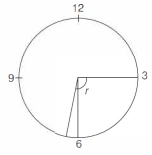
0 likes
View SolutionTrigonometrical Ratios, Functions and Identities — Mix Examples-Trigonometrical Ratios, Functions and Identities · Frequently Asked Questions
1Are these Trigonometrical Ratios, Functions and Identities questions useful for JEE and NEET?
Yes. All questions in this section are mapped to JEE Main and NEET exam patterns. Previous year questions from JEE Main, NEET, GUJCET and state-level exams are included with full solutions.
2Can I switch to Hindi or Gujarati for these questions?
Yes. Use the language tabs in the hero section or the sidebar to view the same questions and solutions in English, Hindi or Gujarati.
3How do I generate a question paper from this subtopic?
Use the Vedclass Exam Paper Generator — select the chapter and subtopic, set difficulty, and generate Sets A, B, C, D automatically. First 3 chapters of every subject are free.
Vedclass Products
For Students
Vedclass Test Series
Mock tests in real JEE/NEET style with performance analysis. 5-day free trial.
Start Free TrialFor Teachers
Exam Paper Generator
Generate Set A/B/C/D papers from this chapter in 2 minutes. 3 chapters free.
Try FreeFor Institutes
Online Exam Module
Live online exams with unlimited students, 360° analytics & white-label branding.
See DemoFor Teachers & Institutes
Generate a Trigonometrical Ratios, Functions and Identities Exam Paper in 2 Minutes
Select subtopic & difficulty — Sets A, B, C, D auto-generated with No Repeat logic.
First 3 chapters of every subject are free — no payment required.