
A English
Mix Examples-Trigonometrical Ratios, Functions and Identities Questions in English
Class 11 Mathematics · Trigonometrical Ratios, Functions and Identities · Mix Examples-Trigonometrical Ratios, Functions and Identities
670+
Questions
English
Language
100%
With Solutions
Showing 50 of 670 questions in English
151
AdvancedMCQ
The value of $\cos \frac{\pi}{10} \cos \frac{2\pi}{10} \cos \frac{4\pi}{10} \cos \frac{8\pi}{10} \cos \frac{16\pi}{10}$ is
A
$\frac{1}{32}$
B
$\frac{1}{16}$
C
$\frac{\cos(\pi/10)}{16}$
D
$-\frac{1}{16}$
0 likes
View Solution152
DifficultMCQ
If $a \cos^3 \alpha + 3a \cos \alpha \sin^2 \alpha = m$ and $a \sin^3 \alpha + 3a \cos^2 \alpha \sin \alpha = n$,then $(m + n)^{2/3} + (m - n)^{2/3}$ is equal to:
A
$2a^2$
B
$2a^{1/3}$
C
$2a^{2/3}$
D
$2a^3$
Solution
(C) Given:
$m = a \cos^3 \alpha + 3a \cos \alpha \sin^2 \alpha$
$n = a \sin^3 \alpha + 3a \cos^2 \alpha \sin \alpha$
Adding $m$ and $n$:
$m + n = a(\cos^3 \alpha + 3 \cos \alpha \sin^2 \alpha + \sin^3 \alpha + 3 \cos^2 \alpha \sin \alpha)$
$m + n = a(\cos \alpha + \sin \alpha)^3$
$(m + n)^{2/3} = a^{2/3}(\cos \alpha + \sin \alpha)^2$
Subtracting $n$ from $m$:
$m - n = a(\cos^3 \alpha + 3 \cos \alpha \sin^2 \alpha - \sin^3 \alpha - 3 \cos^2 \alpha \sin \alpha)$
$m - n = a(\cos \alpha - \sin \alpha)^3$
$(m - n)^{2/3} = a^{2/3}(\cos \alpha - \sin \alpha)^2$
Now,adding the two results:
$(m + n)^{2/3} + (m - n)^{2/3} = a^{2/3}[(\cos \alpha + \sin \alpha)^2 + (\cos \alpha - \sin \alpha)^2]$
$= a^{2/3}[(\cos^2 \alpha + \sin^2 \alpha + 2 \sin \alpha \cos \alpha) + (\cos^2 \alpha + \sin^2 \alpha - 2 \sin \alpha \cos \alpha)]$
$= a^{2/3}[1 + 1] = 2a^{2/3}$
$m = a \cos^3 \alpha + 3a \cos \alpha \sin^2 \alpha$
$n = a \sin^3 \alpha + 3a \cos^2 \alpha \sin \alpha$
Adding $m$ and $n$:
$m + n = a(\cos^3 \alpha + 3 \cos \alpha \sin^2 \alpha + \sin^3 \alpha + 3 \cos^2 \alpha \sin \alpha)$
$m + n = a(\cos \alpha + \sin \alpha)^3$
$(m + n)^{2/3} = a^{2/3}(\cos \alpha + \sin \alpha)^2$
Subtracting $n$ from $m$:
$m - n = a(\cos^3 \alpha + 3 \cos \alpha \sin^2 \alpha - \sin^3 \alpha - 3 \cos^2 \alpha \sin \alpha)$
$m - n = a(\cos \alpha - \sin \alpha)^3$
$(m - n)^{2/3} = a^{2/3}(\cos \alpha - \sin \alpha)^2$
Now,adding the two results:
$(m + n)^{2/3} + (m - n)^{2/3} = a^{2/3}[(\cos \alpha + \sin \alpha)^2 + (\cos \alpha - \sin \alpha)^2]$
$= a^{2/3}[(\cos^2 \alpha + \sin^2 \alpha + 2 \sin \alpha \cos \alpha) + (\cos^2 \alpha + \sin^2 \alpha - 2 \sin \alpha \cos \alpha)]$
$= a^{2/3}[1 + 1] = 2a^{2/3}$
0 likes
View Solution153
AdvancedMCQ
The value of $\csc \frac{\pi}{18} - \sqrt{3} \sec \frac{\pi}{18}$ is a
A
surd
B
rational which is not integral
C
negative natural number
D
natural number
Solution
(D) Let $E = \csc \frac{\pi}{18} - \sqrt{3} \sec \frac{\pi}{18} = \frac{1}{\sin \frac{\pi}{18}} - \frac{\sqrt{3}}{\cos \frac{\pi}{18}}$.
$E = \frac{\cos \frac{\pi}{18} - \sqrt{3} \sin \frac{\pi}{18}}{\sin \frac{\pi}{18} \cos \frac{\pi}{18}}$.
Multiply numerator and denominator by $2$:
$E = \frac{2(\frac{1}{2} \cos \frac{\pi}{18} - \frac{\sqrt{3}}{2} \sin \frac{\pi}{18})}{\frac{1}{2} \sin \frac{\pi}{9}} = \frac{4(\sin \frac{\pi}{6} \cos \frac{\pi}{18} - \cos \frac{\pi}{6} \sin \frac{\pi}{18})}{\sin \frac{\pi}{9}}$.
Using $\sin(A - B) = \sin A \cos B - \cos A \sin B$:
$E = \frac{4 \sin(\frac{\pi}{6} - \frac{\pi}{18})}{\sin \frac{\pi}{9}} = \frac{4 \sin(\frac{3\pi - \pi}{18})}{\sin \frac{\pi}{9}} = \frac{4 \sin \frac{2\pi}{18}}{\sin \frac{\pi}{9}} = \frac{4 \sin \frac{\pi}{9}}{\sin \frac{\pi}{9}} = 4$.
Since $4$ is a natural number,the correct option is $D$.
$E = \frac{\cos \frac{\pi}{18} - \sqrt{3} \sin \frac{\pi}{18}}{\sin \frac{\pi}{18} \cos \frac{\pi}{18}}$.
Multiply numerator and denominator by $2$:
$E = \frac{2(\frac{1}{2} \cos \frac{\pi}{18} - \frac{\sqrt{3}}{2} \sin \frac{\pi}{18})}{\frac{1}{2} \sin \frac{\pi}{9}} = \frac{4(\sin \frac{\pi}{6} \cos \frac{\pi}{18} - \cos \frac{\pi}{6} \sin \frac{\pi}{18})}{\sin \frac{\pi}{9}}$.
Using $\sin(A - B) = \sin A \cos B - \cos A \sin B$:
$E = \frac{4 \sin(\frac{\pi}{6} - \frac{\pi}{18})}{\sin \frac{\pi}{9}} = \frac{4 \sin(\frac{3\pi - \pi}{18})}{\sin \frac{\pi}{9}} = \frac{4 \sin \frac{2\pi}{18}}{\sin \frac{\pi}{9}} = \frac{4 \sin \frac{\pi}{9}}{\sin \frac{\pi}{9}} = 4$.
Since $4$ is a natural number,the correct option is $D$.
0 likes
View Solution154
AdvancedMCQ
In a right-angled triangle,the hypotenuse is $2 \sqrt{2}$ times the perpendicular drawn from the opposite vertex. Then the other acute angles of the triangle are
A
$\frac{\pi}{3}$ & $\frac{\pi}{3}$
B
$\frac{\pi}{8}$ & $\frac{3 \pi}{8}$
C
$\frac{\pi}{4}$ & $\frac{\pi}{4}$
D
$\frac{\pi}{5}$ & $\frac{3 \pi}{10}$
Solution
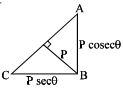
(B) Let the perpendicular from the right-angle vertex to the hypotenuse be $p$.
Let the two segments of the hypotenuse be $x$ and $y$.
In the two smaller right-angled triangles formed,we have $x = p \tan \theta$ and $y = p \cot \theta$.
The hypotenuse is $x + y = p(\tan \theta + \cot \theta) = p(\frac{\sin \theta}{\cos \theta} + \frac{\cos \theta}{\sin \theta}) = \frac{p}{\sin \theta \cos \theta} = \frac{2p}{\sin 2\theta}$.
Given that the hypotenuse is $2\sqrt{2}p$,we have $\frac{2p}{\sin 2\theta} = 2\sqrt{2}p$.
$\Rightarrow \sin 2\theta = \frac{1}{\sqrt{2}}$.
Thus,$2\theta = \frac{\pi}{4}$ or $2\theta = \pi - \frac{\pi}{4} = \frac{3\pi}{4}$.
Therefore,$\theta = \frac{\pi}{8}$ or $\theta = \frac{3\pi}{8}$.
The two acute angles are $\frac{\pi}{8}$ and $\frac{3\pi}{8}$.
Let the two segments of the hypotenuse be $x$ and $y$.
In the two smaller right-angled triangles formed,we have $x = p \tan \theta$ and $y = p \cot \theta$.
The hypotenuse is $x + y = p(\tan \theta + \cot \theta) = p(\frac{\sin \theta}{\cos \theta} + \frac{\cos \theta}{\sin \theta}) = \frac{p}{\sin \theta \cos \theta} = \frac{2p}{\sin 2\theta}$.
Given that the hypotenuse is $2\sqrt{2}p$,we have $\frac{2p}{\sin 2\theta} = 2\sqrt{2}p$.
$\Rightarrow \sin 2\theta = \frac{1}{\sqrt{2}}$.
Thus,$2\theta = \frac{\pi}{4}$ or $2\theta = \pi - \frac{\pi}{4} = \frac{3\pi}{4}$.
Therefore,$\theta = \frac{\pi}{8}$ or $\theta = \frac{3\pi}{8}$.
The two acute angles are $\frac{\pi}{8}$ and $\frac{3\pi}{8}$.
0 likes
View Solution155
AdvancedMCQ
If the orthocentre and circumcentre of a triangle $ABC$ are at equal distances from the side $BC$ and lie on the same side of $BC$,then the value of $\tan B \tan C$ is equal to:
A
$3$
B
$\frac{1}{3}$
C
$-3$
D
$-\frac{1}{3}$
Solution
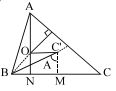
(A) Let $O$ be the orthocentre and $C'$ be the circumcentre of $\triangle ABC$.
The distance of the orthocentre $O$ from side $BC$ is given by $ON = 2R \cos B \cos C$.
The distance of the circumcentre $C'$ from side $BC$ is given by $C'M = R \cos A$.
Given that $ON = C'M$,we have:
$2R \cos B \cos C = R \cos A$
$2 \cos B \cos C = \cos A$
Since $A + B + C = 180^{\circ}$,$\cos A = \cos(180^{\circ} - (B + C)) = -\cos(B + C)$.
Thus,$2 \cos B \cos C = -\cos(B + C)$.
$2 \cos B \cos C = -(\cos B \cos C - \sin B \sin C)$.
$2 \cos B \cos C = -\cos B \cos C + \sin B \sin C$.
$3 \cos B \cos C = \sin B \sin C$.
Dividing both sides by $\cos B \cos C$ (assuming $\cos B, \cos C \neq 0$):
$3 = \tan B \tan C$.
Therefore,$\tan B \tan C = 3$.
The distance of the orthocentre $O$ from side $BC$ is given by $ON = 2R \cos B \cos C$.
The distance of the circumcentre $C'$ from side $BC$ is given by $C'M = R \cos A$.
Given that $ON = C'M$,we have:
$2R \cos B \cos C = R \cos A$
$2 \cos B \cos C = \cos A$
Since $A + B + C = 180^{\circ}$,$\cos A = \cos(180^{\circ} - (B + C)) = -\cos(B + C)$.
Thus,$2 \cos B \cos C = -\cos(B + C)$.
$2 \cos B \cos C = -(\cos B \cos C - \sin B \sin C)$.
$2 \cos B \cos C = -\cos B \cos C + \sin B \sin C$.
$3 \cos B \cos C = \sin B \sin C$.
Dividing both sides by $\cos B \cos C$ (assuming $\cos B, \cos C \neq 0$):
$3 = \tan B \tan C$.
Therefore,$\tan B \tan C = 3$.
0 likes
View Solution156
AdvancedMCQ
The exact value of $\cos^2 73^\circ + \cos^2 47^\circ + (\cos 73^\circ \cdot \cos 47^\circ)$ is
A
$1/4$
B
$1/2$
C
$3/4$
D
$1$
Solution
(C) Let $E = \cos^2 73^\circ + \cos^2 47^\circ + \cos 73^\circ \cos 47^\circ$.
Using the identity $\cos^2 \theta = \frac{1 + \cos 2\theta}{2}$ and $2 \cos A \cos B = \cos(A+B) + \cos(A-B)$:
$E = \frac{1 + \cos 146^\circ}{2} + \frac{1 + \cos 94^\circ}{2} + \frac{\cos 120^\circ + \cos 26^\circ}{2}$
$E = \frac{1}{2} + \frac{\cos 146^\circ}{2} + \frac{1}{2} + \frac{\cos 94^\circ}{2} + \frac{-1/2}{2} + \frac{\cos 26^\circ}{2}$
$E = 1 - \frac{1}{4} + \frac{1}{2} (\cos 146^\circ + \cos 94^\circ + \cos 26^\circ)$
Since $\cos 146^\circ + \cos 94^\circ = 2 \cos(\frac{146+94}{2}) \cos(\frac{146-94}{2}) = 2 \cos 120^\circ \cos 26^\circ = 2(-1/2) \cos 26^\circ = -\cos 26^\circ$.
$E = \frac{3}{4} + \frac{1}{2} (-\cos 26^\circ + \cos 26^\circ) = \frac{3}{4}$.
Using the identity $\cos^2 \theta = \frac{1 + \cos 2\theta}{2}$ and $2 \cos A \cos B = \cos(A+B) + \cos(A-B)$:
$E = \frac{1 + \cos 146^\circ}{2} + \frac{1 + \cos 94^\circ}{2} + \frac{\cos 120^\circ + \cos 26^\circ}{2}$
$E = \frac{1}{2} + \frac{\cos 146^\circ}{2} + \frac{1}{2} + \frac{\cos 94^\circ}{2} + \frac{-1/2}{2} + \frac{\cos 26^\circ}{2}$
$E = 1 - \frac{1}{4} + \frac{1}{2} (\cos 146^\circ + \cos 94^\circ + \cos 26^\circ)$
Since $\cos 146^\circ + \cos 94^\circ = 2 \cos(\frac{146+94}{2}) \cos(\frac{146-94}{2}) = 2 \cos 120^\circ \cos 26^\circ = 2(-1/2) \cos 26^\circ = -\cos 26^\circ$.
$E = \frac{3}{4} + \frac{1}{2} (-\cos 26^\circ + \cos 26^\circ) = \frac{3}{4}$.
0 likes
View Solution157
AdvancedMCQ
If $O$ is the circumcentre of the $\Delta ABC$ and $R_1, R_2$ and $R_3$ are the radii of the circumcircles of triangles $OBC, OCA$ and $OAB$ respectively,then the value of $\frac{a}{R_1} + \frac{b}{R_2} + \frac{c}{R_3}$ is equal to:
A
$\frac{abc}{2R^3}$
B
$\frac{R^3}{abc}$
C
$\frac{4\Delta}{R^2}$
D
$\frac{\Delta}{4R^2}$
Solution
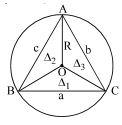
(C) Let $R$ be the circumradius of $\Delta ABC$. The sides of $\Delta OBC$ are $a, R, R$. The area of $\Delta OBC$ is $\Delta_1$. The circumradius $R_1$ of $\Delta OBC$ is given by $R_1 = \frac{a \cdot R \cdot R}{4\Delta_1} = \frac{aR^2}{4\Delta_1}$.
Thus,$\frac{a}{R_1} = \frac{4\Delta_1}{R^2}$.
Similarly,$\frac{b}{R_2} = \frac{4\Delta_2}{R^2}$ and $\frac{c}{R_3} = \frac{4\Delta_3}{R^2}$.
Adding these,we get $\frac{a}{R_1} + \frac{b}{R_2} + \frac{c}{R_3} = \frac{4}{R^2}(\Delta_1 + \Delta_2 + \Delta_3)$.
Since $\Delta_1 + \Delta_2 + \Delta_3 = \Delta$ (the area of $\Delta ABC$),the expression becomes $\frac{4\Delta}{R^2}$.
Thus,$\frac{a}{R_1} = \frac{4\Delta_1}{R^2}$.
Similarly,$\frac{b}{R_2} = \frac{4\Delta_2}{R^2}$ and $\frac{c}{R_3} = \frac{4\Delta_3}{R^2}$.
Adding these,we get $\frac{a}{R_1} + \frac{b}{R_2} + \frac{c}{R_3} = \frac{4}{R^2}(\Delta_1 + \Delta_2 + \Delta_3)$.
Since $\Delta_1 + \Delta_2 + \Delta_3 = \Delta$ (the area of $\Delta ABC$),the expression becomes $\frac{4\Delta}{R^2}$.
0 likes
View Solution158
DifficultMCQ
The value of $\left( 1 + \cos \frac{\pi }{9} \right) \left( 1 + \cos \frac{3\pi }{9} \right) \left( 1 + \cos \frac{5\pi }{9} \right) \left( 1 + \cos \frac{7\pi }{9} \right)$ is
A
$\frac{9}{16}$
B
$\frac{10}{16}$
C
$\frac{12}{16}$
D
$\frac{5}{16}$
Solution
(A) Let $E = \left( 1 + \cos \frac{\pi}{9} \right) \left( 1 + \cos \frac{3\pi}{9} \right) \left( 1 + \cos \frac{5\pi}{9} \right) \left( 1 + \cos \frac{7\pi}{9} \right)$.
Since $\cos \frac{3\pi}{9} = \cos \frac{\pi}{3} = \frac{1}{2}$,we have $1 + \cos \frac{3\pi}{9} = \frac{3}{2}$.
Thus,$E = \frac{3}{2} \left( 1 + \cos 20^\circ \right) \left( 1 + \cos 100^\circ \right) \left( 1 + \cos 140^\circ \right)$.
Using $1 + \cos \theta = 2 \cos^2 \frac{\theta}{2}$,we get:
$E = \frac{3}{2} \left( 2 \cos^2 10^\circ \right) \left( 2 \cos^2 50^\circ \right) \left( 2 \cos^2 70^\circ \right) = 12 \left( \cos 10^\circ \cos 50^\circ \cos 70^\circ \right)^2$.
Using the identity $\cos \theta \cos(60^\circ - \theta) \cos(60^\circ + \theta) = \frac{1}{4} \cos 3\theta$ with $\theta = 10^\circ$:
$\cos 10^\circ \cos 50^\circ \cos 70^\circ = \frac{1}{4} \cos 30^\circ = \frac{1}{4} \times \frac{\sqrt{3}}{2} = \frac{\sqrt{3}}{8}$.
Therefore,$E = 12 \times \left( \frac{\sqrt{3}}{8} \right)^2 = 12 \times \frac{3}{64} = \frac{36}{64} = \frac{9}{16}$.
Since $\cos \frac{3\pi}{9} = \cos \frac{\pi}{3} = \frac{1}{2}$,we have $1 + \cos \frac{3\pi}{9} = \frac{3}{2}$.
Thus,$E = \frac{3}{2} \left( 1 + \cos 20^\circ \right) \left( 1 + \cos 100^\circ \right) \left( 1 + \cos 140^\circ \right)$.
Using $1 + \cos \theta = 2 \cos^2 \frac{\theta}{2}$,we get:
$E = \frac{3}{2} \left( 2 \cos^2 10^\circ \right) \left( 2 \cos^2 50^\circ \right) \left( 2 \cos^2 70^\circ \right) = 12 \left( \cos 10^\circ \cos 50^\circ \cos 70^\circ \right)^2$.
Using the identity $\cos \theta \cos(60^\circ - \theta) \cos(60^\circ + \theta) = \frac{1}{4} \cos 3\theta$ with $\theta = 10^\circ$:
$\cos 10^\circ \cos 50^\circ \cos 70^\circ = \frac{1}{4} \cos 30^\circ = \frac{1}{4} \times \frac{\sqrt{3}}{2} = \frac{\sqrt{3}}{8}$.
Therefore,$E = 12 \times \left( \frac{\sqrt{3}}{8} \right)^2 = 12 \times \frac{3}{64} = \frac{36}{64} = \frac{9}{16}$.
0 likes
View Solution159
AdvancedMCQ
The number of all possible triplets $(a_1, a_2, a_3)$ such that $a_1 + a_2 \cos 2x + a_3 \sin^2 x = 0$ for all $x$ is
A
$0$
B
$1$
C
$3$
D
infinite
Solution
(D) Given the equation $a_1 + a_2 \cos 2x + a_3 \sin^2 x = 0$ for all $x$.
Using the identity $\sin^2 x = \frac{1 - \cos 2x}{2}$,we substitute this into the equation:
$a_1 + a_2 \cos 2x + a_3 \left( \frac{1 - \cos 2x}{2} \right) = 0$
Rearranging the terms based on the coefficients of $\cos 2x$ and the constant term:
$\left( a_1 + \frac{a_3}{2} \right) + \left( a_2 - \frac{a_3}{2} \right) \cos 2x = 0$
Since this must hold for all $x$,the coefficients must be zero:
$a_1 + \frac{a_3}{2} = 0 \implies a_1 = -\frac{a_3}{2}$
$a_2 - \frac{a_3}{2} = 0 \implies a_2 = \frac{a_3}{2}$
Here,$a_3$ can be any real number. Thus,for every value of $a_3$,we get a unique triplet $(a_1, a_2, a_3)$.
Since there are infinitely many real values for $a_3$,there are infinitely many such triplets.
Using the identity $\sin^2 x = \frac{1 - \cos 2x}{2}$,we substitute this into the equation:
$a_1 + a_2 \cos 2x + a_3 \left( \frac{1 - \cos 2x}{2} \right) = 0$
Rearranging the terms based on the coefficients of $\cos 2x$ and the constant term:
$\left( a_1 + \frac{a_3}{2} \right) + \left( a_2 - \frac{a_3}{2} \right) \cos 2x = 0$
Since this must hold for all $x$,the coefficients must be zero:
$a_1 + \frac{a_3}{2} = 0 \implies a_1 = -\frac{a_3}{2}$
$a_2 - \frac{a_3}{2} = 0 \implies a_2 = \frac{a_3}{2}$
Here,$a_3$ can be any real number. Thus,for every value of $a_3$,we get a unique triplet $(a_1, a_2, a_3)$.
Since there are infinitely many real values for $a_3$,there are infinitely many such triplets.
0 likes
View Solution160
DifficultMCQ
The value of $\sqrt{3} \, \text{cosec} \, 20^\circ - \text{sec} \, 20^\circ$ is:
A
$2$
B
$\frac{2 \sin 20^\circ}{\sin 40^\circ}$
C
$4$
D
$\frac{4 \sin 20^\circ}{\sin 40^\circ}$
Solution
(C) Let $E = \sqrt{3} \, \text{cosec} \, 20^\circ - \text{sec} \, 20^\circ = \frac{\sqrt{3}}{\sin 20^\circ} - \frac{1}{\cos 20^\circ}$
$E = \frac{\sqrt{3} \cos 20^\circ - \sin 20^\circ}{\sin 20^\circ \cos 20^\circ}$
Multiply numerator and denominator by $2$:
$E = \frac{2(\frac{\sqrt{3}}{2} \cos 20^\circ - \frac{1}{2} \sin 20^\circ)}{\frac{1}{2} (2 \sin 20^\circ \cos 20^\circ)}$
$E = \frac{4(\sin 60^\circ \cos 20^\circ - \cos 60^\circ \sin 20^\circ)}{\sin 40^\circ}$
$E = \frac{4 \sin(60^\circ - 20^\circ)}{\sin 40^\circ} = \frac{4 \sin 40^\circ}{\sin 40^\circ} = 4$
$E = \frac{\sqrt{3} \cos 20^\circ - \sin 20^\circ}{\sin 20^\circ \cos 20^\circ}$
Multiply numerator and denominator by $2$:
$E = \frac{2(\frac{\sqrt{3}}{2} \cos 20^\circ - \frac{1}{2} \sin 20^\circ)}{\frac{1}{2} (2 \sin 20^\circ \cos 20^\circ)}$
$E = \frac{4(\sin 60^\circ \cos 20^\circ - \cos 60^\circ \sin 20^\circ)}{\sin 40^\circ}$
$E = \frac{4 \sin(60^\circ - 20^\circ)}{\sin 40^\circ} = \frac{4 \sin 40^\circ}{\sin 40^\circ} = 4$
0 likes
View Solution161
AdvancedMCQ
The value of the expression $(sinx + cosecx)^2 + (cosx + secx)^2 - (tanx + cotx)^2$ wherever defined is equal to
A
$0$
B
$5$
C
$7$
D
$9$
Solution
(B) Expand the given expression:
$(\sin x + cosecx)^2 = \sin ^2x + co\sec ^2x + 2\sin x \cdot cosecx = \sin ^2x + co\sec ^2x + 2$
$(cosx + \sec x)^2 = cos^2x + \sec ^2x + 2cosx \cdot \sec x = cos^2x + \sec ^2x + 2$
$(\tan x + \cot x)^2 = \tan ^2x + \cot ^2x + 2\tan x \cdot \cot x = \tan ^2x + \cot ^2x + 2$
Substituting these into the expression:
$(\sin ^2x + cosec ^2x + 2) + (cos^2x + \sec ^2x + 2) - (\tan ^2x + \cot ^2x + 2)$
$= (\sin ^2x + cos^2x) + cosec ^2x + \sec ^2x + 4 - \tan ^2x - \cot ^2x - 2$
$= 1 + (1 + \cot ^2x) + (1 + \tan ^2x) + 2 - \tan ^2x - \cot ^2x$
$= 1 + 1 + \cot ^2x + 1 + \tan ^2x + 2 - \tan ^2x - \cot ^2x$
$= 5$
$(\sin x + cosecx)^2 = \sin ^2x + co\sec ^2x + 2\sin x \cdot cosecx = \sin ^2x + co\sec ^2x + 2$
$(cosx + \sec x)^2 = cos^2x + \sec ^2x + 2cosx \cdot \sec x = cos^2x + \sec ^2x + 2$
$(\tan x + \cot x)^2 = \tan ^2x + \cot ^2x + 2\tan x \cdot \cot x = \tan ^2x + \cot ^2x + 2$
Substituting these into the expression:
$(\sin ^2x + cosec ^2x + 2) + (cos^2x + \sec ^2x + 2) - (\tan ^2x + \cot ^2x + 2)$
$= (\sin ^2x + cos^2x) + cosec ^2x + \sec ^2x + 4 - \tan ^2x - \cot ^2x - 2$
$= 1 + (1 + \cot ^2x) + (1 + \tan ^2x) + 2 - \tan ^2x - \cot ^2x$
$= 1 + 1 + \cot ^2x + 1 + \tan ^2x + 2 - \tan ^2x - \cot ^2x$
$= 5$
1 likes
View Solution162
AdvancedMCQ
If $\tan \alpha = \frac{x^2 - x}{x^2 - x + 1}$ and $\tan \beta = \frac{1}{2x^2 - 2x + 1}$ $(x \ne 0, 1)$,where $0 < \alpha, \beta < \frac{\pi}{2}$,then $\tan(\alpha + \beta)$ has the value equal to:
A
$1$
B
$-1$
C
$2$
D
$\frac{3}{4}$
Solution
(A) Let $t = x^2 - x$. Then $\tan \alpha = \frac{t}{t + 1}$ and $\tan \beta = \frac{1}{2t + 1}$.
Using the formula $\tan(\alpha + \beta) = \frac{\tan \alpha + \tan \beta}{1 - \tan \alpha \tan \beta}$,we substitute the values:
$\tan(\alpha + \beta) = \frac{\frac{t}{t + 1} + \frac{1}{2t + 1}}{1 - \left(\frac{t}{t + 1}\right) \left(\frac{1}{2t + 1}\right)}$
$= \frac{\frac{t(2t + 1) + (t + 1)}{(t + 1)(2t + 1)}}{\frac{(t + 1)(2t + 1) - t}{(t + 1)(2t + 1)}}$
$= \frac{2t^2 + t + t + 1}{2t^2 + 2t + t + 1 - t}$
$= \frac{2t^2 + 2t + 1}{2t^2 + 2t + 1} = 1$
Therefore,$\tan(\alpha + \beta) = 1$.
Using the formula $\tan(\alpha + \beta) = \frac{\tan \alpha + \tan \beta}{1 - \tan \alpha \tan \beta}$,we substitute the values:
$\tan(\alpha + \beta) = \frac{\frac{t}{t + 1} + \frac{1}{2t + 1}}{1 - \left(\frac{t}{t + 1}\right) \left(\frac{1}{2t + 1}\right)}$
$= \frac{\frac{t(2t + 1) + (t + 1)}{(t + 1)(2t + 1)}}{\frac{(t + 1)(2t + 1) - t}{(t + 1)(2t + 1)}}$
$= \frac{2t^2 + t + t + 1}{2t^2 + 2t + t + 1 - t}$
$= \frac{2t^2 + 2t + 1}{2t^2 + 2t + 1} = 1$
Therefore,$\tan(\alpha + \beta) = 1$.
0 likes
View Solution163
AdvancedMCQ
If $\theta$ is eliminated from the equations $x = a \cos(\theta - \alpha)$ and $y = b \cos(\theta - \beta)$,then $\frac{x^2}{a^2} + \frac{y^2}{b^2} - \frac{2xy}{ab} \cos(\alpha - \beta)$ is equal to
A
$\cos^2(\alpha - \beta)$
B
$\sin^2(\alpha - \beta)$
C
$\sec^2(\alpha - \beta)$
D
$\csc^2(\alpha - \beta)$
Solution
(B) Given equations are $\frac{x}{a} = \cos(\theta - \alpha)$ and $\frac{y}{b} = \cos(\theta - \beta)$.
We know that $(\alpha - \beta) = (\theta - \beta) - (\theta - \alpha)$.
Using the cosine difference formula,$\cos(\alpha - \beta) = \cos((\theta - \beta) - (\theta - \alpha)) = \cos(\theta - \beta) \cos(\theta - \alpha) + \sin(\theta - \beta) \sin(\theta - \alpha)$.
Substituting the given values,$\cos(\alpha - \beta) = \frac{y}{b} \cdot \frac{x}{a} + \sqrt{1 - \frac{x^2}{a^2}} \sqrt{1 - \frac{y^2}{b^2}}$.
Rearranging,$\cos(\alpha - \beta) - \frac{xy}{ab} = \sqrt{1 - \frac{x^2}{a^2}} \sqrt{1 - \frac{y^2}{b^2}}$.
Squaring both sides,$\cos^2(\alpha - \beta) + \frac{x^2y^2}{a^2b^2} - \frac{2xy}{ab} \cos(\alpha - \beta) = (1 - \frac{x^2}{a^2})(1 - \frac{y^2}{b^2})$.
Expanding the right side,$\cos^2(\alpha - \beta) + \frac{x^2y^2}{a^2b^2} - \frac{2xy}{ab} \cos(\alpha - \beta) = 1 - \frac{y^2}{b^2} - \frac{x^2}{a^2} + \frac{x^2y^2}{a^2b^2}$.
Canceling $\frac{x^2y^2}{a^2b^2}$ from both sides and rearranging,$\frac{x^2}{a^2} + \frac{y^2}{b^2} - \frac{2xy}{ab} \cos(\alpha - \beta) = 1 - \cos^2(\alpha - \beta)$.
Therefore,the expression is equal to $\sin^2(\alpha - \beta)$.
We know that $(\alpha - \beta) = (\theta - \beta) - (\theta - \alpha)$.
Using the cosine difference formula,$\cos(\alpha - \beta) = \cos((\theta - \beta) - (\theta - \alpha)) = \cos(\theta - \beta) \cos(\theta - \alpha) + \sin(\theta - \beta) \sin(\theta - \alpha)$.
Substituting the given values,$\cos(\alpha - \beta) = \frac{y}{b} \cdot \frac{x}{a} + \sqrt{1 - \frac{x^2}{a^2}} \sqrt{1 - \frac{y^2}{b^2}}$.
Rearranging,$\cos(\alpha - \beta) - \frac{xy}{ab} = \sqrt{1 - \frac{x^2}{a^2}} \sqrt{1 - \frac{y^2}{b^2}}$.
Squaring both sides,$\cos^2(\alpha - \beta) + \frac{x^2y^2}{a^2b^2} - \frac{2xy}{ab} \cos(\alpha - \beta) = (1 - \frac{x^2}{a^2})(1 - \frac{y^2}{b^2})$.
Expanding the right side,$\cos^2(\alpha - \beta) + \frac{x^2y^2}{a^2b^2} - \frac{2xy}{ab} \cos(\alpha - \beta) = 1 - \frac{y^2}{b^2} - \frac{x^2}{a^2} + \frac{x^2y^2}{a^2b^2}$.
Canceling $\frac{x^2y^2}{a^2b^2}$ from both sides and rearranging,$\frac{x^2}{a^2} + \frac{y^2}{b^2} - \frac{2xy}{ab} \cos(\alpha - \beta) = 1 - \cos^2(\alpha - \beta)$.
Therefore,the expression is equal to $\sin^2(\alpha - \beta)$.
0 likes
View Solution164
AdvancedMCQ
The expression $\frac{\tan^2 20^\circ - \sin^2 20^\circ}{\tan^2 20^\circ \cdot \sin^2 20^\circ}$ simplifies to
A
a rational which is not integral
B
a surd
C
a natural which is prime
D
a natural which is not composite
Solution
(D) Let the expression be $E = \frac{\tan^2 20^\circ - \sin^2 20^\circ}{\tan^2 20^\circ \cdot \sin^2 20^\circ}$.
We know that $\tan^2 \theta - \sin^2 \theta = \frac{\sin^2 \theta}{\cos^2 \theta} - \sin^2 \theta = \sin^2 \theta \left( \frac{1}{\cos^2 \theta} - 1 \right) = \sin^2 \theta \left( \frac{1 - \cos^2 \theta}{\cos^2 \theta} \right) = \sin^2 \theta \cdot \frac{\sin^2 \theta}{\cos^2 \theta} = \tan^2 \theta \cdot \sin^2 \theta$.
Substituting $\theta = 20^\circ$,we get $\tan^2 20^\circ - \sin^2 20^\circ = \tan^2 20^\circ \cdot \sin^2 20^\circ$.
Therefore,$E = \frac{\tan^2 20^\circ \cdot \sin^2 20^\circ}{\tan^2 20^\circ \cdot \sin^2 20^\circ} = 1$.
Since $1$ is a natural number and it is not composite (it is neither prime nor composite),the correct option is $D$.
We know that $\tan^2 \theta - \sin^2 \theta = \frac{\sin^2 \theta}{\cos^2 \theta} - \sin^2 \theta = \sin^2 \theta \left( \frac{1}{\cos^2 \theta} - 1 \right) = \sin^2 \theta \left( \frac{1 - \cos^2 \theta}{\cos^2 \theta} \right) = \sin^2 \theta \cdot \frac{\sin^2 \theta}{\cos^2 \theta} = \tan^2 \theta \cdot \sin^2 \theta$.
Substituting $\theta = 20^\circ$,we get $\tan^2 20^\circ - \sin^2 20^\circ = \tan^2 20^\circ \cdot \sin^2 20^\circ$.
Therefore,$E = \frac{\tan^2 20^\circ \cdot \sin^2 20^\circ}{\tan^2 20^\circ \cdot \sin^2 20^\circ} = 1$.
Since $1$ is a natural number and it is not composite (it is neither prime nor composite),the correct option is $D$.
0 likes
View Solution165
AdvancedMCQ
Choose the $INCORRECT$ statement$(s)$.
A
There exists a value of $\theta$ between $0$ and $2\pi$ which satisfies the equation $\sin^4 \theta - \sin^2 \theta - 1 = 0$.
B
If $\tan A = \frac{\sqrt{3}}{4 - \sqrt{3}}$ and $\tan B = \frac{\sqrt{3}}{4 + \sqrt{3}}$,then $\tan(A - B)$ must be irrational.
C
The sign of the product $\sin(2) \cdot \sin(3) \cdot \sin(5)$ is positive.
D
All of the above
Solution
(D) For option $A$: Let $x = \sin^2 \theta$. The equation is $x^2 - x - 1 = 0$. The roots are $x = \frac{1 \pm \sqrt{5}}{2}$. Since $\sin^2 \theta$ must be in $[0, 1]$,we check $\frac{1 + \sqrt{5}}{2} \approx 1.618 > 1$ and $\frac{1 - \sqrt{5}}{2} < 0$. Thus,no real $\theta$ exists. Statement $A$ is $INCORRECT$.
For option $B$: $\tan(A - B) = \frac{\tan A - \tan B}{1 + \tan A \tan B} = \frac{\frac{\sqrt{3}}{4 - \sqrt{3}} - \frac{\sqrt{3}}{4 + \sqrt{3}}}{1 + \frac{3}{16 - 3}} = \frac{\sqrt{3}(4 + \sqrt{3} - 4 + \sqrt{3})}{13 + 3} \cdot \frac{13}{13} = \frac{6}{16} = \frac{3}{8}$. Since $3/8$ is rational,the statement that it must be irrational is $INCORRECT$.
For option $C$: $\sin(2)$ (radians) is in the $2^{nd}$ quadrant (positive),$\sin(3)$ is in the $2^{nd}$ quadrant (positive),and $\sin(5)$ is in the $4^{th}$ quadrant (negative). The product $(+) \cdot (+) \cdot (-) = (-)$. Thus,the statement is $INCORRECT$.
Since $A, B,$ and $C$ are all incorrect,$D$ is the correct choice.
For option $B$: $\tan(A - B) = \frac{\tan A - \tan B}{1 + \tan A \tan B} = \frac{\frac{\sqrt{3}}{4 - \sqrt{3}} - \frac{\sqrt{3}}{4 + \sqrt{3}}}{1 + \frac{3}{16 - 3}} = \frac{\sqrt{3}(4 + \sqrt{3} - 4 + \sqrt{3})}{13 + 3} \cdot \frac{13}{13} = \frac{6}{16} = \frac{3}{8}$. Since $3/8$ is rational,the statement that it must be irrational is $INCORRECT$.
For option $C$: $\sin(2)$ (radians) is in the $2^{nd}$ quadrant (positive),$\sin(3)$ is in the $2^{nd}$ quadrant (positive),and $\sin(5)$ is in the $4^{th}$ quadrant (negative). The product $(+) \cdot (+) \cdot (-) = (-)$. Thus,the statement is $INCORRECT$.
Since $A, B,$ and $C$ are all incorrect,$D$ is the correct choice.
0 likes
View Solution166
AdvancedMCQ
If the sides of a right-angled triangle are ${cos2\alpha + cos2\beta + 2cos(\alpha + \beta )}$ and ${sin2\alpha + sin2\beta + 2sin(\alpha + \beta )}$,then the length of the hypotenuse is:
A
$2[1+cos(\alpha -\beta )]$
B
$2[1 - cos(\alpha+\beta )]$
C
$4 \, cos^2 \left( \frac{\alpha - \beta}{2} \right)$
D
Both $(a)$ and $(c)$
Solution
(D) Let the two legs of the right-angled triangle be $a = cos2\alpha + cos2\beta + 2cos(\alpha + \beta )$ and $b = sin2\alpha + sin2\beta + 2sin(\alpha + \beta )$.
Using the sum-to-product formulas:
$a = 2cos(\alpha + \beta)cos(\alpha - \beta) + 2cos(\alpha + \beta) = 2cos(\alpha + \beta)[cos(\alpha - \beta) + 1] = 4cos(\alpha + \beta)cos^2\left(\frac{\alpha - \beta}{2}\right)$.
$b = 2sin(\alpha + \beta)cos(\alpha - \beta) + 2sin(\alpha + \beta) = 2sin(\alpha + \beta)[cos(\alpha - \beta) + 1] = 4sin(\alpha + \beta)cos^2\left(\frac{\alpha - \beta}{2}\right)$.
The hypotenuse $h = \sqrt{a^2 + b^2}$.
$h = \sqrt{[4cos^2\left(\frac{\alpha - \beta}{2}\right)]^2 [cos^2(\alpha + \beta) + sin^2(\alpha + \beta)]}$.
Since $cos^2(\alpha + \beta) + sin^2(\alpha + \beta) = 1$,we have $h = 4cos^2\left(\frac{\alpha - \beta}{2}\right)$.
Also,using the identity $2cos^2\theta = 1 + cos2\theta$,we have $4cos^2\left(\frac{\alpha - \beta}{2}\right) = 2[1 + cos(\alpha - \beta)]$.
Thus,both $(a)$ and $(c)$ are correct.
Using the sum-to-product formulas:
$a = 2cos(\alpha + \beta)cos(\alpha - \beta) + 2cos(\alpha + \beta) = 2cos(\alpha + \beta)[cos(\alpha - \beta) + 1] = 4cos(\alpha + \beta)cos^2\left(\frac{\alpha - \beta}{2}\right)$.
$b = 2sin(\alpha + \beta)cos(\alpha - \beta) + 2sin(\alpha + \beta) = 2sin(\alpha + \beta)[cos(\alpha - \beta) + 1] = 4sin(\alpha + \beta)cos^2\left(\frac{\alpha - \beta}{2}\right)$.
The hypotenuse $h = \sqrt{a^2 + b^2}$.
$h = \sqrt{[4cos^2\left(\frac{\alpha - \beta}{2}\right)]^2 [cos^2(\alpha + \beta) + sin^2(\alpha + \beta)]}$.
Since $cos^2(\alpha + \beta) + sin^2(\alpha + \beta) = 1$,we have $h = 4cos^2\left(\frac{\alpha - \beta}{2}\right)$.
Also,using the identity $2cos^2\theta = 1 + cos2\theta$,we have $4cos^2\left(\frac{\alpha - \beta}{2}\right) = 2[1 + cos(\alpha - \beta)]$.
Thus,both $(a)$ and $(c)$ are correct.
0 likes
View Solution167
DifficultMCQ
It is known that $\sin \beta = \frac{4}{5}$ and $0 < \beta < \pi$. Then the value of $\frac{\sqrt{3} \sin(\alpha + \beta) - \frac{2}{\cos(\pi/6)} \cos(\alpha + \beta)}{\sin \alpha}$ is:
A
independent of $\alpha$ for all $\beta$ in $(0, \pi/2)$
B
$\frac{5}{\sqrt{3}}$ for $\tan \beta > 0$
C
$\frac{\sqrt{3}(7 + 24 \cot \alpha)}{15}$ for $\tan \beta < 0$
D
All of the above
Solution
(D) Given $\sin \beta = \frac{4}{5}$ and $0 < \beta < \pi$. Since $\cos(\pi/6) = \frac{\sqrt{3}}{2}$,the expression becomes $E = \frac{\sqrt{3} \sin(\alpha + \beta) - \frac{4}{\sqrt{3}} \cos(\alpha + \beta)}{\sin \alpha}$.
Multiplying numerator and denominator by $\sqrt{3}$,we get $E = \frac{3 \sin(\alpha + \beta) - 4 \cos(\alpha + \beta)}{\sqrt{3} \sin \alpha}$.
Using $\sin(\alpha + \beta) = \sin \alpha \cos \beta + \cos \alpha \sin \beta$ and $\cos(\alpha + \beta) = \cos \alpha \cos \beta - \sin \alpha \sin \beta$:
If $0 < \beta < \pi/2$,then $\cos \beta = \frac{3}{5}$. Substituting $\sin \beta = \frac{4}{5}$ and $\cos \beta = \frac{3}{5}$,we get $E = \frac{3(\sin \alpha \cdot \frac{3}{5} + \cos \alpha \cdot \frac{4}{5}) - 4(\cos \alpha \cdot \frac{3}{5} - \sin \alpha \cdot \frac{4}{5})}{\sqrt{3} \sin \alpha} = \frac{\frac{9}{5} \sin \alpha + \frac{12}{5} \cos \alpha - \frac{12}{5} \cos \alpha + \frac{16}{5} \sin \alpha}{\sqrt{3} \sin \alpha} = \frac{5 \sin \alpha}{\sqrt{3} \sin \alpha} = \frac{5}{\sqrt{3}}$.
If $\pi/2 < \beta < \pi$,then $\cos \beta = -\frac{3}{5}$. Substituting $\sin \beta = \frac{4}{5}$ and $\cos \beta = -\frac{3}{5}$,we get $E = \frac{3(\sin \alpha \cdot (-\frac{3}{5}) + \cos \alpha \cdot \frac{4}{5}) - 4(\cos \alpha \cdot (-\frac{3}{5}) - \sin \alpha \cdot \frac{4}{5})}{\sqrt{3} \sin \alpha} = \frac{-\frac{9}{5} \sin \alpha + \frac{12}{5} \cos \alpha + \frac{12}{5} \cos \alpha + \frac{16}{5} \sin \alpha}{\sqrt{3} \sin \alpha} = \frac{\frac{7}{5} \sin \alpha + \frac{24}{5} \cos \alpha}{\sqrt{3} \sin \alpha} = \frac{7 + 24 \cot \alpha}{5\sqrt{3}} = \frac{\sqrt{3}(7 + 24 \cot \alpha)}{15}$.
Multiplying numerator and denominator by $\sqrt{3}$,we get $E = \frac{3 \sin(\alpha + \beta) - 4 \cos(\alpha + \beta)}{\sqrt{3} \sin \alpha}$.
Using $\sin(\alpha + \beta) = \sin \alpha \cos \beta + \cos \alpha \sin \beta$ and $\cos(\alpha + \beta) = \cos \alpha \cos \beta - \sin \alpha \sin \beta$:
If $0 < \beta < \pi/2$,then $\cos \beta = \frac{3}{5}$. Substituting $\sin \beta = \frac{4}{5}$ and $\cos \beta = \frac{3}{5}$,we get $E = \frac{3(\sin \alpha \cdot \frac{3}{5} + \cos \alpha \cdot \frac{4}{5}) - 4(\cos \alpha \cdot \frac{3}{5} - \sin \alpha \cdot \frac{4}{5})}{\sqrt{3} \sin \alpha} = \frac{\frac{9}{5} \sin \alpha + \frac{12}{5} \cos \alpha - \frac{12}{5} \cos \alpha + \frac{16}{5} \sin \alpha}{\sqrt{3} \sin \alpha} = \frac{5 \sin \alpha}{\sqrt{3} \sin \alpha} = \frac{5}{\sqrt{3}}$.
If $\pi/2 < \beta < \pi$,then $\cos \beta = -\frac{3}{5}$. Substituting $\sin \beta = \frac{4}{5}$ and $\cos \beta = -\frac{3}{5}$,we get $E = \frac{3(\sin \alpha \cdot (-\frac{3}{5}) + \cos \alpha \cdot \frac{4}{5}) - 4(\cos \alpha \cdot (-\frac{3}{5}) - \sin \alpha \cdot \frac{4}{5})}{\sqrt{3} \sin \alpha} = \frac{-\frac{9}{5} \sin \alpha + \frac{12}{5} \cos \alpha + \frac{12}{5} \cos \alpha + \frac{16}{5} \sin \alpha}{\sqrt{3} \sin \alpha} = \frac{\frac{7}{5} \sin \alpha + \frac{24}{5} \cos \alpha}{\sqrt{3} \sin \alpha} = \frac{7 + 24 \cot \alpha}{5\sqrt{3}} = \frac{\sqrt{3}(7 + 24 \cot \alpha)}{15}$.
0 likes
View Solution168
DifficultMCQ
If $x = \sec \phi - \tan \phi$ and $y = \csc \phi + \cot \phi$,then:
A
$xy + x - y + 1 = 0$
B
$y = \frac{1 + x}{1 - x}$
C
$x = \frac{y - 1}{y + 1}$
D
All of the above
Solution
(D) Given $x = \sec \phi - \tan \phi = \frac{1 - \sin \phi}{\cos \phi} = \frac{1 - \cos(\frac{\pi}{2} - \phi)}{\sin(\frac{\pi}{2} - \phi)} = \tan(\frac{\pi}{4} - \frac{\phi}{2})$.
Given $y = \csc \phi + \cot \phi = \frac{1 + \cos \phi}{\sin \phi} = \frac{2 \cos^2(\frac{\phi}{2})}{2 \sin(\frac{\phi}{2}) \cos(\frac{\phi}{2})} = \cot(\frac{\phi}{2})$.
Now,$x = \tan(\frac{\pi}{4} - \frac{\phi}{2}) = \frac{\tan(\frac{\pi}{4}) - \tan(\frac{\phi}{2})}{1 + \tan(\frac{\pi}{4}) \tan(\frac{\phi}{2})} = \frac{1 - \tan(\frac{\phi}{2})}{1 + \tan(\frac{\phi}{2})}$.
Since $y = \cot(\frac{\phi}{2}) = \frac{1}{\tan(\frac{\phi}{2})}$,we have $\tan(\frac{\phi}{2}) = \frac{1}{y}$.
Substituting this into $x$,we get $x = \frac{1 - \frac{1}{y}}{1 + \frac{1}{y}} = \frac{y - 1}{y + 1}$.
This confirms option $C$ is correct.
From $x = \frac{y - 1}{y + 1}$,we get $x(y + 1) = y - 1$ $\Rightarrow xy + x = y - 1$ $\Rightarrow xy + x - y + 1 = 0$. This confirms option $A$ is correct.
Also,$y(1 - x) = 1 + x \Rightarrow y = \frac{1 + x}{1 - x}$. This confirms option $B$ is correct.
Therefore,all options are correct.
Given $y = \csc \phi + \cot \phi = \frac{1 + \cos \phi}{\sin \phi} = \frac{2 \cos^2(\frac{\phi}{2})}{2 \sin(\frac{\phi}{2}) \cos(\frac{\phi}{2})} = \cot(\frac{\phi}{2})$.
Now,$x = \tan(\frac{\pi}{4} - \frac{\phi}{2}) = \frac{\tan(\frac{\pi}{4}) - \tan(\frac{\phi}{2})}{1 + \tan(\frac{\pi}{4}) \tan(\frac{\phi}{2})} = \frac{1 - \tan(\frac{\phi}{2})}{1 + \tan(\frac{\phi}{2})}$.
Since $y = \cot(\frac{\phi}{2}) = \frac{1}{\tan(\frac{\phi}{2})}$,we have $\tan(\frac{\phi}{2}) = \frac{1}{y}$.
Substituting this into $x$,we get $x = \frac{1 - \frac{1}{y}}{1 + \frac{1}{y}} = \frac{y - 1}{y + 1}$.
This confirms option $C$ is correct.
From $x = \frac{y - 1}{y + 1}$,we get $x(y + 1) = y - 1$ $\Rightarrow xy + x = y - 1$ $\Rightarrow xy + x - y + 1 = 0$. This confirms option $A$ is correct.
Also,$y(1 - x) = 1 + x \Rightarrow y = \frac{1 + x}{1 - x}$. This confirms option $B$ is correct.
Therefore,all options are correct.
0 likes
View Solution169
AdvancedMCQ
The value of $\frac{1}{4} \tan \frac{\pi}{8} + \frac{1}{8} \tan \frac{\pi}{16} + \frac{1}{16} \tan \frac{\pi}{32} + \dots \infty$ terms is equal to-
A
$\frac{5}{\pi} - \frac{1}{2}$
B
$\frac{3}{\pi} + \frac{1}{2}$
C
$\frac{2}{\pi} - \frac{1}{2}$
D
$\frac{4}{\pi} - \frac{1}{4}$
Solution
(C) We use the identity $\tan \theta = \cot \theta - 2 \cot 2\theta$.
Let $S = \sum_{n=2}^{\infty} \frac{1}{2^n} \tan \frac{\pi}{2^{n+1}}$.
Using the identity $\tan \theta = \cot \theta - 2 \cot 2\theta$,we have $\frac{1}{2^n} \tan \frac{\pi}{2^{n+1}} = \frac{1}{2^n} \cot \frac{\pi}{2^{n+1}} - \frac{1}{2^{n-1}} \cot \frac{\pi}{2^n}$.
This is a telescoping series.
Summing from $n=2$ to $N$:
$S_N = \sum_{n=2}^{N} \left( \frac{1}{2^n} \cot \frac{\pi}{2^{n+1}} - \frac{1}{2^{n-1}} \cot \frac{\pi}{2^n} \right)$.
$S_N = \left( \frac{1}{2^N} \cot \frac{\pi}{2^{N+1}} - \frac{1}{2^1} \cot \frac{\pi}{2^2} \right)$.
As $N \to \infty$,$\frac{1}{2^N} \cot \frac{\pi}{2^{N+1}} = \frac{1}{2^N} \frac{\cos(\pi/2^{N+1})}{\sin(\pi/2^{N+1})} \approx \frac{1}{2^N} \frac{1}{\pi/2^{N+1}} = \frac{2}{\pi}$.
Thus,$S = \frac{2}{\pi} - \frac{1}{2} \cot \frac{\pi}{4} = \frac{2}{\pi} - \frac{1}{2}$.
Let $S = \sum_{n=2}^{\infty} \frac{1}{2^n} \tan \frac{\pi}{2^{n+1}}$.
Using the identity $\tan \theta = \cot \theta - 2 \cot 2\theta$,we have $\frac{1}{2^n} \tan \frac{\pi}{2^{n+1}} = \frac{1}{2^n} \cot \frac{\pi}{2^{n+1}} - \frac{1}{2^{n-1}} \cot \frac{\pi}{2^n}$.
This is a telescoping series.
Summing from $n=2$ to $N$:
$S_N = \sum_{n=2}^{N} \left( \frac{1}{2^n} \cot \frac{\pi}{2^{n+1}} - \frac{1}{2^{n-1}} \cot \frac{\pi}{2^n} \right)$.
$S_N = \left( \frac{1}{2^N} \cot \frac{\pi}{2^{N+1}} - \frac{1}{2^1} \cot \frac{\pi}{2^2} \right)$.
As $N \to \infty$,$\frac{1}{2^N} \cot \frac{\pi}{2^{N+1}} = \frac{1}{2^N} \frac{\cos(\pi/2^{N+1})}{\sin(\pi/2^{N+1})} \approx \frac{1}{2^N} \frac{1}{\pi/2^{N+1}} = \frac{2}{\pi}$.
Thus,$S = \frac{2}{\pi} - \frac{1}{2} \cot \frac{\pi}{4} = \frac{2}{\pi} - \frac{1}{2}$.
0 likes
View Solution170
AdvancedMCQ
Let $E = \left( 1 - \frac{\cos 61^\circ}{\cos 1^\circ} \right) \left( 1 - \frac{\cos 62^\circ}{\cos 2^\circ} \right) \dots \left( 1 - \frac{\cos 119^\circ}{\cos 59^\circ} \right)$,then $E$ is equal to:
A
$1/2$
B
$1$
C
$2$
D
$3/2$
Solution
(B) The expression is given by $E = \prod_{r=1}^{59} \left( 1 - \frac{\cos(60^\circ + r^\circ)}{\cos r^\circ} \right)$.
Using the identity $\cos A - \cos B = -2 \sin \frac{A+B}{2} \sin \frac{A-B}{2}$,we have $1 - \frac{\cos(60^\circ + r^\circ)}{\cos r^\circ} = \frac{\cos r^\circ - \cos(60^\circ + r^\circ)}{\cos r^\circ} = \frac{2 \sin(30^\circ + r^\circ) \sin 30^\circ}{\cos r^\circ} = \frac{\sin(30^\circ + r^\circ)}{\cos r^\circ}$.
Thus,$E = \prod_{r=1}^{59} \frac{\sin(30^\circ + r^\circ)}{\cos r^\circ} = \frac{\sin 31^\circ \cdot \sin 32^\circ \dots \sin 89^\circ}{\cos 1^\circ \cdot \cos 2^\circ \dots \cos 59^\circ}$.
Since $\sin(90^\circ - \theta) = \cos \theta$,the numerator is $\cos 59^\circ \cdot \cos 58^\circ \dots \cos 1^\circ$,which cancels exactly with the denominator.
Therefore,$E = 1$.
Using the identity $\cos A - \cos B = -2 \sin \frac{A+B}{2} \sin \frac{A-B}{2}$,we have $1 - \frac{\cos(60^\circ + r^\circ)}{\cos r^\circ} = \frac{\cos r^\circ - \cos(60^\circ + r^\circ)}{\cos r^\circ} = \frac{2 \sin(30^\circ + r^\circ) \sin 30^\circ}{\cos r^\circ} = \frac{\sin(30^\circ + r^\circ)}{\cos r^\circ}$.
Thus,$E = \prod_{r=1}^{59} \frac{\sin(30^\circ + r^\circ)}{\cos r^\circ} = \frac{\sin 31^\circ \cdot \sin 32^\circ \dots \sin 89^\circ}{\cos 1^\circ \cdot \cos 2^\circ \dots \cos 59^\circ}$.
Since $\sin(90^\circ - \theta) = \cos \theta$,the numerator is $\cos 59^\circ \cdot \cos 58^\circ \dots \cos 1^\circ$,which cancels exactly with the denominator.
Therefore,$E = 1$.
0 likes
View Solution171
AdvancedMCQ
If $\frac{\cos^4 \alpha}{\cos^2 \beta} + \frac{\sin^4 \alpha}{\sin^2 \beta} = 1$,then the value of $\left[ \frac{\cos^4 \beta}{\cos^2 \alpha} + \frac{\sin^4 \beta}{\sin^2 \alpha} \right]$ is (where $[.]$ denotes the greatest integer function).
A
$0$
B
$1$
C
$2$
D
depends only on $\alpha$
Solution
(B) Given: $\frac{\cos^4 \alpha}{\cos^2 \beta} + \frac{\sin^4 \alpha}{\sin^2 \beta} = 1$.
Let $\frac{\cos^2 \alpha}{\cos \beta} = \cos \theta$ and $\frac{\sin^2 \alpha}{\sin \beta} = \sin \theta$.
Then $\cos^2 \alpha = \cos \beta \cos \theta$ and $\sin^2 \alpha = \sin \beta \sin \theta$.
Adding these,$\cos^2 \alpha + \sin^2 \alpha = \cos \beta \cos \theta + \sin \beta \sin \theta = \cos(\beta - \theta) = 1$.
This implies $\beta = \theta$.
Substituting $\theta = \beta$ back into the expressions,we get $\cos^2 \alpha = \cos^2 \beta$ and $\sin^2 \alpha = \sin^2 \beta$.
Therefore,$\frac{\cos^4 \beta}{\cos^2 \alpha} + \frac{\sin^4 \beta}{\sin^2 \alpha} = \frac{\cos^4 \beta}{\cos^2 \beta} + \frac{\sin^4 \beta}{\sin^2 \beta} = \cos^2 \beta + \sin^2 \beta = 1$.
The greatest integer value $[1] = 1$.
Let $\frac{\cos^2 \alpha}{\cos \beta} = \cos \theta$ and $\frac{\sin^2 \alpha}{\sin \beta} = \sin \theta$.
Then $\cos^2 \alpha = \cos \beta \cos \theta$ and $\sin^2 \alpha = \sin \beta \sin \theta$.
Adding these,$\cos^2 \alpha + \sin^2 \alpha = \cos \beta \cos \theta + \sin \beta \sin \theta = \cos(\beta - \theta) = 1$.
This implies $\beta = \theta$.
Substituting $\theta = \beta$ back into the expressions,we get $\cos^2 \alpha = \cos^2 \beta$ and $\sin^2 \alpha = \sin^2 \beta$.
Therefore,$\frac{\cos^4 \beta}{\cos^2 \alpha} + \frac{\sin^4 \beta}{\sin^2 \alpha} = \frac{\cos^4 \beta}{\cos^2 \beta} + \frac{\sin^4 \beta}{\sin^2 \beta} = \cos^2 \beta + \sin^2 \beta = 1$.
The greatest integer value $[1] = 1$.
0 likes
View Solution172
AdvancedMCQ
If $|\cos x + \sin x| + |\cos x - \sin x| = 2 \sin x$ for $x \in [0, 2\pi]$,then the maximum integral value of $x$ is:
A
$1$
B
$2$
C
$3$
D
$4$
Solution
(B) Given the equation: $|\cos x + \sin x| + |\cos x - \sin x| = 2 \sin x$.
For the right side $2 \sin x$ to be non-negative,we must have $\sin x \ge 0$,which implies $x \in [0, \pi]$.
Case $1$: $0 \le x \le \frac{\pi}{4}$. Here $\cos x \ge \sin x$,so $(\cos x + \sin x) + (\cos x - \sin x) = 2 \cos x = 2 \sin x$ $\Rightarrow \tan x = 1$ $\Rightarrow x = \frac{\pi}{4}$.
Case $2$: $\frac{\pi}{4} < x \le \frac{3\pi}{4}$. Here $\cos x + \sin x > 0$ and $\cos x - \sin x < 0$,so $(\cos x + \sin x) - (\cos x - \sin x) = 2 \sin x \Rightarrow 2 \sin x = 2 \sin x$. This is true for all $x \in [\frac{\pi}{4}, \frac{3\pi}{4}]$.
Case $3$: $\frac{3\pi}{4} < x \le \pi$. Here $\cos x + \sin x < 0$ and $\cos x - \sin x < 0$,so $-(\cos x + \sin x) - (\cos x - \sin x) = -2 \cos x = 2 \sin x$ $\Rightarrow \tan x = -1$ $\Rightarrow x = \frac{3\pi}{4}$.
The solution set is $x \in [\frac{\pi}{4}, \frac{3\pi}{4}]$.
Since $\frac{\pi}{4} \approx 0.785$ and $\frac{3\pi}{4} \approx 2.356$,the integral values of $x$ in this interval are $1$ and $2$.
The maximum integral value is $2$.
For the right side $2 \sin x$ to be non-negative,we must have $\sin x \ge 0$,which implies $x \in [0, \pi]$.
Case $1$: $0 \le x \le \frac{\pi}{4}$. Here $\cos x \ge \sin x$,so $(\cos x + \sin x) + (\cos x - \sin x) = 2 \cos x = 2 \sin x$ $\Rightarrow \tan x = 1$ $\Rightarrow x = \frac{\pi}{4}$.
Case $2$: $\frac{\pi}{4} < x \le \frac{3\pi}{4}$. Here $\cos x + \sin x > 0$ and $\cos x - \sin x < 0$,so $(\cos x + \sin x) - (\cos x - \sin x) = 2 \sin x \Rightarrow 2 \sin x = 2 \sin x$. This is true for all $x \in [\frac{\pi}{4}, \frac{3\pi}{4}]$.
Case $3$: $\frac{3\pi}{4} < x \le \pi$. Here $\cos x + \sin x < 0$ and $\cos x - \sin x < 0$,so $-(\cos x + \sin x) - (\cos x - \sin x) = -2 \cos x = 2 \sin x$ $\Rightarrow \tan x = -1$ $\Rightarrow x = \frac{3\pi}{4}$.
The solution set is $x \in [\frac{\pi}{4}, \frac{3\pi}{4}]$.
Since $\frac{\pi}{4} \approx 0.785$ and $\frac{3\pi}{4} \approx 2.356$,the integral values of $x$ in this interval are $1$ and $2$.
The maximum integral value is $2$.
0 likes
View Solution173
AdvancedMCQ
Let $A, B, C$ be three angles such that $\sin A + \sin B + \sin C = 0$. Then,the value of $\frac{\sin A \sin B \sin C}{\sin 3A + \sin 3B + \sin 3C}$ (wherever defined) is:
A
$12$
B
$-12$
C
$-\frac{1}{12}$
D
$\frac{1}{12}$
Solution
(C) Given $\sin A + \sin B + \sin C = 0$.
We know the identity $\sin 3\theta = 3\sin \theta - 4\sin^3 \theta$.
Thus,$\sin 3A + \sin 3B + \sin 3C = 3(\sin A + \sin B + \sin C) - 4(\sin^3 A + \sin^3 B + \sin^3 C)$.
Since $\sin A + \sin B + \sin C = 0$,we have $\sin 3A + \sin 3B + \sin 3C = -4(\sin^3 A + \sin^3 B + \sin^3 C)$.
Using the identity for $x+y+z=0 \implies x^3+y^3+z^3 = 3xyz$,we have $\sin^3 A + \sin^3 B + \sin^3 C = 3 \sin A \sin B \sin C$.
Substituting this,$\sin 3A + \sin 3B + \sin 3C = -4(3 \sin A \sin B \sin C) = -12 \sin A \sin B \sin C$.
Therefore,$\frac{\sin A \sin B \sin C}{\sin 3A + \sin 3B + \sin 3C} = \frac{\sin A \sin B \sin C}{-12 \sin A \sin B \sin C} = -\frac{1}{12}$.
We know the identity $\sin 3\theta = 3\sin \theta - 4\sin^3 \theta$.
Thus,$\sin 3A + \sin 3B + \sin 3C = 3(\sin A + \sin B + \sin C) - 4(\sin^3 A + \sin^3 B + \sin^3 C)$.
Since $\sin A + \sin B + \sin C = 0$,we have $\sin 3A + \sin 3B + \sin 3C = -4(\sin^3 A + \sin^3 B + \sin^3 C)$.
Using the identity for $x+y+z=0 \implies x^3+y^3+z^3 = 3xyz$,we have $\sin^3 A + \sin^3 B + \sin^3 C = 3 \sin A \sin B \sin C$.
Substituting this,$\sin 3A + \sin 3B + \sin 3C = -4(3 \sin A \sin B \sin C) = -12 \sin A \sin B \sin C$.
Therefore,$\frac{\sin A \sin B \sin C}{\sin 3A + \sin 3B + \sin 3C} = \frac{\sin A \sin B \sin C}{-12 \sin A \sin B \sin C} = -\frac{1}{12}$.
0 likes
View Solution174
AdvancedMCQ
The value of $\sum_{r=1}^{18} \cos^2(5r)^\circ$,where $x^\circ$ denotes the $x$ degree,is equal to
A
$\frac{19}{2}$
B
$\frac{7}{2}$
C
$\frac{17}{2}$
D
$0$
Solution
(C) The given sum is $S = \sum_{r=1}^{18} \cos^2(5r)^\circ = \cos^2 5^\circ + \cos^2 10^\circ + \dots + \cos^2 85^\circ + \cos^2 90^\circ$.
Since $\cos 90^\circ = 0$,the last term is $0$.
We can pair the terms using the identity $\cos^2 \theta + \cos^2(90^\circ - \theta) = \cos^2 \theta + \sin^2 \theta = 1$.
There are $17$ non-zero terms: $\cos^2 5^\circ, \cos^2 10^\circ, \dots, \cos^2 85^\circ$.
Pairing them: $(\cos^2 5^\circ + \cos^2 85^\circ) + (\cos^2 10^\circ + \cos^2 80^\circ) + \dots + (\cos^2 40^\circ + \cos^2 50^\circ) + \cos^2 45^\circ$.
There are $8$ such pairs,each summing to $1$,plus the middle term $\cos^2 45^\circ = (\frac{1}{\sqrt{2}})^2 = \frac{1}{2}$.
Thus,$S = 8(1) + \frac{1}{2} = \frac{17}{2}$.
Since $\cos 90^\circ = 0$,the last term is $0$.
We can pair the terms using the identity $\cos^2 \theta + \cos^2(90^\circ - \theta) = \cos^2 \theta + \sin^2 \theta = 1$.
There are $17$ non-zero terms: $\cos^2 5^\circ, \cos^2 10^\circ, \dots, \cos^2 85^\circ$.
Pairing them: $(\cos^2 5^\circ + \cos^2 85^\circ) + (\cos^2 10^\circ + \cos^2 80^\circ) + \dots + (\cos^2 40^\circ + \cos^2 50^\circ) + \cos^2 45^\circ$.
There are $8$ such pairs,each summing to $1$,plus the middle term $\cos^2 45^\circ = (\frac{1}{\sqrt{2}})^2 = \frac{1}{2}$.
Thus,$S = 8(1) + \frac{1}{2} = \frac{17}{2}$.
0 likes
View Solution175
DifficultMCQ
If $\tan(\pi \sin \theta) = \cot(\pi \cos \theta)$,then $\left| \cot \left( \theta - \frac{\pi}{4} \right) \right|$ is -
A
$\frac{1}{\sqrt{7}}$
B
$\sqrt{7}$
C
$\frac{2}{\sqrt{7}}$
D
$2\sqrt{7}$
Solution
(A) Given $\tan(\pi \sin \theta) = \cot(\pi \cos \theta)$.
Using $\cot(x) = \tan(\frac{\pi}{2} - x)$,we have $\tan(\pi \sin \theta) = \tan(\frac{\pi}{2} - \pi \cos \theta)$.
This implies $\pi \sin \theta = n\pi + \frac{\pi}{2} - \pi \cos \theta$ for some integer $n$.
$\sin \theta + \cos \theta = n + \frac{1}{2}$.
Since $- \sqrt{2} \le \sin \theta + \cos \theta \le \sqrt{2}$,the possible values for $n$ are $0$ or $-1$.
If $n = 0$,$\sin \theta + \cos \theta = \frac{1}{2}$.
$\sqrt{2} \sin(\theta + \frac{\pi}{4}) = \frac{1}{2} \Rightarrow \sin(\theta + \frac{\pi}{4}) = \frac{1}{2\sqrt{2}}$.
Using $\cos^2 x = 1 - \sin^2 x$,$\cos^2(\theta + \frac{\pi}{4}) = 1 - \frac{1}{8} = \frac{7}{8}$.
$\cot^2(\theta + \frac{\pi}{4}) = \frac{\cos^2(\theta + \frac{\pi}{4})}{\sin^2(\theta + \frac{\pi}{4})} = \frac{7/8}{1/8} = 7$.
Since $\cot(\theta - \frac{\pi}{4}) = \tan(\frac{\pi}{2} - (\theta - \frac{\pi}{4})) = \tan(\frac{3\pi}{4} - \theta)$,we use the identity $\cot(\theta - \frac{\pi}{4}) = -\tan(\theta + \frac{\pi}{4})$.
Thus,$\left| \cot(\theta - \frac{\pi}{4}) \right| = \left| \tan(\theta + \frac{\pi}{4}) \right| = \frac{1}{\sqrt{7}}$.
Using $\cot(x) = \tan(\frac{\pi}{2} - x)$,we have $\tan(\pi \sin \theta) = \tan(\frac{\pi}{2} - \pi \cos \theta)$.
This implies $\pi \sin \theta = n\pi + \frac{\pi}{2} - \pi \cos \theta$ for some integer $n$.
$\sin \theta + \cos \theta = n + \frac{1}{2}$.
Since $- \sqrt{2} \le \sin \theta + \cos \theta \le \sqrt{2}$,the possible values for $n$ are $0$ or $-1$.
If $n = 0$,$\sin \theta + \cos \theta = \frac{1}{2}$.
$\sqrt{2} \sin(\theta + \frac{\pi}{4}) = \frac{1}{2} \Rightarrow \sin(\theta + \frac{\pi}{4}) = \frac{1}{2\sqrt{2}}$.
Using $\cos^2 x = 1 - \sin^2 x$,$\cos^2(\theta + \frac{\pi}{4}) = 1 - \frac{1}{8} = \frac{7}{8}$.
$\cot^2(\theta + \frac{\pi}{4}) = \frac{\cos^2(\theta + \frac{\pi}{4})}{\sin^2(\theta + \frac{\pi}{4})} = \frac{7/8}{1/8} = 7$.
Since $\cot(\theta - \frac{\pi}{4}) = \tan(\frac{\pi}{2} - (\theta - \frac{\pi}{4})) = \tan(\frac{3\pi}{4} - \theta)$,we use the identity $\cot(\theta - \frac{\pi}{4}) = -\tan(\theta + \frac{\pi}{4})$.
Thus,$\left| \cot(\theta - \frac{\pi}{4}) \right| = \left| \tan(\theta + \frac{\pi}{4}) \right| = \frac{1}{\sqrt{7}}$.
0 likes
View Solution176
AdvancedMCQ
If $\sin x + \cos x = a$,where $a \in [-\sqrt{2}, \sqrt{2}] - \{-1, 1\}$,then $\sum_{n=1}^{\infty} (\sin^n x + \cos^n x)$ is equal to -
A
$\frac{2(1 + a - a^2)}{(a + 1)^2}$
B
$\frac{2(a^2 - a + 1)}{(a - 1)^2}$
C
$\frac{2(a^2 - a + 1)}{(a + 1)^2}$
D
$\frac{2(1 + a - a^2)}{(a - 1)^2}$
Solution
(D) Given $\sin x + \cos x = a$. Squaring both sides,we get $1 + 2 \sin x \cos x = a^2$,so $\sin x \cos x = \frac{a^2 - 1}{2}$.
The sum is $S = \sum_{n=1}^{\infty} \sin^n x + \sum_{n=1}^{\infty} \cos^n x = \frac{\sin x}{1 - \sin x} + \frac{\cos x}{1 - \cos x}$.
$S = \frac{\sin x(1 - \cos x) + \cos x(1 - \sin x)}{(1 - \sin x)(1 - \cos x)} = \frac{(\sin x + \cos x) - 2 \sin x \cos x}{1 - (\sin x + \cos x) + \sin x \cos x}$.
Substituting $\sin x + \cos x = a$ and $\sin x \cos x = \frac{a^2 - 1}{2}$:
$S = \frac{a - (a^2 - 1)}{1 - a + \frac{a^2 - 1}{2}} = \frac{a - a^2 + 1}{\frac{2 - 2a + a^2 - 1}{2}} = \frac{2(1 + a - a^2)}{a^2 - 2a + 1} = \frac{2(1 + a - a^2)}{(a - 1)^2}$.
The sum is $S = \sum_{n=1}^{\infty} \sin^n x + \sum_{n=1}^{\infty} \cos^n x = \frac{\sin x}{1 - \sin x} + \frac{\cos x}{1 - \cos x}$.
$S = \frac{\sin x(1 - \cos x) + \cos x(1 - \sin x)}{(1 - \sin x)(1 - \cos x)} = \frac{(\sin x + \cos x) - 2 \sin x \cos x}{1 - (\sin x + \cos x) + \sin x \cos x}$.
Substituting $\sin x + \cos x = a$ and $\sin x \cos x = \frac{a^2 - 1}{2}$:
$S = \frac{a - (a^2 - 1)}{1 - a + \frac{a^2 - 1}{2}} = \frac{a - a^2 + 1}{\frac{2 - 2a + a^2 - 1}{2}} = \frac{2(1 + a - a^2)}{a^2 - 2a + 1} = \frac{2(1 + a - a^2)}{(a - 1)^2}$.
0 likes
View Solution177
AdvancedMCQ
Evaluate: $\sin ^4 \frac{\pi}{8} + \sin ^4 \frac{3\pi}{8} + \sin ^4 \frac{5\pi}{8} + \sin ^4 \frac{7\pi}{8} = $
A
$\frac{1}{2}$
B
$\frac{1}{4}$
C
$\frac{3}{2}$
D
$\frac{3}{4}$
Solution
(C) Given expression: $S = \sin ^4 \frac{\pi}{8} + \sin ^4 \frac{3\pi}{8} + \sin ^4 \frac{5\pi}{8} + \sin ^4 \frac{7\pi}{8}$
Since $\sin(\pi - \theta) = \sin \theta$,we have $\sin \frac{7\pi}{8} = \sin \frac{\pi}{8}$ and $\sin \frac{5\pi}{8} = \sin \frac{3\pi}{8}$.
Thus,$S = 2 \left( \sin ^4 \frac{\pi}{8} + \sin ^4 \frac{3\pi}{8} \right)$.
Using the identity $\sin^2 \theta = \frac{1 - \cos 2\theta}{2}$,we get $\sin^4 \theta = \left( \frac{1 - \cos 2\theta}{2} \right)^2 = \frac{1}{4} (1 - 2\cos 2\theta + \cos^2 2\theta)$.
$S = 2 \left[ \frac{1}{4} (1 - 2\cos \frac{\pi}{4} + \cos^2 \frac{\pi}{4}) + \frac{1}{4} (1 - 2\cos \frac{3\pi}{4} + \cos^2 \frac{3\pi}{4}) \right]$
$S = \frac{1}{2} \left[ 1 - 2(\frac{1}{\sqrt{2}}) + \frac{1}{2} + 1 - 2(-\frac{1}{\sqrt{2}}) + \frac{1}{2} \right]$
$S = \frac{1}{2} \left[ 1 - \sqrt{2} + \frac{1}{2} + 1 + \sqrt{2} + \frac{1}{2} \right] = \frac{1}{2} [3] = \frac{3}{2}$.
Since $\sin(\pi - \theta) = \sin \theta$,we have $\sin \frac{7\pi}{8} = \sin \frac{\pi}{8}$ and $\sin \frac{5\pi}{8} = \sin \frac{3\pi}{8}$.
Thus,$S = 2 \left( \sin ^4 \frac{\pi}{8} + \sin ^4 \frac{3\pi}{8} \right)$.
Using the identity $\sin^2 \theta = \frac{1 - \cos 2\theta}{2}$,we get $\sin^4 \theta = \left( \frac{1 - \cos 2\theta}{2} \right)^2 = \frac{1}{4} (1 - 2\cos 2\theta + \cos^2 2\theta)$.
$S = 2 \left[ \frac{1}{4} (1 - 2\cos \frac{\pi}{4} + \cos^2 \frac{\pi}{4}) + \frac{1}{4} (1 - 2\cos \frac{3\pi}{4} + \cos^2 \frac{3\pi}{4}) \right]$
$S = \frac{1}{2} \left[ 1 - 2(\frac{1}{\sqrt{2}}) + \frac{1}{2} + 1 - 2(-\frac{1}{\sqrt{2}}) + \frac{1}{2} \right]$
$S = \frac{1}{2} \left[ 1 - \sqrt{2} + \frac{1}{2} + 1 + \sqrt{2} + \frac{1}{2} \right] = \frac{1}{2} [3] = \frac{3}{2}$.
0 likes
View Solution178
DifficultMCQ
The value of $\log _{10} \tan 1^{\circ} + \log _{10} \tan 2^{\circ} + \dots + \log _{10} \tan 89^{\circ}$ is equal to :-
A
$0$
B
$1$
C
$27$
D
$81$
Solution
(A) Using the property $\log a + \log b = \log(ab)$,the expression becomes:
$\log _{10} (\tan 1^{\circ} \cdot \tan 2^{\circ} \cdot \dots \cdot \tan 89^{\circ})$
We know that $\tan \theta \cdot \tan(90^{\circ} - \theta) = \tan \theta \cdot \cot \theta = 1$.
Pairing the terms:
$(\tan 1^{\circ} \cdot \tan 89^{\circ}) \cdot (\tan 2^{\circ} \cdot \tan 88^{\circ}) \cdot \dots \cdot (\tan 44^{\circ} \cdot \tan 46^{\circ}) \cdot \tan 45^{\circ}$
$= (1) \cdot (1) \cdot \dots \cdot (1) \cdot 1 = 1$
Therefore,$\log _{10} (1) = 0$.
$\log _{10} (\tan 1^{\circ} \cdot \tan 2^{\circ} \cdot \dots \cdot \tan 89^{\circ})$
We know that $\tan \theta \cdot \tan(90^{\circ} - \theta) = \tan \theta \cdot \cot \theta = 1$.
Pairing the terms:
$(\tan 1^{\circ} \cdot \tan 89^{\circ}) \cdot (\tan 2^{\circ} \cdot \tan 88^{\circ}) \cdot \dots \cdot (\tan 44^{\circ} \cdot \tan 46^{\circ}) \cdot \tan 45^{\circ}$
$= (1) \cdot (1) \cdot \dots \cdot (1) \cdot 1 = 1$
Therefore,$\log _{10} (1) = 0$.
0 likes
View Solution179
AdvancedMCQ
If $\frac{\cos x}{a} = \frac{\cos (x + \theta)}{b} = \frac{\cos (x + 2\theta)}{c} = \frac{\cos (x + 3\theta)}{d}$,then $\left( \frac{a + c}{b + d} \right)$ is equal to:
A
$\frac{a}{d}$
B
$\frac{c}{d}$
C
$\frac{b}{c}$
D
$\frac{d}{a}$
Solution
(C) Let each ratio be equal to $k$,such that $\frac{\cos x}{a} = \frac{\cos (x + \theta)}{b} = \frac{\cos (x + 2\theta)}{c} = \frac{\cos (x + 3\theta)}{d} = k$.
Then $a = \frac{\cos x}{k}$,$b = \frac{\cos (x + \theta)}{k}$,$c = \frac{\cos (x + 2\theta)}{k}$,and $d = \frac{\cos (x + 3\theta)}{k}$.
Consider the expression $\frac{a + c}{b + d} = \frac{\frac{\cos x}{k} + \frac{\cos (x + 2\theta)}{k}}{\frac{\cos (x + \theta)}{k} + \frac{\cos (x + 3\theta)}{k}}$.
$= \frac{\cos x + \cos (x + 2\theta)}{\cos (x + \theta) + \cos (x + 3\theta)}$.
Using the sum-to-product formula $\cos A + \cos B = 2 \cos \left( \frac{A + B}{2} \right) \cos \left( \frac{A - B}{2} \right)$:
Numerator: $\cos x + \cos (x + 2\theta) = 2 \cos (x + \theta) \cos \theta$.
Denominator: $\cos (x + \theta) + \cos (x + 3\theta) = 2 \cos (x + 2\theta) \cos \theta$.
Thus,$\frac{a + c}{b + d} = \frac{2 \cos (x + \theta) \cos \theta}{2 \cos (x + 2\theta) \cos \theta} = \frac{\cos (x + \theta)}{\cos (x + 2\theta)}$.
Since $\frac{\cos (x + \theta)}{b} = \frac{\cos (x + 2\theta)}{c} = k$,we have $\frac{\cos (x + \theta)}{\cos (x + 2\theta)} = \frac{b}{c}$.
Therefore,$\frac{a + c}{b + d} = \frac{b}{c}$.
Then $a = \frac{\cos x}{k}$,$b = \frac{\cos (x + \theta)}{k}$,$c = \frac{\cos (x + 2\theta)}{k}$,and $d = \frac{\cos (x + 3\theta)}{k}$.
Consider the expression $\frac{a + c}{b + d} = \frac{\frac{\cos x}{k} + \frac{\cos (x + 2\theta)}{k}}{\frac{\cos (x + \theta)}{k} + \frac{\cos (x + 3\theta)}{k}}$.
$= \frac{\cos x + \cos (x + 2\theta)}{\cos (x + \theta) + \cos (x + 3\theta)}$.
Using the sum-to-product formula $\cos A + \cos B = 2 \cos \left( \frac{A + B}{2} \right) \cos \left( \frac{A - B}{2} \right)$:
Numerator: $\cos x + \cos (x + 2\theta) = 2 \cos (x + \theta) \cos \theta$.
Denominator: $\cos (x + \theta) + \cos (x + 3\theta) = 2 \cos (x + 2\theta) \cos \theta$.
Thus,$\frac{a + c}{b + d} = \frac{2 \cos (x + \theta) \cos \theta}{2 \cos (x + 2\theta) \cos \theta} = \frac{\cos (x + \theta)}{\cos (x + 2\theta)}$.
Since $\frac{\cos (x + \theta)}{b} = \frac{\cos (x + 2\theta)}{c} = k$,we have $\frac{\cos (x + \theta)}{\cos (x + 2\theta)} = \frac{b}{c}$.
Therefore,$\frac{a + c}{b + d} = \frac{b}{c}$.
0 likes
View Solution180
AdvancedMCQ
If $a = \sin \frac{\pi}{18} \sin \frac{5\pi}{18} \sin \frac{7\pi}{18}$ and $x$ is the solution of the equations $y = 2[x] + 2$ and $y = 3[x - 2]$,where $[x]$ denotes the greatest integer function of $x$,then $a$ is equal to:
A
$[x]$
B
$\frac{1}{[x]}$
C
$2[x]$
D
$[x]^2$
0 likes
View Solution181
AdvancedMCQ
Number of real values of $x \in (0, \pi)$ for which $\frac{8}{3\sin x - \sin 3x} + 3\sin^2 x \le 5$ is:
A
$0$
B
$1$
C
$2$
D
infinite
Solution
(B) Given the inequality: $\frac{8}{3\sin x - \sin 3x} + 3\sin^2 x \le 5$.
Using the identity $\sin 3x = 3\sin x - 4\sin^3 x$,the denominator becomes $3\sin x - (3\sin x - 4\sin^3 x) = 4\sin^3 x$.
Substituting this into the inequality: $\frac{8}{4\sin^3 x} + 3\sin^2 x \le 5 \Rightarrow \frac{2}{\sin^3 x} + 3\sin^2 x \le 5$.
Let $f(x) = \frac{2}{\sin^3 x} + 3\sin^2 x - 5$. We want to find $x \in (0, \pi)$ such that $f(x) \le 0$.
Let $t = \sin x$. Since $x \in (0, \pi)$,$t \in (0, 1]$.
The expression becomes $g(t) = \frac{2}{t^3} + 3t^2 - 5$.
By the $AM$-$GM$ inequality for three terms $\frac{1}{t^3}, \frac{1}{t^3}, t^2, t^2, t^2$:
$\frac{\frac{1}{t^3} + \frac{1}{t^3} + t^2 + t^2 + t^2}{5} \ge \sqrt[5]{\frac{1}{t^3} \cdot \frac{1}{t^3} \cdot t^2 \cdot t^2 \cdot t^2} = \sqrt[5]{1} = 1$.
So,$\frac{2}{t^3} + 3t^2 \ge 5$.
The equality holds if and only if $\frac{1}{t^3} = t^2$,which implies $t^5 = 1$,so $t = 1$.
Since $\sin x = 1$ for $x \in (0, \pi)$ only at $x = \frac{\pi}{2}$,the inequality $f(x) \le 0$ holds only for $x = \frac{\pi}{2}$.
Thus,there is only $1$ real value.
Using the identity $\sin 3x = 3\sin x - 4\sin^3 x$,the denominator becomes $3\sin x - (3\sin x - 4\sin^3 x) = 4\sin^3 x$.
Substituting this into the inequality: $\frac{8}{4\sin^3 x} + 3\sin^2 x \le 5 \Rightarrow \frac{2}{\sin^3 x} + 3\sin^2 x \le 5$.
Let $f(x) = \frac{2}{\sin^3 x} + 3\sin^2 x - 5$. We want to find $x \in (0, \pi)$ such that $f(x) \le 0$.
Let $t = \sin x$. Since $x \in (0, \pi)$,$t \in (0, 1]$.
The expression becomes $g(t) = \frac{2}{t^3} + 3t^2 - 5$.
By the $AM$-$GM$ inequality for three terms $\frac{1}{t^3}, \frac{1}{t^3}, t^2, t^2, t^2$:
$\frac{\frac{1}{t^3} + \frac{1}{t^3} + t^2 + t^2 + t^2}{5} \ge \sqrt[5]{\frac{1}{t^3} \cdot \frac{1}{t^3} \cdot t^2 \cdot t^2 \cdot t^2} = \sqrt[5]{1} = 1$.
So,$\frac{2}{t^3} + 3t^2 \ge 5$.
The equality holds if and only if $\frac{1}{t^3} = t^2$,which implies $t^5 = 1$,so $t = 1$.
Since $\sin x = 1$ for $x \in (0, \pi)$ only at $x = \frac{\pi}{2}$,the inequality $f(x) \le 0$ holds only for $x = \frac{\pi}{2}$.
Thus,there is only $1$ real value.
0 likes
View Solution182
AdvancedMCQ
If the roots of $x^3 + ax^2 + bx + c = 0$ are the cosines of the angles of an acute triangle,then the value of $a^2 - 2b - 2c$ is:
A
$0$
B
$1$
C
$-1$
D
$3$
Solution
(B) Let the roots be $\cos A, \cos B, \cos C$ where $A, B, C$ are angles of an acute triangle.
From Vieta's formulas,we have:
$\cos A + \cos B + \cos C = -a$
$\cos A \cos B + \cos B \cos C + \cos C \cos A = b$
$\cos A \cos B \cos C = -c$
We need to evaluate $a^2 - 2b - 2c$.
$a^2 - 2b - 2c = (-a)^2 - 2b - 2c = (\cos A + \cos B + \cos C)^2 - 2(\cos A \cos B + \cos B \cos C + \cos C \cos A) - 2(\cos A \cos B \cos C)$.
Expanding the square: $(\cos A + \cos B + \cos C)^2 = \cos^2 A + \cos^2 B + \cos^2 C + 2(\cos A \cos B + \cos B \cos C + \cos C \cos A)$.
Substituting this into the expression:
$a^2 - 2b - 2c = \cos^2 A + \cos^2 B + \cos^2 C + 2(\cos A \cos B + \cos B \cos C + \cos C \cos A) - 2(\cos A \cos B + \cos B \cos C + \cos C \cos A) - 2(\cos A \cos B \cos C)$.
$a^2 - 2b - 2c = \cos^2 A + \cos^2 B + \cos^2 C - 2 \cos A \cos B \cos C$.
Using the identity for angles of a triangle: $\cos^2 A + \cos^2 B + \cos^2 C = 1 - 2 \cos A \cos B \cos C$.
Therefore,$a^2 - 2b - 2c = 1 - 2 \cos A \cos B \cos C - 2 \cos A \cos B \cos C$ is incorrect in the prompt's logic. Re-evaluating: The identity is $\cos^2 A + \cos^2 B + \cos^2 C + 2 \cos A \cos B \cos C = 1$.
Thus,$a^2 - 2b = \cos^2 A + \cos^2 B + \cos^2 C$.
$a^2 - 2b - 2c = \cos^2 A + \cos^2 B + \cos^2 C - 2(-c) = \cos^2 A + \cos^2 B + \cos^2 C + 2 \cos A \cos B \cos C = 1$.
From Vieta's formulas,we have:
$\cos A + \cos B + \cos C = -a$
$\cos A \cos B + \cos B \cos C + \cos C \cos A = b$
$\cos A \cos B \cos C = -c$
We need to evaluate $a^2 - 2b - 2c$.
$a^2 - 2b - 2c = (-a)^2 - 2b - 2c = (\cos A + \cos B + \cos C)^2 - 2(\cos A \cos B + \cos B \cos C + \cos C \cos A) - 2(\cos A \cos B \cos C)$.
Expanding the square: $(\cos A + \cos B + \cos C)^2 = \cos^2 A + \cos^2 B + \cos^2 C + 2(\cos A \cos B + \cos B \cos C + \cos C \cos A)$.
Substituting this into the expression:
$a^2 - 2b - 2c = \cos^2 A + \cos^2 B + \cos^2 C + 2(\cos A \cos B + \cos B \cos C + \cos C \cos A) - 2(\cos A \cos B + \cos B \cos C + \cos C \cos A) - 2(\cos A \cos B \cos C)$.
$a^2 - 2b - 2c = \cos^2 A + \cos^2 B + \cos^2 C - 2 \cos A \cos B \cos C$.
Using the identity for angles of a triangle: $\cos^2 A + \cos^2 B + \cos^2 C = 1 - 2 \cos A \cos B \cos C$.
Therefore,$a^2 - 2b - 2c = 1 - 2 \cos A \cos B \cos C - 2 \cos A \cos B \cos C$ is incorrect in the prompt's logic. Re-evaluating: The identity is $\cos^2 A + \cos^2 B + \cos^2 C + 2 \cos A \cos B \cos C = 1$.
Thus,$a^2 - 2b = \cos^2 A + \cos^2 B + \cos^2 C$.
$a^2 - 2b - 2c = \cos^2 A + \cos^2 B + \cos^2 C - 2(-c) = \cos^2 A + \cos^2 B + \cos^2 C + 2 \cos A \cos B \cos C = 1$.
0 likes
View Solution183
AdvancedMCQ
If $\tan {3^o} + 2\tan {6^o} + 4\tan {12^o} + 8\cot {24^o} = \cot {\theta ^o}$,then:
A
$\cot (10\theta)^o = 1$
B
$\cot (15\theta)^o = 1$
C
$\cot {\theta ^o} = 0$
D
$\cot {(15\theta)^o} = \sqrt{3}$
Solution
(B) We use the identity $\cot \alpha - \tan \alpha = 2 \cot 2\alpha$,which implies $\cot \alpha = \tan \alpha + 2 \cot 2\alpha$.
Given expression: $E = \tan 3^{\circ} + 2 \tan 6^{\circ} + 4 \tan 12^{\circ} + 8 \cot 24^{\circ}$.
Using $\tan \alpha = \cot \alpha - 2 \cot 2\alpha$:
$E = (\cot 3^{\circ} - 2 \cot 6^{\circ}) + 2 \tan 6^{\circ} + 4 \tan 12^{\circ} + 8 \cot 24^{\circ}$.
Since $2 \tan 6^{\circ} - 2 \cot 6^{\circ} = -2(2 \cot 12^{\circ}) = -4 \cot 12^{\circ}$:
$E = \cot 3^{\circ} - 4 \cot 12^{\circ} + 4 \tan 12^{\circ} + 8 \cot 24^{\circ}$.
Since $4 \tan 12^{\circ} - 4 \cot 12^{\circ} = -4(2 \cot 24^{\circ}) = -8 \cot 24^{\circ}$:
$E = \cot 3^{\circ} - 8 \cot 24^{\circ} + 8 \cot 24^{\circ} = \cot 3^{\circ}$.
Thus,$\cot \theta^{\circ} = \cot 3^{\circ}$,so $\theta = 3$.
Checking the options: $\cot (15 \times 3)^{\circ} = \cot 45^{\circ} = 1$.
Given expression: $E = \tan 3^{\circ} + 2 \tan 6^{\circ} + 4 \tan 12^{\circ} + 8 \cot 24^{\circ}$.
Using $\tan \alpha = \cot \alpha - 2 \cot 2\alpha$:
$E = (\cot 3^{\circ} - 2 \cot 6^{\circ}) + 2 \tan 6^{\circ} + 4 \tan 12^{\circ} + 8 \cot 24^{\circ}$.
Since $2 \tan 6^{\circ} - 2 \cot 6^{\circ} = -2(2 \cot 12^{\circ}) = -4 \cot 12^{\circ}$:
$E = \cot 3^{\circ} - 4 \cot 12^{\circ} + 4 \tan 12^{\circ} + 8 \cot 24^{\circ}$.
Since $4 \tan 12^{\circ} - 4 \cot 12^{\circ} = -4(2 \cot 24^{\circ}) = -8 \cot 24^{\circ}$:
$E = \cot 3^{\circ} - 8 \cot 24^{\circ} + 8 \cot 24^{\circ} = \cot 3^{\circ}$.
Thus,$\cot \theta^{\circ} = \cot 3^{\circ}$,so $\theta = 3$.
Checking the options: $\cot (15 \times 3)^{\circ} = \cot 45^{\circ} = 1$.
2 likes
View Solution184
AdvancedMCQ
The value of the expression $\frac{(\sin 36^{\circ} + \cos 36^{\circ} - \sqrt{2} \sin 27^{\circ})^2}{2 \sin 54^{\circ}}$ is less than
A
$\cos 36^{\circ}$
B
$\cos 67\frac{1}{2}^{\circ}$
C
$\cos 9^{\circ}$
D
$\cos 72^{\circ}$
Solution
(C) Let the expression be $E = \frac{(\sin 36^{\circ} + \cos 36^{\circ} - \sqrt{2} \sin 27^{\circ})^2}{2 \sin 54^{\circ}}$.
Expanding the numerator: $(\sin 36^{\circ} + \cos 36^{\circ})^2 + 2 \sin^2 27^{\circ} - 2\sqrt{2} \sin 27^{\circ} (\sin 36^{\circ} + \cos 36^{\circ})$.
Using $\sin 36^{\circ} + \cos 36^{\circ} = \sqrt{2} \sin(36^{\circ} + 45^{\circ}) = \sqrt{2} \sin 81^{\circ} = \sqrt{2} \cos 9^{\circ}$.
Alternatively,simplify the expression as follows:
$E = \frac{1 + \sin 72^{\circ} - 2\sqrt{2} \sin 27^{\circ} (\sin 36^{\circ} + \cos 36^{\circ})}{2 \cos 36^{\circ}}$.
Using the identity $\sin 36^{\circ} + \cos 36^{\circ} = \sqrt{2} \cos 9^{\circ}$ and $\sin 27^{\circ} = \cos 63^{\circ}$,the expression simplifies to $\cos 18^{\circ}$.
Since $\cos 18^{\circ} < \cos 9^{\circ}$,the value is less than $\cos 9^{\circ}$.
Expanding the numerator: $(\sin 36^{\circ} + \cos 36^{\circ})^2 + 2 \sin^2 27^{\circ} - 2\sqrt{2} \sin 27^{\circ} (\sin 36^{\circ} + \cos 36^{\circ})$.
Using $\sin 36^{\circ} + \cos 36^{\circ} = \sqrt{2} \sin(36^{\circ} + 45^{\circ}) = \sqrt{2} \sin 81^{\circ} = \sqrt{2} \cos 9^{\circ}$.
Alternatively,simplify the expression as follows:
$E = \frac{1 + \sin 72^{\circ} - 2\sqrt{2} \sin 27^{\circ} (\sin 36^{\circ} + \cos 36^{\circ})}{2 \cos 36^{\circ}}$.
Using the identity $\sin 36^{\circ} + \cos 36^{\circ} = \sqrt{2} \cos 9^{\circ}$ and $\sin 27^{\circ} = \cos 63^{\circ}$,the expression simplifies to $\cos 18^{\circ}$.
Since $\cos 18^{\circ} < \cos 9^{\circ}$,the value is less than $\cos 9^{\circ}$.
0 likes
View Solution185
AdvancedMCQ
If $3 \cos \theta + 4 \sin \theta = 5$,then the value of $3 \sin \theta - 4 \cos \theta$ is:
A
$1$
B
$-1$
C
$0$
D
$\frac{1}{2}$
Solution
(C) Let $3 \cos \theta + 4 \sin \theta = 5$ $(i)$
Let $3 \sin \theta - 4 \cos \theta = x$ $(ii)$
Squaring both equations and adding them:
$(3 \cos \theta + 4 \sin \theta)^2 + (3 \sin \theta - 4 \cos \theta)^2 = 5^2 + x^2$
$(9 \cos^2 \theta + 16 \sin^2 \theta + 24 \sin \theta \cos \theta) + (9 \sin^2 \theta + 16 \cos^2 \theta - 24 \sin \theta \cos \theta) = 25 + x^2$
$9(\cos^2 \theta + \sin^2 \theta) + 16(\sin^2 \theta + \cos^2 \theta) = 25 + x^2$
Since $\sin^2 \theta + \cos^2 \theta = 1$,we have:
$9(1) + 16(1) = 25 + x^2$
$25 = 25 + x^2$
$x^2 = 0$
Therefore,$x = 0$.
Let $3 \sin \theta - 4 \cos \theta = x$ $(ii)$
Squaring both equations and adding them:
$(3 \cos \theta + 4 \sin \theta)^2 + (3 \sin \theta - 4 \cos \theta)^2 = 5^2 + x^2$
$(9 \cos^2 \theta + 16 \sin^2 \theta + 24 \sin \theta \cos \theta) + (9 \sin^2 \theta + 16 \cos^2 \theta - 24 \sin \theta \cos \theta) = 25 + x^2$
$9(\cos^2 \theta + \sin^2 \theta) + 16(\sin^2 \theta + \cos^2 \theta) = 25 + x^2$
Since $\sin^2 \theta + \cos^2 \theta = 1$,we have:
$9(1) + 16(1) = 25 + x^2$
$25 = 25 + x^2$
$x^2 = 0$
Therefore,$x = 0$.
0 likes
View Solution186
AdvancedMCQ
If $\cos A + \cos B = \cos C$ and $\sin A + \sin B = \sin C$,then the value of the expression $\frac{\sin(A + B)}{\sin 2C}$ is:
A
$0$
B
$1$
C
$2$
D
$3$
Solution
(B) Given: $\cos A + \cos B = \cos C$ and $\sin A + \sin B = \sin C$.
Let $z_1 = \cos A + i \sin A = e^{iA}$,$z_2 = \cos B + i \sin B = e^{iB}$,and $z_3 = \cos C + i \sin C = e^{iC}$.
Then $z_1 + z_2 = \cos C + i \sin C = z_3$.
Also,taking the conjugate: $\cos A - i \sin A + \cos B - i \sin B = \cos C - i \sin C$,which implies $e^{-iA} + e^{-iB} = e^{-iC}$.
From $e^{iA} + e^{iB} = e^{iC}$,we have $e^{iA} + e^{iB} = e^{iC}$.
Dividing the two equations: $\frac{e^{iA} + e^{iB}}{e^{-iA} + e^{-iB}} = \frac{e^{iC}}{e^{-iC}} = e^{2iC}$.
Since $\frac{e^{iA} + e^{iB}}{e^{-iA} + e^{-iB}} = \frac{e^{iA} + e^{iB}}{\frac{1}{e^{iA}} + \frac{1}{e^{iB}}} = \frac{e^{iA} + e^{iB}}{\frac{e^{iA} + e^{iB}}{e^{iA}e^{iB}}} = e^{i(A+B)}$.
Thus,$e^{i(A+B)} = e^{2iC}$.
Comparing the imaginary parts,$\sin(A+B) = \sin 2C$.
Therefore,$\frac{\sin(A+B)}{\sin 2C} = 1$.
Let $z_1 = \cos A + i \sin A = e^{iA}$,$z_2 = \cos B + i \sin B = e^{iB}$,and $z_3 = \cos C + i \sin C = e^{iC}$.
Then $z_1 + z_2 = \cos C + i \sin C = z_3$.
Also,taking the conjugate: $\cos A - i \sin A + \cos B - i \sin B = \cos C - i \sin C$,which implies $e^{-iA} + e^{-iB} = e^{-iC}$.
From $e^{iA} + e^{iB} = e^{iC}$,we have $e^{iA} + e^{iB} = e^{iC}$.
Dividing the two equations: $\frac{e^{iA} + e^{iB}}{e^{-iA} + e^{-iB}} = \frac{e^{iC}}{e^{-iC}} = e^{2iC}$.
Since $\frac{e^{iA} + e^{iB}}{e^{-iA} + e^{-iB}} = \frac{e^{iA} + e^{iB}}{\frac{1}{e^{iA}} + \frac{1}{e^{iB}}} = \frac{e^{iA} + e^{iB}}{\frac{e^{iA} + e^{iB}}{e^{iA}e^{iB}}} = e^{i(A+B)}$.
Thus,$e^{i(A+B)} = e^{2iC}$.
Comparing the imaginary parts,$\sin(A+B) = \sin 2C$.
Therefore,$\frac{\sin(A+B)}{\sin 2C} = 1$.
0 likes
View Solution187
AdvancedMCQ
If $A$ lies in the third quadrant and $3 \tan A - 4 = 0$,then find the value of $5 \sin 2A + 3 \sin A + 4 \cos A$.
A
$0$
B
$1$
C
$2$
D
none of these
Solution
(A) Given $3 \tan A - 4 = 0$,so $\tan A = \frac{4}{3}$.
Since $A$ lies in the third quadrant,both $\sin A$ and $\cos A$ are negative.
Using $\tan A = \frac{4}{3}$,we have $\sin A = -\frac{4}{5}$ and $\cos A = -\frac{3}{5}$.
Now,substitute these values into the expression $5 \sin 2A + 3 \sin A + 4 \cos A$.
Recall $\sin 2A = 2 \sin A \cos A = 2 \times (-\frac{4}{5}) \times (-\frac{3}{5}) = \frac{24}{25}$.
So,$5 \sin 2A = 5 \times \frac{24}{25} = \frac{24}{5}$.
Then,$3 \sin A = 3 \times (-\frac{4}{5}) = -\frac{12}{5}$.
And $4 \cos A = 4 \times (-\frac{3}{5}) = -\frac{12}{5}$.
Adding them together: $\frac{24}{5} - \frac{12}{5} - \frac{12}{5} = \frac{24 - 12 - 12}{5} = 0$.
Since $A$ lies in the third quadrant,both $\sin A$ and $\cos A$ are negative.
Using $\tan A = \frac{4}{3}$,we have $\sin A = -\frac{4}{5}$ and $\cos A = -\frac{3}{5}$.
Now,substitute these values into the expression $5 \sin 2A + 3 \sin A + 4 \cos A$.
Recall $\sin 2A = 2 \sin A \cos A = 2 \times (-\frac{4}{5}) \times (-\frac{3}{5}) = \frac{24}{25}$.
So,$5 \sin 2A = 5 \times \frac{24}{25} = \frac{24}{5}$.
Then,$3 \sin A = 3 \times (-\frac{4}{5}) = -\frac{12}{5}$.
And $4 \cos A = 4 \times (-\frac{3}{5}) = -\frac{12}{5}$.
Adding them together: $\frac{24}{5} - \frac{12}{5} - \frac{12}{5} = \frac{24 - 12 - 12}{5} = 0$.
0 likes
View Solution188
AdvancedMCQ
If the equation $\tan^4x - 2\sec^2x + [a]^2 = 0$ has at least one solution,then the complete range of $a$ (where $a \in R$) is:
(Note: $[k]$ denotes the greatest integer less than or equal to $k$)
(Note: $[k]$ denotes the greatest integer less than or equal to $k$)
A
$[-1, 1]$
B
$[-2, 1]$
C
$[-1, 2)$
D
$[-2, 2)$
Solution
(C) Given the equation $\tan^4x - 2\sec^2x + [a]^2 = 0$.
Using the identity $\sec^2x = 1 + \tan^2x$,we get:
$\tan^4x - 2(1 + \tan^2x) + [a]^2 = 0$
$\tan^4x - 2\tan^2x - 2 + [a]^2 = 0$
$(\tan^2x - 1)^2 - 1 - 2 + [a]^2 = 0$
$(\tan^2x - 1)^2 = 3 - [a]^2$
Since $(\tan^2x - 1)^2 \geq 0$,we must have $3 - [a]^2 \geq 0$,which implies $[a]^2 \leq 3$.
Thus,$[a] \in [-\sqrt{3}, \sqrt{3}]$. Since $[a]$ is an integer,$[a] \in \{-1, 0, 1\}$.
If $[a] = -1$,then $-1 \leq a < 0$.
If $[a] = 0$,then $0 \leq a < 1$.
If $[a] = 1$,then $1 \leq a < 2$.
Combining these,the range of $a$ is $[-1, 2)$.
Using the identity $\sec^2x = 1 + \tan^2x$,we get:
$\tan^4x - 2(1 + \tan^2x) + [a]^2 = 0$
$\tan^4x - 2\tan^2x - 2 + [a]^2 = 0$
$(\tan^2x - 1)^2 - 1 - 2 + [a]^2 = 0$
$(\tan^2x - 1)^2 = 3 - [a]^2$
Since $(\tan^2x - 1)^2 \geq 0$,we must have $3 - [a]^2 \geq 0$,which implies $[a]^2 \leq 3$.
Thus,$[a] \in [-\sqrt{3}, \sqrt{3}]$. Since $[a]$ is an integer,$[a] \in \{-1, 0, 1\}$.
If $[a] = -1$,then $-1 \leq a < 0$.
If $[a] = 0$,then $0 \leq a < 1$.
If $[a] = 1$,then $1 \leq a < 2$.
Combining these,the range of $a$ is $[-1, 2)$.
0 likes
View Solution189
AdvancedMCQ
The value of $\frac{4 \sin 9^{\circ} \sin 21^{\circ} \sin 39^{\circ} \sin 51^{\circ} \sin 69^{\circ} \sin 81^{\circ}}{\sin 54^{\circ}}$ is equal to
A
$\frac{1}{16}$
B
$\frac{1}{32}$
C
$\frac{1}{8}$
D
$\frac{1}{4}$
Solution
(C) Let $E = \frac{4 \sin 9^{\circ} \sin 21^{\circ} \sin 39^{\circ} \sin 51^{\circ} \sin 69^{\circ} \sin 81^{\circ}}{\sin 54^{\circ}}$.
Using $\sin \theta \sin(60^{\circ}-\theta) \sin(60^{\circ}+\theta) = \frac{1}{4} \sin 3\theta$:
Group the terms: $(\sin 9^{\circ} \sin 51^{\circ} \sin 69^{\circ}) = \sin 9^{\circ} \sin(60^{\circ}-9^{\circ}) \sin(60^{\circ}+9^{\circ}) = \frac{1}{4} \sin 27^{\circ}$.
And $(\sin 21^{\circ} \sin 39^{\circ} \sin 81^{\circ}) = \sin 21^{\circ} \sin(60^{\circ}-21^{\circ}) \sin(60^{\circ}+21^{\circ}) = \frac{1}{4} \sin 63^{\circ}$.
Substituting these into the expression:
$E = \frac{4 \cdot (\frac{1}{4} \sin 27^{\circ}) \cdot (\frac{1}{4} \sin 63^{\circ})}{\sin 54^{\circ}}$
$E = \frac{\frac{1}{4} \sin 27^{\circ} \cos 27^{\circ}}{\sin 54^{\circ}}$
$E = \frac{\frac{1}{8} \sin 54^{\circ}}{\sin 54^{\circ}} = \frac{1}{8}$.
Using $\sin \theta \sin(60^{\circ}-\theta) \sin(60^{\circ}+\theta) = \frac{1}{4} \sin 3\theta$:
Group the terms: $(\sin 9^{\circ} \sin 51^{\circ} \sin 69^{\circ}) = \sin 9^{\circ} \sin(60^{\circ}-9^{\circ}) \sin(60^{\circ}+9^{\circ}) = \frac{1}{4} \sin 27^{\circ}$.
And $(\sin 21^{\circ} \sin 39^{\circ} \sin 81^{\circ}) = \sin 21^{\circ} \sin(60^{\circ}-21^{\circ}) \sin(60^{\circ}+21^{\circ}) = \frac{1}{4} \sin 63^{\circ}$.
Substituting these into the expression:
$E = \frac{4 \cdot (\frac{1}{4} \sin 27^{\circ}) \cdot (\frac{1}{4} \sin 63^{\circ})}{\sin 54^{\circ}}$
$E = \frac{\frac{1}{4} \sin 27^{\circ} \cos 27^{\circ}}{\sin 54^{\circ}}$
$E = \frac{\frac{1}{8} \sin 54^{\circ}}{\sin 54^{\circ}} = \frac{1}{8}$.
0 likes
View Solution190
DifficultMCQ
$sin 5^{\circ} + sin 10^{\circ} + sin 15^{\circ} + \dots + sin 350^{\circ} + sin 355^{\circ}$ is equal to:
A
$0$
B
$1$
C
$-1$
D
$2$
Solution
(A) The given series is $S = \sum_{k=1}^{71} \sin(5k^{\circ})$.
This is a series of sines in arithmetic progression with $n = 71$ terms,first term $a = 5^{\circ}$,and common difference $d = 5^{\circ}$.
The formula for the sum is $S = \frac{\sin(n \cdot d/2)}{\sin(d/2)} \cdot \sin\left(\frac{a + l}{2}\right)$,where $l = 355^{\circ}$.
$S = \frac{\sin(71 \cdot 5^{\circ}/2)}{\sin(5^{\circ}/2)} \cdot \sin\left(\frac{5^{\circ} + 355^{\circ}}{2}\right)$.
$S = \frac{\sin(355^{\circ}/2)}{\sin(5^{\circ}/2)} \cdot \sin(180^{\circ})$.
Since $\sin(180^{\circ}) = 0$,the total sum is $0$.
This is a series of sines in arithmetic progression with $n = 71$ terms,first term $a = 5^{\circ}$,and common difference $d = 5^{\circ}$.
The formula for the sum is $S = \frac{\sin(n \cdot d/2)}{\sin(d/2)} \cdot \sin\left(\frac{a + l}{2}\right)$,where $l = 355^{\circ}$.
$S = \frac{\sin(71 \cdot 5^{\circ}/2)}{\sin(5^{\circ}/2)} \cdot \sin\left(\frac{5^{\circ} + 355^{\circ}}{2}\right)$.
$S = \frac{\sin(355^{\circ}/2)}{\sin(5^{\circ}/2)} \cdot \sin(180^{\circ})$.
Since $\sin(180^{\circ}) = 0$,the total sum is $0$.
0 likes
View Solution191
DifficultMCQ
The value of $\cos \frac{\pi}{7} \cos \frac{2\pi}{7} \cos \frac{3\pi}{7}$ is
A
$1/8$
B
$-1/8$
C
$1$
D
$0$
Solution
(A) Let $P = \cos \frac{\pi}{7} \cos \frac{2\pi}{7} \cos \frac{3\pi}{7}$.
Since $\cos \frac{3\pi}{7} = \cos (\pi - \frac{4\pi}{7}) = -\cos \frac{4\pi}{7}$,we have:
$P = -\cos \frac{\pi}{7} \cos \frac{2\pi}{7} \cos \frac{4\pi}{7}$.
Using the formula $\cos \theta \cos 2\theta \cos 4\theta = \frac{\sin 8\theta}{8 \sin \theta}$ for $\theta = \frac{\pi}{7}$:
$P = -\left[ \frac{\sin (8 \cdot \frac{\pi}{7})}{8 \sin \frac{\pi}{7}} \right]$.
Since $\sin \frac{8\pi}{7} = \sin (\pi + \frac{\pi}{7}) = -\sin \frac{\pi}{7}$:
$P = -\left[ \frac{-\sin \frac{\pi}{7}}{8 \sin \frac{\pi}{7}} \right] = -\left( -\frac{1}{8} \right) = \frac{1}{8}$.
Since $\cos \frac{3\pi}{7} = \cos (\pi - \frac{4\pi}{7}) = -\cos \frac{4\pi}{7}$,we have:
$P = -\cos \frac{\pi}{7} \cos \frac{2\pi}{7} \cos \frac{4\pi}{7}$.
Using the formula $\cos \theta \cos 2\theta \cos 4\theta = \frac{\sin 8\theta}{8 \sin \theta}$ for $\theta = \frac{\pi}{7}$:
$P = -\left[ \frac{\sin (8 \cdot \frac{\pi}{7})}{8 \sin \frac{\pi}{7}} \right]$.
Since $\sin \frac{8\pi}{7} = \sin (\pi + \frac{\pi}{7}) = -\sin \frac{\pi}{7}$:
$P = -\left[ \frac{-\sin \frac{\pi}{7}}{8 \sin \frac{\pi}{7}} \right] = -\left( -\frac{1}{8} \right) = \frac{1}{8}$.
0 likes
View Solution192
AdvancedMCQ
If $\cos x = \frac{2 \cos y - 1}{2 - \cos y}$ where $x, y \in (0, \pi)$,then $\tan(x/2) \cot(y/2) =$
A
$\sqrt{2}$
B
$\sqrt{3}$
C
$1/\sqrt{2}$
D
$1/\sqrt{3}$
Solution
(B) Given $\cos x = \frac{2 \cos y - 1}{2 - \cos y}$.
Applying the componendo and dividendo rule:
$\frac{1 - \cos x}{1 + \cos x} = \frac{(2 - \cos y) - (2 \cos y - 1)}{(2 - \cos y) + (2 \cos y - 1)}$
$\frac{2 \sin^2(x/2)}{2 \cos^2(x/2)} = \frac{3 - 3 \cos y}{1 + \cos y}$
$\tan^2(x/2) = \frac{3(1 - \cos y)}{1 + \cos y} = \frac{3(2 \sin^2(y/2))}{2 \cos^2(y/2)}$
$\tan^2(x/2) = 3 \tan^2(y/2)$
Since $x, y \in (0, \pi)$,$x/2, y/2 \in (0, \pi/2)$,so $\tan(x/2)$ and $\tan(y/2)$ are positive.
Taking the square root,we get $\tan(x/2) = \sqrt{3} \tan(y/2)$.
Therefore,$\tan(x/2) \cot(y/2) = \sqrt{3}$.
Applying the componendo and dividendo rule:
$\frac{1 - \cos x}{1 + \cos x} = \frac{(2 - \cos y) - (2 \cos y - 1)}{(2 - \cos y) + (2 \cos y - 1)}$
$\frac{2 \sin^2(x/2)}{2 \cos^2(x/2)} = \frac{3 - 3 \cos y}{1 + \cos y}$
$\tan^2(x/2) = \frac{3(1 - \cos y)}{1 + \cos y} = \frac{3(2 \sin^2(y/2))}{2 \cos^2(y/2)}$
$\tan^2(x/2) = 3 \tan^2(y/2)$
Since $x, y \in (0, \pi)$,$x/2, y/2 \in (0, \pi/2)$,so $\tan(x/2)$ and $\tan(y/2)$ are positive.
Taking the square root,we get $\tan(x/2) = \sqrt{3} \tan(y/2)$.
Therefore,$\tan(x/2) \cot(y/2) = \sqrt{3}$.
0 likes
View Solution193
AdvancedMCQ
If $\alpha, \beta, \gamma, \delta$ are the smallest positive angles in ascending order of magnitude which have their sines equal to the positive quantity $k$,then the value of $4\sin \frac{\alpha}{2} + 3\sin \frac{\beta}{2} + 2\sin \frac{\gamma}{2} + \sin \frac{\delta}{2}$ is equal to
A
$2\sqrt{1 - k}$
B
$\frac{1}{2}\sqrt{1 + k}$
C
$2\sqrt{1 + k}$
D
None of these
Solution
(C) Given that $\alpha < \beta < \gamma < \delta$ and $\sin \alpha = \sin \beta = \sin \gamma = \sin \delta = k$.
Since these are the smallest positive angles,we have:
$\alpha = \alpha$
$\beta = \pi - \alpha$
$\gamma = 2\pi + \alpha$
$\delta = 3\pi - \alpha$
Substituting these into the expression:
$E = 4\sin \frac{\alpha}{2} + 3\sin \frac{\pi - \alpha}{2} + 2\sin \frac{2\pi + \alpha}{2} + \sin \frac{3\pi - \alpha}{2}$
$E = 4\sin \frac{\alpha}{2} + 3\sin \left(\frac{\pi}{2} - \frac{\alpha}{2}\right) + 2\sin \left(\pi + \frac{\alpha}{2}\right) + \sin \left(\frac{3\pi}{2} - \frac{\alpha}{2}\right)$
$E = 4\sin \frac{\alpha}{2} + 3\cos \frac{\alpha}{2} - 2\sin \frac{\alpha}{2} - \cos \frac{\alpha}{2}$
$E = 2\sin \frac{\alpha}{2} + 2\cos \frac{\alpha}{2} = 2\left(\sin \frac{\alpha}{2} + \cos \frac{\alpha}{2}\right)$
Squaring the term inside:
$E^2 = 4\left(\sin^2 \frac{\alpha}{2} + \cos^2 \frac{\alpha}{2} + 2\sin \frac{\alpha}{2}\cos \frac{\alpha}{2}\right) = 4(1 + \sin \alpha) = 4(1 + k)$
Therefore,$E = 2\sqrt{1 + k}$.
Since these are the smallest positive angles,we have:
$\alpha = \alpha$
$\beta = \pi - \alpha$
$\gamma = 2\pi + \alpha$
$\delta = 3\pi - \alpha$
Substituting these into the expression:
$E = 4\sin \frac{\alpha}{2} + 3\sin \frac{\pi - \alpha}{2} + 2\sin \frac{2\pi + \alpha}{2} + \sin \frac{3\pi - \alpha}{2}$
$E = 4\sin \frac{\alpha}{2} + 3\sin \left(\frac{\pi}{2} - \frac{\alpha}{2}\right) + 2\sin \left(\pi + \frac{\alpha}{2}\right) + \sin \left(\frac{3\pi}{2} - \frac{\alpha}{2}\right)$
$E = 4\sin \frac{\alpha}{2} + 3\cos \frac{\alpha}{2} - 2\sin \frac{\alpha}{2} - \cos \frac{\alpha}{2}$
$E = 2\sin \frac{\alpha}{2} + 2\cos \frac{\alpha}{2} = 2\left(\sin \frac{\alpha}{2} + \cos \frac{\alpha}{2}\right)$
Squaring the term inside:
$E^2 = 4\left(\sin^2 \frac{\alpha}{2} + \cos^2 \frac{\alpha}{2} + 2\sin \frac{\alpha}{2}\cos \frac{\alpha}{2}\right) = 4(1 + \sin \alpha) = 4(1 + k)$
Therefore,$E = 2\sqrt{1 + k}$.
0 likes
View Solution194
AdvancedMCQ
The value of the expression $\frac{2(\sin 1^{\circ} + \sin 2^{\circ} + \sin 3^{\circ} + \dots + \sin 89^{\circ})}{2(\cos 1^{\circ} + \cos 2^{\circ} + \dots + \cos 44^{\circ}) + 1}$ equals
A
$\sqrt{2}$
B
$1/\sqrt{2}$
C
$1/2$
D
$0$
Solution
(A) Let $S = \sin 1^{\circ} + \sin 2^{\circ} + \dots + \sin 89^{\circ}$.
Using the identity $\sin \theta + \sin(90^{\circ} - \theta) = 2 \sin 45^{\circ} \cos(\theta - 45^{\circ}) = \sqrt{2} \cos(\theta - 45^{\circ})$,
we can pair terms: $(\sin 1^{\circ} + \sin 89^{\circ}) + (\sin 2^{\circ} + \sin 88^{\circ}) + \dots + (\sin 44^{\circ} + \sin 46^{\circ}) + \sin 45^{\circ}$.
Each pair $(\sin \theta + \sin(90^{\circ} - \theta)) = 2 \sin 45^{\circ} \cos(45^{\circ} - \theta) = \sqrt{2} \cos(45^{\circ} - \theta)$.
Thus,the numerator is $2 \times [\sqrt{2}(\cos 44^{\circ} + \cos 43^{\circ} + \dots + \cos 1^{\circ}) + \sin 45^{\circ}]$.
Since $\sin 45^{\circ} = \frac{1}{\sqrt{2}}$,the numerator becomes $2\sqrt{2}(\cos 44^{\circ} + \dots + \cos 1^{\circ}) + 2(\frac{1}{\sqrt{2}}) = 2\sqrt{2}(\cos 44^{\circ} + \dots + \cos 1^{\circ}) + \sqrt{2}$.
Factoring out $\sqrt{2}$,we get $\sqrt{2} [2(\cos 1^{\circ} + \dots + \cos 44^{\circ}) + 1]$.
Dividing by the denominator $2(\cos 1^{\circ} + \dots + \cos 44^{\circ}) + 1$,the result is $\sqrt{2}$.
Using the identity $\sin \theta + \sin(90^{\circ} - \theta) = 2 \sin 45^{\circ} \cos(\theta - 45^{\circ}) = \sqrt{2} \cos(\theta - 45^{\circ})$,
we can pair terms: $(\sin 1^{\circ} + \sin 89^{\circ}) + (\sin 2^{\circ} + \sin 88^{\circ}) + \dots + (\sin 44^{\circ} + \sin 46^{\circ}) + \sin 45^{\circ}$.
Each pair $(\sin \theta + \sin(90^{\circ} - \theta)) = 2 \sin 45^{\circ} \cos(45^{\circ} - \theta) = \sqrt{2} \cos(45^{\circ} - \theta)$.
Thus,the numerator is $2 \times [\sqrt{2}(\cos 44^{\circ} + \cos 43^{\circ} + \dots + \cos 1^{\circ}) + \sin 45^{\circ}]$.
Since $\sin 45^{\circ} = \frac{1}{\sqrt{2}}$,the numerator becomes $2\sqrt{2}(\cos 44^{\circ} + \dots + \cos 1^{\circ}) + 2(\frac{1}{\sqrt{2}}) = 2\sqrt{2}(\cos 44^{\circ} + \dots + \cos 1^{\circ}) + \sqrt{2}$.
Factoring out $\sqrt{2}$,we get $\sqrt{2} [2(\cos 1^{\circ} + \dots + \cos 44^{\circ}) + 1]$.
Dividing by the denominator $2(\cos 1^{\circ} + \dots + \cos 44^{\circ}) + 1$,the result is $\sqrt{2}$.
0 likes
View Solution195
AdvancedMCQ
The variable $x$ satisfying the equation $|\sin x \cos x| + \sqrt{2 + \tan^2 x + \cot^2 x} = \sqrt{3}$ belongs to the interval
A
$[0, \frac{\pi}{3}]$
B
$(\frac{\pi}{3}, \frac{\pi}{2})$
C
$[\frac{3\pi}{4}, \pi)$
D
non-existent
Solution
(D) The given equation is $|\sin x \cos x| + \sqrt{2 + \tan^2 x + \cot^2 x} = \sqrt{3}$.
We know that $2 + \tan^2 x + \cot^2 x = 1 + \tan^2 x + 1 + \cot^2 x = \sec^2 x + \csc^2 x = \frac{1}{\cos^2 x} + \frac{1}{\sin^2 x} = \frac{\sin^2 x + \cos^2 x}{\sin^2 x \cos^2 x} = \frac{1}{\sin^2 x \cos^2 x}$.
Thus,$\sqrt{2 + \tan^2 x + \cot^2 x} = \sqrt{\frac{1}{\sin^2 x \cos^2 x}} = \frac{1}{|\sin x \cos x|}$.
Let $y = |\sin x \cos x|$. Since $0 < |\sin x \cos x| \leq \frac{1}{2}$,we have $y \in (0, 0.5]$.
The equation becomes $y + \frac{1}{y} = \sqrt{3}$.
However,for any $y > 0$,by the $AM$-$GM$ inequality,$y + \frac{1}{y} \geq 2$.
Since $\sqrt{3} \approx 1.732 < 2$,there is no real value of $x$ that satisfies this equation.
Therefore,the solution is non-existent.
We know that $2 + \tan^2 x + \cot^2 x = 1 + \tan^2 x + 1 + \cot^2 x = \sec^2 x + \csc^2 x = \frac{1}{\cos^2 x} + \frac{1}{\sin^2 x} = \frac{\sin^2 x + \cos^2 x}{\sin^2 x \cos^2 x} = \frac{1}{\sin^2 x \cos^2 x}$.
Thus,$\sqrt{2 + \tan^2 x + \cot^2 x} = \sqrt{\frac{1}{\sin^2 x \cos^2 x}} = \frac{1}{|\sin x \cos x|}$.
Let $y = |\sin x \cos x|$. Since $0 < |\sin x \cos x| \leq \frac{1}{2}$,we have $y \in (0, 0.5]$.
The equation becomes $y + \frac{1}{y} = \sqrt{3}$.
However,for any $y > 0$,by the $AM$-$GM$ inequality,$y + \frac{1}{y} \geq 2$.
Since $\sqrt{3} \approx 1.732 < 2$,there is no real value of $x$ that satisfies this equation.
Therefore,the solution is non-existent.
0 likes
View Solution196
AdvancedMCQ
If $\tan A + \cot A = 4$,then $\tan^4 A + \cot^4 A$ is equal to
A
$110$
B
$191$
C
$80$
D
$194$
Solution
(D) Given that $\tan A + \cot A = 4$.
Squaring both sides,we get $(\tan A + \cot A)^2 = 4^2$.
$\tan^2 A + \cot^2 A + 2 \tan A \cot A = 16$.
Since $\tan A \cot A = 1$,we have $\tan^2 A + \cot^2 A + 2 = 16$.
$\tan^2 A + \cot^2 A = 14$.
Now,squaring again,$(\tan^2 A + \cot^2 A)^2 = 14^2$.
$\tan^4 A + \cot^4 A + 2 \tan^2 A \cot^2 A = 196$.
Since $\tan^2 A \cot^2 A = 1$,we have $\tan^4 A + \cot^4 A + 2 = 196$.
$\tan^4 A + \cot^4 A = 194$.
Squaring both sides,we get $(\tan A + \cot A)^2 = 4^2$.
$\tan^2 A + \cot^2 A + 2 \tan A \cot A = 16$.
Since $\tan A \cot A = 1$,we have $\tan^2 A + \cot^2 A + 2 = 16$.
$\tan^2 A + \cot^2 A = 14$.
Now,squaring again,$(\tan^2 A + \cot^2 A)^2 = 14^2$.
$\tan^4 A + \cot^4 A + 2 \tan^2 A \cot^2 A = 196$.
Since $\tan^2 A \cot^2 A = 1$,we have $\tan^4 A + \cot^4 A + 2 = 196$.
$\tan^4 A + \cot^4 A = 194$.
0 likes
View Solution197
AdvancedMCQ
If $\cos x + \sec x = -2$,then for a positive integer $n$,$\cos^n x + \sec^n x$ is
A
always $2$
B
always $-2$
C
$-2$ if $n$ is odd and $2$ if $n$ is even
D
$-2$ if $n$ is even and $2$ if $n$ is odd
Solution
(C) Given $\cos x + \sec x = -2$.
Since $\sec x = \frac{1}{\cos x}$,we have $\cos x + \frac{1}{\cos x} = -2$.
Multiplying by $\cos x$,we get $\cos^2 x + 1 = -2 \cos x$.
This simplifies to $\cos^2 x + 2 \cos x + 1 = 0$,which is $(\cos x + 1)^2 = 0$.
Thus,$\cos x = -1$.
Then $\sec x = \frac{1}{-1} = -1$.
Now,$\cos^n x + \sec^n x = (-1)^n + (-1)^n = 2(-1)^n$.
If $n$ is odd,$2(-1)^n = -2$.
If $n$ is even,$2(-1)^n = 2$.
Therefore,the value is $-2$ if $n$ is odd and $2$ if $n$ is even.
Since $\sec x = \frac{1}{\cos x}$,we have $\cos x + \frac{1}{\cos x} = -2$.
Multiplying by $\cos x$,we get $\cos^2 x + 1 = -2 \cos x$.
This simplifies to $\cos^2 x + 2 \cos x + 1 = 0$,which is $(\cos x + 1)^2 = 0$.
Thus,$\cos x = -1$.
Then $\sec x = \frac{1}{-1} = -1$.
Now,$\cos^n x + \sec^n x = (-1)^n + (-1)^n = 2(-1)^n$.
If $n$ is odd,$2(-1)^n = -2$.
If $n$ is even,$2(-1)^n = 2$.
Therefore,the value is $-2$ if $n$ is odd and $2$ if $n$ is even.
0 likes
View Solution198
AdvancedMCQ
The equation $2 \cos ^{2} \left( \frac{x}{2} \right) \sin ^{2} x = x^{2} + \frac{1}{x^{2}}$ for $0 \leq x \leq \frac{\pi}{2}$ has
A
no solution
B
one real solution
C
more than one real solution
D
none of these
Solution
(A) The given equation is $2 \cos ^{2} \left( \frac{x}{2} \right) \sin ^{2} x = x^{2} + \frac{1}{x^{2}}$.
For the $R.H.S.$,by $AM \geq GM$ inequality,$x^{2} + \frac{1}{x^{2}} \geq 2$ for all $x \neq 0$. The equality holds when $x^{2} = 1$,i.e.,$x = \pm 1$.
For the $L.H.S.$,we have $2 \cos ^{2} \left( \frac{x}{2} \right) \sin ^{2} x$. Since $\cos ^{2} \left( \frac{x}{2} \right) \leq 1$ and $\sin ^{2} x \leq 1$,the maximum value of the product $2 \cos ^{2} \left( \frac{x}{2} \right) \sin ^{2} x$ is $2 \times 1 \times 1 = 2$.
For the equation to hold,both sides must equal $2$. This requires $x^{2} = 1$ (so $x = 1$ since $x \in [0, \pi/2]$) $AND$ $\cos ^{2} \left( \frac{x}{2} \right) = 1$ and $\sin ^{2} x = 1$.
If $x = 1$,then $\sin ^{2} (1) \approx (0.841)^{2} \approx 0.707 \neq 1$.
Since the $L.H.S.$ cannot reach $2$ when the $R.H.S.$ is $2$,there is no solution.
For the $R.H.S.$,by $AM \geq GM$ inequality,$x^{2} + \frac{1}{x^{2}} \geq 2$ for all $x \neq 0$. The equality holds when $x^{2} = 1$,i.e.,$x = \pm 1$.
For the $L.H.S.$,we have $2 \cos ^{2} \left( \frac{x}{2} \right) \sin ^{2} x$. Since $\cos ^{2} \left( \frac{x}{2} \right) \leq 1$ and $\sin ^{2} x \leq 1$,the maximum value of the product $2 \cos ^{2} \left( \frac{x}{2} \right) \sin ^{2} x$ is $2 \times 1 \times 1 = 2$.
For the equation to hold,both sides must equal $2$. This requires $x^{2} = 1$ (so $x = 1$ since $x \in [0, \pi/2]$) $AND$ $\cos ^{2} \left( \frac{x}{2} \right) = 1$ and $\sin ^{2} x = 1$.
If $x = 1$,then $\sin ^{2} (1) \approx (0.841)^{2} \approx 0.707 \neq 1$.
Since the $L.H.S.$ cannot reach $2$ when the $R.H.S.$ is $2$,there is no solution.
0 likes
View Solution199
AdvancedMCQ
For which value of $x$ is $\cos x > \sin x$,where $x \in \left( \frac{\pi}{2}, \frac{3\pi}{2} \right)$?
A
$\left( \frac{\pi}{2}, \frac{5\pi}{4} \right]$
B
$\left( \frac{\pi}{2}, \pi \right]$
C
$\left( \frac{5\pi}{4}, \frac{3\pi}{2} \right)$
D
None
Solution
(C) We are given the inequality $\cos x > \sin x$ for $x \in \left( \frac{\pi}{2}, \frac{3\pi}{2} \right)$.
Dividing by $\cos x$ requires caution because $\cos x$ changes sign in this interval.
Alternatively,consider the intersection of the graphs of $y = \cos x$ and $y = \sin x$.
In the interval $\left( \frac{\pi}{2}, \frac{3\pi}{2} \right)$,$\cos x = \sin x$ when $\tan x = 1$,which occurs at $x = \frac{5\pi}{4}$.
For $x \in \left( \frac{\pi}{2}, \frac{5\pi}{4} \right)$,$\cos x$ is negative and $\sin x$ is positive (or $\cos x$ is less than $\sin x$ in the second quadrant).
Specifically,at $x = \pi$,$\cos \pi = -1$ and $\sin \pi = 0$,so $-1 < 0$ (i.e.,$\cos x < \sin x$).
For $x \in \left( \frac{5\pi}{4}, \frac{3\pi}{2} \right)$,both $\sin x$ and $\cos x$ are negative.
In this interval,$\cos x$ is closer to $0$ than $\sin x$ (e.g.,at $x = \frac{4\pi}{3}$,$\cos x = -0.5$ and $\sin x = -0.866$,so $-0.5 > -0.866$).
Thus,$\cos x > \sin x$ holds for $x \in \left( \frac{5\pi}{4}, \frac{3\pi}{2} \right)$.
Dividing by $\cos x$ requires caution because $\cos x$ changes sign in this interval.
Alternatively,consider the intersection of the graphs of $y = \cos x$ and $y = \sin x$.
In the interval $\left( \frac{\pi}{2}, \frac{3\pi}{2} \right)$,$\cos x = \sin x$ when $\tan x = 1$,which occurs at $x = \frac{5\pi}{4}$.
For $x \in \left( \frac{\pi}{2}, \frac{5\pi}{4} \right)$,$\cos x$ is negative and $\sin x$ is positive (or $\cos x$ is less than $\sin x$ in the second quadrant).
Specifically,at $x = \pi$,$\cos \pi = -1$ and $\sin \pi = 0$,so $-1 < 0$ (i.e.,$\cos x < \sin x$).
For $x \in \left( \frac{5\pi}{4}, \frac{3\pi}{2} \right)$,both $\sin x$ and $\cos x$ are negative.
In this interval,$\cos x$ is closer to $0$ than $\sin x$ (e.g.,at $x = \frac{4\pi}{3}$,$\cos x = -0.5$ and $\sin x = -0.866$,so $-0.5 > -0.866$).
Thus,$\cos x > \sin x$ holds for $x \in \left( \frac{5\pi}{4}, \frac{3\pi}{2} \right)$.
0 likes
View Solution200
AdvancedMCQ
If a regular pentagon and a regular decagon have the same perimeter,then the ratio of their areas is
A
$1:\sqrt{5}$
B
$2:\sqrt{5}$
C
$\sqrt{5}:2$
D
$\sqrt{5}:1$
Solution
(B) Let the perimeter of both the regular pentagon and the regular decagon be $10x$.
For the regular pentagon,the number of sides $n_1 = 5$. The side length $s_1 = \frac{10x}{5} = 2x$.
The area of a regular polygon with $n$ sides and side length $s$ is given by $A = \frac{n s^2}{4 \tan(\frac{\pi}{n})}$.
Area of the pentagon $A_1 = \frac{5 (2x)^2}{4 \tan(\frac{\pi}{5})} = \frac{5 \cdot 4x^2}{4 \tan(36^{\circ})} = 5x^2 \cot(36^{\circ})$.
For the regular decagon,the number of sides $n_2 = 10$. The side length $s_2 = \frac{10x}{10} = x$.
Area of the decagon $A_2 = \frac{10 x^2}{4 \tan(\frac{\pi}{10})} = \frac{5}{2} x^2 \cot(18^{\circ})$.
The ratio of the area of the pentagon to the area of the decagon is:
$\frac{A_1}{A_2} = \frac{5x^2 \cot(36^{\circ})}{\frac{5}{2} x^2 \cot(18^{\circ})} = 2 \cdot \frac{\cot(36^{\circ})}{\cot(18^{\circ})} = 2 \cdot \frac{\cos(36^{\circ})}{\sin(36^{\circ})} \cdot \frac{\sin(18^{\circ})}{\cos(18^{\circ})}$
Using $\sin(36^{\circ}) = 2 \sin(18^{\circ}) \cos(18^{\circ})$:
$\frac{A_1}{A_2} = 2 \cdot \frac{\cos(36^{\circ})}{2 \sin(18^{\circ}) \cos(18^{\circ})} \cdot \frac{\sin(18^{\circ})}{\cos(18^{\circ})} = \frac{\cos(36^{\circ})}{\cos^2(18^{\circ})}$
Using $\cos^2(18^{\circ}) = \frac{1 + \cos(36^{\circ})}{2}$:
$\frac{A_1}{A_2} = \frac{\cos(36^{\circ})}{\frac{1 + \cos(36^{\circ})}{2}} = \frac{2 \cos(36^{\circ})}{1 + \cos(36^{\circ})}$
Since $\cos(36^{\circ}) = \frac{\sqrt{5} + 1}{4}$:
$\frac{A_1}{A_2} = \frac{2(\frac{\sqrt{5} + 1}{4})}{1 + \frac{\sqrt{5} + 1}{4}} = \frac{\frac{\sqrt{5} + 1}{2}}{\frac{5 + \sqrt{5}}{4}} = \frac{\sqrt{5} + 1}{2} \cdot \frac{4}{\sqrt{5}(\sqrt{5} + 1)} = \frac{2}{\sqrt{5}}$.
For the regular pentagon,the number of sides $n_1 = 5$. The side length $s_1 = \frac{10x}{5} = 2x$.
The area of a regular polygon with $n$ sides and side length $s$ is given by $A = \frac{n s^2}{4 \tan(\frac{\pi}{n})}$.
Area of the pentagon $A_1 = \frac{5 (2x)^2}{4 \tan(\frac{\pi}{5})} = \frac{5 \cdot 4x^2}{4 \tan(36^{\circ})} = 5x^2 \cot(36^{\circ})$.
For the regular decagon,the number of sides $n_2 = 10$. The side length $s_2 = \frac{10x}{10} = x$.
Area of the decagon $A_2 = \frac{10 x^2}{4 \tan(\frac{\pi}{10})} = \frac{5}{2} x^2 \cot(18^{\circ})$.
The ratio of the area of the pentagon to the area of the decagon is:
$\frac{A_1}{A_2} = \frac{5x^2 \cot(36^{\circ})}{\frac{5}{2} x^2 \cot(18^{\circ})} = 2 \cdot \frac{\cot(36^{\circ})}{\cot(18^{\circ})} = 2 \cdot \frac{\cos(36^{\circ})}{\sin(36^{\circ})} \cdot \frac{\sin(18^{\circ})}{\cos(18^{\circ})}$
Using $\sin(36^{\circ}) = 2 \sin(18^{\circ}) \cos(18^{\circ})$:
$\frac{A_1}{A_2} = 2 \cdot \frac{\cos(36^{\circ})}{2 \sin(18^{\circ}) \cos(18^{\circ})} \cdot \frac{\sin(18^{\circ})}{\cos(18^{\circ})} = \frac{\cos(36^{\circ})}{\cos^2(18^{\circ})}$
Using $\cos^2(18^{\circ}) = \frac{1 + \cos(36^{\circ})}{2}$:
$\frac{A_1}{A_2} = \frac{\cos(36^{\circ})}{\frac{1 + \cos(36^{\circ})}{2}} = \frac{2 \cos(36^{\circ})}{1 + \cos(36^{\circ})}$
Since $\cos(36^{\circ}) = \frac{\sqrt{5} + 1}{4}$:
$\frac{A_1}{A_2} = \frac{2(\frac{\sqrt{5} + 1}{4})}{1 + \frac{\sqrt{5} + 1}{4}} = \frac{\frac{\sqrt{5} + 1}{2}}{\frac{5 + \sqrt{5}}{4}} = \frac{\sqrt{5} + 1}{2} \cdot \frac{4}{\sqrt{5}(\sqrt{5} + 1)} = \frac{2}{\sqrt{5}}$.
0 likes
View SolutionTrigonometrical Ratios, Functions and Identities — Mix Examples-Trigonometrical Ratios, Functions and Identities · Frequently Asked Questions
1Are these Trigonometrical Ratios, Functions and Identities questions useful for JEE and NEET?
Yes. All questions in this section are mapped to JEE Main and NEET exam patterns. Previous year questions from JEE Main, NEET, GUJCET and state-level exams are included with full solutions.
2Can I switch to Hindi or Gujarati for these questions?
Yes. Use the language tabs in the hero section or the sidebar to view the same questions and solutions in English, Hindi or Gujarati.
3How do I generate a question paper from this subtopic?
Use the Vedclass Exam Paper Generator — select the chapter and subtopic, set difficulty, and generate Sets A, B, C, D automatically. First 3 chapters of every subject are free.
Vedclass Products
For Students
Vedclass Test Series
Mock tests in real JEE/NEET style with performance analysis. 5-day free trial.
Start Free TrialFor Teachers
Exam Paper Generator
Generate Set A/B/C/D papers from this chapter in 2 minutes. 3 chapters free.
Try FreeFor Institutes
Online Exam Module
Live online exams with unlimited students, 360° analytics & white-label branding.
See DemoFor Teachers & Institutes
Generate a Trigonometrical Ratios, Functions and Identities Exam Paper in 2 Minutes
Select subtopic & difficulty — Sets A, B, C, D auto-generated with No Repeat logic.
First 3 chapters of every subject are free — no payment required.