
A English
Locus of Point Questions in English
Class 11 Mathematics · Straight Line · Locus of Point
238+
Questions
English
Language
100%
With Solutions
Showing 50 of 238 questions in English
51
DifficultMCQ
$A(a,0)$ and $B(-a,0)$ are two fixed points of triangle $ABC$. The vertex $C$ moves in such a way that $\cot A + \cot B = \lambda$,where $\lambda$ is a constant. Then the locus of the point $C$ is
A
$y\lambda = 2a$
B
$ya = 2\lambda$
C
$y = \lambda a$
D
None of these
Solution
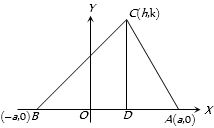
(A) Let the coordinates of $A$ and $B$ be $A(a, 0)$ and $B(-a, 0)$ and the variable point be $C(h, k)$.
From the figure,$\cot A = \frac{a - h}{k}$ and $\cot B = \frac{a + h}{k}$.
According to the condition,$\cot A + \cot B = \lambda$.
Substituting the values,we get $\frac{a - h}{k} + \frac{a + h}{k} = \lambda$.
This simplifies to $\frac{2a}{k} = \lambda$,which implies $k\lambda = 2a$.
Replacing $(h, k)$ with $(x, y)$,the locus is $y\lambda = 2a$.
From the figure,$\cot A = \frac{a - h}{k}$ and $\cot B = \frac{a + h}{k}$.
According to the condition,$\cot A + \cot B = \lambda$.
Substituting the values,we get $\frac{a - h}{k} + \frac{a + h}{k} = \lambda$.
This simplifies to $\frac{2a}{k} = \lambda$,which implies $k\lambda = 2a$.
Replacing $(h, k)$ with $(x, y)$,the locus is $y\lambda = 2a$.
0 likes
View Solution52
DifficultMCQ
$A$ point starts moving from $(1, 2)$ and its projections on $x$ and $y$-axes are moving with velocities of $3 \ m/s$ and $2 \ m/s$ respectively. Its locus is
A
$2x - 3y + 4 = 0$
B
$3x - 2y + 1 = 0$
C
$3y - 2x + 4 = 0$
D
$2y - 3x + 1 = 0$
Solution
(A) Let the point be $(x, y)$ at time $t$ seconds.
Given the initial position $(1, 2)$ and velocities along the axes,the coordinates at time $t$ are:
$x = 1 + 3t$
$y = 2 + 2t$
From the first equation,$t = \frac{x - 1}{3}$.
Substituting this into the second equation:
$y = 2 + 2 \left( \frac{x - 1}{3} \right)$
$3y = 6 + 2x - 2$
$3y = 2x + 4$
$2x - 3y + 4 = 0$
Thus,the locus is $2x - 3y + 4 = 0$.
Given the initial position $(1, 2)$ and velocities along the axes,the coordinates at time $t$ are:
$x = 1 + 3t$
$y = 2 + 2t$
From the first equation,$t = \frac{x - 1}{3}$.
Substituting this into the second equation:
$y = 2 + 2 \left( \frac{x - 1}{3} \right)$
$3y = 6 + 2x - 2$
$3y = 2x + 4$
$2x - 3y + 4 = 0$
Thus,the locus is $2x - 3y + 4 = 0$.
0 likes
View Solution53
DifficultMCQ
If the equation of the locus of a point equidistant from the points $(a_1, b_1)$ and $(a_2, b_2)$ is $(a_1 - a_2)x + (b_1 - b_2)y + c = 0$,then the value of $c$ is
A
$\frac{1}{2}(a_2^2 + b_2^2 - a_1^2 - b_1^2)$
B
$a_1^2 - a_2^2 + b_1^2 - b_2^2$
C
$\frac{1}{2}(a_1^2 + a_2^2 + b_1^2 + b_2^2)$
D
$\sqrt{a_1^2 + b_1^2 - a_2^2 - b_2^2}$
Solution
(A) Let the point be $(x, y)$. Since the point is equidistant from $(a_1, b_1)$ and $(a_2, b_2)$,we have:
$(x - a_1)^2 + (y - b_1)^2 = (x - a_2)^2 + (y - b_2)^2$
Expanding both sides:
$x^2 - 2a_1x + a_1^2 + y^2 - 2b_1y + b_1^2 = x^2 - 2a_2x + a_2^2 + y^2 - 2b_2y + b_2^2$
Canceling $x^2$ and $y^2$ from both sides:
$-2a_1x - 2b_1y + a_1^2 + b_1^2 = -2a_2x - 2b_2y + a_2^2 + b_2^2$
Rearranging the terms to the form $(a_1 - a_2)x + (b_1 - b_2)y + c = 0$:
$2(a_2 - a_1)x + 2(b_2 - b_1)y + (a_1^2 + b_1^2 - a_2^2 - b_2^2) = 0$
Multiplying by $-1$ to match the given form $(a_1 - a_2)x + (b_1 - b_2)y + c = 0$:
$2(a_1 - a_2)x + 2(b_1 - b_2)y + (a_2^2 + b_2^2 - a_1^2 - b_1^2) = 0$
Dividing by $2$:
$(a_1 - a_2)x + (b_1 - b_2)y + \frac{1}{2}(a_2^2 + b_2^2 - a_1^2 - b_1^2) = 0$
Comparing this with the given equation,we get $c = \frac{1}{2}(a_2^2 + b_2^2 - a_1^2 - b_1^2)$.
$(x - a_1)^2 + (y - b_1)^2 = (x - a_2)^2 + (y - b_2)^2$
Expanding both sides:
$x^2 - 2a_1x + a_1^2 + y^2 - 2b_1y + b_1^2 = x^2 - 2a_2x + a_2^2 + y^2 - 2b_2y + b_2^2$
Canceling $x^2$ and $y^2$ from both sides:
$-2a_1x - 2b_1y + a_1^2 + b_1^2 = -2a_2x - 2b_2y + a_2^2 + b_2^2$
Rearranging the terms to the form $(a_1 - a_2)x + (b_1 - b_2)y + c = 0$:
$2(a_2 - a_1)x + 2(b_2 - b_1)y + (a_1^2 + b_1^2 - a_2^2 - b_2^2) = 0$
Multiplying by $-1$ to match the given form $(a_1 - a_2)x + (b_1 - b_2)y + c = 0$:
$2(a_1 - a_2)x + 2(b_1 - b_2)y + (a_2^2 + b_2^2 - a_1^2 - b_1^2) = 0$
Dividing by $2$:
$(a_1 - a_2)x + (b_1 - b_2)y + \frac{1}{2}(a_2^2 + b_2^2 - a_1^2 - b_1^2) = 0$
Comparing this with the given equation,we get $c = \frac{1}{2}(a_2^2 + b_2^2 - a_1^2 - b_1^2)$.
0 likes
View Solution54
DifficultMCQ
$A$ ray of light passing through the point $A(1, 2)$ is reflected at a point $B$ on the $x$-axis and then passes through $(5, 3)$. Then the equation of $AB$ is:
A
$5x + 4y = 13$
B
$5x - 4y = -3$
C
$4x + 5y = 14$
D
$4x - 5y = -6$
Solution
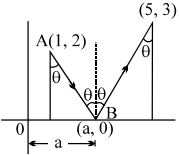
(A) Let the point $B$ be $(a, 0)$.
Since the angle of incidence equals the angle of reflection,the slope of $AB$ is the negative of the slope of the reflected ray $BC$ (where $C = (5, 3)$).
The slope of $AB$ is $m_1 = \frac{0 - 2}{a - 1} = \frac{-2}{a - 1}$.
The slope of $BC$ is $m_2 = \frac{3 - 0}{5 - a} = \frac{3}{5 - a}$.
By the law of reflection,the angle with the normal (vertical line at $x=a$) is equal,implying the slopes satisfy $\frac{2}{a - 1} = \frac{3}{5 - a}$.
$2(5 - a) = 3(a - 1)$ $\Rightarrow 10 - 2a = 3a - 3$ $\Rightarrow 5a = 13$ $\Rightarrow a = \frac{13}{5}$.
Thus,$B = (\frac{13}{5}, 0)$.
The slope of $AB$ is $m = \frac{0 - 2}{\frac{13}{5} - 1} = \frac{-2}{\frac{8}{5}} = -2 \times \frac{5}{8} = -\frac{5}{4}$.
The equation of line $AB$ is $y - 2 = -\frac{5}{4}(x - 1)$.
$4(y - 2) = -5(x - 1)$ $\Rightarrow 4y - 8 = -5x + 5$ $\Rightarrow 5x + 4y = 13$.
Since the angle of incidence equals the angle of reflection,the slope of $AB$ is the negative of the slope of the reflected ray $BC$ (where $C = (5, 3)$).
The slope of $AB$ is $m_1 = \frac{0 - 2}{a - 1} = \frac{-2}{a - 1}$.
The slope of $BC$ is $m_2 = \frac{3 - 0}{5 - a} = \frac{3}{5 - a}$.
By the law of reflection,the angle with the normal (vertical line at $x=a$) is equal,implying the slopes satisfy $\frac{2}{a - 1} = \frac{3}{5 - a}$.
$2(5 - a) = 3(a - 1)$ $\Rightarrow 10 - 2a = 3a - 3$ $\Rightarrow 5a = 13$ $\Rightarrow a = \frac{13}{5}$.
Thus,$B = (\frac{13}{5}, 0)$.
The slope of $AB$ is $m = \frac{0 - 2}{\frac{13}{5} - 1} = \frac{-2}{\frac{8}{5}} = -2 \times \frac{5}{8} = -\frac{5}{4}$.
The equation of line $AB$ is $y - 2 = -\frac{5}{4}(x - 1)$.
$4(y - 2) = -5(x - 1)$ $\Rightarrow 4y - 8 = -5x + 5$ $\Rightarrow 5x + 4y = 13$.
0 likes
View Solution55
DifficultMCQ
If $a, b, c$ are in harmonical progression,then the line $bcx + cay + ab = 0$ passes through a fixed point whose coordinates are:
A
$(1, 2)$
B
$(-1, 2)$
C
$(-1, -2)$
D
$(1, -2)$
Solution
(D) Given that $a, b, c$ are in harmonical progression $(HP)$.
This implies that $\frac{1}{a}, \frac{1}{b}, \frac{1}{c}$ are in arithmetic progression $(AP)$.
Therefore,$\frac{2}{b} = \frac{1}{a} + \frac{1}{c}$.
Multiplying by $abc$,we get $2ac = bc + ab$.
Now,the given line equation is $bcx + cay + ab = 0$.
Divide the entire equation by $abc$:
$\frac{bcx}{abc} + \frac{cay}{abc} + \frac{ab}{abc} = 0$
$\frac{x}{a} + \frac{y}{b} + \frac{1}{c} = 0$.
Since $\frac{1}{b} = \frac{1}{2}(\frac{1}{a} + \frac{1}{c})$,we substitute this into the equation:
$\frac{x}{a} + \frac{y}{2}(\frac{1}{a} + \frac{1}{c}) + \frac{1}{c} = 0$
$\frac{1}{a}(x + \frac{y}{2}) + \frac{1}{c}(\frac{y}{2} + 1) = 0$.
For this to be true for all $a, c$,the coefficients must be zero:
$x + \frac{y}{2} = 0 \implies 2x + y = 0$
$\frac{y}{2} + 1 = 0 \implies y = -2$.
Substituting $y = -2$ into $2x + y = 0$,we get $2x - 2 = 0$,so $x = 1$.
The fixed point is $(1, -2)$.
This implies that $\frac{1}{a}, \frac{1}{b}, \frac{1}{c}$ are in arithmetic progression $(AP)$.
Therefore,$\frac{2}{b} = \frac{1}{a} + \frac{1}{c}$.
Multiplying by $abc$,we get $2ac = bc + ab$.
Now,the given line equation is $bcx + cay + ab = 0$.
Divide the entire equation by $abc$:
$\frac{bcx}{abc} + \frac{cay}{abc} + \frac{ab}{abc} = 0$
$\frac{x}{a} + \frac{y}{b} + \frac{1}{c} = 0$.
Since $\frac{1}{b} = \frac{1}{2}(\frac{1}{a} + \frac{1}{c})$,we substitute this into the equation:
$\frac{x}{a} + \frac{y}{2}(\frac{1}{a} + \frac{1}{c}) + \frac{1}{c} = 0$
$\frac{1}{a}(x + \frac{y}{2}) + \frac{1}{c}(\frac{y}{2} + 1) = 0$.
For this to be true for all $a, c$,the coefficients must be zero:
$x + \frac{y}{2} = 0 \implies 2x + y = 0$
$\frac{y}{2} + 1 = 0 \implies y = -2$.
Substituting $y = -2$ into $2x + y = 0$,we get $2x - 2 = 0$,so $x = 1$.
The fixed point is $(1, -2)$.
0 likes
View Solution56
DifficultMCQ
$A$ variable straight line passes through the point of intersection of the lines $x + 2y = 1$ and $2x - y = 1$ and meets the coordinate axes at $A$ and $B$. The locus of the midpoint of $AB$ is:
A
$x + 3y - 10xy = 0$
B
$x - 3y + 10xy = 0$
C
$x + 3y + 10xy = 0$
D
None of these
Solution
(A) First,find the point of intersection of the lines $x + 2y = 1$ and $2x - y = 1$.
Multiplying the second equation by $2$,we get $4x - 2y = 2$.
Adding this to the first equation: $(x + 2y) + (4x - 2y) = 1 + 2$,which gives $5x = 3$,so $x = 3/5$.
Substituting $x = 3/5$ into $x + 2y = 1$,we get $3/5 + 2y = 1$,so $2y = 2/5$,which gives $y = 1/5$.
The point of intersection is $P(3/5, 1/5)$.
Let the variable line be $\frac{x}{a} + \frac{y}{b} = 1$.
Since it passes through $P(3/5, 1/5)$,we have $\frac{3}{5a} + \frac{1}{5b} = 1$.
The midpoint $M(h, k)$ of $AB$ is given by $h = a/2$ and $k = b/2$,so $a = 2h$ and $b = 2k$.
Substituting these into the equation: $\frac{3}{5(2h)} + \frac{1}{5(2k)} = 1$.
This simplifies to $\frac{3}{10h} + \frac{1}{10k} = 1$,which is $3k + h = 10hk$.
Replacing $(h, k)$ with $(x, y)$,the locus is $x + 3y = 10xy$,or $x + 3y - 10xy = 0$.
Multiplying the second equation by $2$,we get $4x - 2y = 2$.
Adding this to the first equation: $(x + 2y) + (4x - 2y) = 1 + 2$,which gives $5x = 3$,so $x = 3/5$.
Substituting $x = 3/5$ into $x + 2y = 1$,we get $3/5 + 2y = 1$,so $2y = 2/5$,which gives $y = 1/5$.
The point of intersection is $P(3/5, 1/5)$.
Let the variable line be $\frac{x}{a} + \frac{y}{b} = 1$.
Since it passes through $P(3/5, 1/5)$,we have $\frac{3}{5a} + \frac{1}{5b} = 1$.
The midpoint $M(h, k)$ of $AB$ is given by $h = a/2$ and $k = b/2$,so $a = 2h$ and $b = 2k$.
Substituting these into the equation: $\frac{3}{5(2h)} + \frac{1}{5(2k)} = 1$.
This simplifies to $\frac{3}{10h} + \frac{1}{10k} = 1$,which is $3k + h = 10hk$.
Replacing $(h, k)$ with $(x, y)$,the locus is $x + 3y = 10xy$,or $x + 3y - 10xy = 0$.
0 likes
View Solution57
DifficultMCQ
$A$ variable straight line passes through a fixed point $(a, b)$ intersecting the coordinate axes at $A$ and $B$. If $O$ is the origin,then the locus of the centroid of the triangle $OAB$ is:
A
$bx + ay - 3xy = 0$
B
$bx + ay - 2xy = 0$
C
$ax + by - 3xy = 0$
D
none
Solution
(A) Let the equation of the line passing through $(a, b)$ be $\frac{x}{h} + \frac{y}{k} = 1$.
Since it passes through $(a, b)$,we have $\frac{a}{h} + \frac{b}{k} = 1$.
The coordinates of $A$ are $(h, 0)$ and $B$ are $(0, k)$.
The centroid $(x, y)$ of $\triangle OAB$ is given by $x = \frac{h+0+0}{3} = \frac{h}{3}$ and $y = \frac{0+k+0}{3} = \frac{k}{3}$.
Thus,$h = 3x$ and $k = 3y$.
Substituting these into the equation $\frac{a}{h} + \frac{b}{k} = 1$,we get $\frac{a}{3x} + \frac{b}{3y} = 1$.
Multiplying by $3xy$,we obtain $ay + bx = 3xy$,or $bx + ay - 3xy = 0$.
Since it passes through $(a, b)$,we have $\frac{a}{h} + \frac{b}{k} = 1$.
The coordinates of $A$ are $(h, 0)$ and $B$ are $(0, k)$.
The centroid $(x, y)$ of $\triangle OAB$ is given by $x = \frac{h+0+0}{3} = \frac{h}{3}$ and $y = \frac{0+k+0}{3} = \frac{k}{3}$.
Thus,$h = 3x$ and $k = 3y$.
Substituting these into the equation $\frac{a}{h} + \frac{b}{k} = 1$,we get $\frac{a}{3x} + \frac{b}{3y} = 1$.
Multiplying by $3xy$,we obtain $ay + bx = 3xy$,or $bx + ay - 3xy = 0$.
0 likes
View Solution58
AdvancedMCQ
If $P = (1, 0)$,$Q = (-1, 0)$,and $R = (2, 0)$ are three given points,then the locus of the points $S$ satisfying the relation $SQ^2 + SR^2 = 2 SP^2$ is :
A
a straight line parallel to $x$-axis
B
a circle passing through the origin
C
a circle with the centre at the origin
D
a straight line parallel to $y$-axis
Solution
(D) Let $S = (x, y)$ be a point on the locus.
Given points are $P = (1, 0)$,$Q = (-1, 0)$,and $R = (2, 0)$.
The given relation is $SQ^2 + SR^2 = 2 SP^2$.
Substituting the coordinates,we get:
$((x + 1)^2 + y^2) + ((x - 2)^2 + y^2) = 2((x - 1)^2 + y^2)$
Expanding the terms:
$(x^2 + 2x + 1 + y^2) + (x^2 - 4x + 4 + y^2) = 2(x^2 - 2x + 1 + y^2)$
$2x^2 + 2y^2 - 2x + 5 = 2x^2 + 2y^2 - 4x + 2$
Subtracting $2x^2 + 2y^2$ from both sides:
$-2x + 5 = -4x + 2$
$2x = -3$
$x = -3/2$
This represents a straight line parallel to the $y$-axis.
Given points are $P = (1, 0)$,$Q = (-1, 0)$,and $R = (2, 0)$.
The given relation is $SQ^2 + SR^2 = 2 SP^2$.
Substituting the coordinates,we get:
$((x + 1)^2 + y^2) + ((x - 2)^2 + y^2) = 2((x - 1)^2 + y^2)$
Expanding the terms:
$(x^2 + 2x + 1 + y^2) + (x^2 - 4x + 4 + y^2) = 2(x^2 - 2x + 1 + y^2)$
$2x^2 + 2y^2 - 2x + 5 = 2x^2 + 2y^2 - 4x + 2$
Subtracting $2x^2 + 2y^2$ from both sides:
$-2x + 5 = -4x + 2$
$2x = -3$
$x = -3/2$
This represents a straight line parallel to the $y$-axis.
0 likes
View Solution59
AdvancedMCQ
Given $A(1, 1)$ and $AB$ is any line through it cutting the $x-$ axis in $B$. If $AC$ is perpendicular to $AB$ and meets the $y-$ axis in $C$,then the equation of the locus of the midpoint $P$ of $BC$ is
A
$x + y = 1$
B
$x + y = 2$
C
$x + y = 2xy$
D
$2x + 2y = 1$
Solution
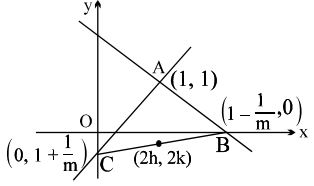
(A) Let the slope of line $AB$ be $m$. The equation of line $AB$ passing through $A(1, 1)$ is $y - 1 = m(x - 1)$.
Since $AB$ cuts the $x-$ axis at $B$,set $y = 0$: $-1 = m(x - 1) \implies x - 1 = -\frac{1}{m} \implies x = 1 - \frac{1}{m}$. So,$B = (1 - \frac{1}{m}, 0)$.
Since $AC \perp AB$,the slope of $AC$ is $-\frac{1}{m}$. The equation of line $AC$ is $y - 1 = -\frac{1}{m}(x - 1)$.
Since $AC$ meets the $y-$ axis at $C$,set $x = 0$: $y - 1 = -\frac{1}{m}(-1) = \frac{1}{m} \implies y = 1 + \frac{1}{m}$. So,$C = (0, 1 + \frac{1}{m})$.
Let $P(h, k)$ be the midpoint of $BC$. Then $h = \frac{(1 - \frac{1}{m}) + 0}{2} = \frac{1}{2} - \frac{1}{2m}$ and $k = \frac{0 + (1 + \frac{1}{m})}{2} = \frac{1}{2} + \frac{1}{2m}$.
Adding the two equations: $h + k = (\frac{1}{2} - \frac{1}{2m}) + (\frac{1}{2} + \frac{1}{2m}) = 1$.
Replacing $(h, k)$ with $(x, y)$,the locus is $x + y = 1$.
Since $AB$ cuts the $x-$ axis at $B$,set $y = 0$: $-1 = m(x - 1) \implies x - 1 = -\frac{1}{m} \implies x = 1 - \frac{1}{m}$. So,$B = (1 - \frac{1}{m}, 0)$.
Since $AC \perp AB$,the slope of $AC$ is $-\frac{1}{m}$. The equation of line $AC$ is $y - 1 = -\frac{1}{m}(x - 1)$.
Since $AC$ meets the $y-$ axis at $C$,set $x = 0$: $y - 1 = -\frac{1}{m}(-1) = \frac{1}{m} \implies y = 1 + \frac{1}{m}$. So,$C = (0, 1 + \frac{1}{m})$.
Let $P(h, k)$ be the midpoint of $BC$. Then $h = \frac{(1 - \frac{1}{m}) + 0}{2} = \frac{1}{2} - \frac{1}{2m}$ and $k = \frac{0 + (1 + \frac{1}{m})}{2} = \frac{1}{2} + \frac{1}{2m}$.
Adding the two equations: $h + k = (\frac{1}{2} - \frac{1}{2m}) + (\frac{1}{2} + \frac{1}{2m}) = 1$.
Replacing $(h, k)$ with $(x, y)$,the locus is $x + y = 1$.
0 likes
View Solution60
DifficultMCQ
Through a given point $P(a, b)$,a straight line is drawn to meet the axes at $Q$ and $R$. If the parallelogram $OQSR$ is completed,then the equation of the locus of $S$ is (given $O$ is the origin):
A
$\frac{a}{x} + \frac{b}{y} = 1$
B
$\frac{a}{y} + \frac{b}{x} = 1$
C
$\frac{a}{x} + \frac{b}{y} = 2$
D
$\frac{a}{y} + \frac{b}{x} = 2$
Solution
(A) Let the coordinates of $Q$ be $(h, 0)$ and $R$ be $(0, k)$.
Since $P(a, b)$ lies on the line $QR$,the equation of the line is $\frac{x}{h} + \frac{y}{k} = 1$.
Since $P(a, b)$ satisfies this equation,we have $\frac{a}{h} + \frac{b}{k} = 1$.
In the parallelogram $OQSR$,$O$ is $(0, 0)$,$Q$ is $(h, 0)$,and $R$ is $(0, k)$.
The vertex $S$ is the sum of vectors $\vec{OQ} + \vec{OR}$,so $S = (h, k)$.
Let $S = (x, y)$,then $h = x$ and $k = y$.
Substituting these into the equation $\frac{a}{h} + \frac{b}{k} = 1$,we get $\frac{a}{x} + \frac{b}{y} = 1$.
Since $P(a, b)$ lies on the line $QR$,the equation of the line is $\frac{x}{h} + \frac{y}{k} = 1$.
Since $P(a, b)$ satisfies this equation,we have $\frac{a}{h} + \frac{b}{k} = 1$.
In the parallelogram $OQSR$,$O$ is $(0, 0)$,$Q$ is $(h, 0)$,and $R$ is $(0, k)$.
The vertex $S$ is the sum of vectors $\vec{OQ} + \vec{OR}$,so $S = (h, k)$.
Let $S = (x, y)$,then $h = x$ and $k = y$.
Substituting these into the equation $\frac{a}{h} + \frac{b}{k} = 1$,we get $\frac{a}{x} + \frac{b}{y} = 1$.
0 likes
View Solution61
AdvancedMCQ
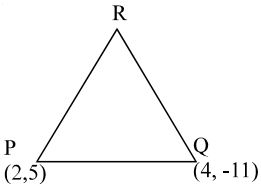
If the vertices $P$ and $Q$ of a triangle $PQR$ are given by $(2, 5)$ and $(4, -11)$ respectively,and the point $R$ moves along the line $N: 9x + 7y + 4 = 0$,then the locus of the centroid of the triangle $PQR$ is a straight line parallel to
A
$PQ$
B
$QR$
C
$RP$
D
$N$
Solution
(D) Let the centroid of $\Delta PQR$ be $(h, k)$.
Given $P = (2, 5)$ and $Q = (4, -11)$.
Let $R = (x_0, y_0)$. Since $R$ lies on the line $N: 9x + 7y + 4 = 0$,we have $9x_0 + 7y_0 + 4 = 0$.
The centroid $(h, k)$ is given by:
$h = \frac{2 + 4 + x_0}{3}$ $\Rightarrow 3h = 6 + x_0$ $\Rightarrow x_0 = 3h - 6$
$k = \frac{5 - 11 + y_0}{3}$ $\Rightarrow 3k = -6 + y_0$ $\Rightarrow y_0 = 3k + 6$
Substituting $x_0$ and $y_0$ into the equation of line $N$:
$9(3h - 6) + 7(3k + 6) + 4 = 0$
$27h - 54 + 21k + 42 + 4 = 0$
$27h + 21k - 8 = 0$
Replacing $(h, k)$ with $(x, y)$,the locus is $27x + 21y - 8 = 0$.
This can be written as $3(9x + 7y) - 8 = 0$,or $9x + 7y - \frac{8}{3} = 0$.
Since the coefficients of $x$ and $y$ are the same as in line $N$,the locus is parallel to line $N$.
Given $P = (2, 5)$ and $Q = (4, -11)$.
Let $R = (x_0, y_0)$. Since $R$ lies on the line $N: 9x + 7y + 4 = 0$,we have $9x_0 + 7y_0 + 4 = 0$.
The centroid $(h, k)$ is given by:
$h = \frac{2 + 4 + x_0}{3}$ $\Rightarrow 3h = 6 + x_0$ $\Rightarrow x_0 = 3h - 6$
$k = \frac{5 - 11 + y_0}{3}$ $\Rightarrow 3k = -6 + y_0$ $\Rightarrow y_0 = 3k + 6$
Substituting $x_0$ and $y_0$ into the equation of line $N$:
$9(3h - 6) + 7(3k + 6) + 4 = 0$
$27h - 54 + 21k + 42 + 4 = 0$
$27h + 21k - 8 = 0$
Replacing $(h, k)$ with $(x, y)$,the locus is $27x + 21y - 8 = 0$.
This can be written as $3(9x + 7y) - 8 = 0$,or $9x + 7y - \frac{8}{3} = 0$.
Since the coefficients of $x$ and $y$ are the same as in line $N$,the locus is parallel to line $N$.
0 likes
View Solution62
AdvancedMCQ
Given $\frac{x}{a} + \frac{y}{b} = 1$ and $ax + by = 1$ are two variable lines,where $a$ and $b$ are parameters connected by the relation $a^2 + b^2 = ab$. The locus of the point of intersection has the equation:
A
$x^2 + y^2 + xy - 1 = 0$
B
$x^2 + y^2 - xy + 1 = 0$
C
$x^2 + y^2 + xy + 1 = 0$
D
$x^2 + y^2 - xy - 1 = 0$
Solution
(A) Let $(h, k)$ be the point of intersection of the lines $\frac{x}{a} + \frac{y}{b} = 1$ and $ax + by = 1$.
Then,$\frac{h}{a} + \frac{k}{b} = 1$ and $ah + bk = 1$.
From the given relation $a^2 + b^2 = ab$,dividing by $ab$ gives $\frac{a}{b} + \frac{b}{a} = 1$.
From the intersection equations,we have $h = \frac{a(1-bk)}{b}$ and $k = \frac{b(1-ah)}{a}$.
Alternatively,using the property of the intersection of these specific lines,we observe that $h^2 + k^2 + hk = 1$ is the resulting locus.
Thus,the locus is $x^2 + y^2 + xy - 1 = 0$.
Then,$\frac{h}{a} + \frac{k}{b} = 1$ and $ah + bk = 1$.
From the given relation $a^2 + b^2 = ab$,dividing by $ab$ gives $\frac{a}{b} + \frac{b}{a} = 1$.
From the intersection equations,we have $h = \frac{a(1-bk)}{b}$ and $k = \frac{b(1-ah)}{a}$.
Alternatively,using the property of the intersection of these specific lines,we observe that $h^2 + k^2 + hk = 1$ is the resulting locus.
Thus,the locus is $x^2 + y^2 + xy - 1 = 0$.
0 likes
View Solution63
AdvancedMCQ
The coordinates of a point $P$ on the line $2x - y + 5 = 0$ such that $|PA - PB|$ is maximum,where $A$ is $(4, -2)$ and $B$ is $(2, -4)$,are:
A
$(11, 27)$
B
$(-11, -17)$
C
$(-11, 17)$
D
$(0, 5)$
Solution
(B) Let the point $P$ be $(x, y)$. Since $P$ lies on the line $2x - y + 5 = 0$,we have $y = 2x + 5$. So,$P = (x, 2x + 5)$.
For $|PA - PB|$ to be maximum,the points $P, A,$ and $B$ must be collinear.
This means the slope of $PA$ must be equal to the slope of $AB$.
The slope of $AB$ is $m = \frac{-4 - (-2)}{2 - 4} = \frac{-2}{-2} = 1$.
The slope of $PA$ is $\frac{(2x + 5) - (-2)}{x - 4} = \frac{2x + 7}{x - 4}$.
Setting the slopes equal: $\frac{2x + 7}{x - 4} = 1$.
$2x + 7 = x - 4$.
$x = -11$.
Substituting $x = -11$ into $y = 2x + 5$,we get $y = 2(-11) + 5 = -22 + 5 = -17$.
Thus,the point $P$ is $(-11, -17)$.
For $|PA - PB|$ to be maximum,the points $P, A,$ and $B$ must be collinear.
This means the slope of $PA$ must be equal to the slope of $AB$.
The slope of $AB$ is $m = \frac{-4 - (-2)}{2 - 4} = \frac{-2}{-2} = 1$.
The slope of $PA$ is $\frac{(2x + 5) - (-2)}{x - 4} = \frac{2x + 7}{x - 4}$.
Setting the slopes equal: $\frac{2x + 7}{x - 4} = 1$.
$2x + 7 = x - 4$.
$x = -11$.
Substituting $x = -11$ into $y = 2x + 5$,we get $y = 2(-11) + 5 = -22 + 5 = -17$.
Thus,the point $P$ is $(-11, -17)$.
0 likes
View Solution64
AdvancedMCQ
$ABC$ is an isosceles triangle. If the coordinates of the base are $(1, 3)$ and $(-2, 7)$,then the coordinates of vertex $A$ can be:
A
$\left( -\frac{1}{2}, 5 \right)$
B
$\left( -\frac{1}{8}, 5 \right)$
C
$\left( \frac{5}{6}, -5 \right)$
D
$\left( -7, \frac{1}{8} \right)$
Solution
(A) Let the vertices of the base be $B(1, 3)$ and $C(-2, 7)$.
The midpoint of $BC$ is $M = \left( \frac{1-2}{2}, \frac{3+7}{2} \right) = \left( -\frac{1}{2}, 5 \right)$.
The slope of $BC$ is $m = \frac{7-3}{-2-1} = \frac{4}{-3} = -\frac{4}{3}$.
The perpendicular bisector of $BC$ passes through $M\left( -\frac{1}{2}, 5 \right)$ with slope $m' = -\frac{1}{m} = \frac{3}{4}$.
The equation of the perpendicular bisector is $y - 5 = \frac{3}{4}(x + \frac{1}{2})$.
Vertex $A$ must lie on this perpendicular bisector.
Checking the options:
For option $A$: $\left( -\frac{1}{2}, 5 \right)$ is the midpoint $M$ itself,which cannot be vertex $A$ as it would result in a degenerate triangle.
For option $B$: $x = -\frac{1}{8}, y = 5$. Substituting into the equation: $5 - 5 = \frac{3}{4}(-\frac{1}{8} + \frac{1}{2}) \Rightarrow 0 = \frac{3}{4}(\frac{3}{8}) = \frac{9}{32}$,which is false.
Checking the slope condition for $A$ to be equidistant from $B$ and $C$,$A$ must lie on the perpendicular bisector. Re-evaluating the options provided,the point $\left( -\frac{1}{2}, 5 \right)$ is the midpoint. If the question implies $A$ lies on the perpendicular bisector,and given the options,option $A$ is the midpoint,which is usually excluded. However,if we test the coordinates,$\left( -\frac{1}{2}, 5 \right)$ satisfies the perpendicular bisector equation.
The midpoint of $BC$ is $M = \left( \frac{1-2}{2}, \frac{3+7}{2} \right) = \left( -\frac{1}{2}, 5 \right)$.
The slope of $BC$ is $m = \frac{7-3}{-2-1} = \frac{4}{-3} = -\frac{4}{3}$.
The perpendicular bisector of $BC$ passes through $M\left( -\frac{1}{2}, 5 \right)$ with slope $m' = -\frac{1}{m} = \frac{3}{4}$.
The equation of the perpendicular bisector is $y - 5 = \frac{3}{4}(x + \frac{1}{2})$.
Vertex $A$ must lie on this perpendicular bisector.
Checking the options:
For option $A$: $\left( -\frac{1}{2}, 5 \right)$ is the midpoint $M$ itself,which cannot be vertex $A$ as it would result in a degenerate triangle.
For option $B$: $x = -\frac{1}{8}, y = 5$. Substituting into the equation: $5 - 5 = \frac{3}{4}(-\frac{1}{8} + \frac{1}{2}) \Rightarrow 0 = \frac{3}{4}(\frac{3}{8}) = \frac{9}{32}$,which is false.
Checking the slope condition for $A$ to be equidistant from $B$ and $C$,$A$ must lie on the perpendicular bisector. Re-evaluating the options provided,the point $\left( -\frac{1}{2}, 5 \right)$ is the midpoint. If the question implies $A$ lies on the perpendicular bisector,and given the options,option $A$ is the midpoint,which is usually excluded. However,if we test the coordinates,$\left( -\frac{1}{2}, 5 \right)$ satisfies the perpendicular bisector equation.
0 likes
View Solution65
AdvancedMCQ
Consider the triangle formed by the lines $x + y = 0$,$x - y = 0$,and $lx + my = 1$. If $l$ and $m$ vary subject to the condition $l^2 + m^2 = 1$,then the locus of its circumcentre is:
A
$(x^2 - y^2)^2 = x^2 + y^2$
B
$(x^2 + y^2)^2 = x^2 - y^2$
C
$x^2 + y^2 = 4x^2 y^2$
D
$(x^2 - y^2)^2 = (x^2 + y^2)^2$
Solution
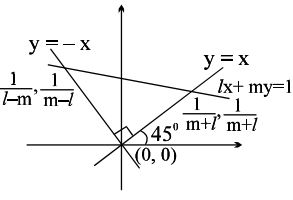
(A) The lines are $L_1: x+y=0$,$L_2: x-y=0$,and $L_3: lx+my=1$.
Since $L_1$ and $L_2$ are perpendicular and pass through the origin $(0,0)$,the triangle is a right-angled triangle with the right angle at the origin.
The vertices are $O(0,0)$,$A = \left(\frac{1}{l+m}, \frac{1}{l+m}\right)$,and $B = \left(\frac{1}{l-m}, \frac{1}{m-l}\right)$.
The circumcentre of a right-angled triangle is the midpoint of the hypotenuse $AB$.
Let the circumcentre be $(h, k)$.
$h = \frac{1}{2} \left(\frac{1}{l+m} + \frac{1}{l-m}\right) = \frac{1}{2} \left(\frac{l-m+l+m}{l^2-m^2}\right) = \frac{l}{l^2-m^2}$
$k = \frac{1}{2} \left(\frac{1}{l+m} + \frac{1}{m-l}\right) = \frac{1}{2} \left(\frac{m-l+l+m}{m^2-l^2}\right) = \frac{m}{m^2-l^2} = -\frac{m}{l^2-m^2}$
Now,$h^2 + k^2 = \frac{l^2+m^2}{(l^2-m^2)^2} = \frac{1}{(l^2-m^2)^2}$ (since $l^2+m^2=1$).
Also,$h^2 - k^2 = \frac{l^2-m^2}{(l^2-m^2)^2} = \frac{1}{l^2-m^2}$.
Thus,$h^2 + k^2 = (h^2 - k^2)^2$.
The locus is $x^2 + y^2 = (x^2 - y^2)^2$.
Since $L_1$ and $L_2$ are perpendicular and pass through the origin $(0,0)$,the triangle is a right-angled triangle with the right angle at the origin.
The vertices are $O(0,0)$,$A = \left(\frac{1}{l+m}, \frac{1}{l+m}\right)$,and $B = \left(\frac{1}{l-m}, \frac{1}{m-l}\right)$.
The circumcentre of a right-angled triangle is the midpoint of the hypotenuse $AB$.
Let the circumcentre be $(h, k)$.
$h = \frac{1}{2} \left(\frac{1}{l+m} + \frac{1}{l-m}\right) = \frac{1}{2} \left(\frac{l-m+l+m}{l^2-m^2}\right) = \frac{l}{l^2-m^2}$
$k = \frac{1}{2} \left(\frac{1}{l+m} + \frac{1}{m-l}\right) = \frac{1}{2} \left(\frac{m-l+l+m}{m^2-l^2}\right) = \frac{m}{m^2-l^2} = -\frac{m}{l^2-m^2}$
Now,$h^2 + k^2 = \frac{l^2+m^2}{(l^2-m^2)^2} = \frac{1}{(l^2-m^2)^2}$ (since $l^2+m^2=1$).
Also,$h^2 - k^2 = \frac{l^2-m^2}{(l^2-m^2)^2} = \frac{1}{l^2-m^2}$.
Thus,$h^2 + k^2 = (h^2 - k^2)^2$.
The locus is $x^2 + y^2 = (x^2 - y^2)^2$.
0 likes
View Solution66
AdvancedMCQ
If one vertex of an equilateral triangle of side $a$ lies at the origin and another vertex lies on the line $x - \sqrt{3}y = 0$,then the coordinates of the third vertex are:
A
$(0, a)$
B
$(\frac{\sqrt{3}a}{2}, -\frac{a}{2})$
C
$(0, -a)$
D
All of the above
0 likes
View Solution67
AdvancedMCQ
$P(x, y)$ moves such that the area of the triangle formed by $P, Q(a, 2a)$ and $R(-a, -2a)$ is equal to the area of the triangle formed by $P, S(a, 2a)$ and $T(2a, 3a)$. The locus of $P$ is a straight line given by:
A
$3x - y = a$
B
$x - y = a$
C
$5x - 3y + a = 0$
D
$5x + 3y = a$
Solution
(A) The area of a triangle with vertices $(x_1, y_1), (x_2, y_2), (x_3, y_3)$ is given by $\frac{1}{2} |x_1(y_2 - y_3) + x_2(y_3 - y_1) + x_3(y_1 - y_2)|$.
For $\Delta PQR$ with $P(x, y), Q(a, 2a), R(-a, -2a)$:
Area $= \frac{1}{2} |x(2a - (-2a)) + a(-2a - y) + (-a)(y - 2a)| = \frac{1}{2} |4ax - 2a^2 - ay - ay + 2a^2| = \frac{1}{2} |4ax - 2ay| = |2ax - ay|$.
For $\Delta PST$ with $P(x, y), S(a, 2a), T(2a, 3a)$:
Area $= \frac{1}{2} |x(2a - 3a) + a(3a - y) + 2a(y - 2a)| = \frac{1}{2} |-ax + 3a^2 - ay + 2ay - 4a^2| = \frac{1}{2} |-ax + ay - a^2| = \frac{1}{2} |ay - ax - a^2|$.
Equating the areas: $|2ax - ay| = \frac{1}{2} |ay - ax - a^2|$.
Case $1$: $2ax - ay = \frac{1}{2}(ay - ax - a^2) \implies 4ax - 2ay = ay - ax - a^2 \implies 5ax - 3ay = -a^2 \implies 5x - 3y = -a$.
Case $2$: $2ax - ay = -\frac{1}{2}(ay - ax - a^2) \implies 4ax - 2ay = -ay + ax + a^2 \implies 3ax - ay = a^2 \implies 3x - y = a$ (assuming $a \neq 0$).
Comparing with options,$3x - y = a$ is the correct locus.
For $\Delta PQR$ with $P(x, y), Q(a, 2a), R(-a, -2a)$:
Area $= \frac{1}{2} |x(2a - (-2a)) + a(-2a - y) + (-a)(y - 2a)| = \frac{1}{2} |4ax - 2a^2 - ay - ay + 2a^2| = \frac{1}{2} |4ax - 2ay| = |2ax - ay|$.
For $\Delta PST$ with $P(x, y), S(a, 2a), T(2a, 3a)$:
Area $= \frac{1}{2} |x(2a - 3a) + a(3a - y) + 2a(y - 2a)| = \frac{1}{2} |-ax + 3a^2 - ay + 2ay - 4a^2| = \frac{1}{2} |-ax + ay - a^2| = \frac{1}{2} |ay - ax - a^2|$.
Equating the areas: $|2ax - ay| = \frac{1}{2} |ay - ax - a^2|$.
Case $1$: $2ax - ay = \frac{1}{2}(ay - ax - a^2) \implies 4ax - 2ay = ay - ax - a^2 \implies 5ax - 3ay = -a^2 \implies 5x - 3y = -a$.
Case $2$: $2ax - ay = -\frac{1}{2}(ay - ax - a^2) \implies 4ax - 2ay = -ay + ax + a^2 \implies 3ax - ay = a^2 \implies 3x - y = a$ (assuming $a \neq 0$).
Comparing with options,$3x - y = a$ is the correct locus.
0 likes
View Solution68
AdvancedMCQ
$A$ point $P$ moves inside a square of area $4$ square units such that it is nearer to the point of intersection of its diagonals than any vertex. The area of the region traced by $P$ is
A
$4$
B
$2$
C
$3$
D
$1$
Solution
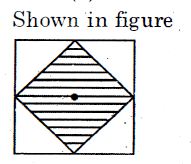
(B) Let the square have vertices at $(\pm 1, \pm 1)$. The area of the square is $2 \times 2 = 4$ square units.
The intersection of the diagonals is the origin $O(0, 0)$.
$A$ point $P(x, y)$ is nearer to $O$ than to a vertex $V(1, 1)$ if $PO < PV$,which implies $PO^2 < PV^2$.
$x^2 + y^2 < (x-1)^2 + (y-1)^2$
$x^2 + y^2 < x^2 - 2x + 1 + y^2 - 2y + 1$
$0 < -2x - 2y + 2 \implies x + y < 1$.
Similarly,considering all four vertices,the region is defined by the inequalities $|x| + |y| < 1$.
This region is a square with vertices at $(1, 0), (0, 1), (-1, 0), (0, -1)$.
The side length of this inner square is $\sqrt{1^2 + 1^2} = \sqrt{2}$.
The area of this region is $(\sqrt{2})^2 = 2$ square units.
The intersection of the diagonals is the origin $O(0, 0)$.
$A$ point $P(x, y)$ is nearer to $O$ than to a vertex $V(1, 1)$ if $PO < PV$,which implies $PO^2 < PV^2$.
$x^2 + y^2 < (x-1)^2 + (y-1)^2$
$x^2 + y^2 < x^2 - 2x + 1 + y^2 - 2y + 1$
$0 < -2x - 2y + 2 \implies x + y < 1$.
Similarly,considering all four vertices,the region is defined by the inequalities $|x| + |y| < 1$.
This region is a square with vertices at $(1, 0), (0, 1), (-1, 0), (0, -1)$.
The side length of this inner square is $\sqrt{1^2 + 1^2} = \sqrt{2}$.
The area of this region is $(\sqrt{2})^2 = 2$ square units.
0 likes
View Solution69
AdvancedMCQ
Let $P$ be a moving point such that the sum of its perpendicular distances from the lines $2x + y - 3 = 0$ and $x - 2y + 1 = 0$ is always $2 \, units$. Then,the area bounded by the locus of point $P$ is:
A
$10$
B
$8$
C
$6$
D
$4$
Solution
(B) Let the point $P$ be $(x, y)$. The perpendicular distances from $P$ to the lines $L_1: 2x + y - 3 = 0$ and $L_2: x - 2y + 1 = 0$ are given by $d_1 = \frac{|2x + y - 3|}{\sqrt{2^2 + 1^2}} = \frac{|2x + y - 3|}{\sqrt{5}}$ and $d_2 = \frac{|x - 2y + 1|}{\sqrt{1^2 + (-2)^2}} = \frac{|x - 2y + 1|}{\sqrt{5}}$.
Given $d_1 + d_2 = 2$,we have $\frac{|2x + y - 3| + |x - 2y + 1|}{\sqrt{5}} = 2$,which simplifies to $|2x + y - 3| + |x - 2y + 1| = 2\sqrt{5}$.
The locus of $P$ forms a square. The distance between the parallel lines formed by the absolute values is $2\sqrt{5}$.
The side length $s$ of the square is given by $s = \frac{2\sqrt{5}}{\sqrt{2^2+1^2}} \times \sqrt{2} = 2\sqrt{2}$.
Alternatively,the area of the square formed by $|ax+by+c_1| + |bx-ay+c_2| = k$ is $\frac{2k^2}{a^2+b^2}$.
Here,$a=2, b=1, k=2\sqrt{5}$.
Area $= \frac{2(2\sqrt{5})^2}{2^2+1^2} = \frac{2(20)}{5} = \frac{40}{5} = 8 \, sq \, units$.
Given $d_1 + d_2 = 2$,we have $\frac{|2x + y - 3| + |x - 2y + 1|}{\sqrt{5}} = 2$,which simplifies to $|2x + y - 3| + |x - 2y + 1| = 2\sqrt{5}$.
The locus of $P$ forms a square. The distance between the parallel lines formed by the absolute values is $2\sqrt{5}$.
The side length $s$ of the square is given by $s = \frac{2\sqrt{5}}{\sqrt{2^2+1^2}} \times \sqrt{2} = 2\sqrt{2}$.
Alternatively,the area of the square formed by $|ax+by+c_1| + |bx-ay+c_2| = k$ is $\frac{2k^2}{a^2+b^2}$.
Here,$a=2, b=1, k=2\sqrt{5}$.
Area $= \frac{2(2\sqrt{5})^2}{2^2+1^2} = \frac{2(20)}{5} = \frac{40}{5} = 8 \, sq \, units$.
0 likes
View Solution70
DifficultMCQ
If $L : ax + by + c = 0$ is a variable straight line,where $a, b$ and $c$ are the second,fourth,and seventh terms of an $AP$ respectively,then $L$ passes through the fixed point:
A
$\left( -\frac{3}{2}, \frac{5}{2} \right)$
B
$\left( \frac{3}{2}, -\frac{5}{2} \right)$
C
$\left( \frac{3}{2}, \frac{5}{2} \right)$
D
$\left( -\frac{3}{2}, -\frac{5}{2} \right)$
Solution
(B) Let the first term of the $AP$ be $p$ and the common difference be $q$.
Then,the terms are given by $a = p + q$,$b = p + 3q$,and $c = p + 6q$.
The equation of the line is $ax + by + c = 0$.
Substituting the values of $a, b, c$:
$(p + q)x + (p + 3q)y + (p + 6q) = 0$
Rearranging the terms to group $p$ and $q$:
$p(x + y + 1) + q(x + 3y + 6) = 0$
For this line to pass through a fixed point for all $p$ and $q$,both expressions must be zero:
$x + y + 1 = 0$ (Equation $1$)
$x + 3y + 6 = 0$ (Equation $2$)
Subtracting Equation $1$ from Equation $2$:
$(x + 3y + 6) - (x + y + 1) = 0$
$2y + 5 = 0 \Rightarrow y = -\frac{5}{2}$
Substituting $y = -\frac{5}{2}$ into Equation $1$:
$x - \frac{5}{2} + 1 = 0$ $\Rightarrow x - \frac{3}{2} = 0$ $\Rightarrow x = \frac{3}{2}$
Thus,the fixed point is $\left( \frac{3}{2}, -\frac{5}{2} \right)$.
Then,the terms are given by $a = p + q$,$b = p + 3q$,and $c = p + 6q$.
The equation of the line is $ax + by + c = 0$.
Substituting the values of $a, b, c$:
$(p + q)x + (p + 3q)y + (p + 6q) = 0$
Rearranging the terms to group $p$ and $q$:
$p(x + y + 1) + q(x + 3y + 6) = 0$
For this line to pass through a fixed point for all $p$ and $q$,both expressions must be zero:
$x + y + 1 = 0$ (Equation $1$)
$x + 3y + 6 = 0$ (Equation $2$)
Subtracting Equation $1$ from Equation $2$:
$(x + 3y + 6) - (x + y + 1) = 0$
$2y + 5 = 0 \Rightarrow y = -\frac{5}{2}$
Substituting $y = -\frac{5}{2}$ into Equation $1$:
$x - \frac{5}{2} + 1 = 0$ $\Rightarrow x - \frac{3}{2} = 0$ $\Rightarrow x = \frac{3}{2}$
Thus,the fixed point is $\left( \frac{3}{2}, -\frac{5}{2} \right)$.
0 likes
View Solution71
AdvancedMCQ
$ABC$ is a variable triangle such that $A$ is $(1, 2)$,and $B$ and $C$ lie on the line $y = x + \lambda$ (where $\lambda$ is a variable). The locus of the orthocenter of triangle $ABC$ is:
A
$(x - 1)^2 + y^2 = 4$
B
$x + y = 3$
C
$2x - y = 0$
D
None of these
Solution
(B) Let the coordinates of $A$ be $(1, 2)$.
The line containing $B$ and $C$ is $L: x - y + \lambda = 0$.
The altitude from $A$ to the line $BC$ is perpendicular to $BC$.
The slope of $BC$ is $m = 1$.
Therefore,the slope of the altitude from $A$ is $m' = -1$.
The equation of the altitude from $A$ is $y - 2 = -1(x - 1)$,which simplifies to $y - 2 = -x + 1$,or $x + y = 3$.
Since the orthocenter of a triangle always lies on its altitudes,and the altitude from $A$ is fixed regardless of the value of $\lambda$,the locus of the orthocenter is the line $x + y = 3$.
The line containing $B$ and $C$ is $L: x - y + \lambda = 0$.
The altitude from $A$ to the line $BC$ is perpendicular to $BC$.
The slope of $BC$ is $m = 1$.
Therefore,the slope of the altitude from $A$ is $m' = -1$.
The equation of the altitude from $A$ is $y - 2 = -1(x - 1)$,which simplifies to $y - 2 = -x + 1$,or $x + y = 3$.
Since the orthocenter of a triangle always lies on its altitudes,and the altitude from $A$ is fixed regardless of the value of $\lambda$,the locus of the orthocenter is the line $x + y = 3$.
0 likes
View Solution72
AdvancedMCQ
If the line $y = \sqrt{3}x$ cuts the curve $x^3 + 3y^2 + 4x + 5y - 1 = 0$ at the points $A, B, C$,then the product $OA \cdot OB \cdot OC$ is
A
$\frac{4}{13}(3\sqrt{3} - 1)$
B
$3\sqrt{3} + 1$
C
$\frac{2}{\sqrt{3}} + 7$
D
None of these
Solution
(D) The line is $y = \sqrt{3}x$. This can be written in parametric form as $x = r \cos(\theta)$ and $y = r \sin(\theta)$,where $\tan(\theta) = \sqrt{3}$,so $\theta = 60^\circ$. Thus,$x = r \cos(60^\circ) = \frac{r}{2}$ and $y = r \sin(60^\circ) = \frac{r\sqrt{3}}{2}$.
Substituting these into the curve equation $x^3 + 3y^2 + 4x + 5y - 1 = 0$:
$(\frac{r}{2})^3 + 3(\frac{r\sqrt{3}}{2})^2 + 4(\frac{r}{2}) + 5(\frac{r\sqrt{3}}{2}) - 1 = 0$
$\frac{r^3}{8} + \frac{9r^2}{4} + 2r + \frac{5\sqrt{3}r}{2} - 1 = 0$
Multiplying by $8$:
$r^3 + 18r^2 + (16 + 20\sqrt{3})r - 8 = 0$
Let the roots be $r_1, r_2, r_3$,which represent the distances $OA, OB, OC$. The product of the roots is given by the constant term with a sign change (for a cubic $ar^3 + br^2 + cr + d = 0$,product is $-d/a$):
$OA \cdot OB \cdot OC = r_1 r_2 r_3 = -(-8)/1 = 8$.
Substituting these into the curve equation $x^3 + 3y^2 + 4x + 5y - 1 = 0$:
$(\frac{r}{2})^3 + 3(\frac{r\sqrt{3}}{2})^2 + 4(\frac{r}{2}) + 5(\frac{r\sqrt{3}}{2}) - 1 = 0$
$\frac{r^3}{8} + \frac{9r^2}{4} + 2r + \frac{5\sqrt{3}r}{2} - 1 = 0$
Multiplying by $8$:
$r^3 + 18r^2 + (16 + 20\sqrt{3})r - 8 = 0$
Let the roots be $r_1, r_2, r_3$,which represent the distances $OA, OB, OC$. The product of the roots is given by the constant term with a sign change (for a cubic $ar^3 + br^2 + cr + d = 0$,product is $-d/a$):
$OA \cdot OB \cdot OC = r_1 r_2 r_3 = -(-8)/1 = 8$.
0 likes
View Solution73
DifficultMCQ
The line $\frac{x}{a} + \frac{y}{b} = 1$ moves in such a way that $\frac{1}{a^2} + \frac{1}{b^2} = \frac{1}{2c^2},$ where $a, b, c \in R_0$ and $c$ is a constant. Then,the locus of the foot of the perpendicular from the origin on the given line is -
A
$x^2 + y^2 = c^2$
B
$x^2 + y^2 = 2c^2$
C
$x^2 + y^2 = \frac{c^2}{2}$
D
$x^2 + y^2 = 4c^2$
Solution
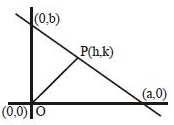
(B) Let the foot of the perpendicular from the origin $(0,0)$ to the line $\frac{x}{a} + \frac{y}{b} = 1$ be $P(h, k).$
Since $P(h, k)$ lies on the line,we have $\frac{h}{a} + \frac{k}{b} = 1.$
Also,the slope of the line $OP$ is $\frac{k}{h}$ and the slope of the given line is $-\frac{b}{a}.$
Since $OP$ is perpendicular to the line,their product of slopes is $-1$: $\left(\frac{k}{h}\right) \left(-\frac{b}{a}\right) = -1$ $\Rightarrow \frac{b}{a} = \frac{h}{k}$ $\Rightarrow a = \frac{bh}{k}.$
Substituting $a$ into the line equation: $\frac{hk}{bh} + \frac{y}{b} = 1$ $\Rightarrow \frac{k}{b} + \frac{y}{b} = 1$ $\Rightarrow b = k + \frac{ky}{h}$ (This is not correct,let's use the standard approach).
Alternative approach: The line is $\frac{x}{a} + \frac{y}{b} = 1.$ The foot of the perpendicular $(h, k)$ satisfies $h = \frac{a b^2}{a^2 + b^2}$ and $k = \frac{a^2 b}{a^2 + b^2}.$
Then $h^2 + k^2 = \frac{a^2 b^2 (b^2 + a^2)}{(a^2 + b^2)^2} = \frac{a^2 b^2}{a^2 + b^2} = \frac{1}{\frac{1}{b^2} + \frac{1}{a^2}}.$
Given $\frac{1}{a^2} + \frac{1}{b^2} = \frac{1}{2c^2},$ we have $h^2 + k^2 = \frac{1}{1/(2c^2)} = 2c^2.$
Thus,the locus is $x^2 + y^2 = 2c^2.$
Since $P(h, k)$ lies on the line,we have $\frac{h}{a} + \frac{k}{b} = 1.$
Also,the slope of the line $OP$ is $\frac{k}{h}$ and the slope of the given line is $-\frac{b}{a}.$
Since $OP$ is perpendicular to the line,their product of slopes is $-1$: $\left(\frac{k}{h}\right) \left(-\frac{b}{a}\right) = -1$ $\Rightarrow \frac{b}{a} = \frac{h}{k}$ $\Rightarrow a = \frac{bh}{k}.$
Substituting $a$ into the line equation: $\frac{hk}{bh} + \frac{y}{b} = 1$ $\Rightarrow \frac{k}{b} + \frac{y}{b} = 1$ $\Rightarrow b = k + \frac{ky}{h}$ (This is not correct,let's use the standard approach).
Alternative approach: The line is $\frac{x}{a} + \frac{y}{b} = 1.$ The foot of the perpendicular $(h, k)$ satisfies $h = \frac{a b^2}{a^2 + b^2}$ and $k = \frac{a^2 b}{a^2 + b^2}.$
Then $h^2 + k^2 = \frac{a^2 b^2 (b^2 + a^2)}{(a^2 + b^2)^2} = \frac{a^2 b^2}{a^2 + b^2} = \frac{1}{\frac{1}{b^2} + \frac{1}{a^2}}.$
Given $\frac{1}{a^2} + \frac{1}{b^2} = \frac{1}{2c^2},$ we have $h^2 + k^2 = \frac{1}{1/(2c^2)} = 2c^2.$
Thus,the locus is $x^2 + y^2 = 2c^2.$
0 likes
View Solution74
DifficultMCQ
$A$ variable line passes through a fixed point $(a, b)$ and meets the coordinate axes at $A$ and $B$. The locus of the point of intersection of lines drawn through $A$ and $B$ parallel to the coordinate axes is:
A
$x/a + y/b = 2$
B
$a/x + b/y = 1$
C
$x/a + y/b = 1$
D
$a/x + b/y = 2$
Solution
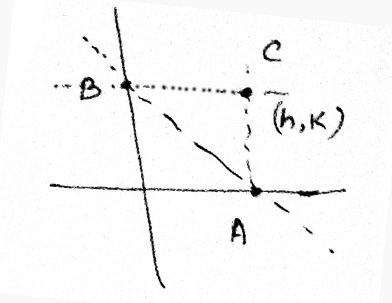
(B) Let the equation of the variable line passing through $(a, b)$ be $\frac{x}{X} + \frac{y}{Y} = 1$.
Since it passes through $(a, b)$,we have $\frac{a}{X} + \frac{b}{Y} = 1$.
The line meets the axes at $A(X, 0)$ and $B(0, Y)$.
The lines drawn through $A$ and $B$ parallel to the coordinate axes intersect at point $P(h, k)$.
From the geometry,$h = X$ and $k = Y$.
Substituting these into the equation $\frac{a}{X} + \frac{b}{Y} = 1$,we get $\frac{a}{h} + \frac{b}{k} = 1$.
Replacing $(h, k)$ with $(x, y)$,the locus is $\frac{a}{x} + \frac{b}{y} = 1$.
Since it passes through $(a, b)$,we have $\frac{a}{X} + \frac{b}{Y} = 1$.
The line meets the axes at $A(X, 0)$ and $B(0, Y)$.
The lines drawn through $A$ and $B$ parallel to the coordinate axes intersect at point $P(h, k)$.
From the geometry,$h = X$ and $k = Y$.
Substituting these into the equation $\frac{a}{X} + \frac{b}{Y} = 1$,we get $\frac{a}{h} + \frac{b}{k} = 1$.
Replacing $(h, k)$ with $(x, y)$,the locus is $\frac{a}{x} + \frac{b}{y} = 1$.
0 likes
View Solution75
AdvancedMCQ
Let $A (2, 3)$ and $B (-4, 5)$ be two fixed points. $A$ point $P$ moves in such a way that the area of $\Delta PAB = 12 \, \text{sq. units}$. Find its locus.
A
$x^2 + 6xy + 9y^2 + 22x + 66y - 23 = 0$
B
$x^2 + 6xy + 9y^2 + 22x + 66y + 23 = 0$
C
$x^2 + 6xy + 9y^2 - 22x - 66y - 23 = 0$
D
None of these
Solution
(C) Let $P = (x, y)$.
Given $A = (2, 3)$ and $B = (-4, 5)$.
The area of $\Delta PAB = \frac{1}{2} |x_1(y_2 - y_3) + x_2(y_3 - y_1) + x_3(y_1 - y_2)| = 12$.
Substituting the coordinates: $\frac{1}{2} |x(3 - 5) + 2(5 - y) - 4(y - 3)| = 12$.
$\frac{1}{2} |-2x + 10 - 2y - 4y + 12| = 12$.
$|-2x - 6y + 22| = 24$.
$|-x - 3y + 11| = 12$.
This implies $-x - 3y + 11 = 12$ or $-x - 3y + 11 = -12$.
Case $1$: $x + 3y + 1 = 0$.
Case $2$: $x + 3y - 23 = 0$.
The combined equation of the locus is $(x + 3y + 1)(x + 3y - 23) = 0$.
Expanding this: $x^2 + 3xy - 23x + 3xy + 9y^2 - 69y + x + 3y - 23 = 0$.
$x^2 + 6xy + 9y^2 - 22x - 66y - 23 = 0$.
Given $A = (2, 3)$ and $B = (-4, 5)$.
The area of $\Delta PAB = \frac{1}{2} |x_1(y_2 - y_3) + x_2(y_3 - y_1) + x_3(y_1 - y_2)| = 12$.
Substituting the coordinates: $\frac{1}{2} |x(3 - 5) + 2(5 - y) - 4(y - 3)| = 12$.
$\frac{1}{2} |-2x + 10 - 2y - 4y + 12| = 12$.
$|-2x - 6y + 22| = 24$.
$|-x - 3y + 11| = 12$.
This implies $-x - 3y + 11 = 12$ or $-x - 3y + 11 = -12$.
Case $1$: $x + 3y + 1 = 0$.
Case $2$: $x + 3y - 23 = 0$.
The combined equation of the locus is $(x + 3y + 1)(x + 3y - 23) = 0$.
Expanding this: $x^2 + 3xy - 23x + 3xy + 9y^2 - 69y + x + 3y - 23 = 0$.
$x^2 + 6xy + 9y^2 - 22x - 66y - 23 = 0$.
0 likes
View Solution76
AdvancedMCQ
$A$ point moves in the $x-y$ plane such that the sum of its distances from two mutually perpendicular lines is always equal to $3$. The area enclosed by the locus of the point is ............... $unit^{2}$.
A
$18$
B
$4.5$
C
$9$
D
None of these
Solution
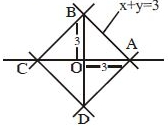
(A) Let the two mutually perpendicular lines be the coordinate axes $x=0$ and $y=0$.
Let the point be $(x, y)$.
The sum of its distances from these lines is $|x| + |y| = 3$.
This equation represents a square with vertices at $(3, 0), (0, 3), (-3, 0),$ and $(0, -3)$.
The diagonals of this square lie along the axes and have lengths $d_1 = 6$ and $d_2 = 6$.
The area of the square is $\frac{1}{2} \times d_1 \times d_2 = \frac{1}{2} \times 6 \times 6 = 18 \text{ unit}^2$.
Let the point be $(x, y)$.
The sum of its distances from these lines is $|x| + |y| = 3$.
This equation represents a square with vertices at $(3, 0), (0, 3), (-3, 0),$ and $(0, -3)$.
The diagonals of this square lie along the axes and have lengths $d_1 = 6$ and $d_2 = 6$.
The area of the square is $\frac{1}{2} \times d_1 \times d_2 = \frac{1}{2} \times 6 \times 6 = 18 \text{ unit}^2$.
0 likes
View Solution77
DifficultMCQ
If two mutually perpendicular lines through the point $A(1, 1)$ intersect the $x$-axis and $y$-axis at points $B$ and $C$ respectively,then the locus of the centroid of $\Delta ABC$ is -
A
$3x + 3y = 4$
B
$x + y = 4$
C
$x + y = 2$
D
$9xy - 6x - 6y + 5 = 0$
Solution
(D) Let the line $AB$ have slope $m$. Since $AB$ passes through $A(1, 1)$,its equation is $y - 1 = m(x - 1)$.
It intersects the $x$-axis at $B(1 - \frac{1}{m}, 0)$.
The line $AC$ is perpendicular to $AB$,so its slope is $-\frac{1}{m}$. Its equation is $y - 1 = -\frac{1}{m}(x - 1)$.
It intersects the $y$-axis at $C(0, 1 + m)$.
Let the centroid of $\Delta ABC$ be $G(h, k)$.
$h = \frac{1 + (1 - \frac{1}{m}) + 0}{3} = \frac{2 - \frac{1}{m}}{3} \implies 3h - 2 = -\frac{1}{m} \implies m = \frac{1}{2 - 3h}$.
$k = \frac{1 + 0 + (1 + m)}{3} = \frac{2 + m}{3} \implies 3k - 2 = m$.
Substituting $m$ in the second equation: $3k - 2 = \frac{1}{2 - 3h}$.
$(3k - 2)(2 - 3h) = 1 \implies 6k - 9hk - 4 + 6h = 1$.
$9hk - 6h - 6k + 5 = 0$.
Replacing $(h, k)$ with $(x, y)$,the locus is $9xy - 6x - 6y + 5 = 0$.
It intersects the $x$-axis at $B(1 - \frac{1}{m}, 0)$.
The line $AC$ is perpendicular to $AB$,so its slope is $-\frac{1}{m}$. Its equation is $y - 1 = -\frac{1}{m}(x - 1)$.
It intersects the $y$-axis at $C(0, 1 + m)$.
Let the centroid of $\Delta ABC$ be $G(h, k)$.
$h = \frac{1 + (1 - \frac{1}{m}) + 0}{3} = \frac{2 - \frac{1}{m}}{3} \implies 3h - 2 = -\frac{1}{m} \implies m = \frac{1}{2 - 3h}$.
$k = \frac{1 + 0 + (1 + m)}{3} = \frac{2 + m}{3} \implies 3k - 2 = m$.
Substituting $m$ in the second equation: $3k - 2 = \frac{1}{2 - 3h}$.
$(3k - 2)(2 - 3h) = 1 \implies 6k - 9hk - 4 + 6h = 1$.
$9hk - 6h - 6k + 5 = 0$.
Replacing $(h, k)$ with $(x, y)$,the locus is $9xy - 6x - 6y + 5 = 0$.
0 likes
View Solution78
AdvancedMCQ
Let $P(2, 3)$,$Q(6, 0)$,and $R(\alpha, \beta)$ be three points in the $x-y$ plane such that $|PR + QR| + |PR - QR|$ is minimum. Then the value of $(\alpha - 2\beta)$ is:
A
$1$
B
$0$
C
$-1$
D
$4$
Solution
(A) The expression $|PR + QR| + |PR - QR|$ represents the sum of the distances from $R$ to $P$ and $Q$ plus the absolute difference of those distances.
By the triangle inequality,$|PR + QR| \ge |PQ|$.
Also,$|PR - QR| \ge 0$,and the minimum value is $0$ when $R$ lies on the line segment $PQ$.
Thus,the minimum value of the entire expression is $|PQ|$,which occurs when $R$ lies on the line segment $PQ$.
However,for the expression to be minimized specifically as a function of $R$,$R$ must lie on the line segment $PQ$.
Given the standard interpretation of such geometric minimization problems,$R$ is the midpoint of $PQ$.
$R = \left( \frac{2+6}{2}, \frac{3+0}{2} \right) = (4, 1.5)$.
So,$\alpha = 4$ and $\beta = 1.5$.
Then,$\alpha - 2\beta = 4 - 2(1.5) = 4 - 3 = 1$.
By the triangle inequality,$|PR + QR| \ge |PQ|$.
Also,$|PR - QR| \ge 0$,and the minimum value is $0$ when $R$ lies on the line segment $PQ$.
Thus,the minimum value of the entire expression is $|PQ|$,which occurs when $R$ lies on the line segment $PQ$.
However,for the expression to be minimized specifically as a function of $R$,$R$ must lie on the line segment $PQ$.
Given the standard interpretation of such geometric minimization problems,$R$ is the midpoint of $PQ$.
$R = \left( \frac{2+6}{2}, \frac{3+0}{2} \right) = (4, 1.5)$.
So,$\alpha = 4$ and $\beta = 1.5$.
Then,$\alpha - 2\beta = 4 - 2(1.5) = 4 - 3 = 1$.
0 likes
View Solution79
DifficultMCQ
If a variable line drawn through the intersection of the lines $\frac{x}{3} + \frac{y}{4} = 1$ and $\frac{x}{4} + \frac{y}{3} = 1$ meets the coordinate axes at $A$ and $B$ $(A \neq B)$,then the locus of the midpoint of $AB$ is
A
$7xy = 6(x + y)$
B
$4(x + y)^2 - 28(x + y) + 49 = 0$
C
$6xy = 7(x + y)$
D
$14(x + y)^2 - 97(x + y) + 168 = 0$
Solution
(C) The given lines are $L_1: 4x + 3y - 12 = 0$ and $L_2: 3x + 4y - 12 = 0$.
Any line passing through their intersection is given by $L_1 + \lambda L_2 = 0$,which is $(4x + 3y - 12) + \lambda(3x + 4y - 12) = 0$.
Rearranging,we get $x(4 + 3\lambda) + y(3 + 4\lambda) - 12(1 + \lambda) = 0$.
The line meets the axes at $A\left(\frac{12(1 + \lambda)}{4 + 3\lambda}, 0\right)$ and $B\left(0, \frac{12(1 + \lambda)}{3 + 4\lambda}\right)$.
Let the midpoint of $AB$ be $(h, k)$. Then $h = \frac{6(1 + \lambda)}{4 + 3\lambda}$ and $k = \frac{6(1 + \lambda)}{3 + 4\lambda}$.
From these,$\frac{1}{h} = \frac{4 + 3\lambda}{6(1 + \lambda)}$ and $\frac{1}{k} = \frac{3 + 4\lambda}{6(1 + \lambda)}$.
Adding these,$\frac{1}{h} + \frac{1}{k} = \frac{7 + 7\lambda}{6(1 + \lambda)} = \frac{7}{6}$.
Thus,$\frac{h + k}{hk} = \frac{7}{6}$,which implies $6(h + k) = 7hk$.
The locus is $6(x + y) = 7xy$.
Any line passing through their intersection is given by $L_1 + \lambda L_2 = 0$,which is $(4x + 3y - 12) + \lambda(3x + 4y - 12) = 0$.
Rearranging,we get $x(4 + 3\lambda) + y(3 + 4\lambda) - 12(1 + \lambda) = 0$.
The line meets the axes at $A\left(\frac{12(1 + \lambda)}{4 + 3\lambda}, 0\right)$ and $B\left(0, \frac{12(1 + \lambda)}{3 + 4\lambda}\right)$.
Let the midpoint of $AB$ be $(h, k)$. Then $h = \frac{6(1 + \lambda)}{4 + 3\lambda}$ and $k = \frac{6(1 + \lambda)}{3 + 4\lambda}$.
From these,$\frac{1}{h} = \frac{4 + 3\lambda}{6(1 + \lambda)}$ and $\frac{1}{k} = \frac{3 + 4\lambda}{6(1 + \lambda)}$.
Adding these,$\frac{1}{h} + \frac{1}{k} = \frac{7 + 7\lambda}{6(1 + \lambda)} = \frac{7}{6}$.
Thus,$\frac{h + k}{hk} = \frac{7}{6}$,which implies $6(h + k) = 7hk$.
The locus is $6(x + y) = 7xy$.
0 likes
View Solution80
DifficultMCQ
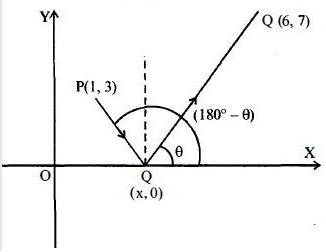
$A$ light ray emerging from the point source placed at $P(1, 3)$ is reflected at a point $Q$ on the $x$-axis. If the reflected ray passes through the point $R(6, 7)$,then the abscissa of $Q$ is
A
$1$
B
$3$
C
$\frac{7}{2}$
D
$\frac{5}{2}$
Solution
(D) Let the abscissa of $Q$ be $x$.
Since $Q$ lies on the $x$-axis,its coordinates are $Q(x, 0)$.
Let the reflected ray make an angle $\theta$ with the positive $x$-axis.
The slope of the reflected ray $QR$ is $\tan \theta = \frac{7 - 0}{6 - x} = \frac{7}{6 - x}$.
The incident ray $PQ$ makes an angle $(180^\circ - \theta)$ with the positive $x$-axis.
The slope of the incident ray $PQ$ is $\tan(180^\circ - \theta) = \frac{3 - 0}{1 - x} = \frac{3}{1 - x}$.
Since $\tan(180^\circ - \theta) = -\tan \theta$,we have:
$\frac{3}{1 - x} = -\left(\frac{7}{6 - x}\right)$
$3(6 - x) = -7(1 - x)$
$18 - 3x = -7 + 7x$
$25 = 10x$
$x = \frac{25}{10} = \frac{5}{2}$.
Since $Q$ lies on the $x$-axis,its coordinates are $Q(x, 0)$.
Let the reflected ray make an angle $\theta$ with the positive $x$-axis.
The slope of the reflected ray $QR$ is $\tan \theta = \frac{7 - 0}{6 - x} = \frac{7}{6 - x}$.
The incident ray $PQ$ makes an angle $(180^\circ - \theta)$ with the positive $x$-axis.
The slope of the incident ray $PQ$ is $\tan(180^\circ - \theta) = \frac{3 - 0}{1 - x} = \frac{3}{1 - x}$.
Since $\tan(180^\circ - \theta) = -\tan \theta$,we have:
$\frac{3}{1 - x} = -\left(\frac{7}{6 - x}\right)$
$3(6 - x) = -7(1 - x)$
$18 - 3x = -7 + 7x$
$25 = 10x$
$x = \frac{25}{10} = \frac{5}{2}$.
0 likes
View Solution81
DifficultMCQ
$A$ point $P$ moves on the line $2x - 3y + 4 = 0$. If $Q(1, 4)$ and $R(3, -2)$ are fixed points,then the locus of the centroid of $\Delta PQR$ is a line
A
with slope $\frac{3}{2}$
B
parallel to $x-$ axis
C
with slope $\frac{2}{3}$
D
parallel to $y-$ axis
Solution
(C) Let the coordinates of point $P$ be $(\alpha, \beta)$. Since $P$ lies on the line $2x - 3y + 4 = 0$,we have $2\alpha - 3\beta + 4 = 0$.
Let $(h, k)$ be the centroid of $\Delta PQR$. The coordinates of the centroid are given by:
$h = \frac{\alpha + 1 + 3}{3}$ $\Rightarrow 3h = \alpha + 4$ $\Rightarrow \alpha = 3h - 4$
$k = \frac{\beta + 4 - 2}{3}$ $\Rightarrow 3k = \beta + 2$ $\Rightarrow \beta = 3k - 2$
Substituting these values into the equation of the line:
$2(3h - 4) - 3(3k - 2) + 4 = 0$
$6h - 8 - 9k + 6 + 4 = 0$
$6h - 9k + 2 = 0$
The locus of the centroid $(h, k)$ is $6x - 9y + 2 = 0$.
Rewriting in slope-intercept form: $9y = 6x + 2$ $\Rightarrow y = \frac{6}{9}x + \frac{2}{9}$ $\Rightarrow y = \frac{2}{3}x + \frac{2}{9}$.
The slope of this line is $\frac{2}{3}$.
Let $(h, k)$ be the centroid of $\Delta PQR$. The coordinates of the centroid are given by:
$h = \frac{\alpha + 1 + 3}{3}$ $\Rightarrow 3h = \alpha + 4$ $\Rightarrow \alpha = 3h - 4$
$k = \frac{\beta + 4 - 2}{3}$ $\Rightarrow 3k = \beta + 2$ $\Rightarrow \beta = 3k - 2$
Substituting these values into the equation of the line:
$2(3h - 4) - 3(3k - 2) + 4 = 0$
$6h - 8 - 9k + 6 + 4 = 0$
$6h - 9k + 2 = 0$
The locus of the centroid $(h, k)$ is $6x - 9y + 2 = 0$.
Rewriting in slope-intercept form: $9y = 6x + 2$ $\Rightarrow y = \frac{6}{9}x + \frac{2}{9}$ $\Rightarrow y = \frac{2}{3}x + \frac{2}{9}$.
The slope of this line is $\frac{2}{3}$.
0 likes
View Solution82
DifficultMCQ
$A$ point on the straight line $3x + 5y = 15$ which is equidistant from the coordinate axes will lie only in
A
$4^{th}$ quadrant
B
$1^{st}$,$2^{nd}$ and $4^{th}$ quadrants
C
$1^{st}$ quadrant
D
$1^{st}$ and $2^{nd}$ quadrants
Solution
(D) Let the point be $P(t, y)$. Since the point lies on the line $3x + 5y = 15$,we have $3t + 5y = 15$,which gives $y = \frac{15 - 3t}{5}$.
Since the point is equidistant from the coordinate axes,$|x| = |y|$,so $|t| = |\frac{15 - 3t}{5}|$.
This implies $\frac{15 - 3t}{5} = t$ or $\frac{15 - 3t}{5} = -t$.
Case $1$: $15 - 3t = 5t$ $\Rightarrow 8t = 15$ $\Rightarrow t = \frac{15}{8}$. Then $y = \frac{15}{8}$. Point $P(\frac{15}{8}, \frac{15}{8})$ lies in the $1^{st}$ quadrant.
Case $2$: $15 - 3t = -5t$ $\Rightarrow 2t = -15$ $\Rightarrow t = -\frac{15}{2}$. Then $y = \frac{15}{2}$. Point $P(-\frac{15}{2}, \frac{15}{2})$ lies in the $2^{nd}$ quadrant.
Thus,the points lie in the $1^{st}$ and $2^{nd}$ quadrants.
Since the point is equidistant from the coordinate axes,$|x| = |y|$,so $|t| = |\frac{15 - 3t}{5}|$.
This implies $\frac{15 - 3t}{5} = t$ or $\frac{15 - 3t}{5} = -t$.
Case $1$: $15 - 3t = 5t$ $\Rightarrow 8t = 15$ $\Rightarrow t = \frac{15}{8}$. Then $y = \frac{15}{8}$. Point $P(\frac{15}{8}, \frac{15}{8})$ lies in the $1^{st}$ quadrant.
Case $2$: $15 - 3t = -5t$ $\Rightarrow 2t = -15$ $\Rightarrow t = -\frac{15}{2}$. Then $y = \frac{15}{2}$. Point $P(-\frac{15}{2}, \frac{15}{2})$ lies in the $2^{nd}$ quadrant.
Thus,the points lie in the $1^{st}$ and $2^{nd}$ quadrants.
1 likes
View Solution83
DifficultMCQ
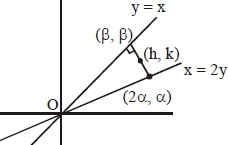
The locus of the mid-points of the perpendiculars drawn from points on the line $x=2y$ to the line $x=y$ is:
A
$2x-3y=0$
B
$7x-5y=0$
C
$5x-7y=0$
D
$3x-2y=0$
Solution
(C) Let a point on the line $x=2y$ be $P(2\alpha, \alpha)$.
Let the perpendicular from $P$ to the line $x-y=0$ meet it at $Q(\beta, \beta)$.
The slope of $PQ$ is $\frac{\alpha-\beta}{2\alpha-\beta}$.
Since $PQ$ is perpendicular to $x-y=0$ (slope $1$),the slope of $PQ$ must be $-1$.
So,$\frac{\alpha-\beta}{2\alpha-\beta} = -1 \implies \alpha-\beta = -2\alpha+\beta \implies 3\alpha = 2\beta \implies \beta = \frac{3\alpha}{2}$.
Let $(h, k)$ be the mid-point of $PQ$.
$h = \frac{2\alpha+\beta}{2} = \frac{2\alpha + \frac{3\alpha}{2}}{2} = \frac{7\alpha}{4}$.
$k = \frac{\alpha+\beta}{2} = \frac{\alpha + \frac{3\alpha}{2}}{2} = \frac{5\alpha}{4}$.
Now,$\frac{h}{k} = \frac{7\alpha/4}{5\alpha/4} = \frac{7}{5}$.
$5h = 7k \implies 5x-7y=0$.
Let the perpendicular from $P$ to the line $x-y=0$ meet it at $Q(\beta, \beta)$.
The slope of $PQ$ is $\frac{\alpha-\beta}{2\alpha-\beta}$.
Since $PQ$ is perpendicular to $x-y=0$ (slope $1$),the slope of $PQ$ must be $-1$.
So,$\frac{\alpha-\beta}{2\alpha-\beta} = -1 \implies \alpha-\beta = -2\alpha+\beta \implies 3\alpha = 2\beta \implies \beta = \frac{3\alpha}{2}$.
Let $(h, k)$ be the mid-point of $PQ$.
$h = \frac{2\alpha+\beta}{2} = \frac{2\alpha + \frac{3\alpha}{2}}{2} = \frac{7\alpha}{4}$.
$k = \frac{\alpha+\beta}{2} = \frac{\alpha + \frac{3\alpha}{2}}{2} = \frac{5\alpha}{4}$.
Now,$\frac{h}{k} = \frac{7\alpha/4}{5\alpha/4} = \frac{7}{5}$.
$5h = 7k \implies 5x-7y=0$.
0 likes
View Solution84
Difficult
Show that the path of a moving point such that its distances from two lines $3x - 2y = 5$ and $3x + 2y = 5$ are equal is a straight line.
Solution
(N/A) Given lines are $3x - 2y - 5 = 0$ $(1)$ and $3x + 2y - 5 = 0$ $(2)$.
Let $(h, k)$ be any point whose distances from lines $(1)$ and $(2)$ are equal.
The distance of $(h, k)$ from line $(1)$ is $\frac{|3h - 2k - 5|}{\sqrt{3^2 + (-2)^2}} = \frac{|3h - 2k - 5|}{\sqrt{13}}$.
The distance of $(h, k)$ from line $(2)$ is $\frac{|3h + 2k - 5|}{\sqrt{3^2 + 2^2}} = \frac{|3h + 2k - 5|}{\sqrt{13}}$.
Since the distances are equal,we have $\frac{|3h - 2k - 5|}{\sqrt{13}} = \frac{|3h + 2k - 5|}{\sqrt{13}}$,which implies $|3h - 2k - 5| = |3h + 2k - 5|$.
This gives two cases:
Case $1$: $3h - 2k - 5 = 3h + 2k - 5 \implies -2k = 2k \implies 4k = 0 \implies k = 0$.
Case $2$: $3h - 2k - 5 = -(3h + 2k - 5) \implies 3h - 2k - 5 = -3h - 2k + 5 \implies 6h = 10 \implies h = \frac{5}{3}$.
Thus,the locus of the point $(h, k)$ is $y = 0$ or $x = \frac{5}{3}$,both of which represent straight lines.
Let $(h, k)$ be any point whose distances from lines $(1)$ and $(2)$ are equal.
The distance of $(h, k)$ from line $(1)$ is $\frac{|3h - 2k - 5|}{\sqrt{3^2 + (-2)^2}} = \frac{|3h - 2k - 5|}{\sqrt{13}}$.
The distance of $(h, k)$ from line $(2)$ is $\frac{|3h + 2k - 5|}{\sqrt{3^2 + 2^2}} = \frac{|3h + 2k - 5|}{\sqrt{13}}$.
Since the distances are equal,we have $\frac{|3h - 2k - 5|}{\sqrt{13}} = \frac{|3h + 2k - 5|}{\sqrt{13}}$,which implies $|3h - 2k - 5| = |3h + 2k - 5|$.
This gives two cases:
Case $1$: $3h - 2k - 5 = 3h + 2k - 5 \implies -2k = 2k \implies 4k = 0 \implies k = 0$.
Case $2$: $3h - 2k - 5 = -(3h + 2k - 5) \implies 3h - 2k - 5 = -3h - 2k + 5 \implies 6h = 10 \implies h = \frac{5}{3}$.
Thus,the locus of the point $(h, k)$ is $y = 0$ or $x = \frac{5}{3}$,both of which represent straight lines.
0 likes
View Solution85
Difficult
If the sum of the perpendicular distances of a variable point $P(x, y)$ from the lines $x + y - 5 = 0$ and $3x - 2y + 7 = 0$ is always $10$,show that $P$ must move on a line.
Solution
(N/A) The equations of the given lines are:
$x + y - 5 = 0$ $(1)$
$3x - 2y + 7 = 0$ $(2)$
The perpendicular distances of $P(x, y)$ from lines $(1)$ and $(2)$ are given by:
$d_{1} = \frac{|x + y - 5|}{\sqrt{1^{2} + 1^{2}}} = \frac{|x + y - 5|}{\sqrt{2}}$
$d_{2} = \frac{|3x - 2y + 7|}{\sqrt{3^{2} + (-2)^{2}}} = \frac{|3x - 2y + 7|}{\sqrt{13}}$
Given that $d_{1} + d_{2} = 10$,we have:
$\frac{|x + y - 5|}{\sqrt{2}} + \frac{|3x - 2y + 7|}{\sqrt{13}} = 10$
Assuming the expressions inside the modulus are positive,we get:
$\sqrt{13}(x + y - 5) + \sqrt{2}(3x - 2y + 7) = 10\sqrt{26}$
Expanding the terms:
$(\sqrt{13} + 3\sqrt{2})x + (\sqrt{13} - 2\sqrt{2})y - (5\sqrt{13} - 7\sqrt{2} + 10\sqrt{26}) = 0$
This is of the form $Ax + By + C = 0$,which represents a straight line. Since the signs of the expressions inside the modulus can change,$P$ moves on one of the four possible lines formed by the combinations of signs. Thus,$P$ moves on a line.
$x + y - 5 = 0$ $(1)$
$3x - 2y + 7 = 0$ $(2)$
The perpendicular distances of $P(x, y)$ from lines $(1)$ and $(2)$ are given by:
$d_{1} = \frac{|x + y - 5|}{\sqrt{1^{2} + 1^{2}}} = \frac{|x + y - 5|}{\sqrt{2}}$
$d_{2} = \frac{|3x - 2y + 7|}{\sqrt{3^{2} + (-2)^{2}}} = \frac{|3x - 2y + 7|}{\sqrt{13}}$
Given that $d_{1} + d_{2} = 10$,we have:
$\frac{|x + y - 5|}{\sqrt{2}} + \frac{|3x - 2y + 7|}{\sqrt{13}} = 10$
Assuming the expressions inside the modulus are positive,we get:
$\sqrt{13}(x + y - 5) + \sqrt{2}(3x - 2y + 7) = 10\sqrt{26}$
Expanding the terms:
$(\sqrt{13} + 3\sqrt{2})x + (\sqrt{13} - 2\sqrt{2})y - (5\sqrt{13} - 7\sqrt{2} + 10\sqrt{26}) = 0$
This is of the form $Ax + By + C = 0$,which represents a straight line. Since the signs of the expressions inside the modulus can change,$P$ moves on one of the four possible lines formed by the combinations of signs. Thus,$P$ moves on a line.
0 likes
View Solution86
DifficultMCQ
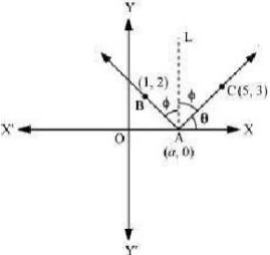
$A$ ray of light passing through the point $(1, 2)$ reflects on the $x$-axis at point $A$ and the reflected ray passes through the point $(5, 3)$. Find the coordinates of $A$.
A
$\left(\frac{13}{5}, 0\right)$
B
$\left(\frac{11}{5}, 0\right)$
C
$\left(\frac{12}{5}, 0\right)$
D
$\left(\frac{14}{5}, 0\right)$
Solution
(A) Let the coordinates of point $A$ be $(a, 0)$.
By the law of reflection,the point $(1, 2)$ and the point $(5, 3)$ are such that the reflection of $(1, 2)$ across the $x$-axis,which is $(1, -2)$,lies on the line passing through $A$ and $(5, 3)$.
The slope of the line passing through $(1, -2)$ and $(5, 3)$ is $m = \frac{3 - (-2)}{5 - 1} = \frac{5}{4}$.
The equation of this line is $y - 3 = \frac{5}{4}(x - 5)$.
To find the $x$-intercept (point $A$),set $y = 0$:
$-3 = \frac{5}{4}(x - 5)$
$-12 = 5x - 25$
$5x = 13$
$x = \frac{13}{5}$.
Thus,the coordinates of point $A$ are $\left(\frac{13}{5}, 0\right)$.
By the law of reflection,the point $(1, 2)$ and the point $(5, 3)$ are such that the reflection of $(1, 2)$ across the $x$-axis,which is $(1, -2)$,lies on the line passing through $A$ and $(5, 3)$.
The slope of the line passing through $(1, -2)$ and $(5, 3)$ is $m = \frac{3 - (-2)}{5 - 1} = \frac{5}{4}$.
The equation of this line is $y - 3 = \frac{5}{4}(x - 5)$.
To find the $x$-intercept (point $A$),set $y = 0$:
$-3 = \frac{5}{4}(x - 5)$
$-12 = 5x - 25$
$5x = 13$
$x = \frac{13}{5}$.
Thus,the coordinates of point $A$ are $\left(\frac{13}{5}, 0\right)$.
0 likes
View Solution87
DifficultMCQ
$A$ $10 \text{ inches}$ long pencil $AB$ with midpoint $C$ and a small eraser $P$ are placed on the horizontal top of a table such that $PC = \sqrt{5} \text{ inches}$ and $\angle PCB = \tan^{-1}(2)$. The acute angle through which the pencil must be rotated about $C$ so that the perpendicular distance between the eraser and the pencil becomes exactly $1 \text{ inch}$ is:
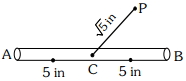
A
$\tan^{-1}\left(\frac{3}{4}\right)$
B
$\tan^{-1}(1)$
C
$\tan^{-1}\left(\frac{4}{3}\right)$
D
$\tan^{-1}\left(\frac{1}{2}\right)$
Solution
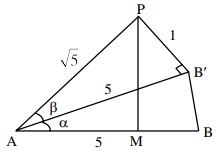
(A) Let the pencil be rotated by an angle $\alpha$ about $C$. Let the new position of the pencil be $A'B'$.
In the right-angled triangle formed by the perpendicular from $P$ to the pencil,let the angle between $PC$ and the new pencil line be $\theta$.
We are given $PC = \sqrt{5}$ and the perpendicular distance $d = 1$.
In the right triangle formed by $P$,the foot of the perpendicular on the pencil,and $C$,we have $\sin \theta = \frac{d}{PC} = \frac{1}{\sqrt{5}}$.
Thus,$\tan \theta = \frac{1}{2}$.
Initially,the angle $\angle PCB = \phi = \tan^{-1}(2)$,so $\tan \phi = 2$.
The angle of rotation $\alpha$ is the difference between the initial angle $\phi$ and the new angle $\theta$.
$\alpha = \phi - \theta$.
$\tan \alpha = \tan(\phi - \theta) = \frac{\tan \phi - \tan \theta}{1 + \tan \phi \tan \theta} = \frac{2 - 1/2}{1 + 2(1/2)} = \frac{3/2}{2} = \frac{3}{4}$.
Therefore,$\alpha = \tan^{-1}\left(\frac{3}{4}\right)$.
In the right-angled triangle formed by the perpendicular from $P$ to the pencil,let the angle between $PC$ and the new pencil line be $\theta$.
We are given $PC = \sqrt{5}$ and the perpendicular distance $d = 1$.
In the right triangle formed by $P$,the foot of the perpendicular on the pencil,and $C$,we have $\sin \theta = \frac{d}{PC} = \frac{1}{\sqrt{5}}$.
Thus,$\tan \theta = \frac{1}{2}$.
Initially,the angle $\angle PCB = \phi = \tan^{-1}(2)$,so $\tan \phi = 2$.
The angle of rotation $\alpha$ is the difference between the initial angle $\phi$ and the new angle $\theta$.
$\alpha = \phi - \theta$.
$\tan \alpha = \tan(\phi - \theta) = \frac{\tan \phi - \tan \theta}{1 + \tan \phi \tan \theta} = \frac{2 - 1/2}{1 + 2(1/2)} = \frac{3/2}{2} = \frac{3}{4}$.
Therefore,$\alpha = \tan^{-1}\left(\frac{3}{4}\right)$.
0 likes
View Solution88
DifficultMCQ
Let $A$ be a fixed point $(0,6)$ and $B$ be a moving point $(2t, 0)$. Let $M$ be the mid-point of $AB$ and the perpendicular bisector of $AB$ meets the $y$-axis at $C$. The locus of the mid-point $P$ of $MC$ is:
A
$3x^{2}-2y-6=0$
B
$3x^{2}+2y-6=0$
C
$2x^{2}+3y-9=0$
D
$2x^{2}-3y+9=0$
Solution
(C) Given $A = (0,6)$ and $B = (2t, 0)$.
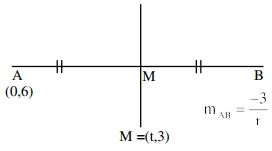
The mid-point $M$ of $AB$ is $\left(\frac{0+2t}{2}, \frac{6+0}{2}\right) = (t, 3)$.
The slope of $AB$ is $m_{AB} = \frac{0-6}{2t-0} = \frac{-6}{2t} = -\frac{3}{t}$.
The slope of the perpendicular bisector of $AB$ is $m_{\perp} = -\frac{1}{m_{AB}} = \frac{t}{3}$.
The equation of the perpendicular bisector passing through $M(t, 3)$ is $(y-3) = \frac{t}{3}(x-t)$.
To find $C$,we set $x=0$ in the equation: $y-3 = \frac{t}{3}(0-t) \Rightarrow y = 3 - \frac{t^{2}}{3}$.
So,$C = (0, 3 - \frac{t^{2}}{3})$.
Let $P(h, k)$ be the mid-point of $MC$. Since $M = (t, 3)$ and $C = (0, 3 - \frac{t^{2}}{3})$:
$h = \frac{t+0}{2} = \frac{t}{2} \Rightarrow t = 2h$.
$k = \frac{3 + (3 - \frac{t^{2}}{3})}{2} = \frac{6 - \frac{t^{2}}{3}}{2} = 3 - \frac{t^{2}}{6}$.
Substituting $t = 2h$ into the equation for $k$:
$k = 3 - \frac{(2h)^{2}}{6} = 3 - \frac{4h^{2}}{6} = 3 - \frac{2h^{2}}{3}$.
$3k = 9 - 2h^{2} \Rightarrow 2h^{2} + 3k - 9 = 0$.
Replacing $(h, k)$ with $(x, y)$,the locus is $2x^{2} + 3y - 9 = 0$.
The mid-point $M$ of $AB$ is $\left(\frac{0+2t}{2}, \frac{6+0}{2}\right) = (t, 3)$.
The slope of $AB$ is $m_{AB} = \frac{0-6}{2t-0} = \frac{-6}{2t} = -\frac{3}{t}$.
The slope of the perpendicular bisector of $AB$ is $m_{\perp} = -\frac{1}{m_{AB}} = \frac{t}{3}$.
The equation of the perpendicular bisector passing through $M(t, 3)$ is $(y-3) = \frac{t}{3}(x-t)$.
To find $C$,we set $x=0$ in the equation: $y-3 = \frac{t}{3}(0-t) \Rightarrow y = 3 - \frac{t^{2}}{3}$.
So,$C = (0, 3 - \frac{t^{2}}{3})$.
Let $P(h, k)$ be the mid-point of $MC$. Since $M = (t, 3)$ and $C = (0, 3 - \frac{t^{2}}{3})$:
$h = \frac{t+0}{2} = \frac{t}{2} \Rightarrow t = 2h$.
$k = \frac{3 + (3 - \frac{t^{2}}{3})}{2} = \frac{6 - \frac{t^{2}}{3}}{2} = 3 - \frac{t^{2}}{6}$.
Substituting $t = 2h$ into the equation for $k$:
$k = 3 - \frac{(2h)^{2}}{6} = 3 - \frac{4h^{2}}{6} = 3 - \frac{2h^{2}}{3}$.
$3k = 9 - 2h^{2} \Rightarrow 2h^{2} + 3k - 9 = 0$.
Replacing $(h, k)$ with $(x, y)$,the locus is $2x^{2} + 3y - 9 = 0$.
0 likes
View Solution89
DifficultMCQ
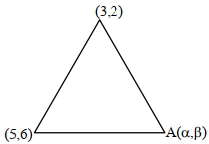
Let $A$ be the set of all points $(\alpha, \beta)$ such that the area of the triangle formed by the points $(5, 6), (3, 2),$ and $(\alpha, \beta)$ is $12 \text{ square units}.$ Then the least possible length of a line segment joining the origin to a point in $A$ is:
A
$\frac{4}{\sqrt{5}}$
B
$\frac{16}{\sqrt{5}}$
C
$\frac{8}{\sqrt{5}}$
D
$\frac{12}{\sqrt{5}}$
Solution
(C) The area of a triangle with vertices $(x_1, y_1), (x_2, y_2),$ and $(x_3, y_3)$ is given by $\frac{1}{2} |x_1(y_2 - y_3) + x_2(y_3 - y_1) + x_3(y_1 - y_2)| = 12.$
Substituting the given points $(5, 6), (3, 2),$ and $(\alpha, \beta)$:
$\frac{1}{2} |5(2 - \beta) + 3(\beta - 6) + \alpha(6 - 2)| = 12$
$|10 - 5\beta + 3\beta - 18 + 4\alpha| = 24$
$|4\alpha - 2\beta - 8| = 24$
$|2\alpha - \beta - 4| = 12$
This gives two possible lines for the locus of point $A$:
Case $1$: $2\alpha - \beta - 4 = 12 \Rightarrow 2\alpha - \beta - 16 = 0$
Case $2$: $2\alpha - \beta - 4 = -12 \Rightarrow 2\alpha - \beta + 8 = 0$
The distance from the origin $(0, 0)$ to a line $ax + by + c = 0$ is $\frac{|c|}{\sqrt{a^2 + b^2}}.$
For line $1$: $d_1 = \frac{|-16|}{\sqrt{2^2 + (-1)^2}} = \frac{16}{\sqrt{5}}$
For line $2$: $d_2 = \frac{|8|}{\sqrt{2^2 + (-1)^2}} = \frac{8}{\sqrt{5}}$
The least distance is $\frac{8}{\sqrt{5}}.$
Substituting the given points $(5, 6), (3, 2),$ and $(\alpha, \beta)$:
$\frac{1}{2} |5(2 - \beta) + 3(\beta - 6) + \alpha(6 - 2)| = 12$
$|10 - 5\beta + 3\beta - 18 + 4\alpha| = 24$
$|4\alpha - 2\beta - 8| = 24$
$|2\alpha - \beta - 4| = 12$
This gives two possible lines for the locus of point $A$:
Case $1$: $2\alpha - \beta - 4 = 12 \Rightarrow 2\alpha - \beta - 16 = 0$
Case $2$: $2\alpha - \beta - 4 = -12 \Rightarrow 2\alpha - \beta + 8 = 0$
The distance from the origin $(0, 0)$ to a line $ax + by + c = 0$ is $\frac{|c|}{\sqrt{a^2 + b^2}}.$
For line $1$: $d_1 = \frac{|-16|}{\sqrt{2^2 + (-1)^2}} = \frac{16}{\sqrt{5}}$
For line $2$: $d_2 = \frac{|8|}{\sqrt{2^2 + (-1)^2}} = \frac{8}{\sqrt{5}}$
The least distance is $\frac{8}{\sqrt{5}}.$
0 likes
View Solution90
MediumMCQ
$A$ man starts walking from the point $P(-3, 4)$,touches the $x$-axis at $R$,and then turns to reach the point $Q(0, 2)$. The man is walking at a constant speed. If the man reaches the point $Q$ in the minimum time,then $50((PR)^{2} + (RQ)^{2})$ is equal to ..... .
A
$5025$
B
$5020$
C
$2050$
D
$1250$
Solution
(D) To minimize the time taken at a constant speed,the total distance $PR + RQ$ must be minimized.
Let $Q'(0, -2)$ be the reflection of $Q(0, 2)$ across the $x$-axis.
The distance $RQ = RQ'$. Thus,$PR + RQ = PR + RQ'$.
This sum is minimized when $P, R,$ and $Q'$ are collinear.
The line passing through $P(-3, 4)$ and $Q'(0, -2)$ has the equation:
$y - (-2) = \frac{4 - (-2)}{-3 - 0}(x - 0)$
$y + 2 = \frac{6}{-3}x$
$y + 2 = -2x \implies 2x + y + 2 = 0$.
The point $R$ is the intersection of this line with the $x$-axis $(y=0)$:
$2x + 0 + 2 = 0 \implies x = -1$.
So,$R = (-1, 0)$.
Now,calculate the squared distances:
$PR^{2} = (-1 - (-3))^{2} + (0 - 4)^{2} = (2)^{2} + (-4)^{2} = 4 + 16 = 20$.
$RQ^{2} = (0 - (-1))^{2} + (2 - 0)^{2} = (1)^{2} + (2)^{2} = 1 + 4 = 5$.
Finally,calculate $50(PR^{2} + RQ^{2})$:
$50(20 + 5) = 50(25) = 1250$.
Let $Q'(0, -2)$ be the reflection of $Q(0, 2)$ across the $x$-axis.
The distance $RQ = RQ'$. Thus,$PR + RQ = PR + RQ'$.
This sum is minimized when $P, R,$ and $Q'$ are collinear.
The line passing through $P(-3, 4)$ and $Q'(0, -2)$ has the equation:
$y - (-2) = \frac{4 - (-2)}{-3 - 0}(x - 0)$
$y + 2 = \frac{6}{-3}x$
$y + 2 = -2x \implies 2x + y + 2 = 0$.
The point $R$ is the intersection of this line with the $x$-axis $(y=0)$:
$2x + 0 + 2 = 0 \implies x = -1$.
So,$R = (-1, 0)$.
Now,calculate the squared distances:
$PR^{2} = (-1 - (-3))^{2} + (0 - 4)^{2} = (2)^{2} + (-4)^{2} = 4 + 16 = 20$.
$RQ^{2} = (0 - (-1))^{2} + (2 - 0)^{2} = (1)^{2} + (2)^{2} = 1 + 4 = 5$.
Finally,calculate $50(PR^{2} + RQ^{2})$:
$50(20 + 5) = 50(25) = 1250$.
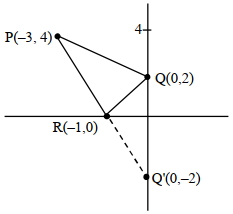
0 likes
View Solution91
AdvancedMCQ
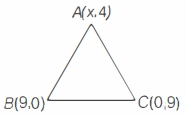
Let $BC$ be a fixed line segment in the plane. The locus of a point $A$ such that the $\triangle ABC$ is isosceles,is (with finitely many possible exceptional points)
A
a line
B
a circle
C
the union of a circle and a line
D
the union of two circles and a line
Solution
(D) For $\triangle ABC$ to be isosceles,at least two sides must be equal. Let the fixed segment be $BC$ with length $a$.
Case $I$: $AB = AC$. The locus of $A$ is the perpendicular bisector of the segment $BC$,which is a straight line.
Case $II$: $AB = BC$. Since $BC$ is fixed,$AB$ must be equal to the constant length $BC$. Thus,the locus of $A$ is a circle centered at $B$ with radius equal to $BC$.
Case $III$: $AC = BC$. Similarly,the locus of $A$ is a circle centered at $C$ with radius equal to $BC$.
Therefore,the complete locus of $A$ is the union of the perpendicular bisector of $BC$ and two circles centered at $B$ and $C$ with radius $BC$ (excluding points where $A, B, C$ are collinear,which are the finitely many exceptional points).
Thus,the correct option is $(d)$.
Case $I$: $AB = AC$. The locus of $A$ is the perpendicular bisector of the segment $BC$,which is a straight line.
Case $II$: $AB = BC$. Since $BC$ is fixed,$AB$ must be equal to the constant length $BC$. Thus,the locus of $A$ is a circle centered at $B$ with radius equal to $BC$.
Case $III$: $AC = BC$. Similarly,the locus of $A$ is a circle centered at $C$ with radius equal to $BC$.
Therefore,the complete locus of $A$ is the union of the perpendicular bisector of $BC$ and two circles centered at $B$ and $C$ with radius $BC$ (excluding points where $A, B, C$ are collinear,which are the finitely many exceptional points).
Thus,the correct option is $(d)$.
0 likes
View Solution92
DifficultMCQ
Suppose we have to cover the $XY$-plane with identical tiles such that no two tiles overlap and no gap is left between the tiles. Suppose that we can choose tiles of the following shapes: equilateral triangle,square,regular pentagon,regular hexagon. Then,the tiling can be done with tiles of
A
all four shapes
B
exactly three of the four shapes
C
exactly two of the four shapes
D
exactly one of the four shapes
Solution
(B) regular polygon with $n$ sides can tile the plane if and only if its interior angle is a divisor of $360^{\circ}$.
The interior angle of a regular $n$-gon is given by $\frac{(n-2) \times 180^{\circ}}{n}$.
$(1)$ For an equilateral triangle $(n=3)$: Interior angle = $\frac{(3-2) \times 180^{\circ}}{3} = 60^{\circ}$. Since $360^{\circ} / 60^{\circ} = 6$,it can tile the plane.
$(2)$ For a square $(n=4)$: Interior angle = $\frac{(4-2) \times 180^{\circ}}{4} = 90^{\circ}$. Since $360^{\circ} / 90^{\circ} = 4$,it can tile the plane.
$(3)$ For a regular pentagon $(n=5)$: Interior angle = $\frac{(5-2) \times 180^{\circ}}{5} = 108^{\circ}$. Since $360^{\circ} / 108^{\circ} = 3.33$ (not an integer),it cannot tile the plane.
$(4)$ For a regular hexagon $(n=6)$: Interior angle = $\frac{(6-2) \times 180^{\circ}}{6} = 120^{\circ}$. Since $360^{\circ} / 120^{\circ} = 3$,it can tile the plane.
Thus,the shapes that can tile the plane are the equilateral triangle,the square,and the regular hexagon. There are exactly three such shapes.
The interior angle of a regular $n$-gon is given by $\frac{(n-2) \times 180^{\circ}}{n}$.
$(1)$ For an equilateral triangle $(n=3)$: Interior angle = $\frac{(3-2) \times 180^{\circ}}{3} = 60^{\circ}$. Since $360^{\circ} / 60^{\circ} = 6$,it can tile the plane.
$(2)$ For a square $(n=4)$: Interior angle = $\frac{(4-2) \times 180^{\circ}}{4} = 90^{\circ}$. Since $360^{\circ} / 90^{\circ} = 4$,it can tile the plane.
$(3)$ For a regular pentagon $(n=5)$: Interior angle = $\frac{(5-2) \times 180^{\circ}}{5} = 108^{\circ}$. Since $360^{\circ} / 108^{\circ} = 3.33$ (not an integer),it cannot tile the plane.
$(4)$ For a regular hexagon $(n=6)$: Interior angle = $\frac{(6-2) \times 180^{\circ}}{6} = 120^{\circ}$. Since $360^{\circ} / 120^{\circ} = 3$,it can tile the plane.
Thus,the shapes that can tile the plane are the equilateral triangle,the square,and the regular hexagon. There are exactly three such shapes.
0 likes
View Solution93
AdvancedMCQ
Ten ants are on the real line. At time $t=0$,the $k$-th ant starts at the point $k^2$ and,travelling at a uniform speed,reaches the point $(11-k)^2$ at time $t=1$. The number of distinct times at which at least two ants are at the same location is
A
$45$
B
$11$
C
$17$
D
$9$
Solution
(C) Let the position of the $k$-th ant at time $t$ be $x_k(t)$.
Given $x_k(0) = k^2$ and $x_k(1) = (11-k)^2$.
Since the speed is uniform,the velocity $v_k = x_k(1) - x_k(0) = (11-k)^2 - k^2 = 121 - 22k + k^2 - k^2 = 121 - 22k$.
Thus,$x_k(t) = k^2 + (121 - 22k)t$.
Two ants $i$ and $j$ (where $i < j$) are at the same location if $x_i(t) = x_j(t)$.
$i^2 + (121 - 22i)t = j^2 + (121 - 22j)t$
$i^2 - j^2 = (121 - 22j - 121 + 22i)t$
$(i-j)(i+j) = 22(i-j)t$
Since $i \neq j$,we can divide by $(i-j)$:
$t = \frac{i+j}{22}$.
Since $1 \le i < j \le 10$,the possible values for $i+j$ range from $1+2=3$ to $9+10=19$.
Thus,$t \in \{\frac{3}{22}, \frac{4}{22}, \dots, \frac{19}{22}\}$.
The number of distinct values is $19 - 3 + 1 = 17$.
Given $x_k(0) = k^2$ and $x_k(1) = (11-k)^2$.
Since the speed is uniform,the velocity $v_k = x_k(1) - x_k(0) = (11-k)^2 - k^2 = 121 - 22k + k^2 - k^2 = 121 - 22k$.
Thus,$x_k(t) = k^2 + (121 - 22k)t$.
Two ants $i$ and $j$ (where $i < j$) are at the same location if $x_i(t) = x_j(t)$.
$i^2 + (121 - 22i)t = j^2 + (121 - 22j)t$
$i^2 - j^2 = (121 - 22j - 121 + 22i)t$
$(i-j)(i+j) = 22(i-j)t$
Since $i \neq j$,we can divide by $(i-j)$:
$t = \frac{i+j}{22}$.
Since $1 \le i < j \le 10$,the possible values for $i+j$ range from $1+2=3$ to $9+10=19$.
Thus,$t \in \{\frac{3}{22}, \frac{4}{22}, \dots, \frac{19}{22}\}$.
The number of distinct values is $19 - 3 + 1 = 17$.
0 likes
View Solution94
AdvancedMCQ
Let $b, d > 0$. The locus of all points $P(r, \theta)$ for which the line $OP$ (where $O$ is the origin) intersects the line $r \sin \theta = b$ at $Q$ such that $PQ = d$ is
A
$(r - d) \sin \theta = b$
B
$(r \pm d) \sin \theta = b$
C
$(r - d) \cos \theta = b$
D
$(r \pm d) \cos \theta = b$
Solution
(B) Let the coordinates of point $P$ be $(r, \theta)$. In Cartesian coordinates,$P = (r \cos \theta, r \sin \theta)$.
The line $OP$ passes through the origin and has the equation $y = x \tan \theta$.
The line $r \sin \theta = b$ is equivalent to $y = b$ in Cartesian coordinates.
Let $Q$ be the point of intersection of line $OP$ and the line $y = b$.
Since $Q$ lies on $y = b$,its $y$-coordinate is $b$. Since $Q$ lies on $OP$,its polar distance from the origin $OQ$ satisfies $OQ \sin \theta = b$,so $OQ = \frac{b}{\sin \theta}$.
Given $PQ = d$,the distance $OP = OQ \pm d = \frac{b}{\sin \theta} \pm d$.
Thus,$r = \frac{b}{\sin \theta} \pm d$.
Multiplying by $\sin \theta$,we get $r \sin \theta = b \pm d \sin \theta$,which simplifies to $(r \mp d) \sin \theta = b$.
Since $d$ is a constant,the locus is $(r \pm d) \sin \theta = b$.
The line $OP$ passes through the origin and has the equation $y = x \tan \theta$.
The line $r \sin \theta = b$ is equivalent to $y = b$ in Cartesian coordinates.
Let $Q$ be the point of intersection of line $OP$ and the line $y = b$.
Since $Q$ lies on $y = b$,its $y$-coordinate is $b$. Since $Q$ lies on $OP$,its polar distance from the origin $OQ$ satisfies $OQ \sin \theta = b$,so $OQ = \frac{b}{\sin \theta}$.
Given $PQ = d$,the distance $OP = OQ \pm d = \frac{b}{\sin \theta} \pm d$.
Thus,$r = \frac{b}{\sin \theta} \pm d$.
Multiplying by $\sin \theta$,we get $r \sin \theta = b \pm d \sin \theta$,which simplifies to $(r \mp d) \sin \theta = b$.
Since $d$ is a constant,the locus is $(r \pm d) \sin \theta = b$.
0 likes
View Solution95
DifficultMCQ
Let $A=(4,0)$ and $B=(0,12)$ be two points in the plane. The locus of a point $C(x, y)$ such that the area of $\triangle ABC$ is $18$ sq units is
A
$(y+3x+12)^2=81$
B
$(y+3x+81)^2=12$
C
$(y+3x-12)^2=81$
D
$(y+3x-81)^2=12$
Solution
(C) Given points are $A(4,0)$ and $B(0,12)$.
Let the point $C$ be $(x, y)$.
The area of $\triangle ABC$ is given by the formula:
$\text{Area} = \frac{1}{2} |x_1(y_2 - y_3) + x_2(y_3 - y_1) + x_3(y_1 - y_2)|$
Substituting the coordinates:
$18 = \frac{1}{2} |4(12 - y) + 0(y - 0) + x(0 - 12)|$
$18 = \frac{1}{2} |48 - 4y - 12x|$
$36 = |48 - 4y - 12x|$
Dividing by $4$ inside the absolute value:
$36 = 4 |12 - y - 3x|$
$9 = |-(3x + y - 12)|$
$9 = |3x + y - 12|$
Squaring both sides:
$(3x + y - 12)^2 = 81$
Thus,the locus is $(y + 3x - 12)^2 = 81$.
Let the point $C$ be $(x, y)$.
The area of $\triangle ABC$ is given by the formula:
$\text{Area} = \frac{1}{2} |x_1(y_2 - y_3) + x_2(y_3 - y_1) + x_3(y_1 - y_2)|$
Substituting the coordinates:
$18 = \frac{1}{2} |4(12 - y) + 0(y - 0) + x(0 - 12)|$
$18 = \frac{1}{2} |48 - 4y - 12x|$
$36 = |48 - 4y - 12x|$
Dividing by $4$ inside the absolute value:
$36 = 4 |12 - y - 3x|$
$9 = |-(3x + y - 12)|$
$9 = |3x + y - 12|$
Squaring both sides:
$(3x + y - 12)^2 = 81$
Thus,the locus is $(y + 3x - 12)^2 = 81$.
0 likes
View Solution96
AdvancedMCQ
There are two candles of the same length and size. Both of them burn at a uniform rate. The first one burns in $5 \, hr$ and the second one burns in $3 \, hr$. Both the candles are lit together. After how many minutes is the length of the first candle $3$ times that of the other?
A
$90$
B
$120$
C
$135$
D
$150$
Solution
(D) Let the initial length of both candles be $L$.
The rate of burning for the first candle is $\frac{L}{5}$ per hour,and for the second candle is $\frac{L}{3}$ per hour.
Let $t$ be the time in hours after which the length of the first candle is $3$ times the length of the second candle.
The remaining lengths after time $t$ are $L_1 = L - \frac{L}{5}t$ and $L_2 = L - \frac{L}{3}t$.
According to the problem,$L_1 = 3L_2$.
Substituting the expressions: $L - \frac{L}{5}t = 3(L - \frac{L}{3}t)$.
Dividing by $L$: $1 - \frac{t}{5} = 3 - t$.
Rearranging the terms: $t - \frac{t}{5} = 3 - 1$.
$\frac{4t}{5} = 2$.
$t = \frac{10}{4} = 2.5 \, hr$.
Converting to minutes: $2.5 \times 60 = 150 \, min$.
The rate of burning for the first candle is $\frac{L}{5}$ per hour,and for the second candle is $\frac{L}{3}$ per hour.
Let $t$ be the time in hours after which the length of the first candle is $3$ times the length of the second candle.
The remaining lengths after time $t$ are $L_1 = L - \frac{L}{5}t$ and $L_2 = L - \frac{L}{3}t$.
According to the problem,$L_1 = 3L_2$.
Substituting the expressions: $L - \frac{L}{5}t = 3(L - \frac{L}{3}t)$.
Dividing by $L$: $1 - \frac{t}{5} = 3 - t$.
Rearranging the terms: $t - \frac{t}{5} = 3 - 1$.
$\frac{4t}{5} = 2$.
$t = \frac{10}{4} = 2.5 \, hr$.
Converting to minutes: $2.5 \times 60 = 150 \, min$.
0 likes
View Solution97
DifficultMCQ
$A$ man standing on a railway platform noticed that a train took $21\,s$ to cross the platform (this means the time elapsed from the moment the engine enters the platform till the last compartment leaves the platform),which is $88\,m$ long,and that it took $9\,s$ to pass him. Assuming that the train was moving with uniform speed,what is the length of the train in meters?
A
$55$
B
$60$
C
$66$
D
$72$
Solution
(C) Let the length of the train be $x\,m$.
The time taken by the train to pass the man is $9\,s$.
Therefore,the speed of the train is $v = \frac{x}{9}\,m/s$.
The time taken by the train to cross the platform is $21\,s$.
When crossing the platform,the total distance covered is the sum of the length of the train and the length of the platform,which is $(x + 88)\,m$.
Using the formula $\text{Distance} = \text{Speed} \times \text{Time}$,we have:
$x + 88 = v \times 21$
Substituting $v = \frac{x}{9}$:
$x + 88 = \frac{x}{9} \times 21$
$x + 88 = \frac{7x}{3}$
$3(x + 88) = 7x$
$3x + 264 = 7x$
$4x = 264$
$x = 66\,m$.
Thus,the length of the train is $66\,m$.
The time taken by the train to pass the man is $9\,s$.
Therefore,the speed of the train is $v = \frac{x}{9}\,m/s$.
The time taken by the train to cross the platform is $21\,s$.
When crossing the platform,the total distance covered is the sum of the length of the train and the length of the platform,which is $(x + 88)\,m$.
Using the formula $\text{Distance} = \text{Speed} \times \text{Time}$,we have:
$x + 88 = v \times 21$
Substituting $v = \frac{x}{9}$:
$x + 88 = \frac{x}{9} \times 21$
$x + 88 = \frac{7x}{3}$
$3(x + 88) = 7x$
$3x + 264 = 7x$
$4x = 264$
$x = 66\,m$.
Thus,the length of the train is $66\,m$.
0 likes
View Solution98
AdvancedMCQ
$A$ frog is presently located at the origin $(0,0)$ in the $XY$-plane. It always jumps from a point with integer coordinates to a point with integer coordinates,moving a distance of $5$ units in each jump. What is the minimum number of jumps required for the frog to go from $(0,0)$ to $(0,1)$?
A
$2$
B
$3$
C
$4$
D
$9$
Solution
(B) The frog starts at $(0,0)$ and needs to reach $(0,1)$ with each jump covering a distance of $5$ units.
Let the jump be represented by a vector $(x, y)$ such that $x^2 + y^2 = 5^2 = 25$,where $x, y \in \mathbb{Z}$.
Possible integer pairs $(x, y)$ are $(\pm 3, \pm 4)$ or $(\pm 4, \pm 3)$ or $(\pm 5, 0)$ or $(0, \pm 5)$.
To reach $(0,1)$ in the minimum number of jumps:
$1$. Jump $1$: From $(0,0)$ to $(4,3)$ (distance $5$).
$2$. Jump $2$: From $(4,3)$ to $(0,6)$ (distance $\sqrt{(0-4)^2 + (6-3)^2} = \sqrt{16+9} = 5$).
$3$. Jump $3$: From $(0,6)$ to $(0,1)$ (distance $5$).
Thus,the minimum number of jumps required is $3$.
Let the jump be represented by a vector $(x, y)$ such that $x^2 + y^2 = 5^2 = 25$,where $x, y \in \mathbb{Z}$.
Possible integer pairs $(x, y)$ are $(\pm 3, \pm 4)$ or $(\pm 4, \pm 3)$ or $(\pm 5, 0)$ or $(0, \pm 5)$.
To reach $(0,1)$ in the minimum number of jumps:
$1$. Jump $1$: From $(0,0)$ to $(4,3)$ (distance $5$).
$2$. Jump $2$: From $(4,3)$ to $(0,6)$ (distance $\sqrt{(0-4)^2 + (6-3)^2} = \sqrt{16+9} = 5$).
$3$. Jump $3$: From $(0,6)$ to $(0,1)$ (distance $5$).
Thus,the minimum number of jumps required is $3$.
0 likes
View Solution99
DifficultMCQ
Consider a square $ABCD$ of side $12$ and let $M, N$ be the midpoints of $AB, CD$ respectively. Take a point $P$ on $MN$ and let $AP=r, PC=s$. Then,the area of the triangle whose sides are $r, s, 12$ is
A
$72$
B
$36$
C
$\frac{rs}{2}$
D
$\frac{rs}{4}$
Solution
(B) Let the square $ABCD$ be placed in the coordinate plane with $A(0, 12), B(12, 12), C(12, 0), D(0, 0)$.
$M$ is the midpoint of $AB$,so $M = (6, 12)$.
$N$ is the midpoint of $CD$,so $N = (6, 0)$.
$P$ lies on $MN$,so $P = (6, y)$ for some $y \in [0, 12]$.
$AP = r = \sqrt{(6-0)^2 + (y-12)^2} = \sqrt{36 + (12-y)^2}$.
$PC = s = \sqrt{(6-12)^2 + (y-0)^2} = \sqrt{36 + y^2}$.
Consider the triangle with sides $r, s, 12$. Note that $BC = 12$. The point $P$ has a horizontal distance of $6$ from the side $BC$ (which lies on the line $x=12$).
Thus,the area of $\triangle PBC$ is $\frac{1}{2} \times \text{base} \times \text{height} = \frac{1}{2} \times BC \times \text{distance of } P \text{ from } BC = \frac{1}{2} \times 12 \times 6 = 36$.
$M$ is the midpoint of $AB$,so $M = (6, 12)$.
$N$ is the midpoint of $CD$,so $N = (6, 0)$.
$P$ lies on $MN$,so $P = (6, y)$ for some $y \in [0, 12]$.
$AP = r = \sqrt{(6-0)^2 + (y-12)^2} = \sqrt{36 + (12-y)^2}$.
$PC = s = \sqrt{(6-12)^2 + (y-0)^2} = \sqrt{36 + y^2}$.
Consider the triangle with sides $r, s, 12$. Note that $BC = 12$. The point $P$ has a horizontal distance of $6$ from the side $BC$ (which lies on the line $x=12$).
Thus,the area of $\triangle PBC$ is $\frac{1}{2} \times \text{base} \times \text{height} = \frac{1}{2} \times BC \times \text{distance of } P \text{ from } BC = \frac{1}{2} \times 12 \times 6 = 36$.
0 likes
View Solution100
DifficultMCQ
At what time between $10\,\text{O'clock}$ and $11\,\text{O'clock}$ are the two hands of a clock symmetric with respect to the vertical line (give the answer to the nearest second)?
A
$10\,\text{h } 9\,\text{m } 13\,\text{s}$
B
$10\,\text{h } 9\,\text{m } 14\,\text{s}$
C
$10\,\text{h } 9\,\text{m } 22\,\text{s}$
D
$10\,\text{h } 9\,\text{m } 50\,\text{s}$
Solution
(B) Let $x$ be the number of minutes past $10\,\text{O'clock}$.
At $10\,\text{O'clock}$,the hour hand is at $300^{\circ}$ from the $12\,\text{O'clock}$ position.
In $x$ minutes,the minute hand moves $6x^{\circ}$ from the $12\,\text{O'clock}$ position.
The hour hand moves $\frac{x}{2}^{\circ}$ in $x$ minutes,so its position is $(300 + \frac{x}{2})^{\circ}$ from $12\,\text{O'clock}$.
For the hands to be symmetric with respect to the vertical line (the $12-6$ line),the angle of the minute hand from $12\,\text{O'clock}$ (clockwise) must equal the angle of the hour hand from $12\,\text{O'clock}$ (counter-clockwise).
The angle of the hour hand from $12\,\text{O'clock}$ (counter-clockwise) is $360^{\circ} - (300 + \frac{x}{2})^{\circ} = (60 - \frac{x}{2})^{\circ}$.
Setting these equal: $6x = 60 - \frac{x}{2}$.
$12x = 120 - x$ $\Rightarrow 13x = 120$ $\Rightarrow x = \frac{120}{13} \approx 9.2307\,\text{minutes}$.
$0.2307 \times 60 \approx 13.84\,\text{seconds}$,which rounds to $14\,\text{seconds}$.
Thus,the time is $10\,\text{h } 9\,\text{m } 14\,\text{s}$.
At $10\,\text{O'clock}$,the hour hand is at $300^{\circ}$ from the $12\,\text{O'clock}$ position.
In $x$ minutes,the minute hand moves $6x^{\circ}$ from the $12\,\text{O'clock}$ position.
The hour hand moves $\frac{x}{2}^{\circ}$ in $x$ minutes,so its position is $(300 + \frac{x}{2})^{\circ}$ from $12\,\text{O'clock}$.
For the hands to be symmetric with respect to the vertical line (the $12-6$ line),the angle of the minute hand from $12\,\text{O'clock}$ (clockwise) must equal the angle of the hour hand from $12\,\text{O'clock}$ (counter-clockwise).
The angle of the hour hand from $12\,\text{O'clock}$ (counter-clockwise) is $360^{\circ} - (300 + \frac{x}{2})^{\circ} = (60 - \frac{x}{2})^{\circ}$.
Setting these equal: $6x = 60 - \frac{x}{2}$.
$12x = 120 - x$ $\Rightarrow 13x = 120$ $\Rightarrow x = \frac{120}{13} \approx 9.2307\,\text{minutes}$.
$0.2307 \times 60 \approx 13.84\,\text{seconds}$,which rounds to $14\,\text{seconds}$.
Thus,the time is $10\,\text{h } 9\,\text{m } 14\,\text{s}$.
0 likes
View SolutionStraight Line — Locus of Point · Frequently Asked Questions
1Are these Straight Line questions useful for JEE and NEET?
Yes. All questions in this section are mapped to JEE Main and NEET exam patterns. Previous year questions from JEE Main, NEET, GUJCET and state-level exams are included with full solutions.
2Can I switch to Hindi or Gujarati for these questions?
Yes. Use the language tabs in the hero section or the sidebar to view the same questions and solutions in English, Hindi or Gujarati.
3How do I generate a question paper from this subtopic?
Use the Vedclass Exam Paper Generator — select the chapter and subtopic, set difficulty, and generate Sets A, B, C, D automatically. First 3 chapters of every subject are free.
Vedclass Products
For Students
Vedclass Test Series
Mock tests in real JEE/NEET style with performance analysis. 5-day free trial.
Start Free TrialFor Teachers
Exam Paper Generator
Generate Set A/B/C/D papers from this chapter in 2 minutes. 3 chapters free.
Try FreeFor Institutes
Online Exam Module
Live online exams with unlimited students, 360° analytics & white-label branding.
See DemoFor Teachers & Institutes
Generate a Straight Line Exam Paper in 2 Minutes
Select subtopic & difficulty — Sets A, B, C, D auto-generated with No Repeat logic.
First 3 chapters of every subject are free — no payment required.