
A English
Transformation, Pedal points Questions in English
Class 11 Mathematics · Straight Line · Transformation, Pedal points
11+
Questions
English
Language
100%
With Solutions
Showing 9 of 11 questions in English
1
DifficultMCQ
The point $(4, 1)$ undergoes the following two successive transformations:
$(i)$ Reflection about the line $y = x$
$(ii)$ Translation through a distance $2$ units along the positive $x$-axis
Then the final coordinates of the point are
$(i)$ Reflection about the line $y = x$
$(ii)$ Translation through a distance $2$ units along the positive $x$-axis
Then the final coordinates of the point are
A
$(4, 3)$
B
$(3, 4)$
C
$(1, 4)$
D
$\left( \frac{7}{2}, \frac{7}{2} \right)$
Solution
(B) Step $1$: Reflection of the point $(x, y)$ about the line $y = x$ results in the point $(y, x)$.
Applying this to the point $(4, 1)$,we get $(1, 4)$.
Step $2$: Translation of the point $(x, y)$ through a distance $d$ along the positive $x$-axis results in the point $(x + d, y)$.
Applying this to the point $(1, 4)$ with $d = 2$,we get $(1 + 2, 4) = (3, 4)$.
Thus,the final coordinates of the point are $(3, 4)$.
Applying this to the point $(4, 1)$,we get $(1, 4)$.
Step $2$: Translation of the point $(x, y)$ through a distance $d$ along the positive $x$-axis results in the point $(x + d, y)$.
Applying this to the point $(1, 4)$ with $d = 2$,we get $(1 + 2, 4) = (3, 4)$.
Thus,the final coordinates of the point are $(3, 4)$.
0 likes
View Solution2
MediumMCQ
The point $(4, 1)$ undergoes the following three transformations:
$(i)$ Reflection about the line $y = x$.
$(ii)$ Translation by $2$ units along the positive direction of the $x$-axis.
$(iii)$ Rotation about the origin by an angle of $\pi/4$ in the counter-clockwise direction.
Find the coordinates of the final position of the point.
$(i)$ Reflection about the line $y = x$.
$(ii)$ Translation by $2$ units along the positive direction of the $x$-axis.
$(iii)$ Rotation about the origin by an angle of $\pi/4$ in the counter-clockwise direction.
Find the coordinates of the final position of the point.
A
$\left( \frac{1}{\sqrt{2}}, \frac{7}{\sqrt{2}} \right)$
B
$(-2, 7\sqrt{2})$
C
$\left( -\frac{1}{\sqrt{2}}, \frac{7}{\sqrt{2}} \right)$
D
$(\sqrt{2}, 7\sqrt{2})$
Solution
(C) Step $1$: Reflection of $(4, 1)$ about $y = x$ gives $(1, 4)$.
Step $2$: Translation by $2$ units along the positive $x$-axis: $(1 + 2, 4) = (3, 4)$.
Step $3$: Rotation of $(3, 4)$ by $\theta = \pi/4$ counter-clockwise about the origin.
The new coordinates $(x', y')$ are given by:
$x' = x \cos \theta - y \sin \theta = 3 \cos(\pi/4) - 4 \sin(\pi/4) = 3(\frac{1}{\sqrt{2}}) - 4(\frac{1}{\sqrt{2}}) = -\frac{1}{\sqrt{2}}$
$y' = x \sin \theta + y \cos \theta = 3 \sin(\pi/4) + 4 \cos(\pi/4) = 3(\frac{1}{\sqrt{2}}) + 4(\frac{1}{\sqrt{2}}) = \frac{7}{\sqrt{2}}$
Thus,the final position is $\left( -\frac{1}{\sqrt{2}}, \frac{7}{\sqrt{2}} \right)$.
Step $2$: Translation by $2$ units along the positive $x$-axis: $(1 + 2, 4) = (3, 4)$.
Step $3$: Rotation of $(3, 4)$ by $\theta = \pi/4$ counter-clockwise about the origin.
The new coordinates $(x', y')$ are given by:
$x' = x \cos \theta - y \sin \theta = 3 \cos(\pi/4) - 4 \sin(\pi/4) = 3(\frac{1}{\sqrt{2}}) - 4(\frac{1}{\sqrt{2}}) = -\frac{1}{\sqrt{2}}$
$y' = x \sin \theta + y \cos \theta = 3 \sin(\pi/4) + 4 \cos(\pi/4) = 3(\frac{1}{\sqrt{2}}) + 4(\frac{1}{\sqrt{2}}) = \frac{7}{\sqrt{2}}$
Thus,the final position is $\left( -\frac{1}{\sqrt{2}}, \frac{7}{\sqrt{2}} \right)$.
0 likes
View Solution3
AdvancedMCQ
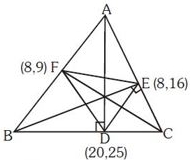
The coordinates of the feet of the perpendiculars from the vertices of a triangle to the opposite sides are $(20, 25)$,$(8, 16)$,and $(8, 9)$. The orthocentre of the triangle lies at the point-
A
$(5, 10)$
B
$(15, 30)$
C
$(10, 15)$
D
$(50, -5)$
Solution
(C) Let $ABC$ be the triangle and $D(20, 25)$,$E(8, 16)$,$F(8, 9)$ be the feet of the perpendiculars from $A, B, C$ respectively. Then $DEF$ is the pedal triangle of $\Delta ABC$.
From geometry,we know that the orthocentre of $\Delta ABC$ is the incentre of its pedal triangle $DEF$.
Let the coordinates of the orthocentre be $O(h, k)$.
First,calculate the side lengths of $\Delta DEF$:
$DE = \sqrt{(20-8)^2 + (25-16)^2} = \sqrt{12^2 + 9^2} = \sqrt{144 + 81} = \sqrt{225} = 15$
$EF = \sqrt{(8-8)^2 + (16-9)^2} = \sqrt{0^2 + 7^2} = 7$
$FD = \sqrt{(20-8)^2 + (25-9)^2} = \sqrt{12^2 + 16^2} = \sqrt{144 + 256} = \sqrt{400} = 20$
Using the incentre formula $I = \frac{aA + bB + cC}{a+b+c}$,where $a, b, c$ are side lengths opposite to vertices $D, E, F$ respectively:
$h = \frac{EF \cdot x_D + FD \cdot x_E + DE \cdot x_F}{EF + FD + DE} = \frac{7(20) + 20(8) + 15(8)}{7 + 20 + 15} = \frac{140 + 160 + 120}{42} = \frac{420}{42} = 10$
$k = \frac{EF \cdot y_D + FD \cdot y_E + DE \cdot y_F}{EF + FD + DE} = \frac{7(25) + 20(16) + 15(9)}{7 + 20 + 15} = \frac{175 + 320 + 135}{42} = \frac{630}{42} = 15$
Thus,the orthocentre is $(10, 15)$.
From geometry,we know that the orthocentre of $\Delta ABC$ is the incentre of its pedal triangle $DEF$.
Let the coordinates of the orthocentre be $O(h, k)$.
First,calculate the side lengths of $\Delta DEF$:
$DE = \sqrt{(20-8)^2 + (25-16)^2} = \sqrt{12^2 + 9^2} = \sqrt{144 + 81} = \sqrt{225} = 15$
$EF = \sqrt{(8-8)^2 + (16-9)^2} = \sqrt{0^2 + 7^2} = 7$
$FD = \sqrt{(20-8)^2 + (25-9)^2} = \sqrt{12^2 + 16^2} = \sqrt{144 + 256} = \sqrt{400} = 20$
Using the incentre formula $I = \frac{aA + bB + cC}{a+b+c}$,where $a, b, c$ are side lengths opposite to vertices $D, E, F$ respectively:
$h = \frac{EF \cdot x_D + FD \cdot x_E + DE \cdot x_F}{EF + FD + DE} = \frac{7(20) + 20(8) + 15(8)}{7 + 20 + 15} = \frac{140 + 160 + 120}{42} = \frac{420}{42} = 10$
$k = \frac{EF \cdot y_D + FD \cdot y_E + DE \cdot y_F}{EF + FD + DE} = \frac{7(25) + 20(16) + 15(9)}{7 + 20 + 15} = \frac{175 + 320 + 135}{42} = \frac{630}{42} = 15$
Thus,the orthocentre is $(10, 15)$.
0 likes
View Solution4
DifficultMCQ
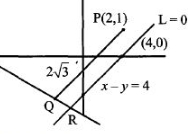
The point $(2, 1)$ is translated parallel to the line $L: x - y = 4$ by $2\sqrt{3}$ units. If the new point $Q$ lies in the third quadrant,then the equation of the line passing through $Q$ and perpendicular to $L$ is
A
$x + y = 2 - \sqrt{6}$
B
$2x + 2y = 1 - \sqrt{6}$
C
$x + y = 3 - 3\sqrt{6}$
D
$x + y = 3 - 2\sqrt{6}$
Solution
(D) The line $L$ is given by $x - y = 4$,which has a slope $m = 1$.
Since the point $P(2, 1)$ is translated parallel to $L$,the new point $Q(x, y)$ lies on a line parallel to $L$.
The slope of the line passing through $P$ and $Q$ is $1$.
The distance between $P(2, 1)$ and $Q(x, y)$ is $2\sqrt{3}$.
Using the parametric form of a line,the coordinates of $Q$ are $(2 \pm 2\sqrt{3} \cos \theta, 1 \pm 2\sqrt{3} \sin \theta)$,where $\tan \theta = 1$,so $\cos \theta = \sin \theta = \frac{1}{\sqrt{2}}$.
$Q = (2 \pm 2\sqrt{3} \cdot \frac{1}{\sqrt{2}}, 1 \pm 2\sqrt{3} \cdot \frac{1}{\sqrt{2}}) = (2 \pm \sqrt{6}, 1 \pm \sqrt{6})$.
Since $Q$ lies in the third quadrant,both coordinates must be negative.
Choosing the negative sign: $Q = (2 - \sqrt{6}, 1 - \sqrt{6})$.
The line passing through $Q$ and perpendicular to $L$ has a slope $m' = -1$.
The equation is $y - (1 - \sqrt{6}) = -1(x - (2 - \sqrt{6}))$.
$y - 1 + \sqrt{6} = -x + 2 - \sqrt{6}$.
$x + y = 3 - 2\sqrt{6}$.
Since the point $P(2, 1)$ is translated parallel to $L$,the new point $Q(x, y)$ lies on a line parallel to $L$.
The slope of the line passing through $P$ and $Q$ is $1$.
The distance between $P(2, 1)$ and $Q(x, y)$ is $2\sqrt{3}$.
Using the parametric form of a line,the coordinates of $Q$ are $(2 \pm 2\sqrt{3} \cos \theta, 1 \pm 2\sqrt{3} \sin \theta)$,where $\tan \theta = 1$,so $\cos \theta = \sin \theta = \frac{1}{\sqrt{2}}$.
$Q = (2 \pm 2\sqrt{3} \cdot \frac{1}{\sqrt{2}}, 1 \pm 2\sqrt{3} \cdot \frac{1}{\sqrt{2}}) = (2 \pm \sqrt{6}, 1 \pm \sqrt{6})$.
Since $Q$ lies in the third quadrant,both coordinates must be negative.
Choosing the negative sign: $Q = (2 - \sqrt{6}, 1 - \sqrt{6})$.
The line passing through $Q$ and perpendicular to $L$ has a slope $m' = -1$.
The equation is $y - (1 - \sqrt{6}) = -1(x - (2 - \sqrt{6}))$.
$y - 1 + \sqrt{6} = -x + 2 - \sqrt{6}$.
$x + y = 3 - 2\sqrt{6}$.
0 likes
View Solution5
DifficultMCQ
The point $P(a, b)$ undergoes the following three transformations successively:
$(a)$ reflection about the line $y=x$.
$(b)$ translation through $2$ units along the positive direction of $x$-axis.
$(c)$ rotation through angle $\frac{\pi}{4}$ about the origin in the anti-clockwise direction.
If the coordinates of the final position of the point $P$ are $\left(-\frac{1}{\sqrt{2}}, \frac{7}{\sqrt{2}}\right)$,then the value of $2a+b$ is equal to:
$(a)$ reflection about the line $y=x$.
$(b)$ translation through $2$ units along the positive direction of $x$-axis.
$(c)$ rotation through angle $\frac{\pi}{4}$ about the origin in the anti-clockwise direction.
If the coordinates of the final position of the point $P$ are $\left(-\frac{1}{\sqrt{2}}, \frac{7}{\sqrt{2}}\right)$,then the value of $2a+b$ is equal to:
A
$9$
B
$5$
C
$13$
D
$7$
Solution
(A) The reflection of point $P(a, b)$ about the line $y=x$ gives the point $(b, a)$.
Translating this point by $2$ units along the positive $x$-axis results in the point $(b+2, a)$.
Applying a rotation of $\frac{\pi}{4}$ anti-clockwise about the origin,the new coordinates $(x', y')$ are given by:
$x' = (b+2)\cos\frac{\pi}{4} - a\sin\frac{\pi}{4} = \frac{b+2-a}{\sqrt{2}}$
$y' = (b+2)\sin\frac{\pi}{4} + a\cos\frac{\pi}{4} = \frac{b+2+a}{\sqrt{2}}$
Given the final position is $\left(-\frac{1}{\sqrt{2}}, \frac{7}{\sqrt{2}}\right)$,we have:
$\frac{b+2-a}{\sqrt{2}} = -\frac{1}{\sqrt{2}}$ $\Rightarrow b-a+2 = -1$ $\Rightarrow b-a = -3$ (Equation $1$)
$\frac{b+2+a}{\sqrt{2}} = \frac{7}{\sqrt{2}}$ $\Rightarrow b+a+2 = 7$ $\Rightarrow b+a = 5$ (Equation $2$)
Adding Equation $1$ and Equation $2$:
$2b = 2 \Rightarrow b = 1$
Substituting $b=1$ into Equation $2$:
$1+a = 5 \Rightarrow a = 4$
Therefore,$2a+b = 2(4)+1 = 9$.
Translating this point by $2$ units along the positive $x$-axis results in the point $(b+2, a)$.
Applying a rotation of $\frac{\pi}{4}$ anti-clockwise about the origin,the new coordinates $(x', y')$ are given by:
$x' = (b+2)\cos\frac{\pi}{4} - a\sin\frac{\pi}{4} = \frac{b+2-a}{\sqrt{2}}$
$y' = (b+2)\sin\frac{\pi}{4} + a\cos\frac{\pi}{4} = \frac{b+2+a}{\sqrt{2}}$
Given the final position is $\left(-\frac{1}{\sqrt{2}}, \frac{7}{\sqrt{2}}\right)$,we have:
$\frac{b+2-a}{\sqrt{2}} = -\frac{1}{\sqrt{2}}$ $\Rightarrow b-a+2 = -1$ $\Rightarrow b-a = -3$ (Equation $1$)
$\frac{b+2+a}{\sqrt{2}} = \frac{7}{\sqrt{2}}$ $\Rightarrow b+a+2 = 7$ $\Rightarrow b+a = 5$ (Equation $2$)
Adding Equation $1$ and Equation $2$:
$2b = 2 \Rightarrow b = 1$
Substituting $b=1$ into Equation $2$:
$1+a = 5 \Rightarrow a = 4$
Therefore,$2a+b = 2(4)+1 = 9$.
0 likes
View Solution6
DifficultMCQ
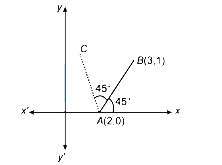
The line joining the points $A(2,0)$ and $B(3,1)$ is rotated through an angle of $45^{\circ}$ about $A$ in the anti-clockwise direction. Find the coordinates of $B$ in the new position.
A
$(2, \sqrt{2})$
B
$(\sqrt{2}, 2)$
C
$(2,2)$
D
$(\sqrt{2}, \sqrt{2})$
Solution
(A) Let the coordinates of $A$ be $(x_1, y_1) = (2, 0)$ and $B$ be $(x_2, y_2) = (3, 1)$.
The length of $AB$ is $r = \sqrt{(3-2)^2 + (1-0)^2} = \sqrt{1^2 + 1^2} = \sqrt{2}$.
The angle $\theta$ that $AB$ makes with the positive $x$-axis is given by $\tan \theta = \frac{1-0}{3-2} = 1$,so $\theta = 45^{\circ}$.
When the line is rotated by $45^{\circ}$ in the anti-clockwise direction about $A$,the new angle $\theta'$ becomes $\theta + 45^{\circ} = 45^{\circ} + 45^{\circ} = 90^{\circ}$.
Let the new coordinates of $B$ be $(x', y')$.
Using the rotation formula,$x' = x_1 + r \cos \theta'$ and $y' = y_1 + r \sin \theta'$.
$x' = 2 + \sqrt{2} \cos 90^{\circ} = 2 + \sqrt{2}(0) = 2$.
$y' = 0 + \sqrt{2} \sin 90^{\circ} = 0 + \sqrt{2}(1) = \sqrt{2}$.
Thus,the new coordinates are $(2, \sqrt{2})$.
The length of $AB$ is $r = \sqrt{(3-2)^2 + (1-0)^2} = \sqrt{1^2 + 1^2} = \sqrt{2}$.
The angle $\theta$ that $AB$ makes with the positive $x$-axis is given by $\tan \theta = \frac{1-0}{3-2} = 1$,so $\theta = 45^{\circ}$.
When the line is rotated by $45^{\circ}$ in the anti-clockwise direction about $A$,the new angle $\theta'$ becomes $\theta + 45^{\circ} = 45^{\circ} + 45^{\circ} = 90^{\circ}$.
Let the new coordinates of $B$ be $(x', y')$.
Using the rotation formula,$x' = x_1 + r \cos \theta'$ and $y' = y_1 + r \sin \theta'$.
$x' = 2 + \sqrt{2} \cos 90^{\circ} = 2 + \sqrt{2}(0) = 2$.
$y' = 0 + \sqrt{2} \sin 90^{\circ} = 0 + \sqrt{2}(1) = \sqrt{2}$.
Thus,the new coordinates are $(2, \sqrt{2})$.
0 likes
View Solution7
MediumMCQ
Let $A = (2, 0)$ and $B = (6, 4)$ be two points. If the line segment $\overline{AB}$ is rotated about $A$ through an angle of $45^{\circ}$ in the negative (clockwise) direction,then the coordinates of $B$ after the rotation are:
A
$(2 + 4\sqrt{2}, 0)$
B
$(2, 4\sqrt{2})$
C
$(0, 4\sqrt{2})$
D
$(4\sqrt{2}, 0)$
Solution
(A) Let $A = (x_1, y_1) = (2, 0)$ and $B = (x_2, y_2) = (6, 4)$.
Vector $\vec{AB} = (6-2, 4-0) = (4, 4)$.
The length of $AB$ is $r = \sqrt{4^2 + 4^2} = \sqrt{32} = 4\sqrt{2}$.
The angle of $\vec{AB}$ with the positive $x$-axis is $\theta = \tan^{-1}(\frac{4}{4}) = 45^{\circ}$.
Rotating the vector by $45^{\circ}$ in the negative (clockwise) direction gives a new angle $\theta' = 45^{\circ} - 45^{\circ} = 0^{\circ}$.
The new coordinates $(x', y')$ of $B$ are given by $x' = x_1 + r \cos(\theta')$ and $y' = y_1 + r \sin(\theta')$.
$x' = 2 + 4\sqrt{2} \cos(0^{\circ}) = 2 + 4\sqrt{2}(1) = 2 + 4\sqrt{2}$.
$y' = 0 + 4\sqrt{2} \sin(0^{\circ}) = 0 + 4\sqrt{2}(0) = 0$.
Thus,the new coordinates are $(2 + 4\sqrt{2}, 0)$.
Vector $\vec{AB} = (6-2, 4-0) = (4, 4)$.
The length of $AB$ is $r = \sqrt{4^2 + 4^2} = \sqrt{32} = 4\sqrt{2}$.
The angle of $\vec{AB}$ with the positive $x$-axis is $\theta = \tan^{-1}(\frac{4}{4}) = 45^{\circ}$.
Rotating the vector by $45^{\circ}$ in the negative (clockwise) direction gives a new angle $\theta' = 45^{\circ} - 45^{\circ} = 0^{\circ}$.
The new coordinates $(x', y')$ of $B$ are given by $x' = x_1 + r \cos(\theta')$ and $y' = y_1 + r \sin(\theta')$.
$x' = 2 + 4\sqrt{2} \cos(0^{\circ}) = 2 + 4\sqrt{2}(1) = 2 + 4\sqrt{2}$.
$y' = 0 + 4\sqrt{2} \sin(0^{\circ}) = 0 + 4\sqrt{2}(0) = 0$.
Thus,the new coordinates are $(2 + 4\sqrt{2}, 0)$.
0 likes
View Solution8
EasyMCQ
The point $(4,1)$ undergoes the following transformations successively:
$I$. Reflection about the line $y=x$.
$II$. Translation through a distance $2$ units in the direction of the positive $X$-axis.
$III$. Rotation through an angle $\frac{\pi}{4}$ about the origin in the anticlockwise direction.
Then,the final position of the point is:
$I$. Reflection about the line $y=x$.
$II$. Translation through a distance $2$ units in the direction of the positive $X$-axis.
$III$. Rotation through an angle $\frac{\pi}{4}$ about the origin in the anticlockwise direction.
Then,the final position of the point is:
A
$\left(\frac{7}{\sqrt{2}}, \frac{1}{\sqrt{2}}\right)$
B
$(\sqrt{2}, 7\sqrt{2})$
C
$(-\sqrt{2}, 7\sqrt{2})$
D
$\left(\frac{1}{\sqrt{2}}, -\frac{7}{\sqrt{2}}\right)$
Solution
(C) Step $1$: Reflection of $(4,1)$ about the line $y=x$ gives $(1,4)$.
Step $2$: Translation of $(1,4)$ by $2$ units in the positive $X$-direction gives $(1+2, 4) = (3,4)$.
Step $3$: Rotation of $(x,y) = (3,4)$ by an angle $\theta = \frac{\pi}{4}$ anticlockwise about the origin is given by the transformation:
$x' = x \cos \theta - y \sin \theta$
$y' = x \sin \theta + y \cos \theta$
Substituting the values:
$x' = 3 \cos \frac{\pi}{4} - 4 \sin \frac{\pi}{4} = 3 \left(\frac{1}{\sqrt{2}}\right) - 4 \left(\frac{1}{\sqrt{2}}\right) = -\frac{1}{\sqrt{2}}$
$y' = 3 \sin \frac{\pi}{4} + 4 \cos \frac{\pi}{4} = 3 \left(\frac{1}{\sqrt{2}}\right) + 4 \left(\frac{1}{\sqrt{2}}\right) = \frac{7}{\sqrt{2}}$
Thus,the final position is $\left(-\frac{1}{\sqrt{2}}, \frac{7}{\sqrt{2}}\right)$.
Step $2$: Translation of $(1,4)$ by $2$ units in the positive $X$-direction gives $(1+2, 4) = (3,4)$.
Step $3$: Rotation of $(x,y) = (3,4)$ by an angle $\theta = \frac{\pi}{4}$ anticlockwise about the origin is given by the transformation:
$x' = x \cos \theta - y \sin \theta$
$y' = x \sin \theta + y \cos \theta$
Substituting the values:
$x' = 3 \cos \frac{\pi}{4} - 4 \sin \frac{\pi}{4} = 3 \left(\frac{1}{\sqrt{2}}\right) - 4 \left(\frac{1}{\sqrt{2}}\right) = -\frac{1}{\sqrt{2}}$
$y' = 3 \sin \frac{\pi}{4} + 4 \cos \frac{\pi}{4} = 3 \left(\frac{1}{\sqrt{2}}\right) + 4 \left(\frac{1}{\sqrt{2}}\right) = \frac{7}{\sqrt{2}}$
Thus,the final position is $\left(-\frac{1}{\sqrt{2}}, \frac{7}{\sqrt{2}}\right)$.
0 likes
View Solution9
MediumMCQ
The point $(3,2)$ undergoes the following three transformations in the order given:
$(i)$ Reflection about the line $y=x$.
(ii) Translation by the distance $1$ unit in the positive direction of $x$-axis.
(iii) Rotation by an angle $\frac{\pi}{4}$ about the origin in the anti-clockwise direction.
Then,the final position of the point is:
$(i)$ Reflection about the line $y=x$.
(ii) Translation by the distance $1$ unit in the positive direction of $x$-axis.
(iii) Rotation by an angle $\frac{\pi}{4}$ about the origin in the anti-clockwise direction.
Then,the final position of the point is:
A
$(-\sqrt{18}, \sqrt{18})$
B
$(-2, 3)$
C
$(0, \sqrt{18})$
D
$(0, 3)$
Solution
(C) Given point is $(3, 2)$.
$(i)$ Reflection of point $(3, 2)$ about the line $y=x$ gives $(2, 3)$.
(ii) Translation of point $(2, 3)$ by $1$ unit in the positive $x$-direction gives $(2+1, 3) = (3, 3)$.
(iii) Rotation of point $(x, y) = (3, 3)$ by an angle $\theta = \frac{\pi}{4}$ about the origin in the anti-clockwise direction is given by the transformation:
$X = x \cos \theta - y \sin \theta = 3 \cos(\frac{\pi}{4}) - 3 \sin(\frac{\pi}{4}) = 3(\frac{1}{\sqrt{2}}) - 3(\frac{1}{\sqrt{2}}) = 0$
$Y = x \sin \theta + y \cos \theta = 3 \sin(\frac{\pi}{4}) + 3 \cos(\frac{\pi}{4}) = 3(\frac{1}{\sqrt{2}}) + 3(\frac{1}{\sqrt{2}}) = \frac{6}{\sqrt{2}} = 3\sqrt{2} = \sqrt{18}$
Thus,the final position is $(0, \sqrt{18})$.
$(i)$ Reflection of point $(3, 2)$ about the line $y=x$ gives $(2, 3)$.
(ii) Translation of point $(2, 3)$ by $1$ unit in the positive $x$-direction gives $(2+1, 3) = (3, 3)$.
(iii) Rotation of point $(x, y) = (3, 3)$ by an angle $\theta = \frac{\pi}{4}$ about the origin in the anti-clockwise direction is given by the transformation:
$X = x \cos \theta - y \sin \theta = 3 \cos(\frac{\pi}{4}) - 3 \sin(\frac{\pi}{4}) = 3(\frac{1}{\sqrt{2}}) - 3(\frac{1}{\sqrt{2}}) = 0$
$Y = x \sin \theta + y \cos \theta = 3 \sin(\frac{\pi}{4}) + 3 \cos(\frac{\pi}{4}) = 3(\frac{1}{\sqrt{2}}) + 3(\frac{1}{\sqrt{2}}) = \frac{6}{\sqrt{2}} = 3\sqrt{2} = \sqrt{18}$
Thus,the final position is $(0, \sqrt{18})$.
0 likes
View SolutionStraight Line — Transformation, Pedal points · Frequently Asked Questions
1Are these Straight Line questions useful for JEE and NEET?
Yes. All questions in this section are mapped to JEE Main and NEET exam patterns. Previous year questions from JEE Main, NEET, GUJCET and state-level exams are included with full solutions.
2Can I switch to Hindi or Gujarati for these questions?
Yes. Use the language tabs in the hero section or the sidebar to view the same questions and solutions in English, Hindi or Gujarati.
3How do I generate a question paper from this subtopic?
Use the Vedclass Exam Paper Generator — select the chapter and subtopic, set difficulty, and generate Sets A, B, C, D automatically. First 3 chapters of every subject are free.
Vedclass Products
For Students
Vedclass Test Series
Mock tests in real JEE/NEET style with performance analysis. 5-day free trial.
Start Free TrialFor Teachers
Exam Paper Generator
Generate Set A/B/C/D papers from this chapter in 2 minutes. 3 chapters free.
Try FreeFor Institutes
Online Exam Module
Live online exams with unlimited students, 360° analytics & white-label branding.
See DemoFor Teachers & Institutes
Generate a Straight Line Exam Paper in 2 Minutes
Select subtopic & difficulty — Sets A, B, C, D auto-generated with No Repeat logic.
First 3 chapters of every subject are free — no payment required.