
A English
Basic concepts Questions in English
Class 11 Chemistry · Thermodynamics · Basic concepts
401+
Questions
English
Language
100%
With Solutions
Showing 50 of 401 questions in English
201
Medium
Define open,closed,and isolated systems with examples.
Solution
(N/A) $1$. Open System: $A$ system that can exchange both energy and matter with its surroundings. Example: Boiling water in an open beaker.
$2$. Closed System: $A$ system that can exchange energy but not matter with its surroundings. Example: Boiling water in a sealed container.
$3$. Isolated System: $A$ system that cannot exchange either energy or matter with its surroundings. Example: Hot water in a perfectly insulated thermos flask.
$2$. Closed System: $A$ system that can exchange energy but not matter with its surroundings. Example: Boiling water in a sealed container.
$3$. Isolated System: $A$ system that cannot exchange either energy or matter with its surroundings. Example: Hot water in a perfectly insulated thermos flask.
0 likes
View Solution202
MediumMCQ
At equilibrium,all systems are closed systems. $A$ saturated solution of glucose in an open vessel is which type of system?
A
Open system
B
Closed system
C
Isolated system
D
None of these
Solution
(A) An open system is one that can exchange both matter and energy with its surroundings.
In an open vessel,a saturated solution of glucose can exchange both water vapor (matter) and heat (energy) with the surroundings.
Therefore,it is an open system.
In an open vessel,a saturated solution of glucose can exchange both water vapor (matter) and heat (energy) with the surroundings.
Therefore,it is an open system.
0 likes
View Solution203
Medium
What is an exothermic reaction and an endothermic reaction?
Solution
(N/A) $1$. Exothermic Reaction: $A$ chemical reaction in which energy is released into the surroundings,usually in the form of heat or light. In these reactions,the total energy of the products is less than the total energy of the reactants. Example: Combustion of methane,$CH_4 + 2O_2 \rightarrow CO_2 + 2H_2O + \text{Heat}$.
$2$. Endothermic Reaction: $A$ chemical reaction in which energy is absorbed from the surroundings. In these reactions,the total energy of the products is greater than the total energy of the reactants. Example: Photosynthesis,$6CO_2 + 6H_2O + \text{Energy} \rightarrow C_6H_{12}O_6 + 6O_2$.
$2$. Endothermic Reaction: $A$ chemical reaction in which energy is absorbed from the surroundings. In these reactions,the total energy of the products is greater than the total energy of the reactants. Example: Photosynthesis,$6CO_2 + 6H_2O + \text{Energy} \rightarrow C_6H_{12}O_6 + 6O_2$.
0 likes
View Solution204
Medium
Prove the relationship between $C_p$ and $C_v$ for an ideal gas.
Solution
(N/A) At constant volume,the heat capacity is denoted by $C_v$ and at constant pressure,it is denoted by $C_p$.
For a process at constant volume,the heat exchanged is $q_v = \Delta U = C_v \Delta T$.
For a process at constant pressure,the heat exchanged is $q_p = \Delta H = C_p \Delta T$.
For $1 \text{ mole}$ of an ideal gas,the enthalpy change is given by $\Delta H = \Delta U + \Delta (pV)$.
Since $pV = RT$ for $1 \text{ mole}$ of an ideal gas,we have $\Delta H = \Delta U + \Delta (RT)$.
Assuming $R$ is constant,$\Delta H = \Delta U + R \Delta T$.
Substituting the expressions for $\Delta H$ and $\Delta U$ in terms of heat capacities:
$C_p \Delta T = C_v \Delta T + R \Delta T$.
Dividing both sides by $\Delta T$,we get $C_p = C_v + R$ or $C_p - C_v = R$.
For a process at constant volume,the heat exchanged is $q_v = \Delta U = C_v \Delta T$.
For a process at constant pressure,the heat exchanged is $q_p = \Delta H = C_p \Delta T$.
For $1 \text{ mole}$ of an ideal gas,the enthalpy change is given by $\Delta H = \Delta U + \Delta (pV)$.
Since $pV = RT$ for $1 \text{ mole}$ of an ideal gas,we have $\Delta H = \Delta U + \Delta (RT)$.
Assuming $R$ is constant,$\Delta H = \Delta U + R \Delta T$.
Substituting the expressions for $\Delta H$ and $\Delta U$ in terms of heat capacities:
$C_p \Delta T = C_v \Delta T + R \Delta T$.
Dividing both sides by $\Delta T$,we get $C_p = C_v + R$ or $C_p - C_v = R$.
0 likes
View Solution205
MediumMCQ
The volume of $100 \ L$ of gas increases to $120 \ L$ at a constant temperature and an external pressure of $10 \ bar$. Calculate the work done by the system. [Given: $1 \ L \ bar = 24.21 \ cal$] (in $cal$)
A
$-4842$
B
$4842$
C
$-200$
D
$200$
Solution
(A) The formula for work done by a system during expansion against a constant external pressure is $w = -P_{ext} \times \Delta V$.
Here,$P_{ext} = 10 \ bar$,$V_1 = 100 \ L$,and $V_2 = 120 \ L$.
Change in volume $\Delta V = V_2 - V_1 = 120 \ L - 100 \ L = 20 \ L$.
Substituting the values: $w = -10 \ bar \times 20 \ L = -200 \ L \ bar$.
Given the conversion factor $1 \ L \ bar = 24.21 \ cal$,we convert the work to calories:
$w = -200 \times 24.21 \ cal = -4842 \ cal$.
The negative sign indicates that work is done by the system.
Here,$P_{ext} = 10 \ bar$,$V_1 = 100 \ L$,and $V_2 = 120 \ L$.
Change in volume $\Delta V = V_2 - V_1 = 120 \ L - 100 \ L = 20 \ L$.
Substituting the values: $w = -10 \ bar \times 20 \ L = -200 \ L \ bar$.
Given the conversion factor $1 \ L \ bar = 24.21 \ cal$,we convert the work to calories:
$w = -200 \times 24.21 \ cal = -4842 \ cal$.
The negative sign indicates that work is done by the system.
0 likes
View Solution206
Medium
Explain the measurement of $\Delta U$ and $\Delta H$ by calorimetry.
Solution
(N/A) We can measure energy changes associated with chemical or physical processes by an experimental technique called calorimetry.
In calorimetry,the process is carried out in a vessel called a calorimeter,which is immersed in a known volume of a liquid.
Knowing the heat capacity of the liquid in which the calorimeter is immersed and the heat capacity of the calorimeter,it is possible to determine the heat evolved in the process by measuring temperature changes. Measurements are made under two different conditions:
$(i)$ at constant volume,$q_{v}$
$(ii)$ at constant pressure,$q_{p}$
$(a)$ $\Delta U$ measurements:
For chemical reactions,heat absorbed at constant volume is measured in a bomb calorimeter. Here,a steel vessel is immersed in a water bath. The whole device is called a calorimeter. The steel vessel is immersed in a water bath to ensure that no heat is lost to the surroundings.
$(b)$ $\Delta H$ measurements:
Heat absorbed at constant pressure is measured using a calorimeter (often a coffee-cup calorimeter). Since $\Delta H = q_{p}$,the heat change measured at constant pressure directly gives the enthalpy change of the reaction.
In calorimetry,the process is carried out in a vessel called a calorimeter,which is immersed in a known volume of a liquid.
Knowing the heat capacity of the liquid in which the calorimeter is immersed and the heat capacity of the calorimeter,it is possible to determine the heat evolved in the process by measuring temperature changes. Measurements are made under two different conditions:
$(i)$ at constant volume,$q_{v}$
$(ii)$ at constant pressure,$q_{p}$
$(a)$ $\Delta U$ measurements:
For chemical reactions,heat absorbed at constant volume is measured in a bomb calorimeter. Here,a steel vessel is immersed in a water bath. The whole device is called a calorimeter. The steel vessel is immersed in a water bath to ensure that no heat is lost to the surroundings.
$(b)$ $\Delta H$ measurements:
Heat absorbed at constant pressure is measured using a calorimeter (often a coffee-cup calorimeter). Since $\Delta H = q_{p}$,the heat change measured at constant pressure directly gives the enthalpy change of the reaction.
0 likes
View Solution207
Medium
Explain the standard enthalpy of reaction.
Solution
(N/A) The enthalpy of a reaction depends on the conditions under which the reaction is carried out. Therefore,it is necessary to specify standard conditions.
The standard enthalpy of reaction is defined as the enthalpy change for a reaction when all the participating substances are in their standard states.
The standard state of a substance at a specified temperature is its pure form at $1 \ bar$ pressure.
For example,the standard state of liquid ethanol at $298 \ K$ is pure liquid ethanol at $1 \ bar$; the standard state of solid iron at $500 \ K$ is pure iron at $1 \ bar$. Usually,thermodynamic data are reported at $298 \ K$.
Standard conditions are denoted by adding the superscript $\theta$ to the symbol $\Delta H$,represented as $\Delta H^{\theta}$.
The standard enthalpy of reaction is defined as the enthalpy change for a reaction when all the participating substances are in their standard states.
The standard state of a substance at a specified temperature is its pure form at $1 \ bar$ pressure.
For example,the standard state of liquid ethanol at $298 \ K$ is pure liquid ethanol at $1 \ bar$; the standard state of solid iron at $500 \ K$ is pure iron at $1 \ bar$. Usually,thermodynamic data are reported at $298 \ K$.
Standard conditions are denoted by adding the superscript $\theta$ to the symbol $\Delta H$,represented as $\Delta H^{\theta}$.
0 likes
View Solution208
Medium
Explain enthalpy changes during phase transformations.
Solution
(N/A) Standard enthalpy of fusion $(\Delta_{fus} H)$: The enthalpy change that accompanies the melting of one mole of a solid substance in its standard state is called the standard enthalpy of fusion. Melting is an endothermic process,so $\Delta_{fus} H$ is always positive.
$H_2O_{(s)} \rightarrow H_2O_{(l)}$; $\Delta_{fus} H = 6.00 \ kJ \ mol^{-1}$
Standard enthalpy of vaporization $(\Delta_{vap} H)$: The amount of heat required to vaporize one mole of a liquid at a constant temperature and under standard pressure $(1 \ bar)$ is called its standard enthalpy of vaporization.
$H_2O_{(l)} \rightarrow H_2O_{(g)}$; $\Delta_{vap} H = +40.79 \ kJ \ mol^{-1}$
Standard enthalpy of sublimation $(\Delta_{sub} H)$: The change in enthalpy when one mole of a solid substance sublimes directly into its vapour at a constant temperature and under standard pressure $(1 \ bar)$.
$CO_{2_{(s)}} \rightarrow CO_{2_{(g)}}$; $\Delta_{sub} H^o = 25.2 \ kJ \ mol^{-1}$
The magnitude of these enthalpy changes depends on the strength of the intermolecular interactions in the substance.
$H_2O_{(s)} \rightarrow H_2O_{(l)}$; $\Delta_{fus} H = 6.00 \ kJ \ mol^{-1}$
Standard enthalpy of vaporization $(\Delta_{vap} H)$: The amount of heat required to vaporize one mole of a liquid at a constant temperature and under standard pressure $(1 \ bar)$ is called its standard enthalpy of vaporization.
$H_2O_{(l)} \rightarrow H_2O_{(g)}$; $\Delta_{vap} H = +40.79 \ kJ \ mol^{-1}$
Standard enthalpy of sublimation $(\Delta_{sub} H)$: The change in enthalpy when one mole of a solid substance sublimes directly into its vapour at a constant temperature and under standard pressure $(1 \ bar)$.
$CO_{2_{(s)}} \rightarrow CO_{2_{(g)}}$; $\Delta_{sub} H^o = 25.2 \ kJ \ mol^{-1}$
The magnitude of these enthalpy changes depends on the strength of the intermolecular interactions in the substance.
| Substance | $T_f / K$ | $\Delta_{fus} H / (kJ \ mol^{-1})$ | $T_b / K$ | $\Delta_{vap} H / (kJ \ mol^{-1})$ |
|---|---|---|---|---|
| $N_2$ | $63.15$ | $0.72$ | $77.35$ | $5.59$ |
| $NH_3$ | $195.40$ | $5.65$ | $239.73$ | $23.35$ |
| $HCl$ | $159.0$ | $1.992$ | $188.0$ | $16.15$ |
| $CO$ | $68.0$ | $6.836$ | $82.0$ | $6.04$ |
| $CH_3COCH_3$ | $177.8$ | $5.72$ | $329.4$ | $29.1$ |
| $CCl_4$ | $250.16$ | $2.5$ | $349.69$ | $30.0$ |
| $H_2O$ | $273.15$ | $6.01$ | $373.15$ | $40.79$ |
| $NaCl$ | $1081.0$ | $28.8$ | $1665.0$ | $170.0$ |
| $C_6H_6$ | $278.65$ | $9.83$ | $353.25$ | $30.8$ |
0 likes
View Solution209
Difficult
Explain the enthalpy of dilution.
Solution
Enthalpy of dilution is the enthalpy change observed when a specified amount of solvent is added to a solution at a constant temperature and pressure.
For example,the enthalpy change for dissolving $1 \ mol$ of gaseous hydrogen chloride in $10 \ mol$ of water is represented by:
$HCl_{(g)} + 10 \ H_2O_{(l)} \rightarrow HCl \cdot 10 \ H_2O ; \Delta H = -69.01 \ kJ/mol$
Consider the following enthalpy changes for different amounts of water:
$(S-1) \ HCl_{(g)} + 25 \ H_2O_{(l)} \rightarrow HCl \cdot 25 \ H_2O ; \Delta H = -72.03 \ kJ/mol$
$(S-2) \ HCl_{(g)} + 40 \ H_2O_{(l)} \rightarrow HCl \cdot 40 \ H_2O ; \Delta H = -72.79 \ kJ/mol$
$(S-3) \ HCl_{(g)} + \infty \ H_2O_{(l)} \rightarrow HCl \cdot \infty \ H_2O ; \Delta H = -74.85 \ kJ/mol$
As more solvent is added,the enthalpy of solution approaches a limiting value at infinite dilution,as shown in $(S-3)$.
To find the enthalpy of dilution between two concentrations,subtract $(S-1)$ from $(S-2)$:
$(HCl \cdot 25 \ H_2O) + 15 \ H_2O \rightarrow HCl \cdot 40 \ H_2O ; \Delta H = [-72.79 - (-72.03)] = -0.76 \ kJ/mol$
This value,$-0.76 \ kJ/mol$,is the enthalpy of dilution. It depends on the initial concentration of the solution and the amount of solvent added.
For example,the enthalpy change for dissolving $1 \ mol$ of gaseous hydrogen chloride in $10 \ mol$ of water is represented by:
$HCl_{(g)} + 10 \ H_2O_{(l)} \rightarrow HCl \cdot 10 \ H_2O ; \Delta H = -69.01 \ kJ/mol$
Consider the following enthalpy changes for different amounts of water:
$(S-1) \ HCl_{(g)} + 25 \ H_2O_{(l)} \rightarrow HCl \cdot 25 \ H_2O ; \Delta H = -72.03 \ kJ/mol$
$(S-2) \ HCl_{(g)} + 40 \ H_2O_{(l)} \rightarrow HCl \cdot 40 \ H_2O ; \Delta H = -72.79 \ kJ/mol$
$(S-3) \ HCl_{(g)} + \infty \ H_2O_{(l)} \rightarrow HCl \cdot \infty \ H_2O ; \Delta H = -74.85 \ kJ/mol$
As more solvent is added,the enthalpy of solution approaches a limiting value at infinite dilution,as shown in $(S-3)$.
To find the enthalpy of dilution between two concentrations,subtract $(S-1)$ from $(S-2)$:
$(HCl \cdot 25 \ H_2O) + 15 \ H_2O \rightarrow HCl \cdot 40 \ H_2O ; \Delta H = [-72.79 - (-72.03)] = -0.76 \ kJ/mol$
This value,$-0.76 \ kJ/mol$,is the enthalpy of dilution. It depends on the initial concentration of the solution and the amount of solvent added.
0 likes
View Solution210
Easy
Increase in enthalpy of the surroundings is equal to decrease in enthalpy of the system. Will the temperature of system and surroundings be the same when they are in thermal equilibrium?
Solution
(N/A) Yes,the temperature of the system and the surroundings are the same when they are in thermal equilibrium.
Thermal equilibrium is defined as a state where two physical systems are in contact through a diathermal wall,allowing the transfer of energy as heat,but no net transfer of energy occurs between them.
When two systems are in thermal equilibrium,there is no change in their states,which implies that their temperatures are equal.
This concept is governed by the $Zeroth \ Law \ of \ Thermodynamics$.
Thermal equilibrium is defined as a state where two physical systems are in contact through a diathermal wall,allowing the transfer of energy as heat,but no net transfer of energy occurs between them.
When two systems are in thermal equilibrium,there is no change in their states,which implies that their temperatures are equal.
This concept is governed by the $Zeroth \ Law \ of \ Thermodynamics$.
0 likes
View Solution211
Easy
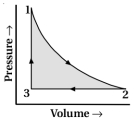
$A$ sample of $1.0 \ mol$ of a monoatomic ideal gas is taken through a cyclic process of expansion and compression as shown in the figure. What will be the value of $\Delta H$ for the cycle as a whole?
Solution
(0) Enthalpy $(H)$ is a state function,which means its value depends only on the initial and final states of the system.
In a cyclic process,the system returns to its initial state after completing the cycle.
Therefore,the change in enthalpy for the entire cycle is zero,i.e.,$\Delta H_{\text{cycle}} = 0$.
In a cyclic process,the system returns to its initial state after completing the cycle.
Therefore,the change in enthalpy for the entire cycle is zero,i.e.,$\Delta H_{\text{cycle}} = 0$.
0 likes
View Solution212
Easy
Identify the state functions and path functions out of the following: enthalpy,entropy,heat,temperature,work,free energy.
Solution
(N/A) State functions are properties that depend only on the initial and final states of the system,not on the path taken to reach that state. Examples include: enthalpy $(H)$,entropy $(S)$,temperature $(T)$,and free energy $(G)$.
Path functions are properties that depend on the specific path or process by which the system changes from one state to another. Examples include: heat $(q)$ and work $(w)$.
Path functions are properties that depend on the specific path or process by which the system changes from one state to another. Examples include: heat $(q)$ and work $(w)$.
0 likes
View Solution213
EasyMCQ
Predict the change in internal energy for an isolated system at constant volume.
A
$\Delta U > 0$
B
$\Delta U < 0$
C
$\Delta U = 0$
D
$\Delta U = \infty$
Solution
(C) For an isolated system,there is no transfer of energy as heat,i.e.,$q = 0$.
There is no transfer of energy as work,i.e.,$W = 0$.
According to the first law of thermodynamics:
$\Delta U = q + W$
$\Delta U = 0 + 0 = 0$
There is no transfer of energy as work,i.e.,$W = 0$.
According to the first law of thermodynamics:
$\Delta U = q + W$
$\Delta U = 0 + 0 = 0$
0 likes
View Solution214
Medium
Although heat is a path function,heat absorbed by the system under certain specific conditions is independent of path. What are those conditions? Explain.
Solution
(N/A) The two conditions under which heat becomes independent of path are:
$(i)$ When volume remains constant $(q_V)$
$(ii)$ When pressure remains constant $(q_p)$
Explanation:
$(i)$ At constant volume: By the first law of thermodynamics,$\Delta U = q + W$. Since $W = -P_{ext} \Delta V$ and $\Delta V = 0$,the work done is $0$. Therefore,$q_V = \Delta U$. Since internal energy $(\Delta U)$ is a state function,$q_V$ is also a state function.
$(ii)$ At constant pressure: The heat absorbed is given by $q_p = \Delta U + P \Delta V$. By definition,the change in enthalpy is $\Delta H = \Delta U + P \Delta V$. Therefore,$q_p = \Delta H$. Since enthalpy $(\Delta H)$ is a state function,$q_p$ is also a state function.
$(i)$ When volume remains constant $(q_V)$
$(ii)$ When pressure remains constant $(q_p)$
Explanation:
$(i)$ At constant volume: By the first law of thermodynamics,$\Delta U = q + W$. Since $W = -P_{ext} \Delta V$ and $\Delta V = 0$,the work done is $0$. Therefore,$q_V = \Delta U$. Since internal energy $(\Delta U)$ is a state function,$q_V$ is also a state function.
$(ii)$ At constant pressure: The heat absorbed is given by $q_p = \Delta U + P \Delta V$. By definition,the change in enthalpy is $\Delta H = \Delta U + P \Delta V$. Therefore,$q_p = \Delta H$. Since enthalpy $(\Delta H)$ is a state function,$q_p$ is also a state function.
0 likes
View Solution215
Medium
Expansion of a gas in vacuum is called free expansion. Calculate the work done and the change in internal energy when $1 \ L$ of ideal gas expands isothermally into vacuum until its total volume is $5 \ L$?
Solution
(A) Work done of a gas in vacuum is given by the formula $W = -p_{ext} \Delta V$.
Since the expansion occurs in vacuum,the external pressure $p_{ext} = 0$.
Therefore,$W = -0 \times (5 \ L - 1 \ L) = 0 \ J$.
For an ideal gas,the internal energy $U$ is a function of temperature only $(U = f(T))$.
Since the process is isothermal,the temperature remains constant $(\Delta T = 0)$,which implies that the change in internal energy $\Delta U = 0$.
Since the expansion occurs in vacuum,the external pressure $p_{ext} = 0$.
Therefore,$W = -0 \times (5 \ L - 1 \ L) = 0 \ J$.
For an ideal gas,the internal energy $U$ is a function of temperature only $(U = f(T))$.
Since the process is isothermal,the temperature remains constant $(\Delta T = 0)$,which implies that the change in internal energy $\Delta U = 0$.
0 likes
View Solution216
EasyMCQ
The difference between $C_p$ and $C_v$ can be derived using the empirical relation $H = U + PV$. Calculate the difference between $C_p$ and $C_v$ for $10$ moles of an ideal gas.
A
$10R$
B
$R$
C
$5R$
D
$0$
Solution
(A) For an ideal gas,the enthalpy is defined as $H = U + PV$.
Since $PV = nRT$ for $n$ moles of an ideal gas,we have $H = U + nRT$.
Differentiating with respect to temperature $T$ at constant pressure,we get $\frac{dH}{dT} = \frac{dU}{dT} + nR$.
By definition,$C_p = \frac{dH}{dT}$ and $C_v = \frac{dU}{dT}$.
Therefore,$C_p - C_v = nR$.
Given $n = 10$,the difference is $10R$.
Since $PV = nRT$ for $n$ moles of an ideal gas,we have $H = U + nRT$.
Differentiating with respect to temperature $T$ at constant pressure,we get $\frac{dH}{dT} = \frac{dU}{dT} + nR$.
By definition,$C_p = \frac{dH}{dT}$ and $C_v = \frac{dU}{dT}$.
Therefore,$C_p - C_v = nR$.
Given $n = 10$,the difference is $10R$.
0 likes
View Solution217
Medium
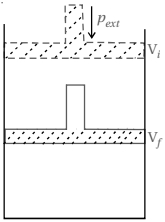
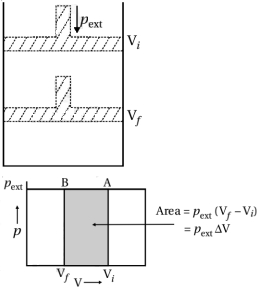
What will be the work done on an ideal gas enclosed in a cylinder,when it is compressed by a constant external pressure,$p_{ext}$ in a single step as shown in the figure? Explain graphically.
Solution
(N/A) The change in volume is given by $\Delta V = (V_f - V_i)$.
If $W$ is the work done on the system by the movement of the piston,then the work done is defined as:
$W = -p_{ext} \times \Delta V$
Substituting $\Delta V = (V_f - V_i)$,we get:
$W = -p_{ext} \times (V_f - V_i) = p_{ext} \times (V_i - V_f)$
This can be represented on a $p-V$ graph as shown in the figure. The work done is equal to the shaded area under the pressure-volume curve.
In the case of compression,the system is compressed from initial volume $V_i$ to final volume $V_f$,where $V_f < V_i$. Thus,$\Delta V$ is negative,making the work done $W$ positive,which is consistent with the sign convention that work done on the system is positive.
If $W$ is the work done on the system by the movement of the piston,then the work done is defined as:
$W = -p_{ext} \times \Delta V$
Substituting $\Delta V = (V_f - V_i)$,we get:
$W = -p_{ext} \times (V_f - V_i) = p_{ext} \times (V_i - V_f)$
This can be represented on a $p-V$ graph as shown in the figure. The work done is equal to the shaded area under the pressure-volume curve.
In the case of compression,the system is compressed from initial volume $V_i$ to final volume $V_f$,where $V_f < V_i$. Thus,$\Delta V$ is negative,making the work done $W$ positive,which is consistent with the sign convention that work done on the system is positive.
0 likes
View Solution218
Medium
How will you calculate the work done on an ideal gas during compression,when the change in pressure is carried out in infinite steps?
Solution
$A$ process or change is said to be reversible if it is carried out in such a way that the process could,at any moment,be reversed by an infinitesimal change.
When pressure changes in infinite steps (reversible conditions) during compression from an initial volume $V_i$ to a final volume $V_f$,the work done can be calculated by integrating the pressure with respect to volume:
$w = -\int_{V_i}^{V_f} p_{ext} \, dV$
In a $pV$-plot,this work done on the gas is represented by the area under the curve between $V_i$ and $V_f$.
When pressure changes in infinite steps (reversible conditions) during compression from an initial volume $V_i$ to a final volume $V_f$,the work done can be calculated by integrating the pressure with respect to volume:
$w = -\int_{V_i}^{V_f} p_{ext} \, dV$
In a $pV$-plot,this work done on the gas is represented by the area under the curve between $V_i$ and $V_f$.
0 likes
View Solution219
Medium
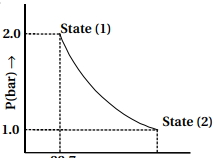
$1.0 \ mol$ of a monoatomic ideal gas is expanded from state $(1)$ to state $(2)$ as shown in the figure. Calculate the work done for the expansion of the gas from state $(1)$ to state $(2)$ at $298 \ K$.
Solution
(N/A) The given diagram represents an isothermal reversible expansion of an ideal gas from pressure $P_1 = 2.0 \ bar$ to $P_2 = 1.0 \ bar$ at $T = 298 \ K$.
For an isothermal reversible process,the work done $W$ is given by the formula:
$W = -2.303 \ nRT \log_{10} \left( \frac{P_1}{P_2} \right)$
Given:
$n = 1.0 \ mol$
$R = 8.314 \ J \ K^{-1} \ mol^{-1}$
$T = 298 \ K$
$P_1 = 2.0 \ bar$
$P_2 = 1.0 \ bar$
Substituting the values:
$W = -2.303 \times 1.0 \times 8.314 \times 298 \times \log_{10} \left( \frac{2.0}{1.0} \right)$
$W = -2.303 \times 8.314 \times 298 \times 0.3010$
$W \approx -1717.46 \ J \approx -1.717 \ kJ$
For an isothermal reversible process,the work done $W$ is given by the formula:
$W = -2.303 \ nRT \log_{10} \left( \frac{P_1}{P_2} \right)$
Given:
$n = 1.0 \ mol$
$R = 8.314 \ J \ K^{-1} \ mol^{-1}$
$T = 298 \ K$
$P_1 = 2.0 \ bar$
$P_2 = 1.0 \ bar$
Substituting the values:
$W = -2.303 \times 1.0 \times 8.314 \times 298 \times \log_{10} \left( \frac{2.0}{1.0} \right)$
$W = -2.303 \times 8.314 \times 298 \times 0.3010$
$W \approx -1717.46 \ J \approx -1.717 \ kJ$
0 likes
View Solution220
Medium
An ideal gas is allowed to expand against a constant pressure of $2 \ bar$ from $10 \ L$ to $50 \ L$ in one step. Calculate the amount of work done by the gas. If the same expansion were carried out reversibly,will the work done be higher or lower than the earlier case? (Given that $1 \ L \ bar = 100 \ J$)
Solution
(N/A) In the first case,as the expansion is against constant external pressure,
$W = -p_{ext} \times (V_2 - V_1) = -2 \ bar \times (50 - 10) \ L = -80 \ L \ bar$
Since $1 \ L \ bar = 100 \ J$,
$W = -80 \times 100 \ J = -8000 \ J = -8 \ kJ$
If the given expansion was carried out reversibly,the internal pressure of the gas would be infinitesimally greater than the external pressure at every stage,resulting in maximum work done. Therefore,the work done will be higher than in the irreversible case.
$W = -p_{ext} \times (V_2 - V_1) = -2 \ bar \times (50 - 10) \ L = -80 \ L \ bar$
Since $1 \ L \ bar = 100 \ J$,
$W = -80 \times 100 \ J = -8000 \ J = -8 \ kJ$
If the given expansion was carried out reversibly,the internal pressure of the gas would be infinitesimally greater than the external pressure at every stage,resulting in maximum work done. Therefore,the work done will be higher than in the irreversible case.
0 likes
View Solution221
Medium
Extensive properties depend on the quantity of matter,while intensive properties do not. Classify the following properties as extensive or intensive:
Mass,internal energy,pressure,heat capacity,molar heat capacity,density,mole fraction,specific heat,temperature,and molarity.
Mass,internal energy,pressure,heat capacity,molar heat capacity,density,mole fraction,specific heat,temperature,and molarity.
Solution
(N/A) Extensive properties: Properties whose values depend on the quantity or size of matter present in the system are known as extensive properties.
Examples: $Mass$,$internal \ energy$,$heat \ capacity$.
Intensive properties: Properties that do not depend on the quantity or size of matter present are known as intensive properties.
Examples: $Pressure$,$molar \ heat \ capacity$,$density$,$mole \ fraction$,$specific \ heat$,$temperature$,and $molarity$.
Note: The ratio of two extensive properties is always an intensive property.
$\frac{\text{Extensive}}{\text{Extensive}} = \text{Intensive}$
For example,$mole \ fraction = \frac{\text{Moles of component}}{\text{Total moles}} = \frac{\text{Extensive}}{\text{Extensive}}$ and $molarity = \frac{\text{Moles}}{\text{Volume}} = \frac{\text{Extensive}}{\text{Extensive}}$. Thus,they are intensive properties.
Examples: $Mass$,$internal \ energy$,$heat \ capacity$.
Intensive properties: Properties that do not depend on the quantity or size of matter present are known as intensive properties.
Examples: $Pressure$,$molar \ heat \ capacity$,$density$,$mole \ fraction$,$specific \ heat$,$temperature$,and $molarity$.
Note: The ratio of two extensive properties is always an intensive property.
$\frac{\text{Extensive}}{\text{Extensive}} = \text{Intensive}$
For example,$mole \ fraction = \frac{\text{Moles of component}}{\text{Total moles}} = \frac{\text{Extensive}}{\text{Extensive}}$ and $molarity = \frac{\text{Moles}}{\text{Volume}} = \frac{\text{Extensive}}{\text{Extensive}}$. Thus,they are intensive properties.
0 likes
View Solution222
Difficult
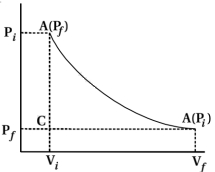
Graphically show the total work done in an expansion when the state of an ideal gas is changed reversibly and isothermally from $(P_i, V_i)$ to $(P_f, V_f)$. With the help of a $pV$ plot,compare the work done in the above case with that carried out against a constant external pressure $P_f$.
Solution
(N/A) $(i)$ Total work done in an expansion when the state of an ideal gas is changed reversibly and isothermally from $(P_i, V_i)$ to $(P_f, V_f)$ is represented by the area under the curve between $V_i$ and $V_f$.
$(ii)$ Work done against constant external pressure $P_f$ is represented by the rectangular area under the line at $P_f$ between $V_i$ and $V_f$.
$(iii)$ Comparing the two,the area under the reversible curve is greater than the area under the constant pressure line,therefore,reversible work is greater than the work done against constant external pressure $P_f$.
$(ii)$ Work done against constant external pressure $P_f$ is represented by the rectangular area under the line at $P_f$ between $V_i$ and $V_f$.
$(iii)$ Comparing the two,the area under the reversible curve is greater than the area under the constant pressure line,therefore,reversible work is greater than the work done against constant external pressure $P_f$.
0 likes
View Solution223
EasyMCQ
What is a $System$ in thermodynamics?
A
$A$ part of the universe chosen for thermodynamic study.
B
The entire universe excluding the surroundings.
C
The energy contained within a specific region of space.
D
The boundary separating the universe from the surroundings.
Solution
(A) In thermodynamics,a $System$ is defined as that part of the universe which is under investigation or chosen for study.
Everything else in the universe,excluding the system,is called the $Surroundings$.
The system and surroundings together constitute the $Universe$.
Everything else in the universe,excluding the system,is called the $Surroundings$.
The system and surroundings together constitute the $Universe$.
0 likes
View Solution224
EasyMCQ
During which process is all the heat absorbed by the system completely converted into work?
A
Isothermal process
B
Isobaric process
C
Isochoric process
D
Adiabatic process
Solution
(A) According to the first law of thermodynamics,$\Delta U = q + w$.
For the heat absorbed $(q)$ to be completely converted into work $(-w)$,the change in internal energy $(\Delta U)$ must be zero.
This condition,$\Delta U = 0$,is characteristic of an isothermal process for an ideal gas.
For the heat absorbed $(q)$ to be completely converted into work $(-w)$,the change in internal energy $(\Delta U)$ must be zero.
This condition,$\Delta U = 0$,is characteristic of an isothermal process for an ideal gas.
0 likes
View Solution225
EasyMCQ
What is free expansion?
A
Expansion against a constant external pressure.
B
Expansion against a vacuum $(P_{ext} = 0)$.
C
Expansion where temperature remains constant.
D
Expansion where no heat is exchanged.
Solution
(B) Free expansion is defined as the expansion of a gas into a vacuum.
Since the external pressure $(P_{ext})$ is $0$,the work done $(w)$ by the system is calculated as $w = -P_{ext} \Delta V$.
Because $P_{ext} = 0$,the work done is $w = 0$.
Therefore,free expansion refers to expansion against a vacuum.
Since the external pressure $(P_{ext})$ is $0$,the work done $(w)$ by the system is calculated as $w = -P_{ext} \Delta V$.
Because $P_{ext} = 0$,the work done is $w = 0$.
Therefore,free expansion refers to expansion against a vacuum.
0 likes
View Solution226
EasyMCQ
What are extensive properties?
A
Properties that depend on the amount of matter present in the system.
B
Properties that are independent of the amount of matter present in the system.
C
Properties that depend only on the temperature of the system.
D
Properties that depend only on the pressure of the system.
Solution
(A) Extensive properties are those properties whose values depend on the quantity or size of matter present in the system.
Examples include mass,volume,internal energy,enthalpy,and entropy.
In contrast,intensive properties are independent of the amount of matter present.
Examples include mass,volume,internal energy,enthalpy,and entropy.
In contrast,intensive properties are independent of the amount of matter present.
0 likes
View Solution227
EasyMCQ
What is calorimetry?
A
The study of heat capacity.
B
The measurement of heat changes in chemical and physical processes.
C
The study of work done in a system.
D
The measurement of temperature change in a vacuum.
Solution
(B) Calorimetry is the experimental technique used to measure the energy changes associated with chemical and physical processes.
0 likes
View Solution228
EasyMCQ
For a chemical reaction,when does $\Delta H = \Delta U$ occur?
A
When $\Delta n_{(g)} = 1$
B
When $\Delta n_{(g)} = 0$
C
When $\Delta n_{(g)} = -1$
D
When $\Delta n_{(g)} = 2$
Solution
(B) The relationship between enthalpy change and internal energy change is given by $\Delta H = \Delta U + \Delta n_{(g)}RT$.
For $\Delta H = \Delta U$ to hold true,the term $\Delta n_{(g)}RT$ must be equal to $0$.
Since $R$ (gas constant) and $T$ (temperature) are non-zero,this implies $\Delta n_{(g)} = 0$.
For $\Delta H = \Delta U$ to hold true,the term $\Delta n_{(g)}RT$ must be equal to $0$.
Since $R$ (gas constant) and $T$ (temperature) are non-zero,this implies $\Delta n_{(g)} = 0$.
0 likes
View Solution229
EasyMCQ
What is meant by standard state?
A
$1 \, \text{bar pressure and } 273 \, K \text{ temperature}$
B
$1 \, \text{atm pressure and } 298 \, K \text{ temperature}$
C
$1 \, \text{bar pressure and } 298 \, K \text{ temperature}$
D
$1 \, \text{atm pressure and } 273 \, K \text{ temperature}$
Solution
(C) The standard state of a substance at a specified temperature is defined as its pure form at $1 \, \text{bar}$ pressure.
By convention,$298 \, K$ is taken as the standard temperature for thermodynamic calculations.
Therefore,the standard state corresponds to $1 \, \text{bar}$ pressure and $298 \, K$ temperature.
By convention,$298 \, K$ is taken as the standard temperature for thermodynamic calculations.
Therefore,the standard state corresponds to $1 \, \text{bar}$ pressure and $298 \, K$ temperature.
0 likes
View Solution230
Easy
What is molar enthalpy of vaporization?
Solution
(N/A) The molar enthalpy of vaporization,also known as the standard enthalpy of vaporization,is the amount of heat required to vaporize one mole of a liquid at constant temperature and under constant pressure.
0 likes
View Solution231
Easy
Give the formula that shows the relationship between the boiling point and the enthalpy of evaporation of a solvent.
Solution
(N/A) The relationship between the boiling point $(T_b)$ and the enthalpy of vaporization $(\Delta_{vap}H)$ of a solvent is described by Trouton's rule. For many liquids,the entropy of vaporization $(\Delta_{vap}S)$ is approximately constant at the boiling point. The relation is given by: $\Delta_{vap}S = \frac{\Delta_{vap}H}{T_b} \approx 88 \ J \ K^{-1} \ mol^{-1}$.
0 likes
View Solution232
Easy
What are extensive properties?
Solution
(N/A) Extensive properties are those properties whose values depend on the quantity or size of matter present in the system. Examples include mass,volume,internal energy,and enthalpy.
0 likes
View Solution233
Easy
What is calorimetry?
Solution
(N/A) Calorimetry is the experimental technique used to measure the energy changes associated with chemical and physical processes.
0 likes
View Solution234
EasyMCQ
For a chemical reaction,when does $\Delta H = \Delta U$ occur?
A
When $\Delta n_{(g)} = 1$
B
When $\Delta n_{(g)} = 0$
C
When $\Delta n_{(g)} = -1$
D
When $\Delta n_{(g)} = 2$
Solution
(B) The relationship between enthalpy change and internal energy change is given by the equation: $\Delta H = \Delta U + \Delta n_{(g)}RT$.
For $\Delta H = \Delta U$ to hold true,the term $\Delta n_{(g)}RT$ must be equal to $0$.
Since $R$ (gas constant) and $T$ (temperature) are non-zero,it implies that $\Delta n_{(g)} = 0$.
For $\Delta H = \Delta U$ to hold true,the term $\Delta n_{(g)}RT$ must be equal to $0$.
Since $R$ (gas constant) and $T$ (temperature) are non-zero,it implies that $\Delta n_{(g)} = 0$.
0 likes
View Solution235
Easy
What is meant by standard state in the context of the equation $\Delta U = q + w$?
Solution
(N/A) The standard state is defined as a pressure of $1 \, \text{bar}$ (or $1 \, \text{atm}$) and a temperature of $298 \, K$.
0 likes
View Solution236
Easy
What is molar enthalpy of vaporization?
Solution
(N/A) The molar enthalpy of vaporization is the amount of heat required to vaporize $1 \ mol$ of a liquid at a constant temperature and under constant pressure.
0 likes
View Solution237
EasyMCQ
On what factors does the enthalpy of dilution of a solution depend?
A
Initial concentration of the solution
B
Amount of solvent added
C
Both $(A)$ and $(B)$
D
None of the above
Solution
(C) The enthalpy of dilution is the heat change associated with the process of diluting a solution.
It depends on the initial concentration of the solution and the amount of solvent added to it.
It depends on the initial concentration of the solution and the amount of solvent added to it.
0 likes
View Solution238
EasyMCQ
Which law of thermodynamics can be considered as the definition of temperature?
A
First law of thermodynamics
B
Second law of thermodynamics
C
Zeroth law of thermodynamics
D
Third law of thermodynamics
Solution
(C) The $Zeroth \ law$ of thermodynamics states that if two systems are each in thermal equilibrium with a third system,they are in thermal equilibrium with each other. This law provides the basis for the measurement of temperature and is therefore considered the definition of temperature.
0 likes
View Solution239
EasyMCQ
Give examples of intensive properties.
A
Mass
B
Volume
C
Density
D
Enthalpy
Solution
(C) Intensive properties are those that do not depend on the amount of matter present in the system.
Examples include:
$1$. Melting point
$2$. Boiling point
$3$. Density
$4$. Refractive index
$5$. Molar heat capacity
$6$. Pressure
$7$. Temperature
Examples include:
$1$. Melting point
$2$. Boiling point
$3$. Density
$4$. Refractive index
$5$. Molar heat capacity
$6$. Pressure
$7$. Temperature
0 likes
View Solution240
MediumMCQ
Fill in the blanks:
$(i)$ $A$ system that allows the exchange of energy but not matter with the surroundings is called a ........ .
$(ii)$ The total amount of energy consisting of the internal energy of a substance plus the product of its pressure and volume is called ........ .
$(iii)$ The change in energy that occurs when a chemical reaction is carried out at constant pressure is called ........ .
$(i)$ $A$ system that allows the exchange of energy but not matter with the surroundings is called a ........ .
$(ii)$ The total amount of energy consisting of the internal energy of a substance plus the product of its pressure and volume is called ........ .
$(iii)$ The change in energy that occurs when a chemical reaction is carried out at constant pressure is called ........ .
A
Closed system,Enthalpy,Enthalpy change
B
Open system,Internal energy,Entropy change
C
Isolated system,Gibbs energy,Internal energy change
D
Closed system,Entropy,Enthalpy change
Solution
(A) $(i)$ $A$ system that exchanges energy but not matter with its surroundings is known as a $Closed \ system$.
$(ii)$ The sum of internal energy $(U)$ and the product of pressure $(P)$ and volume $(V)$ is defined as $Enthalpy$ $(H = U + PV)$.
$(iii)$ The heat content change or energy change during a reaction at constant pressure is known as $Enthalpy \ change$ $(\Delta H)$.
$(ii)$ The sum of internal energy $(U)$ and the product of pressure $(P)$ and volume $(V)$ is defined as $Enthalpy$ $(H = U + PV)$.
$(iii)$ The heat content change or energy change during a reaction at constant pressure is known as $Enthalpy \ change$ $(\Delta H)$.
0 likes
View Solution241
Medium
Fill in the blanks:
$(i)$ The process of attaining thermal equilibrium between any two heat-conducting bodies is called the $\dots\dots$ law of thermodynamics.
$(ii)$ The law of thermodynamics is actually the law of $\dots\dots$.
$(iii)$ $A$ thermometer measures temperature according to the $\dots\dots$ law of thermodynamics.
$(i)$ The process of attaining thermal equilibrium between any two heat-conducting bodies is called the $\dots\dots$ law of thermodynamics.
$(ii)$ The law of thermodynamics is actually the law of $\dots\dots$.
$(iii)$ $A$ thermometer measures temperature according to the $\dots\dots$ law of thermodynamics.
Solution
(A) $(i)$ Zeroth law of thermodynamics.
$(ii)$ Conservation of energy (First law).
$(iii)$ Zeroth law of thermodynamics.
$(ii)$ Conservation of energy (First law).
$(iii)$ Zeroth law of thermodynamics.
0 likes
View Solution242
Easy
Fill in the blanks:
$(i)$ $1 \ \text{calorie} = \ldots \ldots \ \text{joules}$
$(ii)$ The work done by the system can be calculated by the equation .......
$(i)$ $1 \ \text{calorie} = \ldots \ldots \ \text{joules}$
$(ii)$ The work done by the system can be calculated by the equation .......
Solution
(N/A) $(i)$ $1 \ \text{calorie} = 4.184 \ \text{joules}$
$(ii)$ The work done by the system is given by the equation $W = -P_{ext} \Delta V$.
$(ii)$ The work done by the system is given by the equation $W = -P_{ext} \Delta V$.
0 likes
View Solution243
Easy
Fill in the blanks:
$(i)$ The change in heat energy during a chemical reaction at constant volume is called .......
$(ii)$ During a ....... process,there is no absorption or evolution of heat.
$(iii)$ The equation $\Delta G = \Delta H - T \Delta S$ was proposed by .......
$(i)$ The change in heat energy during a chemical reaction at constant volume is called .......
$(ii)$ During a ....... process,there is no absorption or evolution of heat.
$(iii)$ The equation $\Delta G = \Delta H - T \Delta S$ was proposed by .......
Solution
(N/A) $(i)$ Internal energy change (or $\Delta U$)
$(ii)$ Adiabatic
$(iii)$ Gibbs-Helmholtz
$(ii)$ Adiabatic
$(iii)$ Gibbs-Helmholtz
0 likes
View Solution244
Medium
Name the energy which arises due to the motion of atoms or molecules in a body. How is this energy affected when the temperature is increased?
Solution
(N/A) The energy that arises due to the motion of atoms or molecules in a body is called $thermal \ energy$. It is a measure of the average kinetic energy of particles,which increases with an increase in temperature.
0 likes
View Solution245
Easy
On what factors does the enthalpy of dilution of a solution depend?
Solution
(N/A) The enthalpy of dilution of a solution depends on the initial concentration of the solution and the amount of solvent added to it.
0 likes
View Solution246
EasyMCQ
Which law of thermodynamics provides the definition of temperature?
A
First Law
B
Second Law
C
Zeroth Law
D
Third Law
Solution
(C) The $Zeroth$ $Law$ of thermodynamics provides the definition of temperature. It states that if two systems are each in thermal equilibrium with a third system,they are in thermal equilibrium with each other.
0 likes
View Solution247
DifficultMCQ
Fill in the blanks given below:
$(i)$ $A$ system in which the exchange of energy between the system and the surroundings is possible but the exchange of matter is not possible is called a .......
$(ii)$ The total amount of energy, which is the sum of the internal energy of the substance and the product of its pressure and volume, is called .......
$(iii)$ The change in energy that occurs when a chemical reaction is carried out at constant pressure is called .......
$(iv)$ The process of attaining thermal equilibrium between any two heat-conducting substances is known as the ....... law of thermodynamics.
$(i)$ $A$ system in which the exchange of energy between the system and the surroundings is possible but the exchange of matter is not possible is called a .......
$(ii)$ The total amount of energy, which is the sum of the internal energy of the substance and the product of its pressure and volume, is called .......
$(iii)$ The change in energy that occurs when a chemical reaction is carried out at constant pressure is called .......
$(iv)$ The process of attaining thermal equilibrium between any two heat-conducting substances is known as the ....... law of thermodynamics.
A
Closed system,Enthalpy,Enthalpy change,Zeroth
B
Open system,Internal energy,Entropy,First
C
Isolated system,Gibbs energy,Internal energy,Second
D
Closed system,Entropy,Gibbs energy,Third
Solution
(A) $(i)$ $A$ system that allows energy exchange but not matter exchange is a $\text{Closed system}$.
$(ii)$ The sum of internal energy $(U)$ and the product of pressure $(P)$ and volume $(V)$ is defined as $\text{Enthalpy}$ $(H = U + PV)$.
$(iii)$ The energy change at constant pressure is defined as $\text{Enthalpy change}$ $(\Delta H)$.
$(iv)$ The law describing thermal equilibrium is the $\text{Zeroth law of thermodynamics}$.
$(ii)$ The sum of internal energy $(U)$ and the product of pressure $(P)$ and volume $(V)$ is defined as $\text{Enthalpy}$ $(H = U + PV)$.
$(iii)$ The energy change at constant pressure is defined as $\text{Enthalpy change}$ $(\Delta H)$.
$(iv)$ The law describing thermal equilibrium is the $\text{Zeroth law of thermodynamics}$.
0 likes
View Solution248
Difficult
Fill in the blanks:
$(i)$ The conversion of graphite into diamond is a ........ process.
$(ii)$ $1 \text{ calorie} = ........ \text{ Joules}$.
$(iii)$ Work done by the system can be calculated by the equation ........ .
$(iv)$ The change in heat energy during a chemical reaction at constant volume is called ........ .
$(i)$ The conversion of graphite into diamond is a ........ process.
$(ii)$ $1 \text{ calorie} = ........ \text{ Joules}$.
$(iii)$ Work done by the system can be calculated by the equation ........ .
$(iv)$ The change in heat energy during a chemical reaction at constant volume is called ........ .
Solution
(N/A) $(i)$ Endothermic (or non-spontaneous at standard conditions)
$(ii)$ $4.184 \ J$
$(iii)$ $W = -P_{ext} \Delta V$
$(iv)$ Change in internal energy $(\Delta U)$
$(ii)$ $4.184 \ J$
$(iii)$ $W = -P_{ext} \Delta V$
$(iv)$ Change in internal energy $(\Delta U)$
0 likes
View Solution249
Medium
Fill in the blanks:
$(i)$ During the ........... process,there is no absorption or evolution of heat.
$(ii)$ The equation $\Delta G = \Delta H - T\Delta S$ was proposed by ........... .
$(i)$ During the ........... process,there is no absorption or evolution of heat.
$(ii)$ The equation $\Delta G = \Delta H - T\Delta S$ was proposed by ........... .
Solution
(N/A) $(i)$ Adiabatic process
$(ii)$ Gibbs-Helmholtz
$(ii)$ Gibbs-Helmholtz
0 likes
View Solution250
EasyMCQ
How does a thermal power plant work?
A
It converts chemical energy of fuel into heat,then into kinetic energy of steam,and finally into electrical energy.
B
It converts solar energy directly into electrical energy using photovoltaic cells.
C
It uses the kinetic energy of flowing water to rotate turbines.
D
It uses nuclear fission to generate heat for steam production.
Solution
(A) thermal power plant operates on the principle of energy conversion:
$1$. Fuel (coal,oil,or gas) is burned in a boiler to produce heat.
$2$. This heat is used to convert water into high-pressure steam.
$3$. The steam is directed onto the blades of a turbine,causing it to rotate (kinetic energy).
$4$. The rotating turbine is connected to a generator,which converts the mechanical energy into electrical energy through electromagnetic induction.
$1$. Fuel (coal,oil,or gas) is burned in a boiler to produce heat.
$2$. This heat is used to convert water into high-pressure steam.
$3$. The steam is directed onto the blades of a turbine,causing it to rotate (kinetic energy).
$4$. The rotating turbine is connected to a generator,which converts the mechanical energy into electrical energy through electromagnetic induction.
0 likes
View SolutionThermodynamics — Basic concepts · Frequently Asked Questions
1Are these Thermodynamics questions useful for JEE and NEET?
Yes. All questions in this section are mapped to JEE Main and NEET exam patterns. Previous year questions from JEE Main, NEET, GUJCET and state-level exams are included with full solutions.
2Can I switch to Hindi or Gujarati for these questions?
Yes. Use the language tabs in the hero section or the sidebar to view the same questions and solutions in English, Hindi or Gujarati.
3How do I generate a question paper from this subtopic?
Use the Vedclass Exam Paper Generator — select the chapter and subtopic, set difficulty, and generate Sets A, B, C, D automatically. First 3 chapters of every subject are free.
Vedclass Products
For Students
Vedclass Test Series
Mock tests in real JEE/NEET style with performance analysis. 5-day free trial.
Start Free TrialFor Teachers
Exam Paper Generator
Generate Set A/B/C/D papers from this chapter in 2 minutes. 3 chapters free.
Try FreeFor Institutes
Online Exam Module
Live online exams with unlimited students, 360° analytics & white-label branding.
See DemoFor Teachers & Institutes
Generate a Thermodynamics Exam Paper in 2 Minutes
Select subtopic & difficulty — Sets A, B, C, D auto-generated with No Repeat logic.
First 3 chapters of every subject are free — no payment required.