
A English
Basic concepts Questions in English
Class 11 Chemistry · Thermodynamics · Basic concepts
401+
Questions
English
Language
100%
With Solutions
Showing 50 of 401 questions in English
151
MediumMCQ
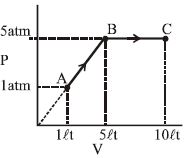
Find the work done $W_{ABC}$ for the process $A$ $\rightarrow B$ $\rightarrow C$ in $L \cdot atm$.
A
$-41$
B
$-37$
C
$-25$
D
$+25$
Solution
(B) The work done in a $P-V$ diagram is given by the area under the curve,with a negative sign for expansion: $W = -\int P \, dV$.
For the path $A \rightarrow B$,the process is a straight line. The area under the line $AB$ is a trapezoid with height $(V_B - V_A) = (5 - 1) = 4 \, L$ and parallel sides $P_A = 1 \, atm$ and $P_B = 5 \, atm$.
Area $AB = \frac{1}{2} \times (P_A + P_B) \times (V_B - V_A) = \frac{1}{2} \times (1 + 5) \times 4 = \frac{1}{2} \times 6 \times 4 = 12 \, L \cdot atm$.
For the path $B \rightarrow C$,the process is isobaric at $P = 5 \, atm$. The area under the line $BC$ is a rectangle with height $P = 5 \, atm$ and width $(V_C - V_B) = (10 - 5) = 5 \, L$.
Area $BC = P \times (V_C - V_B) = 5 \times 5 = 25 \, L \cdot atm$.
The total area under the path $ABC$ is $12 + 25 = 37 \, L \cdot atm$.
Since the process involves expansion ($V$ increases from $1 \, L$ to $10 \, L$),the work done by the system is negative: $W_{ABC} = -37 \, L \cdot atm$.
For the path $A \rightarrow B$,the process is a straight line. The area under the line $AB$ is a trapezoid with height $(V_B - V_A) = (5 - 1) = 4 \, L$ and parallel sides $P_A = 1 \, atm$ and $P_B = 5 \, atm$.
Area $AB = \frac{1}{2} \times (P_A + P_B) \times (V_B - V_A) = \frac{1}{2} \times (1 + 5) \times 4 = \frac{1}{2} \times 6 \times 4 = 12 \, L \cdot atm$.
For the path $B \rightarrow C$,the process is isobaric at $P = 5 \, atm$. The area under the line $BC$ is a rectangle with height $P = 5 \, atm$ and width $(V_C - V_B) = (10 - 5) = 5 \, L$.
Area $BC = P \times (V_C - V_B) = 5 \times 5 = 25 \, L \cdot atm$.
The total area under the path $ABC$ is $12 + 25 = 37 \, L \cdot atm$.
Since the process involves expansion ($V$ increases from $1 \, L$ to $10 \, L$),the work done by the system is negative: $W_{ABC} = -37 \, L \cdot atm$.
0 likes
View Solution152
MediumMCQ
Which statement is correct?
A
$(\frac{dH}{dT})_p < (\frac{dE}{dT})_v$ for ideal gas
B
$(\frac{dH}{dT})_p + (\frac{dE}{dT})_v = \frac{R}{2}$
C
$(\frac{dE}{dV})_T$ for ideal gas is zero
D
All of these
Solution
(C) For an ideal gas,the enthalpy change with respect to temperature at constant pressure is given by $(\frac{dH}{dT})_p = C_p$.
Similarly,the internal energy change with respect to temperature at constant volume is given by $(\frac{dE}{dT})_v = C_v$.
We know that for an ideal gas,$C_p - C_v = R$.
Therefore,$C_p = C_v + R$.
Since $R > 0$,it follows that $C_p > C_v$,which means $(\frac{dH}{dT})_p > (\frac{dE}{dT})_v$. Thus,option $A$ is incorrect.
Option $B$ is incorrect because $C_p + C_v$ is not equal to $\frac{R}{2}$.
For an ideal gas,internal energy $E$ depends only on temperature,so $(\frac{dE}{dV})_T = 0$.
Therefore,option $C$ is the correct statement.
Similarly,the internal energy change with respect to temperature at constant volume is given by $(\frac{dE}{dT})_v = C_v$.
We know that for an ideal gas,$C_p - C_v = R$.
Therefore,$C_p = C_v + R$.
Since $R > 0$,it follows that $C_p > C_v$,which means $(\frac{dH}{dT})_p > (\frac{dE}{dT})_v$. Thus,option $A$ is incorrect.
Option $B$ is incorrect because $C_p + C_v$ is not equal to $\frac{R}{2}$.
For an ideal gas,internal energy $E$ depends only on temperature,so $(\frac{dE}{dV})_T = 0$.
Therefore,option $C$ is the correct statement.
0 likes
View Solution153
EasyMCQ
The internal energy of an ideal gas increases during an isothermal process when the gas is
A
Expanded by adding more molecules to it.
B
Expanded by adding more heat to it.
C
Expanded against zero pressure.
D
Compressed by doing work on it.
Solution
(A) For an ideal gas,the internal energy $U$ is given by $U = \frac{f}{2} NkT$.
Since $U \propto NT$,for an isothermal process,the temperature $T$ remains constant.
Therefore,the internal energy $U$ becomes directly proportional to the number of molecules $N$ $(U \propto N)$.
Thus,the internal energy increases if the number of molecules $N$ is increased.
Since $U \propto NT$,for an isothermal process,the temperature $T$ remains constant.
Therefore,the internal energy $U$ becomes directly proportional to the number of molecules $N$ $(U \propto N)$.
Thus,the internal energy increases if the number of molecules $N$ is increased.
0 likes
View Solution154
MediumMCQ
Which of the following expressions is true for an ideal gas?
A
$\left( \frac{\partial V}{\partial T} \right)_P = 0$
B
$\left( \frac{\partial P}{\partial T} \right)_V = 0$
C
$\left( \frac{\partial U}{\partial V} \right)_T = 0$
D
$\left( \frac{\partial U}{\partial T} \right)_V = 0$
Solution
(C) For an ideal gas,the internal energy $U$ is a function of temperature only,i.e.,$U = f(T)$.
Therefore,the change in internal energy with respect to volume at constant temperature is zero:
$\left( \frac{\partial U}{\partial V} \right)_T = 0$.
Let us evaluate the other options:
$1$. From the ideal gas equation $PV = nRT$,we have $\left( \frac{\partial V}{\partial T} \right)_P = \frac{nR}{P} \neq 0$.
$2$. From the ideal gas equation $PV = nRT$,we have $\left( \frac{\partial P}{\partial T} \right)_V = \frac{nR}{V} \neq 0$.
$3$. $\left( \frac{\partial U}{\partial T} \right)_V = C_V \neq 0$ (for a non-zero heat capacity).
Thus,the correct expression is $\left( \frac{\partial U}{\partial V} \right)_T = 0$.
Therefore,the change in internal energy with respect to volume at constant temperature is zero:
$\left( \frac{\partial U}{\partial V} \right)_T = 0$.
Let us evaluate the other options:
$1$. From the ideal gas equation $PV = nRT$,we have $\left( \frac{\partial V}{\partial T} \right)_P = \frac{nR}{P} \neq 0$.
$2$. From the ideal gas equation $PV = nRT$,we have $\left( \frac{\partial P}{\partial T} \right)_V = \frac{nR}{V} \neq 0$.
$3$. $\left( \frac{\partial U}{\partial T} \right)_V = C_V \neq 0$ (for a non-zero heat capacity).
Thus,the correct expression is $\left( \frac{\partial U}{\partial V} \right)_T = 0$.
0 likes
View Solution155
EasyMCQ
In thermodynamics,a process is called reversible when
A
The surrounding and system change into each other
B
There is no boundary between system and surrounding
C
The surrounding are always in equilibrium with the system.
D
The system changes into the surrounding spontaneously.
Solution
(C) process is called reversible if it occurs in an infinite number of steps such that the system and surroundings are always in equilibrium with each other at every step. \\ The process can be reversed by an infinitesimal change in the state functions.
0 likes
View Solution156
MediumMCQ
The maximum work done in expanding $16 \, g$ of $O_2$ gas isothermally at $300 \, K$ from an initial volume of $5 \, dm^3$ to a final volume of $25 \, dm^3$ is:
A
$-2.01 \times 10^3 \, J$
B
$2.01 \times 10^{-3} \, J$
C
$+2.81 \times 10^3 \, J$
D
$+2.01 \times 10^{-6} \, J$
Solution
(A) The formula for maximum work done in an isothermal reversible expansion is $W_{max} = -nRT \ln(\frac{V_2}{V_1})$.
Given: Mass of $O_2 = 16 \, g$,Molar mass of $O_2 = 32 \, g/mol$.
Number of moles $n = \frac{16}{32} = 0.5 \, mol$.
Temperature $T = 300 \, K$,$R = 8.314 \, J \cdot K^{-1} \cdot mol^{-1}$.
$V_1 = 5 \, dm^3$,$V_2 = 25 \, dm^3$.
$W_{max} = -0.5 \times 8.314 \times 300 \times \ln(\frac{25}{5})$.
$W_{max} = -0.5 \times 8.314 \times 300 \times \ln(5)$.
$W_{max} = -1247.1 \times 1.609 \approx -2006.6 \, J \approx -2.01 \times 10^3 \, J$.
Given: Mass of $O_2 = 16 \, g$,Molar mass of $O_2 = 32 \, g/mol$.
Number of moles $n = \frac{16}{32} = 0.5 \, mol$.
Temperature $T = 300 \, K$,$R = 8.314 \, J \cdot K^{-1} \cdot mol^{-1}$.
$V_1 = 5 \, dm^3$,$V_2 = 25 \, dm^3$.
$W_{max} = -0.5 \times 8.314 \times 300 \times \ln(\frac{25}{5})$.
$W_{max} = -0.5 \times 8.314 \times 300 \times \ln(5)$.
$W_{max} = -1247.1 \times 1.609 \approx -2006.6 \, J \approx -2.01 \times 10^3 \, J$.
0 likes
View Solution157
MediumMCQ
Calculate the final temperature of a monoatomic ideal gas that is compressed reversibly and adiabatically from $16 \, L$ to $2 \, L$ at $300 \, K$. (in $, K$)
A
$600$
B
$1044.6$
C
$1200$
D
$2400$
Solution
(C) For a reversible adiabatic process,the relationship between temperature and volume is given by $T_1 V_1^{\gamma-1} = T_2 V_2^{\gamma-1}$.
Given: $T_1 = 300 \, K$,$V_1 = 16 \, L$,$V_2 = 2 \, L$.
For a monoatomic ideal gas,the heat capacity ratio $\gamma = \frac{5}{3}$,so $\gamma - 1 = \frac{2}{3}$.
Substituting the values: $300 \times (16)^{2/3} = T_2 \times (2)^{2/3}$.
$T_2 = 300 \times (\frac{16}{2})^{2/3} = 300 \times (8)^{2/3}$.
Since $(8)^{2/3} = (2^3)^{2/3} = 2^2 = 4$,we get $T_2 = 300 \times 4 = 1200 \, K$.
Given: $T_1 = 300 \, K$,$V_1 = 16 \, L$,$V_2 = 2 \, L$.
For a monoatomic ideal gas,the heat capacity ratio $\gamma = \frac{5}{3}$,so $\gamma - 1 = \frac{2}{3}$.
Substituting the values: $300 \times (16)^{2/3} = T_2 \times (2)^{2/3}$.
$T_2 = 300 \times (\frac{16}{2})^{2/3} = 300 \times (8)^{2/3}$.
Since $(8)^{2/3} = (2^3)^{2/3} = 2^2 = 4$,we get $T_2 = 300 \times 4 = 1200 \, K$.
0 likes
View Solution158
EasyMCQ
In the equation $C_P - C_V = R$,what does $R$ represent?
A
Change in $KE$
B
Change in rotational energy
C
Work done by the system when expanding one mole of gas per degree increase in temperature
D
All are correct
Solution
(C) The relation $C_P - C_V = R$ is known as Mayer's relation for an ideal gas.
Here,$C_P$ is the molar heat capacity at constant pressure and $C_V$ is the molar heat capacity at constant volume.
When one mole of an ideal gas is heated by $1 \ K$,the increase in internal energy is $C_V \Delta T = C_V \times 1 = C_V$.
If the gas is heated at constant pressure,the heat supplied is $C_P \Delta T = C_P \times 1 = C_P$.
According to the first law of thermodynamics,$Q = \Delta U + W$.
Thus,$C_P = C_V + W$,which implies $C_P - C_V = W$.
Therefore,$R$ represents the work done by the system during the expansion of one mole of an ideal gas when its temperature is increased by $1 \ K$ (or $1 \ ^\circ C$).
Here,$C_P$ is the molar heat capacity at constant pressure and $C_V$ is the molar heat capacity at constant volume.
When one mole of an ideal gas is heated by $1 \ K$,the increase in internal energy is $C_V \Delta T = C_V \times 1 = C_V$.
If the gas is heated at constant pressure,the heat supplied is $C_P \Delta T = C_P \times 1 = C_P$.
According to the first law of thermodynamics,$Q = \Delta U + W$.
Thus,$C_P = C_V + W$,which implies $C_P - C_V = W$.
Therefore,$R$ represents the work done by the system during the expansion of one mole of an ideal gas when its temperature is increased by $1 \ K$ (or $1 \ ^\circ C$).
0 likes
View Solution159
MediumMCQ
For which of the following reactions is $\Delta H$ approximately equal to $\Delta E$?
A
$2H_2O_{2(g)} \longrightarrow 2H_2O_{(g)} + O_{2(g)}$
B
$2H_{2(g)} + O_{2(g)} \longrightarrow 2H_2O_{(g)}$
C
$2NH_{3(g)} \longrightarrow N_{2(g)} + 3H_{2(g)}$
D
$2NO_{(g)} \longrightarrow N_{2(g)} + O_{2(g)}$
Solution
(D) The relationship between enthalpy change $\Delta H$ and internal energy change $\Delta E$ is given by the equation: $\Delta H = \Delta E + \Delta n_g RT$.
For $\Delta H$ to be approximately equal to $\Delta E$,the term $\Delta n_g$ must be equal to $0$.
$\Delta n_g$ is the difference between the number of moles of gaseous products and gaseous reactants.
For option $D$: $2NO_{(g)} \longrightarrow N_{2(g)} + O_{2(g)}$,$\Delta n_g = (1 + 1) - 2 = 0$.
Since $\Delta n_g = 0$,$\Delta H = \Delta E$.
For $\Delta H$ to be approximately equal to $\Delta E$,the term $\Delta n_g$ must be equal to $0$.
$\Delta n_g$ is the difference between the number of moles of gaseous products and gaseous reactants.
For option $D$: $2NO_{(g)} \longrightarrow N_{2(g)} + O_{2(g)}$,$\Delta n_g = (1 + 1) - 2 = 0$.
Since $\Delta n_g = 0$,$\Delta H = \Delta E$.
0 likes
View Solution160
EasyMCQ
Which of the following is not true?
A
$A$ system does not contain heat.
B
$A$ system contains internal energy.
C
$A$ system contains heat.
D
Heat is evolved during the combustion of methane.
Solution
(C) system possesses internal energy,but it does not possess heat. Heat is a mode of energy transfer that occurs due to a temperature difference between the system and the surroundings. Therefore,the statement that a system contains heat is incorrect.
0 likes
View Solution161
EasyMCQ
Which of the following is true for an isothermal process?
A
$\Delta V = 0$
B
$\Delta P = 0$
C
$P \cdot \Delta V = 0$
D
$\Delta T = 0$
Solution
(D) An isothermal process is defined as a thermodynamic process in which the temperature of the system remains constant throughout the process.
Therefore,the change in temperature,$\Delta T$,is equal to $0$.
Therefore,the change in temperature,$\Delta T$,is equal to $0$.
0 likes
View Solution162
EasyMCQ
An adiabatic process is .................
A
Endothermic
B
Exothermic
C
Endothermic or exothermic
D
None of these
Solution
(D) An adiabatic process is defined as a process in which there is no exchange of heat between the system and the surroundings,i.e.,$q = 0$.
Since $q = 0$,the process is neither endothermic (where $q > 0$) nor exothermic (where $q < 0$).
Therefore,the correct option is $D$.
Since $q = 0$,the process is neither endothermic (where $q > 0$) nor exothermic (where $q < 0$).
Therefore,the correct option is $D$.
0 likes
View Solution163
EasyMCQ
Which of the following is an intensive property?
A
Heat capacity
B
Enthalpy
C
Work
D
Molar heat capacity
Solution
(D) An intensive property is a property of matter that does not depend on the amount of the matter present or the size of the system.
$1$. Heat capacity,Enthalpy,and Work are extensive properties because they depend on the quantity of matter.
$2$. Molar heat capacity is defined as the heat capacity per mole of a substance,which makes it independent of the total amount of substance,hence it is an intensive property.
$1$. Heat capacity,Enthalpy,and Work are extensive properties because they depend on the quantity of matter.
$2$. Molar heat capacity is defined as the heat capacity per mole of a substance,which makes it independent of the total amount of substance,hence it is an intensive property.
0 likes
View Solution164
MediumMCQ
For the reaction of nitrogen with hydrogen to form ammonia,$\Delta H^o = -92.2 \ kJ/mol$. If the reaction is carried out at a constant pressure of $20.0 \ atm$ and a volume change of $-1.16 \ L$,calculate the change in internal energy $(\Delta U)$ in $kJ$.
A
$87.7$
B
$-89.85$
C
$46.6$
D
$80$
Solution
(B) The relationship between enthalpy change $(\Delta H)$ and internal energy change $(\Delta U)$ is given by the equation: $\Delta H = \Delta U + P\Delta V$.
Given: $\Delta H = -92.2 \ kJ/mol$,$P = 20.0 \ atm$,and $\Delta V = -1.16 \ L$.
First,calculate the work done $(P\Delta V)$ in $L \cdot atm$: $P\Delta V = 20.0 \ atm \times (-1.16 \ L) = -23.2 \ L \cdot atm$.
Convert $L \cdot atm$ to $kJ$ using the conversion factor $1 \ L \cdot atm = 0.1013 \ kJ$: $P\Delta V = -23.2 \times 0.1013 \ kJ = -2.35 \ kJ$.
Now,substitute the values into the equation: $-92.2 \ kJ = \Delta U + (-2.35 \ kJ)$.
$\Delta U = -92.2 \ kJ + 2.35 \ kJ = -89.85 \ kJ$.
Given: $\Delta H = -92.2 \ kJ/mol$,$P = 20.0 \ atm$,and $\Delta V = -1.16 \ L$.
First,calculate the work done $(P\Delta V)$ in $L \cdot atm$: $P\Delta V = 20.0 \ atm \times (-1.16 \ L) = -23.2 \ L \cdot atm$.
Convert $L \cdot atm$ to $kJ$ using the conversion factor $1 \ L \cdot atm = 0.1013 \ kJ$: $P\Delta V = -23.2 \times 0.1013 \ kJ = -2.35 \ kJ$.
Now,substitute the values into the equation: $-92.2 \ kJ = \Delta U + (-2.35 \ kJ)$.
$\Delta U = -92.2 \ kJ + 2.35 \ kJ = -89.85 \ kJ$.
0 likes
View Solution165
MediumMCQ
For the reaction $N_{2(g)} + 3H_{2(g)} \to 2NH_{3(g)}$,the relationship between $\Delta H$ and $\Delta U$ is:
A
$\Delta H = \Delta U - 2RT$
B
$\Delta H = \Delta U + 2RT$
C
$\Delta H = \Delta U + RT$
D
$\Delta H = \Delta U - RT$
Solution
(A) The relationship between enthalpy change $(\Delta H)$ and internal energy change $(\Delta U)$ is given by the equation: $\Delta H = \Delta U + \Delta n_g RT$.
For the reaction $N_{2(g)} + 3H_{2(g)} \to 2NH_{3(g)}$,the number of moles of gaseous products is $n_p = 2$ and the number of moles of gaseous reactants is $n_r = 1 + 3 = 4$.
Therefore,the change in the number of gaseous moles is $\Delta n_g = n_p - n_r = 2 - 4 = -2$.
Substituting this value into the equation: $\Delta H = \Delta U + (-2)RT = \Delta U - 2RT$.
For the reaction $N_{2(g)} + 3H_{2(g)} \to 2NH_{3(g)}$,the number of moles of gaseous products is $n_p = 2$ and the number of moles of gaseous reactants is $n_r = 1 + 3 = 4$.
Therefore,the change in the number of gaseous moles is $\Delta n_g = n_p - n_r = 2 - 4 = -2$.
Substituting this value into the equation: $\Delta H = \Delta U + (-2)RT = \Delta U - 2RT$.
0 likes
View Solution166
MediumMCQ
What will be the difference in heat at constant pressure and constant volume for the combustion of carbon monoxide at $27 \, ^oC$ in $cal$?
A
$27$
B
$54$
C
$-300$
D
$600$
Solution
(C) The combustion reaction for carbon monoxide is: $CO(g) + \frac{1}{2} O_2(g) \rightarrow CO_2(g)$.
The change in the number of moles of gaseous products and reactants is $\Delta n_g = n_p - n_r = 1 - (1 + 0.5) = -0.5 \, mol$.
The relationship between heat at constant pressure $(q_p = \Delta H)$ and constant volume $(q_v = \Delta U)$ is given by $\Delta H = \Delta U + \Delta n_g RT$.
Therefore,the difference is $\Delta H - \Delta U = \Delta n_g RT$.
Given $T = 27 + 273 = 300 \, K$ and $R \approx 2 \, cal \, mol^{-1} K^{-1}$.
Difference $= (-0.5) \times 2 \times 300 = -300 \, cal$.
The change in the number of moles of gaseous products and reactants is $\Delta n_g = n_p - n_r = 1 - (1 + 0.5) = -0.5 \, mol$.
The relationship between heat at constant pressure $(q_p = \Delta H)$ and constant volume $(q_v = \Delta U)$ is given by $\Delta H = \Delta U + \Delta n_g RT$.
Therefore,the difference is $\Delta H - \Delta U = \Delta n_g RT$.
Given $T = 27 + 273 = 300 \, K$ and $R \approx 2 \, cal \, mol^{-1} K^{-1}$.
Difference $= (-0.5) \times 2 \times 300 = -300 \, cal$.
0 likes
View Solution167
MediumMCQ
For $1 \, \text{mole}$ of an ideal gas,isothermal expansion occurs from a volume of $2 \, L$ to $6 \, L$ at a temperature of $300 \, K$. The value of $\Delta U$ for this process is .............
A
$8 \, kJ$
B
$8 \, cal$
C
$300 \, cal$
D
$0$
Solution
(D) For an ideal gas,the internal energy $(U)$ is a function of temperature only.
Since the process is isothermal,the change in temperature $(\Delta T)$ is $0$.
Therefore,the change in internal energy $\Delta U = nC_v\Delta T = 0$.
Since the process is isothermal,the change in temperature $(\Delta T)$ is $0$.
Therefore,the change in internal energy $\Delta U = nC_v\Delta T = 0$.
0 likes
View Solution168
MediumMCQ
The work done during the expansion of $1 \ mol$ of an ideal gas into a vacuum is ............ .
A
$ - P \Delta V$
B
$P \Delta V$
C
$\Delta G^o$
D
zero
Solution
(D) In a vacuum,the external pressure $P_{ext} = 0$.
Since the work done $w = -P_{ext} \Delta V$,substituting $P_{ext} = 0$ gives $w = 0$.
Therefore,the work done during expansion into a vacuum is zero.
Since the work done $w = -P_{ext} \Delta V$,substituting $P_{ext} = 0$ gives $w = 0$.
Therefore,the work done during expansion into a vacuum is zero.
0 likes
View Solution169
EasyMCQ
In an irreversible expansion of a gas,the work done by the gas is given by.....
A
$P_{ext} \Delta V$
B
$-nRT$
C
$1/nRT$
D
$0$
Solution
(A) For an irreversible expansion of a gas against a constant external pressure,the work done is given by the formula $W = -P_{ext} \Delta V$.
If the gas expands into a vacuum (free expansion),$P_{ext} = 0$,so $W = 0$.
However,in the context of general irreversible expansion,the work is defined as $W = -P_{ext} \Delta V$.
If the gas expands into a vacuum (free expansion),$P_{ext} = 0$,so $W = 0$.
However,in the context of general irreversible expansion,the work is defined as $W = -P_{ext} \Delta V$.
0 likes
View Solution170
MediumMCQ
The work done when $2 \, mol$ of an ideal gas expands from $5 \, L$ to $15 \, L$ at a temperature of $300 \, K$ is .............. $kJ$.
A
$- 5.481$
B
$- 5481$
C
$18.27$
D
$- 14.86$
Solution
(A) For an isothermal reversible expansion,the work done is given by the formula:
$W = -2.303 nRT \log \frac{V_2}{V_1}$
Given: $n = 2 \, mol$,$R = 8.314 \, J \, K^{-1} \, mol^{-1}$,$T = 300 \, K$,$V_1 = 5 \, L$,$V_2 = 15 \, L$.
Substituting the values:
$W = -2.303 \times 2 \times 8.314 \times 300 \times \log \frac{15}{5}$
$W = -2.303 \times 2 \times 8.314 \times 300 \times \log(3)$
$W = -2.303 \times 2 \times 8.314 \times 300 \times 0.4771$
$W \approx -5481 \, J$
Since the question asks for the value in $kJ$:
$W = -5.481 \, kJ$.
$W = -2.303 nRT \log \frac{V_2}{V_1}$
Given: $n = 2 \, mol$,$R = 8.314 \, J \, K^{-1} \, mol^{-1}$,$T = 300 \, K$,$V_1 = 5 \, L$,$V_2 = 15 \, L$.
Substituting the values:
$W = -2.303 \times 2 \times 8.314 \times 300 \times \log \frac{15}{5}$
$W = -2.303 \times 2 \times 8.314 \times 300 \times \log(3)$
$W = -2.303 \times 2 \times 8.314 \times 300 \times 0.4771$
$W \approx -5481 \, J$
Since the question asks for the value in $kJ$:
$W = -5.481 \, kJ$.
0 likes
View Solution171
MediumMCQ
The work done when the temperature of $1 \, \text{mol}$ of an ideal gas is increased by $2 \, ^\circ\text{C}$ is ......... $J$.
A
$46.8$
B
$8.3$
C
$-16.6$
D
$16.6$
Solution
(C) The work done by an ideal gas during expansion is given by the formula $w = -P \Delta V$.
Since $PV = nRT$,for a constant pressure process,$P \Delta V = nR \Delta T$.
Substituting the given values: $n = 1 \, \text{mol}$,$R = 8.3 \, \text{J K}^{-1} \text{mol}^{-1}$,and $\Delta T = 2 \, \text{K}$ (since a change of $2 \, ^\circ\text{C}$ is equivalent to a change of $2 \, \text{K}$).
$w = -1 \times 8.3 \times 2 = -16.6 \, \text{J}$.
Thus,the work done is $-16.6 \, \text{J}$.
Since $PV = nRT$,for a constant pressure process,$P \Delta V = nR \Delta T$.
Substituting the given values: $n = 1 \, \text{mol}$,$R = 8.3 \, \text{J K}^{-1} \text{mol}^{-1}$,and $\Delta T = 2 \, \text{K}$ (since a change of $2 \, ^\circ\text{C}$ is equivalent to a change of $2 \, \text{K}$).
$w = -1 \times 8.3 \times 2 = -16.6 \, \text{J}$.
Thus,the work done is $-16.6 \, \text{J}$.
0 likes
View Solution172
MediumMCQ
Under what conditions does the isothermal expansion of a gas become a free expansion process?
A
The gas is real and expands against a vacuum.
B
The gas is real and expands against atmospheric pressure.
C
The gas is ideal and expands against a vacuum.
D
The gas is ideal and expands against atmospheric pressure.
Solution
(C) Free expansion is defined as the expansion of a gas into a vacuum $(P_{ext} = 0)$.
For an ideal gas,the internal energy $(U)$ is a function of temperature only,i.e.,$U = f(T)$.
In an isothermal process,the temperature remains constant $(\Delta T = 0)$,therefore $\Delta U = 0$.
According to the first law of thermodynamics,$\Delta U = q + w$.
Since $w = -P_{ext} \Delta V$ and $P_{ext} = 0$,the work done $(w)$ is $0$.
Thus,for an ideal gas undergoing isothermal expansion against a vacuum,$\Delta U = 0$ and $w = 0$,which implies $q = 0$ (adiabatic process).
Therefore,the condition for free expansion is that the gas expands against a vacuum,and for an ideal gas,this process is both isothermal and adiabatic.
For an ideal gas,the internal energy $(U)$ is a function of temperature only,i.e.,$U = f(T)$.
In an isothermal process,the temperature remains constant $(\Delta T = 0)$,therefore $\Delta U = 0$.
According to the first law of thermodynamics,$\Delta U = q + w$.
Since $w = -P_{ext} \Delta V$ and $P_{ext} = 0$,the work done $(w)$ is $0$.
Thus,for an ideal gas undergoing isothermal expansion against a vacuum,$\Delta U = 0$ and $w = 0$,which implies $q = 0$ (adiabatic process).
Therefore,the condition for free expansion is that the gas expands against a vacuum,and for an ideal gas,this process is both isothermal and adiabatic.
0 likes
View Solution173
EasyMCQ
The formula for the Joule-Thomson coefficient is ............. .
A
$(\partial T/\partial V)_P$
B
$(\partial T/\partial P)_V$
C
$(\partial T/\partial P)_H$
D
$(\partial G/\partial T)_P$
Solution
(C) The Joule-Thomson coefficient,denoted by $\mu_{JT}$,is defined as the change in temperature with respect to a change in pressure at constant enthalpy.
Mathematically,it is expressed as $\mu_{JT} = (\partial T/\partial P)_H$.
Therefore,the correct option is $C$.
Mathematically,it is expressed as $\mu_{JT} = (\partial T/\partial P)_H$.
Therefore,the correct option is $C$.
0 likes
View Solution174
EasyMCQ
For a phase change$H _2 O ( l ) \underset{1 bar , 0^{\circ} C }{\rightleftharpoons} H _2 O ( s )$
A
$\Delta G = 0$
B
$\Delta S = 0$
C
$\Delta H = 0$
D
$\Delta U = 0$
Solution
(A) For any phase change occurring at equilibrium,the change in Gibbs free energy is zero.
Since the process $H _2 O (l) \underset{1 \text { bar, } 0^{\circ} C }{\rightleftharpoons} H _2 O (s)$ represents the freezing of water at its normal melting point ( $0^{\circ} C$ and 1 bar ), the system is at equilibrium.
Therefore, $\Delta G=0$.
Since the process $H _2 O (l) \underset{1 \text { bar, } 0^{\circ} C }{\rightleftharpoons} H _2 O (s)$ represents the freezing of water at its normal melting point ( $0^{\circ} C$ and 1 bar ), the system is at equilibrium.
Therefore, $\Delta G=0$.
0 likes
View Solution175
MediumMCQ
The enthalpy change $(\Delta H)$ for the reaction,$N_{2(g)} + 3H_{2(g)} \to 2NH_{3(g)}$ is $-92.38 \ kJ$ at $298 \ K$. The internal energy change $\Delta U$ at $298 \ K$ is .............. $kJ$
A
$-92.38$
B
$-87.42$
C
$-97.34$
D
$-89.9$
Solution
(B) The relationship between enthalpy change $(\Delta H)$ and internal energy change $(\Delta U)$ is given by the equation: $\Delta H = \Delta U + \Delta n_g RT$.
Rearranging for $\Delta U$: $\Delta U = \Delta H - \Delta n_g RT$.
For the reaction $N_{2(g)} + 3H_{2(g)} \to 2NH_{3(g)}$,the change in the number of gaseous moles is $\Delta n_g = n_p - n_r = 2 - (1 + 3) = -2$.
Given $\Delta H = -92.38 \ kJ$,$R = 8.314 \times 10^{-3} \ kJ \ K^{-1} \ mol^{-1}$,and $T = 298 \ K$.
Substituting the values: $\Delta U = -92.38 - (-2 \times 8.314 \times 10^{-3} \times 298)$.
$\Delta U = -92.38 - (-4.957) = -92.38 + 4.957 = -87.423 \ kJ$.
Thus,$\Delta U \approx -87.42 \ kJ$.
Rearranging for $\Delta U$: $\Delta U = \Delta H - \Delta n_g RT$.
For the reaction $N_{2(g)} + 3H_{2(g)} \to 2NH_{3(g)}$,the change in the number of gaseous moles is $\Delta n_g = n_p - n_r = 2 - (1 + 3) = -2$.
Given $\Delta H = -92.38 \ kJ$,$R = 8.314 \times 10^{-3} \ kJ \ K^{-1} \ mol^{-1}$,and $T = 298 \ K$.
Substituting the values: $\Delta U = -92.38 - (-2 \times 8.314 \times 10^{-3} \times 298)$.
$\Delta U = -92.38 - (-4.957) = -92.38 + 4.957 = -87.423 \ kJ$.
Thus,$\Delta U \approx -87.42 \ kJ$.
0 likes
View Solution176
MediumMCQ
$6$ moles of an ideal gas expand isothermally and reversibly from a volume of $1 \ L$ to a volume of $10 \ L$ at $27 \ ^oC$. What is the maximum work done? (in $kJ$)
A
$47$
B
$100$
C
$0$
D
$34.465$
Solution
(D) For an isothermal reversible expansion,the work done is given by the formula: $W = -2.303 \times nRT \times \log(\frac{V_2}{V_1})$.
Given values: $n = 6 \ mol$,$T = 27 \ ^oC = 300 \ K$,$V_1 = 1 \ L$,$V_2 = 10 \ L$,and $R = 8.314 \ J \ K^{-1} \ mol^{-1}$.
Substituting the values: $W = -2.303 \times 6 \times 8.314 \times 300 \times \log(\frac{10}{1})$.
$W = -2.303 \times 6 \times 8.314 \times 300 \times 1$.
$W = -34465.3 \ J = -34.465 \ kJ$.
The magnitude of maximum work done is $34.465 \ kJ$.
Given values: $n = 6 \ mol$,$T = 27 \ ^oC = 300 \ K$,$V_1 = 1 \ L$,$V_2 = 10 \ L$,and $R = 8.314 \ J \ K^{-1} \ mol^{-1}$.
Substituting the values: $W = -2.303 \times 6 \times 8.314 \times 300 \times \log(\frac{10}{1})$.
$W = -2.303 \times 6 \times 8.314 \times 300 \times 1$.
$W = -34465.3 \ J = -34.465 \ kJ$.
The magnitude of maximum work done is $34.465 \ kJ$.
0 likes
View Solution177
EasyMCQ
One mole of an ideal gas at $300 \ K$ is expanded isothermally from an initial volume of $1 \ L$ to $10 \ L$. The value of $\Delta E$ for this process is $(R = 2 \ cal \ mol^{-1} \ K^{-1})$.
A
$163.7 \ cal$
B
zero
C
$138.1 \ cal$
D
$9 \ L \ atm$
Solution
(B) For an ideal gas,the internal energy $(E)$ is a function of temperature only,i.e.,$E = f(T)$.
Since the process is isothermal,the temperature remains constant $(\Delta T = 0)$.
Therefore,the change in internal energy $(\Delta E)$ is zero.
Since the process is isothermal,the temperature remains constant $(\Delta T = 0)$.
Therefore,the change in internal energy $(\Delta E)$ is zero.
0 likes
View Solution178
MediumMCQ
Choose the reaction in which $\Delta H$ is not equal to $\Delta U$.
A
$C_{(graphite)} + O_{2(g)} \to CO_{2(g)}$
B
$C_2H_{4(g)} + H_{2(g)} \to C_2H_{6(g)}$
C
$2C_{(graphite)} + H_{2(g)} \to C_2H_{2(g)}$
D
$H_{2(g)} + I_{2(g)} \to 2HI_{(g)}$
Solution
(B) The relationship between enthalpy change $\Delta H$ and internal energy change $\Delta U$ is given by the equation: $\Delta H = \Delta U + \Delta n_g RT$.
If $\Delta n_g = 0$,then $\Delta H = \Delta U$.
If $\Delta n_g \neq 0$,then $\Delta H \neq \Delta U$.
Let us calculate $\Delta n_g$ (change in the number of moles of gaseous species) for each reaction:
$A$: $\Delta n_g = 1 - 1 = 0$
$B$: $\Delta n_g = 1 - (1 + 1) = -1$
$C$: $\Delta n_g = 1 - 1 = 0$
$D$: $\Delta n_g = 2 - (1 + 1) = 0$
Since $\Delta n_g \neq 0$ for option $B$,$\Delta H \neq \Delta U$ in this reaction.
If $\Delta n_g = 0$,then $\Delta H = \Delta U$.
If $\Delta n_g \neq 0$,then $\Delta H \neq \Delta U$.
Let us calculate $\Delta n_g$ (change in the number of moles of gaseous species) for each reaction:
$A$: $\Delta n_g = 1 - 1 = 0$
$B$: $\Delta n_g = 1 - (1 + 1) = -1$
$C$: $\Delta n_g = 1 - 1 = 0$
$D$: $\Delta n_g = 2 - (1 + 1) = 0$
Since $\Delta n_g \neq 0$ for option $B$,$\Delta H \neq \Delta U$ in this reaction.
0 likes
View Solution179
EasyMCQ
Assertion : During an adiabatic process,heat energy is not exchanged between the system and its surroundings.
Reason : The temperature of a gas increases when it undergoes an adiabatic expansion.
Reason : The temperature of a gas increases when it undergoes an adiabatic expansion.
A
If both Assertion and Reason are correct and the Reason is a correct explanation of the Assertion.
B
If both Assertion and Reason are correct but Reason is not a correct explanation of the Assertion.
C
If the Assertion is correct but Reason is incorrect.
D
If both the Assertion and Reason are incorrect.
Solution
(C) An adiabatic process is defined as a process where there is no exchange of heat between the system and the surroundings,i.e.,$q = 0$. Thus,the Assertion is correct.
During an adiabatic expansion,the system does work on the surroundings at the expense of its internal energy. Since $dU = dq + dw$ and $dq = 0$,$dU = dw$. For expansion,$dw < 0$,so $dU < 0$. Since internal energy is a function of temperature for an ideal gas,a decrease in internal energy leads to a decrease in temperature. Therefore,the Reason is incorrect.
During an adiabatic expansion,the system does work on the surroundings at the expense of its internal energy. Since $dU = dq + dw$ and $dq = 0$,$dU = dw$. For expansion,$dw < 0$,so $dU < 0$. Since internal energy is a function of temperature for an ideal gas,a decrease in internal energy leads to a decrease in temperature. Therefore,the Reason is incorrect.
0 likes
View Solution180
DifficultMCQ
Assertion : Mass and volume are extensive properties.
Reason : Mass / volume is also an extensive parameter.
Reason : Mass / volume is also an extensive parameter.
A
If both Assertion and Reason are correct and the Reason is a correct explanation of the Assertion.
B
If both Assertion and Reason are correct but Reason is not a correct explanation of the Assertion.
C
If the Assertion is correct but Reason is incorrect.
D
If both the Assertion and Reason are incorrect.
Solution
(C) The properties of a system that depend upon the quantity of matter contained in it are called extensive properties,e.g.,mass,volume,heat capacity,etc.
However,$\text{Density} = \frac{\text{Mass}}{\text{Volume}}$.
Density is an intensive property because it is independent of the quantity of matter in a system.
Therefore,the Assertion is correct,but the Reason is incorrect.
However,$\text{Density} = \frac{\text{Mass}}{\text{Volume}}$.
Density is an intensive property because it is independent of the quantity of matter in a system.
Therefore,the Assertion is correct,but the Reason is incorrect.
0 likes
View Solution181
MediumMCQ
Assertion : Absolute values of internal energy of substances cannot be determined.
Reason : It is impossible to determine exact values of constituent energies of the substances.
Reason : It is impossible to determine exact values of constituent energies of the substances.
A
If both Assertion and Reason are correct and the Reason is a correct explanation of the Assertion.
B
If both Assertion and Reason are correct but Reason is not a correct explanation of the Assertion.
C
If the Assertion is correct but Reason is incorrect.
D
If both the Assertion and Reason are incorrect.
Solution
(A) The internal energy of a substance is the sum of all forms of energy present in the system,such as electronic,nuclear,vibrational,and rotational energies.
Because it is impossible to determine the exact values of these constituent energies,the absolute value of the total internal energy of a substance cannot be determined.
Therefore,the Assertion is correct,and the Reason provides the correct explanation for it.
Because it is impossible to determine the exact values of these constituent energies,the absolute value of the total internal energy of a substance cannot be determined.
Therefore,the Assertion is correct,and the Reason provides the correct explanation for it.
0 likes
View Solution182
DifficultMCQ
Under isothermal condition,a gas at $300 \; K$ expands from $0.1 \; L$ to $0.25 \; L$ against a constant external pressure of $2 \; bar$. The work done by the gas is .... [Given that $1 \; L \; bar = 100 \; J$]
A
$-30 \; J$
B
$5 \; kJ$
C
$25 \; J$
D
$30 \; J$
Solution
(A) The work done during expansion against a constant external pressure is given by the formula:
$W = -P_{ext} \times \Delta V$
Given:
$P_{ext} = 2 \; bar$
$V_{1} = 0.1 \; L$
$V_{2} = 0.25 \; L$
Change in volume:
$\Delta V = V_{2} - V_{1} = 0.25 \; L - 0.1 \; L = 0.15 \; L$
Calculating work done:
$W = -2 \; bar \times 0.15 \; L = -0.30 \; bar \cdot L$
Since $1 \; L \cdot bar = 100 \; J$:
$W = -0.30 \times 100 \; J = -30 \; J$
The work done by the gas is $-30 \; J$.
$W = -P_{ext} \times \Delta V$
Given:
$P_{ext} = 2 \; bar$
$V_{1} = 0.1 \; L$
$V_{2} = 0.25 \; L$
Change in volume:
$\Delta V = V_{2} - V_{1} = 0.25 \; L - 0.1 \; L = 0.15 \; L$
Calculating work done:
$W = -2 \; bar \times 0.15 \; L = -0.30 \; bar \cdot L$
Since $1 \; L \cdot bar = 100 \; J$:
$W = -0.30 \times 100 \; J = -30 \; J$
The work done by the gas is $-30 \; J$.
0 likes
View Solution183
MediumMCQ
An ideal gas expands isothermally from $10^{-3} \; m^{3}$ to $10^{-2} \; m^{3}$ at $300 \; K$ against a constant external pressure of $10^{5} \; Nm^{-2}$. The work done on the gas is:
A
$270 \; J$
B
$-900 \; J$
C
$+900 \; J$
D
$-900 \; kJ$
Solution
(B) The work done on the gas during an expansion against a constant external pressure is given by the formula:
$W = -P_{ext} \times \Delta V$
Given:
$P_{ext} = 10^{5} \; Nm^{-2}$
$V_i = 10^{-3} \; m^{3}$
$V_f = 10^{-2} \; m^{3}$
Change in volume $\Delta V = V_f - V_i = 10^{-2} - 10^{-3} = 10^{-2} - 0.1 \times 10^{-2} = 0.9 \times 10^{-2} \; m^{3}$
Substituting the values:
$W = -10^{5} \; Nm^{-2} \times (0.9 \times 10^{-2} \; m^{3})$
$W = -0.9 \times 10^{3} \; J$
$W = -900 \; J$
Since the work done is negative,it indicates that work is done by the gas on the surroundings.
$W = -P_{ext} \times \Delta V$
Given:
$P_{ext} = 10^{5} \; Nm^{-2}$
$V_i = 10^{-3} \; m^{3}$
$V_f = 10^{-2} \; m^{3}$
Change in volume $\Delta V = V_f - V_i = 10^{-2} - 10^{-3} = 10^{-2} - 0.1 \times 10^{-2} = 0.9 \times 10^{-2} \; m^{3}$
Substituting the values:
$W = -10^{5} \; Nm^{-2} \times (0.9 \times 10^{-2} \; m^{3})$
$W = -0.9 \times 10^{3} \; J$
$W = -900 \; J$
Since the work done is negative,it indicates that work is done by the gas on the surroundings.
0 likes
View Solution184
DifficultMCQ
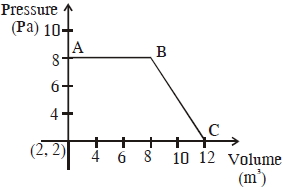
The magnitude of work done by a gas that undergoes a reversible expansion along the path $ABC$ shown in the figure is .............. $Joule$.
A
$40$
B
$48$
C
$45$
D
$96$
Solution
(NONE) The work done by a gas in a reversible process is equal to the area under the $P-V$ curve.
For the path $ABC$,the area is a trapezoid with parallel sides of length $8 \; Pa$ (from $V=2$ to $V=8$) and height $8 \; m^3$ (from $V=2$ to $V=10$ is not correct,let's re-evaluate).
Looking at the graph,the area under the path $ABC$ is the area of the trapezoid formed by the points $(2, 8), (8, 8), (12, 0),$ and $(2, 0)$.
Area $= \frac{1}{2} \times (\text{sum of parallel sides}) \times \text{height}$.
The parallel sides are the vertical line at $V=2$ (from $P=0$ to $P=8$,length $8$) and the vertical line at $V=12$ (from $P=0$ to $P=0$,length $0$). This is not a standard trapezoid.
Let's calculate the area as a rectangle plus a triangle:
Rectangle area (from $V=2$ to $V=8$,$P=8$): $(8-2) \times 8 = 6 \times 8 = 48$.
Triangle area (from $V=8$ to $V=12$,$P$ from $8$ to $0$): $\frac{1}{2} \times (12-8) \times 8 = \frac{1}{2} \times 4 \times 8 = 16$.
Total area $= 48 + 16 = 64 \; Joule$.
For the path $ABC$,the area is a trapezoid with parallel sides of length $8 \; Pa$ (from $V=2$ to $V=8$) and height $8 \; m^3$ (from $V=2$ to $V=10$ is not correct,let's re-evaluate).
Looking at the graph,the area under the path $ABC$ is the area of the trapezoid formed by the points $(2, 8), (8, 8), (12, 0),$ and $(2, 0)$.
Area $= \frac{1}{2} \times (\text{sum of parallel sides}) \times \text{height}$.
The parallel sides are the vertical line at $V=2$ (from $P=0$ to $P=8$,length $8$) and the vertical line at $V=12$ (from $P=0$ to $P=0$,length $0$). This is not a standard trapezoid.
Let's calculate the area as a rectangle plus a triangle:
Rectangle area (from $V=2$ to $V=8$,$P=8$): $(8-2) \times 8 = 6 \times 8 = 48$.
Triangle area (from $V=8$ to $V=12$,$P$ from $8$ to $0$): $\frac{1}{2} \times (12-8) \times 8 = \frac{1}{2} \times 4 \times 8 = 16$.
Total area $= 48 + 16 = 64 \; Joule$.
0 likes
View Solution185
Easy
Consider the expansion given in problem $6.2$,for $1 \, mol$ of an ideal gas conducted reversibly.
Solution
(N/A) For a reversible isothermal expansion of an ideal gas,the work done $w$ is given by $w = -2.303 \, nRT \, \log \frac{V_f}{V_i}$.
Since the process is reversible and isothermal,the heat exchanged $q = -w = 2.303 \, nRT \, \log \frac{V_f}{V_i}$.
Given $n = 1 \, mol$,$R = 0.08206 \, L \, atm \, K^{-1} \, mol^{-1}$,$T = 298 \, K$,$V_i = 2 \, L$,and $V_f = 10 \, L$.
Substituting the values: $q = 2.303 \times 1 \times 0.08206 \times 298 \times \log \frac{10}{2}$.
$q = 2.303 \times 0.08206 \times 298 \times \log 5$.
$q = 2.303 \times 0.08206 \times 298 \times 0.6990 \approx 393.66 \, L \, atm$.
Since the process is reversible and isothermal,the heat exchanged $q = -w = 2.303 \, nRT \, \log \frac{V_f}{V_i}$.
Given $n = 1 \, mol$,$R = 0.08206 \, L \, atm \, K^{-1} \, mol^{-1}$,$T = 298 \, K$,$V_i = 2 \, L$,and $V_f = 10 \, L$.
Substituting the values: $q = 2.303 \times 1 \times 0.08206 \times 298 \times \log \frac{10}{2}$.
$q = 2.303 \times 0.08206 \times 298 \times \log 5$.
$q = 2.303 \times 0.08206 \times 298 \times 0.6990 \approx 393.66 \, L \, atm$.
0 likes
View Solution186
EasyMCQ
Choose the correct answer. $A$ thermodynamic state function is a quantity
A
used to determine heat changes
B
used to determine pressure volume work
C
whose value is independent of path
D
whose value depends on temperature only.
Solution
(C) thermodynamic state function is a property of a system whose value depends only on the current state of the system and is independent of the path taken to reach that state.
Examples include pressure $(p)$,volume $(V)$,temperature $(T)$,internal energy $(U)$,enthalpy $(H)$,entropy $(S)$,and Gibbs free energy $(G)$.
Therefore,the correct option is $(C)$.
Examples include pressure $(p)$,volume $(V)$,temperature $(T)$,internal energy $(U)$,enthalpy $(H)$,entropy $(S)$,and Gibbs free energy $(G)$.
Therefore,the correct option is $(C)$.
0 likes
View Solution187
EasyMCQ
For the process to occur under adiabatic conditions,the correct condition is:
A
$\Delta T=0$
B
$\Delta p=0$
C
$w=0$
D
$q=0$
Solution
(D) system is said to be under adiabatic conditions if there is no exchange of heat between the system and its surroundings.
Hence,under adiabatic conditions,the heat exchange $q$ is equal to $0$.
Therefore,the correct option is $D$.
Hence,under adiabatic conditions,the heat exchange $q$ is equal to $0$.
Therefore,the correct option is $D$.
0 likes
View Solution188
EasyMCQ
The enthalpies of all elements in their standard states are:
A
zero
B
unity
C
$< 0$
D
different for each element
Solution
(A) By convention,the standard enthalpy of formation of an element in its most stable form at $298 \ K$ and $1 \ bar$ pressure is defined as zero.
Therefore,the correct option is $A$.
Therefore,the correct option is $A$.
0 likes
View Solution189
EasyMCQ
For the reaction,$2Cl_{(g)} \to Cl_{2_{(g)}}$,what are the signs of $\Delta H$ and $\Delta S$?
A
$\Delta H > 0, \Delta S > 0$
B
$\Delta H < 0, \Delta S < 0$
C
$\Delta H < 0, \Delta S > 0$
D
$\Delta H > 0, \Delta S < 0$
Solution
(B) The reaction is $2Cl_{(g)} \to Cl_{2_{(g)}}$.
$1$. $\Delta H$: Bond formation is an exothermic process,meaning energy is released. Therefore,$\Delta H < 0$ (negative).
$2$. $\Delta S$: The reaction involves the conversion of $2 \text{ moles}$ of gaseous atoms into $1 \text{ mole}$ of a gaseous molecule. Since the number of moles of gas decreases,the randomness or disorder of the system decreases. Therefore,$\Delta S < 0$ (negative).
$1$. $\Delta H$: Bond formation is an exothermic process,meaning energy is released. Therefore,$\Delta H < 0$ (negative).
$2$. $\Delta S$: The reaction involves the conversion of $2 \text{ moles}$ of gaseous atoms into $1 \text{ mole}$ of a gaseous molecule. Since the number of moles of gas decreases,the randomness or disorder of the system decreases. Therefore,$\Delta S < 0$ (negative).
0 likes
View Solution190
Easy
Explain the difference between the system and surroundings.
Solution
(N/A) system in thermodynamics refers to that part of the universe in which observations are made,and the remaining universe constitutes the surroundings. The surroundings include everything other than the system.
The entire universe other than the system is not affected by the changes taking place in the system. Therefore,for all practical purposes,the surroundings are that portion of the remaining universe which can interact with the system. Usually,the region of space in the neighbourhood of the system constitutes its surroundings.
The universe $=$ The system $+$ The surroundings
For example,if we are studying the reaction between two substances $A$ and $B$ kept in a beaker,the beaker containing the reaction mixture is the system and the room where the beaker is kept is the surroundings.
The entire universe other than the system is not affected by the changes taking place in the system. Therefore,for all practical purposes,the surroundings are that portion of the remaining universe which can interact with the system. Usually,the region of space in the neighbourhood of the system constitutes its surroundings.
The universe $=$ The system $+$ The surroundings
For example,if we are studying the reaction between two substances $A$ and $B$ kept in a beaker,the beaker containing the reaction mixture is the system and the room where the beaker is kept is the surroundings.

0 likes
View Solution191
Easy
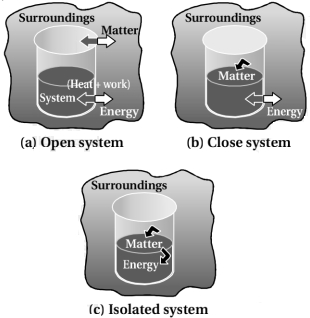
What is a system? Explain the types of systems.
Solution
(N/A) system is defined as a specific part of the universe that is under observation or investigation,where experiments are conducted.
There are three main types of systems:
$(1)$ Open System: In an open system,there is an exchange of both energy and matter between the system and its surroundings.
Example: Reactants in an open beaker.
$(2)$ Closed System: In a closed system,there is no exchange of matter,but an exchange of energy is possible between the system and its surroundings.
Example: Reactants in a closed vessel made of conducting material like copper or steel.
$(3)$ Isolated System: In an isolated system,there is no exchange of either energy or matter between the system and its surroundings.
Example: Reactants in a thermos flask or any other closed insulated vessel.
There are three main types of systems:
$(1)$ Open System: In an open system,there is an exchange of both energy and matter between the system and its surroundings.
Example: Reactants in an open beaker.
$(2)$ Closed System: In a closed system,there is no exchange of matter,but an exchange of energy is possible between the system and its surroundings.
Example: Reactants in a closed vessel made of conducting material like copper or steel.
$(3)$ Isolated System: In an isolated system,there is no exchange of either energy or matter between the system and its surroundings.
Example: Reactants in a thermos flask or any other closed insulated vessel.
0 likes
View Solution192
Difficult
Explain the internal energy as a state function.
Solution
(N/A) Internal energy is a state function that represents the total energy of a system,including chemical,electrical,mechanical,and other forms of energy. In thermodynamics,it is denoted by $U$. The internal energy of a system changes when:
$\Rightarrow$ Heat passes into or out of the system.
$\Rightarrow$ Work is done on or by the system.
$\Rightarrow$ Matter enters or leaves the system.
To demonstrate that internal energy is a state function,consider an adiabatic system (a system insulated from its surroundings,where $q = 0$).
$1$. Let the initial state of the system be $A$ with temperature $T_{A}$ and internal energy $U_{A}$.
$2$. We can change the state of the system to state $B$ (with temperature $T_{B}$ and internal energy $U_{B}$) in two different ways:
- Way $I$: Perform mechanical work (e.g.,$1 \ kJ$) by churning water with paddles.
- Way $II$: Perform an equal amount of electrical work (e.g.,$1 \ kJ$) using an immersion rod.
In both cases,the final temperature $T_{B}$ is found to be the same. Since the change in internal energy $\Delta U = U_{B} - U_{A}$ depends only on the initial and final states ($A$ and $B$) and not on the path taken to reach the state,internal energy is a state function.
$\Rightarrow$ Heat passes into or out of the system.
$\Rightarrow$ Work is done on or by the system.
$\Rightarrow$ Matter enters or leaves the system.
To demonstrate that internal energy is a state function,consider an adiabatic system (a system insulated from its surroundings,where $q = 0$).
$1$. Let the initial state of the system be $A$ with temperature $T_{A}$ and internal energy $U_{A}$.
$2$. We can change the state of the system to state $B$ (with temperature $T_{B}$ and internal energy $U_{B}$) in two different ways:
- Way $I$: Perform mechanical work (e.g.,$1 \ kJ$) by churning water with paddles.
- Way $II$: Perform an equal amount of electrical work (e.g.,$1 \ kJ$) using an immersion rod.
In both cases,the final temperature $T_{B}$ is found to be the same. Since the change in internal energy $\Delta U = U_{B} - U_{A}$ depends only on the initial and final states ($A$ and $B$) and not on the path taken to reach the state,internal energy is a state function.
0 likes
View Solution193
Medium
Explain mechanical work.
Solution
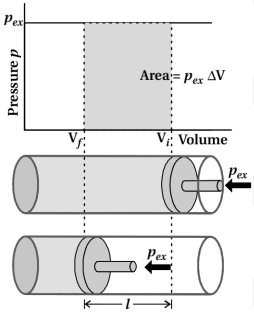
(N/A) Consider a cylinder which contains one mole of an ideal gas fitted with a frictionless piston. The total volume of the gas is $V_{i}$ and the pressure of the gas inside is $p$. If the external pressure is $p_{ex}$ which is greater than $p$.
The piston is moved inward until the pressure inside becomes equal to $p_{ex}$. Let the final volume be $V_{f}$. During this compression,suppose the piston moves a distance $l$,and the cross-sectional area of the piston is $A$.
Volume change $= l \times A = \Delta V = (V_{f} - V_{i}) \quad \ldots (I)$
Force on the piston $= p_{ex} \cdot A$
If $w$ is the work done on the system by the movement of the piston then,
$w = \text{force} \times \text{distance} = p_{ex} \cdot A \cdot l$
$= p_{ex} (-\Delta V) = -p_{ex} (V_{f} - V_{i})$
The piston is moved inward until the pressure inside becomes equal to $p_{ex}$. Let the final volume be $V_{f}$. During this compression,suppose the piston moves a distance $l$,and the cross-sectional area of the piston is $A$.
Volume change $= l \times A = \Delta V = (V_{f} - V_{i}) \quad \ldots (I)$
Force on the piston $= p_{ex} \cdot A$
If $w$ is the work done on the system by the movement of the piston then,
$w = \text{force} \times \text{distance} = p_{ex} \cdot A \cdot l$
$= p_{ex} (-\Delta V) = -p_{ex} (V_{f} - V_{i})$
0 likes
View Solution194
Medium
Explain pressure-volume work.
Solution
(N/A) Consider a cylinder containing one mole of an ideal gas fitted with a frictionless piston. The initial volume of the gas is $V_{i}$ and the internal pressure is $p$. Let the external pressure be $p_{ex}$,where $p_{ex} > p$.
The piston is moved inward until the internal pressure becomes equal to $p_{ex}$. Let the final volume be $V_{f}$. During this compression,suppose the piston moves a distance $l$,and the cross-sectional area of the piston is $A$.
Volume change $= l \times A = \Delta V = (V_{f} - V_{i}) \quad \ldots (i)$
Force on the piston $= p_{ex} \cdot A$
If $w$ is the work done on the system by the movement of the piston,then:
$w = \text{force} \times \text{distance} = p_{ex} \cdot A \cdot l$
Since the change in volume is a compression,$l \cdot A = -(V_{f} - V_{i}) = -\Delta V$.
Therefore,$w = p_{ex} \cdot (- \Delta V) = -p_{ex}(V_{f} - V_{i})$.
The piston is moved inward until the internal pressure becomes equal to $p_{ex}$. Let the final volume be $V_{f}$. During this compression,suppose the piston moves a distance $l$,and the cross-sectional area of the piston is $A$.
Volume change $= l \times A = \Delta V = (V_{f} - V_{i}) \quad \ldots (i)$
Force on the piston $= p_{ex} \cdot A$
If $w$ is the work done on the system by the movement of the piston,then:
$w = \text{force} \times \text{distance} = p_{ex} \cdot A \cdot l$
Since the change in volume is a compression,$l \cdot A = -(V_{f} - V_{i}) = -\Delta V$.
Therefore,$w = p_{ex} \cdot (- \Delta V) = -p_{ex}(V_{f} - V_{i})$.
0 likes
View Solution195
Medium
Explain free expansion.
Solution
(N/A) The expansion of a gas into a vacuum $(p_{ex} = 0)$ is known as free expansion.
During the free expansion of an ideal gas,no work is performed,regardless of whether the process is reversible or irreversible.
We can express the first law of thermodynamics,$\Delta U = q + w$,in various ways depending on the process.
Substituting $w = -p_{ex} \Delta V$ into the equation,we get:
$\Delta U = q - p_{ex} \Delta V$.
If a process occurs at constant volume $(\Delta V = 0)$,then $\Delta U = q_{V}$,where the subscript $V$ indicates that heat is exchanged at constant volume.
During the free expansion of an ideal gas,no work is performed,regardless of whether the process is reversible or irreversible.
We can express the first law of thermodynamics,$\Delta U = q + w$,in various ways depending on the process.
Substituting $w = -p_{ex} \Delta V$ into the equation,we get:
$\Delta U = q - p_{ex} \Delta V$.
If a process occurs at constant volume $(\Delta V = 0)$,then $\Delta U = q_{V}$,where the subscript $V$ indicates that heat is exchanged at constant volume.
0 likes
View Solution196
Medium
Explain the isothermal and free expansion of an ideal gas.
Solution
(N/A) For isothermal $(T = \text{constant})$ expansion of an ideal gas into a vacuum,the external pressure $(p_{ex})$ is $0$. Since work done $w = -p_{ex} \Delta V$,it follows that $w = 0$.
According to the first law of thermodynamics,$\Delta U = q + w$. For an ideal gas,internal energy $(U)$ is a function of temperature only. Thus,for an isothermal process,$\Delta U = 0$. Consequently,$q = -w = 0$.
For other isothermal processes:
$1$. For isothermal irreversible change: $q = -w = p_{ex}(V_f - V_i)$.
$2$. For isothermal reversible change: $q = -w = nRT \ln \frac{V_f}{V_i} = 2.303 nRT \log \frac{V_f}{V_i}$.
$3$. For adiabatic change: $q = 0$,therefore $\Delta U = w_{ad}$.
According to the first law of thermodynamics,$\Delta U = q + w$. For an ideal gas,internal energy $(U)$ is a function of temperature only. Thus,for an isothermal process,$\Delta U = 0$. Consequently,$q = -w = 0$.
For other isothermal processes:
$1$. For isothermal irreversible change: $q = -w = p_{ex}(V_f - V_i)$.
$2$. For isothermal reversible change: $q = -w = nRT \ln \frac{V_f}{V_i} = 2.303 nRT \log \frac{V_f}{V_i}$.
$3$. For adiabatic change: $q = 0$,therefore $\Delta U = w_{ad}$.
0 likes
View Solution197
Difficult
Explain: Enthalpy as a state function.
Solution
(A) The first law of thermodynamics is given by $\Delta U = q + w$.
At constant pressure,the work done is $w = -p \Delta V$,so the equation becomes $\Delta U = q_p - p \Delta V$,where $q_p$ is the heat absorbed by the system at constant pressure.
When the system changes from state $1$ to state $2$,the internal energy changes from $U_1$ to $U_2$ and volume changes from $V_1$ to $V_2$.
Thus,$\Delta U = U_2 - U_1$ and $\Delta V = V_2 - V_1$.
Substituting these into the equation: $U_2 - U_1 = q_p - p(V_2 - V_1)$.
Rearranging gives: $q_p = (U_2 - U_1) + p(V_2 - V_1) = (U_2 + pV_2) - (U_1 + pV_1)$.
We define a new state function,Enthalpy $(H)$,as $H = U + pV$.
Therefore,$q_p = H_2 - H_1 = \Delta H$.
Since $U$,$p$,and $V$ are state functions,$H$ is also a state function.
For a process at constant pressure,$\Delta H = \Delta U + p \Delta V$.
$\Delta H$ is positive for endothermic reactions (heat absorption) and negative for exothermic reactions (heat evolution).
At constant pressure,the work done is $w = -p \Delta V$,so the equation becomes $\Delta U = q_p - p \Delta V$,where $q_p$ is the heat absorbed by the system at constant pressure.
When the system changes from state $1$ to state $2$,the internal energy changes from $U_1$ to $U_2$ and volume changes from $V_1$ to $V_2$.
Thus,$\Delta U = U_2 - U_1$ and $\Delta V = V_2 - V_1$.
Substituting these into the equation: $U_2 - U_1 = q_p - p(V_2 - V_1)$.
Rearranging gives: $q_p = (U_2 - U_1) + p(V_2 - V_1) = (U_2 + pV_2) - (U_1 + pV_1)$.
We define a new state function,Enthalpy $(H)$,as $H = U + pV$.
Therefore,$q_p = H_2 - H_1 = \Delta H$.
Since $U$,$p$,and $V$ are state functions,$H$ is also a state function.
For a process at constant pressure,$\Delta H = \Delta U + p \Delta V$.
$\Delta H$ is positive for endothermic reactions (heat absorption) and negative for exothermic reactions (heat evolution).
0 likes
View Solution198
Medium
Explain: $\Delta H = q_{p}$
Solution
(A) The first law of thermodynamics is given by $\Delta U = q + w$.
At constant pressure,the work done by the system is $w = -p \Delta V$,so we can write $\Delta U = q_{p} - p \Delta V$.
Here,$q_{p}$ is the heat absorbed by the system at constant pressure.
When the system undergoes a change from state $1$ to state $2$,the internal energy changes from $U_{1}$ to $U_{2}$ and volume changes from $V_{1}$ to $V_{2}$.
Thus,$\Delta U = U_{2} - U_{1}$ and $\Delta V = V_{2} - V_{1}$.
Substituting these into the equation: $U_{2} - U_{1} = q_{p} - p(V_{2} - V_{1})$.
Rearranging gives $q_{p} = (U_{2} - U_{1}) + p(V_{2} - V_{1}) = (U_{2} + pV_{2}) - (U_{1} + pV_{1})$.
Defining enthalpy as $H = U + pV$,we get $q_{p} = H_{2} - H_{1} = \Delta H$.
Since $U, p,$ and $V$ are state functions,$H$ is also a state function.
For processes at constant pressure,$\Delta H = \Delta U + p \Delta V$.
$\Delta H$ is positive for endothermic reactions (heat absorption) and negative for exothermic reactions (heat evolution).
At constant pressure,the work done by the system is $w = -p \Delta V$,so we can write $\Delta U = q_{p} - p \Delta V$.
Here,$q_{p}$ is the heat absorbed by the system at constant pressure.
When the system undergoes a change from state $1$ to state $2$,the internal energy changes from $U_{1}$ to $U_{2}$ and volume changes from $V_{1}$ to $V_{2}$.
Thus,$\Delta U = U_{2} - U_{1}$ and $\Delta V = V_{2} - V_{1}$.
Substituting these into the equation: $U_{2} - U_{1} = q_{p} - p(V_{2} - V_{1})$.
Rearranging gives $q_{p} = (U_{2} - U_{1}) + p(V_{2} - V_{1}) = (U_{2} + pV_{2}) - (U_{1} + pV_{1})$.
Defining enthalpy as $H = U + pV$,we get $q_{p} = H_{2} - H_{1} = \Delta H$.
Since $U, p,$ and $V$ are state functions,$H$ is also a state function.
For processes at constant pressure,$\Delta H = \Delta U + p \Delta V$.
$\Delta H$ is positive for endothermic reactions (heat absorption) and negative for exothermic reactions (heat evolution).
0 likes
View Solution199
Medium
Prove that the change in enthalpy of a system in which a chemical reaction occurs is equal to the heat gained by the system at constant pressure.
Solution
(N/A) According to the first law of thermodynamics,$\Delta U = q + w$.
At constant pressure,the work done by the system is $w = -p \Delta V$.
Substituting this into the equation,we get $\Delta U = q_p - p \Delta V$.
Here,$q_p$ is the heat absorbed by the system at constant pressure.
When the system undergoes a change from state $1$ to state $2$,we have $\Delta U = U_2 - U_1$ and $\Delta V = V_2 - V_1$.
Substituting these values: $U_2 - U_1 = q_p - p(V_2 - V_1)$.
Rearranging the terms: $q_p = (U_2 - U_1) + p(V_2 - V_1)$.
$q_p = (U_2 + pV_2) - (U_1 + pV_1)$.
Defining enthalpy as $H = U + pV$,we get $q_p = H_2 - H_1 = \Delta H$.
Thus,the change in enthalpy $\Delta H$ is equal to the heat absorbed at constant pressure $q_p$.
At constant pressure,the work done by the system is $w = -p \Delta V$.
Substituting this into the equation,we get $\Delta U = q_p - p \Delta V$.
Here,$q_p$ is the heat absorbed by the system at constant pressure.
When the system undergoes a change from state $1$ to state $2$,we have $\Delta U = U_2 - U_1$ and $\Delta V = V_2 - V_1$.
Substituting these values: $U_2 - U_1 = q_p - p(V_2 - V_1)$.
Rearranging the terms: $q_p = (U_2 - U_1) + p(V_2 - V_1)$.
$q_p = (U_2 + pV_2) - (U_1 + pV_1)$.
Defining enthalpy as $H = U + pV$,we get $q_p = H_2 - H_1 = \Delta H$.
Thus,the change in enthalpy $\Delta H$ is equal to the heat absorbed at constant pressure $q_p$.
0 likes
View Solution200
Medium
Explain extensive property and intensive property.
Solution
(N/A) Extensive property: An extensive property is a property whose value depends on the quantity or size of matter present in the system. Examples include mass,volume,internal energy,enthalpy,and heat capacity.
Intensive property: An intensive property is a property that does not depend on the quantity or size of matter present in the system. Examples include temperature,density,and pressure.
$A$ molar property,$\chi_{m}$,is the value of an extensive property $\chi$ of the system for $1 \ mol$ of the substance. If $n$ is the amount of matter,then $\chi_{m} = \frac{\chi}{n}$ is independent of the amount of matter.
Other examples include molar volume,$V_{m}$,and molar heat capacity,$C_{m}$. Consider a gas enclosed in a container of volume $V$ at temperature $T$ [Fig. $(a)$]. If we introduce a partition such that the volume is halved,each part [Fig. $(b)$] now has one half of the original volume,$\frac{V}{2}$,but the temperature $T$ remains the same.
Therefore,it is clear that volume $V$ is an extensive property and temperature $T$ is an intensive property.
Intensive property: An intensive property is a property that does not depend on the quantity or size of matter present in the system. Examples include temperature,density,and pressure.
$A$ molar property,$\chi_{m}$,is the value of an extensive property $\chi$ of the system for $1 \ mol$ of the substance. If $n$ is the amount of matter,then $\chi_{m} = \frac{\chi}{n}$ is independent of the amount of matter.
Other examples include molar volume,$V_{m}$,and molar heat capacity,$C_{m}$. Consider a gas enclosed in a container of volume $V$ at temperature $T$ [Fig. $(a)$]. If we introduce a partition such that the volume is halved,each part [Fig. $(b)$] now has one half of the original volume,$\frac{V}{2}$,but the temperature $T$ remains the same.
Therefore,it is clear that volume $V$ is an extensive property and temperature $T$ is an intensive property.
0 likes
View SolutionThermodynamics — Basic concepts · Frequently Asked Questions
1Are these Thermodynamics questions useful for JEE and NEET?
Yes. All questions in this section are mapped to JEE Main and NEET exam patterns. Previous year questions from JEE Main, NEET, GUJCET and state-level exams are included with full solutions.
2Can I switch to Hindi or Gujarati for these questions?
Yes. Use the language tabs in the hero section or the sidebar to view the same questions and solutions in English, Hindi or Gujarati.
3How do I generate a question paper from this subtopic?
Use the Vedclass Exam Paper Generator — select the chapter and subtopic, set difficulty, and generate Sets A, B, C, D automatically. First 3 chapters of every subject are free.
Vedclass Products
For Students
Vedclass Test Series
Mock tests in real JEE/NEET style with performance analysis. 5-day free trial.
Start Free TrialFor Teachers
Exam Paper Generator
Generate Set A/B/C/D papers from this chapter in 2 minutes. 3 chapters free.
Try FreeFor Institutes
Online Exam Module
Live online exams with unlimited students, 360° analytics & white-label branding.
See DemoFor Teachers & Institutes
Generate a Thermodynamics Exam Paper in 2 Minutes
Select subtopic & difficulty — Sets A, B, C, D auto-generated with No Repeat logic.
First 3 chapters of every subject are free — no payment required.