
A English
Heat capacity Questions in English
Class 11 Chemistry · Thermodynamics · Heat capacity
41+
Questions
English
Language
100%
With Solutions
Showing 39 of 41 questions in English
1
MediumMCQ
The molar heat capacity of water at constant pressure is $75 \, J \, K^{-1} \, mol^{-1}$. When $1.0 \, kJ$ of heat is supplied to $100 \, g$ of water which is free to expand,the increase in temperature of water is (in $, K$)
A
$6.6$
B
$1.2$
C
$2.4$
D
$4.8$
Solution
(C) The relationship between the heat supplied $(q)$,molar heat capacity at constant pressure $(C_p)$,and the temperature change $(\Delta T)$ is given by the formula: $q = n \cdot C_p \cdot \Delta T$
Given:
$q = 1.0 \, kJ = 1000 \, J$
$C_p = 75 \, J \, K^{-1} \, mol^{-1}$
Mass of water = $100 \, g$
Molar mass of water $(H_2O)$ = $18 \, g \, mol^{-1}$
Calculate the number of moles $(n)$:
$n = \frac{\text{mass}}{\text{molar mass}} = \frac{100 \, g}{18 \, g \, mol^{-1}} = 5.55 \, mol$
Substitute the values into the formula:
$1000 = (\frac{100}{18}) \times 75 \times \Delta T$
$1000 = 5.55 \times 75 \times \Delta T$
$1000 = 416.67 \times \Delta T$
$\Delta T = \frac{1000}{416.67} \approx 2.4 \, K$
Therefore,the increase in temperature is $2.4 \, K$.
Given:
$q = 1.0 \, kJ = 1000 \, J$
$C_p = 75 \, J \, K^{-1} \, mol^{-1}$
Mass of water = $100 \, g$
Molar mass of water $(H_2O)$ = $18 \, g \, mol^{-1}$
Calculate the number of moles $(n)$:
$n = \frac{\text{mass}}{\text{molar mass}} = \frac{100 \, g}{18 \, g \, mol^{-1}} = 5.55 \, mol$
Substitute the values into the formula:
$1000 = (\frac{100}{18}) \times 75 \times \Delta T$
$1000 = 5.55 \times 75 \times \Delta T$
$1000 = 416.67 \times \Delta T$
$\Delta T = \frac{1000}{416.67} \approx 2.4 \, K$
Therefore,the increase in temperature is $2.4 \, K$.
0 likes
View Solution2
EasyMCQ
The molar heat capacity of water at constant pressure is $75 \ J \ K^{-1} \ mol^{-1}$. When $1.0 \ kJ$ of heat is supplied to $100 \ g$ of water which is free to expand,the increase in temperature of water is $...... \ K$.
A
$6.6$
B
$1.2$
C
$2.4$
D
$4.8$
Solution
(C) The molar mass of water $(H_2O)$ is $18 \ g \ mol^{-1}$.
Given,molar heat capacity $(C_p)$ = $75 \ J \ K^{-1} \ mol^{-1}$.
Specific heat capacity $(c)$ = $\frac{C_p}{\text{Molar mass}} = \frac{75}{18} \approx 4.17 \ J \ g^{-1} \ K^{-1}$.
Heat supplied $(Q)$ = $1.0 \ kJ = 1000 \ J$.
Mass of water $(m)$ = $100 \ g$.
Using the formula $Q = m \cdot c \cdot \Delta T$:
$1000 = 100 \times 4.17 \times \Delta T$.
$\Delta T = \frac{1000}{417} \approx 2.4 \ K$.
Given,molar heat capacity $(C_p)$ = $75 \ J \ K^{-1} \ mol^{-1}$.
Specific heat capacity $(c)$ = $\frac{C_p}{\text{Molar mass}} = \frac{75}{18} \approx 4.17 \ J \ g^{-1} \ K^{-1}$.
Heat supplied $(Q)$ = $1.0 \ kJ = 1000 \ J$.
Mass of water $(m)$ = $100 \ g$.
Using the formula $Q = m \cdot c \cdot \Delta T$:
$1000 = 100 \times 4.17 \times \Delta T$.
$\Delta T = \frac{1000}{417} \approx 2.4 \ K$.
1 likes
View Solution3
EasyMCQ
The heat required to raise the temperature of $1 \ mol$ of a substance by $1^{\circ}C$ is called:
A
Specific heat
B
Molar heat capacity
C
Water equivalent
D
Specific gravity
Solution
(B) The amount of heat required to raise the temperature of $1 \ mol$ of a substance by $1^{\circ}C$ (or $1 \ K$) is defined as the molar heat capacity of that substance.
Therefore,the correct option is $(B)$.
Therefore,the correct option is $(B)$.
0 likes
View Solution4
EasyMCQ
The heat required to raise the temperature of a body by $1 \, K$ is called
A
Specific heat
B
Thermal capacity
C
Water equivalent
D
None of these
Solution
(B) The heat required to raise the temperature of a body by $1 \, K$ is defined as the thermal capacity of the body.
0 likes
View Solution5
EasyMCQ
Specific heat capacity is defined as:
A
Heat capacity at constant volume
B
Heat capacity at constant pressure
C
Heat capacity per mole
D
Heat capacity per gram
0 likes
View Solution6
MediumMCQ
For the reaction ${H_2}_{(g)} + \frac{1}{2}{O_2}_{(g)} \to {H_2}O(\ell)$,given $\Delta C_P = 7.63 \, cal/deg$ and $\Delta H_{25\,^{\circ}C} = 68.3 \, Kcal$,find the value of $\Delta H$ at $100\,^{\circ}C$ (in $Kcal$).
A
$7.63 \times 10^{-3} \times (373 - 298) - 68.3$
B
$7.63 \times 10^{-3} \times (373 - 298) + 68.3$
C
$7.63 \times (373 - 298) - 68.3$
D
$7.63 \times (373 - 298) + 68.3$
Solution
(B) Using Kirchhoff's equation: $\Delta H_2 - \Delta H_1 = \Delta C_p \times (T_2 - T_1)$.
Given $\Delta C_p = 7.63 \, cal/deg = 7.63 \times 10^{-3} \, Kcal/deg$.
$T_1 = 25 + 273 = 298 \, K$.
$T_2 = 100 + 273 = 373 \, K$.
$\Delta H_{100\,^{\circ}C} = \Delta H_{25\,^{\circ}C} + \Delta C_p \times (T_2 - T_1)$.
$\Delta H_{100\,^{\circ}C} = 68.3 + 7.63 \times 10^{-3} \times (373 - 298)$.
Given $\Delta C_p = 7.63 \, cal/deg = 7.63 \times 10^{-3} \, Kcal/deg$.
$T_1 = 25 + 273 = 298 \, K$.
$T_2 = 100 + 273 = 373 \, K$.
$\Delta H_{100\,^{\circ}C} = \Delta H_{25\,^{\circ}C} + \Delta C_p \times (T_2 - T_1)$.
$\Delta H_{100\,^{\circ}C} = 68.3 + 7.63 \times 10^{-3} \times (373 - 298)$.
0 likes
View Solution7
EasyMCQ
The molar heat capacity of water in equilibrium with ice at constant pressure is.....
A
Zero
B
Infinite
C
$40.50 \, kJ \, K^{-1} \, mol^{-1}$
D
$75.48 \, J \, K^{-1} \, mol^{-1}$
Solution
(B) The molar heat capacity $C$ is defined as $C = \frac{Q}{n \Delta T}$.
For a phase transition (like ice in equilibrium with water) at constant pressure,the temperature remains constant,meaning $\Delta T = 0$.
Since the denominator $\Delta T$ is $0$,the value of $C$ becomes $\frac{Q}{0} = \infty$.
Therefore,the molar heat capacity is infinite.
For a phase transition (like ice in equilibrium with water) at constant pressure,the temperature remains constant,meaning $\Delta T = 0$.
Since the denominator $\Delta T$ is $0$,the value of $C$ becomes $\frac{Q}{0} = \infty$.
Therefore,the molar heat capacity is infinite.
0 likes
View Solution8
EasyMCQ
Molar heat capacity of water in equilibrium with ice at constant pressure is
A
Zero
B
Infinity $(\infty)$
C
$40.45 \ kJ \ K^{-1} \ mol^{-1}$
D
$75.48 \ J \ K^{-1} \ mol^{-1}$
Solution
(B) The molar heat capacity at constant pressure is defined as $C_P = (\frac{\delta H}{\delta T})_P$.
At phase equilibrium between ice and water,the temperature remains constant even when heat is added,meaning $\delta T = 0$.
Therefore,$C_P = \frac{\delta H}{0} = \infty$.
At phase equilibrium between ice and water,the temperature remains constant even when heat is added,meaning $\delta T = 0$.
Therefore,$C_P = \frac{\delta H}{0} = \infty$.
0 likes
View Solution9
MediumMCQ
$4.48 \ L$ of an ideal gas at $1 \ atm$ and $273 \ K$ requires $12 \ cal$ to raise the temperature by $15 \ ^\circ C$ at constant volume. The $C_p$ of the gas is $... \ cal \ mol^{-1} K^{-1}$.
A
$4$
B
$6$
C
$2$
D
$8$
Solution
(B) First,calculate the number of moles $(n)$ using the ideal gas conditions at $STP$:
$n = \frac{4.48 \ L}{22.4 \ L \ mol^{-1}} = 0.2 \ mol$.
Next,calculate the molar heat capacity at constant volume $(C_v)$:
$C_v = \frac{q_v}{n \times \Delta T} = \frac{12 \ cal}{0.2 \ mol \times 15 \ K} = \frac{12}{3} = 4 \ cal \ mol^{-1} K^{-1}$.
Finally,use the relation $C_p - C_v = R$ to find $C_p$:
Given $R \approx 2 \ cal \ mol^{-1} K^{-1}$ (as per the provided options and context),
$C_p = C_v + R = 4 + 2 = 6 \ cal \ mol^{-1} K^{-1}$.
$n = \frac{4.48 \ L}{22.4 \ L \ mol^{-1}} = 0.2 \ mol$.
Next,calculate the molar heat capacity at constant volume $(C_v)$:
$C_v = \frac{q_v}{n \times \Delta T} = \frac{12 \ cal}{0.2 \ mol \times 15 \ K} = \frac{12}{3} = 4 \ cal \ mol^{-1} K^{-1}$.
Finally,use the relation $C_p - C_v = R$ to find $C_p$:
Given $R \approx 2 \ cal \ mol^{-1} K^{-1}$ (as per the provided options and context),
$C_p = C_v + R = 4 + 2 = 6 \ cal \ mol^{-1} K^{-1}$.
0 likes
View Solution10
MediumMCQ
$A_{(g)} \to 2B_{(g)}$; $\Delta_rH = 20 \ kJ/mol$ at $300 \ K$. If $C_{p,m}(A) = 20 \ J \ K^{-1} \ mol^{-1}$ and $C_{p,m}(B) = 5 \ J \ K^{-1} \ mol^{-1}$,which of the following statements is correct?
A
$\Delta H$ will increase on increasing temperature
B
$\Delta H$ will decrease on increasing temperature
C
$\Delta H$ will be unaffected by temperature change
D
$\Delta H$ will decrease on decreasing temperature
Solution
(B) According to Kirchhoff's law,the variation of enthalpy of reaction with temperature is given by: $\Delta_r H_2 - \Delta_r H_1 = \Delta_r C_p (T_2 - T_1)$.
First,calculate $\Delta_r C_p$ for the reaction $A_{(g)} \to 2B_{(g)}$:
$\Delta_r C_p = \sum \nu_p C_{p,m}(\text{products}) - \sum \nu_r C_{p,m}(\text{reactants})$
$\Delta_r C_p = [2 \times C_{p,m}(B)] - [1 \times C_{p,m}(A)]$
$\Delta_r C_p = [2 \times 5 \ J \ K^{-1} \ mol^{-1}] - [20 \ J \ K^{-1} \ mol^{-1}] = 10 - 20 = -10 \ J \ K^{-1} \ mol^{-1}$.
Since $\Delta_r C_p < 0$,the term $\Delta_r C_p (T_2 - T_1)$ will be negative if $T_2 > T_1$ (increasing temperature).
Therefore,$\Delta_r H_2 = \Delta_r H_1 + \Delta_r C_p (T_2 - T_1)$ will be less than $\Delta_r H_1$.
Thus,$\Delta H$ will decrease on increasing temperature.
First,calculate $\Delta_r C_p$ for the reaction $A_{(g)} \to 2B_{(g)}$:
$\Delta_r C_p = \sum \nu_p C_{p,m}(\text{products}) - \sum \nu_r C_{p,m}(\text{reactants})$
$\Delta_r C_p = [2 \times C_{p,m}(B)] - [1 \times C_{p,m}(A)]$
$\Delta_r C_p = [2 \times 5 \ J \ K^{-1} \ mol^{-1}] - [20 \ J \ K^{-1} \ mol^{-1}] = 10 - 20 = -10 \ J \ K^{-1} \ mol^{-1}$.
Since $\Delta_r C_p < 0$,the term $\Delta_r C_p (T_2 - T_1)$ will be negative if $T_2 > T_1$ (increasing temperature).
Therefore,$\Delta_r H_2 = \Delta_r H_1 + \Delta_r C_p (T_2 - T_1)$ will be less than $\Delta_r H_1$.
Thus,$\Delta H$ will decrease on increasing temperature.
0 likes
View Solution11
EasyMCQ
$C_P$ is always greater than $C_V$ for an ideal gas. Choose the correct option.
A
When a gas absorbs heat at constant pressure,its volume remains unchanged.
B
No work is done by a gas at constant volume.
C
For the same change in temperature,the internal energy of a gas changes by a smaller amount at constant volume than at constant pressure.
D
The mass of a gas at constant pressure is greater than that of constant volume.
Solution
(B) For an ideal gas,the relationship between molar heat capacities is given by Mayer's relation: $C_P - C_V = R$.
At constant volume,the work done by the gas is zero $(w = 0)$ because there is no change in volume $(dV = 0)$.
Therefore,all the heat supplied at constant volume is used to increase the internal energy of the system $(q_V = \Delta U)$.
At constant pressure,some heat is used to increase the internal energy and some is used to perform work of expansion $(q_P = \Delta U + P\Delta V)$.
Since the internal energy change $(\Delta U)$ depends only on temperature for an ideal gas,it is the same for both processes for the same temperature change.
Thus,$C_P$ must be greater than $C_V$ because additional heat is required to perform work at constant pressure.
At constant volume,the work done by the gas is zero $(w = 0)$ because there is no change in volume $(dV = 0)$.
Therefore,all the heat supplied at constant volume is used to increase the internal energy of the system $(q_V = \Delta U)$.
At constant pressure,some heat is used to increase the internal energy and some is used to perform work of expansion $(q_P = \Delta U + P\Delta V)$.
Since the internal energy change $(\Delta U)$ depends only on temperature for an ideal gas,it is the same for both processes for the same temperature change.
Thus,$C_P$ must be greater than $C_V$ because additional heat is required to perform work at constant pressure.
0 likes
View Solution12
MediumMCQ
Which graph represents the relationship between heat capacity at constant pressure $(C_p)$ and temperature $(T)$ for a monatomic ideal gas?
A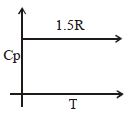
B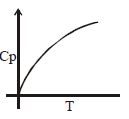
C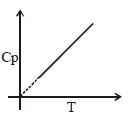
D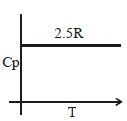
Solution
(D) For an ideal gas,the molar heat capacity at constant pressure $(C_p)$ is defined as $C_p = C_v + R$.
For a monatomic ideal gas,the molar heat capacity at constant volume $(C_v)$ is $\frac{3}{2}R$.
Therefore,$C_p = \frac{3}{2}R + R = \frac{5}{2}R = 2.5R$.
Since $C_p$ for an ideal gas is independent of temperature,the graph of $C_p$ versus $T$ is a horizontal straight line at the value of $2.5R$.
For a monatomic ideal gas,the molar heat capacity at constant volume $(C_v)$ is $\frac{3}{2}R$.
Therefore,$C_p = \frac{3}{2}R + R = \frac{5}{2}R = 2.5R$.
Since $C_p$ for an ideal gas is independent of temperature,the graph of $C_p$ versus $T$ is a horizontal straight line at the value of $2.5R$.
0 likes
View Solution13
MediumMCQ
Molar heat capacity of water in equilibrium with ice at constant pressure is- (Enthalpy of fusion of ice $\Delta H_f = 6 \ kJ/mol$,$T_m = 273 \ K$)
A
zero
B
infinity
C
$\frac{6 \ kJ/mol}{273 \ K}$
D
$6 \ kJ/mol \times 273 \ K$
Solution
(B) The molar heat capacity is defined as $C = \frac{dq}{dT}$.
For a phase transition occurring at constant temperature and pressure (equilibrium between ice and water),the temperature change $\Delta T$ is $0$.
Since the heat added is used for the phase change (latent heat) without changing the temperature,$dT = 0$.
Therefore,$C = \frac{dq}{0} = \infty$ (infinity).
For a phase transition occurring at constant temperature and pressure (equilibrium between ice and water),the temperature change $\Delta T$ is $0$.
Since the heat added is used for the phase change (latent heat) without changing the temperature,$dT = 0$.
Therefore,$C = \frac{dq}{0} = \infty$ (infinity).
0 likes
View Solution14
MediumMCQ
For a reaction $H_{2(g)} + \frac{1}{2}O_{2(g)} \longrightarrow H_2O_{(l)}$; $\Delta C_p = 32 \ J \ K^{-1}$,$\Delta H$ at $27 \ ^oC = -285.8 \ kJ \ mol^{-1}$. What will be the value of $\Delta H$ at $127 \ ^oC$ in $kJ \ mol^{-1}$?
A
$-289$
B
$-282.6$
C
$-317$
D
$-253.8$
Solution
(B) Using Kirchhoff's equation: $\Delta H_2 = \Delta H_1 + \Delta C_p(T_2 - T_1)$.
Given: $\Delta H_1 = -285.8 \ kJ \ mol^{-1} = -285800 \ J \ mol^{-1}$,$\Delta C_p = 32 \ J \ K^{-1}$,$T_1 = 27 + 273 = 300 \ K$,$T_2 = 127 + 273 = 400 \ K$.
$\Delta H_2 = -285800 + 32(400 - 300)$.
$\Delta H_2 = -285800 + 32(100) = -285800 + 3200 = -282600 \ J \ mol^{-1}$.
Converting to $kJ \ mol^{-1}$: $\Delta H_2 = -282.6 \ kJ \ mol^{-1}$.
Given: $\Delta H_1 = -285.8 \ kJ \ mol^{-1} = -285800 \ J \ mol^{-1}$,$\Delta C_p = 32 \ J \ K^{-1}$,$T_1 = 27 + 273 = 300 \ K$,$T_2 = 127 + 273 = 400 \ K$.
$\Delta H_2 = -285800 + 32(400 - 300)$.
$\Delta H_2 = -285800 + 32(100) = -285800 + 3200 = -282600 \ J \ mol^{-1}$.
Converting to $kJ \ mol^{-1}$: $\Delta H_2 = -282.6 \ kJ \ mol^{-1}$.
0 likes
View Solution15
MediumMCQ
What is the value of ${\left[ {\partial U/\partial T} \right]_V}$ for $He$ gas?
A
$(5/2)R$
B
$3R$
C
$(7/2)R$
D
$(3/2)R$
Solution
(D) The term ${\left[ {\partial U/\partial T} \right]_V}$ represents the molar heat capacity at constant volume,denoted as $C_V$.
For an ideal gas,the internal energy $U$ depends only on temperature.
For a monoatomic gas like $He$,the degrees of freedom $f = 3$.
The molar heat capacity at constant volume is given by the formula $C_V = (f/2)R$.
Substituting $f = 3$,we get $C_V = (3/2)R$.
For an ideal gas,the internal energy $U$ depends only on temperature.
For a monoatomic gas like $He$,the degrees of freedom $f = 3$.
The molar heat capacity at constant volume is given by the formula $C_V = (f/2)R$.
Substituting $f = 3$,we get $C_V = (3/2)R$.
0 likes
View Solution16
MediumMCQ
If $192 \ J$ of heat is required to increase the temperature of $45.0 \ g$ of silicon by $6 \ ^oC$,what is its specific heat capacity?
A
$0.71 \ J \ g^{-1} \ ^oC^{-1}$
B
$1.33 \ J \ g^{-1} \ ^oC^{-1}$
C
$2.90 \ J \ g^{-1} \ ^oC^{-1}$
D
$1.66 \ J \ g^{-1} \ ^oC^{-1}$
Solution
(A) The formula for specific heat capacity $(c)$ is given by $q = m \times c \times \Delta T$.
Here,$q = 192 \ J$,$m = 45.0 \ g$,and $\Delta T = 6 \ ^oC$.
Rearranging for $c$: $c = \frac{q}{m \times \Delta T}$.
Substituting the values: $c = \frac{192}{45.0 \times 6} = \frac{192}{270}$.
$c \approx 0.711 \ J \ g^{-1} \ ^oC^{-1}$.
Here,$q = 192 \ J$,$m = 45.0 \ g$,and $\Delta T = 6 \ ^oC$.
Rearranging for $c$: $c = \frac{q}{m \times \Delta T}$.
Substituting the values: $c = \frac{192}{45.0 \times 6} = \frac{192}{270}$.
$c \approx 0.711 \ J \ g^{-1} \ ^oC^{-1}$.
0 likes
View Solution17
DifficultMCQ
At constant volume,$4 \; mol$ of an ideal gas when heated from $300 \; K$ to $500 \; K$ changes its internal energy by $5000 \; J$. The molar heat capacity at constant volume is ............... $J \; mol^{-1} \; K^{-1}$
A
$7.25$
B
$6.75$
C
$7$
D
$6.25$
Solution
(D) For an ideal gas,the change in internal energy is given by the formula: $\Delta U = n C_{V} \Delta T$
Given values are:
$n = 4 \; mol$
$\Delta T = T_{2} - T_{1} = 500 \; K - 300 \; K = 200 \; K$
$\Delta U = 5000 \; J$
Substituting these values into the equation:
$5000 = 4 \times C_{V} \times 200$
$5000 = 800 \times C_{V}$
$C_{V} = \frac{5000}{800} = 6.25 \; J \; mol^{-1} \; K^{-1}$
Given values are:
$n = 4 \; mol$
$\Delta T = T_{2} - T_{1} = 500 \; K - 300 \; K = 200 \; K$
$\Delta U = 5000 \; J$
Substituting these values into the equation:
$5000 = 4 \times C_{V} \times 200$
$5000 = 800 \times C_{V}$
$C_{V} = \frac{5000}{800} = 6.25 \; J \; mol^{-1} \; K^{-1}$
0 likes
View Solution18
Easy
Calculate the number of $kJ$ of heat necessary to raise the temperature of $60.0 \, g$ of aluminium from $35^{\circ} C$ to $55^{\circ} C$. Molar heat capacity of $Al$ is $24 \, J \, mol^{-1} \, K^{-1}$.
Solution
The heat required $(q)$ is given by the formula: $q = n \cdot C_m \cdot \Delta T$
First,calculate the number of moles $(n)$ of $Al$:
$n = \frac{\text{mass}}{\text{molar mass}} = \frac{60.0 \, g}{27.0 \, g \, mol^{-1}} = 2.222 \, mol$
Next,determine the change in temperature $(\Delta T)$:
$\Delta T = 55^{\circ} C - 35^{\circ} C = 20 \, K$
Now,substitute the values into the heat formula:
$q = 2.222 \, mol \times 24 \, J \, mol^{-1} \, K^{-1} \times 20 \, K$
$q = 1066.56 \, J$
Convert the heat to $kJ$:
$q = \frac{1066.56}{1000} \, kJ = 1.067 \, kJ$
First,calculate the number of moles $(n)$ of $Al$:
$n = \frac{\text{mass}}{\text{molar mass}} = \frac{60.0 \, g}{27.0 \, g \, mol^{-1}} = 2.222 \, mol$
Next,determine the change in temperature $(\Delta T)$:
$\Delta T = 55^{\circ} C - 35^{\circ} C = 20 \, K$
Now,substitute the values into the heat formula:
$q = 2.222 \, mol \times 24 \, J \, mol^{-1} \, K^{-1} \times 20 \, K$
$q = 1066.56 \, J$
Convert the heat to $kJ$:
$q = \frac{1066.56}{1000} \, kJ = 1.067 \, kJ$
0 likes
View Solution19
Medium
Explain Heat Capacity.
Solution
(N/A) The quantity of heat required to increase the temperature of any substance by $1^{\circ}C$ is called the heat capacity $(C)$ of that substance.
$q = C \cdot \Delta T$,where $C$ is the heat capacity.
We can measure the heat supplied by monitoring the temperature rise,provided we know the heat capacity.
When $C$ is large,a given amount of heat results in only a small temperature rise. Water has a large heat capacity,meaning a lot of energy is needed to raise its temperature. $C$ is directly proportional to the amount of substance.
Molar Heat Capacity: The molar heat capacity $(C_m)$ of a substance is the heat capacity for one mole of the substance,defined as the quantity of heat needed to raise the temperature of one mole by one degree Celsius.
$C_m = C / n$
Specific Heat Capacity: The specific heat capacity $(c)$ is the quantity of heat required to raise the temperature of one unit mass of a substance by one degree Celsius.
$q = c \times m \times \Delta T = C \Delta T$,where $m$ is the mass of the substance.
$q = C \cdot \Delta T$,where $C$ is the heat capacity.
We can measure the heat supplied by monitoring the temperature rise,provided we know the heat capacity.
When $C$ is large,a given amount of heat results in only a small temperature rise. Water has a large heat capacity,meaning a lot of energy is needed to raise its temperature. $C$ is directly proportional to the amount of substance.
Molar Heat Capacity: The molar heat capacity $(C_m)$ of a substance is the heat capacity for one mole of the substance,defined as the quantity of heat needed to raise the temperature of one mole by one degree Celsius.
$C_m = C / n$
Specific Heat Capacity: The specific heat capacity $(c)$ is the quantity of heat required to raise the temperature of one unit mass of a substance by one degree Celsius.
$q = c \times m \times \Delta T = C \Delta T$,where $m$ is the mass of the substance.
0 likes
View Solution20
Difficult
$20 \ cal$ of heat is required to increase the temperature of a $15 \ g$ piece of $Al$ metal from $25^{\circ}C$ to $30^{\circ}C$. Calculate the heat capacity,specific heat capacity,and molar heat capacity of the $Al$ piece. (Given: Atomic mass of $Al = 27 \ g \ mol^{-1}$)
Solution
(N/A) Given: $q = 20 \ cal$,$\Delta T = 30^{\circ}C - 25^{\circ}C = 5^{\circ}C$,$m = 15 \ g$,$M = 27 \ g \ mol^{-1}$.
$1$. Heat capacity $(C)$: $C = \frac{q}{\Delta T} = \frac{20 \ cal}{5^{\circ}C} = 4.0 \ cal \ {}^{\circ}C^{-1}$.
$2$. Specific heat capacity $(c)$: $c = \frac{C}{m} = \frac{4.0 \ cal \ {}^{\circ}C^{-1}}{15 \ g} \approx 0.267 \ cal \ g^{-1} \ {}^{\circ}C^{-1}$.
$3$. Molar heat capacity $(C_m)$: $C_m = c \times M = 0.267 \ cal \ g^{-1} \ {}^{\circ}C^{-1} \times 27 \ g \ mol^{-1} \approx 7.21 \ cal \ mol^{-1} \ {}^{\circ}C^{-1}$.
$1$. Heat capacity $(C)$: $C = \frac{q}{\Delta T} = \frac{20 \ cal}{5^{\circ}C} = 4.0 \ cal \ {}^{\circ}C^{-1}$.
$2$. Specific heat capacity $(c)$: $c = \frac{C}{m} = \frac{4.0 \ cal \ {}^{\circ}C^{-1}}{15 \ g} \approx 0.267 \ cal \ g^{-1} \ {}^{\circ}C^{-1}$.
$3$. Molar heat capacity $(C_m)$: $C_m = c \times M = 0.267 \ cal \ g^{-1} \ {}^{\circ}C^{-1} \times 27 \ g \ mol^{-1} \approx 7.21 \ cal \ mol^{-1} \ {}^{\circ}C^{-1}$.
1 likes
View Solution21
EasyMCQ
Heat capacity $(C_{p})$ is an extensive property but specific heat $(c)$ is an intensive property. What will be the relation between $C_{p}$ and $c$ for $1 \ mol$ of water?
A
$C_{p} = c$
B
$C_{p} = 18 \times c$
C
$C_{p} = c / 18$
D
$C_{p} = 180 \times c$
Solution
(B) The molar heat capacity $(C_{p})$ is defined as the heat capacity per mole of a substance.
Specific heat $(c)$ is defined as the heat capacity per gram of a substance.
For $1 \ mol$ of water $(H_{2}O)$,the molar mass is $18 \ g \ mol^{-1}$.
The relationship is given by: $C_{p} = M \times c$,where $M$ is the molar mass.
Therefore,for water: $C_{p} = 18 \times c$.
Specific heat $(c)$ is defined as the heat capacity per gram of a substance.
For $1 \ mol$ of water $(H_{2}O)$,the molar mass is $18 \ g \ mol^{-1}$.
The relationship is given by: $C_{p} = M \times c$,where $M$ is the molar mass.
Therefore,for water: $C_{p} = 18 \times c$.
0 likes
View Solution22
EasyMCQ
What is heat capacity?
A
The amount of heat required to increase the temperature of $1 \ g$ of a substance by $1 \ K$.
B
The amount of heat required to increase the temperature of a given quantity of a substance by $1 \ K$.
C
The amount of heat required to increase the temperature of $1 \ mole$ of a substance by $1 \ K$.
D
The total energy of a system at constant pressure.
Solution
(B) Heat capacity $(C)$ is defined as the amount of heat required to raise the temperature of a given quantity of a substance by $1 \ K$ (or $1 \ ^\circ C$).
Mathematically,it is expressed as $q = C \times \Delta T$,where $q$ is the heat absorbed and $\Delta T$ is the change in temperature.
Its $SI$ unit is $J \ K^{-1}$.
Mathematically,it is expressed as $q = C \times \Delta T$,where $q$ is the heat absorbed and $\Delta T$ is the change in temperature.
Its $SI$ unit is $J \ K^{-1}$.
0 likes
View Solution23
Easy
State the units of specific heat capacity and molar heat capacity.
Solution
(N/A) Specific heat capacity is defined as the amount of heat required to raise the temperature of $1 \ g$ of a substance by $1 \ K$. Its unit is $J \ K^{-1} \ g^{-1}$ or $J \ g^{-1} \ K^{-1}$.
Molar heat capacity is defined as the amount of heat required to raise the temperature of $1 \ mol$ of a substance by $1 \ K$. Its unit is $J \ K^{-1} \ mol^{-1}$ or $J \ mol^{-1} \ K^{-1}$.
Molar heat capacity is defined as the amount of heat required to raise the temperature of $1 \ mol$ of a substance by $1 \ K$. Its unit is $J \ K^{-1} \ mol^{-1}$ or $J \ mol^{-1} \ K^{-1}$.
0 likes
View Solution24
EasyMCQ
What is heat capacity?
A
The amount of heat required to raise the temperature of a substance by $1^{\circ}C$.
B
The amount of heat required to raise the temperature of $1 \ g$ of a substance by $1^{\circ}C$.
C
The amount of heat required to raise the temperature of $1 \ mole$ of a substance by $1^{\circ}C$.
D
The total energy of a system.
Solution
(A) Heat capacity is defined as the amount of heat required to raise the temperature of a given quantity of a substance by $1^{\circ}C$ (or $1 \ K$).
0 likes
View Solution25
Easy
State the units of specific heat capacity and molar heat capacity.
Solution
(N/A) The unit of specific heat capacity is $J \cdot K^{-1} \cdot g^{-1}$ (or $J \cdot g^{-1} \cdot K^{-1}$).
The unit of molar heat capacity is $J \cdot K^{-1} \cdot mol^{-1}$ (or $J \cdot mol^{-1} \cdot K^{-1}$).
The unit of molar heat capacity is $J \cdot K^{-1} \cdot mol^{-1}$ (or $J \cdot mol^{-1} \cdot K^{-1}$).
0 likes
View Solution26
Medium
Fill in the blanks:
$(i)$ The foundation of thermochemistry is based on the ......... law of thermodynamics.
$(ii)$ The amount of heat required to raise the temperature of a substance by $1^{\circ}C$ is called its ......... .
$(iii)$ Specific heat capacity is the amount of heat required to raise the temperature of ......... of a substance by $1^{\circ}C$.
$(i)$ The foundation of thermochemistry is based on the ......... law of thermodynamics.
$(ii)$ The amount of heat required to raise the temperature of a substance by $1^{\circ}C$ is called its ......... .
$(iii)$ Specific heat capacity is the amount of heat required to raise the temperature of ......... of a substance by $1^{\circ}C$.
Solution
(N/A) $(i)$ First law of thermodynamics.
$(ii)$ Heat capacity.
$(iii)$ $1 \ g$ (or unit mass).
$(ii)$ Heat capacity.
$(iii)$ $1 \ g$ (or unit mass).
0 likes
View Solution27
Medium
Fill in the blanks:
$(i)$ The unit of heat capacity is ......... .
$(ii)$ Heat capacity is a ......... property of matter.
$(iii)$ The amount of heat required to raise the temperature of $1 \ mol$ of a substance by $1^{\circ} C$ is called ......... .
$(i)$ The unit of heat capacity is ......... .
$(ii)$ Heat capacity is a ......... property of matter.
$(iii)$ The amount of heat required to raise the temperature of $1 \ mol$ of a substance by $1^{\circ} C$ is called ......... .
Solution
(N/A) $(i)$ $J \ K^{-1}$ (Joule per Kelvin)
$(ii)$ Extensive
$(iii)$ Molar heat capacity
$(ii)$ Extensive
$(iii)$ Molar heat capacity
0 likes
View Solution28
EasyMCQ
Define specific heat capacity and provide examples of intensive properties.
A
Heat capacity is an extensive property.
B
Specific heat capacity is the amount of heat required to raise the temperature of $1 \ g$ of a substance by $1 \ K$.
C
Density is an extensive property.
D
Internal energy is an intensive property.
Solution
(B) Specific heat capacity $(c)$ is defined as the amount of heat required to raise the temperature of $1 \ g$ of a substance by $1 \ K$ (or $1 \ ^\circ C$).
It is an intensive property because it does not depend on the amount of matter present.
Examples of intensive properties include: Melting point,density,boiling point,viscosity,and refractive index.
It is an intensive property because it does not depend on the amount of matter present.
Examples of intensive properties include: Melting point,density,boiling point,viscosity,and refractive index.
0 likes
View Solution29
Difficult
Fill in the blanks given below:
$(i)$ Specific heat capacity is the amount of heat required to raise the temperature of $1 \ g$ of a substance by $1^{\circ} C$.
$(ii)$ The unit of heat capacity is $........$.
$(iii)$ Heat capacity is an $........$ property of a substance.
$(iv)$ The amount of heat required to raise the temperature of $1 \ mol$ of a substance by $1^{\circ} C$ is called $........$.
$(i)$ Specific heat capacity is the amount of heat required to raise the temperature of $1 \ g$ of a substance by $1^{\circ} C$.
$(ii)$ The unit of heat capacity is $........$.
$(iii)$ Heat capacity is an $........$ property of a substance.
$(iv)$ The amount of heat required to raise the temperature of $1 \ mol$ of a substance by $1^{\circ} C$ is called $........$.
Solution
(N/A) $(i)$ $1 \ g$
$(ii)$ $J \ K^{-1}$
$(iii)$ Extensive
$(iv)$ Molar heat capacity
$(ii)$ $J \ K^{-1}$
$(iii)$ Extensive
$(iv)$ Molar heat capacity
0 likes
View Solution30
MediumMCQ
The ratio of the heat capacities $C_p / C_V$ for one mole of a gas is $1.67$. The gas is
A
$He$
B
$H_2$
C
$CO_2$
D
$CH_4$
Solution
(A) The ratio of molar heat capacities at constant pressure $(C_p)$ to that at constant volume $(C_V)$ is represented by the adiabatic index $\gamma = C_p / C_V$.
For a monoatomic gas,the degrees of freedom $f = 3$,so $\gamma = 1 + (2/f) = 1 + 2/3 \approx 1.67$.
For a diatomic gas,the degrees of freedom $f = 5$,so $\gamma = 1 + 2/5 = 1.40$.
For a non-linear triatomic gas,the degrees of freedom $f = 6$,so $\gamma = 1 + 2/6 \approx 1.33$.
Given that $C_p / C_V = 1.67$,the gas must be monoatomic.
Among the given options,$He$ (Helium) is a noble gas and is monoatomic,while $H_2$,$CO_2$,and $CH_4$ are polyatomic.
Therefore,the correct option is $A$.
For a monoatomic gas,the degrees of freedom $f = 3$,so $\gamma = 1 + (2/f) = 1 + 2/3 \approx 1.67$.
For a diatomic gas,the degrees of freedom $f = 5$,so $\gamma = 1 + 2/5 = 1.40$.
For a non-linear triatomic gas,the degrees of freedom $f = 6$,so $\gamma = 1 + 2/6 \approx 1.33$.
Given that $C_p / C_V = 1.67$,the gas must be monoatomic.
Among the given options,$He$ (Helium) is a noble gas and is monoatomic,while $H_2$,$CO_2$,and $CH_4$ are polyatomic.
Therefore,the correct option is $A$.
0 likes
View Solution31
MediumMCQ
$A$ piece of metal weighing $100 \, g$ is heated to $80^{\circ} C$ and dropped into $1 \, kg$ of cold water in an insulated container at $15^{\circ} C$. If the final temperature of the water in the container is $15.69^{\circ} C$,the specific heat of the metal in $J / g \cdot ^{\circ} C$ is
A
$0.38$
B
$0.24$
C
$0.45$
D
$0.13$
Solution
(C) The heat lost by the metal is equal to the heat gained by the water in an insulated container.
Let $c$ be the specific heat of the metal.
Mass of metal $m_m = 100 \, g$,Initial temperature $T_{m,i} = 80^{\circ} C$.
Mass of water $m_w = 1000 \, g$,Initial temperature $T_{w,i} = 15^{\circ} C$.
Final equilibrium temperature $T_f = 15.69^{\circ} C$.
Specific heat of water $c_w = 4.184 \, J / g \cdot ^{\circ} C$.
Heat lost by metal $= m_m \times c \times (T_{m,i} - T_f) = 100 \times c \times (80 - 15.69) = 6431c$.
Heat gained by water $= m_w \times c_w \times (T_f - T_{w,i}) = 1000 \times 4.184 \times (15.69 - 15) = 4184 \times 0.69 = 2886.96 \, J$.
Equating the two: $6431c = 2886.96$.
$c = \frac{2886.96}{6431} \approx 0.4489 \, J / g \cdot ^{\circ} C$.
Rounding to two decimal places,we get $0.45 \, J / g \cdot ^{\circ} C$.
Let $c$ be the specific heat of the metal.
Mass of metal $m_m = 100 \, g$,Initial temperature $T_{m,i} = 80^{\circ} C$.
Mass of water $m_w = 1000 \, g$,Initial temperature $T_{w,i} = 15^{\circ} C$.
Final equilibrium temperature $T_f = 15.69^{\circ} C$.
Specific heat of water $c_w = 4.184 \, J / g \cdot ^{\circ} C$.
Heat lost by metal $= m_m \times c \times (T_{m,i} - T_f) = 100 \times c \times (80 - 15.69) = 6431c$.
Heat gained by water $= m_w \times c_w \times (T_f - T_{w,i}) = 1000 \times 4.184 \times (15.69 - 15) = 4184 \times 0.69 = 2886.96 \, J$.
Equating the two: $6431c = 2886.96$.
$c = \frac{2886.96}{6431} \approx 0.4489 \, J / g \cdot ^{\circ} C$.
Rounding to two decimal places,we get $0.45 \, J / g \cdot ^{\circ} C$.
0 likes
View Solution32
MediumMCQ
When a $60 \, W$ electric heater is immersed in a gas for $100 \, s$ in a constant volume container with adiabatic walls,the temperature of the gas rises by $5^{\circ} \, C$. The heat capacity of the given gas is $......... \, J \, K^{-1}$ (Nearest integer).
A
$1100$
B
$1200$
C
$1000$
D
$1600$
Solution
(B) Power of the heater $P = 60 \, W = 60 \, J \, s^{-1}$.
Total energy supplied $Q = P \times t = 60 \, J \, s^{-1} \times 100 \, s = 6000 \, J$.
Since the container is adiabatic and of constant volume,the heat supplied is equal to the heat absorbed by the gas.
$Q = C \times \Delta T$,where $C$ is the heat capacity and $\Delta T$ is the change in temperature.
$6000 \, J = C \times 5 \, K$.
$C = \frac{6000}{5} = 1200 \, J \, K^{-1}$.
Total energy supplied $Q = P \times t = 60 \, J \, s^{-1} \times 100 \, s = 6000 \, J$.
Since the container is adiabatic and of constant volume,the heat supplied is equal to the heat absorbed by the gas.
$Q = C \times \Delta T$,where $C$ is the heat capacity and $\Delta T$ is the change in temperature.
$6000 \, J = C \times 5 \, K$.
$C = \frac{6000}{5} = 1200 \, J \, K^{-1}$.
0 likes
View Solution33
EasyMCQ
Identify the extensive property amongst the following.
A
Viscosity
B
Heat capacity
C
Density
D
Surface tension
Solution
(B) Extensive properties are those that depend on the amount of matter present in the system.
$Heat \ capacity$ is an extensive property because it depends on the total amount of substance.
Viscosity,density,and surface tension are intensive properties as they are independent of the amount of matter present.
$Heat \ capacity$ is an extensive property because it depends on the total amount of substance.
Viscosity,density,and surface tension are intensive properties as they are independent of the amount of matter present.
0 likes
View Solution34
MediumMCQ
The energy required to increase the temperature of $180 \ g$ of liquid water from $10^{\circ} C$ to $15^{\circ} C$ is $3765 \ J$. What is $C_{p}$ of water in $J \ mol^{-1} \ K^{-1}$ ? $(H_2O = 18 \ u)$
A
$75.3$
B
$376.5$
C
$753$
D
$37.65$
Solution
(A) The formula for heat energy is $q = n \times C_p \times \Delta T$.
Given:
Mass of water $(m)$ = $180 \ g$.
Molar mass of water $(M)$ = $18 \ g \ mol^{-1}$.
Number of moles $(n)$ = $\frac{m}{M} = \frac{180}{18} = 10 \ mol$.
Change in temperature $(\Delta T)$ = $15^{\circ} C - 10^{\circ} C = 5 \ K$ (or $5^{\circ} C$).
Heat energy $(q)$ = $3765 \ J$.
Substituting the values into the formula:
$3765 = 10 \times C_p \times 5$.
$3765 = 50 \times C_p$.
$C_p = \frac{3765}{50} = 75.3 \ J \ mol^{-1} \ K^{-1}$.
Thus,the correct option is $A$.
Given:
Mass of water $(m)$ = $180 \ g$.
Molar mass of water $(M)$ = $18 \ g \ mol^{-1}$.
Number of moles $(n)$ = $\frac{m}{M} = \frac{180}{18} = 10 \ mol$.
Change in temperature $(\Delta T)$ = $15^{\circ} C - 10^{\circ} C = 5 \ K$ (or $5^{\circ} C$).
Heat energy $(q)$ = $3765 \ J$.
Substituting the values into the formula:
$3765 = 10 \times C_p \times 5$.
$3765 = 50 \times C_p$.
$C_p = \frac{3765}{50} = 75.3 \ J \ mol^{-1} \ K^{-1}$.
Thus,the correct option is $A$.
0 likes
View Solution35
EasyMCQ
The $C_{p}$ of $H_{2}O_{(l)}$ is $75.3 \ J \ mol^{-1} \ K^{-1}$. What is the energy (in $J$) required to raise $180 \ g$ of liquid water from $10^{\circ}C$ to $15^{\circ}C$? $(H_{2}O = 18 \ u)$
A
$3.765$
B
$3765$
C
$753$
D
$376.5$
Solution
(B) Step $1$: Calculate the number of moles of water. $n = \frac{\text{mass}}{\text{molar mass}} = \frac{180 \ g}{18 \ g \ mol^{-1}} = 10 \ mol$.
Step $2$: Calculate the change in temperature. $\Delta T = 15^{\circ}C - 10^{\circ}C = 5 \ K$.
Step $3$: Use the formula for heat energy $q = n \times C_{p} \times \Delta T$.
Step $4$: Substitute the values: $q = 10 \ mol \times 75.3 \ J \ mol^{-1} \ K^{-1} \times 5 \ K = 3765 \ J$.
Step $2$: Calculate the change in temperature. $\Delta T = 15^{\circ}C - 10^{\circ}C = 5 \ K$.
Step $3$: Use the formula for heat energy $q = n \times C_{p} \times \Delta T$.
Step $4$: Substitute the values: $q = 10 \ mol \times 75.3 \ J \ mol^{-1} \ K^{-1} \times 5 \ K = 3765 \ J$.
0 likes
View Solution36
MediumMCQ
The heat required to raise the temperature of $54 \ g$ of aluminium from $40^{\circ}C$ to $60^{\circ}C$ in $J$ is (molar heat capacity of aluminium in this temperature range is $24 \ J \ mol^{-1} \ K^{-1}$; atomic weight of $Al$ is $27$).
A
$480$
B
$800$
C
$960$
D
$1280$
Solution
(C) Given:
Weight of aluminium $(w) = 54 \ g$
Temperature difference $(\Delta T) = 60^{\circ}C - 40^{\circ}C = 20 \ K$ (or $20^{\circ}C$)
Molar heat capacity of aluminium $(C_m) = 24 \ J \ mol^{-1} \ K^{-1}$
Atomic mass of $Al$ $(M) = 27 \ g \ mol^{-1}$
Number of moles of $Al$ $(n) = \frac{w}{M} = \frac{54}{27} = 2 \ mol$
Heat required $(Q) = n \times C_m \times \Delta T$
$Q = 2 \times 24 \times 20 = 960 \ J$
Hence,option $(C)$ is the correct answer.
Weight of aluminium $(w) = 54 \ g$
Temperature difference $(\Delta T) = 60^{\circ}C - 40^{\circ}C = 20 \ K$ (or $20^{\circ}C$)
Molar heat capacity of aluminium $(C_m) = 24 \ J \ mol^{-1} \ K^{-1}$
Atomic mass of $Al$ $(M) = 27 \ g \ mol^{-1}$
Number of moles of $Al$ $(n) = \frac{w}{M} = \frac{54}{27} = 2 \ mol$
Heat required $(Q) = n \times C_m \times \Delta T$
$Q = 2 \times 24 \times 20 = 960 \ J$
Hence,option $(C)$ is the correct answer.
0 likes
View Solution37
MediumMCQ
What will be the $\Delta U$ value,when one mole of oxygen $(O_2)$ is heated from $-20^{\circ} C$ to $40^{\circ} C$ at constant volume (in $J$)? (Molar heat capacity for oxygen $\simeq 20.8 \ J \ mol^{-1} \ K^{-1}$)
A
$2496$
B
$20.8$
C
$416$
D
$1248$
Solution
(D) At constant volume,the change in internal energy $\Delta U$ is given by the formula: $\Delta U = n C_v \Delta T$.
Given:
Number of moles $n = 1 \ mol$.
Molar heat capacity $C_v = 20.8 \ J \ mol^{-1} \ K^{-1}$.
Change in temperature $\Delta T = 40^{\circ} C - (-20^{\circ} C) = 60 \ K$.
Substituting the values:
$\Delta U = 1 \ mol \times 20.8 \ J \ mol^{-1} \ K^{-1} \times 60 \ K$.
$\Delta U = 1248 \ J$.
Given:
Number of moles $n = 1 \ mol$.
Molar heat capacity $C_v = 20.8 \ J \ mol^{-1} \ K^{-1}$.
Change in temperature $\Delta T = 40^{\circ} C - (-20^{\circ} C) = 60 \ K$.
Substituting the values:
$\Delta U = 1 \ mol \times 20.8 \ J \ mol^{-1} \ K^{-1} \times 60 \ K$.
$\Delta U = 1248 \ J$.
0 likes
View Solution38
EasyMCQ
Molar heat capacity $(C_p)$ of water at constant pressure is $75 \ J \ K^{-1} \ mol^{-1}$. The increase in temperature (in $K$) of $100 \ g$ of water when $1 \ kJ$ of heat is supplied to it is
A
$2.4$
B
$0.24$
C
$1.3$
D
$0.13$
Solution
(A) The formula for heat supplied at constant pressure is $\Delta H = n C_p \Delta T$.
Given:
Heat supplied $(q)$ = $1 \ kJ = 1000 \ J$.
Mass of water $(m)$ = $100 \ g$.
Molar mass of water $(M_{H_2O})$ = $18 \ g \ mol^{-1}$.
Number of moles $(n)$ = $\frac{m}{M} = \frac{100}{18} \ mol$.
$C_p = 75 \ J \ K^{-1} \ mol^{-1}$.
Substituting the values:
$1000 = (\frac{100}{18}) \times 75 \times \Delta T$.
$\Delta T = \frac{1000 \times 18}{100 \times 75} = \frac{180}{75} = 2.4 \ K$.
Given:
Heat supplied $(q)$ = $1 \ kJ = 1000 \ J$.
Mass of water $(m)$ = $100 \ g$.
Molar mass of water $(M_{H_2O})$ = $18 \ g \ mol^{-1}$.
Number of moles $(n)$ = $\frac{m}{M} = \frac{100}{18} \ mol$.
$C_p = 75 \ J \ K^{-1} \ mol^{-1}$.
Substituting the values:
$1000 = (\frac{100}{18}) \times 75 \times \Delta T$.
$\Delta T = \frac{1000 \times 18}{100 \times 75} = \frac{180}{75} = 2.4 \ K$.
0 likes
View Solution39
MediumMCQ
The correct order of molar heat capacities measured at $298 \ K$ and $1 \ bar$ is:
A
Copper$(s)$ > Bromine$(l)$ > Helium$(g)$
B
Bromine$(l)$ > Copper$(s)$ > Helium$(g)$
C
Helium$(g)$ > Bromine$(l)$ > Copper$(s)$
D
Helium$(g)$ > Bromine$(l)$ = Copper$(s)$
Solution
(C) The molar heat capacity $(C_p)$ at constant pressure for gases is generally higher than for liquids and solids because a portion of the heat supplied is used to perform work against the external pressure during expansion.
For monatomic gases like Helium $(He)$,$C_p = \frac{5}{2}R \approx 20.8 \ J \cdot K^{-1} \cdot mol^{-1}$.
For liquids like Bromine $(Br_2)$,the molar heat capacity is approximately $75.7 \ J \cdot K^{-1} \cdot mol^{-1}$ (Note: While $C_p$ for liquids can be high,in the context of standard chemistry problems comparing states of matter,gases are often considered to have higher degrees of freedom or specific heat characteristics relative to solids).
However,based on standard thermodynamic data,the molar heat capacity of liquids like $Br_2$ is often higher than that of monatomic gases. Re-evaluating the standard trend: $C_p$ (liquid) > $C_p$ (gas) > $C_p$ (solid).
Given the specific options provided in competitive chemistry contexts,the intended order is $Helium(g) > Bromine(l) > Copper(s)$ based on the degrees of freedom and expansion work.
For monatomic gases like Helium $(He)$,$C_p = \frac{5}{2}R \approx 20.8 \ J \cdot K^{-1} \cdot mol^{-1}$.
For liquids like Bromine $(Br_2)$,the molar heat capacity is approximately $75.7 \ J \cdot K^{-1} \cdot mol^{-1}$ (Note: While $C_p$ for liquids can be high,in the context of standard chemistry problems comparing states of matter,gases are often considered to have higher degrees of freedom or specific heat characteristics relative to solids).
However,based on standard thermodynamic data,the molar heat capacity of liquids like $Br_2$ is often higher than that of monatomic gases. Re-evaluating the standard trend: $C_p$ (liquid) > $C_p$ (gas) > $C_p$ (solid).
Given the specific options provided in competitive chemistry contexts,the intended order is $Helium(g) > Bromine(l) > Copper(s)$ based on the degrees of freedom and expansion work.
0 likes
View SolutionThermodynamics — Heat capacity · Frequently Asked Questions
1Are these Thermodynamics questions useful for JEE and NEET?
Yes. All questions in this section are mapped to JEE Main and NEET exam patterns. Previous year questions from JEE Main, NEET, GUJCET and state-level exams are included with full solutions.
2Can I switch to Hindi or Gujarati for these questions?
Yes. Use the language tabs in the hero section or the sidebar to view the same questions and solutions in English, Hindi or Gujarati.
3How do I generate a question paper from this subtopic?
Use the Vedclass Exam Paper Generator — select the chapter and subtopic, set difficulty, and generate Sets A, B, C, D automatically. First 3 chapters of every subject are free.
Vedclass Products
For Students
Vedclass Test Series
Mock tests in real JEE/NEET style with performance analysis. 5-day free trial.
Start Free TrialFor Teachers
Exam Paper Generator
Generate Set A/B/C/D papers from this chapter in 2 minutes. 3 chapters free.
Try FreeFor Institutes
Online Exam Module
Live online exams with unlimited students, 360° analytics & white-label branding.
See DemoFor Teachers & Institutes
Generate a Thermodynamics Exam Paper in 2 Minutes
Select subtopic & difficulty — Sets A, B, C, D auto-generated with No Repeat logic.
First 3 chapters of every subject are free — no payment required.