
A English
Basic concepts Questions in English
Class 11 Chemistry · Thermodynamics · Basic concepts
401+
Questions
English
Language
100%
With Solutions
Showing 50 of 401 questions in English
251
MediumMCQ
Five moles of an ideal gas at $1 \ bar$ and $298 \ K$ is expanded into vacuum to double the volume. The work done is :-
A
$C_V(T_2 - T_1)$
B
$-RT \ln(V_2 / V_1)$
C
$-RT(V_2 - V_1)$
D
zero
Solution
(D) The expansion of an ideal gas into a vacuum is known as free expansion.
In free expansion,the external pressure $(p_{\text{ext}})$ is $0 \ bar$.
The formula for work done is $W = -p_{\text{ext}} \Delta V$.
Since $p_{\text{ext}} = 0$,the work done $W = 0$.
In free expansion,the external pressure $(p_{\text{ext}})$ is $0 \ bar$.
The formula for work done is $W = -p_{\text{ext}} \Delta V$.
Since $p_{\text{ext}} = 0$,the work done $W = 0$.
0 likes
View Solution252
MediumMCQ
For one mole of an ideal gas,which of these statements must be true?
$(a)$ $U$ and $H$ each depend only on temperature.
$(b)$ Compressibility factor $Z$ is not equal to $1$.
$(c)$ $C_{P,m} - C_{V,m} = R$
$(d)$ $dU = C_V dT$ for any process.
$(a)$ $U$ and $H$ each depend only on temperature.
$(b)$ Compressibility factor $Z$ is not equal to $1$.
$(c)$ $C_{P,m} - C_{V,m} = R$
$(d)$ $dU = C_V dT$ for any process.
A
$(a), (c)$ and $(d)$
B
$(b), (c)$ and $(d)$
C
$(c)$ and $(d)$
D
$(a)$ and $(c)$
Solution
(A) For an ideal gas:
$1$. Internal energy $U$ and enthalpy $H$ are functions of temperature only,i.e.,$U = f(T)$ and $H = f(T)$. Thus,statement $(a)$ is true.
$2$. The compressibility factor $Z$ for an ideal gas is defined as $Z = \frac{PV}{nRT} = 1$. Thus,statement $(b)$ is false.
$3$. For an ideal gas,the molar heat capacity relation is $C_{P,m} - C_{V,m} = R$. Thus,statement $(c)$ is true.
$4$. The relation $dU = C_V dT$ holds for an ideal gas for any process,whether reversible or irreversible. Thus,statement $(d)$ is true.
Therefore,statements $(a), (c),$ and $(d)$ are correct.
$1$. Internal energy $U$ and enthalpy $H$ are functions of temperature only,i.e.,$U = f(T)$ and $H = f(T)$. Thus,statement $(a)$ is true.
$2$. The compressibility factor $Z$ for an ideal gas is defined as $Z = \frac{PV}{nRT} = 1$. Thus,statement $(b)$ is false.
$3$. For an ideal gas,the molar heat capacity relation is $C_{P,m} - C_{V,m} = R$. Thus,statement $(c)$ is true.
$4$. The relation $dU = C_V dT$ holds for an ideal gas for any process,whether reversible or irreversible. Thus,statement $(d)$ is true.
Therefore,statements $(a), (c),$ and $(d)$ are correct.
0 likes
View Solution253
EasyMCQ
One mole of a non-ideal gas undergoes a change of state ($2.0 \, atm$,$3.0 \, L$,$95 \, K$) $\rightarrow$ ($4.0 \, atm$,$5.0 \, L$,$245 \, K$) with a change in internal energy,$\Delta U = 30.0 \, L \, atm$. The change in enthalpy $\Delta H$ of the process in $L \, atm$ is.
A
$40.0$
B
$42.3$
C
$44.0$
D
Not defined because pressure is not constant
Solution
(C) The change in enthalpy is defined as $\Delta H = \Delta U + \Delta(PV)$.
Given $\Delta U = 30.0 \, L \, atm$.
Initial state: $P_1 = 2.0 \, atm$,$V_1 = 3.0 \, L$.
Final state: $P_2 = 4.0 \, atm$,$V_2 = 5.0 \, L$.
$\Delta(PV) = P_2 V_2 - P_1 V_1 = (4.0 \times 5.0) - (2.0 \times 3.0) = 20.0 - 6.0 = 14.0 \, L \, atm$.
Therefore,$\Delta H = 30.0 + 14.0 = 44.0 \, L \, atm$.
Given $\Delta U = 30.0 \, L \, atm$.
Initial state: $P_1 = 2.0 \, atm$,$V_1 = 3.0 \, L$.
Final state: $P_2 = 4.0 \, atm$,$V_2 = 5.0 \, L$.
$\Delta(PV) = P_2 V_2 - P_1 V_1 = (4.0 \times 5.0) - (2.0 \times 3.0) = 20.0 - 6.0 = 14.0 \, L \, atm$.
Therefore,$\Delta H = 30.0 + 14.0 = 44.0 \, L \, atm$.
0 likes
View Solution254
EasyMCQ
Which one among the following is the correct option for the relationship between $C_{P}$ and $C_{V}$ for one mole of an ideal gas?
A
$C_{P} + C_{V} = R$
B
$C_{P} - C_{V} = R$
C
$C_{P} = R C_{V}$
D
$C_{V} = R C_{P}$
Solution
(B) For one mole of an ideal gas,the relationship between molar heat capacity at constant pressure $(C_{P})$ and molar heat capacity at constant volume $(C_{V})$ is given by Mayer's relation:
$C_{P} - C_{V} = R$
where $R$ is the universal gas constant.
$C_{P} - C_{V} = R$
where $R$ is the universal gas constant.
0 likes
View Solution255
MediumMCQ
When $5 \ mol$ of $He$ gas expand isothermally and reversibly at $300 \ K$ from $10 \ L$ to $20 \ L,$ the magnitude of the maximum work obtained is $....... \ J$. [nearest integer] (Given: $R = 8.3 \ J \ K^{-1} \ mol^{-1}$ and $\log 2 = 0.3010$)
A
$6574$
B
$1245$
C
$9130$
D
$8630$
Solution
(D) For an isothermal reversible expansion,the maximum work $(W_{max})$ is given by the formula:
$W_{max} = -nRT \ln \frac{V_2}{V_1} = -2.303 nRT \log \frac{V_2}{V_1}$
Given:
$n = 5 \ mol$,$T = 300 \ K$,$V_1 = 10 \ L$,$V_2 = 20 \ L$,$R = 8.3 \ J \ K^{-1} \ mol^{-1}$,$\log 2 = 0.3010$
Substituting the values:
$W_{max} = -2.303 \times 5 \times 8.3 \times 300 \times \log \frac{20}{10}$
$W_{max} = -2.303 \times 5 \times 8.3 \times 300 \times 0.3010$
$W_{max} = -8630.38 \ J$
The magnitude of the work is $|W_{max}| = 8630.38 \ J$.
Rounding to the nearest integer,we get $8630 \ J$.
$W_{max} = -nRT \ln \frac{V_2}{V_1} = -2.303 nRT \log \frac{V_2}{V_1}$
Given:
$n = 5 \ mol$,$T = 300 \ K$,$V_1 = 10 \ L$,$V_2 = 20 \ L$,$R = 8.3 \ J \ K^{-1} \ mol^{-1}$,$\log 2 = 0.3010$
Substituting the values:
$W_{max} = -2.303 \times 5 \times 8.3 \times 300 \times \log \frac{20}{10}$
$W_{max} = -2.303 \times 5 \times 8.3 \times 300 \times 0.3010$
$W_{max} = -8630.38 \ J$
The magnitude of the work is $|W_{max}| = 8630.38 \ J$.
Rounding to the nearest integer,we get $8630 \ J$.
0 likes
View Solution256
DifficultMCQ
For the reaction $H_{2}F_{2(g)} \rightarrow H_{2(g)} + F_{2(g)}$,$\Delta U = -59.6 \ kJ \ mol^{-1}$ at $27^{\circ} C$. The enthalpy change for the above reaction is $(-)$ $kJ \ mol^{-1}$ [nearest integer]. Given: $R = 8.314 \ J \ K^{-1} \ mol^{-1}$.
A
$57$
B
$55$
C
$56$
D
$54$
Solution
(A) The relationship between enthalpy change and internal energy change is given by $\Delta H = \Delta U + \Delta n_{g} RT$.
For the reaction $H_{2}F_{2(g)} \rightarrow H_{2(g)} + F_{2(g)}$,the change in the number of gaseous moles is $\Delta n_{g} = (1 + 1) - 1 = 1$.
The temperature is $T = 27 + 273 = 300 \ K$.
Given $\Delta U = -59.6 \ kJ \ mol^{-1}$ and $R = 8.314 \ J \ K^{-1} \ mol^{-1} = 8.314 \times 10^{-3} \ kJ \ K^{-1} \ mol^{-1}$.
Substituting the values: $\Delta H = -59.6 + (1 \times 8.314 \times 10^{-3} \times 300) = -59.6 + 2.4942 = -57.1058 \ kJ \ mol^{-1}$.
The nearest integer value is $-57 \ kJ \ mol^{-1}$.
For the reaction $H_{2}F_{2(g)} \rightarrow H_{2(g)} + F_{2(g)}$,the change in the number of gaseous moles is $\Delta n_{g} = (1 + 1) - 1 = 1$.
The temperature is $T = 27 + 273 = 300 \ K$.
Given $\Delta U = -59.6 \ kJ \ mol^{-1}$ and $R = 8.314 \ J \ K^{-1} \ mol^{-1} = 8.314 \times 10^{-3} \ kJ \ K^{-1} \ mol^{-1}$.
Substituting the values: $\Delta H = -59.6 + (1 \times 8.314 \times 10^{-3} \times 300) = -59.6 + 2.4942 = -57.1058 \ kJ \ mol^{-1}$.
The nearest integer value is $-57 \ kJ \ mol^{-1}$.
0 likes
View Solution257
EasyMCQ
Among the following,the number of state variables is $.....$
Internal energy $(U)$; Volume $(V)$; Heat $(q)$; Enthalpy $(H)$
Internal energy $(U)$; Volume $(V)$; Heat $(q)$; Enthalpy $(H)$
A
$2$
B
$3$
C
$4$
D
$6$
Solution
(B) State variables are properties whose values depend only on the state of the system and not on the path taken to reach that state.
In the given list:
$1$. Internal energy $(U)$ is a state function.
$2$. Volume $(V)$ is a state function.
$3$. Enthalpy $(H)$ is a state function.
$4$. Heat $(q)$ is a path function,not a state function.
Therefore,there are $3$ state variables: Internal energy,Volume,and Enthalpy.
In the given list:
$1$. Internal energy $(U)$ is a state function.
$2$. Volume $(V)$ is a state function.
$3$. Enthalpy $(H)$ is a state function.
$4$. Heat $(q)$ is a path function,not a state function.
Therefore,there are $3$ state variables: Internal energy,Volume,and Enthalpy.
0 likes
View Solution258
MediumMCQ
For the isothermal reversible expansion of an ideal gas,which of the following is correct?
A
$ \Delta H > 0 $ and $ \Delta U = 0 $
B
$ \Delta H > 0 $ and $ \Delta U < 0 $
C
$ \Delta H = 0 $ and $ \Delta U = 0 $
D
$ \Delta H = 0 $ and $ \Delta U > 0 $
Solution
(C) For an ideal gas,the internal energy $ \Delta U $ and enthalpy $ \Delta H $ are functions of temperature only.
For an isothermal process,the change in temperature $ \Delta T = 0 $.
Since $ \Delta U = n C_V \Delta T $,if $ \Delta T = 0 $,then $ \Delta U = 0 $.
Similarly,since $ \Delta H = \Delta U + n R \Delta T $,if $ \Delta T = 0 $ and $ \Delta U = 0 $,then $ \Delta H = 0 $.
Therefore,for an isothermal reversible expansion of an ideal gas,both $ \Delta H = 0 $ and $ \Delta U = 0 $.
For an isothermal process,the change in temperature $ \Delta T = 0 $.
Since $ \Delta U = n C_V \Delta T $,if $ \Delta T = 0 $,then $ \Delta U = 0 $.
Similarly,since $ \Delta H = \Delta U + n R \Delta T $,if $ \Delta T = 0 $ and $ \Delta U = 0 $,then $ \Delta H = 0 $.
Therefore,for an isothermal reversible expansion of an ideal gas,both $ \Delta H = 0 $ and $ \Delta U = 0 $.
0 likes
View Solution259
MediumMCQ
Among the quantities,density $(\rho)$,temperature $(T)$,enthalpy $(H)$,heat capacity $(C_p)$,volume $(V)$ and pressure $(p)$,a set of intensive variables are
A
$(\rho, T, H)$
B
$(H, T, V)$
C
$(V, T, C_p)$
D
$(\rho, T, p)$
Solution
(D) Intensive variables are those properties of a system that are independent of the amount or size of matter present in the system.
Density $(\rho)$,temperature $(T)$,and pressure $(p)$ are intensive properties because they do not change with the amount of substance.
Enthalpy $(H)$,heat capacity $(C_p)$,and volume $(V)$ are extensive properties because they depend on the quantity of matter present.
Therefore,the set of intensive variables is $(\rho, T, p)$.
Thus,the correct option is $D$.
Density $(\rho)$,temperature $(T)$,and pressure $(p)$ are intensive properties because they do not change with the amount of substance.
Enthalpy $(H)$,heat capacity $(C_p)$,and volume $(V)$ are extensive properties because they depend on the quantity of matter present.
Therefore,the set of intensive variables is $(\rho, T, p)$.
Thus,the correct option is $D$.
0 likes
View Solution260
MediumMCQ
When $2 \ L$ of an ideal gas expands isothermally into a vacuum to a total volume of $6 \ L$,what is the change in internal energy in $J$? (Nearest integer)
A
$0$
B
$2$
C
$4$
D
$6$
Solution
(A) For an ideal gas,the internal energy $U$ is a function of temperature only,i.e.,$U = f(T)$.
Since the process is isothermal,the temperature remains constant $(\Delta T = 0)$.
Therefore,the change in internal energy $\Delta U = 0 \ J$.
Since the process is isothermal,the temperature remains constant $(\Delta T = 0)$.
Therefore,the change in internal energy $\Delta U = 0 \ J$.
0 likes
View Solution261
MediumMCQ
The total number of intensive properties from the following is $........$.
Volume,Molar heat capacity,Molarity,$E^{\theta}_{cell}$,Gibbs free energy change,Molar mass,Mole
Volume,Molar heat capacity,Molarity,$E^{\theta}_{cell}$,Gibbs free energy change,Molar mass,Mole
A
$4$
B
$8$
C
$2$
D
$6$
Solution
(A) Intensive properties are those that do not depend on the quantity or size of matter present in the system.
$1$. Volume: Extensive (depends on amount).
$2$. Molar heat capacity: Intensive (defined per mole).
$3$. Molarity: Intensive (concentration is independent of amount).
$4$. $E^{\theta}_{cell}$: Intensive (potential is independent of amount).
$5$. Gibbs free energy change $(\Delta G)$: Extensive (depends on amount).
$6$. Molar mass: Intensive (property of the substance itself).
$7$. Mole: Extensive (measure of amount).
Therefore,the intensive properties are: Molar heat capacity,Molarity,$E^{\theta}_{cell}$,and Molar mass.
The total count is $4$.
$1$. Volume: Extensive (depends on amount).
$2$. Molar heat capacity: Intensive (defined per mole).
$3$. Molarity: Intensive (concentration is independent of amount).
$4$. $E^{\theta}_{cell}$: Intensive (potential is independent of amount).
$5$. Gibbs free energy change $(\Delta G)$: Extensive (depends on amount).
$6$. Molar mass: Intensive (property of the substance itself).
$7$. Mole: Extensive (measure of amount).
Therefore,the intensive properties are: Molar heat capacity,Molarity,$E^{\theta}_{cell}$,and Molar mass.
The total count is $4$.
0 likes
View Solution262
MediumMCQ
What happens when methane undergoes combustion in systems $A$ and $B$ respectively?
| System $A$ | System $B$ |
|---|---|
| Temperature rise | Temperature remains same |
A
| System $A$ | System $B$ |
|---|---|
| Adiabatic system | Diathermic system |
B
| System $A$ | System $B$ |
|---|---|
| Diathermic system | Adiabatic system |
C
| System $A$ | System $B$ |
|---|---|
| Isothermal system | Adiabatic system |
D
| System $A$ | System $B$ |
|---|---|
| Isolated system | Closed system |
Solution
(A) The combustion of methane $(CH_4 + 2O_2 \rightarrow CO_2 + 2H_2O)$ is an exothermic process.
In System $A$,the temperature rises because the system is adiabatic,meaning no heat can escape to the surroundings.
In System $B$,the temperature remains constant because the system is diathermic,allowing heat to be exchanged with the surroundings to maintain thermal equilibrium.
Therefore,System $A$ is an adiabatic system and System $B$ is a diathermic system.
In System $A$,the temperature rises because the system is adiabatic,meaning no heat can escape to the surroundings.
In System $B$,the temperature remains constant because the system is diathermic,allowing heat to be exchanged with the surroundings to maintain thermal equilibrium.
Therefore,System $A$ is an adiabatic system and System $B$ is a diathermic system.
0 likes
View Solution263
MediumMCQ
Which amongst the following options is the correct relation between change in enthalpy and change in internal energy?
A
$\Delta H + \Delta U = \Delta n R$
B
$\Delta H = \Delta U - \Delta n_{g} R T$
C
$\Delta H = \Delta U + \Delta n_{g} R T$
D
$\Delta H - \Delta U = - \Delta n R T$
Solution
(C) The enthalpy change $(\Delta H)$ is defined as the change in internal energy $(\Delta U)$ plus the work done due to volume change at constant pressure.
For a chemical reaction involving gases,the relation is given by:
$\Delta H = \Delta U + \Delta n_{g} R T$
Where:
$\Delta H$ = Change in enthalpy
$\Delta U$ = Change in internal energy
$\Delta n_{g}$ = Change in the number of moles of gaseous products and reactants
$R$ = Universal gas constant
$T$ = Temperature in Kelvin
For a chemical reaction involving gases,the relation is given by:
$\Delta H = \Delta U + \Delta n_{g} R T$
Where:
$\Delta H$ = Change in enthalpy
$\Delta U$ = Change in internal energy
$\Delta n_{g}$ = Change in the number of moles of gaseous products and reactants
$R$ = Universal gas constant
$T$ = Temperature in Kelvin
0 likes
View Solution264
DifficultMCQ
If $5 \ mol$ of an ideal gas expands from $10 \ L$ to a volume of $100 \ L$ at $300 \ K$ under isothermal and reversible conditions,then the work done,$w$,is $-x \ J$. The value of $x$ is $ . . . . . . $. (Given $R = 8.314 \ J \ K^{-1} \ mol^{-1}$)
A
$28719$
B
$28721$
C
$28722$
D
$28725$
Solution
(B) For an isothermal reversible expansion,the work done is given by the formula:
$w = -2.303 \ nRT \log \left( \frac{V_2}{V_1} \right)$
Substituting the given values:
$n = 5 \ mol$,$R = 8.314 \ J \ K^{-1} \ mol^{-1}$,$T = 300 \ K$,$V_1 = 10 \ L$,$V_2 = 100 \ L$
$w = -2.303 \times 5 \times 8.314 \times 300 \times \log \left( \frac{100}{10} \right)$
$w = -2.303 \times 5 \times 8.314 \times 300 \times \log(10)$
Since $\log(10) = 1$:
$w = -2.303 \times 5 \times 8.314 \times 300 = -28720.713 \ J$
Given $w = -x \ J$,we have $-x = -28720.713$,so $x \approx 28721$.
$w = -2.303 \ nRT \log \left( \frac{V_2}{V_1} \right)$
Substituting the given values:
$n = 5 \ mol$,$R = 8.314 \ J \ K^{-1} \ mol^{-1}$,$T = 300 \ K$,$V_1 = 10 \ L$,$V_2 = 100 \ L$
$w = -2.303 \times 5 \times 8.314 \times 300 \times \log \left( \frac{100}{10} \right)$
$w = -2.303 \times 5 \times 8.314 \times 300 \times \log(10)$
Since $\log(10) = 1$:
$w = -2.303 \times 5 \times 8.314 \times 300 = -28720.713 \ J$
Given $w = -x \ J$,we have $-x = -28720.713$,so $x \approx 28721$.
0 likes
View Solution265
MediumMCQ
Match List-$I$ with List-$II$.
Choose the correct answer from the options given below:
| List-$I$ (Process) | List-$II$ (Conditions) |
| $A$. Isothermal process | $I$. No heat exchange |
| $B$. Isochoric process | $II$. Carried out at constant temperature |
| $C$. Isobaric process | $III$. Carried out at constant volume |
| $D$. Adiabatic process | $IV$. Carried out at constant pressure |
Choose the correct answer from the options given below:
A
$A-IV, B-II, C-III, D-I$
B
$A-I, B-II, C-III, D-IV$
C
$A-II, B-III, C-IV, D-I$
D
$A-IV, B-III, C-II, D-I$
Solution
(C) Isothermal process $\Rightarrow$ Temperature is constant throughout the process.
$(B)$ Isochoric process $\Rightarrow$ Volume is constant throughout the process.
$(C)$ Isobaric process $\Rightarrow$ Pressure is constant throughout the process.
$(D)$ Adiabatic process $\Rightarrow$ No exchange of heat $(q)$ between the system and surroundings.
Therefore,the correct matching is: $A-II, B-III, C-IV, D-I$.
$(B)$ Isochoric process $\Rightarrow$ Volume is constant throughout the process.
$(C)$ Isobaric process $\Rightarrow$ Pressure is constant throughout the process.
$(D)$ Adiabatic process $\Rightarrow$ No exchange of heat $(q)$ between the system and surroundings.
Therefore,the correct matching is: $A-II, B-III, C-IV, D-I$.
1 likes
View Solution266
MediumMCQ
The work done during reversible isothermal expansion of one mole of hydrogen gas at $25^{\circ}C$ from a pressure of $20 \ atm$ to $10 \ atm$ is
(Given $R = 2.0 \ cal \ K^{-1} \ mol^{-1}$)
(Given $R = 2.0 \ cal \ K^{-1} \ mol^{-1}$)
A
$-413.14 \ calories$
B
$413.14 \ calories$
C
$100 \ calories$
D
$0 \ calorie$
Solution
(A) For a reversible isothermal expansion,the work done is given by the formula:
$W = -2.303 \ nRT \log \frac{P_i}{P_f}$
Given:
$n = 1 \ mol$
$R = 2.0 \ cal \ K^{-1} \ mol^{-1}$
$T = 25^{\circ}C = 298 \ K$
$P_i = 20 \ atm$
$P_f = 10 \ atm$
Substituting the values:
$W = -2.303 \times 1 \times 2.0 \times 298 \times \log \frac{20}{10}$
$W = -2.303 \times 2.0 \times 298 \times \log 2$
$W = -2.303 \times 596 \times 0.3010$
$W \approx -413.14 \ calories$
$W = -2.303 \ nRT \log \frac{P_i}{P_f}$
Given:
$n = 1 \ mol$
$R = 2.0 \ cal \ K^{-1} \ mol^{-1}$
$T = 25^{\circ}C = 298 \ K$
$P_i = 20 \ atm$
$P_f = 10 \ atm$
Substituting the values:
$W = -2.303 \times 1 \times 2.0 \times 298 \times \log \frac{20}{10}$
$W = -2.303 \times 2.0 \times 298 \times \log 2$
$W = -2.303 \times 596 \times 0.3010$
$W \approx -413.14 \ calories$
1 likes
View Solution267
AdvancedMCQ
Among the following,the state function$(s)$ is(are):
$A$. Internal energy
$B$. Irreversible expansion work
$C$. Reversible expansion work
$D$. Molar enthalpy
$A$. Internal energy
$B$. Irreversible expansion work
$C$. Reversible expansion work
$D$. Molar enthalpy
A
$A, C$
B
$A, D$
C
$A, B$
D
$B, D$
Solution
(B) The correct option is $B$.
Explanation:
$1$. $A$ state function is a property whose value depends only on the current state of the system and not on the path taken to reach that state.
$2$. Internal energy $(U)$ and molar enthalpy $(H_m)$ are state functions because they depend only on the state variables of the system.
$3$. Work $(w)$ and heat $(q)$ are path functions,meaning their values depend on the specific process or path taken to change the state of the system.
$4$. Therefore,both $A$ (Internal energy) and $D$ (Molar enthalpy) are state functions.
Explanation:
$1$. $A$ state function is a property whose value depends only on the current state of the system and not on the path taken to reach that state.
$2$. Internal energy $(U)$ and molar enthalpy $(H_m)$ are state functions because they depend only on the state variables of the system.
$3$. Work $(w)$ and heat $(q)$ are path functions,meaning their values depend on the specific process or path taken to change the state of the system.
$4$. Therefore,both $A$ (Internal energy) and $D$ (Molar enthalpy) are state functions.
0 likes
View Solution268
AdvancedMCQ
The species which by definition has $ZERO$ standard molar enthalpy of formation at $298 \ K$ is
A
$Br_{2(l)}$
B
$Cl_{2(g)}$
C
$H_2O_{(g)}$
D
$CH_{4(g)}$
Solution
(B) By definition,the standard molar enthalpy of formation $(\Delta_fH^circ)$ of an element in its most stable state at $298 \ K$ and $1 \ \text{bar}$ pressure is $ZERO$.
$Cl_{2(g)}$ is the most stable form of chlorine at $298 \ K$.
$Br_{2(l)}$ is the most stable form of bromine at $298 \ K$,so $Br_{2(g)}$ does not have a zero enthalpy of formation.
$H_2O_{(g)}$ and $CH_{4(g)}$ are compounds,not elements,so their standard enthalpy of formation is not zero.
$Cl_{2(g)}$ is the most stable form of chlorine at $298 \ K$.
$Br_{2(l)}$ is the most stable form of bromine at $298 \ K$,so $Br_{2(g)}$ does not have a zero enthalpy of formation.
$H_2O_{(g)}$ and $CH_{4(g)}$ are compounds,not elements,so their standard enthalpy of formation is not zero.
0 likes
View Solution269
AdvancedMCQ
In thermodynamics,the $P-V$ work done is given by $w = -\int P_{ext} dV$. For a system undergoing a particular process,the work done is $w = -\int \left(\frac{RT}{V - b} - \frac{a}{V^2}\right) dV$. This equation is applicable to a:
A
$A$ System that satisfies the van der Waals equation of state.
B
$B$ Process that is reversible and isothermal.
C
$C$ Process that is reversible and adiabatic.
D
$D$ Process that is irreversible and at constant pressure.
Solution
(C) The van der Waals equation for $1$ mole of gas is given by $P = \frac{RT}{V - b} - \frac{a}{V^2}$.
In thermodynamics,the work done is defined as $w = -\int P_{ext} dV$.
If the process is reversible,the external pressure $P_{ext}$ is equal to the internal pressure $P$ of the system at every stage,i.e.,$P_{ext} = P$.
Substituting the van der Waals pressure into the work equation gives $w = -\int \left(\frac{RT}{V - b} - \frac{a}{V^2}\right) dV$.
This expression is valid for any reversible process involving a van der Waals gas,regardless of whether it is isothermal or adiabatic. Thus,both $A$ and $B$ (in the context of reversibility) are satisfied.
In thermodynamics,the work done is defined as $w = -\int P_{ext} dV$.
If the process is reversible,the external pressure $P_{ext}$ is equal to the internal pressure $P$ of the system at every stage,i.e.,$P_{ext} = P$.
Substituting the van der Waals pressure into the work equation gives $w = -\int \left(\frac{RT}{V - b} - \frac{a}{V^2}\right) dV$.
This expression is valid for any reversible process involving a van der Waals gas,regardless of whether it is isothermal or adiabatic. Thus,both $A$ and $B$ (in the context of reversibility) are satisfied.
0 likes
View Solution270
EasyMCQ
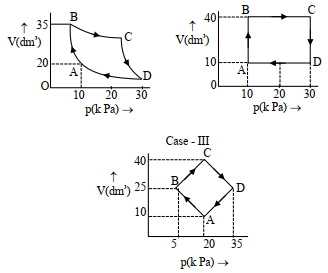
An ideal gas undergoes a cyclic transformation starting from the point $A$ and coming back to the same point by tracing the path $A$ $\rightarrow B$ $\rightarrow C$ $\rightarrow D$ $\rightarrow A$ as shown in the three cases above. Choose the correct option regarding $\Delta U$.
A
$\Delta U (\text{Case-}III) > \Delta U (\text{Case-}II) > \Delta U (\text{Case-}I)$
B
$\Delta U (\text{Case-}I) > \Delta U (\text{Case-}II) > \Delta U (\text{Case-}III)$
C
$\Delta U (\text{Case-}I) > \Delta U (\text{Case-}III) > \Delta U (\text{Case-}II)$
D
$\Delta U (\text{Case-}I) = \Delta U (\text{Case-}II) = \Delta U (\text{Case-}III)$
Solution
(D) Internal energy $(U)$ is a state function,which means its value depends only on the state of the system and not on the path taken.
In any cyclic process,the system returns to its initial state.
Therefore,the change in internal energy $(\Delta U)$ for a complete cycle is always zero.
$\Delta U_{\text{cycle}} = U_{\text{final}} - U_{\text{initial}} = 0$.
Since all three cases represent cyclic processes starting and ending at point $A$,the change in internal energy for each case is equal to zero.
Thus,$\Delta U (\text{Case-}I) = \Delta U (\text{Case-}II) = \Delta U (\text{Case-}III) = 0$.
In any cyclic process,the system returns to its initial state.
Therefore,the change in internal energy $(\Delta U)$ for a complete cycle is always zero.
$\Delta U_{\text{cycle}} = U_{\text{final}} - U_{\text{initial}} = 0$.
Since all three cases represent cyclic processes starting and ending at point $A$,the change in internal energy for each case is equal to zero.
Thus,$\Delta U (\text{Case-}I) = \Delta U (\text{Case-}II) = \Delta U (\text{Case-}III) = 0$.
0 likes
View Solution271
DifficultMCQ
Given below are two statements $ : $
Statement $I :$ When a system containing ice in equilibrium with water $(\text{liquid})$ is heated, heat is absorbed by the system and there is no change in the temperature of the system until whole ice gets melted.
Statement $II :$ At the melting point of ice, there is absorption of heat in order to overcome intermolecular forces of attraction within the molecules of water in ice, and the kinetic energy of molecules is not increased at the melting point.
In the light of the above statements, choose the correct answer from the options given below $ : $
Statement $I :$ When a system containing ice in equilibrium with water $(\text{liquid})$ is heated, heat is absorbed by the system and there is no change in the temperature of the system until whole ice gets melted.
Statement $II :$ At the melting point of ice, there is absorption of heat in order to overcome intermolecular forces of attraction within the molecules of water in ice, and the kinetic energy of molecules is not increased at the melting point.
In the light of the above statements, choose the correct answer from the options given below $ : $
A
Statement $I$ is true but Statement $II$ is false
B
Both Statement $I$ and Statement $II$ are false
C
Both Statement $I$ and Statement $II$ are true
D
Statement $I$ is false but Statement $II$ is true
Solution
(C) Statement $I$ is true because during the phase transition of ice to water at its melting point, the temperature remains constant at $0 \ ^\circ C$ until all the ice has melted, as the heat supplied is used as latent heat of fusion.
Statement $II$ is also true because the absorbed heat is utilized to overcome the intermolecular forces of attraction (hydrogen bonding) between water molecules in the solid lattice, and since the temperature does not change, the average kinetic energy of the molecules remains constant.
Therefore, both statements are correct.
Statement $II$ is also true because the absorbed heat is utilized to overcome the intermolecular forces of attraction (hydrogen bonding) between water molecules in the solid lattice, and since the temperature does not change, the average kinetic energy of the molecules remains constant.
Therefore, both statements are correct.
0 likes
View Solution272
DifficultMCQ
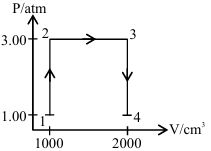
$A$ perfect gas $(0.1 \ mol)$ having $\overline{C}_{v}=1.50 \ R$ (independent of temperature) undergoes the transformation shown in the graph from point $1$ to point $4$. If each step is reversible,the total work done $(w)$ while going from point $1$ to point $4$ is $(-)$ . . . . . . $J$ (nearest integer). [Given: $R=0.082 \ L \ atm \ K^{-1} \ mol^{-1}$,$1 \ L \ atm = 101.3 \ J$]
A
$204$
B
$304$
C
$404$
D
$504$
Solution
(B) The process from $1$ to $4$ consists of three steps: $1 \rightarrow 2$,$2 \rightarrow 3$,and $3 \rightarrow 4$.
Step $1 \rightarrow 2$: Isochoric process $(V = 1000 \ cm^3 = 1 \ L)$,so $W_{1 \rightarrow 2} = 0 \ J$.
Step $2 \rightarrow 3$: Isobaric expansion $(P = 3 \ atm)$ from $V_2 = 1 \ L$ to $V_3 = 2 \ L$.
$W_{2 \rightarrow 3} = -P \Delta V = -3 \ atm \times (2 \ L - 1 \ L) = -3 \ L \ atm$.
Step $3 \rightarrow 4$: Isochoric process $(V = 2000 \ cm^3 = 2 \ L)$,so $W_{3 \rightarrow 4} = 0 \ J$.
Total work done $W = W_{1 \to 2} + W_{2 \to 3} + W_{3 \to 4} = 0 + (-3 \text{ L atm}) + 0 = -3 \text{ L atm}$
Converting to Joules: $W = -3 \times 101.3 \ J = -303.9 \ J$.
Rounding to the nearest integer,the magnitude is $304 \ J$.
Step $1 \rightarrow 2$: Isochoric process $(V = 1000 \ cm^3 = 1 \ L)$,so $W_{1 \rightarrow 2} = 0 \ J$.
Step $2 \rightarrow 3$: Isobaric expansion $(P = 3 \ atm)$ from $V_2 = 1 \ L$ to $V_3 = 2 \ L$.
$W_{2 \rightarrow 3} = -P \Delta V = -3 \ atm \times (2 \ L - 1 \ L) = -3 \ L \ atm$.
Step $3 \rightarrow 4$: Isochoric process $(V = 2000 \ cm^3 = 2 \ L)$,so $W_{3 \rightarrow 4} = 0 \ J$.
Total work done $W = W_{1 \to 2} + W_{2 \to 3} + W_{3 \to 4} = 0 + (-3 \text{ L atm}) + 0 = -3 \text{ L atm}$
Converting to Joules: $W = -3 \times 101.3 \ J = -303.9 \ J$.
Rounding to the nearest integer,the magnitude is $304 \ J$.
0 likes
View Solution273
MediumMCQ
The correct statement amongst the following is $:$
A
The term 'standard state' implies that the temperature is $0^{\circ} C$
B
The standard state of pure gas is the pure gas at a pressure of $1 \ bar$ and temperature $273 \ K$
C
$\Delta_{f} H_{298}^{\theta}$ is zero for $O_{(g)}$
D
$\Delta_{f} H_{500}^{\theta}$ is zero for $O_{2(g)}$
Solution
(D) The standard state of a substance is defined as its pure form at a pressure of $1 \ bar$ and a specified temperature (usually $298 \ K$).
$\Delta_{f} H^{\theta}$ (standard enthalpy of formation) is defined as zero for elements in their most stable state at the specified temperature.
For $O_{2(g)}$,which is the most stable form of oxygen,$\Delta_{f} H^{\theta} = 0$ at any specified temperature.
Therefore,$\Delta_{f} H_{500}^{\theta}$ is zero for $O_{2(g)}$ is the correct statement.
$\Delta_{f} H^{\theta}$ (standard enthalpy of formation) is defined as zero for elements in their most stable state at the specified temperature.
For $O_{2(g)}$,which is the most stable form of oxygen,$\Delta_{f} H^{\theta} = 0$ at any specified temperature.
Therefore,$\Delta_{f} H_{500}^{\theta}$ is zero for $O_{2(g)}$ is the correct statement.
0 likes
View Solution274
MediumMCQ
Out of $E, H, G, q$ and $w$,which are state functions?
A
$E, q, S$
B
$E, H, G$
C
$G, q, w$
D
$H, G, q$
Solution
(B) state function is a property whose value depends only on the current state of the system and not on the path taken to reach that state.
$E$ (Internal energy),$H$ (Enthalpy),and $G$ (Gibbs free energy) are state functions.
$q$ (Heat) and $w$ (Work) are path functions,as their values depend on the process or path taken.
Therefore,the correct set of state functions is $E, H, G$.
$E$ (Internal energy),$H$ (Enthalpy),and $G$ (Gibbs free energy) are state functions.
$q$ (Heat) and $w$ (Work) are path functions,as their values depend on the process or path taken.
Therefore,the correct set of state functions is $E, H, G$.
0 likes
View Solution275
MediumMCQ
Which of the following options consists of only intensive parameters?
A
$pH$ of solution,Temperature and volume.
B
Specific heat capacity,Molar internal energy,$E.M.F.$
C
Resistance,Molar mass,Vapour density
D
Density,Mass and Temperature
Solution
(B) Intensive properties are those that do not depend on the amount of matter present in the system.
$pH$,Temperature,Specific heat capacity,Molar internal energy,$E.M.F.$,Molar mass,Vapour density,and Density are intensive properties.
Extensive properties depend on the amount of matter,such as Volume,Mass,and Resistance.
In option $B$,Specific heat capacity,Molar internal energy,and $E.M.F.$ are all intensive properties.
Therefore,the correct option is $B$.
$pH$,Temperature,Specific heat capacity,Molar internal energy,$E.M.F.$,Molar mass,Vapour density,and Density are intensive properties.
Extensive properties depend on the amount of matter,such as Volume,Mass,and Resistance.
In option $B$,Specific heat capacity,Molar internal energy,and $E.M.F.$ are all intensive properties.
Therefore,the correct option is $B$.
0 likes
View Solution276
EasyMCQ
Which of the following compounds is $NOT$ present in its standard state at $25^{\circ} C$ and $1 \text{ atmosphere}$ pressure?
A
$CO_{2(g)}$
B
$CaCO_{3(s)}$
C
$C_{2}H_{5}OH_{(l)}$
D
$H_{2}O_{(g)}$
Solution
(D) The standard state of a substance is its most stable physical form at a specified temperature (usually $298 \text{ K}$ or $25^{\circ} C$) and $1 \text{ bar}$ (or $1 \text{ atm}$) pressure.
At $25^{\circ} C$ and $1 \text{ atm}$ pressure,water exists as a liquid $(H_{2}O_{(l)})$,not as a gas $(H_{2}O_{(g)})$.
Therefore,$H_{2}O_{(g)}$ is not in its standard state under these conditions.
At $25^{\circ} C$ and $1 \text{ atm}$ pressure,water exists as a liquid $(H_{2}O_{(l)})$,not as a gas $(H_{2}O_{(g)})$.
Therefore,$H_{2}O_{(g)}$ is not in its standard state under these conditions.
0 likes
View Solution277
EasyMCQ
Identify an example of an intensive property from the following:
A
Surface tension
B
Volume
C
Internal energy
D
Number of moles
Solution
(A) An intensive property is a physical property of a system that does not depend on the amount of matter present or the size of the system.
$1$. Surface tension is an intensive property because it depends only on the nature of the substance and temperature,not on the quantity of the liquid.
$2$. Volume,internal energy,and the number of moles are extensive properties because they depend on the amount of matter present in the system.
$1$. Surface tension is an intensive property because it depends only on the nature of the substance and temperature,not on the quantity of the liquid.
$2$. Volume,internal energy,and the number of moles are extensive properties because they depend on the amount of matter present in the system.
0 likes
View Solution278
MediumMCQ
Which of the following is an example of both an intensive property and a state function?
A
Internal energy
B
Volume
C
Temperature
D
Entropy
Solution
(C) $1$. An intensive property is a property that does not depend on the amount of matter present in the system (e.g.,$Temperature$,$Pressure$,$Density$).
$2$. $A$ state function is a property whose value depends only on the state of the system and not on the path taken to reach that state (e.g.,$Internal \ energy$,$Enthalpy$,$Entropy$,$Temperature$).
$3$. $Internal \ energy$,$Volume$,and $Entropy$ are extensive properties because they depend on the amount of matter.
$4$. $Temperature$ is independent of the amount of matter (intensive) and its value depends only on the current state of the system (state function).
$5$. Therefore,$Temperature$ is the correct answer.
$2$. $A$ state function is a property whose value depends only on the state of the system and not on the path taken to reach that state (e.g.,$Internal \ energy$,$Enthalpy$,$Entropy$,$Temperature$).
$3$. $Internal \ energy$,$Volume$,and $Entropy$ are extensive properties because they depend on the amount of matter.
$4$. $Temperature$ is independent of the amount of matter (intensive) and its value depends only on the current state of the system (state function).
$5$. Therefore,$Temperature$ is the correct answer.
0 likes
View Solution279
EasyMCQ
Which of the following is an example of an intensive property of the system?
A
Volume
B
Enthalpy
C
Entropy
D
Molar volume
Solution
(D) An intensive property is a physical property of a system that does not depend on the amount of matter present or the size of the system.
$Volume$,$Enthalpy$,and $Entropy$ are extensive properties because they depend on the quantity of matter.
$Molar volume$ is defined as the volume per mole of a substance $(V_m = V/n)$,which is independent of the total amount of the substance.
Therefore,$Molar volume$ is an intensive property.
$Volume$,$Enthalpy$,and $Entropy$ are extensive properties because they depend on the quantity of matter.
$Molar volume$ is defined as the volume per mole of a substance $(V_m = V/n)$,which is independent of the total amount of the substance.
Therefore,$Molar volume$ is an intensive property.
0 likes
View Solution280
EasyMCQ
Which among the following is $NOT$ an intensive property?
A
Internal energy
B
Viscosity
C
Surface tension
D
Specific heat
Solution
(A) An intensive property is independent of the amount of substance present in the system. Examples include viscosity,surface tension,and specific heat.
An extensive property depends on the amount of substance present in the system.
Internal energy $(U)$ is an extensive property because its value depends on the quantity of matter in the system.
An extensive property depends on the amount of substance present in the system.
Internal energy $(U)$ is an extensive property because its value depends on the quantity of matter in the system.
0 likes
View Solution281
EasyMCQ
Which among the following pairs of properties are intensive?
A
surface tension and viscosity
B
mass and temperature
C
internal energy and boiling point
D
heat capacity and specific heat
Solution
(A) The correct answer is $A$.
Intensive properties are properties that do not depend on the amount or size of the substance and remain the same regardless of the quantity of the material present.
Extensive properties depend on the amount of substance.
$1$. Surface tension and viscosity are both intensive properties because they are independent of the amount of substance.
$2$. Mass,internal energy,and heat capacity are extensive properties as they depend on the amount of matter.
$3$. Temperature,boiling point,and specific heat are intensive properties.
Since both surface tension and viscosity are intensive,option $A$ is correct.
Intensive properties are properties that do not depend on the amount or size of the substance and remain the same regardless of the quantity of the material present.
Extensive properties depend on the amount of substance.
$1$. Surface tension and viscosity are both intensive properties because they are independent of the amount of substance.
$2$. Mass,internal energy,and heat capacity are extensive properties as they depend on the amount of matter.
$3$. Temperature,boiling point,and specific heat are intensive properties.
Since both surface tension and viscosity are intensive,option $A$ is correct.
0 likes
View Solution282
EasyMCQ
Which among the following pair of properties is intensive?
A
Mass and heat capacity
B
Heat capacity and pressure
C
Specific heat and pressure
D
Internal energy and boiling point
Solution
(C) An intensive property is a physical property of a system that does not depend on the system size or the amount of material in the system.
$Specific \ heat$ and $pressure$ are independent of the amount of matter present,hence they are intensive properties.
In contrast,$mass$,$heat \ capacity$,and $internal \ energy$ are extensive properties as they depend on the amount of matter.
$Specific \ heat$ and $pressure$ are independent of the amount of matter present,hence they are intensive properties.
In contrast,$mass$,$heat \ capacity$,and $internal \ energy$ are extensive properties as they depend on the amount of matter.
0 likes
View Solution283
EasyMCQ
Identify the type of system if boiling water is kept in a half-filled closed vessel.
A
Homogeneous closed system
B
Heterogeneous closed system
C
Homogeneous isolated system
D
Heterogeneous isolated system
Solution
(B) system is called $closed$ if it can exchange energy but not matter with the surroundings.
In a half-filled closed vessel containing boiling water,both liquid water and water vapor are present.
Since there are two distinct phases (liquid and gas) present in the system,it is $heterogeneous$.
Therefore,the system is a $heterogeneous$ $closed$ $system$.
In a half-filled closed vessel containing boiling water,both liquid water and water vapor are present.
Since there are two distinct phases (liquid and gas) present in the system,it is $heterogeneous$.
Therefore,the system is a $heterogeneous$ $closed$ $system$.
0 likes
View Solution284
EasyMCQ
Which among the following are intensive and extensive properties respectively?
A
Boiling point and heat capacity
B
Heat capacity and boiling point
C
Internal energy and pressure
D
Heat capacity and surface tension
Solution
(A) Intensive properties are those which do not depend on the quantity or size of matter present in the system,such as boiling point.
Extensive properties are those whose value depends on the quantity or size of matter present in the system,such as heat capacity.
Therefore,boiling point is an intensive property and heat capacity is an extensive property.
Extensive properties are those whose value depends on the quantity or size of matter present in the system,such as heat capacity.
Therefore,boiling point is an intensive property and heat capacity is an extensive property.
0 likes
View Solution285
EasyMCQ
Which among the following pairs represents extensive and intensive properties respectively?
A
Volume and number of moles
B
Volume and pressure
C
Surface tension and heat capacity
D
Internal energy and temperature
Solution
(B) Extensive properties depend on the amount of matter present in the system (e.g.,$Volume$,$Number \ of \ moles$,$Internal \ energy$,$Heat \ capacity$).
Intensive properties are independent of the amount of matter present in the system (e.g.,$Pressure$,$Temperature$,$Surface \ tension$,$Density$).
In option $B$,$Volume$ is an extensive property and $Pressure$ is an intensive property. Therefore,the pair ($Volume$,$Pressure$) matches the requirement.
Intensive properties are independent of the amount of matter present in the system (e.g.,$Pressure$,$Temperature$,$Surface \ tension$,$Density$).
In option $B$,$Volume$ is an extensive property and $Pressure$ is an intensive property. Therefore,the pair ($Volume$,$Pressure$) matches the requirement.
0 likes
View Solution286
MediumMCQ
Which among the following properties is $NOT$ a state function?
A
Enthalpy
B
Volume
C
Pressure
D
Work
Solution
(D) state function is a property whose value depends only on the current state of the system and not on the path taken to reach that state. $Enthalpy$ $(H)$,$Volume$ $(V)$,and $Pressure$ $(P)$ are state functions. $Work$ $(w)$ and $Heat$ $(q)$ are path functions,as their values depend on the process or path followed. Therefore,$Work$ is not a state function.
0 likes
View Solution287
EasyMCQ
Which among the following is $NOT$ an intensive property?
A
Heat capacity
B
Viscosity
C
Pressure
D
Surface tension
Solution
(A) An intensive property is independent of the amount of matter present in the system.
An extensive property depends on the amount of matter present in the system.
Heat capacity $(C)$ is defined as the product of mass $(m)$ and specific heat capacity $(c)$,i.e.,$C = m \times c$.
Since it depends on the mass of the substance,heat capacity is an extensive property.
Viscosity,pressure,and surface tension are independent of the amount of matter and are therefore intensive properties.
An extensive property depends on the amount of matter present in the system.
Heat capacity $(C)$ is defined as the product of mass $(m)$ and specific heat capacity $(c)$,i.e.,$C = m \times c$.
Since it depends on the mass of the substance,heat capacity is an extensive property.
Viscosity,pressure,and surface tension are independent of the amount of matter and are therefore intensive properties.
0 likes
View Solution288
EasyMCQ
Which among the following is $\text{NOT}$ an extensive property?
A
Mass
B
Volume
C
Pressure
D
Internal energy
Solution
(C) Extensive properties are those properties of a system that depend on the amount of matter (size and mass) present in the system.
$Mass$,$Volume$,and $Internal \ energy$ are extensive properties because they depend on the quantity of matter.
$Pressure$ is an intensive property because it is independent of the amount of matter present in the system.
$Mass$,$Volume$,and $Internal \ energy$ are extensive properties because they depend on the quantity of matter.
$Pressure$ is an intensive property because it is independent of the amount of matter present in the system.
0 likes
View Solution289
EasyMCQ
Which among the following is $NOT$ an intensive property?
A
Surface tension
B
Heat capacity
C
Viscosity
D
Temperature
Solution
(B) Intensive properties are those that are independent of the amount of matter present in the system.
Extensive properties depend on the quantity of matter present.
$1$. Surface tension: Intensive property.
$2$. Heat capacity: Extensive property (as it depends on the mass of the substance).
$3$. Viscosity: Intensive property.
$4$. Temperature: Intensive property.
Therefore,heat capacity is $NOT$ an intensive property.
Extensive properties depend on the quantity of matter present.
$1$. Surface tension: Intensive property.
$2$. Heat capacity: Extensive property (as it depends on the mass of the substance).
$3$. Viscosity: Intensive property.
$4$. Temperature: Intensive property.
Therefore,heat capacity is $NOT$ an intensive property.
0 likes
View Solution290
EasyMCQ
Which of the following is $NOT$ an intensive property?
A
Surface tension
B
Density
C
Refractive index
D
Heat capacity
Solution
(D) $I$. Extensive property: Heat capacity (depends on the amount of matter present in the system).
$II$. Intensive property: Surface tension,density,and refractive index (independent of the amount of matter present in the system).
$II$. Intensive property: Surface tension,density,and refractive index (independent of the amount of matter present in the system).
0 likes
View Solution291
EasyMCQ
Which of the following is true for heat and temperature?
A
Extensive and intensive properties respectively
B
Intensive and extensive properties respectively
C
Both are extensive properties
D
Both are intensive properties
Solution
(A) An extensive property is a property whose value depends on the quantity or size of matter present in the system (e.g.,heat,mass,volume).
An intensive property is a property whose value is independent of the quantity or size of matter present in the system (e.g.,temperature,pressure,density).
Therefore,heat is an extensive property and temperature is an intensive property.
An intensive property is a property whose value is independent of the quantity or size of matter present in the system (e.g.,temperature,pressure,density).
Therefore,heat is an extensive property and temperature is an intensive property.
0 likes
View Solution292
MediumMCQ
Which of the following is a path function?
A
Internal energy
B
Enthalpy
C
Work
D
Entropy
Solution
(C) State functions are properties that depend only on the initial and final states of the system,such as internal energy $(U)$,enthalpy $(H)$,and entropy $(S)$.
Path functions are properties that depend on the path taken to reach the state,such as work $(w)$ and heat $(q)$.
Path functions are properties that depend on the path taken to reach the state,such as work $(w)$ and heat $(q)$.
0 likes
View Solution293
MediumMCQ
Which of the following reactions performs zero work?
A
$CH_{4(g)} + Cl_{2(g)} \rightarrow CH_3Cl_{(g)} + HCl_{(g)}$
B
$3H_{2(g)} + N_{2(g)} \rightarrow 2NH_{3(g)}$
C
$C_2H_{2(g)} + \frac{5}{2}O_{2(g)} \rightarrow 2CO_{2(g)} + H_2O_{(l)}$
D
$2C_2H_{6(g)} + 7O_{2(g)} \rightarrow 4CO_{2(g)} + 6H_2O_{(l)}$
Solution
(A) Work done in a chemical reaction at constant pressure is given by $W = -P \Delta V = -\Delta n_g RT$,where $\Delta n_g$ is the change in the number of moles of gaseous products and reactants.
For zero work,$\Delta n_g$ must be equal to $0$.
In option $A$: $\Delta n_g = (1 + 1) - (1 + 1) = 0$.
In option $B$: $\Delta n_g = 2 - (3 + 1) = -2$.
In option $C$: $\Delta n_g = 2 - (1 + 2.5) = -1.5$.
In option $D$: $\Delta n_g = 4 - (2 + 7) = -5$.
Since $\Delta n_g = 0$ for reaction $A$,it performs zero work.
For zero work,$\Delta n_g$ must be equal to $0$.
In option $A$: $\Delta n_g = (1 + 1) - (1 + 1) = 0$.
In option $B$: $\Delta n_g = 2 - (3 + 1) = -2$.
In option $C$: $\Delta n_g = 2 - (1 + 2.5) = -1.5$.
In option $D$: $\Delta n_g = 4 - (2 + 7) = -5$.
Since $\Delta n_g = 0$ for reaction $A$,it performs zero work.
0 likes
View Solution294
MediumMCQ
Calculate the constant external pressure required to expand $2$ moles of an ideal gas from volume $15 \ dm^{3}$ to $20 \ dm^{3}$ if the amount of work done is $-600 \ J$. (in $bar$)
A
$1.2$
B
$1.5$
C
$1.8$
D
$2.1$
Solution
(A) The formula for work done during expansion against a constant external pressure is $W = -P_{ext} \Delta V$.
Given: $W = -600 \ J$,$V_1 = 15 \ dm^{3}$,$V_2 = 20 \ dm^{3}$.
Change in volume $\Delta V = V_2 - V_1 = 20 \ dm^{3} - 15 \ dm^{3} = 5 \ dm^{3}$.
Since $1 \ dm^{3} = 1 \ L$ and $1 \ L \cdot bar = 100 \ J$,we convert the volume change to units compatible with Joules.
$5 \ dm^{3} = 5 \ L$.
Using $W = -P_{ext} \Delta V$,we have $-600 \ J = -P_{ext} \times (5 \ L)$.
$P_{ext} = \frac{600 \ J}{5 \ L} = 120 \ J/L$.
Since $100 \ J = 1 \ L \cdot bar$,then $120 \ J = 1.2 \ L \cdot bar$.
Therefore,$P_{ext} = \frac{120 \ J}{5 \ L} = 24 \ J/L = 0.24 \ bar$.
Wait,re-evaluating the conversion: $1 \ dm^{3} \cdot bar = 100 \ J$.
$P_{ext} (bar) = \frac{-W (J)}{100 \times \Delta V (dm^{3})} = \frac{600}{100 \times 5} = \frac{600}{500} = 1.2 \ bar$.
The correct answer is $1.2 \ bar$.
Given: $W = -600 \ J$,$V_1 = 15 \ dm^{3}$,$V_2 = 20 \ dm^{3}$.
Change in volume $\Delta V = V_2 - V_1 = 20 \ dm^{3} - 15 \ dm^{3} = 5 \ dm^{3}$.
Since $1 \ dm^{3} = 1 \ L$ and $1 \ L \cdot bar = 100 \ J$,we convert the volume change to units compatible with Joules.
$5 \ dm^{3} = 5 \ L$.
Using $W = -P_{ext} \Delta V$,we have $-600 \ J = -P_{ext} \times (5 \ L)$.
$P_{ext} = \frac{600 \ J}{5 \ L} = 120 \ J/L$.
Since $100 \ J = 1 \ L \cdot bar$,then $120 \ J = 1.2 \ L \cdot bar$.
Therefore,$P_{ext} = \frac{120 \ J}{5 \ L} = 24 \ J/L = 0.24 \ bar$.
Wait,re-evaluating the conversion: $1 \ dm^{3} \cdot bar = 100 \ J$.
$P_{ext} (bar) = \frac{-W (J)}{100 \times \Delta V (dm^{3})} = \frac{600}{100 \times 5} = \frac{600}{500} = 1.2 \ bar$.
The correct answer is $1.2 \ bar$.
0 likes
View Solution295
EasyMCQ
Which of the following processes involves zero work done?
A
Isobaric expansion of gas.
B
Adiabatic compression of gas.
C
Isothermal expansion of gas.
D
Free expansion of gas.
Solution
(D) The work done in a thermodynamic process is given by the formula $W = -P_{ext} \Delta V$.
In the case of free expansion,a gas expands against a vacuum,meaning the external pressure $P_{ext} = 0$.
Therefore,the work done $W = -0 \times \Delta V = 0$.
Thus,free expansion involves zero work done.
In the case of free expansion,a gas expands against a vacuum,meaning the external pressure $P_{ext} = 0$.
Therefore,the work done $W = -0 \times \Delta V = 0$.
Thus,free expansion involves zero work done.
0 likes
View Solution296
MediumMCQ
Calculate the work done in joule if $2 \ mol$ of an ideal gas expands isothermally from $15.5 \ dm^3$ to $20 \ dm^3$ at a constant external pressure of $1 \ atm$. (in $J$)
A
$-456$
B
$-228$
C
$-684$
D
$-912$
Solution
(A) The work done during the expansion of a gas against a constant external pressure is given by the formula: $W = -P_{ext} \times \Delta V$.
Here,$P_{ext} = 1 \ atm$,$V_1 = 15.5 \ dm^3$,and $V_2 = 20 \ dm^3$.
Change in volume,$\Delta V = V_2 - V_1 = 20 \ dm^3 - 15.5 \ dm^3 = 4.5 \ dm^3$.
Since $1 \ dm^3 \cdot atm = 101.325 \ J$,the work done is $W = -1 \ atm \times 4.5 \ dm^3 = -4.5 \ dm^3 \cdot atm$.
Converting to joules: $W = -4.5 \times 101.325 \ J \approx -456 \ J$.
Here,$P_{ext} = 1 \ atm$,$V_1 = 15.5 \ dm^3$,and $V_2 = 20 \ dm^3$.
Change in volume,$\Delta V = V_2 - V_1 = 20 \ dm^3 - 15.5 \ dm^3 = 4.5 \ dm^3$.
Since $1 \ dm^3 \cdot atm = 101.325 \ J$,the work done is $W = -1 \ atm \times 4.5 \ dm^3 = -4.5 \ dm^3 \cdot atm$.
Converting to joules: $W = -4.5 \times 101.325 \ J \approx -456 \ J$.
0 likes
View Solution297
MediumMCQ
Calculate work done in isothermal reversible expansion of $1 \ mol$ of an ideal gas from an initial pressure of $10 \ bar$ to a final pressure of $1 \ bar$ at $300 \ K$ $\left(R = 8.314 \ J \ K^{-1} \ mol^{-1}\right)$. (in $kJ$)
A
$-2.87$
B
$-8.60$
C
$-5.74$
D
$-11.49$
Solution
(C) For an isothermal reversible expansion,the work done $(w)$ is given by the formula: $w = -2.303 \ nRT \ \log\left(\frac{P_1}{P_2}\right)$.
Given values are: $n = 1 \ mol$,$R = 8.314 \ J \ K^{-1} \ mol^{-1}$,$T = 300 \ K$,$P_1 = 10 \ bar$,and $P_2 = 1 \ bar$.
Substituting these values into the equation:
$w = -2.303 \times 1 \times 8.314 \times 300 \times \log\left(\frac{10}{1}\right)$.
Since $\log(10) = 1$,we have:
$w = -2.303 \times 8.314 \times 300 \times 1$.
$w = -5744.14 \ J$.
Converting to $kJ$,we get $w = -5.744 \ kJ \approx -5.74 \ kJ$.
Given values are: $n = 1 \ mol$,$R = 8.314 \ J \ K^{-1} \ mol^{-1}$,$T = 300 \ K$,$P_1 = 10 \ bar$,and $P_2 = 1 \ bar$.
Substituting these values into the equation:
$w = -2.303 \times 1 \times 8.314 \times 300 \times \log\left(\frac{10}{1}\right)$.
Since $\log(10) = 1$,we have:
$w = -2.303 \times 8.314 \times 300 \times 1$.
$w = -5744.14 \ J$.
Converting to $kJ$,we get $w = -5.744 \ kJ \approx -5.74 \ kJ$.
0 likes
View Solution298
MediumMCQ
Calculate work done if $1 \ mole$ of an ideal gas expands isothermally from $2 \ dm^3$ to $2.8 \ dm^3$ against constant external pressure $1 \ atm$. (in $J$)
A
$-81.04$
B
$-40.52$
C
$-121.56$
D
$-60.78$
Solution
(A) The work done in an irreversible isothermal expansion against constant external pressure is given by the formula: $W = -P_{ext} \times \Delta V$.
Given:
$P_{ext} = 1 \ atm$
$V_1 = 2 \ dm^3$
$V_2 = 2.8 \ dm^3$
$\Delta V = V_2 - V_1 = 2.8 \ dm^3 - 2 \ dm^3 = 0.8 \ dm^3$.
Since $1 \ dm^3 \cdot atm = 101.325 \ J$,
$W = -1 \ atm \times 0.8 \ dm^3 = -0.8 \ dm^3 \cdot atm$.
$W = -0.8 \times 101.325 \ J = -81.06 \ J$.
Rounding to the nearest option,the work done is $-81.04 \ J$.
Given:
$P_{ext} = 1 \ atm$
$V_1 = 2 \ dm^3$
$V_2 = 2.8 \ dm^3$
$\Delta V = V_2 - V_1 = 2.8 \ dm^3 - 2 \ dm^3 = 0.8 \ dm^3$.
Since $1 \ dm^3 \cdot atm = 101.325 \ J$,
$W = -1 \ atm \times 0.8 \ dm^3 = -0.8 \ dm^3 \cdot atm$.
$W = -0.8 \times 101.325 \ J = -81.06 \ J$.
Rounding to the nearest option,the work done is $-81.04 \ J$.
0 likes
View Solution299
MediumMCQ
Calculate the work done in joule if $1 \ mole$ of ideal gas is compressed from $25 \ dm^3$ to $13 \ dm^3$ at constant external pressure $4 \ bar$. (in $J$)
A
$2400$
B
$4800$
C
$6000$
D
$7200$
Solution
(B) The work done in an irreversible process against constant external pressure is given by the formula: $W = -P_{ext} \times \Delta V$.
Here,$P_{ext} = 4 \ bar = 4 \times 10^5 \ Pa$.
Initial volume $V_1 = 25 \ dm^3 = 25 \times 10^{-3} \ m^3$.
Final volume $V_2 = 13 \ dm^3 = 13 \times 10^{-3} \ m^3$.
Change in volume $\Delta V = V_2 - V_1 = (13 - 25) \times 10^{-3} \ m^3 = -12 \times 10^{-3} \ m^3$.
Substituting the values: $W = -(4 \times 10^5 \ Pa) \times (-12 \times 10^{-3} \ m^3) = 4800 \ J$.
Since the gas is compressed,work is done on the system,so the value is positive.
Here,$P_{ext} = 4 \ bar = 4 \times 10^5 \ Pa$.
Initial volume $V_1 = 25 \ dm^3 = 25 \times 10^{-3} \ m^3$.
Final volume $V_2 = 13 \ dm^3 = 13 \times 10^{-3} \ m^3$.
Change in volume $\Delta V = V_2 - V_1 = (13 - 25) \times 10^{-3} \ m^3 = -12 \times 10^{-3} \ m^3$.
Substituting the values: $W = -(4 \times 10^5 \ Pa) \times (-12 \times 10^{-3} \ m^3) = 4800 \ J$.
Since the gas is compressed,work is done on the system,so the value is positive.
0 likes
View Solution300
MediumMCQ
Calculate the work done in joule if $1 \ mole$ of an ideal gas is compressed from volume $24 \ dm^3$ to $13 \ dm^3$ at a constant external pressure of $3 \ bar$. (in $J$)
A
$3300$
B
$2250$
C
$4400$
D
$4870$
Solution
$(A)$ The formula for work done in an irreversible process against constant external pressure is given by $W = -P_{ext} \times \Delta V$.
Here, $P_{ext} = 3 \ bar = 3 \times 10^5 \ Pa$.
$\Delta V = V_f - V_i = 13 \ dm^3 - 24 \ dm^3 = -11 \ dm^3 = -11 \times 10^{-3} \ m^3$.
Substituting the values: $W = -(3 \times 10^5 \ Pa) \times (-11 \times 10^{-3} \ m^3)$.
$W = 3300 \ J$.
Since the gas is compressed, work is done on the system, hence the value is positive.
Here, $P_{ext} = 3 \ bar = 3 \times 10^5 \ Pa$.
$\Delta V = V_f - V_i = 13 \ dm^3 - 24 \ dm^3 = -11 \ dm^3 = -11 \times 10^{-3} \ m^3$.
Substituting the values: $W = -(3 \times 10^5 \ Pa) \times (-11 \times 10^{-3} \ m^3)$.
$W = 3300 \ J$.
Since the gas is compressed, work is done on the system, hence the value is positive.
0 likes
View SolutionThermodynamics — Basic concepts · Frequently Asked Questions
1Are these Thermodynamics questions useful for JEE and NEET?
Yes. All questions in this section are mapped to JEE Main and NEET exam patterns. Previous year questions from JEE Main, NEET, GUJCET and state-level exams are included with full solutions.
2Can I switch to Hindi or Gujarati for these questions?
Yes. Use the language tabs in the hero section or the sidebar to view the same questions and solutions in English, Hindi or Gujarati.
3How do I generate a question paper from this subtopic?
Use the Vedclass Exam Paper Generator — select the chapter and subtopic, set difficulty, and generate Sets A, B, C, D automatically. First 3 chapters of every subject are free.
Vedclass Products
For Students
Vedclass Test Series
Mock tests in real JEE/NEET style with performance analysis. 5-day free trial.
Start Free TrialFor Teachers
Exam Paper Generator
Generate Set A/B/C/D papers from this chapter in 2 minutes. 3 chapters free.
Try FreeFor Institutes
Online Exam Module
Live online exams with unlimited students, 360° analytics & white-label branding.
See DemoFor Teachers & Institutes
Generate a Thermodynamics Exam Paper in 2 Minutes
Select subtopic & difficulty — Sets A, B, C, D auto-generated with No Repeat logic.
First 3 chapters of every subject are free — no payment required.