
A English
Basic concepts Questions in English
Class 11 Chemistry · Thermodynamics · Basic concepts
401+
Questions
English
Language
100%
With Solutions
Showing 50 of 401 questions in English
101
EasyMCQ
The evaporation of water is a:
A
Process in which no heat is evolved or absorbed.
B
Process that occurs via a chemical reaction.
C
Exothermic change.
D
Endothermic change.
Solution
(D) The evaporation of water is a physical process represented as $H_2O(l) \rightarrow H_2O(g)$.
To convert liquid water into water vapor,energy must be supplied to overcome the intermolecular forces of attraction.
Since heat is absorbed from the surroundings during this process,it is an endothermic change.
To convert liquid water into water vapor,energy must be supplied to overcome the intermolecular forces of attraction.
Since heat is absorbed from the surroundings during this process,it is an endothermic change.
0 likes
View Solution102
EasyMCQ
Energy can be transferred from a system to the surroundings as work if $.....$
A
Pressure of system $>$ External pressure
B
Pressure of system $ < $ External pressure
C
Pressure of system $=$ External pressure
D
None of these
Solution
(A) Work done by the system on the surroundings is given by the expression $w = -P_{ext} \Delta V$.
For the system to perform work on the surroundings (expansion),the volume must increase $(\Delta V > 0)$.
This expansion occurs when the internal pressure of the system is greater than the external pressure $(P_{sys} > P_{ext})$.
Therefore,energy is transferred as work from the system to the surroundings when the system pressure is greater than the atmospheric (external) pressure.
For the system to perform work on the surroundings (expansion),the volume must increase $(\Delta V > 0)$.
This expansion occurs when the internal pressure of the system is greater than the external pressure $(P_{sys} > P_{ext})$.
Therefore,energy is transferred as work from the system to the surroundings when the system pressure is greater than the atmospheric (external) pressure.
0 likes
View Solution103
EasyMCQ
An isolated system can exchange ........ with the surroundings.
A
Matter only
B
Energy only
C
Neither matter nor energy
D
Both matter and energy
Solution
(C) An isolated system is defined as a system that cannot exchange either matter or energy with its surroundings.
Therefore,the correct option is $C$.
Therefore,the correct option is $C$.
0 likes
View Solution104
MediumMCQ
The heat of combustion of ethanol in a bomb calorimeter at $25\,^oC$ is $-670.48\, K\,cal\, mol^{-1}$. Find the value of $\Delta U$ in $K\,cal$ for the reaction at $25\,^oC$.
A
$-269.24$
B
$-469.28$
C
$-670.48$
D
$+770.48$
Solution
(C) bomb calorimeter measures the heat of combustion at constant volume.
By definition,the heat of reaction at constant volume is equal to the change in internal energy,$\Delta U$.
Therefore,for the combustion reaction of ethanol,$\Delta U = \Delta H_{combustion} = -670.48\, K\,cal\, mol^{-1}$.
By definition,the heat of reaction at constant volume is equal to the change in internal energy,$\Delta U$.
Therefore,for the combustion reaction of ethanol,$\Delta U = \Delta H_{combustion} = -670.48\, K\,cal\, mol^{-1}$.
0 likes
View Solution105
EasyMCQ
Identify the pair of intensive properties from the following.
A
Enthalpy and Temperature
B
Volume and Temperature
C
Enthalpy and Volume
D
Temperature and Refractive Index
Solution
(D) Intensive properties are those that do not depend on the amount of matter present in the system.
Temperature and Refractive Index are independent of the quantity of matter.
Enthalpy and Volume are extensive properties as they depend on the amount of substance.
Temperature and Refractive Index are independent of the quantity of matter.
Enthalpy and Volume are extensive properties as they depend on the amount of substance.
0 likes
View Solution106
EasyMCQ
If $\Delta H$ is the change in enthalpy,$\Delta U$ is the change in internal energy,$N_P$ is the number of moles of products,and $N_r$ is the number of moles of reactants,then which of the following is correct for a gaseous reaction?
A
$\Delta H > \Delta U$ always
B
$\Delta H < \Delta U$ when $N_P > N_r$
C
$\Delta H < \Delta U$ when $N_P < N_r$
D
$\Delta H > \Delta U$ when $N_P > N_r$
Solution
(D) The relationship between enthalpy change $(\Delta H)$ and internal energy change $(\Delta U)$ for a chemical reaction is given by the equation: $\Delta H = \Delta U + \Delta n_g RT$,where $\Delta n_g = N_P - N_r$ (change in the number of moles of gaseous species).
If $N_P > N_r$,then $\Delta n_g > 0$,which implies $\Delta H > \Delta U$.
If $N_P < N_r$,then $\Delta n_g < 0$,which implies $\Delta H < \Delta U$.
Therefore,the correct statement is $\Delta H > \Delta U$ when $N_P > N_r$.
If $N_P > N_r$,then $\Delta n_g > 0$,which implies $\Delta H > \Delta U$.
If $N_P < N_r$,then $\Delta n_g < 0$,which implies $\Delta H < \Delta U$.
Therefore,the correct statement is $\Delta H > \Delta U$ when $N_P > N_r$.
0 likes
View Solution107
EasyMCQ
Which of the following is a set of intensive properties?
A
Enthalpy,Temperature
B
Volume,Temperature
C
Enthalpy,Volume
D
Temperature,Refractive index
Solution
(D) Intensive properties are those that do not depend on the amount of matter present in the system.
$1$. Enthalpy $(H)$ and Volume $(V)$ are extensive properties because they depend on the amount of substance.
$2$. Temperature $(T)$ and Refractive index $(n)$ are intensive properties because they are independent of the quantity of matter.
Therefore,the set (Temperature,Refractive index) consists of intensive properties.
$1$. Enthalpy $(H)$ and Volume $(V)$ are extensive properties because they depend on the amount of substance.
$2$. Temperature $(T)$ and Refractive index $(n)$ are intensive properties because they are independent of the quantity of matter.
Therefore,the set (Temperature,Refractive index) consists of intensive properties.
0 likes
View Solution108
DifficultMCQ
$A$ $5 \, L$ cylinder contains $10 \, mol$ of $O_2$ gas at $27 \, ^\circ C$. Due to a leak,the gas escapes into the atmosphere until the pressure inside the cylinder equals the atmospheric pressure $(1.0 \, atm)$. What is the work done by the gas?
A
$-0.5 \times 101.3 \, L \cdot atm$
B
$-1.5 \times 201.3 \, L \cdot atm$
C
$-1 \times 241.3 \, L \cdot atm$
D
$-2 \times 101.3 \, L \cdot atm$
Solution
(C) Initial volume $V_{initial} = 5 \, L$. Temperature $T = 27 + 273 = 300 \, K$.
Final volume $V_{final}$ is the volume occupied by $10 \, mol$ of gas at $1 \, atm$ pressure:
$V_{final} = \frac{nRT}{P} = \frac{10 \times 0.0821 \times 300}{1} = 246.3 \, L$.
Change in volume $\Delta V = V_{final} - V_{initial} = 246.3 - 5 = 241.3 \, L$.
Work done $W = -P_{ext} \Delta V = -1 \, atm \times 241.3 \, L = -241.3 \, L \cdot atm$.
Final volume $V_{final}$ is the volume occupied by $10 \, mol$ of gas at $1 \, atm$ pressure:
$V_{final} = \frac{nRT}{P} = \frac{10 \times 0.0821 \times 300}{1} = 246.3 \, L$.
Change in volume $\Delta V = V_{final} - V_{initial} = 246.3 - 5 = 241.3 \, L$.
Work done $W = -P_{ext} \Delta V = -1 \, atm \times 241.3 \, L = -241.3 \, L \cdot atm$.
0 likes
View Solution109
MediumMCQ
For a reversible process at $T = 300 \, K$,the volume increases from $V_i = 1 \, L$ to $V_f = 10 \, L$. If the process is isothermal,find the value of $\Delta H$ in $kJ$.
A
$11.47$
B
$4.98$
C
$0$
D
$-11.47$
Solution
(C) For an ideal gas,the enthalpy change $\Delta H$ is given by the relation $\Delta H = nC_p \Delta T$.
Since the process is isothermal,the temperature change $\Delta T = 0$.
Therefore,$\Delta H = nC_p(0) = 0 \, kJ$.
For an ideal gas,enthalpy is a function of temperature only,so for any isothermal process,$\Delta H = 0$.
Since the process is isothermal,the temperature change $\Delta T = 0$.
Therefore,$\Delta H = nC_p(0) = 0 \, kJ$.
For an ideal gas,enthalpy is a function of temperature only,so for any isothermal process,$\Delta H = 0$.
0 likes
View Solution110
MediumMCQ
What is the work done in $cal$ during the reversible isothermal expansion of $1 \, mol$ of an ideal gas at $300 \, K$ from $10 \, atm$ to $1 \, atm$?
A
$-1345.5$
B
$-1223.5$
C
$-1159.5$
D
$-1381.8$
Solution
(D) For an ideal gas,the number of moles $(n) = 1$; initial pressure $(P_1) = 10 \, atm$; final pressure $(P_2) = 1 \, atm$.
Constant absolute temperature $(T) = 300 \, K$; gas constant $(R) = 2 \, cal \, mol^{-1} \, K^{-1}$.
The work done $(W)$ for the reversible isothermal expansion of an ideal gas is given by:
$W = -2.303 \, nRT \, \log_{10} \left( \frac{P_1}{P_2} \right)$
$W = -2.303 \times 1 \times 2 \times 300 \times \log_{10} \left( \frac{10}{1} \right)$
$W = -2.303 \times 600 \times 1$
$W = -1381.8 \, cal$
Constant absolute temperature $(T) = 300 \, K$; gas constant $(R) = 2 \, cal \, mol^{-1} \, K^{-1}$.
The work done $(W)$ for the reversible isothermal expansion of an ideal gas is given by:
$W = -2.303 \, nRT \, \log_{10} \left( \frac{P_1}{P_2} \right)$
$W = -2.303 \times 1 \times 2 \times 300 \times \log_{10} \left( \frac{10}{1} \right)$
$W = -2.303 \times 600 \times 1$
$W = -1381.8 \, cal$
0 likes
View Solution111
EasyMCQ
For a massless piston undergoing an expansion of $\Delta V$ at constant temperature against a variable external pressure $P$,which equation represents the work done?
A
$W = -\int P \, dV$
B
$W = 0$
C
$W = -P \Delta V$
D
None of these
Solution
(A) The work done by a system during expansion against an external pressure $P$ is given by the integral of the pressure with respect to the change in volume.
For a variable external pressure $P$,the work done $W$ is expressed as $W = -\int_{V_i}^{V_f} P_{ext} \, dV$.
Since the pressure $P$ is variable,the integral form is the correct representation of the work done.
For a variable external pressure $P$,the work done $W$ is expressed as $W = -\int_{V_i}^{V_f} P_{ext} \, dV$.
Since the pressure $P$ is variable,the integral form is the correct representation of the work done.
0 likes
View Solution112
EasyMCQ
During the reversible isothermal expansion of an ideal gas,the change in internal energy is......
A
Always negative
B
Always positive
C
Zero
D
Positive or negative
Solution
(C) For an ideal gas,the internal energy $(U)$ is a function of temperature $(T)$ only,i.e.,$U = f(T)$.
During an isothermal process,the temperature remains constant,so $\Delta T = 0$.
Since $\Delta U = nC_v\Delta T$,if $\Delta T = 0$,then $\Delta U = 0$.
Therefore,the change in internal energy during the isothermal expansion of an ideal gas is zero.
During an isothermal process,the temperature remains constant,so $\Delta T = 0$.
Since $\Delta U = nC_v\Delta T$,if $\Delta T = 0$,then $\Delta U = 0$.
Therefore,the change in internal energy during the isothermal expansion of an ideal gas is zero.
0 likes
View Solution113
EasyMCQ
According to thermodynamics,when can a process be called reversible?
A
The system and surroundings are in mutual transformation.
B
The system and surroundings are always in equilibrium with each other.
C
The system spontaneously changes into the surroundings.
D
There is no boundary between the system and the surroundings.
Solution
(B) process is said to be reversible if it occurs infinitely slowly such that the system and surroundings are always in a state of equilibrium with each other at every stage of the process.
If the process is reversed,the system and surroundings return to their original states without leaving any net change in the universe.
If the process is reversed,the system and surroundings return to their original states without leaving any net change in the universe.
0 likes
View Solution114
EasyMCQ
During the isothermal expansion of an ideal gas,its enthalpy change is ......
A
$1$
B
$0$
C
Constant
D
None of these
Solution
(B) For an ideal gas,enthalpy $(H)$ is a function of temperature $(T)$ only,i.e.,$H = f(T)$.
Since the process is isothermal,the temperature remains constant $(\Delta T = 0)$.
Therefore,the change in enthalpy $(\Delta H)$ is equal to $0$.
Since the process is isothermal,the temperature remains constant $(\Delta T = 0)$.
Therefore,the change in enthalpy $(\Delta H)$ is equal to $0$.
0 likes
View Solution115
MediumMCQ
An ideal gas at $300 \, K$ expands from a volume of $1 \times 10^{-3} \, m^3$ to $1 \times 10^{-2} \, m^3$ against a constant external pressure of $1 \times 10^5 \, N \, m^{-2}$. Calculate the work done.
A
$-900 \, J$
B
$-900 \, kJ$
C
$2710 \, kJ$
D
$900 \, kJ$
Solution
(A) The work done during expansion against a constant external pressure is given by the formula: $W = -P_{ext} \times \Delta V$.
Here,$P_{ext} = 1 \times 10^5 \, N \, m^{-2}$.
Change in volume $\Delta V = V_f - V_i = (1 \times 10^{-2} - 1 \times 10^{-3}) \, m^3 = (10 \times 10^{-3} - 1 \times 10^{-3}) \, m^3 = 9 \times 10^{-3} \, m^3$.
Substituting the values: $W = -(1 \times 10^5) \times (9 \times 10^{-3}) = -900 \, J$.
Since the gas expands,work is done by the system,hence the value is negative.
Here,$P_{ext} = 1 \times 10^5 \, N \, m^{-2}$.
Change in volume $\Delta V = V_f - V_i = (1 \times 10^{-2} - 1 \times 10^{-3}) \, m^3 = (10 \times 10^{-3} - 1 \times 10^{-3}) \, m^3 = 9 \times 10^{-3} \, m^3$.
Substituting the values: $W = -(1 \times 10^5) \times (9 \times 10^{-3}) = -900 \, J$.
Since the gas expands,work is done by the system,hence the value is negative.
0 likes
View Solution116
EasyMCQ
Exothermic reactions occur in which of the following processes?
A
Calcination
B
Combustion
C
Fusion
D
Reduction
Solution
(B) Combustion is a chemical process in which a substance reacts rapidly with oxygen and gives off heat. Therefore,combustion is an exothermic process.
0 likes
View Solution117
DifficultMCQ
The internal energy change when a system goes from state $A$ to $B$ is $40 \, kJ/mol$. If the system goes from $A$ to $B$ by a reversible path and returns to state $A$ by an irreversible path,what would be the net change in internal energy?
A
$40 \, kJ/mol$
B
$> 0 \, kJ/mol$
C
$< 40 \, kJ/mol$
D
$Zero$
Solution
(D) Internal energy $(U)$ is a state function.
$A$ state function depends only on the initial and final states of the system,not on the path taken.
For any cyclic process,where the system returns to its initial state,the total change in the state function is always zero.
Since the system starts at state $A$,goes to state $B$,and returns to state $A$,the net change in internal energy $\Delta U_{net} = U_{final} - U_{initial} = U_A - U_A = 0$.
$A$ state function depends only on the initial and final states of the system,not on the path taken.
For any cyclic process,where the system returns to its initial state,the total change in the state function is always zero.
Since the system starts at state $A$,goes to state $B$,and returns to state $A$,the net change in internal energy $\Delta U_{net} = U_{final} - U_{initial} = U_A - U_A = 0$.
0 likes
View Solution118
MediumMCQ
Internal energy does not include
A
Nuclear energy
B
Rotational energy
C
Vibrational energy
D
Energy arising by gravitational pull
Solution
(D) Internal energy $(U)$ is the sum of all microscopic forms of energy in a system,including translational,rotational,vibrational,electronic,and nuclear energy.
It does not include macroscopic forms of energy such as kinetic energy due to the motion of the system as a whole or potential energy due to the gravitational pull on the system.
Therefore,the correct answer is $D$.
It does not include macroscopic forms of energy such as kinetic energy due to the motion of the system as a whole or potential energy due to the gravitational pull on the system.
Therefore,the correct answer is $D$.
0 likes
View Solution119
MediumMCQ
Two moles of an ideal gas expand spontaneously into a vacuum. The work done is ............. $Joule$.
A
$2$
B
$4$
C
$0$
D
Infinite
Solution
(C) The work done during expansion is given by the formula $W = -P_{ext} \Delta V$.
Since the gas expands into a vacuum,the external pressure $P_{ext} = 0$.
Therefore,$W = -0 \times \Delta V = 0 \ J$.
Thus,the work done is $0 \ J$.
Since the gas expands into a vacuum,the external pressure $P_{ext} = 0$.
Therefore,$W = -0 \times \Delta V = 0 \ J$.
Thus,the work done is $0 \ J$.
0 likes
View Solution120
EasyMCQ
Heat exchanged in a chemical reaction at constant temperature and constant pressure is called as
A
Internal energy
B
Enthalpy
C
Entropy
D
Free energy
Solution
(B) The heat exchanged in a chemical reaction at constant temperature and constant pressure is defined as the change in enthalpy $(\Delta H)$.
Mathematically, at constant pressure, the heat exchanged $(q_p)$ is equal to the change in enthalpy: $\Delta H = q_p$.
Mathematically, at constant pressure, the heat exchanged $(q_p)$ is equal to the change in enthalpy: $\Delta H = q_p$.
0 likes
View Solution121
MediumMCQ
Which of the following statements is true?
A
$\Delta E$ is always greater than $\Delta H$
B
$\Delta E$ is always less than $\Delta H$
C
$\Delta E$ may be lesser or greater or equal to $\Delta H$
D
$\Delta E$ is always proportional to $\Delta H$
Solution
(C) The relationship between enthalpy change $(\Delta H)$ and internal energy change $(\Delta E)$ is given by the equation: $\Delta H = \Delta E + \Delta n_{g}RT$.
Depending on the value of $\Delta n_{g}$ (the change in the number of moles of gaseous species),$\Delta n_{g}RT$ can be positive,negative,or zero.
If $\Delta n_{g} > 0$,then $\Delta H > \Delta E$.
If $\Delta n_{g} < 0$,then $\Delta H < \Delta E$.
If $\Delta n_{g} = 0$,then $\Delta H = \Delta E$.
Therefore,$\Delta E$ may be lesser,greater,or equal to $\Delta H$.
Depending on the value of $\Delta n_{g}$ (the change in the number of moles of gaseous species),$\Delta n_{g}RT$ can be positive,negative,or zero.
If $\Delta n_{g} > 0$,then $\Delta H > \Delta E$.
If $\Delta n_{g} < 0$,then $\Delta H < \Delta E$.
If $\Delta n_{g} = 0$,then $\Delta H = \Delta E$.
Therefore,$\Delta E$ may be lesser,greater,or equal to $\Delta H$.
0 likes
View Solution122
EasyMCQ
Which expression is correct for the work done in adiabatic reversible expansion of an ideal gas?
A
$W = nRT \ln \frac{V_2}{V_1}$
B
$W = P \Delta V$
C
$W = nC_v \ln \frac{T_2}{T_1}$
D
$W = - \int_{1}^{2} P dV$
Solution
(D) The work done in any reversible expansion process is given by the general expression $W = - \int_{1}^{2} P dV$.
For an adiabatic process,$q = 0$,and by the first law of thermodynamics,$\Delta U = W$.
Since $\Delta U = nC_v \Delta T$,the work done is $W = nC_v(T_2 - T_1)$.
However,the fundamental definition of reversible work for any gas expansion is $W = - \int_{1}^{2} P dV$.
For an adiabatic process,$q = 0$,and by the first law of thermodynamics,$\Delta U = W$.
Since $\Delta U = nC_v \Delta T$,the work done is $W = nC_v(T_2 - T_1)$.
However,the fundamental definition of reversible work for any gas expansion is $W = - \int_{1}^{2} P dV$.
0 likes
View Solution123
EasyMCQ
Three moles of an ideal gas expanded spontaneously into vacuum. The work done will be .............. $Joules$.
A
infinite
B
$3$
C
$9$
D
$0$
Solution
(D) The work done during the expansion of a gas is given by the formula $W = -P_{ext} \Delta V$.
Since the gas expands into a vacuum,the external pressure $P_{ext}$ is $0$.
Therefore,the work done $W = -0 \times \Delta V = 0 \ J$.
Since the gas expands into a vacuum,the external pressure $P_{ext}$ is $0$.
Therefore,the work done $W = -0 \times \Delta V = 0 \ J$.
0 likes
View Solution124
EasyMCQ
Which of the following are not state functions?
$I$. $q + w$
$II$. $q$
$III$. $w$
$IV$. $H - TS$
$I$. $q + w$
$II$. $q$
$III$. $w$
$IV$. $H - TS$
A
$I, II$ and $III$
B
$II$ and $III$
C
$I$ and $IV$
D
$II, III$ and $IV$
Solution
(B) state function is a property whose value depends only on the state of the system and not on the path taken to reach that state.
$I$. $q + w = \Delta U$ (Internal energy change),which is a state function.
$II$. $q$ (Heat) is a path function.
$III$. $w$ (Work) is a path function.
$IV$. $H - TS = G$ (Gibbs free energy),which is a state function.
Therefore,$q$ and $w$ are not state functions.
$I$. $q + w = \Delta U$ (Internal energy change),which is a state function.
$II$. $q$ (Heat) is a path function.
$III$. $w$ (Work) is a path function.
$IV$. $H - TS = G$ (Gibbs free energy),which is a state function.
Therefore,$q$ and $w$ are not state functions.
0 likes
View Solution125
MediumMCQ
Assume each reaction is carried out in an open container. For which reaction will $\Delta H = \Delta E$ ?
A
$2CO_{(g)} + O_{2_{(g)}} \rightarrow 2CO_{2_{(g)}}$
B
$H_{2_{(g)}} + Br_{2_{(g)}} \rightarrow 2HBr_{(g)}$
C
$C_{(s)} + 2H_{2}O_{(g)} \rightarrow 2H_{2_{(g)}} + CO_{2_{(g)}}$
D
$PCl_{5_{(g)}} \rightarrow PCl_{3_{(g)}} + Cl_{2_{(g)}}$
Solution
(B) The relationship between enthalpy change $(\Delta H)$ and internal energy change $(\Delta E)$ is given by the equation: $\Delta H = \Delta E + \Delta n_{g} RT$.
For $\Delta H = \Delta E$ to hold true,the change in the number of moles of gaseous species $(\Delta n_{g})$ must be $0$.
Calculating $\Delta n_{g}$ for option $B$: $H_{2_{(g)}} + Br_{2_{(g)}} \rightarrow 2HBr_{(g)}$.
$\Delta n_{g} = (\text{moles of gaseous products}) - (\text{moles of gaseous reactants}) = 2 - (1 + 1) = 0$.
Since $\Delta n_{g} = 0$,it follows that $\Delta H = \Delta E$.
For $\Delta H = \Delta E$ to hold true,the change in the number of moles of gaseous species $(\Delta n_{g})$ must be $0$.
Calculating $\Delta n_{g}$ for option $B$: $H_{2_{(g)}} + Br_{2_{(g)}} \rightarrow 2HBr_{(g)}$.
$\Delta n_{g} = (\text{moles of gaseous products}) - (\text{moles of gaseous reactants}) = 2 - (1 + 1) = 0$.
Since $\Delta n_{g} = 0$,it follows that $\Delta H = \Delta E$.
0 likes
View Solution126
MediumMCQ
$6$ moles of an ideal gas expand isothermally and reversibly from a volume of $1$ litre to a volume of $10$ litres at $27\,^oC$. What is the maximum work done (in $, kJ$)?
A
$47$
B
$100$
C
$0$
D
$34.465$
Solution
(D) The work done in an isothermal reversible expansion is given by the formula: $W = -nRT \ln(\frac{V_2}{V_1})$
Using the base-$10$ logarithm: $W = -2.303 \times nRT \log(\frac{V_2}{V_1})$
Given values: $n = 6 \, mol$,$R = 8.314 \, J \cdot K^{-1} \cdot mol^{-1}$,$T = 27 + 273 = 300 \, K$,$V_1 = 1 \, L$,$V_2 = 10 \, L$.
Substituting the values: $W = -2.303 \times 6 \times 8.314 \times 300 \times \log(\frac{10}{1})$
$W = -2.303 \times 6 \times 8.314 \times 300 \times 1$
$W = -34464.8 \, J = -34.465 \, kJ$
The magnitude of the maximum work done is $34.465 \, kJ$.
Using the base-$10$ logarithm: $W = -2.303 \times nRT \log(\frac{V_2}{V_1})$
Given values: $n = 6 \, mol$,$R = 8.314 \, J \cdot K^{-1} \cdot mol^{-1}$,$T = 27 + 273 = 300 \, K$,$V_1 = 1 \, L$,$V_2 = 10 \, L$.
Substituting the values: $W = -2.303 \times 6 \times 8.314 \times 300 \times \log(\frac{10}{1})$
$W = -2.303 \times 6 \times 8.314 \times 300 \times 1$
$W = -34464.8 \, J = -34.465 \, kJ$
The magnitude of the maximum work done is $34.465 \, kJ$.
0 likes
View Solution127
MediumMCQ
$10$ moles of an ideal gas confined to a volume of $10 \, L$ is released into the atmosphere at $300 \, K$ where the pressure is $1 \, bar$. The work done by the gas is ....$L \, bar$
$(R = 0.083 \, L \, bar \, K^{-1} \, mol^{-1})$
$(R = 0.083 \, L \, bar \, K^{-1} \, mol^{-1})$
A
$249$
B
$259$
C
$239$
D
$220$
Solution
(C) Initial volume,$V_{1} = 10 \, L$
Final volume,$V_{2} = \frac{nRT}{P} = \frac{10 \times 0.083 \times 300}{1} = 249 \, L$
Work done by the gas,$W = P_{ext} \Delta V = P_{ext} (V_{2} - V_{1})$
$W = 1 \, bar \times (249 \, L - 10 \, L) = 239 \, L \, bar$
Final volume,$V_{2} = \frac{nRT}{P} = \frac{10 \times 0.083 \times 300}{1} = 249 \, L$
Work done by the gas,$W = P_{ext} \Delta V = P_{ext} (V_{2} - V_{1})$
$W = 1 \, bar \times (249 \, L - 10 \, L) = 239 \, L \, bar$
0 likes
View Solution128
MediumMCQ
Calculate $q$ when $0.75 \ mol$ of an ideal gas expands isothermally and reversibly at $27 \ ^oC$ from a volume of $15 \ L$ to $25 \ L$.
(Given $\log 5 = 0.70, \log 3 = 0.48$)
...... $Joule$
(Given $\log 5 = 0.70, \log 3 = 0.48$)
...... $Joule$
A
$955.7$
B
$-955.7$
C
$890.52$
D
$-890.52$
Solution
(A) For an isothermal and reversible expansion of an ideal gas,the heat absorbed $(q)$ is given by the formula:
$q = -w = 2.303 \ nRT \ \log \left( \frac{V_2}{V_1} \right)$
Given:
$n = 0.75 \ mol$
$T = 27 + 273 = 300 \ K$
$R = 8.314 \ J \ K^{-1} \ mol^{-1}$
$V_1 = 15 \ L, V_2 = 25 \ L$
Substituting the values:
$q = 2.303 \times 0.75 \times 8.314 \times 300 \times \log \left( \frac{25}{15} \right)$
$q = 2.303 \times 0.75 \times 8.314 \times 300 \times \log \left( \frac{5}{3} \right)$
$q = 2.303 \times 0.75 \times 8.314 \times 300 \times (\log 5 - \log 3)$
$q = 2.303 \times 0.75 \times 8.314 \times 300 \times (0.70 - 0.48)$
$q = 2.303 \times 0.75 \times 8.314 \times 300 \times 0.22$
$q = 955.7 \ J$
$q = -w = 2.303 \ nRT \ \log \left( \frac{V_2}{V_1} \right)$
Given:
$n = 0.75 \ mol$
$T = 27 + 273 = 300 \ K$
$R = 8.314 \ J \ K^{-1} \ mol^{-1}$
$V_1 = 15 \ L, V_2 = 25 \ L$
Substituting the values:
$q = 2.303 \times 0.75 \times 8.314 \times 300 \times \log \left( \frac{25}{15} \right)$
$q = 2.303 \times 0.75 \times 8.314 \times 300 \times \log \left( \frac{5}{3} \right)$
$q = 2.303 \times 0.75 \times 8.314 \times 300 \times (\log 5 - \log 3)$
$q = 2.303 \times 0.75 \times 8.314 \times 300 \times (0.70 - 0.48)$
$q = 2.303 \times 0.75 \times 8.314 \times 300 \times 0.22$
$q = 955.7 \ J$
0 likes
View Solution129
MediumMCQ
The work done in an isothermal reversible process for an ideal gas is-
A
$-nRT \ln \frac{V_2}{V_1}$
B
$-P(V_2 - V_1)$
C
$\frac{P_2V_2 - P_1V_1}{\gamma - 1}$
D
$0$
Solution
(A) For an isothermal reversible process,the temperature $T$ is constant.
From the ideal gas law,$PV = nRT$,so $P = \frac{nRT}{V}$.
The work done $w$ is given by the integral:
$w = -\int_{V_1}^{V_2} P \, dV = -\int_{V_1}^{V_2} \frac{nRT}{V} \, dV$.
Since $n$,$R$,and $T$ are constants,we pull them out of the integral:
$w = -nRT \int_{V_1}^{V_2} \frac{1}{V} \, dV = -nRT [\ln V]_{V_1}^{V_2}$.
Therefore,$w = -nRT \ln \frac{V_2}{V_1}$.
From the ideal gas law,$PV = nRT$,so $P = \frac{nRT}{V}$.
The work done $w$ is given by the integral:
$w = -\int_{V_1}^{V_2} P \, dV = -\int_{V_1}^{V_2} \frac{nRT}{V} \, dV$.
Since $n$,$R$,and $T$ are constants,we pull them out of the integral:
$w = -nRT \int_{V_1}^{V_2} \frac{1}{V} \, dV = -nRT [\ln V]_{V_1}^{V_2}$.
Therefore,$w = -nRT \ln \frac{V_2}{V_1}$.
0 likes
View Solution130
MediumMCQ
$2 \ \text{moles}$ of a gas undergoes a change in state from $(2 \ \text{bar}, 40 \ \text{L})$ to $(5 \ \text{bar}, 15 \ \text{L})$ at a constant temperature. If the change in internal energy is given by $35 \ \text{bar-L}$, then the enthalpy change for the process will be: (in $\text{bar-L}$)
A
$30$
B
$35$
C
$40$
D
$80$
Solution
(A) The enthalpy change $\Delta H$ is related to the internal energy change $\Delta U$ by the equation: $\Delta H = \Delta U + \Delta(PV)$.
Given $\Delta U = 35 \ \text{bar-L}$.
The change in the product of pressure and volume is $\Delta(PV) = P_2V_2 - P_1V_1$.
Substituting the given values: $P_1 = 2 \ \text{bar}, V_1 = 40 \ \text{L}, P_2 = 5 \ \text{bar}, V_2 = 15 \ \text{L}$.
$\Delta(PV) = (5 \ \text{bar} \times 15 \ \text{L}) - (2 \ \text{bar} \times 40 \ \text{L}) = 75 \ \text{bar-L} - 80 \ \text{bar-L} = -5 \ \text{bar-L}$.
Therefore, $\Delta H = 35 \ \text{bar-L} + (-5 \ \text{bar-L}) = 30 \ \text{bar-L}$.
Given $\Delta U = 35 \ \text{bar-L}$.
The change in the product of pressure and volume is $\Delta(PV) = P_2V_2 - P_1V_1$.
Substituting the given values: $P_1 = 2 \ \text{bar}, V_1 = 40 \ \text{L}, P_2 = 5 \ \text{bar}, V_2 = 15 \ \text{L}$.
$\Delta(PV) = (5 \ \text{bar} \times 15 \ \text{L}) - (2 \ \text{bar} \times 40 \ \text{L}) = 75 \ \text{bar-L} - 80 \ \text{bar-L} = -5 \ \text{bar-L}$.
Therefore, $\Delta H = 35 \ \text{bar-L} + (-5 \ \text{bar-L}) = 30 \ \text{bar-L}$.
0 likes
View Solution131
MediumMCQ
$5 \ mol$ of an ideal monoatomic gas is compressed isothermally from $(40 \ L, 5 \ bar)$ to $4 \ L$. The magnitude of maximum work done on the gas in this compression is
A
$5 \times 8.314 \times T \times \ln(10) \ J$
B
$5 \times 0.08314 \times T \times \ln(10) \ J$
C
$5 \times 5 \times \ln(10) \ L \cdot bar$
D
$5 \times 5 \times \ln(10) \ bar \cdot L$
0 likes
View Solution132
EasyMCQ
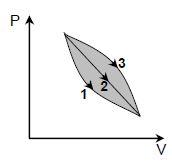
$A$ given mass of gas expands from state $A$ to state $B$ by three paths $1, 2$ and $3$ as shown in the figure. If $w_1, w_2$ and $w_3$ are the work done by the gas along the three paths respectively,then:
A
$w_1 > w_2 > w_3$
B
$w_1 < w_2 < w_3$
C
$w_1 = w_2 = w_3$
D
$w_2 < w_3 < w_1$
Solution
(B) The work done by a gas during expansion is equal to the area under the $P-V$ curve.
From the given figure,the area under the curve for path $3$ is the largest,followed by path $2$,and the area under the curve for path $1$ is the smallest.
Therefore,the work done follows the order $w_3 > w_2 > w_1$,which is equivalent to $w_1 < w_2 < w_3$.
From the given figure,the area under the curve for path $3$ is the largest,followed by path $2$,and the area under the curve for path $1$ is the smallest.
Therefore,the work done follows the order $w_3 > w_2 > w_1$,which is equivalent to $w_1 < w_2 < w_3$.
0 likes
View Solution133
MediumMCQ
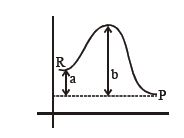
The energy diagram for a reaction $R \to P$ is shown below. The $\Delta H^o$ for the reaction will be:
A
$b-a$
B
$b$
C
$a$
D
$a-b$
Solution
(A) In the given energy profile diagram for the reaction $R \to P$:
$a$ represents the potential energy of the reactant $R$ relative to the baseline.
$b$ represents the potential energy of the product $P$ relative to the baseline.
However,looking at the diagram,$a$ is the energy of $R$ and $b$ is the energy of $P$ relative to the same reference level.
The enthalpy change of the reaction,$\Delta H^o$,is defined as the difference between the potential energy of the products and the potential energy of the reactants.
$\Delta H^o = E_P - E_R$
From the diagram,$E_P = b$ and $E_R = a$.
Therefore,$\Delta H^o = b - a$.
$a$ represents the potential energy of the reactant $R$ relative to the baseline.
$b$ represents the potential energy of the product $P$ relative to the baseline.
However,looking at the diagram,$a$ is the energy of $R$ and $b$ is the energy of $P$ relative to the same reference level.
The enthalpy change of the reaction,$\Delta H^o$,is defined as the difference between the potential energy of the products and the potential energy of the reactants.
$\Delta H^o = E_P - E_R$
From the diagram,$E_P = b$ and $E_R = a$.
Therefore,$\Delta H^o = b - a$.
0 likes
View Solution134
MediumMCQ
Out of boiling point $(I)$,entropy $(II)$,$pH$ $(III)$ and $emf$ of a cell $(IV)$,intensive properties are
A
$I, II$
B
$I, II, III$
C
$I, III, IV$
D
All of these
Solution
(C) Intensive properties are those that do not depend on the quantity of matter present in the system.
Boiling point,$pH$,and $emf$ of a cell are intensive properties because they are independent of the amount of substance.
Entropy $(S)$ is an extensive property because it depends on the amount of matter present in the system.
Therefore,$I, III, \text{and } IV$ are intensive properties.
Boiling point,$pH$,and $emf$ of a cell are intensive properties because they are independent of the amount of substance.
Entropy $(S)$ is an extensive property because it depends on the amount of matter present in the system.
Therefore,$I, III, \text{and } IV$ are intensive properties.
0 likes
View Solution135
EasyMCQ
Work done during the process when $1 \, mol$ of gas is allowed to expand freely into vacuum is:-
A
zero
B
$+ve$
C
$-ve$
D
none of these
Solution
(A) Given: Number of moles $n = 1$.
Since the gas expands freely into a vacuum,the external pressure $P_{ext} = 0 \, atm$.
The formula for work done is $W = -P_{ext} \Delta V$.
Substituting the value of $P_{ext} = 0$,we get $W = -0 \times (V_2 - V_1) = 0$.
Therefore,the work done is zero.
Since the gas expands freely into a vacuum,the external pressure $P_{ext} = 0 \, atm$.
The formula for work done is $W = -P_{ext} \Delta V$.
Substituting the value of $P_{ext} = 0$,we get $W = -0 \times (V_2 - V_1) = 0$.
Therefore,the work done is zero.
0 likes
View Solution136
DifficultMCQ
At a definite temperature,for which of the following reactions will the value of $(\Delta E - \Delta H)$ be maximum?
A
$PCl_{5(g)} \to PCl_{3(g)} + Cl_{2(g)}$
B
$NH_4HS_{(s)} \to NH_{3(g)} + H_2S_{(g)}$
C
$N_{2(g)} + O_{2(g)} \to 2NO_{(g)}$
D
$CaCO_{3(s)} \to CaO_{(s)} + CO_{2(g)}$
Solution
(C) The relationship between enthalpy change and internal energy change is given by $\Delta H = \Delta E + \Delta n_g RT$.
Rearranging this,we get $\Delta E - \Delta H = - \Delta n_g RT$.
For $(\Delta E - \Delta H)$ to be maximum,the value of $-\Delta n_g$ must be maximum,which means $\Delta n_g$ must be the most negative (minimum).
Calculating $\Delta n_g$ (moles of gaseous products - moles of gaseous reactants) for each reaction:
$A: \Delta n_g = (1 + 1) - 1 = 1$
$B: \Delta n_g = (1 + 1) - 0 = 2$
$C: \Delta n_g = 2 - (1 + 1) = 0$
$D: \Delta n_g = (0 + 1) - 0 = 1$
Since $\Delta E - \Delta H = - \Delta n_g RT$,the expression is maximum when $\Delta n_g$ is minimum. However,the question asks for the maximum value. Re-evaluating: if $\Delta n_g$ is negative,the value is positive. Among the given options,$C$ has the lowest $\Delta n_g$ $(0)$,making the value $0$. For $A, B, D$,$\Delta n_g$ is positive,making $(\Delta E - \Delta H)$ negative. Thus,the maximum value is $0$ for option $C$.
Rearranging this,we get $\Delta E - \Delta H = - \Delta n_g RT$.
For $(\Delta E - \Delta H)$ to be maximum,the value of $-\Delta n_g$ must be maximum,which means $\Delta n_g$ must be the most negative (minimum).
Calculating $\Delta n_g$ (moles of gaseous products - moles of gaseous reactants) for each reaction:
$A: \Delta n_g = (1 + 1) - 1 = 1$
$B: \Delta n_g = (1 + 1) - 0 = 2$
$C: \Delta n_g = 2 - (1 + 1) = 0$
$D: \Delta n_g = (0 + 1) - 0 = 1$
Since $\Delta E - \Delta H = - \Delta n_g RT$,the expression is maximum when $\Delta n_g$ is minimum. However,the question asks for the maximum value. Re-evaluating: if $\Delta n_g$ is negative,the value is positive. Among the given options,$C$ has the lowest $\Delta n_g$ $(0)$,making the value $0$. For $A, B, D$,$\Delta n_g$ is positive,making $(\Delta E - \Delta H)$ negative. Thus,the maximum value is $0$ for option $C$.
0 likes
View Solution137
MediumMCQ
An ideal gas is expanded from $1 \times 10^{-3} \,m^3$ to $1 \times 10^{-2} \,m^3$ against a constant external pressure of $1 \times 10^5 \,N/m^2$ at $300 \,K$. The work done is
A
$900 \,kJ$
B
$-900 \,kJ$
C
$270 \,kJ$
D
$-900 \,J$
Solution
(D) The work done during expansion against constant external pressure is given by the formula: $W = -P_{ex} \Delta V$.
Given:
$P_{ex} = 1 \times 10^5 \,N/m^2$
$V_1 = 1 \times 10^{-3} \,m^3$
$V_2 = 1 \times 10^{-2} \,m^3 = 10 \times 10^{-3} \,m^3$
Change in volume:
$\Delta V = V_2 - V_1 = (10 \times 10^{-3} - 1 \times 10^{-3}) \,m^3 = 9 \times 10^{-3} \,m^3$
Calculating work:
$W = -(1 \times 10^5 \,N/m^2) \times (9 \times 10^{-3} \,m^3)$
$W = -9 \times 10^2 \,J = -900 \,J$
Given:
$P_{ex} = 1 \times 10^5 \,N/m^2$
$V_1 = 1 \times 10^{-3} \,m^3$
$V_2 = 1 \times 10^{-2} \,m^3 = 10 \times 10^{-3} \,m^3$
Change in volume:
$\Delta V = V_2 - V_1 = (10 \times 10^{-3} - 1 \times 10^{-3}) \,m^3 = 9 \times 10^{-3} \,m^3$
Calculating work:
$W = -(1 \times 10^5 \,N/m^2) \times (9 \times 10^{-3} \,m^3)$
$W = -9 \times 10^2 \,J = -900 \,J$
0 likes
View Solution138
MediumMCQ
Consider the following reaction:
$CO_{(g)} + 1/2 O_{2_{(g)}} \to CO_{2_{(g)}}$
How are $\Delta E$ and $\Delta H$ related for the reaction?
$CO_{(g)} + 1/2 O_{2_{(g)}} \to CO_{2_{(g)}}$
How are $\Delta E$ and $\Delta H$ related for the reaction?
A
$\Delta H = \Delta E - 0.5 \, RT$
B
$\Delta H = \Delta E - RT$
C
$\Delta H = \Delta E + 0.5 \, RT$
D
$\Delta H = \Delta E - 1.5 \, RT$
Solution
(A) The relationship between enthalpy change $(\Delta H)$ and internal energy change $(\Delta E)$ is given by the equation: $\Delta H = \Delta E + \Delta n_g RT$.
For the reaction $CO_{(g)} + 1/2 O_{2_{(g)}} \to CO_{2_{(g)}}$,the change in the number of moles of gaseous species $(\Delta n_g)$ is calculated as:
$\Delta n_g = (\text{moles of gaseous products}) - (\text{moles of gaseous reactants})$
$\Delta n_g = 1 - (1 + 0.5) = -0.5$.
Substituting this value into the equation:
$\Delta H = \Delta E + (-0.5) RT$
$\Delta H = \Delta E - 0.5 \, RT$.
For the reaction $CO_{(g)} + 1/2 O_{2_{(g)}} \to CO_{2_{(g)}}$,the change in the number of moles of gaseous species $(\Delta n_g)$ is calculated as:
$\Delta n_g = (\text{moles of gaseous products}) - (\text{moles of gaseous reactants})$
$\Delta n_g = 1 - (1 + 0.5) = -0.5$.
Substituting this value into the equation:
$\Delta H = \Delta E + (-0.5) RT$
$\Delta H = \Delta E - 0.5 \, RT$.
0 likes
View Solution139
EasyMCQ
At $27\,^{\circ}C$,$1\, mole$ of an ideal gas expands reversibly and isothermally from $2\, atm$ to $1\, atm$. Then $\Delta H$ will be......$kJ$.
A
$1.73$
B
$0$
C
$-1.73$
D
$3.46$
Solution
(B) For an ideal gas,the enthalpy change $\Delta H$ is given by the relation $\Delta H = nC_p\Delta T$.
Since the process is isothermal,the change in temperature $\Delta T = 0$.
Therefore,$\Delta H = nC_p(0) = 0\, kJ$.
Since the process is isothermal,the change in temperature $\Delta T = 0$.
Therefore,$\Delta H = nC_p(0) = 0\, kJ$.
0 likes
View Solution140
EasyMCQ
Which of the following is an extensive property?
A
molar entropy
B
specific volume
C
Boiling point
D
None of these
Solution
(D) Extensive properties are those properties of a system whose value depends on the quantity or size of matter present in the system. Examples include mass,volume,internal energy,enthalpy,and entropy $(S)$.
$1$. Molar entropy is an intensive property because it is defined per mole of substance.
$2$. Specific volume is an intensive property because it is defined as volume per unit mass.
$3$. Boiling point is an intensive property as it is independent of the amount of substance.
Since none of the given options are extensive properties,the correct answer is $D$.
$1$. Molar entropy is an intensive property because it is defined per mole of substance.
$2$. Specific volume is an intensive property because it is defined as volume per unit mass.
$3$. Boiling point is an intensive property as it is independent of the amount of substance.
Since none of the given options are extensive properties,the correct answer is $D$.
0 likes
View Solution141
EasyMCQ
One mole of an ideal gas at $25\,^{\circ}C$ expands its volume from $1\,L$ to $4\,L$ at constant temperature. What work (in $J$) is done if the gas expands against a vacuum $(P_{ext} = 0)$?
A
$-4 \times 10^2$
B
$-3 \times 10^2$
C
$-1 \times 10^2$
D
Zero
Solution
(D) The work done during the expansion of a gas is given by the formula: $W = -P_{ext} \Delta V$.
Since the gas expands against a vacuum,the external pressure is $P_{ext} = 0 \, atm$.
Substituting the values into the equation: $W = -(0) \times (4 \, L - 1 \, L) = 0 \, J$.
Therefore,the work done is $0 \, J$.
Since the gas expands against a vacuum,the external pressure is $P_{ext} = 0 \, atm$.
Substituting the values into the equation: $W = -(0) \times (4 \, L - 1 \, L) = 0 \, J$.
Therefore,the work done is $0 \, J$.
0 likes
View Solution142
EasyMCQ
Which of the following sets represents the normal physical states of the elements concerned at $25\,^{\circ}C$ and $1 \ bar$ pressure,for which $\Delta H^{\circ}_{f} = 0$?
A
$C(\text{diamond}), S_{8(s)}, Na_{(s)}$
B
$C(\text{diamond}), C(\text{graphite}), Br_{2(l)}$
C
$C(\text{graphite}), Br_{2(g)}, P_{4(\text{white})}$
D
$C(\text{graphite}), Br_{2(l)}, I_{2(s)}$
Solution
(D) The standard enthalpy of formation,$\Delta_{f}H^{\circ}$,is defined as $0$ for an element in its most stable physical state at $25\,^{\circ}C$ $(298 \ K)$ and $1 \ bar$ pressure.
$1$. Carbon is most stable as $C(\text{graphite})$,not diamond.
$2$. Bromine exists as a liquid,$Br_{2(l)}$,at standard conditions.
$3$. Iodine exists as a solid,$I_{2(s)}$,at standard conditions.
Therefore,the set $C(\text{graphite}), Br_{2(l)}, I_{2(s)}$ represents elements in their standard states where $\Delta_{f}H^{\circ} = 0$.
$1$. Carbon is most stable as $C(\text{graphite})$,not diamond.
$2$. Bromine exists as a liquid,$Br_{2(l)}$,at standard conditions.
$3$. Iodine exists as a solid,$I_{2(s)}$,at standard conditions.
Therefore,the set $C(\text{graphite}), Br_{2(l)}, I_{2(s)}$ represents elements in their standard states where $\Delta_{f}H^{\circ} = 0$.
0 likes
View Solution143
DifficultMCQ
For which of the following reactions,$\Delta H$ is equal to $\Delta U$ ?
A
$N_{2(g)} + 3H_{2(g)} \to 2NH_{3(g)}$
B
$2HI_{(g)} \to H_{2(g)} + I_{2(g)}$
C
$2SO_{2(g)} + O_{2(g)} \to 2SO_{3(g)}$
D
$2NO_{2(g)} \to N_2O_{4(g)}$
Solution
(B) The relationship between enthalpy change $(\Delta H)$ and internal energy change $(\Delta U)$ is given by the equation: $\Delta H = \Delta U \Delta n_g RT$.
For $\Delta H$ to be equal to $\Delta U$,the term $\Delta n_g$ must be $0$.
$\Delta n_g$ is the difference between the sum of stoichiometric coefficients of gaseous products and gaseous reactants.
For option $B$: $2HI_{(g)} \to H_{2(g)} I_{2(g)}$,$\Delta n_g = (1 1) - 2 = 0$.
Since $\Delta n_g = 0$,$\Delta H = \Delta U 0$,which means $\Delta H = \Delta U$.
For $\Delta H$ to be equal to $\Delta U$,the term $\Delta n_g$ must be $0$.
$\Delta n_g$ is the difference between the sum of stoichiometric coefficients of gaseous products and gaseous reactants.
For option $B$: $2HI_{(g)} \to H_{2(g)} I_{2(g)}$,$\Delta n_g = (1 1) - 2 = 0$.
Since $\Delta n_g = 0$,$\Delta H = \Delta U 0$,which means $\Delta H = \Delta U$.
0 likes
View Solution144
DifficultMCQ
An ideal gas undergoes isothermal expansion at constant pressure. During the process
A
enthalpy increases but entropy decreases
B
enthalpy remains constant but entropy increases
C
enthalpy decreases but entropy increases.
D
Both enthalpy and entropy remain constant.
Solution
(B) For an ideal gas,enthalpy $H$ is a function of temperature only,i.e.,$H = f(T)$.
Since the process is isothermal,the change in temperature $\Delta T = 0$,therefore $\Delta H = n C_p \Delta T = 0$,which means enthalpy remains constant.
For an expansion process,the final volume $V_f$ is greater than the initial volume $V_i$ $(V_f > V_i)$.
The change in entropy for an ideal gas is given by $\Delta S = n R \ln(V_f / V_i)$.
Since $V_f / V_i > 1$,$\ln(V_f / V_i) > 0$,therefore $\Delta S > 0$,which means entropy increases.
Since the process is isothermal,the change in temperature $\Delta T = 0$,therefore $\Delta H = n C_p \Delta T = 0$,which means enthalpy remains constant.
For an expansion process,the final volume $V_f$ is greater than the initial volume $V_i$ $(V_f > V_i)$.
The change in entropy for an ideal gas is given by $\Delta S = n R \ln(V_f / V_i)$.
Since $V_f / V_i > 1$,$\ln(V_f / V_i) > 0$,therefore $\Delta S > 0$,which means entropy increases.
0 likes
View Solution145
DifficultMCQ
Consider the reversible isothermal expansion of an ideal gas in a closed system at two different temperatures $T_1$ and $T_2$ $(T_1 < T_2)$. The correct graphical depiction of the dependence of work done $(|w|)$ on the final volume $(ln V)$ is:
A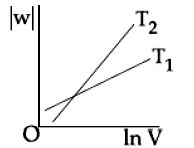
B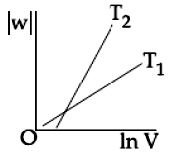
C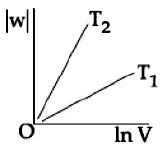
D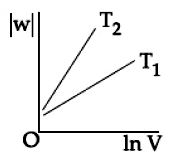
Solution
(B) For a reversible isothermal expansion,the work done by the gas is given by $w = -nRT \ln(\frac{V_f}{V_i})$.
Taking the magnitude,we have $|w| = nRT \ln V_f - nRT \ln V_i$.
This equation is in the form of a straight line $y = mx + c$,where $y = |w|$,$x = ln V_f$,slope $m = nRT$,and intercept $c = -nRT \ln V_i$.
Since $T_2 > T_1$,the slope for $T_2$ $(nRT_2)$ is greater than the slope for $T_1$ $(nRT_1)$.
Also,for a given expansion,the intercept $-nRT \ln V_i$ will be more negative for higher temperatures if we assume the same initial state or consistent expansion parameters,leading to the graph where the line for $T_2$ is steeper and has a lower intercept than the line for $T_1$.
Taking the magnitude,we have $|w| = nRT \ln V_f - nRT \ln V_i$.
This equation is in the form of a straight line $y = mx + c$,where $y = |w|$,$x = ln V_f$,slope $m = nRT$,and intercept $c = -nRT \ln V_i$.
Since $T_2 > T_1$,the slope for $T_2$ $(nRT_2)$ is greater than the slope for $T_1$ $(nRT_1)$.
Also,for a given expansion,the intercept $-nRT \ln V_i$ will be more negative for higher temperatures if we assume the same initial state or consistent expansion parameters,leading to the graph where the line for $T_2$ is steeper and has a lower intercept than the line for $T_1$.
0 likes
View Solution146
DifficultMCQ
Among the following,the set of parameters that represents path functions is:
$(a) \ q + w$
$(b) \ q$
$(c) \ w$
$(d) \ H - TS$
$(a) \ q + w$
$(b) \ q$
$(c) \ w$
$(d) \ H - TS$
A
$(b)$ and $(c)$
B
$(b), (c)$ and $(d)$
C
$(a), (b)$ and $(c)$
D
$(a)$ and $(d)$
Solution
(A) Path functions are properties whose values depend on the path taken to reach a state,not just the initial and final states.
$q$ (heat) and $w$ (work) are path functions.
$q + w$ represents the change in internal energy $(\Delta U)$,which is a state function.
$H - TS$ represents the Gibbs free energy $(G)$,which is a state function.
Therefore,only $q$ and $w$ are path functions.
$q$ (heat) and $w$ (work) are path functions.
$q + w$ represents the change in internal energy $(\Delta U)$,which is a state function.
$H - TS$ represents the Gibbs free energy $(G)$,which is a state function.
Therefore,only $q$ and $w$ are path functions.
0 likes
View Solution147
MediumMCQ
An ideal gas is allowed to expand from $1 \, L$ to $10 \, L$ against a constant external pressure of $1 \, bar$. The work done in $kJ$ is
A
$-0.9$
B
$-9$
C
$-2$
D
$+10$
Solution
(A) The work done during expansion against a constant external pressure is given by the formula: $W = -P_{ext} \cdot \Delta V$.
Given: $P_{ext} = 1 \, bar$, $V_1 = 1 \, L$, $V_2 = 10 \, L$.
$\Delta V = V_2 - V_1 = 10 \, L - 1 \, L = 9 \, L$.
$W = -1 \, bar \cdot 9 \, L = -9 \, bar \cdot L$.
Since $1 \, bar \cdot L = 100 \, J$, then $W = -9 \times 100 \, J = -900 \, J$.
Converting to $kJ$: $W = -900 \, J / 1000 = -0.9 \, kJ$.
Given: $P_{ext} = 1 \, bar$, $V_1 = 1 \, L$, $V_2 = 10 \, L$.
$\Delta V = V_2 - V_1 = 10 \, L - 1 \, L = 9 \, L$.
$W = -1 \, bar \cdot 9 \, L = -9 \, bar \cdot L$.
Since $1 \, bar \cdot L = 100 \, J$, then $W = -9 \times 100 \, J = -900 \, J$.
Converting to $kJ$: $W = -900 \, J / 1000 = -0.9 \, kJ$.
0 likes
View Solution148
MediumMCQ
$1 \, mol$ of an ideal gas is compressed reversibly at a constant temperature of $27 \, ^oC$ from $1 \, bar$ to $4 \, bar$. Calculate the work done in $kJ$.
A
$4.01$
B
$3.458$
C
$18.02$
D
$-14.01$
Solution
(B) For a reversible isothermal compression of an ideal gas,the work done is given by the formula: $W = -2.303 \, nRT \log \frac{P_1}{P_2}$
Given: $n = 1 \, mol$,$T = 27 + 273 = 300 \, K$,$R = 8.314 \, J \, K^{-1} \, mol^{-1}$,$P_1 = 1 \, bar$,$P_2 = 4 \, bar$.
Substituting the values: $W = -2.303 \times 1 \times 8.314 \times 300 \times \log(\frac{1}{4})$
$W = -2.303 \times 8.314 \times 300 \times (-0.602)$
$W = +3.458 \, kJ$.
Given: $n = 1 \, mol$,$T = 27 + 273 = 300 \, K$,$R = 8.314 \, J \, K^{-1} \, mol^{-1}$,$P_1 = 1 \, bar$,$P_2 = 4 \, bar$.
Substituting the values: $W = -2.303 \times 1 \times 8.314 \times 300 \times \log(\frac{1}{4})$
$W = -2.303 \times 8.314 \times 300 \times (-0.602)$
$W = +3.458 \, kJ$.
0 likes
View Solution149
EasyMCQ
Which of the following is not an extensive property?
A
Temperature
B
Pressure
C
Viscosity
D
All
Solution
(D) Extensive properties are those that depend on the amount of matter present in the system (e.g.,mass,volume,internal energy).
Intensive properties are those that are independent of the amount of matter present in the system.
Temperature,pressure,and viscosity are all independent of the amount of matter in the system,meaning they are intensive properties.
Therefore,all of the given options are not extensive properties.
Intensive properties are those that are independent of the amount of matter present in the system.
Temperature,pressure,and viscosity are all independent of the amount of matter in the system,meaning they are intensive properties.
Therefore,all of the given options are not extensive properties.
0 likes
View Solution150
MediumMCQ
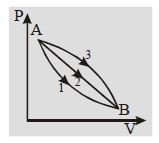
$A$ given mass of gas expands reversibly from the state $A$ to the state $B$ by three paths $1, 2$ and $3$ as shown in the figure. If $w_1, w_2$ and $w_3$ respectively be the work done by the gas along three paths then:
A
$w_1 > w_2 > w_3$
B
$w_1 < w_2 < w_3$
C
$w_1 = w_2 = w_3$
D
$w_2 < w_3 < w_1$
Solution
(B) The work done by a gas during an expansion process is equal to the area under the $PV$ curve.
In the given graph,the area under the path represents the work done by the gas.
Comparing the areas under the three paths:
- The area under path $3$ is the largest.
- The area under path $2$ is intermediate.
- The area under path $1$ is the smallest.
Therefore,the work done follows the order: $w_1 < w_2 < w_3$.
In the given graph,the area under the path represents the work done by the gas.
Comparing the areas under the three paths:
- The area under path $3$ is the largest.
- The area under path $2$ is intermediate.
- The area under path $1$ is the smallest.
Therefore,the work done follows the order: $w_1 < w_2 < w_3$.
0 likes
View SolutionThermodynamics — Basic concepts · Frequently Asked Questions
1Are these Thermodynamics questions useful for JEE and NEET?
Yes. All questions in this section are mapped to JEE Main and NEET exam patterns. Previous year questions from JEE Main, NEET, GUJCET and state-level exams are included with full solutions.
2Can I switch to Hindi or Gujarati for these questions?
Yes. Use the language tabs in the hero section or the sidebar to view the same questions and solutions in English, Hindi or Gujarati.
3How do I generate a question paper from this subtopic?
Use the Vedclass Exam Paper Generator — select the chapter and subtopic, set difficulty, and generate Sets A, B, C, D automatically. First 3 chapters of every subject are free.
Vedclass Products
For Students
Vedclass Test Series
Mock tests in real JEE/NEET style with performance analysis. 5-day free trial.
Start Free TrialFor Teachers
Exam Paper Generator
Generate Set A/B/C/D papers from this chapter in 2 minutes. 3 chapters free.
Try FreeFor Institutes
Online Exam Module
Live online exams with unlimited students, 360° analytics & white-label branding.
See DemoFor Teachers & Institutes
Generate a Thermodynamics Exam Paper in 2 Minutes
Select subtopic & difficulty — Sets A, B, C, D auto-generated with No Repeat logic.
First 3 chapters of every subject are free — no payment required.