
A English
Quantum number, Electronic configuration and Shape of orbitals Questions in English
Class 11 Chemistry · Structure of Atom · Quantum number, Electronic configuration and Shape of orbitals
1023+
Questions
English
Language
100%
With Solutions
Showing 50 of 1023 questions in English
301
MediumMCQ
Statement $A$: An orbital can accommodate a maximum of two electrons.
Reason $R$: Two electrons in an orbital produce opposite magnetic fields.
Reason $R$: Two electrons in an orbital produce opposite magnetic fields.
A
$A$ and $R$ are both true and $R$ is the correct explanation of $A$.
B
$A$ and $R$ are both true but $R$ is not the correct explanation of $A$.
C
$A$ is true,while $R$ is false.
D
$A$ is false,while $R$ is true.
Solution
(B) Statement $A$ is based on the Pauli Exclusion Principle,which states that no two electrons in an atom can have the same set of four quantum numbers. This implies that an orbital can hold a maximum of two electrons with opposite spins.
Reason $R$ is also a true statement because electrons have spin angular momentum,which generates a magnetic moment. Electrons with opposite spins produce magnetic fields that are oriented in opposite directions.
However,the reason $R$ is not the direct explanation for why an orbital can only hold two electrons; the Pauli Exclusion Principle is the fundamental reason. Therefore,both statements are true,but $R$ is not the correct explanation of $A$.
Reason $R$ is also a true statement because electrons have spin angular momentum,which generates a magnetic moment. Electrons with opposite spins produce magnetic fields that are oriented in opposite directions.
However,the reason $R$ is not the direct explanation for why an orbital can only hold two electrons; the Pauli Exclusion Principle is the fundamental reason. Therefore,both statements are true,but $R$ is not the correct explanation of $A$.
0 likes
View Solution302
MediumMCQ
Which of the following rules describes the order in which electrons fill various orbitals?
A
Hund's rule
B
Octet rule
C
Aufbau principle
D
All of the above
Solution
(C) - The $Aufbau$ principle states that electrons fill orbitals in the order of increasing energy.
0 likes
View Solution303
MediumMCQ
The atomic number of the element (in ground state) having the maximum number of unpaired $3p$ electrons is:
A
$15$
B
$10$
C
$12$
D
$8$
Solution
(A) The electronic configuration of the given elements in their ground state is as follows:
$1.$ For atomic number $8$ $(O)$: $1s^2 2s^2 2p^4$. Number of unpaired $3p$ electrons = $0$.
$2.$ For atomic number $10$ $(Ne)$: $1s^2 2s^2 2p^6$. Number of unpaired $3p$ electrons = $0$.
$3.$ For atomic number $12$ $(Mg)$: $1s^2 2s^2 2p^6 3s^2$. Number of unpaired $3p$ electrons = $0$.
$4.$ For atomic number $15$ $(P)$: $1s^2 2s^2 2p^6 3s^2 3p^3$. The $3p$ subshell has $3$ orbitals,each containing $1$ unpaired electron according to Hund's rule.
Thus,the element with atomic number $15$ has the maximum number of unpaired $3p$ electrons ($3$ unpaired electrons).
$1.$ For atomic number $8$ $(O)$: $1s^2 2s^2 2p^4$. Number of unpaired $3p$ electrons = $0$.
$2.$ For atomic number $10$ $(Ne)$: $1s^2 2s^2 2p^6$. Number of unpaired $3p$ electrons = $0$.
$3.$ For atomic number $12$ $(Mg)$: $1s^2 2s^2 2p^6 3s^2$. Number of unpaired $3p$ electrons = $0$.
$4.$ For atomic number $15$ $(P)$: $1s^2 2s^2 2p^6 3s^2 3p^3$. The $3p$ subshell has $3$ orbitals,each containing $1$ unpaired electron according to Hund's rule.
Thus,the element with atomic number $15$ has the maximum number of unpaired $3p$ electrons ($3$ unpaired electrons).
0 likes
View Solution304
MediumMCQ
The maximum number of electrons in a $P$ orbital with $n = 6$ and $m = 0$ is ......
A
$14$
B
$6$
C
$2$
D
$10$
Solution
(C) For any given orbital,the maximum number of electrons it can hold is $2$,according to the Pauli Exclusion Principle.
Since the question specifies a single orbital (defined by $n=6$,$l=1$ for $P$,and $m=0$),it can accommodate a maximum of $2$ electrons.
Since the question specifies a single orbital (defined by $n=6$,$l=1$ for $P$,and $m=0$),it can accommodate a maximum of $2$ electrons.
0 likes
View Solution305
MediumMCQ
Which of the following represents the ground state of an atom?
A
$1s^2 2s^2 2p^6 3s^2 3p^6 4s^2 3d^1$
B
$1s^2 2s^2 2p^6 3s^2 3p^6 4s^2 3d^0$
C
$1s^2 2s^2 2p^6 3s^2 3p^6 4s^1 3d^1$
D
$1s^2 2s^2 2p^6 3s^2 3p^6 4s^0 3d^2$
Solution
(B) The ground state of an atom is the state with the lowest possible energy configuration,following the Aufbau principle,Pauli exclusion principle,and Hund's rule.
Comparing the given configurations:
$(A)$ $1s^2 2s^2 2p^6 3s^2 3p^6 4s^2 3d^1$ corresponds to Scandium ($Sc$,$Z=21$).
$(B)$ $1s^2 2s^2 2p^6 3s^2 3p^6 4s^2 3d^0$ corresponds to Calcium ($Ca$,$Z=20$).
$(C)$ $1s^2 2s^2 2p^6 3s^2 3p^6 4s^1 3d^1$ is an excited state of Scandium.
$(D)$ $1s^2 2s^2 2p^6 3s^2 3p^6 4s^0 3d^2$ is an excited state of Scandium.
Since all options represent valid electronic configurations,the question typically refers to the standard filling order. Option $B$ represents the stable ground state of Calcium.
Comparing the given configurations:
$(A)$ $1s^2 2s^2 2p^6 3s^2 3p^6 4s^2 3d^1$ corresponds to Scandium ($Sc$,$Z=21$).
$(B)$ $1s^2 2s^2 2p^6 3s^2 3p^6 4s^2 3d^0$ corresponds to Calcium ($Ca$,$Z=20$).
$(C)$ $1s^2 2s^2 2p^6 3s^2 3p^6 4s^1 3d^1$ is an excited state of Scandium.
$(D)$ $1s^2 2s^2 2p^6 3s^2 3p^6 4s^0 3d^2$ is an excited state of Scandium.
Since all options represent valid electronic configurations,the question typically refers to the standard filling order. Option $B$ represents the stable ground state of Calcium.
0 likes
View Solution306
MediumMCQ
What is the number of unpaired electrons in the electronic configuration of the $N^{+2}$ ion?
A
$0$
B
$1$
C
$2$
D
$3$
Solution
(B) The atomic number of Nitrogen $(N)$ is $7$. The electronic configuration of $N$ is $1s^2 2s^2 2p^3$.
For the $N^{+2}$ ion,two electrons are removed from the $2p$ orbital.
The electronic configuration of $N^{+2}$ becomes $1s^2 2s^2 2p^1$.
In the $2p^1$ orbital,there is $1$ unpaired electron.
Therefore,the number of unpaired electrons is $1$.
For the $N^{+2}$ ion,two electrons are removed from the $2p$ orbital.
The electronic configuration of $N^{+2}$ becomes $1s^2 2s^2 2p^1$.
In the $2p^1$ orbital,there is $1$ unpaired electron.
Therefore,the number of unpaired electrons is $1$.
0 likes
View Solution307
MediumMCQ
An element has an outermost orbital configuration of $4s^2$. What is its atomic number?
A
$29$
B
$24$
C
$30$
D
$19$
Solution
(C) The electronic configuration of an element with the outermost orbital $4s^2$ implies that the $3d$ subshell is completely filled.
Following the Aufbau principle,the complete electronic configuration is $1s^2 2s^2 2p^6 3s^2 3p^6 3d^{10} 4s^2$.
Summing the electrons: $2 + 2 + 6 + 2 + 6 + 10 + 2 = 30$.
Therefore,the atomic number is $30$,which corresponds to Zinc $(Zn)$.
Following the Aufbau principle,the complete electronic configuration is $1s^2 2s^2 2p^6 3s^2 3p^6 3d^{10} 4s^2$.
Summing the electrons: $2 + 2 + 6 + 2 + 6 + 10 + 2 = 30$.
Therefore,the atomic number is $30$,which corresponds to Zinc $(Zn)$.
0 likes
View Solution308
MediumMCQ
For $n = 4$,what is the total number of orbitals?
A
$4$
B
$8$
C
$16$
D
$32$
Solution
(C) The total number of orbitals in a shell with principal quantum number $n$ is given by the formula $n^2$.
For $n = 4$,the total number of orbitals is $4^2 = 16$.
For $n = 4$,the total number of orbitals is $4^2 = 16$.
0 likes
View Solution309
EasyMCQ
What is the total spin for the electronic configuration of fluorine $(F)$?
A
$0.5$
B
$2$
C
$1$
D
$1.5$
Solution
(A) The atomic number of fluorine $(F)$ is $9$.
The electronic configuration of fluorine is $1s^2 2s^2 2p^5$.
In the $2p$ subshell,there are $5$ electrons.
According to Hund's rule,the electrons are filled as: $2p_x^2, 2p_y^2, 2p_z^1$.
The paired electrons have spins of $+1/2$ and $-1/2$,which cancel each other out.
There is only one unpaired electron in the $2p_z$ orbital.
The total spin $(S)$ is equal to $n \times (1/2)$,where $n$ is the number of unpaired electrons.
Here,$n = 1$,so $S = 1 \times (1/2) = 0.5$.
The electronic configuration of fluorine is $1s^2 2s^2 2p^5$.
In the $2p$ subshell,there are $5$ electrons.
According to Hund's rule,the electrons are filled as: $2p_x^2, 2p_y^2, 2p_z^1$.
The paired electrons have spins of $+1/2$ and $-1/2$,which cancel each other out.
There is only one unpaired electron in the $2p_z$ orbital.
The total spin $(S)$ is equal to $n \times (1/2)$,where $n$ is the number of unpaired electrons.
Here,$n = 1$,so $S = 1 \times (1/2) = 0.5$.
0 likes
View Solution310
MediumMCQ
Which set of quantum numbers is correct for the unpaired electron of a chlorine atom?
A
$n = 2, l = 1, m = 0, s = 1/2$
B
$n = 1, l = 1, m = 1, s = -1/2$
C
$n = 3, l = 1, m = 1, s = 1/2$
D
$n = 2, l = 1, m = -1, s = -1/2$
Solution
(C) The atomic number of chlorine $(Cl)$ is $17$.
The electronic configuration of $Cl$ is $1s^2 2s^2 2p^6 3s^2 3p^5$.
The unpaired electron is present in the $3p$ orbital.
For the $3p$ orbital,the principal quantum number $n = 3$ and the azimuthal quantum number $l = 1$.
The magnetic quantum number $m$ can be $-1, 0, +1$,and the spin quantum number $s$ can be $\pm 1/2$.
Comparing this with the given options,option $C$ $(n = 3, l = 1, m = 1, s = 1/2)$ represents a valid set of quantum numbers for an electron in the $3p$ subshell.
The electronic configuration of $Cl$ is $1s^2 2s^2 2p^6 3s^2 3p^5$.
The unpaired electron is present in the $3p$ orbital.
For the $3p$ orbital,the principal quantum number $n = 3$ and the azimuthal quantum number $l = 1$.
The magnetic quantum number $m$ can be $-1, 0, +1$,and the spin quantum number $s$ can be $\pm 1/2$.
Comparing this with the given options,option $C$ $(n = 3, l = 1, m = 1, s = 1/2)$ represents a valid set of quantum numbers for an electron in the $3p$ subshell.
0 likes
View Solution311
DifficultMCQ
The five valence electrons of $_{15}P$ are represented as shown in the figure. If the spin quantum number of $B$ and $Z$ is $+1/2$,which of the following groups has three identical quantum numbers?

A
$AB, XYZ, BY$
B
$AB$
C
$XYZ, AZ$
D
$AB, XYZ$
Solution
(B) The electronic configuration of $_{15}P$ is $[Ne] 3s^2 3p^3$.
In the $3s$ orbital,there are two electrons ($A$ and $B$) with opposite spins.
For electron $A$,$n=3, l=0, m=0, s=-1/2$.
For electron $B$,$n=3, l=0, m=0, s=+1/2$.
Since $A$ and $B$ share the same principal $(n)$,azimuthal $(l)$,and magnetic $(m)$ quantum numbers,they have three identical quantum numbers.
In the $3s$ orbital,there are two electrons ($A$ and $B$) with opposite spins.
For electron $A$,$n=3, l=0, m=0, s=-1/2$.
For electron $B$,$n=3, l=0, m=0, s=+1/2$.
Since $A$ and $B$ share the same principal $(n)$,azimuthal $(l)$,and magnetic $(m)$ quantum numbers,they have three identical quantum numbers.
0 likes
View Solution312
MediumMCQ
According to which principle is the electronic configuration of nitrogen $1s^2 2s^2 2p_x^1 2p_y^1 2p_z^1$ and not $1s^2 2s^2 2p_x^2 2p_y^1 2p_z^0$?
A
Aufbau principle
B
Pauli exclusion principle
C
Hund's rule
D
de Broglie principle
Solution
(C) Hund's rule of maximum multiplicity states that for a given electron configuration,the term with the maximum multiplicity has the lowest energy.
In the case of nitrogen $(Z = 7)$,the electronic configuration is $1s^2 2s^2 2p^3$.
According to Hund's rule,electrons fill degenerate orbitals (like $2p_x, 2p_y, 2p_z$) singly first before pairing occurs.
Therefore,$1s^2 2s^2 2p_x^1 2p_y^1 2p_z^1$ is the correct ground state configuration,while $1s^2 2s^2 2p_x^2 2p_y^1 2p_z^0$ represents an excited state.
In the case of nitrogen $(Z = 7)$,the electronic configuration is $1s^2 2s^2 2p^3$.
According to Hund's rule,electrons fill degenerate orbitals (like $2p_x, 2p_y, 2p_z$) singly first before pairing occurs.
Therefore,$1s^2 2s^2 2p_x^1 2p_y^1 2p_z^1$ is the correct ground state configuration,while $1s^2 2s^2 2p_x^2 2p_y^1 2p_z^0$ represents an excited state.
0 likes
View Solution313
MediumMCQ
Which statement is true regarding the hydrogen atom?
A
The energy of the $3d$-orbital is lower than the energy of the $3p$-orbital.
B
The energy of the $3p$-orbital is lower than the energy of the $3d$-orbital.
C
The energy of $3s$ and $3p$-orbitals is lower than the energy of the $3d$-orbital.
D
All $3s$,$3p$,and $3d$ orbitals have the same energy.
Solution
(D) In a hydrogen atom,the energy of an orbital depends only on the principal quantum number $(n)$.
Since all the given orbitals ($3s$,$3p$,and $3d$) have the same principal quantum number $(n = 3)$,they are degenerate,meaning they possess the same energy.
Therefore,the correct statement is that all $3s$,$3p$,and $3d$ orbitals have the same energy.
Since all the given orbitals ($3s$,$3p$,and $3d$) have the same principal quantum number $(n = 3)$,they are degenerate,meaning they possess the same energy.
Therefore,the correct statement is that all $3s$,$3p$,and $3d$ orbitals have the same energy.
0 likes
View Solution314
MediumMCQ
What is the decreasing order of energy for the $2s$-orbital of $H, Li, Na$,and $K$ atoms?
A
$E_{2s(H)} > E_{2s(Li)} > E_{2s(Na)} > E_{2s(K)}$
B
$E_{2s(H)} > E_{2s(Na)} > E_{2s(Li)} > E_{2s(K)}$
C
$E_{2s(H)} > E_{2s(Na)} = E_{2s(K)} > E_{2s(Li)}$
D
$E_{2s(K)} < E_{2s(Na)} < E_{2s(Li)} < E_{2s(H)}$
Solution
(A) The energy of an orbital in a multi-electron atom depends on the effective nuclear charge $(Z_{eff})$.
As the atomic number $(Z)$ increases,the attraction between the nucleus and the electrons increases,which lowers the energy of the orbital.
For the $2s$-orbital,the energy decreases as the nuclear charge increases.
The atomic numbers are $H (Z=1)$,$Li (Z=3)$,$Na (Z=11)$,and $K (Z=19)$.
Since $Z_{eff}$ increases from $H$ to $K$,the energy of the $2s$-orbital decreases in the order: $E_{2s(H)} > E_{2s(Li)} > E_{2s(Na)} > E_{2s(K)}$.
As the atomic number $(Z)$ increases,the attraction between the nucleus and the electrons increases,which lowers the energy of the orbital.
For the $2s$-orbital,the energy decreases as the nuclear charge increases.
The atomic numbers are $H (Z=1)$,$Li (Z=3)$,$Na (Z=11)$,and $K (Z=19)$.
Since $Z_{eff}$ increases from $H$ to $K$,the energy of the $2s$-orbital decreases in the order: $E_{2s(H)} > E_{2s(Li)} > E_{2s(Na)} > E_{2s(K)}$.
0 likes
View Solution315
MediumMCQ
Statement $1$: The energy of an electron is determined by the principal quantum number.
Statement $2$: The principal quantum number $(n)$ indicates the distance of the electron from the nucleus.
Statement $2$: The principal quantum number $(n)$ indicates the distance of the electron from the nucleus.
A
Statement $1$ and Statement $2$ are both true,and Statement $2$ is the correct explanation of Statement $1$.
B
Statement $1$ and Statement $2$ are both true,but Statement $2$ is not the correct explanation of Statement $1$.
C
Statement $1$ is true,while Statement $2$ is false.
D
Statement $1$ is false,while Statement $2$ is false.
Solution
(A) Statement $1$ is true because,in a hydrogen-like atom,the energy of an orbital depends only on the principal quantum number $(n)$,given by the formula $E_n = -R_H \times (Z^2 / n^2)$.
Statement $2$ is also true because the principal quantum number $(n)$ defines the shell and determines the average distance of the electron from the nucleus.
Since the energy level of the electron is directly related to its distance from the nucleus (as defined by the shell $n$),Statement $2$ provides the physical basis for Statement $1$.
Statement $2$ is also true because the principal quantum number $(n)$ defines the shell and determines the average distance of the electron from the nucleus.
Since the energy level of the electron is directly related to its distance from the nucleus (as defined by the shell $n$),Statement $2$ provides the physical basis for Statement $1$.
0 likes
View Solution316
EasyMCQ
Which of the following sets of quantum numbers is not possible?
A
$n = 3, l = 2, m = 1, s = +1/2$
B
$n = 3, l = 2, m = 1, s = -1/2$
C
$n = 3, l = 2, m = 1, s = 0$
D
$n = 3, l = 2, m = -1, s = +1/2$
Solution
(C) For any electron,the spin quantum number $(s)$ can only have two possible values: $+1/2$ or $-1/2$.
It cannot be $0$.
Therefore,the set $n = 3, l = 2, m = 1, s = 0$ is not possible.
It cannot be $0$.
Therefore,the set $n = 3, l = 2, m = 1, s = 0$ is not possible.
0 likes
View Solution317
MediumMCQ
Which set of quantum numbers is correct for the valence electron of $Na$?
A
$n = 2, l = 1, m = -1, s = 1/2$
B
$n = 3, l = 0, m = 0, s = 1/2$
C
$n = 1, l = 1, m = -1, s = 1/2$
D
$n = 3, l = 1, m = -1, s = 1/2$
Solution
(B) The atomic number of $Na$ is $11$.
The electronic configuration of $Na$ is $1s^2 2s^2 2p^6 3s^1$.
The valence electron is the one in the $3s$ orbital.
For the $3s$ orbital:
Principal quantum number $(n)$ = $3$.
Azimuthal quantum number $(l)$ for $s$-orbital = $0$.
Magnetic quantum number $(m)$ = $0$.
Spin quantum number $(s)$ = $+1/2$ or $-1/2$.
Thus,the correct set is $(n = 3, l = 0, m = 0, s = 1/2)$.
The electronic configuration of $Na$ is $1s^2 2s^2 2p^6 3s^1$.
The valence electron is the one in the $3s$ orbital.
For the $3s$ orbital:
Principal quantum number $(n)$ = $3$.
Azimuthal quantum number $(l)$ for $s$-orbital = $0$.
Magnetic quantum number $(m)$ = $0$.
Spin quantum number $(s)$ = $+1/2$ or $-1/2$.
Thus,the correct set is $(n = 3, l = 0, m = 0, s = 1/2)$.
0 likes
View Solution318
MediumMCQ
If the electronic configuration of a nitrogen atom were $1s^7$,its energy would be lower than the ground state configuration $1s^2 2s^2 2p^3$ because the electrons would be closer to the nucleus. However,the configuration $1s^7$ is not observed. Which of the following principles is violated?
A
Heisenberg uncertainty principle
B
Hund's rule
C
Pauli exclusion principle
D
Bohr's postulates of stationary orbits
Solution
(C) The $1s$ orbital can accommodate a maximum of $2$ electrons according to the Pauli exclusion principle,which states that no two electrons in an atom can have the same set of all four quantum numbers.
Since an $s$-orbital has only one subshell $(m_l = 0)$ and can hold electrons with opposite spins ($m_s = +1/2$ and $-1/2$),it cannot hold $7$ electrons.
Therefore,the configuration $1s^7$ violates the Pauli exclusion principle.
Since an $s$-orbital has only one subshell $(m_l = 0)$ and can hold electrons with opposite spins ($m_s = +1/2$ and $-1/2$),it cannot hold $7$ electrons.
Therefore,the configuration $1s^7$ violates the Pauli exclusion principle.
0 likes
View Solution319
MediumMCQ
$A$: The energy of an electron can be determined by the principal quantum number.
$R$: The principal quantum number $(n)$ determines the possible distance of the electron from the nucleus.
$R$: The principal quantum number $(n)$ determines the possible distance of the electron from the nucleus.
A
$A$ and $R$ are both correct and $R$ is the correct explanation of $A$.
B
$A$ and $R$ are both correct,but $R$ is not the correct explanation of $A$.
C
$A$ is correct,but $R$ is incorrect.
D
$A$ is incorrect,but $R$ is correct.
Solution
(A) The energy of an electron in a hydrogen-like atom is given by the formula $E_n = -\frac{13.6 \ Z^2}{n^2} \ eV$,which depends on the principal quantum number $n$.
Thus,statement $A$ is correct.
The principal quantum number $n$ defines the shell and determines the average distance of the electron from the nucleus.
Thus,statement $R$ is correct and it explains why the energy depends on $n$ (as energy is a function of distance from the nucleus).
Therefore,the correct option is $A$.
Thus,statement $A$ is correct.
The principal quantum number $n$ defines the shell and determines the average distance of the electron from the nucleus.
Thus,statement $R$ is correct and it explains why the energy depends on $n$ (as energy is a function of distance from the nucleus).
Therefore,the correct option is $A$.
0 likes
View Solution320
EasyMCQ
If $n = 3$,which of the following values of $l$ is correct?
A
$0$
B
$1$
C
$2$
D
All of these
0 likes
View Solution321
DifficultMCQ
The sum of paired electrons present in $l = 2$ orbitals for the species $Fe^{2+}$,$Co^{2+}$,and $Ni^{2+}$ is .......
A
$9$
B
$12$
C
$6$
D
$15$
Solution
(B) The $l = 2$ orbital corresponds to the $d$-subshell.
$1$. For $_{26}Fe^{2+}$: Electronic configuration is $[Ar] 3d^6$. In $3d^6$,there is $1$ paired electron set (containing $2$ electrons) and $4$ unpaired electrons. Number of paired electrons = $2$.
$2$. For $_{27}Co^{2+}$: Electronic configuration is $[Ar] 3d^7$. In $3d^7$,there are $2$ paired electron sets (containing $4$ electrons) and $3$ unpaired electrons. Number of paired electrons = $4$.
$3$. For $_{28}Ni^{2+}$: Electronic configuration is $[Ar] 3d^8$. In $3d^8$,there are $3$ paired electron sets (containing $6$ electrons) and $2$ unpaired electrons. Number of paired electrons = $6$.
Total number of paired electrons = $2 + 4 + 6 = 12$.
$1$. For $_{26}Fe^{2+}$: Electronic configuration is $[Ar] 3d^6$. In $3d^6$,there is $1$ paired electron set (containing $2$ electrons) and $4$ unpaired electrons. Number of paired electrons = $2$.
$2$. For $_{27}Co^{2+}$: Electronic configuration is $[Ar] 3d^7$. In $3d^7$,there are $2$ paired electron sets (containing $4$ electrons) and $3$ unpaired electrons. Number of paired electrons = $4$.
$3$. For $_{28}Ni^{2+}$: Electronic configuration is $[Ar] 3d^8$. In $3d^8$,there are $3$ paired electron sets (containing $6$ electrons) and $2$ unpaired electrons. Number of paired electrons = $6$.
Total number of paired electrons = $2 + 4 + 6 = 12$.
0 likes
View Solution322
EasyMCQ
Which rule is violated in the given electronic configuration?

A
Aufbau principle
B
Pauli's exclusion principle
C
Hund's rule of maximum multiplicity
D
Heisenberg's uncertainty principle
Solution
(C) The given electronic configuration shows orbitals with paired electrons while an adjacent orbital is empty.
According to $Hund's$ rule of maximum multiplicity,electrons fill degenerate orbitals singly first before pairing occurs.
Since the electrons are paired in the first two orbitals while the third orbital in the set is empty,this violates $Hund's$ rule.
According to $Hund's$ rule of maximum multiplicity,electrons fill degenerate orbitals singly first before pairing occurs.
Since the electrons are paired in the first two orbitals while the third orbital in the set is empty,this violates $Hund's$ rule.
0 likes
View Solution323
MediumMCQ
The magnetic quantum number for a $d$-orbital is ...... .
A
$2$
B
$0, \pm 1, \pm 2$
C
$0, 1, 2$
D
$5$
Solution
(B) For a $d$-orbital,the azimuthal quantum number $l = 2$.
The magnetic quantum number $m_l$ ranges from $-l$ to $+l$ including zero.
Therefore,for $l = 2$,the values of $m_l$ are $-2, -1, 0, +1, +2$.
The magnetic quantum number $m_l$ ranges from $-l$ to $+l$ including zero.
Therefore,for $l = 2$,the values of $m_l$ are $-2, -1, 0, +1, +2$.
0 likes
View Solution324
MediumMCQ
Arrange the following orbitals in increasing order of energy based on the given values of principal quantum number $(n)$ and azimuthal quantum number $(l)$:
$(1) n = 4, l = 1$
$(2) n = 4, l = 0$
$(3) n = 3, l = 1$
$(4) n = 3, l = 2$
$(1) n = 4, l = 1$
$(2) n = 4, l = 0$
$(3) n = 3, l = 1$
$(4) n = 3, l = 2$
A
$(3) < (2) < (4) < (1)$
B
$(3) < (4) < (1) < (2)$
C
$(2) < (1) < (4) < (3)$
D
$(4) < (3) < (2) < (1)$
Solution
(A) According to the $(n+l)$ rule,the energy of an orbital increases as the value of $(n+l)$ increases. If two orbitals have the same $(n+l)$ value,the one with the lower $n$ value has lower energy.
Calculating $(n+l)$ for each:
$(1) n = 4, l = 1 \implies n+l = 5 \text{ (4p orbital)}$
$(2) n = 4, l = 0 \implies n+l = 4 \text{ (4s orbital)}$
$(3) n = 3, l = 1 \implies n+l = 4 \text{ (3p orbital)}$
$(4) n = 3, l = 2 \implies n+l = 5 \text{ (3d orbital)}$
Comparing the values:
For $(3)$ and $(2)$,both have $(n+l) = 4$. Since $(3)$ has $n=3$ and $(2)$ has $n=4$,$(3) < (2)$.
For $(4)$ and $(1)$,both have $(n+l) = 5$. Since $(4)$ has $n=3$ and $(1)$ has $n=4$,$(4) < (1)$.
Combining these,the increasing order of energy is $(3) < (2) < (4) < (1)$.
Calculating $(n+l)$ for each:
$(1) n = 4, l = 1 \implies n+l = 5 \text{ (4p orbital)}$
$(2) n = 4, l = 0 \implies n+l = 4 \text{ (4s orbital)}$
$(3) n = 3, l = 1 \implies n+l = 4 \text{ (3p orbital)}$
$(4) n = 3, l = 2 \implies n+l = 5 \text{ (3d orbital)}$
Comparing the values:
For $(3)$ and $(2)$,both have $(n+l) = 4$. Since $(3)$ has $n=3$ and $(2)$ has $n=4$,$(3) < (2)$.
For $(4)$ and $(1)$,both have $(n+l) = 5$. Since $(4)$ has $n=3$ and $(1)$ has $n=4$,$(4) < (1)$.
Combining these,the increasing order of energy is $(3) < (2) < (4) < (1)$.
0 likes
View Solution325
MediumMCQ
The maximum number of electrons with principal quantum number $n = 3$ and spin quantum number $m_s = -1/2$ is:
A
$2$
B
$4$
C
$5$
D
$9$
Solution
(D) For a given principal quantum number $n$,the total number of orbitals is given by $n^2$.
For $n = 3$,the total number of orbitals is $3^2 = 9$.
Each orbital can hold a maximum of two electrons,one with $m_s = +1/2$ and one with $m_s = -1/2$.
Therefore,the number of electrons with $m_s = -1/2$ is equal to the total number of orbitals,which is $9$.
For $n = 3$,the total number of orbitals is $3^2 = 9$.
Each orbital can hold a maximum of two electrons,one with $m_s = +1/2$ and one with $m_s = -1/2$.
Therefore,the number of electrons with $m_s = -1/2$ is equal to the total number of orbitals,which is $9$.
0 likes
View Solution326
MediumMCQ
For a magnetic quantum number $m = 0, \pm 1$,the value of the principal orbital (azimuthal quantum number $l$) corresponds to which subshell,and what is the minimum principal quantum number $n$ required for this set?
A
$n = 2$
B
$n = 4$
C
$n = 3$
D
$n = 5$
Solution
(A) The magnetic quantum number $m$ ranges from $-l$ to $+l$. Given $m = 0, \pm 1$,the number of values is $3$,which corresponds to $l = 1$ (the $p$-orbital). The $p$-orbital starts from the second principal energy level,i.e.,$n = 2$. However,in the context of standard multiple-choice questions regarding the $p$-subshell,$n=2$ is the minimum value.
0 likes
View Solution327
MediumMCQ
An element has $13$ electrons in the $M$ shell in its ground state. Which element could it be?
A
$Cu$
B
$Cr$
C
$Ni$
D
$Fe$
Solution
(B) The correct option is $B$.
The electronic configuration of $Cr$ $(Z=24)$ is: $1s^2 2s^2 2p^6 3s^2 3p^6 3d^5 4s^1$.
The $M$ shell corresponds to the principal quantum number $n=3$.
Summing the electrons in the $3s$,$3p$,and $3d$ orbitals: $2 (3s) + 6 (3p) + 5 (3d) = 13$ electrons.
Thus,$Cr$ satisfies the given condition.
The electronic configuration of $Cr$ $(Z=24)$ is: $1s^2 2s^2 2p^6 3s^2 3p^6 3d^5 4s^1$.
The $M$ shell corresponds to the principal quantum number $n=3$.
Summing the electrons in the $3s$,$3p$,and $3d$ orbitals: $2 (3s) + 6 (3p) + 5 (3d) = 13$ electrons.
Thus,$Cr$ satisfies the given condition.
0 likes
View Solution328
MediumMCQ
The electronic configuration of a nitrogen atom in its ground state is represented as follows:
A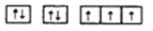
B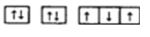
C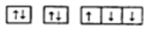
D
None of the above
Solution
(A) The atomic number of nitrogen $(N)$ is $7$. Its electronic configuration is $1s^2 2s^2 2p^3$.
According to Hund's rule of maximum multiplicity,for a given electron configuration,the term with the maximum multiplicity has the lowest energy. This means that electrons in the same subshell should occupy separate orbitals with parallel spins as far as possible.
In the $2p$ subshell,there are $3$ electrons. Therefore,they should occupy the three $2p$ orbitals singly with parallel spins.
Option $A$ (image $203-$a248) correctly shows $1s^2$ (paired),$2s^2$ (paired),and $2p^3$ (three unpaired electrons with parallel spins).
According to Hund's rule of maximum multiplicity,for a given electron configuration,the term with the maximum multiplicity has the lowest energy. This means that electrons in the same subshell should occupy separate orbitals with parallel spins as far as possible.
In the $2p$ subshell,there are $3$ electrons. Therefore,they should occupy the three $2p$ orbitals singly with parallel spins.
Option $A$ (image $203-$a248) correctly shows $1s^2$ (paired),$2s^2$ (paired),and $2p^3$ (three unpaired electrons with parallel spins).
0 likes
View Solution329
MediumMCQ
Statement $A$: In a potassium atom,the $19^{th}$ electron enters the $4s$-orbital instead of the $3d$-orbital.
Reason $R$: The $(n + l)$ rule is followed to determine the minimum energy of an orbital.
Reason $R$: The $(n + l)$ rule is followed to determine the minimum energy of an orbital.
A
$A$ and $R$ are both true and $R$ is the correct explanation of $A$.
B
$A$ and $R$ are both true,but $R$ is not the correct explanation of $A$.
C
$A$ is true,but $R$ is false.
D
$A$ is false,but $R$ is true.
Solution
(A) For the $4s$ orbital,$(n + l) = 4 + 0 = 4$.
For the $3d$ orbital,$(n + l) = 3 + 2 = 5$.
According to the $(n + l)$ rule,the orbital with the lower $(n + l)$ value has lower energy and is filled first.
Since $4 < 5$,the $19^{th}$ electron enters the $4s$ orbital.
Therefore,both Statement $A$ and Reason $R$ are true,and $R$ is the correct explanation of $A$.
For the $3d$ orbital,$(n + l) = 3 + 2 = 5$.
According to the $(n + l)$ rule,the orbital with the lower $(n + l)$ value has lower energy and is filled first.
Since $4 < 5$,the $19^{th}$ electron enters the $4s$ orbital.
Therefore,both Statement $A$ and Reason $R$ are true,and $R$ is the correct explanation of $A$.
0 likes
View Solution330
MediumMCQ
How many electrons in an atom can have the quantum numbers $n = 3, l = 2, m = +2, s = +1/2$?
A
$18$
B
$6$
C
$24$
D
$1$
Solution
(D) The set of quantum numbers $n = 3, l = 2, m = +2, s = +1/2$ uniquely identifies a single specific orbital and a specific spin state of an electron within that orbital.
$n = 3$ represents the third shell.
$l = 2$ represents the $d$-subshell ($3d$ orbital).
$m = +2$ specifies one of the five $d$-orbitals.
$s = +1/2$ specifies the spin of the electron.
According to the Pauli Exclusion Principle,each unique set of four quantum numbers corresponds to exactly one electron.
Therefore,only $1$ electron can have this specific set of quantum numbers.
$n = 3$ represents the third shell.
$l = 2$ represents the $d$-subshell ($3d$ orbital).
$m = +2$ specifies one of the five $d$-orbitals.
$s = +1/2$ specifies the spin of the electron.
According to the Pauli Exclusion Principle,each unique set of four quantum numbers corresponds to exactly one electron.
Therefore,only $1$ electron can have this specific set of quantum numbers.
0 likes
View Solution331
EasyMCQ
How many electrons can a given orbital accommodate?
A
Four electrons
B
Two electrons with parallel spin
C
Six electrons
D
Two electrons with opposite spin
Solution
(D) According to the $Pauli$ exclusion principle,an orbital can accommodate a maximum of two electrons,and these two electrons must have opposite spins. Therefore,the correct option is $D$.
0 likes
View Solution332
MediumMCQ
Find the number of electron pairs in $P$ atom with $l = 1$ and $m = 0$.
A
$3$
B
$1$
C
$2$
D
$0$
Solution
(B) The atomic number of Phosphorus $(P)$ is $15$.
The electronic configuration of $P$ is $1s^2 2s^2 2p^6 3s^2 3p^3$.
For $l = 1$,the orbitals are $2p$ and $3p$.
In $2p^6$,all three orbitals $(m = -1, 0, +1)$ are fully filled,so there is one pair in $m = 0$.
In $3p^3$,according to Hund's rule,each orbital has one electron,so there is no pair in $m = 0$.
Thus,the total number of electron pairs with $l = 1$ and $m = 0$ is $1$ (from the $2p$ subshell).
The electronic configuration of $P$ is $1s^2 2s^2 2p^6 3s^2 3p^3$.
For $l = 1$,the orbitals are $2p$ and $3p$.
In $2p^6$,all three orbitals $(m = -1, 0, +1)$ are fully filled,so there is one pair in $m = 0$.
In $3p^3$,according to Hund's rule,each orbital has one electron,so there is no pair in $m = 0$.
Thus,the total number of electron pairs with $l = 1$ and $m = 0$ is $1$ (from the $2p$ subshell).
0 likes
View Solution333
MediumMCQ
The angular momentum of a $p$-orbital electron is given by:
A
$\frac{\sqrt{2}h}{2\pi}$
B
Zero
C
$\frac{h}{\sqrt{2}\pi}$
D
$\frac{\sqrt{3}h}{2\pi}$
Solution
(A) The angular momentum of an electron in an orbital is given by the formula: $L = \sqrt{l(l+1)} \frac{h}{2\pi}$.
For a $p$-orbital,the azimuthal quantum number $l = 1$.
Substituting $l = 1$ into the formula:
$L = \sqrt{1(1+1)} \frac{h}{2\pi} = \sqrt{2} \frac{h}{2\pi} = \frac{\sqrt{2}h}{2\pi} = \frac{h}{\sqrt{2}\pi}$.
For a $p$-orbital,the azimuthal quantum number $l = 1$.
Substituting $l = 1$ into the formula:
$L = \sqrt{1(1+1)} \frac{h}{2\pi} = \sqrt{2} \frac{h}{2\pi} = \frac{\sqrt{2}h}{2\pi} = \frac{h}{\sqrt{2}\pi}$.
0 likes
View Solution334
MediumMCQ
In which of the following cases are both the Pauli exclusion principle and Hund's rule violated?
A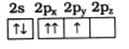
B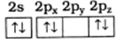
C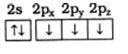
D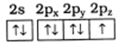
Solution
(A) Pauli's exclusion principle states that no two electrons in an atom can have the same set of four quantum numbers,meaning an orbital can hold a maximum of two electrons with opposite spins. Hund's rule states that electron pairing in degenerate orbitals (like $p$-orbitals) does not occur until each orbital is singly occupied.
In option $(A)$,the $2p_x$ orbital contains two electrons with parallel spins,which violates the Pauli exclusion principle. Furthermore,since the $2p_y$ orbital is empty while $2p_x$ is paired,it also violates Hund's rule regarding the order of filling.
Therefore,option $(A)$ violates both principles.
In option $(A)$,the $2p_x$ orbital contains two electrons with parallel spins,which violates the Pauli exclusion principle. Furthermore,since the $2p_y$ orbital is empty while $2p_x$ is paired,it also violates Hund's rule regarding the order of filling.
Therefore,option $(A)$ violates both principles.
0 likes
View Solution335
MediumMCQ
What is the maximum number of electrons that can be accommodated in an orbital with $l = 3$?
A
$2$
B
$10$
C
$6$
D
$14$
Solution
(D) For a given azimuthal quantum number $l$,the number of orbitals is given by $(2l + 1)$.
For $l = 3$,the number of orbitals is $(2 \times 3 + 1) = 7$.
Each orbital can accommodate a maximum of $2$ electrons.
Therefore,the maximum number of electrons = $7 \times 2 = 14$.
For $l = 3$,the number of orbitals is $(2 \times 3 + 1) = 7$.
Each orbital can accommodate a maximum of $2$ electrons.
Therefore,the maximum number of electrons = $7 \times 2 = 14$.
0 likes
View Solution336
MediumMCQ
The energy required to remove an electron from different subshells of a $H$ atom is given below. What is the order of these energies?
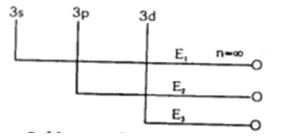
A
$E_1 > E_2 > E_3$
B
$E_3 > E_2 > E_1$
C
$E_1 = E_2 = E_3$
D
None of these
Solution
(C) For a hydrogen atom (a single-electron system),the energy of an orbital depends only on the principal quantum number $n$.
Since all the subshells $(3s, 3p, 3d)$ have the same principal quantum number $n = 3$,they are degenerate,meaning they have the same energy.
Therefore,the energy required to remove an electron from these subshells to $n = \infty$ is the same.
Thus,$E_1 = E_2 = E_3$.
Since all the subshells $(3s, 3p, 3d)$ have the same principal quantum number $n = 3$,they are degenerate,meaning they have the same energy.
Therefore,the energy required to remove an electron from these subshells to $n = \infty$ is the same.
Thus,$E_1 = E_2 = E_3$.
0 likes
View Solution337
MediumMCQ
Which of the following rules states that an orbital can hold a maximum of two electrons?
A
Aufbau principle
B
Pauli exclusion principle
C
Hund's rule
D
Heisenberg's uncertainty principle
Solution
(B) The $Pauli$ exclusion principle states that no two electrons in an atom can have the same set of all four quantum numbers. As a consequence,an orbital can accommodate a maximum of two electrons,and these must have opposite spins.
0 likes
View Solution338
MediumMCQ
For $n = 5$ and $m = 2$,which of the following statements is incorrect?
A
$l = 4$
B
$l = 2, 3, 4$
C
$l = 3$
D
$l = 0, 1, 2, 3, s = 1/2$
Solution
(D) For a given principal quantum number $n$,the azimuthal quantum number $l$ can take values from $0$ to $n-1$. For $n = 5$,$l$ can be $0, 1, 2, 3, 4$.
The magnetic quantum number $m$ can take values from $-l$ to $+l$.
If $m = 2$,then $l$ must be at least $2$ (i.e.,$l = 2, 3, 4$).
Option $D$ is incorrect because it includes $l = 0$ and $l = 1$,for which $m = 2$ is not possible.
The magnetic quantum number $m$ can take values from $-l$ to $+l$.
If $m = 2$,then $l$ must be at least $2$ (i.e.,$l = 2, 3, 4$).
Option $D$ is incorrect because it includes $l = 0$ and $l = 1$,for which $m = 2$ is not possible.
0 likes
View Solution339
MediumMCQ
Which of the following ions does not have the same electronic configuration as $Ne$?
A
$F^{-}$
B
$Mg^{2+}$
C
$Na^{+}$
D
$Cl^{-}$
Solution
(D) The atomic number of $Ne$ is $10$. Its electronic configuration is $1s^2 2s^2 2p^6$.
$F^{-}$ has $9 + 1 = 10$ electrons. Configuration: $1s^2 2s^2 2p^6$.
$Na^{+}$ has $11 - 1 = 10$ electrons. Configuration: $1s^2 2s^2 2p^6$.
$Mg^{2+}$ has $12 - 2 = 10$ electrons. Configuration: $1s^2 2s^2 2p^6$.
$Cl^{-}$ has $17 + 1 = 18$ electrons. Configuration: $1s^2 2s^2 2p^6 3s^2 3p^6$.
Therefore,$Cl^{-}$ does not have the same electronic configuration as $Ne$.
$F^{-}$ has $9 + 1 = 10$ electrons. Configuration: $1s^2 2s^2 2p^6$.
$Na^{+}$ has $11 - 1 = 10$ electrons. Configuration: $1s^2 2s^2 2p^6$.
$Mg^{2+}$ has $12 - 2 = 10$ electrons. Configuration: $1s^2 2s^2 2p^6$.
$Cl^{-}$ has $17 + 1 = 18$ electrons. Configuration: $1s^2 2s^2 2p^6 3s^2 3p^6$.
Therefore,$Cl^{-}$ does not have the same electronic configuration as $Ne$.
0 likes
View Solution340
EasyMCQ
Which of the following does not follow the Aufbau principle?
A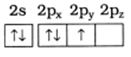
B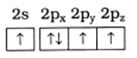
C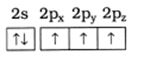
D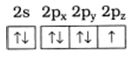
Solution
(B) The Aufbau principle states that electrons fill orbitals in order of increasing energy.
Option $A$ represents a valid configuration for $N$ or $O$ (depending on total electrons).
Option $B$ violates the Aufbau principle because the $2s$ orbital is only half-filled while the $2p$ orbitals are already being filled,which is energetically unfavorable compared to filling the $2s$ orbital completely first.
Option $C$ represents the ground state of Nitrogen $(1s^2 2s^2 2p^3)$.
Option $D$ represents the ground state of Fluorine $(1s^2 2s^2 2p^5)$.
Therefore,option $B$ is the correct answer.
Option $A$ represents a valid configuration for $N$ or $O$ (depending on total electrons).
Option $B$ violates the Aufbau principle because the $2s$ orbital is only half-filled while the $2p$ orbitals are already being filled,which is energetically unfavorable compared to filling the $2s$ orbital completely first.
Option $C$ represents the ground state of Nitrogen $(1s^2 2s^2 2p^3)$.
Option $D$ represents the ground state of Fluorine $(1s^2 2s^2 2p^5)$.
Therefore,option $B$ is the correct answer.
0 likes
View Solution341
MediumMCQ
In a multi-electron atom,which of the following orbitals have the same energy in the absence of magnetic and electric fields? $(a) n = 1, l = 0, m = 0, (b) n = 3, l = 0, m = 0, (c) n = 2, l = 1, m = 1, (d) n = 3, l = 2, m = 1, (e) n = 3, l = 2, m = 0$
A
$(d)$ and $(e)$
B
$(c)$ and $(d)$
C
$(b)$ and $(c)$
D
$(a)$ and $(b)$
Solution
(A) In a multi-electron atom,the energy of an orbital depends on both the principal quantum number $(n)$ and the azimuthal quantum number $(l)$.
Orbitals with the same $n$ and $l$ values are degenerate (have the same energy) in the absence of an external field.
Analyzing the given orbitals:
$(a) n=1, l=0$ $(1s)$
$(b) n=3, l=0$ $(3s)$
$(c) n=2, l=1$ $(2p)$
$(d) n=3, l=2$ $(3d)$
$(e) n=3, l=2$ $(3d)$
Comparing the sets,orbitals $(d)$ and $(e)$ both have $n=3$ and $l=2$,meaning they are both $3d$ orbitals.
Therefore,they have the same energy.
Orbitals with the same $n$ and $l$ values are degenerate (have the same energy) in the absence of an external field.
Analyzing the given orbitals:
$(a) n=1, l=0$ $(1s)$
$(b) n=3, l=0$ $(3s)$
$(c) n=2, l=1$ $(2p)$
$(d) n=3, l=2$ $(3d)$
$(e) n=3, l=2$ $(3d)$
Comparing the sets,orbitals $(d)$ and $(e)$ both have $n=3$ and $l=2$,meaning they are both $3d$ orbitals.
Therefore,they have the same energy.
0 likes
View Solution342
MediumMCQ
The spin angular momentum for an electron is given by .......
A
$\sqrt{S(S + 1)} \,\, \frac{h}{2\pi}$
B
$\sqrt{2S(S + 1)} \,\, \frac{h}{2\pi}$
C
$\sqrt{S(S + 2)} \,\, \frac{h}{2\pi}$
D
None of these
Solution
(A) The spin angular momentum $(L_s)$ of an electron is calculated using the formula:
$L_s = \sqrt{S(S + 1)} \frac{h}{2\pi}$
where $S$ is the spin quantum number and $h$ is Planck's constant.
Thus,the correct option is $A$.
$L_s = \sqrt{S(S + 1)} \frac{h}{2\pi}$
where $S$ is the spin quantum number and $h$ is Planck's constant.
Thus,the correct option is $A$.
0 likes
View Solution343
MediumMCQ
$A$ neutral atom has $2, 8,$ and $7$ electrons in its $K, L,$ and $M$ shells,respectively. What is the total number of electrons in the $p$-orbitals?
A
$5$
B
$6$
C
$13$
D
$11$
Solution
(D) The electronic configuration of the atom based on the given shell distribution $(K=2, L=8, M=7)$ is as follows:
$K$ shell $(n=1)$: $1s^2$ (contains $2$ electrons)
$L$ shell $(n=2)$: $2s^2 2p^6$ (contains $8$ electrons)
$M$ shell $(n=3)$: $3s^2 3p^5$ (contains $7$ electrons)
Total electrons in $p$-orbitals = (electrons in $2p$) + (electrons in $3p$)
Total = $6 + 5 = 11$ electrons.
Therefore,the correct option is $D$.
$K$ shell $(n=1)$: $1s^2$ (contains $2$ electrons)
$L$ shell $(n=2)$: $2s^2 2p^6$ (contains $8$ electrons)
$M$ shell $(n=3)$: $3s^2 3p^5$ (contains $7$ electrons)
Total electrons in $p$-orbitals = (electrons in $2p$) + (electrons in $3p$)
Total = $6 + 5 = 11$ electrons.
Therefore,the correct option is $D$.
0 likes
View Solution344
MediumMCQ
The orbital angular momentum of an electron in an orbital is given by $\sqrt{l(l + 1)} \cdot \frac{h}{2\pi}$. For an $s$-electron,this momentum is:
A
$\sqrt{2} \cdot \frac{h}{2\pi}$
B
$+\frac{1}{2} \cdot \frac{h}{2\pi}$
C
$0$
D
$\frac{h}{2\pi}$
Solution
(C) The orbital angular momentum is given by the formula $\sqrt{l(l + 1)} \cdot \frac{h}{2\pi}$.
For an $s$-orbital,the azimuthal quantum number $l = 0$.
Substituting $l = 0$ into the formula: $\sqrt{0(0 + 1)} \cdot \frac{h}{2\pi} = \sqrt{0} \cdot \frac{h}{2\pi} = 0$.
Therefore,the orbital angular momentum for an $s$-electron is $0$.
For an $s$-orbital,the azimuthal quantum number $l = 0$.
Substituting $l = 0$ into the formula: $\sqrt{0(0 + 1)} \cdot \frac{h}{2\pi} = \sqrt{0} \cdot \frac{h}{2\pi} = 0$.
Therefore,the orbital angular momentum for an $s$-electron is $0$.
0 likes
View Solution345
MediumMCQ
For a subshell with $n = 5$,$l = 2$,and $m = 0$,which orbital is it?
A
$5d_{xy}$
B
$5d_{x^2-y^2}$
C
$5d_{z^2}$
D
$5d_{yz}$
Solution
(C) The principal quantum number $n = 5$ indicates the $5^{th}$ shell.
The azimuthal quantum number $l = 2$ corresponds to the $d$-subshell.
The magnetic quantum number $m = 0$ for a $d$-subshell specifically corresponds to the $d_{z^2}$ orbital.
Therefore,the orbital is $5d_{z^2}$.
The azimuthal quantum number $l = 2$ corresponds to the $d$-subshell.
The magnetic quantum number $m = 0$ for a $d$-subshell specifically corresponds to the $d_{z^2}$ orbital.
Therefore,the orbital is $5d_{z^2}$.
0 likes
View Solution346
MediumMCQ
What is the electronic configuration of Chromium $(Z=24)$?
A
$2, 8, 14$
B
$2, 8, 8, 6$
C
$2, 8, 12, 2$
D
$2, 8, 13, 1$
Solution
(D) The atomic number of Chromium $(Cr)$ is $24$.
According to the Aufbau principle,the expected configuration is $[Ar] 3d^4 4s^2$.
However,due to the extra stability of half-filled $d$-orbitals,one electron from the $4s$ orbital shifts to the $3d$ orbital.
Thus,the actual electronic configuration is $[Ar] 3d^5 4s^1$.
In terms of shells,this corresponds to $2, 8, 13, 1$ $(K=2, L=8, M=13, N=1)$.
According to the Aufbau principle,the expected configuration is $[Ar] 3d^4 4s^2$.
However,due to the extra stability of half-filled $d$-orbitals,one electron from the $4s$ orbital shifts to the $3d$ orbital.
Thus,the actual electronic configuration is $[Ar] 3d^5 4s^1$.
In terms of shells,this corresponds to $2, 8, 13, 1$ $(K=2, L=8, M=13, N=1)$.
0 likes
View Solution347
MediumMCQ
What is the maximum number of electrons that can be accommodated in a shell with principal quantum number $n = 4$?
A
$10$
B
$18$
C
$32$
D
$54$
Solution
(C) The maximum number of electrons in a shell is given by the formula $2n^2$.
For the shell with principal quantum number $n = 4$:
Maximum electrons $= 2 \times (4)^2 = 2 \times 16 = 32$.
For the shell with principal quantum number $n = 4$:
Maximum electrons $= 2 \times (4)^2 = 2 \times 16 = 32$.
0 likes
View Solution348
MediumMCQ
The four quantum numbers for the unpaired electron of chlorine $(Cl)$ are:
A
$n = 3, l = 2, m = 0, s = +1/2$
B
$n = 3, l = 1, m = 0, s = +1/2$
C
$n = 3, l = 1, m = +1, s = 0$
D
$n = 3, l = 0, m = -1, s = +1/2$
Solution
(B) The atomic number of chlorine $(Cl)$ is $17$.
The electronic configuration is $1s^2 2s^2 2p^6 3s^2 3p^5$.
The unpaired electron is in the $3p$ orbital.
For $3p$ orbital:
Principal quantum number $(n)$ = $3$.
Azimuthal quantum number $(l)$ = $1$.
Magnetic quantum number $(m)$ can be $-1, 0, +1$.
Spin quantum number $(s)$ = $+1/2$ or $-1/2$.
Among the given options,$n = 3, l = 1, m = 0, s = +1/2$ is a valid set of quantum numbers for one of the $p$-orbitals.
The electronic configuration is $1s^2 2s^2 2p^6 3s^2 3p^5$.
The unpaired electron is in the $3p$ orbital.
For $3p$ orbital:
Principal quantum number $(n)$ = $3$.
Azimuthal quantum number $(l)$ = $1$.
Magnetic quantum number $(m)$ can be $-1, 0, +1$.
Spin quantum number $(s)$ = $+1/2$ or $-1/2$.
Among the given options,$n = 3, l = 1, m = 0, s = +1/2$ is a valid set of quantum numbers for one of the $p$-orbitals.
0 likes
View Solution349
MediumMCQ
The $20^{th}$ electron of $Fe$ $(Z = 26)$ has which of the following sets of quantum numbers?
A
$3, 2, -2, -\frac{1}{2}$
B
$3, 2, 0, +\frac{1}{2}$
C
$4, 0, 0, +\frac{1}{2}$
D
$4, 1, -1, +\frac{1}{2}$
Solution
(C) The electronic configuration of $Fe$ $(Z = 26)$ is $1s^2, 2s^2, 2p^6, 3s^2, 3p^6, 4s^2, 3d^6$.
The $20^{th}$ electron is the second electron entering the $4s$ orbital.
For the $4s$ orbital,the principal quantum number $n = 4$,azimuthal quantum number $l = 0$,magnetic quantum number $m_l = 0$,and spin quantum number $m_s = +\frac{1}{2}$ (assuming the first electron is $+\frac{1}{2}$).
The $20^{th}$ electron is the second electron entering the $4s$ orbital.
For the $4s$ orbital,the principal quantum number $n = 4$,azimuthal quantum number $l = 0$,magnetic quantum number $m_l = 0$,and spin quantum number $m_s = +\frac{1}{2}$ (assuming the first electron is $+\frac{1}{2}$).
0 likes
View Solution350
MediumMCQ
How many maximum electrons can be accommodated in a $p$-orbital with $n = 6$ and $m = 0$?
A
$2$
B
$6$
C
$10$
D
$14$
Solution
(A) The $p$-orbital with $n = 6$ is the $6p$ subshell.
For a given $p$-orbital,the magnetic quantum number $m$ can take values $-1, 0, +1$.
The orbital corresponding to $m = 0$ is the $6p_z$ orbital.
According to the Pauli Exclusion Principle,any single orbital can accommodate a maximum of $2$ electrons.
For a given $p$-orbital,the magnetic quantum number $m$ can take values $-1, 0, +1$.
The orbital corresponding to $m = 0$ is the $6p_z$ orbital.
According to the Pauli Exclusion Principle,any single orbital can accommodate a maximum of $2$ electrons.
0 likes
View SolutionStructure of Atom — Quantum number, Electronic configuration and Shape of orbitals · Frequently Asked Questions
1Are these Structure of Atom questions useful for JEE and NEET?
Yes. All questions in this section are mapped to JEE Main and NEET exam patterns. Previous year questions from JEE Main, NEET, GUJCET and state-level exams are included with full solutions.
2Can I switch to Hindi or Gujarati for these questions?
Yes. Use the language tabs in the hero section or the sidebar to view the same questions and solutions in English, Hindi or Gujarati.
3How do I generate a question paper from this subtopic?
Use the Vedclass Exam Paper Generator — select the chapter and subtopic, set difficulty, and generate Sets A, B, C, D automatically. First 3 chapters of every subject are free.
Vedclass Products
For Students
Vedclass Test Series
Mock tests in real JEE/NEET style with performance analysis. 5-day free trial.
Start Free TrialFor Teachers
Exam Paper Generator
Generate Set A/B/C/D papers from this chapter in 2 minutes. 3 chapters free.
Try FreeFor Institutes
Online Exam Module
Live online exams with unlimited students, 360° analytics & white-label branding.
See DemoFor Teachers & Institutes
Generate a Structure of Atom Exam Paper in 2 Minutes
Select subtopic & difficulty — Sets A, B, C, D auto-generated with No Repeat logic.
First 3 chapters of every subject are free — no payment required.