
A English
Quantum number, Electronic configuration and Shape of orbitals Questions in English
Class 11 Chemistry · Structure of Atom · Quantum number, Electronic configuration and Shape of orbitals
1023+
Questions
English
Language
100%
With Solutions
Showing 50 of 1023 questions in English
251
DifficultMCQ
The general configuration of the outermost and penultimate shell is $(n - 1)s^2 (n - 1)p^6 (n - 1)d^x ns^2$. If $n = 4$ and $x = 5$,then the number of protons in the nucleus will be:
A
$> 25$
B
$< 24$
C
$25$
D
$30$
Solution
(C) Given the configuration: $(n - 1)s^2 (n - 1)p^6 (n - 1)d^x ns^2$.
For $n = 4$ and $x = 5$,the configuration becomes $3s^2 3p^6 3d^5 4s^2$.
This corresponds to the element Manganese $(Mn)$,which has an atomic number of $25$.
The total number of electrons is calculated by summing the electrons in all shells:
$1s^2 2s^2 2p^6 3s^2 3p^6 3d^5 4s^2$.
Total electrons $= 2 + 2 + 6 + 2 + 6 + 5 + 2 = 25$.
Since the number of protons equals the number of electrons in a neutral atom,the number of protons is $25$.
For $n = 4$ and $x = 5$,the configuration becomes $3s^2 3p^6 3d^5 4s^2$.
This corresponds to the element Manganese $(Mn)$,which has an atomic number of $25$.
The total number of electrons is calculated by summing the electrons in all shells:
$1s^2 2s^2 2p^6 3s^2 3p^6 3d^5 4s^2$.
Total electrons $= 2 + 2 + 6 + 2 + 6 + 5 + 2 = 25$.
Since the number of protons equals the number of electrons in a neutral atom,the number of protons is $25$.
0 likes
View Solution252
MediumMCQ
The number of $d-$ electrons in $Fe^{2+}$ (at. no. of $Fe = 26$) is not equal to that of the
A
$p-$ electrons in $Ne$ (at. no. $= 10$)
B
$s-$ electrons in $Mg$ (at. no. $= 12$)
C
$d-$ electrons in $Fe$
D
$p-$ electrons in $Cl^{-}$ (at. no. of $Cl = 17$)
Solution
(D) The electronic configuration of $Fe$ $(Z=26)$ is $[Ar] 3d^6 4s^2$.
For $Fe^{2+}$,the configuration is $[Ar] 3d^6$. Thus,the number of $d-$ electrons is $6$.
$(A)$ $Ne$ $(Z=10)$: $1s^2 2s^2 2p^6$. Number of $p-$ electrons $= 6$.
$(B)$ $Mg$ $(Z=12)$: $1s^2 2s^2 2p^6 3s^2$. Number of $s-$ electrons $= 2+2+2 = 6$.
$(C)$ $Fe$ $(Z=26)$: $[Ar] 3d^6 4s^2$. Number of $d-$ electrons $= 6$.
$(D)$ $Cl^{-}$ $(Z=17)$: $1s^2 2s^2 2p^6 3s^2 3p^6$. Number of $p-$ electrons $= 6+6 = 12$.
Since $6 \neq 12$,the number of $d-$ electrons in $Fe^{2+}$ is not equal to the number of $p-$ electrons in $Cl^{-}$.
For $Fe^{2+}$,the configuration is $[Ar] 3d^6$. Thus,the number of $d-$ electrons is $6$.
$(A)$ $Ne$ $(Z=10)$: $1s^2 2s^2 2p^6$. Number of $p-$ electrons $= 6$.
$(B)$ $Mg$ $(Z=12)$: $1s^2 2s^2 2p^6 3s^2$. Number of $s-$ electrons $= 2+2+2 = 6$.
$(C)$ $Fe$ $(Z=26)$: $[Ar] 3d^6 4s^2$. Number of $d-$ electrons $= 6$.
$(D)$ $Cl^{-}$ $(Z=17)$: $1s^2 2s^2 2p^6 3s^2 3p^6$. Number of $p-$ electrons $= 6+6 = 12$.
Since $6 \neq 12$,the number of $d-$ electrons in $Fe^{2+}$ is not equal to the number of $p-$ electrons in $Cl^{-}$.
0 likes
View Solution253
MediumMCQ
The electronic configuration of the phosphide ion $(P^{3-})$ is similar to which of the following?
A
Nitride ion $(N^{3-})$
B
Fluoride ion $(F^-)$
C
Sodium ion $(Na^+)$
D
Chloride ion $(Cl^-)$
Solution
(D) The atomic number of phosphorus $(P)$ is $15$. The phosphide ion $(P^{3-})$ is formed by gaining $3$ electrons,so it has $15 + 3 = 18$ electrons.
Its electronic configuration is $1s^2 2s^2 2p^6 3s^2 3p^6$,which is the same as that of the noble gas Argon $(Ar)$.
Among the given options,the chloride ion $(Cl^-)$ has an atomic number of $17$ and gains $1$ electron to have $17 + 1 = 18$ electrons.
Thus,the electronic configuration of $P^{3-}$ ($18$ electrons) is similar to that of $Cl^-$ ($18$ electrons).
Its electronic configuration is $1s^2 2s^2 2p^6 3s^2 3p^6$,which is the same as that of the noble gas Argon $(Ar)$.
Among the given options,the chloride ion $(Cl^-)$ has an atomic number of $17$ and gains $1$ electron to have $17 + 1 = 18$ electrons.
Thus,the electronic configuration of $P^{3-}$ ($18$ electrons) is similar to that of $Cl^-$ ($18$ electrons).
0 likes
View Solution254
EasyMCQ
What is the correct order of energy of atomic orbitals in any given shell?
A
$s < p < d < f$
B
$s > p > d > f$
C
$p < d < f < s$
D
$f > d > s > p$
Solution
(A) For a given shell (principal quantum number $n$),the energy of orbitals increases with the increase in the azimuthal quantum number $(l)$.
The values of $l$ for $s, p, d, f$ orbitals are $0, 1, 2, 3$ respectively.
Therefore,the order of energy is $s < p < d < f$.
The values of $l$ for $s, p, d, f$ orbitals are $0, 1, 2, 3$ respectively.
Therefore,the order of energy is $s < p < d < f$.
0 likes
View Solution255
EasyMCQ
Which of the following orbitals has zero probability of finding an electron in the $yz$ plane?
A
$p_x$
B
$p_y$
C
$p_z$
D
$d_{yz}$
Solution
(A) The $p_x$ orbital is oriented along the $x$-axis.
Since the $yz$ plane is perpendicular to the $x$-axis,the electron density for the $p_x$ orbital in the $yz$ plane is zero.
Therefore,the correct option is $A$.
Since the $yz$ plane is perpendicular to the $x$-axis,the electron density for the $p_x$ orbital in the $yz$ plane is zero.
Therefore,the correct option is $A$.
1 likes
View Solution256
MediumMCQ
The five $d$-orbitals are designated as $d_{xy}, d_{yz}, d_{xz}, d_{x^2-y^2},$ and $d_{z^2}$. Choose the correct statement from the following.
A
The shapes of the first three orbitals are similar,but the shapes of the fourth and fifth orbitals are different.
B
The shapes of all five $d$-orbitals are similar.
C
The shapes of the first four orbitals are similar,but the shape of the fifth orbital is different.
D
The shapes of all five $d$-orbitals are different.
Solution
(C) The five $d$-orbitals are $d_{xy}, d_{yz}, d_{xz}, d_{x^2-y^2},$ and $d_{z^2}$.
The first four orbitals $(d_{xy}, d_{yz}, d_{xz}, d_{x^2-y^2})$ have a similar shape,which is 'double-dumbbell'.
The fifth orbital,$d_{z^2}$,has a different shape,which is 'doughnut-shaped' or 'dumbbell with a ring'.
Therefore,the correct statement is that the first four orbitals have similar shapes,while the fifth orbital has a different shape.
The first four orbitals $(d_{xy}, d_{yz}, d_{xz}, d_{x^2-y^2})$ have a similar shape,which is 'double-dumbbell'.
The fifth orbital,$d_{z^2}$,has a different shape,which is 'doughnut-shaped' or 'dumbbell with a ring'.
Therefore,the correct statement is that the first four orbitals have similar shapes,while the fifth orbital has a different shape.
0 likes
View Solution257
EasyMCQ
For an electron in a $4d$ orbital,which of the following sets of quantum numbers is not possible?
A
$n = 4$
B
$l = 1$
C
$m = 1$
D
$m = 2$
Solution
(B) For a $4d$ orbital,the principal quantum number $n = 4$ and the azimuthal quantum number $l = 2$ (since $s=0, p=1, d=2, f=3$).
Since $l$ must be $2$ for a $d$-orbital,the value $l = 1$ is incorrect for a $4d$ orbital.
Therefore,the set of quantum numbers containing $l = 1$ is not possible.
Since $l$ must be $2$ for a $d$-orbital,the value $l = 1$ is incorrect for a $4d$ orbital.
Therefore,the set of quantum numbers containing $l = 1$ is not possible.
0 likes
View Solution258
EasyMCQ
What is the number of protons in the nucleus of an element that has the maximum number of unpaired electrons in the $2p$ subshell?
A
$6$
B
$7$
C
$14$
D
$15$
Solution
(B) The $2p$ subshell consists of three orbitals $(2p_x, 2p_y, 2p_z)$.
According to Hund's rule of maximum multiplicity,electrons fill these orbitals singly before pairing begins.
The maximum number of unpaired electrons in the $2p$ subshell is $3$,which occurs in the Nitrogen atom $(Z = 7)$.
The electronic configuration of Nitrogen is $1s^2 2s^2 2p^3$.
Since the atomic number $(Z)$ equals the number of protons,the number of protons is $7$.
According to Hund's rule of maximum multiplicity,electrons fill these orbitals singly before pairing begins.
The maximum number of unpaired electrons in the $2p$ subshell is $3$,which occurs in the Nitrogen atom $(Z = 7)$.
The electronic configuration of Nitrogen is $1s^2 2s^2 2p^3$.
Since the atomic number $(Z)$ equals the number of protons,the number of protons is $7$.
0 likes
View Solution259
EasyMCQ
For a given azimuthal quantum number $(l)$,the total number of magnetic quantum numbers $(m)$ is given by:
A
$l = \frac{(m + 1)}{2}$
B
$l = \frac{(m - 1)}{2}$
C
$l = \frac{(2m + 1)}{2}$
D
$l = \frac{(2m - 1)}{2}$
Solution
(B) The magnetic quantum number $(m)$ can take values from $-l$ to $+l$,including zero.
The total number of values for a given $l$ is $(2l + 1)$.
Let the total number of magnetic quantum numbers be $m_{total} = 2l + 1$.
Rearranging the formula to solve for $l$:
$m_{total} - 1 = 2l$
$l = \frac{(m_{total} - 1)}{2}$.
Thus,the correct relation is $l = \frac{(m - 1)}{2}$.
The total number of values for a given $l$ is $(2l + 1)$.
Let the total number of magnetic quantum numbers be $m_{total} = 2l + 1$.
Rearranging the formula to solve for $l$:
$m_{total} - 1 = 2l$
$l = \frac{(m_{total} - 1)}{2}$.
Thus,the correct relation is $l = \frac{(m - 1)}{2}$.
0 likes
View Solution260
EasyMCQ
The values of $n$ and $l$ for orbital $A$ are $3$ and $2$ respectively. The values of $n$ and $l$ for orbital $B$ are $5$ and $0$ respectively. Compare their energies.
A
Energy of $B$ is greater than $A$
B
Energy of $A$ is greater than $B$
C
Energy of $A$ and $B$ are equal
D
None of these
Solution
(A) For orbital $A$: $n = 3, l = 2$. The orbital is $3d$. The energy is determined by $(n + l)$ rule. $(n + l) = 3 + 2 = 5$.
For orbital $B$: $n = 5, l = 0$. The orbital is $5s$. The energy is determined by $(n + l)$ rule. $(n + l) = 5 + 0 = 5$.
Since both orbitals have the same $(n + l)$ value of $5$,the orbital with the lower $n$ value has lower energy.
Therefore,$3d$ $(A)$ has lower energy than $5s$ $(B)$,or energy of $B$ is greater than $A$.
For orbital $B$: $n = 5, l = 0$. The orbital is $5s$. The energy is determined by $(n + l)$ rule. $(n + l) = 5 + 0 = 5$.
Since both orbitals have the same $(n + l)$ value of $5$,the orbital with the lower $n$ value has lower energy.
Therefore,$3d$ $(A)$ has lower energy than $5s$ $(B)$,or energy of $B$ is greater than $A$.
0 likes
View Solution261
EasyMCQ
An electron having quantum numbers $n = 4, l = 3, m = 0, s = -1/2$ is present in which orbital?
A
$3s$
B
$3p$
C
$4d$
D
$4f$
Solution
(D) The principal quantum number $n = 4$ indicates the shell is the $4^{th}$ shell.
The azimuthal quantum number $l = 3$ corresponds to the $f$ subshell.
Therefore,the electron is present in the $4f$ orbital.
The azimuthal quantum number $l = 3$ corresponds to the $f$ subshell.
Therefore,the electron is present in the $4f$ orbital.
0 likes
View Solution262
EasyMCQ
Which of the following orbitals does not have any directional properties?
A
$4p$
B
$4d$
C
$4f$
D
$3s$
Solution
(D) The shape of an orbital is determined by the azimuthal quantum number $(l)$.
For $s$-orbitals,$l = 0$,which corresponds to a spherical shape.
Spherical shapes are non-directional because the probability density of finding an electron is the same in all directions from the nucleus.
Therefore,the $3s$ orbital is non-directional.
For $s$-orbitals,$l = 0$,which corresponds to a spherical shape.
Spherical shapes are non-directional because the probability density of finding an electron is the same in all directions from the nucleus.
Therefore,the $3s$ orbital is non-directional.
0 likes
View Solution263
MediumMCQ
Which of the following statements is true regarding the hydrogen atom?
A
$3s$,$3p$,and $3d$ orbitals have the same energy.
B
$3s$ and $3p$ orbitals have lower energy than $3d$ orbitals.
C
$3p$ orbitals have lower energy than $3d$ orbitals.
D
$3s$ orbitals have lower energy than $3p$ orbitals.
Solution
(A) For a hydrogen atom,the energy of an orbital depends only on the principal quantum number $(n)$.
Since all the given orbitals ($3s$,$3p$,and $3d$) have the same principal quantum number $(n = 3)$,they possess the same energy in the hydrogen atom.
Therefore,the correct statement is that $3s$,$3p$,and $3d$ orbitals have the same energy.
Since all the given orbitals ($3s$,$3p$,and $3d$) have the same principal quantum number $(n = 3)$,they possess the same energy in the hydrogen atom.
Therefore,the correct statement is that $3s$,$3p$,and $3d$ orbitals have the same energy.
0 likes
View Solution264
MediumMCQ
For an electron with quantum numbers $s = +1/2$ and $m_l = -1$,which of the following orbitals is not possible?
A
$s$
B
$p$
C
$d$
D
$f$
Solution
(A) The magnetic quantum number $m_l$ depends on the azimuthal quantum number $l$,where $m_l$ ranges from $-l$ to $+l$.
For an $s$-orbital,$l = 0$,so $m_l$ can only be $0$.
Since the given value is $m_l = -1$,it is impossible for an electron to be in an $s$-orbital because $m_l$ cannot be $-1$ when $l = 0$.
Therefore,the correct option is $A$.
For an $s$-orbital,$l = 0$,so $m_l$ can only be $0$.
Since the given value is $m_l = -1$,it is impossible for an electron to be in an $s$-orbital because $m_l$ cannot be $-1$ when $l = 0$.
Therefore,the correct option is $A$.
0 likes
View Solution265
EasyMCQ
The atomic number of the element having the maximum number of unpaired electrons (in the ground state) is ........
A
$15$
B
$10$
C
$12$
D
$8$
Solution
(A) To find the element with the maximum number of unpaired electrons,we write the electronic configuration for each option in the ground state:
$A) \ Z = 15 \ (P): 1s^2 2s^2 2p^6 3s^2 3p^3$. The $3p$ subshell has $3$ unpaired electrons.
$B) \ Z = 10 \ (Ne): 1s^2 2s^2 2p^6$. All electrons are paired ($0$ unpaired electrons).
$C) \ Z = 12 \ (Mg): 1s^2 2s^2 2p^6 3s^2$. All electrons are paired ($0$ unpaired electrons).
$D) \ Z = 8 \ (O): 1s^2 2s^2 2p^4$. The $2p$ subshell has $2$ unpaired electrons.
Comparing the number of unpaired electrons,$Z = 15$ has the maximum number ($3$ unpaired electrons). Therefore,the correct option is $A$.
$A) \ Z = 15 \ (P): 1s^2 2s^2 2p^6 3s^2 3p^3$. The $3p$ subshell has $3$ unpaired electrons.
$B) \ Z = 10 \ (Ne): 1s^2 2s^2 2p^6$. All electrons are paired ($0$ unpaired electrons).
$C) \ Z = 12 \ (Mg): 1s^2 2s^2 2p^6 3s^2$. All electrons are paired ($0$ unpaired electrons).
$D) \ Z = 8 \ (O): 1s^2 2s^2 2p^4$. The $2p$ subshell has $2$ unpaired electrons.
Comparing the number of unpaired electrons,$Z = 15$ has the maximum number ($3$ unpaired electrons). Therefore,the correct option is $A$.
0 likes
View Solution266
MediumMCQ
The $3p$ orbital has ........
A
Two radial nodes
B
Two angular nodes
C
One radial and one angular node
D
One radial and two angular nodes
Solution
(C) For a $3p$ orbital,the principal quantum number $n = 3$ and the azimuthal quantum number $l = 1$.
Number of radial nodes (spherical nodes) = $n - l - 1 = 3 - 1 - 1 = 1$.
Number of angular nodes (planar nodes) = $l = 1$.
Therefore,the $3p$ orbital has one radial node and one angular node.
Number of radial nodes (spherical nodes) = $n - l - 1 = 3 - 1 - 1 = 1$.
Number of angular nodes (planar nodes) = $l = 1$.
Therefore,the $3p$ orbital has one radial node and one angular node.
0 likes
View Solution267
MediumMCQ
The $39^{th}$ electron of an element enters which of the following subshells?
A
$4f$
B
$4d$
C
$3p$
D
$5s$
Solution
(B) To determine the subshell of the $39^{th}$ electron,we write the electronic configuration of the element with atomic number $Z = 39$ (Yttrium).
The order of filling orbitals according to the Aufbau principle is: $1s, 2s, 2p, 3s, 3p, 4s, 3d, 4p, 5s, 4d, \dots$
The configuration is: $1s^2, 2s^2, 2p^6, 3s^2, 3p^6, 4s^2, 3d^{10}, 4p^6, 5s^2, 4d^1$.
The total number of electrons is $2+2+6+2+6+2+10+6+2+1 = 39$.
The $39^{th}$ electron enters the $4d$ subshell.
The order of filling orbitals according to the Aufbau principle is: $1s, 2s, 2p, 3s, 3p, 4s, 3d, 4p, 5s, 4d, \dots$
The configuration is: $1s^2, 2s^2, 2p^6, 3s^2, 3p^6, 4s^2, 3d^{10}, 4p^6, 5s^2, 4d^1$.
The total number of electrons is $2+2+6+2+6+2+10+6+2+1 = 39$.
The $39^{th}$ electron enters the $4d$ subshell.
0 likes
View Solution268
MediumMCQ
Which orbital is represented by the wave function $\Psi_{310}$?
A
$3d_{xy}$
B
$3p_z$
C
$4s$
D
$4d_{z^2}$
Solution
(B) The wave function is given as $\Psi_{nlm}$.
Comparing $\Psi_{310}$ with $\Psi_{nlm}$,we get:
$n = 3$ (Principal quantum number),
$\ell = 1$ (Azimuthal quantum number,which corresponds to the $p$ orbital),
$m = 0$ (Magnetic quantum number,which corresponds to the $p_z$ orbital).
Therefore,the orbital is $3p_z$.
Comparing $\Psi_{310}$ with $\Psi_{nlm}$,we get:
$n = 3$ (Principal quantum number),
$\ell = 1$ (Azimuthal quantum number,which corresponds to the $p$ orbital),
$m = 0$ (Magnetic quantum number,which corresponds to the $p_z$ orbital).
Therefore,the orbital is $3p_z$.
0 likes
View Solution269
MediumMCQ
The electronic configuration of an element is $1s^2 2s^2 2p^6 3s^2 3p^6 4s^1$. This represents:
A
Excited state
B
Ground state
C
Cation
D
Anion
Solution
(B) The given electronic configuration is $1s^2 2s^2 2p^6 3s^2 3p^6 4s^1$.
This configuration corresponds to the element Potassium ($K$,atomic number $19$).
Since the electrons are filled in the orbitals according to the Aufbau principle,Hund's rule,and Pauli's exclusion principle,this represents the stable ground state of the atom.
This configuration corresponds to the element Potassium ($K$,atomic number $19$).
Since the electrons are filled in the orbitals according to the Aufbau principle,Hund's rule,and Pauli's exclusion principle,this represents the stable ground state of the atom.
0 likes
View Solution270
MediumMCQ
What is the orbital angular momentum of an electron in a $2s$-orbital?
A
$\frac{1}{2} \frac{h}{2\pi}$
B
$0$
C
$\frac{h}{2\pi}$
D
$\sqrt{2} \frac{h}{2\pi}$
Solution
(B) The orbital angular momentum of an electron is given by the formula: $L = \sqrt{l(l+1)} \frac{h}{2\pi}$.
For an $s$-orbital,the azimuthal quantum number $(l)$ is $0$.
Substituting $l = 0$ into the formula: $L = \sqrt{0(0+1)} \frac{h}{2\pi} = 0$.
Therefore,the orbital angular momentum of an electron in a $2s$-orbital is $0$.
For an $s$-orbital,the azimuthal quantum number $(l)$ is $0$.
Substituting $l = 0$ into the formula: $L = \sqrt{0(0+1)} \frac{h}{2\pi} = 0$.
Therefore,the orbital angular momentum of an electron in a $2s$-orbital is $0$.
0 likes
View Solution271
MediumMCQ
The total number of electrons in all orbitals having principal quantum number $n = 2$ and azimuthal quantum number $l = 1$ is ..........
A
$2$
B
$4$
C
$6$
D
$8$
Solution
(C) For $n = 2$ and $l = 1$,the orbital is $2p$.
$2p$ subshell consists of three orbitals: $2p_x, 2p_y, 2p_z$.
Each orbital can accommodate a maximum of $2$ electrons.
Therefore,the total number of electrons in the $2p$ subshell is $3 \times 2 = 6$ electrons.
$2p$ subshell consists of three orbitals: $2p_x, 2p_y, 2p_z$.
Each orbital can accommodate a maximum of $2$ electrons.
Therefore,the total number of electrons in the $2p$ subshell is $3 \times 2 = 6$ electrons.
0 likes
View Solution272
MediumMCQ
The quantum numbers $n$ and $l$ for four electrons are given as: $(1) \, n = 4, l = 1; \, (2) \, n = 4, l = 0; \, (3) \, n = 3, l = 2; \, (4) \, n = 3, l = 1$. Arrange them in increasing order of their energy.
A
$(3) < (4) < (2) < (1)$
B
$(4) < (2) < (3) < (1)$
C
$(2) < (4) < (1) < (3)$
D
$(1) < (3) < (2) < (4)$
Solution
(B) According to the $(n+l)$ rule,the energy of an orbital increases as the value of $(n+l)$ increases. If two orbitals have the same $(n+l)$ value,the one with the lower $n$ value has lower energy.
Calculating $(n+l)$ for each:
$(1) \, n=4, l=1 \implies n+l = 5$
$(2) \, n=4, l=0 \implies n+l = 4$
$(3) \, n=3, l=2 \implies n+l = 5$
$(4) \, n=3, l=1 \implies n+l = 4$
Comparing the values:
For $(n+l) = 4$: $(4)$ has $n=3$ and $(2)$ has $n=4$. Thus,$(4) < (2)$.
For $(n+l) = 5$: $(3)$ has $n=3$ and $(1)$ has $n=4$. Thus,$(3) < (1)$.
Combining these,the increasing order of energy is $(4) < (2) < (3) < (1)$.
Calculating $(n+l)$ for each:
$(1) \, n=4, l=1 \implies n+l = 5$
$(2) \, n=4, l=0 \implies n+l = 4$
$(3) \, n=3, l=2 \implies n+l = 5$
$(4) \, n=3, l=1 \implies n+l = 4$
Comparing the values:
For $(n+l) = 4$: $(4)$ has $n=3$ and $(2)$ has $n=4$. Thus,$(4) < (2)$.
For $(n+l) = 5$: $(3)$ has $n=3$ and $(1)$ has $n=4$. Thus,$(3) < (1)$.
Combining these,the increasing order of energy is $(4) < (2) < (3) < (1)$.
0 likes
View Solution273
MediumMCQ
The number of electrons in the outermost shell of an element with atomic number $15$ is . . . . . . .
A
$7$
B
$5$
C
$3$
D
$2$
Solution
(B) The element with atomic number $15$ is Phosphorus $(P)$.
The electronic configuration of Phosphorus is $1s^2 2s^2 2p^6 3s^2 3p^3$ or $2, 8, 5$.
Therefore,the number of electrons in the outermost shell (valence shell) is $5$.
The electronic configuration of Phosphorus is $1s^2 2s^2 2p^6 3s^2 3p^3$ or $2, 8, 5$.
Therefore,the number of electrons in the outermost shell (valence shell) is $5$.
0 likes
View Solution274
MediumMCQ
What are the four quantum numbers for the valence electron of sodium $(Z = 11)$?
A
$n = 2, l = 1, m = -1, s = -1/2$
B
$n = 3, l = 0, m = 0, s = +1/2$
C
$n = 3, l = 0, m = 0, s = -1/2$
D
$n = 3, l = 2, m = 2, s = +1/2$
Solution
(B) The atomic number of sodium is $Z = 11$.
The electronic configuration is $1s^2 2s^2 2p^6 3s^1$.
The valence electron is in the $3s$ orbital.
For the $3s$ orbital:
Principal quantum number $(n) = 3$.
Azimuthal quantum number $(l) = 0$ (for $s$-orbital).
Magnetic quantum number $(m) = 0$.
Spin quantum number $(s) = +1/2$ or $-1/2$.
Thus,the correct set is $n = 3, l = 0, m = 0, s = +1/2$.
The electronic configuration is $1s^2 2s^2 2p^6 3s^1$.
The valence electron is in the $3s$ orbital.
For the $3s$ orbital:
Principal quantum number $(n) = 3$.
Azimuthal quantum number $(l) = 0$ (for $s$-orbital).
Magnetic quantum number $(m) = 0$.
Spin quantum number $(s) = +1/2$ or $-1/2$.
Thus,the correct set is $n = 3, l = 0, m = 0, s = +1/2$.
0 likes
View Solution275
MediumMCQ
Which orbital has two angular nodal planes?
A
$s$
B
$p$
C
$d$
D
$f$
Solution
(C) The number of angular nodal planes in an orbital is given by the azimuthal quantum number,$l$.
For an $s$-orbital,$l = 0$ (zero nodal planes).
For a $p$-orbital,$l = 1$ (one nodal plane).
For a $d$-orbital,$l = 2$ (two nodal planes).
For an $f$-orbital,$l = 3$ (three nodal planes).
Therefore,the $d$-orbital has two angular nodal planes.
For an $s$-orbital,$l = 0$ (zero nodal planes).
For a $p$-orbital,$l = 1$ (one nodal plane).
For a $d$-orbital,$l = 2$ (two nodal planes).
For an $f$-orbital,$l = 3$ (three nodal planes).
Therefore,the $d$-orbital has two angular nodal planes.
0 likes
View Solution276
MediumMCQ
$A$: No two electrons in an atom can have the same set of all four quantum numbers.
$R$: Two electrons in an atom can exist in the same shell,subshell,or orbital only if they have opposite spins.
$R$: Two electrons in an atom can exist in the same shell,subshell,or orbital only if they have opposite spins.
A
$A$ and $R$ are both true and $R$ is the correct explanation of $A$.
B
$A$ and $R$ are both true,but $R$ is not the correct explanation of $A$.
C
$A$ is true,but $R$ is false.
D
$A$ is false,but $R$ is true.
Solution
(A) is the statement of the Pauli Exclusion Principle,which states that no two electrons in an atom can have the same set of all four quantum numbers $(n, l, m_l, m_s)$.
$R$ is also a true statement because,according to the Pauli Exclusion Principle,if two electrons occupy the same orbital (same $n, l, m_l$),they must have opposite spins ($m_s = +1/2$ and $-1/2$).
Since the restriction on the spins is the direct reason why the four quantum numbers cannot be identical for two electrons in the same orbital,$R$ is the correct explanation of $A$.
$R$ is also a true statement because,according to the Pauli Exclusion Principle,if two electrons occupy the same orbital (same $n, l, m_l$),they must have opposite spins ($m_s = +1/2$ and $-1/2$).
Since the restriction on the spins is the direct reason why the four quantum numbers cannot be identical for two electrons in the same orbital,$R$ is the correct explanation of $A$.
0 likes
View Solution277
MediumMCQ
The atomic weight of an element is twice its atomic number. If the $2p$ subshell contains three electrons,the element is .......
A
$C$
B
$N$
C
$O$
D
$Ca$
Solution
(B) The electronic configuration of the element is $1s^2 2s^2 2p^3$.
Total number of electrons = $2 + 2 + 3 = 7$.
Since the atom is neutral,the atomic number $(Z)$ = $7$.
The element with atomic number $7$ is Nitrogen $(N)$.
Atomic weight = $2 \times Z = 2 \times 7 = 14$,which is the atomic mass of Nitrogen.
Total number of electrons = $2 + 2 + 3 = 7$.
Since the atom is neutral,the atomic number $(Z)$ = $7$.
The element with atomic number $7$ is Nitrogen $(N)$.
Atomic weight = $2 \times Z = 2 \times 7 = 14$,which is the atomic mass of Nitrogen.
0 likes
View Solution278
MediumMCQ
According to the Aufbau principle,what is the correct order of energy for $3d$,$4s$,and $4p$ orbitals?
A
$4p < 3d < 4s$
B
$4s < 4p < 3d$
C
$4s < 3d < 4p$
D
$3d < 4s < 4p$
Solution
(C) According to the Aufbau principle,the energy of an orbital is determined by the $(n + l)$ rule.
For $4s$: $n = 4, l = 0$,so $(n + l) = 4 + 0 = 4$.
For $3d$: $n = 3, l = 2$,so $(n + l) = 3 + 2 = 5$.
For $4p$: $n = 4, l = 1$,so $(n + l) = 4 + 1 = 5$.
Since $4s$ has the lowest $(n + l)$ value,it has the lowest energy.
Between $3d$ and $4p$,both have $(n + l) = 5$,but $3d$ has a lower $n$ value $(3 < 4)$,so $3d$ has lower energy than $4p$.
Thus,the correct order is $4s < 3d < 4p$.
For $4s$: $n = 4, l = 0$,so $(n + l) = 4 + 0 = 4$.
For $3d$: $n = 3, l = 2$,so $(n + l) = 3 + 2 = 5$.
For $4p$: $n = 4, l = 1$,so $(n + l) = 4 + 1 = 5$.
Since $4s$ has the lowest $(n + l)$ value,it has the lowest energy.
Between $3d$ and $4p$,both have $(n + l) = 5$,but $3d$ has a lower $n$ value $(3 < 4)$,so $3d$ has lower energy than $4p$.
Thus,the correct order is $4s < 3d < 4p$.
0 likes
View Solution279
DifficultMCQ
Which of the following sets of quantum numbers represents the orbital with the highest energy?
A
$n = 3, l = 1, m = 1, s = +\frac{1}{2}$
B
$n = 7, l = 0, m = 0, s = +\frac{1}{2}$
C
$n = 3, l = 2, m = 1, s = +\frac{1}{2}$
D
$n = 3, l = 0, m = 0, s = +\frac{1}{2}$
Solution
(B) The energy of an orbital is determined by the $(n + l)$ rule.
For option $A$: $(n + l) = 3 + 1 = 4$.
For option $B$: $(n + l) = 7 + 0 = 7$.
For option $C$: $(n + l) = 3 + 2 = 5$.
For option $D$: $(n + l) = 3 + 0 = 3$.
Comparing the $(n + l)$ values,$7 > 5 > 4 > 3$.
Therefore,the orbital with the highest energy is represented by the set of quantum numbers in option $B$.
For option $A$: $(n + l) = 3 + 1 = 4$.
For option $B$: $(n + l) = 7 + 0 = 7$.
For option $C$: $(n + l) = 3 + 2 = 5$.
For option $D$: $(n + l) = 3 + 0 = 3$.
Comparing the $(n + l)$ values,$7 > 5 > 4 > 3$.
Therefore,the orbital with the highest energy is represented by the set of quantum numbers in option $B$.
0 likes
View Solution280
EasyMCQ
The energy of atomic orbitals in a given shell follows the order:
A
$s < p < d < f$
B
$s > p > d > f$
C
$p < d < f < s$
D
$f > d > s > p$
Solution
(A) For a given shell (principal quantum number $n$),the energy of orbitals depends on the azimuthal quantum number $(l)$.
As the value of $l$ increases,the energy of the orbital increases.
The values of $l$ for $s, p, d, f$ orbitals are $0, 1, 2, 3$ respectively.
Therefore,the order of energy is $s < p < d < f$.
As the value of $l$ increases,the energy of the orbital increases.
The values of $l$ for $s, p, d, f$ orbitals are $0, 1, 2, 3$ respectively.
Therefore,the order of energy is $s < p < d < f$.
0 likes
View Solution281
MediumMCQ
Considering the ground state of $Cr$ atom $(Z = 24)$,the number of electrons associated with azimuthal quantum numbers $l = 1$ and $l = 2$ are,respectively:
A
$16$ and $5$
B
$12$ and $5$
C
$16$ and $4$
D
$12$ and $4$
Solution
(B) The electronic configuration of $Cr$ $(Z = 24)$ is $1s^2 2s^2 2p^6 3s^2 3p^6 4s^1 3d^5$.
For azimuthal quantum number $l = 1$,the electrons are in $p$-orbitals ($2p^6$ and $3p^6$). Total electrons = $6 + 6 = 12$.
For azimuthal quantum number $l = 2$,the electrons are in $d$-orbitals $(3d^5)$. Total electrons = $5$.
Therefore,the number of electrons for $l = 1$ and $l = 2$ are $12$ and $5$ respectively.
For azimuthal quantum number $l = 1$,the electrons are in $p$-orbitals ($2p^6$ and $3p^6$). Total electrons = $6 + 6 = 12$.
For azimuthal quantum number $l = 2$,the electrons are in $d$-orbitals $(3d^5)$. Total electrons = $5$.
Therefore,the number of electrons for $l = 1$ and $l = 2$ are $12$ and $5$ respectively.
0 likes
View Solution282
MediumMCQ
In an atom,if the $K$-shell has $2$ electrons,the $L$-shell has $8$ electrons,and the $M$-shell has $6$ electrons,what is the total number of electrons in the atom?
A
$10$
B
$7$
C
$16$
D
$4$
Solution
(C) The total number of electrons in an atom is the sum of electrons in all its shells.
Given:
$K$-shell = $2$ electrons
$L$-shell = $8$ electrons
$M$-shell = $6$ electrons
Total electrons = $2 + 8 + 6 = 16$ electrons.
Therefore,the correct option is $C$.
Given:
$K$-shell = $2$ electrons
$L$-shell = $8$ electrons
$M$-shell = $6$ electrons
Total electrons = $2 + 8 + 6 = 16$ electrons.
Therefore,the correct option is $C$.
0 likes
View Solution283
EasyMCQ
Which of the following is the correct electronic configuration of $Cr$ (Chromium)?
A
$1s^2 2s^2 2p^6 3s^2 3p^6 4s^1 3d^5$
B
$1s^2 2s^2 2p^6 3s^2 3p^6 4s^2 3d^4$
C
$1s^2 2s^2 2p^6 3s^2 3p^6 4s^2 3d^6$
D
$1s^2 2s^2 2p^6 3s^2 3p^6 4s^1 3d^8$
Solution
(A) The atomic number of $Cr$ (Chromium) is $24$.
According to the Aufbau principle,the expected configuration is $[Ar] 4s^2 3d^4$.
However,half-filled and fully-filled $d$-orbitals are more stable due to exchange energy and symmetry.
Therefore,one electron from the $4s$ orbital jumps to the $3d$ orbital to make the $d$-subshell half-filled $(3d^5)$.
The correct electronic configuration is $[Ar] 4s^1 3d^5$,which is $1s^2 2s^2 2p^6 3s^2 3p^6 4s^1 3d^5$.
According to the Aufbau principle,the expected configuration is $[Ar] 4s^2 3d^4$.
However,half-filled and fully-filled $d$-orbitals are more stable due to exchange energy and symmetry.
Therefore,one electron from the $4s$ orbital jumps to the $3d$ orbital to make the $d$-subshell half-filled $(3d^5)$.
The correct electronic configuration is $[Ar] 4s^1 3d^5$,which is $1s^2 2s^2 2p^6 3s^2 3p^6 4s^1 3d^5$.
0 likes
View Solution284
MediumMCQ
Which of the following sets of quantum numbers represents the orbital with the highest energy?
A
$n = 3, l = 2, m = 1, s = +1/2$
B
$n = 4, l = 2, m = -1, s = +1/2$
C
$n = 4, l = 1, m = 0, s = -1/2$
D
$n = 5, l = 0, m = 0, s = -1/2$
Solution
(B) According to the $(n + l)$ rule,the energy of an orbital is determined by the sum of the principal quantum number $(n)$ and the azimuthal quantum number $(l)$.
For $(A): n + l = 3 + 2 = 5$.
For $(B): n + l = 4 + 2 = 6$.
For $(C): n + l = 4 + 1 = 5$.
For $(D): n + l = 5 + 0 = 5$.
Since the orbital in option $(B)$ has the highest $(n + l)$ value of $6$,it possesses the highest energy.
For $(A): n + l = 3 + 2 = 5$.
For $(B): n + l = 4 + 2 = 6$.
For $(C): n + l = 4 + 1 = 5$.
For $(D): n + l = 5 + 0 = 5$.
Since the orbital in option $(B)$ has the highest $(n + l)$ value of $6$,it possesses the highest energy.
0 likes
View Solution285
MediumMCQ
The quantum number '$n$' for a free gaseous atom is associated with which of the following?
A
Effective size of the orbitals
B
Shape of the orbitals
C
Spatial orientation of the orbitals
D
Energy of the orbitals in the absence of a magnetic field
Solution
(A) The principal quantum number '$n$' determines the main energy level or shell of an electron in an atom.
It primarily dictates the effective size of the orbital and the average distance of the electron from the nucleus.
Therefore,'$n$' is associated with the effective size of the orbitals.
It primarily dictates the effective size of the orbital and the average distance of the electron from the nucleus.
Therefore,'$n$' is associated with the effective size of the orbitals.
0 likes
View Solution286
MediumMCQ
Which of the following electronic configurations is more stable?
A
$3d^2 4s^0$
B
$3d^0 4s^1$
C
$3d^5 4s^1$
D
$3d^1 4s^2$
Solution
(C) The stability of an electronic configuration is determined by the symmetry and exchange energy of the orbitals.
According to Hund's rule,half-filled and fully-filled orbitals are more stable due to their symmetrical distribution and higher exchange energy.
The configuration $3d^5 4s^1$ represents a half-filled $d$-subshell $(d^5)$,which provides extra stability compared to the other given configurations.
According to Hund's rule,half-filled and fully-filled orbitals are more stable due to their symmetrical distribution and higher exchange energy.
The configuration $3d^5 4s^1$ represents a half-filled $d$-subshell $(d^5)$,which provides extra stability compared to the other given configurations.
0 likes
View Solution287
MediumMCQ
For an electron in the $4f$ orbital,which of the following sets of quantum numbers is correct?
A
$n = 3, l = 2, m = -2, s = +\frac{1}{2}$
B
$n = 4, l = 4, m = -4, s = -\frac{1}{2}$
C
$n = 4, l = 3, m = +1, s = +\frac{1}{2}$
D
$n = 4, l = 3, m = +4, s = +\frac{1}{2}$
Solution
(C) For the $4f$ orbital:
$1$. The principal quantum number $n$ is given by the coefficient,so $n = 4$.
$2$. For an $f$ subshell,the azimuthal quantum number $l$ is $3$.
$3$. The magnetic quantum number $m$ can range from $-l$ to $+l$,i.e.,$-3, -2, -1, 0, +1, +2, +3$. Thus,$m = +1$ is a valid value.
$4$. The spin quantum number $s$ can be either $+\frac{1}{2}$ or $-\frac{1}{2}$.
Comparing these with the options,option $C$ satisfies all conditions: $n = 4, l = 3, m = +1, s = +\frac{1}{2}$.
$1$. The principal quantum number $n$ is given by the coefficient,so $n = 4$.
$2$. For an $f$ subshell,the azimuthal quantum number $l$ is $3$.
$3$. The magnetic quantum number $m$ can range from $-l$ to $+l$,i.e.,$-3, -2, -1, 0, +1, +2, +3$. Thus,$m = +1$ is a valid value.
$4$. The spin quantum number $s$ can be either $+\frac{1}{2}$ or $-\frac{1}{2}$.
Comparing these with the options,option $C$ satisfies all conditions: $n = 4, l = 3, m = +1, s = +\frac{1}{2}$.
0 likes
View Solution288
MediumMCQ
Which of the following pairs of atoms or ions have the same electronic configuration?
A
$F^{+}$ and $Ne$
B
$Li^{+}$ and $He^{-}$
C
$Cl^{-}$ and $Ar$
D
$Na$ and $K$
Solution
(C) To determine the electronic configuration,we count the total number of electrons in each species:
$1$. $F^{+}$: Atomic number $9$,so $9 - 1 = 8$ electrons.
$Ne$: Atomic number $10$,so $10$ electrons.
$2$. $Li^{+}$: Atomic number $3$,so $3 - 1 = 2$ electrons.
$He^{-}$: Atomic number $2$,so $2 + 1 = 3$ electrons.
$3$. $Cl^{-}$: Atomic number $17$,so $17 + 1 = 18$ electrons.
$Ar$: Atomic number $18$,so $18$ electrons.
$4$. $Na$: Atomic number $11$,so $11$ electrons.
$K$: Atomic number $19$,so $19$ electrons.
Since $Cl^{-}$ and $Ar$ both have $18$ electrons,they have the same electronic configuration.
$1$. $F^{+}$: Atomic number $9$,so $9 - 1 = 8$ electrons.
$Ne$: Atomic number $10$,so $10$ electrons.
$2$. $Li^{+}$: Atomic number $3$,so $3 - 1 = 2$ electrons.
$He^{-}$: Atomic number $2$,so $2 + 1 = 3$ electrons.
$3$. $Cl^{-}$: Atomic number $17$,so $17 + 1 = 18$ electrons.
$Ar$: Atomic number $18$,so $18$ electrons.
$4$. $Na$: Atomic number $11$,so $11$ electrons.
$K$: Atomic number $19$,so $19$ electrons.
Since $Cl^{-}$ and $Ar$ both have $18$ electrons,they have the same electronic configuration.
0 likes
View Solution289
MediumMCQ
Electrons should be filled in orbitals according to their increasing order of energy. This statement is related to .....
A
Aufbau principle
B
Pauli's exclusion principle
C
Hund's rule
D
Planck's law
Solution
(A) The $Aufbau$ principle states that in the ground state of the atoms,the orbitals are filled in the order of their increasing energies. Therefore,electrons enter the orbital with the lowest energy first.
0 likes
View Solution290
MediumMCQ
The probability of finding an electron in the $d_{xy}$ orbital is maximum along:
A
The $x$-axis
B
The $y$-axis
C
The directions at an angle of $45^{\circ}$ to the $x$ and $y$ axes
D
The directions at an angle of $90^{\circ}$ to the $x$ and $y$ axes
Solution
(C) The $d_{xy}$ orbital has four lobes that lie in the $xy$-plane.
These lobes are oriented between the $x$ and $y$ axes.
The maximum electron density for the $d_{xy}$ orbital is located at an angle of $45^{\circ}$ with respect to both the $x$ and $y$ axes.
These lobes are oriented between the $x$ and $y$ axes.
The maximum electron density for the $d_{xy}$ orbital is located at an angle of $45^{\circ}$ with respect to both the $x$ and $y$ axes.
0 likes
View Solution291
MediumMCQ
The presence of three unpaired electrons in a nitrogen atom is explained by .......
A
Pauli's exclusion principle
B
Hund's rule
C
Aufbau principle
D
Uncertainty principle
Solution
(B) The electronic configuration of nitrogen $(Z = 7)$ is $1s^2 2s^2 2p^3$.
According to Hund's rule of maximum multiplicity,pairing of electrons in the orbitals belonging to the same subshell $(p, d, f)$ does not take place until each orbital is singly occupied.
Therefore,the three electrons in the $2p$ subshell occupy separate orbitals,resulting in three unpaired electrons.
According to Hund's rule of maximum multiplicity,pairing of electrons in the orbitals belonging to the same subshell $(p, d, f)$ does not take place until each orbital is singly occupied.
Therefore,the three electrons in the $2p$ subshell occupy separate orbitals,resulting in three unpaired electrons.
0 likes
View Solution292
MediumMCQ
In the ground state of $Cr$,the number of electrons with $l = 1$ and $l = 2$ in its electronic configuration are respectively:
A
$12, 5$
B
$16, 4$
C
$16, 5$
D
$12, 4$
Solution
(A) The atomic number of $Cr$ is $24$. Its electronic configuration is $1s^2 2s^2 2p^6 3s^2 3p^6 4s^1 3d^5$.
For $l = 1$ (p-orbitals),we consider the $2p$ and $3p$ subshells. The number of electrons is $6 + 6 = 12$.
For $l = 2$ (d-orbitals),we consider the $3d$ subshell. The number of electrons is $5$.
Therefore,the number of electrons with $l = 1$ and $l = 2$ are $12$ and $5$ respectively.
For $l = 1$ (p-orbitals),we consider the $2p$ and $3p$ subshells. The number of electrons is $6 + 6 = 12$.
For $l = 2$ (d-orbitals),we consider the $3d$ subshell. The number of electrons is $5$.
Therefore,the number of electrons with $l = 1$ and $l = 2$ are $12$ and $5$ respectively.
0 likes
View Solution293
MediumMCQ
For the electronic configuration $1s^2 2s^2 2p^3$,what is the number of electrons having $n = 2, l = 1$,and $s = +1/2$?
A
$1$
B
$3$
C
$5$
D
$7$
Solution
(B) The electronic configuration is $1s^2 2s^2 2p^3$.
For $n = 2$ and $l = 1$,the electrons are in the $2p$ subshell.
The $2p$ subshell has $3$ orbitals $(p_x, p_y, p_z)$ containing $3$ electrons.
According to Hund's rule,these $3$ electrons will occupy separate orbitals with parallel spins.
Thus,all $3$ electrons in the $2p$ subshell can have a spin quantum number $s = +1/2$.
For $n = 2$ and $l = 1$,the electrons are in the $2p$ subshell.
The $2p$ subshell has $3$ orbitals $(p_x, p_y, p_z)$ containing $3$ electrons.
According to Hund's rule,these $3$ electrons will occupy separate orbitals with parallel spins.
Thus,all $3$ electrons in the $2p$ subshell can have a spin quantum number $s = +1/2$.
0 likes
View Solution294
MediumMCQ
The electronic configuration $1s^2, 2s^2 2p^5, 3s^1$ represents:
A
Excited state of $O_2^-$ ion
B
Excited state of $Ne$ atom
C
Excited state of $F$ atom
D
Ground state of $F$ atom
Solution
(B) The ground state electronic configuration of Neon ($Ne$,atomic number $10$) is $1s^2, 2s^2 2p^6$.
When an electron from the $2p$ orbital is promoted to the $3s$ orbital,the configuration becomes $1s^2, 2s^2 2p^5, 3s^1$.
This represents the excited state of the $Ne$ atom.
When an electron from the $2p$ orbital is promoted to the $3s$ orbital,the configuration becomes $1s^2, 2s^2 2p^5, 3s^1$.
This represents the excited state of the $Ne$ atom.
0 likes
View Solution295
MediumMCQ
The number of valence electrons in one mole of nitride ion is ............ mole.
A
$2$
B
$3$
C
$5$
D
$8$
Solution
(D) The nitride ion is represented as $N^{3-}$.
The atomic number of nitrogen $(N)$ is $7$,and its electronic configuration is $1s^2, 2s^2, 2p^3$.
When it gains $3$ electrons to form the nitride ion $(N^{3-})$,its electronic configuration becomes $1s^2, 2s^2, 2p^6$.
The valence shell is the $n=2$ shell,which contains $2 + 6 = 8$ electrons.
Therefore,$1$ mole of $N^{3-}$ ions contains $8$ moles of valence electrons.
The atomic number of nitrogen $(N)$ is $7$,and its electronic configuration is $1s^2, 2s^2, 2p^3$.
When it gains $3$ electrons to form the nitride ion $(N^{3-})$,its electronic configuration becomes $1s^2, 2s^2, 2p^6$.
The valence shell is the $n=2$ shell,which contains $2 + 6 = 8$ electrons.
Therefore,$1$ mole of $N^{3-}$ ions contains $8$ moles of valence electrons.
0 likes
View Solution296
EasyMCQ
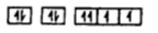
Which of the following rules is violated by the given electronic configuration?
A
Hund's rule
B
Aufbau principle
C
Pauli's exclusion principle
D
None of these
Solution
(C) In the given configuration,one orbital contains three electrons (two with parallel spins and one with opposite spin),which is physically impossible as an orbital can hold a maximum of two electrons with opposite spins.
According to $Pauli's$ exclusion principle,no two electrons in an atom can have the same set of four quantum numbers. This implies that an orbital can hold a maximum of two electrons,and they must have opposite spins.
Since the configuration shows an orbital with three electrons,it violates $Pauli's$ exclusion principle.
According to $Pauli's$ exclusion principle,no two electrons in an atom can have the same set of four quantum numbers. This implies that an orbital can hold a maximum of two electrons,and they must have opposite spins.
Since the configuration shows an orbital with three electrons,it violates $Pauli's$ exclusion principle.
1 likes
View Solution297
MediumMCQ
If an atom has $13$ electrons in the $M$ shell and $1$ electron in the $N$ shell,then the number of unpaired electrons in that atom is ...
A
$6$
B
$5$
C
$3$
D
$4$
Solution
(A) The electronic configuration follows the order of shells: $K=2, L=8, M=18, N=32$.
Given that the $M$ shell has $13$ electrons and the $N$ shell has $1$ electron,the configuration is $1s^2, 2s^2, 2p^6, 3s^2, 3p^6, 3d^5, 4s^1$.
This corresponds to the element $Cr$ (Chromium).
In the $3d$ subshell,there are $5$ unpaired electrons,and in the $4s$ subshell,there is $1$ unpaired electron.
Therefore,the total number of unpaired electrons is $5 + 1 = 6$.
Given that the $M$ shell has $13$ electrons and the $N$ shell has $1$ electron,the configuration is $1s^2, 2s^2, 2p^6, 3s^2, 3p^6, 3d^5, 4s^1$.
This corresponds to the element $Cr$ (Chromium).
In the $3d$ subshell,there are $5$ unpaired electrons,and in the $4s$ subshell,there is $1$ unpaired electron.
Therefore,the total number of unpaired electrons is $5 + 1 = 6$.
0 likes
View Solution298
MediumMCQ
The total number of subshells for which $(n + l) = 7$ is .......
A
$4$
B
$5$
C
$6$
D
$7$
Solution
(A) For a subshell,the value of $(n + l)$ is given as $7$.
Possible combinations of $(n, l)$ such that $n > l$ are:
$1$. If $n = 7, l = 0$ (subshell $7s$)
$2$. If $n = 6, l = 1$ (subshell $6p$)
$3$. If $n = 5, l = 2$ (subshell $5d$)
$4$. If $n = 4, l = 3$ (subshell $4f$)
Thus,there are $4$ possible subshells.
Possible combinations of $(n, l)$ such that $n > l$ are:
$1$. If $n = 7, l = 0$ (subshell $7s$)
$2$. If $n = 6, l = 1$ (subshell $6p$)
$3$. If $n = 5, l = 2$ (subshell $5d$)
$4$. If $n = 4, l = 3$ (subshell $4f$)
Thus,there are $4$ possible subshells.
0 likes
View Solution299
MediumMCQ
For the given quantum numbers $n$ and $l$ of electrons:
$(i) n = 4, l = 1$
$(ii) n = 4, l = 0$
$(iii) n = 3, l = 2$
$(iv) n = 3, l = 1$
Arrange them in the increasing order of their energy.
$(i) n = 4, l = 1$
$(ii) n = 4, l = 0$
$(iii) n = 3, l = 2$
$(iv) n = 3, l = 1$
Arrange them in the increasing order of their energy.
A
$(iv) < (ii) < (iii) < (i)$
B
$(ii) < (iv) < (i) < (iii)$
C
$(i) < (iii) < (ii) < (iv)$
D
$(iii) < (i) < (iv) < (ii)$
Solution
(A) According to the $(n+l)$ rule,the energy of an orbital increases as the value of $(n+l)$ increases.
If $(n+l)$ values are equal,the orbital with the lower $n$ value has lower energy.
Calculating $(n+l)$ for each:
$(i) n=4, l=1 \implies n+l = 5$
$(ii) n=4, l=0 \implies n+l = 4$
$(iii) n=3, l=2 \implies n+l = 5$
$(iv) n=3, l=1 \implies n+l = 4$
Comparing the values:
For $(iv)$ and $(ii)$,$(n+l) = 4$. Since $n(iv) < n(ii)$,energy $(iv) < (ii)$.
For $(i)$ and $(iii)$,$(n+l) = 5$. Since $n(iii) < n(i)$,energy $(iii) < (i)$.
Combining these,the increasing order of energy is $(iv) < (ii) < (iii) < (i)$.
If $(n+l)$ values are equal,the orbital with the lower $n$ value has lower energy.
Calculating $(n+l)$ for each:
$(i) n=4, l=1 \implies n+l = 5$
$(ii) n=4, l=0 \implies n+l = 4$
$(iii) n=3, l=2 \implies n+l = 5$
$(iv) n=3, l=1 \implies n+l = 4$
Comparing the values:
For $(iv)$ and $(ii)$,$(n+l) = 4$. Since $n(iv) < n(ii)$,energy $(iv) < (ii)$.
For $(i)$ and $(iii)$,$(n+l) = 5$. Since $n(iii) < n(i)$,energy $(iii) < (i)$.
Combining these,the increasing order of energy is $(iv) < (ii) < (iii) < (i)$.
0 likes
View Solution300
DifficultMCQ
If $l = 3$,what is the number of orbitals and their type?
A
$3p, 3$
B
$4f, 14$
C
$f, 7$
D
$3d, 5$
Solution
(C) For an azimuthal quantum number $l = 3$,the subshell is an $f$-subshell.
The number of orbitals in a subshell is given by the formula $(2l + 1)$.
Substituting $l = 3$:
Number of orbitals $= 2(3) + 1 = 7$.
Thus,for $l = 3$,there are $7$ orbitals of the $f$-type.
The number of orbitals in a subshell is given by the formula $(2l + 1)$.
Substituting $l = 3$:
Number of orbitals $= 2(3) + 1 = 7$.
Thus,for $l = 3$,there are $7$ orbitals of the $f$-type.
0 likes
View SolutionStructure of Atom — Quantum number, Electronic configuration and Shape of orbitals · Frequently Asked Questions
1Are these Structure of Atom questions useful for JEE and NEET?
Yes. All questions in this section are mapped to JEE Main and NEET exam patterns. Previous year questions from JEE Main, NEET, GUJCET and state-level exams are included with full solutions.
2Can I switch to Hindi or Gujarati for these questions?
Yes. Use the language tabs in the hero section or the sidebar to view the same questions and solutions in English, Hindi or Gujarati.
3How do I generate a question paper from this subtopic?
Use the Vedclass Exam Paper Generator — select the chapter and subtopic, set difficulty, and generate Sets A, B, C, D automatically. First 3 chapters of every subject are free.
Vedclass Products
For Students
Vedclass Test Series
Mock tests in real JEE/NEET style with performance analysis. 5-day free trial.
Start Free TrialFor Teachers
Exam Paper Generator
Generate Set A/B/C/D papers from this chapter in 2 minutes. 3 chapters free.
Try FreeFor Institutes
Online Exam Module
Live online exams with unlimited students, 360° analytics & white-label branding.
See DemoFor Teachers & Institutes
Generate a Structure of Atom Exam Paper in 2 Minutes
Select subtopic & difficulty — Sets A, B, C, D auto-generated with No Repeat logic.
First 3 chapters of every subject are free — no payment required.