
A English
Quantum number, Electronic configuration and Shape of orbitals Questions in English
Class 11 Chemistry · Structure of Atom · Quantum number, Electronic configuration and Shape of orbitals
1023+
Questions
English
Language
100%
With Solutions
Showing 50 of 1023 questions in English
751
EasyMCQ
Which of the following electronic configurations is closer to the nucleus: $4s^2 3d^{10}$ or $4s^0 3d^{10}$?
A
$4s^2 3d^{10}$
B
$4s^0 3d^{10}$
C
Both are at the same distance
D
None of the above
Solution
(B) The distance of an electron from the nucleus depends on the principal quantum number $n$.
In the configuration $4s^2 3d^{10}$,the outermost electrons are in the $n=4$ shell.
In the configuration $4s^0 3d^{10}$,the outermost electrons are in the $n=3$ shell.
Since $n=3 < n=4$,the electrons in the $3d^{10}$ configuration are closer to the nucleus compared to those in the $4s^2 3d^{10}$ configuration.
In the configuration $4s^2 3d^{10}$,the outermost electrons are in the $n=4$ shell.
In the configuration $4s^0 3d^{10}$,the outermost electrons are in the $n=3$ shell.
Since $n=3 < n=4$,the electrons in the $3d^{10}$ configuration are closer to the nucleus compared to those in the $4s^2 3d^{10}$ configuration.
0 likes
View Solution752
EasyMCQ
What is the relationship between the shapes of $3d_{xy}$ and $3d_{x^2-y^2}$ orbitals?
A
They have different shapes.
B
They have the same shape but different orientations.
C
They have different number of lobes.
D
They have different nodal planes.
Solution
(B) Both $3d_{xy}$ and $3d_{x^2-y^2}$ orbitals have the same shape,consisting of $4$ lobes.
However,they differ in their spatial orientation.
The lobes of the $3d_{xy}$ orbital lie in the $xy$-plane between the $x$ and $y$ axes.
The lobes of the $3d_{x^2-y^2}$ orbital lie along the $x$ and $y$ axes.
Thus,they are rotated by $45^{\circ}$ relative to each other.
However,they differ in their spatial orientation.
The lobes of the $3d_{xy}$ orbital lie in the $xy$-plane between the $x$ and $y$ axes.
The lobes of the $3d_{x^2-y^2}$ orbital lie along the $x$ and $y$ axes.
Thus,they are rotated by $45^{\circ}$ relative to each other.
0 likes
View Solution753
EasyMCQ
What is the number of radial and angular nodes in a $5f$ orbital?
A
$1, 3$
B
$3, 1$
C
$1, 1$
D
$3, 3$
Solution
(A) For a $5f$ orbital,the principal quantum number $n = 5$ and the azimuthal quantum number $l = 3$.
The number of radial nodes is calculated using the formula: $n - l - 1 = 5 - 3 - 1 = 1$.
The number of angular nodes is equal to the azimuthal quantum number $l$,which is $3$.
Therefore,the number of radial nodes is $1$ and the number of angular nodes is $3$.
The number of radial nodes is calculated using the formula: $n - l - 1 = 5 - 3 - 1 = 1$.
The number of angular nodes is equal to the azimuthal quantum number $l$,which is $3$.
Therefore,the number of radial nodes is $1$ and the number of angular nodes is $3$.
0 likes
View Solution754
EasyMCQ
What are the spins of the two electrons in $He$?
A
Both $+1/2$
B
Both $-1/2$
C
$+1/2$ and $-1/2$
D
None of these
Solution
(C) According to the Pauli Exclusion Principle,no two electrons in an atom can have the same set of all four quantum numbers.
For Helium ($He$,atomic number $Z = 2$),the electronic configuration is $1s^2$.
The two electrons in the $1s$ orbital have the same principal quantum number $(n=1)$,azimuthal quantum number $(l=0)$,and magnetic quantum number $(m_l=0)$.
Therefore,they must have different spin quantum numbers $(m_s)$ to satisfy the principle.
Thus,the spins are $+1/2$ and $-1/2$.
For Helium ($He$,atomic number $Z = 2$),the electronic configuration is $1s^2$.
The two electrons in the $1s$ orbital have the same principal quantum number $(n=1)$,azimuthal quantum number $(l=0)$,and magnetic quantum number $(m_l=0)$.
Therefore,they must have different spin quantum numbers $(m_s)$ to satisfy the principle.
Thus,the spins are $+1/2$ and $-1/2$.
0 likes
View Solution755
EasyMCQ
Which of the following are degenerate orbitals?
$3d_{xy}, 4d_{xy}, 3d_{z^2}, 3d_{xz}, 4d_{yz}, 4d_{z^2}$
$3d_{xy}, 4d_{xy}, 3d_{z^2}, 3d_{xz}, 4d_{yz}, 4d_{z^2}$
A
$3d_{xy}, 3d_{z^2}, 3d_{xz}$
B
$4d_{xy}, 4d_{yz}, 4d_{z^2}$
C
Both $A$ and $B$
D
None of these
Solution
(C) Degenerate orbitals are those that have the same energy level (same principal quantum number $n$ and same subshell $l$).
$(i)$ The orbitals $3d_{xy}, 3d_{z^2}, 3d_{xz}$ all have $n=3$ and $l=2$,so they are degenerate.
$(ii)$ The orbitals $4d_{xy}, 4d_{yz}, 4d_{z^2}$ all have $n=4$ and $l=2$,so they are degenerate.
Therefore,both sets are degenerate.
$(i)$ The orbitals $3d_{xy}, 3d_{z^2}, 3d_{xz}$ all have $n=3$ and $l=2$,so they are degenerate.
$(ii)$ The orbitals $4d_{xy}, 4d_{yz}, 4d_{z^2}$ all have $n=4$ and $l=2$,so they are degenerate.
Therefore,both sets are degenerate.
0 likes
View Solution756
EasyMCQ
What is the maximum number of electrons that can be accommodated in $d$ and $f$ orbitals,respectively?
A
$10$ and $14$
B
$6$ and $10$
C
$2$ and $6$
D
$14$ and $10$
Solution
(A) The maximum number of electrons in an orbital subshell is given by the formula $2(2l + 1)$.
For a $d$ orbital,the azimuthal quantum number $l = 2$. Therefore,the maximum number of electrons is $2(2 \times 2 + 1) = 2(5) = 10$.
For an $f$ orbital,the azimuthal quantum number $l = 3$. Therefore,the maximum number of electrons is $2(2 \times 3 + 1) = 2(7) = 14$.
Thus,the maximum number of electrons in $d$ and $f$ orbitals are $10$ and $14$,respectively.
For a $d$ orbital,the azimuthal quantum number $l = 2$. Therefore,the maximum number of electrons is $2(2 \times 2 + 1) = 2(5) = 10$.
For an $f$ orbital,the azimuthal quantum number $l = 3$. Therefore,the maximum number of electrons is $2(2 \times 3 + 1) = 2(7) = 14$.
Thus,the maximum number of electrons in $d$ and $f$ orbitals are $10$ and $14$,respectively.
0 likes
View Solution757
EasyMCQ
Calculate the value of $(n + l)$ for the $3d$ orbital.
A
$3$
B
$4$
C
$5$
D
$6$
Solution
(C) For the $3d$ orbital,the principal quantum number $n = 3$.
For a $d$ subshell,the azimuthal quantum number $l = 2$.
Therefore,the value of $(n + l) = 3 + 2 = 5$.
For a $d$ subshell,the azimuthal quantum number $l = 2$.
Therefore,the value of $(n + l) = 3 + 2 = 5$.
0 likes
View Solution758
Easy
Write the values of $n, l, m_{l}, m_{s}$ for $4f$.
Solution
(N/A) For the $4f$ orbital:
$n = 4$ (Principal quantum number).
$l = 3$ (Azimuthal quantum number for $f$-orbital).
$m_{l}$ can take $7$ values: $-3, -2, -1, 0, +1, +2, +3$.
$m_{s}$ can take values of $+\frac{1}{2}$ and $-\frac{1}{2}$.
$n = 4$ (Principal quantum number).
$l = 3$ (Azimuthal quantum number for $f$-orbital).
$m_{l}$ can take $7$ values: $-3, -2, -1, 0, +1, +2, +3$.
$m_{s}$ can take values of $+\frac{1}{2}$ and $-\frac{1}{2}$.
0 likes
View Solution759
EasyMCQ
How many total orbitals are present in the $4f$ subshell?
A
$3$
B
$5$
C
$7$
D
$9$
Solution
(C) For any subshell,the number of orbitals is given by the formula $(2l + 1)$.
For an $f$ subshell,the azimuthal quantum number $l = 3$.
Therefore,the number of orbitals $= 2(3) + 1 = 7$.
For an $f$ subshell,the azimuthal quantum number $l = 3$.
Therefore,the number of orbitals $= 2(3) + 1 = 7$.
0 likes
View Solution760
EasyMCQ
What are the values of $n$ and $l$ for the $f$-subshell with the lowest energy?
A
$n=3, l=3$
B
$n=4, l=3$
C
$n=4, l=2$
D
$n=5, l=3$
Solution
(B) The $f$-subshell first appears in the $4^{th}$ energy level.
According to the $(n+l)$ rule,the lowest energy $f$-subshell is $4f$.
For $4f$,the principal quantum number $n = 4$.
For an $f$-subshell,the azimuthal quantum number $l = 3$.
According to the $(n+l)$ rule,the lowest energy $f$-subshell is $4f$.
For $4f$,the principal quantum number $n = 4$.
For an $f$-subshell,the azimuthal quantum number $l = 3$.
0 likes
View Solution761
Easy
Write the electronic configuration of the following ions:
$(a) H^-$
$(b) Na^+$
$(c) O^{2-}$
$(d) F^-$
$(a) H^-$
$(b) Na^+$
$(c) O^{2-}$
$(d) F^-$
Solution
$(a) H^-$: Total electrons = $1 + 1 = 2$. Electronic configuration: $1s^2$.
$(b) Na^+$: Total electrons = $11 - 1 = 10$. Electronic configuration: $1s^2 2s^2 2p^6$.
$(c) O^{2-}$: Total electrons = $8 + 2 = 10$. Electronic configuration: $1s^2 2s^2 2p^6$.
$(d) F^-$: Total electrons = $9 + 1 = 10$. Electronic configuration: $1s^2 2s^2 2p^6$.
$(b) Na^+$: Total electrons = $11 - 1 = 10$. Electronic configuration: $1s^2 2s^2 2p^6$.
$(c) O^{2-}$: Total electrons = $8 + 2 = 10$. Electronic configuration: $1s^2 2s^2 2p^6$.
$(d) F^-$: Total electrons = $9 + 1 = 10$. Electronic configuration: $1s^2 2s^2 2p^6$.
0 likes
View Solution762
Easy
If the outermost electrons of an element are represented as $(a)$ $3s^1$,$(b)$ $2p^3$,and $(c)$ $3p^5$,what will be the atomic numbers of these elements?
Solution
(N/A) For the outermost configuration $3s^1$,the complete electronic configuration is $1s^2 2s^2 2p^6 3s^1$. The total number of electrons is $2+2+6+1 = 11$. Thus,the atomic number $Z = 11$.
$(b)$ For the outermost configuration $2p^3$,the complete electronic configuration is $1s^2 2s^2 2p^3$. The total number of electrons is $2+2+3 = 7$. Thus,the atomic number $Z = 7$.
$(c)$ For the outermost configuration $3p^5$,the complete electronic configuration is $1s^2 2s^2 2p^6 3s^2 3p^5$. The total number of electrons is $2+2+6+2+5 = 17$. Thus,the atomic number $Z = 17$.
$(b)$ For the outermost configuration $2p^3$,the complete electronic configuration is $1s^2 2s^2 2p^3$. The total number of electrons is $2+2+3 = 7$. Thus,the atomic number $Z = 7$.
$(c)$ For the outermost configuration $3p^5$,the complete electronic configuration is $1s^2 2s^2 2p^6 3s^2 3p^5$. The total number of electrons is $2+2+6+2+5 = 17$. Thus,the atomic number $Z = 17$.
0 likes
View Solution763
Easy
Identify the elements represented by the following electronic configurations:
$(a)$ $[He] \, 2s^1$
$(b)$ $[Ne] \, 3s^2 \, 3p^3$
$(c)$ $[Ar] \, 4s^2 \, 3d^1$
$(a)$ $[He] \, 2s^1$
$(b)$ $[Ne] \, 3s^2 \, 3p^3$
$(c)$ $[Ar] \, 4s^2 \, 3d^1$
Solution
(N/A) The electronic configuration is $[He] \, 2s^1$. The atomic number $Z = 2 + 1 = 3$. Thus,the element is Lithium $(Li)$.
$(b)$ The electronic configuration is $[Ne] \, 3s^2 \, 3p^3$. The atomic number $Z = 10 + 2 + 3 = 15$. Thus,the element is Phosphorus $(P)$.
$(c)$ The electronic configuration is $[Ar] \, 4s^2 \, 3d^1$. The atomic number $Z = 18 + 2 + 1 = 21$. Thus,the element is Scandium $(Sc)$.
$(b)$ The electronic configuration is $[Ne] \, 3s^2 \, 3p^3$. The atomic number $Z = 10 + 2 + 3 = 15$. Thus,the element is Phosphorus $(P)$.
$(c)$ The electronic configuration is $[Ar] \, 4s^2 \, 3d^1$. The atomic number $Z = 18 + 2 + 1 = 21$. Thus,the element is Scandium $(Sc)$.
0 likes
View Solution764
EasyMCQ
What is the minimum value of $n$ for which $g$ orbitals are allowed?
A
$3$
B
$4$
C
$5$
D
$6$
Solution
(C) For any orbital,the azimuthal quantum number $l$ determines its type. For $g$ orbitals,$l = 4$.
The principal quantum number $n$ must be greater than $l$. Specifically,for a given $l$,the minimum value of $n$ is $n = l + 1$.
Substituting $l = 4$:
$n = 4 + 1 = 5$.
Thus,the minimum value of $n$ for $g$ orbitals is $5$.
The principal quantum number $n$ must be greater than $l$. Specifically,for a given $l$,the minimum value of $n$ is $n = l + 1$.
Substituting $l = 4$:
$n = 4 + 1 = 5$.
Thus,the minimum value of $n$ for $g$ orbitals is $5$.
0 likes
View Solution765
EasyMCQ
An electron is in one of the $3d$ orbitals. Give the possible values of $n, l,$ and $m_l$ for this electron.
A
$n=3, l=2, m_l=-2, -1, 0, +1, +2$
B
$n=3, l=1, m_l=-1, 0, +1$
C
$n=3, l=0, m_l=0$
D
$n=2, l=2, m_l=-2, -1, 0, +1, +2$
Solution
(A) For $3d$ orbitals,the principal quantum number $n = 3$.
For $d$ subshell,the azimuthal quantum number $l = 2$.
The magnetic quantum number $m_l$ can take values from $-l$ to $+l$,including zero.
Therefore,for $l = 2$,the possible values of $m_l$ are $-2, -1, 0, +1, +2$.
For $d$ subshell,the azimuthal quantum number $l = 2$.
The magnetic quantum number $m_l$ can take values from $-l$ to $+l$,including zero.
Therefore,for $l = 2$,the possible values of $m_l$ are $-2, -1, 0, +1, +2$.
0 likes
View Solution766
EasyMCQ
An atom of an element contains $29$ electrons and $35$ neutrons. Determine $(i)$ the number of protons and $(ii)$ the electronic configuration of the element.
A
$29, 1s^2 2s^2 2p^6 3s^2 3p^6 3d^9 4s^2$
B
$29, 1s^2 2s^2 2p^6 3s^2 3p^6 3d^{10} 4s^1$
C
$35, 1s^2 2s^2 2p^6 3s^2 3p^6 3d^{10} 4s^1$
D
$35, 1s^2 2s^2 2p^6 3s^2 3p^6 3d^9 4s^2$
Solution
(B) $(i)$ In a neutral atom,the number of electrons is equal to the number of protons. Therefore,the number of protons = $29$.
$(ii)$ The atomic number $Z$ is $29$. The electronic configuration is written by filling orbitals in increasing order of energy. For $Z = 29$ (Copper),the configuration is $1s^2 2s^2 2p^6 3s^2 3p^6 3d^{10} 4s^1$ because the fully filled $3d$ subshell provides extra stability.
$(ii)$ The atomic number $Z$ is $29$. The electronic configuration is written by filling orbitals in increasing order of energy. For $Z = 29$ (Copper),the configuration is $1s^2 2s^2 2p^6 3s^2 3p^6 3d^{10} 4s^1$ because the fully filled $3d$ subshell provides extra stability.
0 likes
View Solution767
Medium
For a given atomic orbital,$n = 3$. What are the possible values of $l$ and $m_l$?
Solution
(N/A) For $n = 3$,the possible values of the azimuthal quantum number $l$ range from $0$ to $(n - 1)$.
Thus,$l = 0, 1, 2$.
For each value of $l$,the magnetic quantum number $m_l$ ranges from $-l$ to $+l$ including $0$.
If $l = 0$,$m_l = 0$.
If $l = 1$,$m_l = -1, 0, +1$.
If $l = 2$,$m_l = -2, -1, 0, +1, +2$.
Total number of $m_l$ values $= 1 + 3 + 5 = 9$.
Thus,$l = 0, 1, 2$.
For each value of $l$,the magnetic quantum number $m_l$ ranges from $-l$ to $+l$ including $0$.
If $l = 0$,$m_l = 0$.
If $l = 1$,$m_l = -1, 0, +1$.
If $l = 2$,$m_l = -2, -1, 0, +1, +2$.
Total number of $m_l$ values $= 1 + 3 + 5 = 9$.
0 likes
View Solution768
EasyMCQ
List the quantum numbers ($l$ and $m_{l}$) for an electron in a $3d$ orbital.
A
$l = 2, m_{l} = -2, -1, 0, +1, +2$
B
$l = 3, m_{l} = -3, -2, -1, 0, +1, +2, +3$
C
$l = 2, m_{l} = -1, 0, +1$
D
$l = 1, m_{l} = -1, 0, +1$
Solution
(A) For a $3d$ orbital,the principal quantum number $n = 3$.
For a $d$ subshell,the azimuthal quantum number $l = 2$.
The magnetic quantum number $m_{l}$ ranges from $-l$ to $+l$,including zero.
Therefore,for $l = 2$,the possible values for $m_{l}$ are $-2, -1, 0, +1, +2$.
For a $d$ subshell,the azimuthal quantum number $l = 2$.
The magnetic quantum number $m_{l}$ ranges from $-l$ to $+l$,including zero.
Therefore,for $l = 2$,the possible values for $m_{l}$ are $-2, -1, 0, +1, +2$.
0 likes
View Solution769
EasyMCQ
Which of the following orbitals are possible: $1p, 2s, 2p, 3f$?
A
$1p, 2s$
B
$2s, 2p$
C
$2p, 3f$
D
$1p, 3f$
Solution
(B) For an orbital to be possible,the principal quantum number $n$ and the azimuthal quantum number $l$ must satisfy the condition $l < n$.
For $1p$: $n=1, l=1$. Since $l$ is not less than $n$,$1p$ is not possible.
For $2s$: $n=2, l=0$. Since $l < n$,$2s$ is possible.
For $2p$: $n=2, l=1$. Since $l < n$,$2p$ is possible.
For $3f$: $n=3, l=3$. Since $l$ is not less than $n$,$3f$ is not possible.
Therefore,$2s$ and $2p$ are the possible orbitals.
For $1p$: $n=1, l=1$. Since $l$ is not less than $n$,$1p$ is not possible.
For $2s$: $n=2, l=0$. Since $l < n$,$2s$ is possible.
For $2p$: $n=2, l=1$. Since $l < n$,$2p$ is possible.
For $3f$: $n=3, l=3$. Since $l$ is not less than $n$,$3f$ is not possible.
Therefore,$2s$ and $2p$ are the possible orbitals.
0 likes
View Solution770
Medium
Describe the orbitals with the following quantum numbers using $s, p, d, f$ notation:
$(a) n = 1, l = 0$
$(b) n = 3, l = 1$
$(c) n = 4, l = 2$
$(d) n = 4, l = 3$
$(a) n = 1, l = 0$
$(b) n = 3, l = 1$
$(c) n = 4, l = 2$
$(d) n = 4, l = 3$
Solution
(N/A) The orbital notation is given by $nl$,where $n$ is the principal quantum number and $l$ is the azimuthal quantum number ($l=0$ is $s$,$l=1$ is $p$,$l=2$ is $d$,$l=3$ is $f$).
| Quantum Numbers | Orbital |
|---|---|
| $(a) n = 1, l = 0$ | $1s$ |
| $(b) n = 3, l = 1$ | $3p$ |
| $(c) n = 4, l = 2$ | $4d$ |
| $(d) n = 4, l = 3$ | $4f$ |
0 likes
View Solution771
Medium
Identify which of the following sets of quantum numbers are not possible and explain why.
$(a) n = 0, l = 0, m_l = 0, m_s = +1/2$
$(b) n = 1, l = 0, m_l = 0, m_s = -1/2$
$(c) n = 1, l = 1, m_l = 0, m_s = +1/2$
$(d) n = 2, l = 1, m_l = 0, m_s = -1/2$
$(e) n = 3, l = 3, m_l = 3, m_s = +1/2$
$(f) n = 3, l = 1, m_l = 0, m_s = +1/2$
$(a) n = 0, l = 0, m_l = 0, m_s = +1/2$
$(b) n = 1, l = 0, m_l = 0, m_s = -1/2$
$(c) n = 1, l = 1, m_l = 0, m_s = +1/2$
$(d) n = 2, l = 1, m_l = 0, m_s = -1/2$
$(e) n = 3, l = 3, m_l = 3, m_s = +1/2$
$(f) n = 3, l = 1, m_l = 0, m_s = +1/2$
Solution
(A, C, E) The following sets of quantum numbers are not possible:
$(a) n = 0$ is not possible because the principal quantum number $n$ must be a positive integer $(n = 1, 2, 3, \dots)$.
$(c) n = 1, l = 1$ is not possible because for a given $n$,the azimuthal quantum number $l$ can only range from $0$ to $n-1$. Thus,if $n = 1$,$l$ must be $0$.
$(e) n = 3, l = 3$ is not possible because $l$ must always be less than $n$ $(l < n)$. Therefore,$l$ can only take values $0, 1, 2$ when $n = 3$.
$(a) n = 0$ is not possible because the principal quantum number $n$ must be a positive integer $(n = 1, 2, 3, \dots)$.
$(c) n = 1, l = 1$ is not possible because for a given $n$,the azimuthal quantum number $l$ can only range from $0$ to $n-1$. Thus,if $n = 1$,$l$ must be $0$.
$(e) n = 3, l = 3$ is not possible because $l$ must always be less than $n$ $(l < n)$. Therefore,$l$ can only take values $0, 1, 2$ when $n = 3$.
0 likes
View Solution772
Easy
How many electrons in an atom can have the following quantum numbers?
$(a)$ $n = 4, m_s = -\frac{1}{2}$
$(b)$ $n = 3, l = 0$
$(a)$ $n = 4, m_s = -\frac{1}{2}$
$(b)$ $n = 3, l = 0$
Solution
(A) For a given principal quantum number $n$,the total number of electrons is given by $2n^2$.
For $n = 4$,total electrons $= 2(4)^2 = 2 \times 16 = 32$.
In any shell,half of the electrons have $m_s = +\frac{1}{2}$ and half have $m_s = -\frac{1}{2}$.
Therefore,the number of electrons with $m_s = -\frac{1}{2}$ is $32 / 2 = 16$.
$(b)$ For $n = 3$ and $l = 0$,the orbital is $3s$.
$A$ single orbital can hold a maximum of $2$ electrons.
Therefore,the number of electrons is $2$.
For $n = 4$,total electrons $= 2(4)^2 = 2 \times 16 = 32$.
In any shell,half of the electrons have $m_s = +\frac{1}{2}$ and half have $m_s = -\frac{1}{2}$.
Therefore,the number of electrons with $m_s = -\frac{1}{2}$ is $32 / 2 = 16$.
$(b)$ For $n = 3$ and $l = 0$,the orbital is $3s$.
$A$ single orbital can hold a maximum of $2$ electrons.
Therefore,the number of electrons is $2$.
0 likes
View Solution773
Easy
Match the items in List-$A$ with the items in List-$B$ and select the correct option.
| List-$A$ | List-$B$ |
| $(1)$ Principal quantum number | $(A)$ Shape of the orbital |
| $(2)$ Azimuthal quantum number | $(B)$ Spin of the electron |
| $(3)$ Magnetic quantum number | $(C)$ Orientation of the orbital in space |
| $(4)$ Spin quantum number | $(D)$ Size of the orbital |
Solution
(D) The correct matching is:
$(1)$ Principal quantum number $(n)$ determines the size of the orbital $(D)$.
$(2)$ Azimuthal quantum number $(l)$ determines the shape of the orbital $(A)$.
$(3)$ Magnetic quantum number $(m_l)$ determines the orientation of the orbital in space $(C)$.
$(4)$ Spin quantum number $(m_s)$ determines the spin of the electron $(B)$.
Therefore,the correct sequence is $(1-D, 2-A, 3-C, 4-B)$.
$(1)$ Principal quantum number $(n)$ determines the size of the orbital $(D)$.
$(2)$ Azimuthal quantum number $(l)$ determines the shape of the orbital $(A)$.
$(3)$ Magnetic quantum number $(m_l)$ determines the orientation of the orbital in space $(C)$.
$(4)$ Spin quantum number $(m_s)$ determines the spin of the electron $(B)$.
Therefore,the correct sequence is $(1-D, 2-A, 3-C, 4-B)$.
0 likes
View Solution774
MediumMCQ
Match the quantum numbers with the information provided:
| Quantum Number | Information |
| $(1)$ Principal quantum number | $(A)$ Spatial orientation of the orbital |
| $(2)$ Azimuthal quantum number | $(B)$ Energy and size of the orbital |
| $(3)$ Magnetic quantum number | $(C)$ Electron spin |
| $(4)$ Spin quantum number | $(D)$ Shape of the orbital |
A
$1-B, 2-D, 3-A, 4-C$
B
$1-A, 2-B, 3-C, 4-D$
C
$1-D, 2-C, 3-B, 4-A$
D
$1-B, 2-A, 3-D, 4-C$
Solution
(A) $(1)$ Principal quantum number $(n)$ determines the energy and size of the orbital.
$(2)$ Azimuthal quantum number $(l)$ determines the shape of the orbital.
$(3)$ Magnetic quantum number $(m_l)$ determines the spatial orientation of the orbital.
$(4)$ Spin quantum number $(m_s)$ determines the spin of the electron.
Therefore,the correct match is $1-B, 2-D, 3-A, 4-C$.
$(2)$ Azimuthal quantum number $(l)$ determines the shape of the orbital.
$(3)$ Magnetic quantum number $(m_l)$ determines the spatial orientation of the orbital.
$(4)$ Spin quantum number $(m_s)$ determines the spin of the electron.
Therefore,the correct match is $1-B, 2-D, 3-A, 4-C$.
0 likes
View Solution775
MediumMCQ
How is an electron in an atom identified? State the parameters used.
A
Atomic number
B
Quantum numbers
C
Mass number
D
Electronic configuration
Solution
(B) An electron in an atom is identified by its four quantum numbers: the principal quantum number $(n)$,the azimuthal quantum number $(l)$,the magnetic quantum number $(m_l)$,and the spin quantum number $(m_s)$.
0 likes
View Solution776
EasyMCQ
What is meant by electronic configuration?
A
The arrangement of protons in the nucleus.
B
The distribution of electrons into different orbitals of an atom.
C
The total number of neutrons in an atom.
D
The mass of an atom.
Solution
(B) The distribution of electrons into different orbitals of an atom is called its electronic configuration.
0 likes
View Solution777
EasyMCQ
What is a shell in the context of atomic structure?
A
$A$ region where the probability of finding an electron is maximum.
B
$A$ set of orbitals with the same principal quantum number $(n)$.
C
The path followed by an electron around the nucleus.
D
The spin of an electron.
Solution
(B) In atomic structure,a shell is defined as a set of orbitals that share the same principal quantum number $(n)$.
Each shell represents a specific energy level for electrons orbiting the nucleus.
As the value of $n$ increases,the shell is further from the nucleus and has higher energy.
Each shell represents a specific energy level for electrons orbiting the nucleus.
As the value of $n$ increases,the shell is further from the nucleus and has higher energy.
0 likes
View Solution778
MediumMCQ
Where does the electronic configuration occur in an atom?
A
In the nucleus
B
In the subshells $s, p, d, f$
C
In the protons
D
In the neutrons
Solution
(B) The electronic configuration of an atom describes the distribution of electrons in various atomic orbitals. These orbitals are grouped into subshells denoted as $s, p, d,$ and $f$.
0 likes
View Solution779
EasyMCQ
What determines the position of an element in the periodic table?
A
Atomic mass
B
Number of neutrons
C
Electronic configuration
D
Number of protons
Solution
(C) The position of an element in the periodic table is determined by its $Electronic \ configuration$,which describes the distribution of electrons in various orbitals. The $Principal \ quantum \ number$ $(n)$ determines the period,while the $subshell$ in which the last electron enters determines the block and group.
0 likes
View Solution780
Easy
If the period is $6$,then $n = 6$ and $l = 0, 1, 2, 3, 4$. Why is the number of elements in this period still $32$?
Solution
(N/A) For $n = 6$,the subshells available are $6s, 6p, 5d, 4f$. The $5g$ and $6g$ subshells are not filled in the ground state of known elements because their energy is significantly higher than the $7s$ orbital.
| $n=6$ subshells | $6s, 6p, 5d, 4f$ |
| Number of orbitals | $1 (6s) + 3 (6p) + 5 (5d) + 7 (4f) = 16$ orbitals |
| Total elements | $16 \times 2 = 32$ elements |
0 likes
View Solution781
EasyMCQ
What are the electronic configurations of elements with atomic numbers $Z = 117$ and $Z = 120$?
A
$[Rn] 5f^{14} 6d^{10} 7s^2 7p^5$ and $[Og] 8s^2$
B
$[Rn] 5f^{14} 6d^{10} 7s^2 7p^6$ and $[Og] 8s^1$
C
$[Rn] 5f^{14} 6d^{10} 7s^2 7p^3$ and $[Og] 8s^2 8p^1$
D
$[Rn] 5f^{14} 6d^{10} 7s^2 7p^4$ and $[Og] 8s^2 8p^2$
Solution
(A) For $Z = 117$ (Tennessine):
The electronic configuration is $[Rn] 5f^{14} 6d^{10} 7s^2 7p^5$.
For $Z = 120$ (Unbinilium):
The electronic configuration is $[Og] 8s^2$,where $[Og]$ represents the noble gas Oganesson with $Z = 118$.
The electronic configuration is $[Rn] 5f^{14} 6d^{10} 7s^2 7p^5$.
For $Z = 120$ (Unbinilium):
The electronic configuration is $[Og] 8s^2$,where $[Og]$ represents the noble gas Oganesson with $Z = 118$.
0 likes
View Solution782
Easy
Which electron,$2s$ or $2p$,is more strongly attracted to the nucleus? Explain.
Solution
(A) The $2s$ electrons are more strongly attracted to the nucleus than the $2p$ electrons. This is because the $2s$ orbital is closer to the nucleus and has a higher probability density near the nucleus compared to the $2p$ orbital,which experiences greater shielding from the inner shell electrons.
0 likes
View Solution783
Medium
While filling up of electrons in the atomic orbitals,the $4s$ orbital is filled before the $3d$ orbital,but the reverse happens during the ionization of the atom. Explain why?
Solution
(N/A) In an atom,electrons are filled according to the $(n+l)$ rule in order of increasing energy.
For $3d$: $n=3, l=2$,so $(n+l) = 3+2 = 5$.
For $4s$: $n=4, l=0$,so $(n+l) = 4+0 = 4$.
Since the $(n+l)$ value for $4s$ is lower than $3d$,the $4s$ orbital has lower energy and is filled first.
During ionization,electrons are removed from the orbital with the highest principal quantum number $(n)$ first. Since $4s$ has $n=4$ and $3d$ has $n=3$,the $4s$ electrons are further from the nucleus and are removed first.
For $3d$: $n=3, l=2$,so $(n+l) = 3+2 = 5$.
For $4s$: $n=4, l=0$,so $(n+l) = 4+0 = 4$.
Since the $(n+l)$ value for $4s$ is lower than $3d$,the $4s$ orbital has lower energy and is filled first.
During ionization,electrons are removed from the orbital with the highest principal quantum number $(n)$ first. Since $4s$ has $n=4$ and $3d$ has $n=3$,the $4s$ electrons are further from the nucleus and are removed first.
0 likes
View Solution784
EasyMCQ
The number of subshells associated with $n=4$ and $m=-2$ quantum numbers is :
A
$4$
B
$8$
C
$16$
D
$2$
Solution
(D) For a given principal quantum number $n=4$,the possible values of azimuthal quantum number $\ell$ are $0, 1, 2, 3$.
These correspond to the subshells $4s, 4p, 4d, 4f$ respectively.
The magnetic quantum number $m$ ranges from $-\ell$ to $+\ell$.
For $4s$ $(\ell=0)$: $m=0$.
For $4p$ $(\ell=1)$: $m=-1, 0, +1$.
For $4d$ $(\ell=2)$: $m=-2, -1, 0, +1, +2$.
For $4f$ $(\ell=3)$: $m=-3, -2, -1, 0, +1, +2, +3$.
The value $m=-2$ is present in the $4d$ and $4f$ subshells.
Therefore,the number of subshells associated with $n=4$ and $m=-2$ is $2$.
These correspond to the subshells $4s, 4p, 4d, 4f$ respectively.
The magnetic quantum number $m$ ranges from $-\ell$ to $+\ell$.
For $4s$ $(\ell=0)$: $m=0$.
For $4p$ $(\ell=1)$: $m=-1, 0, +1$.
For $4d$ $(\ell=2)$: $m=-2, -1, 0, +1, +2$.
For $4f$ $(\ell=3)$: $m=-3, -2, -1, 0, +1, +2, +3$.
The value $m=-2$ is present in the $4d$ and $4f$ subshells.
Therefore,the number of subshells associated with $n=4$ and $m=-2$ is $2$.
0 likes
View Solution785
DifficultMCQ
Consider the hypothetical situation where the azimuthal quantum number,$l$,takes values $0, 1, 2, \ldots, n+1$,where $n$ is the principal quantum number. Then,the element with atomic number
A
$13$ has a half-filled valence subshell
B
$9$ is the first alkali metal
C
$8$ is the first noble gas
D
$6$ has a $2p$ valence subshell
Solution
(B) Given $l$ ranges from $0$ to $(n+1)$.
For $n=1$,$l=0, 1, 2$ (orbitals: $1s, 1p, 1d$).
For $n=2$,$l=0, 1, 2, 3$ (orbitals: $2s, 2p, 2d, 2f$).
Applying the $(n+l)$ rule for energy order: $1s (1+0=1) < 1p (1+1=2) < 2s (2+0=2) < 1d (1+2=3) < 2p (2+1=3) < 3s (3+0=3) < 2d (2+2=4)$.
Electronic configuration for atomic number $9$: $1s^2 1p^6 2s^1$.
Since it has $1$ electron in the outermost $s$-orbital $(2s^1)$,it behaves like an alkali metal.
Thus,$9$ is the first alkali metal.
For $n=1$,$l=0, 1, 2$ (orbitals: $1s, 1p, 1d$).
For $n=2$,$l=0, 1, 2, 3$ (orbitals: $2s, 2p, 2d, 2f$).
Applying the $(n+l)$ rule for energy order: $1s (1+0=1) < 1p (1+1=2) < 2s (2+0=2) < 1d (1+2=3) < 2p (2+1=3) < 3s (3+0=3) < 2d (2+2=4)$.
Electronic configuration for atomic number $9$: $1s^2 1p^6 2s^1$.
Since it has $1$ electron in the outermost $s$-orbital $(2s^1)$,it behaves like an alkali metal.
Thus,$9$ is the first alkali metal.
0 likes
View Solution786
MediumMCQ
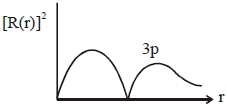
The correct statement about probability density (except at infinite distance from the nucleus) is:
A
It can be negative for $2p$ orbital.
B
It can be zero for $3p$ orbital.
C
It can be zero for $1s$ orbital.
D
It can never be zero for $2s$ orbital.
Solution
(B) Probability density is defined as $|\psi|^2$. Since it is a square of the wave function,it can never be negative.
Nodes are regions where the probability density is zero.
For a $3p$ orbital,the radial node is present where the radial wave function $R(r)$ becomes zero,which is also where the probability density $|R(r)|^2$ becomes zero,as shown in the provided graph.
Therefore,the correct statement is that it can be zero for $3p$ orbital.
Nodes are regions where the probability density is zero.
For a $3p$ orbital,the radial node is present where the radial wave function $R(r)$ becomes zero,which is also where the probability density $|R(r)|^2$ becomes zero,as shown in the provided graph.
Therefore,the correct statement is that it can be zero for $3p$ orbital.
0 likes
View Solution787
MediumMCQ
In the sixth period,the orbitals that are filled are
A
$6s, 5f, 6d, 6p$
B
$6s, 6p, 6d, 6f$
C
$6s, 5d, 5f, 6p$
D
$6s, 4f, 5d, 6p$
Solution
(D) According to the $(n + \ell)$ rule,the energy of orbitals increases in the order of their $(n + \ell)$ values. For the $6^{th}$ period,the orbitals filled are $6s$ $(n+\ell = 6+0=6)$,$4f$ $(n+\ell = 4+3=7)$,$5d$ $(n+\ell = 5+2=7)$,and $6p$ $(n+\ell = 6+1=7)$.
Thus,the correct order of filling is $6s, 4f, 5d, 6p$.
Thus,the correct order of filling is $6s, 4f, 5d, 6p$.
0 likes
View Solution788
EasyMCQ
The number of angular nodes and radial nodes in $3s$ orbital are
A
$0$ and $1,$ respectively
B
$0$ and $2,$ respectively
C
$1$ and $0,$ respectively
D
$3$ and $0,$ respectively
Solution
(B) For any orbital,the number of angular nodes is given by the azimuthal quantum number $l$.
For an $s$-orbital,$l = 0$,so the number of angular nodes is $0$.
The number of radial nodes is given by the formula $n - l - 1$.
For the $3s$ orbital,the principal quantum number $n = 3$ and $l = 0$.
Therefore,the number of radial nodes $= 3 - 0 - 1 = 2$.
Thus,the $3s$ orbital has $0$ angular nodes and $2$ radial nodes.
For an $s$-orbital,$l = 0$,so the number of angular nodes is $0$.
The number of radial nodes is given by the formula $n - l - 1$.
For the $3s$ orbital,the principal quantum number $n = 3$ and $l = 0$.
Therefore,the number of radial nodes $= 3 - 0 - 1 = 2$.
Thus,the $3s$ orbital has $0$ angular nodes and $2$ radial nodes.
0 likes
View Solution789
MediumMCQ
Which one of the following sets of quantum numbers is not possible for a $4p$ electron?
A
$n=4, l=1, m=-1, m_{s}=+\frac{1}{2}$
B
$n=4, l=1, m=0, m_{s}=+\frac{1}{2}$
C
$n=4, l=1, m=2, m_{s}=+\frac{1}{2}$
D
$n=4, l=1, m=-1, m_{s}=-\frac{1}{2}$
Solution
(C) For a $4p$ electron,the principal quantum number $n=4$ and the azimuthal quantum number $l=1$.
The magnetic quantum number $m$ can take values from $-l$ to $+l$,which means for $l=1$,$m$ can be $-1, 0, +1$.
The value $m=2$ is not possible for $l=1$ because $m$ must satisfy the condition $|m| \leq l$.
Therefore,the set $n=4, l=1, m=2, m_{s}=+\frac{1}{2}$ is not possible.
The magnetic quantum number $m$ can take values from $-l$ to $+l$,which means for $l=1$,$m$ can be $-1, 0, +1$.
The value $m=2$ is not possible for $l=1$ because $m$ must satisfy the condition $|m| \leq l$.
Therefore,the set $n=4, l=1, m=2, m_{s}=+\frac{1}{2}$ is not possible.
0 likes
View Solution790
EasyMCQ
Which of the following elements has the last electron in its outermost orbit with a magnetic quantum number $m = 0$?
A
$Na$
B
$O$
C
$Cl$
D
$N$
Solution
(A) The magnetic quantum number $m$ for an $s$-orbital is always $0$.
For $Na$ $(Z=11)$,the electronic configuration is $1s^{2} 2s^{2} 2p^{6} 3s^{1}$. The last electron enters the $3s$ orbital,which has $l=0$,therefore $m=0$.
For $O$ $(Z=8)$,the configuration is $1s^{2} 2s^{2} 2p^{4}$. The last electron enters a $2p$ orbital $(l=1)$,where $m$ can be $-1, 0, +1$.
For $Cl$ $(Z=17)$,the configuration is $1s^{2} 2s^{2} 2p^{6} 3s^{2} 3p^{5}$. The last electron enters a $3p$ orbital $(l=1)$,where $m$ can be $-1, 0, +1$.
For $N$ $(Z=7)$,the configuration is $1s^{2} 2s^{2} 2p^{3}$. The last electron enters a $2p$ orbital $(l=1)$,where $m$ can be $-1, 0, +1$.
Thus,only $Na$ has its last electron in an $s$-orbital where $m$ is strictly $0$.
For $Na$ $(Z=11)$,the electronic configuration is $1s^{2} 2s^{2} 2p^{6} 3s^{1}$. The last electron enters the $3s$ orbital,which has $l=0$,therefore $m=0$.
For $O$ $(Z=8)$,the configuration is $1s^{2} 2s^{2} 2p^{4}$. The last electron enters a $2p$ orbital $(l=1)$,where $m$ can be $-1, 0, +1$.
For $Cl$ $(Z=17)$,the configuration is $1s^{2} 2s^{2} 2p^{6} 3s^{2} 3p^{5}$. The last electron enters a $3p$ orbital $(l=1)$,where $m$ can be $-1, 0, +1$.
For $N$ $(Z=7)$,the configuration is $1s^{2} 2s^{2} 2p^{3}$. The last electron enters a $2p$ orbital $(l=1)$,where $m$ can be $-1, 0, +1$.
Thus,only $Na$ has its last electron in an $s$-orbital where $m$ is strictly $0$.
0 likes
View Solution791
MediumMCQ
$A$ certain orbital has $n = 4$ and $m_{L} = -3$. The number of radial nodes in this orbital is .......... (Round off to the Nearest Integer).
A
$1$
B
$0$
C
$3$
D
$5$
Solution
(B) For a given orbital,the magnetic quantum number $m_{\ell}$ ranges from $-\ell$ to $+\ell$.
Given $m_{\ell} = -3$,the azimuthal quantum number $\ell$ must be at least $3$.
Since $n = 4$ and $\ell = 3$,this corresponds to a $4f$ orbital.
The formula for the number of radial nodes is $n - \ell - 1$.
Substituting the values: $4 - 3 - 1 = 0$.
Given $m_{\ell} = -3$,the azimuthal quantum number $\ell$ must be at least $3$.
Since $n = 4$ and $\ell = 3$,this corresponds to a $4f$ orbital.
The formula for the number of radial nodes is $n - \ell - 1$.
Substituting the values: $4 - 3 - 1 = 0$.
0 likes
View Solution792
MediumMCQ
$A$ certain orbital has no angular nodes and two radial nodes. The orbital is
A
$2s$
B
$3s$
C
$3p$
D
$2p$
Solution
(B) The number of angular nodes is given by the azimuthal quantum number $l$.
Since there are no angular nodes,$l = 0$,which corresponds to an '$s$' orbital.
The number of radial nodes is given by the formula $n - l - 1$.
Given that the number of radial nodes is $2$,we have $n - 0 - 1 = 2$.
Solving for $n$,we get $n = 3$.
Therefore,the orbital is $3s$.
Since there are no angular nodes,$l = 0$,which corresponds to an '$s$' orbital.
The number of radial nodes is given by the formula $n - l - 1$.
Given that the number of radial nodes is $2$,we have $n - 0 - 1 = 2$.
Solving for $n$,we get $n = 3$.
Therefore,the orbital is $3s$.
0 likes
View Solution793
MediumMCQ
The number of orbitals with $n = 5, m_{l} = +2$ is $......$ . (Round off to the Nearest Integer)
A
$3$
B
$2$
C
$1$
D
$0$
Solution
(A) For a given principal quantum number $n = 5$,the possible values of azimuthal quantum number $\ell$ are $0, 1, 2, 3, 4$.
The magnetic quantum number $m_{l}$ ranges from $-\ell$ to $+\ell$ for each $\ell$.
We need to find the number of orbitals where $m_{l} = +2$:
$1$. For $\ell = 0$ $(5s)$,$m_{l} = 0$.
$2$. For $\ell = 1$ $(5p)$,$m_{l} = \{-1, 0, +1\}$.
$3$. For $\ell = 2$ $(5d)$,$m_{l} = \{-2, -1, 0, +1, +2\}$. Here,$m_{l} = +2$ is possible ($1$ orbital).
$4$. For $\ell = 3$ $(5f)$,$m_{l} = \{-3, -2, -1, 0, +1, +2, +3\}$. Here,$m_{l} = +2$ is possible ($1$ orbital).
$5$. For $\ell = 4$ $(5g)$,$m_{l} = \{-4, -3, -2, -1, 0, +1, +2, +3, +4\}$. Here,$m_{l} = +2$ is possible ($1$ orbital).
Total number of orbitals with $m_{l} = +2$ is $1 + 1 + 1 = 3$.
The magnetic quantum number $m_{l}$ ranges from $-\ell$ to $+\ell$ for each $\ell$.
We need to find the number of orbitals where $m_{l} = +2$:
$1$. For $\ell = 0$ $(5s)$,$m_{l} = 0$.
$2$. For $\ell = 1$ $(5p)$,$m_{l} = \{-1, 0, +1\}$.
$3$. For $\ell = 2$ $(5d)$,$m_{l} = \{-2, -1, 0, +1, +2\}$. Here,$m_{l} = +2$ is possible ($1$ orbital).
$4$. For $\ell = 3$ $(5f)$,$m_{l} = \{-3, -2, -1, 0, +1, +2, +3\}$. Here,$m_{l} = +2$ is possible ($1$ orbital).
$5$. For $\ell = 4$ $(5g)$,$m_{l} = \{-4, -3, -2, -1, 0, +1, +2, +3, +4\}$. Here,$m_{l} = +2$ is possible ($1$ orbital).
Total number of orbitals with $m_{l} = +2$ is $1 + 1 + 1 = 3$.
0 likes
View Solution794
EasyMCQ
In the ground state of atomic $Fe \,(Z = 26)$,the spin-only magnetic moment is ...... $\times 10^{-1} \,BM$. (Round off to the nearest integer).
$[$Given $: \sqrt{3} = 1.73, \sqrt{2} = 1.41]$
$[$Given $: \sqrt{3} = 1.73, \sqrt{2} = 1.41]$
A
$95$
B
$49$
C
$22$
D
$84$
Solution
(B) The electronic configuration of $Fe$ $(Z = 26)$ is $[Ar] 3d^6 4s^2$.
In the $3d$ subshell,there are $6$ electrons. According to Hund's rule,the distribution is:
Number of unpaired electrons $(n) = 4$.
The spin-only magnetic moment $(\mu)$ is given by the formula $\mu = \sqrt{n(n + 2)} \,BM$.
$\mu = \sqrt{4(4 + 2)} = \sqrt{24} \,BM$.
Using $\sqrt{24} \approx 4.899 \,BM$.
$\mu = 48.99 \times 10^{-1} \,BM$.
Rounding off to the nearest integer,we get $49$.
In the $3d$ subshell,there are $6$ electrons. According to Hund's rule,the distribution is:
| $\uparrow \downarrow$ | $\uparrow$ | $\uparrow$ | $\uparrow$ | $\uparrow$ |
Number of unpaired electrons $(n) = 4$.
The spin-only magnetic moment $(\mu)$ is given by the formula $\mu = \sqrt{n(n + 2)} \,BM$.
$\mu = \sqrt{4(4 + 2)} = \sqrt{24} \,BM$.
Using $\sqrt{24} \approx 4.899 \,BM$.
$\mu = 48.99 \times 10^{-1} \,BM$.
Rounding off to the nearest integer,we get $49$.
0 likes
View Solution795
EasyMCQ
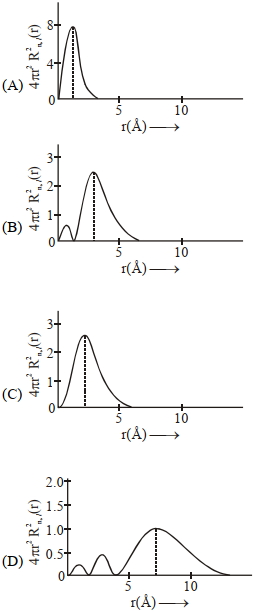
The plots of radial distribution functions for various orbitals of hydrogen atom against $r$ are given below.
The correct plot for $3s$ orbital is
The correct plot for $3s$ orbital is
A
$(A)$
B
$(B)$
C
$(C)$
D
$(D)$
Solution
(C) The number of radial nodes for an orbital is given by the formula: $\text{Number of radial nodes} = n - \ell - 1$.
For the $3s$ orbital,the principal quantum number $n = 3$ and the azimuthal quantum number $\ell = 0$.
Substituting these values: $\text{Number of radial nodes} = 3 - 0 - 1 = 2$.
$A$ radial distribution function plot for an orbital with $2$ radial nodes must show $2$ points where the probability density touches the $r$-axis (excluding $r=0$ and $r=\infty$).
Looking at the provided plots:
- Plot $(A)$ has $0$ radial nodes (corresponds to $1s$).
- Plot $(B)$ has $1$ radial node (corresponds to $2s$).
- Plot $(C)$ has $0$ radial nodes.
- Plot $(D)$ has $2$ radial nodes.
Therefore,the correct plot for the $3s$ orbital is $(D)$.
For the $3s$ orbital,the principal quantum number $n = 3$ and the azimuthal quantum number $\ell = 0$.
Substituting these values: $\text{Number of radial nodes} = 3 - 0 - 1 = 2$.
$A$ radial distribution function plot for an orbital with $2$ radial nodes must show $2$ points where the probability density touches the $r$-axis (excluding $r=0$ and $r=\infty$).
Looking at the provided plots:
- Plot $(A)$ has $0$ radial nodes (corresponds to $1s$).
- Plot $(B)$ has $1$ radial node (corresponds to $2s$).
- Plot $(C)$ has $0$ radial nodes.
- Plot $(D)$ has $2$ radial nodes.
Therefore,the correct plot for the $3s$ orbital is $(D)$.
0 likes
View Solution796
MediumMCQ
The orbital having two radial as well as two angular nodes is
A
$3p$
B
$4f$
C
$4d$
D
$5d$
Solution
(D) The number of radial nodes is given by the formula $n-l-1$ and the number of angular nodes is given by $l$.
Given that radial nodes = $2$ and angular nodes = $2$,we have $l = 2$.
Substituting $l = 2$ into the radial node formula: $n-2-1 = 2$,which gives $n = 5$.
Since $l = 2$ corresponds to the $d$ orbital,the orbital is $5d$.
Given that radial nodes = $2$ and angular nodes = $2$,we have $l = 2$.
Substituting $l = 2$ into the radial node formula: $n-2-1 = 2$,which gives $n = 5$.
Since $l = 2$ corresponds to the $d$ orbital,the orbital is $5d$.
0 likes
View Solution797
EasyMCQ
$Ge$ $(Z=32)$ in its ground state electronic configuration has $x$ completely filled orbitals with $m_{l}=0$. The value of $x$ is ..... .
A
$4$
B
$6$
C
$5$
D
$7$
Solution
(D) The electronic configuration of $Ge$ $(Z=32)$ is $1s^2 2s^2 2p^6 3s^2 3p^6 4s^2 3d^{10} 4p^2$.
We need to identify completely filled orbitals where the magnetic quantum number $m_l = 0$.
- $1s$ orbital $(m_l=0)$: $1$ orbital (completely filled)
- $2s$ orbital $(m_l=0)$: $1$ orbital (completely filled)
- $2p$ subshell $(m_l=-1, 0, +1)$: $1$ orbital with $m_l=0$ (completely filled)
- $3s$ orbital $(m_l=0)$: $1$ orbital (completely filled)
- $3p$ subshell $(m_l=-1, 0, +1)$: $1$ orbital with $m_l=0$ (completely filled)
- $4s$ orbital $(m_l=0)$: $1$ orbital (completely filled)
- $3d$ subshell $(m_l=-2, -1, 0, +1, +2)$: $1$ orbital with $m_l=0$ (completely filled)
- $4p$ subshell: Not completely filled.
Total count of completely filled orbitals with $m_l=0$ is $1+1+1+1+1+1+1 = 7$.
Thus,$x = 7$.
We need to identify completely filled orbitals where the magnetic quantum number $m_l = 0$.
- $1s$ orbital $(m_l=0)$: $1$ orbital (completely filled)
- $2s$ orbital $(m_l=0)$: $1$ orbital (completely filled)
- $2p$ subshell $(m_l=-1, 0, +1)$: $1$ orbital with $m_l=0$ (completely filled)
- $3s$ orbital $(m_l=0)$: $1$ orbital (completely filled)
- $3p$ subshell $(m_l=-1, 0, +1)$: $1$ orbital with $m_l=0$ (completely filled)
- $4s$ orbital $(m_l=0)$: $1$ orbital (completely filled)
- $3d$ subshell $(m_l=-2, -1, 0, +1, +2)$: $1$ orbital with $m_l=0$ (completely filled)
- $4p$ subshell: Not completely filled.
Total count of completely filled orbitals with $m_l=0$ is $1+1+1+1+1+1+1 = 7$.
Thus,$x = 7$.
0 likes
View Solution798
MediumMCQ
The value of the magnetic quantum number of the outermost electron of $Zn^{+}$ ion is $.....$ .
A
$1$
B
$0$
C
$3$
D
$2$
Solution
(B) The atomic number of $Zn$ is $30$. The electronic configuration of $Zn$ is $[Ar] 3d^{10} 4s^{2}$.
For $Zn^{+}$ ion,one electron is removed from the $4s$ orbital,so the configuration becomes $[Ar] 3d^{10} 4s^{1}$.
The outermost electron is in the $4s$ subshell.
For an $s$-orbital,the azimuthal quantum number $l = 0$.
The magnetic quantum number $m$ ranges from $-l$ to $+l$,so for $l = 0$,$m = 0$.
For $Zn^{+}$ ion,one electron is removed from the $4s$ orbital,so the configuration becomes $[Ar] 3d^{10} 4s^{1}$.
The outermost electron is in the $4s$ subshell.
For an $s$-orbital,the azimuthal quantum number $l = 0$.
The magnetic quantum number $m$ ranges from $-l$ to $+l$,so for $l = 0$,$m = 0$.
0 likes
View Solution799
MediumMCQ
The azimuthal quantum number for the valence electrons of $Ga^{+}$ ion is $.....$
(Atomic number of $Ga = 31$)
(Atomic number of $Ga = 31$)
A
$0$
B
$1$
C
$2$
D
$3$
Solution
(A) The atomic number of $Ga$ is $31$. The electronic configuration of $Ga$ is $[Ar] 3d^{10} 4s^{2} 4p^{1}$.
For the $Ga^{+}$ ion,one electron is removed from the outermost $4p$ orbital. Thus,the electronic configuration of $Ga^{+}$ is $[Ar] 3d^{10} 4s^{2}$.
The valence electrons are in the $4s$ subshell.
The azimuthal quantum number $(l)$ for an $s$-orbital is $0$.
For the $Ga^{+}$ ion,one electron is removed from the outermost $4p$ orbital. Thus,the electronic configuration of $Ga^{+}$ is $[Ar] 3d^{10} 4s^{2}$.
The valence electrons are in the $4s$ subshell.
The azimuthal quantum number $(l)$ for an $s$-orbital is $0$.
0 likes
View Solution800
MediumMCQ
Number of electrons that Vanadium $(Z=23)$ has in p-orbitals is equal to $......$
A
$24$
B
$66$
C
$89$
D
$12$
Solution
(D) The electronic configuration of Vanadium $(Z=23)$ is: $1s^{2} 2s^{2} 2p^{6} 3s^{2} 3p^{6} 3d^{3} 4s^{2}$.
The p-orbitals present are $2p$ and $3p$.
Number of electrons in $2p$ orbital = $6$.
Number of electrons in $3p$ orbital = $6$.
Total number of electrons in p-orbitals = $6 + 6 = 12$.
The p-orbitals present are $2p$ and $3p$.
Number of electrons in $2p$ orbital = $6$.
Number of electrons in $3p$ orbital = $6$.
Total number of electrons in p-orbitals = $6 + 6 = 12$.
0 likes
View SolutionStructure of Atom — Quantum number, Electronic configuration and Shape of orbitals · Frequently Asked Questions
1Are these Structure of Atom questions useful for JEE and NEET?
Yes. All questions in this section are mapped to JEE Main and NEET exam patterns. Previous year questions from JEE Main, NEET, GUJCET and state-level exams are included with full solutions.
2Can I switch to Hindi or Gujarati for these questions?
Yes. Use the language tabs in the hero section or the sidebar to view the same questions and solutions in English, Hindi or Gujarati.
3How do I generate a question paper from this subtopic?
Use the Vedclass Exam Paper Generator — select the chapter and subtopic, set difficulty, and generate Sets A, B, C, D automatically. First 3 chapters of every subject are free.
Vedclass Products
For Students
Vedclass Test Series
Mock tests in real JEE/NEET style with performance analysis. 5-day free trial.
Start Free TrialFor Teachers
Exam Paper Generator
Generate Set A/B/C/D papers from this chapter in 2 minutes. 3 chapters free.
Try FreeFor Institutes
Online Exam Module
Live online exams with unlimited students, 360° analytics & white-label branding.
See DemoFor Teachers & Institutes
Generate a Structure of Atom Exam Paper in 2 Minutes
Select subtopic & difficulty — Sets A, B, C, D auto-generated with No Repeat logic.
First 3 chapters of every subject are free — no payment required.