
A English
Quantum number, Electronic configuration and Shape of orbitals Questions in English
Class 11 Chemistry · Structure of Atom · Quantum number, Electronic configuration and Shape of orbitals
1023+
Questions
English
Language
100%
With Solutions
Showing 50 of 1023 questions in English
651
MediumMCQ
Assertion : An orbital designated by $n = 3, l = 1$ has double dumb-bell shape.
Reason : It belongs to $p-$subshell.
Reason : It belongs to $p-$subshell.
A
If both Assertion and Reason are correct and the Reason is a correct explanation of the Assertion.
B
If both Assertion and Reason are correct but Reason is not a correct explanation of the Assertion.
C
If the Assertion is correct but Reason is incorrect.
D
If both the Assertion and Reason are incorrect.
Solution
(D) For an orbital with $n = 3$ and $l = 1$,the orbital is $3p$.
The $p-$orbitals have a dumb-bell shape,not a double dumb-bell shape.
Double dumb-bell shape is characteristic of $d-$orbitals $(l = 2)$.
Therefore,the Assertion is incorrect.
The Reason states it belongs to the $p-$subshell,which is correct for $l = 1$.
Thus,the Assertion is incorrect but the Reason is correct.
The $p-$orbitals have a dumb-bell shape,not a double dumb-bell shape.
Double dumb-bell shape is characteristic of $d-$orbitals $(l = 2)$.
Therefore,the Assertion is incorrect.
The Reason states it belongs to the $p-$subshell,which is correct for $l = 1$.
Thus,the Assertion is incorrect but the Reason is correct.
0 likes
View Solution652
MediumMCQ
Assertion : Spin quantum number can have two values,$+\frac{1}{2}$ and $-\frac{1}{2}$.
Reason : $+$ and $-$ signs signify the positive and negative wave functions.
Reason : $+$ and $-$ signs signify the positive and negative wave functions.
A
If both Assertion and Reason are correct and the Reason is a correct explanation of the Assertion.
B
If both Assertion and Reason are correct but Reason is not a correct explanation of the Assertion.
C
If the Assertion is correct but Reason is incorrect.
D
If both the Assertion and Reason are incorrect.
Solution
(C) The Assertion is correct because the spin quantum number $(m_s)$ describes the intrinsic angular momentum of an electron,which can only take two values: $+\frac{1}{2}$ and $-\frac{1}{2}$.
The Reason is incorrect because the $+$ and $-$ signs in spin quantum numbers do not refer to the sign of the wave function; rather,they represent the two opposite orientations of the electron's spin angular momentum.
The Reason is incorrect because the $+$ and $-$ signs in spin quantum numbers do not refer to the sign of the wave function; rather,they represent the two opposite orientations of the electron's spin angular momentum.
0 likes
View Solution653
EasyMCQ
$4d, 5p, 5f$ and $6p$ orbitals are arranged in the order of decreasing energy. The correct option is
A
$5f > 6p > 5p > 4d$
B
$6p > 5f > 5p > 4d$
C
$6p > 5f > 4d > 5p$
D
$5f > 6p > 4d > 5p$
Solution
(A) To determine the energy order,we use the $(n+l)$ rule:
For $4d$: $n=4, l=2$,so $(n+l) = 4+2 = 6$.
For $5p$: $n=5, l=1$,so $(n+l) = 5+1 = 6$.
For $5f$: $n=5, l=3$,so $(n+l) = 5+3 = 8$.
For $6p$: $n=6, l=1$,so $(n+l) = 6+1 = 7$.
Comparing the $(n+l)$ values: $8 (5f) > 7 (6p) > 6 (4d, 5p)$.
For orbitals with the same $(n+l)$ value,the one with the higher $n$ value has higher energy. Thus,$5p (n=5) > 4d (n=4)$.
The final decreasing order of energy is $5f > 6p > 5p > 4d$.
For $4d$: $n=4, l=2$,so $(n+l) = 4+2 = 6$.
For $5p$: $n=5, l=1$,so $(n+l) = 5+1 = 6$.
For $5f$: $n=5, l=3$,so $(n+l) = 5+3 = 8$.
For $6p$: $n=6, l=1$,so $(n+l) = 6+1 = 7$.
Comparing the $(n+l)$ values: $8 (5f) > 7 (6p) > 6 (4d, 5p)$.
For orbitals with the same $(n+l)$ value,the one with the higher $n$ value has higher energy. Thus,$5p (n=5) > 4d (n=4)$.
The final decreasing order of energy is $5f > 6p > 5p > 4d$.
0 likes
View Solution654
EasyMCQ
The orbital having $3$ angular nodes and $3$ total nodes is:
A
$5p$
B
$3d$
C
$4f$
D
$6d$
Solution
(C) The number of angular nodes is given by the azimuthal quantum number $\ell$. Given $\ell = 3$.
The total number of nodes is given by the formula $n - 1$,where $n$ is the principal quantum number.
Given total nodes $= 3$,we have $n - 1 = 3$,which implies $n = 4$.
Since $n = 4$ and $\ell = 3$,the orbital corresponds to the $4f$ subshell.
The total number of nodes is given by the formula $n - 1$,where $n$ is the principal quantum number.
Given total nodes $= 3$,we have $n - 1 = 3$,which implies $n = 4$.
Since $n = 4$ and $\ell = 3$,the orbital corresponds to the $4f$ subshell.
0 likes
View Solution655
AdvancedMCQ
Which one is a wrong statement?
A
Total orbital angular momentum of electron in '$s$' orbital is equal to zero
B
An orbital is designated by three quantum numbers while an electron in an atom is designated by four quantum numbers
C
The electronic configuration of $N$ atom is as shown in the image
D
The value of $m$ for $d_{z^2}$ is zero
Solution
(C) The electronic configuration of $N$ $(Z=7)$ is $1s^2 2s^2 2p_x^1 2p_y^1 2p_z^1$. According to Hund's rule of maximum multiplicity,electrons in degenerate orbitals (like $2p_x, 2p_y, 2p_z$) should be filled singly first with parallel spins. The provided image for option $C$ shows the last electron with an opposite spin,which violates Hund's rule. Thus,option $C$ is the wrong statement.
0 likes
View Solution656
MediumMCQ
The number of orbitals associated with quantum numbers $n=5, m_s=+\frac{1}{2}$ is
A
$11$
B
$25$
C
$15$
D
$50$
Solution
(B) For a given principal quantum number $n$,the total number of orbitals is given by $n^{2}$.
For $n=5$,the total number of orbitals is $5^{2} = 25$.
Each orbital can hold a maximum of two electrons with opposite spins ($m_s = +\frac{1}{2}$ and $m_s = -\frac{1}{2}$).
Therefore,the number of orbitals associated with $m_s = +\frac{1}{2}$ is exactly equal to the total number of orbitals,which is $25$.
For $n=5$,the total number of orbitals is $5^{2} = 25$.
Each orbital can hold a maximum of two electrons with opposite spins ($m_s = +\frac{1}{2}$ and $m_s = -\frac{1}{2}$).
Therefore,the number of orbitals associated with $m_s = +\frac{1}{2}$ is exactly equal to the total number of orbitals,which is $25$.
0 likes
View Solution657
Medium
Using $s, p, d, f$ notations,describe the orbital with the following quantum numbers:
$(a) n=2, l=1$
$(b) n=4, l=0$
$(c) n=5, l=3$
$(d) n=3, l=2$
$(a) n=2, l=1$
$(b) n=4, l=0$
$(c) n=5, l=3$
$(d) n=3, l=2$
Solution
(N/A) The orbital notation is given by $nl$,where $n$ is the principal quantum number and the letter corresponds to the azimuthal quantum number $l$ ($l=0$ is $s$,$l=1$ is $p$,$l=2$ is $d$,$l=3$ is $f$).
| Quantum Numbers | Orbital |
| $(a) n=2, l=1$ | $2p$ |
| $(b) n=4, l=0$ | $4s$ |
| $(c) n=5, l=3$ | $5f$ |
| $(d) n=3, l=2$ | $3d$ |
0 likes
View Solution658
Medium
$(i)$ Write the electronic configurations of the following ions:
$(a)$ $H^{-}$
$(b)$ $Na^{+}$
$(c)$ $O^{2-}$
$(d)$ $F^{-}$
$(ii)$ What are the atomic numbers of elements whose outermost electrons are represented by
$(a)$ $3s^{1}$
$(b)$ $2p^{3}$ and
$(c)$ $3p^{5}$?
$(iii)$ Which atoms are indicated by the following configurations?
$(a)$ $[He] 2s^{1}$
$(b)$ $[Ne] 3s^{2} 3p^{3}$
$(c)$ $[Ar] 4s^{2} 3d^{1}$
$(a)$ $H^{-}$
$(b)$ $Na^{+}$
$(c)$ $O^{2-}$
$(d)$ $F^{-}$
$(ii)$ What are the atomic numbers of elements whose outermost electrons are represented by
$(a)$ $3s^{1}$
$(b)$ $2p^{3}$ and
$(c)$ $3p^{5}$?
$(iii)$ Which atoms are indicated by the following configurations?
$(a)$ $[He] 2s^{1}$
$(b)$ $[Ne] 3s^{2} 3p^{3}$
$(c)$ $[Ar] 4s^{2} 3d^{1}$
Solution
(N/A) $(i)$ $(a)$ $H^{-}$ ion: The electronic configuration of $H$ atom is $1s^{1}$. $A$ negative charge indicates the gain of an electron. $\therefore$ Electronic configuration of $H^{-} = 1s^{2}$.
$(b)$ $Na^{+}$ ion: The electronic configuration of $Na$ atom is $1s^{2} 2s^{2} 2p^{6} 3s^{1}$. $A$ positive charge indicates the loss of an electron. $\therefore$ Electronic configuration of $Na^{+} = 1s^{2} 2s^{2} 2p^{6}$.
$(c)$ $O^{2-}$ ion: The electronic configuration of $O$ atom is $1s^{2} 2s^{2} 2p^{4}$. $A$ dinegative charge indicates the gain of two electrons. $\therefore$ Electronic configuration of $O^{2-} = 1s^{2} 2s^{2} 2p^{6}$.
$(d)$ $F^{-}$ ion: The electronic configuration of $F$ atom is $1s^{2} 2s^{2} 2p^{5}$. $A$ negative charge indicates the gain of an electron. $\therefore$ Electronic configuration of $F^{-} = 1s^{2} 2s^{2} 2p^{6}$.
$(ii)$ $(a)$ $3s^{1}$: Configuration is $1s^{2} 2s^{2} 2p^{6} 3s^{1}$. Total electrons $= 11$. Atomic number $= 11$.
$(b)$ $2p^{3}$: Configuration is $1s^{2} 2s^{2} 2p^{3}$. Total electrons $= 7$. Atomic number $= 7$.
$(c)$ $3p^{5}$: Configuration is $1s^{2} 2s^{2} 2p^{6} 3s^{2} 3p^{5}$. Total electrons $= 17$. Atomic number $= 17$.
$(iii)$ $(a)$ $[He] 2s^{1} = 1s^{2} 2s^{1}$. Atomic number $= 3$. Element is Lithium $(Li)$.
$(b)$ $[Ne] 3s^{2} 3p^{3} = 1s^{2} 2s^{2} 2p^{6} 3s^{2} 3p^{3}$. Atomic number $= 15$. Element is Phosphorus $(P)$.
$(c)$ $[Ar] 4s^{2} 3d^{1} = 1s^{2} 2s^{2} 2p^{6} 3s^{2} 3p^{6} 4s^{2} 3d^{1}$. Atomic number $= 21$. Element is Scandium $(Sc)$.
$(b)$ $Na^{+}$ ion: The electronic configuration of $Na$ atom is $1s^{2} 2s^{2} 2p^{6} 3s^{1}$. $A$ positive charge indicates the loss of an electron. $\therefore$ Electronic configuration of $Na^{+} = 1s^{2} 2s^{2} 2p^{6}$.
$(c)$ $O^{2-}$ ion: The electronic configuration of $O$ atom is $1s^{2} 2s^{2} 2p^{4}$. $A$ dinegative charge indicates the gain of two electrons. $\therefore$ Electronic configuration of $O^{2-} = 1s^{2} 2s^{2} 2p^{6}$.
$(d)$ $F^{-}$ ion: The electronic configuration of $F$ atom is $1s^{2} 2s^{2} 2p^{5}$. $A$ negative charge indicates the gain of an electron. $\therefore$ Electronic configuration of $F^{-} = 1s^{2} 2s^{2} 2p^{6}$.
$(ii)$ $(a)$ $3s^{1}$: Configuration is $1s^{2} 2s^{2} 2p^{6} 3s^{1}$. Total electrons $= 11$. Atomic number $= 11$.
$(b)$ $2p^{3}$: Configuration is $1s^{2} 2s^{2} 2p^{3}$. Total electrons $= 7$. Atomic number $= 7$.
$(c)$ $3p^{5}$: Configuration is $1s^{2} 2s^{2} 2p^{6} 3s^{2} 3p^{5}$. Total electrons $= 17$. Atomic number $= 17$.
$(iii)$ $(a)$ $[He] 2s^{1} = 1s^{2} 2s^{1}$. Atomic number $= 3$. Element is Lithium $(Li)$.
$(b)$ $[Ne] 3s^{2} 3p^{3} = 1s^{2} 2s^{2} 2p^{6} 3s^{2} 3p^{3}$. Atomic number $= 15$. Element is Phosphorus $(P)$.
$(c)$ $[Ar] 4s^{2} 3d^{1} = 1s^{2} 2s^{2} 2p^{6} 3s^{2} 3p^{6} 4s^{2} 3d^{1}$. Atomic number $= 21$. Element is Scandium $(Sc)$.
0 likes
View Solution659
EasyMCQ
What is the lowest value of $n$ that allows $g$ orbitals to exist?
A
$n = 3$
B
$n = 4$
C
$n = 5$
D
$n = 6$
Solution
(C) For $g$-orbitals,the azimuthal quantum number $l = 4$.
For any principal quantum number $n$,the azimuthal quantum number $l$ can have values ranging from $0$ to $(n - 1)$.
Therefore,for $l = 4$,the minimum value of $n$ is calculated as $n - 1 = 4$,which gives $n = 5$.
For any principal quantum number $n$,the azimuthal quantum number $l$ can have values ranging from $0$ to $(n - 1)$.
Therefore,for $l = 4$,the minimum value of $n$ is calculated as $n - 1 = 4$,which gives $n = 5$.
0 likes
View Solution660
Medium
An electron is in one of the $3d$ orbitals. Give the possible values of $n$,$l$,and $m$ for this electron.
Solution
(N/A) For the $3d$ orbital:
Principal quantum number $(n) = 3$
Azimuthal quantum number $(l) = 2$
Magnetic quantum number $(m) = -2, -1, 0, 1, 2$
Principal quantum number $(n) = 3$
Azimuthal quantum number $(l) = 2$
Magnetic quantum number $(m) = -2, -1, 0, 1, 2$
0 likes
View Solution661
Medium
An atom of an element contains $29$ electrons and $35$ neutrons. Deduce
$(i)$ the number of protons and
$(ii)$ the electronic configuration of the element.
$(i)$ the number of protons and
$(ii)$ the electronic configuration of the element.
Solution
(N/A) $(i)$ For a neutral atom,the number of protons is equal to the number of electrons.
$\therefore$ Number of protons $= 29$.
$(ii)$ The atomic number $(Z)$ is $29$,which corresponds to Copper $(Cu)$. The electronic configuration is $1s^{2} \, 2s^{2} \, 2p^{6} \, 3s^{2} \, 3p^{6} \, 3d^{10} \, 4s^{1}$.
$\therefore$ Number of protons $= 29$.
$(ii)$ The atomic number $(Z)$ is $29$,which corresponds to Copper $(Cu)$. The electronic configuration is $1s^{2} \, 2s^{2} \, 2p^{6} \, 3s^{2} \, 3p^{6} \, 3d^{10} \, 4s^{1}$.
0 likes
View Solution662
Medium
$(i)$ An atomic orbital has $n=3$. What are the possible values of $l$ and $m_l$?
$(ii)$ List the quantum numbers ($m_l$ and $l$) of electrons for $3d$ orbital.
$(iii)$ Which of the following orbitals are possible? $1p$,$2s$,$2p$,and $3f$.
$(ii)$ List the quantum numbers ($m_l$ and $l$) of electrons for $3d$ orbital.
$(iii)$ Which of the following orbitals are possible? $1p$,$2s$,$2p$,and $3f$.
Solution
(N/A) $(i)$ $n=3$ (Given).
For a given value of $n$,$l$ can have values from $0$ to $(n-1)$.
$\therefore$ For $n=3$,$l=0, 1, 2$.
For a given value of $l$,$m_l$ can have $(2l+1)$ values ranging from $-l$ to $+l$.
For $l=0$,$m_l=0$; for $l=1$,$m_l=-1, 0, 1$; for $l=2$,$m_l=-2, -1, 0, 1, 2$.
$(ii)$ For $3d$ orbital,$n=3$ and $l=2$.
For $l=2$,$m_l$ can have $5$ values: $-2, -1, 0, 1, 2$.
$(iii)$ Among the given orbitals,only $2s$ and $2p$ are possible.
$1p$ is not possible because for $p$-orbital $(l=1)$,the minimum value of $n$ is $2$.
$3f$ is not possible because for $f$-orbital $(l=3)$,the minimum value of $n$ is $4$.
For a given value of $n$,$l$ can have values from $0$ to $(n-1)$.
$\therefore$ For $n=3$,$l=0, 1, 2$.
For a given value of $l$,$m_l$ can have $(2l+1)$ values ranging from $-l$ to $+l$.
For $l=0$,$m_l=0$; for $l=1$,$m_l=-1, 0, 1$; for $l=2$,$m_l=-2, -1, 0, 1, 2$.
$(ii)$ For $3d$ orbital,$n=3$ and $l=2$.
For $l=2$,$m_l$ can have $5$ values: $-2, -1, 0, 1, 2$.
$(iii)$ Among the given orbitals,only $2s$ and $2p$ are possible.
$1p$ is not possible because for $p$-orbital $(l=1)$,the minimum value of $n$ is $2$.
$3f$ is not possible because for $f$-orbital $(l=3)$,the minimum value of $n$ is $4$.
0 likes
View Solution663
Medium
Using $s$,$p$,$d$,and $f$ notations,describe the orbital with the following quantum numbers:
$(a)$ $n=1$,$l=0$
$(b)$ $n=3$,$l=1$
$(c)$ $n=4$,$l=2$
$(d)$ $n=4$,$l=3$
$(a)$ $n=1$,$l=0$
$(b)$ $n=3$,$l=1$
$(c)$ $n=4$,$l=2$
$(d)$ $n=4$,$l=3$
Solution
The orbital notation is given by $nl$,where $n$ is the principal quantum number and $l$ is the azimuthal quantum number ($l=0$ is $s$,$l=1$ is $p$,$l=2$ is $d$,$l=3$ is $f$).
$(a)$ For $n=1$,$l=0$: The orbital is $1s$.
$(b)$ For $n=3$,$l=1$: The orbital is $3p$.
$(c)$ For $n=4$,$l=2$: The orbital is $4d$.
$(d)$ For $n=4$,$l=3$: The orbital is $4f$.
$(a)$ For $n=1$,$l=0$: The orbital is $1s$.
$(b)$ For $n=3$,$l=1$: The orbital is $3p$.
$(c)$ For $n=4$,$l=2$: The orbital is $4d$.
$(d)$ For $n=4$,$l=3$: The orbital is $4f$.
1 likes
View Solution664
Medium
Explain,giving reasons,which of the following sets of quantum numbers are not possible.
$(a)$ $n=0, l=0, m_{l}=0, m_{s}=+\frac{1}{2}$
$(b)$ $n=1, l=0, m_{l}=0, m_{s}=-\frac{1}{2}$
$(c)$ $n=1, l=1, m_{l}=0, m_{s}=+\frac{1}{2}$
$(d)$ $n=2, l=1, m_{l}=0, m_{s}=-\frac{1}{2}$
$(e)$ $n=3, l=3, m_{l}=-3, m_{s}=+\frac{1}{2}$
$(f)$ $n=3, l=1, m_{l}=0, m_{s}=+\frac{1}{2}$
$(a)$ $n=0, l=0, m_{l}=0, m_{s}=+\frac{1}{2}$
$(b)$ $n=1, l=0, m_{l}=0, m_{s}=-\frac{1}{2}$
$(c)$ $n=1, l=1, m_{l}=0, m_{s}=+\frac{1}{2}$
$(d)$ $n=2, l=1, m_{l}=0, m_{s}=-\frac{1}{2}$
$(e)$ $n=3, l=3, m_{l}=-3, m_{s}=+\frac{1}{2}$
$(f)$ $n=3, l=1, m_{l}=0, m_{s}=+\frac{1}{2}$
Solution
(A) Not possible: The principal quantum number $n$ must be a positive integer $(n \geq 1)$.
$(b)$ Possible: $n=1, l=0, m_{l}=0, m_{s}=-\frac{1}{2}$ follows all rules.
$(c)$ Not possible: For a given $n$,$l$ can only range from $0$ to $n-1$. For $n=1$,$l$ must be $0$.
$(d)$ Possible: $n=2, l=1, m_{l}=0, m_{s}=-\frac{1}{2}$ follows all rules.
$(e)$ Not possible: For $n=3$,$l$ can only be $0, 1, 2$. It cannot be $3$.
$(f)$ Possible: $n=3, l=1, m_{l}=0, m_{s}=+\frac{1}{2}$ follows all rules.
$(b)$ Possible: $n=1, l=0, m_{l}=0, m_{s}=-\frac{1}{2}$ follows all rules.
$(c)$ Not possible: For a given $n$,$l$ can only range from $0$ to $n-1$. For $n=1$,$l$ must be $0$.
$(d)$ Possible: $n=2, l=1, m_{l}=0, m_{s}=-\frac{1}{2}$ follows all rules.
$(e)$ Not possible: For $n=3$,$l$ can only be $0, 1, 2$. It cannot be $3$.
$(f)$ Possible: $n=3, l=1, m_{l}=0, m_{s}=+\frac{1}{2}$ follows all rules.
0 likes
View Solution665
Medium
How many electrons in an atom may have the following quantum numbers?
$(a)$ $n=4, m_{s}=-\frac{1}{2}$
$(b)$ $n=3, l=0$
$(a)$ $n=4, m_{s}=-\frac{1}{2}$
$(b)$ $n=3, l=0$
Solution
(A) The total number of electrons in a shell with principal quantum number $n$ is $2n^{2}$.
For $n=4$,the total number of electrons is $2(4)^{2} = 32$.
In a neutral atom with a filled shell,half of the electrons have spin $m_{s}=+\frac{1}{2}$ and half have spin $m_{s}=-\frac{1}{2}$.
Therefore,the number of electrons with $n=4$ and $m_{s}=-\frac{1}{2}$ is $\frac{32}{2} = 16$.
$(b)$ The quantum numbers $n=3$ and $l=0$ correspond to the $3s$ orbital.
Since an $s$ orbital can hold a maximum of $2$ electrons,the number of electrons with $n=3$ and $l=0$ is $2$.
For $n=4$,the total number of electrons is $2(4)^{2} = 32$.
In a neutral atom with a filled shell,half of the electrons have spin $m_{s}=+\frac{1}{2}$ and half have spin $m_{s}=-\frac{1}{2}$.
Therefore,the number of electrons with $n=4$ and $m_{s}=-\frac{1}{2}$ is $\frac{32}{2} = 16$.
$(b)$ The quantum numbers $n=3$ and $l=0$ correspond to the $3s$ orbital.
Since an $s$ orbital can hold a maximum of $2$ electrons,the number of electrons with $n=3$ and $l=0$ is $2$.
0 likes
View Solution666
Medium
The quantum numbers of six electrons are given below. Arrange them in order of increasing energies. If any of these combination$(s)$ has/have the same energy,list them:
$(1).$ $n=4, l=2, m_l=-2, m_s=-1/2$
$(2).$ $n=3, l=2, m_l=1, m_s=+1/2$
$(3).$ $n=4, l=1, m_l=0, m_s=+1/2$
$(4).$ $n=3, l=2, m_l=-2, m_s=-1/2$
$(5).$ $n=3, l=1, m_l=-1, m_s=+1/2$
$(6).$ $n=4, l=1, m_l=0, m_s=+1/2$
$(1).$ $n=4, l=2, m_l=-2, m_s=-1/2$
$(2).$ $n=3, l=2, m_l=1, m_s=+1/2$
$(3).$ $n=4, l=1, m_l=0, m_s=+1/2$
$(4).$ $n=3, l=2, m_l=-2, m_s=-1/2$
$(5).$ $n=3, l=1, m_l=-1, m_s=+1/2$
$(6).$ $n=4, l=1, m_l=0, m_s=+1/2$
Solution
(A) The energy of an orbital is determined by the $(n+l)$ rule. Lower $(n+l)$ value implies lower energy. If $(n+l)$ values are equal,the orbital with lower $n$ has lower energy.
$(1).$ $n=4, l=2 \implies n+l = 6$ $(4d)$
$(2).$ $n=3, l=2 \implies n+l = 5$ $(3d)$
$(3).$ $n=4, l=1 \implies n+l = 5$ $(4p)$
$(4).$ $n=3, l=2 \implies n+l = 5$ $(3d)$
$(5).$ $n=3, l=1 \implies n+l = 4$ $(3p)$
$(6).$ $n=4, l=1 \implies n+l = 5$ $(4p)$
Comparing $(n+l)$ values: $(5) < (2) = (4) = (3) = (6) < (1)$.
For orbitals with the same $(n+l)$ value,the one with lower $n$ has lower energy. Thus,$3d$ $(n=3)$ has lower energy than $4p$ $(n=4)$.
Therefore,the increasing order of energy is: $(5) < (2) = (4) < (3) = (6) < (1)$.
$(1).$ $n=4, l=2 \implies n+l = 6$ $(4d)$
$(2).$ $n=3, l=2 \implies n+l = 5$ $(3d)$
$(3).$ $n=4, l=1 \implies n+l = 5$ $(4p)$
$(4).$ $n=3, l=2 \implies n+l = 5$ $(3d)$
$(5).$ $n=3, l=1 \implies n+l = 4$ $(3p)$
$(6).$ $n=4, l=1 \implies n+l = 5$ $(4p)$
Comparing $(n+l)$ values: $(5) < (2) = (4) = (3) = (6) < (1)$.
For orbitals with the same $(n+l)$ value,the one with lower $n$ has lower energy. Thus,$3d$ $(n=3)$ has lower energy than $4p$ $(n=4)$.
Therefore,the increasing order of energy is: $(5) < (2) = (4) < (3) = (6) < (1)$.
0 likes
View Solution667
Medium
$(a)$ How many sub-shells are associated with $n=4?$
$(b)$ How many electrons will be present in the sub-shells having $m_{s}$ value of $-1/2$ for $n=4?$
$(b)$ How many electrons will be present in the sub-shells having $m_{s}$ value of $-1/2$ for $n=4?$
Solution
(N/A) For a given principal quantum number $n$,the possible values of the azimuthal quantum number $l$ range from $0$ to $(n-1)$.
For $n=4$,$l = 0, 1, 2, 3$.
These correspond to the $4s, 4p, 4d$,and $4f$ sub-shells. Thus,there are $4$ sub-shells.
$(b)$ The total number of orbitals in a shell with principal quantum number $n$ is given by $n^2$.
For $n=4$,the total number of orbitals $= 4^2 = 16$.
According to the Pauli exclusion principle,each orbital can hold a maximum of $2$ electrons with opposite spins ($m_s = +1/2$ and $m_s = -1/2$).
Therefore,in $16$ orbitals,there will be $16$ electrons with $m_s = -1/2$.
For $n=4$,$l = 0, 1, 2, 3$.
These correspond to the $4s, 4p, 4d$,and $4f$ sub-shells. Thus,there are $4$ sub-shells.
$(b)$ The total number of orbitals in a shell with principal quantum number $n$ is given by $n^2$.
For $n=4$,the total number of orbitals $= 4^2 = 16$.
According to the Pauli exclusion principle,each orbital can hold a maximum of $2$ electrons with opposite spins ($m_s = +1/2$ and $m_s = -1/2$).
Therefore,in $16$ orbitals,there will be $16$ electrons with $m_s = -1/2$.
0 likes
View Solution668
Medium
On the basis of quantum numbers,justify that the sixth period of the periodic table should have $32$ elements.
Solution
(N/A) In the periodic table,a period corresponds to the principal quantum number $(n)$ of the outermost shell.
For the $6^{th}$ period,$n = 6$.
The orbitals available for filling in the $6^{th}$ period are determined by the Aufbau principle,which dictates the order of increasing energy: $6s < 4f < 5d < 6p$.
- $6s$ subshell: $1$ orbital
- $4f$ subshell: $7$ orbitals
- $5d$ subshell: $5$ orbitals
- $6p$ subshell: $3$ orbitals
Total number of orbitals = $1 + 7 + 5 + 3 = 16$.
According to the Pauli exclusion principle,each orbital can hold a maximum of $2$ electrons.
Therefore,the total number of electrons that can be accommodated is $16 \times 2 = 32$.
Since each element corresponds to the addition of one electron,the $6^{th}$ period contains $32$ elements.
For the $6^{th}$ period,$n = 6$.
The orbitals available for filling in the $6^{th}$ period are determined by the Aufbau principle,which dictates the order of increasing energy: $6s < 4f < 5d < 6p$.
- $6s$ subshell: $1$ orbital
- $4f$ subshell: $7$ orbitals
- $5d$ subshell: $5$ orbitals
- $6p$ subshell: $3$ orbitals
Total number of orbitals = $1 + 7 + 5 + 3 = 16$.
According to the Pauli exclusion principle,each orbital can hold a maximum of $2$ electrons.
Therefore,the total number of electrons that can be accommodated is $16 \times 2 = 32$.
Since each element corresponds to the addition of one electron,the $6^{th}$ period contains $32$ elements.
0 likes
View Solution669
Medium
Explain the meaning of the $+ve$ and $-ve$ signs in the context of the wave function $\psi$ for an electron.
Solution
(N/A) In quantum mechanics,the wave function $\psi$ represents the amplitude of the electron wave.
The $+ve$ and $-ve$ signs do not represent electrical charges.
Instead,they represent the phase of the wave function.
$+$ indicates a positive phase (crest),and $-$ indicates a negative phase (trough).
These signs are crucial in determining the nature of orbital overlap:
$1$. Constructive interference occurs when lobes of the same sign overlap ($+ / +$ or $- / -$),leading to bonding molecular orbitals.
$2$. Destructive interference occurs when lobes of opposite signs overlap $(+ / -)$,leading to antibonding molecular orbitals.
The $+ve$ and $-ve$ signs do not represent electrical charges.
Instead,they represent the phase of the wave function.
$+$ indicates a positive phase (crest),and $-$ indicates a negative phase (trough).
These signs are crucial in determining the nature of orbital overlap:
$1$. Constructive interference occurs when lobes of the same sign overlap ($+ / +$ or $- / -$),leading to bonding molecular orbitals.
$2$. Destructive interference occurs when lobes of opposite signs overlap $(+ / -)$,leading to antibonding molecular orbitals.
0 likes
View Solution670
Medium
Explain the significance of the $+ve$ and $-ve$ signs in the context of atomic orbitals.
Solution
(N/A) The $+ve$ and $-ve$ signs are not related to electrical charge.
They represent the phase or the sign of the wave function (amplitude) of the electron in an orbital.
These signs correspond to the crests and troughs of the electron wave. By convention,the crests of the electron wave are assigned a $+ve$ sign,while the troughs are assigned a $-ve$ sign.
They represent the phase or the sign of the wave function (amplitude) of the electron in an orbital.
These signs correspond to the crests and troughs of the electron wave. By convention,the crests of the electron wave are assigned a $+ve$ sign,while the troughs are assigned a $-ve$ sign.
0 likes
View Solution671
Medium
While filling up of electrons in the atomic orbitals,the $4s$ orbital is filled before the $3d$ orbital but reverse happens during the ionisation of the atom. Explain why?
Solution
(N/A) The filling of orbitals is governed by the $(n+l)$ rule,also known as the $Aufbau$ principle. For the $4s$ orbital,$(n+l) = 4+0 = 4$. For the $3d$ orbital,$(n+l) = 3+2 = 5$. Since $4 < 5$,the $4s$ orbital is filled first.
During ionization,electrons are removed from the orbital with the highest principal quantum number $(n)$. In the case of transition metals,the $4s$ orbital has $n=4$,while the $3d$ orbital has $n=3$. Therefore,the $4s$ electrons are at a greater average distance from the nucleus and are removed first.
During ionization,electrons are removed from the orbital with the highest principal quantum number $(n)$. In the case of transition metals,the $4s$ orbital has $n=4$,while the $3d$ orbital has $n=3$. Therefore,the $4s$ electrons are at a greater average distance from the nucleus and are removed first.
0 likes
View Solution672
Medium
Define the principal quantum number $(n)$.
Solution
The principal quantum number $(n)$ is a positive integer $(n = 1, 2, 3, \dots)$ that describes the main energy level or shell of an electron in an atom.
Key characteristics of the principal quantum number $(n)$:
$1$. It determines the size of the orbital and,to a large extent,its energy.
$2$. As the value of $n$ increases,the electron is located further from the nucleus,and the energy of the orbital increases.
$3$. The total number of orbitals in a given shell is given by $n^{2}$.
Representation of shells:
Key characteristics of the principal quantum number $(n)$:
$1$. It determines the size of the orbital and,to a large extent,its energy.
$2$. As the value of $n$ increases,the electron is located further from the nucleus,and the energy of the orbital increases.
$3$. The total number of orbitals in a given shell is given by $n^{2}$.
Representation of shells:
| Main shell $(n)$ | $1$ | $2$ | $3$ | $4$ |
| Symbol (shell) | $K$ | $L$ | $M$ | $N$ |
| No. of orbitals $(n^{2})$ | $1$ | $4$ | $9$ | $16$ |
0 likes
View Solution673
Difficult
Write about the subsidiary quantum number $(l)$.
Solution
The subsidiary quantum number $(l)$ is also known as the Azimuthal quantum number or orbital angular momentum quantum number.
It defines the three-dimensional shape of the orbital.
Values of $l$: For a given principal quantum number $n$,$l$ can have $n$ values ranging from $0$ to $n-1$. Each shell consists of one or more subshells. The number of subshells in a principal shell is equal to the value of $n$.
For example:
In the first shell $(n=1)$,there is only one subshell,which corresponds to $l=0$.
In the second shell $(n=2)$,there are two subshells,$l=0, 1$.
In the third shell $(n=3)$,there are three subshells,$l=0, 1, 2$.
In the fourth shell $(n=4)$,there are four subshells,$l=0, 1, 2, 3$.
Subshells corresponding to different values of $l$ are represented by the following symbols:
The following table shows the permissible values of $l$ for a given principal quantum number $n$ and the corresponding subshell notation:
It defines the three-dimensional shape of the orbital.
Values of $l$: For a given principal quantum number $n$,$l$ can have $n$ values ranging from $0$ to $n-1$. Each shell consists of one or more subshells. The number of subshells in a principal shell is equal to the value of $n$.
For example:
In the first shell $(n=1)$,there is only one subshell,which corresponds to $l=0$.
In the second shell $(n=2)$,there are two subshells,$l=0, 1$.
In the third shell $(n=3)$,there are three subshells,$l=0, 1, 2$.
In the fourth shell $(n=4)$,there are four subshells,$l=0, 1, 2, 3$.
Subshells corresponding to different values of $l$ are represented by the following symbols:
| Value for $l$ | $0, 1, 2, 3, 4, 5$ |
| Notation for subshell | $s, p, d, f, g, h$ |
The following table shows the permissible values of $l$ for a given principal quantum number $n$ and the corresponding subshell notation:
| $n$ | $l$ (Subshell notation) |
| $1$ | $0$ $(1s)$ |
| $2$ | $0, 1$ $(2s, 2p)$ |
| $3$ | $0, 1, 2$ $(3s, 3p, 3d)$ |
| $4$ | $0, 1, 2, 3$ $(4s, 4p, 4d, 4f)$ |
0 likes
View Solution674
Medium
Write about the magnetic quantum number $(m_{l})$.
Solution
(N/A) The magnetic orbital quantum number,denoted as $m_{l}$,provides information about the spatial orientation of an orbital with respect to a standard set of coordinate axes.
Value of $m_{l}$: For any subshell defined by the azimuthal quantum number '$l$',there are $2l+1$ possible values of $m_{l}$,ranging from $-l$ to $+l$ including zero:
$m_{l} = -l, -(l-1), \ldots, 0, \ldots, +(l-1), +l$
Relation between $l$ and the number of orbitals:
$1$. For $l = 0$ ($s$-orbital): $m_{l} = 0$. Total values = $2(0)+1 = 1$. This indicates a single $s$-orbital.
$2$. For $l = 1$ ($p$-orbital): $m_{l} = -1, 0, +1$. Total values = $2(1)+1 = 3$. These correspond to $p_{x}, p_{y},$ and $p_{z}$ orbitals.
$3$. For $l = 2$ ($d$-orbital): $m_{l} = -2, -1, 0, +1, +2$. Total values = $2(2)+1 = 5$. These correspond to five $d$-orbitals.
$4$. For $l = 3$ ($f$-orbital): $m_{l} = -3, -2, -1, 0, +1, +2, +3$. Total values = $2(3)+1 = 7$. These correspond to seven $f$-orbitals.
Each orbital is defined by a set of values for $n, l,$ and $m_{l}$. The following table summarizes the relationship between the subshell and the number of orbitals:
Value of $m_{l}$: For any subshell defined by the azimuthal quantum number '$l$',there are $2l+1$ possible values of $m_{l}$,ranging from $-l$ to $+l$ including zero:
$m_{l} = -l, -(l-1), \ldots, 0, \ldots, +(l-1), +l$
Relation between $l$ and the number of orbitals:
$1$. For $l = 0$ ($s$-orbital): $m_{l} = 0$. Total values = $2(0)+1 = 1$. This indicates a single $s$-orbital.
$2$. For $l = 1$ ($p$-orbital): $m_{l} = -1, 0, +1$. Total values = $2(1)+1 = 3$. These correspond to $p_{x}, p_{y},$ and $p_{z}$ orbitals.
$3$. For $l = 2$ ($d$-orbital): $m_{l} = -2, -1, 0, +1, +2$. Total values = $2(2)+1 = 5$. These correspond to five $d$-orbitals.
$4$. For $l = 3$ ($f$-orbital): $m_{l} = -3, -2, -1, 0, +1, +2, +3$. Total values = $2(3)+1 = 7$. These correspond to seven $f$-orbitals.
Each orbital is defined by a set of values for $n, l,$ and $m_{l}$. The following table summarizes the relationship between the subshell and the number of orbitals:
| Value for $l$ | $0, 1, 2, 3, 4, 5$ |
| Notation for subshell | $s, p, d, f, g, h$ |
| Number of orbitals | $1, 3, 5, 7, 9, 11$ |
0 likes
View Solution675
Difficult
Write down about the electron spin quantum number $(s)$.
Solution
(N/A) The electron spin quantum number,denoted by $(s)$ or $(m_s)$,describes the angular momentum of an electron due to its spin about its own axis.
It can have only two possible values: $+1/2$ and $-1/2$.
These values represent the two possible orientations of the electron spin,often referred to as 'spin up' and 'spin down'.
This quantum number is essential for the Pauli Exclusion Principle,which states that no two electrons in an atom can have the same set of all four quantum numbers.
It can have only two possible values: $+1/2$ and $-1/2$.
These values represent the two possible orientations of the electron spin,often referred to as 'spin up' and 'spin down'.
This quantum number is essential for the Pauli Exclusion Principle,which states that no two electrons in an atom can have the same set of all four quantum numbers.
0 likes
View Solution676
Medium
Write information about the four quantum numbers.
Solution
(N/A) Principal quantum number $(n): n$ defines the shell,determines the size of the orbital,and also to a large extent the energy of the orbital.
Azimuthal quantum number $(l):$
- $l$ identifies the subshell and determines the shape of the orbital.
- For a given $n$,$l$ can have values from $0$ to $(n-1)$.
- There are $(2l+1)$ orbitals of each type in a subshell (e.g.,$s, p, d, f$).
Magnetic quantum number $(m_l):$
- $m_l$ designates the orientation of the orbital in space.
- For a given value of $l$,$m_l$ has $(2l+1)$ values ranging from $-l$ to $+l$.
Spin quantum number $(m_s):$
- $m_s$ refers to the orientation of the spin of the electron.
- It can have two values: $+\frac{1}{2} (\uparrow)$ or $-\frac{1}{2} (\downarrow)$.
Azimuthal quantum number $(l):$
- $l$ identifies the subshell and determines the shape of the orbital.
- For a given $n$,$l$ can have values from $0$ to $(n-1)$.
- There are $(2l+1)$ orbitals of each type in a subshell (e.g.,$s, p, d, f$).
Magnetic quantum number $(m_l):$
- $m_l$ designates the orientation of the orbital in space.
- For a given value of $l$,$m_l$ has $(2l+1)$ values ranging from $-l$ to $+l$.
Spin quantum number $(m_s):$
- $m_s$ refers to the orientation of the spin of the electron.
- It can have two values: $+\frac{1}{2} (\uparrow)$ or $-\frac{1}{2} (\downarrow)$.
0 likes
View Solution677
MediumMCQ
What is the total number of orbitals associated with the principal quantum number $n = 3$?
A
$3$
B
$6$
C
$9$
D
$12$
Solution
(C) For a given principal quantum number $n$,the total number of orbitals is given by the formula $n^2$.
For $n = 3$,the total number of orbitals is $n^2 = (3)^2 = 9$.
Alternatively,for $n = 3$,the possible values of the azimuthal quantum number $l$ are $0, 1, 2$.
- For $l = 0$ ($3s$ orbital): $1$ orbital $(m_l = 0)$
- For $l = 1$ ($3p$ orbitals): $3$ orbitals $(m_l = -1, 0, +1)$
- For $l = 2$ ($3d$ orbitals): $5$ orbitals $(m_l = -2, -1, 0, +1, +2)$
Total orbitals = $1 + 3 + 5 = 9$.
For $n = 3$,the total number of orbitals is $n^2 = (3)^2 = 9$.
Alternatively,for $n = 3$,the possible values of the azimuthal quantum number $l$ are $0, 1, 2$.
- For $l = 0$ ($3s$ orbital): $1$ orbital $(m_l = 0)$
- For $l = 1$ ($3p$ orbitals): $3$ orbitals $(m_l = -1, 0, +1)$
- For $l = 2$ ($3d$ orbitals): $5$ orbitals $(m_l = -2, -1, 0, +1, +2)$
Total orbitals = $1 + 3 + 5 = 9$.
0 likes
View Solution678
Medium
Describe the orbitals with the following quantum numbers using $s, p, d, f$ notations:
$(a) \ n = 2, l = 1$
$(b) \ n = 4, l = 0$
$(c) \ n = 5, l = 3$
$(d) \ n = 3, l = 2$
$(a) \ n = 2, l = 1$
$(b) \ n = 4, l = 0$
$(c) \ n = 5, l = 3$
$(d) \ n = 3, l = 2$
Solution
(N/A) The orbital notation is given by $nl$,where $n$ is the principal quantum number and the letter corresponds to the azimuthal quantum number $l$ $(l=0$ $\rightarrow s, l=1$ $\rightarrow p, l=2$ $\rightarrow d, l=3$ $\rightarrow f)$.
| Quantum Numbers | Orbital |
| $(a) \ n=2, l=1$ | $2p$ |
| $(b) \ n=4, l=0$ | $4s$ |
| $(c) \ n=5, l=3$ | $5f$ |
| $(d) \ n=3, l=2$ | $3d$ |
0 likes
View Solution679
DifficultMCQ
Explain the differences between the $1s$ and $2s$ orbitals based on their probability density plots and radial distribution.
A
The $1s$ orbital has no radial nodes,while the $2s$ orbital has one radial node.
B
The $1s$ orbital has one radial node,while the $2s$ orbital has no radial nodes.
C
Both $1s$ and $2s$ orbitals have the same number of radial nodes.
D
The $2s$ orbital is smaller in size than the $1s$ orbital.
Solution
(A) The $1s$ orbital corresponds to the principal quantum number $n=1$ and azimuthal quantum number $l=0$. The number of radial nodes is given by the formula $(n-l-1)$. For $1s$,nodes = $1-0-1 = 0$.
For the $2s$ orbital,$n=2$ and $l=0$. The number of radial nodes = $2-0-1 = 1$.
Therefore,the $1s$ orbital has no radial nodes,whereas the $2s$ orbital has one radial node where the probability density drops to zero.
For the $2s$ orbital,$n=2$ and $l=0$. The number of radial nodes = $2-0-1 = 1$.
Therefore,the $1s$ orbital has no radial nodes,whereas the $2s$ orbital has one radial node where the probability density drops to zero.
0 likes
View Solution680
Medium
Write the characteristics of $s$ orbitals.
Solution
(N/A) For all $s$-orbitals,the azimuthal quantum number $l = 0$ and the magnetic quantum number $m_{l} = 0$,while the principal quantum number $n$ can take values $1, 2, 3, \ldots$. For example,$1s, 2s, 3s, \ldots$ represent different $s$-orbitals where $n$ varies but $l$ and $m_{l}$ remain zero.
All $s$-orbitals are spherically symmetric,meaning the probability of finding an electron at a given distance from the nucleus is equal in all directions.
The size of the $s$-orbital increases with an increase in the value of $n$. The order of size is: $1s < 2s < 3s < 4s$.
As $n$ increases,the distance from the nucleus increases,leading to an increase in energy and a decrease in the electrostatic attraction between the nucleus and the electron. Consequently,the electron becomes easier to remove.
The number of nodal surfaces (or radial nodes) is given by $(n - 1)$.
$A$ region where the probability density $|\Psi|^{2}$ is zero is called a nodal surface.
All $s$-orbitals are spherically symmetric,meaning the probability of finding an electron at a given distance from the nucleus is equal in all directions.
The size of the $s$-orbital increases with an increase in the value of $n$. The order of size is: $1s < 2s < 3s < 4s$.
As $n$ increases,the distance from the nucleus increases,leading to an increase in energy and a decrease in the electrostatic attraction between the nucleus and the electron. Consequently,the electron becomes easier to remove.
The number of nodal surfaces (or radial nodes) is given by $(n - 1)$.
| Orbital | $1s, 2s, 3s, 4s, 5s, 6s$ |
| No. of nodal surfaces | $0, 1, 2, 3, 4, 5$ |
$A$ region where the probability density $|\Psi|^{2}$ is zero is called a nodal surface.
0 likes
View Solution681
Medium
What is an orbital? Explain the point and boundary surface diagram of orbitals.
Solution
(N/A) Orbital: The region in space around the nucleus where the probability of finding an electron is maximum is called an orbital. In each orbital,there is a region where the probability of finding an electron is approximately $90 \%$. For this,$|\Psi|^{2}$ is small,but it gives a definite value for a specific distance from the nucleus. It is not possible to draw any geometrical figure that encloses a region of $100 \%$ probability. Therefore,we draw the figure for $90 \%$ probability of finding an electron.
Point and boundary surface diagram of orbitals: In a point diagram,dots are used to represent the probability density. By clustering these points,the shape of the orbital is visualized. In a boundary surface diagram,a surface is drawn for an orbital within which the value of the probability density $|\Psi|^{2}$ is constant.
Example: The boundary surface diagrams of $1s, 2s, 2p_{x}, 2p_{y}, 2p_{z}$ orbitals are standard representations.
Point and boundary surface diagram of orbitals: In a point diagram,dots are used to represent the probability density. By clustering these points,the shape of the orbital is visualized. In a boundary surface diagram,a surface is drawn for an orbital within which the value of the probability density $|\Psi|^{2}$ is constant.
Example: The boundary surface diagrams of $1s, 2s, 2p_{x}, 2p_{y}, 2p_{z}$ orbitals are standard representations.
0 likes
View Solution682
Difficult
Write about $p$-orbitals.
Solution
(N/A) Presence of $p$-orbital: $p$-orbitals are possible for $n = 2, 3, 4, \ldots$ (i.e.,$2p, 3p, 4p, \ldots$),but $1p$ is not possible. For a $p$-orbital,the azimuthal quantum number $l = 1$. Since $l$ can range from $0$ to $n-1$,for $n=1$,$l$ can only be $0$ ($s$-orbital). Thus,$p$-orbitals are not possible in the first shell.
Boundary surface for $p$-orbital: $p$-orbitals have a dumbbell shape. Each $p$-orbital consists of two lobes.
These two lobes are located on opposite sides of the nucleus. The region where the two lobes meet is a nodal plane where the probability of finding an electron is zero.
Number of $p$-orbitals: For $l = 1$,the number of $p$-orbitals is given by $(2l + 1) = 2(1) + 1 = 3$. These are designated as $p_x, p_y,$ and $p_z$. For any $n > 1$,there are three $p$-orbitals.
Energy of $p$-orbitals: In a given subshell,all three $p$-orbitals $(p_x, p_y, p_z)$ are degenerate,meaning they have the same shape,size,and energy. The number of radial nodes is given by $(n - l - 1)$. For $3p$,radial nodes $= 3 - 1 - 1 = 1$. For $4p$,radial nodes $= 4 - 1 - 1 = 2$.
Energy order: As the principal quantum number $n$ increases,the energy of the $p$-orbitals increases. Thus,the energy order is $2p < 3p < 4p < 5p < \ldots$.
Boundary surface for $p$-orbital: $p$-orbitals have a dumbbell shape. Each $p$-orbital consists of two lobes.
These two lobes are located on opposite sides of the nucleus. The region where the two lobes meet is a nodal plane where the probability of finding an electron is zero.
Number of $p$-orbitals: For $l = 1$,the number of $p$-orbitals is given by $(2l + 1) = 2(1) + 1 = 3$. These are designated as $p_x, p_y,$ and $p_z$. For any $n > 1$,there are three $p$-orbitals.
Energy of $p$-orbitals: In a given subshell,all three $p$-orbitals $(p_x, p_y, p_z)$ are degenerate,meaning they have the same shape,size,and energy. The number of radial nodes is given by $(n - l - 1)$. For $3p$,radial nodes $= 3 - 1 - 1 = 1$. For $4p$,radial nodes $= 4 - 1 - 1 = 2$.
Energy order: As the principal quantum number $n$ increases,the energy of the $p$-orbitals increases. Thus,the energy order is $2p < 3p < 4p < 5p < \ldots$.
0 likes
View Solution683
Medium
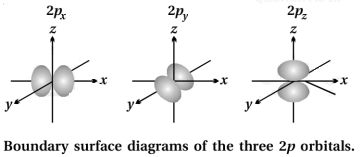
Explain $2p$ orbitals.
Solution
If $n=2$ and $l=1$,then it is a $2p$ orbital. The number of orbitals is given by $2l+1 = 2(1)+1 = 3$.
These three $2p$ orbitals have magnetic quantum numbers $(m_l): +1, 0, -1$. These values can be assigned to any orbital,and $p_x$ can be given any of these values.
Based on their orientation along the axes,these orbitals are known as $2p_x, 2p_y, 2p_z$.
The number of radial nodes in $2p$ orbitals is zero as per the formula $(n-l-1) = (2-1-1) = 0$. However,the number of angular nodes (nodal planes) is one. At the nodal plane where the two lobes meet,the electron density is zero.
These three $2p$ orbitals have magnetic quantum numbers $(m_l): +1, 0, -1$. These values can be assigned to any orbital,and $p_x$ can be given any of these values.
Based on their orientation along the axes,these orbitals are known as $2p_x, 2p_y, 2p_z$.
The number of radial nodes in $2p$ orbitals is zero as per the formula $(n-l-1) = (2-1-1) = 0$. However,the number of angular nodes (nodal planes) is one. At the nodal plane where the two lobes meet,the electron density is zero.
0 likes
View Solution684
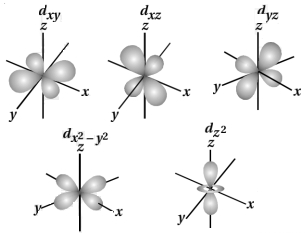
Difficult
Explain $d$ orbital.
Solution
(N/A) orbital: $d$ orbitals exist in energy levels $n=3, 4, 5 \ldots$ but in $n=1, 2$ shells,$d$ orbitals do not exist. Therefore,$1d$ and $2d$ do not exist. For $d$ orbitals,the azimuthal quantum number $l=2$. Since for $n=1$ and $n=2$,$l$ cannot be $2$,$d$ orbitals do not exist for these shells.
For $d$ orbitals,the minimum value of $n$ is $3$. Thus,$3d, 4d, 5d \ldots$ exist.
Number of $d$ orbitals: The number of orbitals in a subshell is given by $(2l+1)$. For $d$ orbitals,$l=2$,so the number of $d$ orbitals is $2(2)+1 = 5$. Thus,a $d$ subshell has $5$ orbitals.
Magnetic quantum number: For $d$ orbitals,$l=2$ and the magnetic quantum number $m_l$ can take values $-2, -1, 0, +1, +2$. These $5$ $d$ orbitals are $d_{xy}, d_{yz}, d_{zx}, d_{x^2-y^2}$ and $d_{z^2}$.
Shape of $d$ orbitals: Four $d$ orbitals $(d_{xy}, d_{yz}, d_{zx}, d_{x^2-y^2})$ have a similar shape with $4$ lobes. The $d_{xy}, d_{yz}$ and $d_{zx}$ orbitals have lobes oriented between the respective axes. For $d_{x^2-y^2}$,the lobes are oriented along the $x$ and $y$ axes.
The shape of the $d_{z^2}$ orbital is different,consisting of two lobes along the $z$ axis with a ring of electron density in the $xy$ plane.
Energy of $d$ orbitals: In any single subshell,the energy of all $5$ $d$ orbitals is degenerate (same energy). Their shape and size are also identical.
As the principal quantum number $n$ increases,the size and energy of the orbitals increase: $3d < 4d < 5d \ldots$
Nodes: Radial nodes are regions where electron density is zero. In $d$ orbitals,the number of angular nodes is $l=2$ and the number of radial nodes is $(n-l-1)$.
For a $3d$ orbital,the number of radial nodes is $(3-2-1) = 0$.
Total nodes for $3d$ orbital: $(n-1) = 3-1 = 2$ nodes.
For $d$ orbitals,the minimum value of $n$ is $3$. Thus,$3d, 4d, 5d \ldots$ exist.
Number of $d$ orbitals: The number of orbitals in a subshell is given by $(2l+1)$. For $d$ orbitals,$l=2$,so the number of $d$ orbitals is $2(2)+1 = 5$. Thus,a $d$ subshell has $5$ orbitals.
Magnetic quantum number: For $d$ orbitals,$l=2$ and the magnetic quantum number $m_l$ can take values $-2, -1, 0, +1, +2$. These $5$ $d$ orbitals are $d_{xy}, d_{yz}, d_{zx}, d_{x^2-y^2}$ and $d_{z^2}$.
Shape of $d$ orbitals: Four $d$ orbitals $(d_{xy}, d_{yz}, d_{zx}, d_{x^2-y^2})$ have a similar shape with $4$ lobes. The $d_{xy}, d_{yz}$ and $d_{zx}$ orbitals have lobes oriented between the respective axes. For $d_{x^2-y^2}$,the lobes are oriented along the $x$ and $y$ axes.
The shape of the $d_{z^2}$ orbital is different,consisting of two lobes along the $z$ axis with a ring of electron density in the $xy$ plane.
Energy of $d$ orbitals: In any single subshell,the energy of all $5$ $d$ orbitals is degenerate (same energy). Their shape and size are also identical.
As the principal quantum number $n$ increases,the size and energy of the orbitals increase: $3d < 4d < 5d \ldots$
Nodes: Radial nodes are regions where electron density is zero. In $d$ orbitals,the number of angular nodes is $l=2$ and the number of radial nodes is $(n-l-1)$.
For a $3d$ orbital,the number of radial nodes is $(3-2-1) = 0$.
Total nodes for $3d$ orbital: $(n-1) = 3-1 = 2$ nodes.
0 likes
View Solution685
Medium
Write a note about the energy of orbitals in hydrogen.
Solution
(N/A) The energy of an electron in a hydrogen atom is determined solely by the principal quantum number $(n)$. Thus,the energy of the orbitals increases as follows:
$1s < 2s = 2p < 3s = 3p = 3d < 4s = 4p = 4d = 4f < 5s = 5p = \dots$
Ground state of $H$: The $1s$ orbital in a hydrogen atom corresponds to the most stable condition and is called the ground state,and an electron residing in this orbital is most strongly held by the nucleus.
Excited state: An electron in the $2s, 2p$ or higher orbitals in a hydrogen atom is in an excited state.
An electron in an excited state is weakly attracted towards the nucleus. Ground state energy < Excited state energy.
The only electrical interaction present in the hydrogen atom is the attraction between the negatively charged electron and the positively charged nucleus; therefore,the subshell $(l)$ does not affect the orbital energy state.
$1s < 2s = 2p < 3s = 3p = 3d < 4s = 4p = 4d = 4f < 5s = 5p = \dots$
Ground state of $H$: The $1s$ orbital in a hydrogen atom corresponds to the most stable condition and is called the ground state,and an electron residing in this orbital is most strongly held by the nucleus.
Excited state: An electron in the $2s, 2p$ or higher orbitals in a hydrogen atom is in an excited state.
An electron in an excited state is weakly attracted towards the nucleus. Ground state energy < Excited state energy.
The only electrical interaction present in the hydrogen atom is the attraction between the negatively charged electron and the positively charged nucleus; therefore,the subshell $(l)$ does not affect the orbital energy state.
0 likes
View Solution686
Difficult
Give the order of energy of orbitals in a multi-electron atom.
Solution
(N/A) The energy order of orbitals in multi-electron atoms is determined by the $(n+l)$ rule,where $n$ is the principal quantum number and $l$ is the azimuthal quantum number. Orbitals with a lower $(n+l)$ value have lower energy. If two orbitals have the same $(n+l)$ value,the one with the lower $n$ value has lower energy.
The energy order of orbitals is:
$1s < 2s < 2p < 3s < 3p < 4s < 3d < 4p < 5s < 4d < 5p < 6s < 4f < 5d < 6p < 7s < 5f < 6d < 7p$
Factors affecting the energy of orbitals:
$(i)$ The attraction of the orbital towards the nucleus and repulsion between electrons.
$(ii)$ The shielding effect provided by inner shell electrons.
$(iii)$ The penetration effect of orbitals,which follows the order $s > p > d > f$ for a given shell.
$(iv)$ The effective nuclear charge $(Z_{eff})$ experienced by the electrons.
The energy order of orbitals is:
$1s < 2s < 2p < 3s < 3p < 4s < 3d < 4p < 5s < 4d < 5p < 6s < 4f < 5d < 6p < 7s < 5f < 6d < 7p$
Factors affecting the energy of orbitals:
$(i)$ The attraction of the orbital towards the nucleus and repulsion between electrons.
$(ii)$ The shielding effect provided by inner shell electrons.
$(iii)$ The penetration effect of orbitals,which follows the order $s > p > d > f$ for a given shell.
$(iv)$ The effective nuclear charge $(Z_{eff})$ experienced by the electrons.
0 likes
View Solution687
Difficult
Explain the energy order of orbitals in multielectron atoms.
Solution
(N/A) In multielectron atoms,the energy of an orbital depends on both the principal quantum number $(n)$ and the azimuthal quantum number $(l)$.
$1$. In a multielectron atom,the electron experiences attraction from the nucleus and repulsion from other electrons.
$2$. The inner electrons shield the outer electrons from the full nuclear charge,a phenomenon known as the shielding effect. The effectiveness of this shielding depends on the shape of the orbital $(s > p > d > f)$.
$3$. Due to different shielding effects,orbitals within the same principal shell $(n)$ have different energies. For example,in the $n=3$ shell,the energy order is $3s < 3p < 3d$.
$4$. The energy of orbitals is generally determined by the $(n+l)$ rule. Orbitals with a lower $(n+l)$ value have lower energy. If two orbitals have the same $(n+l)$ value,the one with the lower $n$ value has lower energy.
$1$. In a multielectron atom,the electron experiences attraction from the nucleus and repulsion from other electrons.
$2$. The inner electrons shield the outer electrons from the full nuclear charge,a phenomenon known as the shielding effect. The effectiveness of this shielding depends on the shape of the orbital $(s > p > d > f)$.
$3$. Due to different shielding effects,orbitals within the same principal shell $(n)$ have different energies. For example,in the $n=3$ shell,the energy order is $3s < 3p < 3d$.
$4$. The energy of orbitals is generally determined by the $(n+l)$ rule. Orbitals with a lower $(n+l)$ value have lower energy. If two orbitals have the same $(n+l)$ value,the one with the lower $n$ value has lower energy.
0 likes
View Solution688
Difficult
Explain how the energy of an orbital and the extent of shielding in the same shell depend on the shape of the orbitals.
Solution
(N/A) Both the attractive and repulsive interactions depend upon the shell and the shape of the orbital in which the electron is present. The reasons are as follows:
$(i)$ The $s$-orbital shields the outer electrons from the nucleus more effectively compared to electrons present in the $p$-orbital.
$(ii)$ Due to the spherical shape of the $s$-orbital,the $s$-orbital electron spends more time close to the nucleus in comparison to the $p$-orbital electron,which in turn spends more time near the nucleus compared to the $d$-orbital electron.
$(iii)$ Effective nuclear charge $(Z_{eff})$: As the azimuthal quantum number $(l)$ increases,the $Z_{eff}$ experienced by the electron decreases. Consequently,the $s$-orbital electron is more tightly bound to the nucleus than the $p$-orbital electron,which is more tightly bound than the $d$-orbital electron.
Result: The energy order of orbitals in the same shell is $s < p < d < f$.
$(i)$ The $s$-orbital shields the outer electrons from the nucleus more effectively compared to electrons present in the $p$-orbital.
$(ii)$ Due to the spherical shape of the $s$-orbital,the $s$-orbital electron spends more time close to the nucleus in comparison to the $p$-orbital electron,which in turn spends more time near the nucleus compared to the $d$-orbital electron.
$(iii)$ Effective nuclear charge $(Z_{eff})$: As the azimuthal quantum number $(l)$ increases,the $Z_{eff}$ experienced by the electron decreases. Consequently,the $s$-orbital electron is more tightly bound to the nucleus than the $p$-orbital electron,which is more tightly bound than the $d$-orbital electron.
Result: The energy order of orbitals in the same shell is $s < p < d < f$.
0 likes
View Solution689
Medium
Explain $(n + l)$ rules for the energy of an orbital with an example.
Solution
The energy of an electron in an orbital is determined by the values of the principal quantum number $(n)$ and the azimuthal quantum number $(l)$.
Rule $I$: The orbital with a lower value of $(n + l)$ has lower energy.
Example: The energy of $2p$ is higher than $2s$.
For $2s$: $n = 2, l = 0$,so $(n + l) = (2 + 0) = 2$.
For $2p$: $n = 2, l = 1$,so $(n + l) = (2 + 1) = 3$.
Since $2 < 3$,therefore $2s < 2p$.
Rule $II$: If two orbitals have the same $(n + l)$ value,the orbital with the lower value of $n$ has lower energy.
Example: The energy of $3p$ is lower than $4s$.
For $4s$: $n = 4, l = 0$,so $(n + l) = (4 + 0) = 4$.
For $3p$: $n = 3, l = 1$,so $(n + l) = (3 + 1) = 4$.
Since $3 < 4$,therefore $3p < 4s$.
Rule $I$: The orbital with a lower value of $(n + l)$ has lower energy.
Example: The energy of $2p$ is higher than $2s$.
For $2s$: $n = 2, l = 0$,so $(n + l) = (2 + 0) = 2$.
For $2p$: $n = 2, l = 1$,so $(n + l) = (2 + 1) = 3$.
Since $2 < 3$,therefore $2s < 2p$.
Rule $II$: If two orbitals have the same $(n + l)$ value,the orbital with the lower value of $n$ has lower energy.
Example: The energy of $3p$ is lower than $4s$.
For $4s$: $n = 4, l = 0$,so $(n + l) = (4 + 0) = 4$.
For $3p$: $n = 3, l = 1$,so $(n + l) = (3 + 1) = 4$.
Since $3 < 4$,therefore $3p < 4s$.
0 likes
View Solution690
MediumMCQ
On the basis of which rules does the arrangement of electrons take place in atoms?
A
Aufbau principle
B
Pauli exclusion principle
C
Hund's rule of maximum multiplicity
D
All of the above
Solution
(D) The arrangement of electrons in an atom is governed by the following fundamental principles:
$(i)$ Aufbau principle: Electrons fill orbitals in order of increasing energy.
$(ii)$ Pauli exclusion principle: No two electrons in an atom can have the same set of all four quantum numbers.
$(iii)$ Hund's rule of maximum multiplicity: Pairing of electrons in degenerate orbitals does not occur until each orbital is singly occupied.
Therefore,all these rules collectively determine the electronic configuration of atoms.
$(i)$ Aufbau principle: Electrons fill orbitals in order of increasing energy.
$(ii)$ Pauli exclusion principle: No two electrons in an atom can have the same set of all four quantum numbers.
$(iii)$ Hund's rule of maximum multiplicity: Pairing of electrons in degenerate orbitals does not occur until each orbital is singly occupied.
Therefore,all these rules collectively determine the electronic configuration of atoms.
0 likes
View Solution691
Easy
Explain the arrangement of orbitals in increasing order of energy on the basis of the $(n + l)$ rule.
Solution
(N/A) The energy of an orbital is determined by the $(n + l)$ rule,where $n$ is the principal quantum number and $l$ is the azimuthal quantum number.
Rules for determining energy:
$1$. The orbital with the lower value of $(n + l)$ has lower energy.
$2$. If the $(n + l)$ values are the same,the orbital with the lower value of $n$ has lower energy.
Based on these rules,the increasing order of energy is: $1s < 2s < 2p < 3s < 3p < 4s < 3d < 4p$.
Rules for determining energy:
$1$. The orbital with the lower value of $(n + l)$ has lower energy.
$2$. If the $(n + l)$ values are the same,the orbital with the lower value of $n$ has lower energy.
Based on these rules,the increasing order of energy is: $1s < 2s < 2p < 3s < 3p < 4s < 3d < 4p$.
| Orbital and Values | Comparison |
|---|---|
| $1s: n=1, l=0, n+l=1$ | - |
| $2s: n=2, l=0, n+l=2$ | - |
| $2p: n=2, l=1, n+l=3$ $3s: n=3, l=0, n+l=3$ | $2p$ $(n=2)$ has lower energy than $3s$ $(n=3)$ |
| $3p: n=3, l=1, n+l=4$ $4s: n=4, l=0, n+l=4$ | $3p$ $(n=3)$ has lower energy than $4s$ $(n=4)$ |
| $3d: n=3, l=2, n+l=5$ $4p: n=4, l=1, n+l=5$ | $3d$ $(n=3)$ has lower energy than $4p$ $(n=4)$ |
0 likes
View Solution692
Easy
Arrange the $1s$,$2s$,$4s$,$2p$,$3p$,$4p$,and $3d$ orbitals according to increasing order of energy.
Solution
(N/A) The energy of orbitals is determined by the $(n+l)$ rule.
According to this rule,the orbital with a lower $(n+l)$ value has lower energy.
If the $(n+l)$ values are the same,the orbital with the lower principal quantum number $(n)$ has lower energy.
Based on this,the increasing order of energy is: $1s < 2s < 2p < 3p < 4s < 3d < 4p$.
According to this rule,the orbital with a lower $(n+l)$ value has lower energy.
If the $(n+l)$ values are the same,the orbital with the lower principal quantum number $(n)$ has lower energy.
Based on this,the increasing order of energy is: $1s < 2s < 2p < 3p < 4s < 3d < 4p$.
| Orbital Properties | Explanation |
|---|---|
| $1s$: $n=1, l=0, n+l=1$ | Lowest energy |
| $2s$: $n=2, l=0, n+l=2$ | - |
| $2p$: $n=2, l=1, n+l=3$ | - |
| $3p$: $n=3, l=1, n+l=4$ | - |
| $4s$: $n=4, l=0, n+l=4$ | $3p$ $(n=3)$ < $4s$ $(n=4)$ |
| $3d$: $n=3, l=2, n+l=5$ | - |
| $4p$: $n=4, l=1, n+l=5$ | $3d$ $(n=3)$ < $4p$ $(n=4)$ |
0 likes
View Solution693
Medium
Explain the Aufbau principle with an example.
Solution
(N/A) The word 'aufbau' in German means 'building up'. The building up of orbitals refers to the process of filling orbitals with electrons.
Principle: 'In the ground state of atoms,the orbitals are filled in the order of their increasing energies.'
The order in which orbitals are filled is: $1s, 2s, 2p, 3s, 3p, 4s, 3d, 4p, 5s, 4d, 5p, 6s, 4f, 5d, 6p, 7s, \ldots$
Lower energy orbitals are filled completely before higher energy orbitals. The electron capacity of orbitals is as follows:
Example:
$Be$ $(Z=4)$: $1s^{2} 2s^{2}$
$F$ $(Z=9)$: $1s^{2} 2s^{2} 2p^{5}$
$Br$ $(Z=35)$: $1s^{2} 2s^{2} 2p^{6} 3s^{2} 3p^{6} 4s^{2} 3d^{10} 4p^{5}$
Principle: 'In the ground state of atoms,the orbitals are filled in the order of their increasing energies.'
The order in which orbitals are filled is: $1s, 2s, 2p, 3s, 3p, 4s, 3d, 4p, 5s, 4d, 5p, 6s, 4f, 5d, 6p, 7s, \ldots$
Lower energy orbitals are filled completely before higher energy orbitals. The electron capacity of orbitals is as follows:
| Orbital | $s, p, d, f$ |
| Max. electron capacity | $2, 6, 10, 14$ |
Example:
$Be$ $(Z=4)$: $1s^{2} 2s^{2}$
$F$ $(Z=9)$: $1s^{2} 2s^{2} 2p^{5}$
$Br$ $(Z=35)$: $1s^{2} 2s^{2} 2p^{6} 3s^{2} 3p^{6} 4s^{2} 3d^{10} 4p^{5}$
0 likes
View Solution694
Medium
Explain the Pauli exclusion principle with an example.
Solution
(N/A) The number of electrons that can be filled in various orbitals is restricted by the exclusion principle,proposed by the Austrian scientist Wolfgang Pauli $(1926)$.
Rule: "No two electrons in an atom can have the same set of four quantum numbers $(n, l, m_l, m_s)$."
Alternative statement: Only two electrons may exist in the same orbital,and these electrons must have opposite spins.
According to the rule,two electrons can have the same values for the three quantum numbers $n, l,$ and $m_l$,but they must have different spin quantum numbers ($m_s = +\frac{1}{2}$ and $m_s = -\frac{1}{2}$).
Application: Pauli's exclusion principle helps in calculating the maximum electron capacity of any subshell.
- Subshell $1s$ comprises one orbital; thus,the maximum number of electrons in the $1s$ subshell is two.
- In $p, d,$ and $f$ subshells,the maximum number of electrons is $6, 10,$ and $14$ respectively.
For a principal quantum number $n$,the number of orbitals is $n^2$,and the maximum number of electrons is $2n^2$.
Example: The electron configuration of Helium $(He)$ is $1s^2$. For these two electrons,the values of $n, l,$ and $m_l$ are $1, 0, 0$ respectively. Their spin quantum numbers are $+\frac{1}{2}$ and $-\frac{1}{2}$,which differ from each other.
Rule: "No two electrons in an atom can have the same set of four quantum numbers $(n, l, m_l, m_s)$."
Alternative statement: Only two electrons may exist in the same orbital,and these electrons must have opposite spins.
According to the rule,two electrons can have the same values for the three quantum numbers $n, l,$ and $m_l$,but they must have different spin quantum numbers ($m_s = +\frac{1}{2}$ and $m_s = -\frac{1}{2}$).
Application: Pauli's exclusion principle helps in calculating the maximum electron capacity of any subshell.
- Subshell $1s$ comprises one orbital; thus,the maximum number of electrons in the $1s$ subshell is two.
- In $p, d,$ and $f$ subshells,the maximum number of electrons is $6, 10,$ and $14$ respectively.
| Subshell | Number of orbitals | Maximum electrons $(2 \times \text{orbitals})$ |
| $s$ | $1$ | $2$ |
| $p$ | $3$ | $6$ |
| $d$ | $5$ | $10$ |
| $f$ | $7$ | $14$ |
For a principal quantum number $n$,the number of orbitals is $n^2$,and the maximum number of electrons is $2n^2$.
Example: The electron configuration of Helium $(He)$ is $1s^2$. For these two electrons,the values of $n, l,$ and $m_l$ are $1, 0, 0$ respectively. Their spin quantum numbers are $+\frac{1}{2}$ and $-\frac{1}{2}$,which differ from each other.
0 likes
View Solution695
Medium
Write down about the Hund's rule.
Solution
(N/A) Hund's rule of maximum multiplicity deals with the filling of electrons into orbitals belonging to the same subshell.
Rule: Pairing of electrons in the orbitals belonging to the same subshell ($p, d,$ or $f$) does not take place until each orbital of that subshell is singly occupied.
This means that electrons will first occupy all available orbitals in a subshell singly with parallel spins before pairing begins.
For example,in a $p$-subshell,the $4^{th}$ electron starts the pairing process. Similarly,for $d$ and $f$ subshells,pairing starts with the $6^{th}$ and $8^{th}$ electrons,respectively.
Example: Nitrogen $(Z=7)$ has the configuration $1s^2 2s^2 2p_x^1 2p_y^1 2p_z^1$,and Oxygen $(Z=8)$ has the configuration $1s^2 2s^2 2p_x^2 2p_y^1 2p_z^1$.
Rule: Pairing of electrons in the orbitals belonging to the same subshell ($p, d,$ or $f$) does not take place until each orbital of that subshell is singly occupied.
This means that electrons will first occupy all available orbitals in a subshell singly with parallel spins before pairing begins.
For example,in a $p$-subshell,the $4^{th}$ electron starts the pairing process. Similarly,for $d$ and $f$ subshells,pairing starts with the $6^{th}$ and $8^{th}$ electrons,respectively.
Example: Nitrogen $(Z=7)$ has the configuration $1s^2 2s^2 2p_x^1 2p_y^1 2p_z^1$,and Oxygen $(Z=8)$ has the configuration $1s^2 2s^2 2p_x^2 2p_y^1 2p_z^1$.
0 likes
View Solution696
Medium
Explain Hund's rule of maximum multiplicity.
Solution
(N/A) Hund's rule of maximum multiplicity states that for a given electron configuration,the term with the maximum multiplicity has the lowest energy. In simpler terms,for orbitals of the same subshell ($p, d,$ or $f$),pairing of electrons does not occur until each orbital is singly occupied with electrons having parallel spins.
$1$. Electrons first occupy all empty orbitals of a subshell singly with parallel spins.
$2$. Pairing only begins once each orbital in the subshell contains one electron.
For example,in Nitrogen $(Z=7)$,the configuration is $1s^2 2s^2 2p_x^1 2p_y^1 2p_z^1$. In Oxygen $(Z=8)$,the configuration is $1s^2 2s^2 2p_x^2 2p_y^1 2p_z^1$.
$1$. Electrons first occupy all empty orbitals of a subshell singly with parallel spins.
$2$. Pairing only begins once each orbital in the subshell contains one electron.
For example,in Nitrogen $(Z=7)$,the configuration is $1s^2 2s^2 2p_x^1 2p_y^1 2p_z^1$. In Oxygen $(Z=8)$,the configuration is $1s^2 2s^2 2p_x^2 2p_y^1 2p_z^1$.
0 likes
View Solution697
Difficult
What is the electronic configuration of an atom? Explain its method with examples.
Solution
(N/A) The distribution of electrons into the orbitals of an atom is called its electronic configuration.
Method-$1$: (Electronic configuration by orbital notation): The subshell is represented by its respective letter symbol,and the number of electrons present in the subshell is depicted as a superscript. The subshells belonging to different shells are differentiated by writing the principal quantum number before the respective subshell. General configuration is represented as $n_{1}s^{a}n_{2}p^{b}n_{3}d^{c}$.
Example: Electronic configurations expressed by orbital notation for $B(Z=5), C(Z=6), N(Z=7), O(Z=8), F(Z=9)$ and $Ne(Z=10)$ are as follows:
Method-$2$: (Electronic configuration by orbital diagram): Each orbital of the subshell is represented by a box as shown below:
$s$-orbital: [ ]
$p$-subshell: [ ][ ][ ]
$d$-subshell: [ ][ ][ ][ ][ ]
The electron is represented by an arrow $(\uparrow)$ for a positive $(+\frac{1}{2})$ spin or an arrow $(\downarrow)$ for a negative $(-\frac{1}{2})$ spin.
Method-$1$: (Electronic configuration by orbital notation): The subshell is represented by its respective letter symbol,and the number of electrons present in the subshell is depicted as a superscript. The subshells belonging to different shells are differentiated by writing the principal quantum number before the respective subshell. General configuration is represented as $n_{1}s^{a}n_{2}p^{b}n_{3}d^{c}$.
Example: Electronic configurations expressed by orbital notation for $B(Z=5), C(Z=6), N(Z=7), O(Z=8), F(Z=9)$ and $Ne(Z=10)$ are as follows:
| Atom | Electronic configuration by orbital notation |
|---|---|
| $B(Z=5)$ | $1s^{2}2s^{2}2p^{1}$ |
| $C(Z=6)$ | $1s^{2}2s^{2}2p^{2}$ |
| $N(Z=7)$ | $1s^{2}2s^{2}2p^{3}$ |
| $O(Z=8)$ | $1s^{2}2s^{2}2p^{4}$ |
| $F(Z=9)$ | $1s^{2}2s^{2}2p^{5}$ |
| $Ne(Z=10)$ | $1s^{2}2s^{2}2p^{6}$ |
Method-$2$: (Electronic configuration by orbital diagram): Each orbital of the subshell is represented by a box as shown below:
$s$-orbital: [ ]
$p$-subshell: [ ][ ][ ]
$d$-subshell: [ ][ ][ ][ ][ ]
The electron is represented by an arrow $(\uparrow)$ for a positive $(+\frac{1}{2})$ spin or an arrow $(\downarrow)$ for a negative $(-\frac{1}{2})$ spin.
0 likes
View Solution698
Medium
Provide the orbital electronic configuration for the following elements: $Na, Mg, Al, Si, P, S, Cl, Ar, K, Ca$.
Solution
(N/A)
Note: $[Ne]$ represents $1s^{2} 2s^{2} 2p^{6}$ and $[Ar]$ represents $1s^{2} 2s^{2} 2p^{6} 3s^{2} 3p^{6}$.
| Atom $(Z)$ | Orbital Electronic Configuration |
|---|---|
| $Na (11)$ | $[Ne] 3s^{1}$ |
| $Mg (12)$ | $[Ne] 3s^{2}$ |
| $Al (13)$ | $[Ne] 3s^{2} 3p_{x}^{1} 3p_{y}^{0} 3p_{z}^{0}$ |
| $Si (14)$ | $[Ne] 3s^{2} 3p_{x}^{1} 3p_{y}^{1} 3p_{z}^{0}$ |
| $P (15)$ | $[Ne] 3s^{2} 3p_{x}^{1} 3p_{y}^{1} 3p_{z}^{1}$ |
| $S (16)$ | $[Ne] 3s^{2} 3p_{x}^{2} 3p_{y}^{1} 3p_{z}^{1}$ |
| $Cl (17)$ | $[Ne] 3s^{2} 3p_{x}^{2} 3p_{y}^{2} 3p_{z}^{1}$ |
| $Ar (18)$ | $[Ne] 3s^{2} 3p_{x}^{2} 3p_{y}^{2} 3p_{z}^{2}$ |
| $K (19)$ | $[Ar] 4s^{1}$ |
| $Ca (20)$ | $[Ar] 4s^{2}$ |
Note: $[Ne]$ represents $1s^{2} 2s^{2} 2p^{6}$ and $[Ar]$ represents $1s^{2} 2s^{2} 2p^{6} 3s^{2} 3p^{6}$.
0 likes
View Solution699
Medium
What are core electrons and valence electrons?
Solution
(N/A) Core electrons: These are the electrons present in the inner,completely filled shells of an atom,corresponding to the nearest noble gas configuration.
Valence electrons: These are the electrons present in the outermost shell of an atom,which have the highest principal quantum number $(n)$. These electrons are involved in chemical bonding.
Example: For Sulfur $(Z = 16)$,the electronic configuration is $[Ne] 3s^{2} 3p^{4}$.
Here,the electrons in $[Ne]$ (i.e.,$1s^{2} 2s^{2} 2p^{6}$) are core electrons,and the $2 + 4 = 6$ electrons in the $3s$ and $3p$ orbitals are valence electrons.
Valence electrons: These are the electrons present in the outermost shell of an atom,which have the highest principal quantum number $(n)$. These electrons are involved in chemical bonding.
Example: For Sulfur $(Z = 16)$,the electronic configuration is $[Ne] 3s^{2} 3p^{4}$.
Here,the electrons in $[Ne]$ (i.e.,$1s^{2} 2s^{2} 2p^{6}$) are core electrons,and the $2 + 4 = 6$ electrons in the $3s$ and $3p$ orbitals are valence electrons.
0 likes
View Solution700
Medium
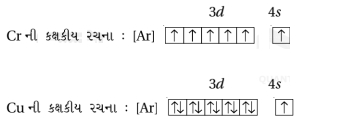
Write the electronic configuration of chromium $(Cr)$ and copper $(Cu)$. Give reasons for the observed configurations of $Cr$ $(Z = 24)$ and $Cu$ $(Z = 29)$.
Solution
(N/A) The electronic configuration of $Cr$ $(Z = 24)$ is $[Ar]^{18} 3d^5 4s^1$. This is because half-filled $d$-orbitals $(3d^5)$ provide extra stability due to symmetry and exchange energy.
The electronic configuration of $Cu$ $(Z = 29)$ is $[Ar]^{18} 3d^{10} 4s^1$. This is because completely filled $d$-orbitals $(3d^{10})$ provide extra stability due to symmetry and exchange energy.
Orbital diagrams:
$Cr: [Ar] \text{ } 3d^5 \text{ } 4s^1$
$Cu: [Ar] \text{ } 3d^{10} \text{ } 4s^1$
The electronic configuration of $Cu$ $(Z = 29)$ is $[Ar]^{18} 3d^{10} 4s^1$. This is because completely filled $d$-orbitals $(3d^{10})$ provide extra stability due to symmetry and exchange energy.
Orbital diagrams:
$Cr: [Ar] \text{ } 3d^5 \text{ } 4s^1$
$Cu: [Ar] \text{ } 3d^{10} \text{ } 4s^1$
0 likes
View SolutionStructure of Atom — Quantum number, Electronic configuration and Shape of orbitals · Frequently Asked Questions
1Are these Structure of Atom questions useful for JEE and NEET?
Yes. All questions in this section are mapped to JEE Main and NEET exam patterns. Previous year questions from JEE Main, NEET, GUJCET and state-level exams are included with full solutions.
2Can I switch to Hindi or Gujarati for these questions?
Yes. Use the language tabs in the hero section or the sidebar to view the same questions and solutions in English, Hindi or Gujarati.
3How do I generate a question paper from this subtopic?
Use the Vedclass Exam Paper Generator — select the chapter and subtopic, set difficulty, and generate Sets A, B, C, D automatically. First 3 chapters of every subject are free.
Vedclass Products
For Students
Vedclass Test Series
Mock tests in real JEE/NEET style with performance analysis. 5-day free trial.
Start Free TrialFor Teachers
Exam Paper Generator
Generate Set A/B/C/D papers from this chapter in 2 minutes. 3 chapters free.
Try FreeFor Institutes
Online Exam Module
Live online exams with unlimited students, 360° analytics & white-label branding.
See DemoFor Teachers & Institutes
Generate a Structure of Atom Exam Paper in 2 Minutes
Select subtopic & difficulty — Sets A, B, C, D auto-generated with No Repeat logic.
First 3 chapters of every subject are free — no payment required.