
A English
Mix Examples-Hydrocarbon Questions in English
Class 11 Chemistry · Hydrocarbons · Mix Examples-Hydrocarbon
317+
Questions
English
Language
100%
With Solutions
Showing 45 of 317 questions in English
251
Medium
Answer the following questions:
$(i)$ What is the bond length of $C-C$,$C=C$,and $C\equiv C$?
$(ii)$ What will be the effect on bond length as bond multiplicity increases?
$(iii)$ What is the relation between reactivity of compound,bond strength and bond order between two carbon atoms?
$(iv)$ What is the rate of reaction of $Cl_2, Br_2,$ and $I_2$ with $CH_2=CH_2$?
$(v)$ What is the difference between $2-$butyne and $1-$butyne? By which test can we distinguish between these two?
$(vi)$ Which real product is obtained on hydrolysis of alkyne? Why?
$(vii)$ Give the structure and $IUPAC$ name:
$(a)$ Vinyl chloride
$(b)$ Vinyl cyanide
$(c)$ Glyoxal
$(d)$ Silver acetylide
$(e)$ Diacetyl
$(f)$ Glycol
$(i)$ What is the bond length of $C-C$,$C=C$,and $C\equiv C$?
$(ii)$ What will be the effect on bond length as bond multiplicity increases?
$(iii)$ What is the relation between reactivity of compound,bond strength and bond order between two carbon atoms?
$(iv)$ What is the rate of reaction of $Cl_2, Br_2,$ and $I_2$ with $CH_2=CH_2$?
$(v)$ What is the difference between $2-$butyne and $1-$butyne? By which test can we distinguish between these two?
$(vi)$ Which real product is obtained on hydrolysis of alkyne? Why?
$(vii)$ Give the structure and $IUPAC$ name:
$(a)$ Vinyl chloride
$(b)$ Vinyl cyanide
$(c)$ Glyoxal
$(d)$ Silver acetylide
$(e)$ Diacetyl
$(f)$ Glycol
Solution
(N/A) $(i)$ $C-C = 154 \text{ pm}$,$C=C = 134 \text{ pm}$,$C\equiv C = 120 \text{ pm}$.
$(ii)$ Bond length decreases as bond multiplicity increases.
$(iii)$ Bond strength $\propto$ Bond order. Reactivity: $C\equiv C > C=C > C-C$ (for addition reactions).
$(iv)$ $Cl_2 > Br_2 > I_2$.
$(v)$ $1-$butyne is a terminal alkyne with an acidic $H$,while $2-$butyne is a non-terminal alkyne. They can be distinguished using $\text{Tollen's reagent}$ (ammoniacal silver nitrate).
$(vi)$ Carbonyl compounds (aldehydes or ketones) are obtained due to enol-keto tautomerism of the unstable enol intermediate.
$(vii)$
| Name | $IUPAC$ Name | Structure |
| :--- | :--- | :--- |
| Vinyl chloride | Chloroethene | $CH_2=CHCl$ |
| Vinyl cyanide | Prop$-2-$enenitrile | $CH_2=CHCN$ |
| Glyoxal | Ethanedial | $CHO-CHO$ |
| Silver acetylide | Silver ethynide | $Ag-C\equiv C-Ag$ |
| Diacetyl | Butane$-2,3-$dione | $CH_3-CO-CO-CH_3$ |
| Glycol | Ethane$-1,2-$diol | $HO-CH_2-CH_2-OH$ |
$(ii)$ Bond length decreases as bond multiplicity increases.
$(iii)$ Bond strength $\propto$ Bond order. Reactivity: $C\equiv C > C=C > C-C$ (for addition reactions).
$(iv)$ $Cl_2 > Br_2 > I_2$.
$(v)$ $1-$butyne is a terminal alkyne with an acidic $H$,while $2-$butyne is a non-terminal alkyne. They can be distinguished using $\text{Tollen's reagent}$ (ammoniacal silver nitrate).
$(vi)$ Carbonyl compounds (aldehydes or ketones) are obtained due to enol-keto tautomerism of the unstable enol intermediate.
$(vii)$
| Name | $IUPAC$ Name | Structure |
| :--- | :--- | :--- |
| Vinyl chloride | Chloroethene | $CH_2=CHCl$ |
| Vinyl cyanide | Prop$-2-$enenitrile | $CH_2=CHCN$ |
| Glyoxal | Ethanedial | $CHO-CHO$ |
| Silver acetylide | Silver ethynide | $Ag-C\equiv C-Ag$ |
| Diacetyl | Butane$-2,3-$dione | $CH_3-CO-CO-CH_3$ |
| Glycol | Ethane$-1,2-$diol | $HO-CH_2-CH_2-OH$ |
0 likes
View Solution252
Easy
Arrange the following compounds in decreasing order of acidic character of $C-H$ bonds.
$CH_2=CH_2, CH_3-CH_3, C_6H_6, CH\equiv CH$
$CH_2=CH_2, CH_3-CH_3, C_6H_6, CH\equiv CH$
Solution
(A) The acidic character of a $C-H$ bond depends on the $s$-character of the carbon atom involved in the bond.
Greater $s$-character leads to higher electronegativity of the carbon atom,which stabilizes the resulting conjugate base (carbanion) and increases acidity.
$1$. $CH\equiv CH$ ($sp$ hybridized,$50\% \ s$-character)
$2$. $CH_2=CH_2$ ($sp^2$ hybridized,$33.3\% \ s$-character)
$3$. $C_6H_6$ ($sp^2$ hybridized,but resonance stabilized)
$4$. $CH_3-CH_3$ ($sp^3$ hybridized,$25\% \ s$-character)
Therefore,the decreasing order of acidic character is: $CH\equiv CH > CH_2=CH_2 > C_6H_6 > CH_3-CH_3$.
Greater $s$-character leads to higher electronegativity of the carbon atom,which stabilizes the resulting conjugate base (carbanion) and increases acidity.
$1$. $CH\equiv CH$ ($sp$ hybridized,$50\% \ s$-character)
$2$. $CH_2=CH_2$ ($sp^2$ hybridized,$33.3\% \ s$-character)
$3$. $C_6H_6$ ($sp^2$ hybridized,but resonance stabilized)
$4$. $CH_3-CH_3$ ($sp^3$ hybridized,$25\% \ s$-character)
Therefore,the decreasing order of acidic character is: $CH\equiv CH > CH_2=CH_2 > C_6H_6 > CH_3-CH_3$.
0 likes
View Solution253
MediumMCQ
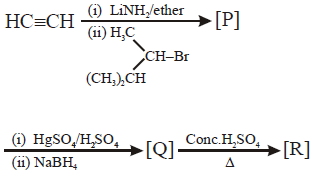
The major product $[R]$ in the following sequence of reactions is :-
A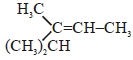
B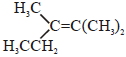
C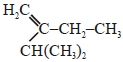
D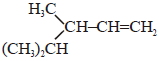
Solution
(B) Step $1$: Acetylene reacts with $LiNH_2$ followed by $2$-bromopropane to form $3,4$-dimethylpent-$1$-yne.
Step $2$: Hydration of the alkyne using $HgSO_4 / H_2SO_4$ gives a ketone,which is then reduced by $NaBH_4$ to form an alcohol,$3,4$-dimethylpentan-$2$-ol.
Step $3$: Acid-catalyzed dehydration of the alcohol using $Conc. H_2SO_4 / \Delta$ follows $Saytzeff$ rule to form the most substituted alkene,which is $2,3$-dimethylpent-$2$-ene as the major product.
Step $2$: Hydration of the alkyne using $HgSO_4 / H_2SO_4$ gives a ketone,which is then reduced by $NaBH_4$ to form an alcohol,$3,4$-dimethylpentan-$2$-ol.
Step $3$: Acid-catalyzed dehydration of the alcohol using $Conc. H_2SO_4 / \Delta$ follows $Saytzeff$ rule to form the most substituted alkene,which is $2,3$-dimethylpent-$2$-ene as the major product.
0 likes
View Solution254
DifficultMCQ
The major product $[C]$ of the following reaction sequence will be
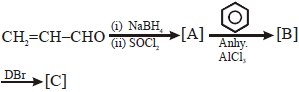
A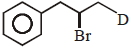
B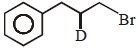
C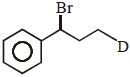
D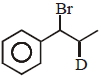
Solution
(C) Step $1$: $CH_2=CH-CHO$ reacts with $NaBH_4$ to give $CH_2=CH-CH_2OH$,which then reacts with $SOCl_2$ to form $CH_2=CH-CH_2Cl$ $[A]$.
Step $2$: $CH_2=CH-CH_2Cl$ reacts with benzene in the presence of anhydrous $AlCl_3$ (Friedel-Crafts alkylation) to give allylbenzene,$C_6H_5-CH_2-CH=CH_2$ $[B]$.
Step $3$: The addition of $DBr$ to allylbenzene follows Markovnikov's rule. The electrophile $D^+$ adds to the terminal carbon $(CH_2)$ to form the more stable benzylic carbocation $(C_6H_5-CH^+-CH_2D)$,which is then attacked by $Br^-$ to form the final product $[C]$,$C_6H_5-CH(Br)-CH_2-CH_2D$.
Step $2$: $CH_2=CH-CH_2Cl$ reacts with benzene in the presence of anhydrous $AlCl_3$ (Friedel-Crafts alkylation) to give allylbenzene,$C_6H_5-CH_2-CH=CH_2$ $[B]$.
Step $3$: The addition of $DBr$ to allylbenzene follows Markovnikov's rule. The electrophile $D^+$ adds to the terminal carbon $(CH_2)$ to form the more stable benzylic carbocation $(C_6H_5-CH^+-CH_2D)$,which is then attacked by $Br^-$ to form the final product $[C]$,$C_6H_5-CH(Br)-CH_2-CH_2D$.
0 likes
View Solution255
MediumMCQ
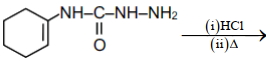
Identify the major product of the following reaction:
A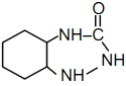
B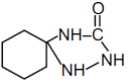
C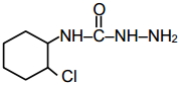
D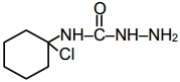
Solution
(B) The reaction proceeds via the protonation of the double bond in the cyclohexenyl group to form a stable carbocation intermediate.
Following this,the terminal amino group $(-NH_2)$ of the semicarbazide moiety acts as a nucleophile and attacks the carbocation.
This intramolecular cyclization leads to the formation of a cyclic structure where the nitrogen atom is bonded to the same carbon atom of the cyclohexane ring,resulting in the final major product shown in option $B$.
Following this,the terminal amino group $(-NH_2)$ of the semicarbazide moiety acts as a nucleophile and attacks the carbocation.
This intramolecular cyclization leads to the formation of a cyclic structure where the nitrogen atom is bonded to the same carbon atom of the cyclohexane ring,resulting in the final major product shown in option $B$.
0 likes
View Solution256
DifficultMCQ
The major product $'A'$ of the following given reaction has $......\,sp^2$ hybridized carbon atoms.
$2,7-\text{Dimethyl}-2,6-\text{octadiene} \xrightarrow{H^{+}} A \text{ (Major Product)}$
$2,7-\text{Dimethyl}-2,6-\text{octadiene} \xrightarrow{H^{+}} A \text{ (Major Product)}$
A
$5$
B
$3$
C
$1$
D
$2$
Solution
(D) The reaction involves the acid-catalyzed cyclization of $2,7-\text{dimethyl}-2,6-\text{octadiene}$.
First,the protonation of one of the double bonds forms a tertiary carbocation.
Then,an internal nucleophilic attack by the other double bond occurs,leading to the formation of a five-membered ring with a tertiary carbocation.
Finally,the loss of a proton $(-H^{+})$ from the carbocation results in the formation of the major product,which is $1,1,2-\text{trimethyl}-2-\text{isopropylidenecyclopentane}$ (or a similar isomer depending on the specific mechanism path).
Looking at the final structure shown in the mechanism: the product is $1,1-\text{dimethyl}-2-\text{isopropylidenecyclopentane}$.
In this structure,the double bond is between the ring carbon and the isopropylidene carbon.
This double bond involves $2$ carbon atoms,both of which are $sp^2$ hybridized.
Therefore,the major product has $2$ $sp^2$ hybridized carbon atoms.
First,the protonation of one of the double bonds forms a tertiary carbocation.
Then,an internal nucleophilic attack by the other double bond occurs,leading to the formation of a five-membered ring with a tertiary carbocation.
Finally,the loss of a proton $(-H^{+})$ from the carbocation results in the formation of the major product,which is $1,1,2-\text{trimethyl}-2-\text{isopropylidenecyclopentane}$ (or a similar isomer depending on the specific mechanism path).
Looking at the final structure shown in the mechanism: the product is $1,1-\text{dimethyl}-2-\text{isopropylidenecyclopentane}$.
In this structure,the double bond is between the ring carbon and the isopropylidene carbon.
This double bond involves $2$ carbon atoms,both of which are $sp^2$ hybridized.
Therefore,the major product has $2$ $sp^2$ hybridized carbon atoms.
0 likes
View Solution257
MediumMCQ
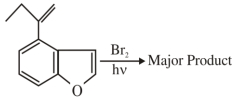
The major product of the following reaction contains $.....$ bromine atom$(s)$.
A
$1$
B
$2$
C
$3$
D
$4$
Solution
(A) The reaction of the given substrate with $Br_2$ in the presence of $h\nu$ (ultraviolet light) proceeds via a free-radical substitution mechanism.
In this specific molecule,the allylic position (the carbon adjacent to the double bond in the ethyl group) is the most reactive site for radical bromination.
Therefore,the bromine atom replaces one of the hydrogen atoms at the allylic position.
The major product contains $1$ bromine atom.
In this specific molecule,the allylic position (the carbon adjacent to the double bond in the ethyl group) is the most reactive site for radical bromination.
Therefore,the bromine atom replaces one of the hydrogen atoms at the allylic position.
The major product contains $1$ bromine atom.
0 likes
View Solution258
MediumMCQ
Given below are two statements.
Statement $I$: On heating with $KHSO_4$,glycerol is dehydrated and acrolein is formed.
Statement $II$: Acrolein has fruity odour and can be used to test glycerol's presence.
Choose the correct option.
Statement $I$: On heating with $KHSO_4$,glycerol is dehydrated and acrolein is formed.
Statement $II$: Acrolein has fruity odour and can be used to test glycerol's presence.
Choose the correct option.
A
Both Statement $I$ and Statement $II$ are correct.
B
Both Statement $I$ and Statement $II$ are incorrect.
C
Statement $I$ is correct but Statement $II$ is incorrect.
D
Statement $I$ is incorrect but Statement $II$ is correct.
Solution
(C) Statement $I$ is correct: Glycerol undergoes dehydration when heated with $KHSO_4$ to form acrolein $(CH_2=CH-CHO)$.
Statement $II$ is incorrect: Acrolein has a pungent,suffocating,and irritating odour,not a fruity odour. While it is used to detect the presence of glycerol,the description of its odour is wrong.
Statement $II$ is incorrect: Acrolein has a pungent,suffocating,and irritating odour,not a fruity odour. While it is used to detect the presence of glycerol,the description of its odour is wrong.
0 likes
View Solution259
MediumMCQ
Total number of isomers (including stereoisomers) obtained on monochlorination of methylcyclohexane is $........$
A
$11$
B
$13$
C
$14$
D
$12$
Solution
(D) Monochlorination of methylcyclohexane $(C_7H_{14})$ occurs at different positions:
$1$. At the methyl group: $1$ isomer (chloromethylcyclohexane).
$2$. At the $C_1$ position: $1$ isomer ($1$-chloro$-1-$methylcyclohexane).
$3$. At the $C_2$ position: $2$ chiral centers are present,leading to $2^2 = 4$ stereoisomers.
$4$. At the $C_3$ position: $2$ chiral centers are present,leading to $2^2 = 4$ stereoisomers.
$5$. At the $C_4$ position: $2$ stereoisomers (cis and trans$-1-$chloro$-4-$methylcyclohexane).
Total isomers = $1 + 1 + 4 + 4 + 2 = 12$.
$1$. At the methyl group: $1$ isomer (chloromethylcyclohexane).
$2$. At the $C_1$ position: $1$ isomer ($1$-chloro$-1-$methylcyclohexane).
$3$. At the $C_2$ position: $2$ chiral centers are present,leading to $2^2 = 4$ stereoisomers.
$4$. At the $C_3$ position: $2$ chiral centers are present,leading to $2^2 = 4$ stereoisomers.
$5$. At the $C_4$ position: $2$ stereoisomers (cis and trans$-1-$chloro$-4-$methylcyclohexane).
Total isomers = $1 + 1 + 4 + 4 + 2 = 12$.
0 likes
View Solution260
MediumMCQ
The maximum number of structural isomers possible for the hydrocarbon having the molecular formula $C_4H_6$ is:
A
$12$
B
$3$
C
$9$
D
$5$
Solution
(C) The degree of unsaturation for $C_4H_6$ is $4 - (6/2) + 1 = 2$. This indicates the presence of two double bonds,one triple bond,or two rings,or a combination of rings and double bonds.
There are $9$ possible structural isomers for $C_4H_6$:
$1$. $CH_3-CH_2-C\equiv CH$ (but$-1-$yne)
$2$. $CH_3-C\equiv C-CH_3$ (but$-2-$yne)
$3$. $CH_2=C=CH-CH_3$ (buta$-1,2-$diene)
$4$. $CH_2=CH-CH=CH_2$ (buta$-1,3-$diene)
$5$. $CH_2=C(CH_3)-CH=CH_2$ ($2$-methylpropa$-1,2-$diene)
$6$. Cyclobutene
$7$. $1-$Methylcyclopropene
$8$. $3-$Methylcyclopropene
$9$. Methylenecyclopropane
Thus,the total number of structural isomers is $9$.
There are $9$ possible structural isomers for $C_4H_6$:
$1$. $CH_3-CH_2-C\equiv CH$ (but$-1-$yne)
$2$. $CH_3-C\equiv C-CH_3$ (but$-2-$yne)
$3$. $CH_2=C=CH-CH_3$ (buta$-1,2-$diene)
$4$. $CH_2=CH-CH=CH_2$ (buta$-1,3-$diene)
$5$. $CH_2=C(CH_3)-CH=CH_2$ ($2$-methylpropa$-1,2-$diene)
$6$. Cyclobutene
$7$. $1-$Methylcyclopropene
$8$. $3-$Methylcyclopropene
$9$. Methylenecyclopropane
Thus,the total number of structural isomers is $9$.
0 likes
View Solution261
DifficultMCQ
When a hydrocarbon $A$ undergoes complete combustion,it requires $11$ equivalents of oxygen and produces $4$ equivalents of water. What is the molecular formula of $A$?
A
$C_9H_8$
B
$C_{11}H_4$
C
$C_5H_8$
D
$C_{11}H_8$
Solution
(A) The general combustion reaction for a hydrocarbon $C_xH_y$ is given by:
$C_xH_y + (x + \frac{y}{4}) O_2 \rightarrow xCO_2 + \frac{y}{2} H_2O$
Given that the reaction produces $4$ equivalents of water:
$\frac{y}{2} = 4 \implies y = 8$
Given that the reaction requires $11$ equivalents of oxygen:
$x + \frac{y}{4} = 11$
Substituting $y = 8$:
$x + \frac{8}{4} = 11$
$x + 2 = 11$
$x = 9$
Therefore,the molecular formula of the hydrocarbon $A$ is $C_9H_8$.
$C_xH_y + (x + \frac{y}{4}) O_2 \rightarrow xCO_2 + \frac{y}{2} H_2O$
Given that the reaction produces $4$ equivalents of water:
$\frac{y}{2} = 4 \implies y = 8$
Given that the reaction requires $11$ equivalents of oxygen:
$x + \frac{y}{4} = 11$
Substituting $y = 8$:
$x + \frac{8}{4} = 11$
$x + 2 = 11$
$x = 9$
Therefore,the molecular formula of the hydrocarbon $A$ is $C_9H_8$.
0 likes
View Solution262
MediumMCQ
The major products from the following reaction sequence are product $A$ and product $B$. The total sum of $\pi$ electrons in product $A$ and product $B$ are . . . . . . .(nearest integer)

A
$5$
B
$6$
C
$7$
D
$8$
Solution
(D) Step $1$: Formation of product $A$.
Cyclohexene reacts with $Br_2$ to form $1,2$-dibromocyclohexane. This intermediate then reacts with $HC \equiv C-CH_2-O^- Na^+$ (a nucleophile) via an $S_N2$ mechanism to substitute one $Br$ atom,yielding product $A$ ($1$-bromo-$2$-(prop-$2$-ynyloxy)cyclohexane).
Product $A$ contains one triple bond ($2 \pi$ bonds = $4 \pi$ electrons).
Step $2$: Formation of product $B$.
$1,2$-dibromocyclohexane reacts with $3$ equivalents of alcoholic $KOH$ (a strong base) to undergo double dehydrohalogenation,resulting in the formation of $1,3$-cyclohexadiene (product $B$).
Product $B$ contains two double bonds ($2 \pi$ bonds = $4 \pi$ electrons).
Step $3$: Calculation of total $\pi$ electrons.
Total $\pi$ electrons = ($\pi$ electrons in $A$) + ($\pi$ electrons in $B$)
Total $\pi$ electrons = $4 + 4 = 8$.
Cyclohexene reacts with $Br_2$ to form $1,2$-dibromocyclohexane. This intermediate then reacts with $HC \equiv C-CH_2-O^- Na^+$ (a nucleophile) via an $S_N2$ mechanism to substitute one $Br$ atom,yielding product $A$ ($1$-bromo-$2$-(prop-$2$-ynyloxy)cyclohexane).
Product $A$ contains one triple bond ($2 \pi$ bonds = $4 \pi$ electrons).
Step $2$: Formation of product $B$.
$1,2$-dibromocyclohexane reacts with $3$ equivalents of alcoholic $KOH$ (a strong base) to undergo double dehydrohalogenation,resulting in the formation of $1,3$-cyclohexadiene (product $B$).
Product $B$ contains two double bonds ($2 \pi$ bonds = $4 \pi$ electrons).
Step $3$: Calculation of total $\pi$ electrons.
Total $\pi$ electrons = ($\pi$ electrons in $A$) + ($\pi$ electrons in $B$)
Total $\pi$ electrons = $4 + 4 = 8$.
0 likes
View Solution263
EasyMCQ
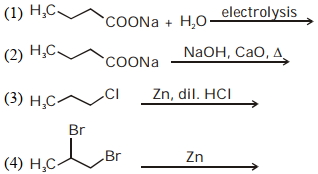
Which of the following reactions produce$(s)$ propane as a major product?
A
$1, 2$
B
$1, 3$
C
$2, 3$
D
$2, 4$
Solution
(C) Let us analyze each reaction:
$(1)$ Kolbe's electrolysis of sodium butanoate $(CH_3CH_2CH_2COONa)$ produces $n$-hexane $(CH_3CH_2CH_2CH_2CH_2CH_3)$.
$(2)$ Decarboxylation of sodium butanoate $(CH_3CH_2CH_2COONa)$ with soda lime $(NaOH + CaO)$ produces propane $(CH_3CH_2CH_3)$.
$(3)$ Reduction of $1$-chloropropane $(CH_3CH_2CH_2Cl)$ with $Zn$ and dilute $HCl$ produces propane $(CH_3CH_2CH_3)$.
$(4)$ Dehalogenation of $1,2$-dibromopropane with $Zn$ produces propene $(CH_3CH=CH_2)$.
Thus,reactions $(2)$ and $(3)$ produce propane as the major product.
$(1)$ Kolbe's electrolysis of sodium butanoate $(CH_3CH_2CH_2COONa)$ produces $n$-hexane $(CH_3CH_2CH_2CH_2CH_2CH_3)$.
$(2)$ Decarboxylation of sodium butanoate $(CH_3CH_2CH_2COONa)$ with soda lime $(NaOH + CaO)$ produces propane $(CH_3CH_2CH_3)$.
$(3)$ Reduction of $1$-chloropropane $(CH_3CH_2CH_2Cl)$ with $Zn$ and dilute $HCl$ produces propane $(CH_3CH_2CH_3)$.
$(4)$ Dehalogenation of $1,2$-dibromopropane with $Zn$ produces propene $(CH_3CH=CH_2)$.
Thus,reactions $(2)$ and $(3)$ produce propane as the major product.
0 likes
View Solution264
AdvancedMCQ
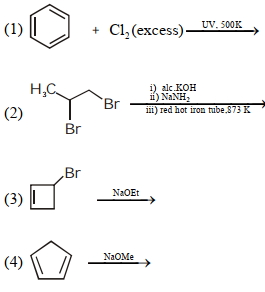
Choose the correct option$(s)$ that give$(s)$ an aromatic compound as the major product.
A
$2, 1$
B
$2, 3$
C
$2, 4$
D
$1, 2, 3$
Solution
(C) Analysis of the given reactions:
$(1)$ Benzene reacts with excess $Cl_2$ in the presence of $UV$ light at $500 \ K$ to form benzene hexachloride,which is non-aromatic.
$(2)$ $1,2$-dibromopropane reacts with $alc. KOH$ followed by $NaNH_2$ to form propyne $(CH_3-C \equiv CH)$. Cyclotrimerization of propyne using a red hot iron tube at $873 \ K$ yields $1,3,5$-trimethylbenzene (mesitylene),which is aromatic.
$(3)$ $3$-bromocyclobutene reacts with $NaOEt$ to give a substitution product and an elimination product (cyclobutadiene),which dimerizes to a non-aromatic compound.
$(4)$ Cyclopentadiene reacts with $NaOMe$ to form the cyclopentadienyl anion,which is aromatic ($6 \pi$ electrons,Huckel's rule).
Therefore,reactions $(2)$ and $(4)$ yield aromatic products.
$(1)$ Benzene reacts with excess $Cl_2$ in the presence of $UV$ light at $500 \ K$ to form benzene hexachloride,which is non-aromatic.
$(2)$ $1,2$-dibromopropane reacts with $alc. KOH$ followed by $NaNH_2$ to form propyne $(CH_3-C \equiv CH)$. Cyclotrimerization of propyne using a red hot iron tube at $873 \ K$ yields $1,3,5$-trimethylbenzene (mesitylene),which is aromatic.
$(3)$ $3$-bromocyclobutene reacts with $NaOEt$ to give a substitution product and an elimination product (cyclobutadiene),which dimerizes to a non-aromatic compound.
$(4)$ Cyclopentadiene reacts with $NaOMe$ to form the cyclopentadienyl anion,which is aromatic ($6 \pi$ electrons,Huckel's rule).
Therefore,reactions $(2)$ and $(4)$ yield aromatic products.
0 likes
View Solution265
MediumMCQ
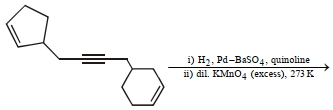
Total number of hydroxyl groups present in a molecule of the major product $P$ is. . . . . . . .
A
$6$
B
$8$
C
$9$
D
$10$
Solution
(A) $1$. The starting material contains one alkyne group and two alkene groups (one in a cyclopentene ring and one in a cyclohexene ring).
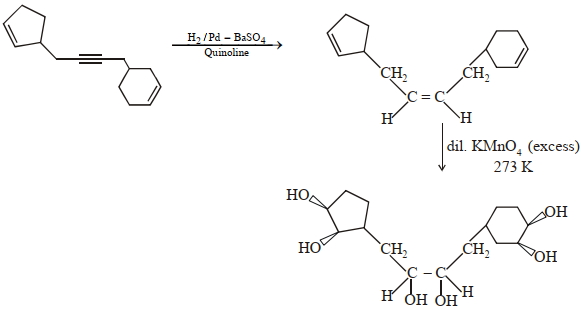
$2$. The first step uses $H_2, Pd-BaSO_4$,and quinoline (Lindlar's catalyst),which selectively reduces the alkyne to a $cis$-alkene without affecting the other alkene groups.
$3$. The second step uses dilute $KMnO_4$ at $273 \ K$ (Baeyer's reagent),which performs syn-dihydroxylation of all double bonds present in the molecule.
$4$. The molecule has three double bonds: one newly formed $cis$-alkene from the alkyne and the two original cyclic alkenes.
$5$. Each double bond undergoes dihydroxylation,adding two $-OH$ groups per double bond.
$6$. Total $-OH$ groups $= 3 \times 2 = 6$.
$2$. The first step uses $H_2, Pd-BaSO_4$,and quinoline (Lindlar's catalyst),which selectively reduces the alkyne to a $cis$-alkene without affecting the other alkene groups.
$3$. The second step uses dilute $KMnO_4$ at $273 \ K$ (Baeyer's reagent),which performs syn-dihydroxylation of all double bonds present in the molecule.
$4$. The molecule has three double bonds: one newly formed $cis$-alkene from the alkyne and the two original cyclic alkenes.
$5$. Each double bond undergoes dihydroxylation,adding two $-OH$ groups per double bond.
$6$. Total $-OH$ groups $= 3 \times 2 = 6$.
0 likes
View Solution266
AdvancedMCQ
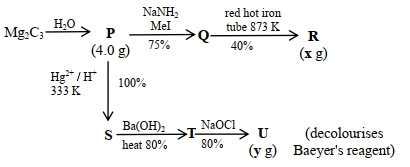
For the following reaction scheme,percentage yields are given along the arrows. $x \ g$ and $y \ g$ are the masses of $R$ and $U$,respectively. (Molar mass of $H$,$C$,and $O$ are $1$,$12$,and $16 \ g \ mol^{-1}$ respectively). $(1)$ The value of $x$ is $(2)$ The value of $y$ is.
A
$1.60, 3.1$
B
$1.60, 3.2$
C
$1.62, 3.2$
D
$1.62, 3.1$
Solution
(C) $1$. $Mg_2C_3 + 4H_2O \rightarrow 2Mg(OH)_2 + CH_3C \equiv CH$ (Propyne,$P$). Molar mass of $P = 40 \ g \ mol^{-1}$. Moles of $P = 4.0 \ g / 40 \ g \ mol^{-1} = 0.1 \ mol$.
$2$. $P \xrightarrow{NaNH_2, MeI, 75\%} CH_3-C \equiv C-CH_3$ $(Q)$. Moles of $Q = 0.1 \times 0.75 = 0.075 \ mol$.
$3$. $3Q \xrightarrow{red \ hot \ iron \ tube, 40\%} \text{Hexamethylbenzene} (R)$. Moles of $R = (0.075 / 3) \times 0.40 = 0.01 \ mol$. Molar mass of $R (C_{12}H_{18}) = 162 \ g \ mol^{-1}$. $x = 0.01 \times 162 = 1.62 \ g$.
$4$. $P \xrightarrow{Hg^{2+}/H^+, 100\%} CH_3COCH_3 (S)$. Moles of $S = 0.1 \ mol$.
$5$. $S \xrightarrow{Ba(OH)_2, \Delta, 80\%} (CH_3)_2C=CHCOCH_3 (T)$. Moles of $T = 0.1 \times 0.80 = 0.08 \ mol$.
$6$. $T \xrightarrow{NaOCl, 80\%} (CH_3)_2C=CHCOOH (U)$. Moles of $U = 0.08 \times 0.80 = 0.064 \ mol$. Molar mass of $U (C_5H_8O_2) = 100 \ g \ mol^{-1}$. $y = 0.064 \times 100 = 6.4 \ g$. (Note: Given options suggest $y=3.2$,implying a stoichiometry factor or yield interpretation difference in the source; based on standard calculation,$x=1.62$).
$2$. $P \xrightarrow{NaNH_2, MeI, 75\%} CH_3-C \equiv C-CH_3$ $(Q)$. Moles of $Q = 0.1 \times 0.75 = 0.075 \ mol$.
$3$. $3Q \xrightarrow{red \ hot \ iron \ tube, 40\%} \text{Hexamethylbenzene} (R)$. Moles of $R = (0.075 / 3) \times 0.40 = 0.01 \ mol$. Molar mass of $R (C_{12}H_{18}) = 162 \ g \ mol^{-1}$. $x = 0.01 \times 162 = 1.62 \ g$.
$4$. $P \xrightarrow{Hg^{2+}/H^+, 100\%} CH_3COCH_3 (S)$. Moles of $S = 0.1 \ mol$.
$5$. $S \xrightarrow{Ba(OH)_2, \Delta, 80\%} (CH_3)_2C=CHCOCH_3 (T)$. Moles of $T = 0.1 \times 0.80 = 0.08 \ mol$.
$6$. $T \xrightarrow{NaOCl, 80\%} (CH_3)_2C=CHCOOH (U)$. Moles of $U = 0.08 \times 0.80 = 0.064 \ mol$. Molar mass of $U (C_5H_8O_2) = 100 \ g \ mol^{-1}$. $y = 0.064 \times 100 = 6.4 \ g$. (Note: Given options suggest $y=3.2$,implying a stoichiometry factor or yield interpretation difference in the source; based on standard calculation,$x=1.62$).
0 likes
View Solution267
AdvancedMCQ
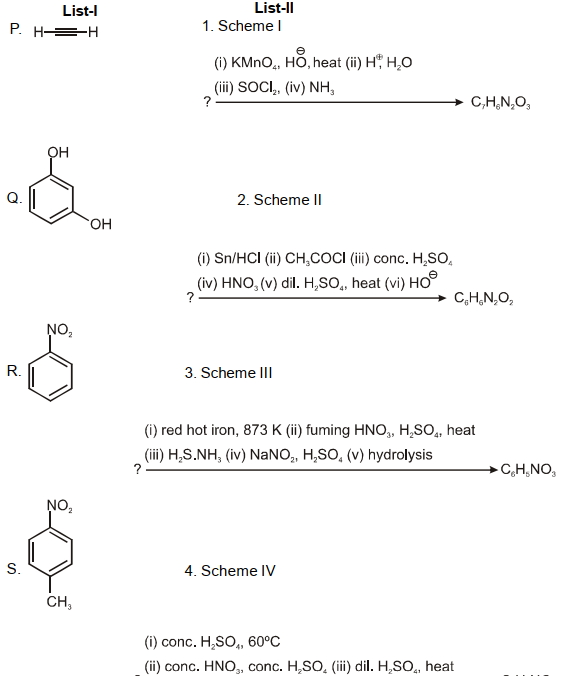
Match the four starting materials $(P, Q, R, S)$ given in List-$I$ with the corresponding reaction schemes $(I, II, III, IV)$ provided in List-$II$ and select the correct answer using the code given below the lists. Codes: $P \quad Q \quad R \quad S$
A
$1 \quad 4 \quad 2 \quad 3$
B
$3 \quad 1 \quad 4 \quad 2$
C
$3 \quad 4 \quad 2 \quad 1$
D
$4 \quad 1 \quad 3 \quad 2$
Solution
(C) The correct matching is as follows:
$P$ (Acetylene) undergoes cyclization to benzene,followed by nitration,reduction,diazotization,and hydrolysis to yield $C_6H_5NO_3$ (Scheme $III$).
$Q$ (Resorcinol) undergoes sulfonation,nitration,and desulfonation to yield $C_6H_5NO_4$ (Scheme $IV$).
$R$ (Nitrobenzene) undergoes reduction,acetylation,sulfonation,nitration,desulfonation,and hydrolysis to yield $C_6H_6N_2O_2$ (Scheme $II$).
$S$ ($p$-Nitrotoluene) undergoes oxidation of the methyl group to carboxylic acid,followed by conversion to acid chloride and then amide to yield $C_7H_6N_2O_3$ (Scheme $I$).
Thus,the correct sequence is $P$ $\rightarrow 3, Q$ $\rightarrow 4, R$ $\rightarrow 2, S$ $\rightarrow 1$. Hence,the correct option is $(C)$.
$P$ (Acetylene) undergoes cyclization to benzene,followed by nitration,reduction,diazotization,and hydrolysis to yield $C_6H_5NO_3$ (Scheme $III$).
$Q$ (Resorcinol) undergoes sulfonation,nitration,and desulfonation to yield $C_6H_5NO_4$ (Scheme $IV$).
$R$ (Nitrobenzene) undergoes reduction,acetylation,sulfonation,nitration,desulfonation,and hydrolysis to yield $C_6H_6N_2O_2$ (Scheme $II$).
$S$ ($p$-Nitrotoluene) undergoes oxidation of the methyl group to carboxylic acid,followed by conversion to acid chloride and then amide to yield $C_7H_6N_2O_3$ (Scheme $I$).
Thus,the correct sequence is $P$ $\rightarrow 3, Q$ $\rightarrow 4, R$ $\rightarrow 2, S$ $\rightarrow 1$. Hence,the correct option is $(C)$.
0 likes
View Solution268
AdvancedMCQ
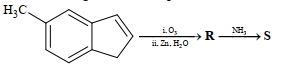
In the following reactions,the product $S$ is
A
$6-$methylisoquinoline
B
$6-$methylquinoline
C
$7-$methylisoquinoline
D
$7-$methylquinoline
Solution
(A) The reaction sequence is as follows: \\ $1$. Ozonolysis of $5$-methylindene followed by reductive workup $(Zn, H_2O)$ yields a dialdehyde intermediate $(R)$,which is $2-(2-oxopropyl)benzaldehyde$ derivative. \\ $2$. The reaction of this dialdehyde with $NH_3$ involves an intramolecular condensation reaction. \\ $3$. The nitrogen atom of ammonia attacks one of the carbonyl groups to form an imine,which then undergoes cyclization with the other carbonyl group. \\ $4$. Subsequent dehydration leads to the formation of the aromatic heterocyclic compound $S$,which is $6$-methylisoquinoline.
0 likes
View Solution269
AdvancedMCQ
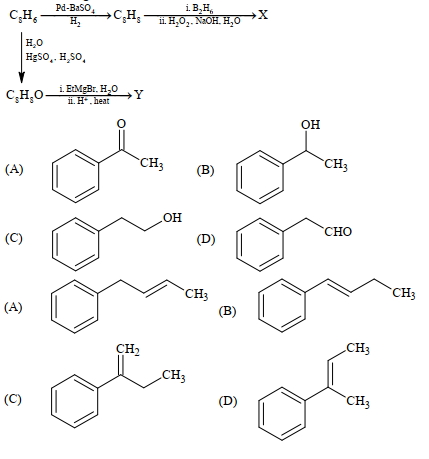
In the following reactions:
$1.$ Compound $X$ is
$2.$ The major compound $Y$ is
Give the answer for question $1$ and $2.$
$1.$ Compound $X$ is
$2.$ The major compound $Y$ is
Give the answer for question $1$ and $2.$
A
$1. (C), 2. (D)$
B
$1. (B), 2. (D)$
C
$1. (C), 2. (C)$
D
$1. (B), 2. (C)$
Solution
(A) $1.$ The starting material is phenylacetylene $(C_6H_5C \equiv CH)$.
Reaction with $Pd-BaSO_4/H_2$ gives styrene $(C_6H_5CH=CH_2)$.
Hydroboration-oxidation ($B_2H_6$ followed by $H_2O_2/NaOH$) of styrene follows anti-Markovnikov addition of water,yielding $2-phenylethanol$ $(C_6H_5CH_2CH_2OH)$,which corresponds to structure $(C)$.
$2.$ Reaction of phenylacetylene with $H_2O/HgSO_4/H_2SO_4$ (oxymercuration) gives acetophenone $(C_6H_5COCH_3)$.
Reaction with $EtMgBr$ followed by $H_2O$ gives $2-phenylbutan-2-ol$ $(C_6H_5C(OH)(CH_3)CH_2CH_3)$.
Acid-catalyzed dehydration $(H^+/heat)$ of $2-phenylbutan-2-ol$ proceeds via the most stable carbocation to form the most substituted alkene,which is $2-phenylbut-2-ene$ $(C_6H_5C(CH_3)=CHCH_3)$,corresponding to structure $(D)$.
Reaction with $Pd-BaSO_4/H_2$ gives styrene $(C_6H_5CH=CH_2)$.
Hydroboration-oxidation ($B_2H_6$ followed by $H_2O_2/NaOH$) of styrene follows anti-Markovnikov addition of water,yielding $2-phenylethanol$ $(C_6H_5CH_2CH_2OH)$,which corresponds to structure $(C)$.
$2.$ Reaction of phenylacetylene with $H_2O/HgSO_4/H_2SO_4$ (oxymercuration) gives acetophenone $(C_6H_5COCH_3)$.
Reaction with $EtMgBr$ followed by $H_2O$ gives $2-phenylbutan-2-ol$ $(C_6H_5C(OH)(CH_3)CH_2CH_3)$.
Acid-catalyzed dehydration $(H^+/heat)$ of $2-phenylbutan-2-ol$ proceeds via the most stable carbocation to form the most substituted alkene,which is $2-phenylbut-2-ene$ $(C_6H_5C(CH_3)=CHCH_3)$,corresponding to structure $(D)$.
0 likes
View Solution270
DifficultMCQ
The number of isomeric tetraenes ($NOT$ containing $sp$-hybridized carbon atoms) that can be formed from the following reaction sequence is.....
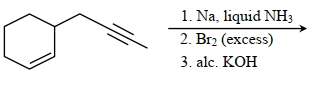
A
$2$
B
$5$
C
$8$
D
$9$
Solution
(C) Step $1$: Reduction of the alkyne using $Na/liq. NH_3$ (Birch reduction conditions) yields the trans-alkene. The starting material is $3-(prop-2-ynyl)cyclohex-1-ene$. The product is $3-(trans-prop-1-enyl)cyclohex-1-ene$.
Step $2$: Addition of excess $Br_2$ to the two double bonds results in the formation of a tetrabromide derivative.
Step $3$: Treatment with $alc. KOH$ causes dehydrohalogenation. Since there are four $Br$ atoms,elimination occurs to form two new double bonds. The resulting product is a tetraene. The side chain double bond can exist in $cis$ or $trans$ configuration. Additionally,the ring double bond can shift to form different conjugated systems. Based on the stereochemistry and the requirement of no $sp$-hybridized carbons,there are $8$ possible isomeric tetraenes.
Step $2$: Addition of excess $Br_2$ to the two double bonds results in the formation of a tetrabromide derivative.
Step $3$: Treatment with $alc. KOH$ causes dehydrohalogenation. Since there are four $Br$ atoms,elimination occurs to form two new double bonds. The resulting product is a tetraene. The side chain double bond can exist in $cis$ or $trans$ configuration. Additionally,the ring double bond can shift to form different conjugated systems. Based on the stereochemistry and the requirement of no $sp$-hybridized carbons,there are $8$ possible isomeric tetraenes.
0 likes
View Solution271
DifficultMCQ
The compound with molecular formula $C_6H_6$,which gives only one monobromo derivative and takes up four moles of hydrogen per mole for complete hydrogenation,has $................\pi$ electrons.
A
$8$
B
$9$
C
$10$
D
$11$
Solution
(A) The molecular formula $C_6H_6$ corresponds to a degree of unsaturation of $4$ $(C_n H_{2n+2} - C_n H_m / 2 = (2(6)+2-6)/2 = 4)$.
This means the molecule has $4$ double bonds or equivalent unsaturation (rings/triple bonds).
The compound takes up $4$ moles of $H_2$ for complete hydrogenation,confirming it has $4$ $\pi$ bonds.
Each $\pi$ bond contains $2$ $\pi$ electrons,so $4$ $\pi$ bonds contain $4 \times 2 = 8$ $\pi$ electrons.
The compound is $1,3,5$-trimethylenecyclohexane or a similar isomer that is highly symmetric to yield only one monobromo derivative.
Thus,the number of $\pi$ electrons is $8$.
This means the molecule has $4$ double bonds or equivalent unsaturation (rings/triple bonds).
The compound takes up $4$ moles of $H_2$ for complete hydrogenation,confirming it has $4$ $\pi$ bonds.
Each $\pi$ bond contains $2$ $\pi$ electrons,so $4$ $\pi$ bonds contain $4 \times 2 = 8$ $\pi$ electrons.
The compound is $1,3,5$-trimethylenecyclohexane or a similar isomer that is highly symmetric to yield only one monobromo derivative.
Thus,the number of $\pi$ electrons is $8$.
0 likes
View Solution272
MediumMCQ
The hydrocarbon $(X)$ with molar mass $80 \ g \ mol^{-1}$ and $90 \%$ carbon has $............$ degree of unsaturation.
A
$5$
B
$1$
C
$2$
D
$3$
Solution
(D) Mass of carbon $= \frac{80 \times 90}{100} = 72 \ g$.
Number of $C$ atoms $= \frac{72}{12} = 6$.
Mass of hydrogen $= 80 - 72 = 8 \ g$.
Number of $H$ atoms $= \frac{8}{1} = 8$.
So,the molecular formula is $C_6H_8$.
Degree of Unsaturation $(D.U.) = C + 1 - \frac{H}{2} = 6 + 1 - \frac{8}{2} = 7 - 4 = 3$.
Number of $C$ atoms $= \frac{72}{12} = 6$.
Mass of hydrogen $= 80 - 72 = 8 \ g$.
Number of $H$ atoms $= \frac{8}{1} = 8$.
So,the molecular formula is $C_6H_8$.
Degree of Unsaturation $(D.U.) = C + 1 - \frac{H}{2} = 6 + 1 - \frac{8}{2} = 7 - 4 = 3$.
0 likes
View Solution273
DifficultMCQ
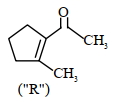
$A$ molecule $P$ on treatment with acid undergoes rearrangement and gives $Q$. $Q$ on ozonolysis followed by reflux under alkaline condition gives $R$. The structure of $R$ is given below:
[Image of $R$]
The structure of $P$ is
[Image of $R$]
The structure of $P$ is
A
$1,2-$dimethylcyclohexene
B
$1-$isopropylcyclopentanol
C
$1-$hydroxy$-1-$($1$-methylethyl)cyclobutane
D
$1-$isopropylidenecyclopentane
Solution
(D) The molecule $P$ is $1$-isopropylidenecyclopentane.
Upon treatment with acid,it undergoes protonation followed by ring expansion and rearrangement to form $1,2$-dimethylcyclohexene $(Q)$.
Ozonolysis of $Q$ ($1,2$-dimethylcyclohexene) yields $2,6$-heptanedione.
Subsequent reflux under alkaline conditions (aldol condensation) leads to the formation of $R$,which is $2$-acetyl-$1$-methylcyclopentene.
Upon treatment with acid,it undergoes protonation followed by ring expansion and rearrangement to form $1,2$-dimethylcyclohexene $(Q)$.
Ozonolysis of $Q$ ($1,2$-dimethylcyclohexene) yields $2,6$-heptanedione.
Subsequent reflux under alkaline conditions (aldol condensation) leads to the formation of $R$,which is $2$-acetyl-$1$-methylcyclopentene.
0 likes
View Solution274
MediumMCQ
The total number of sigma $(\sigma)$ and pi $(\pi)$ bonds present in $\text{hex}-1-\text{en}-4-\text{yne}$ are respectively:
A
$13$ and $3$
B
$11$ and $3$
C
$3$ and $13$
D
$14$ and $3$
Solution
(A) The structure of $\text{hex}-1-\text{en}-4-\text{yne}$ is $CH_2=CH-CH_2-C\equiv C-CH_3$.
Counting the bonds:
$1$. $\sigma$ bonds: There are $5$ $C-C$ bonds,$8$ $C-H$ bonds. Total $\sigma$ bonds $= 5 + 8 = 13$.
$2$. $\pi$ bonds: There is $1$ $\pi$ bond in the double bond and $2$ $\pi$ bonds in the triple bond. Total $\pi$ bonds $= 1 + 2 = 3$.
Thus,the number of $\sigma$ and $\pi$ bonds are $13$ and $3$ respectively.
Counting the bonds:
$1$. $\sigma$ bonds: There are $5$ $C-C$ bonds,$8$ $C-H$ bonds. Total $\sigma$ bonds $= 5 + 8 = 13$.
$2$. $\pi$ bonds: There is $1$ $\pi$ bond in the double bond and $2$ $\pi$ bonds in the triple bond. Total $\pi$ bonds $= 1 + 2 = 3$.
Thus,the number of $\sigma$ and $\pi$ bonds are $13$ and $3$ respectively.
0 likes
View Solution275
DifficultMCQ
$1, 2-$dibromocyclooctane $\xrightarrow[\substack{\text{(ii) } NaNH_2 \\ \text{(iii) } Hg^{2+} / H^{+} \\ \text{(iv) } Zn-Hg / H^{+}}]{\text{(i) } KOH \text{ (alc.) }} \underset{\text{(Major product)}}{P}$. $P$ is
A
Cyclooctanol
B
Cyclooctane
C
Cyclooctanone
D
Cyclooctyne
Solution
(B) The reaction sequence is as follows:
$1$. Dehydrohalogenation of $1, 2-$dibromocyclooctane with alc. $KOH$ followed by $NaNH_2$ yields cyclooctyne.
$2$. Hydration of cyclooctyne using $Hg^{2+} / H^{+}$ (Kucherov reaction) gives an enol intermediate,which tautomerizes to form cyclooctanone.
$3$. Clemmensen reduction of cyclooctanone using $Zn-Hg / H^{+}$ reduces the carbonyl group to a methylene group,resulting in cyclooctane as the final major product $P$.
$1$. Dehydrohalogenation of $1, 2-$dibromocyclooctane with alc. $KOH$ followed by $NaNH_2$ yields cyclooctyne.
$2$. Hydration of cyclooctyne using $Hg^{2+} / H^{+}$ (Kucherov reaction) gives an enol intermediate,which tautomerizes to form cyclooctanone.
$3$. Clemmensen reduction of cyclooctanone using $Zn-Hg / H^{+}$ reduces the carbonyl group to a methylene group,resulting in cyclooctane as the final major product $P$.
0 likes
View Solution276
MediumMCQ
What is the number of moles of $H$ atoms required for the complete reduction of one mole of acetonitrile?
A
$2$
B
$4$
C
$6$
D
$8$
Solution
(B) The chemical formula of acetonitrile is $CH_3CN$.
The complete reduction of acetonitrile $(CH_3CN)$ to ethylamine $(CH_3CH_2NH_2)$ is represented by the following chemical equation:
$CH_3CN + 4[H] \rightarrow CH_3CH_2NH_2$.
According to the stoichiometry of the reaction,$1 \ mole$ of acetonitrile requires $4 \ moles$ of hydrogen atoms $(H)$ for complete reduction to ethylamine.
The complete reduction of acetonitrile $(CH_3CN)$ to ethylamine $(CH_3CH_2NH_2)$ is represented by the following chemical equation:
$CH_3CN + 4[H] \rightarrow CH_3CH_2NH_2$.
According to the stoichiometry of the reaction,$1 \ mole$ of acetonitrile requires $4 \ moles$ of hydrogen atoms $(H)$ for complete reduction to ethylamine.
0 likes
View Solution277
MediumMCQ
What is the number of moles of $sp^3$ hybrid carbon atoms in one mole of $2-$Methylbut$-2-$ene?
A
Four
B
Three
C
Two
D
One
Solution
(B) The structure of $2-$Methylbut$-2-$ene is $CH_3-C(CH_3)=CH-CH_3$.
In this molecule,the carbon atoms at positions $1$,$3$,and the methyl group attached to position $2$ are $sp^3$ hybridized.
The carbon atoms at positions $2$ and $3$ are $sp^2$ hybridized because they are involved in the double bond.
Thus,there are $3$ $sp^3$ hybridized carbon atoms in one molecule of $2-$Methylbut$-2-$ene.
Therefore,in one mole of $2-$Methylbut$-2-$ene,there are $3$ moles of $sp^3$ hybrid carbon atoms.
In this molecule,the carbon atoms at positions $1$,$3$,and the methyl group attached to position $2$ are $sp^3$ hybridized.
The carbon atoms at positions $2$ and $3$ are $sp^2$ hybridized because they are involved in the double bond.
Thus,there are $3$ $sp^3$ hybridized carbon atoms in one molecule of $2-$Methylbut$-2-$ene.
Therefore,in one mole of $2-$Methylbut$-2-$ene,there are $3$ moles of $sp^3$ hybrid carbon atoms.
0 likes
View Solution278
EasyMCQ
Which among the following statements is $NOT$ true about aliphatic compounds?
A
These are easily attacked by oxidizing agents.
B
These burn with a sooty flame.
C
Saturated aliphatic compounds undergo substitution reactions.
D
Unsaturated aliphatic compounds undergo addition reactions easily.
Solution
(B) Aliphatic compounds generally burn with a non-sooty (clean) flame because they have a lower carbon-to-hydrogen ratio compared to aromatic compounds. Aromatic compounds,due to their high carbon content,typically burn with a sooty flame. Therefore,the statement that aliphatic compounds burn with a sooty flame is incorrect.
0 likes
View Solution279
EasyMCQ
How many $\pi$ bonds and $\sigma$ bonds are present in the following molecule?
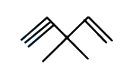
A
$5 \pi, 14 \sigma$ bonds
B
$3 \pi, 17 \sigma$ bonds
C
$3 \pi, 16 \sigma$ bonds
D
$2 \pi, 17 \sigma$ bonds
Solution
(C) The given molecule is $2$-methylpent-$1$-en-$4$-yne,which has the structure $CH_2=C(CH_3)-CH_2-C\equiv CH$.
Counting the bonds:
$1$. $\sigma$ bonds: There are $16$ $\sigma$ bonds in total ($1$ in $C=C$,$1$ in $C-C$,$1$ in $C-C$,$1$ in $C\equiv C$,and $12$ $C-H$ bonds).
$2$. $\pi$ bonds: There is $1$ $\pi$ bond in the double bond $(C=C)$ and $2$ $\pi$ bonds in the triple bond $(C\equiv C)$,totaling $3$ $\pi$ bonds.
Thus,the molecule contains $3 \pi$ and $16 \sigma$ bonds.
Counting the bonds:
$1$. $\sigma$ bonds: There are $16$ $\sigma$ bonds in total ($1$ in $C=C$,$1$ in $C-C$,$1$ in $C-C$,$1$ in $C\equiv C$,and $12$ $C-H$ bonds).
$2$. $\pi$ bonds: There is $1$ $\pi$ bond in the double bond $(C=C)$ and $2$ $\pi$ bonds in the triple bond $(C\equiv C)$,totaling $3$ $\pi$ bonds.
Thus,the molecule contains $3 \pi$ and $16 \sigma$ bonds.
0 likes
View Solution280
MediumMCQ
By which of the following processes are hydrocarbons obtained from petroleum?
A
Combustion
B
Fractional distillation
C
Addition
D
All of the above
Solution
(B) Hydrocarbons are separated from petroleum based on their different boiling points using the $Fractional \ distillation$ method.
0 likes
View Solution281
MediumMCQ
What is the number of moles of $sp^2$ hybrid carbon atoms in one mole of $hexa-1,4-diyne$?
A
$5$
B
$3$
C
$4$
D
Zero
Solution
(D) The structure of $hexa-1,4-diyne$ is $CH_3-C \equiv C-CH_2-C \equiv C-H$.
In this molecule,the carbon atoms involved in triple bonds are $sp$ hybridized,and the carbon atoms involved in single bonds are $sp^3$ hybridized.
There are no carbon atoms with $sp^2$ hybridization in this molecule.
Therefore,the number of moles of $sp^2$ hybrid carbon atoms in one mole of $hexa-1,4-diyne$ is zero.
In this molecule,the carbon atoms involved in triple bonds are $sp$ hybridized,and the carbon atoms involved in single bonds are $sp^3$ hybridized.
There are no carbon atoms with $sp^2$ hybridization in this molecule.
Therefore,the number of moles of $sp^2$ hybrid carbon atoms in one mole of $hexa-1,4-diyne$ is zero.
0 likes
View Solution282
MediumMCQ
Power alcohol is a mixture of
A
$80 \% \text{ petrol} + 20 \% \text{ ethanol} + \text{small quantity of benzene}$
B
$80 \% \text{ ethanol} + 20 \% \text{ benzene} + \text{small quantity of petrol}$
C
$50 \% \text{ petrol} + 50 \% \text{ ethanol} + \text{small quantity of benzene}$
D
$80 \% \text{ petrol} + 20 \% \text{ benzene} + \text{small quantity of ethanol}$
Solution
(A) Power alcohol is defined as a mixture of $80 \% \text{ petrol}$ and $20 \% \text{ ethanol}$ with a small amount of benzene added to act as a co-solvent to prevent phase separation.
It is primarily used as a fuel in internal combustion engines.
It is primarily used as a fuel in internal combustion engines.
0 likes
View Solution283
EasyMCQ
The increasing order of carbon-carbon bond length for the following is:

A
$C < B < A < D$
B
$B < C < A < D$
C
$D < C < A < B$
D
$B < A < C < D$
Solution
(D) The bond length depends on the bond order; higher bond order results in shorter bond length.
$A: C_2H_4$ (double bond,$1.34 \ \mathring{A}$)
$B: C_2H_2$ (triple bond,$1.20 \ \mathring{A}$)
$C: C_6H_6$ (partial double bond,$1.39 \ \mathring{A}$)
$D: C_2H_6$ (single bond,$1.54 \ \mathring{A}$)
Comparing the values: $1.20 \ \mathring{A} (B) < 1.34 \ \mathring{A} (A) < 1.39 \ \mathring{A} (C) < 1.54 \ \mathring{A} (D)$.
Thus,the increasing order is $B < A < C < D$.
$A: C_2H_4$ (double bond,$1.34 \ \mathring{A}$)
$B: C_2H_2$ (triple bond,$1.20 \ \mathring{A}$)
$C: C_6H_6$ (partial double bond,$1.39 \ \mathring{A}$)
$D: C_2H_6$ (single bond,$1.54 \ \mathring{A}$)
Comparing the values: $1.20 \ \mathring{A} (B) < 1.34 \ \mathring{A} (A) < 1.39 \ \mathring{A} (C) < 1.54 \ \mathring{A} (D)$.
Thus,the increasing order is $B < A < C < D$.
0 likes
View Solution284
MediumMCQ
Arrange benzene,$n$-hexane and ethyne in decreasing order of their acidic behaviour.
A
Benzene $> n$-hexane $>$ Ethyne
B
$n$-hexane $>$ Benzene $>$ Ethyne
C
Ethyne $> n$-hexane $>$ Benzene
D
Ethyne $>$ Benzene $> n$-hexane
Solution
(D) The decreasing order of acidic behaviour is ethyne $>$ benzene $>$ $n$-hexane.
The acidity of a hydrocarbon depends on the $s$-character of the hybridised carbon atom to which the hydrogen is attached.
Higher $s$-character leads to higher electronegativity of the carbon atom,which makes the $C-H$ bond more polar and the resulting carbanion more stable.
The hybridisation of carbon atoms in these compounds is as follows:
Ethyne $(HC \equiv CH)$: $sp$ hybridised ($50\% \ s$-character).
Benzene $(C_6H_6)$: $sp^2$ hybridised ($\approx 33.3\% \ s$-character).
$n$-Hexane $(CH_3(CH_2)_4CH_3)$: $sp^3$ hybridised ($25\% \ s$-character).
Therefore,the order of acidity is ethyne $>$ benzene $>$ $n$-hexane.
The acidity of a hydrocarbon depends on the $s$-character of the hybridised carbon atom to which the hydrogen is attached.
Higher $s$-character leads to higher electronegativity of the carbon atom,which makes the $C-H$ bond more polar and the resulting carbanion more stable.
The hybridisation of carbon atoms in these compounds is as follows:
Ethyne $(HC \equiv CH)$: $sp$ hybridised ($50\% \ s$-character).
Benzene $(C_6H_6)$: $sp^2$ hybridised ($\approx 33.3\% \ s$-character).
$n$-Hexane $(CH_3(CH_2)_4CH_3)$: $sp^3$ hybridised ($25\% \ s$-character).
Therefore,the order of acidity is ethyne $>$ benzene $>$ $n$-hexane.
0 likes
View Solution285
EasyMCQ
In the given sequence of reactions,identify $P, Q, R$ and $S$ respectively.
$CH_2=CH_2 + Br_2$ $\xrightarrow{P} CH_2(Br)-CH_2(Br)$ $\xrightarrow{Q} CH_2=CH-Br$ $\xrightarrow{R} CH \equiv CH$ $\xrightarrow{S} C_6H_6$
$CH_2=CH_2 + Br_2$ $\xrightarrow{P} CH_2(Br)-CH_2(Br)$ $\xrightarrow{Q} CH_2=CH-Br$ $\xrightarrow{R} CH \equiv CH$ $\xrightarrow{S} C_6H_6$
A
$Br_2$,Alc. $KOH, NaOH, Al_2O_3$
B
$HBr$,Alc. $KOH, CaC_2, KMnO_4$
C
$HBr$,Alc. $KOH, NaNH_2$,Red hot iron tube
D
$Br_2$,Alc. $KOH, NaNH_2$,Red hot iron tube
Solution
(D) The complete reaction sequence is as follows:
$1$. $CH_2=CH_2 + Br_2 \xrightarrow{P=Br_2} CH_2(Br)-CH_2(Br)$ (Electrophilic addition)
$2$. $CH_2(Br)-CH_2(Br) \xrightarrow{Q=Alc. KOH} CH_2=CH-Br$ (Dehydrohalogenation)
$3$. $CH_2=CH-Br \xrightarrow{R=NaNH_2} CH \equiv CH$ (Dehydrohalogenation)
$4$. $3 CH \equiv CH \xrightarrow{S=Red \ hot \ iron \ tube} C_6H_6$ (Cyclic polymerization)
Thus,the reagents $P, Q, R$ and $S$ are $Br_2$,alc. $KOH, NaNH_2$,and Red hot iron tube respectively.
$1$. $CH_2=CH_2 + Br_2 \xrightarrow{P=Br_2} CH_2(Br)-CH_2(Br)$ (Electrophilic addition)
$2$. $CH_2(Br)-CH_2(Br) \xrightarrow{Q=Alc. KOH} CH_2=CH-Br$ (Dehydrohalogenation)
$3$. $CH_2=CH-Br \xrightarrow{R=NaNH_2} CH \equiv CH$ (Dehydrohalogenation)
$4$. $3 CH \equiv CH \xrightarrow{S=Red \ hot \ iron \ tube} C_6H_6$ (Cyclic polymerization)
Thus,the reagents $P, Q, R$ and $S$ are $Br_2$,alc. $KOH, NaNH_2$,and Red hot iron tube respectively.
0 likes
View Solution286
EasyMCQ
The correct statement is
A
$1 \text{ mole}$ each of benzene and hydrogen when reacted gives $1/3 \text{ mole}$ of cyclohexane and $2/3 \text{ mole}$ unreacted hydrogen.
B
It is easier to hydrogenate benzene when compared to cyclohexene.
C
Cyclohexadiene and cyclohexene cannot be isolated with ease during controlled hydrogenation of benzene.
D
Hydrogenation of benzene to cyclohexane is an endothermic process.
Solution
(C) The hydrogenation of benzene is represented as: $C_6H_6 + 3H_2 \xrightarrow{Ni, 150^{\circ}C} C_6H_{12}$.
Because the intermediate products (cyclohexadiene and cyclohexene) are more reactive than benzene itself,they are immediately hydrogenated to cyclohexane.
Therefore,it is not possible to isolate cyclohexadiene and cyclohexene with ease during the controlled hydrogenation of benzene.
Thus,the correct statement is that cyclohexadiene and cyclohexene cannot be isolated with ease during controlled hydrogenation of benzene.
Because the intermediate products (cyclohexadiene and cyclohexene) are more reactive than benzene itself,they are immediately hydrogenated to cyclohexane.
Therefore,it is not possible to isolate cyclohexadiene and cyclohexene with ease during the controlled hydrogenation of benzene.
Thus,the correct statement is that cyclohexadiene and cyclohexene cannot be isolated with ease during controlled hydrogenation of benzene.
0 likes
View Solution287
EasyMCQ
Styrene on reaction with reagent $X$ gave $Y$, which on hydrolysis followed by oxidation gave $Z$. $Z$ gives a positive $2,4-DNP$ test but does not give the iodoform test. What are $X$ and $Z$ respectively?
A
$HBr ; C_6H_5COCH_3$
B
$HBr ; C_6H_5CH_2CHO$
C
$HBr / (C_6H_5CO)_2O_2 ; C_6H_5CH_2CHO$
D
$HBr / (C_6H_5CO)_2O_2 ; C_6H_5COCH_3$
Solution
(C) Styrene $(C_6H_5CH=CH_2)$ reacts with $HBr$ in the presence of peroxide $((C_6H_5CO)_2O_2)$ via anti-Markovnikov addition to give $Y$ $(C_6H_5CH_2CH_2Br)$.
Hydrolysis of $Y$ gives $C_6H_5CH_2CH_2OH$, and subsequent oxidation gives $Z$ ($C_6H_5CH_2CHO$, phenylacetaldehyde).
$Z$ $(C_6H_5CH_2CHO)$ is an aldehyde, so it gives a positive $2,4-DNP$ test.
However, it does not contain the $CH_3CO-$ group, so it does not give the iodoform test.
Therefore, $X$ is $HBr / (C_6H_5CO)_2O_2$ and $Z$ is $C_6H_5CH_2CHO$.
Hydrolysis of $Y$ gives $C_6H_5CH_2CH_2OH$, and subsequent oxidation gives $Z$ ($C_6H_5CH_2CHO$, phenylacetaldehyde).
$Z$ $(C_6H_5CH_2CHO)$ is an aldehyde, so it gives a positive $2,4-DNP$ test.
However, it does not contain the $CH_3CO-$ group, so it does not give the iodoform test.
Therefore, $X$ is $HBr / (C_6H_5CO)_2O_2$ and $Z$ is $C_6H_5CH_2CHO$.
0 likes
View Solution288
MediumMCQ
What are $X$ and $Y$ respectively in the following sets of reactions?
$I. \ CH_3CH_2CH_2OH \xrightarrow{PBr_3} X$
$II. \ CH_3CH=CH_2 \xrightarrow{HBr, (C_6H_5COO)_2} Y \text{ (major)}$
$I. \ CH_3CH_2CH_2OH \xrightarrow{PBr_3} X$
$II. \ CH_3CH=CH_2 \xrightarrow{HBr, (C_6H_5COO)_2} Y \text{ (major)}$
A
$CH_3CH(Br)CH_3, \ CH_3CH_2CH_2Br$
B
$CH_3CH_2CH_2Br, \ CH_3CH_2CH_2Br$
C
$CH_3CH_2CH_2Br, \ CH_3CH(Br)CH_3$
D
$CH_3CH(Br)CH_3, \ CH_3CH(Br)CH_3$
Solution
(B) In reaction $I$,the reaction of $n$-propanol with $PBr_3$ is a nucleophilic substitution reaction ($S_N2$ mechanism) which converts the alcohol group into a bromide,yielding $n$-propyl bromide $(CH_3CH_2CH_2Br)$.
In reaction $II$,the reaction of propene with $HBr$ in the presence of benzoyl peroxide $((C_6H_5COO)_2)$ proceeds via the anti-Markovnikov addition mechanism (peroxide effect or Kharasch effect). This results in the formation of $n$-propyl bromide $(CH_3CH_2CH_2Br)$ as the major product.
Therefore,$X = CH_3CH_2CH_2Br$ and $Y = CH_3CH_2CH_2Br$.
In reaction $II$,the reaction of propene with $HBr$ in the presence of benzoyl peroxide $((C_6H_5COO)_2)$ proceeds via the anti-Markovnikov addition mechanism (peroxide effect or Kharasch effect). This results in the formation of $n$-propyl bromide $(CH_3CH_2CH_2Br)$ as the major product.
Therefore,$X = CH_3CH_2CH_2Br$ and $Y = CH_3CH_2CH_2Br$.
0 likes
View Solution289
MediumMCQ
Match the following reactions with their nature and choose the correct code.
| Reaction | Nature of reaction |
| $A. RBr \xrightarrow{Na}$ | $1. \text{Partial reduction}$ |
| $B. RCOO^-Na^+ \xrightarrow{NaOH/CaO, \Delta}$ | $2. \text{Electrophilic addition}$ |
| $C. R-C \equiv C-R' \xrightarrow{\text{Lindlar's catalyst } (H_2)}$ | $3. \text{Wurtz reaction}$ |
| $D. H_2C=CH_2 \xrightarrow{Br_2/CCl_4}$ | $4. \text{Decarboxylation}$ |
| $5. \text{Decarboxylative dimerisation}$ |
A
$A-3, B-4, C-1, D-2$
B
$A-3, B-5, C-1, D-2$
C
$A-5, B-4, C-1, D-2$
D
$A-3, B-4, C-2, D-1$
Solution
(A) The correct matching is as follows:
$A. RBr \xrightarrow{Na}$ represents the $Wurtz$ reaction $(3)$.
$B. RCOO^-Na^+ \xrightarrow{NaOH/CaO, \Delta}$ represents $Decarboxylation$ $(4)$.
$C. R-C \equiv C-R' \xrightarrow{\text{Lindlar's catalyst } (H_2)}$ represents $Partial$ $reduction$ $(1)$.
$D. H_2C=CH_2 \xrightarrow{Br_2/CCl_4}$ represents $Electrophilic$ $addition$ $(2)$.
Therefore,the correct sequence is $A-3, B-4, C-1, D-2$.
$A. RBr \xrightarrow{Na}$ represents the $Wurtz$ reaction $(3)$.
$B. RCOO^-Na^+ \xrightarrow{NaOH/CaO, \Delta}$ represents $Decarboxylation$ $(4)$.
$C. R-C \equiv C-R' \xrightarrow{\text{Lindlar's catalyst } (H_2)}$ represents $Partial$ $reduction$ $(1)$.
$D. H_2C=CH_2 \xrightarrow{Br_2/CCl_4}$ represents $Electrophilic$ $addition$ $(2)$.
Therefore,the correct sequence is $A-3, B-4, C-1, D-2$.
0 likes
View Solution290
MediumMCQ
The major products $A$ and $B$ in the following reactions are respectively:
i) Benzene $\xrightarrow{Cl_2/uv, 500K} A$
ii) $1-$Methylcyclohexene $\xrightarrow{HI} B$
i) Benzene $\xrightarrow{Cl_2/uv, 500K} A$
ii) $1-$Methylcyclohexene $\xrightarrow{HI} B$
A
$A$ = $1,2-$Dichlorobenzene,$B$ = $1-$Iodo$-1-$methylcyclohexane
B
$A$ = Chlorobenzene,$B$ = $1-$Iodo$-1-$methylcyclohexane
C
$A$ = $1,4-$Dichlorobenzene,$B$ = $3-$Iodo$-1-$methylcyclohexane
D
$A$ = Hexachlorocyclohexane $(BHC)$,$B$ = $1-$Iodo$-1-$methylcyclohexane
Solution
(D) Reaction $(i)$: Benzene reacts with $Cl_2$ in the presence of $uv$ light at $500 \ K$ to undergo free radical addition,forming $1,2,3,4,5,6$-hexachlorocyclohexane (also known as $BHC$ or $Gammexane$).
Reaction (ii): $1$-Methylcyclohexene reacts with $HI$ via electrophilic addition following Markovnikov's rule. The proton $(H^+)$ adds to the less substituted carbon of the double bond,and the iodide ion $(I^-)$ adds to the more substituted carbon,resulting in $1$-iodo-$1$-methylcyclohexane.
Reaction (ii): $1$-Methylcyclohexene reacts with $HI$ via electrophilic addition following Markovnikov's rule. The proton $(H^+)$ adds to the less substituted carbon of the double bond,and the iodide ion $(I^-)$ adds to the more substituted carbon,resulting in $1$-iodo-$1$-methylcyclohexane.
0 likes
View Solution291
MediumMCQ
Match the following reactions in List-$I$ with their products in List-$II$:
| List-$I$ | List-$II$ |
| :--- | :--- |
| $A. HC \equiv CH \xrightarrow{Hg^{2+}, H^{+}/H_{2}O}$ | $I. H_{3}C-COOH$ |
| $B. CH_{4} \xrightarrow{O_{2}, Mo_{2}O_{3}, \Delta}$ | $II. CH_{3}-CO-CH_{3}$ |
| $C. (CH_{3})_{2}C=C(CH_{3})_{2} \xrightarrow{O_{3}, Zn, H_{2}O}$ | $III. H_{3}C-CHO$ |
| $D. CH_{3}-CH=CH-CH_{3} \xrightarrow{KMnO_{4}, H^{+}}$ | $IV. HCHO$ |
| List-$I$ | List-$II$ |
| :--- | :--- |
| $A. HC \equiv CH \xrightarrow{Hg^{2+}, H^{+}/H_{2}O}$ | $I. H_{3}C-COOH$ |
| $B. CH_{4} \xrightarrow{O_{2}, Mo_{2}O_{3}, \Delta}$ | $II. CH_{3}-CO-CH_{3}$ |
| $C. (CH_{3})_{2}C=C(CH_{3})_{2} \xrightarrow{O_{3}, Zn, H_{2}O}$ | $III. H_{3}C-CHO$ |
| $D. CH_{3}-CH=CH-CH_{3} \xrightarrow{KMnO_{4}, H^{+}}$ | $IV. HCHO$ |
A
$A-I, B-II, C-III, D-IV$
B
$A-III, B-IV, C-II, D-I$
C
$A-I, B-IV, C-III, D-II$
D
$A-III, B-II, C-IV, D-I$
Solution
(B) The reactions are analyzed as follows:
$A$. Hydration of ethyne $(HC \equiv CH)$ in the presence of $Hg^{2+}$ and $H^{+}$ gives acetaldehyde $(CH_{3}CHO)$,which corresponds to $III$.
$B$. Controlled oxidation of methane $(CH_{4})$ with $O_{2}$ in the presence of $Mo_{2}O_{3}$ and heat gives formaldehyde $(HCHO)$,which corresponds to $IV$.
$C$. Ozonolysis of $2,3-$dimethylbut$-2-$ene $((CH_{3})_{2}C=C(CH_{3})_{2})$ gives two molecules of acetone $(CH_{3}COCH_{3})$,which corresponds to $II$.
$D$. Oxidative cleavage of but$-2-$ene $(CH_{3}CH=CHCH_{3})$ with acidic $KMnO_{4}$ gives acetic acid $(CH_{3}COOH)$,which corresponds to $I$.
Therefore,the correct matching is $A-III, B-IV, C-II, D-I$.
$A$. Hydration of ethyne $(HC \equiv CH)$ in the presence of $Hg^{2+}$ and $H^{+}$ gives acetaldehyde $(CH_{3}CHO)$,which corresponds to $III$.
$B$. Controlled oxidation of methane $(CH_{4})$ with $O_{2}$ in the presence of $Mo_{2}O_{3}$ and heat gives formaldehyde $(HCHO)$,which corresponds to $IV$.
$C$. Ozonolysis of $2,3-$dimethylbut$-2-$ene $((CH_{3})_{2}C=C(CH_{3})_{2})$ gives two molecules of acetone $(CH_{3}COCH_{3})$,which corresponds to $II$.
$D$. Oxidative cleavage of but$-2-$ene $(CH_{3}CH=CHCH_{3})$ with acidic $KMnO_{4}$ gives acetic acid $(CH_{3}COOH)$,which corresponds to $I$.
Therefore,the correct matching is $A-III, B-IV, C-II, D-I$.
0 likes
View Solution292
DifficultMCQ
Which of the following reactions are not feasible?
$I$. $CH_3CH=CH_2 \xrightarrow{HCl, (C_6H_5CO)_2O_2} CH_3CH_2CH_2Cl$
$II$. $C_6H_6 + CH_3CH_2CH_2Cl \xrightarrow{AlCl_3} C_6H_5CH(CH_3)_2$
$III$. $CH_3CHClCH_2Cl \xrightarrow{KOH, \Delta} CH_3C \equiv CH$
$IV$. $CH_3CH=CHCH_3 \xrightarrow{KMnO_4 / H^+} CH_3COOH$
$I$. $CH_3CH=CH_2 \xrightarrow{HCl, (C_6H_5CO)_2O_2} CH_3CH_2CH_2Cl$
$II$. $C_6H_6 + CH_3CH_2CH_2Cl \xrightarrow{AlCl_3} C_6H_5CH(CH_3)_2$
$III$. $CH_3CHClCH_2Cl \xrightarrow{KOH, \Delta} CH_3C \equiv CH$
$IV$. $CH_3CH=CHCH_3 \xrightarrow{KMnO_4 / H^+} CH_3COOH$
A
$I$ & $IV$ only
B
$II$ & $III$ only
C
$II$ & $IV$ only
D
$I$ & $III$ only
Solution
(D) $I$. The reaction $CH_3CH=CH_2 \xrightarrow{HCl, (C_6H_5CO)_2O_2} CH_3CH_2CH_2Cl$ is not feasible because the peroxide effect (Kharasch effect) is only observed with $HBr$,not with $HCl$ or $HI$.
$II$. The reaction $C_6H_6 + CH_3CH_2CH_2Cl \xrightarrow{AlCl_3} C_6H_5CH(CH_3)_2$ is feasible. The $n$-propyl carbocation formed initially rearranges to the more stable isopropyl carbocation,which then undergoes Friedel-Crafts alkylation to yield isopropylbenzene.
$III$. The reaction $CH_3CHClCH_2Cl \xrightarrow{KOH, \Delta} CH_3C \equiv CH$ is not feasible. Dehydrohalogenation of vicinal dihalides with $KOH$ typically yields a vinyl halide or an alkene. To obtain an alkyne,a stronger base like $NaNH_2$ is required.
$IV$. The reaction $CH_3CH=CHCH_3 \xrightarrow{KMnO_4 / H^+} CH_3COOH$ is feasible as it involves the oxidative cleavage of the alkene.
Thus,reactions $I$ and $III$ are not feasible.
$II$. The reaction $C_6H_6 + CH_3CH_2CH_2Cl \xrightarrow{AlCl_3} C_6H_5CH(CH_3)_2$ is feasible. The $n$-propyl carbocation formed initially rearranges to the more stable isopropyl carbocation,which then undergoes Friedel-Crafts alkylation to yield isopropylbenzene.
$III$. The reaction $CH_3CHClCH_2Cl \xrightarrow{KOH, \Delta} CH_3C \equiv CH$ is not feasible. Dehydrohalogenation of vicinal dihalides with $KOH$ typically yields a vinyl halide or an alkene. To obtain an alkyne,a stronger base like $NaNH_2$ is required.
$IV$. The reaction $CH_3CH=CHCH_3 \xrightarrow{KMnO_4 / H^+} CH_3COOH$ is feasible as it involves the oxidative cleavage of the alkene.
Thus,reactions $I$ and $III$ are not feasible.
0 likes
View Solution293
MediumMCQ
What is $Z$ in the following reaction sequence ?
$C_3H_6$ $\xrightarrow[CCl_4]{Br_2} \underset{\text{(colourless)}}{X}$ $\xrightarrow[\text{(ii) } NaNH_2, \Delta]{\text{(i) } KOH / \text{alcohol}} Y$ $\xrightarrow[\substack{Hg^{2+}, H^{+} \\ 333 \ K}]{H_2O} Z$
$C_3H_6$ $\xrightarrow[CCl_4]{Br_2} \underset{\text{(colourless)}}{X}$ $\xrightarrow[\text{(ii) } NaNH_2, \Delta]{\text{(i) } KOH / \text{alcohol}} Y$ $\xrightarrow[\substack{Hg^{2+}, H^{+} \\ 333 \ K}]{H_2O} Z$
A
Acetone
B
Propanal
C
Propanol-$2$
D
Methoxy ethane
Solution
(A) Step $1$: $C_3H_6$ (Propene) reacts with $Br_2$ in $CCl_4$ to form $X$,which is $1,2$-dibromopropane $(CH_3-CHBr-CH_2Br)$.
Step $2$: $1,2$-dibromopropane reacts with alcoholic $KOH$ followed by $NaNH_2$ and heat (dehydrohalogenation) to form $Y$,which is $CH_3-C \equiv CH$ (Propyne).
Step $3$: Propyne undergoes hydration in the presence of $Hg^{2+}$ and $H^+$ at $333 \ K$ (Kucherov reaction) to form an enol intermediate,which tautomerizes to form $Z$,which is $CH_3-CO-CH_3$ (Acetone).
Step $2$: $1,2$-dibromopropane reacts with alcoholic $KOH$ followed by $NaNH_2$ and heat (dehydrohalogenation) to form $Y$,which is $CH_3-C \equiv CH$ (Propyne).
Step $3$: Propyne undergoes hydration in the presence of $Hg^{2+}$ and $H^+$ at $333 \ K$ (Kucherov reaction) to form an enol intermediate,which tautomerizes to form $Z$,which is $CH_3-CO-CH_3$ (Acetone).
0 likes
View Solution294
MediumMCQ
What are $B$ and $C$ respectively in the following set of reactions?
$C \xleftarrow[\Delta]{Zn} 1,2-\text{dibromopropane}$ $\xrightarrow[\text {(ii) } NaNH_2]{\text {(i) alc. } KOH} A$ $\xrightarrow[\text { Catalyst }]{\text { Lindlar }} B$
$C \xleftarrow[\Delta]{Zn} 1,2-\text{dibromopropane}$ $\xrightarrow[\text {(ii) } NaNH_2]{\text {(i) alc. } KOH} A$ $\xrightarrow[\text { Catalyst }]{\text { Lindlar }} B$
A
Propene,Propene
B
Propane,Propane
C
Propene,Propane
D
Propane,Propene
Solution
(A) $1$. Reaction of $1,2-\text{dibromopropane}$ with $Zn$ and $\Delta$ (dehalogenation) yields $C = \text{propene}$ $(CH_3-CH=CH_2)$.
$2$. Reaction of $1,2-\text{dibromopropane}$ with $(i)$ $\text{alc. } KOH$ and (ii) $NaNH_2$ (dehydrohalogenation) yields $A = \text{propyne}$ $(CH_3-C \equiv CH)$.
$3$. Hydrogenation of $A$ $(\text{propyne})$ using $\text{Lindlar catalyst}$ yields $B = \text{propene}$ $(CH_3-CH=CH_2)$.
$4$. Thus,$B$ is $\text{propene}$ and $C$ is $\text{propene}$.
$2$. Reaction of $1,2-\text{dibromopropane}$ with $(i)$ $\text{alc. } KOH$ and (ii) $NaNH_2$ (dehydrohalogenation) yields $A = \text{propyne}$ $(CH_3-C \equiv CH)$.
$3$. Hydrogenation of $A$ $(\text{propyne})$ using $\text{Lindlar catalyst}$ yields $B = \text{propene}$ $(CH_3-CH=CH_2)$.
$4$. Thus,$B$ is $\text{propene}$ and $C$ is $\text{propene}$.
0 likes
View Solution295
EasyMCQ
'Natalite' is used as:
A
anaesthetic
B
substitute for petrol
C
insecticide
D
preservative
Solution
(B) Natalite is a mixture of $95\%$ ethanol and $5\%$ ether. It is used as a fuel or a substitute for petrol in internal combustion engines.
0 likes
View SolutionHydrocarbons — Mix Examples-Hydrocarbon · Frequently Asked Questions
1Are these Hydrocarbons questions useful for JEE and NEET?
Yes. All questions in this section are mapped to JEE Main and NEET exam patterns. Previous year questions from JEE Main, NEET, GUJCET and state-level exams are included with full solutions.
2Can I switch to Hindi or Gujarati for these questions?
Yes. Use the language tabs in the hero section or the sidebar to view the same questions and solutions in English, Hindi or Gujarati.
3How do I generate a question paper from this subtopic?
Use the Vedclass Exam Paper Generator — select the chapter and subtopic, set difficulty, and generate Sets A, B, C, D automatically. First 3 chapters of every subject are free.
Vedclass Products
For Students
Vedclass Test Series
Mock tests in real JEE/NEET style with performance analysis. 5-day free trial.
Start Free TrialFor Teachers
Exam Paper Generator
Generate Set A/B/C/D papers from this chapter in 2 minutes. 3 chapters free.
Try FreeFor Institutes
Online Exam Module
Live online exams with unlimited students, 360° analytics & white-label branding.
See DemoFor Teachers & Institutes
Generate a Hydrocarbons Exam Paper in 2 Minutes
Select subtopic & difficulty — Sets A, B, C, D auto-generated with No Repeat logic.
First 3 chapters of every subject are free — no payment required.